The Displaced Nation

A home for international creatives

Tag Archives: ATCK

TCK TALENT: Nancy Henderson-James, Missionary Kid in Angola, Librarian in North Carolina, and Author/Memoirist

Nancy Henderson James TCK Talent
Columnist Elizabeth (Lisa) Liang has invited another fellow Writing out of Limbo contributor to be her guest this month.

Greetings, readers. Today’s interviewee is Nancy Henderson-James, my fellow ATCK author in the anthology Writing Out of Limbo: International Childhoods, Global Nomads and Third Culture Kids.

Nancy was born in Tacoma, Washington, to Congregational missionaries. Not long after, the family moved to Portugal to learn Portuguese in preparation for a life in Angola, then a Portuguese colony.

Nancy grew up mostly in Angola—except for a couple of years in Rhodesia (now Zimbabwe), where she boarded in a dorm run by an English couple, 2,000 kilometers away from her family. The Angolan war for independence from Portugal, in 1961, forced Nancy’s mother to bring her children “back” to Tacoma when Nancy was 16.

After high school graduation Nancy attended Carleton College, and then she and her husband settled in Durham, NC, where she worked as a librarian for 30 years.

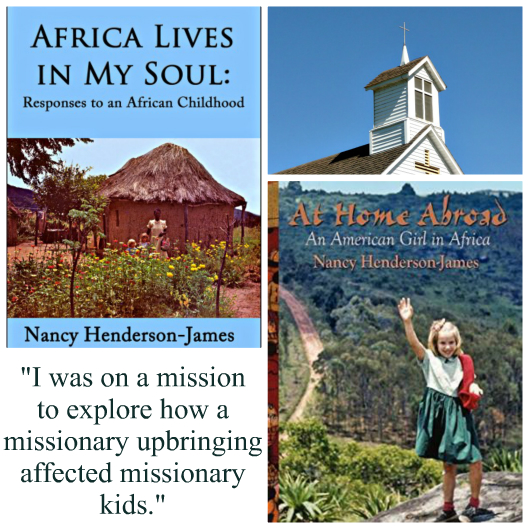
The author of an acclaimed Third Culture Kid memoir At Home Abroad: An American Girl in Africa, about her childhood in Africa, Nancy has received honors from the Southern Women Writers Conference and the North Carolina Writers’ Network.

* * *

Welcome, Nancy. I’ve outlined some of your story already because I’d like to begin at the point where, after having “repatriated” with your mother and siblings to Tacoma, Washington, you were basically left on your own. Your older sister went to college and your mother took your younger siblings back to Angola to be reunited with your father. You, meanwhile, attended a high school in Tacoma for your senior year, living with a family you knew from church. In both your memoir and essay in the anthology Writing Out of Limbo, you write eloquently about the yearning you felt for family connection and “home,” which you sometimes confused with a need for spiritual connection. How do you define “home” now?
Thank you for inviting me, Lisa. The advantage of aging is the ability to look back and see how seemingly random decisions have knit into a coherent pattern. It is obvious to me now that a drive to create family and community has led me through life. Most recently it has manifested in the decision my husband and I made to form and move into a cohousing community in downtown Durham, North Carolina, called Durham Central Park Cohousing Community. Cohousing offers some of the best aspects of growing up as a missionary kid, such as sharing resources, supporting fellow community members, and working together toward a shared vision. Our urban condo community sometimes reminds me of the good times I had living in dorms. Of all my living situations growing up, dorms were the most congenial. Now the coho feels very much like home.

Were you happiest in a certain place at a certain time, and if so, why?
Zeroing in on one place and time is a challenge for me. With the exception of the years immediately after reentry to the United States when I was caught up in culture shock, almost every place I’ve lived has had its happy times. For pure unconscious happiness, my early years in Lobito, living with my family, swimming on the beach across from the house every day, and absorbing the cultural mix of the small city has to qualify. My children’s growing up years gave me the satisfaction of family. And now in my older years, settled into cohousing, I find the challenge of working with 38 other residents draws on my strengths and tests me in ways that help me grow.

“I had landed in the middle of my own mystery…

Do you identify most with a particular culture or cultures, or with people who have similar interests and perhaps similar cross-cultural backgrounds?  
My antenna immediately goes up when I hear someone talking about living in another country, whether as a child or adult. I attribute all sorts of wonderful characteristics to her, not always with good reason! I’ve spent decades reconciling to American culture and I am most of the way there. I married an American man who had not traveled much until I showed him its virtues. I have two American sons who have absorbed the best of American culture, contribute to it in the fields of affordable housing and community organizing, and bring me great happiness. That said, I pay special attention to what is happening in Angola and Portugal. I try to keep up my Portuguese and recently have had wonderful contacts via Facebook with young Angolans. I attend reunions of those who also grew up in Angola, at times the only way to know what is happening there since newspapers rarely cover Angola.

Did your TCK upbringing inform your choice to become a writer and memoirist?  Conversely, did writing the memoir and the essay for Writing Out of Limbo help you to process your TCK upbringing?
Both are true. Reading Mary Wertsch’s Military Brats in my 40s launched me on a mission, so to speak, to explore how a missionary upbringing affected missionary kids, or MKs, in the way that the military affected military brats. I found countless correspondences. The responses to the questionnaire I sent out—which were compiled in Africa Lives in My Soul: Responses to an African Childhood —provided rich sources for contemplating my life. The honesty and willingness of other missionary kids to respond affected me deeply and brought back memories of similar experiences I had had. Writing a memoir seemed like the logical next step. Faith Eidse helped me along the way by including my essay in Unrooted Childhoods, the memoir anthology she and Nina Sichel edited. Her confidence in my work was invaluable.

Missionary kids

…the mystery of life, really.”

It sounds like writing became part of the fabric of your life.
Writing continues to supply food for inquiry and expression. Our cohousing community has a small group of writers and artists that meets weekly to create and share. The group motivates me to write and provides helpful feedback. I also co-edit our monthly e-news.

What made you decide to settle in Durham and become a librarian?
We moved to Durham when my husband decided to attend Duke University’s graduate health administration program in 1974. As the wage earner with a newly minted library degree, I found a job working as a high school librarian—strange since I had hated attending American high school. Despite that, I worked at Jordan High School for 25 years and then for another five years at the UNC Children’s Hospital School (for children with chronic illnesses), as their first librarian.

Were you an avid reader as a kid, like so many TCKs?
As a child I was much more attracted to the outdoors (riding my bike, running, swimming) than reading inside. But when I graduated from high school I realized how much I didn’t know and started reading.

As an ATCK, do you have “itchy feet,” which still make you want to move frequently?
ATCKs seem to respond in two opposite fashions…to want to move frequently or to stay put. I discovered early on that I am in the second camp. I was a thrilled high school senior when President Kennedy announced the Peace Corps, certain I would join after college. But when the time came, I chose graduate school stateside to maintain ties with my boyfriend and his family, since my family still lived in Angola. The need for connection trumped the need for adventure. I have never lived outside the United States since leaving Africa in 1961. That said, I do travel for pleasure and took my sons on trips abroad, including on my first return trip to Angola after 44 years.

Never lived outside US

Your memoir, At Home Abroad: An American Girl in Africa, was well received. The chapter included in Unrooted Childhoods is gorgeous and haunting, and I love how you talk about the importance of language. (I agree! I think the ability to communicate trumps nationality, race, gender, religion, etc., in terms of person-to-person contact.) Where else may readers find your wonderful published writing?
My recent publications have been essays:

I’m currently working on another memoir that focuses on the many mothers and fathers who passed through my life growing up.

* * *

Thank you for sharing your story with us, Nancy! Readers: you may learn more about Nancy Henderson-James and her writings at her author site. And don’t forget to check out her books: At Home Abroad and the anthology, Africa Lives in My Soul. If you have any questions or comments for Nancy, be sure to leave them below.

Editor’s note: All photos of Africa are from Nancy Henderson-James’s Flickr albums; other photos (of the Tacoma school and the library) are from morguefiles. The quotes are from Nancy’s memoir (see excerpts).

Elizabeth (Lisa) Liang is a prime example of what she writes about in this column: an Adult Third Culture Kid working in a creative field. A Guatemalan-American of Chinese-Spanish-Irish-French-German-English descent, she is an actor, writer, and producer who created the solo show Alien Citizen: an earth odyssey, which has been touring internationally. And now she is working on another show, which we hope to hear more about soon! To keep up with Lisa’s progress in between her columns, be sure to visit her blog, Suitcasefactory. You can also follow her on Twitter and on Facebook.

STAY TUNED for next week’s fab posts!

If you enjoyed this post, we invite you to register for The Displaced Dispatch, a round up of weekly posts from The Displaced Nation, and so much more! Register for The Displaced Dispatch by clicking here!

Related posts:

BOOKLUST, WANDERLUST: 11 Expat- and Travel-themed Books to Expand Our Horizons in 2016

booklust-wanderlust-2015

Attention displaced bookworms! Our book review columnist, Beth Green, an American expat in Prague (she is also an Adult Third Culture Kid), is back with her personal picks for expat- and travel-themed books to watch for in 2016.

Hello again, Displaced Nationers!

It’s been quite a long time since I last wrote to you here. Since my last column we’ve started 2016, celebrated the beginning of the Year of the Monkey, written and revised our new year’s resolutions, and (hopefully) read some really great books!

As part of my own (ever-evolving) New Year’s resolutions I signed up for the Goodreads Reading Challenge. It’s currently showing that I’m 22 books behind schedule for my overly optimistic goal of 300 books this year—but, hey, it wouldn’t be a challenge if it was easy, right?

Screen Shot 2016-02-11 at 7.33.56 PM
Now, usually in this column I talk about books I’ve already read, but this month I’d like to highlight some that I haven’t. There are, of course, lots of intriguing books coming out this year—more than I can cover adequately in one column! But, of the expat- or international-themed books coming out in 2016 that caught my eye, I’ve chosen 11 to feature in this post, one for each month left in 2016. Take a look!

* * *

Beginning with…a Thriller and a Mystery

CambodiaNoir_cover_300x200Cambodia Noir, by Nick Seeley (March 15, 2016)
The debut novel from an American journalist who has been working out of the Middle East and Southeast Asia, Cambodia Noir is a thriller that I’ve had on my to-be-read list ever since I first heard about it. The plot: A young American woman who is working as an intern at a local paper in Phnom Penh, June Saito, disappears. Her sister hires a retired photojournalist with first-hand knowledge of the corrupt, dissolute ways of the Cambodian capital, to look for her. Author Nick Seeley got his start as a foreign correspondent in Phnom Penh. He’s been hailed as a “fresh voice” exploring the depths of the Far East’s underworld.


InspectorSinghInvestigates_cover_300x200Inspector Singh Investigates: A Frightfully English Execution, by Shamini Flint (April 7, 2016)
Always the fan of international crime fiction, I’m excited that one of my favorite series—a series of charming crime novels featuring the portly, lovable Sikh policeman Inspector Singh—is getting a new addition this year. Author Shamini Flint is sending Singh to Britain Diary of a Tennis Prodigy_cover_300x200in the seventh book in her series. Each book provides not only a puzzle for the reader to solve but also a close-up look at the locations where the books are set. This is the Inspector’s first time out of Asia, and I’m looking forward to seeing what he discovers in the UK.

And, a special note for readers with kids: on January 1 Flint, who is a Singapore-based Malaysian, published a middle-grade book, Diary of a Tennis Prodigy, with illustrator Sally Heinrich (Sally formerly lived in Singapore and Malaysia but is now based in Adelaide, Australia).

And Now Let’s Add Three Travel Memoirs…

No Baggage_cover_300x200No Baggage: A Minimalist Tale of Love and Wandering, by Clara Bensen (January 5, 2016)
I love memoirs that read like novels, as I’m hoping this one will! Recovering from a quarter-life meltdown, 25-year-old Bensen signs up for an online dating account, and to her surprise, ends up meeting Jeff, a university professor who proposes they take a three-week experimental trip spanning eight countries, with no plans or baggage. Her story resonates with the adventurer in me—I can’t wait to take a look.


Little Dribbling_cover_300x200The Road to Little Dribbling, by Bill Bryson (January 19, 2016)
It may already be old news to anyone who’s been in a bookstore recently—or read our Displaced Dispatch!—but the world’s favorite traveler, humor writer and expat, Bill Bryson, has a new travelogue out. It’s another of his road-trip books. (I much prefer these to his other writings such as A Short History of Nearly Everything and At Home—they started out great, but I ended up leaving them unfinished…) Bryson made a journey through Britain 20 years ago, which was forever immortalized in his bestselling classic, Notes from a Small Island. In Little Dribbling, he follows the “Bryson line” from bottom to top of his adopted home country. I’m looking forward to being in his company again.


In Other Words_cover_300x200In Other Words, by Jhumpa Lahiri (and translations by Ann Goldstein) (February 9, 2016)
As a London-born Indian-American, world-class novelist Jhumpa Lahiri excels at writing in English—yet has long harbored a passion for the Italian language. Not wanting to miss out, she moved her family to Rome to immerse herself and quickly reached a point where she was writing only in Italian. She kept a journal in Italian that has evolved into this dual-language memoir. As an expat who’s now tried to learn three foreign languages while abroad, I’m curious to see how Lahiri’s experiences match up to my own. (The critics would apparently like to see her go back to English!)

…Along with Two Works of Literary Fiction and a Harlequin Romance

WhatBelongstoYou_cover_300x200What Belongs to You, by Garth Greenwell (January 19, 2016)
An American professor working in Sofia, Bulgaria, hooks up with a male prostitute in a public toilet and slowly becomes more involved than he anticipated. Reviewers cite Greenwell’s lyrical prose as reason alone for picking up his debut novel, but I’m interested in seeing how this young writer—who himself once worked as an expat English teacher in Bulgaria—depicts the city and the relationships between locals and foreigners. (This book, too, was mentioned in a recent Displaced Dispatch.)


TheHighMountainsofPortugal_cover_300x200The High Mountains of Portugal, by Yann Martel (February 2, 2016)
Going over this years’ publishers lists, I’m now looking forward to reading a book by an author whose last book I despised. My friends were all gushing over Yann Martel’s 2002 novel Life of Pi; but, while it has an admittedly awesome premise, the story left me cold. But I’m excited to check out the chronically traveling Canadian author’s next book, which is set in Portugal and intertwines the century-spanning stories of a young man reading an old journal, a mystery-loving pathologist, and a Canadian diplomat. I’m planning a trip to Lisbon later this year, and hope to read this book before I go.


UndertheSpanishStairs_cover_300x200Under the Spanish Stars, by Alli Sinclair (February 1, 2016)
I’m pleased to report that former expat Alli Sinclair—my friend and former co-blogger from Novel Adventurers—has published her second romantic mystery novel this month. (Congratulations, Alli!) The action takes place in her native Australia and also in Spain. The plot: an Australian woman travels to her grandmother’s homeland of Andalucía to unravel a family mystery. She ends up meeting a passionate flamenco guitarist and learns her grandmother’s past is not what she imagined.

Finally, to Top Things Off, How About a Couple of YA Books?

I don’t read a lot of young adult books, but descriptions of two novels I saw reviewed recently stuck with me. Funnily enough, both books’ titles start with “Up”—maybe it’s the implied optimism that caught me? We could use a bit of cheer in our displaced world…

Up from the Sea_cover_300x200Up from the Sea, by Leza Lowitz (January 12, 2016)
This is a novel in verse. It tells the story of a Japanese teenager, Kai, whose coastal village is obliterated by the March 2011 tsunami, after which he is offered a trip to New York to meet children who had been affected by the terrorist attacks of 9/11. The trip also provides an opportunity for him to go in search of his estranged American father. Author Leza Lowitz is an American expat writer and translator living in Tokyo, where she also runs a popular yoga studio. Her favorite themes to explore in her writing include the idea of place, displacement and what “home” means to expatriate women.


UPtothisPointe_cover_300x200Up to this Pointe, by Jennifer Longo (January 19, 2016)
I’m always fascinated by stories of Antarctica so have my eye on this book about a teenage girl who aspires to be a professional ballerina but, when her grand plan goes awry, sets out on an expedition to McMurdo Station (the U.S. Antarctic research center) in the footsteps of her relative and explorer Robert Falcon Scott. Notably, Seattle-based author Jennifer Longo wanted to be a ballerina until she finally had to admit that her talent for writing exceeded her talent for dance. Like me, she harbors an obsessive love of Antarctica. I admire the way she has woven these two themes together!

* * *

So, Displaced Nationers, what do you think? What are you looking forward to reading this year? Any much-anticipated displaced reads that should be added to my list?

As always, please let me or ML know if you have any suggestions for books you’d like to see reviewed here! And I urge you to sign up for the DISPLACED DISPATCH, which has at least one Recommended Read every week.

STAY TUNED for more fab posts!

Beth Green is an American writer living in Prague, Czech Republic. She grew up on a sailboat and, though now a landlubber, continues to lead a peripatetic life, having lived in Asia as well as Europe. Her personal Web site is Beth Green Writes. She has also launched the site Everyday Travel Stories. To keep in touch with her in between columns, try following her on Facebook and Twitter. She’s a social media nut!

If you enjoyed this post, we invite you to subscribe to The Displaced Dispatch, a weekly round up of posts from The Displaced Nation and much, much more. Sign up for The Displaced Dispatch by clicking here!

Related posts:

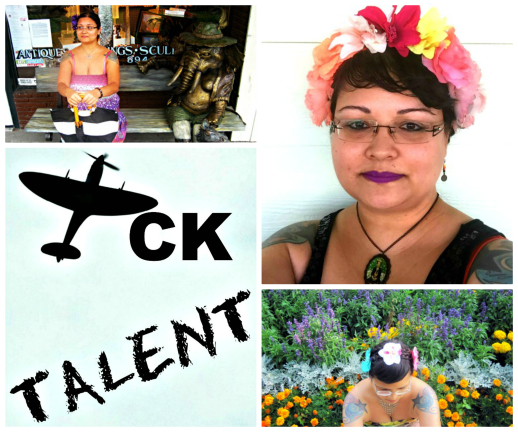
TCK TALENT: Sezín Koehler, multimedia artist, tatoo collector, editor and prodigious writer

Columnist Elizabeth (Lisa) Liang starts off 2016 with a guest who has been to the Displaced Nation before, albeit in different guises: as Alice, as film critic, as featured novelist, as repatriate…though never as a TCK Talent.

Happy 2016, readers! I hope your January has been splendid thus far. Today’s interviewee is writer, editor, tattoo collector, and Huffington Post contributor Sezín Koehler, who also calls herself Zuzu (a nickname she picked up when living in Prague). Sezín may already be familiar to some Displaced Nation readers as an early contributor, including a two-part series listing films that depict the horrors of being abroad, or otherwise displaced; a much-commented upon post called “The Accidental Repatriate”; and an Alice-in-Wonderland-themed post on her life in Prague (that was after she had received one of the Displaced Nation’s very first “Alice” awards).

But what some of you may not know is that Sezín is a Third Culture Kid. She was born in Colombo, Sri Lanka, to a Sri Lankan dad and Lithuanian-American mom. Her mom’s job with UNICEF moved the family from Sri Lanka to Zambia, Thailand, Pakistan, and India.

Sezín went to college in California—and then returned to her family, who were living in Switzerland and then in France (the move again being due to her mom’s job).

Next Sezín moved alone to Spain, where she met her husband, who is American. After living as expats in Turkey, Czech Republic, and Germany, the couple now call Lighthouse Point, Florida, home.

* * *

Welcome, Sezín. What a truly peripatetic life you’ve had! What made you decide to “repatriate” to the USA and come to Lighthouse Point? 
This area is where my husband grew up and has family, although his family moved further north just this year. Economics and a series of unfortunate events are what brought me back to the US—my husband and I returned with literally 15 euros between us.

Sounds like a tough reentry. While living as a nomad can also be tough, were you happiest in a certain place?
That’s a surprisingly difficult question! There was a lot of conflict in my family when I was growing up because of the tension between my American mum and conservative Sri Lankan dad—and all the cultural, social, etc., issues that come with having a multicultural and multiracial family before that became something of the norm. Plus, moving all the time was not a lifestyle that worked for me, and it created uncomfortable cycles of depression that were then compounded by having post-traumatic stress disorder (PTSD) after witnessing the murder of one of my best friends in our final year of university. The repatriation to Florida was one of the more miserable moves—especially since I had never planned to move back to the United States until they sort out more effective gun-control laws.

That sounds terribly painful. How have you coped since your return to the US?
My first two years back made me completely despondent, and then one day I just decided to make the best of the situation. It was time to choose happiness; otherwise I wasn’t going to survive. So now every day I wake up and I find something—big or small—to be happy about and I focus on that for the day. In that sense, and in a strange reversal, I suppose Florida is where I find myself happiest because this is where I learned that happiness isn’t something that happens to me passively because life is perfect. Happiness is a daily choice. And I actively make the choice to be happy however difficult my surroundings.

“That feeling of being an outsider never quite leaves you…”

Do you identify most with a particular culture or cultures, including the very broad “TCK culture”? 
You know, I think I identify with aspects of pretty much every culture under the sun—even ones where I didn’t actually live or visit. Being highly sensitive, coupled with having a TCK upbringing, has made it so I can identify with just about anyone who isn’t a bigot or misogynist, even if our backgrounds are nothing alike. I do find myself particularly drawn to other TCKs because, even if we didn’t live in the same places, there is something about the “universal” TCK personality that resonates with me, and it’s far easier to start on the same page rather than having to work hard to build bridges of understanding between myself and people who haven’t traveled or grown up abroad. I also find that many TCKs understand that just because growing up abroad sounds exciting, it might not have actually felt that way when we were getting yanked from place to place, leaving friends and family behind in those pre-social-media Dark Ages.

Did your TCK upbringing inform your career path as a writer?
To be honest, with all the moving around plus PTSD, it’s been hard to develop a career track other than writing. Being a writer means you take your passion with you wherever you go, and no matter where you are, there is always something new to write about. Writing has been my longest-standing support system and therapy through the variety of traumas that ended up shaping my life, and any day now I hope I’ll start being able to make a living doing it. 🙂

Did growing up as a TCK also influence your career as an editor?
As an editor I focus on academic writing by non-native English speakers, and having lived in so many places has definitely helped me understand all the different (incorrect) ways people use English and help them to get published in English-language publications where English fluency is a requirement.

“As a Third Culture Kid, I always related with monsters more than ‘norms.'”

Tell us about your tattoo collection. Any TCK connections there?
Other than my husband, tattoos are one of the great loves of my life. Tattoos for me have been a way to not just express myself creatively, but have also been a way to re-claim my own body after so many traumas. I have a hybrid identity that I often express in fantastical ways. Sometimes when people ask me where I’m from and I don’t feel like having an intimate conversation about my life I’ll say I’m a mermaid and I’m visiting from the ocean. I have a huge jellyfish on my right thigh and I say, “Meet my pet jelly.” Now that my hair is in a pixie cut, I might introduce myself as a fairy and since I actually have tattooed wings on my shoulders as well as often literally leaving a trail of glitter in my wake, I find it easier than getting into my TCK identity—especially when the person I’m talking to might have never left this corner of Florida.

Keep Calm & Be a Mermaid

So in a way, the tattoos serve as both explanation and protection.
For my entire life I’ve operated under an assumption of otherness—when I’m in the US people ask me where I’m from, and when I’m in Sri Lanka people ask me where I’m from. Being mixed race can be really complicated—and I get a lot of aggression from strangers who try to figure out “what” I am. In a way tattoos are a shield between me and curious eyes, as is much of my performance-of-the-fantastical-self art and being.

Have any of these careers/interests helped you to process your nomadic upbringing?
Writing, definitely! Writing has been my most effective and longest-standing therapeutic tool. Not just my non-fiction, but also my short stories and my novels have most certainly helped me situate my cultural self in lots of different ways that have been helpful and healing. As a writer I’m also an avid reader, and reading is another huge help in figuring out where my strange background and I fit in the grander scheme of culture and society.

“I revel in my boundaryless self…”

As an ATCK, do you have “itchy feet,” or would you prefer to have a home base and only travel for pleasure?
I have always hated moving and I might be the only TCK to say I have never had itchy feet. Ever since I was a little girl all I wanted was to stay in one place and even now at 36 I feel that way. But because of how I grew up moving around, I’ve also come to a point where everywhere seems pretty much the same—I always see the same kinds of people in disparate places, it’s weird—and yet nowhere ever feels like home. So now my concept of home has shifted and simply means being somewhere with people I love.

Moving is one thing, but how do you feel about traveling in general, including for pleasure?
After a lifetime spent on airplanes and traveling, I absolutely hate traveling now. I have crippling aerophobia, and if I’m forced to travel somewhere by plane, everything about the experience is miserable and I end up getting really ill before, during, and after. I find going to new places more stressful than enjoyable. My dream is one day to have a house with a beautiful view and some rescue dogs and never go anywhere ever again. Except through books, of course.

Speaking of books, you published your first novel, American Monsters, four years ago, and I understand the sequel has just come out!
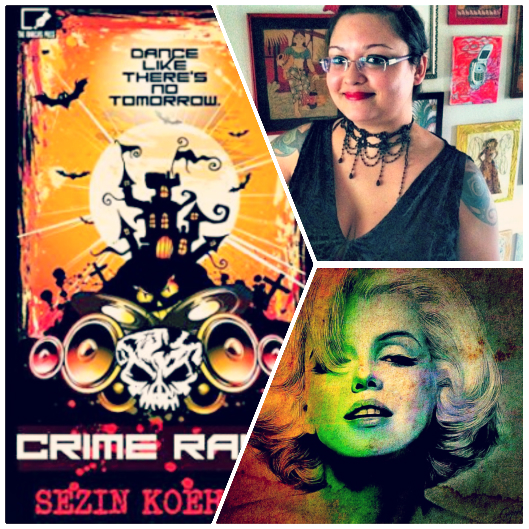
Yes indeed! My second novel, Crime Rave, came out in October 2015, and I don’t think I’ve ever been prouder of one of my creations in my life. Going back to your question about how being a TCK has shaped my writing, this book is a perfect example. The story itself defies genres—it has crime noir, supernatural, horror, and feminist themes just to name a few—and most of my characters are either mixed race or people of color who are not only TCKs themselves or ethno-cultural hybrids, but they’ve all gone through traumas that resulted in superpowers. If there was a label of Third Culture Fiction, my book would totally fit the bill.

The number of novels you have in progress, on top of what you’ve had published, is wildly impressive! Please tell us about them.
Thank you so much, Lisa. I’m currently working on my third, fourth, fifth, and potentially sixth novels—the third is a zombie tale set in Prague, the fourth will find recurring Crime Rave characters on Pine Ridge Reservation in South Dakota, Lighthouse Terror will be a grindhouse horror novel set in a gated community in southeast Florida, and finally I’m toying with the idea of an entire novel about Marilyn Monroe.

Yes, I know you are a big Marilyn fan. I believe she makes an appearance in Crime Rave?
Yes, in Crime Rave she not only lives but has a daughter.
Crime Rave Marilyn
What else are you working on?
As a HuffPost freelancer I’m working on a number of pieces featuring interviews with some badass individuals—authors, activists, artists, scientists, and more. I’m also in the process of starting my own publishing label that will focus on works by women and other marginalized writers who create genre-bending works in which women play all the major roles.

You’re so prodigious!
The one benefit of being an accidental shut-in who works from home here in Lighthouse Point is that I have nothing but time to work on all the creative projects I want, which is another dream come true.

Where can we find your work and follow your progress?
At sezin.org, my HuffPost column, my American Monsters site, and sezinkoehler.com. I’ve also recently revamped my Etsy store, Zuzu Art, with its gallery of sparkly-strange multimedia Alice in Wonderland and Frida Kahlo-inspired pieces. I have a Tumblr cabinet of curiosities called Hybrid/Monster that I continue to update with oddities of the visual nature, and I am rather fond of my Instagram account, where I post pics of my own art, my performance art, and snapshots of life in the tropics. Whew! I didn’t realize how much I produce online until this very moment.

* * *

Thank you so much, Sezín! I’m inspired to know that your artistic path has led to your healing, and that you’ve found daily happiness since the painful reentry to the United States. Congratulations on your many creative, career, and personal accomplishments! Readers, please leave questions or comments for Sezín below.

Editor’s note: All photos are from Koehler’s Hybrid Monsters site (apart from her book cover and the photo of one of her Etsy works) or from Pixabay. The quotes are from her “About the Curatrix” page.

Elizabeth (Lisa) Liang is a prime example of what she writes about in this column: an Adult Third Culture working in a creative field. A Guatemalan-American of Chinese-Spanish-Irish-French-German-English descent, she is an actor, writer, and producer who created the solo show Alien Citizen: an earth odyssey, which has been touring internationally. And now she is working on another show, which we hope to hear more about soon! To keep up with Lisa’s progress in between her columns, be sure to visit her blog, Suitcasefactory. You can also follow her on Twitter and on Facebook.

STAY TUNED for next week’s fab posts!

If you enjoyed this post, we invite you to register for The Displaced Dispatch, a round up of weekly posts from The Displaced Nation, and so much more! Register for The Displaced Dispatch by clicking here!

Related posts:

IN CASE YOU MISSED IT: Best of expat fiction 2015

The title of this post is a lie: you didn’t miss anything. It’s we who missed our deadline of publishing, at the end of 2015, a list of books for, by and about expats.

Dare I suggest that our procrastination could prove fortuitous? Most of us have more time to read now that the holidays are over and the doldrums have set in—along with, for some of us (I refer to those on the East Coast of the USA), a spell of blizzardous weather. What better time to curl up with a book that in some way relates to the themes of international adventure and displacement?

Without further ado, allow me to offer my curated list of the best novels by, for, and about expats and other international creatives in 2015. (Nonfiction coming soon, we promise!)

PLEASE NOTE: The books, which include indie as well as traditionally published novels, are arranged in reverse chronological order.

* * *

Year of the GooseYearoftheGoose_cover_400x (Unnamed Press, December 2015)
Author: Carly J. Hallman
Expat credentials: A native Texan, Hallman lives in Beijing. This is her first novel.
Synopsis: A comic novel about China’s era of the instant tycoon, which has been described as “unhinged”, “outrageous”, “deranged” and “hilarious. The oligarchical, tabloid-driven society it portrays is not unlike our own, which may be why the book was listed as one of the BBC’s 10 books to read in December 2015 as well as selected for the December 2015 Indie Next list.
How we heard about: The Anthill blog


TheNavyWife_cover_400xThe Navy Wife (December 2016)
Author: Helena Halme
Expat credentials: Originally from Finland, Halme has lived in the UK with her British husband for many years.
Synopsis: The sequel to Halme’s well-received autobiographical novel The Englishman (reviewed here by Displaced Nation founder Kate Allison), which concerns a long-distance romance between a Finnish woman, Kaisa, and a British naval officer, Peter. We see the couple, despite having tied the knot, facing a number of obstacles and threats to living happily ever after—especially when Kaisa doesn’t take well to the life of a military spouse in a foreign country.How we heard about: Social media, and a comment by Halme on one of our posts.


Seafled_cover_400xSeafled (November 2015), Burnt Sea (August 2015) & Seaswept (April 2015)
Author: Jordan Rivet (aka Shannon Young)
Expat credentials: An American, Young has lived in Hong Kong for the past few years with her half-Chinese husband, a Hong Kong native.
Synopsis: A post-apocalyptic adventure series set on a souped-up cruise ship, featuring a prickly female mechanic named Esther. The series, called the Seabound Chronicles, consists of three books and a prequel.
How we heard about: Young writes the popular “Diary of an Expat Writer” column for the Displaced Nation.


TheJapaneseLover_cover_400xThe Japanese Lover (Atria Books, November 2015)
Author: Isabel Allende
Expat credentials: Born in Lima, Peru, to a Chilean diplomatic family, Allende lived in various countries, including Chile, Bolivia, and Beirut. As an adult she worked in Belgium and elsewhere in Europe; she also lived for over a decade in Venezuela. She currently lives in San Rafael, California.
Synopsis: A cross-cultural love story that sweeps from present-day San Francisco to WWII-era Poland the United States. It explores questions of identity, abandonment, and redemption.
How we heard about it: Who hasn’t heard about it? It was one of the most anticipated books of 2015!


TheDisobedientWife_cover_400xThe Disobedient Wife (Cinnamon Press, November 2015)
Author: Annika Milisic-Stanley
Expat credentials: Born to Swedish and Anglo-German parents, Milisic-Stanley grew up in England and now lives in Rome. She says she based the plot on stories she heard when living in Dushanbe as a humanitarian aid worker for several years.
Synopsis: The story of the friendship that forms between a poor, courageous local woman in Dushanbe, Tajikistan, and her employer, a trailing expat wife married to a British diplomat.
How we heard about: An interview with Kristin Louise Duncombe, an American writer who has lived in Europe since 2001.


CrimeRave_cover_400xCrime Rave (The Margins Press, November 2015)
Author: Sezin Koehler
Expat credentials: Koehler is an adult Third Culture Kid who lived in Prague for some years and now lives in Florida. She has written several posts for the Displaced Nation, including a two-part series listing movies that depict the horrors of being abroad or otherwise displaced.
Synopsis: The second installment to her debut novel, American Monsters. Picking up where that one left off while jumping genres, the new book presents an alternate universe in which goddesses have free reign over humans, trauma goes hand in hand with superpowers, and Marilyn Monroe lives.
How we heard about: A Facebook post by Koehler


ADecentBomber_cover_400xA Decent Bomber (November 2015)
Author: Alexander McNabb
Expat credentials: A Brit who has been working in, living in and traveling around the Middle East for some thirty years, McNabb was featured on The Displaced Nation three years ago for his “Levant Cycle” trilogy.
Synopsis: Another political thriller—but this one is set in Northern Ireland and concerns a former IRA bomb maker who is drafted against his will into joining the War on Terror.
How we heard about: He sent us a heads up, and Beth Green reviewed the book in her last column. She found it well researched, well written and an enjoyable read.


ThePalestInk_cover_400xThe Palest Ink (Lake Union Publishing, October 2015)
Author: Kay Bratt
Expat credentials: Bratt lived in China for almost five years, where she “fell in love enough with the people to want to write about them forever.” She has since repatriated to the hills of North Carolina. (She is also the author of a memoir, Silent Tears: A Journey of Hope in a Chinese Orphanage. )
Synopsis: A story that depicts the coming-of-age of a sheltered son from an intellectual family in Shanghai, during a tumultuous period of Chinese history: the Cultural Revolution.
How we heard about: Kindle promotion.


Olivia&Sophia_cover_400xOlivia & Sophia (Monsoon Books, October 2015)
Author: Rosie Milne
Expat credentials: A native Brit, Milne has lived all over Asia; she currently lives in Singapore, where she runs the Asian Books Blog.
Synopsis: A fictional account of the lives of the first and second wives of the founder of the British trading post of Singapore, Sir Thomas Stamford Raffles. Set in London, Java, Sumatra and Singapore, against the backdrop of the Napoleonic Wars—the story takes the form of two fictionalized diaries, one by each of Raffles’s wives: Olivia Devinish and Sophia Hull. Milne “takes us away from the cold, damp confines of Georgian London to the muggy, hostile tropics and to the titillations and tribulations of a life far away from home.”
How we heard about: When Rosie Milne was “wonderlanded” on our site, we published a couple of excerpts from the book.


NowhereChild_coverNowhere Child (Black Dot Publishing, October 2015)
Author: Rachel Abbott
Expat credentials: Abbott fled from the corporate life to Italy, which gave her the opportunity to start writing psychological thrillers. Her first one was a break-out hit on Kindle, and she hasn’t looked back. Currently, Abbott divides her time between Italy (where she lives in an apartment in an old fort, which overlooks the sea) and Alderney, in the Channel Islands (just off the coast of France). But although the expat life gave her a new career as a writer, Abbott sets her books mostly in her native Manchester.
Synopsis: A stand-alone novella featuring the same characters as Abbott’s Stranger Child. Eight months ago Tasha Joseph ran away, and her stepmother, Emma, has been searching for her ever since—as are the police, since Tasha could be a vital witness in a criminal trial.
How we heard about: Lorraine Mace interviewed Abbott for her Location, Locution column in December.


TheHundredYearFlood_cover_400xThe Hundred-Year Flood (Little A, September 2015)
Author: Matthew Salesses
Expat credentials: Salesses was adopted from Korea at the age of two and often writes about race and adoption. This is his first full-length novel.
Synopsis: The mythical and magical story of a 22-year-old Korean-American’s escape to Prague in the wake of his uncle’s suicide and the aftermath of 9/11. He tries to convince himself that living in a new place will mean a new identity and a chance to shed the parallels between himself and his adopted father.
How we heard about: Social media


TheDressmaker_cover_400xThe Dressmaker (Penguin Books, August 2015*)
Author: Rosalie Ham
Expat credentials: Born and raised in Jerilderie, Australia, Ham now lives in Melbourne. Like most Australians, she has had a period of traveling and living overseas.
Synopsis: A darkly satirical tale of love, revenge, and 1950s fashion. After twenty years spent mastering the art of dressmaking at couture houses in Paris, Tilly Dunnage returns to the small Australian town she was banished from as a child. She plans only to check on her ailing mother and leave. But Tilly decides to stay, and though she is still an outcast, her exquisite dresses prove irresistible to the prim women of Dungatar. Note: The book is soon to be a film starring Kate Winslet and Liam Hemsworth.
How we heard about: A book review in the New York Times
*Originally published in 2000, this is the film adaptation of the book.


CirclingtheSun_cover_400xCircling the Sun (Ballantine Books, July 2015)
Author: Paula McLain
Expat credentials: None! Her breakout novel, The Paris Wife, was about an expat: Ernest Hemingway’s first wife, Hadley Richardson, whose passionate marriage ended as her husband shot into literary stardom. This time her focus is the Happy Valley set, a decadent community of Europeans in 1920s colonial Kenya. As she told NPR in a recent interview:

You know, I wrote most of The Paris Wife in a coffee shop in Cleveland. I don’t have to tell you that a Starbucks in Cleveland is about as far away from a Parisian cafe as you can possibly get. And I also wrote about Kenya, the wild African frontier, from my home in Cleveland without having ever gone there. You can’t really visit colonial Kenya, can you? You can’t really visit Paris in 1922, except in your imagination.

Synopsis: Based on the real-life story of the fearless and captivating Beryl Markham, a record-setting aviator who became caught up in a passionate love triangle with safari hunter Denys Finch Hatton and Karen Blixen, who as Isak Dinesen wrote the classic memoir Out of Africa.
How we heard about: A New York Times review by the expat writer Alexandra Fuller.


TheAmbassadorsWife_cover_400xThe Ambassador’s Wife (Doubleday, July 2015)
Author: Jennifer Steil
Expat credentials: A Boston-born former journalist, Steil is married to a Brit who once served as ambassador to Yemen, where a suicide bomber attacked him. She is also the author of The Woman Who Fell from the Sky, a memoir about her experiences running a newspaper in Yemen. She lives in Bolivia, where her husband is the European Union ambassador.
Synopsis: A harrowing account of the kidnapping of an American woman in the Middle East and the heartbreaking choices she and her husband, the British ambassador to an Arab country, must make in the hope of being reunited.
How we heard about: Shortlisted in the New York Times Book Review as a “marriage plots” novel.


TheStarSideofBurnHill_cover_400xThe Star Side of Bird Hill (Penguin Press, June 2015)
Author: Naomi Jackson
Expat credentials: A Third Culture Kid, Jackson was born and raised in Brooklyn by West Indian parents. After attending the Iowa Writers’ Workshop, she traveled to South Africa on a Fulbright scholarship and earned an MA in creative writing from the University of Cape Town.
Synopsis: The story of two sisters, ages ten and sixteen, who are suddenly sent from Brooklyn to Bird Hill in Barbados after their mother can no longer care for them. The young Phaedra and her older sister, Dionne, live for the summer of 1989 with their grandmother Hyacinth, a midwife and practitioner of the local spiritual practice of obeah.
How we heard about: Shortlisted in the New York Times Book Review as a “coming of age” novel.


TheWolfBorder_cover_400xThe Wolf Border (Harper, June 2015)
Author: Sarah Hall
Expat credentials: Born in northwest England, Hall lived in Wales while attending Aberystwyth. She went on to study in Scotland (St. Andrews) for an MA, where she met and married an American law student. Though the marriage was short-lived, its legacy was substantial: a move to the US proved the catalyst she needed to embark on novel writing. The pair was based in the small town of Lexington, Virginia, after her husband was awarded a scholarship to a nearby law school. At that time, Hall visited the Idaho reservation that appears in this book. She currently lives in Norwich, UK.
Synopsis: About a controversial scheme to reintroduce the Grey Wolf to the English countryside, which brings zoologist Rachel Caine, who has lived a solitary existence in a remote section of Idaho, far away from her estranged family in England, back to the peat and wet light of the Lake District. The novel explores the fundamental nature of wilderness and wildness—as well as the frontier of the human spirit.
How we heard about: A book review in the New York Times


IntheCountry_cover_400xIn the Country: Stories (Knopf, June 2016)
Author: Mia Alvar
Expat credentials: Born in the Philippines, Alvar was raised in Bahrain and the United States. She now lives in New York City. This is her first book.
Synopsis: A collection of nine short stories about Filipinos living overseas. Alvar has imagined the lives of exiles, emigrants, and wanderers who uprooted their families from the Philippines to begin new lives in the Middle East, the United States, and elsewhere—and, sometimes, turned back again.
How we heard about: A book review in the New York Times


TheDiversClothesLieEmpty_cover_400xThe Diver’s Clothes Lie Empty (Ecco, June 2015)
Author: Vendela Vida
Expat credentials: Born and raised in San Francisco, Vida is the daughter of two immigrant parents: a Swedish mother and a Hungarian father. She has become known for producing “travel trauma” narratives, exploring the lives of competent women who feel disintegrating marriages for distant lands (i.e., the Philippines, Finland and Turkey). Her latest novel, considered to be her “finest work” to date, was inspired by a trip she took to Morocco where her bag was stolen.
Synopsis: A literary thriller that probes the malleability of identity, told with lush detail and a sense of humor. Robbed of her money and passport in Casablanca, Morocco, an American woman feels free to be anyone she chooses.
How we heard about: A book review in the New York Times.


ChinaRichGirlfriend_cover_400xChina Rich Girlfriend (Doubleday, June 2015)
Author: Kevin Kwan
Expat credentials: Born and raised in Singapore, Kwan has lived in Manhattan for the past two decades. He says he still craves “craves pineapple tarts and a decent plate of Hokkien mee.“
Synopsis: Follows the story of the culture-shocked Rachel Chu as she searches for her mysterious birth father in Shanghai in hopes he’ll walk her down the isle at her upcoming wedding. The book is a sequel to Kwan’s 2013 bestseller, Crazy Rich Asians, picking up a few years after those events. Both books take place in the world of Hong Kong and Singapore’s super-super elite.
How we heard about: A book review in the New York Times


TheRocks_cover_400xThe Rocks (Riverhead Books, May 2015)
Author: Peter Nichols
Expat credentials: Nichols grew up partially on Mallorca (while attending boarding school in England), where he got to know other Northern Europeans. He has worked in advertising and as a screenwriter, and a shepherd in Wales. He divides his time between Europe and the United States. In 1997 he produced a riveting memoir, Sea Change, telling of the time when he set off alone across the Atlantic in his beloved 27-foot wooden engineless sailboat, Toad, which he and his (now ex-) wife had lived on for six years, fixing it up, making it into their home, sharing adventures on it.
Synopsis: A tragic double romance, told in reverse, primarily set in a seaside resort in Mallorca and its enduring expat community.
How we heard about: From a book review in the New York Times.


coming-home_cover_400xComing Home (Mira, April 2015)
Author: Annabel Kantaria
Expat credentials: A Telegraph Expat blogger who has been featured on the Displaced Nation, Kantaria has lived in Dubai with her family for several years.
Synopsis: The story of a woman living in Dubai because she wants to flee the pain of her brother’s death but then heads for home upon receiving word of her father’s sudden death. Kantaria says that writing the book helped her “explore that push and pull and sense of displacement you feel when you have a foot in two countries.”
How we heard about: A Telegraph Expat post on expat-themed summer reads, by Rosie Milne


APlaceCalledWinter_cover_400xA Place Called Winter (Grand Central Publishing, March 2015)
Author: Patrick Gale
Expat credentials: Born in the Isle of Wight, Gale was an expat of sorts when his family moved to London. During his misspent youth, he lived at one point in a crumbling French chateau. He now lives on a farm near Land’s End.
Synopsis: The story of a privileged Edwardian man who has a homosexual affair and, for fear of arrest, is forced to abandon his wife and child: he signs up for emigration to the Canadian prairies. He reaches a world as far away as possible from the golden suburbs of turn-of-the-century England. The story is loosely based on a real-life family mystery of Gale’s gentleman great-grandfather. The plot in a nutshell: “To find yourself, you must sometimes lose everything.”
How we heard about: Gale was a featured author at the Port Eliot Festival, which takes place yearly on an ancient estate in Saint Germans, Cornwall, UK.


TheArtofUnpackingYourLife_cover_400xThe Art of Unpacking Your Life (Bloomsbury Reader, March 2015)
Author: Shireen Jilla
Expat credentials: A journalist-turned-novelist who now lives in London, Jilla has been an expat in Paris, Rome, and New York. The Displaced Nation did a feature on her first novel, Exiled, about a British expat wife in New York.
Synopsis: The story of a group of university friends who set out on the holiday of a lifetime, a safari in the Kalahari, only to find they don’t have much in common any more.
How we heard about: Social media and then Beth Green interviewed her.


TheTehranText_cover_400xThe Tehran Text – The Tana Standish Spy Series #2 (Crooked Cat Publishing, February 2015)
Author: Nik Morton
Expat credentials: Morton spent 23 years in the Royal Navy, during which he had the chance to visit (among others) Rawalpindi, the Khyber Pass, Sri Lanka, Tokyo, Zululand, Mombasa, Bahrain, Tangier, Turkey, Norway, Finland, South Georgia and the Falklands. He has also traveled widely in his private life. He and his wife are now retired in Alicante, Spain.
Synposis: Second of Morton’s Cold War thrillers featuring psychic spy Tana Standish (first was The Prague Papers). Iran is in ferment and the British Intelligence Service wants Tana Standish’s assessment. It appears that CIA agents are painting too rosy a picture, perhaps because they’re colluding with the state torturers…
How we heard about: Lorraine Mace interviewed Morton for her Location, Locution column last July.


Outline_cover_400xOutline (Farrar, Straus and Giroux, January 2015)
Author: Rachel Cusk
Expat credentials: Born in Canada, Cusk spent much of her childhood in Los Angeles. She moved to the UK in 1974 and is a graduate of Oxford University. She now lives in London.
Synopsis: About a divorced writer who lives in London with her two youngish children, covering the several days she spends in Athens, where she has gone to teach a writing class. She ends up spending time with a much older Greek bachelor she met on the plane.
How we heard about: A book review in the New York Times

* * *

Tell me, what have I missed? I’m sure I’ve missed loads!! Kindly leave your recommendations for novels for, by, and about expats that came out in 2015 in the comments!

ML Awanohara, one of the Displaced Nation’s founders and its current editor, has a section in the weekly Displaced Dispatch where she mentions the latest expat books. Why not subscribe for the new year?

STAY TUNED for next week’s fab posts.

If you enjoyed this post, we invite you to register for The Displaced Dispatch, a round up of weekly posts from The Displaced Nation, and much, much more. Register for The Displaced Dispatch by clicking here!

Related posts:

Photo credits: All photos via Pixabay or Morguefiles.

Alice in Expatland: Paying tribute as her 150th anniversary year winds to a close

Alice in Expatland

Curiouser and curiouser.

Once upon a time, I found myself chasing a white rabbit with a gloriously old-fashioned pocket watch and falling
d
o
w
n
a hOle into Aliceland, where people stood about in anoraks and talked about the weather.

I was an expat in the United Kingdom.

Next I stepped through a looking glass into a topsy-turvy wonder-world where commuters in suits sporting high-tech timepieces were dashing about, afraid to be late for apparently important dates.

I was an expat in Japan.

In 2015 the world celebrated the 150th birthday of Lewis Carroll’s first Alice story, Alice’s Adventures in Wonderland, and, although I’m no longer an expat—I repatriated back to East Coast USA some time ago—I have spent the year paying tribute to this Victorian heroine for being my role model, or muse, during the period when I lived abroad.

What drew me so powerfully to the Alice stories? Skeptics may surmise that this Alice obsession of mine comes from some childish need to exoticize the adventures that took place during my time overseas. By comparing myself to Alice, I’m implying that my expat life was even more extraordinary than it actually was.

These critics may also think I’m being condescending in implicitly likening the natives of the UK and Japan to talkative animals or mad people.

For anyone who’s not feeling the thing I have for Alice: My point is, being an expat made me feel like a child again, especially when I found myself struggling to communicate basic points or failing to understand what was happening around me.

At moments like those, if someone had told me lobsters could dance, cats could have grins that fade in and out, and men could be shaped like eggs—I would have believed them. (In fact, I did see a lobster dance. That was at a fish restaurant in Tokyo. It hadn’t mastered the quadrille, though.)

“Who in the world am I? Ah, that’s the great puzzle…”

Alice is a child on the verge of adolescence—and the expat me could relate to that portion of her story as well. Her statement “It’s no use going back to yesterday, because I was a different person then” echoed in my head throughout my expat life—especially towards the end, when I was an American who spoke with a British accent and, similar to Through the Looking Glass Alice, had lost my first name. (As the only foreigner in a Japanese office, I was always referred to by my last name, with the suffix “-san”.)

Psychologist Eve Hemming addresses what it feels like to lose one’s cultural bearings in her recently published Scatterlings: A Tapestry of Afri-expat Tales. As she tells it, her decision to emigrate from her native South Africa to New Zealand was traumatic. Her arrival in “the land of the long white cloud” of Māori legend was akin to “falling through Alice in Wonderland’s looking glass and waking up an extra-terrestrial in an alien landscape.” Not long after, she had the chance to return to her homeland for a brief visit, and felt as though she has “plummeted down the rabbit hole back into Africa.”

These descriptions make me think of the Cheshire Cat’s advice to poor disorientated Alice:

“Then it doesn’t matter which way you go.”

If you stay in the expat world long enough, you feel, and are treated like, an alien wherever you go. I can still recall going home to America and having people refuse to believe I was American because of my credible British accent. They also found it strange I was so apologetic, a trait that had come from working in a Japanese office.

I had become one of those people who are at home everywhere—and nowhere; an adult yet a Third Culture Kid.

“How do you know I’m mad?”

Although I didn’t know it at the time, Lewis Carroll’s wonderland story could be a textbook illustration of the four stages of expat acculturation, as outlined by psychologist Dr. Cathy Tsang-Feign in her manual, Living Abroad.

As soon as she lands at the bottom of the rabbit hole, Alice enters Stage One: Elation. She glimpses a “most fabulous” garden and samples a delightful drink that has “a sort of mixed flavour of cherry-tart, custard, pine-apple, roast turkey, toffee, and hot buttered toast.”

It is not long, however, before she enters Stage Two: Resistance. “It was much pleasanter at home,” thought poor Alice, “when one wasn’t always growing larger and smaller, and being ordered about by mice and rabbits.”

At the same time, though, she shows potential for entering Stage Three: Transformation, when, after saying she almost wishes she hadn’t gone down the rabbit hole, she reflects: ”…and yet—and yet—it’s rather curious, you know, this sort of life!”

And, although Alice never quite reaches Stage Four: Integration (when cultural barriers are bridged)—she leaves Wonderland still feeling a bit displaced—the memories of her adventures clearly have an impact. In the next Alice story, Carroll shows her as being keen for another adventure, why she steps through the looking-glass…

“And yet—and yet—it’s rather curious, you know, this sort of life!”

The quality that Alice develops in spades (and hearts, clubs, diamonds) is resilience—which by many expert accounts is the key on a glass plate that opens the door to a successful expat life.

As Linda Janssen puts it in her book The Emotionally Resilient Expat, to have a successful transition into living in another part of the world, we need to know how to adapt, adjust or simply accept what cannot be changed.

Janssen, an American, called the blog she kept while living in the Hague “Adventures in Expatland.” She said the title perfectly expressed her feelings about an experience that was “incredibly exhilarating, challenging, and occasionally maddening.”

I know what she means. There were several instances during my times in the UK and Japan when I needed to believe six impossible things before breakfast… By the same token, though, I knew that after a fall into expatland, I should think nothing of tumbling down stairs—a thought that kept me going through a second expat assignment, and now repatriation, possibly the curious-est wonderland of them all.

Thank you, Alice, for being my heroine, and I hope you enjoyed your big birthday. Now that you’re 150, you shouldn’t be taking any stuff and nonsense from the March Hare. Tell him to pour you that glass of wine! Cheers, kanpai, bottoms up—from one of your top expat fans xoxoxo

* * *

ML Awanohara, one of the Displaced Nation’s founders and its current editor, has been conducting a series of “wonderlanded” interviews with expat authors whose lives, and works, in some way echo Alice’s adventures. If you find her Alice comparisons amusing or even a bit nonsensical, be sure to subscribe to the weekly Displaced Dispatch, which has an “Alice Obsession” feature.

STAY TUNED for more fab posts.

If you enjoyed this post, we invite you to register for The Displaced Dispatch, a round up of weekly posts from The Displaced Nation, and much, much more. Register for The Displaced Dispatch by clicking here!

Related posts:

Photo credits: Top row: Ann Smith – Sleepy Summers Day – Lobster Quadrille, by sea +; Final Tea Party, by Joe Rice via Flickr; and Float in the Tres Reyes parade (Seville, Spain), by Paul Asman and Jill Lenoble. Bottom row: Night cat, by Raffaele Esposito; The Pool of Tears, by sea +; and Have I gone mad (Berlin), by onnola. All photos via Flickr (CC BY 2.0), except last one, which is via Flickr (CC BY-SA 2.0).

Top 10 diverting holiday posts for expats and world travelers

Top 10 diverting holiday posts 2015

‘Twas the night before the night before Christmas, when all through the house, creatures were stirring…because they had jet lag!

This is how I imagine many of you expats and world travelers may be feeling at this point in the holiday season. If that description fits—or even if you’re simply remembering with a mix of relief and nostalgia (as I am) how you once were in that category—the following “holiday” posts may give you a much-needed injection of Christmas spirit. At the very least, they may divert you long enough so that you can sleep again.

I’ve chosen some of them with the thought of bringing you back to Christmases past, when your world was more predictable; others because I think they help to provide perspective on your present life of travel and adventure; and still others to stimulate thoughts about what kinds of Christmases we globetrotters can look forward to in future.

Posts (pun intended) of Christmas Past

1) Dreaming of a white Christmas? Check this out, Lonely Planet, by Roisin Agnew (14 December 2015)
Are White Christmases becoming a thing of the past because of global warming? Some of us may be losing sleep over this question ever since the climate summit was held in Paris. Visions are now dancing in our heads of melting ice flooding the world’s major cities. Also keeping some of us awake is the strongest El Niño in 50 years, which has brought mild, humid weather to North America. Today, Christmas Eve, it’s 70°F in New York City! Meanwhile, the UK and Ireland have been experiencing the ravages of Storm Desmond. Don’t despair yet, though. According to Roisin Agnew, there are still a few places with a reasonable probability of snow this year. (Agnew is a journalist at Lonely Planet Online and founding editor of Guts Magazine, for new Irish writers.) Try this quiz before reading: Which is the one state in the United States with a near 100% chance of a White Christmas?

2) Rick Steves’ European Christmas (Rick Steves Christmas pledge special, published on YouTube May 14, 2014, but an evergreen, so to speak!)
In this hour-long TV special, European travel authority Rick Steves invites his American audience to accompany him back to the old country, to the original Christmas customs that various immigrant groups brought to the United States.

3) The Sweet and Sticky Story of Candy Canes, by Rebecca Rupp, National Geographic Online (22 December 2015)
How did candy canes come into being? We actually don’t know very much about them—but can make an educated guess that they’re a displaced European treat. Read this, and visions of sugar plum-flavored candy canes may dance in your head when you at last drift off…

Posts of Christmases Present

4) Americans Try Norwegian Christmas Food (A production of the Embassy of the United States in Oslo, 21 December 2015)
Witness the somewhat goofy reactions of staff at the U.S. Embassy in Oslo as they try traditional Norwegian Christmas dishes such as lutefisk, smalahove, cabaret and more. Comments Siobhán O’Grady of Foreign Policy magazine: this short video “looks more like it belongs on Buzzfeed than on the diplomatic mission’s YouTube channel.” Hey, but at least it fits with the YouTube tradition of posting videos about people sampling other cultures’ foods for the first time.

5) Rupert the Expat Reindeer (UKinUAE, 14 December 2015)
Another embassy video! This one is part of the British Embassy in Dubai’s effort to ensure that British expats in the UAE behave themselves in the run-up to Christmas. Inspired by the Johnny Marks classic “Rudolph the Red-Nosed Reindeer,” the lyrics follow the story of a group of expatriate reindeer who get a crash course in getting to know the local laws, customs and climate the hard way. They learn about alcohol licenses, drinking in public, wearing appropriate clothing and the use of offensive language. No red noses, guys, okay?

6) “On a Christmas visit, expat thoughts turn to ‘going home,'” by Nicolas Gattig (Japan Times, 23 December 2015)
If you’re one of the expats who has gone all the way home for Christmas, will you also use it as an opportunity to consider whether you will go home for good: as in, repatriate? Nicolas Gattig has returned to San Francisco with with that in mind, only to find himself wondering whether he, and the city, has changed too much for a 2016 reunion…

Posts of Christmas Future

7) Life as a modern expat: Happy (virtual) holidays, by Melanie Haynes in the Local Denmark (14 December 2015)
Some expat families still choose to juggle complicated travel schedules—and will go to any length to set up a family Christmas tree, even if they find themselves rendezvousing in a place like Roatán (see Julia Simens’s recent post). But relocation expert Melanie Haynes has decided it’s time her child got used to celebrating virtual Christmases with his extended family. She and her husband are Brits but have become permanent expats in Copenhagen. Both sets of grandparents are expats, too—one in France and the other in the United States. She now arranges to have her son open his Christmas gifts from his grandparents on Skype “so they can share his delight firsthand.” The way she sees it, her family is simply building a new tradition:

As a child, my husband and I held Christmases that followed a very familiar and lovely pattern with all our family coming together for the day. Now, Christmas for us and our son is very different but just as special.

Is the Haynes’s virtual Christmas the wave of the future?
8) Happy Holidays! (BostonDynamics, 22 December 2015)
Now it’s time to look even further into the future, when technology leads us to the point where robots have inherited the Earth. How will robots, and the last remnants of homo sapiens, celebrate? According to a tech firm in Boston, Santa and his reindeer will still be delivering presents—but don’t be surprised if Santa is female!

9) Star Wars Should Give Power to the Dark Side, by Scott Meslow (The Week, 23 December 2015)
While we’re on such cosmic themes, it’s time to contemplate whether the universe portrayed in the new Star Wars, easily the biggest of this Christmas’s blockbusters, has enough moral nuance. As we who’ve traveled the world know perhaps better than anyone else, every country on Planet Earth has shades of gray, so why should other planets and galaxies be any different? Hollywood scriptwriters, however, remain blissfully unaware, having chosen to sustain a world where good guys have blue lightsabers and bad guys have red ones.

As Meslow puts it:

Compare Star Wars to Game of Thrones, which forces the viewer to interrogate their perspectives on heroes and villains until the lines between them barely exist. There’s no reason Star Wars can’t do the same.

Post of Christmas Past, Present & Future

10) A Christmas WISH LIST, by Cinda MacKinnon (22 December 2015)
Cinda MacKinnon and her novel, A Place in the World, have been featured several times on the Displaced Nation. As the book’s title suggests, anyone who grows up among several cultures, as Cinda did, or who has chosen an adult life of repeat expat experiences (as I have), may have trouble finding their place in the world, especially at Christmas. However, the final wish on Cinda’s list, for peace on earth, is one that belongs to all people, however displaced—and to Christmases past, present, and future. I for one am extremely grateful for that reminder, Cinda!

* * *

So, readers, if you are still reading at this stage and haven’t drifted back to sleep, does that mean you have other posts in mind that should be on the list? Do tell in the comments! And to all of you who celebrate Christmas: on behalf of the Displaced Nation team of writers, I’d like to wish and yours the happiest of times on December 25th. Oh, and don’t forget to extend the celebration into Boxing Day, a lovely tradition I picked up while living in the UK!

STAY TUNED for next week’s fab posts.

If you enjoyed this post, we invite you to register for The Displaced Dispatch, a round up of weekly posts from The Displaced Nation, and much, much more. Register for The Displaced Dispatch by clicking here!

Related posts:

TCK TALENT: As 2016 approaches, Lisa Liang dares to dream big for her one-woman show, “Alien Citizen”

LisaLiang_onFilm

Photo credit (top right): Lights, camera, action! by Portable Antiquities Scheme via Flickr (CC BY 2.0).

In a year that took her to Spain and South Africa for performances of her play Alien Citizen, columnist Lisa Liang is already making big plans for 2016. You go girl!

Hello, dear readers. This month’s column is devoted to my recent experience filming my one-woman show, Alien Citizen: an earth odyssey, in Los Angeles, California. The show is about growing up a TCK of mixed heritage.

Two years ago, I had Alien Citizen video-recorded so that I could

I had no budget and will be forever grateful to my friend, filmmaker Rod Bradley, for giving the video such high-caliber image quality. For readers who may be unfamiliar with my show, here is what we produced:

Taking it up a level

This year I wanted to film the show at an even higher level in order to…well, that’s the thing: I have many dreams for it. I want to sell it to individual customers and institutions. I also want to send it to the Sundance Channel, IFC, and PBS on the chance that they might like it enough to want to reshoot it as a “special” with a much higher budget. I would love for it to catch the attention of an off-Broadway producer who would give it a proper several-weeks run in Manhattan. I would love for it to inspire a studio to hire me to draft a screenplay or TV pilot based on it. I would love to get great stage and screen acting jobs from it. I would love for it to entice professional producers to come on board for my next solo show. I would love for it to get me great writing gigs.

I want a lot. I’m not sure how to pursue any of it. But I will try.

This all means that I need a filmed version that looks and sounds really good. So I took my ridiculously meager budget (at least I had a budget this time!) and rented a venue where years ago I was in the audience for the greatest live performance of a solo show I’ve ever seen.

Last month, at this tiny theatre, I produced as professional a film shoot as I could under the ultra-low-budget circumstances. We shot over two nights with two extremely high-end digital cameras on both nights—I got great deals on the cameras and equipment, largely thanks to my friend Rod again. I hired a DP (director of photography), a camera operator, and a professional sound recordist (who set up five microphones, including the lavalier attached to my sternum, for truly good sound quality).

My husband, Dan, ran the projections and sound cues, and I hired a stage manager to also hang lights, program the light board, and run lights.

My director, Sofie Calderon, worked tirelessly with the crew and me, having to “slate” the clapboard herself because we had no PA (production assistant) to do the job for her. She was wonderful.

Taking direction Alien Citizen

Director Sophie Calderon puts her all into helping Lisa Liang with the filming of Alien Citizen in November (photos supplied).

We had no audience on the first night when we shot close-ups and medium shots; we had a full audience on the second night of close-ups and wide shots.

This is what I’ll say about performing a solo show for cameras but without an audience, starting and stopping for technical and performance adjustments: it’s utterly exhausting. We were at the venue for a good eight hours that night and we must have shot for at least four-and-a-half of those hours. This meant that I had to perform alone for close to five hours. No costar to work off of, no audience to bounce off of, nobody but the silent cameras, the silent crew, and me. Mind you, doing the 80-minute show nonstop is already a tremendous workout. I always say it’s like doing a sprint triathlon while emoting—and I would know because I’ve done a sprint tri. So now imagine doing it for 270 minutes.

Gah!!!

Drama needs an audience

The next night’s shoot was much more fun, thanks to the warm, enthusiastic audience. They were mostly friends and friends-of-friends who were happy to be there, which made all the difference. I enjoyed myself and the performance felt “full.” We had to “hold” a few times due to sirens passing just outside the theatre—the bane of filming in a big city. But the audience was good humored and supportive throughout.

Afterward we had a Q&A moderated by one of my associate producers, Karen Smith, and people asked smart questions. I’ll include the Q&A on the DVD as an “extra” and maybe put it on YouTube as a promo. People stuck around for wine and goodies after that, and it was absolutely lovely to continue receiving support and enthusiasm well into the evening.

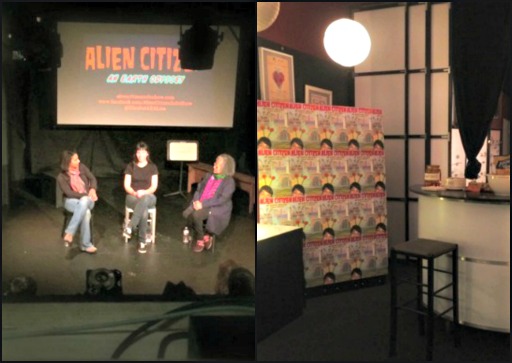
Alien Citizen Talkback

Associate producer Karen Smith conducts a talk back with Lisa and Sophie for a DVD “extra”; the lobby is decked out before the public show with an Alien Citizen backdrop for interviews later (photos supplied).

Have I mentioned that I performed with four injuries? I accidentally hurt my lower back in January, and the problem has flared up intermittently throughout the year. My left shoulder/neck area started bothering me over the summer. My right clavicle was injured accidentally at a chiropractic session for the first two injuries (!). And I hurt my right leg during a performance of an excerpt of the show in September. I’ve been doing all I can to take care of these problems: chiropractor, massage, acupuncture, cupping, at-home physical therapy, hot tub, you name it.

Stress with a capital “S”

So I can only think that the reason they all flared up (especially my back) with a vengeance in the weeks leading up to the shoot was: stress. It’s stressful to produce a film, even when it only shoots over two nights. If you’re the only actor in it, and it’s your “baby,” and you’re literally recording it for posterity, then the stress increases exponentially. So I felt more wrecked than usual on the mornings after both performances, and I laid low for a few days afterward. Luckily, Thanksgiving was soon upon us, so I used the holiday weekend as an excuse to stay in.

I look forward to editing the digital version of the show with my director’s input, and then sending it out into the world. The world has been very kind to Alien Citizen so far, so I’m allowing myself to hope for its future.

Meanwhile, my next live performance will be at Smith College on January 30, and my Asia-Pacific debut will be in Singapore in late April. The show still has legs and I’m so grateful to every single person who has supported it.

Since I’ve posted several entries about the show’s adventures in 2015, and you’ve been very indulgent of that, I’m pleased to announce that the first TCK Talent posting of the new year will be an interview of a wildly impressive creative ATCK. Happy holidays, all, and stay tuned!

* * *

Thank you, Lisa! It’s been quite a year for you and your solo show. I’m amazed you still had energy for a film shoot, especially given your injuries. You’re amazing! I think I speak for all the Displaced Nation readers in wishing the brightest of futures for Alien Citizen, in 2016…and beyond! —ML Awanohara

STAY TUNED for the next fab post!

If you enjoyed this post, we invite you to register for The Displaced Dispatch, a round up of weekly posts from The Displaced Nation, with news, book giveaways and other extras. Register for The Displaced Dispatch by clicking here!

Related posts:

BOOKLUST, WANDERLUST: Giving thanks for expat and repat writers whose novels have an international flavor

booklust-wanderlust-2015

Attention displaced bookworms! Our book review columnist, Beth Green, an American expat in Prague (she is also an Adult Third Culture Kid), is back with several recommended reads!

Hello again, Displaced Nationers!

This week is Thanksgiving in the USA. Many Americans abroad skip this holiday for one reason or another—one main reason being the cost of frozen turkey (a friend in Thailand recently posted a picture of one selling for $200 at the expat grocery store!).

But I always try to do something a little bit special. The way I see it, there can never be enough occasions to sit down with friends to a table full of good food!

In addition to planning for Thanksgiving and the holiday season, I’ve been cruising through the rest of my 2015 To-Be-Read list. This month, I’ve been feasting, so to speak, on three books by current or former expats who write fiction set against international landscapes. Two of them are first-time novels and the other is a thriller. One came out with a small press, and the other two are self-pubbed. Take a look!

1) Summer on the Cold War Planet, by Paula Closson Buck (Fomite, 2015)

Summer Cold War Buck

A first novel about expats in late 1980s Berlin, written by a former Fulbright fellow who has written poems and short stories about her travels? Sounds like a perfect choice for the Displaced Nation! Paula Closson Buck directs the creative writing program at Bucknell University in Pennsylvania, and is currently at work on a novel set in Venice—keep your eyes open for a review of that book, too, when it publishes.

Summer on the Cold War Planet tells the story of Lyddie, a young American woman who is living in Berlin a few years before reunification and studying architecture. She encounters a trio of German artists/activists and also meets her future husband, an American botanist named Phelps.

Most of the action takes place, as the title suggests, the summer before the Berlin Wall falls. At that time, Phelps disappears while conducting botanical research in Kurdistan and so Lyddie, now pregnant, returns to Berlin to examine her feelings for the absent Phelps—and rediscover who she is.

Buck brings the period to life through gorgeous details such as:

In the simple way the young East German at the border touched Lyddie’s face, tipping her chin this way and that as he scrutinized her features in relation to her passport, Lyddie felt she understood the meaning of Cold War. He returned her passport with a hint of a smirk and nodded her release.

But, although I was transported to the intense atmosphere of 1989 Berlin, I often felt at arm’s length from Lyddie, I think because, especially in the flashback scenes, she seemed to be letting others make choices for her.

Later, when the action shifts to the Cycladic Islands in Greece, Lyddie becomes more relatable. My favorite character in the novel, I’d like to add, is another point-of-view character, a Greek painter who learns to paint canvases underwater. A new thing to try next time I go scuba diving!

2) A Decent Bomber, by Alexander McNabb (November 2015)

McNabb Decent Bomber

This book also ticked two boxes for inclusion in this column—an expat author and an internationally relevant plot. Alexander McNabb is a former journalist who has lived abroad—mostly in the Middle East—for about 30 years. He is author of several other international thrillers, including the “Levant Cycle” books, all three of which were featured on the Displaced Nation.

The action of McNabb’s previous international thrillers centers on the Middle East, but he sets A Decent Bomber in Europe, mostly in Ireland.

Now, I find it fun to read thrillers (“fun” in that kind of macabre sense), and this one has an enjoyable premise. A retired, reformed bomb-maker for the Irish Republican Army reluctantly agrees to build new bombs, this time for African terrorists—and then tries to save the day before his bombs explode. McNabb keeps the pacing tight, the action scenes believable, and the violence just on this side of gruesome.

Perhaps because of recent current events, I was also impressed with how delicately he handles the multiculturalism of present-day Ireland, as well as the long, contentious history between the English and Irish. Take, for example, the following scene, set in a mosque in Northern Ireland:

“Welcome. I am Abdelkader Ul-Haq.”

“Hello, Father. My name’s Pat.”

Abdelkader hobbled to behind the desk and lowered himself into the wooden armchair. “I am not your father. May I sit?”

“Of course. I’m not holding you up. And father is we call our priests.”

“I know. I was joking with you. It is always best to joke with men who have guns, I am finding.”

“What gun?”

“I know the shapes guns make in clothes, Mister Pat. I come from a troubled place.’

“Well you’ve certainly hopped out of the frying pan into the fire.”

“Belfast? It is peaceful now. Before, there were troubles. No more. How may I be of assistance to you?”

Lest you be put off by the idea of following the adventures of a lone cowboy (indeed, Pat is such a cowboy that he actually owns cows), I should mention that our hero is rarely alone. He is joined on the chase by his college-student niece along with a group of police officers and politicians from both the Republic of Ireland and Northern Ireland, all of whom provide moments of comic relief. As we know from the Displaced Nation’s previous encounters with McNabb, he has a sense of humo(u)r.

3) I Have Lived Today, by Steven Moore (October 2014)

I have lived today Moore

I included this book in this particular round-up because of the author’s international credentials, and because it has received 130+ five-star reviews on Amazon. Steven Moore is the man behind the visually stunning travel blog, Twenty First Century Nomad (he also has an author site). He has been working and traveling abroad for at least twenty years. He now lives in Mexico, and one suspects his adventures aren’t over yet!

But, now, let’s burrow into the pages of Moore’s book, his first. Although the novel does have scenes both in the UK and in New York City, it is principally a coming-of-age story about a boy whose travels have to do with discovering his own conscience. I Have Lived Today takes place in the 1960s and follows the turbulent journey of Tristan Nancarrow, a boy so badly treated by his alcoholic father that he was never allowed to attend school.

Tristan’s mother is forced to run for her life, and not long after, Tristan makes his escape from the isolated island where the family lives. He spends the bulk of the book trying to reunite with his mother—having plenty of adventures, along with his share of small triumphs and bitter tragedies, along the way.

I especially enjoyed the parts of the novel when Tristan discovers what he was missing out on while under his father’s control. One of the first things he does after escaping is go to a bookstore and buy an atlas:

Tristan turned the pages delicately, as if he was looking at a priceless and ancient manuscript. To him it was an object of beauty, a treasure from a museum, and indeed the musty old store had a museum feel about it, or at least that’s how Tristan imagined a museum would seem, having never been to one.

There are times in I Have Lived Today when the tone takes on a moralistic edge and the pacing becomes steady and unrushed in a manner reminiscent of a Grimm’s fairy tale (though, to be sure, without any witches or other supernatural beings).

Our hero, Tristan, despite his father’s brutal abuse, remains an innocent who chooses to embrace a white-knight moral code even as the world shows him how cruel it can be. Through switches in point of view, Moore lets the reader peek into other characters’ motivations, but the focus is always on Tristan and his choice to reject his personal demons. This hero has resilience—the quality that we expats need—in spades.

* * *

So, Displaced Nationers, if you’re lucky enough to have a few moments to yourself over Thanksgiving or before the holiday season gets into full swing, you might want to check out these three books. They’re as different as the sides at a potluck Thanksgiving, and no less delicious for that!

p.s. And, since it’s Thanksgiving, may I say a hearty thank you to my readers! Please keep in touch and let me or ML know if you have any suggestions for books you’d like to see reviewed here! Last but not least, I urge you to sign up for the DISPLACED DISPATCH, which has at least one Recommended Read every week.

STAY TUNED for next week’s fab posts!

Beth Green is an American writer living in Prague, Czech Republic. She grew up on a sailboat and, though now a landlubber, continues to lead a peripatetic life, having lived in Asia as well as Europe. Her personal Web site is Beth Green Writes. She has also launched the site Everyday Travel Stories. To keep in touch with her in between columns, try following her on Facebook and Twitter. She’s a social media nut!

If you enjoyed this post, we invite you to subscribe to The Displaced Dispatch, a weekly round up of posts from The Displaced Nation and much, much more. Sign up for The Displaced Dispatch by clicking here!

Related posts:

CULTURE SHOCK TOOLBOX: Newbie expats, to keep waves of culture shock from crashing over you, practice the art of tacking

Culture Shock Toolbox Beth Green

Beth Green at a Buddhist temple in Cebu City in the Philippines, during Chinese New Year (supplied).

Transitions enthusiast H.E. Rybol is back with her latest interview guest.

Ahoy, Displaced Nationers! This month, fellow Displaced Nation columnist Beth Green takes us on a brief tour of her extensive, initially aquatic travels. You know how children test the waters? Well, Beth got to do that quite literally. That’s right, Beth spent her childhood on a sailboat! Doesn’t that sound mouth-watering? Though I must admit that with my predisposition for motion sickness I’d probably spend most of the time with my head over the railing.

Anyhoo, Beth now lives on land—in Prague, the Czech Republic—where she works as a freelance writer and English-language coach. She is also a member of the Sisters in Crime mystery writers’ association. Upon discovering she is a traveler, bookworm and lover of spookiness, I knew I had to interview Beth for this column! And luckily for us, she kindly agreed to share her culture shock stories.

Join us as we talk about opening a conversation with an apology, cringing at our own meltdowns, sending stuff back in restaurants (or not!), and working weekends to make up for weekday public holidays (say what?!). You never know, you may pick up a few items for your culture shock toolbox!

* * *

Hi, Beth. Welcome to my column! As a TCK and an ATCK, you’ve led a peripatetic life. Tell us a little about where you’ve lived…

I’ve never lived anywhere for very long! As a kid, I traveled with my parents on a sailboat. We were in the Caribbean for seven years and the South Pacific for two, with stops along the coastal United States in between. I went to high school in Alaska and to university in the continental USA, but my junior year of university I went to Spain on exchange for a year. That experience inspired me to move to Europe when I graduated and work for a bit. I lived in the Czech Republic for three years, where I met my now-husband (who’s Australian…of course!). Then, we moved to China together to teach English. We were there for four-and-a-half years all together—but with a break in the middle when we did a long backpacking tour of Southeast Asia and India that included living on an island in Thailand for five months. After touching down briefly in the Philippines and Thailand again, we’ve been back in the Czech Republic for the past two years.

In the course of these many transitions, have you ever ended up with your foot in your mouth?

Oh, sure! The first time I moved to the Czech Republic I quickly realized I needed to start every conversation in Czech with an apology. That way I could make up for the inevitable times when I forgot to whom I should give kisses on the cheek rather than shake hands, or failed to greet everyone properly (as is customary in many more situations in Central Europe than in other cultures—you say “hello” and “goodbye” even to strangers in elevators). China as well was a tricky place to stay on the right side of etiquette. Speaking of which, I can recall an embarrassing meltdown I had once in China after being served a mango-papaya smoothie (what I had actually ordered, I realized later) rather than a melon smoothie like I thought I was getting. I lost all kinds of “face” that day.

Art of European Cheek Kissing

Photo credit: Women kissing at bus stop in Paris, France, by Steven Depolo via Flickr (CC BY 2.0).

How should you have handled that situation? What if any tools have you developed to adapt to this kind of scenario?

What I should have done—and what I learned to do later when I inevitably ordered the wrong thing due to either fanciful names on the menu or my ham-tongued attempts to speak and understand Mandarin—was just to give my smoothie to someone else and order another one. In certain cultures, you just can’t send stuff back in a restaurant! In other words, I had to get better at tacking: that’s when you zigzag back and forth with your sailboat instead of sailing right into the wind. I had to reminding myself constantly that expect the unexpected and not to make too many waves. Like the time in China when I was told that we would all work on Saturday to make up for a public holiday on Monday. What? That’s considered normal? Well, this will be a fun story later! And, I’d better make a note to check my next contract veeerrry thoroughly!

Smoothie debacle collage

Photo credits: (Top) Charm- and confidence-boosting smoothie, Ghangzhou, China, by Cory Doctorow via Flickr (CC BY-SA 2.0); Breakfast (Shanghai, China), by Martin Slavin via Flickr (CC BY-SA 2.0); dissatisfied character via Pixabay.

Can you think of a situation you handled with finesse, and why do you think that was?

I feel like my latest move, back to Europe from Asia, went well because I made a decision not to hard on myself when the waters got choppy. I also decided to take measures right away that past experience had taught would help lower my stress; for instance:

  • hiring someone to help with my visa paperwork (instead of doing on my own);
  • asking for help finding an apartment instead of taking the DIY approach;
  • joining a co-working space right off the bat (even before the apartment) so that I had a quiet place to work even when everything else was up in the air; and
  • enrolling in a refresher language course.

Of course, I’m lucky that I had the option to do all of those things—not everyone will when they move cultures.

If you had any advice for someone moving abroad for the first time, what tool would you suggest they develop first and why?

This advice is easy to give and hard to follow: develop patience and also trust in yourself: you will make progress eventually. Patience for yourself for not “catching on” quickly to situations (I find that culture shock seems to lower your IQ a bit at first!), patience for local people who might not understand your expectations (even though they’re crystal clear to you), patience for the culture shock itself. If we go back to our sailing metaphor: By tacking, you move into the wind gradually. But the zigzagging doesn’t necessarily slow you down. You can learn to tack efficiently—that’s what I tried to do when seeking help for some of the more stressful challenges of settling back into life in Prague. Use your first few months wisely, and eventually your culture shock will go away! Tacking is the Blu-Tack of the culture shock toolkit.

Tacking is the Blu-Tack

Photo credits: Tacking upwind, by Tom Purves via Flickr (CC BY 2.0); Old blu-tack packaging, by Clive Darra via Flickr (CC BY-SA 2.0).

Thank you so much, Beth, for sharing your experience with us! Like you said, if you develop the sailor’s tacking skill, soon it’ll all be water under the bridge. Plus, as you also pointed out, you’ll have great travel yarns to share! In the end, it’s the situations that are most difficult to navigate that make for the best lessons, right?! That’s what I love about culture shock: the lessons we learn and the way our horizons shift as a result.

* * *

Readers, what do you make of Beth’s advice? If you like what she has to say, I recommend you visit her Booklust, Wanderlust book review column here on the Displaced Nation, as well as her personal site. And as those who frequent her column know, she’s a social media nut: find her on Facebook and Twitter.

Well, hopefully this has you “fixed” until next month.

Until then. Prost! Santé!

H.E. Rybol is a TCK and the author of Culture Shock: A Practical Guide and Culture Shock Toolbox. She loves animals, piano, yoga and being outdoors. You can find her on Twitter, Linkedin and Goodreads. She recently launched a new Web site and is now working on her second book.  

STAY TUNED for next week’s fab posts.

If you enjoyed this post, we invite you to register for The Displaced Dispatch, a round up of weekly posts from The Displaced Nation—and much, much more! Register for The Displaced Dispatch by clicking here!

Related post:

TCK TALENT: Donna Musil, Writer-Director, Lawyer, Activist & Proud Army Brat

The uber TCK-talented Donna Musil. Photo credit: Ray Ng.

The uber TCK-talented Donna Musil. Photo credit: Ray Ng.

Columnist Elizabeth (Lisa) Liang is back with her latest interview guest.

Welcome back, readers! It’s been awhile. But I think the wait will be worth it as my latest interviewee is the super-talented writer, filmmaker and social change agent Donna Musil. Donna is also a fitting choice for the month when America celebrates Veteran’s Day. She made the award-winning documentary BRATS: Our Journey Home, narrated by Kris Kristofferson, about what it is like to grow up in a military family and the long-term impact it can have on a person’s adult life.

She is also the founding director of Brats Without Borders, a nonprofit organization dedicated to increasing awareness and support for military brats and other Third Culture Kids.

Donna’s interest in the subculture of military brats is personal. Born into a career Army family, she went to 12 schools by the time she was 16 and never had a hometown. Her family moved almost every year until she was seven, from Fort Benning, Georgia, to two other bases in Georgia (Athens and Macon, the latter when her father was serving in Korea and Vietnam); then to the enormous Army installation in Fort Bragg, North Carolina, and to Charlottesville, Virginia, where her father was doing something at the university. They moved overseas twice: to Germany (Bad Kreuznach), followed by Fort Mason in San Francisco; and to South Korea—Yongsan Garrison in Seoul and then Camp Walker in Taegu (now Daegu), after which they were stationed in Fort Knox, Kentucky. Donna’s father died in the summer of 1976, two months after she turned 16, and her family had to leave base housing. They moved to Columbus, Georgia.

Talk about talent! BRATS was Donna’s very first directing effort. I had the privilege of getting to know her as one of my fellow authors in the TCK anthology Writing Out of Limbo.

* * *

Welcome to The Displaced Nation, Donna. Even though I’ve met and have interviewed plenty of Adult TCKs, my head is still spinning at the number of moves you experienced as a youngster. Once you reached young adulthood, did you settle in one spot or keep moving?
I stayed in Georgia for college, earning a degree in journalism from the University of Georgia and a law degree a few years later (the time in between I traveled and worked as an on-air radio newscaster). After law school, I practiced union-side labor law in Washington, DC and Atlanta. In the late 1980s, I quit practicing law to pursue a writing career, my childhood dream. After a few years in Atlanta, I moved to Los Angeles to “pay my dues” in the film business, but when the 1994 Northridge earthquake struck and destroyed half of my possessions, I stored the other half at my sister’s and moved to Dublin, Ireland, for two years to write. When I ran out of money, I returned to Georgia and began making the BRATS film. I lived in a crooked, old family lakehouse, which became my “base.” During the ten years it took to make and distribute the BRATS film, I also worked as a technical writer and/or attended writer’s residencies in Denmark, Spain, Paris, Taos, and Port Townsend (Washington).

Where do you live now?
In 2010, I moved to Denver to be near my sister and her family, and have lived there ever since, except when I’ve been on writer’s residencies—in France, Chicago, and San Francisco. (I’ll be living at a writer’s residency in Chiang Mai, Thailand, this coming winter.)

Donna Musil, already displaying her talents in Korea, 1975. (Photo supplied.)

Donna Musil, already displaying her talents in Korea, 1975. (Photo supplied.)

Were you happiest in a certain place at a certain time?
I was happiest when we lived at Fort Mason in San Francisco when I was 11 to 13 years old. Interestingly enough, it was one of the least “military” of all of our assignments, just a block away from the famed Ghirardelli Square, overlooking the bay. I attended public schools, populated by an eclectic array of children, whose parents were everything from authors to restaurant owners to ballerinas. The racial makeup of the student body was about a third Chinese, a third white, and a third black and brown. I loved it!

I can imagine you thriving on the diversity. Was there anything else that made that time special?
Yes, swimming! I joined the Presidio Swim Club after watching Mark Spitz bedazzle the tragic 1972 Olympics, and began dreaming of my own (albeit unlikely) Olympic run. I walked to school every day and to swim practice every afternoon. I think I still hold the Marina Junior High School record for the most pull-ups for a 13-year-old girl—12! I loved everything about San Francisco—the culture, the diversity, the hippies on the beach. It was also the last year before my father got sick, so I suppose it was the end of my innocence. The next year, we moved to Seoul, Korea, for six months and then to Taegu, where there was no swim team, and my dreams of Olympic glory evaporated. My freshman class had ten students, total. We were surrounded by jaded, war-struck soldiers on their way to or from Vietnam, bars, prostitutes, and easy access to drugs and alcohol. You can imagine the results.

Because everybody needs a place to call home…

Let’s talk about BRATS. For readers who aren’t familiar, here is the trailer:


Were you surprised by what a hit BRATS has been with adult military brats and ATCKs? 
The reaction to BRATS: Our Journey Home has been interesting. I initially made the movie to figure out “who I was and where I was from,” but it quickly became apparent that it was less about me and more about the brat/TCK culture in general. I had been separated from the military life for twenty years when I began filming so was somewhat surprised to discover that most of the issues the movie discusses are just as relevant today as they were when I was a child—particularly the emotional and trauma-related issues.

In your essay in Writing Out of Limbo, you mention a teenaged boy who loved the documentary because it was the first time he had seen a family like his portrayed on film. You state: “I would do it all over again to hear that one comment. To make a difference in just one child’s life—no honor, award, or monetary compensation could ever compare.” That’s tremendous! But let’s also talk about your goal of affecting change within the military itself. How has the military responded?
To be honest, I would have to say that the military-as-a-whole has not welcomed the film or the research of Brats Without Borders (or any other “brat” groups) with open arms, nor have they helped us implement programs or provide resources to current and retired families that address the emotional needs of military brats/TCKs. There have been pockets of institutional and corporate support for a related art exhibit and workshops, as well as the film distribution costs, and Armed Forces Network has broadcast the film multiple times. The reactions have always been universally positive, but we could be doing so much more (with so very little).

So there are no military groups who have interpreted the film as a call to action?
In general, the military clergy and soldiers have been most supportive of our work and the military educational system and spouses the least supportive. It took me a while to realize that it must be hard to hear that the life you’ve chosen for your family (often a life better than your own childhood) also has its flaws. Many (high-powered) spouses are willing to hear and promote the positive legacies of growing up brat/TCK but tend to gloss over the painful legacies and attribute them to bad parenting instead of institutional pressures, traditions, or combat trauma. As a result, nothing much changes, and (as it has always been), brats/TCKs are forced to take care of their own emotional needs. Nowadays, people talk a little bit more about the sacrifice of military kids and groups give them free “stuff”; but they’re still not addressing their emotional needs (among other things) or considering what institutional changes might be made to ease their transitions and difficulties.

You must find that frustrating.
It’s particularly frustrating when I hear the institution and the media talk about the “lack of research” in this area, because it’s simply not true. We have the research. We’ve had it for 25 years. They just don’t always like what the research says. The military wants to downplay the negatives and the media wants to downplay the positives. Meanwhile, millions of dollars are being thrown into programs for military kids that are designed by people who haven’t walked the walk, or whose loyalties lie more with the institution or perpetuating their own existence than they do with the children. That may seem harsh, but I think it’s the truth. Perhaps one day actual brats and TCKs will be invited to the table and given substantial support, but I’m not holding my breath. In the meantime, we’ll just keep helping ourselves!

“Like many brats,…I could talk to, but didn’t trust, anyone.” —Donna Musil in Writing Out of Limbo

Let’s move on to talk about the TCK experience. Many of the sections in your essay for Writing Out of Limbo resonated with me; for instance, when you said: “There are lessons each of us has to learn in our lives, and the more we avoid learning a particular lesson, the harder God will knock us down, until we have no choice but to learn it (and move on to the next lesson….). Still I didn’t learn.” You mention trust issues, inability to handle disagreement or confrontation, and more traits that are common among ATCKs, for which you needed to learn healthier coping mechanisms. Has making and touring BRATS helped you deal with this? Or do your old TCK survival mechanisms still crop up from time to time (like mine do even though creating Alien Citizen helped me a lot)?
For good or ill, I think all of my TCK survival mechanisms are alive and well! I’ve just learned to manage them better, with experiences from the BRATS film, my new film projects, some very good therapy, a lot of reading, and a very kind, understanding, and patient fiancé.

Has making and touring BRATS helped Donna to deal with some of the TCK issues Donna describes in Writing Out of Limbo? (Cover art; poster art, supplied.)

Has making and touring BRATS helped Donna to deal with some of the TCK issues she describes in Writing Out of Limbo? (Cover art and poster art, supplied.)

Are you tempted, for example, to run away from confrontation/disagreement?
Yes, I’d rather flee, move, break up or leave. I’ve learned to temper that impulse by isolating myself and dealing with it after I’ve calmed down. I also still have a visceral reaction to mean-spirited, unjust, authoritative, or self-centered people, but instead of confronting them like I used to, I try to avoid them. I’m much less black-and-white about things—but perhaps that’s just the wisdom of age. I do make people earn my trust instead of instantly bestowing it, and vice versa. There are so many ways “growing up brat/TCK” still affects my life today; it probably shapes almost everything I do. As I get older, though, I try to build on the positive aspects of my youth and temper the less-than-positive legacies, which is often much easier said than done!

Do you identify most with a particular culture or cultures, or with people who have similar interests and perhaps similar cross-cultural backgrounds?  
I don’t identify with any particular culture or ethnicity, other than the brat/TCK culture. I don’t even have any real nationalistic tendencies. I don’t think America is “the best country in the world.” I think all countries and all people have their good points and not-so-good points; it just depends on what you’re most comfortable with. That said, I am definitely the quintessential American—independent, strong-willed, feisty, rebellious. Daniel Boone was my (great-great) uncle, his oldest brother Samuel my (great-great) grandfather, so I come by that spirit honestly. But my political sensibilities are more Scandinavian, like my grandmother’s side of the family. I enjoy being around other curious, open-minded “outsiders,” many of whom tend to have cross-cultural backgrounds. I try very hard not to consider myself, or any group to which I feel I might belong, “special.” That kind of thinking is the source of most of the world’s ills.

Do you have “itchy feet,” which still make you want to move frequently? Or would you prefer to have a home base and only travel for pleasure?
My poor fiancé. He was an educator brat—but basically grew up in one town in Germany. When we first started dating, I’d tell him all of the places I dream about living in: Vancouver, Canada; Austin, TX; San Francisco, CA; Chiang Mai, Thailand; Asheville, NC; and Paris, etc. Like any man, he wanted to give me what I wanted, but he couldn’t pin me down on what I actually wanted (one of the banes of being a brat/TCK). I was born and raised to be geographically and intellectually curious (the best legacy of growing up brat/TCK!). I like to stay somewhere until I want to go somewhere else—and my fiancé is okay with that, too. I don’t have any children, and his are grown, so it’s possible for us to live this way. Perhaps we’ll settle down in one place in the future. Denver is a nice town. We like it—for now.

Donna’s next act(s)

Returning to your work: I believe you are making another documentary? Tell us about it.
Yes, the film is called Our Own Private Battlefield. It’s the first documentary about the intergenerational effects of combat PTSD on military children, and how one Marine family is using art to help heal the long-term wounds of the Vietnam War. I still have a few more interviews to shoot. I’m hoping the lessons learned from this family will help generations of current and future military families deal with the traumas of war, both here and abroad.

Battlefield sounds amazing.
It’s actually a byproduct of the combined efforts of Brats Without Borders and Marine brat Lora Beldon’s organization, Military Kid Art Project, which teaches customized art classes to military children.

Your mention of art reminds me: I think an art exhibit is one of your other projects?
Yes, Lora and I founded the BRAT Art Institute this year and will host our first Military BRAT Art Camp in 2016, in conjunction with Old Dominion University, in Norfolk, VA. Right now we have a museum exhibit currently touring the country, called “UNCLASSIFIED: The Military Kid Art Show.” It won a Newman’s Own Award in 2012 and features over fifty years of military brat and veteran art from around the world, historical artifacts, and films about using art to heal trauma. The art camps will be part of a larger research effort to study how art can help military children deal with the traumas of war and multiple deployments.

Do you have any projects that don’t relate to the military?
Yes, my personal projects are much more eclectic. Besides a TV show based on brats in Korea in the 1970s, I’m also shopping a children’s animated film script based on African folktales (with a producer from Ghana) as well as a feature film screenplay about a modern-day union campaign at a small-town nursing home. My current writing efforts are focused on a murder mystery, based on (what I believe) is an unjust incarceration of an innocent man for over thirty years.

How can we follow your progress?
People can see my brat/TCK projects at www.USAbrat.org. Later this year, I will be putting up a personal page, donnamusil.com, for my non-brat/TCK projects.

* * *

Thank you so much, Donna! I think I can speak for the entire Displaced Nation in asserting that you’ve blown us all away with all the important and necessary work you do for military brats, veterans, and TCKs. Congratulations on your many extraordinary achievements! Readers, please leave questions or comments for Donna below.

Elizabeth (Lisa) Liang is a prime example of what she writes about in this column: an Adult Third Culture working in a creative field. A Guatemalan-American of Chinese-Spanish-Irish-French-German-English descent, she is an actor, writer, and producer who created the solo show Alien Citizen: an earth odyssey, which has been touring internationally. And now she is working on another show, which we hope to hear more about soon! To keep up with Lisa’s progress in between her columns, be sure to visit her blog, Suitcasefactory. You can also follow her on Twitter and on Facebook.

STAY TUNED for more fab posts!

If you enjoyed this post, we invite you to register for The Displaced Dispatch, a round up of weekly posts from The Displaced Nation, and so much more! Register for The Displaced Dispatch by clicking here!

Related posts: