The Displaced Nation

A home for international creatives

LOCATION, LOCUTION: Jeet Thayil on bringing location to life in a semi-dream state

Jeet Thayil

Clockwise from top: author photo Jeet Thayil; book cover art “Narcopolis”; author photo JJ Marsh

In this month’s “Location, Locution”, expat crime writer JJ Marsh interviews Jeet Thayil, author of  Narcopolis.

Jeet Thayil was born in Kerala, India, in 1959 and educated in Hong Kong, New York and Bombay. He is a performance poet, songwriter, librettist and guitarist, and has published four collections of poetry: These Errors Are Correct (Tranquebar, 2008), English (2004, Penguin India, Rattapallax Press, New York, 2004), Apocalypso (Ark, 1997) and Gemini (Viking Penguin, 1992). He is also the editor of The Bloodaxe Book of Contemporary Indian Poets (2008). His first novel, Narcopolis (Faber & Faber, 2012), won the DSC Prize for South Asian Literature and was shortlisted for the 2012 Man Booker Prize and the Hindu Literary Prize 2013. He currently lives in Berlin.

Which came first, story or location?
I knew Narcopolis would be set in Bombay. I started with that city and that period in mind. It was about telling a story that hadn’t been told before, in a way that Indian fiction doesn’t really tell stories. Unsentimental, brutal and beautiful. When I realised that was what the book would be like, it revealed itself to me.

What’s your technique for evoking the atmosphere of a place?
When I was working on Narcopolis, I would work till very late at night, go to bed, wake up and start on it again, without really thinking. I found that when you’re in that oneiric, half-oneiric state, still slightly in the dream, very interesting things would happen. I’d come up with things I’d never have thought of later in the day. I was astonished about how much I remembered from that time, 25 years earlier, when I had no idea I would write a novel, when I was not exactly in the clearest of mental states. I was also surprised how unhealthy it was, the process of remembering.

A negative experience?
Absolutely. It was the opposite of cathartic.

Which particular features create a sense of location? Landscape, culture, food?
All of those. I’m a big fan of crime fiction, the bloodier the better. I’m addicted to crime thrillers. That, and poetry, is what I read on a daily basis. I’m sure a lot of that atmospheric noir milieu seeped into Narcopolis.

That’s curious. Not a link I would have made. I was going to ask you if you had a guilty reading pleasure, but you obviously don’t feel guilty.
Not at all. I hold those books up proudly on the train.

How well do you need to know the place before using it as a setting?
I’ve set poems in places I’ve never been to, and that can be a huge liberation. I think the worst is to know a place glancingly. To visit a place for a few days, get a false sense of it and then try to write about it. It might even be better to have never been there than read a guide about it.

Because it’s too superficial?
I think so. Either never go there or have been there too long.

Which writers do you admire for the way they use location?
I mentioned my love for crime writers and the way they do exactly that, evoking streets and cities and ambiance. But I’m also tremendously fond of the fiction that’s set in the opposite of cities: William Trevor, Henry James, E.M. Forster. Writers that do evoke a sense of place but often in the most mysterious and indirect of ways.

Next on Location, Locution … JD Smith, author of Tristan and Iseult (12th-century Cornwall) and Overlord: The Rise of Zenobia (3rd-century Syria), to be released in early 2014.

 * * *

JJ Marsh grew up in Wales, Africa and the Middle East, where her curiosity for culture took root and triggered an urge to write. After living in Hong Kong, Nigeria, Dubai, Portugal and France, JJ finally settled in Switzerland, where she is currently halfway through her European crime series, set in compelling locations all over the continent and featuring detective inspector Beatrice Stubbs.

STAY TUNED for tomorrow’s post!

If you enjoyed this post, we invite you to register for The Displaced Dispatch, a round up of weekly posts from The Displaced Nation, with seasonal recipes, book giveaways and other extras. Register for The Displaced Dispatch by clicking here!

Related posts:

LIBBY’S LIFE #88 – A silver trail

It’s a cozy enough scene, I suppose, if one were to look at it quickly through the living room window. Granny, Beloved Son, Doted-On Grandchildren and, OK, Tolerated Daughter-in-Law, all sitting in squashy chairs and sofas around a real (gas) fire. Tea and biscuits on a tray on the coffee table. Everyone chatting together, like people used to do before TVs and iPads and smartphones came along.

You could paint the scene and put it in the National Gallery: a snapshot of family life at the beginning of the third millennium.  A couple of hundred years later, some author would see it as an escape route from writer’s block, and write a book about it – a bit like “The Girl With A Pearl Earring”, only this would be “The Family Without Facebook” — and the idyllic life of the Patrick family would be immortalized in print as well as watercolour, on paper. Or whatever they make books out of in the 2200s.

The story two hundred years hence, of course, would be nothing like the reality of today. The reality of our get-together is less idyllic than it appears from that quick glance through the window.

Although pictures can say a thousand words, those words sometimes get lost in translation.

*  *  *

Oliver, in the armchair to the left of the fireplace, leans forward, his elbows on his knees. He’s tired and cross, annoyed that he’s had to come back to Milton Keynes for an emergency family summit instead of having a child-free lie-in tomorrow at an anonymous airport hotel. He should be so lucky. Since I opened the door of the fourth bedroom, the children and I have been staying in one room at the local Travelodge.

He looks in Sandra’s direction – at her left ear, her right shoulder – but doesn’t catch her eye.

“You do understand, don’t you, Mum?” he says.

Sandra sits rigidly upright in an identical armchair on the other side of the fireplace, folds her arms, and lifts her chin up. You don’t have to be an expert in body language to hear “Defiance” screaming from every limb placement.

Playing with a toy Ferrari on the floor at her feet, Jack announces excitedly to the room that he can see right up Granny’s nose and it has hairs growing out of the left side.

Sandra drops her chin a little to make her nostrils less obvious, and hunches her shoulders as she hugs herself. In doing so, her stance loses the defiance and becomes defensive.

“I said, you do understand?” Oliver repeats his question, but his voice is gentle. He is a much nicer person than I am, at least when it comes to dealing with his mother. “You see that we can’t let you keep—”

“They’re not doing any harm!” Sandra hugs herself more tightly as she blurts out the words. “They’re just minding their own business, in the spare room. I don’t see how any reasonable person can object to that.”

“Yes, but, when we agreed that you should live in our house, it was on the understanding that you didn’t keep–”

“You didn’t say anything about it.” Sandra hunches over even more, looking like a naughty child who’s been caught stealing chocolate biscuits after being told she can’t have any. “You only said ‘No dogs’.”

Oliver nods slowly, seeming to consider this miscarriage of justice. “That’s true,” he says at last. “When you put it like that, I suppose we don’t have any grounds to…”

Oh, for goodness’ sake. I leap up from the sofa.

“When Oliver said ‘No dogs’,” I say to my mother-in-law, pointing my finger at her, “it should have been perfectly obvious that he meant ‘No dogs, no cats, and no Boris The Tarantulas. Certainly no geckos, no turtles, no rats or mice, no giant African snails or any of the other slimy creatures you’ve got living in our spare bedroom, and —” I pause to take a breath, and the last part comes out as a semi-scream “— most definitely not a six-foot boa constrictor on the loose.”

“Libby.” Oliver tries to take control, but I’m on a roll. I shake my finger at Sandra again, and she cowers into the armchair.

“Are you incapable of using common sense, or does everything have to be written into the lease? Ah, yes, I forgot. Oliver didn’t want you to have a lease, did he? You’re family, he said. You’ll look after the house, he said. Clearly,” I say, shooting a slit-eyed look at Oliver, “having an exotic pet collection in what will be Beth’s bedroom in a couple of years is his and your idea of looking after the house.”

Oliver’s expression and body language echo those of his mother. Two naughty children caught in the biscuit tin.

“The animals…they’re not actually doing any harm in the spare bedroom. To be fair,” he adds.

I try counting to ten, and get as far as three. I’m not in the mood to be fair.

“When I went into that room to look for rainboots,” I say, as evenly as I can, “that giant snake had escaped from its box and was curled up under the radiator.”

“That’s why I call him Houdini,” Sandra says. “He doesn’t like being in his tank all the time.”

“It’s not a tank!” I shout. “I might not mind as much if it were a real, actual tank! It’s a plastic box, just like the one in the attic that we used to keep our rolls of Christmas wrapping paper in, and its lid is loose, just like that one…” I stop. “I don’t believe it. It’s the same box, isn’t it? You’ve recycled our storage bins into serpent bungalows.”

Sandra nods reluctantly. “I put the wrapping paper through the shredder and used it as bedding for the rats. It seemed the least I could do for them, give them a nice colourful bed before they were fed to Houdini. Now that the wrapping paper is gone, I give them the colour magazines from the Sunday newspapers.”

Surreal. I’ve had a lot of imagined conversations in my life, but not one of them has been about interior decorating styles for rodents on death row.

“What else have you done?” I ask. “What else has been recycled? Is the conservatory now a bird sanctuary, or the oven a retirement home for aged scorpions?”

“Libs…”

I wave at Oliver,  a dismissive “shut up, I’m not finished” flap of the hand.

“And this living room,” I continue. “Very convenient that you choose to get it decorated three days before we arrive, isn’t it?”

“That’s going too far.” Oliver stands up. “Mum had this room done to keep the place nice for us. It’s terrible of you to say she had ulterior–”

“It was the snails.” Sandra’s voice cuts across Oliver’s protests. We both turn to stare at her. “The giant African snails. I put them on the fireplace.”

Oliver and I look at the fireplace. I’ve always hated it: a relic from another decade, stucco-covered brick. We’d kept intending to rip the thing out and replace it with something nicer, but it was such a messy job that we never got round to it.

“You put the snails on the fireplace?” Oliver’s confusion matches my own. “What were you doing? Roasting them for supper?”

Sandra shakes her head. “I’d run out of eggshells.”

Oh, right. She should have said before. Everything’s perfectly clear now.

“What the hell are you talking about?” I ask.

Sandra sniffs. “Will and Kate — that’s what I call them — they need calcium for their shells, and I usually give them eggshells to eat. But I wasn’t very well, and I ran out of eggs and couldn’t go out, so I took Will and Kate out of their tank and put them on the fireplace, because that white bobbly stuff has calcium in it.”

“It’s true,” Oliver murmurs at me. “I’ve read about it. Florida has an infestation of those creatures, and they love the stucco on the houses there.”

“And then because I was poorly, I fell asleep and when I woke up, they’d gone for a little walk all over the walls.”

“Leaving a silver snail trail behind them.”

Sandra shuffles around in her chair and gazes at the carpet.

“And other things too. So when you phoned and said you were coming, I thought I’d better get the decorators in.”

Oliver turns to me. “Those things carry meningitis. And they’ve been crapping all over our living room walls.”

Much as I am sickened at this idea, I’m pleased that Oliver has switched from being Dutiful Son to Dutiful Husband. He finds it difficult to play both roles at once, but, to paraphrase a great Prime Minister, he will always do the right thing once he has exhausted all the other possibilities.

“They can’t stay,” he says to Sandra. “Either they go and you stay here, or they go and you go with them. But they can’t stay. Fergus and Boris are one thing, but Houdini and Will and Kate are another. I don’t care where they go, as long as they go safely. I don’t want to read in the newspaper a few days from now about cats and Yorkshire terriers mysteriously going missing in Milton Keynes. We’ll come back in a few days to make sure they’re gone, and I want that spare bedroom returned to human living quarters.”

“But they’re such good company!” Sandra wails. “They’re my babies!”

She could be right, I reflect. It would explain an awful lot.

*  *  *

“Now what?” I ask Oliver as I open the hotel room door at the Travelodge. “The kids and I can’t stay here for the next week and a half, and I’m not sure I could bear to stay with my own mother, even if she’d have us.”

We bundle the three kids inside the room before one of them decides to make a break for it down the corridor.

“We’ve seen the house, we’ve sorted out the problems. Stay here for a couple more days until I can get you an earlier flight, and then go home. I’ll follow in a week or so when I’ve finished my work in Europe.”

I think about this. It would mean being without Oliver in the house in Woodhaven for a while.  Just me, Jack, George, Beth – and Em.  But if there’s one thing I’ve learned this week, it’s that there are worse things to have around the house than centuries-old spirits of nine-year-old girls.

Em, at least, does not spread meningitis or slither around on my living room walls.

“Sounds good,” I say.

.

Next post: LIBBY’S LIFE #89

Previous post: LIBBY’S LIFE #87 – Behind closed doors

Read Libby’s Life from the first episode.

Want to read more? Head on over to Kate Allison’s own site, where you can find out more about Libby and the characters of Woodhaven, and where you can buy Taking Flight, the first year of Libby’s Life — now available as an ebook.

STAY TUNED for next week’s posts!

If you enjoyed this post, we invite you to subscribe for email delivery of The Displaced Dispatch, a round up of the week’s posts from The Displaced Nation. Sign up for The Displaced Dispatch by clicking here!

JACK THE HACK: Expat authors, once you have a blog, it’s schmooze it or lose it (3/3)

Jack Scott and his partner, Liam, set up home in the Turkish port town of Bodrum in the late aughts. They were seeking sanctuary from a pressured existence in London. In the event, the expat experience proved to be something for Jack to write home about, as in a book! The pair have since returned to the UK, where they are living the life of Riley in Norwich. Some time ago, we suggested that Jack reinvent himself as Jack the Hack and submit monthly columns targeted at those of you who are still displaced and hacking away at travelogues-cum-memoirsor, in some cases, autobiographical novels. Warning to non-Brits: Don’t be put off by his wry sense of humo(u)r!

—ML Awanohara

In my last two columns, I banged on about the art of blogging and how it is one of the most important tools in an author’s PR box, particularly for indie authors or those with a small publisher and only a few shillings in the marketing piggy bank.

You’ll be relieved to read that this is third and final episode.

FACT: most blogs run out of steam after two years. So, giving your blog legs will keep it in the race for longer.

Here’s how.

Win friends and influence people

So, your gorgeous new blog has hit the ground running and you’ve fallen under its spell. Now you want others to be captivated, too. The single most important thing you must do is engage meaningfully with your audience and your blogging peers, often and in every possible way.

It’s good to talk and networking pays big dividends. Allow your readers to comment on your posts. If someone takes the time to drop you a line, always reply. It helps develop your popularity and credibility.

A word of warning: make sure you’re set up to approve comments before they are published to keep the trolls and spammers at bay.

If you disagree with a comment, unless it’s abusive, offensive or loony tune, let it stand (polite rebukes are fine). That’s the unofficial blogger’s protocol.

Participate in the blogosphere by talking to your peers. Leave comments on their blogs and list your favorites on your site. Many will reciprocate, and the backlinks will help drive traffic your way. Be generous and promote others. Join blog directories. Most are free and some specialize (book bloggers, women bloggers, expat bloggers, for example).

Faceache and that Tweety thing

Cross-fertilization with social media is a must these days. At the very least, create a Facebook Page for your blog, join Twitter and post and tweet your content.

Facebook may like us all to think that it’s just a nerdy way to keep in touch with friends, but we all know it’s much, much more. Take advantage of its power.

Many blogging platforms can auto-post to the main social networks and this takes some of the pain out of the merry-go-round. While you’re at it, you may as well post to Google+, Pinterest (for images), Linkedin and any other social network you join. All this activity will increase your visibility. It worked wonders for me.

Fans can be fickle and lazy. Make it easy to follow you by adding social network links to your blog. It’s all about seamless sharing and following. And don’t forget to set up a subscription to your great works by old-fashioned email.

It’s not all about numbers, of course. Go for quality not quantity. Try not to obsess too much about your stats. (I should talk—I check mine several times a day.) Remember, your hit rate will be low at first. Don’t let it get you down. With a little careful nurturing and a lot of networking, your audience will steadily grow.

Is there any brass in it?

Blogging may be an important promotional tool but unless you’re attracting hundreds of thousands of readers a week (and some blogs do), you’re very unlikely to make any real money from your blog directly. My advice is not to plaster ads over your site. It will turn people off.

Beware blogging fatigue

Blogs do have a natural lifespan and there’s no point flogging a dead horse. Sometimes the cupboard is bare and there are no words left. Even the most enthusiastic and verbose writers may throw in the towel at some point.

Just like real work in the real world, take a short break or a long sabbatical. A nice holiday can work wonders for the creative juices. When I packed up my drag in my old kit bag and paddled back to Blighty, I was convinced that Perking the Pansies would wither on the vine like a piece of dried-up old fruit. Still, this old fruit soldiered on and much to my relief, the change of scene gave the blog a welcome shot in the arm.

In the end though, nothing lasts forever; when it’s done, it’s done. And that’s okay.

And finally…

BLOGGING TIP FOR EXPAT AUTHORS NO 3:

Blogging can be a hugely powerful tool for writers. It really can. It isn’t for everyone but if you decide to give it a go, have fun with it. If it’s a chore, it won’t endure.

Here endeth the blogging gospel according to Saint Jack. Season’s greetings and good luck from old Norwich town.

* * *

Readers, any comments, further questions for Jack the Hack? He will be following his own advice and taking a break from this column in the new year as he’ll be busy moving house with Liam (within Norwich) and publishing/promoting his sequel to Perking the Pansies—watch this space for a review!

Jack Scott’s debut book, Perking the Pansies—Jack and Liam move to Turkey, is a bitter-sweet tragi-comedy that recalls the first year of a British gay couple in a Muslim country. For more information on this and Jack’s other titles, go to his author site.

STAY TUNED for tomorrow’s post, another installment in the life of our fictional expat heroine, Libby. (What, not keeping up with Libby? Read the first three episodes of her expat adventures.)

If you enjoyed this post, we invite you to register for The Displaced Dispatch, a round up of weekly posts from The Displaced Nation, with seasonal recipes, book giveaways and other extras. Register for The Displaced Dispatch by clicking here!

Related posts:

And the November 2013 Alices go to … these 5 international creatives

 © Iamezan | Dreamstime.com Used under license

© Iamezan | Dreamstime.com
Used under license

If you are a subscriber to our weekly newsletter, Displaced Dispatch, you’re already in the know. But if you’re not (and why aren’t you? off with your head!), listen up. Every week, when that esteemed publication comes out, we present an “Alice Award” to a writer or other kind of creative person who we think has a special handle on the curious and unreal aspects of being a global resident or voyager. Not only that, but this person tries to use this state of befuddlement to their advantage, as a spur to greater creative heights.

Today’s post honors November’s five Alice recipients.

Starting with the most recent, and this time with annotations, they are (drumroll…):

1) MATT HERSHBERGER, intrepid traveler, former expat in UK, and blogger at A Man Without a Country

For his post: Why I don’t take pictures when I travel, on Matador Network
Published: 18 November 2013
Snippet:

If you’re a good photographer, by all means, keep taking pictures. I need something to fuel my nostalgia addiction when I’m trapped in my cubicle at work. But if you’re not a great photographer, put down the camera. Enjoy the giraffe.

Citation: Matt, as you may know, Charles Lutwidge Dodgson, aka Lewis Carroll, fancied himself as something of a photographer, even toying with the idea of making a living from his photos. But it’s a good thing for posterity that he decided to turn to words instead (while still leaving us with a photo or two of his youthful muse, Alice Liddell). And probably also a good thing that he left off illustrating the book; otherwise, we’d be deprived of the extraordinary drawings of Sir John Tenniel. (That said, Carroll’s own drawings of Alice aren’t half bad.) We suspect that Charles/Lewis would chime in with you and say: “Like me, you moderns should find your niche and stick to it; practice your craft and stop faffing about.” Unfortunately, though, we suspect that even (especially?) Mr. Carroll would be fatally attracted to some of our modern-day gadgetry and communications techniques, the ubiquitous cell phone having turned us all into Victorian tinkerers of a sort, who attempt to do everything from blogging to design to photography to videos without much (if any) training—a case of doing many things badly instead of a few things well. And the presence of social media encourages us to share the rather meager fruits of our labors with everyone else, as though they were works of staggering genius. Still, we unreservedly endorse your “enjoy the giraffe” campaign—so much more creative.

2) Architectural historian JANIE RICE BROTHER, American expat in UK and blogger at FH & FAG

For her post: “The Geffrye Museum and the History of the Almshouse” for the Smitten by Britain blog
Posted on: 22 November 2013
Snippet (after noting that the Geffrye Museum in Shoreditch occupies the building and grounds of a former almshouse, or poorhouse):

The Geffrye is the only museum in the United Kingdom dedicated to the history of the domestic interiors of the urban middle class. . . . [I]t took an excellent collection of buildings—home for many people over the generations—and preserved not only the structures themselves but the fleeting and changing sense of home and its traditions over the years.

Citation:  Janie-Rice, we love the sense of wonder with which you approach this almshouse-turned-museum. It reminds us of Alice’s excitement when showing her black kitten, Kitty, the “little PEEP of the passage in Looking-glass House”:

Oh, Kitty! how nice it would be if we could only get through into Looking-glass House! I’m sure it’s got, oh! such beautiful things in it! Let’s pretend there’s a way of getting through into it, somehow, Kitty.

A Looking-glass House, an almshouse, a museum of houses…whatever floats your (house)boat and spurs your creativity, we heartily approve.

3) JOSH, blogger at Real Life English

For his post: How Your Personality Changes When You Speak in a Foreign Language
Posted on: 16 April 2012
Snippet:

…what happens when you speak a foreign language using the rhythm from your native language? The effect is that even if everything else is perfect, the listener might not understand everything you say because it still seems like you’re speaking a foreign language. The following video demonstrates this concept quite well. In it there are a group of Italians singing in what seems to be English, but if you listen carefully you will realize that they are speaking gibberish. . . .

Citation: Josh, we love the idea of developing another personality when living in another culture. Far too many of us internationals cling to the naive belief that we can go around the world just being ourselves. As you point out, the only way to be yourself is to adopt the rhythms of the other language/culture, which paradoxically entails acting like someone else. And here is where Alice comes in: she tries to use reasoning suited to the above-ground world, only to find that no one understands her, and some even feel quite offended by what she says. (Mind you, it was a tad culturally insensitive of her to mention her cat, Dinah, in front of Mouse, and to go on about Dinah’s hunting skills to the creatures in the Caucus Race.) Gradually it dawns on her that she must adopt Wonderland’s logic of nonsense, even if that means risking becoming someone she doesn’t recognize:

But if I’m not the same, the next question is ‘Who in the world am I?’ Ah, that’s the great puzzle!

International creatives, if you take nothing else from this citation please remember that having an identity crisis is a positive sign. At some point, you will find it an asset to have multiple personalities to draw on.

4) DAWN RUTHERFORD MARCHANT, American expat in London and Quora community member

For her post: US Expat Describes The Best And Worst Things About England (a re-publication of her answer to a Quora question: What is it like to move to England from the United States?)
Posted on: 2 November 2013
Snippet:

Houses are very expensive and you will live in a house half the size you’d expect in the US, often attached to your neighbour and with a one car garage (if you are lucky). There are no basements, so you feel cramped and everything is cluttered—I’ve never seen a walk-in closet to date. You will cram everything into a ‘wardrobe’ the size of your coat closet.

Citation: Dawn, at this point in your narrative, we began to picture you as Alice when, after drinking an unmarked bottle of liquid, grows into a giant with her arms and legs shooting out the windows and doors of the White Rabbit’s house. Perhaps the only consolation is that with one of your arms out the window, you should find it easier to hang the laundry out to dry (another of the bugbears you mention about life in the UK). Further to which, we wouldn’t advise “giving up your arm” for an American washer and dryer. That said, you do have a point about the ironing. It can’t be easy bending an elbow under such conditions! In any event, thank you for painting such a vivid portrait of life in the UK, cramps and all.

4) AISHA ASHRAF, Irish expat in Canada, freelance writer and blogger at Expatlog

For her post: My mother was a nun
Posted on: 7 March 2013
Snippet (pertaining to the times she and her sisters would accompany their mother on visits to her former convent):

Looking back, I see that we were also entering a different culture, an insulated bubble within the larger alien culture of middle England. Like Inception—a dream within a dream. It was all very different from the Irish farm, but it felt like being part of a family, something I came to idealise later on when mine turned out to be so dysfunctional.

Citation: Aisha, leave it to you to bring us to even greater depths by suggesting that expats can find alien worlds within alien worlds, wonderlands within wonderlands, ad infinitum, rather like the mirror reflecting the mirror in Velázquez’s baroque masterpiece, Las Meninas. What’s more, you’ve suggested that a person can come to appreciate the relationships formed within these wonderlands even more than their original relationships with family. If that isn’t going through the looking glass, we’re not sure what is! Thanks for such a cosmic post, from which we’re still reeling (in a good way, of course!).

*  *  *

So, readers, do you have a favorite from the above, or have you read any recent posts you think deserve an Alice Award?  We’d love to hear your suggestions! And don’t miss out on these weekly sources of inspiration. Get on our subscription list now!

STAY TUNED for tomorrow’s post, another installment on blogging from JACK THE HACK.

Writers and other international creatives: If you want to know in advance whether you’re one of our Alice Award winners, sign up to receive The Displaced Dispatch, a round up of weekly posts from The Displaced Nation, with news of book giveaways, future posts, and of course, our weekly Alice Award!. Register for The Displaced Dispatch by clicking here!

Related posts:

TCK TALENT: Amber Godfrey, Diplomatic Kid Turned Performer-Writer

Amber Godfrey Collage

Photo credits: left: RoganJosh (MorgueFiles); right: Amber Godfrey, from her portfolio.

Welcome to Elizabeth (Lisa) Liang’s monthly column about adult Third Culture Kids (TCKs) who work in creative fields. Lisa is herself a prime example. A Guatemalan-American of Chinese-Spanish-Irish-French-German-English descent, she recently debuted her one-woman show about being a TCK, which I had the pleasure of seeing during its too-short run in New York City in September: stupendous!

—ML Awanohara

Happy Thanksgiving, readers! I’m thankful to be bringing you today’s guest, a kindred spirit of mine. She is Amber Godfrey, an actress-writer who, like me, has written and performed her own solo show about growing up as a TCK of mixed heritage.

* * *

Welcome to The Displaced Nation, Amber! I’m happy to have met another solo performer whose TCK story parallels my own. Since your dad is a Canadian diplomat, you grew up in eight countries. Can you tell us which ones?
Besides Canada, I’ve lived in the USA, Ecuador, Trinidad, India, Hong Kong, Sri Lanka and England.

Growing up, which of these countries do you identify most strongly with?
I identified, and continue to identify, strongly as a Canadian probably because of my dad’s job and the fact that we always connected with the Canadian expat community wherever we went. I also heard on more than one occasion (usually when I was being busted for some rebellious act): “You represent Canada!!” I’ve spent most of my adult life in Canada and the US, so I feel very “North American” at this point. At the same time, though, I do feel like a “citizen of the world,” and the bond that I feel with other TCKs is unique.

“Are you adopted?”

Your family is particularly diverse. Let’s see if I can get this right. You are the daughter of an Ecuadorian mom and an African American father, but you were raised by your mom and a Caucasian-Jewish Canadian stepdad, who then had your brother, David. Was your family’s status ever challenged by strangers, like mine was? In grade school, no one believed my brother was my brother, and people asked my mom if I was adopted.
Yes! This still happens all the time. When the four of us go out for dinner, servers will assume my brother and I are a couple. If I check into a hotel with my Dad, we get stares. When I was in fifth grade, I had to go to the school nurse and, when she realized who my brother was, she asked pointedly: “Are you adopted?” I panicked and said “Yes,” even though that wasn’t the whole truth. Looking back—what an inappropriate question to ask a 10-year-old!

Do you feel offended when that happens?
Honestly, it sort of tickles me that people don’t know what to make of us. I figure, that’s their problem and it doesn’t have to ruin my day. As an actor, I get irritated by the under-portrayal of mixed-race families on stage and in film. When I was auditioning a lot, I became really frustrated realizing I would most likely not be considered for “sister of” so-and-so because the other actor had already been cast as white.

Love the place you’re in

I completely relate! So, with such a mixed background, which culture(s) form the core of your identity?
I grew up with a lot of focus on Jewish history, tradition and heritage, which I resisted up to a point—I chose not to be Bat Mizvah’d—but to which I also really connected. As a pre-teen I was obsessed with The Diary of Anne Frank and wrote short stories about young Jewish girls in the Nazi era. In my early 20s, the combination of acting roles I was being sent out for and my burgeoning adulthood piqued a stronger curiosity in the African-American side of me, which ultimately led to me reaching out to find my birth father. Now, in my 30s, I find myself seeking to connect with my Latin American roots. Of course I also identify with the cultures of the countries I grew up in! I think the quest to understand my “identity” is ongoing…

Were you happiest in a certain place at a certain time?
I guess the short answer is: I aim to be happiest in the moment I am in. Every place I went to had its good and bad moments…

What were your school experiences like growing up?
I went to private school in California, international schools in India, HK and Sri Lanka, and the local public school in Canada. During high school I had to contend with three completely different school systems, which was a challenge to say the least.

How about college?
I went back to Canada for college: I studied theatre at Acadia University, in Nova Scotia. It was hard to get good information back then (the Internet was just a baby!), but my Dad pointed out that as a small school in a small town, it might be an easier transition than if I went to a big school in a bigger city like Toronto. And Acadia has a good theatre program.

“It’s all in me…”

Did your TCK upbringing influence your desire to become a performer?  
Being in school plays or performance groups was a good way to get involved and make friends when moving from place to place. But I also think that portraying characters on stage allowed different parts of myself to come forth and was a way for me to work out my identity. I’m laughing because I’m thinking of Whitney Houston’s “I’m Every Woman”—I’m a hippy at heart and believe we are all one and connected. Seeking to experience and understand life/truth from multiple viewpoints is an essential part of who I am.

Before we get into your solo show, let’s talk about your series of performances of Anna Deavere Smith‘s solo show Fires in the Mirror, a docudrama for a solo performer about the racial tensions that erupted between blacks and Jews in Brooklyn in 1991.
I was asked to do Fires in the Mirror by Jesse Freedman, a fellow performer and prolific director, whom I met in a SITI Company Suzuki/Viewpoints workshop. I jumped at the chance to engage with this epic piece because it is constructed so thoughtfully and allows me to play with my Black/Jewish roots. I initially performed Fires in the Mirror at the Limmud Conference, which took place in Coventry, England. Then the Jewish Theatre Workshop in Baltimore requested the show as part of an initiative to continue dialogue between Blacks and Jews who share space in that community. I also had a short run in NYC at the New Yiddish Repertory Company Theatre.

Moving over to your autobiographical solo show: why did you create DipKid?
I’d been thinking for many years about telling my story but couldn’t decide which way to tell it. After taking a Soulo-Show Workshop with Tracey Erin Smith, I finally started writing. I submitted a proposal to a small festival in NY, and when I got in, I realized it was time to start making the show! My efforts resulted in a short but sweet twenty-minute piece (you can watch it here).

How was it received?
The reaction was fascinating. I had assumed my story was unique, but it seemed that people could relate to it, and wanted more! That’s where the struggle began for me. I didn’t know how to finish the piece because I felt I wanted it to link up with my current situation—but that kept changing! The next time I performed the show, I expanded it to 45 minutes but felt less satisfied. I’d watched the video of my first performance so many times I felt sort of stuck in the past. I also found myself listening to many differing opinions on where my show should go and how it should be crafted—my vision got a little lost in the din. Finally, the festival format was crazy-making—especially as I was holding down a full-time job. Trying to write and rehearse this piece all for just one evening was too much pressure. My dream would be to take the show to the countries I lived in and beyond. I’d love to perform it at international schools and for expat communities worldwide.

As the interviewer, I think I can permit one question that’s of particular interest to me, which is: how do you like solo performing?
Solo performance is relatively new for me and I do miss getting to work with other actors on stage. That said, the medium allows me to be a bit more in control of the work and my approach. And it’s wonderfully vulnerable!

I understand you’re planning to film a documentary. What will it be about?
The focus will be on other children of diplomats (i.e., “dip kids”) and how their lives have been shaped by their upbringing and the jobs of their parent(s). I plan to tell the story from my perspective and also weave in my experiences as a mixed-race individual who continues to search for an understanding of and connection to my identity, heritage and all the parts that I am made of.

Do you have any other projects coming up?
I am writing a memoir that will delve deeper into the stories I reveal in DipKid.

Best and worst (Canadian) Thanksgiving memories

Canadian Thanksgiving was in October, but since American Thanksgiving is today, please share with us your best and worst Thanksgivings.
The best occurred when we were living in New Delhi. We were invited to the Official Residence of the High Commissioner for a Canadian Thanksgiving celebration. It was a big party with live music and food sprawled out on the grounds. At dusk everyone looked up and gasped as hundreds of bats swarmed the sky. It was the coolest thing I had ever seen!

I think the worst was my first Thanksgiving away from home. My parents were in Sri Lanka and I was in Wolfville, Nova Scotia (where Acadia U is). Everyone I knew at school had family nearby, but it was only October and I hadn’t bonded with anyone enough to get an invite. I ate Pop-Tarts and drank Dr. Pepper and felt homesick for my family and a bit sorry for myself…

* * *

Thank you, Amber, for being you, a fellow TCK theatre-maker! Readers, please leave questions and comments for Amber below. And if you want to keep up with her creative undertakings, I suggest you also follow her on Twitter: @DipKidAmber.

STAY TUNED for next week’s/month’s fab posts!

If you enjoyed this post, we invite you to register for The Displaced Dispatch, a round up of weekly posts from The Displaced Nation, with seasonal recipes, book giveaways and other extras. Register for The Displaced Dispatch by clicking here!

Related posts:

An expat’s thoughts on flying and the journey “home”

20131128-020743.jpg

Photo credit: A Windram

This is my third attempt at writing this post. The previous two attempts were quickly aborted; I had tried drafting them during two separate flights back to the UK, but quickly gave up in frustration.

Flying—for me, at least—is not conducive to creativity (if hastily scribbled blog posts can be described as such). I can never settle on a flight, I can never forget that I am 30,000 feet above the earth trapped in a metal tube powered by 36,000 gallons of jet fuel.

But, of course, flying remains an occupational hazard for the expat. No matter how long you may have been away, the call home is at some point unavoidable. After an absence from “home” of nearly three years, over the last few months I’ve had to make two trips back. One for reasons pleasant; one for reasons unpleasant.

Flying, when you think about it, and when I am flying I find I would much rather not think about it (those 36,000 gallons of highly flammable jet fuel remain heavy on my mind), is astonishing. Indeed, it is so astounding that we have to go out of our way to avoid that fact and focus on the banal. The aviation industry is helpful on this point. You wait in a terminal, shitty retail and even shittier food your scant choices to kill time, but it helps numb you, I suppose. Makes you unthinking about the journey ahead, your entry into the heavens.

When I was flying back for more pleasant reasons I began reading French philosopher Michel SerresAngels: A Modern Myth. Serres opens his work with a fictional couple meeting at an airport. He a traveling inspector; she a doctor at the airport medical center. For Serres, the couple see angels when they look around the airport:

I see angels—which, incidentally, in case you didn’t know, comes from the ancient Greek word for messengers. Take a good look around. Air hostess and pilots; radio messages; all the air crew just flown in from Tokyo and just about to leave Rio; those dozen aircraft neatly lined up, wing to wing on the runaway, as they wait to take off; yellow postal vans delivering parcels, packets and telegrams; staff calls over the tannoy; all these bags passing in front of us on the conveyor, endless announcements for Mr X or Miss Y recently arrived from Stockholm or Helsinki; boarding announcements for Berlin and Rome, Sydney and Durban; passengers crossing paths with each other and hurrying for taxis and shuttles while escalators move silently and endlessly up and down . . . like the ladder in Jacob’s dream . . . Don’t you see—what we have here is angels of steel, carrying angels of steel, carrying angels of flesh and blood, who in turn send angel signals across angel air waves . . .

I don’t see any angels sitting around me in the terminal, and I don’t think our messages are worth conveying across the world. I would have enjoyed reading the Serres anywhere other than here, in a terminal.

“Business or pleasure?”

For the expat, the answer is neither. I am going home. I am leaving home. I am leaving the present. I am returning to the past.

On the plane, I put the Serres away and try to read a book (The Journey of Theophanes: Travel, Business, and Daily Life in the Roman Middle East) about a Roman lawyer journeying to Antioch. Over six months he slowly makes his way, noticing the slight changes in geography. Compared to that, what I am doing seems a cheat. I put the book away. I can’t concentrate enough, there’s slight lurch in the plane’s movement that suggests we are beginning to enter turbulence. I just try to watch Iron Man 3 instead.

I am going home. I am leaving home.

STAY TUNED for tomorrow’s post, a TCK Talent interview by monthly columnist Elizabeth Liang.

If you enjoyed this post, we invite you to register for The Displaced Dispatch, a round up of weekly posts from The Displaced Nation, with seasonal recipes, book giveaways and other extras. Register for The Displaced Dispatch by clicking here!

Related posts:

An expat novel in episodes: SUITE DUBAI #1 – Arriving (1/8)

Suite Dubai Collage Drop Shadow

Image: Top: Book cover & author image (supplied by Callista Fox); bottom: By vahiju (Morguefiles).

Today we begin a serial novel by Callista Fox, called Suite Dubai. Recalling her childhood as a Third Culture Kid in the Middle East, Callista had a story in her head that wouldn’t go away: “There was this girl, young, vulnerable, naive, walking along a concourse in an airport, among men in white robes and checkered scarves and woman in black gauzy material. Where was she going? What would happen to her there?” Sounds tantalizing, doesn’t it? On that note, here’s the very first part of Episode 1…with 7 more parts to come. (Warning: Highly addictive!)

ML Awanohara

When Rachel walked through the sunlit terminal at the Dubai airport, her student-loan payment was a month past due; her credit card, maxed. She had thirty-six dollars in her bank account and twenty-three in her purse, minus the ten she’d converted to euros to buy a stale ham-and-cheese croissant from a vendor at the Charles de Gaulle Airport. Now she couldn’t find the name of the man sent to pick her up. She’d printed the e-mail back in her mother’s office, folded it into a neat square. But where was it? Not in her purse or her carry-on bag. She’d checked them twice. It was a man’s name, something that started with an S. Her phone was no help. When she turned it on, the word ROAMING flashed across the screen. She was definitely roaming. At least Sallie Mae couldn’t reach her here. Not for a few weeks, anyway. And when they did, Rachel would finally have the money to make a payment. Unless her new boss realized she was a fraud and sent her home.

They wouldn’t have hired you if they thought you couldn’t do it. That’s what she’d been telling herself since Paris, since before Paris, really. Since she’d gotten the job offer.

You will do it, she whispered.

Down an escalator and along a series of moving walkways, she followed a family she recognized from her flight: a man in loose-hipped pants and long tunic, his wife in a bright green sari, the end of her scarf trailing behind her sequined shoes. Between them, holding their hands, a tiny girl in a yellow dress kept bending her legs, lifting her feet off the floor and letting her parents carry her along. The little girl shrieked and giggled, and in spite of the strain on their arms, her parents smiled down at her. In front of them, two men wore long, floor-length dress shirts. Checkered scarves flipped away from their faces like long hair. To her right, in the aisles of a duty-free shop, a woman covered in black gauze moved like a shadow among the perfume displays.

Rachel switched both bags to her other shoulder and smoothed the front of her wrinkled t-shirt. Her pants were no better. All those hours of travel had left a dull film on her skin and her head felt like it was filled with cotton.

She needed something. A trip to the bathroom to splash more water on her face. Something to eat. Several hours of real sleep—not the kind you did while trying to sit straight up until, desperate to finish your dream, your head slipped down and found a comfortable spot on the shoulder of the man sitting in 32F. “Excuse me…miss…”

She handed her passport to a man behind a high counter, who studied her picture then thumbed through the pages to her visa.

“You are here for work?” He asked.

“Yes,” she said. “The Al Zari Hotel.”

“The Al Zari Hotel,” he repeated. He looked at her t-shirt, her pants and then down at her tennis shoes. “Housekeeper?”

The customs line was long but it moved quickly. A man straightened his black beret before motioning for her to put her suitcase on the counter and open it. “Medications?” he asked. She shook her head. “Cash over ten thousand dollars?” She laughed. No. “Gifts over three thousand AED?” She had exactly no gifts worth any AED, as far as she knew.

“You have nothing to declare?” He said, looking annoyed.

“No,” she said. “Nothing to declare.”

“You are in the wrong place.”

She stared at him, not sure what to do next.

He pointed across the room to the Indian family who was waiting for their luggage to travel along a conveyor belt through an x-ray machine. “There,” the man said.

She grabbed her suitcase first, then her carry-on by the strap, tipping it over and spilling an envelope of pictures onto the counter. Together she and the customs man began to scoop them into a pile. He lifted one and squinted at it. Then he turned it around so she could see it. It was her with Truman, taken by a stranger while they stood in front of the roller coaster at Dollywood. They were doing that couples pose they’d perfected the one with their heads tilted toward each other. She was holding a mass of fluffy cotton candy and his face was scribbled out with a black marker.

“Oh, yeah.” She took the picture from him. “I should just throw this away.” She turned and slipped the picture into the side pocket of her bag.

On the other side of customs some sliding doors parted to reveal a crowd. People craned their necks to see who was coming through. Some held signs in Arabic. Some in Chinese or Japanese. The only English sign had the name Mr. Duncan written in marker. She walked along, looking for someone looking for her. The family from the airplane walked past her, the man pushing a luggage cart and the woman carrying the girl, who had fallen asleep on her shoulder.

Someone touched her arm.

“Rachel, eh, Lewis?” A short man with a horseshoe of black hair on an otherwise bald head, wearing delicate gold spectacles, stood a few feet from her. “You arrre Rachel Lewis?” His rolled rs made the question sound dramatic.

“Yes,” she said, and gave him a smile that remained on her face against her will. This was not the professional look she’d practiced but the face of a girl watching a friend of her father’s pretend to pull a quarter from behind her ear. “I’m Rachel Lewis.”

“I am Sayeed,” he said. “The car is outside.” He picked up her suitcase and headed for the exit.

Outside there was no sky, just the sun’s glare. It stung her tired eyes and she had to blink just to see where she was going. The heat felt thick as fur against her skin, too thick to breathe in all at once. Sayeed crossed a road and led the way along a row of cars, finally stopping at a white Mercedes.

The city looked nothing like she’d hoped. She saw no ancient markets shaded with draped fabric, no tents, no camels. It was as modern as downtown Atlanta with silver skyscrapers and wide, smooth multi-lane highways and perfectly painted crosswalks. A Rolls-Royce passed them on the right, then a big truck hauling men like cargo. They were packed tight on benches bolted to the truck bed; the ones on the end braced with their feet to stay seated. Their faces sagged, their shoulders, their arms and hands. They looked as tired as she felt. . . .

* * *

So, readers, would you like to hear more? Let us know in the comments… And if you can’t wait until next month, you can always download the complete episode of “Arriving” (this is just the beginning) —as well as the next episode, provocatively entitled “Party on Palm Island”—from Amazon.

Callista Fox moved to Saudi Arabia when she was eight and lived there off and on until turning 19. she went to boarding schools in Cyprus and Austria. She has written two travel books and a travel column in the Sunday Oklahoman. Currently, she writes proposals for a consulting firm that provides technology and management solutions to governments and nonprofits around the world.

STAY TUNED for tomorrow’s post, some musings on Thanksgiving from an expat point of view, by Anthony Windram.

If you enjoyed this post, we invite you to register for The Displaced Dispatch, a round up of weekly posts from The Displaced Nation, with seasonal recipes, book giveaways and other extras. Register for The Displaced Dispatch by clicking here!

Related posts:

Image: Top: Book cover & author image (supplied by Callista Fox); bottom: By vahiju (Morguefiles).

Repeat expat Manal Khan lives in fact, in fiction–and everywhere in between

ManalinSpain

Manal Khan, taken by her husband on a day trip to Segovia.

The Displaced Nation is on a mission to celebrate the contributions made by borderless travelers and global residents to creative pursuits.

Owing to our Western bias, we tend to feature Westerners who have ventured to other parts of the world, but there are plenty of other internationals who, too, deserve kudos—I refer to our counterparts in the less developed world, many of whom flock to the United States and Europe for higher education and employment opportunities, and in the course of that, find their own creative paths.

Is that because they feel as displaced as we do?

Perhaps I’ll uncover some answers in today’s post. I’ll be talking to journalist, poet, essayist, photographer, and storyteller Manal A. Khan, who says that she lives in fact, in fiction—and everywhere in between. Born in Pakistan, Manal has a journalism degree from Berkeley and has worked for an independent news organization in New York City.

I discovered Manal’s magnificent blog, “Windswept Words.”, around the time the Displaced Nation started and have been eager to interview her ever since. But when I tried contacting her, she’d just repatriated to Pakistan. She did not see my request until recently, when she and her husband (also Pakistani) moved abroad again, this time to Europe.*

I am so pleased to be able to catch up with Manal in her latest port of call: Madrid, Spain. I predict that you, too, dear reader, will be as blown away, so to speak, as I was by her windswept words…

* Ironically, on the very day when Manal answered my request, she was awarded one of our Alices for a recent blog post that expresses, at one and the same time, her love for her native Pakistan as well as her discomfort with its social inequalities and excessive religiosity.

* * *

Greetings, Manal. It’s so good to have the chance to catch up with you at long last. I’d like to start by quoting from one of your poems, called “Foreigner”:

sometimes, i wish
i didn’t feel like such a foreigner
in my own country
among my own people
that i wouldn’t be polite,
embarrassed, awkward
that punjabi or urdu would flow from my mouth
as effortlessly as english…

What led you to compose these words?
I wrote “Foreigner” eight years ago, during my college days in my hometown, Lahore. Pakistan is an extremely socially-divided country. If you happen to be born “privileged,” chances are you will get the best lifestyle, the best education, and the best work opportunities that the country has to offer. And if you happen to be born outside of that tiny privileged class—the middle-class barely exists in Pakistan—chances are you will be struggling most of your life just to put food on the table. I happened to be born into the former class, and while I know that I was fortunate, that terrible divide is something I could never reconcile myself with.

And it was not just about money, or wealth. It was about culture, and language, and a sense of belonging. Pakistan used to be a British colony, and gained independence in 1947, along with the rest of the Indian subcontinent. But in many ways, we remain “colonized” by the English language. English is still the language of the powerful, of the elite, and a huge divider of class, culture and people.

So all these different things were swimming in my head when I wrote the poem. You could say that I felt “displaced,” even when I lived in my native country.

I can relate—and I was born in America! Another poem of yours I enjoyed was this short one: “Not Being,”. Allow me to share the first two lines:

If home is where the heart is, my heart is forever moving, a gypsy
If a piece of cloth and a stadium slogan is a test of nationalism, I have no nation…

“Not Being” was written in New York. It was inspired by many different things, but the theme of not belonging, or not quite fitting in—in this case, to Pakistani society—is similar to “Foreigner.” For instance, the definition of a “good” Pakistani, according to accepted norms, is basic and black-and-white: intensely patriotic, passionate about cricket, virulent about America, and careful about fasting in Ramadan and attending Friday prayers; somebody who is dutiful to family, loyal to friends, lives up to expectations, and sticks to his or her roots. I was getting a lot of pressure, directly and indirectly, to be this sort of person from people I knew back home, and from feedback on my blogs published in The Express Tribune. I felt confused. I didn’t agree with or conform to any of those norms, so did that make me a “bad” Pakistani? The poem was an expression of that conflict.

Was the audience you intended for these poems primarily Pakistani?
To be honest, I intended no audience. I published “Foreigner” on Windswept Words a few years ago—it had been sitting in an old notebook till then; and “Not Being” only reached my regular blog readers. But now you mention it, I may submit the poems to one of the Pakistani blog sites I write for. It would be interesting to see people’s reactions.

“Embrace the day with laughing heart…”

Did writing about these themes help you to process the peripatetic life you’ve led as a young Pakistani woman who went to j-school in California and has lived in New York City?
Not only the poems, but most of the writing on my blog over the past few years has revolved around these themes. It’s interesting to see how one’s feelings of displacement evolve over time. Initially, when you are “fresh off the boat,” a foreigner in a foreign land, you feel compelled to uphold a sense of distinction, your separate identity (see my post “When in America, do as the Americans don’t”). At another level, you also want to assimilate, because you don’t to be viewed as an outsider forever (“Change”). And then there is that other level, when you stop waxing nostalgic and start viewing your own country critically (“The Freedom to Be”).

Is writing therapeutic?
Oh yes, definitely. My experience living abroad has changed me inalterably, and writing about it helps to make sense of things, to sift through the good and the bad of places, situations.

LakeSaifulMalook_MK

Photo credit: Manal Khan

You also translate Pakistani stories into English: I’m thinking of your work-in-progress “The Legend of Saif-ul-Malook.” Can you tell us how that got started, and the audience you hope to reach with these tales?
Oh yes! Saif-ul-Malook is the name of a beautiful lake located in the Himalayas, in the northwestern province of Pakistan. It’s a breathtaking region, full of snow-capped mountains, lush pine forests, and startlingly blue lakes. When I was growing up, our family would travel to the mountains every summer, driving from the torrid heat of flat and dusty Lahore to the cool green valleys of Kaghan, Swat, Nathiagali. I first visited Saif-ul-Malook when I was 12 and fell in love with the place for its beauty and for the enchanting legend associated with it, a fairytale that has been penned in several local languages but never in English. So, the next time I went there (four years ago), I was sure to take an audio recorder and capture the full version of the story in the words of the resident raconteur.

This I transcribed, translated into English, and re-wrote with my own little additions (see “The Legend of Saif-ul-Malook Part I”). I have still to write the last part, the epilogue.

But the response I’ve received to the story has been truly wonderful, and so encouraging. English-speaking Pakistanis are thrilled to find this favorite tale of theirs in an accessible form.

I want to continue this sort of storytelling, translating and transforming Pakistani fairytales, many of them unwritten, into English, for an English-speaking audience. I have a few stories in mind, told to me in childhood by an old lady called Bua, who used to work for my grandmother and later lived with my family for many years. She was the quintessential storyteller, silver-haired and toothless, with fabulous tales at the tip of her tongue and a different twist each time she narrated one. (See my profile of Bua.)

Where did you meet your husband, and does he share your feelings of being between cultures?
I met my husband in Lahore many years ago. Like me, he grew up in Lahore, though his family is originally from a Pashtu-speaking tribal region of northwest Pakistan. He also studied in the U.S., and we both lived and worked there together, so, yes, he does share many of my feelings about being in between cultures. But he does not dwell on it as much as I do; he is quite at peace with himself, wherever he is and whatever he is doing. I, on the other hand, have to think and think and write and write before I am able to find that peace, that balance, the position where I stand and where I am comfortable! Still, it helps a lot to be able to discuss these things with him. He is also always my first reader!

“My heart is forever moving…”

In your search for that peace and balance, as you put it, do you recall one moment in particular when living in America that stands out as your most displaced?
I can’t think of any one moment in the U.S. when I felt especially displaced. I think it’s because I lived in such big, multicultural cities (San Francisco Bay Area and New York City), where people were mostly very tolerant and open-minded, and where there were always so many “ethnic” options. In New York if I missed Pakistani food, I could quickly hop over to Haandi or Lahori Kabab Restaurant on Lexington Ave for a hearty, spicy, almost-authentic meal; if I missed the music and dancing, there was no shortage of Bhaṅgṛā– or Bollywood-themed dance clubs; and if I missed Urdu conversation, Pakistani jokes, or just reminiscing about home, there were many lovely people from Pakistan whom I knew from before or had met in the U.S.; and we congregated quite regularly for these chai-biscuit sessions.

How about in Madrid?
In Spain, the experience has been a little bit different. There is hardly any Pakistani or Indian community in Madrid. The American or British expats mostly hang out within their own cliques. Madrilenos are very warm and welcoming, but language is the biggest barrier to cross before you can really feel like a part of the city. Still, we are very new, I’ve started learning Spanish, and we’ve already met some terrific people. So I am not too worried about settling in!

And during your repatriation?
During our recent year and a half in Pakistan, one thing I could not bring myself to get accustomed to was our culture of live-in servants. Even though I had grown up in that environment—and we were always taught to be extremely courteous with the domestic staff—it was very difficult to go back to it after living independently for so long. I think I experienced moments of displacement every single day, in my interaction with the servants in my parents’-in-laws home, where we lived. A part of me abhorred the idea of making a distinction between “them” and “us”—the employers, the masters. But the practical part of me knew that even the servants would consider it wrong, or strange and awkward, if I was to behave in any other way, outside of the conventional master-servant relationship.

I also remember certain conversations, with friends or family, in which somebody would innocently discuss: “Where should the new servant girl sleep? Not in that empty bedroom upstairs, no—she may steal something. Perhaps in the hallway?” To be followed by: “I bought a gorgeous new outfit from so-and-so designer’s store the other day—only Rs. 30,000 (US$280) on sale!”—probably ten times the servant girl’s monthly salary. I always felt so uncomfortable, and so out-of-place, for feeling uncomfortable—yet powerless to do anything or say anything that would make any difference.

What was your least displaced moment, when the peripatetic life made sense, and you felt as though you belonged in the Western world?
For me, feeling at home somewhere is all about making meaningful connections with people, and being free to be yourself. It doesn’t matter where you are, and it need not necessarily be the land of your birth.

One of the places I felt most at home at was the International House in Berkeley, California. A six-story dormitory for both American and foreign students at UC Berkeley, the I-house was a cozy, colorful, microcosmic universe in itself. There we were, young people from every corner of the world, each with our own unique culture, language, background, story, sharing the singular experience of studying and learning in a foreign land, a new place; a place that was beautiful and accepting of our differences, that celebrated our diversity. Even an ordinary meal in the I-house cafeteria—notorious for its tasteless food—was an adventure. I could be sitting next to a Lebanese civil engineer on one side, a Japanese-American graphic artist on the other; an Italian composer and a Korean mathematician in front; and conversation never ran dry. We laughed a lot, and learnt much from each other; and we never felt alone. That life wasn’t “real,” I know; it was and could only be a temporary phase. But I cherish those memories everyday. My one-year fellowship at Democracy Now in New York was a similar experience. We were a diverse, energetic team, united by a shared vision; and we all loved our fair-trade coffee and double-chocolate cupcakes!

How about during your recent sojourn in Pakistan: despite your conflicted feelings, were there moments when you felt entirely at home?
As for Pakistan—it is and always will be home, home at the end of the day. What I loved most during our recent sojourn was traveling within Pakistan. We explored the Karakorum Mountains, the Hindukush, the Himalayas, the Salt Range. We camped by flowing white rivers, under dazzlingly starry skies. We ate unbelievably delicious chapli kababs at nameless roadside restaurants, washing them down with steaming cups of sweet kaava. We tracked brown bears and chased golden marmots in the second-highest plateau in the world. We had tea with a jeep-driver and his eight daughters in their warm three-room cottage on the hillside. I discovered a Pakistan that I had never known before—a Hindu Pakistan, a Buddhist Pakistan, an animist Pakistan, the ancient Pakistan of the Indus Valley Civilization. A much richer Pakistan. And being outside of Lahore, outside of the noisy, constricted city, I felt at home. I felt like another character in the sweeping history of this aged and beautiful land that I loved, yet did not conventionally fit into.

A picture says…

Lahore_MK

Photo credit: Manal Khan

I understand you also use photography as a creative outlet. Can you share some examples with us?
I took this photo in the Old City of Lahore last summer. It was early evening, and the moon had just come up. All the different sources of light—the full moon, the halogen lights in the shops, the headlights of the motorbike behind the tonga—gave the scene a very magical, unreal feel. I love the lights, the shadows and silhouettes in this photo, as well as the depth of the crisscrossing cables overhead, fading away into mist.


Gypsies_MK

Photo credit: Manal Khan

I agree, it’s enchanting, and the cables are an amazing juxtaposition. I believe you have one more photo to share?
Yes, one that I took this summer in Deosai Plains, the second-highest plateau in the world, located in the remote Baltistan region of Pakistan. This region is also home to K2, second-highest mountain in the world. We were crossing the plains in jeeps, when we came upon a caravan of gypsies, traveling in the opposite direction with their children, mules, dogs and horses. I cannot find any information about these people, where they come from, what their destination is, even what language they speak. But they make the trek across Deosai Plains every summer. I love the clarity of this photo, the crispness of the colors; and generally I loved the mystery of these people, in this remote, unpeopled part of the world.

What are your writing plans for the coming year? Will you attempt to put some of your writings together in a book?
I wish! Writing a book, either a novel or a collection or short stories or essays, is definitely something I hope to achieve within the next five years. For the coming year, I want to focus on writing regularly on my blog, about my adventures and experiences in Spain, from multiple perspectives of displacement! I also want to continue the translation, or “transformation” of Pakistani fairy tales into English.

10 Questions for Manal A. Khan

Finally, I’d like to ask a series of questions that I’ve asked some of our other featured authors, about your reading and writing habits:
1. Last truly great book you read: Samarkand, by French-Lebanese writer Amin Maalouf
2. Favorite literary genre: Magical realism, historical and fantasy fiction, creative nonfiction, short stories
3. Reading habits on a plane: I always take one book with me, normally a novel, slim enough to stuff into a handbag, easily readable but thought-provoking: e.g., The White Tiger, by Aravind Adiga.
4. The one book you’d require Mamnoon Hussain to read, and why: He is so new to the Pakistani political scene that I really don’t know much about him! But I would recommend every Pakistani leader to read Jinnah, Pakistan and Islamic Identity, a revisionist biography of Pakistan’s founding father, by Akbar S. Ahmed.
5. Favorite books as a child: The Anne of Green Gables series, by L.M. Montgomery; The Faraway Tree Stories and The Famous Five series, by Enid Blyton; Chronicles of Narnia, by C.S. Lewis; all of Road Dahl; abridged versions of Jules Verne.
6. Favorite heroines: Anne Shirley of Anne of Green Gables and Scheherazade of The Arabian Nights.
7. The writers, alive or dead, you’d most like to meet: Gabriel García Marquez, J.R.R. Tolkien, Ismat Chughtai
8. Your reading habits: I read mostly at night, before bed, or while traveling, or on lazy afternoons curled up on the sofa with a cup of tea.
9. The books you’d most like to see made as a film: One is a novella by celebrated Indian-Muslim authoress Ismat Chughtai, translated from Urdu as The Heart Breaks Free. The other is a collection of satirical short stories by Naguib Mahfouz, titled Arabian Nights & Days. I would love to see both these works as short films, and maybe even produce them myself one day!
10. The book you plan to read next: Don Quixote—because I am in Spain!

* * *

Thank you, Manal! I must say, I love how you combine the spirit and creativity of Anne of Green Gables with the story-telling power of Scheherazade! Like most gifted writers, you are still a child at heart!

Readers, do you have any further questions or comments for Manal? Once again, if you want to read more of her insights, be sure to check out her blog, Windswept Words.

STAY TUNED for Monday’s post, another episode in the life of Libby, our fictional expat heroine…

If you enjoyed this post, we invite you to register for The Displaced Dispatch, a round up of weekly posts from The Displaced Nation, with seasonal recipes, book giveaways and other extras. Register for The Displaced Dispatch by clicking here!

Related posts:

Main image at top of page: Manal Khan, taken by her husband on a day trip to Segovia. All other images are by Manal Khan, and are posted here with her permission.

GLOBAL FOOD GOSSIP: Stuffing a chair with boar’s hair, and your face with Charlotte Royale – British style, bien sûr.

global food gossipJoanna Masters-Maggs, our resident repeat-expat Food Gossip and Creative Chef, is back with her column for like-minded food lovers, which includes pretty much every expat we’ve ever encountered.

This month: Upholstering armchairs to the tune of Mary Berry.

* * *

I haven’t been cooking much this month.

This is because, instead, I have been totally absorbed in reupholstering an armchair for my daughter’s bedroom.

Like so many “trailing spouses”, I am an International Jack of All Trades and, possibly, Masters of None.  Work visas are rarely applied to spouses and we must do what the current location allows us if we wish to work.

In my time I have taught English (yes, I have a qualification), arranged flowers (basic qualification), taught exercise classes on a Saudi compound (absolutely qualified with first aid certificates to boot) and baked and decorated birthday cakes (the qualification here is hard to pin down, but I am very enthusiastic).

My latest enterprise, however, is gripping me, and might well be what saves me from permanent life as an expat dilettante.

A family history, as recorded on sofa cushions

Over the years my four children have wrought destruction on all our soft furnishing, but the sofas have suffered the worst.  In part, I have been loath to recover them, as they represent something of both the material culture and culinary history of our family.  The stains, ever more poorly hidden by artfully draped throws and cushions, track the growth of the children from breast to solids. Here and there are the stains of snacks smuggled from the pantry or the marks made by friends I felt woefully too weak to upbraid.   Perhaps I’m just too English to tell off other people’s kids successfully.  My “Take the hamburger back to the kitchen before I am forced to beat you” delivered mildly with a smile and a wink, is taken as face value and ignored – I should expect no more, really.   Anyway, confronted with an upholstery bill that reached into five digits, I decided to take another “Have a go, Jo” course.

The result is that I can no longer visit a friend’s house, or watch a film or TV, without becoming entirely distracted by the chairs and sofas on display.

Thanksgiving stuffing? Not unless it’s made of boar’s hair

This new interest has caused me to all but abandon the kitchen.  Meals are late and gracelessly served.  Plates generally consist of pasta with a side of chopped tomatoes, cucumber, and sundry vegetables dragged from the back of the fridge or freezer – anything to make up the 5 a day and free me to return to the basement.  I’m amazed that my family is bored by this approach.  Perhaps they need a little footstool project of their own.

Thankfully for this webpage, this dearth of food-related happenings in my household has been tempered by my need to listen to radio or TV while I work.

This month I caught up with Great British Bake Off: the perfect accompaniment for the stripping and recovering process.  If you haven’t yet discovered the delights of this quintessentially British of “competitions”, I recommend a quick rifle through YouTube.  I’m sure you too will be hooked.

None of the competitors claim that winning the show is their dream, or assure us that they must win because they want it so bad. That they don’t do so on a televised competition comes as a surprise and seems to suggest that things back home have changed more than I could ever have guessed.  So accustomed are we all to naked ambition and self-puffery despite slender talents that the shock of modesty seems inconceivable.  This year there was even a competitor, Ruby, who was so self-effacing that she became a hate figure in the press.  Holding up her various offerings and apologizing for their variously burned, dry or just plain terrible states, she seemed to hail from a bygone age, ignorant of Simon Cowell.  But today this is mistrusted and seems to be insincere, even manipulative.  Interestingly, Mary Berry, the rather strict octogenarian judge, was quick to comfort and reassure.  Modesty has been lost to the British TV in 15 years of TV competitions in music, food, modeling and god-knows-what.

The public might mistrust Ruby’s handwringing over her uselessness, but Mary did the proper thing and bucked her up.

What, really, is so wrong with such a world?

Killing two oiseaux

IMG_2070

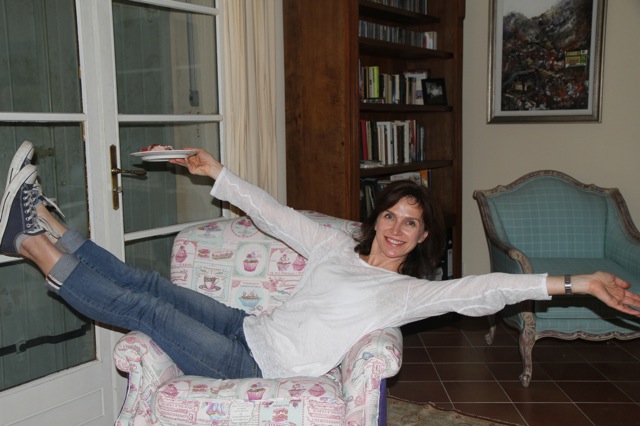
Joanna and her impressive reason
for a lack of cooking this month

Where am I going with this?  Welcome to the wandering mind of someone whose hands are deep in boar’s hair and webbing.  I’ll tell you where, though.  It occurred to me that, since this hugely successful show had been spun off to many countries, each tweaking it to its own tastes and state of mind, I could find the French version and improve my lamentable French while never pausing in my upholstery endeavours.

The first two hour episode proved to be a deeply comforting and successful experiment in language acquisition — mal cuit, anyone?  But then, halfway through the next episode I received a bit of a douche froide, so to speak.  The announcer, thankfully less humorous than her British counterparts as my French is barely up to understanding French slapstick let alone gentle, self-deprecating humour, announced that the Challenge Technique would be English in origin.  Cue the endless pause so beloved of such shows, then:

“Le challenge est……….  Charlotte aux fruits rouge.

Well, strike me down with a langue de chat.  You see, Charlotte Royale wasn’t English, it was French.  I knew this, because it had appeared only a week before on English T.V. and during French Week, no less.

Charlotte? C’est un French name, non?

Finally, something had occurred which made me look up from my stitching.  What gave Charlotte her ambiguous status between the French and the Brits, while retaining value as a challenge worth attempting?  The British show gave no clue.  Although their Charlotte involved Swiss Roll and looked like one of the illustrations in your mother’s 1970s copy of, er, a Mary Berry recipe book, it was accepted without demur by all as French.  Similarly, the French contestants, while sucking in their breath and declaring they were going to have to concentrate hard on this one, they failed to cry as one patissier,  “Zut alors, c’est un recet francais!”

The French presenter thickened the plot further, introducing a historian to explain the English origins of the dish.  Apparently, it was invented by Antoine Carême (yes, the father of the art of patisserie) who worked at both the English and Russian courts for a time.  You see?  Strange, no?  He made it for either a Queen Charlotte, a Princess Charlotte, a cousin Charlotte and then at some point tagged on Russe to include the Tsar in his flattery.

So why is this not considered French if a French man really did invent it?

Unearthing Charlotte’s origins in my own kitchen

IMG_2042

Patrick sharing his British Charlotte Royale. In France.

Patrick, my 9 year old, and I, decided to make the British version.  Doing it for myself cleared up all my questions.  It was, let’s say, a woman of substance.  French Women Do Not Get Fat, and their puddings cannot be hefty either.

My own Charlotte Royal was no slip of a thing.

The Swiss Roll lining was easily managed by Patrick working alone with our trusty KitchenAid.  While the French contestants piped boudoir biscuits to surround their moulds for the light bavarois filling, Patrick sliced up jammy sponge rolls which gave the pud a slightly cerebral air when turned out. How can you cut a petite tranche from that?  Piping even biscuits would be much more of a challenge for child and adult alike.  The Swiss Roll is infinitely more forgiving.

The difference between the French version and the English became clearer.  Simiar amounts of work and skill are involved, but one must be elegant and the other must be generous.  One should look preternaturally perfect, and the other is valued for comfort.  A French dessert should perhaps make you feel you are not quite elegant enough to eat it, while the English makes you feel better because you do not look like the Duchess of Windsor.  Ha ha –  it is not generosity of spirit that holds the French back from planting the tricolor on this this dish.  They are anxious that it is a recipe that can look unfinished, so trifle-like.

When Carême returned to France, he apparently rechristened the dish Charlotte á la Parisienne, probably to soothe the nerves of alarmed locals who may have heard a thing or two about the English king Carême had worked for.  I have no doubt when Charlotte arrived on French shores she resembled a trifle as little as possible.

Carême’s Charlotte is a little rootless, like so many of us expats.  Like us, it is unsure where it belongs and if home will ever be home again.  The Charlotte is perhaps a sort of Third Culture Dessert.

But at least I think I may have found the name for my upholstery business if I ever start one.

Here’s to Third Culture Sofas.

* * *

Joanna was displaced from her native England 16 years ago, and has since attempted to re-place herself and blend into the USA, Holland, Brazil, Malaysia, Venezuela, Saudi Arabia, and now France. She describes herself as a “food gossip”, saying: “I’ve always enjoyed cooking and trying out new recipes. Overseas, I am curious as to what people buy and from where. What is in the baskets of my fellow shoppers? What do they eat when they go home at night?”

Fellow Food Gossips, share your own stories with us!

STAY TUNED for tomorrow’s post!

If you enjoyed this post, we invite you to register for The Displaced Dispatch, a round up of weekly posts from The Displaced Nation, with seasonal recipes, book giveaways and other extras. Register for The Displaced Dispatch by clicking here!

Related posts:

Images: All images from Joanna’s personal photo albums, and used here with her permission

Jackie Townsend’s novel examines a cross-cultural relationship up close, imperfections and all

Jackie_Townsend

Jackie Townsend in Rome (photo used with her permission)

As a veteran of cross-cultural relationships (I am now on my second marriage to someone from another country), I tend to fancy myself as something of an expert on the topic. On the one hand, I know the joys of living in an intimate relationship with someone from another culture. On the other, I am only too aware of the pitfalls, a few of which I listed in an early post that still gets lots of hits: “Cross-cultural marriage: Four good reasons not to rush into it.”

I was therefore delighted to come across the novel Imperfect Pairings, by Jackie Townsend. From the outset of the book, I could see that here is a writer who understands that marrying someone from another country not only means marrying the family—but marrying the culture, by which one means the REAL culture, not the tourist version.

The imperfect pairing at the center of Jackie’s novel are Jamie, an American career woman, and Jack/Giovanni, who received his education at MIT but is from an old Italian family. The reason he has two names? Because, when he gets to Italy, he “literally turns into another person with another name,” as Jamie informs her mother at one stage.

Unsure of the relationship at first, Jamie finds herself powerfully drawn to Jack/Giovanni. Not only is he physically attractive, but he’s a man of hidden depths, who seems to understand her better than anyone else.

Eventually, the pair get married—but it’s not a fairytale wedding in the Italian countryside. Rather, it happens in city hall—Jamie has offered to help Jack get his green card. But despite this rather unromantic beginning, the couple grow close, and Jamie gradually immerses herself in Giovanni’s life, especially after he quits his job in the United States to help out with resurrecting the vineyards on his family’s estate.

As one reviewer said of Jackie’s novel:

It’s a brilliantly-written small gem, with exquisite detail and equally exquisite crafting of language, by an American author with her own Italian husband and her own Italian experience. It’s a guidebook to Italy, and a guidebook to how Italians really live their lives.

So can love cross borders? Fortunately, Jackie has agreed to answer some questions about her own life and the book. And she has kindly offered to GIVE AWAY ONE FREE E-COPY to the person who leaves the most interesting comment!

* * *

ImperfectPairings_cover_pmHi / ciao, Jackie. Thanks so much for agreeing to be our featured author this month. First can you tell us what made you decide to write a novel focusing on a cross-cultural relationship between an American woman and an Italian man?
I am 16 years married to an Italian who came to the U.S. for university and stayed.

And you called the novel “Imperfect Pairings”–why?
I got tired hearing all the oohs and ahs: “Oh you’re married to an Italian, how wonderful!” It’s so much more complex than that, and I wanted to dispel the notion of the romantic Italian love story, but in a real and true way, which means also dispelling the romanticism of relationships. The novel is about a couple dealing with real issues and real life, and learning to love each other even more in the midst of all that.

Did writing the book help you to process your own experience of getting into a cross-cultural relationship?
My own experience of being married to a foreigner exposed me to the parallels between cultural differences and marital differences. Entering a foreign country can be like entering a relationship and vise versa. To get to know someone, to understand them, you need the cross the border into their country, the country of their mind and soul. But even if you do eventually learn their “language,” you will never speak their native tongue, not really anyway. Which leaves the question, “Is it possible to ever really know the person you love?”

How much of the book is autobiographical?
Only about thirty percent of the story is autobiographically based. It took me much longer than Jamie to truly open myself up to my Italian family. Part of my writing the book, is homage to that, and them.

The Italian wine-making industry figures large in the novel. Did that emerge from an actual experience?
My husband’s family lives outside Turin, in Northern Italy, not far from the Barolo region. They did once have a summer villa there, where they made wine, and this is what inspired me to use wine and the resurrection of the family vineyard as a catalyst for the story. I love the way Italians treat wine, casually, like a member of the family, an old friend. Wine is a relationship. It requires love and care and tending to if it’s going to survive and grow, and, still, you don’t know what that wine will ultimately be, how it will taste. It became the perfect metaphor for the book.

Why a novel and not a memoir?
I’ve always written fiction, that’s the genre that comes naturally to me. I like the freedom, the idea of letting the characters take the story where they want to go, as when Jamie and Giovanni head to Southern Italy, to Napoli, at the end of the story.

Staying on the theme of your own life and travels, how and where did you meet your Italian husband?
My husband grew up in Italy, Australia, and Bangkok. He moved to the United States for college. We met four years later at business school in Berkeley. I had no idea he was Italian. He was raised in international schools and learned English very early on and worked hard to fit in, to have no Italian accent. But in Italy, he’s the opposite, staunchly Italian and working hard to rid himself of his American accent because he needs this sense of heritage, of home.

The inner nuances of Italian life

In the book you describe Jamie’s many displaced moments: her initial discomfort at being thrown into a physically demonstrative family that loves sitting down to home-cooked meals; her surprise at discovering that her American values of self-reliance and a can-do spirit do not really register with Giovanni’s people; and, perhaps most shockingly of all, her perception that her husband’s allegiance to football trumps all else. At one point she actually wonders if she and he have been “raised on different planets.” What was your most displaced moment when visiting Italy with your husband?
In the beginning of our relationship, it was knowing that he might be embarrassed my me, and my rather bawdy Americanism.

That reminds me of the first time Jamie and Giovanni visit Italy, not long after they’ve met, and she suggests that he sleep in her room. He gets angry and says: “It’s just not something you do here.” I know that you and your husband live in New York City. Have you ever considered moving to Italy?
Early on we had lofty dreams about living in Italy. The idea sounded romantic, but the reality was that the more and more we visited, the more and more I realized that moving to Italy would mean essentially moving in with his family—more disconcertingly his mother, a lovely kind woman, but also, well, I’ll let you imagine. The other reality was that it’s not easy to move to Italy and work. Job opportunities there just can’t compete with those in the States. Will we give it all up some day and move there? We’ll see.

What was your least displaced moment, when the Italian way of life made sense, and you felt as though you belonged in that part of the world—or as Jamie puts it when she comes to tolerate football, “accidentally entered some alternative universe”?
Three years ago our Roman cousin (the inspiration for the character Silvestro) asked me to be the godmother to his third child. Italians take this duty seriously, and I was very touched that he asked me, for Romans can often be all about Rome, and yet he skipped over all these other family members, even my husband, for the Americana. I’ve never felt so naturally a part of things (this, after 12 years)—standing in this magnificent church in the center of Rome, holding his baby in my arms as the priest christened him, trying not to shake or trip or fumble, surrounded by all of our Italian family, those who had so easily and truly made me part of their lives. I think I finally let myself believe it. It takes time, years, for cultural barriers to fall down, to really get to know someone from another country. But what I’ve learned is that you can. It’s something I would never have believed earlier on in my relationship with my in-laws.

That’s a touching story. Does having a non-American husband make you look at life in the United States any differently? In the book, Jamie comes to reappraise her sister and brother-in-law’s values after being exposed to a different part of the world.
Absolutely. It gives me perspective. My husband’s view is always global, from the outside in, sometimes infuriatingly so. While my view, the view of most Americans, will be from the inside out. We are the center of the world. But in fact, we are not. You can’t get this perspective, I don’t believe, unless you are intimately involved with another country, you “marry” them. I feel so lucky to have this experience and perspective in my life.

Self-publishing, a Writer’s Digest prize & praise from Italian Americans

Moving on to the book: What was the most difficult part of the book-writing process?
My writing is very subtle. I want my readers to read between the lines, to feel what’s going on in the quiet places. In as such, bringing out the romance between Jamie and Giovanni proved difficult. Because I believe that love is very personal and private, between two people only, and so to expose Jamie and Giovanni’s love felt like I was tainting it. I had to get past this. Knowing when to let love surface, getting the balance right, was difficult. It took a lot of time, and many of rewrites.

What was your path to getting it published?
I self-publish my novels through my own imprint, Ripetta Press. It’s a decision I came to a few years back when my first novel, Reel Life, came close but ultimately had no success in finding a publisher. When Imperfect Pairings came along, I didn’t even bother trying to find a publisher. I became accustomed to the freedom of being able to do what I wanted with the book. And I was going to have to market it myself anyway.

Are you comfortable with indie publishing—is it working for you?
It’s become relatively easy to self-publish, though it might not be for everyone. In my case, I’m able to garner enough press and sales to sustain myself and find inspiration. Speaking of self-publishing, Imperfect Pairings just won an honorable mention award for literary fiction in the Writer’s Digest Self-Published Book awards, which of course I was very pleased about. My plan is to have the book translated, first in Italian, and work to find an international distributer.

Wow, congratulations! And well deserved. I must say, was impressed by how elegantly and lyrically you write. So what audience did you have in mind for the book? Has it been reaching those people?
Some people from the pure Romance genre got a hold of my book early on, and were wildly disappointed. This is not your typical Italian love story, and far from your steamy romance. It’s an adult romance, and people who get that really enjoy it.

The best reception of the book has been from the Italian American community, people who have some connection with Italy, second or third generation transplants. Many of those readers can really relate to the idea of an Italian’s displacement and the differing cultural dynamics between America and Italy.

I noticed your first book was about sisters, and this book has a sister relationship at its heart. Are you working on the next book now? What is about, and will it have a pair of sisters?
Funny you should ask. Yes, my next book has a sister theme. Two young adult women from different countries and cultures—one is Italian and one is American—will discover that they have the same father.

I presume you have a sister or sisters in real life?
Yes, I have two sisters (and a brother) who drive me crazy. But I love them. They provide inspiration for a lot of material!

10 Questions for Jackie Townsend

Finally, I’d like to ask a series of questions that I’ve asked some of our other featured authors, about your reading and writing habits:
1. Last truly great book you read: Hologram for a King, by Dave Eggers.
2. Favorite literary genres: Fiction, novels and short story collections, both classical and contemporary.
3. Reading habits on a plane: I travel frequently, and often far. Planes are my excuse to spend uninterrupted hours getting lost in a novel. I travel with my Kindle. It gives me this sense, tucked into my purse, that I’m traveling with all my books.
4. The one book you’d require President Obama to read, and why: 1984, by George Orwell but only because I couldn’t think of anything else.

5. Favorite books as a child: To Kill A Mockingbird; Catcher in the Rye.
6. Favorite heroine: Dorothea in Middlemarch
7. The writer, alive or dead, you’d most like to meet: Joan Didion
8. Your reading habits: At night, before bed, but I will also sometimes get up and read in the morning, for inspiration. I am always inspired to write when I read great fiction.

9. The book you’d most like to see made as a film: Mine.

10. The book you plan to read next: The Lowland, by Jhumpa Lahiri

* * *

Thank you, Jackie! As mentioned, I loved the book—everything from the big picture of the cross-cultural relationship to the little details, like Jamie having to get used to the fact that Italians don’t snack between meals. I also love something you said just now: “Entering a foreign country can be like entering a relationship and vise versa.” I believe there’s something in this book for every expat or serious traveler.

Readers, how about you? Any further questions for Jackie, or comments? Remember that if you leave a comment, you’ll be eligible to receive a free e-copy of the book! So, comment away! Extra points, as always, if you’re a Displaced Dispatch subscriber!

The winner will be announced in our Displaced Dispatch on November 30, 2013.

Can’t wait to read the book? You can always order a copy at Amazon.

STAY TUNED for next week’s fab posts!

If you enjoyed this post, we invite you to register for The Displaced Dispatch, a round up of weekly posts from The Displaced Nation, with seasonal recipes, book giveaways and other extras. Register for The Displaced Dispatch by clicking here!

Related posts:

Images: Jackie Townsend in Rome; book cover art.