The Displaced Nation

A home for international creatives

Tag Archives: Alice in Wonderland

LESSONS FROM TWO SMALL ISLANDS — 5) Keep calm and pour some tea

Teatime CollageDecember greetings, everyone! Can you see us twinkling? The Displaced Nation wants to be part of your Festival of Lights this December — a source of brightness and enLIGHTenment during the dark days of winter. (Unless, of course, you reside in the Southern Hemisphere, in which case, you should be helping all of us to feel brighter!)

But before we get to that — Kate Allison will be delivering some tips tomorrow on generating holiday cheer regardless of location — do you fancy what the Brits would call a cuppa?

If you said no, that you’d prefer coffee or cold beverage, I suspect you may be a compatriot of mine. Once upon a time, I was an American like you — I didn’t drink any caffeinated beverages apart from Diet Coke. But then I traveled to Europe and Asia, and now I can’t imagine a life without tea. As the Chinese lady who owns Ching Ching Cha, a traditional Chinese tea house in Georgetown, DC, once remarked to me, when I told her how much I’d grown to like tea from my travels: “For me, tea is a way of life.”

Those who already know what I’m talking about may read no further. But for the unconvinced, here are 10 lessons I learned while living in two major tea-drinking nations, Britain and Japan, for many years. (If you’re the bucket-list-keeping type, think of it is as 10 reasons to develop a tea-drinking habit before you die!)

1) Even if coffee is more your cup of tea, so to speak, give tea a chance.

Coffee is great for that jolt to the system. One of its most effective uses, apart from first thing in the morning when you’re going to work, is for the jet lag that occurs after a really long international flight — say between the United States and Japan. (Japanese, btw, love coffee as much as the English do — and perhaps thanks to German influence, can make an even better cup than anyone in the UK or the USA.) But unlike coffee, tea is what keeps you going day in day out, putting one foot in front of the other. It’s the sustenance beverage for the marathon known as life.

2) I mean tea, not tisanes.

I apologize to those expats who’ve spent their formative years in France. I have nothing against those herbal drinks with medicinal qualities. I just think it would be a shame to miss out on the kind of caffeine that tea has to offer — the kind that produces sustained mental alertness. Not to mention tea’s own medicinal qualities — all of those lovely antioxidants. Why do you think the Japanese live so long, with all their bad habits of smoking, drinking to excess and overwork? Likewise, the English writer, George Orwell, was able to sustain himself on cups of tea when living “down and out” in Paris and London.

3) Tea has a special role to play in the holiday season.

It’s the perfect libation to help you recover when your feet are aching after a full day of shopping and wrapping gifts (surely, the bane of any adult female’s existence this time of year!) or when you think your hand will drop off if you have to write one more Christmas card. It’s also the perfect drink to serve, because so convivial and relaxing, when meeting up with friends or family you haven’t seen in a long time.

4) Tea is a primary aid for developing a more stoical attitude towards life.

As explained in the very first post in this series, I found it a bit of a challenge to adapt to the brand of stoicism-cum-fatalism both of these small islands, England and Japan, have cultivated over the centuries. But the day I worked out the connection between tea-drinking and stoicism marked the beginning of the end of my struggle. If only I’d paid closer attention to Orwell, who said:

All true tea lovers not only like their tea strong, but like it a little stronger with each year that passes.

5) Tea may also be the key to a philosophical approach to life.

The process of drinking a cuppa slows you down for long enough to clear your head of pressing thoughts and work out what is important. Strangely, I found Brits to be almost as insistent on the importance of a regular tea-drinking habit as the Japanese — even though it’s the latter who are renowned for their Zen approach to tea. Take these words of Rudyard Kipling’s, for example:

We haven’t had any tea for a week…
The bottom is out of the Universe

It reads like a haiku, doesn’t it? Certainly, his sentiments are not far removed from the Japanese proverb:

If man has no tea in him, he is incapable of understanding truth and beauty.

6) The rituals are just as important as the tea itself.

After nearly a decade of living in Britain, I had it all down to a fine art: boiling water to serve tea, heating the pot, putting the milk in the cup first, and pouring the tea without spilling. To this day, I cannot imagine making a pot of tea without pouring hot water in it first to heat the pot. The water and the pot need to be at the right temperature to brew the tea properly. Imagine the affront I experienced upon returning to this country and being served a cup of either semi-warm water or boiling water with a Lipton’s tea bag on the side. And though I found some of the Japanese tea-drinking rituals a bit obscure, especially those related to the tea ceremony — twirl the cup around three times, really? — I still took delight in the spectacle.

7) Tea should be served with something sweet.

“Tea and biccies, anyone?” as they say in England — usually meaning the chocolate-coated digestive biscuits. And the perfect way to offset the super bitter green tea (macha) of the Japanese tea ceremony is with the almost sickeningly sweet kashi and wagashi — confections that are usually served beforehand. A tad of sugar helps this most medicinal of teas go down. Not only that but it’s a beautiful combination, as anyone who has sampled green tea ice cream, by now a classic flavor, will attest.

8) Tea should be served in an aesthetically pleasing cup — never paper or plastic!

Part of the pleasure of taking tea at Fortnum & Mason’s or the Ritz is the bone china it is served in. If the world had a treasure chest, surely it would contain a full set of Wedgwood or Royal Doulton? In Japan, by contrast, it is the roughness and imperfection of the tea cup that provides aesthetic pleasure, or, if you’re drinking Western tea (usually served with lemon, not milk), the sheen of a fine china tea cup — either English (Wedgwood Wild Strawberry is very popular there) or a Japanese version (eg, Noritake). Can’t be bothered with china? At the very least, make your tea in a proper mug.

9) Tea is the ultimate social drink.

Perhaps the British writer known as Saki (yes, he was born in the Far East) put it best when he wrote:

Find yourself a cup of tea; the teapot is behind you. Now tell me about hundreds of things.

Japanese may not be as fond of having a natter when they take tea; nevertheless, they see it as a custom that fosters social harmony.

10) No one should ever be too busy for a tea break.

My fellow Americans, are you still with me? This pointer is particularly for you — particularly those of you who are always crazy busy — although as Tim Kreider pointed out on the New York Times‘s Opinionator blog, it’s often not clear why what you’re doing is so important. Perhaps if you took time out for a regular tea break, you would slow down a bit — see 5) — and find an escape from your self-imposed “busy trap.”

****

And now I must leave you as the clock says ten to three — only, is there still honey for my tea?

Readers, do you agree that tea may be the answer? Or is this just another of my moonbat pronouncements that’s put you in need of a strong cup of Joe?!

STAY TUNED for tomorrow’s post from Kate Allison.

If you enjoyed this post, we invite you to register for The Displaced Dispatch, a round up of weekly posts from The Displaced Nation, with seasonal recipes, book giveaways and other extras. Register for The Displaced Dispatch by clicking here!

Related posts:

Img: Collage made of two photos available on Flickr via Creative Commons: (left) “High tea,” by John Heaven, and “Japanese tea ceremony,” by JoshBerglund19.

And the Alices go to … these 3 expat writers for their Hurricane Sandy posts

 © Iamezan | Dreamstime.com Used under license

© Iamezan | Dreamstime.com
Used under license

My husband and I have a habit of going on holiday just before some major world crisis occurs — after which we have no choice but to spend several days holed up in our hotel room watching the events unfold on CNN. Twice it was a crisis involving water: the deadly Hurricane Katrina and the 2004 Boxing Day tsunami.

But for Hurricane Sandy, we were very much on the scene — ensconced in our apartment in NYC’s East Village, and with no television to watch, not even a radio to listen to! As those who read my post of earlier this month are aware, we were deprived not only of power but also water, communications and public transportation for several days, and displaced from our home for one night — an inconvenience that, while somewhat traumatic, turned out to be minor compared to what others had suffered in harder-hit areas.

As I mentioned then, the experience gave me a chance to test this blog’s basic premise: that forcible displacement at some level compares with the kind of displacement one has when living in a country that is not your home. And if so, can a former expat like me draw on the strengths gained from living overseas to keep calm and carry on?

While pondering these fundamental questions, I came across three posts by expats on Hurricane Sandy that gave me some fresh insights — not only on Sandy but on the down-the-rabbit hole nature of international travel and the expat life.

Thus I’d like to hand out three “Alices” today to (in reverse chronological order):

1) PETE LAWLER

Awarded for: Clouds from the Past: My Reflections on Sandy, Gloria and the Jersey Shore, in his personal blog: The American Londoner
Posted on: 3 November 2012
Moving passage:

But here and now, when things are raw, when my cousins have been without power for a week and my parents are cooking with a propane tank and a Coleman portable grill even high up in the Pocono Mountains of Pennsylvania, I mourn. My heart goes out to those suffering and I mourn for that place of childhood sunshine and wish it a good and steady recovery in the coming months.
All the best, Jersey. I am thinking of you.

Citation: Pete, before Sandy, you probably weren’t thinking that much about “that place of childhood sunshine,” the Jersey shore — because, after eight years in London, you try not to think too much about sunshine any more. But then Sandy plunged you into mourning for all the good times you had as an all-American kid — the “long sunny days spent lazily frolicking through waves, collecting shells, and cautiously avoiding jellyfish.” It even made you think with some nostalgia of Hurricane Gloria, which you rather enjoyed as a seven-year-old. Absence, plus tragedy, can indeed make the heart grow fonder… What’s more, I sense how bad you must have felt about being powerless, from a distance, to help your parents and your cousin in their time of need — a guilt that’s at the hard core of the expat life. Just ask Linda Janssen — I’m thinking of her aptly titled “Down the Rabbit Hole” post of last summer, about her father’s illness.

2) MADELINE GRESSEL

Awarded for: Hurricane Sandy and the unspoken attraction of disaster, in Matador Abroad
Posted on: 1 November 2012
Thought-provoking passage:

Now, as New York City is sloshed by a record-breaking 13ft wall of water, it is I sitting comfortably in a café in Hong Kong watching the light October rain outside. … My friends post photos on Facebook of candlelit dinners, submerged cars, and the powerless, darkened skyline.

And I wish I were there with them. Not because I’m afraid for their safety (I’m not), but because I’m missing a moment of New York history. I’ll never be able to say, “Remember the flood of 2012? That was insane.” I feel jealous at the pictures, like I’ve seen a photo of an ex-lover with his new flame.

Citation: Maddie, I wonder why it is, as we also learned on this blog this month, so few American expats feel the need to connect with their homeland during a presidential election — which, too, provides a chance to be “part of history,” especially if the race is closely contested? I think the answer may lie in your rather astute observation: people love a disaster. Come to think of it, a friend of mine has confessed that during Sandy, she had the overwhelming urge to go outside — in the storm! (Even though it was expressly forbidden by Mayor Bloomberg.) In addition, your post reminded me of another old expat adage: out of sight, (afraid of being) out of mind…

3) RUTH MARGOLIS

Awarded for: “I wasn’t afraid of Superstorm Sandy — until the lights went out,” in Telegraph Expat
Posted on: 31 October 2012
Moving passage:

Forty-eight hours ago, I was relishing my role as stoic, cynical Brit, refusing to bow down to an impending crisis. I bashed out jokey emails to friends and family noting that it was “a bit blustery”…

…my husband and I — plus my visiting younger sister — spent much of Sunday and Monday quite enjoying the commotion. Like kids playing an imaginary game, we stocked up on all the (un)necessaries: crisps mainly, and garish American junk foods…

Then, something strange happened: the lights went out in Manhattan. … “Ah,” we thought, followed by a shaky: “Hmm”. … Eventually, we went to bed, with the radio on. No one got much sleep.

When the next storm hits, I expect I’ll ditch the cockiness sooner.

Citation: Ruth, there I was, trying to conjure up the “keep calm and carry on” ethos that I’d learned (rather begrudgingly) from nearly a decade of living in Britain, when, had I known you were down in Brooklyn, I could have asked for a refresher course (ah, yes, the junk foods and the jokey emails!). Still and all, I’m glad to know that even for a native-born Brit, there are limits, one of which is seeing the lights go out in lower Manhattan… (From now on, I won’t be too hard on myself!) I can also relate to what you said about these disasters having a cumulative effect (made worse by the fact that you’re living far away from your homeland and already feeling somewhat displaced). As you point out in your post, Sandy was the second time since emigrating that you’ve “had to assume the brace position,” the first being Irene. I can recall feeling something similar when living in Tokyo — first there was the Aum Shinrikyo attack on the subway and then the massive earthquake in Kobe, after which I decided that the stoicism required for this situation hadn’t yet been invented! (Bloomin’ heck, why was it I’d told everyone at “home” that Japan was so much safer?)

* * *

So, readers, do you have a favorite from the above, any comments on these bloggers’ ruminations, or any further posts to suggest? I’d love to hear your suggestions!

STAY TUNED for tomorrow’s post, some comforting advice and (hopefully) words of wisdom from The Displaced Nation’s resident agony aunt, Mary-Sue Wallace.

If you enjoyed this post, we invite you to register for The Displaced Dispatch, a round up of weekly posts from The Displaced Nation, with seasonal recipes, book giveaways and other extras. Register for The Displaced Dispatch by clicking here!

Related posts:

Images: All from Morguefiles.

And the Alices go to … these 7 writers for their revealing posts on food and world travel

 © Iamezan | Dreamstime.com Used under license

© Iamezan | Dreamstime.com
Used under license

Autumn is finally here, and those of us who lost our appetite during the onslaught of this summer’s heat and humidity find that we can breathe — and eat — again!

Accordingly, the Displaced Nation has turned its attention to food — though in a way that conjures up the magical dreamscape of Alice in Wonderland rather than a blog populated by posts on typical and traditional world cuisines.

On the one hand, we’ve heard from the Top Hatter — I refer to Anthony Windram’s avatar — on the pleasures of indulging in beef tongue at a Kyoto restaurant. On the other, we’ve encountered Duchess Kate (Allison) just as she was pronouncing on the Queen’s favorite chocolate and inviting us to join her in a chocolate cocktail.

Last week when Tony James Slater appeared on the site, he was looking for all the world like Lewis Carroll’s Caterpillar, smoking his hookah and talking in short, somewhat rude sentences. His topic was the time he became violently ill (to use more polite language than he did) on mansaf on his visit to Jordan.

And personally I’ve yet to recover from last week’s encounter with the curious and curiouser Mark Wiens, who said he

would be very happy to fly to a destination and not do any of the normal tourist attractions, but just eat.

What’s more, he had the cheek to propose serving durian to The Displaced Nation! Off with his nose!!!

While putting together this menu of “It’s food!” posts, I’ve found it entertaining to read as many foodie posts as possible on other expat, repat, and travel blogs. And today I’d like to acknowledge some of their writers for what they’ve taught me about food and world travel.

A year-and-a-half ago, I had the pleasure of handing out the Displaced Nation’s Alice Awards to 7 writers who clearly understand — and aren’t afraid to reveal — the curious, unreal side of international travel.

Today I will hand out another set of Alices — you might call them the “Foodie Alices” — to writers who share the Displaced Nation’s down-the-rabbit-hole disposition toward world cuisines, i.e., who aren’t afraid to try mushrooms that make you grow, potions that make you shrink, tea parties where they don’t serve tea, and also feel duty bound to report these experiences to the rest of us.

So, without further ado, the Alices go to (in reverse chronological order):

1) AMANDA VAN MULLIGEN

Awarded for: “Do I Not Like Mushy Peas”, in A Letter from the Netherlands (personal blog about life as an Englishwoman in Holland)
Posted on: 19 September 2012
Choice morsel:

[Regular readers will know I am a fan of the Great British fish and chips.] However, there is no way, no how, I will eat fish and chips with mushy peas. They are vile. Foul. By far, mushy peas are … [t]he most disgusting monstrous green mess that has ever passed my lips. They turn my stomach.

Citation: Amanda, we award you this Food Alice or the feat of turning the typical “foods I miss from home” post on its head. That’s what it means to step through the looking glass. You’re a smart cookie and the rest of us would do well follow your example and focus on the “evil” accompaniments to our native cuisines that for health reasons alone, we’re lucky to have escaped from.

2) ANDREW COUCH

Awarded for: “Making Pancakes from a Bottle,” in Grounded Traveler (personal blog covering expat life in Germany), Posted on: 21 September 2012
Choice morsel:

We do not have a griddle. I imagine very few Germans have a griddle, at least not one useful for pancakes. So I get a set of 3 in a pan and the whole bottle [of Mondamin Pfannkuchen Teig-Mix] makes 12 or so, so I was doing several batches. … It works great, but well.. umm.. the Celsius temperatures still seem hard to understand for me. So while I didn’t overcook the cakes, I did almost burn my finger…

Citation: Andrew, you showed derring-do in experimenting with using bottled German pancake mix (and no griddle) to produce one of your favorite breakfast foods from home. Such bravery merits an Alice as does your acknowledged befuddlement over temperatures in Celsius, the vagaries of baking soda performance across the globe, and the extortionate prices of maple syrup. (Hey, we’ve all been there…)

3) KATE BAILWARD

Awarded for: “Sunday Supper,” in Driving Like a Maniac (personal blog about life as an Englishwoman in Sicily), part of her “Eating like a maniac” series.
Posted on: 3 September 2012
Choice morsel:

A Sunday night chuck it together kind of a lazy supper for one, to use up whatever you’ve got left in the fridge. I had a medium aubergine, a small courgette and some ricotta, as well as a jar of passata vellutata. You could say it was a very bastardised version of parmigiana alla melanzana, or you could just take it on its own merits and call it courgette, ricotta and aubergine rolls in tomato sauce. Or something else entirely. Whatever takes your fancy.

Citation: Kate — Katja, if we may — we give you an Alice for your versatility in writing foodie posts. Just after you published this piece, you wrote a post for Travel Belles on the joys of rustling up one’s own caponata, which you described as the “very essence of traditional Sicilian food.” Clearly, your training as an actor has borne fruit (and veggies!) if you can segue from harried EFL teacher chucking together a pseudo-Italian dinner, to full-fledged cookery expert. (What’s wrong with trifle, btw?)

4) JESSICA FESTA

Awarded for: “Eating My First Pet in Ecuador,” in Jessie on a Journey (personal travel blog)
Posted on: 24 August 24 2012
Choice morsel:

The body is sliced down the middle, opened like a thick book, on top of sizzling coals. Tiny hands, still with finger nails, reach into the air as if their last plea for help had gone completely unnoticed. Bright white teeth gleam out of mouths open in a scream and faces twist in agony. Apparently, the miniature murder scene I am witnessing is about to be my dinner.

Despite having been excited to try the popular Ecuadorian meal, something inside me feels a bit uneasy. My mind wanders back to my first pet, a guinea pig I named Joey after a school crush.

Citation: Jessica, we award you this Alice for your refusal to let “mental discomfort” stop you from ordering cuy, a popular South American dish, just because it resembles your Joey. (I for one never let sentiment get in the way of my enjoyment of koi, or goldfish, in Japan.) You’ve more than delivered on your promise to take us “beyond the guidebook.” We’re also very pleased that you found the dish delicious. Another one to add to our “must try” list, alongside Anthony Windram’s beef tongue.
COMING ON WEDNESDAY: A Random Nomad interview with the cuy-eating Jessie!

5) GERALDINE

Awarded for: “7 Badass Bavarian Foods You Must Try,” in The Everywhereist (personal blog about a trailing spouse’s adventures)
Posted on: 8 May 2012
Choice morsel:

Do you want to eat Bavarian food? OF COURSE YOU DO. It is rich and doughy and filling and is the only thing on the planet that can soak up German beer. Every other fare will simply hide in the corner of your stomach, petrified at the sheer awesomeness of the brew that resides in there with it, and it will never get digested.

In short: if you don’t eat Bavarian food while in Germany, you could die.

Citation: Geraldine, you’re full o’ beans, but we love you for that. Most “10 best foods” posts are about Southeast Asia or, more specifically, Thailand, home of cheap, tasty yet healthy food. But you realized that the market was already satiated for such posts and that it was time to give “badass Bavarian” food — of the kind that puts hairs on one’s chest — more of a chance. Not only that but you persuaded us. Pass the schweinshaxe.

6) & 7) MICHAEL HARLING & TONY HARGIS

Awarded for: “Is America too Sweet or Britain too Bland?” in Pond Parleys (joint blog, now defunct)
Posted on: 13 March 2011
Choice morsel:

Mike: I was surprised, on our recent visit, at how sweet America was: the beer, the bread, the pretzels (sugar-coated pretzels—honest to God) and even, oddly enough, the candy. And if it wasn’t infused with sugar, it was too salty and/or covered in cinnamon. After nearly ten years in UK, I found it all a bit too cloying.
Toni: While I do agree that American food has some strange stuff added to it, I wouldn’t call British food particularly bland. Rather than sweet, there is often a surprisingly savoury taste when you least expect it. While Cumberland sausage can have a peppery bite to it, Americans actually build their sweetness into the sausage, with maple syrup mixed right in.

Citation: Mike and Toni, we know you aren’t publishing Pond Parleys any more, but surely this post goes down in the annals and therefore deserves an Alice. I commented on it at the time it was published, wrote a post about it on TDN, and here I am writing about it again. The pair of you had a genius for pinpointing the kinds of things that routinely throw off American expats in Britain and vice versa, without their even knowing it. In the case of this food post, it turns out that we Yanks, just like the Duchess in Alice’s Adventures in Wonderland, may be allergic to all that pepper in the sausage! And who would have guessed that the sweets-loving Brits would recoil from our foods for their high sugar content?

* * *

So, readers, do you have a favorite from the above, and do you have any other writers/posts to nominate for our next round of Alices? I’d love to hear your suggestions!

STAY TUNED for tomorrow’s post, another Displaced Q focused on food by the anti-foodie Tony James Slater!

If you enjoyed this post, we invite you to register for The Displaced Dispatch, a round up of weekly posts from The Displaced Nation, with seasonal recipes, book giveaways and other extras. Register for The Displaced Dispatch by clicking here!

Related posts:

The accidental repatriate

Last time Sezin Koehler wrote for us, she was bidding farewell to “strange, Lovecraftian” Prague, where she and her husband had lived for four years. Also in the Czech Republic, Koehler succeeded in producing her first (horror) novel, American Monsters. After a short stint in Germany, the couple is now saying hello to sunny, but bugbear-filled, Florida. Koehler describes the emotional transition.

When I left the US for Europe in 2002 I had no intention of ever again living in America. Violence, backwards politics, a horrible job market, and a provincial outlook on the world made an extreme contrast with my global, Third Culture Kid background. I am half American, half Sri Lankan, and my mother worked for UNICEF, so the family lived all over the world.

Not to mention I was suffering from extreme post-traumatic stress disorder after witnessing the murder of a dear friend when the two of us were robbed at gunpoint by a gang banger in Hollywood.

Ten years later and a forced repatriation determined by economics rather than desire, I am at a loss for how much worse off this country is since I left. I know a decade is a long time — but surely not long enough to usher in political rhetoric that would take this nation back to pre-1950s? My mind boggles.

One big dark nation

Gun violence has ever increased — to the point where we find so-called Stand Your Ground laws that allow citizens to kill each other with impunity, under the guise of “I felt threatened” — even when that threat consists merely of a young African-American boy, armed with nothing but iced tea and a bag of Skittles.

I’m back in the world of mad gunmen going on shooting sprees. Sikhs mistaken for Muslims and murdered. Women getting abducted and raped at gunpoint while waiting for a bus — this happened just recently not far from where I live.

Post-9/11 America has seen the sharpest increase in the infringement of civil liberties as matters of homeland security and anti-terrorism. The arrests of journalists covering Occupy Wall Street events brought the US’s rank of journalistic freedom down 27 points, putting the country at 47, just behind Comoros and Romania.

Xenophobia abounds as states pass laws against the teaching of ethnic studies, and even literature written by Native and Mexican Americans, in schools. Such developments are exponentially more ironic when considering that this country’s immigrant history.

The worst (and rudest!) of times

After college it took me almost a year to get a proper job. Upon returning, I’ve had trouble securing even a retail job: all applications are now submitted online and don’t give you an option to upload a cover letter or even your full resume. Not only are American jobs outsourced to China, the application process has been tech-sourced to boot, as machines vet your application — even if you live right down the street from the store to which you’re applying.

I was shocked to find that retail jobs pay exactly what they did a whole ten years ago. Way to move forward, America.

America might have progressed in terms of technology; I see a smart phone in every hand. However, common courtesy has gone out the window as people text, Facebook, Tweet, right in the middle of an actual face-to-face interaction, without even a twinge of remorse.

Call me old fashioned, or a kindred spirit to Hannibal Lecter, in believing it’s the epitome of rude to fiddle with one’s phone (or any other such object of distraction) whilst another human being is talking to you.

The wheels on the bus go back-backwards.

Monsters are the best friends I ever had

To add insult to injury, I find myself in a particularly devoid area of Florida, easily one of the most vapid places on the planet. Plastic people who can spend an hour telling you about their lunch salad are the antithesis of the cultured individuals with whom I spent my time while living elsewhere.

Who would have thought the rabbit hole I fell down when I left Prague would lead to a place scarily resembling Hell, with its torturous circles and its staggering temperatures?

Each day I force myself to review the positives:

It seems incredible that the America I left ten years ago — the one that traumatized me so badly — is actually a better version than the one in which I live now.

So frustrated have I been by absurd American conservatism and the zombie hordes of consumerism around me, I’ve resorted to a new persona: Zuzu Grimm, a creature who writes wicked dystopic visions of where this country is headed if it continues down this current path of willful ignorance and fear mongering.

Bored now

But that’s not been the only struggle: For years I defined myself as an expat. My blog was filled with anthropological tales of living in Switzerland, France, Spain, Turkey, the Czech Republic and Germany. More than that: stories of growing up in Sri Lanka, Zambia, Thailand, Pakistan, India.

While I’m still a Third Culture Kid — never really at home anywhere — my expat identity became a cornerstone of who I was. It worked, and was so much less confusing to explain. The expat label made me feel ultimately more interesting. Writing a novel in Prague sounds infinitely more exotic than writing from an essentially retiree community of ten thousand.

Oy vey.

Accepting that this is who I am now, and this is where I am, has been even harder than the absolute culture shock upon repatriation.

Being an expat gives a person a sense of uniqueness that may or may not be deserved. Yes, you’re a foreigner who must negotiate language/cultural/social barriers. But it’s also your choice. And for many people economics determines whether you can or can’t participate.

Kind of like having kids. You can complain all you want about how hard it is, but it’s something you elected to do, not something that was forced upon you.

(Well…unless Republicans head up the White house; with their insane ideas on abortion there’ll be thousands more women forced to carry rapists’ babies to term. Disgusting. Terrifying. Yet another grotesque example of the New America I find on return.)

I’m nobody, who are you?

My former life as an expat has taken on so many more shades of meaning as I consider how it must have seemed to those in my position right now: How glamorous. How decadent. How lucky. How dare they criticize my government when they’ve jumped ship. I have to live here. I’m thousands of dollars in debt. I don’t have the luxury of leaving.

Maybe one day when my husband wins the lottery, that’s just what we’ll do. Leave. Maybe for Buenos Aires, or Addis Ababa. Maybe in the meantime we’ll find a better city in the US, one that offers more by way of creativity, culture, and history — the things I miss most about life in Europe.

Until then, I have to make peace with being plain old Sezin Koehler who lives in and writes from Florida. Hopefully some time soon I’ll be okay with that. Any minute now. It’s going to happen.

That’s fine. I’ll wait.

And pray I don’t get sick in the meantime, because even with Obamacare, I still can’t afford health insurance.

Sezin Koehler, author of American Monsters, is a woman either on the verge of a breakdown or breakthrough writing from Lighthouse Point, Florida. Culture shock aside, she’s working on four follow-up novels to her first, progress of which you can follow on her Pinterest boards. Her other online haunts are Zuzu’s Petals‘, Twitter, and Facebook — all of which feature eclectic bon mots, rants and raves.

STAY TUNED for tomorrow’s post, another displaced Q from anti-foodie Tony James Slater.

If you enjoyed this post, we invite you to register for The Displaced Dispatch, a round up of weekly posts from The Displaced Nation, with seasonal recipes, book giveaways and other extras. Register for The Displaced Dispatch by clicking here!

Related posts:

img: Sezin Koehler in St. Petersburg, Florida, by Steven Koehler (2012).

TRAVEL YARN: Two madcap Indonesian ladies in weird & wonderful Japan (1/2)

Japan — the country that many Westerners have likened to Lewis Carroll’s “wonderland” for its quality of wacky unpredictability. But what about for other Asians — do they feel as displaced and disoriented there as we do? Our very first Random Nomad, Anita McKay, ventured into the Land of the Rising Sun for the first time this summer, in the company of another Indonesian, P, who had been there once before as a student. McKay reports on the pair’s adventures in this two-part travel yarn.

The message exchange between my travel buddy, P, and me, in May, went like this:

Me: “So have we decided where we want to go this July?”

P: “How about Japan?

Me: “Okay.”

P had lived in Japan decades ago for a student exchange program. She hadn’t been back since, and thought this year would be a good time.

I, on the other hand, didn’t really have any specific destination in mind — just so long as I could go somewhere I hadn’t been to. As I explained in my interview with the Displaced Nation, although I am from Indonesia originally, I have lived for extended periods in Aberdeen, Scotland, and in Australia. But I still hadn’t made it to Japan.

P suggested Tokyo, Kyoto, and Kobe. I added Yokohama to the list because there’s a blog buddy I wanted to meet up with. She and I had been trying to catch up forever and everywhere — UK, Singapore, and Indonesia — but kept missing each other. If I went to Yokohoma, where she is now based, surely we would finally get together?

I prepared myself for the trip by scanning some pages in Trip Advisor and the Lonely Planet guidebook. At least I would have an idea of what to do and where to go — and wouldn’t be entirely dependent on P, who speaks and reads Japanese and has lived there before so presumably knew how to get around.

Madcap traveler’s motto: Be unprepared!

When we landed at Narita Airport, I suggested that we take a taxi because it was 9:00 a.m., and I had taken the notion of a red-eye quite literally — my eyes looked red as I was still recovering from flu. I desperately wanted to have a quick nap before exploring the city.

We crossed the road, dragging our gigantic suitcases with us, and I let P speak with the men at the taxi rank. When she showed them the address of the hotel, one guy frowned and looked at us. “Tokyo?” he asked in disbelief.

We nodded eagerly. The drivers exchanged glances and apparently decided we weren’t crazy. One of them spoke in Japanese to P, who translated: “It’s 23,000 yen.”

I did a quick calculation, and almost fainted when I found out it will cost us almost 300 AUD [around the same in US$] for a taxi to our hotel.

“300 bucks??” I asked P. She nodded calmly, but her eyes couldn’t lie. She was just as shocked as I was.

“No! Cancel!” I shook my head furiously, while P apologized to the drivers. The men just laughed and pointed us back to the airport. “Take the train instead,” I think they said. “Like normal people.” Maybe they said that, too!!

Now we know why there was no one queuing for a taxi, whereas there was a long queue at the train ticket window. And we thought we were being smart!

Everyone had warned us that Japan — Tokyo in particular — is “very expensive!” The city ranks number 1 in the list of the most expensive cities in the world, while Perth, where I now live, is number 19. But really, if the taxi would cost us almost 300 bucks, what kinds of prices could we expect to find in Tokyo?

P had no memory of taxis from the airport. Years ago when she landed in Tokyo, she was picked up by a shuttle bus.

She’d also paid no attention to the length of the journey — she’d been too busy meeting and getting to know the other students. Both of us were surprised when it took almost an hour for the Narita Express to reach Tokyo Station. P had assumed it would be like Jakarta airport to the city centre (just because), and I must have skipped that page in the guidebook…

Well, at least we now knew why it was so expensive to take a taxi: the distance is more like Heathrow to London.

We just kept laughing at our silliness.

It’s food?!?!?

By the time we’d reached our hotel in Chiyoda, a quiet area near the Imperial Palace, we were both rather hungry and decided food would come first on the agenda, before tackling the first sight on our list: Sensō-ji, Tokyo’s oldest temple, in Asakusa.

Food is important to us Indonesians. We eat all the time. In Japan for the first time, I wanted to try something new: not sushi, yakiniku, donburri (rice bowl), soba, or ramen.

“Let’s try this!” I excitedly pointed at one restaurant name in the guidebook. “It’s in Asakusa and it looks…exotic enough.”

P agreed, and under the glare of the July sun we made our way to a restaurant called Komagata Dojo, only to be greeted by the sight of a rather long queue. If there is a queue, then the food must be good, we assured each other. Plus it seems as though most of the people in the queue are locals, so the taste must be authentic.

As it turned out, the restaurant is in its sixth generation of owners, and is famous for its dojo: a tiny freshwater fish like an eel or sardine, cooked in a cast iron pot.

We ordered what seemed to be everyone’s favorite, dojo nabe (hot pot), and also asked for two bowls of rice.

The waitress lit the charcoal burner in front of us, set the pot down on top of it, and told us to sprinkle the spring onions, or negi, on top of the fish.

We looked at each other after the first gulp.

“What do you think?” I asked P.

“What do you think?” she replied back.

“Well…it’s…all right. Weird.”

She nodded. “The rice is very good though.”

I can’t describe the taste. It’s rather bland for my liking, as I grew up in Indonesia, which is famous for its spicy dishes. Not just hot spicy, but lots of flavors in every dish. But dojo nabe isn’t tasteless either. Lots of soft flavors, like soy and spring onions.

When we were about to finish our lunch, I asked P how come Japanese people look so slim if, like the rest of us Asians, they enjoy eating all the time. We were thinking that their diet of raw seafood might be the answer.

“But this isn’t raw,” I pointed at the dojo. “It’s cooked. Plus the size of the rice is rather big.”

We looked around at the other patrons — and, to our horror, we were the only ones who’d seemed to have ordered a bowl of rice each! The rest of the customers were adding the spring onions to their fish but had no rice bowls.

“That’s the only thing they eat for lunch!” I hissed to P. “Spring onions and tiny fish! No wonder they’re slim!”

“No wonder the waiter asked if we wanted one or two bowls of rice,” P admitted when we were at the cashier. “I thought it was because of my rusty Japanese, but now I know because she didn’t believe two small girls can eat that much!”

Hanging our heads in shame, we slipped out of the restaurant and determined we would burn away the calories by walking to Sensō-ji temple. The temple, however, was only a few minutes’ walk away. Still, we had fun taking photos of ourselves under the gigantic red lantern at the temple gate, and looking at the stalls lining the 200-metre-long Nakamise-dōri, the street approaching the temple — selling every manner of Japanese trinket and souvenir, including yukata robes (cotton kimono), tenugui (hand towel, often used as a headband), furoshiki (rectangular cloth for gift wrapping) and folding fans. There were also local snacks for sale, of a kind I’d never seen before in my life, in every shape and color possible, in beautiful packaging.

Kyoto and the Indonesian connection

After two days in Tokyo, we took the shinkansen to Kyoto and stayed in a ryokan — a traditional Japanese guesthouse where you sleep on tatami mats. Being shoppers at heart (another trait of Indonesian tourists!), we were pleased to see that the ryokan was just two minutes away from Nishiki Market, which we saved for our last day.

At first I was skeptical. How “weird and wonderful” can the Nishiki market wares be? I’m an Asian, I’ve seen lots of weird and wonderful things, I don’t think that the Japanese can produce anything that would shock me. Well, I was wrong. From pickled eggplants to live turtles, from grilled sea-eels to rakugan (tea-ceremony sweets) shaped as sushi — every single stall was full of wonders that had me alternatively oohing and ahing, or eek-ing and yuck-ing (along with a few WOWs and OMGs).

But I’m getting ahead of myself. We ended up having a better experience in Kyoto because of making an Indonesian connection on our very first day. After encountering the tail end of the Gion Matsuri, one of Japan’s most famous festivals, named for Kyoto’s Gion district, we stopped in one of the shops in Gion, where the owner happily chatted with us in English. He knew about Indonesia’s first president (I guess because the third of Soekarno’s nine wives was a Japanese woman), and explained to me that the stuff I was buying wasn’t candy but rakugan, made of sugar and starchy powder and often served in Japanese tea ceremony to offset the bitterness of the green tea.

Arranged in a pretty box, the rakugan have the most beautiful soft colors, from baby pink to green. Each was in a floral shape, with delicate carvings on the surface — yet each was only as big as my smallest fingernail. How they could make such detailed coverings in such a small space, I had no idea.

We told the shop owner we were hoping to eat a good soba for dinner. He said to go straight ahead until we reached the kabuki theatre. Next door to that theatre is a famous soba place called Matsuba, he said.

We found the place easily (thanks to P’s ability to read the restaurant sign!), and had fantastic soba with smoked herring.

Our luck didn’t stop there. The next day, after wandering around Kiyomizu-dera, a famously beautiful temple in Eastern Kyoto, and spending a fortune buying souvenirs, cookies and ice cream from virtually every shop along the temple street, we made a quick stop at a proper store to buy sunglasses for P. One of the staff turned out to be an Indonesian. He recommended a bar not far from our hotel for a drink, where the owners are Japanese sisters but can speak Indonesian. Thanks to this advice, we ended up spending our last night in Kyoto befriending a set of Indonesian-speaking Japanese twins.

IT’S FOOD!!!

I queried the twins about where to have lunch on our last morning. They booked us into Gion Nishikawa — 2 stars in the Japanese Michelin Guide and the first restaurant in Japan that made me appreciate how wonderful Japanese food can be. The eight-course, kaiseki-style lunch cost only around 70 AUD and was served directly by the cute chef (whom P rather fancied!) from across the counter. No other Japanese food I’d had before in my life could compare to this.

The chef would tell us (in Japanese, of course) what type of dish he was putting on our plates, and which food goes with which sauce. By the fourth course, which featured three types of fish, even we were starting to feel rather full, and P decided not to finish it — she wanted to save some space for course No. 8. When the chef cleared her dish, he saw that there was still some fish left, put it back in front of her and told her to finish it! I assumed he did that because it was such a costly delicacy.

Meanwhile, I was amazed that one of the fish in the bowl was koi (carp or goldfish) — yes, koi, what people normally keep as a pet! I looked at the chef in disbelief and he only laughed at me and said (as translated by P) that of course they eat koi.

Hahaha — I still felt as though I was eating my own cat…

By the eighth course both P and I swore we wouldn’t eat again until tomorrow. Famous last words! 🙂 We’re Indonesians, remember?

* * *

Readers, do you have any questions or comments for Anita? Stay tuned for the second part of her travel yarn, when the madcap duo move on to Kobe and Yokohama, and then back to Tokyo, to be posted within the next two weeks.

Anita McKay is a property consultant, travel junkie, cat lover, food enthusiast. She resides in Perth with her Scottish husband but is still searching for a place called home. To learn more about her, check out her blog, Finally Woken, and/or follow her on Twitter: @finallywoken.

STAY TUNED for tomorrow’s interview with a hilariously funny British expat author.

If you enjoyed this post, we invite you to register for The Displaced Dispatch, a round up of weekly posts from The Displaced Nation, with seasonal recipes, book giveaways and other extras. Register for The Displaced Dispatch by clicking here!

Related posts:

Images (clockwise from top left): Japanese trinkets for sale at the famed Nakamise-dori in Asakusa, Tokyo; Anita McKay deciding that dojo nabe may be an acquired taste (at a famous Tokyo restaurant); one of the many fabulous lunch courses at Gion Nishikawa in Kyoto; one half of the dynamic duo (A) outside of the JR Station in Kyoto; the other half of the dynamic duo (P) at Nishiki Tenmangu Shrine, just outside Nishiki Market, Kyoto. All photos from Anita McKay’s personal collection.

Is there a common theme — or better yet meme — for the expat life?

After writing, planning, commissioning, and editing posts for this site for just over a year — many of which were centered on the keyword “expat” — I have become rather fixated on that word of late.

Yes, we’re back to that old chestnut, but kindly indulge me while I rake it over the coals again and crack it open to take another look.

Back when I myself could have been considered an expat — first in England and then in Japan — I assiduously avoided describing myself in that way. It made me think of the kinds of people who go into a siege mentality, circle the wagons and say: “Right, it’s just us now.” I’m sure you know the kind of expats I mean, the ones who live in a colony or compound, or socialize as if they do. They hang out at the pool drinking G&Ts, exuding a sense of cultural superiority — along with great pride in having remained unassimilated.

After all, if you’re an expat, it means you come from the richer part of the world; otherwise, you’d be an immigrant.

Nowadays, I’m an American living in America, but I simply tell people that I used to live abroad. If I use the word “expat” at all to refer to myself, it’s in inverted commas: “Yes, I suppose I was an ‘expat’ for all those years. And now I’m a ‘repat.’ Hahaha…”

What about you? If you are reading this, chances are you are (or have been) someone who has ventured across borders to travel and/or live. How do you refer to your predicament? (BTW, my choice of “predicament” is the result of cultivating a British sense of humor over many years of living on that sceptered isle — no, not as an expat, but as an international resident!!!)

Maybe unlike me, you don’t have any hang-ups about calling yourself an expat — and think that people of my sort are inverse snobs for rejecting the label?

As the blogger Tabitha Carvan (The City That Never Sleeps In) has written:

To the Vietnamese who live around me, it’s clear where I fit in here: I don’t. The differences between us are as plain as the enormous nose on my big fat face.

So is it fair to say we’re all “displaced”?

One of the other founders of The Displaced Nation, Kate Allison, is an Englishwoman who has lived in the United States for more than 15 years. I sometimes think of her as an immigrant, except that she tells me she keeps a foot on each side of the Atlantic.

Strangely, I did not wince at all when Kate Allison proposed the word “displaced” as a descriptor for our common situation, when she and I were first chatting about starting up this site.

Well, perhaps I winced just slightly. I know from my studies of international affairs that “displaced” is often used for people who are forcibly removed from their homes by natural disaster, famine, civil wars and other tragedies.

In this narrow sense, “displaced” in no way applies to me, Kate or others of our ilk, who have led privileged lives.

But in a broader sense, I had to agree with Kate that “displaced” seems a good fit. As the Italian poet Cesare Pavese once said:

Traveling is a brutality. It forces you to trust strangers and to lose sight of all that familiar comfort of home and friends. You are constantly off balance. Nothing is yours except the essential things – air, sleep, dreams, the sea, the sky — all things tending towards the eternal or what we imagine of it.

If there is any common theme that applies to all of us, surely it’s that sense of being “constantly off balance,” as Pavese so aptly puts it. By trotting off to investigate — and live in — far-flung corners of the globe, we are casting off the balance of our lives and choosing a life where, for a while, the only things we have in common with anyone else are the basics: air, sea, sky, sleep, dreams — a life of displacement, in other words…

And in some cases — Kate’s would be an example — we are trailing others who have made this choice on our behalf, or on behalf of family and kids. (See her “Libby’s Life” series.)

Always look on the bright side of life!

In an article last month for the FT, Edwin Heathcote had this to say about what he called “a life less ordinary”:

The expat experience combines a cocktail of the thrill of the new and the ennui of global alienation, of displacement and dislocation.

Readers may wonder why the founders of The Displaced Nation have chosen to emphasize the negative ingredients of this cocktail. After all, the meaning of “displaced” is only a shade or two away from “misplaced” or “out of place.”

Why not look at the bright side instead — the allure and the thrill of a life overseas?

Well, the fact is, the founders of The Displaced Nation don’t necessarily see displacement as a negative. As shown in numerous ways on this site over the past 12 months, it’s a necessary first step in making the leap beyond the known to the unknown — to feeding what for many of us is, or soon becomes, an insatiable hunger for new ways to knowledge.

By becoming displaced, we open up our minds to new forms of

Now if that isn’t the bright side, we don’t know what is!

Keep ’em laughing as you go

As far as our site stats go, readers have most enjoyed the series of posts where we’ve explored the good and the bad, the yin and the yang, of the displaced life, with a large helping of humor thrown into the mix.

1. Alice in Wonderland

Top of the charts is the month that we dedicated to the “curious, unreal” aspects of the displaced life with the help of Lewis Carroll’s Alice.

When you stop to think of it, barging into other people’s countries is rather like falling down a rabbit hole: full of adventure but also misadventure, of curious — and sometimes scary (because so incomprehensible) — encounters.

Kate Allison produced two brilliant posts illustrating just how unreal things can sometimes get: “5 lessons Wonderland taught me about the expat life, by Lewis Carroll’s Alice,” and “How many of these 5 expat Alice characters do you recognize?”

Meanwhile, Guest blogger Carole Hallett Mobbs kept us in stitches when describing the scenes of young adults dressed up in furry romper suits, “doormice folk,” and flying potatoes that formed the backdrop to her everyday life in Japan.

2. Pocahontas

Readers also appreciated the month when we recruited the legendary Pocahontas to help us understand, from a native’s point of view, what it’s like to be bombarded with clueless nomads.

In particular, we focused on the cases when displaced types befriend, or even marry, the natives, causing them to lead displaced lives (sometimes to tragic effect — I’m thinking not so much of Pocahontas, but of her tribe!).

I weighed in with a post that was partly based on my own experiences: “Cross-cultural marriage: Four good reasons not to rush into it.” Somewhat to my bemusement, the post proved extremely popular — that is, until it was surpassed by new TDN writer Tony James Slater’s hilarious (but with a hard kernel of truth) “Does love conquer all, even language barriers?”

Counterbalancing Tony’s and my cautious take on such matters was a two-part interview series with two cross-cultural couples — all of whom seemed to find their situation “no big deal.”

That blasé sentiment would later be echoed by Wendy Williams, author of the new work, The Globalisation of Love. In a guest post in honor of Valentine’s Day, she pointed out that in an era of increased international travel, multicultural unions are an inevitability — and even deserve their own label: “GloLo.”

3. Global philanthropy

Another monthly theme that earned high marks from readers was “global philanthropy” — the idea of displacing oneself on behalf of the forcibly displaced.

Readers responded with high praise for Kate Allison’s interview of Robin Wiszowaty, who immersed herself in Maasai culture and now runs development programs in Kenya on behalf of the Canada-based charity Free the Children.

Also popular was a feature on international aid worker and consultant Jennifer Lentfer. (Lentfer has received the most hits of any of the 40 Random Nomads who’ve been featured in the site’s first year.)

But even when covering this seemingly sacrosanct topic, we were hard pressed to prevent a note of skepticism, verging on irreverence, from creeping into the site. Guest blogger Lawrence Hunt stirred things up with his well-received post making fun of gap-year students who think they can save the world in just six months. And I wasn’t far behind with this one, still getting many hits: “7 extraordinary women travelers with a passion to save souls.” (Hey, the current generation isn’t the first to perform good works on behalf of those less fortunate!)

But is it a meme?

First, what is a meme exactly? My dictionary tells me it’s an idea, behavior or style that spreads from person to person within a culture.

Memes are the cultural analogues to genes that get selected and then self-replicate.

Is the kind of “displacement” we talk about on this site a meme? Not in the Internet sense — it hasn’t spread like wild fire throughout social media.

But has it been a meme within our community? You tell us — does “displaced” work for you, or is there some other organizing principle we should be using on this site? Expat, perhaps? (Groan…)

STAY TUNED for tomorrow’s post, a roundup of recent displaced reads by Kate Allison.

If you enjoyed this post, we invite you to register for The Displaced Dispatch, a round up of weekly posts from The Displaced Nation, with seasonal recipes, book giveaways and other extras. Register for The Displaced Dispatch by clicking here!

Related posts:


“We read to know we’re not alone”: 1st-ever litfest for expats & random nomads

The displaced writer Hazel Rochman once said that reading “makes immigrants of us all”:

Reading takes us away from home, but more important, it finds homes for us everywhere.

That must be why author interviews have played such an important role in the entertainment mix provided by The Displaced Nation since our founding one year ago.

A book that enables us to escape to a new world without buying a plane ticket? Bring it on!

A book that makes us feel at home in another part of the world? There’s nothing we crave more.

We’ve also taken authors into our confidence who, as St. Augustine once advised, treat the world as their book, rather than staying put and reading only one page. Because of their own peripatetic ways, these writers have much to say to the rest of us nomadic types about how to make sense of feelings of isolation, ennui and displacement.

As C.S. Lewis once said:

We read to know we’re not alone.

In honor of The Displaced Nation’s first anniversary, as well as in the spirit of World Party Month, I would like to propose the first-ever Displaced Nation literary festival featuring authors who have been interviewed or in some way featured on the site during the past year.

“We read to know we’re not alone”: THE FIRST-EVER LITERARY FESTIVAL FOR EXPATS AND RANDOM NOMADS
Note: The following is a tentative line-up. It includes previews of the kinds of insights we can expect to glean from such an extraordinary gathering of expat literati.

We anticipate the festival to extend from a Sunday night to a Thursday morning, with an opening night gala and a couple of closing events. Click on the headlines to go to the event descriptions for each segment:

OPENING NIGHT GALA EVENT

It seems only fitting that we offer something totally mad on our opening night. We will screen Alice in Wonderland, the 1903 British silent film directed by Cecil Hepworth and Percy Stow, which was partially restored by the British Film Institute and released in 2010. (NOTE: You can see portions of the film in a video specially made by Anthony Windram during The Displaced Nation’s “Alice in Wonderland” theme month.)

The film is memorable for its use of special effects: Alice’s shrinking in the Hall of Many Doors, and then growing too large in the White Rabbit’s home, getting stuck and reaching for help through a window.

The film matches our theme of “We read to know we’re not alone” — could anyone ever feel lonelier than Alice did at such moments?

But here’s the new twist: the screening will feature a live accompaniment by Seremedy, the displaced Swedish visual kei band this is now making such a sensation in Japan, reacting musically and without any rehearsal beforehand, to the silent film in front of them. Unique, spontaneous — and perhaps even terrifying, given that the band’s (male) lead guitarist, Yohio, looks like an anime version of Alice.

DAY ONE: “We’re not alone” — We have each other

Iranian Childhoods, Inspiring Stories

TONY ROBERTS and ASHLEY DARTNELL each spent portions of their childhood in Iran. Roberts has produced a novel based on his memories of that time, Sons of the Great Satan, which we featured on this blog about a year ago. Dartnell, who has yet to be featured (we hope she will!), released her memoir, Farangi Girl, last year (it was recently issued in paperback).

Roberts and Dartnell have in common the status of being so-called third culture kids — growing up in a third culture not common to their parents (Roberts’ parents were American and Dartnell was the product of an American mother and British father). They also have in common that they were enjoying their lives in Tehran until something terrible happened — the memory of which affects them to this day.

In Dartnell’s case, it was the sudden collapse of her father’s business (her parents subsequently split up), whereas for Roberts, it was the experience of being evacuated because of the American hostage crisis — suddenly, he was back at the family’s small farm town in Kansas, having no idea of where his friends had gone.

TCKs experience such traumas in isolation (Roberts continued to feel isolated well into his adulthood). Roberts and Dartnell, who have never met before, welcome the opportunity to forge a new connection over their common displacement.

PERFORMANCE: “The White Ship,” by Ethan Kenning

Ex-folk singer Ethan Kenning — known as GEORGE EDWARDS when performing with the former psychedelic rock band H.P. Lovecraft — will give a special performance of “The White Ship,” a song based on a mystical tale by horror writer H.P. Lovecraft (from whom the band took its name), about a vessel sailing on a sea of dreams. Critics have described it as “baroque, Middle Eastern-flavored psychedelia at its finest.”

Multicultural Marriage Boot Camp

Two Wendys — WENDY WILLIAMS and WENDY TOKUNAGA — will answer questions about the benefits as well as challenges involved in marrying someone from another culture.

Wendy Williams is the author of The Globalisation of Love and has coined a term, “GloLo,” to refer to this phenomenon. She was last week’s Random Nomad and has also been a contributor to The Displaced Nation with the post: “Why expat is a misleading term for multicultural couples” — a topic big enough to be a festival theme in its own right!

Wendy Tokunaga, who was one of The Displaced Nation’s 12 Nomads of Christmas, recently published Marriage in Translation: Foreign Wife, Japanese Husband, consisting of interviews with 14 Western women involved in cross-cultural relationships.

GloTinis will be served — those in particularly challenging unions may wish to order theirs straight up.

Romance Across Borders: Fairytale or Myth?

JANE GREEN, a prolific writer and one of the founders of chick literature, will interview MEAGAN ADELE LOPEZ and MICHELLE GORMAN — both of whom have produced first novels exploring the idea of looking for romance in other cultures. Lopez is the author of Three Questions: Because a quarter-life crisis needs answers (self-published, October 2011), about a cross-cultural romance that blossoms through the asking of three questions; and Gorman, of Single in the City: One girl, one city, one disaster waiting to happen (Michael Joseph, 2010), about an American who goes to London in search of love and the perfect life.

The Displaced Nation recently featured Lopez on our site and will feature her tomorrow in a guest post. We have yet to interview Gorman but would like to — especially as she recently self-published Misfortune Cookie, about a young woman who moves to Hong Kong to be with her boyfriend.

Both women relied heavily on their own autobiographies to produce these first novels. As Lopez said in her interview with Tony James Slater:

Hey — they always say to write about what you know, so that’s what I did!

But is it the stuff of chick lit? No one is better placed to judge this than the displaced author Jane Green (she is now an expat living in Connecticut). As early readers of The Displaced Nation will recall, Green “came in” for a chat during our coverage of last year’s Royal Wedding — she had just produced a multimedia book celebrating the young royals as an example of a “modern fairytale.”

Though Kate and Will aren’t from different cultures, they might as well have been since Kate — unlike the Prince’s mother, Diana — does not come from a royal lineage. But from Green’s point of view, this is what is makes the couple modern — and why their marriage is likely to last:

I loved discovering just how unusual William and Kate are: grounded, humble, and thoroughly modern, eschewing much of the pomp and circumstance that surrounded the wedding of Charles and Diana.

One Person’s Home — Another Person’s Nightmare?

BARBARA CONELLI, who lives in Manhattan for half of the year and Milan for the other half, will interview SHIREEN JILLA, whose first novel was set in the Big Apple.

Thanks in large part to the influence of her Italian grandmother, Conelli qualifies as the ultimate Italophile. Last year she published Chique Secrets of Dolce Vita last year — her first book in a three-part series about the Italian grasp of the “good life.” When asked by Kate Allison to explain the differences between her two homes of Milan and New York City, Conelli said that New Yorkers need to learn the Italian art of taking the time to actually live:

We need to stop and smell the roses more often.

On this point, Jilla would certainly concur. After spending three years in New York as an expat when her husband was BBC’s North America correspondent, Jilla came away thinking that “New York is a city populated by control freaks.”

But, unlike Conelli, Jilla found this control freakery sinister — which was what inspired her to write a novel that depicts the city as, as one critic said, “a teeming pit of vipers, only just covered with a finely buffed veneer of sophistication.”

In the online discussion we hosted of Exiled, Jilla commented on how culturally different New York and London are — despite New York not being seen as a particularly adventurous posting among the expat crowd. She went on:

New York in fact reminds me a lot more of Rome than London. Passion is lived out on the street, for good and bad.

Hmmm… It will be interesting to see what Conelli, whose series includes a book on Rome’s joyful idleness, makes of that!

Are Expats Defined by Their Boundaries — or the Lack? James Joyce Unplugged

One of The Displaced Nation’s founders, ANTHONY WINDRAM, and the novelist JOANNA PENN will join forces to discuss the topic of whether being an expat necessarily entails producing “expat” literature. In a post published last year on The Displaced Nation, Windram noted that although James Joyce spent most of his adult life in continental Europe, he continued to write about his home, Ireland:

If we were to be glib, we might say that Finnegans Wake was conceived in Dublin, but Paris was its midwife.

Likewise, Joanna Penn, who has been a TCK and an expat, does not self-identify as an expat writer and sets her novels at least partly in Oxford, the city she calls home. She does feel, however, that wanderlust is a big part of what fuels her to write thrillers set in various countries, as she explained in a comment on a post deconstructing a post of hers on what “home” means to writers.

DAY TWO: “We’re not alone” — Global activism

Travel for a Purpose

For this event, we hope to engage the world-famous novelist BARBARA KINGSOLVER to interview ROBIN WISZOWATY, who is Kenya program director for the Canadian charity Free the Children and the author of a memoir targeted at young adults on her own experience of living in Kenya, My Maasai Life.

Kate Allison interviewed Wiszowaty during the month when The Displaced Nation explored the topic of global philanthropy.

Around the same time, Allison also wrote a post on Kingsolver, exploring the idea that her novel The Poisonwood Bible was intended an allegory for what happens when you barge into someone else’s culture thinking you know everything and they know nothing.

Notably, Wiszowaty could almost have been a Kingsolver character in the following incident that occurred during her initial two months in Nairobi, as reported to Allison:

One street man nearby…said in Swahili, “What are you doing in Kenya, if you can’t help us?”

Despite my halting comprehension of the language, I understood his question. What was I doing here? Was I here to help Kenyans? I couldn’t remember any sort of altruistic impulse as my reason for being me here. I only pictured myself three months earlier, curled up on my family room couch reading books on cultural sensitivity, or shopping in neighborhood department stores for appropriate clothing, thinking this was a chance for me to enlarge my experience and pick up others’ points of view. I’d been driven simply by a desire to escape, not to improve the lives of these poor people.

Wiszowaty, of course, came around and now thinks constantly about what she can do for Kenya. We expect that Kingsolver, who funds a prize for authors of unpublished works that support social change, will approve; but will she also offer a critique?

PERFORMANCE: “The Boy with a Thorn in His Side,” by Pete Wentz

Fall Out Boy’s PETE WENTZ will do a performance in which he puts passages from his 2004 book, The Boy with a Thorn in His Side, to music. The book chronicles the nightmares he had as a child.

Wentz is a supporter of Invisible Children, Inc., an organization dedicated to helping the cause of child refugees in Uganda. He once participated in an event called “Displace Me,” in which 67,000 activists throughout the United States slept in the streets in makeshift cardboard villages.

(Notably, Wentz has also earned his chops as world traveler. Before Fall Out Boy went on hiatus in late 2009, it made an unsuccessful bid to the only band to play a concert on all seven continents in less than nine months — unfortunately, weather conditions prevented them from flying to Antarctica.)

Why Feisty Heroines Need Not Always Be Named Pollyanna, Calpurnia or Hermione

Melbourne-based author GABRIELLE WANG writes books under the Penguin label targeted at young adults in Australia. Her heroines are always non-white, Chinese or some mix. They are culturally marginalized.

Wang, who fell into writing accidentally — she had planned to be a book illustrator — loves to use her imagination to create characters who are historically plausible yet never show up in history books. One such character is Mimi, who feels ashamed of being Chinese until she has a magical, transformative experience that makes her proud of her cultural heritage.

Another such character is Poppy, a half-Chinese, half-Aborigine girl who lived in the 19th century.

Wang told us she was able to draw on her own background to portray how Poppy might have felt:

I think I was able to imagine the Aboriginal child’s situation quite easily because I know what it feels like to be an outsider, and to suffer racial prejudice. I was the only Asian child in my school in Melbourne and I only saw white faces in the street.

The Search for Paradise

The search for paradise has been underway for as long as human history. Understood as an idyllic realm located at an exact spot somewhere on the earth, and yet as a place separated from the world, the possibility of reaching paradise has aroused the curiosity of travelers over many centuries and continues to do so.

MARK DAMAROYD, who has lived in Thailand for the past several years, subscribes to the idea that paradise is indeed what many men have claimed it to be since time immemorial: life on an exotic island, with sandy beaches, coral reefs and coconut trees, and with an exotic, much younger girlfriend. That is why, as he told us in an interview last summer, he had Koh Samui in mind when creating the island setting for his first novel — the aptly named Pursuit to Paradise.

Coming from a somewhat different direction is JACK SCOTT, whose memoir — Perking the Pansies: Jack and Liam Move to Turkey — was reviewed at the end of last year by Kate Allison.

In it, Scott tells the story of how he and his civil partner, Liam, left the rat race in London behind to live in Bodrum, Turkey. A picturesque spot on the Mediterranean with a temperate climate, the city was their vision of paradise.

Naturally, though, things were not that simple. The couple soon encountered another rat race — the expat one. To quote directly from Scott’s book:

Sad people, bad people, expats-in-a-bubble people. They hate the country they came from; they hate the country they’ve come to. This was my social life. This is what I gave everything up for. This was Liam’s bloody Nirvana. We were the mad ones, not them.

PERFORMANCE: “Red Right Hand,” by Nick Cave

NICK CAVE is a distinguished musician and songwriter from Down Under. He took the title of this song from a line in John Milton’s epic Paradise Lost, referring to the vengeful hand of God. According to the lyrics: “You’re one microscopic cog in his catastrophic plan.”

Cave has also occasionally dabbled in literature. As one reviewer put it, his first novel “reads like a logical extension of the dark world his music has already created.”

Ghosts of Nations Past and Future

In honor of Dickens’ bicentenary, Displaced Nation contributor ANTHONY WINDRAM will give a spirited reading of his favorite passages from A Christmas Carol (already explored in a post), followed by a discussion of whether Scrooge’s displacement could inspire the planet’s wealthiest people to behave more humanely. To quote from one of the comments made on Windram’s original post:

If such a man as Scrooge can displace his lust for money with a love of humankind — and an awareness of other people’s suffering — then does that mean there’s hope for the 1%?

Through the Looking Glass: Delhi & Bangkok

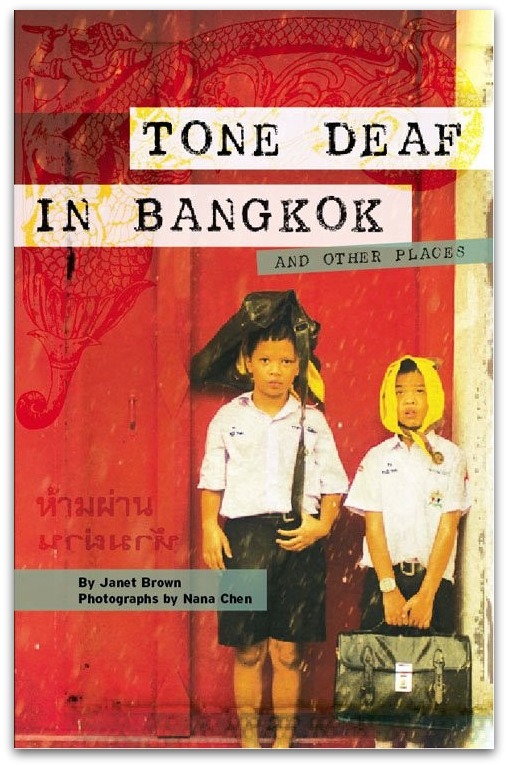
JANET BROWN, author of the travelogue Tone Deaf in Bangkok, and DAVE PRAGER, author of the travelogue Delirious Dehli, will discuss the need for travelers to do more than the usual amount of preparation when entering cultures that are very different from one’s own, on a par with Alice’s Wonderland.

As Brown explained in her interview with us, travelers to Thailand can be “tone deaf” because Thai is a tonal language and it’s easy to make mistakes. But they can also be “tone deaf” when it comes to figuring out the Thais’ communication style:

“You looked so beautiful yesterday” probably means today you resemble dog food and ought to go home and rectify that at once.

Whereas for Prager, one of the points about living in Dehli is that you may end up deaf as there are always people, animals and vehicles around.

In conversation with Anthony Windram, Prager admitted that getting used to America again — he and his wife now live in Denver — hasn’t been easy:

What’s struck me is that the US just seems so empty. It’s not that India is always intensely crowded; rather, it’s that India you’re never completely alone.

WRITING LAB: What (Not) to Write

Expat writing coach par excellence KRISTEN BAIR O’KEEFFE will explore techniques to develop your writing skills and help you find which world, of your many worlds, you want to write about, and how to get started.

Last summer’s post “6 celebrated women travel writers with the power to enchant you” was officially dedicated to O’Keeffe for delivering these pearls of writerly wisdom during her “Expat Writing Prompts” series:

Writing a multi-volume treatise is NOT the answer. Of this, I am sure.
Instead find a nugget. A moment. A single object. One exchange. One epiphany. One cultural revelation.
Find one story and tell it.
Just it.

DAY THREE: “We’re not alone” — Eat, drink, be merry & look good

Classy and Fabulous: French Style as Universal Norm

The French may be under fire for how they treat immigrants, but expats continue to thrive there. For this event, the classy and fabulous JENNIFER SCOTT, author of Lessons from Madame Chic: The Top 20 Things I Learned While Living in Paris — which has been a runaway success (it’s now under contract by a major publisher!) — will set out to prove, as she did last month in an interview with us, that no one can edit down their clothes and belongings as well as the French can.

The equally classy and fabulous ANASTASIA ASHMAN, co-editor of The Expat Harem: Foreign Women in Modern Turkey — and participant in our “Cleopatra for a Day” series last month — will serve as discussant. Two of the cultural influences for Ashman’s wardrobe are Southeast Asia (she once lived in Malaysia) and Turkey (she was an expat in Istanbul for several years). She does, however, adore French perfume!

Which Came First, Story or Recipe?

It’s food — so that means France again! ELIZABETH BARD, an American who lives in France with her French husband, and her opposite number, CORINE GANTZ, a Frenchwoman who lives near LA with her American husband, will explore why food is so central to the works each of them produces.

Bard is the author of the best-selling Lunch in Paris: A Love Story with Recipes. So did she ever think of writing it the other way around: recipes with a love story? Here’s what she told ML Awanohara in their conversation last autumn:

When I sat down to think about the moments that really helped me discover French life, I kept coming back to the dinner table, the markets, the recipes — so it seemed natural to structure Lunch in Paris around those experiences.

Gantz can no doubt relate. When we featured her novel, Hidden in Paris, last summer, here’s what she said when the topic of food came up:

For me, writing a novel is a barely disguised way for me to talk about food — the novel being a vehicle for food just as grilled toast is a vehicle for foie gras.

Fans of Hidden in Paris, please note: Gantz has just now released a playful cookbook featuring 20 delicious dishes that were described in mouth-watering details in the novel.

Moderating the discussion between Bard and Gantz will be the well-known novelist JOANNE HARRIS. Harris, who was born over a sweet shop in Yorkshire to a French mother and an English father, rarely misses an opportunity to bring food and drink into her novels — the most famous example being Chocolat.

Displaced Storytelling Circle

Verbal antics, stories, music and more. Highlights include readings by

  1. Displaced Nation contributor TONY JAMES SLATER, from his highly entertaining travelogue, That Bear Ate My Pants! Adventures of a Real Idiot Abroad.
  2. Displaced Nation interviewee ALLIE SOMMERVILLE, from her wry memoir Uneasy Rider: Confessions of a Reluctant Traveller. (Allie, please read the passage about the campervan being too wide for one of the Spanish streets!)
  3. Displaced Nation nomad KAREN VAN DER ZEE, from her collection of expat stories. (Miss Footloose, please tell us the ones about the crocodile and the couple in the Roman restaurant!)
  4. Founder KATE ALLISON, from The Displaced Nation’s weekly fiction series, Libby’s Life, which as you may have noticed, is now up to 46 episodes. (Kate, be sure to read the one where you introduce Sandra, Libby’s MIL from hell!)

The Art of Drink: Ian Fleming

One of The Displaced Nation’s founders, ANTHONY WINDRAM, will talk about the role of food (and especially drink) in Ian Fleming’s James Bond novels, on which he did a post last year:

The Bond of the novels isn’t solely a martini drinker. He’s always one to try anything local that’s on offer. In Jamaica he’ll drink a glass of Red Stripe, in the US he’ll have a Millers Highlife beer. Throughout the novels Fleming uses food and drink to convey an alien culture, demonstrate social status, show Bond’s mood and his sophistication and ease with the world.

An array of drinks — not only shaken martinis but also bottles of Heineken!– will be served. Green figs and yogurt, along with coffee (very black), will be made available to anyone who is still suffering from jetlag.

Enchanted by Wisteria: Elizabeth Von Arnim Unveiled

Displaced Nation founder (and the author of this post!) ML AWANOHARA will read her favorite passages from the collected works of travel writer Elizabeth von Arnim, on whom she wrote a post last year. As she pointed out then, Von Arnim was fond of the idea of a woman escaping her marital, motherly and household duties in the pursuit of simple pleasures such as gardens and wisteria. A magical Italian castle — such as the one featured in her best-known novel, The Enchanted April — can also be a tonic.

CLOSING NIGHT + BONUS EVENT

To close the festival, we will screen both the Swedish and Hollywood versions of The Girl with the Dragon Tattoo, followed by a critique from CHRIS PAVONE, author of the new novel The Expats. Pavone will discuss whether:

  1. it was really necessary for Hollywood to produce its own (non-subtitled) version; and
  2. all the female-perpetrated violence cropping up in film and on TV of late presages a “fourth wave” of feminism.

Pavone is well qualified to judge the latter as his novel (not yet featured on TDN!) is an offbeat spy story with a female protagonist — a burned-out CIA operative who moves to Luxembourg. Apparently, this was the kind of thing Pavone thought about when he was trailing his spouse in that cobblestoney old town.

And, just when you thought it was all over, we bring you a final treat: a chance to hear from the historian SUSAN MATT, who recently published Homesickness: An American History to much fanfare in the thinking media. Matt disputes the stereotype of Americans as westward wanderers by showing that Americans are returning to their homeland in greater numbers — that’s if they ever leave at all. (Our ancestors must be turning over in their graves!)

* * *

So, shall I sign you up? And can you think of any additional topics/authors/performers who ought to be featured? I look forward to reading your suggestions in the comments.

STAY TUNED for tomorrow’s guest post from Meagan Adele Lopez, on the differences between American and British wedding celebrations.

If you enjoyed this post, we invite you to subscribe for email delivery of The Displaced Dispatch, a round up of the week’s posts from The Displaced Nation. Sign up for The Displaced Dispatch by clicking here!

Related posts:

RETURN TRIP: 5 lessons Wonderland taught me about the expat life, by Lewis Carroll’s Alice

August is finally drawing to a close — we hope you managed to have an enchanting time of it. Here is one more in our series of “return trips” to posts that, for one reason or another, enchanted our readers. Enjoy!
All three members of The Displaced Nation team have found Alice, of Wonderland and Through the Looking-Glass renown, a source of inspiration on our travels — seeing her as a kind of ultimate expat. Thus we decided to dedicate the month of June to Lewis Carroll’s “little heroine.” Kate Allison launched a series of posts on our Alice in Wonderland theme with 5 “lessons” Alice had allegedly learned from her adventures. It remains one of our most popular posts to date.

To kick off our Alice in Wonderland theme, we asked Alice if she had any advice for today’s Displaced Person:

*

Indeed I do. It might be many years since I fell down the rabbit hole, but human nature hasn’t changed. This is a little of what I learned:

1. Keep the golden key in your pocket at all times, and make a note of the emergency exits.

In another moment down went Alice after [the White Rabbit], never once considering how in the world she was to get out again.

My first mistake was to plunge down the rabbit-hole without planning ahead. The adventurous life is all very well, but it’s good to have a bolt-hole, as well as a rabbit-hole, when you need to escape to the old and familiar.

My second mistake was to leave the key on the glass table before drinking from the bottle marked “Drink Me.” In your vernacular, that’s like buying a return ticket home for this evening, then discovering your passport expired six months ago. Be prepared for the unexpected, the peculiar, and the almost impossible.

2. No matter how hard you try contrariwise, at some point you will offend someone.

Evidently Humpty Dumpty was very angry… “It is a—MOST—PROVOKING—thing,” he said at last, “when a person doesn’t know a cravat from a belt!”

Oh dear! If only I had a shilling for every time I inadvertently offended one of the creatures in Wonderland and through the Looking Glass! Not knowing Humpty Dumpty’s neck-wear from midriff-wear; my compulsive mentioning of cats and dogs in the Mouse’s presence without considering that he and I might have a different perspective of these animals…the list went on and on.

In the end, I think the Red Queen’s advice was the best:

“Always speak the truth—think before you speak—and write it down afterwards.”

But still, I couldn’t help thinking:

“I wish the creatures wouldn’t be so easily offended!”

3. “The rule is, jam to-morrow and jam yesterday — but never jam to-day.” Different country, different rules.

The Queen of Hearts was the worst example of this:

“No, no!” said the Queen. “Sentence first—verdict afterwards.”

I suggest if you are ever in this situation yourself, you employ more tact than I did. “Stuff and nonsense!” I said. “The idea of having the sentence first!”

Perhaps today a quick telephone call to your country’s embassy might be better.

Better still, acquaint yourself with the country’s rules before you go jumping on aeroplanes or down rabbit holes.

4. Go to a party or a Caucus-Race — don’t drown in your own tears.

“I am so VERY tired of being all alone here!”

The Caucus-Race proved to me that I could make friends with the most unlikely companions.

After a few minutes it seemed natural to Alice to find herself talking familiarly with them, as if she had known them all her life.

If you feel alone in your new environment, seek out company, even if it’s not the kind of company you’re used to. You might find your life is richer for it.

5. And finally: Keep a note of your name in your memorandum-book.

“Who are YOU?” said the Caterpillar.

Alice replied, rather shyly, “I—I hardly know, sir, just at present—at least I know who I WAS when I got up this morning, but I think I must have been changed several times since then.”

I spent a great deal of time in both countries wondering who I was now. Was I my little friend Ada, or Mabel, perhaps?

Tweedledum even suggested I wasn’t really there at all.

“You’re only one of the things in his dream. You know very well you’re not real.”

“I AM real!” said Alice and began to cry.

Take a tip from me and write your name in a memorandum-book. Then keep a journal.

That way you will always remember who you were on any particular day.

And one day, people might read about you as they do about me.

*

Thank you, Alice!


If you enjoyed this post, we invite you to subscribe to The Displaced Dispatch, a weekly round up of posts from The Displaced Nation, plus some extras such as seasonal recipes and occasional book giveaways. Sign up for The Displaced Dispatch by clicking here!

Related posts:

The Displaced Nation’s monthly themes — witty, wacky, wise, all or none of the above?

Before drawing up the charter, as it were, for The Displaced Nation in April, the site’s two Founding Mothers — Kate Allison and myself — and its one Founding Father, Anthony Windram, engaged in some vigorous debate over what the site’s “categories” should be.

We had met through our blogs. What topics did we all have in common?

One of them was easy: cultural discombobulation, to borrow a phrase from Anthony Windram’s blog title. Except we had now come up with a new term: displacement.

Now what do we mean by “displacement” in the context of global travel and residency? My favorite analogy is to an old-fashioned fruit slot machine — but where each fruit is assigned a national identity. I suspect, for instance, that my two colleagues, both of whom are Brits who are living in the U.S., sometimes have days when they spin the reels and get two gooseberries (British fruit) and one cranberry (American fruit) — meaning they’re feeling a lot more British than American. Whereas for me — an American who has lived in both the UK and Japan — I’ll often get one cranberry, one gooseberry and one mikan (Japanese fruit), an outcome that makes my head spin, as I simply don’t know where or who I am. That, btw, is what’s known as hitting the jackpot in our displaced world!

Thus the category What a Displaced World was born, the default category for most of our articles.

Speaking of fruits, food was another obvious category. It was something that had drawn the three of us together in the first place. Indeed, Kate Allison’s blog — Marmite & Fluff — even has food (two of her favorites) in its title.

For this category, we came up with It’s Food! — which, if less than original, we hope does the job thanks to the exclamation mark.

Around the time we spoke about starting this blog, Kate was beginning to serialize a fictional account of a trailing spouse, Libby, on her blog. She proposed moving Libby’s Life to the new site, and we came up with the category It’s Fiction! Libby now shares that real estate with our posts consisting of interviews with novelists who’ve written about the expat life or travel.

Sometimes truth is stranger than fiction, and the category Random Nomads sprung out of our decision to have me continue the interviews with expats and repats I’d started on my blog, Seen the Elephant. If “nomad” was obvious, the three of us felt that “random” worked well with it, since we’re constantly bumping into — actually as well as virtually — the kind of people who strike us as being interesting because of their displacement.

As for the Displaced Hall of Fame, this came about because of Anthony Windram’s desire to explore the writings of famous people who’ve been displaced both in centuries past and our own time. While he has a bent for the classics — and has chosen to feature literary giants such as Vladimir Nabokov and James Joyce in his posts — Kate and I have occasionally expanded the category to include celebrity types, ranging from the actress Mia Wasikowska (a Third Culture Kid) to the model India Hicks to the chef Jamie Oliver.

The “monthly theme” idea

But then once the blog got underway, we decided that in addition to these categories, we enjoyed organizing our posts around monthly themes, rather like a magazine (the fashion issue, the cheap eats issue, the summer issue, etc.).

This came about rather by accident as Kate Middleton and Prince William’s nuptials took place around the time we launched, prompting us to do a series of Royal Wedding posts focusing on what a global event this quintessentially British occasion had become.

Other initial themes were:

  • Domestic expats — the idea that you didn’t have to go abroad to feel displaced (apt in these economically troubled times), anchored by Kate Allison’s The domestic expat.

But then something (we’re not quite clear what) happened, and our thinking morphed again. We started exploring themes based on particular characters, historical and literary, that have inspired us, as well as books:

And September will be — wait for it! — Zen and the Art of Motorcycle Maintenance month, a series of posts inspired by Robert M. Pirsig’s 1974 philosophical novel.

Some say they like the way we cover themes, while we suspect others find it rather zany.

How about you, what do you think? And if you’re pro-theme, can you suggest any you might like us to cover?

STAY TUNED for tomorrow’s post on films and TV series that take vacations to other lands.

If you enjoyed this post, we invite you to subscribe to The Displaced Dispatch, a weekly round up of posts from The Displaced Nation, plus some extras such as seasonal recipes and occasional book giveaways. Sign up for The Displaced Dispatch by clicking here!

Related posts:
RETURN TRIP: Travel author Janet Brown channels Alice in Wonderland’s “tone deaf” adventures

While our writers take off on what they hope will be enchanting August breaks, The Displaced Nation will occasionally be reissuing some posts that, for one reason or another, enchanted our readers. Enjoy these “return trips”!
June was “Alice in Wonderland” month in The Displaced Nation, and the enchanting travel author Janet Brown came to our online tea party. She answered ML Awanohara’s questions on the curious and unreal aspects of her life in Thailand. Last time we checked in with Janet, she was in the process of moving back to the States. Will her counterculture shock prove to be another Alice adventure? We hope to hear back from Janet in the coming months.

As you may have noticed, The Displaced Nation has gone Alice-in-Wonderland mad since around the first of June. To take just a few examples:

And now, to top that all off, the extraordinary travel writer Janet Brown is paying us a visit. Brown could almost be a stand-in for the Lewis Carroll heroine herself, having published a book on travel to and life in Thailand called Tone Deaf in Bangkok, to much acclaim.

“Tone deaf” — it puts one in mind of poor Alice’s plea to the Mouse, “I didn’t mean it…But you’re so easily offended, you know!”

But if Brown sees herself as tone deaf, her readers regard her as anything but. Here is a sampling of her reader reviews on Amazon:

It has been ages since I have loved a piece of travel literature…, and so when I read TONE DEAF IN BANGKOK, I was thrilled. This is a good travel book, and it is a good book, period.

I am not a traveler, nor do I typically read travel books. Shame on me, I know, but here’s the thing: … The author brought Bangkok to life in a way that made me want to go there, yes, but it was her own story that captivated me and kept me turning the pages. Now I’d read anything Janet Brown writes!

Janet Brown’s TONE DEAF IN BANGKOK is a travelogue, to be sure. Yet it is more, so much more. It’s also an investigation into how dislocated we can become by ourselves, by our priorities and by all that we demand of the cultures in which we live. … That she has a gift for spotting the universal in the exotic makes this collection all the more profound.

Janet Brown has graciously agreed to answer some of my Alice-related questions. After that, dear reader, I urge you to chime in!

Before we go down the rabbit-hole, can you tell me a little bit more about your background?
My parents turned me into a gypsy before I was two, by taking me on their journey by jeep from New York City to Alaska when the 49th state was still a territory and the Alcan Highway was still an unpaved trail into the frozen north. I have wandered ever since, most recently in Southeast Asia with Bangkok as my home, writing down the stories I encounter as I explore. My books include:

Maybe because I’m so steeped in Alice-of-Wonderland lore this month, I think of you as Alice Personified. To what extent can you relate to Alice’s sense of disorientation? Going back not just to the first time you went to Thailand but also when your family dragged you to Alaska…
I was 18 months old when my family moved to Alaska from Manhattan. I coped with any displacement issues by making my mother read my favorite book over and over again — a truly saccharine Little Golden Book called The New Baby. The main character had the same name as I so that was the big attraction — all about me! My mother swears she can still recite it verbatim after having two martinis.

Alice came to mind constantly in my first months in Bangkok — and frequently thereafter. I knew I’d gone through the looking glass — or had entered the postcard — and asked myself often if that experience had been as painful for Alice as it often was for me.

Can you describe your worst “Pool of Tears” moment in Bangkok, where you wished you hadn’t decided on living there?
I’ve tried to make light of that time when I wrote about it in Tone Deaf in Bangkok, but it nearly demolished me. When the manager of my apartment turned me into Ryan’s Daughter by listening in on my phone calls and then entertaining the neighborhood with highly embroidered versions of my life — and when people fell silent when I walked down the street and began gabbling excitedly after I’d passed — I felt as though my life had been stolen from me and I shut down to the point of hypothermia. If my students hadn’t helped me find a new neighborhood, I would have gone home a gibbering mess.

Thailand is renowned for its distinctive cuisine. Was there anything that carried an “Eat me” label that you felt hesitant about at first, but then discovered you loved?
I’ve written about durian in Tone Deaf, how I thought its smell in the market was sewer gas and then how I was forced to taste it, with happy results. Fried grasshoppers were another thing I didn’t warm to at first sight and then liked as much as I do popcorn — they have much the same crunch and texture.

By the same token, were there any foods that you thought might be good but then didn’t acquire a taste for? (For Alice, of course, that was the Duchess’s over-peppered soup.)
One night I stopped to buy green papaya salad from a food cart to take home for supper. There was something in a little plastic bag that looked like a sort of relish, so I bought that, too.When I opened it at home a smell of rot filled the air, but remembering the delightful surprise that durian had proved to be, I took a generous spoonful. It was pla ra — fermented fish, a Northeastern Thailand culinary staple that is meant to be added and mixed judiciously with the salad, not eaten like peanut butter. There wasn’t enough toothpaste in the world to rid my mouth of that thoroughly foul taste.

As already mentioned, Alice finds it’s easy to offend the creatures in Wonderland without even trying. Why did you choose the expression “tone deaf” for the title of your book on Bangkok?
“Tone deaf” can be taken quite literally. Thai is a tonal language with five different tones giving meaning to every word. Use the wrong tone and at best you’re incomprehensible, at worst shocking. The most common mistake for foreigners is to tell someone their baby is beautiful, while actually announcing that the infant is bad luck. Another pitfall is confusing the word “near” with the word for “far” — they are the same sound, differentiated by a crucial tone.

But travelers to Thailand can also be “tone deaf” when it comes to figuring out the Thais’ communication style. As a Thai-American friend has observed, the important things are what remain unsaid. “You looked so beautiful yesterday” probably means today you resemble dogfood and ought to go home and rectify that at once. Subtlety is the hallmark of Thai communication, and is often expressed through a quirk of an eyebrow or a famous Thai smile, which has at least one hundred different meanings — including disdain or outright menace.

Describe the biggest faux pas you’ve made since settling in Bangkok.
Oh, how to choose — it’s impossible not to make faux pas every second because Thai etiquette is demanding and complex. The one that makes me cringe most is in my first week when I set off on my first solo bus ride. I was clutching a twenty-baht note, which like all bank notes in Thailand bears the countenance of the King. He is revered to the point of near godhood in his kingdom and his picture is always elevated to the highest spot in a room — nothing is above the King. But I was fresh off the boat and when I dropped my money and it was caught in a little breeze, I put out my foot (the lowest and most ignominious part of the body) and stepped on the picture of the King’s face to secure my bus fare. I was too clueless to pick up on the ripples of horror that this caused others at the bus stop, but now I writhe when I remember this.

“Off with her head!” as the chief royal in Alice’s story is wont to proclaim. Actually, never mind your head. Your mention of your foot makes me think of how physically awkward Alice feels around the creatures in Wonderland. As a farang in Bangkok, do you often feel self conscious?
I’m short and dark in a family of pale-skinned people, so I was used to being an anomaly from early childhood. In Bangkok, if I dressed like a Thai woman and wore sunglasses and walked slowly, I felt as though I blended in. But one day I walked down a quiet street on my way to a class, and someone looked up and said, “Look at the foreigner.” “How did she know?” I asked my class of teenage girls. “Your hair,” they said. “No, lots of Thai women have dyed their hair brown,” I replied — to which they responded: “Your nose.” It was my big American nose that gave me away every time — and since I hate pain and surgery, I just had to accept that.

Have you tweaked your personal style at all so as to fit in better?
Yes — I adopted the conservative “Don’t show your bare shoulders” school of dressing that prevailed in Bangkok when I first arrived and slowed my pace to that of the women around me. I learned to keep my facial expression as bland as I possibly could to achieve the quiet Thai “public face,” and I ironed everything, including my Levis. Now women are much more casual in the way they dress but I’m still stuck in the cultural mores of the 90s. To foreign women who live here now, my introductory years in Bangkok seem like fiction — things have changed so drastically in the past 16 years.

Time for a quote from the Cheshire Cat: “…we’re all mad here. I’m mad. You’re mad.” Can you relate?
Riding on the back of a motorcycle taxi down a crowded city sidewalk, buying a glass of Shiraz to take with my popcorn into a movie theater, being drenched to the bone during Thai New Year’s — this is actually the most difficult question you’ve asked so far because at this point it all seems normal.

If you were to hold your own Mad Hatter’s Tea Party in Bangkok, whom would you invite, and why?
Anais Nin, because she would love the unbridled hedonism of this place, Evelyn Waugh because he would satirize the expat scene so well, Ho Chi Minh because he could help put together the revolution that is needed here, Emily Hahn because she has always been my role model since I first read her when I was twelve, and Elvis because in Bangkok he is still the king.

Alice becomes aware that Wonderland is turning her into a different person, unrecognizable to the one she used to be. Has your identity has shifted in fundamental ways since living in Bangkok?
This is a very complex question — I’ve written one book about it and am working on a second one, Almost Home. I’m always drawn back to the US because my children are there. Seeing them for two weeks a year doesn’t work for me. Once I get back to the US this time around, I’ll return here but plan to spend the bulk of my time near family in the Pacific Northwest. I won’t know how much I’ve been changed by this recent incarnation in Bangkok until then. Ask me again in several months.

Can you offer any advice for newcomers to Bangkok, who aren’t sure who they are any more?
Tone Deaf in Bangkok and my next book, Almost Home, are where I directly address the challenges of feeling like an Alice in Thailand. In addition, the recently published Lost and Found Bangkok, for which I wrote the text, may be helpful for newcomers. It’s a book in which five different photographers — two American men, two Thai men (both from Bangkok), and one Taiwanese-American woman — show the city they live in. New arrivals can look at the photos and see some great places to get lost — and find out who they are — in this Wonderland-like city.

img: Janet Brown with friends at an all-you-can-eat DIY barbecue at a huge restaurant under a bridge in Bangkok, by Will Yaryan.

If you enjoyed this post, we invite you to subscribe to The Displaced Dispatch, a weekly round up of posts from The Displaced Nation, plus some extras such as seasonal recipes and occasional book giveaways. Sign up for The Displaced Dispatch by clicking here!

Related posts: