The Displaced Nation

A home for international creatives

Tag Archives: Scotland

LOCATION, LOCUTION: Expat author JJ Marsh on bringing a location to life through writing

jill 3Today we welcome expat crime writer JJ Marsh to the Displaced Nation. JJ grew up in Wales, Africa and the Middle East, where her curiosity for culture took root and triggered an urge to write. Having at this point lived in Hong Kong, Nigeria, Dubai, Portugal and France—she finally settled in Switzerland—JJ certainly belongs in our midst! But what makes her even more special is that she has offered to impart her knowledge to other international creatives about the portrayal of “place” in one’s works.

Currently halfway through her European crime series, set in compelling locations all over the continent and featuring detective inspector Beatrice Stubbs (on loan from Interpol), today JJ begins a new series for us, entitled “Location, Locution.” In the opening post, she will answer the questions she plans to ask other displaced authors in future posts.

JJ, we are positively THRILLED (in more ways than one!) to have you as a new columnist. Welcome! And now to get to know you a little better…

Which comes first, story or location?
Story, always. Or at least the bare bones of the plot. Then I audition various places before beginning to write. I have to know the setting, even before populating the novel with characters. The place IS a character. For example, once I knew the victims would be corporate Fat Cats in Behind Closed Doors, the first in my Beatrice Stubbs series, I looked around for a financial centre with the right kind of atmosphere. Turns out my home town of Zürich fitted the bill and even gave me the title.

How do you go about evoking the atmosphere of a place?
I’d say by really looking at it and digging deep. Not only that, but try to look at it from the perspective of your reader. It’s no coincidence that in many European languages, one asks for a description using the word “How”.

Como é?
Wie war es?

Yet in English, we say “What is it like?” We want comparisons to what we know. I actively chose to use a foreigner arriving in a strange country/city, so as to look at it with new eyes.

Which particular features create a sense of location? Landscape, culture, food?
I start with the senses. We notice sights, sounds and smells first, and add to our impressions with tastes and textures, all the while comparing them to our expectations. Food and drink are essential, as they reveal something of the region but also much about the characters. Cultural differences have to be treated with great care in fiction. Lumpen great dumps of information are poison to pace. But subtle observations can be woven into the story, provided they are relevant. I’ve just abandoned a book set in Rome which was clumsily pasted chunks of guidebook against a sub-par Eat, Pray, Love plot. The reader wants to be immersed in the world of the book, not subjected to the author’s holiday snaps.

How well do you need to know the place before using it as a setting?
Speaking for myself, extremely well. I feel insecure describing an area I’ve never visited. But that’s not true for everyone. Stef Penney, who wrote The Tenderness of Wolves, created a beautiful story set against the backdrop of the frozen wastes of Canada. She’d never even been there.

While I am awed by that achievement, I don’t think I could do it. I need to ‘feel’ the place and also, to understand the people.

My nomadic past and interest in culture led me to study the work of Geert Hofstede and Fons Trompenaars. One of their models is to analyze culture like an onion. The outer layer is Symbols—what represents the country to outsiders/its own people? The next is Heroes—who do the people worship and venerate? Peel that away and explore its Rituals—on a national and personal level. At the centre of the Onion, you will find its values, the hardest part of a culture to access. But that’s where the heart is.

Could you give a brief example from your work which you feel brings the location to life?
The recent UK horsemeat scandal amused me, as it’s part of the average menu in Switzerland. Here my combative detectives, one Swiss, one British, have just finished lunch.

Beatrice patted her mouth with her napkin. “Herr Kälin, your recommendation was excellent. I thoroughly enjoyed that meal.”

“Good. Would you like coffee, or shall I get the bill?”

“I’ve taken up enough of your time. Let’s pay up and head for home.” Beatrice finished her wine.

Kälin hailed the waitress. “I wasn’t sure you’d like this kind of farmer’s food.”

“Farmer’s food is my favourite sort. Solid and unpretentious. Not the sort of fare they would serve in those crisp white tents at the polo park.”

Kälin let out a short laugh. Beatrice cocked her head in enquiry.

“It would definitely be inappropriate at the polo park, Frau Stubbs. We’ve just eaten Pferdefleisch. Horse steak.”

Which writers do you admire for the way they use location?
Val McDermid, particularly for A Place of Execution. Not only place but period done with impressive subtlety. Kate Atkinson, for making the environment vital to the plot in a book such as One Good Turn. Monique Roffey for bringing Trinidad to life in The White Woman on the Green Bicycle. Alexander McCall Smith enriches his stories with a wealth of local detail, be it Botswana or Edinburgh. And Kathy Reichs for making her dual identity an advantage. Donna Leon’s Venetian backdrop, Scotland according to Iain Banks in Complicity, and Peter Høeg’s Copenhagen in Smilla’s Sense of Snow.

There are many, many more.

* * *

Thank you, JJ! Readers, any further questions to JJ on her portrayal of “place”, or authors you’d like to see her interview in future posts? Please leave your suggestions in the comments. You may also enjoy checking out the first three books in JJ Marsh’s Beatrice Stubbs series:

  • Behind Closed Doors: Takes place in Zürich, where someone is bumping off bankers.
  • Raw Material: Takes place between London and Pembrokeshire. Here Beatrice is joined by wannabe sleuth, Adrian. Amateur detectives and professional criminals make a bad mix.
  • Tread Softly: Unfolds in the Basque Country of Northern Spain. Beatrice is supposedly on sabbatical, but soon finds herself up to her neck in corruption, murder and Rioja.

STAY TUNED for tomorrow’s interview with Lisa Egle, author of Magic Carpet Seduction, two copies of which we’ll be giving away!

If you enjoyed this post, we invite you to register for The Displaced Dispatch, a round up of weekly posts from The Displaced Nation, with seasonal recipes, book giveaways and other extras. Register for The Displaced Dispatch by clicking here!

Images: Typewriter from MorgueFile; picture of JJ Marsh and her book cover supplied by herself; map from MorgueFile

I’m an explorer — not a traveler

This week, the Displaced Nation is drifting away from March’s initial theme of beauty/fashion tips picked up from world travels. Hardly surprising, given that all of this week’s writers are males! Today’s guest poster, James Murray, a displaced Brit in Boston, is a prime example. The only new fashion he’d like to start would be replacing the word “travel” with “explore.” Sounds pedantic, right? Well, see what you think!

— ML Awanohara

I was never really one for traveling. When all the kids went on their gap years before college, I called them on it: I knew it was a waste of money; a way to delay the inevitable intrusion of the Real World into their lives — in short, I didn’t see the point.

Receiving emails from abroad about how wonderful these experiences were and how life-affirming and eye-opening and incredible the world was, I simply smiled to myself.

How naïve they were, I thought.

Whereas I would be a year ahead; a year closer to a job; a year closer to money, and a year closer to actual freedom.

I did not see work as some black hole into which you pour all of your efforts with no hope of ever getting anything back. On the contrary, I thought it would be pretty good to have a job and a flat and friends and the cash to support a lifestyle I could be comfortable with.

Travel for travel’s sake

I still think that. In fact, I’m not entirely sure I was ever wrong on this point. Sorry to disappoint. And particular apologies to Jeff Jung, whose book on career-break travel was favorably reviewed on this site at the end of last month.

Don’t get me wrong. Yes, I’ve traveled and, yes, I love being “elsewhere,” doing things differently, as much as the next displaced nation resident. In fact I’m a bit of a neophile when it comes to food and culture…

But being enamored of the new doesn’t mean you have to travel.

Travel provides a set of obvious novelties: new tastes; new currencies; new transport; climate; a different view from the window.

But just being somewhere different doesn’t make you an explorer; in order to get that badge, you need to set foot outside your comfort zone, step away from the hotel, the package tour, the guidebook — and look with your own eyes.

Cross that one off the list!

That Facebook app that challenges you to prove you’re a world traveler by listing all the countries you’ve visited irrespective of how long you were there or where exactly you were: what does it really show? It makes a three-day hotel stay in Shanghai look as though you’ve conquered the entirety of mainland China, and it reduces that beautiful holiday in Wales — you know, the one that reminded you what it was like when shops closed on a Sunday — to a complete non-event.

The way we think of travel is all wrong: the political boundaries on the map say that I now live in the USA, but that doesn’t really say anything about where I actually live or the aspects of American culture that I’ve actually experienced.

My life would be completely different if, say, I lived in the desert or the mountains — it would even be different if I lived in New York instead of Boston.

I don’t anticipate ever being able to say that I’ve seen it all.

Explore, for heaven’s sake!

Exploring as opposed to traveling is a question of quality against quantity. I did a lot of exploring in London and Edinburgh that opened my eyes just as much as wandering around Thailand and Romania.

A few curiously exploratory examples:

  • Getting a haircut at a weird little barber’s in Shepherd’s Bush. It was an all-male barber’s, where men could “come along and say what they like in whatever language they like,” as the proprietor put it. I remember being very quiet amid a torrent of very macho conversation. Not a totally unpleasant experience, but I never went back.
  • With my flatmate, laying Russian roulette with the pastries at Vanna Patisserie, a Chinese bakery in Shepherd’s Bush. They were either sugary and delicious or curiously tough with a peculiar secret ingredient. There was no way of telling from the outside.
  • Spotting a Portobello (Edinburgh) art exhibition displayed outside people’s homes that featured, amongst other things, a fat-and-seed bird feeder in the shape of the artist’s head, hung from a tree, where it was gradually and gruesomely pecked to pieces.

These bizarre titbits are the wages of the explorer but not necessarily the traveler, who might see only those accepted “landmarks” to which his eyes are directed.

Avenues for exploration are everywhere. In fact, when I first moved to London, I was so inspired by the tube stops that I wanted to develop a guide to each one.

My idea was that I would use some algorithm to pick a different tube stop each weekend, go there and simply wander around in a roughly spiral shape from that stop, looking carefully at architectural details, stopping in parks and perhaps interviewing the proprietors of particularly interesting local businesses.

I would document these things not so much as a guide for others to visit exactly the same places, but in hopes of inspiring them to look at their own neighborhoods with new eyes.

Exploring the New World

I try to do the same kind of thing in Boston, although I confess I find it a bit harder — there’s the sheer fact that London is 1) massive and 2) very, very old that makes it rather easier to find the gems at the ends of the nooks and crannies.

But I’m not discouraged — I’ve still barely explored the North End with its windy little streets and ample opportunities for getting lost (I don’t have one of those phones that tells me where I’m going).

And just the other day we were introduced to a bar not five minutes down the road, which will make a superb local, with its walls plastered in kitschy tut. I’m sure I’ve passed it before, but, like all the best things, it’s a bit hard to spot.

In amongst these streets are histories, idiosyncrasies and mythologies — of that I have little doubt. Finding them is just a matter of retiring my traveler’s shoes and donning an explorer’s hat.

* * *

So, world travelers — sorry, I meant to say “explorers” — what do you think? Is James right in saying that all of this obsession with the quantity of travel (how many countries, etc.) is misguided? And what do you think of his assertion that Edinburgh can be as fascinating as Bangkok, if you take an explorer’s approach? Please leave your thoughts in the comments…

James Murray is a self-described “itinerant Brit.” After a stint in New Zealand, and some travel in Southeast Asia, he and his American girlfriend — now wife — are practicing “staying put” in Boston, where James is pursing a career as a wordsmith for marketing and fiction, and as a non-professional theatre director. He is also a Utopian idealist and SingStar enthusiast. You can find more about his views by reading his blog, Quaint James, and/or following him on Twitter: @quaintjames.

STAY TUNED for tomorrow’s post by Andy Martin, about a unusual source of beauty in his new home town of São Paulo.

If you enjoyed this post, we invite you to register for The Displaced Dispatch, a round up of weekly posts from The Displaced Nation, with seasonal recipes, book giveaways and other extras. Register for The Displaced Dispatch by clicking here!

Related posts:

img: MorgueFile

The 10 Muses of Expat & International Adventure Writing and their 5 most popular tunes

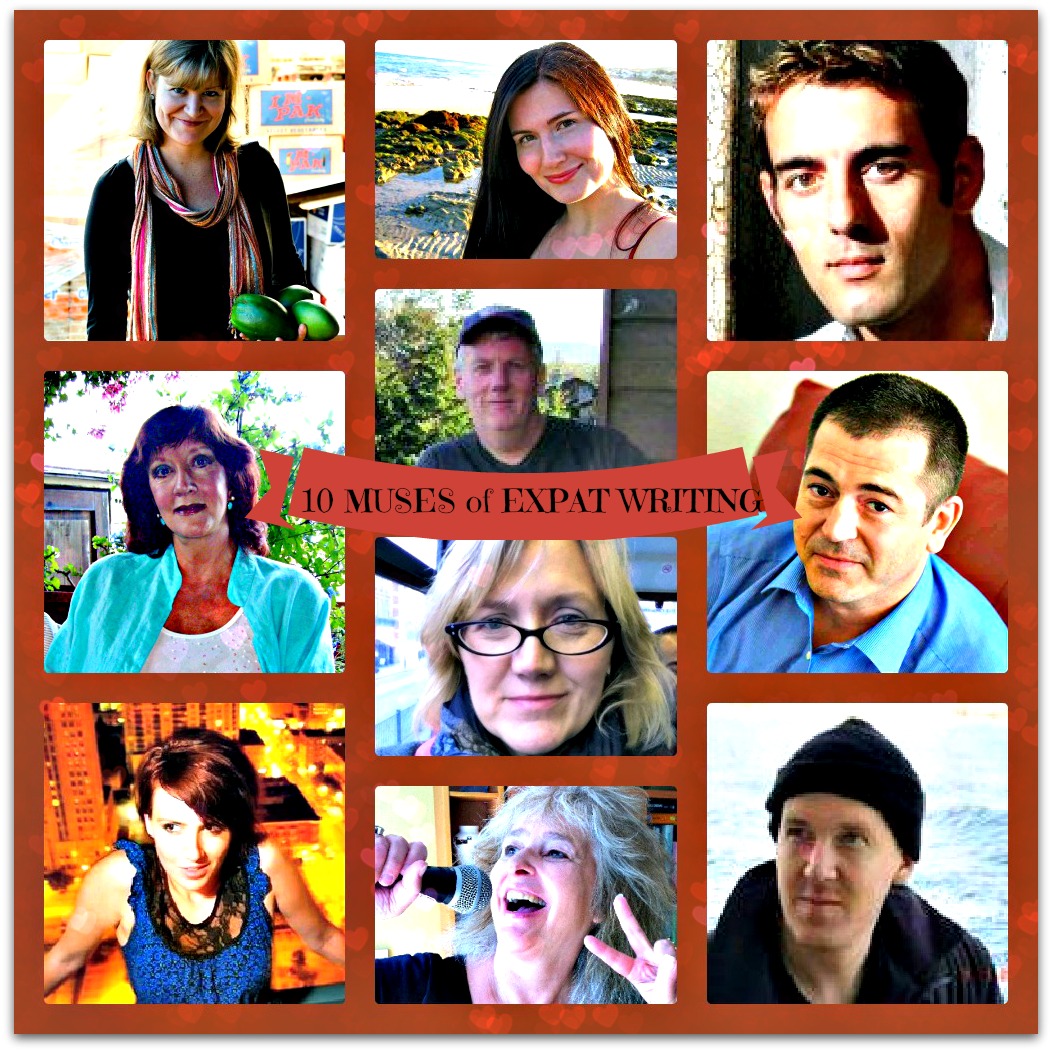
10 muses collageGreetings, Displaced Nation-ers! Ready for a little more intellectual stimulation?

A couple of weeks ago, I wrote about Great Thinkers who can help with task of embracing the well-traveled life and teasing out its deeper meaning, in the new year.

And today I will address the needs of those who have resolved to tackle a major writing project in 2013.

It’s a well-known fact that many of us who live in foreign lands aspire to write novels, memoirs and travelogues about our overseas adventures. But many of us also live in isolated situations (by definition).

So who can aid us, provide our inspiration?

Why, the muses of course!

Tell us, O muses, how to tell our stories…

And we don’t even have to look heavenwards to invoke them! The 10 Muses (that’s one more than the ancients got!) of Expat and International Travel Writing are right in our midst. They have already shared the joys, wonders and value of writing with Displaced Nation readers:

  1. Barbara Conelli, author of the Chique Travel Book series, filled with the charm, beauty, secrets and passion of Italy…
  2. Martin Crosbie, who is writing a trilogy entitled My Temporary Life; in December of last year, he published Book Two: My Name Is Hardly.
  3. Helena Halme, author of the novel The Englishman (2012)
  4. Laura Graham, author of the novel Down a Tuscan Alley (2011)
  5. Matt Krause, author of the memoir A Tight Wide-open Space: Finding love in a Muslim land (2011)
  6. Meagan Adele Lopez, author of the novel Three Questions: Because a quarter-life crisis needs answers (2011)
  7. Edith McClintock, author of the mystery novel Monkey Love and Murder (2013)
  8. Alexander McNabb, who is writing the Levant Cycle, a trilogy of books about the Middle East; he released the second book, Beirut — An Explosive Thriller, last September.
  9. Tony James Slater, erstwhile regular at the Displaced Nation and author of a two-book series: The Bear That Ate My Pants: Adventures of a real idiot abroad (2011) and Don’t Need the Whole Dog!, which came out in December.
  10. Wendy Nelson Tokunaga, author of Marriage in Translation: Foreign Wife, Japanese Husband (2011) and of several novels that explore cross-cultural themes between the United States and Japan.

Over the past year on our site, if you were listening closely, these heaven-sent muses were singing a number of tunes. Here are their five top hits:

SONG #1: “Yes, it’s hard; yes it’s uphill. But you’re living the dream, which makes writing a thrill!”

In one of the Displaced Nation’s most popular posts of the past year, Tony James Slater tried to make it out that the life of an expat writer is far from glamorous. Don’t believe him. He was pulling your leg, as usual — or singing off key, to continue the metaphor.

Alexander McNabb has the more accurate rendition. Here’s his account of the prep for his latest thriller, Beirut:

While writing it, I spent hours walking around the city, along the curving corniche and up into the busy streets that cling to the foothills rising from the coast up to the snow-capped mountains. Walking with friends, walking alone — day and night, spring and summer. From the maze of funky little bars of Hamra to the boutiques of Verdun, from the spicy Armenian groceries of Bourj Hammoud to the cafés overlooking the famous rocks at Raouché…

Barbara Conelli is another inspirational example. She explores every nook and cranny of Milan so as to take the reader on an armchair journey. And now she is doing the same with Rome, which will be the subject of her third book in the Chique Travel series.

Great work, if you can get it!

SONG #2: “It’s time to make your creative debut — so why not make it all about you?”

These days it’s hard to tell the difference between a heavily autobiographical novel and a memoir, though one of our muses, Helena Halme, insists that there is a distinction. When questioned about her decision to write The Englishman as a novel — it’s about a young Finnish woman, Kaisa, who meets a dashing British naval officer, a plot that echoes very closely her own life story — she had the following to say:

I tried to write a memoir, but couldn’t! Much of this story is, however, true — but I didn’t think I could call it a memoir as some things were pure fiction. I am a novelist and just keep making stories up.

Hmmm… By that reckoning, perhaps Tony James Slater should be a novelist, too? As regular readers of this blog will know, his favorite topic consists of his own, rather daring but also bumbling, world adventures.

But did a bear really eat his pants, or is he exaggerating for comic effect?

The mind boggles…

But whatever the form, the point is that quite a few of our muses have found plenty of material in their own life experiences. Besides Halme and Slater, we have

  • Martin Crosbie: His protagonist, Malcolm, leaves Scotland for Canada at a formative age, just as he did.
  • Laura Graham: Her protagonist, Lorri, arrives in Italy as a forty-something single and finds a younger Italian man, just as she did.
  • Matt Krause: He has written a memoir on the portion of his life that involved meeting a Turkish woman on a plane and following her back to Turkey. (Reader, he married her!)
  • Meagan Adele Lopez: The protagonist of her debut novel, Del, is offered three questions by her British fiancé (just as Lopez was offered three questions by hers).
  • Edith McClintock: Her protagonist, Emma, works as a researcher in the very Amazonian rainforest where she once conducted her own research.

To conclude, the old adage is alive and well, even (especially?) in expat and travel writing: “Write about what you know and care for…”

SONG #3: “Looking for inspiration from above? The answer lies in cross-cultural love.”

Another theme running through the works of several of our muses is the love that takes place across cultures, usually resulting in marriage. I just now referred to the cross-cultural love stories at the heart of the books produced by Helena Halme (Finnish woman, English man), Laura Graham (Englishwoman, Italian man), Matt Krause (American man, Turkish woman) and Meagan Adele Lopez (American woman, Scotsman).

To this list should be added Wendy Nelson Tokunaga, who has written about Western women getting involved with Japanese men — one of the stranger of all possible unions, to be sure! 😉 — in both fiction and nonfiction (the latter being a bit of a self-help book).

SONG #4: “As your brainstorming proceeds apace, never forget the appeal of place.”

Since travel is a constant for all of us, it should come as no surprise that particular places can become a pull for certain expat writers. They cannot rest until they’ve depicted a place they’ve experienced so that others can live vicariously. Several of our muses represent this principle:

  • Barbara Conelli and her love for “capricious, unpredictable” Milan. To quote from her book: “When the streets of Milan ask you to dance, there’s nothing else to do but put on your ballet shoes and surrender…”
  • Alexander McNabb and his obsession with Beirut. “There can be few places on earth so sexy, dark, cosmopolitan and brittle…,” he writes in his Displaced Nation post.
  • Edith McClintock and her preoccupation with the rainforest and a place called Raleighvallen in the Central Suriname Nature Reserve. As her main character, Emma, says:

    I fell completely and irretrievably in love with the rainforest that week — the deep rich smells of dirt and decay and teeming, thriving life; the warm soft light of the rocky moss-covered paths hidden beneath layers of climbing and tumbling lianas and roots; soaring tree trunks wrapped in colorful bromeliads, orchids, moss, and lichens; and the canopy of leaves of every conceivable size and shape….

SONG #5: “Growing weary of fruitless writing sessions? Time to take some acting lessons!”

Four of our ten muses could double as the muses of acting and entertainment:

  • Tony James Slater and Meagan Adele Lopez trained as actors (Lopez actually starred in a bad horror film!) before embarking on their world travels.
  • Laura Graham enjoyed a long career as a stage actress in Britain, working for the Royal Shakespeare Company and the Young Vic, and on television, before setting herself up as an expat in Tuscany.
  • Wendy Nelson Tokunaga first went to Japan because she won a prize in a songwriting contest sponsored by Japan Victor Records. She is an accomplished karaoke artist who can sing jazz as well as j-pop and enka, a type of sentimental ballad.

Why are so many of the Muses of Expat Writing multi-talented, you may ask? Does a former acting/singing career work to one’s advantage when it comes to overseas travel and writing? I like to think so.

Just as Dickens used to act out the dialogue of his characters, I like to think of Tony James Slater reenacting his wild adventures on the road, in the confines of his flat in Perth…

And sometimes this versatility can add a further dimension to the writing. Last we heard from Lopez, she had created a trailer for her book and was trying to convert it to a screenplay. Tokunaga composed and sang an enka to accompany her novel Love in Translation. (It’s impressive!)

Plus these four could always hew to the tradition of wandering minstrel, one of the oldest careers in the book, if their works don’t sell. (Hey, it’s never a bad idea to have a fallback option when you’re a long ways away from family and friends…)

* * *

So, writers out there, did our 10 Muses sing to you? And will you listen to some of their songs again as you face the blank page in 2013? Let me know in the comments. (Only, be careful of criticizing the Muses — they have been known to be vengeful!)

STAY TUNED for tomorrow’s post, another installment in the life of our fictional expat heroine, Libby. (What, not keeping up with Libby? Read the first three episodes of her expat adventures.)

If you enjoyed this post, we invite you to register for The Displaced Dispatch, a round up of weekly posts from The Displaced Nation, with seasonal recipes, book giveaways and other extras. Register for The Displaced Dispatch by clicking here!

Related posts:

Images: Our Ten Muses (left to right, top to bottom) — Edith McClintock, Barbara Conelli, Tony James Slater; Laura Graham, Martin Crosbie, Helena Halme, Alexander McNabb; Meagan Adele Lopez, Wendy Nelson Tokunaga, Matt Krause.

15 films that depict the horrors of being abroad, or otherwise displaced

Readers, we’re getting goosebumps and our blood is curdling. Horror novelist, former expat and Third Culture Kid Sezin Koehler is here to remind us that, however glamorous the life of an expat or world traveler may seem, it has a netherworld — one that horror movie makers are fond of depicting. To proceed is at your peril.

As if moving or traveling abroad isn’t scary enough, there is a whole host of films that would put the kibosh on even the most adventurous of people. For today’s guest post for The Displaced Nation, I’m breaking down these tales of terror into three groups:

  1. The expat.
  2. The world traveler.
  3. The otherwise displaced.

What follows is a rundown of some of the best horror films that will make you never want to leave home again.

1. Expat Horror: Caveat expat, or expat beware (or in some cases, beware of the expat!).

1) Ils (Them) (2006), dir. David Moreau and Xavier Palud.
In this terrifying French film, two expat partners, a teacher and a writer, living outside Bucharest in Romania are terrorized and psychologically tortured by an unknown group for days before their murder. Based on a true story, the villains — who were apprehended in real life — turn out to be even more shocking than the events they perpetrated.

My big question: Why on earth do you choose to live out in the middle of nowhere in Romania? Tragic story indeed, but really, they should have known better. Now you do.

2) Suspiria (1977), dir. Dario Argento.
Considered one of the classic horror films and what many now consider to be the father of the arthouse horror genre, Argento’s dark and twisted tale features a ballet school in Rome full of young girls from all around the world who live and study within walls haunted by a chilling presence that picks off the girls one by one. The score by Goblin is enough to give you nightmares and make you reconsider sending your children away to school. Ever.

3) & 4) Red Dragon (2002), dir. Bret Rattner; & The Silence of the Lambs (1991), dir. Jonathan Demme.
In Red Dragon Dr. Hannibal Lector is just a British expat living and practicing psychiatry in the United States. In fact, he’s helping the police with a brutal series of murders in which specific body parts had been taken as trophies. Detective Will Graham eventually discovers that not only is psychiatrist-to-the-stars Dr. Lector responsible for these grisly killings, he’s also eating the missing pieces.

The next time we meet Hannibal the Cannibal is in The Silence of the Lambs, where he is safely tucked away in a maximum security prison until the FBI needs his profiling assistance in uncovering the identity of a man who is kidnapping and skinning women.

Maybe Dr. Lector is a reason why locals are so wary of expats around the world?

5) The Omen (1976), dir. Richard Donner.
It’s hard enough being the wife of the American ambassador to the UK, but when Lee Remick discovers that there is something very wrong, very evil with her son, Damien, matters only get worse.

In many ways this is the kind of expat horror to which we can most relate: being in a foreign country, going through a difficult time, and not having the kind of support one might have at home. Even though the Thorns are wealthy and have a full staff at their beck and call, Mrs. Thorn cannot confide in them her misgivings that her son is the Antichrist — nor can she with anyone else since she’s the ambassador’s wife. In the end she goes mad from fear and frustration.

As expats, we’ve all been there. Luckily, though, we didn’t have the incarnation of Satan as our son. At least I hope not.

6) Freaks (1932), dir. Tod Browning.
This magnificent film follows a group of sideshow circus performers in Dust Bowl America — the majority of whom are European expats from all over the continent. As foreigners as well as displaying physical deformities of all kinds, this group is the marginalized of the most marginalized in America not just at that time, but even today.

The gorgeous German and “normal” trapeze artist Cleopatra finds out that Hans, the midget, is fabulously wealthy and sets out to steal him away from his same-sized girlfriend Frieda — with disastrous consequences as the group of freaks tries to bring the wicked Cleopatra into their embrace. Cleo finds out well and good that one does not mess with members of the sideshow.

The message here? Respect your local customs, even if you think them freakish. It could be what stands between your body as it is or being turned into a human-chicken hybrid.

2. Traveler Horror: “Let your suitcases gather dust!”, cry these films.

1) Hostel (2005), dir. Eli Roth.
A group of backpackers passing through the Slovakian capital city, Bratislava — it has no semblance to the real place whatsoever — gets kidnapped by an organization that sells young people to the highest bidders so that they can be tortured and murdered in the Slovakian outback with impunity. While the film is rife with cultural and geographical blunders, it nonetheless preys on a legitimate fear of kidnapping and/or human trafficking while traveling, especially for young women as we see in the two follow-up films in this gory franchise.

Kids, don’t fall for the local pretty girl/handsome boy who picks you up in a bar. You have no idea whom they could be working for.

2) American Werewolf in London (1981), dir. John Landis.
Two American backpackers (uh-oh) in the Scottish highlands stray from the road and are attacked by a wild beast. One dies, the other is in a coma for three days with horrible gashes across his chest. When the doctor informs him he was attacked by a madman he’s confused, claiming it was a wolf that had killed his friend and wounded him. Come full moon, young David Kessler finds out it was neither man nor wolf, and he’s becoming one.

There’s nothing like a story about a horrific accident taking place while traveling, especially when said accident turns you into a monster. Always remember, STAY AWAY FROM THE MOORS/MUIRS!

3) The Descent (2005), dir. Neil Marshall.
After the tragic death of Sarah’s husband and daughter in a wicked car accident, her fellow British extreme-sporting friends decide to take a trip across the pond to Appalachia for a spelunking expedition. Why anyone would think that crawling around in caves would be a good idea I haven’t a clue — let alone choose to take an already-traumatized woman into that scenario. But hey, they do. And not only do they find themselves in an unmapped cave system that has no way back to the surface, there are others down there in the dark who’d like to ensure the girls never leave.

Dear People Traveling to America: For Pete’s sake, avoid the US’s back country! Monsters are above and below.

4) Wolf Creek (2005), dir. Greg Mclean.
Two British tourists in Australia pair up with a local to check out a supposed alien-landing site in the middle of nowhere. All is fine until their car battery dies. Stranded in the badlands of Oz, grateful are they when a mechanic rolls up and tows them to his place to fix their vehicle. But oh, he’s not a mechanic at all. He’s a serial murderer who waits for tourists to come out to the Wolf Creek Crater, and takes his good time torturing them before their slow death.

The film is based on a true story — one of the British girls actually survived and made it to the authorities. It turned out the man had killed hundreds of people over decades, and nobody even suspected a thing. Shiver

5) Primeval (2007), dir. Michael Katleman.
During the Rwanda-Burundi conflict, bodies were dumped into the Ruzizi River at such alarming rates that the crocs began eating human flesh. One of these crocs, nicknamed Gustave by the locals, gets a taste for human flesh and begins hunting humans inland. An American team of journalists are sent to capture and bring back the beast amidst an ongoing civil conflict between warlords and villagers.

The best thing about this movie is that there really is a 70-year-old, 22-feet-long croc named Gustave who swims the Ruzizi. He was last sighted in 2008, but I know he’s still out there. I can feel him.

3. Displaced Horror: “Think twice about moving or taking a sojourn outside the ‘hood” is the moral here.

1) The Amityville Horror (1979), dir. Stuart Rosenberg.
As if moving doesn’t suck enough, can you imagine moving into a house that not only was the site of a brutal family murder but is also haunted? I don’t even know how many whammies that makes the scene. Also based on the true story of the Lutz family, who were terrorized by their house to the point where they fled without any of their belongings and never went back to collect them.

Word to the wise: Always check about the house’s history before you move in, and always remember to burn sage throughout, even in cabinets and drawers, before you move anything in anything at all. Trust me on this one.

2) Se7en (1995), dir. David Fincher.
Heralding a promotion to detective, Brad Pitt gets transferred to an anonymous city with a reputation of being among the worst in America. *Cough* Detroit *Cough*. His wife is miserable as she wants to have a family, but cannot imagine raising children in that town. The first case he lands is a serial killer murdering people based on the Seven Deadly Sins — one that quickly sucks both him and his wife into a horrific spiral of torture and murder.

Women, don’t let your husband drag you to a horrible city. Just don’t. Your life very well may depend on it.

3) The Texas Chainsaw Massacre (2003), dir. Marcus Nispel.
A group of friends on a road trip through Texas and — oh crap! — their car breaks down. It’s just their luck that the person who finds them is the patriarch of the psychotic and inbred Hewett family, known for killing and cooking their victims. There are no happy endings here, people.

If you’re going on a road trip, stick to the main roads, for God’s sake! I mean, jeez, everybody knows that. And while you’re at it, stay the bloody hell out of Texas!

4) El laberinto del fauno (Pan’s Labyrinth) (2006), dir. Guillermo del Toro.
Set in 1944 fascist Spain, the film tells the story of Ofelia, a young girl who accompanies her mother to live with her new stepfather, a barbarous Spanish general. Amidst the horror, Ofelia discovers a fairy world underneath the very grounds of their home, a place to which she escapes when the torture around her becomes too much to bear. But even fairy worlds have their horrors, as she soon finds out.

Moms, jeez, don’t marry jerks and then don’t agree to live in their military camp. Seems like logic to me, but I guess it needs to be said.

* * *

So, are you ready to burn your passport and throw away all your travel gear yet? 😉

And do you have any other films you’d add to my best-of abroad horror list?

Sezin Koehler, author of American Monsters, is a woman either on the verge of a breakdown or breakthrough writing from Lighthouse Point, Florida. Culture shock aside, she’s working on four follow-up novels to her first, progress of which you can follow on her Pinterest boards. Her other online haunts are Zuzu’s Petals, Twitter, and Facebook — all of which feature eclectic bon mots, rants and raves.

STAY TUNED for tomorrow’s post, which has Kate Allison continuing our horror theme.

If you enjoyed this post, we invite you to register for The Displaced Dispatch, a round up of weekly posts from The Displaced Nation, with seasonal recipes, book giveaways and other extras. Register for The Displaced Dispatch by clicking here!

Related posts:

Images: From MorgueFile: Cinema; Hat and suitcase;  Bridge from biplane.

Photo of Sezin, from her newest FB page, ZUZUHULK, used with her permission.

Would I travel for food? It depends…on whether it’s pizza or haggis!

Third Culture Kid Tiffany Lake-Haeuser is back, to tell us what she thinks about gluttony as a motive for travel.

As a Third Culture Kid who was raised in the United States and Abu Dhabi before returning to my native Germany, I’ve learned that every culture has its own traditional foods — but the idea of trying them all? I’ll take that with a pinch of salt, so to speak.  Some of the world’s most celebrated foods are very good; others, not so much.

At my international school in Frankfurt, I’ve found it amusing to walk around at lunchtime and see what the different nationalities are eating. Obviously, we students are somewhat limited by what the cafeteria offers, but once a year on International Day — a day for celebrating all the nationalities at our school — things get a bit more interesting. We get to choose between egg noodles at the Thai stand and the burgers at the U.S. stand, among others…

Food for thought

Would I travel for food? I know that the Displaced Nation has covered this topic obsessively last month. I discussed it with a few of my schoolmates — ironically, during our lunch period — and we agreed that while most of us have a certain sweet or other type of food we make a habit of eating or buying when we are in certain countries, we would not be inclined to go on a food tour.

One of my friends said she makes it a priority to buy “double stuf” oreos in the U.S. Though hardly a delicacy in America, this cookie is seen as an exotic treat at our school.

Other friends mentioned their efforts to avoid certain traditional foods at all costs. For instance, one of them said she loathed eating haggis in Scotland — even though that’s where she is originally from! For those of you who don’t know what haggis is, it is a savory pudding of sheep lung, liver and heart encased with other ingredients in an animal’s stomach. Mmmmm!

Another friend reported she’d found eating snails in France less than appetizing. The snails slimy and chewy, not pleasurable as French people like to claim.

Rice…again!

My own most memorable food experience associated with travel occurred when I was attending international school in Abu Dhabi. I refer to my eighth-grade week-long school trip to Thailand. Every day, we were given plain white rice to eat; it came with every single meal. By the end of the week, we just couldn’t face another bowl of rice! (On the rare occasions when we were served French fries, the students would attack them and within minutes they would be gone.)

However, on the last day of our trip, we were taken to a school and taught how to make chicken curry and spring rolls. Not only was it the best meal I’d had all week (which is of course not biased to the fact that I was the cook!), but I also found it so interesting to see the way these foods were made.

So maybe I would consider a cookery tour one day?

By the way, that still didn’t stop me from refusing to even consider eating rice for another month after that trip!

Pasta & pizza — perfect!

By the time this post goes up, I will be traveling in Italy, which is by far my favorite country to eat in. Pasta and pizza are two of my favorite things to eat in the world — and let’s face it, Italy does these foods better than anywhere else.

Honestly, I don’t even know how I will stop eating, but that’s a different problem.

I guess everyone needs to decide for themselves how far they are willing to travel for scrumptious or adventuresome eats. As for me, I will not be taking the train to Paris (where my dad now lives) every time I want a croissant — even if the original is truly amazing.

* * *

Readers, any thoughts on or reactions to Tiffany Lake-Haeuser’s skepticism about linking international travel to food experiences? Please put them in the comments. You can also follow what she is up to on her blog, Girl on the Run.

STAY TUNED for the Displaced Nation’s agony aunt, Mary-Sue Wallace, who will attempt to offer expat readers solace on their horrifying experiences in tomorrow’s post.

If you enjoyed this post, we invite you to register for The Displaced Dispatch, a round up of weekly posts from The Displaced Nation, with seasonal recipes, book giveaways and other extras. Register for The Displaced Dispatch by clicking here!

Related posts:


For expat novelist Laura Graham, even a dark Tuscan alley has La Dolce Vita to spare

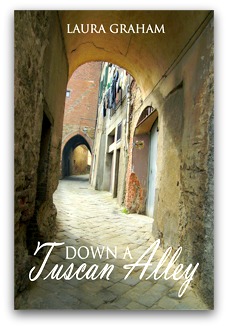
“Down a Tuscan Alley” — when I first heard the title of Laura Graham’s debut novel about an Englishwoman in Tuscany, I assumed it would be a thriller or mystery. Something nefarious would happen down a Tuscan alley, and the protagonist, whose name is Lorri, would find herself enmeshed in events beyond her comprehension, fearful of getting caught in the crossfire between rival Mafia gangs…

The book is no such thing, I’m happy to report (I’m not a fan of Mafia thrillers). Strange things do happen in the dark alley outside of the tiny flat where Lorri lives in the Centro Storico (village on a hill) of the Tuscan town of Sinalunga — but nothing worse than a peeping Tom. And at one point there’s a shady-looking man following Lorri — but he turns out to be (relatively speaking) harmless.

No, the book’s real mystery has to do with why Lorri is living in a tiny Tuscan village on her own. Well, she’s not on her own but has two cats. The last time she was in Sinalunga, it was with her husband, Richard. They had bought the flat together and Richard fixed it up. But now their marriage is over because of Richard’s infidelity. Or Lorri thinks it is over — Richard is having second thoughts.

Lorri, however, is determined. She has come to Italy to get lost in the culture and start her life again. But is she doing the right thing? Her Italian neighbors treat her with some suspicion: what’s a woman doing living on her own, with no visible means of support? (She has decided to do B&B in her little flat, but since it has only one bedroom, when the guests come, she has to sleep on the sitting room floor.)

And she also has to persuade herself to trust her gut instincts. As she says toward the start of the novel:

Am I crazy to come here? Hardly any grasp of the language, forty-seven, alone and with virtually no money? Many would think so…

Lest you think we’re venturing into Under the Tuscan Sun territory, rest assured, we’re not. Lorri does not take life, let alone her midlife predicament, too seriously. This is a flat overlooking an alley we’re talking about, not a 250-year-old villa. And so what if she ends up seizing an opportunity to get involved with the handsome young builder Ronaldo? Isn’t La Dolce Amore the quickest way to obtain La Dolce Vita?

But before I get too carried away with the story, let me turn the conversation over to Laura Graham, who has graciously agreed to answer a few questions about both her book and her life story — which, as she freely admits, the novel is based on.

The decision to write an autobiographical novel

Thank you so much, Laura, for agreeing to this chat. Your story — both in the book and in real life — neatly combines the two themes we’ve been talking about on The Displaced Nation this month: the quest for La Dolce Vita and the need for taking a “midlife gap year,” which sometimes heralds an even bigger life change. But let’s start by having you talk a little about your background — where you were born, what you studied and why you went to live in Italy.
I was born and brought up on the Isle of Tiree on the West Coast of Scotland for the first six years of my life. I then came to London and entered a convent school.

Later, as an adult, I won a scholarship to study drama at the London Academy of Music and Dramatic Art for two years. I received the prize for being the most promising student and immediately got a job understudying Helen Mirren in The Balcony at the Aldwych Theatre in London. I had a long and successful acting career at the Royal Shakespeare Company and the Young Vic, also on television.

When my long relationship ended with my former partner, I felt the need to turn my life around and decided to begin again in Italy. About ten years before, I’d invested £6,000 in a tiny hilltop village apartment in Tuscany, never thinking that one day it would become my permanent home. I still live in the village, but in a house, with my partner Rosalbo, a property restorer and an artist (he paints cats!). Besides writing, I run my own holiday agency, called “Laura’s Houses.”

Down the Tuscan Alley is your first novel. Have you written anything else?
I have also written a book for children called A Tale of Two Tuscan Cats, which was published last October. It has recently come out in Italian. Rosalbo did the illustrations.

What made you decide to write a novel about a middle-aged woman who is determined to change her life by moving abroad?
Because I’ve experienced it and thought it would make a good story — and might help others so inclined.

Why a novel and not a memoir?
I wrote my story in a novel form to protect the people I wrote about — I’ve changed their names, although some of them are now dead.

What audience did you have in mind when writing the book?
Women like myself, who want more from life than just settling into middle age with nothing but memories. Life is to be lived!

One of your Amazon reviewers wrote: “Brava! Brava! Brava! I loved reading Down a Tuscan Alley. The comic cast of characters brought me to the heart of bellisima Italia.” Other readers, however, said they were grateful that the book isn’t just about how beautiful Italy is. To which parts of the story have most readers responded?
The parts that are thought-provoking — about losing oneself in another culture in order to find oneself — and the humor are what people seem to enjoy.

Getting to the heart of La Dolce Vita…

From the time she arrives Italy, Lorri seems to be in touch with the little things that make her Tuscan alley so different from the Devonshire alley where she was living with friends, just before she left: the old stone steps, the steeple of the magnificent ochre-colored church she can see from her window, the birdsong… Is there something special about Italy that awakens the five senses?
In my opinion it is the light that awakens the senses. The light in Tuscany touches something in you, brings you to life — it’s like a medicine, a tonic.

Since you’re a former actress, would you say that daily life in Italy is more theatrical?
Living in Italy is certainly more theatrical than living in the UK. The people here are open and spontaneous.

And Lorri immediately becomes part of that drama. As her elderly English-speaking neighbor in Sinalunga, Lionello Torossi, says: “The people are delighted to see you…You are their portable theater.” But doesn’t some of the charm of a place have to do with its novelty value? Wouldn’t an Italian feel charmed by a Devonshire alley?
I think the Italians would be fascinated by a Devonshire back alley, if only to think — how is it possible to live there?

…and La Dolce Amore

At one point, Lorri is contemplating her affair with Ronaldo and says to herself: “How can you speak with your heart when you don’t know the words?” Call me a skeptic, but couldn’t their relationship change for the worse once their verbal communications improve?
No, I think Lorri would still find Ronaldo enchanting once she’s able to understand more of the language. But perhaps also more infuriating at times!

Lorri also says, with reference to Ronaldo: “These torrid passions are what happens to English women in hot countries.” Is romance so very different in Italy as compared to the UK?
Torrid passions indeed! The Italian art of seduction is very different from the UK. An Italian makes a woman feel every inch a woman and delights in her beauty and femininity no matter what her age.

Many of The Displaced Nation’s readers are in cross-cultural relationships. What do you find to be the biggest challenge about getting together with someone of another culture?
I cannot pretend it’s easy getting together for a long time with someone of a different culture — although it’s not the culture so much as the mentality. There are many things to learn, mainly about one’s self — and that’s always a challenge. Here in Italy, it’s the language I find most difficult and the humor, which is somewhat different from ours. Of the two, language is the bigger difficulty. Communicating is the key to success when living in another country. Otherwise, you can’t offer as much as yourself as you would like to.

The challenge of exporting La Dolce Vita

After living in a small Italian community for so long, do you think you could ever fit back into living in Britain?
No, I can’t imagine myself living again in the UK even though I go back twice a year and enjoy it. But if I had to I would adjust simply because I’m English. But the biggest culture shock — apart from the food — would be the people. I’ve grown so used to the warmth of the Italians.

Could you bottle the formula you’ve developed for La Dolce Vita in Tuscany and bring it back with you?
The only way to bottle the formula of the Tuscan Dolce Vita is to carry it inside my heart — and take it with me wherever I go.

Coming soon!

Please tell me that you’re working on another book. By the time I finished Down a Tuscan Alley, I’d grown fond of Lorri, Ronaldo and the various neighbors — and felt bereft!
I am on the last chapter of my next book: The Story of Kelly McCloud. This is also set in Italy and is about a young woman who takes a job as a housesitter in an Italian villa. Amongst an eccentric English family, a fallen angel and a dragon, she discovers how to use the whole of her brain and realizes the potentiality of the human race.

Assolutamente favoloso! Thanks so much, Laura!

Readers, you can purchase Down a Tuscan Alley on Amazon. You can also read more about Laura Graham at her author site. And, should you now feel tempted into trying out La Dolce Vita for yourself, then consider renting one of her two houses in the Centro Storico of Sinalunga. What are you waiting for?!

STAY TUNED for tomorrow’s episode in the life of our fictional expat heroine, Libby, who has traded her Boston Red Sox cap for a Sherlock Holmes deerstalker in her quest to uncover her husband’s roots. (What, not keeping up with Libby? Read the first three episodes of her expat adventures.)

If you enjoyed this post, we invite you to register for The Displaced Dispatch, a round up of weekly posts from The Displaced Nation, with seasonal recipes, book giveaways and other extras. Register for The Displaced Dispatch by clicking here!

Related posts:

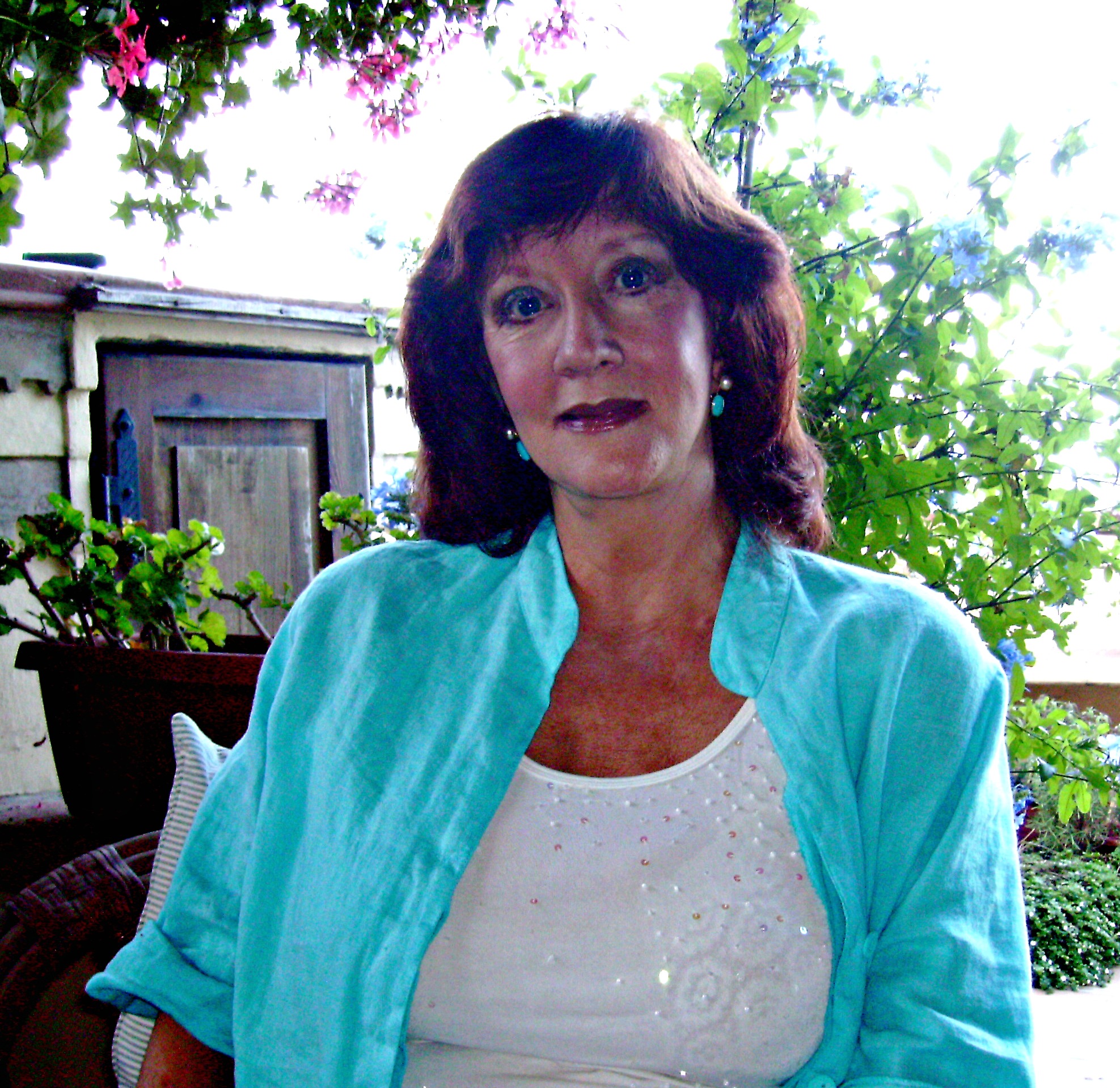
img: Laura Graham, on the terrace outside her house in Tuscany.

For the displaced writer Martin Crosbie, a life between two cultures is the stuff of literary fiction

Readers who’ve been paying attention will know that a couple of days ago, in honor of The Displaced Nation’s first birthday, we fleshed out a prospectus for a literary festival for authors who’ve been expats, third culture kids and/or global nomads.

Should this litfest ever happen, this month’s featured author, Martin Crosbie, would make an exciting addition to the line-up.

Last year he published a sensitive, partly autobiographical first novel, My Temporary Life, telling the story of Malcolm, a young half-Scot half-Canadian. As Malcolm informs us towards the start of the book:

I live with a father [in Scotland], who didn’t intend to have a son with no wife, or I spend my summers in Canada, with a mother who forgets that I’m there.
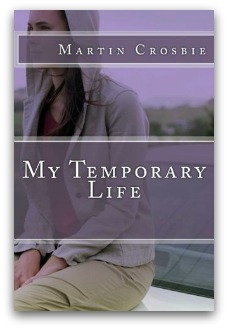
Eventually, circumstances make it impossible for Malcolm to continue this peripatetic life, and he heads to Canada to finish up his schooling. Even then, he feels unsettled:

It really does feel like everything is going to be okay, or at least it might be for a little while. Nothing in my life has ever been forever anyways. Everything is always just temporary, always temporary.

The novel has taken the Amazon charts by storm, garnered rave reviews and turned Crosbie into an overnight publishing sensation.

In fact, I recommend you become part of the storm by reading the book RIGHT NOW — or as soon as you’ve finished this post.

Here’s a link to the book on Amazon: My Temporary Life.

Alternatively, you can sign up for our DISPLACED DISPATCH — and cross your fingers that you’ll be one of this month’s two lucky winners!

And now for some highlights from my exchange with Martin Crosbie…

Is Malcolm Martin?

Hi there, Martin!
Hi, Tony!

Can you tell me a bit about your upbringing — where you were born and how you ended up in Vancouver?
I was born in Aberdeen in Scotland but I was adopted and transplanted to Kilmarnock when I was still an infant. I lived there until I was ten and my family moved us to the west coast of Canada. Other than a few years in Toronto and in Ontario when I was in my twenties, I have always lived here, just outside of Vancouver, British Columbia.

I’ve read your book My Temporary Life, and I loved it. I was particularly impressed by the way your writing flows, which is the mark of a very accomplished writer.
Thanks for saying that, I really appreciate it. This is my first novel and I think one of the reasons that it’s done well is that it went through so many re-writes and revisions. The novel that is out there today is very unlike the first few drafts.

You’ve lived in both Scotland and Canada, the two locations in the book. You also share the main character’s love of running… So I have to ask — how much of this character is autobiographical?
I had a writing teacher who would say “What is truth, in fiction? Write something down!”

Then, he’d sit down and wouldn’t answer any questions until the class had all written something, anything.

Once we shared what we’d written, he’d talk about the fact that when you read something and it “rings true” — in that you get lost in the scene — the reason is that the emotions the writer has conveyed are coming from a true place.

So, I appreciate your question because it means that my story probably worked when you read it.

But did the events in the book really happen — the boy with two parents from two cultures (Malcolm), his best friend whose parents beat him up (Hardly), and his dream woman, who, too, has had an abusive childhood (Heather)?
A lot of the incidents did in fact happen — but to different people at different times. The book is most definitely fictional.

But it is true?
Without wanting to become the next James Frey, yes, on some level it is. I had the daughter of a friend read the novel and really enjoy it, and she asked me if I was Malcolm. I told her that some days I feel like Malcolm and some days I feel like Hardly — lol.

The ups and downs of self-publishing

Quite a few authors in The Displaced Nation’s circle have self-published their works, myself included. Can you tell us what was behind your decision to self-publish My Temporary Life?
I self-published My Temporary Life because I was turned down over one hundred times by agents and publishers. The strange thing, though, was I’d pass my work to readers and they enjoyed it — very few of them didn’t. Oh, there were changes that I made along the way because of readers’ input, but the feedback was almost always decent. And they all wanted to know the same thing: “When’s the next book?”

So I self-published through Amazon, and it’s been an incredible ride. In less than three months 85,000 copies of my book are out there. I say that number and it absolutely astounds me that so many people have taken the time to give My Temporary Life a chance.

Is there a particular group of readers who’ve found particular resonance with your story?
One of the challenges with my novel has been that it doesn’t fit any specific genre, and when that happens you don’t know where to market your work. This has been good and bad. Not knowing whether to call it a coming-of-age story, a romance, or a thriller has been challenging. But not knowing exactly to whom it might appeal has also been a good thing, because I now have women and men readers of all ages.

I guess Malcolm is a reluctant, flawed hero and we can all kind of relate to that.

Self-publishing , as I know from my own experience, can be time consuming, however rewarding it is. Have you found it that way?
Without self-publishing, my story would not have reached anyone. It’s as simple as that. Having said that, the downside is that it’s a lot of work — and I mean, a lot of work. I promote my book anywhere that I can online where I think folks might be interested. Unfortunately, this takes me away from writing my next book, and that’s what I really want to be doing these days.

The positive of self-publishing is that I enjoy interacting with folks who’ve read or are reading My Temporary Life. I’m very accessible. I answer every email. I am on chat loops, Facebook groups, Yahoo groups — anywhere that somebody wants to talk about self-publishing or writing or my work. And, in doing that, I’ve formed some incredible friendships.

You know when you meet someone, whether it’s virtually or in person, and you just know that they’re going to be in your life for a long time? Well, I have met friends like that because of my book.

In the past week, I’ve had instant messages, tweets and emails from all kinds of people. One lady was ribbing me because she had to call in sick after being up all night reading my book. Another woman sent me a barbecued salmon recipe — she’d liked the recipe in my book but thought hers was better. And a gentleman sent me a message who is a huge fan of the book. He said that he’d told his wife that if she didn’t read it, she had to pack her bags, lol.

And, the readers that I am “meeting” are from all over: Taiwan, Luxembourg, lots in Australia, the UK of course, and the US.

It’s an amazing world that we live in that I’m able to experience that, and it’s all because I self-published my book.

Cross-cultural relationships

Malcolm gets involved with Heather, who’s a born-and-bred Canadian from a secluded little town in Northern Ontario. Heather says to Malcolm when they first meet: “You have this Scottish look to you, like you just got off the boat and are still lost; it’s very cute.” What’s your view on cross-cultural relationships? Do you see them as particularly challenging? (Many Displaced Nation readers are in them, which is why I ask…)
It’s funny that you bring that up as I’m trying to address it in my work in progress. I don’t really know if I’m properly qualified to comment… I live in an area of Vancouver where I have friends from pretty much every culture you can imagine. I’m lucky in that respect, and of course because of that, I get to eat lots and lots of different foods. Food is very very important to me, Tony, I do love to eat.

The importance of being Scottish

You’ve lived in Canada a long time. But does Scotland still exert some kind of pull?
Scotland calls me back every few years. Right now it’s been three years since I was there and it’s whispering in my ear again, so I’ll be back there soon.

You see, when you’re a Scot, you’re always a Scot. There are third and fourth generation Scots who live in Canada who still call themselves Scottish.

Well, I was born and bred there and have been back many times, and even though I am a Canadian citizen now, you can’t not be a Scot. It’s more than just being born there. It’s much more than that.

When I arrive at Glasgow airport and present my European passport (yes, I have a Canadian and European one), and the customs agent sees my birthplace and says, “Welcome home, Mr Crosbie,” I always get a tear in my eye.

And, there are many many things that I miss about Scotland.

I miss the passion that they have for football, real football. I miss big sour pickled onions. I miss the way the rain can be lashing in your face and somebody will say to you that it’s a “grand” day. I miss the way that Scottish history is real history, real old history.

The dream of partial repatriation

Would you ever go back to live in Scotland?
I’m fortunate that I can go back from time to time, and in the movie of my life that plays in my head, I do live there part time too. One day I hope to make it happen. I already have the city picked out in Scotland where I’d like to live…

But wouldn’t you have to make some adjustments?
During the months when I’m living in Scotland, I expect I’d miss the mountains that we have here on the Vancouver coast — but I’d sure like to try it for a little while.

If my next book is as successful as My Temporary Life, I might just find a way to fulfill my dream and live part time in both countries.

A Temporary Life — The Sequel

Rumor has it you’ll be doing a sequel following the life of Malcolm’s Scottish friend, Hardly. What can you tell us about this work in progress?
I can tell you that I’ve seldom been as excited about anything as much as I’m excited about my next novel. Yes, it is the story of Hardly. I’m having so much fun writing it.

Just what the final product will look like I don’t really know, so at this point I’ll just say that it’s like the first novel in the sense that it’s an in-depth character study of a man and his motivations, and in terms of how the novel reads, well, I do love plot twists, Tony, and I can absolutely guarantee you that this book will have them.

Sounds fantastic! Thanks so much for your time, Martin.
Thanks for doing this Tony, and of course now I’m going to be dreaming tonight about the wee chip shop in Stewarton, and the farm house that my cousins live in in Inverness, and a multitude of other Scottish things.

* * *

Anyone who’d like to know more about Martin’s life and his work, you can check out his author site and follow his escapades on Twitter: @martinthewriter

And if you have any questions for Martin, please feel free to ask them in the comments!

And don’t forget to sign up for our Dispatch to be eligible for the giveaway of Martin’s book!

STAY TUNED for tomorrow’s installment in the life of our fictional expat heroine, Libby, which will be another party-themed post — this time, of course, it’s a baby shower! (What, not keeping up with Libby? Read the first three episodes of her expat adventures.)

If you enjoyed this post, we invite you to register for The Displaced Dispatch, a round up of weekly posts from The Displaced Nation, with seasonal recipes, book giveaways and other extras. Register for The Displaced Dispatch by clicking here!

Related posts:

How to throw a party for a bunch of global nomads

One year has passed since our first random nomad, Anita McKay, crashed through the gates of The Displaced Nation, bribing the guards with chicken tikka masala and cranachan and shouting “bollocks” at several of us who tried to stop and question her.

And now there are 40 such nomads within our ranks — the latest being Annabel Kantaria, who insisted on bringing an alarm clock that looks like a miniature mosque — it rings every morning with the call to prayer. (Note to other founders: perhaps we need to find guards who aren’t so easily intimidated when travelers show a bit of temerity…)

Still, as we now have 40 nomads, randomly selected, why not make the best of the situation and throw a party? And what better excuse than The Displaced Nation’s 1st birthday — which, as announced by Kate Allison in a post a couple of days ago, took place on April 1 (no fooling!).

Further to that end, I’ve come up with a Party Primer that I think should work for this group — as well as for similar gatherings.

PARTY PRIMER FOR DISPLACED NOMADS

Click on the headlines below to go to each section:

  1. INVITATIONS
  2. DRESS CODE
  3. DECORATIONS
  4. MUSIC
  5. TABLE ASSIGNMENTS
  6. FOOD
  7. TOPICS FOR SMALL TALK
  8. PHOTOGRAPHY
  9. GAMES
  10. SONGS

INVITATIONS

As this party marks a special occasion (who ever thought we’d make it to be one year old?), a deluxe printed invitation is in order. The only thing is, our invitees are a bunch of nomads! We’ll be lucky if we can catch them on email, let alone at a fixed address. Let’s compromise on an attractively designed message: see mock-up at top of this page.

DRESS CODE

As some of you may know, Cleopatra recently paid a visit to The Displaced Nation. Based on her observations of today’s international travelers, we’ll be doing well if we can get the men to shower and change before joining us. As for the women, well, allow me to offer these pearls of wisdom from Jennifer Scott — the American guru of Parisian chic who was featured on this blog last week. Jennifer says:

There are certain occasions that always warrant dressing up. Generally any gathering … where others went to a lot of effort for your sake.

DECORATIONS

The theme is easy: the wide wide world! (Rather the opposite of Disney’s “It’s a small world after all” concept.) This calls for tablecloths imprinted with the world map (to make it easy for guests to point out where exactly “Moldova” etc is); globe-patterned balloons (can we coin a new term: globalloons?); and for the centerpieces, flags from each of the adopted country represented at the table in question.

Optional extras include party hats, noisemakers and loot bags. It’s fun when the loot contains some surprises. Given all the items our nomads have insisted upon carrying into The Displaced Nation, we should have plenty to choose from, eg:

  • mosque alarm clocks (thanks, Annabel!)
  • hairy coo fluffy toys (thanks, Nerissa!)
  • fake Harry Potter glasses (thanks, Charlotte!)
  • boomerangs (thanks, Kim & Vicki!)
  • brie bakers (thanks, Toni!)

MUSIC

As Todd Lyon, author of a number of party and lifestyle books, puts it:

Without music, a party isn’t a party. It might be an assembly, a meeting, or a bee, but it can never be a shindig, a bust-up or a ball unless there’s fine tunes that never stop.

Not being a party tunes buff myself, I’ve consulted with The Displaced Nation’s resident music expert, Kate Allison, about the kind of soundtrack that would cultivate just the right ambience. Her suggestions include:

Everybody all around the world, gotta tell you what I just heard
There’s gonna be a party all over the world…

TABLE ASSIGNMENTS

8-10 person tables work well. Since we’ll have 40 guests, I’ve decided on five tables of eight people each, and to mix everyone up as much as possible. Hostesses must also, of course, take steps to reduce the risk of a “silent table,” where people just eat and don’t talk. To be honest, I don’t there is too much risk of that with this crowd — have you ever watched a bunch of expats try to outdo each other with stories of their (cross-cultural, linguistic and travel) adventures? But just in case, I’m offering some “hostess notes” for each table (the hostess’s job being to introduce everyone and make sure the conversation keeps flowing!).

TABLE 1
Matthew Chozick (American expat in Japan)
Tom Frost (American expat in China)
Lyn Fuchs (American expat in Mexico — Sacred Ground Travel Magazine)
Turner Jansen (American canine in Holland)
Annabel Kantaria (English expat in Dubai — Telegraph Expat blog)
Kirsty Rice (Australian expat in Qatar — 4 kids, 20 suitcases and a beagle)
Jack Scott (English expat in Turkey — Perking the Pansies)
Karen van der Zee (Dutch/American expat in Moldova — Life in the Expat Lane)
Hostess notes: Introduce Tom Frost to Matthew Chozick — Tom used to live in Japan and speaks Japanese. Kirsty Rice should sit next to Turner Jansen, as she travels around with a beagle. Annabel Kantaria, Jack Scott and Kirsty all have in common life in the Middle East. Karen van der Zee and and Lyn Fuchs should find each other fascinating, as both have had some extraordinary adventures (Karen could entertain Lyn with her crocodile tale and Lyn, keep Karen amused talking about the time he went paddling with orcas.)

TABLE 2
Balaka Basu (Indian American in New York City)
Santi Dharmaputra (Indonesian expat in Australia)
Michelle Garrett (American expat in UK — The American Resident)
Robin Graham (Irish expat in Spain — a lot of wind)
Anita McKay (Indonesian expat in Australia — Finally Woken)
Brian Peter (Scottish expat in Brazil — A Kilt and a Camera)
Kate Reuterswärd (American expat in Sweden — Transatlantic Sketches)
Wendy Tokunaga (Former American expat in Japan)
Hostess notes: You might want to break up Santi Dharmaputra and Anita McKay, who are the same nationality (Indonesian) and already friends. Anita should definitely be introduced to Brian Peter, who like her hubby, is Scottish, and will probably be amused by her stories of toasting oatmeal in whisky. And make sure Anita also talks to Wendy Tokunaga — I know from personal experience how intrigued Anita is by stories of Western woman marrying Asian men. To be honest, everyone at this table should really be socializing with everyone else, as each and every one of them has a partner of a different nationality! (Now if that isn’t a talking point, I don’t know what is…)

TABLE 3
Kim Andreasson (Swedish expat in Vietnam)
Jo Gan (American expat in China– Life behind the wall)
Jennifer Greco (American expat in France — Chez Loulou)
David Hagerman (American expat in Malaysia — SkyBlueSky)
Helena Halme (Finnish expat in UK — Helena’s London Life)
Vicki Jeffels (Kiwi expat in UK — Vegemite Vix)
Janet Newenham (Irish internationalist — Journalist on the run)
Adria Schmidt (former Peace Corps worker in the Dominican Republic)
Hostess notes: Seat David Hagerman next to Jennifer Greco — since his wife is a well-known food writer and expert cook, he’ll find nothing strange in her quest to sample all the known French cheeses. Janet Newenham should be near Adria Schmidt and Kim Andreasson as they are all interested in international affairs. Vicki should be introduced to Helena as I’m sure the latter would love to hear about her recent spa experience in Cyprus. Jo Gan, too, should meet Vicki as she is now experiencing visa problems with the Chinese authorities — on a level that may even surpass Vicki’s own nightmare experience in Britain.

TABLE 4
Aaron Ausland (American expat in Colombia — Staying for Tea)
Emily Cannell (American expat in Japan — Hey from Japan)
Charlotte Day (Australian expat in UK)
Toni Hargis (English expat in USA — Expat Mum)
Vilma Ilic (Former aid worker in Uganda)
Jennifer Lentfer (Former American expat in Africa — How Matters)
Camden Luxford (Australian expat in Argentina — The Brink of Something Else)
Piglet in Portugal (English expat in Portugal — Piglet in Portugal)
Hostess notes: Aaron Ausland will naturally gravitate towards Jennifer Lentfer as they are both deeply involved in global aid and development. Make sure you introduce the pair of them to Piglet in Portugal — she’ll ask them some thought-provoking questions about whether it’s better to save the world or cultivate your own garden. Jennifer should also be near Vilma as the two will want to share their Africa experiences, and you might urge Emily Cannell to join that conversation as well — she has such an adventuresome spirit! Along with Toni Hargis, who runs her own charity supporting a school in Ghana. As for Camden Luxford, she’s an easy one: a social butterfly! Perhaps she could take fellow Aussie Charlotte Day under her wing (ha ha) and make sure she gets plenty of material to write about for her courses at Oxford next year!

TABLE 5
Lei Lei Clavey (Australian expat in New York City)
Matt Collin (American expat in UK)
Megan Farrell (American expat in Brazil — Born Again Brazilian)
Liv Hambrett (Australian expat in Germany — A Big Life)
Mardi Michels (Australian expat in Canada — eat. live. travel. write | culinary adventures, near and far)
Iain Mallory (English adventurer — Mallory on Travel | Making Everyday an Adventure)
Nerissa Muijs (Australian expat in Holland — Adventures in Integration)
Simon Wheeler (English expat in Slovakia — Rambling Thoughts of Moon)
Hostess notes: As soon as Lei Lei Clavey, Liv Hambrett, Mardi Michels and Nerissa Muijs discover they all have Australia in common, they will be blabbing away — just hope it doesn’t turn into an Ozfest! Also, make sure Mardi connects with Matt — I suspect he may need her counseling about how to seek creative refuge from academia. Iain Mallory and Simon Wheeler will form a natural pair, exchanging stories of their travel adventures and perhaps even breaking into a rousing chorus of “Jerusalem.” But should their antics get too raucous, ask Mardi to step in: she teaches cooking classes to 9-11-year-old boys in Canada. Megan Farrell should connect with Nerissa and Simon on the topic of what it’s like to raise a child in a nationality (and language) other than your own.

FOOD

One of the purposes of gathering together nomads from the four corners of the earth has to be eating, especially if each of them brings along some of their favorite dishes. For our party, we will have a dazzling tableaux brimming over with rare and exotic foods. (We know that because our Random Nomads have already described their faves to us in their interviews.)

Shall we go over the list? (Warning: Don’t read on an empty stomach, or if on a restricted diet!)

NIBBLES/STARTERS

  • Guacamole & chips (Kim — recipe provided)
  • Selection of mezze with pita bread (Annabel Kantaria)
  • Assorted pinchos (Megan Farrell)
  • Avocado & mango salad (Matt Collin)
  • Bhelpuri (Tom Frost)
  • Satay sticks (Nerissa Muijs)
  • Four kinds of eggs: tea eggs, thousand-year-old eggs, fried eggs with tomato, and boiled salted eggs with a chicken embryo inside (Jo Gan)
  • Shrimp & grits (Lei Lei Clavey)
  • Vietnamese caramelized chili prawns (Mardi)
  • Ceviche (Camden Luxford)
  • Bluff oysters from New Zealand (Vicki Jeffels)
  • Gravad lax with Finnish rye bread (Helena Halme)
  • Tuna sashimi with ponzu sauce (Emily Cannell)

COCKTAILS

  • Traditional Bloody Marys (Lei Lei Clavey)
  • Caipirinhas (Megan Farrell)
  • Margaritas (Kirsty Rice)

WINE

  • Rich red wines from Lebanon (Annabel K)
  • Red wine from Macedonia (Vilma Ilic)
  • Malbec wine from Argentina (Camden Luxford)
  • Shiraz from Australia (Vicki Jeffels)
  • White wine from Australia (Simon Wheeler)
  • Chilled sake (Tom Frost)
  • Rice wine (Jo Gan)

BEER

  • Carlsberg browns (Matt Collin)
  • Cusqueña beer (Camden Luxford)
  • Mexican Pacifico (Tom Frost)
  • Harbin beer (Jo Gan)
  • Coopers beer (Simon Wheeler)

MAINS
Meat dishes:

  • Carne de Porco a Alentejana (Piglet in Portugal)
  • Schnitzel served with rotkohl (Liv Hambrett)
  • Bondiola-chevre-basil wraps and nattō (Tom Frost)
  • Fried chicken sandwiches with hand-cut fries (Lei Lei Clavey)
  • Chicken tikka masala (Anita McKay)
  • Libyan soup (Kirsty Rice — recipe provided)
  • Cuban ropa vieja (Mardi)
  • Argentinian steak cooked rare (Camden Luxford)
  • Tapola black sausage with lingonberry jam (Helena Halme)
  • Barbecued steak, snags & lamb chops (Nerissa Muijs)

Fish dishes:

  • Paella Valenciana (Megan Farrell)
  • Llish in mustard and chili paste, smoked in banana leaves (Balaka Basu)
  • Chambo curry with nsima (Matt Collin)
  • Moreton Bay bugs (Vicki Jeffels)
  • Grilled salmon on a plank (Emily Cannell)
  • Sushi (Simon Wheeler)

Vegetarian offerings:

  • Peanut butter vegetable stew (Jennifer Lentfer)
  • Overcooked spaghetti with carnation milk, canned tomatoes and corn (Adria Schmidt)

DESSERTS

  • Summer pudding (Toni Hargis)
  • Apple crumble (Matt Collin)
  • Cranachan (Anita McKay)
  • Hot fudge sundaes (Lei Lei Clavey)
  • Blackberry gelato (Balaka Basu)
  • Caramel cheesecake (Kirsty Rice)
  • Bread pudding with Bourbon sauce (Jennifer Greco)
  • Île flottante (Mardi)
  • Molotof cake (Piglet in Portugal)
  • Mouse de maracujá (Megan Farrell)
  • Tiramisu (Camden Luxford)
  • Homemade Slovakian cream cakes (Simon Wheeler)
  • Dutch waffles (Turner Jansen)
  • Oblande, tulumbe, kadaif & krempite (Vilma Ilic)
  • Umm Ali (Annabel Kantaria)
  • Sigara borek (Jack Scott)
  • Juustoleipä with fresh cloudberries and cream (Helena Halme)
  • Yangmei fruit (Jo Gan)
  • Languedoc cheese: Roquefort, Pélardon and Tomette des Corbières (Jennifer Greco)

AFTER-DINNER DRINKS

  • Chlicanos (Camden Luxford)
  • Rakija (Vilma Ilic)
  • Fernet (Tom Frost)
  • Homemade Slivovica (Simon Wheeler)
  • Dragon-wall green tea (Jo Gan)
  • Espresso (Balaku Basu)
  • Large “flat whites” (Charlotte Day)

FOR THE TOAST(S):
New Zealand champenoise (Vicki Jeffels)

NOTE: Charlotte Day will be cooking a Sydney-style breakfast for diehards who care to linger to the next morning. (And Nerissa Muijs will be frying up some bacon!)

TOPICS FOR SMALL TALK

There are some topics that should be avoided at all costs. As style writer Rita Konig puts it,

It is very dull to talk about journeys. Once you have arrived somewhere, try to keep quiet about how long it took you to get there.

Should you notice anyone engaging in this, put the kibosh on it by asking them to help with pouring drinks, or with putting away coats in the spare room.

PHOTOGRAPHY

Fortunately, there’s usually one great photographer or two in a group of global nomads, thereby saving unnecessary expenditure. (We will ask David Hagerman — he’s sensational!)

GAMES

Games are a great ice breaker. Here are a few that might be appropriate for a well-traveled crowd:
1) Musical countries: Draw a big map on a piece of vinyl (back of a Twister mat might do), and give everyone a flagpole. When the music stops, they must place the flagpole on a country, Anyone whose flagpole ends up in the ocean is out.

2) Variation on “Pin the Donkey”: Pin the rudder on the 747! (Contributed by Kate Allison.)

3) Word games: As we’ve found out from our interviews, global nomads pick up words and expressions from here and there. Taking some of these and mixing them together, we can come up with some pretty strange exchanges. (Prizes for anyone who manages to decipher!)

A: Prego, could you get me a ba ba ba? Kippis!
B: Inshallah, a barbie would also be awesome. And how about la ziq?
A: Avustralyalılaştıramadıklarımızdanmışsınızcasına.
B: So desu ne!

A: Tudo bem? You look a bit daggy.
B: Life can be arbit sometimes.
A: Zvakaoma.

A: Hey.
B: Hey. Das stimmt, sorry to be such a Debbie Downer but I’m knackered after all this work.
A: Bless!
B: Zikomo.

A: Oh la vache! You are lost. Siga, siga. Ni chifan le ma?
B: Bollocks! [Sucking air through gritted teeth.] I think I got lost in the wopwops.
A: Well, there’s the big ol’ tree out the front.
B: Bula! Okay-la. Le bon ton roule!

TOASTS

Toasts should be made repeatedly throughout the latter half of the dinner. Just in case no one feels inspired, prepare one or two classics for the host or hostess to offer, eg:

I’d rather be with all of you than with the finest people in the world.

SONGS

Songs can be sung in several languages. In this case, a stirring rendition of “Happy Birthday” is called for, sung not only in English but in:
Dutch (Karen, Nerissa)
Finnish (Helena)
French (Jennifer, Mardi)
Indonesian (Anita & Santi)
Japanese (Emily, Matthew, Tom, Wendy)
Spanish (Aaron, Adria, Camden, Lyn, Megan, Robin)
Swedish (Kate, Kim)
Woof-woof (Turner)

Finally, the party should end with the Displaced Nation founders treating the guests to a round of:

For you are all jolly good fellows, for you are all jolly good fellows,
For you are all jolly good fellows…
Kate, Anthony, Tony: And so say all of us!
ML: Which nobody can deny!

* * *
Have I left out any important details? Any tweaks you can suggest? Your turn!!! Let’s work together to make this the most awesome gathering of global nomads ever. Onegaishimasu, shokran — and all that!

STAY TUNED for tomorrow’s installment from our displaced fictional heroine, Libby. She is expecting a visitor: her own mother, who is — in theory — coming to help as her due date gets closer. Will Granny Jane be an improvement on Sandra, the MIL from hell — or will she prove to be one more spanner in the works for our poor displaced heroine? (What, not keeping up with Libby? Read the first three episodes of her expat adventures.)

If you enjoyed this post, we invite you to register for The Displaced Dispatch, a round up of weekly posts from The Displaced Nation, with seasonal recipes, book giveaways and other extras. Register for The Displaced Dispatch by clicking here!

Related posts:

12 NOMADS OF CHRISTMAS: Brian Peter, Scottish expat in Brazil (3/12)

Current home: Rio das Ostras, RJ, Brazil
Past overseas location: Houston, Texas, USA
Cyberspace coordinates: A Kilt and a Camera | Travel tales, reviews, photos, interviews and crazy goings on. Because you never know what’s going to happen (blog) and @KiltandaCamera (Twitter handle)
Most recent post: Brazil — “Getting to know Aldeia Velha,” by Peg Peter [Brian’s American photographer wife] (December 19, 2011)

Where are you spending the holidays this year?
In Houston.

What will you do when you first arrive?
Peg will arrive three weeks before I do, so the first thing I want to do is hug my wife. After that I’ll put my feet up and relax after the long flight from Rio for a few hours. That night we will spend the evening with good friends we haven’t seen in way too long.

What do you most like doing during the holidays?
Relax. We are living in Brazil while I’m working as a manufacturing and production manager in the oil and gas field. The growth in the industry has been enormous. I’ve been working long hours, and long weeks, for too many months. I’m going to turn off my phone, keep my laptop shut and switch my mind off.

So you’ll be offline?
Pegs is the Internet junkie of the team so I trust she’ll let me know if anything important happens out in cyberworld.

Are you sending any cards?
Peg will send a few Christmas cards for us. As for a Christmas letter, we do too many things and go to too many places each year to write something brief. Our family and friends who want to know more about what we’re doing can take a look at our Web site.

What’s the thing you most look forward to eating?
A bloody decent whiskey, and a tin of haggis. If I can find a good smoked mackerel, I’ll eat that too. I really wish I could get my hands on an Orkney black pudding.

Can you recommend any good books other expats or “internationals” might enjoy?
Because of work I haven’t had time to read a single book all year, unless you count industrial engineering books as a good read. But Peg always has her nose in a book. Right now she says she’s really enjoying Barbara Kingsolver’s The Poisonwood Bible. The sense of stepping into another world is something any traveler or expat can relate to.

If you could travel anywhere for New Year’s Eve, where would it be?
I’d love to do an Old Year’s Night in Comrie, a small village in the Scottish highlands. As I remember, its Hogmanay ritual starts in the evening with the kids in a fancy-dress parade riding on the back of a lorrie — a kind of float. That goes on until nearly midnight, when the whole community gathers at the bridge on the side of town near Oban and throws three flambeaux (flaming torches) over it into the River Earn. Then there’s a procession through the village with a pipe band leading the way — the villagers in the middle, the float bringing up the rear. When they reach the bridge at the other end of town, they throw the remaining flambeaux into the river. The whole thing is a ritual to protect the village from evil spirits for the year. Back in the center of town the party, including a céilidh, will go on for hours.

My sister has lived there for the past twenty years. Someday I’ll take Peg back there to show her how my family of Scots does an old fashioned Old Year’s Night properly.

What’s been your most displaced celebration of the holidays?
My first Christmas in Houston. I spent the day in shorts, roasting by the pool. It just doesn’t feel like Christmas without freezing your b*******s off.

How about the least displaced — when you’ve felt the true joy of the season?
Even though we live in Brazil, we always go back to Houston to spend the holidays with Peg’s kids. I’ve enjoyed the last few holidays with them, among new family, but I still don’t feel at home as much as I did back in Scotland– especially since I’m so far away from my own adult sons.

However, last year was a bit more exciting because Peg and I had a big secret plan between us. On Boxing Day we hopped on a plane and flew to the Caribbean. One long haul, three airports, three islands and one ferry later we arrived on St. John in the US Virgin Islands, where we eloped on the beach on December 28th. The photo above was taken of us on the ferry ride over to the courthouse in Charlotte Amalie to pick up our marriage license the day before. This year, of course, we’ll have our first anniversary!

How do you feel when the holidays are over?
It’s a bit anti-climactic. I start the new year with a long flight back to Brazil, which is a country we love living in, but it means back to work for a while. When my job is done there, we’ll have more time to travel when we please. In the meantime, we’ll enjoy as much of Brazil as we can. We both love to travel and look forward to the day when we can just keep going.

On the first day of Christmas, my true love said to me:
THREE DECENT WHISKIES,
TWO CANDY BOXES,
& AN IRISHMAN IN A PALM TREE!

STAY TUNED for tomorrow’s featured nomad (4/12) in our 12 Nomads of Christmas series.

If you enjoyed this post, we invite you to register for The Displaced Dispatch, a round up of weekly posts from The Displaced Nation, with seasonal recipes, book giveaways and other extras. Register for The Displaced Dispatch by clicking here!

Related posts:

RANDOM NOMAD: Nerissa Muijs, Business Development Specialist

Born in: Kingston S.E., a wee town in South Australia
Passport: Australian, but will be eligible to become a dual Australian-Dutch citizen this year
Countries lived in: Malaysia (Shah Alam): 1997; New Zealand (Christchurch): 2003; England (Plymouth): 2006-2007; Scotland (Edinburgh): 2007-2008; Netherlands (Almere): 2008-present
Cyberspace coordinates: Adventures in Integration (blog)

What made you leave your homeland in the first place?
I grew up in a small town in South Australia called Lucindale (just 300 people). I don’t feel like I was ever a good fit. I have always had a feeling of wanderlust and being able to go on an AFS exchange to Malaysia when I was 17 added more fuel to the fire, rather than sating my taste for experiencing new places. Once I returned home, I never really settled down again. I was constantly planning my next adventure.

Is anyone else in your immediate family a “displaced” person?
One of my Fabulous Aunts is also perfectly displaced. She lives on a yacht with her partner and two cats. They are currently floating around the Colombian coast, preparing for hurricane season before braving the Panama Canal to head back into the Pacific and beyond.

Describe the moment when you felt most displaced over the course of your many displacements.
Perhaps it was sitting in a restaurant in Malaysia with my wonderful Chinese host family. They had taken me out especially to eat shark’s fin soup. Or it could be the time I was the only Australian sitting in a bar in Christchurch watching the Wallabies beat the All Blacks in the semi finals of the 2003 Rugby World Cup. But seriously, it was probably when I found myself in the immigration offices in Amsterdam realizing I was making a potentially permanent commitment by moving to my husband’s homeland — it was time to grow up!

Describe the moment when you felt least displaced.
On my birthday in 2007. I was living in Edinburgh at the time. My Dutch boyfriend, who is now my husband — we met in Australia when he joined one of my tours to Uluru — was visiting from the Netherlands. A group of my friends took us out to celebrate. In that moment I was happy, I was at home. I find I don’t have the sense of “home” when I return to my hometown in Australia any more. I feel at home with people, not places. Having a cup of tea with my best friend, for example. We’ve done that in at least four countries together and it’s always the same.

You may bring one curiosity you’ve collected from each of the countries where you’ve lived into the Displaced Nation. What’s in your suitcase?
From Malaysia: A batik sarong. I’ve been wearing the same one weekly since 1997, and I love it just as much as the day I paid 5RM for it.
From NZ: The jade pendant I got from Hokitika. It feels cool or warm on my skin and is smooth and comforting.
From England: A cream tea with scones and Cornish clotted cream. A cream tea will always make me think of my elderly great aunts at home and of England.
From Scotland: A “hairy coo” fluffy toy. (Actually, I’d prefer to bring a real-life hairy coo, but I imagine you have strict quarantine rules…)
From Netherlands: Rookworst (a type of smoked sausage, similar to bratwurst).

You’re invited to prepare one meal based on your travels for other Displaced Nation members. What’s on your menu?
Being Australian, I will have to say a barbie. We’ll eat steak, snags [sausages], lamb chops and onions. We’ll tip our hats to Malaysia with some satay sticks. We’ll have bread and my grandma’s hot potato salad. There will be noodle salad that my mum made and sliced beetroot on the side, which I’ll drop on my shirt. Of course, because I live in the Netherlands, we’ll have garlic sauce along with our tomato sauce. And because of the UK influence it will probably be raining, but there will be beer. Lots of beer. And it won’t end for two days. I’ll be up early to cook bacon and eggs again the next morning for the people who just won’t leave. (Dad, I’m talking to you!) It will be fun — care to join me?

You may add one word or expression from each of the countries you’ve lived in to The Displaced Nation argot. What words do you loan us?
From Malaysia: Adding a “la” onto words and sentences: “Okay-la.”
From New Zealand: “Chur bro.” Depending on the context, it can mean “thanks,” “nice,” or “cheers, mate.”
From England: “I’m not trying to be funny, but [insert random passive aggressive insult here].”
From Scotland: Any swear word you can imagine.
From Netherlands: Gezellig, the most important word in the Dutch language. There is no real English translation, though “cosy” is sometimes used. It’s a word people use to describe a pleasant situation. Going out with friends is gezellig. Sitting around having a nice dinner with family is gezellig. Anything that gives you a nice warm fuzzy happy feeling inside can be described as gezellig. Wonderful word.

img: Nerissa Muijs at tulip fields outside Lisse, Netherlands.

If you enjoyed this post, we invite you to subscribe for email delivery of The Displaced Nation. That way, you won’t miss a single issue. SPECIAL OFFER: New subscribers receive a FREE copy of “A Royally Displaced Tea.”

Related posts: