The Displaced Nation

A home for international creatives

Tag Archives: Japan

FOOTLOOSE & FANCIFUL: Margaret Drabble’s “The Red Queen”

Welcome to Footloose & Fanciful, an occasional series of posts where we talk about books, films or other art forms that have inspired us to travel to new places or appraise familiar places with fresh eyes.

I’m probably not the best person to kick off this series. As much as I adore fiction, I’m not one to travel on a whim, because of something I read in a book. Especially not these days, when my expat years, spent in England and Japan, are behind me and I have to take time off from work. Typically, I arrive at my destination and collapse in a heap of exhaustion. It’s not until I’ve had a good rest that I am able to take in my surroundings. I peer out the window and say: “Really, I’m in xxx?!”

At that point I go to the other extreme, manically trying to find out as much as possible about where I’ve landed, visiting bookstores with an English-language section to stock up on translated novels, expat memoirs, the lot…

The second time I went to Seoul, South Korea, though, was different, and I’ll make that the subject of today’s post. That trip marked a rare time when a book had piqued my interest in a country to the point of influencing what I wanted to do and see and talk about during my stay.

Finding the soul of Seoul

I said my second visit to Seoul. The first had occurred a few years before. It followed the typical pattern. I arrived tired and unprepared, although on that occasion, I got an immediate lesson in the local culture.

Just as my husband and I were landing in Incheon International Airport, the news was breaking that Dr. Hwang Woo Suk—a veterinary researcher who had achieved world fame by cloning an Afghan hound named Snuppy—had falsified his latest results to make it look as though he’d made advances in human cloning.

“It’s a very Korean story,” some Korean friends of my husband’s informed us. I wasn’t sure what they meant, but little by little, I pieced it together. The Korean government, desperate to project a modern, high-tech face to the world, had turned Dr. Hwang into a national hero. He appeared in many of their promotional campaigns. The post office sold stamps to commemorate his research, and Dr and Mrs Hwang enjoyed a decade of first-class tickets on Korea Air, because of his status as “national treasure.”

Interestingly, our Korean friends were reluctant to condemn him outright. He’d been under a phenomenal amount of pressure to produce results and bring his country greater glory. If you were under that much pressure, you’d probably be tempted to skip a few rounds of clinical trials, too, they seemed to be saying.

I had to think about that for a while. Already, I was inclined to feel sorry for the Koreans because I knew how they’d suffered under Japanese rule. They are the Central Europeans of Asia, if you will. Just as the Hungarians, Poles and Czechs have had to put up with Germany and Russia, the Koreans, due to being sandwiched between China and Japan, have had to put up with incursions from both.

Gradually, I came round to the Korean point of view. My thought process went something like this:

Okay, the Koreans have been victims of some bad geography. But then why do they make things so much worse for themselves by setting such impossibly high standards? What Dr. Hwang did was wrong, a violation of ethical standards in medical research. But, okay, if I can feel sorry for all the Korean schoolchildren cramming like crazy for exams, I guess I can spare a bit of sympathy for Snuppy’s creator…

After arriving home from that trip, I was eager to read more about the country (I hadn’t found much in translation in Seoul’s bookstores).

That was when I happened upon the novel The Red Queen, by Margaret Drabble.

Seeing Korea in shades of red

A novel on Korean history by one of the writers I’d most admired when living in the UK: what could be a more perfect bridge between the two parts of my expat life?

The Red Queen of the book’s title refers to Lady Hyegyong, a Korean woman who lived in the 18th and early 19th centuries. She was plucked from obscurity to marry the Crown Prince of Korea, Sado, who turned out to be…a HOMICIDAL MANIAC, I kid you not.

The reason we know all of this is that Lady Hyegyong left behind a diary, and Part 1 of the novel is Drabble’s version of that document, which she based on JaHyun Kim Haboush’s translation of The Memoirs of Lady Hyegyong: The Autobiographical Writings of a Crown Princess of Eighteenth-Century Korea.

In Part 1, the Crown Princess tells us about what it was like to live with a husband and in a court where daily, several dead bodies would be carried out of the palace (whenever Sado felt agitated or depressed, he would seek relief by murdering his servants) or reports would arrive of another court lady being raped. After he murders his concubine, he starts harassing his own sister, too.

At about this point, I concluded that the only thing worse than discovering you’re married to psychopath would be to find out you’re confined with him in a palace, from which there’s no escape. Terror within a claustrophobic setting must be the worst kind there is!

The story has a further twist. The Crown Prince’s father, King Yongjo, turns out to have been deeply Confucian. He is the kind of Korean parent who sets impossibly high standards for his son, which—it is hinted in the Crown Princess’s diaries—may be part of what triggers the son’s madness.

In the end, the cruel father proves more than the psycho son’s match. On a hot day in July 1762, he summons Sado and orders him to get into a heavy wooden chest, ordinarily used for storing rice or grain. The lid is shut and locked, and Sado is left to starve. It takes eight days.

The Crown Princess is traumatized all over again at witnessing her father-in-law execute her husband in such a cruel manner.

In part 2 of the book, an Oxford academic travels to Seoul with the Crown Princess’s diary in hand (which has been sent to her anonymously via Amazon.com) and finds parallels between her own life and hers. Professor Halliwell feels that the Princess “has entered her, like an alien creature in a science-fiction movie.” She becomes possessed by her—just as I was by the end of the book, just as I’m sure Drabble was, which was what inspired her to create (in her words) this “transcultural tragi-comedy.”

More questions than answers

I went back to Korea for a second time not long after reading the novel, accompanying my husband on some work he had there. So moved had I been by Drabble’s book that I was determined to find a way to pay tribute to the Red Queen, so called because of all the blood that flowed during her husband’s reign.

But here’s the strange thing. All of my attempts to find out about Lady Hyegyong came to naught. My Korean friends said I needed special permission to visit Changgyeong Palace, where this tragic series of events took place. They did not seem to want to engage in a conversation about this period of their history.

I left Korea with more questions than answers: Do Koreans repress this part of their past, and if so, what does that tell us about them? Is my previous view of them as helpless victims all wrong? Did other countries walk in and take over because Korea had weakened itself through its impossibly high Confucian ideals, which had led to total anarchy by the end of the 18th century?

But the weirdest thing is, I wasn’t that surprised by the Korean reaction. While the Western part of me applauds Drabble for resurrecting Lady Hyegyeong as feminist hero, one who lived long enough to write her tale (the existence of her memoirs, incidentally, served to refute later attempts to restore Sado to a position of honor in Korean history books), the Asian part thinks that poor Lady Hyegyeong must feel displaced in Drabble’s novel. Relationships are, after all, a central theme to Confucianism. The husband is the head of the household and the wife is obedient to him, full stop.

This inner dilemma of mine, along with the spirit of Lady Hyegyeong, which Drabble portrays so vividly in her novel, still haunts me to this day…

* * *

Readers, have you ever read a book that has colored your impressions of a place in weird ways? Also, if you would like to contribute to this new series—perhaps an uplifting tale of being inspired by a book set in the idyllic Tuscan countryside would be in order after this rather macabre story?—please don’t hesitate to get in touch: ml@thedisplacednation.com.

STAY TUNED for next week’s fab posts!

If you enjoyed this post, we invite you to register for The Displaced Dispatch, a round up of weekly posts from The Displaced Nation, with seasonal recipes, book giveaways and other extras. Register for The Displaced Dispatch by clicking here!

Related posts:

And the May 2013 Alices go to … these 4 international creatives

 © Iamezan | Dreamstime.com Used under license

© Iamezan | Dreamstime.com
Used under license

As subscribers to our weekly newsletter will hopefully have noticed by now, each week our Displaced Dispatch presents an “Alice Award” to a writer who we think has a special handle on the curious and unreal aspects of the displaced life of global residency and travel. Not only that, but this person has used their befuddlement as a spur to creativity. He or she qualifies as an “international creative.”

Today’s post honors May’s four Alice recipients, beginning with the most recent and this time including citations.

So, without further ado: The May 2013 Alices go to (drumroll…):

1) ADAM GROFFMAN, travel blogger and expat

Source: “How a children’s book inspired my wanderlust” in Travels of Adam
Posted on: 13 April 2013
Snippet:

You see, what I loved about this book as a kid is the focus on architecture and food in this utopian society. Each family is responsible for bringing a country’s culture to the island nation.

Citation: Many of us at the Displaced Nation attribute our abilities to tolerate and even embrace life abroad (the strange foods and drinks, the loneliness, the largely incomprehensible rules) from having taken to heart Alice’s Adventures in Wonderland and its sequel, Through the Looking Glass, as kids. A good dose of literary nonsense has taken us a long way, and even to this day, we appreciate having recourse to Lewis Carroll’s great works to make sense of our rather curious lifestyles in countries other than those in which we were born.

Adam, we understand that you quit your job in Boston to travel the world and that you trace your own wanderlust to the 1947 American children’s book The Twenty-One Balloons, by William Pène du Bois, a story that in some ways is even more fanciful than Alice’s.

For those who don’t know it: The book begins when a schoolteacher, Professor William Waterman Sherman, becomes bored with his life and sets off on a journey in a hot air balloon called The Globe. He hopes the wind will blow him and his balloon all around the world. But instead he has a crash landing on the mysterious island of Krakatoa (Indonesia), where he discovers a utopian society started up by a group of wealthy families. Each family owns a restaurant of different types of foreign foods and all members of the island eat together at a different house, full of fantastic inventions, every night. Krakatoa being a volcanic island, the families are aware of the danger that the volcano could erupt at any moment (in fact its volcanoes erupted in 1883). Their escape plan consists of a platform made of balloons…

Adam, we love the idea of emulating a fictional character who favors balloon travel—the kind that begins without regard to speed and without a destination in mind. It’s also romantic to think that you expect to find, at best, utopianism, at worst, good food, in the course of your world wanderings. Perhaps it accounts for why you’ve landed your own “balloon” in Berlin, Germany’s creative capital and a city renowned for its architecture (only, how is the food there?).

2) TRACY SLATER, expat writer, author and blogger

Source: “What Does Home Mean When You Live Abroad?” in The Good Shufu
Posted on: 8 May 2013
Snippet:

I know how easy it is, when we live overseas, to lose our gimlet eye about home: to romanticize it, to see it as a kind of lost Eden, a place where we wouldn’t suffer the same disappointments or lonelinesses or defeats that we suffer in our expat lives.

Citation: Tracy, we would add to that something we learned from Alice, which is that part of the reason for cherishing the memory of home so much is that you can’t easily share what you love about it with the people you encounter in your new place. Alice experiences this when trying to talk about her beloved cat, Dinah, with the Wonderland creatures:

“I wish I hadn’t mentioned Dinah!” she said to herself in a melancholy tone. “Nobody seems to like her, down here, and I’m sure she’s the best cat in the world! Oh, my dear Dinah! I wonder if I shall ever see you any more!” And here poor Alice began to cry again, for she felt very lonely and low-spirited.

We also find inspiring your quote from the Egyptian writer and thinker André Aciman, that all exiles impulsively look for their homeland abroad. Even poor Alice suffered from that affliction—recall her trying to make herself at home at the Mad Hatter’s tea party, only to discover it is a less than civil gathering to what she is used to. First she is told there is no room for her at the table; then when she sits anyway, that her hair needs cutting. She is offered wine even though there isn’t any, and told to take more tea even though she hasn’t had any.

In fact, some of us can relate quite directly to this need to feel at home via a good cup of tea. TDN writer Kate Allison, for instance, has lived in the United States for many years but to this day fails to understand why Americans give her a cup of lukewarm water and a tea bag when she orders tea. And ML Awanohara, who lived in England before becoming an expat in Japan, often longed for English tea while sitting through the Japanese tea ceremony.

Tracy, we very much look forward to your forthcoming book, The Good Shufu: A Wife in Search of a Life Between East and West (Putnam, 2015), to help us make sense of such classic expat predicaments.

3) DANIELLA ZALCMAN, photojournalist

Source: “London + New York: A double exposure project”—an interview with Daniella by Austin Yoder on Matador Network
Posted on: 22 April, 2013
Snippet:

When [Daniella] moved from New York to London, she decided to create a series of double exposures to marry the spirit of both cities based on a combination of negative space, color, and contrast. Daniella’s double exposures create beautiful imaginary landscapes, and are captured entirely with her iPhone 4s.

“When I got to London, I knew that I wanted to capture not just the sensation of leaving NYC, but also of exploring a new city and making that environment feel like home.”

Citation: Daniella, we are enchanted by your idea of creating a composite of your beloved home city (New York) with your adopted city (London) to come up with an imaginary landscape. Indeed, we think it must be akin to the process Lewis Carroll used when creating Alice’s Wonderland—blending the bucolic English countryside surrounding Alice (she is sitting on the river bank considering making a daisy chain when the White Rabbit first appears) with the curious world that exists at the bottom of the rabbit hole, the familiar with the unfamiliar. When Alice awakens and reports her dream to her sister, the sister “half-believes” herself to be in Wonderland—if only she can suspend her disbelief for long enough to the sheep-bells tinkling in the distance as rattling teacups, the voice of the shepherd boy as the Queen’s shrill cries, and the lowing of the cattle in the distance as the Mock Turtle’s heavy sobs…

4) “SARAH SOMEWHERE”, world traveler and blogger

Source:On Freedom” in Sarah Somewhere blog
Posted on: 29 April 2013
Snippet:

I am not, by nature, a free spirit. I’m a worrier, a control freak and a chronic people pleaser. Letting go and trusting in the universe’s plan for me is not my default setting, nor is being content with what I have rather than continually striving for more. I still need some practice.

Citation: Sarah, your struggle with living life in the moment in Mexico puts us in mind of Alice, who, is constantly worrying about the impression she is leaving on the Wonderland residents, and finds it a challenge to enjoy the moment in a place as curious as Wonderland. We wish you luck in finding that sweet spot between total personal freedom and societal obligations. And, taking our cue from Alice’s sister, we envision a day when you’ll be telling stories about your adventures in Southeast Asia, China, Mexico and India to a group of children and inspiring them to follow their unique destinies:

she pictured to herself how this same little sister of hers would, in the after-time, be herself a grown woman; and how she would keep, through all her riper years, the simple and loving heart of her childhood: and how she would gather about her other little children, and make their eyes bright and eager with many a strange tale, perhaps even with the dream of Wonderland of long ago: and how she would feel with all their simple sorrows, and find a pleasure in all their simple joys, remembering her own child-life, and the happy summer days.

* * *

So, readers, do you have a favorite from the above, and do you have any posts you’d like to see among June’s Alice Awards? We’d love to hear your suggestions! And don’t miss out on these weekly sources of inspiration. Get on our subscription list now!

STAY TUNED for tomorrow’s post, another Jack the Hack column…

Writers and other international creatives: If you want to know in advance whether you’re one of our Alice Award winners, sign up to receive The Displaced Dispatch, a round up of weekly posts from The Displaced Nation, with news of book giveaways, future posts, and of course, our weekly Alice Award!. Register for The Displaced Dispatch by clicking here!

Related posts:

6 Alice-in-Wonderland themes for creatives abroad to explore in their works

 © Iamezan | Dreamstime.com Used under license

© Iamezan | Dreamstime.com
Used under license

Call us zany, but when we first started this site two years ago, someone (no, not me!) had the bright idea of picking a literary or historical figure and using that person as a source of inspiration for a month-long series of posts.

June 2011, for instance, was Alice in Wonderland month; July, Pocahontas month; September, Robert Persig month; and October, Julia Child month.

You’ll never guess which one of these themes proved most popular: why, Alice of course! What international traveler or expat hasn’t experienced the sensation of stepping through the looking glass or falling down the rabbit hole? Like Alice, those of us who venture beyond borders must furiously navigate the new environments we uncover. Also like Alice, we are prone to feeling lonely and a bit sorry for ourselves on occasion.

Most expats can also relate to Alice’s gradual loss of self-identity. As she confesses to the Caterpillar:

“I can’t explain myself, I’m afraid, Sir, because I’m not myself, you see.”

In today’s post, I propose to revisit Lewis Carroll’s masterpiece for themes that are worth exploring from a creative angle. Here are six that I find myself thinking about a lot, when trying to parse my own expat experience (an American, I lived first in England and then in Japan). WARNING: Tongue-in-cheek, but only somewhat!

1) The old adage about trusting your gut doesn’t always work when it comes to your actual gut.

ALICE PASSAGE: In Alice’s Wonderland, a jar labeled “Orange Marmalade” is not actually a jar full of orange marmalade.
APPLIES TO: Expats in Japan, who are always biting into pastries in the hopes of tasting chocolate and tasting azuki bean paste instead. Indeed, should you ever be in need of an Alice-like culinary experience, Japan has got to be your place. There’s the wasabi Kit Kats, of course. And how about the time when Carole Hallett Mobbs’s friend in Tokyo bought a sandwich with a lumpy filling? As Carole reported in her guest post for us:

A gentle squeeze sent a whole cooked potato shooting across the room.

ANOTHER ALICE FOOD PASSAGE: Fearing the contents of the “Drink Me” bottle may be poison, Alice is pleasantly surprised:

it had, in fact, a sort of mixed flavour of cherry-tart, custard, pine-apple, roast turkey, toffee, and hot buttered toast.

APPLIES TO: International travelers who venture to remote spots and are pleasantly surprised by the local cuisine. Actually, you don’t even have to be somewhere remote. Tokyo was where I developed a fondness for hirezake (hot sake with fugu fin) — talk about poisonous cocktails! And travel author Janet Brown told us she dreaded trying fried grasshoppers while living in Bangkok,  only to find she liked them as much as popcorn! But even dedicated locavores, such as Jessica Festa, can have an Alice moment from time to time. I’ll never forget the story about her first experience eating cuy (guinea pig) in Ecuador. As she tells it, she saw it on the grill and thought it resembled her childhood pet, Joey. Repressing her better instinct not to eat anything she grew up playing with, she took a bite and said: “Holy crap, this is delicious!”

2) Communications with others and in general are far from satisfactory.

ALICE PASSAGE: When Alice is “opening out like the largest telescope that ever was, saying good-bye to her feet, she cries “Curiouser and curiouser!”—and then feels surprised that “for the moment she quite forgot how to speak good English.”
APPLIES TO: Native English speakers living in a non-English speaking country. Their English inevitably morphs into the version the locals speak; spelling, too, deteriorates, and doesn’t come back.

ANOTHER ALICE MISCOMMUNICATION: Alice repeatedly offends the creatures in Wonderland without even trying.
APPLIES TO: Anyone who finds themselves “tone deaf” in Bangkok, as the aforementioned Janet Brown once did. (NOTE: Applies equally to those struggling to learn other Asian tonal languages such as Mandarin Chinese.) As she explained in her interview with us:

The most common mistake for foreigners is to tell someone their baby is beautiful, while actually announcing that the infant is bad luck.

3) Committing to another country can sometimes mean altering your body size (or wishing you could).

ALICE PASSAGE: When Alice first lands in Wonderland, she finds herself too large for the doorway out of the dark hall into the beautiful garden.
APPLIES TO: Anyone over 5’5″ living in Japan, Korea or Southeast Asia, who has to keep their head down when entering traditional dwellings for fear of getting a concussion.

ANOTHER BODY-CHANGING ALICE MOMENT: At the instruction of the Caterpillar, Alice tries eating portions of mushroom he’s been sitting on, which make her grow and shrink.
APPLIES TO: Repeat expats, or rex-pats, who find themselves going back and forth between the obesity epidemic in United States and almost anywhere else in the world, where people simply eat less and walk more. While living in Tokyo I soon reached my lowest body weight ever without even trying: all those meals of clear soup, rice, veggies and fish. Now that I’m back in America, I weigh ten pounds more, while in England I was somewhere in between…

4) People in other countries have their own relationships with Father Time.

ALICE PASSAGE: Alice experiences the full gamut: from the White Rabbit dashing about with his stopwatch for fear of being late for an important date, to the slackers at the Mad Hatter’s tea party, who waste time “asking riddles that have no answers.”
APPLIES TO: Repeat expats, or rex-pats, who’ve had the chance to live in Southern Europe, South America, or other places notorious for their laid-back approach to time, as well as in Germany, Switzerland or Japan where people pride themselves on their punctuality. Compared to Japan, I found England a Southern European country. When I was living in Tokyo and visiting the UK during summers, I was always late to appointments because I’d forgotten that trains don’t run on time (or at all). And most of the time, I had their sympathies. Whereas in Japan, I swear a White Rabbit must be in charge of public transport. You can set your watch by the trains! No excuses for lateness…

5) The laws and practices of another land can take some getting used to.

ALICE PASSAGE:

“No, no!” said the Queen. “Sentence first—verdict afterwards.”
“Stuff and nonsense!” said Alice loudly. “The idea of having the sentence first!”

APPLIES TO: Anyone who displaces themselves to a country with a radically different life philosophy. For instance, as an American I found that one of the biggest challenges of getting used to England and then Japan, the two small-island nations where I lived, was that I could never quite accept the natives’ stoicism. As I wrote in the first of my “Lessons from Two Small Islands” posts:

Where the citizens of each of these countries saw grace, strength, endurance, and perseverance, I saw passivity, masochism, fatalism and pain. “Why is everyone bowing so readily to their fates?” I would ask myself repeatedly.

And, though I never committed an act of “queue rage” while standing in line at the post office in the English town where I lived, I came pretty close—especially when watching others who’d come in after I did get served before me.

On those occasions, I felt like crying out: why don’t we try a serpentine line instead?

And what about all those expats living in countries with byzantine immigration laws? Apparently, Alice’s own home, the UK, is among the worst. As we learned from interviewing New Zealander Vicki Jeffels, it essentially tells any wannabe immigrants: “Off with your heads!” Even if you’re from the Commonwealth! Still, at least they no longer discriminate… (Jeffels sorted out her visa problems in the end but has since repatriated.)

6) “Pool of tears” moments eventually build resilience.

ALICE PASSAGES: Alice goes from “shedding gallons of tears, until there was a large pool all round her, about four inches deep” to holding her own in Wonderland (see #5).
APPLIES TO: Well, really all of us. In the previous incarnation of the Displaced Nation, I had a Random Nomads column in which I would interview expats or veterans of international travel and ask them to describe their “most displaced” and “least displaced” moments. Many had difficulty with the former request, I guess because they felt uncomfortable going down the Rabbit Hole and examining their hearts more closely. The American Brian MacDuckston, though, was the rare exception. His “pool of tears” moment was his very first day of work as an English teacher in Japan. He somehow managed to get on the wrong train (every foreigner in Japan’s nightmare) and ended up in a “depot storage yard with an attendant yelling at me in a language I didn’t understand.” He was late for his first class and wanted to quit. Since then, however, he has emerged as one of the leading experts on Japanese ramen. Last we heard, he’d been offered a few gigs on Japanese TV shows as a “ramen reporter” and successfully pitched his first magazine article about a best-of-ramen list. Way to go, Brian, in treating that screaming railway worker as a Jack of Spades!

* * *

So, are you ready to inject a bit of Alice into your Great Work on the voluntarily displaced life? And can you think of any more inspirational passages from Lewis Carroll? (No doubt there are more, and I will think of some of them as soon as I post this.)

Meantime, the Displaced Nation will continue its tradition of awarding “Alices” to writers who capture the curious, unreal side of the displaced life—only we will now be awarding one per week, via our Displaced Dispatch. What, not a subscriber yet? CLICK HERE NOW—or off with your head! Recommendations of posts (your own, other bloggers’) for Alices are also warmly appreciated. Please send to ML@thedisplacednation.com.

STAY TUNED for tomorrow’s post, another in our Old World/New World series.

If you enjoyed this post, we invite you to register for The Displaced Dispatch, a round up of weekly posts from The Displaced Nation, with seasonal recipes, book giveaways and other extras. Register for The Displaced Dispatch by clicking here!

Related posts:

Dipika Kohli on world community art, defining a future, and why “wait and see” won’t cut it

tumblr_m7b7kmftdt1qaqyfmToday TDN welcomes Dipika Kohli, author of The Elopement, which we reviewed in September last year. Raised in America by Indian parents, Dipika now lives with her Japanese husband, Akira, in Durham, North Carolina, where the couple run a design company

Together, they are the driving force behind Stitch, a community art project for which they are currently raising funds on Kickstarter in order to take the project around the globe. 

Dipika, who has channeled her own feelings of displacedness into writing and art, joins us today to tell us more about this exciting project, the first in a series.

We begin with an intro to what Stitch is all about…

Stitch 101

Stitch is about supporting local artists and the art scene; it’s about a community defining the fabric of itself and its future. It’s community art, and an exercise in word-driven intention-setting at the same time.

Dipika and Akira say:

Now, we’re bombarded by images we never chose for ourselves—we let brands and labels do the work to define and express who we are. It doesn’t have to be that way. What if we could choose what we see? In simple, uplifting, people-nominated and people-chosen words and images? Would we, as a community, behave differently? Would we know who we are?

5d4954b68a302fd6081cb8f67e904ad2_large-1

The 276 words representing Durham, NC, in a word-cloud indicating frequency/popularity

For two months, Dipika and Akira talked to hundreds of people in their town of Durham, North Carolina, asking them one question:

What would you like to see Durham become, in one word?

After collecting many words, the residents of Durham voted for those that described their vision of the future Durham — the Durham they would like to be part of.

The resultant 276 words were passed onto two dozen local artists, who created work inspired by these words. Collectively, these pieces create a vision for the town, while money raised from the selling of these pieces will take Stitch to other communities in the world,

“connecting disparate communities with a common thread of art and collective visions.”

And now — over to Dipika:

Insane…or brilliant?

You have to either be insane or brilliant. To do it, I mean. To get up and do the crazy thing that no one believes will ever work. Everyone who says they care about you and your future likes to say, “Just wait, and see.” See if you can save enough. See if you still feel like doing something wild and crazy. Wait. See.

I’m done with that approach.

You see, I’ve been “waiting and seeing” for about a year now. I’ve been wanting to get back on the road, but why? How? What would that accomplish? A little Descartes reincarnation was sitting on my shoulder, niggling.

March, I said, was when I’d pull the trigger. Whether it made “sense” or not to jump ship and move out of my apartment for some unknown adventure ahead.

Taking Flight

March 16. My birthday. The day I launched the book that took me 13 years to get the nerve up to actually publish. So romantic, I thought, to finally upload Flight of Pisces and then move out of my apartment, and “away.” Wherever that might be.

Flight of Pisces was about the time I left Durham, NC, to trek about in India. Footloose and in search of “identity,” I wanted to see the place where my parents originally come from. New Delhi, and Old Delhi. I went solo, and I did it big, culminating in something that all these years later, I shake my head about, thinking, “Did I have some kind of death wish?”

Maybe I did.

Maybe it was survivor’s guilt. Or more, or less. Who knows.

What I do know, and what I can say, is that it had to be the way it was. I had to go and try something that seemed like it was the most absurd and off-the-track kind of thing in the world, in the universe, even, because without having gone and done it, I wouldn’t have ever gotten it. “The glimpse.” A feeling that the world was shifting beneath my feet. And, indeed, it was.

Now, the same feeling is resurfacing.

On the road again

I’m getting lost in the world, again, and on purpose one more time. It’s okay with me that I have a four year-old who’ll be my classmate on this new tour as we go on an educational field trip together to someplace new. I can’t disclose all the details (yet), but I’m trusting it’s going to be okay.

We’ll have just one text with us, in our imaginations. A book that’s got a bunch of blank pages inside, and one image. It’s the cover, and it looks like this:

It’s the drawing I made back in 1994, when I met my husband, Akira Morita. He’s from Japan, and I’m Indian-American, and we eloped to Ireland in 2000. You could say we like to mix it up. Or just trust that we’ll find something wherever we go. One thing’s for sure, we’re always getting to know a bunch of people well, and anyone who’s into the displaced feeling of being elsewhere knows what I mean.

I held a roundtable last year called EXPAT at a place in town called Mad Hatter’s. It’s a little cafe, and about a dozen of us got together to talk about our experiences in places like Ghana, Madagascar, and all parts of Europe, too. Conversations like that made me feel like I was on the road again.

From T-shirt designs to Stitch concept

Now, Akira and I are 18 years older than we were when we met, and we’ve evolved a lot from those days when we thought printing a T-shirt design on a shirt was cool. Our style has gone conceptual, and now we’re doing our biggest art project together yet. It’s called STITCH, and it’s on Kickstarter now through April 28.

Part of the reason we’re doing this is to shape the community for the place where we both have spent the biggest chunks of our life: Durham, North Carolina. But there’s more, too. Lots of things I want to talk about with you in upcoming posts from this new series. I hope you’ll enjoy the journey with me.

Find out more about STITCH here at the Kickstarter website!

* * *

STAY TUNED for tomorrow’s post from our fictional expat heroine, Libby. (What, not keeping up with Libby? Read the first three episodes of her expat adventures.)

If you enjoyed this post, we invite you to register for The Displaced Dispatch, a round up of weekly posts from The Displaced Nation, with seasonal recipes, book giveaways and other extras. Register for The Displaced Dispatch by clicking here!

Related posts:

Born to run the Shikoku Pilgrimage—and write a book about it (which we’re giving away!)

AMY ChavezWe dedicate today’s interview with distance runner Amy Chavez to those affected by the Boston marathon bombings. Our hopes and prayers and encouragement are with you.

When it comes to long-distance running, I couldn’t put it better than the American cowboy Will Rogers once did:

We can’t all be heroes because someone has to sit on the curb and clap as they go by.

I simply haven’t got the necessary strength, both physical and mental, for that kind of endurance test.

Is it any wonder, then, that I’m feeling intimidated by the prospect of talking to Japan-based expat Amy Chavez about her 900-mile run around Shikoku Island? We’re talking ultramarathon here.

The redoubtable Amy hails from Ohio but has lived in Japan for many years, where she is a well-known writer and columnist for the leading English-language newspaper, the Japan Times.

In 1998, she spent five weeks during March and April running the traditional pilgrimage on Shikoku Island. In essence she ran a marathon per day (sometimes more). And although the weather and conditions were pleasant enough—it was cherry blossom season—it was cold at night, and there were many mountains, though the roads were the worst part “because pavement is hard on the feet, knees, etc.”

Last month Amy published a book with Volcano Press about her record-breaking adventure (almost needless to say, she was the first person to accomplish this feat), Running the Shikoku Pilgrimage: 900 Miles to Englightenment—a copy of which we are giving away!!! (Details below.)

But first I want to find out more about what motivated her on her epic—and energetic—journey, including any challenges she faced in writing her book.

* * *
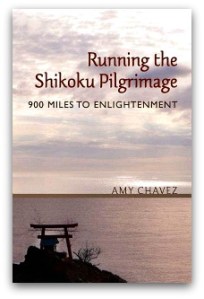
Pilgrimage-Cover_pmSo, Amy, I understand you decided to run the 900-mile-long Shikoku Pilgrimage after being laid off by the university where you were teaching in Japan. What made you think that running vast distances might be the answer?
Physical challenges have a certain appeal. I was interested in the physical journey, as I think most foreigners are when they walk the pilgrimage the first time.

But you didn’t walk it; you ran it!
For some reason I have never discovered the joy of walking. I dreaded the thought of walking 900 miles, the distance from San Diego to Oregon. But running is somehow different. When people go running, it’s not unusual to run 10 km or more, three or four times a week. People hardly ever do that walking. Instead, they walk around the block and come back. Runners don’t do that. We’re in for the long haul.

Did making this journey allow you to see Japan in a new way?
I was able to see Japan much more objectively. I went from being in my own little world where everything was centered around me—thus when my world crashed, so did I—to being an observer of Japanese culture in the framework of the pilgrimage. So there was a fundamental shift from being a part of the university, where the students and the university relied on me, my teaching skills, and my commitment, to being part of the pilgrimage that didn’t really care whether I did those things or not. The pilgrimage doesn’t care whether you show up or not, whether you complete it or not, whether you understand how it works. In other words, it’s not about you at all. So suddenly you’re on the other end, trying to understand what it is that the pilgrimage is trying to give you, on its own terms, and what you can learn and take away from it.

What was your most displaced moment on the journey?
I’d never felt displaced in Japan until I lost my job. It was a very big thing for me because I had put so much time, effort and love into that job. Suddenly, without warning, I was let go, all because I was a foreigner. I just couldn’t get my head around that. So the journey started as a result of this unnatural feeling of being displaced. The people who had treated me like family had suddenly tossed me out on the street. I was searching for ways to deal with my feelings toward Japan and Japanese people.

“The person who starts the race is not the same person who finishes the race.” [Marathon sign]

How did your feelings toward Japan evolve once the journey got underway?
I was able to see the pilgrimage as this microcosm of Japanese culture. If you’re ever wondered why the Japanese do things or act a certain way, you can find out through this historical context of Buddhism, and the Shikoku Pilgrimage which has been walked for over a thousand years. The purpose of the pilgrimage—to reach enlightenment—has never wavered over the centuries.

You became less and less displaced?
Doing the pilgrimage is often referred to as entering a mandala. You have to leave your safe, secure world and cross over into an unknown world where you are no longer in control. Once you accept this, and surrender yourself to the pilgrimage, you will no longer feel displaced.

Wise words! How long did it take before you surrendered?
It happens for different people at various parts of their pilgrimage but for me, this happened about one third of the way through, or two weeks into, the pilgrimage. Suddenly everything fell into place. I had finally learned to go with the flow and let things happen to me rather than trying to control things that happened to me. We are so used to taking control of our lives: we plan our trips down to the finest detail, we budget monthly, weekly and even daily, we get the right job. But life doesn’t care how much you’ve planned. Life continues to throw us curve balls—your car dies, you come down with an illness, you lose your job. Despite our steadfast planning, that’s not how life works.

It’s is not how the pilgrimage works either. Despite your intentions to do something a certain way, the pilgrimage will constantly present you with challenges—things you’d never planned on. Once you surrender to the ways of the pilgrimage, you no longer feel displaced. You no longer struggle with the elements, the terrain or nature. Instead, you become one with them.

Not surprisingly, this is one of Buddhism’s life metaphors as well.

Another ultramarathon—writing the book

I believe you chronicled your Shikoku adventure in the Japan Times?
Actually, I wrote six columns for the Japan Times. I also kept a diary, but that was separate from the columns.

Once you’d decided to write a book about the experience, what was the greatest challenge?
Time. It takes an enormous amount of time to write a good book. It’s all consuming, a full-time job. On top of that, I still had my weekly deadlines for the newspaper and other publications I write for.

Your book is coming out 15 years after you made the pilgrimage. Why the delay?
It’s not unusual to have so many years between a story and a published book. There’s the year (or longer) it takes to write, there’s the year-long (or longer) search for a publisher, the six months negotiation with the publisher(s), and then the two-year process from book contract to published book. So already five years has passed, and that’s with no bumps along the way.

Then there’s also timing. No one was really interested in my story at the time I did it. But things have changed drastically since then. NHK has had a popular TV series about the pilgrimage, previous books about the pilgrimage have run their course and gone out of print (thus creating a demand for something new), and ultra-running has become one of the fastest growing sports in the world.

Did you derive any new insights from revisiting the adventure?
That’s another reason I think you see so many books that are published a decade or so after they happened is because people often need distance before they can really understand their own journey. How can you talk about how an experience has changed you, or changed your life, if you haven’t had time to prove that it really has? Time gives one perspective. And with time comes wisdom. I was just reading a book the other day and couldn’t help but think it would have been so much better if the writer had waited a decade or so tell his story. He, nor his writing, had matured yet; his book had no arc, it offered no wisdom.

So while I wish my book could have been published a long time ago, I know it’s a much better book because I waited.

What audiences do you intend for the book?
There are three: those interested in Japan, those interested in Buddhism, and those interested in running. The book was officially released in March, and the reviews are just beginning to come out, so it’s too early to tell if those are the audiences the book will attract.

How about people who don’t know Japan—would they enjoy it, or would you be running circles around them?
You would have to have some innate interest in other cultures to get the most enjoyment out of the book—which I think most Displaced Nation readers have. But even if you are only interested in people’s amazing feats and accomplishments, you should enjoy the story, too. It is an adventure travel story about a girl who ran 900 miles that happens to take place in Japan.

Running the Shikoku Pilgrimage sounds like a hard act to follow. Are you working on any other ambitious travel projects that will one day be books?
I have an original hand-written diary of my great-great grandfather’s journey through Japan’s Inland Sea to the Philippines on a ship in 1900. In 2004 I decided to trace his journey in a sailboat. Unfortunately, the trip was cut short when we had to be rescued at sea, and we lost the boat. Determined to finish the trip, however, we bought another sailboat and set out again in 2012. This time we finished the trip despite dodging four typhoons, two tropical storms and running into a reef. I haven’t decided whether the title of the book should be Little Titanic or Storm Girl.

What do you think?

Love it! (Hmmm … the limb doesn’t fall far from the tree.)

10 Questions for Amy

Finally, I’d like to ask a series of questions that I’ve asked some of our other featured authors, about your reading and writing habits:
Last truly great book you read: Jules Verne’s Twenty Thousand Leagues Under the Sea. It’s always the last great book I read.
Favorite literary genre: Adventure travel, memoirs.
Reading habits on a plane: E-books only. Whatever is stacked up still waiting to be read. I also read tons of magazines.
The one book you’d require President Obama to read, and why: Any book on the current farming industry and feedlots. Save the cows!
Favorite books as a child: Anything about horses.
Favorite heroine: I admire Nora Ephron.
The writer, alive or dead, you’d most like to meet: I’d like to go fishing with Ernest Hemingway.
Your reading habits: Mostly non-fiction. More and more creative non-fiction. A little bit of fiction.
The book you’d most like to see made as a film: I’ve learned that books and film are completely different genres, so don’t dare compare them.
The book you plan to read next: Right now I’m reading The Annotated Reminiscences of Lafcadio Hearn. Next I’m going to read Strength Training Past 50. (Hey, you asked!) Oh, I might read Waging Heavy Peace, by Neil Young, before the strength training one, but I haven’t decided yet. Oh, I just remembered, my Dad wants me to read A Conflict of Visions: Ideological Origins of Political Struggles, by Thomas Sowell, so I better read that one next.

* * *

Readers, now it’s your chance to ENTER OUR DRAW TO WIN A FREE COPY of Amy Chavez’s book. Please leave a comment telling us about a physical challenge you’ve set for yourself, preferably in an international setting, and what it taught you. Extra points if you’re a Displaced Dispatch subscriber!!!

The winner will be announced in our Displaced Dispatch on May 2, 2013.

Readers lucky enough to live in the LA area: Amy will be signing books and meeting readers at the LA Times Festival of Books April 20 held on the USC campus, Los Angeles. Look for her in the Kinokuniya booth from 12:00 to 1:30 p.m. Copies of her book also available for purchase. April 21, she will be speaking at the Koyasan Buddhist Temple in Little Tokyo from 1:00 p.m. Public welcome.

STAY TUNED for tomorrow’s post and for a post on Friday about our fictional expat heroine, Libby. (What, not keeping up with Libby? Read the first three episodes of her expat adventures.)

If you enjoyed this post, we invite you to register for The Displaced Dispatch, a round up of weekly posts from The Displaced Nation, with seasonal recipes, book giveaways and other extras. Register for The Displaced Dispatch by clicking here!

Related posts:

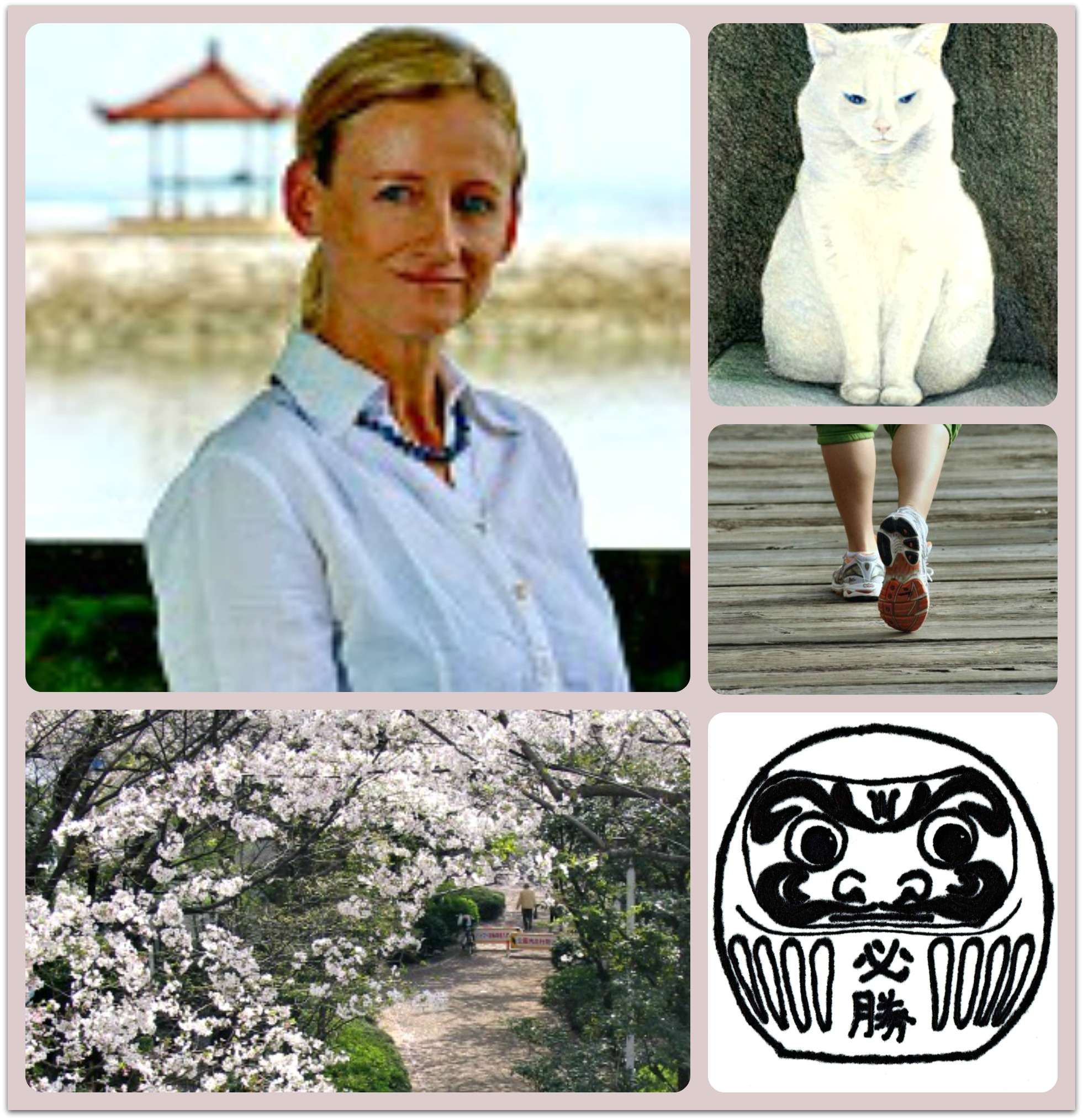
Images: Amy Chavez; Meditating Cat (a character in the book); and Daruma Doll (drawing by Deborah Davidson)—all supplied by Amy Chavez, with permission granted by Davidson. The other two images—of the running feet and the cherry blossoms—are from morguefiles.


LESSONS FROM TWO SMALL ISLANDS — 6) Keep Calm and Run a Bath

I didn’t think seriously about fashion and beauty until I, an American East Coaster, became a resident of two small islands: Britain and then Japan.

Both London and Tokyo are fashion capitals, and living in each of these cities, I found that every so often I really enjoy thinking about striking clothing combinations, make-up, and self-pampering.

Would I have discovered this love of what America’s Puritan founders would call frivolity had I stayed in this country? It’s conceivable, especially if I’d moved to New York City, where I now live as a repatriate. (NOTE: While I do not have Puritan ancestry, I was raised to be a bluestocking, not a girl in rhinestone-studded pantyhose.)

But in the event, I discovered fashion and beauty through my travels — and from learning about how women in other countries clothe and groom themselves.

So what, you may ask, were my key take-aways from this relatively speaking decadent period of my life? No specific beauty products or fashions, but these five guiding principles:

1) To get an English rose (or any other perfect) complexion, you have to be born with it. Nevertheless, skin care is worth it.

As a Caucasian woman, one of my beauty ideals was that of the English rose: a woman with flawless porcelain skin and rosy cheeks that look as though they’ve been produced by good bracing walks in the countryside wearing sensible shoes and tweed skirts.

When I first moved to England and encountered some actual English Roses, I wondered: is it because of the climate, the cosmetics from Boots the Chemist, the diet? (How do I get me one of those?)

My research soon revealed that diet has nothing to do with it. Not in a country where people grow up eating chips and crisps.

And as nice as the No7 products are, they can’t work miracles.

So maybe a glowing appearance is the result of England’s unique climatic conditions: a paucity of direct sunlight and the moisturizing drizzle that almost always seems to be in the air?

I hardly think that can be the case, as there are plenty of Britons with problem skin…

Trying not to turn pea green with envy (hardly a flattering shade!), I could come to only one conclusion: you have to be born with it.

But, not to despair! Once I reached Japan, where women are obsessed with their skin — some even use whitening lotions to obtain a creamier complexion — I learned that of all the things you can do for beauty, skin care is the most worthwhile.

Ladies, if you protect your skin, you might find yourself turning into an English Rose when you get a bit older — the Last Rose of Summer, so to speak.  While some may swear by Crème de la Mer, I go with the regime I picked up in Japan: sunscreen, a hat and a parasol.

I’d also recommend befriending your dermatologist, who knows a lot more about skin care and sun protection than the woman behind the cosmetics counter…

2) Don’t be afraid of experimenting with your hair: it can add some spice and life to your image.

In the UK one of my English rose-complexioned friends favored a chic bob — but with a streak of blue, green or red in it.

As an American fresh off the boat, I was rather scandalized. Why was she ruining a perfectly good hairstyle?

Over time, however, I came to realize that when you live in a country where skies are often the color of lead, adding a bright color to a strand of hair can brighten up your day.

By the time I left England, I could no longer understand why any woman, once she reached maturity, wouldn’t dye or highlight her hair. She doesn’t know the fun she’s missing out on! And, even though I have yet to streak my hair in an outrageous color, it’s definitely on my bucket list.

In Japan, too, I got some kicks from playing with my hair — this time, by adorning it with the kinds of hair ornaments that have been popular since the times when women wore kimono and kanzashi: combs, hair sticks and pins, hair bands, and fancy barrettes.

I did not have particularly long hair when I first reached Japan, but as long hair is the signature of Japanese ladies — and they were my new role models — I soon had locks long enough to make the most of such accessories. My favorite was the snood — I had one that was attached to a barrette covered with a bow. What a great way to keep long hair out of one’s face.

3) Gemstones and pearls are a girl’s best friend.

Sorry, Marilyn dear, but after living in the UK and Japan, my BFFs are gemstones and pearls. Is this because I went to England in the era of Princess Diana, with her (now Kate Middleton’s) 18-carat sapphire ring?

My relationship with colored gemstones only deepened after I moved to Japan and went on several sojourns into Southeast Asia, land of rubies and sapphires, among others.

My engagement ring is a ruby (purchased by my hubby in Tokyo!).

In Japan itself, I fell for pearls and now have quite the collection of necklaces, earrings, rings, and bracelets, mostly from Wally Yonamine’s in the Roppongi area of Tokyo. The owner, Jane, wife of  Wally (a professional baseball player who played with the Yomiuri Giants) is a displaced Japanese Hawaiian.

4) Youth is the time to have fun with fashion.

In the UK, I was taken in by the spectacle of punk and post-punk kids and their strange fashions, while in Japan I found it mesmerizing to watch the Lolita fashions of the Harajuku kids, on a Sunday afternoon.

Eventually, instead of thinking they were weird, I regretted never having had my own equivalent of wearing Doc Martens with a Laura Ashley dresses … sporting long, back-combed hair, pale skin, dark eyeshadow, eyeliner, and lipstick, black nail varnish, along with a spiked bracelet and dog-collar … dressing up like a Victorian boy …

It just wasn’t the done thing, in my stiff, conservative American circles, to wear outlandish garb. And now it’s too late, of course. Youth is the time when you can get away with it. After that, you have to wait for Halloween. (Unless, of course, you want to come across as “mutton dressed as lamb,” as the English say…)

5) Last but not least, my top beauty tip, reinforced by both of these countries: A bath is much preferable to a shower.

At the beginning of living in England, I missed the American shower so much. I was convinced I would never be clean again. But then one day I woke up and realized I’d been brainwashed into believing I needed to have a shower every day. In fact, daily showers dry out the skin. As one dermatologist puts it:

Most people wash far too much. Using piping-hot water combined with harsh soaps can strip the skin of its oils, resulting in dryness, cracking and even infection.

That was around the same time I opened my mind to the possibility that baths — which tend to be favored over showers in the UK (at least in my day) — might actually be preferable. Nothing like a long hot bath with a glass of wine and a book, my English friends would say. Or, as one British beauty site puts it:

A nice bubble bath is the closest you can come to having a spa-like relaxing experience in your own home, without much effort or without spending a lot of money.

Too true! Plus the English shops sell such wonderful bubble bath creams. My favorite was the Perlier Honey Miel (actually from Italy).

Still, I didn’t mind giving all of that up once I reached Tokyo — not the bathing but the bubbles. In the land of the communal bath, you scrub the skin first and then have a long soak in clean hot water, in a tub (ofuro) that is deep rather than long.

Indeed, Japan was where I learned the benefits of exfoliation: I ended up sloughing off dry skin from parts of my body I didn’t know existed. And then the immersion in clean hot water: bliss! Like returning to the womb…

For a Japanese who works long hours, bathing is a sacred time, a ritual. While I haven’t quite converted that far, I have a Pavlovian reaction every time I hear bath water running. Time to go into Total Relax Mode!

I even have a Japanese bath here in my apartment in NYC, and the thought of sitting in it is what keeps me going … That said, I must confess that I sometimes put bubbles in. What can I say? I’m displaced.

* * *

So, readers, what do you make of my five beauty principles? Have you picked up any of your own in the countries where you live? I’m all ears — only please excuse me for a minute while I make sure the bath water isn’t running over. (I don’t want my downstairs neighbors knocking on my door at 3:00 a.m.!)

STAY TUNED for tomorrow’s post, another installment in the life of our fictional expat heroine, Libby. (What, not keeping up with Libby? Read the first three episodes of her expat adventures.)

If you enjoyed this post, we invite you to register for The Displaced Dispatch, a round up of weekly posts from The Displaced Nation, with seasonal recipes, book giveaways and other extras. Register for The Displaced Dispatch by clicking here!

Related posts:

Image: MorgueFile

5 movies for expats and world travelers looking to stir up romance this Valentine’s Day

Editor’s note: Today we are happy to welcome a new member to the Displaced Nation team, Andy Martin. His debut post introduces our two favorite February’s themes: Valentine’s Day (aka expat love) and displaced movies (in honor of Oscar season). For those who haven’t read Andy’s Random Nomad interview with us, it’s worth knowing that he’s a UK-qualified social worker who now lives in Brazil with his Brazilian wife, and a self-professed football geek.

One of the things I discovered when I moved to Brazil is that Valentine’s Day is not actually celebrated here until 12th June, where it is instead known as Dia dos Namorados (Boyfriend’s/Girlfriend’s Day). The reasoning for this is that 12th June is the eve of St. Anthony’s Day, the saint otherwise known as “the marriage saint.”

Additionally, what the rest of us know as Valentine’s Day (14th February) typically falls during or around the time of Carnaval, and anyone who knows anything about the excesses of Carnaval knows that a holiday to celebrate fidelity may probably be best left until later in the year — say, June time.

Anyhow, seeing as my wife has lived in the UK and now openly embraces British culture she’s suggested that it would only be proper to celebrate both the British and Brazilian holidays — she’s a clever one! And what more traditional way to celebrate than a trip to the cinema?

Bearing this in mind, I’ve made a list of 5 films that couples like us — multicultural, expat, glolo and/or nomadic — might like to watch this coming Valentine’s Day, to stir up the romance of travel that brought you together in the first place…

The one about adventure

IndianaJones_small1) Indiana Jones and the Raiders of the Lost Ark (1981), dir. Steven Spielberg
An action-adventure drama that pits Indiana Jones (played by Harrison Ford) against a group of Nazis who are searching for the Ark of the Covenant because Adolf Hitler believes it will make their army invincible.

Why I like it: The original Indiana Jones trilogy was released between 1981 and 1989, and despite the pointless release of Indiana Jones and the Kingdom of the Crystal Skull in 2008, it will forever remain, for my generation at least, what introduced us to the potential excitement of exploring the unknown.

Personal note: I love my in-laws but they neglected their parenting duties in one pretty big way: their failure to introduce my wife to Indiana Jones (a situation that has, thankfully, now been rectified).

Most stunning aspect: Let’s face it, any film that can make archaeology seem like the coolest profession in the world has got to be doing something right hasn’t it?

The ones with the romantic clichés

The traveler is often accused of being a romantic, an idealist and of someone who is running away from life and all the problems and commitments that go with it. The alternative argument is that the traveler is actually taking life by the scruff of the neck and living it to the full.

Either way, two films that best capture this dialectic are the two that often most lionized by today’s generation of travelers:

IntotheWild_small2) Into the Wild (2007), dir. Sean Penn
An adaptation (also by Penn) of the book of the same name, by Jon Krakauer, depicting the true story of Chris McCandless, a 24 year-old American and persistent wanderer whom believed that there was more to life than settling for the 9-5 grind in an office.

Why I like it: My wife introduced me to it (her riposte to my Indiana Jones exasperation). She had watched it early on in our relationship, when she was in Brazil and I was in London — a genuinely long distance relationship.

Personal note: She said that the film’s protagonist, Chris McCandless, reminded her of me — although fortunately our story has had a bit of a happier ending than his (I’ll say no more in order not to ruin it for you).

No half-measures: Boy did McCandless walk the walk, giving away his $24,000 college fund to charity before hitchhiking to Alaska and plunging into the wilderness, gradually seeking the means to remove himself from the “real world. ”

TheMotorcyleDiaries_small3) The Motorcycle Diaries (Spanish: Diarios de motocicleta) (2004), dir. Walter Salles
A biopic of Ernesto “Che” Guevara as a young man, representing an adaptation of Che’s memoir of the same name, recounting the trip he made around South America with his best friend, Alberto Granado.

Why I like it: Whatever you view of Che is, there is actually relatively little politics in the film, although one is introduced to some of the experiences that started to inform what he later became in life. Instead, for the most part, this is a film which perfectly captures what is to be young and curious of the world outside your own town or city. Che and Alberto chase beautiful landscapes and beautiful people, but also volunteer their time to those less fortunate than themselves.

Personal note: This film was the tipping point in inspiring me to travel around South America.

Memorable scene: There’s a great scene that highlights the dichotomy between the travel romanticized by “travelers” and that which is driven by the needs of most other migrants around the world — the topic of my guest post last month for The Displaced Nation. In it Che and Alberto meet an indigenous couple who have been forced from their lands and who are traveling in order to find work. When the couple ask Alberto and Che why they are traveling, they reply: “We travel just to travel.” Confused, the wife replies: “God bless you.”

The one about being displaced

Lost_in_Translation_small4) Lost in Translation (2003), dir. Sofia Coppola
The story of the unlikely bond between an aging movie star, played by the awesome Bill Murray, and a trailing spouse (Scarlett Johansson), after they meet in the bar of their five star hotel in Tokyo.

Why I like it: Life as a nomad is not all about romantic adventures and life-changing experiences — there are also just as many challenges and struggles: homesickness, culture shock and loss being just some of them. Lost in Translation is, perhaps, one of the films that best explores some of these issues.

Additional benefits: The story is poignant, and the film is beautifully shot.

The one that’s not actually about travel or expats

Blood_into_Wine_small5) Blood Into Wine (2010), dirs. Ryan Page & Christopher Pomerenke
A documentary about the Northern Arizona wine industry focusing on the musician Maynard James Keenan and Eric Glomski and their winery, Caduceus Cellers.

Why I like it: This film doesn’t really have anything to do with either travel or expat life, but I’m including it here because it’s about one of my favorite artists: Maynard James Keenan. A slightly biased choice perhaps, but I think it deserves a merit for the way it encapsulates the spirit of those people who have dreams and then act upon them to make them happen — a spirit which, I think, drives many of us travelers and expats.

Maynard’s dream: Maynard dreams of starting a vineyard in Arizona. Yes, Arizona. Despite the doubts and concerns of the experts he consulted Maynard invested almost his entire fortune, made from working with the bands Tool and A Perfect Circle, to start a vineyard in Arizona — a state entirely unknown for growing wine.

Does he succeed? You’ll have to watch it, I guess… And don’t forget to invite a date!

* * *

Readers, what do you think of Andy’s suggestions? Are these the sorts of films that make you feel romantic, or do you think he’s bonkers? We’re open to any and all comments…as well as to further recommendations of films likely to bring out the romantic side in us glomads!

STAY TUNED for tomorrow’s post from our monthly columnist, James Murray, who right now can be found in front of his fireplace in Boston — and not because he’s in a romantic mood! Far from it…

If you enjoyed this post, we invite you to register for The Displaced Dispatch, a round up of weekly posts from The Displaced Nation, with seasonal recipes, book giveaways and other extras. Register for The Displaced Dispatch by clicking here!

Related posts:

The 10 Muses of Expat & International Adventure Writing and their 5 most popular tunes

10 muses collageGreetings, Displaced Nation-ers! Ready for a little more intellectual stimulation?

A couple of weeks ago, I wrote about Great Thinkers who can help with task of embracing the well-traveled life and teasing out its deeper meaning, in the new year.

And today I will address the needs of those who have resolved to tackle a major writing project in 2013.

It’s a well-known fact that many of us who live in foreign lands aspire to write novels, memoirs and travelogues about our overseas adventures. But many of us also live in isolated situations (by definition).

So who can aid us, provide our inspiration?

Why, the muses of course!

Tell us, O muses, how to tell our stories…

And we don’t even have to look heavenwards to invoke them! The 10 Muses (that’s one more than the ancients got!) of Expat and International Travel Writing are right in our midst. They have already shared the joys, wonders and value of writing with Displaced Nation readers:

  1. Barbara Conelli, author of the Chique Travel Book series, filled with the charm, beauty, secrets and passion of Italy…
  2. Martin Crosbie, who is writing a trilogy entitled My Temporary Life; in December of last year, he published Book Two: My Name Is Hardly.
  3. Helena Halme, author of the novel The Englishman (2012)
  4. Laura Graham, author of the novel Down a Tuscan Alley (2011)
  5. Matt Krause, author of the memoir A Tight Wide-open Space: Finding love in a Muslim land (2011)
  6. Meagan Adele Lopez, author of the novel Three Questions: Because a quarter-life crisis needs answers (2011)
  7. Edith McClintock, author of the mystery novel Monkey Love and Murder (2013)
  8. Alexander McNabb, who is writing the Levant Cycle, a trilogy of books about the Middle East; he released the second book, Beirut — An Explosive Thriller, last September.
  9. Tony James Slater, erstwhile regular at the Displaced Nation and author of a two-book series: The Bear That Ate My Pants: Adventures of a real idiot abroad (2011) and Don’t Need the Whole Dog!, which came out in December.
  10. Wendy Nelson Tokunaga, author of Marriage in Translation: Foreign Wife, Japanese Husband (2011) and of several novels that explore cross-cultural themes between the United States and Japan.

Over the past year on our site, if you were listening closely, these heaven-sent muses were singing a number of tunes. Here are their five top hits:

SONG #1: “Yes, it’s hard; yes it’s uphill. But you’re living the dream, which makes writing a thrill!”

In one of the Displaced Nation’s most popular posts of the past year, Tony James Slater tried to make it out that the life of an expat writer is far from glamorous. Don’t believe him. He was pulling your leg, as usual — or singing off key, to continue the metaphor.

Alexander McNabb has the more accurate rendition. Here’s his account of the prep for his latest thriller, Beirut:

While writing it, I spent hours walking around the city, along the curving corniche and up into the busy streets that cling to the foothills rising from the coast up to the snow-capped mountains. Walking with friends, walking alone — day and night, spring and summer. From the maze of funky little bars of Hamra to the boutiques of Verdun, from the spicy Armenian groceries of Bourj Hammoud to the cafés overlooking the famous rocks at Raouché…

Barbara Conelli is another inspirational example. She explores every nook and cranny of Milan so as to take the reader on an armchair journey. And now she is doing the same with Rome, which will be the subject of her third book in the Chique Travel series.

Great work, if you can get it!

SONG #2: “It’s time to make your creative debut — so why not make it all about you?”

These days it’s hard to tell the difference between a heavily autobiographical novel and a memoir, though one of our muses, Helena Halme, insists that there is a distinction. When questioned about her decision to write The Englishman as a novel — it’s about a young Finnish woman, Kaisa, who meets a dashing British naval officer, a plot that echoes very closely her own life story — she had the following to say:

I tried to write a memoir, but couldn’t! Much of this story is, however, true — but I didn’t think I could call it a memoir as some things were pure fiction. I am a novelist and just keep making stories up.

Hmmm… By that reckoning, perhaps Tony James Slater should be a novelist, too? As regular readers of this blog will know, his favorite topic consists of his own, rather daring but also bumbling, world adventures.

But did a bear really eat his pants, or is he exaggerating for comic effect?

The mind boggles…

But whatever the form, the point is that quite a few of our muses have found plenty of material in their own life experiences. Besides Halme and Slater, we have

  • Martin Crosbie: His protagonist, Malcolm, leaves Scotland for Canada at a formative age, just as he did.
  • Laura Graham: Her protagonist, Lorri, arrives in Italy as a forty-something single and finds a younger Italian man, just as she did.
  • Matt Krause: He has written a memoir on the portion of his life that involved meeting a Turkish woman on a plane and following her back to Turkey. (Reader, he married her!)
  • Meagan Adele Lopez: The protagonist of her debut novel, Del, is offered three questions by her British fiancé (just as Lopez was offered three questions by hers).
  • Edith McClintock: Her protagonist, Emma, works as a researcher in the very Amazonian rainforest where she once conducted her own research.

To conclude, the old adage is alive and well, even (especially?) in expat and travel writing: “Write about what you know and care for…”

SONG #3: “Looking for inspiration from above? The answer lies in cross-cultural love.”

Another theme running through the works of several of our muses is the love that takes place across cultures, usually resulting in marriage. I just now referred to the cross-cultural love stories at the heart of the books produced by Helena Halme (Finnish woman, English man), Laura Graham (Englishwoman, Italian man), Matt Krause (American man, Turkish woman) and Meagan Adele Lopez (American woman, Scotsman).

To this list should be added Wendy Nelson Tokunaga, who has written about Western women getting involved with Japanese men — one of the stranger of all possible unions, to be sure! 😉 — in both fiction and nonfiction (the latter being a bit of a self-help book).

SONG #4: “As your brainstorming proceeds apace, never forget the appeal of place.”

Since travel is a constant for all of us, it should come as no surprise that particular places can become a pull for certain expat writers. They cannot rest until they’ve depicted a place they’ve experienced so that others can live vicariously. Several of our muses represent this principle:

  • Barbara Conelli and her love for “capricious, unpredictable” Milan. To quote from her book: “When the streets of Milan ask you to dance, there’s nothing else to do but put on your ballet shoes and surrender…”
  • Alexander McNabb and his obsession with Beirut. “There can be few places on earth so sexy, dark, cosmopolitan and brittle…,” he writes in his Displaced Nation post.
  • Edith McClintock and her preoccupation with the rainforest and a place called Raleighvallen in the Central Suriname Nature Reserve. As her main character, Emma, says:

    I fell completely and irretrievably in love with the rainforest that week — the deep rich smells of dirt and decay and teeming, thriving life; the warm soft light of the rocky moss-covered paths hidden beneath layers of climbing and tumbling lianas and roots; soaring tree trunks wrapped in colorful bromeliads, orchids, moss, and lichens; and the canopy of leaves of every conceivable size and shape….

SONG #5: “Growing weary of fruitless writing sessions? Time to take some acting lessons!”

Four of our ten muses could double as the muses of acting and entertainment:

  • Tony James Slater and Meagan Adele Lopez trained as actors (Lopez actually starred in a bad horror film!) before embarking on their world travels.
  • Laura Graham enjoyed a long career as a stage actress in Britain, working for the Royal Shakespeare Company and the Young Vic, and on television, before setting herself up as an expat in Tuscany.
  • Wendy Nelson Tokunaga first went to Japan because she won a prize in a songwriting contest sponsored by Japan Victor Records. She is an accomplished karaoke artist who can sing jazz as well as j-pop and enka, a type of sentimental ballad.

Why are so many of the Muses of Expat Writing multi-talented, you may ask? Does a former acting/singing career work to one’s advantage when it comes to overseas travel and writing? I like to think so.

Just as Dickens used to act out the dialogue of his characters, I like to think of Tony James Slater reenacting his wild adventures on the road, in the confines of his flat in Perth…

And sometimes this versatility can add a further dimension to the writing. Last we heard from Lopez, she had created a trailer for her book and was trying to convert it to a screenplay. Tokunaga composed and sang an enka to accompany her novel Love in Translation. (It’s impressive!)

Plus these four could always hew to the tradition of wandering minstrel, one of the oldest careers in the book, if their works don’t sell. (Hey, it’s never a bad idea to have a fallback option when you’re a long ways away from family and friends…)

* * *

So, writers out there, did our 10 Muses sing to you? And will you listen to some of their songs again as you face the blank page in 2013? Let me know in the comments. (Only, be careful of criticizing the Muses — they have been known to be vengeful!)

STAY TUNED for tomorrow’s post, another installment in the life of our fictional expat heroine, Libby. (What, not keeping up with Libby? Read the first three episodes of her expat adventures.)

If you enjoyed this post, we invite you to register for The Displaced Dispatch, a round up of weekly posts from The Displaced Nation, with seasonal recipes, book giveaways and other extras. Register for The Displaced Dispatch by clicking here!

Related posts:

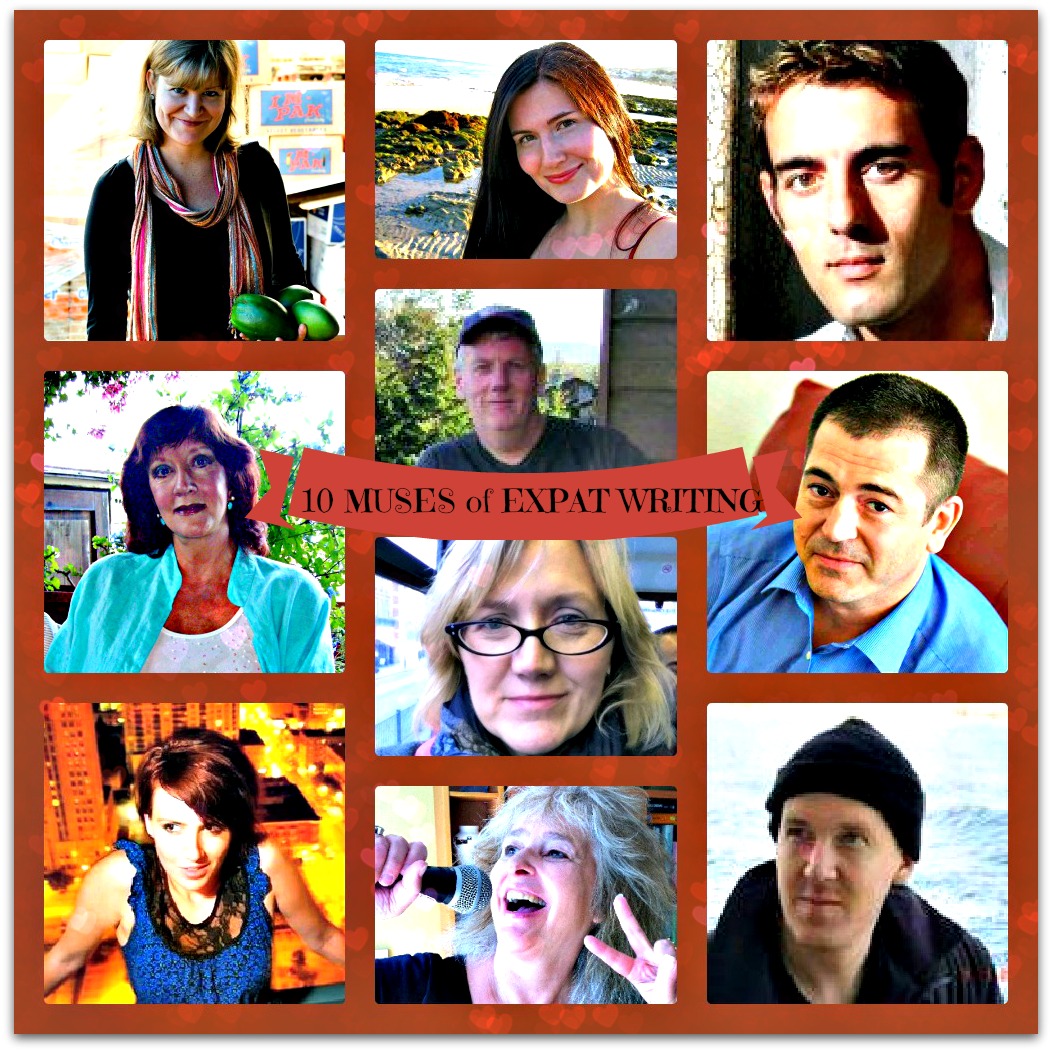
Images: Our Ten Muses (left to right, top to bottom) — Edith McClintock, Barbara Conelli, Tony James Slater; Laura Graham, Martin Crosbie, Helena Halme, Alexander McNabb; Meagan Adele Lopez, Wendy Nelson Tokunaga, Matt Krause.

Expats, here’s how to enrich your lives in 2013: Choose a mentor or a muse!

Expats and other world adventurers, let me guess. You have you spent the past week making resolutions about

  • staying positive about your new life in Country X;
  • indulging in less of the local stodge;
  • giving up the smoking habit that no one is nagging you about now that you’re so far away from home;
  • and/or taking advantage of travel opportunities within the region that may never come your way again

— while also knowing full well that at some point in the not-distant future, you’ll end up stuffing your face with marshmallows (metaphorically speaking).

Never mind, it happens to the best of us, as psychologist Walter Mischel — he of the marshmallow experimentrecently told Abby Hunstman of the Huffington Post. Apparently, it has something to do with the way impulses work in the brain. The key is to trick the brain by coming up with strategies to avoid the marshmallow or treat it as something else.

Today I’d like to propose something I found to be one of the most effective strategies for turning away from the marshmallows you’ve discovered in your new home abroad or, for more veteran expats, turning these marshmallows into something new and exotic. My advice is to find a mentor or a muse in your adopted land — someone who can teach you something new, or who inspires you by their example to try new things…

Trust me, if you choose the right mentor +/or muse, benefits like the following will soon accrue:

1) More exotic looks — and a book deal.

Back when I lived abroad, first in England and then in Japan, I was always studying other women for style and beauty tips. I made a muse of everyone from Princess Diana (I could hardly help it as her image was being constantly thrust in front of me) to the stewardesses I encountered on All Nippon Airways. Have you ever seen the film Fear and Trembling, based on the autobiographical novel of that name, by the oft-displaced Amélie Nothomb? On ANA flights, I behaved a little like the film’s young Belgian protagonist, Amélie, who secretly adulates her supervisor Miss Fubuki. I simply couldn’t believe the world contained such attractive women…

The pay-off came upon my repatriation to the US. With such a wide array of fashion and beauty influences, I’d begun to resemble Countess Olenska in The Age of Innocence — with my Laura Ashley dresses, hair ornaments, strings of (real) pearls, and habit of bowing to everyone.

Is it any wonder my (Japanese) husband-to-be nicknamed me the Duchess? (Better than being the sheltered May Welland, surely?)

My one regret is that I didn’t parlay these style tips into a best-seller — unlike Jennifer Scott, one of the authors who was featured on TDN this past year. While studying in Paris, Scott was in a mentoring relationship with Madame Chic and Madame Bohemienne. (The former was the matriarch in her host family; the latter, in her boyfriend’s host family.) Mme C & Mme B took her under their wing and taught her everything she knows about personal style, preparation of food, home decor, entertaining, make-up, you name it…and is now imparting to others in her Simon & Schuster-published book.

2) More memorable dinner parties.

As mentioned in a previous post, I adopted actress and Indian cookbook writer Madhur Jaffrey as my muse shortly after settling down in the UK. I was (still am) madly in love with her, her cookbooks, even her writing style.

And her recipes do me proud to this day.

Right before Christmas I threw a dinner party for 10 featuring beef cooked in yogurt and black pepper, black cod in a coriander marinade, and several of her vegetable dishes.

It was divine — if I say so myself! To be fair, the guests liked it, too…

3) Improved language skills.

Now the ideal mentor for an adult seeking to pick up a new foreign language is a boyfriend or girlfriend in the local culture — preferably one with gobs of patience. The Japanese have the perfect expression for it: iki jibiki, or walking dictionary.

Just one caveat: If you’re as language challenged as Tony James Slater, it could prove a headache and, ultimately, a heartache.

Still, nothing ventured, nothing gained…

(Married people, you might want to give up on this goal. I’m serious…)

4) A fondness for angels who dance on pinheads.

After seeing the film Lost in Translation, I became an advocate for expats giving themselves intellectual challenges. Really, there’s no excuse for ennui of the sort displayed by Scarlett Johansson character, in a well-traveled life.

It was while living in the UK as a grad student that I discovered the extraordinary scholar-writer Marina Warner, who remains an inspiration to this day. Warner, who grew up in Brussels and Cambridge and was educated at convent school and Oxford University, is best known for her books on feminism and myth.

After reading her book Monuments and Maidens, I could never look at a statue in the same way again!

In her person, too, she is something of a goddess. Though I’d encountered women of formidable intellect before, I found her more appealing than most, I think because she wears her learning lightly and has an ethereal presence, like one of the original Muses.

Booker prizewinner Julian Barnes has written of her “incandescent intelligence and Apulian beauty” (she is half Italian, half English). The one time I met her — I asked her to sign my copy of her Booker Prize-shortlisted novel, The Lost Father — I could see what he meant.

I was gobsmacked.

Major girl crush!

(Don’t have a girl crush? Get one! It will enrich your life immeasurably.)

5) Greater powers of mindfulness — and a book deal.

Third Culture Kid Maria Konnikova was born in Moscow but grew up and was educated in the US. She has started the new year by putting out a book with Viking entitled Mastermind: How to Think Like Sherlock Holmes. Who would guess that a young Russian-born woman would use Conan Doyle’s fictional creations, Holmes and Watson, as her muses? But, as she explains in a recent article in Slate, she has learned everything she knows about the art of mindfulness from that master British sleuth:

Mindfulness allows Holmes to observe those details that most of us don’t even realize we don’t see.

So moved is she by Holmes’s example — and so frustrated by her own, much more limited observational powers — Konnikova does the boldest of all thought experiments: she gives up the Internet…

So does her physiological and emotional well-being improve as a result? Does her mind stop wandering away from the present? Does she become happier? I won’t give it away lest you would like to make Konnikova this year’s muse and invest in her book. Hint: If you do, we may not see you here for a while. 😦

6) The confidence to travel on your own.

We expats tend to be a little less intrepid than the average global wanderer: we’re a little too attached to our creature comforts and may need a kick to become more adventuresome. But even avid travelers sometimes lose their courage, as Amy Baker recently reported in a post for Vagabondish. She recounts the first time she met a Swedish solo traveler in Morocco, who had lived on her own in Zimbabwe for 10 years. This Swede is now her friend — and muse:

She was level-headed, organized and fiercely independent — all characteristics that I aim to embody as a female traveler.

With this “fearless Swedish warrior woman” in mind, Amy started venturing out on her lonesome — and hasn’t looked back.

* * *

Readers, the above is not intended as an exhaustive list as I’m hoping you can contribute your own experiences with mentors and muses abroad: What do you do to avoid the “marshmallows” of the (too?) well-traveled life? Who have you met that has inspired you to new creative, intellectual, or travel heights? Please let us know in the comments. In the meantime, I wish you a happy, healthy — and most of all, intellectually stimulating — new year!

STAY TUNED for next week’s posts.

If you enjoyed this post, we invite you to register for The Displaced Dispatch, a round up of weekly posts from The Displaced Nation, with seasonal recipes, book giveaways and other extras. Register for The Displaced Dispatch by clicking here!

Related posts:


Catching up with this year’s Random Nomads over the holidays (3/3)

RandomNomadXmasPassportIt’s Christmas Day and the holiday party continues for the expats and other global voyagers who washed up on the Displaced Nation’s shores in 2012. Remember all those Random Nomads who proposed to make us exotic meals based on their far-ranging meanderings? Not to mention their suitcases full of treasures they’d collected and their vocabularies full of strange words… How are they doing these days, and do they have any exciting plans for the holidays? Third in a three-part series (see also Part One and Part Two).

During the final third of 2012, we met some expats and intrepid world travelers who, I think it’s fair to say, have developed some rather unusual hobbies and eating habits. The two are one and the same in the case of Brian MacDuckston, who was featured on our site this past August. He has made a habit of eating ramen in as many Tokyo venues as possible — a hobby that was quirky enough to attract the attention of the New York Times. In addition to Brian — a San Franciscan who originally went to Japan to teach English — we encountered:

  • Liv Gaunt, an Englishwoman who became an expat accidentally, while pursuing her love of scuba diving and underwater photography. Now based in Australia, she told us she has a passion for sharks but would happily do without sea urchins.
  • Mark Wiens, an American third culture kid who now lives in Thailand and travels all over — he feels least displaced when sampling other countries’ street foods.
  • Jessica Festa, an American traveler who loves to venture off the beaten track and eat locally — she did not hesitate to eat cuy in Ecuador (even though it reminded her of her pet guinea pig, Joey, named after a school crush).
  • Larissa Reinhart, a small-town Midwesterner who lived in Japan for several years and, since repatriating, has taken up the pen as a crime novelist. She is now living in small-town Georgia but hopes to go abroad again. She provides recipes for Asian fried chicken, among other delicacies, on her blog about life as an ex-expat.
  • Patricia Winton, an American who responded to 9/11 by giving up her comfortable life in Washington to become an expat crime writer in Rome. She also invested in a pasta-making machine…
  • Bart Schaneman, a Nebraskan who wanted to see the world and has made his home in Seoul, where he is an editor for an English-language newspaper and author of a travelogue on the Trans-Siberian railway. He is a huge fan of kimchi.

Three of this esteemed group are with us today. What have they been up to since a few months ago, and are they cooking up anything special for the holidays, besides chatting with us?

Brian with Ramen_Xmas1) BRIAN MACDUCKSTON

Have there been any big changes in your life since we last spoke?
I’ve been offered a few gigs on Japanese TV shows as a “ramen reporter” and successfully pitched my first magazine article about a best-of-ramen list. A start! I also started a ramen class aimed at non-Japanese speakers. Check it out!

How will you be spending the holidays this year?
A nice staycation in Tokyo.

What’s the thing you most look forward to eating, dare I ask?
I’m trying to eat more high-class sushi, but I’ll probably just stick to a lot of ramen for the next few weeks.

Can you recommend any books or films you came across in 2012 that speak to the displaced life?
I really enjoyed Jiro Dreams of Sushi, a documentary about the most revered sushi chef in the world. [Editor’s note: The film has been available on Netflix since last August.]

Do you have any New Year’s resolutions for 2013?
I want to train myself to stop using double spaces after periods when I write. Not a big goal, but important for someone who has an interest in being paid for my writing.

A worthy goal, imho! (I’ve had to correct quite a few in my time…) So, any upcoming travel plans?
My father will visit Japan, so I am planning a luxury week-long trip of eating and relaxing in hot springs. Two things I’m good at!

LarissaReinhart&Reinhart2) LARISSA REINHART

Any big developments in your life since we last spoke?
My second Cherry Tucker Mystery, Still Life in Brunswick Stew, has a release date of May 21, 2013. [Editor’s note: As mentioned in Larissa’s interview, the first in her Cherry Tucker series, Portrait of a Dead Guy, came out this year.]

How will you be spending the holidays this year?
We travel to visit my family in Illinois and St. Louis after Christmas through New Year’s.

What’s the thing you most look forward to eating?
There’s this Italian grocery, Viviano’s, in the Italian district of St. Louis, called The Hill in St. Louis, that I really look forward to visiting. I’ll stock up on cheap wine and Italian staples for the coming year.

Can you recommend any books or films you came across in 2012 that speak to the displaced life?
Yes, two Japanese films:

  1. The fascinating documentary Jiro Dreams of Sushi. I highly recommend — even for non-sushi fans. The film is beautifully shot and reveals what it takes to be a true master at something. Incredible.
  2. The gorgeous The Secret World of Arrietty (aka The Borrower Arrietty), scripted by Hayao Miyazaki. We were excited to see Arrietty because we saw the ads for the movie when we were still living in Japan (and I’m a big fan of Mary Norton’s The Borrowers, on which the film is based, as well as of Miyazaki).

Have you made any New Year’s resolutions for 2013?
To spend less time on social media and more time writing. I love chatting online, but I need to be more disciplined about getting away from the “water cooler” and back to work.

Any upcoming travel plans?
Disney World for spring break! Woot! And we’re hoping to get back overseas soon, but no definite plans yet.

PatriciaWintonwithholly3) PATRICIA WINTON

Any big changes in your life since we last spoke a couple of months ago?
The month after you featured me, I put my long-time WIP in the bottom drawer for a while and started a new one. I’ve written about 30,000 words. This one, also a mystery, is set in Florence. It takes place during the 500th anniversary celebration of the world’s first culinary society.

Meanwhile, my blog partners at Novel Adventurers are working on an anthology of long short stories. We are an adventurous group comprising (besides me):

  • an Australian who has lived in South America
  • an American of Swiss-German origin who is married to a man from Iran, where they frequently travel
  • an American with close family ties in India, where she frequently travels
  • an American specializing in things Russian, who is married to a Kyrgyz
  • a former Peace Corps volunteer who writes about the Caribbean
  • an American who grew up on a sailboat traveling the world and has lived as an adult in many countries.

We’ll be writing about travel and adventure from international perspectives. It will be some time before it sees publication, but I’ll keep you posted. I think it will interest the Displaced Nation!

Where will you be spending the holidays this year?
I’m spending the holidays quietly at home. I plan to visit a friend in the country for New Year’s weekend. The holidays here last almost three weeks, ending on January 6. Nativity scenes are a big deal here, and I plan to visit various churches to view, and photograph, them as I usually do. I’ll write about them on my blog, Italian Intrigues, on January 3rd.

What’s the thing you most look forward to eating?
Christmas Eve in Italy is devoted to eating fish — usually seven fish dishes from antipasto onward. I’m trying out a new recipe for sea bass stuffed with frutta del mare (non-fin fish). I’m using clams, mussels, shrimp, squid and baby octopus, all well laced with garlic. And I always make the holiday custard that comes from my Tennessee childhood.

Can you recommend any books you came across in 2012 that speak to the displaced life?
The Lacuna, by Barbara Kingsolver. While it was published in 2010, I didn’t read it until this year, and I think it’s a masterpiece. It’s about a man with one foot in Mexico and the other in the US — but that’s a vast oversimplification. After the young man’s Mexican mother dies, he works for Frida Kahlo and Diego Rivera while Leon Trotsky is staying with them. He later moves to the US to join his American father. He eventually becomes a successful writer caught up in the McCarthy witch hunt. I don’t want to include spoilers here, but it’s fabulous. The boy/man is a foreigner in both countries and speaks both languages with an accent.

Do you have any New Year’s resolutions for 2013?
Not that I want to share.

Last but not least, do you have any upcoming travel plans?
No concrete travel plans at the moment. While composing these answers, I received an email about a tour of Uzbekistan that sounds really alluring. And I will probably go to the US to attend a mystery writers conference.

* * *

Readers, any questions for this rather motley (one former expat and two current ones) but highly creative bunch?

STAY TUNED for tomorrow’s post — expat Anthony Windram’s musings on spending Boxing Day in a country that associates boxing with punching, not (Christmas) punch.

If you enjoyed this post, we invite you to register for The Displaced Dispatch, a round up of weekly posts from The Displaced Nation, with seasonal recipes, book giveaways and other extras. Register for The Displaced Dispatch by clicking here!

Related posts:

Images: Passport photo from Morguefiles; portrait photos are from the nomads (Larissa Reinhart’s shows her family in front of one of their favorite Japanese manga characters, Shin-chan, a sort of Bart Simpson of Japan — the creator, Yoshito Usui, had recently died).