The Displaced Nation

A home for international creatives

Tag Archives: It’s Food!

GLOBAL FOOD GOSSIP: To ease the stress of yet another international move, tea all round and some jammie biscuits?

Global Food Gossip 062315
Serial expat (and soon to be repat!) Joanna Masters-Maggs is back with some tasty global food gossip to share.

As I write this, we are in the middle of packing for our eighth international move.

By the way, I don’t count moves within countries as an actual move. Indeed, when people complain about having to move from one house to another, I have an unpleasant tendency to judge them for being just a little, well, weak.

Call me strange, but I have almost come to enjoy the stress because I know how deeply the memories will be imprinted as a result.

I especially relish the sweaty dirtiness of a move in a hot climate. You look dreadful and just don’t care. The joy of the dirt sloughing off you in the shower at the end of the day, is unspeakably satisfying. As they say, you never appreciate water until you have experienced thirst.

Memories set to the soundtrack of masking tape being torn from the roll and objects being wrapped in rustling paper—I have a few, including:

  • Watching the Malaysian movers slip on and off their shoes as the moved in and out of our house, no matter how heavy their load.
  • Spying the Brazilian workers taking a siesta under the removal van.
  • Above all, enjoying the sight of my children playing for days with empty boxes.

Tea, all round?

Tea all round

Photo credits: (clockwise from top left) “We’re Moving!” by David Goehring via Flickr (CC BY 2.0); Moving Day, by Cambodia4kids.org via Flickr (CC BY 2.0); Allied Movers, allied Moving Truck, by Mike Mozart via Flickr (CC BY 2.0); (overlay) Tea time, by Daniela Vladimirova via Flickr (CC BY 2.0).

In England it is customary to offer tea to anyone who comes to work around your house. It politely defines their status as providers of services rather than servants.

I have come to associate removal men with strong, sweetened tea and a biscuit to go with it. No move has ever been complete without these accompaniments—and my biscuit of choice under the circumstances is the Jammie Dodger.

A Jammie Dodger comprises two vanilla biscuits sandwiched together with a red jam and possibly buttercream, too. The upper biscuit boasts a little cut out to reveal a little filling—what a tease!

Jammie Dodgers are freely available in English supermarkets. The store-bought version used to do the trick, but I am afraid I have, like an addict, come to demand something more refined as my drug of choice.

No dodging the Jammie Dodger

Years ago, while living in Virginia as a student, I started to make my own Jammie Dodgers, craving as I did a taste of home. Come on, I had to tolerate Lipton Yellow Label tea, which lacks the body I demand. If I couldn’t magic up a suitable English blend, at least there was something I could do about the biscuit situation.

Jammie Dan[https://www.flickr.com/photos/lacuna007/3399511720/], by Andrea Black via Flickr (CC BY-SA 2.0)[https://creativecommons.org/licenses/by-sa/2.0/]

Jammie Dan, by Andrea Black via Flickr (CC BY-SA 2.0).

I hit on a good combination of a shortbread style biscuit and a good-quality jam. Imagine my surprise on discovering these were so much better than the factory version—so much so that I have never again willingly returned to the supermarket to buy them. I was young, remember. I still am. As the years passed I have tweaked that recipe until nothing surpasses it.

Arriving in France I was astonished discover that there was a chain of French bakeries that came very close to my recipe. What a disaster for my thighs! They could no longer look forward to being given a respite on the days when I don’t have time to bake.

Even the French can’t resist!

Known as sablé (literally, sand) for their sandy, crumbly texture, these confiture-filled delights are uncharacteristically large for a French pâtisserie. I relish the idea that even the French find them difficult to resist despite being a nation of “Oui, mais only one”.

I understand their dilemma. The sablé’s crumbly, buttery, shortbread-like texture offers what food technicians call “mouth fill”.

Talking of fillings, the French version comes generally in raspberry or chocolate as well as the ill-advised Nutella. Hm.. France really ought to give the concept of the Nutella sablé a rethink. This biscuit calls for a contrasting texture, so non merci to Nutella, here at least.

Photo credits: flickr black day[https://www.flickr.com/photos/29233640@N07/11273242073/], by Robert Couse-Baker (CC BY 2.0)[https://creativecommons.org/licenses/by/2.0/] ; nutella cookies[https://www.flickr.com/photos/ginnerobot/7095126765/], by Ginny via Flickr (CC BY-SA 2.0)[https://creativecommons.org/licenses/by-sa/2.0/]

Photo credits: flickr black day, by Robert Couse-Baker (CC BY 2.0); nutella cookies, by Ginny via Flickr (CC BY-SA 2.0).

Apart from the size, the other difference in a French Jammie dodger is that instead of one hole cut in the upper biscuit to expose the filling there can be as many as three. Alors, the French can actually do vulgar excess it would seem!

Personally, I love the idea of the French ditching the restrained elegance we are so used to seeing from them. I also love that it is a jammie biscuit that drove them to it.

Cate the Cake: She’s the biscuit!

This move is the most special of all my international moves, because this time, my daughter is providing the Jammie Dodgers that fuel us. Since arriving in France, Catherine has developed first an interest in baking and then in patisserie—developments that have made my heart sing a special version of the 1812 Overture.

Instead of the “La Marseillaise” being quieted by the Russian national anthem, we have a case of “God Save the Queen” being, if not crushed by the French anthem, at least over-laid and dusted down with a Gallic flourish.

Cate the Cake (a weak nickname, but I can’t resist) has taken courses in all sorts of things from éclairs to crème brûlée. She has brought a certain French flair to my Jammie Dodger, making them even more irresistible, if that were possible.

Cate the Cake She's the biscuit

Having the patience and perfectionism I so entirely lack, she is willing to stare through the oven door until just the right shade of pale delicacy is reached that ensures the texture is melting, but not cloying. Adhering strictly to butter only, the flavor is delectable and well worth an extra few centimeters to the waistline. These beauties scream for a strong cup of English blend tea made with leaves, not a bag, and steeped a full five minutes.

Talking of which, I think I’ll nip in to the kitchen before the teapot is packed and give the packers a cultural experience to remember. After all, it’s the presence of workmen in the house that provides the impetus (or excuse?) for an extra-special tea-and-biscuits ritual.

*****************************

Jammy Dodgers/Sablés

Ingredients
• 250g plain flour
• 200g butter, cut into small cubes
• 100g icing sugar
• pinch of salt
• 2 free-range egg yolks
• Raspberry or Strawberry Jam

Method
1. Preheat the oven to 170C/325F
2. Place the flour, butter, icing sugar and salt into a bowl. Using your fingertips, rub the ingredients together until the mixture resembles breadcrumbs.
3. Add the egg yolks and mix until a dough forms. Turn out onto a lightly floured work surface and roll out to a thickness of about 0.5cm. Cut out shapes using a 4cm cutter.
4. Divide the sablés in half. Using a 2cm, fluted cutter, make a hole in the middle of half of the sablé biscuits and discard the dough. Place all the sablés on a baking tray.
5. Liberally dust the tops with icing sugar passed through a fine sieve.
6. Bake the sablés for 10-12 minutes, or until pale golden-brown and crisp. Remove and transfer to a wire rack to cool.
7. Using a teaspoon, place a small dollop of jam on a whole sablé. Place a sablé (with a hole) over the whole sablé biscuit.

* * *

Readers, we invite you to continue the food gossip! Can you relate to Joanna’s instinct for strong tea and Jammie Dodgers? And can you offer any other food tips to alleviate the stress of an international move? Be sure to let us know in the comments!

Joanna Masters-Maggs was displaced from her native England 17 years ago, and has since attempted to re-place herself in the USA, Holland, Brazil, Malaysia, Venezuela, Saudi Arabia, and now France. She describes herself as a “global food gossip”, saying: “I’ve always enjoyed cooking and trying out new recipes. Overseas, I am curious as to what people buy and from where. What is in the baskets of my fellow shoppers? What do they eat when they go home at night?”

STAY TUNED for the next fab post!

If you enjoyed this post, we invite you to register for The Displaced Dispatch, a round up of weekly posts from The Displaced Nation—and much, much more! Register for The Displaced Dispatch by clicking here!

Related posts:

CULTURE SHOCK TOOLBOX: Expats, if you hammer away at something long enough, you might just get used to it!

Culture Shock Toolbox Valerie Hamer
For her column this month, transitions enthusiast H.E. Rybol interviews displaced creative Valerie Hamer about her culture shock memories and coping strategies.

Hello Displaced Nationers! The moment I learned that this month’s guest, Valerie Hamer, goes by the moniker of “Faraway Hammer,” I knew she had to be on this column. After all, no toolbox worth its salt would be complete without a hammer, even a cultural one!

Forgive me for hamming it up, but I really believe that Valerie, who is “British by birth and a nomad by choice,” will have some great insights for us.

But before we get into that, let’s go over why she has chosen to go by the name of Faraway Hammer. As it turns out, that’s how people pronounce “Valerie Hamer” in Asia, where Valerie has lived for over fifteen years. She loves how her name sounds with an Asian accent, so much so that she decided to name her writing site after it. Head on over there and you’ll discover that although Val has been a “world citizen” for some time now, she still loves her native Britain, and although her passport says teacher, her heart says says writer—of non-fiction, because she thinks the lives of “ordinary, everyday, regular people” are “richer and more interesting than any fictional character.”

Further to which, Val is the author of two non-fiction books with amusing titles:

And now it’s time for the toolbox part. Valerie has kindly agreed to share some of her culture shock experiences with us. Here’s what she had to say…

* * *

Hi, Valerie, and welcome back to the Displaced Nation. Now, I understand you were born and raised in the UK. But what about your alter-ego, Faraway Hammer? Where has she lived?

In Japan for seven years, Vietnam for a couple of months, and currently in year seven in South Korea.

In the context of transitioning from England to various Asian countries, did you ever put your foot in your mouth? Can you share any memorable stories?

I find language learning in a new country to be the thing that will get me into bother, usually when two words sound very similar. That’s how in Japan I once asked a shop assistant if there was poop inside the cakes instead of red beans!

Photo credit: Dorayaki, by Emran Kassim via Flickr (CC BY 2.0).

Photo credit: Dorayaki, by Emran Kassim via Flickr (CC BY 2.0).

Here’s another example. On public transport in Asia it’s normal to take and hold the bags of those standing, whether stranger or friend, if you are lucky enough to get a seat. The first time that happened to me I wrestled with the old lady trying to be helpful. I just assumed I was being mugged.

What does one do in a situation like that?

With my language gaffes I found people laughed as they actually appreciated my effort to speak. Having said that, such rookie mistakes have put me off learning Korean to any great extent. I don’t have the patience to go through that stage again. With the “bag helping” incident I would probably react the same way again in a new country/culture. Strangely, nothing I read or heard prepared me for that moment in Korea—perhaps people forget about such things when they adapt to a place, and forget to mention them?

Photo credit: Seoul Subway by Dale Ellerm via Flickr (CC BY 2.0).

Photo credit: Seoul Subway by Dale Ellerm via Flickr (CC BY 2.0).

Looking back on your transition from the UK to Asia, can you recall any situations that you handled with surprising finesse?

I can’t think of any. As I said, I continue to remain stubbornly “western” in many ways, but it’s also true to say that I’ve adapted to many things and no longer think about them. If you hammer away at something for long enough…

If you had to give advice to someone who just moved to a new country, what’s the tool you’d tell them to develop first and why?

Develop a keen eye. You can learn a lot by being aware of ordinary interactions between locals.

Thank you so much, Valerie! I think you’ve hit the nail soundly on the head, so to speak. Language gaffes can be icebreakers if you don’t mind people laughing at your expense. And donning your safety specs to observe the details of everyday life before you plunge in: that’s an excellent way to smooth the rough edges of a cultural transition. But of course there will also be times when you just have to hammer away at it; progress isn’t always immediate.

* * *

Readers, what do you make of Valerie’s advice? If you like it and appreciate her sense of humor, I suggest you visit her writing site and/or follow her on Facebook and Twitter.

Well, hopefully this has you “fixed” until next month.

Until then. Prost! Santé!

H.E. Rybol is a TCK and the author of Culture Shock: A Practical Guide and Culture Shock Toolbox. She loves animals, piano, yoga and being outdoors. You can find her on Twitter, Linkedin and Goodreads. She is currently working on her new Web site and her second book.  

STAY TUNED for next week’s fab posts.

If you enjoyed this post, we invite you to register for The Displaced Dispatch, a round up of weekly posts from The Displaced Nation—and much, much more! Register for The Displaced Dispatch by clicking here!

Related post:

WONDERLANDED: “Bewildered, Bewitched & Bothered,” by expat writer Sally Rose

bewildered bewitched and bothered

Photo credits: (Row 1) Cheshire Cat, by thethreesisters via Flickr (CC BY 2.0); (Row 2) Alice in Wonderland Cosplay, by Michael Miller via Flickr (CC BY 2.0). Other photos supplied.

A couple of days ago we were Wonderlanded in Santiago, Chile, with American expat writer Sally Rose. She nearly had us twirling in teacups as she took us on a tour of the curiouser and curiouser aspects of her adopted home.

Today we have a chance to sample Sally’s writing and its distinctly wonderlanded quality with this excerpt from her recently published memoir, A Million Sticky Kisses, which recounts her early days as a volunteer English teacher at a not-so-well-off school in Santiago. How does Sally write about being a stranger in a strange land? NOTE: For the purposes of this post, I’ve titled this passage “Bewildered, Bewitched & Bothered” as that seemed an apt way to describe the scenes Sally depicts.

AMillionStickyKisses_cover_pm

* * *

Bewildered, Bewitched & Bothered (Part 2, Chapter 7 of A Million Sticky Kisses, by Sally Rose):

I got up early the next morning because the supervisor had granted me permission to attend the meeting which started at 8:00am. I was at the Metro station by 7:30, where the free newspaper hawkers were setting out stacks of papers. As I walked by, I started to take one from a stack. The male hawker slapped his hand on top of the paper to hold it down. I looked at him as he let out a rapid stream of Spanish, but I had absolutely no idea what he was saying. I tugged again at the paper. “¡No!” He would not let me have it.

“No entiendo. ¿Por qué?” I don’t understand.

From the corner of his eye, he glanced at me. ¡Gringa! I saw him almost relent for a second before tightening his stance as he started explaining again. I listened hard, but without success. He was one of those Chileans that I could not understand at all.

Finally, the woman, who was guarding the other free paper, came over to me and, like she might explain to a 5-year-old who was just learning how to tell time, she pointed to my watch and made a quarter circle with her finger. I understood her, but couldn’t believe it.

“¿Ocho menos cuarto?” 7:45? I had to wait until 7:45 before I could take one of their free papers? She nodded her head.

I realized that it wouldn’t do any good to try and finagle it. This was one of those mysterious Chilean customs that made no sense to a gringa, especially a gringa living in New York, where the papers sat in huge stacks and you could take as many as you liked.

As I walked away, bewildered, I noticed that there were several people already forming a line, willing to wait 15 minutes so that one of the hawkers could hand them a newspaper. They watched our exchange closely to make sure that I didn’t get a newspaper before they did.

I couldn’t wait 15 minutes, not if I wanted to be on time for the meeting. Not that I expected it to actually start at 8:00, but She-Who-Can-Never-Be-Late didn’t want to risk it. I descended the Metro steps without getting my newspaper after all.

"Out of time" street art, which has now been painted over (supplied).

Sally may be in Chile but she doesn’t want to be late! Photo credits: “Out of time” street art, which has now been painted over (supplied); Suivez le lapin blanc, by thierry ehrmann via Flickr (CC BY 2.0)

Incredibly, the meeting started at 8:05. The supervisor was a no-nonsense Chilean who spoke excellent English. I mostly just listened, but Marisol [Sally’s colleague, a Chilean English teacher] told me later, “I think she was nervous around you.”

Then, she added, “Jacqueline [another gringa English teacher] would really like it if you went to her classes today. The supervisor has given her another bad mark. She has received bad marks all year. Without telling her that they will not have her back next year, they have interviewed three other people to replace her. Yesterday, BAY-ACHAY-ESSAY [nickname for Victor Hugo Salinas, head of the English volunteer program] knocked at her door and told her that someone else would be teaching her classes that day. Then, a job applicant took over her classes while poor Jacqueline had to stand and watch.”

Her teaching skills needed improvement, but I almost could not comprehend the cruelty of this. I trudged off to find Jacqueline. Her classes, and now her career at this school, were a lost cause.

After school, I was invited to go with the chorus to the annual Christmas concert at a nearby cathedral. Students from each of The Network’s schools participated. My kids were partnered with girls from the adjacent high school.

We left in a large van from the school, zigging and zagging down narrow backstreets to arrive at the church just in time. We hurried the kids in to find our pews. In the 90-degree heat, my clothes clung to me, but inside the church, it was blissfully cool and smelled of candle wax and furniture polish.

I sat with one of the mother chaperones and kept an eye on the kids. In our chorus were eighteen girls and one boy. They were the only ones wearing their “every day” uniforms, the same gray sweat suits that they wore to school. Choir members from the other schools had on school uniforms, as well, but they were cleaner, dressier, and more expensive.

White shirts, navy pants for boys and white shirts with navy jumpers for girls. I had never seen my kids in any uniform except the sweat suit and I wondered if my school might be the poorest in The Network.

Behind me, I heard commotion and turned to find little girls pushing off and sliding from one end of the well-buffed pew to the other. I gave them a look that included an arched eyebrow and they settled down again, giggling.

The concert began with “It Came upon a Midnight Clear,” in Spanish. My kids were next. I didn’t recognize their song, but it was beautiful with their voices echoing strong in the vaulted cathedral. They accompanied the song by clapping their hands in flamenco-style rhythm while the youngest girl pinged on a triangle.

Sally doesn't mind her kids being in sweat suits when they perform well (photo supplied).

Sally doesn’t mind her kids being in sweat suits when they sing beautifully (photo supplied).

Out of the twenty or more songs, I only recognized five. The rest were traditional Chilean Christmas songs.

Afterward, going home later than usual, the train was crowded. A man entered after me and moved past me. Then, he called attention to himself by bumping into me as he moved in front of me again. “Permiso,” he said as he circled around. I thought he would be getting off at the next station since he stood by the door, but instead of facing the door, he turned around to face me.

All this moving around put me on guard. I was holding my purse, my school bag, and my sweater when I felt something funny going on with my purse. I looked down and saw a sweater hanging over the top of it. His sweater. Then, I felt something fiddling with the zipper. His hand?

Quickly, I moved away to the middle of the car, out of his range. Keeping my eyes on his, I felt around inside my purse to make sure everything was still there. I glared at him with mal de ojo, the evil eye, until he jumped off at the next stop.

Metro and evil eye

You have to have an evil eye on the Santiago Metro if you don’t want to be pickpocketed. Photo credit: Metro Universidad de Chile, by Guillermo Perez via Flickr (CC BY 2.0).

* * *

Thanks, Sally! I love it, especially the section where you descend into the Metro muttering the equivalent of: “I’m late, I’m late, for an important date.” And your mal de ojo (evil eye) powers must be on a par with the Queens of Hearts’s “Off with your head!” Also, I’m glad your version of Wonderland includes children’s music.

Readers, what do you think? Has this excerpt from Sally’s book made you want to read more? If so, you can order A Million Sticky Kisses from Amazon or Good Reads. You can also visit Sally’s author site, where she keeps a blog and/or stay social with Sally by following her on Twitter, Facebook, Pinterest, and Instagram. And of course you can also express appreciation for Sally in the comments below. ~ML

STAY TUNED for next week’s fab posts.

If you enjoyed this post, we invite you to register for The Displaced Dispatch, a round up of weekly posts from The Displaced Nation, and much, much more. Register for The Displaced Dispatch by clicking here!

Related posts:


Wonderlanded in Santiago with Sally Rose, expat writer, teacher and (above all) learner

Photo credits: Santiago (top) and New York City via Pixabay; Sally in Chile & Sally's Alice in Wonderland  painting by Russian artist. (supplied).

Being Wonderlanded with Sally Rose means going from the City That Never Sleeps to the City of Madhouse Parties. Photo credits: Santiago (top) and New York City via Pixabay; Sally in Chile & Sally’s Alice in Wonderland painting by Russian artist. (supplied).

Welcome back to the Displaced Nation’s Wonderlanded series, being held in gratitude for Lewis Carroll’s Alice’s Adventures in Wonderland, which turns 150 this year and, despite this advanced age, continues to stimulate and reassure many of us who have chosen to lead international, displaced, “through the looking glass” lives.

This month we travel
d
o
w
n
the hole with Sally Rose to Santiago, Chile.

At first glance, Sally may not seem to have a strong connection to Alice in Wonderland, having been born and bred in the piney woods of East Texas. But I assure you her life has taken the kinds of twists and turns that would give Alice some serious competition.

First, Sally faced the struggle of getting out of a conservative small town in Texas, which simply didn’t have enough Mad Hatters in it to satisfy her curiosity. As she says in the introduction to her recently published memoir:

At night, I’d lie awake and listen to the whistle of the midnight train as it passed through like clockwork. I always pondered where it might be going. In my imagination, it was always somewhere “exotic” and exciting. Where to tonight? Chicago? New York? Out West?

Once she was old enough to leave home, Sally tried living in the Cajun Country of Louisiana, the plains of Oklahoma, and the “enchanted” land of New Mexico—only to make her way, eventually, to the East Coast and New York City, where she dreamed of writing the Great American Novel.

But even the Big Apple wasn’t enough to sate her restless, adventuresome spirit. Soon it was time to expand her horizons again and go abroad. Having been to Chile on a holiday, she signed up for a volunteer program teaching English in Santiago.

At last she had stepped though the looking glass! From the moment she arrived to live in Santiago, she found herself struggling with both language and culture, along with a whole host of unfamiliar characters—from avaricious school owners to boisterous school kids. She was a “stranger in a strange land.” Would she get out alive and unharmed, with her wallet safe (no joke!). Perhaps if she hadn’t been the recipient of a million sticky kisses, as her memoir is titled, she would have exited her Alice in Wonderland story by now, screaming “Off with their heads!”

But instead she embraced the adventure and has now become a permanent resident of Santiago, a displaced creative. In addition to A Million Sticky Kisses, which chronicles her earliest encounters with her Chilean students, Sally has also produced a children’s book, Penny Possible, about a Golden Retriever named Penny who trained for two years to become a therapy dog for an Iraq war veteran (proceeds are donated to Warrior Canine Connection). It has been a No.1 bestseller on Amazon.

Oh, but wait! A rabbit just darted by. Let’s follow Sally and hear about her Adventures as a Gringa Teacher in the Wonderland of Santiago de Chile…

* * *

Sally Rose: Thanks, ML, and thanks, Displaced Nation readers, for accompanying me on this trip to my special version of Wonderland. As ML mentioned, I was born and raised in East Texas, in a tiny little town. That means the northeast corner between Dallas and Texarkana. I’m not sure why I chose to incarnate in small-town Texas because I always had the feeling that I was a big-city girl, and I’ve since discovered that to be true.

My path to becoming a displaced national went like this: Texas-Louisiana-Texas-Louisiana-Oklahoma-Louisiana-Texas-New Mexico-Texas-New Mexico-New York-Chile.

I’d always wanted to try living in New York, and I’d always thought I’d live overseas. Everything before that was only practice.

“Who in the world am I? Ah, that’s the great puzzle!”

I must have felt disoriented from the moment I was born. Though there were differences in each of the original four states (Texas, Louisiana, Oklahoma, New Mexico), my life before New York was fairly homogenous, but nowhere felt like “home.” Now, I realize that most of my moves have been based on trying to find my tribe. Asking myself, “Where do I fit in?”

Though many people become disoriented by being “down the rabbit hole,” I thrive on feeling that little edge of uncertainty, on feeling puzzled.

Living in New York meant getting used to high rent-tiny apartments, walking and public transit vs. car culture, different (read: NY) attitudes, too many choices, and 7,999,999 other people, yet not being connected to any of them.

Once I got into the rhythm and pace of the city, I found it exhilarating. I called New York my temperamental mistress, but I eventually felt less disoriented there than anywhere else I’d ever lived.

In 2008, I came to Chile on a vacation. Call it karma, fate, or the planets aligning—but the moment I set foot in that strange land, I knew the time had come to follow my heart and make my dream of teaching abroad a reality.

I moved to Chile on March 1, 2011, ready to conquer the world and make a difference in someone’s life.

“Curiouser and curiouser…”

Three years before I made the move, I did several stints of volunteer teaching in low-income schools where the students were considered to be “at risk.” Vulnerables. My book, A Million Sticky Kisses, covers that initial period.

I learned so much about myself that, most of that time, I wondered who was teaching whom.

In Santiago, Sally is teacher but above all learner (photo supplied).

In Santiago, Sally is teacher but above all learner (photo supplied).

“But she went on all the same, shedding gallons of tears, until there was a large pool all round her, about four inches deep…”

Once I decided to relocate to Chile, I had many moments of doubt, starting as the plane sat on the runway at JFK. Buckled in and staring out the airplane window, I had a moment of utter, can’t breathe, panic. What in the world was I doing? Leaving everything behind and moving overseas where I knew almost no one and barely spoke the language, what was I thinking?

Most “pool of tears” moments were followed by elation, the “I did it!” moments. Making the move, finding an apartment, getting my residency visa, opening a bank account, finally understanding enough Spanish to have a phone conversation, all counted as triumphs.

“If everybody minded their own business,” the Duchess said in a hoarse growl, “the world would go round a deal faster than it does.”

I haven’t changed my personal clothing style, which tends to be tailored and conservative. I actually enjoy wearing what I think of as the “Chilean granny uniform.” Wool skirt, wool sweater, wool scarf in neutral tones. And let’s not forget the sensible flats.

My short, red hair has earned me some long looks and possibly some judgment.

For young Chilean women, the hair style is long. Period. There are few exceptions. Once a woman is over 50, it’s acceptable to have shorter hair, but not spiky, red hair, like mine. This leads to suspicions that one is a lesbian, whether it’s true or not.

Sally doesn't care what Chileans think of her granny clothes & short red hair. Or does she? (Photos supplied)

Sally doesn’t care what Chileans think of her granny clothes & short red hair. Or does she? (Photos supplied)

“You’ll get used to it in time,” said the Caterpillar; and it put the hookah into its mouth and began smoking again.

It took me a long time to realize that you cannot be direct with Chileans. If you approach things openly and directly, they will often be embarrassed or offended.

This happened to me the first year that I was here. A teaching colleague had invited me to an asado, a BBQ, for Chile’s national independence day, Fiestas Patrias, September 18.

She invited me, but there were no details. What time did the party start? Would it be at her house or at her sister’s? Could she give me directions?

I sent her an email, asking these questions, but it went unanswered. I tried phoning her. She didn’t pick up. I texted her, Facebook messaged her, and phoned again, multiple times. She never responded to me and I ended up with no plans for the biggest Chilean holiday of the year.

Gringa alone on Fiestas Patrias. Photo credit: Bailando en la fonda, by Osmar Valdebenito via Flickr (CC BY-SA 2.0).

Gringa alone on Fiestas Patrias. Photo credit: Bailando en la fonda, by Osmar Valdebenito via Flickr (CC BY-SA 2.0); inset: Sally Rose (supplied).

The following week at school, she was polite, but not friendly like she’d been before. When I finally found her alone one day, I asked her what had happened. “I waited to hear from you about the BBQ. Why didn’t you respond to my messages?”

Lo que pasa es…” What had happened is that her baby had been sick and the car broke down. Then, her sister had decided not to have the party, and so on and so forth.

“I understand difficult family situations,” I told her. “What I don’t understand is why you didn’t let me know.”

She couldn’t explain this, didn’t seem to understand why it mattered nor why I felt disappointed.

Our relationship never recovered from this incident, and I was never invited again. She became distant; she avoided me. I lost a friend, but learned a lesson. To maintain Chilean friendships, I had to be less direct, or even silent, about many things, which is not my usual style.

“Well, I’ll eat it,” said Alice…

A Chilean food I love? That’s a strong word. I’ve tried octopus—too rubbery. Cochayuyo (dried seaweed)—rubbery and sticky. No love lost there. I’d have to say that my favorite Chilean dish is Pastel de Jaiba. This is a crab casserole baked in an individual clay bowl. ¡Rico!

Pastel de Jaiba, Sally's favorite Chilean dish (photo supplied).

Pastel de Jaiba, Sally’s favorite Chilean dish (photo supplied).

“Take some more tea,” the March Hare said to Alice, very earnestly.

Since my current home is approximately 55m, and my dining room table seats four people, this would be an intimate party. I would host a traditional Chilean once, with a twist or two.

Once is tea time in Chile. Not everyone observes this tradition, but many still do. Once has its roots in friends getting together for a nip in the late afternoon. In some stories, it was soldiers who began the tradition. In other stories, it was older ladies. Either way, they wanted to keep it a secret, so they called it once. The word in Spanish means eleven, after the eleven letters in aguardiente, fire water.

These days, alcohol is not usually served at once. Traditional once includes tea, bread with butter and jam, sometimes ham and cheese, and on special occasions, a cake. Chileans love sweets, and many cakes here are layered with manjar, a tooth-aching, caramelized milk filling, similar to dulce de leche.

I would use my best tablecloth and my English teapot. Manjar‘s too sweet for me, so I would serve a gooey, dark chocolate confection instead, and since I’m a gringa, I would serve a dry, bubbly espumante, in addition to the tea.

Wearing hats might be involved. Gloves, optional.

Is Sally Alice or the Mad Hatter here? (Photo supplied)

Is Sally Alice or the Mad Hatter here? (Photo supplied)

“I almost wish I hadn’t gone down that rabbit-hole—and yet—and yet—it’s rather curious, you know, this sort of life!”

My identity shift began in New York and has continued here in Chile. There is something empowering about moving into the unknown. When you start to have small victories, like navigating the subway or ordering in Spanish at a restaurant, you feel a heady success.

On the flip side, your mettle is tested on an almost-daily basis. Once you have proved to yourself that you can survive, evolve, adapt, and thrive, you get a glimpse of who you really are.

Sally in Disneyland teacup, in the days before she was wonderlanded (photo supplied).

Sally in Disneyland teacup, foreshadowing her experience of being wonderlanded (photo supplied).

Advice for those who have only just stepped through the looking glass

It’s okay to not know where you belong. Change course if necessary. Accept that you may never fit in. If something doesn’t work, be flexible. Try something else. Reinvent yourself. The good news is that you’ve already done it once, and you can do it again.

“Alice had begun to think that very few things indeed were really impossible.”

Ironically, I often work best when I am confused, challenged, or depressed. Since none of these is the case at the moment, I’m distracted by life, in general, but I have two specific projects in mind.

The first is an illustrated children’s book. It will be based in Chile, using iconic settings, and the theme will revolve around two of Santiago’s one million street dogs. I call them Bruno and Roger.

I am also in the process of reviewing and editing a former project titled Well, Why Was I Born: The Romance that Never Was. Publication goal: 2017.

sally rose books

Sally’s great works: two in the bag and two to come.

* * *

Thank you, Sally! That was a jolly good trip, both entertaining and thoughtful. Readers, I wonder if you feel like me, that there was something very special about the experience of being “wonderlanded” with Sally in Santiago? Please let us know in the comments. ~ML

STAY TUNED for the next fab post: an example of how Sally writes about place.

If you enjoyed this post, we invite you to register for The Displaced Dispatch, a round up of weekly posts from The Displaced Nation, and much, much more. Register for The Displaced Dispatch by clicking here!

Related posts:

LOCATION, LOCUTION: Nik Morton draws from his nomadic expat life to author genre fiction

Location Locution
Columnist Lorraine Mace, aka Frances di Plino, is back with her very first interview guest, the extraordinary Nik Morton. (Nik, thank you for giving the Displaced Nation a shout-out in one of your recent posts!)

Hello, readers. This month we have the delight of discovering how Nik Morton, a British-born resident of Spain who is also a prolific author, handles location, locution.

Although Nik has fifty years of writing experience, having sold hundreds of articles and more than a hundred short stories, he came late to being a published author. His first novel, a western, came out in 2007. This year he will publish his twenty-second book—Catacomb, the second in his Avenging Cat crime series. (The first was Catalyst and the third will be Cataclysm. All are named for the series’ protagonist, the Avenging Catherine Vibrissae.)

In addition to this contemporary crime series, which he publishes with Crooked Cat (there’s that feline theme again!), Nik has written:

  • westerns (Black Horse series, under the pseudonym Ross Morton, published by Robert Hale)
  • fantasy (co-written with Gordon Faulkner under the pseudonym Morton Faulkner, published by Knox Robinson)
  • Cold War thrillers (the Tana Standish series, which Crooked Cat will reissue).

Nik has run writing workshops and chaired writers’ circles, and has been a magazine editor, a publisher’s editor, and even an illustrator. His writing guide, Write a Western in 30 Days: With Plenty of Bullet-Points!, is said to be useful for all genre writers, not only writers of westerns.

Spain, where he currently lives, was the inspiration for the stories collected in Spanish Eye.

Spain is one of several inspiration sources for the well-travelled writer Nik Morton.

Nik was displaced, incidentally, long before he and his wife retired to Alicante. He spent 23 years in the Royal Navy, during which he had the chance to visit many exotic places—among them Rawalpindi, the Khyber Pass, Sri Lanka, Tokyo, Zululand, Mombasa, Bahrain, Tangier, Turkey, Norway, Finland, South Georgia and the Falklands. He has also travelled widely in his private life, giving him a wealth of places to draw on in his works in addition to his current home of Spain.

* * *

Which comes first, story or location?

This is a tough question, and the answer is ‘it depends’. For my seven western novels, the character and the story came first; the location for each required research for the period and the State, usually Dakota Territory.

Yet location definitely comes first for my Cold War thrillers featuring psychic spy Tana Standish: The Prague Papers, The Tehran Text and the third, a work in progress, The Khyber Chronicle. Each adventure in the series is based around actual historic events, so the location is crucial.

I’ve always hankered after writing about exotic places, and as you mentioned in your introduction, I’ve been fortunate enough to travel widely, both privately and with the Royal Navy. My wife and I lived for 20 months in Malta and out of that location emerged a cross-genre novel, a modern-day vampire romantic thriller, now out of print.

We’ve visited Tenerife on five separate occasions and from that evolved my romantic thriller, Blood of the Dragon Trees.

Having lived in Spain for over 11 years, I’ve absorbed quite a bit about the politics and crime situation here and have had 22 short stories published set in Spain, collected in Spanish Eye—exploring the human condition as seen through the eyes of Leon Cazador, half-English, half-Spanish private eye, written ‘in his own words’.

For my latest crime series about ‘the avenging cat’, Catherine Vibrissae, the story definitely came first: but the exotic locations were a close second—Barcelona (Catalyst), Morocco (Catacomb) and Shanghai (Cataclysm).

What’s your technique for evoking the atmosphere of a place?

Place is important in almost every scene; I want the reader to see the characters in the scene, so the place needs to be described in relation to them. Character point of view can provide an emotional appreciation of the scene too. The rugged, inhospitable High Atlas of Morocco, for example, can be strengthened by the character experiencing the intense heat and the almost preternatural silence of the place.

Technique: be there, in the scene. Of course you can’t overburden the story with too much description, but the weather, the flora and maybe even fauna, the landscape as character, all have their input at various times. If I can’t visualise the scene through my characters’ eyes, then there’s little chance that the reader will. I may not always succeed, but that’s what I strive towards—using all of the character’s senses.

Which particular features create a sense of location? Landscape, culture, food?

All of the above, depending on the dramatic content of the scene. People have to eat to live, so it’s natural that my characters eat from time to time. I don’t want to labour the point for the reader, but if I simply wrote ‘Corbin ate a meal at the hotel and then went out,’ then we’re in the realms of ‘tell’ not ‘show’; which has its place from time to time, but perhaps mentioning some particular food can make it more ‘real’ and show more of the character, such as:

Stomach full with Chili de Sangre Anaranjada, Corbin read the local newspaper in the hotel lounge, allowing the beef and pork to digest. He had complimented the chef, a Swede by the moniker of Iwan Morelius. Apparently, Morelius had been on the staff of Baron Ernst Mattais Peter von Vegesack, who had been given leave to fight for the Union. While the baron returned to Sweden after the war, Morelius stayed and Mr Canaan, the hotel manager, was vociferously proud of his culinary acquisition.

—From The $300 Man, by Ross Morton (p. 84)

Culture is definitely relevant if the story takes place abroad—whether that’s Prague or Shanghai. And we’ve already touched upon landscape, which can become a character that tests individuals to the limit.

Can you give a brief example of your work which illustrates place?

This cafe in Tenerife will soon be populated by characters from Nik Morton's imagination. Photo credit: Tenerife, Canary Islands, by Carrie Finley-Bajak[https://www.flickr.com/photos/cruisebuzz/8158748971] via Flickr (CC BY 2.0)

This cafe in Tenerife will soon be populated by characters from Nik Morton’s imagination. Photo credit: Tenerife, Canary Islands, by Carrie Finley-Bajak via Flickr (CC BY 2.0)

In Blood of the Dragon Trees, Laura has come to Tenerife to teach a couple of Spanish children. I wanted to create an ambiance while moving her through the story. She is waiting for Andrew Kirby, a mystery man who attracts her:

Clutching her Corte Inglés shopping bag, Laura arrived at the square about fifteen minutes early and, as usual, the adjoining roads were jammed with delivery trucks and a variety of taxis: Mercedes, Toyota, Seat, Peugeot. She was lucky and grabbed a café’s outdoor table with two vacant chairs. She sat and politely fended off the attentive waiter, explaining in Spanish that she would order when her friend joined her. Friend?

In the meantime, she waited, idly studying the antics of the men at the taxi rank in front of a series of phone booths. One of them was pushing his car along the rank, rather than switch on the engine, as the row moved forward. The taxis sported a colorful and distinctive coat of arms.

Sitting on the corner of the street was a blind man selling lottery tickets. She doubted if that would be possible in any town or city in England; the poor man would be mugged in seconds.
Most of the people at the other tables appeared to be businessmen and women, though there were some exceptions. An overdressed elderly woman sat with her Pekinese dog on her lap, feeding it biscuits while sipping her Tío Pepe. At the table next to her, a large bull of a man was glancing through the newspaper, El Día; he possessed a Neanderthal jaw and crewcut dark brown hair. For a second she thought she’d seen him before, but shook off the idea. Andrew Kirby was making her unreasonably suspicious!

—from Blood of the Dragon Trees, by Nik Morton (p. 116)

So, besides the observation of little details going on around her—and the suspenseful hint for the reader that we’ve seen the man with the Neanderthal jaw before—there’s the compelling influence that Andrew is exerting on her.

How well do you need to know the place before using it as a setting?

Ideally, travel to the place. But even then additional back-up research is necessary. Of course you can’t hope to travel to every exotic place you write about. I’ve been to many of the places in my novels and short stories, but not all—and I must then concentrate on research.

Sadly, non-fiction reference books can quickly become out-of-date—bus colours might change, customs may once have been quaint only to be replaced by adopted globalised traits. (Yes, it has happened to me!)

Any piece of fiction set in the past requires research; yes, you can travel the battlefields, visit the ancient cities; but you can’t experience that time, only imagine it.

Official map of the territory of Dakota[https://www.flickr.com/photos/normanbleventhalmapcenter/14009763855/], by http://maps.bpl.org via Flickr (CC BY 2.0) [https://creativecommons.org/licenses/by/2.0/]

Some places can’t be visited, only researched. Official map of the territory of Dakota, by http://maps.bpl.org via Flickr (CC BY 2.0).

Fiction requires a writer to be bold, to do research and then re-imagine the place, with its sights, smells and sounds. The bottom line is, it’s fiction, which means an approximation of the real world. If a critic blithely dismisses writers who make a few errors in their research because they haven’t travelled there, then that critic is misguided.

Which writers do you admire for the way they use location?

Some books could be set anywhere; location is not significant to the story. Others, the location is vital to the story. The old practitioners Desmond Bagley, Hammond Innes, Nevil Shute, and Alistair Maclean described the location their main characters found themselves in, and you believed every word. Bernard Cornwell’s Sharpe novels thrust you into a period and a place that seems real while you’re reading. Donna Leon’s Italy is real.

A few of the writers Nik Morton admires for their depiction of place in their novels.

A few of the novelists Nik Morton admires for their skill with depicting location.

Thanks so much, Nik!

* * *

Readers, any questions for my first guest? Please leave them in the comments below.

And if you’d like to discover more about Nik, why not pay a visit to his author site; his blog, called Writealot (no exaggeration in his case); and the archives of Auguries, a science fiction, fantasy and horror magazine Nik edited from 1983 to 1994. You can also follow Nik on twitter at @nik_morton.

Until next month!

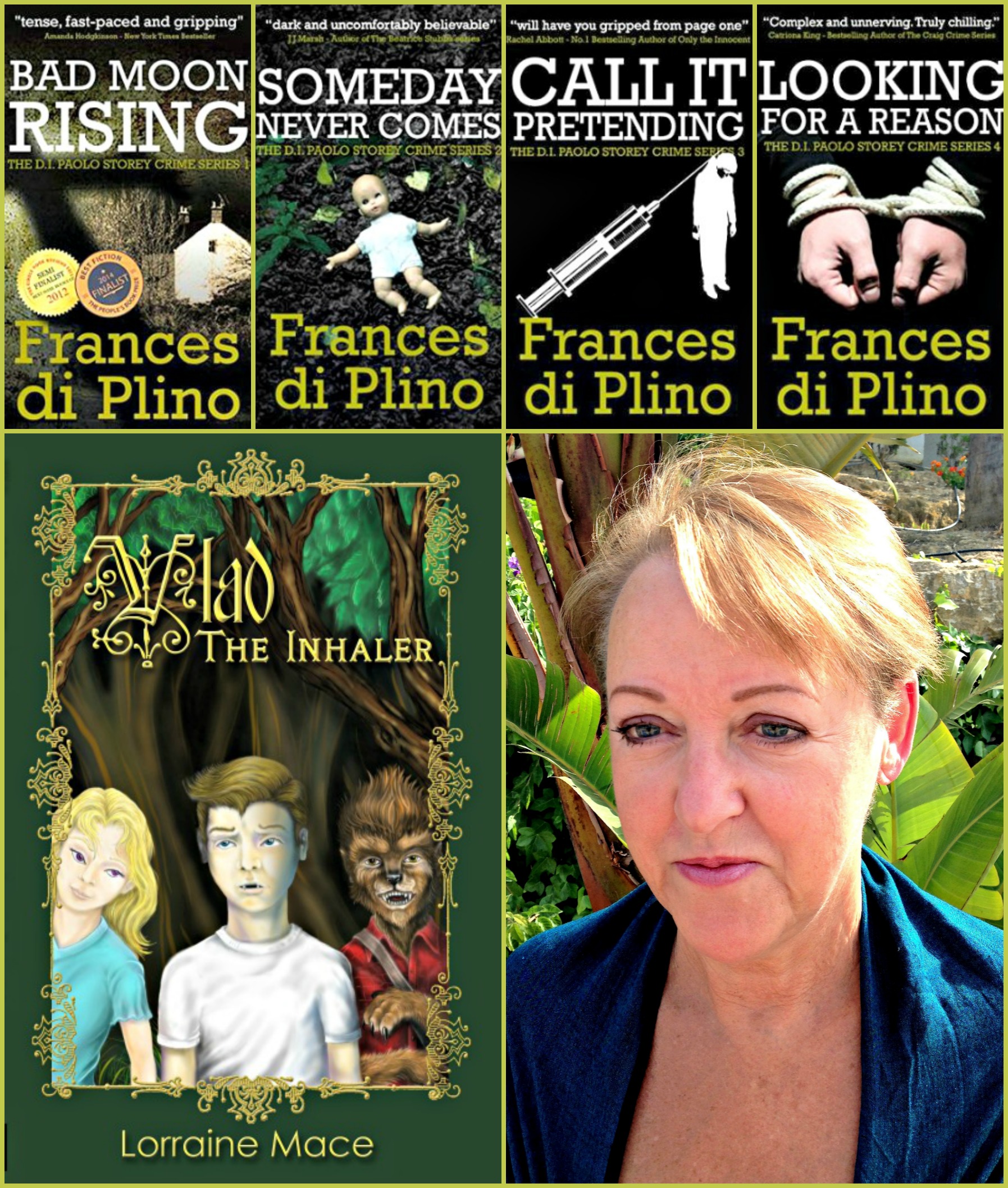
Lorraine Mace writes for children with the Vlad the Inhaler books. As Frances di Plino, she writes crime in the D.I. Paolo Storey series. She is a columnist for both of the UK’s top writing magazines, has founded international writing competitions and runs a writing critique service, mentoring authors on three continents.

STAY TUNED for the next fab post!

If you enjoyed this post, we invite you to register for The Displaced Dispatch, a round up of weekly posts from The Displaced Nation, with weekly updates and much, much more. Register for The Displaced Dispatch by clicking here!

Related posts:

Photo credits (top of page): The World Book (1920), by Eric Fischer via Flickr; “Writing? Yeah.” by Caleb Roenigk via Flickr (both CC BY 2.0).

GLOBAL FOOD GOSSIP: When facing repatriation after 18 years of the expat life, bring on the comfort food!

Serial expat (and soon to be repat!) Joanna Masters-Maggs is back with some juicy global food gossip to share.
Global Food Gossip 062315
“Oh, I see, it’s that time again, is it?” My husband entered the kitchen and sniffed the air. “It’s smells like Christmas, but it’s 30 degrees outside. “You’ll be wanting tea with that gingerbread?” Sighing he reached for the kettle.

Now, I’m not saying that expat life calls for comfort food more than any other lifestyle, but it does have it’s own rhythm of needs. For me, the main calls for comfort come during the entry and exit period of a new location.

I am now facing moving on from France—and frankly, even my beloved madeleine is not up to the job.

I need the kind of comfort food that warms up the winter, as neither the glorious weather nor the proximity of pools and beaches here in Provence can distract me this time.

Bikini be damned, my next move will be a return to England.

It is hard to imagine that repatriation can be more alarming than a move from one foreign country to another. Yet, after 18 years abroad and seven intercontinental moves, I am discovering that it is.

Our house in England is our holiday home, and we have few of the friends and none of the social networks we would have built had we stayed put. All the friends we have made at various offices, playgroups, schools, dog training groups and sundry activities are scattered across several continents. We will be in the interesting position of not belonging, while giving every outward appearance of doing so and no possibility of joining a repat support group (do such things even exist?).

You understand why I am reaching for the gingerbread now?

gingerbread-repatriation

Gingerbread by roxymjones via Pixabay.

The act of making gingerbread is a comfort in itself. Just watching the butter, syrup and sugar melt together and swirl in the pan, gives one time to relax and think.

Mm…as I watch the ingredients swirl, I’m thinking about cultural comfort foods of locations past.

Morning sickness in New Orleans calls for Morning Call

For anyone into comfort eating, my former home of New Orleans is a dangerous place. There are just too many temptations along the path of righteous eating, beginning with crawfish stew, jambalaya, seafood gumbo…

But it was beignets with coffee from Café du Monde or Morning Call (the less touristy choice, favored by locals) that became my preferred source of solace.

"City Park 12-12-12 Morning Call Coffee Beignets Dunk," by Infrogmation of New Orleans (CC BY 2.0).

“City Park 12-12-12 Morning Call Coffee Beignets Dunk,” by Infrogmation of New Orleans via Flickr (CC BY 2.0).

Of course life in New Orleans is pretty fabulous, especially when you are lucky enough to live in the French Quarter and see the life that exists behind the touristy façade. But comfort requirements are still there. Coffee and beignets are a fabulous hangover buster for one thing and for another they sure beat morning sickness into retreat while providing a good dose of the additional calcium an expectant mum needs. For me, the beignet and café au lait was the multi-tasking workhorse of comfort foods.

When it came time to leave the Big Easy, the beignet soothed my sadness, and I was careful to ensure I had a good recipe (see end of post) should it be needed to help with my adjustment to the next location: Den Haag.

The only problem, of course, with making your own beignets is the terror one feels when cooking with large quantities of hot fat—so it was with relief that I quickly discovered a more convenient way to ease my emotional entry into The Hague.

A cold arrival in Holland calls for oliebollen

We arrived in the middle of a particularly cold Christmas season. You can only imagine my delight at catching my first whiff of oliebollen and appelflappen, which fills the air that time of year.

Oliebollen is a Dutch style of doughnut that is traditionally eaten on New Year’s Eve, and appelflappen are a kind of apple beignet—YES!—served with sugar and cinnamon and sold from little stands throughout the Christmas season.

What a happy Christmas that turned out to be. What joy to have a little bag of those to warm both your chilly fingers and the depths of your heart.

How can you not love living in such a place?

Dumpy in Brazil calls for Disk Cook

And then there was Brazil. Now Brazil provided a different sort of comfort food to get me through the hard times. Being pregnant and feeling dumpy in a land full of girls from Ipanema in tiny bikinis isn’t exactly fun—but then, suffering from the heat, I cut off all my hair. Short.

You don’t do that in Brazil. It’s akin to cutting off your femininity. It’s ugly.

Happily unaware of this and feeling as though I was channeling mid 1990s Meg Ryan, I returned home from the hairdresser. My housekeeper took one look of me and clapped her hands loudly to her cheeks with a look of pure horror. After a slight pause and in an unnaturally high voice, she said “Madame looks beautiful”—before making her excuses and disappearing for half an hour.

The next few days were a bit unsettling as Maria avoided eye contact. It wasn’t that I minded her thinking my hair was ugly, more that I was now aware of how little I understood the culture. How many other things was I getting wrong?

As insecure as it makes me sound, I decided not to compound one aesthetic error with that of gaining weight, too. I avoided thoughts of my beignet recipe and my go-to home remedy of buttered toast. I also steered clear of the local padarias (bakeries). Instead I filled up on fruit.

But the thing is, comfort food is the kind of thing that finds you and it doesn’t have to come in carbohydrate form. You just need to be open to it: it being a well-rounded flavor that puts your taste buds at ease.

The comfort food of Brazil found me rather quickly. Disc Cook is a service which will collect food from a huge list of restaurants and deliver to your house. A new restaurant opened in our area and we decided to try it out. Imagine my surprise when the healthy sounding chicken liver and spinach dish turned out to be my next comfort food.

Disk Cook screenshot.

Disk Cook screenshot, taken 24 June 2015.

No, hear me out. Full-flavoured meat that melted in the mouth, cooked with balsamic vinegar and pine nuts. Yes, I know it sounds odd, but it was so richly satisfying, I couldn’t get enough of it. I even took comfort in the cold leftovers of that dish, straight from the fridge.

In honesty, however, comforting as it was, it can never qualify as true comfort food. Firstly, it comes from a good restaurant and true comfort food should not be exclusive. Secondly, I was never able to find or make up that recipe for myself. If it is too hard to lay your hands on, it isn’t comfort food. Comfort food cannot be a cause of any stress—other than the weekly weigh-in, of course.

Enough of my unabashed wallowing, and now for my beignet recipe

As I write, I am beginning to feel a little nostalgic and rather sad again. The problem with being in a constant state of serial expatness is that each time you leave one place, you remember the pain of leaving the last. It is a sort of travellers’ emotional add-on game. Sometimes I have to walk away from it. That is true now.

Perhaps next time I can tell you how I found solace from homesickness and last-location-sickness in the foods of Malaysia, Venezuela and Saudi.

(If you have had enough of this unabashed wallowing, I apologise—but would politely point out that at least I haven’t descended to mentioning visits to certain popular fast food chains, which I have no doubt we perpetual expats have all indulged in at least once or twice. For that we must be grateful.)

New Orleans-style Beignets, adapted from The Ultimate Southern Living Cookbook
NOTE: I made the conversions to grams years ago. Metric rocks!

Ingredients:
1 package dried yeast
3 tablespoons warm water (hand hot)
180 ml milk
150g sugar
28g shortening (or lard—which I prefer)
1 tsp salt
375g all-purpose flour
1 large egg
Vegetable oil
Powdered sugar

Method
Combine the yeast and water and leave to stand for five minutes.

Combine the milk with the sugar, shortening and salt in a saucepan over a low heat until the fat melts. Remove from the heat and leave to cool until again hand hot. Very hot liquid will kill the yeast and so it will not rise. If your hand can tolerate the heat, so too can the yeast.

Combine yeast mixture, liquid mixture, two cups of the flour and the egg in a large mixing bowl. Beat at medium speed with an electric mixer for two minutes. Gradually stir in as much of the remaining flour as you need to make a soft dough.

Put dough onto a lightly floured surface and knead until smooth and elastic (about 10 minutes). Place in a buttered bowl, cover and leave to rise in a warm place for one hour until doubled in size.

Punch dough back, turn onto a floured surface and roll out into a 30 x 25cms rectangle. Cut into two-inch squares and place them onto a lightly floured surface where they can be covered and left to rise until double in size (about 45 minutes).

Pour oil into a pan to a depth of about 3 or 4” and heat to 375° F (190 °C). Fry the beignets four at a time until golden. Drain on paper towels. Sprinkle with icing sugar and serve warm. YUM.

* * *

Readers, we invite you to continue the food gossip! What new comfort foods have you added to your list on your moves around the globe? And do you have any words of comfort for Joanna on her imminent repatriation? Be sure to let us know in the comments!

Joanna Masters-Maggs was displaced from her native England 17 years ago, and has since attempted to re-place herself in the USA, Holland, Brazil, Malaysia, Venezuela, Saudi Arabia, and now France. She describes herself as a “global food gossip”, saying: “I’ve always enjoyed cooking and trying out new recipes. Overseas, I am curious as to what people buy and from where. What is in the baskets of my fellow shoppers? What do they eat when they go home at night?”

STAY TUNED for the next fab post!

If you enjoyed this post, we invite you to register for The Displaced Dispatch, a round up of weekly posts from The Displaced Nation—and much, much more! Register for The Displaced Dispatch by clicking here!

Related posts:

TCK TALENT: Lisa Liang takes her show back on the road; first stop: Valencia, Spain!

This month our TCK Talent columnist Elizabeth (Lisa) Liang updates us on her own creative life.

¡Hola, amigos!

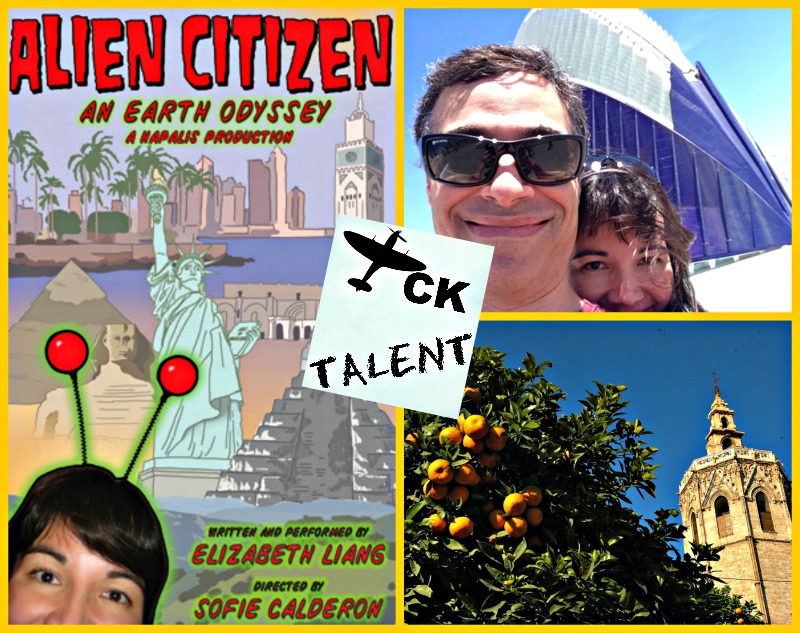
As those of you who subscribe to the Displaced Dispatch will know, Alien Citizen: an earth odyssey, my one-woman show about growing up as a Third Culture Kid, or TCK, of mixed heritage, was accepted by two international conferences in two of the world’s most appealing locations: Valencia, Spain, and Cape Town, South Africa. Thinking I’d be a fool to pass up this kind of opportunity, I launched an online crowd-funding campaign to fund both journeys. Two of us would be going: myself and my husband, Dan, who also serves as my “techie” for the show.

It was my fourth experience with crowd-funding—the most recent being last year, to cover expenses for taking the show to an arts center in Reykjavík, Iceland; and once again, the campaign worked. (A relief since I feared I might have tapped out my supporters’ goodwill, but people were as generous as ever—and I won’t ever fundraise for this show again.) We didn’t quite make our goal but could afford to cover the balance. We would be able to attend two international conferences on two continents in two months—hooray!

In this month’s column I’ll recount our trip to Valencia, Spain, to participate in the 2015 SIETAR Europa Congress, on May 21–23. SIETAR, which stands for the Society for Intercultural Education, Training and Research, is the world’s largest association dedicated to intercultural issues.

TCK Talent Lisa Liang takes her show on the road to Valencia, Spain.

TCK Talent columnist Lisa and her husband (and techie), Dan, head to Spain. Photo credits: (from left) Alien Citizen poster; Dan and Lisa in front of Ciudad de Artes y Ciencias (supplied); “Naranjo y el Campanario Valencia,” by Emilio via Flickr (CC BY-SA 2.0).

First impressions of the Land of Sweet Orange Trees

Dan and I had a couple of days of sightseeing before the three-day conference took place at the Universitat de Valencia. We drank lots of fresh-pressed zumo de naranja (“orange juice” in Catalán)—and yes, the oranges are the best we’ve ever tasted!

We toured the wonderful old section of the city, including the Cathedral and its Torre del Micalet, and the spectacular Ciudad de Artes y Ciencias (City of Arts & Sciences)—a futuristic outdoor/indoor complex near the beach, with an awesome aquarium. We even took the long bus route back to our hotel, which gave us a chance to see a lot of the Turia Gardens, a park built on a riverbed.

Dan got to carry on sightseeing while I attended sessions (workshops, panels, and lectures) during the first two days in order to meet people, learn more about the interculturalist professional world, and get the word out on Alien Citizen.

First impressions of SIETAR

In general the other conference participants seemed very nice but a tad noncommittal when I told them about my one-woman show. I think it was rather unusual to have a theatrical piece at the congress, though I noticed there were several sessions on storytelling as an important means of generating intercultural understanding.

Most of the attendees were what I would describe as interculturalist entrepreneurs—perhaps not your usual fringe theatre-goers? Still, I appreciated learning what sort of cross-cultural issues Europeans have been facing, and there was the bonus of generous lunches and yummy pastries along with coffee, tea, and zumo during the breaks. (I may have gained a pound or two.)

At the end of the second day, I was beat—but still had to do a run-through of my show in our hotel room that evening. Theatre takes stamina, so perhaps my two full days of attending conference events had done me a favor.

attending performing SIETAR

First she observes; then she performs. Lisa Liang at Congress Valencia 2015. (Photos supplied.)

Show Day!

The third day of the congress: show day! And some tension… For one thing, I didn’t realize until then that many congress-goers would take the day off to go to the beach or do sightseeing. I feared I might only have five or so attendees, which would be enormously disappointing after making the long journey from California (not to mention the fundraising!).

And for another, I was performing in a classroom like all the other session presenters, which meant we had just 10 minutes to set up. Ten minutes may be fine for a PowerPoint presentation but, especially as the session before us ran a little late, Dan and I really had to hustle to set up all the props, as well as the laptop, old-fashioned slide projector with voltage converter, my tape marks so I would know where to stand when projecting words onto my torso, and chair. We were in such a hurry that I forgot to set up chairs to stand and dance on “upstage.” I had to grab them from the front row in the middle of the performance. Funfunfun!

Despite these challenges, the show was a hit! People did turn up, and there were many more than five, thank goodness. They stayed for the whole performance, which was a coup—there had been walkouts from every session I attended in the previous days (with all the concurrent sessions, people were constantly session-hopping).

After the show, the applause lasted for such a long time that I exited the room to give the audience a break. But they didn’t stop, which was deeply gratifying and a huge relief, so I came back in and took some more bows. Many audience members stayed afterward to thank Dan and me, and in some cases draw parallels with their own lives. Those who found the story relatable included not just people like me, who grew up in different countries, but also people who’d lived only in Spain. One woman said she would distribute the show’s flyers at international schools in her country…so here’s hoping!

Most importantly: the show seemed to help people feel more connected and better understood, which is its ultimate mission.

Post-show celebrations

Post-show, Dan and I went out for a celebratory drink of horchata (made with tiger nuts) at one of Valencia’s oldest and prettiest horchata joints. Then we ambled over to the formerly half-Moorish, half-Catholic quarter, where we ordered a pitcher of sangria (since it cost the same as two glasses).

It may well have been the best sangria I’ve ever had—certainly worth the headache afterwards.

We made it back in time to attend the conference’s gala dinner, which took place in a lovely courtyard at the university. A couple of people who came to the performance approached me to say they were telling everyone at their tables about Alien Citizen. Again, I felt a mix of pride and relief.

Congrats Collage

Brava, Lisa, to another fine performance! Photo credits: (top and bottom) Lisa and Dan celebrating with sangria and at the gala dinner (supplied); (right) “A glass of horchata, Spain” via Wikimedia Commons (CC-BY SA 2.0).

To sum up…

Reflecting on the experience, I came to the conclusion that if the show is accepted at another non-theatre conference in the future, I should perform it only if it can be a keynote (as it was at the FIGT conference in 2014). Practically speaking, it takes time to set up the equipment and props, and as a performer I need space/room to relax and warm up before the show, which runs 80 minutes non-stop and takes my entire being to perform with the energy, precision, and authenticity that the audience deserves.

Still, I’m glad that we brought the show to this intercultural gathering, and I’d love to visit Valencia again. Food-wise, we had truly fantastic tapas and excellent wine, and as a night owl, I appreciated the late dinners. Virtually every Valenciana/o was very polite and friendly, and they all understood my slightly-gringa-inflected Guatemalan accent in Spanish.

The jet lag was only a problem on our first night. It took about a week to recover from it back in L.A., but that may partially be due to wistfulness: we’re not in Valencia anymore (woe!). Between its delights and our appreciative SIETAR audience, it was a fantastic, and very worthwhile, trip.

Next stop: South Africa!

At the time of writing I am preparing to attend the 10th Women Playwrights International Conference, being held in Cape Town from June 29 to July 3. WPI has brought together women playwrights and allied theatre artists, cultural workers and scholars since 1988. It facilitates communications and collaborations among the international community of women in theatre by holding conferences every three years.

It sounds like my crowd. But South Africa: that’s a first! We’re hoping to do a winelands tour and maybe a one-day safari tour. Watch this space for my next update.

* * *

Thank you, Lisa! I enjoyed taking that vicarious journey into a part of Spain to which I’ve never been. Imagine being able to drink fresh-pressed zumo de naranja to one’s heart’s content! (I’m not so sure about the horchata, though.) It was also interesting to hear your take on SIETAR: I know several Displaced Nationers were planning to attend. Readers, please leave questions or comments for Lisa below.

STAY TUNED for the next fab post!

If you enjoyed this post, we invite you to register for The Displaced Dispatch, a round up of weekly posts from The Displaced Nation, with news, book giveaways and other extras. Register for The Displaced Dispatch by clicking here!

Related posts:

Wonderlanded in Berlin with British expat Paul Scraton, founding editor of the new “Elsewhere” journal

Welcome to the Displaced Nation’s Wonderlanded series, being held in gratitude for Lewis Carroll’s Alice’s Adventures in Wonderland, which turns 150 this year and, despite this advanced age, continues to stimulate and inspire many of us who lead international, displaced, “through the looking glass” lives.

This month we travel
d
o
w
n
the hole with Paul Scraton to Berlin.

Paul Scraton Wonderlanded for TDN 3

Paul says he isn’t intimately familiar with Lewis Carroll’s classic work—this despite having had a mainly English childhood. He was born and spent his early years in a market town just north of Liverpool; and, though his family moved around a fair bit in Paul’s early years—Wales, Canada, the south of England—they settled in Lancashire once he reached school age. At 18, he crossed the north–south divide to attend the University of Leeds.

But I feel justified in including Paul in this series first because he is most certainly displaced. Upon graduation from Leeds, he moved to Berlin, Germany, which is where we find him today, living with his German partner, Katrin, and their daughter. Apart from a summer spent in Dublin, the German capital has been Paul’s “home” for the past 14 years.

In addition, having studied Paul’s creative output, I think it is fair to say that for him, “elsewhere”—by that he seems to mean the great outdoors—is a kind of Wonderland. He never tires of exploring the area where he lives. He has served as a tour guide for Slow Travel Berlin and written two short books based on walks he has led in and around his adopted city.

Another place to which he has formed a deep attachment is Germany’s Baltic coast. Katrin spent much of her childhood on the the island of Rügen and in the Hanseatic city of Stralsund, and for about a decade, Paul has accompanied her on trips to the region.

Paul writes a regular series of “dispatches” about his various outdoor adventures—whether in Germany or the UK (which he still visits frequently)—for his blog, under a grey sky…

And now he has just released the very first issue of Elsewhere: A Journal of Place, of which he is the founding editor.

Without further ado, let’s find out what it’s like to be “wonderlanded” with Paul.

* * *

Paul Scraton: Although it was quite a few years ago now, I can remember what it was like when I first arrived in Berlin and needed help with everything, from registering an apartment to opening a bank account. It was certainly challenging, even though Berlin is a city where many people speak English. And it is often only in the moving that you realise what aspects of life are different or not easily accessible compared to “back home”…and that can certainly make you feel lonely in a new city, a new country.

I did not have an internet connection in my first couple of Berlin apartments, and the English newspapers were expensive, so I relied a lot on BBC World Service. It is funny that this is not that long ago, but I imagine it is a different experience now with widespread internet access, social media and Skype.

I think the reason I first resisted the idea of Berlin or my life in another country as “wonderland”, besides a lack of familiarity with the books, is that by the definition of the Displaced Nation I am so often in this wonderland that it would never occur to me to frame it in that way. What I mean by this: when I am in Berlin I feel like I don’t quite belong, but when I go “back” to England having lived abroad for 14 years then I feel just as out of place. So it is something of a permanent state.

Despite this I can recognise that there are elements of life and my experience in Berlin (and beyond) after all these years that I still find curious…

“The question is,” said Alice, “whether you CAN make words mean so many different things.”

Having just finished university with no real idea of what I wanted to do except to write, I did wonder whether Berlin was the right place for me in the sense that I felt a long way away from any community or other people doing something similar in English. But several of us built our own little network, and, with the influx of still more international creatives over the years, there is now a small but thriving community of English-language writers and other like-minded folk.

“But what did the Dormouse say?” one of the jury asked.

One of the reasons I was drawn to Berlin was its history and the stories contained within these streets. One of the questions I would often ask people when I met them was whether or not they had grown up in the east or the west, and their experiences of living in a divided city and country and also what they thought about the process of reunification. In more recent years I was involved with running eyewitness history talks with people who told their personal stories of living in the city during the Nazi era or the Second World War, or living under communism in East Germany or in the “island city” that was West Berlin. Sometimes people in the audience, who were mainly visitors from outside Germany, would ask questions that would make me worry that the speaker would be offended, but actually it never happened. The Germans were happy to answer even difficult questions about their past or that of their families. In general, this is one of the strengths of the German society—the extent to which they have acknowledged, come to terms with, and discussed, debated and learned from their history; and you see it with individuals as well.

“Curiouser and curiouser…”

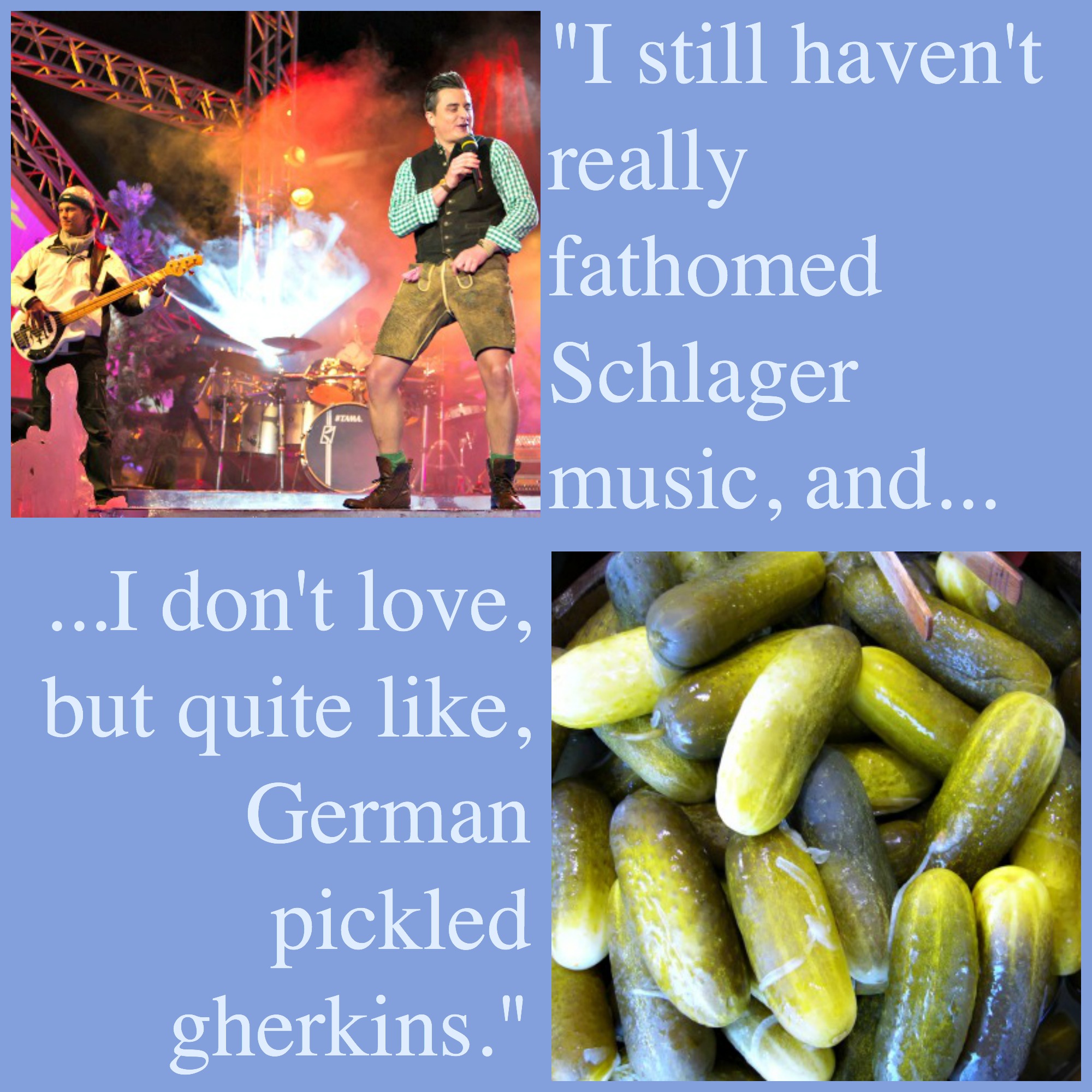
I think what really struck me about moving to Germany was not any sense of culture shock, but that the differences to back home were subtle and needed time to be discovered. In Berlin especially people can be very direct… there is very little tip-toeing around the subject, which can be a bit disconcerting. The main thing I still haven’t really fathomed is Schlager music, and the assorted television shows that showcase it. Finding yourself in the middle of something like that is one of those moments where you really realise you are living in a place where there are certain cultural traditions you have no grasp of, and to which you may never have access.

Acquired tastes Paul Scraton

German tastes you may never fully acquire. Photo credits: “Wenn die Musi spielt,” by Bad Kleinkirchheim via Flickr (CC BY 2.0); Giant gherkins, by Caitriana Nicholson via Flickr (CC BY-SA 2.0).

“Well, I’ll eat it,” said Alice…

My partner introduced me to good German pickled gherkins, and without her prompting I doubt I would ever have touched them. Now I quite like them.

“Will you walk a little faster?” said a whiting to a snail…

I am fascinated by Germany’s Baltic coast. One of the reasons is that I am fascinated by the coast in general, I think because it is a place that combines (a) the sense of escape that comes with family holidays, the seaside resorts, and the break with everyday life; and (b) the danger, myths and legends of the sea itself. Most seaside towns have both beaches where people have spent many, many happy hours, as well as memorials to shipwrecks and lifeboat crews… This contrast or contradiction applies, by the way, to the coast of the UK as much as here in Germany. (See for instance my blog post about our visit to Lindisfarne, Northumbria.)

The allure of the coast: Heimat, Germany (top) and Lindisfarne, Northumbria, UK. Photo credits: Paul Scraton and K.

The allure of the coast: Heimat, Germany (top) and Lindisfarne, Northumbria, UK. Photo credits: Paul Scraton and Katrin Schönig.

Another reason the Baltic is special is that it’s the place where my partner grew up. In the past ten years or so she has been taking me and my daughter up there. We are writing new stories for ourselves in a place that was very much a part of her childhood.

“Take some more tea,” the March Hare said to Alice, very earnestly.

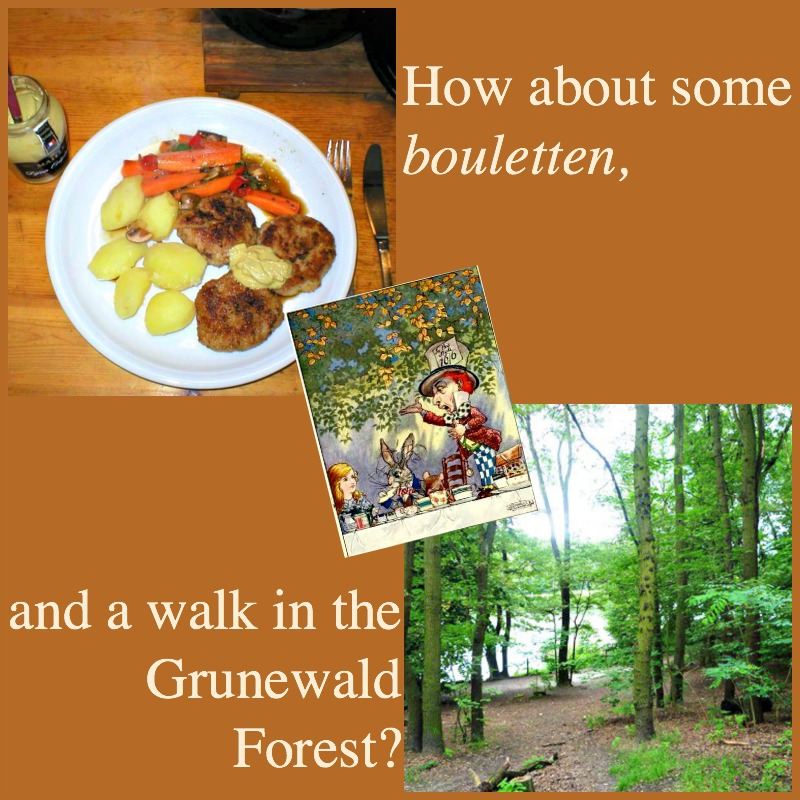
Now that you’re Wonderlanded with me, I must throw you a Mad Hatter’s tea party. This being Berlin, I will serve beer and bouletten (meat balls), a Berlin specialty, at the big table in our living room. We will listen to music and chat…and the guests will be friends, those who I don’t see enough of because of the way life seems to be. Not only those who are in England, and who I don’t see because of distance, but also those who live in the same city but somehow life gets in the way. But before we sat down for beer and meatballs we would have done a long walk together through the city or perhaps out at the lakes and the forests on the edge.

Bouletten and a walk. Photo credits: Bouletten mit Senf, by  Michael Fielitz (CC-BY SA 2.0); Grunewalk Forest by Paul Scraton.

Bouletten and a walk. Photo credits: Bouletten mit Senf, by
Michael Fielitz (CC-BY SA 2.0); Grunewalk Forest by Paul Scraton.

“Who in the world am I? Ah, that’s the great puzzle!”

Inevitably, you are a different person at 36 years old than at 22, and these changes would have no doubt happened whether I was in Berlin or had stayed in England. And if anything, being with my partner and our child probably had a more profound impact that simply the act of moving away. But I would say that work wise, in my writing and in creating our journal, Elsewhere, living in Berlin has been an endless source of inspiration. The number of interesting places and the stories they contain feels inexhaustible. I don’t think I would have become the writer I am, pursued the projects I am doing, or developed my work in the direction I have, without living in this city for the past decade and a half.

Advice for those who have only just stepped through the looking glass

If you are like me, you will find yourself feeling out of place in your new home and out of place when you return to the old one. But there is nothing wrong with being slightly on the edge of the scene…that’s where the interesting stuff happens.

“I wonder if I shall fall right through the earth!”

Paul Scraton books and journal

Paul Scraton’s two short books and the first issue of the new journal he edits, Elsewhere.

Aside from the journal, the first issue of which we are launching this week, I am writing a book about memory, exploration and imagination on the German Baltic coast. As I mentioned, this is the area where Katrin grew up, and so the book combines my own travels and discoveries in the area with the myths and stories of the places along the coast as well as Katrin’s family history. I think coming at these places and stories as an “outsider” gives me a different perspective that informs and shapes the writing. Ultimately everything I am working on right now is concerned with the idea of “place”, and again, I think this interest has developed as a result of never quite feeling I belong wherever I may be…

* * *

Readers, I wonder if you feel like me, that you’ve enjoyed being “elsewhere” with Paul so much you feel a bit bereft now that our “tour” has ended… Do you agree the time went quickly? And what did you make of his Wonderlanded story? Please let us know in the comments. ~ML

STAY TUNED for the next fab post: an example of how Paul writes about place.

If you enjoyed this post, we invite you to register for The Displaced Dispatch, a round up of weekly posts from The Displaced Nation, and much, much more. Register for The Displaced Dispatch by clicking here!

Related posts:

Photo credits for opening image (clockwise from top left): Paul Scraton (supplied); image from “A line of wild suprise: Prespa, Greece,” one of the articles on the first issue of Elsewhere; “Alice,” by Jennie Park via Flickr (CC BY 2.0); Hutschenreuther Garten Eden Cup & Saucer via Chinacraft.

CULTURE SHOCK TOOLBOX: Expats, don’t throw away your old coping tools—they may come in handy for your new life abroad

For her column this month, transitions enthusiast H.E. Rybol interviews displaced creative Jessica Lipowski about her culture shock memories and coping strategies.

June 2015 Jessica Libowksi Culture Shock Toolbox
Hello, Displaced Nationers! I’m excited to introduce you to road-less-traveled (#TRLT) buff and foodie Jessica Lipowski. Originally from Detroit, Michigan, Jessica moved to Amsterdam in February 2011 to be with her Dutch boyfriend, Matthijs. She has worked in a variety of jobs related to travel and is currently writing a non-fiction book that documents the stories of 83 entrepreneurs from 50 different countries who live in Amsterdam. They all have in common that they own restaurants in the city.

Jessica, who appreciates Amsterdam’s wide range of cuisines, has developed a curiosity about how all of these people ended up in the same industry, in the same city and with similar passions. As she writes on her site:

Why Amsterdam and how did so many people from every corner of the world end up in this small capital city? What drew them to the land of tulips and windmills?

But our focus today is not these expat restauranteurs but Jessica herself. While sampling Amsterdam’s rich cultural stew, has she ever had to put down her spoon owing to culture shock? And what tools did she use to restore her appetite?

* * *

Hi, Jessica, and welcome to the Displaced Nation. Can you tell us a little about your background?

I am originally from the United States, born and raised in the metropolitan Detroit area. I spent the first 23 years of my life in Michigan, apart from the two summer internships I completed in Washington D.C. In February 2011, I moved to the Netherlands and have resided in Amsterdam for the past four years.

In the context of transitioning from the United States into Europe, did you ever put your foot in your mouth? Can you share any memorable stories?

While working in sales and marketing for an online group travel platform, I often had to attend business meetings and conferences in Europe. I was a regular at one of these events, which took place four to six times a year. I soon developed a friendship with another regular, a Dutch woman, whom I’d always look forward to seeing. On one occasion when we met, she complimented me on the dress I was wearing. I thanked her and then, as I leaned in to share with her where I purchased the dress (I wanted to tell her I’d paid a relatively cheap price), she cut me off and said: “Oh, Jessica, you should never tell someone details like that.” I honestly thought she would appreciate hearing my story, but it turned out to be the kind of information that is supposed to be shared only with close friends.

I got a bargain! Shhh... Photos via Pixabay.

I got a bargain! Shhh… Photo credits: “Street signs of the nine Straatjes” on Wikimedia by JSpijer via Wikimedia Commons (CC BY-SA 3.0); other two photos via Pixabay.

What lessons can you offer to the rest of us from this story?

Instead of being offended, I smiled and apologized. I told my Dutch business acquaintance how much I appreciated that she’d corrected me, and I meant it sincerely, as it would keep me from making the same mistake again in future. I think a smile and an apology can go a long way in such situations. Of course it might have helped if I’d done more research beforehand on social customs and norms in various European countries. But if you haven’t done your research, then don’t be too proud to rely on business colleagues or local friends for advice.

Looking back on your transition from the United States to Holland, can you recall any situations that you handled with surprising finesse?

I surprised myself with my commitment to learning Dutch. My first exposure to the language occurred when I met Matthijs, who is now my partner. When we started dating, I used Rosetta Stone intermittently; but then, once I made the move to Holland, I started taking private lessons once a week. Expats can get by quite easily in Amsterdam speaking just English as the Dutch start learning English at a young age and many speak the language quite well. However, I felt it was important to learn Dutch so that I could speak it with my partner’s family. It’s not easy but can be done. It all comes down to practice, practice, practice.

If you had to give advice to someone who just moved to a new country, what’s the tool you’d tell them to develop first and why?

I guess it would be pack some of your old tools. Because one of the most important things to do when you first arrive is to establish a routine. A routine will help you settle into a new country and feel at home. For instance, if you used to work out or do yoga, search for a gym or studio. Or maybe you always looked forward to grabbing a cup of coffee on the way to work. So find a favorite coffee house en route. Did you used to have an active social circle? Then make a point of joining a local meet-up group, a sports team, classes or other activities where it’s relatively easy to make friends and develop a support system. It will make the transition that much easier.

Thank you so much, Jessica, for taking the time to share your culture shock stories with us. Leaning on local friends for advice and re-establishing small personal rituals or routines: those are two nifty tools that can ease the initial stress of changing countries.

* * *

Readers, what do you make of Jessica’s advice? Have you ever found yourself in a situation in your life abroad where you thought, “I should have done more research”? Do tell!

If you like what you heard from Jessica, be sure to check out her writer’s site and/or follow her on Facebook, Twitter and Instagram.

Well, hopefully this has you “fixed” until next month.

Until then. Prost! Santé!

H.E. Rybol is a TCK and the author of Culture Shock: A Practical Guide and Culture Shock Toolbox. She loves animals, piano, yoga and being outdoors. You can find her on Twitter, Linkedin and Goodreads. She is currently working on her new Web site and her second book.  

STAY TUNED for next week’s fab posts.

If you enjoyed this post, we invite you to register for The Displaced Dispatch, a round up of weekly posts from The Displaced Nation—and much, much more! Register for The Displaced Dispatch by clicking here!

Related post:

LOCATION, LOCUTION: Expat author and new columnist Lorraine Mace offers her own thoughts on writing about place

Location Locution
Please join us in welcoming Lorraine Mace, aka Frances di Plino, to the Displaced Nation for the first time. From this month, she’ll be taking over the Location, Locution column from JJ Marsh.

Hello, Displaced Nationers! I am thrilled to be taking over this column from JJ Marsh, and I already have lots of interesting guests lined up to take part over the coming months. For this first post, however, I am going to follow in Jill’s footsteps and use my first column to answer the “location locution” questions as a means of introducing myself.

But before I do that, let me give you a few basics. I was born and raised in London, but moved to South Africa just before my 25th birthday. I first lived just outside Johannesburg, then moved to the Orange Free State before discovering, and falling in love with, “the fairest cape”. Since leaving Cape Town I’ve been a nomad for more years than I care to count, having moved continent and country nine times. I finally put down roots in Spain, but have an inclination to spend summers in British Columbia, Canada.

Like JJ, I write crime fiction. I also have a book series for children.

Lorraine May and books

The prolific Lorraine Mace has produced four books in her D.I. Paolo Storey crime thriller series, and one book in her Vlad the Inhaler series (vampires, werewolves and peaches, oh my!).

Oh, and one last item before I move to the questions: don’t forget to visit my predecessor’s farewell post and enter the book giveaway competition. So far there’s only two comments, which by my reckoning gives you a pretty good chance at winning seven great e-books!

* * *

Which came first, story or location?

This can vary from book to book and story to story. However, in my crime novels, written as Frances di Plino, story came first—but then location helps to formulate the plots. Although the series is set in a fictional town, the surrounding British countryside is very real. Bradchester is situated close to Rutland Water and the nearest city is Leicester, both of which feature in the novels on a regular basis. I know this area well. During my last (brief) sojourn in England I lived in a small village a stone’s throw from Rutland Water and frequently visited Leicester.

What’s your technique for evoking the atmosphere of a place?

I put myself into the heads of my characters and experience the place through their senses. When I can smell the bread in the local bakery, or hear the cries of street vendors, weep over a beautiful sunset, taste an orange straight from the tree, or touch the moss-covered stones of a monastery, I know it’s time to start writing, using my character’s experiences of the place.

Which particular features create a sense of location? Landscape, culture, food?

All three, but I must admit I find it easier to use food allied to culture when the story is set outside of the British Isles. Having lived in South Africa, on the Maltese island of Gozo, as well as in France and Spain, I know I can use regional dishes to bring areas of those countries to life. But in Britain I think we have lost the regional aspect of many of our foods. Fish and chips, roast beef and so on are now available throughout the country, where other nations seem to have guarded their regional food identities.

Can you give a brief example of your work which illustrates place?

Bradchester is a town that has more than its fair share of rundown, seedy areas set side by side with gentrified neighbourhoods. This leads to a great deal of social unrest—the haves want the have-nots moved elsewhere and the have-nots resent the wealth and easy life of the haves. This short passage illustrates an area that has, as yet, remained untouched by either sector, but just a street away it is very different.

Station Road wasn’t exactly the best part of town, but the place looked respectable. Paolo was pleased to see that most of the businesses he remembered from his youth were thriving. This was one of the few communities that still had a drycleaners, newsagent, old-fashioned fruit and veg shop, alongside a mini-supermarket, hairdressers and a bank. He glanced up. Even the flats above the businesses looked lived in and cared for. Nice nets and curtains framed the windows and many of the street doors had been painted in recent history.

They walked a couple of hundred yards before turning into Zephyr Road. It was like moving into another country. Here, most of the shops they passed were boarded up and the few remaining open for business seemed to Paolo to concentrate on ways to transform goods into money. Pawnbrokers, gold for cash, payday cheque converters. It appeared as though all the dregs of the financial service industry had found their way into this street. This time when he glanced up, Paolo saw the flats above the shops were likewise either boarded up or had dirty nets hiding whatever was going on up there.

net curtains

The quality of the net curtains tells you where you are in Bradchester. Photo credit: Joss Smithson via Flickr (CC BY-SA 2.0).

How well do you need to know the place before using it as a setting?

I prefer to use places I’ve lived in, or visited many times. I like to know the area and people so well I can conjure them up at will when I’m writing.

Which writers do you admire for the way they use location?

Barbara Kingsolver and Donna Tartt spring to mind. With both authors I feel as if I am living in the locations depicted. In Donna Tartt’s The Goldfinch she manages to recreate both city and desert locations to the extent one can almost feel the weather. Kingsolver’s The Poisonwood Bible brings the 1959 Belgian Congo to life so powerfully the reader is swept into the villages, fearful alike of jungle creatures and the inhospitable landscape.

Books that get "place" right: The Goldfinch, by Donna Tartt; and The Poisonwood Bible, by Barbara Kingsolver.

Books that get “place” right: The Goldfinch, by Donna Tartt; and The Poisonwood Bible, by Barbara Kingsolver.

* * *

Thanks so much, Lorraine! I’m impressed that you created your own place for your crime series novels, and that it’s in the UK, where you haven’t lived for quite some time. Readers, any words of welcome and/or questions for our new columnist? Please leave them in the comments below.

And don’t forget to leave a comment on her predecessor, JJ Marsh’s last post for a chance to win 7 e-books that should take you through the summer. All you have to do is answer the question, in 50 words or less: Where and when in the world would you like to go, and why?

Lorraine Mace writes for children with the Vlad the Inhaler books. As Frances di Plino, she writes crime in the D.I. Paolo Storey series. She is a columnist for both of the UK’s top writing magazines, has founded international writing competitions and runs a writing critique service, mentoring authors on three continents.

STAY TUNED for the next fab post!

If you enjoyed this post, we invite you to register for The Displaced Dispatch, a round up of weekly posts from The Displaced Nation, with weekly updates and much, much more. Register for The Displaced Dispatch by clicking here!

Related posts:

Photo credits (top of page): The World Book (1920), by Eric Fischer via Flickr; “Writing? Yeah.” by Caleb Roenigk via Flickr (both CC BY 2.0).