The Displaced Nation

A home for international creatives

Tag Archives: Asia

And the August 2014 Alices go to … these 3 international creatives

 © Iamezan | Dreamstime.com Used under license

© Iamezan | Dreamstime.com
Used under license

If you are a subscriber to our weekly newsletter, the Displaced Dispatch, you’re already in the know. But if you’re not, listen up. (Hey, why aren’t you? Off with your head!)

Every week, when that esteemed publication comes out, we present contenders for a monthly “Alice Award,” most of whom are writers or other kinds of international creatives who appear to have a special handle on the curious and unreal aspects of being a global resident or voyager.

Not only that, but this person tries to use this state of befuddlement as a spur to greater creative heights.

Today’s post honours August’s three Alice recipients. They are (drumroll…):

1) JESSICA WRAY, overthinking Californian, serial expat (currently in Madrid), and blogger

For her post: Seven Reasons Why English Food Doesn’t Actually Suck on her blog, Curiosity Travels
Posted on: 13 August 2014
Snippet:

3. Yorkshire Pudding
Not the pudding we are used to, this version doesn’t come from a powdered Jello packet. Instead, the Yorkshire pudding is actually referring to the pastry-like cooked dough which holds an assortment of heart attack inducing savory foods.

This specific Yorkshire pudding came with mashed potatoes, sausage and smothered in gravy. Accompanied by an ale, it was great for my soul but horrible for my waistline.

Citation: Jessica, the title of your post goes down in the annals. If that isn’t damning with faint praise, we don’t know what is. Your British hosts would be impressed. And it’s rather too literally gutsy of you to champion the cause of as many as 10 stogy foods merely because of “having dated a Brit for an extended period of time” and after having visited the country only twice. And while we don’t wish to stop you from acquiring a taste for stodge (British victuals need all the support they can get!), we worry you’ve become too focused on the gravy that’s smothering the Yorkshire pud and what it’s doing to your waistline to take in the protocol surrounding the British Sunday roast tradition. Alice, too, forgot her manners after stepping through the looking glass. We refer to the faux pas she committed when attempting to carve the leg of mutton just after having been introduced to it—only to be informed by the Red Queen:

“It isn’t etiquette to cut any one you’ve been introduced to. Remove the joint!”

Should you be possessed by a similar urge to seize the carving knife, don’t be surprised if your hosts are less than appreciative. You may wish to say something cheeky just as Alice did, i.e.:

“I won’t be introduced to the pudding, please, or we shall get no dinner at all.”

Then again, you could always utter an Americanism like: “Don’t get your panties in a bunch.” After all, the Brits have a comparable expression about getting their knickers in a twist. (What’s the worst that can happen—you don’t get invited back and have to make do with the food in Madrid?)

2) KEN SEEROI, American expat in Japan and professional writer, photographer and blogger

For his post: How to Stop Learning Japanese on his blog, Japanese Rule of 7
Posted on: 2 August 2014
Snippet:

Who knew languages had so many components? It’s all those words—that’s the real problem. First, I only wanted to know enough Japanese to order a beer. I figured I’d be happy with one word. But then I wanted another beer, so I needed another word. See, I told you I don’t think about the future.

Citation: We can empathize, Ken. How beautiful life in Japan would be if we foreigners didn’t have to grapple with the “devil’s tongue”. One minute you’re ordering a beer, and the next you find you’ve been captured and hooked: condemned to the life of an eternal student. And the struggle to learn vocabulary that doesn’t resemble Latin in any way is only the half of it. You also have to get into the mode of thinking that what isn’t said is usually far more important than what is said—the (in)famous wa factor. Indeed, if you have wa going, then your listeners should be able to finish your sentences for you—which is great if you’ve forgotten the verb, but not so great if they fill in the blank in the wrong way and you find you’ve agreed to something like tutoring their child in English for the rest of his born days when you were actually trying to say you’re giving up tutoring because you’re writing a book. Another challenging aspect of wa is the tendency to allow emotion to take over in favor of clarity. After all, stating something clearly may mean that that the speaker commits to something and thus would get the blame if the situation goes awry. Should you become the victim of this, you could always do a Humpty Dumpty—we refer to the (in)famous exchange between Alice and Humpty Dumpty over semantics, in Through the Looking Glass:

“When I use a word,” Humpty Dumpty said in rather a scornful tone, “it means just what I choose it to mean—neither more nor less.”

“The question is,” said Alice, “whether you CAN make words mean so many different things.”

“The question is,” said Humpty Dumpty, “which is to be master—that’s all.”

All things considered, though, you may be better off floating in a sea of vagueness. You had the right instincts, Ken, when ordering that beer and realizing one might not be enough. Well done!

3) DR. KATE EVANS, British zoologist, founder of Elephants for Africa (based in Botswana), and expat in Germany

For her remarks in an interview, The Expat that African Elephants Will Never Forget, with Claire Bolden McGill in Global Living Magazine (July/August 2014)
Posted on: 18 August 2014
Snippet:

The sounds we wake up to at night are very different. In Botswana my nights are disturbed by the roaring of a lion, the cackle of hyena or the rumble of an elephant, and I wake up to the sounds of the local franklin (a small chicken-like bird that is common throughout Southern Africa and very funny to watch running).

Citation: Dr. Kate, first of all we must congratulate you on heading up an organization that is doing one of the most noble deeds on the planet—attempting to save the African elephant from extinction. And although we know you have a list of degrees as long as an arm for doing such important work, we also suspect it’s your Alice-like curiosity that makes you so suited to the task. It is not at all surprising to us when you tell Claire (who btw was an Alice winner back in June and has also guest posted for our “New vs. Olde Worlds” series), that you feel more at home in the bush than you do in “hectic lifestyle of the West”. Your comfort level among African wildlife brings to mind this passage from Through the Looking-Glass:

…[Alice] found herself sitting quietly under a tree—while the Gnat (for that was the insect she had been talking to) was balancing itself on a twig just over her head, and fanning her with its wings.

It certainly was a VERY large Gnat: “about the size of a chicken,” Alice thought. Still, she couldn’t feel nervous with it, after they had been talking together so long.

You go on to tell Claire that your expat life owes to a promise you made to an elephant at the age of seven. Were you aware you were channeling Alice?!

*  *  *

So, readers, do you have a favorite from the above, or have you read any recent posts you think deserve an Alice Award? We’d love to hear your suggestions! And don’t miss out on the shortlist of Alice contenders we provide in each week’s Dispatch, which are sources of creative thought if nothing else! Get on our subscription list now!

STAY TUNED for more fab posts.

Writers and other international creatives: If you want to know in advance the contenders for our monthly Alice Award winners, sign up to receive The Displaced Dispatch, a round up of weekly posts from The Displaced Nation, with news of book giveaways, future posts, and of course, our weekly Alice Award!. Register for The Displaced Dispatch by clicking here!

Related posts:

For this Swiss ethnographer with a fondness for remote parts of China, a picture says…

Gaetan in China Collage

Canon zoom lens; photo credit: Morguefiles. Gaetan Green doing fieldwork in Xishuangbanna, a region of Southwest China squeezed between Laos and Burma; photo credit: Gaetan Green.

Welcome to our monthly series “A picture says…”, created to celebrate expats and other global residents for whom photography is a creative outlet. The series host is English expat, blogger, writer, world traveler and photography enthusiast James King, who thinks of a camera as a mirror with memory. If you like what you see here, be sure to check out his blog, Jamoroki.

My guest this month is 33-year-old Swiss national Gaetan Green, who has spent the last 12 years between China, Europe and North America. After graduating university, Gaetan studied and conducted ethnographic research in remote parts of China. He went back to do field work in the country’s ethnic borderland when pursuing a master’s degree in geography at a university in Vancouver.

For the past three years Gaetan has lived in one of China’s mega-cities, but he always grabs the opportunity to travel in the countryside, where he can indulge in his current passion for the  ancient and ethnic villages of south and southwest China, with a “minor focus on Guangzhou and the Pearl River Delta.”

Gaetan keeps a fascinating blog, Travel Cathay. He posts about his off-the-beaten-path travels to parts of China most of us wouldn’t know existed.

* * *

Hi Gaetan. I have been following your blog for a while now and am very pleased to have the opportunity to interview you for the Displaced Nation. Let’s start with some background on you, shall we? Where were you born, and when did you spread your wings to start traveling?
I grew up in a ski resort in the middle of the Swiss Alps and I started travelling as soon as my parents would allow it. My first trips were to Southern and Eastern Europe with classmates—that started when we were around 16 years old. But my travels became a lot more serious when I left Switzerland for my first trip around the world, at age 20. This trip changed my life for good.

So your wanderlust dates from an early age. Why do you think that was?
There were essentially two things that inspired me to travel. The first was a map of the world that I discovered at home when I was an inquisitive eight-year-old. The map made me realize the world was much bigger than the valley surrounded by big snow-capped mountains where we lived. I was itching to discover the reality behind all the exotic place names. The second source of inspiration was my home country. With its pure air, snow-capped mountains, green valleys and quaint mountain villages, Switzerland is beautiful—but way too small. The boy I was then saw a world so big, I knew I had to leave.

Which countries did you travel to?
Besides southern and eastern Europe, I visited Australia, Peru, Bolivia, Ecuador, Malaysia, Philippines, and Singapore. And of course, eventually, China.

And now China has become a second home for you.
Although I have traveled to other countries, China is the one I know best because that is where I have spent most of my time so far, and I have only five provinces left to discover. My love story with China started at age 20: I spent three months of my round-the-world trip traveling within its vast terrain. When I returned home, I started to learn Mandarin (some of my friends thought I was seriously deranged!!). Then one thing lead to another: I studied for two years in Chongqing (a city of 15 million people in central China), worked as an ethnographer in remote parts of Yunnan province, taught English in Kunming, and conducted academic research between Vancouver and Xishuangbanna. Although China is a country, it gives the impression of being a continent because it is very diverse. Contrary to what many people think, China does not have a monolithic culture. I speak Mandarin, so that makes travel easier. I can venture into the countryside knowing I’ll be understood.

“Let’s all go up to the mountain to be close to the flowers and songs.” – Dong folk ballad

I’m sure that speaking the language gives you a huge advantage. Tell us more about the life you now lead in China.
I am currently working as a sourcing agent and living in one of China’s megacities. Recently I have developed mixed feelings about the megacity life. Megacities can be convenient places to live, providing easy access to food, entertainment, communication and transportation; but I find them overcrowded. Dangerous levels of pollution and food hygiene are growing concerns and also the reasons why some of my expat friends have already left.

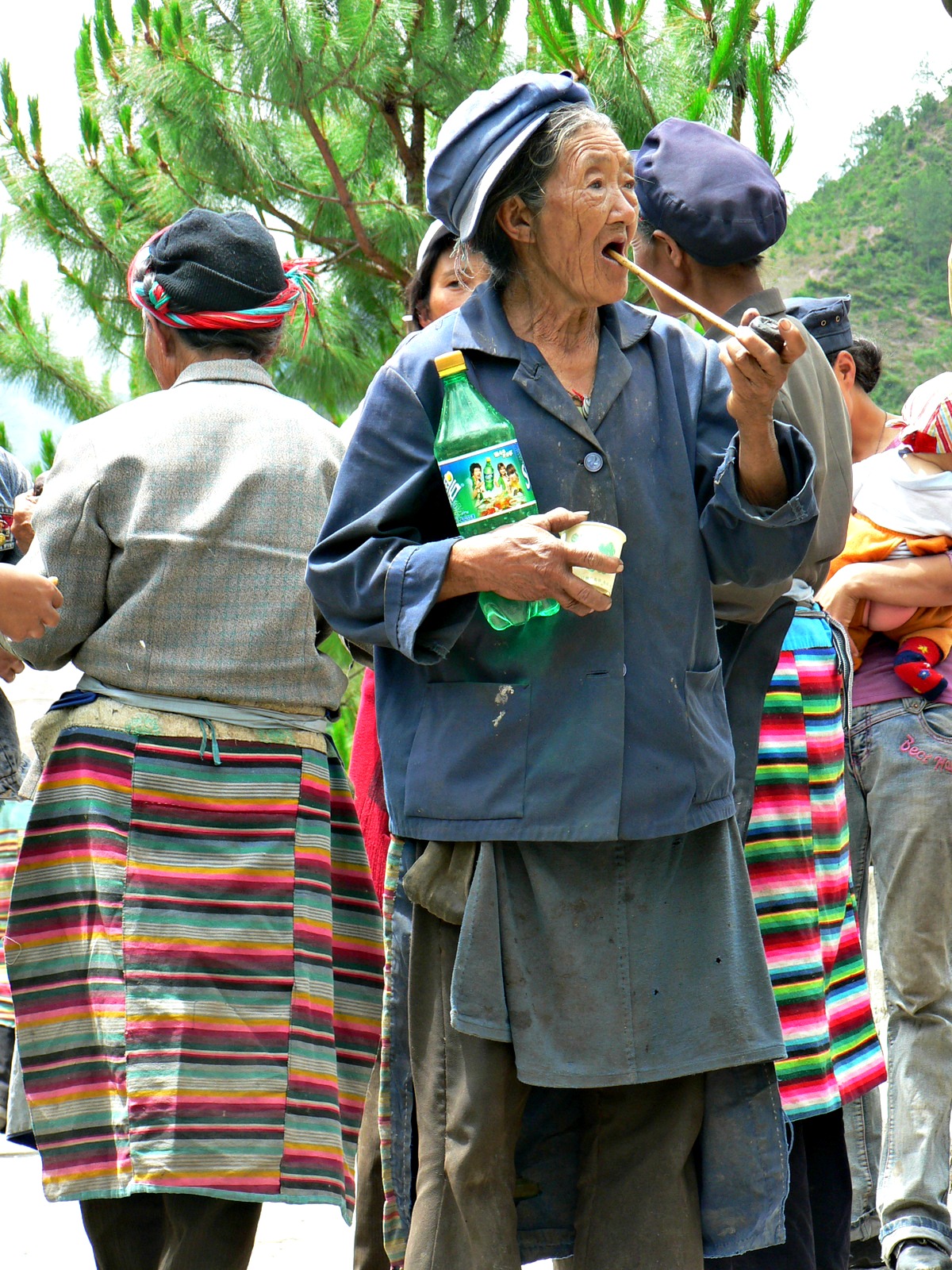
Old woman in a Tibetan Catholic community; photo credit: Gaetan Green.

An elderly woman pushing barley alcohol in north Yunan; photo credit: Gaetan Green.

Some friends of mine have recently moved to China to work in Shanghai but they refuse to live in the city for the same reasons you mention. But let’s get away from the megacity and take a look at your first three photos, which take us far away from that scene. Can you tell us what makes each of these photos so special?
This first photo reminds me of the time when I was doing ethnographic research about Tibetan Catholic communities in remote regions of north Yunnan province. On that particular occasion, I had the opportunity to witness a ceremony during which villagers prayed that it would rain on the graves of French missionaries who’d been assassinated at the beginning of the 20th century during anti-Christian violence in the region. There was a steep hike to reach the graves. At end of the ceremony, this woman started giving everyone barley alcohol in a paper cup. I remember going back to the village half-drunk after she challenged me to a second glass of firewater.

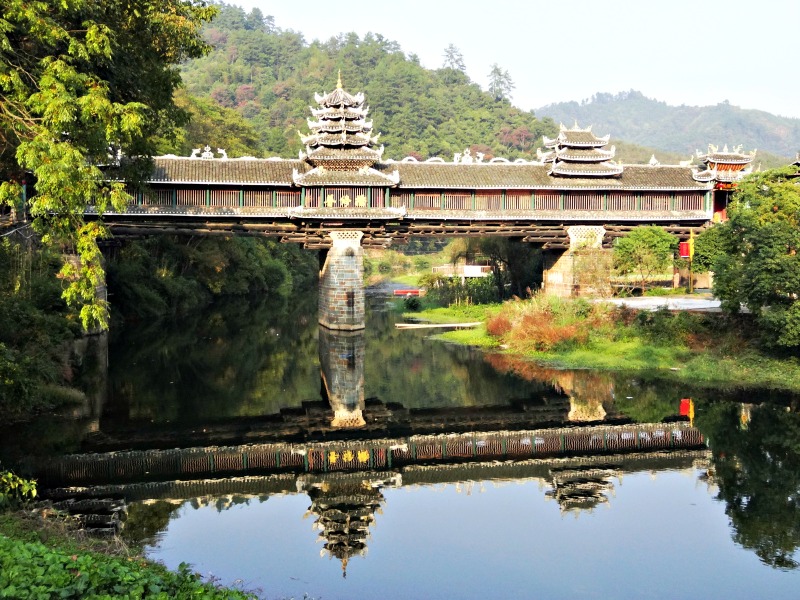
Wind and Rain Bridge, Tondao. Photo credit: Gaetan Green

Blown away by the Puxiu Wind and Rain Bridge in Tondao; photo credit: Gaetan Green

The second photo was taken after I’d missed the last afternoon bus and got stuck in the small town of Tongdao (southwest Hunan province), which I’d never heard of. I eventually ended up hiring a taxi driver for the afternoon to show me around. We went to a few ethnic villages and by 4:00 p.m., we had arrived by this amazing covered bridge, which is an example of a “wind and rain” (fengyu) bridge common to the Dong ethnic minority region. Missing my bus was the best thing that happened to me that day.

Taoist Temple, Macau; photo credit: Gaetan Green.

The Jade Emperor’s generals on their joss paper thrones; photo credit: Gaetan Green.

The third photo records the time I got lost in Macau somewhere between the Ruínas de São Paulo and the Camões Garden, I went to a Taoist temple. In one hall, I noticed that some statues had uneven stacks of joss paper (spirit money) under them. I asked the temple caretaker: “Why?” He explained that there were, in that particular hall, the statues of the 60 heavenly generals who help the Jade Emperor to supervise human life on earth. There is one heavenly general for each birth year, and the more joss paper there is under the statues that matches your birth year, the luckier you will get. I decided to boost my luck and bought stacks of joss paper to boost my heavenly general higher. The temple caretaker gave me three sticks of incense to burn; he said a long prayer in Cantonese and gave me a red talisman. I definitely enjoyed doing business with the gods, though I didn’t feel any luckier afterwards.

“Who can rob me of the songs I learned?” – Dong folk ballad

I love all three photos, and, yes, you are right, missing the bus and staying in Tondau must have been divine providence. Now, I’m keen to know where your favourite places to take photographs are, and why these places inspire you and how that shows in your next three photos?
Now that I live in a big Chinese city, the places that inspire me the most are the ethnic and ancient villages. In the cities, many historical buildings and old streets have been knocked down to give way to shopping malls and skyscrapers. Ethnic and ancient villages are real windows on the past and the cultural diversity of China. I chose the next three photos to make this point.

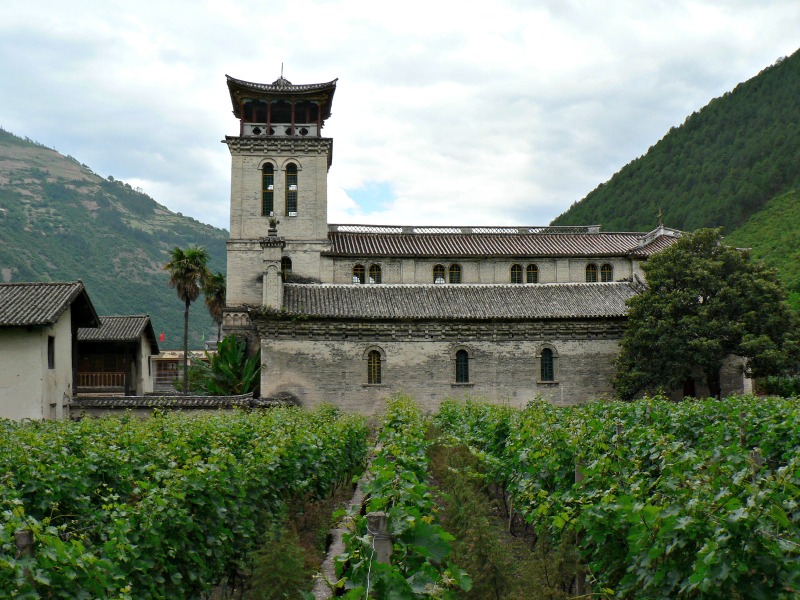
Cizhong Catholic Church; photo credit: Gaetan Green.

A Roman Catholic Church in an unexpected spot: by the Lancang (Mekong) River at Cizhong; photo credit: Gaetan Green.

The first is of the Catholic church at Cizhong, a remote village of north Yunnan province that is home to a community of Tibetan Catholics who were converted by French missionaries more than 100 years ago. The church seems out of place in this land of Buddhism. The mountains surrounding the village make it a picturesque spot.

Yunnanyi Gaetan Green

If these walls could talk: Yunnanyi village on the Tea Horse Road; photo credit: Gaetan Green.

The second photo is of Yunnanyi village, in Yunnan province, which was an important stop on the Tea Horse Road that linked Southeast Asia to the Tibetan plateau. Horse caravans carrying tea, spices and other goods stopped in Yunnanyi. In 1936, the communist armies of Mao Zedong stopped in Yunnanyi to rest during the Long March. Then, during WWII, the rice fields behind the village were transformed into a U.S. airfield. Planes that had flown from India over the Himalayas (to avoid the Japanese-controlled Burmese airspace) landed in Yunnanyi with supplies for the Chinese armies. The history of this unknown village is inspiring. The mud-brick courtyard houses have seen a lot. I wish these walls could talk.

Stepping back in time in Qianyang; photo credit: Gaetan Green.

Stepping back in time in Qianyang; photo credit: Gaetan Green.

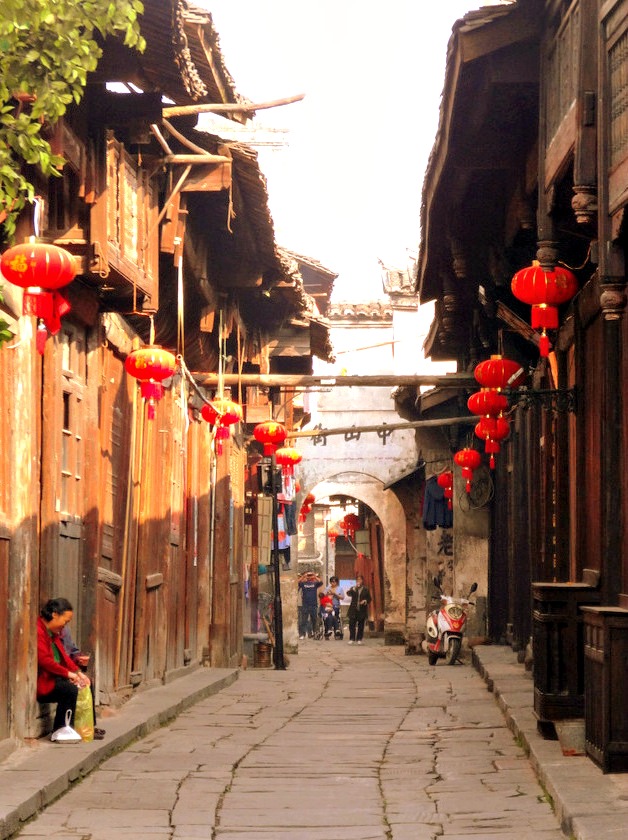
The final photo is of Qianyang, in Shaanxi, an ancient regional political centre that has been forgotten in China’s rush to develop. The streets are lined with dozens of temples, an ancestral hall, and courtyard mansions that belonged to local officials. Most of the city’s walls and four out of fives gates are still standing. There were no tourists when I visited. It felt like stepping back in time and taking a walk in China’s past.

What I find amazing in these pictures is the beautiful architecture and the pristine condition of such old buildings and the cleanliness of the streets. Tell me something, I notice that many of your photos are of buildings or streets. Do you feel reserved about taking photos of people, particularly when they are conscious that you are doing so?
I do feel reserved about taking pictures of other people so I rarely do. The exception is when I have the opportunity to witness a ceremony or special event.

I know this is a similar question but do you ask permission before taking people’s photographs and how do you get around any problem of language?
Since I now travel mostly in China, I ask in Chinese. If I am in a region where people do not speak Mandarin, a hand gesture is usually enough.

Would you say that photography and the ability to be able to capture something unique which will never be seen again is a powerful force for you?
It is indeed. I would add that photography also has the ability to monitor change. In a country like China where everything is growing and changing so fast, photography can be a tool to record how the landscape is transforming.

That’s a very pertinent point, particularly when applied to China. Was there a particular moment when you realized that?
I thought about it a lot while on a business trip to Ningbo, a city of nine million people that is just a couple of hours by train from Shanghai. I had been able to take an afternoon off and wander in the city. I discovered an entire neighbourhood of stone houses built during the late Qing Dynasty (late 19th century), all of which were empty. They were going to be knocked down to build a shopping mall and high-density residential buildings. In China I am constantly thinking that what I see today may be different or not even exist tomorrow.

If someone wants to learn from me, I’ll teach him songs as melodious as cicadas.” – Dong folk ballad

I know exactly what you mean. It almost feels like you are running out of time. I have many old pre-digital photos (35 years old and more). I didn’t realise until now how precious they are. Moving on to the technical stuff (I’m not too good at tech but getting better). Some of our readers will want to know what kind of camera and lenses you use.
I use a very simple point-and-shoot Sony camera.

I must say it works really well and the shooter has a good eye! Finally, do you have any advice for wannabe photographers who are traveling or living abroad?
I think I am in the same position as you. I need advice.

Gaetan, I’d like to thank you for taking the time to tell the story of your exciting journey and for sharing so much interesting information. You may not consider yourself to be a good photographer, but your “point and shoot” pictures embellish your narrative beautifully. Keep following your way and I am sure you will inspire other young people to travel the globe as you are doing. I, for one, will be checking your progress.

* * *

Readers, what do you make of Gaetan’s experiences? Do you have any questions about his photos or his travels? Please leave them in the comments!

And if you want to know more about Gaetan, don’t forget to visit his excellent blog, Travel Cathay. You can also follow him on Twitter: @TravelCathay.

(If you are a photographer and would like to be interviewed by James for this series, please send your information to ml@thedisplacednation.com.)

STAY TUNED for tomorrow’s fab post!

If you enjoyed this post, we invite you to register for The Displaced Dispatch, a round up of weekly posts from The Displaced Nation, with seasonal recipes, book giveaways and other extras. Register for The Displaced Dispatch by clicking here!

Related posts:

For this Filipina with a passion for immersive escapades, a picture says…

Jean Alaba Collage

Canon zoom lens; photo credit: Morguefiles. Jean Alaba in front of moat surrounding Osaka Castle, Osaka, Japan. Photo credit: Jean Alaba.

Welcome to our monthly series “A picture says…”, created to celebrate expats and other global residents for whom photography is a creative outlet. The series host is English expat, blogger, writer, world traveler and photography enthusiast James King, who thinks of a camera as a mirror with memory. If you like what you see here, be sure to check out his blog, Jamoroki.

My February guest is 20+ Filipina Jean Alaba. An extrovert who describes herself as a “God-fearing human being” and a “firm believer of living vividly,” Jean is, without a doubt, fulfilling her passion in life: TO TRAVEL. As she explains on the About page of her blog, The Eager Traveller, travel affords her an opportunity to move outside her comfort zone and grow as a person.

Jean was motivated to start up her blog just over a year ago, as a space to record the re-collections of her travels—which she modestly calls “my humble escapades”—in hopes of inspiring others to “nurture their zeal for new adventures” and of promoting the joy of immersing yourself in “the vibrant cultures across the globe.”

Why am I not surprised that Jean has gathered a considerable following in just over one year? My interview with her may provide a few clues as to why other avid travellers are drawn to Jean and her suggested itineraries.

* * *

Hi Jean. I know it has taken us a bit of time to connect, but I’m glad we finally managed to find some time to discuss your photo-travel experiences. Firstly, I see that you are 20+ (I am also 20+: 20 + 50!!), and for one so young you have travelled a fair bit. Can you tell us where you were born and when did you spread your wings to start travelling?
I was born in the Philippines. This may sound like a cliché but my first source of inspiration for travelling was a National Geographic magazine I saw in our school library.

National Geographic is a wonderful publication. I love it.
But I didn’t spread my wings until I made my first trip to West Coast USA. The Strip struck me the most because everyone there seemed to be having the time of their lives. There was such a lot to experience and yet the time was way too short. After that, I developed a passion to immerse myself in new cultures, interact with unfamiliar nationalities and engage in overseas adventures.

To a fearless person, no fence is high enough.—Filipino tagalong proverb

I assume you mean the famous Sunset Strip that has featured in so many movies over the years? I want to know more about your travels, but let’s start with what it’s like to be a solo female traveller.
So far I’ve travelled for pleasure and for business but as yet have never travelled alone. That’s a hurdle I hope to cross this year. I realize it can be risky, but from the inspiring articles I’ve read online, it’s clear it can also be rewarding.

Even though stepping into the unknown by yourself can sometimes be difficult, even for seasoned travellers, I believe preparation is the key. I’m sure you will be fine. Next I would love to know what what countries you have already visited?
So far, I’ve only been to the United States, India, Singapore, Japan, South Korea, Hong Kong, China and Taiwan. I lived in Singapore as an exchange student for four months, which gave me a a sense of independence and responsibility. Another highlight was my six-week business trip in India, where I had the opportunity of visiting Mumbai, Agra, New Delhi and Jaipur. Here are two photos I took on that trip:

Q9-Taj-Mahal

The Taj Mahal in all of its intricacy. Photo credit: Jean Alaba

The first is of the Taj Mahal. I immediately fell in love with its intricate design. By pure luck, a bird flew across at the moment when I snapped this shot. It was only when I was viewing my photos on my laptop that I realized I had captured such an amazing moment. For me, the bird is special: it symbolizes freedom from all the worries in one’s life and from whatever is holding you back from achieving your dreams.

Q9-Bhawani

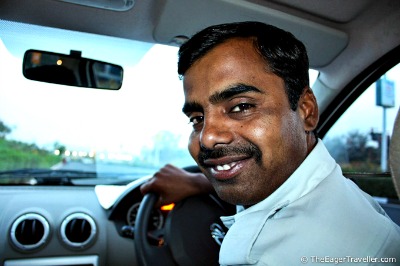
The jolly Jaipur driver Bhawani. Photo credit: Jean Alaba

The second is of Bhawani, the driver assigned to my group during our two-day outing to Jaipur. It reminds me of his kindness and positive disposition in life. He had to take us around Jaipur in the burning hot summer, but never once did he become irritated or impatient. He always had a smile on his face, and that kept us all in a good mood during the trip. In fact, the following week when we went to New Delhi, the company driver assigned to us was totally rude and inconsiderate. At one point he left us in the car sleeping (engine shut off!) while he had his dinner. Worse, when we lightly honked the car to signal that we were awake and frankly not amused, he completely ignored us.

I loved your photo of the Taj Mahal when I first saw it on your blog’s Home Page, but I have to be honest, I never noticed the bird until you pointed it out just now. Maybe that’s good as I was able to appreciate the intricate carvings. Now I’m worried I’ll miss the building and concentrate on the bird!! You’ve captured Bhawani exactly as you describe him; perfect.

One finds a way, or finds a reason to do something.—Filipino tagalong proverb

You are very modest to say you’ve been to “only” eight countries. That’s a lot more than most people visit in a lifetime. So tell us about where are you right now and why.
Well, as you know, James, I am currently in my country of birth, the Philippines, but I’m working out a deal that will hopefully pave the way for life in a new place. I’ll keep you posted.

Q9-Baler

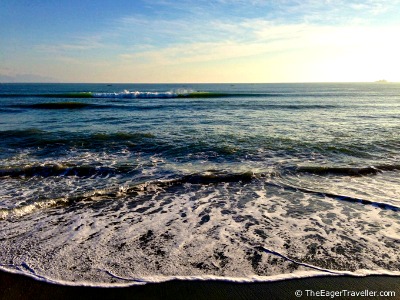
Baler, nicknamed the Philippines’ surfing capital. Photo credit: Jean Alaba

So you are keeping the secret for now, but I’m sure your blog will be give the game away when you are on the move again. The Philippines is a beautiful country and I see you have included one picture in your selection.
Yes, I’ve included this photo of Baler, which is in Aurora province. I like it because it reminds me of my first time attempting to surf and for someone not sporty, I didn’t do too badly. This was also my first time to go beyond my comfort zone in my own part of the world: I travelled for six hours just to catch the waves. It was a spontaneous weekend that proved to be pretty rewarding.

For me, the Baler surf lapping the shore looks just like a welcoming carpet in someone’s lounge.

If you plant, you will harvest.—Filipino tagalong proverb

I know you take a lot of photos but where, so far, are your favourite places to do so? and Can you explain why these places inspire you and how it shows in your next three photos?
My favourite places to take photos so far are India, Japan and Hong Kong. I’ve included one photo of each.

Q10-India

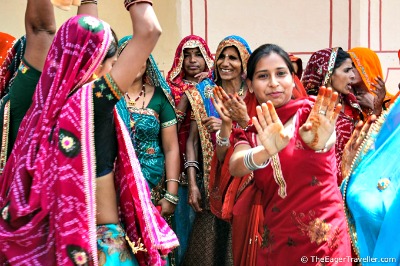
Indian women in colorful saris. Photo credit: Jean Alaba

I like taking photos in India because Indians are very proud of their heritage. This was apparent everywhere we went in India, regardless of the people’s social status.

Q10 Japan

Portraits of Japanese people. Photo credit: Jean Alaba

Japan is a favorite of mine because the people are so organized, disciplined and polite. I never run out of things to see and admire.

Q10-Hong-Kong

A Hong Kong eatery. Photo credit: Jean Alaba

Hong Kong inspires me because of the food! I should think its vast array of local dishes are enough to inspire anyone!

I like that you manage to get a handle on people from the different countries you visit, without actually living in that place. You are clearly a good observer of people, as well as a keen researcher. Tell me, do you feel reserved about taking photos of people, particularly when they are conscious you are doing so?
Not really unless I see they’re offended. But so far, no one has reacted angrily when they see me taking their photo. This is a good thing since I like shooting people. Capturing their unique expressions enables me to glimpse who they are and the kind of lives they lead. I must have taken a thousand portrait shots while in India. Perhaps I’ll get some of these printed and make it my wall art.

I’m the same. I hate to take “posed” photos so never get into a discussion with my subjects. I either take the pic or I don’t. So you like shooting people? Don’t worry; I know what you mean! I think the wall art is a great idea. I know this is a similar question but do you ever ask permission before taking people’s photographs. And how do you get around any language barriers?
Most of the time, I don’t ask but when I was in Japan, where permission needs to be secured for taking photographs of infants and kids, I would politely approach one of the parents and ask them in Japanese—of course with the help of sign language (pointing to my camera and their kids).

Thanks to you, I won’t get into trouble if I ever go to Japan. Would you say that you are motivated by the possibility of capturing something unique, which will never be seen again?
Definitely. You always have to live in the moment, and there is nothing more rewarding than being able to capture the special moments that, unless you have a time machine, you’ll never be able to bring back. Those photos may give you inspiration just when you need it most.

I have to agree, as I think most photographers would. So when did you first realize the power of photography, and how has it changed you?
I first realized it after borrowing a decent SLR for my trip to Hong Kong in 2008. I was able to take high-quality photos to serve as a memento. Ever since, I’ve made it a point to capture moments with my camera, whether during a vacation or simply at a gathering of family or friends—moments I’ll be wanting to view when I get old and grey.

I know what you mean. The picture for me is like a diary of an event in visual form. The photographer can write about it but no one else could.

When the sheets are short, one needs to make do.—Filipino tagalong proverb

Most readers will know by now that I’m not too good on the technical stuff but some of our readers will want to know what kind of camera and lenses you use.
I’m still using the borrowed camera; it’s a Canon 450D. I use the kit lens and a prime lens. It’s outdated equipment now.

You sound a bit like me except that I haven’t managed to borrow any equipment yet. And you aren’t asking me for technical advice. That’s great!! Finally, do you have any advice for wannabe photographers who are traveling or living abroad?
I don’t feel I’m in a position to give advice since I haven’t really achieved anything noteworthy. But I would say from my experience, don’t hesitate to take as many pictures as you can while travelling. Before embarking on a journey, research and learn from the professionals online. You can try copying them, using a trial and error process.

I actually think that is very good non-technical advice, Jean. I’d like to thank you for taking the time to tell your story so far in this interview. On your blog you say:

It has been a spectacular life so far but there is so much more to be seen! I have yet to find that life-changing opportunity which will allow me to do my passion for travelling and blogging as a living.

I have no doubt you will find that opportunity. I’m booking you in for a follow up interview next year to check your progress!!

* * *

Readers, what do you make of Jean’s experiences and her photography advice? And do you have any questions for her on her photos and/or travels? Please leave them in the comments!

And if you want to know more about Jean, don’t forget to visit her excellent blog, The Eager Traveller. You can also follow her on social media:
Twitter: @eagertraveller
Instagram: theeagertraveller
Google+: Jean Alaba

(If you are a photographer and would like to be interviewed by James for this series, please send your information to ml@thedisplacednation.com.)

STAY TUNED for tomorrow’s fab post!

If you enjoyed this post, we invite you to register for The Displaced Dispatch, a round up of weekly posts from The Displaced Nation, with seasonal recipes, book giveaways and other extras. Register for The Displaced Dispatch by clicking here!

Related posts:

TCK TALENT: Why do so many Adult Third Culture Kids gravitate toward acting, and is that the best use of their talents?

Com & Trag Collage

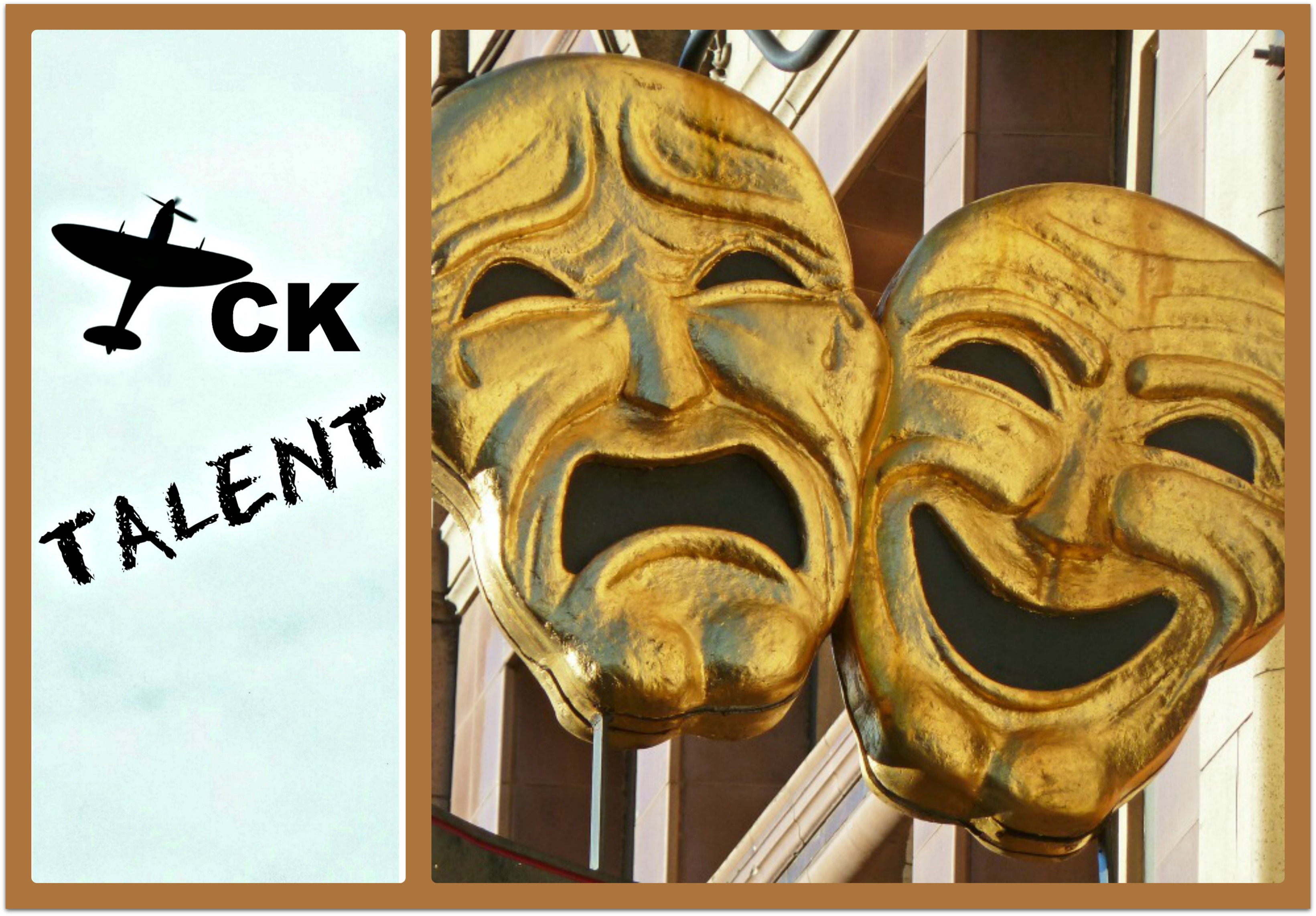
Tragedy and Comedy, Scarborough Hotel, Bishopgate, Leeds. Photo credit: Tim Green via Flickr.

Elizabeth (Lisa) Liang is back with her monthly column about Adult Third Culture Kids (ATCKs) who work in creative fields, Lisa herself being a prime example. A Guatemalan-American of Chinese-Spanish-Irish-French-German-English descent, she has developed her own one-woman show about being a TCK, which will be the closing keynote at this year’s Families in Global Transition (FIGT) conference, “The Global Family.”

In my last column, I interviewed Laura Piquado, a professional actress based in New York who grew up in six countries, including Egypt, where we were drama classmates in high school. As a result of the interview, Laura, editor ML Awanohara, and I had a lively discussion about Laura’s career change from education/activism to acting.

ML said she was puzzled as to why so many intelligent, well-educated Adult Third Culture Kids feel so at home in the acting world. She expressed concern that acting might cultivate a narcissistic outlook on life, which is the opposite of a TCK’s worldly upbringing. She said she found it particularly jarring that Laura could go from go from almost doing a PhD on women’s education in post-conflict societies, to enrolling in acting school—and not look back.

Laura’s response was so eloquent that I am posting it here.

Before you read it, I recommend watching this TED Talk by British actor Thandie Newton:

Born to a Zimbabwean mother and English father, Newton always felt disconnected or “other” while growing up in the UK:

“From about the age of 5, I was aware that I didn’t fit. I was the black, atheist kid in the all-white, Catholic school run by nuns. I was an anomaly.”

Acting gave her a chance to play with her different selves.

And now from Laura Piquado:

I had a similar reaction to yours, Lisa, in seeing acting described by ML as a narcissistic endeavor. While I can certainly understand that reputation (indeed, the Golden Globe awards), I have always idealized what theatre can be: life-changing, hopeful, inspiring, and necessary. It’s the worst to be onstage with someone who’s “masturbating” their way through a show (and equally as painful for an audience member).

I was in Maine a few years ago at a craft school (I’m a potter), and I sat next to a visiting artist at dinner (the amazing Hungarian-born sculptor Gyöngy Lake). She asked me what I did. When I told her I was an actor she said:

“We love you! We need you! You tell the stories of our lives!”

Now while that sounds uber-maudlin, I was completely overwhelmed. I had known this woman for less than two minutes, but she had described, for me, what the essence of art is.

On the other hand, I don’t want to get beaten over the head with social and political commentary every time I go to the theatre. I mean, I love Brecht, but can you imagine if that’s all theatre was? Mother Courage after Mother Courage, after The Caucasian Chalk Circle, after Arturo Ui…ugh. People would stop going. There’s room for pomp-y, wacky, ridiculousness (all hail The Book of Mormon), and everything in between. But I do think theatre at its best, the stories that stay with you, are the ones that connect to a deeper human context.

I was reading an interview with Supreme Court Justice Stephen Breyer in the New York Review of Books where he recounts a story he heard while a law student:

At the turn of the last century, the court was called upon to decide a case on prices for theater tickets—could they be considered basic necessities, and could they be regulated as such? The majority thought the theatre was not a necessity. The great Justice Olive Wendell Holmes Jr. replied in his dissent: “We have not that respect for art that is one of the glories of France. But to many people, the superfluous is the necessary.”

The interview was a larger discourse on France and Proust, but the point Holmes made about the necessity of art resonates.

ML also made the comment:

An interest in international affairs implies that you care about effecting positive social change on behalf of less fortunate people… Do you foresee bringing those two strands of your life together at some point?

The notion of “effecting positive social change” is what I’ll respond to. Again, it’s what I believe theatre can be, from Winter Miller‘s In Darfur to Moisés Kaufman‘s The Laramie Project. Being a part of that kind of theatre is deeply gratifying and something I always seek out. (Or as a potter: being able to go to communities to work with local artisans to make pots that filter clean, potable water falls into that same category.)

The leap from one discipline (social justice through academia) to another (theatre) wasn’t so quantum for me. And while they are vastly different on so many practical and actual levels, “effecting positive social change,” for me, lies at the heart of both.

* * *

So, readers, do you have anything to add to the debate? Are we ATCKs doing ourselves, and the world, a disservice by turning to acting, or can acting be one of our more profound contributions?

STAY TUNED for next week’s fab posts!

If you enjoyed this post, we invite you to register for The Displaced Dispatch, a round up of weekly posts from The Displaced Nation, with seasonal recipes, book giveaways and other extras. Register for The Displaced Dispatch by clicking here!

Related posts:

TCK TALENT: Laura Piquado, New York City Actress & One Well-Traveled Kid!

Laura Piquado Collage FINALWelcome to Elizabeth (Lisa) Liang’s monthly column about Adult Third Culture Kids (ATCKs) who work in creative fields, Lisa herself being a prime example. A Guatemalan-American of Chinese-Spanish-Irish-French-German-English descent, she recently debuted her one-woman show about being a TCK, which I had the pleasure of seeing during its too-short run in New York City in September of last year: stupendous!

—ML Awanohara

Happy new year, readers! Let’s start today’s interview by plunging right in. My guest is Laura Piquado, a professional actress based in New York who grew up in six countries, including Egypt, where we were drama classmates in high school.

* * *

Welcome to The Displaced Nation, Laura. It’s wonderful to reconnect with a Cairo classmate! I know you grew up as the daughter of a pair of teachers who were full of wanderlust. Can you give us a run-down of the countries you lived in as a kid?
My mother always told me that her earliest dream memory was of wanting to move to Africa. And as soon as she graduated from university in Canada, that’s what she did. She met my father in Sierra Leone in the mid 1960s. He was there with the Peace Corps, while she was being sponsored by CUSO (Canadian University Service Overseas)—a Peace Corps-style organization. They left when my mother was six months pregnant with my brother. My mother is tall, almost 5’11”, but at that time weighed only 120 lbs. I think having parasites, or the occasional bout of malaria was commonplace, but the risk to her health became too great.

After my (healthy) brother was born in Washington, DC, my parents decided to go overseas again. The first job my dad got was as an English teacher in a small village in northern Newfoundland, where I was born. Less than a year later, we moved to Beirut, Lebanon. Four years after that, when war broke out, we were evacuated to Shahin-Shahr, Iran, for almost four years. War broke out again, and we were evacuated again. The next stop was São Paulo, Brazil, for two years. My mom and dad hated the city, and we left every other weekend and holiday to get away from it. Consequently, my memories of Brazil are of travel, and of everywhere but São Paulo. After Brazil, we lived for four years in Bontang, Indonesia, which is in the province of East Kalimantan on the island of Borneo. After seventh grade we moved again, to Cairo, Egypt, where I graduated high school. That’s where you and I first met! My parents then moved on to Ecuador and China for 16 more years.

My parents loved being overseas, and at no point did they yearn to “come home.” They wanted their lives to be as teachers in international schools, and for 40 years that’s what they did. They retired a few years ago to a small town in New Hampshire.

A hard landing into adulthood

How did you feel about living in so many places?
I loved it, actually. Adjusting to new environments, new friends, new cultures, languages, was never difficult for me. I don’t know why. Perhaps I just got used to it. But I don’t think you ever get used to leaving friends and people you love—that’s always hard.

As an adult, do you find yourself drawn to other TCKs?
I definitely identify with other TCKS, though it’s not always a given we will hit it off. In fact, I used to be magnetically drawn to anyone who was a visible minority. “You’re from Indonesia?! I used to live in Indonesia!” “Hey, you’re Alexandrian! I lived in Cairo for 5 years!” I was always wanting to make a connection with a world that was no longer mine—and maybe never was mine, if I adhere to the rules of 3rd culture. But just because someone grew up all over the world as I did, or just because they are an actor like me, doesn’t guarantee I’ll be friends with that person—but it’s a starting point. And if a person grew up in different countries, at least their eyes won’t glass over when I answer the question, “Where are you from?”

You now live in New York City. How do you find life in the USA?
I’ve lived in the United States longer than I’ve lived anywhere else. Yet it’s the first place I’ve ever lived that doesn’t feel like home. For the first 20 years of my life I played with my friends, explored the jungle, hiked the Andes, swam in the Red Sea and the East Timor Straights, climbed salt flats, made forts in the desert, went horse-back riding around the Great Pyramids, woke to gibbon songs and the muezzin’s call to prayer. And then I came back here to go to school, get some degrees, get a job, and try to figure things out… I had this exhilarating childhood, and then this less-than-thrilling transition to adulthood.

Does your identity revolve around any one particular culture that you’ve lived in?
I am Dyak and atheist, Muslim, Christian, Bahá’í, Jain, Egyptian, Italian, Canadian—there is nowhere in the world that has ever felt foreign to me. I am all of these things, and none of them. After moving to the United States for the first time for college, being able to be all of them at the same time was what mattered the most. I was striving to understand who I was and what my life had been, and trying to share that with others, even if I couldn’t articulate it to myself. It’s taken a long time, and I suppose I’m still working at it. That said, I love meeting the kind of person who, unlike me, was raised in the same town he or she was born in, and still goes back there for family visits and holidays. I am attracted to the sense of being anchored somewhere, to a particular place. That perceived sense of belonging somewhere: it’s something I just don’t have; I don’t know what it feels like.

From an actor on the global stage, to an actor on a real stage

Tell us what you studied in college and how you made the leap to pursuing an acting career.
I did my master’s degree in Islamic Studies at McGill University in Montreal. I wanted, as an adult, to understand the cultural, political, and social environments in which I grew up. On some level I was looking for a path that would take me overseas again, which I was aching to do. I wanted to work in the development of women’s education in post-conflict societies because it was work that I was passionate about.

Just as I was finishing my degree, and thinking about streamlining into a doctoral program, I went back to Cairo. I hadn’t been back since high school. For a whole month I walked through the streets of my old neighborhood, saw my friends, went to mosques and bazaars and the Red Sea, and smelled and ate and absorbed Egypt again. It was glorious. But something changed in me after that, and made it okay for me to move on.

When I came back to Montreal, I started applying to drama schools. Although I had been involved in theatre since I was a kid, I hadn’t wanted to study it as an undergrad. There were other things in my life that I needed to address before I embarked on that.

But now I was ready for drama school—I enrolled in the London Academy of Music and Dramatic Art. At LAMDA, I felt like I was flying. I was so happy. To allow myself the ability to change horses mid stream, and for it to feel natural and fluid and right—that was tremendous. I don’t think any of us is just one person, and we aren’t the same person at 15, 25, 35, 55. We have multiple loves and lives and wants, and finding ways to marry them all, if we’re lucky enough to know what they are in the first place, can be overwhelming.

How did your family react to your decision to pursue an acting career?
I’ve only ever had a supportive family. So instead of calling me a flake, or accusing me of lacking any sense of stick-to-itiveness when I told them I wanted to go to drama school, they became, again, my most enthusiastic supporters.

I think our peripatetic childhoods trained us to be actors—to observe, listen, and adjust our behavior to our surroundings. Do you agree?
I do agree, for the most part. But I also think personality has a lot to do with it. Just because you grew up all over the world doesn’t de facto make you a keen observer, or an astute listener, and not all kids who move around a lot are able to adjust to their changing environment. On the other hand, if you have had a peripatetic life, and you also happen to be a good listener, observer, etc., it seems it can only enrich your depths as an actor (and certainly as a human being). For me, adaptability became a defining aspect of my personality.

I think that for us TCKs, the challenge of convincing a casting director that you truly can be this other person is made easier because of all of those things we bring to the table—listening, observing, adjusting, maybe even having lived or known the character’s life. But also for that reason, many of us find it even harder to put up with being typecast.

Which sorts of roles are you attracted to, and do you think your upbringing influenced this?
I’m usually attracted to damaged characters, or quirky ones. And accents are always juicy! I’ve always been a mimic, and am grateful for that gift as it makes it easier to play a variety of roles. Why I’m drawn to quirky characters is less apparent. Does it have something to do with my upbringing? That’s an interesting thought. I’ve never made that correlation, but it makes complete sense.

So which parts have been your faves?
I loved playing Goneril in King Lear with the Texas Shakespeare Festival. I’ve always thought that she’s been inappropriately maligned as a character. Lear is not the easiest father—demanding, impulsive—and to require his daughters to prove, to prove, their undying love for him—for the sole purpose of measuring it against their inheritance—makes him something of a jerk in my book.

Playing the painter in Ionesco‘s The Painting with the Phoenix Theatre Ensemble was pretty great as well. Aside from the play’s absurdism, the part was perverse because of the the vocal and physical qualities we decided on. It’s not often that you get to play grotesque and obsequious, mismanage your voice, throw out your back, and sprain your jaw because the part demands it. Fantastic! 🙂

And a role on the damaged front, I suppose, was Charlotte in Sharr White‘s Sunlight, for its world premiere with the New Jersey Rep. While I’m less attracted to straightforward, modern dramas (though in truth, I love it all), the whole premise for who Charlotte is, for what motivates and oppresses her, is her having been in the Towers on September 11th and losing her child as a result of the trauma. And while that’s not what the play’s about (thank God!), it defines who she is able to become (or not become) in the ensuing decade.

* * *

Wow, that’s an impressive list! Thank you, Laura! I wish you the very best in your career and hope to see you on stage and/or screen soon. Readers, please leave questions or comments for Laura below.

STAY TUNED for tomorrow’s post, from our Global Food Gossip!

If you enjoyed this post, we invite you to register for The Displaced Dispatch, a round up of weekly posts from The Displaced Nation, with seasonal recipes, book giveaways and other extras. Register for The Displaced Dispatch by clicking here!

Related posts:

For semi-retired expat blogger James King, a picture says…

Welcome back to our series “A picture says…”, which we created to celebrate those for whom photography is a creative outlet—who rely on a camera to register the look, character, and ambiance of the people and places that capture their fancy as they move around the globe.

Today’s guest is English expat, blogger, writer, world traveler and photography enthusiast James King. From December onwards, James will take over the hosting of this column from Andy Martin and publish it monthly.

As James plans to ask his interviewees to provide a selection of photos that help to tell their personal travel stories, it seems only fair that we require him to undergo the same exercise. What pix would he use to illustrate his peripatetic life of the past 25 years?

Indeed, “peripatetic” seems an apt descriptor for James. Semi-retired and now living in Chiang Mai, Thailand, he has traveled to over twenty countries. He lived in South Africa for a couple of decades and Thailand for the past five years. Here, in summary, are his vital travel stats:
Place of birth: England, UK
Passports: UK and EU (British citizen)
Resident in: UK (Bristol): 1942 to 1995; South Africa (Durban, Johannesburg, Cape Town): 1995 to 2008; Thailand (Chiangmai): 2008 to present.
Main countries visited: France, Spain, Greece, Italy, Morocco, Gambia, Kenya, Botswana, South Africa, USA, Thailand, Malaysia, West Indies.
Business interests: Majority shareholder in WestJewel (Pty) Ltd., a Cape Town jewelry wholesaler he founded in 2004.
Social media coordinates:
Twitter: @JimKing28265666
Facebook: Jim King
Linkedin: James King
Google+: jamoroki@gmail.com
Blog: Jamoroki.com

* * *

A bloomin’ late bloomer!

Hi, James. I see you were born in England during World War II. When did you actually start traveling?
Life was pretty austere after the war, we had rationing and people lived a fairly simple life. There were very few restaurants and I don’t actually remember ever going out to eat with my parents. Don’t get me wrong, we weren’t on the “bread line”; but it just didn’t happen in those days. We had TV for the first time in 1953, and it wasn’t until I was 24 that I first traveled overseas; to Paris in fact. When I got into my thirties, then I really started to spread my wings but I was very busy trying to make a living so I didn’t have the freedom I gained later in life. Only then was the adventurous side of me given wings, so to speak. Eventually, at the age of 53, I packed my bags and emigrated to South Africa after a few sorties there in the three years before.
SouthAfricanBeach_JK

Photo credit: James King

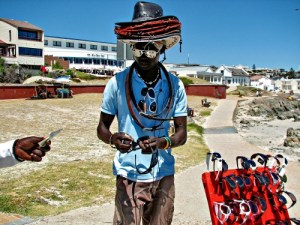
Okay, time to see your first photo. What’s the story behind this one?
This guy wears many hats and makes a living selling his wares on the beach at Bloubergsands, which is close to the house that I bought (and am now trying to sell!) in Table View in Cape Town. Generally these traders are not South African. They often travel a very long way from neighboring countries such as Zimbabwe, Zambia and Mozambique. Many of them dodge border posts by hiding in the back of goods trucks. They all hope to make a new life in South Africa after escaping from oppressive regimes or poverty. Some of them are intelligent, articulate and well educated, as I remember this guy was.

What do you like most about this shot?
I like that it highlights the harshness of Cape Town light. The ozone layer is so thin there—I had to be far more careful of the sun than I do in the tropics. I also like the photo because at that time, I wasn’t into photography at all and had even less idea about what I was doing than I do now. I always have to be aware of what harsh light can do to my pics.

Okay, let’s move along to another photo that speaks to your South Africa experience.
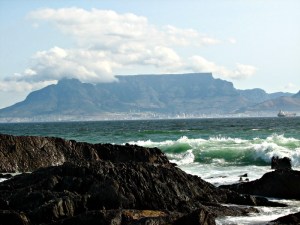
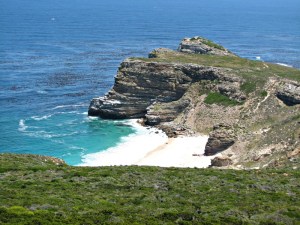
Can I have two shots, please? One of the Cape of Good Hope and the other of Table Mountain, with Cape Town below.
EndoftheEarth_JK

Photo credit: James King

TableMountain

Photo credit: James King

For me, these photos bring back memories of how wonderful the landscape is in that part of the world. So overwhelming, you really have to experience it in person. Just think, we are at the Cape of Good Hope, the bottom of Africa! And, despite how beautiful it looks, you don’t want to know how cold that water is. Naked you may survive ten minutes in there!

What particularly appeals to you about the Table Mountain photo?
I love how the clarity changes as soon as you hit the shore line below the mountain. It really is like that and not a cock-up on my part. It won’t win awards, but it is very personal so I love it.

How did you end up in Cape Town?
How long have you got? Things went a bit wrong for me in England after I got divorced, and then I met a guy who used to live in Durban and still had some business interests there. His wife had died the previous year so we were both single and hit it off. He had to go to South Africa again, so we decided to go and work together. That’s the “nutshell” version.

Semi-retirement in the Thai tropics

And now 20 years later you are in Thailand. How did that happen?
I’ll have to get the “nutshell” out again. In 2004, with some backing, I bought a jewelry wholesale business. Most of our silver is sourced and manufactured in Thailand, and I took on the responsibility of buying overseas. So I started traveling to Bangkok to meet suppliers and go to the Gems and Jewelry Fair in March and September. I met so many new people and also took a couple of holidays in Phuket before going back to Cape Town. Gradually I got a taste for SE Asia and, after a few years, decided to stay for four months getting to know more whilst still working remotely. That was it. Semi-retirement in the tropics beckoned and I was hooked!

I imagine it’s all been plain sailing since you moved to Thailand. Just kidding! I see from your blog you’ve had your struggles.
It is very difficult to précis my life over the last four years. I wrote my first book, the memoir MASK, to try and show the different sides to Thailand, its people and their culture. The book isn’t everybody’s cup of tea, but it was a cathartic exercise and helped me a lot. I should add that I didn’t include everything in it. The rest may come out later. But now I have a new lease of life and am so pleased I found blogging and photography because I believe the two go hand in glove. Writing, which has been a passion of mine for a long time, can embellish the photos and photos can enhance the writing, so in blogging you have the best of both worlds.

You say that photography gives you the ability to be able to capture something unique, which will never be seen again. What brought you to this realization?
I have always admired great photography while not having time to pursue it because I was working. Now, through my blog, I am learning how to incorporate photos into my posts. It’s fair to say my appreciation is growing as I hope will my knowledge. Writing is still my primary passion, but I now have another tool in my observation box. Although late in life for me, we are so lucky to be living in a technological age where we have the tools to enable us to express ourselves like never before. Sorry to take over the interviewing, but don’t you think it is so amazing?
Thailand2_JK

Photo credit: James King

But of course! Getting back to you and the photos that capture special memories: what do you choose next?
Actually, on my “to do” list is scanning some of the photos from my pre-digital collection, beginning in the 1970s, a number of which carry powerful memories and should help to create some rather interesting blog posts. In the meantime I have selected three of my more recent favorites for you.

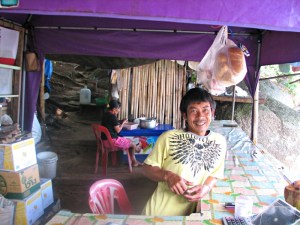
The first one shows this guy and his wife who live in their little house at the end of Kata Noi, a beach on Koh Phuket. Every grain of sand is polished every day, they welcome everyone whether you want a drink or something to eat or just to say hello. They have a few beach loungers as well if you want to relax there. If you can have a more simple stress free existence, I’d like to know about it. On this particular day, I visited early one morning before the tourists woke up, and they made me feel most welcome.
Thailand3_JK

Photo credit: James King

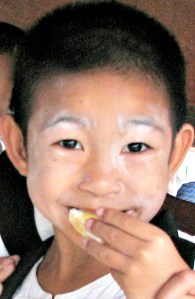
This little seven-year-old boy lives in my village in Chiang Mai. As you can imagine he is very naughty and the older children tease him unmercifully. So he comes to my house at weekends to annoy me and get chocolate and biscuits. He always wants me to take his pic, and on this occasion I caught him waiting for the school bus. He felt very proud.

Let’s not get technical

What kind of camera and lenses do you use?
Please don’t ask me anything technical. It says on the bottom “Canon PC1130” and on the front “Power Shot S2 IS”. One fixed lens 12x Optical Zoom with lots of numbers on it. It has lots of settings but I don’t know what they are for so I leave it on auto-pilot and hope for the best. Oh, and most importantly, the rechargeable batteries are held in with an elastic band. I haven’t got a clue whether it is any good or not: I just shoot and ask questions afterwards. But sometimes I do worry that my photos are not so good when I see many accomplished photographers blogs. I just console myself I must work extra hard on the subject matter.
ThaiWhiteTemple_jk

Photo credit: James King

I think you have one more Thai photo?
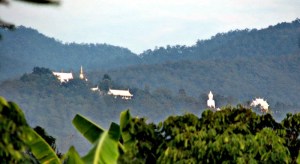
Yes, this one: the white temple in the forest, which can be viewed from my village. This is very special because most of the time, although I know it is there, I can’t see it for mist or haze. Then one evening it was there and so was I with my camera!

Where have been your very favorite places to take photographs?
On safari in Kenya, Mykonos Island in Greece, and here in Chiang Mai where, even though I say it myself, I’ve managed to capture some beautiful morning and evening landscapes.
MykonosTown_JK

Photo credit: James King

Do you have a shot that’s your all-time favorite?
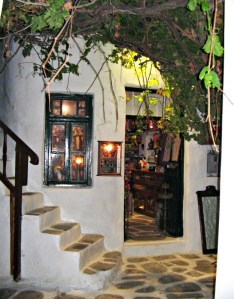
I pick this one, of a house in Mykonos Town, taken in 2005. I think it will always be one of my favorites.

A few parting shots

Do you feel reserved about taking photos of people, particularly when they are conscious that you are doing so?
It’s a very good question because I am always conscious that they may be shy and so I try and make a quick judgement call. But I do have an aversion to posed photos in the natural environment, so getting the balance right is important to me.

Do you ask permission before taking people’s photographs?
I just try and feel how they feel if they are aware I want to shoot them. I prefer to take them when they are unaware, then smile and say thanks. Otherwise I don’t get the naturalness I want. Look, I’m not experienced so I am not over-confident and I need all the advantages I can get. I find people will show you pretty quickly if they don’t want their picture taken.

But how do you get around problems of language?
Funnily enough I find not speaking the same language gives me an excuse not to ask. I have a smattering of Thai so the people here know I’m not a tourist, which definitely helps a bit.

Finally, do you have any advice for wannabe photographers who are traveling or living abroad?
In a nutshell (there I go again!), here are two pieces of advice:

  1. Never leave your camera at home or you may miss the shot of a lifetime out of nowhere. (Up until recently I have regretted not taking my camera on so many occasions. Now I hardly go anywhere without it, so much so that I often feel like a Japanese tourist. Believe it or not, most of my best shots were taken when I forgot to put in the SD card!)
  2. If, like me, you are not proficient, use other skills such as writing and storytelling or bizarre scenes, so that the photos don’t have to stand alone, to be judged naked.

* * *

Thank you, James! Readers, what do you make of James’s experiences and his photography advice? And do you have any questions for him on his photos and/or travels? Please leave them in the comments! (If you are a photographer and would like to be interviewed by James for this series, please let me know: ml@thedisplacednation.com.)

Once again, if you want to read more of James, be sure to check out his blog, Jamoroki.com. (Hmmm…I suspect there’s a story in that name!)

STAY TUNED for tomorrow’s post, an interview with November’s featured author, a novelist!

If you enjoyed this post, we invite you to register for The Displaced Dispatch, a round up of weekly posts from The Displaced Nation, with seasonal recipes, book giveaways and other extras. Register for The Displaced Dispatch by clicking here!

Related posts:

Main image at top of page: Camera lens from Morguefile; James King at the Khao Panong Rung Khmer Temple near Buriram, NE Thailand. All other images by James King.

For travel addict & photography lover Milda Ratkelyte, a picture says …

Milda M CollageWelcome to the second installment of “A picture says,” a series that sheds light on the people who move through our planet with a camera in hand, registering the look, character, and ambiance of people and places that capture their fancy.

Our guest today is Milda Ratkelyte, a camera-happy Lithuanian whose wanderings have taken her to the UK, America and now Asia.

Here are Milda’s vital travel statistics:
Place of birth: Lithuania
Passport: Lithuanian
Overseas history: From least to most recent: United Kingdom (London): 2005-2008; China (Wuhan, Shanghai, Beijing): 2008-2009; United States (California, Colorado, New York): 2009-2010; United Kingdom (London): 2010-2011; Singapore: 2011-present.
Occupations: Travel Community Manager at AsiaRooms.com and owner of Milda Ratkelyte Photography
Social media coordinates:
Twitter: @MildaRatkelyte
Facebook: Milda Ratkelyte Travel
Instagram: @milda_ratkelyte
Google+: Milda Ratkelyte

And now let’s meet Milda and find out: which came first, the photography obsession or the peripatetic life?

Kenyan curiosity

Hi, Milda. Let’s talk a bit about your travels. You are originally from Lithuania but have spent a considerable amount of time in other countries and now live in Singapore. Tell me about how that came about, and what inspired your moves.
I had the most amazing childhood in Lithuania. I was very lucky, because my dad was a true travel fanatic. Back then it was not easy for us Lithuanians to go traveling to remote destinations outside of Europe, but my dad found a way to get us to Kenya for a summer. From that time on, I was addicted to travel, and have been wandering the world ever since. “Explore, discover and get to know different cultures and people around the world”that’s become my mantra.

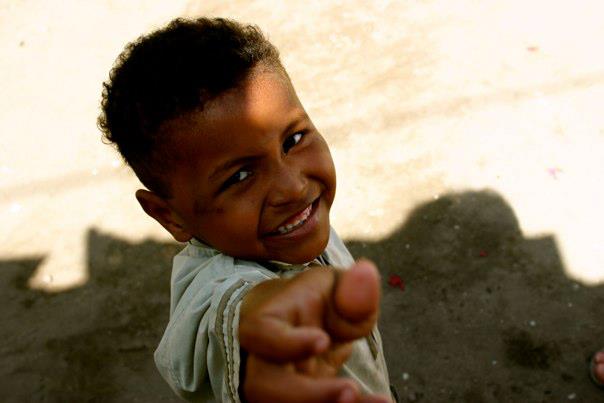
Boy reaching for candyKenya sounds amazing. Can you share with us one of the photos from that trip?
I like this shot of a boy reaching for what he hoped would be candy. It’s from the early days of my camera experience, but I love it because it’s just so natural. There was no set up, no preparation. I was wandering the streets of the Watamu village, looking for the school where I was volunteering, when a group of kids ran towards me asking for candies. I didn’t have any on me, but I had a pack of pencils that I was carrying to the school, so I gave them out and decided to take a photo of the group. As I was setting up the shot, this boy ran from the end of the street. Noticing something was being given away, he squeezed through other kids and jumped right in front of the camera.

Asia calls!

How did you end up in my native land, the UK?
When I graduated from high school, I knew that I want to do something travel related. I enrolled in an International Tourism Management course at the University of Bedfordshire in the UK. For my work placement, I was sent to work in China for the Shangri-La Hotels and Resorts, which gave me the chance to explore some other Asian destinations such as Hong Kong and Singapore. I fell in love with Hong Kong and told myself that once I graduated, I would definitely be coming back. However, when that moment occurred, reality kicked in: I could not get a visa for Hong Kong. I’d decided to stay in London when an opportunity to work for a major events company in Singapore suddenly landed on my doorstep. I had my bags packed in a few days and was on the 14-hour flight to Singapore.

How do you like Singapore?
I’ve been in Singapore for two-and-a-half years already and absolutely love it. Mostly, because it’s the most convenient spot in Asia travel wise. In just two hours I can be in Bali, Hong Kong, or Thailand. And Malaysia is just an hour’s bus drive away.

Luck strikes again

On your blog you say you were “one lucky girl” in finding your current position as a Community Manager for AsiaRooms, a site for booking hotels throughout Asia. Tell us how that opportunity came about and how it fits into your life ideals and love of travel.
When I moved to Singapore, I was working for an events company in the oil and gas industry. While I loved the thrill of closing huge deals, I had no life. The hours were long, with weekends in the office and sales calls at all times of the night. After about half a year, I missed having time to travel, take photos, explore and discover! I started looking around for something in the travel industry, and that was when I got introduced to my current boss, who mentioned that AsiaRooms.com were looking to hire a Community Manager. It was a dream come true. Today I can definitely say I love my job! I have been working on the launch of AsiaRooms.com Community site together with an amazing team, and we’ve already achieved some incredible results. I have also gotten a chance to study and have completed MatadorU’s Travel Writing and Photography courses. But most importantly, I’m getting to work with some amazing and talented photographers, filmmakers, writers and musicians in Asia and across the world while traveling a lot! This year I will finally tick off all the places on my bucket list for Asia.

Passionate about photographybut not equipment

On your blog you say that you love photography “and being able to freeze a particular moment in time, so when things in life change you have the one thing, one memory that never will.” What are the shots that capture some of your favorite memories? And what made them so special?
It is hard to say which ones are my favorites since there are just so many of them, and every trip I make is special. But if I had to choose, I’d pick the photos from the trip to Kenya such as the one above. That was the first time I got exposed to a truly different environment. It was also the first time I experimented with my DLSR, which was a present from my dad. My dad passed away unexpectedly last year, and I feel sad that I’ll never get to travel with him again. But having those photos reminds me of him and of the reason I started traveling.

What kind of camera and lenses do you use?
I have a Canon 300D with two Canon lenses: 18-55mm and 70-300mm. When I was doing a short weekend photography course, my tutor joked: “This girl is truly passionate about photography and not equipment.” My camera was so old it did not have half of the functions they were using during the course!

But although the camera has huge sentimental value, I think I will need to invest in a new one soon, since I have started MatadorU’s Travel Filmmaking course and will need a camera that can capture video.

A “no holds barred” approach to people as subjects

Where have been your favorite places to take photographs? Any particular shots stick out as being amongst your favorites?
My two favorite spots are Myanmar and Japan: Myanmar, for its amazing people, who are always smiling, and the colors of its markets, nature and city life, as well as incredible sunsets and sunrises over the ancient city of Bagan; Japan for its nature, culture and architecture. The old streets of Kyoto, the underground cafes and restaurants in Tokyo, hip people in the Harajuku district, lush greenery and deer in Nara, and bamboo groves in ArashiyamaJapan is just naturally photogenic.

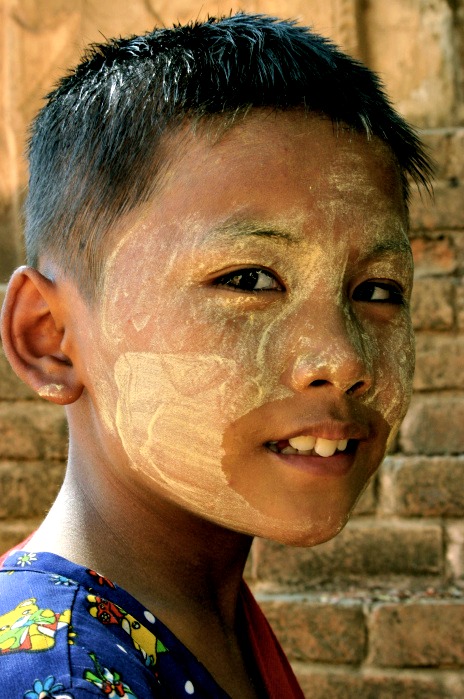
ThanakaBoy_mmIn your shots of Myanmar, I noticed one of a young child. Tell me about how that shot came about and what exactly is going on!
It was taken in Bagan, Myanmar, which is full of the remains of temples and pagodas. That particular morning we’d grabbed our bikes and were exploring the terrain, when I was approached by this young kid trying to sell me his drawings for a dollar. They were crayon drawings of the temples, neatly packed in plastic bags. The boy spoke almost no English, but soon he became my little tour guide, showing me around all the ruins. After our little tour we sat on the old dusty stairs at one of the temples, and while he was trying to tell me more about the place, this perfect photo opportunity appeared. I just love the look in his eyes.

I often feel very reserved about taking photos of people, particularly when they are conscious that I am doing so. Are you the same?
I used to be very reserved about it, but at the same time I knew that this was a major obstacle if I want to progress with my travel photography. I think I came to realize that after traveling around with my boyfriend, who is also a photographer and who has never had hang-ups about this! He doesn’t find it difficult to go straight to someone and ask them to take a photo. At the beginning I used to stay back and watch him, but when I saw how his shots turned out, I realized I needed to overcome this barrier.

Do you ask permission before taking people’s photographs?
It was hard at the beginning, because the truth is you will get a lot of people who will just tell you NO, but at the same time you will get the few that will be very nice to you. I guess my main advice would be to definitely ask them first, and if they don’t agree, leave it! If they do agree, have a little chit chat with them to ease the atmosphere and, once you take the shot, show them how the photo looks, I’ve noticed a lot of people appreciate that!

But how do you get around the inevitable problem of language barriers?
Well, I always try to learn at least few words in the local language before I visit country, like “please,” “thank you”, “hello”, etc. As for the rest, I just point to the camera, then at the person, and smile 🙂 Usually this works—and trust me, the results will be worth the effort.

Parting shots…

Finally, do you have any advice for wannabe photographers (like me) who are traveling or living abroad?
1. Never leave your camera at home. The truth is, some of the most amazing photos are from the moments that come out the blue. It doesn’t have to be an incredible place, it might just be the street you walk down every day. Even if it’s just your iPhone camera, have something at hand.
2. Don’t let rejections stop you from achieving your dreams. I must admit, I have been trying to pitch different publications, blogs, magazines, etc for over a year and all I got were either unpaid opportunities or rejections. And it’s hard to keep motivated, when someone says that your photos are not good enough. But I’ve carried on pursuing my dream and finally, a year later, I am getting paid assignments and, what’s even more important, people are finally starting to look for me and not me for them. As a Community Manager at AsiaRooms.com, I source the photo and video content myself, so I get about 30 pitches a day from very talented people. The roles are reversed: I am the one who is telling someone that we will not be publishing their work. However, in most cases, it’s not because their photos are not good, it’s because the industry is so competitive and businesses like ours can choose only the very best. Knowing this helps me to deal with my own rejections.

Thank you, Milda! Readers, what do you make of Milda’s advice on shooting people? And do you have any further questions for her on her photography, travels, or anything else? Please leave them in the comments!

STAY TUNED for next week’s fab posts!

If you enjoyed this post, we invite you to register for The Displaced Dispatch, a round up of weekly posts from The Displaced Nation, with seasonal recipes, book giveaways and other extras. Register for The Displaced Dispatch by clicking here!

Related posts:

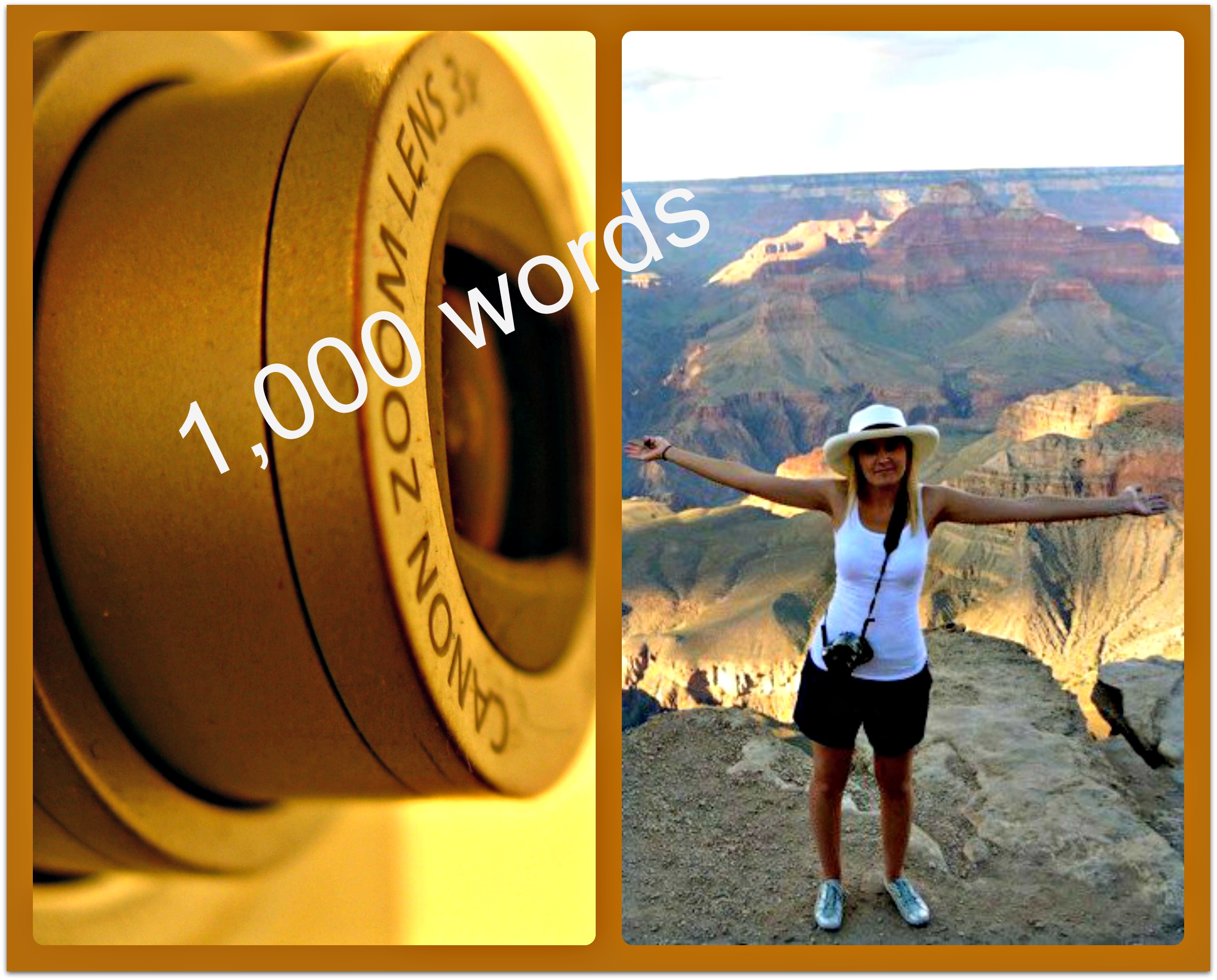
Images (from left): Camera lens from Morguefile; Milda Ratkelyte reveling in her Grand Canyon moment. All other photos by Milda Ratkelyte

And the May 2013 Alices go to … these 4 international creatives

 © Iamezan | Dreamstime.com Used under license

© Iamezan | Dreamstime.com
Used under license

As subscribers to our weekly newsletter will hopefully have noticed by now, each week our Displaced Dispatch presents an “Alice Award” to a writer who we think has a special handle on the curious and unreal aspects of the displaced life of global residency and travel. Not only that, but this person has used their befuddlement as a spur to creativity. He or she qualifies as an “international creative.”

Today’s post honors May’s four Alice recipients, beginning with the most recent and this time including citations.

So, without further ado: The May 2013 Alices go to (drumroll…):

1) ADAM GROFFMAN, travel blogger and expat

Source: “How a children’s book inspired my wanderlust” in Travels of Adam
Posted on: 13 April 2013
Snippet:

You see, what I loved about this book as a kid is the focus on architecture and food in this utopian society. Each family is responsible for bringing a country’s culture to the island nation.

Citation: Many of us at the Displaced Nation attribute our abilities to tolerate and even embrace life abroad (the strange foods and drinks, the loneliness, the largely incomprehensible rules) from having taken to heart Alice’s Adventures in Wonderland and its sequel, Through the Looking Glass, as kids. A good dose of literary nonsense has taken us a long way, and even to this day, we appreciate having recourse to Lewis Carroll’s great works to make sense of our rather curious lifestyles in countries other than those in which we were born.

Adam, we understand that you quit your job in Boston to travel the world and that you trace your own wanderlust to the 1947 American children’s book The Twenty-One Balloons, by William Pène du Bois, a story that in some ways is even more fanciful than Alice’s.

For those who don’t know it: The book begins when a schoolteacher, Professor William Waterman Sherman, becomes bored with his life and sets off on a journey in a hot air balloon called The Globe. He hopes the wind will blow him and his balloon all around the world. But instead he has a crash landing on the mysterious island of Krakatoa (Indonesia), where he discovers a utopian society started up by a group of wealthy families. Each family owns a restaurant of different types of foreign foods and all members of the island eat together at a different house, full of fantastic inventions, every night. Krakatoa being a volcanic island, the families are aware of the danger that the volcano could erupt at any moment (in fact its volcanoes erupted in 1883). Their escape plan consists of a platform made of balloons…

Adam, we love the idea of emulating a fictional character who favors balloon travel—the kind that begins without regard to speed and without a destination in mind. It’s also romantic to think that you expect to find, at best, utopianism, at worst, good food, in the course of your world wanderings. Perhaps it accounts for why you’ve landed your own “balloon” in Berlin, Germany’s creative capital and a city renowned for its architecture (only, how is the food there?).

2) TRACY SLATER, expat writer, author and blogger

Source: “What Does Home Mean When You Live Abroad?” in The Good Shufu
Posted on: 8 May 2013
Snippet:

I know how easy it is, when we live overseas, to lose our gimlet eye about home: to romanticize it, to see it as a kind of lost Eden, a place where we wouldn’t suffer the same disappointments or lonelinesses or defeats that we suffer in our expat lives.

Citation: Tracy, we would add to that something we learned from Alice, which is that part of the reason for cherishing the memory of home so much is that you can’t easily share what you love about it with the people you encounter in your new place. Alice experiences this when trying to talk about her beloved cat, Dinah, with the Wonderland creatures:

“I wish I hadn’t mentioned Dinah!” she said to herself in a melancholy tone. “Nobody seems to like her, down here, and I’m sure she’s the best cat in the world! Oh, my dear Dinah! I wonder if I shall ever see you any more!” And here poor Alice began to cry again, for she felt very lonely and low-spirited.

We also find inspiring your quote from the Egyptian writer and thinker André Aciman, that all exiles impulsively look for their homeland abroad. Even poor Alice suffered from that affliction—recall her trying to make herself at home at the Mad Hatter’s tea party, only to discover it is a less than civil gathering to what she is used to. First she is told there is no room for her at the table; then when she sits anyway, that her hair needs cutting. She is offered wine even though there isn’t any, and told to take more tea even though she hasn’t had any.

In fact, some of us can relate quite directly to this need to feel at home via a good cup of tea. TDN writer Kate Allison, for instance, has lived in the United States for many years but to this day fails to understand why Americans give her a cup of lukewarm water and a tea bag when she orders tea. And ML Awanohara, who lived in England before becoming an expat in Japan, often longed for English tea while sitting through the Japanese tea ceremony.

Tracy, we very much look forward to your forthcoming book, The Good Shufu: A Wife in Search of a Life Between East and West (Putnam, 2015), to help us make sense of such classic expat predicaments.

3) DANIELLA ZALCMAN, photojournalist

Source: “London + New York: A double exposure project”—an interview with Daniella by Austin Yoder on Matador Network
Posted on: 22 April, 2013
Snippet:

When [Daniella] moved from New York to London, she decided to create a series of double exposures to marry the spirit of both cities based on a combination of negative space, color, and contrast. Daniella’s double exposures create beautiful imaginary landscapes, and are captured entirely with her iPhone 4s.

“When I got to London, I knew that I wanted to capture not just the sensation of leaving NYC, but also of exploring a new city and making that environment feel like home.”

Citation: Daniella, we are enchanted by your idea of creating a composite of your beloved home city (New York) with your adopted city (London) to come up with an imaginary landscape. Indeed, we think it must be akin to the process Lewis Carroll used when creating Alice’s Wonderland—blending the bucolic English countryside surrounding Alice (she is sitting on the river bank considering making a daisy chain when the White Rabbit first appears) with the curious world that exists at the bottom of the rabbit hole, the familiar with the unfamiliar. When Alice awakens and reports her dream to her sister, the sister “half-believes” herself to be in Wonderland—if only she can suspend her disbelief for long enough to the sheep-bells tinkling in the distance as rattling teacups, the voice of the shepherd boy as the Queen’s shrill cries, and the lowing of the cattle in the distance as the Mock Turtle’s heavy sobs…

4) “SARAH SOMEWHERE”, world traveler and blogger

Source:On Freedom” in Sarah Somewhere blog
Posted on: 29 April 2013
Snippet:

I am not, by nature, a free spirit. I’m a worrier, a control freak and a chronic people pleaser. Letting go and trusting in the universe’s plan for me is not my default setting, nor is being content with what I have rather than continually striving for more. I still need some practice.

Citation: Sarah, your struggle with living life in the moment in Mexico puts us in mind of Alice, who, is constantly worrying about the impression she is leaving on the Wonderland residents, and finds it a challenge to enjoy the moment in a place as curious as Wonderland. We wish you luck in finding that sweet spot between total personal freedom and societal obligations. And, taking our cue from Alice’s sister, we envision a day when you’ll be telling stories about your adventures in Southeast Asia, China, Mexico and India to a group of children and inspiring them to follow their unique destinies:

she pictured to herself how this same little sister of hers would, in the after-time, be herself a grown woman; and how she would keep, through all her riper years, the simple and loving heart of her childhood: and how she would gather about her other little children, and make their eyes bright and eager with many a strange tale, perhaps even with the dream of Wonderland of long ago: and how she would feel with all their simple sorrows, and find a pleasure in all their simple joys, remembering her own child-life, and the happy summer days.

* * *

So, readers, do you have a favorite from the above, and do you have any posts you’d like to see among June’s Alice Awards? We’d love to hear your suggestions! And don’t miss out on these weekly sources of inspiration. Get on our subscription list now!

STAY TUNED for tomorrow’s post, another Jack the Hack column…

Writers and other international creatives: If you want to know in advance whether you’re one of our Alice Award winners, sign up to receive The Displaced Dispatch, a round up of weekly posts from The Displaced Nation, with news of book giveaways, future posts, and of course, our weekly Alice Award!. Register for The Displaced Dispatch by clicking here!

Related posts:

6 Alice-in-Wonderland themes for creatives abroad to explore in their works

 © Iamezan | Dreamstime.com Used under license

© Iamezan | Dreamstime.com
Used under license

Call us zany, but when we first started this site two years ago, someone (no, not me!) had the bright idea of picking a literary or historical figure and using that person as a source of inspiration for a month-long series of posts.

June 2011, for instance, was Alice in Wonderland month; July, Pocahontas month; September, Robert Persig month; and October, Julia Child month.

You’ll never guess which one of these themes proved most popular: why, Alice of course! What international traveler or expat hasn’t experienced the sensation of stepping through the looking glass or falling down the rabbit hole? Like Alice, those of us who venture beyond borders must furiously navigate the new environments we uncover. Also like Alice, we are prone to feeling lonely and a bit sorry for ourselves on occasion.

Most expats can also relate to Alice’s gradual loss of self-identity. As she confesses to the Caterpillar:

“I can’t explain myself, I’m afraid, Sir, because I’m not myself, you see.”

In today’s post, I propose to revisit Lewis Carroll’s masterpiece for themes that are worth exploring from a creative angle. Here are six that I find myself thinking about a lot, when trying to parse my own expat experience (an American, I lived first in England and then in Japan). WARNING: Tongue-in-cheek, but only somewhat!

1) The old adage about trusting your gut doesn’t always work when it comes to your actual gut.

ALICE PASSAGE: In Alice’s Wonderland, a jar labeled “Orange Marmalade” is not actually a jar full of orange marmalade.
APPLIES TO: Expats in Japan, who are always biting into pastries in the hopes of tasting chocolate and tasting azuki bean paste instead. Indeed, should you ever be in need of an Alice-like culinary experience, Japan has got to be your place. There’s the wasabi Kit Kats, of course. And how about the time when Carole Hallett Mobbs’s friend in Tokyo bought a sandwich with a lumpy filling? As Carole reported in her guest post for us:

A gentle squeeze sent a whole cooked potato shooting across the room.

ANOTHER ALICE FOOD PASSAGE: Fearing the contents of the “Drink Me” bottle may be poison, Alice is pleasantly surprised:

it had, in fact, a sort of mixed flavour of cherry-tart, custard, pine-apple, roast turkey, toffee, and hot buttered toast.

APPLIES TO: International travelers who venture to remote spots and are pleasantly surprised by the local cuisine. Actually, you don’t even have to be somewhere remote. Tokyo was where I developed a fondness for hirezake (hot sake with fugu fin) — talk about poisonous cocktails! And travel author Janet Brown told us she dreaded trying fried grasshoppers while living in Bangkok,  only to find she liked them as much as popcorn! But even dedicated locavores, such as Jessica Festa, can have an Alice moment from time to time. I’ll never forget the story about her first experience eating cuy (guinea pig) in Ecuador. As she tells it, she saw it on the grill and thought it resembled her childhood pet, Joey. Repressing her better instinct not to eat anything she grew up playing with, she took a bite and said: “Holy crap, this is delicious!”

2) Communications with others and in general are far from satisfactory.

ALICE PASSAGE: When Alice is “opening out like the largest telescope that ever was, saying good-bye to her feet, she cries “Curiouser and curiouser!”—and then feels surprised that “for the moment she quite forgot how to speak good English.”
APPLIES TO: Native English speakers living in a non-English speaking country. Their English inevitably morphs into the version the locals speak; spelling, too, deteriorates, and doesn’t come back.

ANOTHER ALICE MISCOMMUNICATION: Alice repeatedly offends the creatures in Wonderland without even trying.
APPLIES TO: Anyone who finds themselves “tone deaf” in Bangkok, as the aforementioned Janet Brown once did. (NOTE: Applies equally to those struggling to learn other Asian tonal languages such as Mandarin Chinese.) As she explained in her interview with us:

The most common mistake for foreigners is to tell someone their baby is beautiful, while actually announcing that the infant is bad luck.

3) Committing to another country can sometimes mean altering your body size (or wishing you could).

ALICE PASSAGE: When Alice first lands in Wonderland, she finds herself too large for the doorway out of the dark hall into the beautiful garden.
APPLIES TO: Anyone over 5’5″ living in Japan, Korea or Southeast Asia, who has to keep their head down when entering traditional dwellings for fear of getting a concussion.

ANOTHER BODY-CHANGING ALICE MOMENT: At the instruction of the Caterpillar, Alice tries eating portions of mushroom he’s been sitting on, which make her grow and shrink.
APPLIES TO: Repeat expats, or rex-pats, who find themselves going back and forth between the obesity epidemic in United States and almost anywhere else in the world, where people simply eat less and walk more. While living in Tokyo I soon reached my lowest body weight ever without even trying: all those meals of clear soup, rice, veggies and fish. Now that I’m back in America, I weigh ten pounds more, while in England I was somewhere in between…

4) People in other countries have their own relationships with Father Time.

ALICE PASSAGE: Alice experiences the full gamut: from the White Rabbit dashing about with his stopwatch for fear of being late for an important date, to the slackers at the Mad Hatter’s tea party, who waste time “asking riddles that have no answers.”
APPLIES TO: Repeat expats, or rex-pats, who’ve had the chance to live in Southern Europe, South America, or other places notorious for their laid-back approach to time, as well as in Germany, Switzerland or Japan where people pride themselves on their punctuality. Compared to Japan, I found England a Southern European country. When I was living in Tokyo and visiting the UK during summers, I was always late to appointments because I’d forgotten that trains don’t run on time (or at all). And most of the time, I had their sympathies. Whereas in Japan, I swear a White Rabbit must be in charge of public transport. You can set your watch by the trains! No excuses for lateness…

5) The laws and practices of another land can take some getting used to.

ALICE PASSAGE:

“No, no!” said the Queen. “Sentence first—verdict afterwards.”
“Stuff and nonsense!” said Alice loudly. “The idea of having the sentence first!”

APPLIES TO: Anyone who displaces themselves to a country with a radically different life philosophy. For instance, as an American I found that one of the biggest challenges of getting used to England and then Japan, the two small-island nations where I lived, was that I could never quite accept the natives’ stoicism. As I wrote in the first of my “Lessons from Two Small Islands” posts:

Where the citizens of each of these countries saw grace, strength, endurance, and perseverance, I saw passivity, masochism, fatalism and pain. “Why is everyone bowing so readily to their fates?” I would ask myself repeatedly.

And, though I never committed an act of “queue rage” while standing in line at the post office in the English town where I lived, I came pretty close—especially when watching others who’d come in after I did get served before me.

On those occasions, I felt like crying out: why don’t we try a serpentine line instead?

And what about all those expats living in countries with byzantine immigration laws? Apparently, Alice’s own home, the UK, is among the worst. As we learned from interviewing New Zealander Vicki Jeffels, it essentially tells any wannabe immigrants: “Off with your heads!” Even if you’re from the Commonwealth! Still, at least they no longer discriminate… (Jeffels sorted out her visa problems in the end but has since repatriated.)

6) “Pool of tears” moments eventually build resilience.

ALICE PASSAGES: Alice goes from “shedding gallons of tears, until there was a large pool all round her, about four inches deep” to holding her own in Wonderland (see #5).
APPLIES TO: Well, really all of us. In the previous incarnation of the Displaced Nation, I had a Random Nomads column in which I would interview expats or veterans of international travel and ask them to describe their “most displaced” and “least displaced” moments. Many had difficulty with the former request, I guess because they felt uncomfortable going down the Rabbit Hole and examining their hearts more closely. The American Brian MacDuckston, though, was the rare exception. His “pool of tears” moment was his very first day of work as an English teacher in Japan. He somehow managed to get on the wrong train (every foreigner in Japan’s nightmare) and ended up in a “depot storage yard with an attendant yelling at me in a language I didn’t understand.” He was late for his first class and wanted to quit. Since then, however, he has emerged as one of the leading experts on Japanese ramen. Last we heard, he’d been offered a few gigs on Japanese TV shows as a “ramen reporter” and successfully pitched his first magazine article about a best-of-ramen list. Way to go, Brian, in treating that screaming railway worker as a Jack of Spades!

* * *

So, are you ready to inject a bit of Alice into your Great Work on the voluntarily displaced life? And can you think of any more inspirational passages from Lewis Carroll? (No doubt there are more, and I will think of some of them as soon as I post this.)

Meantime, the Displaced Nation will continue its tradition of awarding “Alices” to writers who capture the curious, unreal side of the displaced life—only we will now be awarding one per week, via our Displaced Dispatch. What, not a subscriber yet? CLICK HERE NOW—or off with your head! Recommendations of posts (your own, other bloggers’) for Alices are also warmly appreciated. Please send to ML@thedisplacednation.com.

STAY TUNED for tomorrow’s post, another in our Old World/New World series.

If you enjoyed this post, we invite you to register for The Displaced Dispatch, a round up of weekly posts from The Displaced Nation, with seasonal recipes, book giveaways and other extras. Register for The Displaced Dispatch by clicking here!

Related posts:

Catching up with this year’s Random Nomads over the holidays (3/3)

RandomNomadXmasPassportIt’s Christmas Day and the holiday party continues for the expats and other global voyagers who washed up on the Displaced Nation’s shores in 2012. Remember all those Random Nomads who proposed to make us exotic meals based on their far-ranging meanderings? Not to mention their suitcases full of treasures they’d collected and their vocabularies full of strange words… How are they doing these days, and do they have any exciting plans for the holidays? Third in a three-part series (see also Part One and Part Two).

During the final third of 2012, we met some expats and intrepid world travelers who, I think it’s fair to say, have developed some rather unusual hobbies and eating habits. The two are one and the same in the case of Brian MacDuckston, who was featured on our site this past August. He has made a habit of eating ramen in as many Tokyo venues as possible — a hobby that was quirky enough to attract the attention of the New York Times. In addition to Brian — a San Franciscan who originally went to Japan to teach English — we encountered:

  • Liv Gaunt, an Englishwoman who became an expat accidentally, while pursuing her love of scuba diving and underwater photography. Now based in Australia, she told us she has a passion for sharks but would happily do without sea urchins.
  • Mark Wiens, an American third culture kid who now lives in Thailand and travels all over — he feels least displaced when sampling other countries’ street foods.
  • Jessica Festa, an American traveler who loves to venture off the beaten track and eat locally — she did not hesitate to eat cuy in Ecuador (even though it reminded her of her pet guinea pig, Joey, named after a school crush).
  • Larissa Reinhart, a small-town Midwesterner who lived in Japan for several years and, since repatriating, has taken up the pen as a crime novelist. She is now living in small-town Georgia but hopes to go abroad again. She provides recipes for Asian fried chicken, among other delicacies, on her blog about life as an ex-expat.
  • Patricia Winton, an American who responded to 9/11 by giving up her comfortable life in Washington to become an expat crime writer in Rome. She also invested in a pasta-making machine…
  • Bart Schaneman, a Nebraskan who wanted to see the world and has made his home in Seoul, where he is an editor for an English-language newspaper and author of a travelogue on the Trans-Siberian railway. He is a huge fan of kimchi.

Three of this esteemed group are with us today. What have they been up to since a few months ago, and are they cooking up anything special for the holidays, besides chatting with us?

Brian with Ramen_Xmas1) BRIAN MACDUCKSTON

Have there been any big changes in your life since we last spoke?
I’ve been offered a few gigs on Japanese TV shows as a “ramen reporter” and successfully pitched my first magazine article about a best-of-ramen list. A start! I also started a ramen class aimed at non-Japanese speakers. Check it out!

How will you be spending the holidays this year?
A nice staycation in Tokyo.

What’s the thing you most look forward to eating, dare I ask?
I’m trying to eat more high-class sushi, but I’ll probably just stick to a lot of ramen for the next few weeks.

Can you recommend any books or films you came across in 2012 that speak to the displaced life?
I really enjoyed Jiro Dreams of Sushi, a documentary about the most revered sushi chef in the world. [Editor’s note: The film has been available on Netflix since last August.]

Do you have any New Year’s resolutions for 2013?
I want to train myself to stop using double spaces after periods when I write. Not a big goal, but important for someone who has an interest in being paid for my writing.

A worthy goal, imho! (I’ve had to correct quite a few in my time…) So, any upcoming travel plans?
My father will visit Japan, so I am planning a luxury week-long trip of eating and relaxing in hot springs. Two things I’m good at!

LarissaReinhart&Reinhart2) LARISSA REINHART

Any big developments in your life since we last spoke?
My second Cherry Tucker Mystery, Still Life in Brunswick Stew, has a release date of May 21, 2013. [Editor’s note: As mentioned in Larissa’s interview, the first in her Cherry Tucker series, Portrait of a Dead Guy, came out this year.]

How will you be spending the holidays this year?
We travel to visit my family in Illinois and St. Louis after Christmas through New Year’s.

What’s the thing you most look forward to eating?
There’s this Italian grocery, Viviano’s, in the Italian district of St. Louis, called The Hill in St. Louis, that I really look forward to visiting. I’ll stock up on cheap wine and Italian staples for the coming year.

Can you recommend any books or films you came across in 2012 that speak to the displaced life?
Yes, two Japanese films:

  1. The fascinating documentary Jiro Dreams of Sushi. I highly recommend — even for non-sushi fans. The film is beautifully shot and reveals what it takes to be a true master at something. Incredible.
  2. The gorgeous The Secret World of Arrietty (aka The Borrower Arrietty), scripted by Hayao Miyazaki. We were excited to see Arrietty because we saw the ads for the movie when we were still living in Japan (and I’m a big fan of Mary Norton’s The Borrowers, on which the film is based, as well as of Miyazaki).

Have you made any New Year’s resolutions for 2013?
To spend less time on social media and more time writing. I love chatting online, but I need to be more disciplined about getting away from the “water cooler” and back to work.

Any upcoming travel plans?
Disney World for spring break! Woot! And we’re hoping to get back overseas soon, but no definite plans yet.

PatriciaWintonwithholly3) PATRICIA WINTON

Any big changes in your life since we last spoke a couple of months ago?
The month after you featured me, I put my long-time WIP in the bottom drawer for a while and started a new one. I’ve written about 30,000 words. This one, also a mystery, is set in Florence. It takes place during the 500th anniversary celebration of the world’s first culinary society.

Meanwhile, my blog partners at Novel Adventurers are working on an anthology of long short stories. We are an adventurous group comprising (besides me):

  • an Australian who has lived in South America
  • an American of Swiss-German origin who is married to a man from Iran, where they frequently travel
  • an American with close family ties in India, where she frequently travels
  • an American specializing in things Russian, who is married to a Kyrgyz
  • a former Peace Corps volunteer who writes about the Caribbean
  • an American who grew up on a sailboat traveling the world and has lived as an adult in many countries.

We’ll be writing about travel and adventure from international perspectives. It will be some time before it sees publication, but I’ll keep you posted. I think it will interest the Displaced Nation!

Where will you be spending the holidays this year?
I’m spending the holidays quietly at home. I plan to visit a friend in the country for New Year’s weekend. The holidays here last almost three weeks, ending on January 6. Nativity scenes are a big deal here, and I plan to visit various churches to view, and photograph, them as I usually do. I’ll write about them on my blog, Italian Intrigues, on January 3rd.

What’s the thing you most look forward to eating?
Christmas Eve in Italy is devoted to eating fish — usually seven fish dishes from antipasto onward. I’m trying out a new recipe for sea bass stuffed with frutta del mare (non-fin fish). I’m using clams, mussels, shrimp, squid and baby octopus, all well laced with garlic. And I always make the holiday custard that comes from my Tennessee childhood.

Can you recommend any books you came across in 2012 that speak to the displaced life?
The Lacuna, by Barbara Kingsolver. While it was published in 2010, I didn’t read it until this year, and I think it’s a masterpiece. It’s about a man with one foot in Mexico and the other in the US — but that’s a vast oversimplification. After the young man’s Mexican mother dies, he works for Frida Kahlo and Diego Rivera while Leon Trotsky is staying with them. He later moves to the US to join his American father. He eventually becomes a successful writer caught up in the McCarthy witch hunt. I don’t want to include spoilers here, but it’s fabulous. The boy/man is a foreigner in both countries and speaks both languages with an accent.

Do you have any New Year’s resolutions for 2013?
Not that I want to share.

Last but not least, do you have any upcoming travel plans?
No concrete travel plans at the moment. While composing these answers, I received an email about a tour of Uzbekistan that sounds really alluring. And I will probably go to the US to attend a mystery writers conference.

* * *

Readers, any questions for this rather motley (one former expat and two current ones) but highly creative bunch?

STAY TUNED for tomorrow’s post — expat Anthony Windram’s musings on spending Boxing Day in a country that associates boxing with punching, not (Christmas) punch.

If you enjoyed this post, we invite you to register for The Displaced Dispatch, a round up of weekly posts from The Displaced Nation, with seasonal recipes, book giveaways and other extras. Register for The Displaced Dispatch by clicking here!

Related posts:

Images: Passport photo from Morguefiles; portrait photos are from the nomads (Larissa Reinhart’s shows her family in front of one of their favorite Japanese manga characters, Shin-chan, a sort of Bart Simpson of Japan — the creator, Yoshito Usui, had recently died).