The Displaced Nation

A home for international creatives

Tag Archives: Africa

TRAVEL YARN: Just a regular expat girls’ night out in Kenya…um, right?

Today, as many of us await the very real horror of Hurricane Sandy, it may be helpful to have a distraction in the form of a scary travel tale. Guest blogger Amy Lucinda Jones, an Englishwoman who lives in Italy, has obliged with this story about an unsettling experience she had while volunteering in Africa.

If I had a pound, or even a penny, for every person who told me that it was dangerous to go to Kenya on my own, well…I would have been able to afford to take a friend with me, too.

Have you heard about all those terrible things that happen to people who go there? And you’re going alone! And you’re a WOMAN!

But, I shrugged off these (somewhat sexist, and racist) warnings and went to Kenya anyway, fresh out of university, ready to face a new part of the world and a new adventure. I had decided to take part in a volunteer programme, helping children in the local community. And while the experience was one of the most interesting, eye opening and rewarding things I have ever done, it was definitely challenging.

The heat for one thing. Then the million tablets I had to take to stop me getting malaria (which, in turn, gave me terrible indigestion…and some other, ahem, more “personal” side effects that I won’t mention).

Oh, and the fact that I found lots of little white ants crawling all over my toothbrush one morning. They were in the breakfast jam, too. After a few days I grew tired of picking them out. Extra protein and whatnot.

But despite the creepy crawlies and the questionable hygiene, nothing compared to the experience I had with my fellow volunteers, one Saturday night.

What an excellent night for…

We’d decided to let off some steam after a tiring week, due to hard work and challenging projects. After having had a few Smirnof Ices (yes, alcopops are still pretty big over there) at a local bar where we lived in Mombasa, we decided to take the party elsewhere. There was a “discotheque” several miles away, where we could drink more sugary alcohol and dance under the stars.

The only problem was getting there.

We approached a taxi driver and bartered with him for a while. There were about eight of us, so two taxis were needed, and the guy suggested we go with his somewhat shifty looking friend. Please don’t let me be in his taxi, I silently prayed, as one of the other girls pulled me in the direction of said taxi driver’s car.

As we got in, though, everything seemed fine. He drove through the city calmly, without saying too much. I didn’t blame the guy for staying so quiet when he had a group of women who were squealing as though they were 13 again, in his back seat.

But then we reached the edge of the city. It was pitch black — a whole load of nothing was surrounding us. I began to feel just a little uneasy, but none of the other girls seemed to be in the slightest bit bothered.

That was until the driver slowed right down. He crawled along the road, looking around him. We all looked at each other. We had done this journey before, and the road was straightforward. It should not be taking this long.

Oh, yes, there will be blood!

“You do know the way to the disco, right?” One of us asked.

“Mmm.”

Well, of course that response filled us with a whole load of confidence. We repeated the question but were met with an even less helpful silence.

I’m sure he’s just lost and feels embarrassed about it, I told myself, noticing that I was starting to sweat a little bit, even though it wasn’t that hot. We all fell silent as he continued to creep along, still surveying his surroundings.

Suddenly a petrol station loomed into view. Our driver pulled over and silently got out of the car. As he closed the door behind him, we erupted into a state of panic.

“Oh my God, what’s he doing?!”

Followed by:

“Who’s that weird man he’s now talking to?!”

And then, the slightly more alarming:

“I actually think he’s going to chop us into little pieces!”

After this last statement I instinctively placed my fingers on the door handle to assess our possible escape option.

“OH MY GOD — THE DOORS ARE LOCKED!!!”

The other girls frantically tried their doors, too, but to no avail. The driver was talking with the attendant and beckoning towards the car. Probably explaining about how he had four young women captive in the back seat, and he was planning to take us to his rickety old house and, of course, chop us all into little pieces.

I seriously started to panic.

After a few more horrific minutes, he ambled back to the car. In a slow, Leatherface-like way. Albeit without the chainsaw (although he could have had one of those in the boot).

He got into the driver’s seat and pulled away. Still driving at an agonizingly slow speed and saying nothing. He took another turning, which was again unknown to us.

We were in silence now — all secretly wondering if we should pounce on him to try and take him out. Grab the steering wheel or something equally as reckless.

Help me! Help meeeee!

We continued to crawl along. I could hear one of the girls whimpering. Or maybe it was me. I don’t remember. I thought back to those who had warned me about the dangers of traveling. Although to be honest, I think their concerns were more along the lines of avoiding being mugged, or catching typhoid from ice cubes. I’m pretty sure they hadn’t imagined me being stuck in the back of a taxi with a murderer.

Okay, that was harsh. Maybe he wasn’t the actual murderer. Maybe he just “found” innocent, unsuspecting people and took them to his “boss,” who would do the torturing and killing. Maybe he was actually a really nice guy who was stuck in this horrid job. I almost started to feel sorry for him.

He pulled over again. This time at the side of the road. In the middle of nowhere. We clung to each other for dear life as he got out and talked into his mobile phone. He’d probably lost the address to the House for Killing Unsuspecting Foreign Women.

After another five minutes of driving, one of the girls squealed. With a voice barely containing her excitement, she pointed out that she recognized the road. “We are two minutes away from the disco,” she said.. We bounced about in the back seat as the driver pulled into the car park. People! Noise! No Killing Houses!

We threw some money at him and escaped the moment he brought the car to a stop.

The other girls were waiting by the entrance. They looked incredibly annoyed by our lateness. But we just didn’t care.

Because we were ALIVE.

Amy Lucinda Jones is an English teacher, keen traveler, food fanatic, and occasional follower of fashion. Currently, she is living in Puglia (Apulia) and discovering southern Italy one gelato at a time… You can keep up with her adventures by visiting her blog, Sunshine and Tomatoes, and/or following her on Twitter: @BritInItaly. She was recently interviewed about her adventures by Expats Blog.

STAY TUNED for tomorrow’s post, an Expat Moment involving creepy Princess Di dolls, by Anthony Windram.

If you enjoyed this post, we invite you to register for The Displaced Dispatch, a round up of weekly posts from The Displaced Nation, with seasonal recipes, book giveaways and other extras. Register for The Displaced Dispatch by clicking here!

Related posts:


15 films that depict the horrors of being abroad, or otherwise displaced

Readers, we’re getting goosebumps and our blood is curdling. Horror novelist, former expat and Third Culture Kid Sezin Koehler is here to remind us that, however glamorous the life of an expat or world traveler may seem, it has a netherworld — one that horror movie makers are fond of depicting. To proceed is at your peril.

As if moving or traveling abroad isn’t scary enough, there is a whole host of films that would put the kibosh on even the most adventurous of people. For today’s guest post for The Displaced Nation, I’m breaking down these tales of terror into three groups:

  1. The expat.
  2. The world traveler.
  3. The otherwise displaced.

What follows is a rundown of some of the best horror films that will make you never want to leave home again.

1. Expat Horror: Caveat expat, or expat beware (or in some cases, beware of the expat!).

1) Ils (Them) (2006), dir. David Moreau and Xavier Palud.
In this terrifying French film, two expat partners, a teacher and a writer, living outside Bucharest in Romania are terrorized and psychologically tortured by an unknown group for days before their murder. Based on a true story, the villains — who were apprehended in real life — turn out to be even more shocking than the events they perpetrated.

My big question: Why on earth do you choose to live out in the middle of nowhere in Romania? Tragic story indeed, but really, they should have known better. Now you do.

2) Suspiria (1977), dir. Dario Argento.
Considered one of the classic horror films and what many now consider to be the father of the arthouse horror genre, Argento’s dark and twisted tale features a ballet school in Rome full of young girls from all around the world who live and study within walls haunted by a chilling presence that picks off the girls one by one. The score by Goblin is enough to give you nightmares and make you reconsider sending your children away to school. Ever.

3) & 4) Red Dragon (2002), dir. Bret Rattner; & The Silence of the Lambs (1991), dir. Jonathan Demme.
In Red Dragon Dr. Hannibal Lector is just a British expat living and practicing psychiatry in the United States. In fact, he’s helping the police with a brutal series of murders in which specific body parts had been taken as trophies. Detective Will Graham eventually discovers that not only is psychiatrist-to-the-stars Dr. Lector responsible for these grisly killings, he’s also eating the missing pieces.

The next time we meet Hannibal the Cannibal is in The Silence of the Lambs, where he is safely tucked away in a maximum security prison until the FBI needs his profiling assistance in uncovering the identity of a man who is kidnapping and skinning women.

Maybe Dr. Lector is a reason why locals are so wary of expats around the world?

5) The Omen (1976), dir. Richard Donner.
It’s hard enough being the wife of the American ambassador to the UK, but when Lee Remick discovers that there is something very wrong, very evil with her son, Damien, matters only get worse.

In many ways this is the kind of expat horror to which we can most relate: being in a foreign country, going through a difficult time, and not having the kind of support one might have at home. Even though the Thorns are wealthy and have a full staff at their beck and call, Mrs. Thorn cannot confide in them her misgivings that her son is the Antichrist — nor can she with anyone else since she’s the ambassador’s wife. In the end she goes mad from fear and frustration.

As expats, we’ve all been there. Luckily, though, we didn’t have the incarnation of Satan as our son. At least I hope not.

6) Freaks (1932), dir. Tod Browning.
This magnificent film follows a group of sideshow circus performers in Dust Bowl America — the majority of whom are European expats from all over the continent. As foreigners as well as displaying physical deformities of all kinds, this group is the marginalized of the most marginalized in America not just at that time, but even today.

The gorgeous German and “normal” trapeze artist Cleopatra finds out that Hans, the midget, is fabulously wealthy and sets out to steal him away from his same-sized girlfriend Frieda — with disastrous consequences as the group of freaks tries to bring the wicked Cleopatra into their embrace. Cleo finds out well and good that one does not mess with members of the sideshow.

The message here? Respect your local customs, even if you think them freakish. It could be what stands between your body as it is or being turned into a human-chicken hybrid.

2. Traveler Horror: “Let your suitcases gather dust!”, cry these films.

1) Hostel (2005), dir. Eli Roth.
A group of backpackers passing through the Slovakian capital city, Bratislava — it has no semblance to the real place whatsoever — gets kidnapped by an organization that sells young people to the highest bidders so that they can be tortured and murdered in the Slovakian outback with impunity. While the film is rife with cultural and geographical blunders, it nonetheless preys on a legitimate fear of kidnapping and/or human trafficking while traveling, especially for young women as we see in the two follow-up films in this gory franchise.

Kids, don’t fall for the local pretty girl/handsome boy who picks you up in a bar. You have no idea whom they could be working for.

2) American Werewolf in London (1981), dir. John Landis.
Two American backpackers (uh-oh) in the Scottish highlands stray from the road and are attacked by a wild beast. One dies, the other is in a coma for three days with horrible gashes across his chest. When the doctor informs him he was attacked by a madman he’s confused, claiming it was a wolf that had killed his friend and wounded him. Come full moon, young David Kessler finds out it was neither man nor wolf, and he’s becoming one.

There’s nothing like a story about a horrific accident taking place while traveling, especially when said accident turns you into a monster. Always remember, STAY AWAY FROM THE MOORS/MUIRS!

3) The Descent (2005), dir. Neil Marshall.
After the tragic death of Sarah’s husband and daughter in a wicked car accident, her fellow British extreme-sporting friends decide to take a trip across the pond to Appalachia for a spelunking expedition. Why anyone would think that crawling around in caves would be a good idea I haven’t a clue — let alone choose to take an already-traumatized woman into that scenario. But hey, they do. And not only do they find themselves in an unmapped cave system that has no way back to the surface, there are others down there in the dark who’d like to ensure the girls never leave.

Dear People Traveling to America: For Pete’s sake, avoid the US’s back country! Monsters are above and below.

4) Wolf Creek (2005), dir. Greg Mclean.
Two British tourists in Australia pair up with a local to check out a supposed alien-landing site in the middle of nowhere. All is fine until their car battery dies. Stranded in the badlands of Oz, grateful are they when a mechanic rolls up and tows them to his place to fix their vehicle. But oh, he’s not a mechanic at all. He’s a serial murderer who waits for tourists to come out to the Wolf Creek Crater, and takes his good time torturing them before their slow death.

The film is based on a true story — one of the British girls actually survived and made it to the authorities. It turned out the man had killed hundreds of people over decades, and nobody even suspected a thing. Shiver

5) Primeval (2007), dir. Michael Katleman.
During the Rwanda-Burundi conflict, bodies were dumped into the Ruzizi River at such alarming rates that the crocs began eating human flesh. One of these crocs, nicknamed Gustave by the locals, gets a taste for human flesh and begins hunting humans inland. An American team of journalists are sent to capture and bring back the beast amidst an ongoing civil conflict between warlords and villagers.

The best thing about this movie is that there really is a 70-year-old, 22-feet-long croc named Gustave who swims the Ruzizi. He was last sighted in 2008, but I know he’s still out there. I can feel him.

3. Displaced Horror: “Think twice about moving or taking a sojourn outside the ‘hood” is the moral here.

1) The Amityville Horror (1979), dir. Stuart Rosenberg.
As if moving doesn’t suck enough, can you imagine moving into a house that not only was the site of a brutal family murder but is also haunted? I don’t even know how many whammies that makes the scene. Also based on the true story of the Lutz family, who were terrorized by their house to the point where they fled without any of their belongings and never went back to collect them.

Word to the wise: Always check about the house’s history before you move in, and always remember to burn sage throughout, even in cabinets and drawers, before you move anything in anything at all. Trust me on this one.

2) Se7en (1995), dir. David Fincher.
Heralding a promotion to detective, Brad Pitt gets transferred to an anonymous city with a reputation of being among the worst in America. *Cough* Detroit *Cough*. His wife is miserable as she wants to have a family, but cannot imagine raising children in that town. The first case he lands is a serial killer murdering people based on the Seven Deadly Sins — one that quickly sucks both him and his wife into a horrific spiral of torture and murder.

Women, don’t let your husband drag you to a horrible city. Just don’t. Your life very well may depend on it.

3) The Texas Chainsaw Massacre (2003), dir. Marcus Nispel.
A group of friends on a road trip through Texas and — oh crap! — their car breaks down. It’s just their luck that the person who finds them is the patriarch of the psychotic and inbred Hewett family, known for killing and cooking their victims. There are no happy endings here, people.

If you’re going on a road trip, stick to the main roads, for God’s sake! I mean, jeez, everybody knows that. And while you’re at it, stay the bloody hell out of Texas!

4) El laberinto del fauno (Pan’s Labyrinth) (2006), dir. Guillermo del Toro.
Set in 1944 fascist Spain, the film tells the story of Ofelia, a young girl who accompanies her mother to live with her new stepfather, a barbarous Spanish general. Amidst the horror, Ofelia discovers a fairy world underneath the very grounds of their home, a place to which she escapes when the torture around her becomes too much to bear. But even fairy worlds have their horrors, as she soon finds out.

Moms, jeez, don’t marry jerks and then don’t agree to live in their military camp. Seems like logic to me, but I guess it needs to be said.

* * *

So, are you ready to burn your passport and throw away all your travel gear yet? 😉

And do you have any other films you’d add to my best-of abroad horror list?

Sezin Koehler, author of American Monsters, is a woman either on the verge of a breakdown or breakthrough writing from Lighthouse Point, Florida. Culture shock aside, she’s working on four follow-up novels to her first, progress of which you can follow on her Pinterest boards. Her other online haunts are Zuzu’s Petals, Twitter, and Facebook — all of which feature eclectic bon mots, rants and raves.

STAY TUNED for tomorrow’s post, which has Kate Allison continuing our horror theme.

If you enjoyed this post, we invite you to register for The Displaced Dispatch, a round up of weekly posts from The Displaced Nation, with seasonal recipes, book giveaways and other extras. Register for The Displaced Dispatch by clicking here!

Related posts:

Images: From MorgueFile: Cinema; Hat and suitcase;  Bridge from biplane.

Photo of Sezin, from her newest FB page, ZUZUHULK, used with her permission.

RANDOM NOMAD: Jessica Festa, Backpacker, Offbeat Traveler & Locavore

Place of birth: Long Island, New York, USA
Passport: USA — but I’m planning on starting the papers for my Italian passport soon (my grandparents were born there).
Overseas history: Australia (Sydney): 2008. I’ve also backpacked through western Europe (for partying and food!), South America (for surreal landscapes and hiking trails), and Southeast Asia/China and Ghana (for volunteer projects).
Occupation: Freelance travel writer. I have my own site and also write for Gadling, Viator and Matador, among others.
Cyberspace coordinates: Jessie on a Journey — Taking you beyond the guidebook (travel-zine); @JessonaJourney (Twitter handle); Jessie on a Journey (FB page for backpacking community); and Jessie on a Journey (Pinterest).

What made you leave the United States for the Land of Oz?
I chose Australia for studying abroad because I wanted to be able to communicate in English — it was my first time going abroad alone.

On your site you describe yourself as a “natural backpacker.” How did you find living in one country?
It’s so different living somewhere than just traveling to it. When you have a part-time job, class schedule, gym membership, local hangout, go-to grocery store, etc, you really begin to feel a strong connection to a place. Sydney is such a great city. That said, I did not give up my backpacking habit entirely. I also traveled a lot through Australia when studying!

Tell me about the moment on your travels when you felt the most displaced.
I had many moments like that when I did a homestay for a month in Ghana, in West Africa. I was doing orphanage work, and absolutely loved the experience — but the culture is just completely different. Especially in city areas, it’s very loud and chaotic, and people will shout at you and grab your skin to feel if it’s real. They don’t get many tourists, so they’re just curious and wanting to get to know you — but sometimes it got a little too intense.

When have you felt the most comfortable?
In Sydney. I actually called my family crying the night before my flight back to New York, saying I had a new home and would not be returning. I had this camaraderie with my neighbors and so many connections to the community, I really felt like a local.

You may bring one curiosity you’ve collected from each of the countries where you’ve traveled or lived into The Displaced Nation. What’s in your suitcase?
My collection of paintings, jewelry and handcrafted items:

  • Ghanaian artwork and wooden masks
  • Handmade jewelry from Sydney and Bolivia
  • A handwoven purse from Peru
  • Alpaca socks from Ecuador
  • Banksy artwork from the UK
  • Masapán (bread dough art) from Calderón, Ecuador
  • A hand-sewn water-bottle holder from Thailand

You are also invited to prepare one meal based on your travels for other members of The Displaced Nation. What’s on the menu?

Appetizer: Locro, a thick soup with potatoes, avocado, cheese and vegetables from the Andes.
Main: A pesto pasta with some kind of meat mixed in from the Cinque Terre in Italy.
Dessert: Salzburger Nockerl, a sweet soufflé from Austria.
Drink: Malbec wine from Argentina.

I wonder if you could also add a word or expression from one or more of the countries you’ve visited to the Displaced Nation’s argot.
“No worries” from Australia. Such a great phrase for life. I have it tattooed on my foot!

This week you received a “Food Alice” from the Displaced Nation for your post about the first time you tried cuy, or guinea pig, in Ecuador — you said your dinner reminded you of your pet guinea pig, Joey, named after a school crush. So, does food play a big role in your travels?
For me it’s about trying new things. It doesn’t need to be in the fanciest restaurant or prepared by a Michelin chef, just something truly local. For example, in South America while many of the other backpackers went to guidebook-rated restaurants, I always opted for the tiny, simple, dimly-lit local hangouts. I ate 2- and 3-course meals for a $1, and the food was fresh and local. It was exactly what everyday people in the community were having, and that was important to me.

If you were to design a world tour based on food, what would be your top five recommendations?
1) Mendoza, Argentina — try asado (barbecued meat) with a glass of Malbec.
2) Cinque Terre, Italy — try the pesto pasta that I served to you in my meal!
3) Naples, Italy — try the pizza.
4) Cuzco, Peru — try the cuy (guinea pig) or, if you’re too squeamish, the lomo saltado: strips of marinated steak served over white rice and with French fries.
5) Munich, Germany — try the brätwurst. It is like no other sausage I’ve ever tasted, and tastes so much better in Germany!

To be honest, I’m not so sure about going to Cuzco for cuy.
Really? I love it. I’m planning to go back, and possibly move, to Peru or Ecuador in March. I’m already looking forward to getting my fill of cuy again!

Readers — yay or nay for letting Jessica Festa into The Displaced Nation? At least she’s not planning to serve us guinea pig for dinner — that’s a mercy! (Note: It’s fine to vote “nay” as long as you couch your reasoning in terms we all — including Jessie — find amusing!)

STAY TUNED for tomorrow’s post, which will most likely be on food. (No, we haven’t finished gorging ourselves yet!)

If you enjoyed this post, we invite you to register for The Displaced Dispatch, a round up of weekly posts from The Displaced Nation, with seasonal recipes, book giveaways and other extras. Register for The Displaced Dispatch by clicking here!

Related posts:

img: Jessie Festa enjoying one of the biggest and best empanadas in all of Peru, at the Point Hostels in Máncora (May 2012).

RANDOM NOMAD: Mark Wiens, Traveling Entrepreneur and Street Food Addict

Place of birth: Phoenix, Arizona, USA
Passport: USA
Overseas history: France (Albertville): 1990–91); Democratic Republic of Congo (Tandala): 1991–94; Kenya (Nairobi): 1995–2004; Thailand (Bangkok): 2009 – present.
Occupation: Freelance writer, blogger, video blogger, and food lover.
Cyberspace coordinates: Migrationology — Cultural Travel and Street Food Around the World (blog); Eating Thai Food (blog); @migrationology (Twitter handle); Migrationology (Facebook); and Migrationology (YouTube channel).

What made you leave your homeland in the first place?
I grew up traveling and living overseas with my parents, who are Christian missionaries. So after returning to the United States to attend university, I was ready to get back to traveling again.

Is anyone else in your immediate family “displaced”?
My parents are now residing in Tanzania. My father is now in leadership so he ventures into remote parts of Africa frequently and gets to see some pretty cool things!

As a Third Culture Kid, you’ve grown up living in several different countries. Tell me about the moment when you felt the most displaced.
What makes me feel out of place? Showing up at the airport, train station or bus station of a new city and not knowing how to get to the city center. That happened a lot when I first began solo traveling. I didn’t do enough initial research before arriving in a country.

One time I flew into Clark Airport in the Philippines thinking it was in Manila, but in reality it’s located about three hours from the city, and there’s no easy way to get to Manila center. I should have known this before arriving and getting lost!

I now still don’t do a lot of planning, but I always do a bit of research to figure out the best way to get from the airport (or station) to the city center!

Wow, you sound pretty comfortable in the big wide world out there, if you don’t even bother doing research before a trip. When have you felt the most comfortable?
Whenever I’m eating delicious food cooked by a local — that’s when I feel the least displaced. In Sri Lanka, for instance, I got into the habit of stopping to eat food along the side of the road. I would always be greeted by genuinely friendly and hospitable people. So in addition to delicious food, I would be connecting with others. That’s how I feel at home in a foreign place.

You may bring one curiosity you’ve collected from your travels into The Displaced Nation. What’s in your suitcase?
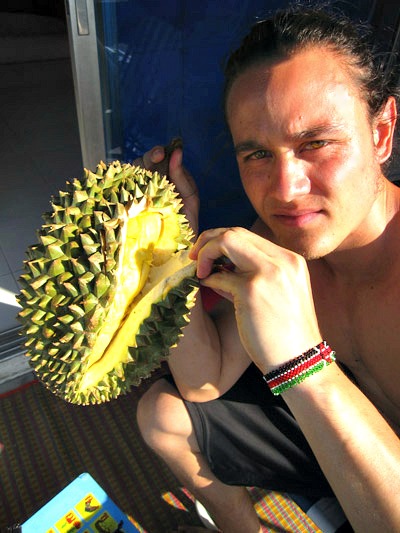
Durian from Southeast Asia — the most amazing fruit in the world! It makes me very happy!

And now you are invited to prepare one meal based on your travels for other members of The Displaced Nation. What’s on the menu?

Appetizer: Poke, the Hawaiian sashimi: cubed pieces of raw fish marinated in onions, soy sauce, and sea salt.
Main: Sichuan fish hot pot, known as Shuizhuyu. It’s the signature dish in Sichuan cooking.
Dessert: Either Thai-style sticky rice with durian, or just plain durian fruit.
Drink: Stoney, a strong ginger soda from East Africa that burns going down.

I wonder if you could also add a word or expression from one or more of the countries you’ve lived in to The Displaced Nation argot.
From Kenya: Sema boss, a slang term for greeting the person who is in charge. It’s a good way to connect.
From Thailand: Mai pen rai, how Thais say “don’t worry about it” or “no problem.” It’s a polite phrase.
From Mexico: Pansa llena, corazón contento: “Stomach full, heart is happy.” When I lived in the US, I had many friends from Mexico who would use that expression with me as they knew I loved to eat. I also have visited northern Mexico a number of times.

This month we’ve been exploring the idea of organizing one’s travels around the wish to try particular foods. I understand that many of your travels are motivated by food interests?
Yes, nowadays just about all my travels are motivated by food. I do travel to see other countries and meet new people, but my main passion is food and that’s what I enjoy searching for. I would be very happy to fly to a destination and not do any of the normal tourist attractions, but just eat. A few months ago I took just a short 24-hour trip to Malaysia with a strict mission to eat. It was an amazing food binge!

Are you more motivated by the idea of trying new foods or by finding the very best of particular foods?
I’d say I’m equally motivated to try new foods and to find the very best foods that I’ve already eaten previously. I’m always excited to try something I’ve never seen or heard of before, but at the same time if I hear about the best bowl of Thai boat noodles, or the most amazing seafood restaurant, I’m quite tempted too!

If you were to design a world tour based on food, what would be your top five stops/foods to try?
I couldn’t narrow it down to five, so here are six:
1) Thailand — try the gaeng som (sour spicy soup), som tam (green papaya salad), and boo pad pongali (crab yellow curry).
2) Malaysia — try the nasi campur (mixed curry and rice), nasi lemak (rice and toppings), and roti canai (roti bread with curry).
3) China — try the Sichuan hot pot and all kinds of exotic delicacies.
4) India — try the thali (rice with a variety of curries), dhosa (pancake with curries) and home-cooked curries.
5) Mexico — try the tacos, burritos, mole (chocolate curry), carne asada (grilled meat), and ceviche (seafood salad).
6) Ethiopia — try the mahaberawi, a platter that includes injera (white spongy bread) topped with a variety of spicy curries.

Readers — yay or nay for letting Mark Wiens into The Displaced Nation? He’s an adventuresome eater, that’s for sure, but can you stand the smell of what’s in his suitcase? (Note: It’s fine to vote “nay” as long as you couch your reasoning in terms we all — including Mark — find amusing!)

STAY TUNED for tomorrow’s episode in the life of our fictional expat heroine, Libby. (What, not keeping up with Libby? Read the first three episodes of her expat adventures.)

If you enjoyed this post, we invite you to register for The Displaced Dispatch, a round up of weekly posts from The Displaced Nation, with seasonal recipes, book giveaways and other extras. Register for The Displaced Dispatch by clicking here!

Related posts:

img: Mark Wiens in the act of trying, for the first time, to cut open a durian fruit, on his balcony in Bangkok.

BOOK REVIEW: “Expat Life Slice By Slice” by Apple Gidley

TITLE: Expat Life Slice by Slice
AUTHOR: Apple Gidley
AUTHOR’S CYBER COORDINATES:
Website: www.expatapple.com
Blog: my.telegraph.co.uk/applegidley
Twitter: @ExpatApple
PUBLICATION DATE: March 2012 (Summertime Publishers)
FORMAT: Ebook (Kindle) and Paperback, available from Amazon
GENRE: Memoir
SOURCE: Review copy from author

Author Bio:

Apple Gidley became an expat at the tender age of one month old, in Kano, Nigeria. Since her early initiation into global wandering, she has relocated 26 times through 12 countries, acquiring a husband and two children en route.

Apple is known to thousands as ExpatApple, through her popular blog at the Daily Telegraph.

Summary:

“From marauding monkeys to strange men in her bedroom, from Africa to Australasia to America, with stops in Melanesia, the Caribbean and Europe along the way, Apple Gidley vividly sketches her itinerant global life. The challenges of expatriation, whether finding a home, a job, or a school are faced mostly with equanimity. Touched with humour and pathos, places come alive with stories of people met and cultures learned, with a few foreign faux pas added to the mix.”

(Source: Amazon.com book description)

Review:

If anyone is qualified to issue advice on expat life, Apple Gidley is that person. Born to an English father and Australian mother, she takes the label “Serial Expat” to new heights.  She was a TCK before the term was invented (instead classed unflatteringly as an “expat brat”) and continued the global wandering throughout her adult life, with 26 relocations through 12 countries to date.

Her memoir provides fascinating reading, about places and lifestyles that most of us will never experience, and at times is almost anachronistic:  reading her reminiscences about servants, voluntary work, and charity committees, there’s a time warp sensation of stepping into a Somerset Maugham short story.

Although the book is a record of Apple’s patchwork life, most expats will relate to the emotional experiences she describes, no matter where in the world they are or  how many countries they’ve lived in. For example, we worry that leaving our family and friends behind will increase the emotional distance as well as the physical. After a while, we realise that this is mostly not the case, and that those who allow physical distance to become an obstacle weren’t so emotionally close in the first place. In Chapter 8, “Eighth Slice: Staying Connected”, she says:

As we age we draw closer still. We believe in family but do not see each other for years at a time, and yet we are all aware of where each of us is in the world, still scattered and testaments to a global upbringing.

In “Ninth Slice: Death at a Distance”, Apple deals with the elephant-in-the-room topic: the illness or death of a family member while we are thousands of miles away. During such times, it’s easy to beat ourselves up for choosing a nomadic lifestyle;  if our associated guilt trips were eligible for air miles, we could afford to fly back and forth to be with our loved ones as often as we wanted. In describing her own experiences of bereavement, Apple’s practical, matter-of-fact approach, plus her insights gleaned from other cultures’ attitudes to old age and death, reminds us that the old cliché of “life goes on” holds true, even after “death at a distance”.

Whether you’re a veteran expat, a re-pat, or are just about to embark upon your first move to another country, “Expat Life Slice By Slice” should be on your reading list.

Words of wisdom:

On TCKs:

For those children brought up as TCKs…a nonjudgmental and accepting attitude to different customs, colours and cultures is the norm. As this demographic grows, let’s hope for an even greater understanding of cultural differences for all our children.

On voluntary work:

Volunteering is work, sometimes harder than a paid position because it is the cause keeping you there and not the salary.

On making new connections:

Picking up people around the world to share your life with is one of the greatest pleasures in life, and sometimes you know straight away they will continue to stay in it.

On “Home”

Home is with me wherever I go…It is not a single building or a single country, but many of them.

.

STAY TUNED for Wednesday’s post.

Image:  Book cover – “Expat Life Slice By Slice”

If you enjoyed this post, we invite you to register for The Displaced Dispatch, a round up of weekly posts from The Displaced Nation, with seasonal recipes, book giveaways and other extras. Register for The Displaced Dispatch by clicking here!

Related posts:


RANDOM NOMAD: Lynne Murphy, American Expat in UK & Champion Linguist

Place of birth: Western New York State, USA
Passports: USA + UK
Overseas history: South Africa (Johannesburg): 1993-97; Texas, USA (Waco): 1997-99 — definitely a different country!; England, UK (Brighton): 2000 – present.
Occupation: Senior Lecturer in Linguistics, University of Sussex
Cyberspace coordinates: Separated by a Common Language — observations on British and American English by an American linguist in the UK (blog); @LynneGuist (Twitter handle).

What made you leave your homeland in the first place?
What made me move were jobs. I am a theoretical lexicologist. Not many places want a theoretical lexicologist, so I applied far and wide and have been rewarded with some very interesting jobs and living experiences.

Is anyone else in your immediate family “displaced”?
I was the first person in my immediate family-of-birth to own a passport.

Can you describe the moment when you felt the most displaced?
The night after the American student Amy Biehl was killed in South Africa, in August 1993. At that point, I lived in a granny flat — an outbuilding behind a house in a Johannesburg suburb. I came home to find my neighbours in the main house packing up and leaving for a safe place to stay, as they’d been robbed during the day. As they left, they told me the thieves had taken the spare keys to my flat — and had already come back to steal the bicycles from the garage. At that point, I had no car, no telephone (setting one up there took FOREVER), nowhere to go and no way to get there. I stayed up all night with the lights on and with a newspaper with the story of Biehl’s murder on the front page, feeling very alone and very scared.

Is there any particular moment that stands out as your “least displaced”?
Sometimes it’s funny to reflect on the fact that my own child speaks with an English accent, and I feel most absolutely at home with her. But I also often feel really divorced from the US when I read the news. When the hullabaloo about “Obamacare” was going on, I just couldn’t believe that I came from a place where many people seem not to see good medical care as a basic right for all. And it especially galled when I saw some Americans spreading lies about how British healthcare works and others willing to believe those lies. The National Health Service isn’t perfect, but it has saved my life, and I have more confidence in its care for me than I had in the insurance-industry-driven care I had in the US.

You may bring one curiosity you’ve collected from your adopted country into The Displaced Nation. What’s in your suitcase?
From South Africa: It’s the art that’s lasted! Two pieces by Ezekiel Madiba, a print and one of his printing blocks — which is nice because it’s sturdy enough to put in a suitcase and to hug every once in a while.
From Texas: My doctor’s instructions on what to do the next time I’m stung by a fire ant (to try to avoid being bed-ridden for a week, like the first time).
From England: My wedding ring. It’s a one-off, made by a Brighton goldsmith, and it’s a curiosity, because I hadn’t thought I was the marrying type.

You are invited to prepare one meal based on your travels for other members of The Displaced Nation. What’s on your menu?

Starter/Appetizer: South African biltong. A nice peppery one—but I don’t mind if it’s beef or game. Maybe a selection.
Main course: For this, I’ll bring together the British and the American — not fancy but delicious. I haven’t given it a name, but here’s the recipe: Toast crumpets. cover with cheddar cheese and put under the broiler/grill. Slather on A1 Steak Sauce. Eat with knife and fork.
Dessert: Eton mess with raspberries instead of strawberries.
Drinks: South African wine (I never had a South African wine I didn’t like while I was in South Africa– the exported stuff is of more variable quality, in my experience); Castle Lager (a South African beer); and Schweppes Bitter Lemon (a popular soft drink in South Africa, no longer being produced in this part of the world as far as I know).

And now you may add a word or expression from each of the countries where you’ve lived to The Displaced Nation argot. What will you loan us?
From South Africa: Putting hey? on the ends of sentences. It was so easy to start doing, since I’d grown up using the “Canadian” eh? (Though I hadn’t realized I said it till I moved from upstate New York to Massachusetts, where they don’t say it.) It’s been a while since I lived in South Africa, but I still find myself doing it.
From the UK: There are so many great expressions, but the thing that’s invaded my language most is lovely. When I write emails, I have to go back at the end and take out half of the lovelies because I say it so terrifically much.

This month we have been doing some posts on Queen Elizabeth’s Diamond Jubilee. How did you spend the Bank Holiday weekend? Did you celebrate?
We’re not much into the monarchy in my house, so we just enjoyed the extra time off. But we did go to a friend’s house and eat red-white-and-blue cupcakes — which we should probably have called “fairy cakes” if we wanted to take the whole Rule Britannia thing seriously.

A couple of us on The Displaced Nation team thinks that the Queen deserves an Olympic medal for being on the throne for so long. Do you agree?
I respect the queen for handling many awkward situations with grace, but all she has done to be on the throne so long is not die yet. She got a national holiday for the occasion—I think that’s sufficient!

Readers — yay or nay for letting Lynne Murphy into The Displaced Nation? Tell us your reasons. (Note: It’s fine to vote “nay” as long as you couch your reasoning in terms we all — including Lynne — find amusing!)

STAY TUNED for tomorrow’s episode in Libby’s Life, our fictional expat series set in small town New England. (What, not keeping up with Libby? Read the first three episodes of her expat adventures and/or check out “Who’s Who in Libby’s Life.”)

If you enjoyed this post, we invite you to register for The Displaced Dispatch, a round up of weekly posts from The Displaced Nation, with seasonal recipes, book giveaways and other extras. Register for The Displaced Dispatch by clicking here!

Related posts:

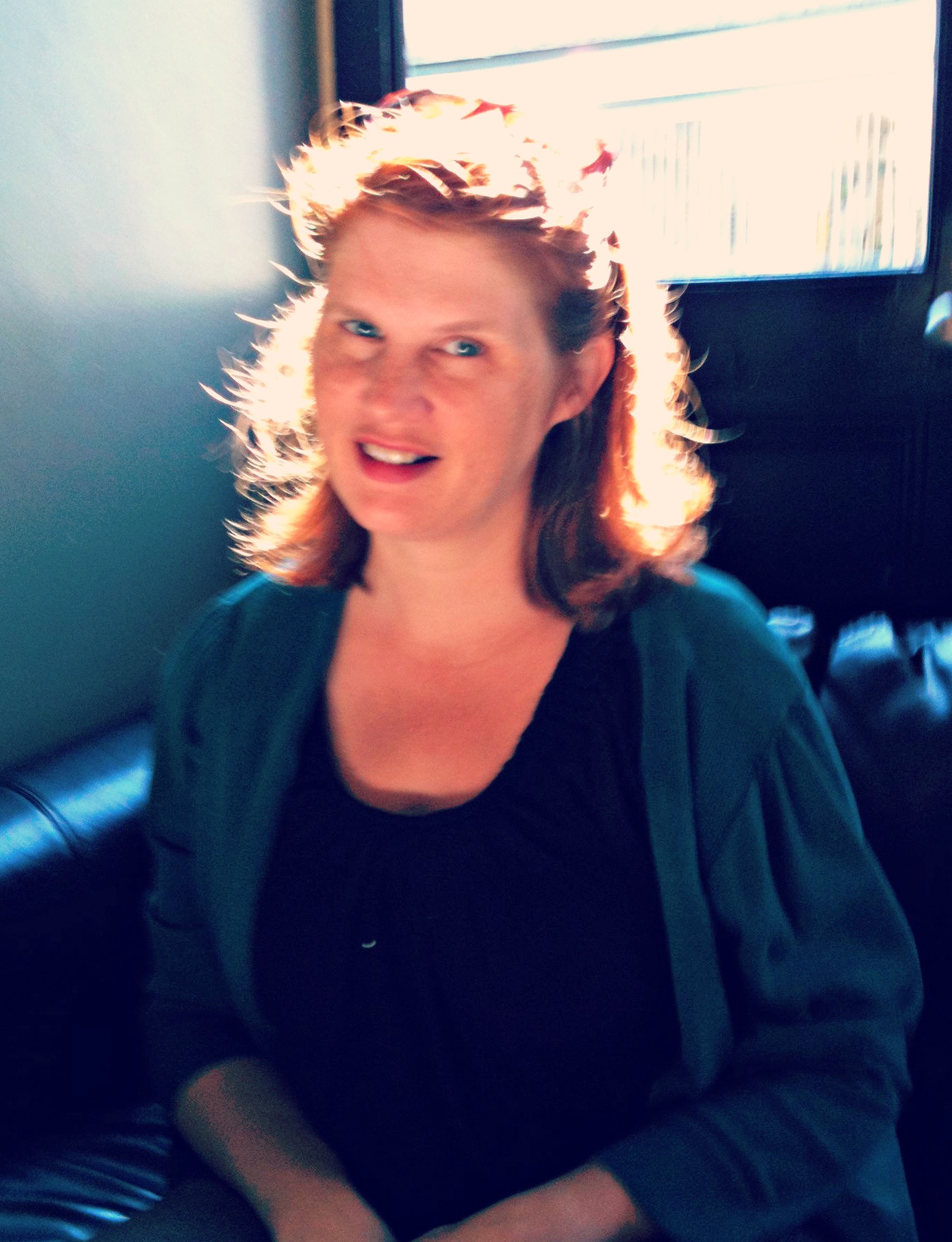
img: Lynne Murphy looking rather other-worldly — or  “out of this displaced world,” as we like to say — in a Brighton pub.

BOOK REVIEW: “The Chalk Circle,” by Tara L. Masih, Ed.

TITLE: The Chalk Circle
AUTHOR: Tara L. Masih (Editor)
LITERARY AWARDS: 2012 Skipping Stones Honor Award
AUTHOR’S CYBER COORDINATES:
Website: www.taramasih.com
PUBLICATION DATE: May 2012 (Wyatt-MacKenzie Publishing)
FORMAT: Ebook (Kindle) and Paperback
GENRE: Anthology/Autobiography
SOURCE: Review copy from author

Author Bio:

Tara L. Masih, a native of Long Island, N.Y., is the editor of The Rose Metal Press Field Guide to Writing Flash Fiction (a ForeWord Book of the Year) and The Chalk Circle: Intercultural Prizewinning Essays, and the author of Where the Dog Star Never Glows: Stories (a National Best Books Award finalist). She has published fiction, poetry, and essays in numerous anthologies and literary magazines (including ConfrontationHayden’s Ferry ReviewNatural Bridge,The PedestalNight Train, and The Caribbean Writer); and several limited edition illustrated chapbooks featuring her flash fiction have been published by The Feral Press. Awards for her work include first place in The Ledge Magazine‘s fiction contest and Pushcart Prize, Best New American Voices, and Best of the Web nominations.

(Source: Author’s website)

Summary:

Award-winning editor Tara L. Masih put out a call in 2007 for intercultural essays dealing with the subjects of  “culture, race, and a sense of place.” The prizewinners are gathered for the first time in a ground-breaking anthology that explores many facets of culture not previously found under one cover. The powerful, honest, thoughtful voices — Native American, African American, Asian, European, Jewish, White — speak daringly on topics not often discussed in the open, on subjects such as racism, anti-Semitism, war, self-identity, gender, societal expectations.

(Source: Amazon.com book description)

Review:

I’ll be honest: anthologies are not what I head for when I enter a bookshop. My gripe is that the tales are too short, and that just as you are getting into the swing of a story, it ends.

This collection of real-life snapshots, on the other hand, is different. Like most other writers, I have an addiction to people-watching and surreptitious eavesdropping, so an anthology of confessions on multicultural issues, by prize-winning writers, is right up my alley.

Because of the book’s broad topic of “culture, race, and a sense of place,” the essay subjects range widely, as each writer offers his or her own perspective on the topic. Not all of the pieces are about living abroad in another country. One such essay, which also struck me as the most poignant, was “A Dash of Pepper in the Snow,” by Samuel Autman. An African-American who grew up in an all-black neighbourhood of St. Louis, Missouri, Autman became the first black reporter for the Salt Lake Tribune in Utah during the early 1990s. His recollections of that time show, clearly, that one does not need to cross oceans to feel like a fish out of water in the worst possible way.

The essay that will probably strike the loudest chord with TDN readers is “Fragments: Finding Center,” by Sarah J. Stoner. An American-born writer who, until the age of 18, had never lived in the country of her passport but had grown up in Uganda, Morocco, Belgium, and Thailand, Stoner writes of her first days at college. This pivotal life experience also coincided with her first days of living in America, a country she can technically call “home” but which feels like anything but:

A pronounced British accent or status as an exchange student would work wonders for me in this moment. But my bland and unremarkable exterior offers no such grace. I appear deceptively American.

Because everyone’s experiences are unique, different essays will appeal to different readers. A solitary person myself, I was fascinated by “Connections,” by Betty Jo Goddard, in which the 78-year-old writer describes her isolated existence in Alaska, and her feelings about using modern technology to stay connected to the world.

Everyone, though, will be touched by “Tightrope Across the Abyss,” by Shanti Elke Bannwart, a woman born in Germany at the start of World War II. In this piece, Bannwart tells the story of her neighbor, Bettina Goering. Goering is the great-niece of Herman Göring, right-hand man of Adolf Hitler, who swallowed cyanide two hours before he was due to be hanged at Nuremberg. Her  struggles to reconcile herself with her Nazi ancestry have already been documented in the film Bloodlineswhere she “seeks redemption by facing Holocaust survivor and artist Ruth Rich in Sidney, Australia.” Bannwart, with her own 70-year burden of having a Nazi father decorated by Hitler, meets her neighbor Goering, and in doing so finds the nugget of peace and self-forgiveness that has evaded her for so long.

Words of wisdom:

On the convenience of the label “TCK”:

Yes. I’m a Third Culture Kid.

I was relieved to finally have a shortened version of, “Well, I am American but I never lived in America until college. I went to high school in Thailand and before that I lived in Belgium and then Morocco before that. Yes, I was born in the U.S., but we left for Uganda when I was seventeen days old.”

(From “Fragments: Finding Center,” by Sarah J. Stoner)

On getting to know a place:

Places are best soaked in through the tongue, sent stomach-ward, digested and incorporated into the body. To know a place is to visit local markets, order things with unpronounceable names, and eat street food no matter the time of day.

(From “Assailing Otherness” by Katrina Grigg-Saito)

On using technology to stay in touch:

Such connections [phone and email]…are available even to “hermits” living on a ridge-top at the end of nowhere. Are they needed? No. But they enrich my life. My life is full of potential connections.

(From “Connections,” by Betty Jo Goddard)

Verdict:

Although this anthology of autobiographical experiences is a slight departure from the usual books we review at Displaced Nation, it’s a valuable and high quality addition to our stable of “displaced reading.” The sheer variety of experiences depicted in the book means that all readers, wherever they hale from and wherever they are at present, will find something that resonates.

“The Chalk Circle” can be purchased here. 

STAY TUNED for Thursday’s trip to Woodhaven, where Libby is feeling more and more like an exhibit on  the Jerry Springer Show.

Image:  Book cover – “The Chalk Circle”

If you enjoyed this post, we invite you to register for The Displaced Dispatch, a round up of weekly posts from The Displaced Nation, with seasonal recipes, book giveaways and other extras. Register for The Displaced Dispatch by clicking here!

Related posts:


Ask Mary-Sue: Is the mid-life gap year a good idea?

Mary-Sue Wallace, The Displaced Nation’s agony aunt, is back. Her thoughtful advice eases and soothes any cross-cultural quandary or travel-related confusion you may have. Submit your questions and comments here, or else by emailing her at thedisplacednation@gmail.com.

Welcome to May, dearest readers. I’m sure like me you find this to be an absolutely delightful time of year as a long and delicious summer stretches out before us. This month’s theme is la dolce vita — or the sweet life in American. For me that means a summer making full use of my grill and dusting off my Paula Dean cookbook. Anyhoo, let’s get on with the queries that you’ve sent in for me, hopefully I can turn someone’s frown upside down — if anything, that’s the real sweet life. Ha, who am I kidding? It’s still baby back ribs!

__________________________________________

Dear Mary-Sue,

My wife and I are middle-aged, middle class Americans with two kids and a house and jobs. But now that our kids are grown up with lives of their own, my wife seems to have gotten it into her head that we should quit our jobs, sell the house, and have an adventure. I said, “Don’t be silly, gap years are for kids,” but she seems determined to do this. I wonder if I can talk her into taking a “gap year” at home. What do you think?

Dan from Denver

Dear Dan,

It sounds to me like you’re not that excited by your wife’s suggestion. This really needs to be a joint decision between the two of you for it to work, otherwise you’ll end up resenting your wife and she’ll feel hurt that you never shared your reservations with her initially. Talk to your wife about your misgivings. It’s a big step to quit your jobs and “have an adventure.” What does that mean anyway? Does she want you to move somewhere entirely different or travel the world? Take your wife out to your favorite restaurant, your local waffle house say, and over pistachio and strawberry waffles find out if there’s anything that excites you both. If it’s that you want to buy motorcycles and travel across the US, then maybe you could look into hiring bikes and doing a few long weekends. Find your common ground and then dip your toes a few times before you decide to take the plunge.

Mary-Sue

———————————-

Dear Mary-Sue,

I am an American who has lived in England for the past twenty odd years. Initially, I was married to an Englishman but that didn’t last. Now that the big 5-0 is approaching, I’d like to take a break from this place — having had my fill of rainy weather and jobs that don’t pay well. I’m thinking about volunteering at an orphanage in Africa or somewhere like that. I told my best friend, who is English, about the plan the other day, and she said: “Why do you want to reinvent yourself in the years when you should be winding down?” Do you think she has a point or is just being negative?

Elaine from Essex

Dear Elaine,

As a committed Anglophile with a younger son who has shown me how to download from torrent sites, I have unfortunately watched The Only Way is Essex and as such it’s my considered opinion that spending a few years in an orphanage in Africa is preferable to remaining in Essex.

Yours in commiseration,

Mary Sue

———————————-


Dear Mary-Sue,

I recently finished reading Susan Griffith’s Gap Years for Grown Ups, and now I’m torn between three different ideas for my mid-life gap year: 1) build walkways in the Costa Rican rainforest; 2) crew a yacht across the Atlantic; or 3) take a gourmet cookery course in the Loire Valley. Can you give me any advice on which one to choose? I should tell you that I’m a middle-aged German, twice divorced, and hoping this gap year will lead to meeting a significant other, preferably from a different culture.

Helmut from Hamburg

Dear Helmut,

I suspect that your true intentions lie in the end of your letter where you write, “I’m…twice-divorced, and hoping this gap year will lead to meeting a significant other, preferably from a different culture.” Let’s  face it Helmut, you’re a little horny, aren’t you? Don’t be shy, there’s no shame in that. I’m convinced that Mellisa from my Tuesday night Bible class who is always so excited about going to Marrakech once a year isn’t just looking forward to her “voluntary work” if you know what I mean. Wink, wink. 

Well, let’s take each option that you’ve presented me with. This idea of taking a yacht across the Atlantic? Hmm, well unless you’re planning on dating a sperm whale, I think you might find the Atlantic slim pickings. Maybe if you ended up yacht-wrecked off the Azores you might have a chance, but really let’s forget this one. Second thought, a cookery course in the Loire Valley. Well, as we’re seeing with President Hollande and Chancellor Merkel, I’m not sure about the long-term benefits of a Franco-German relationship. So that leaves Costa Rica. Last time I visited Costa Rica I was stunned by the amount of sad, lonely, pasty-faced middle-aged men in garish Hawaiian shirts who were on my flight into San Jose. Apparently, they’re getting action, so I don’t see why you shouldn’t as well.

Mary-Sue

___________________________________________

Anyhoo, that’s all from me readers. I’m so keen to hear about your cultural issues and all your juicy problems. Do drop me a line with any problems you have, or if you want to talk smack about Delilah Rene.

Mary-Sue is a retired travel agent who lives in Tulsa with her husband Jake. She is the best-selling author of Traveling Made Easy, Low-Fat Chicken Soup for the Traveler’s Soul, The Art of War: The Authorized Biography of Samantha Brown, and William Shatner’s TekWar: An Unofficial Guide. If you have any questions that you would like Mary-Sue to answer, you can contact her at thedisplacednation@gmail.com, or by adding to the comments below.

STAY TUNED for Tuesday’s post. Mary-Sue has heard it’s going to be great.

If you enjoyed this post, we invite you to register for The Displaced Dispatch, a round up of weekly posts from The Displaced Nation, with seasonal recipes, book giveaways and other extras. Register for The Displaced Dispatch by clicking here!

Related posts:


Is there a common theme — or better yet meme — for the expat life?

After writing, planning, commissioning, and editing posts for this site for just over a year — many of which were centered on the keyword “expat” — I have become rather fixated on that word of late.

Yes, we’re back to that old chestnut, but kindly indulge me while I rake it over the coals again and crack it open to take another look.

Back when I myself could have been considered an expat — first in England and then in Japan — I assiduously avoided describing myself in that way. It made me think of the kinds of people who go into a siege mentality, circle the wagons and say: “Right, it’s just us now.” I’m sure you know the kind of expats I mean, the ones who live in a colony or compound, or socialize as if they do. They hang out at the pool drinking G&Ts, exuding a sense of cultural superiority — along with great pride in having remained unassimilated.

After all, if you’re an expat, it means you come from the richer part of the world; otherwise, you’d be an immigrant.

Nowadays, I’m an American living in America, but I simply tell people that I used to live abroad. If I use the word “expat” at all to refer to myself, it’s in inverted commas: “Yes, I suppose I was an ‘expat’ for all those years. And now I’m a ‘repat.’ Hahaha…”

What about you? If you are reading this, chances are you are (or have been) someone who has ventured across borders to travel and/or live. How do you refer to your predicament? (BTW, my choice of “predicament” is the result of cultivating a British sense of humor over many years of living on that sceptered isle — no, not as an expat, but as an international resident!!!)

Maybe unlike me, you don’t have any hang-ups about calling yourself an expat — and think that people of my sort are inverse snobs for rejecting the label?

As the blogger Tabitha Carvan (The City That Never Sleeps In) has written:

To the Vietnamese who live around me, it’s clear where I fit in here: I don’t. The differences between us are as plain as the enormous nose on my big fat face.

So is it fair to say we’re all “displaced”?

One of the other founders of The Displaced Nation, Kate Allison, is an Englishwoman who has lived in the United States for more than 15 years. I sometimes think of her as an immigrant, except that she tells me she keeps a foot on each side of the Atlantic.

Strangely, I did not wince at all when Kate Allison proposed the word “displaced” as a descriptor for our common situation, when she and I were first chatting about starting up this site.

Well, perhaps I winced just slightly. I know from my studies of international affairs that “displaced” is often used for people who are forcibly removed from their homes by natural disaster, famine, civil wars and other tragedies.

In this narrow sense, “displaced” in no way applies to me, Kate or others of our ilk, who have led privileged lives.

But in a broader sense, I had to agree with Kate that “displaced” seems a good fit. As the Italian poet Cesare Pavese once said:

Traveling is a brutality. It forces you to trust strangers and to lose sight of all that familiar comfort of home and friends. You are constantly off balance. Nothing is yours except the essential things – air, sleep, dreams, the sea, the sky — all things tending towards the eternal or what we imagine of it.

If there is any common theme that applies to all of us, surely it’s that sense of being “constantly off balance,” as Pavese so aptly puts it. By trotting off to investigate — and live in — far-flung corners of the globe, we are casting off the balance of our lives and choosing a life where, for a while, the only things we have in common with anyone else are the basics: air, sea, sky, sleep, dreams — a life of displacement, in other words…

And in some cases — Kate’s would be an example — we are trailing others who have made this choice on our behalf, or on behalf of family and kids. (See her “Libby’s Life” series.)

Always look on the bright side of life!

In an article last month for the FT, Edwin Heathcote had this to say about what he called “a life less ordinary”:

The expat experience combines a cocktail of the thrill of the new and the ennui of global alienation, of displacement and dislocation.

Readers may wonder why the founders of The Displaced Nation have chosen to emphasize the negative ingredients of this cocktail. After all, the meaning of “displaced” is only a shade or two away from “misplaced” or “out of place.”

Why not look at the bright side instead — the allure and the thrill of a life overseas?

Well, the fact is, the founders of The Displaced Nation don’t necessarily see displacement as a negative. As shown in numerous ways on this site over the past 12 months, it’s a necessary first step in making the leap beyond the known to the unknown — to feeding what for many of us is, or soon becomes, an insatiable hunger for new ways to knowledge.

By becoming displaced, we open up our minds to new forms of

Now if that isn’t the bright side, we don’t know what is!

Keep ’em laughing as you go

As far as our site stats go, readers have most enjoyed the series of posts where we’ve explored the good and the bad, the yin and the yang, of the displaced life, with a large helping of humor thrown into the mix.

1. Alice in Wonderland

Top of the charts is the month that we dedicated to the “curious, unreal” aspects of the displaced life with the help of Lewis Carroll’s Alice.

When you stop to think of it, barging into other people’s countries is rather like falling down a rabbit hole: full of adventure but also misadventure, of curious — and sometimes scary (because so incomprehensible) — encounters.

Kate Allison produced two brilliant posts illustrating just how unreal things can sometimes get: “5 lessons Wonderland taught me about the expat life, by Lewis Carroll’s Alice,” and “How many of these 5 expat Alice characters do you recognize?”

Meanwhile, Guest blogger Carole Hallett Mobbs kept us in stitches when describing the scenes of young adults dressed up in furry romper suits, “doormice folk,” and flying potatoes that formed the backdrop to her everyday life in Japan.

2. Pocahontas

Readers also appreciated the month when we recruited the legendary Pocahontas to help us understand, from a native’s point of view, what it’s like to be bombarded with clueless nomads.

In particular, we focused on the cases when displaced types befriend, or even marry, the natives, causing them to lead displaced lives (sometimes to tragic effect — I’m thinking not so much of Pocahontas, but of her tribe!).

I weighed in with a post that was partly based on my own experiences: “Cross-cultural marriage: Four good reasons not to rush into it.” Somewhat to my bemusement, the post proved extremely popular — that is, until it was surpassed by new TDN writer Tony James Slater’s hilarious (but with a hard kernel of truth) “Does love conquer all, even language barriers?”

Counterbalancing Tony’s and my cautious take on such matters was a two-part interview series with two cross-cultural couples — all of whom seemed to find their situation “no big deal.”

That blasé sentiment would later be echoed by Wendy Williams, author of the new work, The Globalisation of Love. In a guest post in honor of Valentine’s Day, she pointed out that in an era of increased international travel, multicultural unions are an inevitability — and even deserve their own label: “GloLo.”

3. Global philanthropy

Another monthly theme that earned high marks from readers was “global philanthropy” — the idea of displacing oneself on behalf of the forcibly displaced.

Readers responded with high praise for Kate Allison’s interview of Robin Wiszowaty, who immersed herself in Maasai culture and now runs development programs in Kenya on behalf of the Canada-based charity Free the Children.

Also popular was a feature on international aid worker and consultant Jennifer Lentfer. (Lentfer has received the most hits of any of the 40 Random Nomads who’ve been featured in the site’s first year.)

But even when covering this seemingly sacrosanct topic, we were hard pressed to prevent a note of skepticism, verging on irreverence, from creeping into the site. Guest blogger Lawrence Hunt stirred things up with his well-received post making fun of gap-year students who think they can save the world in just six months. And I wasn’t far behind with this one, still getting many hits: “7 extraordinary women travelers with a passion to save souls.” (Hey, the current generation isn’t the first to perform good works on behalf of those less fortunate!)

But is it a meme?

First, what is a meme exactly? My dictionary tells me it’s an idea, behavior or style that spreads from person to person within a culture.

Memes are the cultural analogues to genes that get selected and then self-replicate.

Is the kind of “displacement” we talk about on this site a meme? Not in the Internet sense — it hasn’t spread like wild fire throughout social media.

But has it been a meme within our community? You tell us — does “displaced” work for you, or is there some other organizing principle we should be using on this site? Expat, perhaps? (Groan…)

STAY TUNED for tomorrow’s post, a roundup of recent displaced reads by Kate Allison.

If you enjoyed this post, we invite you to register for The Displaced Dispatch, a round up of weekly posts from The Displaced Nation, with seasonal recipes, book giveaways and other extras. Register for The Displaced Dispatch by clicking here!

Related posts:


“We read to know we’re not alone”: 1st-ever litfest for expats & random nomads

The displaced writer Hazel Rochman once said that reading “makes immigrants of us all”:

Reading takes us away from home, but more important, it finds homes for us everywhere.

That must be why author interviews have played such an important role in the entertainment mix provided by The Displaced Nation since our founding one year ago.

A book that enables us to escape to a new world without buying a plane ticket? Bring it on!

A book that makes us feel at home in another part of the world? There’s nothing we crave more.

We’ve also taken authors into our confidence who, as St. Augustine once advised, treat the world as their book, rather than staying put and reading only one page. Because of their own peripatetic ways, these writers have much to say to the rest of us nomadic types about how to make sense of feelings of isolation, ennui and displacement.

As C.S. Lewis once said:

We read to know we’re not alone.

In honor of The Displaced Nation’s first anniversary, as well as in the spirit of World Party Month, I would like to propose the first-ever Displaced Nation literary festival featuring authors who have been interviewed or in some way featured on the site during the past year.

“We read to know we’re not alone”: THE FIRST-EVER LITERARY FESTIVAL FOR EXPATS AND RANDOM NOMADS
Note: The following is a tentative line-up. It includes previews of the kinds of insights we can expect to glean from such an extraordinary gathering of expat literati.

We anticipate the festival to extend from a Sunday night to a Thursday morning, with an opening night gala and a couple of closing events. Click on the headlines to go to the event descriptions for each segment:

OPENING NIGHT GALA EVENT

It seems only fitting that we offer something totally mad on our opening night. We will screen Alice in Wonderland, the 1903 British silent film directed by Cecil Hepworth and Percy Stow, which was partially restored by the British Film Institute and released in 2010. (NOTE: You can see portions of the film in a video specially made by Anthony Windram during The Displaced Nation’s “Alice in Wonderland” theme month.)

The film is memorable for its use of special effects: Alice’s shrinking in the Hall of Many Doors, and then growing too large in the White Rabbit’s home, getting stuck and reaching for help through a window.

The film matches our theme of “We read to know we’re not alone” — could anyone ever feel lonelier than Alice did at such moments?

But here’s the new twist: the screening will feature a live accompaniment by Seremedy, the displaced Swedish visual kei band this is now making such a sensation in Japan, reacting musically and without any rehearsal beforehand, to the silent film in front of them. Unique, spontaneous — and perhaps even terrifying, given that the band’s (male) lead guitarist, Yohio, looks like an anime version of Alice.

DAY ONE: “We’re not alone” — We have each other

Iranian Childhoods, Inspiring Stories

TONY ROBERTS and ASHLEY DARTNELL each spent portions of their childhood in Iran. Roberts has produced a novel based on his memories of that time, Sons of the Great Satan, which we featured on this blog about a year ago. Dartnell, who has yet to be featured (we hope she will!), released her memoir, Farangi Girl, last year (it was recently issued in paperback).

Roberts and Dartnell have in common the status of being so-called third culture kids — growing up in a third culture not common to their parents (Roberts’ parents were American and Dartnell was the product of an American mother and British father). They also have in common that they were enjoying their lives in Tehran until something terrible happened — the memory of which affects them to this day.

In Dartnell’s case, it was the sudden collapse of her father’s business (her parents subsequently split up), whereas for Roberts, it was the experience of being evacuated because of the American hostage crisis — suddenly, he was back at the family’s small farm town in Kansas, having no idea of where his friends had gone.

TCKs experience such traumas in isolation (Roberts continued to feel isolated well into his adulthood). Roberts and Dartnell, who have never met before, welcome the opportunity to forge a new connection over their common displacement.

PERFORMANCE: “The White Ship,” by Ethan Kenning

Ex-folk singer Ethan Kenning — known as GEORGE EDWARDS when performing with the former psychedelic rock band H.P. Lovecraft — will give a special performance of “The White Ship,” a song based on a mystical tale by horror writer H.P. Lovecraft (from whom the band took its name), about a vessel sailing on a sea of dreams. Critics have described it as “baroque, Middle Eastern-flavored psychedelia at its finest.”

Multicultural Marriage Boot Camp

Two Wendys — WENDY WILLIAMS and WENDY TOKUNAGA — will answer questions about the benefits as well as challenges involved in marrying someone from another culture.

Wendy Williams is the author of The Globalisation of Love and has coined a term, “GloLo,” to refer to this phenomenon. She was last week’s Random Nomad and has also been a contributor to The Displaced Nation with the post: “Why expat is a misleading term for multicultural couples” — a topic big enough to be a festival theme in its own right!

Wendy Tokunaga, who was one of The Displaced Nation’s 12 Nomads of Christmas, recently published Marriage in Translation: Foreign Wife, Japanese Husband, consisting of interviews with 14 Western women involved in cross-cultural relationships.

GloTinis will be served — those in particularly challenging unions may wish to order theirs straight up.

Romance Across Borders: Fairytale or Myth?

JANE GREEN, a prolific writer and one of the founders of chick literature, will interview MEAGAN ADELE LOPEZ and MICHELLE GORMAN — both of whom have produced first novels exploring the idea of looking for romance in other cultures. Lopez is the author of Three Questions: Because a quarter-life crisis needs answers (self-published, October 2011), about a cross-cultural romance that blossoms through the asking of three questions; and Gorman, of Single in the City: One girl, one city, one disaster waiting to happen (Michael Joseph, 2010), about an American who goes to London in search of love and the perfect life.

The Displaced Nation recently featured Lopez on our site and will feature her tomorrow in a guest post. We have yet to interview Gorman but would like to — especially as she recently self-published Misfortune Cookie, about a young woman who moves to Hong Kong to be with her boyfriend.

Both women relied heavily on their own autobiographies to produce these first novels. As Lopez said in her interview with Tony James Slater:

Hey — they always say to write about what you know, so that’s what I did!

But is it the stuff of chick lit? No one is better placed to judge this than the displaced author Jane Green (she is now an expat living in Connecticut). As early readers of The Displaced Nation will recall, Green “came in” for a chat during our coverage of last year’s Royal Wedding — she had just produced a multimedia book celebrating the young royals as an example of a “modern fairytale.”

Though Kate and Will aren’t from different cultures, they might as well have been since Kate — unlike the Prince’s mother, Diana — does not come from a royal lineage. But from Green’s point of view, this is what is makes the couple modern — and why their marriage is likely to last:

I loved discovering just how unusual William and Kate are: grounded, humble, and thoroughly modern, eschewing much of the pomp and circumstance that surrounded the wedding of Charles and Diana.

One Person’s Home — Another Person’s Nightmare?

BARBARA CONELLI, who lives in Manhattan for half of the year and Milan for the other half, will interview SHIREEN JILLA, whose first novel was set in the Big Apple.

Thanks in large part to the influence of her Italian grandmother, Conelli qualifies as the ultimate Italophile. Last year she published Chique Secrets of Dolce Vita last year — her first book in a three-part series about the Italian grasp of the “good life.” When asked by Kate Allison to explain the differences between her two homes of Milan and New York City, Conelli said that New Yorkers need to learn the Italian art of taking the time to actually live:

We need to stop and smell the roses more often.

On this point, Jilla would certainly concur. After spending three years in New York as an expat when her husband was BBC’s North America correspondent, Jilla came away thinking that “New York is a city populated by control freaks.”

But, unlike Conelli, Jilla found this control freakery sinister — which was what inspired her to write a novel that depicts the city as, as one critic said, “a teeming pit of vipers, only just covered with a finely buffed veneer of sophistication.”

In the online discussion we hosted of Exiled, Jilla commented on how culturally different New York and London are — despite New York not being seen as a particularly adventurous posting among the expat crowd. She went on:

New York in fact reminds me a lot more of Rome than London. Passion is lived out on the street, for good and bad.

Hmmm… It will be interesting to see what Conelli, whose series includes a book on Rome’s joyful idleness, makes of that!

Are Expats Defined by Their Boundaries — or the Lack? James Joyce Unplugged

One of The Displaced Nation’s founders, ANTHONY WINDRAM, and the novelist JOANNA PENN will join forces to discuss the topic of whether being an expat necessarily entails producing “expat” literature. In a post published last year on The Displaced Nation, Windram noted that although James Joyce spent most of his adult life in continental Europe, he continued to write about his home, Ireland:

If we were to be glib, we might say that Finnegans Wake was conceived in Dublin, but Paris was its midwife.

Likewise, Joanna Penn, who has been a TCK and an expat, does not self-identify as an expat writer and sets her novels at least partly in Oxford, the city she calls home. She does feel, however, that wanderlust is a big part of what fuels her to write thrillers set in various countries, as she explained in a comment on a post deconstructing a post of hers on what “home” means to writers.

DAY TWO: “We’re not alone” — Global activism

Travel for a Purpose

For this event, we hope to engage the world-famous novelist BARBARA KINGSOLVER to interview ROBIN WISZOWATY, who is Kenya program director for the Canadian charity Free the Children and the author of a memoir targeted at young adults on her own experience of living in Kenya, My Maasai Life.

Kate Allison interviewed Wiszowaty during the month when The Displaced Nation explored the topic of global philanthropy.

Around the same time, Allison also wrote a post on Kingsolver, exploring the idea that her novel The Poisonwood Bible was intended an allegory for what happens when you barge into someone else’s culture thinking you know everything and they know nothing.

Notably, Wiszowaty could almost have been a Kingsolver character in the following incident that occurred during her initial two months in Nairobi, as reported to Allison:

One street man nearby…said in Swahili, “What are you doing in Kenya, if you can’t help us?”

Despite my halting comprehension of the language, I understood his question. What was I doing here? Was I here to help Kenyans? I couldn’t remember any sort of altruistic impulse as my reason for being me here. I only pictured myself three months earlier, curled up on my family room couch reading books on cultural sensitivity, or shopping in neighborhood department stores for appropriate clothing, thinking this was a chance for me to enlarge my experience and pick up others’ points of view. I’d been driven simply by a desire to escape, not to improve the lives of these poor people.

Wiszowaty, of course, came around and now thinks constantly about what she can do for Kenya. We expect that Kingsolver, who funds a prize for authors of unpublished works that support social change, will approve; but will she also offer a critique?

PERFORMANCE: “The Boy with a Thorn in His Side,” by Pete Wentz

Fall Out Boy’s PETE WENTZ will do a performance in which he puts passages from his 2004 book, The Boy with a Thorn in His Side, to music. The book chronicles the nightmares he had as a child.

Wentz is a supporter of Invisible Children, Inc., an organization dedicated to helping the cause of child refugees in Uganda. He once participated in an event called “Displace Me,” in which 67,000 activists throughout the United States slept in the streets in makeshift cardboard villages.

(Notably, Wentz has also earned his chops as world traveler. Before Fall Out Boy went on hiatus in late 2009, it made an unsuccessful bid to the only band to play a concert on all seven continents in less than nine months — unfortunately, weather conditions prevented them from flying to Antarctica.)

Why Feisty Heroines Need Not Always Be Named Pollyanna, Calpurnia or Hermione

Melbourne-based author GABRIELLE WANG writes books under the Penguin label targeted at young adults in Australia. Her heroines are always non-white, Chinese or some mix. They are culturally marginalized.

Wang, who fell into writing accidentally — she had planned to be a book illustrator — loves to use her imagination to create characters who are historically plausible yet never show up in history books. One such character is Mimi, who feels ashamed of being Chinese until she has a magical, transformative experience that makes her proud of her cultural heritage.

Another such character is Poppy, a half-Chinese, half-Aborigine girl who lived in the 19th century.

Wang told us she was able to draw on her own background to portray how Poppy might have felt:

I think I was able to imagine the Aboriginal child’s situation quite easily because I know what it feels like to be an outsider, and to suffer racial prejudice. I was the only Asian child in my school in Melbourne and I only saw white faces in the street.

The Search for Paradise

The search for paradise has been underway for as long as human history. Understood as an idyllic realm located at an exact spot somewhere on the earth, and yet as a place separated from the world, the possibility of reaching paradise has aroused the curiosity of travelers over many centuries and continues to do so.

MARK DAMAROYD, who has lived in Thailand for the past several years, subscribes to the idea that paradise is indeed what many men have claimed it to be since time immemorial: life on an exotic island, with sandy beaches, coral reefs and coconut trees, and with an exotic, much younger girlfriend. That is why, as he told us in an interview last summer, he had Koh Samui in mind when creating the island setting for his first novel — the aptly named Pursuit to Paradise.

Coming from a somewhat different direction is JACK SCOTT, whose memoir — Perking the Pansies: Jack and Liam Move to Turkey — was reviewed at the end of last year by Kate Allison.

In it, Scott tells the story of how he and his civil partner, Liam, left the rat race in London behind to live in Bodrum, Turkey. A picturesque spot on the Mediterranean with a temperate climate, the city was their vision of paradise.

Naturally, though, things were not that simple. The couple soon encountered another rat race — the expat one. To quote directly from Scott’s book:

Sad people, bad people, expats-in-a-bubble people. They hate the country they came from; they hate the country they’ve come to. This was my social life. This is what I gave everything up for. This was Liam’s bloody Nirvana. We were the mad ones, not them.

PERFORMANCE: “Red Right Hand,” by Nick Cave

NICK CAVE is a distinguished musician and songwriter from Down Under. He took the title of this song from a line in John Milton’s epic Paradise Lost, referring to the vengeful hand of God. According to the lyrics: “You’re one microscopic cog in his catastrophic plan.”

Cave has also occasionally dabbled in literature. As one reviewer put it, his first novel “reads like a logical extension of the dark world his music has already created.”

Ghosts of Nations Past and Future

In honor of Dickens’ bicentenary, Displaced Nation contributor ANTHONY WINDRAM will give a spirited reading of his favorite passages from A Christmas Carol (already explored in a post), followed by a discussion of whether Scrooge’s displacement could inspire the planet’s wealthiest people to behave more humanely. To quote from one of the comments made on Windram’s original post:

If such a man as Scrooge can displace his lust for money with a love of humankind — and an awareness of other people’s suffering — then does that mean there’s hope for the 1%?

Through the Looking Glass: Delhi & Bangkok

JANET BROWN, author of the travelogue Tone Deaf in Bangkok, and DAVE PRAGER, author of the travelogue Delirious Dehli, will discuss the need for travelers to do more than the usual amount of preparation when entering cultures that are very different from one’s own, on a par with Alice’s Wonderland.

As Brown explained in her interview with us, travelers to Thailand can be “tone deaf” because Thai is a tonal language and it’s easy to make mistakes. But they can also be “tone deaf” when it comes to figuring out the Thais’ communication style:

“You looked so beautiful yesterday” probably means today you resemble dog food and ought to go home and rectify that at once.

Whereas for Prager, one of the points about living in Dehli is that you may end up deaf as there are always people, animals and vehicles around.

In conversation with Anthony Windram, Prager admitted that getting used to America again — he and his wife now live in Denver — hasn’t been easy:

What’s struck me is that the US just seems so empty. It’s not that India is always intensely crowded; rather, it’s that India you’re never completely alone.

WRITING LAB: What (Not) to Write

Expat writing coach par excellence KRISTEN BAIR O’KEEFFE will explore techniques to develop your writing skills and help you find which world, of your many worlds, you want to write about, and how to get started.

Last summer’s post “6 celebrated women travel writers with the power to enchant you” was officially dedicated to O’Keeffe for delivering these pearls of writerly wisdom during her “Expat Writing Prompts” series:

Writing a multi-volume treatise is NOT the answer. Of this, I am sure.
Instead find a nugget. A moment. A single object. One exchange. One epiphany. One cultural revelation.
Find one story and tell it.
Just it.

DAY THREE: “We’re not alone” — Eat, drink, be merry & look good

Classy and Fabulous: French Style as Universal Norm

The French may be under fire for how they treat immigrants, but expats continue to thrive there. For this event, the classy and fabulous JENNIFER SCOTT, author of Lessons from Madame Chic: The Top 20 Things I Learned While Living in Paris — which has been a runaway success (it’s now under contract by a major publisher!) — will set out to prove, as she did last month in an interview with us, that no one can edit down their clothes and belongings as well as the French can.

The equally classy and fabulous ANASTASIA ASHMAN, co-editor of The Expat Harem: Foreign Women in Modern Turkey — and participant in our “Cleopatra for a Day” series last month — will serve as discussant. Two of the cultural influences for Ashman’s wardrobe are Southeast Asia (she once lived in Malaysia) and Turkey (she was an expat in Istanbul for several years). She does, however, adore French perfume!

Which Came First, Story or Recipe?

It’s food — so that means France again! ELIZABETH BARD, an American who lives in France with her French husband, and her opposite number, CORINE GANTZ, a Frenchwoman who lives near LA with her American husband, will explore why food is so central to the works each of them produces.

Bard is the author of the best-selling Lunch in Paris: A Love Story with Recipes. So did she ever think of writing it the other way around: recipes with a love story? Here’s what she told ML Awanohara in their conversation last autumn:

When I sat down to think about the moments that really helped me discover French life, I kept coming back to the dinner table, the markets, the recipes — so it seemed natural to structure Lunch in Paris around those experiences.

Gantz can no doubt relate. When we featured her novel, Hidden in Paris, last summer, here’s what she said when the topic of food came up:

For me, writing a novel is a barely disguised way for me to talk about food — the novel being a vehicle for food just as grilled toast is a vehicle for foie gras.

Fans of Hidden in Paris, please note: Gantz has just now released a playful cookbook featuring 20 delicious dishes that were described in mouth-watering details in the novel.

Moderating the discussion between Bard and Gantz will be the well-known novelist JOANNE HARRIS. Harris, who was born over a sweet shop in Yorkshire to a French mother and an English father, rarely misses an opportunity to bring food and drink into her novels — the most famous example being Chocolat.

Displaced Storytelling Circle

Verbal antics, stories, music and more. Highlights include readings by

  1. Displaced Nation contributor TONY JAMES SLATER, from his highly entertaining travelogue, That Bear Ate My Pants! Adventures of a Real Idiot Abroad.
  2. Displaced Nation interviewee ALLIE SOMMERVILLE, from her wry memoir Uneasy Rider: Confessions of a Reluctant Traveller. (Allie, please read the passage about the campervan being too wide for one of the Spanish streets!)
  3. Displaced Nation nomad KAREN VAN DER ZEE, from her collection of expat stories. (Miss Footloose, please tell us the ones about the crocodile and the couple in the Roman restaurant!)
  4. Founder KATE ALLISON, from The Displaced Nation’s weekly fiction series, Libby’s Life, which as you may have noticed, is now up to 46 episodes. (Kate, be sure to read the one where you introduce Sandra, Libby’s MIL from hell!)

The Art of Drink: Ian Fleming

One of The Displaced Nation’s founders, ANTHONY WINDRAM, will talk about the role of food (and especially drink) in Ian Fleming’s James Bond novels, on which he did a post last year:

The Bond of the novels isn’t solely a martini drinker. He’s always one to try anything local that’s on offer. In Jamaica he’ll drink a glass of Red Stripe, in the US he’ll have a Millers Highlife beer. Throughout the novels Fleming uses food and drink to convey an alien culture, demonstrate social status, show Bond’s mood and his sophistication and ease with the world.

An array of drinks — not only shaken martinis but also bottles of Heineken!– will be served. Green figs and yogurt, along with coffee (very black), will be made available to anyone who is still suffering from jetlag.

Enchanted by Wisteria: Elizabeth Von Arnim Unveiled

Displaced Nation founder (and the author of this post!) ML AWANOHARA will read her favorite passages from the collected works of travel writer Elizabeth von Arnim, on whom she wrote a post last year. As she pointed out then, Von Arnim was fond of the idea of a woman escaping her marital, motherly and household duties in the pursuit of simple pleasures such as gardens and wisteria. A magical Italian castle — such as the one featured in her best-known novel, The Enchanted April — can also be a tonic.

CLOSING NIGHT + BONUS EVENT

To close the festival, we will screen both the Swedish and Hollywood versions of The Girl with the Dragon Tattoo, followed by a critique from CHRIS PAVONE, author of the new novel The Expats. Pavone will discuss whether:

  1. it was really necessary for Hollywood to produce its own (non-subtitled) version; and
  2. all the female-perpetrated violence cropping up in film and on TV of late presages a “fourth wave” of feminism.

Pavone is well qualified to judge the latter as his novel (not yet featured on TDN!) is an offbeat spy story with a female protagonist — a burned-out CIA operative who moves to Luxembourg. Apparently, this was the kind of thing Pavone thought about when he was trailing his spouse in that cobblestoney old town.

And, just when you thought it was all over, we bring you a final treat: a chance to hear from the historian SUSAN MATT, who recently published Homesickness: An American History to much fanfare in the thinking media. Matt disputes the stereotype of Americans as westward wanderers by showing that Americans are returning to their homeland in greater numbers — that’s if they ever leave at all. (Our ancestors must be turning over in their graves!)

* * *

So, shall I sign you up? And can you think of any additional topics/authors/performers who ought to be featured? I look forward to reading your suggestions in the comments.

STAY TUNED for tomorrow’s guest post from Meagan Adele Lopez, on the differences between American and British wedding celebrations.

If you enjoyed this post, we invite you to subscribe for email delivery of The Displaced Dispatch, a round up of the week’s posts from The Displaced Nation. Sign up for The Displaced Dispatch by clicking here!

Related posts: