The Displaced Nation

A home for international creatives

Category Archives: Cool Columns

CULTURE SHOCK TOOLBOX: Expats, don’t let the cultural prism you carry around blind you to the most interesting facets of the experience

Culture Shock Toolbox Joe Lurie
Transitions enthusiast H.E. Rybol consults with a world expert on cross-cultural communication for this month’s column.

Hello, Displaced Nationers! This month I’d like to introduce you to Joe Lurie, Executive Director Emeritus of the University of California Berkeley’s International House. If you’re not familiar with it, I-House is a multicultural residence and program center that serves Berkeley’s students, alumni, and the local community. Its mission is to foster intercultural respect, understanding, lifelong friendships, and leadership skills to promote a more tolerant and peaceful world. Founded in 1930, Berkeley’s is part of a network of International Houses worldwide.

In addition to having led this esteemed cross-cultural institution, Joe has worked as a teacher, trainer and consultant. Last year, he published Perception and Deception: A Mind-Opening Journey Across Cultures, which contains the sum total of his knowledge about cross-cultural communication.

On the book cover is a cow, with the question:

What am I?

Divine?
Dowry?
Dinner?

Already this tells you something about Joe—the fact that he has a sense of humor along with many stories to tell about bridging cultures. As one of his Amazon reviewers says, the book is “sometimes laugh out loud, sometimes moving, always thought provoking.”

Joe also shares stories on his YouTube channel, along with information about how our own narratives can lead to incorrect perceptions. Tune in to watch him speak about an Italian student who thought his Sikh roommate was Jesus, the various meanings slurping and belching can have—and much more!

But for now, let’s hear a couple of Joe’s stories about gift giving, along with his theory of cultural prisms, the kind that can blind you once you exit your comfort zone. Warning: Joe’s culture shock toolbox may require donning safety specs!

* * *

Hi, Joe, and welcome to Culture Shock Toolbox. Tell us, which countries have you lived in and for how long?

I lived in Kenya as a Peace Corps Volunteer for three years; directed international educational programs in various parts of France (Strasbourg, Toulouse, Dole and Corsica) for four years; directed a study abroad program in Ghana for six months; and studied in Montreal, Canada, for two years. I have also traveled widely in Asia, Africa, Europe and Latin America, New Zealand and Australia as part of my career in international and intercultural education.

In the course of your many cultural transitions, have you ever ended up with your foot in your mouth?

I recall, while living in Ghana, offering a gift to an Ashanti chief with my left hand, which caused a very angry reaction from the chief and the villagers who were present. Little did I know then that offering something with the left hand is virtually taboo in many parts of Africa, the Middle East and Asia. The left hand in these areas is considered dirty, used frequently to clean oneself after a bowel movement.

How did you handle that situation? Would you handle it any differently now? What are the tools that you think are most useful for adapting to this kind of scenario?

Before entering another culture, it’s helpful to become familiar with its values, taboos and related behaviors, in contrast to your own values, taboos and behaviors. It is also useful to spend time with someone from the countries to be visited, asking them what they see as strange, offensive, or even unacceptable in your culture. This kind of research makes it easier to pause and suspend judgement when encountering a strange, inexplicable behavior beyond the horizons of your experience.

Of course, I apologized profusely—but to little avail until another Ghanaian, who had been to the United States, explained to all assembled that I meant no harm. It was at that moment that I fully understood the spirit behind the West African proverb: “The stranger sees only what he or she knows.” The Japanese also have a good one: “You cannot see the whole world through a bamboo tube.”

Japanese proverb bamboo tube

Can you think of a situation you handled with finesse, and why do you think that was?

I recall an Indian friend offering me a beautifully wrapped gift with two hands—a signal that I should accept the gift with two hands, as is the custom in many parts of Asia. Also, many Americans will open the gift immediately in front of the giver, eager to know what’s there—and perhaps even feigning joy if the gift is not particularly desirable. Because I had read about and experienced the discomfort that opening a gift in front of the giver could cause, I paused and chose to open the gift in private later, in order to prevent any possible sign of disappointment that might cause the giver to lose face.

If you had any advice for someone moving abroad for the first time, what tool would you suggest they develop first?

Travelers and new expats would do well to realize that their cultures function like narrow prisms that distort their perceptions of what lies beyond their cultural ponds. As far as the Culture Shock Toolbox goes, I would advise that you take out your chisel and keep chipping away at these prisms to include facets of other cultures. The original prism never completely goes away, but you shouldn’t let it prevent you from taking in all you can from all the people you meet in other places. It’s enlightening as well as enriching.
cultural prism and chisel

Thank you so much, Joe, for taking the time to share your culture shock stories with us! Your description of one’s native culture as a prism is spot on. A prism takes light but then bends and distorts it. And I think you are right, we ought to chip away at these prisms, or at least become more aware of their refractive effects in producing cultural biases that limit our understanding of other cultural realities. We would all, whether we travel or not, do well to heed that advice, given that so much of our world is multicultural these days.

* * *

Readers, in light of Joe’s advice, why not take a moment and ask yourself: what is my cultural perspective and what does it make me see (and not see) in others? And now if you want to learn more about what Joe has to say, I recommend you visit his author site and/or consider buying his book for further inspiration (and entertainment!).

Well, hopefully this has you “fixed” until next month.

Until then. Prost! Santé!

H.E. Rybol is a TCK and the author of Culture Shock: A Practical Guide and Culture Shock Toolbox. She loves animals, piano, yoga and being outdoors. You can find her on Twitter, Linkedin and Goodreads. She recently launched a new Web site and will soon be publishing her second book, on repatriation.  

STAY TUNED for more fab posts.

If you enjoyed this post, we invite you to register for The Displaced Dispatch, a round up of weekly posts from The Displaced Nation—and much, much more! Register for The Displaced Dispatch by clicking here!

Related post:

Photo credits: Book cover and author image supplied; all other photos from Pixabay.

LOCATION, LOCUTION: Writer Tracey Warr is a troubadour of medieval life, telling stories she collects from roaming far and wide

Location Locution
Columnist Lorraine Mace, aka Frances di Plino, is back with her latest, and last(!), interview guest.

My guest this month is Tracey Warr, a writer of fiction and nonfiction who was born in London and lived there for a substantial portion of her life—but these days can be found in Pembrokeshire, in the south west of Wales; on the Aveyron in southern France; or in transit.

Actually, Tracey is more than just a guest; from next month onwards, she will be assuming the reins of the Location, Locution column. I’ve enjoyed my time interviewing a variety of talented expat authors, and I thank you all for your comments and for being part of my writing life.

I know you will be in good hands with Tracey, who already has lots of interesting interviews lined up for you. But first, like Jill Marsh and I before her, Tracey will introduce herself and her writing by answering the Location, Locution interview questions.

Tracey has enjoyed two illustrious careers. Her day job for many years was as an academic specialist in contemporary art history and theory. She studied English Literature at Oxford University and holds a PhD in Art History. She held the post of senior lecturer for 15 years, teaching art history and theory in not only the UK but also Germany and the Netherlands. She has been involved in art curation projects all over the world, including in Australia, the USA, Spain, Lithuania, Norway and Finland. She has a long list of published books and articles and contributes art book reviews to Times Higher Education. Her most recent publication in the contemporary art field is the edited volume Remote Performances in Nature and Architecture, which came out last year with Routledge.

But if Tracey’s head is in the world of contemporary art, her heart belongs to historical fiction. After earning an MA in Creative Writing at University of Wales Trinity St Davids in Carmarthen, she entered her second career: writing fiction and biographies inspired by the landscapes and medieval histories of southern France and south west Wales.

If Tracey’s head is in the world of contemporary art, her heart belongs to historical fiction. Photo credits: (top row) The mind via Pixabay; cover art for Warr’s recent book; (middle row) Tracey Warr author photo; Map bastides in 1271, by FRAMYJO, Wikimedia Commons (public domain); (bottom row) Hearts via Pixabay; Ramon Berenguer I and his wife, Almodis de la Marche, counting out 2,000 ounces of gold coins, via Wikimedia Commons (public domain).

Thus far Tracey has published two novels set in early medieval France, Spain and Wales: Almodis the Peaceweaver (2011) and The Viking Hostage (2014). Her new novel, Conquest: Daughter of the Last King, due out later this year, focuses on the 12th-century Welsh princess Nest ferch Rhys and the Welsh resistance to the Normans. In addition, Tracey is working on a biography entitled Three Female Lords, charting the lives and interactions of three medieval sisters who ruled in 11th-century southern France and Catalonia.

Tracey has already garnered numerous awards in her new career as a novelist and biographer. I won’t go on to list them because I am eager to get to our interview, but I urge you to read about her accolades on the page created by her publisher, Impress Books.

And now let’s meet Tracey Warr and hear her views on location, locution.

* * *

Welcome, Tracey, to Location, Locution, a column that will soon be yours! You have a strong sense of place in your historical novels, but tell us, which comes first, story or location?

Thank you, Lorraine, for hosting me and I look forward to assuming the column reins next month. In answer to your question: location! I was staying in a friend’s house in a remote village in the Tarn Valley in southern France for four months during a very cold winter. I visited the nearby medieval castle and village of Brousse-le-Château with my nephew, who was around 10 at the time and asked me to write a story about the castle. He loved it when I made up stories, and actually had me under a “contract” to write him at least one story a year—a hard task-master! During my research I came across an extraordinary real woman, Almodis de La Marche—and realised she would make a fascinating adult novel. The incidents of her life astonished me and I had to become a self-taught historian to discover more and more about her and then imagine what had happened during the gaps in the historical evidence. The landscape in this part of France is littered with spectacular castles and medieval bastide towns clustered around hilltops and connected by rivers, which served as highways in medieval times, so it became a process of location initiating and then feeding the development of the story.

Almodis inspiration

During her research on the castle, Tracey Warr came across an extraordinary real woman, Almodis de La Marche. Photo credits: Brousse-le-Château and Almodis cover art (supplied).

I’m particularly fascinated by watery landscapes—rivers, estuaries, coasts and islands. My second novel and the third one I’m working on now also began with landscapes—the Welsh islands off the coast of Pembrokeshire and the great triple river estuary at Carmarthen Bay.

What techniques do you use for evoking place in your stories? After all, the action takes place long ago.

If possible go there, take photographs, experience it, make notes on how it smells, sounds, feels, looks. The small details you gain from walking the ground are invaluable. The novel I’m writing at the moment centres around a number of medieval castles in Wales. I spent a few days staying in the village of Llansteffan near one of the castles, walking the cliffs and looking down on the spectacular river estuary and the dangerous tides and sandbanks of Carmarthen Bay. Watching birds hovering in the wind, seeing the weather lowering and rain coming in fast—I’ve used all those details in the novel. Although I’m writing historical fiction and many things have changed in a place, there are also many things that don’t change.

Which particular features create a sense of location? Landscape, culture, food?

I use all of those, with landscape probably dominating, but I also use objects in museums, the literature of the times and places and medieval cookery books to help me evoke places. My characters need to eat, sleep, work, travel, use the garderobe and observe the rhythms of medieval life. A map of 11th-century Toulouse, a model of Viking Dublin, a Viking serpent brooch, medieval objects such as the Dunstable Swan Jewel, a medieval book of hours, the poetry of the female troubadours—all have been vital in helping me to create my fictional locations.

The Viking Hostage influences

Medieval objects such as the Dunstable Swan Jewel have been vital in helping Tracey create her fiction. Photo credits: (clockwise from top left) The Viking Hostage cover art, Dunstable Swan Jewel (British Museum), print from a Viking brooch (all supplied); Labors of the Months: May, from a Flemish Book of Hours (Bruges) via Wikimedia Commons (public domain).

Books such as medieval historian Ian Mortimer’s The Time Traveller’s Guide to Medieval England, which treats that distant time like the Rough Guide series, are full of helpful details on everyday life. I do a lot of historical, literary, material culture and visual research, picking out details that I can use and adapt to my story to create a credible world for my readers to step into. I started writing medieval fiction as a kind of holiday in time away from my academic work with contemporary art, so I try to recreate that experience for the reader. I hope that when they have their noses in my books, sitting on the Tube in London, on a train going to Birmingham, in their modern bedrooms and living rooms or on a crowded beach, they find themselves travelling with my characters to 11th-century Barcelona, 10th-century Tallinn (in Estonia), 12th-century Pembroke—or they are on a Viking ship or a medieval passenger boat plying up and down the Thames.

Can you give a brief example from your writing that illustrates place?

In The Viking Hostage I used my knowledge of traditional markets in France and modern-day Tallinn to help me create the opening scene in the 10th-century Tallinn slave market:

A list of items for sale was called out in the marketplace. I was described as one female Northchild, but my name is Sigrid Thorolfsdottir. I am for sale along with my brothers, Thorgils and Olafr, who stand either side, holding my hands.

‘Ease up Sigrid,’ Thorgils whispers to me, ‘you’re crunching the bones of my hand. It will be alright.’

I try to relax my grip on his knuckles and look out at the few buyers staring up at the platform where we stand barefoot. Most of the crowd have gone since we are the last and least interesting item. Around the edges of the market square tall, thin houses are painted in gay colours. Awnings above the stalls flap in the slight breeze, their colours leached out by sun. Apples, nuts and cheeses are carefully arranged in small mounds and circles. Chickens are panicking in wooden cages. If I squint my eyes I can just see the sun sparkling on the sea in the distance, beyond the square and the buildings, and the buyers.

‘Three fine children of the Northmen, already growing muscled and hard-working,’ Klerkon, the slaver, shouts to the sparse audience, pushing up the grimy sleeve of Thorgils’ shift and pinching the flesh of his bicep, leaving white fingerprints against the brown skin. I glance up at the angry muscle shifting in my brother’s cheek.

Medieval markets

“A list of items for sale was called out in the marketplace. I was described as one female Northchild…” Photo credits: Talinn, Estonia (Old Town) via Pixabay; Villefranche-de-Rouergue market (supplied).

Later on in the novel my heroines are held hostage by Vikings on a Welsh island. I blended together the real Welsh islands of Caldey and Skomer, which were actually occupied by Vikings, to create my fictional island.

We climb the hill in the direction Thorgils indicated. As we move up the path we alarm plump brown curlews with long curving beaks like darning needles that are nesting in the brilliant green bracken. Large dragon-flies fly towards us swerving at the last minute. From the top of the hill we can discern the rough diamond shape of the island, cliffs spearing out erratically into the blue sea on all sides and ravines full of white flowers. Our eyes crease against the brightness of the light reflecting from the surrounding water. There is an overwhelming sense of space. The grey cliffs are dotted with short bright green grass and yellow lichen. To the left comes the regular boom of the sea in a rocky blow-hole. The white foam of waves studded with black boulders look like a thin necklace slung around the coast. Thick green and yellow seaweed rolls back and forth on the strand. The irregular patchwork of fields established by the monks where the thralls now labour, blanket the rocks and undulations of the island. Planes of colour are visible in the sea—greens, dark blues, grey-blues, grey-greens and blacks. Strings of other islands in the distance look as if they have been dropped out of the sky from a giant’s hand.

The island is teeming with life. Raucous screeching seabirds wheel around us, sit on nests on the narrow ledges of the guano-streaked cliffs like a great shrieking city, skid across the surface of the ocean carrying flapping fish in their beaks, plunge-dive at dark clouds of mackerel. Aina and I lay on our bellies on the edge of the cliff, watching the birds. There are fat black and white birds with striped beaks and long talons like the fingers of a lute player.

Blend of two islands

“Planes of colour are visible in the sea—greens, dark blues, grey-blues, grey-greens and blacks.” Photo credits: (top) Sea cave right through Skomer; view of the sea through Llansteffan Castle (both supplied).

How well do you need to know a place before using it as a setting?

It helps to know a place well from living there or visiting and making detailed research. But I also sometimes completely imagine a place without going there, or I transpose my knowledge and experiences of one place to somewhere else. In my first novel I had to write about a journey across the Pyrenees. At the time I’d never been there so I used maps together with experiences of the Scottish Highlands to conjure it. Now I have spent quite a lot of time in writing residencies in the Pyrenees and would probably write it differently—but I hope the ‘Scottish’ version still worked in the novel for the readers. I find that if I really imagine a place or a building in my own head, such as the Norman motte-and-bailey castle at Cardiff that I’m writing about at the moment, this can drive the plot. Certain scenes and events happen because of the layout of a place, because I’m imagining moving through that place with my characters.

Which writers do you admire for the way they use location?

Donna Leon—in her Commissario Brunetti series, she makes me feel that I am in Venice, wandering the streets, riding boats in the canals with Brunetti, dropping into a corner bar for a glass of wine or a quick coffee, accompanying him on his way home for a delicious lunch with his smart, Henry-James-loving wife. Being in Venice with Brunetti is at least 60 percent of the charm of reading those books, and the murder mystery is the rest. British historical crime writer Antonia Hodgson—her 18th-century London in her recent novel, The Devil in Marshalsea, is absolutely believable and alarming. And Wilkie Collins—in The Moonstone, he creates a vivid landscape and mansion that his story unfolds within, and he infuses place with emotions and suspense.

Fave books for place Tracey Warr

Tracey’s picks for novelists who have mastered the art of writing about place

Thanks so much, Tracey!

* * *

Readers, any questions for Tracey? Please leave them in the comments below.

And if you’d like to discover more about Tracey before she begins her column next month, why not visit her author site. You can also follow her on twitter.

And with that, I bid you a fond adieu!

* * *

Thanks, Lorraine! You’ve introduced us to so many fabulous writers, an experience that has touched all of us who have been inspired by the landscapes we’ve visited, or in many cases, have made into our homes. We hope you’ll drop by the Displaced Nation every so often and see what we’re up to. Don’t be a stranger!! —ML Awanohara

Lorraine Mace writes for children with the Vlad the Inhaler books. As Frances di Plino, she writes crime in the D.I. Paolo Storey series. She is a columnist for both of the UK’s top writing magazines, has founded international writing competitions and runs a writing critique service, mentoring authors on three continents.

STAY TUNED for the next fab post!

If you enjoyed this post, we invite you to register for The Displaced Dispatch, a round up of weekly posts from The Displaced Nation, with weekly updates and much, much more. Register for The Displaced Dispatch by clicking here!

Related posts:

Photo credits: Top of page: The World Book (1920), by Eric Fischer via Flickr; “Writing? Yeah.” by Caleb Roenigk via Flickr (both CC BY 2.0).

THE PERIPATETIC EXPAT: Where to next? The $64,000 question

Displaced creative Sally Rose: Is she coming…or going?!

Sally Rose was once happily settled in Santiago, Chile, as she described in her wonderlanded interview with us last year. But then five years went by, and she got itchy feet. Let’s hear some more about her attempt to answer the question: where to next? —ML Awanohara

Where to next? That’s the $64,000 question. If I decide to leave Chile, I can’t just throw a dart at a map and see where it lands. To some, it might seem as if that’s how I’ve decided my previous moves, but I’m no good at darts.

Contrary to popular opinion, my “big” moves, to New York and overseas to Chile, were things I’d considered for years. They could have been called “bucket list” items, not whims nor spur-of-the-moment decisions.

I’ve never actually written a bucket list, but if I had, most things on it would already be crossed off. Much as I love exploring other cultures, my burning desire to experience life from a different perspective has been sated, so do I go back to the US now, hunker down, and wait for Armageddon? (Which may come sooner rather than later, if you know what I mean.)

No, I’m not ready for that.

Last year I set out on a six-month journey to explore alternatives.

In September 2015, I left Chile and flew to Great Britain, with the idea of bouncing around the British Isles and sniffing the air.

That’s my term for trying my luck, checking the vibe, however you’d like to phrase it. When I sniff the air, I’m not a tourist. I’m a visitor, or as one man complimented me, “You’re a proper traveler.”

Being a traveler once again brings up the image of “gypsy,” which might not be far off the mark.

Here’s what the past six months have looked like for me: Santiago-London-Manchester-Windermere-Edinburgh-Portree-Oban-Glasgow-Wigtown-Edinburgh-Barcelona-ship at sea-Barcelona-Edinburgh-Dublin-Belfast-Edinburgh.

Are you dizzy yet

Are you dizzy yet? I am, but it’s been worth it because a distinct pattern has emerged. I keep returning to Edinburgh because life here is comfortable and effortless for me.

“Expat lite” compared to Chile

In Edinburgh there’s plenty to do; it’s simple to navigate the city; I’m meeting people and making friends, including with some lovely dogs. With no language barrier and familiar customs, being in Scotland feels like “Expat Lite” in comparison with Chile.

Even the dreich winter weather works in my favor, since it’s a great incentive to stay indoors and be creative.

I came here with no expectations. Just following my nose, I made plans as I went along. Of all the places I’ve been since September, Edinburgh ticks the most boxes. It’s just too darned easy to be here.

Edinburgh ticks boxes

But for visa problems…

Except that it’s not. There’s no residency visa for me in the UK. I’m not here for work; I’m not a student; I don’t have a UK spouse or kids. I’m not from an EU-member country. Though my ancestry is mainly British and Irish, my grandparents didn’t have the foresight to be born in the Old Country, thus denying me the possibility of automatic citizenship privileges.

“What about a retirement visa?” I asked.

They did away with it in 2008. I guess they didn’t want us old farts coming over and using their National Health Service.

The best I can figure is that I would have to come and go on a tourist visa, granting me 180 days a year in the UK. The question then would be, “What do I do the other 185 days a year?”

In Chile, a tourist visa is for 90 days. To renew it, you only have to leave the country for one day. When you reenter, you get a new visa stamp for another 90 days.

Not so with the UK. A US citizen is not allowed to spend six months here, then hop over to the continent for the weekend and return to get another six-month stamp. The tourist visa is good for up to six months, out of a year.

In the Republic of Ireland, tourist visas for US citizens are only for 90 days…but it counts against your 180 days in the UK, even though the Republic is not a part of the UK.

UK tourist visa

The continent is no more promising. They have this little thing called the Schengen Agreement. It’s great if you’re an EU citizen. You can travel around freely between countries as you please, but if you’re a US citizen, you’re limited to 90 days total within the Schengen area, which encompasses most of Europe, Iceland, and some Scandinavian countries.

Can I coin a new term: “sunbird”?

Could I be like the “snowbirds,” the Yankees that flit south for the winter in the US to spend a few months in Arizona or Florida, until their state thaws out again?

Since I hate being hot and try to avoid the summer, I would have to be a “sunbird,” flocking to wherever it was autumn or winter. But is that really viable?

I know a couple who’s been married for over 30 years. He is a US citizen and she’s a Brit. Neither of them has ever bothered with residency in the other’s country. They spend six months a year in New York and the other six months in London, being careful not to overstay the 180-day tourist visas. It works for them, so why shouldn’t it work for me?

I could be a tourist for six months in the UK, then head back to Chile or the US or Outer Mongolia or a combination of those for the other six months.

As long as I don’t mind floating around the globe like a bohemian, it might work. Maybe it’s mind over matter. If I don’t mind, it won’t matter.

Signed~
Perpetually Perplexed

* * *

Thank you, Sally, for sharing your quest to find your “little piece of the world.” Readers, where will Sally try (or not try) next, and how long will she stay? Is she a gypsy or a settler at heart? I hope you’ll join me in saying we look forward to the next installment! —ML Awanohara

Born and raised in the piney woods of East Texas, Sally Rose has lived in the Cajun Country of Louisiana, the plains of Oklahoma, the “enchanted” land of New Mexico, and the Big Apple, New York City. Then she fell in love with Santiago de Chile and has been “telling tall tales” from that long, skinny country since 2009, and living in that city for the past five years. But where will her next act take her? The author of a memoir and a children’s book, Sally has an author site where she keeps a blog, and is active on Facebook and Twitter.

STAY TUNED for next week’s fab posts!

If you enjoyed this post, we invite you to register for The Displaced Dispatch, a round up of weekly posts from The Displaced Nation, and SO much more. Register for The Displaced Dispatch by clicking here!

Related posts:

Photo credits: Photos of Edinburgh are from Sally Rose’s collection; all other photos from Pixabay.

TCK TALENT: Nancy Henderson-James, Missionary Kid in Angola, Librarian in North Carolina, and Author/Memoirist

Nancy Henderson James TCK Talent
Columnist Elizabeth (Lisa) Liang has invited another fellow Writing out of Limbo contributor to be her guest this month.

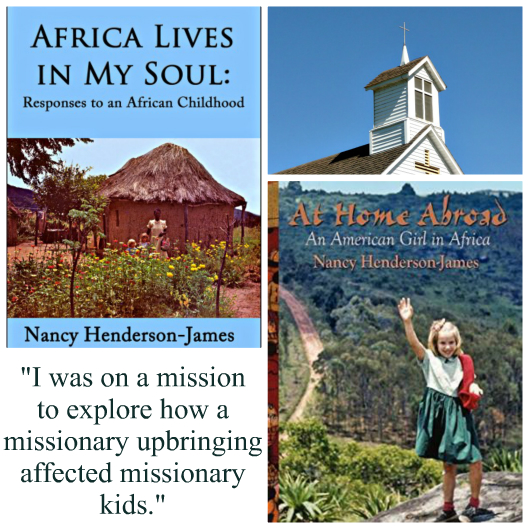
Greetings, readers. Today’s interviewee is Nancy Henderson-James, my fellow ATCK author in the anthology Writing Out of Limbo: International Childhoods, Global Nomads and Third Culture Kids.

Nancy was born in Tacoma, Washington, to Congregational missionaries. Not long after, the family moved to Portugal to learn Portuguese in preparation for a life in Angola, then a Portuguese colony.

Nancy grew up mostly in Angola—except for a couple of years in Rhodesia (now Zimbabwe), where she boarded in a dorm run by an English couple, 2,000 kilometers away from her family. The Angolan war for independence from Portugal, in 1961, forced Nancy’s mother to bring her children “back” to Tacoma when Nancy was 16.

After high school graduation Nancy attended Carleton College, and then she and her husband settled in Durham, NC, where she worked as a librarian for 30 years.

The author of an acclaimed Third Culture Kid memoir At Home Abroad: An American Girl in Africa, about her childhood in Africa, Nancy has received honors from the Southern Women Writers Conference and the North Carolina Writers’ Network.

* * *

Welcome, Nancy. I’ve outlined some of your story already because I’d like to begin at the point where, after having “repatriated” with your mother and siblings to Tacoma, Washington, you were basically left on your own. Your older sister went to college and your mother took your younger siblings back to Angola to be reunited with your father. You, meanwhile, attended a high school in Tacoma for your senior year, living with a family you knew from church. In both your memoir and essay in the anthology Writing Out of Limbo, you write eloquently about the yearning you felt for family connection and “home,” which you sometimes confused with a need for spiritual connection. How do you define “home” now?
Thank you for inviting me, Lisa. The advantage of aging is the ability to look back and see how seemingly random decisions have knit into a coherent pattern. It is obvious to me now that a drive to create family and community has led me through life. Most recently it has manifested in the decision my husband and I made to form and move into a cohousing community in downtown Durham, North Carolina, called Durham Central Park Cohousing Community. Cohousing offers some of the best aspects of growing up as a missionary kid, such as sharing resources, supporting fellow community members, and working together toward a shared vision. Our urban condo community sometimes reminds me of the good times I had living in dorms. Of all my living situations growing up, dorms were the most congenial. Now the coho feels very much like home.

Were you happiest in a certain place at a certain time, and if so, why?
Zeroing in on one place and time is a challenge for me. With the exception of the years immediately after reentry to the United States when I was caught up in culture shock, almost every place I’ve lived has had its happy times. For pure unconscious happiness, my early years in Lobito, living with my family, swimming on the beach across from the house every day, and absorbing the cultural mix of the small city has to qualify. My children’s growing up years gave me the satisfaction of family. And now in my older years, settled into cohousing, I find the challenge of working with 38 other residents draws on my strengths and tests me in ways that help me grow.

“I had landed in the middle of my own mystery…

Do you identify most with a particular culture or cultures, or with people who have similar interests and perhaps similar cross-cultural backgrounds?  
My antenna immediately goes up when I hear someone talking about living in another country, whether as a child or adult. I attribute all sorts of wonderful characteristics to her, not always with good reason! I’ve spent decades reconciling to American culture and I am most of the way there. I married an American man who had not traveled much until I showed him its virtues. I have two American sons who have absorbed the best of American culture, contribute to it in the fields of affordable housing and community organizing, and bring me great happiness. That said, I pay special attention to what is happening in Angola and Portugal. I try to keep up my Portuguese and recently have had wonderful contacts via Facebook with young Angolans. I attend reunions of those who also grew up in Angola, at times the only way to know what is happening there since newspapers rarely cover Angola.

Did your TCK upbringing inform your choice to become a writer and memoirist?  Conversely, did writing the memoir and the essay for Writing Out of Limbo help you to process your TCK upbringing?
Both are true. Reading Mary Wertsch’s Military Brats in my 40s launched me on a mission, so to speak, to explore how a missionary upbringing affected missionary kids, or MKs, in the way that the military affected military brats. I found countless correspondences. The responses to the questionnaire I sent out—which were compiled in Africa Lives in My Soul: Responses to an African Childhood —provided rich sources for contemplating my life. The honesty and willingness of other missionary kids to respond affected me deeply and brought back memories of similar experiences I had had. Writing a memoir seemed like the logical next step. Faith Eidse helped me along the way by including my essay in Unrooted Childhoods, the memoir anthology she and Nina Sichel edited. Her confidence in my work was invaluable.

Missionary kids

…the mystery of life, really.”

It sounds like writing became part of the fabric of your life.
Writing continues to supply food for inquiry and expression. Our cohousing community has a small group of writers and artists that meets weekly to create and share. The group motivates me to write and provides helpful feedback. I also co-edit our monthly e-news.

What made you decide to settle in Durham and become a librarian?
We moved to Durham when my husband decided to attend Duke University’s graduate health administration program in 1974. As the wage earner with a newly minted library degree, I found a job working as a high school librarian—strange since I had hated attending American high school. Despite that, I worked at Jordan High School for 25 years and then for another five years at the UNC Children’s Hospital School (for children with chronic illnesses), as their first librarian.

Were you an avid reader as a kid, like so many TCKs?
As a child I was much more attracted to the outdoors (riding my bike, running, swimming) than reading inside. But when I graduated from high school I realized how much I didn’t know and started reading.

As an ATCK, do you have “itchy feet,” which still make you want to move frequently?
ATCKs seem to respond in two opposite fashions…to want to move frequently or to stay put. I discovered early on that I am in the second camp. I was a thrilled high school senior when President Kennedy announced the Peace Corps, certain I would join after college. But when the time came, I chose graduate school stateside to maintain ties with my boyfriend and his family, since my family still lived in Angola. The need for connection trumped the need for adventure. I have never lived outside the United States since leaving Africa in 1961. That said, I do travel for pleasure and took my sons on trips abroad, including on my first return trip to Angola after 44 years.

Never lived outside US

Your memoir, At Home Abroad: An American Girl in Africa, was well received. The chapter included in Unrooted Childhoods is gorgeous and haunting, and I love how you talk about the importance of language. (I agree! I think the ability to communicate trumps nationality, race, gender, religion, etc., in terms of person-to-person contact.) Where else may readers find your wonderful published writing?
My recent publications have been essays:

I’m currently working on another memoir that focuses on the many mothers and fathers who passed through my life growing up.

* * *

Thank you for sharing your story with us, Nancy! Readers: you may learn more about Nancy Henderson-James and her writings at her author site. And don’t forget to check out her books: At Home Abroad and the anthology, Africa Lives in My Soul. If you have any questions or comments for Nancy, be sure to leave them below.

Editor’s note: All photos of Africa are from Nancy Henderson-James’s Flickr albums; other photos (of the Tacoma school and the library) are from morguefiles. The quotes are from Nancy’s memoir (see excerpts).

Elizabeth (Lisa) Liang is a prime example of what she writes about in this column: an Adult Third Culture Kid working in a creative field. A Guatemalan-American of Chinese-Spanish-Irish-French-German-English descent, she is an actor, writer, and producer who created the solo show Alien Citizen: an earth odyssey, which has been touring internationally. And now she is working on another show, which we hope to hear more about soon! To keep up with Lisa’s progress in between her columns, be sure to visit her blog, Suitcasefactory. You can also follow her on Twitter and on Facebook.

STAY TUNED for next week’s fab posts!

If you enjoyed this post, we invite you to register for The Displaced Dispatch, a round up of weekly posts from The Displaced Nation, and so much more! Register for The Displaced Dispatch by clicking here!

Related posts:

REVERSE CULTURE SHOCK TOOLBOX: Expats, what kinds of tools do you need if you decide to repatriate?

Reverse Culture Shock RosesTransitions enthusiast H.E. Rybol is already having a constructive 2016: she is about to publish a second book, on reverse culture shock.

Reverse Culture Shock_coverHello, Displaced Nationers! This month, I have a very special preview for you! On March 30th, my book Reverse Culture Shock will be released! Unlike Culture Shock: A Practical Guide, this is not a how-to book. It’s a collection of adapted blog posts including some previously unpublished material.

Dealing with reverse culture shock is a continuously evolving process that requires constant adjustments, reflection and introspection. This collection is meant to bring you food for thought and give you a little nudge to ease a difficult transition.

Here’s an adapted excerpt, just for you… Even if you’re currently an expat, I hope you enjoy! Someday you, too, may face this phenomenon, if you decide to repatriate.

* * *

When I moved back from California to Europe, I spent the summer pruning trees, rosebushes and anything else I could find. It provided comfort in a way nothing else did. I got to be outdoors, didn’t have to interact, nobody asked me any questions or commented on how ‘American’ I sounded. I could just be. Quietly, peacefully.

What I needed the most was a set of gardening tools.

Yep, reverse culture shock was a doozy.

Here’s the thing about reverse culture shock: everything feels familiar and completely different at the same time. And no matter how hard you try to reconcile everything, it makes you feel like a puzzle put together wrong. Everything sort of fits but doesn’t.

Of course, intellectually, you reason with yourself. Your brain explains that both you and the place have changed, so what you’re feeling is natural. Meanwhile your insides are screaming bloody murder. That’s what it was like for me, anyway.

There is an aspect of mourning involved. You have to let go of the notion of home as a physical or geographical place (if that’s what it was to begin with) and of the idea that operating within a comfort zone is how things should be. You need to redefine what home and comfort mean to you.

And here’s the biggie: letting go of who you were before you left to incorporate the person you became while you were gone and see how both now fit into a new identity within that familiar environment that feels alien. It’s mind-boggling and the whole thing is a process.

The puzzle of home

Europe had changed…and I’d changed as well.

When I got back from the US, Europe had changed: there was a new currency (hello, Euro!), there were new streets, Starbucks and Subways had sprouted up all over the place, the use of language had changed, to name a few. For example, “Zähflüssiger Verkehr” had become “stop and go” and my French-speaking friends and colleagues said things like “c’est fun!”

Of course, I had changed as well. Not only in my eyes but also in the eyes of other people who kept reminding me that I wasn’t quite European anymore with a steady refrain of “You’re SO American!”

  • Accent: I had an American accent and naturally, people who knew me before I lived in America kept saying “you sound so American.” I understand the reaction, of course, but the effect was one of alienation all the same. What I heard was “you don’t sound European”. Which was fine too, except that I was in Europe trying to figure out how to fit back in after four years of being away.
  • Language: I couldn’t express myself the way I wanted to in my native languages, which can feel alarming. People kept correcting me, pointing out that I was speaking weirdly, which had a distancing effect on me and on them as well. I wasn’t the way they remembered and these new aspects of me were disconcerting for them.
  • Laugh: I was told I had an American laugh, whatever that means.
  • Attitude/ways of thinking/seeing things: I had developed a new approach and attitude towards problem solving, thinking and managing everyday life. That attitude was also pointed out to me as being American. But it wasn’t something I could shake, so living with that perspective in Europe can be alienating on multiple levels.

I spent four years becoming aware of my “Europeanness” to come back to a Europe that felt alien to me and where people kept and still keep pointing out my “Americanness”.

I’ve come to accept that I’m just in between. Someone once said to me that it’s like sitting on a fence: you can see both sides but that fence just isn’t very comfortable.

Over time though, we get comfortable being uncomfortable. That’s the good news!
Just in between

* * *

Readers who are or have been repats, hopefully this has you “fixed” until next month, when I’ll be back with one of my culture shock interviews. In future I plan to interview some repatriates as well.

Until then, here’s to discomfort! Cheers! Prost! Santé!

H.E. Rybol is a TCK and the author of Culture Shock: A Practical Guide and Culture Shock Toolbox and the soon-to-be-released Reverse Culture Shock. She loves animals, piano, yoga and being outdoors. You can find her on Twitter, Linkedin, Goodreads, and her author site.  

STAY TUNED for more fab posts.

If you enjoyed this post, we invite you to register for The Displaced Dispatch, a round up of weekly posts from The Displaced Nation—and much, much more! Register for The Displaced Dispatch by clicking here!

Related post:

Photo credits: All photos are from Pixabay.

WORLD OF WORDS: Oh, those faux pas! Those you commit, and others that are committed upon you, during your travels abroad

Marianne Bohr in the Luxembourg Gardens in Paris—is she reading or indulging in reveries about words?

Marianne Bohr in the Luxembourg Gardens in Paris—is she reading or indulging in reveries about French words?

Columnist Marianne Bohr’s first book, Gap Year Girl, about an adult gap year she took with her husband, came out last September with She Writes Press. Here she recounts some amusing faux pas from their travels, and owns up to one of her own (from her first time in France).

In the world of words, language is a subtle art. So what happens when non-native speakers miss out on linguistic subtleties? To what extent does it rock the native speaker’s world?

Over the course of 12 months backpacking across Europe on an adult gap year with my husband in 2012, we were frequently amused by the quirky use of English we encountered. Indeed, while we would never want to discourage non-native speakers from giving English a try, hearing translations of our mother tongue that weren’t quite right was, more often than not, a source of entertainment.

And sometimes the results of such attempts were downright, flat-out, laugh-out-loud funny.

I’ll elaborate on those examples—that’s after I own up to one of my own French faux pas.

Pas de tout or pas tout? There’s a difference?!!

The delicate nature of language was highlighted for me when teaching a middle school French class a couple of weeks ago. I asked one of my best students if she understood the lesson we’d just completed on the formation of the passé composé. She looked at me guardedly and replied with a crooked smile, “Pas de tout.”

I was deflated. Crushed. One of my stars had freely admitted she’d understood nothing at all of my lecture. How could that be? Was my explication really that obtuse?

Vous comprenhez Pas de tout

Photo credits: Studying French at home and in Paris, by Modern Languages @ Finger Lakes Community College, by The LEAF Project via Flickr (CC0 1.0).

But then, like a flash, I remembered something from my own life that occurred almost 40 years ago, during my initial entry to France. I was a youthful 21-year-old backpacker, not the gap-year backpacker I would write about later, and was having my first authentic conversation with a native speaker. Instead of a husband, I was traveling with several companions, not one of whom spoke a word of the language of love.

We were checking into a seedy, Parisian budget hotel on the right bank. The front desk clerk spoke at a speed beyond my college ken, and from what I understood, yes, he had a room, but just one for the four of us (one boy and three girls).

My hesitation to reply, searching for the right words, and the panicked look in my eyes, stretched beyond the limits of his harried patience, and he demanded: “Vous comprenez, alors, mademoiselle?” Do you understand, miss?

Pas de tout,” I replied, so pleased that I’d managed to tell him that I understood most of what he’d said.

Oh, la,” he replied, straightening his posture and rolling his eyes in that distinctively Gallic way. “You understood nothing,” he said, in heavily accented English.

“No, no,” I countered, not even aware of how quickly I’d collapsed, reverting to the comfort of English. “I meant, I didn’t understand everything.”

I didn’t want him to think I was a complete imbecile. But the damage was done. I’d told him I hadn’t understood a word, when what I’d wanted to convey was that I’d understood, but perhaps not every word. The simple insertion of the little word “de” had completely changed what I’d said. “Pas tout.” Not everything. “Pas de tout.” Nothing at all. My merry band of four American youth did settle into a single room that night, but my faux pas would haunt me for the balance of our stay in Paris.

Fast-forward to my present-day classroom. “Did you understand today’s lesson?” I ask. “Pas de tout,” is the response, and now I smile. “Not everything,” is what she means, and not, “Nothing at all.”

She’s making the same mistake I did forty years ago. How can I possibly fault her?

A Catalan breakfast a la Cee-lo Green

Two months into our year-long gap-year journey, my husband and I have arrived in Barcelona after having spent seven weeks in my beloved France.

The familiar doorbell chime greeting of “bonjour, messieurs-dames” each time we walk into a shop or hotel has been replaced with a simple, straightforward “hola.” And we’re reminded at every turn by the abundant bright red-and-yellow striped flags and the street signs and billboards (the words of which I can decipher only a few), that we’re not yet fully in Spain; we’re in Catalonia, as we were in Andorra on our way here.

Now and then, I’ll spot a familiar word, like bella for beautiful, carrer for street or gambeta for shrimp.

Ordering food off a Catalan menu can be a real adventure!

On our very first morning in Spain, we experience one of those unexpected, laugh-out-loud moments that surprise you when you travel. In the well-lit hotel breakfast room, painted pale green and decorated with plentiful plastic oranges and daisies, we are the only two Americans filling our plates from the buffet. Imagine our surprise when the English-language rock music playing in the background launches into Cee-Lo Green’s original “Forget You.”

We practically drop our huevos in our laps. Are they really playing the uncensored version? “I’m like, 
f*** you! And f*** her too!”

No one else in the cantina even flinches. Ah, the beauty and innocence of enjoying another country’s music while you have no idea what the lyrics mean.

Breakfast in Barcelona

Photo credits (clockwise from top): Cee-Lo, by Pat Guiney via Flickr (CC BY 2.0); Hello sign, by Oh-Barcelona.com via Flickr (CC BY 2.0); Manifestació Som Una Nació, Nosaltres Decidim! 50, by Merche Pérez via Flickr (CC BY-SA 2.0); and Breakfast (Barcelona, Spain), by PunkToad via Flickr (CC BY 2.0).

The Golden Virgin & Kid

Marseille was founded in 600 BC. As the oldest town in France, it’s now the second largest city in the country (although the residents of Lyon often like to challenge this claim). My husband and I have an early seafood dinner along the lines of yachts and fishing boats and are pleasantly surprised that the wharf area isn’t half as gritty as we imagined.

Despite the sea breezes, the day is extremely hot, lethargy prevails and we find ourselves purchasing the most touristy tickets of our year. We take the miniature baby blue train on wheels that wanders the city and up to the top of a limestone peak with a panoramic view over the city.

As we approach the summit, the electronically generated (and apparently translated) French commentary announces we’re arriving at the Notre Dame de la Garde church, famous for its 30-foot high gilded Madonna and Child atop the steeple.

So far, so good except that the English translation that follows suggests that we “fold our necks and look up to see the golden Virgin and her kid.”

We must be the only English speakers aboard because we’re the only ones laughing.

* * *

Thank you, Marianne, for sharing these très drôles d’histoires (gosh, did I get that right?), one of which was at your own expense.

Readers, any faux pas of note to report from your travels, yours or others’? We’d love to hear about them in the comments!

Marianne C. Bohr is a writer, editor and French teacher whose book, Gap Year Girl: A Baby Boomer Adventure Across 21 Countries, was published last September (She Writes Press). She married her high school sweetheart and travel partner, and with their two grown children, follows her own advice and travels at every opportunity. Marianne lives in Bethesda, Maryland, where after decades in publishing, she has followed her Francophile muse to teach French. She has an author site where she keeps a blog, and is active on Facebook and Twitter.

STAY TUNED for the next fab post!

If you enjoyed this post, we invite you to register for The Displaced Dispatch, a round up of weekly posts from The Displaced Nation, and SO much more. Register for The Displaced Dispatch by clicking here!

Related posts:

BOOKLUST, WANDERLUST: 11 Expat- and Travel-themed Books to Expand Our Horizons in 2016

booklust-wanderlust-2015

Attention displaced bookworms! Our book review columnist, Beth Green, an American expat in Prague (she is also an Adult Third Culture Kid), is back with her personal picks for expat- and travel-themed books to watch for in 2016.

Hello again, Displaced Nationers!

It’s been quite a long time since I last wrote to you here. Since my last column we’ve started 2016, celebrated the beginning of the Year of the Monkey, written and revised our new year’s resolutions, and (hopefully) read some really great books!

As part of my own (ever-evolving) New Year’s resolutions I signed up for the Goodreads Reading Challenge. It’s currently showing that I’m 22 books behind schedule for my overly optimistic goal of 300 books this year—but, hey, it wouldn’t be a challenge if it was easy, right?

Screen Shot 2016-02-11 at 7.33.56 PM
Now, usually in this column I talk about books I’ve already read, but this month I’d like to highlight some that I haven’t. There are, of course, lots of intriguing books coming out this year—more than I can cover adequately in one column! But, of the expat- or international-themed books coming out in 2016 that caught my eye, I’ve chosen 11 to feature in this post, one for each month left in 2016. Take a look!

* * *

Beginning with…a Thriller and a Mystery

CambodiaNoir_cover_300x200Cambodia Noir, by Nick Seeley (March 15, 2016)
The debut novel from an American journalist who has been working out of the Middle East and Southeast Asia, Cambodia Noir is a thriller that I’ve had on my to-be-read list ever since I first heard about it. The plot: A young American woman who is working as an intern at a local paper in Phnom Penh, June Saito, disappears. Her sister hires a retired photojournalist with first-hand knowledge of the corrupt, dissolute ways of the Cambodian capital, to look for her. Author Nick Seeley got his start as a foreign correspondent in Phnom Penh. He’s been hailed as a “fresh voice” exploring the depths of the Far East’s underworld.


InspectorSinghInvestigates_cover_300x200Inspector Singh Investigates: A Frightfully English Execution, by Shamini Flint (April 7, 2016)
Always the fan of international crime fiction, I’m excited that one of my favorite series—a series of charming crime novels featuring the portly, lovable Sikh policeman Inspector Singh—is getting a new addition this year. Author Shamini Flint is sending Singh to Britain Diary of a Tennis Prodigy_cover_300x200in the seventh book in her series. Each book provides not only a puzzle for the reader to solve but also a close-up look at the locations where the books are set. This is the Inspector’s first time out of Asia, and I’m looking forward to seeing what he discovers in the UK.

And, a special note for readers with kids: on January 1 Flint, who is a Singapore-based Malaysian, published a middle-grade book, Diary of a Tennis Prodigy, with illustrator Sally Heinrich (Sally formerly lived in Singapore and Malaysia but is now based in Adelaide, Australia).

And Now Let’s Add Three Travel Memoirs…

No Baggage_cover_300x200No Baggage: A Minimalist Tale of Love and Wandering, by Clara Bensen (January 5, 2016)
I love memoirs that read like novels, as I’m hoping this one will! Recovering from a quarter-life meltdown, 25-year-old Bensen signs up for an online dating account, and to her surprise, ends up meeting Jeff, a university professor who proposes they take a three-week experimental trip spanning eight countries, with no plans or baggage. Her story resonates with the adventurer in me—I can’t wait to take a look.


Little Dribbling_cover_300x200The Road to Little Dribbling, by Bill Bryson (January 19, 2016)
It may already be old news to anyone who’s been in a bookstore recently—or read our Displaced Dispatch!—but the world’s favorite traveler, humor writer and expat, Bill Bryson, has a new travelogue out. It’s another of his road-trip books. (I much prefer these to his other writings such as A Short History of Nearly Everything and At Home—they started out great, but I ended up leaving them unfinished…) Bryson made a journey through Britain 20 years ago, which was forever immortalized in his bestselling classic, Notes from a Small Island. In Little Dribbling, he follows the “Bryson line” from bottom to top of his adopted home country. I’m looking forward to being in his company again.


In Other Words_cover_300x200In Other Words, by Jhumpa Lahiri (and translations by Ann Goldstein) (February 9, 2016)
As a London-born Indian-American, world-class novelist Jhumpa Lahiri excels at writing in English—yet has long harbored a passion for the Italian language. Not wanting to miss out, she moved her family to Rome to immerse herself and quickly reached a point where she was writing only in Italian. She kept a journal in Italian that has evolved into this dual-language memoir. As an expat who’s now tried to learn three foreign languages while abroad, I’m curious to see how Lahiri’s experiences match up to my own. (The critics would apparently like to see her go back to English!)

…Along with Two Works of Literary Fiction and a Harlequin Romance

WhatBelongstoYou_cover_300x200What Belongs to You, by Garth Greenwell (January 19, 2016)
An American professor working in Sofia, Bulgaria, hooks up with a male prostitute in a public toilet and slowly becomes more involved than he anticipated. Reviewers cite Greenwell’s lyrical prose as reason alone for picking up his debut novel, but I’m interested in seeing how this young writer—who himself once worked as an expat English teacher in Bulgaria—depicts the city and the relationships between locals and foreigners. (This book, too, was mentioned in a recent Displaced Dispatch.)


TheHighMountainsofPortugal_cover_300x200The High Mountains of Portugal, by Yann Martel (February 2, 2016)
Going over this years’ publishers lists, I’m now looking forward to reading a book by an author whose last book I despised. My friends were all gushing over Yann Martel’s 2002 novel Life of Pi; but, while it has an admittedly awesome premise, the story left me cold. But I’m excited to check out the chronically traveling Canadian author’s next book, which is set in Portugal and intertwines the century-spanning stories of a young man reading an old journal, a mystery-loving pathologist, and a Canadian diplomat. I’m planning a trip to Lisbon later this year, and hope to read this book before I go.


UndertheSpanishStairs_cover_300x200Under the Spanish Stars, by Alli Sinclair (February 1, 2016)
I’m pleased to report that former expat Alli Sinclair—my friend and former co-blogger from Novel Adventurers—has published her second romantic mystery novel this month. (Congratulations, Alli!) The action takes place in her native Australia and also in Spain. The plot: an Australian woman travels to her grandmother’s homeland of Andalucía to unravel a family mystery. She ends up meeting a passionate flamenco guitarist and learns her grandmother’s past is not what she imagined.

Finally, to Top Things Off, How About a Couple of YA Books?

I don’t read a lot of young adult books, but descriptions of two novels I saw reviewed recently stuck with me. Funnily enough, both books’ titles start with “Up”—maybe it’s the implied optimism that caught me? We could use a bit of cheer in our displaced world…

Up from the Sea_cover_300x200Up from the Sea, by Leza Lowitz (January 12, 2016)
This is a novel in verse. It tells the story of a Japanese teenager, Kai, whose coastal village is obliterated by the March 2011 tsunami, after which he is offered a trip to New York to meet children who had been affected by the terrorist attacks of 9/11. The trip also provides an opportunity for him to go in search of his estranged American father. Author Leza Lowitz is an American expat writer and translator living in Tokyo, where she also runs a popular yoga studio. Her favorite themes to explore in her writing include the idea of place, displacement and what “home” means to expatriate women.


UPtothisPointe_cover_300x200Up to this Pointe, by Jennifer Longo (January 19, 2016)
I’m always fascinated by stories of Antarctica so have my eye on this book about a teenage girl who aspires to be a professional ballerina but, when her grand plan goes awry, sets out on an expedition to McMurdo Station (the U.S. Antarctic research center) in the footsteps of her relative and explorer Robert Falcon Scott. Notably, Seattle-based author Jennifer Longo wanted to be a ballerina until she finally had to admit that her talent for writing exceeded her talent for dance. Like me, she harbors an obsessive love of Antarctica. I admire the way she has woven these two themes together!

* * *

So, Displaced Nationers, what do you think? What are you looking forward to reading this year? Any much-anticipated displaced reads that should be added to my list?

As always, please let me or ML know if you have any suggestions for books you’d like to see reviewed here! And I urge you to sign up for the DISPLACED DISPATCH, which has at least one Recommended Read every week.

STAY TUNED for more fab posts!

Beth Green is an American writer living in Prague, Czech Republic. She grew up on a sailboat and, though now a landlubber, continues to lead a peripatetic life, having lived in Asia as well as Europe. Her personal Web site is Beth Green Writes. She has also launched the site Everyday Travel Stories. To keep in touch with her in between columns, try following her on Facebook and Twitter. She’s a social media nut!

If you enjoyed this post, we invite you to subscribe to The Displaced Dispatch, a weekly round up of posts from The Displaced Nation and much, much more. Sign up for The Displaced Dispatch by clicking here!

Related posts:

THE PERIPATETIC EXPAT: Can an expat also have itchy feet?

Displaced creative Sally Rose: Is she coming…or going?!

Sally Rose, who was one of last year’s Wonderlanded guests, recently confessed to me that she’s a perpetually perplexed peripatetic expat. We decided she needed her own column to explain this contradiction in terms. This is her first attempt. Enjoy! —ML Awanohara

Hello, Displaced Nationers! I’ve been an expat for five years. That’s if you don’t count the five years I spent in New York before that. For a wide-eyed girl from rural Texas, living in New York felt like being in a whole new country, except that I didn’t need a visa.

Now, I’ve been in Santiago, Chile, for five years and I’m beginning to get itchy feet again. What’s that about? A friend accused me of having a five year maximum in any one location. Though I’ve lived longer than five years in several places, they ultimately didn’t stick either.

She could be right.

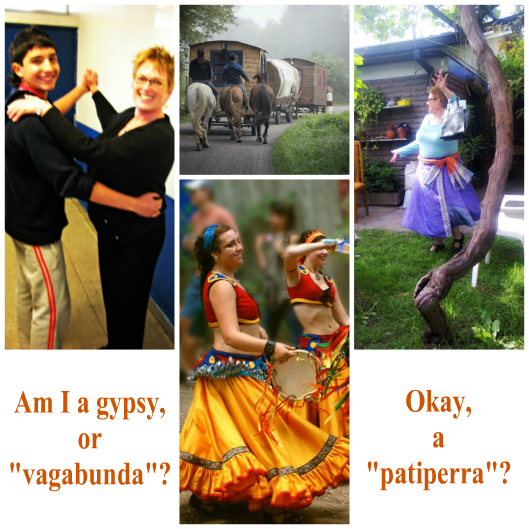
Am I a gypsy (or whatever you’d like to call it) at heart?

I used to tell people in Chile that I had gypsy blood, but in Chile, being associated with gypsies has a bad connotation, so I decided to tell them that I was a vagabunda, a vagabond, but I think that was as bad as gypsy.

My Spanish teacher tells me I’m a patiperra. It’s a Chilean term that means globe-trotter. One Chilean writer, who calls herself Patiperra, defines it as:

“A wanderer. Someone who doesn’t stay at home often, someone whose burning curiosity leads them on journeys to places they’ve never been.”

Guilty, as charged.

Maybe it’s simply my adult ADD kicking in, or I could be kind to myself and say it’s my inquiring mind that wants to know more places.

March 1 will be my five-year mark in Chile, and I’m thinking about making a change.
Sally Rose the Gypsy

Careful what you wish for…

I’m not a writer by profession. I went to Chile to be a volunteer English teacher. I even visited and volunteered four times before making the big leap. My book, A Million Sticky Kisses, chronicles my first visits to Chile as a volunteer teacher.

Volunteering in Chile was a dream-come-true—until I actually moved there. As American radio broadcaster Paul Harvey was fond of saying, here’s the “rest of the story.”

Between my final visit as a volunteer and the time I made the move in 2011, things had changed drastically at “my” school.

The administration had changed, and the director, who had been so kind and supportive of me, had been fired, along with an assistant director and several teachers whom I knew and liked.

A pall of anxiety hung over the school because teachers were being let go for minor infractions. The teachers who remained were terrified of the new director, who was a member of a conservative, rigid religious sect.

He viewed me suspiciously and made it clear that I was not welcome in the classrooms. The atmosphere of the previous two years had vanished.

My teacher friend, Marisol, invited me into her classroom, but even she, who had worked at the school for 40 years, was afraid of the new director’s power.

In the end, I went to the school for 45 minutes, once a week, to do cuentacuentos, story hour, in the library, under the strict supervision of the librarian and her assistant.

The happy days of volunteering in the classes at “my” school with “my” kids were a distant memory.
The Chilean Years
I made other volunteer attempts: doing a workshop for hyperactive fifth graders, singing “The Lion Sleeps Tonight” for three hours in a classroom of 40 nine-year-olds, assisting the English teacher who didn’t speak English.

“What is your name?” I asked her.

“I’m fine, thank you,” she responded.

The last year I volunteered was magical. I’d met a new friend, who happened to be a volunteer coordinator. She asked me to assist in a class of 16-year-olds.

“You want me to do what?!” I’d never worked with 16-year-olds before and just the thought of it gave me the willies.

By saying “Yes,” my pre-conceived notions were shattered when they turned out to be the most respectful, creative, fun kids I’d ever known.

I wanted to be at that school forever, but at the end of year, the owners, who were having financial problems, sold the school, and my students were scattered into the wind.

Should I twiddle my thumbs…or write?

The following year, Year Nº. 4 in Chile, I returned after my summer vacation, thinking that I would find another volunteer position. Something had always turned up before.

But not that year. Though I searched and searched, nothing materialized. I ended up without a purpose, twiddling my thumbs.

That’s when it hit me. I could rekindle my writing.

I had been blogging for years, and I’d previously taken a few stabs at novel writing. This time, I sat down and wrote a children’s book about Penny, a Golden Retriever puppy with a special mission.

The result was Penny Possible, the true story of a service dog in training.

I repatriated back to the US for six months while I revised A Million Sticky Kisses and self-published both books.

Sally Rose Great Works

When I returned to Chile again last year, I penned another children’s story, about a dog named Elvis who lives on the streets in Santiago. It’s currently being illustrated. The working title is Love Me Tender.

Hm…writing is portable!

There are other stories I’d like to complete. Some are half-finished, others are just a twinkle in my eye, but guess what, folks? Writing is portable. It doesn’t matter whether I’m in Chile, the US, or Timbuktu.

Almost at the five-year mark, my feet are itching again. Does this mean I’m leaving Chile?

I’m not sure, but it does mean I’m exploring. The world is a big place and I haven’t found my little piece of it yet.

Stay tuned!

* * *

Thank you, Sally, for sharing your quest to find your “little piece of the world.” Readers, where will Sally try (or not try) next, and how long will she stay? Is she a gypsy or a settler at heart? I hope you’ll join me in saying we look forward to the next installment! —ML Awanohara

Born and raised in the piney woods of East Texas, Sally Rose has lived in the Cajun Country of Louisiana, the plains of Oklahoma, the “enchanted” land of New Mexico, and the Big Apple, New York City. Then she fell in love with Santiago de Chile and has been “telling tall tales” from that long, skinny country since 2009, and living in that city for the past five years. But where will her next act take her? The author of a memoir and a children’s book, Sally has an author site where she keeps a blog, and is active on Facebook and Twitter.

STAY TUNED for next week’s fab posts!

If you enjoyed this post, we invite you to register for The Displaced Dispatch, a round up of weekly posts from The Displaced Nation, and SO much more. Register for The Displaced Dispatch by clicking here!

Related posts:

LOCATION, LOCUTION: Pining for her native Emerald Isle, Sheila Bugler writes crime novels with Irish connections

Location Locution
Columnist Lorraine Mace, aka Frances di Plino, is back with her latest interview guest.

Part of being an Irish emigrant, whether in the UK or farther afield, is a nostalgia for the homeland and its green fields and rich, dark soil—as my guest this month, crime writer Sheila Bugler, will attest.

Sheila grew up in a small town in the west of Ireland. After studying psychology at University College Galway, she left her native land for a life abroad, working in Italy, Spain, Germany, Holland and Argentina. Today she lives with her husband and two children in Eastbourne, a seaside resort town on the south coast of England. Despite being settled in the UK, she pines for Ireland and describes herself as a “reluctant emigrant.”

Sheila Bugler Ireland England

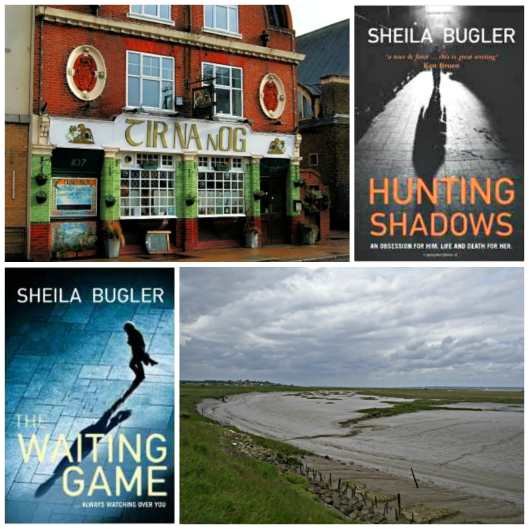
What’s more, these intense feelings for the Emerald Isle are what fuels her creative efforts. Sheila is the author of an acclaimed mystery series published by Brandon Books, an imprint of Ireland’s O’Brien Press, consisting so far of three books of a planned six: Hunting Shadows (2013), The Waiting Game (2014), and All Things Nice (forthcoming, April 2016). The series features Detective Inspector Ellen Kelly, a character whose “Irish roots shine through,” as one Amazon reviewer puts it, and is set amongst the displaced Irish community in southeast London.

As Sheila remarked in an interview with Triskele Books:

I adore Ireland and miss it (despite being very happy in the UK). For me, writing really is a way of connecting with my country. I write Irish characters (not exclusively, of course) and it was always very important to me that Ellen’s roots were Irish. At the moment, I can’t imagine writing a novel that doesn’t have some connection to Ireland.

Her characters, too, are inspired by place: by the bleak wilderness of the North Kent coast. Perhaps they find it reminiscent of the bleak and beautiful Aran Islands off the coast of Galway?

But let’s not get too carried away. It’s time to give Sheila the floor and hear what she has to say about location, locution.

* * *

Welcome, Sheila, to Location, Locution. You have a strong sense of place in your writing, but tell us, which tends to come first, story or location?

Thank you for inviting me, Lorraine. In answer to your question: Story. But often there is a single image, in a particular place, which is the inspiration for that story.

What techniques do you use for evoking place in your crime stories?

I am quite an instinctive writer and try not to overthink the process as it happens. Of course, like all writers I have had to learn the basic techniques, but I don’t think you can force yourself to write in a particular way. Although location plays an important part in my novels, this isn’t a deliberate choice—it’s something that happens naturally as I write.

I like the way location can enhance a particular atmosphere you are trying to create. In my first two novels, Hunting Shadows and The Waiting Game, parts of each book are based in the beautiful, bleak Hoo Peninsula of north Kent.

In Hunting Shadows, this is the perfect location for one of the central characters, Brian. He is an isolated loner and the isolated landscape is a great way of showing how Brian lives his life. In contrast, there is a character in The Waiting Game who uses the Hoo’s wide open spaces and big skies as a backdrop to her work as an artist.

If I am struggling to create a sense of place, I will do some or all of the following:

  • Close my eyes and try to get a picture in my head.
  • Play some music that has a connection with the landscape I’m trying to evoke (for example, bluegrass when I’m writing about the Hoo, traditional Irish music when writing about the west of Ireland).
  • I wait until I can see the place, hear it, smell it, feel it.
  • And then I write it.

Sheila Bugler locations

Which particular features have you used to create a sense of what clearly is to you a special location? Landscape, culture, food?

Obviously it’s all of those things. However, you don’t need to use every one of them to evoke a sense of place.

The author JJ Marsh, for example, puts a lot of importance on food when she is writing about the different locations in her novels (I should add she doesn’t just write about food!).

The Irish noir writer Ken Bruen perfectly evokes the city of Galway[https://en.wikipedia.org/wiki/Galway] with almost no reference to the external landscape. Instead, he brings the city to perfect life through his characters’ voices and the internal spaces, particularly the pubs. Likewise, Ian Rankin manages to perfectly evoke his home city of Edinburgh without ever needing to give us “in your face” descriptions.

As in real life, your characters move through a rich world of noises, smells, colours, places and other people. If you don’t forget that when you are writing, then neither will your readers.

I’m pleased you mentioned JJ Marsh. She was the original creator of this column! But returning to your own works: can you give a brief example from your writing that illustrates place?

I’m going to share two different examples.

First, a short scene from my novel, Hunting Shadows. In this scene, I tried to give an impression of the location through the reactions of the two characters:

Ellen stepped out of the car and looked around. The place reminded her of the black-and-white photos in her parents’ house of old Irish towns. It gave her that same feeling that she was observing somewhere from a time long past. Apart from a scattering of houses—a mixture of semi-derelict Victorian cottages and cheap, flat-roofed eyesores—there was nothing else.

From where she stood, the landscape sloped down to the Thames marshes, bleak and desolate under the heavy sky.

“Listen,” Dai whispered.

Ellen frowned. “What? I can’t hear anything.”

“Duelling banjos,” he said. “I knew it. “Deliverance” country. We’re not safe in a place like this.”

ThamesMarshes_quote
And here is a very different piece from a stand-alone novel I am working on called Walk Away. I don’t normally write this descriptively but my own love for this part of Ireland obviously influenced me:

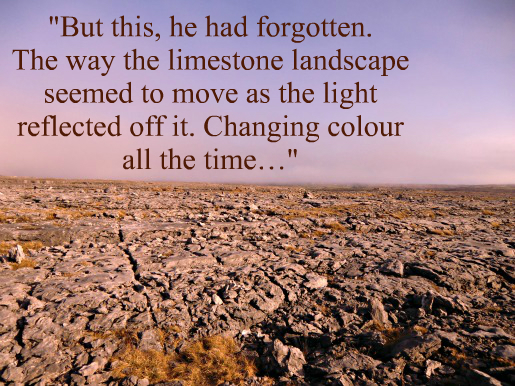
The town was on the southern edge of Galway Bay, the hills of the Burren sloping up behind it, the vast sweep of the Atlantic Ocean stretching out in front of it. Next stop America. It was beautiful. He knew that. Probably always had.

Sydney was home these days. A modern, open-plan apartment with muted colours, floor to ceiling windows and views across Sydney Harbour. All very tasteful and perfect for a shit-hot, sharp-dressing, arse-kicking, wheeling-and-dealing corporate lawyer.

But this, he had forgotten. The way the limestone landscape seemed to move as the light reflected off it. Changing colour all the time from purple to pale pink to grey and back to purple again, in harmony and contrast with the sea.

The_Burren_in_the_evening_sun_515x_quote

How well do you need to know a place before using it as a setting?

If you are using a real location as a setting, you need to know enough about it so it seems real to your reader. In today’s world, there is no excuse not to do this. We all have access to the internet and Google maps. If you haven’t visited a place, do some basic research and make sure you include this in your novel. Using a real pub, for example, instead of making one up can really add to the sense of authenticity.

I once read a crime novel set in Lewisham (where I was living at the time). In one scene, a character is walking down Lewisham High Street and bemoaning the lack of a Marks and Spencer’s. We have M&S in Lewisham! This—and other aspects of the novel—made it clear to me the writer had never been to Lewisham and didn’t know anything about the place he was writing about.

Of course, we can also write about fictional locations. If you do that, your own sense of the place needs to be well-formed before you write about it. The important thing is this: whatever location you choose, it must feel authentic for the story you are writing.

Which writers do you admire for the way they use location?

JJ Marsh writes beautifully in her European crime series featuring Beatrice Stubbs. Similarly, Gilly Hamer writes wonderful descriptions of the stunning Anglesea coastline where her novels are set.

For many reasons, I hold Ken Bruen up as a master when it comes to using location in his novels. He perfectly evokes Galway city, capturing not only its beauty but also the voices and characters of the people who live in that very special place. He is my absolute writing hero.

Bulger fave authors

Thanks so much, Sheila!

* * *

Readers, any questions for Sheila Bugler? Please leave them in the comments below.

And if you’d like to discover more about Sheila, why not visit her author site. You can also follow her on twitter.

Until next month!

Lorraine Mace writes for children with the Vlad the Inhaler books. As Frances di Plino, she writes crime in the D.I. Paolo Storey series. She is a columnist for both of the UK’s top writing magazines, has founded international writing competitions and runs a writing critique service, mentoring authors on three continents.

STAY TUNED for the next fab post!

If you enjoyed this post, we invite you to register for The Displaced Dispatch, a round up of weekly posts from The Displaced Nation, with weekly updates and much, much more. Register for The Displaced Dispatch by clicking here!

Related posts:

Photo credits: Top of page: The World Book (1920), by Eric Fischer via Flickr; “Writing? Yeah.” by Caleb Roenigk via Flickr (both CC BY 2.0). First collage: Sheila Bugler (supplied); County Galway, Eastbourne Pier & shamrock via Pixabay. Second collage: Book cover art; The Tir Na Nog Irish Pub, Wandsworth – London, by Jim Linwood (CC BY 2.0); All Hallows Marshes, Hoo, Kent, by Amanda Slater via Flickr (CC BY-SA 2.0). First quote: Hang on, is that grass over there?, by Andrew Bowden (CC BY-SA 2.0). Second quote: Burren landscape in the evening sun, by YvonneM via Wikimedia Commons (CC BY-SA 3.0). Favorite books collage: Cover art; Blitz Movie Poster via Wikimedia Commons.

TCK TALENT: Sezín Koehler, multimedia artist, tatoo collector, editor and prodigious writer

Columnist Elizabeth (Lisa) Liang starts off 2016 with a guest who has been to the Displaced Nation before, albeit in different guises: as Alice, as film critic, as featured novelist, as repatriate…though never as a TCK Talent.

Happy 2016, readers! I hope your January has been splendid thus far. Today’s interviewee is writer, editor, tattoo collector, and Huffington Post contributor Sezín Koehler, who also calls herself Zuzu (a nickname she picked up when living in Prague). Sezín may already be familiar to some Displaced Nation readers as an early contributor, including a two-part series listing films that depict the horrors of being abroad, or otherwise displaced; a much-commented upon post called “The Accidental Repatriate”; and an Alice-in-Wonderland-themed post on her life in Prague (that was after she had received one of the Displaced Nation’s very first “Alice” awards).

But what some of you may not know is that Sezín is a Third Culture Kid. She was born in Colombo, Sri Lanka, to a Sri Lankan dad and Lithuanian-American mom. Her mom’s job with UNICEF moved the family from Sri Lanka to Zambia, Thailand, Pakistan, and India.

Sezín went to college in California—and then returned to her family, who were living in Switzerland and then in France (the move again being due to her mom’s job).

Next Sezín moved alone to Spain, where she met her husband, who is American. After living as expats in Turkey, Czech Republic, and Germany, the couple now call Lighthouse Point, Florida, home.

* * *

Welcome, Sezín. What a truly peripatetic life you’ve had! What made you decide to “repatriate” to the USA and come to Lighthouse Point? 
This area is where my husband grew up and has family, although his family moved further north just this year. Economics and a series of unfortunate events are what brought me back to the US—my husband and I returned with literally 15 euros between us.

Sounds like a tough reentry. While living as a nomad can also be tough, were you happiest in a certain place?
That’s a surprisingly difficult question! There was a lot of conflict in my family when I was growing up because of the tension between my American mum and conservative Sri Lankan dad—and all the cultural, social, etc., issues that come with having a multicultural and multiracial family before that became something of the norm. Plus, moving all the time was not a lifestyle that worked for me, and it created uncomfortable cycles of depression that were then compounded by having post-traumatic stress disorder (PTSD) after witnessing the murder of one of my best friends in our final year of university. The repatriation to Florida was one of the more miserable moves—especially since I had never planned to move back to the United States until they sort out more effective gun-control laws.

That sounds terribly painful. How have you coped since your return to the US?
My first two years back made me completely despondent, and then one day I just decided to make the best of the situation. It was time to choose happiness; otherwise I wasn’t going to survive. So now every day I wake up and I find something—big or small—to be happy about and I focus on that for the day. In that sense, and in a strange reversal, I suppose Florida is where I find myself happiest because this is where I learned that happiness isn’t something that happens to me passively because life is perfect. Happiness is a daily choice. And I actively make the choice to be happy however difficult my surroundings.

“That feeling of being an outsider never quite leaves you…”

Do you identify most with a particular culture or cultures, including the very broad “TCK culture”? 
You know, I think I identify with aspects of pretty much every culture under the sun—even ones where I didn’t actually live or visit. Being highly sensitive, coupled with having a TCK upbringing, has made it so I can identify with just about anyone who isn’t a bigot or misogynist, even if our backgrounds are nothing alike. I do find myself particularly drawn to other TCKs because, even if we didn’t live in the same places, there is something about the “universal” TCK personality that resonates with me, and it’s far easier to start on the same page rather than having to work hard to build bridges of understanding between myself and people who haven’t traveled or grown up abroad. I also find that many TCKs understand that just because growing up abroad sounds exciting, it might not have actually felt that way when we were getting yanked from place to place, leaving friends and family behind in those pre-social-media Dark Ages.

Did your TCK upbringing inform your career path as a writer?
To be honest, with all the moving around plus PTSD, it’s been hard to develop a career track other than writing. Being a writer means you take your passion with you wherever you go, and no matter where you are, there is always something new to write about. Writing has been my longest-standing support system and therapy through the variety of traumas that ended up shaping my life, and any day now I hope I’ll start being able to make a living doing it. 🙂

Did growing up as a TCK also influence your career as an editor?
As an editor I focus on academic writing by non-native English speakers, and having lived in so many places has definitely helped me understand all the different (incorrect) ways people use English and help them to get published in English-language publications where English fluency is a requirement.

“As a Third Culture Kid, I always related with monsters more than ‘norms.'”

Tell us about your tattoo collection. Any TCK connections there?
Other than my husband, tattoos are one of the great loves of my life. Tattoos for me have been a way to not just express myself creatively, but have also been a way to re-claim my own body after so many traumas. I have a hybrid identity that I often express in fantastical ways. Sometimes when people ask me where I’m from and I don’t feel like having an intimate conversation about my life I’ll say I’m a mermaid and I’m visiting from the ocean. I have a huge jellyfish on my right thigh and I say, “Meet my pet jelly.” Now that my hair is in a pixie cut, I might introduce myself as a fairy and since I actually have tattooed wings on my shoulders as well as often literally leaving a trail of glitter in my wake, I find it easier than getting into my TCK identity—especially when the person I’m talking to might have never left this corner of Florida.

Keep Calm & Be a Mermaid

So in a way, the tattoos serve as both explanation and protection.
For my entire life I’ve operated under an assumption of otherness—when I’m in the US people ask me where I’m from, and when I’m in Sri Lanka people ask me where I’m from. Being mixed race can be really complicated—and I get a lot of aggression from strangers who try to figure out “what” I am. In a way tattoos are a shield between me and curious eyes, as is much of my performance-of-the-fantastical-self art and being.

Have any of these careers/interests helped you to process your nomadic upbringing?
Writing, definitely! Writing has been my most effective and longest-standing therapeutic tool. Not just my non-fiction, but also my short stories and my novels have most certainly helped me situate my cultural self in lots of different ways that have been helpful and healing. As a writer I’m also an avid reader, and reading is another huge help in figuring out where my strange background and I fit in the grander scheme of culture and society.

“I revel in my boundaryless self…”

As an ATCK, do you have “itchy feet,” or would you prefer to have a home base and only travel for pleasure?
I have always hated moving and I might be the only TCK to say I have never had itchy feet. Ever since I was a little girl all I wanted was to stay in one place and even now at 36 I feel that way. But because of how I grew up moving around, I’ve also come to a point where everywhere seems pretty much the same—I always see the same kinds of people in disparate places, it’s weird—and yet nowhere ever feels like home. So now my concept of home has shifted and simply means being somewhere with people I love.

Moving is one thing, but how do you feel about traveling in general, including for pleasure?
After a lifetime spent on airplanes and traveling, I absolutely hate traveling now. I have crippling aerophobia, and if I’m forced to travel somewhere by plane, everything about the experience is miserable and I end up getting really ill before, during, and after. I find going to new places more stressful than enjoyable. My dream is one day to have a house with a beautiful view and some rescue dogs and never go anywhere ever again. Except through books, of course.

Speaking of books, you published your first novel, American Monsters, four years ago, and I understand the sequel has just come out!
Yes indeed! My second novel, Crime Rave, came out in October 2015, and I don’t think I’ve ever been prouder of one of my creations in my life. Going back to your question about how being a TCK has shaped my writing, this book is a perfect example. The story itself defies genres—it has crime noir, supernatural, horror, and feminist themes just to name a few—and most of my characters are either mixed race or people of color who are not only TCKs themselves or ethno-cultural hybrids, but they’ve all gone through traumas that resulted in superpowers. If there was a label of Third Culture Fiction, my book would totally fit the bill.

The number of novels you have in progress, on top of what you’ve had published, is wildly impressive! Please tell us about them.
Thank you so much, Lisa. I’m currently working on my third, fourth, fifth, and potentially sixth novels—the third is a zombie tale set in Prague, the fourth will find recurring Crime Rave characters on Pine Ridge Reservation in South Dakota, Lighthouse Terror will be a grindhouse horror novel set in a gated community in southeast Florida, and finally I’m toying with the idea of an entire novel about Marilyn Monroe.

Yes, I know you are a big Marilyn fan. I believe she makes an appearance in Crime Rave?
Yes, in Crime Rave she not only lives but has a daughter.
Crime Rave Marilyn
What else are you working on?
As a HuffPost freelancer I’m working on a number of pieces featuring interviews with some badass individuals—authors, activists, artists, scientists, and more. I’m also in the process of starting my own publishing label that will focus on works by women and other marginalized writers who create genre-bending works in which women play all the major roles.

You’re so prodigious!
The one benefit of being an accidental shut-in who works from home here in Lighthouse Point is that I have nothing but time to work on all the creative projects I want, which is another dream come true.

Where can we find your work and follow your progress?
At sezin.org, my HuffPost column, my American Monsters site, and sezinkoehler.com. I’ve also recently revamped my Etsy store, Zuzu Art, with its gallery of sparkly-strange multimedia Alice in Wonderland and Frida Kahlo-inspired pieces. I have a Tumblr cabinet of curiosities called Hybrid/Monster that I continue to update with oddities of the visual nature, and I am rather fond of my Instagram account, where I post pics of my own art, my performance art, and snapshots of life in the tropics. Whew! I didn’t realize how much I produce online until this very moment.

* * *

Thank you so much, Sezín! I’m inspired to know that your artistic path has led to your healing, and that you’ve found daily happiness since the painful reentry to the United States. Congratulations on your many creative, career, and personal accomplishments! Readers, please leave questions or comments for Sezín below.

Editor’s note: All photos are from Koehler’s Hybrid Monsters site (apart from her book cover and the photo of one of her Etsy works) or from Pixabay. The quotes are from her “About the Curatrix” page.

Elizabeth (Lisa) Liang is a prime example of what she writes about in this column: an Adult Third Culture working in a creative field. A Guatemalan-American of Chinese-Spanish-Irish-French-German-English descent, she is an actor, writer, and producer who created the solo show Alien Citizen: an earth odyssey, which has been touring internationally. And now she is working on another show, which we hope to hear more about soon! To keep up with Lisa’s progress in between her columns, be sure to visit her blog, Suitcasefactory. You can also follow her on Twitter and on Facebook.

STAY TUNED for next week’s fab posts!

If you enjoyed this post, we invite you to register for The Displaced Dispatch, a round up of weekly posts from The Displaced Nation, and so much more! Register for The Displaced Dispatch by clicking here!

Related posts: