The Displaced Nation

A home for international creatives

TCK TALENT: As 2016 approaches, Lisa Liang dares to dream big for her one-woman show, “Alien Citizen”

LisaLiang_onFilm

Photo credit (top right): Lights, camera, action! by Portable Antiquities Scheme via Flickr (CC BY 2.0).

In a year that took her to Spain and South Africa for performances of her play Alien Citizen, columnist Lisa Liang is already making big plans for 2016. You go girl!

Hello, dear readers. This month’s column is devoted to my recent experience filming my one-woman show, Alien Citizen: an earth odyssey, in Los Angeles, California. The show is about growing up a TCK of mixed heritage.

Two years ago, I had Alien Citizen video-recorded so that I could

I had no budget and will be forever grateful to my friend, filmmaker Rod Bradley, for giving the video such high-caliber image quality. For readers who may be unfamiliar with my show, here is what we produced:

Taking it up a level

This year I wanted to film the show at an even higher level in order to…well, that’s the thing: I have many dreams for it. I want to sell it to individual customers and institutions. I also want to send it to the Sundance Channel, IFC, and PBS on the chance that they might like it enough to want to reshoot it as a “special” with a much higher budget. I would love for it to catch the attention of an off-Broadway producer who would give it a proper several-weeks run in Manhattan. I would love for it to inspire a studio to hire me to draft a screenplay or TV pilot based on it. I would love to get great stage and screen acting jobs from it. I would love for it to entice professional producers to come on board for my next solo show. I would love for it to get me great writing gigs.

I want a lot. I’m not sure how to pursue any of it. But I will try.

This all means that I need a filmed version that looks and sounds really good. So I took my ridiculously meager budget (at least I had a budget this time!) and rented a venue where years ago I was in the audience for the greatest live performance of a solo show I’ve ever seen.

Last month, at this tiny theatre, I produced as professional a film shoot as I could under the ultra-low-budget circumstances. We shot over two nights with two extremely high-end digital cameras on both nights—I got great deals on the cameras and equipment, largely thanks to my friend Rod again. I hired a DP (director of photography), a camera operator, and a professional sound recordist (who set up five microphones, including the lavalier attached to my sternum, for truly good sound quality).

My husband, Dan, ran the projections and sound cues, and I hired a stage manager to also hang lights, program the light board, and run lights.

My director, Sofie Calderon, worked tirelessly with the crew and me, having to “slate” the clapboard herself because we had no PA (production assistant) to do the job for her. She was wonderful.

Taking direction Alien Citizen

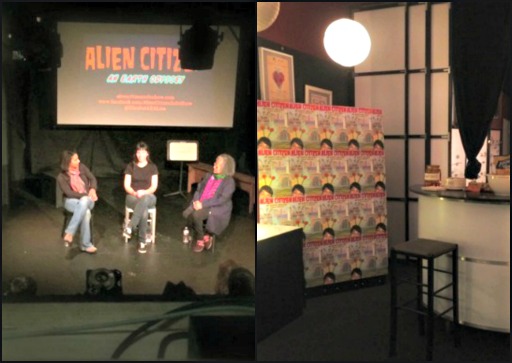
Director Sophie Calderon puts her all into helping Lisa Liang with the filming of Alien Citizen in November (photos supplied).

We had no audience on the first night when we shot close-ups and medium shots; we had a full audience on the second night of close-ups and wide shots.

This is what I’ll say about performing a solo show for cameras but without an audience, starting and stopping for technical and performance adjustments: it’s utterly exhausting. We were at the venue for a good eight hours that night and we must have shot for at least four-and-a-half of those hours. This meant that I had to perform alone for close to five hours. No costar to work off of, no audience to bounce off of, nobody but the silent cameras, the silent crew, and me. Mind you, doing the 80-minute show nonstop is already a tremendous workout. I always say it’s like doing a sprint triathlon while emoting—and I would know because I’ve done a sprint tri. So now imagine doing it for 270 minutes.

Gah!!!

Drama needs an audience

The next night’s shoot was much more fun, thanks to the warm, enthusiastic audience. They were mostly friends and friends-of-friends who were happy to be there, which made all the difference. I enjoyed myself and the performance felt “full.” We had to “hold” a few times due to sirens passing just outside the theatre—the bane of filming in a big city. But the audience was good humored and supportive throughout.

Afterward we had a Q&A moderated by one of my associate producers, Karen Smith, and people asked smart questions. I’ll include the Q&A on the DVD as an “extra” and maybe put it on YouTube as a promo. People stuck around for wine and goodies after that, and it was absolutely lovely to continue receiving support and enthusiasm well into the evening.

Alien Citizen Talkback

Associate producer Karen Smith conducts a talk back with Lisa and Sophie for a DVD “extra”; the lobby is decked out before the public show with an Alien Citizen backdrop for interviews later (photos supplied).

Have I mentioned that I performed with four injuries? I accidentally hurt my lower back in January, and the problem has flared up intermittently throughout the year. My left shoulder/neck area started bothering me over the summer. My right clavicle was injured accidentally at a chiropractic session for the first two injuries (!). And I hurt my right leg during a performance of an excerpt of the show in September. I’ve been doing all I can to take care of these problems: chiropractor, massage, acupuncture, cupping, at-home physical therapy, hot tub, you name it.

Stress with a capital “S”

So I can only think that the reason they all flared up (especially my back) with a vengeance in the weeks leading up to the shoot was: stress. It’s stressful to produce a film, even when it only shoots over two nights. If you’re the only actor in it, and it’s your “baby,” and you’re literally recording it for posterity, then the stress increases exponentially. So I felt more wrecked than usual on the mornings after both performances, and I laid low for a few days afterward. Luckily, Thanksgiving was soon upon us, so I used the holiday weekend as an excuse to stay in.

I look forward to editing the digital version of the show with my director’s input, and then sending it out into the world. The world has been very kind to Alien Citizen so far, so I’m allowing myself to hope for its future.

Meanwhile, my next live performance will be at Smith College on January 30, and my Asia-Pacific debut will be in Singapore in late April. The show still has legs and I’m so grateful to every single person who has supported it.

Since I’ve posted several entries about the show’s adventures in 2015, and you’ve been very indulgent of that, I’m pleased to announce that the first TCK Talent posting of the new year will be an interview of a wildly impressive creative ATCK. Happy holidays, all, and stay tuned!

* * *

Thank you, Lisa! It’s been quite a year for you and your solo show. I’m amazed you still had energy for a film shoot, especially given your injuries. You’re amazing! I think I speak for all the Displaced Nation readers in wishing the brightest of futures for Alien Citizen, in 2016…and beyond! —ML Awanohara

STAY TUNED for the next fab post!

If you enjoyed this post, we invite you to register for The Displaced Dispatch, a round up of weekly posts from The Displaced Nation, with news, book giveaways and other extras. Register for The Displaced Dispatch by clicking here!

Related posts:

WORLD OF WORDS: At least know the meaning of “gauche” before you travel abroad

Marianne Bohr in the Luxembourg Gardens in Paris—is she reading or indulging in reveries about words?

Marianne Bohr in the Luxembourg Gardens in Paris—is she reading or indulging in reveries about French words?

Columnist Marianne Bohr, whose first book, Gap Year Girl, came out in September with She Writes Press, recounts some of the bad elements she and her husband encountered during their travels.

When living in or even just briefly visiting a country not your own, bad behavior often involves words. Or sometimes, the lack of them.

Over the course of the adult gap year I took with my husband to explore Europe, we frequently witnessed what we considered bad behavior by expats or tourists. There’s no excuse for being in a country without learning the basics of its culture and at least a modicum of words for pleasantries. To do otherwise selfishly places you and your mother tongue at the center of the language universe and disrespects the country and the people you’ve chosen to visit.

Rude Americans in the City of Light

Our 365 days of travel began with a month in Paris. In the space of two evenings, we observed very different, yet equally disappointing, back-to-back dining experiences. The food was terrific but our neighbors were not. Both incidents involved Americans in the City of Light for long stays.

Parisian cafe bad elements

Photo credit: Parisian bistro at night, by La Citta Vita via Flickr (CC BY-SA 2.0).

The first took place in a bright busy bistro where we were seated next to a retired married couple from Reno, Nevada. They had been coming to Paris for six weeks at the end of every summer for several years.

The second was in a dim crêperie where we sat across from a middle-aged man and woman from U.S. parts unknown (although her accent gave her away as coming from the deep south). He taught something somewhere to students in Paris and she stated indignantly as we ordered our drinks that she, “could not take another year over here—twelve months was more than enough.” Everyone has a story.

Some of the two couples’ background they shared with us and other bits we overheard. What absolutely amazed me—in fact made me wince—was that none of these four Americans even attempted to speak French to the wait staff.

I completely identify with not knowing a language; we traveled through multiple countries whose languages eluded me, yet we always learned to say hello, please, thank you and you’re welcome.

But all four of these people had spent significant time in France. Would it have been so difficult to read off the menu and say, “la salade” and ”le poulet” instead of “the salad” and “the chicken?” Could the guy who’s been teaching here for a year at least have learned to say, “l’addition, s’il vous plaît” instead of “the check, please?” Might they all have been able replace, “Thank you—goodbye,” with “Merci—au revoir?”

I’m sympathetic towards tourists who travel for brief visits, but after six weeks every year and a full twelve months in Paris, there’s simply no excuse. That’s behaving badly in my book.

Blatant bad behavior in Aix

Well into our sabbatical year having traveled through 20 additional countries, we were back in the pleasures of France. And yet again, we found ourselves observing a more blatant brand of bad behavior.

We had settled in the stylish university town of Aix-en-Provence at the height and in the heat of a south-of-France summer. One of our favorite pastimes was sitting for long mornings under the dense shade of sycamores—les platanes—their green canopies arching over appealing squares filled with tiny bistro tables. The unique mosaic of the sycamores’ peeling bark intrigued us—uneven patterns of pastel yellows, tawny russets, avocado greens and dull grays—and we never tired of studying the colors.

Aix plantanes

But on one morning, our idyllic interlude under royal sycamores was marred by the manners of plebeians.

Enjoying cafés au lait, croissants, and the daily chatter of French summer school students in the outdoor shade, we were startled when an Eastern European quartet of two tanned Moms and their Mini-Me daughters, each one more rude than the other, unceremoniously marched onto the terrace.

There were no “bonjours” and no smiles in response to the sweet greetings of the waitress. The women’s bravado more than upset the drowsy morning ambience.

All were similarly clad in skinny jeans, patent leather stilettos and Jackie-O shades with “spoiled” plastered across heavily made-up faces. Distressed that the cafe served no food for breakfast and when politely urged, as we had been, to run up the street to the local boulangerie for croissants, the most vocal of the four retorted brusquely and loudly in accented English, “What, the French don’t eat breakfast? Ridiculous.”

We so wanted to see her wobble up the cobblestoned hill in search of pastries in those heels.

stilettos in Aix

Rather than rebuke the vocal twenty-something for bad behavior and creating a scene, however, her mother barked an order for orange juice—“freshly squeezed.” The OJ not forthcoming, they settled loudly for espressos, plopped down in their chairs and insolently picked up their Blackberries with identical pouts.

Bad-mannered people come from all corners of the world, and, unfortunately, they sometimes chose to sit next to us.

* * *

Thank you, Marianne, for sharing these horror stories! I agree, more people need to join your world of words!

Readers, have you ever met the tourists from hell, and were they using English in a non-English-speaking country at the time? We’d love to hear about it in the comments!

Marianne C. Bohr is a writer, editor and French teacher whose book, Gap Year Girl: A Baby Boomer Adventure Across 21 Countries, was published in early September (She Writes Press). She married her high school sweetheart and travel partner, and with their two grown children, follows her own advice and travels at every opportunity. Marianne lives in Bethesda, Maryland, where after decades in publishing, she has followed her Francophile muse to teach French. She has an author site where she keeps a blog, and is active on Facebook and Twitter.

STAY TUNED for the next fab post!

If you enjoyed this post, we invite you to register for The Displaced Dispatch, a round up of weekly posts from The Displaced Nation, and SO much more. Register for The Displaced Dispatch by clicking here!

Related posts:

CULTURE SHOCK TOOLBOX: Expats, when you find yourself out of tune with the local language/culture, throw back your head and laugh it off!

Byron Williams, Jr. with one of his performers (supplied).

Byron Williams, Jr. with one of his performers (supplied).

Transitions enthusiast H.E. Rybol is in holiday mode with her latest interview guest.

Season’s greetings, Displaced Nationers! You may be in full hibernation mode by now or, if you live in the Southern Hemisphere, perhaps you’re ready to hit the beach! Either way, I’d like to offer you some holiday cheer through this month’s column. My guest is singer, song-writer and long-term expat Byron Williams, Jr. Byron grew up in Miami, Florida, and Portland, Maine, before moving to Europe in the 1990s.

He started singing in a gospel choir when he was eight years old—and has been singing ever since. Since 1998 he has made his home in Fredrikstad, Norway, where he performs soul, jazz and rhythm ‘n’ blues with his duo/trio at all kinds of events: parties, anniversaries, festivals and more. He can go from Frank Sinatra to Barry White and everything in between.

During this cold and grey season, Byron has been spreading comfort and joy with his concert series “Christmas Joy N’ Soul.” Talk about holiday spirit!

Byron kindly agreed to share some of his culture shock experiences with us. Tune in as we talk about mistaken identities, language classes, mispronounced words and what to pack to get through awkward moments. Actually, as it’s the holidays, why not literally tune in to Byron? Click here to hear him croon…while you read on.

* * *

Hi, Bryon. Welcome to Culture Shock Toolbox. I know you were born in Miami and then went all the way north to Portland, Maine. Where have you lived abroad?

Spain (Mallorca) for three years and Norway (Fredrikstad) for almost 17 years.

In the course of your transitions into European cultures, have you ever ended up with your foot in your mouth?

When I moved to Norway back in 1998, I was getting off the train in Oslo and heading towards the central station, when a man approached me asking me something in Norwegian. And I, being the polite American, told him “No, I’m sorry and continued on my way to the station. He continued to ask me questions and I replied: “No, I do not have any money to give you.” As I was getting closer to the entrance to the station, he told me that he was a customs agent and needed to see my passport. I apologized to him for thinking that he was a beggar.

How did you handle that situation?

We both laughed and went our separate ways 🙂

Can you think of a situation you handled with finesse, and why do you think that was?

When I began to take Norwegian classes, I mispronounced the word for “brick” in English and what came out sounded like the Norwegian word for murder. Back then the words sounded the same to me and didn’t notice it. Then my teacher started laughing and told me that the words meant two totally different things 🙂 I laughed it off by saying that that’s what happens when you learn a new language.

You have to have a sense of humor in life.

If you had any advice for someone moving abroad for the first time, what tool would you suggest they develop first?

Carry a smile in your culture shock toolbox, it will take you further 🙂 And stock up on those smiley face stickers and emoticons for when you need a reminder!

smiley face toolbox

Thank you so much, Bryon, for taking the time to do this interview! As newbies in another culture, we aren’t always as inconspicuous as we’d like to be. Humor will definitely see us you through those awkward moments and make you feel more in harmony with yourself and your surroundings. Especially in this holiday season, why not crack a smile and try putting one on someone else’s face?!

* * *

Readers, what do you make of Byron’s advice? If you like what he has to say, I recommend you visit his site, where you can peruse his music. You can also find him on Facebook and Twitter.

And to keep you in that holiday spirit, listen to Byron’s tribute to Barry White:

As always, thanks for reading, Displaced Nationers! Well, hopefully this has you “fixed” until next month/year. See you in 2016!

Until then. Prost! Santé!

H.E. Rybol is a TCK and the author of Culture Shock: A Practical Guide and Culture Shock Toolbox. She loves animals, piano, yoga and being outdoors. You can find her on Twitter, Linkedin and Goodreads. She recently launched a new Web site and is now working on her second book.  

STAY TUNED for more fab posts.

If you enjoyed this post, we invite you to register for The Displaced Dispatch, a round up of weekly posts from The Displaced Nation—and much, much more! Register for The Displaced Dispatch by clicking here!

Related post:

LOCATION, LOCUTION: Rachel Abbott, proof positive it’s never too late to become a best-selling novelist—and expat

Location Locution
Columnist Lorraine Mace, aka Frances di Plino, is back with her latest interview guest.

My guest this month, Rachel Abbott, did not start out as a writer, though she claims she always had a novel in her head. Born in Manchester, she trained as a systems analyst but then ended up founding her own interactive media company, where, as managing director, she wrote everyday but mostly board reports, user manuals, and creative treatments for clients.

Around 15 years ago, she sold the company and moved with her husband to Le Marche, in central Italy. The pair set to work on renovating a ruined small monastery, where they lived for several years.

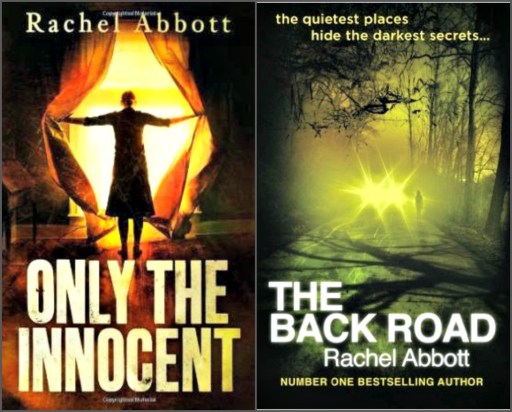
When six-foot snowdrifts prevented her from leaving the house for a couple of weeks, Rachel started writing and found she couldn’t stop. She self-published her first novel just over four years ago, a psychological thriller called Only the Innocent, which is set very briefly in Italy but mostly takes place in rural Oxfordshire.

Only the Innocent reached the number 1 spot in the Kindle store just over three months later and went on to become the second highest selling self-published title in 2012. It was subsequently published by Thomas and Mercer in the USA, where in just a few months it achieved number 1 in the US charts, making Rachel’s debut a number one bestseller on both sides of the Atlantic.

The Guardian newspaper dubbed Rachel “the e-publishing sensation of 2012” while The Observer stated “self-published authors such as Rachel Abbott are the trade’s hottest property.”

That’s how this Mancunian fell into a brilliant new career. Two years after her break-out success, Rachel released her long-awaited second novel, The Back Road—which quickly reached number 2 on the UK Kindle chart and has over 450 five-star reviews. (The back road of the title is in a made-up village called Little Melham, in the heart of the English countryside.)

Rachel's first two psychological thrillers, both international bestsellers.

Rachel’s first two psychological thrillers, both of which rapidly became international bestsellers.

Her latest works, Sleep Tight (partially set in Anglesey, one of the Channel Islands, which Rachel visited as a child), Stranger Child and Nowhere Child have followed the same pattern of success. All of them take place mainly within Rachel’s hometown of Manchester.

Rachel's latest three books. Stranger Child, a stand-alone novella but featuring the same characters as Stranger Child, came out in October.

Rachel’s latest three books. The very latest, Nowhere Child, came out in October. It’s a stand-alone novella but features the same characters as Stranger Child.

As far as the expat life goes, Rachel now divides her time between Italy (where she lives in her second property, an apartment in an old fort, which overlooks the sea) and Alderney, in the Channel Islands, which is just off the coast of France. She explains her decision to spend time on this beautiful island as follows:

“There are so many wonderful aspects of living in another country—not least getting to understand their culture. Italians are extreme in their emotions, and that—for me—was a joy to watch, even when they are shouting at each other (because it usually doesn’t last). I did, however, struggle with the language. I can now speak reasonable Italian, but as a writer I found it difficult not to be speaking English all the time! I discovered that from time to time I struggled to remember the correct English words, and I felt it was time to move back to an English-speaking country if I was to continue to write. So I moved to Alderney. Not quite the UK, but close. It’s a wonderful island, and life here is as perfect as it gets.”

Despite her new-found worldliness, Rachel insists she remains a Lancastrian at heart.

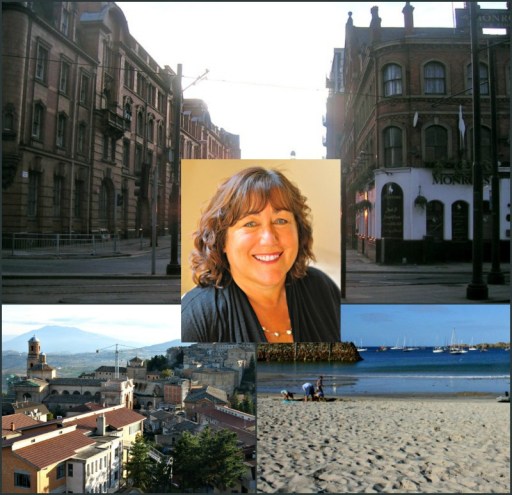
Photo credits: Rachel Abbott (inset); Whitworth Street, Manchester, by Mikey via Flickr (CC BY 2.0) ; Montalto delle Marche, by Sgobbone via Flickr (CC BY-SA 2.0); and Braye Beach (Alderney, Channel Islands), by TheOnlyMoxey via Flickr (CC BY 2.0) .

Photo credits: Rachel Abbott (inset, supplied); Whitworth Street, Manchester, by Mikey via Flickr (CC BY 2.0); Montalto delle Marche, by Sgobbone via Flickr (CC BY-SA 2.0); and Braye Beach (Alderney, Channel Islands), by TheOnlyMoxey via Flickr (CC BY 2.0) .

* * *

Welcome, Rachel, to Location, Locution. It seems your writing career and your expat life developed in tandem, but which comes first when you are writing, story or location?

Thank you for inviting me, Lorraine.

In all cases, my story has come first. My most recent books are set in Manchester, but the locations within Manchester are determined by the story. My concern is that I am going to run out of spooky places for the strange goings on that I need in my stories!

What techniques do you use for evoking the atmosphere of a place?

I have a very visual imagination, and in every major location in any of my books, I know exactly what it looks like. That’s my starting point. I can wander the halls of houses, or creep along canal banks at night. So I know what I can see. I then start to think about what it might smell like—and much of that is determined by what is happening. A house can smell of baking cakes, or of rotting food—so I imagine myself there, and think how it might smell. Finally, I listen. What will the sounds be like? Where is the location—outdoors or indoors? What are the surroundings like—are there trains nearby, or a distant motorway? I close my eyes, and I am there—feeling what my characters are feeling.

Which particular features create a sense of location? Landscape, culture, food?

It depends on the stage in the story. The character might be walking along a country lane, but if she is scared, the overhanging trees, dripping with rain from the recent storm would be the features to focus on. If it’s a happy day, it might be the cows munching contentedly on the grass in the fields. With this in mind, any feature can help to create that sense of the location.

Which of your works provides the best illustration of place, and can you give us a brief example?

Here’s a passage from my latest, Nowhere Child:

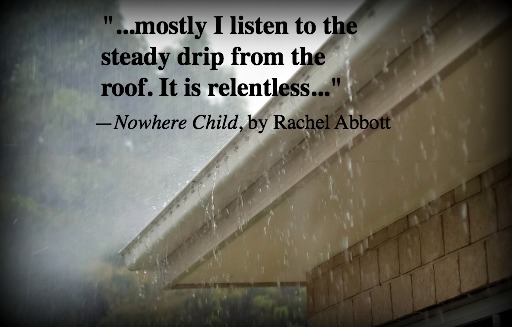
The freezing November wind is bouncing off the damp walls, hitting us in icy blasts as if someone keeps opening and closing a door. But there isn’t any door—just a gaping black hole. There are four or five groups of us down here, sitting in twos and threes huddled around our feeble fires. We keep to ourselves mostly. I can see the odd face, lit from below by the weak yellow flames, features hovering, disembodied, against the black walls, the eyes hollow pits. I can hear the occasional murmur of conversation but mostly I listen to the steady drip from the roof. It is relentless, and I’m not surprised when Andy says that dripping water is used as a form of torture. Another drop joins in, this time with a slightly different tone. There is a pause, and for a second I wonder if it’s stopped. But of course it hasn’t. Drip-drop. Drip-drop.

Nowhere_child_quote

How well do you need to know a place before using it as a setting?

Some settings exist in my imagination. Others have to be realistic. I am currently writing a story about an area of Manchester that I didn’t know existed—even though I lived there for a large proportion of my life. I have been unable to visit it myself in time to write the first draft of the book, but my sister lives nearby. So she has been out on research trips for me, taking photos and videos. I have used to map to pinpoint the places that I want her to take pictures of, and I’ve also used Google Maps—in walkabout mode—to get me close enough. I have studied this place in as much detail as possible without an actual visit, and I will visit it myself before the final version is written.

Which writers do you admire for the way they use location?

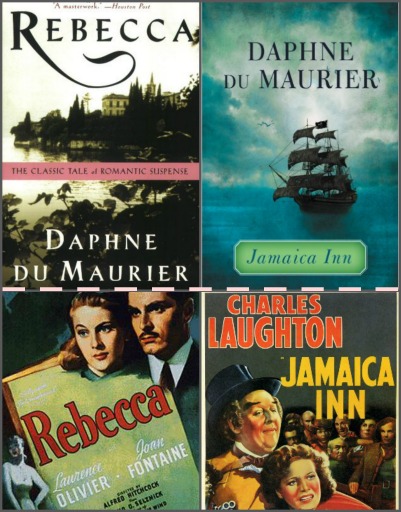
I love the sense of location in Daphne Du Maurier’s books—in particular, Rebecca and Jamaica Inn. One is set in a magnificent, if malevolent old property, the other a run down and gloomy inn, which is never open to the public. The locations are so vivid in these books that a mental image is formed even before seeing them on the big screen!

The locations of these two Daphne du Maurier classics are so vivid, you don't even need to see Hitchcock's films!

The locations of these two Daphne du Maurier classics are so vivid, you don’t even need to see Hitchcock’s films!

Thanks so much, Rachel!

* * *

Readers, any questions for Rachel Abbott? Please leave them in the comments below before she jets off to one of her exotic locales…

And if you’d like to discover more about Rachel, why not visit her author site. You can also follow her on twitter at @RachelAbbott.

Until next month!

Lorraine Mace writes for children with the Vlad the Inhaler books. As Frances di Plino, she writes crime in the D.I. Paolo Storey series. She is a columnist for both of the UK’s top writing magazines, has founded international writing competitions and runs a writing critique service, mentoring authors on three continents.

STAY TUNED for the next fab post!

If you enjoyed this post, we invite you to register for The Displaced Dispatch, a round up of weekly posts from The Displaced Nation, with weekly updates and much, much more. Register for The Displaced Dispatch by clicking here!

Related posts:

Photo credits (top of page): The World Book (1920), by Eric Fischer via Flickr; “Writing? Yeah.” by Caleb Roenigk via Flickr (both CC BY 2.0).

BOOKLUST, WANDERLUST: Giving thanks for expat and repat writers whose novels have an international flavor

booklust-wanderlust-2015

Attention displaced bookworms! Our book review columnist, Beth Green, an American expat in Prague (she is also an Adult Third Culture Kid), is back with several recommended reads!

Hello again, Displaced Nationers!

This week is Thanksgiving in the USA. Many Americans abroad skip this holiday for one reason or another—one main reason being the cost of frozen turkey (a friend in Thailand recently posted a picture of one selling for $200 at the expat grocery store!).

But I always try to do something a little bit special. The way I see it, there can never be enough occasions to sit down with friends to a table full of good food!

In addition to planning for Thanksgiving and the holiday season, I’ve been cruising through the rest of my 2015 To-Be-Read list. This month, I’ve been feasting, so to speak, on three books by current or former expats who write fiction set against international landscapes. Two of them are first-time novels and the other is a thriller. One came out with a small press, and the other two are self-pubbed. Take a look!

1) Summer on the Cold War Planet, by Paula Closson Buck (Fomite, 2015)

Summer Cold War Buck

A first novel about expats in late 1980s Berlin, written by a former Fulbright fellow who has written poems and short stories about her travels? Sounds like a perfect choice for the Displaced Nation! Paula Closson Buck directs the creative writing program at Bucknell University in Pennsylvania, and is currently at work on a novel set in Venice—keep your eyes open for a review of that book, too, when it publishes.

Summer on the Cold War Planet tells the story of Lyddie, a young American woman who is living in Berlin a few years before reunification and studying architecture. She encounters a trio of German artists/activists and also meets her future husband, an American botanist named Phelps.

Most of the action takes place, as the title suggests, the summer before the Berlin Wall falls. At that time, Phelps disappears while conducting botanical research in Kurdistan and so Lyddie, now pregnant, returns to Berlin to examine her feelings for the absent Phelps—and rediscover who she is.

Buck brings the period to life through gorgeous details such as:

In the simple way the young East German at the border touched Lyddie’s face, tipping her chin this way and that as he scrutinized her features in relation to her passport, Lyddie felt she understood the meaning of Cold War. He returned her passport with a hint of a smirk and nodded her release.

But, although I was transported to the intense atmosphere of 1989 Berlin, I often felt at arm’s length from Lyddie, I think because, especially in the flashback scenes, she seemed to be letting others make choices for her.

Later, when the action shifts to the Cycladic Islands in Greece, Lyddie becomes more relatable. My favorite character in the novel, I’d like to add, is another point-of-view character, a Greek painter who learns to paint canvases underwater. A new thing to try next time I go scuba diving!

2) A Decent Bomber, by Alexander McNabb (November 2015)

McNabb Decent Bomber

This book also ticked two boxes for inclusion in this column—an expat author and an internationally relevant plot. Alexander McNabb is a former journalist who has lived abroad—mostly in the Middle East—for about 30 years. He is author of several other international thrillers, including the “Levant Cycle” books, all three of which were featured on the Displaced Nation.

The action of McNabb’s previous international thrillers centers on the Middle East, but he sets A Decent Bomber in Europe, mostly in Ireland.

Now, I find it fun to read thrillers (“fun” in that kind of macabre sense), and this one has an enjoyable premise. A retired, reformed bomb-maker for the Irish Republican Army reluctantly agrees to build new bombs, this time for African terrorists—and then tries to save the day before his bombs explode. McNabb keeps the pacing tight, the action scenes believable, and the violence just on this side of gruesome.

Perhaps because of recent current events, I was also impressed with how delicately he handles the multiculturalism of present-day Ireland, as well as the long, contentious history between the English and Irish. Take, for example, the following scene, set in a mosque in Northern Ireland:

“Welcome. I am Abdelkader Ul-Haq.”

“Hello, Father. My name’s Pat.”

Abdelkader hobbled to behind the desk and lowered himself into the wooden armchair. “I am not your father. May I sit?”

“Of course. I’m not holding you up. And father is we call our priests.”

“I know. I was joking with you. It is always best to joke with men who have guns, I am finding.”

“What gun?”

“I know the shapes guns make in clothes, Mister Pat. I come from a troubled place.’

“Well you’ve certainly hopped out of the frying pan into the fire.”

“Belfast? It is peaceful now. Before, there were troubles. No more. How may I be of assistance to you?”

Lest you be put off by the idea of following the adventures of a lone cowboy (indeed, Pat is such a cowboy that he actually owns cows), I should mention that our hero is rarely alone. He is joined on the chase by his college-student niece along with a group of police officers and politicians from both the Republic of Ireland and Northern Ireland, all of whom provide moments of comic relief. As we know from the Displaced Nation’s previous encounters with McNabb, he has a sense of humo(u)r.

3) I Have Lived Today, by Steven Moore (October 2014)

I have lived today Moore

I included this book in this particular round-up because of the author’s international credentials, and because it has received 130+ five-star reviews on Amazon. Steven Moore is the man behind the visually stunning travel blog, Twenty First Century Nomad (he also has an author site). He has been working and traveling abroad for at least twenty years. He now lives in Mexico, and one suspects his adventures aren’t over yet!

But, now, let’s burrow into the pages of Moore’s book, his first. Although the novel does have scenes both in the UK and in New York City, it is principally a coming-of-age story about a boy whose travels have to do with discovering his own conscience. I Have Lived Today takes place in the 1960s and follows the turbulent journey of Tristan Nancarrow, a boy so badly treated by his alcoholic father that he was never allowed to attend school.

Tristan’s mother is forced to run for her life, and not long after, Tristan makes his escape from the isolated island where the family lives. He spends the bulk of the book trying to reunite with his mother—having plenty of adventures, along with his share of small triumphs and bitter tragedies, along the way.

I especially enjoyed the parts of the novel when Tristan discovers what he was missing out on while under his father’s control. One of the first things he does after escaping is go to a bookstore and buy an atlas:

Tristan turned the pages delicately, as if he was looking at a priceless and ancient manuscript. To him it was an object of beauty, a treasure from a museum, and indeed the musty old store had a museum feel about it, or at least that’s how Tristan imagined a museum would seem, having never been to one.

There are times in I Have Lived Today when the tone takes on a moralistic edge and the pacing becomes steady and unrushed in a manner reminiscent of a Grimm’s fairy tale (though, to be sure, without any witches or other supernatural beings).

Our hero, Tristan, despite his father’s brutal abuse, remains an innocent who chooses to embrace a white-knight moral code even as the world shows him how cruel it can be. Through switches in point of view, Moore lets the reader peek into other characters’ motivations, but the focus is always on Tristan and his choice to reject his personal demons. This hero has resilience—the quality that we expats need—in spades.

* * *

So, Displaced Nationers, if you’re lucky enough to have a few moments to yourself over Thanksgiving or before the holiday season gets into full swing, you might want to check out these three books. They’re as different as the sides at a potluck Thanksgiving, and no less delicious for that!

p.s. And, since it’s Thanksgiving, may I say a hearty thank you to my readers! Please keep in touch and let me or ML know if you have any suggestions for books you’d like to see reviewed here! Last but not least, I urge you to sign up for the DISPLACED DISPATCH, which has at least one Recommended Read every week.

STAY TUNED for next week’s fab posts!

Beth Green is an American writer living in Prague, Czech Republic. She grew up on a sailboat and, though now a landlubber, continues to lead a peripatetic life, having lived in Asia as well as Europe. Her personal Web site is Beth Green Writes. She has also launched the site Everyday Travel Stories. To keep in touch with her in between columns, try following her on Facebook and Twitter. She’s a social media nut!

If you enjoyed this post, we invite you to subscribe to The Displaced Dispatch, a weekly round up of posts from The Displaced Nation and much, much more. Sign up for The Displaced Dispatch by clicking here!

Related posts:

GLOBAL FOOD GOSSIP: Upon repatriation, a chance to hatch my first farm-to-table plan (the coop came first!)

Global Food Gossip 062315
Serial expat—and now repat—Joanna Masters-Maggs is back with some tasty global food gossip to share—this time a rather entertaining chicken-and-egg story (but the coop came first).

“Right, that’s it, no more chickens,” muttered my husband darkly as he finished putting in the last stake supporting the electric fence which now circled a large part of our garden. “You’d think these eggs were gold plated.”

I had always wanted chickens and, returning to the English countryside after nearly twenty years of living abroad, I seized the opportunity, investing in a proper, farm-style coop. No silly Dutch barns or Irish caravans for me—this was to be serious stuff.

“What kind of chickens do you keep?” asked the friendly guy from the animal feed shop from whom I was buying a vast bag of hay and a substantial sack of layers meal (poultry feed).

“Er, well,” I muttered with embarrassment.“I don’t actually have any yet…but soon.”

“Well,” he smiled kindly, “you’d do worse than looking up Andy at Oak Farm, he’s got all sorts.”

The chickens arrived a week later. All went well, two more arrived and the eggs began to come….until…

The Girls...minus poor Abby (supplied).

The Girls…minus poor Abby (supplied).

Why did the chicken cross the road? (Don’t ask…)

One afternoon, I went out to check on my girls, to discover that one, Abby (a Wyandotte), was missing—and so too was Sophie, my gorgeous German Shepherd.

Nearly hysterical by now as I couldn’t possibly contemplate life without Sophie, I ran up and down the road in front of the house and down the lane calling and calling the dog. She always comes.

But this time it took fifteen minutes. When she at last emerged from the ditch behind the hedge—quiet but gleaming and bright eyed—I knew.

We never found traces of Abby and it was easy to convince ourselves that a fox had stolen the unfortunate bird, but, hours later, my husband caught Sophie, red in tooth and claw, with Keira, a light Sussex.

Dinner that night was chicken. “It’s not Keira, honestly.”

The atmosphere was bleak. Something had to be done and so the electric fence was organized. We now rest easy that Sophie won’t help herself to another expensive free-range chicken lunch. She clearly remembers her meal with relish—and I still occasionally catch her gazing wistfully at The Girls. But she now knows, and an electric shock serves to reinforce the lesson.

But the flavor? Just eggs-traordinary!

The eggs are worth all the trouble. Unless you have tasted an egg straight from nesting box to plate, you have not, I am sad to say, tasted egg.

A feast of poached eggs on toast at Joanna's house (supplied).

A feast of poached eggs on toast at Joanna’s house (supplied).

In England it isn’t easy to buy battery eggs any more. Free range is the thing in all supermarkets; many only stock free range.

Should you decide to stand firm against spending extra for your eggs, you might feel it prudent to hide the box under some curly kale as you complete your perambulations around the aisles, such is the disapproval you might attract.

Hardly a nest egg…

Yes, I have eaten my share of free-range eggs and so feel myself qualified, albeit poorly, to make two observations:

1) A free-range egg from a supermarket is not the same as the eggs The Girls produce. I think it may have more to do with freshness than free-rangeness. Freshly laid, my girls produce eggs with thick whites, which do not spread when they are cracked. It is very easy to poach them perfectly since they hold together well. Of course, it goes without saying that the yolks are deeper in colour and of a more unctuous texture.

2) It’s simply not clear how free-range eggs can be produced for any profit, even at the prices supermarkets charge. I have—thank you, Sophie—nine chickens. I am lucky if I get four eggs a day. Four. I have to feed these girls both regular feed and little treats and put cider vinegar in their water for strong shells. Then I must buy them straw, which I like to change daily both for hygiene and for their comfort and dignity—they are ladies, please. Then there is the cost of the coop and galvanized feeders and water dispensers. Then, of course, the electric fence. My girls aren’t even close to paying me back in eggs. Not close.

I suppose if I was of a suspicious mind, I would question how free range does a chicken need to be for her eggs to be sold as such. Does she range wantonly over the garden trampling peonies and pecking at pyrocantha with shameless disregard, or she rather more constrained? If so, exactly how constrained? Does she live outdoors, indoors? I just don’t know. The frightening thing is that, like so many others standing in the egg section of Waitrose, I’m not alone in not knowing what, precisely, is meant by “free range”.

There is also the matter of the moulting season, during which hens lay few eggs in order to conserve all protein for the growth of a new winter feathers. As my friends said, “Moulting season? But there are always eggs in Waitrose.”

He makes a fair point. How does that work? I’ll tell you how it works in Hambridge: I get no eggs, but I carry on caring for the princesses.

Still, let’s not brood over it!

Happily, like my chooks, I don’t have to exhaust myself worrying about these things. I have The Girls, the eggs, the sheer joy of feeling connected to food production albeit in such a small way. It feels so wholeseome to watch my family enjoy our own eggs. It is so snobbishly gratifying, too, to know we are eating probably amongst the world’s most expensive hens’ eggs.

Where’s is the champagne, darling?

colorful bountiful eggs

* * *

Readers, we invite you to continue the food gossip! What do you make of Joanna’s eggs-perience? Of course if you’re American your thoughts will be turning to turkey at this point, but surely you, too, can spare a few moments to think of the humble chicken? Let us know in the comments…

Joanna Masters-Maggs was displaced from her native England 17 years ago, and has since attempted to re-place herself in the USA, Holland, Brazil, Malaysia, Venezuela, Saudi Arabia, and France. She describes herself as a “global food gossip”, saying: “I’ve always enjoyed cooking and trying out new recipes. Overseas, I am curious as to what people buy and from where. What is in the baskets of my fellow shoppers? What do they eat when they go home at night?”

STAY TUNED for more fab posts!

If you enjoyed this post, we invite you to register for The Displaced Dispatch, a round up of weekly posts from The Displaced Nation—and much, much more! Register for The Displaced Dispatch by clicking here!

Related posts:

CULTURE SHOCK TOOLBOX: Newbie expats, to keep waves of culture shock from crashing over you, practice the art of tacking

Culture Shock Toolbox Beth Green

Beth Green at a Buddhist temple in Cebu City in the Philippines, during Chinese New Year (supplied).

Transitions enthusiast H.E. Rybol is back with her latest interview guest.

Ahoy, Displaced Nationers! This month, fellow Displaced Nation columnist Beth Green takes us on a brief tour of her extensive, initially aquatic travels. You know how children test the waters? Well, Beth got to do that quite literally. That’s right, Beth spent her childhood on a sailboat! Doesn’t that sound mouth-watering? Though I must admit that with my predisposition for motion sickness I’d probably spend most of the time with my head over the railing.

Anyhoo, Beth now lives on land—in Prague, the Czech Republic—where she works as a freelance writer and English-language coach. She is also a member of the Sisters in Crime mystery writers’ association. Upon discovering she is a traveler, bookworm and lover of spookiness, I knew I had to interview Beth for this column! And luckily for us, she kindly agreed to share her culture shock stories.

Join us as we talk about opening a conversation with an apology, cringing at our own meltdowns, sending stuff back in restaurants (or not!), and working weekends to make up for weekday public holidays (say what?!). You never know, you may pick up a few items for your culture shock toolbox!

* * *

Hi, Beth. Welcome to my column! As a TCK and an ATCK, you’ve led a peripatetic life. Tell us a little about where you’ve lived…

I’ve never lived anywhere for very long! As a kid, I traveled with my parents on a sailboat. We were in the Caribbean for seven years and the South Pacific for two, with stops along the coastal United States in between. I went to high school in Alaska and to university in the continental USA, but my junior year of university I went to Spain on exchange for a year. That experience inspired me to move to Europe when I graduated and work for a bit. I lived in the Czech Republic for three years, where I met my now-husband (who’s Australian…of course!). Then, we moved to China together to teach English. We were there for four-and-a-half years all together—but with a break in the middle when we did a long backpacking tour of Southeast Asia and India that included living on an island in Thailand for five months. After touching down briefly in the Philippines and Thailand again, we’ve been back in the Czech Republic for the past two years.

In the course of these many transitions, have you ever ended up with your foot in your mouth?

Oh, sure! The first time I moved to the Czech Republic I quickly realized I needed to start every conversation in Czech with an apology. That way I could make up for the inevitable times when I forgot to whom I should give kisses on the cheek rather than shake hands, or failed to greet everyone properly (as is customary in many more situations in Central Europe than in other cultures—you say “hello” and “goodbye” even to strangers in elevators). China as well was a tricky place to stay on the right side of etiquette. Speaking of which, I can recall an embarrassing meltdown I had once in China after being served a mango-papaya smoothie (what I had actually ordered, I realized later) rather than a melon smoothie like I thought I was getting. I lost all kinds of “face” that day.

Art of European Cheek Kissing

Photo credit: Women kissing at bus stop in Paris, France, by Steven Depolo via Flickr (CC BY 2.0).

How should you have handled that situation? What if any tools have you developed to adapt to this kind of scenario?

What I should have done—and what I learned to do later when I inevitably ordered the wrong thing due to either fanciful names on the menu or my ham-tongued attempts to speak and understand Mandarin—was just to give my smoothie to someone else and order another one. In certain cultures, you just can’t send stuff back in a restaurant! In other words, I had to get better at tacking: that’s when you zigzag back and forth with your sailboat instead of sailing right into the wind. I had to reminding myself constantly that expect the unexpected and not to make too many waves. Like the time in China when I was told that we would all work on Saturday to make up for a public holiday on Monday. What? That’s considered normal? Well, this will be a fun story later! And, I’d better make a note to check my next contract veeerrry thoroughly!

Smoothie debacle collage

Photo credits: (Top) Charm- and confidence-boosting smoothie, Ghangzhou, China, by Cory Doctorow via Flickr (CC BY-SA 2.0); Breakfast (Shanghai, China), by Martin Slavin via Flickr (CC BY-SA 2.0); dissatisfied character via Pixabay.

Can you think of a situation you handled with finesse, and why do you think that was?

I feel like my latest move, back to Europe from Asia, went well because I made a decision not to hard on myself when the waters got choppy. I also decided to take measures right away that past experience had taught would help lower my stress; for instance:

  • hiring someone to help with my visa paperwork (instead of doing on my own);
  • asking for help finding an apartment instead of taking the DIY approach;
  • joining a co-working space right off the bat (even before the apartment) so that I had a quiet place to work even when everything else was up in the air; and
  • enrolling in a refresher language course.

Of course, I’m lucky that I had the option to do all of those things—not everyone will when they move cultures.

If you had any advice for someone moving abroad for the first time, what tool would you suggest they develop first and why?

This advice is easy to give and hard to follow: develop patience and also trust in yourself: you will make progress eventually. Patience for yourself for not “catching on” quickly to situations (I find that culture shock seems to lower your IQ a bit at first!), patience for local people who might not understand your expectations (even though they’re crystal clear to you), patience for the culture shock itself. If we go back to our sailing metaphor: By tacking, you move into the wind gradually. But the zigzagging doesn’t necessarily slow you down. You can learn to tack efficiently—that’s what I tried to do when seeking help for some of the more stressful challenges of settling back into life in Prague. Use your first few months wisely, and eventually your culture shock will go away! Tacking is the Blu-Tack of the culture shock toolkit.

Tacking is the Blu-Tack

Photo credits: Tacking upwind, by Tom Purves via Flickr (CC BY 2.0); Old blu-tack packaging, by Clive Darra via Flickr (CC BY-SA 2.0).

Thank you so much, Beth, for sharing your experience with us! Like you said, if you develop the sailor’s tacking skill, soon it’ll all be water under the bridge. Plus, as you also pointed out, you’ll have great travel yarns to share! In the end, it’s the situations that are most difficult to navigate that make for the best lessons, right?! That’s what I love about culture shock: the lessons we learn and the way our horizons shift as a result.

* * *

Readers, what do you make of Beth’s advice? If you like what she has to say, I recommend you visit her Booklust, Wanderlust book review column here on the Displaced Nation, as well as her personal site. And as those who frequent her column know, she’s a social media nut: find her on Facebook and Twitter.

Well, hopefully this has you “fixed” until next month.

Until then. Prost! Santé!

H.E. Rybol is a TCK and the author of Culture Shock: A Practical Guide and Culture Shock Toolbox. She loves animals, piano, yoga and being outdoors. You can find her on Twitter, Linkedin and Goodreads. She recently launched a new Web site and is now working on her second book.  

STAY TUNED for next week’s fab posts.

If you enjoyed this post, we invite you to register for The Displaced Dispatch, a round up of weekly posts from The Displaced Nation—and much, much more! Register for The Displaced Dispatch by clicking here!

Related post:

TCK TALENT: Donna Musil, Writer-Director, Lawyer, Activist & Proud Army Brat

The uber TCK-talented Donna Musil. Photo credit: Ray Ng.

The uber TCK-talented Donna Musil. Photo credit: Ray Ng.

Columnist Elizabeth (Lisa) Liang is back with her latest interview guest.

Welcome back, readers! It’s been awhile. But I think the wait will be worth it as my latest interviewee is the super-talented writer, filmmaker and social change agent Donna Musil. Donna is also a fitting choice for the month when America celebrates Veteran’s Day. She made the award-winning documentary BRATS: Our Journey Home, narrated by Kris Kristofferson, about what it is like to grow up in a military family and the long-term impact it can have on a person’s adult life.

She is also the founding director of Brats Without Borders, a nonprofit organization dedicated to increasing awareness and support for military brats and other Third Culture Kids.

Donna’s interest in the subculture of military brats is personal. Born into a career Army family, she went to 12 schools by the time she was 16 and never had a hometown. Her family moved almost every year until she was seven, from Fort Benning, Georgia, to two other bases in Georgia (Athens and Macon, the latter when her father was serving in Korea and Vietnam); then to the enormous Army installation in Fort Bragg, North Carolina, and to Charlottesville, Virginia, where her father was doing something at the university. They moved overseas twice: to Germany (Bad Kreuznach), followed by Fort Mason in San Francisco; and to South Korea—Yongsan Garrison in Seoul and then Camp Walker in Taegu (now Daegu), after which they were stationed in Fort Knox, Kentucky. Donna’s father died in the summer of 1976, two months after she turned 16, and her family had to leave base housing. They moved to Columbus, Georgia.

Talk about talent! BRATS was Donna’s very first directing effort. I had the privilege of getting to know her as one of my fellow authors in the TCK anthology Writing Out of Limbo.

* * *

Welcome to The Displaced Nation, Donna. Even though I’ve met and have interviewed plenty of Adult TCKs, my head is still spinning at the number of moves you experienced as a youngster. Once you reached young adulthood, did you settle in one spot or keep moving?
I stayed in Georgia for college, earning a degree in journalism from the University of Georgia and a law degree a few years later (the time in between I traveled and worked as an on-air radio newscaster). After law school, I practiced union-side labor law in Washington, DC and Atlanta. In the late 1980s, I quit practicing law to pursue a writing career, my childhood dream. After a few years in Atlanta, I moved to Los Angeles to “pay my dues” in the film business, but when the 1994 Northridge earthquake struck and destroyed half of my possessions, I stored the other half at my sister’s and moved to Dublin, Ireland, for two years to write. When I ran out of money, I returned to Georgia and began making the BRATS film. I lived in a crooked, old family lakehouse, which became my “base.” During the ten years it took to make and distribute the BRATS film, I also worked as a technical writer and/or attended writer’s residencies in Denmark, Spain, Paris, Taos, and Port Townsend (Washington).

Where do you live now?
In 2010, I moved to Denver to be near my sister and her family, and have lived there ever since, except when I’ve been on writer’s residencies—in France, Chicago, and San Francisco. (I’ll be living at a writer’s residency in Chiang Mai, Thailand, this coming winter.)

Donna Musil, already displaying her talents in Korea, 1975. (Photo supplied.)

Donna Musil, already displaying her talents in Korea, 1975. (Photo supplied.)

Were you happiest in a certain place at a certain time?
I was happiest when we lived at Fort Mason in San Francisco when I was 11 to 13 years old. Interestingly enough, it was one of the least “military” of all of our assignments, just a block away from the famed Ghirardelli Square, overlooking the bay. I attended public schools, populated by an eclectic array of children, whose parents were everything from authors to restaurant owners to ballerinas. The racial makeup of the student body was about a third Chinese, a third white, and a third black and brown. I loved it!

I can imagine you thriving on the diversity. Was there anything else that made that time special?
Yes, swimming! I joined the Presidio Swim Club after watching Mark Spitz bedazzle the tragic 1972 Olympics, and began dreaming of my own (albeit unlikely) Olympic run. I walked to school every day and to swim practice every afternoon. I think I still hold the Marina Junior High School record for the most pull-ups for a 13-year-old girl—12! I loved everything about San Francisco—the culture, the diversity, the hippies on the beach. It was also the last year before my father got sick, so I suppose it was the end of my innocence. The next year, we moved to Seoul, Korea, for six months and then to Taegu, where there was no swim team, and my dreams of Olympic glory evaporated. My freshman class had ten students, total. We were surrounded by jaded, war-struck soldiers on their way to or from Vietnam, bars, prostitutes, and easy access to drugs and alcohol. You can imagine the results.

Because everybody needs a place to call home…

Let’s talk about BRATS. For readers who aren’t familiar, here is the trailer:


Were you surprised by what a hit BRATS has been with adult military brats and ATCKs? 
The reaction to BRATS: Our Journey Home has been interesting. I initially made the movie to figure out “who I was and where I was from,” but it quickly became apparent that it was less about me and more about the brat/TCK culture in general. I had been separated from the military life for twenty years when I began filming so was somewhat surprised to discover that most of the issues the movie discusses are just as relevant today as they were when I was a child—particularly the emotional and trauma-related issues.

In your essay in Writing Out of Limbo, you mention a teenaged boy who loved the documentary because it was the first time he had seen a family like his portrayed on film. You state: “I would do it all over again to hear that one comment. To make a difference in just one child’s life—no honor, award, or monetary compensation could ever compare.” That’s tremendous! But let’s also talk about your goal of affecting change within the military itself. How has the military responded?
To be honest, I would have to say that the military-as-a-whole has not welcomed the film or the research of Brats Without Borders (or any other “brat” groups) with open arms, nor have they helped us implement programs or provide resources to current and retired families that address the emotional needs of military brats/TCKs. There have been pockets of institutional and corporate support for a related art exhibit and workshops, as well as the film distribution costs, and Armed Forces Network has broadcast the film multiple times. The reactions have always been universally positive, but we could be doing so much more (with so very little).

So there are no military groups who have interpreted the film as a call to action?
In general, the military clergy and soldiers have been most supportive of our work and the military educational system and spouses the least supportive. It took me a while to realize that it must be hard to hear that the life you’ve chosen for your family (often a life better than your own childhood) also has its flaws. Many (high-powered) spouses are willing to hear and promote the positive legacies of growing up brat/TCK but tend to gloss over the painful legacies and attribute them to bad parenting instead of institutional pressures, traditions, or combat trauma. As a result, nothing much changes, and (as it has always been), brats/TCKs are forced to take care of their own emotional needs. Nowadays, people talk a little bit more about the sacrifice of military kids and groups give them free “stuff”; but they’re still not addressing their emotional needs (among other things) or considering what institutional changes might be made to ease their transitions and difficulties.

You must find that frustrating.
It’s particularly frustrating when I hear the institution and the media talk about the “lack of research” in this area, because it’s simply not true. We have the research. We’ve had it for 25 years. They just don’t always like what the research says. The military wants to downplay the negatives and the media wants to downplay the positives. Meanwhile, millions of dollars are being thrown into programs for military kids that are designed by people who haven’t walked the walk, or whose loyalties lie more with the institution or perpetuating their own existence than they do with the children. That may seem harsh, but I think it’s the truth. Perhaps one day actual brats and TCKs will be invited to the table and given substantial support, but I’m not holding my breath. In the meantime, we’ll just keep helping ourselves!

“Like many brats,…I could talk to, but didn’t trust, anyone.” —Donna Musil in Writing Out of Limbo

Let’s move on to talk about the TCK experience. Many of the sections in your essay for Writing Out of Limbo resonated with me; for instance, when you said: “There are lessons each of us has to learn in our lives, and the more we avoid learning a particular lesson, the harder God will knock us down, until we have no choice but to learn it (and move on to the next lesson….). Still I didn’t learn.” You mention trust issues, inability to handle disagreement or confrontation, and more traits that are common among ATCKs, for which you needed to learn healthier coping mechanisms. Has making and touring BRATS helped you deal with this? Or do your old TCK survival mechanisms still crop up from time to time (like mine do even though creating Alien Citizen helped me a lot)?
For good or ill, I think all of my TCK survival mechanisms are alive and well! I’ve just learned to manage them better, with experiences from the BRATS film, my new film projects, some very good therapy, a lot of reading, and a very kind, understanding, and patient fiancé.

Has making and touring BRATS helped Donna to deal with some of the TCK issues Donna describes in Writing Out of Limbo? (Cover art; poster art, supplied.)

Has making and touring BRATS helped Donna to deal with some of the TCK issues she describes in Writing Out of Limbo? (Cover art and poster art, supplied.)

Are you tempted, for example, to run away from confrontation/disagreement?
Yes, I’d rather flee, move, break up or leave. I’ve learned to temper that impulse by isolating myself and dealing with it after I’ve calmed down. I also still have a visceral reaction to mean-spirited, unjust, authoritative, or self-centered people, but instead of confronting them like I used to, I try to avoid them. I’m much less black-and-white about things—but perhaps that’s just the wisdom of age. I do make people earn my trust instead of instantly bestowing it, and vice versa. There are so many ways “growing up brat/TCK” still affects my life today; it probably shapes almost everything I do. As I get older, though, I try to build on the positive aspects of my youth and temper the less-than-positive legacies, which is often much easier said than done!

Do you identify most with a particular culture or cultures, or with people who have similar interests and perhaps similar cross-cultural backgrounds?  
I don’t identify with any particular culture or ethnicity, other than the brat/TCK culture. I don’t even have any real nationalistic tendencies. I don’t think America is “the best country in the world.” I think all countries and all people have their good points and not-so-good points; it just depends on what you’re most comfortable with. That said, I am definitely the quintessential American—independent, strong-willed, feisty, rebellious. Daniel Boone was my (great-great) uncle, his oldest brother Samuel my (great-great) grandfather, so I come by that spirit honestly. But my political sensibilities are more Scandinavian, like my grandmother’s side of the family. I enjoy being around other curious, open-minded “outsiders,” many of whom tend to have cross-cultural backgrounds. I try very hard not to consider myself, or any group to which I feel I might belong, “special.” That kind of thinking is the source of most of the world’s ills.

Do you have “itchy feet,” which still make you want to move frequently? Or would you prefer to have a home base and only travel for pleasure?
My poor fiancé. He was an educator brat—but basically grew up in one town in Germany. When we first started dating, I’d tell him all of the places I dream about living in: Vancouver, Canada; Austin, TX; San Francisco, CA; Chiang Mai, Thailand; Asheville, NC; and Paris, etc. Like any man, he wanted to give me what I wanted, but he couldn’t pin me down on what I actually wanted (one of the banes of being a brat/TCK). I was born and raised to be geographically and intellectually curious (the best legacy of growing up brat/TCK!). I like to stay somewhere until I want to go somewhere else—and my fiancé is okay with that, too. I don’t have any children, and his are grown, so it’s possible for us to live this way. Perhaps we’ll settle down in one place in the future. Denver is a nice town. We like it—for now.

Donna’s next act(s)

Returning to your work: I believe you are making another documentary? Tell us about it.
Yes, the film is called Our Own Private Battlefield. It’s the first documentary about the intergenerational effects of combat PTSD on military children, and how one Marine family is using art to help heal the long-term wounds of the Vietnam War. I still have a few more interviews to shoot. I’m hoping the lessons learned from this family will help generations of current and future military families deal with the traumas of war, both here and abroad.

Battlefield sounds amazing.
It’s actually a byproduct of the combined efforts of Brats Without Borders and Marine brat Lora Beldon’s organization, Military Kid Art Project, which teaches customized art classes to military children.

Your mention of art reminds me: I think an art exhibit is one of your other projects?
Yes, Lora and I founded the BRAT Art Institute this year and will host our first Military BRAT Art Camp in 2016, in conjunction with Old Dominion University, in Norfolk, VA. Right now we have a museum exhibit currently touring the country, called “UNCLASSIFIED: The Military Kid Art Show.” It won a Newman’s Own Award in 2012 and features over fifty years of military brat and veteran art from around the world, historical artifacts, and films about using art to heal trauma. The art camps will be part of a larger research effort to study how art can help military children deal with the traumas of war and multiple deployments.

Do you have any projects that don’t relate to the military?
Yes, my personal projects are much more eclectic. Besides a TV show based on brats in Korea in the 1970s, I’m also shopping a children’s animated film script based on African folktales (with a producer from Ghana) as well as a feature film screenplay about a modern-day union campaign at a small-town nursing home. My current writing efforts are focused on a murder mystery, based on (what I believe) is an unjust incarceration of an innocent man for over thirty years.

How can we follow your progress?
People can see my brat/TCK projects at www.USAbrat.org. Later this year, I will be putting up a personal page, donnamusil.com, for my non-brat/TCK projects.

* * *

Thank you so much, Donna! I think I can speak for the entire Displaced Nation in asserting that you’ve blown us all away with all the important and necessary work you do for military brats, veterans, and TCKs. Congratulations on your many extraordinary achievements! Readers, please leave questions or comments for Donna below.

Elizabeth (Lisa) Liang is a prime example of what she writes about in this column: an Adult Third Culture working in a creative field. A Guatemalan-American of Chinese-Spanish-Irish-French-German-English descent, she is an actor, writer, and producer who created the solo show Alien Citizen: an earth odyssey, which has been touring internationally. And now she is working on another show, which we hope to hear more about soon! To keep up with Lisa’s progress in between her columns, be sure to visit her blog, Suitcasefactory. You can also follow her on Twitter and on Facebook.

STAY TUNED for more fab posts!

If you enjoyed this post, we invite you to register for The Displaced Dispatch, a round up of weekly posts from The Displaced Nation, and so much more! Register for The Displaced Dispatch by clicking here!

Related posts:

LOCATION, LOCUTION: Trish Nicholson, a writer whose talents have blossomed in unusual places

Location Locution
Columnist Lorraine Mace, aka Frances di Plino, is back with her latest interview guest.

My guest this month, Trish Nicholson, is something of an exotic plant—the kind one discovers flowering profusely in a far-flung part of the world.

Trish’s birthplace, the Isle of Man, sounds remote to many of us—but not so for Trish, who, despite being half Manx (a mix of Celtic and Nordic), wasn’t able to bloom where she was planted. Following in the footsteps of some of her intrepid ancestors, she left her birthplace and hasn’t looked back.

Her first destination was the UK, in pursuit of higher education and a career. Trish is also half-Scottish, but, though she lived in Scotland for 12 years, her roots did not prove deep enough and she moved on to Europe and much further afield…transplanting herself to Papua New Guinea!

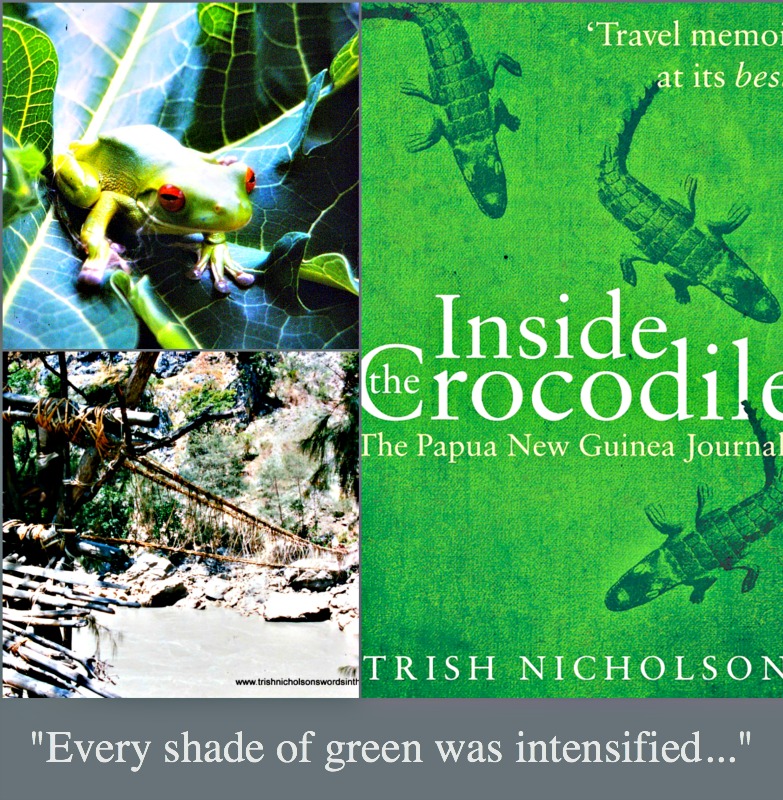
Yes, Trish was stationed in the West Sepik (Sandaun) Province of Papua New Guinea for five years working on aid and development projects while also serving as Honorary Consul for the British High Commission. Rest assured, conditions here were exotic enough for Trish not only to put down roots but to blossom and thrive. As she attests in the travel memoir she published last month, PNG contains the wildest places in the tropics. Among other challenges, she had to contend with crocodiles (the book is titled Inside the Crocodile), sorcery and near-fatal malaria.

Photo credits (clockwise from upper left): Mooragh Park Lake, Ramsey (Isle of Man), by Tony Hisgett via Flickr (CC BY 2.0); Trisha Nicholson (supplied); Explosions (in PNG), by Taro Taylor via Flickr (CC BY 2.0) .

Photo credits (clockwise from upper left): Mooragh Park Lake, Ramsey (Isle of Man), by Tony Hisgett via Flickr (CC BY 2.0); Trisha Nicholson (supplied); Explosions (in PNG), by Taro Taylor via Flickr (CC BY 2.0) .

The so-called Land of Surprises must have been a hard act to follow, but Asia Pacific being Trish’s most nurturant habitat, she soon found other challenges—the next one being to direct the Voluntary Service Overseas (VSO) operations in the Philippines while completing her doctorate in social anthropology. After the Philippines, she obtained a research grant to study indigenous tourism in Vietnam and Australia.

And I mustn’t forget to mention that along the way there have also been frequent trips to South America and Africa, along with treks in Bhutan, Tibet and Nepal.

Trish did return to England eventually—only to decide the time had come to try transplanting herself to the “winterless” far north of New Zealand, where, as she says in her blog:

native trees grow even more in winter than summer because they have more moisture.

Hmmm… sounds a little like Trish?

And now let’s talk about Trish’s body of works. A compulsive scribbler, she has produced plenty of what she calls “creative nonfiction”—from articles for mainstream media to a book on responsible travel tourism—as well as short stories during her twenty years of wandering the globe.

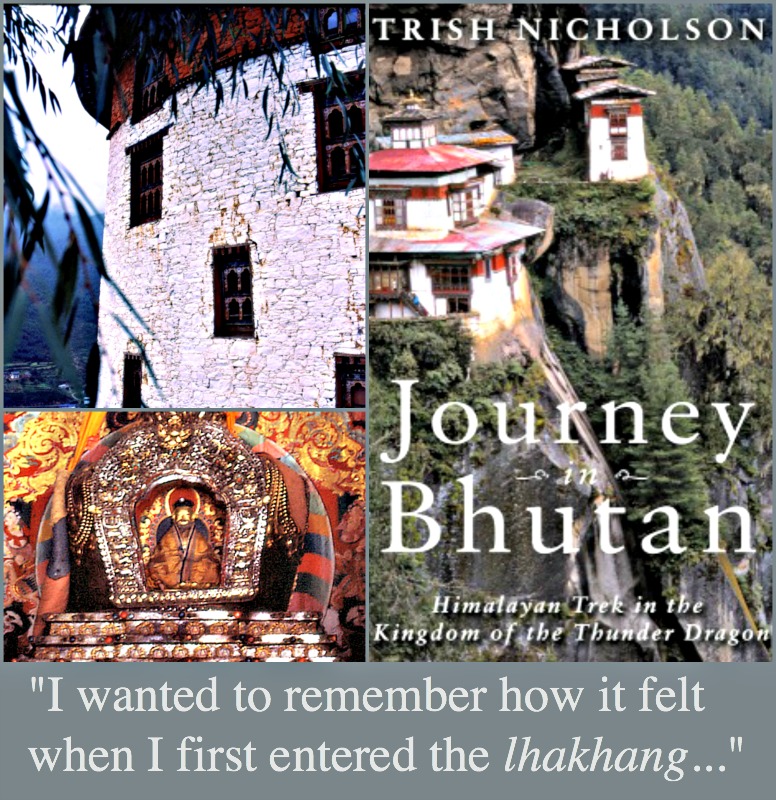
More recently, since moving to New Zealand, she has published a series of e-books on her travels—one of the most popular of which is the illustrated travelogue Journey in Bhutan: Himalayan Trek in the Kingdom of the Thunder Dragon. And now there is the aforementioned Inside the Crocodile: The Papua New Guinea Journals.

Trish’s nonfiction output also includes a volume on creative reading/writing as well as a guide to becoming a non-fiction author. And let’s not forget the historical anthology of storytelling, which she intends to sit down and write now that she’s settled on a quiet New Zealand hillside. That’s when she’s not hiding in her tree house or blogging. Her blog is called, appropriately enough, “Words in the Treehouse.”

* * *

Welcome, Trish, to Location, Locution. I know that your travels have led to much of your writing, but which tends to come first, story or location?

Thank you for inviting me, Lorraine.

It depends on what kind of writing I’m doing, of course. For short stories it’s usually character that comes first for me, but it’s close because characters are an integral part of their setting. In building up the story, character and setting feed upon each other. Location can affect a character’s mood, sometimes their whole outlook on life, and a change of location can be a turning point. But, as I said, it’s a two-way influence; people can also have an impact on their surroundings.

For my travelogues, experience of location came first, but the same principle applies: people feed off setting and vice versa. In this case, of course, the “characters” are actual people I met along the way.

Notably, you were right in saying that my travels led to my writing. I did not set out to write a book at the beginning of either of the two travelogues I have produced. I was inspired to visit Bhutan by an article in a 1914 National Geographic magazine my aunt had left me in a box of dusty old books. It was full of the most amazing photographs of mist threaded mountains, exotic architecture, and distinguished looking men wearing what appeared to be navy blue dressing gowns with broad white cuffs… Papua New Guinea, as you explained in your introduction, was a five-year work assignment, fulfilling a teenage dream to work overseas. Only afterwards did these locations compel me to write about them.

What techniques do you use for evoking the atmosphere of a place? After all, you’ve faced the challenge of describing places very few of the rest of us have visited.

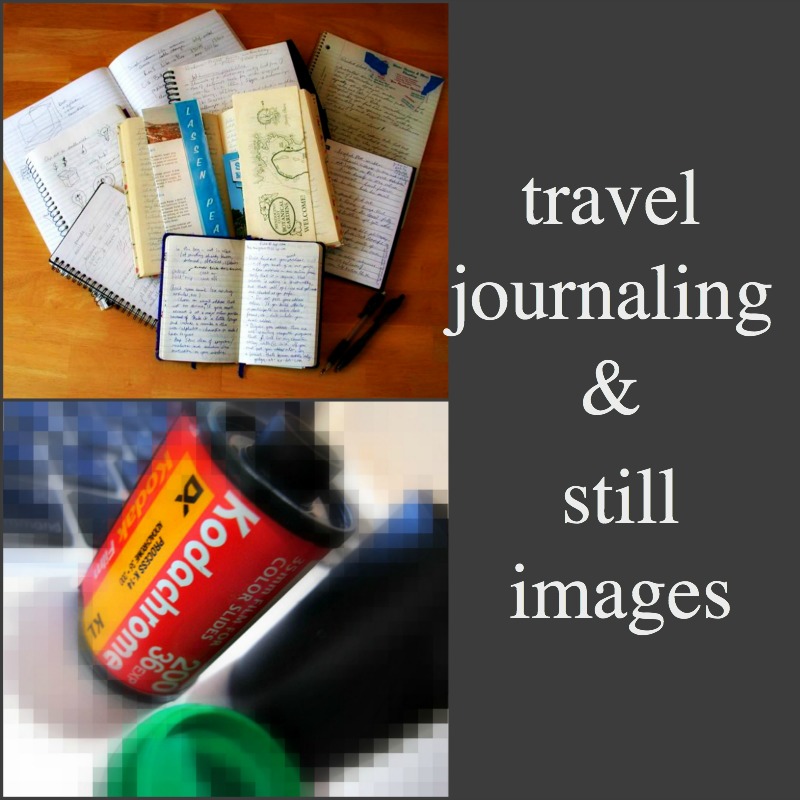
I’m not sure if it’s a technique because it’s not something I do consciously as I write, but your question made me think about it. It’s not so easy to explain, but I seem to identify a feature that is characteristic of a particular place and use my senses to link to it emotionally—trying to recreate in words what I felt when I was there. It’s not simply “place” though, but more a series of “moments-in-place.” The atmosphere of a place changes depending on time of day, seasons and events. It’s possible to keep track of these changes if you maintain a detailed journal as I always do—scraps of information about everything I see, hear, smell and feel. With buildings and landscapes, for example, I record how light and weather affect them. A grey stone wall, for instance, may look hard and forbidding in Scotland, but under a tropical sun it feels surprisingly soft and warm. I note sounds and snippets of overheard conversation, clothes, colours, rhythms of people’s movements—all of which suggest place. Scribbling is a bit of an obsession with me, perhaps a way of hanging on to something I don’t want to end. My other obsession is photography, probably for the same reason. In my early travelling days I used Kodachrome but film was expensive; now you can take large memory cards and click away without a thought. When I’m writing, I scroll through my images and they recall whole scenes for me. The jottings and photographs aid my memory for those sensuous details that I believe evoke atmosphere.

Two of Trish's tools for capturing the details of places. Photo credits: (top) Notebook collection, by Dvortygirl via Flickr (CC BY-SA 2.0); Kodachrome, by Pittaya Sroilong via Flickr (CC BY 2.0).

Two of Trish’s tools for capturing the details of place. Photo credits: (top) Notebook collection, by Dvortygirl via Flickr (CC BY-SA 2.0); Kodachrome, by
Pittaya Sroilong via Flickr (CC BY 2.0).

Which particular features create a sense of location? Landscape, culture, food?

They all can, of course, depending on the story and a writer’s personal interests. I’m certainly no foodie, but even I can feel the tropical heat of Papua New Guinea when recalling drinking kulau (Tok Pisin for “juice from a young green coconut”) straight from a young coconut—the rough, dry shell on my lips, the smooth sweet coolness dribbling down my chin. Language, too, has always been a significant feature for me. Many writers avoid using dialect or foreign words in dialogue so as not to stress the reader, but there are ways of making it easier, and readers enjoy a little challenge. I write dialect or local language in short stories and in travelogues because it draws readers closer to people. And if I want to create the sense of a very specific location, I focus on whatever features are found only in that one place—for example, in Bhutan, the painted red bands around a building that tells you there are sacred relics inside, or in Australia, the surreal landforms of the Bungle Bungles that seem to stride across the landscape enacting their own primordial drama.

Which of your works provides the best illustration of place, and can you give us a brief example?

From Inside the Crocodile, a jungle moment on the hair-raising trek from Oksapmin to Lake Kopiago:

The heavy shower was reduced to drizzle under the canopy and it invigorated the forest; every shade of green was intensified, glistening and vivid. Lazy drops of water glided along leaves, dripping silently onto moss beneath. Fine hairs on the ribs of fern fronds, usually invisible, were lit-up by tiny twinkling water droplets like miniature fairy lights. And the air was filled with the fecund mustiness of moist earth seasoned with the tang of wet foliage … the forest stood in strange, expectant silence, muffled by the press of growing, spreading vegetation all around us. Yet every surface, especially the dark underside, was teeming with life we could not see, or would not recognise if we did, and we couldn’t see beyond the next tree trunk or veil of hanging moss. The sense of being enclosed, entrapped within an unknowable multitude, was overpowering.

Photo credits: (top) A frog inside the papaya tree, one of many critters found in PNG; one of many disintegrating bamboo bridges in PNG (by Trish Nicholson, supplied).

Photo credits: (top) A frog inside the papaya tree, one of many critters found in PNG; one of many disintegrating bamboo bridges in PNG (by Trish Nicholson, supplied).

And if I’m allowed another little one, from Journey in Bhutan, my journal entry the evening after we visited the ancient temple of Kyichu Lhakhang:

… I want to remember how it felt when I first entered the lhakhang – the dark wooden floor, polished and worn into grooves by centuries of calloused feet; distant chanting heard through a haze of incense; Buddhas lustrous in the flickering light of butter lamps – thirteen centuries of reverence are distilled in that room creating an almost palpable sanctity. I feel the balm of its atmosphere as I write – it’s almost like a presence.

Photo credits: (clockwise from top left) Rinpung Dzong, a large dzong (Buddhist monastery and fortress) found in Paro District, Bhutan; book cover art; ancient religious relics inside the lhakhang (all photos supplied by Trish Nicholson).

Photo credits: (top) Rinpung Dzong, a large dzong (Buddhist monastery and fortress) found in Paro District, Bhutan; book cover art; ancient religious relics inside the lhakhang (by Trish Nicholson, supplied).

How well do you need to know a place before using it as a setting?

This is a particularly interesting question because I believe one can be in a location too long. The point is not how much time is spent in a place, but how well we “see” it. In an urban setting, I can spend an hour leaning against a wall on a street corner, or a day walking the streets at random, and gather a huge number of impressions and factual details. In remote areas it takes longer because the changing elements have a greater affect on atmosphere. But this may be enough for the setting of a single story. Obviously, for a travelogue, longer immersion is necessary to reach a depth of understanding across time and seasons. But it depends also on how one writes about a place, the scope of the account. I was in Bhutan for a month, much of that time trekking, so although I included monasteries and temples, and carried out a lot of research on cultural and historical background, Journey in Bhutan focuses on the trek rather than trying to cover the whole country superficially. So, how long is too long? After a few years in Papua New Guinea I noted in my journal:

I’m losing all sense of “normal”.

I began taking for granted what seemed extraordinary to a visitor. Fortunately, I had recorded early events that revealed my astonishment and joy and alienation as a greenhorn during those first months. Without the journals, Inside the Crocodile would have lacked that perspective on the location because, after a while, we cease to “see” so clearly.

Which writers do you admire for the way they use location?

Hard to pick a few from so many: Vikram Seth for his depiction of India—but his first book, From Heaven Lake, was a vivid travelogue of Sinkiang and Tibet; he was still a student but the novelist is already burgeoning in those pages. Khaled Hosseini, who so cleverly weaves his characters into the texture of place in The Kite Runner, and Nikolai Gogol, especially in Dead Souls, where his detailing of personal possessions in a room reveals not only a distinctly Russian steppes atmosphere, but also a character’s past and present. And one more: Ruth Rendell appears to break all the “rules” in The Keys to the Street by opening with almost two pages describing London’s ornamental iron railings—but in such a way that with the first paragraph we are already anxious about those spikes.

Trish's picks for writers who have mastered the art of writing about place.

Trish’s picks for writers who have mastered the art of writing about place.

Thanks so much, Trish! I can easily see why one reviewer described you as “full of humour, adventure, and iron determination…”

* * *

Readers, any questions for Trish Nicholson? Please leave them in the comments below before she disappears back into her treehouse.

And if you’d like to discover more about Trish, why not visit her author site. She also chirps on twitter at @TrishaNicholson.

Until next month!

Lorraine Mace writes for children with the Vlad the Inhaler books. As Frances di Plino, she writes crime in the D.I. Paolo Storey series. She is a columnist for both of the UK’s top writing magazines, has founded international writing competitions and runs a writing critique service, mentoring authors on three continents.

STAY TUNED for the next fab post!

If you enjoyed this post, we invite you to register for The Displaced Dispatch, a round up of weekly posts from The Displaced Nation, with weekly updates and much, much more. Register for The Displaced Dispatch by clicking here!

Related posts:

Photo credits (top of page): The World Book (1920), by Eric Fischer via Flickr; “Writing? Yeah.” by Caleb Roenigk via Flickr (both CC BY 2.0).

DIARY OF AN EXPAT WRITER: Still reeling from reaching the end of my 4-book series in 3 years!

Diary of an Expat Writer
American expat in Hong Kong Shannon Young quit her day job a year ago to become a full-time writer. Here’s the latest entry in her expat writer’s diary.

Dear Displaced Diary,

Yesterday I finished writing the Seabound Chronicles. It’s hard to wrap my head around that sentence:

I…AM…FINISHED…WRITING…THE…SEABOUND…CHRONICLES.

I first got the idea for this series, set on a post-apocalyptic cruise ship called the Catalina, three years ago. I wrote the first words on November 1st, 2012. The series has been my primary writing project ever since, influencing what I read, research, and think about on a daily basis. And now it is complete.

The total word count for the series is 322,000. That works out to 80,000 for Seabound, 73,000 for Seaswept, 73,000 for Burnt Sea, and a whopping 96,000 for Seafled.

Photo credit: Chart via Pixabay.

Photo credit: Chart via Pixabay.

I’ve spent hundreds of hours in this world…

The characters have become increasingly real to me as I’ve figured out how they think, what happens to them, how they react. I’ve lost count of how many dreams I’ve had set on cruise ships. They never take place on the actual Catalina or include characters from the books, but they are often incredibly vivid.

I’ve been walking around for the past day trying to figure out how I feel about this ending. To be honest, I feel hazy, almost hung-over. My reactions are a little slower, lights are a little too bright, and I’m not sure what to do with myself.

Part of this is likely because my week writing the final draft was very intense. I taught five days at two schools far out by the Chinese border. In order to meet my deadline, I stayed at Starbucks until closing several nights that week, and spent eight straight hours writing on both Wednesday (a public holiday) and Sunday.

Except when teaching, I was totally disengaged from the real world. I’m sure I still owe some people some emails.

Trying to get my head around how this feels…

I’m reminded of when I graduated from college. I honestly feel like the three years I spent writing this series was akin to getting a degree. I now have a Masters in Writing Seabound. And like many degrees (my double major in Classical Studies, for example), it’s something I’ll never use again. At least, not directly.

Photo credit: Graduation—my masters degree, by Sarah Stierch via Flickr (CC BY 2.0).

Photo credit: Graduation—my masters degree, by Sarah Stierch via Flickr (CC BY 2.0).

Soon, I’ll be able to look at the lessons I learned from this series and apply them to the next one, which is already in progress.

Soon, I’ll be able to step back and remember that the series isn’t really finished because I still have to format and upload the final book.

Soon, I’ll be able to appreciate that my readers are still deeply engaged in this world and there are more of them out there who haven’t discovered it yet.

Soon, I’ll be able to break this down into a nice takeaway message or two.

But today, I am just absorbing the feelings…

There’s some joy, some sadness, some melancholy, some triumph. Right now all I can do is feel and process. And maybe even write down those feelings. Isn’t that what diaries are for?

Thanks for listening.

Yours,

Shannon Young
AKA Jordan Rivet
www.shannonyoungwriter.com
JordanRivet.com

The Seabound Chronicles is a post-apocalyptic adventure series set on a souped-up cruise ship. It features a prickly female mechanic named Esther. The first three books are out now under the pen name Jordan Rivet. The final book, Seafled, launches on November 30th.

Photo credit: Cruise ship via Pixabay.

Photo credit: Cruise ship via Pixabay.

* * *

Wow, that’s quite a milestone, Shannon—congratulations! It makes sense to me that you feel both happy and relieved as well as numb and somewhat bereft. It’s been an intense three years! Readers who are also writers, can you relate to Shannon’s mixed emotions? Please share your own experiences in the comments. ~ML

STAY TUNED for next week’s fab posts!

If you enjoyed this post, we invite you to register for The Displaced Dispatch, a round up of weekly posts from The Displaced Nation and much, much more. Register for The Displaced Dispatch by clicking here!

Related posts: