The Displaced Nation

A home for international creatives

Tag Archives: USA

THE ACCIDENTAL EXPAT: A stopover in Toronto, the world’s most multicultural city

THE ACCIDENTAL EXPAT
Columnist Indra Chopra is back. Born in India, Indra embraced the life of a trailing spouse to become a globetrotter. In this post she shares her impressions of Toronto, a place that arouses her curiosity and makes her feel (somewhat) at home. ML Awanohara

In my last column, I promised to deliver the Hong Kong chapter of our diasporic shenanigans, beginning in 2008—but the present keeps intruding on my thoughts.

This summer I am visiting Canada for the fourth time. Every visit has been an exposé on the resilience of immigrants waiting for the “turning point.” They start anew not knowing what is around the bend.

“Canada is a place of infinite promise.” —John Maynard Keynes

English economist John Maynard Keynes once said he’d prefer emigrating to Canada over the USA. It’s perhaps a good thing he never experienced driving along Don Mills Road in Toronto…

The morning-evening views of humming cars and twinkling lights of Highway 401—said to be the busiest highway in North America (around half a million vehicles travel along it per day)—does not lull me into a poetic trance; I am too busy counting heads. The car lights represent the people from all over the world who have made this land their home, and the cars…their search for permanency.

I wonder how many of the immigrants enjoyed their moves, whether it was voluntary or forced, under happy circumstances or tragic.

Not all that long ago Canada was the land of Niagara Falls, polar bears and Arctic wilderness. The steady trickling in of immigrants and other displaced nationers has provided an opportunity to fill in the blanks, the empty spaces, with men, women and children looking for places to plant new roots.

The human surge continues; new faces keep appearing from corners of the world that have been stretched to their limits; and there is talk of getting in still more.

“It is easy to get a Canadian permanent resident card,” state a young couple from India. They willingly chose this option for a hassle-free life and the chance to be accepted into the Indo-Canadian diaspora that somehow lessens nostalgia for the homeland.
canada-then-and-now

“Toronto is a very multicultural city, a place of immigrants, like my parents.” —R&B artist Melanie Fiona

I take the elevator down from the 32nd floor of one of the city’s high rises, stopping at different floors. Soon I am joined by African Canadians, Asian Canadians, Indo Canadians: different colors, different masks. I ask an Asian lady flaunting a diamond nose-pin whether she is from India. Her answer? “From Bangladesh. India, Pakistan, Bangladesh—we’re all the same; we wear the same dresses and speak the same languages.” I agree—it’s time I shed my parochial attitude.

A walk in the nearby mall and it’s a mini-world of myriad tongues and dress: hijab-covered heads, Indian tunic tops, tank tops and short shorts… I wonder how they are all adjusting, what makes them leave their familiar environments to embark on a journey to an unknown land.

“It’s relatives and friends who entice us with stories of luxury, which seldom are true,” they would probably tell me. And, once here, they do not want to return having used their savings but must honor their promises to help finance parents and other family member to join them in hopes of a better life, not only in terms of opportunities but also basic amenities.

Of course, some want to return to their native lands, such as the Trinidad-born banker who tells me: “I cannot see myself retiring here. It is too cold.” In any event, she has no choice but to stay in Toronto for the time being, having enrolled her children in city schools. She thinks they will be misfits in their own country if they leave mid-way. She will wait for them to complete college before she decides on her next move, she says.

There are the lone movers, the refugees fleeing torture, intimidation, famine, and poverty. Canadians recently opened their minds and hearts to 25,000 Syrian refugees and are committed to helping them resettle in their country.

I see plenty of my compatriots: young men and women from Punjab and other Indian states. In 2011 Toronto was favored destination for Indians, with no or few limits on letting them work. Some are even doing manual labor—which they certainly would have felt below their dignity in their own country. Many are now investing in properties and enjoying affluent lifestyles—calculating how this compares to where they might have been had they stayed in India.

“The fact that over 50 per cent of the residents of Toronto are not from Canada, that is always a good thing, creatively, and for food especially.” —Anthony Bourdain

Toronto is the most multicultural city in the world, with more than 140 dialects spoken other than French and English. It is nicknamed the “city of neighbourhoods,”; some of the more famous include:

We are driven around Brampton—aka Sikhland or Bangland because so many South Asian migrants have made it their home. It’s a suburban city in Greater Toronto. Many find it easier to settle in if they can live in pockets of ethnicity rather than having to navigate new neighborhoods.

I read about “white flight”, a term that describes the pattern by which early settlers from England to Canada were replaced first by Europeans and then by Asians, Africans, Arabs…a never-drying stream.

“In all of this, the mighty god Krishna moves, increasingly troubled by his lack of relevancy in this alien land.” —Gary Dickerson, about the Indo-Canadian film Masala (1991)

I attend a Hindu prayer gathering (puja) at a relative’s house; and for two hours I am transported to a gurudwara in New Delhi. My reverie is broken when I hear two ladies whispering—not in Punjabi but in Canadian-accented English. Where am I?

The kirtana (call-and-response style religious song or chant) that take place every weekend are a way to keep the umbilical cord intact. One can talk Indian politics, stay connected with friends, and expose children to Indian culture. Neighborhoods are thereby transformed into extensions of the pind (Indian village), with its internal rules and laws intact.

India was/is a reservoir for brides and grooms for Canadian-based Indians, until the younger generation, born and brought up in Toronto, insists on the much-needed change of deciding their own fate by finding their own partners—a source of pride in their adopted land.

A friend recounts his first few days in the country when his wife refused to step out of the house even though her relatives, parents were living next door. The wife was missing her daily routine of long chats with friends, the shared housework and space. Eventually she succumbed to the “good life”; and now with her children married and settled, she wonders how she could have been so “foolish in wanting to return to Punjab.”

Living an expat life can be full of pitfalls or else promises, depending on one’s family life and their expectations.

I meet up with an Indian lady who started her own spice business supplying to Toronto’s Indian grocery stores, first in her neighborhood, then in greater Toronto, and now to neighboring cities and provinces. Her business grew with support from her husband and children. She says:

“When I came to Canada, newly married, I did not plan to sit in the house, and at the same time, I did not want to take up a nine-to-five job. A few experiments at self-business and finally the right idea came. Fifteen years back most of us would carry our spices from visits back home. In time it became tedious, and this is when I hit upon the idea of starting a business with something I was familiar with. We source spices from India and different countries and package and sell them in Canada.”

At other end of the spectrum is a friend’s relative, who has been slogging away since the time she set foot in Toronto forty years back. The ashen visage says it all: having been married at a young age, she had no idea what she was getting into. The husband was of no help; the only silver lining there were no relatives or in-laws around. “It was not easy,” she says.

She took up a job in a bank for financial stability—and with children to take care of as well, it was a balancing act between work and home responsibilities. Years have not changed her routine. She still gets up early morning to complete chores before leaving for work and returning home to prepare dinner, an endlessly exhausting double burden.

I see the younger generation, my children included, who know what it means to globetrot, to assimilate to new surroundings and find their place under the Canadian sun. A Hindu girl lets drop that she eats beef in answer to last year’s “beef killings” in India (an incident where a Hindu mob killed a Muslim family for slaughtering a cow and consuming its meat).
india-diaspora-toronto

* * *

Whether an immigrant from Europe, South East Asia, Far East, Middle East…the narratives are similar, voiced with a shuttered look as if to say:

“We are here, this is what matters, not how we got here or why we came.”

A walk on Toronto’s streets and neighborhoods and the international flavor of Canada devours you. I think of my own journey and where I would like it to end…

* * *

Thank you, Indra, for sharing your thoughts on Canada’s, and the world’s, most multicultural city. From your description, I think Toronto must be the closest physical counterpart our planet has to The Displaced Nation site! —ML Awanohara

Indra Chopra is a writer/blogger passionate about travel and curious about cultures and people. Her present status is that of an accidental expat writing to relive moments in countries wherever she sets home with her husband. With over twenty years of writing experience Indra has contributed to Indian, Middle Eastern publications and online media. She blogs at TravTrails

STAY TUNED for more fab posts!

If you enjoyed this post, we invite you to register for The Displaced Dispatch, a round up of posts from The Displaced Nation, and much much more. Register for The Displaced Dispatch by clicking here!

Related posts:

Photo credits: Opening visual: Airplane photo and India photo via Pixabay. Second visual: Photos of Canadian wilderness, polar bear and Niagagra Falls via Pixabay; and night and morning photos of Don Mills Road (supplied). Third visual: (first row) 2013 Taste of the Danforth, by synestheticstrings via Flickr (CC BY-SA 2.0), and Chinatown mural via Pixabay; (second row) Immigrant, by Taymaz Valley via Flickr (CC BY 2.0); (third row) India Bazaar – Toronto, by The Lost Wanderer via Flickr (CC BY 2.0), and Lord Dufferin Public School Students Watch MLK Day Performance, by US Embassy Canada via Flickr (CC BY 2.0). Last visual: (clockwise from top left) The kulffi kid (Little India, Toronto), by sakura via Flickr (CC BY 2.0); Toronto Temple, by shedairyproduct via Flickr (CC BY 2.0); Sacred Hindu Cows, by Anthony Easton via Flickr (CC BY 2.0); and Hindu Markings on a Van, also by Anthony Eaton.

BOOKLUST, WANDERLUST: Expat creatives recommend books for the (not quite) end of summer

End of Summer 2016 Reads

Attention displaced bookworms! Our book review columnist, Beth Green, has canvassed several international creatives for some recommendations of books that suit the various end-of-summer scenarios those of us who live in the Northern Hemisphere will soon be in (if we aren’t already!).

Hello Displaced Nationers!

I’ve traveled quite a bit this summer, and now I’m wondering what I can do, as summer slides into autumn here in Prague, to bask in those prized last few moments of glory before the days get shorter and a chill enters the air.

I decided to canvas fellow international creatives about the books they would recommend for those of us who are:

  • Striving for one last beach read;
  • Stranded at an airport on our way “home”; and/or
  • Getting back to work/school/reality as autumn sets in.

There was just one catch: I asked if they would please recommend books that qualify as “displaced” reads, meaning they are for, by, or about expats or other internationals and so speak to members of our “tribe” (see ML Awanohara’s contribution below).

And now let’s check out their picks (correction: I should say “our” as I’m a contributor this time)—it’s an eclectic mix, but I predict you’ll be tempted by quite a few!

* * *

JENNIFER ALDERSON, expat and writer

TheGoodThiefsGuidetoParis_coverWhen I read on the beach, the story’s got to be light and quirky or it goes back in my tote bag. The Good Thief’s Guide to Paris (2009), by Chris Ewan—or really any of the other four books in Ewan’s popular series of mysteries about a globetrotting thief-for-hire—fits the bill perfectly. I actually dislike the much-displaced Charlie Howard immensely—yet somehow end up rooting for him along the way. An Englishman, he doesn’t feel at home anywhere and travels the world to get inspired to write his next novel—and then ends up involved in criminal activities that mirror his fictitious plots. Each novel revolves around Charlie’s bungled robbery of an artwork or antiquity in yet another famous tourist destination: Amsterdam, Paris, Venice, Las Vegas, Berlin… Ewan’s descriptions of each city are spot on and quite beautiful, in contrast to the wonderfully sarcastic tone of the novels themselves. The capers are silly, absurd constructions involving the shadiest of characters, which inevitably leave a smile on my face. I’ve already finished Paris and Amsterdam. The Good Thief’s Guide to Venice is next.

The City of Falling Angels_coverI actually have two suggestions for books I wish I’d had in my carry-on when stranded en route, both set in one of my favorite countries in the world: Italy! A few days before my husband and I set off for a week-long holiday in Venice, I popped into a local secondhand bookstore and spotted John Berendt’s The City of Falling Angels (2005). I absolutely loved Midnight in the Garden of Good and Evil, so I bought it without even reading the description on the back. Imagine my surprise when I pulled it out of my suitcase and realized it was all about the same magical city I’d just arrived in! It is an absorbing, magnificent novel that effortlessly blends fact and fiction. (Berendt moved to Venice in 1997, just three days after the city’s Fenice opera house burned down during a restoration—accident or arson?) The fabled city and many of her more eccentric residents form the soul of this book; art, opera and architecture are the main ingredients. Let yourself get lost in Berendt’s unique, almost conversational prose and follow along on his deliciously slow journey through one of the prettiest (and most mysterious) places on the planet.

BridgeofSighs_coverMy other pick is the captivating historical novel, Bridge of Sighs and Dreams (2015), by former expat Pamela Allegretto. The story follows one Italian family through the 1930s and 1940s, when Mussolini and later Hitler ruled the land. It is a sometimes gritty, sometimes romantic, tale of betrayal, intrigue and—above all—survival. The author’s beautiful yet compact descriptions of the landscape, people and culture effortlessly transport the reader to this fascinating and complex period in Italian (and European) history. I highly recommend it.

Whichever of these two books you choose, you’ll wish your flight was delayed indefinitely.

The Disobedient Wife_coverI’ve only read the first two chapters of The Disobedient Wife (2015), by Annika Milisic-Stanley, yet I’m already hooked—and would recommend it for anyone trying to get back into work/school mode. It’s such an eloquent description of the expat experience; from the first sentence I felt as if I was reading a soulmate’s description of how it feels to move on to a new destination after building up a life in a foreign country: we say goodbye while wondering what, if any, lasting impact we’ve had on our temporary homes. [Editor’s note: This book also made the Displaced Nation’s “best of expat fiction” list for 2015.]

The official synopsis reads:

The Disobedient Wife intertwines the narratives of a naïve, British expatriate, Harriet, and that of her maid, Nargis, who possesses an inner strength that Harriet comes to admire as their lives begin to unravel against a backdrop of violence and betrayal.

In the first chapter, Harriet is thinking back to her last post in Tajikistan: about the friends she’d willingly left behind and about her home, inhabited by another family only days after her own departure:

“All traces will be erased until the Dutch tulips I laid last September rise above the earth to bloom in April and pronounce that I really was there. The language, learned and badly spoken, is already fading from my dreams…”

These sentences stirred up so many memories for me of people left behind and as well as adventures past. I sometimes wish I could go back—even for a moment—to all of the places I’ve been in this crazy world and just say hello to the people I once knew there and remind them that I’m still around and do think of them once in a while. I cannot wait to finish this book. [Beth’s note: I did NOT mention to Jennifer that Annika is also participating in this column’s roundup—quite a coincidence!]

Jennifer S. Alderson has published two novels, the recently released A Lover’s Portrait: An Art Mystery and Down and Out in Kathmandu (2015), which cover the adventures of traveler and culture lover Zelda Richardson. An American, Jennifer lives in the Netherlands with her Dutch husband and young son.


ML AWANOHARA, Displaced Nation founding editor and former expat

Inspired by the new BBC One TV miniseries, at the beginning of the summer I downloaded War and Peace (new translation by Richard Pevear and Larissa Volokhonsky) onto my Kindle. And, reader, I finished it! And now I’m having trouble finding any novels that hold my attention. By comparison to Tolstoy’s masterwork, they all seem too narrow in scope, and their characters aren’t as beautifully developed. Sigh!

Tribe_coverI’m thinking I should turn to nonfiction until the W&P spell wears off. Right now I have my eye on Sebastian Junger’s latest work, Tribe: On Homecoming and Belonging—which I think could serve any of the purposes Beth has outlined above, though perhaps is best applied to the third condition (getting back to reality). Junger has been compared to Hemingway for his adventure non-fiction and war reporting, but this book is more of an anthropological look at the very human need to belong to a tribe. Though we expats have left our original tribes, I don’t think that this decision eradicates our tribal instincts. On the contrary, we are attracted to tribes of fellow expats; and some of us even find new homes in cultures more tribal than ours—where the people value qualities like loyalty and belonging more than we do in the West.

Junger provides an example to which I can personally relate. Recounting the history of 18th-century America, he says that no native Americans defected to join colonial society even though it was richer, whereas many colonials defected to live with the Indian tribes. They apparently appreciated the communal, caring lifestyle of the latter. That’s how I felt after I’d lived in Japan for several years. I really didn’t fancy returning to my native society, which I’d come to see as overly individualistic and centered on self to the exclusion of little else. To this day (and especially during election years like this one!) I struggle with America’s you’re-on-your-own ethos. Wealth doesn’t necessarily translate into well-being: why can’t my compatriots see that? It’s something I can feel in my bones because of the more tribal life I had in Asia. Could this book help me understand the roots of my displacement?

ML Awanohara, who has lived for extended periods in the UK and Japan, has been running the Displaced Nation site for five years. She works in communications in New York City.


BETH GREEN, Displaced Nation columnist and writer

Hotel_Kerobokan_coverI tend to pick beach books by the setting. So if I am going to the Caribbean, I’ll pick something set in the Caribbean. My last beach destination was Bali, and the book I wish I’d taken with me was Hotel Kerobokan: The Shocking Inside Story of Bali’s Most Notorious Jail (2009), a sharply observed account of life inside Indonesia’s most notorious prison, by Australian journalist Kathryn Bonella. Also great is her subsequent nonfiction title, Snowing in Bali (2012), a graphic look at Bali’s cocaine traffickers. Stories that depict true-life crime in unexpected settings (isn’t Bali supposed to be paradise?) automatically go on my to-read list—but I forgot to pick up Bonella’s book when we were at the airport and then wasn’t able to find in the area around my hotel. I know, most people go to the beach for good weather and strong cocktails; but for me, a holiday isn’t a holiday until I can peel back the veneer and peer at something darker underneath.

The Bat_coverWhat I actually ended up reading was in fact very good—Jo Nesbo’s thriller The Bat, in which he introduces his hard-headed detective Harry Hole and sends him to Australia to pursue a serial killer—but I wish I’d planned ahead and got something that blended with the scenery.

It’s a terrible feeling to get to the boarding gate and realize you don’t have enough chapters left in your book to get you through takeoff. (This is one reason I love my e-reader and try to have it loaded with dozens of books at all times.) For air travel especially, I look for the fattest, longest reads possible.

The Mountain Shadow_coverFor my next long flight, I’m hoping to read Gregory David Robert’s The Mountain Shadow, which came out last year and is the sequel to his equally weighty Shantaram (2003). At 880 pages, this book will take even a fast reader like me a while! Set in Mumbai, India, it continues the story of an escaped Australian prisoner who finds a new niche as a passport forger—but also a better self—in the underbelly of the South Asian crime world. Engrossing and beautifully written, I think it’s the perfect companion for marathon flights. Even if you did manage to finish it mid-flight, you can spend the rest of the trip wondering how close the story is to the author’s real-life history as an escaped convict. Roberts spent 10 years in India as a fugitive after escaping a maximum security prison in Australia, and his first novel, at least, is rumored to be autobiographical.

CatKingofHavana_coverFor the goal of channeling our more serious selves as autumn approaches, how about a fun read by the peripatetic Latvian author Tom Crosshill (he spent several years studying and working in the United States, as well as a year learning traditional dances in Cuba). Crosshill will release The Cat King of Havana (2016) this month. The eponymous Cat King is a half-Cuban American teenager who gets his nicknames from the cat videos he posts online. When he invites his crush to Havana to learn about his heritage and take salsa lessons, he discovers Cuba’s darker side…

Beth Green is the Booklust, Wanderlust columnist for the Displaced Nation. Her bio blurb appears below.


HELENA HALME, novelist and expat

Murder in Aix_coverFor a last hurrah on the beach, I’d recommend Murder in Aix (2013), Book 5 in a mystery series by Susan Kiernan-Lewis, an ex-military dependent who is passionate about France, travel and writing. One of my secret pleasures in life is to settle down with a cozy murder mystery; I also have a passion for the South of France. So when I found The Maggie Newberry Mystery Series, consisting of nine books that featured an expat protagonist-sleuth who solves mysteries in and around Aix-en-Provence, I couldn’t wait to download the whole series onto my Kindle. In the fifth book, Maggie Newberry is heavily pregnant but that doesn’t stop her as she finds herself scrambling to prove the innocence of a dear friend arrested for the murder of an abusive ex-boyfriend. Her partner, a ruggedly handsome French winemaker, doesn’t approve of Maggie’s involvement in the case. “It’s too dangerous,” he tells her.

The novel is pure bliss—a feeling enhanced if you can read it by a pool or on a beach, preferably accompanied by a glass of chilled rosé!

TheBreathofNight_coverFor those inevitable airport delays, I’d recommend The Breath of Night (2013), by Michael Arditti, a much-neglected English author. The first book I read by him, Jubilate, said to be the first serious novel about Lourdes since Zola’s, is one of my all-time favorites, so I was delighted when The Breath of Night came out soon after. This is a story of the murder of one Julian Tremayne, a Catholic priest from England who was working as a missionary in the Philippines in the 1970s. Since their son’s tragic death, Julian’s parents have pursued a campaign to have him declared a saint. The story is told partly through letters from Julian to his parents and partly through an account by a friend of the family, Philip Seward, who has gone to Manila 30 years later to find out the truth about the miracles he is said to have performed. Did Julian lead “a holy life of heroic virtue”—one of the conditions for canonization? While telling an intriguing and captivating tale of life in the Philippines, the book provides a broader commentary on love and faith.

TheParisWife_coverWhen the time comes to settle back into your routine, I would suggest a read of The Paris Wife, by Paula McLain (2011). It’s a fictionalized story of Hemingway’s first years as a struggling writer in Paris in the 1920s, told from the point of view of his first wife, Hadley, a naive Southern girl who suddenly finds herself suddenly plunged into a life of drunken debauchery in the French capital. McLain’s writing is precise and beautiful; her background as a poet comes through in her careful choice of words. Her descriptions of Hemingway when Hadley first meets him are particularly ingenious:

“He smiles with everything he’s got…”

“I can tell he likes being in his body…”

“He seemed to do happiness all the way up and through.”

It’s a brilliant read that will take you somewhere completely different and keep the challenges (boredom?) of work or school at bay a little longer.

Helena Halme is a Finnish author of Nordic women’s and romantic fiction. She lives with her English husband in London. Her works include the best-selling autobiographical novel The Englishman (reviewed on the Displaced Nation), its sequel The Navy Wife, Coffee and Vodka (about which she wrote a guest post for us) and The Red King of Helsinki (for which she won one of our Alice Awards). The Finnish Girl, her latest novella, is the prequel to The Englishman.


MATT KRAUSE, writer and expat

A Time of Gifts_coverFor any of those circumstances, I would recommend A Time of Gifts, by Patrick Leigh Fermor (1977; reissued in 2011 with an introduction by Jan Morris). At the age of 18, Fermor dropped out of school to walk from the heart of London to Constantinople, and his account of that journey—which started in December 1933, not long after Hitler has come to power in Germany, and ended just over two years later—is hailed as a classic of British travel writing. Hitler’s abuses were not yet evident, and Fermor describes drinking beers with Nazis once he reaches Germany. But I particularly enjoyed his account of a luxurious extended weekend in Geneva (or some city, I don’t remember) with a couple of girls he met along the way. I read this book as part of my research before walking across Turkey in 2012–2013, and really liked it.

Matt Krause is a communications coach based in Istanbul. He is the author of the memoir A Tight Wide-Open Space (reviewed on the Displaced Nation) and is working on a book about his walk across Turkey.


ANNIKA MILISIC-STANLEY, ATCK, expat, painter, campaigner and writer

two more book picks_Aug2016When I am on the beach, I get no longer than half an hour of uninterrupted reading time. For that reason, I took a book of short stories with me this year: Angela Readman’s Don’t Try This At Home (2015), which has stories set in the UK, USA, France and elsewhere. Brilliantly engaging, with an amazing use of language, alternately fun and fantastical, this debut, award-winning collection is well worth a read.

Some of you may not be short story fans, in which case I’d recommend The White Tiger (2008), by Aravind Adiga. The “white tiger” of the book’s title is a Bangalore chauffeur, who guides us through his experience of the poverty and corruption of modern India’s caste society. two book picks_Aug2016_515xThe novel won the 2008 Booker, but don’t let that put you off. It is surprisingly accessible and a real page-turner: funny, horrifying and brilliant.

For an agonizing airport wait, I have two suggestions: Atticus Lish’s Preparation for the Next Life (2015) and Sanjeev Sahota’s The Year of the Runaways (also 2015). Both feature immigrants describing their former lives, their motive for departure from their countries of origin, and the harshness of life in a new country as illegals.

CentresofCataclysm_coverAnd once you’re back at the desk, I would recommend giving Centres of Cataclysm (2016, Bloodaxe Books) a try. Edited by Sasha Dugdale and David and Helen Constantine, it’s an anthology celebrating fifty years of modern poetry in translation—full of beautiful gems from poets from around the world. Profits go to refugee charities.

Raised in Britain by Swedish and Anglo-German parents, Annika Milisic-Stanley has worked on humanitarian aid projects in Nepal, Kenya, Somalia, South Sudan, India, Burundi and Egypt as well as living in Tajikistan for several years. She currently lives in Rome with her family. In addition to writing and painting, she works as a campaigner to raise awareness on the plight of refugees in Southern Europe. The Disobedient Wife, about expatriate and local life in Tajikistan, is her debut novel and was named the Cinnamon Press 2015 Novel of the Year. Annika invites you to like her book page on Facebook and follow her on Twitter.


PAMELA JANE ROGERS, expat and artist/author

Saving Fish from Drowning_coverFor that last trip to the beach, I’d recommend Amy Tan’s Saving Fish from Drowning (2005). A group of California travelers decide to go on their planned trip to the Burma (its southern Shan State) without their (deceased) travel director, and in their total ignorance of the customs and religion of that part of the world, create havoc—and commit what is considered a heinous crime. I was directing a travel group in Greece when I read it, which may be why it seemed quite plausible, as well as darkly hilarious.

If you haven’t read it yet (though most on this site probably have), an absorbing read for when you get stuck in an airport is Barbara Kingsolver’s The Poisonwood Bible (1998)The Poisonwood Bible_cover, about a fierce, evangelical Baptist who takes his family and mission to the Belgian Congo in 1959. Between the evangelical Christian father wanting his converts to “gather by the river” in Africa for their baptisms, to the chapters written by his wife and daughters at different ages—the reader is in for a rollicking, sometimes absurd, sometimes sad and sobering, ride.

And when it’s time to face work again, I recommend the book I’m reading now: Passage of the Stork, Delivering the Soul (Springtime Books, 2015), by Madeleine LenaghPassage of the Stork_cover, an American who has lived in the Netherlands since 1970. This is her life story. [Editor’s note: Madeleine Lenagh and her photography have been featured on the Displaced Nation.]

Pamela Jane Rogers is an American artist who has adopted the Greek island of Poros as her home. She has written a memoir of her adventures, which she recently re-published with a hundred of her paintings as illustrations: GREEKSCAPES: Illustrated Journeys with an Artist.


JASMINE SILVERA, former expat and writer

The Best of All Possible Worlds_coverFor the beach I would recommend The Best of All Possible Worlds (2013), by Barbadian author Karen Lord. It’s what many people call “social science fiction” because the story is less obsessed with technological advances than with their interpersonal ramifications. The book opens after a cataclysmic event destroys the home planet of an entire civilization, rendering everyone who managed to be off-world at the time of destruction displaced. It follows the journey of a leader of a group of survivors, who decides to team up with an “assistant biotechnician” to find a suitable replacement home on a colony planet. I know what you’re thinking: it doesn’t sound like a rollicking good time! But it reads a bit like a “he said, she said” travelogue; and one of the two narrators has delightfully funny moments (I’ll let you decide which one). There is humor and sweetness, a bit of intrigue, and a satisfyingly happy ending.

The Pilgrimage_coverFor an absorbing read suitable for a long wait in an airport lounge, try The Pilgrimage (1987), by Brazilian writer Paulo Coelho. [Editor’s note: He was once featured on the Displaced Nation’s Location, Locution column.] I’ll be honest, my experience of the Camino de Santiago was nothing like the one depicted in this book (more technical fabrics and guidebooks, less overt mysticism); but I still find Coelho’s account evocative and moving. Like the work considered to be his masterpiece, The Alchemist, it’s part engaging adventure, part allegory—and a wonderful story. It’s a good one to transport you elsewhere when you’re “stuck” in a place you don’t want to be in.

Committed_coverIf the Way of St. James isn’t your thing, then I might recommend Elizabeth Gilbert’s Committed (2010) for an absorbing read. I can’t imagine what it would be like to attempt a follow-up to a book that was a huge commercial success, let alone a direct “sequel.” But that’s what Gilbert did with Committed. People love or hate the book for all sorts of reasons. But it’s a good one to stick with, IMHO, because it explores not only the byzantine banalities of bureaucratic regulations (something all displaced persons deal with at some point in their adventures) but also the innermost workings of one’s heart as you navigate knowing when to go and when to, well, commit. And while Gilbert occasionally allows herself to navel gaze in less charming a fashion than in Eat, Pray, Love, overall this book is an honest, thoughtful exploration of what marriage and commitment means in a world of divorce, infidelity, and the “best friending” of one’s partner. The book starts out with a decision made and then backtracks through the process—but it’s the journey that counts, after all. [Editor’s note: Hmmm… Will she write a sequel now that she is divorcing her husband of 12 years?]

Kinky Gazpacho_coverFor getting back into your groove at work, I’d recommend Kinky Gazpacho: Life, Love & Spain (2008), by Lori Tharps. There are relatively few travel memoirs written by people of color, so a book full of observations around how race is experienced in different cultures is a rare treasure. As a black woman from the United States, I have found race to be an intrinsic part of my experience in traveling and living abroad. From being stared at, to being touched, to stumbling on some unexpected bit of exported racism where I least expect it, I would say it’s an oversimplification to think that race is something we only struggle with in the land of my birth (that said, I’ve known a few African Americans whose decision to live abroad was based in no small part on the gravity of the struggle for racial equality in America). Nowhere is perfect, and Tharp explores what happens when the fantasy and the reality collide during her year of study abroad in Spain, as she attempts to reconcile that country’s problematic past with its present. She also extends her adventures beyond those of a traveler to become an expat (this is not a spoiler: she marries a Spaniard). I enjoyed Eat, Pray, Love, but this book resonated with my personal experience of travel and life abroad much more deeply.

A world traveler and former expat who remains a California girl at heart, Jasmine Silvera will release her debut, Prague-inspired novel Death’s Dancer in October (it was recently selected for publication by Kindle Press). Follow her on Facebook and Instagram.

* * *

Thanks, everyone, for participating! Readers, what books would you recommend? Let us know in the comments!

Till next time and happy reading!

As always, please let me or ML know if you have any suggestions for books you’d like to see reviewed here! And I urge you to sign up for the DISPLACED DISPATCH, which has at least one Recommended Read every week.

STAY TUNED for next week’s fab posts!

Beth Green is an American writer living in Prague, Czech Republic. She grew up on a sailboat and, though now a landlubber, continues to lead a peripatetic life, having lived in Asia as well as Europe. Her personal Web site is Beth Green Writes. She has also launched the site Everyday Travel Stories. To keep in touch with her in between columns, try following her on Facebook and Twitter. She’s a social media nut!

If you enjoyed this post, we invite you to subscribe to The Displaced Dispatch, a weekly round up of posts from The Displaced Nation and much, much more. Sign up for The Displaced Dispatch by clicking here!

Related posts:

WORLD OF WORDS: The travail of travel abroad with a group of middle schoolers (2/2)

Marianne Bohr in the Luxembourg Gardens in Paris—is she reading or indulging in reveries about words?

Marianne Bohr in the Luxembourg Gardens in Paris—is she reading or indulging in reveries about French words?

What is it like to tour France with a bunch of American middle schoolers? It involves travel, for sure, but also no small amount of travail, as Marianne Bohr, who besides being a writer is a teacher of middle-school French, discovered this past spring break. This month we present Part Two of her lively travel/travail-ogue; anyone traveling with kids this summer should appreciate. (Miss Part One? Find it here.)

We are now four days into April and my students and I have been to Paris and to several chateaux in the Loire Valley. Amid some moans, groans and yawns, I’ve been reminding them that the English word travel comes from the French word travail. Work. Yes, travel can sometimes be a lot of work.

That said, we’ve already had plenty of enjoyable moments, including the rare sight of a rainbow over the Château de Chambord. Our French tour director, Nathalie, suggested this as the title for my next book: A Rainbow Over Chambord.

And now we’ve made it to gentle, lovely Normandy and Brittany. Apples and butter, Camembert and cows. No drama, no high emotions today—not until we reach the D-Day beaches tomorrow. We’re in the land of crêpes and galettes.

And what would our nine days be without a rude French waiter—actually quite difficult to find these days.

Monsieur Méchant, my students call him. They’re using one of our vocabulary words! Mr. Mean.

While they’ve learned to appreciate some French delicacies (poulet confit, profiteroles, pork rillettes, chicken liver pâtéun croque monsieur), they occasionally fall back on the familiar.

“That may be the worst sandwich I’ve ever had.”

“Ah, so you’ve learned an important lesson, non? Never order a baguette called The American in France!”

We have reached Mont Saint-Michel, a spikey medieval stronghold and pilgrimage destination jutting out into the English Channel. I revel in the calm of its cloister, three arches of which are open to the sea.

This place looks like a French Hogwarts, and this would be the dining hall. Perfect.

Dozens of seagulls soaring overhead—look how cute they are up close!

So, Mont St Michel was first built in the 700s? That’s over 1,000 years ago!

“Your math skills astound me,” I say with a smile.

We amble down the steep, corkscrewed lanes of the abbey and then through the village below. As I point out the rustic La Mère Poulard Café, famous for its fluffy omelettes Normandes, we manage to bump, very literally, into a working film crew. They push us aside. Make way for the star.

“Hey, they’re shooting a film—wow, a French actress!”

“Do you know her, Madame Bohr?”

“I think it’s just a commercial or there would be more cameras, right?”

We stand and watch two takes, gawking from the sides of the cobblestoned footpath, as the thirty-something beauty performs a soliloquy on a cell phone. Our brush with Gallic fame for the day. I google the actress that evening—redheaded French actress with blue eyes. How many could there be? And there she is: Audrey Fleurot, of Les IntouchablesMidnight in Paris and a yet-unknown film shot on Mont St. Michel.

“I had no idea you spoke so much French, Madame Bohr. You can ask directions and read the signs and talk to our guides and order food. And you can even order wine!”

Thank God for that. J’ai la patate (I’m in the mood).
Brittany and Normandy

Our longest day

“I thought our room was on the first floor. She said premier étage, didn’t she?”

“Why do we need the elevator?”

“Because in France, the first floor is on the second floor. We talked about it in class, but now you’ll remember,” I say. 

Our coach puts dozens of kilometers of narrow country roads behind us, weaving past stone buildings in various states of disrepair. They’ve been here for centuries—long before World War II came close to obliterating them all. Houses, barns, stables, outbuildings, storage sheds, churches. Some appear to have come through the war unscathed, their bucolic charm intact. Others lie in pieces, barely recognizable under gold and milky lichen, thick grasses and specks of blue spring wildflowers.

Who were the people who lived here during the war? French country homes are rarely sold, customarily passed down through families, so it’s likely those who live here now, lived here in the 1940s, or at least their forebears did. Stories of Allied sacrifice and bravery were shared across generations, thus, many yards fly both French and American flags.

“Madame Bohr, it feels like we’re at the seashore.”

“We ARE at the seashore. We’re in Normandy, close to the D-day BEACHES,” I say. “Don’t you remember what Nathalie told us and what we discussed this morning? D-day, Jour-J, to the French, took place on the English Channel, La Manche. You’ll see where the battles were fought as soon as we get off the bus.”

I find the beaches of Northern France melancholy by nature: cold, gray, rocky. Add the D-day landings and my heart wants to break. There’s salt in the air, and humidity. Remarkable humidity. Seagulls scream overhead. The landscape at Pointe du Hoc, virtually untouched since 1944 and pockmarked with deep bomb craters, is dotted with dense, low-slung bushes of tightly packed yellow beach blooms. A tiny ginger-breasted European robin twitches its head in the brush, trilling morning song. The inexorable persistence of nature on such a blood-soaked bluff.

Do my spring-breakers understand what happened here seventy years ago? For that matter, do I or any of us truly understand?

It’s an emotionally gloomy day, despite blue skies and a crisp wind. We arrive at the Normandy American Cemetery, honoring the Americans who died in Europe during World War II, and the yellow roses have changed to spiky mauve and burgundy heather. I’ve visited this sacred spot multiple times, yet it never fails to make me cry. How could it not? Seeing the black and white photographs of the fresh, young faces of men—boys, actually—displayed on the walls of the Visitors Center is all it takes.

I reiterate to my charges Nathalie’s suggestion that each of them find a soldier from Maryland, or the state in which he or she was born, take a picture of the grave marker and research him when they return home. Say a prayer, be grateful, say thank you to him and his family.

My students gaze out over Omaha Beach to the English Channel and I wonder what they’re thinking, dreaming. Are they imagining a war that seems so very long ago? What was I thinking at their age? As I recall, it was always about the future. About all that lay ahead. Life yet to unfold. Now, however, with decades and so many of life’s major decisions behind me, I’m in the present, appreciating the privilege of sharing history with students, watching it come alive in their eyes.

As we stand on this promontory where what happened changed the world, my wish for my charges, as it is for my children: put the important things in relief and let the trivial falls aside. Appreciate what they have and what was secured for them on this cliff in France.

Omaha Beach

“Do my spring-breakers understand what happened here? For that matter, do I or any of us truly understand?”

In the end, what will they remember?

The end of our nine-day trip looms.

I recall being enchanted, smitten, after my first taste of France. Have my students fallen in love as well? Have they caught the very same Francophile bug?

“Are we taking the metro or the RER into Paris?”

 “Bravo! You know the difference.” I applaud their progress.

There has been plenty of hilarity and silliness followed by moments of reflection and illumination.

Our final evening in Paris. A cruise on the Seine. Notre Dame soars, the river banks crawl with revelers, the Eiffel Tower glitters. My students shout with glee, their voices echoing, each time we glide under one of Paris’ many bridges.

“I’ve never laughed so hard.”

“I can’t believe I ate chicken liver. I really can’t believe I actually liked it!”

“This is the best meal I’ve ever had.”

“I’ll remember this trip for the rest of my life.”

“I’ll never forget how beautiful Paris is. I’m so sad we leave tomorrow.”

“I want to stay. When I come back to France…”

French music to my ears.
Eiffel Tower by Night

* * *

Brava, Madame Bohr! I’ve thoroughly enjoyed this account of your travels/travails with your students. C’était très drôles! Like you, I also wonder whether this trip will have a long-lasting effect. If only we could track your charges over the next ten years: how many will take gap years, become expats? You’ve certainly done your bit to point them in the right direction! —ML Awanohara

Readers, have you ever had this kind of adventure with a group of young people abroad, and if so, were your travels full of travails? Do tell in the comments!

Marianne C. Bohr is a writer, editor and French teacher whose book, Gap Year Girl: A Baby Boomer Adventure Across 21 Countries, was published in September 2015 with She Writes Press. She married her high school sweetheart and travel partner, and with their two grown children, follows her own advice and travels at every opportunity. Marianne lives in Bethesda, Maryland, where after decades in publishing, she has followed her Francophile muse to teach French. She has an author site where she keeps a blog, and is active on Facebook and Twitter.

STAY TUNED for next week’s fab posts!

If you enjoyed this post, we invite you to register for The Displaced Dispatch, SO much more than a round-up of weekly posts from The Displaced Nation. Register for The Displaced Dispatch by clicking here!

Related posts:

Photo credits: Top of page: Marianne Bohr (supplied); world map via Pixabay. First collage: (clockwise from top left) Audrey Fleurot à l’ouverture du Printemps du cinéma à l’UGC La Défense, by Georges Biard via Wikimedia (CC BY-SA 3.0); Normandy cow and glass of wine via Pixabay; Tidal Plains from the Cloisters Mont St. Michel Abbey France, by amanderson2 via Flickr (CC BY 2.0); La Mere Poulard, Mont St Michel, by John Mason via Flickr (CC BY 2.0); and view of Mont Saint-Michel via Pixabay. Second collage: Normandy American Cemetery via Pixabay; and [untitled – Pointe du Hoc], by Scott via Flickr (CC BY-SA 2.0). Photo of Paris by night via Pixabay.

THE PERIPATETIC EXPAT: Against the wind, becoming a repatriate

Displaced creative Sally Rose

When Sally Rose first started this column, her most perplexing issue was where to go next after five years of being based in Santiago, Chile. But then a devastating personal tragedy struck and she had no choice but to return to the United States. In this month’s post, she reports on her transition. —ML Awanohara

I’ve been back in the United States for not quite two months. Back in New Mexico, where I’d lived twice before.

I’ve owned a condo here for the past two years, but I didn’t expect to actually live in it. It was supposed to be my pied-à-terre, my escape hatch, an occasional break from my real life, that of a perpetually perplexed peripatetic expat. Now, everything is topsy-turvy and, at least for the foreseeable future, it will be home.

It wasn’t supposed to be like this.

“Life is what happens to you while you’re busy making other plans.” (mistakenly attributed to John Lennon)

Repatriating wasn’t part of the plan, but circumstances change. In my case, death happened. As I wrote about in my last column, my son, Phillip, passed away in May. Instead of visiting with him, it’s all business now, taking care of whatever has to be done.

It’s a month on and I still haven’t seen Phillip’s fiancee. She’s working at a summer camp for children, out in the New Mexico wilderness. Our reunion will have to wait a while longer.

Am I glad to have a little hidey-hole to come back to? Maybe, but I’m hoping it will be a temporary measure in an otherwise peripatetic life.

Phillip would have understood. “If I wanted to just hang out with ‘Americans,’ I would stay in the United States.” I used to say that often, long before Phillip encouraged me to follow my dream and move to Chile.

In our first conversation about my going overseas, Phillip told me, “I’ve been wondering what’s taking you so long.” He knew, even before I’d decided, that I would become an expat.

The expat life is a kind of calling

A few months ago, I read an article about a woman who’d grown up in Portugal. As an adult, she moved to London and assumed the expat life. As I recall, she didn’t stay there very long, maybe a year, before moving back to Portugal.

She commented that she felt like a failure because her expat life in London didn’t work out.

Maybe failure is the wrong word. Being an expat isn’t for everyone. For me it was a kind of calling. When I went to Chile, I learned Spanish, taught many students, learned from many students, and created a family-like circle of friends.

Before I left Chile, the Universe brought several people, whom I hadn’t seen in a long time, back around to say goodbye.

The neighbor, whom I had met in the laundry room when I was a newbie to Chile. She was the one who introduced me to Chilean sopaipillas, which are very different from Mexican sopaipillas.

Even after I moved out of my apartment in the Bellas Artes neighborhood of Santiago, I ran into the drum-and-flute band. In the late afternoons, they used to wander through the neighborhoods of Bellas Artes and LaStarria, busking for donations. I felt like they had come to tell me goodbye.

I ran into my original landlord, the famous Sr. A from my memoir, A Million Sticky Kisses, three times in the two weeks before I left.

Coincidence? Could have been, if you believe in it, which I don’t.

At my despedida, my farewell party before leaving Santiago, I looked at the faces of my guests and realized that two-thirds of them were Chilean faces. I smiled. I had created another life in another part of the world. Mission accomplished.
adios chile

Against the wind, becoming a repatriate

Once I arrived back here in New Mexico, it took two weeks for me to unpack. I was exhausted, physically and emotionally, and unpacking didn’t seem important.

By now, I’ve tackled everything except the three boxes that I had mailed back to myself. I threw them into my storage locker here at the condo complex. I wonder what’s in them, what part of my other life I considered important enough to save.

I’m struggling to get into a routine, some semblance of normalcy. No exercise regimen, no writing routine, no Pisco Sour debriefs with a bestie once a week. Not yet.

I’ve tried Pilates, my preferred form of exercise, but it’s different here. Instead of being a relaxed, gentle atmosphere of breath-work and stretching, like in Chile, it’s hut-hut-hut, military style. I don’t like it.

Pilates Now and Then

I’m taking the stairs to my fourth floor apartment, whenever I don’t have my hands full. It gives me a little cardio workout once or twice a day, but it’s not the same as doing Pilates. I miss it.

And don’t get me started on how I have to drive everywhere, or how much I dislike hot weather, or how difficult it is to make new friends in an old place.

Sandia Mountains vista


As I wrote about on my own blog, I feel like I’ve been yanked out of a familiar and beloved garden, leaving torn roots behind.

Last year, when I visited Scotland, I spotted this graffiti on the side of a building.

“The things I love are not at home.”

I wondered who wrote that and what that meant to them.
What were they thinking
I’m not sure where “home” is, but I know that the things that are most important to me didn’t get packed into those boxes that I shipped back to Albuquerque.

The things I love most aren’t “things.”

Let me leave you with this thought:
TrustthatanEnding

Signed~
Perpetually Perplexed, and Now Grieving

* * *

Sally, Thank you for updating us. I know from personal experience how hard it is to repatriate but your circumstances make it even harder. I’m rooting for you! I’m also imagining that your restless, roaming spirit will not allow you to remain home for very long…but we shall see. —ML Awanohara

Born and raised in the piney woods of East Texas, Sally Rose has lived in the Cajun Country of Louisiana, the plains of Oklahoma, the “enchanted” land of New Mexico, and the Big Apple, New York City. Then she fell in love with Santiago de Chile and entertained herself (and us) by “telling tall tales” from that long, skinny country, where she made her home for five years. Where will her next act take her? The author of a memoir and a children’s book, Sally has an author site where she keeps a blog, and is active on Facebook and Twitter.

STAY TUNED for next week’s fab posts!

If you enjoyed this post, we invite you to register for The Displaced Dispatch, a round up of weekly posts from The Displaced Nation, and SO much more. Register for The Displaced Dispatch by clicking here!

Related posts:

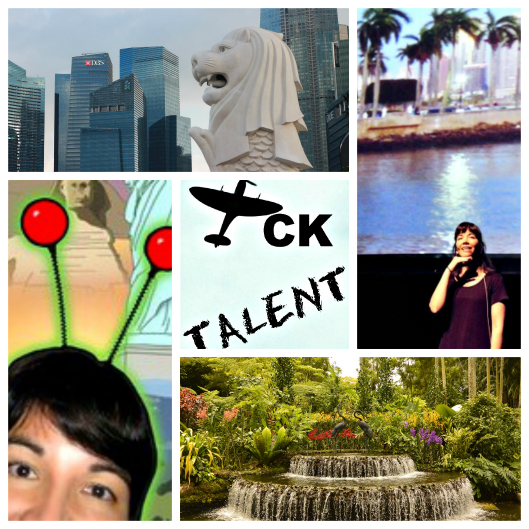
TCK TALENT: The talented Lisa Liang goes to Asia with her one-woman show about growing up everywhere

TCK Talent in Singapore

Columnist Elizabeth (Lisa) Liang has a “first” and a “last” to announce in this post. She will tell us all about what happened when she took her show, Alien Citizen, to Asia for the first time. But she will also tell us that this is her last regular column for the Displaced Nation. Having known her for three years (we even met in person once, when her show was in New York), I will miss interacting with her as well as reading her columns. But as is characteristic of her, she has kindly recruited a replacement. The show will go on! —ML Awanohara

Greetings, dear readers.

As ML just said, this will be my last article for TCK Talent. I’ll be moving on to devote more time to my solo shows, workshops, and acting career.

Starting in September, the column will be carried on by Dounia Bertuccelli, last month’s multi-talented interviewee. I know the column will thrive under her charge.

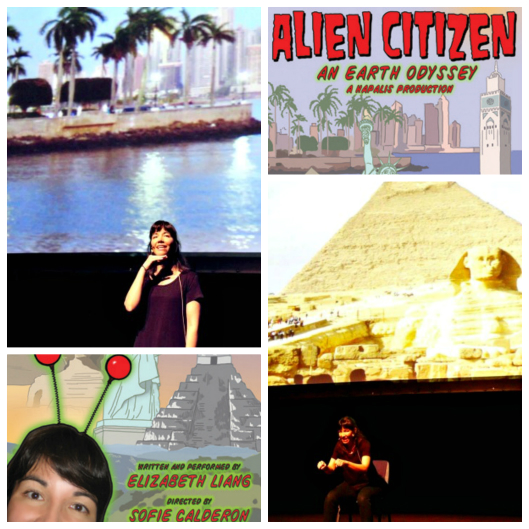
As ML also said, for my last post I’ll be presenting an account of the journey I made to Singapore in April to perform Alien Citizen: an earth odyssey—my one-woman show about growing up as a Third Culture Kid of mixed heritage.

It was my first time taking the show to Asia. I performed it for Third Culture Kid (TCK) high school students and their parents (many of whom had also been TCKs), teachers, and administrators, at two international schools.

* * *

Two miracles occurred on the flights to Singapore: I was in no pain despite a lower-back injury, and Dan (my husband and techie extraordinaire) and I both fell asleep! We normally can’t sleep on planes no matter what.

Unfortunately, we also experienced something troubling: my ankles and calves swelled up alarmingly. We guessed that this might be due to my choosing the Chinese options at mealtimes, which were tasty…but perhaps a foolish decision on my part since I’m mildly allergic to MSG.

(For details on the health scare that ensued, read my blog.)

Landing in a tropical city full of gardens and great food

Swollen body parts notwithstanding, we oooohed and aaaahed when we arrived at fancy Changi Airport, but were too tired to linger. As the cab drove us through the city-state to our AirBnB apartment, we were impressed by the many tall buildings and the lushly green urban landscape.

After that evening’s health melodrama, we slept like the dead. We had a few days to orient ourselves, sightsee, and start recovering from jet lag. I was expecting the heat of Panama alongside the humidity, but Singapore felt more humid than hot. (We perspired buckets nonetheless.)

Our adventures during the first two full days included:

  • visiting the lovely, peaceful Chinese Garden…in the pouring rain…with one umbrella. (Dan had accidentally left his in the Uber car.) Despite the deluge, we were impressed by the Confucius statues and the Bonsai Garden.
  • taking the immaculate and orderly MRT (metro). We loved hearing the train’s prerecorded announcements in Standard RP English, Mandarin, Malay, and Tamil.
  • exploring the interior of the enormous ION Orchard, a mall on Orchard Road. (It was still raining outside.)
  • ordering Malay and Indian food at a hawker stall in a mall near our AirBnB. (Singapore malls have food courts that serve the same scrumptious food you’d get at one of the famous hawker centres.)
  • trying a local dessert of shaved ice topped with red beans, black jello, and syrup—sort of a combo of Ice Kachang and Grass Jelly. Super-sweet!
  • experiencing Singapore’s favorite breakfast/snack at Toast Junction: kaya toast (sugar-coconut-buttered toast) served with two soft-boiled eggs, dribbled with a little bit of soy sauce, and a cup of hot coffee with condensed milk. Even if you’re not a fan of soft-boiled eggs (neither am I) or milk in your coffee (neither is Dan), we’re here to tell you that the whole combination is fantastic.

SHOWTIME #1 @ Canadian International School

On the first performance day we were up at 5:30 a.m. (The horror.) Our cab took us to Canadian International School in the pre-dawn darkness. In the impressively large and beautiful theatre, the school’s cheerful stage techie helped us to set up. I was warmly welcomed by a few faculty and admin members—and then the 9th through 11th graders started pouring in.

Showtime!

At first the audience was very quiet yet attentive. Some whispering began after 20 minutes and slowly grew louder until there was a low murmur toward the end.

Nonetheless, the students giggled and laughed at various appropriate places, and at the curtain call I heard a few hoots of appreciation along with the applause.

This was a relief because I rarely know how the show has been received until I take my bow. Afterward, drama teacher Julie and a slew of ATCKs (who are now moms to TCKs!) thanked me repeatedly for bringing the show to the school. I was especially validated by Julie’s appreciation of the script and performance since she’s a fellow theatre-maker.

As has happened after all of my performances, audience members approached to tell me about their own intercultural, nomadic lives and which parts of the show resonated the most for them.

One of them was a friend of a fellow Writing Out of Limbo author—thus proving how small the world is!

I loved hearing American accents from the non-US citizens and non-American accents from the US citizens. It made me feel like I was among my people, with that particular vibe of an international-school crowd, again.

My dear college friend Kikuko flew in from Tokyo just to see the show and flew back directly after, which blew my mind!

I learned later that the head of the school and the secondary school principal both enjoyed the show as well—always affirming to receive praise from the “top admin.” I will forever be grateful to Canadian International School for giving Alien Citizen its Asia Pacific debut.

As usual, my adrenaline was still pumping after the show, so Dan and I headed off to the Singapore National Museum. It had beautiful artifacts and displays, dense with information…and then we went home and crashed.
CIS performance

More marvels in this dot-sized city-state

On our day in between performances, we explored Little India. We saw our first Buddhist and Hindu temples, all of which were gorgeously colorful: Leong San See (Chinese Buddhist), Sakya Muni Buddha Gaya (Thai Buddhist with a huge Buddha statue), and Sri Srinivasa Perumal (Hindu). Each was a marvel for uninitiated us. We also saw the Sultan Mosque, which was more modest than the mosques I’ve toured elsewhere, but very welcoming to visitors.

It was another warm day and the humidity began to take its toll. Still, I enjoyed seeing the brightly painted two-story houses all walled together (like the one-story ones you see in Guatemala and other Latin American countries), with open shutters on the upper floors like in Cape Town.

When the humidity became overpowering, it was a pleasure to duck into a 7-Eleven (!) that blasted air conditioning—a/c is paramount in Singapore. We had lunch at Muthu’s Curry, where the delicious food was served on banana leaves. After waddling out we took an Uber to Arab Street and walked by tons of shops on the pedestrian road. At Sifr Aromatics I bought some blended-in-person Shadowfax perfume, which I adore.

In between shows

SHOWTIME #2 @ Singapore American School

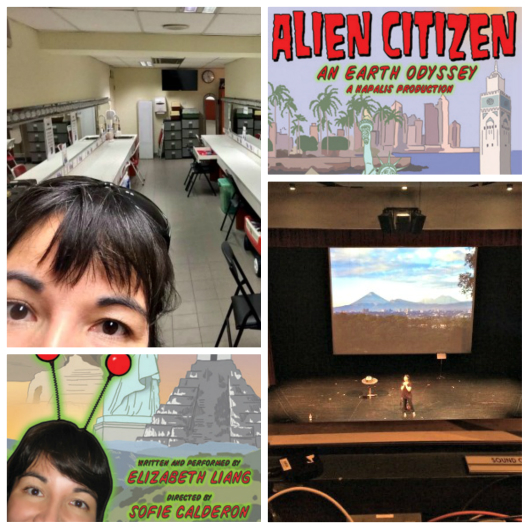
The next day we went to Singapore American School for my afternoon performance. The high school drama teacher, Tom, gave us a warm welcome. I would perform in one of three theatres on campus, which had a luxurious backstage area—aisles upon aisles of dressing-room vanity mirrors and a full bathroom! The school’s theatre techies were very professional and helpful.

During the performance, the audience was alert and even laughed heartily at a few points. Afterward, some audience members came up to praise the show and a faculty member gave me an emotional bear hug. (Every time an audience member shows that much appreciation, it’s a relief, because it highlights the show’s value for different people in different places even as time wears on. I never know if there’s going to be an expiration date.)

Again, it was especially validating to hear a fellow theatre-maker like Tom speak of the craft that goes into creating and performing a show like Alien Citizen. I’ve performed it so many times in non-theatrical venues that I’ve become resigned to folks who refer to the show as a “sketch.”

For those unfamiliar with my work: I perform over 30 characters (including myself at different ages), speak five languages in it, and take the audience through six countries while I’m all alone onstage…with no intermission…for 80 minutes. It’s my job to make it flow and feel intimate, but it has never been an easy one.

An old friend of my mom from my high school years in Egypt (it seems that everyone knows someone in Singapore) took Dan and me out for drinks and dinner afterwards to celebrate. We went to the American Club, which is humongous with several restaurants, a pool, library, convenience store, dry cleaner, and more—I’ve never seen anything like it. They make an excellent martini…
SAS performance

Final hurrah: Singapore

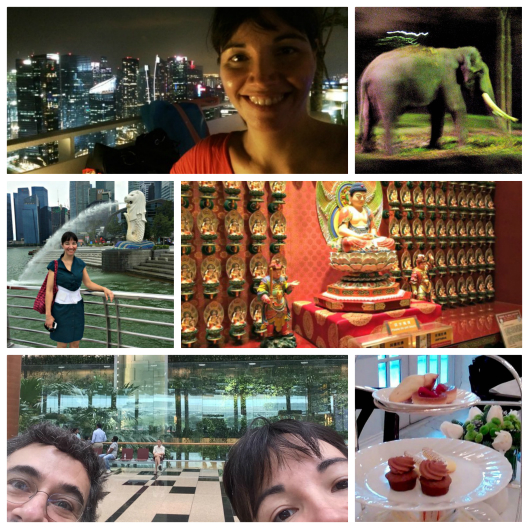
The next day: freedom! Now we could do whatever we wanted for the rest of the trip! We took the MRT to the old colonial district, where we visited the Merlion, Cavanagh Bridge, and the Asian Civilisations Museum. The latter had a fascinating shipwreck exhibit as well as a collection of gorgeous ceramics.

The next stop was Raffles Hotel for high tea. We each indulged in two servings of tiered tea trays of finger sandwiches, cakes, and tarts. The meal also included a buffet of dim sum (!), croque monsieurs, chicken pot pies, and scones. (By now you’ve figured out: I’m all about the food.) After stuffing ourselves to the sound of a musician playing musical theatre tunes on a harp, we peaked into the famous Long Bar. We decided against ordering an overpriced Singapore Sling and took an Uber home.

The following day we visited Chinatown. We loved the Chinese Heritage Centre, which recreates what a shophouse was like in the 1950s—very immersive and expertly done. There were tons of places to shop for knickknacks. We had lunch at Fill-a-Pita, my high-school-mate Hassan’s eatery, where he served us delicious vegetarian Egyptian/Middle Eastern food. Singapore is a true hub for international folk.

We then walked through the Singapore Botanic Gardens, which were lush and peaceful. (They are the only tropical gardens to be honored as a UNESCO Heritage site.) That evening we went to the famous Wee Nam Kee for a dinner of Hainanese chicken rice, Singapore’s wildly popular and yummy comfort food.

The next day we visited Liang Seah Street, which was recommended for its young vibe. I enjoyed seeing my surname on street signs! We returned to Chinatown to visit Singapore’s oldest Hokkien temple, Thian Hock Keng, the interior of which reminded me vaguely of my extended family’s “big house” in Guatemala City (tiled floor around an open sky patio). We then walked to the Buddha Tooth Relic Temple with its splendid interior. We were privileged to witness our first Buddhist service there.

That evening we went to the Night Safari, said to be the world’s first nocturnal zoo. Tip: get your tickets online to avoid a two-hour wait. It was fun to see nocturnal animals (and non-nocturnal animals, asleep) from all over the world as we were driven through on long trams. The elephants may have been the most thrilling sight. I had seen them and other animals on wildlife preserves in Kenya when I was 15, but that was a very long time ago. Alien Citizen’s final scene is set in Kenya, so there was a nice symmetry to seeing African animals on this trip.

On our last day we returned to Orchard Road. This time the sun was shining and we could see why it’s sometimes compared to the Champs d’Elysees or 5th Avenue. From there we went to the Peranakan Museum, which is basically the mixed heritage/multiracial/multicultural museum of Singapore. I felt very at home!

For our last adventure in the city, we took a Singapore River tour on a bumboat, the kind with a cheesy prerecorded commentary. I’m so glad we did, because we saw a completely different Singapore from the one we had been experiencing on the MRT and in cabs. It really is lovely along the banks of the quays and bays at twilight.

We capped the evening off by going to the Flight Bar at the Marina Bay Sands, a Vegas-style, three-towered behemoth of a hotel. Despite our sweaty, bedraggled appearance, we were given excellent service: they seated us at a perfect table overlooking both the bay and the city skyline. We toasted with my French “57” (its version of the drink that was originally served at the American Bar in Paris, later Harry’s New York Bar) and Dan’s Dark ‘N’ Stormy—overpriced but nonetheless a delightful VERY FINAL hurrah. After that celebratory toast, we managed to find one open restaurant, CoCo ICHIBANYA curry house, and gave that Japanese curry hell.

On our day of departure, after checking in at Changi Airport, we headed down to its ginormous food court and got our last kaya toast “Set A” at Ya Kun Kaya Toast. It was glorious. As we walked to our gate, we saw more of the deluxe airport, took pictures, and then had uneventful flights home. It took over two weeks to recover from the jet lag. It was worth it.

Final hurrah: TCK TALENT

It seems fitting for my last entry to be about Alien Citizen. I was first introduced to The Displaced Nation via an interview by amazing founder and editor ML Awanohara, when Alien Citizen was having its world premiere in Hollywood in 2013. ML asked me to write this column not long after the show’s first run ended, and it has been an honor to interview numerous fellow creative ATCKs for TCK Talent. They have all inspired, touched, and educated me. In the meantime, Alien Citizen has traveled around the USA on the college circuit, to festivals and conferences, and to private retreats and galas. It has also traveled the world to theatres, conferences, and international schools in Central America, Iceland, Europe, Africa, and now Asia. Furthermore, it was the catalyst for the workshops I now lead. We’ve come a very long way and we’re not even close to finishing the journey.

I feel privileged to have written for The Displaced Nation and am ever grateful to ML Awanohara for giving me the opportunity. Thank you, dear readers, for following along.

* * *

Thank YOU, Lisa, and the fondest of farewells! I will miss you. You really “got” what the Displaced Nation is about and over the years have showcased so many internationals who are now leading creative lives. You’ve also served as a shining example of that yourself, by reporting on the progress of your show—and several of those reports, like this one, have also been fascinating travelogues. I’m just so glad that the column you have created and shaped, highlighting the many talents of Adult Third Culture kids, will carry on in your wake. (Thank you, Dounia!) Meantime, please promise us you’ll come back to our fair shores from time to time for a visit—and perhaps even the occasional update post. Readers, please leave questions, comments, words of farewell 😥 😥 😥 to Lisa below.

Elizabeth (Lisa) Liang is a prime example of what she writes about in this column: an Adult Third Culture Kid working in a creative field. A Guatemalan-American of Chinese-Spanish-Irish-French-German-English descent, she is an actor, writer, and producer who created the solo show Alien Citizen: an earth odyssey, which has been touring internationally. To keep up with Lisa’s progress, be sure to visit her blog, Suitcasefactory. You can also follow her on Twitter and on Facebook.

STAY TUNED for next week’s fab posts!

If you enjoyed this post, we invite you to register for The Displaced Dispatch, a round up of weekly posts from The Displaced Nation, and so much more! Register for The Displaced Dispatch by clicking here!

Related posts:

Photo credits: Top visual: Singapore cityscape and garden images via Pixabay;  Elizabeth Liang performing at the Canadian International School in Singapore, by Jacquie Weber (supplied); Alien Citizen (poster, supplied); and TCK Talent branding. Second visual: (clockwise from top left) Kaya Toast “Set A” breakfast at Toast Junction, by Daniel Lawrence (supplied); MRT image via Pixabay; Lisa at the ION Mall, selfie (supplied); and Chinese and Japanese gardens, Bonsai section, Singapore, by R Barraez D’Lucca via Flickr (CC BY 2.0). Third visual: Lisa performing at the Canadian International School in Singapore, by Jacquie Weber (supplied). Fourth visual: (clockwise from top left) Sri Srinivasa Perumal Temple via Pixabay; Daniel Lawrence in front of Sakya Muni Buddha Gaya Temple, by Lisa Liang (supplied); Muthu’s fish head curry, by Krista, and Arab Street and Sunday lunch, by Bryn Pinzgauer—both via Flickr (CC BY 2.0). Fifth visual: Singapore American School dressing room, selfie (supplied); and Singapore American School long shot, by Daniel Lawrence (supplied). Sixth visual: (top row) Lisa at Flight Bar, Marina Bay Sands Hotel, by Daniel Lawrence (supplied); and Elephant at Night – Night Safari Zoo – Singapore, by Glen Bowman via Flickr (CC BY-SA 2.0); (middle row) Lisa at the Merlion, by Daniel Lawrence (supplied); one of many buddhas in Buddha Tooth Relic Temple, by Lisa Liang (supplied); (bottom row) Changi Airport departure, by Lisa Liang (supplied); High Tea, Raffles Hotel, by llbrarianidol via Flickr (CC BY 2.0).

WORLD OF WORDS: The travail of travel abroad with a group of middle schoolers (1/2)

Marianne Bohr in the Luxembourg Gardens in Paris—is she reading or indulging in reveries about words?

Marianne Bohr in the Luxembourg Gardens in Paris—is she reading or indulging in reveries about French words?

What is it like to tour France with a bunch of American middle schoolers? It involves travel, for sure, but also no small amount of travail, as Marianne Bohr, who besides being a writer is a teacher of middle-school French, discovered this past spring break. This month we present Part One of her lively travel/travail-ogue; Part Two will appear in August. Anyone traveling with kids this summer should appreciate.

It’s departure day, Friday, March 25, and our long-awaited trip to France is about to begin. We arrive at Dulles with our navy and silver Education First (EF) backpacks, excited but subdued. The violence in Belgium just days ago hovers.

The exuberance of the youth I’m accompanying, however, quickly overcomes any pallor and my excitement rises. Delta whisks us from Dulles to JFK to begin the five-hour layover for our flight to Paris. My always-hungry adolescents make multiple trips down the interminable airport hallways in search of their next round of Panda Express, Shake Shack and Jamba Juice, despite my reminders that we’ll have dinner and breakfast on our flight.

While my charges explore, I stay put to watch a blood red sunset to the west. “It’s a beach sunset,” declares an adorable French youngster, face pressed against the terminal window. I’m grateful for his mellifluous chatter that readies my ear for the nine days of French to come.

We board the 767 and my Tylenol PM kicking in, I can’t wait to pass out for seven hours on my travel pillow, under a red felt blanket. My students are of a different mind.

“OMG! Mockingjay!”

“They have The Walking Dead. I can’t believe it!”

“Look at all these movies!”

“Are they FREE, Madame Bohr?”

“I am so binge-watching all night!”

So much for my entreaties to get some sleep.

“You’ll all be walking zombies yourselves tomorrow morning,” I lament. Full bellies notwithstanding, they speculate about what’s for dinner and plan their watching strategies.

An overnight flight between us and the exuberance of the evening’s departure, I awaken semi-refreshed to glum faces, tussled hair and bleary eyes. We snake for well over two hours through the post-Brussels passport control maze at Charles de Gaulle and then finally, after spying and retrieving a temporarily lost suitcase that has inexplicably landed in a pile of unclaimed bags, exit the confines of the terminal for our entry into France.

Amid some moans, groans and yawns, I remind my fellow travelers that the English word travel comes from the French word travail. Work. Yes, travel can sometimes be a lot of work.

How ya gonna keep ’em down on the farm after they’ve seen Paree?

Wide-eyed wonder abounds as we tour the City of Light.

“I saw the Eiffel Tower first!”

“Look, Notre Dame!”

“OMG, Nutella! Nutella crêpes! Nutella milkshakes!”

“Is she a supermodel? She’s definitely a supermodel.”

“He must be French. He’s wearing a scarf.”

Having endlessly extolled the virtues of a genuine French baguette—crunchy on the outside, chewy in the middle, ever so slightly burned on the bottom—I suppose I’m to blame for two students buying two-foot-long baguettes and downing them as we stroll the boulevards. All part of the culinary adventure that is France.

“I thought the Mona Lisa would be bigger.”

“That statue’s just famous ‘cuz she has no arms.”

“Hot chocolate is only two euros! And they serve it with whipped cream!”

“I definitely want to study in Paris.”

“I just love the Seine. Can we do a boat tour?”

Paris impressions

A rainbow over Chambord

Time to leave the hurly burly of the city and her anxiety-producing, camo-clad, machine gun-wielding guards, for the Loire Valley. So many châteaux, churches and country pleasures await.

“Why don’t Chartres’ spires match?”

“Is the stained glass really 1,000 years old?”

“Did people actually live in these châteaux?”

“It’s freezing inside! But look at the size of the fireplaces.”

At Chambord we’ve escaped a quick spring squall just in time, retreating into a mellow-lighted salon de thé. In the shadow of the romantic castle, I’m enjoying a crêpe with a student: crème de marron (chestnut cream) for me, caramel du beurre salé (salted butter caramel) for him. We savor our final bites, the skies clear—and a perfect arc en ciel (rainbow) materializes from one horizon to the other across the grounds of the chateau.

Nathalie, our French tour director, stops at our table and suggests a title for my next book: A Rainbow Over Chambord.

Pourquoi pas? (Why not?)

“What are those huge trees?”

“Why is their bark peeling so much?”

“Are those trees in the square dead?”

“They look like angry old people shaking their fists.”

“Why do they cut off all their branches?”

I recall the first time I saw the closely pruned—pollarded—French trees in the seventies. They made me sad, looking as if they’d been abused, the barren sentinels barred from reaching their natural height and breadth. But as I learned back then, such drastic cropping yields lush lollipop trees in summer, providing thick, summer greenery and dense, cooling shade.

I explain to my students about the trees and this leads to discussions of French rationality and affinity for order, English versus French gardens, the philosophes, and the French penchant for debate.

All because of an angry black tree in a village square.

“I love this hotel!”

“The one in Paris was way too modern.”

“This one has charm.”

“Our room is so cool. It has a back door!”

On peut sortir? Can we go out, Madame Bohr?”

I steal away on my own after dinner—I leave through my own back door—to lose myself in reverie and take a solo look at the château. Azay-le-Rideau, built on a human scale, one of my favorites. Grand enough to be called a château yet small enough to be accessible. I imagine myself living there, tapestries warming the walls, carpets softening the floors, surrounded by a duck pond. On my own for a few minutes, I’m transported back to the ’70s, conjuring the feelings of the romantic young student I was. Smitten then; I’m smitten now. My beloved France.

Once again, time to board the bus. This time amid uncontrolled giggling. “Qu’est-ce qui se passe?” What’s going on?” I ask.

They can barely speak. “The bus driver. Peeing by the tree. I saw things I didn’t want to!” Cackles. Guffaws. Innocents abroad. Innocence in France.

Loire Valley Tour 1

Vous avez la patate?

“Our shower only has half a door!”

“Are all bathrooms like that in France?”

“The whole floor is soaked!”

“How much butter is in this croissant? Is it okay if I add more?”

Our Loire Valley tour continues. Each morning as we load the bus, our guide asks how we are.

Ça va? Vous avez la patate? Vous avez la pêche? Vous avez la banane? (Do you have the potato; the peach; the banana?)

Each is a clever way to ask: Are you bright-eyed and bushy-tailed today? Oui, j’ai la patate. Every language has its apt idioms.

Students scrutinize the fashion of their French peers. While I see few differences, they are keenly aware of every one and school me on the distinctions.

Their shoes: “They just look like sneakers to me.”

Their jeans: “Everyone wears skinny jeans, even the boys.”

Their jackets: “They’re longer and actually match their outfits.”

Their hair: “The guys have a lot of quiffs.”

(What’s a quiff? It’s like a whoosh or a puff, they tell me. Oh, you mean like a pompadour? I say. My fashion eyes are definitely too old.)

The students negotiate the topiary labyrinth at Chenonceau, more interested in the grounds than the interior of the château. While they visit the donkey farm to the side of the sycamore-lined entryway, I discover an elegant orangery-style restaurant tucked behind the cafe. I’m off in a daydream, imagining a romantic dinner with my husband in the not-too-distant future.

Although this is my fourth visit to the castle (my first was in ’78 with Joe, as students freezing on motorbikes), Chenonceau never fails to charm. I send my stateside travel partner a text:

We must return and stay at one of the village’s ivy-covered inns; Chenonceau now has a gourmet restaurant!

The château boasts two magnificent gardens designed by the two women in King Henry ii’s life: one by the mistress and one by the wife. I choose the one that’s more shaded and compact, that of her majesty, Catherine de Medici. Daffodils, hyacinths and other early spring blossoms have made their way into full color, so different from the austere, pallid portraits of the queen inside the castle.

But the persona I assume is that of Diane de Poitiers—the beautiful, fashionista mistress of the king, twenty years his senior. The original cougar, I think with a chuckle; a fitting observation by a woman who just turned sixty. One day, some day, I’ll morph into Diane at a costume ball, despite the fact that her calculating ruthlessness is about as distant from my personality as I can fathom. But that’s what masquerades are about, no doubt.

The gardens are now under a soft, spring drizzle. I envision royal steeds trotting up the sandy lane to deposit me at Chenonceau’s drawbridge from a gilded coach. But I’m brusquely yanked back to the present as a student calls from behind a colossal planter:

“What time do we have to be back on the bus, Madame Bohr? Are we late?”

My travelers are astounded by the size of the four châteaux we’ve visited.

Wait ’til we see Versailles, I say.

“Versailles? I can’t wait to go to Versailles. Part of Kim Kardashian’s wedding was there!”

Some things my students say make me less proud than others.
Loire Valley Tour 2

* * *

Très drôles, Marianne! I love that you snuck in a Diane de Poitiers moment just before your charges brought you back to the 21st-century by bringing up Kim Kardashian’s nuptials at Versailles. So, did the sight of that rainbow over Chamboud compensate for your travails? And did any of your students show the potential for taking a gap year, or perhaps even choosing the expat life, one day? I can’t wait to read Part Two. —ML Awanohara

Readers, have you ever had this kind of adventure with a group of young people abroad, and if so, were your travels full of travails? Do tell in the comments!

Marianne C. Bohr is a writer, editor and French teacher whose book, Gap Year Girl: A Baby Boomer Adventure Across 21 Countries, was published in September 2015 with She Writes Press. She married her high school sweetheart and travel partner, and with their two grown children, follows her own advice and travels at every opportunity. Marianne lives in Bethesda, Maryland, where after decades in publishing, she has followed her Francophile muse to teach French. She has an author site where she keeps a blog, and is active on Facebook and Twitter.

STAY TUNED for next week’s fab posts!

If you enjoyed this post, we invite you to register for The Displaced Dispatch, a round up of weekly posts from The Displaced Nation, and SO much more. Register for The Displaced Dispatch by clicking here!

Related posts:

Photo credits: Top of page: Marianne Bohr (supplied); world map via Pixabay. First collage: Photos of baguettes, boat on Seine, and Mona Lisa via Pixabay; just how French, by thellr via Flickr (CC BY-SA 2.0). Second collage: Rainbow, Azay-le-Rideau, and Cambord via Pixabay; Crepes pomme/poire du caramel au beurre sale, by Cyril Doussin via Flickr (CC BY-SA 2.0); and Pollards, by Garry Knight via Flickr (CC BY 2.0). Bottom collage: (clockwise from top left) Chenonceau gardens, by Adam Kent via Flickr (CC BY 2.0); [French boy with quiff], by Reims Media Agency via Flickr (CC BY-SA 2.0); Kim Kardashian, by Eva Rinaldi via Flickr (CC BY-SA 2.0); and Diane De Poitiers (1499-1566), via Wikimedia Commons (CC0 1.0).

THE ACCIDENTAL EXPAT: Globetrotting between overseas assignments

THE ACCIDENTAL EXPAT
Columnist Indra Chopra is back. Born in India, Indra embraced the life of a trailing spouse to become a globetrotter. She also conforms to the image I have a “lovepat.” Because she is such a curious and creative person, the expat life (both the international and the domestic kind) suits her down to the ground, as I think you will see in this post. ML Awanohara

For an accidental expat like me, adventure is not so much reaching out for unknown as it is changing residences, and countries, every so often.

In my last post, I described my family’s move to Oman for my husband’s job. We returned to India at the end of 2000. Eight years later, we would have another country binge—but in this post I want to share with you what we did from 2000 to 2008, a time when our friends were constantly grumbling about needing an exclusive telephone diary for the Chopras’ constantly changing telephone numbers and area codes.

Within a year of our return to India, we were planning an extended trip to United States. My first visit had been in 1975 when, fresh out of college, I attended summer school in journalism at Stanford University, in Palo Alto. It was the era of the “Fs”: Flower power, Frisbee, Freedom…

Twenty-six years later, I headed to America again at an equally momentous time: the aftermath of the horrendous carnage of 9/11/01. My husband and I were visiting our daughter, who, having completed her undergraduate studies at UMass, Amherst, had enrolled in UMass Medical School, which is located in Worcester.

Grey and gloomy Worcester

Our port of entry was Boston’s Logan Airport. From there we made a two-hour train journey past New England landscapes to an unknown territory whose name is pronounced “Wuss-tur,” as in Worcestershire sauce (which originated in the English midlands town of Worcester).

Our brusque reception by the immigration authorities at Logan Airport had put us in a somber mood, which grey and gloomy Worcester—a “city created by and for the middle class,” as Adam Davidson put it in a recent article for the New York Times Magazine—did little to dispel.

During the late 19th century and after, Worcester had attracted fresh-off-the-boat migrants from Europe, Asia, and Africa who had left behind unwelcoming Boston to look for work in the cotton mills and steel works, some of them starting their own enterprises. The proximity to Boston helped industries to flourish, but World War II and rise of other industrial bases across the country led to the greyness we now saw all around us.

I recalled having read Daoma Winson’s novel The Fall River Line, a 90-year saga about the family of a New England matriarch who owns a Massachusetts-based steamship line running between New York and Boston in the late 19th century. But the city I saw before me was a mix of new and old three-decker rectangular homes alongside newer constructions of colleges and hospitals.

Imagine my surprise when, researching the city further, I discovered that out of its gloom had emerged something pink, lacy and romantic. Esther Howland of Worcester started up a business making valentines in 1857, the success of which earned her the epithet of “the mother of the American valentine”; you can see a large collection of her creations at the American Antiquarian Society in Worcester.

Worcester can also claim the “Smiley” face, created by Worcester-born-and-bred graphic artist Harvey Ross Ball—another seeming contradiction; and there are many other firsts to the city’s credit:

  • the largest female workforce in the USA;
  • the first woman Secretary of Labor, Frances Perkins (she served in President Franklin Delano Roosevelt’s cabinet and had grown up in Worcester);
  • the first Bible and first dictionary printed in America (by one Isaiah Thomas, in the 18th century);
  • the first public reading of the Declaration of Independence, also by Isaiah Thomas;
  • the first monkey wrench, invented by Loring and Aury Coes in 1840 (just thought I’d throw that in!);
  • the first commercially successful envelope-producing machine, invented by Russell Hawes in 1853; and
  • WORC, the first radio station to play a Beatles song in the United States.

I suppose adversity bred innovation and, as far as the Beatles went, a “thumbs-down” to the Boston Brahmins.

Once settled, we walked around Worcester Commons and past the Burnside Fountain with its Turtle Boy statue; along the crowded downtown streets including Shrewsbury Street (where can be found Little Italy) and the tree-lined avenues where there are many houses dating back to the late 19th-century; all over the “modern” UMass Medical School campus; and even out to the suburban Auburn Mall (I had to shop in Filene’s). We also ventured out to the shores of Quinsigamond and Indian Lakes.

Lake Quinsigamond (or the Long Pond) reflects the sensibilities of the city. Though a favored destination for water sports, rowing and boating regattas, it misses out on aqua “vitality”.

Worcester Mass Collage 2

Bustling Boston (& vicinity)

Worcester’s saving grace, for me, is that it’s only a step away from Boston and its famous landmarks…no, I would not be one of those people who prefers Worcester’s slower pace!

My favorite Boston spots include Faneuil Hall/Marketplace, incorporating Quincy Market, the Freedom Trail, Harvard University, and, further afield: Cape Cod, Martha’s Vineyard and Nantucket the latter two accessible by ferry and good spots for celeb watching. I liked walking down Nantucket’s cobblestoned Main Street and gawking at the tony lifestyle and the boutique shops.

Boston and beach collage

There have been other visits to Worcester since then, in various seasons, as we continue our effort to appreciate small-town living. But on this first occasion, 15 days were sufficient, and from Worcester we jetted across to San Francisco to visit family. In this sense, we were conforming to the distinctive Indian habit of tagging family and friends across the globe to ensure hassle free board and lodging. (Thankfully, at least for the people doing much of the hosting, that concept is changing with Indian tourism opening up and more people traveling on their own.)

San Francisco, here we come!

San Francisco lived up to my “Alice in Wonderland” memories. Our days were devoted dawdling on Fisherman’s Wharf, trundling down Nob Hill in the cable car, watching the sunset from Golden Gate Bridge, driving around Palo Alto.

The quintessential university town had changed: there were more residences and start-up communities, shortening the distance between University and town. The path from Escondido Village (where I lived) to the journalism department (where I studied) did not appear intimidating as when I had first cycled on it.

San Fran Collage

The re-discovery journey had been pleasant except for an interaction with immigration officer on our return to Boston’s Logan International Airport. Having been assured by the travel agent of no extra charges, we had extended our return flight from San Francisco to Boston by two days. Hence our surprise when we were asked to pay $200 and, as we attempted to explain, the airline official countered with a complete dossier of our movements, the number of times we had cancelled our arrival to USA, the change we’d made to our flight schedule from San Francisco, etc., etc.

It was a case of pay the said amount or be barred from boarding the flight back to India. The disbelief came when I told my husband, in Hindi, to ask the name of the official or demand that we speak to her senior. She caught on and told us that we are most welcome, promptly giving us her name and declaring it would not change anything.

Left with no alternative, we promptly paid the contested amount and exited the country. Talk about “parochial” and “paranoid”! I suddenly remembered my Media and Broadcasting Prof. at Stanford, who, upon seeing me sit alone on the patio (I was finishing an assignment), apologised for the “parochial” attitude of my fellow students. (I told him I was fine.)

We did not stop visiting USA but, on the next occasions, we were prepared for the pat downs, security checks and x-rays. No hair sprays, body cremes, etc., and no loose talk. So, now when I am told “You have been selected,” I know it is not for a seat upgrade but for the body scanner.

Becoming Punekars

In 2004 we made another “small city” visit and, this time, a change of residence. There is no connection between Worcester and Pune, except that both are stress busters for concrete jungles: Boston and Mumbai, respectively.

Pune is an emerging “mega-city” said to epitomize the New India. It is also the cultural capital of the state of Maharashtra, celebrating Maratha arts and crafts, music, and theatre. It has a proud history as the seat of the Peshwas, who were the ruling figures within the Maratha Empire, which was established by the legendary Shivaji, the Hindu leader who challenged the mighty Mughals. He was later held up as a hero during the rebellion against English rule and bid for Indian independence.

But returning to the Pune of today: it is very much a city on the go, with mushrooming high-rises, malls, and hotels. Its already congested labyrinth of shops, roadside stalls, and disintegrating colonial architecture is constantly expanding, with new enterprises such as education centers cropping up, and more and more “steel ants” (mopeds and two wheelers) running along its narrow lanes and arteries. (Public transport leaves something to be desired.)

The one constant between former eras and today are the majestic banyan trees, with their nebbish roots adding a spidery effect.

The city is being invaded by professionals and tourists from neighboring cities and states. A true Punekar (aka Punaite) will argue that, despite the onslaught of so many people, their city has retained its elegance and charm typified by the “dragonfly” energy and the attitude of the female residents who cover their faces with a scarf and slice through the traffic. (For me, this unique sartorial style is a silent tribute to “girl power”!)

Upon our arrival, we visited the famous landmarks including:

Pune is the city for seeing Alphonso mangoes piled high on roadside carts and market stalls. The mango mania does not stop at simply eating the fruit but has invaded thalis (food platters), desserts, ice creams and shakes, literally adding color to the local cuisine.

What I relish most is the ubiquitous Vada Pav, a vegetarian fast food consisting of a potato fritter. I often purchase one from a roadside stall that, according to my friend’s driver, is the “best Vada Pav in town.”

The mesmeric effect of life in this part of the world culminated in our purchasing a property up in the hills, on NIBM Road in Kondhwa, a fast-growing suburb of Pune.

And now here I sit on our lawn, under blue skies, a rarity in the part of India where I’m from. Later I will watch the sun descend deeper into the surrounding hills while dreaming of new places where we might be based in near future.

Pune India Collage

Not surprisingly, the seven-year itch surfaced and in summer of 2008 we jetted our way to Hong Kong, another country and another accidental expat experience. The Sultanate of Oman and Hong Kong are on different trajectories: one a traditional nation and the other a place full of glitz, glamor and restlessness. Hong Kong’s mishmash of lingering British influences and Chinese opportunism must be what lures so many visitors, us included, to its crowded streets.

We came for a year and found ourselves queuing at the Immigration office to get extensions stamped for two, three, seven years—and then permanent residency.

But more on that experience in my next post…

* * *

Thank you, Indra, for sharing this continuation of your story. It was refreshing to hear about the United States from an outsider’s perspective, and to learn all about Pune. And now I am eager to hear what you make of Hong Kong! —ML Awanohara

Indra Chopra is a writer/blogger passionate about travel and curious about cultures and people. Her present status is that of an accidental expat writing to relive moments in countries wherever she sets home with her husband. With over twenty years of writing experience Indra has contributed to Indian, Middle Eastern publications and online media. She blogs at TravTrails

STAY TUNED for more fab posts!

If you enjoyed this post, we invite you to register for The Displaced Dispatch, a round up of weekly posts from The Displaced Nation, and SO much more. Register for The Displaced Dispatch by clicking here!

Related posts:

Photo credits: Opening visual: Airplane photo and India photo via Pixabay. Second visual: (top row) Worcester, Massachusetts, by Doug Kerr via Flickr (CC BY-SA 2.0); photo of the Beatles and of Worcester’s buildings via Pixabay; (bottom row) Turtle Boy, by Joe Shlabotnik via Flickr (CC BY 2.0); Harvey Ball, by Michael Carroll courtesy Worcester Historical Museum; and Daoma Winston book cover. Third visual: Nantucket – Main St, by thisisbossi via Flickr (CC BY-SA 2.0); Quincy Market, by Smart Destinations via Flickr (CC BY-SA 2.0); Boston – Freedom Trail, by David Ohmer via Flickr (CC BY 2.0); Cape Cod scene via Pixabay. Fourth visual: Cable car, Stanford U & Golden Gate sunset photos all via Pixabay; Fisherman’s Wharf – San Francisco, California, by Doug Kerr via Flickr (CC BY-SA 2.0). Last visual: (top row) Mangoes for sale in Crawford Market, Mumbai, by Anuradha Sengupta via Flickr (CC BY 2.0); warrior statue via Pixabay; A Crowd Gathers – Pune, India, by Ian D. Keating via Flickr (CC BY 2.0) (same as bottom-row middle photo); Sunset at Sinhagarh, by Abhijit Kar Gupta via Flickr (CC BY 2.0); (bottom row) Sukhadia’s open vada pav, by Krista via Flickr (CC BY 2.0); [untitled – Banyan tree in Pune], by ptwo via Flickr (CC BY 2.0); and Osho Ashram, aka Osho International Meditation Resort, by fraboof via Flickr (CC BY-SA 2.0).

THE PERIPATETIC EXPAT: Going home again due to a devastating personal loss

Displaced creative Sally Rose

We expats may sound like we’re living in a dream or fairy tale, but many of us have lived through nightmares, too. Last time we heard from Sally, her story was running along the lines of her wonderlanded interview for this site. Having spent five years in Santiago, Chile, she was in need of new thrills and was trying to figure out where to go next. But then, one day, just as she felt her plans were coming together, her entire world came crashing down. Sally, I commend you for her honesty in telling this part of your story. Readers, I hope you will join me in offering your condolences for Sally’s heart-breaking loss. —ML Awanohara

I went to church today. Just stopped in, as I’ve often done over the past five years. I’m not Catholic, but I like to sit and look at the statue of the Virgin Mary at the Basilica de la Merced in downtown Santiago.

It’s cool and peaceful inside, painted to resemble pink marble. There’s a center aisle and the pews are lined up on either side, in two sections, before and after the hanging pulpit.

The statue of the Virgin Mary is set into a niche behind the altar. The back of the niche is painted royal blue. She’s wearing a flowing, white cape and a silver crown.

I read somewhere that she protects the innocent by bringing them close and covering them with her cape. I love that idea.

Virgin Mary with Cape

The basilica always smells of floor polish and candle wax. The first three years that I lived in Chile, there was a caretaker who, every time I went in, was there, polishing the wooden floor with a buffing machine.

Nowadays, I still see him from time to time. Today he recognizes me and greets me cordially. I find out his name for the first time: Fabián. He agrees to let me take his photo.

Fabian floor polisher

At noon, on weekdays, the church chimes ring out, just after the cañonazo, the firing of the cannon at Cerro Santa Lucia.

For five years, at straight-up twelve o’clock, I heard “Boom!” And then, the sweet notes of a recognizable song. I don’t know what its title is, but like an old friend, it became familiar to me over time. I will miss it.

Everything is falling into place…

I arrived back in Santiago on April 1. My apartment lease was expiring on June 4, and I had decided not to renew it. Since, for the past couple of years, I’ve been traveling a lot and spending as much time outside of Chile as I have in Chile, it no longer makes sense to maintain a year-round apartment here.

My goal was to turn myself into a global nomad and visit several places every year, spending a few months in each one. Hyper-organized nerd that I am, I immediately went to work, selling off furniture and clearing out my apartment. Within two weeks, every stick of furniture had been sold. I felt like Wile E. Coyote in the old cartoons, left spinning around after the roadrunner whizzed by me.

Everything was falling into place, as if the Universe were whispering, “Yes, yes. This is the right move for you.”

Cleared apartment nostalgia

Nostalgia kicked in. And sadness, a sort of grief. I started missing Santiago, even though I’m still here. I started thinking of all the places I’d meant to visit, all the things that I didn’t get around to doing since I’ve been here. Wishing I had more time. Wishing I weren’t leaving. Wondering if I were doing the right thing, wondering where I’m going next, wondering whether I’ll ever be back.

I found an apart-hotel and got halfway moved in, expecting to be in Santiago until my usual “can’t-stand-the-heat” date of mid-September. Then, I would go back to the US to sort out some business and to spend time with my son and his fiancée, before heading out again to Parts Unknown.

…until the phone call no parent should get

That’s when the phone call came. That most horribly personal phone call that no parent should ever have to receive.

My son had died in the early morning of May 4. He was 34 years old. The coroner took his body away for an autopsy because why does a 34-year old die? He hadn’t been sick. Or had he?

He had been, but he had not told me. Because I was so far away, I wasn’t aware of his physical condition. Not that I could have prevented his death had I been closer. But if I had known, I would have tried.

In tribute to Phillip

In tribute to Phillip

So began another grief. Deep, heavy waves of shock and sadness and guilt that left me with almost no energy to continue doing what I needed to do. To finish moving out, packing up, and getting myself back to the States for an indefinite period of time.

Sooner now than I had expected. Not to see my son. The best I’ll be able to do is memorialize him. His fiancée and I will be getting to know each other without him, and I will be a “repat,” at least for awhile.

My suitcases are already bulging, but I will be taking back a small replica of this Virgin Mary, Virgen de la Merced. I hope that she brings me as much comfort from afar as she has in the church that’s named after her.

Signed~
Perpetually Perplexed, and Now Devastated

* * *

Sally, I honestly can’t imagine the grief you must be feeling. You were planning where to go next, only to land on the dark side of the moon. Thank you for taking us on this part of your journey as well. If it helps to know, we are all here for you. We are privileged to share in your heart-felt tribute to your son, whom I feel certain was as remarkable a human being as his mother. —ML Awanohara

Born and raised in the piney woods of East Texas, Sally Rose has lived in the Cajun Country of Louisiana, the plains of Oklahoma, the “enchanted” land of New Mexico, and the Big Apple, New York City. Then she fell in love with Santiago de Chile and has been “telling tall tales” from that long, skinny country since 2009, and living in that city for the past five years. But where will her next act take her? The author of a memoir and a children’s book, Sally has an author site where she keeps a blog, and is active on Facebook and Twitter.

STAY TUNED for next week’s fab posts!

If you enjoyed this post, we invite you to register for The Displaced Dispatch, a round up of weekly posts from The Displaced Nation, and SO much more. Register for The Displaced Dispatch by clicking here!

Related posts:

TCK TALENT: Dounia Bertuccelli, writer, editor, mentor and #TCKchat co-host

Dounia Bertuccelli TCK Talent

Columnist Elizabeth (Lisa) Liang‘s guest this month is a TCK of Lebanese origin, who has lived almost everywhere apart from Lebanon!

Greetings, readers. Today’s interviewee is Dounia Bertuccelli, writer, editor, mentor, and one of the moderators of #TCKchat, a Twitter chat for TCK kids around the globe. I first met Dounia at the Families in Global Transition 2014 conference, where she was a Parfitt Pascoe Writing Residency scholar and I was performing Alien Citizen: an earth odyssey as the final keynote. Since then, Dounia’s writing and my show have had positive trajectories, so I feel like our paths are parallel.

Dounia was born in Nicosia, Cyprus, to Lebanese parents—but has never lived in Lebanon. Her father worked for a US-based company with branches around the world, and Dounia spent her childhood and pre-teen years in the USA (Wisconsin), Mexico, and the Philippines, and her teens in Australia and France.

As an adult, Dounia has studied/lived in the U.K., France and the United States. She earned her undergraduate degree in History/Geography at Institut Catholique de Paris (actually not a religious institute) and her BA in History at the Sorbonne. After taking a year to work, she enrolled in the University of Surrey in the UK to pursue an MA in European Politics, Business and Law. She worked in France again for a while. Her latest move was to Connecticut six years ago with her husband, who also grew up as a TCK, for his job.

It’s a pleasure to interview Dounia for The Displaced Nation.

* * *

Welcome, Dounia. Your peripatetic, multilingual childhood must have included so many adventures and challenges. Were you happiest in a certain place at a certain time, and if so, why? 
That’s a really great and interesting question! It’s also a tough one but here goes… As a teenager, I found the two years I lived in Australia to be the happiest and most carefree. We moved there from the Philippines (where safety was an issue, especially for foreigners), and our newfound freedom was exhilarating. As a teenager, it was the ideal place: it was safe, and we had sunshine, beach and friends. Initially it was a very difficult transition, but once I settled in, I loved it—and it remains a very positive memory. As an adult, I have been happiest living in Paris. It’s where I’ve felt the most sense of belonging. I still don’t feel 100% like I belong there and I can still feel like an outsider—but less so than everywhere else. Paris is beautiful, vibrant and truly taught me independence. I also met the love of my life there, and it is where my family has settled down, so it will always hold a special place in my heart.

Do you identify most with a particular culture or cultures or with people who have similar interests and perhaps similar cross-cultural backgrounds?  
There is no black-and-white answer here. A lot of it comes down to the individual and their family background. I definitely identify with people who have similar cross-cultural/global-living backgrounds because there is an unspoken understanding and connection. But I also identify with those who come from a similar heritage and familial background. Not necessarily the same origin, but who were brought up with similar values and family ties.

“I long for somewhere,/ without knowing where.”

How do you like living in Connecticut?
It’s been a mixed experience. People have been nice and we live in a cute small town…but there is very little diversity and, although we may look and sound like everyone else, we are very different. That has made it difficult to meet people we connect with and to feel as though we belong. It’s also tough to live in a small American town after living in Paris for 10 years and having access to other European cities. And it’s definitely not easy being across the ocean from my parents and siblings.

Did your TCK upbringing inform your choice to become a writer—and has writing helped you to process your TCK upbringing?
I have always written, but I don’t know if that comes from my TCK upbringing or if it’s just my character. I think writing has helped me process my TCK experiences, as it has helped me process most things in my life. I’ve always written to express myself, to put my thoughts and emotions on paper—through journals, prose and poetry. As I was growing up I wrote about everyday life, and also during every move, in airports between homes and everything else in between. I still do that and I think it’s definitely helped me process my experiences as an adult TCK.
Heart vs home

“And yet I long to settle,/ To put down roots.”

As an ATCK, do you now have “itchy feet” or do you prefer to have a home base and only travel for pleasure?
I think it’s a bit of both. I’ve been in the same place for 5.5 years and that’s long. I’m ready for a change and to be somewhere new. But at the same time I’m not sure I want the constant upheaval of frequent moves. I think I would like to settle and have a home base, but only somewhere special to me and where I can also travel easily. Even if I settled down somewhere, I would need to travel frequently to feel the thrill of the unfamiliar, see new places and keep those “itchy feet” content.

Are you working on anything at the moment?
I have my ongoing work as a freelance writer and editor—I am the Expat Resource Manager for Global Living Magazine. In addition, I’m working on a variety of projects: I’m a moderator for #TCKchat (a twitter chat for TCKs around the globe); I write the TCKchat column for Among Worlds; and I work with the Parfitt Pascoe Writing Residency scholars as their mentor and editor (as you mentioned at the outset, it’s a scholarship program for new TCK/expat writers to attend and write about the Families in Global Transition Conference). You can find all my published works on my blog as well as on my LinkedIn page. It’s collection of non-fiction prose, poetry, occasional book reviews and photography.

* * *

Thank you so much, Dounia. Readers, please leave questions or comments for Dounia below. You can also follow her on Twitter, where you’ll be led into the monthly #TCKchats (#TCKchat is held on the 1st Wednesday/Thursday of each month with 2 sessions: 1st session at 15:00 GMT and 2nd session at 3:00 +1 GMT). And be sure to take a look at her creative works on her blog, the aptly named Next Stop.

Editor’s note: The two quotes are from Dounia Bertuccelli’s poem “Longing,” which was first published on her blog in 2014 and also appeared in Among Worlds (December 2015), a magazine for Adult Third Culture Kids (ATCKs).

Elizabeth (Lisa) Liang is a prime example of what she writes about in this column: an Adult Third Culture Kid working in a creative field. A Guatemalan-American of Chinese-Spanish-Irish-French-German-English descent, she is an actor, writer, and producer who created the solo show Alien Citizen: an earth odyssey, which has been touring internationally. And now she is working on another show, which we hope to hear more about soon! To keep up with Lisa’s progress in between her columns, be sure to visit her blog, Suitcasefactory. You can also follow her on Twitter and on Facebook.

STAY TUNED for next week’s fab posts!

If you enjoyed this post, we invite you to register for The Displaced Dispatch, a round up of weekly posts from The Displaced Nation, and so much more! Register for The Displaced Dispatch by clicking here!

Related posts:

Photo credits: Top visual: (top row) Eiffel Tower image via Pixabay; Coat of arms of the former university of Paris, France (Sorbonne), by Katepanomegas via Wikimedia (CC BY-SA 3.0); Connecticut 1980 camper trailer plate, by Jerry “Woody” via Flickr (CC BY-SA 2.0); and Dounia Bertuccelli (supplied); (bottom row) Lebanon via Pixabay; Selimiye Mosque (originally the Cathedral of Sainte Sophie), in Nicosia, Cyprus, by Chris06 via Wikimedia Commons (CC BY-SA 4.0); and The Surrey Scholar in Guildford, by Mike Peel via Wikimedia Commons (CC BY-SA 4.0). Middle visual: House and heart images via Pixabay; Avenue des Champs-Élysées photo via Pixabay; Hartford, Connecticut by Doug Kerr via Flickr (CC BY-SA 2.0). Bottom visual: Writing and photography images via Pixabay.

DIARY OF AN EXPAT WRITER: How to swashbuckle your way into productivity (whether you’re a writer or not)

Diary of an Expat Writer
American expat in Hong Kong and aspiring writer Shannon Young officially met her monthly income target in April, and in May had already achieved that target in 20 days. How did she get so productive?

Dear Displaced Diary,

It’s hard to believe it has already been two months since my last entry. The past five months have been exceptionally productive. As I mentioned in a previous entry, I wanted to get my new fantasy series off the ground by publishing the first two books within two months of each other. At that time, the first book, Duel of Fire, had just come out.

Well, I’m happy to report that Book 2, King of Mist, launched this past week!

First two steel and fire books

For this entry I thought I’d take a step back to tell you about how I stay focused now that I am self-employed and my deadlines are generally self-imposed. (Even if you’re not a writer but are one of those expats with a side-gig or remote career—I suspect many trailing partners fall into this category—my strategies may be useful to you as well.)

The other reason I want to talk about this is that I’ve had a rather unproductive week—at least from a writing standpoint. The weeks when I release a book, it’s way too tempting to spend all my time refreshing my sales graph. So I also want to remind myself what I do to stay productive in hopes that it will get me back in the groove.

So here it is: Shannon’s Productivity Plan or, given that I’m now writing swashbuckling fantasy: How to Swashbuckle Your Way into Productivity.

Keep regular hours.

I go to Starbucks every day at 11:00 a.m. and stay until 6:00 or 7:00 p.m. My mood and feelings on any given morning do not dictate whether or not I show up for work. I’ve tried going in earlier, but I find that I don’t usually get in the zone until 11:00 anyway, so I don’t force it. (Between you and me, not having to get up early is the best part of being a writer!) I catch up on news and social media, read emails, and check sales stats over breakfast before I leave the apartment, so I won’t be distracted by those things when it’s time to get to work.

Don’t take weekdays off.

It’s all too easy to reward yourself with days off when you work for yourself. I honestly think the biggest key to my productivity is that I don’t take days off except on extremely rare occasions. If I finish a book or draft on Wednesday, I start the next one on Thursday. Starting a new project is hard. If you simply roll right into it, you get to keep your momentum, and don’t have time to feel daunted by the challenges a new project presents.

Do take weekends off.

Burnout is real. I want to sustain this career for the long haul, so I don’t work weekends unless I’m on a serious roll or approaching a big deadline. I’ll sometimes go to a café for a few hours on a weekend afternoon—but I treat that as a bonus (as I quite enjoy writing), rather than a necessity.

Use the chunky method.

I block out my to-do lists by week rather than by day. I find it’s a lot more effective to set a word-count goal of, say, 15,000 in a week versus 3,000 per day. That way if you have a rough day, you’ll have a chance to make it up. Feeling like you’ve failed or haven’t lived up to your expectations for yourself can kill your productivity.

This method is especially helpful for edits, which are much harder to divide up by word count. One day you might edit 20,000 words and the next you might only get through 10,000 with the same amount of time and effort. If you plan to finish a draft within a given two-week period, you have some leeway on your day-to-day progress.

This method also makes it easier to figure out when a book will be finished so I can reserve my editor and cover designer at the right time. I also often group related tasks and tackle them all at once. Don’t feel bad if you miss a task on any given day. And if you finish your tasks early in the week, you can get more writing done!

Use breaks strategically

I’m now at the point where I can write for 6–8 hours in a single day, but I do usually hit a wall around the 4- or 5-hour mark. This is when I eat a late lunch and sometimes switch to another task (like email) for a little while before jumping back into the book. I don’t need to tell you how important it is to control your Internet and phone usage. Keep it confined to your lunch breaks! I’ve written before about the importance of sustaining writing focus: it’s a muscle you have to exercise.

What if you get stuck?

I’m definitely in the “writer’s block is a myth” camp. I believe if you show up and keep working, you will eventually break through the wall. No existential angst required! However, sometimes you have days where it’s harder to get in the zone. When this happens I have three tactics that usually work:

1 – Stay in the chair.
Keep your usual working hours, even if you’re not getting much done. Chances are you will find your groove a lot sooner than if you give up and go home.

2 – Work on something else.
You’re writing more than one book, right? Switch to a different one. Work on your outline by hand. Do a different essential task. Make sure you’re still in your chair. Checking something else off your to-do list is a great way to get back the motivation you need to keep writing. This is the strategy I’ve been using this week. I prepared an audition script for the forthcoming Seabound audio book and listened to samples from dozens of narrators. It was really exciting to wake up to a handful of completed auditions this morning!

3 – Read something good.
This is the method for when all else fails. Nothing helps to get the juices flowing in your head like reading a good, fast-paced novel. Make sure you choose a story you can get lost in without your writer or editor brain getting in the way. I have a few trusted authors who I know will give me a satisfying reading experience, including Lindsay Buroker and Sarah J. Maas. This isn’t a time to try a new writer. Stick to your favorites when you’re stuck.

Set big goals.

I’ve written before about what keeps me motivated. I want to build a career that I can sustain indefinitely without having to get piecemeal teaching work. The thought of that keeps the fire alive, even when work becomes a slog. I’ve barely looked up from my computer for the past five months. But I’ve also finished and published three novels in that time, one of which I hadn’t even started before the beginning of 2016.

In April of this year, I officially met the monthly income target I established as a signifier of whether I was going to make it or not. In May I passed that milestone in 20 days. So I guess this is my job!

Thanks for staying with me, diary. Reaching this target has taken longer than I expected at first, but it has been a great journey. I still feel like I’m just getting started!

Readers, I hope some of these tips will be useful in your own writing or self-employment journey. Do you have any other productivity strategies you’d like to share?

Now it’s time to jump back in to Steel and Fire Book 3!

Yours,

Shannon Young
AKA Jordan Rivet
www.shannonyoungwriter.com
www.jordanrivet.com

* * *

Shannon, I am definitely one of those people who needs to swashbuckle my way into  self-discipline, particularly when it comes to writing. I can always think of an excuse to procrastinate! I really value your advice, and am sure other readers will as well. Thank you, as always! ~ML

STAY TUNED for more fab posts!

If you enjoyed this post, we invite you to register for The Displaced Dispatch, a round up of weekly posts from The Displaced Nation and much, much more. Register for The Displaced Dispatch by clicking here!

Related posts:

Photo credit: The swashbuckler was downloaded from Pixabay.