The Displaced Nation

A home for international creatives

Tag Archives: Turkey

Ten years after “Expat Harem,” foreign women will have another say on expat life in Turkey

Tea in Gülhane Park[http://www.flickr.com/photos/wneuheisel/6493228113/ ], Istanbul, by William Neuheisel via Flickr (CC BY 2.0).

Tea in Gülhane Park, Istanbul, by William Neuheisel via Flickr (CC BY 2.0).

When the Displaced Nation first started, Anastasia Ashman, an American living in Istanbul, was running a blog tailored to the needs of the “thinking expat.”

It seemed almost too good to be true: a group of women who were passionate about telling stories that illustrated the impact of the expat life on a person’s psyche. Had Anastasia rubbed a magic lamp to conjure up a kind of foreign harem? After all, her site was called Expat+HAREM.

In fact, as we soon discovered, the core contributors to the site had also been contributors to a book Anastasia had co-edited with Jennifer Eaton Gokmen, Tales from the Expat Harem: Foreign Women in Modern Turkey, which came out in 2005.

Anastasia has since moved on from Turkey, the expat life and the Expat+HAREM project. As she reported in a post to the Displaced Nation three-and-a-half years ago, she and her Turkish husband traded Istanbul for her native San Francisco because they thought that life in America’s high-tech city would “more closely align with a future we want to live in.”

Yet the work she created on the basis of her Turkish expat life has lived on in her wake.

And now two American expats in Turkey, Rose Margaret (Rose) Deniz and Katherine (Katie) Belliel, have announced their intention to produce a kind of sequel to Expat Harem, which is scheduled to be published later this year, to coincide with its 10th anniversary.

The title of the new anthology will be Sofra: A Gathering of Foreign Voices Around the Turkish Table.

As that title suggests, we’re shifting metaphors: from the harem to food. But no need for me to go on any further as Katie and Rose are joining us today to discuss their plans for the new volume. (Note to female expats who have lived in Turkey for at least a year: the window for submissions closes on April 1st!)

 * * *

Sofra Editors Horizontal

Meet Sofra editors Katie Belliel (left) and Rose Margaret Deniz. Photo credit: Journey Collective

Hi, Rose and Katie, and welcome to the Displaced Nation. Before we talk about your plans for a sequel, let’s go back to the original work. Katie, I understand that you contributed a story to Tales from the Expat Harem. What did you write about?

KATIE: “A heart-broken Michigan girl finds closure in Bursa at an ancient Ottoman bath, nurtured by her would-be Turkish sister-in-law.” This line that introduces my story in the book sums up my piece nicely. It is about how my first journey to Turkey was for love. My return was also for love—but not for my failed relationship. It’s the story of how I returned for closure, but stayed for my true love, Turkey the country. At least, that is what I hope people understand when they read my piece 😉

How about you, Rose? I believe you were active in the book’s companion blog and online community?

ROSE: I was a frequent writer for expat+HAREM, the companion site for the book (it was Anastasia Ashman’s brainchild). For example, I facilitated a roundtable discussion that included nine female cultural ambassadors from around the world, called Dialogue2010. It was a live conversation on art, culture, and hybrid identity inspired by my post to expat+HAREM called Mapping the Imagination. We sought to create a living definition of hybrid identity and how one’s worldview literally shifts as a result of location.

Am I right in surmising there was something very special about the Expat Harem experience?

KATIE: Being a part of Harem was an incredible experience from beginning to end. I knew I could trust the editors with my story; we had a wonderful relationship. They inspired confidence in me, and really gave me the courage to keep writing even well after Expat Harem was published. I also find that I keep going back to the book, as different stories speak up at different times in my life. Right now, as a mother, I am particularly drawn to Maria Orhon’s story about her daughter. Two years ago, when we bought our new house, Annie Prior Özsaraç’s story about their house problems gave me a much needed laugh amongst our then house troubles.

ROSE: I remember reading the book around the time I moved to Turkey. So many of the stories struck a chord, especially as I was getting my bearings those first few years. It made a big impression on me.

The Harem book features stories by expat women, and this new book you’re working on, Sofra: A Gathering of Foreign Voices around the Turkish Table, is likewise calling for female contributors. What’s the thinking behind the “women only” approach?

KATIE: Both Rose and I were heavily involved in the sisterhood of Expat Harem: all-female writing groups, entrepreneurial initiatives, and other spin-offs. It seemed natural for Sofra to be another book featuring women expat writers.

ROSE: Yes, as Sofra is following in the footsteps of Expat Harem, we thought it important to continue the tradition of honoring women writers.

But are men’s voices unwelcome?

KATIE: We mean no offense to the guys. I’m sure they have wonderful stories, which we hope to incorporate in the Expat Sofra community. In fact, we want to open Expat Sofra’s companion blog to expats from around the world, male and female. Stay tuned, as these plans are evolving.

I understand that sofra means “feast,” and you are proposing to make the new anthology at least partly about food. I’m curious: what was your own food journey like in Turkey? Did you take to the food right away?

Turkish food

(Clockwise from left): Kokoreç, by William Neuheisel via Flickr (CC BY 2.0); big black Turkish [figs] , by naturalflow via Flickr (CC BY-SA 2.0) ; Istanbul: Ayran, by tomislav medak via Flickr (CC BY-SA 2.0).

KATIE: I was really hesitant about Turkish food at first, but then I just dove right in. Kind of like how I fell in love! There was no going back. There are still some things I just can’t eat or drink, like ayran (a milky yogurt drink) and kokoreç (intestines, usually lamb). I still try them on occasion, but they are just not for me! I have many favorites. Fresh figs are at the top—I look forward to fig season at the end of August/early September each year. Pazı, a kind of green, leafy chard, is my favorite vegetable, I eat it sauteed with onions and yogurt.

ROSE: Turkish cuisine is definitely a leap from the standard Midwestern fare of my native Wisconsin. I love cooking, though, and embraced the challenge of learning new dishes but adding a twist from my roots. My least favorite food experience would have to be the amount of service required when having guests over. It is more tiring at times than the meal! However, now I can say that my Turkish friends and family appreciate buffet style big meals at my house, and I don’t stress about every detail being perfect as I did in the past. My favorite food experiences are cooking with my friends and family. Nothing flavors my sofra better! Another thing I enjoy is sourcing my food locally. We get milk, butter, and eggs from our neighbors’ farm, and even turkey and chicken from time to time!

You are also conceiving of food as a metaphor for the expat life in Turkey, which can be sweet, bitter, tangy, or spicy. Regarding your own Turkey experience: what percent has been each of these taste sensations?

KATIE: Good question. I would argue that my experience here has been an equal part of all the tastes. There are beautiful and not-so-great parts of each flavor. But that is life, right? Even bitterness becomes a taste we crave if denied it for too long. So, I believe in appreciating the full flavor of whatever is put in front of me in the moment. Appreciating all parts of it for even if I don’t understand the taste then, I will understand it much later.

ROSE: Hmmm, I would say my life here has parts of each. Similar to motherhood, there are wonderful, sweet moments, and moments that are bitter. I would also add the combo of bittersweet to the mix! We are challenging our writers to pick one experience and match it with a flavor. You will have to wait until the book comes out to see which flavor I picked to portray.

On my one and only trip to Istanbul, I came away with a copy of the letters written by Lady Mary Wortley Montagu, wife of the British ambassador to the Ottoman Empire in the 18th century. As Anita Desai writes in the introduction, Although Lady Mary was well traveled,

it was Turkey and her first experience of a non-European, non-Christian civilization that provoked her most open and heart-felt admiration.

Do you see your book as having a further purpose of helping to explain Turkey to the West?

"Liotard Lady Montagu," by Jean-Étienne Liotard. Licensed under Public Domain via Wikimedia Commons.

“Liotard Lady Montagu,” by Jean-Étienne Liotard. Licensed under Public Domain via Wikimedia Commons.

KATIE: I am currently re-reading Lady Mary Wortley Montagu’s The Turkish Embassy Letters. I read them before moving to Turkey. It’s nice to re-read them after living here for over a decade! Our book definitely seeks to show a different side of Turkey than is commonly portrayed by the media. What is the main thing every tourist says after their first visit here? “It’s not what I expected.” We want to show people a deeper, richer side of Turkey. In my opinion, the true side of Turkey.

ROSE: This region is still largely portrayed in a negative light. Expat Harem successfully challenged that by showing a different side, and we hope to continue that with Sofra. Not everything is positive, of course, we don’t want this book to be all cakes and flowers. We want to show a deeper side, an open portrayal of even bitter experiences that give lessons or show growth.

Who is the book’s primary audience?

KATIE: Our primary audience extends from the armchair traveler to the seasoned expat. The foodie to the culinary newbie. A little something for everyone, we hope.

Thank you, both. Talking so much about Turkish food has made me peckish. I look forward to seeing what you cook up in this new book. After our exchange, I’m anticipating a rich stew!

* * *

Readers, if this interview has piqued your curiosity about the Sofra anthology, or even if you simply wish to know how sofra is defined, I encourage you to visit the Expat Sofra site and/or follow the book’s progress on Twitter. And if you’re a woman who has had the pleasure of living (and eating!) in Turkey as an expat, then why not submit a piece to the new anthology? Only don’t forget, the deadline is coming soon: APRIL 1.

STAY TUNED for next week’s fab posts!

If you enjoyed this post, we invite you to register for The Displaced Dispatch, a round up of weekly posts from The Displaced Nation, with seasonal recipes, book giveaways and other extras. Register for The Displaced Dispatch by clicking here!

Related posts:

TCK TALENT: Heidi Durrow, Afro-Viking Renaissance Woman and Award-winning Novelist

Heidi Durrow Collage Drop ShadowElizabeth (Lisa) Liang is back with her monthly column about Adult Third Culture Kids (ATCKs) who work in creative fields, Lisa herself being a prime example. A Guatemalan-American of Chinese-Spanish-Irish-French-German-English descent, she has developed her own one-woman show about being a TCK, which will be the closing keynote at this month’s Families in Global Transition (FIGT) conference, “The Global Family.”

Today I’m excited to introduce Heidi Durrow, the author of the New York Times best-selling novel The Girl Who Fell From the Sky (Algonquin Books), which received writer Barbara Kingsolver’s 2008 PEN/Bellwether Prize for Socially Engaged Fiction. Heidi grew up in Turkey, the USA, and Germany. She and I first met at the Mixed Roots Literary & Film Festival that Heidi co-founded, which celebrates storytelling of the Mixed racial and cultural experience.

* * *

Welcome to The Displaced Nation, Heidi. As the TCK child of an American Air Force dad and a Danish mom, you’ve lived in North Carolina, Turkey, Washington state, and Germany. Can you tell us a little more about the chronology of the moves?
I was born in Seattle and moved to Turkey at the age of six months. The next years until I was 11, I was in North Carolina and Germany, with summers and holidays in Denmark. Since college, which was at Stanford, I have lived in NYC for grad school, Connecticut for law school, and now I split my time between the East and West Coasts.

Do you remember being happier in one place in particular?
I was pretty happy in all the places where I grew up—I was still very young. I never felt out of place or unwelcome.

Repatriations can be the hardest moves of all for TCKs, and repeated repatriation can be particularly tough, so I’m curious to know if this was true for you whenever you returned to the United States.
I had never thought of the moves as “repatriations” but that’s interesting. I think when I was very young I wasn’t aware of a lot of difficulties. But when we finally moved back to the States when I was 11, it was very difficult.  I was at an age of awareness. I felt more like an immigrant. It was so interesting to me that I had an idea of what America was when I lived overseas, and I learned quickly that America didn’t operate the way I’d imagined it from far away.

“We family.”—African-American proverb

Tell us about your summers and holidays in Denmark with your mom’s family.
It was awesome for me—in particular because my mother raised us speaking Danish and English. I am forever grateful that I have both languages. It made me infinitely closer to my aunts and cousins, whom I adore. As an adult, it’s been interesting to see how Denmark is changing. I remember going back when I was in college. I hadn’t been in ten years. My cousins had Copenhagen boyfriends, and they’d laugh whenever I talked. It wasn’t because they didn’t understand what I was saying, but they found my country accent strange. I guess I sounded like someone from Birmingham, Alabama, visiting NYC. It’s English, but it sounds very different. For years after that visit, I have often wondered whether certain traditions or sayings I learned were in fact Danish or just my mom’s own quirks.

Do you identify most with a particular culture or cultures? Or are you like many TCKs who are more likely to identify with people who have similar interests and perhaps similar cross-cultural backgrounds? (And of course it’s not a given that we’ll identify with them, either.)
I identify myself as an Afro-Viking—that is a small but growing demographic, by the way! In terms of who I am most likely to identify with—well, I think for many years in my adulthood I was very interested in finding other “mixed” friends. I wanted to know how they negotiated being multiracial and multicultural. I have found that I still have that affinity, but now I am more drawn to people who have the same career interests, who are moving on the same path at the same rate.

Studies have shown that TCKs have similar identity issues and struggles to children of mixed heritage. You and I are TCKs of mixed heritage, which makes our identities more layered than most, and makes for quite an identity struggle during adolescence. And sometimes there are shifts. I was culturally Guatemalan when I was very little, but that hasn’t been my main identity for decades.  
I haven’t shed any of my identities—I feel like I’ve added on to them over time. I remember in college I was essentially “passing” as Latina. I lived in the Hispanic-theme dorm, took Spanish classes and became the second-vice-chair of the Latino Electrical Engineering Society. I liked the idea that in latino culture they had already thought about the idea of the mestizo. So I added that on to my identity. And then when I moved to NYC I found that people thought I was what they were. Bangladeshis thought I was Bangladeshi, Puerto Ricans thought I was Puerto Rican, Greeks thought I was Greek. I’m not any of those things, but I feel like the fact that people see me as part of their own tribes has added another layer to my identity: a layer of belonging.

“He hath need of his wits who wanders wide.”—Old Norse proverb

I can relate: I was very pleased to be mistaken for Turkish when my husband and I honeymooned in Turkey. As an adult TCK, do you ever suffer from “itchy feet,” which make you want to move (locations, jobs, etc.) frequently?
You got me. I actually live on two coasts—flying back and forth every few days. I fly more than 100,000 miles per year. I can’t stay still. The same has been true for my career: I’ve been a Hallmark greeting-card writer, a journalist, a lawyer, a life skills trainer to NFL and NBA players, a podcaster, a festival producer and now a writer. Who knows what’s next?!

I often wonder if ATCKs who pursue writing careers do so because the story is entirely in their hands as opposed to the experienced upheaval of their peripatetic childhoods. Meanwhile, a peripatetic childhood fosters so many incredible experiences and thus stories to tell! Did your TCK upbringing influence your desire to become a writer?
My TCK upbringing has been great fuel for my writing, but it’s not the reason I wanted to become a writer. I do remember having a special feeling about writing as a child because of my upbringing—I loved to write letters. I’d write letters to the friends I moved away from and to my family—they were always far away. I was the kid who would save money to buy stationary and stamps.

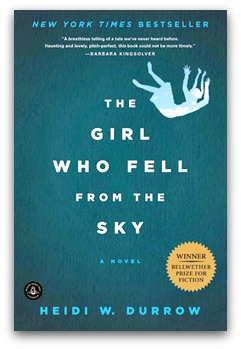
girl-who-fell-from-sky-coverBut isn’t it fair to say that your choice of topic for your debut novel, The Girl Who Fell from the Sky, was influenced by your TCK upbringing and mixed-race heritage?
The story is autobiographical only insofar as it is about a biracial and bicultural girl growing up in the Northwest. I guess that is to say: the confusion of the character is a confusion I experienced. But the story—about a girl who survives a family tragedy—well, that was inspired by a real story I’d read in the news many years ago.

The Girl Who Fell from the Sky was fantastically well received. Did you learn something pivotal about yourself and your TCK upbringing in the process of writing it?
Oh gosh. I learned so much. I am still learning—in particular as the book reaches students in high school and college as required reading. I’m always so interested in the ways in which readers identify their own “displacement” with that of the main character, Rachel. I think the TCK experience is one of being an outsider in all places—and, strangely, that feeling is universal, familiar even to those who have grown up in one place their whole lives.

On your author site and your blog, Light-Skinned-ed Girl, as well as on your Mixed Experience Podcast, you mention that you’re working on a second novel. Can you tell us anything about it?
The new novel is still a work in progress. I’m on the verge of finishing a good complete draft at last! All I can say about it is that it’s about my obsessions again—about identity, and race and culture and grief; it’s about beauty and connectedness. Hopefully it’s something folks can relate to.

* * *

Thank you, Heidi! I wish you all the best in your endeavors, and feel confident you’ll soon be repeating your amazing successes. I understand you’ve got the Mixed Remixed Festival coming up in mid-June here in LA, which will celebrate the stories of the Mixed experience through films and books—something Displaced Nationers would love to hear more about. Readers, please leave questions or comments for Heidi below.

STAY TUNED for next week’s fab posts!

If you enjoyed this post, we invite you to register for The Displaced Dispatch, a round up of weekly posts from The Displaced Nation, with seasonal recipes, book giveaways and other extras. Register for The Displaced Dispatch by clicking here!

Related posts:

JACK THE HACK: Expat authors, once you have a blog, it’s schmooze it or lose it (3/3)

Jack Scott and his partner, Liam, set up home in the Turkish port town of Bodrum in the late aughts. They were seeking sanctuary from a pressured existence in London. In the event, the expat experience proved to be something for Jack to write home about, as in a book! The pair have since returned to the UK, where they are living the life of Riley in Norwich. Some time ago, we suggested that Jack reinvent himself as Jack the Hack and submit monthly columns targeted at those of you who are still displaced and hacking away at travelogues-cum-memoirsor, in some cases, autobiographical novels. Warning to non-Brits: Don’t be put off by his wry sense of humo(u)r!

—ML Awanohara

In my last two columns, I banged on about the art of blogging and how it is one of the most important tools in an author’s PR box, particularly for indie authors or those with a small publisher and only a few shillings in the marketing piggy bank.

You’ll be relieved to read that this is third and final episode.

FACT: most blogs run out of steam after two years. So, giving your blog legs will keep it in the race for longer.

Here’s how.

Win friends and influence people

So, your gorgeous new blog has hit the ground running and you’ve fallen under its spell. Now you want others to be captivated, too. The single most important thing you must do is engage meaningfully with your audience and your blogging peers, often and in every possible way.

It’s good to talk and networking pays big dividends. Allow your readers to comment on your posts. If someone takes the time to drop you a line, always reply. It helps develop your popularity and credibility.

A word of warning: make sure you’re set up to approve comments before they are published to keep the trolls and spammers at bay.

If you disagree with a comment, unless it’s abusive, offensive or loony tune, let it stand (polite rebukes are fine). That’s the unofficial blogger’s protocol.

Participate in the blogosphere by talking to your peers. Leave comments on their blogs and list your favorites on your site. Many will reciprocate, and the backlinks will help drive traffic your way. Be generous and promote others. Join blog directories. Most are free and some specialize (book bloggers, women bloggers, expat bloggers, for example).

Faceache and that Tweety thing

Cross-fertilization with social media is a must these days. At the very least, create a Facebook Page for your blog, join Twitter and post and tweet your content.

Facebook may like us all to think that it’s just a nerdy way to keep in touch with friends, but we all know it’s much, much more. Take advantage of its power.

Many blogging platforms can auto-post to the main social networks and this takes some of the pain out of the merry-go-round. While you’re at it, you may as well post to Google+, Pinterest (for images), Linkedin and any other social network you join. All this activity will increase your visibility. It worked wonders for me.

Fans can be fickle and lazy. Make it easy to follow you by adding social network links to your blog. It’s all about seamless sharing and following. And don’t forget to set up a subscription to your great works by old-fashioned email.

It’s not all about numbers, of course. Go for quality not quantity. Try not to obsess too much about your stats. (I should talk—I check mine several times a day.) Remember, your hit rate will be low at first. Don’t let it get you down. With a little careful nurturing and a lot of networking, your audience will steadily grow.

Is there any brass in it?

Blogging may be an important promotional tool but unless you’re attracting hundreds of thousands of readers a week (and some blogs do), you’re very unlikely to make any real money from your blog directly. My advice is not to plaster ads over your site. It will turn people off.

Beware blogging fatigue

Blogs do have a natural lifespan and there’s no point flogging a dead horse. Sometimes the cupboard is bare and there are no words left. Even the most enthusiastic and verbose writers may throw in the towel at some point.

Just like real work in the real world, take a short break or a long sabbatical. A nice holiday can work wonders for the creative juices. When I packed up my drag in my old kit bag and paddled back to Blighty, I was convinced that Perking the Pansies would wither on the vine like a piece of dried-up old fruit. Still, this old fruit soldiered on and much to my relief, the change of scene gave the blog a welcome shot in the arm.

In the end though, nothing lasts forever; when it’s done, it’s done. And that’s okay.

And finally…

BLOGGING TIP FOR EXPAT AUTHORS NO 3:

Blogging can be a hugely powerful tool for writers. It really can. It isn’t for everyone but if you decide to give it a go, have fun with it. If it’s a chore, it won’t endure.

Here endeth the blogging gospel according to Saint Jack. Season’s greetings and good luck from old Norwich town.

* * *

Readers, any comments, further questions for Jack the Hack? He will be following his own advice and taking a break from this column in the new year as he’ll be busy moving house with Liam (within Norwich) and publishing/promoting his sequel to Perking the Pansies—watch this space for a review!

Jack Scott’s debut book, Perking the Pansies—Jack and Liam move to Turkey, is a bitter-sweet tragi-comedy that recalls the first year of a British gay couple in a Muslim country. For more information on this and Jack’s other titles, go to his author site.

STAY TUNED for tomorrow’s post, another installment in the life of our fictional expat heroine, Libby. (What, not keeping up with Libby? Read the first three episodes of her expat adventures.)

If you enjoyed this post, we invite you to register for The Displaced Dispatch, a round up of weekly posts from The Displaced Nation, with seasonal recipes, book giveaways and other extras. Register for The Displaced Dispatch by clicking here!

Related posts:

JACK THE HACK: Expat authors, time to build a great and powerful blog (2/3)

The expat experience Jack Scott and his partner, Liam, had in the Turkish port town of Bodrum—they were seeking sanctuary from a pressured existence in London—proved literally to be something to write home about, as in a book! They have since returned to the UK, where they are living the life of Riley in Norwich.  Some months ago, we suggested that Jack reinvent himself as Jack the Hack and submit monthly columns targeted at those of you who are still displaced and hacking away at travelogues-cum-memoirsor, in some cases, autobiographical novels. Warning to non-Brits: Don’t be put off by his wry sense of humo(u)r!

—ML Awanohara

Last month I extolled the virtues of blogging as a way of spreading the word about your words—and, in the process, flogging that box of books you’re using as a door stop.

This month, I want to take you further down the yellow brick road to blogger glory, with answers to the following Frequently Asked Questions.

Where do I start?

First things first. Choose a blogging platform—called a “host.” This will be your blog’s home. The biggest free applications are:

  1. Blogger—easiest.
  2. WordPress—slightly more technical knowledge required.
  3. Tumblr—attracts a younger crowd and great for short posts, video and pictures.

Your host manages all the back office stuff so you don’t have to. Once you’ve signed up, you can roll out a new blog in no time. You don’t need to be technically savvy but it does help to have mastered the basics. All the blogging platforms offer online help and/or tutorials. WordPress, in particular, has a large and active user community. You will learn as you go along and this is all part of the fun. WordPress also offers a free self-hosting package through WordPress.org, providing total freedom and endless possibilities to the serious blogging geek (I’m bad but I ain’t that bad).

What’s in a name?

More than you might think. Choose a title for your blog that reflects its subject matter. Simple is best. For example, the Turkish Travel Blog does exactly what it says on the tin and works well for searching. I also like What’s for Tea Tonight, Dear? because it’s obviously about food but has a witty title.

Don’t ask me why I chose the rather obscure title of Perking the Pansies for my own blog. It’s caused endless confusion, especially across the Pond. All I can say is that it came to me in the night and seemed like a good idea at the time.

How do I make it a looker?

All blogging platforms come with a variety of appealing templates to add a dash of style. Select one; furnish it with your personal touches in words, images and music; accessorize from a menu of widgets and plugins; and, hey presto, you’ve got yourself a blog with punch and panache.

Some fancy features come at a premium but they aren’t necessary.

Your blog will be unique, so move the vases and furniture around to see what works feng shui-wise—rather like flicking through an IKEA catalogue.

Add an interesting “About Me” widget or page. The most successful blogs reveal something of the writer’s personality.

Will I be chained to the computer?

Not unless it turns you on. Posts can be written in batches and scheduled to be published over time. Try to post at least once a week, though. It’s good for what’s called search engine optimization (SEO). Don’t be spooked by this. This is just how Internet search engines index and rank your site— it’s all done in the background. Over time, posting regularly will push up your assets better than a Playtex 18-hour girdle.

What will give my blog the kiss of life?

This is the original million-dollar question. The short answer is, whatever floats your boat: something that interests you will help you write something interesting. Variety, as they say, is the spice of life—so choose a broad theme to write around.

Many authors will post book reviews or write about the writing experience itself. That’s fine and dandy, but just because you’re a writer doesn’t mean that you have to write about writing (I rarely do). And it does no harm to go off-message now and again. Surprise your audience with the occasional left fielder.

The blogosphere is an incredibly hyper-active arena. Bloggers through WordPress alone published more than 35 million posts during September this year, attracting more than 4 billion hits (yes, billion). Obviously, you’ll want your posts to stand out from the crowd. Try to ensure that the titles of your posts spark an interest. If your blog is mostly text, make the first few sentences of each post leap from the screen and get the juices flowing. Break up your words with interesting and relevant images.

In our visual, coffee-on-the-go, no-time-to-read age, the right picture can be more eloquent than a thousand words. Keep your pages clean and uncluttered. Fussy, multi-coloured fonts and busy designs can hurt the eyes and put the reader off. Don’t forget to use relevant categories and tags for each post. They’re good for SEO, too.

And the kiss of death?

If you’ve a book to flog, promote it lightly—otherwise, your readers will change channels quicker than you can say “click here.” By now, I reckon most of my regulars have either bought my book or would rather read the back of an envelope, so there’s little point banging on about it (until the next one, of course).

Don’t use your blog as a daily diary (use Facebook for this if you must). Even your dear old Grandma won’t be that interested in what you had for breakfast or that you broke a nail taking out the rubbish (unless something funny or profound happened on the way to the tip).

If you want to be seen as an authority on something, you need to write with authority.

So, until the third, and last, thrilling installment, I leave you with this final thought:

BLOGGING TIP FOR EXPAT AUTHORS NO 2:

While it’s important to blog regularly, it’s okay to take a break because real life is, well, real. If you have nothing to say, don’t say it.

* * *

Readers, any comments, further questions for Jack the Hack? He’ll be back next month with the third, and final, installment in his blogging advice trilogy: “Making Friends and Influencing People.”

Jack Scott’s debut book, Perking the Pansies—Jack and Liam move to Turkey, is a bitter-sweet tragi-comedy that recalls the first year of a British gay couple in a Muslim country. For more information on this and Jack’s other titles, go to his author site.

STAY TUNED for tomorrow’s post, another installment in the life of our fictional expat heroine, Libby. (What, not keeping up with Libby? Read the first three episodes of her expat adventures.)

If you enjoyed this post, we invite you to register for The Displaced Dispatch, a round up of weekly posts from The Displaced Nation, with seasonal recipes, book giveaways and other extras. Register for The Displaced Dispatch by clicking here!

Related posts:

Images from top, clockwise: Hand with pen / MorgueFile.com; Boats in King’s Lynn, Norfolk / MorgueFile.com; Jack Scott, used with his permission; Turkish boats / MorgueFile.com

JACK THE HACK: Expat authors, let’s reopen that blogging can of worms (1/3)

JACK THE HACK _writingtipsA pressured existence in the UK led Jack Scott and his partner, Liam, to seek sanctuary in the Turkish port town of Bodrum. This expat experience was literally something to write home about (as in a book!), after which the pair returned to the UK, where they are living the life of Riley in Norwich.

We have invited Jack, now reinvented as Jack the Hack, to submit a monthly column targeted at those of you who are still displaced and hacking away at travelogues-cum-memoirsor, in some cases, autobiographical novels. Warning to non-Brits: Don’t be put off by his wry sense of humo(u)r!

—ML Awanohara

As far as the book malarkey goes, unless you’re lucky enough to bag a big boy in the publishing world, you will carry the can to get the word out. These days, this means developing a strong and dynamic online presence.

To some, this seems like a step too far. I’ve worked with a number of new authors who just don’t have the time, skill or inclination to do what it takes.

“I wrote the damn book. Isn’t that enough?” I’ve been told.

Well, no, it isn’t, I’m afraid, not by a long chalk.

So I work with them to take the pain away. You see, it doesn’t need to be a can of worms. Those who regularly dip into Jack the Hack will know that I’m a passionate advocate of blogging—for fun and for glory. With a little effort and imagination, you really can make the Web work for you, and blogging is a very good place to start (cue Julie Andrews, the old Dame who tragically lost her fabulous soprano timbre).

Still not convinced?

Then let’s start at the very beginning…

So what is a blog?

The word is an abbreviation of “weblog”. Put simply, a blog is a journal where the entries (posts) are published online, with the most recent first (the reverse of a traditional hand-penned diary). A blog can take many forms and is a perfect vehicle to reflect our multi-media world of words, music, video and images.

Importantly, blogs differ from standard websites. They are dynamic (rather than static) and constantly evolving (assuming they are kept up to date).

Why do people blog?

It may sound grandiose, but blogging is an important democratizing force, giving a real voice to those who might otherwise not have one. It’s a great social leveler tooanyone can do it, no qualification required. There’s no editor to correct your flabby grammar and no one to censure your words (unless, of course, you live somewhere with lively Internet police).

While this means a fair amount of dross is floating round the crowded blogosphere, there are roses among the weedsand you could be one of them.

Bloggers blog for all sorts of reasons and to continue the tenuous Sound of Music theme, here are a few of my favo(u)rite (things):

• Because they have something to say about an issue they care about (the campaigners and spleen-ventors);
• To tell their world what they’re up to and to keep in touch with friends and family (a common topic for expat blogs);
• To help others (health-related blogs are often written for this purpose);
• To be seen as an expert or influencer in a particular arena or place (the Arts, politics and travel leap to mind);
• To connect with like-minded people (this blog, The Displaced Nation, is a good example);
• To flog a service, brand or product (oh, like a book).

Most successful blogs tend to focus around a particular theme or niche. I know a blogger who writes about knitting patterns. It’s hugely popular, attracting thousands of hits a week.

Among the big hitters are travel, politics, food, family life and…ta-da! books and creative writing.
Blogs are a boundless, no-to-low-cost way to lay out your stall in a way an ordinary Website might not. Why so? Because Internet search engines like Google love content that’s new, fresh and frequently updated.

Even well-established businesses take blogging seriously these days. So why wouldn’t you?

Has Jack converted you to the cause? If you’re hooked, let him reel you next month with tips to launch your blog with bang.

BLOGGING TIP FOR EXPAT AUTHORS NO 1:

Blogging increases the chances of getting your mug shot on the first page of Googleand that just might sell a book or two.

* * *

Readers, any comments, further questions for Jack the Hack? He’ll be back next month with the second in his blogging advice trilogy…

Jack Scott’s debut book, Perking the Pansies—Jack and Liam move to Turkey, is a bitter-sweet tragi-comedy that recalls the first year of a British gay couple in a Muslim country. For more information on this and Jack’s other titles, go to his author site.

STAY TUNED for tomorrow’s post, another installment in the life of our fictional expat heroine, Libby. (What, not keeping up with Libby? Read the first three episodes of her expat adventures.)

If you enjoyed this post, we invite you to register for The Displaced Dispatch, a round up of weekly posts from The Displaced Nation, with seasonal recipes, book giveaways and other extras. Register for The Displaced Dispatch by clicking here!

Related posts:

Images: from top, clockwise: Hand with pen / MorgueFile.com; Boats in King’s Lynn, Norfolk / MorgueFile.com; Jack Scott, used with his permission; Turkish boats / MorgueFile.com

JACK THE HACK: Expat authors, let’s review the reviewer situation

JACK THE HACK _writingtipsAfter an expat experience in Bodrum, Turkey, that was literally something to write home about (as in a book!), Jack Scott traded in the dream for a less pressured existence back in the UK, than the one he was originally escaping from. In his monthly column for the Displaced Nation, he attempts to give back something to the poor souls out there who are still displaced and hacking away at travelogues-cum-memoirs or, in some cases, autobiographical novels. Jack the Hack has been there and done that and can lend a helping hand. Warning to non-Brits: Don’t be put off by his wry sense of humo(u)r!

—ML Awanohara

There’s no doubt that a sparkling set of reviews is one of the most potent ways to market a book (or anything else for that matter). Conversely, bad reviews (or no reviews at all) are poison.

So, how difficult is it to elicit those five gold stars everyone’s chasing?

Apart from emotionally blackmailing your nearest and dearest (something I assume you’ve already done), there are a number of little tricks you can try when it comes to beefing up your scrapbook.

Tricks of the trade

Here are three basics:
1) Whenever someone writes something positive about your masterpiece on social media or on your blog, do the right thing and thank them. While you’re at it, ask if they wouldn’t mind posting a review on Amazon or Goodreads. Some won’t but some will.

2) Search out book review sites online. Some review for free, some for a small fee—and all will expect a freebie. Many of these sites will post their review on the major bookselling sites as well as their own website.

3) Raise your game even further by approaching the Amazon top reviewers. Click on a reviewer, check out their interests and if they have listed their contact details, drop them a begging letter. This won’t guarantee you a good review (or one at all)—and be careful to select someone who is interested in your type of book. Someone into soft porn vampire romps is unlikely to rave about your expat escapades, however worthy and well written they are.

Damning with faint praise

There’s a downside to all this. Reviewing can be a rum business. Amateur hacks, often anonymous and sometimes with an axe to grind or with lofty literary pretensions, can damn with faint praise or go nuclear with their toxic pen.

Naturally, no book appeals to everyone. Literature, as with art, is in the eye of the beholder.

Even writers at the top of the heap get mixed critiques. Someone once wrote that Captain Corelli’s Mandolin was “…the worst book I’ve ever read.” Sure, it’s not everyone’s cup of tea—but the worst book ever?

Was the author, Louis de Bernières, much bothered? Not with a fat cheque for the film rights in his back pocket, he wasn’t.

Should a review like that count? Well, here’s the rub. Mass appeal retailers who positively encourage reviews as part of their business model are far too egalitarian. There’s very little discernment and no filter. Generally speaking, every comment carries equal weight. (A notable exception is something written by one of Amazon’s top reviewers, as mentioned earlier. These guys do have clout).

Hoisted by their own petard? If only…

Have you ever read a book review that’s so badly written, it’s barely readable? I know I have. Talk about irony. It’s like a playground brat screaming “I don’t like you so there!” just because he can.

For my part, if I don’t have anything good to say, I tend not to say it at all. It’s bad karma.

Like it or lump it, mixed reviews are an occupational hazard. People are entitled to express their view about something they’ve paid hard cash to read. Good, bad or indifferent, as long as it’s honest and not gratuitously offensive, it’s fair comment even when you think it’s unfair. Just hope the good drowns out the bad.

As for me, I’ve gotten off lightly. Reviews for my book have been very positive, but I’ve had the odd wobbly moment, too. Someone once joined Goodreads just to trash my book and make sure it dropped down a reading list by voting up every other title. Who was the literary troll? I will never know. Was I hurt? Sure was.

Rogue reviewers? It reminds me of why dogs lick themselves—because they can.

Which leads to—

WRITING TIP FOR EXPATS NO 6:

The best you can do is rise above the din, turn the other cheek and keep you own counsel. It doesn’t do to spit back even when sorely provoked.

* * *

Readers, any comments, further questions for Jack the Hack? He’ll be back next month with some more writing tips…

Jack Scott’s debut book, Perking the Pansies—Jack and Liam move to Turkey, is a bitter-sweet tragi-comedy that recalls the first year of a British gay couple in a Muslim country. For more information on this and Jack’s other titles, go to his author site.

STAY TUNED for next week’s fab posts!

If you enjoyed this post, we invite you to register for The Displaced Dispatch, a round up of weekly posts from The Displaced Nation, with seasonal recipes, book giveaways and other extras. Register for The Displaced Dispatch by clicking here!

Related posts:

Images: from top, clockwise: Hand with pen / MorgueFile.com; Boats in King’s Lynn, Norfolk / MorgueFile.com; Jack Scott, used with his permission; Turkish boats / MorgueFile.com

JACK THE HACK: Expat writers, now to deal with fame and fortune … or the lack

JACK THE HACK _writingtipsJack Scott is back with his monthly column for all of you wannabe authors who are hacking away at travelogues-cum-memoirs, or autobiographical novels. After an expat experience in Bodrum, Turkey, that was literally something to write home about, Jack and his partner, Liam, traded in the dream for a less pressured existence back in the UK.

—ML Awanohara

So your labour of love is out there on the virtual shelves (and a few actual shelves with a fair wind and a bit of luck). After an initial flurry, it’s all gone a bit quiet on the sales front and you’re dropping down the Amazon rankings like a stone.

It can be disheartening, depressing even.

We all want a little recognition for our art and a few shillings for our trouble—but don’t let the dream carry you off with the fairies. Let’s face it, very few authors make a decent living from writing and even fewer reach the premier league (if only I had that idea about a boy wizard called Harry).

So don’t expect literary agents to vie for your attention or film moguls to beat a path to your door. Hell might freeze over before that invite to the daytime TV sofa drops on the mat. Nor will you be batting off the paparazzi with a stick—even well-known writers aren’t photo-fodder for the Sunday rags. Instant celebrity is generally reserved for the young and fresh faced.

Writing’s just not that sexy.

Will it even pay the rent?

Sure, writing can provide a useful extra income stream but it’s unlikely to pay the rent.

Unless you’re tapping into that trust-fund set up my your dearly departed maiden aunt (the one everyone knew was a lesbian but no one mentioned it) or have a partner who doesn’t mind indulging you (that’ll be me, then), don’t give up the day job just yet.

Even a book that does well won’t buy you that Maserati. If you’re lucky enough to get a publishing deal, expect a royalty rate of between 10 and 50 percent. This sounds a lot (particularly at the upper end) but remember, that’s a percentage of net sales after pretty much everyone else has taken their cut.

You will be last to be fed.

But, not to despair!

All is not lost. You might be able to supplement your royalties by writing for Websites and magazines because, as a published author, your street cred will improve and you’ll be seen as someone with something interesting to say.

Not to mention the chance to promote your book.

Trouble is, most don’t pay very much or don’t pay at all. Another option is to sell your soul to the Devil by writing general copy for a huge range of internet sites desperate for content. Again, they pay a poor return and you may not get any credit for your words.

Whatever you earn, whether you’re a minnow of a big fish, remember to declare your income to the nasty taxman. You don’t want a stink in the clink, do you?

What’s it all about, Jack?

I don’t know about you, but this isn’t the reason I got into this writing lark. Cherish your writing for what it is, something you enjoy and have a passion for.

Be careful though. It’s very easy to get lost in the scribbling moment (I know, I’ve done it). It’s intoxicating. Suddenly you snap out of it only to realize that you’ve sat by the computer all day long in your nightie, haven’t washed, haven’t brushed your teeth—and you’ve forgotten to pick the kids up from school.

Quick, stick that ready meal in the microwave and get to the kids before social services do.

So, savour the unique voice writing gives you but remember to look up occasionally. A little ambition and self-belief is a good thing. There’s no need to lower you expectations, just keep them in check.

Which leads to—

WRITING TIP FOR EXPATS NO 5:

Be realistic. You never know, you might hit the jackpot. But, until that day comes, write for the right reasons.

* * *

Readers, any comments, further questions for Jack the Hack? He’ll be back next month with some more writing tips…

Jack Scott’s debut book, Perking the Pansies—Jack and Liam move to Turkey, is a bitter-sweet tragi-comedy that recalls the first year of a British gay couple in a Muslim country. For more information on this and Jack’s other titles, go to his author site.

STAY TUNED for next week’s fab posts!

If you enjoyed this post, we invite you to register for The Displaced Dispatch, a round up of weekly posts from The Displaced Nation, with seasonal recipes, book giveaways and other extras. Register for The Displaced Dispatch by clicking here!

Related posts:

Images: from top, clockwise: Hand with pen / MorgueFile.com; Boats in King’s Lynn, Norfolk / MorgueFile.com; Jack Scott, used with his permission; Turkish boats / MorgueFile.com

JACK THE HACK: Expat writers, time to crank up the PR machine!

JACK THE HACK _writingtipsJack Scott is back with his monthly column for all of you wannabe authors who are hacking away at travelogues-cum-memoirs (or cum-novels?). For those who don’t know, he was a Random Nomad for the Displaced Nation way back when we started this site. After an expat experience in Bodrum, Turkey, that was literally something to write home about, he and his partner, Liam, have traded in the dream for a less pressured existence back home in the UK.

—ML Awanohara

There’s a firm knock at your door and a postman in a tight uniform (well, we can hope!) hands you a box. You rip open the carton like an over-wrought five-year-old on Christmas morning, pull out a copy of your book, lift it to your nose and smell the pages. It’s intoxicating, better than recreational drugs. You’ve done it. For the very first time, you feel like a proper author.

Savour the moment. It may not last.

Unless you want to be stuck with a stack of books propping open a door or languishing unloved and unread in the attic, you’ll need to start phase two of your cunning marketing plan: making sure people know about your minor masterpiece.

But how do you get the message out there these days? Just what are the rules of engagement?

1) Start a blog.

As I have said many times before, blogging is a great auditioning process for writing, and the best way to experiment and grow your fan-base. In the crowded blogosphere, content is king and the best content is fresh, new and frequently updated. Aim to blog at least once a week and break up your words with interesting and relevant images. Keep your page clean and uncluttered. Fussy, multi-colored scripts and busy designs can hurt the eyes and put the reader off. Fans can be fickle and lazy. Make it easy for them to follow you by adding your social network links and the chance to subscribe to your pearls of wisdom by email.

2) Engage with social media.

Plaster the good news everywhere. Join social networks and make friends. Facebook and Twitter are the most popular and influential, although Pinterest is starting to give both of them a run for their money. Create a Facebook page and solicit “likes.” Give Linkedin a go. After all, you are a professional author now. If social forums exist for your area of interest, join them and participate meaningfully. A word of warning: Engage gently and be careful not to over-promote; otherwise, people will switch off.

3) Join book sites.

There are hundreds of book sites out there and most of them allow you to add your book. Goodreads is the biggie and most respected, Join their author programme and add your profile and book. There’s also AuthorsDen, LibraryThing and WritersNet. Make friends and become an active member of the groups you join. Reviewing the work of other new authors will help garner support and build a “bookie” network.

4) Solicit Amazon reviews.

If you’re selling your books through Amazon—an organization set on a path to either a) world domination or b) break-up by the Monopolies Commission—make sure the selling page is attractive, accurate and informative. Add an author profile, encourage people to submit positive reviews and if you do get the odd bad review (and you will) don’t spit back, it’s really not worth it.

5) Think about search engine optimisation.

Don’t be spooked by this. Search engine optimization (SEO) is just how a page is ranked on search engines and by this I mostly mean Google (another monolith on the path to world domination). If your blog doesn’t appear in the first few pages of Google then you might as well not be on the internet at all. There are many companies that claim they will increase your ranking for a fee. Don’t waste your money. Follow a few simple steps and you’ll soon by up there with the pros:

  • Reply to comments left on your blog. It’s the polite thing to do.
  • Engage with your blogging peers with comments and guest posts.
  • Add share buttons to your posts so your readers can spread the word effortlessly.
  • Create reciprocal links by listing your favorite blogs and Websites on your blog.
  • Join blog directories. Most are free and some specialize (women bloggers, expat bloggers, for example).
  • Post to Facebook and Twitter (at the very least).
  • While you’re at it, you may as well post to Google+, Pinterest and Linkedin (and any other social network you join). All that activity will help you clamber up the rankings and increase your visibility.

6) Get yourself interviewed.

Online interviews are a great way to increase your profile. Expat and book sites (notably, The Displaced Nation!) are always looking for interesting people to chat to. It provides them with content and you with exposure—a perfect double whammy.

7) Create a personal Website.

Creating a personal Website isn’t the expensive faff it used to be and the days of paying top dollar for large-brained web-designers to give birth to your labor of love are over. These days, get the right help and you can end up with a fully functional and integrated site for a fraction of what it used to cost. (PLUG ALERT: You could do worse than checking out author2author, my new low cost Website, blogging and social media service for authors.)

8) And finally…keep chipping away at it!

Exhausted? You will be. This PR lark takes a lot of graft. I know. I’ve never worked so hard. The good news is that once you’ve set the wheels in motion, you just need to keep a light touch on the tiller. Then before you know it, you’ll start getting that exposure you’ve always dreamed of and, who knows, the agents and distributors knocking at your door instead of the pretty postman.

Until then, I’m afraid there’s no substitute for
WRITING TIP FOR EXPATS NO 4:

Master the rules of engagement!

* * *

Readers, any comments, further questions for Jack the Hack? He’ll be back next month with some more writing tips…

Jack Scott’s debut book, Perking the Pansies—Jack and Liam move to Turkey, is a bitter-sweet tragi-comedy that recalls the first year of a British gay couple in a Muslim country. For more information on this and Jack’s other titles, go to his author site.

STAY TUNED for tomorrow’s post, another installment in the life of our fictional expat heroine, Libby. (What, not keeping up with Libby? Read the first three episodes of her expat adventures.)

If you enjoyed this post, we invite you to register for The Displaced Dispatch, a round up of weekly posts from The Displaced Nation, with seasonal recipes, book giveaways and other extras. Register for The Displaced Dispatch by clicking here!

Related posts:

Images: from top, clockwise: Hand with pen / MorgueFile.com; Boats in King’s Lynn, Norfolk / MorgueFile.com; Jack Scott, used with his permission; Turkish boats / MorgueFile.com

Getting carried away with author Lisa Egle on a magic carpet, or is it a chicken bus? (Win a copy of her travel memoirs!)

Lisa E Collage for TNBack in the days when my nieces were small—and I’d just repatriated to the United States after quite a few years abroad—I got to know them again through long bouts of playing make-believe at my mother’s (their grandmother’s) house.

We particularly enjoyed Magic Carpet. We had our own home-made version. Adorning ourselves in Grandma’s silk scarves, we would plonk down on her quilted bedspread for a flight of fancy, à la Arabian Nights (not for us the Disney version!):

Whoever sitteth on this carpet and willeth in thought to be taken up and set down upon other site will, in the twinkling of an eye, be borne thither, be that place nearhand or distant many a day’s journey and difficult to reach.

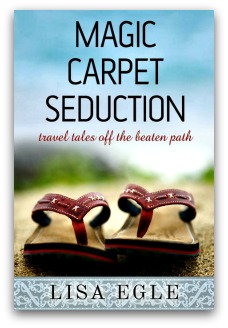
I trust this anecdote will explain why I’m so excited about hosting new author Lisa Egle today. It’s Magic Carpet time again, and this time I get to be the kid, listening to Egle tell of the off-the-beaten-track adventures that are captured in her travel memoirs, Magic Carpet Seduction.

Hey, we even have prizes! Two of our readers will be the lucky recipients of a copy of Egle’s book (see giveaway details below). The giveaway is now over! 😦

Hmmm… The only thing is, I suspect that before we board the Magic Carpet, Egle will ask us to ride on a chicken bus. (Leave the silk scarves at home, girls!)

* * *
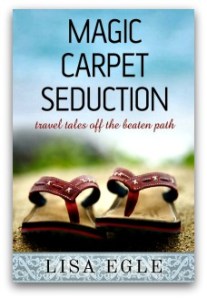
MagicCarpetSeduction_cover_pmHi, Lisa! I won’t need too much persuasion to be seduced by your writing. I’m already a follower of your travel blog, ChickyBus. And I know you’re an American like me, living in New Jersey. Why made you decide to travel in the first place?
After taking short solo trips in the U.S. back in the 1990s, I went on a two-week group tour of Egypt and thought it was the most exciting thing I’d ever done. I then went on another tour, of Ecuador, which turned out to be a life-changing experience (for many reasons, including the fact that I moved there a few months later). While living in Ecuador, I began to travel independently and realized how much I enjoyed it. From that point on, I entered the ranks of “travel addicts.”

How many countries have you been to at this point?
In total, I’ve been to 36 countries, on five continents. I was an expat twice: in Ecuador for a year and half and in Spain for a year. Recently, I spent two months in Indonesia.

And home is now New Jersey?
Yes. I’m a full-time ESL professor at a two-year college in Bloomfield.

I don’t get it. Is a “chicken bus” magical?

Where does the epithet “Chicky Bus” come from?
“Chicky Bus” is the name of one of the stories in my book. It’s about a quirky 12-hour “chicken bus” ride I took in Central America that led me to have epiphanies about living in the moment. When I started my blog, I thought “ChickyBus” would be a cool domain name—one that related to travel and one that people would remember. I also liked it as a blog concept. I’m the “driver” taking readers—”passengers”—on “rides” with me, allowing them to experience the same random moments and unexpected journeys that I do.

There’s also a deeper meaning, however. “Chicky bus” is a metaphor for my unique style of travel—being in the moment while venturing off the beaten path and taking risks (nothing too crazy, of course). It refers to that place of magic and self-discovery that I find wherever I go.

Why did you decide to publish some of your travel stories as a book?
Years ago, while blogging about general topics on a site called http://www.gaia.com, I began sharing travel tales. The feedback was incredibly positive; people were inspired and entertained by what I wrote and said they felt like they were right there with me. After a while, I decided to go all the way with it, to write more stories and to compile them into a book—four major “rides” to different regions of the world (and a total of 9 countries: China, Nicaragua, El Salvador, Guatemala, Mexico, Turkey, Jordan, Syria and Lebanon).

Are any of your chapters based on blog posts?
Interestingly, none of the stories are based on blog posts. I wrote most of the book before I started ChickyBus. There are, however, a few stories (simplified versions) on the blog that came from the book.

Mostly magical connections

We like to talk about “displaced moments” on the Displaced Nation. We can see you’ve experienced your fair share: from close encounters with Carpet Casanovas in Turkey, to meeting with a hermit in the Lebanese mountains, to experiencing political intrigue in a Chinese classroom, to receiving a marriage proposal on that infamous chicken bus in Nicaragua. But we still have to ask you: which is the MOST displaced moment that you’ve included in this book?
The moments you mention were truly unique ones and—believe it or not—I didn’t feel as displaced as one might think. Because I was in the moment and going with the flow, I felt quite comfortable and that I was where I needed to be.

There were a few instances, however, in which I did have that “displaced” feeling—the most extreme of which occurred in China.

It was 1999 and I was teaching English at a university in Changsha in Hunan Province, which was definitely considered off the beaten path back then. For most of my time there, I was in a deep state of culture shock. I struggled with many things, from freedom of speech issues to getting to know my students. There were many “displaced moments”—and even days. Fortunately, after a while, things leveled out and went more smoothly.

So from what you’ve just said, I guess there is a lot of competition for your LEAST displaced moment, when you felt you actually belonged with all of these characters you discovered off the beaten track?
One of my least displaced moments (and possibly favorite) was when a friend and I ended up spending the night with a Mexican family we barely knew. They’d invited us over for lunch. We were planning to take a bus to another city that night because we had to fly home from there the next day. It got later and later and because we were so comfortable, we didn’t want to leave. We ended up staying (and sleeping in two very tiny beds, slightly larger than coffins) and having a wonderful time being part of the family.

P.S. A little Boone’s Farm wine went a long way in helping make us even more comfortable…

Don’t exit until the rug has made a complete stop!

Okay, time to get off that chicken bus and onto that magic carpet. On your post announcing the book’s publication, you say:

So imagine that my book is the equivalent of an invitation to a Bedouin lounge of sorts. If you decide to join me, we’ll get comfy on the cushions and share some tea (or coffee or whichever beverage you like). When you’re ready, I’ll start telling you my favorite travel tales—and together, we’ll take a magic carpet ride.

Why did you choose this metaphor, and indeed use “magic carpet” in your title?
When I was a kid, my friends and brother and I used to sit on the front porch and listen to my mother telling us stories. Years later, I found myself doing the same thing with friends and later, on a blog. Then, I spent time with the Bedouins in Wadi Rum, Jordan. We told our own stories while sharing tea and sitting on the sand under a tent or on a cushion inside a house. In retrospect, I believe that the “invitation” into the Bedouin lounge has something do with each of these experiences.

Re: the title, when people see the words “magic carpet,” the freedom to travel anywhere, magically, usually comes to mind. Also, “Magic Carpet Seduction” is the name of one of the stories in the book. It’s about two men, seemingly different, trying to sell me a carpet and what happens I see through their each one’s sales pitch/ploy.

Also in your blog post announcing the book’s publication, you confess to being exhausted. (I confess to having had similar feelings after long games of Magic Carpet with my nieces!) What was the most challenging part of the writing process?
Mostly, it was finishing the book, editing it and formatting it while maintaining my blog and my full-time teaching job, and being on social media. At times, it was difficult to prioritize and I often felt burnt out.

Overall, however, I would say that editing took a lot out of me. There were a few times when I thought I was finished with a certain stage of the process; then, I’d realize that I wasn’t. Having said this, that is where I learned the most and what helped me become a better writer. So, in the end, it was a positive experience.

Capturing the magic of self-publishing

Why did you self-publish the book?
I took this route mostly because I wanted creative control; I believe the book is unique and slightly nichey. Also, I didn’t want to have to spend a lot of time pursuing an agent and traditional publisher. Mostly, I wanted to get the book done my own way and on my own schedule.

Can you offer any tips for others who are contemplating going down this path?
My best tips for anyone who’d like to self-publish are:

• Hire a professional editor and a proofreader—two (even three) people. Also, get a critique done before you pass the manuscript on to an editor. It’s important because each editor has his/her own specialty and will probably catch something another didn’t.

• Have a cover professionally designed. I know there are ways to do this cheaply or yourself, but it’s worth spending money to do this right since the cover is first thing that people see when searching for a book.

• Have your blog (and social media accounts) set up/established before you publish the book. I’ve seen many people do it the other way around. They finish and publish their book, then set up a blog and join Twitter. Many aren’t sure what to do—they just tweet about their book and don’t interact with others. This tends to hurt them more than help them.

• Don’t give up. I can’t begin to tell you how many times I wanted to quit just because of the sheer amount of work (blog, social media, the book itself, etc.) You can burn out very easily and, if you’re not careful, your health can suffer. Keep going, though, and you’ll cross that finish line!

What audience did you have in mind when writing the book?
I’ve always envisioned the audience as:

  • armchair travelers and those who take tours and fantasize about breaking away
  • other independent travelers/expats
  • non-travelers with an interest in countries often in the news
  • anyone curious about the cultural perspective/insights of a female American traveler.

Is it reaching those readers?
I don’t know the customer demographics yet, but I know that a few men have written reviews on Amazon—and that makes me happy. As is the case with ChickyBus, the book is for people of all ages and both genders. It’s definitely not just for women.

I see you’ve opened your own publishing company and are working on some more ambitious travel-cum-writing projects. Can you tell us some more about that?
I set up a small publishing company for a number of reasons, including accounting and taxes. More than that, I thought it made sense because I will be publishing more books and hopefully, a collection of travel tales written by others. This is a longer-term goal, but definitely something I’m considering for the future.

Are you already working on your next book?
I’m currently working on a trilogy about Native American-style healing journeys in the U.S. (in the Northeast and the Southwest). After that, I’ll hopefully wrap up the rough draft of a book about life-changing experiences I had in Ecuador. That, like the trilogy, would fall under a “spiritual travel” genre.

10 Questions for Lisa

Finally, I’d like to ask a series of questions that I’ve asked some of our other featured authors, about your reading and writing habits:
1. Last truly great book you read: Grey Wolves and White Doves, by John Balian
2. Favorite literary genre: Political thrillers; travel literature.
3. Reading habits on a plane: (what kinds of things do you tend to read and by what means?) Now, because I own a Kindle, this is much easier. I usually have several books to choose from: one I’m sure I’ll love and lose myself in and—a few that I’m curious about. One thing I love to do on a plane (and during my trip) is keep a journal. During my return flight, I re-read the journal and re-experience the trip. I almost always do that and love it!
4. The one book you’d require President Obama to read, and why: Hmmm. That’s a tough question. Maybe my book? I’d want him to see that there are Americans who embrace the rest of the world, despite the media’s distortions of it. Also, I think my book would show him how travel, the way I approach it—focusing mostly on meeting the locals—can help people to connect in a very real way and to overcome cultural misconceptions, ultimately helping make world peace more attainable. Another reason I’d want him to read it is because I think it would provide good escapism since it’s quite humorous. He’s got a tough job and might enjoy it for the entertainment value alone.
5. Favorite books as a child: The Outsiders, a coming-of-age novel by S.E. Hinton; and Go Ask Alice, by Beatrice Sparks.
6. The writer, you’d most like to meet, who is no longer living: Aldous Huxley
7. The writer, you’d most like to meet, who is still alive today: Daniel Keyes
8. Your reading habits: I have a pretty short attention span, so there are many books that I start to read that I don’t finish. However, if a book really gets my attention, then I can’t stop. It becomes something I look forward to and put aside other things to do. Unfortunately, since I started my blog a few years ago, I’ve been reading less than previously. I spend more time reading other blogs and articles than reading actual books. When I seem to read the most is when I’m traveling and find myself without Internet. I end up loving it, too.
9. The book you’d most like to see made as a film: A cyber suspense I’ve written about two women who “meet” on the Internet and what happens when the bond they’ve formed takes a dysfunctional and frightening turn. It’s now in rough draft form (about 15,000 words), but I’m hoping to publish it on Amazon (just for Kindle) in a few months.
10. The book you plan to read next: Actually, there’s a book I’m itching to finish reading—and that’s Shantaram. I always start it and then get interrupted. It’s a very long book (over 900 pages). I think Gregory David Roberts is an awesome writer. His storytelling ability—the way he writes dialogue, how he describes characters, settings and situations, and the way he uses metaphor—makes his experiences incredibly real to me.

* * *

Thanks so much, Lisa! That was absolutely magical, a carpet ride to write home (to my nieces) about! And that chicken bus? It wasn’t half bad! 🙂

What about you, readers? Has she seduced you?

Lisa Egle writes a blog, Chicky Bus, the concept of which is “finding yourself off the beaten path.” Over the past three years, it has been recognized on two “Top 100” lists of independent travel blogs. Egle is also Assistant Professor of ESL at Passaic County Community College in Paterson, New Jersey, where she teaches students from all over the world, especially Latin America and the Middle East. She holds a BA in Social Sciences from New York University and an MA in TESOL (Teaching English to Speakers of Other Languages) from Fairleigh Dickinson University. Lisa recently published a humorous piece in OH SANDY! An Anthology of Humor for a Serious Purpose (sales of which help victims of Hurricane Sandy), and an article on one of her quirkier adventures in Indonesia in LifeLift, the Oprah.com blog. She received an honorable mention in the 77th Annual Writer’s Digest Contest, in the Inspirational category.

STAY TUNED for tomorrow’s post, by guest blogger Elizabeth Liang, who will be updating us on her one-woman play about the TCK life, Alien Citizen.

If you enjoyed this post, we invite you to register for The Displaced Dispatch, a round up of weekly posts from The Displaced Nation, with seasonal recipes, book giveaways and other extras. Register for The Displaced Dispatch by clicking here!

Related posts:

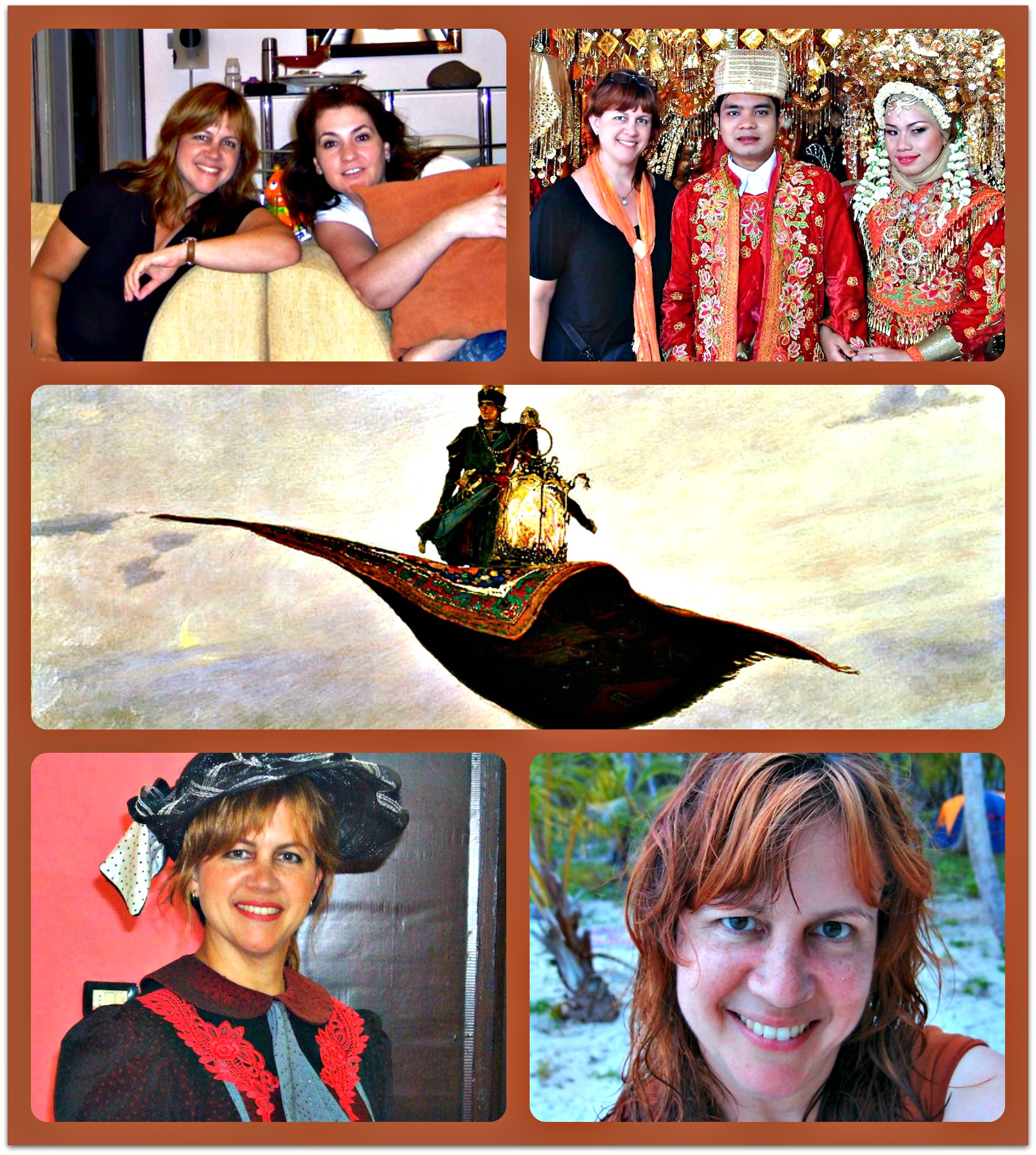
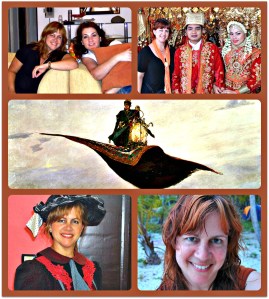
Images (clockwise, starting top left): Lisa at the home of her Cirassian-Jordanian friend, Souzan, with whom she was staying before the latter’s move to New Jersey(!) [this photo is in the book]; Lisa at a wedding in a Minangkabau village in Sumatra (hey, you can’t attend without posing with the bride and groom); Lisa camping in San Blas, Panama, during rainy season and a full moon (a displaced moment, to be sure, as the local Kuna indigenous believe that a full moon equals a curse); and Lisa after being recruited to be on a famous TV show in Damascus, which aired during Ramadan afforded an opportunity to meet one of the most famous actors in Syria—Qusai Khouli (she is wearing a late 1800s outfit, in case you were wondering). The painting in the center is “The Flying Carpet,” by Viktor Vasnetsov (1880), courtesy Wikipedia.

JACK THE HACK: Advice to all you expat writers: Publish and be damned!

JACK THE HACK _writingtipsJack Scott is back with his monthly column for all of you wannabe authors who are hacking away at travelogues-cum-memoirs (or cum-novels?). For those who don’t know, he was a Random Nomad for the Displaced Nation way back when we started this site. After an expat experience that was literally something to write home about, he and his partner, Liam, have traded in the dream for a less pressured existence back home in the UK.

—ML Awanohara

After months of burning the midnight oil, neglecting the sprogs and denying your long-suffering partner their conjugal rights, your memoir masterpiece is finally done and dusted. Whether you’re pleased with the result of your hard graft or just relieved, pop a cork. It’s quite an achievement.

So what’s next? Well, obviously you want to launch your labour of love onto an unprepared world—but how?

Essentially, you have four choices:

1) The big boys—the Holy Grail

Who wouldn’t bite the hand off a corporate suit offering a fat advance cheque, certainly not me. It sounds tantalising. Let the big boys do all the work—edit, design, promote and distribute—while you sit back and watch the royalties land on the mat. And you get to feel like a ‘proper’ author. Easy.

Except, it isn’t.  I know of no traditional publishing house that accepts unsolicited manuscripts, so don’t waste your time and money.

Mainstream publishers have cosy relationships with literary agents who filter out the dross so they don’t have to.

So, your first task is to bag yourself an agent who’s willing to take a punt on you (and a cut from you).

That’s not easy either. Agents receive thousands of manuscripts every year and few make it past the receptionist’s in-tray.

Keep the Faith. There are things you can do to avoid getting your memoir filed in the bulging bin:

  • Carefully read what an agent is looking for. Select only those who fancy a trip down memory lane. If you send your book to anyone else, you’re toast.
  • Follow the submission guidelines to the letter. If they want it double spaced in Times Roman 12, a full book proposal and a copy of your grandma’s marriage certificate then do exactly what it says on the tin.
  • Develop the patience of a saint, do not expect a quick response (if any) and don’t hassle.

2) Half-way houses—stepping into the breach

As we all know, the traditional bricks and mortar bookshop is under seize from the growth of on-line retailers (particularly Amazon), print-on-demand services and electronic books and they are transforming the market. A number of smaller publishers have sprung up to take advantage of this brave new world. For an upfront fee (often with set menu and a la carte offers), these smaller outfits will work with you to prepare your book to a professional standard (both print and e-versions) and get it onto the virtual shelves.

In return for a higher royalty rate, you will be expected to do most of your own promotion.

The advantage of print-on-demand publishing is that you can keep a stock of books in your bedroom for direct sales (to local bookshops, through your Web site and by emotionally blackmailing your nearest and dearest). The disadvantage is that most major book chains won’t give them shelf room.

3) Vanity publishing—the blind leading the desperate

We’ve all seen the “Authors Wanted” ads popping up on Google placed by companies who trade on a writer’s desire to see their name in print. For the right price, they’ll print almost anything. I’m not saying they are necessarily unscrupulous or misleading, but the quality of the written word isn’t their bag. Unfortunately, the line between the vanity publisher and the half-way housemate is becoming increasingly blurred. For me, the main distinction is selection and control. Be careful.

4) Self-publishing—the DIY approach

If your story is fit for publication (that is to say edited, proofed and formatted with a snazzy cover), why not self-publish as an e-book? It’s easier than you might think. Open an Amazon Kindle account, upload your file and let them do the conversion and listing.

And there’s always Smashwords, which will convert and distribute your e-book to all the main online retailers (including Amazon). Formatting an e-book for Smashwords is a bit fiddly but they do publish a handy style guide to lead you by the hand.

The advantage of self-publishing is that you get to keep full control over your work, including the price, and you’re paid direct without a publisher’s cut.

If you really want to see your precious words in print (and there’s nothing like the smell of a brand new book), get a printer to set the presses running. Many offer their services online and deliver to your door so you don’t even have to leave home.

Amazon also provides a print-on-demand service called CreateSpace. This way, people can order a print copy direct from them and, if you get the look and feel right, no one need ever know you did it yourself.

Postscript: Bedtime reading

Especially for expats with UK connections: The Writers and Artists Association has a comprehensive list of UK and overseas agents and their requirements. You’ll have to register first but it’s free. Their site also contains a well of advice about all aspects of the publishing business.

Which leads me to …

WRITING TIP FOR EXPATS NO 3:

Publish and be damned!

With all of the options out there, what are you waiting for?

* * *

Readers, any comments, further questions for Jack the Hack? He’ll be back next month with some more writing tips…

Jack Scott’s debut book, Perking the Pansies—Jack and Liam move to Turkey, is a bitter-sweet tragi-comedy that recalls the first year of a British gay couple in a Muslim country. For more information on this and Jack’s other titles, go to his author site.

STAY TUNED for tomorrow’s post, another in our NEW vs OLDE WORLDS series.

If you enjoyed this post, we invite you to register for The Displaced Dispatch, a round up of weekly posts from The Displaced Nation, with seasonal recipes, book giveaways and other extras. Register for The Displaced Dispatch by clicking here!

Related posts:

Images: from top, clockwise: Hand with pen / MorgueFile.com; Boats in King’s Lynn, Norfolk / MorgueFile.com; Jack Scott, used with his permission; Turkish boats / MorgueFile.com