The Displaced Nation

A home for international creatives

Tag Archives: Gothic tales

From soccer hater to World Cup fanatic: A most peculiar expat tale

FIFA World Cup Collage

The Brazilian player Edmilson Santos, by AK Bijuraj; CocaCola FIFA World Cup Soccer, by Mike Mozart; FIFA World Cup trophy, by Warrenski (all CC).

To mark the start of the 2014 World Cup in Brazil, I have updated a post I wrote four years ago, in time for 2010 World Cup, in South Africa. I wrote it for the now-defunct Pond Parleys, the brainchild of esteemed writers Toni Hargis (a British expat in the US, with an American husband) and Mike Harling (an American expat in the UK, with an English wife).

In America, of course, we call it soccer. But I am content to say “football.” If there’s one thing I learned from living in England for nearly ten years, it’s to use the English language with precision (in which case, shouldn’t it be “foot-and-head ball”?).

So, herewith, an attempt to tell the rather twisted tale of my conversion to football fandom, though part of me will always wonder: is my story more typical than one imagines? Surely, a taste for football isn’t easily acquired by those who don’t have it in their national DNA?

PART I: Why I Never Liked Football Whilst Living in England

This little tale of mine begins on a dark and stormy night in the latter years of the 20th century. I am living in football-mad England but am rapidly developing an aversion to the sport, squandering my first real opportunity to see it played at a professional level.

Chalk it up to my contrarian nature. I’m not one to throw myself into chanting, banner waving, and other tribal behaviors before I’ve had a chance to study what’s going on and make a full appraisal. And it did not take me long to find things I was less than enamored of, including:

1) The game itself—the endless running up and down the pitch with hardly any scoring. The few times I watched a football match, I inevitably got up to make a cup of tea, or dozed off, just as the one goal of the match was being made.

2) The fans—mostly male, many of them yobbos (some of whom are now chavs?). But even if we leave social class out of the equation, a good number of the UK’s football fans appeared to be hooligans, not exactly the most appealing lot—especially to a grad student like me, whose images of England had been formed from a steady diet of Jane Austen novels and Merchant-Ivory period movies. Occasionally violent male bonding rituals weren’t on the agenda. (I’m sure it didn’t help that my arrival in England coincided with football hooliganism reaching new levels of hysteria.)

3) The jingoistic tabloid coverage—which reaches its height whenever England plays Germany. I happened to be living in London in 2006, when the semifinals of the European finals, between England and Germany, took place at Wembley Stadium. What a palaver! The British mass-circulation paper The Daily Mirror ran a front-page headline “Achtung! Surrender!” over a photo of two England stars wearing World War II helmets. Years later, when England met Germany in the 2010 World Cup, held in South Africa, John F. Burns contributed an article to the New York Times contending that such “rib-poking” has provided catharsis for England and Germany over the years. Who am I to contradict Burns, the Times‘s London bureau chief and an expert on interpreting his native culture? Still, I couldn’t help but think of the late American historian Howard Zinn‘s warning that harmless pride can become an “arrogant nationalism dangerous to others and to ourselves.” Red card!

It’s perhaps worth noting that of all the reasons I came up with not to like football, none of them included the argument that occasionally surfaces in right-wing circles in the United States, which is that football is collectivist and carries the threat of “socializing” Americans’ taste in sports.

As an expat, I had a choice: keep skating along the surface and pretend football doesn’t exist, or else try and go closer to the beating heart of my adopted culture and see what makes it tick.

So I gave football a miss and moved back to pursuing a life of cream teas, theatre performances, cricket…wait did I just say “cricket”? I must be getting batty… (hahaha)

PART II: How I Came to Change My Mind About Football, or At Least the World Cup

Am I looking forward to this year’s World Cup championship games in Brazil? Why soitenly! Numbskull that I am, I’ve finally gotten with the program!!

Herewith, the second part of my most peculiar tale. As explained in Part I, I never paid much attention to the sport despite nearly a decade of exposure; on the contrary, I developed an abhorrence for it.

But four years ago all of that changed. Having settled back in the United States, I found myself powerfully drawn to the championship that took place in South Africa, and I expect it will be no different this time around, with the World Cup being hosted by Brazil. (While I’m sad that Paul the Octopus is no longer with us, I take comfort in the thought of Nelly the Elephant taking his place—her punditry is apparently on a similar level.)

I can’t pinpoint the precise moment when my conversion happened, especially as football still has all the same drawbacks I’d once noted: goals are few and far between, the fans are predominantly male, and jingoism reigns, particularly between the English and the Germans.

All I know is that it wasn’t until I was back in my own culture that I felt comfortable giving the sport a chance. Yes, I know this is ironic considering that the UK is considered to be the cradle of the game (the English have been kicking balls competitively since at least 1314), whereas we Yanks still aren’t quite there.

My top three reasons for fanning football are:

1) It’s the World Cup, stupid. Living in England, I couldn’t see the World Cup forest from the local English football club trees. But when watching the very best players in the world compete, even a hardened skeptic like me can start to appreciate why they call it The Beautiful Game. Those feet of theirs—they are using them like hands! That Messi fellow: it looks as though the ball is glued to his feet; how extraordinary! Xavi Hernández and Andrés Iniesta: it’s incredible how they can pass the ball through the midfields! And let’s not forget Yaya Touré and the way he switches gears. Robin van Persie has a left foot to die for! And so on…

2) It’s a much-needed distraction from other kinds of world events. There’s nothing quite like a soaring soccer ball to lift the spirits, not to mention the vicarious pleasure of seeing a team, and a nation, carry off the trophy. I can still recall the thrill of watching the first European team win outside Europe, at the tournament in South Africa. ‪Viva España!‬

3) It’s on a par with, or perhaps even better than, the Olympics. Ironically, even though there is nothing quite like football to arouse nationalistic urges, the World Cup is, as the name suggests, a world competition, with 32 nations competing. (Compare that to America’s World Series—now that’s a misnomer!) Repeat expats like me, who are a hybrid of nationalities, are the ideal supporters of such sporting events. I think it also helps that I don’t really have a dog in the race. Though America competes, we aren’t yet a serious contender for the cup. This leaves me free to throw my support behind almost any athlete or team that I think are the world’s best. The Olympics of course provide many such opportunities; but that’s the problem: there’s too much choice. What I love about the FIFA World Cup is that it’s a singular occasion. There can be no bigger stage, literally as well as figuratively, than the vast pitch on which this ultimate sporting drama takes

*  *  *

It’s time to hear from you, dear reader. Is my conversion complete, or should I be bending the case for football still more, by stressing its potential for opening up intergalactic communication and fostering truly universal harmony? And even if you don’t share this new-found enthusiasm of mine, can you at least relate to the experience of getting to know and love a sport outside the ones you grew up playing and watching? Do tell!

STAY TUNED for next week’s fab posts!

If you enjoyed this post, we invite you to register for The Displaced Dispatch, a round up of weekly posts from The Displaced Nation, with seasonal recipes, book giveaways and other extras. Register for The Displaced Dispatch by clicking here!

Related posts:

Some funny things happened on the way to paradise, as recorded in this brilliant new expat memoir

Paradise Imperfect Collage

Clockwise from top left, surrounding Margot Page’s author photo (center): Monteverde waterfall; the family’s front yard; Margot, her husband,and their three kids; sunset; their youngest child, Ivy, on the vine outside their house; first day of school. All photos courtesy of Margot Page.

Before introducing today’s guest, Margot Page, I’d like to make one thing clear. When I first read of her decision to uproot herself, her husband and three young kids from their comfortable life in Seattle to spend a year in Costa Rica, I thought it made perfect sense.

In fact, it reminded me of my initial decision to try living abroad. While I wasn’t married with kids, nor was I looking to land in paradise, I sensed that I needed to get a wider perspective on my own country. It was before the era of the dot com boom and crazy Wall Street wealth, but even then, we Americans were becoming a pretty spoiled and entitled lot. I almost couldn’t bear to watch it and wondered: would my life be enriched if I tried living with less?

Now that I’ve made that clear, let’s return to Margot’s story. As she notes toward the beginning of her wonderful memoir, Paradise Imperfect, Seattle in 2003 could drive a person crazy:

It was an environment that made a person constantly aware of how rich other people are.

Thanks to all the overnight Microsoft millionaires, her family often felt “downright poor,” she says, despite enjoying a high standard of living and a reasonable amount of money.

Margot missed out on her opportunity to go abroad while still single—to “confront her privilege,” as she might say. But she is feisty enough to think that she need not forgo the expat experience of her dreams. A dozen years into her marriage, she finagles it so that she and her husband, Anthony, could quit their jobs, rent out their house, and head off with their three children, 4, 9 and 12, into the mountains of Central America, for a year.

The family settles down in the cloud forest of Monteverde, where the kids attend a “school in the clouds” with many Tico classmates and the entire family works hard on mastering Spanish. While it is enjoyable to read about their adventures in that part of the world—which at one point include a trip to Nicaragua, where they received a “full-on truth assault” about what poverty really is and hence their “own, unimaginable wealth”—there are plenty of other reasons to read the book as well, not least of which is that Margot is a gifted writer possessed of a self-deprecating sense of humor (always a huge plus at the Displaced Nation). She is, in short, jolly good company, as we shall see in the interview that follows. NOTE: Margot has generously offered to GIVE AWAY ONE FREE COPY to the person who leaves the most compelling comment about why they’d like to read her book.

* * *

PI_FrontCoverMargot, pura vida! Welcome to the Displaced Nation. Many people may not realize that you waited ten years before writing a memoir about the year you and your family spent in Costa Rica. Why was that?
Actually, I did try to write the book when we first got back—I just couldn’t get it done! But the great thing about that initial effort is that I wrote down a lot of the events when they were still fresh. Then, when I was actually ready to write the book, I was able take those stories and stand back from them, and see the picture they formed. You might liken it to an impressionist painting. Up close, I could have looked at an event from that year and said “Hmm, nice dot.” But with the distance of time, I could see that all the dots made a picture, with form and theme and sense. Had I managed to get it written right away, Paradise Imperfect would have been a completely different book.

Did you ever think of writing a novel instead?
More than one publisher suggested I turn Paradise Imperfect into a novel. Fictionalizing your story really lets you pile on the crises. Memoir only has a chance with the big publishing houses these days if you’re either already a celebrity (Tina Fey, Hillary), or if something truly hideous happened to you. If I’d had to saw off my arm or a couple of the kids were on meth, the big houses would have been all over me. As it was, they were very “Ooooh, we love your writing! Can you turn it into a novel?” Because then of course I could introduce some addictions or incest or something—you know, the stuff that really makes a story pop.

You went from a harried existence with very little work-life balance in Seattle, to a carefree, pura vida existence in Monteverde. Looking back, what do you think was your strongest impetus for packing it all in like that?
I think my impetus was about the same as anyone’s who’s living a busy, full life and has one of those days where you just feel like you’re running the whole time. The only difference is that a lot of people take a bubble bath at the end of that day, maybe pour a glass of wine—whereas I rented out the house and bought airplane tickets. It’s still not entirely clear to me what made that night different from a bubble bath night. Although clearly, the bubbles weren’t doing it for me anymore.

From reading the book, I know that even though you didn’t work in Costa Rica, you were far from idle. You applied yourself to learning Spanish and also did some volunteering—which had the added benefit of helping you practice your Spanish.
Yes, I went from working more than full time to volunteering a few hours each week at an amazing art gallery/studio; one of the owners painted me the piece of a woman in a hammock, stretching her toes to heaven, which became the cover of Paradise Imperfect. So while the kids did their homework, I would work on my Spanish, or practice painting assignments.

“The mind is its own place, and in itself can make a heaven of hell, a hell of heaven…”

No doubt you’re familiar with the expression “Be careful what you wish for”. Was all the family togetherness as wonderful as you were hoping?
The initial period, when it was just the five of us, on top of each other all the time—that was a real challenge. It’s a good thing to have done, but it wasn’t so delightful in the doing. Of course, as we grew into our lives there, other people got incorporated, which was great. Kids would go off with friends, people would come over. And, as time passed and we adjusted to the conditions, we found all kinds of goofy things to do with ourselves. We had dance parties in the living room, just the five of us. We’d walk several kilometers just to get a milkshake and go to the library. There was much flopping around in hammocks with books and conversation. And with no sports practices to work around, dinner was a nightly togetherness event, with kids helping cook and clean the kitchen.

When I saw the title to your book, I was thinking of Milton’s Paradise Lost. In your case, paradise was imperfect. Why is that?
Paradise is imperfect because people are. We just ARE, and putting us in front of a really pretty waterfall just means you have flawed, funny people in front of a really pretty waterfall. In Costa Rica, we were strangers in a strange land together, and that made us incredibly close—which was wonderful, but you know, the closer you are, the more blemishes you can see. Wherever we go in the world, we take our human frailties with us.

You were the one with the original idea to take your family to Costa Rica. Were there any moments for you personally when you could say that you felt displaced and had made a mistake? 
Honestly, I never had that moment. At Christmas during our Costa Rica year—I put this in the book—the kids were lonely, and the possibility hit me hard that maybe the whole escapade was just a tremendously selfish act, bringing the kids on this adventure that was really for ME. But I never once felt like it was the wrong thing for me.

Here at the Displaced Nation, we call that your “pool of tears” moment.

“Sweet is the breath of morn…/With charm of earliest birds…/fragrant the fertile earth/After soft showers”

Was there a particular moment when you felt you were born to be Costa Rican rather than American? Having read the book, I can think of quite a few: when visiting your children’s “school in the sky,” when coming across new flora & fauna, or when tasting the fried chicken from El Super Pollo in Monteverde.
I had those moments almost every day, that Costa Rica was exactly where I belonged. But I think it was usually tinged with “I am exactly where I belong right now.” And although it was hard to leave, coming back to the States felt right, too. One of the fun things about that year, paradoxically, was that it gave me the chance to fall back in love with being an American. Back home, I’d been pretty upset with the political landscape. But when you travel, you get a different perspective on what truly corrupt government can look like, and you think “You know, we all wish Congress would do their jobs, but it appears that not having your shit together is not, in fact, the very worst crime a government can perpetrate on its people.”

You say you were happy to get back to Seattle, but did you miss Costa Rica once you returned? 
We definitely missed Costa Rica, and the way we got to live there. My son, Harry, spent a semester in Monteverde a few years after our family returned. When he got home, he smelled fried chicken and had this super strong sense memory of Super Pollo in Monteverde. He said:

I love it there so much. And I love Seattle so much. And it’s great, having two places to love. But it also means that, no matter where I am, I’m always just a little bit homesick.

Unlike many of our readers who are long-term expats, you stayed abroad only for a year. But the impact appears to have been lasting.
All our kids are travelers, now. And I can’t see a freighter without wanting to jump on it. My husband, Anthony, seems to have the travel bug the least, but that is not surprising. As I mention in the book, he’s a congenitally satisfied person 🙂

“Thou shalt possess a Paradise within thee, happier far.”

When you got back to Seattle, was it back to the grind for you and your husband, or was your outlook somehow different?
The hours went back to being a similar breakdown to what we had before, though there was much less parental shuttling as our kids had become brilliant walkers and public-transit-takers. 
But the most important change was internal: We knew in a much clearer way that we had made a choice to live in this way. And our family also had a core togetherness as a result of that year in Costa Rica. Even when we’re geographically scattered, we feel together in a way I didn’t feel before. I attribute it to our common challenge of spending a year figuring out a new language and culture. Think about it: When do parents and kids ever have the opportunity to learn something so fundamental as how to speak, all at the same time?

And one more repat question: Did your family retain its social conscience, developed over the course of that year of learning to live with less?
I think we’ve kept an in-our-bones awareness of the fact of our own, sheer luck. I used to tell myself “I’ve worked really hard for what we have,” which is true! But you know what else is true? A lot of people work just as hard, and don’t have any cushion, and never will. That year in Costa Rica also developed us as people who will keep getting out there. Our son, Harry, was recently in South America, and while many of his peers tend to backpack and look at things until their parents’ money gives out, he got a job waiting tables. Our older daughter, Hannah, recently graduated college and moved to a new city; she hasn’t asked for a dime to help get started, and the housing she can afford is frankly a little appalling—but she is so spunky and awesome about it! And Ivy, the youngest, is currently back in Costa Rica, where she goes to school and helps out in the small hotel that her family runs.

Treading the publishing path

Moving back to the book: what was the most difficult part of the writing process?
Finding the discipline to cut was just excruciating. There are so many fun little stories that didn’t make it into the book. Stories I slaved over! Sentences I loved! But the difference between writing a legit book and just publishing your journal all cleaned up is that you really do have to kill your darlings, as Faulkner or whoever said. At the time I was finalizing, I thought I had cut absolutely down to the bone. But now, looking back—I think I could have killed more darlings.

Why did you publish with a small press?
That decision was made on the advice of my agent. As already mentioned, the big publishing houses told me I needed more crisis, but my agent loved the book and wanted me to be true to my experience. I simply don’t grant that there isn’t interest and beauty in true stories of normal people. You have to tell them well, of course.

What audience did you have in mind for the book?
My ideas about audience went from something pretty specific to something much more general. People always think we’re this crazy alt family that’s always up to wild shenanigans. Or else they think we’re obscenely wealthy, and had no economic issue in quitting our jobs. But we’re actually so mainstream! So I wanted to show regular people: “If we could do this, you totally could.”

But it quickly became clear the audience is basically everyone who likes a good story. Men, women, people with kids, people without kids, people with grown kids—the different populations that have responded has been really lovely. Some people are planning a big adventure and are actively looking for inspiration, but the vast majority just love the people they meet and the events that unfold in the book.

The most fun for me is when women say “I got your book but I haven’t read it yet, because my husband is totally hogging it!” I can’t say why it’s so rewarding for me that Paradise isn’t just a chick book, but it really, really is.

What’s next for the indefatigable Margot—more books? Other creative projects?
I write for magazines about topics that interest me. Although I’m not Catholic, I’m nuts about the head of their church—I call him Pope Frantastic. And in the next year, I’m going to seriously embark on the novel that’s been in my head. I’m trying very hard to be a Twitter user, but really? I find the whole idea enormously intimidating.

How’s your Spanish these days, your art?
My Spanish and art—ack. Let’s just say I really hit my zenith during that year away.

10 Questions for Margot Page

Finally, I’d like to ask a series of questions that I’ve asked some of our other featured authors, about your reading and writing habits:
1. Last truly great book you read: Wow, that is a hard question! It’s the “truly” that’s stressing me out. I’m going with Fidelity, a five-story collection by Wendell Berry. It is the most beautiful arrangement of sentences ever organized about how to be a person.
2. Favorite literary genre: Any book that someone in my family read and then gave it to me saying: “You HAVE to read this; you will love it so much.”
3. Reading habits on a plane: I’m actually really smug about what a light traveler I am, so my reading usually tends to be any book I’ve been meaning to read that I won’t mind leaving behind. Or airport magazines (Harper’s, The Atlantic). I try to read trashy magazines because it seems like that’s what you’re supposed to do, but honestly I just can’t bring myself to give money to the people who are putting this crap in the world.
4. The one book you’d require President Obama to read, and why: The Complete Calvin and Hobbes, by Bill Watterson. I just don’t trust anyone to run the country who doesn’t love Calvin. That’s my litmus test, right there.
5. Favorite books as a child: Mandy, by Julie Edwards. I must have read that book a hundred times. It’s about a girl who finds a garden and makes it hers. It’s like The Secret Garden but has a lot more soul and a lot fewer sideshows. It’s just a beautiful story of a lonely girl who sets out to heal her own little heart, and in the process finds people to help. And Julie Edwards (who, amazingly enough, is also the actress Julie Andrews) wrote it because she lost a bet about swearing to her daughter. I have a lot of respect for that whole situation.
6. Favorite heroine: Claudia from From the Mixed-up Files of Mrs. Basil E. Frankweiler, by E.L. Konigsburg. I love Claudia. I never was her, as a kid—I was much more like her reckless little brother, Jamie. But as an adult and a parent, I relate to Claudia much more. She went to the museum for reasons not unlike the ones that took me to Costa Rica. She had to go get a piece of her self back, a piece she had lost to her role as responsible big sister. Mine was as responsible mama and breadwinner, but those roles are not so dissimilar. Claudia’s cooler than I am, though, just by nature of being 12. And in New York.
7. The writer, alive or dead, you’d most like to meet: The thing is, my fantasies around meeting writers all revolve around how incredible it will be that this amazing, brilliant human is interested in ME. But writers are total crazed narcissists! Have you noticed? So my scenario is unlikely. That said, I think Donald Barthelme and I could have a pretty good time, if he’d just stop being dead for a minute. He wouldn’t be interested in what I had to say and I wouldn’t really care. I’d just listen to what he said and then we’d have pie.
8. Your reading habits: I read every single day on the bus to and from the office. This makes going to an office infinitely more tolerable.
9. The book you’d most like to see made as a film: I gotta be honest here. Paradise Imperfect.
10. The book you plan to read next: Mr. Penumbra’s 24-Hour Bookstore, by Robin Sloan. I’m traveling right now, and it’s next to me on the seat.

* * *

So, readers, any COMMENTS or QUESTIONS for Margot? Do you admire her decision to trade in her family’s packed schedules for a life of monkeys and footpaths, which is almost paradise? Or do you think she was crazy? Do you identify with any of her motives or epiphanies, thinking (as I do) that extended trips overseas should be encouraged for Americans?

Don’t forget, there’s a FREE digital copy on offer that will go to the best commenter…

And if you can’t wait to read the book or don’t win, Paradise Imperfect is available from Amazon (among other venues). Peruse the many five-star reviews, and be sure to grab a copy! You can also visit the book’s companion site (where you can read about Margot’s other writings, including a Modern Love column for the New York Times), like its Facebook page +/or follow Margot on Twitter, where she’s now testing her wings.

STAY TUNED for more fab posts!

If you enjoyed this post, we invite you to register for The Displaced Dispatch, a round up of weekly posts from The Displaced Nation, with seasonal recipes, book giveaways and other extras. Register for The Displaced Dispatch by clicking here!

Related posts:

Live your life, take chances—raise alpacas? A curious expat tale that has yielded a book-worthy yarn

Seriously Mum Collage

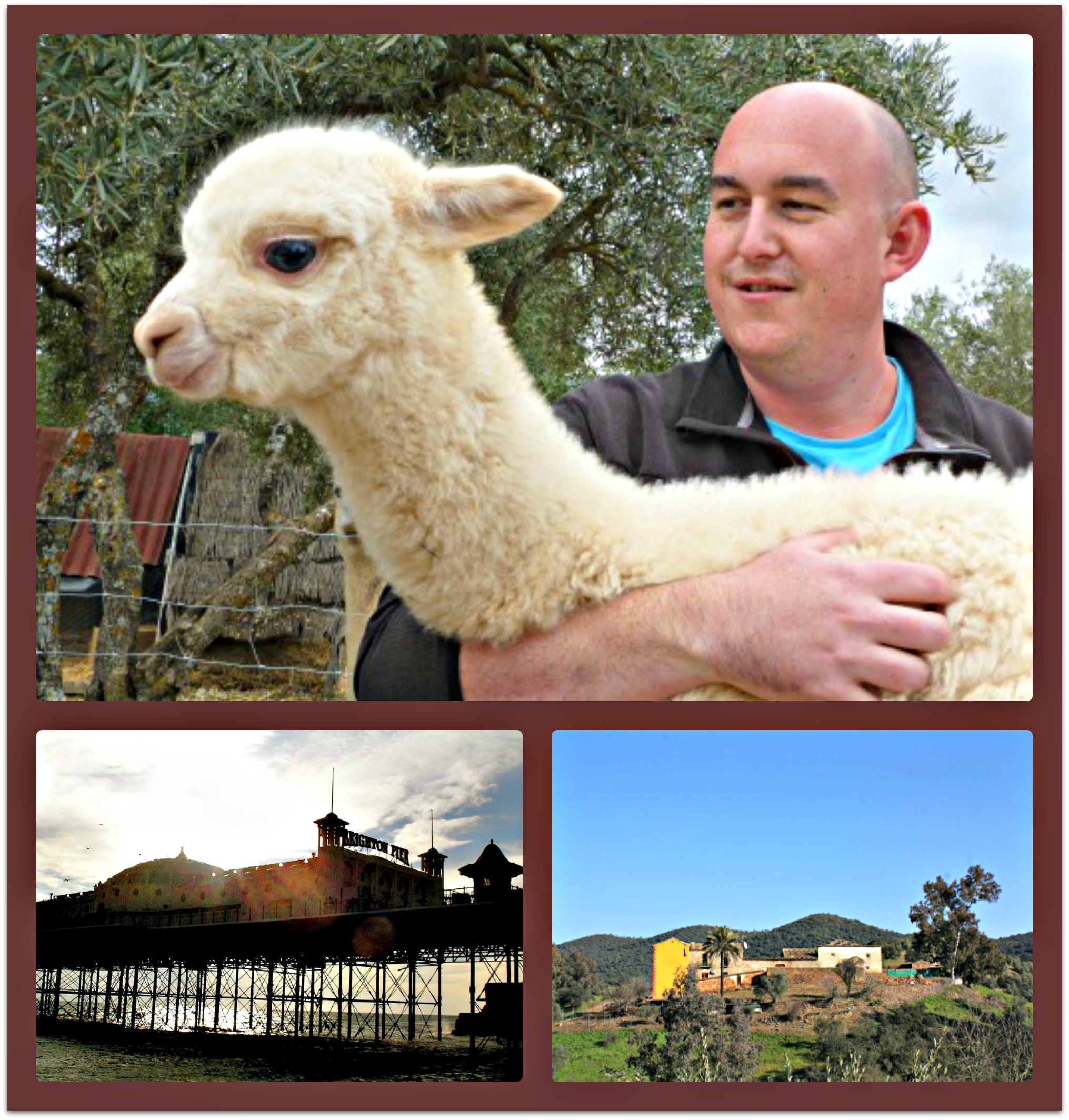
(Clockwise from top) Alan Parks with a friend’s alpaca; the converted olive mill where he and his partner, Lorna, now live; Brighton Pier, scene of their former abode (photo credit: Photo Monkey via Flickr Creative Commons).

The most amazing thing about the expat memoir penned by my guest today, Alan Parks, is not simply its title, though Seriously Mum, What’s an Alpaca? is quite a doozy.

It’s not even the zaniness of the alpacas that appear throughout the narrative: Bermuda, Cassandra, Lily, Baby Rafa… BTW, they are just a few among many animals Alan and his partner, Lorna Penfold, keep. (There’s a tally of how many and what kinds at the start of each chapter.)

No, the most amazing thing about Alan Parks’s memoir is that fellow expats, particularly fellow Brits (but also one German), are the villains of the piece—the least trustworthy of all the people he and Lorna have encountered on their madcap adventure. I say “madcap” as I think the decision the couple made, six years ago, to abandon their home in Brighton (in their native UK) for a renovated olive mill near Montoro in Spain’s Córdoba Province, which is within the autonomous territory of Andalusia, to raise alpacas justifies my choice of that adjective.

From the book’s beginning, Alan’s instinct is not to stick with the expat community—as he puts it:

I don’t think we would have mixed with many of these people at home, so we should not feel forced to by circumstances.

And boy does that instinct prove right! While the Spanish merely think he and Lorna are crazy (so far as they’re concerned, the British pair may as well be raising giraffes!), their fellow Brits are out to take advantage of them in all kinds of ways. And despite Alan’s better instincts, his limited Spanish at times gives him little choice but to get involved with some pretty unscrupulous characters.

Mind you, the Spanish don’t always come off well either, especially when it comes to their treatment of animals. In light of Mahatma Gandhi’s proclamation—

“The greatness of a nation and its moral progress can be judged by the way its animals are treated.”

—it would not be too far fetched to say that the animals are the book’s true heroes. They are what keep Alan and Lorna going in face of a seemingly unending series of challenges. In tribute, Alan gives various pets a voice at the end of occasional chapters. (It’s sad when they lose them, though.)

But the reason we are assembled here today to give Alan himself a voice in telling us about his book, which I urge you to read if you haven’t already. It’s done super well on Amazon for a reason: it’s terrific! And please LEAVE A COMMENT at the end of this post to be eligible to win a FREE COPY. (Alan has kindly agreed to give one of his books away: your choice of alpacas or donkeys! And there may also be prizes for runners-up!!!)

* * *

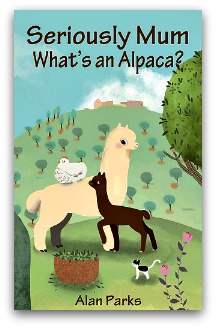
SeriouslyMumAlpaca_bookcover_dropshadowWelcome to the Displaced Nation, Alan! Between you and your partner, Lorna Penfold, you have produced three memoirs about your life in Spain. There’s the book we’re featuring today: Seriously Mum, What’s an Alpaca?. There’s also the sequel: Seriously Mum, Where’s That Donkey? And Lorna has just now published From Sequins to Sunshine: Year One. Tell me, what has made the pair of you so prolific?
The books were never planned. Two years ago, after being told many times that I should write a book about our adventures, I decided to give it a go. Seriously Mum, What’s an Alpaca? was the result. It started out being called Bloody Hell, What’s an Alpaca?—an exact quote for how Lorna’s daughter, Frankie, responded when we told her about our plans. But the use of the word “hell” hindered sales in the US. After I released the sequel, we thought people might like to read Lorna’s point of view. She had started a blog when we first moved here, so we turned her posts from the first year into an e-book. So far the reaction has been good.

What was the impulse that led to your packing it all in and moving to the South of Spain?
Lorna was a dance teacher in the UK and I used to work in retail. Lorna developed a condition called sarcoidosis, which made working difficult. One day we were talking about the possibility of her giving up work, and I suggested moving to Florida, but that was too far away. I blurted out “What about Spain?” Crazy really, as I had never ever been here.

Hey, craziness is what makes the world round! And how about this idea of raising alpacas, where did that come from?
We had heard about alpacas in the UK and thought that would be a good business for us to get in to (it wasn’t).

Okay, seeing as I know nothing about the alpaca business, what makes it so challenging?
An alpaca is not a cheap animal, yet you can’t eat it, and it doesn’t produce milk to drink. You make money by selling them to other breeders. But sales, and the selling price, have gone down since the world financial crisis.

What about their wool?
We try to sell as much of our alpacas’ wool as possible to local people who spin, knit and use it for crafting, but the market here in Spain is miniscule and postage costs prohibitive.

Do Spanish people think you and Lorna are crazy for your devotion to these animals?
People in Spain have never heard of alpacas. To a Spaniard, a goat is a much more useful animal.

Why do you still keep your alpacas if you’re not making any money on them?
For one there is no one to sell them to, and for two, they are part of our family and we love them. We also like it when people come and stay at our farm and can experience walking and feeding the alpacas. And finally, if there were no alpacas, there would be no books.

Ah, yes, the books. We’ll get to that, but first let me ask another alpaca question. The New York Times had an article last year talking about llamas being good pets. I think the alpaca is meant to be the llama’s quirky cousin. So is the same true of them?
It depends….they are no good if you want an animal to pet and stroke. But if you have an acre of land and you need the grass kept short, they could be good. Bear in mind, though, that they need to be kept in groups of at least three!

Out of the grey skies of England and into the frying pan of Spain

Moving right along to the weather: having been an expat in Britain myself, I can imagine you were keen to leave behind its grey skies and unpredictable climate. But were you aware that the interior of Andalusia, where you were headed, is the hottest area in all of Europe?
We didn’t find out about this area being called “The Frying Pan of Spain” until much further down the line. We were sorting some paperwork at the Spanish Embassy in London, and a lady said to us, “You do know they call it the Frying Pan of Spain, don’t you?” In the summer it can easily hit 45 degrees during the day. Siestas are a necessity.

Can you give us some sense of how you spend a typical day in your new life versus when you lived in Brighton?
In Brighton I was often out the door at 7:30 a.m. and got back home about 7:00 p.m. Lorna worked in the evenings, often not returning home until 9:00 or 10:00 p.m. Also, she had to work a lot of Sundays, so we never got to see each other. In Spain our life is much more relaxed. We spend our days looking after the animals and maintaining the house, and we are now together 24/7. You could say we went from one extreme to another.

I understand you met Lorna on the Internet. How long had you known each other before hatching this plan to live in Spain?
We had been together for four years and living together for three before we made the move, so we at least knew we could live together.

Did starting up a totally new life in a foreign land put a strain on your relationship or draw you closer?
I wouldn’t say our relationship has ever been strained, although as you can read in our books, we have been through some tough times together.

Be careful what you wish for…

Having read your book, I know there were quite a few moments in Spain when you felt like a bit like aliens, but which moment stands out as your most displaced, when you wondered if you’d made a mistake?
I think our “What are we doing here?” moment came after about 18 months. We had spent all our money with an English builder renovating our new house in the sun, and we experienced the worst Spanish winter rains for a hundred years. It turned out the builder was a conman and all the roofs he’d built started leaking. On top of that two of our alpacas died in the months before. I remember us standing in our kitchen as water cascaded from the ceiling. We were both in tears.

Wow, a literal “pool of tears” moment! But I know you also have things you love about your new life. Can you tell us about your least displaced moment, when you felt you were born to be in Spain’s Frying Pan rather than your native UK?
Andalucia feels like home to us now, although it is difficult to pinpoint the exact moment when we turned the corner. I think we are most aware of it when we are sitting outside having something to eat and drink with friends at 2:00 a.m. in the middle of August, wearing only a t-shirt. That is what life is about, not whether or not you can afford the latest version of the iPad!

Would you say you’ve assimilated to the point where returning to the UK gives you counter culture shock?
Lorna visits the UK regularly as she now has three grandchildren that weren’t even thought about when we first moved here. I have not been back for five years but will head back for a weekend in June to visit my relatives and attend a diamond wedding celebration for my grandparents. In all honesty, I am a bit nervous about it, I am not looking forward to being in crowds. Here in Spain we live in the countryside outside a small town and some days we do not see a single person. Plus in June, I only ever wear shorts and a t-shirt, but in the UK I may need jumpers (sweaters) and trousers.

An Amazon bestseller in Travel with Pets and Travel in Europe

Moving on to your e-books: why did you decide to self-publish?
I wrote my first book just as self-publishing was really taking off. I submitted the manuscript to one publishing house, got a thanks-but-no-thanks letter back, so decided to publish it myself.

Are there any drawbacks to self-publishing?
As a self-publisher, the hardest part is clicking the button to publish. A traditionally published author has that taken away from them, and even if they get mixed reviews they have the backing of the publishing house. We are responsible for everything, from cover, to content, to editing mistakes. If there are problems, or mistakes in the manuscript, that is our fault.

What audience did you have in mind for the book, and has it been reaching those people?
Initially I thought it would appeal mainly to other alpaca breeders, but I have had emails from readers all over the world who say they’ve enjoyed reading about our Spanish adventure. In fact, I was so overwhelmed by the response to Seriously Mum, What’s an Alpaca? I just had to write the sequel, Seriously Mum, Where’s that Donkey?

Your book has done very well on Amazon. Do you do a lot to promote it?
I run a FB group called We Love Memoirs, which has over a thousand members, all of whom enjoy books like mine. The best way to promote is by word of mouth. If somebody recommends your book to their friend, nothing beats that. As a self publisher I am actually against the Amazon Select program, where you make your book available exclusively on Kindle. My books are available on Amazon but also everywhere else: iTunes, Barnes and Noble, Kobo and even smaller retailers.

What’s next—more books?
I would like to release a third book this year, and Lorna has years 2 and 3 in her From Sequins to Sunshine series to work on.

How are the alpacas doing?
The alpacas are good, and if all is well, we may have some babies at the end of the year.

SONY DSC10 Questions for Alan Parks & Lorna Penfold

Finally, I know that both you and Lorna have become avid readers while living in Spain, so I’m curious to hear both of you answer a series of questions that I’ve asked some of our other featured authors, about your reading and writing habits:
1. Last truly great book you read: Alan: I’m not sure I have ever read a truly great book. The books I read tend not to get put in that category. Lorna: A Thousand Splendid Suns, by Khaled Hosseini. Alan: I also have read A Thousand Splendid Suns, but I didn’t have the same reaction Lorna did.
2. Favorite literary genre: Alan: Comedy memoir. Lorna: Everything except horror.
3. Reading habits on a plane: Alan: I haven’t been on a plane for six years. Before it would have been an old fashioned book, but now I would read on a kindle app on my phone. Lorna: Always a paperback (whatever I happen to be reading).
4. The one book you’d require PM Cameron to read: Alan: Mine, of course! I think it would do him the world of good to find out that people can be happy living a more simple life, with less materialistic ideals in life! Lorna: Mine of course, just to give him a look at a day to day life of a “normal” working class person.
5. Favorite books as a child: Alan: The “Adventure” Series, by Willard Price.
6. Favorite hero/heroine in fiction: Alan: Jack West Junior, who appears in a book series by Australian author Matthew Reilly. Lorna: Mariam from A Thousand Splendid Suns, by Khaled Hosseini.
7. The writer, alive or dead, you’d most like to meet: Alan: Peter Mayle. Lorna: Khaled Hosseini.
8. Your reading habits: Alan: I read in bed at night, and a lot in the summer. Lorna: I read lots in summer as we do not watch television at all then. Plus other times of course.
9. The book you’d most like to see made as a film: Alan: Anything by Matthew Reilly, it would be like Indiana Jones on speed. And my own book of course. Lorna: My partner’s book Seriously Mum, what’s an Alpaca?
10. The book you plan to read next: Alan: Escape to Mulberry Cottage by Victoria Connelly. Lorna: The next on the shelf, whatever it is!

* * *

So, readers, any COMMENTS or QUESTIONS for Alan? Hey, it’s not every day you get to discuss the world’s most captivating camelids! And don’t forget, there’s a free digital copy on offer…

And if you can’t wait to read the book or don’t win, Seriously, Mum, What’s an Alpaca? is available from Amazon(among other venues). Be sure to grab a copy! You can also visit its companion site, like the book’s Facebook page (and be treated to lots of cute alpaca pix!) +/or follow Alan on Twitter.

STAY TUNED for next week’s fab posts!<!–tomorrow’s post, when our fictional expat heroine, Libby, returns to the Displaced Nation to update us on her many adventures. (What, not keeping up with Libby? Read the first three episodes of her expat adventures.)–>

If you enjoyed this post, we invite you to register for The Displaced Dispatch, a round up of weekly posts from The Displaced Nation, with seasonal recipes, book giveaways and other extras. Register for The Displaced Dispatch by clicking here!

Related posts:

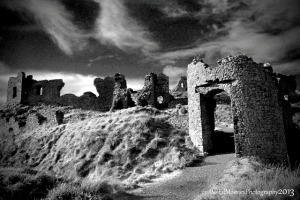
For this intrepid Irish “ruin hunter,” a picture says…

Ed Mooney 1,000 words Collage

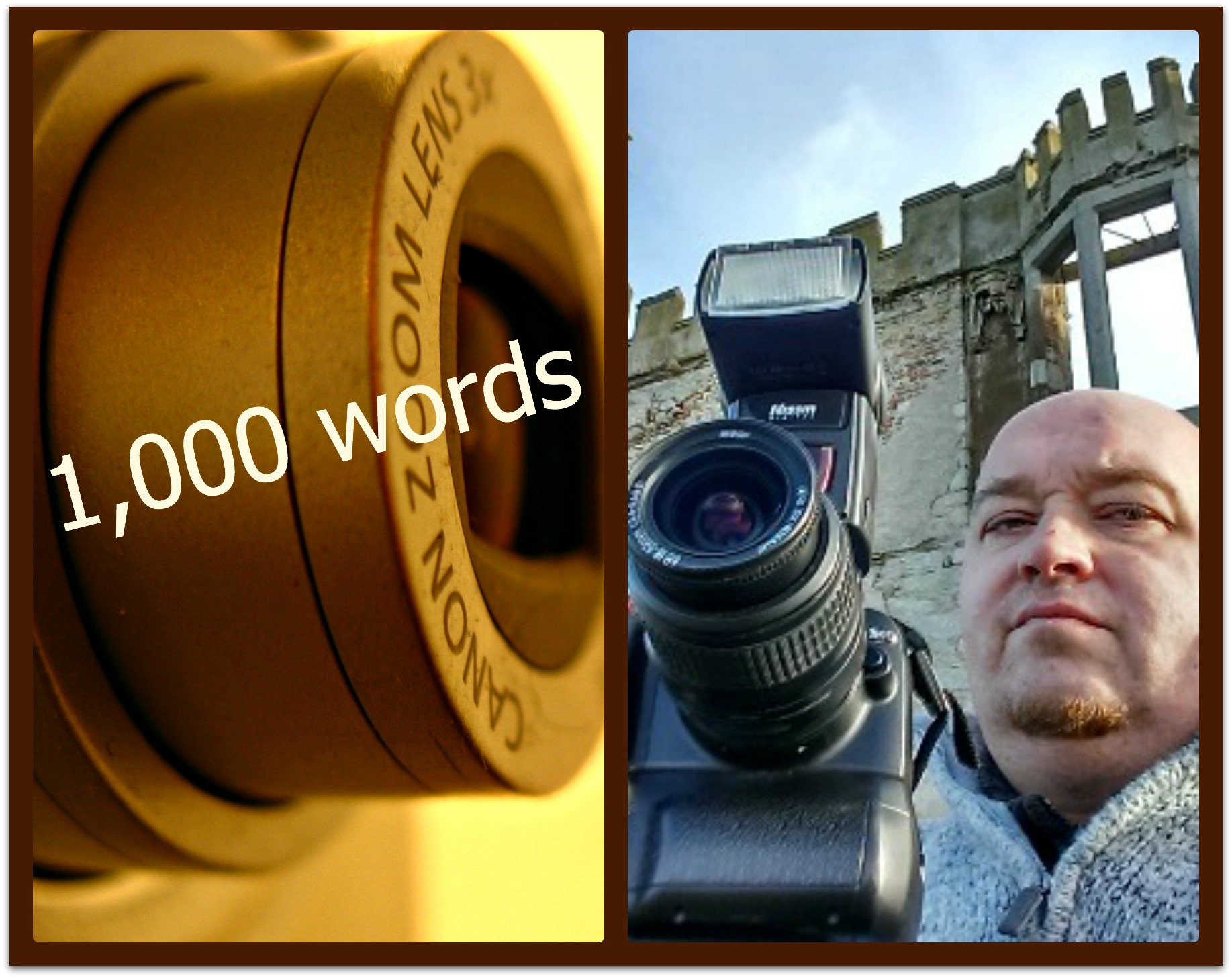
Canon zoom lens; photo credit: Morguefiles; Ed Mooney in front of the ruins of Ducketts Grove, County Carlow (photo credit: Ed Mooney).

Welcome to our monthly series “A picture says…”, created to celebrate expats and other global residents for whom photography is a creative outlet. The series host is English expat, blogger, writer, world traveler and photography enthusiast James King, who thinks of a camera as a mirror with memory. If you like what you see here, be sure to check out his blog, Jamoroki.

My guest this month is 38-year-old Irishman Edward (Ed) Mooney. His story is quite different from previous guests for several reasons, the main one being that he is not an expat. On the contrary, he travels within the confines of his native Ireland.

That said, Ed does cross boundaries, at least in a temporal sense. He loves nothing more than to immerse himself in an obscure historical site, exploring Irish history, lore and mythology while also photographing the surrounding ruins, to keep a record of what remains from generations past.

I really like the name Ed has given to his hobby: “ruin-hunting”. Ed tells me that ruin-hunting merges Past, Present & Future. By researching the history behind a place, he pays tribute to the Past. By writing about the experience, he brings it into the Present. And by posting his article, along with his photos, on his blog, he preserves his findings for the Future.

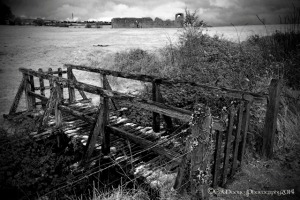
I have been following Ed for some months and love the way he weaves historic research into (mostly) black-and-white images.

* * *

Hi, Ed. Thanks for joining me at the Displaced Nation. I know you live with your young family in Kildare, but where were you born and what gave you the urge to travel around Ireland photographing ancient ruins?
I was born in Dublin, where I lived until flying the coop at 17. I moved to Kildare for work. I only got into photography seriously three or four years ago. With a young family, I don’t get to go abroad very often. But I am fortunate enough to travel within Ireland itself, which with its rich heritage offers an abundance of fascinating sights. And the crazy thing is, the majority of them are relatively unknown and rarely visited. It is these off-the-beaten-track places that I tend to concentrate on while traveling the country, attempting to capture them with my DSLR camera.

“I love everything that’s old…” —Oliver Goldsmith

You seem to have found an interesting niche. Can you tell us a little more about this “ruin hunting” hobby of yours?
It all started in 2011. I had just gotten my first DSLR and joined the local camera club, but had very little opportunity to get out and about shooting. I wasn’t into wildlife or landscape photography like some of the other club members. I guess I was searching for my niche, as you put it. One day a flyer came through the letterbox, which had an image of a nearby historical site called the Rock of Dunamase, in County Laois. Though I didn’t know it at the time, this was the beginning of what would become an obsession. A few days later, I located Dunamase and went exploring. Now, looking back at the photos, I cringe—but at the time I thought they were the best shots I’d ever taken. Around this time I had starting blogging and decided to post a brief essay on the history of Dunamase, along with the images. Next thing I knew, I was spending all of my spare time searching out new sites. Now that the kids are a little older, I have been able to take them on some of my trips. To date I have explored sites in nine counties with plans for many more over the coming months.

When you said “a flyer came through the letterbox…,” I immediately thought of a WWII fighter pilot. I would love to know more about what inspires you to spend so much of your spare time visiting historical places.
My inspiration comes from my deep love of history. In my early twenties, I joined what was then known as the Heritage Awareness Group, or HAG. We visited sites such as Newgrange, Tara and Baltinglass Abbey. Nowadays my favourite ruins are castles and Neolithic sites such as stone circles and cairns, although I am forever coming across many ecclesiastical sites which are interesting in their own right and make for some stunning shots. It’s quite hard to find the locations so I’ve created maps for each county, and make a point of recording every site I visit on my blog along with an interactive map showing the exact location to assist other travellers.

It’s great that you record your findings in so much detail and include exact locations in case others are inspired to follow in your footsteps. Ireland is a small country, unless you get lost. Tell us, where are you now, how did you end up there and what is life like in that part of the world?
We have been in Monasterevin, Kildare, for almost seven years now and absolutely love it. It’s a different way of life to Dublin. If I didn’t have to commute daily to the City to work, I would probably return there rarely. The great thing about Monasterevin, besides the relaxed atmosphere and close community, is that I am situated almost in the centre of Ireland. I can travel to any part of the country in two to three hours, which is great considering the amount of travelling involved in “ruin hunting”.

Rock of Dunamase. Photo credit: Ed Mooney

Rock of Dunamase. Photo credit: Ed Mooney

I’ve never been outside Dublin but I hear the countryside is beautiful. Other benefits are that you never run out of Guinness and you just won the Six Nations rugby! Thank you for sharing some of your photo shots which capture a few of your favourite memories. Can you describe the story behind them and what makes them so special?
These three are from recent shoots. The first, of the Rock of Dunamase, is a special place not just for the stunning views and fascinating history but also because it’s where my journey started.

Church ruins in Laois; photo credit: Ed Mooney.

Church ruins in Laois; photo credit: Ed Mooney.

The second photo is of another site I discovered in neighbouring Laois, which, with its stunning views, constitutes a ruin hunter’s paradise. This one is special on a personal level as well, being the first ruin I visited with all three children. In the chancel to the rear of the church is an old iron gate blocking the entrance to a vaulted mortuary chamber. Ryan, my eldest, had an interesting observation on the chamber: “Daddy, that’s where the Vampires live.” Now how the heck did he come up with that? Have you ever tried convincing an eight-year-old that something doesn’t exist?

Skryne Hill Church; photo credit: Ed Mooney.

Skryne Hill Church; photo credit: Ed Mooney.

The third is of the church that sits on Skryne Hill, the site of an early Christian settlement. To this day my memory of Skryne remains vivid. The tower is inaccessible due to a very heavy iron gate that on examination appeared to be rusted shut. I shone my torch through the bars on one of the windows. Inside were a number of interesting stone artifacts that I wanted to capture. So I set up my flashgun and shot through the bars. On the second or third flash something physically grabbed my camera strap and pulled it into the tower. It all happened so fast, but somehow I managed to pull that camera away from the window while shouting a few expletives. At first I wondered if it might have been a draft of some kind that had caught my strap, but it could not have been as I was pressed right up against the opening and there was no wind to cause a draft. Then I thought that maybe someone was inside, but there was no way for a person to get in or out of the tower. To this day I still can’t explain what happened. But it certainly left a lasting memory.

“Memory, in widow’s weeds, … stands on a tombstone.” —Aubrey de Vere

Great memoriesand that last story is quite eerie. But I suppose you would expect the odd ghost or two in buildings so old? Now, out of these many destinations, do you have any that stand out as your favorites?
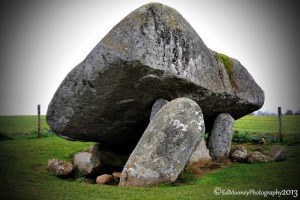
If you haven’t already guessed, old ruins are what attract my attention, be it a crumbling castle, a neolithic stone circle or standing stone, or an ancient church overgrown with ivy. Here are three of my favorite places:

Brownshill Dolmen, County Carlow; photo credit: Ed Mooney.

Brownshill Dolmen, County Carlow; photo credit: Ed Mooney.

Ballymoon Castle, County Carlow. Photo credit: Ed Mooney

Ballymoon Castle, County Carlow; photo credit: Ed Mooney.

Cillbharrog Church & cemetery; photo credit: Ed Mooney.

Cillbharrog Church & Cemetery; photo credit: Ed Mooney.

Can you explain why these particular places inspire you?
It’s kind of hard to explain but once I set foot on the site of an ancient monument, something about the atmosphere affects me, and a flip switches in my head. I feel as though I’m stepping back in time. The modern world disappears for a while and I get to experience something really special. With my photography I try to capture that experience and hopefully portray it to the viewer. Mood, atmosphere and a sense of the past are the most important elements for me to enjoy shooting at a location.

I can assure you, Ed, that, for me, you usually achieve it. Your photos make me feel as though I’m there, not you. I know people aren’t a part of your ruin hunting but I want to ask you all the same if you ever feel reserved about taking photos of people on your travels, particularly when they are conscious you are doing so?
I still enjoy getting out and doing some street photography from time to time and I have never really had an issue with shooting people, but then again I have had plenty of experience ranging from large events in Dublin down to small country festivals. I guess at the start I was a bit shy and unsure of how to approach shooting strangers, but once you learn how to engage with a subject it becomes fun. Some of the best shots I have taken were the result of strangers coming up to me wanting to have their pictures taken. Parades and street festivals are probably the best for doing this as everyone is relaxed and having a good time.

Do you ask permission before taking people’s photographs?
Most times I don’t have to. I find it amazing how people start posing once they see a camera in your hand. Obviously, with children you have to be really careful these days and should always get parental permission.

“Ireland’s ruins are historic emotions surrendered to time.”—Horace Sutton

Interesting—that last point would never be considered in Thailand, where I live. So would you say that photography and the ability to be able to capture something unique which will never be seen again is a powerful force for you?
Absolutely, I would say that most photographers constantly strive to get that once-in-a-lifetime shot. In my case the deeper motivation is to capture historic sites for posterity. As in many other countries, Ireland’s local and national heritage sites continue to disappear for good. Most people don’t care and the government is only interested in money. Take my home town of Tallaght, a suburb of Dublin. There were several castles in the area up until about 40 years ago. Now only a part of one remains. This scenario recurs with alarming regularity. So if I can capture the essence of a place before it is wiped away for good, I have done my job.

I see you use the word “job”. But I see it more as a calling and you, as a preservationist and historian. Either way you are doing an excellent “job”–one that incidentally reminds me of my last interview subject, Gaetan Green. He is trying to record China’s traditional landscapes before they fall to the forces of modernization. So when did you realize this deeper purpose?
Right from the start. The need to preserve the past was a major factor in motivating me to choose this path for my photography.

Now for the technical stuff at which I am far from proficient. What kind of camera and lenses do you use? And which software do you use for post-processing?
I still use my trusty Nikon D40 with kit lens. Yes it is outdated by today’s standards, but it has served me well over the last few years and taken a lot more punishment than it should have. I am planning to upgrade later this year and hopefully the D40 will be converted to shoot Infra Red, which is something I really want to experiment with. For my raw images ACR is a must, but my one stop shop for post processing has to be Photoshop. I currently use CS6 and it does everything I need. I still have various other programs sitting on my desktop but these rarely get a look-in.

Finally, do you have any advice for wannabe photographers who are traveling or living abroad?
If I was starting photography now I would say take the time to enjoy what you do and most importantly, research, research, research. Find out as much as possible about the place you are travelling to. Look at as many images of the place as you can, take inspiration from them and don’t go and shoot the same scene as everybody else. Look for a new angle or view. Don’t be afraid to get creative.

Thank you, Ed. It has been a real pleasure to interview you. Your story so far is fascinating. I say so far because I know one day you will run out of ruins in Ireland and you’ll be dreaming up your next historical project in places further afield.

* * *

Readers, what do you make of Ed’s experiences and his photography advice? And do you have any questions for him on his photos and/or experiences? Please leave them in the comments!

And if you want to know more about Ed Mooney, don’t forget to visit his excellent photography site. You can also like his Facebook page, follow him on Twitter, connect with him on LinkedIn, or shoot him an email.

(If you are a photographer and would like to be interviewed by James for this series, please send your information to ml@thedisplacednation.com.)

STAY TUNED for tomorrow’s post, the start of a brand new column on travel and fantasy writing, by Andrew Couch.

If you enjoyed this post, we invite you to register for The Displaced Dispatch, a round up of weekly posts from The Displaced Nation, with seasonal recipes, book giveaways and other extras. Register for The Displaced Dispatch by clicking here!

Related posts:

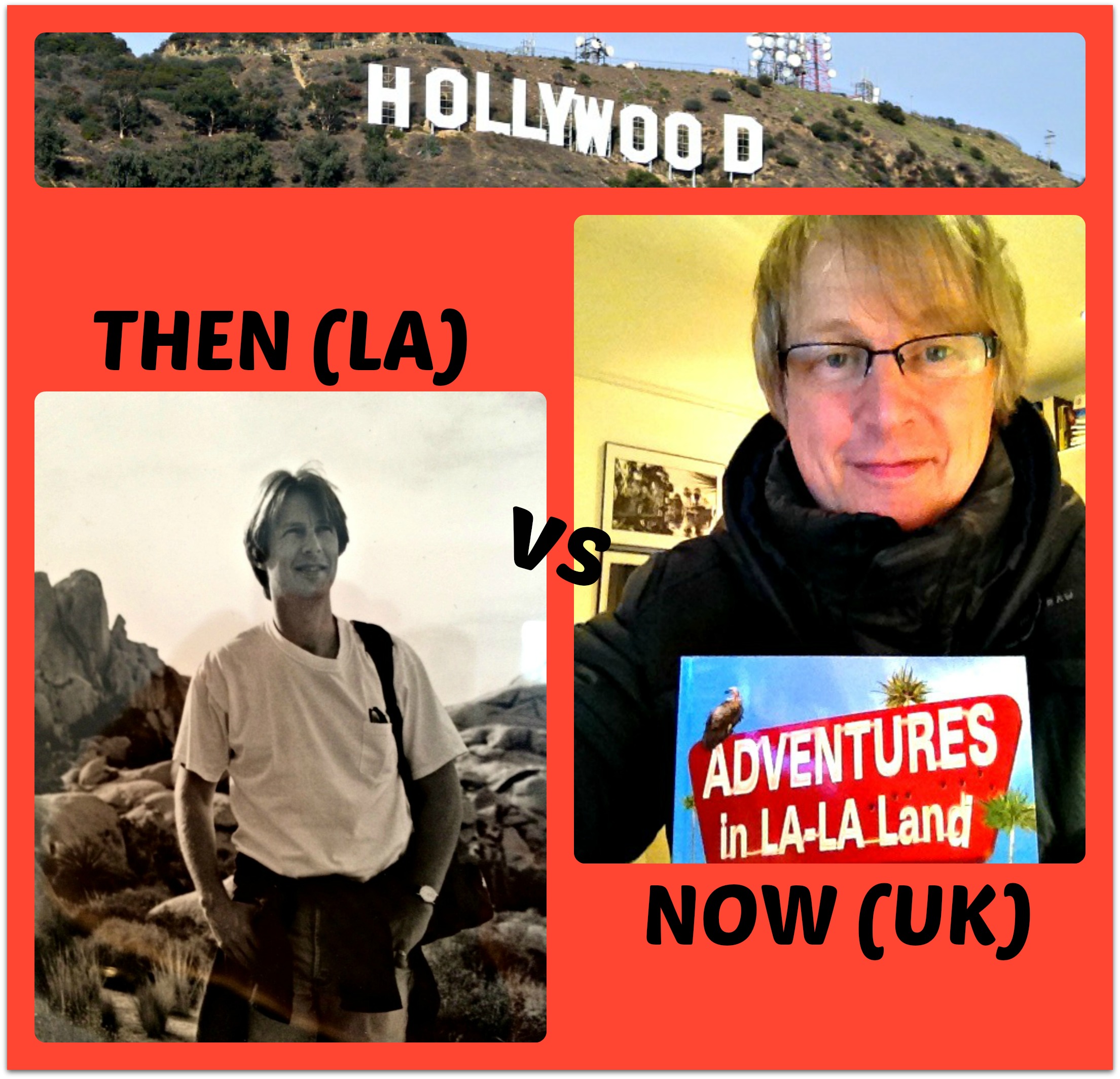
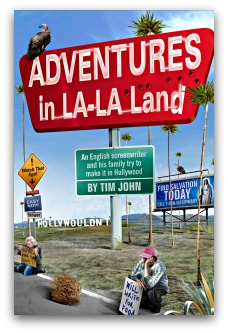
Does an expat life in Los Angeles ever go according to script? Read Tim John’s memoir to find out…

Tim John Hollywood CollageFor many of us, the calling to the expat life is not really a calling at all, but more of a vague (albeit rather deep-seated) need to escape our surroundings in search of adventure. We have no idea of what we’re looking for until we’ve arrived at a place and put down roots. Even then, we still have the mentality of drifters, and it take us a while to access our muses.

My guest today, the screenwriter Tim John, does not belong in that mould, as soon becomes clear from the first few pages of his new book, Adventures in LA-LA Land, an account of the seven years he spent in Los Angeles with his wife, Jenny, and their two young daughters.

You see, Tim plunged into his particular expat adventure with the script already written, both literally (he had a project in the works) and figuratively. Heading for Hollywood was Plan B after he lost his job with a London advertising agency during the recession of the early 1990s, and started dabbling in screenwriting.

The late Christopher Hitchens, another English writer who chose to be based in the United States, once described LA as a city “mostly full of nonsense and delusion and egomania.” But in the script Tim had written for himself and family, it was LA-LA Land—a place where they could have it all, great climate, a house with swimming pool, and (hopefully) big money.

So did Hollywood feed Tim’s creative muses (and fill his coffers) in the manner he expected? You’ll have to read the book to find out. I read it, and found myself surprisingly moved by the story of a man who lives for the movies. In fact, the pace can be likened to that of a roller coaster ride—fun but also harrowing at times.

On that note, it’s time to welcome Tim to the Displaced Nation to talk about his book. And just a heads up: Tim will be “screening” the comments for the person who leaves the best pitch for why they’d like to read it. That lucky individual will be under contract for a free digital copy!!!

* * *

AdventuresinLALALand_coverHi, Tim, and welcome to the Displaced Nation. Can you tell me why you decided to write a memoir about your years in Hollywood?
I’d read so many books about how to write a Hollywood screenplay, but never found one that also told you what it was like living there, so I decided to write my own, based on the seven years I lived there with my wife and two daughters.

Have you thought about turning it into an actual script for a movie?
I would love to turn it into a screenplay, too.

I understand you lived in LA from 1991 to 1998. I’m curious why you produced the book so long after the fact?
I’m not really sure why I waited so long to write it, possibly because I’ve been doing more and more teaching over the last couple of years and I’m often aware that students often don’t get taught important skills that are crucial to being successful as a screenwriter, such as being able to pitch and how to balance writing life with social life and family life. I thought that relating my experiences could be useful for others. If nothing else, they could learn from my mistakes as well as my successes!

In the end, the movie (of my life) was about…

Has your perspective on the experience deepened with time?
I suppose gaining some distance in time and geographically helped me to see Hollywood from a more objective perspective.

What impact did your writing about the experience have on you?
Definitely part of it was cathartic, to process the bizarre experience.

You worked in advertising for a while. When exactly did you catch the movie-making bug?
I worked a copywriter and then as a creative director—both of which are extremely useful if you want to go into film as they teach you so much about writing for a particular audience and how to write pithy dialogue and how to edit, etc. I always loved film mainly because it was such a great escape. As a kid, The Jungle Book was a big favorite. Mutiny on the Bounty and Lawrence of Arabia got me pretty scared, as did that spider in Doctor No!

Yes, I recall your mentioning in the book your fear of spiders when you found yourself face to face with a black widow at your house in LA. I’m still shuddering at the thought of being bitten by a brown recluse, by the way!

Was there a single epiphanic moment?

Your book is chockerblock with what we like to refer to on this site as “displaced moments” as a result of your encounters with not just deadly spiders but also shrieking peacocks, rats, snakes, and even some neighbors who believed in extraterrestrial burglars—and that’s before we get to the highly venomous creatures who populate the Hollywood film industry. Does any one moment stand out as your most displaced?
Wow. There were many moments when I thought “What on Earth am I doing in this bizarre place?” One that sticks out in my professional life was that time I went to pitch to Disney and the exec said “Great to meet you guys, we’re looking for some comedy writers” and I self-effacingly said: “Then you should meet these guys I play tennis with—they’re hilarious.” None of the execs could see I was joking and at the end of the meeting, the development girl took me aside, discreetly handed me a business card and said: “If you continue to have self-esteem issues, see my shrinkshe’s fabulous!”

That makes me think of Johnny Carson’s line: “In Hollywood if you don’t have a shrink, people think you’re crazy.” And I think the Northridge earthquake of 1994 displaced you and your family rather literally.
Yes, the whole house rattled and creaked for over forty seconds and there were waves in the pool.

Ah, the pool… You also talk about how much you loved the weather, having a pool, and taking drives to some fabulous scenery. Can you pinpoint your LEAST displaced moment, when you felt you were born to be in LA-LA Land rather than your native UK?
There were so many great moments. Personally, living in that sunshine, with a pool, a hot tub, etc., along with plenty of money and also plenty of free time (even though you’re constantly thinking of ideas to pitch), seems like a dream for anyone who’s come from the UK climate and ever struggled to make ends meet. It’s like living in a vacationuntil you realize it will all collapse if you don’t sell your next idea, and you’re going to have to sell it far sooner than you expected because the cost of living is very high, especially when you factor in things you’d never had to pay for before, such as earthquake insurance. Never forget that “writer” is only one letter away from “waiter”.

Professionally, when you get to chat with famous stars and talented directors and they take your comments seriouslythat feels unreal but also great. Probably the greatest moment for me was just before I moved to LA, being able to go to the tenth birthday party for George Harrison’s film company, HandMade Films. For anyone English, I think having a chat with a Beatle tops it all.

What did you and George chat about?
I’d worked on two screenplays for his company, so we talked about that. The funniest thing, I thought, at the company’s birthday party, was when George and Ringo joined the band playing on stage. If anyone requested they perform a Beatles’ song, George said: “I don’t know that one.”

In the end, the film was about spirit…

I understand you found LA a culture shock.
Wow, there are so many things that are culturally different about living in the UK and living in America, especially in Hollywood, which many Americans find totally unreal, too. Ones that really stand out: the almost constant sunshine for a start. The smog levels on bad days. The way so many Americans are so welcoming, where so many Brits can be snooty and suspicious. The way so many Americans are optimistic and so many Brits are pessimistic (or maybe more realistic than many film people). I never forgot that Hollywood has been described as “the only town where you can die of encouragement.”

I know you decided to leave LA in part because of your mother’s health and in part because of your daughters’ education. The family, particularly your daughters, didn’t want to go. What were the biggest adjustments?
Tiny parking spaces, terrible weather, high cost of living but a wonderful sense of humor. I did miss my irony in LA. We also hadn’t realized quite how much UK house prices had rocketed during the period when we’d sold ours to live abroad!

What do you think were the chief benefits you and your family derived from being Los Angelenos for a time?
I’m sure that our seven years in LA and coming home taught us all to adapt to change. My elder daughter had enjoyed an ice skating career in the US, which didn’t continue in the UK. But at least she learned that if you set goals and envision yourself achieving those goals, it will seriously boost your chances of success. The rest of us learned that you can probably have all the things you’d like in life—you just can’t have them all at the same time!

Looking back, what was your single most professional achievement during your time in LA?
Not one single thing; rather, it was learning the craft and how to work with industry people sufficiently well to be able get regular work from the studios (but not all the time!).

How do you make a living these days?
Right now, I’m rushing out to give six hours worth of lectures on dialogue to students at Bournemouth University. I also teach on and off about creative writing in general and about writing for advertising, at various universities: Bournemouth Uni, where I teach part of the MA in Advertising, at Southampton Solent, where I do some spots on Advertising and some on Screenwriting, to students at all levels, and at the Arts University in Poole, where I teach adult classes in all sorts of writing. But teaching is just part-time. I also do some freelance copywriting. And most of my time goes into writing screenplays still!

Do you still feel like a Los Angeleno in some respects?
Only in that I have several great friends in LA and I feel totally at home with film industry people. I probably see myself as neither totally British any more or completely Californian. I’m obviously some sort of mongrel.

Writing for publication: A different animal?

Moving back to the book: what was the most difficult part of the writing process?
The hardest part was the guilt I occasionally feel for what I see as building up all the family’s hopes by showing them a few years of a dream lifestyle, then waking them up from that dream by saying we have to go back to the harsh reality of living back in the UK. BUT, as mentioned, the family all feel really lucky to have had those seven great years and have made all those extra friends without staying away from their old friends and family for so long they felt like strangers. (That’s what they tell me anyway. I have an extremely supportive family!)

Why did you decide to self-publish?
Because I’d had two books published by a big publisher many years ago and never felt they did much to promote them. My agent said most publishers only push big brand names and my wife had a friend who did very well self-publishing a memoir, so I thought I’d give it a go.

What audience did you have in mind for the book, and has it been reaching those people? Is it mainly for wannabe British scriptwriters like yourself, or do you think it has broader appeal—for instance, to any Brit who might be thinking of living in America?
I hope the book will appeal to anyone who likes a laugh, to anyone who is interested in a family fish-out-of-water story and to anyone who wonders how you can make it in the film business. There’s plenty in there about the American school my wife taught in, the ones the kids went to, about my eldest daughter making it as an ice-skating champion… It’s by no means just about the movies, but, as I mentioned earlier, it will show you far more about how to make it as a screenwriter than books that simply tell you about the script, the formats, and nothing else.

Of all the advice you transmit to wannabe Hollywood screenwriters, which is the most important?
Make sure you enjoy the writing process as much as possible. Don’t pin everything on whether you sell it or it gets made. Enjoy the small triumphs, such as writing a great scene or even a great line of dialogue. All the little triumphs can add up into a pretty rewarding experience. And never forget that you may well learn more from your mistakes than from your successes.

What’s next for you in terms of creative projects?
I’ve just finished a UK thriller “Living in Sin”; I’m currently doing a re-write for a sci-fi project for a Californian director, and I have a UK drama that I wrote written with a writing partner, Jon Rolls, for which the producers have just this week started looking for a top director and cast—I’m still going for it!

10 Questions for Tim John

Finally, I’d like to ask a series of questions that I’ve asked some of our other featured authors, about your reading and writing—and in your case, also film-watching—habits:
1. Last truly great book you read / film you watched: Paper Towns, by John Green; The Way Way Back (2013), directed by Nat Faxon and Jim Rash.
2. Favorite literary / film genre: It varies enormously but I’d say “comedy drama” for both (eg, Little Miss Sunshine).
3. Reading/film watching habits on a plane: I only ever read paper books and magazines. Generally I watch films on long flights—but nothing involving flights in danger. I’m a nervous flyer. I can never sleep.
4. The one book you’d require President Obama to read, or film you’d require him to watch, and why: War and Peace, so he’s fully aware what Russians can do if stirred up. No films to recommend—I’d rather he kept his eye on world news!
5. Favorite books/films as a child: The Secret Garden; The Jungle Book and Bond movies and then Paper Moon when I was slightly older. Also the musical Oliver.
6. Favorite hero/heroine in fiction/film: Heroines: Victoria Wood as a writer; Kathy Bates as an actress. Heroes: No book heroes apart from Bilbo Baggins (when I was ten); in film, the cheeky little boy in Cinema Paradiso and later Léon in the film of that name.
7. The writer, alive or dead, you’d most like to meet: Woody Allen, as I’m nearly always amazed at how inventive he can be and how, against the odds, he so frequently gets cross-genre movies to work, certainly during his Crimes and Misdemeanors period.
8. Your reading/film-watching habits: I don’t read that many books as I find it hard to give authors the benefit of 50 or 60 pages to get into it. I far prefer books that grab me almost immediately, but with their style and outlook on life, not with purely mechanical plot like Dan Brown or John Grisham. I find those stories generally too thin to keep reading. I frequently start books and leave them if they don’t hold my interest. As far as films go, I go to the cinema at least once a week. I also watch endless boxed sets: generally US drama such as Breaking Bad, The Sopranos, The Wire, House… I really got into The Bridge and Spiral. My worst DVD marathon took place in the early series of 24, when I watched 13 episodes over a single weekend.
9. The book you’d most like to see made as a film: On Mermaid Avenue, a great American novel that I’ve optioned and written a screenplay from.
10. The book you plan to read next / film you plan to watch next: The Fault in Our Stars, by John Green; currently, I don’t have any films I’m looking forward to watching.

* * *

Bravo, Tim! If we ever host the Displaced Oscars, something we’ve been threatening to do for some time now, you’ll definitely be receiving a statue.

So, any COMMENTS or QUESTIONS for Tim, or PITCHES for why you’d like to read the book? Don’t forget, there’s a free digital copy on offer…

And if you can’t wait to read the book or don’t win, Adventures in LA-LA Land is available from Amazon. Be sure to grab a copy! You can also visit Tim’s writer site, like his book’s Facebook page +/or follow him on Twitter.

STAY TUNED for next week’s (month’s) fab posts!

If you enjoyed this post, we invite you to register for The Displaced Dispatch, a round up of weekly posts from The Displaced Nation, with seasonal recipes, book giveaways and other extras. Register for The Displaced Dispatch by clicking here!

Related posts:

This expat arrived in the tropics without any saucepans—but then cooked up a potboiler of love, horror and adventure!

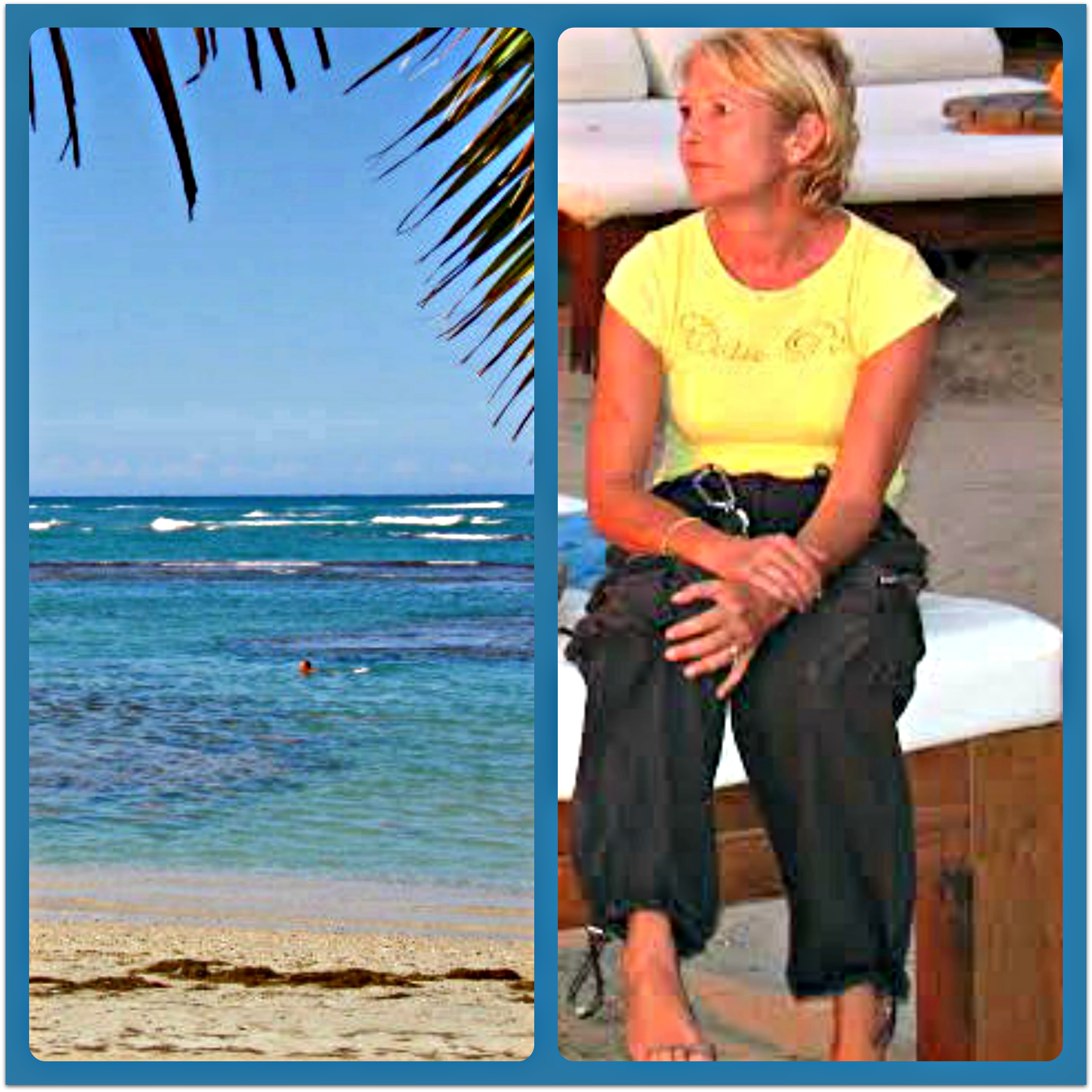
LDF in DR Collage

Las Mameyes, Puerto Plata, Dominican Republic (Morguefiles); Lindsay de Feliz (her own photo).

My guest today, the author Lindsay de Feliz, was scuba diving in the Maldives when one night she found herself on a tiny island in the middle of the Indian Ocean gazing up at the stars, the warm water lapping up against her toes.

She thought about life, love and the meaning of the universe. And then she had an epiphany: she no longer wanted the life she had made for herself in the UK. She would leave her husband of ten years, her cats, her house, her cars and her successful career, and buy a one-way ticket to Paradise (she hoped).

“What about your saucepans?” her mother responded upon hearing of this momentous decision. Possibly she was thinking her daughter had gone potty, but instead of saying that, she talked about the set of expensive pans she and Lindsay’s father had bought her for her birthday and Christmas the previous year.

Lindsay did not pack her saucepans and, when she accepted a job as a diving instructor in the Dominican Republic, was glad she didn’t—especially once she’d settled down with her Dominican boyfriend, Danilo. His son, who lived with them as well, had a habit of throwing pans in the bin because he didn’t like washing them.

Yet her mother’s question stuck in her mind, and she decided to write a memoir called What About Your Saucepans?, which was published last year.

I am thrilled to have the chance to talk to Lindsay about this memoir today, which I found an extraordinarily gripping read. Although Lindsay finds her pot of gold in terms of a man who loves her and a life on her own terms, it all goes to pot at a couple of points. And how she copes with these setbacks is as interesting as anything she has to say about the details of life within the country that has the distinction of being the most visited in the Caribbean (though her account of Dominican life is compelling, too).

And now, before we start, can you hear me banging on a saucepan as I yell out: BE SURE TO LEAVE A COMMENT; YOU’LL HAVE A GOOD CHANCE OF WINNING A DIGITAL COPY!

* * *

Saucepans-Cover_pmHola, Lindsay. ¿Que lo que? Can we start, please, by having you tell us what prompted your decision to write a memoir after a decade of living in the Dominican Republic?
I used to send monthly emails to friends and family about what I was doing and many of them said that I should write a book. I know people often say this, but the longer time went on the more the idea started to grow on me. However, the major prompt was when I was shot by a couple of burglars I’d apprehended at the gate to my home. The bullet passed through my throat and then went straight through my right lung. I made it to the local hospital being carried, then draped over the back of a motorbike, and eventually in a car. After a botched tracheotomy, I was taken to a hospital in the capital, where they put in chest drains. I went home after 12 days.

Wow! So being shot was what motivated you to write about your expat life?
There were lots of things I couldn’t remember about the incident—to this day, my recollections of it are a bit fuzzy—so I asked those who helped me what happened, and then wrote it all down. That became a chapter in the book, and then I filled in before and after.

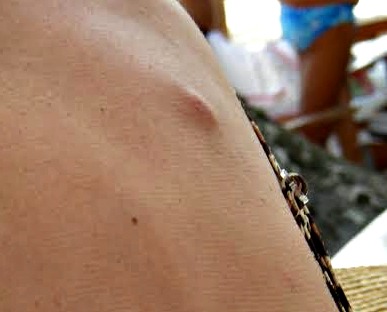
C5 Bullet stuck in my back 2 weeks after the shooting

The bullet went through Lindsay’s lung and got stuck in her back. Here it what it looked like two weeks after the shooting (Lindsay’s own photo).

Did you ever think of writing a novel instead? I ask because your memoir almost reads like a novel. I felt as though I get to know all the characters and missed them when I put the book down.
No, I never thought about writing a novel—my life was like a novel!

I understand the life you left behind in the UK was somewhat more mundane. Can you describe a typical day?
Typically, I would drag myself out of bed at around 5:30 a.m. in the dark. Get showered and dressed in a power suit making sure high heeled shoes and jewelry matched. Wrap up warm and walk 20 minutes to the train station. Train to Central London. Tube to the city. Another tube to Canary Wharf. Total journey time around two hours assuming no delays, which there often were. Work out in the gym and then walk or train to the office. Work all day long, maybe lunch at The Ivy with agencies or journalists, then the same journey home again, getting home around nine and falling into bed to do the same thing the next day.

What was the trigger (so to speak) that made you decide to pack it all in and become a scuba diving instructor?
I adored scuba diving in tropical places and managed to go a few times a year and it just seemed daft to work so hard to pay to go diving when I could dive all the time and earn enough to live off doing something I loved.

How did you end up in the D.R., of all places?
I started off in the Maldives, then went east to Asia, found it impossible to obtain work permits so ended up in Menorca, an island in the Mediterranean belonging to Spain. I decided I should learn Spanish as I already spoke French and German (as an instructor, the more languages you can speak the better). I wanted to get back to the tropics and a job came up in the Dominican Republic, so off I went.

Every pot will find its lid

February is a month for celebrating romance and love. How did you meet Danilo, the Dominican man who became your second husband?
I had seen him around, but I wasn’t even thinking about a relationship. My plan was simply to learn Spanish then head for Costa Rica and work as an instructor there as the diving was supposed to be excellent. One night at a bar Danilo was there and offered me a lift home on his scooter.

Was it love at first sight?
No, although he was seriously cute. But once Dominicans decide that you are the one, they are like Rottweilers and never let you go! He pursued me with a vengeance.

Lindsay&family

A happy family, Caribbean style: Lindsay with her husband, Danilo, and two sons.

Your courtship led to a ready-made family (his kids) and marriage. Was that a difficult decision?
Not at all. Danilo moved in with me after a couple of weeks courting—as I said they move fast, and as soon as he moved in I was called his “wife” (the vast majority of Dominicans don’t actually get married they just live together but are known as husband and wife). He moved his three children in a week later. We were like that for three years, so most of the big cultural adjustments had already taken place—and there were many, which I discuss in the book. He gave me what I wanted in terms of doing everything to make me happy and to make my life easier, and most of all he made me laugh.

But isn’t “happily ever after” particularly challenging for those of us in cross-cultural marriages?
I must admit, due to the fact we were from such different backgrounds I doubted that we would ever become soul mates, in the way you dream of as a child. However, over the past couple of years—we have now been together for 12 years—he has become my media naranja, as they say here—my half an orange—and is totally my soul mate, my best friend and more. Much I think is due to fact that he is now at university, so we have more “intellectual” conversations, and my Spanish is now much more fluent than it was in the early days. We still laugh all the time and I could not contemplate life without him.

If ifs and ands were pots and pans…

Looking back over the decade you’ve lived in the Dominican Republic, what was your most “displaced” moment: when you thought, what’s a nice girl like me doing in a place full of superstition, political corruption, thievery, and the many other cultural quirks you mention in your book?
You are right, there are many—so many I don’t know where to start. Maybe squatting down to have a pee in the sugar cane fields, taking photographs of dead people in their coffins as their families wanted a picture and had no camera, going into a store and being asked to wait while they catch a rat, going to a jail to get prostitutes out, delivering a baby to a Haitian women on the mud floor of her hutand of course having been shot, which, although I didn’t realize it at the time, meant being taken to hospital draped over the back of a motorbike because there are no ambulances or emergency services where I live.

Goodness, that’s quite a selection! Can you also pinpoint your LEAST displaced moment, when you felt you were much more comfortable living in that place than in your native UK?
I feel like that every day now as I have become totally adjusted to Dominican life. Dominicans call foreigners like me aplatanado—literally, “like a plantain banana,” signifying we’ve become one of them. Nowadays I don’t care what I wear, no make up, material possessions are not important, I don’t get annoyed if the car is scratched—a whole different set of values to those I had before. Instead of dragging myself out of bed, I leap out, happy to see what the day has to bring. I go downstairs and look across at the mountains and watch the sun rise drinking fabulous Dominican coffee. I have never been happier. I talk in the book about my search for joy. Those moments of pure joy that you experience occasionally. Now here I have them every single day. No one could ask for more.

Could you ever live in the UK again?
No, I could never live in the UK again. In the D.R., there are very few rules, which, while it does give rise to some problems, also means one has the freedom of being able to park wherever you want, smoke a cigarette where you want, not wear a seat belt if you choose not to, and so on. I love that. Also, in the UK, Danilo and I have experienced racism—groups of youths making monkey noises on the trains—because I am white and he is brown. I could never ask him to suffer that. Here we have never been made to feel uncomfortable.

Does your husband feel the same way?
My husband loves the organization in the UK, the fact that people queue, the lack of litter in the street and the trains. But even if we did want to live in the UK, we couldn’t as the new immigration regulations mean that I would have to earn a salary I could never earn, and he would have to speak pretty fluent English, which would be very hard for him.

Panning for a publisher

Moving on to the book: what was the most difficult part of the writing process for you?
The first draft was easy. I tend to think for days about what I want to write—in bed before I go to sleep, when I am walking the dogs… I wait and wait and wait until I am bursting to write it down. It is so satisfying when you actually write then. Just like when you eventually find a toilet when you have been dying for a pee for ages. The hard bit was changing it to incorporate what the publisher and editor wanted. They wanted me to write much more dialogue, which I found hard, and to talk about things I didn’t really want to talk about. I didn’t want to hurt anyone, and in a memoir you really need to tell the truth. They were right, of course, and the book was much much better as a result; but it was difficult for me to describe all of the emotions.

You published with Jo Parfitt of Summertime Publishing. How did that happen?
The path to publishing was not an easy one. I wrote to literary agents and publishers, and some said no and others told me to get it edited and then resubmit—which I did, but it all cost money. I think in some instances they were just helping out their editor mates as they all said no even after I resubmitted it. In the meantime, I’d started a blog of the same name, which began to build me an audience ready for when the book came out. In the end I found Jo Parfitt, who directed me to a great editor, Jane Dean. Between them they knocked me and the book into shape.

What audience did you have in mind for the book, and has it been reaching those people?
Originally, I had in mind people who were interested in the Dominican Republic. Yes, it has been reaching them, but it is constant work to make sure you find them and tell them about the book. Luckily, the reviews have been fabulous and those who read the book have said that everyone should read it, not just those who like the DR.

I agree, I think it appeals on many levels, not just to those with an interest in the Caribbean.
Thank you for saying that. Apart from being about life in the Dominican Republic, it’s a love story, a horror story, it has adventure, and I like to think that it might make some people reevaluate their lives and what is important to them.

Do you have any advice for others who are writing memoirs and hoping to publish them?
Firstly, write the memoir. Do it. It is great fun and also cathartic. Never stop writing at a point where you are stuck or it takes ages to pick it up again. Stop when you know exactly what you want to write next. I would also say don’t give up when you are looking for a publisher, just keep at it. It must have taken me over a year at least to find Jo. And when I did she set me targets to achieve, which gave me a purpose and a goal. You must also be honest with yourself as to whether people will be interested in your story and what it can do for them, not just what it might do for you. And finally, don’t be arrogant and precious when your editor and publisher suggest changes. They know the market a million times better than you. Take their suggestions on board. In the end it will produce something much better than you could on your own.

10 Questions for Lindsay de Feliz

Finally, I’d like to ask a series of questions that I’ve asked some of our other featured authors, about your reading and writing habits:
1. Last truly great book you read: In the Time of the Butterflies, by Julia Alvarez, a historical novel about the Mirabal sisters, who opposed the dictatorship of Rafael Trujillo in the Dominican Republic.
2. Favorite literary genre: Murder mystery
3. Reading habits on a plane: I haven’t been on a plane since Kindles and such like came out(!). But I used to read novels—the latest Patricia Cornwell or Tom Clancy—which I would buy at the airport.
4. The one book you’d require President Obama to read, and why: Mine. Because I know he would enjoy it, it would make him smile and help him to understand all of the Dominicans in the USA. He would also enjoy the part about Dominican politics. I can just see him reading bits of it to Michelle in bed in his stripey pajamas and them both laughing.
5. Favorite books as a child: Enid Blyton‘s The Famous Five series; the What Katy Did series by Sarah Chauncey Woolsey, under her pen name Susan Coolidge; Heidi; and books about horses and ballet dancers. As I moved into my teens I loved Georgette Heyer books.
6. Favorite heroine: Lisbeth Salander in The Girl with the Dragon Tattoo
7. The writer, alive or dead, you’d most like to meet: This is someone who hasn’t yet published a book so I hope that counts: Aisha Ashraf. Her writing simply blows me away and I could never write like she does. I am a story teller and she has a way of touching your heart. I would love to meet her one day.
8. Your reading habits: I don’t read as much as I would like now. However, when the electricity goes off (which it does here quite a lot) I grab a book and devour it. I also read books online by other Summertime authors which they send to me.
9. The book you’d most like to see made as a film: Mine again! I know it would make a great film. My dream is to go to the Oscars. I just need to make it happen.
10. The book you plan to read next: Linda Janssen’s The Emotionally Resilient Expat. She is another Summertime author, and I am really looking forward to getting into this one.

* * *

Thanks so much, Lindsay. Readers, what I love about Lindsay is her attitude. Some of us might think that she went out of the frying pan (a life she could no longer stand in the UK) and into the fire (getting shot in the Caribbean), but she doesn’t see it that way at all. In fact, as she explains in the book, after surviving the shooting, she has even more purpose in life and even more devotion to her adopted home.

So, any COMMENTS or QUESTIONS for Lindsay? Do you think you would react in the same way to hardships?

And don’t forget, there’s a copy of the book to be won for the best comment! NOTE: If you can’t wait to read the book or don’t win, What About Your Saucepans? is available from Amazon, Apple iTunes, Kobo and Barnes and Noble. And you can also start following Lindsay on her blog, of course!

STAY TUNED for tomorrow’s post, another episode in the life of our fictional expat heroine, Libby, told from the point of view of her husband, Olivera rare treat! (What, not keeping up with Libby? Read the first three episodes of her expat adventures.)

If you enjoyed this post, we invite you to register for The Displaced Dispatch, a round up of weekly posts from The Displaced Nation, with seasonal recipes, book giveaways and other extras. Register for The Displaced Dispatch by clicking here!

Related posts:

2013 Holiday Special: Notable books for, by and about expats

Looking for last-minute gifts—or have your holiday celebrations brought you to the point where you might need an escape for yourself?

In the tradition of looking back at the past year’s highlights, I present, on behalf of the Displaced Nation team, a list of books for, by, and about expats that were featured in some way on this site in 2013.

Click on the category that interests you:

  1. FICTION
  2. MEMOIRS
  3. HANDBOOKS & GUIDEBOOKS
  4. COOKBOOK (singular because we have only one!)
  • Books in each category are arranged from most to least recent.
  • Unless otherwise noted, books are self-published.

Go on, download a few! It’s the time of the year to be generous to one’s fellow human beings. That said, on the Displaced Nation it’s always the season to support the creative output of those who’ve embraced the life of global residency and travel.

* * *

Fiction

Shemlan Ebook_coverShemlan: A Deadly Tragedy (November 2013)
Author: Alexander McNabb
Genre: International thriller
Synopsis: The third in McNabb’s Levant Cycle, Shemlan tells the story of a retired British foreign service officer who, dying from cancer, returns to Beirut in hopes of meeting the Lebanese love of his youth one last time. But then his past catches up with him, threatening to do him in before the disease does—until British spy Gerald Lynch gallops to the rescue…
Expat credentials: Born in London, McNabb has lived in the Middle East for more than a quarter century. He often receives praise for getting the historical and cultural details right in his books.
How we heard about: We encountered McNabb a year ago when we were doing a series of food posts! We love his books and are giving away Shemlan this month, as well as doing an offer for Displaced Dispatch subscribers on all three books in the cycle. Check it out!
ImperfectPairings_cover_pmImperfect Pairings (May 2013)
Author: Jackie Townsend
Genre: Women’s fiction
Synopsis: American career woman Jamie had not intended to fall in love—and to a foreigner no less, a man who tells her his name is Jack, short for John, but it’s really short for Giovanni. Insanely handsome and intense but unreadable, Giovanni has left a complicated family life back home in Italy. Is this more than Jamie signed up for?
Displaced credentials: In real life, Townsend is married to an Italian and has spent 16 years backing and forthing to her husband’s family in Italy.
How we heard about: ML Awanohara, who rightly or wrongly considers herself something of an expert on cross-cultural marriage, read the book on her Kindle and was so impressed with its depiction of cross-cultural relationship woes that she asked Townsend to be our featured author of November. Read the interview.

SuiteDubai-cover_dropshadowSuite Dubai (April 2013)
Author: Callista Fox
Genre: “New adult” lit
Synopsis: As Callista tells it, the book grew out of a story that entered her head that wouldn’t go away: “There was this girl, young, vulnerable, naive, walking along a concourse in an airport, among men in white robes and checkered scarves and woman in black gauzy material. Where was she going? What would happen to her there?”
Expat credentials: Fox moved to Saudi Arabia when she was eight and lived there off and on until turning 19. She went to boarding schools in Cyprus and Austria. Now back in the United States, she thinks of herself as an adult Third Culture Kid, or TCK.
How we heard about: Noticing our fondness for serial fiction (see Kate Allison’s book below), Fox sent us a note saying she’d written a serial novel reflecting her experience of growing up in the Middle East. We responded by asking if we could publish her series in even smaller parts. Part 1 and Part 2 have already gone up, and there are six more parts to come in 2014. Warning: Highly addictive!
Libby'sLifeTakingFlight_coverLibby’s Life: Taking Flight (April 2013)
Author: Kate Allison
Genre: Women’s fiction
Synopsis: 30-something Libby Patrick is just regaining some post-baby control over her life when a change in husband’s job means they must move from their English home to Woodhaven, a town in rural Massachusetts. The book is Libby’s journal covering the first year of her life as trailing spouse.
Expat credentials: Born and raised in Britain, Kate has lived in the United States with her family for almost two decades.
How we heard about: We were the first to know! Kate is a founding member of the Displaced Nation and has been publishing regular episodes of Libby’s Life (on which the book is based) since the blog began. She has accrued countless fans, the most faithful of whom is Janice. (Libby to Janice: xoxo for your support in 2013!)

APlaceintheWorld_coverA Place in the World (March 2013)
Author: Cinda Crabbe MacKinnon
Genre: Romance
Synopsis: Third Culture Kid Alicia meets a young Colombian man at college in the United States. She follows him to Bogotá and the pair end up marrying and settling on his family’s remote coffee finca (farm) in the Andes. Educated as a biologist, Alicia revels in the surrounding cloud-forest. But then her idyllic life starts to unravel…
Expat credentials: Crabbe MacKinnon grew up in several countries as a military brat and diplomatic kid and, though she has since repatriated to the United States, still thinks of Latin America as home.
How we heard about: Crabbe MacKinnon commented on one of Elizabeth Liang’s “TCK Talent” posts and ended up becoming October’s featured author. Read the interview. We love her and her work, and are sure you will, too!

CoffeeandVodka_coverCoffee and Vodka (March 2013)
Author: Helena Halme
Genre: Women’s fiction
Synopsis: A Finnish family emigrate to Sweden in the 1970s and find themselves in turmoil, caused partly by the displacement, but also by the cracks in family dynamics. At its heart, the book reveals what it is like for a young girl to be uprooted and transplanted to a country where she doesn’t speak the language and is despised for her nationality.
Expat credentials: Halme grew up in Tampere, central Finland, and moved to Britain at the age of 22 via Stockholm and Helsinki, after marrying “The Englishman” (how she always refers to him on her blog, Helena’s London Life). She spent her first ten years in Britain working as journalist and translator for the BBC. She and The Englishman now live in North London.
How we heard about: Halme is a big favorite of ours! She was one of our earliest Random Nomads as well as serving as an expat style icon back in the days when we covered fashion. More recently, Kate Allison reviewed Halme’s first book: The Englishman: Can Love Go the Distance?, and we did a giveaway of Coffee and Vodka. And that’s not all: Halme’s latest book, The Red King of Helsinki, received an “Alice” Award in July. (As noted then, the Alices could hardly ignore a book of that title!)

MonkeyLoveAndMurder_dropshadowMonkey Love and Murder (February 2013)
Author: Edith McClinton
Genre: Adventure mystery
Synopsis: A jungle environment in Suriname (spider monkeys and all) is the setting for a closed-door mystery surrounding the death of the renowned director of the International Wildlife Conservation followed by the machete murder of one of the researchers. None of this bodes well for poor Emma Parks, who has joined the research project on a whim. (So much for that budding primatologist career!)
Expat credentials: MacClintock volunteered for the Peace Corps in Suriname for two years, and joined a monkey research project afterwards.
How we heard about: One of our Random Nomads, Patricia Winton, referred us to the now-defunct blog Novel Adventurers, where Edith was one of the writers. We invited her to guest blog for us about the muses behind her monkey mystery.

ArchangelofMercy_dropshadowArchangel of Mercy (Berkley – Penguin Group, December 2012)
Author: Christina Ashcroft
Genre: Paranormal romance
Synopsis: The first storyline in Ashcroft’s new series focusing on a group of angels and archangels and the lives of the people they come in contact with every day.
Expat credentials: Ashcroft is an expat Brit who now lives in Western Australia with her high school sweetheart and their three children.
How we heard about it: We encountered Christina online and asked her to be one of our Random Nomads for a Valentine’s Day special. In that interview, she said she attributes her success as a writer at least in part to her expat status: “I’ve often wondered whether my career would have followed the same route if we’d stayed in the UK. While I’ve always loved writing it wasn’t until we moved to Australia that I decided to to write with the aim of publication.”
SpiritofLostAngels_dropshadowSpirit of Lost Angels (May 2012)
Author: Liza Perrat
Genre: Historical novel
Synopsis: Set against a backdrop of rural France during the French Revolution, the story centers on Victoire Charpentier, a young peasant woman whose mother was executed for witchcraft and who herself suffers abuse at the hands of a nobleman. Can she muster the bravery and skill to join the revolutionary force gripping France, and overthrow the corrupt aristocracy?
Expat credentials: Liza grew up in Wollongong, Australia, where she worked as a general nurse and midwife for fifteen years. When she met her French husband on a Bangkok bus, she moved to France, where she has been living with her husband and three children for twenty years.
How we heard about: The redoubtable JJ Marsh (see below) interviewed Perrat on writing a location to life, for her monthly column, “Location, Locution.”

BehindClosedDoors_dropshadowBehind Closed Doors (June 2012)
Author: JJ Marsh
Genre: Crime mixed with literary fiction
Synopsis: A smart, technologically sophisticated mystery set in Zürich and surrounding countries, featuring a bipolar detective named Beatrice Stubbs, and quite a few surprises… NOTE: JJ Marsh was listed in the Guardian “readers’ recommended self-published authors” this year, for Behind Closed Doors.
Expat credentials: JJ Marsh grew up in Wales, Africa and the Middle East, where her curiosity for culture took root and triggered an urge to write. After living in Hong Kong, Nigeria, Dubai, Portugal and France, she has finally settled in Switzerland.
How we heard about: We owe displaced author Helena Halme (see above) a king’s ransom for telling us about JJ, who since April has been contributing a monthly “Location, Locution” column. Don’t miss her posts under any circumstances! Highly stimulating and cerebral.
snowdrops_dropshadowSnowdrops (Anchor/Random House, February 2011)
Author: AD Miller
Genre: Literary fiction
Synopsis: Lawyer Nick Platt trades his dull British life for pushing paper in Moscow at the turn of the 21st century. He is soon seduced by a culture he fancies himself above. Snowdrops was shortlisted for the Man Booker Prize in 2011.
Expat credentials: British born and educated at Cambridge and Princeton, Andrew Miller joined The Economist and was appointed, in 2004, to become their Moscow correspondent. He covered, among other things, the Orange Revolution in the Ukraine.
How we heard about: JJ Marsh interviewed AD this past July about bringing foreign locations to life in fiction.
odessa_brit_cover_smallMoonlight in Odessa (Bloomsbury, August 2010)
Author: Janet Skeslien Charles
Genre: Women’s fiction
Synopsis: With an engineering degree and perfect English, Daria longs for a life beyond Odessa, Ukraine. And then she moonlights for a dating agency that facilitates hasty, long-distance matches between lustful American men and impoverished Ukrainian women. Her big chance?
Expat credentials: Skeslien Charles went to Odessa, Ukraine, as a Soros Fellow, living through blackouts, heatless winters, corruption and so on. She stayed for two years before returning to the U.S. Then she found a job in France and met her husband. She now lives in Paris but leads a multicultural life. As she puts it: “The novel is set in Odessa, Ukraine. My agent is English. My editor’s assistant is Japanese-Danish, my copy editor is from New Zealand. I’m American. The book was written in France and typeset in Scotland. My first fan letter came from a Swede.”
How we heard about: JJ Marsh picked Skeslien Charles’s brain on “location, locution”, in her November column.

Memoirs

AddictedtoLove_cover_dropshadowAddicted to Love (April 2013)
Author: Lana Penrose
Synopsis: Penrose is the kind of Australian who throws herself wholeheartedly into adventure, which is why her years spend living in Europe have merited not one but three memoirs! This one is the third. In the first memoir (published by Penguin/Viking), To Hellas and Back, she marries the love of her life, an Australian Greek, and accompanies him back to Greece, only to find him becoming increasingly Greek and herself increasingly isolated. In the second, Kickstart My Heart, she moves to London, single and desperate to find love again. And in this third memoir, she returns to Greece, where she encounters a seemingly perfect man named Adonis. (Hey, she never gives up!)
Expat credentials: From Sydney originally (she is back there now), Penrose lived in Athens for five years before moving to London.
How we heard about it: We happened across Penrose online and asked her to guest-post for us a year ago on what it was like to spend Christmas in Greece. At that time, we also did a giveaway of her first memoir. We invited her back this past April to write about Addicted to Love.

MagicCarpetSeduction_cover_pmMagic Carpet Seduction: Travel Tales Off the Beaten Path (May 2013)
Author: Lisa Egle
Synopsis: Travel with the author to China, Latin America, Turkey and the Middle East, and watch while she takes risks off the beaten path, and dances with strangers in strange lands…
Expat credentials: Egle characterizes herself as a lover of offbeat travel. She’s been to 36 countries on five continents and has been an expat twice: in Ecuador for a year and half, and in Spain for a year.
How we heard about: We got to know Egle first through her blog, Chicky Bus, and when we heard she’d put out a book, asked her to be one of our featured authors. Read the interview.

Pilgrimage-Cover_pmRunning the Shikoku Pilgrimage: 900 Miles to Enlightenment (Volcano Press, January 2013)
Author: Amy Chavez
Synopsis: After losing her job at a Japanese university, Chavez undertakes a solo journey running Japan’s 900-mile Buddhist pilgrimage, a distance equal to running from San Diego, California to Oregon. A Buddhist priest who is also a friend gives her “cosmic tools” to take with her.
Expat credentials: American expat Amy Chavez has been a columnist for Japan’s oldest English-language newspaper, The Japan Times, since 1997. She lives with her husband and cat on Shiraishi Island in Japan’s Seto Inland Sea.
How we heard about: We interviewed Chavez about her pilgrimage, and what it took to write the book, in April.

Don'tNeedtheWholeDog_dropshadowDon’t Need the Whole Dog! (December 2012)
Author: Tony James Slater
Synopsis: In the summer of 2004, Slater went to Ecuador, thinking that the experience would turn him into a man. He went back to his native England fueled by a burning desire to do something that mattered—and, ideally, to get the heck out of England in the process. He dreamed of going to Thailand and becoming a professional diver. This is the story of what happened next.
Expat credentials: A Brit, Slater now lives in Perth, Australia, with his Australian wife.
How we heard about: Slater made himself known to us for failing to include his first book, The Bear That Ate My Pants: Adventures of a Real Idiot Abroad, about his time volunteering at an animal shelter in Ecuador, in our 2011 holiday round-up. He probably should have left well enough alone, though, as next thing he knew, we had him writing for the Displaced Nation. His post on the world’s best parties remains one of our most popular!

TruckinginEnglish-dropshadowTrucking in English (December 2012)
Author: Carolyn Steele
Synopsis: This is the tale of what happens when a middle-aged mum from England decides to actually drive 18-wheelers across North America instead of just dreaming about it. Nothing goes well, but that’s why there’s a book.
Expat credentials: Born and bred in London, Carolyn and her son are now Canadian citizens and live permanently in Kitchener, Ontario.
How we heard about: One of our featured authors in 2012, Martin Crosbie, sent Steele our way, and Kate Allison reviewed her book in March. Steele later contributed an amusing post to our “New vs Olde World” series, about the difficulties of mastering the Canadian “R”.
Finding-Rome-on-the-Map-of-Love_dropshadowFinding Rome on the Map of Love (September 2012)
Author: Estelle Jobson
Synopsis: When her Italian diplomat boyfriend gets posted to Rome, Jobson throws up her career in publishing in her native South Africa to accompany him. There, she reinvents herself as Signora Stella, a casalinga (housewife). The book captures a year’s worth of quirky observations about life amongst the Italians.
Expat credentials: Originally from South Africa, Jobson now lives in Geneva, where she works as a writer and editor.
How we heard about: Jobson was our featured author in February. Her book and sense of humor are terrific!
Travels with George Book CoverTravels with George: A Memoir Through the Italy of My Childhood (April 2012)
Author: Olga Vannucci
Synopsis: In five separate trips to Italy with her young son, George, in tow, Vannucci strolls and hikes through the landscapes of her Italian childhood. She looks at Italy both as local native and awed visitor.
Expat credentials: Born in Italy, Vannucci lived in Brazil and came to the United States to attend Brown University. She lives in rural New Jersey with her son.
How we heard about: Vannucci was our featured author in September. Read the interview. We loved this quote from her son: “Where are we going? How much longer? I have something in my shoe. I want to go back. Why are we doing this? Do you know where we are? Do you know where we’re going? Mammaaaaaaa!”
AreWeThereYet_cover_dropshadowAre We There Yet? Travels with My Frontline Family (May 2009)
Author: Rosie Whitehouse
Synopsis: A vivid, funny, and very human account of the author’s travels with her family through war-torn Europe.
Expat credentials: Whitehouse spent five years as a housewife in the war-torn Balkans married to a correspondent of The Economist, caring for their growing family.
How we heard about: We happened across Whitehouse’s work online and asked her to be a featured author last summer. Read the interview. She’s absolutely fascinating, as one might expect of the kind of woman who trails her spouse into a war zone.

HoneyfromtheLion_coverHoney from the Lion: An African Journey (Dutton Adult, 1988)
Author: Wendy Laura Belcher
Synopsis: Brought up in Africa, Belcher returned to Ghana in the early 1980s to work with a “national linguistic group” that is spreading literary into rural areas by translating the Bible into native languages. A coming-of-age story that was called “lyrical” by the New York Times when first issued.
Expat credentials: An adult Third Culture Kid, Belcher grew up in East and West Africa, where she became fascinated with the richness of Ghanaian and Ethiopian intellectual traditions. She is now an assistant professor of African literature at Princeton.
How we heard about: Elizabeth Liang interviewed Belcher for her TCK Talent series.

Handbooks & Guidebooks

cathy_feign_coverKeep Your Life, Family and Career Intact While Living Abroad, 3rd Ed. (Stvdio Media, September 2013)
Author: Cathy Tsang-Feign
Synopsis: A survival manual for those who are living abroad, with real-life examples and easy-to-understand explanations about the unique issues faced by expats: from preparing to move, to daily life overseas, to returning home.
Expat credentials: Tsang-Feign is an American psychologist who lives in Hong Kong, specializing in expat psychology and adjustment issues. She has also lived in London.
How we heard about: When Kate Allison learned about the book, she decided it merited one of our “Alice” awards for the understanding displayed of the “through the looking glass” complex.
realitycheck_bookcoverReality Check: Life in Brazil through the eyes of a foreigner (September 2013)
Author: Mark Hillary
Synopsis: Targeted at those who plan on living, working or just visiting Brazil, it covers issues such as the difficulties of finding new friends, using a new language, and finding a job. Also provided is some background on the fast-changing society in Brazil that resulted in extensive street protests during 2013.
Expat credentials: Hillary is a British writer who moved to Brazil in 2010, bought a home, started a company, and has experienced both difficulties and joys.
How we heard about it: Andy Martin, another Brit in Brazil and a writer for the Displaced Nation in 2013, is a friend of Hillary’s and was jealous he’d produced a book that is not only a practical guide but also provides much of the cultural backdrop an international resident needs for a country as complex as Brazil. The next best thing, Martin thought, would be to do an interview with Hillary, which he delivered in two parts. Read Part 1 and Part 2.

TERE_cover_dropshadowThe Emotionally Resilient Expat: Engage, Adapt and Thrive Across Cultures (Summertime, July 2013)
Author: Linda A. Janssen
Synopsis: A guide for those facing the challenge of cross-cultural living, with candid personal stories from experienced expats and cross-culturals, and a wealth of practical tools, techniques and best practices for developing the emotional resilience for ensuring a successful transition.
Expat credentials: Janssen lived for several years in the Netherlands while her husband, an adult TCK, worked in the Hague. She recently repatriated to the United States.
How we heard about: We’ve had many satisfying interactions with Janssen since starting the Displaced Nation and were thrilled to hear about her new book—a natural for one of this year’s “Alice” awards, particularly as Janssen has been running a popular blog called Adventures in Expatland.

AmericanExbratinSaoPaulo_cover_pmAn American Exbrat in São Paulo: Advice, Stories, Tips and Tricks for Surviving South America’s Largest City (May 2013)
Author: Maggie Foxhole (Megan Farrell)
Synopsis: Aimed at those who are moving or traveling to São Paulo, it is designed to be a companion on the journey through the ups and down, ins and outs, and the curious roundabouts of life in that city.
Expat credentials: Megan/Maggie moved to Brazil with her Brazilian husband and their daughter. She keeps a blog: Born Again Brazilian.
How we heard about: Farrell/Foxhole was one of our early Random Nomads. She kept in touch and we were very pleased to learn about her book, which ML Awanohara read and admired for its comprehensiveness. Andy Martin, a Brit who also lives in São Paulo with a Brazilian spouse, reviewed the book for our site this past July.

101reasons_dropshadow101 Reasons to Live Abroad and 100 Reasons Not to (March 2013)
Author: Chris Alden
Synopsis: Targeted at the wannabe expat, the aim is to help you discover if living abroad is right for you. It’s an uplifting guide to the positive sides of life as an expatriate and a reality check about the challenges that relocation brings.
Expat credentials: A professional writer, Alden lived for three years in a beautiful village in the Troodos foothills of Cyprus, which resulted in his first travel guidebook: 250 Things to Do in Cyprus on a Sunny Day.
How we heard about: Alden was the recipient of one our “Alice” awards for this book. We were impressed that he offered a final, 101st reason to live abroad for those of us who, having been offered as many as a hundred reasons both for and against, still find ourselves dithering…
career-break-travelers-handbook_dropshadowThe Career Break Traveler’s Handbook (September 2012)
Author: Jeffrey Jung
Synopsis: Intended to inspire people to go for it and take the break they’ve been seeking from their jobs and go travel, with tips and tricks Jung learned from his own and other career breakers’ experiences.
Expat credentials: Having left the corporate ladder, Jung now lives in Colombia, where he founded his own business to help others do the same: CareerBreakSecrets.com.
How we heard about: Jung was one of our Random Nomads. He let us know about his book, and we reviewed it this past February. Not that he needed our help—it also got a shout-out in Forbes!
finding-your-feet-in-chicago-3D-Book CoverFinding Your Feet in Chicago: The Essential Guide for Expat Families (Summertime Publishing, August 2012)
Author: Véronique Martin-Place
Synopsis: A down-to-earth pocket guide to help expats settle into the USA’s third largest city with their families.
Expat credentials: As the wife of a French diplomat (they have two daughters), Martin-Place is accustomed to moving around the world. Chicago was one of her more enjoyable stops, but she also enjoyed Sri Lanka(!). The family is now in Shanghai.
How we heard about: ML Awanohara had interviewed Martin-Place on her blog, Seeing the Elephant. She had fun interviewing her again, this time about the process of composing a guidebook.

Cookbook

FromtheGlobalScottishKitchen_cover_tdnFrom the Global Scottish Kitchen (Self-published, November 2012)
Author: Sharon Lorimer
Genre: Cooking
Synopsis: Recipes based on Scottish cuisine but influenced by the restaurants and other kinds of cuisines Lorimer has experienced as an expat: e.g., Cock a’ Leekie Udon!
Expat credentials: Born in Scotland, Lorimer now lives in New York City and is married to an Asian American.
How we heard about it: We interviewed Lorimer about her decision to start up Doshebu, a business providing training to company employees being sent abroad on the “art” of being an expat.

* * *

Questions: Have you read any of the above works and if so, what did you think of them? And can you suggest other works to add to the list? My colleagues and I look forward to reading your comments below!

STAY TUNED for some upcoming posts, though we’ll be taking a bit of a break over the holidays!

If you enjoyed this post, we invite you to subscribe to The Displaced Dispatch, a weekly round up of posts from The Displaced Nation, plus some extras such as seasonal recipes and occasional book giveaways. Sign up for The Displaced Dispatch by clicking here!

Related posts:

Happy Halloween! A cauldron of 6 cautionary tales for the intrepid traveler

Image: Lake View Cemetery / MorgueFile.com

Yesterday’s Halloween post by Anthony Windram, about the top 5 ghostly settings from literature and film, got us thinking again about the ghostly and ghoulish, the mystical and macabre, the dark and demonic.

Our thoughts, however, did not turn towards the new and original, but to the jaw-clanging skeletons in the Displaced Nation’s very own Crypt.

At which point…someone (Kate Allison?) suggested that we pile all of our Gothic Tales of Old into a cauldron and chant “Bubble, bubble, toil and trouble.” All was going well until one of us—must have been the American—broke in with:

Stirring and stirring and stirring my brew…

Just as she screeched “O-o-o-o-o, o-o-o-o-o”, 6 apparitions arose from the pot: 6 terrifying tales from the Displaced Nation’s deep dark past. Each said they were there to teach travelers a lesson.

And here is what they told us:

1) The Ghost of the Mysteriously Misplaced Post

I am the ghost the represents the post titled The Displaced Nation’s Halloween post is…mysteriously displaced!, composed on Halloween night two years ago by ML Awanohara, whose blood was curdling because:

Kate Allison was supposed to post today, for Halloween…but then, pouf, she vanished without a trace!

As readers who are paying attention know, Kate has now posted 80+ episodes in the life of a fictional British expat family living in New England, called Libby’s Life. Two years ago she vanished before uploading the latest episode because of a freak snowstorm in Connecticut, her adopted home.

She finally resurfaced on On All Saint’s Day—in a MacDonald’s! (Has she gone native, or what?)

Travelers, here is the lesson I’m here to impart for your sake: Truth is stranger than fiction, where so’er you roam.

2) The Ghost of Quizzing Others on Their Supernatural Sightings

Hello there, I am the ghost that arises from THE DISPLACED Q: On your travels … have you ever seen a ghost?, which was composed by Tony James Slater just over a year ago. He impressed with his self-knowledge when he said: “I’m about as psychic as a cheese.” But then he went on to say:

And then, just occasionally, I have dreams when I’m visited by the spirits of people I’ve lost….

Is there any wonder there were no comments and no likes on his post? He scared the bejeezus out of most of his readers.

Still, point taken, and I’m here to impart an important lesson that you international travelers may not have fully considered: As you traverse the world, bear in mind that any ghosts you meet will be people you know (and left behind), not strangers.

3) The Ghost of Compiling a Master List of Grim Reapers

Greetings, I have emanated from the post called Grim Reapers around the globe: 7 creatures that say “Time’s up!”, composed by Kate Allison just over a year ago. Kate reported on the surprising number of cultures that maintain some version of the mythological conniving female who lures men to their deaths.

As frequent visitors to this site will know, Kate has a way with words. For instance, she described
Sihuanaba of Central America as follows:

Seen from the back, she’s an attractive woman with long hair; from the front, it’s a horse. (No jokes about Sex and the City, please.)

But even Kate’s rather offbeat humor could not dissuade from the freakishness of some of these figures.

As far as lasting lessons, this will have to suffice: Next time you get lost in a canyon, try blaming an ancient ghoul. Depending on where you’ve landed, as well as gender, you may just about pull it off.

4) The Ghost of Delivering a Screed against Princess Diana Dolls

A cheery hello to one and all, I am the ghost of Anthony Windram’s EXPAT MOMENTS: The Doll Collection, which he wrote almost exactly a year ago.

As anyone who came across it may recall, Mr. Windram was most distressed to find himself at a bed-and-breakfast in NEW England (he is from Jolly Olde) where the innkeeper has put her prized collection of “individually authenticated” Princess Diana dolls on display in the sitting room. He tossed and turned all night, even heard scratchings at his door.

Now, as regular visitors to this esteemed site know, Mr. Windram is no fool. On the contrary, he has has a mighty brainbox. Which is why I’m so stunned that he allowed himself to be frightened by a set of Lady Di figurines. I’m sure they were only there to cover up the fact that the house is haunted—by a young and rather vigorous ghost, which is how ghosts tend to come in America (just ask Libby). The real take-away, then, particularly for those who venture into the New World: Avoid American B&Bs like the plague if you want a decent night’s sleep.

5) The Ghost of the Expat Criminals Exposé

ML Awanohara showed some temerity in writing a post entitled What did Agatha Christie know? Expats make great criminals back when this blog first started.

As the ghost that arose from this post, I’m here to say she hit the proverbial coffin nail soundly on the head with this assertion:

Just as we don’t like to think of rats being part of the animal kingdom, we don’t like to think of conmen, pirates, gangsters, and terrorists being part of the group we have loosely defined as “global voyagers” … But trust me, they are a part of it — as are murderers.

Which leads us to the lesson I’ll impart today: Just because you’re in a part of the world where marrows tend to thrive, don’t assume the likes of Hercule Poirot will turn up and save you.

6) The Ghost of Finding Travel Inspiration in Margaret Drabble’s “Red Queen”

Not long ago compared to other posts in this collection, ML Awanohara wrote FOOTLOOSE & FANCIFUL: Margaret Drabble’s “The Red Queen”, explaining how her views of Korea had shifted after reading a book by Dame Drabble depicting a period of bloodshed and horror in the 18th-century Korean court. A real-life tale made more vivid by Drabble’s considerable fictional powers, in which the Prince is a homicidal maniac, and his father, the King, a stern Confucian. The King ultimately decides to murder his son in a style so dramatic that ML couldn’t get it out of her head next time she went to Korea. She remains haunted to this day.

As the ghost of this post about a ghost, I find myself torn. On the one hand, what kind of person would read Drabble—that serious, hip, intellectual British novelist, who likes to come across as one’s brainy, Cambridge-educated best friend—to get a handle on what the Koreans are really like? Apples and oranges—or marmite and kimchi, I should say.

On the other—and this is the lesson I’ve come to deliver: Never hesitate to use a Cambridge-educated Brit as a resource for novel sightseeing ideas.

* * *

Readers, have we got you thinking twice about those travel plans? Do let us know in the ca-ca-comments. Hey, at least we spared you the horrors of Sezin Koehler’s 15 films that depict the horrors of being abroad, or otherwise displaced; Tony James Slater’s 5 travel situations that spell H-O-R-R-O-R!; or Kate Allison’s Global grub to die for, including a rather scrumptious recipe for fried tarantula, which goes down a treat in Cambodia.

STAY TUNED for next week’s fab posts!

If you enjoyed this post, we invite you to register for The Displaced Dispatch, a round up of the week’s posts from The Displaced Nation, with our weekly Alice Award, book giveaways, and other extras. Register for The Displaced Dispatch by clicking here!


The Displaced Nation selects its top 5 chillingly atmospheric Halloween locations from literature & film

From greedy children holding up whole neighborhoods to blackmail as they seek a cheap fix for their addiction to stores selling cheap plastic masks and covering their aisles in fake cobwebs, I’ve always found Halloween to be tedious time of the year. Everything ends up looking more crappy than creepy. As the day lacks its own miserly Ebenezer Scrooge-figure I would be more than happy to fill the role.

Of course, that makes me a poor choice indeed to write a Halloween-themed post for The Displaced Nation, but we can all take solace in the knowledge that as I write this I have the lights in my living room turned off and I am ignoring the pleading of the legions of candy junkies knocking on my door asking for one last Hershey hit.

But enough whinging, Windram. Now for my picks for atmospheric locations that can send a chill down your spine:

1) Whitby, United Kingdom

Quite understandably Dracula is associated with Transylvania, but the Yorkshire coastal town of Whitby is also heavily featured in Bram Stoker’s novel as the site of Dracula’s shipwreck.

Stoker visited Whitby in 1890 and was struck by the atmospheric fishing town. It is easy to see why with the ruins of Whitby Abbey high atop the east cliff overlooking the town it is visually spectacular, which makes it a wonder why the Whitby portions of Stoker original novel have so often been ignored by filmmakers adapting Dracula. John Badham’s 1979 adaptation is one of the few movie Draculas to try and depict Whitby, though unfortunately even here the use of the Whitby storyline is disappointing as the Cornish coast in fact stood in for the Yorkshire coast. This adaptation also has Frank Langella as Count Dracula, so make of that what you will. It’s certainly not obvious casting, I’ll give them that.

2) Geneva, Switzerland

Sticking with a Gothic theme, let’s focus our attention on that other horror mainstay: Frankenstein, by Mary Shelley.

Frakenstein was inspired by Shelley’s stay in Geneva, and large parts of the novel are also set there. Of course, modern, clean, ever-so-slightly-dull Geneva is not the inspiration, but rather the Villa Diodati, a country house on the shores of Lake Geneva. It is here that famously the Shelleys, Byron, and Dr Polidori challenged each other to come up with a horror story. From this challenge Mary Shelley wrote Frankenstein.

For an appropriate bit of campy Halloween schlock, Ken Russell’s film Gothic (1986), which is about the events of that challenge, is well worth a watch.

Equally, Benjamin Markovits’ novel Imposture, about Dr Polidori and his writing of the short story “The Vampyre” during that same challenge, is recommended.

3) A field of susuki grass, Japan

This entry is something of a cheat. This is an entry about the 1964 Japanese film Onibaba (literally, “Demon Hag”), which has no specific setting beyond Medieval Japan; but it’s one of the few horror films I’ve found genuinely affecting.

This is a very brief and unsatisfying summary of the film, but during a civil war two women, one old and one young—living in poverty in an area thick with reeds—kill soldiers who find themselves lost near their home, taking their possessions to sell. The older woman is worried that the younger woman, who is having an affair with a neighbor recently returned from the war, will soon be leaving her so she will have to fend to herself. When the older woman kills a samurai wearing a demon mask, she pulls the mask off the corpse (his face is disfigured) and wears it pretending to be a demon so as to scare the younger woman. Once she puts on the mask, however, she is unable to take it off.

Wow, that summary really doesn’t do the film justice. The film’s director, Kaneto Shindo, was especially keen for the film to be shot in a field of susuki grass, which they found near a river bank in Chiba Prefecture. That setting really makes Onibaba visually arresting. Claustrophobic, but also surreal and languid, these grasses heighten the tension, which is why I feel justified in adding a susuki grass field in Japan to this list.

4) Maine, USA

Obviously this is in reference to the frighteningly prodigious novelist Stephen King, a Maine native and someone who in his work has made use of the fictional Derry, Maine.

With its atmospheric coastline, rocky and dramatic, it’s easy to see how it has inspired King in a similar way to how east cliff in Whitby inspired Stoker a century before.

5) Georgetown, Washington, DC, USA

Or, more specifically, the stone steps that are on M Street in Georgetown, which were made famous in the classic horror film The Exorcist (1973). May the power of Christ compel you to visit! Word of warning: The steps are pretty steep, so if you’re heart starts beating fast, it’s probably the cardio-vascular workout you’re getting rather than any ghoulish happening.

* * *

Readers, literature and film are of course packed with thrills and chills. Have I missed anywhere you think belongs in the Top Five? Let me know in the comments…

STAY TUNED for next tomorrow’s Halloween posts, and prepare to be scared!

If you enjoyed this post, we invite you to register for The Displaced Dispatch, a round up of the week’s posts from The Displaced Nation, with our weekly Alice Award, book giveaways, and other extras. Register for The Displaced Dispatch by clicking here!

Related posts:

Beth Geglia’s calling to make films on Central American human rights stories

Beth_Geglia_tdn

Beth Geglia (photo supplied by Beth and used with her permission)

Since the Displaced Nation began billing itself as a “home for international creatives,” we have covered plenty of fiction writers, memoirists, and foodies, as well as a few entrepreneurs (I contributed to the latter with an interview with Alison McGowan about her tourism-related business in Brazil).

But there are also expats whose creativity is expressed in political activism: they work for the causes within (and across) the countries they visit.

Today I talk to one such activist, Beth Geglia, an American who, having dedicated her life to human rights issues in Central America, has now developed filmmaking skills and released a feature-length documentary on the resilience displayed by an extraordinary group of Afro-Hondurans.

* * *

Buenas, Beth, and thanks so much for agreeing to be interviewed. Let’s start by having you tell us a bit about yourself. What first awakened your interest in human rights?
I got involved in high school, after the September 11th attacks. I was adamantly against war in both Afghanistan and Iraq, and participated in student walk-outs, teach-ins—all the big mobilizations. Next I volunteered with the Indigenous People’s Council of Oaxaca in Mexico and the Movement of Worker-Occupied Factories in Argentina, which got me working on issues of economic justice and alternative economies as part of the student fair trade movement.

Guatemala has figured large in your life. What led you there in the first place?
As a student activist, I worked closely with a local fair trade coffee-roasting cooperative in Madison, Wisconsin, called Just Coffee. They sent me to Guatemala to do work with a coffee cooperative of former revolutionary combatants and returned refugees from the country’s internal conflict, known as Santa Anita La Unión. Later we organized a delegation of student activists from Wisconsin to meet with Guatemalan producer cooperatives, and I went back a few times.

Making a life in Guatemala

I understand you ended up living in Guatemala?
I became overwhelmed with the history of Guatemala, the U.S.’s interventionist role there, and the movements to restore the memory of the violence that had taken place. I felt I was learning and changing an incredible amount, so I moved there ten days after graduating college. I stayed for two years.

I assume you speak Spanish, but were there any moments when you felt displaced, in the sense of being alienated from your surroundings?
Yes, I spoke Spanish so language was not much of an issue. However, many communities in Guatemala speak their indigenous languages, none of which I was able to learn. There were definitely moments of struggle, but I wouldn’t necessarily relate them to feelings of displacement. After all, I was working with communities who were trying to defend their rights against gold mining and other resource extraction companies—it was they who were facing displacement. Some had been forcibly displaced, while others were threatened with displacement from environmental destruction, militarization, and loss of land. The communities were still healing from the violence of the internal conflict, and some people were experiencing the threat of being locked up or assassinated. Seeing this kind of suffering close up was the hardest, most painful part of my experience. Then there’s always the challenge of understanding your role as a foreigner: what’s appropriate, what’s helpful—fully aware of the privilege of being there by choice and able to leave.

I usually tell people that living in Guatemala was the hardest thing I ever did—and, at the same time, the most important and dearest to my heart. It truly transformed me.

So, for the most part, living in war-torn Guatemala felt right to you?
Things make sense to me whenever I am surrounded by good people doing good work. The people I lived and worked with in Guatemala City, for example, are still some of the people I most respect. Cooking meals with them, hanging out on the roof or patio with a few chelas (beers)—these things really felt like home.

Practicing the filmmaking craft

At what point did you decide to become a filmmaker?
It wasn’t until I moved back to the United States and quit my job with a human rights organization a year later that I began to study documentary filmmaking. Video and film are one of the most useful tools for helping people who are struggling to get their voices heard. It’s an important skill.

RevolutionaryMedicine_poster

Poster for the film screening at Columbia School of Social Work

You have just now released a documentary, Revolutionary Medicine: A Story of the First Garífuna Hospital, a collaboration with journalist Jesse Freeston. The film is set in Honduras and tells the story of the Garífuna people and the community hospital that they built. Can you fill us in a little more?
Sure. Garífuna history has been rife with forced displacement and resistance, from the slave trade to expulsion by the British from the island of St. Vincent. Most Garífunas in Honduras live on the northern coast, on lands their people have occupied for 216 years. They continue to face many pressures, such as a lucrative foreign tourism industry, the expansion of African palm production by the country’s largest landowners, resource extraction, and foreign investors wanting to build charter cities. In addition, they face ongoing discrimination and neglect from the state, which has failed to provide them with medical services. This film is about the community coming together to build their own hospital, while fighting for their human right to health care. It’s a story about self-organization and persistence, but also about a different model of medicine having to do with community survival. According to this model, improving the health of the community is a first step in addressing structural and political issues in need of change.

It really is the “first” Garífuna Hospital?
Yes. It’s the first hospital to exist in the Garífuna’s territory.

“For the health of our people…”

How did the making of the film come about?
I was still in Guatemala when the military coup in Honduras happened in June of 2009. The people around me were remembering Guatemala’s internal conflict, which lasted 36 years and amounted to genocide: it been sparked by a CIA-orchestrated coup. Everyone was feeling the weight of that history, and there was a sense of urgency around what Honduras could suffer as a result of the coup. Upon returning to the U.S., I got involved in local activism that was exposing the DC-based lobbyists who’d been hired by Honduras’s interim coup government to essentially whitewash the coup and restore normal relations with international institutions and the Organization of American States.

That’s when I met Dr. Luther Castillo, one of the founding doctors of the First Garífuna Hospital. He was on a speaking tour denouncing the political violence and repression taking place in Honduras. I took up his invitation to come visit the hospital.

Jesse Freeston and I knew each other from DC. He had been working as a journalist in Honduras and other parts of Central America for a few years and had also gotten to know the story of the Hospital and what Garífuna communities were working to create.

It was great working with Jesse. He had years of documentary experience under his belt and in fact is now finishing up a feature-length film called Resistencia, about land-occupying farmers in the Aguán Valley of Honduras. It should be released in the spring. I think we made a good team, and I learned a lot from the collaboration.

When was the film released, and what has been the reaction amongst the Garífuna people?
We started screening the film in August. Jesse took it down the West coast of the U.S. and I went to screen it in Honduras. The Garífuna community of Ciriboya reacted very positively. You know when you make a film, you can’t cover nearly everything you’d like to, but I think the doctors in particular felt it presented a balanced version of their story. They’re now using it to raise awareness and educate others. Actually, the most gratifying thing was to see the reaction of medical students who attend the public university in the capital city, Tegucigalpa. They were so excited, they ended up organizing their own screening of the film and have entered into a longer-term relationship with the Garífuna Hospital.

What about in the United States?
In the U.S. we’ve screened for lots of different audiences, including activists, organized medical professionals, social work students, med students, and youth. We’ve worked with the Garífuna Health and Education Support Institute in New York to reach Garífuna diaspora audiences, mainly in the Bronx, and the response has been phenomenal. It’s been exciting to help connect diaspora communities with what’s going on back in their homeland. Generally, people seem to come away feeling proud and/or inspired to act. I think the best compliment we received was: “This is a great organizing tool.”

If our readers are interested in watching the film how can they go about it?
Very soon anyone will be able to order a copy of the documentary online. Until then, I suggest you follow our Facebook page to find out about screenings and distribution. You are also welcome to contact Jesse and me directly by email: me@jessefreeston.com or bgeglia@gmail.com.

What further hopes do you have for the film?
Besides the documentary being used as an educational and network-building tool—that’s why we’ve been focusing on community-based and university screenings—we hope it will give ideas to people who are working on related projects. Particularly in the U.S. I would like for it to make people think about our own health care system and what might be possible.

Having already lived in Guatemala, did making the film help you to connect with Central America in any new ways?
I learned a ton about a part of Central America I knew very little about. One thing that continuously inspired me was the resilience of communities—in particular, their ability to construct alternatives that challenge our assumptions of how society can be organized. Also, the idea of doctors playing the role of protagonist in the process wasn’t something I’d anticipated. Now I’m learning that there is a long history of health workers playing a central role in social movements, to which I’d been largely oblivious.

What are your plans for the future, both with the film and your activism?
I’m actually back in school now in DC, studying for a Ph.D. in Public Anthropology. It’s an interesting program because it leaves room to use documentary film as opposed to simply writing academic papers that will have little reach. The program promotes activism as well as embedded and participatory research, so I feel it’s a good home for me. I don’t have much free time, but when I do, I like to volunteer with a local documentary project called Lessons from the ’60s. It’s an oral history project organized by a group of older activists who want to document memories of the movements that took place in DC in the 1960s and ’70s before they are lost forever. Preserving historical memory was one of the reasons I wanted to do documentary film, so it’s great to be able to participate in this kind of a project in my hometown.

10 Questions for Beth Geglia

Finally, we’d like to ask a series of questions that we’ve asked some of our other featured authors, about your reading and writing habits:
1. Last truly great book you read: Golden Gulag, by Ruth Wilson Gilmore, on the prison system in California (being in school means I only read non-fiction).
2. Favorite literary genre: Science fiction.
3. Reading habits on a plane: It’s actually really hard for me to stay awake on planes! I’m usually passed out, and when I’m awake I listen to music to calm my nerves because I’m scared of flying.
4. The one book you’d require Barack Obama to read, and why? Am I allowed to say Open Veins of Latin America: Five Centuries of the Pillaging of a Continent? Maybe The New Jim Crow, by Michelle Alexander.
5. Favorite books as a child: I was a huge fan of Roald Dahl books when I was a kid. The Witches was my favorite one. I also loved The Chronicles of Narnia.
6. Favorite heroine: Itzá in The Inhabited Woman, by Giaconda Belli.
7. The writer, alive or dead, you’d most like to meet: Audre Lorde.
8. Your reading habits: Since I’m in school, I read all the time and I skim a lot. Coffee in hand is usually a necessity.
9. The book you’d most like to see made as a film: The Inhabited Woman, by Giaconda Belli.
10. The book you plan to read next: Pathologies of Power, by Paul Farmer.

* * *

Readers, did you find Beth’s story as inspiring as I did? Be sure to check out her documentary if you get a chance. And feel free to leave further questions or comments for her below.

STAY TUNED for tomorrow’s post, some species of Halloween confection by Anthony Windram.

If you enjoyed this post, we invite you to register for The Displaced Dispatch, a round up of weekly posts from The Displaced Nation, with seasonal recipes, book giveaways and other extras. Register for The Displaced Dispatch by clicking here!

Related posts:

images: Beth Geglia; poster for the film screening at Columbia School of Social Work.