The Displaced Nation

A home for international creatives

Tag Archives: global philanthropy

TRAVEL YARN: Just a regular expat girls’ night out in Kenya…um, right?

Today, as many of us await the very real horror of Hurricane Sandy, it may be helpful to have a distraction in the form of a scary travel tale. Guest blogger Amy Lucinda Jones, an Englishwoman who lives in Italy, has obliged with this story about an unsettling experience she had while volunteering in Africa.

If I had a pound, or even a penny, for every person who told me that it was dangerous to go to Kenya on my own, well…I would have been able to afford to take a friend with me, too.

Have you heard about all those terrible things that happen to people who go there? And you’re going alone! And you’re a WOMAN!

But, I shrugged off these (somewhat sexist, and racist) warnings and went to Kenya anyway, fresh out of university, ready to face a new part of the world and a new adventure. I had decided to take part in a volunteer programme, helping children in the local community. And while the experience was one of the most interesting, eye opening and rewarding things I have ever done, it was definitely challenging.

The heat for one thing. Then the million tablets I had to take to stop me getting malaria (which, in turn, gave me terrible indigestion…and some other, ahem, more “personal” side effects that I won’t mention).

Oh, and the fact that I found lots of little white ants crawling all over my toothbrush one morning. They were in the breakfast jam, too. After a few days I grew tired of picking them out. Extra protein and whatnot.

But despite the creepy crawlies and the questionable hygiene, nothing compared to the experience I had with my fellow volunteers, one Saturday night.

What an excellent night for…

We’d decided to let off some steam after a tiring week, due to hard work and challenging projects. After having had a few Smirnof Ices (yes, alcopops are still pretty big over there) at a local bar where we lived in Mombasa, we decided to take the party elsewhere. There was a “discotheque” several miles away, where we could drink more sugary alcohol and dance under the stars.

The only problem was getting there.

We approached a taxi driver and bartered with him for a while. There were about eight of us, so two taxis were needed, and the guy suggested we go with his somewhat shifty looking friend. Please don’t let me be in his taxi, I silently prayed, as one of the other girls pulled me in the direction of said taxi driver’s car.

As we got in, though, everything seemed fine. He drove through the city calmly, without saying too much. I didn’t blame the guy for staying so quiet when he had a group of women who were squealing as though they were 13 again, in his back seat.

But then we reached the edge of the city. It was pitch black — a whole load of nothing was surrounding us. I began to feel just a little uneasy, but none of the other girls seemed to be in the slightest bit bothered.

That was until the driver slowed right down. He crawled along the road, looking around him. We all looked at each other. We had done this journey before, and the road was straightforward. It should not be taking this long.

Oh, yes, there will be blood!

“You do know the way to the disco, right?” One of us asked.

“Mmm.”

Well, of course that response filled us with a whole load of confidence. We repeated the question but were met with an even less helpful silence.

I’m sure he’s just lost and feels embarrassed about it, I told myself, noticing that I was starting to sweat a little bit, even though it wasn’t that hot. We all fell silent as he continued to creep along, still surveying his surroundings.

Suddenly a petrol station loomed into view. Our driver pulled over and silently got out of the car. As he closed the door behind him, we erupted into a state of panic.

“Oh my God, what’s he doing?!”

Followed by:

“Who’s that weird man he’s now talking to?!”

And then, the slightly more alarming:

“I actually think he’s going to chop us into little pieces!”

After this last statement I instinctively placed my fingers on the door handle to assess our possible escape option.

“OH MY GOD — THE DOORS ARE LOCKED!!!”

The other girls frantically tried their doors, too, but to no avail. The driver was talking with the attendant and beckoning towards the car. Probably explaining about how he had four young women captive in the back seat, and he was planning to take us to his rickety old house and, of course, chop us all into little pieces.

I seriously started to panic.

After a few more horrific minutes, he ambled back to the car. In a slow, Leatherface-like way. Albeit without the chainsaw (although he could have had one of those in the boot).

He got into the driver’s seat and pulled away. Still driving at an agonizingly slow speed and saying nothing. He took another turning, which was again unknown to us.

We were in silence now — all secretly wondering if we should pounce on him to try and take him out. Grab the steering wheel or something equally as reckless.

Help me! Help meeeee!

We continued to crawl along. I could hear one of the girls whimpering. Or maybe it was me. I don’t remember. I thought back to those who had warned me about the dangers of traveling. Although to be honest, I think their concerns were more along the lines of avoiding being mugged, or catching typhoid from ice cubes. I’m pretty sure they hadn’t imagined me being stuck in the back of a taxi with a murderer.

Okay, that was harsh. Maybe he wasn’t the actual murderer. Maybe he just “found” innocent, unsuspecting people and took them to his “boss,” who would do the torturing and killing. Maybe he was actually a really nice guy who was stuck in this horrid job. I almost started to feel sorry for him.

He pulled over again. This time at the side of the road. In the middle of nowhere. We clung to each other for dear life as he got out and talked into his mobile phone. He’d probably lost the address to the House for Killing Unsuspecting Foreign Women.

After another five minutes of driving, one of the girls squealed. With a voice barely containing her excitement, she pointed out that she recognized the road. “We are two minutes away from the disco,” she said.. We bounced about in the back seat as the driver pulled into the car park. People! Noise! No Killing Houses!

We threw some money at him and escaped the moment he brought the car to a stop.

The other girls were waiting by the entrance. They looked incredibly annoyed by our lateness. But we just didn’t care.

Because we were ALIVE.

Amy Lucinda Jones is an English teacher, keen traveler, food fanatic, and occasional follower of fashion. Currently, she is living in Puglia (Apulia) and discovering southern Italy one gelato at a time… You can keep up with her adventures by visiting her blog, Sunshine and Tomatoes, and/or following her on Twitter: @BritInItaly. She was recently interviewed about her adventures by Expats Blog.

STAY TUNED for tomorrow’s post, an Expat Moment involving creepy Princess Di dolls, by Anthony Windram.

If you enjoyed this post, we invite you to register for The Displaced Dispatch, a round up of weekly posts from The Displaced Nation, with seasonal recipes, book giveaways and other extras. Register for The Displaced Dispatch by clicking here!

Related posts:


RANDOM NOMAD: Jessica Festa, Backpacker, Offbeat Traveler & Locavore

Place of birth: Long Island, New York, USA
Passport: USA — but I’m planning on starting the papers for my Italian passport soon (my grandparents were born there).
Overseas history: Australia (Sydney): 2008. I’ve also backpacked through western Europe (for partying and food!), South America (for surreal landscapes and hiking trails), and Southeast Asia/China and Ghana (for volunteer projects).
Occupation: Freelance travel writer. I have my own site and also write for Gadling, Viator and Matador, among others.
Cyberspace coordinates: Jessie on a Journey — Taking you beyond the guidebook (travel-zine); @JessonaJourney (Twitter handle); Jessie on a Journey (FB page for backpacking community); and Jessie on a Journey (Pinterest).

What made you leave the United States for the Land of Oz?
I chose Australia for studying abroad because I wanted to be able to communicate in English — it was my first time going abroad alone.

On your site you describe yourself as a “natural backpacker.” How did you find living in one country?
It’s so different living somewhere than just traveling to it. When you have a part-time job, class schedule, gym membership, local hangout, go-to grocery store, etc, you really begin to feel a strong connection to a place. Sydney is such a great city. That said, I did not give up my backpacking habit entirely. I also traveled a lot through Australia when studying!

Tell me about the moment on your travels when you felt the most displaced.
I had many moments like that when I did a homestay for a month in Ghana, in West Africa. I was doing orphanage work, and absolutely loved the experience — but the culture is just completely different. Especially in city areas, it’s very loud and chaotic, and people will shout at you and grab your skin to feel if it’s real. They don’t get many tourists, so they’re just curious and wanting to get to know you — but sometimes it got a little too intense.

When have you felt the most comfortable?
In Sydney. I actually called my family crying the night before my flight back to New York, saying I had a new home and would not be returning. I had this camaraderie with my neighbors and so many connections to the community, I really felt like a local.

You may bring one curiosity you’ve collected from each of the countries where you’ve traveled or lived into The Displaced Nation. What’s in your suitcase?
My collection of paintings, jewelry and handcrafted items:

  • Ghanaian artwork and wooden masks
  • Handmade jewelry from Sydney and Bolivia
  • A handwoven purse from Peru
  • Alpaca socks from Ecuador
  • Banksy artwork from the UK
  • Masapán (bread dough art) from Calderón, Ecuador
  • A hand-sewn water-bottle holder from Thailand

You are also invited to prepare one meal based on your travels for other members of The Displaced Nation. What’s on the menu?

Appetizer: Locro, a thick soup with potatoes, avocado, cheese and vegetables from the Andes.
Main: A pesto pasta with some kind of meat mixed in from the Cinque Terre in Italy.
Dessert: Salzburger Nockerl, a sweet soufflé from Austria.
Drink: Malbec wine from Argentina.

I wonder if you could also add a word or expression from one or more of the countries you’ve visited to the Displaced Nation’s argot.
“No worries” from Australia. Such a great phrase for life. I have it tattooed on my foot!

This week you received a “Food Alice” from the Displaced Nation for your post about the first time you tried cuy, or guinea pig, in Ecuador — you said your dinner reminded you of your pet guinea pig, Joey, named after a school crush. So, does food play a big role in your travels?
For me it’s about trying new things. It doesn’t need to be in the fanciest restaurant or prepared by a Michelin chef, just something truly local. For example, in South America while many of the other backpackers went to guidebook-rated restaurants, I always opted for the tiny, simple, dimly-lit local hangouts. I ate 2- and 3-course meals for a $1, and the food was fresh and local. It was exactly what everyday people in the community were having, and that was important to me.

If you were to design a world tour based on food, what would be your top five recommendations?
1) Mendoza, Argentina — try asado (barbecued meat) with a glass of Malbec.
2) Cinque Terre, Italy — try the pesto pasta that I served to you in my meal!
3) Naples, Italy — try the pizza.
4) Cuzco, Peru — try the cuy (guinea pig) or, if you’re too squeamish, the lomo saltado: strips of marinated steak served over white rice and with French fries.
5) Munich, Germany — try the brätwurst. It is like no other sausage I’ve ever tasted, and tastes so much better in Germany!

To be honest, I’m not so sure about going to Cuzco for cuy.
Really? I love it. I’m planning to go back, and possibly move, to Peru or Ecuador in March. I’m already looking forward to getting my fill of cuy again!

Readers — yay or nay for letting Jessica Festa into The Displaced Nation? At least she’s not planning to serve us guinea pig for dinner — that’s a mercy! (Note: It’s fine to vote “nay” as long as you couch your reasoning in terms we all — including Jessie — find amusing!)

STAY TUNED for tomorrow’s post, which will most likely be on food. (No, we haven’t finished gorging ourselves yet!)

If you enjoyed this post, we invite you to register for The Displaced Dispatch, a round up of weekly posts from The Displaced Nation, with seasonal recipes, book giveaways and other extras. Register for The Displaced Dispatch by clicking here!

Related posts:

img: Jessie Festa enjoying one of the biggest and best empanadas in all of Peru, at the Point Hostels in Máncora (May 2012).

THE DISPLACED POLL: Which of these 4 travel champions deserves an Olympic gold medal?

Hi there, folks! In keeping with our summer theme — we’ve been talking up the Olympics, in case you haven’t noticed — today I’ll be taking a look at some travely-types who have performed what can only be described as Herculean endeavors.

Which one of these travel worthies would you vote onto the gold medal podium for their efforts? Register your choice in our poll below.

1) THE SPRINTER: Gunnar Garfors

The 30-something Norwegian Gunnar Garfors (he’s a tech and new media guy as well as an avid traveler and former footballer) will never forget where he was on June 18th, 2012. Because he was in Istanbul (Asia), Casablanca (Africa), Paris (Europe), Punta Cana (North America) and Caracas (South America). Yup — all of ’em! He managed to create a new world record by visiting five different continents in one day!

Although the “day” was quite a long one, as Gunnar used the advancing dateline to squeeze a few more hours into his schedule.

It’s hard to believe that something like this is possible… I’m guessing he didn’t use Qantas for any of the flights. (Okay, that little dig was meant for Australians!)

Seriously, he makes me tired just thinking about it! Can you remember what you did on Monday? I think I got a hair cut…

Definitely an Olympian achievement.

2) THE MARATHONER: Jean Béliveau (no, not the ice hockey icon; we’re talking summer Olympics!)

Montrealer Jean Béliveau took a little longer to accomplish his feat than Gunnar Garfors — because Jean walked all the way around the word. No, really! 47,000 miles… It took him 11 years — and 53 pairs of shoes!

At 45, Jean went through a mid-life crisis with the failure of his neon sign business. In his own words:

“I played the game. It left me empty.”

Jean liked the idea of sailing around the world, but ocean-going yachts cost too much. Instead, he began to imagine running away as far as he could.  He started jogging and working out but told no one of his plans — not even his life partner, Luce Archambault. When he finally told Luce, she gave him her blessing — but insisted that he do it for a cause. Jean chose world peace and the safety of children, something no one could disagree with (at that point, he was after some peace of mind).

He began by running south, but by the time he’d reached Atlanta, his knees had started bothering him, so he switched to walking. He waked through the rest of America, Mexico, Latin America, Africa, Europe and Asia — six continents and 64 countries.

His interest in promoting peace didn’t stop him from being mugged, as well as imprisoned (the latter in Ethiopia). But he carried on and eventually even came to embrace his cause, telling people that to achieve peace, we must see the world through “eyes of love.”

It’s an achievement so staggering it begs the question: what can he possibly do next? Where do you go from there?

“Hey honey, let’s celebrate with a holiday…”

“NO! Already been there.”

Another record, of course, belongs to Luce, who has remained loyal to Jean despite his absence of 11 years from their home in Montreal and his falling for a woman in Mexico. Once a year, she would come to him and they would spend three weeks together, in one place.

Jean walked back into Montreal in October of last year. How does the couple find it being under one roof again? Rumor has it, they’re writing a book together! Talk about Olympian challenges…

3) THE PREPOSTEROUS POLYGLOT: Benny Lewis

Brendan (Benny) Lewis is a polyglot who hails from Cavan County in Ireland. (No, “polyglot” isn’t a type of glue; it’s a person who speaks four or more languages fluently.) Benny earned this title — he is also a vegetarian and a teetotaler — after nine years on the road, during which he taught himself to speak eight languages fluently (with more than a smattering of half a dozen more).

I know nothing about Benny’s musculature, but it’s clear his tongue has gotten plenty of exercise.

Benny now considers himself to be a “technomad” — a full-time technology-enabled globe-trotter. His Web site, Fluent in Three Months, is a treasure trove of tips and tricks for picking up languages (called “language hacks”), as well as a tribute to his mind-boggling achievement. (I’m actually surprised that his head hasn’t exploded from the pressure of all that knowledge.)

According to him, it is no big deal — anyone can do what he has done. All they need is dedication, hard work…and more of the same. (Times a million!)

You know, I have to hand it to Benny, he’s the very essence of — sorry, I can’t resist — a cunning linguist. (Well, I said I was sorry! Please stop throwing things at me.)

4) THE MASTER OF EXTREME ENDURANCE: Ben Hatch

The British novelist and travel writer Ben Hatch is the author of a hugely popular (and very entertaining) book about a recent adventure of his: driving 8,000 miles around Britain in a cramped Vauxhall Astra, while researching a guidebook for Frommers.

“But why is that worthy of an Olympics gold medal?” I hear you ask. “Novelists usually aren’t athletes. And he only traveled around his own neck of the woods, Britain.”

Well, there are lots of reasons I could pick: because he practically lived in his car for five months, because he purposefully inflicted dozens of tourist attractions on himself every week, because he had a car crash en route, or because he stayed in a haunted Scottish castle.

But the one I like best is the fact that he did all this with his wife and two children — aged four and two! — in tow.

Can you imagine? While the family was attempting fine dining in a posh hotel restaurant, his children engaged in food fights and eating mashed potatoes with their bare hands. There were tears and tantrums in the car — every single day. For months. It sounds like my worst nightmare! And I don’t even have kids…

The resulting trauma became his best-selling book Are We Nearly There Yet? 8,000 Misguided Miles Round Britain in a Vauxhall Astra — which I can only assume was written cathartically, in a desperate attempt to cling on to what remained of his sanity after such a grueling experience. I think he deserves a medal just for surviving the first week. And of course, once the kids are old enough to read what he’s written about them, he’ll be in for a whole new world of trouble…

* * *

Right! There’s my suggestions. What do think. folks? I just know there are loads of people out there making epic journeys, achieving the unachievable, and generally making the rest of us look like couch potatoes in comparison. Do you know of any? (Olympians, I mean, not couch potatoes — I’ve got enough of the latter in my house.) BTW, I toyed with the idea of including an older traveler, as unlike sport, there seems to be no real age limit on world travel, especially with all the recent growth in the international cruise-ship industry (see photo above).

In any event, I’d love to hear from you — let me know in the comments, or hit us up on Twitter: @DisplacedNation and/or @TonyJamesSlater

And don’t forget to vote in our poll!

STAY TUNED for Tuesday’s post on a historical traveler worthy of a gold medal or two.

If you enjoyed this post, we invite you to register for The Displaced Dispatch, a round up of weekly posts from The Displaced Nation, with seasonal recipes, book giveaways and other extras. Register for The Displaced Dispatch by clicking here!

Related posts:

Image: MorgueFile

THE DISPLACED Q: On your travels, what’s the most memorable chance encounter that brought you closer to The Sweet Life?

Since the beginning of May, I’ve been posing weekly questions as a way of getting at how we travelers experience La Dolce Vita, or The Sweet Life.

Seeking truths by your own lights — that’s what’s known as the Socratic method!

But while my questions thus far have focused on the sensory delights that travel offers — heart-stopping sights, delightful sounds, intoxicating scents, delicate flavors — today’s question is a little different. I want to know about the people you’ve encountered by chance on your travels, who’ve opened your heart and mind to the possibility of living The Sweet Life.

I’ve been very lucky in my life. I’ve met quite a few individuals who have inspired me in one way or another. Perhaps it’s because I’m a big believer in fate; I’ve always thought that everything will play out according to plan, if I just let it.

Not that I sit around and do nothing. Rather, I try to do as much as I possibly can, in the hope that I’ll end up doing enough of the Right Things to shape my life to come. Some of those things will reveal their hidden meaning only years later, in hindsight…

“Life is what happens to us while we are making other plans.”

— American cartoonist Allen Saunders, 1957 (later featured in a John Lennon song)

A couple of early mentors

I owe this philosophy in part to something that happened to me when I was still living in the UK, thinking I was going to become an actor. In order to help my sister, Gillian, integrate into university life, I took her to a kung-fu class. The teacher (or sifu) became more than just a friend to her, he became a spiritual mentor.

What Gill learned passed through to me, and eventually we both attended a personal development seminar that changed our whole worldview. I became more open and generous, rejecting the lessons I’d learned at acting school about clawing my way to the top over the bodies of those less fortunate. My epiphany led me to see that acting was an every-man-for-himself type industry — not exactly good for my soul.

So I gave it up. I went traveling instead. When volunteering in Ecuador, I met Toby, who also helped shape the course of my life. Toby was my boss at the Ecuadorian animal shelter; and, as I recount in my book, That Bear Ate My Pants!, he was confident and capable, at ease in his own skin — just the way I wanted to be.

Toby told me all about his adventures as a professional diver in Thailand, and I began to crave that life as though it was the answer to all my heart’s desires.

He also tricked me into getting my head shaved, the bugger.

A Sheila who suddenly showed up in my life

After three months in Ecuador, I suffered some pretty severe reverse culture shock when I got back to England. I got quite depressed, and wanted nothing more than to leave again. Well, it’s England — can you blame me? (No offense to those who are enjoying the Queen’s Diamond Jubilee celebrations while reading this…)

Around that same time, Gillian was traveling in the USA with a bunch of friends she’d met while working for Camp America. I decided to fly out and meet up with them, in the hope that a few more adventures would dispel my unhappiness.

By the time I got there, she only had two companions left, a young Kiwi-Aussie couple called Richie and Krista. We hung out together for a couple of weeks and had fun, and one by one they, and then the two of us, left for home.

Back in England again, I busied myself trying to recapture the combination of excitement and contentment I’d found in Ecuador, but to no avail. In the end I left for Thailand, following Toby’s advice, hoping that another stint of volunteering would sort my head out.

By pure chance, Gill had invited Krista to come and explore England with her; I flew out the same day she flew in, and we met briefly at the bus station. I said my good-byes and was gone. Though my original plan was to stay away for three months, I got kind of caught up in things and didn’t come back for over two years.

The two girls meanwhile, roamed around the UK until their money ran out, and Krista flew back to Australia. Gill promised to return the visit as soon as she could afford to.

In Thailand, I neither knew nor cared about such things! I was having a great time, diving for a living and partying every opportunity I got.

Toby would be proud, I thought.

Until one day I woke up broke. I’d lost a lot of money to fraud and then had what was left stolen from my bungalow. I realized I would never survive on my meager diving wages. My friends supported me for a while, but I knew I couldn’t ask this of them for long.

It was time to face facts; I was going to have to go home.

Hang on, there’s that Sheila again!

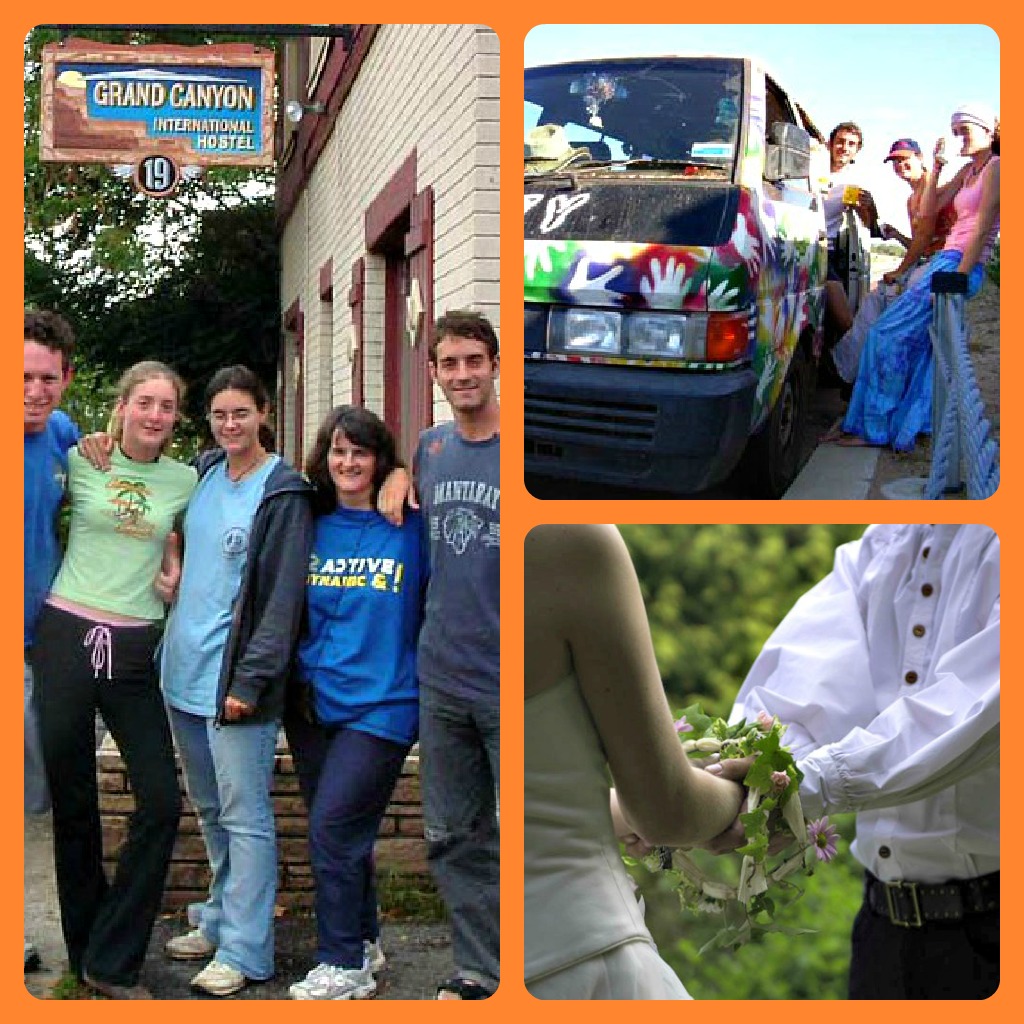
By this time, Gill was in Australia, exploring the country with Krista in a knackered van covered in multi-colored handprints. In a series of tearful emails to my sis, I poured my heart out — telling her how much I hated the idea of abandoning all my hopes and dreams and going home.

She wrote back with an offer from Krista: I could come over to Perth and stay with her family! Krista had even lined up an interview for me with a local job agency — I could hardly believe it! I still didn’t want to leave Thailand, but at least this way I could carry on traveling. (Krista and Gill also pointed out that there were plenty of spare seats in their van…)

I flew to Australia without the price of a cup of coffee. I didn’t even own enough clothing to fill a bag. The girls met me in the airport with their crumbling van (nicknamed Rusty!), and I immediately learned a few things about Krista:

  1. She was prettier than I remembered.
  2. She was now single.
  3. She was a whole lot of fun to be around!

Six years later, after many adventures together, Krista and I were married in the grounds of Taunton Castle, in Somerset in England. Her whole family flew out to join in the medieval-themed celebration, and not long after they flew back, we followed them, back to Perth, where we now live.

Of course, it was a LOT more complicated than that.

But as chance encounters go — and in terms of the ones that influence your life the most — well, that one, for me, takes the biscuit!

What about you? I want to know what chance encounters have affected you the most during your travels — leading to new experiences you wouldn’t have otherwise had. And did they ultimately take you closer to The Sweet Life, as in my case?

Spill the beans in the comments below. (You know you want to!)

STAY TUNED for Monday’s post, a tribute to Queen Elizabeth for lasting 60 years on the throne, despite a period of displacedness.

If you enjoyed this post, we invite you to register for The Displaced Dispatch, a round up of weekly posts from The Displaced Nation, with seasonal recipes, book giveaways and other extras. Register for The Displaced Dispatch by clicking here!

Related posts:

Images from Tony James Slater’s personal collection: Touring the Grand Canyon with Krista (she is in the green tee shirt), her boyfriend and his sister, Gill; his reunion with Krista and Gill in Perth, Australia, some years later (Tony is driving Rusty); all of this leading to Tony and Krista’s medieval-themed wedding in the UK (this is their “hand fasting”).

Is there a common theme — or better yet meme — for the expat life?

After writing, planning, commissioning, and editing posts for this site for just over a year — many of which were centered on the keyword “expat” — I have become rather fixated on that word of late.

Yes, we’re back to that old chestnut, but kindly indulge me while I rake it over the coals again and crack it open to take another look.

Back when I myself could have been considered an expat — first in England and then in Japan — I assiduously avoided describing myself in that way. It made me think of the kinds of people who go into a siege mentality, circle the wagons and say: “Right, it’s just us now.” I’m sure you know the kind of expats I mean, the ones who live in a colony or compound, or socialize as if they do. They hang out at the pool drinking G&Ts, exuding a sense of cultural superiority — along with great pride in having remained unassimilated.

After all, if you’re an expat, it means you come from the richer part of the world; otherwise, you’d be an immigrant.

Nowadays, I’m an American living in America, but I simply tell people that I used to live abroad. If I use the word “expat” at all to refer to myself, it’s in inverted commas: “Yes, I suppose I was an ‘expat’ for all those years. And now I’m a ‘repat.’ Hahaha…”

What about you? If you are reading this, chances are you are (or have been) someone who has ventured across borders to travel and/or live. How do you refer to your predicament? (BTW, my choice of “predicament” is the result of cultivating a British sense of humor over many years of living on that sceptered isle — no, not as an expat, but as an international resident!!!)

Maybe unlike me, you don’t have any hang-ups about calling yourself an expat — and think that people of my sort are inverse snobs for rejecting the label?

As the blogger Tabitha Carvan (The City That Never Sleeps In) has written:

To the Vietnamese who live around me, it’s clear where I fit in here: I don’t. The differences between us are as plain as the enormous nose on my big fat face.

So is it fair to say we’re all “displaced”?

One of the other founders of The Displaced Nation, Kate Allison, is an Englishwoman who has lived in the United States for more than 15 years. I sometimes think of her as an immigrant, except that she tells me she keeps a foot on each side of the Atlantic.

Strangely, I did not wince at all when Kate Allison proposed the word “displaced” as a descriptor for our common situation, when she and I were first chatting about starting up this site.

Well, perhaps I winced just slightly. I know from my studies of international affairs that “displaced” is often used for people who are forcibly removed from their homes by natural disaster, famine, civil wars and other tragedies.

In this narrow sense, “displaced” in no way applies to me, Kate or others of our ilk, who have led privileged lives.

But in a broader sense, I had to agree with Kate that “displaced” seems a good fit. As the Italian poet Cesare Pavese once said:

Traveling is a brutality. It forces you to trust strangers and to lose sight of all that familiar comfort of home and friends. You are constantly off balance. Nothing is yours except the essential things – air, sleep, dreams, the sea, the sky — all things tending towards the eternal or what we imagine of it.

If there is any common theme that applies to all of us, surely it’s that sense of being “constantly off balance,” as Pavese so aptly puts it. By trotting off to investigate — and live in — far-flung corners of the globe, we are casting off the balance of our lives and choosing a life where, for a while, the only things we have in common with anyone else are the basics: air, sea, sky, sleep, dreams — a life of displacement, in other words…

And in some cases — Kate’s would be an example — we are trailing others who have made this choice on our behalf, or on behalf of family and kids. (See her “Libby’s Life” series.)

Always look on the bright side of life!

In an article last month for the FT, Edwin Heathcote had this to say about what he called “a life less ordinary”:

The expat experience combines a cocktail of the thrill of the new and the ennui of global alienation, of displacement and dislocation.

Readers may wonder why the founders of The Displaced Nation have chosen to emphasize the negative ingredients of this cocktail. After all, the meaning of “displaced” is only a shade or two away from “misplaced” or “out of place.”

Why not look at the bright side instead — the allure and the thrill of a life overseas?

Well, the fact is, the founders of The Displaced Nation don’t necessarily see displacement as a negative. As shown in numerous ways on this site over the past 12 months, it’s a necessary first step in making the leap beyond the known to the unknown — to feeding what for many of us is, or soon becomes, an insatiable hunger for new ways to knowledge.

By becoming displaced, we open up our minds to new forms of

Now if that isn’t the bright side, we don’t know what is!

Keep ’em laughing as you go

As far as our site stats go, readers have most enjoyed the series of posts where we’ve explored the good and the bad, the yin and the yang, of the displaced life, with a large helping of humor thrown into the mix.

1. Alice in Wonderland

Top of the charts is the month that we dedicated to the “curious, unreal” aspects of the displaced life with the help of Lewis Carroll’s Alice.

When you stop to think of it, barging into other people’s countries is rather like falling down a rabbit hole: full of adventure but also misadventure, of curious — and sometimes scary (because so incomprehensible) — encounters.

Kate Allison produced two brilliant posts illustrating just how unreal things can sometimes get: “5 lessons Wonderland taught me about the expat life, by Lewis Carroll’s Alice,” and “How many of these 5 expat Alice characters do you recognize?”

Meanwhile, Guest blogger Carole Hallett Mobbs kept us in stitches when describing the scenes of young adults dressed up in furry romper suits, “doormice folk,” and flying potatoes that formed the backdrop to her everyday life in Japan.

2. Pocahontas

Readers also appreciated the month when we recruited the legendary Pocahontas to help us understand, from a native’s point of view, what it’s like to be bombarded with clueless nomads.

In particular, we focused on the cases when displaced types befriend, or even marry, the natives, causing them to lead displaced lives (sometimes to tragic effect — I’m thinking not so much of Pocahontas, but of her tribe!).

I weighed in with a post that was partly based on my own experiences: “Cross-cultural marriage: Four good reasons not to rush into it.” Somewhat to my bemusement, the post proved extremely popular — that is, until it was surpassed by new TDN writer Tony James Slater’s hilarious (but with a hard kernel of truth) “Does love conquer all, even language barriers?”

Counterbalancing Tony’s and my cautious take on such matters was a two-part interview series with two cross-cultural couples — all of whom seemed to find their situation “no big deal.”

That blasé sentiment would later be echoed by Wendy Williams, author of the new work, The Globalisation of Love. In a guest post in honor of Valentine’s Day, she pointed out that in an era of increased international travel, multicultural unions are an inevitability — and even deserve their own label: “GloLo.”

3. Global philanthropy

Another monthly theme that earned high marks from readers was “global philanthropy” — the idea of displacing oneself on behalf of the forcibly displaced.

Readers responded with high praise for Kate Allison’s interview of Robin Wiszowaty, who immersed herself in Maasai culture and now runs development programs in Kenya on behalf of the Canada-based charity Free the Children.

Also popular was a feature on international aid worker and consultant Jennifer Lentfer. (Lentfer has received the most hits of any of the 40 Random Nomads who’ve been featured in the site’s first year.)

But even when covering this seemingly sacrosanct topic, we were hard pressed to prevent a note of skepticism, verging on irreverence, from creeping into the site. Guest blogger Lawrence Hunt stirred things up with his well-received post making fun of gap-year students who think they can save the world in just six months. And I wasn’t far behind with this one, still getting many hits: “7 extraordinary women travelers with a passion to save souls.” (Hey, the current generation isn’t the first to perform good works on behalf of those less fortunate!)

But is it a meme?

First, what is a meme exactly? My dictionary tells me it’s an idea, behavior or style that spreads from person to person within a culture.

Memes are the cultural analogues to genes that get selected and then self-replicate.

Is the kind of “displacement” we talk about on this site a meme? Not in the Internet sense — it hasn’t spread like wild fire throughout social media.

But has it been a meme within our community? You tell us — does “displaced” work for you, or is there some other organizing principle we should be using on this site? Expat, perhaps? (Groan…)

STAY TUNED for tomorrow’s post, a roundup of recent displaced reads by Kate Allison.

If you enjoyed this post, we invite you to register for The Displaced Dispatch, a round up of weekly posts from The Displaced Nation, with seasonal recipes, book giveaways and other extras. Register for The Displaced Dispatch by clicking here!

Related posts:


Keeping yourself earthed: Expats and Earth Day

We should do a post on Earth Day. It fits in with the celebration theme we have for this month, in honor of The Displaced Nation’s first birthday

The brainchild of Gaylord Nelson, a U.S. senator from Wisconsin, Earth Day was established in 1970 — a year that also gifted world culture with bell-bottom trousers and Jon Pertwee’s itineration as the third Dr Who — as a day to engage the public about air and water pollution. From these beginnings it has grown into a day observed by groups and people throughout the world to celebrate the environment and raise awareness of the dangers our planet faces. This Sunday is Earth Day’s 42nd anniversary. The event will be marked with an amusingly inventive doodle on the google homepage and by NBC turning its normally multi-colored peacock logo green. Hallmark will once again fail to capitalize on the day as perhaps they might wish to. This will lead to high-level discussions in the Hallmark marketing department.

it seems to be just the sort of thing that our expat readership would think is a good cause

The vast majority of people agree that not f***ing up the environment is a good idea. Admittedly there may be disagreement over the means by which you do that, and the extent of the problem, but in principle most people would seem to think of Earth Day as  a fairly decent, mostly harmless idea.

…in fact, its just the sort of thing that expats are into. You see, I think expats are more concerned about the environment.

With absolutely no studies to back up the assertion, it was suggested here to me, in the corner of the Internet we call The Displaced Nation, that Earth Day would be a good topic for me to consider writing a post about as expats, so we thought to ourselves, are possibly more attuned to the environment that those mundane muggles known as non-expats.

Theyve just traveled more widely, experienced a bit more.

So I find myself sitting down ready to write this piece. My “notes” if we can call them that, consists of a half-baked observation written on a torn piece of notepaper about all the gas-guzzling trucks people in my current locale (California) seem to love driving. It eloquently reads, “ubiquity of big trucks.”

Added to this is a later notation, a parenthetical thought, where I write that the sights of these unnecessary trucks make me nauseous.

So that’s all I’ve got as I try and knock out this post, but I don’t get far as it seems that this idea that we’re, as I assume if you’re reading this blog you’re an expat, somehow better from my truck-driving neighbors is complete and utter tosh.

Theyre more in tune with whats going on

Now I admit that not all expats are equal, and what I am going to write about doesn’t apply to migrant workers who have left a home country that is undeveloped in a search of a better pay in a more developed country. Neither do I include those individuals who are living in foreign climes doing environmental work. No, what I am concerned about is the self-satisfied expat. You know the type — the sort that decides to start a blog about their experiences because their observations are just so damn important that they need to be read by others. In other words, the likes of me, and, most probably, the likes of you.

and theyre probably better informed.

I was extremely willing to go along with the idea that my expat status confers some sort of wisdom on me. Let’s face it, it’s an intoxicating thought, the idea that living in a different culture from your own automatically transforms you for the better. I guess I must half believe it as I make a point of mentioning on my C.V. that I have lived on three continents, as if that makes me better than a candidate who has only lived on one continent.

Now I do think that there’s a lot to be gained from moving abroad, from leaving your comfort zone, but there should also be an awareness that it is a position of privilege, a privilege conferred — at least on me, I should stop talking on your behalf — by living in the jet age, by ignoring that the life I have chosen, a life that I at times get smug about by being an expat blogger (which really is the smuggest of all expat types) leaves on the world a far greater carbon footprint than my neighbor’s life driving his gas-guzzling truck. And yet I’m the one to feel disdain for him and his environmental choices.

Happy Earth Day.

“We read to know we’re not alone”: 1st-ever litfest for expats & random nomads

The displaced writer Hazel Rochman once said that reading “makes immigrants of us all”:

Reading takes us away from home, but more important, it finds homes for us everywhere.

That must be why author interviews have played such an important role in the entertainment mix provided by The Displaced Nation since our founding one year ago.

A book that enables us to escape to a new world without buying a plane ticket? Bring it on!

A book that makes us feel at home in another part of the world? There’s nothing we crave more.

We’ve also taken authors into our confidence who, as St. Augustine once advised, treat the world as their book, rather than staying put and reading only one page. Because of their own peripatetic ways, these writers have much to say to the rest of us nomadic types about how to make sense of feelings of isolation, ennui and displacement.

As C.S. Lewis once said:

We read to know we’re not alone.

In honor of The Displaced Nation’s first anniversary, as well as in the spirit of World Party Month, I would like to propose the first-ever Displaced Nation literary festival featuring authors who have been interviewed or in some way featured on the site during the past year.

“We read to know we’re not alone”: THE FIRST-EVER LITERARY FESTIVAL FOR EXPATS AND RANDOM NOMADS
Note: The following is a tentative line-up. It includes previews of the kinds of insights we can expect to glean from such an extraordinary gathering of expat literati.

We anticipate the festival to extend from a Sunday night to a Thursday morning, with an opening night gala and a couple of closing events. Click on the headlines to go to the event descriptions for each segment:

OPENING NIGHT GALA EVENT

It seems only fitting that we offer something totally mad on our opening night. We will screen Alice in Wonderland, the 1903 British silent film directed by Cecil Hepworth and Percy Stow, which was partially restored by the British Film Institute and released in 2010. (NOTE: You can see portions of the film in a video specially made by Anthony Windram during The Displaced Nation’s “Alice in Wonderland” theme month.)

The film is memorable for its use of special effects: Alice’s shrinking in the Hall of Many Doors, and then growing too large in the White Rabbit’s home, getting stuck and reaching for help through a window.

The film matches our theme of “We read to know we’re not alone” — could anyone ever feel lonelier than Alice did at such moments?

But here’s the new twist: the screening will feature a live accompaniment by Seremedy, the displaced Swedish visual kei band this is now making such a sensation in Japan, reacting musically and without any rehearsal beforehand, to the silent film in front of them. Unique, spontaneous — and perhaps even terrifying, given that the band’s (male) lead guitarist, Yohio, looks like an anime version of Alice.

DAY ONE: “We’re not alone” — We have each other

Iranian Childhoods, Inspiring Stories

TONY ROBERTS and ASHLEY DARTNELL each spent portions of their childhood in Iran. Roberts has produced a novel based on his memories of that time, Sons of the Great Satan, which we featured on this blog about a year ago. Dartnell, who has yet to be featured (we hope she will!), released her memoir, Farangi Girl, last year (it was recently issued in paperback).

Roberts and Dartnell have in common the status of being so-called third culture kids — growing up in a third culture not common to their parents (Roberts’ parents were American and Dartnell was the product of an American mother and British father). They also have in common that they were enjoying their lives in Tehran until something terrible happened — the memory of which affects them to this day.

In Dartnell’s case, it was the sudden collapse of her father’s business (her parents subsequently split up), whereas for Roberts, it was the experience of being evacuated because of the American hostage crisis — suddenly, he was back at the family’s small farm town in Kansas, having no idea of where his friends had gone.

TCKs experience such traumas in isolation (Roberts continued to feel isolated well into his adulthood). Roberts and Dartnell, who have never met before, welcome the opportunity to forge a new connection over their common displacement.

PERFORMANCE: “The White Ship,” by Ethan Kenning

Ex-folk singer Ethan Kenning — known as GEORGE EDWARDS when performing with the former psychedelic rock band H.P. Lovecraft — will give a special performance of “The White Ship,” a song based on a mystical tale by horror writer H.P. Lovecraft (from whom the band took its name), about a vessel sailing on a sea of dreams. Critics have described it as “baroque, Middle Eastern-flavored psychedelia at its finest.”

Multicultural Marriage Boot Camp

Two Wendys — WENDY WILLIAMS and WENDY TOKUNAGA — will answer questions about the benefits as well as challenges involved in marrying someone from another culture.

Wendy Williams is the author of The Globalisation of Love and has coined a term, “GloLo,” to refer to this phenomenon. She was last week’s Random Nomad and has also been a contributor to The Displaced Nation with the post: “Why expat is a misleading term for multicultural couples” — a topic big enough to be a festival theme in its own right!

Wendy Tokunaga, who was one of The Displaced Nation’s 12 Nomads of Christmas, recently published Marriage in Translation: Foreign Wife, Japanese Husband, consisting of interviews with 14 Western women involved in cross-cultural relationships.

GloTinis will be served — those in particularly challenging unions may wish to order theirs straight up.

Romance Across Borders: Fairytale or Myth?

JANE GREEN, a prolific writer and one of the founders of chick literature, will interview MEAGAN ADELE LOPEZ and MICHELLE GORMAN — both of whom have produced first novels exploring the idea of looking for romance in other cultures. Lopez is the author of Three Questions: Because a quarter-life crisis needs answers (self-published, October 2011), about a cross-cultural romance that blossoms through the asking of three questions; and Gorman, of Single in the City: One girl, one city, one disaster waiting to happen (Michael Joseph, 2010), about an American who goes to London in search of love and the perfect life.

The Displaced Nation recently featured Lopez on our site and will feature her tomorrow in a guest post. We have yet to interview Gorman but would like to — especially as she recently self-published Misfortune Cookie, about a young woman who moves to Hong Kong to be with her boyfriend.

Both women relied heavily on their own autobiographies to produce these first novels. As Lopez said in her interview with Tony James Slater:

Hey — they always say to write about what you know, so that’s what I did!

But is it the stuff of chick lit? No one is better placed to judge this than the displaced author Jane Green (she is now an expat living in Connecticut). As early readers of The Displaced Nation will recall, Green “came in” for a chat during our coverage of last year’s Royal Wedding — she had just produced a multimedia book celebrating the young royals as an example of a “modern fairytale.”

Though Kate and Will aren’t from different cultures, they might as well have been since Kate — unlike the Prince’s mother, Diana — does not come from a royal lineage. But from Green’s point of view, this is what is makes the couple modern — and why their marriage is likely to last:

I loved discovering just how unusual William and Kate are: grounded, humble, and thoroughly modern, eschewing much of the pomp and circumstance that surrounded the wedding of Charles and Diana.

One Person’s Home — Another Person’s Nightmare?

BARBARA CONELLI, who lives in Manhattan for half of the year and Milan for the other half, will interview SHIREEN JILLA, whose first novel was set in the Big Apple.

Thanks in large part to the influence of her Italian grandmother, Conelli qualifies as the ultimate Italophile. Last year she published Chique Secrets of Dolce Vita last year — her first book in a three-part series about the Italian grasp of the “good life.” When asked by Kate Allison to explain the differences between her two homes of Milan and New York City, Conelli said that New Yorkers need to learn the Italian art of taking the time to actually live:

We need to stop and smell the roses more often.

On this point, Jilla would certainly concur. After spending three years in New York as an expat when her husband was BBC’s North America correspondent, Jilla came away thinking that “New York is a city populated by control freaks.”

But, unlike Conelli, Jilla found this control freakery sinister — which was what inspired her to write a novel that depicts the city as, as one critic said, “a teeming pit of vipers, only just covered with a finely buffed veneer of sophistication.”

In the online discussion we hosted of Exiled, Jilla commented on how culturally different New York and London are — despite New York not being seen as a particularly adventurous posting among the expat crowd. She went on:

New York in fact reminds me a lot more of Rome than London. Passion is lived out on the street, for good and bad.

Hmmm… It will be interesting to see what Conelli, whose series includes a book on Rome’s joyful idleness, makes of that!

Are Expats Defined by Their Boundaries — or the Lack? James Joyce Unplugged

One of The Displaced Nation’s founders, ANTHONY WINDRAM, and the novelist JOANNA PENN will join forces to discuss the topic of whether being an expat necessarily entails producing “expat” literature. In a post published last year on The Displaced Nation, Windram noted that although James Joyce spent most of his adult life in continental Europe, he continued to write about his home, Ireland:

If we were to be glib, we might say that Finnegans Wake was conceived in Dublin, but Paris was its midwife.

Likewise, Joanna Penn, who has been a TCK and an expat, does not self-identify as an expat writer and sets her novels at least partly in Oxford, the city she calls home. She does feel, however, that wanderlust is a big part of what fuels her to write thrillers set in various countries, as she explained in a comment on a post deconstructing a post of hers on what “home” means to writers.

DAY TWO: “We’re not alone” — Global activism

Travel for a Purpose

For this event, we hope to engage the world-famous novelist BARBARA KINGSOLVER to interview ROBIN WISZOWATY, who is Kenya program director for the Canadian charity Free the Children and the author of a memoir targeted at young adults on her own experience of living in Kenya, My Maasai Life.

Kate Allison interviewed Wiszowaty during the month when The Displaced Nation explored the topic of global philanthropy.

Around the same time, Allison also wrote a post on Kingsolver, exploring the idea that her novel The Poisonwood Bible was intended an allegory for what happens when you barge into someone else’s culture thinking you know everything and they know nothing.

Notably, Wiszowaty could almost have been a Kingsolver character in the following incident that occurred during her initial two months in Nairobi, as reported to Allison:

One street man nearby…said in Swahili, “What are you doing in Kenya, if you can’t help us?”

Despite my halting comprehension of the language, I understood his question. What was I doing here? Was I here to help Kenyans? I couldn’t remember any sort of altruistic impulse as my reason for being me here. I only pictured myself three months earlier, curled up on my family room couch reading books on cultural sensitivity, or shopping in neighborhood department stores for appropriate clothing, thinking this was a chance for me to enlarge my experience and pick up others’ points of view. I’d been driven simply by a desire to escape, not to improve the lives of these poor people.

Wiszowaty, of course, came around and now thinks constantly about what she can do for Kenya. We expect that Kingsolver, who funds a prize for authors of unpublished works that support social change, will approve; but will she also offer a critique?

PERFORMANCE: “The Boy with a Thorn in His Side,” by Pete Wentz

Fall Out Boy’s PETE WENTZ will do a performance in which he puts passages from his 2004 book, The Boy with a Thorn in His Side, to music. The book chronicles the nightmares he had as a child.

Wentz is a supporter of Invisible Children, Inc., an organization dedicated to helping the cause of child refugees in Uganda. He once participated in an event called “Displace Me,” in which 67,000 activists throughout the United States slept in the streets in makeshift cardboard villages.

(Notably, Wentz has also earned his chops as world traveler. Before Fall Out Boy went on hiatus in late 2009, it made an unsuccessful bid to the only band to play a concert on all seven continents in less than nine months — unfortunately, weather conditions prevented them from flying to Antarctica.)

Why Feisty Heroines Need Not Always Be Named Pollyanna, Calpurnia or Hermione

Melbourne-based author GABRIELLE WANG writes books under the Penguin label targeted at young adults in Australia. Her heroines are always non-white, Chinese or some mix. They are culturally marginalized.

Wang, who fell into writing accidentally — she had planned to be a book illustrator — loves to use her imagination to create characters who are historically plausible yet never show up in history books. One such character is Mimi, who feels ashamed of being Chinese until she has a magical, transformative experience that makes her proud of her cultural heritage.

Another such character is Poppy, a half-Chinese, half-Aborigine girl who lived in the 19th century.

Wang told us she was able to draw on her own background to portray how Poppy might have felt:

I think I was able to imagine the Aboriginal child’s situation quite easily because I know what it feels like to be an outsider, and to suffer racial prejudice. I was the only Asian child in my school in Melbourne and I only saw white faces in the street.

The Search for Paradise

The search for paradise has been underway for as long as human history. Understood as an idyllic realm located at an exact spot somewhere on the earth, and yet as a place separated from the world, the possibility of reaching paradise has aroused the curiosity of travelers over many centuries and continues to do so.

MARK DAMAROYD, who has lived in Thailand for the past several years, subscribes to the idea that paradise is indeed what many men have claimed it to be since time immemorial: life on an exotic island, with sandy beaches, coral reefs and coconut trees, and with an exotic, much younger girlfriend. That is why, as he told us in an interview last summer, he had Koh Samui in mind when creating the island setting for his first novel — the aptly named Pursuit to Paradise.

Coming from a somewhat different direction is JACK SCOTT, whose memoir — Perking the Pansies: Jack and Liam Move to Turkey — was reviewed at the end of last year by Kate Allison.

In it, Scott tells the story of how he and his civil partner, Liam, left the rat race in London behind to live in Bodrum, Turkey. A picturesque spot on the Mediterranean with a temperate climate, the city was their vision of paradise.

Naturally, though, things were not that simple. The couple soon encountered another rat race — the expat one. To quote directly from Scott’s book:

Sad people, bad people, expats-in-a-bubble people. They hate the country they came from; they hate the country they’ve come to. This was my social life. This is what I gave everything up for. This was Liam’s bloody Nirvana. We were the mad ones, not them.

PERFORMANCE: “Red Right Hand,” by Nick Cave

NICK CAVE is a distinguished musician and songwriter from Down Under. He took the title of this song from a line in John Milton’s epic Paradise Lost, referring to the vengeful hand of God. According to the lyrics: “You’re one microscopic cog in his catastrophic plan.”

Cave has also occasionally dabbled in literature. As one reviewer put it, his first novel “reads like a logical extension of the dark world his music has already created.”

Ghosts of Nations Past and Future

In honor of Dickens’ bicentenary, Displaced Nation contributor ANTHONY WINDRAM will give a spirited reading of his favorite passages from A Christmas Carol (already explored in a post), followed by a discussion of whether Scrooge’s displacement could inspire the planet’s wealthiest people to behave more humanely. To quote from one of the comments made on Windram’s original post:

If such a man as Scrooge can displace his lust for money with a love of humankind — and an awareness of other people’s suffering — then does that mean there’s hope for the 1%?

Through the Looking Glass: Delhi & Bangkok

JANET BROWN, author of the travelogue Tone Deaf in Bangkok, and DAVE PRAGER, author of the travelogue Delirious Dehli, will discuss the need for travelers to do more than the usual amount of preparation when entering cultures that are very different from one’s own, on a par with Alice’s Wonderland.

As Brown explained in her interview with us, travelers to Thailand can be “tone deaf” because Thai is a tonal language and it’s easy to make mistakes. But they can also be “tone deaf” when it comes to figuring out the Thais’ communication style:

“You looked so beautiful yesterday” probably means today you resemble dog food and ought to go home and rectify that at once.

Whereas for Prager, one of the points about living in Dehli is that you may end up deaf as there are always people, animals and vehicles around.

In conversation with Anthony Windram, Prager admitted that getting used to America again — he and his wife now live in Denver — hasn’t been easy:

What’s struck me is that the US just seems so empty. It’s not that India is always intensely crowded; rather, it’s that India you’re never completely alone.

WRITING LAB: What (Not) to Write

Expat writing coach par excellence KRISTEN BAIR O’KEEFFE will explore techniques to develop your writing skills and help you find which world, of your many worlds, you want to write about, and how to get started.

Last summer’s post “6 celebrated women travel writers with the power to enchant you” was officially dedicated to O’Keeffe for delivering these pearls of writerly wisdom during her “Expat Writing Prompts” series:

Writing a multi-volume treatise is NOT the answer. Of this, I am sure.
Instead find a nugget. A moment. A single object. One exchange. One epiphany. One cultural revelation.
Find one story and tell it.
Just it.

DAY THREE: “We’re not alone” — Eat, drink, be merry & look good

Classy and Fabulous: French Style as Universal Norm

The French may be under fire for how they treat immigrants, but expats continue to thrive there. For this event, the classy and fabulous JENNIFER SCOTT, author of Lessons from Madame Chic: The Top 20 Things I Learned While Living in Paris — which has been a runaway success (it’s now under contract by a major publisher!) — will set out to prove, as she did last month in an interview with us, that no one can edit down their clothes and belongings as well as the French can.

The equally classy and fabulous ANASTASIA ASHMAN, co-editor of The Expat Harem: Foreign Women in Modern Turkey — and participant in our “Cleopatra for a Day” series last month — will serve as discussant. Two of the cultural influences for Ashman’s wardrobe are Southeast Asia (she once lived in Malaysia) and Turkey (she was an expat in Istanbul for several years). She does, however, adore French perfume!

Which Came First, Story or Recipe?

It’s food — so that means France again! ELIZABETH BARD, an American who lives in France with her French husband, and her opposite number, CORINE GANTZ, a Frenchwoman who lives near LA with her American husband, will explore why food is so central to the works each of them produces.

Bard is the author of the best-selling Lunch in Paris: A Love Story with Recipes. So did she ever think of writing it the other way around: recipes with a love story? Here’s what she told ML Awanohara in their conversation last autumn:

When I sat down to think about the moments that really helped me discover French life, I kept coming back to the dinner table, the markets, the recipes — so it seemed natural to structure Lunch in Paris around those experiences.

Gantz can no doubt relate. When we featured her novel, Hidden in Paris, last summer, here’s what she said when the topic of food came up:

For me, writing a novel is a barely disguised way for me to talk about food — the novel being a vehicle for food just as grilled toast is a vehicle for foie gras.

Fans of Hidden in Paris, please note: Gantz has just now released a playful cookbook featuring 20 delicious dishes that were described in mouth-watering details in the novel.

Moderating the discussion between Bard and Gantz will be the well-known novelist JOANNE HARRIS. Harris, who was born over a sweet shop in Yorkshire to a French mother and an English father, rarely misses an opportunity to bring food and drink into her novels — the most famous example being Chocolat.

Displaced Storytelling Circle

Verbal antics, stories, music and more. Highlights include readings by

  1. Displaced Nation contributor TONY JAMES SLATER, from his highly entertaining travelogue, That Bear Ate My Pants! Adventures of a Real Idiot Abroad.
  2. Displaced Nation interviewee ALLIE SOMMERVILLE, from her wry memoir Uneasy Rider: Confessions of a Reluctant Traveller. (Allie, please read the passage about the campervan being too wide for one of the Spanish streets!)
  3. Displaced Nation nomad KAREN VAN DER ZEE, from her collection of expat stories. (Miss Footloose, please tell us the ones about the crocodile and the couple in the Roman restaurant!)
  4. Founder KATE ALLISON, from The Displaced Nation’s weekly fiction series, Libby’s Life, which as you may have noticed, is now up to 46 episodes. (Kate, be sure to read the one where you introduce Sandra, Libby’s MIL from hell!)

The Art of Drink: Ian Fleming

One of The Displaced Nation’s founders, ANTHONY WINDRAM, will talk about the role of food (and especially drink) in Ian Fleming’s James Bond novels, on which he did a post last year:

The Bond of the novels isn’t solely a martini drinker. He’s always one to try anything local that’s on offer. In Jamaica he’ll drink a glass of Red Stripe, in the US he’ll have a Millers Highlife beer. Throughout the novels Fleming uses food and drink to convey an alien culture, demonstrate social status, show Bond’s mood and his sophistication and ease with the world.

An array of drinks — not only shaken martinis but also bottles of Heineken!– will be served. Green figs and yogurt, along with coffee (very black), will be made available to anyone who is still suffering from jetlag.

Enchanted by Wisteria: Elizabeth Von Arnim Unveiled

Displaced Nation founder (and the author of this post!) ML AWANOHARA will read her favorite passages from the collected works of travel writer Elizabeth von Arnim, on whom she wrote a post last year. As she pointed out then, Von Arnim was fond of the idea of a woman escaping her marital, motherly and household duties in the pursuit of simple pleasures such as gardens and wisteria. A magical Italian castle — such as the one featured in her best-known novel, The Enchanted April — can also be a tonic.

CLOSING NIGHT + BONUS EVENT

To close the festival, we will screen both the Swedish and Hollywood versions of The Girl with the Dragon Tattoo, followed by a critique from CHRIS PAVONE, author of the new novel The Expats. Pavone will discuss whether:

  1. it was really necessary for Hollywood to produce its own (non-subtitled) version; and
  2. all the female-perpetrated violence cropping up in film and on TV of late presages a “fourth wave” of feminism.

Pavone is well qualified to judge the latter as his novel (not yet featured on TDN!) is an offbeat spy story with a female protagonist — a burned-out CIA operative who moves to Luxembourg. Apparently, this was the kind of thing Pavone thought about when he was trailing his spouse in that cobblestoney old town.

And, just when you thought it was all over, we bring you a final treat: a chance to hear from the historian SUSAN MATT, who recently published Homesickness: An American History to much fanfare in the thinking media. Matt disputes the stereotype of Americans as westward wanderers by showing that Americans are returning to their homeland in greater numbers — that’s if they ever leave at all. (Our ancestors must be turning over in their graves!)

* * *

So, shall I sign you up? And can you think of any additional topics/authors/performers who ought to be featured? I look forward to reading your suggestions in the comments.

STAY TUNED for tomorrow’s guest post from Meagan Adele Lopez, on the differences between American and British wedding celebrations.

If you enjoyed this post, we invite you to subscribe for email delivery of The Displaced Dispatch, a round up of the week’s posts from The Displaced Nation. Sign up for The Displaced Dispatch by clicking here!

Related posts:

Happy World Party Day to our virtual friends! Just because we’re Displaced doesn’t mean we can’t have parties!

By the time many of you read this, it will already be April 3. (Actually, if I don’t type faster, it will be April 3 by the time I post this – but I digress.)

The significance of April 3? It’s World Party Day, defined by Wikipedia as:

A synchronized global mass celebration of a better world and the active creation of desirable reality.

…which, I have to say, doesn’t sound a whole lot of festive fun. It doesn’t inspire me to hang out in someone else’s house, eat their food, drink their drink, nosy through their bookshelves, iTunes library, and  medicine cabinets, then spill red wine on their new rug, which is usually what happens at parties.

But it gets better. Sort of. Wiki goes on to say that:

World Party Day began as a grassroots effort in 1996 and…is observed yearly on April 3 through personal and public observances of party-like atmosphere. A basic premise is that the opposite of war is not passive action or peace, but party.

Aha! So you mean that while people have been campaigning for World Peace, waving CND placards, and making records in Amsterdam hotel rooms — it’s all been a waste of time? That they would have been better stockpiling boxes of peanuts and Zinfandel, then heading down to iParty for some paper leis and a plastic punchbowl?

It’s all clear now. This is where the world has been going wrong for so long.

Instead of chanting “Make peace, not war!” we should have been shouting “Party on!” and head-banging to Bohemian Rhapsody.

Quantity, not quality

Perhaps the real problem is that one day of partying a year is simply not enough to end global conflict. A trifling 24 hours shows no stamina, no devotion to the anti-war effort.

So, ladies and gentlemen, in the selfless interests of world peace — I beg your pardon; an absence of war — The Displaced Nation team, for April’s theme, will be bringing you a month of cyber parties. Just because we are all Displaced doesn’t mean we can’t have parties together.

Now, clearly, this is not an undertaking for the fainthearted. We expect, by April 30, to be exhausted and in dire need of Alka Seltzer and carpet cleaner, or at the very least, a new WordPress background.

But sacrifices must be made. Revelries must be organized. Balloons must be filled with helium and hilariously inhaled.

So what are we waiting for? Let’s party!

P.S.

Actually, we’ve already tested the punch and vol-au-vents, just a little bit, because Party Month started two days early for the TDN team. Nothing to do with the active creation of desirable reality, though.

More the creation of desirable unreality, in fact.

On April 1, 2012, The Displaced Nation celebrated its first birthday.

Cheers!

STAY TUNED for Tuesday’s Displaced Q, when Tony J Slater asks: “What’s been your most memorable birthday abroad?”

If you enjoyed this post, we invite you to register for The Displaced Dispatch, a round up of weekly posts from The Displaced Nation, with seasonal recipes, book giveaways and other extras. Register for The Displaced Dispatch by clicking here!

Image: MorgueFile

5 ways to rejuvenate when you’re on the road — a blokey bloke’s perspective

I’m not big on spas. In fact I’ve never been to one. Perhaps because I’m a bloke (and quite a blokey-bloke at that), I just can’t see the appeal of drenching myself in yoghurt or putting cucumber on my eyes. Well, not unless I’m going to a fancy dress party as a Greek salad. 🙂

But that doesn’t mean I’m not on the eternal quest for self-renewal and youthfulness. We all are! Well, anyone over the age of 21, anyway! It’s just that some of us would prefer to avoid the lotions and potions, if alternatives are available.

Here are 5 fail-safe techniques I’ve discovered for feeling younger:

1) Try martial arts — or if all else fails, work out at the gym.

I love yoga — so much so that I practiced it once at two thousand meters at 5:00 a.m., on a tiled floor in a house with no heating. Suffice to say, there were parts of me that remained stuck to that floor long after I was ready to give up! But I believe in yoga’s rejuvenating power, both mental and physical — just not enough to carry on doing it!

Instead I’ve found something more to my tastes: martial arts — specifically Wing Chun kung-fu.

Millions of people around the world practice some form of martial art — can they all be wrong?

Kung-fu offers me the chance to push myself physically. It also challenges me with its spiritual and philosophical components, which are based in passivity and meditation. Manipulation of the invisible life-force or energy flow — known as (also chi) in traditional Chinese culture — is a big part of it, with much of it done through breathing as with yoga.

My advice:

  1. Try it.
  2. Then try it some more…

I can’t think of anything better to be hooked on! You’ll feel happy and amazing and the years will start to pour off.

(If you can’t stomach the idea of punches to the stomach, then try going to the gym — treadmills and all that. It’s odd, but on the days I work out, instead of feeling tired I have the energy of a man ten years younger. It’s all those endorphins!)

2) Travel slowly.

A change is as good as a rest, or so they say. Who “they” are in this instance I’m not sure, but they certainly had a clever turn of phrase!

It’s a lie of course — try having a week’s holiday in Fiji and see how rested you feel after two international flights, separated by five days of jet lag…

A rest is the only thing as good as a rest, which is why I love to take my time as I travel. Luckily for me, I can. These days I make a bit of money from writing, and I’m always keen to try new work experiences as I go. I’ve been a diving guide, a medical guinea pig, a toilet cleaner, a yacht delivery man, a gardener…

Living in a place for a while and taking a job is a great way to meet people and make friends, to get to know an area and its population — it’s also an endless source of ridiculous stories that I can spend the rest of my life turning into books.

If it’s not possible to simply vanish into Asia with a CV and a backpack, I fully understand — but then take longer holidays, with no fixed agenda (even if it means taking fewer holidays). Two weeks away gives you the time to properly relax, and your body will thank you for it.

And just imagine what a month in Fiji would be like! Sunny, is the answer. 🙂

3) Take long walks.

I walk a lot. Even in my bedroom I pace, but that’s not exactly rejuvenation!

I find it revitalizing to be outdoors. I now live in Perth, Australia, where I try to spend an hour or so each day roaming the streets, usually in the evenings (it’s a little on the hot side for casual strolling in the middle of the day).

And yes, I do sometimes get stopped by the police! Fortunately for me, Western Australia doesn’t have a version of Florida’s Stand Your Ground law. When I walk, I feel totally free. The rest of the world goes away, or at least becomes quieter, and I can finally think clearly with all that noise gone.

Some of my best writing has popped into my head spontaneously as I walk — almost as though it were there all along, just waiting for my mind to be still enough to tune in.

And if you’re looking for the ultimate rejuvenation, do a big walk! My wife, my sister and I are still reaping the benefits from hiking the Bibbulmun Track here in Western Australia. It’s 600 miles and took us two months.

After the first week you run out of things to say. After the second week, you run out of the desire to say anything anyway. By the time you’re done, I guarantee there will be peace in your heart and a youthful smile on your face. Because you’ll either be a strong, confident individual as a result of conquering such an epic challenge — or you’ll be dead.

I can’t recommend it enough!

4) Tap into the healing powers of universal energy.

In the course of my many wanderings I’ve acquired a fairly eclectic collection of beliefs — among them, Reiki, a spiritual practice developed in Japan. A sort of laying on of hands to unleash one’s inner energy and help boost the body’s healing system.

I did my Reiki practitioner’s course a few years ago. Though some of it was esoteric, it wasn’t too big a leap for me to imagine an invisible energy field inhabiting the body that we can gain access to, or the notion of supplementing someone else(the patient)’s energy with your own (as the practitioner). It somehow made sense to me, but the proof was in the healing: it really worked!

Feeling skeptical? I can relate — I have friends who chant to the angels and friends who believe in the power of color as a healing medium, neither of which do anything for me.

Still, I recommend giving Reiki healing at least one go in the interest of rejuvenating your body. It’s the furthest I’ve ventured into the bewildering variety of New Age therapies, and the closest I’ve ever gotten to feeling The Force — fantastic! And no, you don’t have to get naked! 🙂

5) Cuddle a furry creature or two.

Anyone who knows me, knows my passion for all kinds of animals. I have volunteered in animal refuges while traveling around and have met some amazing people. I’ve also been shot at, bitten, clawed, mauled, temporarily blinded — and head-butted in the balls by a wild pig. Hey, I never said it was easy!

But as the English writer George Elliot put it in one of her stories: 

Animals are such agreeable friends — they ask no questions, they pass no criticisms.

Having a dog or cat (or three!) to come home to after a long day at work is one of the best ways to soothe one’s fears about the world, and stay sane. But — before you indulge — be sure you can look after a pet, particularly if you travel a lot.

Oh, and if you rescue an animal from a shelter instead, you get double karma points!

STAY TUNED for Monday’s “Ask Mary-Sue” column.

If you enjoyed this post, we invite you to register for The Displaced Dispatch, a round up of weekly posts from The Displaced Nation, with seasonal recipes, book giveaways and other extras. Register for The Displaced Dispatch by clicking here!

Related posts:
Images (clockwise from top left): Our family dog, Meg; on a loooong walk with my wife in Western Australia (no going back!); the fun Fiji scenery; Kung-fu Tony!

In honor of Valentine’s Day, top 10 travel and expat posts on finding love abroad

My mother used to disapprove of Valentine’s Day. Although she would indulge our need to cut out elaborate paper valentines and bake heart cookies, she always made sure my sisters and I knew what she thought — that it was a fabricated consumer holiday for boosting sales during the winter doldrums.

Despite her remonstrations, I always used to look forward to February 14 — even (especially!) when living outside the United States.

For a start, they have much better chocolate abroad. Plus you get to try new foods that other cultures find seductive — see Kate Allison’s scrumptious post of a couple of days ago.

And your idea of what constitutes romantic adventure changes, too, as you expand your visual repertoire to include the world’s most stunning settings. Indeed, why not pop the question as the sun sets over the City Palace and Lake Pichola in India’s Land of the Kings? (For this and nine other exotic locations for marriage proposals, see Annie Fitzsimmons’ recent article for Forbes.)

In that connection, I was distressed to learn that couples who are thinking of heading to Venice, that magical city of watery landscapes, for a Valentine’s escape may need tips from Guardian Travel on how to avoid feeling ripped off. From the sound of things, it may be safer, and perhaps a good deal more enjoyable, to stay at home and watch The Tourist

But let’s leave the film discussion for later in the month, when we’ll be doing a series of posts in honor of the Oscars. Right now we’re honoring Valentine’s Day, and I’m urging you all to get into the Valentine’s spirit. To aid you in that aim,  I’ve compiled a list of 10 online articles that address the specific needs of those who are looking for romance abroad. As usual, and as befits our blog’s slightly irreverent tone, they’re from a mix of indie and conventional publications.

Click on any or all categories that apply:

Stories of love on the road

In addition to the story told by TDN’s own Tony James Slater of his own love affair — which sparked off no end of wonderful romantic tales in the comments — I enjoyed these two posts:

1) Modern Love — A Place to Lay My Heart (8 January 2012)
Author: Elisabeth Eaves (@ElisabethEaves)
Publication: New York Times, Sunday Style section (@nytimes)
Synopsis: Two single journalists in their 30s meet up in Mexico to write about tequila. At first, romance seems off the table. Both are commitment phobes: they see travel as their first love and like nothing better than plunging into a foreign culture. But then…something happens, and for the first time, instead of opting for a distance relationship, they take the leap. (Tequila will be served at the wedding.)

2) 10 Reasons Why You Should Marry a Foreigner (Like I Did) (Archived: 10 November 2010)
Author: Corey Heller (@MultiLingLiving)
Publication: Multilingual Living blog
Synopsis: Chances are, if you spend a lot of time abroad, you may end up marrying, God forbid, a foreigner! Hey, it’s not the worst thing that can happen. Some of us have done it multiple times and lived to tell the story. Still others, such as this week’s Random Nomad, Toni Hargis, fell for a foreigner in their home countries and followed him/her abroad. Heller, who met her husband in Ireland (he trailed her back to the US), lists her own ten reasons for committing such a foolhardy act — everything from his “glorious accent” to her enjoyment of a challenge to the fact that he is her true love (now fancy that!). Actually, the one that sticks with me is #3: being a German (no, he’s not Irish), he craves good chocolate just as much as she does! (But perhaps that says more about me than it does about them?)

The practicalities of dating abroad

If you do decide to make someone you meet in another culture the object of your affections, there may still be some practical concerns. These four posts should help you finesse these sometimes awkward moments:

3) Dating expectations worldwide: Who pays? (4 February 2011)
Author: C. Noah Pelletier (@flyingknuckle)
Publication: Matador Network (@matadornetwork)
Synopsis: From Pelletier’s unofficial survey of dating etiquette across nine cultures, we learn that German men excel at subtle flirting whereas Turks are much more direct; French don’t really “date”; Mexican men wear clean suits; and Japanese are into group dating. But on the all-important question of “who pays,” all nations are in agreement: THE MAN!!!

4) Don’t pull out the chair — but do hold open the door! (Archived: 26 October 2011)
Author: Tanja from Germany
Publication: InterNations blog (@InterNationsorg)
Synopsis: Notably, one of Tanja’s top concerns is:

Who pays for the meal? Does one split the bill, or does he expect to pay — or even worse, must I pay?!

Too bad Noah Pelletier’s post for the Matador Network wasn’t yet available for Tanja’s perusal (see #3 above), or she needn’t have fretted — especially as it’s Mexico, where men have been known to TAKE OFFENSE if a woman offers to pay. Also, she might not have been surprised when she received more flowers on first dates in Mexico than in her entire life in Germany. Still, Tanja’s story (which ends very happily) is a tribute to the power of persistence and the efficacy of muddling one’s way through. Just one thing I’m still not clear on: do Mexican men expect you to open the door for them, rather like Japanese men expecting you to let them exit the elevator first? (See her post title.)

5) Ten Foreign Words for a Romantic Valentine’s Day (9 February 2012)
Author: Justine Ickes (@justineickes)
Publication: Culture Every Day blog
Synopsis: So as not to be totally culturally clueless, it’s important to master a few other romantic terms/concepts. In Japan, for instance, if you hear someone say bakushan as they look you in the face, then they’re probably not a romantic prospect. The expression is used when you think someone looks cuter from behind! (If, on the other hand, you hear the word kawaii, things may be looking up!)

6) Sex when traveling: location, location, location (29 January 2012)
Author: Laurence Norah (@lozula)
Publication: Finding the universe blog
Synopsis: Norah illustrates (literally — yet tastefully, I hasten to add) various options that travelers have for “getting jiggy on the road”: dorm rooms, tents, showers, beaches, backs of camper vans, and (best of all!) private rooms.

Lonely hearts in foreign lands

When all the world is going gaga for romantic love, it can be lonely if you’re not doing so well in that department, particularly if you’re already feeling isolated because of being so far away from your homeland. The following four posts should help with that predicament:

7) 8 Empowering Ways a Traveling Single Female Should Celebrate Valentines Day (Archived: 13 February 2011)
Author: Lainie Liberti (@ilainie)
Publication: Raising Miro blog
Synopsis: From LA, Laine has been traveling with her son, Miro, since 2009 in search of a simpler life. When still in the States, spending Valentine’s Day on her own was no big deal:

it was easy to ignore the day all together or grab a group of my amazing single girl friends and have an AbFab marathon complete with bottomless cosmos.

But what about now that she’s on the road? Though the post is a year old, her suggestions — some aimed at those who enjoy solitude (movies, nature, dinner-in for one), and others, at those who would prefer being with people (volunteering, meet-ups) — won’t go out of style any time soon, and are good for any day of the year.

8) Help! Nobody Wants to Date Me! (Archived: 15 December 2011)
Author: Chris Laub (@Travel_rtw)
Publication: Backpacker Savings blog
Synopsis: Chris claims he’s “undateable” because of his need to spend almost half of the year traveling. He’s not proud of that fact:

The truth is I want to be in relationship, but my deeper desire to travel and have fun makes it seemingly impossible.

Still, the travel addict’s life does have its compensations. He’s moving to Brazil for the 2014 World Cup, leaving him free to hook up with a Brazilian woman. As he sees it:

…running around chasing women in exotic countries and enjoying no-strings-attached travel romances isn’t a bad alternative

— though methinks he doth protest too much!

9) Offbeat Traveler: Unromantic places around the world (6 February 2012)
Author: Jason La
Publication: Los Angeles Times travel section (@latimestravel)
Synopsis: Kissing a well-kissed stone in Ireland, encountering the venomous Komodo dragon in Indonesia, peering into the Gates of Hell in northern Turkmenistan — after such experiences, being wounded by Cupid’s arrow may seem like light relief. (In addition to his seven unromantic suggestions, La thoughtfully provides a link to the LA Times‘s post on 10 romantic cities, in case you get lucky at some point! Chris — see #8 above — may be in with a chance: Rio is on the list. Venice, however, doesn’t make it — not even as a “dishonorable mention.”)

10) Valentine’s Day — the perfect holiday for one (4 February 2012)
Author: Amy Chavez (@JapanLite)
Publication: The Japan Times (@japantimes)
Synopsis: On Valentine’s Day in Japan, the custom is for men to get showered in chocolates by women — women have to hold out for “White Day” when men allegedly return to the favor. But as Chavez points out in her Japan Times column, Japanese women tend to buy just as much chocolate for themselves as they do for the guys, while also indulging themselves with a Hello Kitty trinket or two. I believe that Chavez intends the title of her column — “the perfect holiday for one” — to sound ironic as she finds the Japanese interpretation of Valentine’s Day a little twisted. Perhaps I lived in Japan too long, but I don’t agree. Or maybe it is twisted, but I can hardly blame the Japanese for that. (The other day I noticed that an Asian publication was carrying a story about how the Bronx Zoo encourages people to pay money to give their sweetheart’s name to one of its Madagascar hissing cockroaches, in time for Valentine’s day. After being bombarded with information like this, is it any wonder that Asian women would prefer to buy their own Valentine’s gifts?) What’s more, all women (and not just those who are single) stand to learn a lot from our Japanese sisters: 1) if you can’t rely on the men, then eat chocolate; and 2) never mind diamonds, Hello Kitty charms are a girl’s best friend!

Bonus feature: “Valentine’s Day and the displaced life”

Living abroad can have other benefits besides finding your perfect mate. It can also help you adopt a more expansive vision of life’s rich tapestry and where “love” fits in. To take but one example, the Sufi notion of love entails falling in love with ideal attributes rather than particular people — which, as Turkish writer Mustafa Akyol points out in his article “The Shariah of Love”, leads to a great deal less heartache than Western “romantic love.” (Hmmm…the idea that love shouldn’t hurt — how novel!)

Another potential benefit of the displaced life is the joy in discovering what it feels like to love an actual place, as was the case for British journalist Jane Alexander when she visited Jerusalem. Despite not being religious, she fell smack dab in love with the city and all it stands for:

Love. Total overwhelming Love. Unconditional love that sweeps away all prejudice, all difference, all wanting, all needing, all sense of I, of ego.

Sounds pretty cool, doesn’t it? And no need to worry if it’s unrequited…

What’s more, travel can also open your mind to rebooting Valentine’s Day itself. This year Causes.com is on a mission to rename it as Generosity Day, and I noticed just now that one of the causes we featured on this blog during Global Philanthropy Month, Free the Children, is asking for donations to empower Kenyan women in bee-keeping businesses. “Bee my Valentine!” sounds a great deal less corny when you know it’s for the sake of others on the globe whose lives are less fortunate…

Come to think of it, could my mother have been right about Valentine’s Day being overly commercial? Best to make that up to her on Mother’s Day — except she doesn’t believe in that either! 😦

* * *

Question: Can you suggest any other posts that should have made the list?

STAY TUNED for Monday’s post, when Tony James Slater, who is rapidly becoming our in-house expert on searching for love in foreign lands, takes up the timely topic of transcending language barriers with potential partners.

If you enjoyed this post, we invite you to register for The Displaced Dispatch, a round up of weekly posts from The Displaced Nation, with seasonal recipes, book giveaways and other extras. Register for The Displaced Dispatch by clicking here!

Related posts:

