The Displaced Nation

A home for international creatives

Tag Archives: Alice in Wonderland

HERE BE DRAGONS: A pox on your expat life! How suffering an illness abroad can inspire fantasy writing

Here Be Dragons Pox

(Clockwise from top) Detail of the medieval map Carta marina; one-day old chicken pox blister, by Evanherk at Dutch Wikipedia (CC BY-SA 3.0); neem leaves, by Miansari66 (CC BY-SA 3.0); Freiberg, by kaffeeeinstein (CC BY-SA 2.0).

HERE BE DRAGONS is back, a column produced by fantasy writer Andrew Couch, an American expat in Germany. We at the Displaced Nation have long been aware of the strong connection between fantasy (think Alice in Wonderland) and a life of international travel and residency. And now Andrew has got us pondering the idea of turning our (mis)adventures into fantasy stories!

—ML Awanohara

A few weeks ago I came down with an adult case of the chicken pox. Seriously, I am in my mid-thirties and never had chicken pox as a kid.

The experience got me thinking about the oddities of dealing with a disease as an expat living abroadand then about how this could become a source of material for a writer like myself, who enjoys leading characters around fantasy realms.

Getting sick in Germany is not the same as getting sick in the United States. To begin with, we don’t have a car, so my wife took me on the tram to see the doctor. He subsequently told me that I shouldn’t really have left the house; my local health service would call me.

In the U.S., we would be driving everywhere and the local health service (do we have one?) couldn’t care less about a case of the chickenpox.

In the end I didn’t get a call from the local health service, nor did my Twitter friends’ predictions I would end up being quarantined come true. And yet I can’t stop thinking about the exposure to disease that comes from riding the trams. Did I get sick because someone else had to ride the trams? Public transport is a glorious thing, but it definitely carries health risks.

Another thing that was strange: the German doctor told me to pretty much suck it up and try not to scratch. Germany, in my experience, is not the super-medicated world we commonly find in the United States.

In the end, despite the fear-inducing comments from friends about how horrible the chicken pox can be as an adult, I had only one day of itchiness amidst a week of hideous red bumps.

Okay, you might be saying, that was really awful, but what does it have to do with fantasy writing? Well, as I mentioned in my first post of the series, the expat experience is a wonderful metaphor for encountering a fantasy world. Why not use the episodes and observations from your life overseas to conjure up fantastical tales?

Here are three ways I can envision using my illness in future stories:

1) Add a plot twist about the threat of sickness and disease and search for a cure. Perhaps I’ll given one of my characters a fever and have a foreign medicine woman tell him to rub certain leaves all over his body. How does he respond? Ohand if you think this is just the realm of fantasy, I did have a friend recommend some Indian neem leaves as a powerful agent for curing skin conditions. I even would have tried them had we been able to figure out how to import them into Germany.

This device could cut another way as well. Perhaps my characters are living in the depths of a jungle, with medicine oozing from every berry, leaf and root. They would likely feel creeped out if required to pay a visit to a city doctor, whose remedy consists of handing out bottles of nondescript white tablets.

2) Use sickness to explore my characters at their worst. In my case, for instance, all I want to do when ill is snuggle under a blanket, drink massive amounts of orange juice, eat grilled cheese sandwiches and watch movies until it goes away. I also want someone to bring me these things. I really would be in trouble if I was not supposed to leave home and didn’t have a wonderful wife (or even friends) to bring me food.

Would my fantasy characters become similarly dependent? How would they cope if deprived of their favorite comfort foods and activities?

3) Explore the fear that comes from a disfiguring illness. You may have had chicken pox when you were small and can no longer remember how you felt. But I tell you this, as an adult with an active imagination, chicken pox are frightening. Bubbly boils cover the body and itch like crazy. Without a ton of stretching (oh, and the fever helped this, too), my imagination could easily have convinced me I had the plague. I refrained from looking in the mirror much, but my wife tells me that I looked as awful as I felt.

And now let’s transfer this physical aspect of disease to fantasy culture. What if my characters didn’t know the long-term impact of the pox? What kind of panic would this induce? Or maybe they know the pox to be non-fatal, but how do they deal with having something that makes them look hideous? Another possibility is that an alien character gets the pox but doesn’t understand when the natives don’t react: is this because they expect that person to die, or because they know the disease will run its course? Terror prevails until that question is answered…

* * *

A few weeks later, I am recovered mostly. I am left with stories to tell.

I also have a mind full of diseases to inflict on future characters in fantasy stories. As the Germans say:

Auf jeden Regen folgt auch Sonnenschein

“After every rain, there will be sunshine.” Similar to “every cloud has a silver lining” but not quite the same as it speaks more to the inevitability of change. “This, too, will pass” would be a closer translation.

For expats, the risk of getting seriously ill while abroad is greater than it is for occasional travelers. Try to recall your first time being sick and dealing with the local culture. Was it more frightening than at home? What about trying to communicate with doctors in another language while suffering from fever? What if your favorite remedy or comfort food just didn’t exist? All of these are situations you can include in your fantasy stories.

Andrew Couch has been a fantasy book nut since childhood; he really has not grown up much since then. After struggling to write his own games for years, he is now creating fantastical worlds in a series of novellas that echo the TV shows, anime and role-playing games of his youth. Beyond fantasy he is an avid blogger and a world traveler who resides in Germany. To learn more about Andrew, check out his blog, Grounded Traveler, and follow him on Twitter: @groundedtravelr.

STAY TUNED for our next fab post!

If you enjoyed this post, we invite you to register for The Displaced Dispatch, a round up of weekly posts from The Displaced Nation, with seasonal recipes, book giveaways and other extras. Register for The Displaced Dispatch by clicking here!

Related posts:

And the August 2014 Alices go to … these 3 international creatives

 © Iamezan | Dreamstime.com Used under license

© Iamezan | Dreamstime.com
Used under license

If you are a subscriber to our weekly newsletter, the Displaced Dispatch, you’re already in the know. But if you’re not, listen up. (Hey, why aren’t you? Off with your head!)

Every week, when that esteemed publication comes out, we present contenders for a monthly “Alice Award,” most of whom are writers or other kinds of international creatives who appear to have a special handle on the curious and unreal aspects of being a global resident or voyager.

Not only that, but this person tries to use this state of befuddlement as a spur to greater creative heights.

Today’s post honours August’s three Alice recipients. They are (drumroll…):

1) JESSICA WRAY, overthinking Californian, serial expat (currently in Madrid), and blogger

For her post: Seven Reasons Why English Food Doesn’t Actually Suck on her blog, Curiosity Travels
Posted on: 13 August 2014
Snippet:

3. Yorkshire Pudding
Not the pudding we are used to, this version doesn’t come from a powdered Jello packet. Instead, the Yorkshire pudding is actually referring to the pastry-like cooked dough which holds an assortment of heart attack inducing savory foods.

This specific Yorkshire pudding came with mashed potatoes, sausage and smothered in gravy. Accompanied by an ale, it was great for my soul but horrible for my waistline.

Citation: Jessica, the title of your post goes down in the annals. If that isn’t damning with faint praise, we don’t know what is. Your British hosts would be impressed. And it’s rather too literally gutsy of you to champion the cause of as many as 10 stogy foods merely because of “having dated a Brit for an extended period of time” and after having visited the country only twice. And while we don’t wish to stop you from acquiring a taste for stodge (British victuals need all the support they can get!), we worry you’ve become too focused on the gravy that’s smothering the Yorkshire pud and what it’s doing to your waistline to take in the protocol surrounding the British Sunday roast tradition. Alice, too, forgot her manners after stepping through the looking glass. We refer to the faux pas she committed when attempting to carve the leg of mutton just after having been introduced to it—only to be informed by the Red Queen:

“It isn’t etiquette to cut any one you’ve been introduced to. Remove the joint!”

Should you be possessed by a similar urge to seize the carving knife, don’t be surprised if your hosts are less than appreciative. You may wish to say something cheeky just as Alice did, i.e.:

“I won’t be introduced to the pudding, please, or we shall get no dinner at all.”

Then again, you could always utter an Americanism like: “Don’t get your panties in a bunch.” After all, the Brits have a comparable expression about getting their knickers in a twist. (What’s the worst that can happen—you don’t get invited back and have to make do with the food in Madrid?)

2) KEN SEEROI, American expat in Japan and professional writer, photographer and blogger

For his post: How to Stop Learning Japanese on his blog, Japanese Rule of 7
Posted on: 2 August 2014
Snippet:

Who knew languages had so many components? It’s all those words—that’s the real problem. First, I only wanted to know enough Japanese to order a beer. I figured I’d be happy with one word. But then I wanted another beer, so I needed another word. See, I told you I don’t think about the future.

Citation: We can empathize, Ken. How beautiful life in Japan would be if we foreigners didn’t have to grapple with the “devil’s tongue”. One minute you’re ordering a beer, and the next you find you’ve been captured and hooked: condemned to the life of an eternal student. And the struggle to learn vocabulary that doesn’t resemble Latin in any way is only the half of it. You also have to get into the mode of thinking that what isn’t said is usually far more important than what is said—the (in)famous wa factor. Indeed, if you have wa going, then your listeners should be able to finish your sentences for you—which is great if you’ve forgotten the verb, but not so great if they fill in the blank in the wrong way and you find you’ve agreed to something like tutoring their child in English for the rest of his born days when you were actually trying to say you’re giving up tutoring because you’re writing a book. Another challenging aspect of wa is the tendency to allow emotion to take over in favor of clarity. After all, stating something clearly may mean that that the speaker commits to something and thus would get the blame if the situation goes awry. Should you become the victim of this, you could always do a Humpty Dumpty—we refer to the (in)famous exchange between Alice and Humpty Dumpty over semantics, in Through the Looking Glass:

“When I use a word,” Humpty Dumpty said in rather a scornful tone, “it means just what I choose it to mean—neither more nor less.”

“The question is,” said Alice, “whether you CAN make words mean so many different things.”

“The question is,” said Humpty Dumpty, “which is to be master—that’s all.”

All things considered, though, you may be better off floating in a sea of vagueness. You had the right instincts, Ken, when ordering that beer and realizing one might not be enough. Well done!

3) DR. KATE EVANS, British zoologist, founder of Elephants for Africa (based in Botswana), and expat in Germany

For her remarks in an interview, The Expat that African Elephants Will Never Forget, with Claire Bolden McGill in Global Living Magazine (July/August 2014)
Posted on: 18 August 2014
Snippet:

The sounds we wake up to at night are very different. In Botswana my nights are disturbed by the roaring of a lion, the cackle of hyena or the rumble of an elephant, and I wake up to the sounds of the local franklin (a small chicken-like bird that is common throughout Southern Africa and very funny to watch running).

Citation: Dr. Kate, first of all we must congratulate you on heading up an organization that is doing one of the most noble deeds on the planet—attempting to save the African elephant from extinction. And although we know you have a list of degrees as long as an arm for doing such important work, we also suspect it’s your Alice-like curiosity that makes you so suited to the task. It is not at all surprising to us when you tell Claire (who btw was an Alice winner back in June and has also guest posted for our “New vs. Olde Worlds” series), that you feel more at home in the bush than you do in “hectic lifestyle of the West”. Your comfort level among African wildlife brings to mind this passage from Through the Looking-Glass:

…[Alice] found herself sitting quietly under a tree—while the Gnat (for that was the insect she had been talking to) was balancing itself on a twig just over her head, and fanning her with its wings.

It certainly was a VERY large Gnat: “about the size of a chicken,” Alice thought. Still, she couldn’t feel nervous with it, after they had been talking together so long.

You go on to tell Claire that your expat life owes to a promise you made to an elephant at the age of seven. Were you aware you were channeling Alice?!

*  *  *

So, readers, do you have a favorite from the above, or have you read any recent posts you think deserve an Alice Award? We’d love to hear your suggestions! And don’t miss out on the shortlist of Alice contenders we provide in each week’s Dispatch, which are sources of creative thought if nothing else! Get on our subscription list now!

STAY TUNED for more fab posts.

Writers and other international creatives: If you want to know in advance the contenders for our monthly Alice Award winners, sign up to receive The Displaced Dispatch, a round up of weekly posts from The Displaced Nation, with news of book giveaways, future posts, and of course, our weekly Alice Award!. Register for The Displaced Dispatch by clicking here!

Related posts:

And the July 2014 Alices go to … these 4 international creatives

 © Iamezan | Dreamstime.com Used under license

© Iamezan | Dreamstime.com
Used under license

If you are a subscriber to our weekly newsletter, the Displaced Dispatch, you’re already in the know. But if you’re not, listen up. (Hey, why aren’t you? Off with your head!)

Every week, when that esteemed publication comes out, we present contenders for a monthly “Alice Award,” most of whom are writers or other kinds of international creatives who appear to have a special handle on the curious and unreal aspects of being a global resident or voyager.

Not only that, but this person tries to use this state of befuddlement as a spur to greater creative heights.

Today’s post honors July’s four Alice recipients. They are (drumroll…):

1) STEVE LUNT, British barrister and expat in the Far East (first Hong Kong and now the Philippines)

For his post: “My invitation to paradise was printed on a T-shirt,” on Telegraph Expat
Posted on: 25 July 2014
Snippet:

The tidal rhythms of island life seem to suit the mind and body. After a week in Boracay, you might forget that other world, where you have to strive more, earn more and worry more.

Small wonder then that so many expats forget to leave.

Citation: First off, Mr. Lunt QC, we’d like to pass judgement on this little adventure of yours. Let’s see. According to your testimony, you were having a “chilly winter” in Hong Kong when you happened to notice someone wearing a T-shirt promoting Boracay, the Philippines’ most popular tourist destination. It read:

Quit your job. Buy a ticket. Fall in love. Stay forever …

—and you decided to do just that. Now, does the defendant plead guilty or not guilty of barmy behavior? Off with your head… (Sorry, this is the first chance we’ve had to use that line in an Alice citation, and we simply couldn’t resist.) Moving right along to your observation about expats who are guilty of staying forever: we note that in your own case, you left the white sands of Boracay for the bright lights of Manila after 10 months. While this is a healthy sign, the jury is still out on your long-term intentions. All we can say is that forgetfulness is surprisingly common among us displaced types. Take Alice for instance. After stepping through the looking-glass, she enters the wood where things have no names and immediately forgets her own name:

“What do you call yourself?” the Fawn said at last. Such a soft sweet voice it had!

“I wish I knew!” thought poor Alice. She answered, rather sadly, “Nothing, just now.”

Suffice it to say that the moment you hear a Palawan Bearded Pig cry out, “I’m a Palawan Bearded Pig! and dear me! You’re an English barrister!”, it will be time to get the heck out of there. We rest our case.

2) LUCILLE CELANO, indie author and New Zealander in New Caledonia

For her post: The downsides of living in a Pacific paradise on Stuff.co.nz
Posted on: 15 July 2014
Snippet:

International contracts in mining and development bring in [to New Caledonia] entire families who must cope with a life not their own. Kids are thrown into school wondering what planet they’ve arrived on. No allowances are made for these children in the local system and the French syllabus of reading, writing and mathematics (and nothing else) seems alien to parents used to school rooms full of colour and creativity.

Citation: Lucille, we’ve long suspected that Paradise has many downsides, so thank you for writing this post. But, as to this business of expat children receiving a French-style education, are you sure that’s not an upside? Maybe we’ve been drinking the Pamela Druckerman Koolaid for too long (has her book, Bringing Up Bébé, reached New Caledonia yet?), but Drukerman, an American expat in Paris, pretty much has us persuaded that if your bébé isn’t doing well in school, it’s a sign of bad parenting. According to Druckerman, the French have a knack for getting the balance right between good parenting and good teaching, the evidence being the kids themselves. French kids are much better behaved than—while also being just as boisterous, curious and creative as—kids elsewhere. That said, it sounds as though you’ve got enough toxic matter in the air from that nickel smelter, and we wouldn’t want Druckerman’s thesis to add any more. The way things are going with that New Calendonian expat crowd, we predict it won’t be long before a Mock Turtle stands up and says he’s had the “best of educations,” far superior to anyone else’s in the room. And just think, if said Mock Turtle held sway, all expat offspring would be forced to study the “different branches of Arithmetic—Ambition, Distraction, Uglification, and Derision.” On the other hand, his idea of classes taking place in the sea might have a certain appeal. Isn’t New Caledonia one of THE diving spots in the South Pacific? Yes, yes, we know it’s no paradise, or if it is, it’s a paradise with flaws. Actually, now that you’ve gotten us thinking about French-style learning, we’re remembering a line of Victor Hugo’s that you may wish to use on the expat crowd, next time things get on your nerves:

An intelligent hell would be better than a stupid paradise.

3) BARNABY EALES, freelance journalist and director of a translation service, former expat but now living in East Sussex, UK

For his post: A return to my beautiful, mad school in Paris, on Telegraph Expat
Posted on: 7 July 2014
Snippet:

Madame Boulic, the mother of my second host French family, dropped me off at the [British School of Paris]’s anniversary party and reunion. To her amusement, a banner at the entrance to the school read: “We are all mad here.”

Ahead of the evening BBQ party, the theme of the summer fête was Alice in Wonderland, and in the cultural sense, living in this part of France is all about being in wonderland: exposed to French culture and language while receiving a British education. An outsider within.

Citation: Barnaby, thank you for sharing this charming story of your misspent youth at a school for (predominantly, at the time you went there) British expats in France. And we’re head over heels for the idea of an Alice-themed summer fête being thrown by such a displaced institution. In our book, that’s calling a spade a spade, or should we say, a heart a heart? We have just one item in need of clarification, though, after reading your post. You mention beer and Jägermeister being enjoyed. But what about wine? We are recalling, of course, this exchange between Alice and the March Hare:

“Have some wine,” the March Hare said in an encouraging tone.

Alice looked all round the table, but there was nothing on it but tea. “I don’t see any wine,” she remarked.

“There isn’t any,” said the March Hare.

That would not be terribly civil, to use Alice’s word, especially in light of the growing numbers of French students at BSP. À la vôtre!

4) EMMA THIEME, fifth-generation Maine girl living off-the-grid in Washington County, Matador Network contributor and MatadorU faculty member

For her post: The First Time I Felt Independence, on Matador Network
Posted on: 4 July 2014
Snippet:

I wish I could say that this worry gene didn’t pass on to me, but I too have felt myself hugging a loved one too tightly when saying goodbye. I’ve saved countless voicemails as if they were soon-to-be artifacts. I’ve even gone so far as imagining the minute details of myself, distraught, at a funeral. What would I wear? Who would bring me? How soon would I return to work?

Citation: Listen, Emma, “worry” is Alice in Wonderland’s middle name! Honestly, has there ever been a bigger fretter in the history of English literature? Don’t even think about competing with her. But the nice thing about Alice, and we suspect you have this gene as well, is that despite her aversion to nasty predicaments, she handles them with aplomb. How about the time when she eats the cookie in the White Rabbit’s house and grows to the point where her arms and legs are sticking out the windows and doors, yet still has the presence of mind to conduct a little conversation with her extremities:

“Good-bye, feet!” (for when she looked down at her feet, they seemed to be almost out of sight, they were getting so far off). “Oh, my poor little feet, I wonder who will put on your shoes and stockings for you now, dears? I’m sure I shan’t be able! I shall be a great deal too far off to trouble myself about you: you must manage the best way you can;—but I must be kind to them,’ thought Alice, “or perhaps they won’t walk the way I want to go!”

And, while we don’t wish to be too literal, perhaps your worrying nature has kept your feet, which are clearly itching to travel and have adventures, from fulfilling their true potential. Had you thought of talking to your feet, as Alice does, and reassuring them of your intention to let them lead the way? We feel certain they appreciated your outburst at the Denver airport: “Wow, I’m alive!” (Hmmm…and now that you’re a domestic expat, having moved from Maine to Washington State, are they getting ideas about moving abroad? It would not surprise us.)

*  *  *

So, readers, do you have a favorite from the above, or have you read any recent posts you think deserve an Alice Award? We’d love to hear your suggestions! And don’t miss out on the shortlist of Alice contenders we provide in each week’s Dispatch, which are sources of creative thought if nothing else! Get on our subscription list now!

STAY TUNED for more fab posts.

Writers and other international creatives: If you want to know in advance the contenders for our monthly Alice Award winners, sign up to receive The Displaced Dispatch, a round up of weekly posts from The Displaced Nation, with news of book giveaways, future posts, and of course, our weekly Alice Award!. Register for The Displaced Dispatch by clicking here!

Related posts:

HERE BE DRAGONS: All those cities you’ve visited on your travels? They’re the lego bricks for cityscapes in fantasy writing

Citiscapes Collage

(Clockwise from top) Detail of the medieval map Carta marina; the Speicherstadt (warehouse district) in Hamburg, Germany (photo credit: Andrew Couch); tram in Naples (photo credit: Andrew Couch); legos (photo credit: Morguefiles).

HERE BE DRAGONS is back, a column produced by fantasy writer Andrew Couch, an American expat in Germany. We at the Displaced Nation have long been aware of the strong connection between fantasy (think Alice in Wonderland) and a life of international travel and residency. And now Andrew has got us pondering the idea of turning our adventures into fantasy stories!

—ML Awanohara

Last month on HERE BE DRAGONS, we talked about landscapes: the soaring mountains, unusual geographical formations, torrential storms, and other distinctive natural phenomena that can be used to build a whole new world for a fantasy story.

This month we move to cityscapes: the landscape’s urban counterpart, which has been largely shaped by the hands of man (or beast, depending on your story).

One thing I am learning while writing fantasy novellaswhich has only been reinforced by the posts for this columnis how much I’ve been influenced by my expat life and international travels when attempting to construct my own worlds.

When the bricks stick together, great things can be accomplished…

After living in Europe for several years, I now have a catalog of cityscapes to draw on, from grungy parts of London to quiet Parisian parks to industrialized Hamburg. What’s more, each area of every city has its own distinct sights, sounds and smells. And I’ve come to think of these various parts as my lego bricks for assembling the fantasy cityscape that features in my novellas.

I have heard that the second book is often harder for writers than the first. I am definitely finding this to be the case, but mostly due to character and plot, not setting. The setting of my next few novellas is the city of Resholm, which is perched on the line of cliffs called the Dropline. In creating Resholm I was heavily influenced by my impressions of Hamburg, a city in northern Germany that has a long history of being a free port. Resholm, too, is a port:

QueenOfCloudPirates_cover

A skyline of towers along the ridge watched over the cargo and warehouse districts which dripped down the side of the steep slope, nearly to the edge of the cliffs themselves. Soaring arches piled on soaring arches cut the area in various places to hold up the docking piers. A handful of ships were moored across the area.

Hamburg also has the Speicherstadt, an area where goods could come and go without having to pay customs. I got to thinking, what would a city feel like if it had been created solely for the purpose of moving goods and not for the people in it? Resholm grew from this contemplation. In the stories, the police force exists primarily to safeguard the movement of goods in and out of the port, not to protect residents from harm:

“I don’t know,” Arnhelm said. An hour had passed since the officers of the Teeth had shuffled Jason and him into separate rooms. “Why don’t you ask her? Why are you even hounding my uncle and me? One of her goons nearly killed us and blew up a building in the docks.”

“Listen here, sonny,” the man said. “First off, neither the town nor its populace is in our jurisdiction. Resholm survives on its free port and our duty is to keep it safe. Safe for goods, safe for money and safe for free trade. In my experience, people take care of themselves. If they are smart.”

He leaned forward, picked up a piece of paper from the table between them and began to read. “Endangering goods in the warehouses. Bypassing a checkpoint. Reckless endangerment of transport. And that is before we even talk about the destroyed building in the docklands.”

Could I have created Resholm by studying photos of cityscapes found on the Internet? Probably, but I don’t think the result would have been as rich. Walking around a city is the best way to pick up its sounds, smells and sensations. Building a fantasy city from such memories, you become aware of the details that need to be included. For instance, I decided to include Hamburg’s tall, red-brick warehouses in the Speicherstadt, complete with their cranes and rails to move goods, in Resholm as well. The architecture so happens to date back to the late 1800s, which is the time period I am aiming to replicate in my story.

Sometimes it doesn’t matter what you are building…as long as you’re enjoying the fantasy!

Of course, Hamburg is on water and isn’t dripping down the side of a cliff with airships docked at each level, but hey, it’s fantasy, which means I have the freedom to do what I want:

Only one bulb remained lit and he and Lucia left the tram car. They walked up a set of steps to the road which ran along the level five terrace. The smell of engine exhaust, unwashed humanity and a hint of damp stone assaulted Lors’ nose. The constant wind he had gotten used to didn’t seem to penetrate the row of buildings enough to clear the miasma. Despite the lack of wind, the street was cold. The docklands were in perpetual shadow on the northern slope. He could see the sky between the airships docked at the level above, but its light was so weak that lamps on poles shed he needed the scattered poles with their glowing globes to see anything in the eternal twilight.

A pair of tracks ran down the center of the road. Men stood on carts which ran back and forth controlling them with long handles. Sidings led off to both sides at each building. There was plenty of space to walk on either side, but they had to dodge carts and step carefully to make much headway. This was a place built for shipping goods. People served the crates they carried, not the other way around.

By no means does a fantasy city have to be built from a single real world city. The town square of Resholm is based on my memories of Poznań, Poland. The funiculars that service the docklands are from a day I spent wandering in Naples, Italy, and became fascinated with its tramway network. There are also some pieces of the city that owe to my meanderings in New York. But again, these are my lego bricks that I used to construct a stage for my characters to act upon and interact with each other.

Although my books fall more into the adventure—the characters must traverse a wide terrain—there is an entire genre of urban fantasy set solely in cities. If this kind of thing intrigues you, check out the following works:

* * *

Wannabe fantasy writers who are also travel buffs, how about you? Have you collected some cityscapes on your wanderings you think will affect your writing one day, or perhaps already has? Let me know in the comments. Also, if you’ve been fantasizing about particular topics, let me know, and I’ll attempt to stretch my imagination to discuss in a future post.

Andrew Couch has been a fantasy book nut since childhood; he really has not grown up much since then. After struggling to write his own games for years, he is now creating fantastical worlds in a series of novellas that echo the TV shows, anime and role-playing games of his youth. Beyond fantasy he is an avid blogger and a world traveler who resides in Germany. To learn more about Andrew, check out his blog, Grounded Traveler, and follow him on Twitter: @groundedtravelr.

STAY TUNED for next week’s fab posts!

If you enjoyed this post, we invite you to register for The Displaced Dispatch, a round up of weekly posts from The Displaced Nation, with seasonal recipes, book giveaways and other extras. Register for The Displaced Dispatch by clicking here!

Related posts:

And the June 2014 Alices go to … these 4 international creatives

 © Iamezan | Dreamstime.com Used under license

© Iamezan | Dreamstime.com
Used under license

If you are a subscriber to our weekly newsletter, the Displaced Dispatch, you’re already in the know. But if you’re not, listen up. (Hey, why aren’t you? Off with your head!)

Every week, when that esteemed publication comes out, we present contenders for a monthly “Alice Award,” most of whom are writers or other kinds of international creatives who appear to have a special handle on the curious and unreal aspects of being a global resident or voyager.

Not only that, but this person tries to use this state of befuddlement as a spur to greater creative heights.

Today’s post honors June’s four Alice recipients. They are (drumroll…):

1) ANDREW CREELMAN, British expat in São Paulo, blogger and author of the memoir Trying to Understand Brazilian Culture

For his post: What It’s Like to Watch World Cup Games on the Streets of São Paulo, on his blog, What About São Paulo?
Posted on: 19 June 2014
Snippet:

Watching England vs Italy
The day I’d been waiting for had arrived! I’d managed to recruit a Dane, an American and a couple of Brazilians to support England with me, and we all headed over to the Fan fest area just in time for the English national anthem. I belted this out with gusto, and I noticed I wasn’t alone; there were at least 100 other Brits I could almost hear singing too.

Then the Italian anthem started, and things took an unexpected turn. It was as if EVERYONE else was singing along to this, waving their Italian flags. But then São Paulo is home to a huge number of Brazilians of Italian descent, and for some reason, I hadn’t even thought about this before arriving. To make things worse, there was a group of big, burly Italians stood by us, clearly very passionate about this song and the team.

Citation: Andrew, we’re surprised you didn’t perfect your capoeira kicks before venturing into the FIFA Fan Fest area of São Paulo to watch England play Italy. But it seems you were that clueless. Your story in fact puts us in mind of Alice when she was handed a flamingo and gopher and told to play croquet. She was “in such confusion that she never knew whether it was her turn or not.” Likewise, we note that you were jumping up and down when you imagined England had scored a goal when in fact the ball had hit the outside of the net. Still, it’s a good thing you were mistaken or else those “big, burly” Brazilians of Italian descent might have screamed “Off with his head!”. As it was, their smirks must have made you feel a right wally. Welcome to the Fédération Internationale de Alice (FIA). And, yes, it’s time to invest in the Brazilian equivalent of Spec Savers.

2) CLAIRE BOLDEN MCGILL, British expat in Maryland and blogger at UKDesperateHousewifeUSA

For her post: Brazil 2014: The World Cup Widow’s Guide to Surviving It Stateside, to Lawrence Brown’s blog, Lost in the Pond
Posted on: 12 June 2014
Snippet:

List of activities for making World Cup widowhood fun

3. Buy a big hat and pretend you’re a rich British aristocrat. There is no other reason to do this, other than it’s something fun to do when the game is on.

Really go to town on the British accent. Order or make tea and be all lah-dee-dah, and poo-poo lemon and sweetener, get a proper milk jug and dunk in a Custard Cream. Keep being posh and drink tea and say posh British things during the game.

Citation: Love it, love it, love it, Claire! Only can we make just one wee suggestion, that while outfitted in this rather outlandish garb, you borrow a line from the March Hare and say to your husband, very earnestly: “Take some more tea.” Then when he says he hasn’t had any tea yet so can hardly take more, you can say:

“You mean you can’t take LESS. It’s very easy to take MORE than nothing.”

Just think, he may look away from the screen for an instant, wondering whether you’ve gone totally barking. Mmmmm… Okay, probably not. Still, a Mad Hatter Tea Party would be marginally more entertaining than playing World Cup bingo with yourself (No 6).

3) JANE DEAN, blogger, editor, writer; English-born global resident (but currently in the Netherlands)

For her post: The Non-Expat Expat: Not Fitting The Box to her blog, Wordgeyser
Posted on: 28 May 2014
Snippet:

Today we have no concept of “home” in a geographic sense. This used to worry me and I know it caused consternation for our families that we no longer felt, or identified ourselves as, “British”. I used to feel wholly American, now not so much. I find I can’t identify with any given nationality, but am most comfortable surrounded by people like me, who are from everywhere.

Citation: Jane, at a time when America is about to celebrate its independence from Britain, we find it refreshing to encounter your “nothing is permanent, not even nationality” perspective. British one day and “wholly American” the next—it’s a pivot that can only be rivaled by the German football players on Team USA. What’s more, it’s impressive that you’ve renounced expat-hood as an alternative identity. We, too, have never identified with the expat label and, upon reading your post, suddenly understood why: it’s because we’ve all been “local” (only one of us has had an expat package, in Japan). Like you, we would advise others who feel they are “from everywhere” not to spend too much time on the Alice-in-Wonderland puzzle of “Who in the world am I?” The sooner one can get over the feeling of having arms and feet poking out of the windows and doors of the White Rabbit’s house—or, as you would put it, Jane, “not fitting the box”—the better. To echo your words: “The worst disasters make the best stories down the years.”

4) BRITTANY JORDT, diehard Wisconsinite, “almost expat” in New Zealand and travel blogger

For her post: Reflections on a year and a half abroad, from an almost expat on her blog, Today I’m 20-Something
Posted on: 13 May 2014
Snippet:

Which brings me to my point: anyone who tells you they don’t miss home is either lying or doesn’t have a home worth missing. In the first case, you can hardly blame a person for denying how much they long for the land of their birth, especially when (as is often the case) it’s not feasible to go back. The second scenario is one I don’t envy, even if the homesickness sometimes drags me down.

Citation: Well said, Brittany! Listen, a rainy day in Auckland, the kind that makes you wear socks with your slippers and huddle around the propane heater, would bring out the homesick in anyone, even those of us who don’t have homes worth missing. But your point is well taken. You’re not in Wisconsin any more. To return to Alice (don’t you imagine she and Dorothy would be friends?), a person who is living abroad, particularly on the other side of the world, in the Land of Feijoas no less, would be lying if they didn’t occasionally admit to having a moment like this:

“It was much pleasanter at home,” thought poor Alice, “when one wasn’t always growing larger and smaller, and being ordered about by mice and rabbits. I almost wish I hadn’t gone down that rabbit-hole—and yet—and yet—it’s rather curious, you know, this sort of life!”

We also love that you refer to yourself as an “almost expat—a person who still feels the tug of home on her heart”. It’s the perfect way to describe the existential ambivalence that goes hand in hand with a life of displacement, that persistent feeling of: “There’s no place like home…There’s no place…” Is it any wonder that the Kiwi granny thought you were a keeper? 🙂

*  *  *

So, readers, do you have a favorite from the above, or have you read any recent posts you think deserve an Alice Award? We’d love to hear your suggestions! And don’t miss out on the shortlist of Alice contenders we provide in each week’s Dispatch, which are sources of creative thought if nothing else! Get on our subscription list now!

STAY TUNED for more fab posts.

Writers and other international creatives: If you want to know in advance the contenders for our monthly Alice Award winners, sign up to receive The Displaced Dispatch, a round up of weekly posts from The Displaced Nation, with news of book giveaways, future posts, and of course, our weekly Alice Award!. Register for The Displaced Dispatch by clicking here!

Related posts:

TCK TALENT: Alice Shu-Hsien Wu, Cultural Bridge Builder and Global Nomad Videographer

Alice Wu TCK TALENT Collage

Alice Shu-Hsien Wu (her own photo).

Elizabeth (Lisa) Liang is back with her monthly column about Adult Third Culture Kids (ATCKs) who work in creative fields, Lisa herself being a prime example. A Guatemalan-American of Chinese-Spanish-Irish-French-German-English descent, she has developed her own one-woman show about being a TCK, which was the closing keynote at this year’s Families in Global Transition (FIGT) conference.

—ML Awanohara

Happy summer/winter/rainy season, international readers! As some of you may recall, last month I talked to Cathleen Hadley, a fellow ATCK contributor to the anthology Writing Out of Limbo, dedicated to telling the stories of those of us who grew up among different countries. Today I’m interviewing another Limbo contributor, Alice Shu-Hsien Wu. An intercultural communication consultant and lecturer at Cornell University, Alice is particularly interested in intercultural adjustment and in internationally mobile families. She has produced two acclaimed videos about college students who have led internationally mobile, nomadic lives, in which the students themselves discuss such challenges as transition, cultural identity, and rootlessness.

* * *

Welcome to The Displaced Nation, Alice. I understand that you were internationally mobile while growing up, living in England, Finland and Sweden in addition to the United States.
Yes, my father was a biochemistry professor and had sabbaticals in various places. We went from New York City to Palo Alto, California, when I was 6 and to Upstate New York when I was 7, and then to England when I was 11 and back to New York State when I was 12. We also sometimes traveled to various countries where my father had meetings. I was a Rotary exchange student in Finland when I was 17; went to college and grad school in New York; and then, at age 26, went to Sweden to study and work, returning two years later to Ithaca, New York, where I still live.

Were you happiest in a certain place at a certain time?
I’ve been happy in many places—one of my favorites was California because of the sunny weather, fruit trees and flowers in my yard, and sand in the playgrounds (I was 6 then, remember). This was a welcome change from living in NYC—where the playgrounds were concrete and you weren’t allowed to walk on the small amounts of grass.

“Then when I got here it was a big adjustment identity thing: I didn’t feel American…” – Lynn, US

How did you find your various “repatriation” experiences?
My repatriation from Sweden was probably the most challenging—since I had lived there longer and gotten more immersed in the culture through school, work, and friends. I remember thinking American TV newscasters smiled and laughed too much compared to Swedish commentators and that college and grad students in the United States dressed very informally compared to students in Stockholm. Everything in the U.S. seemed bigger than I had become accustomed to in Sweden—gigantic tableware and portions in restaurants (especially in California), huge shopping carts and vast numbers of products in supermarkets. Also, I was surprised by the general lack of discussion about current world events in the U.S., compared to the amount and frequency of these discussions in Europe.

Now you sound like the other Alice: in Wonderland! (I mention because she’s the Displaced Nation’s mascot.) As an instructor at Cornell, you’ve made two important documentaries about global nomads/TCKs, Global Nomads: Cultural Bridges for the Future (1994) and Global Nomads: Cultural Bridges for the New Millennium (2001). What did you like best about the creative process?
Meeting the students and getting to know them—they were fascinating, honest, and articulate. I screened the first global nomads video for the student interviewees at the end of the school year, and they liked it so much they decided to form a global nomads club. They asked me to be their advisor and I ended up working with them for the next three years. They were amazingly creative, active, and energetic and brought a lot to the campus community.

“Global Nomads have the ability to educate others…” – Liliona, Ghana

What attracted you to the documentary format? I have talked to other ATCK actors like myself and to novelists and artists, but you are my first videographer.
Clearly, there are many effective ways to portray the GN/TCK experience, but I was more familiar with the documentary format since I’d used it in teaching. For example, I’d used videos during intercultural training sessions for students and staff at Cornell to introduce topics like cultural adjustment, culture shock, and reentry shock. I also videoed international students as well as first-generation Americans who were participating in panels about aspects of American culture, as well as some international students who were teaching and doing role-plays. So I was very comfortable with the format. I really like being able to feature students’ own words and impressions—especially when I can capture them interacting with other students. In the first video, all of the students were from Cornell. In the second video, the students were from six different schools across the United States: San Diego State University, Colorado State University, The College of Wooster, George Mason University, Syracuse University, and Cornell.

Limbo_coverIn your essay in Writing Out of Limbo, you describe the impact of the videos not only on the college students who participated in them but also on the TCKs in your audiences. You produced these two documentaries in the era before social media. How did the news spread?
I showed the videos to as many groups at Cornell as I could: students, including Resident Advisors in dorms and the members of an international student discussion group, as well as groups of staff. I also screened them at international and intercultural conferences. Also, the students who appeared in the first video were great with promotions. They showed it to their dorm-mates to help them understand the GN experience, as well as at an initial meeting of their global nomads club to introduce prospective members to the concept. And they traveled together to a Global Nomads International (GNI) collegiate conference in Virginia where they screened it for GNs and TCKs from other colleges. Audience members who’d been TCKs/GNs could really relate to the students on screen, and word soon spread.

“I never wanted to put down roots…”- Brian, US

Did making these videos help you to better understand yourself as an ATCK?
I could relate to many things that the students talked about, and making the videos helped me think about some of my own experiences such as leaving my friends many times and having friends in many different places.

Do you identify most with a particular culture or cultures? Or are you like many TCKs who are more likely to identify with people who have similar interests and perhaps similar cross-cultural backgrounds? (And of course it’s not a given that we’ll identify with them!)
I identify with some aspects of Nordic cultures like Sweden and Finland, some aspects of Chinese culture (due to my family background), and some aspects of American culture. I always seem to meet global nomads and Third Culture Kids wherever I go: I really enjoy it. After learning about the concept of global nomads and Third Culture Kids at the Summer Institute for Intercultural Communication and from the late, great David Pollock, I realized that a lot of the friends I’d made at college were global nomads (and they were very interested in learning more once I’d informed them).

As an ATCK, do you want to move frequently, or do you prefer to have a home base and only travel for pleasure?
My suitcase is always partly packed so it is easy to go on the next trip. On a recent trip to the West Coast, I was thinking about how much I love seeing all the gates listing flights to various parts of the world. I like to imagine what it would be like to jump on one of these planes and end up in a new part of the world. That said, I also enjoy having a home base, especially since I have kids who are quite rooted and don’t like me to be away for very long.

Are you working on a new TCK video project?
Yes. This spring I filmed three panels of Cornell students at Cornell’s Language House. This time I am looking at the influence of technology on the global nomad/TCK experience and how this compares to the experiences of GN/TCK students in my previous two videos. In addition, I am making a video that follows up on some of the students who participated in my first two films, and am planning to use social media tools.

* * *

Thank you, Alice! Readers, if you’re interested in learning more about Alice’s work or obtaining a copy of either of her documentaries, you can go to the Families in Global Transition (FIGT) website. And, to reiterate, you can read her chapter describing her work in Writing Out of Limbo: International Childhoods, Global Nomads and Third Culture Kids. The subheds above are all quotes from the students featured in her second documentary. Please leave any questions or comments for Alice below.

STAY TUNED for our next fab post!

If you enjoyed this post, we invite you to register for The Displaced Dispatch, a round up of weekly posts from The Displaced Nation, with seasonal recipes, book giveaways and other extras. Register for The Displaced Dispatch by clicking here!

Related posts:

And the May 2014 Alices go to … these 3 international creatives

 © Iamezan | Dreamstime.com Used under license

© Iamezan | Dreamstime.com
Used under license

If you are a subscriber to our weekly newsletter, the Displaced Dispatch, you’re already in the know. But if you’re not, listen up. (Hey, why aren’t you? Off with your head!)

Every week, when that esteemed publication comes out, we present contenders for a monthly “Alice Award,” most of whom are writers or other kinds of international creatives who appear to have a special handle on the curious and unreal aspects of being a global resident or voyager.

Not only that, but this person tries to use this state of befuddlement as a spur to greater creative heights.

Today’s post honors May’s three Alice recipients. They are (drumroll…):

1) CHRISTINE GILBERT, blogger, American traveling mom & expat in Barcelona

For her post:  “Why it must suck to be a parent in the US,” on her blog, Almost Fearless
Posted on: 16 May 2014
Snippet:

So we’re traveling across the US after living in Mexico for nearly a year and half, on our way to Europe. … [W]hen we drive to New Orleans it starts. Suddenly I am a bad parent.

… I admit, I am a permissive parent. My basic rules are this: it has to be safe and it can’t infringe on other people. … In short, my children are feral beasties but if required they can sit nicely and say “Please and Thank You” (or at least I try to get them to do that).

But I’m an American, so I have strong opinions about the idea that I have the RED WHITE AND BLUE, PATRIOTIC RIGHT to raise my children however I see fit, whether that’s homeschooling them and teaching them to speak in Klingon or letting them climb trees and juggle knives. Back off.

Citation: Christine, we never cease to enjoy a good round of the old debate about moral relativism (because no parenting method is objectively right or wrong, we ought to tolerate the behavior of all parents) versus moral universalism (a universal parenting norm applies to ALL parents regardless of age, background, ethnicity, etc.)—especially when relayed from the perspective of an expat, and one that writes as entertainingly as you do. While our own inclination is towards tolerance, we would ask you to bear in mind Alice’s “agony of terror” when she first meets the Duchess and her pig-baby. An “unusually large” saucepan flies by the baby’s head and almost take its ear off. “Oh, PLEASE mind what you’re doing!” Alice cries, to which the Duchess responds, in a hoarse growl:

“If everybody minded their own business, the world would go round a deal faster than it does.”

Now, do you identify with Alice or the Duchess? It’s a bit of a moral quandary, correct? What’s more, we’d be curious to hear if your views change at all after living with your family in Barcelona, Spain, for a while. One of us has learned firsthand of a case of an American who is bilingual in Spanish. She brought her two young daughters to Spain last summer to learn Spanish, only to discover, to her considerable consternation, that they were less obedient than Spanish kids in the playground. (No saucepans, please! We’re simply trying to make the world go round faster…)

2) Jon Langford, blogger at BBC America’s “Mind The Gap” and British expat in Manhattan

For his post: Are You Australian?: A British Expat Discusses Mistaken Nationality in America
Posted on: 5 May 2014
Snippet:

Communicating effectively with Americans through a thick Yorkshire accent on a daily basis can be both confusing and traumatizing.

Even though my life would be made significantly easier if I adapted my speech a little, I simply can’t bring myself to say things like war-der, toe-may-do and vie-dah-min. Not that there’s anything wrong with speaking this way, it’s just I’d rather wade through the conversational swamp than surrender my Yorkshire tongue for the sake of convenience.

Citation: Jon, your take-no-prisoners attitude towards preserving your Yorkshire accent, even at the expense of being misunderstood, strikes us as being a trifle, if we may be so bold, bloody minded. (Hey, they don’t call it Yorkshire-stubborn for nothing!) While we can appreciate your need to hold up the side for God’s Own Country, we wonder if you are coming across almost like the Hatter does in Alice in Wonderland. As you may recall, Alice feels “dreadfully puzzled” when he makes a remark that seems “to have no sort of meaning in it, and yet it was certainly English.” But while her response is to say, as politely as she can, “I don’t quite understand you,” our fear is that New Yorkers may dispense with such courtesies and simply blurt out: “You talkin’ to me?” As you have no doubt discovered by now, they take pride in being found the rudest of all rude peoples of America. (Hmmm….has the Yorkshireman met his match?)

3) NIENKE KROOK, blogger and Dutch expat in London

For her post: Bologna Italy: Why you don’t need a map to explore this city, on her blog, The Travel Tester
Posted on: 29 April 2014
Snippet:

Ditch the map in Bologna. Like any classic Italian city, the whole joy of a visit to Bologna is getting lost and losing track of time and space.

Citation: Nienke, we congratulate you for being so willing to let go of your Type A personality while traveling in Italy. especially when exploring a city of Bologna’s ample charms. We would, however, suggest just one small addition to your declaration: “Ditch the map and the watch in Bologna.” If one must carry a timepiece in Italy, let it be the Hatter’s, not the White Rabbit’s! As you may recall from reading Alice in Wonderland as a kid (they read it in Holland, right?), the Hatter and Time do not get along. His watch is frozen at six o’clock. Fascinated by this revelation, Alice says: “Is that the reason so many tea-things are put out here?” Yes, indeed, it is, Alice. In Wonderland you can always have tea and cakes, while in Italy you can always feast on a bit of the sweet life, or la dolce vita, just as long as all five senses are open to the possibility. To repeat (which we think may be necessary for a Type A person), pleasure and indulgence do not come from checking one’s watch!

*  *  *

So, readers, do you have a favorite from the above, or have you read any recent posts you think deserve an Alice Award? We’d love to hear your suggestions! And don’t miss out on the shortlist of Alice contenders we provide in each week’s Dispatch, which are sources of creative thought if nothing else! Get on our subscription list now!

STAY TUNED for more fab posts.

Writers and other international creatives: If you want to know in advance the contenders for our monthly Alice Award winners, sign up to receive The Displaced Dispatch, a round up of weekly posts from The Displaced Nation, with news of book giveaways, future posts, and of course, our weekly Alice Award!. Register for The Displaced Dispatch by clicking here!

Related posts:

For this globe drifter and Adult Third Culture Kid, a picture says…

Rachel Kanev Collage

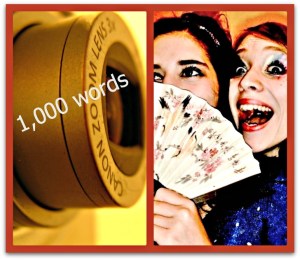
Canon zoom lens; photo credit: Morguefiles; Rachel (right) with her friend Sara experimenting with make-up and photography with the help of a bottle of wine (or two?) and some props (photo credit: Rachel Kanev).

Welcome to our monthly series “A picture says…”, created to celebrate expats and other global residents for whom photography is a creative outlet. The series host is English expat, blogger, writer, world traveler and photography enthusiast James King, who thinks of a camera as a mirror with memory. If you like what you see here, be sure to check out his blog, Jamoroki.

My guest this month is 24-year-old Rachel Kanev. She has a Bulgarian father and German Jewish mother but grew up in England, where she studied French and Chinese languages. She feels she got “…caught somewhere in between” these many cultures:

With my Jewish nose, Bulgarian skin and English accent, I at once belong to British, East German, Bulgarian, Jewish, French and Chinese cultures and yet to none of them at all.

Her grandmother, by contrast, lived in Berlin for decades but was more English than Tetley tea.

Indications of Rachel’s escalating identity crisis are borne out in the images that bombard you upon reaching her engaging blog, Global Drifting, in which she says she is drifting across the globe in hopes of stumbling upon enlightenment…

* * *

Hi, Rachel. I’m pleased your globe-drifting has taken you to the shores of the Displaced Nation, which gives us the opportunity to discuss your photo-travel experiences. For one so young you’ve travelled a fair bit, but where were you actually born?
I was born in my mother’s hometown of Berlin, at the traffic lights on the way to hospital. My mother said I looked like a hedgehog that day, and my family still calls me Igel (“Hedgehog” in German). A few months later, the Berlin Wall came down and one year after that, we all moved to England.

So you were a Third Culture Kid in Britain. When did you spread your wings to start travelling?
My nursery and primary school classes were filled with international children. Eugenia—a Spanish girl from Madrid with long black hair and a passion for witchcraft and the Greek goddess Athena—soon became my best friend. In the momentary way that often strikes a child, I was devastated when she left me to return home for good. So, at the tender age of nine, I boarded a plane alone, in my size 1 shoes, to visit Eugenia in Spain. As I began my first solo journey, I experienced a thirst for discovery, which, as yet, has not been quenched. Since that first adventure, I have visited Italy, Holland, France, Austria, Switzerland, Réunion Island and China. I plan to step (in my now size 5 shoes) into Morocco and perhaps Israel this coming summer.

What do you love so much about travel?
I love travel because everything is new and unknown; we share no past and perhaps no future with the things we see and people we meet. The errant wanderer therefore has no choice but to revel in the present.

Will I ever get over the pull I feel to both of these places?

Despite your age, I think I can put you in the category of seasoned traveller. Tell me, what inspires your decision to travel to particular places?
My inspiration comes partly from a love of languages and partly from the idealistic images of France I painted in my head when watching French films and listening to French music, which I did while revising for my exams at university. Aided by the amazing Erasmus, that towering figure of the Renaissance, I had taken a university year abroad in the island paradise of Réunion, near Africa. It’s a French overseas department so qualifies for the European Union’s Erasmus Programme, which finances students to spend up to a year of their university courses in a university in another European country. But it wasn’t until after finishing university that I had a chance to visit France itself. I meandered through southern French villages like an aimless hippie, reveling in its rural chic.

I understand you also have a passion for China?
Chinese was my third language at university. After graduating, I remained in England saving pennies as a waitress to finance spending a year in the land of silk. I lived in a city about an hour from Beijing.

I’m curious: where are you right now and what are you up to?
Right now I’m back living in my English hometown of Cambridge, selling nutritional products to vitamin-mad French and German customers—and saving up for my next Chinese/Moroccan/Spanish/Israeli adventure this summer. As I look out of the window, I am visualizing being there already, far from the Land of Vitamins C and D!
RK_SouthofFrance

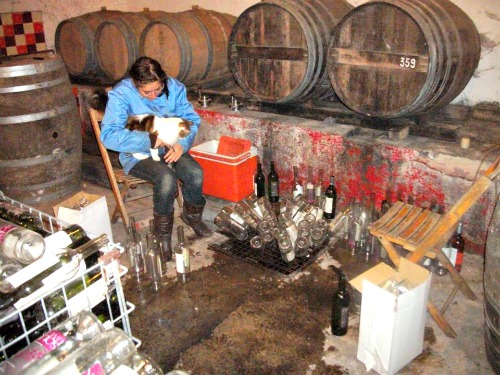
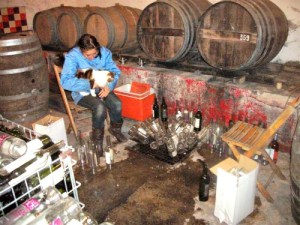
No use crying over spilled wine! Rachel in the cellar of a now-defunct winery near Perpignan, France; photo credit: Rachel Kanev.

Hmmm… I think I detect something of the entrepreneur in you, alongside your intrepid traveller’s spirit! And now let’s have a look at a few of your favorite photos from your travels to France and China.
Sure! I took this first photo in a wine cellar in a small hamlet near Perpignan, some way off the coast of southern France. I’d been helping out, but it was late December, and there was very little work left. Besides, the winemaker, whose name was Bernard, had gone bankrupt due to the stresses of organic farming. Our main task for the day, as his helpers, was to pour bottle upon bottle of wine down the drain as he looked on bemoaning the demise of the modern world. It proved a good way to get skillful with a corkscrew!! And I think poor Bernard appreciated our efforts quite a lot. Just think if he’d drunk all that wine in his cellar, it would have sent him spiraling into an even deeper fit of depression…
RK_dragonriceterraces

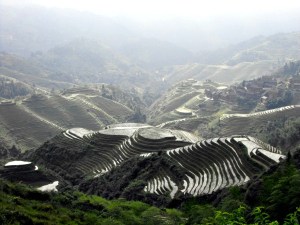
China’s Longji (Dragon’s Backbone) Terraced Rice Fields are so named because of their resemblance to a dragon’s scales; photo credit: Rachel Kanev.

The next photo provides a glimpse of the glorious Dragon rice terraces of Longshen, in China’s Guangxi province. Amazing terraces stretch as far as the eye can see. I visited some years ago and remember being in awe at the combination of nature’s beauty and the skillfulness of the human hand. I had quite an adventure ambling through the fields with two of my Chinese friends. We got lost and at one point envisaged spending a cold night cuddled up to the cows. In the end we reached our hostel, at the top of the terraces, by nightfall. I returned again last year and was saddened to see that the beauty of the fields has been marred by the greedy hand of tourism. Huge plastic cable cars now transport visitors to the top, and the local villagers are paid to dress in traditional clothes.
RK_AnotherBernard

A French farmer, another Barnard; photo credit: Rachel Kanev.

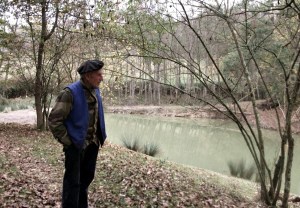
Last in this series we have another Bernard who stumbled into my traveller’s path. This Bernard is an 80-year-old farmer with whom I lived on my own for a week. His farm is an hour away from the nearest town and is completely self-sufficient. He grows his own organic vegetables and was fit enough to hack up the ground with a pickaxe when the underwater pipes burst (ironically, I had left the home of Bernard number 1 because his pipes had burst and the water system needed to be repaired, only to be faced with more burst pipes at the home of Bernard number 2!).

I love the first photo just because it looks as though you’ve broken into someone’s cellar and are drinking all the wine!! The dragon terraces appear so surreal to me because they are so different to the flat rice fields of Thailand, where I live. I wish I could see them one day. I know you take a lot of photos and these next four, I believe, have a special significance for you. Can you explain?

Not all who wander are lost…

The following is a photo I took of a photo of Bernard number 2, which was taken some fifty years ago, when his newly polished army boots took their very first steps away from the small village on the outskirts of the Pyrenees, where he was born. He bid farewell to the farm he’d grown up on and to the parents who’d raised both him and the thriving trees and crops that had formed the backdrop to his childhood. By the time I encountered Bernard, nature had outlived his parents but their legacy remained. He is now a beekeeper and organic vegetable farmer, tending to the very same trees and plants that his father and his father’s father had cared for. Though he has no human family, the trees you see in my other photo of Bernard (above) appear to me to be his forefathers; they are equally his children.

Bernard as a young man

The French farmer Bernard as a young soldier; photo credit: Rachel Kanev.

The next photo was a fluke as I managed to capture an ad for Longines watches showing Kate Winslet just as the sun was setting. In that fleeting instant, one can see Shanghai’s varied transportation, high-rise buildings and red lanterns—that curious amalgamation of Western modernity and Chinese traditionalism that is everywhere around you in the city.

RK_ShanghaiSunset

A British beauty, a Swiss watch and a Shanghai sunset; photo credit: Rachel Kanev.

Cambridge is my home town and I think of it much like a family member, having watched it age and evolve just as it has silently witnessed me grow and change. I love its grandiose architecture, endless greenery, and the way winter and spring intertwine in front of the University’s palace-like structures that are fit for if not a queen then the rulers of academia, to which I never belonged.

RK_CambridgeUK

The dreaming spires of Cambridge; photo credit: Rachel Kanev.

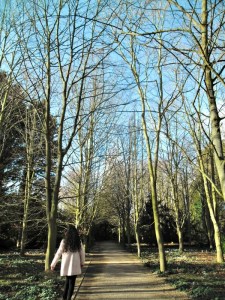
Here my sister explores the labyrinth-like forestry of a park near where we live in Cambridge. It has amazing multi-coloured plants I have never seen anywhere else before and huge trees that watch over you like silent giants. I like this photo because she looks like Alice in Wonderland with her long, thick flowing locks!
RK_SisterinPark

The great outdoors near Cambridge, UK; photo credit: Rachel Kanev.

Is photography sometimes a moral decision?

I love your explanations as they show us the profound effects a picture can have on its creator, something the viewer can never fully appreciate. Tell me, do you ever feel reserved about taking photos of people, particularly when they are conscious that you are doing so?
For me, the morality of taking photos of strangers has always been ambiguous. I think of it whenever I see photos of human suffering. I believe I have the right to use my camera to record the world but without intruding on it. At what point does the power of images and the need for education and understanding through the push of a button and flash of a light become intrusive and affect the lives of others in a negative way? I’ll give you an example from my own experience. The Western media has focused almost exclusively on China’s explosive economic growth when in fact 1.6 million people (11.8 percent of the population) still live below the poverty line. When taking the train, part of me would like to photograph the dirt-covered, barefooted children asleep on newspapers or the train door frozen from the inside as passengers are left to deal with the icy temperatures of the North (-37°C). But feeling intrusive, I refrain.

Do you also feel self-conscious in Asia?
It’s difficult being subtle, given the colour of my hair and skin, and the stamp on my passport. Noticing me walking the streets of China, many Chinese will assume, quite rightly, that I am Western but quite wrongly that I must therefore have dollar bills rolling from my body like a central bank printing press. Often I do not wish to fuel their prejudices by whipping out a digital camera, however small, before their eyes.

As a resident in Thailand, I can empathize with those views, especially the general Asian misconception that all Westerners are rich. Although this can be annoying, I do believe these views are changing for the better, as the younger generation becomes more socially aware through travel and better education. Now let’s turn to the technical stuff. Some of our readers may want to know what kind of camera and lenses you use.
I have a small Samsung camera that fits neatly in the palm of my hand. It’s nothing fancy and often leaves something to be desired in terms of quality, but it was a birthday gift years ago and has sentimental value, having been my only travel partner across unknown lands. Whatever it lacks in lens quality, Windows Photo Gallery makes up for in magical editing power!

Finally, do you have any advice for wannabe photographers who are traveling or living abroad?
Wander through villages, peel garlic with a farmer, shake hands with a prince, run through jungles, leap into waterfalls, swing across the rainforest wilderness and lose a leg to the marble rocks—see the world and allow the world to be seen. Travel, live, eternalize what you see with a photo.

Great non-technical advice, Rachel, that’s right up my street! I’d like to thank you for taking the time to tell your fascinating story in this interview.

* * *

Readers, what do you make of Rachel’s experiences and her photography advice? And do you have any questions for her on her photos or her travels? Please leave them in the comments!

And if you want to know more about Rachel Kanev, don’t forget to visit her blog, Globe Drifting. You can also follow her on Twitter or even shoot her an email.

(If you are a photographer and would like to be interviewed by James for this series, please send your information to ml@thedisplacednation.com.)

STAY TUNED for next week’s fab posts!


If you enjoyed this post, we invite you to register for The Displaced Dispatch, a round up of weekly posts from The Displaced Nation, with seasonal recipes, book giveaways and other extras. Register for The Displaced Dispatch by clicking here!

Related posts:

And the April 2014 Alices go to … these 4 international creatives

 © Iamezan | Dreamstime.com Used under license

© Iamezan | Dreamstime.com
Used under license

If you are a subscriber to our weekly newsletter, Displaced Dispatch, you’re already in the know. But if you’re not, listen up. (Hey, why aren’t you? Off with your head!)

Every week, when that esteemed publication comes out, we present contenders for a monthly “Alice Award,” most of whom are writers or other kinds of international creatives who appear to have a special handle on the curious and unreal aspects of being a global resident or voyager.

Not only that, but this person tries to use this state of befuddlement as a spur to greater creative heights.

Today’s post honors April’s four Alice recipients. They are (drumroll…):

1) TONI HARGIS, author, blogger, and British expat in Chicago

For her post:  “Learn to Take a Compliment, Brits in America” in Mind the Gap, a resource blog for British expats in America on BBCAmerica.com
Posted on: 18 April 2014
Snippet:

Many British teachers admitted that they and their students found it very hard to fill in applications for American colleges because they were asked for “accomplishments and strengths” as well as academic achievements. As one contributor put it, U.K. teachers “are not very good at waxing lyrical about [their] students other than in academic terms.”

Citation: Toni, what an absolutely marvelous post! Only don’t you think you should have promoted your credentials a little more? After all, you’ve written a book called The Stress-Free Guide to Studying in the States, the contents of which we expect could be useful to Bashful Brits. Actually, you do refer to the book in passing—but don’t provide the title or a link. Hey, never miss an opportunity to blow your own trumpet! But listen, as you insist upon being so self-effacing, we feel justified in presenting you with this inspirational passage from Through the Looking Glass, where a banquet is being held in honor of the diffident Queen Alice, who can’t quite believe she’s been made a queen:

[Alice] didn’t see why the Red Queen should be the only one to give orders; so, as an experiment, she called out “Waiter! Bring back the pudding!” and there it was again in a moment, like a conjuring trick. It was so large that she couldn’t help feeling a little shy with it…; however, she conquered her shyness by a great effort, and cut a slice and handed it to the Red Queen.

“What impertinence!” said the Pudding. “I wonder how you’d like it, if I were to cut a slice out of you, you creature!”

It spoke in a thick, suety sort of voice, and Alice hadn’t a word to say in reply: she could only sit and look at it and gasp.

“Make a remark,” said the Red Queen: “it’s ridiculous to leave all the conversation to the pudding!”

One last word of advice, if we may: Should you feel at all embarrassed about accepting an Alice, rest assured, a simple “thanks” will do. No need to curtsey… Notably, this last accords with what the point you make at the end of your excellent (as well as thought-provoking!) post:

…when someone praises you, your spouse, your children, your dog or your house, a simple “Thank you” will both suffice and move the conversation swiftly along without too much excruciation on your part.

Again, as the Red Queen puts it to Alice: “You ought to return thanks in a neat speech.”

2) Anthony The Travel Tart, Australian travel addict and blogger

For his post: “You Know That You’ve Been Living in Japan Too Long When…,” on The Travel Tart
Posted on: 18 March 2014
Snippet:

You know that you’ve been living in Japan too long when…

  • A room the size of a cubic metre feels rather large.
  • Capsule hotels feel quite spacious.
  • Wide open spaces freak you out.

Citation: Anthony, we assume you met quite a few expats during your time in Japan. Because your inference that the longer a foreigner stays in Japan the stranger he or she becomes is spot on (and one of us speaks from a too-long experience of having lived in that small-island nation). Picture for a moment what happens to Alice after she enters the White Rabbit’s house and downs the contents of the “Drink Me” bottle:

She went on growing, and growing, and very soon had to kneel down on the floor: in another minute there was not even room for this, and she tried the effect of lying down with one elbow against the door, and the other arm curled round her head. Still she went on growing, and, as a last resource, she put one arm out of the window, and one foot up the chimney.

This is actually a case where one might prefer to be Alice rather than an expat. She at least has the ability to drink potions or eat pieces of mushroom to change her body size. But many gaijin remain permanently stuck in the White Rabbit’s house (not for nothing has Japan achieved notoriety as the “rabbit-hutch nation”). Downing the contents of a bottle of Suntory whisky or taking a bite of a matsutake (pine mushroom, prized for its spicy aroma) won’t make the blindest bit of difference. Oh, and incidentally, it’s arigato, not origato, but that’s okay as it means you didn’t stay too long—though you may want to add “correcting other foreigners’ Japanese” to the list.

3) MATT HERSHBERGER, writer and blogger at A Man Without a Country, and 4) British dialect coach ANDREW JACK

For the post: “A quick video guide to the accents of the British Isles”, by Matt Hershberger on Matador Network, which features Andrew Jack’s brilliant video (produced by Philip Barker).
Posted on: 20 April 2014
Snippet: Matt, who once lived in England, says:

As an American, I can’t even replicate the accents properly, so if I tried to ask for help distinguishing an accent from a British friend later, the best I could hope would be that I’d sound sort of like Stewie Griffin, and nothing like the accent I’d heard.

Citation: Matt, we take your point that when venturing abroad to a country where they speak the same language, it is most disconcerting when you can’t understand what people are saying because of their heavy accents—a true “through the looking glass” moment. (We fear that Brits may have some of the same troubles in the U.S., but let’s face it, you’d expect that in a country of this size, not of one as tiny as Britain.) We appreciate that you highlighted the video of Andrew providing 14 regional accents from the British Isles in 84 seconds: how awesome is that? As one of the YouTube commenters says, “good for ignorant North Americans”—some of whom, me might add, may plan to be (or have already been) expats in the UK. And we appreciate it even more when recalling that Poor Alice had no interpreter for the White Queen’s methods of communication:

“My finger’s bleeding! Oh, oh, oh, oh!”

Her screams were so exactly like the whistle of a steam-engine, that Alice had to hold both her hands over her ears.

“Oh, much better!” cried the Queen, her voice rising to a squeak as she went on. “Much be-etter! Be-etter! Be-e-e-etter! Be-e-ehh!”

The last word ended in a long bleat, so like a sheep that Alice quite started.

*  *  *

So, readers, do you have a favorite from the above, or have you read any recent posts you think deserve an Alice Award? We’d love to hear your suggestions! And don’t miss out on the shortlist of Alice contenders we provide in each week’s Dispatch, which are sources of creative thought if nothing else! Get on our subscription list now!

STAY TUNED for more fab posts.

Writers and other international creatives: If you want to know in advance the contenders for our monthly Alice Award winners, sign up to receive The Displaced Dispatch, a round up of weekly posts from The Displaced Nation, with news of book giveaways, future posts, and of course, our weekly Alice Award!. Register for The Displaced Dispatch by clicking here!

Related posts:

JESS IN JAPAN: After all the hype, cherry blossom season underwhelms

JessinJapan_column

Jessica Awanohara in Tokyo (winter 2014); photo credit: Hiro Awanohara.

Jessica Awanohara moved from New York to Tokyo with her Japanese husband, Hiro, at the end of last year. What is it like to step “through the looking glass” and treat Japan as a home rather than a quirky place to visit? Jess keeps us abreast of her progress via this occasional column-cum-photos.

After a long, cold, all-around terrible winter, April is here, and in at least half of this beautiful world of ours, that means that spring has sprung! Crocuses are peaking through the nearly frozen plains of Central Park; monarch butterflies are beginning their multi-generational migration from Mexico to northerly climes; and in Tokyo, where I now reside, the most spectacular seasonal transition of them all—the blooming of the cherry trees, or sakura—has been taking place.

This being my first sakura season in Japan, I wasn’t entirely prepared for the national obsession with tracking when, where and how to best view the blossoms. In fact, for at least three weeks, sakura viewing was the only thing anyone talked about. Friends regaled us with stories of sakura seasons past, advising on the best and worst parks in Tokyo for beholding the spectacle of the storied blossoms. Like stock tips, they whispered these insights authoritatively, as though acting upon them would determine our very future.

I learned, for instance, that Inokashira Park, in the northwestern part of the city, was “too crowded, wild, and ‘diverse'” while Nakameguro, in the southeast, was the “ideal spot for a first-timer” like myself.

Meanwhile, the sakura craze was heightened by CNN-style coverage on TV. Whole segments of the morning and evening news were dedicated to maps, predictions, histories, and images detailing the slow ascension of blossoms from Okinawa to Hokkaido.

By the time the trees were showing their first buds, all I could think about was the prospect of attending a viewing party. In case you haven’t heard, celebrating under a fully blossomed cherry tree, a festival known as ohanami, is as eagerly anticipated as the blossoms themselves. All of Tokyo, it seems, comes out for marathon sessions of en plein air eating and drinking, presumably turning as pink as the flowers.

But as luck would have it, this year things would be different. Tokyo was soaked by two straight weeks of hard rain and cold weather. The delicate pink sakura petals were washed away before they were able to reach full bloom.

Braving these inclement conditions, my husband and I biked to a couple of nearby parks and well-known streets to soak up whatever we could (hopefully without getting too soaked!). But the grey skies and cold weather kept our spirits, along with the blooms, at bay. In fact, it was almost too depressing to document the mostly bare branches and paltry spray of revelers, but here, readers, are a few mementos of my first cherry blossom season in Tokyo:

Early sakura in Nakameguro; photo credit: Jessica Awanohara.

Early sakura in Nakameguro, alongside Meguro River, the recommended destination for newbies; photo credit: Jessica Awanohara.

At least someone is trying to get his party blooms on; photo credit: Jessica Awanohara.

At least someone (see man on curb) is trying to get his party blooms on; photo credit: Jessica Awanohara.

The actual best spot to view cherry blossoms this year, snapped on the way to an interview in Shinsen; photo credit: Jessica Awanohara.

The actual best spot to view cherry blossoms this year, snapped on the way to an interview in Shinsen; photo credit: Jessica Awanohara.

* * *

Thanks, Jessica. Sorry to hear it was such a wash-out! Readers, Jess’s experiences raises a classic Displaced Q: How many of you have sought an iconic experience during your stay abroad that didn’t quite live up to your expectations?

STAY TUNED for tomorrow’s fab post!

If you enjoyed this post, we invite you to register for The Displaced Dispatch, a round up of weekly posts from The Displaced Nation, with seasonal recipes, book giveaways and other extras. Register for The Displaced Dispatch by clicking here!

Related posts: