The Displaced Nation

A home for international creatives

Tag Archives: Writers we love

HERE BE DRAGONS: The expat life as fuel for fantasy writing

Serpent Map Collage Drop Shadow

(Clockwise from top): Detail of the medieval map Carta marina; the Speicherstadt (warehouse district) in Hamburg, Germany; Andrew Couch (photo credit: Andrew Couch).

Welcome to the Displaced Nation’s very own Game of Thrones. To be eligible, you simply have to be, or have been, an expat or world traveler of some kind, and open to seeing the connection between the international life and fantasy fiction. Andrew Couch, an American expat in Germany, will be our coach (no pun intended!). Though he has not been playing the game for long, having published his first fantasy novella only last month, he is already dancing with dragons, and thinks that you should be, too…

—ML Awanohara

Living as an expat in another culture forces you to interact with the world in a different way. You cannot rely on the habits of your home and things around you are strange—sometimes really really strange.

Yet they are perfectly normal to the locals.

This echoes my experience of reading (and now writing) fantasy fiction. I didn’t really think about it that way until I started writing this post, but I guess it should have been obvious all along.

Trip the “expat life” fantastic

I’ve always loved the fantasy genre, ever since I could read. The first book I remember was Voyage of the Dawn Treader, by C.S. Lewis, although I certainly delved into Tolkien’s The Hobbit very early on as well. Both are fantasy but also involve travel. As a child, I was drawn to the imagery of the strange places depicted in these books.

Maybe that feeling of diving into fantastical worlds is what led me to a life of travel as an adult, and ultimately to the life I now have in Germany as an expat.

The characters in fantasy novels accept their world as it is. They might accept that magic exists in a specific form—or that elves, trolls and ogres wander the street selling sausages.

Is this really so much of a stretch from what we accept as expats sometimes?

After living for six years in Germany, I almost take for granted how orderly everything is: I like knowing that the tram will come at an exact time. I’ve also come to appreciate being able to sit in a restaurant all evening without anyone shoving the bill at me to pay and leave.

I do notice, though, that the more I integrate with the local life, the more I crave a creative outlet. Several years ago, when I’d been living in Freiburg for a couple of years, my apartment lease was running out and I had to decide: should I find a new place to live, or was it time to move on? In the end, I decided to buy my own apartment, which tied me still more closely to the wonderful town of Freiburg. I was happy but also felt that doors were closing, and I needed to seek other outlets. I ended up starting a blog, Grounded Traveler: Expat life in Germany and still seeing the world. I tried writing fiction, too, but must not have been ready.

Just last year I made a career shift. For 13 years I had worked as a Web developer for an employer, but I decided to leave and start my own freelancing business. Being my own boss has given me the freedom to do what I want when I want, but there are limits on that freedom as I must constantly be on the lookout for projects.

QueenOfCloudPirates_coverCraving the fantastic once again, I started writing a series of fantasy novellas. I self-published the first episode, Queen of the Cloud Pirates, in March and am working on the next one now, based on the inspiration of living and traveling abroad.

Thinking of blue almonds (Polish for “daydreaming”)

Much of my inspiration for writing fantasy comes from the places my wife and I visit on our travels. My follow-on novella to Queen of the Cloud Pirates (I’ve just finished the first draft) is set in a fantasy port city.

Not long ago, my wife and I traveled to Hamburg for a few days and spent time in Speicherstadt, an area of the city full of canals and towering brick warehouses with elevators and cranes around them. On that occasion I let my imagination go, wondering what a sword fight among the ropes and narrow stairs would be like. This has driven a fair amount of the book’s setting.

Of course inspiration can come from anywhere, not just from a city’s wonderfully distinct architecture but also from more mundane settings. For instance, here is a snippet I wrote after glimpsing an unusual face on the subway in Berlin:

A man sat hunched over in the subway seat, his chin piled on top of both hands steadying himself on his cane. A white fluffy mustache flowed over the side of his hands like a cascade of falling clouds. His oh-so-attentive eyes, in contrast to his nearly decrepit body, watched from beneath equally fluffy eyebrows that flowed up in the same way the mustache floated down. Was this a visitor from the realm of clouds come to watch us on earth? I pondered the significance of seeing this man underground as I got off at my stop and watched him through the window as the train sped away.

I am constantly collecting such snippets and images on my travels. In fact, I’m now half-way through another story based on a mis-heard subway announcement about the train ending and needing to transfer to the “elephants”—well, that’s not what the conductor said but it’s how I heard it. I have been thinking about the story so much I can’t really remember the original line, but I expect I heard something about transferring to bus line 11 (elf in German) and, despite being fluent in German, thought of elephants.

Here Be Dragons (in Latin, Hic Sunt Dracones)

Readers, do you collect thoughts and ideas when traveling to, or living in, strange surroundings? And if so, are you inclined to turn these snippets into stories?

While I have a fantasy-oriented imagination, and tend to see dragons or other fantastical beasts when venturing into new territory, I imagine that such snippets could support any genre of writing.

I look forward to seeing you next month, when I will continue exploring how encounters with different landscapes, cultures, cities, architecture, and people can stimulate the imagination in some strange and wonderful directions. Let me know in the comments if you’re fantasizing about any particular topics, and I’ll see if my imagination can stretch to accommodate.

Andrew Couch has been a fantasy book nut since childhood; he really has not grown up much since then. After struggling to write his own games for years, he is now creating fantastical worlds in a series of novellas that echo the TV shows, anime and role-playing games of his youth. Beyond fantasy he is an avid blogger and a world traveler who resides in Germany. To learn more about Andrew, check out his blog, Grounded Traveler, and follow him on Twitter: @groundedtravelr.

STAY TUNED for next week’s fab posts!

If you enjoyed this post, we invite you to register for The Displaced Dispatch, a round up of weekly posts from The Displaced Nation, with seasonal recipes, book giveaways and other extras. Register for The Displaced Dispatch by clicking here!

Related post:

LOCATION, LOCUTION: Andrea Cheng, award-winning children’s author

Author photo: Andrea Cheng

Author photo: Andrea Cheng

In this month’s “Location, Locution”, expat crime writer JJ Marsh interviews Andrea Cheng, award-winning author of  books for children and young adults.  

Cheng’s first novel, Marika, was selected by the city of Cincinnati for “On the Same page,” a citywide reading program.  Honeysuckle House, Anna the Bookbinder, and Shanghai Messenger received Parent’s Choice Awards.  Grandfather Counts was featured on Reading Rainbow. Where the Steps Were, the first book that Cheng has both written and illustrated, received starred reviews in both Publisher’s Weekly and Kirkus. The Year of the Book, a Junior Library Guild selection, was reviewed in the NY Times and was followed by The Year of the Baby (2013 May). Cheng’s most recent title is Etched in Clay.

Some of Cheng’s books draw on her background as the child of Hungarian immigrants as well as the background of her husband, the son of immigrants from China. Others draw on the lives of her children growing up in inner city Cincinnati where she and her husband now live.  Andrea studied Chinese at Cornell University where she received a Masters degree in linguistics.  She and her family have traveled to both Budapest and Shanghai to get to know their extended families.

Which came first, story or location?
I think character comes first in my writing, followed by location, atmosphere, etc.  Plot or ‘story” come later.  I usually start with a character at a particularly salient moment in a specific place, and go from there.

Year of the Book

Cover art: The Year of the Book, by Andrea Cheng

What’s your technique for evoking the atmosphere of a place?
I have to have spent a fair amount of time in a place before I can evoke the atmosphere.  I have to know how it smells and tastes and looks and feels.

Which particular features create a sense of location? Landscape, culture, food?
Everything!  I think I focus a lot on language, the way people talk. I think it would be very hard for me to write a story that takes place in a location in which I cannot speak the native language of the people who live there.

Can you give a brief example of your work which illustrates place?
This is from my chapter book called THE YEAR OF THE FORTUNE COOKIE, coming out with Houghton Mifflin in May 2014.  It is for grades 3-6.  The main character, Ana Wang, is in Beijing:

It starts to rain.  The sky is almost dark, and the air smells like gasoline and charcoal.  We turn down an ally and wind our way behind some buildings.  “This is my home,” Fan says finally, opening a door with her key.

Inside the light is dim.  Her brother is watching television and her mother is cooking on a hot plate.  “This is my friend from America,” Fan says.  

How well do you need to know the place before using it as a setting?
I have to have spent time in the place and I have to understand the language of the people there.  The more time the better.

Which writers do you admire for the way they use location?
I just read Jhumpa Lahiri’s new novel, Lowland.  Although I think the book has some problems, I love her sense of place.

Next month’s Location, Locution:  Jill interviews James Ferron Anderson – weaver, glassblower, soldier, and now writer.

 * * *

JJ Marsh grew up in Wales, Africa and the Middle East, where her curiosity for culture took root and triggered an urge to write. After living in Hong Kong, Nigeria, Dubai, Portugal and France, JJ finally settled in Switzerland, where she is currently halfway through her European crime series, set in compelling locations all over the continent and featuring detective inspector Beatrice Stubbs.

_(75_of_75)

Author photo: J J Marsh

STAY TUNED for our next post!

If you enjoyed this post, we invite you to register for The Displaced Dispatch, a round up of weekly posts from The Displaced Nation, with seasonal recipes, book giveaways and other extras. Register for The Displaced Dispatch by clicking here!

Related posts:

And the March 2014 Alices go to … these 3 international creatives

 © Iamezan | Dreamstime.com Used under license

© Iamezan | Dreamstime.com
Used under license

If you are a subscriber to our weekly newsletter, Displaced Dispatch, you’re already in the know. But if you’re not (and why aren’t you? off with your head!), listen up.

Every week, when that esteemed publication comes out, we present contenders for a monthly “Alice Award,” most of whom are writers or other kinds of international creatives who appear to have a special handle on the curious and unreal aspects of being a global resident or voyager.

Not only that, but this person tries to use this state of befuddlement as a spur to greater creative heights.

Today’s post honors March’s three Alice recipients. Starting with the most recent, they are (drumroll…):

1) CANDACE ROSE RARDON, travel writer and sketch artist

For her interview:  “Watercolouring Her Way Around the World,” on Linda Fairbairn‘s Journey Jottings blog
Posted on: 14 March 2014
Snippet:

“In a way, my sketchbook also helps create the moments I record in it. I might head to a café to draw a street-scape, start talking with the man next to me, and then jot down a line or two from our dialogue on the sketch itself. Sketching has become both my muse and medium on the road—it creates the very stories I love to tell, stories of connection and serendipity, and I now can’t imagine ever travelling without my sketchbook.”

Citation: Candace, we think we should invent a new award for you: a “Poppins.” Your watercolors look so inviting that we want to jump right into them and share in your adventures, just as Mary Poppins jumps into Burt’s chalk drawings. (Incidentally, we refer to the animated sequence in the movie, of which P.L. Travers did not approve, only to be overruled by Walt Disney.) Poor Alice doesn’t go down the rabbit hole because of its visual stimulation; quite the opposite! She goes down the hole due to boredom with her sister’s book “without pictures or conversations.” Our sense is that, were you to receive an “Alice,” it would need to be presented by the Mock Turtle, art lessons having played a role in his superior education:

“Well, there was Mystery,” the Mock Turtle replied, counting off the subjects on his flappers, “—Mystery, ancient and modern, with Seaography: then Drawling—the Drawling-master was an old conger-eel, that used to come once a week: HE taught us Drawling, Stretching, and Fainting in Coils.”

Though he doesn’t mention “water” art, it seems likely he would sanction it. Definitely he would not be a fan of our alternative suggestion unless we agreed to call the prize a “Puffins” instead of a Poppins. But enough of these qualifications; suffice it to say, we are in awe of your ambition to “watercolour” your way around the world. You paint, girl!

2)”The Expat” in Korea

For his post: “The Reincarnation Lottery,” on ExpatHell.com
Posted on: 18 March 2014
Snippet:

We may be dogs, but we are dogs with memories. Memories of where we came from. Memories of hot summer days, clear blue skies, people smiling, people laughing, wind slicing through large trees with leaves whisking and shimmering in the sun like waves washing over a million shiny round stones. We are four dogs with memories of home, and somehow, we are all going back. This is what we wail about during the pitch black nights and all we dream about during the hazy grey days.

Citation: The Expat, we have been around the world a few times so are well aware of South Korea’s proclivity for dog meat consumption. This may be why we find your description of yourself and your three mates as a pack of four large wailing dogs on a dog farm “in the lonely cold mountains and valleys of the Korean countryside” alarming. But no more alarming, we suppose, than Alice’s own sense of transformation as she progresses through Wonderland:

Alice took up the fan and gloves, and, as the hall was very hot, she kept fanning herself all the time she went on talking: “Dear, dear! How queer everything is to-day! And yesterday things went on just as usual. I wonder if I’ve been changed in the night? Let me think: was I the same when I got up this morning? I almost think I can remember feeling a little different. But if I’m not the same, the next question is, Who in the world am I? Ah, THAT’S the great puzzle!” 

A good thing she doesn’t prolong her stay in Wonderland, that’s all we can say. Can she be far off from imagining herself as a caged rabbit that is about to be thrown into the cauldron of pepper soup being stirred by the Duchess’s cook? In any case, we really appreciate your honesty in telling the story, in such a creative way, of four American men arriving in Korea in hopes of a fresh start as English teachers, only to end up “starting over and starting lower.” We can certainly see why you aspire to returning to our “dog eat dog” society here in the West. Only please promise that between now and then, you won’t land in a bowl of Korean soup, which, needless to say, will be a great deal more firey than the Duchess’s.

3) ALEX BAACKES (aka Alex in Wanderland), freelance writer and New York native on the move

For her post: “My Top 8 Animal Encounters Around the World,” on Michael Hodson‘s Go, See, Write blog
Posted on: 20 February 2014
Snippet:

Today, I seek out encounters with animals that are willing participants in sharing their space with me; one where everyone walks—or swims—away happy. . . . While I’m still not quite sure how sailors once mistook manatees for mermaids, I can now attest to the fact that these bulbous creatures move with a surprising amount of grace. Braving the chilly winter waters? Worth every shiver to share a swim with these beauties.

Citation: Alex, we are struck by how quickly you have come to the realization that, while it can be fine, even fun, to encounter other human beings on your travels, you should not miss out on the opportunity to interact with new kinds of mammals—relationships with whom could end up being much more therapeutic, especially if they’re the kind you can swim with. Alice, of course, had no qualms about swimming with the Wonderland creatures:

It was high time to go, for the pool was getting quite crowded with the birds and animals that had fallen into it: there were a Duck and a Dodo, a Lory and an Eaglet, and several other curious creatures. Alice led the way, and the whole party swam to the shore.

But in Alice’s case, she was swimming in a pool made of her own tears. We congratulate you on being much more sensible in heading Crystal River, near Orlando, which plays host to the migrating manatees from October to March.

*  *  *

So, readers, do you have a favorite from the above, or have you read any recent posts you think deserve an Alice Award?  We’d love to hear your suggestions! And don’t miss out on the shortlist of Alice contenders we provide in each week’s Dispatch, which are sources of creative thought if nothing else! Get on our subscription list now!

STAY TUNED for next week’s fab posts.

Writers and other international creatives: If you want to know in advance the contenders for our monthly Alice Award winners, sign up to receive The Displaced Dispatch, a round up of weekly posts from The Displaced Nation, with news of book giveaways, future posts, and of course, our weekly Alice Award!. Register for The Displaced Dispatch by clicking here!

Related posts:

THE LADY WHO WRITES: Even before you write the last word of your novel, start rehearsing the book trailer!

LadyWhoWrites_brandApril blossoms (and showers) are here, which means it’s time to welcome Meagan Adele Lopez, aka The Lady Who Writes, back to the Displaced Nation. Meagan is a repeat expat in the UK (last time Bristol, this time London). Besides writing, her talents include acting, blogging, and crafting ads for social media. In this monthly column, she is doling out advice to international creatives who are contemplating writing a novel about their novel, shall we say, life experiences.

—ML Awanohara

Hello again, Displaced Nationers. I wonder, how many of you caught ML’s interview with British screenwriter Tim John, posted at the end of last week? Tim spent seven years as an expat in LA chasing the dream of selling scripts to Hollywood studio executives and producers. Reading about his (mis)adventures got me thinking about my own Hollywood days—as well as about book trailers, a pet topic of mine.

Like Tim, I tried to make it in Hollywood for a time: first as an actress and then as a casting agent. I poured what I learned from this experience into creating Dell, the heroine of my first novel, Three Questions: Because a quarter-life crisis needs answers. As anyone who has read it will know, the novel is about the developing love between two young people who have only met each other once, by chance, on a night out in Las Vegas. The love interest, Guy, is from England, while Dell is from America. And the complication is that neither are willing to give up their life plans. Dell is on route to Hollywood to seek her fame and fortune, while Guy is heading to Africa in search of adventure.

Perhaps this portion of my background also explains why, the first time I saw a book trailer, I knew I had to have one for my novel. The trailer was for One Day, by English novelist and screenwriter David Nicholls. By my count, Nicholls actually created a total of four “One Day” book trailers. Here is one of them:

I had never seen a book trailer before, and this one made a strong impression on me. I thought: Gosh, this book I’m about to read is going to be turned into a film—and I’m one of the lucky few who gets to read it before the movie comes out.

In fact, when the movie did come out—with Anne Hathaway playing the female lead—it was a flop, even though Nicholls had also written the screenplay. (The consensus among critics on Rotten Tomatoes is that the movie “lacks the emotion, depth, or insight of its bestselling source material.”)

What the *&%$ is a book trailer?

Good question. A book trailer is akin to a movie trailer. It’s an advertisement for the book in visual form. I saw it as another way to reach my audience—another way to inspire and motivate potential readers to buy the book.

But now that I’m in the position to hand out advice to wannabe novelists, I recommend you start thinking about your book trailer even before you finish writing.

Many writing coaches will tell you to read your book aloud before submitting it to an editor for review. It gives you a sense of where you need to improve the dialogue, shorten sentences, change words, and so on. (See Joanna Penn’s post: “7 Reasons Why You Should Read Your Book Out Loud.”)

But I would add that acting out your book trailer in advance can also be helpful. Book trailers are generally scenes, or splices of scenes acted out from the novel. Preferably, the book trailer will end on a cliff hanger. If no one wants to know more, then what’s the point?

By the way, should you feel a tad peculiar acting out scenes from your novel, be sure to remind yourself that Charles Dickens, who was drawn to the theatre and dabbled in acting, had no qualms about acting out the characters he was writing in the mirror and then describing what he saw in his novels.

Should you actually make a book trailer?

Some of you may be nearly finished with your Great Work and wondering: what’s the ROI (return on investment) for a book trailer? “Investment” is exactly the right word. Your trailer will need to be high quality. If it looks like a cheaply made home video, no one will care to learn more. What’s more, they won’t share it with their friends, which is the way to best way to clock up more sales.

I did a lot of research but never found any studies that make the ROI case for book trailers. Similar to billboard advertisements or TV commercials, there is no solid way to measure why people bought your product or how many took action after seeing an ad. As one of my favorite author bloggers, Allison Winn Scotch, has written:

No one knows what the hell sells books.

In fact, I can’t see any demographic data (besides the country they are from) on the purchases made on my novel. (I wish Amazon would change that.)

In the end, though, I decided to spend $1,500 on my book trailer (used from the money that I raised on Kickstarter for turning my book into a film). I researched how much the big companies were charging compared with the indie companies, and got my number.

Perhaps because of my background in film, I knew that I wanted a book trailer as a marketing tool in addition to everything else I was doing: guest blogging (including on this site!), email marketing, social media marketing, book signings, giveaways (including on this site!), PR, etc.

I had a secondary reason for making one as well—I figured it would be a great way to get the eye of a publishing house or agent. All they have to do is click “Play” and watch for two minutes to see if the story intrigues them.

If I were measuring purely on book sales, I can tell you that my book trailer currently has 921 views so far. If every single person who watched the trailer bought my paperback book, I would have made my money back.

Perhaps it’s just another tool for making a book stand out from the crowd. Or maybe I just really enjoyed making it… But I should let you judge for yourself:

And now, without further ado, here’s Novel Writing Tip No 3 for International Creatives:

While in the process of writing your novel, ask yourself: Which scenes would go into my book trailer? And don’t be afraid to act them out, even if you have to play all the parts.

* * *

Readers, what do you make of this book trailer idea of Meagan’s? Do you see the value in having one, or at least in rehearsing as though you might have one someday? And do you have any further questions for Meagan, THE LADY WHO WRITES, any topics you wish she would cover in future columns? Please share in the comments…

Meagan Adele Lopez grew up in the U.S. with a Cuban-born father and American mother, and at one time enjoyed an acting/casting career in Hollywood, something you can detect in the beautiful trailer for her novel, Three Questions. Her day job these days is in social media advertising. To learn more about Meagan, go to her Web site.

STAY TUNED for tomorrow’s announcement of our March “Alice” winners!

If you enjoyed this post, we invite you to register for The Displaced Dispatch, a round up of weekly posts from The Displaced Nation, with seasonal recipes, book giveaways and other extras. Register for The Displaced Dispatch by clicking here!

Related posts:

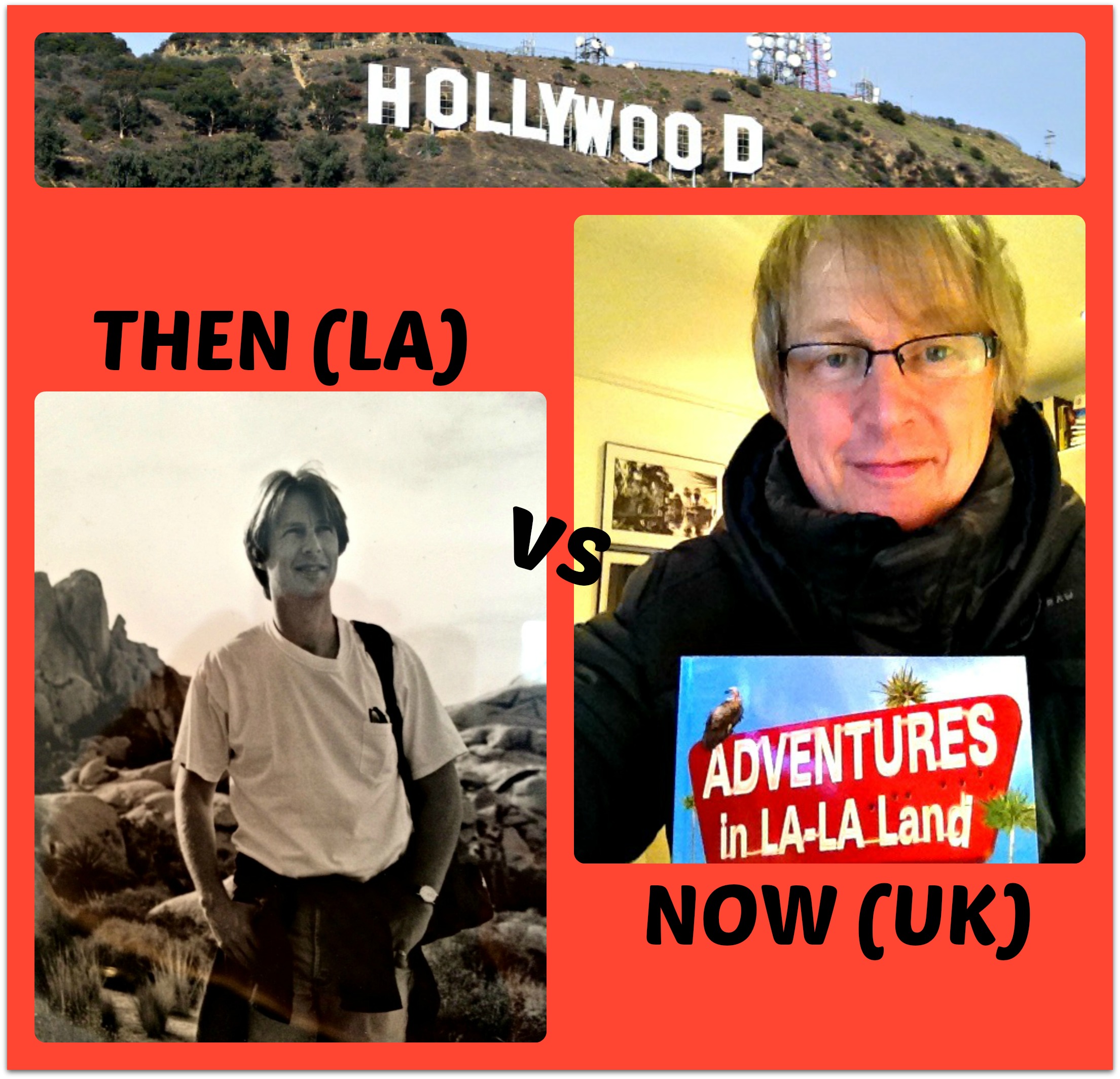
Does an expat life in Los Angeles ever go according to script? Read Tim John’s memoir to find out…

Tim John Hollywood CollageFor many of us, the calling to the expat life is not really a calling at all, but more of a vague (albeit rather deep-seated) need to escape our surroundings in search of adventure. We have no idea of what we’re looking for until we’ve arrived at a place and put down roots. Even then, we still have the mentality of drifters, and it take us a while to access our muses.

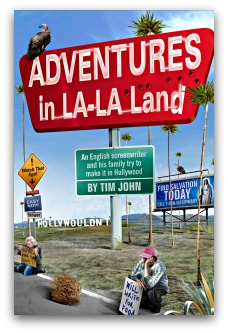
My guest today, the screenwriter Tim John, does not belong in that mould, as soon becomes clear from the first few pages of his new book, Adventures in LA-LA Land, an account of the seven years he spent in Los Angeles with his wife, Jenny, and their two young daughters.

You see, Tim plunged into his particular expat adventure with the script already written, both literally (he had a project in the works) and figuratively. Heading for Hollywood was Plan B after he lost his job with a London advertising agency during the recession of the early 1990s, and started dabbling in screenwriting.

The late Christopher Hitchens, another English writer who chose to be based in the United States, once described LA as a city “mostly full of nonsense and delusion and egomania.” But in the script Tim had written for himself and family, it was LA-LA Land—a place where they could have it all, great climate, a house with swimming pool, and (hopefully) big money.

So did Hollywood feed Tim’s creative muses (and fill his coffers) in the manner he expected? You’ll have to read the book to find out. I read it, and found myself surprisingly moved by the story of a man who lives for the movies. In fact, the pace can be likened to that of a roller coaster ride—fun but also harrowing at times.

On that note, it’s time to welcome Tim to the Displaced Nation to talk about his book. And just a heads up: Tim will be “screening” the comments for the person who leaves the best pitch for why they’d like to read it. That lucky individual will be under contract for a free digital copy!!!

* * *

AdventuresinLALALand_coverHi, Tim, and welcome to the Displaced Nation. Can you tell me why you decided to write a memoir about your years in Hollywood?
I’d read so many books about how to write a Hollywood screenplay, but never found one that also told you what it was like living there, so I decided to write my own, based on the seven years I lived there with my wife and two daughters.

Have you thought about turning it into an actual script for a movie?
I would love to turn it into a screenplay, too.

I understand you lived in LA from 1991 to 1998. I’m curious why you produced the book so long after the fact?
I’m not really sure why I waited so long to write it, possibly because I’ve been doing more and more teaching over the last couple of years and I’m often aware that students often don’t get taught important skills that are crucial to being successful as a screenwriter, such as being able to pitch and how to balance writing life with social life and family life. I thought that relating my experiences could be useful for others. If nothing else, they could learn from my mistakes as well as my successes!

In the end, the movie (of my life) was about…

Has your perspective on the experience deepened with time?
I suppose gaining some distance in time and geographically helped me to see Hollywood from a more objective perspective.

What impact did your writing about the experience have on you?
Definitely part of it was cathartic, to process the bizarre experience.

You worked in advertising for a while. When exactly did you catch the movie-making bug?
I worked a copywriter and then as a creative director—both of which are extremely useful if you want to go into film as they teach you so much about writing for a particular audience and how to write pithy dialogue and how to edit, etc. I always loved film mainly because it was such a great escape. As a kid, The Jungle Book was a big favorite. Mutiny on the Bounty and Lawrence of Arabia got me pretty scared, as did that spider in Doctor No!

Yes, I recall your mentioning in the book your fear of spiders when you found yourself face to face with a black widow at your house in LA. I’m still shuddering at the thought of being bitten by a brown recluse, by the way!

Was there a single epiphanic moment?

Your book is chockerblock with what we like to refer to on this site as “displaced moments” as a result of your encounters with not just deadly spiders but also shrieking peacocks, rats, snakes, and even some neighbors who believed in extraterrestrial burglars—and that’s before we get to the highly venomous creatures who populate the Hollywood film industry. Does any one moment stand out as your most displaced?
Wow. There were many moments when I thought “What on Earth am I doing in this bizarre place?” One that sticks out in my professional life was that time I went to pitch to Disney and the exec said “Great to meet you guys, we’re looking for some comedy writers” and I self-effacingly said: “Then you should meet these guys I play tennis with—they’re hilarious.” None of the execs could see I was joking and at the end of the meeting, the development girl took me aside, discreetly handed me a business card and said: “If you continue to have self-esteem issues, see my shrinkshe’s fabulous!”

That makes me think of Johnny Carson’s line: “In Hollywood if you don’t have a shrink, people think you’re crazy.” And I think the Northridge earthquake of 1994 displaced you and your family rather literally.
Yes, the whole house rattled and creaked for over forty seconds and there were waves in the pool.

Ah, the pool… You also talk about how much you loved the weather, having a pool, and taking drives to some fabulous scenery. Can you pinpoint your LEAST displaced moment, when you felt you were born to be in LA-LA Land rather than your native UK?
There were so many great moments. Personally, living in that sunshine, with a pool, a hot tub, etc., along with plenty of money and also plenty of free time (even though you’re constantly thinking of ideas to pitch), seems like a dream for anyone who’s come from the UK climate and ever struggled to make ends meet. It’s like living in a vacationuntil you realize it will all collapse if you don’t sell your next idea, and you’re going to have to sell it far sooner than you expected because the cost of living is very high, especially when you factor in things you’d never had to pay for before, such as earthquake insurance. Never forget that “writer” is only one letter away from “waiter”.

Professionally, when you get to chat with famous stars and talented directors and they take your comments seriouslythat feels unreal but also great. Probably the greatest moment for me was just before I moved to LA, being able to go to the tenth birthday party for George Harrison’s film company, HandMade Films. For anyone English, I think having a chat with a Beatle tops it all.

What did you and George chat about?
I’d worked on two screenplays for his company, so we talked about that. The funniest thing, I thought, at the company’s birthday party, was when George and Ringo joined the band playing on stage. If anyone requested they perform a Beatles’ song, George said: “I don’t know that one.”

In the end, the film was about spirit…

I understand you found LA a culture shock.
Wow, there are so many things that are culturally different about living in the UK and living in America, especially in Hollywood, which many Americans find totally unreal, too. Ones that really stand out: the almost constant sunshine for a start. The smog levels on bad days. The way so many Americans are so welcoming, where so many Brits can be snooty and suspicious. The way so many Americans are optimistic and so many Brits are pessimistic (or maybe more realistic than many film people). I never forgot that Hollywood has been described as “the only town where you can die of encouragement.”

I know you decided to leave LA in part because of your mother’s health and in part because of your daughters’ education. The family, particularly your daughters, didn’t want to go. What were the biggest adjustments?
Tiny parking spaces, terrible weather, high cost of living but a wonderful sense of humor. I did miss my irony in LA. We also hadn’t realized quite how much UK house prices had rocketed during the period when we’d sold ours to live abroad!

What do you think were the chief benefits you and your family derived from being Los Angelenos for a time?
I’m sure that our seven years in LA and coming home taught us all to adapt to change. My elder daughter had enjoyed an ice skating career in the US, which didn’t continue in the UK. But at least she learned that if you set goals and envision yourself achieving those goals, it will seriously boost your chances of success. The rest of us learned that you can probably have all the things you’d like in life—you just can’t have them all at the same time!

Looking back, what was your single most professional achievement during your time in LA?
Not one single thing; rather, it was learning the craft and how to work with industry people sufficiently well to be able get regular work from the studios (but not all the time!).

How do you make a living these days?
Right now, I’m rushing out to give six hours worth of lectures on dialogue to students at Bournemouth University. I also teach on and off about creative writing in general and about writing for advertising, at various universities: Bournemouth Uni, where I teach part of the MA in Advertising, at Southampton Solent, where I do some spots on Advertising and some on Screenwriting, to students at all levels, and at the Arts University in Poole, where I teach adult classes in all sorts of writing. But teaching is just part-time. I also do some freelance copywriting. And most of my time goes into writing screenplays still!

Do you still feel like a Los Angeleno in some respects?
Only in that I have several great friends in LA and I feel totally at home with film industry people. I probably see myself as neither totally British any more or completely Californian. I’m obviously some sort of mongrel.

Writing for publication: A different animal?

Moving back to the book: what was the most difficult part of the writing process?
The hardest part was the guilt I occasionally feel for what I see as building up all the family’s hopes by showing them a few years of a dream lifestyle, then waking them up from that dream by saying we have to go back to the harsh reality of living back in the UK. BUT, as mentioned, the family all feel really lucky to have had those seven great years and have made all those extra friends without staying away from their old friends and family for so long they felt like strangers. (That’s what they tell me anyway. I have an extremely supportive family!)

Why did you decide to self-publish?
Because I’d had two books published by a big publisher many years ago and never felt they did much to promote them. My agent said most publishers only push big brand names and my wife had a friend who did very well self-publishing a memoir, so I thought I’d give it a go.

What audience did you have in mind for the book, and has it been reaching those people? Is it mainly for wannabe British scriptwriters like yourself, or do you think it has broader appeal—for instance, to any Brit who might be thinking of living in America?
I hope the book will appeal to anyone who likes a laugh, to anyone who is interested in a family fish-out-of-water story and to anyone who wonders how you can make it in the film business. There’s plenty in there about the American school my wife taught in, the ones the kids went to, about my eldest daughter making it as an ice-skating champion… It’s by no means just about the movies, but, as I mentioned earlier, it will show you far more about how to make it as a screenwriter than books that simply tell you about the script, the formats, and nothing else.

Of all the advice you transmit to wannabe Hollywood screenwriters, which is the most important?
Make sure you enjoy the writing process as much as possible. Don’t pin everything on whether you sell it or it gets made. Enjoy the small triumphs, such as writing a great scene or even a great line of dialogue. All the little triumphs can add up into a pretty rewarding experience. And never forget that you may well learn more from your mistakes than from your successes.

What’s next for you in terms of creative projects?
I’ve just finished a UK thriller “Living in Sin”; I’m currently doing a re-write for a sci-fi project for a Californian director, and I have a UK drama that I wrote written with a writing partner, Jon Rolls, for which the producers have just this week started looking for a top director and cast—I’m still going for it!

10 Questions for Tim John

Finally, I’d like to ask a series of questions that I’ve asked some of our other featured authors, about your reading and writing—and in your case, also film-watching—habits:
1. Last truly great book you read / film you watched: Paper Towns, by John Green; The Way Way Back (2013), directed by Nat Faxon and Jim Rash.
2. Favorite literary / film genre: It varies enormously but I’d say “comedy drama” for both (eg, Little Miss Sunshine).
3. Reading/film watching habits on a plane: I only ever read paper books and magazines. Generally I watch films on long flights—but nothing involving flights in danger. I’m a nervous flyer. I can never sleep.
4. The one book you’d require President Obama to read, or film you’d require him to watch, and why: War and Peace, so he’s fully aware what Russians can do if stirred up. No films to recommend—I’d rather he kept his eye on world news!
5. Favorite books/films as a child: The Secret Garden; The Jungle Book and Bond movies and then Paper Moon when I was slightly older. Also the musical Oliver.
6. Favorite hero/heroine in fiction/film: Heroines: Victoria Wood as a writer; Kathy Bates as an actress. Heroes: No book heroes apart from Bilbo Baggins (when I was ten); in film, the cheeky little boy in Cinema Paradiso and later Léon in the film of that name.
7. The writer, alive or dead, you’d most like to meet: Woody Allen, as I’m nearly always amazed at how inventive he can be and how, against the odds, he so frequently gets cross-genre movies to work, certainly during his Crimes and Misdemeanors period.
8. Your reading/film-watching habits: I don’t read that many books as I find it hard to give authors the benefit of 50 or 60 pages to get into it. I far prefer books that grab me almost immediately, but with their style and outlook on life, not with purely mechanical plot like Dan Brown or John Grisham. I find those stories generally too thin to keep reading. I frequently start books and leave them if they don’t hold my interest. As far as films go, I go to the cinema at least once a week. I also watch endless boxed sets: generally US drama such as Breaking Bad, The Sopranos, The Wire, House… I really got into The Bridge and Spiral. My worst DVD marathon took place in the early series of 24, when I watched 13 episodes over a single weekend.
9. The book you’d most like to see made as a film: On Mermaid Avenue, a great American novel that I’ve optioned and written a screenplay from.
10. The book you plan to read next / film you plan to watch next: The Fault in Our Stars, by John Green; currently, I don’t have any films I’m looking forward to watching.

* * *

Bravo, Tim! If we ever host the Displaced Oscars, something we’ve been threatening to do for some time now, you’ll definitely be receiving a statue.

So, any COMMENTS or QUESTIONS for Tim, or PITCHES for why you’d like to read the book? Don’t forget, there’s a free digital copy on offer…

And if you can’t wait to read the book or don’t win, Adventures in LA-LA Land is available from Amazon. Be sure to grab a copy! You can also visit Tim’s writer site, like his book’s Facebook page +/or follow him on Twitter.

STAY TUNED for next week’s (month’s) fab posts!

If you enjoyed this post, we invite you to register for The Displaced Dispatch, a round up of weekly posts from The Displaced Nation, with seasonal recipes, book giveaways and other extras. Register for The Displaced Dispatch by clicking here!

Related posts:

TCK TALENT: Heidi Durrow, Afro-Viking Renaissance Woman and Award-winning Novelist

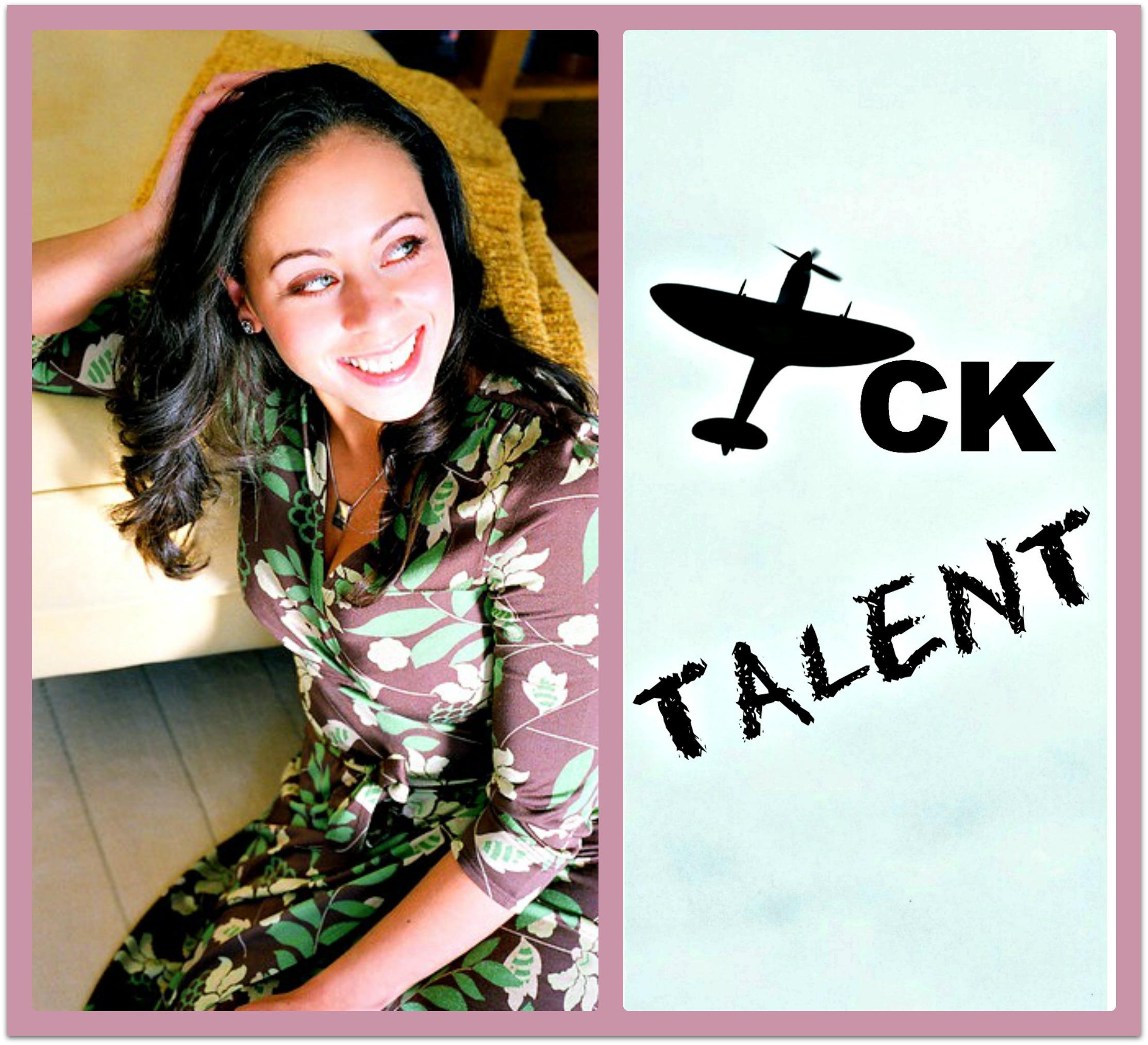
Heidi Durrow Collage Drop ShadowElizabeth (Lisa) Liang is back with her monthly column about Adult Third Culture Kids (ATCKs) who work in creative fields, Lisa herself being a prime example. A Guatemalan-American of Chinese-Spanish-Irish-French-German-English descent, she has developed her own one-woman show about being a TCK, which will be the closing keynote at this month’s Families in Global Transition (FIGT) conference, “The Global Family.”

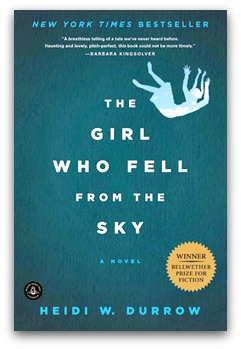
Today I’m excited to introduce Heidi Durrow, the author of the New York Times best-selling novel The Girl Who Fell From the Sky (Algonquin Books), which received writer Barbara Kingsolver’s 2008 PEN/Bellwether Prize for Socially Engaged Fiction. Heidi grew up in Turkey, the USA, and Germany. She and I first met at the Mixed Roots Literary & Film Festival that Heidi co-founded, which celebrates storytelling of the Mixed racial and cultural experience.

* * *

Welcome to The Displaced Nation, Heidi. As the TCK child of an American Air Force dad and a Danish mom, you’ve lived in North Carolina, Turkey, Washington state, and Germany. Can you tell us a little more about the chronology of the moves?
I was born in Seattle and moved to Turkey at the age of six months. The next years until I was 11, I was in North Carolina and Germany, with summers and holidays in Denmark. Since college, which was at Stanford, I have lived in NYC for grad school, Connecticut for law school, and now I split my time between the East and West Coasts.

Do you remember being happier in one place in particular?
I was pretty happy in all the places where I grew up—I was still very young. I never felt out of place or unwelcome.

Repatriations can be the hardest moves of all for TCKs, and repeated repatriation can be particularly tough, so I’m curious to know if this was true for you whenever you returned to the United States.
I had never thought of the moves as “repatriations” but that’s interesting. I think when I was very young I wasn’t aware of a lot of difficulties. But when we finally moved back to the States when I was 11, it was very difficult.  I was at an age of awareness. I felt more like an immigrant. It was so interesting to me that I had an idea of what America was when I lived overseas, and I learned quickly that America didn’t operate the way I’d imagined it from far away.

“We family.”—African-American proverb

Tell us about your summers and holidays in Denmark with your mom’s family.
It was awesome for me—in particular because my mother raised us speaking Danish and English. I am forever grateful that I have both languages. It made me infinitely closer to my aunts and cousins, whom I adore. As an adult, it’s been interesting to see how Denmark is changing. I remember going back when I was in college. I hadn’t been in ten years. My cousins had Copenhagen boyfriends, and they’d laugh whenever I talked. It wasn’t because they didn’t understand what I was saying, but they found my country accent strange. I guess I sounded like someone from Birmingham, Alabama, visiting NYC. It’s English, but it sounds very different. For years after that visit, I have often wondered whether certain traditions or sayings I learned were in fact Danish or just my mom’s own quirks.

Do you identify most with a particular culture or cultures? Or are you like many TCKs who are more likely to identify with people who have similar interests and perhaps similar cross-cultural backgrounds? (And of course it’s not a given that we’ll identify with them, either.)
I identify myself as an Afro-Viking—that is a small but growing demographic, by the way! In terms of who I am most likely to identify with—well, I think for many years in my adulthood I was very interested in finding other “mixed” friends. I wanted to know how they negotiated being multiracial and multicultural. I have found that I still have that affinity, but now I am more drawn to people who have the same career interests, who are moving on the same path at the same rate.

Studies have shown that TCKs have similar identity issues and struggles to children of mixed heritage. You and I are TCKs of mixed heritage, which makes our identities more layered than most, and makes for quite an identity struggle during adolescence. And sometimes there are shifts. I was culturally Guatemalan when I was very little, but that hasn’t been my main identity for decades.  
I haven’t shed any of my identities—I feel like I’ve added on to them over time. I remember in college I was essentially “passing” as Latina. I lived in the Hispanic-theme dorm, took Spanish classes and became the second-vice-chair of the Latino Electrical Engineering Society. I liked the idea that in latino culture they had already thought about the idea of the mestizo. So I added that on to my identity. And then when I moved to NYC I found that people thought I was what they were. Bangladeshis thought I was Bangladeshi, Puerto Ricans thought I was Puerto Rican, Greeks thought I was Greek. I’m not any of those things, but I feel like the fact that people see me as part of their own tribes has added another layer to my identity: a layer of belonging.

“He hath need of his wits who wanders wide.”—Old Norse proverb

I can relate: I was very pleased to be mistaken for Turkish when my husband and I honeymooned in Turkey. As an adult TCK, do you ever suffer from “itchy feet,” which make you want to move (locations, jobs, etc.) frequently?
You got me. I actually live on two coasts—flying back and forth every few days. I fly more than 100,000 miles per year. I can’t stay still. The same has been true for my career: I’ve been a Hallmark greeting-card writer, a journalist, a lawyer, a life skills trainer to NFL and NBA players, a podcaster, a festival producer and now a writer. Who knows what’s next?!

I often wonder if ATCKs who pursue writing careers do so because the story is entirely in their hands as opposed to the experienced upheaval of their peripatetic childhoods. Meanwhile, a peripatetic childhood fosters so many incredible experiences and thus stories to tell! Did your TCK upbringing influence your desire to become a writer?
My TCK upbringing has been great fuel for my writing, but it’s not the reason I wanted to become a writer. I do remember having a special feeling about writing as a child because of my upbringing—I loved to write letters. I’d write letters to the friends I moved away from and to my family—they were always far away. I was the kid who would save money to buy stationary and stamps.

girl-who-fell-from-sky-coverBut isn’t it fair to say that your choice of topic for your debut novel, The Girl Who Fell from the Sky, was influenced by your TCK upbringing and mixed-race heritage?
The story is autobiographical only insofar as it is about a biracial and bicultural girl growing up in the Northwest. I guess that is to say: the confusion of the character is a confusion I experienced. But the story—about a girl who survives a family tragedy—well, that was inspired by a real story I’d read in the news many years ago.

The Girl Who Fell from the Sky was fantastically well received. Did you learn something pivotal about yourself and your TCK upbringing in the process of writing it?
Oh gosh. I learned so much. I am still learning—in particular as the book reaches students in high school and college as required reading. I’m always so interested in the ways in which readers identify their own “displacement” with that of the main character, Rachel. I think the TCK experience is one of being an outsider in all places—and, strangely, that feeling is universal, familiar even to those who have grown up in one place their whole lives.

On your author site and your blog, Light-Skinned-ed Girl, as well as on your Mixed Experience Podcast, you mention that you’re working on a second novel. Can you tell us anything about it?
The new novel is still a work in progress. I’m on the verge of finishing a good complete draft at last! All I can say about it is that it’s about my obsessions again—about identity, and race and culture and grief; it’s about beauty and connectedness. Hopefully it’s something folks can relate to.

* * *

Thank you, Heidi! I wish you all the best in your endeavors, and feel confident you’ll soon be repeating your amazing successes. I understand you’ve got the Mixed Remixed Festival coming up in mid-June here in LA, which will celebrate the stories of the Mixed experience through films and books—something Displaced Nationers would love to hear more about. Readers, please leave questions or comments for Heidi below.

STAY TUNED for next week’s fab posts!

If you enjoyed this post, we invite you to register for The Displaced Dispatch, a round up of weekly posts from The Displaced Nation, with seasonal recipes, book giveaways and other extras. Register for The Displaced Dispatch by clicking here!

Related posts:

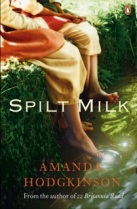
LOCATION, LOCUTION: Amanda Hodgkinson, author of “22 Britannia Road” and “Spilt Milk”

OLYMPUS DIGITAL CAMERA

Author photo – Amanda Hodgkinson

In this month’s “Location, Locution”, expat crime writer JJ Marsh interviews Amanda Hodgkinson, author of 22 Britannia Road and Spilt Milk.

Born in Somerset but raised in a village on the Blackwater estuary in Essex, Amanda has childhood memories of  shingle beaches and mudflats, grey-green heather, salt marshes, messing about in boats, gangs of rowdy kids playing all day along the sea-walls, and the ever-present cries of seagulls.

As an adult, she moved inland to Suffolk. She took an MA in Creative Writing at the University of East Anglia and after the MA, she and her husband, with two young daughters, upped sticks and bought a property in south west France. She intended to write a novel but spent the first few years of their new life mixing concrete to fix their house. She also had to learn French, settle her daughters into school and deal with the ups and downs of living in a country miles away from friends and family. Finally though, the family made a home in France. And she finished the novel…

22 Britannia Road became an international bestseller. Spilt Milk came out in February 2014 (Penguin Books) and a novella Tin Town (Grand Central Penguin US) will be published this summer. Meanwhile Amanda has begun work on a third novel. You can find out more about Amanda at her website, www.amandahodgkinson.com

Which came first, story or location?

With Spilt Milk, I was inspired by a location. I was visiting friends in rural Suffolk. It was late October, that lovely, damp time of year when the smell of leafmould is everywhere in the country. We went walking and ended up on the banks of a small river. I knew there and then that I wanted it to be the location for my next novel. I was amazed by the stillness of the place. The river had a timelessness to it. I suppose the slow moving waters suited the themes I was interested in writing about – the passing of time in families, the stories we keep and the ones we allow to slip away from us. By the time we’d walked back home, I had the beginnings of the novel in my head.

What’s your technique for evoking the atmosphere of a place?

When I am writing about a time and a place I find evoking colour, smell and the sounds of that place help create mood. I know it’s considered old-fashioned to use landscape to create mood and emotional intensity but I not only love writing which evokes emotion in that way, I also believe there is a strong connection between our identities and the geographic landscapes we inhabit.

Which particular features create a sense of location? Landscape, culture, food?

All those but also I find the light is important. I adore Edward Hopper’s paintings for his use of light and I find writing can experiment in a similar way with light, creating mystery or clarity and deepening character.

Can you give a brief example of your work which illustrates place?

In the following passage set in 1970, Nellie, who is a very old lady, watches her family as they picnic together by the river that she has known since she was a small child.

SpiltMilkNellie sat in the shade of summer-green willows, watching the procession of men, women and children making their way down to the riverbank, one after the other, their hands drifting through the day’s fragile bloom of field poppies, all the new-born crimson petals falling at their touch.

Slowly, the murmur of voices, the greetings and talk turned to seasons remembered, harvests and ploughing, days long gone. They discussed winters whose legendary harshness were in retrospect to be marvelled at and even doubted a little, particularly this deep in the year when the barley fields were pale gold and in the distance beyond the farm, the village with its church spire shimmered into the vagueness of a heat haze.

Black and white farm dogs lay low, eyeing Tupperware boxes of sandwiches and sausage rolls. The transistor radio announced cricket scores. A tartan rug was spread out by the bulrushes, and a baby in its frilly white knickers and matching bonnet wriggled and laughed while the women cooed over her. Sunburnt men sprawled in the grass with bottled beers, straw hats tipped low across their brows. Oh, heavens, Nellie thought, eyeing the new baby. And how did I get to be so old?

How well do you need to know the place before using it as a setting?

A place can inspire a novel but I don’t think it is necessary (at least not for me as a writer) to know a place intimately before I begin a story. It is a starting point and as both my books have been set in the past, my research has also been looking at photographs, old films and reference books.

It feels liberating to be able to know a landscape physically and than allow it to become a place of the imagination. I recently wrote a historical novella for an anthology and spent a day exploring an old World War Two airfield which I then used as the basis for the story. While I stuck very closely to the layout of the airfield in the story, I still had to imagine how it must have been back in the 1940s. As in my novels, the landscape was a starting point for my fiction.

Which writers do you admire for the way they use location?

Lots! Thomas Hardy, DH Lawrence, Toni Morrison, Annie Proulx, Paul Harding, Marilynne Robinson, John Steinbeck, Robert Macfarlene, Tracy Chevalier, Jane Smiley, to name a few.

Author bio and photograph from Amanda’s website

Next month’s Location, Locution:  Jill interviews Andrea Cheung, whose Hungarian/Chinese heritage informs her multicultural prize-winning children’s stories.

 * * *

_(75_of_75)JJ Marsh grew up in Wales, Africa and the Middle East, where her curiosity for culture took root and triggered an urge to write. After living in Hong Kong, Nigeria, Dubai, Portugal and France, JJ finally settled in Switzerland, where she is currently halfway through her European crime series, set in compelling locations all over the continent and featuring detective inspector Beatrice Stubbs.

STAY TUNED for our next post!

If you enjoyed this post, we invite you to register for The Displaced Dispatch, a round up of weekly posts from The Displaced Nation, with seasonal recipes, book giveaways and other extras. Register for The Displaced Dispatch by clicking here!

Related posts:

THE LADY WHO WRITES: Wannabe novelists, prepare to dine with your characters daily

LadyWhoWrites_brandToday we welcome back Meagan Adele Lopez, aka The Lady Who Writes—a repeat expat in the UK (she now lives in London). Besides writing, her talents include acting, blogging (during her first UK stint, she kept the blog “The Lady Who Lunches”), and crafting ads for social media. In this monthly column, Meagan is doling out advice to international creatives who are contemplating writing a novel about their novel, shall we say, life experiences.

—ML Awanohara

Hello again, Displaced Nationers—especially those of you who identify as wannabe novelists, similar to my own situation several years ago.

Maybe you recognize the following scenario. You are sitting down to write the novel that you’ve been dreaming about writing for years, which will in some way be based on the exotic life you have lived as an expat or overseas adventurer. You know, the one that will win you the Pulitzer Prize, make you famous, and have some currently unknown actor playing a part that will change his life forever in the film version of your book. You know this because you’ve played it all out a gazillion times in your head.

I’m not here to tell you that won’t happen. Because it could, and dreams are extremely important to have. There are too many nay sayers out there, and I will not be one of them. If E.L. James, Stephenie Meyer and J.K. Rowling can do it, then why the heck can’t you?

What I am here to say is that you better love your idea.

No. Actually, you better be close to obsessed with your idea, and the world you’re about to paint, and the characters you are about to give oxygen to—because they will take over your life.

Hey, you’re planning on having sequels and a huge following? Then loving this idea is almost an understatement.

“Fill your paper with the breathings of your heart.”—William Wordsworth

I know too many authors who write what they think will make them famous; or what they think is really popular on the market right now; or about this newspaper article that seemed like it would make a good detective story.

And there are plenty of writers who make a living out of writing trendy stories.

In my opinion, it’s a waste of time. I don’t want to read from an author who isn’t interested in his own story, and why would you want to commit the next year of your life to something you’re only half-interested in?

If anything, it will slow you down, weigh you down, and potentially turn you off from the whole novel-writing exercise, never to return again.

Writing is laborious. Creativity is maybe 20 percent of the craft (and I am probably being generous here). The rest is hours upon hours of digging through your writing for discrepancies in the storyline, editing, and finding inconsistencies in character developments.

If this is your first novel, you would be lucky to have an editor who will do all of that for you (and I do recommend you hire one for the final cuts).

This will be your baby that you will need to make perfect before you send it off to any agencies, publishing houses, or even to your beta readers (if you decide to self-publish).

“If I were invited to a dinner party with my characters, I wouldn’t show up.”—Dr. Seuss

Displaced Nationers, I know how much you enjoy seeking out new food experiences on your travels, but how do you feel about your characters sitting with you at the table? You will be hard pressed to find a successful fiction writer who doesn’t eat breakfast, lunch and dinner with their characters, and then dream about them.

To sum up, here’s Novel Writing Tip No 2 for International Creatives:

Before you start writing your novel, ask yourself: Do I want to spend the next year eating breakfast, lunch, dinner and dreaming about these people’s lives you’re about to create?

* * *

Readers, how do you feel about Meagan’s notion of your characters accompanying you to daily meals? Do you relish the idea, or does it give you indigestion? And do you have any questions for Meagan, THE LADY WHO WRITES, any topics you wish she would cover in future columns? Please share in the comments…

Meagan Adele Lopez grew up in the U.S. with a Cuban-born father and American mother, and at one time enjoyed an acting/casting career in Hollywood, something you can detect in the beautiful trailer for her novel, Three Questions. Her day job these days is in social media advertising. To learn more about Meagan, go to her personal site.

STAY TUNED for next week’s fab posts!

If you enjoyed this post, we invite you to register for The Displaced Dispatch, a round up of weekly posts from The Displaced Nation, with seasonal recipes, book giveaways and other extras. Register for The Displaced Dispatch by clicking here!

Related posts:

And the February 2014 Alices go to … these 3 international creatives

 © Iamezan | Dreamstime.com Used under license

© Iamezan | Dreamstime.com
Used under license

If you are a subscriber to our weekly newsletter, Displaced Dispatch, you’re already in the know. But if you’re not (and why aren’t you? off with your head!), listen up.

Every week, when that esteemed publication comes out, we present contenders for a monthly “Alice Award,” most of whom are writers or other kinds of international creatives who appear to have a special handle on the curious and unreal aspects of being a global resident or voyager.

Not only that, but this person tries to use this state of befuddlement as a spur to greater creative heights.

Today’s post honours February’s three Alice recipients. Starting with the most recent, they are (drumroll…):

1) MICHELLE WELSCH, writer, traveler, founder of Project Exponential

For her post: “Quitting everything to go to Nepal was the best thing I’ve done” on Medium.com
Posted on: 27 December 2013
Snippet:

And everywhere I went, there were EYES. Always eyes. Constant staring, asking the same questions: Where are you from? What are you doing in Nepal? How long have you been here? How old are you? Are you married? Why not?

Sometimes I just wanted to “blend in” and not be reminded of my whiteness and the privileges that come with being an American…

So no, not every day was perfect. But even the imperfect days added to the experience.

One of the monks asked me, “If there is no night, how can there be day?”

Citation: Michelle, the monk’s line of questioning puts us in mind of the cross-examination to which Alice is subjected upon encountering the Caterpillar:

“You!” said the Caterpillar contemptuously. “Who are YOU?”

Which brought them back again to the beginning of the conversation. Alice felt a little irritated at the Caterpillar’s making such VERY short remarks, and she drew herself up and said, very gravely, “I think, you ought to tell me who YOU are, first.”

“Why?” said the Caterpillar.

Also, if you were bothered by all the eyes staring at you, imagine how poor Alice felt when being scrutinized by a creature with twelve eyes. Yes, that’s what caterpillars have, a dozen eyes. That said, the Caterpillar, whose one and only job is to eat (it increases its body mass by 1,000 times or more), would undoubtedly admire your fortitude in being able to drink tea with sugar and consume lots of carbs without obsessing about food or weight or calories. All told, while your post helps us to understand the charms of this South Asian land, we are still shaking our heads at the notion of monks enjoying water balloons. As the Caterpillar will tell you, water balloons don’t rate, their potential to become psychedelic hallucinogens being rather too limited.

2) AMY R., blogger and British serial expat

For her post: “Expat Life: Love Lessons Learned” on her blog, The Tide That Left
Posted on: 14 February 2014
Snippet:

We ended 2013 by moving to Tanzania. It was the year of learning to be flexible; most importantly to be flexible with each other. I used to be the kind of girl who needed her life mapped out, but since we started our expat life together we’ve both had to find a way to go with the flow. We’ve chosen a lifestyle that throws up the unexpected, and we wouldn’t be able to cope if we didn’t roll with the changes.

Citation: “Roll with the changes”—Amy, that’s exactly what Alice decided to do when her eye fell on a little glass box that was lying under the table, which turned out to contain a very small cake, on which the words “EAT ME: were beautifully marked in currants:

“Well, I’ll eat it,” said Alice, “and if it makes me grow larger, I can reach the key; and if it makes me grow smaller, I can creep under the door; so either way I’ll get into the garden, and I don’t care which happens!”

As you can see, in a land where cakes can make you grow larger or smaller, there is little point in mapping out one’s life, especially when you have reasonable hope of getting into the garden eventually. We’re ever so glad you realized that, and just in time for entering your own Garden of Love! (Hope you and your hubby had a happy Valentine’s Day!)

3) MANAL KHAN, journalist, poet, essayist, photographer, and storyteller

For her post: How to Make Friends in a New City—Tip #5, on her blog, Windswept Words
Posted on: 28 January 2014
Snippet

So, if you ever find yourself lost, alone and friendless in a new city, wondering why on God’s earth you ever transplanted yourself in the first place: don’t worry! It takes time for a plant to adjust to new soil, a new atmosphere. But once it gets over the wilting, drooping, moping period—”transplant shock” in botanical terms—it thrives.

Citation: Manal, imagine yourself, like Alice, having landed in a garden where the flowers can talk “very nicely,” for no apparent reason:

“Put your hand down, and feel the ground,” said the Tiger-lily. “Then you’ll know why.”

Alice did so. “It’s very hard,” she said, “but I don’t see what that has to do with it.”

“In most gardens,” the Tiger-lily said, “they make the beds too soft—so that the flowers are always asleep.”

That’s some transplant shock, don’t you think? In any event, we agree entirely that the botanical analogy goes a long way towards explaining why some of us feel displaced when attempting to put down a few roots in our new culture. Until the process is complete, there is little else we can do but indulge in the occasional wilt/droop/mope, as you say. And just think, if the soil proves sustaining, we may one day flower to the point of talking “very nicely” in the native tongue…

*  *  *

So, readers, do you have a favorite from the above, or have you read any recent posts you think deserve an Alice Award?  We’d love to hear your suggestions! And don’t miss out on the shortlist of Alice contenders we provide in each week’s Dispatch, which are sources of creative thought if nothing else! Get on our subscription list now!

STAY TUNED for tomorrow’s fab post.

Writers and other international creatives: If you want to know in advance the contenders for our monthly Alice Award winners, sign up to receive The Displaced Dispatch, a round up of weekly posts from The Displaced Nation, with news of book giveaways, future posts, and of course, our weekly Alice Award!. Register for The Displaced Dispatch by clicking here!

Related posts:

This expat arrived in the tropics without any saucepans—but then cooked up a potboiler of love, horror and adventure!

LDF in DR Collage

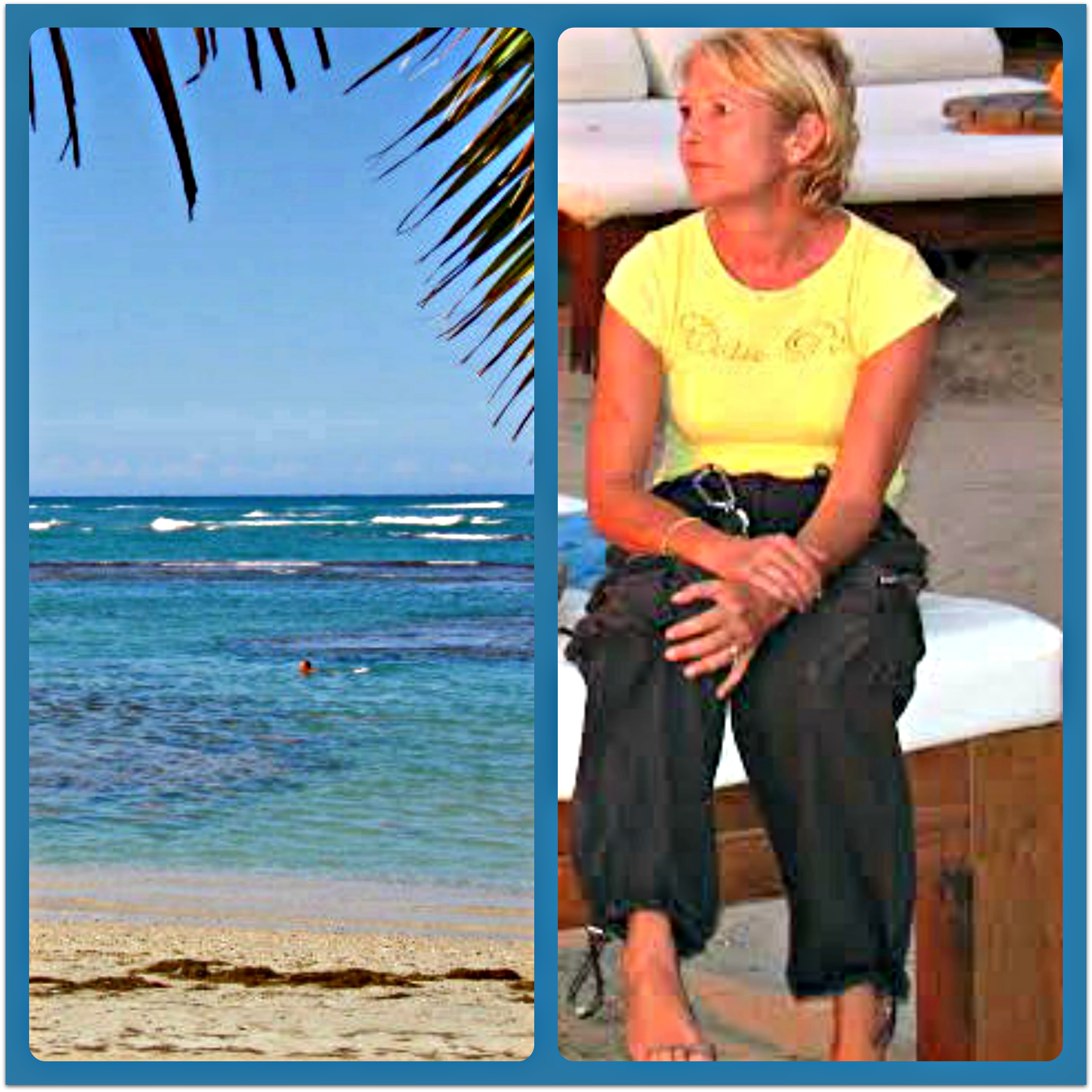
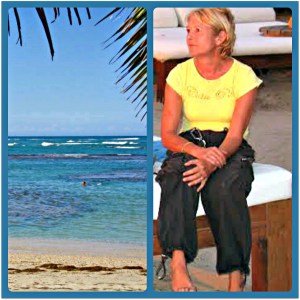
Las Mameyes, Puerto Plata, Dominican Republic (Morguefiles); Lindsay de Feliz (her own photo).

My guest today, the author Lindsay de Feliz, was scuba diving in the Maldives when one night she found herself on a tiny island in the middle of the Indian Ocean gazing up at the stars, the warm water lapping up against her toes.

She thought about life, love and the meaning of the universe. And then she had an epiphany: she no longer wanted the life she had made for herself in the UK. She would leave her husband of ten years, her cats, her house, her cars and her successful career, and buy a one-way ticket to Paradise (she hoped).

“What about your saucepans?” her mother responded upon hearing of this momentous decision. Possibly she was thinking her daughter had gone potty, but instead of saying that, she talked about the set of expensive pans she and Lindsay’s father had bought her for her birthday and Christmas the previous year.

Lindsay did not pack her saucepans and, when she accepted a job as a diving instructor in the Dominican Republic, was glad she didn’t—especially once she’d settled down with her Dominican boyfriend, Danilo. His son, who lived with them as well, had a habit of throwing pans in the bin because he didn’t like washing them.

Yet her mother’s question stuck in her mind, and she decided to write a memoir called What About Your Saucepans?, which was published last year.

I am thrilled to have the chance to talk to Lindsay about this memoir today, which I found an extraordinarily gripping read. Although Lindsay finds her pot of gold in terms of a man who loves her and a life on her own terms, it all goes to pot at a couple of points. And how she copes with these setbacks is as interesting as anything she has to say about the details of life within the country that has the distinction of being the most visited in the Caribbean (though her account of Dominican life is compelling, too).

And now, before we start, can you hear me banging on a saucepan as I yell out: BE SURE TO LEAVE A COMMENT; YOU’LL HAVE A GOOD CHANCE OF WINNING A DIGITAL COPY!

* * *
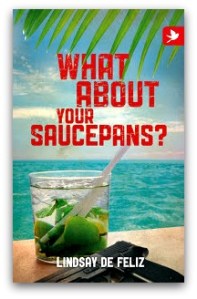
Saucepans-Cover_pmHola, Lindsay. ¿Que lo que? Can we start, please, by having you tell us what prompted your decision to write a memoir after a decade of living in the Dominican Republic?
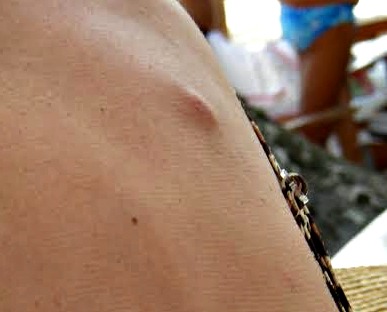
I used to send monthly emails to friends and family about what I was doing and many of them said that I should write a book. I know people often say this, but the longer time went on the more the idea started to grow on me. However, the major prompt was when I was shot by a couple of burglars I’d apprehended at the gate to my home. The bullet passed through my throat and then went straight through my right lung. I made it to the local hospital being carried, then draped over the back of a motorbike, and eventually in a car. After a botched tracheotomy, I was taken to a hospital in the capital, where they put in chest drains. I went home after 12 days.

Wow! So being shot was what motivated you to write about your expat life?
There were lots of things I couldn’t remember about the incident—to this day, my recollections of it are a bit fuzzy—so I asked those who helped me what happened, and then wrote it all down. That became a chapter in the book, and then I filled in before and after.
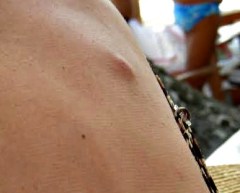
C5 Bullet stuck in my back 2 weeks after the shooting

The bullet went through Lindsay’s lung and got stuck in her back. Here it what it looked like two weeks after the shooting (Lindsay’s own photo).

Did you ever think of writing a novel instead? I ask because your memoir almost reads like a novel. I felt as though I get to know all the characters and missed them when I put the book down.
No, I never thought about writing a novel—my life was like a novel!

I understand the life you left behind in the UK was somewhat more mundane. Can you describe a typical day?
Typically, I would drag myself out of bed at around 5:30 a.m. in the dark. Get showered and dressed in a power suit making sure high heeled shoes and jewelry matched. Wrap up warm and walk 20 minutes to the train station. Train to Central London. Tube to the city. Another tube to Canary Wharf. Total journey time around two hours assuming no delays, which there often were. Work out in the gym and then walk or train to the office. Work all day long, maybe lunch at The Ivy with agencies or journalists, then the same journey home again, getting home around nine and falling into bed to do the same thing the next day.

What was the trigger (so to speak) that made you decide to pack it all in and become a scuba diving instructor?
I adored scuba diving in tropical places and managed to go a few times a year and it just seemed daft to work so hard to pay to go diving when I could dive all the time and earn enough to live off doing something I loved.

How did you end up in the D.R., of all places?
I started off in the Maldives, then went east to Asia, found it impossible to obtain work permits so ended up in Menorca, an island in the Mediterranean belonging to Spain. I decided I should learn Spanish as I already spoke French and German (as an instructor, the more languages you can speak the better). I wanted to get back to the tropics and a job came up in the Dominican Republic, so off I went.

Every pot will find its lid

February is a month for celebrating romance and love. How did you meet Danilo, the Dominican man who became your second husband?
I had seen him around, but I wasn’t even thinking about a relationship. My plan was simply to learn Spanish then head for Costa Rica and work as an instructor there as the diving was supposed to be excellent. One night at a bar Danilo was there and offered me a lift home on his scooter.

Was it love at first sight?
No, although he was seriously cute. But once Dominicans decide that you are the one, they are like Rottweilers and never let you go! He pursued me with a vengeance.
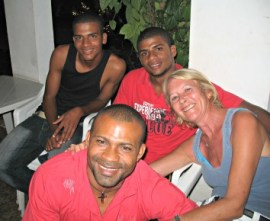
Lindsay&family

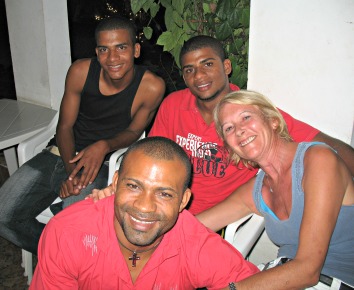
A happy family, Caribbean style: Lindsay with her husband, Danilo, and two sons.

Your courtship led to a ready-made family (his kids) and marriage. Was that a difficult decision?
Not at all. Danilo moved in with me after a couple of weeks courting—as I said they move fast, and as soon as he moved in I was called his “wife” (the vast majority of Dominicans don’t actually get married they just live together but are known as husband and wife). He moved his three children in a week later. We were like that for three years, so most of the big cultural adjustments had already taken place—and there were many, which I discuss in the book. He gave me what I wanted in terms of doing everything to make me happy and to make my life easier, and most of all he made me laugh.

But isn’t “happily ever after” particularly challenging for those of us in cross-cultural marriages?
I must admit, due to the fact we were from such different backgrounds I doubted that we would ever become soul mates, in the way you dream of as a child. However, over the past couple of years—we have now been together for 12 years—he has become my media naranja, as they say here—my half an orange—and is totally my soul mate, my best friend and more. Much I think is due to fact that he is now at university, so we have more “intellectual” conversations, and my Spanish is now much more fluent than it was in the early days. We still laugh all the time and I could not contemplate life without him.

If ifs and ands were pots and pans…

Looking back over the decade you’ve lived in the Dominican Republic, what was your most “displaced” moment: when you thought, what’s a nice girl like me doing in a place full of superstition, political corruption, thievery, and the many other cultural quirks you mention in your book?
You are right, there are many—so many I don’t know where to start. Maybe squatting down to have a pee in the sugar cane fields, taking photographs of dead people in their coffins as their families wanted a picture and had no camera, going into a store and being asked to wait while they catch a rat, going to a jail to get prostitutes out, delivering a baby to a Haitian women on the mud floor of her hutand of course having been shot, which, although I didn’t realize it at the time, meant being taken to hospital draped over the back of a motorbike because there are no ambulances or emergency services where I live.

Goodness, that’s quite a selection! Can you also pinpoint your LEAST displaced moment, when you felt you were much more comfortable living in that place than in your native UK?
I feel like that every day now as I have become totally adjusted to Dominican life. Dominicans call foreigners like me aplatanado—literally, “like a plantain banana,” signifying we’ve become one of them. Nowadays I don’t care what I wear, no make up, material possessions are not important, I don’t get annoyed if the car is scratched—a whole different set of values to those I had before. Instead of dragging myself out of bed, I leap out, happy to see what the day has to bring. I go downstairs and look across at the mountains and watch the sun rise drinking fabulous Dominican coffee. I have never been happier. I talk in the book about my search for joy. Those moments of pure joy that you experience occasionally. Now here I have them every single day. No one could ask for more.

Could you ever live in the UK again?
No, I could never live in the UK again. In the D.R., there are very few rules, which, while it does give rise to some problems, also means one has the freedom of being able to park wherever you want, smoke a cigarette where you want, not wear a seat belt if you choose not to, and so on. I love that. Also, in the UK, Danilo and I have experienced racism—groups of youths making monkey noises on the trains—because I am white and he is brown. I could never ask him to suffer that. Here we have never been made to feel uncomfortable.

Does your husband feel the same way?
My husband loves the organization in the UK, the fact that people queue, the lack of litter in the street and the trains. But even if we did want to live in the UK, we couldn’t as the new immigration regulations mean that I would have to earn a salary I could never earn, and he would have to speak pretty fluent English, which would be very hard for him.

Panning for a publisher

Moving on to the book: what was the most difficult part of the writing process for you?
The first draft was easy. I tend to think for days about what I want to write—in bed before I go to sleep, when I am walking the dogs… I wait and wait and wait until I am bursting to write it down. It is so satisfying when you actually write then. Just like when you eventually find a toilet when you have been dying for a pee for ages. The hard bit was changing it to incorporate what the publisher and editor wanted. They wanted me to write much more dialogue, which I found hard, and to talk about things I didn’t really want to talk about. I didn’t want to hurt anyone, and in a memoir you really need to tell the truth. They were right, of course, and the book was much much better as a result; but it was difficult for me to describe all of the emotions.

You published with Jo Parfitt of Summertime Publishing. How did that happen?
The path to publishing was not an easy one. I wrote to literary agents and publishers, and some said no and others told me to get it edited and then resubmit—which I did, but it all cost money. I think in some instances they were just helping out their editor mates as they all said no even after I resubmitted it. In the meantime, I’d started a blog of the same name, which began to build me an audience ready for when the book came out. In the end I found Jo Parfitt, who directed me to a great editor, Jane Dean. Between them they knocked me and the book into shape.

What audience did you have in mind for the book, and has it been reaching those people?
Originally, I had in mind people who were interested in the Dominican Republic. Yes, it has been reaching them, but it is constant work to make sure you find them and tell them about the book. Luckily, the reviews have been fabulous and those who read the book have said that everyone should read it, not just those who like the DR.

I agree, I think it appeals on many levels, not just to those with an interest in the Caribbean.
Thank you for saying that. Apart from being about life in the Dominican Republic, it’s a love story, a horror story, it has adventure, and I like to think that it might make some people reevaluate their lives and what is important to them.

Do you have any advice for others who are writing memoirs and hoping to publish them?
Firstly, write the memoir. Do it. It is great fun and also cathartic. Never stop writing at a point where you are stuck or it takes ages to pick it up again. Stop when you know exactly what you want to write next. I would also say don’t give up when you are looking for a publisher, just keep at it. It must have taken me over a year at least to find Jo. And when I did she set me targets to achieve, which gave me a purpose and a goal. You must also be honest with yourself as to whether people will be interested in your story and what it can do for them, not just what it might do for you. And finally, don’t be arrogant and precious when your editor and publisher suggest changes. They know the market a million times better than you. Take their suggestions on board. In the end it will produce something much better than you could on your own.

10 Questions for Lindsay de Feliz

Finally, I’d like to ask a series of questions that I’ve asked some of our other featured authors, about your reading and writing habits:
1. Last truly great book you read: In the Time of the Butterflies, by Julia Alvarez, a historical novel about the Mirabal sisters, who opposed the dictatorship of Rafael Trujillo in the Dominican Republic.
2. Favorite literary genre: Murder mystery
3. Reading habits on a plane: I haven’t been on a plane since Kindles and such like came out(!). But I used to read novels—the latest Patricia Cornwell or Tom Clancy—which I would buy at the airport.
4. The one book you’d require President Obama to read, and why: Mine. Because I know he would enjoy it, it would make him smile and help him to understand all of the Dominicans in the USA. He would also enjoy the part about Dominican politics. I can just see him reading bits of it to Michelle in bed in his stripey pajamas and them both laughing.
5. Favorite books as a child: Enid Blyton‘s The Famous Five series; the What Katy Did series by Sarah Chauncey Woolsey, under her pen name Susan Coolidge; Heidi; and books about horses and ballet dancers. As I moved into my teens I loved Georgette Heyer books.
6. Favorite heroine: Lisbeth Salander in The Girl with the Dragon Tattoo
7. The writer, alive or dead, you’d most like to meet: This is someone who hasn’t yet published a book so I hope that counts: Aisha Ashraf. Her writing simply blows me away and I could never write like she does. I am a story teller and she has a way of touching your heart. I would love to meet her one day.
8. Your reading habits: I don’t read as much as I would like now. However, when the electricity goes off (which it does here quite a lot) I grab a book and devour it. I also read books online by other Summertime authors which they send to me.
9. The book you’d most like to see made as a film: Mine again! I know it would make a great film. My dream is to go to the Oscars. I just need to make it happen.
10. The book you plan to read next: Linda Janssen’s The Emotionally Resilient Expat. She is another Summertime author, and I am really looking forward to getting into this one.

* * *

Thanks so much, Lindsay. Readers, what I love about Lindsay is her attitude. Some of us might think that she went out of the frying pan (a life she could no longer stand in the UK) and into the fire (getting shot in the Caribbean), but she doesn’t see it that way at all. In fact, as she explains in the book, after surviving the shooting, she has even more purpose in life and even more devotion to her adopted home.

So, any COMMENTS or QUESTIONS for Lindsay? Do you think you would react in the same way to hardships?

And don’t forget, there’s a copy of the book to be won for the best comment! NOTE: If you can’t wait to read the book or don’t win, What About Your Saucepans? is available from Amazon, Apple iTunes, Kobo and Barnes and Noble. And you can also start following Lindsay on her blog, of course!

STAY TUNED for tomorrow’s post, another episode in the life of our fictional expat heroine, Libby, told from the point of view of her husband, Olivera rare treat! (What, not keeping up with Libby? Read the first three episodes of her expat adventures.)

If you enjoyed this post, we invite you to register for The Displaced Dispatch, a round up of weekly posts from The Displaced Nation, with seasonal recipes, book giveaways and other extras. Register for The Displaced Dispatch by clicking here!

Related posts: