The Displaced Nation

A home for international creatives

Tag Archives: USA

Ask Mary-Sue: Is the mid-life gap year a good idea?

Mary-Sue Wallace, The Displaced Nation’s agony aunt, is back. Her thoughtful advice eases and soothes any cross-cultural quandary or travel-related confusion you may have. Submit your questions and comments here, or else by emailing her at thedisplacednation@gmail.com.

Welcome to May, dearest readers. I’m sure like me you find this to be an absolutely delightful time of year as a long and delicious summer stretches out before us. This month’s theme is la dolce vita — or the sweet life in American. For me that means a summer making full use of my grill and dusting off my Paula Dean cookbook. Anyhoo, let’s get on with the queries that you’ve sent in for me, hopefully I can turn someone’s frown upside down — if anything, that’s the real sweet life. Ha, who am I kidding? It’s still baby back ribs!

__________________________________________

Dear Mary-Sue,

My wife and I are middle-aged, middle class Americans with two kids and a house and jobs. But now that our kids are grown up with lives of their own, my wife seems to have gotten it into her head that we should quit our jobs, sell the house, and have an adventure. I said, “Don’t be silly, gap years are for kids,” but she seems determined to do this. I wonder if I can talk her into taking a “gap year” at home. What do you think?

Dan from Denver

Dear Dan,

It sounds to me like you’re not that excited by your wife’s suggestion. This really needs to be a joint decision between the two of you for it to work, otherwise you’ll end up resenting your wife and she’ll feel hurt that you never shared your reservations with her initially. Talk to your wife about your misgivings. It’s a big step to quit your jobs and “have an adventure.” What does that mean anyway? Does she want you to move somewhere entirely different or travel the world? Take your wife out to your favorite restaurant, your local waffle house say, and over pistachio and strawberry waffles find out if there’s anything that excites you both. If it’s that you want to buy motorcycles and travel across the US, then maybe you could look into hiring bikes and doing a few long weekends. Find your common ground and then dip your toes a few times before you decide to take the plunge.

Mary-Sue

———————————-

Dear Mary-Sue,

I am an American who has lived in England for the past twenty odd years. Initially, I was married to an Englishman but that didn’t last. Now that the big 5-0 is approaching, I’d like to take a break from this place — having had my fill of rainy weather and jobs that don’t pay well. I’m thinking about volunteering at an orphanage in Africa or somewhere like that. I told my best friend, who is English, about the plan the other day, and she said: “Why do you want to reinvent yourself in the years when you should be winding down?” Do you think she has a point or is just being negative?

Elaine from Essex

Dear Elaine,

As a committed Anglophile with a younger son who has shown me how to download from torrent sites, I have unfortunately watched The Only Way is Essex and as such it’s my considered opinion that spending a few years in an orphanage in Africa is preferable to remaining in Essex.

Yours in commiseration,

Mary Sue

———————————-


Dear Mary-Sue,

I recently finished reading Susan Griffith’s Gap Years for Grown Ups, and now I’m torn between three different ideas for my mid-life gap year: 1) build walkways in the Costa Rican rainforest; 2) crew a yacht across the Atlantic; or 3) take a gourmet cookery course in the Loire Valley. Can you give me any advice on which one to choose? I should tell you that I’m a middle-aged German, twice divorced, and hoping this gap year will lead to meeting a significant other, preferably from a different culture.

Helmut from Hamburg

Dear Helmut,

I suspect that your true intentions lie in the end of your letter where you write, “I’m…twice-divorced, and hoping this gap year will lead to meeting a significant other, preferably from a different culture.” Let’s  face it Helmut, you’re a little horny, aren’t you? Don’t be shy, there’s no shame in that. I’m convinced that Mellisa from my Tuesday night Bible class who is always so excited about going to Marrakech once a year isn’t just looking forward to her “voluntary work” if you know what I mean. Wink, wink. 

Well, let’s take each option that you’ve presented me with. This idea of taking a yacht across the Atlantic? Hmm, well unless you’re planning on dating a sperm whale, I think you might find the Atlantic slim pickings. Maybe if you ended up yacht-wrecked off the Azores you might have a chance, but really let’s forget this one. Second thought, a cookery course in the Loire Valley. Well, as we’re seeing with President Hollande and Chancellor Merkel, I’m not sure about the long-term benefits of a Franco-German relationship. So that leaves Costa Rica. Last time I visited Costa Rica I was stunned by the amount of sad, lonely, pasty-faced middle-aged men in garish Hawaiian shirts who were on my flight into San Jose. Apparently, they’re getting action, so I don’t see why you shouldn’t as well.

Mary-Sue

___________________________________________

Anyhoo, that’s all from me readers. I’m so keen to hear about your cultural issues and all your juicy problems. Do drop me a line with any problems you have, or if you want to talk smack about Delilah Rene.

Mary-Sue is a retired travel agent who lives in Tulsa with her husband Jake. She is the best-selling author of Traveling Made Easy, Low-Fat Chicken Soup for the Traveler’s Soul, The Art of War: The Authorized Biography of Samantha Brown, and William Shatner’s TekWar: An Unofficial Guide. If you have any questions that you would like Mary-Sue to answer, you can contact her at thedisplacednation@gmail.com, or by adding to the comments below.

STAY TUNED for Tuesday’s post. Mary-Sue has heard it’s going to be great.

If you enjoyed this post, we invite you to register for The Displaced Dispatch, a round up of weekly posts from The Displaced Nation, with seasonal recipes, book giveaways and other extras. Register for The Displaced Dispatch by clicking here!

Related posts:


Me and my shadow: LIBBY’S LIFE #49 – An unwelcome blast from the past

Well, here I am again. Kate, that is, not Libby.

Not sure when Libby will have enough free time to write her journal herself, so you’ll have to put up with me this week, and possibly next week as well. After that, who knows? Maybe Libs can persuade Maggie to fire off a bulletin for you. Or perhaps her mother could do it…now that would be interesting.

~ ~ ~

Having changed my flight,  I’m going home rather later than I intended, so am now snugly ensconced Chez Patrick where I have agreed to stay for the next two weeks.

A somewhat rash decision, in retrospect. Might have been wiser to stay in the local Motel 6 and commute to my temporary job as Mother’s Help.

It’s not that Libby’s accommodation isn’t wonderful. I’m sleeping on a big sofa-bed in Oliver’s home office. It’s warm, cosy, and has free wifi with a strong signal. Being here means that Oliver can’t use his office much, because the contents of my suitcase are draped all over his swivel chair, but that doesn’t matter. He spends most of his time ten miles away at his workplace.

Yes, Oliver is back at work already. No paid paternity leave for him, but I suspect that is merely an excuse for his absence.

The real problem, for both Oliver and me, is his mother-in-law.

Oliver and Jane aren’t a good mix. We’re not talking chalk and cheese or even oil and water here. Think chemistry class, think sodium and water, think fiery explosions on calm water, and you’re on the right track.

“I thought you said they used to get on well together?” I said to Libby on Oliver’s first day back at work, when the twins were barely a week old. He had stomped out of the house before seven a.m. while Jane tagged after him, swiping ineffectually at his back with a clothes brush. This morning, just before he slammed the door on his way out to the garage, Jane asked him if he’d got a clean hankie in his pocket.

“They did,” she replied, wriggling around on the couch, a baby in each arm. “When I first started going out with Oliver, she pandered to him the way she panders to my father, and he lapped it up. Every argument we ever had, his trump card was ‘Your mother would never say that to your dad.'”

“So what’s his problem now?”

“Ah, well, everything’s got a flip side, hasn’t it? The reason she panders is because she thinks men are useless in the home. According to her, Oliver’s totally incompetent and shouldn’t be allowed near one newborn, let alone two.”

“Ah.”

“I don’t blame her in the case of my Dad. I mean — he is useless, although I sometimes wonder if she makes him that way. Self-fulfilling prophecy and all that. But Oliver’s quite capable of rustling up some bottles of formula and cooking dinner.”

“Not that you need to do any cooking for weeks.” The freezer was chock full of homemade, ready-to-reheat meals, courtesy of the Coffee Morning Posse. Every day, Charlie, Anita or Julia would turn up with more Tupperware boxes, labelled “Chicken a la King” or “Chilli Con Carne” or “Swedish Meatballs”. I’d got to the point where I was considering another pregnancy myself, just for the Meals-On-Wheels benefits.

“Just as well, isn’t it, if I had to rely on my Mum to feed me? She claims Oliver’s incompetent, but then she can’t get past the American-English differences. The other week she decided to make some scones, but couldn’t find the plain flour. It’s called all-purpose flour over here, right, but the leap of imagination to translate was beyond her. All I heard was, Ooh, it’s not the same as what I get in Sainsbury’s.”

“Did you get your scones?”

“Are you kidding? She walked to the gas station up the road and bought some Twinkies. Jack ate four, and he was awake until midnight. I used to take the mick out of Sandra because she once gave Jack some Red Bull, but this was actually worse.”

One of the twins started to cry, so I took the non-crying one from Libby. I think it was Beth. Or maybe it was George. Both twins wore green footie pyjamas, so I couldn’t tell which was which from the outside.

I rested Tweedledum over my left shoulder, absent-mindedly patting its back. Libby handed me an old towel, and I tucked it underneath the baby’s chin.

“I didn’t bring any babyproof clothes with me,” I said. “Mostly business work clothes, and I’m running out of things to wear.”

I’d forgotten the trick of keeping an old cloth on your shoulder when burping babies, and all day yesterday I had the sensation that a piece of ripe Camembert was following me everywhere, until Jane pointed out the trail of curdled milk on the back of my favourite white shirt. The local dry cleaners’ profits would skyrocket when I got home.

“Raid my closet,” Libby suggested. “Take some home with you. I’ll never fit into half of my clothes ever again.”

She’s sweet, but — no. Even at ten days postpartum, she’s thinner than I am now.

If I didn’t like her so much, I’d hate her.

“Or you could go to the mall for some more things,” Libby went on. “Take Jack and Mum with you, and I’ll have some quiet time with the twins.”

That didn’t seem like a bad idea. I’d take Jane, tire Jack out on the little indoor playground there, and when they got home they’d both be ready for bed.

“It’s got possibilities,” I said, and went in search of Libby’s mother and first-born.

*  *  *

Once you get Jane out of the house, she’s different. She even opened up a little to me.

“It’s not that I don’t want to help,” she confessed. “It’s just that I feel very inadequate around Libby, as if I’m going to get everything wrong no matter how hard I try. She’s not the same person who went away a year ago. She’s so much more…confident.”

“She’s not expecting you to be Superwoman,” I said. “Just her mum. And by that I don’t mean Oliver’s mum as well. He can work out himself if he needs a clean hankie or not.”

She had the grace to look a bit ashamed.

As well as going clothes shopping for me, I dragged her and Jack into a supermarket and a craft store. It’s Jack’s fourth birthday in just over a week, and I’m pretty sure Libby won’t have got her act together enough to do anything really special. Between the three of us, we picked out birthday napkins, party favours, and all the stuff Jane needed to make a 3D Lightning McQueen cake.

“I do hope Libby won’t mind me doing this,” she kept saying. “I don’t want to end up being more of a hindrance than a help.”

I told her that she had a long way to go before she attained Oliver’s mum’s standards  of “helping” and that her birthday cake was unlikely to put Libby and Jack into hospital.

She seemed mull this over, and by the time we got in the car to drive home, was the perkiest I’d seen her all week.

When we arrived at the house, a strange car was parked in the driveway.

“Another food delivery from Libby’s friends, I expect,” I said to Jane as we hauled the shopping bags into the hallway.

“Libs?” I called. “We’re home. We’ve got everything sorted out for Jack’s bir–Libs? Are you OK?”

Libby walked unsteadily towards us from the living room. Her face was pale. Following behind her was a woman: tall, fair-skinned, with sparse, sandy-coloured hair. Another of the Coffee Morning Posse, I presumed.

“I’m fine,” Libby said, giving me a too-bright smile that pronounced her a fibber. “Did you get what you need?”

“Yes,” I said, holding up a Macy’s bag in one hand and a Stop and Shop carrier in the other. “Your mum’s going to make Jack’s birthday cake.”

The woman behind Libby spoke to Jack who, at the sight of the stranger, had hidden himself behind his Granny Jane.

“It’s your birthday soon? When’s your birthday, darlin’?”

An English accent. Definitely one of the Coffee Morning Posse.

“Thirteenth of May.”  Libby replied for him after a pause.

“Aww. He’s shy.” The woman put her head on one side. “Just like our Damian.”

Silence from Libby as she looked down at her bare feet. The silence grew until it filled the two-storey room.

“Is Damian a friend of Jack’s?” I asked.

The woman laughed.

“I hope he will be,” she said.

In the living room, one of the twins began to whimper. Normally this would have Libby running to see what the fuss was about, but she didn’t look up from studying her toes.

“This is my mother Jane and my friend Kate,” she said sideways, in the general direction of the stranger. “They’re both staying here, so you can see that it’s not really feasible for you to stay as well.”

“No problem at all. You’ve got your hands full, I can see that. But I’d love to stay and see Oliver.”

“Well, as I explained, Oliver’s on a business trip for three weeks, and that’s why these two wonderful ladies are helping me out–”

Oliver? Business trip? First I’d heard of it, but Libby must have a good reason for telling such a whopper, so I went along with it.

“That’s right.” I nodded, and looked across at Jane to make sure she was going along with whatever plan Libby was hatching.

She wasn’t.

“But –” she said, in a tone of bewilderment. “But Oliver left this morning and said nothing about being away for three weeks. In fact, I heard him say he’d be home in time to cook dinner.”

The woman called Tania folded her arms. “You know, I thought something didn’t sound right. What kind of man leaves his wife on her own with newborn twins, for heavens’ sake?”

She shot a look of triumph at Libby.

“Not my brother, that’s for sure.” She held her hand out to me.

“Tania Patrick,” she said. “Oliver’s long-lost sister. Pleased to meet you.”

Next: LIBBY’S LIFE #50 – Home again

Previous: Me and my shadow: LIBBY’S LIFE #48 – Hospital visiting hours 

Stay tuned for Friday’s Displaced Q!

If you enjoyed this post, we invite you to subscribe for email delivery of The Displaced Dispatch, a round up of the week’s posts from The Displaced Nation. Sign up for The Displaced Dispatch by clicking here!

Img: Map of the World – Salvatore Vuono

RANDOM NOMAD: Isabelle Bryer, French Expat in the City of Angels

Place of birth: Bourgoin, France — a small town between Lyon and Grenoble.
Passport: France and now USA*
Overseas history: USA (New York City): 1990; USA (Los Angeles): 1991 – present.
Occupation: Artist and art instructor
Cyberspace coordinates: Isabelle Bryer Paintings (artist site and blog); Isabelle Bryer Paintings (Facebook page); and @IsaBryerArt (Twitter handle).
*I decided to become a US citizen after I had my first baby. Since she was an American, I thought it would be prudent to be a citizen, too — I’m not sure what I was afraid of! To this day, I can remember swearing allegiance to the American flag in a giant room full of 6,000 immigrants with the song “God Bless the USA” blasting through loudspeakers. It felt surreal but I found it hard not to get emotional with people crying all around me. Some of them had waited many, many years for this moment and were escaping countries where they had few rights and even less opportunities. It made me feel spoiled, coming from France and seeing this process simply as an administrative hurdle.

What made you leave your homeland in the first place?
I left because I couldn’t wait to start living my own life. In France I always felt “the daughter of” or “the sister of” (I have three older brothers). I felt that everything I was doing was dictated by what was expected of me by everyone else. When I arrived in New York, I felt as though I could reinvent myself. Of course my new identity was that of “the French girl” — but at least it felt exotic! I loved that everything was odd, new and exciting.

It took me three months to be able to speak English efficiently, and still I was constantly making mistakes! To this day, I make some mistakes, which never cease to make my husband and two kids laugh! Mainly, I put accents on the wrong part of some words — in French everything is pronounced “flat” with no emphasis on any particular syllable.

During that year in New York, I worked as a fashion consultant. I went back and forth between New York and Europe about five times within the year. I would visit European cities — Paris, Barcelona, Milan, Florence — and act as a “fashion spy,” taking photos and sketches of trendy designs that might inspire American designers. Then I would go back to NYC and compile everything in books that were sold to clothing manufacturers. The job was very badly paid, but it was way more exciting than my old life!

I met my husband when he was in New York on business. A few months later, I moved with him to Los Angeles.

So your husband is an American. Is anyone else in your immediate family “displaced”?
I was the first and only one of my family to leave my town. They all still live there, which is good because I can easily see everyone when I go for a visit.

Can you describe the moment when you felt the most displaced?
When I was living in New York, I was going home late from work by subway. There was a homeless guy in the car trying to eat his hand and screaming. It really terrified me, but I didn’t want to exit before my stop because I was afraid of I’d get lost in the wrong neighborhood. That was the moment when I realized “I’m definitely not in Bourgoin anymore!”

That said, I also remember walking alone down one of the avenues on the west side of New York on a sunny Sunday morning. I felt like a French country girl who’d been dropped in the middle of West Side Story. Everywhere I looked seemed like a movie set. I felt entirely displaced while also having the sense of floating on air. I just loved it.

Is there any particular moment that stands out as your “least displaced”?
When I’m alone and painting in my art studio, I have the feeling of being in the exact right place. I am not sure that I would have found in France what I was supposed to do in life. Sometimes you have to leave your familiar surroundings to start over and become who you were meant to be.

Can you describe the kind of art you do?
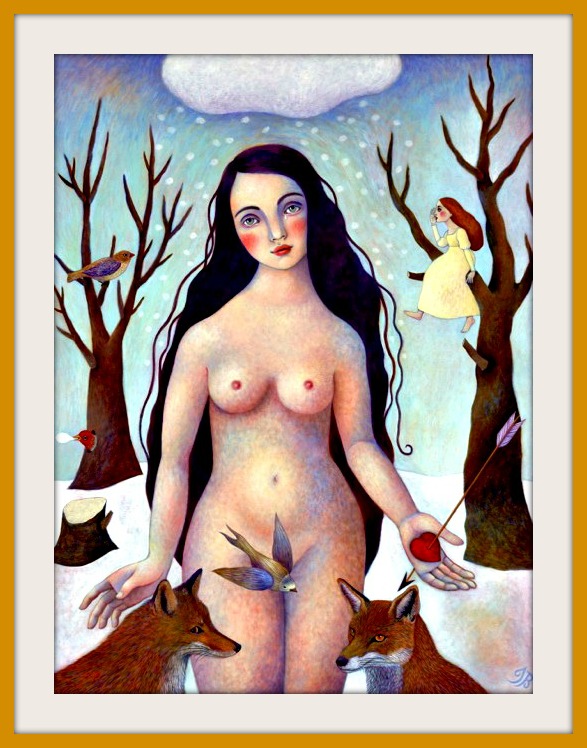
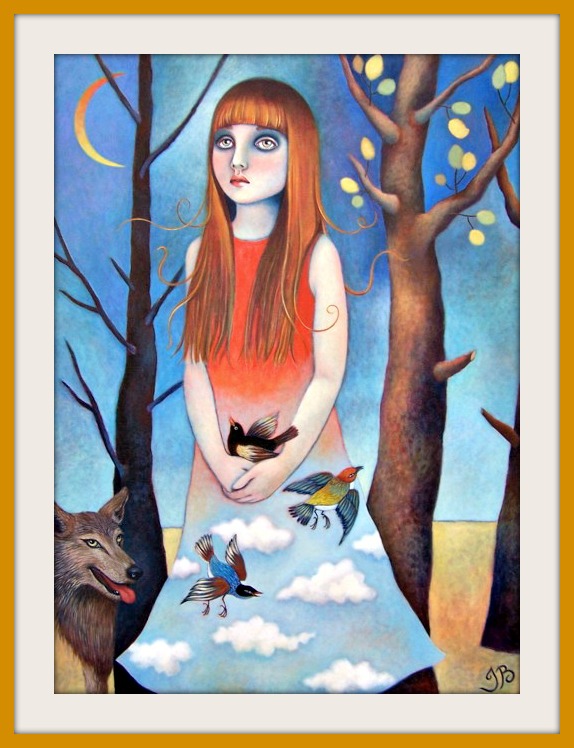
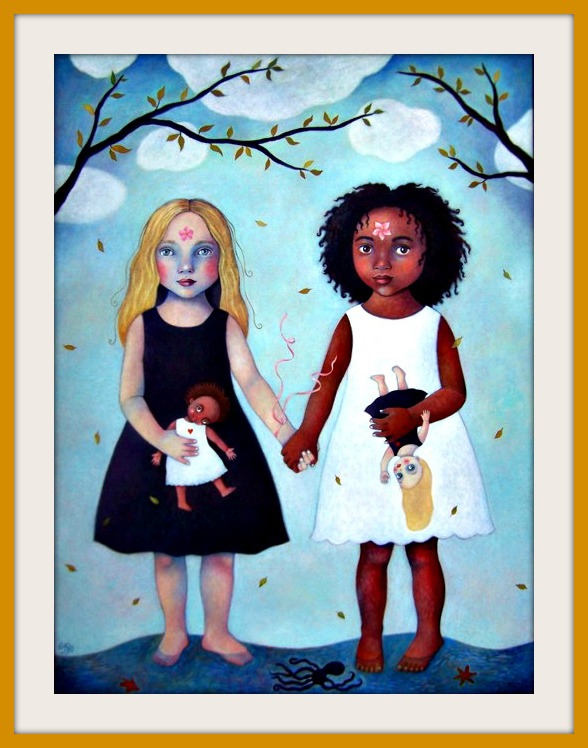
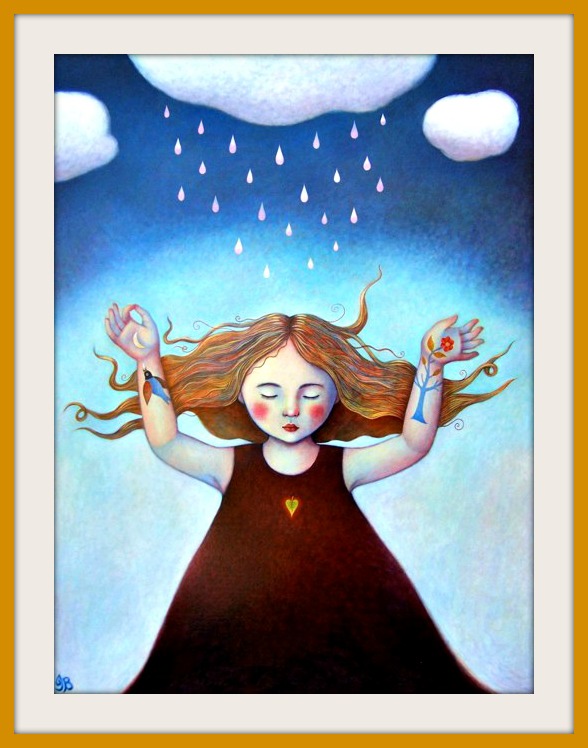
I guess the closest description might be “naive surrealism.” My work is very much inspired by folktales.

You may bring one curiosity you’ve collected from your adopted country into The Displaced Nation. What’s in your suitcase?
I’d like to carry in a couple of memories of curious times.

From New York: A night at the wild nightclub Copacabana. In the early 1990s it was the place to be: beautiful people, drag queens and transsexuals, with everyone dancing to disco music. You could see Madonna’s dancers practicing “voguing” in the back room. One night I also found myself starstruck — I was going down the stairs behind Iggy Pop.

From L.A.: A typical afternoon at my favorite place, Cafe Mimosa in Topanga Canyon, which I think must have been the birthplace of the peace and love culture. Mimosa is owned by Claire, also a French native. The most amazing crowds assemble there, making you feel as though you’re a character in a hippie revival play. It’s not uncommon to see barefoot people, a man with a huge cockatoo on his shoulder, another one carrying a baby goat. You might run into someone who wants to read your aura for free. The ads on the cafe’s bulletin board offer the services of horse or dog whisperers, dream interpreters, or people ready to loan you their herd of goat to mow your lawn in an environmentally friendly way. It is one of the best places in the world to sip your vanilla chai and people watch. I would love for you all to experience it.

You are invited to prepare one meal based on your travels for other members of The Displaced Nation. What’s on your menu?

Appetizer: Lemon rolls (spicy tuna on the inside, fresh tuna on the outside, topped with thin lemon slices and pine nuts in a delicious sauce) and Asian rolls from my favorite sushi place in LA, Kushiyu.
Main course: Baked sweet potatoes with marshmallows on top. Watching my mother-in-law serve this dish for the first time was an absolute culture shock. I couldn’t wait to call my family in France to tell them that these crazy Americans put rows of chamallows on top of sweet potatoes to bake in the oven and serve with turkey. To this day, I refuse to eat these baked sweet potatoes with meat but love to have them for dessert.
Dessert: A Galette des Rois that I would make myself. It’s a French cake made of puffed pastry stuffed with frangipane (a mix of sugar, almond powder and eggs). You hide little figurines of a queen and a king inside the galette before you serve it, and whoever finds one in their slice gets to wear a crown for the day. I have successfully introduced this tradition to my family and friends in the United States.

And now you may add a word or expression from the country where you live in to The Displaced Nation argot. What will you loan us?
One of the first expressions I learned when living in New York was “That’s how the cookie crumbles” — basically the American equivalent of “C’est la vie!

This month we are looking at the concept of “la dolce vita” — by that we mean living with an open heart and soul, indulging in life with all your senses. Can you tell me about a recent instance when you felt you were living la dolce vita?
I remember floating on my back in my swimming pool on a perfect warm April morning, watching hummingbirds fluttering by (and also a few helicopters since it’s Los Angeles, after all!). Living in California is still exotic to me. I feel like I’m on a permanent vacation, which I love.

If you were to take the adult equivalent of a “gap year” now or in the near future, where would you go and what would you do?
If I could take a year off, I would take my family to visit a few far-away places like India, China and Japan. I would pack drawing pads and a digital camera and keep a record of all the beautiful things we encountered on our travels. I would use it for inspiration when back in my studio.

Readers — yay or nay for letting Isabelle Bryer into The Displaced Nation? Tell us your reasons. (Note: It’s fine to vote “nay” as long as you couch your reasoning in terms we all — including Isa — find amusing!)

STAY TUNED for tomorrow’s episode of “Libby’s Life”, with another bulletin from Kate — who seems to be regretting her rash promise to “stay with Libby for a while.” (What, not keeping up with Libby? Read the first three episodes of her expat adventures.)

If you enjoyed this post, we invite you to register for The Displaced Dispatch, a round up of weekly posts from The Displaced Nation, with seasonal recipes, book giveaways and other extras. Register for The Displaced Dispatch by clicking here!

Related posts:
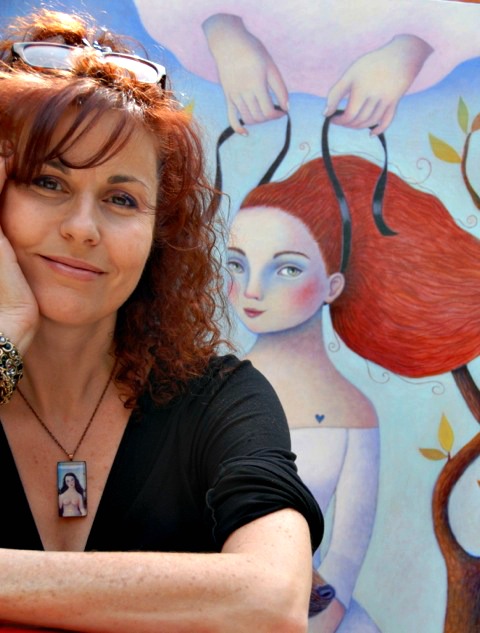
img: Isabelle Bryer and four of her paintings.

Me and my shadow: LIBBY’S LIFE #48 – Hospital visiting hours

Kate here. Sorry. No journal entry from Libby today, so I’m writing it for her — but I think you’ll agree she has a good excuse.

Three days ago on Monday, April 23rd, at 2:02pm and 2:11pm, Libby’s twins entered the world.

Understandably, Libby has been a little preoccupied  since then.

~ ~ ~

It’s a little over a year since I first met Libby. We were both browsing in Waterstones last March — or rather, I was browsing and she was buying self-help books by the truckload, desperately trying to make the best of her enforced expatriation. Over a couple of Danish pastries, I gave her the idea of writing this blog, and I’ve been surprised by her doggedness in the endeavour.

Admittedly, I’ve also been taken aback by her candid accounts of life in small town America. Presumably her landlady and husband don’t read the blog. Not to mention her mother-in-law.

As it happened, I’ve been in Albany on business this month, crossing my fingers that my time here would coincide with the birth of Libby’s twins. When I got a text from her on Tuesday, announcing their arrival the previous day, I was thrilled. She’d beaten the system and had the twins before her scheduled C-section.

“Twins r here! Overjoyed! Visit us!” her first text said, exuding that post-birth hormonal high. I remembered it well.

The next text, twelve hours later, was less high. It said: “Pls bring Boston Cremes and decaf iced coffee. Or normal coffee but don’t tell nurse at desk.”

I duly arrived at the maternity ward — “Family Birth Center” — clutching a box of the requested doughnuts and clandestine joe, and was given lots of suspicious looks by a nurse who appeared to have been trained by the TSA.  When I’d convinced her that I was here to see a friend and her new babies, that I wasn’t going to abduct said babies, that I hadn’t imported TB from Europe, and hinted that it was none of her damned business if I intended to stuff six Boston Cremes down my throat in front of my friend, she grudgingly allowed me to knock on Libby’s door.

The rooms in American hospitals compared with English hospital wards are…Well. Think “Waldorf Astoria.” Then think “Youth hostel.”

Libby’s room contained two beds, and she sat on one with her back to me, chatting on the phone. She seemed to be the only occupant, which is just as well because the spare half of the room was taken up with a flock of helium balloons and the contents of the local garden centre. I felt rather silly with my modest pot of one pink and one blue hyacinth, but took consolation at the sight of an empty Dunkin Donuts cup by the wastepaper basket, which indicated my food offering would be more welcome.

She heard me enter and turned around. “Just a minute,” she mouthed at me before plastering a fake smile on her face.

“No, Mum,” I heard her say. “You put maple syrup on pancakes, and peanut butter on toast. No, not the other way round. Yes, I’m sure. Marmite is fine on American bread, Jack will eat that too — he didn’t? That’s unusual…Oh. Well, I suppose Marmite doesn’t taste too good on cinnamon toast, so — look, just give him a banana now, and Oliver will sort him out later. Mmm-hmm. Mmm-hmm. I’ll be home tomorrow. Hang in there, OK?”

Libby clicked the Off button on the phone. The fake smile disappeared.

“Jesus wept!” she shouted. “I leave the house at 9:30 on Monday morning to give birth to twins five hours later — without an epidural, I’ll have you know — and she can’t even cope with the correct topping for cinnamon toast?”

She breathed in deeply, then let it out slowly. Five times she did this. She’d obviously had lots of practice at this quite recently — whether in labour or while trying to cope with her mother, I couldn’t tell.

“Anyway,” she said eventually, this time with a genuine smile. “You came to see us! That’s lovely.”

“I brought these.” I set the flowers and coffee on one of the bedside tables, and fished around in my tote bag. “Baby clothes. M&S.”

“How cute is that!” She’d adopted some of the American vernacular since our last meeting, I noticed. “They’ll look very sweet in these little vests, won’t you, my babies?” she cooed in the direction of the balloons.

I glanced around the room, peering into the depths of the flowers and balloons for evidence of cribs and newborns.

“Libs? Where are the babies?”

She looked alarmed for a moment, then relaxed. “Oh! That’s right, they’re not here. They’re in the nursery. The nurses keep running off with them when they haven’t got enough to do, which is quite often. There’s only me and two other women in the unit at the moment. Quite surprising, when you consider the circumstances of the conception. Then again, I suppose I was early.”

I was confused for a moment, then remembered. Hurricane Irene. Not much else in the way of entertainment when the electricity is out for a week. In a couple of weeks, this place would be a lot fuller.

“And how are Sam and Megan doing?” I asked.

She tilted her head on one side. “Who?”

I frowned, wondering if the old saying about losing your brain cells in the maternity ward was doubly applicable when you had twins.

“The bay-bies?” I said, enunciating slowly.

Libby laughed.

“Didn’t I tell you? They’re not Sam and Megan any more. They’re George and Elizabeth. They were born on Saint George’s Day,” she explained, “so Oliver and I thought that something more English, more regal, might be in order. And of course Elizabeth is my real name, but we’re going to call her Beth — Oh, look! Here they are!”

Two nurses wheeled two trolleys topped with clear plastic cribs. In each little crib — bassinet, I think they call them here — lay a tightly wrapped bundle with a stripy hat perched on one end.

One pink hat, one blue.

Libby sighed. “They’re hungry again. Especially George. George is always hungry.”

She shuffled around on the bed, twiddling with controls that raised the head into a backrest. One of the nurses propped a couple of pillows in front of her and handed her a baby. Libby tucked it under her left arm, and then tucked the other baby under her right. She nodded at the two nurses, and they left the room.

The babies fed, their eyes closed. One of them  — the pink hat; Beth, I assumed — worked a fist loose from the swaddling and waved it around. The fist bashed the owner’s face, and she stopped feeding and howled at the unprovoked attack by a strange flying object.

“Silly baby,” Libby murmured affectionately.

Beth twisted her head from side to side, looking for the food source again. Libby helped her find it.

“You’re very pro at this already,” I said, impressed. Feeding two babies at once; one had seemed complicated enough, as I remembered. But Libby seemed a different person from the uncertain little mouse I’d met a year ago. This Libby was confident, efficient…

I’d spoken too soon.

Libby’s eyes filled with tears, which ran down her cheeks unchecked because both her hands were occupied, holding the twins.

I stood up, plucked a tissue from the box by the bed, and wiped her face.

“Did I say something wrong?” I asked.

She shook her head and sniffed.

“It’s nothing. The baby blues — remember those?”

I nodded. They’re not easily forgotten, those third-day blues.

“Remember wondering how you’re going to cope at home on your own?”

I pondered. As I recalled, I was overjoyed to leave the noisy NHS hospital, where six mothers in the same ward insisted on “rooming in” with their squawking babes.

“I was glad to get home for some sleep.”

“But it’s different here! They wait on you, hand, foot and finger! I don’t have to do a thing — not even change nappies! And tomorrow I’m going to go home, and my mother will want nursemaiding because she doesn’t understand how the shower works or something, and I’m going to be all…alone!”

She wailed, and one of the babies — Blue Hat — lifted its head and wailed in sympathy. Pink Hat followed suit. All three Patricks wailed together.

“Can’t you stay?” she pleaded.

“I thought I’d stay a couple of hours — ”

“No. I mean, stay with me. At our house. Just for a few days. My mother is useless, and I’ve asked too much of Maggie already, and Oliver means well, but… We have internet, you could work from Oliver’s den. It would mean so much to me, just to have someone sane and female around the house until I get my act together.”

I thought. I only had one more meeting tomorrow morning, and would be working at home in Milton Keynes after that for a week. It would make no difference to anyone else if Home was MK or Woodhaven.

“I can probably change my flight,” I said, although it did occur to me that perhaps Oliver might not be overjoyed at this arrangement.

Libby leaned back against the headrest, and sighed shakily.

“Thank you so much.”

Then she sat up again.

“And guess what! You can write my blog again next week!”

.

Next: LIBBY’S LIFE #49: An unwelcome blast from the past

Previous: LIBBY’S LIFE #47 – Showered with affection

Stay tuned for Friday’s celebration of Obscura Day!

If you enjoyed this post, we invite you to subscribe for email delivery of The Displaced Dispatch, a round up of the week’s posts from The Displaced Nation. Sign up for The Displaced Dispatch by clicking here!

Img: Map of the World – Salvatore Vuono

RANDOM NOMAD: Suzanne Kamata, American Expat in Japan

Place of birth: Grand Haven, Michigan, a charming tourist town on the shores of Lake Michigan.
Passport: USA
Overseas history: France (Avignon): 1985; Japan (various towns + now Aizumi, Tokushima Prefecture, Shikoku Island): 1988 – present.
Occupation: Author* and TEFL teacher
Cyberspace coordinates: Suzanne Kamata (author site); @shikokusue (Twitter handle)
*Suzanne Kamata is the author of a novel, Losing Kei; a short story anthology, The Beautiful One Has Come (listed on The Displaced Nation’s top books for, by and about expats in 2011); and a picture book, Playing for Papa — all of which concern bicultural relationships and/or families. She is the editor of several anthologies — the most recent being Call Me Okaasan: Adventures in Multicultural Mothering.

What made you leave your homeland in the first place?
A sense of adventure! I wanted to see the world, which I’d glimpsed through reading novels set in other countries, and I wanted to gather up interesting, exotic experiences for the stories and books I would one day write.

Toward the end of my college career, I planned on going into the Peace Corps to teach English in Cameroon. As a fallback, my brother suggested a new program he’d read about in the newspaper. The Japanese government had set up the Japan Exchange and Teaching (JET) Programme to get native English speakers into public schools. I’d studied Asian history in college, and had an interest in Japan (especially the Heian Age, when nobles communicated via poetry), so I applied. After rigorous interviews for both, I was accepted into both the Peace Corps and the JET Program. I decided to go to Japan first, because the JET Program was a one-year program. I figured I’d do a two-year stint in the Peace Corps later, but then I wound up meeting a Japanese guy…

Is anyone else in your immediate family “displaced”?
My brother spent a year in Germany as an exchange student during high school. I think I was influenced a bit by his experience.

You’ve lived in Japan for a long time. Does any one moment stand out as your “most displaced”?
When I was about to give birth to my twins via C-section. My mother and father were on the other side of the world, and my husband was out in the waiting room. I was surrounded by Japanese-speaking strangers. I wondered if I would be able to remember how to speak Japanese during the operation. I think entering motherhood is like going into another country for everyone, but it’s especially surreal in a foreign hospital.

Is there any particular moment that stands out as your “least displaced”?
No one moment but all the moments when I’m with my children. Whenever I spend time with them, I feel completely at home. My children have never lived in my native country, and they have Japanese passports. When I’m away from them I feel a little bit lost.

Do your kids ever go to the United States for visits?
My kids have been to the States numerous times. Most recently, my son went on a school trip to Hawaii, where, for once in his life, he blended in perfectly. There are many mixed race kids in Hawaii. I think my kids feel pretty comfortable in the States, but being on vacation is different from actually living there.

You may bring one curiosity you’ve collected from your adopted country into The Displaced Nation. What’s in your suitcase?
A furoshiki — a Japanese wrapping cloth — dyed with locally grown indigo. It will be easy to tuck into my suitcase, and I’m sure I’ll find ways to use it during my stay at The Displaced Nation. In Japan, I use wrapping cloths to carry books, covered dishes, and oddly shaped parcels. They’re durable and more attractive and ecological than paper or plastic bags. The color will remind me of the area where I’ve lived for over twenty years. The name of the town where I now live is Aizumi, which means “indigo dwelling place.”

You are invited to prepare one meal based on your travels for other members of The Displaced Nation. What’s on your menu?

Starter: A few slices of sea bream sashimi from the straits of Naruto, with a squeeze of sudachi and soy sauce mixed with wasabi on the side for dipping.
Main course: Cubes of grilled Kobe beef strewn with fresh herbs (julienned shiso leaves, coriander, parsley, slivers of ginger root), steamed barley and rice, and miso soup made with fresh wakame — served with a nice Côtes du Rhône wine.
Dessert: Sudachi pie (my own creation: it’s Key lime pie made with sudachi juice instead of lime), served with espresso. I’d also put a plate of sliced Asian pears on the table.

And now you may add a word or expression from the country where you live in to The Displaced Nation argot. What will you loan us?
I like the Japanese word natsukashii, which refers to nostalgia or a longing for things of the past. I don’t think there’s a perfect equivalent in English. At any rate, Americans don’t go around saying “I’m feeling nostalgic!” whereas natsukashii is frequently used in Japan. If someone brings up a memory from the past, another person, filled with nostalgia, might say, “Natsukashii!”

Today, appropriately enough, is “East Meets West Day.” can you tell us about any parties or celebrations you’ve held since you becoming displaced from your native land, that in some way illustrate this theme?
In Japan, only children’s birthdays are celebrated, usually with a store-bought cake. In our family, everyone, including the adults, gets a birthday party. Typically, we have a meal with celebratory dishes such as rice with red beans, or everybody’s favorite sushi, with a homemade birthday cake for dessert. We sing “Happy Birthday to You” in English, and the birthday person makes a wish before blowing out the candles on the cake. (The Japanese have adopted the custom of candles on a child’s birthday cake, but not the making of wishes.)

The Displaced Nation has just turned one year old. Can you give us some advice on themes to cover in our second year — anything you think should be on our radar?
You might consider interviewing Edward Sumoto, who runs a variety of events for Mixed Race/Third Culture individuals in Japan, and the filmmakers/photograhers/writers involved in the Hafu Project. I believe their long-awaited documentary will debut this year.

Readers — yay or nay for letting Suzanne Kamata into The Displaced Nation? Tell us your reasons. (Note: It’s fine to vote “nay” as long as you couch your reasoning in terms we all — including Suzanne — find amusing!)

STAY TUNED for a diversion from the usual updates from life in Woodhaven. In tomorrow’s post, Kate Allison will be reporting on her latest meeting with Libby. (What, not keeping up with Libby? Read the first three episodes of her expat adventures.)

If you enjoyed this post, we invite you to register for The Displaced Dispatch, a round up of weekly posts from The Displaced Nation, with seasonal recipes, book giveaways and other extras. Register for The Displaced Dispatch by clicking here!

Related posts:
img: Suzanne Kamata standing inside a pumpkin sculpture on the Japanese island of Naoshima (March 2011). The sculpture was created by the well-known artist Yayoi Kusama, who was herself an expat for awhile. (She lived in New York City in the 1960s.)

Is there a common theme — or better yet meme — for the expat life?

After writing, planning, commissioning, and editing posts for this site for just over a year — many of which were centered on the keyword “expat” — I have become rather fixated on that word of late.

Yes, we’re back to that old chestnut, but kindly indulge me while I rake it over the coals again and crack it open to take another look.

Back when I myself could have been considered an expat — first in England and then in Japan — I assiduously avoided describing myself in that way. It made me think of the kinds of people who go into a siege mentality, circle the wagons and say: “Right, it’s just us now.” I’m sure you know the kind of expats I mean, the ones who live in a colony or compound, or socialize as if they do. They hang out at the pool drinking G&Ts, exuding a sense of cultural superiority — along with great pride in having remained unassimilated.

After all, if you’re an expat, it means you come from the richer part of the world; otherwise, you’d be an immigrant.

Nowadays, I’m an American living in America, but I simply tell people that I used to live abroad. If I use the word “expat” at all to refer to myself, it’s in inverted commas: “Yes, I suppose I was an ‘expat’ for all those years. And now I’m a ‘repat.’ Hahaha…”

What about you? If you are reading this, chances are you are (or have been) someone who has ventured across borders to travel and/or live. How do you refer to your predicament? (BTW, my choice of “predicament” is the result of cultivating a British sense of humor over many years of living on that sceptered isle — no, not as an expat, but as an international resident!!!)

Maybe unlike me, you don’t have any hang-ups about calling yourself an expat — and think that people of my sort are inverse snobs for rejecting the label?

As the blogger Tabitha Carvan (The City That Never Sleeps In) has written:

To the Vietnamese who live around me, it’s clear where I fit in here: I don’t. The differences between us are as plain as the enormous nose on my big fat face.

So is it fair to say we’re all “displaced”?

One of the other founders of The Displaced Nation, Kate Allison, is an Englishwoman who has lived in the United States for more than 15 years. I sometimes think of her as an immigrant, except that she tells me she keeps a foot on each side of the Atlantic.

Strangely, I did not wince at all when Kate Allison proposed the word “displaced” as a descriptor for our common situation, when she and I were first chatting about starting up this site.

Well, perhaps I winced just slightly. I know from my studies of international affairs that “displaced” is often used for people who are forcibly removed from their homes by natural disaster, famine, civil wars and other tragedies.

In this narrow sense, “displaced” in no way applies to me, Kate or others of our ilk, who have led privileged lives.

But in a broader sense, I had to agree with Kate that “displaced” seems a good fit. As the Italian poet Cesare Pavese once said:

Traveling is a brutality. It forces you to trust strangers and to lose sight of all that familiar comfort of home and friends. You are constantly off balance. Nothing is yours except the essential things – air, sleep, dreams, the sea, the sky — all things tending towards the eternal or what we imagine of it.

If there is any common theme that applies to all of us, surely it’s that sense of being “constantly off balance,” as Pavese so aptly puts it. By trotting off to investigate — and live in — far-flung corners of the globe, we are casting off the balance of our lives and choosing a life where, for a while, the only things we have in common with anyone else are the basics: air, sea, sky, sleep, dreams — a life of displacement, in other words…

And in some cases — Kate’s would be an example — we are trailing others who have made this choice on our behalf, or on behalf of family and kids. (See her “Libby’s Life” series.)

Always look on the bright side of life!

In an article last month for the FT, Edwin Heathcote had this to say about what he called “a life less ordinary”:

The expat experience combines a cocktail of the thrill of the new and the ennui of global alienation, of displacement and dislocation.

Readers may wonder why the founders of The Displaced Nation have chosen to emphasize the negative ingredients of this cocktail. After all, the meaning of “displaced” is only a shade or two away from “misplaced” or “out of place.”

Why not look at the bright side instead — the allure and the thrill of a life overseas?

Well, the fact is, the founders of The Displaced Nation don’t necessarily see displacement as a negative. As shown in numerous ways on this site over the past 12 months, it’s a necessary first step in making the leap beyond the known to the unknown — to feeding what for many of us is, or soon becomes, an insatiable hunger for new ways to knowledge.

By becoming displaced, we open up our minds to new forms of

Now if that isn’t the bright side, we don’t know what is!

Keep ’em laughing as you go

As far as our site stats go, readers have most enjoyed the series of posts where we’ve explored the good and the bad, the yin and the yang, of the displaced life, with a large helping of humor thrown into the mix.

1. Alice in Wonderland

Top of the charts is the month that we dedicated to the “curious, unreal” aspects of the displaced life with the help of Lewis Carroll’s Alice.

When you stop to think of it, barging into other people’s countries is rather like falling down a rabbit hole: full of adventure but also misadventure, of curious — and sometimes scary (because so incomprehensible) — encounters.

Kate Allison produced two brilliant posts illustrating just how unreal things can sometimes get: “5 lessons Wonderland taught me about the expat life, by Lewis Carroll’s Alice,” and “How many of these 5 expat Alice characters do you recognize?”

Meanwhile, Guest blogger Carole Hallett Mobbs kept us in stitches when describing the scenes of young adults dressed up in furry romper suits, “doormice folk,” and flying potatoes that formed the backdrop to her everyday life in Japan.

2. Pocahontas

Readers also appreciated the month when we recruited the legendary Pocahontas to help us understand, from a native’s point of view, what it’s like to be bombarded with clueless nomads.

In particular, we focused on the cases when displaced types befriend, or even marry, the natives, causing them to lead displaced lives (sometimes to tragic effect — I’m thinking not so much of Pocahontas, but of her tribe!).

I weighed in with a post that was partly based on my own experiences: “Cross-cultural marriage: Four good reasons not to rush into it.” Somewhat to my bemusement, the post proved extremely popular — that is, until it was surpassed by new TDN writer Tony James Slater’s hilarious (but with a hard kernel of truth) “Does love conquer all, even language barriers?”

Counterbalancing Tony’s and my cautious take on such matters was a two-part interview series with two cross-cultural couples — all of whom seemed to find their situation “no big deal.”

That blasé sentiment would later be echoed by Wendy Williams, author of the new work, The Globalisation of Love. In a guest post in honor of Valentine’s Day, she pointed out that in an era of increased international travel, multicultural unions are an inevitability — and even deserve their own label: “GloLo.”

3. Global philanthropy

Another monthly theme that earned high marks from readers was “global philanthropy” — the idea of displacing oneself on behalf of the forcibly displaced.

Readers responded with high praise for Kate Allison’s interview of Robin Wiszowaty, who immersed herself in Maasai culture and now runs development programs in Kenya on behalf of the Canada-based charity Free the Children.

Also popular was a feature on international aid worker and consultant Jennifer Lentfer. (Lentfer has received the most hits of any of the 40 Random Nomads who’ve been featured in the site’s first year.)

But even when covering this seemingly sacrosanct topic, we were hard pressed to prevent a note of skepticism, verging on irreverence, from creeping into the site. Guest blogger Lawrence Hunt stirred things up with his well-received post making fun of gap-year students who think they can save the world in just six months. And I wasn’t far behind with this one, still getting many hits: “7 extraordinary women travelers with a passion to save souls.” (Hey, the current generation isn’t the first to perform good works on behalf of those less fortunate!)

But is it a meme?

First, what is a meme exactly? My dictionary tells me it’s an idea, behavior or style that spreads from person to person within a culture.

Memes are the cultural analogues to genes that get selected and then self-replicate.

Is the kind of “displacement” we talk about on this site a meme? Not in the Internet sense — it hasn’t spread like wild fire throughout social media.

But has it been a meme within our community? You tell us — does “displaced” work for you, or is there some other organizing principle we should be using on this site? Expat, perhaps? (Groan…)

STAY TUNED for tomorrow’s post, a roundup of recent displaced reads by Kate Allison.

If you enjoyed this post, we invite you to register for The Displaced Dispatch, a round up of weekly posts from The Displaced Nation, with seasonal recipes, book giveaways and other extras. Register for The Displaced Dispatch by clicking here!

Related posts:
 

Keeping yourself earthed: Expats and Earth Day

We should do a post on Earth Day. It fits in with the celebration theme we have for this month, in honor of The Displaced Nation’s first birthday

The brainchild of Gaylord Nelson, a U.S. senator from Wisconsin, Earth Day was established in 1970 — a year that also gifted world culture with bell-bottom trousers and Jon Pertwee’s itineration as the third Dr Who — as a day to engage the public about air and water pollution. From these beginnings it has grown into a day observed by groups and people throughout the world to celebrate the environment and raise awareness of the dangers our planet faces. This Sunday is Earth Day’s 42nd anniversary. The event will be marked with an amusingly inventive doodle on the google homepage and by NBC turning its normally multi-colored peacock logo green. Hallmark will once again fail to capitalize on the day as perhaps they might wish to. This will lead to high-level discussions in the Hallmark marketing department.

it seems to be just the sort of thing that our expat readership would think is a good cause

The vast majority of people agree that not f***ing up the environment is a good idea. Admittedly there may be disagreement over the means by which you do that, and the extent of the problem, but in principle most people would seem to think of Earth Day as  a fairly decent, mostly harmless idea.

…in fact, its just the sort of thing that expats are into. You see, I think expats are more concerned about the environment.

With absolutely no studies to back up the assertion, it was suggested here to me, in the corner of the Internet we call The Displaced Nation, that Earth Day would be a good topic for me to consider writing a post about as expats, so we thought to ourselves, are possibly more attuned to the environment that those mundane muggles known as non-expats.

Theyve just traveled more widely, experienced a bit more.

So I find myself sitting down ready to write this piece. My “notes” if we can call them that, consists of a half-baked observation written on a torn piece of notepaper about all the gas-guzzling trucks people in my current locale (California) seem to love driving. It eloquently reads, “ubiquity of big trucks.”

Added to this is a later notation, a parenthetical thought, where I write that the sights of these unnecessary trucks make me nauseous.

So that’s all I’ve got as I try and knock out this post, but I don’t get far as it seems that this idea that we’re, as I assume if you’re reading this blog you’re an expat, somehow better from my truck-driving neighbors is complete and utter tosh.

Theyre more in tune with whats going on

Now I admit that not all expats are equal, and what I am going to write about doesn’t apply to migrant workers who have left a home country that is undeveloped in a search of a better pay in a more developed country. Neither do I include those individuals who are living in foreign climes doing environmental work. No, what I am concerned about is the self-satisfied expat. You know the type — the sort that decides to start a blog about their experiences because their observations are just so damn important that they need to be read by others. In other words, the likes of me, and, most probably, the likes of you.

and theyre probably better informed.

I was extremely willing to go along with the idea that my expat status confers some sort of wisdom on me. Let’s face it, it’s an intoxicating thought, the idea that living in a different culture from your own automatically transforms you for the better. I guess I must half believe it as I make a point of mentioning on my C.V. that I have lived on three continents, as if that makes me better than a candidate who has only lived on one continent.

Now I do think that there’s a lot to be gained from moving abroad, from leaving your comfort zone, but there should also be an awareness that it is a position of privilege, a privilege conferred — at least on me, I should stop talking on your behalf — by living in the jet age, by ignoring that the life I have chosen, a life that I at times get smug about by being an expat blogger (which really is the smuggest of all expat types) leaves on the world a far greater carbon footprint than my neighbor’s life driving his gas-guzzling truck. And yet I’m the one to feel disdain for him and his environmental choices.

Happy Earth Day.

LIBBY’S LIFE #47 – Showered with affection

Maggie opened her front door, and I handed her a screwdriver set.

“Oliver said you needed this urgently,” I said. “He says there should be one in there that fits, but let him know if there isn’t.”

I tried not to sound irritable, but really — did Maggie require this so urgently that I had to interrupt a nap and traipse here? The last thing on my wish list right now was another needy middle-aged woman. My mother already occupied that job slot, and it seemed that my beloved Maggie was picking up her bad habits. They’d spent a lot of time together over the last few days; in fact, today, Mum had been at Maggie’s house since before lunchtime.

But why stop at blaming middle-aged women? Oliver could have brought it to Maggie himself before his after-work shower, but no: “You take it to her, Libs. I’m shattered.”

And I’m not, of course.

Maggie took the screwdrivers from me. “Come in,” she said, opening the door a little wider.

“No, it’s OK.” I turned to leave. “I have to get back. Jack needs his dinner.”

Maggie reached out and grasped me by the elbow, drawing me back. “Jack will be fine with Oliver for a few minutes. Come on,” she urged. “Your mother just put the kettle on.”

I didn’t want tea. I wanted to give Jack his dinner, put him to bed, and then I wanted to go to bed myself.

“All right,” I said with a sigh, and stepped into the wood-panelled hallway.

“Go and make yourself comfortable,” Maggie said. “I’ll be with you in a moment.” She trotted off towards the back of the house.

Wearily, I turned left, into the living room.

I felt my jaw drop.

* * *

“It’s usual not to have a shower for a second baby,” Maggie said behind me, as I gazed at all the people congregated in the living room. Mum. Charlie, Anita, Julia. A few moms from Jack’s new nursery school. Even Caroline. “But you’re a special case.”

Pink and blue bunting criss-crossed the room. Pastel-wrapped boxes lay piled in one corner. Pink- and blue-iced cupcakes nestled together on a three-tier stand.

Welcome, Twins! said a big banner over the fireplace.

I felt my eyes prickling. “Thank you,” I whispered, looking round at everyone. I hugged Maggie, not quite able to believe that I was the centrepiece of my own surprise baby shower. “Thank you so much.”

Anna appeared from the kitchen and handed me a glass of something that looked like champagne. “Sparkling grape juice,” she said, before I could object. “Although you might want the real thing before the evening’s over,” she murmured, her eyes darting in the direction of my mother, who sat in Maggie’s rocking chair talking earnestly to Charlie.

“Delivery rooms aren’t my scene,” she was saying. “But Libby would like me to be there, I think.”

“No way!” I mouthed at Charlie, any rush of sentiment for my mum receding rapidly.

Charlie’s lips twitched. “Of course, with it being a C-section delivery, they probably won’t let you in.”

Mum took a deep, huffy breath. “That’s not what I’ve seen on A Baby Story. It’s a real family occasion for all those women.”

Heaven preserve us. Mum started channel surfing four days ago, and all her “I didn’t come to America to do this, that and the other” arguments vanished.

Apparently, her raison d’être in America is to watch The Learning Channel all day. If I’ve seen one woman give birth on these dreadful programmes since Sunday, I’ve seen thirty, and believe me, it’s not a good idea when your own birth experience has been scheduled for seven days hence, and your mother has decided that an impromptu family party in the operating theatre would be fun.

Yes. The twins will be extracted from me on April 26th at 9am. My slightly elevated blood pressure was still causing Dr. Gallagher some concern, so he booked me into his busy timetable for next Thursday.

I’m not happy about it, or even convinced that it’s necessary, but what can you do?

Oliver says: Look on the bright side. At least there will be no getting out of bed at three in the morning because your waters have burst and the bed’s a swamp.

Always has a way with words, does my Oliver.

So, as I was saying — what can I do?

Sod it. Enjoy the party. That’s what.

“Cheers, everyone,” I said, raising my glass of grape juice.

* * *

Charlie fetched her car — everyone had parked their cars in the next street so I didn’t get suspicious — and packed all the gifts in the trunk to deliver them to our house. I felt so lucky, so loved. You remember all those things I had returned to the baby shop because they’d cost so much? Maggie had taken note of the items, and now most of them were once again on their way to the babies’ room.

I felt overwhelmed with the generosity, the camaraderie, the shower of affection. No wonder these parties are known as showers.  I felt — far more than I had ever felt in my hometown of Milton Keynes — that I belonged. Belonged to something good.

* * *

“I just wish it didn’t have to be this way,” I said to Maggie as I put my outdoor shoes on, waiting for Anna to bring her car round to drive me the short distance home. “I’ve always dreaded the idea of being sliced open, but I don’t have much option if Dr. Gallagher thinks it’s too risky to let me go on any longer…”

Maggie snorted disbelievingly. “If I know dear Gerry, he’ll have a golf tournament lined up in a couple of weeks that he doesn’t want to miss. Take my word for it, your hospitalization is less to do with your safety, and more to do with keeping his handicap.”

“No!” I was shocked. “He wouldn’t do that — would he?”

“He’ll take very good care of you, don’t worry. Better to do it his way than to have a complete stranger delivering those twins, don’t you think? Imagine — you could end up with that frightful witch, Elspeth Wojcik.”

I shuddered. One visit to that particular obstetrician, whom I’d nicknamed Doctor Death, had been enough. The possibility that in Dr. Gallagher’s absence she could deliver our twins was horrifying. But I still balked at the idea of having my midsection cut open, no matter how unnoticeable the scar would be afterward.

“You need some alone time with Oliver. That’s what you need,” Maggie said.

“But we went out for dinner only last Saturday,” I protested.

“Ribs and fries aren’t going to bring on labour, are they?”

“What?” Maggie’s twists of conversation confused me sometimes. Quite a lot, actually, these days.

“Alone time at home, is what I meant,” she said. “Not alone time at Ruby Tuesday’s.”

The penny dropped.

“Oh!” I’d forgotten about that little trick to bring about labour. And it sure beat swigging castor oil.

Maggie nodded. “Send Jack and your mother round here every lunchtime for the next few days, and see if you and Oliver can spoil Gerry Gallagher’s plans.”

The gravel on Maggie’s driveway crackled as Anna’s Mustang drew up outside.

“You’re on,” I said.

* * *

A Massachusetts spring heatwave. Sun pouring in through our bedroom windows. A chickadee chirping close by.

Oliver feeds me another strawberry. “I should get back to work,” he says. “But I think I’ll call in and say you’re not well.”

“Again? Will they believe you?”

“Don’t care if they do or not.”

“You could always work at home,” I suggest.

“Or do something else at home. Does this old wives’ tale really work? Technically, you’ve still got four weeks to go. ”

“It’s supposed to work. So they say.”

I lie on my side and gaze out of the window, at the slight breeze moving through the tall oak trees at the end of our garden, and I listen to the silence of Woodhaven.

The babies have been very quiet for a couple of days; they’re still, sleeping a lot, getting ready for a big day. Their peace makes me woozy, detached, and I feel myself mentally withdrawing from the world just as they prepare to meet it.

No. It won’t be long. I know it.

.

Next post: LIBBY’S LIFE #48 – Hospital visiting hours

Previous post: LIBBY’S LIFE #46 -A tale of two mothers

Click here to read Libby’s Life from the first episode

STAY TUNED for Friday’s post, when Anthony Windram debates the view that, this Sunday, expats should be the last people celebrating Earth Day.

If you enjoyed this post, we invite you to subscribe for email delivery of The Displaced Dispatch, a round up of the week’s posts from The Displaced Nation. Sign up for The Displaced Dispatch by clicking here!

Image: Travel – Map of the World by Salvatore Vuono / FreeDigit

Wedding celebrations: Who does it better, Britain or America?

We’ve spent the last two weeks looking at festivals and parties around the world, and today it’s time to take a glimpse at nuptial celebrations, with a guest post by Meagan Adele Lopez. As an American who once lived in the UK — she also has a British boyfriend — Lopez can be considered an unofficial expert on British versus American weddings.

Please don’t invite my British beau and me to a wedding unless you really want us to come — we are more than likely going to reply “yes”!

Many have made that mistake. For some reason, it is impossible for us to say “no” — perhaps we are living vicariously through the bride and groom (going to a wedding is much cheaper than throwing one, let’s be honest).

Over the course of four years we have been invited to 28 weddings, 23 of which we will attend/have attended. These weddings span four countries (Wales, England, Dominican Republic and the USA) and 14 cities.

I wish I could say I was a professional wedding guest, getting paid to attend these lavish affairs. But no, we just happen to have many friends who are getting engaged at this time of my life. Some are even going through their second weddings.

One of the many benefits of dating a British guy is being able to attend British weddings — complete with hats, fascinators, castles and tail coats. I’ve become a bit of an expert on both.

So, I’ve been keeping a running tally of the best things that British and American wedding celebrations have to offer. Right now Britain is winning, but only by one, so that could change!

4 great things about British weddings

1) Less financial outlay for bridesmaids
It’s kind of atrocious that Americans still “invite” their best friends in the world to have the “honor” of becoming a bridesmaid only to pick out the most expensive dress they can find, make their best friends pay for it, and take them on a lavish bachelorette party that they must also pay for.

The British have it right. I mean, if you’re paying £25,000 on a wedding already, why not shell out an extra thousand to make your poor bridesmaids happy? After all, they didn’t choose to get married, you did.

2) Betting on the speeches
Let’s face it — sometimes speeches at a wedding can be really, really hilarious and entertaining. They can be so entertaining and hilarious that you have no idea how much time has gone by, whether or not you’ve eaten, or if the dancing has even happened yet. But, a lot of times, they can be painful and long, and somewhat boring. So, what better way to keep the crowd entertained than by going to each table and getting the guests’ bets on how long the speeches will last?

Personally, I love speeches and find it fascinating to see how each person tackles this challenge to charm a crowd of 150 people — 20 of whom you probably know personally. However, knowing that I have the chance to win a pot of 200 quid makes it that much better!

3) The Groom’s Speech
I actually find it a travesty that American grooms aren’t made to give a speech. Perhaps it’s because a woman marrying a British man knows that this one speech might be the only time she will hear her husband tell her how gorgeous, wonderful and amazing she is, and how he is the luckiest man on the planet. After all, British men aren’t known for being overly flattering or sentimental. I blubber like an idiot, wiping the mascara from my eyes, when I hear a doting British man, for the first (and probably only) time, open up to his friends and family about why he is truly in love with this woman.

But I’m sure most brides who marry a British man will tell you that the groom’s speech is one of the best moments of their wedding night. For me, as a guest, it beats the father’s speech and even the first dance. Perhaps the vows are the only thing that trump it.

4) Romantic venues
I’ve attended weddings in a ninth-century castle, in a tenth-century church, in an old manor house in Sussex, on a farm in the West Country, in a hotel where prime ministers stay, and next to a marsh in West Wales. Something about a British wedding makes it that much more romantic. Of course, it’s every girl’s dream to get married in a castle, but in Great Britain, you actually can!

3 great things about American weddings

1) Open bar
The first time I truly found out about the horror that is a cash bar at a wedding, I was invited to just the evening part. You see, my boyfriend and I had been together for over a year, but since the groom had never met me, he didn’t think it important to invite (ah hem, “pay”) for me to come to dinner, or attend the ceremony.

Apparently, it’s quite normal in England for a significant other not to be invited to the entire evening with their partner if they have never met the girlfriend. Being an American, I was already incredibly offended — especially since we had traveled an hour to be there, stayed in a really expensive hotel (the only one in the entire town), and paid for two separate £40 cab rides to the venue from the hotel (since we weren’t leaving together). So, you can imagine my dismay when I got to the reception and had to pay for my own drinks! I understand that not everyone can afford to have an open bar, but I most certainly prefer the American mentality that when you invite a guest, they are to be treated as such.

2) The women’s speeches
In Great Britain, traditionally, the speeches include the Father of the Bride, the Groom and the Best Man. I agree with all of these choices for speeches, but I have to admit, I did find it a teeny bit sexist that no women spoke at weddings the first time I saw it happen. Most British women don’t mind since they would rather the attention be off of them for the night, but what happened to the Maid of Honor? Why can’t she throw in a speech?

Women bring a different take to speech land, and I definitely prefer the American tradition of allowing us to speak.

3) Creative venues
Where the British score points for tradition, history, elegance and romance, American weddings score points for creativity, grandiosity and variety. Obviously, America is a much bigger country with many more choices for venues, and many more options for good weather. I have been to a wedding on a cliff overlooking the Pacific Ocean, at a museum in the middle of downtown Chicago, a country club in Maryland, and by a river at a historic house in Austin, Texas. The possibilities are truly endless in America, and always keep you guessing. While many British weddings have struck me as being similar, it’s hard for me to say that any American wedding has resembled another. This is also probably due to the diversity of the American population and the variety of religions in this country.

Combining the two traditions — still working on that!

I’d be lying if I didn’t admit that with all of these weddings I didn’t think about how I would like my half British, half American wedding to go…but I simply can’t admit to what I dream of just yet. Call it superstition or what have you, but until I get engaged I won’t disclose my dream wedding. My worst nightmare is having my dream wedding down on paper, and then it never happening!

In the meantime, I’ll continue to break down the weddings I go to and figure out which bits I want to keep for myself.

Editor’s note: This post is adapted from a post that appeared on Smitten by Britain: “British vs. American Weddings” (25 January 2012).

Question for readers: Have you been to weddings in the country where you live? How do they compare?

MEAGAN ADELE LOPEZ is the author of Three Questions: Because a quarter-life crisis needs answers, which was featured in February on The Displaced Nation. You can learn more about Lopez and her book at her author site and by following her on Twitter: @meaganadele.

STAY TUNED for tomorrow’s post, an interview with first-time novelist Martin Crosbie. (Sign up for our Dispatch to be eligible for the giveaway of his book, A Temporary Life!)

If you enjoyed this post, we invite you to register for The Displaced Dispatch, a round up of weekly posts from The Displaced Nation, with seasonal recipes, book giveaways and other extras. Register for The Displaced Dispatch by clicking here!

Related posts:
“We read to know we’re not alone”: 1st-ever litfest for expats & random nomads

The displaced writer Hazel Rochman once said that reading “makes immigrants of us all”:

Reading takes us away from home, but more important, it finds homes for us everywhere.

That must be why author interviews have played such an important role in the entertainment mix provided by The Displaced Nation since our founding one year ago.

A book that enables us to escape to a new world without buying a plane ticket? Bring it on!

A book that makes us feel at home in another part of the world? There’s nothing we crave more.

We’ve also taken authors into our confidence who, as St. Augustine once advised, treat the world as their book, rather than staying put and reading only one page. Because of their own peripatetic ways, these writers have much to say to the rest of us nomadic types about how to make sense of feelings of isolation, ennui and displacement.

As C.S. Lewis once said:

We read to know we’re not alone.

In honor of The Displaced Nation’s first anniversary, as well as in the spirit of World Party Month, I would like to propose the first-ever Displaced Nation literary festival featuring authors who have been interviewed or in some way featured on the site during the past year.

“We read to know we’re not alone”: THE FIRST-EVER LITERARY FESTIVAL FOR EXPATS AND RANDOM NOMADS
Note: The following is a tentative line-up. It includes previews of the kinds of insights we can expect to glean from such an extraordinary gathering of expat literati.

We anticipate the festival to extend from a Sunday night to a Thursday morning, with an opening night gala and a couple of closing events. Click on the headlines to go to the event descriptions for each segment:

OPENING NIGHT GALA EVENT

It seems only fitting that we offer something totally mad on our opening night. We will screen Alice in Wonderland, the 1903 British silent film directed by Cecil Hepworth and Percy Stow, which was partially restored by the British Film Institute and released in 2010. (NOTE: You can see portions of the film in a video specially made by Anthony Windram during The Displaced Nation’s “Alice in Wonderland” theme month.)

The film is memorable for its use of special effects: Alice’s shrinking in the Hall of Many Doors, and then growing too large in the White Rabbit’s home, getting stuck and reaching for help through a window.

The film matches our theme of “We read to know we’re not alone” — could anyone ever feel lonelier than Alice did at such moments?

But here’s the new twist: the screening will feature a live accompaniment by Seremedy, the displaced Swedish visual kei band this is now making such a sensation in Japan, reacting musically and without any rehearsal beforehand, to the silent film in front of them. Unique, spontaneous — and perhaps even terrifying, given that the band’s (male) lead guitarist, Yohio, looks like an anime version of Alice.

DAY ONE: “We’re not alone” — We have each other

Iranian Childhoods, Inspiring Stories

TONY ROBERTS and ASHLEY DARTNELL each spent portions of their childhood in Iran. Roberts has produced a novel based on his memories of that time, Sons of the Great Satan, which we featured on this blog about a year ago. Dartnell, who has yet to be featured (we hope she will!), released her memoir, Farangi Girl, last year (it was recently issued in paperback).

Roberts and Dartnell have in common the status of being so-called third culture kids — growing up in a third culture not common to their parents (Roberts’ parents were American and Dartnell was the product of an American mother and British father). They also have in common that they were enjoying their lives in Tehran until something terrible happened — the memory of which affects them to this day.

In Dartnell’s case, it was the sudden collapse of her father’s business (her parents subsequently split up), whereas for Roberts, it was the experience of being evacuated because of the American hostage crisis — suddenly, he was back at the family’s small farm town in Kansas, having no idea of where his friends had gone.

TCKs experience such traumas in isolation (Roberts continued to feel isolated well into his adulthood). Roberts and Dartnell, who have never met before, welcome the opportunity to forge a new connection over their common displacement.

PERFORMANCE: “The White Ship,” by Ethan Kenning

Ex-folk singer Ethan Kenning — known as GEORGE EDWARDS when performing with the former psychedelic rock band H.P. Lovecraft — will give a special performance of “The White Ship,” a song based on a mystical tale by horror writer H.P. Lovecraft (from whom the band took its name), about a vessel sailing on a sea of dreams. Critics have described it as “baroque, Middle Eastern-flavored psychedelia at its finest.”

Multicultural Marriage Boot Camp

Two Wendys — WENDY WILLIAMS and WENDY TOKUNAGA — will answer questions about the benefits as well as challenges involved in marrying someone from another culture.

Wendy Williams is the author of The Globalisation of Love and has coined a term, “GloLo,” to refer to this phenomenon. She was last week’s Random Nomad and has also been a contributor to The Displaced Nation with the post: “Why expat is a misleading term for multicultural couples” — a topic big enough to be a festival theme in its own right!

Wendy Tokunaga, who was one of The Displaced Nation’s 12 Nomads of Christmas, recently published Marriage in Translation: Foreign Wife, Japanese Husband, consisting of interviews with 14 Western women involved in cross-cultural relationships.

GloTinis will be served — those in particularly challenging unions may wish to order theirs straight up.

Romance Across Borders: Fairytale or Myth?

JANE GREEN, a prolific writer and one of the founders of chick literature, will interview MEAGAN ADELE LOPEZ and MICHELLE GORMAN — both of whom have produced first novels exploring the idea of looking for romance in other cultures. Lopez is the author of Three Questions: Because a quarter-life crisis needs answers (self-published, October 2011), about a cross-cultural romance that blossoms through the asking of three questions; and Gorman, of Single in the City: One girl, one city, one disaster waiting to happen (Michael Joseph, 2010), about an American who goes to London in search of love and the perfect life.

The Displaced Nation recently featured Lopez on our site and will feature her tomorrow in a guest post. We have yet to interview Gorman but would like to — especially as she recently self-published Misfortune Cookie, about a young woman who moves to Hong Kong to be with her boyfriend.

Both women relied heavily on their own autobiographies to produce these first novels. As Lopez said in her interview with Tony James Slater:

Hey — they always say to write about what you know, so that’s what I did!

But is it the stuff of chick lit? No one is better placed to judge this than the displaced author Jane Green (she is now an expat living in Connecticut). As early readers of The Displaced Nation will recall, Green “came in” for a chat during our coverage of last year’s Royal Wedding — she had just produced a multimedia book celebrating the young royals as an example of a “modern fairytale.”

Though Kate and Will aren’t from different cultures, they might as well have been since Kate — unlike the Prince’s mother, Diana — does not come from a royal lineage. But from Green’s point of view, this is what is makes the couple modern — and why their marriage is likely to last:

I loved discovering just how unusual William and Kate are: grounded, humble, and thoroughly modern, eschewing much of the pomp and circumstance that surrounded the wedding of Charles and Diana.

One Person’s Home — Another Person’s Nightmare?

BARBARA CONELLI, who lives in Manhattan for half of the year and Milan for the other half, will interview SHIREEN JILLA, whose first novel was set in the Big Apple.

Thanks in large part to the influence of her Italian grandmother, Conelli qualifies as the ultimate Italophile. Last year she published Chique Secrets of Dolce Vita last year — her first book in a three-part series about the Italian grasp of the “good life.” When asked by Kate Allison to explain the differences between her two homes of Milan and New York City, Conelli said that New Yorkers need to learn the Italian art of taking the time to actually live:

We need to stop and smell the roses more often.

On this point, Jilla would certainly concur. After spending three years in New York as an expat when her husband was BBC’s North America correspondent, Jilla came away thinking that “New York is a city populated by control freaks.”

But, unlike Conelli, Jilla found this control freakery sinister — which was what inspired her to write a novel that depicts the city as, as one critic said, “a teeming pit of vipers, only just covered with a finely buffed veneer of sophistication.”

In the online discussion we hosted of Exiled, Jilla commented on how culturally different New York and London are — despite New York not being seen as a particularly adventurous posting among the expat crowd. She went on:

New York in fact reminds me a lot more of Rome than London. Passion is lived out on the street, for good and bad.

Hmmm… It will be interesting to see what Conelli, whose series includes a book on Rome’s joyful idleness, makes of that!

Are Expats Defined by Their Boundaries — or the Lack? James Joyce Unplugged

One of The Displaced Nation’s founders, ANTHONY WINDRAM, and the novelist JOANNA PENN will join forces to discuss the topic of whether being an expat necessarily entails producing “expat” literature. In a post published last year on The Displaced Nation, Windram noted that although James Joyce spent most of his adult life in continental Europe, he continued to write about his home, Ireland:

If we were to be glib, we might say that Finnegans Wake was conceived in Dublin, but Paris was its midwife.

Likewise, Joanna Penn, who has been a TCK and an expat, does not self-identify as an expat writer and sets her novels at least partly in Oxford, the city she calls home. She does feel, however, that wanderlust is a big part of what fuels her to write thrillers set in various countries, as she explained in a comment on a post deconstructing a post of hers on what “home” means to writers.

DAY TWO: “We’re not alone” — Global activism

Travel for a Purpose

For this event, we hope to engage the world-famous novelist BARBARA KINGSOLVER to interview ROBIN WISZOWATY, who is Kenya program director for the Canadian charity Free the Children and the author of a memoir targeted at young adults on her own experience of living in Kenya, My Maasai Life.

Kate Allison interviewed Wiszowaty during the month when The Displaced Nation explored the topic of global philanthropy.

Around the same time, Allison also wrote a post on Kingsolver, exploring the idea that her novel The Poisonwood Bible was intended an allegory for what happens when you barge into someone else’s culture thinking you know everything and they know nothing.

Notably, Wiszowaty could almost have been a Kingsolver character in the following incident that occurred during her initial two months in Nairobi, as reported to Allison:

One street man nearby…said in Swahili, “What are you doing in Kenya, if you can’t help us?”

Despite my halting comprehension of the language, I understood his question. What was I doing here? Was I here to help Kenyans? I couldn’t remember any sort of altruistic impulse as my reason for being me here. I only pictured myself three months earlier, curled up on my family room couch reading books on cultural sensitivity, or shopping in neighborhood department stores for appropriate clothing, thinking this was a chance for me to enlarge my experience and pick up others’ points of view. I’d been driven simply by a desire to escape, not to improve the lives of these poor people.

Wiszowaty, of course, came around and now thinks constantly about what she can do for Kenya. We expect that Kingsolver, who funds a prize for authors of unpublished works that support social change, will approve; but will she also offer a critique?

PERFORMANCE: “The Boy with a Thorn in His Side,” by Pete Wentz

Fall Out Boy’s PETE WENTZ will do a performance in which he puts passages from his 2004 book, The Boy with a Thorn in His Side, to music. The book chronicles the nightmares he had as a child.

Wentz is a supporter of Invisible Children, Inc., an organization dedicated to helping the cause of child refugees in Uganda. He once participated in an event called “Displace Me,” in which 67,000 activists throughout the United States slept in the streets in makeshift cardboard villages.

(Notably, Wentz has also earned his chops as world traveler. Before Fall Out Boy went on hiatus in late 2009, it made an unsuccessful bid to the only band to play a concert on all seven continents in less than nine months — unfortunately, weather conditions prevented them from flying to Antarctica.)

Why Feisty Heroines Need Not Always Be Named Pollyanna, Calpurnia or Hermione

Melbourne-based author GABRIELLE WANG writes books under the Penguin label targeted at young adults in Australia. Her heroines are always non-white, Chinese or some mix. They are culturally marginalized.

Wang, who fell into writing accidentally — she had planned to be a book illustrator — loves to use her imagination to create characters who are historically plausible yet never show up in history books. One such character is Mimi, who feels ashamed of being Chinese until she has a magical, transformative experience that makes her proud of her cultural heritage.

Another such character is Poppy, a half-Chinese, half-Aborigine girl who lived in the 19th century.

Wang told us she was able to draw on her own background to portray how Poppy might have felt:

I think I was able to imagine the Aboriginal child’s situation quite easily because I know what it feels like to be an outsider, and to suffer racial prejudice. I was the only Asian child in my school in Melbourne and I only saw white faces in the street.

The Search for Paradise

The search for paradise has been underway for as long as human history. Understood as an idyllic realm located at an exact spot somewhere on the earth, and yet as a place separated from the world, the possibility of reaching paradise has aroused the curiosity of travelers over many centuries and continues to do so.

MARK DAMAROYD, who has lived in Thailand for the past several years, subscribes to the idea that paradise is indeed what many men have claimed it to be since time immemorial: life on an exotic island, with sandy beaches, coral reefs and coconut trees, and with an exotic, much younger girlfriend. That is why, as he told us in an interview last summer, he had Koh Samui in mind when creating the island setting for his first novel — the aptly named Pursuit to Paradise.

Coming from a somewhat different direction is JACK SCOTT, whose memoir — Perking the Pansies: Jack and Liam Move to Turkey — was reviewed at the end of last year by Kate Allison.

In it, Scott tells the story of how he and his civil partner, Liam, left the rat race in London behind to live in Bodrum, Turkey. A picturesque spot on the Mediterranean with a temperate climate, the city was their vision of paradise.

Naturally, though, things were not that simple. The couple soon encountered another rat race — the expat one. To quote directly from Scott’s book:

Sad people, bad people, expats-in-a-bubble people. They hate the country they came from; they hate the country they’ve come to. This was my social life. This is what I gave everything up for. This was Liam’s bloody Nirvana. We were the mad ones, not them.

PERFORMANCE: “Red Right Hand,” by Nick Cave

NICK CAVE is a distinguished musician and songwriter from Down Under. He took the title of this song from a line in John Milton’s epic Paradise Lost, referring to the vengeful hand of God. According to the lyrics: “You’re one microscopic cog in his catastrophic plan.”

Cave has also occasionally dabbled in literature. As one reviewer put it, his first novel “reads like a logical extension of the dark world his music has already created.”

Ghosts of Nations Past and Future

In honor of Dickens’ bicentenary, Displaced Nation contributor ANTHONY WINDRAM will give a spirited reading of his favorite passages from A Christmas Carol (already explored in a post), followed by a discussion of whether Scrooge’s displacement could inspire the planet’s wealthiest people to behave more humanely. To quote from one of the comments made on Windram’s original post:

If such a man as Scrooge can displace his lust for money with a love of humankind — and an awareness of other people’s suffering — then does that mean there’s hope for the 1%?

Through the Looking Glass: Delhi & Bangkok

JANET BROWN, author of the travelogue Tone Deaf in Bangkok, and DAVE PRAGER, author of the travelogue Delirious Dehli, will discuss the need for travelers to do more than the usual amount of preparation when entering cultures that are very different from one’s own, on a par with Alice’s Wonderland.

As Brown explained in her interview with us, travelers to Thailand can be “tone deaf” because Thai is a tonal language and it’s easy to make mistakes. But they can also be “tone deaf” when it comes to figuring out the Thais’ communication style:

“You looked so beautiful yesterday” probably means today you resemble dog food and ought to go home and rectify that at once.

Whereas for Prager, one of the points about living in Dehli is that you may end up deaf as there are always people, animals and vehicles around.

In conversation with Anthony Windram, Prager admitted that getting used to America again — he and his wife now live in Denver — hasn’t been easy:

What’s struck me is that the US just seems so empty. It’s not that India is always intensely crowded; rather, it’s that India you’re never completely alone.

WRITING LAB: What (Not) to Write

Expat writing coach par excellence KRISTEN BAIR O’KEEFFE will explore techniques to develop your writing skills and help you find which world, of your many worlds, you want to write about, and how to get started.

Last summer’s post “6 celebrated women travel writers with the power to enchant you” was officially dedicated to O’Keeffe for delivering these pearls of writerly wisdom during her “Expat Writing Prompts” series:

Writing a multi-volume treatise is NOT the answer. Of this, I am sure.
Instead find a nugget. A moment. A single object. One exchange. One epiphany. One cultural revelation.
Find one story and tell it.
Just it.

DAY THREE: “We’re not alone” — Eat, drink, be merry & look good

Classy and Fabulous: French Style as Universal Norm

The French may be under fire for how they treat immigrants, but expats continue to thrive there. For this event, the classy and fabulous JENNIFER SCOTT, author of Lessons from Madame Chic: The Top 20 Things I Learned While Living in Paris — which has been a runaway success (it’s now under contract by a major publisher!) — will set out to prove, as she did last month in an interview with us, that no one can edit down their clothes and belongings as well as the French can.

The equally classy and fabulous ANASTASIA ASHMAN, co-editor of The Expat Harem: Foreign Women in Modern Turkey — and participant in our “Cleopatra for a Day” series last month — will serve as discussant. Two of the cultural influences for Ashman’s wardrobe are Southeast Asia (she once lived in Malaysia) and Turkey (she was an expat in Istanbul for several years). She does, however, adore French perfume!

Which Came First, Story or Recipe?

It’s food — so that means France again! ELIZABETH BARD, an American who lives in France with her French husband, and her opposite number, CORINE GANTZ, a Frenchwoman who lives near LA with her American husband, will explore why food is so central to the works each of them produces.

Bard is the author of the best-selling Lunch in Paris: A Love Story with Recipes. So did she ever think of writing it the other way around: recipes with a love story? Here’s what she told ML Awanohara in their conversation last autumn:

When I sat down to think about the moments that really helped me discover French life, I kept coming back to the dinner table, the markets, the recipes — so it seemed natural to structure Lunch in Paris around those experiences.

Gantz can no doubt relate. When we featured her novel, Hidden in Paris, last summer, here’s what she said when the topic of food came up:

For me, writing a novel is a barely disguised way for me to talk about food — the novel being a vehicle for food just as grilled toast is a vehicle for foie gras.

Fans of Hidden in Paris, please note: Gantz has just now released a playful cookbook featuring 20 delicious dishes that were described in mouth-watering details in the novel.

Moderating the discussion between Bard and Gantz will be the well-known novelist JOANNE HARRIS. Harris, who was born over a sweet shop in Yorkshire to a French mother and an English father, rarely misses an opportunity to bring food and drink into her novels — the most famous example being Chocolat.

Displaced Storytelling Circle

Verbal antics, stories, music and more. Highlights include readings by

  1. Displaced Nation contributor TONY JAMES SLATER, from his highly entertaining travelogue, That Bear Ate My Pants! Adventures of a Real Idiot Abroad.
  2. Displaced Nation interviewee ALLIE SOMMERVILLE, from her wry memoir Uneasy Rider: Confessions of a Reluctant Traveller. (Allie, please read the passage about the campervan being too wide for one of the Spanish streets!)
  3. Displaced Nation nomad KAREN VAN DER ZEE, from her collection of expat stories. (Miss Footloose, please tell us the ones about the crocodile and the couple in the Roman restaurant!)
  4. Founder KATE ALLISON, from The Displaced Nation’s weekly fiction series, Libby’s Life, which as you may have noticed, is now up to 46 episodes. (Kate, be sure to read the one where you introduce Sandra, Libby’s MIL from hell!)

The Art of Drink: Ian Fleming

One of The Displaced Nation’s founders, ANTHONY WINDRAM, will talk about the role of food (and especially drink) in Ian Fleming’s James Bond novels, on which he did a post last year:

The Bond of the novels isn’t solely a martini drinker. He’s always one to try anything local that’s on offer. In Jamaica he’ll drink a glass of Red Stripe, in the US he’ll have a Millers Highlife beer. Throughout the novels Fleming uses food and drink to convey an alien culture, demonstrate social status, show Bond’s mood and his sophistication and ease with the world.

An array of drinks — not only shaken martinis but also bottles of Heineken!– will be served. Green figs and yogurt, along with coffee (very black), will be made available to anyone who is still suffering from jetlag.

Enchanted by Wisteria: Elizabeth Von Arnim Unveiled

Displaced Nation founder (and the author of this post!) ML AWANOHARA will read her favorite passages from the collected works of travel writer Elizabeth von Arnim, on whom she wrote a post last year. As she pointed out then, Von Arnim was fond of the idea of a woman escaping her marital, motherly and household duties in the pursuit of simple pleasures such as gardens and wisteria. A magical Italian castle — such as the one featured in her best-known novel, The Enchanted April — can also be a tonic.

CLOSING NIGHT + BONUS EVENT

To close the festival, we will screen both the Swedish and Hollywood versions of The Girl with the Dragon Tattoo, followed by a critique from CHRIS PAVONE, author of the new novel The Expats. Pavone will discuss whether:

  1. it was really necessary for Hollywood to produce its own (non-subtitled) version; and
  2. all the female-perpetrated violence cropping up in film and on TV of late presages a “fourth wave” of feminism.

Pavone is well qualified to judge the latter as his novel (not yet featured on TDN!) is an offbeat spy story with a female protagonist — a burned-out CIA operative who moves to Luxembourg. Apparently, this was the kind of thing Pavone thought about when he was trailing his spouse in that cobblestoney old town.

And, just when you thought it was all over, we bring you a final treat: a chance to hear from the historian SUSAN MATT, who recently published Homesickness: An American History to much fanfare in the thinking media. Matt disputes the stereotype of Americans as westward wanderers by showing that Americans are returning to their homeland in greater numbers — that’s if they ever leave at all. (Our ancestors must be turning over in their graves!)

* * *

So, shall I sign you up? And can you think of any additional topics/authors/performers who ought to be featured? I look forward to reading your suggestions in the comments.

STAY TUNED for tomorrow’s guest post from Meagan Adele Lopez, on the differences between American and British wedding celebrations.

If you enjoyed this post, we invite you to subscribe for email delivery of The Displaced Dispatch, a round up of the week’s posts from The Displaced Nation. Sign up for The Displaced Dispatch by clicking here!

Related posts: