The Displaced Nation

A home for international creatives

Tag Archives: South America

RANDOM NOMAD: Jessica Festa, Backpacker, Offbeat Traveler & Locavore

Place of birth: Long Island, New York, USA
Passport: USA — but I’m planning on starting the papers for my Italian passport soon (my grandparents were born there).
Overseas history: Australia (Sydney): 2008. I’ve also backpacked through western Europe (for partying and food!), South America (for surreal landscapes and hiking trails), and Southeast Asia/China and Ghana (for volunteer projects).
Occupation: Freelance travel writer. I have my own site and also write for Gadling, Viator and Matador, among others.
Cyberspace coordinates: Jessie on a Journey — Taking you beyond the guidebook (travel-zine); @JessonaJourney (Twitter handle); Jessie on a Journey (FB page for backpacking community); and Jessie on a Journey (Pinterest).

What made you leave the United States for the Land of Oz?
I chose Australia for studying abroad because I wanted to be able to communicate in English — it was my first time going abroad alone.

On your site you describe yourself as a “natural backpacker.” How did you find living in one country?
It’s so different living somewhere than just traveling to it. When you have a part-time job, class schedule, gym membership, local hangout, go-to grocery store, etc, you really begin to feel a strong connection to a place. Sydney is such a great city. That said, I did not give up my backpacking habit entirely. I also traveled a lot through Australia when studying!

Tell me about the moment on your travels when you felt the most displaced.
I had many moments like that when I did a homestay for a month in Ghana, in West Africa. I was doing orphanage work, and absolutely loved the experience — but the culture is just completely different. Especially in city areas, it’s very loud and chaotic, and people will shout at you and grab your skin to feel if it’s real. They don’t get many tourists, so they’re just curious and wanting to get to know you — but sometimes it got a little too intense.

When have you felt the most comfortable?
In Sydney. I actually called my family crying the night before my flight back to New York, saying I had a new home and would not be returning. I had this camaraderie with my neighbors and so many connections to the community, I really felt like a local.

You may bring one curiosity you’ve collected from each of the countries where you’ve traveled or lived into The Displaced Nation. What’s in your suitcase?
My collection of paintings, jewelry and handcrafted items:

  • Ghanaian artwork and wooden masks
  • Handmade jewelry from Sydney and Bolivia
  • A handwoven purse from Peru
  • Alpaca socks from Ecuador
  • Banksy artwork from the UK
  • Masapán (bread dough art) from Calderón, Ecuador
  • A hand-sewn water-bottle holder from Thailand

You are also invited to prepare one meal based on your travels for other members of The Displaced Nation. What’s on the menu?

Appetizer: Locro, a thick soup with potatoes, avocado, cheese and vegetables from the Andes.
Main: A pesto pasta with some kind of meat mixed in from the Cinque Terre in Italy.
Dessert: Salzburger Nockerl, a sweet soufflé from Austria.
Drink: Malbec wine from Argentina.

I wonder if you could also add a word or expression from one or more of the countries you’ve visited to the Displaced Nation’s argot.
“No worries” from Australia. Such a great phrase for life. I have it tattooed on my foot!

This week you received a “Food Alice” from the Displaced Nation for your post about the first time you tried cuy, or guinea pig, in Ecuador — you said your dinner reminded you of your pet guinea pig, Joey, named after a school crush. So, does food play a big role in your travels?
For me it’s about trying new things. It doesn’t need to be in the fanciest restaurant or prepared by a Michelin chef, just something truly local. For example, in South America while many of the other backpackers went to guidebook-rated restaurants, I always opted for the tiny, simple, dimly-lit local hangouts. I ate 2- and 3-course meals for a $1, and the food was fresh and local. It was exactly what everyday people in the community were having, and that was important to me.

If you were to design a world tour based on food, what would be your top five recommendations?
1) Mendoza, Argentina — try asado (barbecued meat) with a glass of Malbec.
2) Cinque Terre, Italy — try the pesto pasta that I served to you in my meal!
3) Naples, Italy — try the pizza.
4) Cuzco, Peru — try the cuy (guinea pig) or, if you’re too squeamish, the lomo saltado: strips of marinated steak served over white rice and with French fries.
5) Munich, Germany — try the brätwurst. It is like no other sausage I’ve ever tasted, and tastes so much better in Germany!

To be honest, I’m not so sure about going to Cuzco for cuy.
Really? I love it. I’m planning to go back, and possibly move, to Peru or Ecuador in March. I’m already looking forward to getting my fill of cuy again!

Readers — yay or nay for letting Jessica Festa into The Displaced Nation? At least she’s not planning to serve us guinea pig for dinner — that’s a mercy! (Note: It’s fine to vote “nay” as long as you couch your reasoning in terms we all — including Jessie — find amusing!)

STAY TUNED for tomorrow’s post, which will most likely be on food. (No, we haven’t finished gorging ourselves yet!)

If you enjoyed this post, we invite you to register for The Displaced Dispatch, a round up of weekly posts from The Displaced Nation, with seasonal recipes, book giveaways and other extras. Register for The Displaced Dispatch by clicking here!

Related posts:

img: Jessie Festa enjoying one of the biggest and best empanadas in all of Peru, at the Point Hostels in Máncora (May 2012).

THE DISPLACED Q: Expats & other globetrotters, what foods do you inflict on visitors from home?

I was a very finicky eater when I was growing up.

I would only eat beans on toast or fish-fingers.

Not beans with fish-fingers! Oh, no. In fact if beans touched the fish-fingers, the whole lot was all for the bin.

My poor mother must have been in despair.

Flash forward to the present day, and not much has changed…

Okay, so it has! Honest. I’m now prepared to try anything and everything — although my regular eating habits are not substantially more sophisticated. Well, I’ve added pizza to the mix, which I guess counts as Italian food.

So my question for you today, is this: what do you do when the roles are reversed, and your parents come to see you in a foreign land and rely on you for food? Do you inflict the local cuisine or look for a McDonald’s to tide them over?

The adventuresome Slater women

Now, my Mum has spent half her life trying to inflict a healthier diet on me, and I’d love to pay her back for that. Unfortunately she still has an infinitely more varied diet than I do, so there’s not much I can honestly try to inflict that would phase her.

As explained in my last Displaced Q, I once ate a peculiar insect dipped in soy sauce in Thailand, just to prove a point about my iron stomach. That may be why, when living in Thailand, I sometimes fantasized about getting my mother to try one of the deep-fried locusts they sell on the streets. First I would convince her it was a staple part of my new, healthier diet. And then I would watch carefully while she munched on it, seeing if she could keep it down. Just, you know, to get her back for all those times the beans touched the fish-fingers…

My only sibling, Gillian, has been traveling almost as long as I have, and is far more experimental when it comes to cooking and eating. Although I’ve never seen her eat insects either… But then, I can’t really blame her for all the horrible vegetables I was forced to consume as a young man.

Instead I’ll take revenge on my Dad.

The stick-in-the-mud Slater men

Because whilst it’s not his fault either, he is a very easy target.

He is not big on travel.

He is not big on foreign food.

Anytime he’s left to his own devices he invariably buys fish and chips wrapped up in a newspaper and eats it on his knee in front on the telly.

Sometimes for weeks at a time!

Bless him, he’s even more set in his ways in terms of food that I am. It took me a year to inflict pizza on him for the first time, and I’ve still never managed to convince him to try a nice pad thai.

The thing is, we both know what we like, and we’re both happy to stick with them.

It’s not the most exciting way to live, and certainly not the healthiest.

We’re both firm believers in this saying of Mark Twain’s:

“Part of the secret of success in life is to eat what you like and let the food fight it out inside.”

So, our combined intake of junk food is worryingly high.

But just for a change, I’d like to inflict on him — and on all my family, given half a chance — the one thing I’ve eaten that might prove too much for all of them: guinea pig (cuy) in South America. Or possibly baby octopus in Thailand.

Just to see the looks on their faces… And to hear my Dad announce in no uncertain terms: “I’m not bloody eating that!”

* * *

So, now it’s your turn! What foods would you inflict on a visiting relative, and why? Or have you already inflicted some — and with what results?

Answers on a postcard to — no, wait! Stick ’em in the comments section below. We’re not in our childhoods any more; it’s the future!

STAY TUNED for tomorrow’s post, an interview with a Random Nomad who has eaten cuy and loved it! (She was one of the winners of yesterday’s Food Alices…)

If you enjoyed this post, we invite you to register for The Displaced Dispatch, a round up of weekly posts from The Displaced Nation, with seasonal recipes, book giveaways and other extras. Register for The Displaced Dispatch by clicking here!

Related posts:

img: The Slater women chowing down at a Medieval banquet; stomachs of iron indeed!

And the Alices go to … these 7 writers for their revealing posts on food and world travel

 © Iamezan | Dreamstime.com Used under license

© Iamezan | Dreamstime.com
Used under license

Autumn is finally here, and those of us who lost our appetite during the onslaught of this summer’s heat and humidity find that we can breathe — and eat — again!

Accordingly, the Displaced Nation has turned its attention to food — though in a way that conjures up the magical dreamscape of Alice in Wonderland rather than a blog populated by posts on typical and traditional world cuisines.

On the one hand, we’ve heard from the Top Hatter — I refer to Anthony Windram’s avatar — on the pleasures of indulging in beef tongue at a Kyoto restaurant. On the other, we’ve encountered Duchess Kate (Allison) just as she was pronouncing on the Queen’s favorite chocolate and inviting us to join her in a chocolate cocktail.

Last week when Tony James Slater appeared on the site, he was looking for all the world like Lewis Carroll’s Caterpillar, smoking his hookah and talking in short, somewhat rude sentences. His topic was the time he became violently ill (to use more polite language than he did) on mansaf on his visit to Jordan.

And personally I’ve yet to recover from last week’s encounter with the curious and curiouser Mark Wiens, who said he

would be very happy to fly to a destination and not do any of the normal tourist attractions, but just eat.

What’s more, he had the cheek to propose serving durian to The Displaced Nation! Off with his nose!!!

While putting together this menu of “It’s food!” posts, I’ve found it entertaining to read as many foodie posts as possible on other expat, repat, and travel blogs. And today I’d like to acknowledge some of their writers for what they’ve taught me about food and world travel.

A year-and-a-half ago, I had the pleasure of handing out the Displaced Nation’s Alice Awards to 7 writers who clearly understand — and aren’t afraid to reveal — the curious, unreal side of international travel.

Today I will hand out another set of Alices — you might call them the “Foodie Alices” — to writers who share the Displaced Nation’s down-the-rabbit-hole disposition toward world cuisines, i.e., who aren’t afraid to try mushrooms that make you grow, potions that make you shrink, tea parties where they don’t serve tea, and also feel duty bound to report these experiences to the rest of us.

So, without further ado, the Alices go to (in reverse chronological order):

1) AMANDA VAN MULLIGEN

Awarded for: “Do I Not Like Mushy Peas”, in A Letter from the Netherlands (personal blog about life as an Englishwoman in Holland)
Posted on: 19 September 2012
Choice morsel:

[Regular readers will know I am a fan of the Great British fish and chips.] However, there is no way, no how, I will eat fish and chips with mushy peas. They are vile. Foul. By far, mushy peas are … [t]he most disgusting monstrous green mess that has ever passed my lips. They turn my stomach.

Citation: Amanda, we award you this Food Alice or the feat of turning the typical “foods I miss from home” post on its head. That’s what it means to step through the looking glass. You’re a smart cookie and the rest of us would do well follow your example and focus on the “evil” accompaniments to our native cuisines that for health reasons alone, we’re lucky to have escaped from.

2) ANDREW COUCH

Awarded for: “Making Pancakes from a Bottle,” in Grounded Traveler (personal blog covering expat life in Germany), Posted on: 21 September 2012
Choice morsel:

We do not have a griddle. I imagine very few Germans have a griddle, at least not one useful for pancakes. So I get a set of 3 in a pan and the whole bottle [of Mondamin Pfannkuchen Teig-Mix] makes 12 or so, so I was doing several batches. … It works great, but well.. umm.. the Celsius temperatures still seem hard to understand for me. So while I didn’t overcook the cakes, I did almost burn my finger…

Citation: Andrew, you showed derring-do in experimenting with using bottled German pancake mix (and no griddle) to produce one of your favorite breakfast foods from home. Such bravery merits an Alice as does your acknowledged befuddlement over temperatures in Celsius, the vagaries of baking soda performance across the globe, and the extortionate prices of maple syrup. (Hey, we’ve all been there…)

3) KATE BAILWARD

Awarded for: “Sunday Supper,” in Driving Like a Maniac (personal blog about life as an Englishwoman in Sicily), part of her “Eating like a maniac” series.
Posted on: 3 September 2012
Choice morsel:

A Sunday night chuck it together kind of a lazy supper for one, to use up whatever you’ve got left in the fridge. I had a medium aubergine, a small courgette and some ricotta, as well as a jar of passata vellutata. You could say it was a very bastardised version of parmigiana alla melanzana, or you could just take it on its own merits and call it courgette, ricotta and aubergine rolls in tomato sauce. Or something else entirely. Whatever takes your fancy.

Citation: Kate — Katja, if we may — we give you an Alice for your versatility in writing foodie posts. Just after you published this piece, you wrote a post for Travel Belles on the joys of rustling up one’s own caponata, which you described as the “very essence of traditional Sicilian food.” Clearly, your training as an actor has borne fruit (and veggies!) if you can segue from harried EFL teacher chucking together a pseudo-Italian dinner, to full-fledged cookery expert. (What’s wrong with trifle, btw?)

4) JESSICA FESTA

Awarded for: “Eating My First Pet in Ecuador,” in Jessie on a Journey (personal travel blog)
Posted on: 24 August 24 2012
Choice morsel:

The body is sliced down the middle, opened like a thick book, on top of sizzling coals. Tiny hands, still with finger nails, reach into the air as if their last plea for help had gone completely unnoticed. Bright white teeth gleam out of mouths open in a scream and faces twist in agony. Apparently, the miniature murder scene I am witnessing is about to be my dinner.

Despite having been excited to try the popular Ecuadorian meal, something inside me feels a bit uneasy. My mind wanders back to my first pet, a guinea pig I named Joey after a school crush.

Citation: Jessica, we award you this Alice for your refusal to let “mental discomfort” stop you from ordering cuy, a popular South American dish, just because it resembles your Joey. (I for one never let sentiment get in the way of my enjoyment of koi, or goldfish, in Japan.) You’ve more than delivered on your promise to take us “beyond the guidebook.” We’re also very pleased that you found the dish delicious. Another one to add to our “must try” list, alongside Anthony Windram’s beef tongue.
COMING ON WEDNESDAY: A Random Nomad interview with the cuy-eating Jessie!

5) GERALDINE

Awarded for: “7 Badass Bavarian Foods You Must Try,” in The Everywhereist (personal blog about a trailing spouse’s adventures)
Posted on: 8 May 2012
Choice morsel:

Do you want to eat Bavarian food? OF COURSE YOU DO. It is rich and doughy and filling and is the only thing on the planet that can soak up German beer. Every other fare will simply hide in the corner of your stomach, petrified at the sheer awesomeness of the brew that resides in there with it, and it will never get digested.

In short: if you don’t eat Bavarian food while in Germany, you could die.

Citation: Geraldine, you’re full o’ beans, but we love you for that. Most “10 best foods” posts are about Southeast Asia or, more specifically, Thailand, home of cheap, tasty yet healthy food. But you realized that the market was already satiated for such posts and that it was time to give “badass Bavarian” food — of the kind that puts hairs on one’s chest — more of a chance. Not only that but you persuaded us. Pass the schweinshaxe.

6) & 7) MICHAEL HARLING & TONY HARGIS

Awarded for: “Is America too Sweet or Britain too Bland?” in Pond Parleys (joint blog, now defunct)
Posted on: 13 March 2011
Choice morsel:

Mike: I was surprised, on our recent visit, at how sweet America was: the beer, the bread, the pretzels (sugar-coated pretzels—honest to God) and even, oddly enough, the candy. And if it wasn’t infused with sugar, it was too salty and/or covered in cinnamon. After nearly ten years in UK, I found it all a bit too cloying.
Toni: While I do agree that American food has some strange stuff added to it, I wouldn’t call British food particularly bland. Rather than sweet, there is often a surprisingly savoury taste when you least expect it. While Cumberland sausage can have a peppery bite to it, Americans actually build their sweetness into the sausage, with maple syrup mixed right in.

Citation: Mike and Toni, we know you aren’t publishing Pond Parleys any more, but surely this post goes down in the annals and therefore deserves an Alice. I commented on it at the time it was published, wrote a post about it on TDN, and here I am writing about it again. The pair of you had a genius for pinpointing the kinds of things that routinely throw off American expats in Britain and vice versa, without their even knowing it. In the case of this food post, it turns out that we Yanks, just like the Duchess in Alice’s Adventures in Wonderland, may be allergic to all that pepper in the sausage! And who would have guessed that the sweets-loving Brits would recoil from our foods for their high sugar content?

* * *

So, readers, do you have a favorite from the above, and do you have any other writers/posts to nominate for our next round of Alices? I’d love to hear your suggestions!

STAY TUNED for tomorrow’s post, another Displaced Q focused on food by the anti-foodie Tony James Slater!

If you enjoyed this post, we invite you to register for The Displaced Dispatch, a round up of weekly posts from The Displaced Nation, with seasonal recipes, book giveaways and other extras. Register for The Displaced Dispatch by clicking here!

Related posts:

THE DISPLACED Q: What’s the cheapest — yet tastiest — meal you’ve discovered on your world travels?

So what is the tastiest cheap-eat I’ve come across whilst traversing the globe? Not being much of a foodie, and being a writer, cheap — yet tasty — is what I’m all about.

Well, I hate to be boring and predictable — so I won’t be. Yeah, the street food you get in Thai markets is to die for when you’re hungry. Not only that but you can eat three full meals back to back for the price of a loaf of bread in Australia.

But that’s not what I’m going for. No, for sheer cheapness compared with mouth-watering deliciousness, I’m going to have to go with an old favorite: Indo Mi goreng, an instant-noodle brand produced by the world’s largest instant noodle manufacturer, located in Indonesia.

Not just any old noodles!

Now you could be forgiven for thinking I’ve gone off my rocker here. There are countless brands of instant noodles floating around out there, and they’re pretty much all unified by one thing: being rubbish.

Nutritionally rubbish. Tasteless. Processed. Crap.

But not these noodles! I ate them almost every day on my rejuvenating hike across Western Australia — mostly because they were light enough to carry in a full rucksack and impossible to mess up in terms of cooking. These ones are nice, super nice even. And when I went back to England recently and discovered I couldn’t buy them there, the wife made me order them wholesale! I think they came directly from Indonesia. Forty packet… Oh, yes, this is how much we love these noodles.

Even though we buy them in bulk, they still cost less than the postage!

All the Asians in my area of Australia buy them — either in ten-packs, or in the same giant box I had delivered to me in England. That’s how you know they’re good noodles — when your Malaysian housemates fill their shelves with them!

But I can’t devote this entire post to one brand of instant noodles, can I? Um…no. But I’m hard pressed to think of anything else that’s so delicious for less than 50 cents.

A case of “you get what you pay for”?

Well, Canadian athlete Joe Sakic spoke true when he said:

Any free meal is a good meal, you know?

Or did he? I’ve come across a few ways of getting free food in my time — from famous vegan soup kitchens in a hippie commune in Margaret River (Western Australia) to the delightful food they served me in hospital when I was selling my body to medical science (also know as being a guinea pig for medical testing). And none of these meals were especially delicious.

You know, they would shoot me full of weird, untested drugs, imprison me in a hospital for weeks at a time, make me sleep on rubber sheets and wake me every morning at 4:00 a.m. to take my blood.

But still, the worst thing about the whole experience was the food.

Free is only good if you don’t have to have it; being forced to eat isn’t great no matter the quality of the food. Which, unsurprisingly, wasn’t great.

Tastes that refuse to be acquired

Then, of course, there are the meals in foreign lands that people treat you to. In my experience, that can be risky.

On my last morning in South America, my Ecuadorian girlfriend took me for a surprise breakfast she’d been planning for some time.

She led me all through the suburbs of Quito, to a restaurant which was famous for one dish in particular: ceviche.

Now, I’m not a fan of seafood. I can just about choke down a fish-finger — as long as I can’t see the insides of it. Ugh!

Of course, this topic had never come up; one of the myriad disadvantages to starting a relationship when you don’t share even one common language. We communicated mostly in sign language, and the half-assed version of Spanish I was picking up.

So naturally, I’d never mentioned my intense dislike of seafood, in much the same way as she thought it would be too much effort to explain what her surprise was. As a result, neither of us knew what to expect until I lifted the lid on my service and saw what it was: namely, half the cast of Finding Nemo, after being put in a blender with some brown sauce and chillies…

I tried to eat it, honestly I did!

I didn’t succeed though.

At least, the bit I did eat came back up so rapidly we have to make our excuses and leave the restaurant at top speed…

So remember that, whilst free food is irresistible, you should always season your desire for a cheap eat with a little caution, especially when traveling. The old adage is true: there is no such thing as a free lunch (or breakfast).

There are few things worse than being violently ill in the middle of a country where no one speaks your language. Far from home. Far from healthcare you trust… And wearing most of your raw-seafood breakfast.

That is almost never a good look. :0)

* * *

So, that’s all from me on this particular displaced Q! Now it’s your turn! What experiences have you had in your search for cheap eats around the world? Any tasty morsels? Anything we should avoid? Any scrumptious stories…? We’d love to hear from you! You can also hit us up on Twitter: @TonyJamesSlater +/or @displacednation.

STAY TUNED for Tuesday’s post, the second part of a two-part travel yarn about two madcap Indonesian ladies who are taking Japan by storm!

If you enjoyed this post, we invite you to register for The Displaced Dispatch, a round up of weekly posts from The Displaced Nation, with seasonal recipes, book giveaways and other extras. Register for The Displaced Dispatch by clicking here!

Related posts:

Img: The contents of Tony James Slater’s shopping bag, taken on 9 September 2012 in his current home of Perth, Australia.

We interrupt this Olympic broadcast…with breaking news about a travel book that’s going for free on Amazon!

Now as some of you may know, Displaced Nation contributor Tony James Slater is also an author. What you don’t know (yet) is that for today and tomorrow — 17th & 18th July — his book will be available FREE to download from Amazon! Take it away, Tony! If anyone can sell us something, you can! Except in this case, we don’t even have to pay… 🙂

Hi there, folks! Yes, I’m here today to do a bit of shameless self-promotion. Can you ever forgive me? Listen, my book is called That Bear Ate My Pants. As the title suggests, it’s a ridiculous romp of a travel book, based in an animal refuge in Ecuador where I spent three months volunteering. (Some of you have already had a taste of these adventures from the first post I wrote for the Displaced Nation: “I traveled in search of adventure, and ended up embracing a simpler life.”)

To say that working for an Ecuadorian animal shelter was a struggle is an understatement. To say it was a struggle to stay alive — and avoid being eaten by bears and other exotic animals — well, that’s a little closer to the truth…hence the book’s rather provocative title!

Writing a book has often been likened to a Herculean task (usually by the author responsible, who inevitably believes himself to be unappreciated!)

Well, this one — my first — took me six years to complete. Not because the level of effort needed to write it was greater than for any other book; rather, because  — to continue the Olympic analogy — I’m an exceptionally lazy athlete. I’m pretty much guaranteed to come last, but then, nice guys usually do. 🙂

In fact, the only thing remotely Olympian about this book is the number of free downloads it’s had! In one sense, new authors and budding athletes are exactly alike: we all REALLY care about are our stats! My book has only been available for free on Amazon once before, in February, and there were a staggering (if I say so myself) 22,701 copies downloaded in just two days! Needless to say, this earned the book a place right at the top of the charts, which is exactly here I’m hoping to send it today.

So without further ado, here is a brief excerpt from my adventures, to tempt you, and all of your travel-(and animal-)loving friends, to want to read more.

Excerpt from That Bear Ate My Pants!

“MONKEY!” I shouted, as a brown blur swung out of the cage and onto the path.

The chase was on.

He skipped away with incredible speed, dodging around the corner and heading for freedom as though he’d thought of nothing but this moment for years. I bolted after him, grabbing the edge of a cage to swing me round in hot pursuit. The monkey was a good way ahead of me, and far more maneuverable. But I was faster on the straight. I accelerated down the narrow corridor between enclosures, and was closing the distance between us when he reached the steps down to the main road through the farm. This was my chance — if he paused, if he found the stairs confusing, I’d be on him. But no. Being a monkey, he didn’t have much use for stairs. He just jumped.

He made the ten-foot leap to the ground with ease, landed on all fours, and scurried off down the road. Pounding along behind him I had less than a second to make the choice. If I slowed to negotiate the stairs even part of the way down, it would all be over. Once he reached the trees by the first bend in the road he’d be gone for good.

Time was up. I reached the top of the steps at a dead run and launched myself over the edge.

In the seconds I was airborne my entire life flashed before my eyes. I seemed to have spent a disproportionate amount of it chasing monkeys.

Somehow I landed on my feet, with bone-jarring force. I was only a step behind the monkey — my leap had taken me considerably further than his — but my body was moving too fast for my legs. I managed to push off with my feet at the same moment as I started to fall headlong on the ground. The result: I bounced forwards another metre, sailing high above the form of the fleeing monkey, then crashed to earth and flattened the fella.

The impact knocked the stuffing out of me. It temporarily turned the monkey two-dimensional. Pain shot through me. I felt like I’d fallen ten feet onto a small primate. For the monkey it must have been like being beaten around the head with a banana tree. For a split second neither of us could move.

He recovered quicker than I did. Amazingly he wriggled out from under me and leapt towards freedom, just as I, still lying prone, reached out with both arms and caught him.

Unfortunately I could only catch him around the middle. Which meant that while he wasn’t going anywhere, he wasn’t particularly happy about it.

In far less time than it takes to tell the monkey writhed around in my grasp and sank his fangs into my hand.

“ARGH!”

The monkey switched his attention to my other hand and bit down hard.

“Arrr!” I shrieked. I let go with the recently bitten hand, but I had no other options — I had to grab him again or lose him. As I tried to grab his neck he bit me again, puncturing the thick leather glove easily and scoring my vulnerable flesh. Again and again he bit down, faster than I could even register the damage.

I lay on my belly, flat out on the floor, both arms outstretched in front of me and both hands wrapped around a frantically flailing ball of teeth and rage. There was sod all I could do — without my hands free I couldn’t get to my feet, and without standing up I had no way of controlling the beast. It was not the first time I had the thought; what the hell was I doing in Ecuador?

To Be Continued…

*  *  *

So if you’re a Kindle owner (or want to be), head straight on over to Amazon and grab a copy while it’s free.
If you’d like to read a copy but don’t have a Kindle, here’s a link to the free software that allows you to read Kindle books on any PC or Mac, tablet or smartphone.  (Otherwise, I’m afraid you’ll have to wait for the paperback…)

And let me know what you think in the comments!

STAY TUNED for tomorrow’s installment in ML Awanohara’s new series, “Lessons from Two Small Islands.” NOTE: The post by Tony James Slater that was scheduled for today — a Displaced Q on the Olympics and nationalism — has been postponed to early August.

If you enjoyed this post, we invite you to register for The Displaced Dispatch, a round up of weekly posts from The Displaced Nation, with seasonal recipes, book giveaways and other extras. Register for The Displaced Dispatch by clicking here!

Related posts:

Images: Tony James Slater in Ecuador with his simian “friends”; book cover.

RANDOM NOMAD: Antrese Wood, American Expat in Argentina and Artist on an Epic Expedition

Place of birth: Pomona Valley Hospital. I grew up in Claremont, California — in fact, my mother still lives in the house she brought me home to.
Passport: USA
Overseas history: Honduras (San Pedro Sula): 1986; Argentina (San Antonio de Arredondo + Villa Carlos Paz), 2010-11 + 2011 – present.
Occupation: Artist (painter).
Cyberspace coordinates: Antrese.com (art site + blog); @antresewood (Twitter handle);  Antrese Wood Artist Page (Facebook); and Antrese Wood (Pinterest) — see “A Portrait of Argentina” board.

What made you leave your homeland in the first place?
A friend of mine in high school asked me to go with her to an American Field Service (AFS) meeting. I went because she didn’t want to go alone. I had no idea what it was, but after the meeting I thought, “Awesome! I’m in!!” I ended up going to San Pedro Sula, Honduras, for six months. I didn’t speak a word of Spanish when I left. I memorized the three questions I thought I would get asked most: What is your name, where are you from & how old are you? Unfortunately, I got them mixed up. When someone asked “What is your name?,” with a huge smile I would answer: “I’m 15 years old!” By the time I left, my Spanish was pretty good.

I didn’t travel much until after college, and I didn’t practice my Spanish, so I lost most of it. After college, I got bit by the travel bug again. I would go anywhere if I had the chance. I worked in the video game department at Disney for years, and got to travel a lot with them — all over the US, Vancouver, Montreal, London, Paris, even to the South of France. On my own, I went to South Korea. I also lived in Alaska for a short while (not a foreign country but compared to the Los Angeles culture, it might as well be). At one point I decided I wanted to do a semester with NOLS (the National Outdoor Leadership School). I choose their semester in Patagonia, and thinking this was my last chance to see South America, I spent a few months exploring Chile, Argentina, Peru, and Ecuador.

Indirectly, that is how I met my husband. A friend was worried about my traveling alone, so she introduced me to her friend from Argentina (“even though she doesn’t live there, she can at least give you a few phone numbers just in case…”). Years later, my new Argentine friend introduced me to my future husband.

Which brings me to why I left Los Angeles to live in Argentina: I fell in love.

Wow — that’s some wanderlust! So is anyone else in your immediate family “displaced”?
No one else in my family is displaced. My mother and I both travel as much as possible, but my brothers and sisters are happy where they are.

Can you describe the moment in your Argentinian life when you felt the most displaced?
My husband and I first lived in a tiny town called San Antonio de Arredondo. It’s in el campo — literally, the countryside. But when you move from Los Angeles to a town of barely 5,000…you call it the boondocks. Some friends rented us their quincho (guest house) while they were out of the country. It was in a new neighborhood with few other houses and lots of empty lots. Green and beautiful, but no natural gas, no phone lines…and worst of all, no Internet!

I was used to 24-hour access to everything. The Internet, grocery stores, restaurants…everything. Another thing: San Antonio and Carlos Paz (where we currently live), both honor the siesta. Everything closes between 1:30 and 5:00 p.m.

It was quaint and beautiful at first, but I got tired of riding my bike to the next town to check my email. I’m completely dependent on the Internet. It was in those moments when I admittedly thought “Oh my god, what have I done!?” When we moved to Carlos Paz, the first question I had about the apartment was: “Does it have high-speed Internet?”

And does it?
YES IT DOES!!!….yay!

Now that you have Internet access and are feeling more at home, is there any particular moment that stands out as your least displaced?
As I contemplate this question, a series of images and moments flashes through my head: our house filled with friends for an impromptu dinner; the huge smile on my husband’s face when he cooks for a crowd (he loves it!); looking at the clock and being surprised that it’s already 4:00 a.m…. A big cultural difference is that you can call friends for a dinner, and within an hour or two, your house is filled with all your friends and all their kids. There is always room for just one more.

If I had to pick one event where I didn’t feel displaced, it would definitely be our wedding. It was the best of both worlds. Friends and family from the US, along with about 200 of our “closest” friends from Argentina, came to celebrate. We had a huge asado (barbecue), lots of wine, dancing until 6:30 a.m.

Sounds amazing. And now you may bring one curiosity you’ve collected from your adopted country into The Displaced Nation. What’s in your suitcase?
Really? only one!?

I’m tempted to pack some fernet, but I’ll bring my mate instead.

Drinking mate is a national pastime in Argentina. The mate is a hollowed out gourd that you fill with tea leaves called yerba. You add hot water and drink the tea from a bombilla (a kind of straw with a filter at the bottom). Typically, it’s shared with other people — one person serves the mate to the circle. Drinking mate plays an important social role; it’s the preferred excuse to get together and hang out. “Let’s have a mate” really means “Let’s hang out and chat for a while.” Most gas stations have a hot water dispenser at exactly the right temperature, and almost any restaurant will fill your thermos regardless of whether you eat there. They understand the importance.

There are various subtleties to preparing mate (sugar, no sugar, with mint, water temperature, etc.), and the opinions on how to properly prepare mate are strong and sometimes fiercely debated. When a person drinks mate alone for the first time, its like a right of passage into adulthood. When my husband came home and found me drinking mate by myself, he said: “AHA!! now you are an Argentine!!”

Let’s move on to food. You are invited to prepare one meal based on your travels for other members of The Displaced Nation. What’s on your menu?

Now we’re talking! This one is pretty easy:

Appetizer: Empanadas — dough filled with just about anything and then baked or fried. They’re a staple here. A common filling is ground beef, olives, hard boiled egg, paprika, cumin and salt. My favorite is the árabes, which is ground beef “cooked” with lemon and aromatic spices.

Main: Definitely an asado: various cuts of Argentine beef, and lamb. The meat here is so good, people are surprised how much flavor it has. Typically the only condiment used is salt. (Argentina would be a difficult place for vegetarians!)

Dessert: We could have ice cream — call and have it delivered (yes, they do!!); but I think I’d prefer to introduce you to alfajores from Las delicias de Mamushka. An alfajor is like a cookie sandwich: two cookies made from cornmeal, filled with dulce de leche. I never liked them until I tried Mamushka’s. Now I’m addicted.

Wine & after-dinner drinks: A nice Malbec wine. I like Trapiche. A few hours later, after dessert and coffee, an ice-cold Fernet con Coka.

And now you may add a word or expression from the country you live in to The Displaced Nation argot. What will you loan us?
There are so many — again, hard to choose.

Che and “más vale!” are among my favorites.

Che is used all the time here, especially in the province of Córdoba. Depending on the context, it means “hey…” or “umm…” Sometimes, it seems to be used in the same way we Californians use the word “like.” Che Guevara is from this area. He is actually called Che because when he went to Cuba, he used the word so frequently, people just started calling him “Che.”

Más vale is equivalent to “Hell, yeah!!” — and also has a bit of “Let’s do this!!”

This summer we’ve been doing some posts with an Olympics theme. Are you planning to watch the Summer Olympics in London? If so, who will you be rooting for: Americans, Argentines, both, or neither?
I’ll be rooting for them both. In the event that the U.S. squares off against Argentina in a soccer match, I will be wearing a helmet and full body armor — and cheering for the US!

Are Agentines excited about the Games?
In general, Argentines are fanatical about sports. Especially soccer. Messi is a God. During the World Cup, It seemed like every man, woman and child in this country was wearing a blue-and-white striped #10 jersey. We went to a  friend’s house to watch a game. Normally busy streets were completely deserted. The city had literally shut down. There was an eerie silence occasionally broken by simultaneous cheers erupting from the houses and (closed) shops. During national playoffs, you see grown men sobbing uncontrollably after their local team has lost. The first time I saw this, I was flipping channels on TV. As the camera switched from one sobbing man to another, I thought there had been a national disaster. So, yes, I think it’s safe to say that there will be plenty of excitement about the Games!

The Olympics gives me a segue way into your 8-month project to paint Argentina. That strikes me as being an Olympian feat. Can you say a little bit more about it?
Now that you mention it, it is an Olympian feat! The project is called “A Portrait of Argentina.” I will spend eight months visiting the country’s 23 provinces, traversing something like 15,600 miles, painting portraits of the people I meet. I’ll listen to their stories and then paint en plein-aire, the scenes from their daily life. I’m hoping to deliver a cultural portrait of my adopted home.

When did you first conceive of the project?
The idea came out of a period of misery after I left Los Angeles to live in Argentina. The first year I lived here, I saw everything from a touristic point of view. It was quaint, beautiful and…a little quirky. But the second year was more difficult. It was no longer cute and quirky; the honeymoon was over. I made unfair comparisons and was judging everything. My normally optimistic and upbeat attitude shifted to “This sucks.”

I had two obvious choices: go back to California — or change my outlook, appreciate all that is good, and stay. My husband (fiancé at the time) left it up to me (no pressure, eh?). We could pack everything up and head back to Los Angeles, or I could give Argentina another try.

I realized that much of my misery was self imposed. It came from the fact that I had not integrated and was spending the majority of my time alone, working out of the house. You can’t love anything until you take the time to develop a relationship with, and really get to know, it. Here I was, on an adventure of living in another country, and I wasn’t even willing to give it the time of day. What a wasted opportunity!

As I integrated myself more and became determined to learn as much as I could about Argentina, I started taking classes at the university and began developing this idea about painting my way across the country. Painting has always been my way of making sense out of the world. It forces me to pause and really look at my subject.

Is the project having the effect that you’d hoped — is it improving your attitude?
Just by researching the project, looking for “known” and “unknown” people and places, I have a new-found appreciation for this country. I’m realizing how easy it would be to say I know Argentina because I’ve lived here for two years. The fact is, I know a lot about one region in one province of a very large country, and a little bit about a dozen other places. A native New Yorker and a native Alaskan may live in the same country, but they are culturally worlds apart. The same can be said for a Porteño (a person from Buenos Aires) and a person from La Quiaca near the Bolivian border. Same country, worlds apart.

I’m also overjoyed that so many people here seem excited about my project. Obviously, I’m super excited about it (it’s my baby, after all), but when I share my vision with Argentines and their response is equally enthusiastic, it’s just amazing.

I’ve barely started, and already my outlook has changed. I’m owning the project in a way I didn’t at the start.

What do you hope the project will ultimately accomplish?
“A Portrait of Argentina” is both a personal and a professional journey. I expect to be surprised, challenged, and profoundly affected by it. I’ll be seeking out people from diverse backgrounds, looking to honor those who have dedicated their lives to their passion and whose work positively impacts others: scientists, athletes, artists, musicians, teachers, even the abuelita (little old lady) on the street corner. It’s a collaborative project, and I hope to involve as many people as possible. Luckily, the people I’m meeting are quick to offer help and introduce me to others who might want to participate.

Do you ever feel daunted by the scale of the project?
Argentina is a huge country so I’ve set myself a very ambitious goal to cover this much ground in just eight months. When I break it down into small chunks, it feels manageable. When I think about its entirety, it’s overwhelming.

Finance was another daunting prospect. When I first thought about the funds it would take to get me to and from so many places, it seemed completely insane and impossible. I decided to launch a Kickstarter campaign with a $25k goal. Kickstarter is all or nothing, so if I didn’t hit the goal, my five-week campaign would end with $0.

There were days when I did let the campaign get to me and was sure it would fail. To keep going, I would sometimes just think, okay, how can I raise just $100?

In addition to a herculean effort by family and friends, I was fortunate to have some key influencers get excited about the project and promote it. In the end, with just 17 hours to spare, I made my goal!

I’m sure I will have some of these same feelings on the road, but I’ve developed a number of tactics to deal with it. I don’t give up easily. Besides, there are too many people supporting me and cheering me on. I know it will be hard, but am I ready for it? Más vale!!

Readers — yay or nay for letting Antrese Wood into The Displaced Nation once she’s finished her travels for her project? Tell us your reasons. (Note: It’s fine to vote “nay” as long as you couch your reasoning in terms we all — including Antrese — find amusing!)

STAY TUNED for tomorrow’s episode in Libby’s Life, our fictional expat series set in small town New England. (What, not keeping up with Libby? Read the first three episodes of her expat adventures and/or check out “Who’s Who in Libby’s Life.”)

If you enjoyed this post, we invite you to register for The Displaced Dispatch, a round up of weekly posts from The Displaced Nation, with seasonal recipes, book giveaways and other extras. Register for The Displaced Dispatch by clicking here!

Related posts:

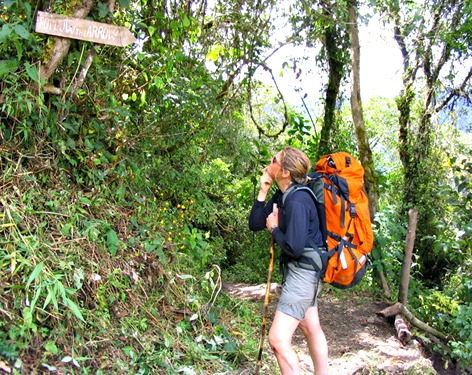
img: Antrese Wood displaying her intrepid travel skills on the Machu Picchu trail in Peru. Her comment: “I thought the Follow the Arrow sign was hilarious because 1) the trail is so well marked I cant imagine anyone getting lost; and 2) this was the one and only sign on the trail and it was near the end of the four-day hike. The other hilarious thing about the photo, at least to me, is that if you look closely, you can see my knee is bleeding. I had just spent 80 days carrying a backpack two-three times as heavy in seriously remote back country, no trails, no markers, nothing. We had to sign a waiver acknowledging the understanding that if something should happen, it could take a helicopter up to a week to arrive. I made it through without a scratch. Here, on this comparative cake-walk, on a perfectly even trail, I fell for no apparent reason and totally skinned up my knee.”

Interesting celebrations around the world, as selected by Canada’s famed Dr Magister

Continuing this month’s theme of celebrations, today’s post sees Dr Simon Magister, a social anthropologist and skateboarding enthusiast from British Columbia, select his most interesting and strangest celebrations from around the world. We haven’t verified Dr Magister’s research, but we’re pretty confident that he can be trusted.

1. Cargo Cult Ceremony

Every March 13th on the island of Manus in Papua New Guinea, the members of the Tadel tribe celebrate Inspection Day. Being a “cargo” cult, this ceremony involves the chief of the tribe donning the ceremonial overalls of an aeronautical engineer and then conducting a two-hour safety check on the life-size straw replica of a plane that the tribe crafted. When the safety check has been completed, the tribe celebrates with roast hog served on in-flight meal trays whittled from wood.

2. The Festival of the Badger

A leading figure in the Celtic revival of the late-Victorian era, Amelia Mudd, established the Festival of the Badger in her home village of Eppingsop, Wiltshire. Now in its 125th year, and popular with adherents of Druidism, the festival, celebrated on the Spring Equinox, sees a giant wicker badger burnt on the village square. The success of the festival can be seen in the Wiltshire Tourist Board rebranding of the county as “the county of badgers.”

3. Nicaragua celebrates Australia Day

Following Crocodile Dundee‘s a.k.a. Paul Hogan‘s brave service fighting for the Sandinistas during the Nicaraguan Revolution, the Nicaraguan government have declared Australia Day an official public holiday.

4. Ted Bernard Month

The residents of Parlor, Arizona probably weren’t expecting too many changes when they voted in mechanic Ted Bernard as the town’s mayor in 2008. Mayor Bernard, however, had other ideas, one of his first acts being to pass a town ordinance that the month of May was now to be known as “Bernardbury in Parlor.” During Bernardbury, downtown Parlor is host to numerous arts festivals. At Cafe Duvet people can enjoy the jazz festival (featuring Ted Bernard playing his saxophone), at Stern’s Movie House there’s the film festival (featuring exclusive footage Ted Bernard filmed on his flip) and at Claremont Green people can enjoy Shakespeare in the Park (featuring performances from the RSC, Steppenwolf Theatre Company, and Habima, the national theatre of Israel).

Whether Bernardbury continues when the mayor’s term ends in 2013 is, as yet, undetermined.

5. The war that wasn’t

Each October 3rd the island of Vosha in Micronesia commemorates the end of the conflict known as the Battle of Joshua’s Chicken, which most historians now agree didn’t actually take place. The reason for the confusion lies in the published memoirs of Captain William Joshua of the Royal Navy, published in 1817. Joshua recounts how in the 1790s when traveling in the Pacific and in need of fresh produce as well as wood to make some minor repairs to his ship, he docked off the island of Vosha where he was cordially greeted by the island’s king. Joshua’s tale is that sick of all the breadfruit they’d been eating, the crew’s cook stole a chicken that belonged to the king,  and treated the crew to, according to Joshua’s memoirs, a “delicious, richly broth’d casserole.”

Unbeknown to the cook, the chicken was, in fact, the Voshaian’s living deity. Enraged at the death of their god, the people of Vosha engaged in a three-day struggle with the British. At the end of the three days Joshua surmised that the casualties on the Vosha’s side stood at six hundred, with their main settlement burnt down. Joshua then ends that chapter with the cook’s recipe for chicken casserole.

Most modern historians, however, feel that Joshua’s account has no basis in fact and that at no point did the people of Vosha ever worship a chicken. Professor Hopkins of Cornell has posited that Joshua’s memoir — where Joshua also alleges that he had been the lover of both George III and Catherine the Great — was the work of a man writing out delusions brought upon by the late-stage syphilis he must have been suffering from.

What strange celebrations have you seen? Dr Magister is curious to know for his research. From Rodeos to cheese-rolling…what did you think of them?

STAY TUNED, next Monday sees Mary-Sue Wallace dishing out advice like a homeless shelter dishes out soup.

Related posts:

Image: MorgueFile

How to throw a party for a bunch of global nomads

One year has passed since our first random nomad, Anita McKay, crashed through the gates of The Displaced Nation, bribing the guards with chicken tikka masala and cranachan and shouting “bollocks” at several of us who tried to stop and question her.

And now there are 40 such nomads within our ranks — the latest being Annabel Kantaria, who insisted on bringing an alarm clock that looks like a miniature mosque — it rings every morning with the call to prayer. (Note to other founders: perhaps we need to find guards who aren’t so easily intimidated when travelers show a bit of temerity…)

Still, as we now have 40 nomads, randomly selected, why not make the best of the situation and throw a party? And what better excuse than The Displaced Nation’s 1st birthday — which, as announced by Kate Allison in a post a couple of days ago, took place on April 1 (no fooling!).

Further to that end, I’ve come up with a Party Primer that I think should work for this group — as well as for similar gatherings.

PARTY PRIMER FOR DISPLACED NOMADS

Click on the headlines below to go to each section:

  1. INVITATIONS
  2. DRESS CODE
  3. DECORATIONS
  4. MUSIC
  5. TABLE ASSIGNMENTS
  6. FOOD
  7. TOPICS FOR SMALL TALK
  8. PHOTOGRAPHY
  9. GAMES
  10. SONGS

INVITATIONS

As this party marks a special occasion (who ever thought we’d make it to be one year old?), a deluxe printed invitation is in order. The only thing is, our invitees are a bunch of nomads! We’ll be lucky if we can catch them on email, let alone at a fixed address. Let’s compromise on an attractively designed message: see mock-up at top of this page.

DRESS CODE

As some of you may know, Cleopatra recently paid a visit to The Displaced Nation. Based on her observations of today’s international travelers, we’ll be doing well if we can get the men to shower and change before joining us. As for the women, well, allow me to offer these pearls of wisdom from Jennifer Scott — the American guru of Parisian chic who was featured on this blog last week. Jennifer says:

There are certain occasions that always warrant dressing up. Generally any gathering … where others went to a lot of effort for your sake.

DECORATIONS

The theme is easy: the wide wide world! (Rather the opposite of Disney’s “It’s a small world after all” concept.) This calls for tablecloths imprinted with the world map (to make it easy for guests to point out where exactly “Moldova” etc is); globe-patterned balloons (can we coin a new term: globalloons?); and for the centerpieces, flags from each of the adopted country represented at the table in question.

Optional extras include party hats, noisemakers and loot bags. It’s fun when the loot contains some surprises. Given all the items our nomads have insisted upon carrying into The Displaced Nation, we should have plenty to choose from, eg:

  • mosque alarm clocks (thanks, Annabel!)
  • hairy coo fluffy toys (thanks, Nerissa!)
  • fake Harry Potter glasses (thanks, Charlotte!)
  • boomerangs (thanks, Kim & Vicki!)
  • brie bakers (thanks, Toni!)

MUSIC

As Todd Lyon, author of a number of party and lifestyle books, puts it:

Without music, a party isn’t a party. It might be an assembly, a meeting, or a bee, but it can never be a shindig, a bust-up or a ball unless there’s fine tunes that never stop.

Not being a party tunes buff myself, I’ve consulted with The Displaced Nation’s resident music expert, Kate Allison, about the kind of soundtrack that would cultivate just the right ambience. Her suggestions include:

Everybody all around the world, gotta tell you what I just heard
There’s gonna be a party all over the world…

TABLE ASSIGNMENTS

8-10 person tables work well. Since we’ll have 40 guests, I’ve decided on five tables of eight people each, and to mix everyone up as much as possible. Hostesses must also, of course, take steps to reduce the risk of a “silent table,” where people just eat and don’t talk. To be honest, I don’t there is too much risk of that with this crowd — have you ever watched a bunch of expats try to outdo each other with stories of their (cross-cultural, linguistic and travel) adventures? But just in case, I’m offering some “hostess notes” for each table (the hostess’s job being to introduce everyone and make sure the conversation keeps flowing!).

TABLE 1
Matthew Chozick (American expat in Japan)
Tom Frost (American expat in China)
Lyn Fuchs (American expat in Mexico — Sacred Ground Travel Magazine)
Turner Jansen (American canine in Holland)
Annabel Kantaria (English expat in Dubai — Telegraph Expat blog)
Kirsty Rice (Australian expat in Qatar — 4 kids, 20 suitcases and a beagle)
Jack Scott (English expat in Turkey — Perking the Pansies)
Karen van der Zee (Dutch/American expat in Moldova — Life in the Expat Lane)
Hostess notes: Introduce Tom Frost to Matthew Chozick — Tom used to live in Japan and speaks Japanese. Kirsty Rice should sit next to Turner Jansen, as she travels around with a beagle. Annabel Kantaria, Jack Scott and Kirsty all have in common life in the Middle East. Karen van der Zee and and Lyn Fuchs should find each other fascinating, as both have had some extraordinary adventures (Karen could entertain Lyn with her crocodile tale and Lyn, keep Karen amused talking about the time he went paddling with orcas.)

TABLE 2
Balaka Basu (Indian American in New York City)
Santi Dharmaputra (Indonesian expat in Australia)
Michelle Garrett (American expat in UK — The American Resident)
Robin Graham (Irish expat in Spain — a lot of wind)
Anita McKay (Indonesian expat in Australia — Finally Woken)
Brian Peter (Scottish expat in Brazil — A Kilt and a Camera)
Kate Reuterswärd (American expat in Sweden — Transatlantic Sketches)
Wendy Tokunaga (Former American expat in Japan)
Hostess notes: You might want to break up Santi Dharmaputra and Anita McKay, who are the same nationality (Indonesian) and already friends. Anita should definitely be introduced to Brian Peter, who like her hubby, is Scottish, and will probably be amused by her stories of toasting oatmeal in whisky. And make sure Anita also talks to Wendy Tokunaga — I know from personal experience how intrigued Anita is by stories of Western woman marrying Asian men. To be honest, everyone at this table should really be socializing with everyone else, as each and every one of them has a partner of a different nationality! (Now if that isn’t a talking point, I don’t know what is…)

TABLE 3
Kim Andreasson (Swedish expat in Vietnam)
Jo Gan (American expat in China– Life behind the wall)
Jennifer Greco (American expat in France — Chez Loulou)
David Hagerman (American expat in Malaysia — SkyBlueSky)
Helena Halme (Finnish expat in UK — Helena’s London Life)
Vicki Jeffels (Kiwi expat in UK — Vegemite Vix)
Janet Newenham (Irish internationalist — Journalist on the run)
Adria Schmidt (former Peace Corps worker in the Dominican Republic)
Hostess notes: Seat David Hagerman next to Jennifer Greco — since his wife is a well-known food writer and expert cook, he’ll find nothing strange in her quest to sample all the known French cheeses. Janet Newenham should be near Adria Schmidt and Kim Andreasson as they are all interested in international affairs. Vicki should be introduced to Helena as I’m sure the latter would love to hear about her recent spa experience in Cyprus. Jo Gan, too, should meet Vicki as she is now experiencing visa problems with the Chinese authorities — on a level that may even surpass Vicki’s own nightmare experience in Britain.

TABLE 4
Aaron Ausland (American expat in Colombia — Staying for Tea)
Emily Cannell (American expat in Japan — Hey from Japan)
Charlotte Day (Australian expat in UK)
Toni Hargis (English expat in USA — Expat Mum)
Vilma Ilic (Former aid worker in Uganda)
Jennifer Lentfer (Former American expat in Africa — How Matters)
Camden Luxford (Australian expat in Argentina — The Brink of Something Else)
Piglet in Portugal (English expat in Portugal — Piglet in Portugal)
Hostess notes: Aaron Ausland will naturally gravitate towards Jennifer Lentfer as they are both deeply involved in global aid and development. Make sure you introduce the pair of them to Piglet in Portugal — she’ll ask them some thought-provoking questions about whether it’s better to save the world or cultivate your own garden. Jennifer should also be near Vilma as the two will want to share their Africa experiences, and you might urge Emily Cannell to join that conversation as well — she has such an adventuresome spirit! Along with Toni Hargis, who runs her own charity supporting a school in Ghana. As for Camden Luxford, she’s an easy one: a social butterfly! Perhaps she could take fellow Aussie Charlotte Day under her wing (ha ha) and make sure she gets plenty of material to write about for her courses at Oxford next year!

TABLE 5
Lei Lei Clavey (Australian expat in New York City)
Matt Collin (American expat in UK)
Megan Farrell (American expat in Brazil — Born Again Brazilian)
Liv Hambrett (Australian expat in Germany — A Big Life)
Mardi Michels (Australian expat in Canada — eat. live. travel. write | culinary adventures, near and far)
Iain Mallory (English adventurer — Mallory on Travel | Making Everyday an Adventure)
Nerissa Muijs (Australian expat in Holland — Adventures in Integration)
Simon Wheeler (English expat in Slovakia — Rambling Thoughts of Moon)
Hostess notes: As soon as Lei Lei Clavey, Liv Hambrett, Mardi Michels and Nerissa Muijs discover they all have Australia in common, they will be blabbing away — just hope it doesn’t turn into an Ozfest! Also, make sure Mardi connects with Matt — I suspect he may need her counseling about how to seek creative refuge from academia. Iain Mallory and Simon Wheeler will form a natural pair, exchanging stories of their travel adventures and perhaps even breaking into a rousing chorus of “Jerusalem.” But should their antics get too raucous, ask Mardi to step in: she teaches cooking classes to 9-11-year-old boys in Canada. Megan Farrell should connect with Nerissa and Simon on the topic of what it’s like to raise a child in a nationality (and language) other than your own.

FOOD

One of the purposes of gathering together nomads from the four corners of the earth has to be eating, especially if each of them brings along some of their favorite dishes. For our party, we will have a dazzling tableaux brimming over with rare and exotic foods. (We know that because our Random Nomads have already described their faves to us in their interviews.)

Shall we go over the list? (Warning: Don’t read on an empty stomach, or if on a restricted diet!)

NIBBLES/STARTERS

  • Guacamole & chips (Kim — recipe provided)
  • Selection of mezze with pita bread (Annabel Kantaria)
  • Assorted pinchos (Megan Farrell)
  • Avocado & mango salad (Matt Collin)
  • Bhelpuri (Tom Frost)
  • Satay sticks (Nerissa Muijs)
  • Four kinds of eggs: tea eggs, thousand-year-old eggs, fried eggs with tomato, and boiled salted eggs with a chicken embryo inside (Jo Gan)
  • Shrimp & grits (Lei Lei Clavey)
  • Vietnamese caramelized chili prawns (Mardi)
  • Ceviche (Camden Luxford)
  • Bluff oysters from New Zealand (Vicki Jeffels)
  • Gravad lax with Finnish rye bread (Helena Halme)
  • Tuna sashimi with ponzu sauce (Emily Cannell)

COCKTAILS

  • Traditional Bloody Marys (Lei Lei Clavey)
  • Caipirinhas (Megan Farrell)
  • Margaritas (Kirsty Rice)

WINE

  • Rich red wines from Lebanon (Annabel K)
  • Red wine from Macedonia (Vilma Ilic)
  • Malbec wine from Argentina (Camden Luxford)
  • Shiraz from Australia (Vicki Jeffels)
  • White wine from Australia (Simon Wheeler)
  • Chilled sake (Tom Frost)
  • Rice wine (Jo Gan)

BEER

  • Carlsberg browns (Matt Collin)
  • Cusqueña beer (Camden Luxford)
  • Mexican Pacifico (Tom Frost)
  • Harbin beer (Jo Gan)
  • Coopers beer (Simon Wheeler)

MAINS
Meat dishes:

  • Carne de Porco a Alentejana (Piglet in Portugal)
  • Schnitzel served with rotkohl (Liv Hambrett)
  • Bondiola-chevre-basil wraps and nattō (Tom Frost)
  • Fried chicken sandwiches with hand-cut fries (Lei Lei Clavey)
  • Chicken tikka masala (Anita McKay)
  • Libyan soup (Kirsty Rice — recipe provided)
  • Cuban ropa vieja (Mardi)
  • Argentinian steak cooked rare (Camden Luxford)
  • Tapola black sausage with lingonberry jam (Helena Halme)
  • Barbecued steak, snags & lamb chops (Nerissa Muijs)

Fish dishes:

  • Paella Valenciana (Megan Farrell)
  • Llish in mustard and chili paste, smoked in banana leaves (Balaka Basu)
  • Chambo curry with nsima (Matt Collin)
  • Moreton Bay bugs (Vicki Jeffels)
  • Grilled salmon on a plank (Emily Cannell)
  • Sushi (Simon Wheeler)

Vegetarian offerings:

  • Peanut butter vegetable stew (Jennifer Lentfer)
  • Overcooked spaghetti with carnation milk, canned tomatoes and corn (Adria Schmidt)

DESSERTS

  • Summer pudding (Toni Hargis)
  • Apple crumble (Matt Collin)
  • Cranachan (Anita McKay)
  • Hot fudge sundaes (Lei Lei Clavey)
  • Blackberry gelato (Balaka Basu)
  • Caramel cheesecake (Kirsty Rice)
  • Bread pudding with Bourbon sauce (Jennifer Greco)
  • Île flottante (Mardi)
  • Molotof cake (Piglet in Portugal)
  • Mouse de maracujá (Megan Farrell)
  • Tiramisu (Camden Luxford)
  • Homemade Slovakian cream cakes (Simon Wheeler)
  • Dutch waffles (Turner Jansen)
  • Oblande, tulumbe, kadaif & krempite (Vilma Ilic)
  • Umm Ali (Annabel Kantaria)
  • Sigara borek (Jack Scott)
  • Juustoleipä with fresh cloudberries and cream (Helena Halme)
  • Yangmei fruit (Jo Gan)
  • Languedoc cheese: Roquefort, Pélardon and Tomette des Corbières (Jennifer Greco)

AFTER-DINNER DRINKS

  • Chlicanos (Camden Luxford)
  • Rakija (Vilma Ilic)
  • Fernet (Tom Frost)
  • Homemade Slivovica (Simon Wheeler)
  • Dragon-wall green tea (Jo Gan)
  • Espresso (Balaku Basu)
  • Large “flat whites” (Charlotte Day)

FOR THE TOAST(S):
New Zealand champenoise (Vicki Jeffels)

NOTE: Charlotte Day will be cooking a Sydney-style breakfast for diehards who care to linger to the next morning. (And Nerissa Muijs will be frying up some bacon!)

TOPICS FOR SMALL TALK

There are some topics that should be avoided at all costs. As style writer Rita Konig puts it,

It is very dull to talk about journeys. Once you have arrived somewhere, try to keep quiet about how long it took you to get there.

Should you notice anyone engaging in this, put the kibosh on it by asking them to help with pouring drinks, or with putting away coats in the spare room.

PHOTOGRAPHY

Fortunately, there’s usually one great photographer or two in a group of global nomads, thereby saving unnecessary expenditure. (We will ask David Hagerman — he’s sensational!)

GAMES

Games are a great ice breaker. Here are a few that might be appropriate for a well-traveled crowd:
1) Musical countries: Draw a big map on a piece of vinyl (back of a Twister mat might do), and give everyone a flagpole. When the music stops, they must place the flagpole on a country, Anyone whose flagpole ends up in the ocean is out.

2) Variation on “Pin the Donkey”: Pin the rudder on the 747! (Contributed by Kate Allison.)

3) Word games: As we’ve found out from our interviews, global nomads pick up words and expressions from here and there. Taking some of these and mixing them together, we can come up with some pretty strange exchanges. (Prizes for anyone who manages to decipher!)

A: Prego, could you get me a ba ba ba? Kippis!
B: Inshallah, a barbie would also be awesome. And how about la ziq?
A: Avustralyalılaştıramadıklarımızdanmışsınızcasına.
B: So desu ne!

A: Tudo bem? You look a bit daggy.
B: Life can be arbit sometimes.
A: Zvakaoma.

A: Hey.
B: Hey. Das stimmt, sorry to be such a Debbie Downer but I’m knackered after all this work.
A: Bless!
B: Zikomo.

A: Oh la vache! You are lost. Siga, siga. Ni chifan le ma?
B: Bollocks! [Sucking air through gritted teeth.] I think I got lost in the wopwops.
A: Well, there’s the big ol’ tree out the front.
B: Bula! Okay-la. Le bon ton roule!

TOASTS

Toasts should be made repeatedly throughout the latter half of the dinner. Just in case no one feels inspired, prepare one or two classics for the host or hostess to offer, eg:

I’d rather be with all of you than with the finest people in the world.

SONGS

Songs can be sung in several languages. In this case, a stirring rendition of “Happy Birthday” is called for, sung not only in English but in:
Dutch (Karen, Nerissa)
Finnish (Helena)
French (Jennifer, Mardi)
Indonesian (Anita & Santi)
Japanese (Emily, Matthew, Tom, Wendy)
Spanish (Aaron, Adria, Camden, Lyn, Megan, Robin)
Swedish (Kate, Kim)
Woof-woof (Turner)

Finally, the party should end with the Displaced Nation founders treating the guests to a round of:

For you are all jolly good fellows, for you are all jolly good fellows,
For you are all jolly good fellows…
Kate, Anthony, Tony: And so say all of us!
ML: Which nobody can deny!

* * *
Have I left out any important details? Any tweaks you can suggest? Your turn!!! Let’s work together to make this the most awesome gathering of global nomads ever. Onegaishimasu, shokran — and all that!

STAY TUNED for tomorrow’s installment from our displaced fictional heroine, Libby. She is expecting a visitor: her own mother, who is — in theory — coming to help as her due date gets closer. Will Granny Jane be an improvement on Sandra, the MIL from hell — or will she prove to be one more spanner in the works for our poor displaced heroine? (What, not keeping up with Libby? Read the first three episodes of her expat adventures.)

If you enjoyed this post, we invite you to register for The Displaced Dispatch, a round up of weekly posts from The Displaced Nation, with seasonal recipes, book giveaways and other extras. Register for The Displaced Dispatch by clicking here!

Related posts:

5 tips on how to look good when you backpack

I don’t know about you, but I look terrible when I travel.

Not intentionally of course; jet lag notwithstanding, it’s impossible to look crisp and put together after an extended journey by public transport, no matter where in the world you are.

My problem has more to do with my style of travel — or lack thereof… There are two real options when you’re a backpacker: clothes that look good, or clothes that are comfy. Now, bearing in mind you’ll be spending quite a lot of time in them — alternating between the same two pairs of trousers every day until they drop off you and disintegrate — it’s not much of a choice.

Is that because I’m a guy? Maybe — see the note about my wife at the end of this post.

But I don’t care whether you’re male or female, there’s something about being a backpacker that makes keeping up one’s appearance a constant challenge. However fastidious you are about your personal appearance (and most backpackers I know are!), however much you shower before an 18-hour bus journey, you’re still going to look (and smell!) pretty bad afterwards.

So, bearing in mind the following advice from Mr Will Kommen:

If you look like your passport photo, you’re too ill to travel.

…here are five of my tips on how to look good as you bounce around the globe:

1) Haunt charity shops.

Many countries have these in some form or other, and the richer the country the more expensive and interesting gear you can pick up for next to nothing. They’re perfect for replacing an item of clothing that is giving up the will to live in your backpack; or something you’ve become so sick of wearing you daydream constantly about burning it. This shops are incredibly cheap, so you can go crazy — and then just give the stuff back when it’s time to move on.

I don’t travel with any technical clothing, so when my wife and I decided to do a two-month, 1,000 km hike, we had to equip ourselves from scratch — on next-to-no budget. Guess how we did it? Yup, “op shops” they call them in Australia — we visited every one. In a couple of weeks we had all the gear we needed for the hike — plus all the money had gone to charity! And when we were done, we gave most of it back as donations (except the t-shirts, which were too stained to be of use to anyone).

2) Adopt local dress.

Fisherman’s trousers in Thailand, those crazy-colored woolly trousers in South America — pseudo local fashions are cheap to buy, fun to wear and, if they don’t become a souvenir, easy to dispose of before onward travel. I say “pseudo local” because real locals wear the uniform of the world: jeans and a fake Nike T-shirt. Or a Manchester United strip (shirt and shorts).

3) Take any opportunity to wash.

It’s amazing how good it feels to be clean. Most people take it for granted, but then most people have never spent three consecutive nights on the same train, going backwards and forwards to avoid paying for a hotel room. Anyway, the point is there are opportunities everywhere: most major train stations have showers open to the public cheaply, almost all airports do too — and some places you wouldn’t expect, like shopping centres. Shopping centres are free to enter, with regularly cleaned public loos. A lot of them also have “mother-and-baby” rooms, with a table or fold-down shelf, a sink — in short, an open invitation for a full body wash and a change of clothes. Just be wary in Japan — a lot of the public toilets there are “smart.” They unlock and open if you’re in there for too long, which can be pretty embarrassing if you’re soaping yourself down when the door opens opposite Starbucks…

4) Take any opportunity to “dress up.”

Looking posh is a moral boost, and should be possible for most of us bedraggled travelers just by shaving and wearing all-clean clothes! I also travel with a shirt — just one — which transforms a pair of jeans into an outfit smart enough for a nice restaurant or swanky bar (well, as long as they don’t look at my feet, on which I have either flip-flops or hiking boots…).

5) Wear jeans!

The rest of the world will be. Seriously — for every sweat-wicking-fast-drying-wind-proof-mesh-venting-ThermaCELL-layering-system you own, there’s another person behind you who has none of it. And you know what? They look a lot better than you! This is why so much “technical” clothing ends up in charity shops (see above) just waiting for you to pick it up — people with lots of cash buy it, don’t use it for anything more strenuous than shopping, then realize that it looks pretty crummy when compared to clothes that were, you know, designed to look good whilst shopping. So they ditch it. You should too — or at the very least, stop paying outrageous prices for the stuff. Unless you’re headed to Everest Base Camp — in which case, buy it all from those people who’ve just realized that no matter how expensive it was, it doesn’t look right in Sainsbury’s.

* * *

Obviously, this is a bit of a male perspective on things. My wife swears by traveling with a small (for an elephant) bag of “essential” make-up. It’s the main reason she’s recently swapped her rucksack for a suitcase…but she assures me it helps her feel good about herself when otherwise she’d look as bad as I do. So I indulge her.

What do you do to look good while you travel?

Tell us in the comments section!

STAY TUNED for tomorrow’s post, a review of a new book on Asian beauty.

If you enjoyed this post, we invite you to register for The Displaced Dispatch, a round up of weekly posts from The Displaced Nation, with seasonal recipes, book giveaways and other extras. Register for The Displaced Dispatch by clicking here!

Related posts:

Images: (clockwise beginning top left): Charity shop in West Street (© Copyright Basher Eyre and licensed for reuse under this Creative Commons Licence)  baby changing room sign and South American wool pants for sale, by Tony James Slater; backpackers (Morgue photos).

Ladies and gentlemen, may we present: THE EXPAT OSCARS! Um…hello? Anyone there?

TheExpatOscarsThe Expat Oscars — really? Now that would be an unusual event. What would it look like?

I live in Spain. Oscars are something that are on TV Sunday night. Basically, very late at night. You don’t watch, you just read the news after who won or who lost. — Javier Bardem

Well, for starters the Expat Oscars would be held via Skype. If we had our own version of the Kodak Theatre, it’d be big and posh and empty — ’cause folk from ’round here…ain’t from ’round here! We’re displaced — all over the bloomin’ planet. Which is kind of the point. If we had to collect our awards in person, that ceremony would have a carbon footprint the size of a football stadium.

So we’re streaming live on the Internet. The Red Carpet is a million pixels long and is digitally re-mastered in every country participating. Unfortunately, Jennifer Lopez wouldn’t be invited as she’s never been displaced, only her clothing! Indeed, you won’t want to make a slip-up — or down — as the clip would literally be on YouTube before you knew it.

But if there wouldn’t be any wardrobe malfunctions, we could at least look forward to getting that delicious hang-fire moment when the Skype picture freezes, and then it cuts back in, seconds later, like this:

“Ladies and Gentlemen, the winner is…” PIXELATE — jittery jump — lips purse with a hint of spittle and stay like that — and pause — and pause —

Cut back in to rapturous applause, the digital wheeling of spotlights and we’ve got to sit through another five minutes of high-volume celebrating before we finally make out the individual giving an acceptance speech. (That’s if it doesn’t cut out again before we get that far!)

Who would host?

Milla Jovovich, you did a great job hosting the sci-tech awards for the Academy of Motion Picture Arts and Sciences, so you’re being promoted — to hosting the entire Expat Oscars shebang! We’d love it if you’d wear that white-sequin, one-shoulder gown you wore for the main event last night — and leave the granny glasses you donned for the sci-techies at home (wherever “home” is!).

From Long Beach to Pacific Palisades? Sorry, Billy Crystal, but that’s not displaced enough. Jovovich is Ukrianian, has lived in Europe and the US, and acted in films in several languages. All of that counts for a lot in our book.

Should Milla request a co-host, it would have to be either Keanu Reeves (he was born in Beirut, a third culture kid!) — or why not go for the daddy of successful expat movie stars, the man who redefined the phrase “I came, I saw, I conquered”: Mr. Arnold Schwarzenegger himself!

No? Well, it’s either him or Borat. With his penchant for embodying other nationalities rather too literally, Sacha Baron Cohen belongs more with our tribe than with the Academy’s. At the Expat Oscars he will be free to attend in his dictator’s uniform without having to get special clearance and can “ash” anyone he likes in the name of terrorizing fashion — the mess will only be virtual.

We’re talking a looooong ceremony

Besides, his antics might keep people awake. The Expat Oscars will have to be a long, LONG show — either that or we’d insist that everyone stay awake all night, and it would be 4 a.m. for someone.

Listen, you think it’s bad at the real Academy Awards sitting on the edge of your auditorium seat for several of hours, sipping champagne while you wait for your category to be announced — what if it’s being announced by someone eight time-zones away?

Charlize Theron*: “Ladies and Gentlemen, here to accept this prestigious award, please welcome Mr. Sung, live by satellite from Hong Kong! Please excuse the penguin pyjamas. And the fact that he’s drunk eight vodka-Red-bulls just trying to keep himself awake…”
Mr. Sung: “Fangssshhhverymussssh…hic!”
*With her South African pedigree, Charlize more than qualifies for the role of Expat Oscar presenter.

Best Foreign Language Film — is that second or third?

Our next category is for Best Film in a Foreign Language…but wait a minute! That’s not a foreign language! That’s my language! Ah…

So could we have Best Film in a Second Language perhaps? But would that category also include people who’ve made a film in their third language — or should they get their own category? And so on.

How about “Film in a Language So Obscure Even the Director Has No Idea What’s Going On”?

No politics/fashion, please, we’re expats

What a thrill. You know you’ve entered new territory when you realize that your outfit cost more than your film. – Jessica Yu, Academy Award Winner 1997 for Documentary Short Subject*
*Breathing Lessons: The Life and Work of Mark O’Brian, about a person with a breathing disability.

The traditional Hollywood bash is often clouded by politics not to mention gossip and verdicts on the gowns of the nominated actresses.

It wouldn’t be like that for us. The Expat Awards would be about the films.

Because we just don’t get each other’s governmental strife — we haven’t got time for sorting it all out.

For instance, I’m sure there’s plenty of fascinating developments in the politics of Milla’s Ukraine (they’re a Presidential Representative Democratic Republic, don’t you know!) — but to be honest, I don’t think that would figure in anyone’s acceptance speech.

How could it? I don’t even know what a PRDR is — do you?

And the fashion would be a bit more varied than in Hollywood. We’d have people walking down the Virtual Red Carpet in burkas, galabiyas — or board shorts and “thongs” for the Aussie nominees! And there’s bound to be a few unwashed backpacker types trying to get away with khakis and a vest…and not shaving. Okay, so that’s me.

And my speech — probably on accepting the World’s Most Ridiculous Person Award?

Tony: “I’d like to thank my Mum…”
Milla: “Well actually, we have your Mum on the phone right now! She’s asking where you are, and why you haven’t called her in the last six months…”
Tony: “I’d like to thank the Academy…and ask them to keep her talking long enough for me to get to a taxi.”

* * *

What else would go wrong with a displaced film award ceremony? Would the statuette be a little gold Buddha? Or a waving cat? Or a mermaid from “Here be dragons”? What would the categories be? And who would win?

Please share your craziest thoughts in the comments!

You could win…hmm, let’s see: the respect of the international film community?

Nah. Not even the real Oscars have that… 🙂

STAY TUNED for tomorrow’s review of A Separation, which won the Oscar for Best Foreign Film, by expat author Matt Krause. Krause’s book, A Tight Wide-open Space: Finding love in a Muslim land, was featured on our site this month.

If you enjoyed this post, we invite you to register for The Displaced Dispatch, a round up of weekly posts from The Displaced Nation, with seasonal recipes, book giveaways and other extras. Register for The Displaced Dispatch by clicking here!

Related posts: