The Displaced Nation

A home for international creatives

Tag Archives: London

THE LADY WHO WRITES: Even before you write the last word of your novel, start rehearsing the book trailer!

LadyWhoWrites_brandApril blossoms (and showers) are here, which means it’s time to welcome Meagan Adele Lopez, aka The Lady Who Writes, back to the Displaced Nation. Meagan is a repeat expat in the UK (last time Bristol, this time London). Besides writing, her talents include acting, blogging, and crafting ads for social media. In this monthly column, she is doling out advice to international creatives who are contemplating writing a novel about their novel, shall we say, life experiences.

—ML Awanohara

Hello again, Displaced Nationers. I wonder, how many of you caught ML’s interview with British screenwriter Tim John, posted at the end of last week? Tim spent seven years as an expat in LA chasing the dream of selling scripts to Hollywood studio executives and producers. Reading about his (mis)adventures got me thinking about my own Hollywood days—as well as about book trailers, a pet topic of mine.

Like Tim, I tried to make it in Hollywood for a time: first as an actress and then as a casting agent. I poured what I learned from this experience into creating Dell, the heroine of my first novel, Three Questions: Because a quarter-life crisis needs answers. As anyone who has read it will know, the novel is about the developing love between two young people who have only met each other once, by chance, on a night out in Las Vegas. The love interest, Guy, is from England, while Dell is from America. And the complication is that neither are willing to give up their life plans. Dell is on route to Hollywood to seek her fame and fortune, while Guy is heading to Africa in search of adventure.

Perhaps this portion of my background also explains why, the first time I saw a book trailer, I knew I had to have one for my novel. The trailer was for One Day, by English novelist and screenwriter David Nicholls. By my count, Nicholls actually created a total of four “One Day” book trailers. Here is one of them:

I had never seen a book trailer before, and this one made a strong impression on me. I thought: Gosh, this book I’m about to read is going to be turned into a film—and I’m one of the lucky few who gets to read it before the movie comes out.

In fact, when the movie did come out—with Anne Hathaway playing the female lead—it was a flop, even though Nicholls had also written the screenplay. (The consensus among critics on Rotten Tomatoes is that the movie “lacks the emotion, depth, or insight of its bestselling source material.”)

What the *&%$ is a book trailer?

Good question. A book trailer is akin to a movie trailer. It’s an advertisement for the book in visual form. I saw it as another way to reach my audience—another way to inspire and motivate potential readers to buy the book.

But now that I’m in the position to hand out advice to wannabe novelists, I recommend you start thinking about your book trailer even before you finish writing.

Many writing coaches will tell you to read your book aloud before submitting it to an editor for review. It gives you a sense of where you need to improve the dialogue, shorten sentences, change words, and so on. (See Joanna Penn’s post: “7 Reasons Why You Should Read Your Book Out Loud.”)

But I would add that acting out your book trailer in advance can also be helpful. Book trailers are generally scenes, or splices of scenes acted out from the novel. Preferably, the book trailer will end on a cliff hanger. If no one wants to know more, then what’s the point?

By the way, should you feel a tad peculiar acting out scenes from your novel, be sure to remind yourself that Charles Dickens, who was drawn to the theatre and dabbled in acting, had no qualms about acting out the characters he was writing in the mirror and then describing what he saw in his novels.

Should you actually make a book trailer?

Some of you may be nearly finished with your Great Work and wondering: what’s the ROI (return on investment) for a book trailer? “Investment” is exactly the right word. Your trailer will need to be high quality. If it looks like a cheaply made home video, no one will care to learn more. What’s more, they won’t share it with their friends, which is the way to best way to clock up more sales.

I did a lot of research but never found any studies that make the ROI case for book trailers. Similar to billboard advertisements or TV commercials, there is no solid way to measure why people bought your product or how many took action after seeing an ad. As one of my favorite author bloggers, Allison Winn Scotch, has written:

No one knows what the hell sells books.

In fact, I can’t see any demographic data (besides the country they are from) on the purchases made on my novel. (I wish Amazon would change that.)

In the end, though, I decided to spend $1,500 on my book trailer (used from the money that I raised on Kickstarter for turning my book into a film). I researched how much the big companies were charging compared with the indie companies, and got my number.

Perhaps because of my background in film, I knew that I wanted a book trailer as a marketing tool in addition to everything else I was doing: guest blogging (including on this site!), email marketing, social media marketing, book signings, giveaways (including on this site!), PR, etc.

I had a secondary reason for making one as well—I figured it would be a great way to get the eye of a publishing house or agent. All they have to do is click “Play” and watch for two minutes to see if the story intrigues them.

If I were measuring purely on book sales, I can tell you that my book trailer currently has 921 views so far. If every single person who watched the trailer bought my paperback book, I would have made my money back.

Perhaps it’s just another tool for making a book stand out from the crowd. Or maybe I just really enjoyed making it… But I should let you judge for yourself:

And now, without further ado, here’s Novel Writing Tip No 3 for International Creatives:

While in the process of writing your novel, ask yourself: Which scenes would go into my book trailer? And don’t be afraid to act them out, even if you have to play all the parts.

* * *

Readers, what do you make of this book trailer idea of Meagan’s? Do you see the value in having one, or at least in rehearsing as though you might have one someday? And do you have any further questions for Meagan, THE LADY WHO WRITES, any topics you wish she would cover in future columns? Please share in the comments…

Meagan Adele Lopez grew up in the U.S. with a Cuban-born father and American mother, and at one time enjoyed an acting/casting career in Hollywood, something you can detect in the beautiful trailer for her novel, Three Questions. Her day job these days is in social media advertising. To learn more about Meagan, go to her Web site.

STAY TUNED for tomorrow’s announcement of our March “Alice” winners!

If you enjoyed this post, we invite you to register for The Displaced Dispatch, a round up of weekly posts from The Displaced Nation, with seasonal recipes, book giveaways and other extras. Register for The Displaced Dispatch by clicking here!

Related posts:

Does an expat life in Los Angeles ever go according to script? Read Tim John’s memoir to find out…

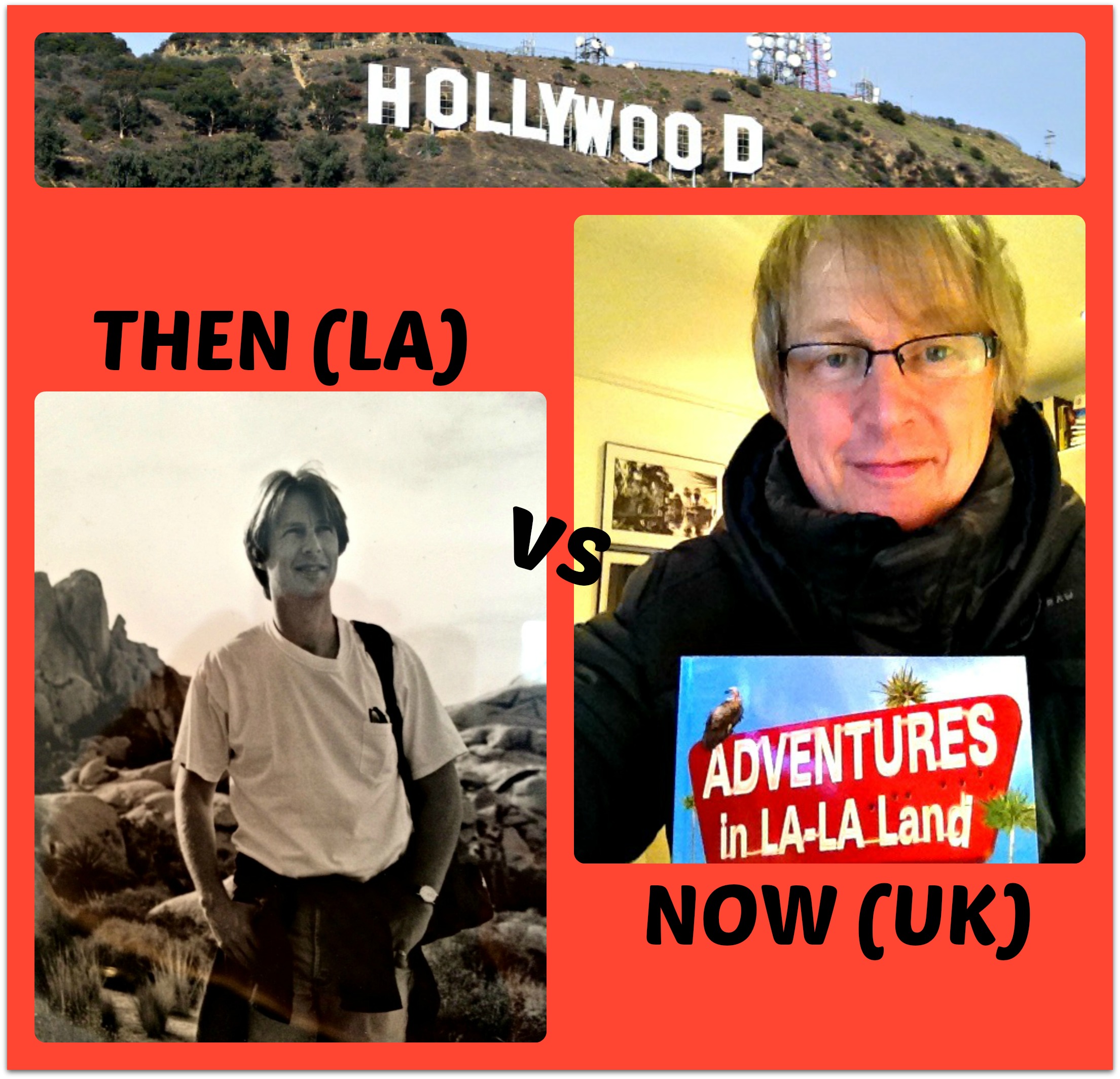
Tim John Hollywood CollageFor many of us, the calling to the expat life is not really a calling at all, but more of a vague (albeit rather deep-seated) need to escape our surroundings in search of adventure. We have no idea of what we’re looking for until we’ve arrived at a place and put down roots. Even then, we still have the mentality of drifters, and it take us a while to access our muses.

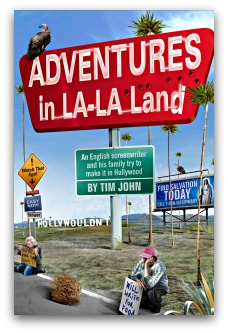
My guest today, the screenwriter Tim John, does not belong in that mould, as soon becomes clear from the first few pages of his new book, Adventures in LA-LA Land, an account of the seven years he spent in Los Angeles with his wife, Jenny, and their two young daughters.

You see, Tim plunged into his particular expat adventure with the script already written, both literally (he had a project in the works) and figuratively. Heading for Hollywood was Plan B after he lost his job with a London advertising agency during the recession of the early 1990s, and started dabbling in screenwriting.

The late Christopher Hitchens, another English writer who chose to be based in the United States, once described LA as a city “mostly full of nonsense and delusion and egomania.” But in the script Tim had written for himself and family, it was LA-LA Land—a place where they could have it all, great climate, a house with swimming pool, and (hopefully) big money.

So did Hollywood feed Tim’s creative muses (and fill his coffers) in the manner he expected? You’ll have to read the book to find out. I read it, and found myself surprisingly moved by the story of a man who lives for the movies. In fact, the pace can be likened to that of a roller coaster ride—fun but also harrowing at times.

On that note, it’s time to welcome Tim to the Displaced Nation to talk about his book. And just a heads up: Tim will be “screening” the comments for the person who leaves the best pitch for why they’d like to read it. That lucky individual will be under contract for a free digital copy!!!

* * *

AdventuresinLALALand_coverHi, Tim, and welcome to the Displaced Nation. Can you tell me why you decided to write a memoir about your years in Hollywood?
I’d read so many books about how to write a Hollywood screenplay, but never found one that also told you what it was like living there, so I decided to write my own, based on the seven years I lived there with my wife and two daughters.

Have you thought about turning it into an actual script for a movie?
I would love to turn it into a screenplay, too.

I understand you lived in LA from 1991 to 1998. I’m curious why you produced the book so long after the fact?
I’m not really sure why I waited so long to write it, possibly because I’ve been doing more and more teaching over the last couple of years and I’m often aware that students often don’t get taught important skills that are crucial to being successful as a screenwriter, such as being able to pitch and how to balance writing life with social life and family life. I thought that relating my experiences could be useful for others. If nothing else, they could learn from my mistakes as well as my successes!

In the end, the movie (of my life) was about…

Has your perspective on the experience deepened with time?
I suppose gaining some distance in time and geographically helped me to see Hollywood from a more objective perspective.

What impact did your writing about the experience have on you?
Definitely part of it was cathartic, to process the bizarre experience.

You worked in advertising for a while. When exactly did you catch the movie-making bug?
I worked a copywriter and then as a creative director—both of which are extremely useful if you want to go into film as they teach you so much about writing for a particular audience and how to write pithy dialogue and how to edit, etc. I always loved film mainly because it was such a great escape. As a kid, The Jungle Book was a big favorite. Mutiny on the Bounty and Lawrence of Arabia got me pretty scared, as did that spider in Doctor No!

Yes, I recall your mentioning in the book your fear of spiders when you found yourself face to face with a black widow at your house in LA. I’m still shuddering at the thought of being bitten by a brown recluse, by the way!

Was there a single epiphanic moment?

Your book is chockerblock with what we like to refer to on this site as “displaced moments” as a result of your encounters with not just deadly spiders but also shrieking peacocks, rats, snakes, and even some neighbors who believed in extraterrestrial burglars—and that’s before we get to the highly venomous creatures who populate the Hollywood film industry. Does any one moment stand out as your most displaced?
Wow. There were many moments when I thought “What on Earth am I doing in this bizarre place?” One that sticks out in my professional life was that time I went to pitch to Disney and the exec said “Great to meet you guys, we’re looking for some comedy writers” and I self-effacingly said: “Then you should meet these guys I play tennis with—they’re hilarious.” None of the execs could see I was joking and at the end of the meeting, the development girl took me aside, discreetly handed me a business card and said: “If you continue to have self-esteem issues, see my shrinkshe’s fabulous!”

That makes me think of Johnny Carson’s line: “In Hollywood if you don’t have a shrink, people think you’re crazy.” And I think the Northridge earthquake of 1994 displaced you and your family rather literally.
Yes, the whole house rattled and creaked for over forty seconds and there were waves in the pool.

Ah, the pool… You also talk about how much you loved the weather, having a pool, and taking drives to some fabulous scenery. Can you pinpoint your LEAST displaced moment, when you felt you were born to be in LA-LA Land rather than your native UK?
There were so many great moments. Personally, living in that sunshine, with a pool, a hot tub, etc., along with plenty of money and also plenty of free time (even though you’re constantly thinking of ideas to pitch), seems like a dream for anyone who’s come from the UK climate and ever struggled to make ends meet. It’s like living in a vacationuntil you realize it will all collapse if you don’t sell your next idea, and you’re going to have to sell it far sooner than you expected because the cost of living is very high, especially when you factor in things you’d never had to pay for before, such as earthquake insurance. Never forget that “writer” is only one letter away from “waiter”.

Professionally, when you get to chat with famous stars and talented directors and they take your comments seriouslythat feels unreal but also great. Probably the greatest moment for me was just before I moved to LA, being able to go to the tenth birthday party for George Harrison’s film company, HandMade Films. For anyone English, I think having a chat with a Beatle tops it all.

What did you and George chat about?
I’d worked on two screenplays for his company, so we talked about that. The funniest thing, I thought, at the company’s birthday party, was when George and Ringo joined the band playing on stage. If anyone requested they perform a Beatles’ song, George said: “I don’t know that one.”

In the end, the film was about spirit…

I understand you found LA a culture shock.
Wow, there are so many things that are culturally different about living in the UK and living in America, especially in Hollywood, which many Americans find totally unreal, too. Ones that really stand out: the almost constant sunshine for a start. The smog levels on bad days. The way so many Americans are so welcoming, where so many Brits can be snooty and suspicious. The way so many Americans are optimistic and so many Brits are pessimistic (or maybe more realistic than many film people). I never forgot that Hollywood has been described as “the only town where you can die of encouragement.”

I know you decided to leave LA in part because of your mother’s health and in part because of your daughters’ education. The family, particularly your daughters, didn’t want to go. What were the biggest adjustments?
Tiny parking spaces, terrible weather, high cost of living but a wonderful sense of humor. I did miss my irony in LA. We also hadn’t realized quite how much UK house prices had rocketed during the period when we’d sold ours to live abroad!

What do you think were the chief benefits you and your family derived from being Los Angelenos for a time?
I’m sure that our seven years in LA and coming home taught us all to adapt to change. My elder daughter had enjoyed an ice skating career in the US, which didn’t continue in the UK. But at least she learned that if you set goals and envision yourself achieving those goals, it will seriously boost your chances of success. The rest of us learned that you can probably have all the things you’d like in life—you just can’t have them all at the same time!

Looking back, what was your single most professional achievement during your time in LA?
Not one single thing; rather, it was learning the craft and how to work with industry people sufficiently well to be able get regular work from the studios (but not all the time!).

How do you make a living these days?
Right now, I’m rushing out to give six hours worth of lectures on dialogue to students at Bournemouth University. I also teach on and off about creative writing in general and about writing for advertising, at various universities: Bournemouth Uni, where I teach part of the MA in Advertising, at Southampton Solent, where I do some spots on Advertising and some on Screenwriting, to students at all levels, and at the Arts University in Poole, where I teach adult classes in all sorts of writing. But teaching is just part-time. I also do some freelance copywriting. And most of my time goes into writing screenplays still!

Do you still feel like a Los Angeleno in some respects?
Only in that I have several great friends in LA and I feel totally at home with film industry people. I probably see myself as neither totally British any more or completely Californian. I’m obviously some sort of mongrel.

Writing for publication: A different animal?

Moving back to the book: what was the most difficult part of the writing process?
The hardest part was the guilt I occasionally feel for what I see as building up all the family’s hopes by showing them a few years of a dream lifestyle, then waking them up from that dream by saying we have to go back to the harsh reality of living back in the UK. BUT, as mentioned, the family all feel really lucky to have had those seven great years and have made all those extra friends without staying away from their old friends and family for so long they felt like strangers. (That’s what they tell me anyway. I have an extremely supportive family!)

Why did you decide to self-publish?
Because I’d had two books published by a big publisher many years ago and never felt they did much to promote them. My agent said most publishers only push big brand names and my wife had a friend who did very well self-publishing a memoir, so I thought I’d give it a go.

What audience did you have in mind for the book, and has it been reaching those people? Is it mainly for wannabe British scriptwriters like yourself, or do you think it has broader appeal—for instance, to any Brit who might be thinking of living in America?
I hope the book will appeal to anyone who likes a laugh, to anyone who is interested in a family fish-out-of-water story and to anyone who wonders how you can make it in the film business. There’s plenty in there about the American school my wife taught in, the ones the kids went to, about my eldest daughter making it as an ice-skating champion… It’s by no means just about the movies, but, as I mentioned earlier, it will show you far more about how to make it as a screenwriter than books that simply tell you about the script, the formats, and nothing else.

Of all the advice you transmit to wannabe Hollywood screenwriters, which is the most important?
Make sure you enjoy the writing process as much as possible. Don’t pin everything on whether you sell it or it gets made. Enjoy the small triumphs, such as writing a great scene or even a great line of dialogue. All the little triumphs can add up into a pretty rewarding experience. And never forget that you may well learn more from your mistakes than from your successes.

What’s next for you in terms of creative projects?
I’ve just finished a UK thriller “Living in Sin”; I’m currently doing a re-write for a sci-fi project for a Californian director, and I have a UK drama that I wrote written with a writing partner, Jon Rolls, for which the producers have just this week started looking for a top director and cast—I’m still going for it!

10 Questions for Tim John

Finally, I’d like to ask a series of questions that I’ve asked some of our other featured authors, about your reading and writing—and in your case, also film-watching—habits:
1. Last truly great book you read / film you watched: Paper Towns, by John Green; The Way Way Back (2013), directed by Nat Faxon and Jim Rash.
2. Favorite literary / film genre: It varies enormously but I’d say “comedy drama” for both (eg, Little Miss Sunshine).
3. Reading/film watching habits on a plane: I only ever read paper books and magazines. Generally I watch films on long flights—but nothing involving flights in danger. I’m a nervous flyer. I can never sleep.
4. The one book you’d require President Obama to read, or film you’d require him to watch, and why: War and Peace, so he’s fully aware what Russians can do if stirred up. No films to recommend—I’d rather he kept his eye on world news!
5. Favorite books/films as a child: The Secret Garden; The Jungle Book and Bond movies and then Paper Moon when I was slightly older. Also the musical Oliver.
6. Favorite hero/heroine in fiction/film: Heroines: Victoria Wood as a writer; Kathy Bates as an actress. Heroes: No book heroes apart from Bilbo Baggins (when I was ten); in film, the cheeky little boy in Cinema Paradiso and later Léon in the film of that name.
7. The writer, alive or dead, you’d most like to meet: Woody Allen, as I’m nearly always amazed at how inventive he can be and how, against the odds, he so frequently gets cross-genre movies to work, certainly during his Crimes and Misdemeanors period.
8. Your reading/film-watching habits: I don’t read that many books as I find it hard to give authors the benefit of 50 or 60 pages to get into it. I far prefer books that grab me almost immediately, but with their style and outlook on life, not with purely mechanical plot like Dan Brown or John Grisham. I find those stories generally too thin to keep reading. I frequently start books and leave them if they don’t hold my interest. As far as films go, I go to the cinema at least once a week. I also watch endless boxed sets: generally US drama such as Breaking Bad, The Sopranos, The Wire, House… I really got into The Bridge and Spiral. My worst DVD marathon took place in the early series of 24, when I watched 13 episodes over a single weekend.
9. The book you’d most like to see made as a film: On Mermaid Avenue, a great American novel that I’ve optioned and written a screenplay from.
10. The book you plan to read next / film you plan to watch next: The Fault in Our Stars, by John Green; currently, I don’t have any films I’m looking forward to watching.

* * *

Bravo, Tim! If we ever host the Displaced Oscars, something we’ve been threatening to do for some time now, you’ll definitely be receiving a statue.

So, any COMMENTS or QUESTIONS for Tim, or PITCHES for why you’d like to read the book? Don’t forget, there’s a free digital copy on offer…

And if you can’t wait to read the book or don’t win, Adventures in LA-LA Land is available from Amazon. Be sure to grab a copy! You can also visit Tim’s writer site, like his book’s Facebook page +/or follow him on Twitter.

STAY TUNED for next week’s (month’s) fab posts!

If you enjoyed this post, we invite you to register for The Displaced Dispatch, a round up of weekly posts from The Displaced Nation, with seasonal recipes, book giveaways and other extras. Register for The Displaced Dispatch by clicking here!

Related posts:

LOCATION, LOCUTION: Amanda Hodgkinson, author of “22 Britannia Road” and “Spilt Milk”

OLYMPUS DIGITAL CAMERA

Author photo – Amanda Hodgkinson

In this month’s “Location, Locution”, expat crime writer JJ Marsh interviews Amanda Hodgkinson, author of 22 Britannia Road and Spilt Milk.

Born in Somerset but raised in a village on the Blackwater estuary in Essex, Amanda has childhood memories of  shingle beaches and mudflats, grey-green heather, salt marshes, messing about in boats, gangs of rowdy kids playing all day along the sea-walls, and the ever-present cries of seagulls.

As an adult, she moved inland to Suffolk. She took an MA in Creative Writing at the University of East Anglia and after the MA, she and her husband, with two young daughters, upped sticks and bought a property in south west France. She intended to write a novel but spent the first few years of their new life mixing concrete to fix their house. She also had to learn French, settle her daughters into school and deal with the ups and downs of living in a country miles away from friends and family. Finally though, the family made a home in France. And she finished the novel…

22 Britannia Road became an international bestseller. Spilt Milk came out in February 2014 (Penguin Books) and a novella Tin Town (Grand Central Penguin US) will be published this summer. Meanwhile Amanda has begun work on a third novel. You can find out more about Amanda at her website, www.amandahodgkinson.com

Which came first, story or location?

With Spilt Milk, I was inspired by a location. I was visiting friends in rural Suffolk. It was late October, that lovely, damp time of year when the smell of leafmould is everywhere in the country. We went walking and ended up on the banks of a small river. I knew there and then that I wanted it to be the location for my next novel. I was amazed by the stillness of the place. The river had a timelessness to it. I suppose the slow moving waters suited the themes I was interested in writing about – the passing of time in families, the stories we keep and the ones we allow to slip away from us. By the time we’d walked back home, I had the beginnings of the novel in my head.

What’s your technique for evoking the atmosphere of a place?

When I am writing about a time and a place I find evoking colour, smell and the sounds of that place help create mood. I know it’s considered old-fashioned to use landscape to create mood and emotional intensity but I not only love writing which evokes emotion in that way, I also believe there is a strong connection between our identities and the geographic landscapes we inhabit.

Which particular features create a sense of location? Landscape, culture, food?

All those but also I find the light is important. I adore Edward Hopper’s paintings for his use of light and I find writing can experiment in a similar way with light, creating mystery or clarity and deepening character.

Can you give a brief example of your work which illustrates place?

In the following passage set in 1970, Nellie, who is a very old lady, watches her family as they picnic together by the river that she has known since she was a small child.

SpiltMilkNellie sat in the shade of summer-green willows, watching the procession of men, women and children making their way down to the riverbank, one after the other, their hands drifting through the day’s fragile bloom of field poppies, all the new-born crimson petals falling at their touch.

Slowly, the murmur of voices, the greetings and talk turned to seasons remembered, harvests and ploughing, days long gone. They discussed winters whose legendary harshness were in retrospect to be marvelled at and even doubted a little, particularly this deep in the year when the barley fields were pale gold and in the distance beyond the farm, the village with its church spire shimmered into the vagueness of a heat haze.

Black and white farm dogs lay low, eyeing Tupperware boxes of sandwiches and sausage rolls. The transistor radio announced cricket scores. A tartan rug was spread out by the bulrushes, and a baby in its frilly white knickers and matching bonnet wriggled and laughed while the women cooed over her. Sunburnt men sprawled in the grass with bottled beers, straw hats tipped low across their brows. Oh, heavens, Nellie thought, eyeing the new baby. And how did I get to be so old?

How well do you need to know the place before using it as a setting?

A place can inspire a novel but I don’t think it is necessary (at least not for me as a writer) to know a place intimately before I begin a story. It is a starting point and as both my books have been set in the past, my research has also been looking at photographs, old films and reference books.

It feels liberating to be able to know a landscape physically and than allow it to become a place of the imagination. I recently wrote a historical novella for an anthology and spent a day exploring an old World War Two airfield which I then used as the basis for the story. While I stuck very closely to the layout of the airfield in the story, I still had to imagine how it must have been back in the 1940s. As in my novels, the landscape was a starting point for my fiction.

Which writers do you admire for the way they use location?

Lots! Thomas Hardy, DH Lawrence, Toni Morrison, Annie Proulx, Paul Harding, Marilynne Robinson, John Steinbeck, Robert Macfarlene, Tracy Chevalier, Jane Smiley, to name a few.

Author bio and photograph from Amanda’s website

Next month’s Location, Locution:  Jill interviews Andrea Cheung, whose Hungarian/Chinese heritage informs her multicultural prize-winning children’s stories.

 * * *

_(75_of_75)JJ Marsh grew up in Wales, Africa and the Middle East, where her curiosity for culture took root and triggered an urge to write. After living in Hong Kong, Nigeria, Dubai, Portugal and France, JJ finally settled in Switzerland, where she is currently halfway through her European crime series, set in compelling locations all over the continent and featuring detective inspector Beatrice Stubbs.

STAY TUNED for our next post!

If you enjoyed this post, we invite you to register for The Displaced Dispatch, a round up of weekly posts from The Displaced Nation, with seasonal recipes, book giveaways and other extras. Register for The Displaced Dispatch by clicking here!

Related posts:

THE LADY WHO WRITES: Wannabe novelists, prepare to dine with your characters daily

LadyWhoWrites_brandToday we welcome back Meagan Adele Lopez, aka The Lady Who Writes—a repeat expat in the UK (she now lives in London). Besides writing, her talents include acting, blogging (during her first UK stint, she kept the blog “The Lady Who Lunches”), and crafting ads for social media. In this monthly column, Meagan is doling out advice to international creatives who are contemplating writing a novel about their novel, shall we say, life experiences.

—ML Awanohara

Hello again, Displaced Nationers—especially those of you who identify as wannabe novelists, similar to my own situation several years ago.

Maybe you recognize the following scenario. You are sitting down to write the novel that you’ve been dreaming about writing for years, which will in some way be based on the exotic life you have lived as an expat or overseas adventurer. You know, the one that will win you the Pulitzer Prize, make you famous, and have some currently unknown actor playing a part that will change his life forever in the film version of your book. You know this because you’ve played it all out a gazillion times in your head.

I’m not here to tell you that won’t happen. Because it could, and dreams are extremely important to have. There are too many nay sayers out there, and I will not be one of them. If E.L. James, Stephenie Meyer and J.K. Rowling can do it, then why the heck can’t you?

What I am here to say is that you better love your idea.

No. Actually, you better be close to obsessed with your idea, and the world you’re about to paint, and the characters you are about to give oxygen to—because they will take over your life.

Hey, you’re planning on having sequels and a huge following? Then loving this idea is almost an understatement.

“Fill your paper with the breathings of your heart.”—William Wordsworth

I know too many authors who write what they think will make them famous; or what they think is really popular on the market right now; or about this newspaper article that seemed like it would make a good detective story.

And there are plenty of writers who make a living out of writing trendy stories.

In my opinion, it’s a waste of time. I don’t want to read from an author who isn’t interested in his own story, and why would you want to commit the next year of your life to something you’re only half-interested in?

If anything, it will slow you down, weigh you down, and potentially turn you off from the whole novel-writing exercise, never to return again.

Writing is laborious. Creativity is maybe 20 percent of the craft (and I am probably being generous here). The rest is hours upon hours of digging through your writing for discrepancies in the storyline, editing, and finding inconsistencies in character developments.

If this is your first novel, you would be lucky to have an editor who will do all of that for you (and I do recommend you hire one for the final cuts).

This will be your baby that you will need to make perfect before you send it off to any agencies, publishing houses, or even to your beta readers (if you decide to self-publish).

“If I were invited to a dinner party with my characters, I wouldn’t show up.”—Dr. Seuss

Displaced Nationers, I know how much you enjoy seeking out new food experiences on your travels, but how do you feel about your characters sitting with you at the table? You will be hard pressed to find a successful fiction writer who doesn’t eat breakfast, lunch and dinner with their characters, and then dream about them.

To sum up, here’s Novel Writing Tip No 2 for International Creatives:

Before you start writing your novel, ask yourself: Do I want to spend the next year eating breakfast, lunch, dinner and dreaming about these people’s lives you’re about to create?

* * *

Readers, how do you feel about Meagan’s notion of your characters accompanying you to daily meals? Do you relish the idea, or does it give you indigestion? And do you have any questions for Meagan, THE LADY WHO WRITES, any topics you wish she would cover in future columns? Please share in the comments…

Meagan Adele Lopez grew up in the U.S. with a Cuban-born father and American mother, and at one time enjoyed an acting/casting career in Hollywood, something you can detect in the beautiful trailer for her novel, Three Questions. Her day job these days is in social media advertising. To learn more about Meagan, go to her personal site.

STAY TUNED for next week’s fab posts!

If you enjoyed this post, we invite you to register for The Displaced Dispatch, a round up of weekly posts from The Displaced Nation, with seasonal recipes, book giveaways and other extras. Register for The Displaced Dispatch by clicking here!

Related posts:

This expat arrived in the tropics without any saucepans—but then cooked up a potboiler of love, horror and adventure!

LDF in DR Collage

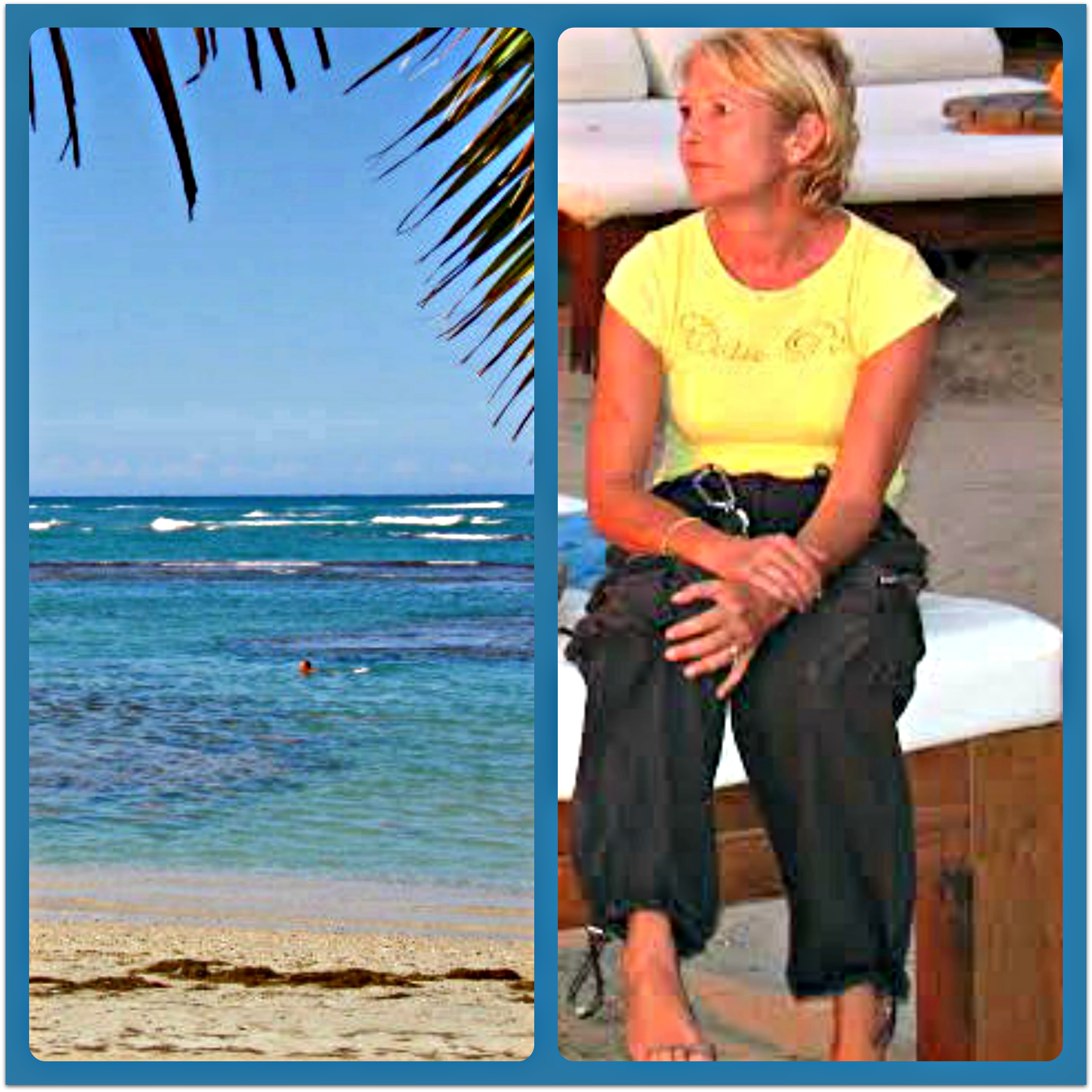
Las Mameyes, Puerto Plata, Dominican Republic (Morguefiles); Lindsay de Feliz (her own photo).

My guest today, the author Lindsay de Feliz, was scuba diving in the Maldives when one night she found herself on a tiny island in the middle of the Indian Ocean gazing up at the stars, the warm water lapping up against her toes.

She thought about life, love and the meaning of the universe. And then she had an epiphany: she no longer wanted the life she had made for herself in the UK. She would leave her husband of ten years, her cats, her house, her cars and her successful career, and buy a one-way ticket to Paradise (she hoped).

“What about your saucepans?” her mother responded upon hearing of this momentous decision. Possibly she was thinking her daughter had gone potty, but instead of saying that, she talked about the set of expensive pans she and Lindsay’s father had bought her for her birthday and Christmas the previous year.

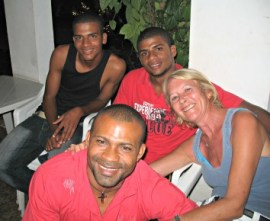
Lindsay did not pack her saucepans and, when she accepted a job as a diving instructor in the Dominican Republic, was glad she didn’t—especially once she’d settled down with her Dominican boyfriend, Danilo. His son, who lived with them as well, had a habit of throwing pans in the bin because he didn’t like washing them.

Yet her mother’s question stuck in her mind, and she decided to write a memoir called What About Your Saucepans?, which was published last year.

I am thrilled to have the chance to talk to Lindsay about this memoir today, which I found an extraordinarily gripping read. Although Lindsay finds her pot of gold in terms of a man who loves her and a life on her own terms, it all goes to pot at a couple of points. And how she copes with these setbacks is as interesting as anything she has to say about the details of life within the country that has the distinction of being the most visited in the Caribbean (though her account of Dominican life is compelling, too).

And now, before we start, can you hear me banging on a saucepan as I yell out: BE SURE TO LEAVE A COMMENT; YOU’LL HAVE A GOOD CHANCE OF WINNING A DIGITAL COPY!

* * *
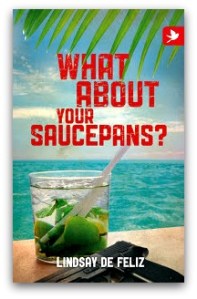
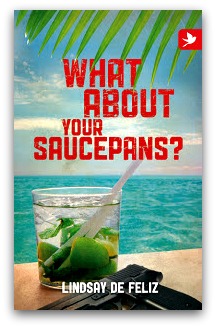
Saucepans-Cover_pmHola, Lindsay. ¿Que lo que? Can we start, please, by having you tell us what prompted your decision to write a memoir after a decade of living in the Dominican Republic?
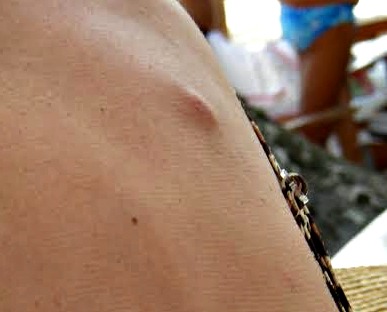
I used to send monthly emails to friends and family about what I was doing and many of them said that I should write a book. I know people often say this, but the longer time went on the more the idea started to grow on me. However, the major prompt was when I was shot by a couple of burglars I’d apprehended at the gate to my home. The bullet passed through my throat and then went straight through my right lung. I made it to the local hospital being carried, then draped over the back of a motorbike, and eventually in a car. After a botched tracheotomy, I was taken to a hospital in the capital, where they put in chest drains. I went home after 12 days.

Wow! So being shot was what motivated you to write about your expat life?
There were lots of things I couldn’t remember about the incident—to this day, my recollections of it are a bit fuzzy—so I asked those who helped me what happened, and then wrote it all down. That became a chapter in the book, and then I filled in before and after.
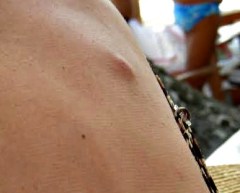
C5 Bullet stuck in my back 2 weeks after the shooting

The bullet went through Lindsay’s lung and got stuck in her back. Here it what it looked like two weeks after the shooting (Lindsay’s own photo).

Did you ever think of writing a novel instead? I ask because your memoir almost reads like a novel. I felt as though I get to know all the characters and missed them when I put the book down.
No, I never thought about writing a novel—my life was like a novel!

I understand the life you left behind in the UK was somewhat more mundane. Can you describe a typical day?
Typically, I would drag myself out of bed at around 5:30 a.m. in the dark. Get showered and dressed in a power suit making sure high heeled shoes and jewelry matched. Wrap up warm and walk 20 minutes to the train station. Train to Central London. Tube to the city. Another tube to Canary Wharf. Total journey time around two hours assuming no delays, which there often were. Work out in the gym and then walk or train to the office. Work all day long, maybe lunch at The Ivy with agencies or journalists, then the same journey home again, getting home around nine and falling into bed to do the same thing the next day.

What was the trigger (so to speak) that made you decide to pack it all in and become a scuba diving instructor?
I adored scuba diving in tropical places and managed to go a few times a year and it just seemed daft to work so hard to pay to go diving when I could dive all the time and earn enough to live off doing something I loved.

How did you end up in the D.R., of all places?
I started off in the Maldives, then went east to Asia, found it impossible to obtain work permits so ended up in Menorca, an island in the Mediterranean belonging to Spain. I decided I should learn Spanish as I already spoke French and German (as an instructor, the more languages you can speak the better). I wanted to get back to the tropics and a job came up in the Dominican Republic, so off I went.

Every pot will find its lid

February is a month for celebrating romance and love. How did you meet Danilo, the Dominican man who became your second husband?
I had seen him around, but I wasn’t even thinking about a relationship. My plan was simply to learn Spanish then head for Costa Rica and work as an instructor there as the diving was supposed to be excellent. One night at a bar Danilo was there and offered me a lift home on his scooter.

Was it love at first sight?
No, although he was seriously cute. But once Dominicans decide that you are the one, they are like Rottweilers and never let you go! He pursued me with a vengeance.
Lindsay&family

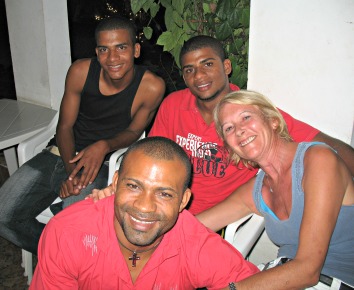
A happy family, Caribbean style: Lindsay with her husband, Danilo, and two sons.

Your courtship led to a ready-made family (his kids) and marriage. Was that a difficult decision?
Not at all. Danilo moved in with me after a couple of weeks courting—as I said they move fast, and as soon as he moved in I was called his “wife” (the vast majority of Dominicans don’t actually get married they just live together but are known as husband and wife). He moved his three children in a week later. We were like that for three years, so most of the big cultural adjustments had already taken place—and there were many, which I discuss in the book. He gave me what I wanted in terms of doing everything to make me happy and to make my life easier, and most of all he made me laugh.

But isn’t “happily ever after” particularly challenging for those of us in cross-cultural marriages?
I must admit, due to the fact we were from such different backgrounds I doubted that we would ever become soul mates, in the way you dream of as a child. However, over the past couple of years—we have now been together for 12 years—he has become my media naranja, as they say here—my half an orange—and is totally my soul mate, my best friend and more. Much I think is due to fact that he is now at university, so we have more “intellectual” conversations, and my Spanish is now much more fluent than it was in the early days. We still laugh all the time and I could not contemplate life without him.

If ifs and ands were pots and pans…

Looking back over the decade you’ve lived in the Dominican Republic, what was your most “displaced” moment: when you thought, what’s a nice girl like me doing in a place full of superstition, political corruption, thievery, and the many other cultural quirks you mention in your book?
You are right, there are many—so many I don’t know where to start. Maybe squatting down to have a pee in the sugar cane fields, taking photographs of dead people in their coffins as their families wanted a picture and had no camera, going into a store and being asked to wait while they catch a rat, going to a jail to get prostitutes out, delivering a baby to a Haitian women on the mud floor of her hutand of course having been shot, which, although I didn’t realize it at the time, meant being taken to hospital draped over the back of a motorbike because there are no ambulances or emergency services where I live.

Goodness, that’s quite a selection! Can you also pinpoint your LEAST displaced moment, when you felt you were much more comfortable living in that place than in your native UK?
I feel like that every day now as I have become totally adjusted to Dominican life. Dominicans call foreigners like me aplatanado—literally, “like a plantain banana,” signifying we’ve become one of them. Nowadays I don’t care what I wear, no make up, material possessions are not important, I don’t get annoyed if the car is scratched—a whole different set of values to those I had before. Instead of dragging myself out of bed, I leap out, happy to see what the day has to bring. I go downstairs and look across at the mountains and watch the sun rise drinking fabulous Dominican coffee. I have never been happier. I talk in the book about my search for joy. Those moments of pure joy that you experience occasionally. Now here I have them every single day. No one could ask for more.

Could you ever live in the UK again?
No, I could never live in the UK again. In the D.R., there are very few rules, which, while it does give rise to some problems, also means one has the freedom of being able to park wherever you want, smoke a cigarette where you want, not wear a seat belt if you choose not to, and so on. I love that. Also, in the UK, Danilo and I have experienced racism—groups of youths making monkey noises on the trains—because I am white and he is brown. I could never ask him to suffer that. Here we have never been made to feel uncomfortable.

Does your husband feel the same way?
My husband loves the organization in the UK, the fact that people queue, the lack of litter in the street and the trains. But even if we did want to live in the UK, we couldn’t as the new immigration regulations mean that I would have to earn a salary I could never earn, and he would have to speak pretty fluent English, which would be very hard for him.

Panning for a publisher

Moving on to the book: what was the most difficult part of the writing process for you?
The first draft was easy. I tend to think for days about what I want to write—in bed before I go to sleep, when I am walking the dogs… I wait and wait and wait until I am bursting to write it down. It is so satisfying when you actually write then. Just like when you eventually find a toilet when you have been dying for a pee for ages. The hard bit was changing it to incorporate what the publisher and editor wanted. They wanted me to write much more dialogue, which I found hard, and to talk about things I didn’t really want to talk about. I didn’t want to hurt anyone, and in a memoir you really need to tell the truth. They were right, of course, and the book was much much better as a result; but it was difficult for me to describe all of the emotions.

You published with Jo Parfitt of Summertime Publishing. How did that happen?
The path to publishing was not an easy one. I wrote to literary agents and publishers, and some said no and others told me to get it edited and then resubmit—which I did, but it all cost money. I think in some instances they were just helping out their editor mates as they all said no even after I resubmitted it. In the meantime, I’d started a blog of the same name, which began to build me an audience ready for when the book came out. In the end I found Jo Parfitt, who directed me to a great editor, Jane Dean. Between them they knocked me and the book into shape.

What audience did you have in mind for the book, and has it been reaching those people?
Originally, I had in mind people who were interested in the Dominican Republic. Yes, it has been reaching them, but it is constant work to make sure you find them and tell them about the book. Luckily, the reviews have been fabulous and those who read the book have said that everyone should read it, not just those who like the DR.

I agree, I think it appeals on many levels, not just to those with an interest in the Caribbean.
Thank you for saying that. Apart from being about life in the Dominican Republic, it’s a love story, a horror story, it has adventure, and I like to think that it might make some people reevaluate their lives and what is important to them.

Do you have any advice for others who are writing memoirs and hoping to publish them?
Firstly, write the memoir. Do it. It is great fun and also cathartic. Never stop writing at a point where you are stuck or it takes ages to pick it up again. Stop when you know exactly what you want to write next. I would also say don’t give up when you are looking for a publisher, just keep at it. It must have taken me over a year at least to find Jo. And when I did she set me targets to achieve, which gave me a purpose and a goal. You must also be honest with yourself as to whether people will be interested in your story and what it can do for them, not just what it might do for you. And finally, don’t be arrogant and precious when your editor and publisher suggest changes. They know the market a million times better than you. Take their suggestions on board. In the end it will produce something much better than you could on your own.

10 Questions for Lindsay de Feliz

Finally, I’d like to ask a series of questions that I’ve asked some of our other featured authors, about your reading and writing habits:
1. Last truly great book you read: In the Time of the Butterflies, by Julia Alvarez, a historical novel about the Mirabal sisters, who opposed the dictatorship of Rafael Trujillo in the Dominican Republic.
2. Favorite literary genre: Murder mystery
3. Reading habits on a plane: I haven’t been on a plane since Kindles and such like came out(!). But I used to read novels—the latest Patricia Cornwell or Tom Clancy—which I would buy at the airport.
4. The one book you’d require President Obama to read, and why: Mine. Because I know he would enjoy it, it would make him smile and help him to understand all of the Dominicans in the USA. He would also enjoy the part about Dominican politics. I can just see him reading bits of it to Michelle in bed in his stripey pajamas and them both laughing.
5. Favorite books as a child: Enid Blyton‘s The Famous Five series; the What Katy Did series by Sarah Chauncey Woolsey, under her pen name Susan Coolidge; Heidi; and books about horses and ballet dancers. As I moved into my teens I loved Georgette Heyer books.
6. Favorite heroine: Lisbeth Salander in The Girl with the Dragon Tattoo
7. The writer, alive or dead, you’d most like to meet: This is someone who hasn’t yet published a book so I hope that counts: Aisha Ashraf. Her writing simply blows me away and I could never write like she does. I am a story teller and she has a way of touching your heart. I would love to meet her one day.
8. Your reading habits: I don’t read as much as I would like now. However, when the electricity goes off (which it does here quite a lot) I grab a book and devour it. I also read books online by other Summertime authors which they send to me.
9. The book you’d most like to see made as a film: Mine again! I know it would make a great film. My dream is to go to the Oscars. I just need to make it happen.
10. The book you plan to read next: Linda Janssen’s The Emotionally Resilient Expat. She is another Summertime author, and I am really looking forward to getting into this one.

* * *

Thanks so much, Lindsay. Readers, what I love about Lindsay is her attitude. Some of us might think that she went out of the frying pan (a life she could no longer stand in the UK) and into the fire (getting shot in the Caribbean), but she doesn’t see it that way at all. In fact, as she explains in the book, after surviving the shooting, she has even more purpose in life and even more devotion to her adopted home.

So, any COMMENTS or QUESTIONS for Lindsay? Do you think you would react in the same way to hardships?

And don’t forget, there’s a copy of the book to be won for the best comment! NOTE: If you can’t wait to read the book or don’t win, What About Your Saucepans? is available from Amazon, Apple iTunes, Kobo and Barnes and Noble. And you can also start following Lindsay on her blog, of course!

STAY TUNED for tomorrow’s post, another episode in the life of our fictional expat heroine, Libby, told from the point of view of her husband, Olivera rare treat! (What, not keeping up with Libby? Read the first three episodes of her expat adventures.)

If you enjoyed this post, we invite you to register for The Displaced Dispatch, a round up of weekly posts from The Displaced Nation, with seasonal recipes, book giveaways and other extras. Register for The Displaced Dispatch by clicking here!

Related posts:

THE LADY WHO WRITES: Wannabe novelists, before you write: Read, and read some more…

LadyWhoWrites_brandIntroducing…The Lady Who Writes, Meagan Adele Lopez—a repeat expat in the UK (she now lives in London). Besides writing, her talents include acting, blogging (during her first UK stint, she kept the blog “The Lady Who Lunches”), and crafting ads for social media. In this monthly column, which began yesterday with a self-introduction, Meagan is doling out advice to international creatives who are contemplating writing a novel about their novel, shall we say, life experiences.

—ML Awanohara

Hello again, Displaced Nationers! After my self-introduction yesterday, I’m happy to be back today to discuss my first topic: reading.

Yes, you heard that correctly: reading. Before you even begin to write, you really need to know how to read.

Reading is not just about absorbing the words on the page. You have to be as observant in your reading as you are in your own writing.

Perhaps I am telling you something you’ve already seen in book-writing manuals—but it still remains the best advice I received before writing my novel about an expat love affair, called Three Questions: Because a quarter-life crisis needs answers.

I was always an avid reader, but somehow got out of it once I finished college. By the time I’d decided to write a novel, I was shocked to realize it had been a few years since I’d read more than one book in a year.

Always one to kill multiple birds with one stone (that’s an awful phrase, isn’t it? I really would rather not kill any birds but, alas, the phrase says I must), I formulated a plan to read as much as I could before starting to write.

I would read books that would help me understand the rhythm of the sort of book I intended to produce, while also learning what my target audience was interested in.

And to do that, I would develop a sort of focus group of people who would give me honest and relevant feedback.

The Ladies Who Read

How did I create this? I started a book club for women. BUT this was no ordinary book club. Oh no! This was a book club with sass, spunk and activities, called the Ladies Who…(yes, I am fond of this moniker).

Our group would meet every month to tackle a different book and create some sort of experience based off the book.

One month, we were Ladies Who Cooked. Another month, we were Ladies who Karaoke-ed. Another month, we were the Ladies who Roller Skated. The topic didn’t always completely correlate to the book, but we did our best and always had a blast doing it.

And, although the novel I ended up writing—Three Questions—belongs to the “chick lit” genre, the books we read weren’t necessarily chick lit, and they weren’t just fluff. Some were literary, some were trashy but popular, and others were largely autobiographical.

“Let us read; and let us dance…” — Voltaire

One thing these books did have in common, though: my fellow “ladies” were interested in reading them.

Before, during or after our “Ladies who…” events, we discussed the book: what we liked about it, what we wished the author had thought more about, what bored us, what gripped us, the ins and outs of the character development—and I took notes.

To me, this was better than sitting in a classroom with fellow writers because I was getting first-hand knowledge of what the people wanted out of a good woman’s fiction novel.

The best part about it? One month it was my book that we did this to!

For me, reading before I started writing was immensely helpful. As I mentioned, being able to understand the ebb and flow of what makes a good narrative is extremely important.

I wanted to keep my readers always wanting more, never getting bored (I’m an actress, remember)—but also not jarring them by jumping from scene to scene. It’s a difficult task to accomplish, but reading other successful novels helps. For me, novel writing is not a science. It’s more of a feeling, an art form…

Notably, I found it more difficult to continue reading while I was in the throes of writing because I found myself subconsciously writing in the same style of whatever author I happened to be reading at the time. This caused my writing to become disjointed, confused and derivative, lacking its own identity. I had to separate myself from reading others’ writings during the course of my novel-writing for this reason.

Others might be different, but this was my experience.

Turning the page

Am I saying you must start a book club immediately in order to kill all those birds at once? OK, I’ve got to come up with a different metaphor. How about: “Throwing the baby out with the bath water”? (Ugh, equally as horrible, if not worse.) Actually, this is where the author must come up with her own! Writing your own metaphors, avoiding clichés and repeating phrases could be its own blog post entirely. I digress…

No, I’m not saying that you need to start a book club. What I am saying is for you to know your genre inside and out.

To sum up, here’s Novel Writing Tip No 1 for International Creatives:

Be the master of what you are writing about. Let no one else understand how to let that cliff hang, those lovers love, or that monster scare little children like you can. NO ONE.

* * *

Readers, any questions for Meagan, THE LADY WHO WRITES? What do you think of her book club suggestion? Zany, helpful—or both? Perhaps you have alternative suggestions? Please share in the comments…and let’s get a “Ladies Who Talk About Writing” club going. (Men, you are welcome, too!)

Meagan Adele Lopez grew up in the U.S. with a Cuban-born father and American mother, and at one time enjoyed an acting/casting career in Hollywood, something you can detect in the beautiful trailer for her novel, Three Questions. Her day job these days is in social media advertising. To learn more about Meagan, go to her personal site.

STAY TUNED for next week’s fab posts!

If you enjoyed this post, we invite you to register for The Displaced Dispatch, a round up of weekly posts from The Displaced Nation, with seasonal recipes, book giveaways and other extras. Register for The Displaced Dispatch by clicking here!

Related posts:
THE LADY WHO WRITES: Expats, there may be a novel in your novel life!

LadyWhoWrites_brandMeagan Adele Lopez has always been on the move. By the time she was 12, she had lived in 12 places within the U.S. As a young adult, she moved to Paris and then Bristol, UK. She repatriated to the U.S. but recently crossed The Pond again to settle in London. Meagan’s talents include actress, blogger (she kept the blog “The Lady Who Lunches” while in Bristol), novelist and social media guru. And now, for the Displaced Nation audience, she will deliver advice on writing a novel. Introducing…THE LADY WHO WRITES!

—ML Awanohara

When ML Awanohara asked me to write a series of guest posts about writing a novel, I was a bit taken aback. Who am I to tell you lovely readers how to write a novelI’ve only written one, and it wasn’t a bestseller on the New York Times!

Then I started thinking about what I could contribute to the Displaced Nation, what I know I did really well, and what I know I didn’t do well. Surely the successes and learnings from any first-time author are worth a contribution of, say, a series of at least six guest posts?

After all, I did have 30,000 people download the book in the first six monthsthat’s worth something, right?

Plus, being an expat myself (this is my third try!), hopefully I will be coming from a perspective that you all know and understand. I was lucky enough to be able to write my novel, Three Questions: Because a quarter-life crisis needs answers, while living abroad in England back in 2008. I’m back in England again (London, to be specific) after living in Chicago for three yearsand, yes, I’ve started writing again.

The odd thing is that I found it difficult to write in my own country. My imagination isn’t sparked like it is when I am abroad, and out of my comfort zone. Living in America (where I’m from), I go through the motions of my day-to-day life without digging deeperand this, in my mind, makes my writing dull and uninspired.

When I’m in Europe, I question more, observe more, and simply write more because I have to in order to survive. My writing in Europe comes almost out of a necessity.

It’s more than that, though. For me, when I’m in Europe, I’m curious about everything around me—I am constantly walking around with a slight tilt of my head, wondering how humans are so much alike and yet so different. I question my own actions and why I do the things I do, because the Brits, the French, the Germansthey don’t act the way I act. Simple phrases I would say without thinking in an American bar, like “double fisting” (to carry and consume two alcoholic beverages simultaneously), can cause serious offense, or fits of giggles, in Britain. Saying my name in France makes people think of a car. Even walking on the sidewalk in England I don’t seem to do right.

When walking becomes a struggle, writing becomes a source of solace.

Do you feel this way at all, fellow expats? We all need inspiration in order to write, and for me that comes when I’m put in situations that are out of the ordinary.

So, this blog series won’t be about telling the musts and mustn’ts of novel writing in a step-by-step manner. We all have a different method, and there is no right/wrong way. Rather, this column will provide six things to think about before, during and after writing a novel that maybe you’ve thought about, maybe you haven’t. I hope you will find my ideas inspiring, and never boring!

I’ll be back tomorrow with my first suggestion, which has to do with READING, the first step to writing…

* * *

Readers, any questions for our new monthly columnist, THE LADY WHO WRITES? Anything in particular you would like to see her cover in her series?

Meagan Adele Lopez grew up in the U.S. with a Cuban-born father and American mother, and at one time enjoyed an acting/casting career in Hollywood, something you can detect in the beautiful trailer for her novel, Three Questions. Her day job these days is in social media advertising. To learn more about Meagan, go to her personal site.

STAY TUNED for Meagan’s first piece of writing advice, scheduled for tomorrow!

If you enjoyed this post, we invite you to register for The Displaced Dispatch, a round up of weekly posts from The Displaced Nation, with seasonal recipes, book giveaways and other extras. Register for The Displaced Dispatch by clicking here!

Related posts:
LOCATION, LOCUTION: Chris Pavone, author of “The Expats”, on why story and location are inseparable

Cover art "The Accident; Author photo Chris Pavone; Author photo JJ Marsh

Cover art “The Accident; Author photo Chris Pavone; Author photo JJ Marsh

In this month’s “Location, Locution”, expat crime writer JJ Marsh interviews author Chris Pavone, whose  first novel, The Expats, was published in 2012, and was a New York Times and international bestseller, with nearly twenty foreign editions and a major film deal.

The Expats was nominated for a Los Angeles Times Book Prize and a Macavity, and awards from the Strand Magazine Critics Circle, the Mystery Booksellers Association, and the International Thriller Writers. It received the 2013 Edgar Award and the 2013 Anthony Award for Best First Novel.

Pavone’s new book, The Accident, will be published in March 2014.


Which comes first, story or location?
For some books I think the story and location are inextricably intertwined: the story is about the location. My thriller The Expats is one of those, defined by taking place in a country that’s not the protagonist’s home. The plot is driven by this situation, by her sense of disassociation and isolation, by the necessity of her reinvention.

How do you go about evoking the atmosphere of a place?
I love walking around cities, looking around at the architecture and the shops and the restaurants, at the people and their pets. My characters do the same, using all their senses to inhabit the world around them. Of course walking around, in and of itself, isn’t the type of action that does much to drive a plot forward, so characters should also be doing something else while walking around. Something such as spying…

Which particular features create a sense of location? Landscape, culture, food?
On the written page, I think the clearest evocation is via the physical landscape, especially when it echoes the culture. New York is the big brashness of skyscrapers and noise; London is the polite order of elegant uniformity; Rome is cheerful dilapidated chaos.

How well do you need to know the place before using it as a setting?
As much as my characters. If they’re only in a city for a day, they don’t know that much about the place, and I don’t need to either. Both The Expats and my next book, The Accident, use a variety of locations, and the amount of time the characters spend in placesLuxembourg, Paris, the Alps, Amsterdam, London, Zurich, Los Angeles, etc.is roughly proportionate to the amount of time I’ve spent there.

Could you give a brief example from your work which you feel brings the location to life?
This is the final sentence of The Expats . . .

Kate watches them merge into the flow of the dense crowd, all the streetlights and lamplights ignited in the Carrefour de l’Odeon, a little red Fiat beeping at a bright green Vespa that’s weaving in the traffic, the policeman oblivious while he continues to flirt with the pretty girl, cigarette smoke wafting from the tables filled with wineglasses and tumblers and carafes and bottles, plates of ham and slabs of foie-gras terrine and napkin-lined baskets of crusty sliced baguette, women wearing scarves knotted at the neck and men in plaid sport jackets, peals of laughter and playful smirks, hand-shaking and cheek-kissing, saying hello and waving good-bye, in the thick lively humanity of early night in the City of Light, where a pair of expats is quickly but quietly disappearing.

Which writers do you admire for the way they use location?
Hemingway was not only a master of evoking location, but also of using physical atmosphere as emotional metaphor. Empty barges on the Seine can represent a lot more than just boats.

Next month on Location, Locution:  award-winning author Amanda Hodgkinson.

 * * *

JJ Marsh grew up in Wales, Africa and the Middle East, where her curiosity for culture took root and triggered an urge to write. After living in Hong Kong, Nigeria, Dubai, Portugal and France, JJ finally settled in Switzerland, where she is currently halfway through her European crime series, set in compelling locations all over the continent and featuring detective inspector Beatrice Stubbs.

STAY TUNED for our next post!

If you enjoyed this post, we invite you to register for The Displaced Dispatch, a round up of weekly posts from The Displaced Nation, with seasonal recipes, book giveaways and other extras. Register for The Displaced Dispatch by clicking here!

Related posts:

Trevi Fountain blesses American woman’s coins, granting her true love, a new life abroad, and now a book (we’re giving it away!)

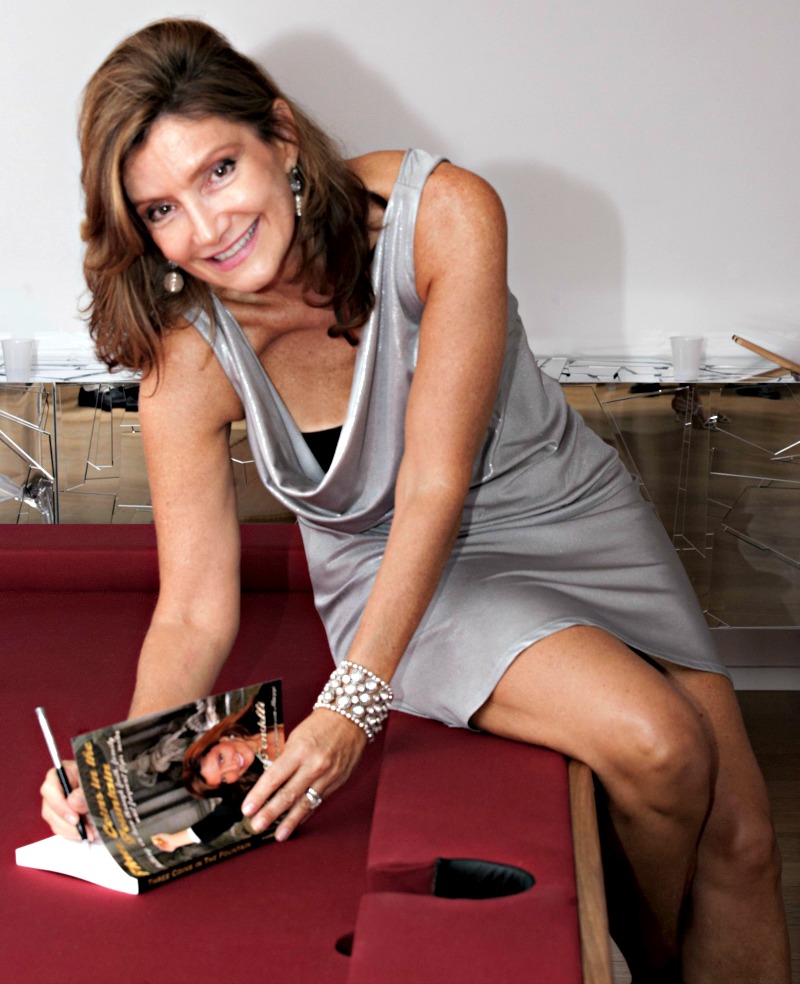
Catherine Tondelli book signing photoWhile an expat in Japan, I mastered the ritual of tossing coins into the offering box, or saisenbako, at the Shinto shrine or Buddhist temple while clapping twice (to attract divine attention) and then making a short prayer.

In the West, of course, we toss coins into fountains and make a wish, but I’d never been one for doing that.

I might start trying it, though, now I’ve read Catherine Tondelli’s memoir, Three Coins in the Fountain, which recounts the luck she had in finding a mate the moment she tossed three coins into the Trevi fountain in the Città Eterna.

Sounds like a pitch for a Hollywood film, doesn’t it? Except, wait a minute, that film has already been done (in the 1950s)!

And it’s real life we are talking about here, not the movies.

Besides, Tondelli has kindly granted me three wishes:

  1. She will answer some questions about her memoir as well as her writing process (see below).
  2. She will GIVE AWAY TWO COPIES (hard copy or Kindle) to the two readers who toss in the best comment below.
  3. She will make the book available for free download for a short period—to be revealed at some point in our weekly Displaced Dispatch. (What? Not a subscriber? SIGN UP NOW!)

Before we start, I should mention that Tondelli’s book has been likened to another book recounting travels in the wake of divorce: Eat, Pray, Love, by Elizabeth Gilbert. But for me, a half-Italian American, Tondelli’s more restricted itinerary makes a a lot more sense. Who needs India and Bali when you can easily get the whole package—great food, a renewed faith in relationships and family, and love—in Bella Italia?

Like me, Tondelli is half-Italian, and I like to think it’s that ancestry that made her realize the truth of Madonna Louise Ciccone’s assertion: “Italians do it better.”

* * *

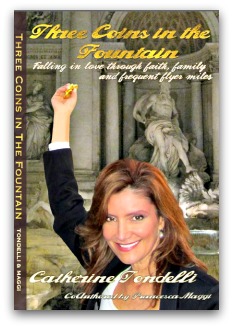
3-Coins-in-Fountain-by-Catherine-Tondelli_dropshadowWelcome, Catherine. I read your book not long after I’d finished Imperfect Pairings, by Jackie Townsend, which we featured in this space this past November. But that was an autobiographical novel based on Jackie’s marriage to an Italian man. So here’s my question: did you ever consider telling your story as fiction, or perhaps using it to develop a film script for a romantic comedy?
I originally thought about writing it as a novel, but my story was so unique and it gave so much hope to women who have given up all hope of ever finding the man of their dreams after 40 years old. Most people would never believe that stories like this really do happen and that true love will find you as easily as tossing some coins in a fountain. I also felt that many people could relate to my crazy stories of growing up in a large family. In the 1960s it was normal to have families of seven or more children; but, with the exception of Cheaper by the Dozen, there is very little written about large families. You have a lot of crazy stories when you grow up with ten siblings!

Yes, I noticed in the press release for the book that you grew up in Chicago as one of 11 kids who were left behind by a deadbeat, jazz musician dad. Can you tell us a little more about your relationship with the man who bequeathed you the surname “Tondelli”? After all, he features in the book quite a bit as well.
I had a very challenging relationship with my father and harbored resentment towards him for many years. I was only 12 years old when he walked out on my mother. It had a huge impact on the relationships I had and the men I chose. A daughter’s first bonding with any man is with her father: he is her first boyfriend, role model for the men she chooses. We often repeat what we know rather than what we want: we need “familiar,” even if it’s unhealthy. I kept choosing unsuitable men until fate stepped in and finally tossed me a “get a good man” coin to throw in the Trevi fountain.

Did you and your father ever reconcile?
I didn’t speak to him for twenty years. We finally reunited when I was attending a conference in Las Vegas and he was a musician playing on the strip. I called him and we had dinner together. We hugged and kissed at the end of the evening: it was a huge healing moment in my life. I was never as close to him as I was to my mother but we had a good relationship up until the day he passed away one year ago. Writing about him also helped me to heal.

Sono pazzo di te (I’m crazy about you…or am I just crazy?!)

Now turning to the man who would become your husband, the handsome and irrepressible Fausto. Since romance is a big part of what your book is about, I’d like to recount the first moment when the pair of you set eyes on each other. Newly divorced, you were traveling in Italy with your mom and had by that time reached Rome and the Fontana di Trevi, where your mother handed you three coins and urged you to wish for a nice man to come into your life. At that very moment, you heard an Italian man say: “Eeffa you wanta your wish to comb true, you avv to trow the coins witah your layft (h)and as eet’s closer to your (h)art…”
Yes, and then he asked if I knew “de meaning of da tree coins”:

“Da first coin, you find your love in Rome, da second coin, you return to Rome and the t(h)ird coin, you marry in Rome.”

And that’s what happened: he and I fell in love, I returned, and we got married.

Chi ama me, ama il mio gatto (Whoever loves me, loves my cat)

Jackie Townsend entitled her book “Imperfect Pairings” because she thinks Americans have an idyllic view of cross-cultural marriage with Europeans, thinking it sounds very romantic—whereas the reality tends to be culture clash after culture clash. You seem to believe in the romance while also acknowledging there were hurdles along the way. After you got over assuming Fausto was gay, you suspected you might be just one in a long line of fountain pick-ups. And even after he at last won your trust, you and he had to struggle to get used to each other’s habits. He did not take well at first to sleeping with your beloved Siamese cats, for instance.
Three Coins is not your stereotypical girl-on-holiday-meets-man-of-her-dreams-and-lives-happily-ever-after. Yes, we did meet on my trip to Italy, but falling in love and moving to Italy was the last thing I’d expected. I came to Italy only after I had worked for three years in London and only when finding a good job in Rome. And when he proposed, I called my sister.

I like that you put a map at the beginning of the book, showing all the destinations you and Fausto traveled to together, before you decided to live in the same place. I presume Italy and Italian culture were an adjustment?
Even though I grew up in an Italian American household, the cultural learning curve for me was huge.
My mother descends from Irish stock, and Fausto couldn’t believe his ears when I told him my Irish grandmother had put money aside in her will to host a luncheon following her funeral for all her friends and family. When his father passed away, we went down to the morgue to say our last goodbye and then off to the church and finally the cemetery, all within two hours. No lunch, no funeral home, no photographs—it was all too fast, no time to mourn to grieve with family or friends. A real Mork & Mindy moment for me.

Was that your most displaced moment: when you thought, what’s a nice girl like me doing with an Italian?
That’s one, and another would be the Christmas after we moved into our new palazzo in Rome. I went to our five neighbors in the building and brought them Christmas cookies I made and a bottle of Spumante. Fausto looked at me with all my plates of cookies and bottles of Asti in my hand and said: “My love, what are you doing??” I went on to explain that we always bring something over to the next door neighbors in America for Christmas. He just stood there and smiled and said “We don’t do that in Italy.” I said, well, we’re going to start now!

Can you also pinpoint your least displaced moment, the first time you realized you felt much more comfortable with him and in Italy than you do with a man from your own culture in the U.S.?
I think it was when there was a Lazio (Rome) football game on TV and instead he took me to see a classical music concert at the Auditorium. He wasn’t telling me all night how much he was giving up for me…he really enjoyed the concert! I am a big baseball fan, not soccer. I was thrilled.

Non si serra mai una porta che non se n’apra un’altra (When one door closes another opens)

Moving on to the writing of the book: What was the most difficult part of the writing process?
Being constantly turned down by traditional publishers. Also, people I knew who already had books published weren’t very encouraging. Luckily, I didn’t let them get me down. After shopping it around for about six months, I decided to self publish. I realized with all my marketing and PR experience I could do a better job then they could in promoting my book in getting it to the right audience.

I see that you’ve listed Francesca Maggi as a co-author. How did that relationship work?
I was lucky as she was an editor and also an author and a friend. She had just published Burnt by the Tuscan Sun, and I asked for her help on the editing process. I gave her my manuscript and she polished and refined it pointing out my weaknesses and suggested options to strengthen those areas. She was instrumental in getting the flow right and helped with the technical elements. She was a natural choice for me as we share a common love of Italy and America, and she knew my husband well.

Can you offer any advice for others who are writing memoirs and hoping to publish them?
Don’t get discouraged. Publishing a book is not easy but if you have a good story, you now at least have options to get it out there. I love this quote by women’s fiction writer Jennifer Weiner:

The difference between people who believe they have books inside of them and those who actually write books is sheer cussed persistence—the ability to make yourself work at your craft, every day—the belief, even in the face of obstacles, that you’ve got something worth saying.

What audience did you have in mind for the book, and has it been reaching those people?
I really thought the target would be women between 20 and 60 (I do get a lot of emails from women like myself, and am happy they can relate), but I have been amazed at how many men also have written to me to say how much they enjoyed reading it. Obviously anyone who loves Italy, old-time romance, or stories of expat life in Europe would find it entertaining.

What do men like about the book?
I’ve had some nice comments from men who said that they were taking notes on Fausto’s techniques… Many of them also grew up in a large family. Also, Fausto was still a bachelor at 50. His story, too, can be inspiring!

Living La Dolce Vita

In your book you question whether Americans have their values in the right place given that we take so little vacation compared to people in Europe. Have you continued to feel this way about the U.S. since marrying Fausto and settling down in Rome?
Two years ago I decided to live like the Romans do and started working for myself so I could spend more time in the US visiting family and friends and also have more time to enjoy La Dolce Vita.

Do you think you could come back to live in the United States? What would be the adjustments?
After living in Italy for more than 12 years it would be very difficult for me to return to live in the US. Fausto and I have discussed moving back to California as he also acts in film and there are many more opportunities, but then we thought: how can we go and live in a city where they close the restaurants at ten o’clock? It would be very difficult to replace our lifestyle in the US. That said, I would love to transport the US postal office here as Italy still doesn’t have postal stamp machines. I bring my book and my computer now when I go to the post office as I know I’ll be spending the day there.

10 Questions for Catherine Tondelli

Finally, I’d like to ask a series of questions that I’ve asked some of our other featured authors, about your reading and writing habits:
1. Last truly great book you read: Blood from a Stone, by Donna Leone, part of her crime series set in Venice.
2. Favorite literary genre: Biographies or autobiographies: real-life stories are always so much more interesting than anything you could make up. That said, I also enjoy reading fiction.
3. Reading habits on a plane: I usually have long flights as my mother lives in San Diego and I fly from Rome three or four times per year to see her couple that with all the travel I do for my work (am working on events in Dubai, Nairobi, Singapore and London at the moment). I always have three or four books in my library at home that I wait eagerly to put in my carry-on bag for my long, hopefully peaceful journey. I am old fashioned and still like to feel the paper when i read a book.
4. The one book you’d require President Obama to read, and why: Jimmy Carter’s book Our Endangered Values: America’s Moral Crisis. I believe that Jimmy Carter has been one of our great leaders yet he is so humble. He was my 95-year-old grandmother’s favorite president. He tells us that for example the USA gives far less foreign aid to developing countries than most people imagine. And, much of this aid goes to certain select countries whose loyalty we are trying to buy rather than because we want to help the poor. The book opened up my eyes to understand how we are perceived internationally. It will give Obama a good reminder that values and morals are more important than being powerful.
5. Favorite books as a child: Charlotte’s Web, The Adventures of Tom Sawyer
6. Favorite heroine: I have many but at the moment it is Malala, the girl who stood up for education and was shot by the Taliban and survived.
7. The writer, alive or dead, you’d most like to meet: Beatrix Potter. I loved her books as a child, and she was also one of the early pioneer woman who broke the male barrier in publishing.
8. Your reading habits: I like to read in bed with my two Siamese cats (Stella and Luisa) on my lap.
9. The book you’d most like to see made as a film: Three Coins in the Fountain, of course!
10. The book you plan to read next: E-Squared: Nine Do-It-Yourself Energy Experiments That Prove Your Thoughts Create Your Reality, by Pam Grout. She provides experiments that prove our thoughts really do create our reality.

* * *

Thanks so much, Catherine. Readers, your turn! Any COMMENTS or QUESTIONS for Catherine? What would YOU wish for with your three coins, having heard her story? Come on, Valentine’s Day is coming! Surely, someone out there aspires to be the next heart wearing the valentine of the Frank Sinatra song?

STAY TUNED for tomorrow’s TCK TALENT column, by Lisa Liang.

If you enjoyed this post, we invite you to register for The Displaced Dispatch, a round up of weekly posts from The Displaced Nation, with seasonal recipes, book giveaways and other extras. Register for The Displaced Dispatch by clicking here!

Related posts:
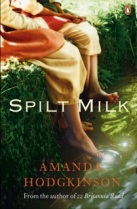
TCK TALENT: Laura Piquado, New York City Actress & One Well-Traveled Kid!

Laura Piquado Collage FINALWelcome to Elizabeth (Lisa) Liang’s monthly column about Adult Third Culture Kids (ATCKs) who work in creative fields, Lisa herself being a prime example. A Guatemalan-American of Chinese-Spanish-Irish-French-German-English descent, she recently debuted her one-woman show about being a TCK, which I had the pleasure of seeing during its too-short run in New York City in September of last year: stupendous!

—ML Awanohara

Happy new year, readers! Let’s start today’s interview by plunging right in. My guest is Laura Piquado, a professional actress based in New York who grew up in six countries, including Egypt, where we were drama classmates in high school.

* * *

Welcome to The Displaced Nation, Laura. It’s wonderful to reconnect with a Cairo classmate! I know you grew up as the daughter of a pair of teachers who were full of wanderlust. Can you give us a run-down of the countries you lived in as a kid?
My mother always told me that her earliest dream memory was of wanting to move to Africa. And as soon as she graduated from university in Canada, that’s what she did. She met my father in Sierra Leone in the mid 1960s. He was there with the Peace Corps, while she was being sponsored by CUSO (Canadian University Service Overseas)—a Peace Corps-style organization. They left when my mother was six months pregnant with my brother. My mother is tall, almost 5’11”, but at that time weighed only 120 lbs. I think having parasites, or the occasional bout of malaria was commonplace, but the risk to her health became too great.

After my (healthy) brother was born in Washington, DC, my parents decided to go overseas again. The first job my dad got was as an English teacher in a small village in northern Newfoundland, where I was born. Less than a year later, we moved to Beirut, Lebanon. Four years after that, when war broke out, we were evacuated to Shahin-Shahr, Iran, for almost four years. War broke out again, and we were evacuated again. The next stop was São Paulo, Brazil, for two years. My mom and dad hated the city, and we left every other weekend and holiday to get away from it. Consequently, my memories of Brazil are of travel, and of everywhere but São Paulo. After Brazil, we lived for four years in Bontang, Indonesia, which is in the province of East Kalimantan on the island of Borneo. After seventh grade we moved again, to Cairo, Egypt, where I graduated high school. That’s where you and I first met! My parents then moved on to Ecuador and China for 16 more years.

My parents loved being overseas, and at no point did they yearn to “come home.” They wanted their lives to be as teachers in international schools, and for 40 years that’s what they did. They retired a few years ago to a small town in New Hampshire.

A hard landing into adulthood

How did you feel about living in so many places?
I loved it, actually. Adjusting to new environments, new friends, new cultures, languages, was never difficult for me. I don’t know why. Perhaps I just got used to it. But I don’t think you ever get used to leaving friends and people you love—that’s always hard.

As an adult, do you find yourself drawn to other TCKs?
I definitely identify with other TCKS, though it’s not always a given we will hit it off. In fact, I used to be magnetically drawn to anyone who was a visible minority. “You’re from Indonesia?! I used to live in Indonesia!” “Hey, you’re Alexandrian! I lived in Cairo for 5 years!” I was always wanting to make a connection with a world that was no longer mine—and maybe never was mine, if I adhere to the rules of 3rd culture. But just because someone grew up all over the world as I did, or just because they are an actor like me, doesn’t guarantee I’ll be friends with that person—but it’s a starting point. And if a person grew up in different countries, at least their eyes won’t glass over when I answer the question, “Where are you from?”

You now live in New York City. How do you find life in the USA?
I’ve lived in the United States longer than I’ve lived anywhere else. Yet it’s the first place I’ve ever lived that doesn’t feel like home. For the first 20 years of my life I played with my friends, explored the jungle, hiked the Andes, swam in the Red Sea and the East Timor Straights, climbed salt flats, made forts in the desert, went horse-back riding around the Great Pyramids, woke to gibbon songs and the muezzin’s call to prayer. And then I came back here to go to school, get some degrees, get a job, and try to figure things out… I had this exhilarating childhood, and then this less-than-thrilling transition to adulthood.

Does your identity revolve around any one particular culture that you’ve lived in?
I am Dyak and atheist, Muslim, Christian, Bahá’í, Jain, Egyptian, Italian, Canadian—there is nowhere in the world that has ever felt foreign to me. I am all of these things, and none of them. After moving to the United States for the first time for college, being able to be all of them at the same time was what mattered the most. I was striving to understand who I was and what my life had been, and trying to share that with others, even if I couldn’t articulate it to myself. It’s taken a long time, and I suppose I’m still working at it. That said, I love meeting the kind of person who, unlike me, was raised in the same town he or she was born in, and still goes back there for family visits and holidays. I am attracted to the sense of being anchored somewhere, to a particular place. That perceived sense of belonging somewhere: it’s something I just don’t have; I don’t know what it feels like.

From an actor on the global stage, to an actor on a real stage

Tell us what you studied in college and how you made the leap to pursuing an acting career.
I did my master’s degree in Islamic Studies at McGill University in Montreal. I wanted, as an adult, to understand the cultural, political, and social environments in which I grew up. On some level I was looking for a path that would take me overseas again, which I was aching to do. I wanted to work in the development of women’s education in post-conflict societies because it was work that I was passionate about.

Just as I was finishing my degree, and thinking about streamlining into a doctoral program, I went back to Cairo. I hadn’t been back since high school. For a whole month I walked through the streets of my old neighborhood, saw my friends, went to mosques and bazaars and the Red Sea, and smelled and ate and absorbed Egypt again. It was glorious. But something changed in me after that, and made it okay for me to move on.

When I came back to Montreal, I started applying to drama schools. Although I had been involved in theatre since I was a kid, I hadn’t wanted to study it as an undergrad. There were other things in my life that I needed to address before I embarked on that.

But now I was ready for drama school—I enrolled in the London Academy of Music and Dramatic Art. At LAMDA, I felt like I was flying. I was so happy. To allow myself the ability to change horses mid stream, and for it to feel natural and fluid and right—that was tremendous. I don’t think any of us is just one person, and we aren’t the same person at 15, 25, 35, 55. We have multiple loves and lives and wants, and finding ways to marry them all, if we’re lucky enough to know what they are in the first place, can be overwhelming.

How did your family react to your decision to pursue an acting career?
I’ve only ever had a supportive family. So instead of calling me a flake, or accusing me of lacking any sense of stick-to-itiveness when I told them I wanted to go to drama school, they became, again, my most enthusiastic supporters.

I think our peripatetic childhoods trained us to be actors—to observe, listen, and adjust our behavior to our surroundings. Do you agree?
I do agree, for the most part. But I also think personality has a lot to do with it. Just because you grew up all over the world doesn’t de facto make you a keen observer, or an astute listener, and not all kids who move around a lot are able to adjust to their changing environment. On the other hand, if you have had a peripatetic life, and you also happen to be a good listener, observer, etc., it seems it can only enrich your depths as an actor (and certainly as a human being). For me, adaptability became a defining aspect of my personality.

I think that for us TCKs, the challenge of convincing a casting director that you truly can be this other person is made easier because of all of those things we bring to the table—listening, observing, adjusting, maybe even having lived or known the character’s life. But also for that reason, many of us find it even harder to put up with being typecast.

Which sorts of roles are you attracted to, and do you think your upbringing influenced this?
I’m usually attracted to damaged characters, or quirky ones. And accents are always juicy! I’ve always been a mimic, and am grateful for that gift as it makes it easier to play a variety of roles. Why I’m drawn to quirky characters is less apparent. Does it have something to do with my upbringing? That’s an interesting thought. I’ve never made that correlation, but it makes complete sense.

So which parts have been your faves?
I loved playing Goneril in King Lear with the Texas Shakespeare Festival. I’ve always thought that she’s been inappropriately maligned as a character. Lear is not the easiest father—demanding, impulsive—and to require his daughters to prove, to prove, their undying love for him—for the sole purpose of measuring it against their inheritance—makes him something of a jerk in my book.

Playing the painter in Ionesco‘s The Painting with the Phoenix Theatre Ensemble was pretty great as well. Aside from the play’s absurdism, the part was perverse because of the the vocal and physical qualities we decided on. It’s not often that you get to play grotesque and obsequious, mismanage your voice, throw out your back, and sprain your jaw because the part demands it. Fantastic! 🙂

And a role on the damaged front, I suppose, was Charlotte in Sharr White‘s Sunlight, for its world premiere with the New Jersey Rep. While I’m less attracted to straightforward, modern dramas (though in truth, I love it all), the whole premise for who Charlotte is, for what motivates and oppresses her, is her having been in the Towers on September 11th and losing her child as a result of the trauma. And while that’s not what the play’s about (thank God!), it defines who she is able to become (or not become) in the ensuing decade.

* * *

Wow, that’s an impressive list! Thank you, Laura! I wish you the very best in your career and hope to see you on stage and/or screen soon. Readers, please leave questions or comments for Laura below.

STAY TUNED for tomorrow’s post, from our Global Food Gossip!

If you enjoyed this post, we invite you to register for The Displaced Dispatch, a round up of weekly posts from The Displaced Nation, with seasonal recipes, book giveaways and other extras. Register for The Displaced Dispatch by clicking here!

Related posts: