The Displaced Nation

A home for international creatives

Tag Archives: It’s Food!

For this wanderlusting Californian for whom photography and travel are a perfect fit, a picture says…

KONICA MINOLTA DIGITAL CAMERA
Writer, world traveler and photography enthusiast James King is back with his latest interview subject.

Jenny in Ireland

Jenny Schulte in front of an old church window ruin near Kinsale, County Cork, Ireland.

Hello again, readers! My May guest is 38-year-old Jenny Schulte. who never had any thoughts of leaving her Northern California home until she travelled to Ireland in 1999 to explore her Irish roots. Now she is an ardent traveler who combines her love of photography with her travel experiences in her captivating blog Bulldog Travels, subtitled “Everything and Nothing Plus Some Pretty Photos.” Jenny is wrong to call it “nothing”: her blog is her her outlet for sharing her travel adventures along with the kinds of “photographs my friends have always enjoyed,” as she puts it.

On her About page, she says:

[Those] two wonderful hobbies of travel and photography fit perfectly together.

A woman after my own heart!

* * *

Hi, Jenny, and welcome to the Displaced Nation. Thank you for getting in touch and offering to share your photo-travels with us. Can you tell us where you were born and when you spread your wings to start travelling?
I was born and raised in Sacramento, California, and consider myself fortunate to live in such a beautiful part of the world. San Francisco, Lake Tahoe, the gorgeous California Coast, Redwoods, Yosemite, Napa Wine Country—all are on my doorstep. But while I have always loved to travel within the United States, when I was twenty I decided I really wanted to delve into my Irish heritage and see Ireland first hand. I had a very romantic vision of the country and figured I would be disappointed if I never went. Well…the moment my tennies hit the ground, a restlessness took over and I have been globetrotting ever since. I made a good friend in Ireland who is from Germany. and together we have seen much of western Europe (Germany, Switzerland, Austria, Italy, France, Monaco, Spain, Andorra, England and Scotland). In more recent years I have been fulfilling an archaeological interest of mine exploring Mexico and Central American sites and ruins.

If you’re lucky enough to be Irish…you’re lucky enough!

So once you finally got the travel bug, you were up and running in those tennies of yours. I have only managed the UK and France from your entire list. I’m envious. Can you share with us some of the highlights of your travel adventures?
I really enjoy history and from Ireland I went to my first European countries: Germany, Switzerland, and Italy, where I could not only delve into history but also enjoy great food, culture, and scenery. From there I went on to other destinations such as France, Scandinavia and the UK. My search for ancient ruins took me to the Yucatán, Belize, and Guatemala. The animals and the raw nature of Costa Rica stole my heart. At home, where I have travelled California and the entire west on shorter trips, I really love Joshua Tree National Park, Portland, Southern Utah, San Francisco and Mendocino.

Now that you have gained so much real travel experience, I would love to hear more about what inspired you to travel originally and sustains you on your many trips.
No one in my family has ever travelled very far, with the exception of a few who travelled for Uncle Sam’s benefit. They tend to stick close to home preferring to take a drive rather than fly somewhere exotic. My family built a cabin in the Sierra Nevada Mountains, and we still enjoy it whenever we can. But my grandmother had told me stories of Ireland since I was a child, and I always dreamed of seeing it one day. After that initial Irish adventure, every trip has left me wanting more. I have averaged one or two main trips per year and as many small trips as I can fit in. As a photographer I tend to focus on areas I know will be wonderful to capture. But I am always surprised and pleased when I get great photos I never expected.

So tell us about where you have travelled most recently.
I recently returned from a trip to Belize and Guatemala. I tend to spend my home time in Sacramento, San Francisco, California Coast, the Lake Tahoe area, and the Sierra Nevada Mountains. I will probably stay in California until I retire and then I plan to be more nomadic, visiting places that are difficult to visit on a two-week trip. Then I hope to live in areas longer, to fully appreciate the culture and the environment.

Don’t leave it too late like I did. You need a lot of energy for the expat life.

“Laughter is the brightest where food is best.”

Now let’s move on to a few of your shots that capture favourite memories. Thank you for sharing and for describing the story behind each one and what makes them so special.  
Of course! For my first photo, I present you with a little boy cleaning a fish out front of his grandmother’s restaurant, Maggie’s Sunset Diner, in Caye Caulker, Belize. His family’s BBQ was fired up just out of the frame. The boy so badly wanted to be like his grandmother. He was begging to BBQ his own fish like an adult. My husband and I observed this charming scene while having dinner. I believe that good, inexpensive food in a place full of local ambiance is better than a five-star restaurant anywhere in the world. The photo was taken only with my iPhone but I think it captures the mood and the vibe of this small island off the coast of Belize.

Q9.1 Boy cleaning fish

Boy in Belize cleaning a fish. Photo credit: Jenny Schulte

The second photo is of some donuts my husband I consumed in Maui, Hawaii. I was driving around the rural part of the island looking for something to eat for breakfast when I stumbled upon a locally owned and run donut shop. The donuts were glorious and became a highlight of our visit. We have actually contemplated going back to Maui just for the donuts! Then again, you wouldn’t have to twist my arm very hard to go back to Maui. The older I get the more food tends to be an important part of my travels.

Maui donuts

Donut feast in Maui. Photo credit: Jenny Schulte

The last photo is of a two-headed jaguar you can see in the ancient Mayan city of Uxmal, which is located in Yucatán, Mexico. Something about Uxmal really spoke to me. I think what makes it so special is that the architects for these structures were so clearly artists. They went beyond function and focused on form in a way not seen elsewhere in the Yucatán. Their work is magnificent and the detail is phenomenal. I never grow tired of looking at photos from this visit, and I offer this one in hopes of transporting readers to these spectacular ruins.

Uxmal

A Mayan jaguar. Photo credit: Jenny Schulte

I am really impressed by the picture of the boy cleaning fish. And I agree that the experience of eating wholesome home cooking in basic local surroundings is better than any clinically manufactured setting. I am sure you take a lot of photos but where, so far, are your favourite places to shoot and can you explain why these places inspire you.
Photography is an integral part of travel for me. It doesn’t matter if I’m travelling to a faraway exotic location or hitting a local California beach—taking photographs helps me recall the trip in a way my memory alone doesn’t, and inspires me to be creative in a way I find difficult at home. I have many favourite places to take photographs, including zoos, gardens, and historical sites. In recent years, I have photographed the San Diego Zoo and the Belize Zoo. I am looking forward to a weekend-long photography expedition at Safari West in Santa Rosa in the fall. I enjoy shooting botanical gardens like Mendocino, DuPlooys in Belize, San Diego, Lake Constance (Germany) and the Maui Garden of Eden. One of my favourite architectural structures is the Eiffel Tower at night. I’ve had fun attempting to shoot it from angles not often seen.

Well, Jenny, since you left it up to me to choose three photos that represent your favourite spots, here my selection. My first choice is your photo of a rickety old building in Paris, which houses a gallery of some kind. I think your capture is wonderful because it looks as though the building won’t be standing much longer, and the shop is a relic of a bygone era.

Business in Paris

A rickety Parisian gallery. Photo credit: Jenny Schulte

Next I’ve chosen one of your Eiffel Tower shots. This one is not immediately recognizable as most shots of this iconic landmark are. So it asks a question—who am I? And the photo of the lighting on the structure in the night sky is beautiful.

Eiffel Tower

A new angle on a famous angular building. Photo credit: Jenny Schulte

Finally, I love this nature shot of yours, taken in Du Plooys Botanical Garden in Belize, with its contrast of the crimson flower, green leaves and shadows. I think it would make fine wall-art.

DuPlooys Botanical Garden Belize

Botanical blossom in Belize. Photo credit: Jenny Schulte

“Better good manners than good looks.”

So do you feel reserved about taking photos of people, particularly when they are conscious that you are doing so?
I definitely do. I try to live my life in a considerate way. I would never feel comfortable embarrassing or offending anyone. I would never be able to look at the photo afterwards with a clear conscience. Sometimes I shoot images of people from an angle where they might not be aware. This is because I prefer candid photos versus asking for permission and taking what I would consider more of a portrait. I admire photographers who do portrait photography, but I suppose it makes me uncomfortable. It can also take the fun out of it.

On occasions where you do ask for permission, how do you get around any problem of language?
Sometimes what I do is show the person the photos I have taken of them. Recently, for example, I photographed a little girl in Belize whose mother owned the dive shop we were visiting. The girl was coloring a picture and smiling at me. I held up my camera and made an O.K. sign with my fingers. She immediately started hamming it up for the camera and then begged to see the image of herself on the camera. The girl and her mother spoke some English, but in this case it was more fun to ask without words. Miming can work pretty well. Holding up a camera or pretending to take a selfie generally gets a smile from a stranger.

Would you say that photography and the ability to be able to capture something unique which will never be seen again is a powerful force for you?
For me, photographing events or moments has the power to capture something that is both crisper and more emotional than if I wrote about the place or just relied on my memory. My photos represent what is in my heart and mind better than any other means of communication. Sometimes I will look back on an old photo and remember a moment or a place that I had completely forgotten about. The memories that come flooding back are what keep me planning for the next trip.

Clearly, a picture says a thousand words for you. When did you realize that, and how has it changed your perspective?
I don’t think there was a particular moment. I have always been that way since I had enough money to buy and develop film—I always took too many photos. But for me, and ultimately for my subjects, it is worthwhile to capture a special moment. That said, I sometimes have to force myself to put the camera down so that I can be in the moment.

“May the blessing of light be on you—/light without and light within.”

Now for the technical stuff. Can you tell me what kind of camera and lenses you use?
I use an iPhone 5s, Nikon D800 and Nikon D700 cameras. Nikon Nikkor DX 18-135mm and Nikon Nikkor AF 70-300mm lenses.

That’s quite a collection. And which software do you use for post-processing?
I just use Lightroom for post processing.

“Your feet will bring you where your heart is.”

Finally, do you have any advice for wannabe photographers who are traveling or living abroad?
Be responsible, show respect, be a good advocate for your home country and for the human race and, if you can, travel while you are young. If you aren’t young anymore travel anyway and it will make you young! Follow your instincts, have fun, stay inspired, take breaks from your art when necessary to keep the spark, try new things, talk to people, eat the food, take the back roads and get lost…the world will all of a sudden become very very wonderful.

That is very good advice, Jenny, and I’d like to thank you for taking the time to tell your story in this interview.

Editor’s note: All subheds are from Irish sayings or blessings.

* * *

Readers, what do you make of Jenny’s experiences and her photography advice? And do you have any questions for her on her photos or travels? Please leave them in the comments!

If you want to get to know Jenny and her creative works better, I suggest you visit her travel site. You can also follow her on Instagram or contact her at PhotosbyJenny@aol.com.

Born in England, James King is now semi-retired in Thailand. He runs his own photography-based blog, Jamoroki. If you are a travel-photographer and would like to be interviewed by James for this series, please send your information to ml@thedisplacednation.com.)

STAY TUNED for next week’s fab posts!

If you enjoyed this post, we invite you to register for The Displaced Dispatch, a round up of weekly posts from The Displaced Nation and much, much more! Register for The Displaced Dispatch by clicking here!

Related posts:

GLOBAL FOOD GOSSIP: I lost my heart (but not my teeth) to the French artichoke

Global Food Gossip French artichoke

Global Food Gossip. Joanna Masters-Maggs (supplied); globe-shaped artichoke via Morguefiles; (slim-shaped) artichoke, by Marco Bernadini via Flickr (CC BY 2.0).

Joanna Masters-Maggs was displaced from her native England 17 years ago, and has since attempted to re-place herself in the USA, Holland, Brazil, Malaysia, Venezuela, Saudi Arabia, and now France. She describes herself as a “global food gossip”, saying: “I’ve always enjoyed cooking and trying out new recipes. Overseas, I am curious as to what people buy and from where. What is in the baskets of my fellow shoppers? What do they eat when they go home at night?”

* * *

“You can’t eat artichoke?” my dentist’s eyebrows lowered. “Something has to be done,” he declared, adding: “Don’t worry, the insurance will pay. In France we know that you can’t live life if you can’t eat an artichoke.”

It took a French dentist to understand that more important than a beautiful tooth, is a fully functional tooth, well able to withstand the demands of the artichoke, the most delectable of vegetables.

While out running a few years ago, I fell and broke my front teeth. Since then I had lived with two veneers, one of which never became my friend. Dreams about my teeth falling out came weekly and I never ate apples or baguettes unless first cut into bite-size pieces.

I could not, however, treat the artichoke with the same level of circumspection. I simply found it too interesting. Upon my arrival in the South of France, I threw caution to the winds—and then paid the price.

The Mighty French Artichoke

Artichokes springing up in a French field. Near Kerlouan – Artichokes, by muffin via Flickr  (CC BY 2.0).


As those who are acquainted with this exquisite food ritual will know, artichoke eating requires you to scrape the flesh from the leaves by gripping them between your teeth and pulling. The inevitable happened and that veneer bailed on me—twice.

Had I been living elsewhere, I suspect the insurance companies would not have been looked on the prospect of my leading a desolately artichoke-free life with much sympathy—in any event, not to the point of covering the payment for a new fixture. But heureusement, as I found myself in France, I was soon the proud possessor of a tooth not only of great beauty but also of unsurpassed shearing ability. It was May, and the prospect of enjoying June and July’s premium artichoke season was just around the corner. I was ready to make up for lost time.

Je t’aime bien!” I declared with uncontrolled delight as I held up the mirror to my new smile.

Non,” Monsieur Le Dentist retorted, “vous avez le coeur d’un artichaut.”

We cackled with delight.

(The joke was not entirely appropriate as the idiom describes one who falls in love all the time so it becomes meaningless—a leaf for everyone you see.)

No matter. I will have life-long good feeling for the dentist who set me loose on the vegetation of Provence. Besides, what other idiom could he possibly have used in the circumstance?

The variety of artichokes available in the South of France surprised me at first.

Slim and chic artichoke

Slim and chic. Artichoke, by Marco Bernadini via Flickr (CC BY 2.0).


Not only do you find the large and familiar green globe type but also the longer, oval types. Trust the French to have a slim and chic artichoke, too!

The colours vary from the usual green to the deepest of violets and are sold in large bunches—I can imagine them being served at the wedding of a dedicated vegan bride.

The French like to eat artichokes boiled in salted water with vinaigrette dressing. Simple and perfect, though I must admit, I sometimes prefer to make homemade mayonnaise. After all, I am dealing with vegetable royalty. Surely I owe them a little effort?

Dealing with an artichoke can cause some worry, but the rules are pretty straightforward.

Preparing an artichoke:

Method
Cut the tips of the leaves off with a pair of scissors to remove any sharp or dry bits.

Lower the artichoke into a pan of salted water and cook uncovered until you can easily pull a leaf from the whole. This can take anything between 20 and 40 minutes, depending on size. NOTE: Just remember not to place a lid on the pan. There are acids in the artichoke, which, if prevented from escaping in the steam, turns them brown. We simply don’t want that!

Next, drain the pan and let the feast begin.

Eating an artichoke:

The artichoke offers tactile eating at its glorious best:

Simply pull a leaf away, dip into your preferred sauce, place between your front teeth and apply gentle pressure as you pull forward, stripping the “meat” from the leaf. (While you’re at it, reflect on the pleasure of knowing that one of your front teeth is unlikely to be dislodged—as you never know what’s around the next corner.)

Discard any woody remnants and move on. Soon you will find a greedy rhythm that makes conversation unnecessary.

As you reach the centre, the leaves become smaller and yield less.

Pretty soon it will be time to strip away the leaves and reveal the silkily haired “choke”—which you definitely don’t want to eat!

Comb away at this choke with your fork until the hairs lift up like poorly rooted weeds. Slowly the heart is revealed, cup-like in shape and richly creamy in colour.

You have now arrived in vegetable heaven!

The rich yet raunchy artichoke “keeps on giving”

The rich yet raunchy artichoke

(Right) Stuffed artichoke, by Joy via Flickr  (CC BY 2.0).


The delicate, buttery nuttiness makes the artichaut one class act. Yet it is far from bland. It has a full and complex flavor that richly fills the mouth.

Indeed, the artichoke is the culinary equivalent of the sophisticated French lady, dressed in natural-coloured linens with caramel-highlighted hair and warmly tanned skin.

If the flavor doesn’t shout for attention with overt showiness or any trace of vulgarity, don’t think it’s a pushover. The artichoke still has potential for a bit of raunchiness. It can provide a base for stronger flavours, as with recipes for stuffed artichokes, which often involve garlic, cheese and oregano.

And why not? Even Kate Middleton has been known to channel the sexy on occasion. However, it is her tasteful and demure style that best defines her—just as it does my beloved artichoke.

Wine…or water?

Finally, I’d like to make a confession. I love drinking wine; the worst thing about it is that it doesn’t even need to be great wine. Sometimes I worry about this, but then I just get on with things.

That said, I’ve discovered that wine just doesn’t go that well with artichokes. Something about this vegetable—its sweet, rounded taste—changes the taste of anything you drink.

But what’s interesting is that it changes the taste of water, too; it makes it sweet. I honestly believe that water is the best accompaniment to this vegetable.

What joy, a healthy, vitamin-loaded lunch, which feels like a decadent treat—yet I am not even tempted to consider just one glass of wine.

If you don’t already love the artichoke, I urge you to give it a chance. It’s the vegetable that just keeps giving.  😀

* * *

Readers, we invite you to continue the food gossip! In your humble opinion, is it worth fixing your teeth veneers to eat artichoke? Have you ever “fallen” for a vegetable in this way in the country where you live? Be sure to let us know in the comments!

STAY TUNED for next week’s fab posts!

If you enjoyed this post, we invite you to register for The Displaced Dispatch, a round up of weekly posts from The Displaced Nation—and much, much more! Register for The Displaced Dispatch by clicking here!

Related posts:

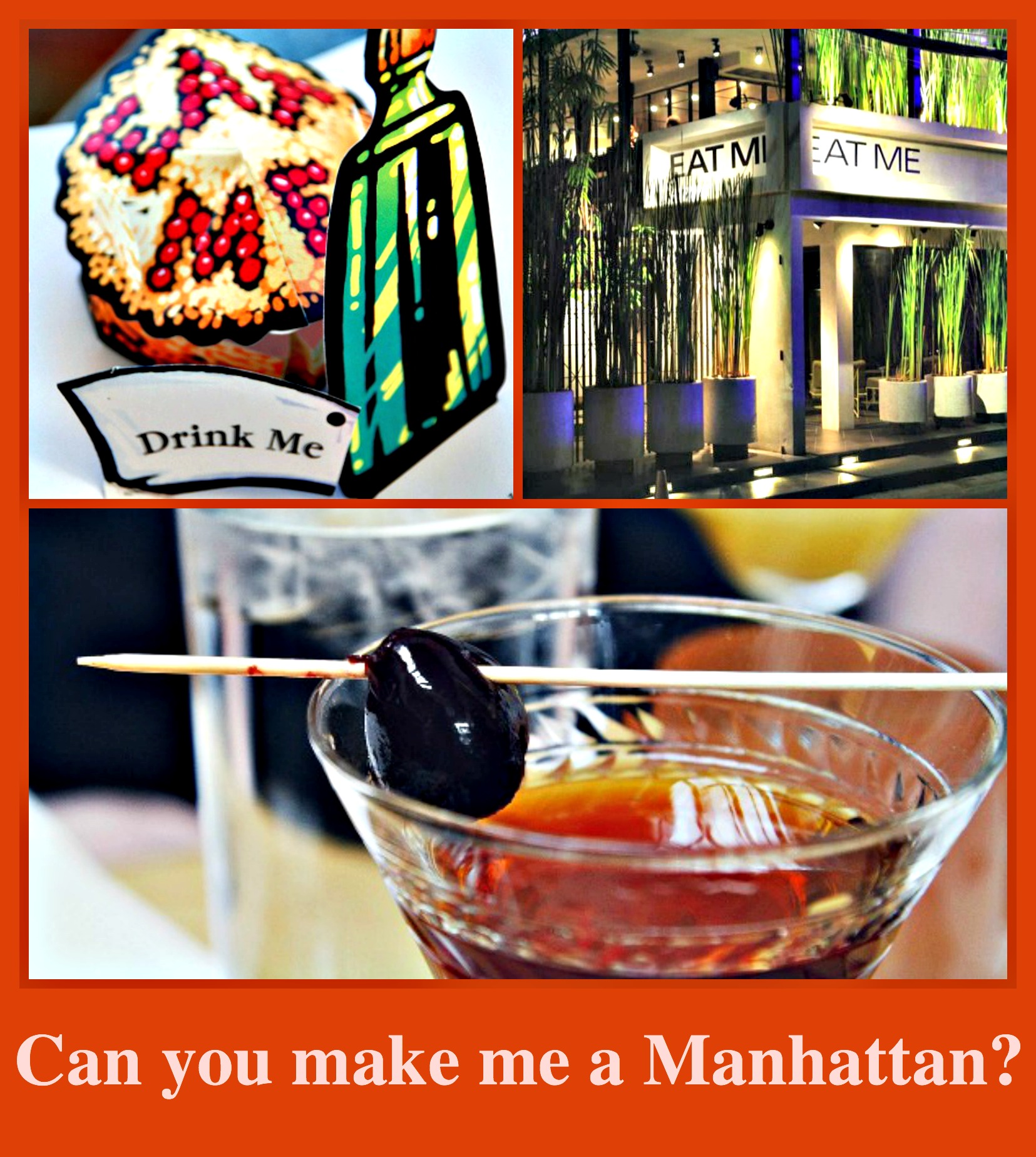
WONDERLANDED: “Can you make me a Manhattan?” by A. Spaice

Can you make me a Manhattan Collage

Drink a Manhattan at Eat Me in Bangkok. Photo credit: “Alice 15,” by AForestFrolic via Flickr (CC BY 2.0); Eat Me Restaurant, Bangkok; Manhattan cocktail via Pixabay.

A couple of days ago, we wonder-landed in Phnom Penh with serial expat writer, artist and sometime photographer A. Spaice. She told us falling down rabbit holes in Europe and Asia has sparked her imagination in untold ways—not least by convincing her that a Mad Hatter’s tea Party would not be complete without champagne and an opera singer.

Spaice ended her musings on the expat writer’s life on this fittingly dramatic note:

Knowing it’s the connection that I write for now, instead of the “art,” I’m moving into a different channel. I trust this current, because it feels good. It moves, it flows. Sometimes, when I’m lucky, it even likes to dance.

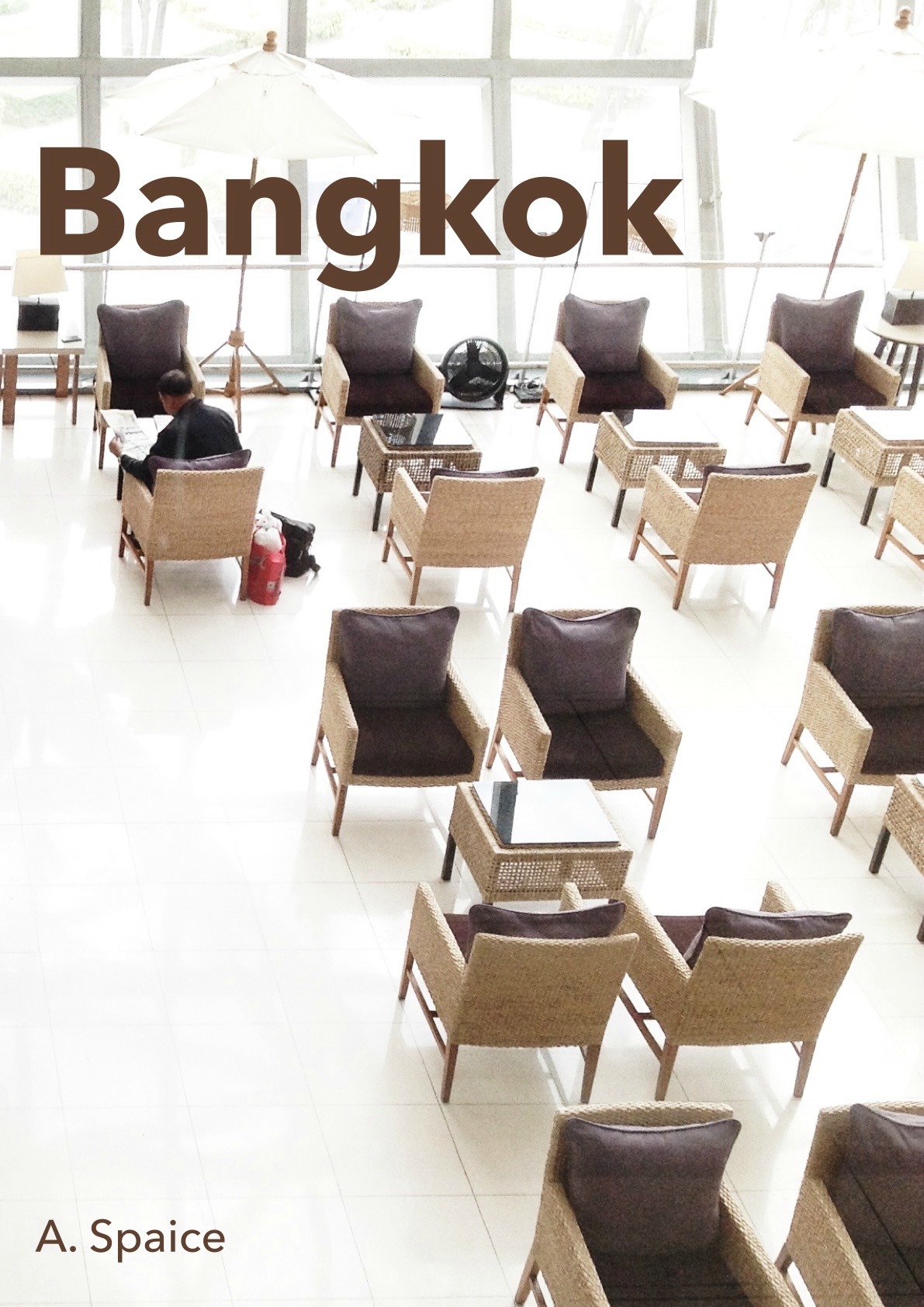
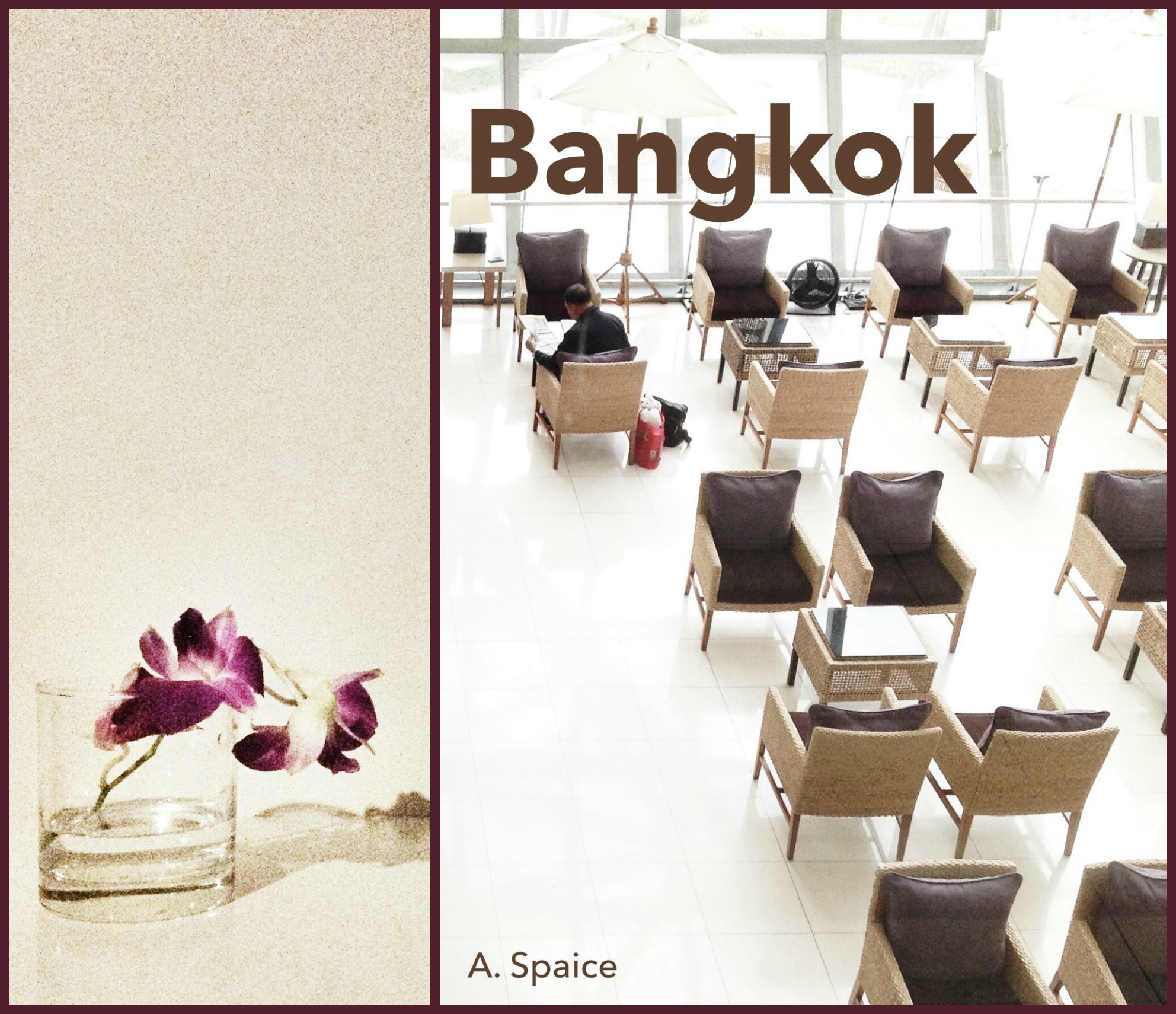
Today she offers a sample of her work that seeks to connect with others who have wonder-landed and lived to tell the story—whether in words, photos, or other forms of creative expression. It’s an except from her short book Bangkok, which she produced as a kind of roman à clef after taking a trip from her current home of Phnom Penh to the Thai capital. Bangkok marks the first in an unconventional short book series she is planning, titled n+1.

Cover art for Bangkok, by A. Plaice.

Cover art for Bangkok, by A. Spaice

* * *

Excerpt from Bangkok

The story principally concerns Karin Malhotra’s attempt to reconnect with an old female friend in Bangkok, Thailand, the Land of Smiles, only to discover they are no longer that compatible. But in this passage, Karin is about to meet someone new, another displaced creative, a magazine editor who has professed an interest in her work…

“CAN YOU MAKE ME A MANHATTAN?” I asked, truly wondering. “Of course.” This was supposed to be the best bar on this side of Bangkok, according to the gay couple that seemed like good people to ask the day before. I wanted a comfortable place. Not too conspicuous, not too loud. But I didn’t expect it to have the kind of name it did. Eat Me.

Still, the guy from the magazine had said “yes,” to meet me there. I muttered something about the name and how I’d heard about it from a bunch of people (two being a bunch) and thought it could work for a conversation space.

He was taller than I’d pictured, and seemed like he might have been French, because of the two-kiss thing that the Europeans like to do when they meet you for the first time. For some reason, he was extremely close to the lips on the second one, but that was kind of flattering, in a way, because he had a rich dark musty scent and I rather liked it.

“So,” he said. “You’re Karin Malhotra. We meet at last.”

At last? Hadn’t we just talked online like, twice? Business conversation making, that was the agenda today.

“Tell me about what you do.”

Oh, boy. Here it was. The test. I hadn’t really prepared for this. I was going to have to wing it. Really, at the end of the day, pretty much everything good that’s come to my life has come of winging it, I realized. With that thought in the forefront of my mind, I got into character. “I make space. I know that might sound odd, but I was meant to be an architect. Designing physical spaces with bricks and glass and maybe new materials but not concrete because in Kyoto I got a giant magazine with Tadao Ando teahouses all in these sad greys which got me depressed for a while because the ones they have in northern Thailand, Chiang Mai and stuff? They have these lovely bamboo colors and textures and earth tones. Which is better. Anyway, I didn’t become an architect for lots of reasons, the biggest one being that I don’t like projects that take more than three or four months to finish. With books, you know, you can take years to write books, but I got into eBooks and nothing more than like a two-hour read, you know? People like that. Short and sweet.”

“Uh-huh.”

“People like it because we are so time-poor right now. Modern people, that is. I’m talking about the malaise of the Western progressive world, where we have books and medicine but we have nothing to get happy about because our souls aren’t nourished properly in the time we’re growing up.

“What I’ve been doing, what I’ve just started since putting the brakes on my own design studio, which you’ll never believe this but is the second time I’ve done that. The first time I just felt compelled to do the same thing again, when we moved from Seattle to Durham NC. Durham is in North Carolina. Have you been there?”

“No. I rarely go to America. I can’t say that I’d ever want to live there, and visiting is a trial.”

“So you’re actually from…”

“Vienna.”

Oh. Memories of college.

Schubert.

Nabokov.

A bottle of Sauvignon blanc.

“Yes, I knew someone from your country once.” I stammered. I wanted to forget about that, but you can’t really forget about those ones you fall for at first sight. Why was I talking about that, though? That was weird. “He was a colleague.” A lie. But… so?

“Where did you work together?”

Shite. I was going to have to keep going with this one? “Oh, just a small firm in Tokyo. They did architecture, but had a base in Los Angeles. I thought I’d make it to Los Angeles because I knew my husband was big into the West Coast, drier air and all. But we wound up in Seattle. It took a while to get there from our time in Japan, though.”

“I love Japanese teas, they are the best.”

“I prefer Darjeeling to everything, personally. But I do love those whisks from those places they have in Kyoto.”

“Are your genetics from India?”

Wow. That was a first. No one put it that way before. Are my genetics from India?

“Yes,” I said. Not barking at them that I’m from the outskirts of Detroit. I hate the where-are-you-from question but I still ask other people, for some reason. I guess it’s habit? Smalltalk.

My bar companion brushed his dark brown hair with his hand, and I noticed that it had a few stray grays. This was interesting. When did I ever think men with gray hair could be attractive? This was news. Maybe it had something to do with turning almost-forty. A round number.

“I have never been to India,” said Glenn. He had a really long last name that I couldn’t pronounce, much less remember to spell. What was the custom in Austria when greeting someone? Was it two kisses like the French, or three like the Swiss? I tried to remember how it had been in those couple of weeks with

“But I intend to go. This winter, in fact.” Glenn was all business, and that reminded me to focus. Not on his hair and his hands and his blue eyes, so puzzlingly deep, but the agenda. “I have to get more writers from that part of the world.”

“You do?”

“Yes. We want to diversify the magazine. It’s far too European for its own good. I really want to bring in some new voices. From afar. From the East. That’s why I contacted you. You seem to have… an Indian-sounding name. I’m sorry… I guess I just assumed…”

“Oh, that’s fine,” I said, waving it away. The truth was it wasn’t fine. Why did my stupid name have to make me into an Indian person automatically? I’d been there enough times to know that the gender bias there is ridiculous and horrid and people aren’t nice within their families, especially to daughters. Goodness knows I’d put up with enough of that growing up with my mother. My complicit brother and father, standing by while she’d hurl psychological abuse upon stones. I hated thinking about those days, and pushed aside the thought as if it were one of Glenn’s locks. I had to stop myself from reaching out to touch his crown, to see if he might notice that kind of action. Just out of curiosity, I’d say, if he asked. Not trying to get with you or anything. Just like the look of you, and enjoy studying your features. High, strong cheekbones made him look a little feminine, but his hands were rough from, what? Magazine work couldn’t possibly be physical.

“Were you always in the publishing industry?”

He took a sip of a new drink that arrived, a tall slim glass that contained a mojito. Kind of a girly drink, wasn’t it?

“No,” he said. “I was a joiner in the past.” “A what?” “Joinery. It’s a kind of carpentry, but specialized. I trained in Germany for it, for about four years. That’s where I met my partner.” “Your… partner?” “He’s a joiner, too, yes.” He. I recalibrated, and quickly. “Ah.”

The waiter came around and saved me. “Another drink?”

* * *

Readers, what did you make of this portion of A. Spaice’s expat-life story? Among other things, I think she has nailed the down-the-rabbit-hole feeling of no longer knowing who you really are or anyone else is, once you have wonder-landed.

Interested to read more of Bangkok? It’s available for purchase at Gumroad and Amazon.

STAY TUNED for next week’s fab posts!

If you enjoyed this post, we invite you to register for The Displaced Dispatch, a round up of weekly posts from The Displaced Nation, and much, much more. Register for The Displaced Dispatch by clicking here!

Related posts:


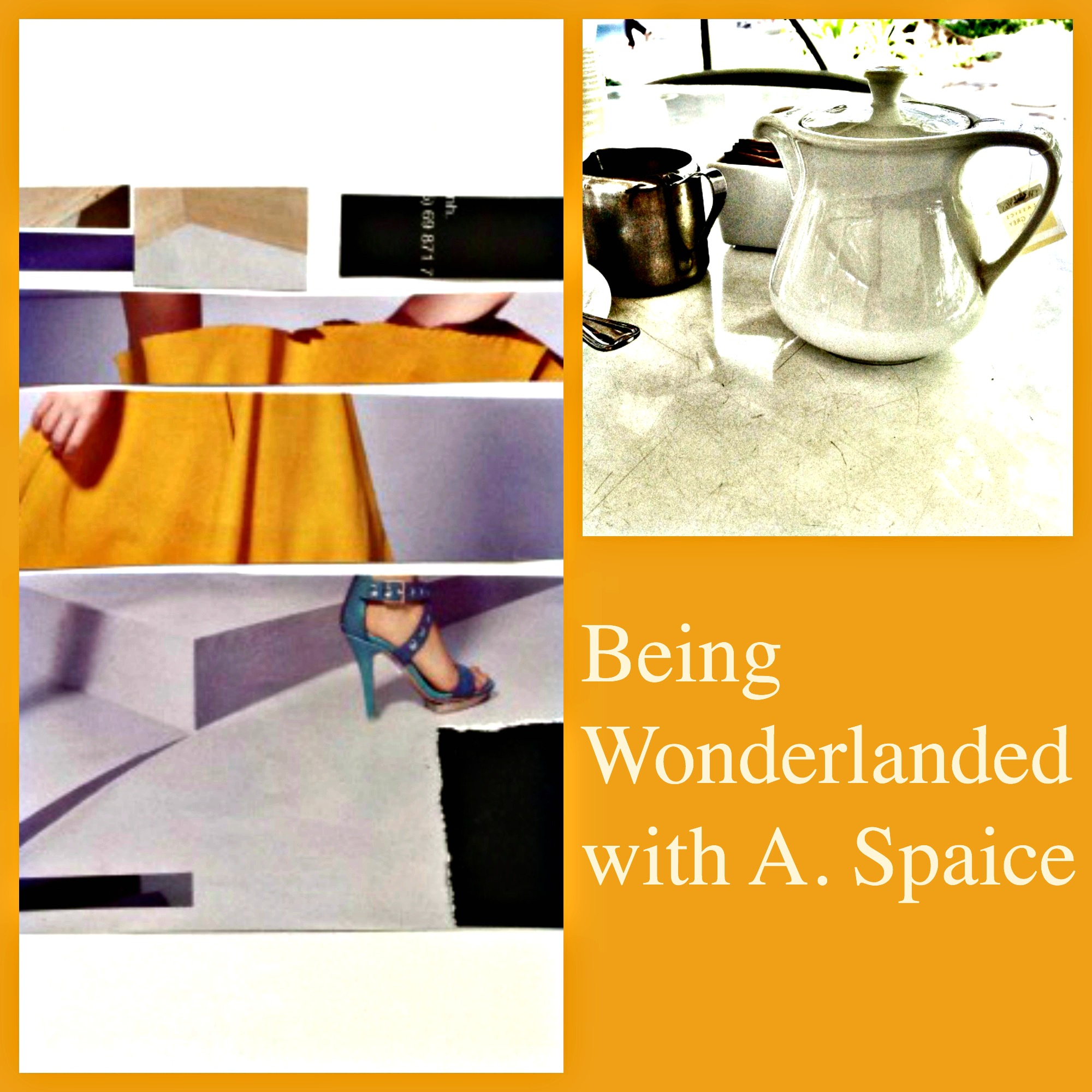
Wonderlanded in Phnom Penh with serial expat writer, artist and sometime photographer A. Spaice

A Spaice Wonderlanded Collage

Tea in Bangkok and Yellow in Phnom Penh. Photo credit: A. Spaice.

Curiouser and curiouser! Residents of the Displaced Nation have always had a deep affiliation with Lewis Carroll’s Alice. We can identify with her experiences of falling down a rabbit-hole and stepping through a look-glass into a world where one doesn’t know, can’t even guess at, the rules of the game. Alice’s sense of discombobulation—which of us hasn’t had at least one pool-of-tears moment after moving to another culture?

By the same token, which of us hasn’t grown, and been stretched, in new and unexpected directions by our displaced lives of global residency and travel?

This year, to celebrate the 150 years of Alice’s Adventures in Wonderland, I am hosting a new “Wonderlanded” series, beginning with today’s post.

Our very first Wonderlanded story is from A. Spaice, who has led a life of remarkable transitions after falling
d
o
w
n
the hole.

Spaice grew up in a rich Western country to be an engineer-artist, disappointing a lot of relatives who insisted (without invitation) that a more “normal” career would make life easier.

But this just pushed her to resent all sorts of social mores, sparking a journey that would never stop anywhere for more than six years. Her path cut a line to the Far East, looped Western Europe, and now, as we hear the details of her Wonderlanded story, Spaice writes from Phnom Penh, Cambodia, having assumed a few new layers to her creative identity as she continues to insist on looking inward to work out Alice’s big question:

“Who in the world am I?’ Ah, that’s the great puzzle!”

Without further ado, I give you A. Spaice!

* * *

Greetings, Displaced Nation readers! I look forward to telling you my story of how I became wonderlanded. But first, a few details about me. Before taking this new name, A. Spaice, I’d been happily writing under my own, mostly first-person essay style accounts and often set in foreign lands. It was fine. I got places. I enjoyed it. But then, I hit bricks. Through my writing, I’d wanted to tell my story and when that was done, I realized it was okay to stretch a bit, to try new things, maybe even third person. Crazy! So after a long time of not knowing one phase could end and a new one begin, I feel a reinventing going on, from within. This propels me, and it’s been a while since I’ve felt that kind of inward push, and I know this is the kind of thing you need to have if you want to get it done and make it good. So I’m happy to make the transition, and let go of the old style.

“Why, sometimes I’ve believed as many as six impossible things before breakfast.”

Along the way I got surprised about something. My major in college was engineering, and I worked in architecture firms for a while, so it’s been fun playing with new concepts in my work, like torque and momentum, or the radiation heat transfer equation, that kind of thing. I’m going to have to find a way to use ! for factorial. I’m terribly excited, and I hope this energy will reverberate through in my just-born, about-to-become-something N+1 series. (Mathy, right? I kind of dig it.)

“I’m afraid I can’t explain myself, sir. Because I am not myself, you see?”

A year ago at this time I was in Chiang Mai, Thailand. I had no idea what I was going to do for work or how I was going to “make it,” or if I’d need to abandon some old idea about what that even means, or something else. Among my possessions was an old copy of You Can’t Go Home Again, which, if you are traveling Asia and the kind of person who sizes people up by the amount of luggage they have, you wouldn’t have given me an ounce of attention because this thing is cement.
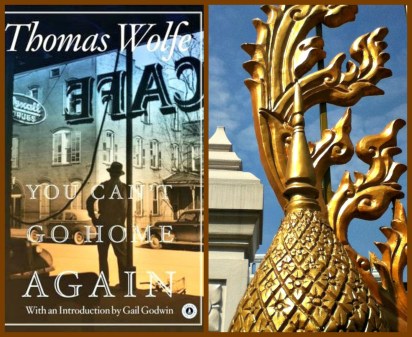
You Can't Go Home_Thailand

You can’t go home again; you’re in the Kingdom of Wonder! Photo credit: Book cover art; A. Spaice.

Thomas Wolfe was pretty roundly criticized, it says in the back notes of the book, for not being able to edit stuff himself and relying on people to help him cut things into a story-like form. But wow. His writing. It’s just…it’s so lovely and right on.

It was there with me in the suitcases, and it is here with me now, as I write. It’s been a comfort. I didn’t know anything about what was ahead (a bus ride to Siem Reap, then another to Phnom Penh, a welcome from some people social media introduced me to, and then, falling in love with Cambodia in an abstract way, because of the whole “Kingdom of Wonder” thing, but also, in general, its aesthetics (architecture, attention to symmetry, detail, and something… something I’m working on trying to capture and will stay until I can name). Ask me about the tuk tuk driver whose floor’s decked out with astroturf. A humor, a style, something else. Unpretentiousness, perhaps? Directness? Reality? Maybe it was this that made me feel, “Yes. Stay.”

But the book, that book being with me, that’s been an anchor. I keep it for comfort. I read it for love. I look to it to remember that yes, the road is ahead of you, that you can’t go back, that you just can’t fall upon some idyllic picture that isn’t real. Snap! You Can’t Go Home Again. And accepting that, right there, in the middle of the wondering, in the enchanting early evening hour of arriving on that long road from Chiang Mai to Phnom Penh, with sun reddening this sky, I knew. Something would work out. “I’ve got this. This is going to be just fine.”

An early “pool of tears” moment

Ireland. 2000. I was plonking myself into the countryside “indefinitely.” There were times out there on the farm in southwest County Cork that I wondered, “What the heck was I thinking?” I was still young then, and feared I was missing something. The city, the lights. A more familiar variety of arts and culture. What did I have in the hills? Views, rainbows, sheep, the grass-fed cow’s milk and Kerry Gold butter, sometimes shared by friends and neighbors in Union Hall and Dunmanway. Lots and lots of partying, but the honest kind, with board games and stories and singing and the craic. This was before the Internet era, so I have my doubts it would be the same now. But little by little, sticking around three years and a bit, you got to know the place and the people, and they got to know you. (A part of me is Irish, you know. From West Cork, like, so.)

“But I’m not used to it!” pleaded poor Alice in a piteous tone.

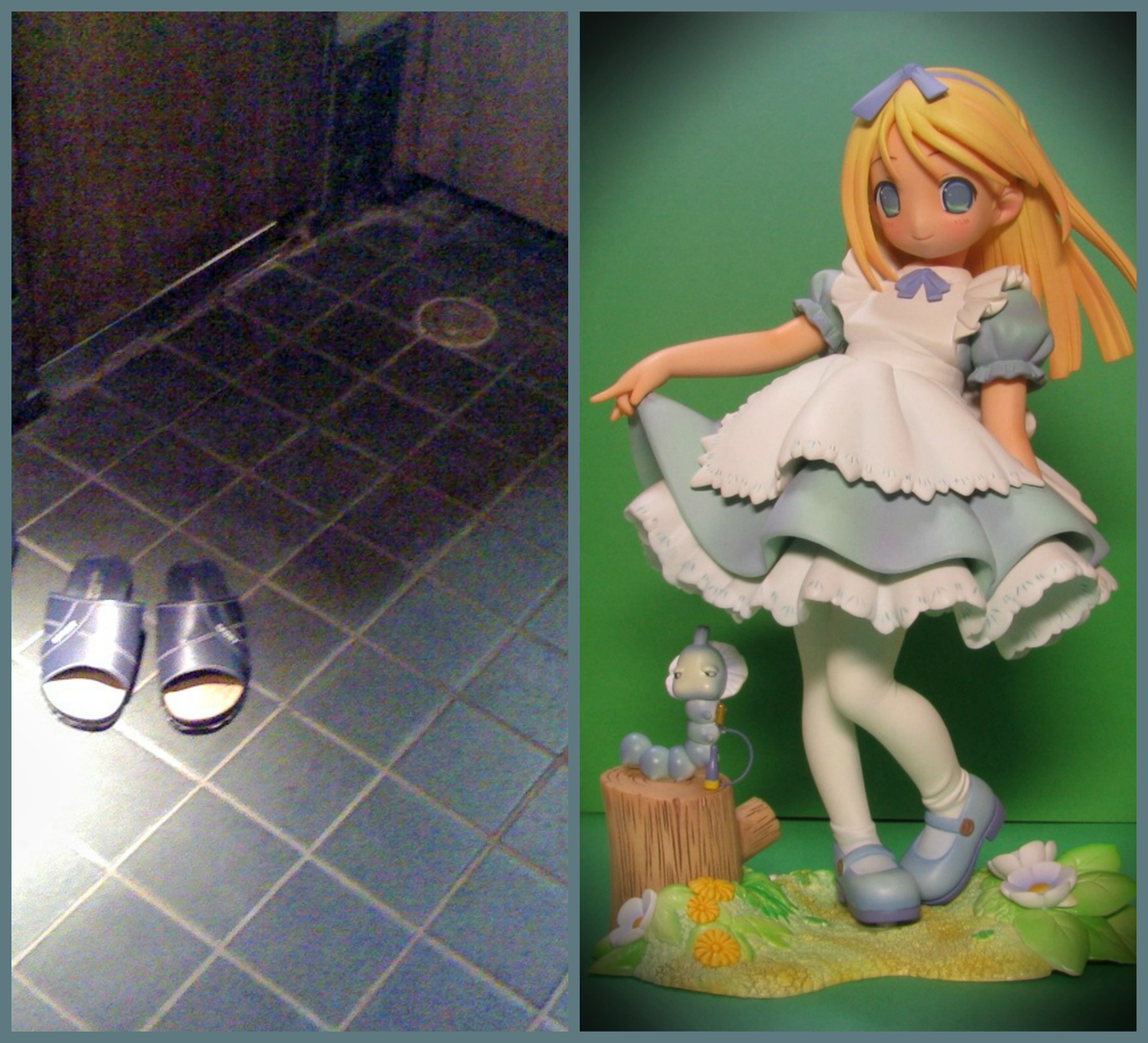
bathroom slippers anime

Through the Utsunomiya looking glass. Photo credit: Toilet Slippers, by Lloyd Morgan (CC BY-SA 2.0); Alice in Wonderland anime doll.

When I was in high school I did a Youth for Understanding exchange to Utsunomiya, Japan. I knew some things, like how you were supposed to bring omiyage so I had one small item each for my host brother, sister, father, and mother. I felt cool knowing you were supposed to leave your shoes in the genkan and wear slippers around the house. What I didn’t know was that when you go to the bathroom you change into special bathroom slippers.

I saw those, put them on, but forgot to change back into regular non-bathroom slippers and so entered the dining room, excited about all the new kinds of food. My host family was horrified. Awkward, but they made a printout of house rules, which they left on the kitchen table the next day. “Bathroom slippers are for the bathroom.” When I realized what had happened, I was redder than the cherry tomato atop the last night’s dinner salad.

“Well, I’ll eat it,” said Alice.

Iced tomato smoothies. Saigon.

Recipe for a successful Mad Hatter’s tea party

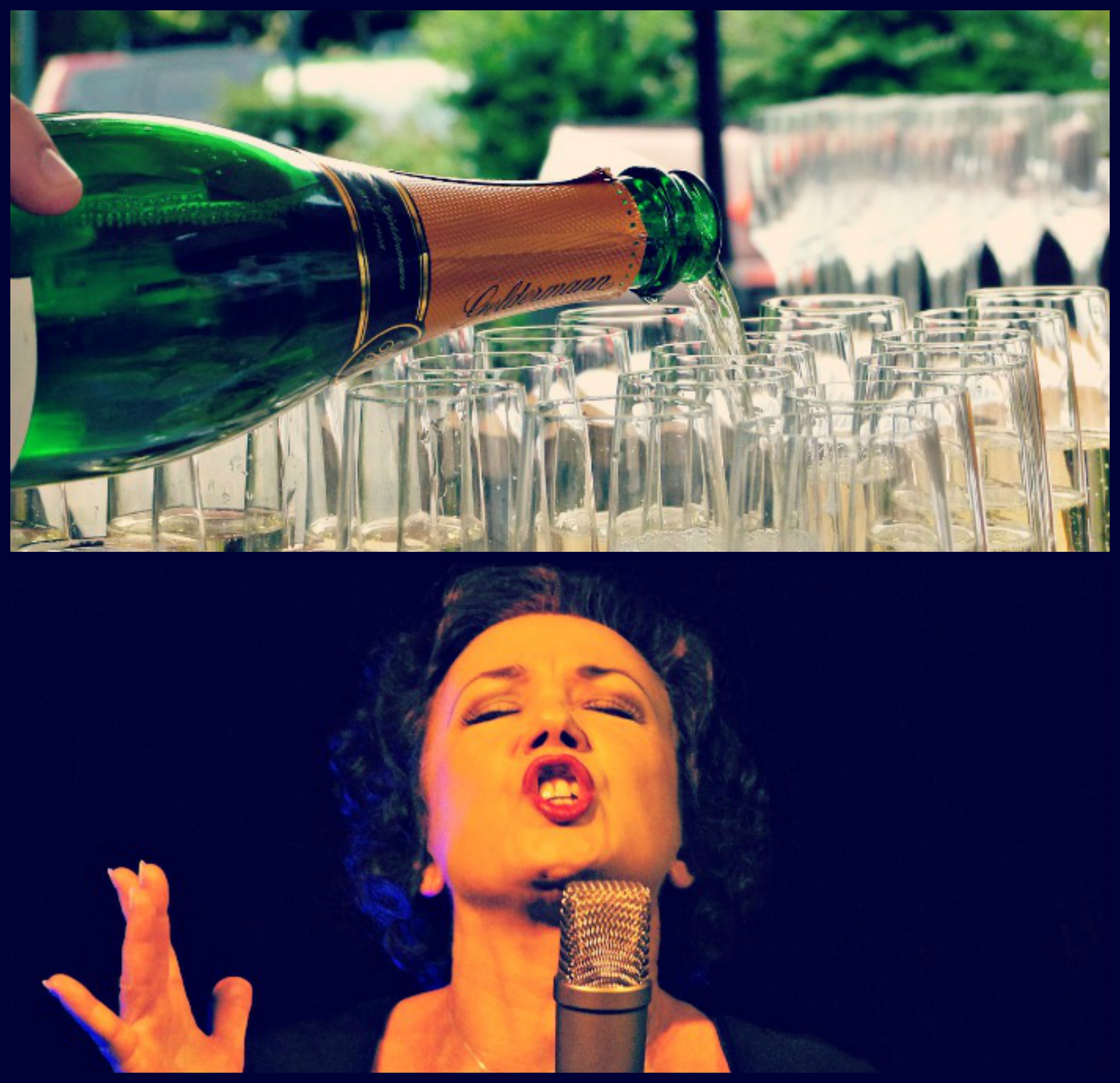
I’d host it in a place with lots of windows, preferably floor-to-ceiling, maybe on the second floor of a well-maintained building with high ceilings. There would be just 16 people—I find this to be a magical number for gatherings, you can arrange guests in pairs and then change it up, into four sets of four. Also cozy. I love having people shift about when I throw a party, it changes up the energy, and gives it a tint of surprise. I would invite people of all ages and career types because there tends to be a lot of silos out here. There would be tea for everyone, and later, an impromptu concert, with an opera singer, and then, champagne. (The opera singer and champagne part actually happened once here, magic!, so I’d have that for my guests for sure.)

champagne and opera

This mad hatter entertains with champagne and opera. Photo credit: Champagne via Pixabay; singer via Pixabay

“Oh, I’ve had such a curious dream!”

I think it’s weird when I go to California, say, and see people eating salads out of boxes. Noticed myself wishing there was more rice around San Francisco. I wondered, quite out of character, why women don’t cover their skin, especially when swimming. Isn’t that funny, when you’ve grown up in the West? Yet there are also the nice parts: people understand one hundred percent of what I say, and vice versa, and I can joke around, and it’s received, and I feel like my “old” self again. Remarkable.

“I almost wish I hadn’t gone down that rabbit-hole—and yet—and yet—it’s rather curious, you know, this sort of life!”

But I also see now that I’m interested in other kinds of things and that my experiences have taken me to far edges, the kinds of edges that aren’t photographable, and these make me feel like I get along better with a traveled set, not necessarily those from a particular country, or style, or personality, or something else. I like the everykind, the mixitup. I like the sense of possibility and connect with those who also want to keep it open, not box it in. Maybe that’s why I’ve lost interest in identifying with a certain country, or any other kind of label, come to think of it, too. Disorientation is part of it, but it’s precisely because of the crisscrossings that I’m figuring out, slowly, who I am. And it’s this feeling, this waking-up feeling, that is why I wanted to connect with Displaced Nation because it’s here I see it’s not just me in this big pot of “Wait. What just happened?”

Advice for those who have only just gone through the looking glass

Trust the process.

“Alice had begun to think that very few things indeed were really impossible.”

Okay. Well, moving from essays in high school to papers in college to, later, writing that has to go out on deadline, I’m finally able to say: I’ve got my voice. I know who the writer in me is. I’m confident, too, that this writer really wants to grow and stretch beyond previous boundaries, and that’s where this new thing, this thing I’m calling “N+1”, came from. A series of short books, based on the people I’m meeting in real time in the places where I go for three weeks or maybe two months at a time.
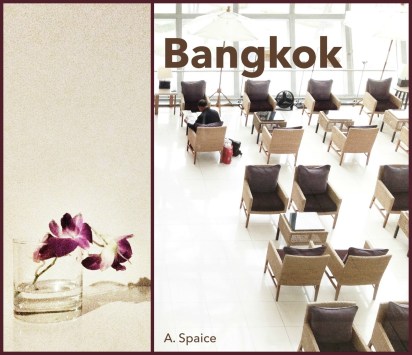
"In Bangkok" by A. Spaice; cover art for A. Spaice's short book, Bangkok

Creative output from Bangkok. Photo credit: “In Bangkok” by A. Spaice; cover art for A. Spaice’s first short book, Bangkok.

I’ve spent my whole life observing and taking notes, but it’s not the notes I’m referring to anymore. It’s not the pretty turns of phrase that I can feel like I can put in there, just, there!, or things I used to think made a person go, “I’m a writer!” No, it’s other stuff. It’s knowing that something you’re saying actually resonates. Connecting deeply with other people in small moments of sharing—that’s important to me. Words have a brilliant potency to make that possible, but they’re just one way. Knowing it’s the connection that I write for now, instead of the “art,” I’m moving into a different channel. I trust this current, because it feels good. It moves, it flows. Sometimes, when I’m lucky, it even likes to dance.

After Bangkok I’ll publish a new piece set in Dalat. It’ll be the first thing I’ve written in third person. My best friend, and my go-to editor, is listening to me read this aloud, and nodding, and smiling. Switching gears, writing different. It’s a good, happy change.

* * *

Readers, how did you enjoy spending time being wonderlanded with A. Spaice? Did you find her story a curiosity or could you relate?

STAY TUNED for the next fab post: an excerpt from A. Spaice’s short book Bangkok!

If you enjoyed this post, we invite you to register for The Displaced Dispatch, a round up of weekly posts from The Displaced Nation, and much, much more. Register for The Displaced Dispatch by clicking here!

Related posts:
GLOBAL FOOD GOSSIP: Is humankind getting too fussy to share food, one of our most basic bonding rituals?

Global Food Gossip April 2015

Joanna Masters-Maggs (supplied) and three forbidden foods: Wheat , by Rasbak via Wikimedia Commons (CC BY-SA 3.0); dairy, by Stefan Kühn via Wikimedia Commons (CC BY-SA 3.0); and peanuts, by Daniella Segura via Flickr (CC BY 2.0).

Joanna Masters-Maggs was displaced from her native England 17 years ago, and has since attempted to re-place herself in the USA, Holland, Brazil, Malaysia, Venezuela, Saudi Arabia, and now France. She describes herself as a “global food gossip”, saying: “I’ve always enjoyed cooking and trying out new recipes. Overseas, I am curious as to what people buy and from where. What is in the baskets of my fellow shoppers? What do they eat when they go home at night?”

* * *

Dost thou think there shall be no more cakes and ale
Because of thy wretched bowels?

—Paraphrase of Sir Toby Belch (Twelfth Night: Act 2, Scene 3)

Readers, I hope you will indulge me in this dramatic, and admittedly somewhat unseemly, turn of a Shakespearean phrase. Not long ago, I was planning a simple supper for a few couples and had just received a third text informing me of various food allergies. The relaxed and convivial supper I had imagined was rapidly becoming a nightmare of compromise and unsatisfactory substitutions.

Somehow I had to come up with a delicious menu that didn’t involve dairy, flour or meat.

I should have known not to invite a bunch of people I barely knew, but I was feeling expansive at the time. I’d also been envisioning a pleasant few days pottering through familiar recipes in my kitchen—only to find myself feeling cross, taken for granted and somewhat overwhelmed.

As those of you who are cooks will know, “simple” suppers never take less than days to bring off in the desired relaxed and blasé style—so one really needs to enjoy the preparation. Frankly, getting ready for this particular dinner was beginning to feel like a challenge on a brutal reality show.

I also felt I could empathize with the nearly 100 restaurateurs in Britain who last month signed a letter protesting the new EU rules requiring restaurants to audit their menus for allergens from lupins to eggs. These allergens must be flagged on menus. Failure to do so could result in a $5,000 fine which, for most restaurants, could be the difference between survival and going to the wall. They rightly point out that having to undertake such work will also reduce the spontaneity of their menus and reduce creativity.

Modern etiquette requires hosts to ask guests if there is anything they don’t eat.

SirTobyBelch

Toby jug (named after Sir Toby Belch), by Graham and Sheila via Flickr (CC BY 2.0).

This is when the guest can mention any genuine allergies—not their likes and dislikes. I might feign polite interest, but I don’t really care to hear about your digestive issues.

Of course, I do want to know if you are actually c(o)eliac. Curmudgeonly as I can be, I get that this is a very real health issue and I will go to any lengths, happily, to accommodate it.

If I have to jump through culinary hoops because you “really feel that you have more energy since you gave up wheat,” I am, frankly, annoyed.

I once entertained a guest and made the mistake of including in a recipe an ingredient he had repeatedly informed me caused a severe allergic reaction.

To this day I cannot explain how I so deliberately included it; however, when I realized my mistake, it was with a heart-stopping thump in the middle of the night. I agonized for hours, caught a moral maze of whether or not I should call and confess my reckless stupidity or not. As dawn broke, so, too, did the suspicion that if this had been a true allergy, I could have expected some drama before the end of the evening. If I am going to get careless while entertaining an allergy sufferer, I expect the subsequent experience to include severe anaphylactic shock and hysterical calls for an ambulance…

Sure enough, by lunchtime I had received the text thanking me for a lovely evening. The experience has left me deeply suspicious of subsequent allergy stories.

It can’t be fun living with an allergy, but neither can it be everyone else’s responsibility and expense.

During the time when we lived as expats in Malaysia, my children were at school in Kuala Lumpur. Peanut butter was not banned. How can you ban it in a country where peanut oil is a major component of the air? But if your child took in nuts or peanut butter to school, it was their responsibility to sit with kids with who claimed peanut allergies, so that the latter wouldn’t feel isolated.

How severe could such allergies be, I wondered? Indeed, at that time, and probably to this day, Malaysian Airlines tested the peanut-withstanding ability of all those entering the country by serving peanuts with the aperitifs—long after other airlines had bailed.

(While on this topic, it’s worth noting that, according to the latest medical studies, those who consume a greater amount of peanuts have about a 35 percent reduced risk of coronary heart disease. This effect is a result of the peanuts’ ability to lower cholesterol and its antioxidant and anti-inflammatory components.)

When you are invited to eat at someone’s house, you are being asked to share with the family.

dinner party quote

Dinner party, by Elin B via Flickr (CC BY 2.0).

As we expats know better than anyone else, the dinner party is an age-old, worldwide gesture of hospitality and friendship. We must take every measure to protect this prized human tradition.

Listen, it is even possible to desensitize ourselves to allergies. I recently saw a documentary about a little boy who showed extreme allergy to a new dog brought into the family. Instead of re-homing the dog, the family decided that the positive aspects of owning a pet were worth making an effort for. They began a desensitization programme at a local hospital and, in time, the boy could begin a wonderful relationship with his dog.

It’s worth thinking about, isn’t it?

* * *

Readers, we invite you to continue the food gossip! To what extent has food fussiness become an item in your social circle? Are you a victim, or do you agree with the curmudgeonly Joanna, that fussy eaters are making dinner parties and other group meals less fun for the rest of us? Be sure to let us know in the comments!

STAY TUNED for next week’s fab posts!

If you enjoyed this post, we invite you to register for The Displaced Dispatch, a round up of weekly posts from The Displaced Nation—and much, much more! Register for The Displaced Dispatch by clicking here!

Related posts:

Ten years after “Expat Harem,” foreign women will have another say on expat life in Turkey

Tea in Gülhane Park[http://www.flickr.com/photos/wneuheisel/6493228113/ ], Istanbul, by William Neuheisel via Flickr (CC BY 2.0).

Tea in Gülhane Park, Istanbul, by William Neuheisel via Flickr (CC BY 2.0).

When the Displaced Nation first started, Anastasia Ashman, an American living in Istanbul, was running a blog tailored to the needs of the “thinking expat.”

It seemed almost too good to be true: a group of women who were passionate about telling stories that illustrated the impact of the expat life on a person’s psyche. Had Anastasia rubbed a magic lamp to conjure up a kind of foreign harem? After all, her site was called Expat+HAREM.

In fact, as we soon discovered, the core contributors to the site had also been contributors to a book Anastasia had co-edited with Jennifer Eaton Gokmen, Tales from the Expat Harem: Foreign Women in Modern Turkey, which came out in 2005.

Anastasia has since moved on from Turkey, the expat life and the Expat+HAREM project. As she reported in a post to the Displaced Nation three-and-a-half years ago, she and her Turkish husband traded Istanbul for her native San Francisco because they thought that life in America’s high-tech city would “more closely align with a future we want to live in.”

Yet the work she created on the basis of her Turkish expat life has lived on in her wake.

And now two American expats in Turkey, Rose Margaret (Rose) Deniz and Katherine (Katie) Belliel, have announced their intention to produce a kind of sequel to Expat Harem, which is scheduled to be published later this year, to coincide with its 10th anniversary.

The title of the new anthology will be Sofra: A Gathering of Foreign Voices Around the Turkish Table.

As that title suggests, we’re shifting metaphors: from the harem to food. But no need for me to go on any further as Katie and Rose are joining us today to discuss their plans for the new volume. (Note to female expats who have lived in Turkey for at least a year: the window for submissions closes on April 1st!)

 * * *

Sofra Editors Horizontal

Meet Sofra editors Katie Belliel (left) and Rose Margaret Deniz. Photo credit: Journey Collective

Hi, Rose and Katie, and welcome to the Displaced Nation. Before we talk about your plans for a sequel, let’s go back to the original work. Katie, I understand that you contributed a story to Tales from the Expat Harem. What did you write about?

KATIE: “A heart-broken Michigan girl finds closure in Bursa at an ancient Ottoman bath, nurtured by her would-be Turkish sister-in-law.” This line that introduces my story in the book sums up my piece nicely. It is about how my first journey to Turkey was for love. My return was also for love—but not for my failed relationship. It’s the story of how I returned for closure, but stayed for my true love, Turkey the country. At least, that is what I hope people understand when they read my piece 😉

How about you, Rose? I believe you were active in the book’s companion blog and online community?

ROSE: I was a frequent writer for expat+HAREM, the companion site for the book (it was Anastasia Ashman’s brainchild). For example, I facilitated a roundtable discussion that included nine female cultural ambassadors from around the world, called Dialogue2010. It was a live conversation on art, culture, and hybrid identity inspired by my post to expat+HAREM called Mapping the Imagination. We sought to create a living definition of hybrid identity and how one’s worldview literally shifts as a result of location.

Am I right in surmising there was something very special about the Expat Harem experience?

KATIE: Being a part of Harem was an incredible experience from beginning to end. I knew I could trust the editors with my story; we had a wonderful relationship. They inspired confidence in me, and really gave me the courage to keep writing even well after Expat Harem was published. I also find that I keep going back to the book, as different stories speak up at different times in my life. Right now, as a mother, I am particularly drawn to Maria Orhon’s story about her daughter. Two years ago, when we bought our new house, Annie Prior Özsaraç’s story about their house problems gave me a much needed laugh amongst our then house troubles.

ROSE: I remember reading the book around the time I moved to Turkey. So many of the stories struck a chord, especially as I was getting my bearings those first few years. It made a big impression on me.

The Harem book features stories by expat women, and this new book you’re working on, Sofra: A Gathering of Foreign Voices around the Turkish Table, is likewise calling for female contributors. What’s the thinking behind the “women only” approach?

KATIE: Both Rose and I were heavily involved in the sisterhood of Expat Harem: all-female writing groups, entrepreneurial initiatives, and other spin-offs. It seemed natural for Sofra to be another book featuring women expat writers.

ROSE: Yes, as Sofra is following in the footsteps of Expat Harem, we thought it important to continue the tradition of honoring women writers.

But are men’s voices unwelcome?

KATIE: We mean no offense to the guys. I’m sure they have wonderful stories, which we hope to incorporate in the Expat Sofra community. In fact, we want to open Expat Sofra’s companion blog to expats from around the world, male and female. Stay tuned, as these plans are evolving.

I understand that sofra means “feast,” and you are proposing to make the new anthology at least partly about food. I’m curious: what was your own food journey like in Turkey? Did you take to the food right away?

Turkish food

(Clockwise from left): Kokoreç, by William Neuheisel via Flickr (CC BY 2.0); big black Turkish [figs] , by naturalflow via Flickr (CC BY-SA 2.0) ; Istanbul: Ayran, by tomislav medak via Flickr (CC BY-SA 2.0).

KATIE: I was really hesitant about Turkish food at first, but then I just dove right in. Kind of like how I fell in love! There was no going back. There are still some things I just can’t eat or drink, like ayran (a milky yogurt drink) and kokoreç (intestines, usually lamb). I still try them on occasion, but they are just not for me! I have many favorites. Fresh figs are at the top—I look forward to fig season at the end of August/early September each year. Pazı, a kind of green, leafy chard, is my favorite vegetable, I eat it sauteed with onions and yogurt.

ROSE: Turkish cuisine is definitely a leap from the standard Midwestern fare of my native Wisconsin. I love cooking, though, and embraced the challenge of learning new dishes but adding a twist from my roots. My least favorite food experience would have to be the amount of service required when having guests over. It is more tiring at times than the meal! However, now I can say that my Turkish friends and family appreciate buffet style big meals at my house, and I don’t stress about every detail being perfect as I did in the past. My favorite food experiences are cooking with my friends and family. Nothing flavors my sofra better! Another thing I enjoy is sourcing my food locally. We get milk, butter, and eggs from our neighbors’ farm, and even turkey and chicken from time to time!

You are also conceiving of food as a metaphor for the expat life in Turkey, which can be sweet, bitter, tangy, or spicy. Regarding your own Turkey experience: what percent has been each of these taste sensations?

KATIE: Good question. I would argue that my experience here has been an equal part of all the tastes. There are beautiful and not-so-great parts of each flavor. But that is life, right? Even bitterness becomes a taste we crave if denied it for too long. So, I believe in appreciating the full flavor of whatever is put in front of me in the moment. Appreciating all parts of it for even if I don’t understand the taste then, I will understand it much later.

ROSE: Hmmm, I would say my life here has parts of each. Similar to motherhood, there are wonderful, sweet moments, and moments that are bitter. I would also add the combo of bittersweet to the mix! We are challenging our writers to pick one experience and match it with a flavor. You will have to wait until the book comes out to see which flavor I picked to portray.

On my one and only trip to Istanbul, I came away with a copy of the letters written by Lady Mary Wortley Montagu, wife of the British ambassador to the Ottoman Empire in the 18th century. As Anita Desai writes in the introduction, Although Lady Mary was well traveled,

it was Turkey and her first experience of a non-European, non-Christian civilization that provoked her most open and heart-felt admiration.

Do you see your book as having a further purpose of helping to explain Turkey to the West?

"Liotard Lady Montagu," by Jean-Étienne Liotard. Licensed under Public Domain via Wikimedia Commons.

“Liotard Lady Montagu,” by Jean-Étienne Liotard. Licensed under Public Domain via Wikimedia Commons.

KATIE: I am currently re-reading Lady Mary Wortley Montagu’s The Turkish Embassy Letters. I read them before moving to Turkey. It’s nice to re-read them after living here for over a decade! Our book definitely seeks to show a different side of Turkey than is commonly portrayed by the media. What is the main thing every tourist says after their first visit here? “It’s not what I expected.” We want to show people a deeper, richer side of Turkey. In my opinion, the true side of Turkey.

ROSE: This region is still largely portrayed in a negative light. Expat Harem successfully challenged that by showing a different side, and we hope to continue that with Sofra. Not everything is positive, of course, we don’t want this book to be all cakes and flowers. We want to show a deeper side, an open portrayal of even bitter experiences that give lessons or show growth.

Who is the book’s primary audience?

KATIE: Our primary audience extends from the armchair traveler to the seasoned expat. The foodie to the culinary newbie. A little something for everyone, we hope.

Thank you, both. Talking so much about Turkish food has made me peckish. I look forward to seeing what you cook up in this new book. After our exchange, I’m anticipating a rich stew!

* * *

Readers, if this interview has piqued your curiosity about the Sofra anthology, or even if you simply wish to know how sofra is defined, I encourage you to visit the Expat Sofra site and/or follow the book’s progress on Twitter. And if you’re a woman who has had the pleasure of living (and eating!) in Turkey as an expat, then why not submit a piece to the new anthology? Only don’t forget, the deadline is coming soon: APRIL 1.

STAY TUNED for next week’s fab posts!

If you enjoyed this post, we invite you to register for The Displaced Dispatch, a round up of weekly posts from The Displaced Nation, with seasonal recipes, book giveaways and other extras. Register for The Displaced Dispatch by clicking here!

Related posts:

GLOBAL FOOD GOSSIP: Et tu, France? Fiddling with that fine American classic, the Caesar salad?

J M-M Caesar SaladJoanna Masters-Maggs was displaced from her native England 17 years ago, and has since attempted to re-place herself in the USA, Holland, Brazil, Malaysia, Venezuela, Saudi Arabia, and now France. She describes herself as a “global food gossip”, saying: “I’ve always enjoyed cooking and trying out new recipes. Overseas, I am curious as to what people buy and from where. What is in the baskets of my fellow shoppers? What do they eat when they go home at night?”

* * *

I have been known to comment on France’s dedication to the classics when it comes to food—or fashion for that matter. (As some readers my recall, I’m a fan of France’s LBD, seeing it as a cure for obesity.)

Actually, there are times when my latest adopted home’s refusal to contemplate a bit of culinary iconoclasm baffles me. But then I come from the UK, which seems obsessed with putting a “twist” on classics or, if not that, then “fusing” apparently disparate food stuffs in a desperate search for novelty.

Much of the time, though, I admire the conviction that as French is best, why fiddle around with something that works well?

Let’s talk about the mille-feuille/Napolean/cream slice

My favourite treat, for example, is a mille-feuille (known as a Napoleon in the US and a cream slice in the British Isles). I can find one in any decent patisserie and know it will be excellent and exactly what it should be: buttery flaky pastry, a rich cream filling and a topping of glacé icing.

I never have to worry that some bright spark will have tried to deconstruct it, spin it or twist it. It remains comfortingly indulgent, mouth filling and ever-so-slightly decadent while also keeping within the bounds of good taste.

If you understand my love for the mille-feuille, it should help you see why I’ve chosen to gossip this month about France’s treatment of the Caesar salad. Clearly, the protection France affords to its own food classics does not extend to those that hail from other shores. I hesitate to suggest a conspiracy, but I have noticed an alarming tendency among the chefs in this part of the world to fiddle with recipes from elsewhere.

Et tu, French chefs?

Some have claimed that there have been so may modifications of the poor Caesar salad over the years that the term “Caesar salad” has lost all meaning.

While I wouldn’t go that far, I would like to point out that this American classic has been treated with reckless disregard here in France. I’ve been trying to puzzle out this very un-French behavior. Is it because of the salad’s humble origins—it was invented in Tijuana, Mexico—not to mention its current status as a menu staple in the steakhouses of Las Vegas?

If so, then the French need to know that this salad is more Grace Kelly than high-kicking showgirl. Much as the Philadelphia-born star brought some film star gloss to Monaco without the tawdry Hollywood tat, the Caesar has much to offer the European Continent. Neither colourfully brash nor tartily sweet, it shows Europe that America can do class, too, and do it well.

So what else has this poor salad done to deserve the indignities heaped upon its noble Roman name? It appears on countless French menus the country over, but I have yet to find one that comes close to those I have enjoyed in America. What is going so terribly wrong?

The classic Caesar vs. the French Caesar

The classic Caesar involves Romaine lettuce tossed in a dressing made from egg yolks, oil, lemon juice, parmesan cheese, a dash of Worcester sauce, maybe a dash of Dijon mustard and topped with croutons, possibly a sprinkling of bacon, and more parmesan. That’s it. Perfection. Leave it alone.

Yet the one I had in a bistro on Cours Mirabeau here in Aix yesterday involved tomato quarters, a poached egg, slivers of raw carrot and a mixture of leaves including frisée. Frisée! (Endive if you will.) What sort of abomination is that? The bitter flavor fights the smooth creaminess of the dressing, and the springy dry texture takes over the salad’s delicacy.

In any event, here is what I beheld on my plate:
NotQuiteCaesarSaladinAix_pm
We’ve already discussed the tomatoes and the endive. Let’s move on to gossiping about the dressing. How can France of all places not get this right? A country where it is not considered suicidal to indulge in raw meat and egg.

Readers, while I was condemned to a hygienic, bottled, nondescript white dressing lacking in any flavour much least of egg—its sole being to lubricate and aid the passage of frisée down my protesting neck—I happened to glance at the main at the neighboring table. And you’ll never guess what I saw? He was enjoying a steak tartare topped with a whole raw egg!

Never lose an opportunity for culinary enhancement!

And this is not the only scandalously wasted opportunity for France to show America how its food can be better done. As American devotees of the Caesar will know, there is an ongoing and passionately fought debate over whether or not the newcomer ingredient of the anchovy is too inauthentic to tolerate or a delightfully salty addition to the rather bland romaine leaves.

(The original salad included anchovies only insofar as they are an ingredient in Worcester sauce. They were not blended into the dressing, nor did they appear whole amongst the leaves and croutons.)

Now, anchovies, I’ll have you know, are found everywhere in France, in all forms, and they are very, very good.

Which is why I simply don’t understand why French Caesars ever omit them from the Caesar salad. (I suspect my tartare-eating neighbor had some on his plate, too.)

Why am I such a fault-finding gossip?

Readers, at this point you may wonder why I felt compelled to report on my apparently doomed search for an authentic Caesar salad here in the South of France.

British anthropologist Kate Fox put her own tribe under scrutiny and reported on the findings in her 2005 book, Watching the English. She suggests that the English complain as it draws us together in adversity. If we do not complain about our lives, we risk being self-satisfied show-offs keen to prove that our lives are perfect. As we place great value on dealing well with any adversity life throws us, optimism can appear smug.

Just think, if I had written that the best Caesar salads are to be found in France and only France and how happy I am that discovered this fact, my life would seem too intolerably pleased with itself for any of you readers out there to tolerate.

And perhaps for that reason I take pleasure in knowing that while the French can produce the perfect mille feuille, they are a little challenged in the salad department. In this way I can love France, because it isn’t intolerably perfect. Voilà!

Or is this whole thing just a sign of my competitiveness?

French author José-Alain Fralon has characterized the relationship between the French and the British by describing the British as “our most dear enemies”.

There must be some truth in what he says. Because before ending this month’s gossip session, I feel compelled to tell you a story about how, when I was back in Blighty recently, I arrived very late in the town of York. A Weatherspoon’s pub was still serving food. I went in and ordered a Caesar salad. Now, Weatherspoons is not a chain renowned for fantastic food, but as you can see from this photo, they understand the requirements of croutons, parmesan, romaine lettuce and a creamy (albeit not very eggy) dressing with some hint of Worcester sauce:
CaesarSaladinUK_pm
I was delighted to see that tomatoes were absent—the only addition to the classic being chicken, which seems the accepted standard now.

Not to be invidious, but if Weatherspoons can get the basic elements right, then why not an Aix bistro?

* * *

Readers, we invite you to continue the food gossip! Have you noticed any abominations of your previous home food classics similar to what Joanna has observed with the French Caesar? Be sure to let us know in the comments!

STAY TUNED for our next fab post!

If you enjoyed this post, we invite you to register for The Displaced Dispatch, a round up of weekly posts from The Displaced Nation—and much, much more! Register for The Displaced Dispatch by clicking here!

Related posts:

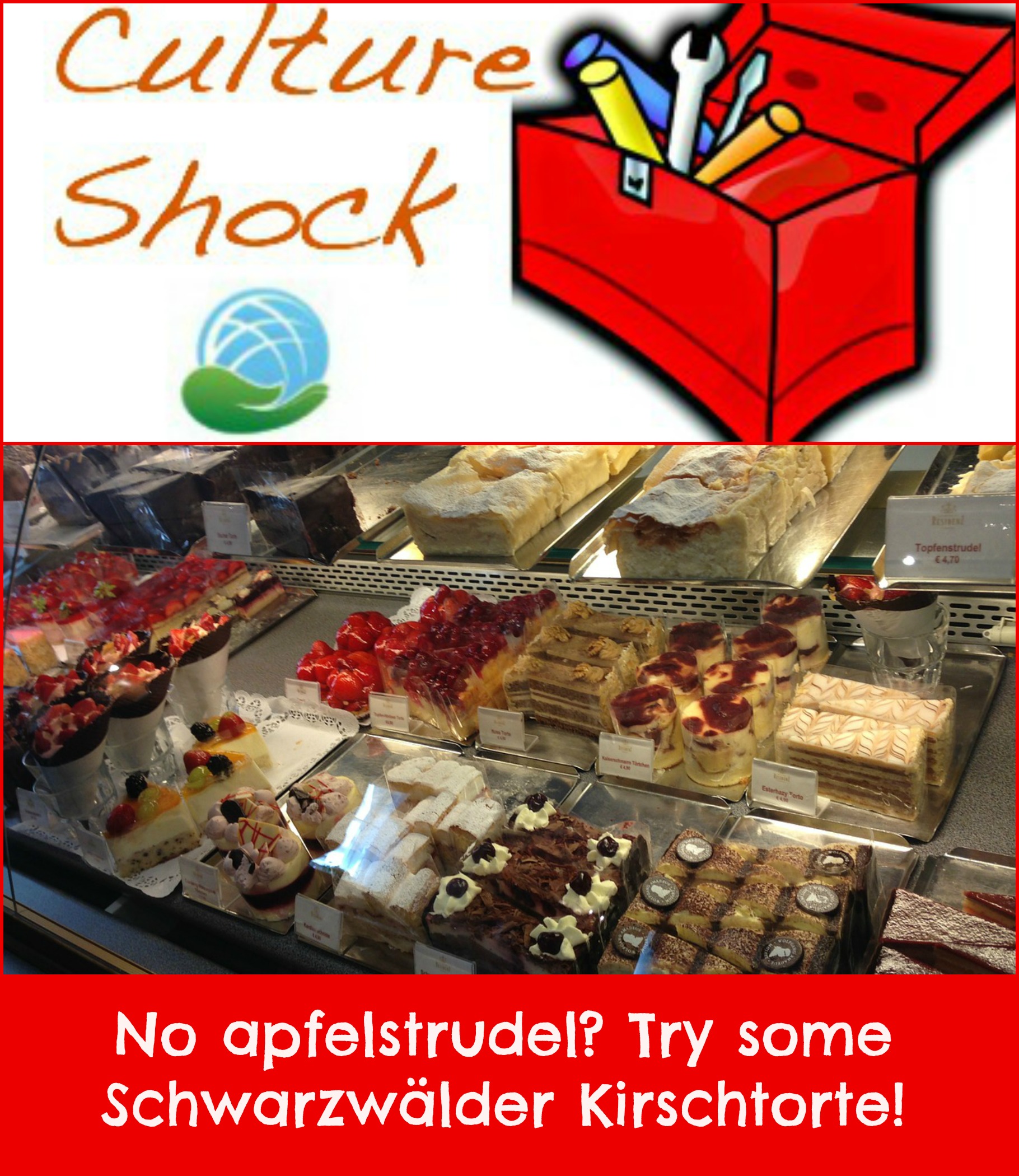
CULTURE SHOCK TOOLBOX: No apfelstrudel? Try some Schwarzwälder Kirschtorte!

CST apfelstrudel collageToday we welcome a new columnist, H.E. Rybol, to the Displaced Nation. The product of a German dad and a French mom, H.E. has lived in the United States, Luxembourg, England, Spain, Switzerland and Singapore. (She currently resides in Luxembourg.) After 16 years of the Third Culture Kid life, she feels well equipped to handle any culture shock challenge that may come her way, and recently compiled these tools in an e-book. In her column for us, H.E. will be sharing some tips for handling the inevitable through-the-looking-glass moments every international faces—albeit with a certain finesse—through excerpts from her own writings and interviews with other cross-cultural experts.

—ML Awanohara

Thanks, ML, and greetings, Displaced Nation readers!

Today I’m going to be talking about how our expectations shape our experiences. While that is something we all might know, we may not always be aware of it when it comes living life in other lands.

I am reminded of when I spent a bit of time in Dortmund, Germany. I spent my afternoons writing in a small boat-like cafe: blue sky and fluffy clouds were painted in the “portholes” on the back wall and ceiling, there were railings, two fake palm trees, maritime decorations carved out of wood: a seagull, a lighthouse, a sailboat.

Corny maybe, but I loved it.

One day, two women walked in with immaculate haircuts and fancy jewelry, conversing. They seemed excited, as if they’d really been looking forward to this moment. They ordered, merry faced and with their arms firmly planted on the table….an apfelstrudel.

The waiter, a young German-Egyptian, seemed bewildered: “A what?”

Apfelstruuuudel.”

Apfelkuchen?”

“No, no!” The women insisted.

This place offered an array of creamy and luscious cakes, but not apfelstrudel.

The women were incredulous. They turned to me, and said: “Apfelstrudel is SO German! How can they not have it?!”

They tried a different cake but kept shaking their heads in disbelief. They were disappointed. It seemed like in their minds, a cafe in Germany that didn’t serve apfelstrudel just didn’t fit.

Of course there’s nothing inherently wrong with this scenario. We have all had moments where we set our minds on something we didn’t get. Consider this though: How would the experience of the two ladies that afternoon have changed, had they let go of their idea and simply embraced what they had found?

Dear readers, may I ask what would you would do in this situation?

Toolbox Time!

Now, were any of you at all inclined to select the first answer? Be honest! Because it’s time for me to get out my toolbox.

Why is it a good idea to leave preconceived notions behind?

1. (She powers up her blowtorch.) It’s more exciting! Of course it’s a good idea to prepare, but once you’re on the plane (train/bus/bike), let go of those ideas. Replace expectations with anticipation.

2. (She exchanges vise grip pliers for needle nose pliers.) Let go to avoid disappointment. I think it’s a great idea to try local specialties and show interest in another country’s culinary traditions. But be flexible. If there’s no apfelstrudel, try a black forest cake (Schwarzwälder Kirschtorte) or any other local specialty. (Or if your heart is still set on apfelstrudel, why not ask people on the streets or in shops or restaurants for apfelstrudel recommendations?)

3. (She picks up the crescent wrench.) It helps us be more open. We don’t travel to confirm an image that we have. We travel to learn and grow as human beings. We travel to connect. In order to do that we have to let go of stuff we don’t need…such as preconceived notions. It helps us embrace new experiences and see things we wouldn’t notice otherwise.

4. (She turns on the overhead light.) Reality is often so much more interesting and stimulating than what we picture in our minds….and if we cling to the picture, we miss out. Culture shock is already a lot to deal with, we don’t need to add roadblocks by clinging to preconceived ideas.

5. (She invites a German-Egyptian carpenter to do a demo.) As travelers our expectations shape our experiences, but we should remember that the reverse is also true. Other people’s preconceptions also have an impact. Be open, flexible and learn from each other.

I hope that has you fixed until next month.

Prost! Santé!

* * *

Readers, what do you make of H.E.’s advice about developing some flexibility from those times when you’re feeling displaced? Or is that too tall an order when you had always pictured yourself eating apple strudel in a boat-themed German café?

H.E. Rybol is a TCK and the author of Culture Shock: A Practical Guide and Culture Shock Toolbox. She loves animals, piano, yoga and being outdoors. You can find her on Twitter, Linkedin and Goodreads. She is currently working on her new Web site and her second book.  

STAY TUNED for another fab post.

If you enjoyed this post, we invite you to register for The Displaced Dispatch, a round up of weekly posts from The Displaced Nation—and much, much more! Register for The Displaced Dispatch by clicking here!

Related posts:

A valentine to displaced creatives: Let a thousand friendships flourish!

Valentine_Displaced_Friendships

Photo credit: PublicDomainPictures via Pixabay.

In my nearly four years of managing the Displaced Nation, I’ve had about as many face-to-face meet-ups with the creatives I’ve “met” on this site. Let me see…the last one was was about eight months ago, when the delightful Jennifer Eremeeva and I had coffee. Among many other things, we talked about her autobiographical novel based on her two decades of living in Russia: Lenin Lives Next Store: Marriage, Martinis and Mayhem in Moscow (don’t you love the alliteration?).

I suppose it’s not surprising how rare these real-life encounters are, given that, by definition, displaced creatives tend to be on the move and/or opt to live in far-flung corners of the globe. (Jennifer was on her way to her summer home—or dacha, as she jokingly referred to it—in Northampton, Massachusetts, when we met, but would soon be heading “home” to Russia.)

Still, putting a gravatar to a name is one thing, putting an actual face to a name quite another. It cements your friendship in a way that nothing else can.

No doubt that’s why I was so thrilled to learn that another such meet-up has taken place between two writers who first encountered each other here: Cinda MacKinnon, author of the novel A Place in the World, and Rita Gardner, author of the memoir The Coconut Latitudes.

Both Cinda and Rita have kindly agreed to answer a few questions about their flourishing friendship (there’s that alliteration again!). This being February, I offer it as a kind of valentine to the pair of them, who have been great friends not only to each other but to TDN, as well as what they represent about the site’s potential to be a haven from the storm of the displaced life, a “home”.

* * *

Rita and Cinda, welcome back to the Displaced Nation! Why don’t we start by having you recount how you discovered each other on this site?

Cinda&Rita
RITA: I first discovered Cinda when she posted a comment on James King’s interview with me in his delightful “A Picture Says” column for the Displaced Nation. I immediately responded to her and we began our online friendship, which evolved into our discovering we were practically neighbors in the San Francisco Bay Area—and subsequent in-person get-togethers.

CINDA: It is ironic to think that James, who lives in Thailand, is responsible for connecting two writers who now live in the San Francisco Bay Area. James’s blog, Jamorocki, and the Displaced Nation are my two favorites.

Thank you for that lovely compliment, Cinda! We’ll be sure to pass on to James… Tell us, what was the thing that immediately drew you the two of you together?

CINDA: We were both expats who grew up in Latin American and her story reminded me of other foreigners I knew, whose parents exchanged a comfortable life for a more adventurous, exotic one…but sometimes with devastating consequences—have you read/seen Mosquito Coast? Actually, I told Rita that Cocoloco—the name of her family’s coconut finca (plantation) in the Dominican Republic—would have served as an apt alternative title for her book. She said it was her working title but then she changed it to The Coconut Latitudes just before publication.

RITA: Besides the obvious—that Cinda was an expat and a TCK who grew up in Latin America—I was intrigued that she’d written a novel that is set in Colombia.

Cinda, you’ve also been a guest of James King’s photography column. Can each of you tell me what which photo of each other’s you liked best?

Rita & Cinda Fave Pix
RITA: My favorite photo of Cinda’s was “A Profusion of Wildflowers in Arvin.” I liked the subtle angles and composition and it reminded me of the unexpected beauty that can be encountered everywhere flowers bloom.

CINDA: I think the “Wading Chairs.” That is so Latino! You can just picture a couple of islanders lounging there and keeping their feet cool.

By now, I assume you’ve read each other’s books. What were your impressions?

Cinda&Rita covers
RITA: I read the TDN interview with Cinda before reading her book. The first line struck a chord, about how her fiction “was a way to revisit homes she has cherished.” I also appreciated learning about Cinda’s life and her writing process and her list of favorite books, many of which mirrored my own. Once I got to reading the novel itself: I loved so much about it! The first thing was its sensory lushness; I could see, smell, taste, and feel the cloud forest setting and the coffee finca. I felt for Alicia, the main character, as she ached to find her own place in that world amid complicated relationship struggles. It was a satisfying read.

CINDA: I loved reading Rita’s memoir. The honesty—a lot of soul searching went into this work. Although her upbringing was difficult and her entry into adult life harsh, the writing is straightforward. And I have to say, her mother must have done a marvelous job with home schooling. For those who aren’t aware: Rita mostly taught herself to write, I believe. The results are extremely impressive.

One of you chose to write a novel based on your TCK life, whereas the other wrote a memoir. Do you think those were the right choices?

CINDA: If Rita had written this story as fiction, we would have assumed that she was exaggerating any real life background that went in to it. It is a haunting and compelling memoir.

RITA: I wondered of course if Cinda’s novel was autobiographical (which I’ve learned it is not, other than being influenced by her South American roots and her love of botany). I thought it was perfect as fiction. A memoir would not have produced A Place in the World—and since I liked this book just as it is, I’m glad she chose that route. However, I’d love to see her write a memoir, too!

Both of you grew up as Third Culture Kids, which gives you something in common right away, though not all adult TCKs become fast friends, of course. What are the closest parallels you’ve discovered?

RITA: Goodness—the parallels are uncanny: We both grew up in families that roamed the world before settling in Latin America. We both love nature, writing, photography, many of the same authors and books. We both wrote our books as ways to revisit our own past. We both arrived in the U.S. as teens, wearing “the wrong clothes” and struggled to basically “become” North Americans. I could go on!

CINDA: I could immediately relate to this line in Rita’s author bio: “She continues to dream in Spanish and dance the merengue.” Like many TCKs we are multilingual and have a tolerance for and interest in other cultures. Both of us had parents that were somewhat negligent and we were on our own by the time we were 18 (maybe 17 for Rita—and I did have some encouragement elsewhere).

You almost sound like the Bobbsey Twins, but I guess you also have some differences?

CINDA: One major difference is that as children, Rita lived in a very isolated village, home-schooled and restricted to certain contacts, whereas I went to international schools with a mélange of teachers and friends. My siblings and I didn’t see our parents as often as most kids, but they were stable individuals. Also, between the ages of 6 and 12, I spent a month every summer stateside with my cousins and affectionate aunts; this helped me both emotionally and gave me a glimpse of American life.

RITA: Also in terms of our adult lives: Cinda pursued a life as an environmental scientist and has had a successful academic career. She possesses a deep knowledge of botany and geology I’ll never have. I’m sure there are a lot of other differences—and look forward to continuing our friendship and discovering more about each other, whether differences or connections.

Finally, can you each tell me something about the other you think might be interesting to Displaced Nation readers?

CINDA: Rita is not just as a writer but has had a big job reporting to the Vice Chancellor of Administration at UC Berkeley. She also garnered a good review from the acclaimed Dominican American author/professor Julia Alvarez, who declared her an “honorary Dominicana”. Rita is an accomplished artist as well; supporting the TDN theory of the creativity of expats .

RITA: Cinda has a generous heart—evident both in person and through her blog posts. For example: Through her blog I’ve learned about a Cuban musician who defected to the US and now is in the San Francisco Bay Area; she did an excellent interview with him and included links to his music. In ways like that, she expands everyone’s horizons. Likewise, she has gotten the word out to friends and readers about my book, and has introduced me to other writers in the area. Oh, and she loves Burmese food!

* * *

Thank you, Cinda and Rita! Readers, be sure to check out their books if you haven’t already! Any further questions for these two writers and adult third culture kids? Any of your own meet-ups to report?! Let a thousand friendships bloom!! As usual, please let us know in the comments…

STAY TUNED for PART 2 of our 2014-2015 reads!

If you enjoyed this post, we invite you to subscribe to The Displaced Dispatch, a weekly round up of posts from The Displaced Nation, plus some extras such as seasonal recipes and occasional book giveaways. Sign up for The Displaced Dispatch by clicking here!

Related posts:

And the December 2014 Alices go to … these 4 international creatives

 © Iamezan | Dreamstime.com Used under license

© Iamezan | Dreamstime.com
Used under license

If you are a subscriber to our weekly newsletter, the Displaced Dispatch, you’re already in the know. But if you’re not, listen up. (Hey, why aren’t you? Off with your head!)

Every week, when that esteemed publication comes out, we present contenders for a monthly “Alice Award,” most of whom are writers or other kinds of international creatives who appear to have a special handle on the curious and unreal aspects of being a global resident or voyager.

Not only that, but this person tries to use this state of befuddlement as a spur to greater creative heights.

Today’s post hono(u)rs our four Alice recipients for December 2014. Listed in order of most to least recent, they are (drumroll…):

1) Lani Cox, half-Thai expat in Chiangmai, Thailand

For her comment on a post: “Dealing with Loneliness Abroad (and at home),” by Mary, former expat in Japan and blogger at The Ruby Ronin. (NOTE: Lani’s own blog is Life, the Universe and Lani.)
Posted on: 9 December 2014

2) Amanda Mouttaki, American expat in Morocco and blogger

For her post: The NOT-SO-NICE Side of Expat Life to her blog, MarocMama
Posted on: 25 November 2014

Alice Connection:
Pool of Tears Quote

LANI: “When I first moved to Thailand, … I was deeply confused over what I was expected to do and where I was supposed to go and basically get the help that I needed for my visa. So, I spent the day crying into my pillow! It didn’t help that we lived by this horrible electrical monster thingy and had squatters outside our window.”

AMANDA: “I cried. And cried. And cried. Over nothing specifically…”

Citation: Lani and Amanda, is it any wonder we have associated your writings with Alice in Wonderland’s “pool of tears” moment? Let us begin by saying how much we admire you both for overcoming the feeling of shame that comes with realizing, and admitting to others, that even “great girls” cry.

Lani, it seems that you blamed yourself, thinking that Thailand shouldn’t have confused you so much since you were raised in the United States by a Thai mother (she’d married an American soldier she’d met during the Vietnam War). But that of course is silly, especially as she didn’t teach you any Thai language (knowing some Thai would have helped with getting your visa sorted). On the other hand, maybe it’s good she didn’t teach you the language, you might have been further disappointed. (We speak from experience, having been Brits in the US or Yanks in the UK.)

Amanda, you say you didn’t want your readers to think you were complaining, especially when so many of them find your story romantic—and it is romantic, meeting and falling in love in fairy-tale fashion on the streets of Marrakesh. In any event, becoming catatonic over nothing specific sounds perfectly normal to us. We’re just glad MarocBaba was there to give you a hug—more than Alice could count on!

3) Kevin Lynch, American expat in Hong Kong

For his interview: “My Airbnb year in Hong Kong: ‘Big fat American’ discovers hidden sides to the city”, by Vanessa Yung, in the South China Morning Post
Posted on: 5 December 2014
Big Alice Quote

“Part of it is I’m a big fat American, which makes things even smaller. It’s just such a different scale of living. Just when I’m used to it—I don’t even take pictures of most of the small things any more—and then something will surprise me.”

Citation: Hats off to you, Kevin—even the Mad Hatter is removing his—for deciding to forgo Western digs to stay in Airbnb accommodation during your first 14 months in Hong Kong, a city that is challenged for space and known for its cramped accommodations. Recall that Alice, who isn’t fat, found the White Rabbit’s house a bit of an uncomfortable fit. You are right, of course: serviced apartments for expats don’t afford many opportunities to meet the natives even if they do have taller ceilings, longer beds, fatter sofas, and proper cutlery. Kudos to you for learning how to tilt your head when standing up in the low-ceilinged rooms and to sleep “in the fetal position” when beds are too short. You had the kind of Hong Kong experience not usually available to the generous of flesh.

4) Amanda van Mulligen, British expat in Holland, blogger, and one of the contributors to the new book Dutched Up! Rocking the Clogs Expat Style

For her post: “My Love Hate Relationship with Sinterklaas” to her personal blog, Expat Life with a Double Buggy
Posted on: 4 December 2014
Mock Tortoise SongAlice Connection:

“Now, I’m all for a good sing song. I’ll croon away with the best of them. But Sinterklaas songs get tedious sang at the top of a child’s voice for weeks on end.”

Citation: Amanda, surely a song repeatedly begging Sinterklaas to leave something nice in one’s shoe or boot is preferable to a song about green soup, such as the Mock Turtle sings to Alice? That’s after she had to withstand the Lobster Quadrille, with repeated refrains of:

Will you come and join the dance?
So, will you, won’t you, won’t you,
Will you, won’t you join the dance?
Will you, won’t you, will you,
Won’t you, won’t you join the dance?

But we do appreciate your attempt to convey the strange, Wonderland-like experience of raising children in a country other than the one in which you grew up. And we grant that you’re not as lucky as Alice, who was saved from having to hear the soup song in its entirety by the announcement of the trial, whereas for you the Sinterklaas din carries on until May! Sinterklaas bloody kapoentje indeed.

*  *  *

So, readers, do you have a favorite from the above, or have you read any recent posts you think deserve an Alice Award? We’d love to hear your suggestions! And don’t miss out on the shortlist of Alice contenders we provide in each week’s Dispatch, which are sources of creative thought if nothing else! Get on our subscription list now!

STAY TUNED for more fab posts.

Writers and other international creatives: If you want to know in advance the contenders for our monthly Alice Award winners, sign up to receive The Displaced Dispatch, a round up of weekly posts from The Displaced Nation, with news of book giveaways, future posts, and of course, our weekly Alice Award!. Register for The Displaced Dispatch by clicking here!

Related posts: