The Displaced Nation

A home for international creatives

Tag Archives: Expat novelists

Me and my shadow: LIBBY’S LIFE #48 – Hospital visiting hours

Kate here. Sorry. No journal entry from Libby today, so I’m writing it for her — but I think you’ll agree she has a good excuse.

Three days ago on Monday, April 23rd, at 2:02pm and 2:11pm, Libby’s twins entered the world.

Understandably, Libby has been a little preoccupied  since then.

~ ~ ~

It’s a little over a year since I first met Libby. We were both browsing in Waterstones last March — or rather, I was browsing and she was buying self-help books by the truckload, desperately trying to make the best of her enforced expatriation. Over a couple of Danish pastries, I gave her the idea of writing this blog, and I’ve been surprised by her doggedness in the endeavour.

Admittedly, I’ve also been taken aback by her candid accounts of life in small town America. Presumably her landlady and husband don’t read the blog. Not to mention her mother-in-law.

As it happened, I’ve been in Albany on business this month, crossing my fingers that my time here would coincide with the birth of Libby’s twins. When I got a text from her on Tuesday, announcing their arrival the previous day, I was thrilled. She’d beaten the system and had the twins before her scheduled C-section.

“Twins r here! Overjoyed! Visit us!” her first text said, exuding that post-birth hormonal high. I remembered it well.

The next text, twelve hours later, was less high. It said: “Pls bring Boston Cremes and decaf iced coffee. Or normal coffee but don’t tell nurse at desk.”

I duly arrived at the maternity ward — “Family Birth Center” — clutching a box of the requested doughnuts and clandestine joe, and was given lots of suspicious looks by a nurse who appeared to have been trained by the TSA.  When I’d convinced her that I was here to see a friend and her new babies, that I wasn’t going to abduct said babies, that I hadn’t imported TB from Europe, and hinted that it was none of her damned business if I intended to stuff six Boston Cremes down my throat in front of my friend, she grudgingly allowed me to knock on Libby’s door.

The rooms in American hospitals compared with English hospital wards are…Well. Think “Waldorf Astoria.” Then think “Youth hostel.”

Libby’s room contained two beds, and she sat on one with her back to me, chatting on the phone. She seemed to be the only occupant, which is just as well because the spare half of the room was taken up with a flock of helium balloons and the contents of the local garden centre. I felt rather silly with my modest pot of one pink and one blue hyacinth, but took consolation at the sight of an empty Dunkin Donuts cup by the wastepaper basket, which indicated my food offering would be more welcome.

She heard me enter and turned around. “Just a minute,” she mouthed at me before plastering a fake smile on her face.

“No, Mum,” I heard her say. “You put maple syrup on pancakes, and peanut butter on toast. No, not the other way round. Yes, I’m sure. Marmite is fine on American bread, Jack will eat that too — he didn’t? That’s unusual…Oh. Well, I suppose Marmite doesn’t taste too good on cinnamon toast, so — look, just give him a banana now, and Oliver will sort him out later. Mmm-hmm. Mmm-hmm. I’ll be home tomorrow. Hang in there, OK?”

Libby clicked the Off button on the phone. The fake smile disappeared.

“Jesus wept!” she shouted. “I leave the house at 9:30 on Monday morning to give birth to twins five hours later — without an epidural, I’ll have you know — and she can’t even cope with the correct topping for cinnamon toast?”

She breathed in deeply, then let it out slowly. Five times she did this. She’d obviously had lots of practice at this quite recently — whether in labour or while trying to cope with her mother, I couldn’t tell.

“Anyway,” she said eventually, this time with a genuine smile. “You came to see us! That’s lovely.”

“I brought these.” I set the flowers and coffee on one of the bedside tables, and fished around in my tote bag. “Baby clothes. M&S.”

“How cute is that!” She’d adopted some of the American vernacular since our last meeting, I noticed. “They’ll look very sweet in these little vests, won’t you, my babies?” she cooed in the direction of the balloons.

I glanced around the room, peering into the depths of the flowers and balloons for evidence of cribs and newborns.

“Libs? Where are the babies?”

She looked alarmed for a moment, then relaxed. “Oh! That’s right, they’re not here. They’re in the nursery. The nurses keep running off with them when they haven’t got enough to do, which is quite often. There’s only me and two other women in the unit at the moment. Quite surprising, when you consider the circumstances of the conception. Then again, I suppose I was early.”

I was confused for a moment, then remembered. Hurricane Irene. Not much else in the way of entertainment when the electricity is out for a week. In a couple of weeks, this place would be a lot fuller.

“And how are Sam and Megan doing?” I asked.

She tilted her head on one side. “Who?”

I frowned, wondering if the old saying about losing your brain cells in the maternity ward was doubly applicable when you had twins.

“The bay-bies?” I said, enunciating slowly.

Libby laughed.

“Didn’t I tell you? They’re not Sam and Megan any more. They’re George and Elizabeth. They were born on Saint George’s Day,” she explained, “so Oliver and I thought that something more English, more regal, might be in order. And of course Elizabeth is my real name, but we’re going to call her Beth — Oh, look! Here they are!”

Two nurses wheeled two trolleys topped with clear plastic cribs. In each little crib — bassinet, I think they call them here — lay a tightly wrapped bundle with a stripy hat perched on one end.

One pink hat, one blue.

Libby sighed. “They’re hungry again. Especially George. George is always hungry.”

She shuffled around on the bed, twiddling with controls that raised the head into a backrest. One of the nurses propped a couple of pillows in front of her and handed her a baby. Libby tucked it under her left arm, and then tucked the other baby under her right. She nodded at the two nurses, and they left the room.

The babies fed, their eyes closed. One of them  — the pink hat; Beth, I assumed — worked a fist loose from the swaddling and waved it around. The fist bashed the owner’s face, and she stopped feeding and howled at the unprovoked attack by a strange flying object.

“Silly baby,” Libby murmured affectionately.

Beth twisted her head from side to side, looking for the food source again. Libby helped her find it.

“You’re very pro at this already,” I said, impressed. Feeding two babies at once; one had seemed complicated enough, as I remembered. But Libby seemed a different person from the uncertain little mouse I’d met a year ago. This Libby was confident, efficient…

I’d spoken too soon.

Libby’s eyes filled with tears, which ran down her cheeks unchecked because both her hands were occupied, holding the twins.

I stood up, plucked a tissue from the box by the bed, and wiped her face.

“Did I say something wrong?” I asked.

She shook her head and sniffed.

“It’s nothing. The baby blues — remember those?”

I nodded. They’re not easily forgotten, those third-day blues.

“Remember wondering how you’re going to cope at home on your own?”

I pondered. As I recalled, I was overjoyed to leave the noisy NHS hospital, where six mothers in the same ward insisted on “rooming in” with their squawking babes.

“I was glad to get home for some sleep.”

“But it’s different here! They wait on you, hand, foot and finger! I don’t have to do a thing — not even change nappies! And tomorrow I’m going to go home, and my mother will want nursemaiding because she doesn’t understand how the shower works or something, and I’m going to be all…alone!”

She wailed, and one of the babies — Blue Hat — lifted its head and wailed in sympathy. Pink Hat followed suit. All three Patricks wailed together.

“Can’t you stay?” she pleaded.

“I thought I’d stay a couple of hours — ”

“No. I mean, stay with me. At our house. Just for a few days. My mother is useless, and I’ve asked too much of Maggie already, and Oliver means well, but… We have internet, you could work from Oliver’s den. It would mean so much to me, just to have someone sane and female around the house until I get my act together.”

I thought. I only had one more meeting tomorrow morning, and would be working at home in Milton Keynes after that for a week. It would make no difference to anyone else if Home was MK or Woodhaven.

“I can probably change my flight,” I said, although it did occur to me that perhaps Oliver might not be overjoyed at this arrangement.

Libby leaned back against the headrest, and sighed shakily.

“Thank you so much.”

Then she sat up again.

“And guess what! You can write my blog again next week!”

.

Next: LIBBY’S LIFE #49: An unwelcome blast from the past

Previous: LIBBY’S LIFE #47 – Showered with affection

Stay tuned for Friday’s celebration of Obscura Day!

If you enjoyed this post, we invite you to subscribe for email delivery of The Displaced Dispatch, a round up of the week’s posts from The Displaced Nation. Sign up for The Displaced Dispatch by clicking here!

Img: Map of the World – Salvatore Vuono

RANDOM NOMAD: Suzanne Kamata, American Expat in Japan

Place of birth: Grand Haven, Michigan, a charming tourist town on the shores of Lake Michigan.
Passport: USA
Overseas history: France (Avignon): 1985; Japan (various towns + now Aizumi, Tokushima Prefecture, Shikoku Island): 1988 – present.
Occupation: Author* and TEFL teacher
Cyberspace coordinates: Suzanne Kamata (author site); @shikokusue (Twitter handle)
*Suzanne Kamata is the author of a novel, Losing Kei; a short story anthology, The Beautiful One Has Come (listed on The Displaced Nation’s top books for, by and about expats in 2011); and a picture book, Playing for Papa — all of which concern bicultural relationships and/or families. She is the editor of several anthologies — the most recent being Call Me Okaasan: Adventures in Multicultural Mothering.

What made you leave your homeland in the first place?
A sense of adventure! I wanted to see the world, which I’d glimpsed through reading novels set in other countries, and I wanted to gather up interesting, exotic experiences for the stories and books I would one day write.

Toward the end of my college career, I planned on going into the Peace Corps to teach English in Cameroon. As a fallback, my brother suggested a new program he’d read about in the newspaper. The Japanese government had set up the Japan Exchange and Teaching (JET) Programme to get native English speakers into public schools. I’d studied Asian history in college, and had an interest in Japan (especially the Heian Age, when nobles communicated via poetry), so I applied. After rigorous interviews for both, I was accepted into both the Peace Corps and the JET Program. I decided to go to Japan first, because the JET Program was a one-year program. I figured I’d do a two-year stint in the Peace Corps later, but then I wound up meeting a Japanese guy…

Is anyone else in your immediate family “displaced”?
My brother spent a year in Germany as an exchange student during high school. I think I was influenced a bit by his experience.

You’ve lived in Japan for a long time. Does any one moment stand out as your “most displaced”?
When I was about to give birth to my twins via C-section. My mother and father were on the other side of the world, and my husband was out in the waiting room. I was surrounded by Japanese-speaking strangers. I wondered if I would be able to remember how to speak Japanese during the operation. I think entering motherhood is like going into another country for everyone, but it’s especially surreal in a foreign hospital.

Is there any particular moment that stands out as your “least displaced”?
No one moment but all the moments when I’m with my children. Whenever I spend time with them, I feel completely at home. My children have never lived in my native country, and they have Japanese passports. When I’m away from them I feel a little bit lost.

Do your kids ever go to the United States for visits?
My kids have been to the States numerous times. Most recently, my son went on a school trip to Hawaii, where, for once in his life, he blended in perfectly. There are many mixed race kids in Hawaii. I think my kids feel pretty comfortable in the States, but being on vacation is different from actually living there.

You may bring one curiosity you’ve collected from your adopted country into The Displaced Nation. What’s in your suitcase?
A furoshiki — a Japanese wrapping cloth — dyed with locally grown indigo. It will be easy to tuck into my suitcase, and I’m sure I’ll find ways to use it during my stay at The Displaced Nation. In Japan, I use wrapping cloths to carry books, covered dishes, and oddly shaped parcels. They’re durable and more attractive and ecological than paper or plastic bags. The color will remind me of the area where I’ve lived for over twenty years. The name of the town where I now live is Aizumi, which means “indigo dwelling place.”

You are invited to prepare one meal based on your travels for other members of The Displaced Nation. What’s on your menu?

Starter: A few slices of sea bream sashimi from the straits of Naruto, with a squeeze of sudachi and soy sauce mixed with wasabi on the side for dipping.
Main course: Cubes of grilled Kobe beef strewn with fresh herbs (julienned shiso leaves, coriander, parsley, slivers of ginger root), steamed barley and rice, and miso soup made with fresh wakame — served with a nice Côtes du Rhône wine.
Dessert: Sudachi pie (my own creation: it’s Key lime pie made with sudachi juice instead of lime), served with espresso. I’d also put a plate of sliced Asian pears on the table.

And now you may add a word or expression from the country where you live in to The Displaced Nation argot. What will you loan us?
I like the Japanese word natsukashii, which refers to nostalgia or a longing for things of the past. I don’t think there’s a perfect equivalent in English. At any rate, Americans don’t go around saying “I’m feeling nostalgic!” whereas natsukashii is frequently used in Japan. If someone brings up a memory from the past, another person, filled with nostalgia, might say, “Natsukashii!”

Today, appropriately enough, is “East Meets West Day.” can you tell us about any parties or celebrations you’ve held since you becoming displaced from your native land, that in some way illustrate this theme?
In Japan, only children’s birthdays are celebrated, usually with a store-bought cake. In our family, everyone, including the adults, gets a birthday party. Typically, we have a meal with celebratory dishes such as rice with red beans, or everybody’s favorite sushi, with a homemade birthday cake for dessert. We sing “Happy Birthday to You” in English, and the birthday person makes a wish before blowing out the candles on the cake. (The Japanese have adopted the custom of candles on a child’s birthday cake, but not the making of wishes.)

The Displaced Nation has just turned one year old. Can you give us some advice on themes to cover in our second year — anything you think should be on our radar?
You might consider interviewing Edward Sumoto, who runs a variety of events for Mixed Race/Third Culture individuals in Japan, and the filmmakers/photograhers/writers involved in the Hafu Project. I believe their long-awaited documentary will debut this year.

Readers — yay or nay for letting Suzanne Kamata into The Displaced Nation? Tell us your reasons. (Note: It’s fine to vote “nay” as long as you couch your reasoning in terms we all — including Suzanne — find amusing!)

STAY TUNED for a diversion from the usual updates from life in Woodhaven. In tomorrow’s post, Kate Allison will be reporting on her latest meeting with Libby. (What, not keeping up with Libby? Read the first three episodes of her expat adventures.)

If you enjoyed this post, we invite you to register for The Displaced Dispatch, a round up of weekly posts from The Displaced Nation, with seasonal recipes, book giveaways and other extras. Register for The Displaced Dispatch by clicking here!

Related posts:

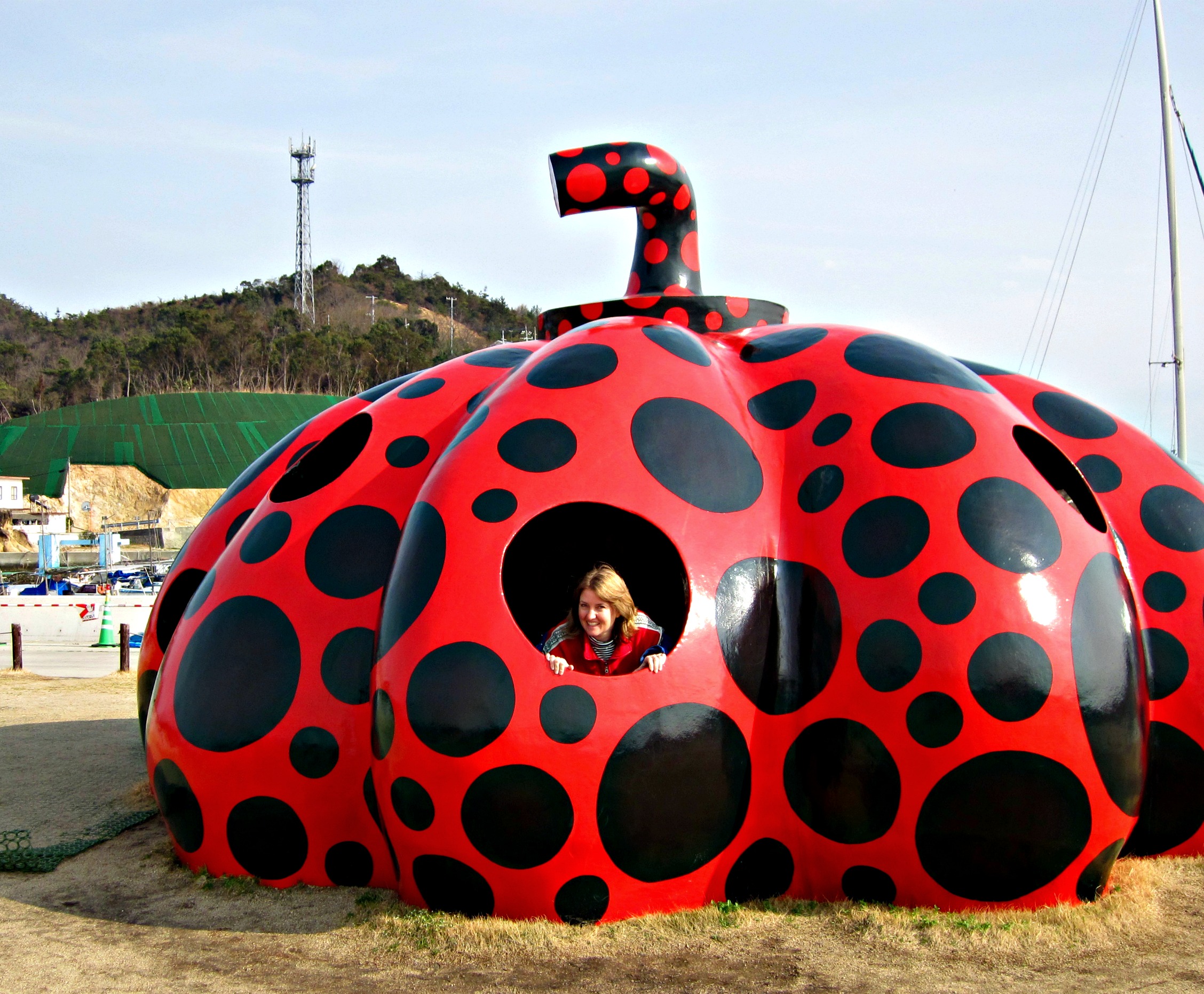
img: Suzanne Kamata standing inside a pumpkin sculpture on the Japanese island of Naoshima (March 2011). The sculpture was created by the well-known artist Yayoi Kusama, who was herself an expat for awhile. (She lived in New York City in the 1960s.)

LIBBY’S LIFE #47 – Showered with affection

Maggie opened her front door, and I handed her a screwdriver set.

“Oliver said you needed this urgently,” I said. “He says there should be one in there that fits, but let him know if there isn’t.”

I tried not to sound irritable, but really — did Maggie require this so urgently that I had to interrupt a nap and traipse here? The last thing on my wish list right now was another needy middle-aged woman. My mother already occupied that job slot, and it seemed that my beloved Maggie was picking up her bad habits. They’d spent a lot of time together over the last few days; in fact, today, Mum had been at Maggie’s house since before lunchtime.

But why stop at blaming middle-aged women? Oliver could have brought it to Maggie himself before his after-work shower, but no: “You take it to her, Libs. I’m shattered.”

And I’m not, of course.

Maggie took the screwdrivers from me. “Come in,” she said, opening the door a little wider.

“No, it’s OK.” I turned to leave. “I have to get back. Jack needs his dinner.”

Maggie reached out and grasped me by the elbow, drawing me back. “Jack will be fine with Oliver for a few minutes. Come on,” she urged. “Your mother just put the kettle on.”

I didn’t want tea. I wanted to give Jack his dinner, put him to bed, and then I wanted to go to bed myself.

“All right,” I said with a sigh, and stepped into the wood-panelled hallway.

“Go and make yourself comfortable,” Maggie said. “I’ll be with you in a moment.” She trotted off towards the back of the house.

Wearily, I turned left, into the living room.

I felt my jaw drop.

* * *

“It’s usual not to have a shower for a second baby,” Maggie said behind me, as I gazed at all the people congregated in the living room. Mum. Charlie, Anita, Julia. A few moms from Jack’s new nursery school. Even Caroline. “But you’re a special case.”

Pink and blue bunting criss-crossed the room. Pastel-wrapped boxes lay piled in one corner. Pink- and blue-iced cupcakes nestled together on a three-tier stand.

Welcome, Twins! said a big banner over the fireplace.

I felt my eyes prickling. “Thank you,” I whispered, looking round at everyone. I hugged Maggie, not quite able to believe that I was the centrepiece of my own surprise baby shower. “Thank you so much.”

Anna appeared from the kitchen and handed me a glass of something that looked like champagne. “Sparkling grape juice,” she said, before I could object. “Although you might want the real thing before the evening’s over,” she murmured, her eyes darting in the direction of my mother, who sat in Maggie’s rocking chair talking earnestly to Charlie.

“Delivery rooms aren’t my scene,” she was saying. “But Libby would like me to be there, I think.”

“No way!” I mouthed at Charlie, any rush of sentiment for my mum receding rapidly.

Charlie’s lips twitched. “Of course, with it being a C-section delivery, they probably won’t let you in.”

Mum took a deep, huffy breath. “That’s not what I’ve seen on A Baby Story. It’s a real family occasion for all those women.”

Heaven preserve us. Mum started channel surfing four days ago, and all her “I didn’t come to America to do this, that and the other” arguments vanished.

Apparently, her raison d’être in America is to watch The Learning Channel all day. If I’ve seen one woman give birth on these dreadful programmes since Sunday, I’ve seen thirty, and believe me, it’s not a good idea when your own birth experience has been scheduled for seven days hence, and your mother has decided that an impromptu family party in the operating theatre would be fun.

Yes. The twins will be extracted from me on April 26th at 9am. My slightly elevated blood pressure was still causing Dr. Gallagher some concern, so he booked me into his busy timetable for next Thursday.

I’m not happy about it, or even convinced that it’s necessary, but what can you do?

Oliver says: Look on the bright side. At least there will be no getting out of bed at three in the morning because your waters have burst and the bed’s a swamp.

Always has a way with words, does my Oliver.

So, as I was saying — what can I do?

Sod it. Enjoy the party. That’s what.

“Cheers, everyone,” I said, raising my glass of grape juice.

* * *

Charlie fetched her car — everyone had parked their cars in the next street so I didn’t get suspicious — and packed all the gifts in the trunk to deliver them to our house. I felt so lucky, so loved. You remember all those things I had returned to the baby shop because they’d cost so much? Maggie had taken note of the items, and now most of them were once again on their way to the babies’ room.

I felt overwhelmed with the generosity, the camaraderie, the shower of affection. No wonder these parties are known as showers.  I felt — far more than I had ever felt in my hometown of Milton Keynes — that I belonged. Belonged to something good.

* * *

“I just wish it didn’t have to be this way,” I said to Maggie as I put my outdoor shoes on, waiting for Anna to bring her car round to drive me the short distance home. “I’ve always dreaded the idea of being sliced open, but I don’t have much option if Dr. Gallagher thinks it’s too risky to let me go on any longer…”

Maggie snorted disbelievingly. “If I know dear Gerry, he’ll have a golf tournament lined up in a couple of weeks that he doesn’t want to miss. Take my word for it, your hospitalization is less to do with your safety, and more to do with keeping his handicap.”

“No!” I was shocked. “He wouldn’t do that — would he?”

“He’ll take very good care of you, don’t worry. Better to do it his way than to have a complete stranger delivering those twins, don’t you think? Imagine — you could end up with that frightful witch, Elspeth Wojcik.”

I shuddered. One visit to that particular obstetrician, whom I’d nicknamed Doctor Death, had been enough. The possibility that in Dr. Gallagher’s absence she could deliver our twins was horrifying. But I still balked at the idea of having my midsection cut open, no matter how unnoticeable the scar would be afterward.

“You need some alone time with Oliver. That’s what you need,” Maggie said.

“But we went out for dinner only last Saturday,” I protested.

“Ribs and fries aren’t going to bring on labour, are they?”

“What?” Maggie’s twists of conversation confused me sometimes. Quite a lot, actually, these days.

“Alone time at home, is what I meant,” she said. “Not alone time at Ruby Tuesday’s.”

The penny dropped.

“Oh!” I’d forgotten about that little trick to bring about labour. And it sure beat swigging castor oil.

Maggie nodded. “Send Jack and your mother round here every lunchtime for the next few days, and see if you and Oliver can spoil Gerry Gallagher’s plans.”

The gravel on Maggie’s driveway crackled as Anna’s Mustang drew up outside.

“You’re on,” I said.

* * *

A Massachusetts spring heatwave. Sun pouring in through our bedroom windows. A chickadee chirping close by.

Oliver feeds me another strawberry. “I should get back to work,” he says. “But I think I’ll call in and say you’re not well.”

“Again? Will they believe you?”

“Don’t care if they do or not.”

“You could always work at home,” I suggest.

“Or do something else at home. Does this old wives’ tale really work? Technically, you’ve still got four weeks to go. ”

“It’s supposed to work. So they say.”

I lie on my side and gaze out of the window, at the slight breeze moving through the tall oak trees at the end of our garden, and I listen to the silence of Woodhaven.

The babies have been very quiet for a couple of days; they’re still, sleeping a lot, getting ready for a big day. Their peace makes me woozy, detached, and I feel myself mentally withdrawing from the world just as they prepare to meet it.

No. It won’t be long. I know it.

.

Next post: LIBBY’S LIFE #48 – Hospital visiting hours

Previous post: LIBBY’S LIFE #46 -A tale of two mothers

Click here to read Libby’s Life from the first episode

STAY TUNED for Friday’s post, when Anthony Windram debates the view that, this Sunday, expats should be the last people celebrating Earth Day.

If you enjoyed this post, we invite you to subscribe for email delivery of The Displaced Dispatch, a round up of the week’s posts from The Displaced Nation. Sign up for The Displaced Dispatch by clicking here!

Image: Travel – Map of the World by Salvatore Vuono / FreeDigit

For the displaced writer Martin Crosbie, a life between two cultures is the stuff of literary fiction

Readers who’ve been paying attention will know that a couple of days ago, in honor of The Displaced Nation’s first birthday, we fleshed out a prospectus for a literary festival for authors who’ve been expats, third culture kids and/or global nomads.

Should this litfest ever happen, this month’s featured author, Martin Crosbie, would make an exciting addition to the line-up.

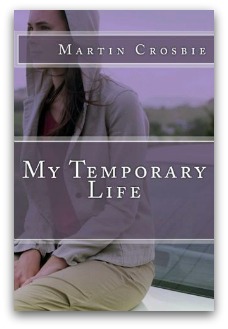
Last year he published a sensitive, partly autobiographical first novel, My Temporary Life, telling the story of Malcolm, a young half-Scot half-Canadian. As Malcolm informs us towards the start of the book:

I live with a father [in Scotland], who didn’t intend to have a son with no wife, or I spend my summers in Canada, with a mother who forgets that I’m there.

Eventually, circumstances make it impossible for Malcolm to continue this peripatetic life, and he heads to Canada to finish up his schooling. Even then, he feels unsettled:

It really does feel like everything is going to be okay, or at least it might be for a little while. Nothing in my life has ever been forever anyways. Everything is always just temporary, always temporary.

The novel has taken the Amazon charts by storm, garnered rave reviews and turned Crosbie into an overnight publishing sensation.

In fact, I recommend you become part of the storm by reading the book RIGHT NOW — or as soon as you’ve finished this post.

Here’s a link to the book on Amazon: My Temporary Life.

Alternatively, you can sign up for our DISPLACED DISPATCH — and cross your fingers that you’ll be one of this month’s two lucky winners!

And now for some highlights from my exchange with Martin Crosbie…

Is Malcolm Martin?

Hi there, Martin!
Hi, Tony!

Can you tell me a bit about your upbringing — where you were born and how you ended up in Vancouver?
I was born in Aberdeen in Scotland but I was adopted and transplanted to Kilmarnock when I was still an infant. I lived there until I was ten and my family moved us to the west coast of Canada. Other than a few years in Toronto and in Ontario when I was in my twenties, I have always lived here, just outside of Vancouver, British Columbia.

I’ve read your book My Temporary Life, and I loved it. I was particularly impressed by the way your writing flows, which is the mark of a very accomplished writer.
Thanks for saying that, I really appreciate it. This is my first novel and I think one of the reasons that it’s done well is that it went through so many re-writes and revisions. The novel that is out there today is very unlike the first few drafts.

You’ve lived in both Scotland and Canada, the two locations in the book. You also share the main character’s love of running… So I have to ask — how much of this character is autobiographical?
I had a writing teacher who would say “What is truth, in fiction? Write something down!”

Then, he’d sit down and wouldn’t answer any questions until the class had all written something, anything.

Once we shared what we’d written, he’d talk about the fact that when you read something and it “rings true” — in that you get lost in the scene — the reason is that the emotions the writer has conveyed are coming from a true place.

So, I appreciate your question because it means that my story probably worked when you read it.

But did the events in the book really happen — the boy with two parents from two cultures (Malcolm), his best friend whose parents beat him up (Hardly), and his dream woman, who, too, has had an abusive childhood (Heather)?
A lot of the incidents did in fact happen — but to different people at different times. The book is most definitely fictional.

But it is true?
Without wanting to become the next James Frey, yes, on some level it is. I had the daughter of a friend read the novel and really enjoy it, and she asked me if I was Malcolm. I told her that some days I feel like Malcolm and some days I feel like Hardly — lol.

The ups and downs of self-publishing

Quite a few authors in The Displaced Nation’s circle have self-published their works, myself included. Can you tell us what was behind your decision to self-publish My Temporary Life?
I self-published My Temporary Life because I was turned down over one hundred times by agents and publishers. The strange thing, though, was I’d pass my work to readers and they enjoyed it — very few of them didn’t. Oh, there were changes that I made along the way because of readers’ input, but the feedback was almost always decent. And they all wanted to know the same thing: “When’s the next book?”

So I self-published through Amazon, and it’s been an incredible ride. In less than three months 85,000 copies of my book are out there. I say that number and it absolutely astounds me that so many people have taken the time to give My Temporary Life a chance.

Is there a particular group of readers who’ve found particular resonance with your story?
One of the challenges with my novel has been that it doesn’t fit any specific genre, and when that happens you don’t know where to market your work. This has been good and bad. Not knowing whether to call it a coming-of-age story, a romance, or a thriller has been challenging. But not knowing exactly to whom it might appeal has also been a good thing, because I now have women and men readers of all ages.

I guess Malcolm is a reluctant, flawed hero and we can all kind of relate to that.

Self-publishing , as I know from my own experience, can be time consuming, however rewarding it is. Have you found it that way?
Without self-publishing, my story would not have reached anyone. It’s as simple as that. Having said that, the downside is that it’s a lot of work — and I mean, a lot of work. I promote my book anywhere that I can online where I think folks might be interested. Unfortunately, this takes me away from writing my next book, and that’s what I really want to be doing these days.

The positive of self-publishing is that I enjoy interacting with folks who’ve read or are reading My Temporary Life. I’m very accessible. I answer every email. I am on chat loops, Facebook groups, Yahoo groups — anywhere that somebody wants to talk about self-publishing or writing or my work. And, in doing that, I’ve formed some incredible friendships.

You know when you meet someone, whether it’s virtually or in person, and you just know that they’re going to be in your life for a long time? Well, I have met friends like that because of my book.

In the past week, I’ve had instant messages, tweets and emails from all kinds of people. One lady was ribbing me because she had to call in sick after being up all night reading my book. Another woman sent me a barbecued salmon recipe — she’d liked the recipe in my book but thought hers was better. And a gentleman sent me a message who is a huge fan of the book. He said that he’d told his wife that if she didn’t read it, she had to pack her bags, lol.

And, the readers that I am “meeting” are from all over: Taiwan, Luxembourg, lots in Australia, the UK of course, and the US.

It’s an amazing world that we live in that I’m able to experience that, and it’s all because I self-published my book.

Cross-cultural relationships

Malcolm gets involved with Heather, who’s a born-and-bred Canadian from a secluded little town in Northern Ontario. Heather says to Malcolm when they first meet: “You have this Scottish look to you, like you just got off the boat and are still lost; it’s very cute.” What’s your view on cross-cultural relationships? Do you see them as particularly challenging? (Many Displaced Nation readers are in them, which is why I ask…)
It’s funny that you bring that up as I’m trying to address it in my work in progress. I don’t really know if I’m properly qualified to comment… I live in an area of Vancouver where I have friends from pretty much every culture you can imagine. I’m lucky in that respect, and of course because of that, I get to eat lots and lots of different foods. Food is very very important to me, Tony, I do love to eat.

The importance of being Scottish

You’ve lived in Canada a long time. But does Scotland still exert some kind of pull?
Scotland calls me back every few years. Right now it’s been three years since I was there and it’s whispering in my ear again, so I’ll be back there soon.

You see, when you’re a Scot, you’re always a Scot. There are third and fourth generation Scots who live in Canada who still call themselves Scottish.

Well, I was born and bred there and have been back many times, and even though I am a Canadian citizen now, you can’t not be a Scot. It’s more than just being born there. It’s much more than that.

When I arrive at Glasgow airport and present my European passport (yes, I have a Canadian and European one), and the customs agent sees my birthplace and says, “Welcome home, Mr Crosbie,” I always get a tear in my eye.

And, there are many many things that I miss about Scotland.

I miss the passion that they have for football, real football. I miss big sour pickled onions. I miss the way the rain can be lashing in your face and somebody will say to you that it’s a “grand” day. I miss the way that Scottish history is real history, real old history.

The dream of partial repatriation

Would you ever go back to live in Scotland?
I’m fortunate that I can go back from time to time, and in the movie of my life that plays in my head, I do live there part time too. One day I hope to make it happen. I already have the city picked out in Scotland where I’d like to live…

But wouldn’t you have to make some adjustments?
During the months when I’m living in Scotland, I expect I’d miss the mountains that we have here on the Vancouver coast — but I’d sure like to try it for a little while.

If my next book is as successful as My Temporary Life, I might just find a way to fulfill my dream and live part time in both countries.

A Temporary Life — The Sequel

Rumor has it you’ll be doing a sequel following the life of Malcolm’s Scottish friend, Hardly. What can you tell us about this work in progress?
I can tell you that I’ve seldom been as excited about anything as much as I’m excited about my next novel. Yes, it is the story of Hardly. I’m having so much fun writing it.

Just what the final product will look like I don’t really know, so at this point I’ll just say that it’s like the first novel in the sense that it’s an in-depth character study of a man and his motivations, and in terms of how the novel reads, well, I do love plot twists, Tony, and I can absolutely guarantee you that this book will have them.

Sounds fantastic! Thanks so much for your time, Martin.
Thanks for doing this Tony, and of course now I’m going to be dreaming tonight about the wee chip shop in Stewarton, and the farm house that my cousins live in in Inverness, and a multitude of other Scottish things.

* * *

Anyone who’d like to know more about Martin’s life and his work, you can check out his author site and follow his escapades on Twitter: @martinthewriter

And if you have any questions for Martin, please feel free to ask them in the comments!

And don’t forget to sign up for our Dispatch to be eligible for the giveaway of Martin’s book!

STAY TUNED for tomorrow’s installment in the life of our fictional expat heroine, Libby, which will be another party-themed post — this time, of course, it’s a baby shower! (What, not keeping up with Libby? Read the first three episodes of her expat adventures.)

If you enjoyed this post, we invite you to register for The Displaced Dispatch, a round up of weekly posts from The Displaced Nation, with seasonal recipes, book giveaways and other extras. Register for The Displaced Dispatch by clicking here!

Related posts:

Wedding celebrations: Who does it better, Britain or America?

We’ve spent the last two weeks looking at festivals and parties around the world, and today it’s time to take a glimpse at nuptial celebrations, with a guest post by Meagan Adele Lopez. As an American who once lived in the UK — she also has a British boyfriend — Lopez can be considered an unofficial expert on British versus American weddings.

Please don’t invite my British beau and me to a wedding unless you really want us to come — we are more than likely going to reply “yes”!

Many have made that mistake. For some reason, it is impossible for us to say “no” — perhaps we are living vicariously through the bride and groom (going to a wedding is much cheaper than throwing one, let’s be honest).

Over the course of four years we have been invited to 28 weddings, 23 of which we will attend/have attended. These weddings span four countries (Wales, England, Dominican Republic and the USA) and 14 cities.

I wish I could say I was a professional wedding guest, getting paid to attend these lavish affairs. But no, we just happen to have many friends who are getting engaged at this time of my life. Some are even going through their second weddings.

One of the many benefits of dating a British guy is being able to attend British weddings — complete with hats, fascinators, castles and tail coats. I’ve become a bit of an expert on both.

So, I’ve been keeping a running tally of the best things that British and American wedding celebrations have to offer. Right now Britain is winning, but only by one, so that could change!

4 great things about British weddings

1) Less financial outlay for bridesmaids
It’s kind of atrocious that Americans still “invite” their best friends in the world to have the “honor” of becoming a bridesmaid only to pick out the most expensive dress they can find, make their best friends pay for it, and take them on a lavish bachelorette party that they must also pay for.

The British have it right. I mean, if you’re paying £25,000 on a wedding already, why not shell out an extra thousand to make your poor bridesmaids happy? After all, they didn’t choose to get married, you did.

2) Betting on the speeches
Let’s face it — sometimes speeches at a wedding can be really, really hilarious and entertaining. They can be so entertaining and hilarious that you have no idea how much time has gone by, whether or not you’ve eaten, or if the dancing has even happened yet. But, a lot of times, they can be painful and long, and somewhat boring. So, what better way to keep the crowd entertained than by going to each table and getting the guests’ bets on how long the speeches will last?

Personally, I love speeches and find it fascinating to see how each person tackles this challenge to charm a crowd of 150 people — 20 of whom you probably know personally. However, knowing that I have the chance to win a pot of 200 quid makes it that much better!

3) The Groom’s Speech
I actually find it a travesty that American grooms aren’t made to give a speech. Perhaps it’s because a woman marrying a British man knows that this one speech might be the only time she will hear her husband tell her how gorgeous, wonderful and amazing she is, and how he is the luckiest man on the planet. After all, British men aren’t known for being overly flattering or sentimental. I blubber like an idiot, wiping the mascara from my eyes, when I hear a doting British man, for the first (and probably only) time, open up to his friends and family about why he is truly in love with this woman.

But I’m sure most brides who marry a British man will tell you that the groom’s speech is one of the best moments of their wedding night. For me, as a guest, it beats the father’s speech and even the first dance. Perhaps the vows are the only thing that trump it.

4) Romantic venues
I’ve attended weddings in a ninth-century castle, in a tenth-century church, in an old manor house in Sussex, on a farm in the West Country, in a hotel where prime ministers stay, and next to a marsh in West Wales. Something about a British wedding makes it that much more romantic. Of course, it’s every girl’s dream to get married in a castle, but in Great Britain, you actually can!

3 great things about American weddings

1) Open bar
The first time I truly found out about the horror that is a cash bar at a wedding, I was invited to just the evening part. You see, my boyfriend and I had been together for over a year, but since the groom had never met me, he didn’t think it important to invite (ah hem, “pay”) for me to come to dinner, or attend the ceremony.

Apparently, it’s quite normal in England for a significant other not to be invited to the entire evening with their partner if they have never met the girlfriend. Being an American, I was already incredibly offended — especially since we had traveled an hour to be there, stayed in a really expensive hotel (the only one in the entire town), and paid for two separate £40 cab rides to the venue from the hotel (since we weren’t leaving together). So, you can imagine my dismay when I got to the reception and had to pay for my own drinks! I understand that not everyone can afford to have an open bar, but I most certainly prefer the American mentality that when you invite a guest, they are to be treated as such.

2) The women’s speeches
In Great Britain, traditionally, the speeches include the Father of the Bride, the Groom and the Best Man. I agree with all of these choices for speeches, but I have to admit, I did find it a teeny bit sexist that no women spoke at weddings the first time I saw it happen. Most British women don’t mind since they would rather the attention be off of them for the night, but what happened to the Maid of Honor? Why can’t she throw in a speech?

Women bring a different take to speech land, and I definitely prefer the American tradition of allowing us to speak.

3) Creative venues
Where the British score points for tradition, history, elegance and romance, American weddings score points for creativity, grandiosity and variety. Obviously, America is a much bigger country with many more choices for venues, and many more options for good weather. I have been to a wedding on a cliff overlooking the Pacific Ocean, at a museum in the middle of downtown Chicago, a country club in Maryland, and by a river at a historic house in Austin, Texas. The possibilities are truly endless in America, and always keep you guessing. While many British weddings have struck me as being similar, it’s hard for me to say that any American wedding has resembled another. This is also probably due to the diversity of the American population and the variety of religions in this country.

Combining the two traditions — still working on that!

I’d be lying if I didn’t admit that with all of these weddings I didn’t think about how I would like my half British, half American wedding to go…but I simply can’t admit to what I dream of just yet. Call it superstition or what have you, but until I get engaged I won’t disclose my dream wedding. My worst nightmare is having my dream wedding down on paper, and then it never happening!

In the meantime, I’ll continue to break down the weddings I go to and figure out which bits I want to keep for myself.

Editor’s note: This post is adapted from a post that appeared on Smitten by Britain: “British vs. American Weddings” (25 January 2012).

Question for readers: Have you been to weddings in the country where you live? How do they compare?

MEAGAN ADELE LOPEZ is the author of Three Questions: Because a quarter-life crisis needs answers, which was featured in February on The Displaced Nation. You can learn more about Lopez and her book at her author site and by following her on Twitter: @meaganadele.

STAY TUNED for tomorrow’s post, an interview with first-time novelist Martin Crosbie. (Sign up for our Dispatch to be eligible for the giveaway of his book, A Temporary Life!)

If you enjoyed this post, we invite you to register for The Displaced Dispatch, a round up of weekly posts from The Displaced Nation, with seasonal recipes, book giveaways and other extras. Register for The Displaced Dispatch by clicking here!

Related posts:

“We read to know we’re not alone”: 1st-ever litfest for expats & random nomads

The displaced writer Hazel Rochman once said that reading “makes immigrants of us all”:

Reading takes us away from home, but more important, it finds homes for us everywhere.

That must be why author interviews have played such an important role in the entertainment mix provided by The Displaced Nation since our founding one year ago.

A book that enables us to escape to a new world without buying a plane ticket? Bring it on!

A book that makes us feel at home in another part of the world? There’s nothing we crave more.

We’ve also taken authors into our confidence who, as St. Augustine once advised, treat the world as their book, rather than staying put and reading only one page. Because of their own peripatetic ways, these writers have much to say to the rest of us nomadic types about how to make sense of feelings of isolation, ennui and displacement.

As C.S. Lewis once said:

We read to know we’re not alone.

In honor of The Displaced Nation’s first anniversary, as well as in the spirit of World Party Month, I would like to propose the first-ever Displaced Nation literary festival featuring authors who have been interviewed or in some way featured on the site during the past year.

“We read to know we’re not alone”: THE FIRST-EVER LITERARY FESTIVAL FOR EXPATS AND RANDOM NOMADS
Note: The following is a tentative line-up. It includes previews of the kinds of insights we can expect to glean from such an extraordinary gathering of expat literati.

We anticipate the festival to extend from a Sunday night to a Thursday morning, with an opening night gala and a couple of closing events. Click on the headlines to go to the event descriptions for each segment:

OPENING NIGHT GALA EVENT

It seems only fitting that we offer something totally mad on our opening night. We will screen Alice in Wonderland, the 1903 British silent film directed by Cecil Hepworth and Percy Stow, which was partially restored by the British Film Institute and released in 2010. (NOTE: You can see portions of the film in a video specially made by Anthony Windram during The Displaced Nation’s “Alice in Wonderland” theme month.)

The film is memorable for its use of special effects: Alice’s shrinking in the Hall of Many Doors, and then growing too large in the White Rabbit’s home, getting stuck and reaching for help through a window.

The film matches our theme of “We read to know we’re not alone” — could anyone ever feel lonelier than Alice did at such moments?

But here’s the new twist: the screening will feature a live accompaniment by Seremedy, the displaced Swedish visual kei band this is now making such a sensation in Japan, reacting musically and without any rehearsal beforehand, to the silent film in front of them. Unique, spontaneous — and perhaps even terrifying, given that the band’s (male) lead guitarist, Yohio, looks like an anime version of Alice.

DAY ONE: “We’re not alone” — We have each other

Iranian Childhoods, Inspiring Stories

TONY ROBERTS and ASHLEY DARTNELL each spent portions of their childhood in Iran. Roberts has produced a novel based on his memories of that time, Sons of the Great Satan, which we featured on this blog about a year ago. Dartnell, who has yet to be featured (we hope she will!), released her memoir, Farangi Girl, last year (it was recently issued in paperback).

Roberts and Dartnell have in common the status of being so-called third culture kids — growing up in a third culture not common to their parents (Roberts’ parents were American and Dartnell was the product of an American mother and British father). They also have in common that they were enjoying their lives in Tehran until something terrible happened — the memory of which affects them to this day.

In Dartnell’s case, it was the sudden collapse of her father’s business (her parents subsequently split up), whereas for Roberts, it was the experience of being evacuated because of the American hostage crisis — suddenly, he was back at the family’s small farm town in Kansas, having no idea of where his friends had gone.

TCKs experience such traumas in isolation (Roberts continued to feel isolated well into his adulthood). Roberts and Dartnell, who have never met before, welcome the opportunity to forge a new connection over their common displacement.

PERFORMANCE: “The White Ship,” by Ethan Kenning

Ex-folk singer Ethan Kenning — known as GEORGE EDWARDS when performing with the former psychedelic rock band H.P. Lovecraft — will give a special performance of “The White Ship,” a song based on a mystical tale by horror writer H.P. Lovecraft (from whom the band took its name), about a vessel sailing on a sea of dreams. Critics have described it as “baroque, Middle Eastern-flavored psychedelia at its finest.”

Multicultural Marriage Boot Camp

Two Wendys — WENDY WILLIAMS and WENDY TOKUNAGA — will answer questions about the benefits as well as challenges involved in marrying someone from another culture.

Wendy Williams is the author of The Globalisation of Love and has coined a term, “GloLo,” to refer to this phenomenon. She was last week’s Random Nomad and has also been a contributor to The Displaced Nation with the post: “Why expat is a misleading term for multicultural couples” — a topic big enough to be a festival theme in its own right!

Wendy Tokunaga, who was one of The Displaced Nation’s 12 Nomads of Christmas, recently published Marriage in Translation: Foreign Wife, Japanese Husband, consisting of interviews with 14 Western women involved in cross-cultural relationships.

GloTinis will be served — those in particularly challenging unions may wish to order theirs straight up.

Romance Across Borders: Fairytale or Myth?

JANE GREEN, a prolific writer and one of the founders of chick literature, will interview MEAGAN ADELE LOPEZ and MICHELLE GORMAN — both of whom have produced first novels exploring the idea of looking for romance in other cultures. Lopez is the author of Three Questions: Because a quarter-life crisis needs answers (self-published, October 2011), about a cross-cultural romance that blossoms through the asking of three questions; and Gorman, of Single in the City: One girl, one city, one disaster waiting to happen (Michael Joseph, 2010), about an American who goes to London in search of love and the perfect life.

The Displaced Nation recently featured Lopez on our site and will feature her tomorrow in a guest post. We have yet to interview Gorman but would like to — especially as she recently self-published Misfortune Cookie, about a young woman who moves to Hong Kong to be with her boyfriend.

Both women relied heavily on their own autobiographies to produce these first novels. As Lopez said in her interview with Tony James Slater:

Hey — they always say to write about what you know, so that’s what I did!

But is it the stuff of chick lit? No one is better placed to judge this than the displaced author Jane Green (she is now an expat living in Connecticut). As early readers of The Displaced Nation will recall, Green “came in” for a chat during our coverage of last year’s Royal Wedding — she had just produced a multimedia book celebrating the young royals as an example of a “modern fairytale.”

Though Kate and Will aren’t from different cultures, they might as well have been since Kate — unlike the Prince’s mother, Diana — does not come from a royal lineage. But from Green’s point of view, this is what is makes the couple modern — and why their marriage is likely to last:

I loved discovering just how unusual William and Kate are: grounded, humble, and thoroughly modern, eschewing much of the pomp and circumstance that surrounded the wedding of Charles and Diana.

One Person’s Home — Another Person’s Nightmare?

BARBARA CONELLI, who lives in Manhattan for half of the year and Milan for the other half, will interview SHIREEN JILLA, whose first novel was set in the Big Apple.

Thanks in large part to the influence of her Italian grandmother, Conelli qualifies as the ultimate Italophile. Last year she published Chique Secrets of Dolce Vita last year — her first book in a three-part series about the Italian grasp of the “good life.” When asked by Kate Allison to explain the differences between her two homes of Milan and New York City, Conelli said that New Yorkers need to learn the Italian art of taking the time to actually live:

We need to stop and smell the roses more often.

On this point, Jilla would certainly concur. After spending three years in New York as an expat when her husband was BBC’s North America correspondent, Jilla came away thinking that “New York is a city populated by control freaks.”

But, unlike Conelli, Jilla found this control freakery sinister — which was what inspired her to write a novel that depicts the city as, as one critic said, “a teeming pit of vipers, only just covered with a finely buffed veneer of sophistication.”

In the online discussion we hosted of Exiled, Jilla commented on how culturally different New York and London are — despite New York not being seen as a particularly adventurous posting among the expat crowd. She went on:

New York in fact reminds me a lot more of Rome than London. Passion is lived out on the street, for good and bad.

Hmmm… It will be interesting to see what Conelli, whose series includes a book on Rome’s joyful idleness, makes of that!

Are Expats Defined by Their Boundaries — or the Lack? James Joyce Unplugged

One of The Displaced Nation’s founders, ANTHONY WINDRAM, and the novelist JOANNA PENN will join forces to discuss the topic of whether being an expat necessarily entails producing “expat” literature. In a post published last year on The Displaced Nation, Windram noted that although James Joyce spent most of his adult life in continental Europe, he continued to write about his home, Ireland:

If we were to be glib, we might say that Finnegans Wake was conceived in Dublin, but Paris was its midwife.

Likewise, Joanna Penn, who has been a TCK and an expat, does not self-identify as an expat writer and sets her novels at least partly in Oxford, the city she calls home. She does feel, however, that wanderlust is a big part of what fuels her to write thrillers set in various countries, as she explained in a comment on a post deconstructing a post of hers on what “home” means to writers.

DAY TWO: “We’re not alone” — Global activism

Travel for a Purpose

For this event, we hope to engage the world-famous novelist BARBARA KINGSOLVER to interview ROBIN WISZOWATY, who is Kenya program director for the Canadian charity Free the Children and the author of a memoir targeted at young adults on her own experience of living in Kenya, My Maasai Life.

Kate Allison interviewed Wiszowaty during the month when The Displaced Nation explored the topic of global philanthropy.

Around the same time, Allison also wrote a post on Kingsolver, exploring the idea that her novel The Poisonwood Bible was intended an allegory for what happens when you barge into someone else’s culture thinking you know everything and they know nothing.

Notably, Wiszowaty could almost have been a Kingsolver character in the following incident that occurred during her initial two months in Nairobi, as reported to Allison:

One street man nearby…said in Swahili, “What are you doing in Kenya, if you can’t help us?”

Despite my halting comprehension of the language, I understood his question. What was I doing here? Was I here to help Kenyans? I couldn’t remember any sort of altruistic impulse as my reason for being me here. I only pictured myself three months earlier, curled up on my family room couch reading books on cultural sensitivity, or shopping in neighborhood department stores for appropriate clothing, thinking this was a chance for me to enlarge my experience and pick up others’ points of view. I’d been driven simply by a desire to escape, not to improve the lives of these poor people.

Wiszowaty, of course, came around and now thinks constantly about what she can do for Kenya. We expect that Kingsolver, who funds a prize for authors of unpublished works that support social change, will approve; but will she also offer a critique?

PERFORMANCE: “The Boy with a Thorn in His Side,” by Pete Wentz

Fall Out Boy’s PETE WENTZ will do a performance in which he puts passages from his 2004 book, The Boy with a Thorn in His Side, to music. The book chronicles the nightmares he had as a child.

Wentz is a supporter of Invisible Children, Inc., an organization dedicated to helping the cause of child refugees in Uganda. He once participated in an event called “Displace Me,” in which 67,000 activists throughout the United States slept in the streets in makeshift cardboard villages.

(Notably, Wentz has also earned his chops as world traveler. Before Fall Out Boy went on hiatus in late 2009, it made an unsuccessful bid to the only band to play a concert on all seven continents in less than nine months — unfortunately, weather conditions prevented them from flying to Antarctica.)

Why Feisty Heroines Need Not Always Be Named Pollyanna, Calpurnia or Hermione

Melbourne-based author GABRIELLE WANG writes books under the Penguin label targeted at young adults in Australia. Her heroines are always non-white, Chinese or some mix. They are culturally marginalized.

Wang, who fell into writing accidentally — she had planned to be a book illustrator — loves to use her imagination to create characters who are historically plausible yet never show up in history books. One such character is Mimi, who feels ashamed of being Chinese until she has a magical, transformative experience that makes her proud of her cultural heritage.

Another such character is Poppy, a half-Chinese, half-Aborigine girl who lived in the 19th century.

Wang told us she was able to draw on her own background to portray how Poppy might have felt:

I think I was able to imagine the Aboriginal child’s situation quite easily because I know what it feels like to be an outsider, and to suffer racial prejudice. I was the only Asian child in my school in Melbourne and I only saw white faces in the street.

The Search for Paradise

The search for paradise has been underway for as long as human history. Understood as an idyllic realm located at an exact spot somewhere on the earth, and yet as a place separated from the world, the possibility of reaching paradise has aroused the curiosity of travelers over many centuries and continues to do so.

MARK DAMAROYD, who has lived in Thailand for the past several years, subscribes to the idea that paradise is indeed what many men have claimed it to be since time immemorial: life on an exotic island, with sandy beaches, coral reefs and coconut trees, and with an exotic, much younger girlfriend. That is why, as he told us in an interview last summer, he had Koh Samui in mind when creating the island setting for his first novel — the aptly named Pursuit to Paradise.

Coming from a somewhat different direction is JACK SCOTT, whose memoir — Perking the Pansies: Jack and Liam Move to Turkey — was reviewed at the end of last year by Kate Allison.

In it, Scott tells the story of how he and his civil partner, Liam, left the rat race in London behind to live in Bodrum, Turkey. A picturesque spot on the Mediterranean with a temperate climate, the city was their vision of paradise.

Naturally, though, things were not that simple. The couple soon encountered another rat race — the expat one. To quote directly from Scott’s book:

Sad people, bad people, expats-in-a-bubble people. They hate the country they came from; they hate the country they’ve come to. This was my social life. This is what I gave everything up for. This was Liam’s bloody Nirvana. We were the mad ones, not them.

PERFORMANCE: “Red Right Hand,” by Nick Cave

NICK CAVE is a distinguished musician and songwriter from Down Under. He took the title of this song from a line in John Milton’s epic Paradise Lost, referring to the vengeful hand of God. According to the lyrics: “You’re one microscopic cog in his catastrophic plan.”

Cave has also occasionally dabbled in literature. As one reviewer put it, his first novel “reads like a logical extension of the dark world his music has already created.”

Ghosts of Nations Past and Future

In honor of Dickens’ bicentenary, Displaced Nation contributor ANTHONY WINDRAM will give a spirited reading of his favorite passages from A Christmas Carol (already explored in a post), followed by a discussion of whether Scrooge’s displacement could inspire the planet’s wealthiest people to behave more humanely. To quote from one of the comments made on Windram’s original post:

If such a man as Scrooge can displace his lust for money with a love of humankind — and an awareness of other people’s suffering — then does that mean there’s hope for the 1%?

Through the Looking Glass: Delhi & Bangkok

JANET BROWN, author of the travelogue Tone Deaf in Bangkok, and DAVE PRAGER, author of the travelogue Delirious Dehli, will discuss the need for travelers to do more than the usual amount of preparation when entering cultures that are very different from one’s own, on a par with Alice’s Wonderland.

As Brown explained in her interview with us, travelers to Thailand can be “tone deaf” because Thai is a tonal language and it’s easy to make mistakes. But they can also be “tone deaf” when it comes to figuring out the Thais’ communication style:

“You looked so beautiful yesterday” probably means today you resemble dog food and ought to go home and rectify that at once.

Whereas for Prager, one of the points about living in Dehli is that you may end up deaf as there are always people, animals and vehicles around.

In conversation with Anthony Windram, Prager admitted that getting used to America again — he and his wife now live in Denver — hasn’t been easy:

What’s struck me is that the US just seems so empty. It’s not that India is always intensely crowded; rather, it’s that India you’re never completely alone.

WRITING LAB: What (Not) to Write

Expat writing coach par excellence KRISTEN BAIR O’KEEFFE will explore techniques to develop your writing skills and help you find which world, of your many worlds, you want to write about, and how to get started.

Last summer’s post “6 celebrated women travel writers with the power to enchant you” was officially dedicated to O’Keeffe for delivering these pearls of writerly wisdom during her “Expat Writing Prompts” series:

Writing a multi-volume treatise is NOT the answer. Of this, I am sure.
Instead find a nugget. A moment. A single object. One exchange. One epiphany. One cultural revelation.
Find one story and tell it.
Just it.

DAY THREE: “We’re not alone” — Eat, drink, be merry & look good

Classy and Fabulous: French Style as Universal Norm

The French may be under fire for how they treat immigrants, but expats continue to thrive there. For this event, the classy and fabulous JENNIFER SCOTT, author of Lessons from Madame Chic: The Top 20 Things I Learned While Living in Paris — which has been a runaway success (it’s now under contract by a major publisher!) — will set out to prove, as she did last month in an interview with us, that no one can edit down their clothes and belongings as well as the French can.

The equally classy and fabulous ANASTASIA ASHMAN, co-editor of The Expat Harem: Foreign Women in Modern Turkey — and participant in our “Cleopatra for a Day” series last month — will serve as discussant. Two of the cultural influences for Ashman’s wardrobe are Southeast Asia (she once lived in Malaysia) and Turkey (she was an expat in Istanbul for several years). She does, however, adore French perfume!

Which Came First, Story or Recipe?

It’s food — so that means France again! ELIZABETH BARD, an American who lives in France with her French husband, and her opposite number, CORINE GANTZ, a Frenchwoman who lives near LA with her American husband, will explore why food is so central to the works each of them produces.

Bard is the author of the best-selling Lunch in Paris: A Love Story with Recipes. So did she ever think of writing it the other way around: recipes with a love story? Here’s what she told ML Awanohara in their conversation last autumn:

When I sat down to think about the moments that really helped me discover French life, I kept coming back to the dinner table, the markets, the recipes — so it seemed natural to structure Lunch in Paris around those experiences.

Gantz can no doubt relate. When we featured her novel, Hidden in Paris, last summer, here’s what she said when the topic of food came up:

For me, writing a novel is a barely disguised way for me to talk about food — the novel being a vehicle for food just as grilled toast is a vehicle for foie gras.

Fans of Hidden in Paris, please note: Gantz has just now released a playful cookbook featuring 20 delicious dishes that were described in mouth-watering details in the novel.

Moderating the discussion between Bard and Gantz will be the well-known novelist JOANNE HARRIS. Harris, who was born over a sweet shop in Yorkshire to a French mother and an English father, rarely misses an opportunity to bring food and drink into her novels — the most famous example being Chocolat.

Displaced Storytelling Circle

Verbal antics, stories, music and more. Highlights include readings by

  1. Displaced Nation contributor TONY JAMES SLATER, from his highly entertaining travelogue, That Bear Ate My Pants! Adventures of a Real Idiot Abroad.
  2. Displaced Nation interviewee ALLIE SOMMERVILLE, from her wry memoir Uneasy Rider: Confessions of a Reluctant Traveller. (Allie, please read the passage about the campervan being too wide for one of the Spanish streets!)
  3. Displaced Nation nomad KAREN VAN DER ZEE, from her collection of expat stories. (Miss Footloose, please tell us the ones about the crocodile and the couple in the Roman restaurant!)
  4. Founder KATE ALLISON, from The Displaced Nation’s weekly fiction series, Libby’s Life, which as you may have noticed, is now up to 46 episodes. (Kate, be sure to read the one where you introduce Sandra, Libby’s MIL from hell!)

The Art of Drink: Ian Fleming

One of The Displaced Nation’s founders, ANTHONY WINDRAM, will talk about the role of food (and especially drink) in Ian Fleming’s James Bond novels, on which he did a post last year:

The Bond of the novels isn’t solely a martini drinker. He’s always one to try anything local that’s on offer. In Jamaica he’ll drink a glass of Red Stripe, in the US he’ll have a Millers Highlife beer. Throughout the novels Fleming uses food and drink to convey an alien culture, demonstrate social status, show Bond’s mood and his sophistication and ease with the world.

An array of drinks — not only shaken martinis but also bottles of Heineken!– will be served. Green figs and yogurt, along with coffee (very black), will be made available to anyone who is still suffering from jetlag.

Enchanted by Wisteria: Elizabeth Von Arnim Unveiled

Displaced Nation founder (and the author of this post!) ML AWANOHARA will read her favorite passages from the collected works of travel writer Elizabeth von Arnim, on whom she wrote a post last year. As she pointed out then, Von Arnim was fond of the idea of a woman escaping her marital, motherly and household duties in the pursuit of simple pleasures such as gardens and wisteria. A magical Italian castle — such as the one featured in her best-known novel, The Enchanted April — can also be a tonic.

CLOSING NIGHT + BONUS EVENT

To close the festival, we will screen both the Swedish and Hollywood versions of The Girl with the Dragon Tattoo, followed by a critique from CHRIS PAVONE, author of the new novel The Expats. Pavone will discuss whether:

  1. it was really necessary for Hollywood to produce its own (non-subtitled) version; and
  2. all the female-perpetrated violence cropping up in film and on TV of late presages a “fourth wave” of feminism.

Pavone is well qualified to judge the latter as his novel (not yet featured on TDN!) is an offbeat spy story with a female protagonist — a burned-out CIA operative who moves to Luxembourg. Apparently, this was the kind of thing Pavone thought about when he was trailing his spouse in that cobblestoney old town.

And, just when you thought it was all over, we bring you a final treat: a chance to hear from the historian SUSAN MATT, who recently published Homesickness: An American History to much fanfare in the thinking media. Matt disputes the stereotype of Americans as westward wanderers by showing that Americans are returning to their homeland in greater numbers — that’s if they ever leave at all. (Our ancestors must be turning over in their graves!)

* * *

So, shall I sign you up? And can you think of any additional topics/authors/performers who ought to be featured? I look forward to reading your suggestions in the comments.

STAY TUNED for tomorrow’s guest post from Meagan Adele Lopez, on the differences between American and British wedding celebrations.

If you enjoyed this post, we invite you to subscribe for email delivery of The Displaced Dispatch, a round up of the week’s posts from The Displaced Nation. Sign up for The Displaced Dispatch by clicking here!

Related posts:

LIBBY’S LIFE #46 – A tale of two mothers

My mother is inexhaustible. She looked so old when she arrived here a week ago, but not any more. She has a new lease of life. Unsurprising, really – she’s taken all my energy instead and become a life-sucking parasite who thrives on attention and entertainment.

It’s the first time I’ve met this version of her, but evidently this is my mother when my dad isn’t around. No wonder she always looks so downcast when she’s with him; inside that whalebone-corseted shell is a Scarlett O’Hara bursting to get out. Fiddle-de-dee.

I keep wondering if she was like this forty years ago, when they first met, and what happened to change her. Or has she just recently realised that life is passing her by while she’s nodding and kowtowing to my dad?

The first few days she was here, all I heard was ‘I didn’t come to America for [insert everyday activity she does at home without thinking about it twice]’. That included drinking instant coffee, watching TV, cooking, or even going to the supermarket. I thought she might be interested in going to Stop and Shop, because it’s so different from Sainsbury’s, but no. Apparently, “Once you’ve seen one loaf of bread, you’ve seen them all” although if that’s the case, I’m mystified why she only shops at Sainsbury’s and refuses to set foot in a Morrison’s.

Of course, her everyday activities don’t now include visits to the obstetrician’s office. Oh no. Those are classified as “Novelty Voyeuristic Entertainment” and top of her Things To Do In New England. My life, to my mother, is just another reality TV show. “At Home With The Patrickashians.”

I’m on weekly visits with Dr. Gallagher now — have been for some time, since it’s twins — and these appointments are never when Jack is at nursery. Dr. Gallagher, bless him, likes long lunch hours and eighteen holes of golf on a regular basis. So I’d been looking forward to Mum being able to babysit Jack while I’m prodded around.

“Why don’t you stay here and look after him for me,” I said on her fourth day, as Oliver waited for me outside in the car. “I’ll be less than an hour, and it’s so much quicker if just Oliver and I go.”

“Don’t be so silly! Ante-natal appointments take much longer than that. I remember when I was expecting you, I’d be at that hospital all afternoon.”

I told her that this wasn’t the NHS in the 1970s, and American obstetricians need to see as many patients as possible so they can cover their insurance premiums and do valuable networking on the golf course, but she wasn’t having it.

“Jack hardly knows me these days,” she said. She likes to trot out the guilt trip card, I’ve noticed. “I’m sure he won’t want to stay with a stranger all afternoon.”

I sighed. “I’ll take Jack with me, then.”

“And leave me all on my own, here? I didn’t come all the way to America to–”

So we had to make it a family outing to Dr Gallagher’s, and it was only with difficulty that Oliver restrained her from barging into the examining room with us. I had to have an urgent word with the nurse and get her to tell Mum that family members other than spouses weren’t allowed.

Mum started to say that if she’d wanted to sit in a doctor’s waiting room, she could have done that in her own GP’s surgery.

“Tell you what,” Oliver said, as the nurse gently ushered Mum and Jack back towards the waiting room, “you can pay the monthly bill of $500 at reception. You don’t get to do that at the GP’s back home.”

She still protested, however, mildly grumbling, so Oliver stayed with her to make sure she behaved.

The nurse came back, shut the door of the exam room, and fastened the velcro strap round my right arm to take my blood pressure.

“It’s a bit high,” she remarked, after she grudgingly returned the blood supply to my fingers.

“That’s hardly bloody surprising, is it?” I jerked my head towards the door. “Anyone’s blood pressure would be up if they had that, 24/7. She was supposed to be coming to give me a rest, not give me a stroke.”

The nurse laughed after a couple of seconds in that uncertain “Oh-you-peculiar-British-people-with-your-odd-sense-of-humour” way, and packed up the blood pressure kit.

“It is higher than usual, though,” she said. “Dr. Gallagher will have to speak with you about it.”

And she rustled out of the room, leaving me to raise my blood pressure even more by reading smug advice from childless experts in mother-and-baby magazines.

Doctor Gallagher breezed in after a few minutes, looking impatiently at his watch. Understandable. Well, it was 2:45 — barely enough time for half a round of golf that afternoon, never mind eighteen holes and a prolonged visit at the nineteenth.

“We need to watch that,” he said without any preamble. “Let’s see…you’re thirty-five weeks now. If your BP stabilises, we can induce at thirty-eight weeks.”

“Induce?” I squeaked.

“It’s not a big deal,” he said. Not a big deal for him, presumably is what he meant. “And if that blood pressure doesn’t come down, we’ll have to consider a C-section.

I covered my mouth with my hand. Somehow, I’d never considered the possibility of having these babies by C-section. Images of pools, dimmed lighting, and doulas swam before my eyes. The bright lights, masks, and blue drapes of an operating theatre hadn’t entered my birthing dreams.

“But —” I said, then stopped, feeling the corners of my mouth quiver as tears threatened. “But the recovery time’s much longer after a C-section.” A friend of mine had one, and she was still shuffling around like a geisha one month later.

“Your mother’s visiting, I hear.”

At this point, I was thinking that Sandra, complete with roasted salmonella, might be more help than my own mother.

“I’m not sure how much help she’s going to be, to be honest,” I said.

Dr Gallagher nodded. “I gathered that. No one else you can ask? What about our mutual friend, Maggie Sharpe?”

He gazed out of the window at the brick wall view.

“A fine woman,” he said, exhaling sharply, and scratching himself somewhere suspicious under his white coat.

I averted my eyes.

“No,” I said. “Maggie’s done enough for me already. She drives me places when Oliver can’t. She looks after Jack when I’m at the end of my tether. She’s like—”

I stopped. I was going to say, “She’s like a second mother to me.” Only that wasn’t quite accurate, was it? These days, she was my mother.

Dr Gallagher watched me, nodding.

“Take it from someone who knows,” he said, his Cork accent strengthening as his emotions ran higher than my blood pressure. “Maggie Sharpe never does anything she doesn’t want to do. If she’s doing all that for you…believe me, it’s not just out of the goodness of her heart.”

He paused.

“You remind me a lot of her daughter, you know.”

.

Next post: LIBBY’S LIFE #47 – Showered with affection

Previous post: LIBBY’S LIFE #45 – Mum’s the word

Click here to read Libby’s Life from the first episode

STAY TUNED for Friday’s post, when we look at ways to celebrate — or tolerate — Friday The Thirteenth.

If you enjoyed this post, we invite you to subscribe for email delivery of The Displaced Dispatch, a round up of the week’s posts from The Displaced Nation. Sign up for The Displaced Dispatch by clicking here!

Image: Travel – Map of the World by Salvatore Vuono / FreeDigit

LIBBY’S LIFE #45 – Mum’s the word

Can’t stop thinking about the awful story of Maggie’s daughter and Anna’s dead brother-in-law. I see why Anna told me — festering half-truths ruined Sara’s life, by all accounts — but I still haven’t figured out what to do about Oliver’s half-sister, Tania, whom I impulsively contacted and now wish I hadn’t.

Although the simplest thing would be not to reply to her message, the damage is done. I’ve opened Pandora’s box. Then again, it’s Oliver’s Pandora’s box, not mine. Might he be grateful to know that his father didn’t abandon him, as he always thought? That’s Anna’s opinion. My worry is that if he heard his father’s side of the story, he would feel differently toward his mother. Much as I don’t like Sandra, I would hate to drive a wedge between her and Oliver.

I’m going round and round in circles thinking about it. Probably the best course of action is to let sleeping dogs lie. It’s not as if I don’t have other things to do right now, what with Easter shopping, getting ready for the twins, getting the spare room ready for my mother, who’s coming today…

Yes, I haven’t told you! My mother is coming to stay! Oliver is driving to Boston tonight to meet her at the airport. I am so looking forward to having someone here to help out; someone who can take Jack off my hands in the early evening and make nice dinners that won’t give me salmonella poisoning.

My father refuses to come with her, and it took a great deal of persuasion for him to let Mum off the leash and come on her own. He has a fear of flying, and an even bigger fear of having to do anything that might qualify as a domestic duty. Honestly, he makes Shirley Valentine’s husband look like Germaine Greer. He finally and bravely concluded that with the assistance of the local pub, the fish and chip shop, some friendly neighbours, and a mammoth cooking/baking/freezing session by my mother before she abandoned him, he might be able to live on his own for a few weeks and not starve.

I don’t know how my mother puts up with it, I really don’t. Still, they’ve been married for the best part of four decades, so I assume she’s OK with her incurable case of Stockholm Syndrome.

Five hours until her plane lands. I am so excited. It’s nearly a year since I saw my mum, and that’s too long.

Plus, I am dying for some of her special steak and Guinness casserole.

* * *

10 p.m. Oliver walks into the house carrying two suitcases. He dumps them on the kitchen floor.

“Two hours down, Christ knows how many days to go,” he says in a low voice, jerking his head in the direction of the garage.

I’m confused. Oliver likes my mother. She supports him when he trots out his Victorian views on the place of women in the home and the workplace. As I’ve said before, when other women in the 1970s were burning their bras, she was out shopping for whalebone corsets. Oliver laps up her outmoded opinions and uses them as ammunition in any arguments we have. “Your mother would never say that” is a frequent debate closer of his.

Mum climbs the stairs from the garage into the kitchen, carrying one of her capacious Mary Poppins handbags, and when I see her, I’m shocked.

In the eight months since I last saw her, she’s aged eight years. She doesn’t look ill — I hope she doesn’t, anyway — but she’s a little shorter, more stooped, more grey…

She looks like her own mother.

“Hello, love,” she says, stopping a couple of feet away from me. She holds out her arms. “It’s so lovely to see you again.”

She still sounds the same, thank goodness, and I give her a hug. If her outward looks have changed, nothing else has. Her skin is tissue paper soft, and her trademark scent of Johnson’s Baby Powder and Chloe perfume makes me feel as if I’m eight years old again.

I hold onto her as if I never want to let go, resting my head on her shoulder, and tears sting at my eyes. She’s been in the house for only three minutes, and already I’m dreading saying goodbye to my mum.

No one warns of it you before you make the decision to become an expat, but this is the absolute worst part of living on the other side of an ocean.

* * *

I make Mum a cup of tea with lots of sugar, and tell her to sit down and put her feet up. If my feet are swollen from late pregnancy, so are hers from sitting on a plane for seven hours, and it’s past 3 in the morning by her body clock. After half an hour, during which time Oliver has taken her bags to her room and we’ve given her the nickel tour of the house, she decides she will get an early night.

“Just take it easy tomorrow,” I say. “We don’t have to be anywhere. It’s Good Friday, although Oliver has to go into work, so—”

“That’s changed,” he interrupts. “I’m working from home instead. Family time’s important, and there’s nothing I can’t deal with from a cell phone and a laptop.”

“But…” I say. I’m confused again, because the last I heard, he had a meeting with customers who were flying in from Dubai, who didn’t celebrate Easter, and couldn’t give a monkey’s for Oliver’s need for family time.

“It’s all sorted. And I want you to take it easy tomorrow,” he adds, raising his voice. “I don’t want you running around the house and exhausting yourself. You know what Dr. Gallagher told you about keeping your blood pressure down.”

Dr. Gallagher has told me nothing about my blood pressure. My blood pressure is sterling, and I am in tip-top condition for anyone, let alone for someone expecting twins in six weeks’ time. Tired, fat, and fed up, of course, but who wouldn’t be?

“Make sure you have a rest while I’m working in the study, and maybe your mum can take over looking after Jack for a couple of hours. That’ll be OK with you, won’t it, Jane?” he says, raising his voice again.“Of course it will,” Mum says. “I’m looking forward to having him around all the time.”

“It won’t be all the time,” I say. “He goes to nursery three times a week.”

Mum pouts. “Can’t he miss it? I haven’t seen little Jackie for nearly a year, and it seems a shame to make him go when we’re on holiday. I was hoping we could go to the seaside for a couple of days or something.”

“But—” I start again.

Oliver puts his hand on my arm.

“Perhaps you’ve forgotten that Libby is about to have twins. She can’t drive now, because she finds it too uncomfortable behind the steering wheel. I think she’d appreciate a quiet time here more than a couple of days at the seaside.”

He stares at Mum, and she drops her gaze.

“I’ll see you both in the morning,” she says, turning away in a huff and unsnapping the locks on the suitcase that Oliver has laid on the spare bed.

It’s our cue to leave.

* * *

“What was all that about?” I demand, as soon as Oliver and I are in our bedroom and the door is shut. “You’ve upset her. Mum knows she’s here to help out, but she’s tired and jetlagged right now. You didn’t have to be so hard on her.”

“Listen.” Oliver pulls his T-shirt off over his head. “Just listen. The whole time back from Boston? She went on and on about how she was looking forward to having a nice holiday, and you’d take her here, and you’d take her there. She’s got a whole bloody itinerary worked out. She doesn’t seem to realise that you’re delivering twins at some point during her stay, because twice she said something like, “Ah well, I expect I’ll feel better when I go back home, because Libby will be looking after me.’ She doesn’t seem to realise that you’re the one who needs looking after.”

I’m cross with Oliver.

My mum would never do that.

That would be behaving like Oliver’s mum. Wouldn’t it?

* * *

Next morning, I wake up before Oliver, still cross with him, and feeling doubly defensive towards my mother.

I get out of bed, and plod downstairs to make some tea before Jack awakes.

Mum’s in the kitchen, sitting at the table, staring into space, with a half-empty mug of instant coffee in front of her. I automatically take the mug off her. The liquid is stone cold, so she’s evidently been sitting there for a while.

We ascertain that we both slept as well as could be expected, given our respective disabilities of gestation and time zone disorientation, then I refill the kettle, and unlock the dishwasher to unload the clean dishes.

This last chore has got increasingly difficult as I’ve become bigger, especially when I have to bend down to empty the lower shelf. From today, I realise, I don’t have to struggle. I can ask Mum to do it.

“Mum, would you—” I begin.

“I thought you’d never ask!” she says. “I’d love another cup.”

Silently, I empty the cold coffee out of the mug, and reach into the cabinet for the jar of instant Folger’s.

“Have you got any real coffee? I’ve already had one of the powdered kind,” Mum says. “I didn’t come all the way to America for instant coffee.” She leans down, rummages in her Mary Poppins bag at the side of the chair, and fishes out a bumper book of word search puzzles.

I put the Folger’s jar back and pull out the grinder and coffee maker instead,. Then I go to the freezer and root around at the back of the top shelf; somewhere, I recall, we have a bag of coffee beans, last used when Anita and Charlie came round one morning.

“So,” says Mum, busily circling words in one of the puzzles. “Where are we going today? How about you driving us back into Boston? I’ve read all about the Freedom Trail. It’ll be a lovely walk for us all. Ooh, you know — I’m going to have such a lovely holiday while I’m here.”

.

Next post: LIBBY’S LIFE #46 – A tale of two mothers

Previous post: LIBBY’S LIFE #44 – Past imperfect, perfectly tense

Click here to read Libby’s Life from the first episode

STAY TUNED for Friday’s post, when we debate which side of the Pond parties harder and better.

If you enjoyed this post, we invite you to subscribe for email delivery of The Displaced Dispatch, a round up of the week’s posts from The Displaced Nation. Sign up for The Displaced Dispatch by clicking here!

Image: Travel – Map of the World by Salvatore Vuono / FreeDigit

LIBBY’S LIFE #44 – Past imperfect, perfectly tense

LOST: One sense of coordination. Last seen, fleetingly, Monday at 9am while driving on highway. Disappeared entirely at 9:05am at red traffic light, which I acknowledged to be a nice crimson colour but otherwise ignored and sailed straight through to the other side of the crossroads. Screeching and honking noises from other cars, and loud, choice, sexist epithets from a bloke in black F150 pickup truck.

Something similar happened four years ago, I remember; something involving a small Peugeot, a removals lorry, and my roundabout technique — the rules of which I had inexplicably forgotten, despite having learned to drive ten years before.

In the last month of gestation, it seems, coordination leaves me, and I wander along in a fog of delayed reaction. After Monday’s near miss, which left me trembling and repeating “Oh my God, oh my God,” for two hours, I have decided I’m not safe to be on the road.

Thank goodness for friendly neighbours like Maggie who don’t mind driving me places. She’s taken me shopping, she’s taken Jack to school for me — she’s my personal chauffeur whenever Oliver isn’t, in other words.

Which brings me to the subject of Oliver.

Ah. Oliver. Oh dear.

You see, I had an email this morning. And I don’t know what to do.

* * *

Ever had an idea that seemed really brilliant at the time, but 24 hours later it…wasn’t? I suppose you have; we all do. Most of the time, though, you don’t act upon those ideas. But every now and then, impulse trumps reason.

That’s what happened last week, when I was awake at two in the morning with only my nesting instinct and laptop for company. Why I didn’t just find the baby toys I was looking for, scrub them with disinfectant, and go to sleep like a normal person would — actually, a normal person wouldn’t be awake at two in the morning, disinfecting toys, but that’s beside the point — I don’t know. Instead, I am now wondering what on earth possessed me to make contact with Oliver’s long-lost father when Oliver himself has never shown any interest in doing so.

Dean Patrick, that’s his name. I’d seen it on Oliver’s birth certificate. It was easy enough to type it into Facebook and see what came up. Not many results. At least, not many results with a date of birth around the right year, a location in England, a hometown of Norwich (Oliver’s place of birth) and privacy levels set low enough that a probable daughter-in-law in Massachusetts could stalk his photo albums.

There was only one like that. One was all it took.

Here was a man, I thought, who was either unconcerned about his online privacy, or not very savvy about it. But because of this cavalier or naive attitude, I knew I’d found the right person. I stared for ages at someone who could have been Oliver in thirty years’ time. The same fine, blond hair — receding more than Oliver’s — the same fair, sun-reddened skin, Oliver’s slightly sticking-out ears. In this picture, one of an album called “Devon 2011” Oliver’s father stood on a sandy beach, holding the hand of a small boy, a little older than Jack, from whose other hand dripped an orange ice lolly.

My favourite grandson, the photo caption read. Four people had clicked the Like button. Underneath:

You go, Grandad! commented a woman: Tania Patrick.

Sister? Mother? Daughter? Sister-in-law? My counterpart, another daughter-in-law? Another ex-wife, on friendlier terms with him than is Sandra?

No matter; I was sure all those people existed. On Dean Patrick’s friend list was a host of other Patricks: Tania Patrick, Janey Patrick. Lewis Patrick, Vince Patrick. Henry Hank Patrick. But he was “In a relationship” with Polly Owen.

I didn’t send Dean Patrick a message. Not directly. A week ago, I still had enough brain cells to be subtle, if not enough to restrain myself from being terminally stupid. I figured that in a large family like his, and with an Irish name at that, one member ought to be into genealogy. Sure enough, a search on GenesReunited turned up the same names in a family tree owned by someone called Tania. I’m no Sherlock Holmes, but I thought that might have been the same Tania who encouraged him to “You go, Grandad.”

So I sent her a message instead.

At four in the morning, sadly, the sleep-deprived brain is incapable of straightening out skewed logic such as: “Where’s the harm in it? She can only say No.”

If only she had.

* * *

A few hours and one nap later, of course, I was in a state of mild panic, asking myself what the hell I had done. This panic increased with every passing day, as I imagined relationships rocked and marriages wrecked as a result of my interference; it culminated in a full-blown anxiety attack this morning when I opened my email inbox to find a reply from Tania Patrick.

Oliver noticed my agitation when he returned from Seattle, but thankfully put it down to surging hormones, pre-birth nerve, and my close call with the F150 pickup driver. He doesn’t know about the email I received from Tania Patrick — and how can I tell him?

Yet I must tell someone. Today, when Maggie picks me and Jack up, I will unburden myself to her, in the hope that her bohemian attitude to life will lend some sense of justification to my actions.

* * *

The doorbell rings.

It’s not Maggie.

“She’s sick,” says Anna Gianni, waving a set of car keys in front of my eyes. “That sniffle she had turned into bronchitis, and she doesn’t want you anywhere near her and her germs. I’m your chauffeur today, ma’am.”  She peers more closely at me. “Is that all right? I’m quite safe. You don’t have to worry about your son being driven around by a maniac.”

I shake my head, the tears that have lapped at the surface for nearly a week now ready to spill over a carefully built dam of self-preservation.

Anna says nothing, but holds her hand out to Jack, takes his booster seat from me in the other hand, and proceeds to strap him and booster into the back seat of her black Mustang. I sit in the front seat and say nothing.

We drop Jack off at Helen Flynn’s nursery, where he rushes off to play with another little boy without a backward glance, then we get back in the Mustang.

“Home?” Anna asks, turning the ignition key. “Or time out in the restaurant? Thursday’s quiet.” She twists round to see over shoulder as she backs out of the parking space. There’s silence between us while she waits for traffic to pass so she can turn onto the main road. It gives me time to think.

“Restaurant,” I say, exhaling in a rush at the same time, and staring out of the passenger door window so Anna can’t see my eyes shining a little too brightly.

Inside the empty Maxwell Plum, Anna commands me to sit at a table. I do so, and study a watercolour painting on the wall. It’s of a young man, dark-haired, Italian-looking. I’m about to get up and take a closer look when Anna returns to join me, carrying two cups of something frothy.

“Decaffeinated,” she says, putting one in front of me.

I pick up the spoon and draw patterns in the froth. “Have you ever,” I say, “done something really, really stupid? Like, so stupid that you can’t imagine why you ever thought it was a good idea?”

Anna leans back in her chair, apparently amused. “I’d hardly have reached my forties without doing that, would I?”

I coffee-doodle some more. I tell her about contacting Oliver’s father’s family. I tell her about my email this morning from Oliver’s half-sister, who claims to be over the moon that her half-brother has finally got in touch, because it was always a source of regret to her father that his only son never wanted to see him.

Anna smiles, but she looks sad.

“You need some perspective on this,” she says. “Let me tell you about my brother-in-law. Max Gianni. It might help.”

I listen.

.

Next post: LIBBY’S LIFE #45: Mum’s the word

Previous post: LIBBY’S LIFE #43 – Alone again – naturally

Click here to read Libby’s Life from the first episode

STAY TUNED for Friday’s post.

If you enjoyed this post, we invite you to subscribe for email delivery of The Displaced Dispatch, a round up of the week’s posts from The Displaced Nation. Sign up for The Displaced Dispatch by clicking here!

Image: Travel – Map of the World by Salvatore Vuono / FreeDigit

LIBBY’S LIFE #43 – Alone again – naturally.

“Four days. That’s all. I’ll be back before you know it.”

Oliver drags his black leather carry-on down the garden path and onto the driveway, unlocks the doors of the rented Ford Taurus, and heaves the case into the boot.

Carefully, I lumber after him, even though we’ve already said our goodbyes in the house.

“Do you have to go?” I sound whiny and pathetic, even to myself, but I can’t help it. It’s better than lying on the floor and having a luxurious Jack-like tantrum, though, which is what I really want to do.

“I wish I didn’t, love. But it’s the last trip before the babies come. Promise. After that, I’m grounding myself.”

He drops a last kiss on my cheek, then opens the driver’s door and sits behind the wheel, peering at the rental car’s unfamiliar dials and levers.

“I’ll text you when I get to Seattle. You’ll probably be asleep, though. Look after the four of you,” he says.

With a wave and a beep of the car horn, he’s off to Logan Airport.

And here I am, again. On my own.

* * *

Evenings are long when Oliver’s gone. Anita says she loves it when her husband’s away, but I must be very needy or something, because I detest having only my own company plus that of a three-year-old who isn’t yet fluent in the English language. Jack, exhausted by a busy day of Lightning McQueen role-play (I really should start charging Pixar for advertising) is in bed by seven, so, rather than watch hours of TV commercials interspersed with the odd five minutes of American Idol, at eight o’clock I’m in bed with a cup of tea and the eReader Jack gave me for Christmas.

The great thing about eReaders is that there are lots of cheap books to be had, all without venturing from the comfort of your armchair. There are even free ones, if you care to read the classics. Now, I’ve read and enjoyed my share of Tolstoy and Dickens, but as my due date gets nearer, I can feel my brain turning to incoherent mush, so any reading material now is light, romantic frippery. All light, romantic frippery involves tall heroic men (in touch with their feminine sides of course) and women who pretend to be modern and feisty, but usually show their true colours by shagging the bad boys from their high school days who used to torment them for being fat. You know your brain is mush when you’re not outraged by this scenario.

It doesn’t really matter what I read, though, because after ten minutes, I feel my eyelids drooping, and I shuffle down under the duvet with an assortment of strategically placed pillows.

Just for once, the babies aren’t having a private rave party. The full moon is under cover of cloud, and the dark outdoor silence is only enhanced by the chirruping of crickets, who arrived early this year.

I shut my eyes. The world fades.

* * *

Four hours later, I am awake again, with a burning desire to listen to a 70s disco playlist, clean out all the cupboards in the junk room, and scrub the bathroom grouting with a toothbrush.

This phenomenon is known as “The nesting instinct” and is a bald reminder that humans are, in fact, animals, however sophisticated and evolved we pretend to be.

It’s also happening too soon. I’m about 32 weeks along now, and pretty sure I didn’t hit this stage with Jack for another month or so. Could it be that Megan and Sam are going to arrive even earlier than Dr. Gallagher predicted?

The thought gets me both excited and nervous at the same time. The twins sense this, and start hacking at each other’s shins.

Sleep is impossible now.

* * *

American houses have wonderful cupboards — sorry, closets. They’re the size of English spare bedrooms. They hoard clothes you won’t admit will never fit again; started-and-abandoned craft projects; paperback books you will never reread, but Brits just love hanging onto their books; lightly used sports equipment; and outgrown, slightly chewed baby toys.

This last category is what I’m looking for. Somewhere in this cavern of a closet lurks a baby bouncer, a mobile, an activity centre, one of those little horseshoe beanbag cushions, and all sorts of goodies for the frugal second-time mother. When Maggie and I went shopping the other week, I picked out two of everything to be fair to the babies, but was so horrified by the total at the checkout that I returned much of it a few days later. I figured that newborns aren’t likely to get a lifelong complex if one has a brand new, wind-up, musical, Peter Rabbit mobile and the other has a few moth-eaten dangling teddy bears.

I find the boxes quite easily, and begin to haul them into the bedroom where I can sort through them in comfort. As I shuffle the first one across the floor, side to side, it knocks something over, and I squat down to prop the object back up again.

A badminton racquet cover. I remember unpacking it in July, looking inside, and finding something that, unbeknownst to me, Oliver has treasured for nearly thirty years: a 6th birthday card from his absent father, who at that point had supposedly run off with a local librarian, with never a thought for his wife or 6-year-old son.

Once again, I unzip the racquet cover, take out the birthday card.

“Dear Oliver — so sorry I can’t be with you on your big day. See you very soon, Tiger. All my love, Dad.”

Nope. It still doesn’t sound like a message from a father who has run off with a local librarian and doesn’t intend to come back.

Far more likely that Sandra has told Oliver a surgically enhanced version of the story; the truth, though, is probably vastly different. It sounds, I think with a sudden chill, as if her husband was away for a short time that coincided with Oliver’s birthday.

A business trip, perhaps.

Pondering this, I push the box of Jack’s baby toys into the bedroom and sit down on the bed before pulling back the packing tape to open the box.

Inside is a time capsule of nearly four years ago: the blanket we wrapped Jack in to bring him home from the hospital, the plastic identity bracelets, now cut, that encircled newborn Jack’s wrist and ankle. A pair of bootees, knitted by my mum for her first grandchild. A pristine copy of The Times, dated May 13, 2008. I remember hearing, later that day, that China had had its worst earthquake for thirty years, with thousands feared dead, and I’d felt guilty for being so happy while so many were suffering.

And Oliver. What had he felt that day, I wonder? Had I bothered to ask, in my post-birth euphoria?

Happiness, of course, that he was able to be with his new son as he began life; determination, I hope, that he would stay with him until it was Jack’s decision for him not to do so; sadness, I imagine, that his father was not around to share in this family event.

My mobile phone trills a blues scale: a text from Oliver.

Just arrived at hotel, it says. Miss you.

Miss you too, I text back, and within half a minute, the phone rings again.

“You not in bed yet, babe?” Oliver’s voice is comforting in the silence of the night.

I explain about the cupboards and 70s disco music cravings. He laughs.

“I remember this bit,” he says. “Which is it getting the nesting instinct treatment? Pantry or utility room?”

“Spare bedroom closet,” I reply.

A missed beat at the end of the phone, as he recalls what is in that closet. “You’re not throwing any of my stuff away, I hope.”

I hide a smile, even though I know he can’t see me. “Not even the box of squashed ping pong balls. Don’t worry.”

“That’s good. Having a clearout is fine, but you can go too far with these things. Look, why don’t you get back to bed now? You need your rest, and if I’m honest, I need mine, because it’s been a sod of a day. Nearly missed my connection in Salt Lake City, and—”

“Oliver,” I interrupt. “Do you ever think about your dad?” There’s something surreal about a conversation that crosses time zones in the wee hours; it makes you say thing you ordinarily wouldn’t. If there’s a no-go area in our marriage, it’s Oliver’s father.

Another pause — surprise? Anger? I wait. Would Oliver answer?

“Never.” Oliver’s voice is casual, cool. “Not since the day he left.”

You know, I’ve heard that casual, cool tone before. I’ve used it myself as a child, after a slap on the legs from my mum. “Didn’t hurt,” I’d say, bracing myself for another slap that would sting twice as much.

It’s the tone of defiance, of buried hurt feelings. A lie, in other words.

“Go to bed, Libs.” He sounds gentle now. “You must be tired.”

“I am. I think I will…Love you too,” I say, and click to end the call.

But against my better judgment and Oliver’s exhortations, I don’t go to bed right away.

Instead, I head for the computer. I log into Facebook, click Search, and type a name I’ve seen many times over the last year, on Oliver’s birth certificate.

Dean Patrick, I type.

It’s four a.m. before I eventually get back to bed.

.

Next post: LIBBY’S LIFE #44 – Past imperfect, perfectly tense

Previous post: LIBBY’S LIFE #42 – Something in the water

Click here to read Libby’s Life from the first episode

STAY TUNED for Friday’s post.

If you enjoyed this post, we invite you to subscribe for email delivery of The Displaced Dispatch, a round up of the week’s posts from The Displaced Nation. Sign up for The Displaced Dispatch by clicking here!

Image: Travel – Map of the World by Salvatore Vuono / FreeDigit