The Displaced Nation

A home for international creatives

Tag Archives: Europe

LOCATION, LOCUTION: Nik Morton draws from his nomadic expat life to author genre fiction

Location Locution
Columnist Lorraine Mace, aka Frances di Plino, is back with her very first interview guest, the extraordinary Nik Morton. (Nik, thank you for giving the Displaced Nation a shout-out in one of your recent posts!)

Hello, readers. This month we have the delight of discovering how Nik Morton, a British-born resident of Spain who is also a prolific author, handles location, locution.

Although Nik has fifty years of writing experience, having sold hundreds of articles and more than a hundred short stories, he came late to being a published author. His first novel, a western, came out in 2007. This year he will publish his twenty-second book—Catacomb, the second in his Avenging Cat crime series. (The first was Catalyst and the third will be Cataclysm. All are named for the series’ protagonist, the Avenging Catherine Vibrissae.)

In addition to this contemporary crime series, which he publishes with Crooked Cat (there’s that feline theme again!), Nik has written:

  • westerns (Black Horse series, under the pseudonym Ross Morton, published by Robert Hale)
  • fantasy (co-written with Gordon Faulkner under the pseudonym Morton Faulkner, published by Knox Robinson)
  • Cold War thrillers (the Tana Standish series, which Crooked Cat will reissue).

Nik has run writing workshops and chaired writers’ circles, and has been a magazine editor, a publisher’s editor, and even an illustrator. His writing guide, Write a Western in 30 Days: With Plenty of Bullet-Points!, is said to be useful for all genre writers, not only writers of westerns.

Spain, where he currently lives, was the inspiration for the stories collected in Spanish Eye.

Spain is one of several inspiration sources for the well-travelled writer Nik Morton.

Nik was displaced, incidentally, long before he and his wife retired to Alicante. He spent 23 years in the Royal Navy, during which he had the chance to visit many exotic places—among them Rawalpindi, the Khyber Pass, Sri Lanka, Tokyo, Zululand, Mombasa, Bahrain, Tangier, Turkey, Norway, Finland, South Georgia and the Falklands. He has also travelled widely in his private life, giving him a wealth of places to draw on in his works in addition to his current home of Spain.

* * *

Which comes first, story or location?

This is a tough question, and the answer is ‘it depends’. For my seven western novels, the character and the story came first; the location for each required research for the period and the State, usually Dakota Territory.

Yet location definitely comes first for my Cold War thrillers featuring psychic spy Tana Standish: The Prague Papers, The Tehran Text and the third, a work in progress, The Khyber Chronicle. Each adventure in the series is based around actual historic events, so the location is crucial.

I’ve always hankered after writing about exotic places, and as you mentioned in your introduction, I’ve been fortunate enough to travel widely, both privately and with the Royal Navy. My wife and I lived for 20 months in Malta and out of that location emerged a cross-genre novel, a modern-day vampire romantic thriller, now out of print.

We’ve visited Tenerife on five separate occasions and from that evolved my romantic thriller, Blood of the Dragon Trees.

Having lived in Spain for over 11 years, I’ve absorbed quite a bit about the politics and crime situation here and have had 22 short stories published set in Spain, collected in Spanish Eye—exploring the human condition as seen through the eyes of Leon Cazador, half-English, half-Spanish private eye, written ‘in his own words’.

For my latest crime series about ‘the avenging cat’, Catherine Vibrissae, the story definitely came first: but the exotic locations were a close second—Barcelona (Catalyst), Morocco (Catacomb) and Shanghai (Cataclysm).

What’s your technique for evoking the atmosphere of a place?

Place is important in almost every scene; I want the reader to see the characters in the scene, so the place needs to be described in relation to them. Character point of view can provide an emotional appreciation of the scene too. The rugged, inhospitable High Atlas of Morocco, for example, can be strengthened by the character experiencing the intense heat and the almost preternatural silence of the place.

Technique: be there, in the scene. Of course you can’t overburden the story with too much description, but the weather, the flora and maybe even fauna, the landscape as character, all have their input at various times. If I can’t visualise the scene through my characters’ eyes, then there’s little chance that the reader will. I may not always succeed, but that’s what I strive towards—using all of the character’s senses.

Which particular features create a sense of location? Landscape, culture, food?

All of the above, depending on the dramatic content of the scene. People have to eat to live, so it’s natural that my characters eat from time to time. I don’t want to labour the point for the reader, but if I simply wrote ‘Corbin ate a meal at the hotel and then went out,’ then we’re in the realms of ‘tell’ not ‘show’; which has its place from time to time, but perhaps mentioning some particular food can make it more ‘real’ and show more of the character, such as:

Stomach full with Chili de Sangre Anaranjada, Corbin read the local newspaper in the hotel lounge, allowing the beef and pork to digest. He had complimented the chef, a Swede by the moniker of Iwan Morelius. Apparently, Morelius had been on the staff of Baron Ernst Mattais Peter von Vegesack, who had been given leave to fight for the Union. While the baron returned to Sweden after the war, Morelius stayed and Mr Canaan, the hotel manager, was vociferously proud of his culinary acquisition.

—From The $300 Man, by Ross Morton (p. 84)

Culture is definitely relevant if the story takes place abroad—whether that’s Prague or Shanghai. And we’ve already touched upon landscape, which can become a character that tests individuals to the limit.

Can you give a brief example of your work which illustrates place?

This cafe in Tenerife will soon be populated by characters from Nik Morton's imagination. Photo credit: Tenerife, Canary Islands, by Carrie Finley-Bajak[https://www.flickr.com/photos/cruisebuzz/8158748971] via Flickr (CC BY 2.0)

This cafe in Tenerife will soon be populated by characters from Nik Morton’s imagination. Photo credit: Tenerife, Canary Islands, by Carrie Finley-Bajak via Flickr (CC BY 2.0)

In Blood of the Dragon Trees, Laura has come to Tenerife to teach a couple of Spanish children. I wanted to create an ambiance while moving her through the story. She is waiting for Andrew Kirby, a mystery man who attracts her:

Clutching her Corte Inglés shopping bag, Laura arrived at the square about fifteen minutes early and, as usual, the adjoining roads were jammed with delivery trucks and a variety of taxis: Mercedes, Toyota, Seat, Peugeot. She was lucky and grabbed a café’s outdoor table with two vacant chairs. She sat and politely fended off the attentive waiter, explaining in Spanish that she would order when her friend joined her. Friend?

In the meantime, she waited, idly studying the antics of the men at the taxi rank in front of a series of phone booths. One of them was pushing his car along the rank, rather than switch on the engine, as the row moved forward. The taxis sported a colorful and distinctive coat of arms.

Sitting on the corner of the street was a blind man selling lottery tickets. She doubted if that would be possible in any town or city in England; the poor man would be mugged in seconds.
Most of the people at the other tables appeared to be businessmen and women, though there were some exceptions. An overdressed elderly woman sat with her Pekinese dog on her lap, feeding it biscuits while sipping her Tío Pepe. At the table next to her, a large bull of a man was glancing through the newspaper, El Día; he possessed a Neanderthal jaw and crewcut dark brown hair. For a second she thought she’d seen him before, but shook off the idea. Andrew Kirby was making her unreasonably suspicious!

—from Blood of the Dragon Trees, by Nik Morton (p. 116)

So, besides the observation of little details going on around her—and the suspenseful hint for the reader that we’ve seen the man with the Neanderthal jaw before—there’s the compelling influence that Andrew is exerting on her.

How well do you need to know the place before using it as a setting?

Ideally, travel to the place. But even then additional back-up research is necessary. Of course you can’t hope to travel to every exotic place you write about. I’ve been to many of the places in my novels and short stories, but not all—and I must then concentrate on research.

Sadly, non-fiction reference books can quickly become out-of-date—bus colours might change, customs may once have been quaint only to be replaced by adopted globalised traits. (Yes, it has happened to me!)

Any piece of fiction set in the past requires research; yes, you can travel the battlefields, visit the ancient cities; but you can’t experience that time, only imagine it.

Official map of the territory of Dakota[https://www.flickr.com/photos/normanbleventhalmapcenter/14009763855/], by http://maps.bpl.org via Flickr (CC BY 2.0) [https://creativecommons.org/licenses/by/2.0/]

Some places can’t be visited, only researched. Official map of the territory of Dakota, by http://maps.bpl.org via Flickr (CC BY 2.0).

Fiction requires a writer to be bold, to do research and then re-imagine the place, with its sights, smells and sounds. The bottom line is, it’s fiction, which means an approximation of the real world. If a critic blithely dismisses writers who make a few errors in their research because they haven’t travelled there, then that critic is misguided.

Which writers do you admire for the way they use location?

Some books could be set anywhere; location is not significant to the story. Others, the location is vital to the story. The old practitioners Desmond Bagley, Hammond Innes, Nevil Shute, and Alistair Maclean described the location their main characters found themselves in, and you believed every word. Bernard Cornwell’s Sharpe novels thrust you into a period and a place that seems real while you’re reading. Donna Leon’s Italy is real.
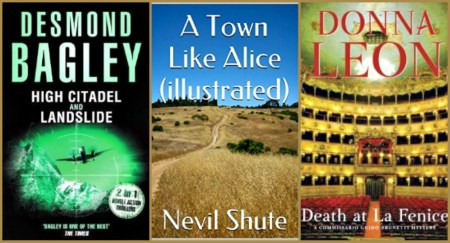
A few of the writers Nik Morton admires for their depiction of place in their novels.

A few of the novelists Nik Morton admires for their skill with depicting location.

Thanks so much, Nik!

* * *

Readers, any questions for my first guest? Please leave them in the comments below.

And if you’d like to discover more about Nik, why not pay a visit to his author site; his blog, called Writealot (no exaggeration in his case); and the archives of Auguries, a science fiction, fantasy and horror magazine Nik edited from 1983 to 1994. You can also follow Nik on twitter at @nik_morton.

Until next month!

Lorraine Mace writes for children with the Vlad the Inhaler books. As Frances di Plino, she writes crime in the D.I. Paolo Storey series. She is a columnist for both of the UK’s top writing magazines, has founded international writing competitions and runs a writing critique service, mentoring authors on three continents.

STAY TUNED for the next fab post!

If you enjoyed this post, we invite you to register for The Displaced Dispatch, a round up of weekly posts from The Displaced Nation, with weekly updates and much, much more. Register for The Displaced Dispatch by clicking here!

Related posts:

Photo credits (top of page): The World Book (1920), by Eric Fischer via Flickr; “Writing? Yeah.” by Caleb Roenigk via Flickr (both CC BY 2.0).

BOOKLUST, WANDERLUST: Beach bound? Check out summer reading recommendations from featured authors (2/2)
booklust-wanderlust-2015

Attention displaced bookworms! Our book review columnist, Beth Green, an American expat in Prague (she is also an Adult Third Culture Kid), empties the remainder of her treasure chest that she brought to us two days ago, stuffed with recommended reads to take you through the summer.

Hello again. As explained in Part One of this post, I reached out to some of my bookish friends as well as a few of the authors whose books I’ve recently reviewed to see what books they recommend taking on vacation. I asked them to tell me:

Summer Reading 2015

Photo credits: Amazon Kindle PDF, by goXunuReviews via Flickr (CC BY 2.0); beach chair and sandy feet via Pixabay.

Here are the rest of the recommendations I received, including a few from yours truly and ML Awanohara (Displaced Nation’s founding editor) at the end. Enjoy!

* * *

MARK ADAMS, best-selling travel writer and author of Meet Me In Atlantis (which we reviewed in May): My recommendations are a classic travelogue, a biography of an intrepid traveler, and an adventure novel.

The-Snow_Leopard_cover_300xThe Snow Leopard, by Peter Matthiessen (Viking Press, 1978)
Shortly before he died, I had the honor of interviewing Matthiessen at his home on Long Island. I was surprised by how concerned he seemed, knowing that his death was rapidly approaching, that he would be remembered less as a novelist than as the author of The Snow Leopard. I went back to reread it for the first time in twenty years and was amazed by how good it was—a moving story about a man’s search for meaning through Zen Buddhism after the death of his young wife, intertwined flawlessly with a thrilling narrative about an incredible journey through the Himalayas. So fresh and evocative it could have been published yesterday.

Bruce-Chatwin_A-Biography_cover_300xBruce Chatwin: A Biography, by Nicholas Shakespeare (Anchor, 2001)
Chatwin, of course, is one of the great travel writers of all time; he practically reinvented the genre with books like In Patagonia and The Songlines. But as Shakespeare’s brilliant biography demonstrates, Chatwin’s greatest creation may have been the globetrotting persona that he carefully presented to the world. The descriptions—decodings might be a better term—of how Chatwin assembled his literary works will be absolutely riveting to anyone who has tried his or her hand at trying to pin down the essence of a place using only words.

State-of-Wonder_cover_300xState of Wonder, by Ann Patchett (HarperCollins, 2011)
I once heard Ann Patchett on the radio, talking about the job of a novelist. She described it as “creating a world.” No one creates worlds with quite the skill that Patchett does. Reading her descriptions of pharmaceutical research being conducted in the Amazon is like being dropped into the jungle—you can feel the sweat beading on your forehead and the buzz of malarial mosquitoes preparing to land on the back of your neck. And you know what? Patchett’s Bel Canto, which takes place in Lima, Peru, is an equally brilliant tale that performs the magic tricks that only great fiction can, allowing you to read minds and travel through time and space.


MARIANNE C. BOHR, Displaced Nationer and author of the soon-to-be-published Gap Year Girl: A Baby Boomer Adventure Across 21 Countries: My summer reads are usually of the meaty kind because as a teacher, I have more time in July and August to pay close attention and savor every word. As one who suffers wanderlust daily, my three choices all have to do with travel. They are very different books, but each grabs my heart in a different way and I could read them over and over, each time discovering something new.
Bohr Collage

The Drifters, by James A. Michener (Random House, 1971)
This book takes me back to my youth and the thirst for exotic adventure that goes along with being young.

Nothing to Declare: Memoirs of a Woman Traveling Alone, by Mary Morris (Houghton Mifflin Harcourt, 1998)
I wanted to head straight to Mexico when I read this heart-wrenching book and also felt like the author was a new friend when I finished.

An Italian Affair, by Laura Fraser (Vintage, 2001)
What a guilty pleasure immersing myself in this book of islands, romance, lust and longing is. I could read it again and again.


SHIREEN JILLA, adult TCK and former expat and author of The Art of Unpacking Your Life (which we reviewed in May) and Exiled (which we featured in 2011): I would pack three very different books:
Jilla Collage

Red Dust: A Path Through China, by Ma Jian (Vintage, 2002)
Dissident artist Ma Jian’s diary of his walk across China in the wake of his divorce and threatened arrest is utterly enlightening, moving, profound and playful. Walking is clearly an under-rated pastime.

Look at Me, by Jennifer Egan (Anchor, 2009)
A powerful, beautiful novel about the crazed nature of modern urban life, it elevates Egan to one of the greats of American literature.

Paris Stories, by Mavis Gallant (NYRB Classics, 2011)
A regular writer for the New Yorker, Gallant penned these short stories about expats and exiles in Europe particularly Paris. They are brilliantly laid bare. (Born in Montreal, Gallant moved to Paris when she was 28 determined to be a full-time writer. She lived there until her death in 2014.)


BETH GREEN, writer, expat, TCK and BOOKLUST, WANDERLUST columnist: Here are my three picks, one of which I’ve not read and two that I have:

The-Messenger-of-Athens_cover_300xThe Messenger of Athens by Anne Zouroudi (Reagan Author Books, 2010)
Summer is the best time to really sink into a mystery series. I love taking a few titles from an established series and binge reading them on the beach or by the pool. Previously, I’ve done this with Elizabeth George’s Inspector Lynley novels, Janet Evanovich’s Stephanie Plum books and Charlaine Harris’ Southern Vampire mysteries. This year I’ll be spending some time on the beach in Greece, so I’ve got my eyes set on British writer Anne Zouroudi’s Greek Inspector mysteries, which depict ugly crimes based on the seven deadly sins in beautiful Mediterranean surroundings. The series now has seven books, of which Messenger is the first. (Born in England, Zouroudi worked in the UK and the USA before giving it all up to live on a Greek island. She married a Greek as well.)

swamplandia_coverSwamplandia! by Karen Russell (Vintage, 2011)
This darkly fascinating and somewhat magical story of a girl and her siblings abandoned in a run-down theme park in Florida fascinated me when I read it a few years ago. It’s both a chilling odyssey into a swampland netherworld and an exploration of subcultures of the kind rarely seen in American books. For me it had the right amount of tension to keep you turning pages and the right amount of whimsy to keep the potentially depressing material light enough for a summer read.

Daughter-of-Fortune_cover_300xDaughter of Fortune, by Isabel Allende, trans. by Margaret Sayers Peden (Harper, 2014)
Summer is a time for voyages—or at least reading about them! I can name a whole bagful of road trip books I’d happily re-read over summer, but for pure swashbuckling joy I have to recommend Isabel Allende’s historical cross-cultural adventure Daughter of Fortune. An upper-class girl raised in an English enclave in Chile in the 1800s stows away to follow her lover to the gold fields of California. I haven’t read the sequel, Portrait in Sepia, yet, but I’m guessing it’s also worth adding to that beach bag. (Born in Peru and raised in Chile, Allende lives in California.)


ML AWANOHARA, former expat and Displaced Nation founding editor: We are constantly reporting on new displaced reads in the Displaced Dispatch, which comes out once a week. Just to give you a taste of the kinds of things we feature, here is a selection. As you can see, it comprises a work of historical nonfiction that reads like a novel, a memoir with elements of Nordic myth, and a novel by a once-displaced poet, all with beach-bag potential.

Daughters_of_the_Samurai_cover_300xDaughters of the Samurai: A Journey from East to West and Back, by Janice P. Nimura (W.W. Norton, May 2015)
Call it the early Japanese version of our gap year or junior year abroad. The story begins in 1871, after Commodore Perry’s ships opened Japan to the outside world, when five young women were sent to the United States on a mission to learn Western ways and help nurture a new generation of enlightened Japanese leaders. Three of them stayed for ten years and returned to Japan determined to revolutionize women’s education. Several critics have said the book reads like a modern fairy tale. But if the women faced many hurdles in the course of their unusual journey, the tale doesn’t necessarily end happily ever after. “I cannot tell you how I feel,” one of them remarked upon her return to her native land, “but I should like to give one good scream.” Janice Nimura, an American who is married to a Japanese, has spent time living in Japan.

Passage-of-the-stork_cover_300xPassage of the Stork: One Woman’s Journey to Self-Realization and Acceptance, by Madeleine Lenagh (Springtime Books, March 2015)
Madeleine Lenagh is American but spent her first five years as an expat child in Europe, after which she grew up in Connecticut. Rebelling against her mother’s interference in her love life, she set out to travel across Europe alone. Arriving in the Netherlands broke, she took a job as an au pair—and the rest is history. She has now been living in the land of cheese and tulips for over four decades and speaks fluent Dutch. But that’s her travel history. Her own personal history remained repressed until she wrote this memoir. One of the things that interests me about it is that Lenagh chose to weave together the narrative using Nordic mythology. (As long-term followers of the Displaced Nation will know, we are fond of doing the same with the Alice in Wonderland story.) Passage of the Stork is a publication of Springtime Books, the new fledgling of Summertime Publishing, which specializes in books by expats and for expats and is the brainchild of global nomad Jo Parfitt.

hausfrau_coverHausfrau, by Jill Alexander Essbaum (Random House, March 2015)
This novel by Texas-born American poet Jill Alexander Essbaum, her first, depicts an American woman in a cross-cultural marriage to a Swiss banker. They are living with their three young children in a postcard-perfect suburb of Zürich. In the spirit of Essbaum’s erotic poetry, Anna (yes, the name is a nod to Tolstoy’s heroine) engages in a series of messy affairs. Now, is this book the expat answer to Fifty Shades? Actually, the answer to that question interests me less than the fact that Essbaum herself was once a hausfrau in Dietlikon, near Zürich, where she moved with her first husband, an American interested in studying Jungian psychoanalysis. Like Anna, she experienced intense loneliness and isolation—albeit no torrid affairs. Who would have guessed?

* * *

Thank you so much for your recommendations, ML and everyone else! Readers, it’s your turn now. What books are you looking forward to popping in the book bag this summer? And, for our friends in the Southern Hemisphere, what books are getting you through the winter?

Also, can I echo ML’s contribution by urging you to sign up for the DISPLACED DISPATCH, which has at least one Recommended Read every week. And please feel welcome to make recommendations for books to be featured in the Dispatch, and in this column, by contacting ML at ML@thedisplacednation.com.

STAY TUNED for next week’s fab posts!

Beth Green is an American writer living in Prague, Czech Republic. She grew up on a sailboat and, though now a landlubber, continues to lead a peripatetic life, having lived in Asia as well as Europe. Her personal Web site is Beth Green Writes. She has also launched the site Everyday Travel Stories. To keep in touch with her in between columns, try following her on Facebook and Twitter. She’s a social media nut!

If you enjoyed this post, we invite you to subscribe to The Displaced Dispatch, a weekly round up of posts from The Displaced Nation and much, much more. Sign up for The Displaced Dispatch by clicking here!

Related posts:

BOOKLUST, WANDERLUST: Beach bound? Check out summer reading recommendations from featured authors (1/2)

booklust-wanderlust-2015

Attention displaced bookworms! Our book review columnist, Beth Green, an American expat in Prague (she is also an Adult Third Culture Kid), has arrived with a treasure chest full of recommended reads to take you through the summer. NOTE: Check out Part Two here.

Hello again, Displaced Nationers!

Summer is upon us—well, for readers in the northern hemisphere, that is! And for those in the United States, Fourth of July weekend is coming shortly. Even if you’re not beach bound, perhaps you are at least picturing yourself sitting in a beach chair feeling the sand through your toes, the waves pounding towards you, the fresh, bracing sea air filling your lungs…

And what’s that you have in your hand—a book or a Kindle?

I find the sound of the waves and the ocean breeze the perfect conditions for escaping into other worlds that writers conjure up for us in their books. This summer, I’ve already been to a few local parks with my e-reader, and I’ll soon be topping it up with some of the books from our best-of-2014 list for an overseas trip. But I’m always on the look-out for fresh new material, and as there are miles to go before I can flop down on the beach of my dreams, I fear I’ll run out of prime reading matter by then. With this eventuality in mind, I decided to reach out to a few of the authors whose books I’ve recently read or reviewed, along with a few of my bookish friends, to see what books they recommend taking on vacation. I asked them to tell me:

Summer Reading 2015

Photo credits: Amazon Kindle PDF, by goXunuReviews via Flickr (CC BY 2.0); beach chair and sandy feet via Pixabay.

They responded with recommendations that seem tailor made for an audience of international creatives. Enjoy! Part 2 will be posted on Friday.

* * *

ALLI SINCLAIR, world traveler, Australian romance author and former co-blogger at Novel Adventurers: I recommend that you bring one travel book, one classic, and one novel. The following make a good combination:

ChasingtheMonsoon_cover_x300Chasing the Monsoon: A Modern Pilgrimage Through India, by Alexander Frater (Henry Holt & Co, May 1992)
There are some books that touch something in your soul that stays with you forever. For me, Chasing the Monsoon falls into that category. Originally published in the early nineties (and thankfully, still available!), Alexander Frater follows the monsoonal rains from the Kerala backwaters in southern India to Cherrapunji, in northern India—known as the wettest place on earth. Frater connects beautifully with the people he meets and he writes for all senses, giving the reader a full immersion into one of the most captivating countries on Earth.

The Ascent of Rum Doodle_cover_x300The Ascent of Rum Doodle, by W.E. Bowman (Vintage Classics, 2010)
Originally published in 1956 but still in print, this book is one of the most celebrated mountaineering stories of all time. The 1950s saw some of the world’s highest mountains successfully climbed (including Everest), and this book is a parody of mountaineering at it’s finest…er, worst. There’s a route finder who is constantly lost, a diplomat who continually argues, and a doctor who is always ill. Rum Doodle will most definitely appeal to fans of Bill Bryson, who wrote the introduction to the book’s international edition (published in 2010).

HellofromtheGillespies_cover_x300Hello From The Gillespies, by Monica McInerney (Penguin, 2014)
I’m a long time fan of Monica McInerney’s books, maybe because Monica is a “displaced” person: having grown up in Australia, she has split her time between Australia and Ireland for the past 20 years. This book is mostly set in outback Australia but with ties to England. Angela Gillespie, a mother of four adult children, has sent out a regular Christmas letter to friends and family for thirty years. The notes are always cheery and full of good news but this year, her note details the unsettling truth of how her family has fallen apart. If you enjoy family sagas with humour and heart, you can’t go wrong with this book. (True, some people recommend it for the holidays, but it’s summer in Australia at Christmas time, remember?)


BRITTANI SONNENBERG, adult TCK, current expat and author of Home Leave (which we reviewed in November): I would pack the following books (assuming I’d be packing it for someone else, who hadn’t read them yet).
Sonnenberg_collage

The Dog, by Joseph O’Neill (Vintage, September 2014)
It’s a devilish, compelling take on cosmopolitan and expat life by the TCK author of Netherland. (Joseph O’Neill was born in Cork, Ireland, in 1964 and grew up in Mozambique, South Africa, Iran, Turkey, and Holland. He now lives in New York City.)

Ghana Must Go, by Taiye Selasi (Penguin, 2014)
This is an intimate examination of a splintered family, set in Accra, Lagos, London, and New York.

All My Puny Sorrows, by Miriam Toews (McSweeney’s, 2014)
One of the saddest and funniest books I’ve ever read; an honest, moving portrayal of sisters and mental illness.


CHRISTINE KLING, author of travel- and sailing-related thrillers: I’ve just finished up the edits on a the third novel in my Shipwreck Adventure series, and I’m looking forward to taking a bit of time off from writing and working at reading my way through some of the long list of books I’ve been wanting to read. The three books I’d take in my beach bag include two novels and a combination cookbook/memoir/travelogue.

The-Janissary-Tree_cover_x300The Janissary Tree, by Jason Goodwin (Sarah Crichton Book, 2006)
My husband and I are contemplating building a new boat in Turkey, and after our recent visit, I’ve fallen in love with the country. Jason Goodwin has written travel books, histories, and thrillers, and I’ve been waiting for the chance to begin reading his work. The Janissary Tree, winner of the 2007 Edgar Award for Best Novel, is the first in what is now his five-book series set in in the waning days of the Ottoman Empire’s Istanbul. The series features a very unique protagonist Yashim Togalu, a eunuch guardian. In this book, Yashim is called upon to investigate a series of crimes including murder and theft of jewels.

Marina_cover_x300Marina by Carlos Ruiz Zafón (Little, Brown Books for Young Readers, 2014)
The first book I read by this author was The Shadow of the Wind, which I often cite as one of my favorite books of all time. I knew Zafón had written a young adult novel that was published in 1999 and became a “cult classic” in Spanish, and since I enjoy good YA novels like the Harry Potter series and the Hunger Games, I was happy to see this book finally released in English in 2014. Marina is set in Barcelona around 1980 at the end of Franco’s regime. This gothic tale is touted as containing elements of mystery, romance and horror as a young boarding school boy meets the exotic, dark Marina. Together they embark on a series of adventures where they meet the kind of grotesque Barcelona characters Zafón does so well.

Sea-Fare_cover_x300Sea Fare: A Chef’s Journey Across the Ocean, by Victoria Allman (Norlightspress Com, 2013)
Years ago I worked as a chef on our owner-operated charter sailboat, and I know what it is like to have to create meals for demanding guests. Victoria Allman is in an entirely different category as she trained as a chef and has worked your years on multi-million dollar yachts. In Sea Fare, Allman has combined the tales from her beginning as a green Canadian chef looking for a job in the charter yacht industry to the joys of shopping in exotic markets from Italy to Vietnam. From the descriptions of her experiences on board the yacht, dealing with crew problems and falling in love with the captain, the stories are grand, but the recipes and the outstanding color photos of the food, will probably cut my trip to the beach short as I head home to try some new dish.


HEIDI NOROOZY, adult TCK, translator and author of multicultural fiction: I just returned from a research trip to Germany, and my choices seem to reflect that! (I went there because I’m writing a novel about an East German detective, Johannes Christian Alexander Freiherr von Maibeck—I know, it’s a bit of a mouthful—I created for a short story I once wrote. The setting is Leipzig, German Democratic Republic, 1981.)

The-Leipzic-Affair_cover_x300The Leipzig Affair, by Fiona Rintoul (Aurora Metro Press, May 2015)
Set in 1985, this novel tells the story of a Scottish student at Leipzig University who falls in love with an East German girl and stumbles into a world of shifting half-truths. Well written and fast paced, the story captures the atmosphere of its setting very well, a world where nothing is ever quite what it seems. As one reviewer writes: “The book is expertly written and seems to me to be a very comprehensive picture of what it was like to live in the East German state.” (Rintoul, a Scot who lives in Glasgow, gathered her material for the book by visiting East Germany and meeting a woman who had been imprisoned. She also looking at extracts of STASI files on people she met.)

Zoo-Station_cover_x300Zoo Station: Adventures in East and West Berlin, by Ian Walker (Atlantic Monthly Press, 1988)
British journalist Ian Walker, who once covered Central America for the Observer (and never managed to write his promised volume on Nicaragua), produced this travelogue on the two Berlins back in 1988. It depicts bohemian life in the once-divided city, where everyone seemed to be from somewhere else: West Berlin was full of Brits, Asians, Danes, Turks and East German exiles; East Berlin, of Anglo-Austrian expats. Walker’s descriptive narrative and reflections on the broader social issues of the day are what make this book stand out. As one of Amazon reviewer puts it:

Having read “Zoo Station”, I was able to understand why some people regarded East Germany as a pinnacle of socialist achievement, much more preferable to its capitalist twin in the West. It is good travel writing, and is both politically and culturally astute.

The-One-That-Got_Away_cover_300xThe One That Got Away, by Simon Wood (Thomas & Mercer, 2015)
Okay, this one isn’t about Germany, and I haven’t read it yet—but it’s at the top of my summer book bag. Tag line: “She escaped with her life, but the killer’s obsessed with the one that got away.” The story of two grad students in California who decide to take a road trip to to Las Vegas, this suspense novel deals with survivor’s guilt and is bound to be a thrilling ride. (Originally from England, Simon Wood lives in California with his wife.)

* * *

Readers, that’s it for this round; we’ll have another round on Friday (update: check it out here). Meanwhile, have you read any of the above and/or do you have summer reading recommendations to add? Please leave in the comments!

And if you need more frequent fixes, I urge you to sign up for the DISPLACED DISPATCH, which has at least one Recommended Read every week.

STAY TUNED for PART 2 of this post on July 3rd!

Beth Green is an American writer living in Prague, Czech Republic. She grew up on a sailboat and, though now a landlubber, continues to lead a peripatetic life, having lived in Asia as well as Europe. Her personal Web site is Beth Green Writes. She has also launched the site Everyday Travel Stories. To keep in touch with her in between columns, try following her on Facebook and Twitter. She’s a social media nut!

If you enjoyed this post, we invite you to subscribe to The Displaced Dispatch, a weekly round up of posts from The Displaced Nation and much, much more. Sign up for The Displaced Dispatch by clicking here!

Related posts:

TCK TALENT: Lisa Liang takes her show back on the road; first stop: Valencia, Spain!

This month our TCK Talent columnist Elizabeth (Lisa) Liang updates us on her own creative life.

¡Hola, amigos!

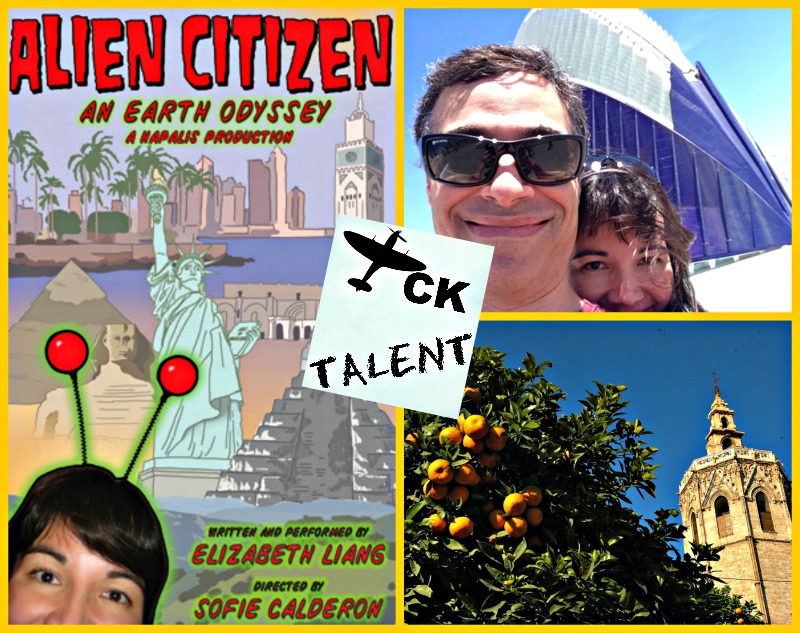
As those of you who subscribe to the Displaced Dispatch will know, Alien Citizen: an earth odyssey, my one-woman show about growing up as a Third Culture Kid, or TCK, of mixed heritage, was accepted by two international conferences in two of the world’s most appealing locations: Valencia, Spain, and Cape Town, South Africa. Thinking I’d be a fool to pass up this kind of opportunity, I launched an online crowd-funding campaign to fund both journeys. Two of us would be going: myself and my husband, Dan, who also serves as my “techie” for the show.

It was my fourth experience with crowd-funding—the most recent being last year, to cover expenses for taking the show to an arts center in Reykjavík, Iceland; and once again, the campaign worked. (A relief since I feared I might have tapped out my supporters’ goodwill, but people were as generous as ever—and I won’t ever fundraise for this show again.) We didn’t quite make our goal but could afford to cover the balance. We would be able to attend two international conferences on two continents in two months—hooray!

In this month’s column I’ll recount our trip to Valencia, Spain, to participate in the 2015 SIETAR Europa Congress, on May 21–23. SIETAR, which stands for the Society for Intercultural Education, Training and Research, is the world’s largest association dedicated to intercultural issues.

TCK Talent Lisa Liang takes her show on the road to Valencia, Spain.

TCK Talent columnist Lisa and her husband (and techie), Dan, head to Spain. Photo credits: (from left) Alien Citizen poster; Dan and Lisa in front of Ciudad de Artes y Ciencias (supplied); “Naranjo y el Campanario Valencia,” by Emilio via Flickr (CC BY-SA 2.0).

First impressions of the Land of Sweet Orange Trees

Dan and I had a couple of days of sightseeing before the three-day conference took place at the Universitat de Valencia. We drank lots of fresh-pressed zumo de naranja (“orange juice” in Catalán)—and yes, the oranges are the best we’ve ever tasted!

We toured the wonderful old section of the city, including the Cathedral and its Torre del Micalet, and the spectacular Ciudad de Artes y Ciencias (City of Arts & Sciences)—a futuristic outdoor/indoor complex near the beach, with an awesome aquarium. We even took the long bus route back to our hotel, which gave us a chance to see a lot of the Turia Gardens, a park built on a riverbed.

Dan got to carry on sightseeing while I attended sessions (workshops, panels, and lectures) during the first two days in order to meet people, learn more about the interculturalist professional world, and get the word out on Alien Citizen.

First impressions of SIETAR

In general the other conference participants seemed very nice but a tad noncommittal when I told them about my one-woman show. I think it was rather unusual to have a theatrical piece at the congress, though I noticed there were several sessions on storytelling as an important means of generating intercultural understanding.

Most of the attendees were what I would describe as interculturalist entrepreneurs—perhaps not your usual fringe theatre-goers? Still, I appreciated learning what sort of cross-cultural issues Europeans have been facing, and there was the bonus of generous lunches and yummy pastries along with coffee, tea, and zumo during the breaks. (I may have gained a pound or two.)

At the end of the second day, I was beat—but still had to do a run-through of my show in our hotel room that evening. Theatre takes stamina, so perhaps my two full days of attending conference events had done me a favor.

attending performing SIETAR

First she observes; then she performs. Lisa Liang at Congress Valencia 2015. (Photos supplied.)

Show Day!

The third day of the congress: show day! And some tension… For one thing, I didn’t realize until then that many congress-goers would take the day off to go to the beach or do sightseeing. I feared I might only have five or so attendees, which would be enormously disappointing after making the long journey from California (not to mention the fundraising!).

And for another, I was performing in a classroom like all the other session presenters, which meant we had just 10 minutes to set up. Ten minutes may be fine for a PowerPoint presentation but, especially as the session before us ran a little late, Dan and I really had to hustle to set up all the props, as well as the laptop, old-fashioned slide projector with voltage converter, my tape marks so I would know where to stand when projecting words onto my torso, and chair. We were in such a hurry that I forgot to set up chairs to stand and dance on “upstage.” I had to grab them from the front row in the middle of the performance. Funfunfun!

Despite these challenges, the show was a hit! People did turn up, and there were many more than five, thank goodness. They stayed for the whole performance, which was a coup—there had been walkouts from every session I attended in the previous days (with all the concurrent sessions, people were constantly session-hopping).

After the show, the applause lasted for such a long time that I exited the room to give the audience a break. But they didn’t stop, which was deeply gratifying and a huge relief, so I came back in and took some more bows. Many audience members stayed afterward to thank Dan and me, and in some cases draw parallels with their own lives. Those who found the story relatable included not just people like me, who grew up in different countries, but also people who’d lived only in Spain. One woman said she would distribute the show’s flyers at international schools in her country…so here’s hoping!

Most importantly: the show seemed to help people feel more connected and better understood, which is its ultimate mission.

Post-show celebrations

Post-show, Dan and I went out for a celebratory drink of horchata (made with tiger nuts) at one of Valencia’s oldest and prettiest horchata joints. Then we ambled over to the formerly half-Moorish, half-Catholic quarter, where we ordered a pitcher of sangria (since it cost the same as two glasses).

It may well have been the best sangria I’ve ever had—certainly worth the headache afterwards.

We made it back in time to attend the conference’s gala dinner, which took place in a lovely courtyard at the university. A couple of people who came to the performance approached me to say they were telling everyone at their tables about Alien Citizen. Again, I felt a mix of pride and relief.

Congrats Collage

Brava, Lisa, to another fine performance! Photo credits: (top and bottom) Lisa and Dan celebrating with sangria and at the gala dinner (supplied); (right) “A glass of horchata, Spain” via Wikimedia Commons (CC-BY SA 2.0).

To sum up…

Reflecting on the experience, I came to the conclusion that if the show is accepted at another non-theatre conference in the future, I should perform it only if it can be a keynote (as it was at the FIGT conference in 2014). Practically speaking, it takes time to set up the equipment and props, and as a performer I need space/room to relax and warm up before the show, which runs 80 minutes non-stop and takes my entire being to perform with the energy, precision, and authenticity that the audience deserves.

Still, I’m glad that we brought the show to this intercultural gathering, and I’d love to visit Valencia again. Food-wise, we had truly fantastic tapas and excellent wine, and as a night owl, I appreciated the late dinners. Virtually every Valenciana/o was very polite and friendly, and they all understood my slightly-gringa-inflected Guatemalan accent in Spanish.

The jet lag was only a problem on our first night. It took about a week to recover from it back in L.A., but that may partially be due to wistfulness: we’re not in Valencia anymore (woe!). Between its delights and our appreciative SIETAR audience, it was a fantastic, and very worthwhile, trip.

Next stop: South Africa!

At the time of writing I am preparing to attend the 10th Women Playwrights International Conference, being held in Cape Town from June 29 to July 3. WPI has brought together women playwrights and allied theatre artists, cultural workers and scholars since 1988. It facilitates communications and collaborations among the international community of women in theatre by holding conferences every three years.

It sounds like my crowd. But South Africa: that’s a first! We’re hoping to do a winelands tour and maybe a one-day safari tour. Watch this space for my next update.

* * *

Thank you, Lisa! I enjoyed taking that vicarious journey into a part of Spain to which I’ve never been. Imagine being able to drink fresh-pressed zumo de naranja to one’s heart’s content! (I’m not so sure about the horchata, though.) It was also interesting to hear your take on SIETAR: I know several Displaced Nationers were planning to attend. Readers, please leave questions or comments for Lisa below.

STAY TUNED for the next fab post!

If you enjoyed this post, we invite you to register for The Displaced Dispatch, a round up of weekly posts from The Displaced Nation, with news, book giveaways and other extras. Register for The Displaced Dispatch by clicking here!

Related posts:

WONDERLANDED: “Shadows & Reflections,” by long-term expat Paul Scraton

Shadows and Reflections Berlin

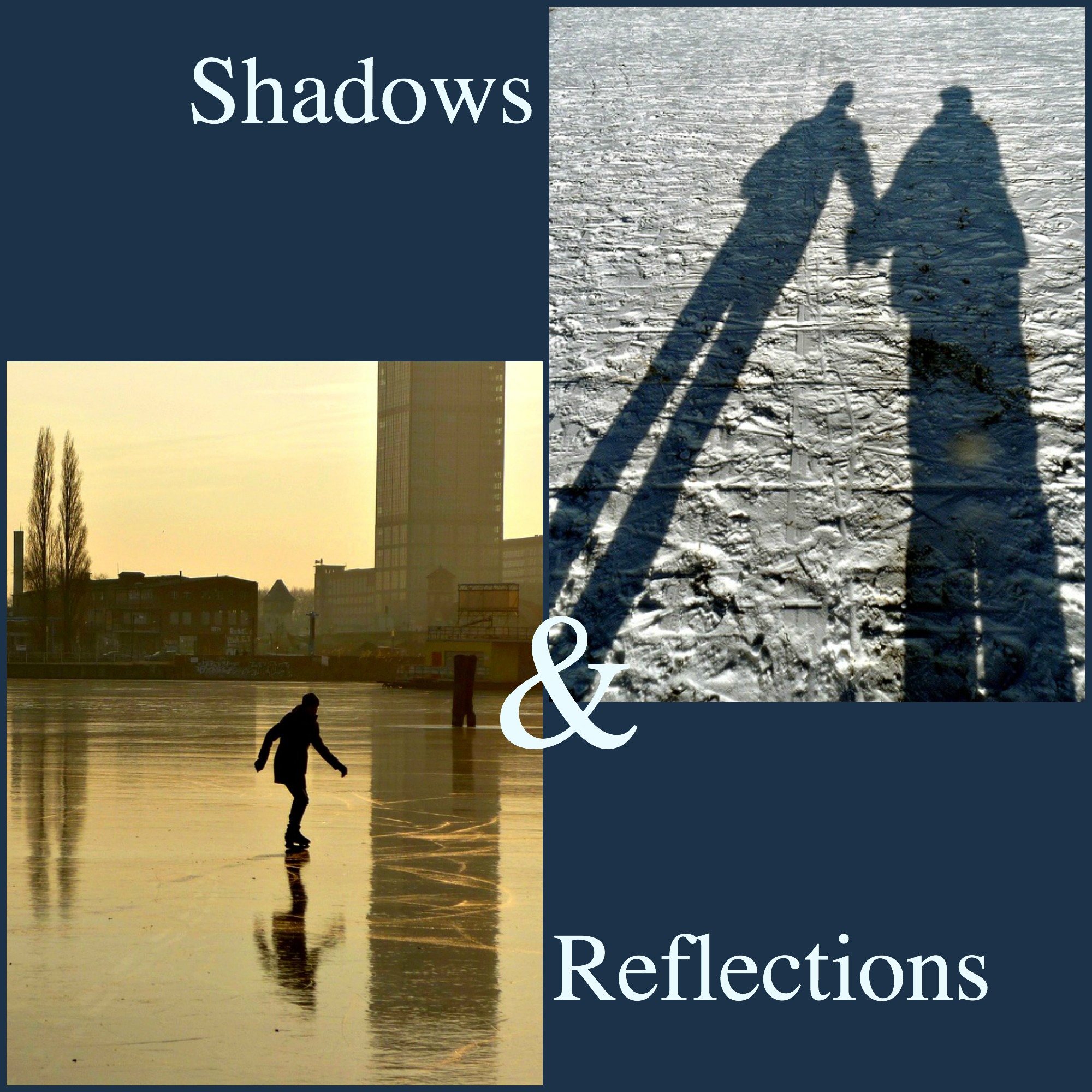
Photo credits: (left) Rummelsburg Bay in Berlin via Pixabay; Volkspark Hasenheide, Berlin-Neukölln, by Zusammen via Flickr (CC BY-SA 2.0) .


Just the other day we were “wonderlanded” in Berlin with British expat writer Paul Scraton. We found out what it was like to live “slightly on the edge of the scene”: in Paul’s view, “that’s where the interesting stuff happens.”

Today we hear from Paul again on the topic of displacement—only this time he will be speaking through a piece of his own writing. “Shadows & Reflections”* is a post he wrote two-and-a-half years ago for the British online forum Caught by the River, which, like Alice’s own story, was “born on a bankside.”

* * *

We are taking a train back from Munich to Berlin on a Sunday afternoon at the start of December, a six-hour train ride home that will take us through some of Germany’s most beautiful countryside at over a hundred and fifty kilometres an hour. A few hours north of Munich, just over the old border between the former West and East of the country, the fields are covered in a light layer of snow, the forests engulfed in mist. Whenever the first snow flurries of the winter arrive it never fails to remind me of the day I moved to Germany, landing at a snowy Schönefeld Airport, still on high alert a couple of months after September 11th.

Train Ride to Berlin quote

Photo credits: (top) The scenery from the train window, by Paul’s partner, Katrin Schönig; “Keep the track focused!” by Axel Schwenke via Flickr (CC BY-SA 2.0).

I did not imagine then that I would still be living in Berlin over a decade later, and that Germany would have become my home. Or is it? The Germans have a wonderful word that to my mind has no proper translation into English. Usually the word Heimat is turned into “homeland”—but it means something more than that, a feeling about a place that involves an almost spiritual sense of belonging even in the non-religious. It might be Berlin, or even a district of the city. It might be a stretch of the Baltic coastline, or a village in the north of Bavaria. It could be a certain landscape, a place of particular traditions and culture. Germany is a fractured country, only put together for the first time in 1871, and local, regional pride still runs strong.

Yes, Berlin and Germany has become my home over the past twelve years, but it is certainly not my Heimat… And at the same time, a handful of trips back to England over this year has made me realise that if it is not here, it might not be there either.

During the three trips, to London, my old stomping ground of West Yorkshire, and new discoveries in Northumbria, I realised once again that although there are certain elements of returning that are as comfortable as a favourite old jumper, being away means you miss certain developments and that marks you down as an outsider, whether it is a particular band an old friend is raving about, or a certain slang term that you start to notice being used on social media or in streamed BBC shows that you think you understand but you cannot be sure.

So in this year of journeys—to England, but also through Germany to the Baltic coast, the Oder River and the forests and lakes around Berlin—I reflected a lot on belonging and what it means to be home. When I first learned the word Heimat it made me think of certain places that meant something strong to me, but I realised—as I conjured images of the Welsh coast and mountains, the Yorkshire moors and dales, the Dock Road in Liverpool and the potato fields of West Lancashire—that this was more an exercise in memory and nostalgia than anything else. And the thing with memory and nostalgia is that even when you go back, return for a visit or even to stay, you realise that not only is the place subtly different than you remember it, but you are also not the same person as the one that was there before.

Heimat Two Seas

Photo credits: (top) “Choppy seas,” by psyberartist via Flickr (CC BY 2.0); Baltic sea by Paul’s partner, Katrin Schönig.

Living in Germany for a dozen years has, of course, shaped and changed me. If I am looking for a shadow in these reflections, perhaps this is it. The paths you take always leave you the chance to wonder about those that you did not. If you are of a mind to spend much time with your memories and nostalgia, then you cannot help but reflect on how things could have been different. You cannot possibly know how you yourself would then have changed with a different job, a different house, perhaps even different people around you, except to know that you most certainly would have.

As the train rushes through the rolling landscape of Thüringen, just before the flatlands of the north, I think of how my appreciation of such scenes has changed over the past 12 years. From my list above you could work out that the landscape I grew up with, and which continues to touch me—of moors and mountains, wild cliffs and the white horses of the Irish Sea.

But over my time in Germany I have come to appreciate the very different landscape that surrounds me…the flat, melancholic beauty of the Baltic coast, the lakes north of Berlin and the pine forests that encroach on the city. And I realise I am happy to have learned to love something so different, that I need not continue any surely futile search for a Heimat that deep down I know does not exist. That is, perhaps, both the cost and the benefit of having grown up in one place and chosen to live and love somewhere else.

As the train reaches the outskirts of Berlin I look out of the window into the darkness, searching for the first glimpse of the Television Tower in the distance. Then I will know that I am nearly there. Home.

*”Shadows and Reflections” is republished here with Caught by the River’s permission.

* * *

Thank you, Paul, for this enlightening series of “wonderlanded” posts. Readers, I hope that by now you are, like me, full of wonder at Paul’s insights into a life of displacement similar to the ones many of us have led. 

As it happens, the very first issue of the new journal of Elsewhere: A Journal of Place, of which Paul is founding editor, is out today. Please join me in wishing Paul a hearty congratulations! And, say, if you like what Paul has to say about place, why not think about subscribing? I would also urge you to follow his blog, under a grey sky… ~ML

STAY TUNED for the next week’s fab posts.

If you enjoyed this post, we invite you to register for The Displaced Dispatch, a round up of weekly posts from The Displaced Nation, and much, much more. Register for The Displaced Dispatch by clicking here!

Related posts:

Wonderlanded in Berlin with British expat Paul Scraton, founding editor of the new “Elsewhere” journal

Welcome to the Displaced Nation’s Wonderlanded series, being held in gratitude for Lewis Carroll’s Alice’s Adventures in Wonderland, which turns 150 this year and, despite this advanced age, continues to stimulate and inspire many of us who lead international, displaced, “through the looking glass” lives.

This month we travel
d
o
w
n
the hole with Paul Scraton to Berlin.

Paul Scraton Wonderlanded for TDN 3

Paul says he isn’t intimately familiar with Lewis Carroll’s classic work—this despite having had a mainly English childhood. He was born and spent his early years in a market town just north of Liverpool; and, though his family moved around a fair bit in Paul’s early years—Wales, Canada, the south of England—they settled in Lancashire once he reached school age. At 18, he crossed the north–south divide to attend the University of Leeds.

But I feel justified in including Paul in this series first because he is most certainly displaced. Upon graduation from Leeds, he moved to Berlin, Germany, which is where we find him today, living with his German partner, Katrin, and their daughter. Apart from a summer spent in Dublin, the German capital has been Paul’s “home” for the past 14 years.

In addition, having studied Paul’s creative output, I think it is fair to say that for him, “elsewhere”—by that he seems to mean the great outdoors—is a kind of Wonderland. He never tires of exploring the area where he lives. He has served as a tour guide for Slow Travel Berlin and written two short books based on walks he has led in and around his adopted city.

Another place to which he has formed a deep attachment is Germany’s Baltic coast. Katrin spent much of her childhood on the the island of Rügen and in the Hanseatic city of Stralsund, and for about a decade, Paul has accompanied her on trips to the region.

Paul writes a regular series of “dispatches” about his various outdoor adventures—whether in Germany or the UK (which he still visits frequently)—for his blog, under a grey sky…

And now he has just released the very first issue of Elsewhere: A Journal of Place, of which he is the founding editor.

Without further ado, let’s find out what it’s like to be “wonderlanded” with Paul.

* * *

Paul Scraton: Although it was quite a few years ago now, I can remember what it was like when I first arrived in Berlin and needed help with everything, from registering an apartment to opening a bank account. It was certainly challenging, even though Berlin is a city where many people speak English. And it is often only in the moving that you realise what aspects of life are different or not easily accessible compared to “back home”…and that can certainly make you feel lonely in a new city, a new country.

I did not have an internet connection in my first couple of Berlin apartments, and the English newspapers were expensive, so I relied a lot on BBC World Service. It is funny that this is not that long ago, but I imagine it is a different experience now with widespread internet access, social media and Skype.

I think the reason I first resisted the idea of Berlin or my life in another country as “wonderland”, besides a lack of familiarity with the books, is that by the definition of the Displaced Nation I am so often in this wonderland that it would never occur to me to frame it in that way. What I mean by this: when I am in Berlin I feel like I don’t quite belong, but when I go “back” to England having lived abroad for 14 years then I feel just as out of place. So it is something of a permanent state.

Despite this I can recognise that there are elements of life and my experience in Berlin (and beyond) after all these years that I still find curious…

“The question is,” said Alice, “whether you CAN make words mean so many different things.”

Having just finished university with no real idea of what I wanted to do except to write, I did wonder whether Berlin was the right place for me in the sense that I felt a long way away from any community or other people doing something similar in English. But several of us built our own little network, and, with the influx of still more international creatives over the years, there is now a small but thriving community of English-language writers and other like-minded folk.

“But what did the Dormouse say?” one of the jury asked.

One of the reasons I was drawn to Berlin was its history and the stories contained within these streets. One of the questions I would often ask people when I met them was whether or not they had grown up in the east or the west, and their experiences of living in a divided city and country and also what they thought about the process of reunification. In more recent years I was involved with running eyewitness history talks with people who told their personal stories of living in the city during the Nazi era or the Second World War, or living under communism in East Germany or in the “island city” that was West Berlin. Sometimes people in the audience, who were mainly visitors from outside Germany, would ask questions that would make me worry that the speaker would be offended, but actually it never happened. The Germans were happy to answer even difficult questions about their past or that of their families. In general, this is one of the strengths of the German society—the extent to which they have acknowledged, come to terms with, and discussed, debated and learned from their history; and you see it with individuals as well.

“Curiouser and curiouser…”

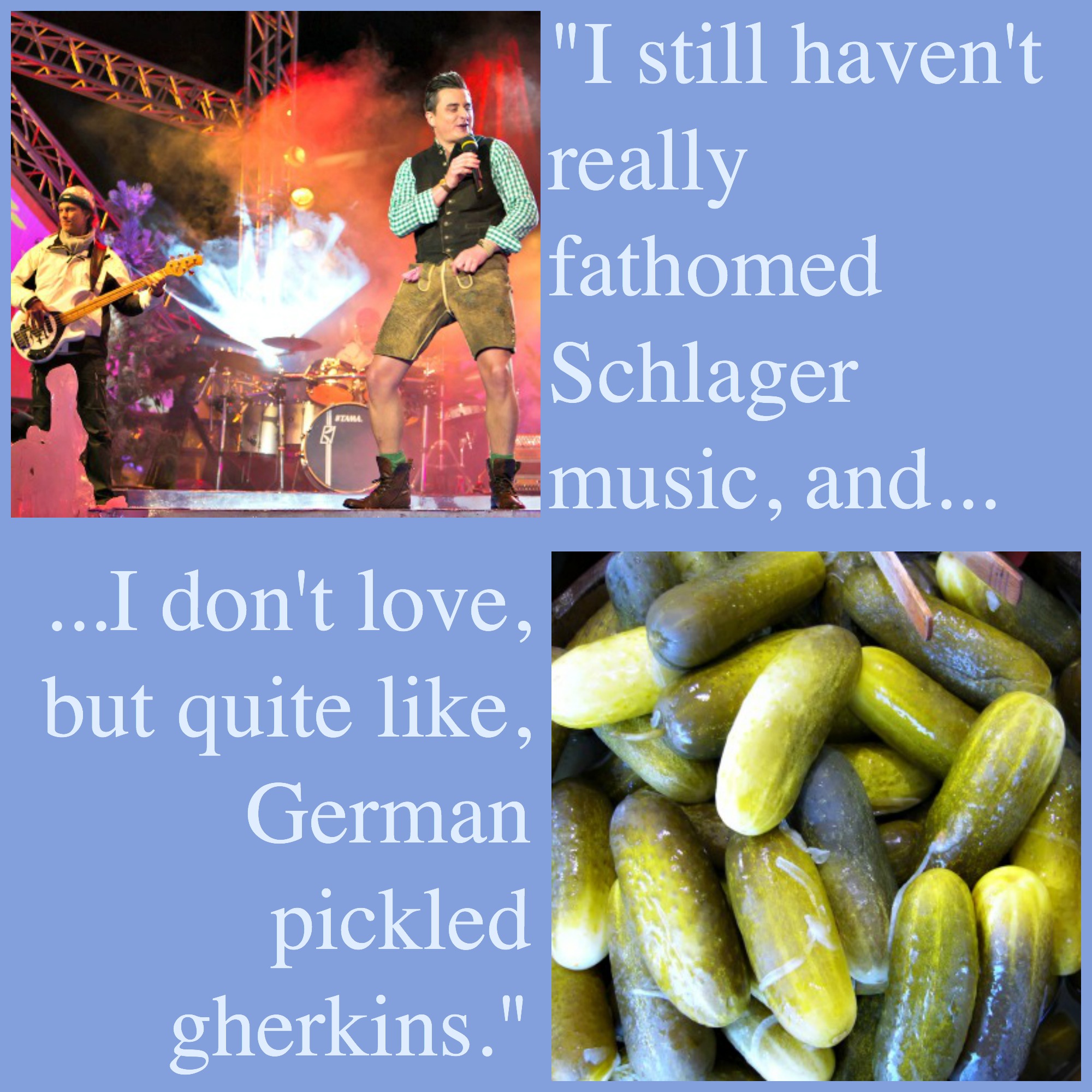
I think what really struck me about moving to Germany was not any sense of culture shock, but that the differences to back home were subtle and needed time to be discovered. In Berlin especially people can be very direct… there is very little tip-toeing around the subject, which can be a bit disconcerting. The main thing I still haven’t really fathomed is Schlager music, and the assorted television shows that showcase it. Finding yourself in the middle of something like that is one of those moments where you really realise you are living in a place where there are certain cultural traditions you have no grasp of, and to which you may never have access.

Acquired tastes Paul Scraton

German tastes you may never fully acquire. Photo credits: “Wenn die Musi spielt,” by Bad Kleinkirchheim via Flickr (CC BY 2.0); Giant gherkins, by Caitriana Nicholson via Flickr (CC BY-SA 2.0).

“Well, I’ll eat it,” said Alice…

My partner introduced me to good German pickled gherkins, and without her prompting I doubt I would ever have touched them. Now I quite like them.

“Will you walk a little faster?” said a whiting to a snail…

I am fascinated by Germany’s Baltic coast. One of the reasons is that I am fascinated by the coast in general, I think because it is a place that combines (a) the sense of escape that comes with family holidays, the seaside resorts, and the break with everyday life; and (b) the danger, myths and legends of the sea itself. Most seaside towns have both beaches where people have spent many, many happy hours, as well as memorials to shipwrecks and lifeboat crews… This contrast or contradiction applies, by the way, to the coast of the UK as much as here in Germany. (See for instance my blog post about our visit to Lindisfarne, Northumbria.)

The allure of the coast: Heimat, Germany (top) and Lindisfarne, Northumbria, UK. Photo credits: Paul Scraton and K.

The allure of the coast: Heimat, Germany (top) and Lindisfarne, Northumbria, UK. Photo credits: Paul Scraton and Katrin Schönig.

Another reason the Baltic is special is that it’s the place where my partner grew up. In the past ten years or so she has been taking me and my daughter up there. We are writing new stories for ourselves in a place that was very much a part of her childhood.

“Take some more tea,” the March Hare said to Alice, very earnestly.

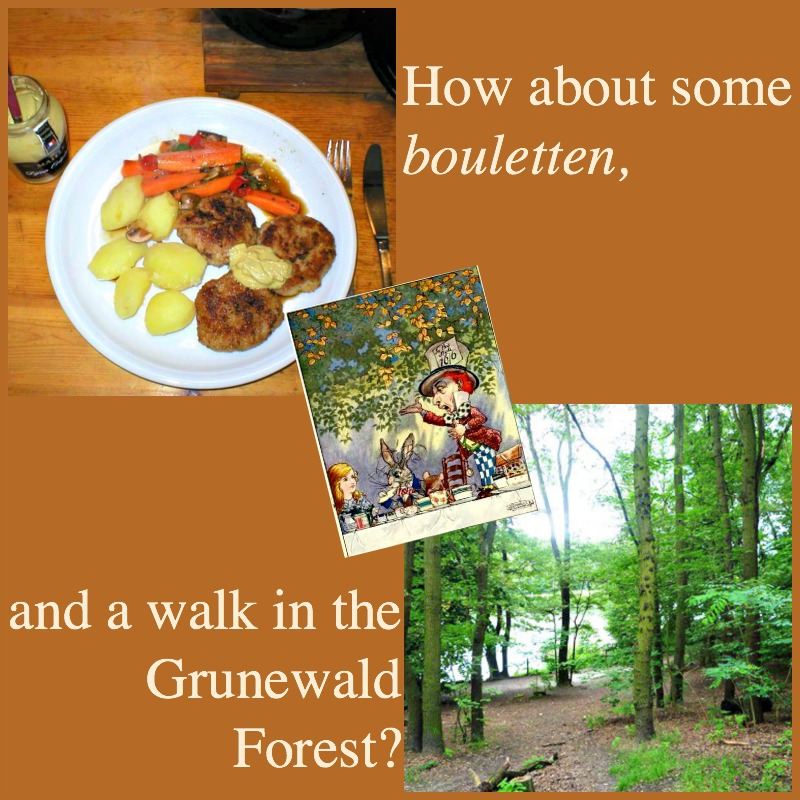
Now that you’re Wonderlanded with me, I must throw you a Mad Hatter’s tea party. This being Berlin, I will serve beer and bouletten (meat balls), a Berlin specialty, at the big table in our living room. We will listen to music and chat…and the guests will be friends, those who I don’t see enough of because of the way life seems to be. Not only those who are in England, and who I don’t see because of distance, but also those who live in the same city but somehow life gets in the way. But before we sat down for beer and meatballs we would have done a long walk together through the city or perhaps out at the lakes and the forests on the edge.

Bouletten and a walk. Photo credits: Bouletten mit Senf, by  Michael Fielitz (CC-BY SA 2.0); Grunewalk Forest by Paul Scraton.

Bouletten and a walk. Photo credits: Bouletten mit Senf, by
Michael Fielitz (CC-BY SA 2.0); Grunewalk Forest by Paul Scraton.

“Who in the world am I? Ah, that’s the great puzzle!”

Inevitably, you are a different person at 36 years old than at 22, and these changes would have no doubt happened whether I was in Berlin or had stayed in England. And if anything, being with my partner and our child probably had a more profound impact that simply the act of moving away. But I would say that work wise, in my writing and in creating our journal, Elsewhere, living in Berlin has been an endless source of inspiration. The number of interesting places and the stories they contain feels inexhaustible. I don’t think I would have become the writer I am, pursued the projects I am doing, or developed my work in the direction I have, without living in this city for the past decade and a half.

Advice for those who have only just stepped through the looking glass

If you are like me, you will find yourself feeling out of place in your new home and out of place when you return to the old one. But there is nothing wrong with being slightly on the edge of the scene…that’s where the interesting stuff happens.

“I wonder if I shall fall right through the earth!”

Paul Scraton books and journal

Paul Scraton’s two short books and the first issue of the new journal he edits, Elsewhere.

Aside from the journal, the first issue of which we are launching this week, I am writing a book about memory, exploration and imagination on the German Baltic coast. As I mentioned, this is the area where Katrin grew up, and so the book combines my own travels and discoveries in the area with the myths and stories of the places along the coast as well as Katrin’s family history. I think coming at these places and stories as an “outsider” gives me a different perspective that informs and shapes the writing. Ultimately everything I am working on right now is concerned with the idea of “place”, and again, I think this interest has developed as a result of never quite feeling I belong wherever I may be…

* * *

Readers, I wonder if you feel like me, that you’ve enjoyed being “elsewhere” with Paul so much you feel a bit bereft now that our “tour” has ended… Do you agree the time went quickly? And what did you make of his Wonderlanded story? Please let us know in the comments. ~ML

STAY TUNED for the next fab post: an example of how Paul writes about place.

If you enjoyed this post, we invite you to register for The Displaced Dispatch, a round up of weekly posts from The Displaced Nation, and much, much more. Register for The Displaced Dispatch by clicking here!

Related posts:

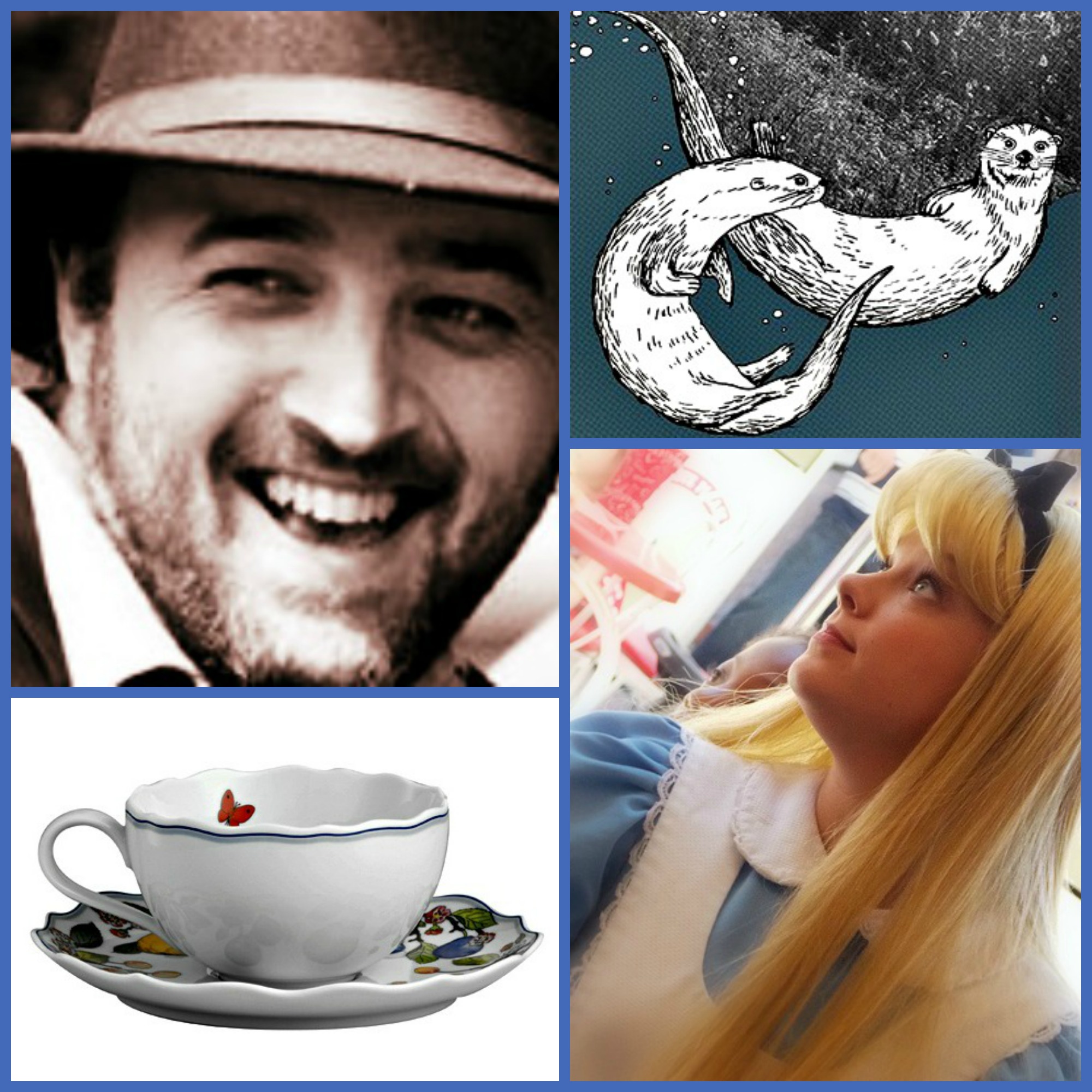
Photo credits for opening image (clockwise from top left): Paul Scraton (supplied); image from “A line of wild suprise: Prespa, Greece,” one of the articles on the first issue of Elsewhere; “Alice,” by Jennie Park via Flickr (CC BY 2.0); Hutschenreuther Garten Eden Cup & Saucer via Chinacraft.

CULTURE SHOCK TOOLBOX: Expats, don’t throw away your old coping tools—they may come in handy for your new life abroad

For her column this month, transitions enthusiast H.E. Rybol interviews displaced creative Jessica Lipowski about her culture shock memories and coping strategies.

June 2015 Jessica Libowksi Culture Shock Toolbox
Hello, Displaced Nationers! I’m excited to introduce you to road-less-traveled (#TRLT) buff and foodie Jessica Lipowski. Originally from Detroit, Michigan, Jessica moved to Amsterdam in February 2011 to be with her Dutch boyfriend, Matthijs. She has worked in a variety of jobs related to travel and is currently writing a non-fiction book that documents the stories of 83 entrepreneurs from 50 different countries who live in Amsterdam. They all have in common that they own restaurants in the city.

Jessica, who appreciates Amsterdam’s wide range of cuisines, has developed a curiosity about how all of these people ended up in the same industry, in the same city and with similar passions. As she writes on her site:

Why Amsterdam and how did so many people from every corner of the world end up in this small capital city? What drew them to the land of tulips and windmills?

But our focus today is not these expat restauranteurs but Jessica herself. While sampling Amsterdam’s rich cultural stew, has she ever had to put down her spoon owing to culture shock? And what tools did she use to restore her appetite?

* * *

Hi, Jessica, and welcome to the Displaced Nation. Can you tell us a little about your background?

I am originally from the United States, born and raised in the metropolitan Detroit area. I spent the first 23 years of my life in Michigan, apart from the two summer internships I completed in Washington D.C. In February 2011, I moved to the Netherlands and have resided in Amsterdam for the past four years.

In the context of transitioning from the United States into Europe, did you ever put your foot in your mouth? Can you share any memorable stories?

While working in sales and marketing for an online group travel platform, I often had to attend business meetings and conferences in Europe. I was a regular at one of these events, which took place four to six times a year. I soon developed a friendship with another regular, a Dutch woman, whom I’d always look forward to seeing. On one occasion when we met, she complimented me on the dress I was wearing. I thanked her and then, as I leaned in to share with her where I purchased the dress (I wanted to tell her I’d paid a relatively cheap price), she cut me off and said: “Oh, Jessica, you should never tell someone details like that.” I honestly thought she would appreciate hearing my story, but it turned out to be the kind of information that is supposed to be shared only with close friends.

I got a bargain! Shhh... Photos via Pixabay.

I got a bargain! Shhh… Photo credits: “Street signs of the nine Straatjes” on Wikimedia by JSpijer via Wikimedia Commons (CC BY-SA 3.0); other two photos via Pixabay.

What lessons can you offer to the rest of us from this story?

Instead of being offended, I smiled and apologized. I told my Dutch business acquaintance how much I appreciated that she’d corrected me, and I meant it sincerely, as it would keep me from making the same mistake again in future. I think a smile and an apology can go a long way in such situations. Of course it might have helped if I’d done more research beforehand on social customs and norms in various European countries. But if you haven’t done your research, then don’t be too proud to rely on business colleagues or local friends for advice.

Looking back on your transition from the United States to Holland, can you recall any situations that you handled with surprising finesse?

I surprised myself with my commitment to learning Dutch. My first exposure to the language occurred when I met Matthijs, who is now my partner. When we started dating, I used Rosetta Stone intermittently; but then, once I made the move to Holland, I started taking private lessons once a week. Expats can get by quite easily in Amsterdam speaking just English as the Dutch start learning English at a young age and many speak the language quite well. However, I felt it was important to learn Dutch so that I could speak it with my partner’s family. It’s not easy but can be done. It all comes down to practice, practice, practice.

If you had to give advice to someone who just moved to a new country, what’s the tool you’d tell them to develop first and why?

I guess it would be pack some of your old tools. Because one of the most important things to do when you first arrive is to establish a routine. A routine will help you settle into a new country and feel at home. For instance, if you used to work out or do yoga, search for a gym or studio. Or maybe you always looked forward to grabbing a cup of coffee on the way to work. So find a favorite coffee house en route. Did you used to have an active social circle? Then make a point of joining a local meet-up group, a sports team, classes or other activities where it’s relatively easy to make friends and develop a support system. It will make the transition that much easier.

Thank you so much, Jessica, for taking the time to share your culture shock stories with us. Leaning on local friends for advice and re-establishing small personal rituals or routines: those are two nifty tools that can ease the initial stress of changing countries.

* * *

Readers, what do you make of Jessica’s advice? Have you ever found yourself in a situation in your life abroad where you thought, “I should have done more research”? Do tell!

If you like what you heard from Jessica, be sure to check out her writer’s site and/or follow her on Facebook, Twitter and Instagram.

Well, hopefully this has you “fixed” until next month.

Until then. Prost! Santé!

H.E. Rybol is a TCK and the author of Culture Shock: A Practical Guide and Culture Shock Toolbox. She loves animals, piano, yoga and being outdoors. You can find her on Twitter, Linkedin and Goodreads. She is currently working on her new Web site and her second book.  

STAY TUNED for next week’s fab posts.

If you enjoyed this post, we invite you to register for The Displaced Dispatch, a round up of weekly posts from The Displaced Nation—and much, much more! Register for The Displaced Dispatch by clicking here!

Related post:

LOCATION, LOCUTION: Expat author and new columnist Lorraine Mace offers her own thoughts on writing about place

Location Locution
Please join us in welcoming Lorraine Mace, aka Frances di Plino, to the Displaced Nation for the first time. From this month, she’ll be taking over the Location, Locution column from JJ Marsh.

Hello, Displaced Nationers! I am thrilled to be taking over this column from JJ Marsh, and I already have lots of interesting guests lined up to take part over the coming months. For this first post, however, I am going to follow in Jill’s footsteps and use my first column to answer the “location locution” questions as a means of introducing myself.

But before I do that, let me give you a few basics. I was born and raised in London, but moved to South Africa just before my 25th birthday. I first lived just outside Johannesburg, then moved to the Orange Free State before discovering, and falling in love with, “the fairest cape”. Since leaving Cape Town I’ve been a nomad for more years than I care to count, having moved continent and country nine times. I finally put down roots in Spain, but have an inclination to spend summers in British Columbia, Canada.

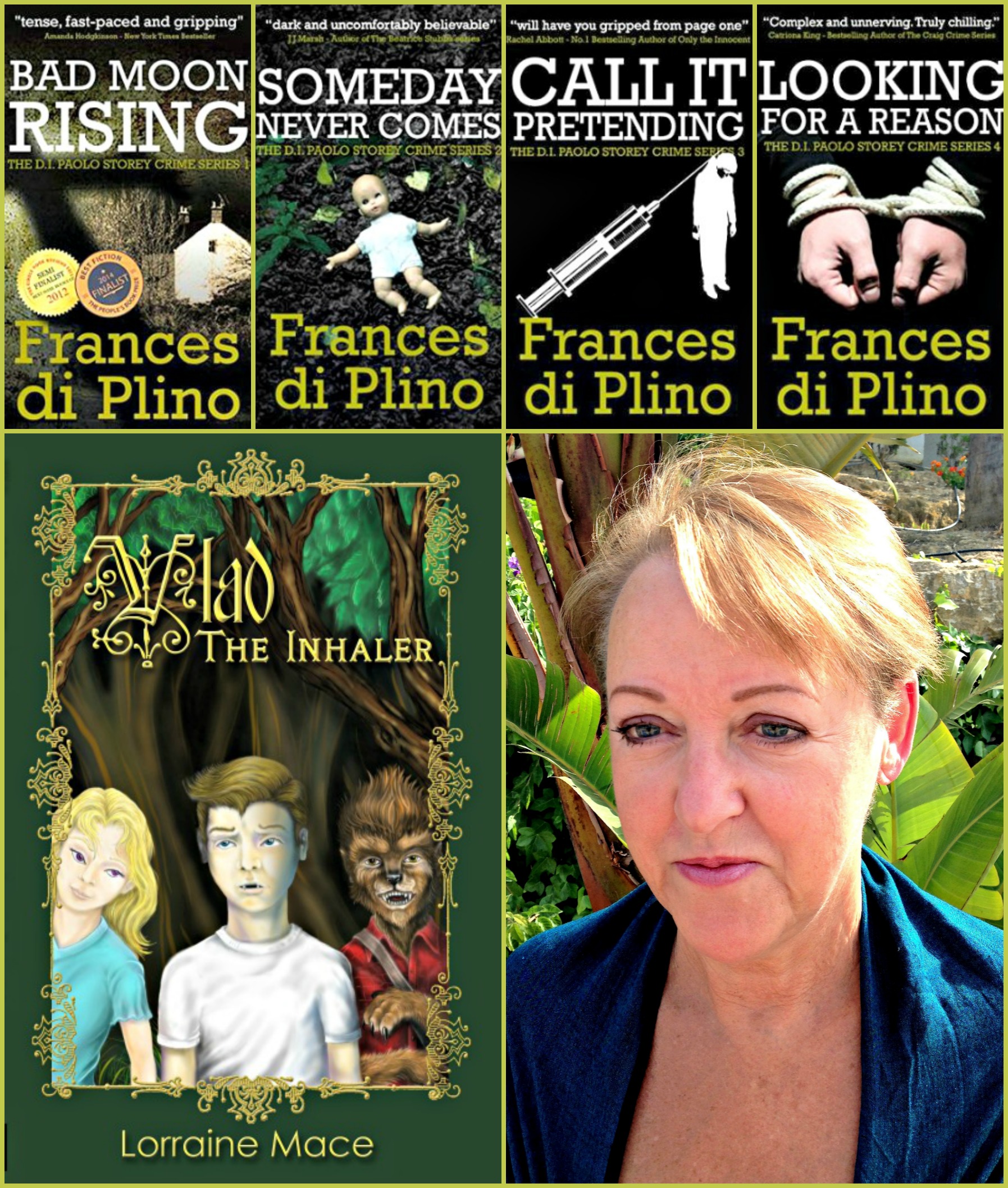
Like JJ, I write crime fiction. I also have a book series for children.

Lorraine May and books

The prolific Lorraine Mace has produced four books in her D.I. Paolo Storey crime thriller series, and one book in her Vlad the Inhaler series (vampires, werewolves and peaches, oh my!).

Oh, and one last item before I move to the questions: don’t forget to visit my predecessor’s farewell post and enter the book giveaway competition. So far there’s only two comments, which by my reckoning gives you a pretty good chance at winning seven great e-books!

* * *

Which came first, story or location?

This can vary from book to book and story to story. However, in my crime novels, written as Frances di Plino, story came first—but then location helps to formulate the plots. Although the series is set in a fictional town, the surrounding British countryside is very real. Bradchester is situated close to Rutland Water and the nearest city is Leicester, both of which feature in the novels on a regular basis. I know this area well. During my last (brief) sojourn in England I lived in a small village a stone’s throw from Rutland Water and frequently visited Leicester.

What’s your technique for evoking the atmosphere of a place?

I put myself into the heads of my characters and experience the place through their senses. When I can smell the bread in the local bakery, or hear the cries of street vendors, weep over a beautiful sunset, taste an orange straight from the tree, or touch the moss-covered stones of a monastery, I know it’s time to start writing, using my character’s experiences of the place.

Which particular features create a sense of location? Landscape, culture, food?

All three, but I must admit I find it easier to use food allied to culture when the story is set outside of the British Isles. Having lived in South Africa, on the Maltese island of Gozo, as well as in France and Spain, I know I can use regional dishes to bring areas of those countries to life. But in Britain I think we have lost the regional aspect of many of our foods. Fish and chips, roast beef and so on are now available throughout the country, where other nations seem to have guarded their regional food identities.

Can you give a brief example of your work which illustrates place?

Bradchester is a town that has more than its fair share of rundown, seedy areas set side by side with gentrified neighbourhoods. This leads to a great deal of social unrest—the haves want the have-nots moved elsewhere and the have-nots resent the wealth and easy life of the haves. This short passage illustrates an area that has, as yet, remained untouched by either sector, but just a street away it is very different.

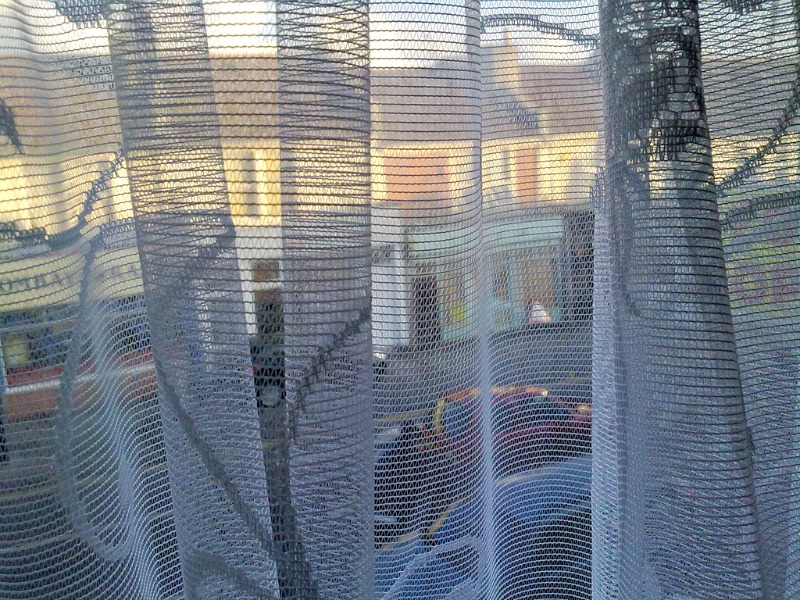
Station Road wasn’t exactly the best part of town, but the place looked respectable. Paolo was pleased to see that most of the businesses he remembered from his youth were thriving. This was one of the few communities that still had a drycleaners, newsagent, old-fashioned fruit and veg shop, alongside a mini-supermarket, hairdressers and a bank. He glanced up. Even the flats above the businesses looked lived in and cared for. Nice nets and curtains framed the windows and many of the street doors had been painted in recent history.

They walked a couple of hundred yards before turning into Zephyr Road. It was like moving into another country. Here, most of the shops they passed were boarded up and the few remaining open for business seemed to Paolo to concentrate on ways to transform goods into money. Pawnbrokers, gold for cash, payday cheque converters. It appeared as though all the dregs of the financial service industry had found their way into this street. This time when he glanced up, Paolo saw the flats above the shops were likewise either boarded up or had dirty nets hiding whatever was going on up there.

net curtains

The quality of the net curtains tells you where you are in Bradchester. Photo credit: Joss Smithson via Flickr (CC BY-SA 2.0).

How well do you need to know the place before using it as a setting?

I prefer to use places I’ve lived in, or visited many times. I like to know the area and people so well I can conjure them up at will when I’m writing.

Which writers do you admire for the way they use location?

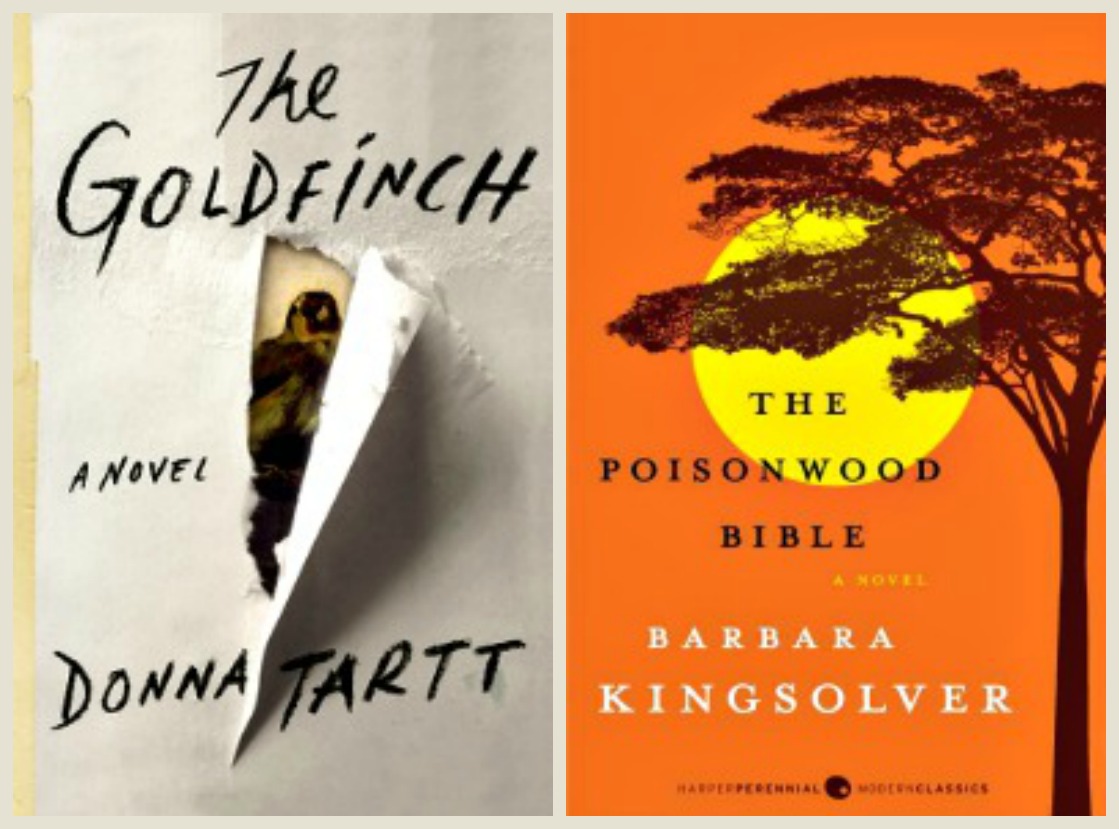
Barbara Kingsolver and Donna Tartt spring to mind. With both authors I feel as if I am living in the locations depicted. In Donna Tartt’s The Goldfinch she manages to recreate both city and desert locations to the extent one can almost feel the weather. Kingsolver’s The Poisonwood Bible brings the 1959 Belgian Congo to life so powerfully the reader is swept into the villages, fearful alike of jungle creatures and the inhospitable landscape.

Books that get "place" right: The Goldfinch, by Donna Tartt; and The Poisonwood Bible, by Barbara Kingsolver.

Books that get “place” right: The Goldfinch, by Donna Tartt; and The Poisonwood Bible, by Barbara Kingsolver.

* * *

Thanks so much, Lorraine! I’m impressed that you created your own place for your crime series novels, and that it’s in the UK, where you haven’t lived for quite some time. Readers, any words of welcome and/or questions for our new columnist? Please leave them in the comments below.

And don’t forget to leave a comment on her predecessor, JJ Marsh’s last post for a chance to win 7 e-books that should take you through the summer. All you have to do is answer the question, in 50 words or less: Where and when in the world would you like to go, and why?

Lorraine Mace writes for children with the Vlad the Inhaler books. As Frances di Plino, she writes crime in the D.I. Paolo Storey series. She is a columnist for both of the UK’s top writing magazines, has founded international writing competitions and runs a writing critique service, mentoring authors on three continents.

STAY TUNED for the next fab post!

If you enjoyed this post, we invite you to register for The Displaced Dispatch, a round up of weekly posts from The Displaced Nation, with weekly updates and much, much more. Register for The Displaced Dispatch by clicking here!

Related posts:

Photo credits (top of page): The World Book (1920), by Eric Fischer via Flickr; “Writing? Yeah.” by Caleb Roenigk via Flickr (both CC BY 2.0).

For this wanderlusting Californian for whom photography and travel are a perfect fit, a picture says…

KONICA MINOLTA DIGITAL CAMERA
Writer, world traveler and photography enthusiast James King is back with his latest interview subject.

Jenny in Ireland

Jenny Schulte in front of an old church window ruin near Kinsale, County Cork, Ireland.

Hello again, readers! My May guest is 38-year-old Jenny Schulte. who never had any thoughts of leaving her Northern California home until she travelled to Ireland in 1999 to explore her Irish roots. Now she is an ardent traveler who combines her love of photography with her travel experiences in her captivating blog Bulldog Travels, subtitled “Everything and Nothing Plus Some Pretty Photos.” Jenny is wrong to call it “nothing”: her blog is her her outlet for sharing her travel adventures along with the kinds of “photographs my friends have always enjoyed,” as she puts it.

On her About page, she says:

[Those] two wonderful hobbies of travel and photography fit perfectly together.

A woman after my own heart!

* * *

Hi, Jenny, and welcome to the Displaced Nation. Thank you for getting in touch and offering to share your photo-travels with us. Can you tell us where you were born and when you spread your wings to start travelling?
I was born and raised in Sacramento, California, and consider myself fortunate to live in such a beautiful part of the world. San Francisco, Lake Tahoe, the gorgeous California Coast, Redwoods, Yosemite, Napa Wine Country—all are on my doorstep. But while I have always loved to travel within the United States, when I was twenty I decided I really wanted to delve into my Irish heritage and see Ireland first hand. I had a very romantic vision of the country and figured I would be disappointed if I never went. Well…the moment my tennies hit the ground, a restlessness took over and I have been globetrotting ever since. I made a good friend in Ireland who is from Germany. and together we have seen much of western Europe (Germany, Switzerland, Austria, Italy, France, Monaco, Spain, Andorra, England and Scotland). In more recent years I have been fulfilling an archaeological interest of mine exploring Mexico and Central American sites and ruins.

If you’re lucky enough to be Irish…you’re lucky enough!

So once you finally got the travel bug, you were up and running in those tennies of yours. I have only managed the UK and France from your entire list. I’m envious. Can you share with us some of the highlights of your travel adventures?
I really enjoy history and from Ireland I went to my first European countries: Germany, Switzerland, and Italy, where I could not only delve into history but also enjoy great food, culture, and scenery. From there I went on to other destinations such as France, Scandinavia and the UK. My search for ancient ruins took me to the Yucatán, Belize, and Guatemala. The animals and the raw nature of Costa Rica stole my heart. At home, where I have travelled California and the entire west on shorter trips, I really love Joshua Tree National Park, Portland, Southern Utah, San Francisco and Mendocino.

Now that you have gained so much real travel experience, I would love to hear more about what inspired you to travel originally and sustains you on your many trips.
No one in my family has ever travelled very far, with the exception of a few who travelled for Uncle Sam’s benefit. They tend to stick close to home preferring to take a drive rather than fly somewhere exotic. My family built a cabin in the Sierra Nevada Mountains, and we still enjoy it whenever we can. But my grandmother had told me stories of Ireland since I was a child, and I always dreamed of seeing it one day. After that initial Irish adventure, every trip has left me wanting more. I have averaged one or two main trips per year and as many small trips as I can fit in. As a photographer I tend to focus on areas I know will be wonderful to capture. But I am always surprised and pleased when I get great photos I never expected.

So tell us about where you have travelled most recently.
I recently returned from a trip to Belize and Guatemala. I tend to spend my home time in Sacramento, San Francisco, California Coast, the Lake Tahoe area, and the Sierra Nevada Mountains. I will probably stay in California until I retire and then I plan to be more nomadic, visiting places that are difficult to visit on a two-week trip. Then I hope to live in areas longer, to fully appreciate the culture and the environment.

Don’t leave it too late like I did. You need a lot of energy for the expat life.

“Laughter is the brightest where food is best.”

Now let’s move on to a few of your shots that capture favourite memories. Thank you for sharing and for describing the story behind each one and what makes them so special.  
Of course! For my first photo, I present you with a little boy cleaning a fish out front of his grandmother’s restaurant, Maggie’s Sunset Diner, in Caye Caulker, Belize. His family’s BBQ was fired up just out of the frame. The boy so badly wanted to be like his grandmother. He was begging to BBQ his own fish like an adult. My husband and I observed this charming scene while having dinner. I believe that good, inexpensive food in a place full of local ambiance is better than a five-star restaurant anywhere in the world. The photo was taken only with my iPhone but I think it captures the mood and the vibe of this small island off the coast of Belize.

Q9.1 Boy cleaning fish

Boy in Belize cleaning a fish. Photo credit: Jenny Schulte

The second photo is of some donuts my husband I consumed in Maui, Hawaii. I was driving around the rural part of the island looking for something to eat for breakfast when I stumbled upon a locally owned and run donut shop. The donuts were glorious and became a highlight of our visit. We have actually contemplated going back to Maui just for the donuts! Then again, you wouldn’t have to twist my arm very hard to go back to Maui. The older I get the more food tends to be an important part of my travels.

Maui donuts

Donut feast in Maui. Photo credit: Jenny Schulte

The last photo is of a two-headed jaguar you can see in the ancient Mayan city of Uxmal, which is located in Yucatán, Mexico. Something about Uxmal really spoke to me. I think what makes it so special is that the architects for these structures were so clearly artists. They went beyond function and focused on form in a way not seen elsewhere in the Yucatán. Their work is magnificent and the detail is phenomenal. I never grow tired of looking at photos from this visit, and I offer this one in hopes of transporting readers to these spectacular ruins.

Uxmal

A Mayan jaguar. Photo credit: Jenny Schulte

I am really impressed by the picture of the boy cleaning fish. And I agree that the experience of eating wholesome home cooking in basic local surroundings is better than any clinically manufactured setting. I am sure you take a lot of photos but where, so far, are your favourite places to shoot and can you explain why these places inspire you.
Photography is an integral part of travel for me. It doesn’t matter if I’m travelling to a faraway exotic location or hitting a local California beach—taking photographs helps me recall the trip in a way my memory alone doesn’t, and inspires me to be creative in a way I find difficult at home. I have many favourite places to take photographs, including zoos, gardens, and historical sites. In recent years, I have photographed the San Diego Zoo and the Belize Zoo. I am looking forward to a weekend-long photography expedition at Safari West in Santa Rosa in the fall. I enjoy shooting botanical gardens like Mendocino, DuPlooys in Belize, San Diego, Lake Constance (Germany) and the Maui Garden of Eden. One of my favourite architectural structures is the Eiffel Tower at night. I’ve had fun attempting to shoot it from angles not often seen.

Well, Jenny, since you left it up to me to choose three photos that represent your favourite spots, here my selection. My first choice is your photo of a rickety old building in Paris, which houses a gallery of some kind. I think your capture is wonderful because it looks as though the building won’t be standing much longer, and the shop is a relic of a bygone era.

Business in Paris

A rickety Parisian gallery. Photo credit: Jenny Schulte

Next I’ve chosen one of your Eiffel Tower shots. This one is not immediately recognizable as most shots of this iconic landmark are. So it asks a question—who am I? And the photo of the lighting on the structure in the night sky is beautiful.

Eiffel Tower

A new angle on a famous angular building. Photo credit: Jenny Schulte

Finally, I love this nature shot of yours, taken in Du Plooys Botanical Garden in Belize, with its contrast of the crimson flower, green leaves and shadows. I think it would make fine wall-art.

DuPlooys Botanical Garden Belize

Botanical blossom in Belize. Photo credit: Jenny Schulte

“Better good manners than good looks.”

So do you feel reserved about taking photos of people, particularly when they are conscious that you are doing so?
I definitely do. I try to live my life in a considerate way. I would never feel comfortable embarrassing or offending anyone. I would never be able to look at the photo afterwards with a clear conscience. Sometimes I shoot images of people from an angle where they might not be aware. This is because I prefer candid photos versus asking for permission and taking what I would consider more of a portrait. I admire photographers who do portrait photography, but I suppose it makes me uncomfortable. It can also take the fun out of it.

On occasions where you do ask for permission, how do you get around any problem of language?
Sometimes what I do is show the person the photos I have taken of them. Recently, for example, I photographed a little girl in Belize whose mother owned the dive shop we were visiting. The girl was coloring a picture and smiling at me. I held up my camera and made an O.K. sign with my fingers. She immediately started hamming it up for the camera and then begged to see the image of herself on the camera. The girl and her mother spoke some English, but in this case it was more fun to ask without words. Miming can work pretty well. Holding up a camera or pretending to take a selfie generally gets a smile from a stranger.

Would you say that photography and the ability to be able to capture something unique which will never be seen again is a powerful force for you?
For me, photographing events or moments has the power to capture something that is both crisper and more emotional than if I wrote about the place or just relied on my memory. My photos represent what is in my heart and mind better than any other means of communication. Sometimes I will look back on an old photo and remember a moment or a place that I had completely forgotten about. The memories that come flooding back are what keep me planning for the next trip.

Clearly, a picture says a thousand words for you. When did you realize that, and how has it changed your perspective?
I don’t think there was a particular moment. I have always been that way since I had enough money to buy and develop film—I always took too many photos. But for me, and ultimately for my subjects, it is worthwhile to capture a special moment. That said, I sometimes have to force myself to put the camera down so that I can be in the moment.

“May the blessing of light be on you—/light without and light within.”

Now for the technical stuff. Can you tell me what kind of camera and lenses you use?
I use an iPhone 5s, Nikon D800 and Nikon D700 cameras. Nikon Nikkor DX 18-135mm and Nikon Nikkor AF 70-300mm lenses.

That’s quite a collection. And which software do you use for post-processing?
I just use Lightroom for post processing.

“Your feet will bring you where your heart is.”

Finally, do you have any advice for wannabe photographers who are traveling or living abroad?
Be responsible, show respect, be a good advocate for your home country and for the human race and, if you can, travel while you are young. If you aren’t young anymore travel anyway and it will make you young! Follow your instincts, have fun, stay inspired, take breaks from your art when necessary to keep the spark, try new things, talk to people, eat the food, take the back roads and get lost…the world will all of a sudden become very very wonderful.

That is very good advice, Jenny, and I’d like to thank you for taking the time to tell your story in this interview.

Editor’s note: All subheds are from Irish sayings or blessings.

* * *

Readers, what do you make of Jenny’s experiences and her photography advice? And do you have any questions for her on her photos or travels? Please leave them in the comments!

If you want to get to know Jenny and her creative works better, I suggest you visit her travel site. You can also follow her on Instagram or contact her at PhotosbyJenny@aol.com.

Born in England, James King is now semi-retired in Thailand. He runs his own photography-based blog, Jamoroki. If you are a travel-photographer and would like to be interviewed by James for this series, please send your information to ml@thedisplacednation.com.)

STAY TUNED for next week’s fab posts!

If you enjoyed this post, we invite you to register for The Displaced Dispatch, a round up of weekly posts from The Displaced Nation and much, much more! Register for The Displaced Dispatch by clicking here!

Related posts:

CULTURE SHOCK TOOLBOX: How to pry open your mind to new cultures—and keep them all sorted

Yelena Parker for CST Displaced Nation Columnist H.E. Rybol never saw a culture clash she didn’t want to fix. A “transitions enthusiast,” she credits her Third Culture Kid upbringing with giving her a head start in this department. That said, H.E. is always on the lookout for shiny new tools, and toward that end has been interviewing other displaced creatives about their culture shock memories and coping strategies. Today she speaks to Yelena Parker, a Ukrainian expat, executive coach, and writer who, through her many international moves, claims to have mastered the art of “moving without shaking.”

—ML Awanohara

Hello, Displaced Nationers! I’d like you to meet today’s guest, businesswoman and author Yelena Parker. Yelena is Ukrainian but has lived in the United States, Switzerland, Tanzania and now the United Kingdom, and has conducted business in many more countries. Last year she published a book titled Moving without Shaking, which made the Displaced Nation’s “Best of 2014 in Expat Books” list. Described as a “guidebook-meets-memoir,” it aims to help women “who are interested in building their new global life styles whether through working, studying, volunteering or simply living abroad.”

One of Yelena’s contentions is:

Once you are on a serial expat path, new relocations get easier.

Can we take this to mean it’s possible to get better at handling culture shock?

Let’s find out by asking Yelena to describe a few of her own culture shock experiences. She may advocate for moving without shaking; but how does that line up with her own adventures? Has she never shaken like a leaf at some point during her various international moves?

* * *

Hi, Yelena! First can you please tell us which countries you’ve lived in and for how long?

I came to California from Ukraine in my 20s to get an MBA and ended up living there for more than nine years. I didn’t make it till the very end of year 10 as an opportunity came along to relocate to Switzerland for work. After two years in Geneva I moved to London to continue working in tech. I’ve now lived in the UK for four years, only interrupted by a four-month volunteering stint in Tanzania, with a Kilimanjaro climbing break in between.

You’ve certainly made your fair share of cultural transitions. Did you ever put your foot in your mouth? Any memorable stories?

I travel to Moscow frequently for work. During the last trip the taxi driver asked me where I was from. This question is always complicated since, like many here at the Displaced Nation, I now feel as though I’m from everywhere and nowhere in particular. I tend to focus on the most recent location when giving an answer. To be polite, I share where I am coming from literally (versus where I am from). On this occasion, the last port of call was St. Petersburg, which in Soviet times was known as Leningrad. Some wires in my brain must have crossed as I blurted out: “From Leningrad.” The driver said “Really???” We ended up engaging in a much longer conversation, about my Soviet childhood in Ukraine and so on. I think I had a reverse culture shock reaction after being away from where I grew up for so long.

What lessons can you offer to the rest of us from this story?

It’s a bit of a strange example, but what I am trying to get across is that keeping your life truly connected to multiple worlds is very difficult. You are bound to lose some of your identity, forget the basics, replace them with new realities and then, perhaps, come full circle as you find yourself back in your good old comfort zone. You and your memories have many layers now. It can be challenging to keep them sorted. That toolbox of yours needs to have quite a few compartments!

Looking back on your many cultural transitions, can you recall any situations that you handled with surprising finesse?

Moving to Tanzania, I was surprised at how quickly I embraced the pole pole (slowly-slowly) way of life. Until I went on this amazing adventure, I had always been a workaholic. But then I found myself living enjoying the most beautiful sunsets and spending a lot of time talking to people in front of me instead of using various digital ways to connect with people remotely. I didn’t complain about the lack of speedy or efficient services anywhere as I no longer expected that kind of thing. I was not rushed or overwhelmed so wasn’t concerned about being late or other people being late or not showing up to meetings. I just enjoyed every moment of this new experience: no deadlines, no crazy work hours, only things I truly wanted to do. You could say I felt burnt out after working non-stop (or being in school) for 23 years. I do believe, however, that something in that culture was appealing to my natural preferences, which had been suppressed by years of working in the corporate world. I also realized that I wanted to teach again. My first career was in teaching English at a university level in Ukraine—work I’d chosen to abandon when I took a degree in business. That said, I am back on the corporate path again.

If you had to give advice to new expats, what’s the tool you’d tell them to develop first
and why?

I guess it would be some kind of crowbar to pry open your mind to new experiences, no matter how many times you relocate. Learn everything you can about your new home country. Explore it thoroughly. If you end up moving back home, you will regret that you didn’t do enough. If you stay, the more you learn, the easier your assimilation into your new life is going to be.

Thank you so much, Yelena, for taking the time to share your experiences and reminding us that keeping an open mind and a willingness to learn about other cultures can be effective tools, sometimes in unexpected ways! I love your example of becoming immersed in an East African culture and learning more about your own (suppressed) natural preferences as a result. And I of course love the idea of moving without shaking! That’s what this toolbox is for…

* * *

Readers, what do you make of Yelena’s advice? Have you ever found yourself having a Rip-Van-Winkle moment like hers? How about discovering your “true self” in a vastly different culture? Do tell!

If you like what you heard from Yelena, be sure to check out her author site and follow her on Facebook and Twitter.

Well, hopefully this has you “fixed” until next month.

Until then. Prost! Santé!

H.E. Rybol is a TCK and the author of Culture Shock: A Practical Guide and Culture Shock Toolbox. She loves animals, piano, yoga and being outdoors. You can find her on Twitter, Linkedin and Goodreads. She is currently working on her new Web site and her second book.  

STAY TUNED for next week’s fab posts.

If you enjoyed this post, we invite you to register for The Displaced Dispatch, a round up of weekly posts from The Displaced Nation—and much, much more! Register for The Displaced Dispatch by clicking here!

Related post: