The Displaced Nation

A home for international creatives

Tag Archives: Australia

RANDOM NOMAD: Christina Ashcroft, British Expat, Australian Citizen, and Writer of Hot Paranormal Romance

Christina Ashcroft Tiara WriterPlace of birth: Croydon*, South London, United Kingdom
Passport: Australia (My UK passport expired a few years ago.)
Overseas history: Australia (just outside Perth, Western Australia): 1998 – present. “I live five minutes from the beach!”
Occupation: Writer of steamy historical and paranormal romance for Penguin and Ellora’s Cave.
Cyberspace coordinates: Christina Ashcroft: Welcome to my dark world of archangelic eroticism (author site) and @ChristinaAsh_ (Twitter handle).
*I always get very excited whenever I see Croydon mentioned in a book (which isn’t very often!)

Before moving to Australia, you lived in England all of your life. What made you take the leap to Down Under?
My husband and I were high school sweethearts — he, too, comes from South London (Upper Norwood). We had talked about moving to Australia off and on for several years. We used to watch the programs on the TV of expats, and it all seemed very exotic and exciting. The decider came when my brother made the move to Perth, WA, in 1994. We visited him in ’96 when he got married (to the girl he’d gone to Uni with in the UK). Despite being chased by the biggest cockroach in the history of cockroaches, we fell in love with the country. We arrived home in early January to ice and snow, and within a couple of weeks we filed our application! We moved out here with our three kids.

So your brother is also “displaced”?
Yes, he, his wife and two daughters live about an hour from us.

In your 15 years in Oz, when have you felt the most displaced — apart from the time when you were literally displaced by that cockroach?
Only when there’s a big family get together in the UK and we know we can’t make it. We used to have great family parties and I really miss them. Apart from that I’ve honestly never felt displaced, except for the first month or so when I did get a bit homesick… 🙂

When have you felt the least displaced?
When I’m spending time in front of my laptop, lost in the mystical worlds of my characters. I’ve made a lot of writer friends online but I’ll never forget the first time I met up with my two critique partners (CPs) in the “real world.” It was just magic. I had found my tribe, and even though I’d had to travel to the other side of the world before we found each other, it was completely worth it. Funnily enough one of my CPs is also an expat from the UK who moved to New Zealand, but now lives in Australia. The other one is an Australian who was living in the UK when we first met online but she has now moved back to Oz.

It sounds as though you credit the move to Australia with your decision to become an author.
I’ve often wondered whether my career would have followed the same route if we’d stayed in the UK. While I’ve always loved writing it wasn’t until we moved to Australia that I decided to to write with the aim of publication. The support, encouragement and friendship I’ve found in the Romance Writers of Australia has been phenomenal. I also don’t think I would have met up with my CPs, and they are the ones who originally suggested I should try writing erotic romance.

ArchangelofMercyCoverAll this talk of erotic romance is helping to put us in the mood for Valentine’s Day. Can you tell us a little more about the plots of your books?
My paranormal romances feature fallen bad ass Archangels and the women who capture their hearts. I’m thrilled that my first Archangel book, Archangel of Mercy, was a finalist in the 2012 Australian Romance Readers Award for Favorite Paranormal Romance.

Wow, congratulations! And don’t you write historical romances as well?
My historical romances are set during the first century when Rome invaded Britain. There are sexy warrior heroes, magical Druid heroines and powerful goddesses.

You may bring one curiosity you’ve collected while living in Australia into The Displaced Nation. What’s in your suitcase besides your books?
Well, I’ve not brought a suitcase, I’ve brought a traveling basket with my three adorable kitties! 🙂 I’d always had cats in England, but we were here for 12 years before I finally adopted two sisters. One of them had four kittens but unfortunately only one survived. We spoil him terribly!

You are invited to prepare a meal for the Displaced Nation, based on your travels. What’s on the menu?

It would have to be a barbeque, of course! Not only can you cook practically anything on the BBQ but it always tastes a lot better than having to cook it in the kitchen. Plus it means I don’t have to actually do any cooking, since my husband and son take over with tongs and fork — always a bonus!

Since lamb is very popular here, we could have lamb and capsicum kebabs with salad and fresh crusty bread, washed down with a local wine and cold beer. Seeing as I’m from the UK, I should only ever drink warm beer, but I have to confess I’ve joined the Dark Side on that one!

For dessert — what could be yummier than a mango cheesecake?

Can you donate an Aussie word or expression to the Displaced Nation’s argot?
One of the best expressions in Australia is “No worries.” While my children take great delight in telling me I still sound “so British,” I do love saying “no worries.” It’s just so laid back and zen and also rolls off the tongue very easily!

Returning one last time to this month’s Valentine’s Day theme, what’s your idea of a romantic evening for two? Has it changed since the time when you were still living in Britain?
Room service in a fabulous hotel with a gorgeous view of the ocean. We’d eat our meal on the balcony as we watched the sun set and later we’d crack open a bottle of bubbly in the private spa. Although we’ve only managed this romantic getaway a couple of times in recent years, we never did anything like it in Britain.

Readers — yay or nay for letting Christina Ashcroft into The Displaced Nation? She drinks cold beer yet her children accuse her of being “so British.” And, though we might enjoy her erotic tales of fallen archangels and the women who capture their hearts around Valentine’s Day, would we benefit from a steady diet of this out-of-this-displaced-world fare? (Note: It’s fine to vote “nay” as long as you couch your reasoning in terms we all — including Christina — find amusing!)

STAY TUNED for tomorrow’s post, another in our “Capital Ideas” series — focusing on one of the world’s most romantic cities (but of course!).

If you enjoyed this post, we invite you to register for The Displaced Dispatch, a round up of weekly posts from The Displaced Nation, with seasonal recipes, book giveaways and other extras. Register for The Displaced Dispatch by clicking here!

Related posts:

img: Christina Ashcroft looking a little bit displaced(?) at the Romance Writers of Australia conference held in August 2012. Christina says: “My critique group call ourselves the Tiara Girls, so we take along our tiaras and wear them at the Friday night conference cocktail party. It’s just a bit of fun!”

Catching up with this year’s Random Nomads over the holidays (3/3)

RandomNomadXmasPassportIt’s Christmas Day and the holiday party continues for the expats and other global voyagers who washed up on the Displaced Nation’s shores in 2012. Remember all those Random Nomads who proposed to make us exotic meals based on their far-ranging meanderings? Not to mention their suitcases full of treasures they’d collected and their vocabularies full of strange words… How are they doing these days, and do they have any exciting plans for the holidays? Third in a three-part series (see also Part One and Part Two).

During the final third of 2012, we met some expats and intrepid world travelers who, I think it’s fair to say, have developed some rather unusual hobbies and eating habits. The two are one and the same in the case of Brian MacDuckston, who was featured on our site this past August. He has made a habit of eating ramen in as many Tokyo venues as possible — a hobby that was quirky enough to attract the attention of the New York Times. In addition to Brian — a San Franciscan who originally went to Japan to teach English — we encountered:

  • Liv Gaunt, an Englishwoman who became an expat accidentally, while pursuing her love of scuba diving and underwater photography. Now based in Australia, she told us she has a passion for sharks but would happily do without sea urchins.
  • Mark Wiens, an American third culture kid who now lives in Thailand and travels all over — he feels least displaced when sampling other countries’ street foods.
  • Jessica Festa, an American traveler who loves to venture off the beaten track and eat locally — she did not hesitate to eat cuy in Ecuador (even though it reminded her of her pet guinea pig, Joey, named after a school crush).
  • Larissa Reinhart, a small-town Midwesterner who lived in Japan for several years and, since repatriating, has taken up the pen as a crime novelist. She is now living in small-town Georgia but hopes to go abroad again. She provides recipes for Asian fried chicken, among other delicacies, on her blog about life as an ex-expat.
  • Patricia Winton, an American who responded to 9/11 by giving up her comfortable life in Washington to become an expat crime writer in Rome. She also invested in a pasta-making machine…
  • Bart Schaneman, a Nebraskan who wanted to see the world and has made his home in Seoul, where he is an editor for an English-language newspaper and author of a travelogue on the Trans-Siberian railway. He is a huge fan of kimchi.

Three of this esteemed group are with us today. What have they been up to since a few months ago, and are they cooking up anything special for the holidays, besides chatting with us?

Brian with Ramen_Xmas1) BRIAN MACDUCKSTON

Have there been any big changes in your life since we last spoke?
I’ve been offered a few gigs on Japanese TV shows as a “ramen reporter” and successfully pitched my first magazine article about a best-of-ramen list. A start! I also started a ramen class aimed at non-Japanese speakers. Check it out!

How will you be spending the holidays this year?
A nice staycation in Tokyo.

What’s the thing you most look forward to eating, dare I ask?
I’m trying to eat more high-class sushi, but I’ll probably just stick to a lot of ramen for the next few weeks.

Can you recommend any books or films you came across in 2012 that speak to the displaced life?
I really enjoyed Jiro Dreams of Sushi, a documentary about the most revered sushi chef in the world. [Editor’s note: The film has been available on Netflix since last August.]

Do you have any New Year’s resolutions for 2013?
I want to train myself to stop using double spaces after periods when I write. Not a big goal, but important for someone who has an interest in being paid for my writing.

A worthy goal, imho! (I’ve had to correct quite a few in my time…) So, any upcoming travel plans?
My father will visit Japan, so I am planning a luxury week-long trip of eating and relaxing in hot springs. Two things I’m good at!

LarissaReinhart&Reinhart2) LARISSA REINHART

Any big developments in your life since we last spoke?
My second Cherry Tucker Mystery, Still Life in Brunswick Stew, has a release date of May 21, 2013. [Editor’s note: As mentioned in Larissa’s interview, the first in her Cherry Tucker series, Portrait of a Dead Guy, came out this year.]

How will you be spending the holidays this year?
We travel to visit my family in Illinois and St. Louis after Christmas through New Year’s.

What’s the thing you most look forward to eating?
There’s this Italian grocery, Viviano’s, in the Italian district of St. Louis, called The Hill in St. Louis, that I really look forward to visiting. I’ll stock up on cheap wine and Italian staples for the coming year.

Can you recommend any books or films you came across in 2012 that speak to the displaced life?
Yes, two Japanese films:

  1. The fascinating documentary Jiro Dreams of Sushi. I highly recommend — even for non-sushi fans. The film is beautifully shot and reveals what it takes to be a true master at something. Incredible.
  2. The gorgeous The Secret World of Arrietty (aka The Borrower Arrietty), scripted by Hayao Miyazaki. We were excited to see Arrietty because we saw the ads for the movie when we were still living in Japan (and I’m a big fan of Mary Norton’s The Borrowers, on which the film is based, as well as of Miyazaki).

Have you made any New Year’s resolutions for 2013?
To spend less time on social media and more time writing. I love chatting online, but I need to be more disciplined about getting away from the “water cooler” and back to work.

Any upcoming travel plans?
Disney World for spring break! Woot! And we’re hoping to get back overseas soon, but no definite plans yet.

PatriciaWintonwithholly3) PATRICIA WINTON

Any big changes in your life since we last spoke a couple of months ago?
The month after you featured me, I put my long-time WIP in the bottom drawer for a while and started a new one. I’ve written about 30,000 words. This one, also a mystery, is set in Florence. It takes place during the 500th anniversary celebration of the world’s first culinary society.

Meanwhile, my blog partners at Novel Adventurers are working on an anthology of long short stories. We are an adventurous group comprising (besides me):

  • an Australian who has lived in South America
  • an American of Swiss-German origin who is married to a man from Iran, where they frequently travel
  • an American with close family ties in India, where she frequently travels
  • an American specializing in things Russian, who is married to a Kyrgyz
  • a former Peace Corps volunteer who writes about the Caribbean
  • an American who grew up on a sailboat traveling the world and has lived as an adult in many countries.

We’ll be writing about travel and adventure from international perspectives. It will be some time before it sees publication, but I’ll keep you posted. I think it will interest the Displaced Nation!

Where will you be spending the holidays this year?
I’m spending the holidays quietly at home. I plan to visit a friend in the country for New Year’s weekend. The holidays here last almost three weeks, ending on January 6. Nativity scenes are a big deal here, and I plan to visit various churches to view, and photograph, them as I usually do. I’ll write about them on my blog, Italian Intrigues, on January 3rd.

What’s the thing you most look forward to eating?
Christmas Eve in Italy is devoted to eating fish — usually seven fish dishes from antipasto onward. I’m trying out a new recipe for sea bass stuffed with frutta del mare (non-fin fish). I’m using clams, mussels, shrimp, squid and baby octopus, all well laced with garlic. And I always make the holiday custard that comes from my Tennessee childhood.

Can you recommend any books you came across in 2012 that speak to the displaced life?
The Lacuna, by Barbara Kingsolver. While it was published in 2010, I didn’t read it until this year, and I think it’s a masterpiece. It’s about a man with one foot in Mexico and the other in the US — but that’s a vast oversimplification. After the young man’s Mexican mother dies, he works for Frida Kahlo and Diego Rivera while Leon Trotsky is staying with them. He later moves to the US to join his American father. He eventually becomes a successful writer caught up in the McCarthy witch hunt. I don’t want to include spoilers here, but it’s fabulous. The boy/man is a foreigner in both countries and speaks both languages with an accent.

Do you have any New Year’s resolutions for 2013?
Not that I want to share.

Last but not least, do you have any upcoming travel plans?
No concrete travel plans at the moment. While composing these answers, I received an email about a tour of Uzbekistan that sounds really alluring. And I will probably go to the US to attend a mystery writers conference.

* * *

Readers, any questions for this rather motley (one former expat and two current ones) but highly creative bunch?

STAY TUNED for tomorrow’s post — expat Anthony Windram’s musings on spending Boxing Day in a country that associates boxing with punching, not (Christmas) punch.

If you enjoyed this post, we invite you to register for The Displaced Dispatch, a round up of weekly posts from The Displaced Nation, with seasonal recipes, book giveaways and other extras. Register for The Displaced Dispatch by clicking here!

Related posts:

Images: Passport photo from Morguefiles; portrait photos are from the nomads (Larissa Reinhart’s shows her family in front of one of their favorite Japanese manga characters, Shin-chan, a sort of Bart Simpson of Japan — the creator, Yoshito Usui, had recently died).

Catching up with this year’s Random Nomads over the holidays (1/3)

RandomNomadXmasPassportThe holiday season is here — the perfect time for the Displaced Nation to catch up with the expats and other global voyagers who washed up on our shores in 2012. Remember all those Random Nomads who proposed to make us exotic meals based on their far-ranging meanderings? Not to mention their suitcases full of treasures they’d collected and their vocabularies full of strange words… How are they doing these days, and do they have any exciting plans for the holidays? First in a three-part series.

In the first part of 2012, quite an array of Random Nomads arrived at the Displaced Nation’s gates, including:

  • Toni Hargis, a Brit married to an American and living in Chicago (she goes by the moniker “Expat Mum”);
  • Megan Farrell, an American married to a Brazilian and living in São Paulo;
  • Liv Hambrett, an Australian moving cities in Germany to be with her SG (Significant German);
  • Lei Lei Clavey, an Australian working in New York City’s fashion industry; and
  • Annabel Kantaria, an Englishwoman living in Dubai (one of the Telegraph Expat bloggers).

Unfortunately, Liv and Lei Lei cannot be with us today as they’ve both headed back to their native Australia. Lei Lei is living in Perth with her boyfriend — and still feeling somewhat displaced as she’s from Melbourne. (Still, her mum, one of our featured authors, Gabrielle Wang, is glad she’s a little closer.)

Liv — who has moved her blog, A Big Life, over to her portfolio site — says she is “now hopelessly pulled in opposing directions by my home country and adopted home, Germany.” Back with her family in Sydney, she is planning a return to Germany in early 2013. Between now and then, SG will have completed his maiden voyage to Oz to pay her a visit.

But now let’s start the party with the three Random Nomads who still qualify as expats. What have they been up to since nearly a year ago, and are they cooking up anything special for the holidays?

ToniHargis_Xmas1) TONI HARGIS

Have there been any big changes in your life since we last spoke?
Yes, I got a new gig writing for BBC America’s “Mind the Gap” column, which is very exciting. I have also just completed a 55,000-word manuscript for a new expat book which should be coming out late Spring 2013. Can’t give any more details at the moment I’m afraid.

Where will you be spending the holidays this year?
We have been going to Copper Mountain, Colorado for the last few years and this year will be the same.

What do you most look forward to eating?
My husband goes mad cooking “skier’s dinners” as he calls them — gumbo, lasagna, chili etc. He will also probably take care of most of the Xmas dinner. Unfortunately, I usually suffer from mild altitude sickness so food isn’t always at the top of my list!

Can you recommend any books you read in 2012 that speak to the displaced life? 
Yes, I read three great books this year on that theme, all from Summertime Publishers:

  1. Expat Life Slice by Slice, by Apple Gidley, which is memoir style and chronicles her (so far) amazing expat adventures.
  2. Finding Your Feet in Chicago, which is a great book for newly arrived expats to the Windy City, by Veronique Martin-Place.
  3. Sunshine Soup: Nourishing the Global Soul, by Jo Parfitt, which came out in 2011 and is a lovely novel set in Dubai about expat women there. (Jo is the founder of Summertime Publishers.)

Do you have any New Year’s resolutions for 2013?
Hmmm…. I try not to make resolutions because it can just be a set up for failure and bitterness (just kidding). There will be a lot of background work to do on my upcoming book, so I suppose my resolution should be to keep my energy levels up and work hard while not ignoring my children for too long!

Last but not least, do you have any upcoming travel plans?
Other than Colorado, I have no definite plans but there will be the annual summer trip to England and perhaps a trip somewhere else in Europe if we can fit it in.

meganfarrell_xmas2) MEGAN FARRELL

Hi there, Megan. Have you had any big changes since we last spoke?
I am currently writing a book, titled American Exbrat in São Paulo: Advice, Stories, Tips and Tricks to Surviving South America’s Largest City, which will be available via Amazon in the next few weeks. And we moved from Jardim Paulista to Higienópolis. The Higienópolis neighborhood feels much more family friendly to me, without losing options for great restaurants and activities.

How will you be spending the holidays this year?
For the holidays, we will be visiting Petrópolis (Brazil’s “City of Emperors” and a lovely mountain resort) and Búzios (known for its magnificent beaches and crystal-clear water), both towns in the state of Rio de Janeiro. I am looking forward to the beach and mountain time.

What’s the thing you most look forward to eating?
Churrasco (Brazilian style barbecue)!

Can you recommend any books you came across in 2012 that speak to the displaced life?
Dark Star Safari: Overland from Cairo to Capetown, by Paul Theroux. I’m also reading Eat, Pray, Love again, but this time in Portuguese (Comer Rezar Amar).

Do you have any New Year’s resolutions for 2013?
I do. My resolutions are to spend more time working on my writing projects and further develop my business. I currently guide executives and managers in their business communications to help them gain advantages in the global market, but I really need to expand my marketing strategy. I also have a large list of São Paulo experiences I have yet to enjoy.

Do you have any upcoming travel plans?
I’m hoping to get back to the States early this year and hit not only Chicago but also Los Angeles and New York City.

AnnabelKantaria_Xmas3) ANNABEL KANTARIA

Have there been any big changes in your life since we last spoke?
None to speak of.

Where will you be spending the holidays this year?
We love to spend Christmas in Dubai as the weather is exactly how a British summer day should be: clear, sunny, blue sky and temperatures of about 28°C (around 82°F).

What’s the thing you most look forward to eating?
We always have a big Christmas lunch in the garden with friends. This year another friend is playing host to us. I feel very lucky as she is practically the “Martha Stewart” of Dubai and I just know the food, decor and company will be divine. I’m vegetarian, so I won’t be eating turkey — I think we’re barbecuing this year.

Can you recommend any books you came across in 2012 that speak to the displaced life?
I read a new book called The Expats, by Chris Pavone, but I was more inspired to revisit old favorites such as White Mischief, by James Fox.

Do you have any New Year’s resolutions for 2013?
To finish writing my book, find an agent and/or publisher and get it published!

Any upcoming travel plans?
We usually go away in the February half-term holidays. Last year we visited family in Kenya before taking a few days in the Seychelles. This year I’m looking East — maybe Thailand, Malaysia (I’ve always wanted to go to Langkawi) or perhaps Bali.

* * *

Readers, before we lose these three Random Nomads to their various holiday (and half-term) adventures, do you have any more questions? Perhaps some of you are wondering, like I am, how they manage to be so productive — each of them has children but also a book to publish in 2013!

STAY TUNED for another episode in the life of our fictional expat heroine, Libby. (What, not keeping up with Libby? Read the first three episodes of her expat adventures.)

If you enjoyed this post, we invite you to register for The Displaced Dispatch, a round up of weekly posts from The Displaced Nation, with seasonal recipes, book giveaways and other extras. Register for The Displaced Dispatch by clicking here!

Related posts:

Images: Passport photo from Morguefile; portrait photos are from the nomads.

Expats and travelers, the adage is true: There’s no place like home for the holidays

“I’ll be home for Christmas if only in my dreams” — Bing Crosby’s closing line has special meaning for best-selling Australian author Lana Penrose. As reported below, she will never forget spending the holidays in Europe during her decade-long stint as an expat, beginning in Greece — highlights from which are chronicled in two memoirs: To Hellas and Back and Kickstart My HeartNOTE: As a special gift to Displaced Nation readers, Lana is giving away a print copy of To Hellas and Back! See details below.

— ML Awanohara

It’s that time again: Christmas, where the cynical amongst us are found warbling, “‘Tis the season to be melancholy.” For the displaced expat, this period really can be an odd time. If you’re remaining in your adopted country, you may catch yourself yearning for your friends, family and homeland. Somehow drunken Uncle Ernie who likes to lick your neck vanishes from memory.

Yes, there’s no place like home, particularly on Christmas Day. I know this because (a) I lived as an expat in Athens for 5 years; (b) I also lived as an expat in London for 5 years; and (c) I’ve written books about it, one a bestseller titled To Hellas and Back (see what I did there?).

So I get it. I truly do.

And I’m no stranger to grappling with the unfamiliar during the festive season. Actually, make that most celebratory occasions.

Hell yeah!

I believe it all started when I was encouraged to join “The Circle.” No, it wasn’t a cult (arguably), although there was a noticeable absence of Kool-Aid and Nike trainers.

I was attending a Greek boyfriend’s cousin’s engagement party in my native country of Australia. It was to be my first head-on collision with Hellenic culture. I distinctly recall being led by the hand towards my beau’s extended family. And as Greek folk music wailed from tinny speakers, I watched relatives dance around and around connected by tightly clutched handkerchiefs.

The leg-scissoring madness was mesmerizing — and there was nothing else for it but to clap along as though attending a barn dance, get hitched and relinquish my country for at least half a decade.

As the years passed, I swallowed more foreign tradition than I did dolmades. I was now living in Greece. And as I’d done so many times before, come Easter I was straddling yet more unfamiliar customs. There I was ingesting mageiritsa soup, traditionally made from lambs’ tongue, lungs, liver and intestines.

It seemed all about innards as my own sighed dejectedly.

A misplaced gift

I also remember a Christmas where I was presented with a gift from a bone fide Athenian native. I excitedly opened a grey velvet box — and there, inside, was a flashy faux gold necklace of the type preferred by gangland hos.

It kind of made sense considering he’d once also given me a birthday present in the form of a pair of black and gold shoes and a fluffy white vest.

At the end of the day, the gesture was beautiful and I couldn’t wait to try everything on as an ensemble … and submit a job application to the Black Eyed Peas.

Food — a substitute for love?

But that stuff’s plain amusing. The toughest part about spending auspicious occasions away from home is missing the people you love most, which thankfully at Christmas usually means the perfect excuse for unprecedented weight gain (if you’re in a country that celebrates such things).

In contrast to Easter, for me Greek Christmases meant hoovering up* delicious fare — including egg and lemon chicken, rice soup, roast pork, turkey stuffed with ground beef, spinach and cheese pies, stuffed cabbage leaves and salads of every description, followed by sesame baklava and cinnamon melomakarona.

My standout memory of a Christmas abroad, however, is the time that an older Greek couple lamented how sorry they were that I wasn’t able to spend the festive season with my family. They “got” it. Because they’d lived as expats, too.

That couple promised to do all in their power to make my day happy, and they succeeded simply by being mindful, considerate and absolutely lovely.

The sentiment was so touching that it will stay with me forever.

So, yeah, the pros and cons of celebrating Christmas abroad. The anomalies are hardly going to kill you, but sometimes you just want to click your shiny red shoes and declare, “There’s no place like home.”
*Canadian slang for “eat very fast and too much.” (Lana, where and when did you pick that up?!)

* * *

And now to that giveaway! Readers, Lana Penrose has offered to send a copy of her best-selling memoir, To Hellas and Back, to the person who leaves the best comment in answer to the question:  Where are you spending the holidays this year, and will you feel at home or displaced? To tempt you even more, consider the fact that To Hellas and Back, which was first published by Penguin, has been described as an “Eat, Pray, Love face-ploughing into a steaming pile of moussaka.” Its dedication coincidentally reads: “For the displaced.” So if you’re tired of reading about the joys of successfully renovating Tuscan homes and the like, this book might be for you!

Sydney-based (and no longer displaced!) author Lana Penrose has had various incarnations, including music journalist, record company promotions gal, music television producer and personal assistant to an iconic pop sensation whose name shall never be revealed unless she’s subjected to Chinese water torture. She also once worked with the now-infamous Simon Cowell, which she today finds really odd. You can read more about her and her works on her author blog and/or follow her on Twitter: @LanaPenrose

STAY TUNED for tomorrow’s post, when we’ll be checking in on some of our Random Nomads from earlier in the year and find out what they’re up to for the holidays and beyond.

If you enjoyed this post, we invite you to register for The Displaced Dispatch, a round up of weekly posts from The Displaced Nation, with seasonal recipes, book giveaways and other extras. Register for The Displaced Dispatch by clicking here!

Related posts:


THE DISPLACED Q: On your travels, have you ever run into horror in the midst of beauty?

We’re trading horror stories again today — about places that are otherwise considered beautiful. With all the violence in this planet’s history, almost every unspoilt view has been a battlefield at some point or other.

But instead I have a personal tale, about the beauty — and the power — of nature.

My wife and I have recently moved to Perth, Australia, to be close to her family. She grew up in a village surrounded by forest on the outskirts of Perth called Roleystone, in the same house her dad and three sisters still live in.

Heaven in the hills

Her hometown is an amazing place — far enough from the city that urbanites consider it part of the outback, yet close enough to have those things that make modern life so convenient, like mains water and electricity.

It’s a ocean of tranquility, a haven for wildlife from bandicoots to parrots to possums to kangaroos. All of them can be seen in the back garden of the family house, which is built into half an acre of steep, wooded hillside.

It is utterly beautiful.

To live in that house is to experience peace — at least until the possums start fighting on the roof! During the period when we lived with her family, I used to wake up every morning to bird-song and dappled light streaming in past the trees that shade the windows.

But then, in February of 2011, tragedy struck in the form of a raging bushfire. Most Australians have nightmares about bushfires at some point or other, but out here in the forest it becomes real all too often.

Fire is a way of life for much of the native flora; the cycle of summer burnings is so regular that seed pods from the honky trees only split when roasted in several-hundred-degree infernos. The vegetation is designed to burn, charring the outer layers of bark on trees that have adapted to cope with — indeed, have come to require — this treatment. Iconic Australian species like grass trees and gum trees couldn’t reproduce without fire to crack open their rock-like seed casings. It’s just another cycle: natural, predictable — and unstoppable.

Especially when it gets out of hand.

Because humans aren’t like those trees. The colonizers of Australia have learned to live with the harshness of its environment — but there’s one thing that can never be withstood, and that is fire.

Hell in the hills

The blaze that engulfed Roleystone was started by accident (as so many of them are). A local man, using an angle grinder outside the front of his house, caused the sparks that set the bush alight for miles around. In a matter of hours, the neighborhood was surrounded by fire, dozens of properties were ablaze, and street by street, as the fire advanced, residents were told to evacuate their homes.

My wife and I were back in England at the time, dealing with some issues of our own, so all I could do was scour the Internet for news while she studied Facebook for updates from her family and friends.

My wife’s father and her three sisters had packed their most precious belongings into the car. Photo albums went in first — the only truly irreplaceable things in the house, containing the last memories of my wife’s mum.

As the wind picked up and the flames grew closer, the next street over was evacuated by fire service volunteers. Helicopters thundered past overhead, carrying giant buckets filled with lake water.

My wife’s whole family sat by the radio, listening to the emergency broadcast, waiting for their street name to be announced; waiting for the call to flee.

It never came.

The wind changed again and the fire swept past less than half 500 metres away, incinerating the village on the other side of the hill.

My wife’s family never had to make the choice between leaving their home for good, and staying to risk their lives defending it. They were luckier than many of their neighbors — though thankfully all of them chose wisely. No one stayed, and no one lost their life.

What they did lose was absolutely everything else.

71 houses were burnt to the ground. Another 39 were damaged, along with two schools — and the main bridge into the village, which collapsed.

Almost two years later, the local landscape has started to recover. The legacy of the fires is, as always, new growth; everywhere new trees and under-brush is flourishing, dark green against the black. The charred portion of bark reaches three or four metres up the trunk of every tree, and still dominates the woodland when viewed from the road — but the trees themselves survived, and will prosper because of it.

Unlike the houses.

Now, we drive through that scorched, blackened forest almost every day. Houses have been rebuilt on many, but not all, of the vacant plots. Life has returned to normal in Roleystone, bordered as it is by charcoal-coated trees. It’s a reminder that living here, in such a volatile environment, is very nearly as dangerous as it is peaceful, beautiful and idyllic.

And so as not to end on a downer, here’s one of my favorite quotes from comic fantasy book writer Terry Pratchett:

Build a man a fire, and he’ll be warm for a day. Set a man on fire, and he’ll be warm for the rest of his life.

* * *

So, Displaced Nationers, share your stories with us! Have you visited any beauty spots that are tinged with horror? We’d love to know about them.

Let us know in the comments, or catch us on Twitter: @DisplacedNation

STAY TUNED for Monday’s guest post, a horror tale of a different kind.

If you enjoyed this post, we invite you to register for The Displaced Dispatch, a round up of weekly posts from The Displaced Nation, with seasonal recipes, book giveaways and other extras. Register for The Displaced Dispatch by clicking here!

Related posts:


15 films that depict the horrors of being abroad, or otherwise displaced

Readers, we’re getting goosebumps and our blood is curdling. Horror novelist, former expat and Third Culture Kid Sezin Koehler is here to remind us that, however glamorous the life of an expat or world traveler may seem, it has a netherworld — one that horror movie makers are fond of depicting. To proceed is at your peril.

As if moving or traveling abroad isn’t scary enough, there is a whole host of films that would put the kibosh on even the most adventurous of people. For today’s guest post for The Displaced Nation, I’m breaking down these tales of terror into three groups:

  1. The expat.
  2. The world traveler.
  3. The otherwise displaced.

What follows is a rundown of some of the best horror films that will make you never want to leave home again.

1. Expat Horror: Caveat expat, or expat beware (or in some cases, beware of the expat!).

1) Ils (Them) (2006), dir. David Moreau and Xavier Palud.
In this terrifying French film, two expat partners, a teacher and a writer, living outside Bucharest in Romania are terrorized and psychologically tortured by an unknown group for days before their murder. Based on a true story, the villains — who were apprehended in real life — turn out to be even more shocking than the events they perpetrated.

My big question: Why on earth do you choose to live out in the middle of nowhere in Romania? Tragic story indeed, but really, they should have known better. Now you do.

2) Suspiria (1977), dir. Dario Argento.
Considered one of the classic horror films and what many now consider to be the father of the arthouse horror genre, Argento’s dark and twisted tale features a ballet school in Rome full of young girls from all around the world who live and study within walls haunted by a chilling presence that picks off the girls one by one. The score by Goblin is enough to give you nightmares and make you reconsider sending your children away to school. Ever.

3) & 4) Red Dragon (2002), dir. Bret Rattner; & The Silence of the Lambs (1991), dir. Jonathan Demme.
In Red Dragon Dr. Hannibal Lector is just a British expat living and practicing psychiatry in the United States. In fact, he’s helping the police with a brutal series of murders in which specific body parts had been taken as trophies. Detective Will Graham eventually discovers that not only is psychiatrist-to-the-stars Dr. Lector responsible for these grisly killings, he’s also eating the missing pieces.

The next time we meet Hannibal the Cannibal is in The Silence of the Lambs, where he is safely tucked away in a maximum security prison until the FBI needs his profiling assistance in uncovering the identity of a man who is kidnapping and skinning women.

Maybe Dr. Lector is a reason why locals are so wary of expats around the world?

5) The Omen (1976), dir. Richard Donner.
It’s hard enough being the wife of the American ambassador to the UK, but when Lee Remick discovers that there is something very wrong, very evil with her son, Damien, matters only get worse.

In many ways this is the kind of expat horror to which we can most relate: being in a foreign country, going through a difficult time, and not having the kind of support one might have at home. Even though the Thorns are wealthy and have a full staff at their beck and call, Mrs. Thorn cannot confide in them her misgivings that her son is the Antichrist — nor can she with anyone else since she’s the ambassador’s wife. In the end she goes mad from fear and frustration.

As expats, we’ve all been there. Luckily, though, we didn’t have the incarnation of Satan as our son. At least I hope not.

6) Freaks (1932), dir. Tod Browning.
This magnificent film follows a group of sideshow circus performers in Dust Bowl America — the majority of whom are European expats from all over the continent. As foreigners as well as displaying physical deformities of all kinds, this group is the marginalized of the most marginalized in America not just at that time, but even today.

The gorgeous German and “normal” trapeze artist Cleopatra finds out that Hans, the midget, is fabulously wealthy and sets out to steal him away from his same-sized girlfriend Frieda — with disastrous consequences as the group of freaks tries to bring the wicked Cleopatra into their embrace. Cleo finds out well and good that one does not mess with members of the sideshow.

The message here? Respect your local customs, even if you think them freakish. It could be what stands between your body as it is or being turned into a human-chicken hybrid.

2. Traveler Horror: “Let your suitcases gather dust!”, cry these films.

1) Hostel (2005), dir. Eli Roth.
A group of backpackers passing through the Slovakian capital city, Bratislava — it has no semblance to the real place whatsoever — gets kidnapped by an organization that sells young people to the highest bidders so that they can be tortured and murdered in the Slovakian outback with impunity. While the film is rife with cultural and geographical blunders, it nonetheless preys on a legitimate fear of kidnapping and/or human trafficking while traveling, especially for young women as we see in the two follow-up films in this gory franchise.

Kids, don’t fall for the local pretty girl/handsome boy who picks you up in a bar. You have no idea whom they could be working for.

2) American Werewolf in London (1981), dir. John Landis.
Two American backpackers (uh-oh) in the Scottish highlands stray from the road and are attacked by a wild beast. One dies, the other is in a coma for three days with horrible gashes across his chest. When the doctor informs him he was attacked by a madman he’s confused, claiming it was a wolf that had killed his friend and wounded him. Come full moon, young David Kessler finds out it was neither man nor wolf, and he’s becoming one.

There’s nothing like a story about a horrific accident taking place while traveling, especially when said accident turns you into a monster. Always remember, STAY AWAY FROM THE MOORS/MUIRS!

3) The Descent (2005), dir. Neil Marshall.
After the tragic death of Sarah’s husband and daughter in a wicked car accident, her fellow British extreme-sporting friends decide to take a trip across the pond to Appalachia for a spelunking expedition. Why anyone would think that crawling around in caves would be a good idea I haven’t a clue — let alone choose to take an already-traumatized woman into that scenario. But hey, they do. And not only do they find themselves in an unmapped cave system that has no way back to the surface, there are others down there in the dark who’d like to ensure the girls never leave.

Dear People Traveling to America: For Pete’s sake, avoid the US’s back country! Monsters are above and below.

4) Wolf Creek (2005), dir. Greg Mclean.
Two British tourists in Australia pair up with a local to check out a supposed alien-landing site in the middle of nowhere. All is fine until their car battery dies. Stranded in the badlands of Oz, grateful are they when a mechanic rolls up and tows them to his place to fix their vehicle. But oh, he’s not a mechanic at all. He’s a serial murderer who waits for tourists to come out to the Wolf Creek Crater, and takes his good time torturing them before their slow death.

The film is based on a true story — one of the British girls actually survived and made it to the authorities. It turned out the man had killed hundreds of people over decades, and nobody even suspected a thing. Shiver

5) Primeval (2007), dir. Michael Katleman.
During the Rwanda-Burundi conflict, bodies were dumped into the Ruzizi River at such alarming rates that the crocs began eating human flesh. One of these crocs, nicknamed Gustave by the locals, gets a taste for human flesh and begins hunting humans inland. An American team of journalists are sent to capture and bring back the beast amidst an ongoing civil conflict between warlords and villagers.

The best thing about this movie is that there really is a 70-year-old, 22-feet-long croc named Gustave who swims the Ruzizi. He was last sighted in 2008, but I know he’s still out there. I can feel him.

3. Displaced Horror: “Think twice about moving or taking a sojourn outside the ‘hood” is the moral here.

1) The Amityville Horror (1979), dir. Stuart Rosenberg.
As if moving doesn’t suck enough, can you imagine moving into a house that not only was the site of a brutal family murder but is also haunted? I don’t even know how many whammies that makes the scene. Also based on the true story of the Lutz family, who were terrorized by their house to the point where they fled without any of their belongings and never went back to collect them.

Word to the wise: Always check about the house’s history before you move in, and always remember to burn sage throughout, even in cabinets and drawers, before you move anything in anything at all. Trust me on this one.

2) Se7en (1995), dir. David Fincher.
Heralding a promotion to detective, Brad Pitt gets transferred to an anonymous city with a reputation of being among the worst in America. *Cough* Detroit *Cough*. His wife is miserable as she wants to have a family, but cannot imagine raising children in that town. The first case he lands is a serial killer murdering people based on the Seven Deadly Sins — one that quickly sucks both him and his wife into a horrific spiral of torture and murder.

Women, don’t let your husband drag you to a horrible city. Just don’t. Your life very well may depend on it.

3) The Texas Chainsaw Massacre (2003), dir. Marcus Nispel.
A group of friends on a road trip through Texas and — oh crap! — their car breaks down. It’s just their luck that the person who finds them is the patriarch of the psychotic and inbred Hewett family, known for killing and cooking their victims. There are no happy endings here, people.

If you’re going on a road trip, stick to the main roads, for God’s sake! I mean, jeez, everybody knows that. And while you’re at it, stay the bloody hell out of Texas!

4) El laberinto del fauno (Pan’s Labyrinth) (2006), dir. Guillermo del Toro.
Set in 1944 fascist Spain, the film tells the story of Ofelia, a young girl who accompanies her mother to live with her new stepfather, a barbarous Spanish general. Amidst the horror, Ofelia discovers a fairy world underneath the very grounds of their home, a place to which she escapes when the torture around her becomes too much to bear. But even fairy worlds have their horrors, as she soon finds out.

Moms, jeez, don’t marry jerks and then don’t agree to live in their military camp. Seems like logic to me, but I guess it needs to be said.

* * *

So, are you ready to burn your passport and throw away all your travel gear yet? 😉

And do you have any other films you’d add to my best-of abroad horror list?

Sezin Koehler, author of American Monsters, is a woman either on the verge of a breakdown or breakthrough writing from Lighthouse Point, Florida. Culture shock aside, she’s working on four follow-up novels to her first, progress of which you can follow on her Pinterest boards. Her other online haunts are Zuzu’s Petals, Twitter, and Facebook — all of which feature eclectic bon mots, rants and raves.

STAY TUNED for tomorrow’s post, which has Kate Allison continuing our horror theme.

If you enjoyed this post, we invite you to register for The Displaced Dispatch, a round up of weekly posts from The Displaced Nation, with seasonal recipes, book giveaways and other extras. Register for The Displaced Dispatch by clicking here!

Related posts:

Images: From MorgueFile: Cinema; Hat and suitcase;  Bridge from biplane.

Photo of Sezin, from her newest FB page, ZUZUHULK, used with her permission.

5 travel situations that spell H-O-R-R-O-R!

Overseas travel can be a dangerous business. Casting yourself out into the wide world — into a foreign culture, possibly alone and thousands of miles from home — is always going to present challenges and perils aplenty.

Sometimes everything goes all right, or almost — sure, you lose your hat at the beach, or your taxi driver struggles to find the right address; but otherwise, everything is fine.

And then there are those moments when something goes terribly amiss — and your stomach feels like it’s dropped into your shoes!

This post is devoted to those H-O-R-R-I-F-Y-I-N-G moments…beginning with five of mine, hand picked from dozens. And I’d like you all to share yours!

1) Your accommodation is not as described.

Now this is a common enough problem. As a broke backpacker, I’ve stayed in some seriously nasty places, but there was one that took the biscuit — or would have, had I dared to eat it in there. I refer to the last two beds left anywhere in Perth — which served my sister and I right for waiting till we arrived to arrange a place to stay. It was coming up to Christmas, and the place looked okay on the Web site. Cheap and cheerful, just like us! Only the rooms stank. They were knee deep in the occupants’ clothes, and it was clear some of them had been hanging out in there for a while. My room, bizarrely, was all girls apart from me — with sarongs hanging from the top bunks as privacy screens. That seemed like a good idea, as I certainly didn’t want to see what was going on — not judging by what I could hear…

Yep, you guessed it. Turned out that place was being used as a brothel, with the owner taking a cut to look the other way. We lasted two nights before thankfully finding more salubrious accommodation. I guess I should have been grateful that our beds weren’t charged by the hour…

2) Your money is suddenly all gone.

Been there, done that! Haven’t we all? When living on a small island in Thailand, I discovered to my horror one day that my bank account was almost empty. A closer inspection revealed a series of withdrawals — always the maximum amount possible, all transacted on the mainland over five hours away by boat.

Something didn’t add up. I got in touch with my bank and took the last of my cash out — only to have it stolen in a bungalow break in the following night! Luckily, I’d made a lot of friends, and they supported me until the bank agreed I’d been defrauded, and gave me all the money back.

(Interestingly enough, years later, it occurred to me that around the time of those withdrawals I’d been buying a lot of diving gear for cash…and of course, my island was too small to process its own transactions, so they all showed up as being made on the mainland…)

3) You drop your camera.

People get very attached to their photos — and we travelers more so than most. Hardly a week goes by without some friend pleading on Facebook for pictures of a night out that got inexplicably wiped from memory. So dropping your camera is potentially a huge disaster — and one that, thankfully, I’ve never done. No, I’ve never owned a camera, because I am death to gadgets. I’m terminally clumsy, which is why no one trusts me — except my poor wife, who paid the ultimate price. She handed her camera to me for safekeeping only for a minute, while she went back to lock the door of our traditional Fijian hut. Now I never thought of concrete as traditionally Fijian, but that is what the path was made of. So when I fumbled and dropped the camera, it shattered into about a thousand pieces.

We were able to claim it on insurance — not ours, as we hadn’t bought any, but my mother’s, since she was kind enough to pretend it was her camera I’d destroyed.

The photos, however, were gone for good. And seeing as how I was wearing a bikini in some of them, maybe that’s for the best…

4) You eat a dodgy curry!

Eating something that doesn’t agree with you and developing a pain, quite literally, in the backside only gets worse when you’re miles from home. And unfortunately, it also gets way more likely. Especially if, like me, you have a habit of eating food from wherever is cheapest! I never found out what caused my illness in Ecuador, but it resulted in my own Night of the Living Dead, in which I, zombie like, spent twelve hours weaving between my bed in a crummy hostel dorm and the nearest toilet two floors away — where (ignore the rest of this sentence if you’re squeamish) I was vomiting more blood than I’d ever seen outside my body. I honestly thought I was going to die that night — a good thing I was already dead!

And last but by no means least:

5) You discover there is no toilet paper…

Whether it’s electronically controlled and plays music at you, or a rough wooden plank over a hole in the ground, you know you’ll have to use the facilities at some point, and when that moment comes, will adapt somehow — you haven’t really got a choice. In one extreme case I’d left it as long as humanly possible — by which point there was no thought in my head beyond getting out of the restaurant in time! Once I’d made it to the toilet round the back, I felt much better. Until, that is, I felt in my pocket and remembered I was wearing new jeans — and hadn’t transferred over the stash of TP…

I won’t go into any more detail, apart from to say that for the rest of that meal, I adopted the local practice of only eating with my right hand.

* * *

So, now it’s your turn! Travel horror stories, if you please! And as always, you can catch me and the rest of the crew on Twitter: @TonyJamesSlater +/or @displacednation.

Thanks for reading!

STAY TUNED for Wednesday’s post, an interview with a displaced author of a violent romance!

If you enjoyed this post, we invite you to register for The Displaced Dispatch, a round up of weekly posts from The Displaced Nation, with seasonal recipes, book giveaways and other extras. Register for The Displaced Dispatch by clicking here!

Related posts:

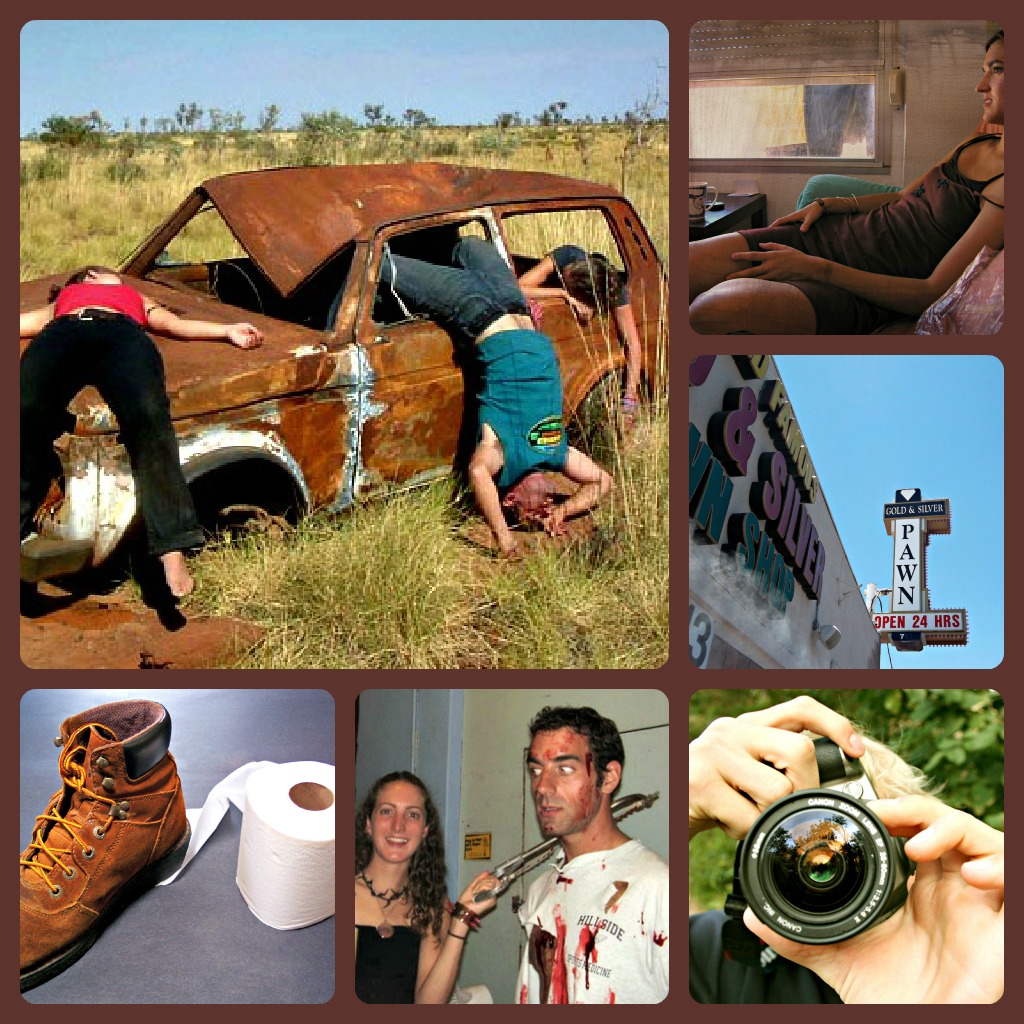
Images (clockwise, left to right): Horror image from Tony’s personal collection: fooling around with an abandoned vehicle near Wolfe Creek, Northern Territory (2007); sexy woman, pawn shop and Canon camera all from MorgueFile; Tony’s “undead” photo from a Halloween in Perth, Australia (2008); toilet paper and travel boot from MorgueFile.

RANDOM NOMAD: Jessica Festa, Backpacker, Offbeat Traveler & Locavore

Place of birth: Long Island, New York, USA
Passport: USA — but I’m planning on starting the papers for my Italian passport soon (my grandparents were born there).
Overseas history: Australia (Sydney): 2008. I’ve also backpacked through western Europe (for partying and food!), South America (for surreal landscapes and hiking trails), and Southeast Asia/China and Ghana (for volunteer projects).
Occupation: Freelance travel writer. I have my own site and also write for Gadling, Viator and Matador, among others.
Cyberspace coordinates: Jessie on a Journey — Taking you beyond the guidebook (travel-zine); @JessonaJourney (Twitter handle); Jessie on a Journey (FB page for backpacking community); and Jessie on a Journey (Pinterest).

What made you leave the United States for the Land of Oz?
I chose Australia for studying abroad because I wanted to be able to communicate in English — it was my first time going abroad alone.

On your site you describe yourself as a “natural backpacker.” How did you find living in one country?
It’s so different living somewhere than just traveling to it. When you have a part-time job, class schedule, gym membership, local hangout, go-to grocery store, etc, you really begin to feel a strong connection to a place. Sydney is such a great city. That said, I did not give up my backpacking habit entirely. I also traveled a lot through Australia when studying!

Tell me about the moment on your travels when you felt the most displaced.
I had many moments like that when I did a homestay for a month in Ghana, in West Africa. I was doing orphanage work, and absolutely loved the experience — but the culture is just completely different. Especially in city areas, it’s very loud and chaotic, and people will shout at you and grab your skin to feel if it’s real. They don’t get many tourists, so they’re just curious and wanting to get to know you — but sometimes it got a little too intense.

When have you felt the most comfortable?
In Sydney. I actually called my family crying the night before my flight back to New York, saying I had a new home and would not be returning. I had this camaraderie with my neighbors and so many connections to the community, I really felt like a local.

You may bring one curiosity you’ve collected from each of the countries where you’ve traveled or lived into The Displaced Nation. What’s in your suitcase?
My collection of paintings, jewelry and handcrafted items:

  • Ghanaian artwork and wooden masks
  • Handmade jewelry from Sydney and Bolivia
  • A handwoven purse from Peru
  • Alpaca socks from Ecuador
  • Banksy artwork from the UK
  • Masapán (bread dough art) from Calderón, Ecuador
  • A hand-sewn water-bottle holder from Thailand

You are also invited to prepare one meal based on your travels for other members of The Displaced Nation. What’s on the menu?

Appetizer: Locro, a thick soup with potatoes, avocado, cheese and vegetables from the Andes.
Main: A pesto pasta with some kind of meat mixed in from the Cinque Terre in Italy.
Dessert: Salzburger Nockerl, a sweet soufflé from Austria.
Drink: Malbec wine from Argentina.

I wonder if you could also add a word or expression from one or more of the countries you’ve visited to the Displaced Nation’s argot.
“No worries” from Australia. Such a great phrase for life. I have it tattooed on my foot!

This week you received a “Food Alice” from the Displaced Nation for your post about the first time you tried cuy, or guinea pig, in Ecuador — you said your dinner reminded you of your pet guinea pig, Joey, named after a school crush. So, does food play a big role in your travels?
For me it’s about trying new things. It doesn’t need to be in the fanciest restaurant or prepared by a Michelin chef, just something truly local. For example, in South America while many of the other backpackers went to guidebook-rated restaurants, I always opted for the tiny, simple, dimly-lit local hangouts. I ate 2- and 3-course meals for a $1, and the food was fresh and local. It was exactly what everyday people in the community were having, and that was important to me.

If you were to design a world tour based on food, what would be your top five recommendations?
1) Mendoza, Argentina — try asado (barbecued meat) with a glass of Malbec.
2) Cinque Terre, Italy — try the pesto pasta that I served to you in my meal!
3) Naples, Italy — try the pizza.
4) Cuzco, Peru — try the cuy (guinea pig) or, if you’re too squeamish, the lomo saltado: strips of marinated steak served over white rice and with French fries.
5) Munich, Germany — try the brätwurst. It is like no other sausage I’ve ever tasted, and tastes so much better in Germany!

To be honest, I’m not so sure about going to Cuzco for cuy.
Really? I love it. I’m planning to go back, and possibly move, to Peru or Ecuador in March. I’m already looking forward to getting my fill of cuy again!

Readers — yay or nay for letting Jessica Festa into The Displaced Nation? At least she’s not planning to serve us guinea pig for dinner — that’s a mercy! (Note: It’s fine to vote “nay” as long as you couch your reasoning in terms we all — including Jessie — find amusing!)

STAY TUNED for tomorrow’s post, which will most likely be on food. (No, we haven’t finished gorging ourselves yet!)

If you enjoyed this post, we invite you to register for The Displaced Dispatch, a round up of weekly posts from The Displaced Nation, with seasonal recipes, book giveaways and other extras. Register for The Displaced Dispatch by clicking here!

Related posts:

img: Jessie Festa enjoying one of the biggest and best empanadas in all of Peru, at the Point Hostels in Máncora (May 2012).

TRAVEL YARN: Two madcap Indonesian ladies in weird & wonderful Japan (2/2)

Japan — the country that many Westerners have likened to Lewis Carroll’s “wonderland” for its quality of wacky unpredictability. But what about for other Asians — do they feel as displaced and disoriented there as we do? Our very first Random Nomad, Anita McKay, ventured into the Land of the Rising Sun for the first time this summer, in the company of another Indonesian, P, who had been there once before as a student. This is Part 2 of the pair’s adventures. (See also Part 1.)

After Tokyo and Kyoto, P and I headed to Kobe — with Kobe beef as our main target. We’re Indonesians, remember? Which means we’re always looking forward to our next meal.

Gluttons for gourmet food

Our hotel in Kobe had booked us a table at Mouriya, a restaurant that prides itself on serving superior quality beef from the Kobe Cow and the Tajima Cow. Mmmm…

The meat was really delicious, but not long afterwards, I was craving sushi again. Fortunately, I was able to indulge in some serious sushi eating one last time with my blogging buddy from Yokohama, whom we met on our way back up to Tokyo. She and I went out for a meal at Kyubey, a high-end sushi restaurant in the Ginza. (P couldn’t join as she actually had to work in Tokyo for her Indonesian company for the last two days of our trip.)

Kyubey, which is actually two restaurants across the street from each other, doesn’t take bookings and always has a long queue. Luckily, my friend and I were able to get a table — and, to our delight, the chef had rather fluent English.

He patiently explained to us about the fish we were eating. One particular sushi had to be held with chopsticks in a certain way and nibbled at from the side, not the front.

We told the chef that both of us weren’t too keen on tuna, as the tuna we’d tried had been chewy or smelled too fishy — so we preferred salmon instead. He smiled and then put some tuna on our plates and told us to try it. We soon realized that this might be the best thing we’d ever eaten — melted like butter in our mouths.

Our nine-course lunch, which included eel (unagi), tuna, scallop, and squid, cost only about AUD 50 (around the same in US$). I would happily go back to Kyubey again and again and again.

P, upset at being stuck in the office while my friend and I were feasting on sushi, insisted that we go to Tsukiji market on our last morning in Japan. We got to the market just after 6:00 a.m. — but by then had already missed the tuna auction.

Still, we took a good look around at all the weird and wonderful sea creatures for sale, and then decided to have a sushi assortment for breakfast. While at the sushi restaurant, I discovered that different parts of the tuna are sold at different prices. I also came to realize that tuna costs 2-3 times more than salmon. Remembering what I’d told the chef at Kyubei about salmon and tuna, I think he must have been laughing at us!

Sex (and hugs), please, we’re Japanese!

Our first night in Kobe, P and I had wandered around looking for a place to have a drink after dinner. It was only 9:00 p.m., but outside nearly every club were girls in miniskirts handing out pamphlets.

(If guys, not girls, were standing outside the clubs, it was to advertise that “go go dancing” was on offer. Hmmm…is that a euphemism?)

We passed one big place claiming to be an Arabian club (actually, the building did have a Middle Eastern look), with a big banner of three Japanese girls dressed as nurses and “A Whole New World” blasting loudly.

We passed a couple who looked as though they were in their mid-50s and had had too much fun too early. The lady was leaning against a tree and wrenching; not exactly the picture of elegance!

We decided just to go back to our hotel instead.

Later, when we joined my blogging buddy for some shopping at the Yokohama Red Brick Warehouse, we rested over coffee as she regaled us with some stories she’d collected of strange and rather lewd behavior engaged in by Japanese men.

And then, as if to illustrate her story, something rather creepy happened. Ever the snap-happy tourist, P had decided to take a parting shot of me and my blogging buddy with the Red Brick Warehouse in the background. There was a young couple doing the same thing, who turned out to be Indonesians, sent by their companies for a training session in Yokohama.

While we were busy exchanging e-mails and phone numbers, a young Japanese man popped up out of nowhere.

He shook my hand, asked my name (in English), and mumbled something I couldn’t understand. He then walked over to my blogging buddy, repeated the same series of gestures — and then hugged her. He walked over to P and did the same thing. And then it was the turn of the young Indonesian couple.

By then, all of us had realized there was something “not right” about this guy — but as he seemed harmless enough, we waited patiently until he finished hugging the last person in the group.

At that point, he walked back to my blogging buddy and hugged her again.

I laughed a little because it seemed so strange — also because I was the only one he hadn’t hugged so felt safe.

But then, to my horror, he came back to me, shook my hand again, asked my name again, and then really hugged me and wouldn’t let go.

My blogging buddy, seeing the expression on my face, started walking away as fast as she could. The rest of us followed her. I broke free and followed her as well. As we looked back at Hugger Boy, he just waved and started laughing.

Another funny, weird, horrifying tale for my blogging buddy’s collection!

Some seriously good people watching

As our time in Japan drew to a close, I entertained myself by staring at the Frank Lloyd Wright wall in Tokyo’s Imperial Hotel, spying on a wedding procession at Meiji Shrine — and, best of all, people watching.

As I was sitting on the subway, I noticed two very pretty girls sitting right in front of me. Their hair was almost light brown (a favorite color in Japan), very long and slightly wavy (favorite style in Japan). They also wore fake eyelashes, but there was something about them that made me keep staring at them. After a few minutes I realized that their eyeballs were unusually large, more like dolls than human.

Later I consulted with Google and found that Japanese girls sometimes wear special contact lens that do make their irises look bigger. Odd…

More odd stuff: both P and I had been wondering why so many young Japanese men carry bags just like us girls. There was one guy in the subway who carried a black Dior tote bag. And if that wasn’t weird enough, I saw a guy carrying a brown city messenger bag by Balenciaga. (Google the bag and your jaw will drop, just as mine did.) Oh, and there was also a man with matching red tote bag and shoes in Bvlgari’s Il Café in Omotesandō, where P and I stopped for martinis.

Still, I did enjoy watching that particular man, who was accompanied by his two pooches. One dog kept begging from the cute girl at the next table, while the other kept demanding food from him.

Meow — or should it be nyan?!

Actually, I’m more of a cat person — so before we flew home I wanted to visit the Calico Cat Café in Shinjuku, where people can enjoy coffee or tea in the company of real cats. P still had to work so I went by myself. I didn’t even get lost!

The café has two floors and charges the guest by the first hour, then per 15 minutes. I saw a wide variety of cat breeds: Maine Coon, Abyssinian, Ragdoll, Persian, Scottish Fold, and so on. No Sphinx, though.

The café has strict rules about entering the cat area: you have to change your shoes to slippers, clean your hands with disinfectant, and not take any photos with a flash.

All of the cats seemed rather spoiled. They refused to be petted unless you gave them a snack first. A Scottish Fold named Apollo apparently thought he was the cashier, so he sat at the cashier counter, looking at us lazily.

One hour passed by so quickly that I wished I could spend at least another day in Tokyo! P, meanwhile, wished she didn’t have to work so she could experience the cat café as well.

A fond sayonara

We spent our last minutes at the airport buying Tokyo bananas and green-tea Kit Kats for friends and family back home. I was pondering about buying sake, but then all of a sudden, it was time for boarding!

P is determined to go back again, and I, too would love to go back. But as the seat belt sign went off, we looked at the world map spread in our screen, and started day-dreaming about our next adventure…

* * *

Readers, any questions or comments for Anita? Where do you think she’ll go next?!

Anita McKay is a property consultant, travel junkie, cat lover, food enthusiast. She resides in Perth with her Scottish husband but is still searching for a place called home. To learn more about her, check out her blog, Finally Woken, and/or follow her on Twitter: @finallywoken.

STAY TUNED for tomorrow’s review of an expat memoir of a cross-cultural elopement.

If you enjoyed this post, we invite you to register for The Displaced Dispatch, a round up of weekly posts from The Displaced Nation, with seasonal recipes, book giveaways and other extras. Register for The Displaced Dispatch by clicking here!

Related posts:

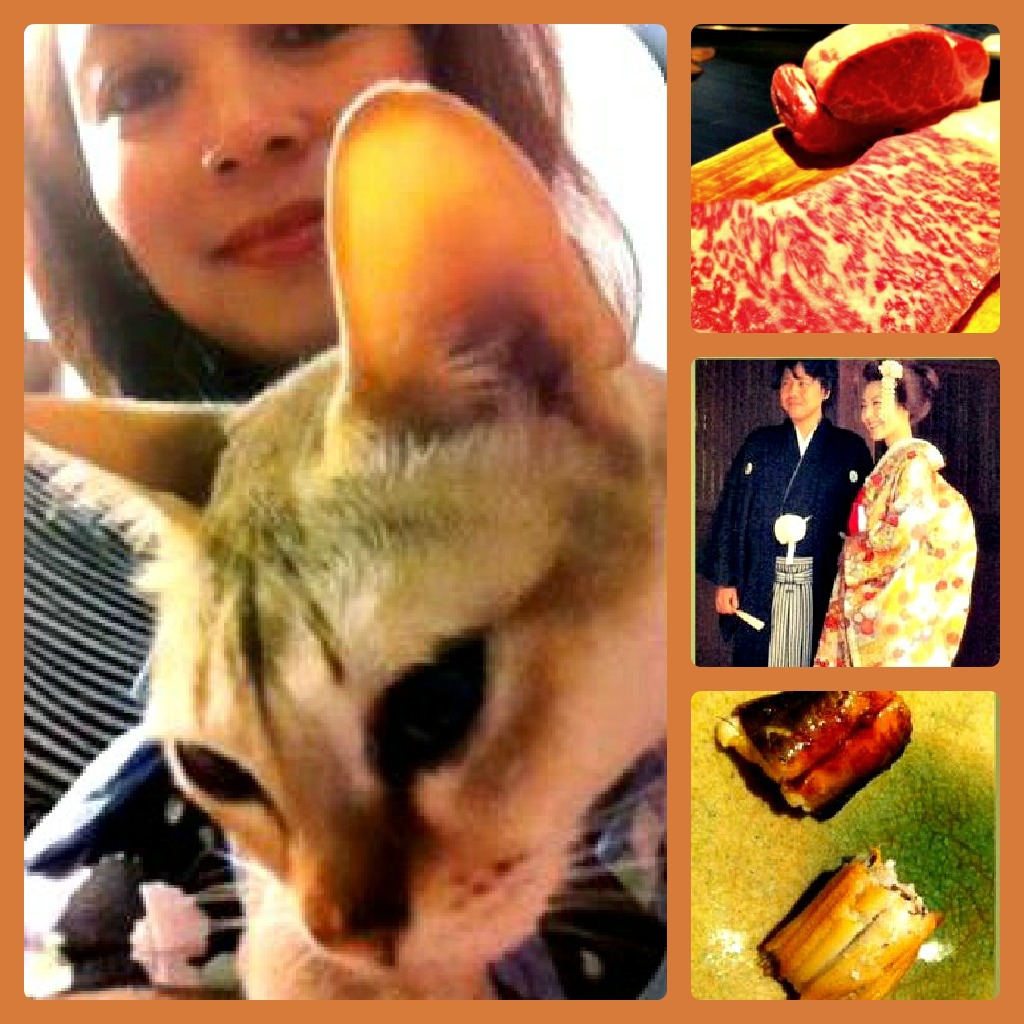
Images (clockwise): Anita McKay making a feline friend in Café Calico in Shinjuku, Tokyo; the marble-ous Kobe beef; the bride and groom at a Japanese wedding at the Meiji Shrine; and Kyubey sushi (all from Anita McKay’s extensive collection).

THE DISPLACED Q: What’s the cheapest — yet tastiest — meal you’ve discovered on your world travels?

So what is the tastiest cheap-eat I’ve come across whilst traversing the globe? Not being much of a foodie, and being a writer, cheap — yet tasty — is what I’m all about.

Well, I hate to be boring and predictable — so I won’t be. Yeah, the street food you get in Thai markets is to die for when you’re hungry. Not only that but you can eat three full meals back to back for the price of a loaf of bread in Australia.

But that’s not what I’m going for. No, for sheer cheapness compared with mouth-watering deliciousness, I’m going to have to go with an old favorite: Indo Mi goreng, an instant-noodle brand produced by the world’s largest instant noodle manufacturer, located in Indonesia.

Not just any old noodles!

Now you could be forgiven for thinking I’ve gone off my rocker here. There are countless brands of instant noodles floating around out there, and they’re pretty much all unified by one thing: being rubbish.

Nutritionally rubbish. Tasteless. Processed. Crap.

But not these noodles! I ate them almost every day on my rejuvenating hike across Western Australia — mostly because they were light enough to carry in a full rucksack and impossible to mess up in terms of cooking. These ones are nice, super nice even. And when I went back to England recently and discovered I couldn’t buy them there, the wife made me order them wholesale! I think they came directly from Indonesia. Forty packet… Oh, yes, this is how much we love these noodles.

Even though we buy them in bulk, they still cost less than the postage!

All the Asians in my area of Australia buy them — either in ten-packs, or in the same giant box I had delivered to me in England. That’s how you know they’re good noodles — when your Malaysian housemates fill their shelves with them!

But I can’t devote this entire post to one brand of instant noodles, can I? Um…no. But I’m hard pressed to think of anything else that’s so delicious for less than 50 cents.

A case of “you get what you pay for”?

Well, Canadian athlete Joe Sakic spoke true when he said:

Any free meal is a good meal, you know?

Or did he? I’ve come across a few ways of getting free food in my time — from famous vegan soup kitchens in a hippie commune in Margaret River (Western Australia) to the delightful food they served me in hospital when I was selling my body to medical science (also know as being a guinea pig for medical testing). And none of these meals were especially delicious.

You know, they would shoot me full of weird, untested drugs, imprison me in a hospital for weeks at a time, make me sleep on rubber sheets and wake me every morning at 4:00 a.m. to take my blood.

But still, the worst thing about the whole experience was the food.

Free is only good if you don’t have to have it; being forced to eat isn’t great no matter the quality of the food. Which, unsurprisingly, wasn’t great.

Tastes that refuse to be acquired

Then, of course, there are the meals in foreign lands that people treat you to. In my experience, that can be risky.

On my last morning in South America, my Ecuadorian girlfriend took me for a surprise breakfast she’d been planning for some time.

She led me all through the suburbs of Quito, to a restaurant which was famous for one dish in particular: ceviche.

Now, I’m not a fan of seafood. I can just about choke down a fish-finger — as long as I can’t see the insides of it. Ugh!

Of course, this topic had never come up; one of the myriad disadvantages to starting a relationship when you don’t share even one common language. We communicated mostly in sign language, and the half-assed version of Spanish I was picking up.

So naturally, I’d never mentioned my intense dislike of seafood, in much the same way as she thought it would be too much effort to explain what her surprise was. As a result, neither of us knew what to expect until I lifted the lid on my service and saw what it was: namely, half the cast of Finding Nemo, after being put in a blender with some brown sauce and chillies…

I tried to eat it, honestly I did!

I didn’t succeed though.

At least, the bit I did eat came back up so rapidly we have to make our excuses and leave the restaurant at top speed…

So remember that, whilst free food is irresistible, you should always season your desire for a cheap eat with a little caution, especially when traveling. The old adage is true: there is no such thing as a free lunch (or breakfast).

There are few things worse than being violently ill in the middle of a country where no one speaks your language. Far from home. Far from healthcare you trust… And wearing most of your raw-seafood breakfast.

That is almost never a good look. :0)

* * *

So, that’s all from me on this particular displaced Q! Now it’s your turn! What experiences have you had in your search for cheap eats around the world? Any tasty morsels? Anything we should avoid? Any scrumptious stories…? We’d love to hear from you! You can also hit us up on Twitter: @TonyJamesSlater +/or @displacednation.

STAY TUNED for Tuesday’s post, the second part of a two-part travel yarn about two madcap Indonesian ladies who are taking Japan by storm!

If you enjoyed this post, we invite you to register for The Displaced Dispatch, a round up of weekly posts from The Displaced Nation, with seasonal recipes, book giveaways and other extras. Register for The Displaced Dispatch by clicking here!

Related posts:

Img: The contents of Tony James Slater’s shopping bag, taken on 9 September 2012 in his current home of Perth, Australia.