The Displaced Nation

A home for international creatives

Tag Archives: Acquired tastes

GLOBAL FOOD GOSSIP: When facing repatriation after 18 years of the expat life, bring on the comfort food!

Serial expat (and soon to be repat!) Joanna Masters-Maggs is back with some juicy global food gossip to share.
Global Food Gossip 062315
“Oh, I see, it’s that time again, is it?” My husband entered the kitchen and sniffed the air. “It’s smells like Christmas, but it’s 30 degrees outside. “You’ll be wanting tea with that gingerbread?” Sighing he reached for the kettle.

Now, I’m not saying that expat life calls for comfort food more than any other lifestyle, but it does have it’s own rhythm of needs. For me, the main calls for comfort come during the entry and exit period of a new location.

I am now facing moving on from France—and frankly, even my beloved madeleine is not up to the job.

I need the kind of comfort food that warms up the winter, as neither the glorious weather nor the proximity of pools and beaches here in Provence can distract me this time.

Bikini be damned, my next move will be a return to England.

It is hard to imagine that repatriation can be more alarming than a move from one foreign country to another. Yet, after 18 years abroad and seven intercontinental moves, I am discovering that it is.

Our house in England is our holiday home, and we have few of the friends and none of the social networks we would have built had we stayed put. All the friends we have made at various offices, playgroups, schools, dog training groups and sundry activities are scattered across several continents. We will be in the interesting position of not belonging, while giving every outward appearance of doing so and no possibility of joining a repat support group (do such things even exist?).

You understand why I am reaching for the gingerbread now?

gingerbread-repatriation

Gingerbread by roxymjones via Pixabay.

The act of making gingerbread is a comfort in itself. Just watching the butter, syrup and sugar melt together and swirl in the pan, gives one time to relax and think.

Mm…as I watch the ingredients swirl, I’m thinking about cultural comfort foods of locations past.

Morning sickness in New Orleans calls for Morning Call

For anyone into comfort eating, my former home of New Orleans is a dangerous place. There are just too many temptations along the path of righteous eating, beginning with crawfish stew, jambalaya, seafood gumbo…

But it was beignets with coffee from Café du Monde or Morning Call (the less touristy choice, favored by locals) that became my preferred source of solace.

"City Park 12-12-12 Morning Call Coffee Beignets Dunk," by Infrogmation of New Orleans (CC BY 2.0).

“City Park 12-12-12 Morning Call Coffee Beignets Dunk,” by Infrogmation of New Orleans via Flickr (CC BY 2.0).

Of course life in New Orleans is pretty fabulous, especially when you are lucky enough to live in the French Quarter and see the life that exists behind the touristy façade. But comfort requirements are still there. Coffee and beignets are a fabulous hangover buster for one thing and for another they sure beat morning sickness into retreat while providing a good dose of the additional calcium an expectant mum needs. For me, the beignet and café au lait was the multi-tasking workhorse of comfort foods.

When it came time to leave the Big Easy, the beignet soothed my sadness, and I was careful to ensure I had a good recipe (see end of post) should it be needed to help with my adjustment to the next location: Den Haag.

The only problem, of course, with making your own beignets is the terror one feels when cooking with large quantities of hot fat—so it was with relief that I quickly discovered a more convenient way to ease my emotional entry into The Hague.

A cold arrival in Holland calls for oliebollen

We arrived in the middle of a particularly cold Christmas season. You can only imagine my delight at catching my first whiff of oliebollen and appelflappen, which fills the air that time of year.

Oliebollen is a Dutch style of doughnut that is traditionally eaten on New Year’s Eve, and appelflappen are a kind of apple beignet—YES!—served with sugar and cinnamon and sold from little stands throughout the Christmas season.

What a happy Christmas that turned out to be. What joy to have a little bag of those to warm both your chilly fingers and the depths of your heart.

How can you not love living in such a place?

Dumpy in Brazil calls for Disk Cook

And then there was Brazil. Now Brazil provided a different sort of comfort food to get me through the hard times. Being pregnant and feeling dumpy in a land full of girls from Ipanema in tiny bikinis isn’t exactly fun—but then, suffering from the heat, I cut off all my hair. Short.

You don’t do that in Brazil. It’s akin to cutting off your femininity. It’s ugly.

Happily unaware of this and feeling as though I was channeling mid 1990s Meg Ryan, I returned home from the hairdresser. My housekeeper took one look of me and clapped her hands loudly to her cheeks with a look of pure horror. After a slight pause and in an unnaturally high voice, she said “Madame looks beautiful”—before making her excuses and disappearing for half an hour.

The next few days were a bit unsettling as Maria avoided eye contact. It wasn’t that I minded her thinking my hair was ugly, more that I was now aware of how little I understood the culture. How many other things was I getting wrong?

As insecure as it makes me sound, I decided not to compound one aesthetic error with that of gaining weight, too. I avoided thoughts of my beignet recipe and my go-to home remedy of buttered toast. I also steered clear of the local padarias (bakeries). Instead I filled up on fruit.

But the thing is, comfort food is the kind of thing that finds you and it doesn’t have to come in carbohydrate form. You just need to be open to it: it being a well-rounded flavor that puts your taste buds at ease.

The comfort food of Brazil found me rather quickly. Disc Cook is a service which will collect food from a huge list of restaurants and deliver to your house. A new restaurant opened in our area and we decided to try it out. Imagine my surprise when the healthy sounding chicken liver and spinach dish turned out to be my next comfort food.

Disk Cook screenshot.

Disk Cook screenshot, taken 24 June 2015.

No, hear me out. Full-flavoured meat that melted in the mouth, cooked with balsamic vinegar and pine nuts. Yes, I know it sounds odd, but it was so richly satisfying, I couldn’t get enough of it. I even took comfort in the cold leftovers of that dish, straight from the fridge.

In honesty, however, comforting as it was, it can never qualify as true comfort food. Firstly, it comes from a good restaurant and true comfort food should not be exclusive. Secondly, I was never able to find or make up that recipe for myself. If it is too hard to lay your hands on, it isn’t comfort food. Comfort food cannot be a cause of any stress—other than the weekly weigh-in, of course.

Enough of my unabashed wallowing, and now for my beignet recipe

As I write, I am beginning to feel a little nostalgic and rather sad again. The problem with being in a constant state of serial expatness is that each time you leave one place, you remember the pain of leaving the last. It is a sort of travellers’ emotional add-on game. Sometimes I have to walk away from it. That is true now.

Perhaps next time I can tell you how I found solace from homesickness and last-location-sickness in the foods of Malaysia, Venezuela and Saudi.

(If you have had enough of this unabashed wallowing, I apologise—but would politely point out that at least I haven’t descended to mentioning visits to certain popular fast food chains, which I have no doubt we perpetual expats have all indulged in at least once or twice. For that we must be grateful.)

New Orleans-style Beignets, adapted from The Ultimate Southern Living Cookbook
NOTE: I made the conversions to grams years ago. Metric rocks!

Ingredients:
1 package dried yeast
3 tablespoons warm water (hand hot)
180 ml milk
150g sugar
28g shortening (or lard—which I prefer)
1 tsp salt
375g all-purpose flour
1 large egg
Vegetable oil
Powdered sugar

Method
Combine the yeast and water and leave to stand for five minutes.

Combine the milk with the sugar, shortening and salt in a saucepan over a low heat until the fat melts. Remove from the heat and leave to cool until again hand hot. Very hot liquid will kill the yeast and so it will not rise. If your hand can tolerate the heat, so too can the yeast.

Combine yeast mixture, liquid mixture, two cups of the flour and the egg in a large mixing bowl. Beat at medium speed with an electric mixer for two minutes. Gradually stir in as much of the remaining flour as you need to make a soft dough.

Put dough onto a lightly floured surface and knead until smooth and elastic (about 10 minutes). Place in a buttered bowl, cover and leave to rise in a warm place for one hour until doubled in size.

Punch dough back, turn onto a floured surface and roll out into a 30 x 25cms rectangle. Cut into two-inch squares and place them onto a lightly floured surface where they can be covered and left to rise until double in size (about 45 minutes).

Pour oil into a pan to a depth of about 3 or 4” and heat to 375° F (190 °C). Fry the beignets four at a time until golden. Drain on paper towels. Sprinkle with icing sugar and serve warm. YUM.

* * *

Readers, we invite you to continue the food gossip! What new comfort foods have you added to your list on your moves around the globe? And do you have any words of comfort for Joanna on her imminent repatriation? Be sure to let us know in the comments!

Joanna Masters-Maggs was displaced from her native England 17 years ago, and has since attempted to re-place herself in the USA, Holland, Brazil, Malaysia, Venezuela, Saudi Arabia, and now France. She describes herself as a “global food gossip”, saying: “I’ve always enjoyed cooking and trying out new recipes. Overseas, I am curious as to what people buy and from where. What is in the baskets of my fellow shoppers? What do they eat when they go home at night?”

STAY TUNED for the next fab post!

If you enjoyed this post, we invite you to register for The Displaced Dispatch, a round up of weekly posts from The Displaced Nation—and much, much more! Register for The Displaced Dispatch by clicking here!

Related posts:

WONDERLANDED: “Shadows & Reflections,” by long-term expat Paul Scraton

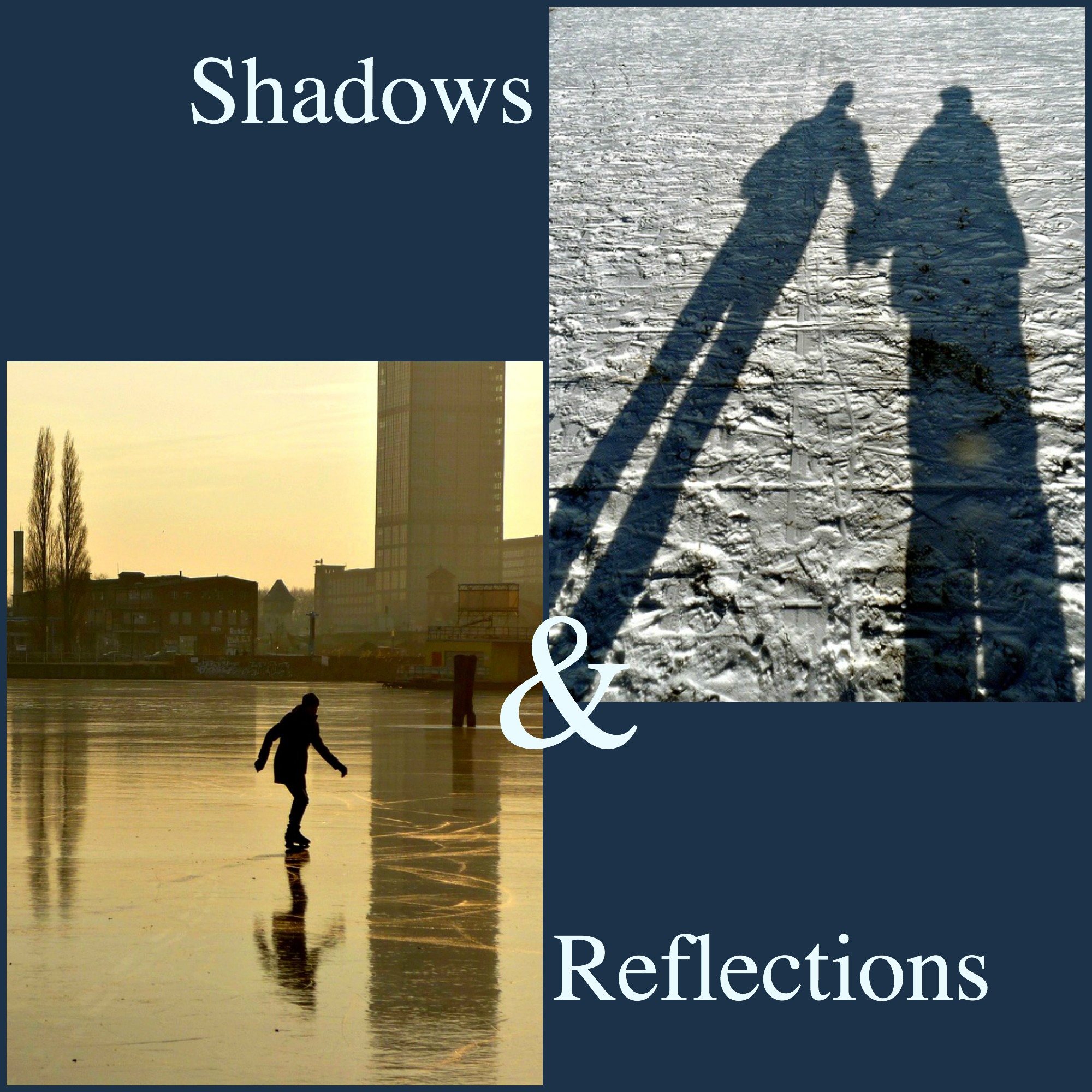
Shadows and Reflections Berlin

Photo credits: (left) Rummelsburg Bay in Berlin via Pixabay; Volkspark Hasenheide, Berlin-Neukölln, by Zusammen via Flickr (CC BY-SA 2.0) .


Just the other day we were “wonderlanded” in Berlin with British expat writer Paul Scraton. We found out what it was like to live “slightly on the edge of the scene”: in Paul’s view, “that’s where the interesting stuff happens.”

Today we hear from Paul again on the topic of displacement—only this time he will be speaking through a piece of his own writing. “Shadows & Reflections”* is a post he wrote two-and-a-half years ago for the British online forum Caught by the River, which, like Alice’s own story, was “born on a bankside.”

* * *

We are taking a train back from Munich to Berlin on a Sunday afternoon at the start of December, a six-hour train ride home that will take us through some of Germany’s most beautiful countryside at over a hundred and fifty kilometres an hour. A few hours north of Munich, just over the old border between the former West and East of the country, the fields are covered in a light layer of snow, the forests engulfed in mist. Whenever the first snow flurries of the winter arrive it never fails to remind me of the day I moved to Germany, landing at a snowy Schönefeld Airport, still on high alert a couple of months after September 11th.

Train Ride to Berlin quote

Photo credits: (top) The scenery from the train window, by Paul’s partner, Katrin Schönig; “Keep the track focused!” by Axel Schwenke via Flickr (CC BY-SA 2.0).

I did not imagine then that I would still be living in Berlin over a decade later, and that Germany would have become my home. Or is it? The Germans have a wonderful word that to my mind has no proper translation into English. Usually the word Heimat is turned into “homeland”—but it means something more than that, a feeling about a place that involves an almost spiritual sense of belonging even in the non-religious. It might be Berlin, or even a district of the city. It might be a stretch of the Baltic coastline, or a village in the north of Bavaria. It could be a certain landscape, a place of particular traditions and culture. Germany is a fractured country, only put together for the first time in 1871, and local, regional pride still runs strong.

Yes, Berlin and Germany has become my home over the past twelve years, but it is certainly not my Heimat… And at the same time, a handful of trips back to England over this year has made me realise that if it is not here, it might not be there either.

During the three trips, to London, my old stomping ground of West Yorkshire, and new discoveries in Northumbria, I realised once again that although there are certain elements of returning that are as comfortable as a favourite old jumper, being away means you miss certain developments and that marks you down as an outsider, whether it is a particular band an old friend is raving about, or a certain slang term that you start to notice being used on social media or in streamed BBC shows that you think you understand but you cannot be sure.

So in this year of journeys—to England, but also through Germany to the Baltic coast, the Oder River and the forests and lakes around Berlin—I reflected a lot on belonging and what it means to be home. When I first learned the word Heimat it made me think of certain places that meant something strong to me, but I realised—as I conjured images of the Welsh coast and mountains, the Yorkshire moors and dales, the Dock Road in Liverpool and the potato fields of West Lancashire—that this was more an exercise in memory and nostalgia than anything else. And the thing with memory and nostalgia is that even when you go back, return for a visit or even to stay, you realise that not only is the place subtly different than you remember it, but you are also not the same person as the one that was there before.

Heimat Two Seas

Photo credits: (top) “Choppy seas,” by psyberartist via Flickr (CC BY 2.0); Baltic sea by Paul’s partner, Katrin Schönig.

Living in Germany for a dozen years has, of course, shaped and changed me. If I am looking for a shadow in these reflections, perhaps this is it. The paths you take always leave you the chance to wonder about those that you did not. If you are of a mind to spend much time with your memories and nostalgia, then you cannot help but reflect on how things could have been different. You cannot possibly know how you yourself would then have changed with a different job, a different house, perhaps even different people around you, except to know that you most certainly would have.

As the train rushes through the rolling landscape of Thüringen, just before the flatlands of the north, I think of how my appreciation of such scenes has changed over the past 12 years. From my list above you could work out that the landscape I grew up with, and which continues to touch me—of moors and mountains, wild cliffs and the white horses of the Irish Sea.

But over my time in Germany I have come to appreciate the very different landscape that surrounds me…the flat, melancholic beauty of the Baltic coast, the lakes north of Berlin and the pine forests that encroach on the city. And I realise I am happy to have learned to love something so different, that I need not continue any surely futile search for a Heimat that deep down I know does not exist. That is, perhaps, both the cost and the benefit of having grown up in one place and chosen to live and love somewhere else.

As the train reaches the outskirts of Berlin I look out of the window into the darkness, searching for the first glimpse of the Television Tower in the distance. Then I will know that I am nearly there. Home.

*”Shadows and Reflections” is republished here with Caught by the River’s permission.

* * *

Thank you, Paul, for this enlightening series of “wonderlanded” posts. Readers, I hope that by now you are, like me, full of wonder at Paul’s insights into a life of displacement similar to the ones many of us have led. 

As it happens, the very first issue of the new journal of Elsewhere: A Journal of Place, of which Paul is founding editor, is out today. Please join me in wishing Paul a hearty congratulations! And, say, if you like what Paul has to say about place, why not think about subscribing? I would also urge you to follow his blog, under a grey sky… ~ML

STAY TUNED for the next week’s fab posts.

If you enjoyed this post, we invite you to register for The Displaced Dispatch, a round up of weekly posts from The Displaced Nation, and much, much more. Register for The Displaced Dispatch by clicking here!

Related posts:

Wonderlanded in Berlin with British expat Paul Scraton, founding editor of the new “Elsewhere” journal

Welcome to the Displaced Nation’s Wonderlanded series, being held in gratitude for Lewis Carroll’s Alice’s Adventures in Wonderland, which turns 150 this year and, despite this advanced age, continues to stimulate and inspire many of us who lead international, displaced, “through the looking glass” lives.

This month we travel
d
o
w
n
the hole with Paul Scraton to Berlin.

Paul Scraton Wonderlanded for TDN 3

Paul says he isn’t intimately familiar with Lewis Carroll’s classic work—this despite having had a mainly English childhood. He was born and spent his early years in a market town just north of Liverpool; and, though his family moved around a fair bit in Paul’s early years—Wales, Canada, the south of England—they settled in Lancashire once he reached school age. At 18, he crossed the north–south divide to attend the University of Leeds.

But I feel justified in including Paul in this series first because he is most certainly displaced. Upon graduation from Leeds, he moved to Berlin, Germany, which is where we find him today, living with his German partner, Katrin, and their daughter. Apart from a summer spent in Dublin, the German capital has been Paul’s “home” for the past 14 years.

In addition, having studied Paul’s creative output, I think it is fair to say that for him, “elsewhere”—by that he seems to mean the great outdoors—is a kind of Wonderland. He never tires of exploring the area where he lives. He has served as a tour guide for Slow Travel Berlin and written two short books based on walks he has led in and around his adopted city.

Another place to which he has formed a deep attachment is Germany’s Baltic coast. Katrin spent much of her childhood on the the island of Rügen and in the Hanseatic city of Stralsund, and for about a decade, Paul has accompanied her on trips to the region.

Paul writes a regular series of “dispatches” about his various outdoor adventures—whether in Germany or the UK (which he still visits frequently)—for his blog, under a grey sky…

And now he has just released the very first issue of Elsewhere: A Journal of Place, of which he is the founding editor.

Without further ado, let’s find out what it’s like to be “wonderlanded” with Paul.

* * *

Paul Scraton: Although it was quite a few years ago now, I can remember what it was like when I first arrived in Berlin and needed help with everything, from registering an apartment to opening a bank account. It was certainly challenging, even though Berlin is a city where many people speak English. And it is often only in the moving that you realise what aspects of life are different or not easily accessible compared to “back home”…and that can certainly make you feel lonely in a new city, a new country.

I did not have an internet connection in my first couple of Berlin apartments, and the English newspapers were expensive, so I relied a lot on BBC World Service. It is funny that this is not that long ago, but I imagine it is a different experience now with widespread internet access, social media and Skype.

I think the reason I first resisted the idea of Berlin or my life in another country as “wonderland”, besides a lack of familiarity with the books, is that by the definition of the Displaced Nation I am so often in this wonderland that it would never occur to me to frame it in that way. What I mean by this: when I am in Berlin I feel like I don’t quite belong, but when I go “back” to England having lived abroad for 14 years then I feel just as out of place. So it is something of a permanent state.

Despite this I can recognise that there are elements of life and my experience in Berlin (and beyond) after all these years that I still find curious…

“The question is,” said Alice, “whether you CAN make words mean so many different things.”

Having just finished university with no real idea of what I wanted to do except to write, I did wonder whether Berlin was the right place for me in the sense that I felt a long way away from any community or other people doing something similar in English. But several of us built our own little network, and, with the influx of still more international creatives over the years, there is now a small but thriving community of English-language writers and other like-minded folk.

“But what did the Dormouse say?” one of the jury asked.

One of the reasons I was drawn to Berlin was its history and the stories contained within these streets. One of the questions I would often ask people when I met them was whether or not they had grown up in the east or the west, and their experiences of living in a divided city and country and also what they thought about the process of reunification. In more recent years I was involved with running eyewitness history talks with people who told their personal stories of living in the city during the Nazi era or the Second World War, or living under communism in East Germany or in the “island city” that was West Berlin. Sometimes people in the audience, who were mainly visitors from outside Germany, would ask questions that would make me worry that the speaker would be offended, but actually it never happened. The Germans were happy to answer even difficult questions about their past or that of their families. In general, this is one of the strengths of the German society—the extent to which they have acknowledged, come to terms with, and discussed, debated and learned from their history; and you see it with individuals as well.

“Curiouser and curiouser…”

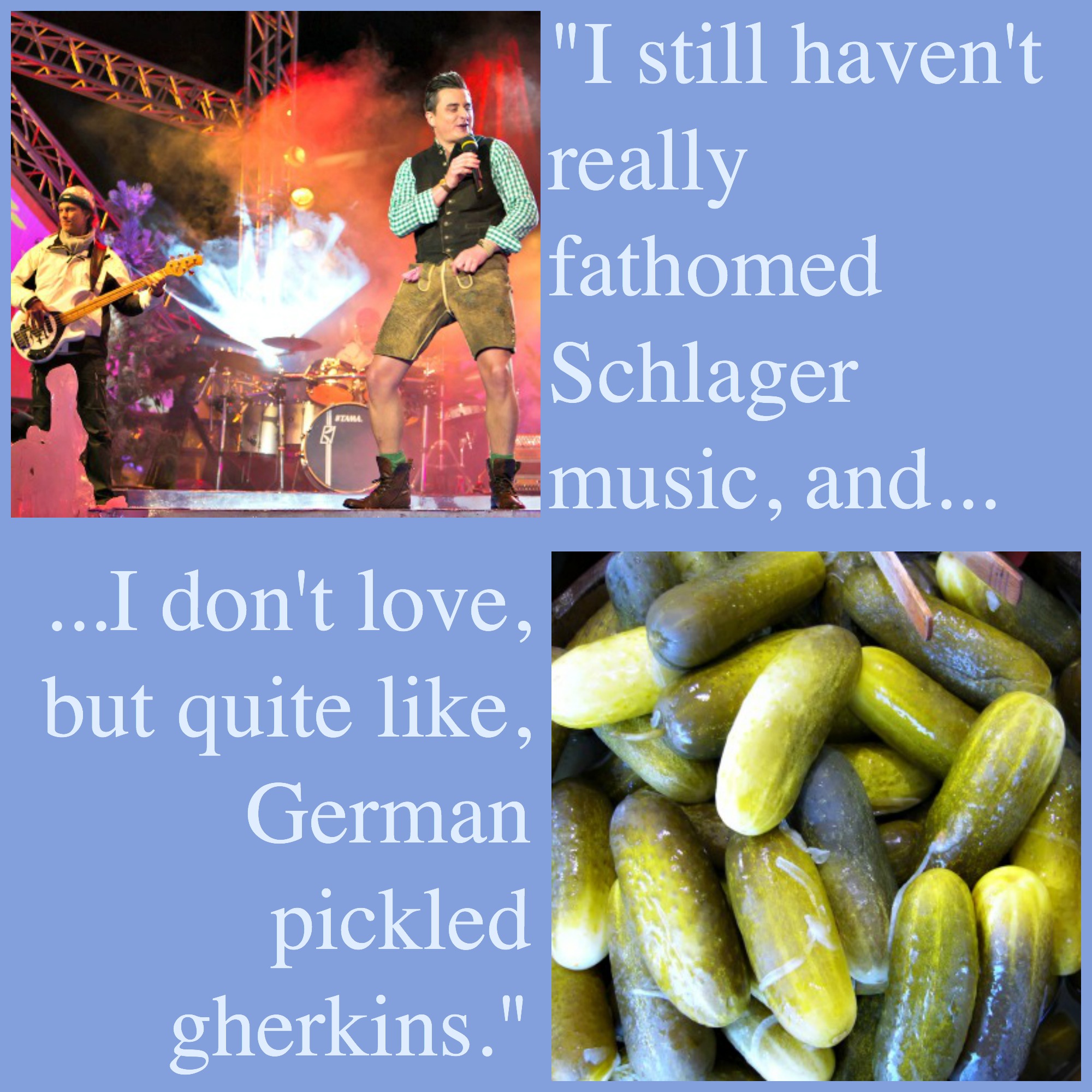
I think what really struck me about moving to Germany was not any sense of culture shock, but that the differences to back home were subtle and needed time to be discovered. In Berlin especially people can be very direct… there is very little tip-toeing around the subject, which can be a bit disconcerting. The main thing I still haven’t really fathomed is Schlager music, and the assorted television shows that showcase it. Finding yourself in the middle of something like that is one of those moments where you really realise you are living in a place where there are certain cultural traditions you have no grasp of, and to which you may never have access.

Acquired tastes Paul Scraton

German tastes you may never fully acquire. Photo credits: “Wenn die Musi spielt,” by Bad Kleinkirchheim via Flickr (CC BY 2.0); Giant gherkins, by Caitriana Nicholson via Flickr (CC BY-SA 2.0).

“Well, I’ll eat it,” said Alice…

My partner introduced me to good German pickled gherkins, and without her prompting I doubt I would ever have touched them. Now I quite like them.

“Will you walk a little faster?” said a whiting to a snail…

I am fascinated by Germany’s Baltic coast. One of the reasons is that I am fascinated by the coast in general, I think because it is a place that combines (a) the sense of escape that comes with family holidays, the seaside resorts, and the break with everyday life; and (b) the danger, myths and legends of the sea itself. Most seaside towns have both beaches where people have spent many, many happy hours, as well as memorials to shipwrecks and lifeboat crews… This contrast or contradiction applies, by the way, to the coast of the UK as much as here in Germany. (See for instance my blog post about our visit to Lindisfarne, Northumbria.)

The allure of the coast: Heimat, Germany (top) and Lindisfarne, Northumbria, UK. Photo credits: Paul Scraton and K.

The allure of the coast: Heimat, Germany (top) and Lindisfarne, Northumbria, UK. Photo credits: Paul Scraton and Katrin Schönig.

Another reason the Baltic is special is that it’s the place where my partner grew up. In the past ten years or so she has been taking me and my daughter up there. We are writing new stories for ourselves in a place that was very much a part of her childhood.

“Take some more tea,” the March Hare said to Alice, very earnestly.

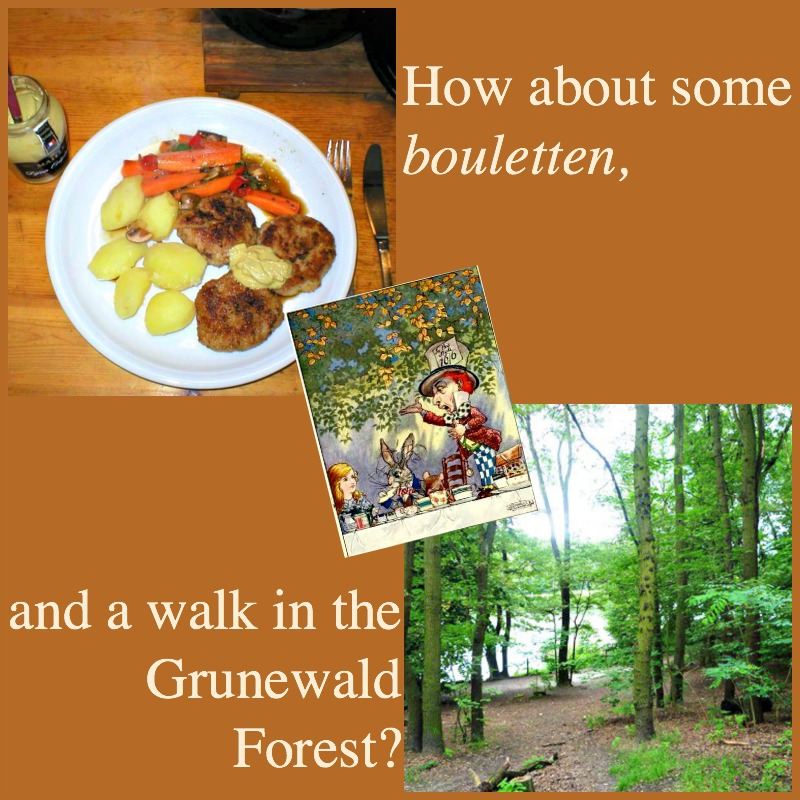
Now that you’re Wonderlanded with me, I must throw you a Mad Hatter’s tea party. This being Berlin, I will serve beer and bouletten (meat balls), a Berlin specialty, at the big table in our living room. We will listen to music and chat…and the guests will be friends, those who I don’t see enough of because of the way life seems to be. Not only those who are in England, and who I don’t see because of distance, but also those who live in the same city but somehow life gets in the way. But before we sat down for beer and meatballs we would have done a long walk together through the city or perhaps out at the lakes and the forests on the edge.

Bouletten and a walk. Photo credits: Bouletten mit Senf, by  Michael Fielitz (CC-BY SA 2.0); Grunewalk Forest by Paul Scraton.

Bouletten and a walk. Photo credits: Bouletten mit Senf, by
Michael Fielitz (CC-BY SA 2.0); Grunewalk Forest by Paul Scraton.

“Who in the world am I? Ah, that’s the great puzzle!”

Inevitably, you are a different person at 36 years old than at 22, and these changes would have no doubt happened whether I was in Berlin or had stayed in England. And if anything, being with my partner and our child probably had a more profound impact that simply the act of moving away. But I would say that work wise, in my writing and in creating our journal, Elsewhere, living in Berlin has been an endless source of inspiration. The number of interesting places and the stories they contain feels inexhaustible. I don’t think I would have become the writer I am, pursued the projects I am doing, or developed my work in the direction I have, without living in this city for the past decade and a half.

Advice for those who have only just stepped through the looking glass

If you are like me, you will find yourself feeling out of place in your new home and out of place when you return to the old one. But there is nothing wrong with being slightly on the edge of the scene…that’s where the interesting stuff happens.

“I wonder if I shall fall right through the earth!”

Paul Scraton books and journal

Paul Scraton’s two short books and the first issue of the new journal he edits, Elsewhere.

Aside from the journal, the first issue of which we are launching this week, I am writing a book about memory, exploration and imagination on the German Baltic coast. As I mentioned, this is the area where Katrin grew up, and so the book combines my own travels and discoveries in the area with the myths and stories of the places along the coast as well as Katrin’s family history. I think coming at these places and stories as an “outsider” gives me a different perspective that informs and shapes the writing. Ultimately everything I am working on right now is concerned with the idea of “place”, and again, I think this interest has developed as a result of never quite feeling I belong wherever I may be…

* * *

Readers, I wonder if you feel like me, that you’ve enjoyed being “elsewhere” with Paul so much you feel a bit bereft now that our “tour” has ended… Do you agree the time went quickly? And what did you make of his Wonderlanded story? Please let us know in the comments. ~ML

STAY TUNED for the next fab post: an example of how Paul writes about place.

If you enjoyed this post, we invite you to register for The Displaced Dispatch, a round up of weekly posts from The Displaced Nation, and much, much more. Register for The Displaced Dispatch by clicking here!

Related posts:

Photo credits for opening image (clockwise from top left): Paul Scraton (supplied); image from “A line of wild suprise: Prespa, Greece,” one of the articles on the first issue of Elsewhere; “Alice,” by Jennie Park via Flickr (CC BY 2.0); Hutschenreuther Garten Eden Cup & Saucer via Chinacraft.

GLOBAL FOOD GOSSIP: I lost my heart (but not my teeth) to the French artichoke

Global Food Gossip French artichoke

Global Food Gossip. Joanna Masters-Maggs (supplied); globe-shaped artichoke via Morguefiles; (slim-shaped) artichoke, by Marco Bernadini via Flickr (CC BY 2.0).

Joanna Masters-Maggs was displaced from her native England 17 years ago, and has since attempted to re-place herself in the USA, Holland, Brazil, Malaysia, Venezuela, Saudi Arabia, and now France. She describes herself as a “global food gossip”, saying: “I’ve always enjoyed cooking and trying out new recipes. Overseas, I am curious as to what people buy and from where. What is in the baskets of my fellow shoppers? What do they eat when they go home at night?”

* * *

“You can’t eat artichoke?” my dentist’s eyebrows lowered. “Something has to be done,” he declared, adding: “Don’t worry, the insurance will pay. In France we know that you can’t live life if you can’t eat an artichoke.”

It took a French dentist to understand that more important than a beautiful tooth, is a fully functional tooth, well able to withstand the demands of the artichoke, the most delectable of vegetables.

While out running a few years ago, I fell and broke my front teeth. Since then I had lived with two veneers, one of which never became my friend. Dreams about my teeth falling out came weekly and I never ate apples or baguettes unless first cut into bite-size pieces.

I could not, however, treat the artichoke with the same level of circumspection. I simply found it too interesting. Upon my arrival in the South of France, I threw caution to the winds—and then paid the price.

The Mighty French Artichoke

Artichokes springing up in a French field. Near Kerlouan – Artichokes, by muffin via Flickr  (CC BY 2.0).


As those who are acquainted with this exquisite food ritual will know, artichoke eating requires you to scrape the flesh from the leaves by gripping them between your teeth and pulling. The inevitable happened and that veneer bailed on me—twice.

Had I been living elsewhere, I suspect the insurance companies would not have been looked on the prospect of my leading a desolately artichoke-free life with much sympathy—in any event, not to the point of covering the payment for a new fixture. But heureusement, as I found myself in France, I was soon the proud possessor of a tooth not only of great beauty but also of unsurpassed shearing ability. It was May, and the prospect of enjoying June and July’s premium artichoke season was just around the corner. I was ready to make up for lost time.

Je t’aime bien!” I declared with uncontrolled delight as I held up the mirror to my new smile.

Non,” Monsieur Le Dentist retorted, “vous avez le coeur d’un artichaut.”

We cackled with delight.

(The joke was not entirely appropriate as the idiom describes one who falls in love all the time so it becomes meaningless—a leaf for everyone you see.)

No matter. I will have life-long good feeling for the dentist who set me loose on the vegetation of Provence. Besides, what other idiom could he possibly have used in the circumstance?

The variety of artichokes available in the South of France surprised me at first.

Slim and chic artichoke

Slim and chic. Artichoke, by Marco Bernadini via Flickr (CC BY 2.0).


Not only do you find the large and familiar green globe type but also the longer, oval types. Trust the French to have a slim and chic artichoke, too!

The colours vary from the usual green to the deepest of violets and are sold in large bunches—I can imagine them being served at the wedding of a dedicated vegan bride.

The French like to eat artichokes boiled in salted water with vinaigrette dressing. Simple and perfect, though I must admit, I sometimes prefer to make homemade mayonnaise. After all, I am dealing with vegetable royalty. Surely I owe them a little effort?

Dealing with an artichoke can cause some worry, but the rules are pretty straightforward.

Preparing an artichoke:

Method
Cut the tips of the leaves off with a pair of scissors to remove any sharp or dry bits.

Lower the artichoke into a pan of salted water and cook uncovered until you can easily pull a leaf from the whole. This can take anything between 20 and 40 minutes, depending on size. NOTE: Just remember not to place a lid on the pan. There are acids in the artichoke, which, if prevented from escaping in the steam, turns them brown. We simply don’t want that!

Next, drain the pan and let the feast begin.

Eating an artichoke:

The artichoke offers tactile eating at its glorious best:

Simply pull a leaf away, dip into your preferred sauce, place between your front teeth and apply gentle pressure as you pull forward, stripping the “meat” from the leaf. (While you’re at it, reflect on the pleasure of knowing that one of your front teeth is unlikely to be dislodged—as you never know what’s around the next corner.)

Discard any woody remnants and move on. Soon you will find a greedy rhythm that makes conversation unnecessary.

As you reach the centre, the leaves become smaller and yield less.

Pretty soon it will be time to strip away the leaves and reveal the silkily haired “choke”—which you definitely don’t want to eat!

Comb away at this choke with your fork until the hairs lift up like poorly rooted weeds. Slowly the heart is revealed, cup-like in shape and richly creamy in colour.

You have now arrived in vegetable heaven!

The rich yet raunchy artichoke “keeps on giving”

The rich yet raunchy artichoke

(Right) Stuffed artichoke, by Joy via Flickr  (CC BY 2.0).


The delicate, buttery nuttiness makes the artichaut one class act. Yet it is far from bland. It has a full and complex flavor that richly fills the mouth.

Indeed, the artichoke is the culinary equivalent of the sophisticated French lady, dressed in natural-coloured linens with caramel-highlighted hair and warmly tanned skin.

If the flavor doesn’t shout for attention with overt showiness or any trace of vulgarity, don’t think it’s a pushover. The artichoke still has potential for a bit of raunchiness. It can provide a base for stronger flavours, as with recipes for stuffed artichokes, which often involve garlic, cheese and oregano.

And why not? Even Kate Middleton has been known to channel the sexy on occasion. However, it is her tasteful and demure style that best defines her—just as it does my beloved artichoke.

Wine…or water?

Finally, I’d like to make a confession. I love drinking wine; the worst thing about it is that it doesn’t even need to be great wine. Sometimes I worry about this, but then I just get on with things.

That said, I’ve discovered that wine just doesn’t go that well with artichokes. Something about this vegetable—its sweet, rounded taste—changes the taste of anything you drink.

But what’s interesting is that it changes the taste of water, too; it makes it sweet. I honestly believe that water is the best accompaniment to this vegetable.

What joy, a healthy, vitamin-loaded lunch, which feels like a decadent treat—yet I am not even tempted to consider just one glass of wine.

If you don’t already love the artichoke, I urge you to give it a chance. It’s the vegetable that just keeps giving.  😀

* * *

Readers, we invite you to continue the food gossip! In your humble opinion, is it worth fixing your teeth veneers to eat artichoke? Have you ever “fallen” for a vegetable in this way in the country where you live? Be sure to let us know in the comments!

STAY TUNED for next week’s fab posts!

If you enjoyed this post, we invite you to register for The Displaced Dispatch, a round up of weekly posts from The Displaced Nation—and much, much more! Register for The Displaced Dispatch by clicking here!

Related posts:

GLOBAL FOOD GOSSIP: Is humankind getting too fussy to share food, one of our most basic bonding rituals?

Global Food Gossip April 2015

Joanna Masters-Maggs (supplied) and three forbidden foods: Wheat , by Rasbak via Wikimedia Commons (CC BY-SA 3.0); dairy, by Stefan Kühn via Wikimedia Commons (CC BY-SA 3.0); and peanuts, by Daniella Segura via Flickr (CC BY 2.0).

Joanna Masters-Maggs was displaced from her native England 17 years ago, and has since attempted to re-place herself in the USA, Holland, Brazil, Malaysia, Venezuela, Saudi Arabia, and now France. She describes herself as a “global food gossip”, saying: “I’ve always enjoyed cooking and trying out new recipes. Overseas, I am curious as to what people buy and from where. What is in the baskets of my fellow shoppers? What do they eat when they go home at night?”

* * *

Dost thou think there shall be no more cakes and ale
Because of thy wretched bowels?

—Paraphrase of Sir Toby Belch (Twelfth Night: Act 2, Scene 3)

Readers, I hope you will indulge me in this dramatic, and admittedly somewhat unseemly, turn of a Shakespearean phrase. Not long ago, I was planning a simple supper for a few couples and had just received a third text informing me of various food allergies. The relaxed and convivial supper I had imagined was rapidly becoming a nightmare of compromise and unsatisfactory substitutions.

Somehow I had to come up with a delicious menu that didn’t involve dairy, flour or meat.

I should have known not to invite a bunch of people I barely knew, but I was feeling expansive at the time. I’d also been envisioning a pleasant few days pottering through familiar recipes in my kitchen—only to find myself feeling cross, taken for granted and somewhat overwhelmed.

As those of you who are cooks will know, “simple” suppers never take less than days to bring off in the desired relaxed and blasé style—so one really needs to enjoy the preparation. Frankly, getting ready for this particular dinner was beginning to feel like a challenge on a brutal reality show.

I also felt I could empathize with the nearly 100 restaurateurs in Britain who last month signed a letter protesting the new EU rules requiring restaurants to audit their menus for allergens from lupins to eggs. These allergens must be flagged on menus. Failure to do so could result in a $5,000 fine which, for most restaurants, could be the difference between survival and going to the wall. They rightly point out that having to undertake such work will also reduce the spontaneity of their menus and reduce creativity.

Modern etiquette requires hosts to ask guests if there is anything they don’t eat.

SirTobyBelch

Toby jug (named after Sir Toby Belch), by Graham and Sheila via Flickr (CC BY 2.0).

This is when the guest can mention any genuine allergies—not their likes and dislikes. I might feign polite interest, but I don’t really care to hear about your digestive issues.

Of course, I do want to know if you are actually c(o)eliac. Curmudgeonly as I can be, I get that this is a very real health issue and I will go to any lengths, happily, to accommodate it.

If I have to jump through culinary hoops because you “really feel that you have more energy since you gave up wheat,” I am, frankly, annoyed.

I once entertained a guest and made the mistake of including in a recipe an ingredient he had repeatedly informed me caused a severe allergic reaction.

To this day I cannot explain how I so deliberately included it; however, when I realized my mistake, it was with a heart-stopping thump in the middle of the night. I agonized for hours, caught a moral maze of whether or not I should call and confess my reckless stupidity or not. As dawn broke, so, too, did the suspicion that if this had been a true allergy, I could have expected some drama before the end of the evening. If I am going to get careless while entertaining an allergy sufferer, I expect the subsequent experience to include severe anaphylactic shock and hysterical calls for an ambulance…

Sure enough, by lunchtime I had received the text thanking me for a lovely evening. The experience has left me deeply suspicious of subsequent allergy stories.

It can’t be fun living with an allergy, but neither can it be everyone else’s responsibility and expense.

During the time when we lived as expats in Malaysia, my children were at school in Kuala Lumpur. Peanut butter was not banned. How can you ban it in a country where peanut oil is a major component of the air? But if your child took in nuts or peanut butter to school, it was their responsibility to sit with kids with who claimed peanut allergies, so that the latter wouldn’t feel isolated.

How severe could such allergies be, I wondered? Indeed, at that time, and probably to this day, Malaysian Airlines tested the peanut-withstanding ability of all those entering the country by serving peanuts with the aperitifs—long after other airlines had bailed.

(While on this topic, it’s worth noting that, according to the latest medical studies, those who consume a greater amount of peanuts have about a 35 percent reduced risk of coronary heart disease. This effect is a result of the peanuts’ ability to lower cholesterol and its antioxidant and anti-inflammatory components.)

When you are invited to eat at someone’s house, you are being asked to share with the family.

dinner party quote

Dinner party, by Elin B via Flickr (CC BY 2.0).

As we expats know better than anyone else, the dinner party is an age-old, worldwide gesture of hospitality and friendship. We must take every measure to protect this prized human tradition.

Listen, it is even possible to desensitize ourselves to allergies. I recently saw a documentary about a little boy who showed extreme allergy to a new dog brought into the family. Instead of re-homing the dog, the family decided that the positive aspects of owning a pet were worth making an effort for. They began a desensitization programme at a local hospital and, in time, the boy could begin a wonderful relationship with his dog.

It’s worth thinking about, isn’t it?

* * *

Readers, we invite you to continue the food gossip! To what extent has food fussiness become an item in your social circle? Are you a victim, or do you agree with the curmudgeonly Joanna, that fussy eaters are making dinner parties and other group meals less fun for the rest of us? Be sure to let us know in the comments!

STAY TUNED for next week’s fab posts!

If you enjoyed this post, we invite you to register for The Displaced Dispatch, a round up of weekly posts from The Displaced Nation—and much, much more! Register for The Displaced Dispatch by clicking here!

Related posts:

DIARY OF AN EXPAT WRITER: Shifting base to literary London, where it all began

DiaryExpatWriterAn American expat newlywed in Hong Kong, Shannon Young took the momentous decision last summer to quit her day job and launch out as a full-time writer. She’d given herself until Chinese New Year to see if she could make a living but has now postponed the decision until the end of next month—which we’re actually rather glad about as it means she’s still with us!

—ML Awanohara

Dear Displaced Diary,

It’s a blustery morning here in London and time for another update on my life as an expat writer. You may remember that I do not, in fact, live in London. I’m taking a break from my writing life in Hong Kong for a visit that combines the Easter holidays with my husband’s business trip.

I am still making the most of not having a day job by staying in the UK for nearly three weeks.

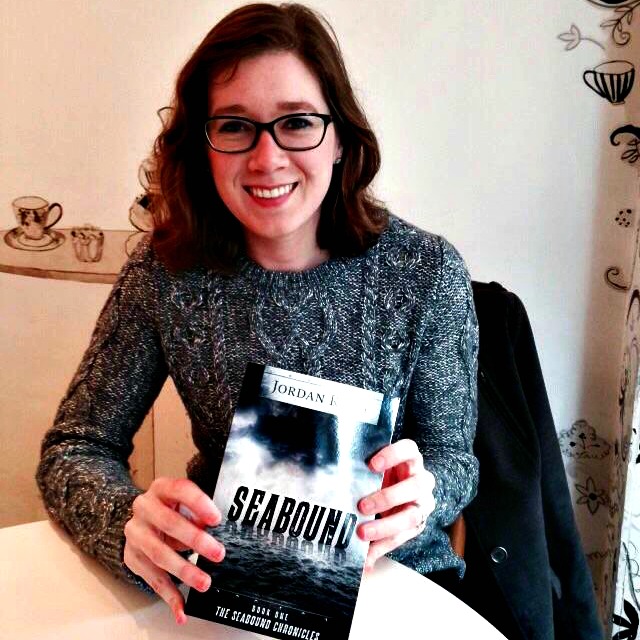
Of course the work never stops for a working writer. I spent the first four days of the holiday finishing up the final revisions of Seaswept, the sequel to my post-apocalyptic adventure at sea called Seabounda job that can be done anywhere, really!

Jordan Rivet in London

Shannon Young aka Jordan Rivet showing off her first book on a tea break in London; photo credit: Shannon Young.

As I mentioned in my last post, the revisions on Seaswept were a bit of a slog, but I really got into the groove by the final pass. I have to admit it was kind of magical to wake up with the sun (or clouds) in this famous literary city, write for a few hours, go for a walk, and then do a bit more writing before the jet lag knocked me out. London has always been a source of inspiration for me, and the setting somehow seemed right for ending my work on this book.

In addition to the beautiful buildings, blue historical plaques, and bridges (have I ever told you, dear diary, how much I love bridges?), I’ve found another source of inspiration in London: a friend from Hong Kong.

Expat connections are everywhere

As Displaced Nation readers know, we expats have a tendency to move on often, either to a new country or back to where we came from. Expat life is a constant rotation of hellos and goodbyes. While it’s sad when friends leave, it’s pretty cool to acquire connections all over the world.

A friend from my writers’ group in Hong Kong returned to the UK nearly two years ago, but she has maintained her link with the group and her role as true cheerleader for my work. Recently, she decided to embark on a similar literary adventure by taking time off work to write!

I met up with her at the cafe and bookshop run by the London Review of Books and spent nearly four hours writing and talking about writing together. (I also ate hummus on toast that came with real worms on the side, but that’s another story.) It was a joy to have a friend in a city thousands of miles away from both my home country and my country of residence, all thanks to this expat life.

The day I sent the final draft of Seaswept to my editor, my Hong Kong friend took me on a literary tour of Highgate and Hampstead—and, of course, a trek across the rain-soaked trails of Hampstead Heath. In between breaks for tea and hot cross buns, she showed me the home of Samuel Coleridge (and the alley where he bought his laudanum), a garden straight out of a Jane Austen novel, and a pub visited by many notable figures throughout its 200-year history. As we walked, I was reminded again and again of just how old this city is and just how much has happened in its streets. It’s the setting for some of my favorite novels, novels that made me want to be a writer myself.

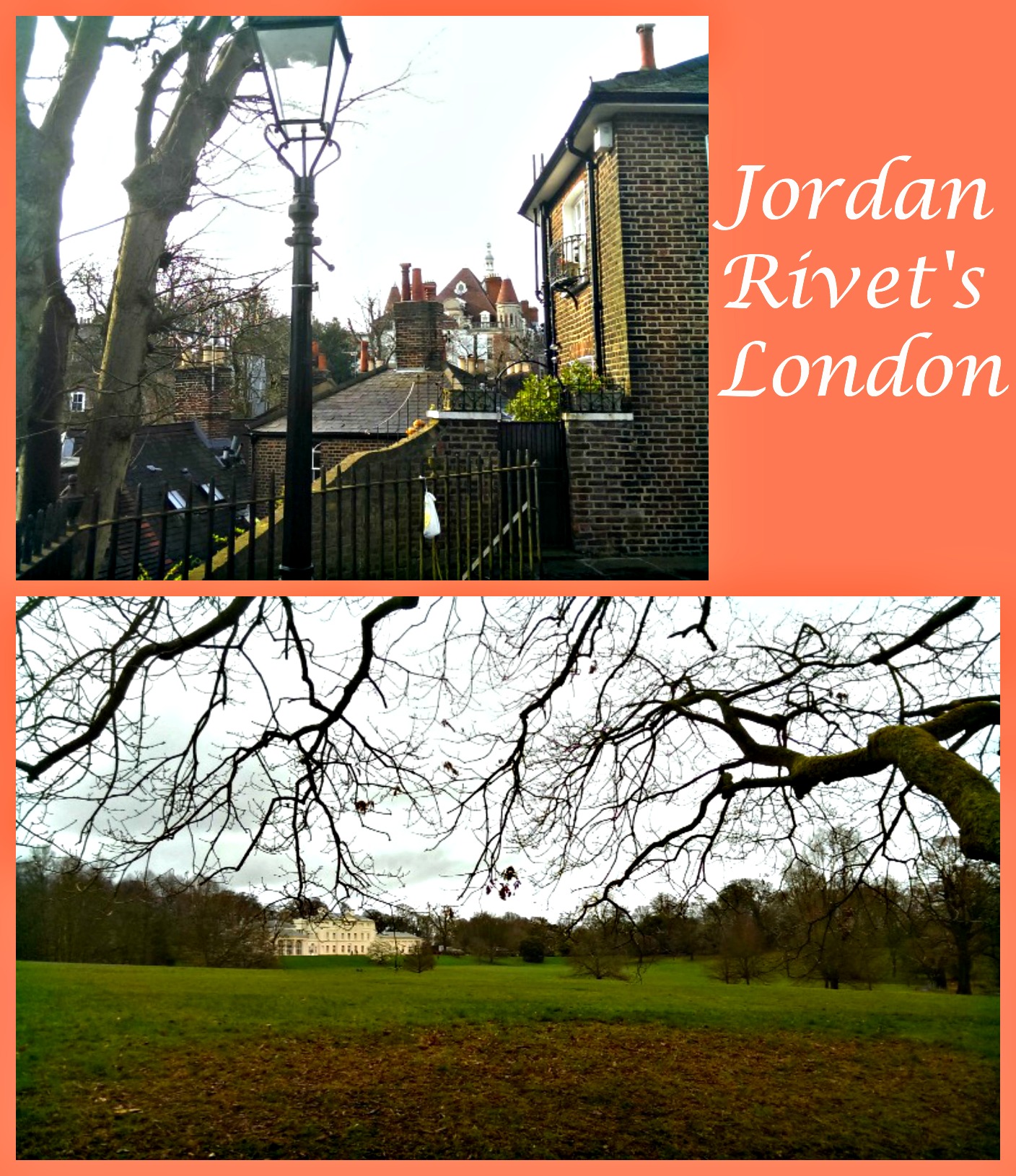
Photo souvenirs from Jordan Rivet's London walks. At bottom: Hampstead Heath with a view of Kenwood House, a former stately home.

The houses of Highgate and the expanses of Hampstead Heath, with former stately home Kenwood House in distance. Photo credit: Shannon Young.

As my writing journey continues across the globe in Hong Kong, it’s nice to remember its origins and to soak in a bit of history in the company of someone who is just as excited about it as I am.

Beginnings, revisited

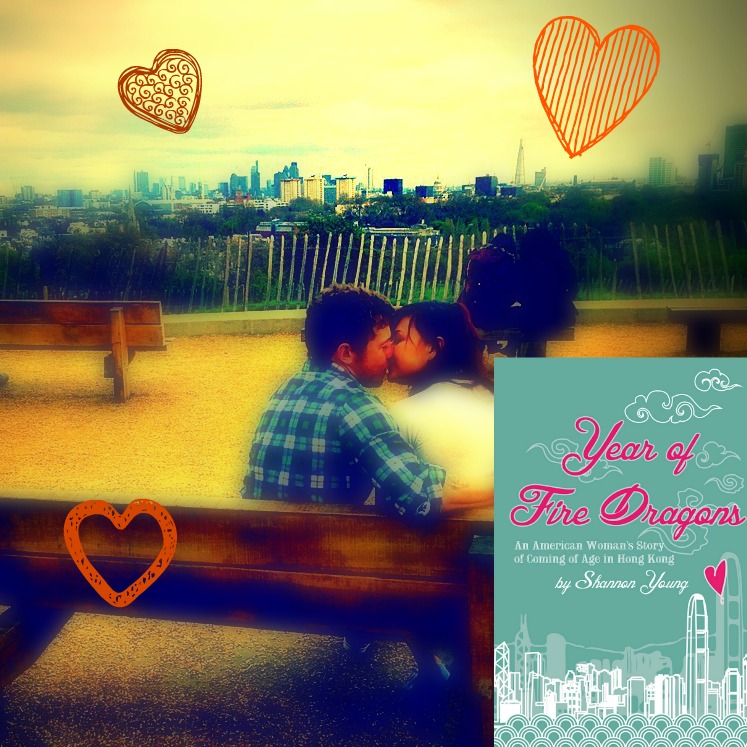
During my time in London, I’m also revisiting the origins of my own expat life. As you may recall, Dear Diary, I met my husband in London during a semester abroad. We ended up in Hong Kong, but our early romance took place here. The memories have been flooding back over the past few days as we walk by all the places where we shared sweet moments: first meeting, first date, first kiss.

I wrote about our romance in the first book I ever started, Year of Fire Dragons. It’s mostly about Hong Kong, but I can’t tell my Hong Kong story without starting in London.

Hong Kong tends to change very quickly, with restaurants and shops going in and out of business all the time. Buildings are torn down and rebuilt completely in the space of months. But London seems largely the same. Back in this place with this man, it’s easy to remember why I decided to follow him across the world.

LondonKiss+Year of Fire Dragons

A firey romance in London led Shannon to the land of Fire Dragons and her first book, a memoir (photo credit: pixabay).

What’s on the horizon?

Well, the sun is breaking through the clouds over the city. I’d better head out to make the most the sunshine before the rain and wind return.

I have two weeks to go in London. During that time, my editor will be working on Seaswept, which should be ready to launch by April 30th. Meanwhile, I’m looking ahead to my next project: the prequel to the Seabound Chronicles. Then it will be time to finish Book 3.

But I’m already working on my next series. I’ve written a rough outline and the first 10,000 words. While I’m enjoying the flood of inspiration and nostalgia in London, perhaps I’ll tap out a few more chapters. If there’s one thing I’ve learned on this expat writing journey, it’s that places have power. I don’t want to miss out on anything London has to offer in the next few weeks.

Thanks for following along on my writing journey around the world.

Yours,

Shannon Young/Jordan Rivet
www.shannonyoungwriter.com

P.S. If you like dystopian fiction and writing Amazon reviews, shoot me an email and I’ll send you a book or two!

* * *

Readers, Shannon’s diary post this month has made me nostalgic for my own days of living in London. Sigh! It sounds as though she’s making the most of her time in the Big Smoke with walks on the Health and so on, but if you have any further recommendations for her remaining two weeks (any bridges you think she should see?), do let her know in the comments!

STAY TUNED for more fab posts!

If you enjoyed this post, we invite you to register for The Displaced Dispatch, a round up of weekly posts from The Displaced Nation and much, much more. Register for The Displaced Dispatch by clicking here!

Related posts:

Ten years after “Expat Harem,” foreign women will have another say on expat life in Turkey

Tea in Gülhane Park[http://www.flickr.com/photos/wneuheisel/6493228113/ ], Istanbul, by William Neuheisel via Flickr (CC BY 2.0).

Tea in Gülhane Park, Istanbul, by William Neuheisel via Flickr (CC BY 2.0).

When the Displaced Nation first started, Anastasia Ashman, an American living in Istanbul, was running a blog tailored to the needs of the “thinking expat.”

It seemed almost too good to be true: a group of women who were passionate about telling stories that illustrated the impact of the expat life on a person’s psyche. Had Anastasia rubbed a magic lamp to conjure up a kind of foreign harem? After all, her site was called Expat+HAREM.

In fact, as we soon discovered, the core contributors to the site had also been contributors to a book Anastasia had co-edited with Jennifer Eaton Gokmen, Tales from the Expat Harem: Foreign Women in Modern Turkey, which came out in 2005.

Anastasia has since moved on from Turkey, the expat life and the Expat+HAREM project. As she reported in a post to the Displaced Nation three-and-a-half years ago, she and her Turkish husband traded Istanbul for her native San Francisco because they thought that life in America’s high-tech city would “more closely align with a future we want to live in.”

Yet the work she created on the basis of her Turkish expat life has lived on in her wake.

And now two American expats in Turkey, Rose Margaret (Rose) Deniz and Katherine (Katie) Belliel, have announced their intention to produce a kind of sequel to Expat Harem, which is scheduled to be published later this year, to coincide with its 10th anniversary.

The title of the new anthology will be Sofra: A Gathering of Foreign Voices Around the Turkish Table.

As that title suggests, we’re shifting metaphors: from the harem to food. But no need for me to go on any further as Katie and Rose are joining us today to discuss their plans for the new volume. (Note to female expats who have lived in Turkey for at least a year: the window for submissions closes on April 1st!)

 * * *

Sofra Editors Horizontal

Meet Sofra editors Katie Belliel (left) and Rose Margaret Deniz. Photo credit: Journey Collective

Hi, Rose and Katie, and welcome to the Displaced Nation. Before we talk about your plans for a sequel, let’s go back to the original work. Katie, I understand that you contributed a story to Tales from the Expat Harem. What did you write about?

KATIE: “A heart-broken Michigan girl finds closure in Bursa at an ancient Ottoman bath, nurtured by her would-be Turkish sister-in-law.” This line that introduces my story in the book sums up my piece nicely. It is about how my first journey to Turkey was for love. My return was also for love—but not for my failed relationship. It’s the story of how I returned for closure, but stayed for my true love, Turkey the country. At least, that is what I hope people understand when they read my piece 😉

How about you, Rose? I believe you were active in the book’s companion blog and online community?

ROSE: I was a frequent writer for expat+HAREM, the companion site for the book (it was Anastasia Ashman’s brainchild). For example, I facilitated a roundtable discussion that included nine female cultural ambassadors from around the world, called Dialogue2010. It was a live conversation on art, culture, and hybrid identity inspired by my post to expat+HAREM called Mapping the Imagination. We sought to create a living definition of hybrid identity and how one’s worldview literally shifts as a result of location.

Am I right in surmising there was something very special about the Expat Harem experience?

KATIE: Being a part of Harem was an incredible experience from beginning to end. I knew I could trust the editors with my story; we had a wonderful relationship. They inspired confidence in me, and really gave me the courage to keep writing even well after Expat Harem was published. I also find that I keep going back to the book, as different stories speak up at different times in my life. Right now, as a mother, I am particularly drawn to Maria Orhon’s story about her daughter. Two years ago, when we bought our new house, Annie Prior Özsaraç’s story about their house problems gave me a much needed laugh amongst our then house troubles.

ROSE: I remember reading the book around the time I moved to Turkey. So many of the stories struck a chord, especially as I was getting my bearings those first few years. It made a big impression on me.

The Harem book features stories by expat women, and this new book you’re working on, Sofra: A Gathering of Foreign Voices around the Turkish Table, is likewise calling for female contributors. What’s the thinking behind the “women only” approach?

KATIE: Both Rose and I were heavily involved in the sisterhood of Expat Harem: all-female writing groups, entrepreneurial initiatives, and other spin-offs. It seemed natural for Sofra to be another book featuring women expat writers.

ROSE: Yes, as Sofra is following in the footsteps of Expat Harem, we thought it important to continue the tradition of honoring women writers.

But are men’s voices unwelcome?

KATIE: We mean no offense to the guys. I’m sure they have wonderful stories, which we hope to incorporate in the Expat Sofra community. In fact, we want to open Expat Sofra’s companion blog to expats from around the world, male and female. Stay tuned, as these plans are evolving.

I understand that sofra means “feast,” and you are proposing to make the new anthology at least partly about food. I’m curious: what was your own food journey like in Turkey? Did you take to the food right away?

Turkish food

(Clockwise from left): Kokoreç, by William Neuheisel via Flickr (CC BY 2.0); big black Turkish [figs] , by naturalflow via Flickr (CC BY-SA 2.0) ; Istanbul: Ayran, by tomislav medak via Flickr (CC BY-SA 2.0).

KATIE: I was really hesitant about Turkish food at first, but then I just dove right in. Kind of like how I fell in love! There was no going back. There are still some things I just can’t eat or drink, like ayran (a milky yogurt drink) and kokoreç (intestines, usually lamb). I still try them on occasion, but they are just not for me! I have many favorites. Fresh figs are at the top—I look forward to fig season at the end of August/early September each year. Pazı, a kind of green, leafy chard, is my favorite vegetable, I eat it sauteed with onions and yogurt.

ROSE: Turkish cuisine is definitely a leap from the standard Midwestern fare of my native Wisconsin. I love cooking, though, and embraced the challenge of learning new dishes but adding a twist from my roots. My least favorite food experience would have to be the amount of service required when having guests over. It is more tiring at times than the meal! However, now I can say that my Turkish friends and family appreciate buffet style big meals at my house, and I don’t stress about every detail being perfect as I did in the past. My favorite food experiences are cooking with my friends and family. Nothing flavors my sofra better! Another thing I enjoy is sourcing my food locally. We get milk, butter, and eggs from our neighbors’ farm, and even turkey and chicken from time to time!

You are also conceiving of food as a metaphor for the expat life in Turkey, which can be sweet, bitter, tangy, or spicy. Regarding your own Turkey experience: what percent has been each of these taste sensations?

KATIE: Good question. I would argue that my experience here has been an equal part of all the tastes. There are beautiful and not-so-great parts of each flavor. But that is life, right? Even bitterness becomes a taste we crave if denied it for too long. So, I believe in appreciating the full flavor of whatever is put in front of me in the moment. Appreciating all parts of it for even if I don’t understand the taste then, I will understand it much later.

ROSE: Hmmm, I would say my life here has parts of each. Similar to motherhood, there are wonderful, sweet moments, and moments that are bitter. I would also add the combo of bittersweet to the mix! We are challenging our writers to pick one experience and match it with a flavor. You will have to wait until the book comes out to see which flavor I picked to portray.

On my one and only trip to Istanbul, I came away with a copy of the letters written by Lady Mary Wortley Montagu, wife of the British ambassador to the Ottoman Empire in the 18th century. As Anita Desai writes in the introduction, Although Lady Mary was well traveled,

it was Turkey and her first experience of a non-European, non-Christian civilization that provoked her most open and heart-felt admiration.

Do you see your book as having a further purpose of helping to explain Turkey to the West?

"Liotard Lady Montagu," by Jean-Étienne Liotard. Licensed under Public Domain via Wikimedia Commons.

“Liotard Lady Montagu,” by Jean-Étienne Liotard. Licensed under Public Domain via Wikimedia Commons.

KATIE: I am currently re-reading Lady Mary Wortley Montagu’s The Turkish Embassy Letters. I read them before moving to Turkey. It’s nice to re-read them after living here for over a decade! Our book definitely seeks to show a different side of Turkey than is commonly portrayed by the media. What is the main thing every tourist says after their first visit here? “It’s not what I expected.” We want to show people a deeper, richer side of Turkey. In my opinion, the true side of Turkey.

ROSE: This region is still largely portrayed in a negative light. Expat Harem successfully challenged that by showing a different side, and we hope to continue that with Sofra. Not everything is positive, of course, we don’t want this book to be all cakes and flowers. We want to show a deeper side, an open portrayal of even bitter experiences that give lessons or show growth.

Who is the book’s primary audience?

KATIE: Our primary audience extends from the armchair traveler to the seasoned expat. The foodie to the culinary newbie. A little something for everyone, we hope.

Thank you, both. Talking so much about Turkish food has made me peckish. I look forward to seeing what you cook up in this new book. After our exchange, I’m anticipating a rich stew!

* * *

Readers, if this interview has piqued your curiosity about the Sofra anthology, or even if you simply wish to know how sofra is defined, I encourage you to visit the Expat Sofra site and/or follow the book’s progress on Twitter. And if you’re a woman who has had the pleasure of living (and eating!) in Turkey as an expat, then why not submit a piece to the new anthology? Only don’t forget, the deadline is coming soon: APRIL 1.

STAY TUNED for next week’s fab posts!

If you enjoyed this post, we invite you to register for The Displaced Dispatch, a round up of weekly posts from The Displaced Nation, with seasonal recipes, book giveaways and other extras. Register for The Displaced Dispatch by clicking here!

Related posts:

GLOBAL FOOD GOSSIP: Et tu, France? Fiddling with that fine American classic, the Caesar salad?

J M-M Caesar SaladJoanna Masters-Maggs was displaced from her native England 17 years ago, and has since attempted to re-place herself in the USA, Holland, Brazil, Malaysia, Venezuela, Saudi Arabia, and now France. She describes herself as a “global food gossip”, saying: “I’ve always enjoyed cooking and trying out new recipes. Overseas, I am curious as to what people buy and from where. What is in the baskets of my fellow shoppers? What do they eat when they go home at night?”

* * *

I have been known to comment on France’s dedication to the classics when it comes to food—or fashion for that matter. (As some readers my recall, I’m a fan of France’s LBD, seeing it as a cure for obesity.)

Actually, there are times when my latest adopted home’s refusal to contemplate a bit of culinary iconoclasm baffles me. But then I come from the UK, which seems obsessed with putting a “twist” on classics or, if not that, then “fusing” apparently disparate food stuffs in a desperate search for novelty.

Much of the time, though, I admire the conviction that as French is best, why fiddle around with something that works well?

Let’s talk about the mille-feuille/Napolean/cream slice

My favourite treat, for example, is a mille-feuille (known as a Napoleon in the US and a cream slice in the British Isles). I can find one in any decent patisserie and know it will be excellent and exactly what it should be: buttery flaky pastry, a rich cream filling and a topping of glacé icing.

I never have to worry that some bright spark will have tried to deconstruct it, spin it or twist it. It remains comfortingly indulgent, mouth filling and ever-so-slightly decadent while also keeping within the bounds of good taste.

If you understand my love for the mille-feuille, it should help you see why I’ve chosen to gossip this month about France’s treatment of the Caesar salad. Clearly, the protection France affords to its own food classics does not extend to those that hail from other shores. I hesitate to suggest a conspiracy, but I have noticed an alarming tendency among the chefs in this part of the world to fiddle with recipes from elsewhere.

Et tu, French chefs?

Some have claimed that there have been so may modifications of the poor Caesar salad over the years that the term “Caesar salad” has lost all meaning.

While I wouldn’t go that far, I would like to point out that this American classic has been treated with reckless disregard here in France. I’ve been trying to puzzle out this very un-French behavior. Is it because of the salad’s humble origins—it was invented in Tijuana, Mexico—not to mention its current status as a menu staple in the steakhouses of Las Vegas?

If so, then the French need to know that this salad is more Grace Kelly than high-kicking showgirl. Much as the Philadelphia-born star brought some film star gloss to Monaco without the tawdry Hollywood tat, the Caesar has much to offer the European Continent. Neither colourfully brash nor tartily sweet, it shows Europe that America can do class, too, and do it well.

So what else has this poor salad done to deserve the indignities heaped upon its noble Roman name? It appears on countless French menus the country over, but I have yet to find one that comes close to those I have enjoyed in America. What is going so terribly wrong?

The classic Caesar vs. the French Caesar

The classic Caesar involves Romaine lettuce tossed in a dressing made from egg yolks, oil, lemon juice, parmesan cheese, a dash of Worcester sauce, maybe a dash of Dijon mustard and topped with croutons, possibly a sprinkling of bacon, and more parmesan. That’s it. Perfection. Leave it alone.

Yet the one I had in a bistro on Cours Mirabeau here in Aix yesterday involved tomato quarters, a poached egg, slivers of raw carrot and a mixture of leaves including frisée. Frisée! (Endive if you will.) What sort of abomination is that? The bitter flavor fights the smooth creaminess of the dressing, and the springy dry texture takes over the salad’s delicacy.

In any event, here is what I beheld on my plate:
NotQuiteCaesarSaladinAix_pm
We’ve already discussed the tomatoes and the endive. Let’s move on to gossiping about the dressing. How can France of all places not get this right? A country where it is not considered suicidal to indulge in raw meat and egg.

Readers, while I was condemned to a hygienic, bottled, nondescript white dressing lacking in any flavour much least of egg—its sole being to lubricate and aid the passage of frisée down my protesting neck—I happened to glance at the main at the neighboring table. And you’ll never guess what I saw? He was enjoying a steak tartare topped with a whole raw egg!

Never lose an opportunity for culinary enhancement!

And this is not the only scandalously wasted opportunity for France to show America how its food can be better done. As American devotees of the Caesar will know, there is an ongoing and passionately fought debate over whether or not the newcomer ingredient of the anchovy is too inauthentic to tolerate or a delightfully salty addition to the rather bland romaine leaves.

(The original salad included anchovies only insofar as they are an ingredient in Worcester sauce. They were not blended into the dressing, nor did they appear whole amongst the leaves and croutons.)

Now, anchovies, I’ll have you know, are found everywhere in France, in all forms, and they are very, very good.

Which is why I simply don’t understand why French Caesars ever omit them from the Caesar salad. (I suspect my tartare-eating neighbor had some on his plate, too.)

Why am I such a fault-finding gossip?

Readers, at this point you may wonder why I felt compelled to report on my apparently doomed search for an authentic Caesar salad here in the South of France.

British anthropologist Kate Fox put her own tribe under scrutiny and reported on the findings in her 2005 book, Watching the English. She suggests that the English complain as it draws us together in adversity. If we do not complain about our lives, we risk being self-satisfied show-offs keen to prove that our lives are perfect. As we place great value on dealing well with any adversity life throws us, optimism can appear smug.

Just think, if I had written that the best Caesar salads are to be found in France and only France and how happy I am that discovered this fact, my life would seem too intolerably pleased with itself for any of you readers out there to tolerate.

And perhaps for that reason I take pleasure in knowing that while the French can produce the perfect mille feuille, they are a little challenged in the salad department. In this way I can love France, because it isn’t intolerably perfect. Voilà!

Or is this whole thing just a sign of my competitiveness?

French author José-Alain Fralon has characterized the relationship between the French and the British by describing the British as “our most dear enemies”.

There must be some truth in what he says. Because before ending this month’s gossip session, I feel compelled to tell you a story about how, when I was back in Blighty recently, I arrived very late in the town of York. A Weatherspoon’s pub was still serving food. I went in and ordered a Caesar salad. Now, Weatherspoons is not a chain renowned for fantastic food, but as you can see from this photo, they understand the requirements of croutons, parmesan, romaine lettuce and a creamy (albeit not very eggy) dressing with some hint of Worcester sauce:
CaesarSaladinUK_pm
I was delighted to see that tomatoes were absent—the only addition to the classic being chicken, which seems the accepted standard now.

Not to be invidious, but if Weatherspoons can get the basic elements right, then why not an Aix bistro?

* * *

Readers, we invite you to continue the food gossip! Have you noticed any abominations of your previous home food classics similar to what Joanna has observed with the French Caesar? Be sure to let us know in the comments!

STAY TUNED for our next fab post!

If you enjoyed this post, we invite you to register for The Displaced Dispatch, a round up of weekly posts from The Displaced Nation—and much, much more! Register for The Displaced Dispatch by clicking here!

Related posts:

And the December 2014 Alices go to … these 4 international creatives

 © Iamezan | Dreamstime.com Used under license

© Iamezan | Dreamstime.com
Used under license

If you are a subscriber to our weekly newsletter, the Displaced Dispatch, you’re already in the know. But if you’re not, listen up. (Hey, why aren’t you? Off with your head!)

Every week, when that esteemed publication comes out, we present contenders for a monthly “Alice Award,” most of whom are writers or other kinds of international creatives who appear to have a special handle on the curious and unreal aspects of being a global resident or voyager.

Not only that, but this person tries to use this state of befuddlement as a spur to greater creative heights.

Today’s post hono(u)rs our four Alice recipients for December 2014. Listed in order of most to least recent, they are (drumroll…):

1) Lani Cox, half-Thai expat in Chiangmai, Thailand

For her comment on a post: “Dealing with Loneliness Abroad (and at home),” by Mary, former expat in Japan and blogger at The Ruby Ronin. (NOTE: Lani’s own blog is Life, the Universe and Lani.)
Posted on: 9 December 2014

2) Amanda Mouttaki, American expat in Morocco and blogger

For her post: The NOT-SO-NICE Side of Expat Life to her blog, MarocMama
Posted on: 25 November 2014

Alice Connection:
Pool of Tears Quote

LANI: “When I first moved to Thailand, … I was deeply confused over what I was expected to do and where I was supposed to go and basically get the help that I needed for my visa. So, I spent the day crying into my pillow! It didn’t help that we lived by this horrible electrical monster thingy and had squatters outside our window.”

AMANDA: “I cried. And cried. And cried. Over nothing specifically…”

Citation: Lani and Amanda, is it any wonder we have associated your writings with Alice in Wonderland’s “pool of tears” moment? Let us begin by saying how much we admire you both for overcoming the feeling of shame that comes with realizing, and admitting to others, that even “great girls” cry.

Lani, it seems that you blamed yourself, thinking that Thailand shouldn’t have confused you so much since you were raised in the United States by a Thai mother (she’d married an American soldier she’d met during the Vietnam War). But that of course is silly, especially as she didn’t teach you any Thai language (knowing some Thai would have helped with getting your visa sorted). On the other hand, maybe it’s good she didn’t teach you the language, you might have been further disappointed. (We speak from experience, having been Brits in the US or Yanks in the UK.)

Amanda, you say you didn’t want your readers to think you were complaining, especially when so many of them find your story romantic—and it is romantic, meeting and falling in love in fairy-tale fashion on the streets of Marrakesh. In any event, becoming catatonic over nothing specific sounds perfectly normal to us. We’re just glad MarocBaba was there to give you a hug—more than Alice could count on!

3) Kevin Lynch, American expat in Hong Kong

For his interview: “My Airbnb year in Hong Kong: ‘Big fat American’ discovers hidden sides to the city”, by Vanessa Yung, in the South China Morning Post
Posted on: 5 December 2014
Big Alice Quote

“Part of it is I’m a big fat American, which makes things even smaller. It’s just such a different scale of living. Just when I’m used to it—I don’t even take pictures of most of the small things any more—and then something will surprise me.”

Citation: Hats off to you, Kevin—even the Mad Hatter is removing his—for deciding to forgo Western digs to stay in Airbnb accommodation during your first 14 months in Hong Kong, a city that is challenged for space and known for its cramped accommodations. Recall that Alice, who isn’t fat, found the White Rabbit’s house a bit of an uncomfortable fit. You are right, of course: serviced apartments for expats don’t afford many opportunities to meet the natives even if they do have taller ceilings, longer beds, fatter sofas, and proper cutlery. Kudos to you for learning how to tilt your head when standing up in the low-ceilinged rooms and to sleep “in the fetal position” when beds are too short. You had the kind of Hong Kong experience not usually available to the generous of flesh.

4) Amanda van Mulligen, British expat in Holland, blogger, and one of the contributors to the new book Dutched Up! Rocking the Clogs Expat Style

For her post: “My Love Hate Relationship with Sinterklaas” to her personal blog, Expat Life with a Double Buggy
Posted on: 4 December 2014
Mock Tortoise SongAlice Connection:

“Now, I’m all for a good sing song. I’ll croon away with the best of them. But Sinterklaas songs get tedious sang at the top of a child’s voice for weeks on end.”

Citation: Amanda, surely a song repeatedly begging Sinterklaas to leave something nice in one’s shoe or boot is preferable to a song about green soup, such as the Mock Turtle sings to Alice? That’s after she had to withstand the Lobster Quadrille, with repeated refrains of:

Will you come and join the dance?
So, will you, won’t you, won’t you,
Will you, won’t you join the dance?
Will you, won’t you, will you,
Won’t you, won’t you join the dance?

But we do appreciate your attempt to convey the strange, Wonderland-like experience of raising children in a country other than the one in which you grew up. And we grant that you’re not as lucky as Alice, who was saved from having to hear the soup song in its entirety by the announcement of the trial, whereas for you the Sinterklaas din carries on until May! Sinterklaas bloody kapoentje indeed.

*  *  *

So, readers, do you have a favorite from the above, or have you read any recent posts you think deserve an Alice Award? We’d love to hear your suggestions! And don’t miss out on the shortlist of Alice contenders we provide in each week’s Dispatch, which are sources of creative thought if nothing else! Get on our subscription list now!

STAY TUNED for more fab posts.

Writers and other international creatives: If you want to know in advance the contenders for our monthly Alice Award winners, sign up to receive The Displaced Dispatch, a round up of weekly posts from The Displaced Nation, with news of book giveaways, future posts, and of course, our weekly Alice Award!. Register for The Displaced Dispatch by clicking here!

Related posts:

BOOKLUST, WANDERLUST: Best of 2014 in Expat Books (2/2)

Best of Expat Books 2014 Part 2Season’s greetings again, Displaced Nationers. And welcome back to our end-of-the-year bookfest!

Pass the eggnog!! (She takes a swig…)

Moving right along (hic!). In the first part of this BOOKLUST WANDERLUST series, posted yesterday, our BOOKLUST, WANDERLUST columnist Beth Green and I presented a list of 2014 expat books in the categories of Travel, Memoirs, and Cross-cultural Challenges.

In Part Two, we present our last three categories (hic, hic—hey, it’s the holidays!):

  1. IT’S FOOD!
  2. THIRD CULTURE KIDS
  3. COUNTRY GUIDES/TRIBUTES


A few points to note:

  • Books in each category are arranged from most to least recent.
  • Unless otherwise noted, books are self-published.
  • Contributions by Beth are in green (most appropriate, given her surname!).

* * *

IT’S FOOD!

Colour_of_Maroc_cover_smallColour of Maroc: A Celebration of Food and Life (Murdoch Books, October 2014)
Authors: Rob Palmer and Sophie Palmer
Synopsis: A collection of Moroccan recipes, both traditional and contemporary, interwoven with stories and anecdotes inspired by people, food and travel experiences as seen through the eyes of Rob, an Australian photographer, and Sophia, his French/Moroccan wife.
Expat Credentials: Rob first met Sophia in Sydney, who had freshly arrived in Australia from France. They were both on a food photo shoot for an ad agency. Fascinated by her half-Moroccan (she was born in Casablanca), half-French heritage, he was only too happy to join her on an extended tour of Morocco, which resulted in both marriage and this book.
How we heard about: Social media.


Cucina_Siciliana_cover_smallCucina Siciliana: A taste of the authentic Sicilian flavors (August 2014)
Author: Wanita
Synopsis: Wanita shares recipes she has collected from her elderly neighbor, her mother-in-law, and Italian friends she has made during her six years in Sicily—recipes that have passed down from generations, several of which, she suspects, have never been outside Sicily!
Expat creds: Wanita met her Sicilian husband on the Internet. After a 3-month online romance, he visited her in California; two weeks later, she accompanied him back to Sicily to get married. They now have an infant daughter.
How we found out about: We’ve pinned several of her Sicilian recipes to our IT’S FOOD! board.


My_Paris_Kitchen_cover_smallMy Paris Kitchen: Recipes and Stories (Ten Speed Press, April 2014)
Author: David Lebovitz
Synopsis: A collection of 100 sweet and savory recipes that reflect the way modern Parisians eat today, combined with Lebovitz’s personal stories of life in the world’s culinary capital. The book also features lush photos of Paris and of Lebovitz’s kitchen.
Expat creds: Lebovitz is an American pastry chef who has been living the sweet life in Paris for a decade. Before moving to France, he made his name at Chez Panisse in Berkeley, California, with celebrity chef Alice Waters as his mentor.
How we found out about: We are among his throngs of followers, keeping up with him any way we can: Facebook, Twitter, Pinterest, his monthly e-newletter… My Paris Kitchen (his 7th book!) has been named best cookbook of the year by Amazon.


The_Edible_Atlas_cover_smallThe Edible Atlas: Around the World in 39 Cuisines (Canongate, March 2014)
Author: Mina Holland
Genre: International cookery
Synopsis: Not just a cookbook, The Edible Atlas introduces readers to the cultures behind the flavors and looks at why people eat what they do.
Expat credentials: Mina Holland, from the UK, has lived both in the USA and in Spain. She’s the acting editor of Guardian Cook.
How we heard about: Titles about food always catch our eye, and the idea of traveling around the world a mouthful at a time? Tantalizing! A review in Guardian Books first brought it to my attention.


THIRD CULTURE KIDS

TheWorldsWithin_cover_smallThe Worlds Within, an anthology of TCK art and writing: young, global and between cultures (Summertime, November 2014)
Editors: Jo Parfitt and Eva László-Herbert
TCK Credentials: As the editors point out, that this is a rare book BY third culture kids, not about them.
Synopsis: Your mother is Swiss, your father is from the Philippines and you have so far lived in five countries, none of them your passport country. Who are you? Where are you from? Where is home? And what did you eat for breakfast? If you are a friend, this book will guide you. If you are a teacher, it will enlighten you. If you are a parent, it will spell it out for you and if you are an employer, it will convince you. Here they are, the cultural chameleons, the young global nomads, the TCKs—Third Culture Kids—from around the world, telling you their story.
How we heard about it: Initially from a Facebook post. Word is spreading fast on social media. One of the coolest things about this book? It features TCK art as well as writing.


The_Secret_Place_cover_smallThe Secret Place (Dublin Murder Squad Book 5) (Penguin, August 2014)
Author: Tana French
Genre: Mystery
Synopsis: In Book 5 of the Dublin Murder Squad series, two detectives are given new information about a cold case—a boy’s murder on the grounds of an exclusive school for girls.
(A)TCK credentials: Tana French was born in Ireland but grew up in Italy, the USA, and Malawi during the years her family traveled with her father’s career as a development economist.
How we heard about it: I’m an avid reader of murder mysteries and fell in love with this series by French last year. In fact, I wrote about her Dublin Murder Squad series , and how it deals with issues of displacement, for my first Booklust, Wanderlust column.


Home_Leave_sonnenberg_cover_smallHome Leave (Hachette, June 2014)
Author: Brittani Sonnenberg
Genre: Expat fiction
Synopsis: In a story that mirrors the author’s own life as a TCK, an expat family’s daughters search for their own identity and confront tragedy.
(A)TCK credentials: Sonnenberg was born in the USA but lived in the UK, Germany, China and Singapore as a child and teenager. She now lives in Berlin and treats Hong Kong as her second home.
How we heard about it: ML is always on the hunt for a good book about TCKs, so when she mentioned having read a review of the book last summer in the New York Times, I agreed to write a column about it.


COUNTRY GUIDES/TRIBUTES

They_Eat_Horses_cover_smallThey Eat Horses, Don’t They? The Truth about the French (Thomas Dunne Macmillan, December 2014)
Author: Piu Marie Eatwell
Genre: Multicultural nonfiction
Synopsis: A series of entertaining mini-essays examines the stereotypes of French life, so beloved of the British in particular, only to discover that many are completely false.
Expat credentials: Eatwell, of mixed Asian and British descent, went to France for a long weekend one August summer holiday many years ago, and never left (how could she, with a surname like that?). After graduating from Oxford University, she trained first as a BBC television producer and then as a lawyer. Over the years she has worked as a documentary film maker, barrister, teacher, mother, and—most recently—full-time writer, both in London and Paris. They Eat Horses, Don’t They? is her first book.
How we heard about: Eatwell’s book is the winner of the 2014 Next Generation Indie Book Award in Amazon’s Multicultural Non-Fiction category.


Dutched_Up_cover_smallDutched Up! Rocking the Clogs Expat Style (November 2014)
Authors: Various
Genre: Anthology
Synopsis: A compilation of stories by expat bloggers in the Netherlands.
Expat credentials: Too numerous to relay.
How we heard about: From a tweet by one of the contributors, Australian expat in Almere Nerissa Muijs. Once upon a time, Muijs was featured on our site as a Random Nomad. (She definitely rocks—we can vouch for it!)


Moving_to_Spain_cover_smallMoving to Spain with Children: Essential reading for anyone thinking about moving to Spain (November 2014)
Author: Lisa Sadleir
Genre: Expat self-help
Synopsis: Spiced with the author’s own heart-warming anecdotes, the book aims to help you arrive at the same place her own family is now—but in half the time: living and loving family life in Spain!
Expat credentials: British born Lisa Sadleir is mother to two young, bilingual children. Educated in the UK and France, she has been a resident in Spain for over 23 years. She works as an independent relocation advisor and personal property finder.
How we heard about: Social media.


Paris_in_Love_cover_smallParis in Love (Chronicle Books, November 2014)
Author: Nichole Robertson
Genre: Photography
Synopsis: A photographic love letter to Paris from the author of the best-selling Paris in Color, capturing the hidden corners and secret moments that make Paris the most romantic city in the world.
Expat credentials: After a successful career in New York City as a writer and creative director for ad agencies, Robertson moved to Paris, which rekindled her love of photography and led to creating a series of prints and now books celebrating her relationship with the City of Light.
How we heard about: Social media.


At_Home_with_Madame_Chic_cover_smallAt Home with Madame Chic: Becoming a Connoisseur of Daily Life (Simon & Schuster, October 2014)
Author: Jennifer L. Scott
Genres: Beauty/Fashion, How-to, Home Improvements
Synopsis: In this follow-up to her best-selling Lessons from Madame Chic, Scott has divided the book into two sections: 1) Chez Vous: exploring how to get your home in order and how to love it again; 2) Les Routines de la Journée: covering the pleasures of the morning, the pleasures of the afternoon, and the pleasures of the evening.
Expat credentials: Once upon a time, Scott was a college student living with a “chic” family in Paris, France, and her books represent her attempt to translate all that she learned from that European experience into her American lifestyle.
How we heard about: I interviewed Scott about her first book just before it was picked up by Simon & Schuster, and have been a big fan of hers ever since. (Her interview still gets lots of hits!)


How_to_live_in_Denmark_coverHow to Live in Denmark: A humourous guide for foreigners and their Danish friends (July 2014)
Author: Kay Zander Mellish
Synopsis: Life as a foreigner in Denmark, one of the world’s most homogenous countries, isn’t always easy. In this book, based on her popular podcast series, Kay Xander Mellish offers a fun guide to Danish culture and Danish manners, as well as tips on how to find a job, a date, someone to talk to or something to eat.
Expat credentials: An Wisconsin-born journalist, Mellish has lived in Denmark for more than a decade.
How we heard about: Mellish’s humorous and somewhat irreverent take on expat life caught our attention about a year ago, when she posted a story about the first woman to guard the Royal Palace at Amalieborg, who was fired not for being a prostitute but for refusing to follow orders and stop moonlighting—a post for which Mellish earned her one of our coveted (?!) Alice Awards. We were pleased to learn she’d published a book, and plan to feature it soon.


SoYou're_Moving_to_Australia_cover_smallSo, you’re moving to Australia?: The 6 essential steps to moving Down Under (June 2014)
Author: Sharon Swift
Genre: Self-help
Synopsis: Swift has distilled her formula for a successful international relocation into a 6-step process, outlined in this book for those making the big leap from the UK to Australia.
Expat credentials: Since her birth in Singapore to a British father and Singaporean mother, Swift has lived across five continents, experiencing life and cultures of 14 countries. Her move to Sydney from London in 2005 was her 18th international relocation. She lives in Sydney Inner West with her husband, both now Australian citizens.
How we heard about: Pinterest.

* * *

Your turn again, readers! Have you read any of the above works and if so, what did you think of them? And can you suggest other works to add to these three categories or to the ones presented yesterday? Beth and I look forward to reading your comments below.

From Beth:
Intrigued by some of these titles? Go ahead, download a few! ‘Tis the season to support the output of other international creatives.

In closing, please note: Beth and I may repeat this exercise in six months (summer reads). But if you can’t wait until then, I suggest that you sign up for our DISPLACED DISPATCH, which has a Recommended Read every week, and also follow our Pinterest board: DISPLACED READS.

Without further ado, we thank you for making this year great and wish you a season full of mirth and good cheer, along with the odd quiet moment for a displaced read or two!

(Oh, and pass that eggnog!!)

STAY TUNED for more fab posts.

If you enjoyed this post, we invite you to subscribe to The Displaced Dispatch, a weekly round up of posts from The Displaced Nation, plus some extras such as seasonal recipes and occasional book giveaways. Sign up for The Displaced Dispatch by clicking here!

Related posts: