The Displaced Nation

A home for international creatives

HERE BE DRAGONS: Dreaming up a landscape from your world travels for a work of fantasy

HBD Landscape CollageWelcome to the second post in our new series, HERE BE DRAGONS, in which fantasy writer Andrew Couch, an American expat in Germany, brings our attention to the connection between fantasy writing and a life of international travel and residency. In the series opener, he pointed out how expat life in all of its glorious strangeness can be a feed for the fantasy writer’s imagination. And today? He talks about how one’s travels can inspire other-worldly landscapes.

—ML Awanohara

Many people think that fantasy is a genre set apart, but fantasy stories, like those in any other genre, center on compelling characters and the struggles they face. As epic fantasy author Patrick Rothfuss once said:

If you want to write a fantasy story with Norse gods, sentient robots, and telepathic dinosaurs, you can do just that. Want to throw in a vampire and a lesbian unicorn while you’re at it? Go ahead. Nothing’s off limits. But the endless possibility of the genre is a trap. It’s easy to get distracted by the glittering props available to you and forget what you’re supposed to be doing: telling a good story.

Yet clearly there are some elements that set fantasy writing apart, and today I want to talk about one of them: landscapes. By “landscapes” I of course refer to the great swaths of nature not created by man. Often in fantasy writing, they are more than just a backdrop—they represent the force of primal nature that must be appeased or overcome. A landscape can also inform how a society is built and what drives it. (I will devote some time to urban-scapes and architecture in future posts.)

Obviously, setting plays a major part in other genres—see the works featured by JJ Marsh in her Location, Locution column—but I would argue that in fantasy writing, a great deal of time should be devoted to conjuring up a physical landscape for your make-believe world. Tolkien understood this very well. The Lord of the Rings would not have the same impact without those soaring mountain ranges.

“What are men to rocks and mountains?” —Jane Austen

Speaking of Lord of the Rings: After joining my wife in New Zealand during her round-the-world trip some years ago, I suddenly understood why Peter Jackson filmed his Lord of the Rings series in his native land. (Older TV series such as Xena: Warrior Princess and Disney’s Hercules were likewise filmed in New Zealand.) The landscape is so varied, so grand and… well…conducive to fantasy! I don’t know which portions of the Rings movies were filmed where, but I certainly had some ideas on our day through Fiordland National Park, which occupies the South Island’s southwest corner. This is the park surrounding Milford Sound, considered to be one of the world’s top travel destinations.

Due to my fear of flying, I never imagined I would make it as far as New Zealand (literally, half a world away)—but I’m so glad I did. After stopping in Queenstown, we took an overnight bus trip out to Milford Sound. Our bus was glass topped—our first hint of the wonders to come. Between Queenstown and the park entrance are lakes and rolling hills—pretty enough; but once you hit the edge of the park, the scenery becomes much more fantastic. We entered a dense beech forest that evoked visions of natural spirits. Then, after traversing the three valleys toward Milford, we caught sight of the mountains.

How to describe those mountains, which the early Queenstown settlers nicknamed The Remarkables? The human mind tries to makes sense of new experiences based on information it has already collected. For instance, we compare a new food to something we’ve already eaten or a a new piece of technology to X on steroids. But the mountains in Fiordland did not really compare to anything I’d seen before. Those I’d seen before were big, but somehow these were even bigger, and more awe-inspiring.

Sitting at the top of the Homer Tunnel gazing down into the valley, I could readily imagine ten thousand orcs (mythical humanoid creatures, the idea for which was developed by Tolkien) rushing up to besiege our bus of a dozen tourists.

We were surrounded on three sides by enormous sheer rock faces with what looked like trickles of water flowing down them, about a handspan wide. But then our guide informed us that these streams were a meter wide, which meant the mountains were not as close as I’d thought: they were a couple of miles away. So much bigger than I’d imagined! Um…my vision of ten thousand orcs began to seem rather pitiful.

Steam-powered dreams

Queenstown is in Otago, a region that opened up after gold was struck in the 1860s. This led to an influx of foreign miners, many of whom were goldrush veterans.

So while the landscape before me conjured up the feeling of Middle-earth, the setting for most of Tolkien’s fantasy writings, in reality most of the region’s early settlers were part of the Steam Age.

QueenOfCloudPirates_coverI didn’t consciously think about it during our tour, but now that I’m writing a series of fantasy novellas, Crossing the Dropline, I can see that my impressions of the mountains, along with my thoughts about the steam era, have fed into my imaginative process. For instance, Cloud Rock is a precious resource in the story. It powers flight and comes from only one region, called Beyond the Dropline, a harsh landscape that is both protected and contested by different groups. So the challenge becomes: can the power of Cloud Rock be harnessed outside of the Dropline?

South of the Dropline, raw ore [Cloud Rock] no longer had as much power. The real breakthrough of rotor technology was how to use it outside of the ranges. Natives had been floating with ore for centuries before the league explorers brought a sample back and engineers developed a way of refining and attuning it to the energy of Air in the rest of the world. That was only thirty years ago and hailed as the advent of powered flight. From that point on the Iron League had controlled the skies and had grown in influence. They had shifted from sea vessels to airships and proceeded to grow their trade empire around the Circle Sea and over the mountains into the west. Lors had heard on the news that the other nations were growing uncomfortable, but the news man had reassured them that the League diplomacy corps had everything under control.

At the mercy of nature

Nature is sometimes a primal force that characters in a fantasy story must overcome. My wife and I had perfect weather on our trip through Fiordland, but it was not hard to imagine a torrential storm ricocheting off the mountains and threatening to wash us over a steep cliff. In my novella series, the characters have to contend with not only human antagonists but with mountains that float in the sky:

He could see the front of the dark clouds out beyond the floating mountain peaks. An ever churning mass of dark clouds stacked into a formidable wall moving slowly away from them. Then another flash lit the sky and Lors saw what Arnhelm had been watching.

On top of the massive wall of clouds strode the figure of a bearded man. He loomed the size of one of the tall steel buildings in downtown Ironholme and was wrapped in a robe made of the clouds. He shone with a pale white light. Every step he took on the clouds caused sparks to ripple out and illuminate the sky.

“Storm giant,” Jason said from next to Lors. “Pretty, isn’t it?”

The first book only hints at it, but soon the spirits of the howling North will try to tempt the characters. They will become more present as the series develops.

* * *

I made the trip to Fjordland years before I started writing novellas, but the memory of those mountains continues to haunt—and inspire—me.

How about you? Do you have a landscape in mind you think will affect your writing one day, or perhaps already has? Let me know in the comments. Also, if you’ve been fantasizing about particular topics, let me know, and I’ll attempt to stretch my imagination to discuss in a future post.

Andrew Couch has been a fantasy book nut since childhood; he really has not grown up much since then. After struggling to write his own games for years, he is now creating fantastical worlds in a series of novellas that echo the TV shows, anime and role-playing games of his youth. Beyond fantasy he is an avid blogger and a world traveler who resides in Germany. To learn more about Andrew, check out his blog, Grounded Traveler, and follow him on Twitter: @groundedtravelr.

STAY TUNED for the next fab post!

If you enjoyed this post, we invite you to register for The Displaced Dispatch, a round up of weekly posts from The Displaced Nation, with seasonal recipes, book giveaways and other extras. Register for The Displaced Dispatch by clicking here!

Related posts:

And the May 2014 Alices go to … these 3 international creatives

 © Iamezan | Dreamstime.com Used under license

© Iamezan | Dreamstime.com
Used under license

If you are a subscriber to our weekly newsletter, the Displaced Dispatch, you’re already in the know. But if you’re not, listen up. (Hey, why aren’t you? Off with your head!)

Every week, when that esteemed publication comes out, we present contenders for a monthly “Alice Award,” most of whom are writers or other kinds of international creatives who appear to have a special handle on the curious and unreal aspects of being a global resident or voyager.

Not only that, but this person tries to use this state of befuddlement as a spur to greater creative heights.

Today’s post honors May’s three Alice recipients. They are (drumroll…):

1) CHRISTINE GILBERT, blogger, American traveling mom & expat in Barcelona

For her post:  “Why it must suck to be a parent in the US,” on her blog, Almost Fearless
Posted on: 16 May 2014
Snippet:

So we’re traveling across the US after living in Mexico for nearly a year and half, on our way to Europe. … [W]hen we drive to New Orleans it starts. Suddenly I am a bad parent.

… I admit, I am a permissive parent. My basic rules are this: it has to be safe and it can’t infringe on other people. … In short, my children are feral beasties but if required they can sit nicely and say “Please and Thank You” (or at least I try to get them to do that).

But I’m an American, so I have strong opinions about the idea that I have the RED WHITE AND BLUE, PATRIOTIC RIGHT to raise my children however I see fit, whether that’s homeschooling them and teaching them to speak in Klingon or letting them climb trees and juggle knives. Back off.

Citation: Christine, we never cease to enjoy a good round of the old debate about moral relativism (because no parenting method is objectively right or wrong, we ought to tolerate the behavior of all parents) versus moral universalism (a universal parenting norm applies to ALL parents regardless of age, background, ethnicity, etc.)—especially when relayed from the perspective of an expat, and one that writes as entertainingly as you do. While our own inclination is towards tolerance, we would ask you to bear in mind Alice’s “agony of terror” when she first meets the Duchess and her pig-baby. An “unusually large” saucepan flies by the baby’s head and almost take its ear off. “Oh, PLEASE mind what you’re doing!” Alice cries, to which the Duchess responds, in a hoarse growl:

“If everybody minded their own business, the world would go round a deal faster than it does.”

Now, do you identify with Alice or the Duchess? It’s a bit of a moral quandary, correct? What’s more, we’d be curious to hear if your views change at all after living with your family in Barcelona, Spain, for a while. One of us has learned firsthand of a case of an American who is bilingual in Spanish. She brought her two young daughters to Spain last summer to learn Spanish, only to discover, to her considerable consternation, that they were less obedient than Spanish kids in the playground. (No saucepans, please! We’re simply trying to make the world go round faster…)

2) Jon Langford, blogger at BBC America’s “Mind The Gap” and British expat in Manhattan

For his post: Are You Australian?: A British Expat Discusses Mistaken Nationality in America
Posted on: 5 May 2014
Snippet:

Communicating effectively with Americans through a thick Yorkshire accent on a daily basis can be both confusing and traumatizing.

Even though my life would be made significantly easier if I adapted my speech a little, I simply can’t bring myself to say things like war-der, toe-may-do and vie-dah-min. Not that there’s anything wrong with speaking this way, it’s just I’d rather wade through the conversational swamp than surrender my Yorkshire tongue for the sake of convenience.

Citation: Jon, your take-no-prisoners attitude towards preserving your Yorkshire accent, even at the expense of being misunderstood, strikes us as being a trifle, if we may be so bold, bloody minded. (Hey, they don’t call it Yorkshire-stubborn for nothing!) While we can appreciate your need to hold up the side for God’s Own Country, we wonder if you are coming across almost like the Hatter does in Alice in Wonderland. As you may recall, Alice feels “dreadfully puzzled” when he makes a remark that seems “to have no sort of meaning in it, and yet it was certainly English.” But while her response is to say, as politely as she can, “I don’t quite understand you,” our fear is that New Yorkers may dispense with such courtesies and simply blurt out: “You talkin’ to me?” As you have no doubt discovered by now, they take pride in being found the rudest of all rude peoples of America. (Hmmm….has the Yorkshireman met his match?)

3) NIENKE KROOK, blogger and Dutch expat in London

For her post: Bologna Italy: Why you don’t need a map to explore this city, on her blog, The Travel Tester
Posted on: 29 April 2014
Snippet:

Ditch the map in Bologna. Like any classic Italian city, the whole joy of a visit to Bologna is getting lost and losing track of time and space.

Citation: Nienke, we congratulate you for being so willing to let go of your Type A personality while traveling in Italy. especially when exploring a city of Bologna’s ample charms. We would, however, suggest just one small addition to your declaration: “Ditch the map and the watch in Bologna.” If one must carry a timepiece in Italy, let it be the Hatter’s, not the White Rabbit’s! As you may recall from reading Alice in Wonderland as a kid (they read it in Holland, right?), the Hatter and Time do not get along. His watch is frozen at six o’clock. Fascinated by this revelation, Alice says: “Is that the reason so many tea-things are put out here?” Yes, indeed, it is, Alice. In Wonderland you can always have tea and cakes, while in Italy you can always feast on a bit of the sweet life, or la dolce vita, just as long as all five senses are open to the possibility. To repeat (which we think may be necessary for a Type A person), pleasure and indulgence do not come from checking one’s watch!

*  *  *

So, readers, do you have a favorite from the above, or have you read any recent posts you think deserve an Alice Award? We’d love to hear your suggestions! And don’t miss out on the shortlist of Alice contenders we provide in each week’s Dispatch, which are sources of creative thought if nothing else! Get on our subscription list now!

STAY TUNED for more fab posts.

Writers and other international creatives: If you want to know in advance the contenders for our monthly Alice Award winners, sign up to receive The Displaced Dispatch, a round up of weekly posts from The Displaced Nation, with news of book giveaways, future posts, and of course, our weekly Alice Award!. Register for The Displaced Dispatch by clicking here!

Related posts:

TCK TALENT: Cathleen Hadley, Porteña at Heart and Artist by Calling

Cathleen Hadley Collage

Cathleen Hadley in the transit lounge nervously awaiting her son’s arrival from Afghanistan, taken by her husband, Roger.

Elizabeth (Lisa) Liang is back with her monthly column about Adult Third Culture Kids (ATCKs) who work in creative fields, Lisa herself being a prime example. A Guatemalan-American of Chinese-Spanish-Irish-French-German-English descent, she has developed her own one-woman show about being a TCK, which was the closing keynote at this year’s Families in Global Transition (FIGT) conference.

—ML Awanohara

Greetings, readers! My guest today is Cathleen Hadley, my fellow ATCK author in the anthology Writing Out of Limbo: International Childhoods, Global Nomads and Third Culture Kids. Cathleen grew up in South America and the USA; she is a visual-turned-conceptual artist now living in Oviedo, Florida.

* * *

Welcome to The Displaced Nation, Cathleen. I understand that as the US-born TCK child of American parents—a Foreign Service dad and a homemaking mom—you lived in the United States (Washington, DC and Maryland), Venezuela, and Argentina before enrolling in Hartford Art School, part of the University of Hartford in Connecticut, and starting your adult life back in your “home” country. Recalling these many transitions, do you have a place and a time where you felt happiest, as in least displaced?
I had a happy childhood in Maryland, but of all the places I lived while growing up, I liked Buenos Aires the best. BA was like a first love; I had come to it fresh, and found it fascinating. It gave me the freedom to explore, discover joy in my life and youth, find myself in the arts… The depth of my feelings for this city are perhaps best summed up in my reaction to the first book I read by the Argentine writer Jorge Louis Borges (who was a living celebrity at the time), his short story collection Labyrinths. I likened myself to one of his halls of mirrors, and felt as though I lived in his circular time travel of art: prose to dreams or dreams to canvas and so on.

Was it an adjustment coming back to the U.S. after such a heady experience?
When I left, I carried as many things Argentine as I could. I had a lot to relearn. In BA, for example, I was courteously late for all appointments, but that was unacceptable in the USA. I had forgotten that if a class started at 8:00 a.m., I should arrive 15 minutes earlier or at least be on time. This reset to my inner clock was harsh. I still carry the music of the language spoken with soft “che” sounds. It grates on my ears to hear the City of Good Airs mispronounced.

But I presume you enjoyed attending art school?
My first art school: the smell, lighting, and echoes in those rooms resonated with my awareness of being in a circle of like-minded souls. Each project was an awakening, a revelation of inner potential.

Becoming a tourist in her own country

Limbo_coverIn your essay in the anthology Writing Out of Limbo, called “Artist in Transit,” you write about the difficulties of repatriation. I can relate! Eventually, you married a U.S. Navy officer and the pair of you ended up living in several different states.
After years of meeting Germans, Indians, and other assorted nationalities who congratulated me on my awareness of the culture of others but admonished me for my lack of knowledge about my native land, I decided that the Navy could serve as my passport to the United States—I would follow my husband, Roger, in his career. I particularly enjoyed being stationed in the Pacific Northwest, our final destination while he was active Navy. It offered the combination of climate from where I grew up in Maryland (think gardening), the temperate weather of Buenos Aires, and the emerald green and mists of the Indonesian Islands.

How did moving to different states compare to your earlier experience of moving from country to country?
The experiences were not dissimilar. Each place we lived in the United States had a different routine and a distinct local culture. Living in Ridgecrest, California (the Mojave Desert) was vastly different from living in San Diego—and that was within the same state! The Navy culture and traditions—those we carried with us everywhere. And having a child, a son, rooted me in life/home.

And now you live in Florida?
Now I am in a place that was not on my map—Florida, where I moved to be near my parents. Roger and I are rooted here by necessity, by the roof over our heads, his job, and my disability (chronic back pain).

I’m so sorry to hear about your back pain. That would be hard for anyone to endure, but especially an artist and a traveler! Going back to your upbringing: are you like many of us TCKs in that you tend to gravitate towards people who have similar interests and perhaps similar cross-cultural backgrounds? (And of course it’s not a given we’ll become fast friends…)
Identifying with people from my own culture is an ongoing process, and to this day I often find myself failing when making an effort to blend in. I suppose I am happiest with my dear old friends from my traveling TCK days and with those Navy folks from my ATCK days. And I was drawn to you, fellow author—Limbo brought us together because of the “resonance” we find in each other’s stories. Though we’ve never met in person, I am certain that if we did, we’d be comfortable and familiar with each other.

“Painting is silent poetry.” — Plutarch

Something that resonated with me from your Limbo essay was your description of how you behaved on home leave during your adolescent years: “I began wearing a mask, holding back information, or my true stories and feelings.” I gather you found ways to express yourself through your art, as I did through acting. Are there particular art works of yours that express these feelings of transience or loneliness or instability—and what about the freedom, curiosity, and love of travel you’ve also experienced?
Yes. I can share several examples:

ch_arrival

“Arrival,” by Cathleen Hadley

I created this painting, “Arrival”, a cleaned-up version of which was used on the cover of Limbo, when imagining what my son would see when serving in Afghanistan. That was a speechless, visual time for me. I wanted to paint endless versions of the same horizon until he came home.

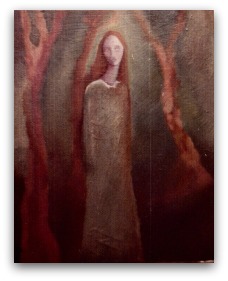
"Phantom in the Woods," by Cathleen Hadley

“Phantom in the Woods,” by Cathleen Hadley

Here I painted myself looking like a phantom standing in a dark and gloomy woods, which symbolized the closed-in feelings I had about transience, loneliness, and instability. The ghost is passing through the landscape of an imaginary world because “place” did not yet exist.

CH_Bug Quilt

Bug Quilt, created by Cathleen Hadley for her son, Alan.

I asked my son to pick out whatever quilt pattern he wanted and I would make it for him. Of course he picked one that required a complicated technique called appliqué, which requires attaching small pieces of fabric to a larger piece. It was way out of my league—not on my list of quilting goals. But making Bug Quilt represented my love for him and my husband, and what it took to make a home for all of us.

What sort of artwork do you find yourself doing now? And is it influenced by any culture(s) and/or by your peripatetic upbringing?
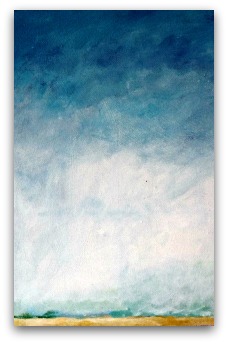
Today, I am a conceptual artist adapting by necessity. I had worked with many wonderful local artists—but had to give that up in 2012 due to my recurring back pain, which influences the mediums I can and cannot use. For one year—as I sat on my terraced porch—with a view over trees directly across from where I sat, I took photos of the sunrise and the changing clouds. That view became my canvas. It was the most accessible art I had at the time. I call it the cloud photo series:

Three of the photos in C Hadley's "cloud series."

Three of the photos in Cathleen Hadley’s “cloud series.”

Today’s painting are these words on paper:

Grey mountain, Green grass. Yellow sky. Blue water.

Time to open those boxes?!

I imagine that due to your back pain, you can no longer travel as you used to. But do you still have the ACTK’s “itchy feet”?
I have worse than itchy feet. How about itchy underworked imagination? Some days I’ll move wall hangings, rearrange the photos on display. Other days, it’s the furniture, or the books…anything that isn’t nailed down. My poor husband! For the first time, I am focusing on “place”. What would I do, what will I keep, to make this place more than a temporary home? As far as travel goes, the urge to travel and live elsewhere remains, but I am becoming a person who wants a home base as well. I consider myself to be in the transit lounge of my life. When we relocated to Florida, I became homesick for the first time for the Pacific Northwest. I am over that now.

Are you working on a new art project or projects?
I am in a period of transformation. From years of having to change or make do, I recognize it as a moment before something new emerges. It’s a slow and alone time and I hope to use it wisely (well). I am feeling remarkably undefined—and that is okay. I am making an art of managing expectations, trying to lose some of my structured behavior and let things unfold. Find my place and be satisfied. Not every day has to be an answer to an existential question. I am on a quest to be a homemaker—lay down the past and make a homey home. A home as a place to speak from, somewhere to simply be. Time to open those boxes!

* * *

Thank you, Cathleen. I do hope we get the chance to meet in person some day! Readers, I hope you’ve enjoyed getting to know Cathleen through this post. Please leave any questions or comments for her below.

STAY TUNED for next month’s fab posts!

If you enjoyed this post, we invite you to register for The Displaced Dispatch, a round up of weekly posts from The Displaced Nation, with seasonal recipes, book giveaways and other extras. Register for The Displaced Dispatch by clicking here!

Related posts:

THE LADY WHO WRITES: Your novel finished, it’s down, down, down into KDP Select Freebie Land

LadyWhoWrites_brandThe Lady Who Writes, Meagan Adele Lopez, is paying us her monthly visit today. Once again, she’ll be doling out some practical advice, based on her own experience, for expats and other international creatives who are engaged in writing novels using the material gathered from their novel, shall we say, life stories. Meagan is a repeat expat in the UK (last time Bristol, this time London). Besides writing, her talents include acting, blogging, and crafting ads for social media.

—ML Awanohara

Okay, Displaced Nation-ers who are also wannabe novelists. Let’s say you’ve followed all my advice up to this point. You’ve gone through the work of reading similar genres before you start writing—perhaps even started up your own book club. You’ve dined on a daily basis with your characters. You’ve rehearsed your book trailer and have opted to publish your novel yourself. (I will go through the steps of the self-publishing process in the next post.)

So now, what about marketing that baby to the masses?

At the top of your list should be a free e-book promotion.

Only, don’t follow my example.

Do what I say, not what I did!

I was told to plan 30 days in advance—I started planning the giveaway of the novel I wrote based on my own expat adventures, Three Questions, the night before.

Once you sign up with Kindle Direct Publishing (KDP) Select, giving Amazon exclusive rights to publish the electronic version of your book for 90 days, you have five days to promote your book for free over that period. Most people tell you to use just two or three days at most, your first time. I used four.

Some things I did right: I waited until I had some strong reviews of the book posted before offering it for free. And after the promotion started, I tracked the book’s rankings and didn’t give up until I’d reached my two goals:

  1. Earn a spot on the coveted Amazon Best Sellers in Kindle Store, Top 100 Free list.
  2. Break five figures (XX,XXX) in downloads.

But, to reiterate, I didn’t plan the freebie promotion; I did it by the seat of my pants. To be honest, I wasn’t entirely sure about the benefits of giving away my book for free. I was afraid the freebie would “devalue” my book—which was silly because it wasn’t selling more than a few a day anyway.

I also had to overcome my fear that I was giving Amazon too much power. However, my Barnes and Noble Nook e-book wasn’t selling at all, so in the end I figured I might as well enroll in KDP Select for three months, even if that meant I couldn’t make it available through any other outlets, including publishing extracts on my blog.

How to get that new novel of yours noticed

First, the hard facts: Amazon has 3,000+ new titles going for free nearly every day. The competition is tough.

As I fell down, down, down into KDP Select Freebie Land, I obsessively read every post I could find with tips on how to make it a success. (Hey, A for effort!) FYI: One of the best articles I found was on Novel Publicity & Co.: “KDP Select free days: Targeted advertising is the key to success; here’s a list of resources.”

Besides learning that I should have been planning the promotion a month in advance—giving “free Kindle ebook” websites at least three weeks’ notice about my intention to offer a freebie for a few days—I quickly realized that I would need to dedicate a LOT OF TIME peddling it over that period through every available avenue: my social media networks, family and friends, and some of the dozens of sites that announce free e-books.

I had missed out on the top site, Pixel of Ink, which requires at least 30 days’ notice. But I did manage to get listed on some of the heavy hitter free e-book blogs, with thousands and tens of thousands of followers—the ones that the majority of free Kindle seekers go to (they come up first in Google searches).

Here’s where I submitted FOR FREE:

  • Digital Book Today: They have paid and free promotional opportunities. I submitted my novel for free via the form on this page, which requires you have at least 10+ reviews with an average of 4+ stars rating. They posted my novel, but the site’s founder, book industry veteran Anthony Wessel, wasn’t too happy at my last-minute submission—again, please don’t do what I did!
  • eReader News Today: I was supposed to submit three days before the beginning of the promo, and in order to be considered, you have to have a high rating in your reviews for them to post it. My mom happened to notice it was up—as she subscribes to their Facebook page—and mine was the first on their daily listing!
  • Freebies4Mom: This site is under the radar compared to the others. It’s run by stay-at-home mom Heather Fernandez. She has over 300k fans on Facebook. That’s A LOT of mommy fans. I believe her site pushed my novel over the five-digit download mark.
  • Kindle Nation Daily (PAID): They offer a Free Book Highlighter Service (scroll down to the bottom). I took $30 out of my Kickstarter money to participate. It was worth it.

Here’s a few more sites that picked me up, which you might consider submitting to (should you follow my advice and plan well in advance):

  • BookGorilla.com: This is another site that sends daily email bulletins to subscribers listing free e-books in categories of interest.

Last but not least, these sites tweeted about my novel and might also be useful to you as indie authors:

  • The aforementioned Digital Ink Today (@DIGITALInkToday): This popular site has 30.2k Twitter followers.
  • Masquerade Crew (@MasqCrew): Site founder Mark Lee currently has 34.6k Twitter followers.

The all-important numbers

Before the book promotion, I was selling at my peak three e-books per day. I never reached higher than #300,000 on Kindle’s bestsellers list. The night before I launched the book, I was ranked about 1,500,000 in Amazon’s e-books—insignificant.

During the promotion, my book gained in momentum each day. Though conventional wisdom advises giving up after two days, I just couldn’t do it. The way I saw it, the more days I was ranking, the more exposure I was getting. To start again from ZERO in a few weeks seemed pointless.

At the end of the first day, I was already #57 in the Kindle store’s free Contemporary Fiction, but hadn’t yet ranked anywhere in the entire Kindle store.

The end of the second day, I was getting closer! I was now just under the top 200 within the entire Kindle store, and had climbed to #16 in Contemporary Fiction.

Over 3,000 people had downloaded the book so far.

But it wasn’t until the third day (a Friday) that extraordinary stuff started happening. This is when the websites started posting about my book, and the downloads became fast and furious.

When I hit #8 in Contemporary Fiction, and saw my name next to THE John Grisham—it was certainly a shock, and made me realize just how many people now had their hands on my novel.

I finally ended the promotion on Saturday night—with over 11,000 downloads just in the United States (the UK hit didn’t garner nearly as many). At its peak, my novel hit #28 in the entire Kindle Books and #6 in Contemporary Fiction—I had accomplished my goal!

The immediate aftermath—any sales?

The big question was, would I make any money after the promotion was over? I was, after all, giving the book away for free.

My ranking disappeared for a few hours, and when it reappeared, my novel was certainly higher than it had ever been. Three days after the promotion ended my novel remained within the top 3,000-5,000 paid Kindles. I sold more in those three days than I’d ever sold before in the same time frame.

On a side note, the day after the promo ended, I received my first negative review and a second great review. Unfortunately, the first reviewer didn’t take the time to read the entire book (that’s another blog post altogether—ouch, it hurt!); and the second reviewer pleaded with people to finish the book. YES, PLEASE!

Time to recap: What would I do differently?

With the benefit of hindsight, I would have

  • taken more time to plan, and put more thought into the audiences to reach out to.
  • jacked up the price the day before the promotion (value would have seemed better to those getting the free download).
  • seeded the community with teasers.

But overall, I was extremely happy with how it turned out, and highly recommend it to other indie authors. Hey, you never know, you might be able to turn those downloads into a book deal!

And now, without further ado, here’s Novel Writing Tip No 4 for International Creatives:

Heed (at least some of) the wisdom of writers who have gone before you and plan a freebie promotion campaign for Kindle a few weeks in advance, not the the night before; commit to working hard on the promotions, and tracking your numbers, for the duration.

* * *

Readers, what do you make of this latest advise of Meagan’s? Did you ever imagine you’d be giving away your precious novel for free? And do you have any further questions for Meagan, THE LADY WHO WRITES, any topics you wish she would cover in future columns? Please share in the comments…

Meagan Adele Lopez grew up in the U.S. with a Cuban-born father and American mother, and at one time enjoyed an acting/casting career in Hollywood, something you can detect in the beautiful trailer for her novel, Three Questions. Her day job these days is in social media advertising. To learn more about Meagan, go to her Web site.

STAY TUNED for tomorrow’s announcement of our March “Alice” winners!

If you enjoyed this post, we invite you to register for The Displaced Dispatch, a round up of weekly posts from The Displaced Nation, with seasonal recipes, book giveaways and other extras. Register for The Displaced Dispatch by clicking here!

Related posts:

Some funny things happened on the way to paradise, as recorded in this brilliant new expat memoir

Paradise Imperfect Collage

Clockwise from top left, surrounding Margot Page’s author photo (center): Monteverde waterfall; the family’s front yard; Margot, her husband,and their three kids; sunset; their youngest child, Ivy, on the vine outside their house; first day of school. All photos courtesy of Margot Page.

Before introducing today’s guest, Margot Page, I’d like to make one thing clear. When I first read of her decision to uproot herself, her husband and three young kids from their comfortable life in Seattle to spend a year in Costa Rica, I thought it made perfect sense.

In fact, it reminded me of my initial decision to try living abroad. While I wasn’t married with kids, nor was I looking to land in paradise, I sensed that I needed to get a wider perspective on my own country. It was before the era of the dot com boom and crazy Wall Street wealth, but even then, we Americans were becoming a pretty spoiled and entitled lot. I almost couldn’t bear to watch it and wondered: would my life be enriched if I tried living with less?

Now that I’ve made that clear, let’s return to Margot’s story. As she notes toward the beginning of her wonderful memoir, Paradise Imperfect, Seattle in 2003 could drive a person crazy:

It was an environment that made a person constantly aware of how rich other people are.

Thanks to all the overnight Microsoft millionaires, her family often felt “downright poor,” she says, despite enjoying a high standard of living and a reasonable amount of money.

Margot missed out on her opportunity to go abroad while still single—to “confront her privilege,” as she might say. But she is feisty enough to think that she need not forgo the expat experience of her dreams. A dozen years into her marriage, she finagles it so that she and her husband, Anthony, could quit their jobs, rent out their house, and head off with their three children, 4, 9 and 12, into the mountains of Central America, for a year.

The family settles down in the cloud forest of Monteverde, where the kids attend a “school in the clouds” with many Tico classmates and the entire family works hard on mastering Spanish. While it is enjoyable to read about their adventures in that part of the world—which at one point include a trip to Nicaragua, where they received a “full-on truth assault” about what poverty really is and hence their “own, unimaginable wealth”—there are plenty of other reasons to read the book as well, not least of which is that Margot is a gifted writer possessed of a self-deprecating sense of humor (always a huge plus at the Displaced Nation). She is, in short, jolly good company, as we shall see in the interview that follows. NOTE: Margot has generously offered to GIVE AWAY ONE FREE COPY to the person who leaves the most compelling comment about why they’d like to read her book.

* * *

PI_FrontCoverMargot, pura vida! Welcome to the Displaced Nation. Many people may not realize that you waited ten years before writing a memoir about the year you and your family spent in Costa Rica. Why was that?
Actually, I did try to write the book when we first got back—I just couldn’t get it done! But the great thing about that initial effort is that I wrote down a lot of the events when they were still fresh. Then, when I was actually ready to write the book, I was able take those stories and stand back from them, and see the picture they formed. You might liken it to an impressionist painting. Up close, I could have looked at an event from that year and said “Hmm, nice dot.” But with the distance of time, I could see that all the dots made a picture, with form and theme and sense. Had I managed to get it written right away, Paradise Imperfect would have been a completely different book.

Did you ever think of writing a novel instead?
More than one publisher suggested I turn Paradise Imperfect into a novel. Fictionalizing your story really lets you pile on the crises. Memoir only has a chance with the big publishing houses these days if you’re either already a celebrity (Tina Fey, Hillary), or if something truly hideous happened to you. If I’d had to saw off my arm or a couple of the kids were on meth, the big houses would have been all over me. As it was, they were very “Ooooh, we love your writing! Can you turn it into a novel?” Because then of course I could introduce some addictions or incest or something—you know, the stuff that really makes a story pop.

You went from a harried existence with very little work-life balance in Seattle, to a carefree, pura vida existence in Monteverde. Looking back, what do you think was your strongest impetus for packing it all in like that?
I think my impetus was about the same as anyone’s who’s living a busy, full life and has one of those days where you just feel like you’re running the whole time. The only difference is that a lot of people take a bubble bath at the end of that day, maybe pour a glass of wine—whereas I rented out the house and bought airplane tickets. It’s still not entirely clear to me what made that night different from a bubble bath night. Although clearly, the bubbles weren’t doing it for me anymore.

From reading the book, I know that even though you didn’t work in Costa Rica, you were far from idle. You applied yourself to learning Spanish and also did some volunteering—which had the added benefit of helping you practice your Spanish.
Yes, I went from working more than full time to volunteering a few hours each week at an amazing art gallery/studio; one of the owners painted me the piece of a woman in a hammock, stretching her toes to heaven, which became the cover of Paradise Imperfect. So while the kids did their homework, I would work on my Spanish, or practice painting assignments.

“The mind is its own place, and in itself can make a heaven of hell, a hell of heaven…”

No doubt you’re familiar with the expression “Be careful what you wish for”. Was all the family togetherness as wonderful as you were hoping?
The initial period, when it was just the five of us, on top of each other all the time—that was a real challenge. It’s a good thing to have done, but it wasn’t so delightful in the doing. Of course, as we grew into our lives there, other people got incorporated, which was great. Kids would go off with friends, people would come over. And, as time passed and we adjusted to the conditions, we found all kinds of goofy things to do with ourselves. We had dance parties in the living room, just the five of us. We’d walk several kilometers just to get a milkshake and go to the library. There was much flopping around in hammocks with books and conversation. And with no sports practices to work around, dinner was a nightly togetherness event, with kids helping cook and clean the kitchen.

When I saw the title to your book, I was thinking of Milton’s Paradise Lost. In your case, paradise was imperfect. Why is that?
Paradise is imperfect because people are. We just ARE, and putting us in front of a really pretty waterfall just means you have flawed, funny people in front of a really pretty waterfall. In Costa Rica, we were strangers in a strange land together, and that made us incredibly close—which was wonderful, but you know, the closer you are, the more blemishes you can see. Wherever we go in the world, we take our human frailties with us.

You were the one with the original idea to take your family to Costa Rica. Were there any moments for you personally when you could say that you felt displaced and had made a mistake? 
Honestly, I never had that moment. At Christmas during our Costa Rica year—I put this in the book—the kids were lonely, and the possibility hit me hard that maybe the whole escapade was just a tremendously selfish act, bringing the kids on this adventure that was really for ME. But I never once felt like it was the wrong thing for me.

Here at the Displaced Nation, we call that your “pool of tears” moment.

“Sweet is the breath of morn…/With charm of earliest birds…/fragrant the fertile earth/After soft showers”

Was there a particular moment when you felt you were born to be Costa Rican rather than American? Having read the book, I can think of quite a few: when visiting your children’s “school in the sky,” when coming across new flora & fauna, or when tasting the fried chicken from El Super Pollo in Monteverde.
I had those moments almost every day, that Costa Rica was exactly where I belonged. But I think it was usually tinged with “I am exactly where I belong right now.” And although it was hard to leave, coming back to the States felt right, too. One of the fun things about that year, paradoxically, was that it gave me the chance to fall back in love with being an American. Back home, I’d been pretty upset with the political landscape. But when you travel, you get a different perspective on what truly corrupt government can look like, and you think “You know, we all wish Congress would do their jobs, but it appears that not having your shit together is not, in fact, the very worst crime a government can perpetrate on its people.”

You say you were happy to get back to Seattle, but did you miss Costa Rica once you returned? 
We definitely missed Costa Rica, and the way we got to live there. My son, Harry, spent a semester in Monteverde a few years after our family returned. When he got home, he smelled fried chicken and had this super strong sense memory of Super Pollo in Monteverde. He said:

I love it there so much. And I love Seattle so much. And it’s great, having two places to love. But it also means that, no matter where I am, I’m always just a little bit homesick.

Unlike many of our readers who are long-term expats, you stayed abroad only for a year. But the impact appears to have been lasting.
All our kids are travelers, now. And I can’t see a freighter without wanting to jump on it. My husband, Anthony, seems to have the travel bug the least, but that is not surprising. As I mention in the book, he’s a congenitally satisfied person 🙂

“Thou shalt possess a Paradise within thee, happier far.”

When you got back to Seattle, was it back to the grind for you and your husband, or was your outlook somehow different?
The hours went back to being a similar breakdown to what we had before, though there was much less parental shuttling as our kids had become brilliant walkers and public-transit-takers. 
But the most important change was internal: We knew in a much clearer way that we had made a choice to live in this way. And our family also had a core togetherness as a result of that year in Costa Rica. Even when we’re geographically scattered, we feel together in a way I didn’t feel before. I attribute it to our common challenge of spending a year figuring out a new language and culture. Think about it: When do parents and kids ever have the opportunity to learn something so fundamental as how to speak, all at the same time?

And one more repat question: Did your family retain its social conscience, developed over the course of that year of learning to live with less?
I think we’ve kept an in-our-bones awareness of the fact of our own, sheer luck. I used to tell myself “I’ve worked really hard for what we have,” which is true! But you know what else is true? A lot of people work just as hard, and don’t have any cushion, and never will. That year in Costa Rica also developed us as people who will keep getting out there. Our son, Harry, was recently in South America, and while many of his peers tend to backpack and look at things until their parents’ money gives out, he got a job waiting tables. Our older daughter, Hannah, recently graduated college and moved to a new city; she hasn’t asked for a dime to help get started, and the housing she can afford is frankly a little appalling—but she is so spunky and awesome about it! And Ivy, the youngest, is currently back in Costa Rica, where she goes to school and helps out in the small hotel that her family runs.

Treading the publishing path

Moving back to the book: what was the most difficult part of the writing process?
Finding the discipline to cut was just excruciating. There are so many fun little stories that didn’t make it into the book. Stories I slaved over! Sentences I loved! But the difference between writing a legit book and just publishing your journal all cleaned up is that you really do have to kill your darlings, as Faulkner or whoever said. At the time I was finalizing, I thought I had cut absolutely down to the bone. But now, looking back—I think I could have killed more darlings.

Why did you publish with a small press?
That decision was made on the advice of my agent. As already mentioned, the big publishing houses told me I needed more crisis, but my agent loved the book and wanted me to be true to my experience. I simply don’t grant that there isn’t interest and beauty in true stories of normal people. You have to tell them well, of course.

What audience did you have in mind for the book?
My ideas about audience went from something pretty specific to something much more general. People always think we’re this crazy alt family that’s always up to wild shenanigans. Or else they think we’re obscenely wealthy, and had no economic issue in quitting our jobs. But we’re actually so mainstream! So I wanted to show regular people: “If we could do this, you totally could.”

But it quickly became clear the audience is basically everyone who likes a good story. Men, women, people with kids, people without kids, people with grown kids—the different populations that have responded has been really lovely. Some people are planning a big adventure and are actively looking for inspiration, but the vast majority just love the people they meet and the events that unfold in the book.

The most fun for me is when women say “I got your book but I haven’t read it yet, because my husband is totally hogging it!” I can’t say why it’s so rewarding for me that Paradise isn’t just a chick book, but it really, really is.

What’s next for the indefatigable Margot—more books? Other creative projects?
I write for magazines about topics that interest me. Although I’m not Catholic, I’m nuts about the head of their church—I call him Pope Frantastic. And in the next year, I’m going to seriously embark on the novel that’s been in my head. I’m trying very hard to be a Twitter user, but really? I find the whole idea enormously intimidating.

How’s your Spanish these days, your art?
My Spanish and art—ack. Let’s just say I really hit my zenith during that year away.

10 Questions for Margot Page

Finally, I’d like to ask a series of questions that I’ve asked some of our other featured authors, about your reading and writing habits:
1. Last truly great book you read: Wow, that is a hard question! It’s the “truly” that’s stressing me out. I’m going with Fidelity, a five-story collection by Wendell Berry. It is the most beautiful arrangement of sentences ever organized about how to be a person.
2. Favorite literary genre: Any book that someone in my family read and then gave it to me saying: “You HAVE to read this; you will love it so much.”
3. Reading habits on a plane: I’m actually really smug about what a light traveler I am, so my reading usually tends to be any book I’ve been meaning to read that I won’t mind leaving behind. Or airport magazines (Harper’s, The Atlantic). I try to read trashy magazines because it seems like that’s what you’re supposed to do, but honestly I just can’t bring myself to give money to the people who are putting this crap in the world.
4. The one book you’d require President Obama to read, and why: The Complete Calvin and Hobbes, by Bill Watterson. I just don’t trust anyone to run the country who doesn’t love Calvin. That’s my litmus test, right there.
5. Favorite books as a child: Mandy, by Julie Edwards. I must have read that book a hundred times. It’s about a girl who finds a garden and makes it hers. It’s like The Secret Garden but has a lot more soul and a lot fewer sideshows. It’s just a beautiful story of a lonely girl who sets out to heal her own little heart, and in the process finds people to help. And Julie Edwards (who, amazingly enough, is also the actress Julie Andrews) wrote it because she lost a bet about swearing to her daughter. I have a lot of respect for that whole situation.
6. Favorite heroine: Claudia from From the Mixed-up Files of Mrs. Basil E. Frankweiler, by E.L. Konigsburg. I love Claudia. I never was her, as a kid—I was much more like her reckless little brother, Jamie. But as an adult and a parent, I relate to Claudia much more. She went to the museum for reasons not unlike the ones that took me to Costa Rica. She had to go get a piece of her self back, a piece she had lost to her role as responsible big sister. Mine was as responsible mama and breadwinner, but those roles are not so dissimilar. Claudia’s cooler than I am, though, just by nature of being 12. And in New York.
7. The writer, alive or dead, you’d most like to meet: The thing is, my fantasies around meeting writers all revolve around how incredible it will be that this amazing, brilliant human is interested in ME. But writers are total crazed narcissists! Have you noticed? So my scenario is unlikely. That said, I think Donald Barthelme and I could have a pretty good time, if he’d just stop being dead for a minute. He wouldn’t be interested in what I had to say and I wouldn’t really care. I’d just listen to what he said and then we’d have pie.
8. Your reading habits: I read every single day on the bus to and from the office. This makes going to an office infinitely more tolerable.
9. The book you’d most like to see made as a film: I gotta be honest here. Paradise Imperfect.
10. The book you plan to read next: Mr. Penumbra’s 24-Hour Bookstore, by Robin Sloan. I’m traveling right now, and it’s next to me on the seat.

* * *

So, readers, any COMMENTS or QUESTIONS for Margot? Do you admire her decision to trade in her family’s packed schedules for a life of monkeys and footpaths, which is almost paradise? Or do you think she was crazy? Do you identify with any of her motives or epiphanies, thinking (as I do) that extended trips overseas should be encouraged for Americans?

Don’t forget, there’s a FREE digital copy on offer that will go to the best commenter…

And if you can’t wait to read the book or don’t win, Paradise Imperfect is available from Amazon (among other venues). Peruse the many five-star reviews, and be sure to grab a copy! You can also visit the book’s companion site (where you can read about Margot’s other writings, including a Modern Love column for the New York Times), like its Facebook page +/or follow Margot on Twitter, where she’s now testing her wings.

STAY TUNED for more fab posts!

If you enjoyed this post, we invite you to register for The Displaced Dispatch, a round up of weekly posts from The Displaced Nation, with seasonal recipes, book giveaways and other extras. Register for The Displaced Dispatch by clicking here!

Related posts:

For this globe drifter and Adult Third Culture Kid, a picture says…

Rachel Kanev Collage

Canon zoom lens; photo credit: Morguefiles; Rachel (right) with her friend Sara experimenting with make-up and photography with the help of a bottle of wine (or two?) and some props (photo credit: Rachel Kanev).

Welcome to our monthly series “A picture says…”, created to celebrate expats and other global residents for whom photography is a creative outlet. The series host is English expat, blogger, writer, world traveler and photography enthusiast James King, who thinks of a camera as a mirror with memory. If you like what you see here, be sure to check out his blog, Jamoroki.

My guest this month is 24-year-old Rachel Kanev. She has a Bulgarian father and German Jewish mother but grew up in England, where she studied French and Chinese languages. She feels she got “…caught somewhere in between” these many cultures:

With my Jewish nose, Bulgarian skin and English accent, I at once belong to British, East German, Bulgarian, Jewish, French and Chinese cultures and yet to none of them at all.

Her grandmother, by contrast, lived in Berlin for decades but was more English than Tetley tea.

Indications of Rachel’s escalating identity crisis are borne out in the images that bombard you upon reaching her engaging blog, Global Drifting, in which she says she is drifting across the globe in hopes of stumbling upon enlightenment…

* * *

Hi, Rachel. I’m pleased your globe-drifting has taken you to the shores of the Displaced Nation, which gives us the opportunity to discuss your photo-travel experiences. For one so young you’ve travelled a fair bit, but where were you actually born?
I was born in my mother’s hometown of Berlin, at the traffic lights on the way to hospital. My mother said I looked like a hedgehog that day, and my family still calls me Igel (“Hedgehog” in German). A few months later, the Berlin Wall came down and one year after that, we all moved to England.

So you were a Third Culture Kid in Britain. When did you spread your wings to start travelling?
My nursery and primary school classes were filled with international children. Eugenia—a Spanish girl from Madrid with long black hair and a passion for witchcraft and the Greek goddess Athena—soon became my best friend. In the momentary way that often strikes a child, I was devastated when she left me to return home for good. So, at the tender age of nine, I boarded a plane alone, in my size 1 shoes, to visit Eugenia in Spain. As I began my first solo journey, I experienced a thirst for discovery, which, as yet, has not been quenched. Since that first adventure, I have visited Italy, Holland, France, Austria, Switzerland, Réunion Island and China. I plan to step (in my now size 5 shoes) into Morocco and perhaps Israel this coming summer.

What do you love so much about travel?
I love travel because everything is new and unknown; we share no past and perhaps no future with the things we see and people we meet. The errant wanderer therefore has no choice but to revel in the present.

Will I ever get over the pull I feel to both of these places?

Despite your age, I think I can put you in the category of seasoned traveller. Tell me, what inspires your decision to travel to particular places?
My inspiration comes partly from a love of languages and partly from the idealistic images of France I painted in my head when watching French films and listening to French music, which I did while revising for my exams at university. Aided by the amazing Erasmus, that towering figure of the Renaissance, I had taken a university year abroad in the island paradise of Réunion, near Africa. It’s a French overseas department so qualifies for the European Union’s Erasmus Programme, which finances students to spend up to a year of their university courses in a university in another European country. But it wasn’t until after finishing university that I had a chance to visit France itself. I meandered through southern French villages like an aimless hippie, reveling in its rural chic.

I understand you also have a passion for China?
Chinese was my third language at university. After graduating, I remained in England saving pennies as a waitress to finance spending a year in the land of silk. I lived in a city about an hour from Beijing.

I’m curious: where are you right now and what are you up to?
Right now I’m back living in my English hometown of Cambridge, selling nutritional products to vitamin-mad French and German customers—and saving up for my next Chinese/Moroccan/Spanish/Israeli adventure this summer. As I look out of the window, I am visualizing being there already, far from the Land of Vitamins C and D!

RK_SouthofFrance

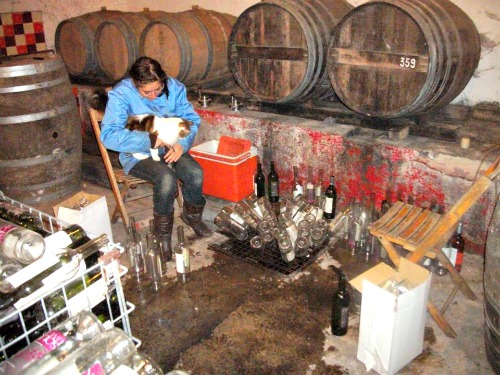
No use crying over spilled wine! Rachel in the cellar of a now-defunct winery near Perpignan, France; photo credit: Rachel Kanev.

Hmmm… I think I detect something of the entrepreneur in you, alongside your intrepid traveller’s spirit! And now let’s have a look at a few of your favorite photos from your travels to France and China.
Sure! I took this first photo in a wine cellar in a small hamlet near Perpignan, some way off the coast of southern France. I’d been helping out, but it was late December, and there was very little work left. Besides, the winemaker, whose name was Bernard, had gone bankrupt due to the stresses of organic farming. Our main task for the day, as his helpers, was to pour bottle upon bottle of wine down the drain as he looked on bemoaning the demise of the modern world. It proved a good way to get skillful with a corkscrew!! And I think poor Bernard appreciated our efforts quite a lot. Just think if he’d drunk all that wine in his cellar, it would have sent him spiraling into an even deeper fit of depression…

RK_dragonriceterraces

China’s Longji (Dragon’s Backbone) Terraced Rice Fields are so named because of their resemblance to a dragon’s scales; photo credit: Rachel Kanev.

The next photo provides a glimpse of the glorious Dragon rice terraces of Longshen, in China’s Guangxi province. Amazing terraces stretch as far as the eye can see. I visited some years ago and remember being in awe at the combination of nature’s beauty and the skillfulness of the human hand. I had quite an adventure ambling through the fields with two of my Chinese friends. We got lost and at one point envisaged spending a cold night cuddled up to the cows. In the end we reached our hostel, at the top of the terraces, by nightfall. I returned again last year and was saddened to see that the beauty of the fields has been marred by the greedy hand of tourism. Huge plastic cable cars now transport visitors to the top, and the local villagers are paid to dress in traditional clothes.

RK_AnotherBernard

A French farmer, another Barnard; photo credit: Rachel Kanev.

Last in this series we have another Bernard who stumbled into my traveller’s path. This Bernard is an 80-year-old farmer with whom I lived on my own for a week. His farm is an hour away from the nearest town and is completely self-sufficient. He grows his own organic vegetables and was fit enough to hack up the ground with a pickaxe when the underwater pipes burst (ironically, I had left the home of Bernard number 1 because his pipes had burst and the water system needed to be repaired, only to be faced with more burst pipes at the home of Bernard number 2!).

I love the first photo just because it looks as though you’ve broken into someone’s cellar and are drinking all the wine!! The dragon terraces appear so surreal to me because they are so different to the flat rice fields of Thailand, where I live. I wish I could see them one day. I know you take a lot of photos and these next four, I believe, have a special significance for you. Can you explain?

Not all who wander are lost…

The following is a photo I took of a photo of Bernard number 2, which was taken some fifty years ago, when his newly polished army boots took their very first steps away from the small village on the outskirts of the Pyrenees, where he was born. He bid farewell to the farm he’d grown up on and to the parents who’d raised both him and the thriving trees and crops that had formed the backdrop to his childhood. By the time I encountered Bernard, nature had outlived his parents but their legacy remained. He is now a beekeeper and organic vegetable farmer, tending to the very same trees and plants that his father and his father’s father had cared for. Though he has no human family, the trees you see in my other photo of Bernard (above) appear to me to be his forefathers; they are equally his children.

Bernard as a young man

The French farmer Bernard as a young soldier; photo credit: Rachel Kanev.

The next photo was a fluke as I managed to capture an ad for Longines watches showing Kate Winslet just as the sun was setting. In that fleeting instant, one can see Shanghai’s varied transportation, high-rise buildings and red lanterns—that curious amalgamation of Western modernity and Chinese traditionalism that is everywhere around you in the city.

RK_ShanghaiSunset

A British beauty, a Swiss watch and a Shanghai sunset; photo credit: Rachel Kanev.

Cambridge is my home town and I think of it much like a family member, having watched it age and evolve just as it has silently witnessed me grow and change. I love its grandiose architecture, endless greenery, and the way winter and spring intertwine in front of the University’s palace-like structures that are fit for if not a queen then the rulers of academia, to which I never belonged.

RK_CambridgeUK

The dreaming spires of Cambridge; photo credit: Rachel Kanev.

Here my sister explores the labyrinth-like forestry of a park near where we live in Cambridge. It has amazing multi-coloured plants I have never seen anywhere else before and huge trees that watch over you like silent giants. I like this photo because she looks like Alice in Wonderland with her long, thick flowing locks!

RK_SisterinPark

The great outdoors near Cambridge, UK; photo credit: Rachel Kanev.

Is photography sometimes a moral decision?

I love your explanations as they show us the profound effects a picture can have on its creator, something the viewer can never fully appreciate. Tell me, do you ever feel reserved about taking photos of people, particularly when they are conscious that you are doing so?
For me, the morality of taking photos of strangers has always been ambiguous. I think of it whenever I see photos of human suffering. I believe I have the right to use my camera to record the world but without intruding on it. At what point does the power of images and the need for education and understanding through the push of a button and flash of a light become intrusive and affect the lives of others in a negative way? I’ll give you an example from my own experience. The Western media has focused almost exclusively on China’s explosive economic growth when in fact 1.6 million people (11.8 percent of the population) still live below the poverty line. When taking the train, part of me would like to photograph the dirt-covered, barefooted children asleep on newspapers or the train door frozen from the inside as passengers are left to deal with the icy temperatures of the North (-37°C). But feeling intrusive, I refrain.

Do you also feel self-conscious in Asia?
It’s difficult being subtle, given the colour of my hair and skin, and the stamp on my passport. Noticing me walking the streets of China, many Chinese will assume, quite rightly, that I am Western but quite wrongly that I must therefore have dollar bills rolling from my body like a central bank printing press. Often I do not wish to fuel their prejudices by whipping out a digital camera, however small, before their eyes.

As a resident in Thailand, I can empathize with those views, especially the general Asian misconception that all Westerners are rich. Although this can be annoying, I do believe these views are changing for the better, as the younger generation becomes more socially aware through travel and better education. Now let’s turn to the technical stuff. Some of our readers may want to know what kind of camera and lenses you use.
I have a small Samsung camera that fits neatly in the palm of my hand. It’s nothing fancy and often leaves something to be desired in terms of quality, but it was a birthday gift years ago and has sentimental value, having been my only travel partner across unknown lands. Whatever it lacks in lens quality, Windows Photo Gallery makes up for in magical editing power!

Finally, do you have any advice for wannabe photographers who are traveling or living abroad?
Wander through villages, peel garlic with a farmer, shake hands with a prince, run through jungles, leap into waterfalls, swing across the rainforest wilderness and lose a leg to the marble rocks—see the world and allow the world to be seen. Travel, live, eternalize what you see with a photo.

Great non-technical advice, Rachel, that’s right up my street! I’d like to thank you for taking the time to tell your fascinating story in this interview.

* * *

Readers, what do you make of Rachel’s experiences and her photography advice? And do you have any questions for her on her photos or her travels? Please leave them in the comments!

And if you want to know more about Rachel Kanev, don’t forget to visit her blog, Globe Drifting. You can also follow her on Twitter or even shoot her an email.

(If you are a photographer and would like to be interviewed by James for this series, please send your information to ml@thedisplacednation.com.)

STAY TUNED for next week’s fab posts!


If you enjoyed this post, we invite you to register for The Displaced Dispatch, a round up of weekly posts from The Displaced Nation, with seasonal recipes, book giveaways and other extras. Register for The Displaced Dispatch by clicking here!

Related posts:

LOCATION, LOCUTION: James Ferron Anderson, weaver, glassblower, soldier – and award-winning novelist

Author photo – James Ferron Anderson

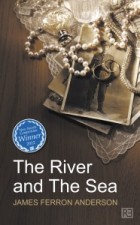
In this month’s “Location, Locution”, expat crime writer JJ Marsh interviews James Ferron Anderson, author of  The River and The Sea.

James was born in Northern Ireland, and worked there as a weaver, glassblower and soldier. He eventually had children, moved to Norwich, UK, studied at UEA, and began to write in different forms, including poetry, short stories, plays and, more recently, novels. One of his first short stories, The Bog Menagerie, won the Bryan MacMahon Short Story Award. He won an Escalator Award winner for I Still Miss Someone, and a Writers’ Centre Free Reads Award winner. The River and The Sea won the Rethink Press New Novels Award in 2012, and was published in November 2012.

The River and The Sea is set in British Columbia. James is currently working on Terminal City, set in Vancouver. While he’s visited British Columbia and Vancouver many times (his once estranged brother lives there, but that’s another story) he has never lived there.

Visit his website at jamesferronanderson.com.

Which came first, story or location?
Location, and more so as I continue to write. I’ll stick with Terminal City, the novel I am currently working on, but it applies equally to The River and The Sea. I was already studying the history of British Columbia, and focusing on Vancouver, when I read that Errol Flynn had died there. It was the human touch that caught my attention: once flamboyant athletic actor reduced, much against his will, to selling his last possession of any worth, his yacht. Shattered, riddled with diseases, looking like seventy instead of the fifty he actually was, he dies. But if my head had not already been filled with images of Vancouver from its lumber town days in the early 1900s to its evolution into the city of glass it is today I may not have found myself, I would say unintentionally, making up stories based around a Flynn-type character.

Politics and mores are as an integral part of a location as are its streets or hills. It was what I knew of the political aspects of this West Coast city in the 30s and 40s that determined that Terminal City would be a crime story. I wanted that mixture of danger and timidity that noir provides: the lure of the forbidden and the pulling back from it. I’d say location determined the form, feel and nature of the book. The rest was my regular desire to tell stories of how people need each other, hate each other, love each other and dispense with each other.

Simply put, it begins with location, finding an interesting event and/or person in that location when I’m not knowingly looking, and getting hooked.

What’s your technique for evoking the atmosphere of a place?
I think finding myself writing a story set in Vancouver (and it felt like finding more than choosing) was a just a wonderful gift. For a start, almost no one in the book was born in the city. They have a past at variance with their present, having come there from across the world for their own purposes. They are testing it, examining it, seeing what they can get from it. Will they be satisfied with what they’ve found? With the people they become over the twenty years of living there from 1939 to 1959? It makes the city, like the Thompson River in The River and The Sea, a protagonist in the book.

Which particular features create a sense of location? Landscape, culture, food?
Vancouver is a mild-weather city with plenty of rain. For noir it knocks LA into a cocked hat. It’s a city on a great bay so there are beaches, ships pass in and out visibly and constantly, there are well-forested and, for large parts of the year, snowy mountains rearing up just across Burrard Inlet. The wild and magnificent outdoors is no more than half an hour away, even in 1959.

Vancouver is a port, and more culturally mixed than an interior city. It’s in the far west of the continent: the final destination, like it or not, for the drifter or seeker after a better life. A large Asian presence leant, certainly in the period of which I am writing, a feeling of tension to nightlife, whether justified or not. My desire to use all that shaped the story.

Buildings matter. I have old all-wood housing from when Vancouver first laid down its streets side by side with the rise of its first multi-storey offices: a city in flux, home to people from elsewhere, also in flux, looking for roots and stability, looking for meaning too in the aftermath of a war.

How well do you need to know the place before using it as a setting?
I couldn’t imagine locating a story in a place I didn’t know well. I was relishing knowing Vancouver more and more anyway. To set a novel there was an excuse to know it better again, from visiting, diving into the City Archives on-line, to examining Google Earth Street View for hours. Plenty, then. I want to make what I write correct as well as relevant to the story. That doesn’t mean that very much of what I know has to go on the page. I read a comment that Colm Toibin in writing his novel on Henry James, The Master, wore his learning lightly. I want to know everything that’s relevant, and more, and use it lightly. The tip of the iceberg theory.

There are tricks also. Why would a local person wonder or remark on anything like the view or the tram tracks in the streets? I feel description has to grow out of incident and dialogue in the narrative. The first person narrator of Terminal City has, in the 1939 scenes, only lived in Vancouver for a year and is still coming to terms with it. He can wonder and notice and remark a little more freely and yet, hopefully, realistically. In 1959 he can reflect on changes, good and bad.

Could you give a brief example from your work which you feel brings the location to life?

The River and The SeaFrom The River and The Sea:

‘Snow was falling and visibility down to a few feet. We stopped in the afternoon and managed to light a fire and had tea and sugar. In a break in the snow Harry saw a raven. That meant there were caribou, and on the move.’

‘It did, did it?’

‘For a certainty, Harry said. We crossed a frozen lake, for easier walking, and came back onto the river. The wind was unrelenting. Even on the lake it took us four hours to make a couple of miles.’ Edward drank his tea. This was the most talking any of us had done for a long time. ‘We found a little clump of spruce. We ate some of the hide matting for the first time, but neither of us slept from the cold and the need to keep the fire going.’

It’s a narrative told to inform someone else and, almost incidentally, informs the reader. The intention was to convey their location as a site of cold, hunger and desperation, but it had to be an integral part of the story, not a piece of description standing to one side.

Which writers do you admire for the way they use location?
Charles Dickens in Chapter Three of Great Expectations uses the weather to bring alive his location when Pip runs in the morning to meet Magwitch.The mist was heavier yet when I got out upon the marshes, so that instead of my running at everything, everything seemed to run at me.’ Wonderful stuff that took me to that location so effectively I still picture it. Anton Chekhov is marvellous for both countryside and city. Yalta is so alive, so liveable-in, in Lady With a Lapdog. W.G. Sebald, not a favourite writer of mine, is nevertheless someone whose ability to put me in his location I much admire.


Next month’s Location, Locution:  Jill interviews Charlotte Otter, South African author – now living in Germany, whose homeland provides fertile fictional soil.

 * * *

JJ Marsh grew up in Wales, Africa and the Middle East, where her curiosity for culture took root and triggered an urge to write. After living in Hong Kong, Nigeria, Dubai, Portugal and France, JJ finally settled in Switzerland, where she is currently halfway through her European crime series, set in compelling locations all over the continent and featuring detective inspector Beatrice Stubbs.

_(75_of_75)

Author photo: J J Marsh

STAY TUNED for our next post!

If you enjoyed this post, we invite you to register for The Displaced Dispatch, a round up of weekly posts from The Displaced Nation, with seasonal recipes, book giveaways and other extras. Register for The Displaced Dispatch by clicking here!

Related posts:

Why did the chicken cross an international border? Because this expat told it to!

sharon lorimer chicken hat

Sharon Lorimer graces the cover of Coop du Monde sporting a chicken hat; photo credit: Kim Khan.

Sharon Lorimer is joining us again today. Last time she and I met, she had on her entrepreneurial hat to tell me about the ingredients she used to start up her company, doshebu. We discussed the company’s mission of helping overseas employees become versed in the “art” of being an expat—her knowledge of which is based, in no small part, on her own experience of being a Scottish expat in New York City and of her husband’s experience as an American ATCK (he has lived in London and Singapore).

This time around, however, Sharon is sporting a chicken hat. Why is that, you may wonder? For the simple reason that she has her eggs in more than one basket. She may be a businesswoman but she also loves cooking. She self-published a photo cookbook named Coop Du Monde at the end of last year, which offers suggestions for jazzing up your basic roast chicken recipe ranging from Pilgrim’s Fowl to Nippon Coop to Mi Amore Coop.

And just now she put out The Seasoner’s Handbook, a companion to her very first cookbook, From the Global Scottish Kitchen, in which she reinvented dishes from her native Scotland by adding flavors picked up from her “gastronomic journey.”

Cock a’ Leekie Udon, anyone?

Sharon’s culinary creativity will be our topic today. She tells me that she has always enjoyed experimenting with food, but by now it should be clear that flying the Scottish coop has pushed her in some new directions.

* * *

CoopduMonde_cover_dropshadowHi, Sharon. Welcome back to the Displaced Nation! Tell me, why did you decide to write a book about roast chicken?
I think it grew out of my fondness for the Sunday Roast ritual in the UK. Even when I was growing up in Scotland, I always preferred to spice it up. But since coming to the United States and leading a more international life, I’ve taken these experiments up a level.

But why chicken? When I lived in Britain, I remember having a lot of lamb and beef.
Well, chicken is probably the most popular for the home cook and besides, it’s eaten all over the world.

I’ve had a look at your book and I’m impressed that it offers a step-by-step guide to roasting a chicken and then suggesting a number of variations.
In fact, the point of the book is not so much to give people recipes as to help them be creative when they cook. I explain the process of blending spices and herbs together and choosing vegetables so that you can invent your own Coop du Monde.
TheSeasoner'sHandbook_cover_dropshadow

Which came first, spices or travels?

You seem to be obsessed with spices. In your newest book, The Seasoner’s Handbook, you explain how to use chili peppers, pomegranate seeds, saffron, mole, truffles…
These are some of the flavors I’ve picked up on my gastronomic journey. Take the pomegranate seed, for instance. I first had a dish seasoned with this fruit in London. As I explain in the book, I hadn’t tasted it before but it made the meal so enjoyable that I thought about how I could use it in other dishes. It has a mellow flavor that combines well with stronger and more subtle flavors.

Your Scottish cookbook, to which this book is a companion, reinterprets your native cuisine in light of what you have learned about the cuisines of the US, Mexico, France, Japan and Greece. In a post discussing the book on your blog, you say:

If I had created a cookbook that represented my travels, the contents would be traditional dishes made authentically. Thinking globally about taste lets you use different aspects of cuisines to develop new ideas.

It sounds as though you’re making a case for fusion cuisine, but is that right?
Cuisines are identified by nationality, and fusion means blending two national cuisines. I want people to understand that it’s less about replicating other people’s cuisines, or competing to be the best at a style of cuisine, and more about exploring what you like. Lots of us expats want to find ways of expressing all the influences we’ve picked up on our travels. What better way to blend them than in cooking?

“Ain’t nobody here but us chickens” – Louis Jordan

How big a role does cooking play in your everyday life?
My husband and I make very simple food during the week. He is a good cook, too, and we take turns cooking for each other. One thing that makes it on to the table every month is Anthony Bourdain’s recipe for whole roasted fish Tuscan style, which essentially means baking it in salt. Bourdain just talks about it in his book Kitchen Confidential. We tried replicating it from the description. It’s really easy. You just stuff herbs, garlic and lemon it to the belly of the fish. Pour olive oil on the fish and encrust in lots of Kosher salt and bake for 45-60 minutes at 375°F.

Mmmm…sounds good. Fish has been one of my staples ever since I lived in Japan.
Well, don’t overlook the beauty of chicken. My new favorite easy meal is a Cook Yourself Thin recipe for butterflied chicken breast marinated in olive oil, rosemary and lemon juice. It only takes 30 minutes to marinate and 10 minutes on the grill. Delicious.

Struttin’ her stuff on Blurb

Moving back to the two books: Why did you choose to publish them on Blurb?
Blurb makes self-publishing easy, and it’s ideal for coffee-table-style books that feature photography.

Yes, I know you’re a keen photographer, but was there a learning curve for taking photos of food?
I’m a professional photographer, but there’s a learning curve with any new project. The most important thing to remember when you start to make books is that printers need higher-resolution shots than websites. You have to print a hard copy with Blurb, even if you don’t want to sell it. Make the shots good enough so that you can display it in your home or give it to family and friends. The other thing I had to learn is that I have to shoot with the book in mind. I had some old chicken shots I wanted to use for the Coop du Monde, but the resolution was wrong and they looked out of place. In the end we had to work from the concept to create a cohesive book. In fact, my husband shot the front and back covers.

I see you’re getting into video more and more these days, and that Coop du Monde includes a teaching video.
I always find it easier to replicate a recipe if I have watched someone else do it first, don’t you? Yes, the video is embedded in the ebook.

What’s the biggest challenge in putting together a cookbook?
My biggest challenge is writing down recipes. I cooked for years without documenting any of it and even today, I still forget to write down what I’ve done. I have an app but it hasn’t really helped me solve the problem. I never cook to a recipe and I don’t really want to. It spoils the experience for me.

What audience do you have in mind for your photo cookbooks, and are they reaching those people?
The most popular post ever on the Art of the Expat blog is “Indian Meat and Potatoes” (it centers on a keema recipe that’s from From the Global Scottish Kitchen, which, believe it or not given that keema is Indian, includes pomegranates!). Food tends to be more accessible than other topics. People are always looking for ways to incorporate and understand other nations’ cuisines, especially ones they usually can’t have unless they eat out. I thought the Brits would like Coop du Monde because of their love of roast chicken, but most visitors to my blog are Americans. More recently, we’ve had a lot of Swedish visitors…but presumably they are also fans of chicken.

What’s next—more cookbooks? Other creative projects?
My husband and I are planning lots more live broadcasts at doshebu.tv focusing on news events and expat topics. On the creative side, I’ve started to write another screenplay. I think this will give me the outlet for creativity that I need when I get depressed about troubleshooting code!

* * *

Thank you, Sharon! Readers, don’t be too chicken to leave questions or comments for Sharon. Or perhaps you’d like to suggest a roast chicken recipe that you’ve enhanced with spices or other exotic ingredients? Just think, if Sharon were to include it in her next Blurb book, what a coup it would be…

STAY TUNED for next week’s fab posts!

If you enjoyed this post, we invite you to register for The Displaced Dispatch, a round up of weekly posts from The Displaced Nation, with seasonal recipes, book giveaways and other extras. Register for The Displaced Dispatch by clicking here!

Related posts:

And the April 2014 Alices go to … these 4 international creatives

 © Iamezan | Dreamstime.com Used under license

© Iamezan | Dreamstime.com
Used under license

If you are a subscriber to our weekly newsletter, Displaced Dispatch, you’re already in the know. But if you’re not, listen up. (Hey, why aren’t you? Off with your head!)

Every week, when that esteemed publication comes out, we present contenders for a monthly “Alice Award,” most of whom are writers or other kinds of international creatives who appear to have a special handle on the curious and unreal aspects of being a global resident or voyager.

Not only that, but this person tries to use this state of befuddlement as a spur to greater creative heights.

Today’s post honors April’s four Alice recipients. They are (drumroll…):

1) TONI HARGIS, author, blogger, and British expat in Chicago

For her post:  “Learn to Take a Compliment, Brits in America” in Mind the Gap, a resource blog for British expats in America on BBCAmerica.com
Posted on: 18 April 2014
Snippet:

Many British teachers admitted that they and their students found it very hard to fill in applications for American colleges because they were asked for “accomplishments and strengths” as well as academic achievements. As one contributor put it, U.K. teachers “are not very good at waxing lyrical about [their] students other than in academic terms.”

Citation: Toni, what an absolutely marvelous post! Only don’t you think you should have promoted your credentials a little more? After all, you’ve written a book called The Stress-Free Guide to Studying in the States, the contents of which we expect could be useful to Bashful Brits. Actually, you do refer to the book in passing—but don’t provide the title or a link. Hey, never miss an opportunity to blow your own trumpet! But listen, as you insist upon being so self-effacing, we feel justified in presenting you with this inspirational passage from Through the Looking Glass, where a banquet is being held in honor of the diffident Queen Alice, who can’t quite believe she’s been made a queen:

[Alice] didn’t see why the Red Queen should be the only one to give orders; so, as an experiment, she called out “Waiter! Bring back the pudding!” and there it was again in a moment, like a conjuring trick. It was so large that she couldn’t help feeling a little shy with it…; however, she conquered her shyness by a great effort, and cut a slice and handed it to the Red Queen.

“What impertinence!” said the Pudding. “I wonder how you’d like it, if I were to cut a slice out of you, you creature!”

It spoke in a thick, suety sort of voice, and Alice hadn’t a word to say in reply: she could only sit and look at it and gasp.

“Make a remark,” said the Red Queen: “it’s ridiculous to leave all the conversation to the pudding!”

One last word of advice, if we may: Should you feel at all embarrassed about accepting an Alice, rest assured, a simple “thanks” will do. No need to curtsey… Notably, this last accords with what the point you make at the end of your excellent (as well as thought-provoking!) post:

…when someone praises you, your spouse, your children, your dog or your house, a simple “Thank you” will both suffice and move the conversation swiftly along without too much excruciation on your part.

Again, as the Red Queen puts it to Alice: “You ought to return thanks in a neat speech.”

2) Anthony The Travel Tart, Australian travel addict and blogger

For his post: “You Know That You’ve Been Living in Japan Too Long When…,” on The Travel Tart
Posted on: 18 March 2014
Snippet:

You know that you’ve been living in Japan too long when…

  • A room the size of a cubic metre feels rather large.
  • Capsule hotels feel quite spacious.
  • Wide open spaces freak you out.

Citation: Anthony, we assume you met quite a few expats during your time in Japan. Because your inference that the longer a foreigner stays in Japan the stranger he or she becomes is spot on (and one of us speaks from a too-long experience of having lived in that small-island nation). Picture for a moment what happens to Alice after she enters the White Rabbit’s house and downs the contents of the “Drink Me” bottle:

She went on growing, and growing, and very soon had to kneel down on the floor: in another minute there was not even room for this, and she tried the effect of lying down with one elbow against the door, and the other arm curled round her head. Still she went on growing, and, as a last resource, she put one arm out of the window, and one foot up the chimney.

This is actually a case where one might prefer to be Alice rather than an expat. She at least has the ability to drink potions or eat pieces of mushroom to change her body size. But many gaijin remain permanently stuck in the White Rabbit’s house (not for nothing has Japan achieved notoriety as the “rabbit-hutch nation”). Downing the contents of a bottle of Suntory whisky or taking a bite of a matsutake (pine mushroom, prized for its spicy aroma) won’t make the blindest bit of difference. Oh, and incidentally, it’s arigato, not origato, but that’s okay as it means you didn’t stay too long—though you may want to add “correcting other foreigners’ Japanese” to the list.

3) MATT HERSHBERGER, writer and blogger at A Man Without a Country, and 4) British dialect coach ANDREW JACK

For the post: “A quick video guide to the accents of the British Isles”, by Matt Hershberger on Matador Network, which features Andrew Jack’s brilliant video (produced by Philip Barker).
Posted on: 20 April 2014
Snippet: Matt, who once lived in England, says:

As an American, I can’t even replicate the accents properly, so if I tried to ask for help distinguishing an accent from a British friend later, the best I could hope would be that I’d sound sort of like Stewie Griffin, and nothing like the accent I’d heard.

Citation: Matt, we take your point that when venturing abroad to a country where they speak the same language, it is most disconcerting when you can’t understand what people are saying because of their heavy accents—a true “through the looking glass” moment. (We fear that Brits may have some of the same troubles in the U.S., but let’s face it, you’d expect that in a country of this size, not of one as tiny as Britain.) We appreciate that you highlighted the video of Andrew providing 14 regional accents from the British Isles in 84 seconds: how awesome is that? As one of the YouTube commenters says, “good for ignorant North Americans”—some of whom, me might add, may plan to be (or have already been) expats in the UK. And we appreciate it even more when recalling that Poor Alice had no interpreter for the White Queen’s methods of communication:

“My finger’s bleeding! Oh, oh, oh, oh!”

Her screams were so exactly like the whistle of a steam-engine, that Alice had to hold both her hands over her ears.

“Oh, much better!” cried the Queen, her voice rising to a squeak as she went on. “Much be-etter! Be-etter! Be-e-e-etter! Be-e-ehh!”

The last word ended in a long bleat, so like a sheep that Alice quite started.

*  *  *

So, readers, do you have a favorite from the above, or have you read any recent posts you think deserve an Alice Award? We’d love to hear your suggestions! And don’t miss out on the shortlist of Alice contenders we provide in each week’s Dispatch, which are sources of creative thought if nothing else! Get on our subscription list now!

STAY TUNED for more fab posts.

Writers and other international creatives: If you want to know in advance the contenders for our monthly Alice Award winners, sign up to receive The Displaced Dispatch, a round up of weekly posts from The Displaced Nation, with news of book giveaways, future posts, and of course, our weekly Alice Award!. Register for The Displaced Dispatch by clicking here!

Related posts:

Live your life, take chances—raise alpacas? A curious expat tale that has yielded a book-worthy yarn

Seriously Mum Collage

(Clockwise from top) Alan Parks with a friend’s alpaca; the converted olive mill where he and his partner, Lorna, now live; Brighton Pier, scene of their former abode (photo credit: Photo Monkey via Flickr Creative Commons).

The most amazing thing about the expat memoir penned by my guest today, Alan Parks, is not simply its title, though Seriously Mum, What’s an Alpaca? is quite a doozy.

It’s not even the zaniness of the alpacas that appear throughout the narrative: Bermuda, Cassandra, Lily, Baby Rafa… BTW, they are just a few among many animals Alan and his partner, Lorna Penfold, keep. (There’s a tally of how many and what kinds at the start of each chapter.)

No, the most amazing thing about Alan Parks’s memoir is that fellow expats, particularly fellow Brits (but also one German), are the villains of the piece—the least trustworthy of all the people he and Lorna have encountered on their madcap adventure. I say “madcap” as I think the decision the couple made, six years ago, to abandon their home in Brighton (in their native UK) for a renovated olive mill near Montoro in Spain’s Córdoba Province, which is within the autonomous territory of Andalusia, to raise alpacas justifies my choice of that adjective.

From the book’s beginning, Alan’s instinct is not to stick with the expat community—as he puts it:

I don’t think we would have mixed with many of these people at home, so we should not feel forced to by circumstances.

And boy does that instinct prove right! While the Spanish merely think he and Lorna are crazy (so far as they’re concerned, the British pair may as well be raising giraffes!), their fellow Brits are out to take advantage of them in all kinds of ways. And despite Alan’s better instincts, his limited Spanish at times gives him little choice but to get involved with some pretty unscrupulous characters.

Mind you, the Spanish don’t always come off well either, especially when it comes to their treatment of animals. In light of Mahatma Gandhi’s proclamation—

“The greatness of a nation and its moral progress can be judged by the way its animals are treated.”

—it would not be too far fetched to say that the animals are the book’s true heroes. They are what keep Alan and Lorna going in face of a seemingly unending series of challenges. In tribute, Alan gives various pets a voice at the end of occasional chapters. (It’s sad when they lose them, though.)

But the reason we are assembled here today to give Alan himself a voice in telling us about his book, which I urge you to read if you haven’t already. It’s done super well on Amazon for a reason: it’s terrific! And please LEAVE A COMMENT at the end of this post to be eligible to win a FREE COPY. (Alan has kindly agreed to give one of his books away: your choice of alpacas or donkeys! And there may also be prizes for runners-up!!!)

* * *

SeriouslyMumAlpaca_bookcover_dropshadowWelcome to the Displaced Nation, Alan! Between you and your partner, Lorna Penfold, you have produced three memoirs about your life in Spain. There’s the book we’re featuring today: Seriously Mum, What’s an Alpaca?. There’s also the sequel: Seriously Mum, Where’s That Donkey? And Lorna has just now published From Sequins to Sunshine: Year One. Tell me, what has made the pair of you so prolific?
The books were never planned. Two years ago, after being told many times that I should write a book about our adventures, I decided to give it a go. Seriously Mum, What’s an Alpaca? was the result. It started out being called Bloody Hell, What’s an Alpaca?—an exact quote for how Lorna’s daughter, Frankie, responded when we told her about our plans. But the use of the word “hell” hindered sales in the US. After I released the sequel, we thought people might like to read Lorna’s point of view. She had started a blog when we first moved here, so we turned her posts from the first year into an e-book. So far the reaction has been good.

What was the impulse that led to your packing it all in and moving to the South of Spain?
Lorna was a dance teacher in the UK and I used to work in retail. Lorna developed a condition called sarcoidosis, which made working difficult. One day we were talking about the possibility of her giving up work, and I suggested moving to Florida, but that was too far away. I blurted out “What about Spain?” Crazy really, as I had never ever been here.

Hey, craziness is what makes the world round! And how about this idea of raising alpacas, where did that come from?
We had heard about alpacas in the UK and thought that would be a good business for us to get in to (it wasn’t).

Okay, seeing as I know nothing about the alpaca business, what makes it so challenging?
An alpaca is not a cheap animal, yet you can’t eat it, and it doesn’t produce milk to drink. You make money by selling them to other breeders. But sales, and the selling price, have gone down since the world financial crisis.

What about their wool?
We try to sell as much of our alpacas’ wool as possible to local people who spin, knit and use it for crafting, but the market here in Spain is miniscule and postage costs prohibitive.

Do Spanish people think you and Lorna are crazy for your devotion to these animals?
People in Spain have never heard of alpacas. To a Spaniard, a goat is a much more useful animal.

Why do you still keep your alpacas if you’re not making any money on them?
For one there is no one to sell them to, and for two, they are part of our family and we love them. We also like it when people come and stay at our farm and can experience walking and feeding the alpacas. And finally, if there were no alpacas, there would be no books.

Ah, yes, the books. We’ll get to that, but first let me ask another alpaca question. The New York Times had an article last year talking about llamas being good pets. I think the alpaca is meant to be the llama’s quirky cousin. So is the same true of them?
It depends….they are no good if you want an animal to pet and stroke. But if you have an acre of land and you need the grass kept short, they could be good. Bear in mind, though, that they need to be kept in groups of at least three!

Out of the grey skies of England and into the frying pan of Spain

Moving right along to the weather: having been an expat in Britain myself, I can imagine you were keen to leave behind its grey skies and unpredictable climate. But were you aware that the interior of Andalusia, where you were headed, is the hottest area in all of Europe?
We didn’t find out about this area being called “The Frying Pan of Spain” until much further down the line. We were sorting some paperwork at the Spanish Embassy in London, and a lady said to us, “You do know they call it the Frying Pan of Spain, don’t you?” In the summer it can easily hit 45 degrees during the day. Siestas are a necessity.

Can you give us some sense of how you spend a typical day in your new life versus when you lived in Brighton?
In Brighton I was often out the door at 7:30 a.m. and got back home about 7:00 p.m. Lorna worked in the evenings, often not returning home until 9:00 or 10:00 p.m. Also, she had to work a lot of Sundays, so we never got to see each other. In Spain our life is much more relaxed. We spend our days looking after the animals and maintaining the house, and we are now together 24/7. You could say we went from one extreme to another.

I understand you met Lorna on the Internet. How long had you known each other before hatching this plan to live in Spain?
We had been together for four years and living together for three before we made the move, so we at least knew we could live together.

Did starting up a totally new life in a foreign land put a strain on your relationship or draw you closer?
I wouldn’t say our relationship has ever been strained, although as you can read in our books, we have been through some tough times together.

Be careful what you wish for…

Having read your book, I know there were quite a few moments in Spain when you felt like a bit like aliens, but which moment stands out as your most displaced, when you wondered if you’d made a mistake?
I think our “What are we doing here?” moment came after about 18 months. We had spent all our money with an English builder renovating our new house in the sun, and we experienced the worst Spanish winter rains for a hundred years. It turned out the builder was a conman and all the roofs he’d built started leaking. On top of that two of our alpacas died in the months before. I remember us standing in our kitchen as water cascaded from the ceiling. We were both in tears.

Wow, a literal “pool of tears” moment! But I know you also have things you love about your new life. Can you tell us about your least displaced moment, when you felt you were born to be in Spain’s Frying Pan rather than your native UK?
Andalucia feels like home to us now, although it is difficult to pinpoint the exact moment when we turned the corner. I think we are most aware of it when we are sitting outside having something to eat and drink with friends at 2:00 a.m. in the middle of August, wearing only a t-shirt. That is what life is about, not whether or not you can afford the latest version of the iPad!

Would you say you’ve assimilated to the point where returning to the UK gives you counter culture shock?
Lorna visits the UK regularly as she now has three grandchildren that weren’t even thought about when we first moved here. I have not been back for five years but will head back for a weekend in June to visit my relatives and attend a diamond wedding celebration for my grandparents. In all honesty, I am a bit nervous about it, I am not looking forward to being in crowds. Here in Spain we live in the countryside outside a small town and some days we do not see a single person. Plus in June, I only ever wear shorts and a t-shirt, but in the UK I may need jumpers (sweaters) and trousers.

An Amazon bestseller in Travel with Pets and Travel in Europe

Moving on to your e-books: why did you decide to self-publish?
I wrote my first book just as self-publishing was really taking off. I submitted the manuscript to one publishing house, got a thanks-but-no-thanks letter back, so decided to publish it myself.

Are there any drawbacks to self-publishing?
As a self-publisher, the hardest part is clicking the button to publish. A traditionally published author has that taken away from them, and even if they get mixed reviews they have the backing of the publishing house. We are responsible for everything, from cover, to content, to editing mistakes. If there are problems, or mistakes in the manuscript, that is our fault.

What audience did you have in mind for the book, and has it been reaching those people?
Initially I thought it would appeal mainly to other alpaca breeders, but I have had emails from readers all over the world who say they’ve enjoyed reading about our Spanish adventure. In fact, I was so overwhelmed by the response to Seriously Mum, What’s an Alpaca? I just had to write the sequel, Seriously Mum, Where’s that Donkey?

Your book has done very well on Amazon. Do you do a lot to promote it?
I run a FB group called We Love Memoirs, which has over a thousand members, all of whom enjoy books like mine. The best way to promote is by word of mouth. If somebody recommends your book to their friend, nothing beats that. As a self publisher I am actually against the Amazon Select program, where you make your book available exclusively on Kindle. My books are available on Amazon but also everywhere else: iTunes, Barnes and Noble, Kobo and even smaller retailers.

What’s next—more books?
I would like to release a third book this year, and Lorna has years 2 and 3 in her From Sequins to Sunshine series to work on.

How are the alpacas doing?
The alpacas are good, and if all is well, we may have some babies at the end of the year.

SONY DSC10 Questions for Alan Parks & Lorna Penfold

Finally, I know that both you and Lorna have become avid readers while living in Spain, so I’m curious to hear both of you answer a series of questions that I’ve asked some of our other featured authors, about your reading and writing habits:
1. Last truly great book you read: Alan: I’m not sure I have ever read a truly great book. The books I read tend not to get put in that category. Lorna: A Thousand Splendid Suns, by Khaled Hosseini. Alan: I also have read A Thousand Splendid Suns, but I didn’t have the same reaction Lorna did.
2. Favorite literary genre: Alan: Comedy memoir. Lorna: Everything except horror.
3. Reading habits on a plane: Alan: I haven’t been on a plane for six years. Before it would have been an old fashioned book, but now I would read on a kindle app on my phone. Lorna: Always a paperback (whatever I happen to be reading).
4. The one book you’d require PM Cameron to read: Alan: Mine, of course! I think it would do him the world of good to find out that people can be happy living a more simple life, with less materialistic ideals in life! Lorna: Mine of course, just to give him a look at a day to day life of a “normal” working class person.
5. Favorite books as a child: Alan: The “Adventure” Series, by Willard Price.
6. Favorite hero/heroine in fiction: Alan: Jack West Junior, who appears in a book series by Australian author Matthew Reilly. Lorna: Mariam from A Thousand Splendid Suns, by Khaled Hosseini.
7. The writer, alive or dead, you’d most like to meet: Alan: Peter Mayle. Lorna: Khaled Hosseini.
8. Your reading habits: Alan: I read in bed at night, and a lot in the summer. Lorna: I read lots in summer as we do not watch television at all then. Plus other times of course.
9. The book you’d most like to see made as a film: Alan: Anything by Matthew Reilly, it would be like Indiana Jones on speed. And my own book of course. Lorna: My partner’s book Seriously Mum, what’s an Alpaca?
10. The book you plan to read next: Alan: Escape to Mulberry Cottage by Victoria Connelly. Lorna: The next on the shelf, whatever it is!

* * *

So, readers, any COMMENTS or QUESTIONS for Alan? Hey, it’s not every day you get to discuss the world’s most captivating camelids! And don’t forget, there’s a free digital copy on offer…

And if you can’t wait to read the book or don’t win, Seriously, Mum, What’s an Alpaca? is available from Amazon(among other venues). Be sure to grab a copy! You can also visit its companion site, like the book’s Facebook page (and be treated to lots of cute alpaca pix!) +/or follow Alan on Twitter.

STAY TUNED for next week’s fab posts!<!–tomorrow’s post, when our fictional expat heroine, Libby, returns to the Displaced Nation to update us on her many adventures. (What, not keeping up with Libby? Read the first three episodes of her expat adventures.)–>

If you enjoyed this post, we invite you to register for The Displaced Dispatch, a round up of weekly posts from The Displaced Nation, with seasonal recipes, book giveaways and other extras. Register for The Displaced Dispatch by clicking here!

Related posts: