The Displaced Nation

A home for international creatives

Category Archives: Cool Columns

HERE BE DRAGONS: Dreaming up a landscape from your world travels for a work of fantasy

HBD Landscape CollageWelcome to the second post in our new series, HERE BE DRAGONS, in which fantasy writer Andrew Couch, an American expat in Germany, brings our attention to the connection between fantasy writing and a life of international travel and residency. In the series opener, he pointed out how expat life in all of its glorious strangeness can be a feed for the fantasy writer’s imagination. And today? He talks about how one’s travels can inspire other-worldly landscapes.

—ML Awanohara

Many people think that fantasy is a genre set apart, but fantasy stories, like those in any other genre, center on compelling characters and the struggles they face. As epic fantasy author Patrick Rothfuss once said:

If you want to write a fantasy story with Norse gods, sentient robots, and telepathic dinosaurs, you can do just that. Want to throw in a vampire and a lesbian unicorn while you’re at it? Go ahead. Nothing’s off limits. But the endless possibility of the genre is a trap. It’s easy to get distracted by the glittering props available to you and forget what you’re supposed to be doing: telling a good story.

Yet clearly there are some elements that set fantasy writing apart, and today I want to talk about one of them: landscapes. By “landscapes” I of course refer to the great swaths of nature not created by man. Often in fantasy writing, they are more than just a backdrop—they represent the force of primal nature that must be appeased or overcome. A landscape can also inform how a society is built and what drives it. (I will devote some time to urban-scapes and architecture in future posts.)

Obviously, setting plays a major part in other genres—see the works featured by JJ Marsh in her Location, Locution column—but I would argue that in fantasy writing, a great deal of time should be devoted to conjuring up a physical landscape for your make-believe world. Tolkien understood this very well. The Lord of the Rings would not have the same impact without those soaring mountain ranges.

“What are men to rocks and mountains?” —Jane Austen

Speaking of Lord of the Rings: After joining my wife in New Zealand during her round-the-world trip some years ago, I suddenly understood why Peter Jackson filmed his Lord of the Rings series in his native land. (Older TV series such as Xena: Warrior Princess and Disney’s Hercules were likewise filmed in New Zealand.) The landscape is so varied, so grand and… well…conducive to fantasy! I don’t know which portions of the Rings movies were filmed where, but I certainly had some ideas on our day through Fiordland National Park, which occupies the South Island’s southwest corner. This is the park surrounding Milford Sound, considered to be one of the world’s top travel destinations.

Due to my fear of flying, I never imagined I would make it as far as New Zealand (literally, half a world away)—but I’m so glad I did. After stopping in Queenstown, we took an overnight bus trip out to Milford Sound. Our bus was glass topped—our first hint of the wonders to come. Between Queenstown and the park entrance are lakes and rolling hills—pretty enough; but once you hit the edge of the park, the scenery becomes much more fantastic. We entered a dense beech forest that evoked visions of natural spirits. Then, after traversing the three valleys toward Milford, we caught sight of the mountains.

How to describe those mountains, which the early Queenstown settlers nicknamed The Remarkables? The human mind tries to makes sense of new experiences based on information it has already collected. For instance, we compare a new food to something we’ve already eaten or a a new piece of technology to X on steroids. But the mountains in Fiordland did not really compare to anything I’d seen before. Those I’d seen before were big, but somehow these were even bigger, and more awe-inspiring.

Sitting at the top of the Homer Tunnel gazing down into the valley, I could readily imagine ten thousand orcs (mythical humanoid creatures, the idea for which was developed by Tolkien) rushing up to besiege our bus of a dozen tourists.

We were surrounded on three sides by enormous sheer rock faces with what looked like trickles of water flowing down them, about a handspan wide. But then our guide informed us that these streams were a meter wide, which meant the mountains were not as close as I’d thought: they were a couple of miles away. So much bigger than I’d imagined! Um…my vision of ten thousand orcs began to seem rather pitiful.

Steam-powered dreams

Queenstown is in Otago, a region that opened up after gold was struck in the 1860s. This led to an influx of foreign miners, many of whom were goldrush veterans.

So while the landscape before me conjured up the feeling of Middle-earth, the setting for most of Tolkien’s fantasy writings, in reality most of the region’s early settlers were part of the Steam Age.

QueenOfCloudPirates_coverI didn’t consciously think about it during our tour, but now that I’m writing a series of fantasy novellas, Crossing the Dropline, I can see that my impressions of the mountains, along with my thoughts about the steam era, have fed into my imaginative process. For instance, Cloud Rock is a precious resource in the story. It powers flight and comes from only one region, called Beyond the Dropline, a harsh landscape that is both protected and contested by different groups. So the challenge becomes: can the power of Cloud Rock be harnessed outside of the Dropline?

South of the Dropline, raw ore [Cloud Rock] no longer had as much power. The real breakthrough of rotor technology was how to use it outside of the ranges. Natives had been floating with ore for centuries before the league explorers brought a sample back and engineers developed a way of refining and attuning it to the energy of Air in the rest of the world. That was only thirty years ago and hailed as the advent of powered flight. From that point on the Iron League had controlled the skies and had grown in influence. They had shifted from sea vessels to airships and proceeded to grow their trade empire around the Circle Sea and over the mountains into the west. Lors had heard on the news that the other nations were growing uncomfortable, but the news man had reassured them that the League diplomacy corps had everything under control.

At the mercy of nature

Nature is sometimes a primal force that characters in a fantasy story must overcome. My wife and I had perfect weather on our trip through Fiordland, but it was not hard to imagine a torrential storm ricocheting off the mountains and threatening to wash us over a steep cliff. In my novella series, the characters have to contend with not only human antagonists but with mountains that float in the sky:

He could see the front of the dark clouds out beyond the floating mountain peaks. An ever churning mass of dark clouds stacked into a formidable wall moving slowly away from them. Then another flash lit the sky and Lors saw what Arnhelm had been watching.

On top of the massive wall of clouds strode the figure of a bearded man. He loomed the size of one of the tall steel buildings in downtown Ironholme and was wrapped in a robe made of the clouds. He shone with a pale white light. Every step he took on the clouds caused sparks to ripple out and illuminate the sky.

“Storm giant,” Jason said from next to Lors. “Pretty, isn’t it?”

The first book only hints at it, but soon the spirits of the howling North will try to tempt the characters. They will become more present as the series develops.

* * *

I made the trip to Fjordland years before I started writing novellas, but the memory of those mountains continues to haunt—and inspire—me.

How about you? Do you have a landscape in mind you think will affect your writing one day, or perhaps already has? Let me know in the comments. Also, if you’ve been fantasizing about particular topics, let me know, and I’ll attempt to stretch my imagination to discuss in a future post.

Andrew Couch has been a fantasy book nut since childhood; he really has not grown up much since then. After struggling to write his own games for years, he is now creating fantastical worlds in a series of novellas that echo the TV shows, anime and role-playing games of his youth. Beyond fantasy he is an avid blogger and a world traveler who resides in Germany. To learn more about Andrew, check out his blog, Grounded Traveler, and follow him on Twitter: @groundedtravelr.

STAY TUNED for the next fab post!

If you enjoyed this post, we invite you to register for The Displaced Dispatch, a round up of weekly posts from The Displaced Nation, with seasonal recipes, book giveaways and other extras. Register for The Displaced Dispatch by clicking here!

Related posts:

TCK TALENT: Cathleen Hadley, Porteña at Heart and Artist by Calling

Cathleen Hadley Collage

Cathleen Hadley in the transit lounge nervously awaiting her son’s arrival from Afghanistan, taken by her husband, Roger.

Elizabeth (Lisa) Liang is back with her monthly column about Adult Third Culture Kids (ATCKs) who work in creative fields, Lisa herself being a prime example. A Guatemalan-American of Chinese-Spanish-Irish-French-German-English descent, she has developed her own one-woman show about being a TCK, which was the closing keynote at this year’s Families in Global Transition (FIGT) conference.

—ML Awanohara

Greetings, readers! My guest today is Cathleen Hadley, my fellow ATCK author in the anthology Writing Out of Limbo: International Childhoods, Global Nomads and Third Culture Kids. Cathleen grew up in South America and the USA; she is a visual-turned-conceptual artist now living in Oviedo, Florida.

* * *

Welcome to The Displaced Nation, Cathleen. I understand that as the US-born TCK child of American parents—a Foreign Service dad and a homemaking mom—you lived in the United States (Washington, DC and Maryland), Venezuela, and Argentina before enrolling in Hartford Art School, part of the University of Hartford in Connecticut, and starting your adult life back in your “home” country. Recalling these many transitions, do you have a place and a time where you felt happiest, as in least displaced?
I had a happy childhood in Maryland, but of all the places I lived while growing up, I liked Buenos Aires the best. BA was like a first love; I had come to it fresh, and found it fascinating. It gave me the freedom to explore, discover joy in my life and youth, find myself in the arts… The depth of my feelings for this city are perhaps best summed up in my reaction to the first book I read by the Argentine writer Jorge Louis Borges (who was a living celebrity at the time), his short story collection Labyrinths. I likened myself to one of his halls of mirrors, and felt as though I lived in his circular time travel of art: prose to dreams or dreams to canvas and so on.

Was it an adjustment coming back to the U.S. after such a heady experience?
When I left, I carried as many things Argentine as I could. I had a lot to relearn. In BA, for example, I was courteously late for all appointments, but that was unacceptable in the USA. I had forgotten that if a class started at 8:00 a.m., I should arrive 15 minutes earlier or at least be on time. This reset to my inner clock was harsh. I still carry the music of the language spoken with soft “che” sounds. It grates on my ears to hear the City of Good Airs mispronounced.

But I presume you enjoyed attending art school?
My first art school: the smell, lighting, and echoes in those rooms resonated with my awareness of being in a circle of like-minded souls. Each project was an awakening, a revelation of inner potential.

Becoming a tourist in her own country

Limbo_coverIn your essay in the anthology Writing Out of Limbo, called “Artist in Transit,” you write about the difficulties of repatriation. I can relate! Eventually, you married a U.S. Navy officer and the pair of you ended up living in several different states.
After years of meeting Germans, Indians, and other assorted nationalities who congratulated me on my awareness of the culture of others but admonished me for my lack of knowledge about my native land, I decided that the Navy could serve as my passport to the United States—I would follow my husband, Roger, in his career. I particularly enjoyed being stationed in the Pacific Northwest, our final destination while he was active Navy. It offered the combination of climate from where I grew up in Maryland (think gardening), the temperate weather of Buenos Aires, and the emerald green and mists of the Indonesian Islands.

How did moving to different states compare to your earlier experience of moving from country to country?
The experiences were not dissimilar. Each place we lived in the United States had a different routine and a distinct local culture. Living in Ridgecrest, California (the Mojave Desert) was vastly different from living in San Diego—and that was within the same state! The Navy culture and traditions—those we carried with us everywhere. And having a child, a son, rooted me in life/home.

And now you live in Florida?
Now I am in a place that was not on my map—Florida, where I moved to be near my parents. Roger and I are rooted here by necessity, by the roof over our heads, his job, and my disability (chronic back pain).

I’m so sorry to hear about your back pain. That would be hard for anyone to endure, but especially an artist and a traveler! Going back to your upbringing: are you like many of us TCKs in that you tend to gravitate towards people who have similar interests and perhaps similar cross-cultural backgrounds? (And of course it’s not a given we’ll become fast friends…)
Identifying with people from my own culture is an ongoing process, and to this day I often find myself failing when making an effort to blend in. I suppose I am happiest with my dear old friends from my traveling TCK days and with those Navy folks from my ATCK days. And I was drawn to you, fellow author—Limbo brought us together because of the “resonance” we find in each other’s stories. Though we’ve never met in person, I am certain that if we did, we’d be comfortable and familiar with each other.

“Painting is silent poetry.” — Plutarch

Something that resonated with me from your Limbo essay was your description of how you behaved on home leave during your adolescent years: “I began wearing a mask, holding back information, or my true stories and feelings.” I gather you found ways to express yourself through your art, as I did through acting. Are there particular art works of yours that express these feelings of transience or loneliness or instability—and what about the freedom, curiosity, and love of travel you’ve also experienced?
Yes. I can share several examples:

ch_arrival

“Arrival,” by Cathleen Hadley

I created this painting, “Arrival”, a cleaned-up version of which was used on the cover of Limbo, when imagining what my son would see when serving in Afghanistan. That was a speechless, visual time for me. I wanted to paint endless versions of the same horizon until he came home.

"Phantom in the Woods," by Cathleen Hadley

“Phantom in the Woods,” by Cathleen Hadley

Here I painted myself looking like a phantom standing in a dark and gloomy woods, which symbolized the closed-in feelings I had about transience, loneliness, and instability. The ghost is passing through the landscape of an imaginary world because “place” did not yet exist.

CH_Bug Quilt

Bug Quilt, created by Cathleen Hadley for her son, Alan.

I asked my son to pick out whatever quilt pattern he wanted and I would make it for him. Of course he picked one that required a complicated technique called appliqué, which requires attaching small pieces of fabric to a larger piece. It was way out of my league—not on my list of quilting goals. But making Bug Quilt represented my love for him and my husband, and what it took to make a home for all of us.

What sort of artwork do you find yourself doing now? And is it influenced by any culture(s) and/or by your peripatetic upbringing?
Today, I am a conceptual artist adapting by necessity. I had worked with many wonderful local artists—but had to give that up in 2012 due to my recurring back pain, which influences the mediums I can and cannot use. For one year—as I sat on my terraced porch—with a view over trees directly across from where I sat, I took photos of the sunrise and the changing clouds. That view became my canvas. It was the most accessible art I had at the time. I call it the cloud photo series:

Three of the photos in C Hadley's "cloud series."

Three of the photos in Cathleen Hadley’s “cloud series.”

Today’s painting are these words on paper:

Grey mountain, Green grass. Yellow sky. Blue water.

Time to open those boxes?!

I imagine that due to your back pain, you can no longer travel as you used to. But do you still have the ACTK’s “itchy feet”?
I have worse than itchy feet. How about itchy underworked imagination? Some days I’ll move wall hangings, rearrange the photos on display. Other days, it’s the furniture, or the books…anything that isn’t nailed down. My poor husband! For the first time, I am focusing on “place”. What would I do, what will I keep, to make this place more than a temporary home? As far as travel goes, the urge to travel and live elsewhere remains, but I am becoming a person who wants a home base as well. I consider myself to be in the transit lounge of my life. When we relocated to Florida, I became homesick for the first time for the Pacific Northwest. I am over that now.

Are you working on a new art project or projects?
I am in a period of transformation. From years of having to change or make do, I recognize it as a moment before something new emerges. It’s a slow and alone time and I hope to use it wisely (well). I am feeling remarkably undefined—and that is okay. I am making an art of managing expectations, trying to lose some of my structured behavior and let things unfold. Find my place and be satisfied. Not every day has to be an answer to an existential question. I am on a quest to be a homemaker—lay down the past and make a homey home. A home as a place to speak from, somewhere to simply be. Time to open those boxes!

* * *

Thank you, Cathleen. I do hope we get the chance to meet in person some day! Readers, I hope you’ve enjoyed getting to know Cathleen through this post. Please leave any questions or comments for her below.

STAY TUNED for next month’s fab posts!

If you enjoyed this post, we invite you to register for The Displaced Dispatch, a round up of weekly posts from The Displaced Nation, with seasonal recipes, book giveaways and other extras. Register for The Displaced Dispatch by clicking here!

Related posts:

For this globe drifter and Adult Third Culture Kid, a picture says…

Rachel Kanev Collage

Canon zoom lens; photo credit: Morguefiles; Rachel (right) with her friend Sara experimenting with make-up and photography with the help of a bottle of wine (or two?) and some props (photo credit: Rachel Kanev).

Welcome to our monthly series “A picture says…”, created to celebrate expats and other global residents for whom photography is a creative outlet. The series host is English expat, blogger, writer, world traveler and photography enthusiast James King, who thinks of a camera as a mirror with memory. If you like what you see here, be sure to check out his blog, Jamoroki.

My guest this month is 24-year-old Rachel Kanev. She has a Bulgarian father and German Jewish mother but grew up in England, where she studied French and Chinese languages. She feels she got “…caught somewhere in between” these many cultures:

With my Jewish nose, Bulgarian skin and English accent, I at once belong to British, East German, Bulgarian, Jewish, French and Chinese cultures and yet to none of them at all.

Her grandmother, by contrast, lived in Berlin for decades but was more English than Tetley tea.

Indications of Rachel’s escalating identity crisis are borne out in the images that bombard you upon reaching her engaging blog, Global Drifting, in which she says she is drifting across the globe in hopes of stumbling upon enlightenment…

* * *

Hi, Rachel. I’m pleased your globe-drifting has taken you to the shores of the Displaced Nation, which gives us the opportunity to discuss your photo-travel experiences. For one so young you’ve travelled a fair bit, but where were you actually born?
I was born in my mother’s hometown of Berlin, at the traffic lights on the way to hospital. My mother said I looked like a hedgehog that day, and my family still calls me Igel (“Hedgehog” in German). A few months later, the Berlin Wall came down and one year after that, we all moved to England.

So you were a Third Culture Kid in Britain. When did you spread your wings to start travelling?
My nursery and primary school classes were filled with international children. Eugenia—a Spanish girl from Madrid with long black hair and a passion for witchcraft and the Greek goddess Athena—soon became my best friend. In the momentary way that often strikes a child, I was devastated when she left me to return home for good. So, at the tender age of nine, I boarded a plane alone, in my size 1 shoes, to visit Eugenia in Spain. As I began my first solo journey, I experienced a thirst for discovery, which, as yet, has not been quenched. Since that first adventure, I have visited Italy, Holland, France, Austria, Switzerland, Réunion Island and China. I plan to step (in my now size 5 shoes) into Morocco and perhaps Israel this coming summer.

What do you love so much about travel?
I love travel because everything is new and unknown; we share no past and perhaps no future with the things we see and people we meet. The errant wanderer therefore has no choice but to revel in the present.

Will I ever get over the pull I feel to both of these places?

Despite your age, I think I can put you in the category of seasoned traveller. Tell me, what inspires your decision to travel to particular places?
My inspiration comes partly from a love of languages and partly from the idealistic images of France I painted in my head when watching French films and listening to French music, which I did while revising for my exams at university. Aided by the amazing Erasmus, that towering figure of the Renaissance, I had taken a university year abroad in the island paradise of Réunion, near Africa. It’s a French overseas department so qualifies for the European Union’s Erasmus Programme, which finances students to spend up to a year of their university courses in a university in another European country. But it wasn’t until after finishing university that I had a chance to visit France itself. I meandered through southern French villages like an aimless hippie, reveling in its rural chic.

I understand you also have a passion for China?
Chinese was my third language at university. After graduating, I remained in England saving pennies as a waitress to finance spending a year in the land of silk. I lived in a city about an hour from Beijing.

I’m curious: where are you right now and what are you up to?
Right now I’m back living in my English hometown of Cambridge, selling nutritional products to vitamin-mad French and German customers—and saving up for my next Chinese/Moroccan/Spanish/Israeli adventure this summer. As I look out of the window, I am visualizing being there already, far from the Land of Vitamins C and D!
RK_SouthofFrance

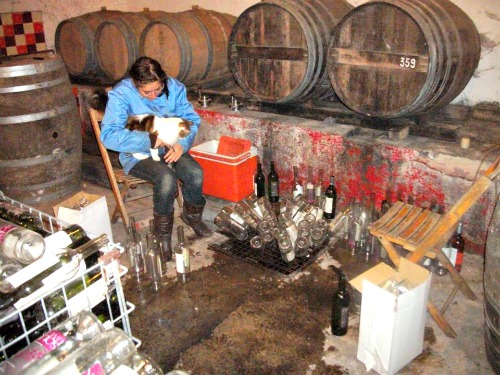
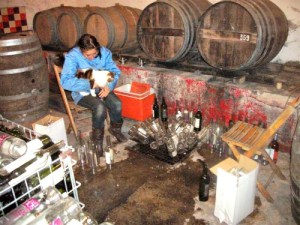
No use crying over spilled wine! Rachel in the cellar of a now-defunct winery near Perpignan, France; photo credit: Rachel Kanev.

Hmmm… I think I detect something of the entrepreneur in you, alongside your intrepid traveller’s spirit! And now let’s have a look at a few of your favorite photos from your travels to France and China.
Sure! I took this first photo in a wine cellar in a small hamlet near Perpignan, some way off the coast of southern France. I’d been helping out, but it was late December, and there was very little work left. Besides, the winemaker, whose name was Bernard, had gone bankrupt due to the stresses of organic farming. Our main task for the day, as his helpers, was to pour bottle upon bottle of wine down the drain as he looked on bemoaning the demise of the modern world. It proved a good way to get skillful with a corkscrew!! And I think poor Bernard appreciated our efforts quite a lot. Just think if he’d drunk all that wine in his cellar, it would have sent him spiraling into an even deeper fit of depression…
RK_dragonriceterraces

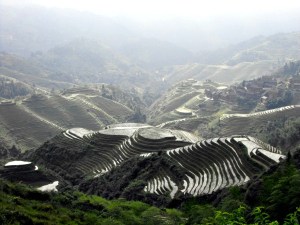
China’s Longji (Dragon’s Backbone) Terraced Rice Fields are so named because of their resemblance to a dragon’s scales; photo credit: Rachel Kanev.

The next photo provides a glimpse of the glorious Dragon rice terraces of Longshen, in China’s Guangxi province. Amazing terraces stretch as far as the eye can see. I visited some years ago and remember being in awe at the combination of nature’s beauty and the skillfulness of the human hand. I had quite an adventure ambling through the fields with two of my Chinese friends. We got lost and at one point envisaged spending a cold night cuddled up to the cows. In the end we reached our hostel, at the top of the terraces, by nightfall. I returned again last year and was saddened to see that the beauty of the fields has been marred by the greedy hand of tourism. Huge plastic cable cars now transport visitors to the top, and the local villagers are paid to dress in traditional clothes.
RK_AnotherBernard

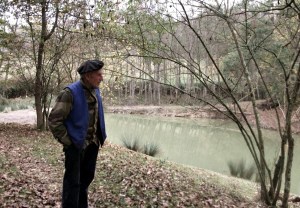
A French farmer, another Barnard; photo credit: Rachel Kanev.

Last in this series we have another Bernard who stumbled into my traveller’s path. This Bernard is an 80-year-old farmer with whom I lived on my own for a week. His farm is an hour away from the nearest town and is completely self-sufficient. He grows his own organic vegetables and was fit enough to hack up the ground with a pickaxe when the underwater pipes burst (ironically, I had left the home of Bernard number 1 because his pipes had burst and the water system needed to be repaired, only to be faced with more burst pipes at the home of Bernard number 2!).

I love the first photo just because it looks as though you’ve broken into someone’s cellar and are drinking all the wine!! The dragon terraces appear so surreal to me because they are so different to the flat rice fields of Thailand, where I live. I wish I could see them one day. I know you take a lot of photos and these next four, I believe, have a special significance for you. Can you explain?

Not all who wander are lost…

The following is a photo I took of a photo of Bernard number 2, which was taken some fifty years ago, when his newly polished army boots took their very first steps away from the small village on the outskirts of the Pyrenees, where he was born. He bid farewell to the farm he’d grown up on and to the parents who’d raised both him and the thriving trees and crops that had formed the backdrop to his childhood. By the time I encountered Bernard, nature had outlived his parents but their legacy remained. He is now a beekeeper and organic vegetable farmer, tending to the very same trees and plants that his father and his father’s father had cared for. Though he has no human family, the trees you see in my other photo of Bernard (above) appear to me to be his forefathers; they are equally his children.
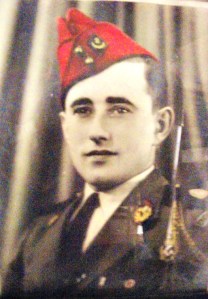
Bernard as a young man

The French farmer Bernard as a young soldier; photo credit: Rachel Kanev.

The next photo was a fluke as I managed to capture an ad for Longines watches showing Kate Winslet just as the sun was setting. In that fleeting instant, one can see Shanghai’s varied transportation, high-rise buildings and red lanterns—that curious amalgamation of Western modernity and Chinese traditionalism that is everywhere around you in the city.
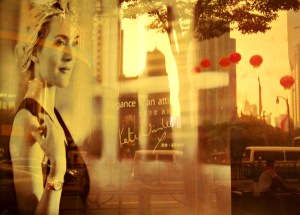
RK_ShanghaiSunset

A British beauty, a Swiss watch and a Shanghai sunset; photo credit: Rachel Kanev.

Cambridge is my home town and I think of it much like a family member, having watched it age and evolve just as it has silently witnessed me grow and change. I love its grandiose architecture, endless greenery, and the way winter and spring intertwine in front of the University’s palace-like structures that are fit for if not a queen then the rulers of academia, to which I never belonged.
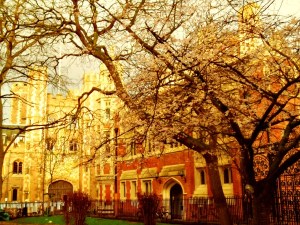
RK_CambridgeUK

The dreaming spires of Cambridge; photo credit: Rachel Kanev.

Here my sister explores the labyrinth-like forestry of a park near where we live in Cambridge. It has amazing multi-coloured plants I have never seen anywhere else before and huge trees that watch over you like silent giants. I like this photo because she looks like Alice in Wonderland with her long, thick flowing locks!
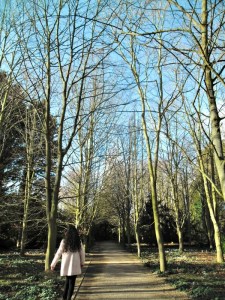
RK_SisterinPark

The great outdoors near Cambridge, UK; photo credit: Rachel Kanev.

Is photography sometimes a moral decision?

I love your explanations as they show us the profound effects a picture can have on its creator, something the viewer can never fully appreciate. Tell me, do you ever feel reserved about taking photos of people, particularly when they are conscious that you are doing so?
For me, the morality of taking photos of strangers has always been ambiguous. I think of it whenever I see photos of human suffering. I believe I have the right to use my camera to record the world but without intruding on it. At what point does the power of images and the need for education and understanding through the push of a button and flash of a light become intrusive and affect the lives of others in a negative way? I’ll give you an example from my own experience. The Western media has focused almost exclusively on China’s explosive economic growth when in fact 1.6 million people (11.8 percent of the population) still live below the poverty line. When taking the train, part of me would like to photograph the dirt-covered, barefooted children asleep on newspapers or the train door frozen from the inside as passengers are left to deal with the icy temperatures of the North (-37°C). But feeling intrusive, I refrain.

Do you also feel self-conscious in Asia?
It’s difficult being subtle, given the colour of my hair and skin, and the stamp on my passport. Noticing me walking the streets of China, many Chinese will assume, quite rightly, that I am Western but quite wrongly that I must therefore have dollar bills rolling from my body like a central bank printing press. Often I do not wish to fuel their prejudices by whipping out a digital camera, however small, before their eyes.

As a resident in Thailand, I can empathize with those views, especially the general Asian misconception that all Westerners are rich. Although this can be annoying, I do believe these views are changing for the better, as the younger generation becomes more socially aware through travel and better education. Now let’s turn to the technical stuff. Some of our readers may want to know what kind of camera and lenses you use.
I have a small Samsung camera that fits neatly in the palm of my hand. It’s nothing fancy and often leaves something to be desired in terms of quality, but it was a birthday gift years ago and has sentimental value, having been my only travel partner across unknown lands. Whatever it lacks in lens quality, Windows Photo Gallery makes up for in magical editing power!

Finally, do you have any advice for wannabe photographers who are traveling or living abroad?
Wander through villages, peel garlic with a farmer, shake hands with a prince, run through jungles, leap into waterfalls, swing across the rainforest wilderness and lose a leg to the marble rocks—see the world and allow the world to be seen. Travel, live, eternalize what you see with a photo.

Great non-technical advice, Rachel, that’s right up my street! I’d like to thank you for taking the time to tell your fascinating story in this interview.

* * *

Readers, what do you make of Rachel’s experiences and her photography advice? And do you have any questions for her on her photos or her travels? Please leave them in the comments!

And if you want to know more about Rachel Kanev, don’t forget to visit her blog, Globe Drifting. You can also follow her on Twitter or even shoot her an email.

(If you are a photographer and would like to be interviewed by James for this series, please send your information to ml@thedisplacednation.com.)

STAY TUNED for next week’s fab posts!


If you enjoyed this post, we invite you to register for The Displaced Dispatch, a round up of weekly posts from The Displaced Nation, with seasonal recipes, book giveaways and other extras. Register for The Displaced Dispatch by clicking here!

Related posts:

LOCATION, LOCUTION: James Ferron Anderson, weaver, glassblower, soldier – and award-winning novelist

Author photo – James Ferron Anderson

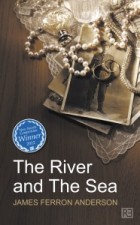
In this month’s “Location, Locution”, expat crime writer JJ Marsh interviews James Ferron Anderson, author of  The River and The Sea.

James was born in Northern Ireland, and worked there as a weaver, glassblower and soldier. He eventually had children, moved to Norwich, UK, studied at UEA, and began to write in different forms, including poetry, short stories, plays and, more recently, novels. One of his first short stories, The Bog Menagerie, won the Bryan MacMahon Short Story Award. He won an Escalator Award winner for I Still Miss Someone, and a Writers’ Centre Free Reads Award winner. The River and The Sea won the Rethink Press New Novels Award in 2012, and was published in November 2012.

The River and The Sea is set in British Columbia. James is currently working on Terminal City, set in Vancouver. While he’s visited British Columbia and Vancouver many times (his once estranged brother lives there, but that’s another story) he has never lived there.

Visit his website at jamesferronanderson.com.

Which came first, story or location?
Location, and more so as I continue to write. I’ll stick with Terminal City, the novel I am currently working on, but it applies equally to The River and The Sea. I was already studying the history of British Columbia, and focusing on Vancouver, when I read that Errol Flynn had died there. It was the human touch that caught my attention: once flamboyant athletic actor reduced, much against his will, to selling his last possession of any worth, his yacht. Shattered, riddled with diseases, looking like seventy instead of the fifty he actually was, he dies. But if my head had not already been filled with images of Vancouver from its lumber town days in the early 1900s to its evolution into the city of glass it is today I may not have found myself, I would say unintentionally, making up stories based around a Flynn-type character.

Politics and mores are as an integral part of a location as are its streets or hills. It was what I knew of the political aspects of this West Coast city in the 30s and 40s that determined that Terminal City would be a crime story. I wanted that mixture of danger and timidity that noir provides: the lure of the forbidden and the pulling back from it. I’d say location determined the form, feel and nature of the book. The rest was my regular desire to tell stories of how people need each other, hate each other, love each other and dispense with each other.

Simply put, it begins with location, finding an interesting event and/or person in that location when I’m not knowingly looking, and getting hooked.

What’s your technique for evoking the atmosphere of a place?
I think finding myself writing a story set in Vancouver (and it felt like finding more than choosing) was a just a wonderful gift. For a start, almost no one in the book was born in the city. They have a past at variance with their present, having come there from across the world for their own purposes. They are testing it, examining it, seeing what they can get from it. Will they be satisfied with what they’ve found? With the people they become over the twenty years of living there from 1939 to 1959? It makes the city, like the Thompson River in The River and The Sea, a protagonist in the book.

Which particular features create a sense of location? Landscape, culture, food?
Vancouver is a mild-weather city with plenty of rain. For noir it knocks LA into a cocked hat. It’s a city on a great bay so there are beaches, ships pass in and out visibly and constantly, there are well-forested and, for large parts of the year, snowy mountains rearing up just across Burrard Inlet. The wild and magnificent outdoors is no more than half an hour away, even in 1959.

Vancouver is a port, and more culturally mixed than an interior city. It’s in the far west of the continent: the final destination, like it or not, for the drifter or seeker after a better life. A large Asian presence leant, certainly in the period of which I am writing, a feeling of tension to nightlife, whether justified or not. My desire to use all that shaped the story.

Buildings matter. I have old all-wood housing from when Vancouver first laid down its streets side by side with the rise of its first multi-storey offices: a city in flux, home to people from elsewhere, also in flux, looking for roots and stability, looking for meaning too in the aftermath of a war.

How well do you need to know the place before using it as a setting?
I couldn’t imagine locating a story in a place I didn’t know well. I was relishing knowing Vancouver more and more anyway. To set a novel there was an excuse to know it better again, from visiting, diving into the City Archives on-line, to examining Google Earth Street View for hours. Plenty, then. I want to make what I write correct as well as relevant to the story. That doesn’t mean that very much of what I know has to go on the page. I read a comment that Colm Toibin in writing his novel on Henry James, The Master, wore his learning lightly. I want to know everything that’s relevant, and more, and use it lightly. The tip of the iceberg theory.

There are tricks also. Why would a local person wonder or remark on anything like the view or the tram tracks in the streets? I feel description has to grow out of incident and dialogue in the narrative. The first person narrator of Terminal City has, in the 1939 scenes, only lived in Vancouver for a year and is still coming to terms with it. He can wonder and notice and remark a little more freely and yet, hopefully, realistically. In 1959 he can reflect on changes, good and bad.

Could you give a brief example from your work which you feel brings the location to life?

The River and The SeaFrom The River and The Sea:

‘Snow was falling and visibility down to a few feet. We stopped in the afternoon and managed to light a fire and had tea and sugar. In a break in the snow Harry saw a raven. That meant there were caribou, and on the move.’

‘It did, did it?’

‘For a certainty, Harry said. We crossed a frozen lake, for easier walking, and came back onto the river. The wind was unrelenting. Even on the lake it took us four hours to make a couple of miles.’ Edward drank his tea. This was the most talking any of us had done for a long time. ‘We found a little clump of spruce. We ate some of the hide matting for the first time, but neither of us slept from the cold and the need to keep the fire going.’

It’s a narrative told to inform someone else and, almost incidentally, informs the reader. The intention was to convey their location as a site of cold, hunger and desperation, but it had to be an integral part of the story, not a piece of description standing to one side.

Which writers do you admire for the way they use location?
Charles Dickens in Chapter Three of Great Expectations uses the weather to bring alive his location when Pip runs in the morning to meet Magwitch.The mist was heavier yet when I got out upon the marshes, so that instead of my running at everything, everything seemed to run at me.’ Wonderful stuff that took me to that location so effectively I still picture it. Anton Chekhov is marvellous for both countryside and city. Yalta is so alive, so liveable-in, in Lady With a Lapdog. W.G. Sebald, not a favourite writer of mine, is nevertheless someone whose ability to put me in his location I much admire.


Next month’s Location, Locution:  Jill interviews Charlotte Otter, South African author – now living in Germany, whose homeland provides fertile fictional soil.

 * * *

JJ Marsh grew up in Wales, Africa and the Middle East, where her curiosity for culture took root and triggered an urge to write. After living in Hong Kong, Nigeria, Dubai, Portugal and France, JJ finally settled in Switzerland, where she is currently halfway through her European crime series, set in compelling locations all over the continent and featuring detective inspector Beatrice Stubbs.

_(75_of_75)

Author photo: J J Marsh

STAY TUNED for our next post!

If you enjoyed this post, we invite you to register for The Displaced Dispatch, a round up of weekly posts from The Displaced Nation, with seasonal recipes, book giveaways and other extras. Register for The Displaced Dispatch by clicking here!

Related posts:

EMERALD CITY TO “KANSAS”: Amy Rogerson on seeing the Wizard of Expat Life and returning home (for just six months)

Amy Rogerson wrapping up warm in the UK at Christmas (her own photo); the Ruby Slippers (CC); corn path (Morguefiles).

Amy Rogerson wrapping up warm in the UK at Christmas (her own photo); the Ruby Slippers (CC); corn path (Morguefiles).

Welcome to “Emerald City to ‘Kansas,'” a series in which we focus on expatriate-into-repatriate stories. This month our subject is Amy Rogerson, an Englishwoman who blogs at The Tide That Left about trailing her husband (aka “Mr Tide”), at breathless pace, all around the globe. The couple now live in Dar es Salaam in Tanzania, but in the past four years have also made homes in South Africa, Angola, Qatar, Russia, and Libya. As we catch up with Amy, she is back to the UK (as of April 7th) for a six-month stay. What is it like going “home” again after such a life of adventure? Without further ado, let’s dig into a slice of Amy’s “back to Kansas” story.

—ML Awanohara

To Oz? To Oz!

I didn’t really choose expat life. Rather, it chose me when I fell head over heels in love with a nomadic man. I met my husband five years ago in his final weeks in the UK before he moved to Libya. We continued our relationship long distance for a year, but eventually knew that one of us had to move. I was in a job that made me miserable, whilst he was welcoming new opportunities at work, so it seemed for the best that I move to Benghazi to be with him.

Lions and tigers and bears, oh my!

Moving to Libya was so far beyond my comfort zone that I shocked both myself and those who loved me most. All I knew is that I wanted to be with the man I loved. I never expected my life to become that of a serial expat. As well as living in Libya, we’ve also lived in Russia, Qatar, Angola, South Africa and Tanzania together. In fact, my home is still in Tanzania; repatriation to the UK is just a temporary move for a project I am working on, and I fully intend to return to Dar es Salaam and my wonderful husband in just under six months from now.

We’ve been gone such a long time…

I’m surprised at how much I’ve grown to love my new lifestyle. I’d never wanted to travel or live abroad before I met my husband, but now I struggle with the idea of ever “going back to Kansas” permanently (not that I don’t think I will one day!). I’ve discovered that life can be different from what I was brought up to believe. If choosing the expat life has meant I’ve had to say goodbye to any dreams I had of the picket fence, the family home, the stable job—that isn’t going to happen, at least not for a while—it isn’t necessarily a bad thing.

What have you learned, Dorothy?

Living in six countries in four years, I’ve learned to adapt to change. Nothing stays the same, and I’ve had to be flexible. That flexibility doesn’t just apply to where we live and work, or what our holiday plans are. I’ve also had to learn that there is not just one way of doing something, especially once I started working for a South American company in the Middle East and now in Africa. I’ve had no choice but to get my head round different ways of doing things that I used to believe we do best “at home”. As a Brit working with people from different parts of the world, I’ve often felt as though my colleagues and I weren’t talking the same language when it came to business practices and relationships. But I’ve come to see that instead of believing the British way is right, it helps if I can open my mind to other approaches, some of which may work if you’re willing to give them a try. With time I’ve been able to overcome the differences and pick up skills that will no doubt help me in future.

No place like home?!

Repatriation is bitter-sweet for me. I didn’t really want to return to the UK right now, but circumstances have dictated otherwise. Having been gone from the UK for four years I’m really struggling with settling back in. Much of what I knew before now seems unfamiliar. My time abroad has coloured my behaviour and expectations. In a sense, I’m having to relearn some of that most basic stuff that I found so hard to let go of when I became an expat.

Oh dear! I keep forgetting I’m not in Kansas!

I once thought huge shopping centres where I could buy everything I needed in one go were the perfect solution to hectic British life. Now I find myself shying away from the crowds of people, the flashy goods, and the elevated prices for things with a short shelf life. During my life abroad, I often missed the choices that were available to me in the UK, be it in the supermarket, on the high street, even on the television, but now I just feel overwhelmed and a tad spoilt by all the options. In adapting to new ways of living and thinking abroad, I no longer completely fit in the country I was born and raised in. Perhaps I need to look at this six-month repatriation like a new expat assignment and approach it like I would any other move. I need to be open to adapting. I need to forgive myself for not “feeling at home” immediately when I wouldn’t ask that of myself anywhere else. I’m incredibly lucky to have so many wonderful connections here in the UK. I expect it won’t be long before I feel more settled at home than I do after a few weeks. One thing I do know: the call of expat life hasn’t quietened yet.

* * *

Thank you, Amy, for such an honest, heart-felt account about what it feels like to go home again, if only for half a year. It’s interesting that you’re now having to apply the adaptability you learned from expat life to feeling more at home in your native UK. Readers, can you relate to what Amy says?

STAY TUNED for tomorrow’s fab post!

If you enjoyed this post, we invite you to register for The Displaced Dispatch, a round up of weekly posts from The Displaced Nation, with seasonal recipes, book giveaways and other extras. Register for The Displaced Dispatch by clicking here!

Related posts:

JESS IN JAPAN: After all the hype, cherry blossom season underwhelms

JessinJapan_column

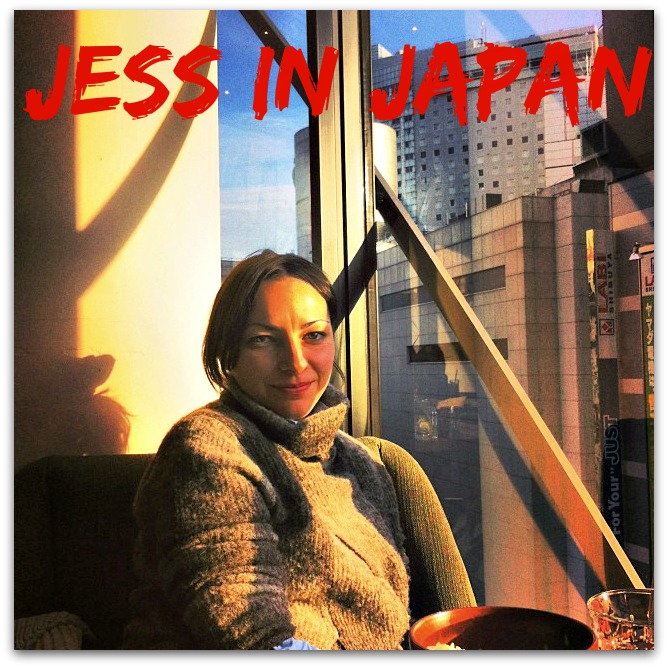
Jessica Awanohara in Tokyo (winter 2014); photo credit: Hiro Awanohara.

Jessica Awanohara moved from New York to Tokyo with her Japanese husband, Hiro, at the end of last year. What is it like to step “through the looking glass” and treat Japan as a home rather than a quirky place to visit? Jess keeps us abreast of her progress via this occasional column-cum-photos.

After a long, cold, all-around terrible winter, April is here, and in at least half of this beautiful world of ours, that means that spring has sprung! Crocuses are peaking through the nearly frozen plains of Central Park; monarch butterflies are beginning their multi-generational migration from Mexico to northerly climes; and in Tokyo, where I now reside, the most spectacular seasonal transition of them all—the blooming of the cherry trees, or sakura—has been taking place.

This being my first sakura season in Japan, I wasn’t entirely prepared for the national obsession with tracking when, where and how to best view the blossoms. In fact, for at least three weeks, sakura viewing was the only thing anyone talked about. Friends regaled us with stories of sakura seasons past, advising on the best and worst parks in Tokyo for beholding the spectacle of the storied blossoms. Like stock tips, they whispered these insights authoritatively, as though acting upon them would determine our very future.

I learned, for instance, that Inokashira Park, in the northwestern part of the city, was “too crowded, wild, and ‘diverse'” while Nakameguro, in the southeast, was the “ideal spot for a first-timer” like myself.

Meanwhile, the sakura craze was heightened by CNN-style coverage on TV. Whole segments of the morning and evening news were dedicated to maps, predictions, histories, and images detailing the slow ascension of blossoms from Okinawa to Hokkaido.

By the time the trees were showing their first buds, all I could think about was the prospect of attending a viewing party. In case you haven’t heard, celebrating under a fully blossomed cherry tree, a festival known as ohanami, is as eagerly anticipated as the blossoms themselves. All of Tokyo, it seems, comes out for marathon sessions of en plein air eating and drinking, presumably turning as pink as the flowers.

But as luck would have it, this year things would be different. Tokyo was soaked by two straight weeks of hard rain and cold weather. The delicate pink sakura petals were washed away before they were able to reach full bloom.

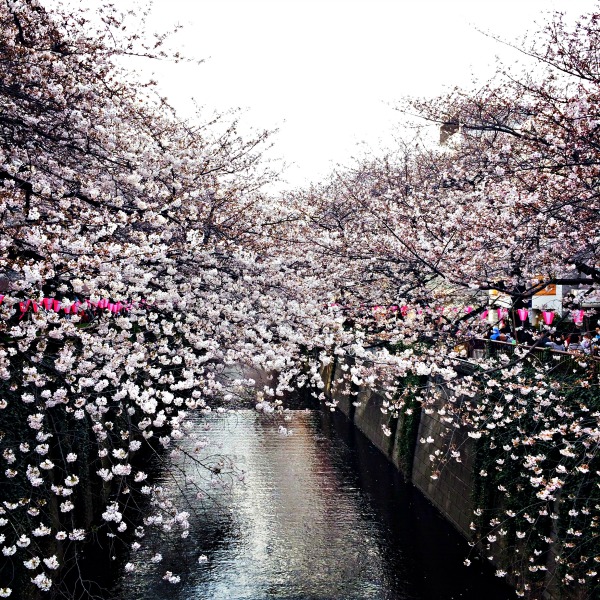
Braving these inclement conditions, my husband and I biked to a couple of nearby parks and well-known streets to soak up whatever we could (hopefully without getting too soaked!). But the grey skies and cold weather kept our spirits, along with the blooms, at bay. In fact, it was almost too depressing to document the mostly bare branches and paltry spray of revelers, but here, readers, are a few mementos of my first cherry blossom season in Tokyo:

Early sakura in Nakameguro; photo credit: Jessica Awanohara.

Early sakura in Nakameguro, alongside Meguro River, the recommended destination for newbies; photo credit: Jessica Awanohara.

At least someone is trying to get his party blooms on; photo credit: Jessica Awanohara.

At least someone (see man on curb) is trying to get his party blooms on; photo credit: Jessica Awanohara.

The actual best spot to view cherry blossoms this year, snapped on the way to an interview in Shinsen; photo credit: Jessica Awanohara.

The actual best spot to view cherry blossoms this year, snapped on the way to an interview in Shinsen; photo credit: Jessica Awanohara.

* * *

Thanks, Jessica. Sorry to hear it was such a wash-out! Readers, Jess’s experiences raises a classic Displaced Q: How many of you have sought an iconic experience during your stay abroad that didn’t quite live up to your expectations?

STAY TUNED for tomorrow’s fab post!

If you enjoyed this post, we invite you to register for The Displaced Dispatch, a round up of weekly posts from The Displaced Nation, with seasonal recipes, book giveaways and other extras. Register for The Displaced Dispatch by clicking here!

Related posts:

HERE BE DRAGONS: The expat life as fuel for fantasy writing

Serpent Map Collage Drop Shadow

(Clockwise from top): Detail of the medieval map Carta marina; the Speicherstadt (warehouse district) in Hamburg, Germany; Andrew Couch (photo credit: Andrew Couch).

Welcome to the Displaced Nation’s very own Game of Thrones. To be eligible, you simply have to be, or have been, an expat or world traveler of some kind, and open to seeing the connection between the international life and fantasy fiction. Andrew Couch, an American expat in Germany, will be our coach (no pun intended!). Though he has not been playing the game for long, having published his first fantasy novella only last month, he is already dancing with dragons, and thinks that you should be, too…

—ML Awanohara

Living as an expat in another culture forces you to interact with the world in a different way. You cannot rely on the habits of your home and things around you are strange—sometimes really really strange.

Yet they are perfectly normal to the locals.

This echoes my experience of reading (and now writing) fantasy fiction. I didn’t really think about it that way until I started writing this post, but I guess it should have been obvious all along.

Trip the “expat life” fantastic

I’ve always loved the fantasy genre, ever since I could read. The first book I remember was Voyage of the Dawn Treader, by C.S. Lewis, although I certainly delved into Tolkien’s The Hobbit very early on as well. Both are fantasy but also involve travel. As a child, I was drawn to the imagery of the strange places depicted in these books.

Maybe that feeling of diving into fantastical worlds is what led me to a life of travel as an adult, and ultimately to the life I now have in Germany as an expat.

The characters in fantasy novels accept their world as it is. They might accept that magic exists in a specific form—or that elves, trolls and ogres wander the street selling sausages.

Is this really so much of a stretch from what we accept as expats sometimes?

After living for six years in Germany, I almost take for granted how orderly everything is: I like knowing that the tram will come at an exact time. I’ve also come to appreciate being able to sit in a restaurant all evening without anyone shoving the bill at me to pay and leave.

I do notice, though, that the more I integrate with the local life, the more I crave a creative outlet. Several years ago, when I’d been living in Freiburg for a couple of years, my apartment lease was running out and I had to decide: should I find a new place to live, or was it time to move on? In the end, I decided to buy my own apartment, which tied me still more closely to the wonderful town of Freiburg. I was happy but also felt that doors were closing, and I needed to seek other outlets. I ended up starting a blog, Grounded Traveler: Expat life in Germany and still seeing the world. I tried writing fiction, too, but must not have been ready.

Just last year I made a career shift. For 13 years I had worked as a Web developer for an employer, but I decided to leave and start my own freelancing business. Being my own boss has given me the freedom to do what I want when I want, but there are limits on that freedom as I must constantly be on the lookout for projects.

QueenOfCloudPirates_coverCraving the fantastic once again, I started writing a series of fantasy novellas. I self-published the first episode, Queen of the Cloud Pirates, in March and am working on the next one now, based on the inspiration of living and traveling abroad.

Thinking of blue almonds (Polish for “daydreaming”)

Much of my inspiration for writing fantasy comes from the places my wife and I visit on our travels. My follow-on novella to Queen of the Cloud Pirates (I’ve just finished the first draft) is set in a fantasy port city.

Not long ago, my wife and I traveled to Hamburg for a few days and spent time in Speicherstadt, an area of the city full of canals and towering brick warehouses with elevators and cranes around them. On that occasion I let my imagination go, wondering what a sword fight among the ropes and narrow stairs would be like. This has driven a fair amount of the book’s setting.

Of course inspiration can come from anywhere, not just from a city’s wonderfully distinct architecture but also from more mundane settings. For instance, here is a snippet I wrote after glimpsing an unusual face on the subway in Berlin:

A man sat hunched over in the subway seat, his chin piled on top of both hands steadying himself on his cane. A white fluffy mustache flowed over the side of his hands like a cascade of falling clouds. His oh-so-attentive eyes, in contrast to his nearly decrepit body, watched from beneath equally fluffy eyebrows that flowed up in the same way the mustache floated down. Was this a visitor from the realm of clouds come to watch us on earth? I pondered the significance of seeing this man underground as I got off at my stop and watched him through the window as the train sped away.

I am constantly collecting such snippets and images on my travels. In fact, I’m now half-way through another story based on a mis-heard subway announcement about the train ending and needing to transfer to the “elephants”—well, that’s not what the conductor said but it’s how I heard it. I have been thinking about the story so much I can’t really remember the original line, but I expect I heard something about transferring to bus line 11 (elf in German) and, despite being fluent in German, thought of elephants.

Here Be Dragons (in Latin, Hic Sunt Dracones)

Readers, do you collect thoughts and ideas when traveling to, or living in, strange surroundings? And if so, are you inclined to turn these snippets into stories?

While I have a fantasy-oriented imagination, and tend to see dragons or other fantastical beasts when venturing into new territory, I imagine that such snippets could support any genre of writing.

I look forward to seeing you next month, when I will continue exploring how encounters with different landscapes, cultures, cities, architecture, and people can stimulate the imagination in some strange and wonderful directions. Let me know in the comments if you’re fantasizing about any particular topics, and I’ll see if my imagination can stretch to accommodate.

Andrew Couch has been a fantasy book nut since childhood; he really has not grown up much since then. After struggling to write his own games for years, he is now creating fantastical worlds in a series of novellas that echo the TV shows, anime and role-playing games of his youth. Beyond fantasy he is an avid blogger and a world traveler who resides in Germany. To learn more about Andrew, check out his blog, Grounded Traveler, and follow him on Twitter: @groundedtravelr.

STAY TUNED for next week’s fab posts!

If you enjoyed this post, we invite you to register for The Displaced Dispatch, a round up of weekly posts from The Displaced Nation, with seasonal recipes, book giveaways and other extras. Register for The Displaced Dispatch by clicking here!

Related post:

For this intrepid Irish “ruin hunter,” a picture says…

Ed Mooney 1,000 words Collage

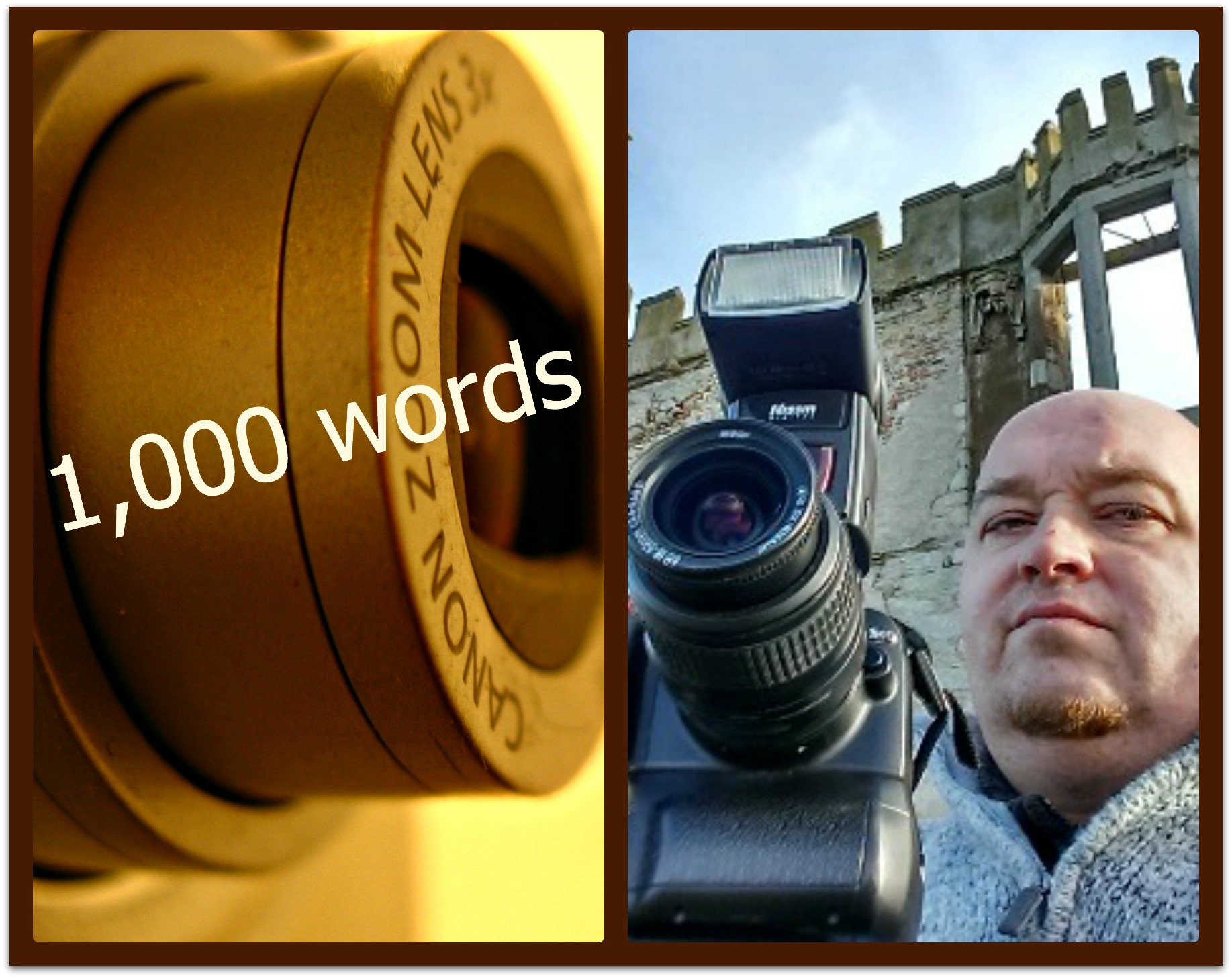
Canon zoom lens; photo credit: Morguefiles; Ed Mooney in front of the ruins of Ducketts Grove, County Carlow (photo credit: Ed Mooney).

Welcome to our monthly series “A picture says…”, created to celebrate expats and other global residents for whom photography is a creative outlet. The series host is English expat, blogger, writer, world traveler and photography enthusiast James King, who thinks of a camera as a mirror with memory. If you like what you see here, be sure to check out his blog, Jamoroki.

My guest this month is 38-year-old Irishman Edward (Ed) Mooney. His story is quite different from previous guests for several reasons, the main one being that he is not an expat. On the contrary, he travels within the confines of his native Ireland.

That said, Ed does cross boundaries, at least in a temporal sense. He loves nothing more than to immerse himself in an obscure historical site, exploring Irish history, lore and mythology while also photographing the surrounding ruins, to keep a record of what remains from generations past.

I really like the name Ed has given to his hobby: “ruin-hunting”. Ed tells me that ruin-hunting merges Past, Present & Future. By researching the history behind a place, he pays tribute to the Past. By writing about the experience, he brings it into the Present. And by posting his article, along with his photos, on his blog, he preserves his findings for the Future.

I have been following Ed for some months and love the way he weaves historic research into (mostly) black-and-white images.

* * *

Hi, Ed. Thanks for joining me at the Displaced Nation. I know you live with your young family in Kildare, but where were you born and what gave you the urge to travel around Ireland photographing ancient ruins?
I was born in Dublin, where I lived until flying the coop at 17. I moved to Kildare for work. I only got into photography seriously three or four years ago. With a young family, I don’t get to go abroad very often. But I am fortunate enough to travel within Ireland itself, which with its rich heritage offers an abundance of fascinating sights. And the crazy thing is, the majority of them are relatively unknown and rarely visited. It is these off-the-beaten-track places that I tend to concentrate on while traveling the country, attempting to capture them with my DSLR camera.

“I love everything that’s old…” —Oliver Goldsmith

You seem to have found an interesting niche. Can you tell us a little more about this “ruin hunting” hobby of yours?
It all started in 2011. I had just gotten my first DSLR and joined the local camera club, but had very little opportunity to get out and about shooting. I wasn’t into wildlife or landscape photography like some of the other club members. I guess I was searching for my niche, as you put it. One day a flyer came through the letterbox, which had an image of a nearby historical site called the Rock of Dunamase, in County Laois. Though I didn’t know it at the time, this was the beginning of what would become an obsession. A few days later, I located Dunamase and went exploring. Now, looking back at the photos, I cringe—but at the time I thought they were the best shots I’d ever taken. Around this time I had starting blogging and decided to post a brief essay on the history of Dunamase, along with the images. Next thing I knew, I was spending all of my spare time searching out new sites. Now that the kids are a little older, I have been able to take them on some of my trips. To date I have explored sites in nine counties with plans for many more over the coming months.

When you said “a flyer came through the letterbox…,” I immediately thought of a WWII fighter pilot. I would love to know more about what inspires you to spend so much of your spare time visiting historical places.
My inspiration comes from my deep love of history. In my early twenties, I joined what was then known as the Heritage Awareness Group, or HAG. We visited sites such as Newgrange, Tara and Baltinglass Abbey. Nowadays my favourite ruins are castles and Neolithic sites such as stone circles and cairns, although I am forever coming across many ecclesiastical sites which are interesting in their own right and make for some stunning shots. It’s quite hard to find the locations so I’ve created maps for each county, and make a point of recording every site I visit on my blog along with an interactive map showing the exact location to assist other travellers.

It’s great that you record your findings in so much detail and include exact locations in case others are inspired to follow in your footsteps. Ireland is a small country, unless you get lost. Tell us, where are you now, how did you end up there and what is life like in that part of the world?
We have been in Monasterevin, Kildare, for almost seven years now and absolutely love it. It’s a different way of life to Dublin. If I didn’t have to commute daily to the City to work, I would probably return there rarely. The great thing about Monasterevin, besides the relaxed atmosphere and close community, is that I am situated almost in the centre of Ireland. I can travel to any part of the country in two to three hours, which is great considering the amount of travelling involved in “ruin hunting”.

Rock of Dunamase. Photo credit: Ed Mooney

Rock of Dunamase. Photo credit: Ed Mooney

I’ve never been outside Dublin but I hear the countryside is beautiful. Other benefits are that you never run out of Guinness and you just won the Six Nations rugby! Thank you for sharing some of your photo shots which capture a few of your favourite memories. Can you describe the story behind them and what makes them so special?
These three are from recent shoots. The first, of the Rock of Dunamase, is a special place not just for the stunning views and fascinating history but also because it’s where my journey started.

Church ruins in Laois; photo credit: Ed Mooney.

Church ruins in Laois; photo credit: Ed Mooney.

The second photo is of another site I discovered in neighbouring Laois, which, with its stunning views, constitutes a ruin hunter’s paradise. This one is special on a personal level as well, being the first ruin I visited with all three children. In the chancel to the rear of the church is an old iron gate blocking the entrance to a vaulted mortuary chamber. Ryan, my eldest, had an interesting observation on the chamber: “Daddy, that’s where the Vampires live.” Now how the heck did he come up with that? Have you ever tried convincing an eight-year-old that something doesn’t exist?

Skryne Hill Church; photo credit: Ed Mooney.

Skryne Hill Church; photo credit: Ed Mooney.

The third is of the church that sits on Skryne Hill, the site of an early Christian settlement. To this day my memory of Skryne remains vivid. The tower is inaccessible due to a very heavy iron gate that on examination appeared to be rusted shut. I shone my torch through the bars on one of the windows. Inside were a number of interesting stone artifacts that I wanted to capture. So I set up my flashgun and shot through the bars. On the second or third flash something physically grabbed my camera strap and pulled it into the tower. It all happened so fast, but somehow I managed to pull that camera away from the window while shouting a few expletives. At first I wondered if it might have been a draft of some kind that had caught my strap, but it could not have been as I was pressed right up against the opening and there was no wind to cause a draft. Then I thought that maybe someone was inside, but there was no way for a person to get in or out of the tower. To this day I still can’t explain what happened. But it certainly left a lasting memory.

“Memory, in widow’s weeds, … stands on a tombstone.” —Aubrey de Vere

Great memoriesand that last story is quite eerie. But I suppose you would expect the odd ghost or two in buildings so old? Now, out of these many destinations, do you have any that stand out as your favorites?
If you haven’t already guessed, old ruins are what attract my attention, be it a crumbling castle, a neolithic stone circle or standing stone, or an ancient church overgrown with ivy. Here are three of my favorite places:

Brownshill Dolmen, County Carlow; photo credit: Ed Mooney.

Brownshill Dolmen, County Carlow; photo credit: Ed Mooney.

Ballymoon Castle, County Carlow. Photo credit: Ed Mooney

Ballymoon Castle, County Carlow; photo credit: Ed Mooney.

Cillbharrog Church & cemetery; photo credit: Ed Mooney.

Cillbharrog Church & Cemetery; photo credit: Ed Mooney.

Can you explain why these particular places inspire you?
It’s kind of hard to explain but once I set foot on the site of an ancient monument, something about the atmosphere affects me, and a flip switches in my head. I feel as though I’m stepping back in time. The modern world disappears for a while and I get to experience something really special. With my photography I try to capture that experience and hopefully portray it to the viewer. Mood, atmosphere and a sense of the past are the most important elements for me to enjoy shooting at a location.

I can assure you, Ed, that, for me, you usually achieve it. Your photos make me feel as though I’m there, not you. I know people aren’t a part of your ruin hunting but I want to ask you all the same if you ever feel reserved about taking photos of people on your travels, particularly when they are conscious you are doing so?
I still enjoy getting out and doing some street photography from time to time and I have never really had an issue with shooting people, but then again I have had plenty of experience ranging from large events in Dublin down to small country festivals. I guess at the start I was a bit shy and unsure of how to approach shooting strangers, but once you learn how to engage with a subject it becomes fun. Some of the best shots I have taken were the result of strangers coming up to me wanting to have their pictures taken. Parades and street festivals are probably the best for doing this as everyone is relaxed and having a good time.

Do you ask permission before taking people’s photographs?
Most times I don’t have to. I find it amazing how people start posing once they see a camera in your hand. Obviously, with children you have to be really careful these days and should always get parental permission.

“Ireland’s ruins are historic emotions surrendered to time.”—Horace Sutton

Interesting—that last point would never be considered in Thailand, where I live. So would you say that photography and the ability to be able to capture something unique which will never be seen again is a powerful force for you?
Absolutely, I would say that most photographers constantly strive to get that once-in-a-lifetime shot. In my case the deeper motivation is to capture historic sites for posterity. As in many other countries, Ireland’s local and national heritage sites continue to disappear for good. Most people don’t care and the government is only interested in money. Take my home town of Tallaght, a suburb of Dublin. There were several castles in the area up until about 40 years ago. Now only a part of one remains. This scenario recurs with alarming regularity. So if I can capture the essence of a place before it is wiped away for good, I have done my job.

I see you use the word “job”. But I see it more as a calling and you, as a preservationist and historian. Either way you are doing an excellent “job”–one that incidentally reminds me of my last interview subject, Gaetan Green. He is trying to record China’s traditional landscapes before they fall to the forces of modernization. So when did you realize this deeper purpose?
Right from the start. The need to preserve the past was a major factor in motivating me to choose this path for my photography.

Now for the technical stuff at which I am far from proficient. What kind of camera and lenses do you use? And which software do you use for post-processing?
I still use my trusty Nikon D40 with kit lens. Yes it is outdated by today’s standards, but it has served me well over the last few years and taken a lot more punishment than it should have. I am planning to upgrade later this year and hopefully the D40 will be converted to shoot Infra Red, which is something I really want to experiment with. For my raw images ACR is a must, but my one stop shop for post processing has to be Photoshop. I currently use CS6 and it does everything I need. I still have various other programs sitting on my desktop but these rarely get a look-in.

Finally, do you have any advice for wannabe photographers who are traveling or living abroad?
If I was starting photography now I would say take the time to enjoy what you do and most importantly, research, research, research. Find out as much as possible about the place you are travelling to. Look at as many images of the place as you can, take inspiration from them and don’t go and shoot the same scene as everybody else. Look for a new angle or view. Don’t be afraid to get creative.

Thank you, Ed. It has been a real pleasure to interview you. Your story so far is fascinating. I say so far because I know one day you will run out of ruins in Ireland and you’ll be dreaming up your next historical project in places further afield.

* * *

Readers, what do you make of Ed’s experiences and his photography advice? And do you have any questions for him on his photos and/or experiences? Please leave them in the comments!

And if you want to know more about Ed Mooney, don’t forget to visit his excellent photography site. You can also like his Facebook page, follow him on Twitter, connect with him on LinkedIn, or shoot him an email.

(If you are a photographer and would like to be interviewed by James for this series, please send your information to ml@thedisplacednation.com.)

STAY TUNED for tomorrow’s post, the start of a brand new column on travel and fantasy writing, by Andrew Couch.

If you enjoyed this post, we invite you to register for The Displaced Dispatch, a round up of weekly posts from The Displaced Nation, with seasonal recipes, book giveaways and other extras. Register for The Displaced Dispatch by clicking here!

Related posts:
LOCATION, LOCUTION: Andrea Cheng, award-winning children’s author

Author photo: Andrea Cheng

Author photo: Andrea Cheng

In this month’s “Location, Locution”, expat crime writer JJ Marsh interviews Andrea Cheng, award-winning author of  books for children and young adults.  

Cheng’s first novel, Marika, was selected by the city of Cincinnati for “On the Same page,” a citywide reading program.  Honeysuckle House, Anna the Bookbinder, and Shanghai Messenger received Parent’s Choice Awards.  Grandfather Counts was featured on Reading Rainbow. Where the Steps Were, the first book that Cheng has both written and illustrated, received starred reviews in both Publisher’s Weekly and Kirkus. The Year of the Book, a Junior Library Guild selection, was reviewed in the NY Times and was followed by The Year of the Baby (2013 May). Cheng’s most recent title is Etched in Clay.

Some of Cheng’s books draw on her background as the child of Hungarian immigrants as well as the background of her husband, the son of immigrants from China. Others draw on the lives of her children growing up in inner city Cincinnati where she and her husband now live.  Andrea studied Chinese at Cornell University where she received a Masters degree in linguistics.  She and her family have traveled to both Budapest and Shanghai to get to know their extended families.

Which came first, story or location?
I think character comes first in my writing, followed by location, atmosphere, etc.  Plot or ‘story” come later.  I usually start with a character at a particularly salient moment in a specific place, and go from there.

Year of the Book

Cover art: The Year of the Book, by Andrea Cheng

What’s your technique for evoking the atmosphere of a place?
I have to have spent a fair amount of time in a place before I can evoke the atmosphere.  I have to know how it smells and tastes and looks and feels.

Which particular features create a sense of location? Landscape, culture, food?
Everything!  I think I focus a lot on language, the way people talk. I think it would be very hard for me to write a story that takes place in a location in which I cannot speak the native language of the people who live there.

Can you give a brief example of your work which illustrates place?
This is from my chapter book called THE YEAR OF THE FORTUNE COOKIE, coming out with Houghton Mifflin in May 2014.  It is for grades 3-6.  The main character, Ana Wang, is in Beijing:

It starts to rain.  The sky is almost dark, and the air smells like gasoline and charcoal.  We turn down an ally and wind our way behind some buildings.  “This is my home,” Fan says finally, opening a door with her key.

Inside the light is dim.  Her brother is watching television and her mother is cooking on a hot plate.  “This is my friend from America,” Fan says.  

How well do you need to know the place before using it as a setting?
I have to have spent time in the place and I have to understand the language of the people there.  The more time the better.

Which writers do you admire for the way they use location?
I just read Jhumpa Lahiri’s new novel, Lowland.  Although I think the book has some problems, I love her sense of place.

Next month’s Location, Locution:  Jill interviews James Ferron Anderson – weaver, glassblower, soldier, and now writer.

 * * *

JJ Marsh grew up in Wales, Africa and the Middle East, where her curiosity for culture took root and triggered an urge to write. After living in Hong Kong, Nigeria, Dubai, Portugal and France, JJ finally settled in Switzerland, where she is currently halfway through her European crime series, set in compelling locations all over the continent and featuring detective inspector Beatrice Stubbs.

_(75_of_75)

Author photo: J J Marsh

STAY TUNED for our next post!

If you enjoyed this post, we invite you to register for The Displaced Dispatch, a round up of weekly posts from The Displaced Nation, with seasonal recipes, book giveaways and other extras. Register for The Displaced Dispatch by clicking here!

Related posts:
TCK TALENT: Lisa Liang performs “Alien Citizen” before fellow aliens

Alien Citizen Collage_dropshadowThis month Elizabeth (Lisa) Liang takes a break from interviewing fellow Adult Third Culture Kids (ATCKs) who work in creative fields, to tell us about what it was like to perform her one-woman show about being a TCK as the closing keynote at last month’s Families in Global Transition (FIGT) conference.

Hello again, Displaced Nationers! I was excited and anxious about performing my solo show, ALIEN CITIZEN: An Earth Odyssey, as the closing keynote at the Families in Global Transition (FIGT) conference, held March 21-23 in Virginia.

Excited because the FIGT audience comprises ATCKs, global nomads, TCK parents, and various professionals (cross-cultural experts, therapists, school administrators, etc.) who help expat families with issues specific to their lifestyles—in other words, my target audience. I hoped that if conference participants liked the show, it could lead to more bookings.

But if I was excited, I was also anxious. What if my work didn’t resonate with the FIGT crowd? That would signal a massive failure on my part as performer/writer.

On the other hand, what if it resonated with them too much? Maybe the FIGT participants would be looking for something light-hearted by the end of two-and-a-half days. While my show uses humor, it also goes to some dark places. Would it make people uncomfortable?

Of course I never know how my shows will be received, but I felt more was at stake at FIGT. As with other performances, I wanted people to laugh, but I also wanted them to be moved.

* * *

Here’s what happened:

1) The audience was quiet at first. I couldn’t tell if they were bored or listening intently—we were in a ballroom and I was on a platform, not close enough to see anyone’s expression. But I didn’t want to lose sight of the storytelling so charged ahead as usual.

2) To my relief, they started laughing at the right places, including lines I like but that don’t always get laughs, such as:

“So I sit in the back until I make friends with another misfit. Also known as an Australian.”

3) They listened intently. I began to realize this about twenty minutes in, which gave me the confidence to tweak some lines. The majority of the audience were my generation and older, so I sensed that if I said “I first fell in love with [Clark Gable] when I saw Judy Garland sing to him in THAT’S ENTERTAINMENT on our Betamax,” they would laugh. Normally I say “on video” because anyone younger than I am has no idea what a Betamax is.

4) I got a standing ovation as soon as the lights came up at the end. It felt warm and sincere and lasted a while.

The keynote of my keynote: Special effects

I hoped the FIGT audience would be pleasantly surprised by the show’s video projections and sound effects, since those are unusual elements in a conference setting.

Everything I attended at the conference was fascinating and of excellent quality. But my piece was something else, something purely theatrical. At the show’s beginning, the room fades to darkness as you hear David Bowie’s “Space Oddity” and then see a projection of the moon flashing past the Earth. The lights come up and I’m standing on the platform with kooky headgear and a bobbly alien headband, grinning at you.

Showtime!

One of my favorite memories of the whole experience was the Q2Q (or cue-to-cue) rehearsal the day before. The hotel staff were busy setting tables and preparing for the following day’s events. Several of them seemed bemused as they watched me performing excerpts so that the projections and sound cues could be rehearsed.

My brother John was my techie, running the cues off of my laptop in the back of the room while telling the hotel’s A/V technician when to fade down/up the lights.

John hadn’t worked in a theatre booth in something like 25 years, but you would never have guessed. And as my brother was taking on the mantle of stage manager/techie, the A/V guy started telling us how he could do some sound mixing during a tricky part of the show.

Then another hotel staffer offered to give me some background lighting to enhance the effect, until the A/V guy told him it wouldn’t be possible to run light cues, so the staffer said he could at least set up the lights to have a nice glow for me from the start.

To our delight, there were showbiz folks among the hotel staff. They loved having something to do other than give people mikes and set tables and were jazzed about what they saw, which boosted my confidence.

After the show, shows of emotion and gratitude

My brother said that when the lights came up there were people who were trying to compose themselves before they stood for the ovation. For the next half hour, people came up to thank me. Some talked at length about how the show affected them, while others just gave me big hugs. A few ATCKs with swollen eyes lodged a complaint: they felt it should have been mandatory to have a box of tissues at every table!

I recall one woman thanking me for “coming out” with my painful adolescent experiences, saying she had experienced the same when growing up in a foreign country.

Another one said the show had changed her mind about theatre—she had no idea it could be moving and transformative. That’s a compliment to my director, Sofie Calderon, who made the show far more dynamic than I could on my own.

Several parents of TCKs told me the show had given them a lot to think about, and one said she could now appreciate some of the issues she ought to be dealing with on behalf of her kids.

To my relief given my initial trepidations, the response was overwhelmingly positive. I also felt, and continue to feel, gratified that people have continued discussing their impressions on blogs, Twitter, Facebook, and email. This confirmed what I’ve learned since the world premiere and through the show’s international tour: the story is relatable and interesting; it’s a testament to TCKs’ strength; and if a story is told with humor, people will listen to the darker side of it, and empathize.

As I had hoped, FIGT has led to a new booking: I’m performing excerpts at the gala dinner for the World Bank Family Network, to be held in Washington, DC, on May 13. That’s right after my San Francisco premiere at the United States of Asian America Festival, sponsored by the Asian Pacific Islander Cultural Center, on May 10.

Hey, if the show has antennae, it also has legs!

Also, since I posted about ALIEN CITIZEN: An Earth Odyssey a year ago on the Displaced Nation, my dream of taking it Off Off Broadway came true this past September. And my goal to take it on the college circuit has come to fruition: I’ve performed the show or excerpts at Princeton, M.I.T., and CSULA, and today, April 10th, I’m taking it to my alma mater, Wesleyan University.

Another desire of mine was to perform the show at international schools, and this, too, is beginning to be fulfilled: right after FIGT, I performed excerpts at two international schools and the U.S. Embassy in Panama.

I’ve also led workshops on how to create a solo show / memoir / personal essay at Princeton, CSULA, FIGT (in 2013 and 2014), and in private classes in Los Angeles.

I’m astonished, thrilled, and humbled by the show’s life and hope to take it all over the world.

* * *

Thank you, Lisa! Your experience at the FIGT conference sounds out of this world (figuratively as well as literally), and it’s wonderful to hear news of all the progress you’ve made since this time last year, when we first “discovered” your talent! Readers, please leave questions or comments for Lisa below.

STAY TUNED for next week’s fab posts!

If you enjoyed this post, we invite you to register for The Displaced Dispatch, a round up of weekly posts from The Displaced Nation, with seasonal recipes, book giveaways and other extras. Register for The Displaced Dispatch by clicking here!

Related posts: