The Displaced Nation

A home for international creatives

Tag Archives: Travel yarn

CULTURE SHOCK TOOLBOX: Newbie expats, to keep waves of culture shock from crashing over you, practice the art of tacking

Culture Shock Toolbox Beth Green

Beth Green at a Buddhist temple in Cebu City in the Philippines, during Chinese New Year (supplied).

Transitions enthusiast H.E. Rybol is back with her latest interview guest.

Ahoy, Displaced Nationers! This month, fellow Displaced Nation columnist Beth Green takes us on a brief tour of her extensive, initially aquatic travels. You know how children test the waters? Well, Beth got to do that quite literally. That’s right, Beth spent her childhood on a sailboat! Doesn’t that sound mouth-watering? Though I must admit that with my predisposition for motion sickness I’d probably spend most of the time with my head over the railing.

Anyhoo, Beth now lives on land—in Prague, the Czech Republic—where she works as a freelance writer and English-language coach. She is also a member of the Sisters in Crime mystery writers’ association. Upon discovering she is a traveler, bookworm and lover of spookiness, I knew I had to interview Beth for this column! And luckily for us, she kindly agreed to share her culture shock stories.

Join us as we talk about opening a conversation with an apology, cringing at our own meltdowns, sending stuff back in restaurants (or not!), and working weekends to make up for weekday public holidays (say what?!). You never know, you may pick up a few items for your culture shock toolbox!

* * *

Hi, Beth. Welcome to my column! As a TCK and an ATCK, you’ve led a peripatetic life. Tell us a little about where you’ve lived…

I’ve never lived anywhere for very long! As a kid, I traveled with my parents on a sailboat. We were in the Caribbean for seven years and the South Pacific for two, with stops along the coastal United States in between. I went to high school in Alaska and to university in the continental USA, but my junior year of university I went to Spain on exchange for a year. That experience inspired me to move to Europe when I graduated and work for a bit. I lived in the Czech Republic for three years, where I met my now-husband (who’s Australian…of course!). Then, we moved to China together to teach English. We were there for four-and-a-half years all together—but with a break in the middle when we did a long backpacking tour of Southeast Asia and India that included living on an island in Thailand for five months. After touching down briefly in the Philippines and Thailand again, we’ve been back in the Czech Republic for the past two years.

In the course of these many transitions, have you ever ended up with your foot in your mouth?

Oh, sure! The first time I moved to the Czech Republic I quickly realized I needed to start every conversation in Czech with an apology. That way I could make up for the inevitable times when I forgot to whom I should give kisses on the cheek rather than shake hands, or failed to greet everyone properly (as is customary in many more situations in Central Europe than in other cultures—you say “hello” and “goodbye” even to strangers in elevators). China as well was a tricky place to stay on the right side of etiquette. Speaking of which, I can recall an embarrassing meltdown I had once in China after being served a mango-papaya smoothie (what I had actually ordered, I realized later) rather than a melon smoothie like I thought I was getting. I lost all kinds of “face” that day.

Art of European Cheek Kissing

Photo credit: Women kissing at bus stop in Paris, France, by Steven Depolo via Flickr (CC BY 2.0).

How should you have handled that situation? What if any tools have you developed to adapt to this kind of scenario?

What I should have done—and what I learned to do later when I inevitably ordered the wrong thing due to either fanciful names on the menu or my ham-tongued attempts to speak and understand Mandarin—was just to give my smoothie to someone else and order another one. In certain cultures, you just can’t send stuff back in a restaurant! In other words, I had to get better at tacking: that’s when you zigzag back and forth with your sailboat instead of sailing right into the wind. I had to reminding myself constantly that expect the unexpected and not to make too many waves. Like the time in China when I was told that we would all work on Saturday to make up for a public holiday on Monday. What? That’s considered normal? Well, this will be a fun story later! And, I’d better make a note to check my next contract veeerrry thoroughly!

Smoothie debacle collage

Photo credits: (Top) Charm- and confidence-boosting smoothie, Ghangzhou, China, by Cory Doctorow via Flickr (CC BY-SA 2.0); Breakfast (Shanghai, China), by Martin Slavin via Flickr (CC BY-SA 2.0); dissatisfied character via Pixabay.

Can you think of a situation you handled with finesse, and why do you think that was?

I feel like my latest move, back to Europe from Asia, went well because I made a decision not to hard on myself when the waters got choppy. I also decided to take measures right away that past experience had taught would help lower my stress; for instance:

  • hiring someone to help with my visa paperwork (instead of doing on my own);
  • asking for help finding an apartment instead of taking the DIY approach;
  • joining a co-working space right off the bat (even before the apartment) so that I had a quiet place to work even when everything else was up in the air; and
  • enrolling in a refresher language course.

Of course, I’m lucky that I had the option to do all of those things—not everyone will when they move cultures.

If you had any advice for someone moving abroad for the first time, what tool would you suggest they develop first and why?

This advice is easy to give and hard to follow: develop patience and also trust in yourself: you will make progress eventually. Patience for yourself for not “catching on” quickly to situations (I find that culture shock seems to lower your IQ a bit at first!), patience for local people who might not understand your expectations (even though they’re crystal clear to you), patience for the culture shock itself. If we go back to our sailing metaphor: By tacking, you move into the wind gradually. But the zigzagging doesn’t necessarily slow you down. You can learn to tack efficiently—that’s what I tried to do when seeking help for some of the more stressful challenges of settling back into life in Prague. Use your first few months wisely, and eventually your culture shock will go away! Tacking is the Blu-Tack of the culture shock toolkit.

Tacking is the Blu-Tack

Photo credits: Tacking upwind, by Tom Purves via Flickr (CC BY 2.0); Old blu-tack packaging, by Clive Darra via Flickr (CC BY-SA 2.0).

Thank you so much, Beth, for sharing your experience with us! Like you said, if you develop the sailor’s tacking skill, soon it’ll all be water under the bridge. Plus, as you also pointed out, you’ll have great travel yarns to share! In the end, it’s the situations that are most difficult to navigate that make for the best lessons, right?! That’s what I love about culture shock: the lessons we learn and the way our horizons shift as a result.

* * *

Readers, what do you make of Beth’s advice? If you like what she has to say, I recommend you visit her Booklust, Wanderlust book review column here on the Displaced Nation, as well as her personal site. And as those who frequent her column know, she’s a social media nut: find her on Facebook and Twitter.

Well, hopefully this has you “fixed” until next month.

Until then. Prost! Santé!

H.E. Rybol is a TCK and the author of Culture Shock: A Practical Guide and Culture Shock Toolbox. She loves animals, piano, yoga and being outdoors. You can find her on Twitter, Linkedin and Goodreads. She recently launched a new Web site and is now working on her second book.  

STAY TUNED for next week’s fab posts.

If you enjoyed this post, we invite you to register for The Displaced Dispatch, a round up of weekly posts from The Displaced Nation—and much, much more! Register for The Displaced Dispatch by clicking here!

Related post:

WORLD OF WORDS: She spoke in Italian to me, I spoke in English to her, and we had a perfect conversation

Marianne Bohr in the Luxembourg Gardens in Paris—is she reading or indulging in reveries about words?

Marianne Bohr in the Luxembourg Gardens in Paris—is she reading or indulging in reveries about French words?

Columnist Marianne Bohr, whose first book, Gap Year Girl, came out in September with She Writes Press, has a story for us about one of the pleasanter linguistic surprises that occurred during year-long travels. Naturally, it happened on an Italian train!

Sometimes the basics of another language are all you need.

For this month’s post, I’d like to share a story about the time when my husband, Joe, and I were on a train from Naples to Sicily.

* * *

All aboard!

We board the train in Naples behind a pack of uniformed, fully armed carabinieri—images of the Italian Wild West, Michael Corleone and Tony Soprano dancing in our heads. We picture the potential for some seriously illegal transactions on this particular itinerary: Naples bound for Sicily.

Photo credits: Train station sign, by jm3 via Flickr https://www.flickr.com/photos/jm3/960186/ (CC BY-SA 2.0) https://creativecommons.org/licenses/by-sa/2.0/; La Muerte Tenía un Precio, by jablagu via Wikimedia Commons (CC0 1.0)https://creativecommons.org/publicdomain/zero/1.0/deed.en; Man with shotgun in Sicily[https://commons.wikimedia.org/wiki/File:Man_with_shotgun_in_Sicily.jpg], by archer 10 via Wikimedia Commons (CC BY-SA 2.0) https://creativecommons.org/licenses/by-sa/2.0/.

Photo credits: Train station sign, by jm3 via Flickr (CC BY-SA 2.0); La Muerte Tenía un Precio, by jablagu via Wikimedia Commons (CC0 1.0); Man with shotgun in Sicily, by archer 10 via Wikimedia Commons (CC BY-SA 2.0).

Our train travels down the boot to its toe and eventually on to Taormina, our Sicilian destination. The trip will take seven hours including the two-mile ferry trip to the island across the Strait of Messina. We discuss the merits of building a tunnel but it makes no seismic sense, our guidebook says; the earthquake-prone region categorically rules out the possibility. But then we read the real reason is that organized crime controls the crossing—and they like the status quo.

Next station stop: Villa San Giovanni (after which the train will board a ferry to the island of Sicilia!)

We stop at Villa San Giovanni, the town at the western tip of mainland Italy. She, Italian, 30-something, boards the train with great flourish and an oversized valise.

Joe and I are in deep conversation about the logistics of our arrival in Taormina and simply say, “Buongiorno,” after helping her hoist her bag onto the rack overhead.

We finally arrive at the terminal where they split the train into two and roll the cars onto rails in the ferry’s cargo hold. This impressive engineering feat can take some time and during the process, our carriage loses power (no lights or air conditioning), adding an element of the sinister to the experience.

Photo credit: Train ferry to Sicily[https://www.flickr.com/photos/comprock/5292490503/], by Michael Cannon via Flickr (CC BY-SA 2.0) https://creativecommons.org/licenses/by-sa/2.0/.

Photo credit: Train ferry to Sicily, by Michael Cannon via Flickr (CC BY-SA 2.0).


Joe, a ship engineer, ever interested in anything marine, goes off to observe the transfer logistics. I stay in our darkened train compartment to chat with the young woman sitting across from me.

Once it’s just the two of us, she asks brightly, “Dove alloggia lì Sicilia?” She wants to know where we’ll stay once we arrive on Sicily.

“We have a hotel in Taormina,” I reply, “the Bel Soggiorno.” And just like that, we establish an understanding for the conversation that ensues. She will speak in her melodic Italian and I will respond in English, each of us knowing just enough of the other’s language to understand but not speak.

She gushes that she loves the Bel Soggiorno, telling me the views of Mount Etna are spectacular and the terrace looking over the sea is so romantic.

“I’m happy to hear that,” I respond, “because our room is only $80 and I was afraid it would be a bit dumpy.”

“Oh no,” she tells me in Italian. “It’s just that it’s early March and rates are very low.”

Her name is Carolina, the Italian version of our daughter’s name, so I like her right away. She’s of that breed of seriously overweight women who don’t behave like they’re heavy: she’s confident, has perfect makeup, is dressed to the nines in bright colors, wears high-heeled suede boots, and carries herself with panache. She knows what to do with what she has, maximizing her assets, as the Italians like to say, in true Italian bella figura style.

Photo credit: Untitled[https://www.flickr.com/photos/lovemaegan/4532998717/], by Maegan Tintari via Flickr (CC BY 2.0) [https://creativecommons.org/licenses/by/2.0/].

Photo credit: Untitled, by Maegan Tintari via Flickr (CC BY 2.0).

Our conversation is a particularly satisfying lopsided exchange because we manage to share so much in spite of our Italian-English volley. I fill her in on Joe’s and my gap year traveling through Europe, she teaches me the lovely, lilting Italian pronunciation of Sicily (Sicilia–See-CHEE-lya) and I explain the geography of the States.

Like many Europeans, the two places she is most anxious to visit are New York City and California. She asks if she can see them both in a week. I smile, draw a map on the back of her ticket and explain just how far apart they are, suggesting she needs at least three weeks to see them properly.

“It’s almost 3,000 miles from New York to San Francisco,” I tell her and California is a big state.

She responds with a laugh, “Allora, mi prendo tre settimane!” Then I’ll take three weeks!

Passengers may now go on deck to view Straits of Messina…

We leave the train for a quick look at our passage across the water, but the wind is fierce, kicking up whitecaps, and we quickly return to the dim warmth of our compartment. I learn that Carolina lives in Naples—she’s a native Neopolitana—and works in an art gallery. She is headed for a long weekend in Taormina to visit her boyfriend. She makes the trip once a month and he travels north with the same frequency to see her.

I ask if she thinks she’ll marry him and she tells me with a wink that she hopes they’ll get engaged this weekend.

“Bravo,” I respond with a giggle and a clap and then ask about a luna di miele—a honeymoon.

Before I finish asking, she says, “Capri,” accent on the first syllable. “Andiamo a Capri.”

I mentally say a quick thank you to my French and Spanish teachers over the years. Knowing these two Romance languages paved the way for this delightful conversation in Italian.

Photo credit: More gossip[https://www.flickr.com/photos/duncanh1/5893263199/], by DncnH via Flickr (CC BY 2.0) [https://creativecommons.org/licenses/by/2.0/].

Photo credit: More gossip, by DncnH via Flickr (CC BY 2.0).

Next stop: Taormina, Sicily

Joe finally returns to his seat once the train is reconnected in Messina for the last leg of our all-day journey. After another twenty minutes, we descend with Carolina onto Taormina’s platform as she drags her bright pink, hard-shelled suitcase, the travel of choice of so many young Italian women, behind her.

She kisses my cheeks, turns and waves, warbling, “Goodbye,” and I call, “Arrivederci!

She embraces her beloved and then ducks into his red sports car.

I follow Joe to the taxi stand, imagine a honeymoon on the horizon, and soon we’re winding up the hill to the Bel Soggiorno.

Photo credits: Wedding (inside restaurant on Capri)[https://www.flickr.com/photos/aigle_dore/20298529790/], by Moyan Brenn (CC BY-SA 2.0) https://creativecommons.org/licenses/by-sa/2.0/;Waving goodbye[https://www.flickr.com/photos/wherearethejoneses/1341937768/], by The Jones via Flickr (CC BY-SA 2.0) https://creativecommons.org/licenses/by-sa/2.0/; Volcano Etna at sunset[https://www.flickr.com/photos/gnuckx/4692956069/], by gnuckx via Flickr (CC BY 2.0) [https://creativecommons.org/licenses/by/2.0/].

Photo credits: Wedding (inside restaurant on Capri), by Moyan Brenn (CC BY-SA 2.0); Waving goodbye, by The Jones via Flickr (CC BY-SA 2.0); Volcano Etna at sunset, by gnuckx via Flickr (CC BY 2.0).

* * *

Thank you, Marianne, for this enchanting story! I must say, I admire the way you reach across linguistic barriers and find words in common. In situations where others might give up, you are undaunted. I guess that’s the advantage of living in a world of words?

Readers, have you ever, like Marianne, enjoyed a conversation with someone even though you were both speaking in different languages? We’d love to hear about it in the comments!

Marianne C. Bohr is a writer, editor and French teacher whose book, Gap Year Girl: A Baby Boomer Adventure Across 21 Countries, was published in early September (She Writes Press). She married her high school sweetheart and travel partner, and with their two grown children, follows her own advice and travels at every opportunity. Marianne lives in Bethesda, Maryland, where after decades in publishing, she has followed her Francophile muse to teach French. She has an author site where she keeps a blog, and is active on Facebook and Twitter.

STAY TUNED for the next fab post!

If you enjoyed this post, we invite you to register for The Displaced Dispatch, a round up of weekly posts from The Displaced Nation, and SO much more. Register for The Displaced Dispatch by clicking here!

Related posts:


BOOKLUST, WANDERLUST: In “The Porcelain Thief,” ATCK and expat writer Huan Hsu assembles shards of his Chinese heritage

booklust-wanderlust-2015

Attention displaced bookworms! Our book review columnist, Beth Green, an American expat in Prague (she is also an Adult Third Culture Kid), is back with a new recommended read!

Hello again Displaced Nationers!

After a long absence (in which I got to satisfy some wanderlust, go me!), I’m resuming my column just in time for the crisp autumn weather that is conducive to some serious reading.

This month I’m excited to tell you about one book in particular I uploaded to my Kindle since we last met: The Porcelain Thief: Searching the Middle Kingdom for Buried China—a memoir of a journey through Mainland China and Taiwan by Chinese American journalist Huan Hsu.

Photo credits: Top third of an antique Chinese vase (Pixabay); cover art; Huan Hsu's author portrait by Martijn van Nieuwenhuyzen.

Photo credits: Top third of a Chinese antique porcelain vase (Pixabay); cover art; Huan Hsu’s author portrait, by Martijn van Nieuwenhuyzen.

Hsu currently lives in Amsterdam and teaches creative writing at Amsterdam University College, but he grew up in Utah. His parents had immigrated to the US from China via Taiwan. Hsu had never set foot in Asia until, as an adult, he started investigating the family legend that sparked this book.

I think one of the reasons Hsu’s account of his travels within China resonated with me so much is that I returned to the United States this summer after a two-year absence and, as usual, felt disoriented. In my case, of course, it was reverse culture shock. I just couldn’t get over the novelty of understanding everything. I started eavesdropping on conversations not because I wanted to but just because I could! Sometimes when people asked me questions, I would stare at them blankly before realizing I could understand what they were saying and respond. I found all the signs and labels, which I often tune out in my life in Prague, distracting. Man, counter culture shock can be tiring!

But whereas I was going home again, Hsu was recounting his very first journey to his homeland, another kind of (and more challenging, I think) Through-the-Looking-Glass experience.

Hsu goes to Shanghai ostensibly to work in an uncle’s semiconductor chip business, but really he wants to interview his grandmother to see what she knows about the family tale of his great-great grandfather having buried a vast collection of prized antique porcelain just before he and his family fled the town of Xingang, on the Yangtze River, to escape the Japanese occupation.

In a place he’s never been—but which many people expect him to regard as “home”

In Shanghai, Hsu finds himself in a place he’s never been—but which many people expect him to regard as “home.” Coming to China without fluent Mandarin, he’s just as much at-sea as many other American expats; but the people he encounters treat him differently than they do other foreigners. In fact, they don’t really consider him an “expat”; rather, they see him as “Chinese”—as much as he would have been if his family had never left that part of the world.

Invisible foreigner in Shanghai

Photo credits: “Just a ‘Small Crowd,'” by Kyle Taylor via Flickr (CC BY 2.0); invisible man (via Pixabay); middle third of Chinese antique porcelain vase (via Pixabay).

This honorary insider status frequently works to Hsu’s advantage as he tries to uncover the truth—if any is to be found—about the complicated events that led to his ancestor burying his precious porcelain pots before taking flight and becoming displaced.

To be honest, I would have been perfectly happy if Hsu’s entire book had been about his experiences as an American-born Chinese exploring China. As Hsu himself says in an essay published earlier this year just before The Porcelain Thief came out, “while books about the Chinese-American experience in America are plentiful, … the story of Chinese-Americans in China remains unstudied.”

It is a story that interests me personally as my now-husband, who is half Chinese, and I once lived in China, where he could pass for Chinese as long as he didn’t talk too much, whereas I was the visible foreigner. (Now that we live in Prague, our “visibilites” are reversed.)

Hsu talks about the times he had it easier adjusting to China because of his ancestry (fewer stares, more acceptance in some areas), but I was happy to see him also address the down side of this situation:

“…(F)etishization of Westerners was perhaps the most exasperating part of being an ABC [American-Born Chinese] in China…the Chinese still regarded laowai [foreigner] as an ethnicity, not a nationality, so we lacked the necessary skin tone and hair color.”

Likewise, other expats fail to see him:

“…I felt wounded when a fellow expat’s gaze passed over me without acknowledgment. Non-Chinese foreigners seemed to always notice one another on the street, sharing a knowing, conspiratorial glance, and when I tried to catch their eyes, they probably regarded me as just another impolite, ogling local. Though I stood out to the local Chinese, I was also invisible to many of my countrymen.”

Hsu’s refreshing honesty about the difficulties of living in China

One of the dangers of many travel memoirs (one that I sometimes fall prey to in my own writing) is to only write about the trip’s highlights. But perhaps because of his journalist background, Hsu is refreshingly honest. He calls it as he sees it:

“To face the absurdities of daily life, expats in Shanghai keep a mantra: This is China. The Middle Kingdom was not so much a foreign country as it was a parallel universe that managed to offend all five senses plus one more—common.”

Hmm… As I can attest from my own experience, it’s not only expats in Shanghai who feel that way!

And if he is honest about the difficulties of living in China, Hsu is also honest about the difficulties of studying Chinese. Anyone who has signed up for language classes after a move abroad will identify with this passage:

“Their Mandarin sounded familiar, and their speech didn’t seem fast to me, and sometimes I could even understand a good number of the words. But I couldn’t comprehend a thing because I was missing all the important ones, so I would hear something like, ‘Okay, and now we’re going to talk about [blank] and why you [blank] and [blank] because [blank] [blank] [blank] [blank] [blank] [blank] otherwise [blank] [blank] [blank]. Any questions?’”

Good memoirs are a little raw; this one is. Just as Hsu doesn’t pull any punches when describing China, he is equally blunt about owning up to his family’s quirks and talking about his own difficulties surmounting culture shock. Regarding this last, he writes about people having “the same personal space as puppies” on public transportation, and about his cringing embarrassment when he sees people drying their laundry on telephone poles in less-affluent areas of the city. I think anyone who has been an expat in China has made a similar list of initial observations. I can remember doing so after moving to China in 2006.

So much more than just a TCK-experiencing-Culture-One memoir

But in the end, the book is so much more than just a TCK-experiencing-Culture-One memoir. Tsu also introduces the reader to the art of Chinese porcelain, which serves in turn as a kind of symbol of modern China, a nation of fragments.

Photo credit: Chinese antique porcelain vase (Pixabay).

Photo credit: Chinese antique porcelain vase (Pixabay).

In fact the bulk of the book is devoted to Hsu actively searching for any remaining pieces of the family treasure. He flies to Taiwan and Hong Kong to locate the heart of the old porcelain industry. He finally visits the old family property that his great-greats had fled and in so doing turns up long-forgotten shirttail relations.

In the course of this quest, Hsu pieces together beautifully imagined scenes of his family’s escape from the Japanese into the Chinese diaspora.

I enjoyed The Porcelain Thief on all kinds of levels: as memoir, travelogue, art history, and social history. I’d particularly urge anyone who has lived as an expat in China, or who is thinking of doing so, to give it a try.

* * *

So, readers, have you ever had the experience of being an “invisible” expat or know someone who has felt that way? Let us know in the comments. And if you have ideas for books to review for this column, please leave a comment or let me know on Twitter! Last but not least, I urge you to sign up for the DISPLACED DISPATCH, which has at least one Recommended Read every week.

STAY TUNED for next week’s fab posts!

Beth Green is an American writer living in Prague, Czech Republic. She grew up on a sailboat and, though now a landlubber, continues to lead a peripatetic life, having lived in Asia as well as Europe. Her personal Web site is Beth Green Writes. She has also launched the site Everyday Travel Stories. To keep in touch with her in between columns, try following her on Facebook and Twitter. She’s a social media nut!

If you enjoyed this post, we invite you to subscribe to The Displaced Dispatch, a weekly round up of posts from The Displaced Nation and much, much more. Sign up for The Displaced Dispatch by clicking here!

Related posts:


CULTURE SHOCK TOOLBOX: Expats, when it comes to culture shock, it’s best to measure your progress in increments and be patient

Photo credit: Cecilia Haynes at Cappadocia, Turkey (supplied).

Photo credit: Cecilia Haynes at Cappadocia, Turkey (supplied).

For her column this month, transitions enthusiast H.E. Rybol interviews a fellow Adult Third Culture Kid and freelance writer, Cecilia Haynes.

Hello, Displaced Nationers!

I’d like to introduce you to this month’s guest: fellow Adult Third Culture Kid Cecilia Haynes. A self-described “state department brat,” Cecilia is the product of a Chinese mother and an American father. As she writes on the About page for her blog, Unsettled TCK:

Moving is all I have ever known.

Cecilia tells a number of stories about herself in one of her blog’s most popular posts, 10 TCK Quirks. I really like the first one, when she says she’d rather not admit how old she was when she discovered that “Visa” didn’t simply mean “that thing in your passport that allows you to go to different countries.” She says it took her a long while to realized it was a credit card brand as well. For me, this anecdote beautifully illustrates a line I keep seeing on social media that reads:

Collect memories, not things.

As an adult Cecilia continues to travel the world while making her living as a freelance writer, photographer, web moderator and editor. She’s the co-host of the awesome biweekly TCK chat on Twitter where participants discuss all things TCK. Her work has been published in The Worlds Within Anthology, The Places We’ve Been: Field Reports from Travelers Under 35 and Among Worlds.

Cecilia has kindly agreed to share some of her culture shock stories. Read on to find out where this seasoned traveler has lived, what she’s experienced—and the tools she recommends for others who are going through cultural transitions…

* * *

Hi, Cecilia. Welcome to The Displaced Nation! As a TCK and an ATCK, you’ve lived all over world. Tell us a little about those places…
I was born in Hong Kong and then we went to Calcutta, India, before moving to Taipei, Taiwan, for two years and then to Beijing, China, also for two years. That was before going to New Delhi, India, and then Mclean, Virginia, USA, each for four years. Then it was back to India (Chennai) for three years, and then on to Manila, the Philippines, for one year, where I graduated from high school. After high school I went to the University of Virginia for four years before moving to Hong Kong for a year and then backpacking around the Tibetan Plateau and northern India for about a year, after which I spent a year in Alanya, Turkey before finally moving to Florida, where I currently live.

Wow, that’s a lot of transitions! Did you ever accidentally transfer the wrong customs or behaviors to a new culture, thus ending up with your foot in your mouth?
I was brought up in so many cultures that weren’t my own that I was pretty culturally sensitive from an early age. Even in Hong Kong where my mom’s family lives and in Ohio where my dad’s family lives, I’m an outsider. I sometimes have this internal awkwardness as I feel out a new cultural situation. Take off shoes or leave them on? Eat with hands, chopsticks, or knife and fork? Moment of silence before eating—does that mean I have to pretend to pray or say amen? But I can’t really think of a truly humiliating cultural transition story where I acted out of turn. That said, I do have plenty of hilarious misadventure stories, such as sitting between two of the nastiest toilets you can imagine on a third-class train in southern India for eight hours(!).

Say amen take off shoes

Photo credits: (top) The big yawn, by Ali Edwards’s sister via Flickr (CC BY 2.0); Please take off shoes when reading the paper, by antjeverena via Flickr (CC BY-SA 2.0).

It sounds as though you fit in everywhere you go, even on an Indian train! What tools do you use?
I model my toolbox on those around me. I observe the local people and mimic their actions. If I am truly confused, I will just ask since it’s better to err on the side of caution than make a social blunder through being overconfident. My number one rule is to be respectful of other people’s customs.

Indian train misadventures

Indian Railways, by Grey Rocker via Flickr (CC BY-SA 2.0).

Absolutely, respect is paramount. Can you think of a situation you handled particularly well? 
Since I am a mix/hapa, I can blend into much of Southeast and East Asia, which means that local people often assume knowledge I don’t have. When you’re an invisible immigrant, you need some special tools. For instance, I’ve developed a certain finesse for handling the times when people approach me speaking the local language, asking for directions, or even just attempting to bond over food or jokes. Inevitably, they are disappointed when they think I have lost my cultural heritage and become “Americanized”—so I hasten to clarify I’m an outsider to their culture because I am only partially from the United States, the other part being from Hong Kong.

hapa predicament

Parsons Chameleon, by Leonora Enking via Flickr (CC BY-SA 2.0).

If you had any advice for someone moving abroad for the first time, what tool would you suggest they develop first and why?
I would tell them to develop patience. Maybe you need a folding ruler to measure your progress in stages. Be patient while you adjust to your new home as it won’t be the same as your old one. Be patient as you adjust to the customs of the local community because they are likely VERY different from what you are used to. The pace can be slower or faster, you may have access to less, and people’s ideas of personal space vary widely—those are just a few examples. And, most of all, be patient with yourself. It will take you a while to navigate and feel comfortable within a new cultural landscape.

Photo credit: Folding rule via Pixabay.

Photo credit: Folding rule via Pixabay.


Thank you so much, Cecilia! Observing and mimicking are two great tools to smooth over cultural transitions. Plus that’s part of the fun, in a way, to experiment with other kinds of behavior. Who knows? You might change your behavior permanently and maybe even your sense of identity if enough of the culture resonates. And three-pronged (for your home, the culture and yourself) patience will definitely help bring down any walls that may be preventing you from becoming a part of your new community. I love the idea of a folding ruler for measuring progress in increments: great tool!

* * *

Readers, what do you think of Cecilia’s advice about practicing patience and not trying to do everything at once? If you like what she has to say, I recommend you visit her professional site, ceciliahaynes.com, where you can find her blog, Unsettled TCK. You can also, of course, get to know her on Facebook and Twitter.

Well, hopefully this has you “fixed” until next month.

Until then. Prost! Santé!

H.E. Rybol is a TCK and the author of Culture Shock: A Practical Guide and Culture Shock Toolbox. She loves animals, piano, yoga and being outdoors. You can find her on Twitter, Linkedin and Goodreads. She recently launched a new Web site and is now working on her second book.  

STAY TUNED for the next fab post.

If you enjoyed this post, we invite you to register for The Displaced Dispatch, a round up of weekly posts from The Displaced Nation—and much, much more! Register for The Displaced Dispatch by clicking here!

Related post:

Wonderlanded with Rosie Milne, Asian Books blogger and author of a new historical novel about two early expat wives

Alice goes through the looking glass[https://www.flickr.com/photos/centralasian/5485576189/], illustration by John Tenniel, uploaded to Flickr by Central Asian (CC BY 2.0)https://creativecommons.org/licenses/by/2.0/; book cover art; Rosie Milne in Singapore with her papier-mâché Alice (supplied).

Alice goes through the looking glass, illustration by John Tenniel, uploaded to Flickr by Central Asian (CC BY 2.0); book cover art; Rosie Milne in Singapore with her papier-mâché Alice (supplied).

Welcome back to the Displaced Nation’s Wonderlanded series, being held in gratitude for Lewis Carroll’s Alice’s Adventures in Wonderland, which turns 150 this year and, despite this advanced age, continues to stimulate and reassure many of us who have chosen to lead international, displaced, “through the looking glass” lives.

This month we travel
d
o
w
n
the hole with Rosie Milne, an Englishwoman who has lived in various places, mostly within Asia, but right now can be found in Singapore.

I first discovered Rosie Milne through an article she worte for Telegraph Expat about romantic novelists who’ve been inspired by their expat surroundings. I noticed in her bio blurb that she runs the Asian Books Blog.

Then recently I had the pleasure of her getting in touch with me to feature a description of the Displaced Nation for the Blog’s Sunday Post.

As Rosie and I began backing and forthing by email, I spontaneously decided it might be fun to be wonderlanded with her.

Now, having spent many years living in Asia myself, Singapore, where Rosie lives now, isn’t exactly my idea of wonderland. I know it comes out tops for expat destinations on various surveys, but for me Singapore is a nice place to visit (great food and shopping) but for living? Much too safe and predictable; Asia Lite.

But Rosie has lived all over Asia, including in my former home of Tokyo (Asia Heavy!). She has also thought deeply about what it’s like for women to “pass through the looking glass” into Asia, having just completed a novel, Olivia and Sophia: a fictionalized account of the adventures of Sir Thomas Stamford Raffles, the founder of Singapore, as seen through the eyes of his first and second wives. (It’s due out in November from Monsoon Books.)

We’ll get to read a couple of excerpts from that work in the next post, but first let’s find out what it’s like to be wonderlanded with Rosie!

* * *

Rosie Milne: Thank you, ML, and greetings, Displaced Nation readers. To give you a little more of my background: I was born in London. I worked in publishing there before moving to New York, where I wrote my first novel, How To Change Your Life, about an editor of self-help books trying to follow the advice in a self-help book.

I then moved to Hong Kong where I wrote my second novel, Holding the Baby, about four sisters with differing attitudes to motherhood—one of them, unable to have biological children, adopts from China.

I then had short spells in Sydney and Tokyo, before moving to my current home, Singapore, where I wrote my new novel, Olivia & Sophia, which features two early forerunners of a type of modern expat woman: the trailing spouse.

“I don’t understand you,” said Alice. “It’s dreadfully confusing!”

In Tokyo language was impenetrable—I did try to learn, but more-or-less never got beyond being able to give my address. There was a big earthquake within a few days of my arrival. There were young adults on the streets dressed as cartoonish characters. I had my first, and last, taste of sashimi chicken – the most revolting food I ever tasted….

Lost in Tokyoland. Photo credits (clockwise from top left): Untitled[https://www.flickr.com/photos/bernatagullo/89651149/], by Bernat Agullo via Flickr (CC BY-SA 2.0)[https://creativecommons.org/licenses/by-sa/2.0/]; Japanese city at night[https://www.flickr.com/photos/photones/6471199389/], by Takuma Kimura via Flickr (CC BY-SA 2.0); Untitled[https://www.flickr.com/photos/kylehase/3458873955/], by Kyle Hasegawa via Flickr (CC BY 2.0)[https://creativecommons.org/licenses/by/2.0/]; 鶏のたたき (chicken sashimi),[https://www.flickr.com/photos/spilt-milk/4578639904/] by yoppy via Flickr (CC BY 2.0)[https://creativecommons.org/licenses/by/2.0/].

Lost in Tokyoland. Photo credits (clockwise from top left): Untitled, by Bernat Agullo via Flickr (CC BY-SA 2.0); Japanese city at night, by Takuma Kimura via Flickr (CC BY-SA 2.0); Untitled, by Kyle Hasegawa via Flickr (CC BY 2.0);
鶏のたたき
(chicken sashimi), by yoppy via Flickr (CC BY 2.0).

“Consider anything, only don’t cry!” said the Queen.

I think expats, amongst the luckiest people on the planet, should resist succumbing to pools of tears.

“No,” said Alice. “I don’t even know what a Mock Turtle is.”

I am quite often wary about fish, but usually, when I try the dish, or fish, in question, I enjoy it.

Recipe for a Mad Hatter’s Tea Party

I would serve vodka and gherkins. As to the guest list…how about Jesus, and Richard Dawkins. The Buddha and Darwin. The Ayatollah Khomeini and Einstein…should make for interesting conversation, although language might be a bit of a problem.

Language might be a bit of a problem at Rosie Milne's tea party. Photo credits (clockwise from top left): Ice cocktail[https://pixabay.com/en/ice-cocktail-glass-drink-alcohol-681547/] via Pixabay; Alice's Adventures in Wonderland (Illustrator: Rackham, 1907) The Mad Tea-party[https://www.flickr.com/photos/43021516@N06/4382428537/], by Special Collections Toronto via Flickr (CC BY-SA 2.0)[https://creativecommons.org/licenses/by-sa/2.0/]; Sad pickle[https://www.flickr.com/photos/healthserviceglasses/3382360977/], by John Bell via Flickr (CC BY-SA 2.0)[https://creativecommons.org/licenses/by-sa/2.0/]. Insets: Albert Einstein during a lecture in Vienna in 1921[https://commons.wikimedia.org/wiki/File:Albert_Einstein_1921_by_F_Schmutzer.jpg]; Ayatollah Khomeini[https://commons.wikimedia.org/wiki/File:Mehdi_Bazargan_Ayatollah_Khomeini.jpg], by Alain DeJean—both images via Wikimedia Commons (CC0 1.0)[https://creativecommons.org/publicdomain/zero/1.0/deed.en].

Language might be a bit of a problem at Rosie Milne’s “tea” party. Photo credits (clockwise from top left): Ice cocktail via Pixabay; Alice’s Adventures in Wonderland (Illustrator: Rackham, 1907) The Mad Tea-party, by Special Collections Toronto via Flickr (CC BY-SA 2.0); Sad pickle, by John Bell via Flickr (CC BY-SA 2.0). Insets: Albert Einstein during a lecture in Vienna in 1921; Ayatollah Khomeini, by Alain DeJean—both images via Wikimedia Commons (CC0 1.0).

“Then it doesn’t matter which way you go,” said the Cat.

I am terrible at giving advice.

Alice had begun to think that very few things indeed were really impossible…

If I hadn’t lived in Singapore I doubt I’d have written Olivia & Sophia—an account of the life of Sir Thomas Stamford Raffles, the founder of Singapore, told through the fictionalised diaries of his two wives. Olivia & Sophia predate Alice, but they must often have felt wonderlanded. In an era when the voyage from Europe to Asia took anything up to ten months, when letters were the only means of communication with Home, when Europeans died like flies in the East, their sojourns abroad saw them fall down the rabbit hole far more comprehensively than any modern expat. I hoped to use the novel to explore parallels between an early age of globalisation, and our own age, between the effects of a financial crisis then, and of the recent crises in the global economy, between the lives of expats then, and expats now, and so on…

Bonus: Alice as manga character

Why not make Alice Japanese? She could cultivate kawaii. And the white rabbit could be kawaii, too. The setting could be Tokyo, the rabbit hole could be the Tokyo subway…

Photo credits: Tumbling down the rabbit hole…[https://www.flickr.com/photos/luxtonnerre/2482551243/], by LuxTonnerre via Flickr (CC BY 2.0)[https://creativecommons.org/licenses/by/2.0/]; Pink bunny-shaped roadblock (Narita)[https://commons.wikimedia.org/wiki/File:Pink_bunny-shaped_roadblock.jpg] via Wikimedia Commons (CC0 1.0)[https://creativecommons.org/publicdomain/zero/1.0/deed.en]. Inset: Through the Rabbit Hole[https://www.flickr.com/photos/ipdegirl/8197732984/], by Jenni C via Flickr (CC BY-SA 2.0)[https://creativecommons.org/licenses/by-sa/2.0/].

Photo credits: Tumbling down the rabbit hole…, by LuxTonnerre via Flickr (CC BY 2.0); Pink bunny-shaped roadblock (Narita) via Wikimedia Commons (CC0 1.0). Inset: Through the Rabbit Hole, by Jenni C via Flickr (CC BY-SA 2.0).

* * *

Thank you, Rosie! Being wonderlanded with you was a curious experience, that’s for sure! Readers, please leave your responses to Rosie’s story in the comments. And stay tuned for her writing samples showing what it was like to be wonderlanded back in the day of Sir Stamford Raffles! ~ML

STAY TUNED for the next fab post: an example of how Rosie writes about a wonderlanded experience.

If you enjoyed this post, we invite you to register for The Displaced Dispatch, a round up of weekly posts from The Displaced Nation, and much, much more. Register for The Displaced Dispatch by clicking here!

Related posts:

For this peripatetic Sardinian writer who has settled down (for now) in Rome, a picture says…

KONICA MINOLTA DIGITAL CAMERAGreetings, Displaced Nationers who are also photography buffs! “A Picture Says…” columnist James King is still away, so I am filling in again.

My guest this month is Angela Corrias, a well-traveled freelance writer who was born in the Italian island of Sardinia.

There’s a lot about Angela’s story that captivates me. For a start, there’s this photo of her on her Chasing the Unexpected blog’s About Me page, where she’s wearing a head scarf and looks Middle Eastern.

I had seen her “I heart my city” article on the National Geographic Traveler‘s site, which was all about Rome (where she now lives), so I assumed she was Italian… But was my assumption incorrect?

I also knew from her NatGeo article that she has traveled extensively and been an expat several times.

Hmm…that still doesn’t explain why she’s wearing a head scarf.

As I read more about Angela, I became even more intrigued. “[W]hat I like the most when I travel,” she writes on her About page, “is to dig deep into other countries’ culture, traditions, social customs and explore them in all their idiosyncrasies. I’ve always tried to avoid filling my posts with the basic information available by performing a simple Google search, and strived to publish more personal impressions instead.”

Something new I learned from her blog was that she is also a “wannabe photographer.”

It was at that point I knew that we had to feature Angela in “A Picture Says…,” and luckily she was “angel” enough to oblige!

Angela Corrias in Jiasalmer, India, one of the many stops in her travels (photo supplied)

In front of India’s Golden City, Jaisalmer, stands Angela Corrias, the woman who finds gold in all her travels. (Photo supplied)

* * *

Hi, Angela, and welcome to the Displaced Nation. I’d like to start by asking: where were you born, and when did you spread your wings to start traveling?
Hi, ML, and thank you for inviting me to take part in this column. And just to clear up your confusion, no, I’m not Middle Eastern. I was born in Sardinia, Italy’s second biggest island off the coast of Rome, and while my first international trip was to nearby France to visit relatives when I was just three years old, I’ve always considered my travel initiation to have been the first time I crossed the equator at the age of 13 to go to Brazil. It was my first long-haul flight and very first immersion in a culture different from mine. Maybe that’s why I’ve always had a soft spot for Brazil.

Now, I know from reading that Nat Geo article that, since reaching adulthood, you’ve traveled far and wide and also been an expat. What are some of the countries you’ve been to, and which have you actually lived in?
I’ve traveled extensively around Europe, living for two years each in Dublin and London. I’ve visited countries like Spain, France, Germany, Poland, Finland, Romania, Turkey and even Monte Carlo (once). In the Middle East, I’ve been to Lebanon, the UAE and Iran (many times). I’ve also spent a great deal of time in Asia. I lived for one year in China (Shanghai) and was able to travel around visiting countries like India, Sri Lanka, Thailand, Singapore and Cambodia. And I mustn’t forget Brazil. I’ve traveled there many times with a quick jaunt to Argentina once—the only two countries I’ve visited in South America so far.

Ah, so THAT explains the head scarf! All those trips to Iran… Where are you living right now and why?
After almost ten years of the expat and nomadic lifestyle, I decided two years ago to come back to Italy and live in Rome. While I’m not ruling out completely another expat/nomadic experience, I’m liking it here so far. The city is extremely lively and constantly inspires me for writing and taking pictures. And it has an international airport, which makes it easy for me to book flights to any destination.

“To one that watches, everything is revealed.” —Italian proverb

Moving right along to the part we’ve all been waiting for: a chance to appreciate a few of your photos. Can you share with us three photos that capture some of your favorite memories of what has clearly been for you a “displaced” life of global travel? And for each photo, can you briefly tell us the memory that the photo captures, and why it remains special to you?
I’ll start with a photo that I took last year at the beautiful Imam Square at the center of Isfahan, Iran, a city that boasts an amazing history, impressive architecture and one the world’s most beautiful bazaars. Recently Iran has become for me one of the countries where I feel most at home—not just because locals actually mistake me for an Iranian and refuse to believe that I don’t speak Persian, but because I feel I can just unwind and enjoy what the country has to offer, from its stunning art to its beautiful and diverse nature to the warmth of its people.

The vast Iman Square in Iran, an important historical site. Photo credit: Angela Corrias (supplied).

The vast Iman Square, an important historical site in Iran. Photo credit: Angela Corrias (supplied).

Another place where I feel at home is my actual home, Sardinia. I left it some 17 years ago and go back far less than I would like to. I took this photo in the lovely coastal town of Bosa this past August, when I treated myself with a full 12-day stay after years of never visiting for more than a week. Sardinia is actually the kind of place where many people, including foreigners, can easily feel comfortable, and eventually settle down. A quiet, laid-back and relaxed lifestyle, its own cuisine, and a hospitable atmosphere—these are just a few of the features that can make anyone feel at home.

Fishing plays an important role in the economy of Basa, Sardinia. Photo credit: Angela Corrias (supplied).

Fishing plays an important role in the economy of Basa, Sardinia. Photo credit: Angela Corrias (supplied).

I took this third photo at a tea market in Shanghai, when living in China. For me it represents a truly traditional Chinese moment. Before moving to China, I had lived in Dublin for two years and in London for another two years, but neither of these cities made me feel I wanted to stay, and from the beginning I knew I would leave once I’d had the experience I was looking for. This changed in China. Despite the initial culture shock, once I started Chinese-language classes and began to speak with the locals, who are always very happy to see foreigners making the effort to learn their extremely difficult language, I instantly felt comfortable and as though I could settle for some time.

Sampling Chinese tea culture in Shanghai. Photo credit: Angela Corrias (supplied).

Sampling Chinese tea culture in Shanghai. Photo credit: Angela Corrias (supplied).

Wow, you’ve taken us from a vast square in Iran to an intimate setting of a tea house in Shanghai, which gives me a clear idea of the breadth of your travels. And that photo of the insides of a fishing boat in your native Sardinia—it seems so intimate. I can tell how much you know and love your homeland, or should I say “homeisland”?

“It all ends with biscuits and wine.” —Italian proverb

Having seen these first three photos, I expect it’s a bit of a tough choice, but which are the top three locations you’ve most enjoyed taking photos in—and can you offer us an example of each?
Everywhere I go, one of the first places I visit are the local markets. I took this photo at a market in the town of Roulos in Cambodia, near Siem Reap, where most vendors lay out their products and merchandise on the ground. Witnessing this feast of fruits, veggies and different local fish being sold by locals to locals was a great way to soak up the local atmosphere and sense of community.

The market in Roulos, Cambodia. Photo credit: Angela Corrias (supplied).

Roadside market in Roulos, Cambodia (not far from Ankor Wat). Photo credit: Angela Corrias (supplied).

Iran is also a place where I very much enjoy taking photos. First of all, the people are always willing to be photographed and they often take it as a chance to strike up a conversation, which is the best possible outcome of a day out as a traveler. Secondly, it’s not very hard to take nice photos thanks to the beauty of its historical landmarks, architecture, parks and bazaars. Finally, Iranian style has a certain opulence, which translates into lavish meals, sophisticated art and loud gatherings. I took this photo at my friend’s house in the city of Lahidjan, in Gilan Province, Iran (on the Caspian Sea). Her mother had prepared some traditional dishes so that I could sample the local cuisine.

An Iranian feast. Photo credit: Angela Corrias (supplied).

A sumptuous feast of traditional foods in Lahijan, Iran. Photo credit: Angela Corrias (supplied).

Maybe because I live here now, but Rome is also one of my favorite places to capture with my camera. It offers many diverse subjects and situations, ranging from ancient Roman baths and villas to the traditional life of the Garbatella area, the industrial archaeology of the Ostiense neighborhood or the urban pop art that is gradually turning Rome’s suburbs into open-air museums. The photo I chose is from an area called Quadraro, once mainly considered a working-class district and now revamped thanks to a street art project that has taken over most walls around the neighborhood.

Street art livens up Quadraro, a neighborhood in Rome’s southeast periphery. Photo credit: Angela Corrias (supplied).

Street art livens up Quadraro, a neighborhood in Rome’s southeast periphery. Photo credit: Angela Corrias (supplied).

Wow, that last one makes me think of an Italian Alice in Wonderland! And the two food photos were amazing, each in their own way.

“When in Rome…” —early Christian proverb (now universal)

I wonder: do you ever feel reserved taking photos of people, particularly when they are conscious of your doing so? How do you handle it?
Yes, I do feel I need to be cautious when taking photos of people as I’m essentially capturing a moment of their life. I must admit, I love taking photos of the locals as they add to the value of the image and give a great sense of place, but obviously if I’m close and have the chance to converse, I always try to get familiar and make them feel more at ease. I also try not to point my lens directly in anyone’s face.

In Cambodia, for example, I had the opportunity to visit two floating villages, Kompong Khleang near Siem Reap and Phsar Krom on the way to Phnom Penh, and while I understand that tours are organized to make visitors experience life on the water and show them how Cambodians live, I sometimes felt as if we were invading their private space. I could imagine the locals wondering why tourists were so interested in their daily life—a life that seemed to me a never-ending struggle for survival.

Here is a photo from that trip, which perhaps helps to demonstrate my point:

Kompong Khleang, considered the most authentic of the three floating villages around Siem Reap, Cambodia. Photo credit: Angela Corrias (supplied).

Kompong Khleang, a floating village near Siem Reap, Cambodia, and home to around 1,800 families. Photo credit: Angela Corrias (supplied).

“Take pleasure in your dreams…” —Giotto di Bondone

When did you become interested in photography?
Ever since I decided to work as a freelance writer, I’ve taken photos to accompany my articles. Gradually, however, especially after I took a course on reportage photography in Rome, photography has became more of a passion and a source of inspiration, so much so that I’m starting to think about focusing on photography alone and having an exhibition one day. I enjoy devoting a whole day to taking pictures. And of course, the more I take photos the better I do with my writing. It gives me ideas for blog posts.

What is it about this art form that drew you in?
Sometimes with a camera you can capture moments, looks, colors that maybe you don’t notice and you realize only afterwards, when looking at the photos. I also like the way images can be interpreted differently depending on the viewer’s perspective. We need words, too, to avoid misunderstandings, but when it comes to art forms, an image can convey emotions and a kind of poetry that speaks to other people.

And now switching over to the technical side of things: what kind of camera, lenses, and post-processing software do you use?
After seven years of Nikon D50, I upgraded my photo gear with a Nikon D7100 last year, and I love it. I have four lenses: the normal 18-55 that I bought with my first camera and that I’m about to replace with one with bigger aperture; a Nikon 70-200; a Sigma 10-20; and a Nikon 50mm. While I started as a self-learner, I eventually felt the need to take a course, during which I improved a lot, especially when it comes to choosing the appropriate lens for particular subjects and situations. For post-processing software I use Adobe Photoshop—an early version, though, which I might need to upgrade.

“Either learn, or leave.” —Roman proverb

Finally, can you offer a few words of advice for wannabe photographers who are traveling the world or living abroad?
My advice would be to take time to interact with locals as much as possible. Understanding the host culture is crucial in order to take the pictures that will capture the essence of a place. Another piece of advice that I always try to follow myself, even though I know it’s not as straightforward as it may sound, is to get out of your comfort zone, even if this means feeling confused at first. You will adapt eventually; human beings always do. Finally, never be so arrogant to travel with the idea of imposing your own lifestyle and values on others, because it’s hardly ever the case that one culture is superior. It’s always better to travel with the idea of learning rather than teaching.

Thank you, Angela! I appreciate your sharing a selection of photos that show us how deeply you connect with the local scenery and people on your travels into various parts of the world. You seem to take the opposite approach to that of the Roman statesman Julius Caesar, he of veni, vidi, vici (I came, I saw, I conquered) fame. At the same time, you clearly feel a strong connection with your native Sardinia and your new home of Rome. Your travels appear to have made you appreciate Italy’s own brand of beauty. Thank you again for doing this interview. Essere uno stinco di santo.

* * *

Readers, what do you make of Angela’s peripatetic life and her photography advice? Please leave any questions or feedback for her in the comments!

If you want to get to know Angela Corrias and her creative works better, I suggest you visit her author site, where if you sign up for her e-newsletter, you’ll receive a free photo ebook on the Venice Carnival. Going to Rome any time soon? Visit Angela’s other site, Rome Actually, about her Roman adventures. You can also follow her on Facebook, Twitter, and Instagram.

NOTE: If you are a travel-photographer and would like to be interviewed for this series, please send your information to ml@thedisplacednation.com.

STAY TUNED for more fab posts!

If you enjoyed this post, we invite you to register for The Displaced Dispatch, a round up of weekly posts from The Displaced Nation and SO much more! Register for The Displaced Dispatch by clicking here!

Related posts:

WORLD OF WORDS: There’s a word for that homesickness that grips expats and overseas travelers, and it’s French!

Marianne Bohr in the Luxembourg Gardens in Paris—is she reading or indulging in reveries about words?

Marianne Bohr in the Luxembourg Gardens in Paris—is she reading or indulging in reveries about French words?

Columnist Marianne Bohr, whose first book, Gap Year Girl, came out at the start of this month with She Writes Press, recounts a time during her travels in France when she and her husband felt suddenly out of place and full of longing for home. Ironically, however, the most apt expression she could think of to describe this feeling was French!

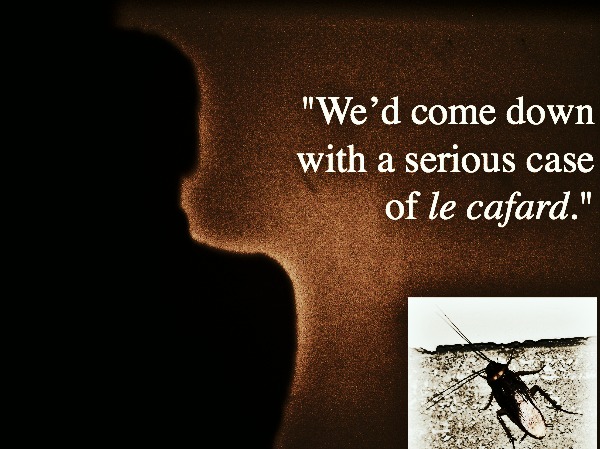
They’re inevitable. Those days that occasionally, and sometimes from out of nowhere, invade the life of a long-term international traveler or expat. You miss home, you’re a stranger in an alien place, you’re gripped by le cafard.

While French has an expression for homesickness (mal du pays), I prefer the other term, le cafard, to describe this dark visitor. It literally means “the cockroach”.

Le_cafard_cockroach

Photo credits: Alone In The Dark, Nobody Waiting, by Môsieur J.; (inset) Gaspard le cafard, by InOutPeaceProject. Both images via Flickr (CC BY-SA 2.0).

The creepy cockroach of homesickness

Seven weeks into our year of living in Europe, homesickness hit and hit hard. My husband, Joe, and I were in southwestern France. The fall weather had turned decidedly cold under steely gray skies and thick cloud cover—never good for lifting one’s spirits. Though we never imagined our adventure abroad would be daily champagne and constant merriment, we didn’t expect the blues to make their appearance so soon.

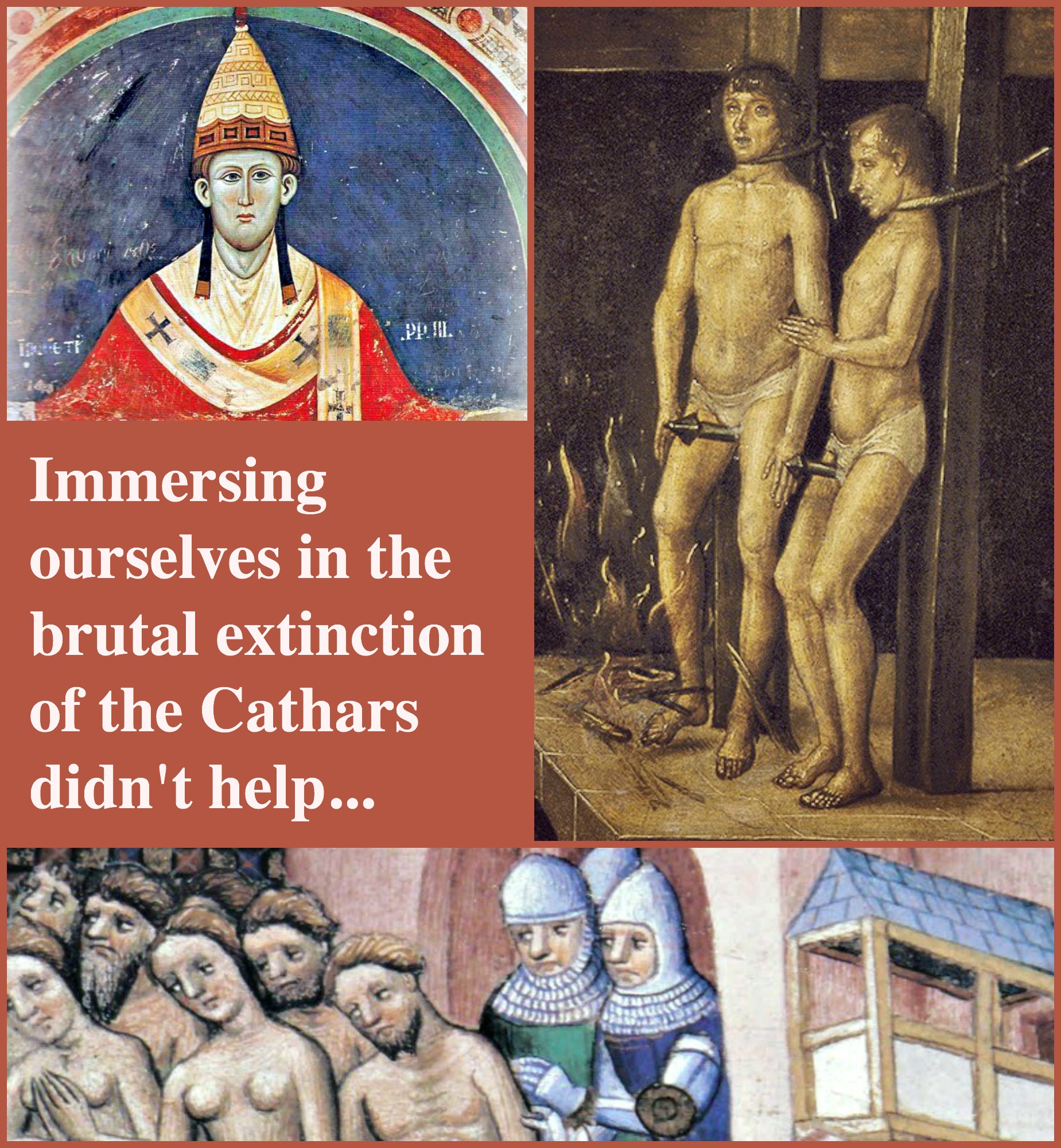
Exploring endless desolate, medieval stone hamlets had darkened our mood. Everything had been touched not only by the savagery of the Hundred Years’ War between the French and English in the 14th and 15th centuries but also by the 13th-century Cathar Crusade.

Prior to leaving for Europe, I’d read extensively about the Cathars and decided that we had to visit the region in which this shameful yet fascinating period of history took place.

The bloodthirsty military campaign of the pope, ironically named Innocent III, to eliminate the dualist offshoot of Catholicism in Languedoc-Roussillon was conducted with abandon against the heretics. No one was spared—men, women, children, and the elderly were all slaughtered. And when Catholics refused to give up their Cathar neighbors, one religious leader (a monk, no less) famously declared: “Kill them all. God will know his own.”

In a sunnier clime, this history might have been remote and intriguing. But against a backdrop of unrelenting gray with no access to the Internet, it left us feeling fogged in and low. Very low. After visiting so many places that witnessed sieges, starvation, plagues, pestilence, and butchery, even the cheeriest of souls would have succumbed to its grip.

Cathar Crusade

Photo credits (clockwise from top left): Pope Innocent III wearing a Y-shaped pallium, by unknown 13th-century artist; “Saint Dominic presiding over an Auto da fe” (detail), by Pedro Berruguete; Expulsion of the inhabitants from Carcassone in 1209, taken from the manuscript Grandes Chroniques de France. All images via Wikimedia Commons.

It’s a bug that thrives in the dark—and in the Dark Ages!

Melancholia, tinged with some serious mal du pays, reared its ugly head without warning. Perhaps we’d had our fill of cold, antiquated spaces and lonely, abandoned stone villages. Or perhaps the total absence of others to provide even a bit of people-watching diversion had brought us down. But maybe we were just in a trough of the normal vicissitudes of travel.

To put it simply, we missed our children and we missed our country—we’d come down with a serious case of le cafard.

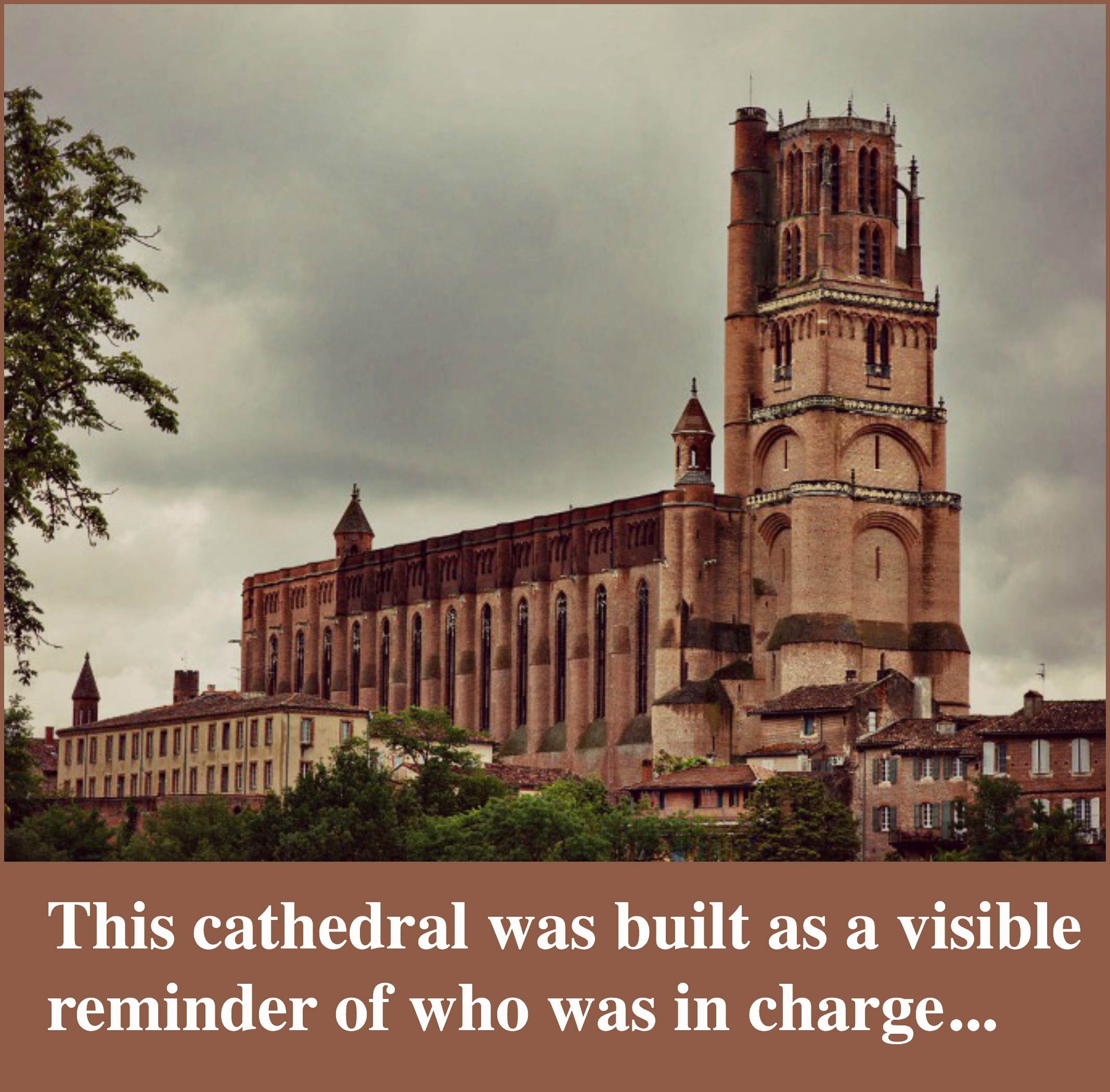
Despite knowing that immersing ourselves in the brutal extinction of the Cathars might not be what we needed to improve our dispositions, we plowed ahead toward our next destination: Caunes-Minervois, just north of Carcassonne. On the way, we stopped and hiked the steep Cathar hill town of Cordes-sur-Ciel, where the region’s alleged heretics had taken refuge, and took a long midday break for a sunny, outdoor lunch in Albi (home of Toulouse-Lautrec), with its austere, imposing redbrick cathedral of Sainte-Cécile, unlike any other church in the world. We noted that the cylindrical exterior of its nave looked like a space shuttle ready for launch. Sainte-Cécile was built after the Cathars were wiped out as a visible reminder to those who might be thinking of defying Rome not to forget who was in charge.

Sainte-Cécile Cathedrale

Photo credit: Cathédrale Sainte-Cécile d’Albi, vue de la rive opposée du Tarn, by Jean-Christophe BENOIST via Wikimedia Commons (CC BY-SA 3.0).

Back on the road, we drove farther south into the Montagne Noire to our ultimate destination: the constricted streets of Caunes-Minervois, where our Internet-enabled hotel awaited. It had been over a week since we’d communicated with our children, and we were lost in reverie about what we would learn when we fired up our laptops. Our son had had an interview the last time we spoke. Did he get the job? we wondered. Our daughter was coming down with a cold. Was she feeling better? Did my latest Amex payment process, and was the house we hoped to rent in Spain still available?

Just can’t get rid of it…

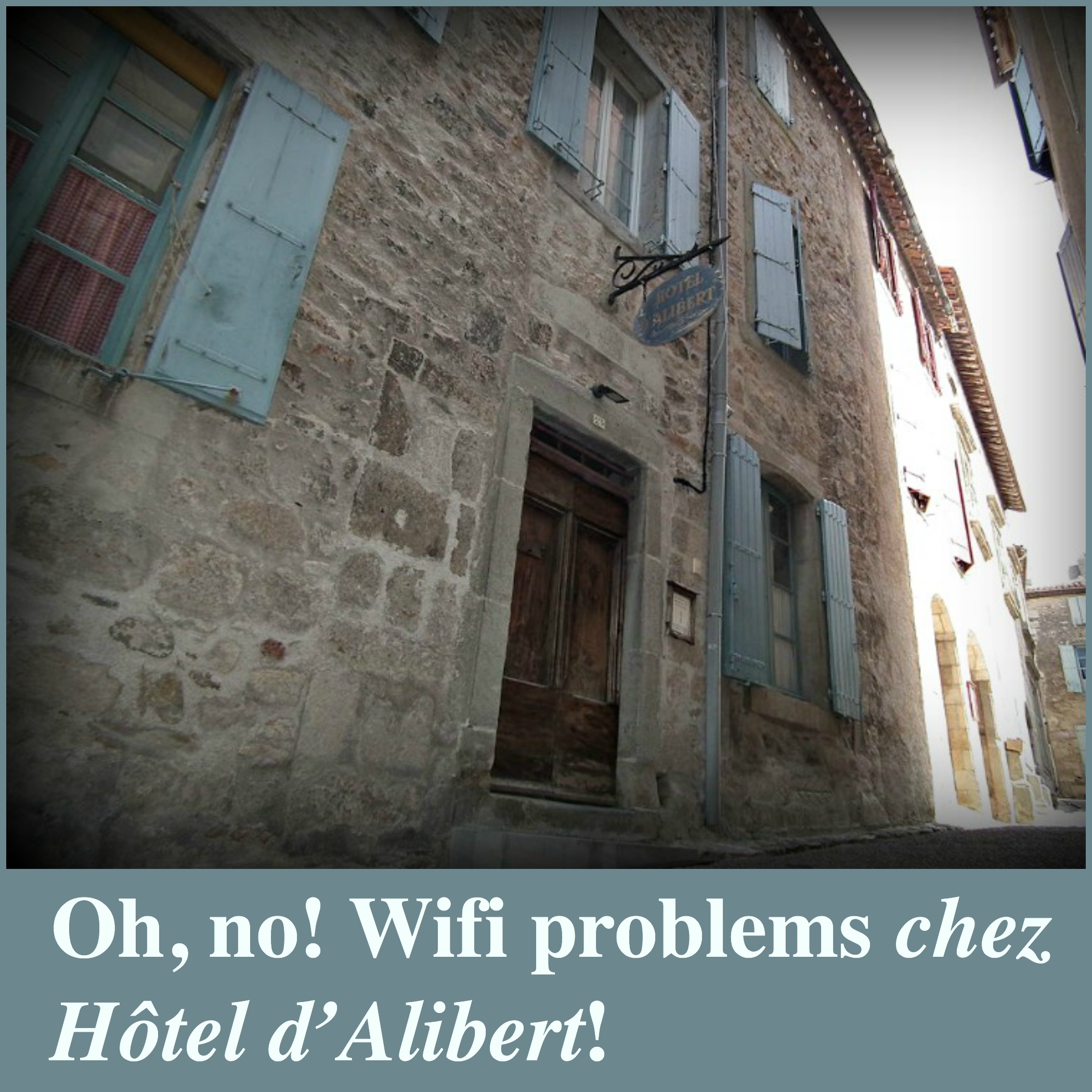
Our home for the next three nights was the Hôtel d’Alibert, an age-old townhome in the heart of the medieval quarter. The affable but quirky owner (you cannot arrive at the hotel between 2:00 and 5:00 p.m. because he is napping—it says so right on the door) lets us in through the French doors of the hotel’s restaurant at just after five. (The front portal remained inexplicably locked all day.)

The coda to our arrival in Caunes-Minervois was this: “Yes, the hotel has free Wi-Fi,” the proprietor confirmed, “but I’m afraid it’s not working; there have been problems.”

Wifi problems at Hotel dAlibert

Photo credit: Hôtel d’Alibert à Caunes-Minervois, by Gaël Gendrotvia Wikimedia Commons (CC BY-SA 3.0).

We were enraged and on the verge of tears. Here we were in yet another deserted town with no means to connect. We dragged our devastated spirits up the spiral stone stairway to our room and dropped our luggage. Le cafard attacked with a vengeance. For the rest of the evening, in a fit of pique, we seriously contemplated the possibility of returning home—of giving up on this gap year business—but finally agreed that all would be better in the morning.

After our night of frustration and reflection, the morning light bolstered our resolve to rally.

* * *

Now back stateside, I still refer to a bout with the blues as le cafard. It just seems so perfect a term. How do other languages express this feeling of profound melancholia? Are there expressions in other languages as accurate as the French?

* * *

Thank you, Marianne! How well you’ve described, with the help of that vivid French metaphor, the sense of alienation that at some point or another plagues all of us who venture beyond borders to travel or live. The word we use on this site, “displaced”, simply isn’t strong enough! Readers, do you have any suggestions for words or sayings in other languages that can convey these feelings? Do let us know in the comments!

Marianne C. Bohr is a writer, editor and French teacher whose book, Gap Year Girl: A Baby Boomer Adventure Across 21 Countries, was published in early September (She Writes Press). She married her high school sweetheart and travel partner, and with their two grown children, follows her own advice and travels at every opportunity. Marianne lives in Bethesda, Maryland, where after decades in publishing, she has followed her Francophile muse to teach French. She has an author site where she keeps a blog, and is active on Facebook and Twitter.

STAY TUNED for the next fab post!

If you enjoyed this post, we invite you to register for The Displaced Dispatch, a round up of weekly posts from The Displaced Nation, and SO much more. Register for The Displaced Dispatch by clicking here!

Related posts:

Wonderlanded with Lene Fogelberg, award-winning poet, writer, and double open-heart surgery survivor

There’s something from Alice in Lene Fogelberg’s story. Photo credits (clockwise, from top left): NecoZAlenky (original Czech film poster for Something from Alice) via Wikimedia Commons; Lene Fogelberg author photo (supplied); operating room via Pixabay.

Welcome back to the Displaced Nation’s Wonderlanded series, being held in gratitude for Lewis Carroll’s Alice’s Adventures in Wonderland, which turns 150 this year and, despite this advanced age, continues to stimulate and reassure many of us who have chosen to lead international, displaced, “through the looking glass” lives.

This month we travel
d
o
w
n
the hole with Lene Fogelberg, a Swede who has lived in quite a few places but right now can be found in Jakarta, Indonesia.

With her long red hair and blue eyes, she looks a little like a Swedish Alice. What’s more, her biography of her early years is not dissimilar to that of Alice Liddell, the muse behind the Lewis Carroll story. Growing up in a small town by the sea, Lene was full of curiosity about the wider world and also in love with words. Describing her youth in a recent guest blog post, Lene says that for her,

written words danced lightly as feathers on the page. I loved to read and made weekly visits to our small town library, the bicycle ride home always wobbly with the heavy pile of books on the rack.

But while similarities are rife to Carroll’s Alice, the “wonderlanded” story Lene lived as an adult in fact comes closer to Czech director Jan Švankmajer’s surrealistic interpretation in his 1988 film, Něco z Alenky.

Něco z Alenky means “something from Alice,” and Lene ended up taking something from Alice’s story when, after moving to the United States with her husband and children, she found herself being wheeled through a rabbit warren of hospital rooms into an operating theatre. As in Švankmajer’s film, she was in a bizarre dream rather than a classic fairy tale.

Strangely, from the time she was young Lene had suspected there was something wrong with her heart. She even harbored a not-so-secret fear of dying young, trying to make the most of each moment. But Swedish doctors repeatedly dismissed her concerns, treating her like a hypochondriac.

And then, it happened: her worst nightmare came true. Shortly after arriving in America she went to have a physical so she could get an American driver’s license—and the American woman doctor informed her she had a congenital heart condition and only a week to live.

Lene survived two emergency open-heart surgeries to tell her story: quite literally! Her memoir (and first book), Beautiful Affliction, is out this week from She Writes Press. Until now, Lene had written in Swedish, mostly poetry, for which she has won some awards. But even though she chose to write her memoir in English, she retains her poetic style, as we will see later in the week when we publish a short book excerpt.

But before that happens, let’s have Lene will take us down into her rather harrowing rabbit hole. True, she’s had some reprieve since since recovering from her surgeries and moving to Jakarta—but only some, as Jakarta is the kind of place where you have to take your life into your own hands to cross the street. But I’m getting ahead of the story—over to Lene!

* * *

Lene Fogelberg: Thank you, ML, and greetings, Displaced Nation readers. Just to give you a little more of my background: I grew up in the south of Sweden, in a small town by the ocean. As ML says, I often stood looking out over the ocean following the waves in my imagination, wondering about all the exciting places in this world. In my youth I spent a couple of summers in France studying French and falling in love with this beautiful country.

As newlyweds my husband and I moved to Germany as students for a year, where I learned the language and took care of our newborn baby (just three months old when we arrived). After Germany, we moved back to Sweden and stayed there until my husband’s employer offered him a position in the United States. We moved to a small town outside of Philadelphia, called Radnor. That became the scene of my life-threatening health crisis. How it erupted and played out is the topic of my book, which, as ML mentioned, came out this week.

We spent a year and a half in the United States in total and then moved back to Sweden for a couple of years. Nearly four years ago we relocated to Jakarta, but in December we will be moving again: to Kuala Lumpur, Malaysia.

“Stop this moment, I tell you!” But [Alice] went on all the same, shedding gallons of tears…

After moving to the US there was a huge pool of tears because of the drama that unfolded in the weeks following the transition. My husband and I had to have physicals prior to getting our American driver’s licenses, and as soon as the doctor put the stethoscope to my chest she reacted to the sound of my heart. It turned out I had a fatal congenital heart disease and that I’d lived longer with this disease than anyone the US doctors had ever met.

Beautiful Affliction story

As Lene attests in her newly published memoir, her “rabbit-hole” experience was full of heart, tears and physical drama. Photo credits (clockwise from top left): Front and back cover art for Lene’s book (supplied); Alice’s Adventures in Wonderland illustration by Milo Winter (1916), via Wikimedia Commons; The White Rabbit’s House, by Kurt Bauschardt via Flickr (CC BY-SA 2.0).

[S]he felt a little nervous about this; “for it might end, you know,’ said Alice to herself, ‘in my going out altogether, like a candle. I wonder what I should be like then?”

The events that unfolded are covered in my book Beautiful Affliction, which is a crazy story, full of heart and physical drama, not unlike Alice’s own confrontations with her changing body.

“Where should I go?” –Alice. “That depends on where you want to end up.” –The Cheshire Cat

Although my physical crisis was great, Jakarta has been one of the biggest challenges in a “wonderland” sense. The city is chaotic, with heavy traffic that is always jammed, making it difficult to navigate. I was shell-shocked for the first six months.

“Oh, I beg your pardon!” [Alice] exclaimed in a tone of great dismay…

Here in Jakarta where the population is mostly Muslim I try not to show too much skin. I wear clothes with sleeves and never skirts shorter than the knees.

skirt and shoes Alice in Wonderland

Photo credit: Alice shoes, by Shimelle Laine via Flickr (CC BY 2.0).

“Well, then,” the Cat went on, “you see, a dog growls when it’s angry and wags its tail when it’s pleased. Now I growl when I’m pleased, and wag my tail when I’m angry.”

Greeting people here in Indonesia can be a minefield. The safest bet is to put my hands together and say, “Namaste.”

“There’s certainly too much pepper in that soup!” Alice said to herself, as well as she could for sneezing.

I love nasi goreng and all the Indonesian dishes—but without the chili, which is too spicy for me.

Nasi Goreng Hold the Chili

Photo credits: Nasi goreng (fried rice), by Tracy Hunter; (inset) Nothing is real, nibble and drink me…, by Wonderlane. Both images via Flickr (CC BY 2.0).

Recipe for a Mad Hatter’s Tea Party

I would invite my family and friends from Sweden and serve all the delicious fruit that can be found here in Indonesia. I know how you can long for sunshine during the long, dark Swedish winters and I would love to give them all a vacation full of sunshine and fruit smoothies.

Tropical Tea Party

Photo credits: A Swedish Mad Hatter [my description], by Rodrigo Parás via Flickr (CC BY 2.0); Fruit stall in Bali, by Midori via Wikimedia Commons (CC BY 3.0).

“Well!” thought Alice to herself. “After such a fall as this, I shall think nothing of tumbling downstairs!”

I am getting more and more courageous. I guess living abroad gives me a sense of “I can do this” and when faced with challenges I can now say to myself: “You have been through worse.”

Advice for those who have only just stepped through the looking glass

Stay busy so you don’t lose yourself to too much introspection. Especially if you are a traveling spouse coming with your expat partner. Make friends who can go with you to explore your new country. And whenever you go on excursions, try to learn the language so you can speak with locals and really get to know the country more than from a tourist’s point of view. The feeling of discovering gems of knowledge that are not in the tourist guides, like a local saying, is very rewarding and makes you feel connected to your new “home”.

Alice had begun to think that very few things indeed were really impossible…

My next writing project is a novel that takes place here in Jakarta. It is a hilarious and heart-breaking story where I combine the ancient myths of Java with modern society and where East meets West. The first draft is basically finished and I hope to follow up my debut book with this story. It is kind of crazy and sometimes I wonder why I am writing it, but I am in love with the characters so I keep going. It is very much a fruit of my “down the rabbit hole” feelings. I would say that most of my writing comes from a place deep inside where I feel like I have discovered something unsettling with the world we live in and, because I need to pinpoint it, I write about it, in an effort to grasp it.

* * *

Thank you, Lene! Being wonderlanded with you was a moving experience. I sense you are a very special person to have survived so much and still be full of curiosity about the world. Readers, please leave your responses to Lene’s story in the comments. And be sure to tune in later in the week when we feature a sample of her writing! ~ML

STAY TUNED for the next fab post: an example of how Lene writes about her wonderlanded experience.

If you enjoyed this post, we invite you to register for The Displaced Dispatch, a round up of weekly posts from The Displaced Nation, and much, much more. Register for The Displaced Dispatch by clicking here!

Related posts:

TCK TALENT: Lisa Liang takes her show back on the road; second stop: Cape Town, South Africa (2/2)

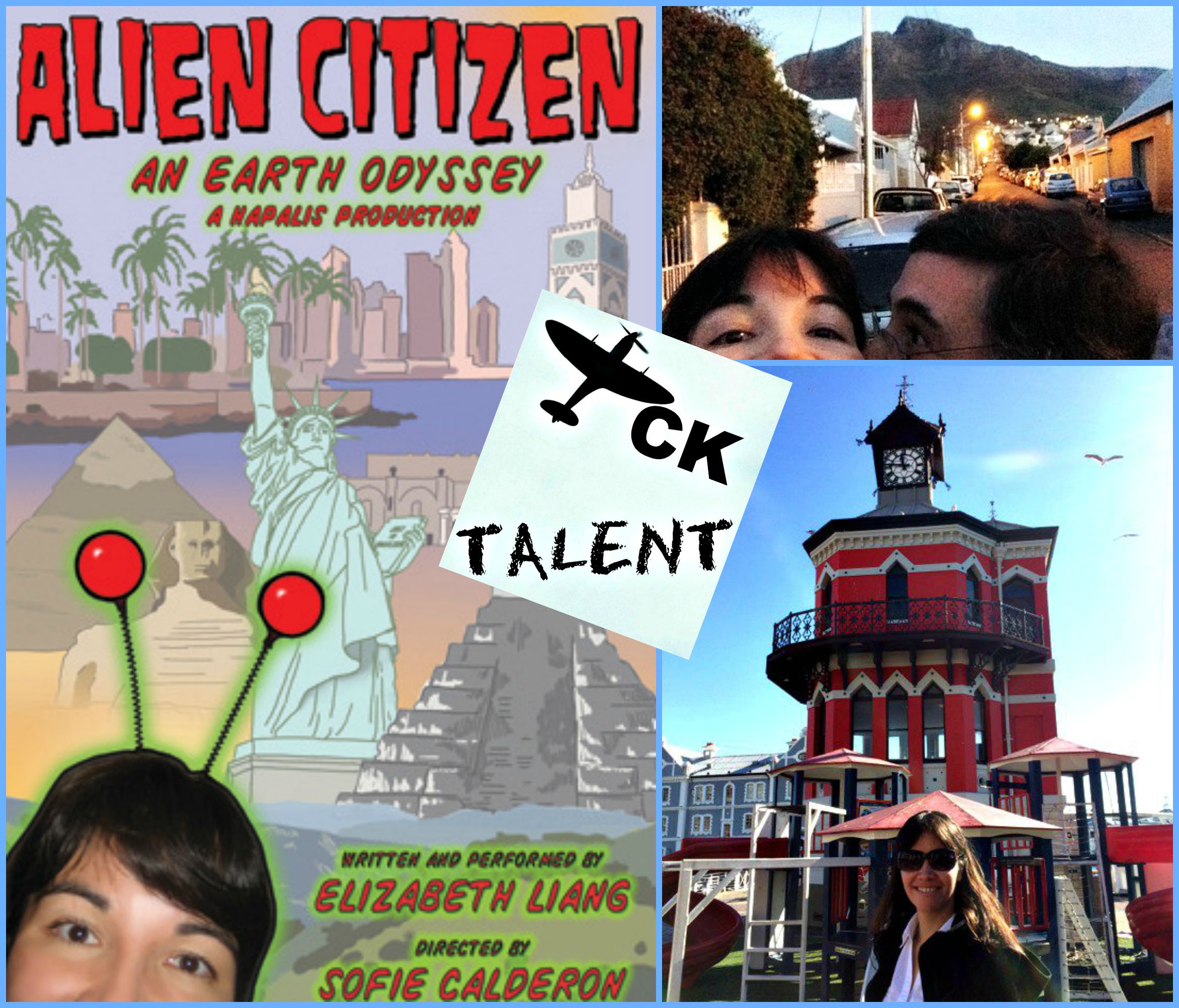
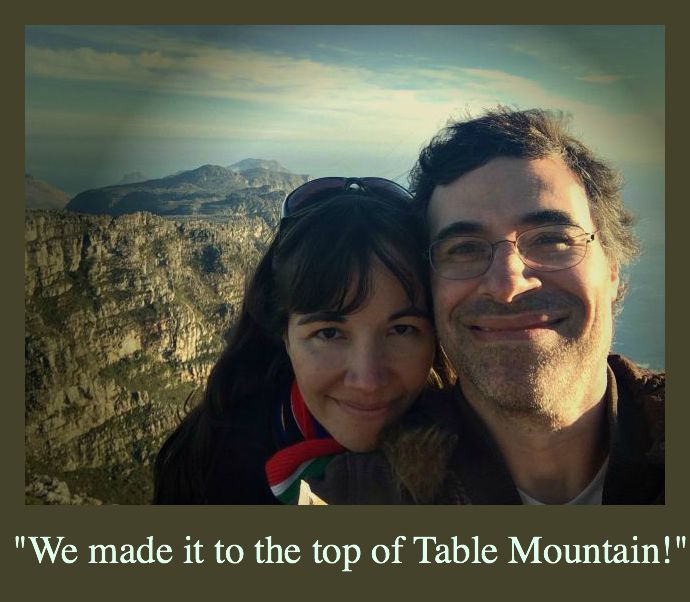
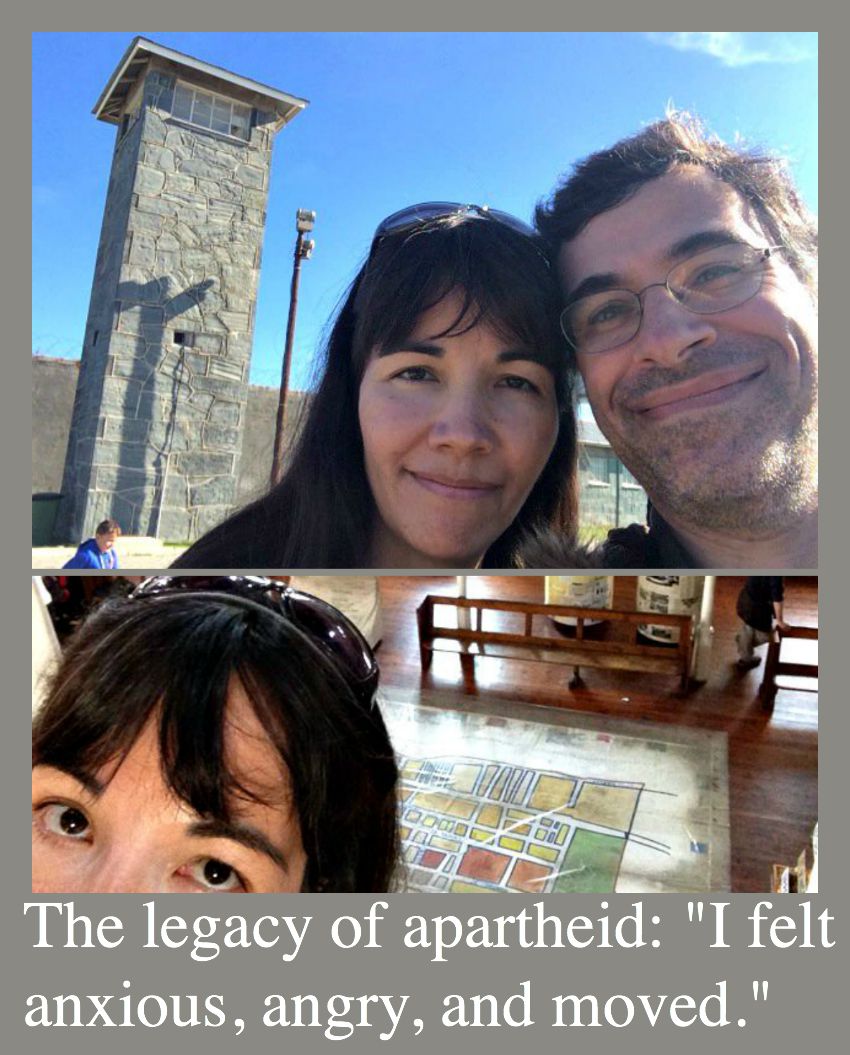
TCK Talent columnist Lisa and her husband (and techie), Dan, head to Cape Town. Photo credits: (from left) Alien Citizen poster; Lisa and Dan in front of Little Theatre on University of Cape Town campus (supplied, by Daniel Lawrence); and view of Table Mountain through bus window (supplied, by Lisa Liang).

Having delivered a successful show, TCK Talent columnist Lisa and her husband (and techie), Dan, explore Cape Town. Photo credits: (from left) Alien Citizen poster; Lisa and Dan on the street where they rented a cottage in Woodstock; Lisa in front of the clock tower on the V&A Waterfront. (All photos supplied, taken by either Lisa or her husband, Daniel Lawrence.)

TCK Talent columnist Elizabeth (Lisa) Liang has had an exciting summer, even by her own, well-traveled standards. First she performed her one-woman show about growing up as a mixed-race TCK in Valencia, Spain, after which she headed for Cape Town, South Africa, for another performance, which she told us about in her last post. Today we’ll be treated to Part Two of her South African adventure!

Howzit, dear readers—molweni! Kunjani?

As some of you may recall, in my previous post I described the experience of taking Alien Citizen: an earth odyssey, my one-woman show about growing up as a Third Culture Kid (TCK) of mixed heritage, to the Women Playwrights International Conference, held June 29–July 3 in Cape Town.

This month’s post is about the second half of said trip, during which my husband, Dan, and I explored the city and its surroundings. A travelogue, if you will.

The day after the conference ended, we took an Uber cab to our new digs in Woodstock, about half a mile east of the city centre. (We’re not fans of Uber as a company—but as the Cape Town drivers were excellent and we were on a budget, we compromised.) Our AirBnB guest cottage had an en suite bathroom with a big shower—an upgrade from the dorm life we’d experienced at the conference.

We took it easy that day because I was wiped out from a week of conferencing that had culminated in performing my show. (Dan had played a role in the performance, too, as my techie.) We went grocery shopping in what South Africans call a “lower rent” area, a couple of blocks away. It offered far fewer choices than you would find in the USA or Europe—similar to the shops of my childhood and adolescence, spent in Central America and North Africa. Our most memorable buys were the potato chips or “crisps” and the gingersnap cookies or “biscuits”: both excellent!

Regarding safety in the city: we had read warnings about crime, but we witnessed none. As we walked along the main road, young men shouted at us through the windows of vans speeding by, offering us rides. At first we were intimidated, but by the end of our stay it was so familiar that we would just call back “No thanks!”

On the way home, we stopped at a cafe, the Field Office, where we enjoyed a great lunch and decent WiFi connection.

Dan is a coffee aficionado and I love the way Cape Town serves chai lattes in pretty glass mugs, so we were especially happy hanging out at this cafe, which aspires to be an office-away-from-the-office (hence its name).

When we returned to the cottage, we nearly froze—my teeth literally chattered! As I mentioned last month, most homes in Cape Town don’t have heating or insulation for the colder months. Luckily, our host realized this and loaned us a space heater the next day. (We had foolishly assumed he didn’t have one.)

The next day we went to the V&A Waterfront, which I loved for the clock tower, the public art, the restaurants and shops—and the fact that so many of our fellow tourists were from African countries. It was a pleasure to be among travelers from the African continent for a change. We discovered some fantastic traditional arts-and-crafts shopping at the African Trading Port.

Impilo! (Cheers!)

The following day we took a winelands tour. The countryside was beautiful; we passed a farm that had a zebra, a springbok, an ostrich, and more animals you never see on US farmland. Without having eaten breakfast, we tasted five wines (!) in Paarl valley, which was perhaps not the healthiest way to begin the morning.

Our next stop was charming Franschhoek, where I insisted on getting breakfast—a lovely muffin-like scone with butter/cream/jam coupled with a caffe latte…I felt much better. We also bought chocolate at a pretty chocolate shop because…chocolate!

The second winery was very fancy; then we continued on to Stellenbosch, where we had a tasty lunch. The towns were pretty with Cape Dutch, Georgian, and Victorian architecture.

The final winery on our tour had lots of character in the form of gigantic spider webs hanging by the stained glass windows. It was there we learned that fortified wine is to port what sparkling wine is to champagne. In total that day we tasted 12 wines and three ports fortified wines. We liked the ports fortified wines the best.

A cobwebbed window at one of the wineries; a glass of port, a fortified wine[https://en.wikipedia.org/wiki/Fortified_wine#/media/File:Port_wine.jpg], by Jon Sullivan via Wikimedia Commons; Lisa at La Motte Winery.

A cobwebbed window at one of the wineries on Lisa and Dan’s tour; a glass of port, a fortified wine, by Jon Sullivan via Wikimedia Commons; Lisa at La Motte Winery.

Benza iKapa (Beautiful Cape Town)

The next day we took a city tour. We were supposed to go to the top of Table Mountain but it was too windy. (We were finally able to reach the top on our second-to-last day. It was so beautiful, I feel enormously lucky and grateful to have experienced it.)
Table Mountain_top
Our guide showed us some of the beaches near the town. The water was such a beautiful shade of light blue—I’ve never seen water like that before! And the view from Signal Hill was spectacular—I can’t use that word enough for the natural beauty surrounding Cape Town.

And on this tour, I finally had the chance to see the outside of all the places that Dan had visited during our first week while I was “conferencing”:

We walked through a small section of the Company’s Garden, a beautiful park with very old trees and Egyptian geese having Make Way for Ducklings moments, to the Iziko South African Museum.

This tour ended with the requisite visit to a diamond shop, which no one in the van was interested in, but we all ultimately decided to go in for the demonstration on how the jewels are made from gems (and, I’ll admit, for the free champagne). There was loads of tanzanite (named for Tanzania, where it was discovered) on display—a good investment, apparently. We didn’t invest.

Legacy of apartheid

While at the South African Museum, it was disturbing to learn that the museum’s first curators had created life-sized models from molds of actual living “Bushmen” (who were never credited) to demonstrate an “authentic, primitive, and it’s being lived today” lifestyle. Since the end of apartheid, the museum has been re-curated from the indigenous perspective.

On our second-to-last day we visited Robben Island, where Nelson Mandela was imprisoned for 18 of the 27 years he served behind bars before the fall of apartheid. (The prison is now a museum.) We had a great guide in the bus, who stressed that the prison was not about Nelson Mandela. The prisoners chose Mandela to speak for them, but they told him what to say and asked him to refashion their words because he was so eloquent and was also trained as a lawyer. At the prison itself, we had a former prisoner as our guide, who showed us Mandela’s cell. No white prisoners were held in that prison—only “blacks” and “coloureds,” who were not treated the same (there was worse treatment for blacks).

Mandela’s last prison was Drakenstein Correctional Centre (formerly Victor Verster Prison), which we’d seen during our winery tour. (We stopped to take pictures beneath the inspiring Nelson Mandela statue at the entrance.)

On our last day we went to the District Six Museum, which is a beautifully and intimately designed and curated memorial to the forced movement of 60,000 inhabitants of various races in District Six during 1970s apartheid. My eyes started welling up in the first five minutes. I felt anxious, angry, and moved.

(Top) Robben Island Prison Museum; District Six Museum.

(Top) Robben Island Prison Museum; District Six Museum.

At the conference I had remarked to a young South African theatremaker that I hadn’t perceived any racial tension among the diverse group of actors and directors who staged the play readings; she replied that that was because we were at the university, but things were different off campus. Dan and I were unpleasantly surprised when one of our tour guides, an older white man, stated that “black neighborhood” equaled “ghetto,” and pointed out a section of the city that he considered “awful”—but it looked like any populated section of a city in a developing nation to me.

I grew up mostly in poor countries, so I’m accustomed to the scrappy, grimy, not-at-all-pretty-yet-functional aspect of many an urban area. We actually bought our groceries on the block that the guide was pointing out.

Ubuhle bendalo (Spectacular scenery)

In disconcerting contrast to its painful history, South Africa has spectacular scenery. We went on a tour to the Cape Peninsula, including Cape of Good Hope and Cape Point. Spectacular vistas and beaches—again, I’ve never seen that color of ocean.

We also loved seeing animals that were new to us. We took a boat to see Cape fur seals on Duiker Island. Along the road throughout the day we passed zebras, baboons, bontebok, and ostriches—mostly not penned in—just by the road! And ever so many African penguins on Boulders Beach!

We ended that particular day at Kirstenbosch National Botanical Gardens, which were lush and green, and I treated myself to a new mug at the gift shop. (A mug of tea being part of my writing ritual!

South African animals collage

Clockwise, from top left: Ostrich between road and sea; South African farm animals; African penguins at Boulders Beach; the Egyptian geese in Company Gardens.

Glorious food

We had been wanting to try the best Cape Malay food in town. We were told it was at Biesmiellah, so went there for dinner. Best comfort food ever after a day that had run the emotional gamut from a grim yet inspiring prison-turned-museum, to one of the world’s natural wonders with jaw-dropping vistas, to a fantastic restaurant where the cooks are Muslim women who feed you after sunset during Ramadan (so you can only hope they’ve broken their own fasts while taking care of tourists).

We ate wonderfully well in Cape Town. I can also recommend:

Paradoxically, almost every day we were approached by a homeless person, each one of a
different ethnicity/race (white, black, Malaysian, etc.), often young, always deeply courteous, asking for a meal. It finally occurred to me to carry an energy bar in my coat for giving away.

Last but not least…

While at the District Six Museum on our last day, we happened to run into a few WPIC delegates, one of whom complimented my performance of Alien Citizen from the previous week: a great way to cap off our visit.

One of the last things we did was to return to Company’s Park to walk the length of it; there were numerous romantic couples on the grass, which reminded me of Rome’s Villa Borghese Gardens and L.A.’s Griffith Park. We also saw many guinea fowl in and around Cape Town—again, we loved seeing animals we never get to see in the States.

We also visited St. George’s Cathedral, which was lovely and smaller than I had expected. It’s so famous for Desmond Tutu that in my head it was the size of Chartres—until I actually saw it and went inside.

We even took in the South African National Gallery, which had two incredible exhibits by South African artists:

  1. photography and more by Omar Badsha, and
  2. a multimedia-with-moving-sculpture work by William Kentridge called The Refusal of Time.

Hamba kakuhle! (Go well!)

All too soon it was time to wend our way back to L.A. The first leg of our flight was at night. On the British Airways plane back to Heathrow, the flight attendants sprayed something throughout the cabin, saying that it was not toxic but that we should still take our contact lenses out and not lick the mist. Um…

I’ll spare you the details of our layover in Heathrow, but be warned: that airport goes well out of its way to make you miserable. Meanwhile, our flight out of Cape Town left late, so we missed the connection and were rerouted to San Francisco…and our luggage got lost at SFO. It was finally delivered to us four days later—intact! Hooray!

Looking back, I think we were lucky to have mostly clear weather during our time in Cape Town as I was able to take extraordinarily vivid impressions of the majestic Table Mountain, the city and its surroundings, which are still with me…

On another level, I found Cape Town stimulating as an artist. It’s the kind of place that compels you to be brave and keep trying to tell your story truthfully. That’s also what I took away from our trip, along with an abiding gratitude to the WPIC programming committee for choosing Alien Citizen as the closing show—and of course to my generous backers who made the trip possible. Without a doubt, it counts as one of the highlights of my creative international life.

* * *

Thank you, Lisa! I really appreciated hearing about your travels within and around Cape Town from your ATCK perspective: it was fascinating, as well as moving, to take this virtual tour. Readers, please leave questions or comments for Lisa below. —ML Awanohara

STAY TUNED for the next fab post!

If you enjoyed this post, we invite you to register for The Displaced Dispatch, a round up of weekly posts from The Displaced Nation, with news, book giveaways and other extras. Register for The Displaced Dispatch by clicking here!

Related posts:

WORLD OF WORDS: How a mysterious passion for learning French has shaped the life of writer Marianne Bohr

Marianne Bohr in the Luxembourg Gardens in Paris—is she reading or indulging in reveries about words?

Marianne Bohr in the Luxembourg Gardens in Paris—is she reading or indulging in reveries about French words?

New columnist Marianne Bohr, whose first book, Gap Year Girl, is about to come out with She Writes Press, is here with her second post attesting to how a passion for learning languages can engender a passion for travel.

I decided long ago that I was born in the wrong country. There must have been some mistake. But then again, if I’d been born in l’Hexagone, my passion for all things French wouldn’t exist. I’d have been raised with the language’s romantic euphony, and the fluid succession of words would be part of my everyday world. Some other tongue and faraway culture would have caught my fancy—so perhaps, just perhaps, it’s fortuitous my birthplace was Fort Wayne, Indiana, and not Paris.

Passions are essential to a happy life. When we care about something, it shrinks the world to a human scale, breaking it into wieldy pieces to love and nurture. My passion for French shapes my world, yet why I love this lyrical language so dearly is an essential mystery I’ll never fully understand.

In my first post I spoke about the decision my husband, Joe, and I made to do a senior year abroad at age 55. For the final six weeks of our “gap year” traveling through Europe, we settled into Aix-en-Provence, a stylish, sun-kissed university town in the south of France. We delighted in the daily outdoor markets and spent hours in cafes along the Cours Mirabeau, sipping rosé wine and listening to the mellifluous French chatter around us.

Photo credit: Les Deux Garçons, by tpholland via Flickr (CC BY 2.0).

I signed up for daily French conversation classes, hoping to further exercise my sometimes-lazy American jaw in preparation for the new career that awaits me back in the States. Over thirty years in book publishing is behind me and armed with the degree I completed before we left for our gap year, I’m ready to embrace being a French teacher, full throttle.

First day of school

I’ve always loved being a student of French, no matter my age, but on the first day of my class at IS Aix-en-Provence (a language institute that specializes in teaching French to adults), I’m predictably nervous, as I’ve been on day one of every school year of my life. I lay out my clothes the night before and imagine first days of school gone by: my freshly ironed plaid uniform, crisp white blouse, just-purchased navy knee socks with tags still attached, and newly polished oxfords. I pack a snack, just as I did in grammar school, and I’m ready to go.

My giddy younger self emerges the moment I cross the classroom threshold, polished floorboards creaking, where I am once again a wide-eyed schoolgirl eagerly poised over a blank composition book, pencil sharpened and my ardor for the subject on my sleeve.

My class of ten includes students from Australia, Finland, the Netherlands, Spain, and Sweden, none of us a youngster and all on an educational vacation in summertime Aix. I introduce myself and stumble on the choice of tense. Do I use the present or the future tense of “to be”? Do I affirm I am a French teacher, or do I demur and say I’ll soon be a French teacher? I opt for the former, Je suis prof de français. It bolsters my confidence with a frisson of pride.

My prof is Céline—gorgeous, funny, and particularly warm. I so wish I could be like her—une jolie française who speaks lovely French. As I walk home from class, it hits me, as it has so often before: yes, I am a newly minted French teacher, but no matter how I try, no matter how I practice, no matter how fiercely I study, I’ll never be French. I’ll never be française. I’ll never sound like Céline. I’ll forever be on the outside looking in, my face and palms pressed against the linguistic glass. I plunge into a microflash of depression. But I proceed across town, under soaring sycamores, content to have a passion I can call my very own.

The French and their apocopes

The French often truncate words by dropping the final syllables and adding an “o.” Apéro, McDo, and resto (aperitif, McDonald’s, and restaurant) have long been staples of my French vocabulary, but thanks to my classes, I add abbreviations to my repertoire:

  • accro hooked on
  • les actus (the news),
  • un ado (an adolescent),
  • bio (organic),
  • un dico (a dictionary),
  • perso (personal), and,
  • (my favorite) Sarko (Nicolas Sarkozy).
Shortened French words

A few examples of the Gallic fondness for apocopes. Photo credits: Apéro au coin du feu, by Sébastien Bertrand via Flickr (CC BY 2.0); English-language dictionary via Pixabay; _EPP Summit, by European People’s Party via Flickr (CC BY 2.0).

Each week in class, we prepare presentations about les actus, and I do one on social media. Twitter and blogger have now entered the daily lexicon as regular “-er” verbs. We learn the quirky French term for “walkie-talkie” (talkie-walkie), that the expression vachement bien (amazingly good), which was very popular thirty years ago, is much less in vogue nowadays, and that it is très chic to say super (pronounced “sue pair”—accent on the “sue”), especially if you’re a woman.

The café was super-bon; your dress is super-chic; he looks super. I imagine the French language police, the Académie Française, must be super-fâché (very angry) about all the new Franglais.

Why won’t anyone speak French with me?

Indeed, much has changed in France over the past 35 years. There’s a new generation with kinder attitudes, more customer-service orientation, and lots of English spoken, so unlike the France of days gone by. Everyone wants to speak English, but I want to speak French. I’m bolstered by Joe, who always encourages, “Make them speak French, babe,” so we have uneven, lopsided exchanges:

“Good evening, madame.”

“Bonsoir, monsieur.”

“Would you like an aperitif?”

“Oui, je prends un kir, s’il vous plaît.”

“Very good. And you, sir?”

“Un kir aussi, merci.”

It’s initially disconcerting, but they eventually get the point and give us what we want. They speak to us in French! We really do appreciate the attempt to be accommodating and their eagerness to practice our language. If only we Americans would exhibit the same passion for learning new tongues.

* * *

Thank you, Marianne! How about the rest of you out there? Do you have a passion for a foreign language and if so, what kind of lengths have you gone to in its pursuit? Do let us know in the comments!

Marianne C. Bohr is a writer, editor and French teacher whose book, Gap Year Girl: A Baby Boomer Adventure Across 21 Countries, will be published in September 2015 (She Writes Press). She married her high school sweetheart and travel partner, and with their two grown children, follows her own advice and travels at every opportunity. Marianne lives in Bethesda, Maryland, where after decades in publishing, she has followed her Francophile muse to teach French. She has an author site where she keeps a blog, and is active on Facebook and Twitter.

STAY TUNED for the next week’s fab posts!

If you enjoyed this post, we invite you to register for The Displaced Dispatch, a round up of weekly posts from The Displaced Nation, and SO much more. Register for The Displaced Dispatch by clicking here!

Related posts: