The Displaced Nation

A home for international creatives

Tag Archives: Thailand

“We read to know we’re not alone”: 1st-ever litfest for expats & random nomads

The displaced writer Hazel Rochman once said that reading “makes immigrants of us all”:

Reading takes us away from home, but more important, it finds homes for us everywhere.

That must be why author interviews have played such an important role in the entertainment mix provided by The Displaced Nation since our founding one year ago.

A book that enables us to escape to a new world without buying a plane ticket? Bring it on!

A book that makes us feel at home in another part of the world? There’s nothing we crave more.

We’ve also taken authors into our confidence who, as St. Augustine once advised, treat the world as their book, rather than staying put and reading only one page. Because of their own peripatetic ways, these writers have much to say to the rest of us nomadic types about how to make sense of feelings of isolation, ennui and displacement.

As C.S. Lewis once said:

We read to know we’re not alone.

In honor of The Displaced Nation’s first anniversary, as well as in the spirit of World Party Month, I would like to propose the first-ever Displaced Nation literary festival featuring authors who have been interviewed or in some way featured on the site during the past year.

“We read to know we’re not alone”: THE FIRST-EVER LITERARY FESTIVAL FOR EXPATS AND RANDOM NOMADS
Note: The following is a tentative line-up. It includes previews of the kinds of insights we can expect to glean from such an extraordinary gathering of expat literati.

We anticipate the festival to extend from a Sunday night to a Thursday morning, with an opening night gala and a couple of closing events. Click on the headlines to go to the event descriptions for each segment:

OPENING NIGHT GALA EVENT

It seems only fitting that we offer something totally mad on our opening night. We will screen Alice in Wonderland, the 1903 British silent film directed by Cecil Hepworth and Percy Stow, which was partially restored by the British Film Institute and released in 2010. (NOTE: You can see portions of the film in a video specially made by Anthony Windram during The Displaced Nation’s “Alice in Wonderland” theme month.)

The film is memorable for its use of special effects: Alice’s shrinking in the Hall of Many Doors, and then growing too large in the White Rabbit’s home, getting stuck and reaching for help through a window.

The film matches our theme of “We read to know we’re not alone” — could anyone ever feel lonelier than Alice did at such moments?

But here’s the new twist: the screening will feature a live accompaniment by Seremedy, the displaced Swedish visual kei band this is now making such a sensation in Japan, reacting musically and without any rehearsal beforehand, to the silent film in front of them. Unique, spontaneous — and perhaps even terrifying, given that the band’s (male) lead guitarist, Yohio, looks like an anime version of Alice.

DAY ONE: “We’re not alone” — We have each other

Iranian Childhoods, Inspiring Stories

TONY ROBERTS and ASHLEY DARTNELL each spent portions of their childhood in Iran. Roberts has produced a novel based on his memories of that time, Sons of the Great Satan, which we featured on this blog about a year ago. Dartnell, who has yet to be featured (we hope she will!), released her memoir, Farangi Girl, last year (it was recently issued in paperback).

Roberts and Dartnell have in common the status of being so-called third culture kids — growing up in a third culture not common to their parents (Roberts’ parents were American and Dartnell was the product of an American mother and British father). They also have in common that they were enjoying their lives in Tehran until something terrible happened — the memory of which affects them to this day.

In Dartnell’s case, it was the sudden collapse of her father’s business (her parents subsequently split up), whereas for Roberts, it was the experience of being evacuated because of the American hostage crisis — suddenly, he was back at the family’s small farm town in Kansas, having no idea of where his friends had gone.

TCKs experience such traumas in isolation (Roberts continued to feel isolated well into his adulthood). Roberts and Dartnell, who have never met before, welcome the opportunity to forge a new connection over their common displacement.

PERFORMANCE: “The White Ship,” by Ethan Kenning

Ex-folk singer Ethan Kenning — known as GEORGE EDWARDS when performing with the former psychedelic rock band H.P. Lovecraft — will give a special performance of “The White Ship,” a song based on a mystical tale by horror writer H.P. Lovecraft (from whom the band took its name), about a vessel sailing on a sea of dreams. Critics have described it as “baroque, Middle Eastern-flavored psychedelia at its finest.”

Multicultural Marriage Boot Camp

Two Wendys — WENDY WILLIAMS and WENDY TOKUNAGA — will answer questions about the benefits as well as challenges involved in marrying someone from another culture.

Wendy Williams is the author of The Globalisation of Love and has coined a term, “GloLo,” to refer to this phenomenon. She was last week’s Random Nomad and has also been a contributor to The Displaced Nation with the post: “Why expat is a misleading term for multicultural couples” — a topic big enough to be a festival theme in its own right!

Wendy Tokunaga, who was one of The Displaced Nation’s 12 Nomads of Christmas, recently published Marriage in Translation: Foreign Wife, Japanese Husband, consisting of interviews with 14 Western women involved in cross-cultural relationships.

GloTinis will be served — those in particularly challenging unions may wish to order theirs straight up.

Romance Across Borders: Fairytale or Myth?

JANE GREEN, a prolific writer and one of the founders of chick literature, will interview MEAGAN ADELE LOPEZ and MICHELLE GORMAN — both of whom have produced first novels exploring the idea of looking for romance in other cultures. Lopez is the author of Three Questions: Because a quarter-life crisis needs answers (self-published, October 2011), about a cross-cultural romance that blossoms through the asking of three questions; and Gorman, of Single in the City: One girl, one city, one disaster waiting to happen (Michael Joseph, 2010), about an American who goes to London in search of love and the perfect life.

The Displaced Nation recently featured Lopez on our site and will feature her tomorrow in a guest post. We have yet to interview Gorman but would like to — especially as she recently self-published Misfortune Cookie, about a young woman who moves to Hong Kong to be with her boyfriend.

Both women relied heavily on their own autobiographies to produce these first novels. As Lopez said in her interview with Tony James Slater:

Hey — they always say to write about what you know, so that’s what I did!

But is it the stuff of chick lit? No one is better placed to judge this than the displaced author Jane Green (she is now an expat living in Connecticut). As early readers of The Displaced Nation will recall, Green “came in” for a chat during our coverage of last year’s Royal Wedding — she had just produced a multimedia book celebrating the young royals as an example of a “modern fairytale.”

Though Kate and Will aren’t from different cultures, they might as well have been since Kate — unlike the Prince’s mother, Diana — does not come from a royal lineage. But from Green’s point of view, this is what is makes the couple modern — and why their marriage is likely to last:

I loved discovering just how unusual William and Kate are: grounded, humble, and thoroughly modern, eschewing much of the pomp and circumstance that surrounded the wedding of Charles and Diana.

One Person’s Home — Another Person’s Nightmare?

BARBARA CONELLI, who lives in Manhattan for half of the year and Milan for the other half, will interview SHIREEN JILLA, whose first novel was set in the Big Apple.

Thanks in large part to the influence of her Italian grandmother, Conelli qualifies as the ultimate Italophile. Last year she published Chique Secrets of Dolce Vita last year — her first book in a three-part series about the Italian grasp of the “good life.” When asked by Kate Allison to explain the differences between her two homes of Milan and New York City, Conelli said that New Yorkers need to learn the Italian art of taking the time to actually live:

We need to stop and smell the roses more often.

On this point, Jilla would certainly concur. After spending three years in New York as an expat when her husband was BBC’s North America correspondent, Jilla came away thinking that “New York is a city populated by control freaks.”

But, unlike Conelli, Jilla found this control freakery sinister — which was what inspired her to write a novel that depicts the city as, as one critic said, “a teeming pit of vipers, only just covered with a finely buffed veneer of sophistication.”

In the online discussion we hosted of Exiled, Jilla commented on how culturally different New York and London are — despite New York not being seen as a particularly adventurous posting among the expat crowd. She went on:

New York in fact reminds me a lot more of Rome than London. Passion is lived out on the street, for good and bad.

Hmmm… It will be interesting to see what Conelli, whose series includes a book on Rome’s joyful idleness, makes of that!

Are Expats Defined by Their Boundaries — or the Lack? James Joyce Unplugged

One of The Displaced Nation’s founders, ANTHONY WINDRAM, and the novelist JOANNA PENN will join forces to discuss the topic of whether being an expat necessarily entails producing “expat” literature. In a post published last year on The Displaced Nation, Windram noted that although James Joyce spent most of his adult life in continental Europe, he continued to write about his home, Ireland:

If we were to be glib, we might say that Finnegans Wake was conceived in Dublin, but Paris was its midwife.

Likewise, Joanna Penn, who has been a TCK and an expat, does not self-identify as an expat writer and sets her novels at least partly in Oxford, the city she calls home. She does feel, however, that wanderlust is a big part of what fuels her to write thrillers set in various countries, as she explained in a comment on a post deconstructing a post of hers on what “home” means to writers.

DAY TWO: “We’re not alone” — Global activism

Travel for a Purpose

For this event, we hope to engage the world-famous novelist BARBARA KINGSOLVER to interview ROBIN WISZOWATY, who is Kenya program director for the Canadian charity Free the Children and the author of a memoir targeted at young adults on her own experience of living in Kenya, My Maasai Life.

Kate Allison interviewed Wiszowaty during the month when The Displaced Nation explored the topic of global philanthropy.

Around the same time, Allison also wrote a post on Kingsolver, exploring the idea that her novel The Poisonwood Bible was intended an allegory for what happens when you barge into someone else’s culture thinking you know everything and they know nothing.

Notably, Wiszowaty could almost have been a Kingsolver character in the following incident that occurred during her initial two months in Nairobi, as reported to Allison:

One street man nearby…said in Swahili, “What are you doing in Kenya, if you can’t help us?”

Despite my halting comprehension of the language, I understood his question. What was I doing here? Was I here to help Kenyans? I couldn’t remember any sort of altruistic impulse as my reason for being me here. I only pictured myself three months earlier, curled up on my family room couch reading books on cultural sensitivity, or shopping in neighborhood department stores for appropriate clothing, thinking this was a chance for me to enlarge my experience and pick up others’ points of view. I’d been driven simply by a desire to escape, not to improve the lives of these poor people.

Wiszowaty, of course, came around and now thinks constantly about what she can do for Kenya. We expect that Kingsolver, who funds a prize for authors of unpublished works that support social change, will approve; but will she also offer a critique?

PERFORMANCE: “The Boy with a Thorn in His Side,” by Pete Wentz

Fall Out Boy’s PETE WENTZ will do a performance in which he puts passages from his 2004 book, The Boy with a Thorn in His Side, to music. The book chronicles the nightmares he had as a child.

Wentz is a supporter of Invisible Children, Inc., an organization dedicated to helping the cause of child refugees in Uganda. He once participated in an event called “Displace Me,” in which 67,000 activists throughout the United States slept in the streets in makeshift cardboard villages.

(Notably, Wentz has also earned his chops as world traveler. Before Fall Out Boy went on hiatus in late 2009, it made an unsuccessful bid to the only band to play a concert on all seven continents in less than nine months — unfortunately, weather conditions prevented them from flying to Antarctica.)

Why Feisty Heroines Need Not Always Be Named Pollyanna, Calpurnia or Hermione

Melbourne-based author GABRIELLE WANG writes books under the Penguin label targeted at young adults in Australia. Her heroines are always non-white, Chinese or some mix. They are culturally marginalized.

Wang, who fell into writing accidentally — she had planned to be a book illustrator — loves to use her imagination to create characters who are historically plausible yet never show up in history books. One such character is Mimi, who feels ashamed of being Chinese until she has a magical, transformative experience that makes her proud of her cultural heritage.

Another such character is Poppy, a half-Chinese, half-Aborigine girl who lived in the 19th century.

Wang told us she was able to draw on her own background to portray how Poppy might have felt:

I think I was able to imagine the Aboriginal child’s situation quite easily because I know what it feels like to be an outsider, and to suffer racial prejudice. I was the only Asian child in my school in Melbourne and I only saw white faces in the street.

The Search for Paradise

The search for paradise has been underway for as long as human history. Understood as an idyllic realm located at an exact spot somewhere on the earth, and yet as a place separated from the world, the possibility of reaching paradise has aroused the curiosity of travelers over many centuries and continues to do so.

MARK DAMAROYD, who has lived in Thailand for the past several years, subscribes to the idea that paradise is indeed what many men have claimed it to be since time immemorial: life on an exotic island, with sandy beaches, coral reefs and coconut trees, and with an exotic, much younger girlfriend. That is why, as he told us in an interview last summer, he had Koh Samui in mind when creating the island setting for his first novel — the aptly named Pursuit to Paradise.

Coming from a somewhat different direction is JACK SCOTT, whose memoir — Perking the Pansies: Jack and Liam Move to Turkey — was reviewed at the end of last year by Kate Allison.

In it, Scott tells the story of how he and his civil partner, Liam, left the rat race in London behind to live in Bodrum, Turkey. A picturesque spot on the Mediterranean with a temperate climate, the city was their vision of paradise.

Naturally, though, things were not that simple. The couple soon encountered another rat race — the expat one. To quote directly from Scott’s book:

Sad people, bad people, expats-in-a-bubble people. They hate the country they came from; they hate the country they’ve come to. This was my social life. This is what I gave everything up for. This was Liam’s bloody Nirvana. We were the mad ones, not them.

PERFORMANCE: “Red Right Hand,” by Nick Cave

NICK CAVE is a distinguished musician and songwriter from Down Under. He took the title of this song from a line in John Milton’s epic Paradise Lost, referring to the vengeful hand of God. According to the lyrics: “You’re one microscopic cog in his catastrophic plan.”

Cave has also occasionally dabbled in literature. As one reviewer put it, his first novel “reads like a logical extension of the dark world his music has already created.”

Ghosts of Nations Past and Future

In honor of Dickens’ bicentenary, Displaced Nation contributor ANTHONY WINDRAM will give a spirited reading of his favorite passages from A Christmas Carol (already explored in a post), followed by a discussion of whether Scrooge’s displacement could inspire the planet’s wealthiest people to behave more humanely. To quote from one of the comments made on Windram’s original post:

If such a man as Scrooge can displace his lust for money with a love of humankind — and an awareness of other people’s suffering — then does that mean there’s hope for the 1%?

Through the Looking Glass: Delhi & Bangkok

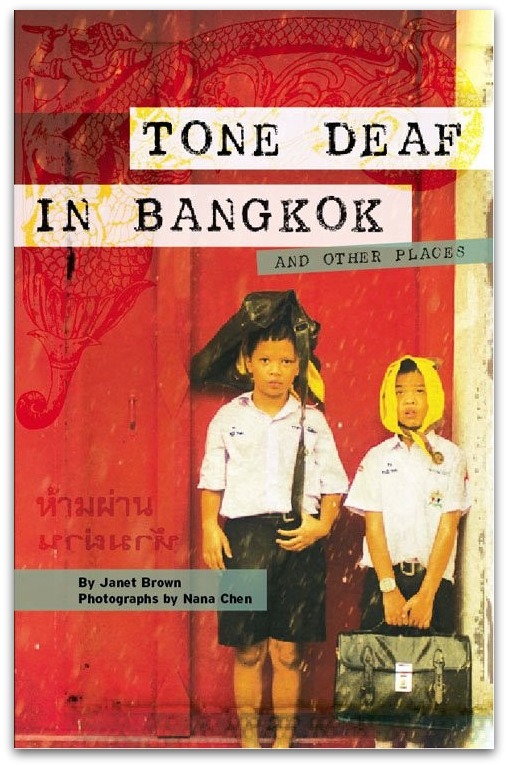
JANET BROWN, author of the travelogue Tone Deaf in Bangkok, and DAVE PRAGER, author of the travelogue Delirious Dehli, will discuss the need for travelers to do more than the usual amount of preparation when entering cultures that are very different from one’s own, on a par with Alice’s Wonderland.

As Brown explained in her interview with us, travelers to Thailand can be “tone deaf” because Thai is a tonal language and it’s easy to make mistakes. But they can also be “tone deaf” when it comes to figuring out the Thais’ communication style:

“You looked so beautiful yesterday” probably means today you resemble dog food and ought to go home and rectify that at once.

Whereas for Prager, one of the points about living in Dehli is that you may end up deaf as there are always people, animals and vehicles around.

In conversation with Anthony Windram, Prager admitted that getting used to America again — he and his wife now live in Denver — hasn’t been easy:

What’s struck me is that the US just seems so empty. It’s not that India is always intensely crowded; rather, it’s that India you’re never completely alone.

WRITING LAB: What (Not) to Write

Expat writing coach par excellence KRISTEN BAIR O’KEEFFE will explore techniques to develop your writing skills and help you find which world, of your many worlds, you want to write about, and how to get started.

Last summer’s post “6 celebrated women travel writers with the power to enchant you” was officially dedicated to O’Keeffe for delivering these pearls of writerly wisdom during her “Expat Writing Prompts” series:

Writing a multi-volume treatise is NOT the answer. Of this, I am sure.
Instead find a nugget. A moment. A single object. One exchange. One epiphany. One cultural revelation.
Find one story and tell it.
Just it.

DAY THREE: “We’re not alone” — Eat, drink, be merry & look good

Classy and Fabulous: French Style as Universal Norm

The French may be under fire for how they treat immigrants, but expats continue to thrive there. For this event, the classy and fabulous JENNIFER SCOTT, author of Lessons from Madame Chic: The Top 20 Things I Learned While Living in Paris — which has been a runaway success (it’s now under contract by a major publisher!) — will set out to prove, as she did last month in an interview with us, that no one can edit down their clothes and belongings as well as the French can.

The equally classy and fabulous ANASTASIA ASHMAN, co-editor of The Expat Harem: Foreign Women in Modern Turkey — and participant in our “Cleopatra for a Day” series last month — will serve as discussant. Two of the cultural influences for Ashman’s wardrobe are Southeast Asia (she once lived in Malaysia) and Turkey (she was an expat in Istanbul for several years). She does, however, adore French perfume!

Which Came First, Story or Recipe?

It’s food — so that means France again! ELIZABETH BARD, an American who lives in France with her French husband, and her opposite number, CORINE GANTZ, a Frenchwoman who lives near LA with her American husband, will explore why food is so central to the works each of them produces.

Bard is the author of the best-selling Lunch in Paris: A Love Story with Recipes. So did she ever think of writing it the other way around: recipes with a love story? Here’s what she told ML Awanohara in their conversation last autumn:

When I sat down to think about the moments that really helped me discover French life, I kept coming back to the dinner table, the markets, the recipes — so it seemed natural to structure Lunch in Paris around those experiences.

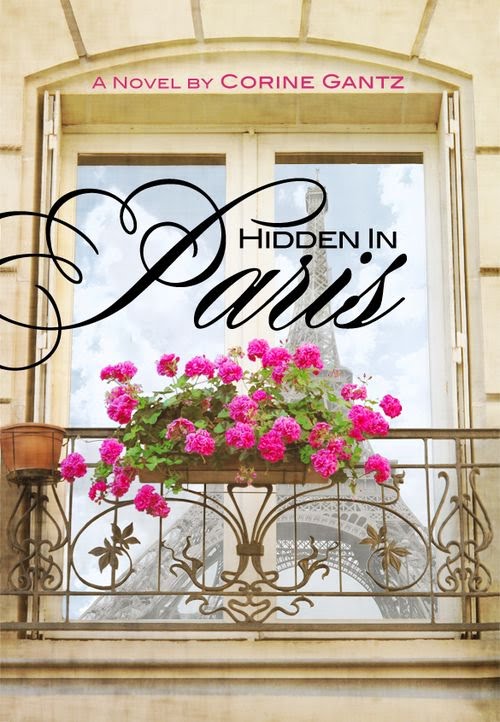
Gantz can no doubt relate. When we featured her novel, Hidden in Paris, last summer, here’s what she said when the topic of food came up:

For me, writing a novel is a barely disguised way for me to talk about food — the novel being a vehicle for food just as grilled toast is a vehicle for foie gras.

Fans of Hidden in Paris, please note: Gantz has just now released a playful cookbook featuring 20 delicious dishes that were described in mouth-watering details in the novel.

Moderating the discussion between Bard and Gantz will be the well-known novelist JOANNE HARRIS. Harris, who was born over a sweet shop in Yorkshire to a French mother and an English father, rarely misses an opportunity to bring food and drink into her novels — the most famous example being Chocolat.

Displaced Storytelling Circle

Verbal antics, stories, music and more. Highlights include readings by

  1. Displaced Nation contributor TONY JAMES SLATER, from his highly entertaining travelogue, That Bear Ate My Pants! Adventures of a Real Idiot Abroad.
  2. Displaced Nation interviewee ALLIE SOMMERVILLE, from her wry memoir Uneasy Rider: Confessions of a Reluctant Traveller. (Allie, please read the passage about the campervan being too wide for one of the Spanish streets!)
  3. Displaced Nation nomad KAREN VAN DER ZEE, from her collection of expat stories. (Miss Footloose, please tell us the ones about the crocodile and the couple in the Roman restaurant!)
  4. Founder KATE ALLISON, from The Displaced Nation’s weekly fiction series, Libby’s Life, which as you may have noticed, is now up to 46 episodes. (Kate, be sure to read the one where you introduce Sandra, Libby’s MIL from hell!)

The Art of Drink: Ian Fleming

One of The Displaced Nation’s founders, ANTHONY WINDRAM, will talk about the role of food (and especially drink) in Ian Fleming’s James Bond novels, on which he did a post last year:

The Bond of the novels isn’t solely a martini drinker. He’s always one to try anything local that’s on offer. In Jamaica he’ll drink a glass of Red Stripe, in the US he’ll have a Millers Highlife beer. Throughout the novels Fleming uses food and drink to convey an alien culture, demonstrate social status, show Bond’s mood and his sophistication and ease with the world.

An array of drinks — not only shaken martinis but also bottles of Heineken!– will be served. Green figs and yogurt, along with coffee (very black), will be made available to anyone who is still suffering from jetlag.

Enchanted by Wisteria: Elizabeth Von Arnim Unveiled

Displaced Nation founder (and the author of this post!) ML AWANOHARA will read her favorite passages from the collected works of travel writer Elizabeth von Arnim, on whom she wrote a post last year. As she pointed out then, Von Arnim was fond of the idea of a woman escaping her marital, motherly and household duties in the pursuit of simple pleasures such as gardens and wisteria. A magical Italian castle — such as the one featured in her best-known novel, The Enchanted April — can also be a tonic.

CLOSING NIGHT + BONUS EVENT

To close the festival, we will screen both the Swedish and Hollywood versions of The Girl with the Dragon Tattoo, followed by a critique from CHRIS PAVONE, author of the new novel The Expats. Pavone will discuss whether:

  1. it was really necessary for Hollywood to produce its own (non-subtitled) version; and
  2. all the female-perpetrated violence cropping up in film and on TV of late presages a “fourth wave” of feminism.

Pavone is well qualified to judge the latter as his novel (not yet featured on TDN!) is an offbeat spy story with a female protagonist — a burned-out CIA operative who moves to Luxembourg. Apparently, this was the kind of thing Pavone thought about when he was trailing his spouse in that cobblestoney old town.

And, just when you thought it was all over, we bring you a final treat: a chance to hear from the historian SUSAN MATT, who recently published Homesickness: An American History to much fanfare in the thinking media. Matt disputes the stereotype of Americans as westward wanderers by showing that Americans are returning to their homeland in greater numbers — that’s if they ever leave at all. (Our ancestors must be turning over in their graves!)

* * *

So, shall I sign you up? And can you think of any additional topics/authors/performers who ought to be featured? I look forward to reading your suggestions in the comments.

STAY TUNED for tomorrow’s guest post from Meagan Adele Lopez, on the differences between American and British wedding celebrations.

If you enjoyed this post, we invite you to subscribe for email delivery of The Displaced Dispatch, a round up of the week’s posts from The Displaced Nation. Sign up for The Displaced Dispatch by clicking here!

Related posts:

Party big! 5 of the world’s biggest bashes, to end all bashes

“Celebrate we will, because life is short but sweet for certain.”
Dave Matthews Band, lyrics from “Two Step”

Because it’s our birthday here at the Displaced Nation, I’ve been having a think about my favorite parties from around the world. I’ve been to quite a few!

There are some I’ll never forget, some I wish I could forget — and some I’m still hoping to experience…

So today I present my top five picks of parties that I wish could be held every year in my own back yard, as it were, for my immediate attending pleasure.

For my first choice, there is simply no contest:

1) The Full Moon Party (Koh Phangan, Thailand)

This Full Moon Party is the bash to end them all. Upwards of 20,000 crowd the Haad Rin beach, on the southern tip of Koh Phangan, an island in the Gulf of Thailand. The party is so epic it has spawned imitators all around the world (especially in Thailand). There are people twirling fire sticks and jumping through fire hoops. Bars line the beach, and vast amounts of alcohol in plastic buckets fuels frantic dancing right through ‘till dawn — and beyond.

By the morning the survivors, usually the most party-savvy (or those who’ve paced their drinking), head off around the coast to start the after-party!

Everyone else falls into two categories:

  1. Those who made it home before they passed out, in which case they’ll have nothing worse than a hangover and the occasional burn mark as souvenirs.
  2. Those who collapsed on the sand mid-party. These unfortunates most likely will have been robbed of everything — including clothes. They face the unenviable task of getting home with no money, no car/bike keys, a raging headaches and a crippling sunburn. That, and the scorn of local taxi drivers, who tend to frown on naked passengers. (You only make this mistake once!)

And if this Full Moon bash is slightly too hard-core and crowded for your tastes, the enterprising organizers have come up with lesser parties for every week of the year: Black Moon, Half Moon, Blue Moon…along with the occasional Jungle Party scattered between.

Go there. Do it. Your liver will never be the same again!

TONY’S TIP: Don’t do drugs. Plain-clothed cops roam the beach, and have been known to try and sell drugs to unsuspecting tourists — and then arrest them if they agree to buy!

From one that’s free to all to one that’s recently become very hard to get to:

2) Burning Man (Black Rock Desert, Nevada)

Burning Man, a week-long event that pays tribute to radical self-expression, began as a bonfire ritual on the summer solstice. It is now so popular that it’s running a lottery system to see who gets to go. If you get the chance, it has to be one of the best New-Age festivals around: a mix of art, performance, story-telling, meeting, camping and surviving, all under the relentless desert sun (or the freezing desert night!).

Oh, did I mention? It’s in the desert.

Self-sufficiency is the key. Leave no trace. Meet up with like-minded, free spirited people from all over the world, and burn a gigantic man-shaped bonfire with them. Then cover yourself with body paint and go do something arty.

Sounds like heaven, eh?

Alas, my friends at Technomadia (a pair of technology-enable nomads) couldn’t get tickets this time, despite being an organizational hub for a whole “sect” of attendees over the last few years. As far as I know, the policy of offering tickets via lottery has been universally hated, and is under review.

The festival starts the last week in August, and the namesake (giant burning man) event takes place on the Saturday night before Labor Day.

And now to one that’s still just about doable:

3) Glastonbury! (Glastonbury, Somerset, UK)

Depending on your point of view, the Glastonbury Festival can be seen as one of the most famous music festivals in the world, with five days of top acts for every taste … or a deafening week camping in a muddy field in England!

I had to include it, because (to my shame) I’ve still never been — despite the fact it’s held less than 15 miles from the house where I grew up! Yup — I lived close enough to smell the unwashed hairy hippies! (I’ve been to the Full Moon Party on Koh Phangan but not to the Glastonbury Festival — now is that displaced, or what?)

But tickets are very expensive, and you’ve got to be quick. I happened to be home visiting someone in hospital on the day the tix went on sale in 2011. There was a whole ward full of people sitting there on laptops, hitting the refresh button constantly, trying to buy them — only three (out of 14) managed it!

Those lucky few contended with the notoriously poor English weather, which turned last year’s festival into a filthy quagmire — but I expect they were far too stoned to care!

TONY’S TIP: Get in FREE as a volunteer litter picker. It’s getting tougher though — you have to join a festival staff agency and convince them you actually plan to pick up litter, instead of doing what most of the staff end up doing: watching bands and getting high!

Moving right along…is it cheating to have another one from Thailand? Well if it is, I don’t care, as this one is unmissable:

4) Songkran (Thailand)

The Thai New Year festival, known as Songkran, is the most fun you’ll ever have with your clothes on. (Anyone who’s traveling in Southeast Asia, hurry up: it’s held this week, April 13-15.) Just don’t expect your clothes to survive the ordeal! This country-wide water fight comes to a head in the cramped city streets, where tourists and locals stand toe to toe — and try to drown each other! Traffic snarls every road, and from the back of every truck buckets of water are being flung.

The year I attended (I was living in Bangkok), I drove up to a policeman and threw a water balloon right in his face — the only time I’ve done that in my life! You gotta watch out for those cops, though — they’re usually packing…super-soakers! The long squirt of the law should never be underestimated; not least because these guys have more practice at firing!

Drinking is a big part of the fun in the touristy areas of Bangkok, as is the throwing of flour, food coloring, dyes and pastes of many kinds — hence the clothes warning. But even if you ruin your clothes, believe me, it’s worth it!

And then, there is the granddaddy of them all…

5) The celebration to mark the end of the Mayan Long Count calendar (Belize)

This has to be most exclusive event on the planet. Attend this year’s Maya Winter Solstice in Chaa Creek, Belize, and you’ll own ultimate bragging rights — it’s as simple as that.

Brangelina wedding? Pah, there’ll be another one. Maybe two.

Meteorites will strike, popes will die, entire nations will rise in triumphant revolution, and then fall — again and again and again.

But the end of the Mesoamerican/Maya/Mayan Long Count calendar will only ever happen once, because a) the first one has taken 5,200 years, and b) there’s no ancient Mayans left to do another count. So even if you live to be a million, you still won’t get to see this party again!

Not to mention, the world is going to end.

Joke! In fact, no one knows what the end of the long count signified to the Mayans — other than it being time to buy a new calendar. There is NO apocalyptic event prophesied in their culture, and never was. But it does make you think — just why did they pick the winter solstice, 21st December 2012, for the end of their five-millennia-long cycle?

Don’t you want to know? I do!

So that’s where I’ll be. Although I may have to sell my house to afford the ticket. And…I don’t own a house.

D’oh.

So what have I missed out, eh? This is a great big world full or parties and festivals — what are your favorites? And why are they so great?

Let me know in the comments!

STAY TUNED for tomorrow’s Random Nomad interview with author Wendy Williams (she recently contributed a popular guest post to The Displaced Nation).

Related posts:

img: MorgueFile

5 tips on how to look good when you backpack

I don’t know about you, but I look terrible when I travel.

Not intentionally of course; jet lag notwithstanding, it’s impossible to look crisp and put together after an extended journey by public transport, no matter where in the world you are.

My problem has more to do with my style of travel — or lack thereof… There are two real options when you’re a backpacker: clothes that look good, or clothes that are comfy. Now, bearing in mind you’ll be spending quite a lot of time in them — alternating between the same two pairs of trousers every day until they drop off you and disintegrate — it’s not much of a choice.

Is that because I’m a guy? Maybe — see the note about my wife at the end of this post.

But I don’t care whether you’re male or female, there’s something about being a backpacker that makes keeping up one’s appearance a constant challenge. However fastidious you are about your personal appearance (and most backpackers I know are!), however much you shower before an 18-hour bus journey, you’re still going to look (and smell!) pretty bad afterwards.

So, bearing in mind the following advice from Mr Will Kommen:

If you look like your passport photo, you’re too ill to travel.

…here are five of my tips on how to look good as you bounce around the globe:

1) Haunt charity shops.

Many countries have these in some form or other, and the richer the country the more expensive and interesting gear you can pick up for next to nothing. They’re perfect for replacing an item of clothing that is giving up the will to live in your backpack; or something you’ve become so sick of wearing you daydream constantly about burning it. This shops are incredibly cheap, so you can go crazy — and then just give the stuff back when it’s time to move on.

I don’t travel with any technical clothing, so when my wife and I decided to do a two-month, 1,000 km hike, we had to equip ourselves from scratch — on next-to-no budget. Guess how we did it? Yup, “op shops” they call them in Australia — we visited every one. In a couple of weeks we had all the gear we needed for the hike — plus all the money had gone to charity! And when we were done, we gave most of it back as donations (except the t-shirts, which were too stained to be of use to anyone).

2) Adopt local dress.

Fisherman’s trousers in Thailand, those crazy-colored woolly trousers in South America — pseudo local fashions are cheap to buy, fun to wear and, if they don’t become a souvenir, easy to dispose of before onward travel. I say “pseudo local” because real locals wear the uniform of the world: jeans and a fake Nike T-shirt. Or a Manchester United strip (shirt and shorts).

3) Take any opportunity to wash.

It’s amazing how good it feels to be clean. Most people take it for granted, but then most people have never spent three consecutive nights on the same train, going backwards and forwards to avoid paying for a hotel room. Anyway, the point is there are opportunities everywhere: most major train stations have showers open to the public cheaply, almost all airports do too — and some places you wouldn’t expect, like shopping centres. Shopping centres are free to enter, with regularly cleaned public loos. A lot of them also have “mother-and-baby” rooms, with a table or fold-down shelf, a sink — in short, an open invitation for a full body wash and a change of clothes. Just be wary in Japan — a lot of the public toilets there are “smart.” They unlock and open if you’re in there for too long, which can be pretty embarrassing if you’re soaping yourself down when the door opens opposite Starbucks…

4) Take any opportunity to “dress up.”

Looking posh is a moral boost, and should be possible for most of us bedraggled travelers just by shaving and wearing all-clean clothes! I also travel with a shirt — just one — which transforms a pair of jeans into an outfit smart enough for a nice restaurant or swanky bar (well, as long as they don’t look at my feet, on which I have either flip-flops or hiking boots…).

5) Wear jeans!

The rest of the world will be. Seriously — for every sweat-wicking-fast-drying-wind-proof-mesh-venting-ThermaCELL-layering-system you own, there’s another person behind you who has none of it. And you know what? They look a lot better than you! This is why so much “technical” clothing ends up in charity shops (see above) just waiting for you to pick it up — people with lots of cash buy it, don’t use it for anything more strenuous than shopping, then realize that it looks pretty crummy when compared to clothes that were, you know, designed to look good whilst shopping. So they ditch it. You should too — or at the very least, stop paying outrageous prices for the stuff. Unless you’re headed to Everest Base Camp — in which case, buy it all from those people who’ve just realized that no matter how expensive it was, it doesn’t look right in Sainsbury’s.

* * *

Obviously, this is a bit of a male perspective on things. My wife swears by traveling with a small (for an elephant) bag of “essential” make-up. It’s the main reason she’s recently swapped her rucksack for a suitcase…but she assures me it helps her feel good about herself when otherwise she’d look as bad as I do. So I indulge her.

What do you do to look good while you travel?

Tell us in the comments section!

STAY TUNED for tomorrow’s post, a review of a new book on Asian beauty.

If you enjoyed this post, we invite you to register for The Displaced Dispatch, a round up of weekly posts from The Displaced Nation, with seasonal recipes, book giveaways and other extras. Register for The Displaced Dispatch by clicking here!

Related posts:

Images: (clockwise beginning top left): Charity shop in West Street (© Copyright Basher Eyre and licensed for reuse under this Creative Commons Licence)  baby changing room sign and South American wool pants for sale, by Tony James Slater; backpackers (Morgue photos).

4 films that will make you want to travel — and one that won’t!

Now, there’s a pretty standard list of travel-inspiring movies out there; it’s everywhere you look online, and it goes something like this:

But I wanted to give you some slightly more alternative choices — because I try to avoid being ordinary whenever possible. Yes, okay, you can say it — because I’m downright weird. So in place of those otherwise awesome films, may I present to you the following movies which have inspired me personally:

1) The Adventures of Priscilla, Queen of the Desert (1994), directed by Stephan Elliot

Why I love this film: It’s ridiculous and lots of fun, which is pretty much how I think all life should be! As three Sydney drag queens travel through the barren Australian outback, we get to see that iconic terrain, vast and empty and aching to be explored. This film has it all: humor, a light-hearted way of handling a serious message (about homophobia) and visuals to die for as the trio procession through some of Australia’s most awe-inspiring scenery. In a big pink bus.
Personal note: Not only did I travel to Australia and fall in love with a woman who considers this her favorite movie ever –- I also had the good fortune to be with her when she decided to re-enact one of the film’s famous scenes, when the drag queens hike around King’s Canyon in their fabulous dresses! I’d say we got mixed reactions from the other tourists — probably me, most of all…
Memorable line:

Felicia: The only life I saw for the last million miles were the hypnotized bunnies. Most of them are now wedged in the tires.

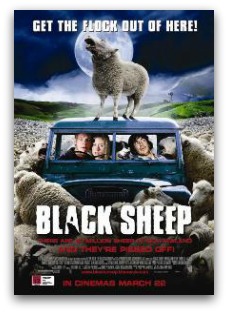
2) Black Sheep (2007), directed by Jonathan King

Also ran: Actually, I was going to nominate The Lord of the Rings trilogy but then decided — NO! I can’t use it. It’s too easy. Plus we’ve already had one film with Hugo Weaving (the mighty Elrond played a drag queen in Priscilla!). I know, across the three films they showcase the sights of New Zealand at their jaw-dropping best — anyone who hasn’t watched these films and felt an urgent need to visit New Zealand needs to watch them again but ignore the kick-ass sword fighting… Yeah, I know. That’s never going to happen.
Why Black Sheep won out: The rugged landscape looks every bit as impressive in this movie as it does in Lord of the Rings — but it’s also populated by were-sheep, an accidental result of some unusual genetic manipulation… See it, and laugh at the New Zealanders. Oddly enough, they’ll love you for it. It’s the Kiwis’ love of poking fun at everything, especially themselves — their self-deprecating humor — that really made me want to visit the place. I felt like I would fit in there. And I did — I stayed for two years. By the time I left, I was on a first-name basis with the entire population.
Memorable lines:

There are 40 million sheep in New Zealand…and they’re pi**ed off!

Harry (as the were-sheep charge towards them): F**k, the sheep!
Tucker: No mate, we haven’t time for that.

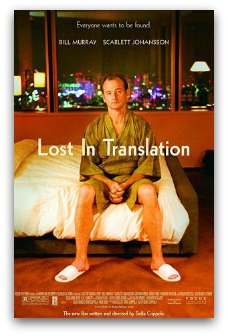
3) Lost in Translation (2003), directed by Sofia Coppola

Why I love this film: It’s an odd one, this one. The first time I watched it, my mind boggled at how something so boring, with nothing remotely resembling a plot, could get made into a movie. Then I watched it again. And again. Because it was the rainy season in Thailand, where I was living, so I couldn’t go outside — and we only had three DVDs in English, so we watched all of them every day. For two months. Somewhere around the halfway point of this torturous process, I fell in love with Lost in Translation — maybe I just needed to relax to appreciate it? Once I stopped looking for something to happen, I started to understand what it was all about: loneliness, uncertainty, being adrift and confused in a completely alien culture. And ever since then I’ve desperately wanted to go to Tokyo. Well, not enough to actually go there — yet — but you know what I mean. I do travel vicariously — just sometimes — and this is one of ‘em.
Caveat: If, like me, you’re a fan of films where, you know, stuff happens — it might take you a few viewings to get used to it. Forty or fifty should do the trick.
Memorable line:

Charlotte: Let’s never come here again because it would never be as much fun.

4) Ip Man (2008), directed by Wilson Yip

Why I love this film: The closest I’ve come to China are the little “made in” labels on almost everything I own. This film, however, kindled a desire to visit China that I never knew I had in me. It’s the biographical story of the most famous kung fu practitioner in the world — not Bruce Lee but his teacher in Wing Chun kung fu, master Ip Man. It’s set in Foshan, China in the 1930s-40s during the Japanese Invasion, but was filmed in Shanghai. It follows the family of the master as he becomes ensnared in the war, losing everything over the course of the Occupation and being forced to face the hardest choices a man could make. The insight into a lifestyle and culture so utterly different from my own was fascinating enough, but this is a story both moving and powerful.
Audience participation: I dare anyone to watch it and not leap off the couch at some point with a cry of “Yeah, kick his ASS!” Ahem. Okay, so maybe that’s just me.
In sum: Will it make you want to visit China? I think so. Will it make you want to learn kung fu? I absolutely guarantee it!

And because I’m a contrary kind of guy, I just had to retaliate against my own optimism by highlighting a film that made me NOT want to travel:

5) Cidade de Deus (City of God) (2002), directed by Fernando Meirelles and Katia Lund

Why I don’t recommend this film: The film is set in the 1970s, in the poorest districts surrounding Rio de Janeiro, where drugs and guns rule and the population live in a fear only matched by their misery. I saw it in South America, in its native Portuguese — but with Spanish subtitles. Given my fledgeling abilities in that language, as described in a previous post, I may have failed to grasp every nuance of the story, but basically what I took from it was: “DON’T EVER GO THERE! They will kill you for the hell of it.”
Analysis:There is poverty everywhere in the world — I’ve worked in homeless shelters in the UK and seen people every bit as desperate as the denizens of Brazilian favelas (shanty towns). But these kind of places, where automatic weapons are more readily available than McDonald’s hamburgers and life is so very cheap…they absolutely terrify me.
In sum: Brazil remains on my list of all-time favorite, must-visit countries — but no way am I going anywhere near the favelas in Rio. This film has put me off — for life.

* * *

And finally…there’s one character that stands head and shoulders (and hat!) above all the rest when it comes to inspiring my travels. I’ve carefully avoided mentioning his films, as I was trying hard to keep this a cheese-free list — but I can’t hold it in any more.

I WANT TO BE INDIANA JONES!

I know, I know! So does everybody in the world, ever. Even people in remote tribes that have never been contacted by the Western world, secretly harbor a desire to be Indiana Jones — they just don’t know how to put it into words.

So — now it’s your turn!
1) What films have made you want to travel? And why?
2) What films have made you want to run screaming from the very idea of travel — and why?
3) If you WERE Indiana Jones — what would you do?

STAY TUNED for tomorrow’s post on cinema and the expat life.

If you enjoyed this post, we invite you to register for The Displaced Dispatch, a round up of weekly posts from The Displaced Nation, with seasonal recipes, book giveaways and other extras. Register for The Displaced Dispatch by clicking here!

Related posts:

Images: Tony James Slater (yes, that’s really him!) playing out his fantasy of being Indiana Jones; film posters courtesy Wikipedia.

The Displaced Q: Can travel and the expat life lead to a healthier diet?

Part of the formula for feeling better about oneself — TDN’s theme this month — is eating a healthier diet. Today Tony James Slater, the newest addition to our team, poses a Displaced Q on the eating habits of travelers and expats.

I’m not sure what qualifies me to pose a question about food, since my idea of healthy eating is using low-fat mayonnaise on a full English breakfast — but hey, I’d love to hear your side of the story…

I think I have what you might consider to be a rather controversial point of view, which is that traveling and leading an expat lifestyle can lead to a healthier diet — but for the most part do not.

WAIT! Before you hit the comments with that vitriolic reply — hear me out. I may be wrong (my past wrongness is legendary), but I believe I have a point. Tell you what — I’ll lay out my opinion (which I’ve put a lot of thought into), and then you can tell me if I’m talking out of my asparagus.

Chopping veggies: too much like hard work?

Plenty of people see travel as a way to reinvent themselves. I should know, I did exactly that, as explained in my last post about volunteering in Ecuador.

But reinventing your lifestyle is one thing — your diet is something else. I think statistically speaking (and I’m no expert) 99.9% of us have struggled with our diet at some point or other.

It’s not a change like deciding to make more “me time,” or adding the beach into your daily itinerary. We struggle because changing our diet requires that dreaded thing: commitment.

And the enemy of commitment is convenience.

Ah, convenience…the single biggest factor driving the fast-food phenomenon worldwide. Is it easier to swing past KFC on your way home from work than it is to get home and start chopping vegetables?

You bet it is.

What’s more, this instant gratification factor appeals not just to the terminally lazy — like me — but to an awful lot of people in a world where free time is increasingly under pressure.

The food you know…

So you’re in a new country. You tour the neighborhood. What’s the first thing you’ll recognize — whether in Cairo, Bangkok, Buenos Aires or Paris? Chances are it’ll be a fast-food joint. It’s just so easy. Nothing new to challenge you — either your palette or your linguistic skills. Just point and grunt, to be rewarded with something you could have bought within five minute’s drive of the last place you lived.

Don’t get me wrong. As I travel I make an effort to eat everything — including, on occasion, things I shouldn’t. (Apparently, the wings stay on the locust, even if they have got most of the soy sauce on them — who knew?)

Still, there is the part of me that, after a few days dining from street vendors, really craves a burger. Or a pizza. Something Western, that tastes of home.

As British writer George Miller once remarked:

The trouble with eating Italian food is that five or six days later you’re hungry again.

Asia — the exception?

There are certain countries with a deserved reputation as a mecca for healthy eating — yes, I’m talking about Japan here. In fact, most Asian countries are considered to have a healthy yet appealing diet, with an emphasis on seafood and simplicity.

For the better part of a year in Thailand I lived like a king. Fresh fruit for breakfast every morning, compared with jam on toast, bacon and sausage back home — score one for healthier eating!

Simple meals of chicken and rice, or noodles from street vendors were my staples. They were as cheap as they were delicious!

And yet… It was all fried. The rice was fried. The chicken was fried. The noodles… Is it possible to overdose on MSG?

I had no control over how my food was cooked and no kitchen to prepare it myself. Back home I fry things occasionally, but I’m a path-of-least-resistance kinda guy. My food isn’t always healthy (burgers, schnitzels, chips) — but I’d stick it in the oven or grill it. So the score…is tricky to say on this one.

And then there’s the booze…

Thailand is famous — at least amongst the 18-35 age group — less for its culinary marvels than for its parties. Score one (a large ONE) + a whisky chaser for the unhealthy diet.

Do you drink more when you travel? Cocktail by the pool? Glass of wine or two in the evening, because why not — you feel so free? Yeah, you do. Don’t worry — so does everyone else. But that’s another nail in the coffin of a healthier diet…

(And yes, I know all about anti-oxidants. That’s how I justify red wine too.)

* * *

In my experience, to eat anything decent, you have to work for it. The easier food is to find, and the more recognizable, the less healthy it tends to be.

If you’re prepared to experiment with different recipes and ingredients, different cooking apparatus and utensils, to learn a few words in the local language and risk using them in the market — then you can manage it.

But if you’re prepared to do all that for the sake of eating healthy, chances are you do it at home too, in which case you’ll eat healthily wherever you are. And probably outlive me by at least a decade.

So, as I said at the beginning: can travel encourage one to adopt a healthier diet? Well, I think it can…but doesn’t.

Am I full of carp? Am I talking sushi? What do you think?

TONY JAMES SLATER is a self-confessed adventureholic. For the last six years he’s been traveling nonstop around the world, working at a variety of jobs including yacht deliverer in the Mediterranean, professional diver in Thailand and snow boarder in New Zealand. He even deprived the world of sandalwood one tree at a time in Australia (though he still maintains it was an accident). Last year, Slater published his first book, That Bear Ate My Pants!, an account of his misadventures while volunteering at the animal refuge in Ecuador. (The book was featured in The Displaced Nation’s list of 2011 expat books.) He is currently working on a second book set in Thailand, while exploring his new home in Perth, Australia.

STAY TUNED for Wednesday’s post, an opinion piece by Lawrence Hunt on what drives today’s young people to seek spiritual enlightenment abroad.

If you enjoyed this post, we invite you to register for The Displaced Dispatch, a round up of weekly posts from The Displaced Nation, with seasonal recipes, book giveaways and other extras. Register for The Displaced Dispatch by clicking here!

Related posts:

Image: Tony Slater with his girlfriend (now wife), Krista, in an open shack-style cafe in Kuta Beach, Bali, Indonesia. Krista is eating nasi goreng, a Balinese veggie curry (over fried rice), whereas Tony has ordered a burger (but will it be too Asianized for his tastes?).

I traveled in search of adventure — and ended up embracing a simpler life

Today we welcome Tony James Slater to The Displaced Nation as the newest addition to our team. He makes his debut with a post about his trip to Ecuador for the purposes of volunteering at an animal sanctuary in the Andean Mountains — an experience that led to some deep (as well as humorous) reflections.

My first real trip abroad was to Ecuador. (I made a trip to France once, but since I’m from England, that doesn’t really count.)

I went there in search of adventure. I sure wasn’t going to “find myself.” If I had any deeper motive, it was to reinvent myself — ideally as Indiana Jones.

(NB. If you’re going to Ecuador — take cheese. The stuff they have there has the same taste and consistency as soggy toilet-roll.)

I’d planned to volunteer in an animal refuge; it was my way of doing something more meaningful with my life, of giving a little bit back to nature.

And I was absolutely terrified.

There were reasons for this:

  1. I’d never really traveled. (As mentioned, France doesn’t really count.)
  2. I spoke no Spanish.
  3. I had no experience with animals, other than owning a pet rabbit when I was nine.
  4. I was, it has to be said, a pretty weedy human being.

But nobody in Ecuador knew me. I could cast off the bits I didn’t like — and that would start with the fear.

It helped that the setting was gorgeous. The refuge, called Santa Martha Animal Rescue Center, was surrounded by cloud-forest, halfway up a mountain in the Avenue of Volcanoes.

Talk with the animals…

I felt an immediate connection with the animals, who were in the sanctuary because they’d been victims of animal trafficking. I even connected with the monkeys, who escaped so often I spent more time chasing them than feeding them.

But you can’t have an adventure inside your comfort zone. That’s like nipping next-door for a cup of tea and calling it a night out.

First I had to strip everything back. My computer couldn’t make the trip as it was the size of a small building. My phone survived for less than a day before committing suicide from the top bunk-bed, but it was only good as an alarm clock anyway.

(I didn’t even need an alarm clock; I had a rooster for that. Which was great, except it went off an hour early every morning.)

Before I knew it I’d slipped into a much simpler pattern. Get up. Feed the animals. Clean the animals. Tend the wounds I’d received whilst feeding and cleaning the animals. Then chop, dig, carry, nail…

The boss would show me a task that needed doing, give me the tools and then leave me to it. Build a cage. Fix a cage. Build a parrot perch…

Generally the tasks were simple, manual, and I got better each day at handling them. (Except one Saturday morning when he tried to teach me welding; I made the mistake of looking at the torch at the exact moment it flared up, like a miniature sun. In fact I did this every time it flared up. As a result, not a lot of welding got done, and I was blind for the rest of the weekend!)

At the end of a long day I could feel how hard I’d worked; tired in body and nothing in mind to concern me beyond wondering what crazy job they’d get me doing tomorrow. I could just kick back in the hammock and day-dream…

As Albert Camus once philosophized:

But what is happiness except the simple harmony between a man and the life he leads?

Swingin’ in a hammock

Ever notice how when people think of “paradise,” there’s almost always hammocks? No corner offices or Mercedes Benzes. Even shoe shops rarely make an appearance.

It’s that idea of “getting away from it all” that holds the allure, I think; relaxing on a beach wouldn’t be the same if you were doing your tax return while you were at it.

Hence the hammocks. Symbolic of the chance to do — and think of — absolutely nothing; at least for as long as your sojourn lasts.

Perhaps I was in fact searching for a simpler life? Perhaps we all are?

In any event, I loved it.

I was getting stronger, more confident, with every week that passed.

(I was also getting bitten, clawed and mauled by everything that could bite, claw and maul, from monkeys to crocodiles — but that’s another story.)

I was learning to focus, to take my time looking for a solution to a problem and to work at it until it was right. I owned less and less each day as my clothes got shredded through work, but it didn’t matter. I wasn’t out to impress anyone, at least not with my fashion sense.

Best of all I had an identity. It didn’t need explaining — I was “that guy from the animal place.” It was a good job to be defined by. It felt positive and honest.

Reality bites as well

Returning to the “real” world back in the UK was like a wet fish in the face — all of a sudden people had places to be and a time-limit for getting there; everyone seemed so busy, so stressed out about it and so worried that something, somewhere was going wrong.

I don’t think a single one of them was about to be eaten alive, but a lot of them acted like it.

I hadn’t even realized what I’d been a part of until I saw it from the outside — and frankly it scared me more than removing the remnants of a jaguar’s breakfast.

I had two choices at that point. I’d gone “back to basics” and knew how rewarding that kind of lifestyle could be. Or I could rejoin my native society, get a real job, get a career even — go corporate.

It wasn’t too hard a choice to make.

Another Albert — Einstein — famously had

Three Rules of Work: Out of clutter find simplicity; From discord find harmony; In the middle of difficulty lies opportunity.

In Ecuador I’d found simplicity and harmony, wrapped up in the most difficulty I’d ever faced, and it had indeed led to opportunity.

I sold my body to medical science (and that’s not even a joke!), bought a one-way ticket to Thailand and spent the next nine months working in an animal clinic that really was in paradise. I didn’t wear shoes for the better part of a year.

I had found myself after all. I’d made my decision not to rejoin the rat race and I’ve been traveling ever since.

Which is probably why I’m broke.

But I couldn’t be happier!

TONY JAMES SLATER is a self-confessed adventureholic. For the last six years he’s been traveling nonstop around the world, working at a variety of jobs including yacht deliverer in the Mediterranean, professional diver in Thailand and snow boarder in New Zealand. He even deprived the world of sandalwood one tree at a time in Australia (though he still maintains it was an accident). Last year, Slater published his first book, That Bear Ate My Pants!, an account of his misadventures while volunteering at the animal refuge in Ecuador. (The book was featured in The Displaced Nation’s list of 2011 expat books.) He is currently working on a second book set in Thailand, while exploring his new home in Perth, Australia.

STAY TUNED for tomorrow’s episode from Libby’s Life. Did the absence of her mother-in-law at Christmas compensate for the absence of Libby’s own mother — and, come to that, the Mother Country? (What, not keeping up with Libby? Read the first three episodes of her expat adventures.)

If you enjoyed this post, we invite you to register for The Displaced Dispatch, a round up of weekly posts from The Displaced Nation, with seasonal recipes, book giveaways and other extras. Register for The Displaced Dispatch by clicking here!

Related posts:

Image: “Hammocks are not just for humans” — Slater took this photo of Machita, the dog he befriended at Santa Martha, the Ecuadorian animal sanctuary.

12 NOMADS OF CHRISTMAS: David Hagerman, American expat in Malaysia (11/12)

Current home: Penang, Malaysia
Past overseas locations: Vietnam (Ho Chi Minh City), Thailand (Bangkok), Malaysia once before (Kuala Lumpur), Hong Kong, China (Shanghai, Chengdu), Philippines (Los Baños)
Cyberspace coordinates: David Hagerman Photography (business site), SkyBlueSky (blog) and @DaveHagerman (Twitter handle)
Recent posts: “My Date with the Bachelorette” (December 17, 2011); “Day Dreaming” [includes a work-in-progress: “The Ferry Boats of Istanbul”] (November 29, 2011)

Where are you spending the holidays this year?
Chiang Mai, on assignment.

What will you do when you first arrive?
I’ll be scoping out shots as soon as I drop my bags.

What do you most like doing during the holidays?
Eating. My wife, Robyn Eckhardt, is a great cook and she always makes something a bit special, if not necessarily traditional, around Christmas and New Year. (She writes about food and food culture, and has a food blog, EatingAsia, for which I take the photos.) For example, she might make devil’s curry, or curry debal, which is part of the Eurasian Kristang cuisine of Singapore and Malaysia, and is often served during Christmas.

Will you be on or offline?
This year I will be working during the holidays. I’m shooting a hotel in Penang and a travel story in northern Thailand with edits in between. I’ll need to be online for most of that time to send images and file the story.

Are you sending any cards?
I’ll admit that I’m terrible about mailers, promotional and personal. Getting better about doing that is a New Year’s resolution.

Can you recommend any good films or books other expats or “internationals” might enjoy?
The BBC mini-series Michael Palin: Himalaya. Palin has a wonderful way of having fun with a place without making fun of a place. I like it when an actor or a writer can transport you to a place and have you meet the people while not making themselves the center of attention in the narrative.

If you could travel anywhere for the holidays, where would it be?
Turkey. I’ve been three times in the past 18 months and it’s become a bit of an obsession.

What famous person do you think it would be fun to spend the holidays with?
The Ventures‘ guitarist, Nokie Edwards. His version of “Frosty the Snowman” is a reason to listen to Christmas music, and if I could talk him into playing “Telstar” as the ball drops on New Year’s Eve then I’d be a pretty happy guy.

What’s been your most displaced holiday experience?
Christmas in Southeast Asia always feels wrong to me. Too much heat, too much sun, too much Christmas for the sake of nothing but shopping. Except for the Philippines. Filipinos know how to do Christmas better than any people I know.

How about the least displaced experience — when you’ve felt the true joy of the season?
In rural northern Italy, where I’ve spent three Christmases, the holiday felt just as it should: a time for eating and drinking and being together with family and friends. The consumerist frenzy was minimal, and everyone was in a great mood, showing kindness to each other and to me. Even on Christmas Eve, when everyone was out food shopping, there was no pushing, no rudeness, no impatience. I’d like to be in Italy again for the holidays.

How do you feel when the holidays are over?
Robyn and I don’t make a big deal of Christmas or New Year’s, so January 2nd feels pretty much like any other day.

On the first day of Christmas, my true love said to me:
ELEVEN CAMERAS CLICKING,
TEN SPROUTS A-BRUSSELING,
NINE CELLPHONES DANCING,
EIGHT WHOOPHIS WHOOPING,
SEVEN SKIERS A-PARTYING,
SIX SPOUSES TRAILING,
FIVE GOOOOOOOFY EXPATS.
FOUR ENGLISH CHEESES,
THREE DECENT WHISKIES,
TWO CANDY BOXES,
& AN IRISHMAN IN A PALM TREE!

STAY TUNED for tomorrow’s featured nomad, the last (12/12) in our 12 Nomads of Christmas series.

If you enjoyed this post, we invite you to register for The Displaced Dispatch, a round up of weekly posts from The Displaced Nation, with seasonal recipes, book giveaways and other extras. Register for The Displaced Dispatch by clicking here!

Related posts:

7 extraordinary women travelers with a passion to save souls

A week ago, I announced that The Displaced Nation will be dedicating the month of November to exploring the displaced lives of those who travel the world to do good works on behalf of those less fortunate.

Blame it on the years I spent as an expat in England, but the whole time I was writing that post, I had the sense of a Victorian couple — the man in a top hat, the woman in a full skirt — looking over my shoulder, whispering in my ear: “We tried to save the world, too, you know.”

To be fair, those phantoms of mine have a point. The Victorians ventured into the wilds of Africa, Asia and the Americas not just as imperialists looking for riches but also as missionaries looking to save souls.

And, just as we 21st-century people think we have the answers for people who live in developing countries — microfinance, entrepreneurship, mosquito nets, gifts of sheep and goats — our forbears thought they had the answers, too: Christianity, coupled with a strong belief in the universality of basic human freedoms.

Today I will attempt to put said ghosts to rest by paying tribute to 7 women missionaries from the 19th and early 20th centuries, from both sides of the Atlantic.

So, why the women and not the men? Three reasons:

  1. Being women, they tended to stand up for the rights of women and children wherever they went.
  2. Many also learned the language and assimilated to the local culture, thereby winning respect.
  3. And many were further willing to acknowledge the blunders committed by missionaries when attempting to penetrate the world’s most remote communities. As missiologist Ruth Tucker, who has read many missionary memoirs by women, observes:

These women writers one after another have allowed themselves to be vulnerable in painting a sometimes messy picture of their own character and of their missionary work. [Their] raw memoirs have much to say to us in the 21st century.

I’m going to take Tucker’s words to mean that even if you’re not religious, disapprove of proselytizing, or are something other than Christian, you might still concede that, on derring-do, fortitude, and decency alone, the following women deserve a place in the Displaced Hall of Fame.

Ann Haseltine Judson (1789 – 1826)

Who was she? A Bradford, Massachusetts native, teacher, and the wife of Andoiram Judson. Two weeks after they married, the couple set out on a mission trip — first to India, then to Burma.
Key achievements: While her husband was imprisoned in Burma under suspicion of being a spy, Judson wrote stories of the struggles she faced on her own in the mission field. She included tragic descriptions of child marriages, female infanticide, and the trials of the Burmese women who had no rights except for those their husbands gave them.
How she died: Of smallpox in Burma, at age 37.
Interesting fact: At least 16 biographies of Judson were published in the 19th century, the most famous of which had a new edition printed almost every year from 1830 to 1856. She and Andoiram were American celebrities.

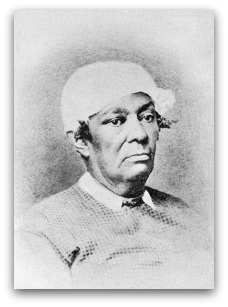
Betsey Stockton (c. 1798 – 1865)

Who was she? A freed slave who left domestic service to travel as America’s first single female missionary to Hawaii, then known as the Sandwich Islands. In fact, she went partly as a missionary and partly as a servant to one of the couples on the mission, the Reverend and Mrs. Stewart.
Key achievement: After being asked by the son of the Hawaiian king to teach him English, Stockton started up a school at Lahaina (in West Maui) for the makeainana — fishermen, farmers and craftsmen who lived off the land — which continued after she left.
Why her mission ended: Stockton’s service in Hawaii was cut short when Mrs. Stewart became ill. The party decided to return to the States in 1826.
Where she died: In Princeton, NJ. She is buried in the Stuarts’ plot in Cooperstown, NY.
Stockton’s diary: Stockton kept a detailed written record of the mission, which conveys her somewhat turbulent, occasionally agonized, inner spiritual life; her interest in the natural world — including the kinds of fish caught from the ship, the color of the waves, and various bird life; and her spirit of adventure. Like others on board she was frightened at her first sight of the Hawaiian men who come out in canoes to greet the ship:

half man and half beast—naked—except a narrow strip of tapa round their loins…

But then she adds: “They are men and have souls.”

Adele Marion Fielde (1839 – 1916)

Who was she? A working-class native of Rodman, NY, who followed her fiancé, a Baptist missionary, to Bangkok, Thailand (then Siam) — only to discover he’d died of typhoid fever 10 days after she’d set sail from New York. She carried on nevertheless, remaining in Siam for a couple of years.  Later she went on a mission to China for training Bible women.
Key achievement: Fielde mastered the Chinese language and was also a powerful writer. She encouraged each of her Chinese Bible women to tell their stories, and then translated these stories and got them published in magazines back home. As one of her biographers puts it:

Their heart-rending sagas proved enormously appealing to American women, who could sympathize with their suffering Chinese sisters.

Where her life ended: In the United States. She retired from missionary work, went home, and became involved in scientific research.
Strange twists and turns: A free thinker since childhood, Fielde broke away from her family’s Baptist roots — only to return after becoming engaged to a Baptist missionary candidate. She faithfully served as a Baptist missionary for two decades — and then turned to science. Notably, the Baptists for a a long time sensed that she wasn’t quite one of them, accusing her of indulging in card-playing and dancing when she lived in Siam. She responded:

“I desire to be good. But I do not wish to be Pious.”

Lottie Moon (1840 – 1912)

Who was she? A highly educated Virginia native (she was born “Charlotte Digges Moon” on her family’s ancestral slave-run tobacco plantation). She became a teacher and then was called, at age 33, to serve for decades in China with the Southern Baptist Convention. Initially she went to join to her sister, Eddie, who was stationed at the North China Mission in the treaty port of Dengzhou.
Remarkable turnaround: When she first arrived at the mission, Moon made a point of wearing Western clothes to distance herself from the “heathens.” But then she mastered the language, became an admirer of Chinese culture and history, and started wearing Chinese clothes and adopted many of their customs.
Commendable behavior: When China was facing plague, famine, revolution, and war, Moon shared her personal finances and food with anyone in need around her.
How she died: Of starvation, in the harbor of Kobe, Japan, while en route back to the United States. (At that point she weighed only 50 pounds!)
Impressive statistic: Southern Baptists have named their annual mission fund after Lottie Moon. It finances half the entire Southern Baptist missions budget every year.
Part of her lore: She used to tell people she was 4′ 3″ tall. While something of an exaggeration, she was definitely petite!
Lottie Moon Cookies: Moon won over the children in her Chinese village by making tea cakes for them — they called her “the cookie lady” instead of “foreign devil.” Baptist families bake Lottie Moon Cookies for Christmas.

Mary Slessor (1848 – 1915)

Who was she? A Victorian mill girl who left the slums of Dundee to live among the tribes of Calabar, Nigeria, to take up the mantle of David Livingstone two years after he died.
Noteworthy friendship: While in Africa, Slessor became acquainted with the writer Mary Kingsley. Although the latter had never been baptized and hadn’t even been brought up a Christian, their common status — both were single females living among native populations with little company — presumably created the basis for lasting friendship.
Key achievement: The tribal people believed that if a woman gave birth to twins, one of the twins was the offspring of the devil who had secretly mated with the mother — and since the innocent child was impossible to distinguish, both should be killed (the mother was often killed as well). Slessor fought hard to end this practice.
Where she died: In Nigeria, at age 67. There was great mourning among the tribes to whom she’d dedicated her life.
A tribute from an unexpected source: During London Fashion Week in 2010, Nigerian-born designers Bunmi Olaye and Francis Udom named Slessor as one of the muses behind their collection, which fused Victorian costume with furs of the African tribe Slesson had lived in. The reason? Slessor had rescued Francis’s great-grandmother, who was born a twin, from human sacrifice.

Amy Carmichael (1867 – 1951)

Who was she? A small-village girl from a devout Presbyterian family in County Down, Northern Ireland (her father founded an evangelical church in Belfast). She was called first to work among the mill girls of Manchester and then overseas, finding her life-long vocation in India.
Key achievement: In those days, Hindu priests kept “temple children” — mostly young girls who were forced into prostitution to earn money for them. Carmichael tried to rescue them by setting up a sanitarium in Tamil Nadu, thirty miles from the southern tip of India.
Bold behavior: She would dress in Indian clothes, dye her skin with dark coffee, and travel long distances on hot, dusty roads to save just one child from suffering.
How she died: In India at the age of 83. She asked that no stone be put over her grave. Instead, the children she had cared for put a bird bath over it with the single inscription Amma, meaning “mother” in Tamil.
Cryptic remark: While serving in India, Carmichael received a letter from a young lady who was considering life as a missionary. She asked, “What is missionary life like?” Carmichael wrote back saying simply,

“Missionary life is simply a chance to die.”

A measure of her fortitude: Carmichael served in India 55 years without furlough and produced a total of 35 published books about her experiences.

Gladys Aylward (1902 – 1970)

Who was she? A working class London girl who left domestic service for to Yuncheng, Shanxi Province, China, in the tumultuous years leading up to World War II. She worked with an older missionary, Jeannie Lawson, to found an inn where traveling merchants could get a hot meal and hear stories from the Bible. Notably, Aylward was initially rejected as a potential missionary to China because of her lack of education. She spent her life savings on her passage.
Key achievements: Appointed by the local mandarin to serve as a “foot inspector,” she toured the countryside to enforce the new law against foot binding and met with much success. She also took in orphans and adopted several herself, and she intervened in a volatile prison riot, advocating for prison reform. When the region was invaded by Japanese forces in 1938, Aylward led around a hundred children to safety over the mountains, despite being wounded herself.
How her life ended: She returned to England in the 1940s, then tried to go back to China but was re-denied entry by the Communist government. She ended up in Taiwan, where she started another orphanage. She lived in Taiwan until her death.
Chinese nickname: She was known in China as Ai-weh-deh, or Virtuous One.
Celebrations of her life: Numerous books, short stories and movies have been created about the life and work of Gladys Aylward, including the film The Inn of the Sixth Happiness.
Not easily flattered: For Aylward, this 1957 movie was a thorn in her side: she resented being played by the tall, Swedish Ingrid Bergman (small in stature, she had dark hair and a cockney accent) and was further horrified to discover she’d been portrayed in “love scenes” with the Chinese Colonel Linnan.

Readers, what do you think of these 7 women? Have they inspired you?

STAY TUNED for tomorrow’s post, a Displaced Q on the “pornography of poverty.”

If you enjoyed this post, we invite you to subscribe to The Displaced Dispatch, a weekly round up of posts from The Displaced Nation, plus some extras such as seasonal recipes and occasional book giveaways. Sign up for The Displaced Dispatch by clicking here!

Related posts:

Image: MorgueFile

RETURN TRIP: Travel author Janet Brown channels Alice in Wonderland’s “tone deaf” adventures

While our writers take off on what they hope will be enchanting August breaks, The Displaced Nation will occasionally be reissuing some posts that, for one reason or another, enchanted our readers. Enjoy these “return trips”!
June was “Alice in Wonderland” month in The Displaced Nation, and the enchanting travel author Janet Brown came to our online tea party. She answered ML Awanohara’s questions on the curious and unreal aspects of her life in Thailand. Last time we checked in with Janet, she was in the process of moving back to the States. Will her counterculture shock prove to be another Alice adventure? We hope to hear back from Janet in the coming months.

As you may have noticed, The Displaced Nation has gone Alice-in-Wonderland mad since around the first of June. To take just a few examples:

And now, to top that all off, the extraordinary travel writer Janet Brown is paying us a visit. Brown could almost be a stand-in for the Lewis Carroll heroine herself, having published a book on travel to and life in Thailand called Tone Deaf in Bangkok, to much acclaim.

“Tone deaf” — it puts one in mind of poor Alice’s plea to the Mouse, “I didn’t mean it…But you’re so easily offended, you know!”

But if Brown sees herself as tone deaf, her readers regard her as anything but. Here is a sampling of her reader reviews on Amazon:

It has been ages since I have loved a piece of travel literature…, and so when I read TONE DEAF IN BANGKOK, I was thrilled. This is a good travel book, and it is a good book, period.

I am not a traveler, nor do I typically read travel books. Shame on me, I know, but here’s the thing: … The author brought Bangkok to life in a way that made me want to go there, yes, but it was her own story that captivated me and kept me turning the pages. Now I’d read anything Janet Brown writes!

Janet Brown’s TONE DEAF IN BANGKOK is a travelogue, to be sure. Yet it is more, so much more. It’s also an investigation into how dislocated we can become by ourselves, by our priorities and by all that we demand of the cultures in which we live. … That she has a gift for spotting the universal in the exotic makes this collection all the more profound.

Janet Brown has graciously agreed to answer some of my Alice-related questions. After that, dear reader, I urge you to chime in!

Before we go down the rabbit-hole, can you tell me a little bit more about your background?
My parents turned me into a gypsy before I was two, by taking me on their journey by jeep from New York City to Alaska when the 49th state was still a territory and the Alcan Highway was still an unpaved trail into the frozen north. I have wandered ever since, most recently in Southeast Asia with Bangkok as my home, writing down the stories I encounter as I explore. My books include:

Maybe because I’m so steeped in Alice-of-Wonderland lore this month, I think of you as Alice Personified. To what extent can you relate to Alice’s sense of disorientation? Going back not just to the first time you went to Thailand but also when your family dragged you to Alaska…
I was 18 months old when my family moved to Alaska from Manhattan. I coped with any displacement issues by making my mother read my favorite book over and over again — a truly saccharine Little Golden Book called The New Baby. The main character had the same name as I so that was the big attraction — all about me! My mother swears she can still recite it verbatim after having two martinis.

Alice came to mind constantly in my first months in Bangkok — and frequently thereafter. I knew I’d gone through the looking glass — or had entered the postcard — and asked myself often if that experience had been as painful for Alice as it often was for me.

Can you describe your worst “Pool of Tears” moment in Bangkok, where you wished you hadn’t decided on living there?
I’ve tried to make light of that time when I wrote about it in Tone Deaf in Bangkok, but it nearly demolished me. When the manager of my apartment turned me into Ryan’s Daughter by listening in on my phone calls and then entertaining the neighborhood with highly embroidered versions of my life — and when people fell silent when I walked down the street and began gabbling excitedly after I’d passed — I felt as though my life had been stolen from me and I shut down to the point of hypothermia. If my students hadn’t helped me find a new neighborhood, I would have gone home a gibbering mess.

Thailand is renowned for its distinctive cuisine. Was there anything that carried an “Eat me” label that you felt hesitant about at first, but then discovered you loved?
I’ve written about durian in Tone Deaf, how I thought its smell in the market was sewer gas and then how I was forced to taste it, with happy results. Fried grasshoppers were another thing I didn’t warm to at first sight and then liked as much as I do popcorn — they have much the same crunch and texture.

By the same token, were there any foods that you thought might be good but then didn’t acquire a taste for? (For Alice, of course, that was the Duchess’s over-peppered soup.)
One night I stopped to buy green papaya salad from a food cart to take home for supper. There was something in a little plastic bag that looked like a sort of relish, so I bought that, too.When I opened it at home a smell of rot filled the air, but remembering the delightful surprise that durian had proved to be, I took a generous spoonful. It was pla ra — fermented fish, a Northeastern Thailand culinary staple that is meant to be added and mixed judiciously with the salad, not eaten like peanut butter. There wasn’t enough toothpaste in the world to rid my mouth of that thoroughly foul taste.

As already mentioned, Alice finds it’s easy to offend the creatures in Wonderland without even trying. Why did you choose the expression “tone deaf” for the title of your book on Bangkok?
“Tone deaf” can be taken quite literally. Thai is a tonal language with five different tones giving meaning to every word. Use the wrong tone and at best you’re incomprehensible, at worst shocking. The most common mistake for foreigners is to tell someone their baby is beautiful, while actually announcing that the infant is bad luck. Another pitfall is confusing the word “near” with the word for “far” — they are the same sound, differentiated by a crucial tone.

But travelers to Thailand can also be “tone deaf” when it comes to figuring out the Thais’ communication style. As a Thai-American friend has observed, the important things are what remain unsaid. “You looked so beautiful yesterday” probably means today you resemble dogfood and ought to go home and rectify that at once. Subtlety is the hallmark of Thai communication, and is often expressed through a quirk of an eyebrow or a famous Thai smile, which has at least one hundred different meanings — including disdain or outright menace.

Describe the biggest faux pas you’ve made since settling in Bangkok.
Oh, how to choose — it’s impossible not to make faux pas every second because Thai etiquette is demanding and complex. The one that makes me cringe most is in my first week when I set off on my first solo bus ride. I was clutching a twenty-baht note, which like all bank notes in Thailand bears the countenance of the King. He is revered to the point of near godhood in his kingdom and his picture is always elevated to the highest spot in a room — nothing is above the King. But I was fresh off the boat and when I dropped my money and it was caught in a little breeze, I put out my foot (the lowest and most ignominious part of the body) and stepped on the picture of the King’s face to secure my bus fare. I was too clueless to pick up on the ripples of horror that this caused others at the bus stop, but now I writhe when I remember this.

“Off with her head!” as the chief royal in Alice’s story is wont to proclaim. Actually, never mind your head. Your mention of your foot makes me think of how physically awkward Alice feels around the creatures in Wonderland. As a farang in Bangkok, do you often feel self conscious?
I’m short and dark in a family of pale-skinned people, so I was used to being an anomaly from early childhood. In Bangkok, if I dressed like a Thai woman and wore sunglasses and walked slowly, I felt as though I blended in. But one day I walked down a quiet street on my way to a class, and someone looked up and said, “Look at the foreigner.” “How did she know?” I asked my class of teenage girls. “Your hair,” they said. “No, lots of Thai women have dyed their hair brown,” I replied — to which they responded: “Your nose.” It was my big American nose that gave me away every time — and since I hate pain and surgery, I just had to accept that.

Have you tweaked your personal style at all so as to fit in better?
Yes — I adopted the conservative “Don’t show your bare shoulders” school of dressing that prevailed in Bangkok when I first arrived and slowed my pace to that of the women around me. I learned to keep my facial expression as bland as I possibly could to achieve the quiet Thai “public face,” and I ironed everything, including my Levis. Now women are much more casual in the way they dress but I’m still stuck in the cultural mores of the 90s. To foreign women who live here now, my introductory years in Bangkok seem like fiction — things have changed so drastically in the past 16 years.

Time for a quote from the Cheshire Cat: “…we’re all mad here. I’m mad. You’re mad.” Can you relate?
Riding on the back of a motorcycle taxi down a crowded city sidewalk, buying a glass of Shiraz to take with my popcorn into a movie theater, being drenched to the bone during Thai New Year’s — this is actually the most difficult question you’ve asked so far because at this point it all seems normal.

If you were to hold your own Mad Hatter’s Tea Party in Bangkok, whom would you invite, and why?
Anais Nin, because she would love the unbridled hedonism of this place, Evelyn Waugh because he would satirize the expat scene so well, Ho Chi Minh because he could help put together the revolution that is needed here, Emily Hahn because she has always been my role model since I first read her when I was twelve, and Elvis because in Bangkok he is still the king.

Alice becomes aware that Wonderland is turning her into a different person, unrecognizable to the one she used to be. Has your identity has shifted in fundamental ways since living in Bangkok?
This is a very complex question — I’ve written one book about it and am working on a second one, Almost Home. I’m always drawn back to the US because my children are there. Seeing them for two weeks a year doesn’t work for me. Once I get back to the US this time around, I’ll return here but plan to spend the bulk of my time near family in the Pacific Northwest. I won’t know how much I’ve been changed by this recent incarnation in Bangkok until then. Ask me again in several months.

Can you offer any advice for newcomers to Bangkok, who aren’t sure who they are any more?
Tone Deaf in Bangkok and my next book, Almost Home, are where I directly address the challenges of feeling like an Alice in Thailand. In addition, the recently published Lost and Found Bangkok, for which I wrote the text, may be helpful for newcomers. It’s a book in which five different photographers — two American men, two Thai men (both from Bangkok), and one Taiwanese-American woman — show the city they live in. New arrivals can look at the photos and see some great places to get lost — and find out who they are — in this Wonderland-like city.

img: Janet Brown with friends at an all-you-can-eat DIY barbecue at a huge restaurant under a bridge in Bangkok, by Will Yaryan.

If you enjoyed this post, we invite you to subscribe to The Displaced Dispatch, a weekly round up of posts from The Displaced Nation, plus some extras such as seasonal recipes and occasional book giveaways. Sign up for The Displaced Dispatch by clicking here!

Related posts:

Some enchanted reading: A round-the-world tour from 4 of our featured writers

For this month’s reading suggestions, we have compiled a list of books from four of our recent featured writers — all of different genres, and set in different parts of the world.

If you are stay-cationing this year, we hope one of these books will transport you for a while to a different place —  and all for a fraction of the cost of a plane ticket.

IRAN – Sons of the Great Satan – Anthony Roberts

Our featured writer in April, Tony Roberts spent his childhood in Saudi Arabia and Iran before the Islamic revolution forced him and his family back to their hometown in Kansas — which, to Tony, no longer seemed like home.

Now living in Hawai’i with his New Zealand wife and their son, Tony has published his first novel, Sons of the Great Satan. It tells the story of the friendship between two teenagers — one American, one Iranian — in the last hours before the fall of the Shah of Iran.

Amazon description:

“SONS OF THE GREAT SATAN is a tale of culture clash, international politics, heroism, friendship, cowardice and sinister betrayal. The character and beliefs of the Shah of Iran, President Jimmy Carter and the Ayatollah Khomeini are all put to the test as the whirlwind of chaos engulfs them all. The actions of these powerful men play out on the world stage and forever change the lives of those who called Tehran home in the late 1970s.”

NEW YORK – Exiled – Shireen Jilla

Third Culture Kid Shireen Jilla (half English, half Persian, and grew up in Germany, Holland and England) currently lives in London after being an expat in Paris, Rome, and New York.

Commenting on our May 7th article, Shireen said, “New York is a material fantasy that most wannabe expats have had. People imagine it to be an adventure laced only with IPad2s and lychee martinis. But, as many of you know, stepping outside your own cultural comfort zone is never as straight forward as those people, longing for it from the comfort of their three-piece sofa in the suburbs, imagine. So I choose to write about Anna, an eager expat looking for experience, but finding she sucked into a cultural nightmare that she neither could control, or understand.”

Amazon description:

“In love with her husband Jessie, an ambitious British diplomat, whose first posting brings them to New York, Anna begins the hectic, enjoyable life of a successful expat. But New York also brings her into contact with her husband’s manipulative and competitive stepmother Nancy, a powerful American socialite and philanthropist. When a silly incident with her only son Josh involves the Police Department, Anna’s seemingly perfect world begins to shatter. As Jessie’s journey to rediscover his New York roots draws him closer to Nancy, terrible and strange things keep happening to Anna. She begins to fear that someone is out to destroy her family.”

FRANCE – Hidden in Paris – Corine Gantz

Our second featured writer in May, Corine Gantz has just released her debut novel about a group of American women who try to start new lives in Paris.

A displaced Parisian in Los Angeles, where she lives with her husband and two sons, Corine blogs at Hidden in France.

Amazon description:

When bankruptcy threatens her beloved house, her one anchor in life, Annie has no choice but to find renters, and quick. Leave it to someone socially phobic to phrase a want ad in all the wrong ways. With shimmering promises of ‘Starting over in Paris’ –– a concept she has no intention of applying to her own life––Annie attracts tenants with the kind of baggage that doesn’t fit in suitcases.

THAILAND – Tone Deaf in Bangkok – Janet Brown

The last book on today’s list is by Janet Brown, whom we featured on June 10th.

In the article, Janet said: “My parents turned me into a gypsy before I was two, by taking me on their journey by jeep from New York City to Alaska when the 49th state was still a territory and the Alcan Highway was still an unpaved trail into the frozen north. I have wandered ever since, most recently in Southeast Asia with Bangkok as my home, writing down the stories I encounter as I explore.”

Amazon description:

“From her first bewildered hours to the moment that she reluctantly leaves, Janet Brown describes her experience of falling in love with, and in, Thailand’s largest city. Nana Chen’s evocative photographs provide illustrations of daily living in Bangkok.”
BC Magazine review:
“Janet Brown’s experiences in Thailand are chronicled in short essays that bypass the usual tourist spots and concepts and present an intimate and revealing understanding of Bangkok and the Thai way of life from a female foreigner’s fascinated point of view.”

If you enjoyed this post, we invite you to subscribe for email delivery of The Displaced Dispatch, a round up of the week’s posts from The Displaced Nation. Sign up for The Displaced Dispatch by clicking here!

Related posts:

Ho’ omaika’i ‘Ana to TCK writer Tony Roberts

Expat life as psychological thriller? An unholy appreciation of novelist Shireen Jilla