The Displaced Nation

A home for international creatives

Tag Archives: France

WORLD OF WORDS: For writer Marianne Bohr, travel is a way to indulge a craving for language

Marianne Bohr in the Luxembourg Gardens in Paris—is she reading or indulging in reveries about words?

Marianne Bohr in the Luxembourg Gardens in Paris—is she reading or indulging in reveries about words?

Today we welcome new columnist Marianne Bohr, whose first book, Gap Year Girl, is about to come out. Marianne contributes a post showing how her love of languages intersects with her love of travel.

At age 55, my husband and I took a “senior year abroad.” We quit our jobs, sold the house, the car and most of our belongings to travel across Europe in search of adventure.

Part of that adventure was physical. Highlights of our 12-month sojourn across 21 countries included running the Paris Marathon and doing a seven-day hike along the Tour du Mont Blanc.

Part of it was about meeting new people and trying new foods.

But for me the adventure also had to do with words. Having always been a “word” person, I was fascinated by the myriad languages we encountered. So often I’ve wondered: Is it possible to overstate the importance of language in forging friendships across borders? And my response has always been, I don’t think so.

Language itself can be a window on the world, one that opens wide when either a common tongue is shared or you look behind the vocabulary of a language other than your own.

In future posts, I’ll look at specific words and expressions, especially those in French, since I’m a Francophile through and through. But for now, I have adapted a few passages from my book that contain a few observations about language that I made during our year abroad. Enjoy!

* * *

The trip from Grindelwald, Switzerland to Chamonix, France, requires four train changes and one bus. As the crow flies, the distance isn’t far, but crossing the Alps can be a multilegged, many-houred proposition.

On one of the neat and tidy Swiss mountain trains, a Japanese couple traveling alone takes their places across from a dapper, middle-aged local gentleman on the banquette seats next to ours. He jumps up to help them with their luggage and once the bags are in place, proceeds to initiate a friendly conversation in Japanese. The look of pure, unadulterated joy on the couple’s faces lights up the train. They’re on their own, far from home, and the serendipity of selecting seats next to someone who speaks their mother tongue is priceless.

Lively conversation among the three fast friends ensues as the Swiss gentleman moves over to sit facing the twosome. He animatedly points to features of the surrounding peaks and comments on the houses we pass by as our train proceeds down the valley. I’m transfixed by the exchange. The travelers laugh, heads nodding and smiles widening, and my heart warms as I imagine the talk turning from our magnificent Alpine surroundings to families, travel, and Japan.

When the train slows for the native son’s stop, they exchange cards and, hands at their sides, quickly bow their goodbyes. Surely the encounter will be one of the most memorable of the visiting couple’s trip.

*

In Grindelwald, where we’ve arrived for eight days of hiking, we attend an evening barbecue at our hotel in the shadow of the Eiger and meet a couple that hails from Dresden, in the former East Germany. They speak passable English (which was significantly better than our almost nonexistent German). They tell us that nowadays, all schoolchildren learn English from a very early age, but that they didn’t take it up until they were adults. They apologize for their lack of fluency, acknowledging that Russian was the requirement when they were growing up. Subjugators, of course, demand that the subjugated learn their language in a decisive power play.

We end up thoroughly enjoying our outdoor buffet in the company of our new friends, having learned much about their formative years behind the Iron Curtain—all because our companions have breached the language barrier.

*

Language is key for forging ties across boundaries but it’s a delicate art. We were also amused on occasion during our gap year by the quirky use of English by some of the people we meet.

  • I overhear an Italian traveler in a quiet Roman museum triumphantly exclaim when his English friend caught up with him, “The bull has now entered into the china store.”
  • Our pretty young guide in Dubrovnik, after she asked us if we were familiar with an anecdote she shared about her city and St. Blaise inquires, “Is that bell not ringing for you?”

Such endearing errors highlight the subtle nature of language and the translation of idioms in particular, but they shouldn’t inhibit us from giving another tongue our best effort. Learning other languages has always helped me listen to and use my own language more carefully and to pay closer attention to expressions that could be difficult to understand by non-native speakers.

*

I snap back from my linguistic reverie as our Swiss train slows and we pull into the station near the French border. It’s time to transfer to the next train that will drop us at the bus depot for the final leg to Chamonix. We are our way to Provence, where we’ll retreat for the summer.

My heart flutters knowing we’ll soon be back in the promised land of the quintessential romance language—my beloved French—where once again my language window will be open on the world. I may at times speak it like a bull that’s entered into the china store, but le français will always help keep my language bell ringing.

* * *

Thank you, Marianne! How about the rest of you out there? How do you look at languages other than your native tongue: are they an impediment or a lure for overseas travel and/or living adventures? Do let us know in the comments!

Marianne C. Bohr is a writer, editor and French teacher whose book, Gap Year Girl: A Baby Boomer Adventure Across 21 Countries, will be published in September 2015 (She Writes Press). She married her high school sweetheart and travel partner, and with their two grown children, follows her own advice and travels at every opportunity. Marianne lives in Bethesda, Maryland, where after decades in publishing, she has followed her Francophile muse to teach French. She has an author site where she keeps a blog, and is active on Facebook and Twitter.

STAY TUNED for the next week’s fab posts!

If you enjoyed this post, we invite you to register for The Displaced Dispatch, a round up of weekly posts from The Displaced Nation, and SO much more. Register for The Displaced Dispatch by clicking here!

Related posts:

EXPAT ART AS THERAPY: Works that capture unexpectedly beautiful moments of life in other countries

ExpatArtasTherapy_principle_no_two

As the summer wears on—and I’m wondering what I am doing working long hours in a big city while everyone else seems to have escaped to beaches or mountains or on other adventures—I’m returning to my series based on the ideas of pop philosopher Alain de Botton. As those familiar with his work will recall, de Botton maintains that art can provide relief from as well as solutions to one’s angst.

But does the art we expats produce play a role in improving people’s lives? That’s what this series of posts explores.

No doubt, the works of international creatives has some appeal to what global soul Pico Iyer has called the great floating tribe of people “living in countries not their own.” (Expats currently number around 230 million, or about 3 percent of the world’s population.)

But are the works expats produce too specific to their own situations, or do these works, too, speak to broader life problems?

De Botton outlines six specific ways art can respond to human needs. My last post examined his first principle, that art can compensate for the fact that we have bad memories. I offered some examples of how international creatives have preserved precious moments of their lives in other countries in their works, not only for themselves but for posterity.

Today let’s look at de Botton’s

PRINCIPLE #2: Art can give us hope. Simple images of happiness touch us. We tend to be moved by small expressions of beauty—not because we are sentimental but precisely because so much of life is not pretty.

The example de Botton cites is Claude Monet’s Water Lilies, (or Nymphéas), a series of around 250 oil paintings that depict the French impressionist’s garden at Giverny. Monet painted the series during the last years of his life, while suffering from cataracts.

Claude_Monet_Nympheas_1915_Musee_Marmottan_Paris

Nymphéas, 1915, Musée Marmottan Monet, Paris. via Wikimedia Commons (public domain).

De Botton is of course stirring it up by insisting that beautiful art serves an important purpose. Artists of today seem to be in a race to outdo each other in the outrageous stakes. I’m thinking of Damien Hirst, who built his reputation on artworks displaying dead animals, or their parts, in formaldehyde tanks. Providing a respite from the ugliness of life is the last thing on his mind. Likewise for Jen Lewis, who uses her own menstrual blood to create abstract designs. Provocative, yes, but not my idea of beauty.

Returning to de Botton’s second principle: which expat artists have excelled at producing the kind of beauty that provides relief from life’s less pleasant aspects? (Who are our displaced Monets?)

By way of an answer I’ve arranged a small “exhibition” of works by four visual artists, three painters and one photographer, all of whom have been affiliated in some way with the Displaced Nation. As de Botton has done at several museum exhibitions, I’ve added post-it notes describing the therapeutic effects I’ve experienced upon viewing these artists’ works.

#1: “Lost on a Mountaintop,” by Candace Rose Rardon

Lost_on_a_Mountaintop_by_candace-rardon_800x

POST-IT: Those of us who have traversed international boundaries carry in our hearts the fear that we may someday lose our way—literally, of course, but even figuratively, with no family or old friends around to serve as mentors or sounding boards. Candace Rose Rardon shows us the flip side: how glorious to be lost on the top of a mountain range with the world stripped down to pines, sun, wind and hills, ready for you to paint your own scenes on it. Even a stay-at-home curmudgeon could be struck down with wanderlust, at such a prospect. Candace is a writer, sketch artist and illustrator without a location. She tells stories about the world through her words and watercolors.
OUR CONNECTION: Candace was the recipient of one of our Alice Awards.
SEE ALSO: Candace’s blog, The Great Affair; and her first book of travel sketches: Beneath the Lantern’s Glow: Sketches and stories from Southeast Asia and Japan.

#2: Les Mimosas de Mesubenomori,” by Julie Harmsworth

les-mimosas-de-mesubenomori-2013-800x-acrylique-et-pastel-c3a0-lhuile-sur-papier
POST-IT: My first (and only) visit to Nagasaki, made while I was living in Japan, had a lasting impact. To this day I carry around images of the damage wreaked on that city from my visit to the Atomic Bomb Museum. But for Julie, who moved to Nagasaki from the United States to teach English, the city was the place of her rebirth as an artist. She often walked to this local park, and this painting is her tribute to its flowering mimosa trees. For a moment her painting makes me forget the pain this city endured, along with the horror for war it engenders. Though one can never lose sight of the darkness, it’s possible to be touched by these simple, beautiful trees.
OUR CONNECTION: We are mutual blogging admirers. Julie, btw, has now moved to France, where she continues her work as a fine artist (hence the French title of her painting).
SEE ALSO: Julie’s portfolio site.

#3: “Russian Market—Phnom Penh,” by A. Spaice

Russian-Market-PhnomPenh_framed
POST-IT: I’ve never been to Phnom Penh but imagine it might be a variation on other Southeast Asian cities (Bangkok, Kuala Lumpur, Jakarta, Saigon) I’ve visited. From reading descriptions of the Russian Market, which lies in the southern part of Cambodia’s capital city, I can certainly picture it: a narrow warren of stalls, crowded, busy and sweltering, full of the kinds of goods you see in all of the markets in that part of the world (though apparently at better prices), everything from handicrafts to fake Swiss watches to pirated software to designer clothes considered unfit to be shipped abroad because of small flaws. The global economy at its finest! But what does writer and sometime photographer A. Spaice offer us? A glimpse of a splendidly isolated flower and flower-to-be. Such a beautiful reminder that the “I shop therefore I am” credo of Asia isn’t all there is to life!
OUR CONNECTION: A. Spaice was our first international creative to be “wonderlanded” (read her interview and an excerpt from her short book, Bangkok).
SEE ALSO: A. Spaice’s Design Kompany site and weekly e-zine.

#4: “End of the Drought,” by Antrese Wood

Endofthedrought_Antrese_Wood
POST-IT: The Pampas grasslands of Argentina are one of the most fertile areas in the world. When a drought occurs and its crops are destroyed, not only farmers—but also does the rest of the world—suffers, as world food prices are nudged higher. Antrese’s painting of the grasslands landscape “after the drought” reminds us that even when nature gives the earth and its inhabitants a terrible beating, the rain returns eventually and the beauty of the landscape is restored. If a glimpse of such beauty helps us forget the pain even for a moment, then perhaps it is possible to regroup and carry on. (Note to self: Come back to this painting once the dog days of August have arrived.) An American married to an Argentinian, Antrese has been living in Argentina since 2011.
OUR CONNECTION: Antrese was one of the interviewees in our long-running Random Nomad series. At that time she was about to embark on an ambitious project, “A Portrait of Argentina.”
SEE ALSO: Her portfolio site and her podcast series for artists, SavvyPainter.

Note: All four artists’ works are reproduced here with their permission.

* * *

So, readers, what do you think of the above “exhibition” of works that capture unexpected moments of appreciation for life’s beauty? I know that writing about these works helped to lift me out of my late-July funk, but did you, too, find it therapeutic? And are there other expat works you would recommend for this reason? Do tell in the comments.

STAY TUNED for the next fab post.

If you enjoyed this post, we invite you to register for The Displaced Dispatch, a round up of weekly posts from The Displaced Nation, with Alice nominations, book giveaways, and other extras. Register for The Displaced Dispatch by clicking here!

Related posts:

BOOKLUST, WANDERLUST: Beach bound? Check out summer reading recommendations from featured authors (2/2)

booklust-wanderlust-2015

Attention displaced bookworms! Our book review columnist, Beth Green, an American expat in Prague (she is also an Adult Third Culture Kid), empties the remainder of her treasure chest that she brought to us two days ago, stuffed with recommended reads to take you through the summer.

Hello again. As explained in Part One of this post, I reached out to some of my bookish friends as well as a few of the authors whose books I’ve recently reviewed to see what books they recommend taking on vacation. I asked them to tell me:

Summer Reading 2015

Photo credits: Amazon Kindle PDF, by goXunuReviews via Flickr (CC BY 2.0); beach chair and sandy feet via Pixabay.

Here are the rest of the recommendations I received, including a few from yours truly and ML Awanohara (Displaced Nation’s founding editor) at the end. Enjoy!

* * *

MARK ADAMS, best-selling travel writer and author of Meet Me In Atlantis (which we reviewed in May): My recommendations are a classic travelogue, a biography of an intrepid traveler, and an adventure novel.

The-Snow_Leopard_cover_300xThe Snow Leopard, by Peter Matthiessen (Viking Press, 1978)
Shortly before he died, I had the honor of interviewing Matthiessen at his home on Long Island. I was surprised by how concerned he seemed, knowing that his death was rapidly approaching, that he would be remembered less as a novelist than as the author of The Snow Leopard. I went back to reread it for the first time in twenty years and was amazed by how good it was—a moving story about a man’s search for meaning through Zen Buddhism after the death of his young wife, intertwined flawlessly with a thrilling narrative about an incredible journey through the Himalayas. So fresh and evocative it could have been published yesterday.

Bruce-Chatwin_A-Biography_cover_300xBruce Chatwin: A Biography, by Nicholas Shakespeare (Anchor, 2001)
Chatwin, of course, is one of the great travel writers of all time; he practically reinvented the genre with books like In Patagonia and The Songlines. But as Shakespeare’s brilliant biography demonstrates, Chatwin’s greatest creation may have been the globetrotting persona that he carefully presented to the world. The descriptions—decodings might be a better term—of how Chatwin assembled his literary works will be absolutely riveting to anyone who has tried his or her hand at trying to pin down the essence of a place using only words.

State-of-Wonder_cover_300xState of Wonder, by Ann Patchett (HarperCollins, 2011)
I once heard Ann Patchett on the radio, talking about the job of a novelist. She described it as “creating a world.” No one creates worlds with quite the skill that Patchett does. Reading her descriptions of pharmaceutical research being conducted in the Amazon is like being dropped into the jungle—you can feel the sweat beading on your forehead and the buzz of malarial mosquitoes preparing to land on the back of your neck. And you know what? Patchett’s Bel Canto, which takes place in Lima, Peru, is an equally brilliant tale that performs the magic tricks that only great fiction can, allowing you to read minds and travel through time and space.


MARIANNE C. BOHR, Displaced Nationer and author of the soon-to-be-published Gap Year Girl: A Baby Boomer Adventure Across 21 Countries: My summer reads are usually of the meaty kind because as a teacher, I have more time in July and August to pay close attention and savor every word. As one who suffers wanderlust daily, my three choices all have to do with travel. They are very different books, but each grabs my heart in a different way and I could read them over and over, each time discovering something new.
Bohr Collage

The Drifters, by James A. Michener (Random House, 1971)
This book takes me back to my youth and the thirst for exotic adventure that goes along with being young.

Nothing to Declare: Memoirs of a Woman Traveling Alone, by Mary Morris (Houghton Mifflin Harcourt, 1998)
I wanted to head straight to Mexico when I read this heart-wrenching book and also felt like the author was a new friend when I finished.

An Italian Affair, by Laura Fraser (Vintage, 2001)
What a guilty pleasure immersing myself in this book of islands, romance, lust and longing is. I could read it again and again.


SHIREEN JILLA, adult TCK and former expat and author of The Art of Unpacking Your Life (which we reviewed in May) and Exiled (which we featured in 2011): I would pack three very different books:
Jilla Collage

Red Dust: A Path Through China, by Ma Jian (Vintage, 2002)
Dissident artist Ma Jian’s diary of his walk across China in the wake of his divorce and threatened arrest is utterly enlightening, moving, profound and playful. Walking is clearly an under-rated pastime.

Look at Me, by Jennifer Egan (Anchor, 2009)
A powerful, beautiful novel about the crazed nature of modern urban life, it elevates Egan to one of the greats of American literature.

Paris Stories, by Mavis Gallant (NYRB Classics, 2011)
A regular writer for the New Yorker, Gallant penned these short stories about expats and exiles in Europe particularly Paris. They are brilliantly laid bare. (Born in Montreal, Gallant moved to Paris when she was 28 determined to be a full-time writer. She lived there until her death in 2014.)


BETH GREEN, writer, expat, TCK and BOOKLUST, WANDERLUST columnist: Here are my three picks, one of which I’ve not read and two that I have:

The-Messenger-of-Athens_cover_300xThe Messenger of Athens by Anne Zouroudi (Reagan Author Books, 2010)
Summer is the best time to really sink into a mystery series. I love taking a few titles from an established series and binge reading them on the beach or by the pool. Previously, I’ve done this with Elizabeth George’s Inspector Lynley novels, Janet Evanovich’s Stephanie Plum books and Charlaine Harris’ Southern Vampire mysteries. This year I’ll be spending some time on the beach in Greece, so I’ve got my eyes set on British writer Anne Zouroudi’s Greek Inspector mysteries, which depict ugly crimes based on the seven deadly sins in beautiful Mediterranean surroundings. The series now has seven books, of which Messenger is the first. (Born in England, Zouroudi worked in the UK and the USA before giving it all up to live on a Greek island. She married a Greek as well.)

swamplandia_coverSwamplandia! by Karen Russell (Vintage, 2011)
This darkly fascinating and somewhat magical story of a girl and her siblings abandoned in a run-down theme park in Florida fascinated me when I read it a few years ago. It’s both a chilling odyssey into a swampland netherworld and an exploration of subcultures of the kind rarely seen in American books. For me it had the right amount of tension to keep you turning pages and the right amount of whimsy to keep the potentially depressing material light enough for a summer read.

Daughter-of-Fortune_cover_300xDaughter of Fortune, by Isabel Allende, trans. by Margaret Sayers Peden (Harper, 2014)
Summer is a time for voyages—or at least reading about them! I can name a whole bagful of road trip books I’d happily re-read over summer, but for pure swashbuckling joy I have to recommend Isabel Allende’s historical cross-cultural adventure Daughter of Fortune. An upper-class girl raised in an English enclave in Chile in the 1800s stows away to follow her lover to the gold fields of California. I haven’t read the sequel, Portrait in Sepia, yet, but I’m guessing it’s also worth adding to that beach bag. (Born in Peru and raised in Chile, Allende lives in California.)


ML AWANOHARA, former expat and Displaced Nation founding editor: We are constantly reporting on new displaced reads in the Displaced Dispatch, which comes out once a week. Just to give you a taste of the kinds of things we feature, here is a selection. As you can see, it comprises a work of historical nonfiction that reads like a novel, a memoir with elements of Nordic myth, and a novel by a once-displaced poet, all with beach-bag potential.

Daughters_of_the_Samurai_cover_300xDaughters of the Samurai: A Journey from East to West and Back, by Janice P. Nimura (W.W. Norton, May 2015)
Call it the early Japanese version of our gap year or junior year abroad. The story begins in 1871, after Commodore Perry’s ships opened Japan to the outside world, when five young women were sent to the United States on a mission to learn Western ways and help nurture a new generation of enlightened Japanese leaders. Three of them stayed for ten years and returned to Japan determined to revolutionize women’s education. Several critics have said the book reads like a modern fairy tale. But if the women faced many hurdles in the course of their unusual journey, the tale doesn’t necessarily end happily ever after. “I cannot tell you how I feel,” one of them remarked upon her return to her native land, “but I should like to give one good scream.” Janice Nimura, an American who is married to a Japanese, has spent time living in Japan.

Passage-of-the-stork_cover_300xPassage of the Stork: One Woman’s Journey to Self-Realization and Acceptance, by Madeleine Lenagh (Springtime Books, March 2015)
Madeleine Lenagh is American but spent her first five years as an expat child in Europe, after which she grew up in Connecticut. Rebelling against her mother’s interference in her love life, she set out to travel across Europe alone. Arriving in the Netherlands broke, she took a job as an au pair—and the rest is history. She has now been living in the land of cheese and tulips for over four decades and speaks fluent Dutch. But that’s her travel history. Her own personal history remained repressed until she wrote this memoir. One of the things that interests me about it is that Lenagh chose to weave together the narrative using Nordic mythology. (As long-term followers of the Displaced Nation will know, we are fond of doing the same with the Alice in Wonderland story.) Passage of the Stork is a publication of Springtime Books, the new fledgling of Summertime Publishing, which specializes in books by expats and for expats and is the brainchild of global nomad Jo Parfitt.

hausfrau_coverHausfrau, by Jill Alexander Essbaum (Random House, March 2015)
This novel by Texas-born American poet Jill Alexander Essbaum, her first, depicts an American woman in a cross-cultural marriage to a Swiss banker. They are living with their three young children in a postcard-perfect suburb of Zürich. In the spirit of Essbaum’s erotic poetry, Anna (yes, the name is a nod to Tolstoy’s heroine) engages in a series of messy affairs. Now, is this book the expat answer to Fifty Shades? Actually, the answer to that question interests me less than the fact that Essbaum herself was once a hausfrau in Dietlikon, near Zürich, where she moved with her first husband, an American interested in studying Jungian psychoanalysis. Like Anna, she experienced intense loneliness and isolation—albeit no torrid affairs. Who would have guessed?

* * *

Thank you so much for your recommendations, ML and everyone else! Readers, it’s your turn now. What books are you looking forward to popping in the book bag this summer? And, for our friends in the Southern Hemisphere, what books are getting you through the winter?

Also, can I echo ML’s contribution by urging you to sign up for the DISPLACED DISPATCH, which has at least one Recommended Read every week. And please feel welcome to make recommendations for books to be featured in the Dispatch, and in this column, by contacting ML at ML@thedisplacednation.com.

STAY TUNED for next week’s fab posts!

Beth Green is an American writer living in Prague, Czech Republic. She grew up on a sailboat and, though now a landlubber, continues to lead a peripatetic life, having lived in Asia as well as Europe. Her personal Web site is Beth Green Writes. She has also launched the site Everyday Travel Stories. To keep in touch with her in between columns, try following her on Facebook and Twitter. She’s a social media nut!

If you enjoyed this post, we invite you to subscribe to The Displaced Dispatch, a weekly round up of posts from The Displaced Nation and much, much more. Sign up for The Displaced Dispatch by clicking here!

Related posts:

GLOBAL FOOD GOSSIP: When facing repatriation after 18 years of the expat life, bring on the comfort food!

Serial expat (and soon to be repat!) Joanna Masters-Maggs is back with some juicy global food gossip to share.
Global Food Gossip 062315
“Oh, I see, it’s that time again, is it?” My husband entered the kitchen and sniffed the air. “It’s smells like Christmas, but it’s 30 degrees outside. “You’ll be wanting tea with that gingerbread?” Sighing he reached for the kettle.

Now, I’m not saying that expat life calls for comfort food more than any other lifestyle, but it does have it’s own rhythm of needs. For me, the main calls for comfort come during the entry and exit period of a new location.

I am now facing moving on from France—and frankly, even my beloved madeleine is not up to the job.

I need the kind of comfort food that warms up the winter, as neither the glorious weather nor the proximity of pools and beaches here in Provence can distract me this time.

Bikini be damned, my next move will be a return to England.

It is hard to imagine that repatriation can be more alarming than a move from one foreign country to another. Yet, after 18 years abroad and seven intercontinental moves, I am discovering that it is.

Our house in England is our holiday home, and we have few of the friends and none of the social networks we would have built had we stayed put. All the friends we have made at various offices, playgroups, schools, dog training groups and sundry activities are scattered across several continents. We will be in the interesting position of not belonging, while giving every outward appearance of doing so and no possibility of joining a repat support group (do such things even exist?).

You understand why I am reaching for the gingerbread now?

gingerbread-repatriation

Gingerbread by roxymjones via Pixabay.

The act of making gingerbread is a comfort in itself. Just watching the butter, syrup and sugar melt together and swirl in the pan, gives one time to relax and think.

Mm…as I watch the ingredients swirl, I’m thinking about cultural comfort foods of locations past.

Morning sickness in New Orleans calls for Morning Call

For anyone into comfort eating, my former home of New Orleans is a dangerous place. There are just too many temptations along the path of righteous eating, beginning with crawfish stew, jambalaya, seafood gumbo…

But it was beignets with coffee from Café du Monde or Morning Call (the less touristy choice, favored by locals) that became my preferred source of solace.

"City Park 12-12-12 Morning Call Coffee Beignets Dunk," by Infrogmation of New Orleans (CC BY 2.0).

“City Park 12-12-12 Morning Call Coffee Beignets Dunk,” by Infrogmation of New Orleans via Flickr (CC BY 2.0).

Of course life in New Orleans is pretty fabulous, especially when you are lucky enough to live in the French Quarter and see the life that exists behind the touristy façade. But comfort requirements are still there. Coffee and beignets are a fabulous hangover buster for one thing and for another they sure beat morning sickness into retreat while providing a good dose of the additional calcium an expectant mum needs. For me, the beignet and café au lait was the multi-tasking workhorse of comfort foods.

When it came time to leave the Big Easy, the beignet soothed my sadness, and I was careful to ensure I had a good recipe (see end of post) should it be needed to help with my adjustment to the next location: Den Haag.

The only problem, of course, with making your own beignets is the terror one feels when cooking with large quantities of hot fat—so it was with relief that I quickly discovered a more convenient way to ease my emotional entry into The Hague.

A cold arrival in Holland calls for oliebollen

We arrived in the middle of a particularly cold Christmas season. You can only imagine my delight at catching my first whiff of oliebollen and appelflappen, which fills the air that time of year.

Oliebollen is a Dutch style of doughnut that is traditionally eaten on New Year’s Eve, and appelflappen are a kind of apple beignet—YES!—served with sugar and cinnamon and sold from little stands throughout the Christmas season.

What a happy Christmas that turned out to be. What joy to have a little bag of those to warm both your chilly fingers and the depths of your heart.

How can you not love living in such a place?

Dumpy in Brazil calls for Disk Cook

And then there was Brazil. Now Brazil provided a different sort of comfort food to get me through the hard times. Being pregnant and feeling dumpy in a land full of girls from Ipanema in tiny bikinis isn’t exactly fun—but then, suffering from the heat, I cut off all my hair. Short.

You don’t do that in Brazil. It’s akin to cutting off your femininity. It’s ugly.

Happily unaware of this and feeling as though I was channeling mid 1990s Meg Ryan, I returned home from the hairdresser. My housekeeper took one look of me and clapped her hands loudly to her cheeks with a look of pure horror. After a slight pause and in an unnaturally high voice, she said “Madame looks beautiful”—before making her excuses and disappearing for half an hour.

The next few days were a bit unsettling as Maria avoided eye contact. It wasn’t that I minded her thinking my hair was ugly, more that I was now aware of how little I understood the culture. How many other things was I getting wrong?

As insecure as it makes me sound, I decided not to compound one aesthetic error with that of gaining weight, too. I avoided thoughts of my beignet recipe and my go-to home remedy of buttered toast. I also steered clear of the local padarias (bakeries). Instead I filled up on fruit.

But the thing is, comfort food is the kind of thing that finds you and it doesn’t have to come in carbohydrate form. You just need to be open to it: it being a well-rounded flavor that puts your taste buds at ease.

The comfort food of Brazil found me rather quickly. Disc Cook is a service which will collect food from a huge list of restaurants and deliver to your house. A new restaurant opened in our area and we decided to try it out. Imagine my surprise when the healthy sounding chicken liver and spinach dish turned out to be my next comfort food.

Disk Cook screenshot.

Disk Cook screenshot, taken 24 June 2015.

No, hear me out. Full-flavoured meat that melted in the mouth, cooked with balsamic vinegar and pine nuts. Yes, I know it sounds odd, but it was so richly satisfying, I couldn’t get enough of it. I even took comfort in the cold leftovers of that dish, straight from the fridge.

In honesty, however, comforting as it was, it can never qualify as true comfort food. Firstly, it comes from a good restaurant and true comfort food should not be exclusive. Secondly, I was never able to find or make up that recipe for myself. If it is too hard to lay your hands on, it isn’t comfort food. Comfort food cannot be a cause of any stress—other than the weekly weigh-in, of course.

Enough of my unabashed wallowing, and now for my beignet recipe

As I write, I am beginning to feel a little nostalgic and rather sad again. The problem with being in a constant state of serial expatness is that each time you leave one place, you remember the pain of leaving the last. It is a sort of travellers’ emotional add-on game. Sometimes I have to walk away from it. That is true now.

Perhaps next time I can tell you how I found solace from homesickness and last-location-sickness in the foods of Malaysia, Venezuela and Saudi.

(If you have had enough of this unabashed wallowing, I apologise—but would politely point out that at least I haven’t descended to mentioning visits to certain popular fast food chains, which I have no doubt we perpetual expats have all indulged in at least once or twice. For that we must be grateful.)

New Orleans-style Beignets, adapted from The Ultimate Southern Living Cookbook
NOTE: I made the conversions to grams years ago. Metric rocks!

Ingredients:
1 package dried yeast
3 tablespoons warm water (hand hot)
180 ml milk
150g sugar
28g shortening (or lard—which I prefer)
1 tsp salt
375g all-purpose flour
1 large egg
Vegetable oil
Powdered sugar

Method
Combine the yeast and water and leave to stand for five minutes.

Combine the milk with the sugar, shortening and salt in a saucepan over a low heat until the fat melts. Remove from the heat and leave to cool until again hand hot. Very hot liquid will kill the yeast and so it will not rise. If your hand can tolerate the heat, so too can the yeast.

Combine yeast mixture, liquid mixture, two cups of the flour and the egg in a large mixing bowl. Beat at medium speed with an electric mixer for two minutes. Gradually stir in as much of the remaining flour as you need to make a soft dough.

Put dough onto a lightly floured surface and knead until smooth and elastic (about 10 minutes). Place in a buttered bowl, cover and leave to rise in a warm place for one hour until doubled in size.

Punch dough back, turn onto a floured surface and roll out into a 30 x 25cms rectangle. Cut into two-inch squares and place them onto a lightly floured surface where they can be covered and left to rise until double in size (about 45 minutes).

Pour oil into a pan to a depth of about 3 or 4” and heat to 375° F (190 °C). Fry the beignets four at a time until golden. Drain on paper towels. Sprinkle with icing sugar and serve warm. YUM.

* * *

Readers, we invite you to continue the food gossip! What new comfort foods have you added to your list on your moves around the globe? And do you have any words of comfort for Joanna on her imminent repatriation? Be sure to let us know in the comments!

Joanna Masters-Maggs was displaced from her native England 17 years ago, and has since attempted to re-place herself in the USA, Holland, Brazil, Malaysia, Venezuela, Saudi Arabia, and now France. She describes herself as a “global food gossip”, saying: “I’ve always enjoyed cooking and trying out new recipes. Overseas, I am curious as to what people buy and from where. What is in the baskets of my fellow shoppers? What do they eat when they go home at night?”

STAY TUNED for the next fab post!

If you enjoyed this post, we invite you to register for The Displaced Dispatch, a round up of weekly posts from The Displaced Nation—and much, much more! Register for The Displaced Dispatch by clicking here!

Related posts:

LOCATION, LOCUTION: Expat author and new columnist Lorraine Mace offers her own thoughts on writing about place

Location Locution
Please join us in welcoming Lorraine Mace, aka Frances di Plino, to the Displaced Nation for the first time. From this month, she’ll be taking over the Location, Locution column from JJ Marsh.

Hello, Displaced Nationers! I am thrilled to be taking over this column from JJ Marsh, and I already have lots of interesting guests lined up to take part over the coming months. For this first post, however, I am going to follow in Jill’s footsteps and use my first column to answer the “location locution” questions as a means of introducing myself.

But before I do that, let me give you a few basics. I was born and raised in London, but moved to South Africa just before my 25th birthday. I first lived just outside Johannesburg, then moved to the Orange Free State before discovering, and falling in love with, “the fairest cape”. Since leaving Cape Town I’ve been a nomad for more years than I care to count, having moved continent and country nine times. I finally put down roots in Spain, but have an inclination to spend summers in British Columbia, Canada.

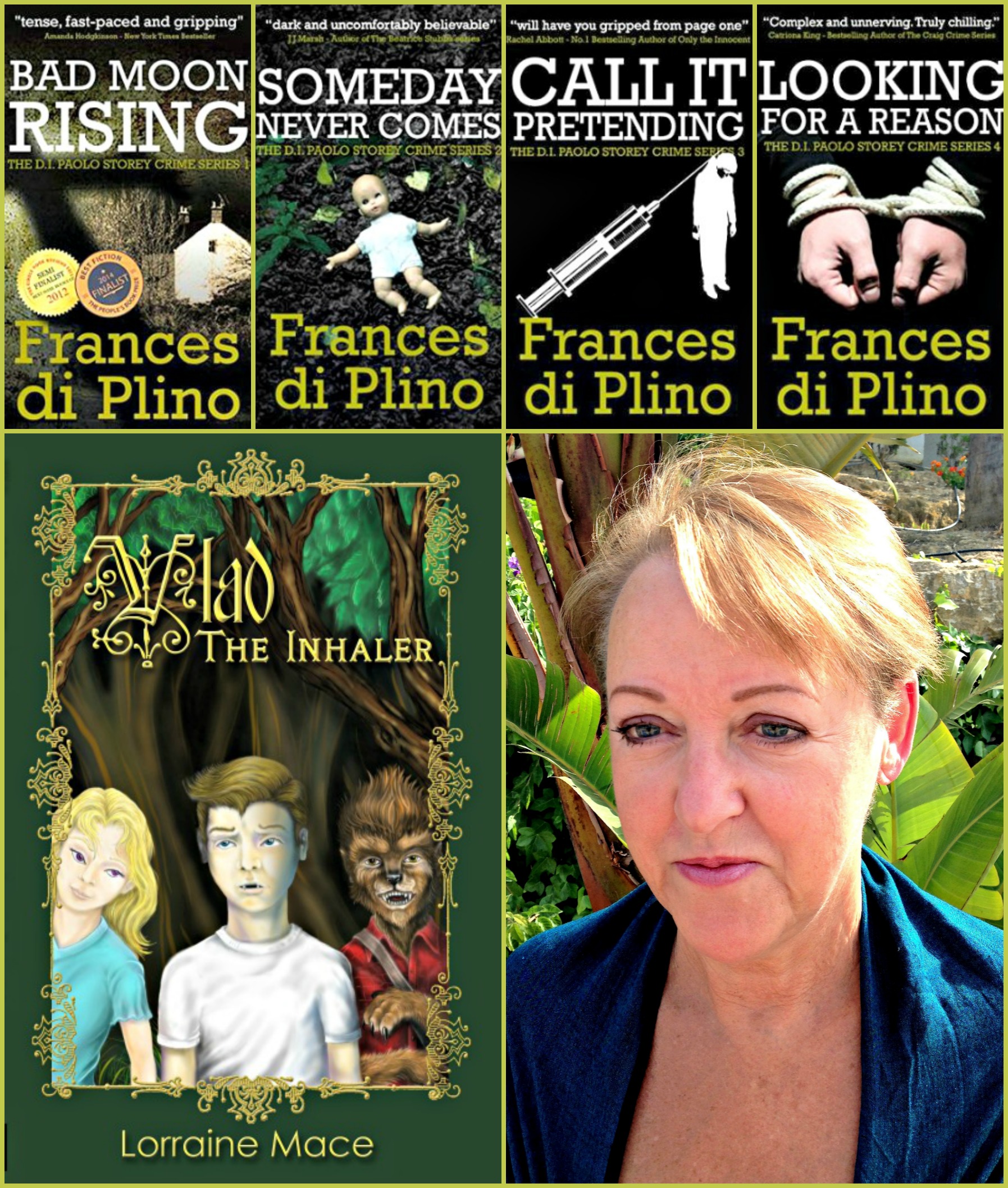
Like JJ, I write crime fiction. I also have a book series for children.

Lorraine May and books

The prolific Lorraine Mace has produced four books in her D.I. Paolo Storey crime thriller series, and one book in her Vlad the Inhaler series (vampires, werewolves and peaches, oh my!).

Oh, and one last item before I move to the questions: don’t forget to visit my predecessor’s farewell post and enter the book giveaway competition. So far there’s only two comments, which by my reckoning gives you a pretty good chance at winning seven great e-books!

* * *

Which came first, story or location?

This can vary from book to book and story to story. However, in my crime novels, written as Frances di Plino, story came first—but then location helps to formulate the plots. Although the series is set in a fictional town, the surrounding British countryside is very real. Bradchester is situated close to Rutland Water and the nearest city is Leicester, both of which feature in the novels on a regular basis. I know this area well. During my last (brief) sojourn in England I lived in a small village a stone’s throw from Rutland Water and frequently visited Leicester.

What’s your technique for evoking the atmosphere of a place?

I put myself into the heads of my characters and experience the place through their senses. When I can smell the bread in the local bakery, or hear the cries of street vendors, weep over a beautiful sunset, taste an orange straight from the tree, or touch the moss-covered stones of a monastery, I know it’s time to start writing, using my character’s experiences of the place.

Which particular features create a sense of location? Landscape, culture, food?

All three, but I must admit I find it easier to use food allied to culture when the story is set outside of the British Isles. Having lived in South Africa, on the Maltese island of Gozo, as well as in France and Spain, I know I can use regional dishes to bring areas of those countries to life. But in Britain I think we have lost the regional aspect of many of our foods. Fish and chips, roast beef and so on are now available throughout the country, where other nations seem to have guarded their regional food identities.

Can you give a brief example of your work which illustrates place?

Bradchester is a town that has more than its fair share of rundown, seedy areas set side by side with gentrified neighbourhoods. This leads to a great deal of social unrest—the haves want the have-nots moved elsewhere and the have-nots resent the wealth and easy life of the haves. This short passage illustrates an area that has, as yet, remained untouched by either sector, but just a street away it is very different.

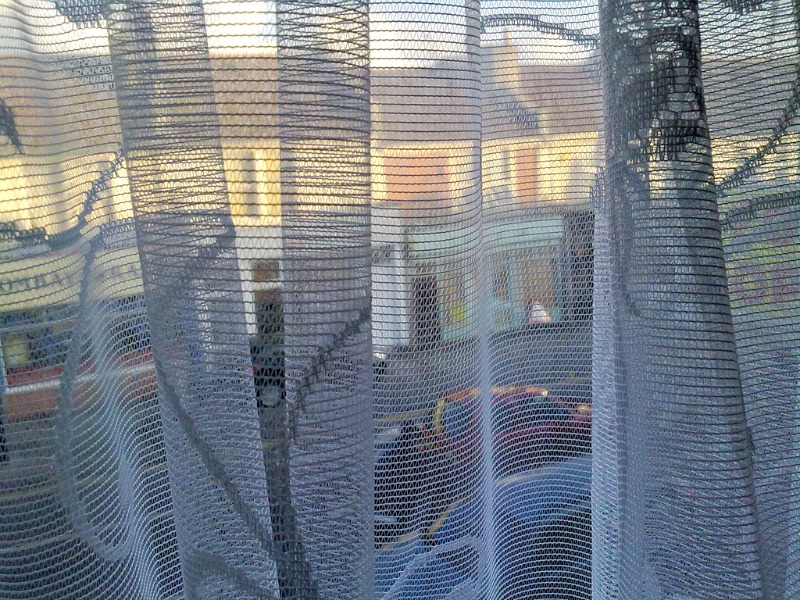
Station Road wasn’t exactly the best part of town, but the place looked respectable. Paolo was pleased to see that most of the businesses he remembered from his youth were thriving. This was one of the few communities that still had a drycleaners, newsagent, old-fashioned fruit and veg shop, alongside a mini-supermarket, hairdressers and a bank. He glanced up. Even the flats above the businesses looked lived in and cared for. Nice nets and curtains framed the windows and many of the street doors had been painted in recent history.

They walked a couple of hundred yards before turning into Zephyr Road. It was like moving into another country. Here, most of the shops they passed were boarded up and the few remaining open for business seemed to Paolo to concentrate on ways to transform goods into money. Pawnbrokers, gold for cash, payday cheque converters. It appeared as though all the dregs of the financial service industry had found their way into this street. This time when he glanced up, Paolo saw the flats above the shops were likewise either boarded up or had dirty nets hiding whatever was going on up there.

net curtains

The quality of the net curtains tells you where you are in Bradchester. Photo credit: Joss Smithson via Flickr (CC BY-SA 2.0).

How well do you need to know the place before using it as a setting?

I prefer to use places I’ve lived in, or visited many times. I like to know the area and people so well I can conjure them up at will when I’m writing.

Which writers do you admire for the way they use location?

Barbara Kingsolver and Donna Tartt spring to mind. With both authors I feel as if I am living in the locations depicted. In Donna Tartt’s The Goldfinch she manages to recreate both city and desert locations to the extent one can almost feel the weather. Kingsolver’s The Poisonwood Bible brings the 1959 Belgian Congo to life so powerfully the reader is swept into the villages, fearful alike of jungle creatures and the inhospitable landscape.

Books that get "place" right: The Goldfinch, by Donna Tartt; and The Poisonwood Bible, by Barbara Kingsolver.

Books that get “place” right: The Goldfinch, by Donna Tartt; and The Poisonwood Bible, by Barbara Kingsolver.

* * *

Thanks so much, Lorraine! I’m impressed that you created your own place for your crime series novels, and that it’s in the UK, where you haven’t lived for quite some time. Readers, any words of welcome and/or questions for our new columnist? Please leave them in the comments below.

And don’t forget to leave a comment on her predecessor, JJ Marsh’s last post for a chance to win 7 e-books that should take you through the summer. All you have to do is answer the question, in 50 words or less: Where and when in the world would you like to go, and why?

Lorraine Mace writes for children with the Vlad the Inhaler books. As Frances di Plino, she writes crime in the D.I. Paolo Storey series. She is a columnist for both of the UK’s top writing magazines, has founded international writing competitions and runs a writing critique service, mentoring authors on three continents.

STAY TUNED for the next fab post!

If you enjoyed this post, we invite you to register for The Displaced Dispatch, a round up of weekly posts from The Displaced Nation, with weekly updates and much, much more. Register for The Displaced Dispatch by clicking here!

Related posts:

Photo credits (top of page): The World Book (1920), by Eric Fischer via Flickr; “Writing? Yeah.” by Caleb Roenigk via Flickr (both CC BY 2.0).

For this wanderlusting Californian for whom photography and travel are a perfect fit, a picture says…

KONICA MINOLTA DIGITAL CAMERA
Writer, world traveler and photography enthusiast James King is back with his latest interview subject.

Jenny in Ireland

Jenny Schulte in front of an old church window ruin near Kinsale, County Cork, Ireland.

Hello again, readers! My May guest is 38-year-old Jenny Schulte. who never had any thoughts of leaving her Northern California home until she travelled to Ireland in 1999 to explore her Irish roots. Now she is an ardent traveler who combines her love of photography with her travel experiences in her captivating blog Bulldog Travels, subtitled “Everything and Nothing Plus Some Pretty Photos.” Jenny is wrong to call it “nothing”: her blog is her her outlet for sharing her travel adventures along with the kinds of “photographs my friends have always enjoyed,” as she puts it.

On her About page, she says:

[Those] two wonderful hobbies of travel and photography fit perfectly together.

A woman after my own heart!

* * *

Hi, Jenny, and welcome to the Displaced Nation. Thank you for getting in touch and offering to share your photo-travels with us. Can you tell us where you were born and when you spread your wings to start travelling?
I was born and raised in Sacramento, California, and consider myself fortunate to live in such a beautiful part of the world. San Francisco, Lake Tahoe, the gorgeous California Coast, Redwoods, Yosemite, Napa Wine Country—all are on my doorstep. But while I have always loved to travel within the United States, when I was twenty I decided I really wanted to delve into my Irish heritage and see Ireland first hand. I had a very romantic vision of the country and figured I would be disappointed if I never went. Well…the moment my tennies hit the ground, a restlessness took over and I have been globetrotting ever since. I made a good friend in Ireland who is from Germany. and together we have seen much of western Europe (Germany, Switzerland, Austria, Italy, France, Monaco, Spain, Andorra, England and Scotland). In more recent years I have been fulfilling an archaeological interest of mine exploring Mexico and Central American sites and ruins.

If you’re lucky enough to be Irish…you’re lucky enough!

So once you finally got the travel bug, you were up and running in those tennies of yours. I have only managed the UK and France from your entire list. I’m envious. Can you share with us some of the highlights of your travel adventures?
I really enjoy history and from Ireland I went to my first European countries: Germany, Switzerland, and Italy, where I could not only delve into history but also enjoy great food, culture, and scenery. From there I went on to other destinations such as France, Scandinavia and the UK. My search for ancient ruins took me to the Yucatán, Belize, and Guatemala. The animals and the raw nature of Costa Rica stole my heart. At home, where I have travelled California and the entire west on shorter trips, I really love Joshua Tree National Park, Portland, Southern Utah, San Francisco and Mendocino.

Now that you have gained so much real travel experience, I would love to hear more about what inspired you to travel originally and sustains you on your many trips.
No one in my family has ever travelled very far, with the exception of a few who travelled for Uncle Sam’s benefit. They tend to stick close to home preferring to take a drive rather than fly somewhere exotic. My family built a cabin in the Sierra Nevada Mountains, and we still enjoy it whenever we can. But my grandmother had told me stories of Ireland since I was a child, and I always dreamed of seeing it one day. After that initial Irish adventure, every trip has left me wanting more. I have averaged one or two main trips per year and as many small trips as I can fit in. As a photographer I tend to focus on areas I know will be wonderful to capture. But I am always surprised and pleased when I get great photos I never expected.

So tell us about where you have travelled most recently.
I recently returned from a trip to Belize and Guatemala. I tend to spend my home time in Sacramento, San Francisco, California Coast, the Lake Tahoe area, and the Sierra Nevada Mountains. I will probably stay in California until I retire and then I plan to be more nomadic, visiting places that are difficult to visit on a two-week trip. Then I hope to live in areas longer, to fully appreciate the culture and the environment.

Don’t leave it too late like I did. You need a lot of energy for the expat life.

“Laughter is the brightest where food is best.”

Now let’s move on to a few of your shots that capture favourite memories. Thank you for sharing and for describing the story behind each one and what makes them so special.  
Of course! For my first photo, I present you with a little boy cleaning a fish out front of his grandmother’s restaurant, Maggie’s Sunset Diner, in Caye Caulker, Belize. His family’s BBQ was fired up just out of the frame. The boy so badly wanted to be like his grandmother. He was begging to BBQ his own fish like an adult. My husband and I observed this charming scene while having dinner. I believe that good, inexpensive food in a place full of local ambiance is better than a five-star restaurant anywhere in the world. The photo was taken only with my iPhone but I think it captures the mood and the vibe of this small island off the coast of Belize.

Q9.1 Boy cleaning fish

Boy in Belize cleaning a fish. Photo credit: Jenny Schulte

The second photo is of some donuts my husband I consumed in Maui, Hawaii. I was driving around the rural part of the island looking for something to eat for breakfast when I stumbled upon a locally owned and run donut shop. The donuts were glorious and became a highlight of our visit. We have actually contemplated going back to Maui just for the donuts! Then again, you wouldn’t have to twist my arm very hard to go back to Maui. The older I get the more food tends to be an important part of my travels.

Maui donuts

Donut feast in Maui. Photo credit: Jenny Schulte

The last photo is of a two-headed jaguar you can see in the ancient Mayan city of Uxmal, which is located in Yucatán, Mexico. Something about Uxmal really spoke to me. I think what makes it so special is that the architects for these structures were so clearly artists. They went beyond function and focused on form in a way not seen elsewhere in the Yucatán. Their work is magnificent and the detail is phenomenal. I never grow tired of looking at photos from this visit, and I offer this one in hopes of transporting readers to these spectacular ruins.

Uxmal

A Mayan jaguar. Photo credit: Jenny Schulte

I am really impressed by the picture of the boy cleaning fish. And I agree that the experience of eating wholesome home cooking in basic local surroundings is better than any clinically manufactured setting. I am sure you take a lot of photos but where, so far, are your favourite places to shoot and can you explain why these places inspire you.
Photography is an integral part of travel for me. It doesn’t matter if I’m travelling to a faraway exotic location or hitting a local California beach—taking photographs helps me recall the trip in a way my memory alone doesn’t, and inspires me to be creative in a way I find difficult at home. I have many favourite places to take photographs, including zoos, gardens, and historical sites. In recent years, I have photographed the San Diego Zoo and the Belize Zoo. I am looking forward to a weekend-long photography expedition at Safari West in Santa Rosa in the fall. I enjoy shooting botanical gardens like Mendocino, DuPlooys in Belize, San Diego, Lake Constance (Germany) and the Maui Garden of Eden. One of my favourite architectural structures is the Eiffel Tower at night. I’ve had fun attempting to shoot it from angles not often seen.

Well, Jenny, since you left it up to me to choose three photos that represent your favourite spots, here my selection. My first choice is your photo of a rickety old building in Paris, which houses a gallery of some kind. I think your capture is wonderful because it looks as though the building won’t be standing much longer, and the shop is a relic of a bygone era.

Business in Paris

A rickety Parisian gallery. Photo credit: Jenny Schulte

Next I’ve chosen one of your Eiffel Tower shots. This one is not immediately recognizable as most shots of this iconic landmark are. So it asks a question—who am I? And the photo of the lighting on the structure in the night sky is beautiful.

Eiffel Tower

A new angle on a famous angular building. Photo credit: Jenny Schulte

Finally, I love this nature shot of yours, taken in Du Plooys Botanical Garden in Belize, with its contrast of the crimson flower, green leaves and shadows. I think it would make fine wall-art.

DuPlooys Botanical Garden Belize

Botanical blossom in Belize. Photo credit: Jenny Schulte

“Better good manners than good looks.”

So do you feel reserved about taking photos of people, particularly when they are conscious that you are doing so?
I definitely do. I try to live my life in a considerate way. I would never feel comfortable embarrassing or offending anyone. I would never be able to look at the photo afterwards with a clear conscience. Sometimes I shoot images of people from an angle where they might not be aware. This is because I prefer candid photos versus asking for permission and taking what I would consider more of a portrait. I admire photographers who do portrait photography, but I suppose it makes me uncomfortable. It can also take the fun out of it.

On occasions where you do ask for permission, how do you get around any problem of language?
Sometimes what I do is show the person the photos I have taken of them. Recently, for example, I photographed a little girl in Belize whose mother owned the dive shop we were visiting. The girl was coloring a picture and smiling at me. I held up my camera and made an O.K. sign with my fingers. She immediately started hamming it up for the camera and then begged to see the image of herself on the camera. The girl and her mother spoke some English, but in this case it was more fun to ask without words. Miming can work pretty well. Holding up a camera or pretending to take a selfie generally gets a smile from a stranger.

Would you say that photography and the ability to be able to capture something unique which will never be seen again is a powerful force for you?
For me, photographing events or moments has the power to capture something that is both crisper and more emotional than if I wrote about the place or just relied on my memory. My photos represent what is in my heart and mind better than any other means of communication. Sometimes I will look back on an old photo and remember a moment or a place that I had completely forgotten about. The memories that come flooding back are what keep me planning for the next trip.

Clearly, a picture says a thousand words for you. When did you realize that, and how has it changed your perspective?
I don’t think there was a particular moment. I have always been that way since I had enough money to buy and develop film—I always took too many photos. But for me, and ultimately for my subjects, it is worthwhile to capture a special moment. That said, I sometimes have to force myself to put the camera down so that I can be in the moment.

“May the blessing of light be on you—/light without and light within.”

Now for the technical stuff. Can you tell me what kind of camera and lenses you use?
I use an iPhone 5s, Nikon D800 and Nikon D700 cameras. Nikon Nikkor DX 18-135mm and Nikon Nikkor AF 70-300mm lenses.

That’s quite a collection. And which software do you use for post-processing?
I just use Lightroom for post processing.

“Your feet will bring you where your heart is.”

Finally, do you have any advice for wannabe photographers who are traveling or living abroad?
Be responsible, show respect, be a good advocate for your home country and for the human race and, if you can, travel while you are young. If you aren’t young anymore travel anyway and it will make you young! Follow your instincts, have fun, stay inspired, take breaks from your art when necessary to keep the spark, try new things, talk to people, eat the food, take the back roads and get lost…the world will all of a sudden become very very wonderful.

That is very good advice, Jenny, and I’d like to thank you for taking the time to tell your story in this interview.

Editor’s note: All subheds are from Irish sayings or blessings.

* * *

Readers, what do you make of Jenny’s experiences and her photography advice? And do you have any questions for her on her photos or travels? Please leave them in the comments!

If you want to get to know Jenny and her creative works better, I suggest you visit her travel site. You can also follow her on Instagram or contact her at PhotosbyJenny@aol.com.

Born in England, James King is now semi-retired in Thailand. He runs his own photography-based blog, Jamoroki. If you are a travel-photographer and would like to be interviewed by James for this series, please send your information to ml@thedisplacednation.com.)

STAY TUNED for next week’s fab posts!

If you enjoyed this post, we invite you to register for The Displaced Dispatch, a round up of weekly posts from The Displaced Nation and much, much more! Register for The Displaced Dispatch by clicking here!

Related posts:

GLOBAL FOOD GOSSIP: I lost my heart (but not my teeth) to the French artichoke

Global Food Gossip French artichoke

Global Food Gossip. Joanna Masters-Maggs (supplied); globe-shaped artichoke via Morguefiles; (slim-shaped) artichoke, by Marco Bernadini via Flickr (CC BY 2.0).

Joanna Masters-Maggs was displaced from her native England 17 years ago, and has since attempted to re-place herself in the USA, Holland, Brazil, Malaysia, Venezuela, Saudi Arabia, and now France. She describes herself as a “global food gossip”, saying: “I’ve always enjoyed cooking and trying out new recipes. Overseas, I am curious as to what people buy and from where. What is in the baskets of my fellow shoppers? What do they eat when they go home at night?”

* * *

“You can’t eat artichoke?” my dentist’s eyebrows lowered. “Something has to be done,” he declared, adding: “Don’t worry, the insurance will pay. In France we know that you can’t live life if you can’t eat an artichoke.”

It took a French dentist to understand that more important than a beautiful tooth, is a fully functional tooth, well able to withstand the demands of the artichoke, the most delectable of vegetables.

While out running a few years ago, I fell and broke my front teeth. Since then I had lived with two veneers, one of which never became my friend. Dreams about my teeth falling out came weekly and I never ate apples or baguettes unless first cut into bite-size pieces.

I could not, however, treat the artichoke with the same level of circumspection. I simply found it too interesting. Upon my arrival in the South of France, I threw caution to the winds—and then paid the price.

The Mighty French Artichoke

Artichokes springing up in a French field. Near Kerlouan – Artichokes, by muffin via Flickr  (CC BY 2.0).


As those who are acquainted with this exquisite food ritual will know, artichoke eating requires you to scrape the flesh from the leaves by gripping them between your teeth and pulling. The inevitable happened and that veneer bailed on me—twice.

Had I been living elsewhere, I suspect the insurance companies would not have been looked on the prospect of my leading a desolately artichoke-free life with much sympathy—in any event, not to the point of covering the payment for a new fixture. But heureusement, as I found myself in France, I was soon the proud possessor of a tooth not only of great beauty but also of unsurpassed shearing ability. It was May, and the prospect of enjoying June and July’s premium artichoke season was just around the corner. I was ready to make up for lost time.

Je t’aime bien!” I declared with uncontrolled delight as I held up the mirror to my new smile.

Non,” Monsieur Le Dentist retorted, “vous avez le coeur d’un artichaut.”

We cackled with delight.

(The joke was not entirely appropriate as the idiom describes one who falls in love all the time so it becomes meaningless—a leaf for everyone you see.)

No matter. I will have life-long good feeling for the dentist who set me loose on the vegetation of Provence. Besides, what other idiom could he possibly have used in the circumstance?

The variety of artichokes available in the South of France surprised me at first.

Slim and chic artichoke

Slim and chic. Artichoke, by Marco Bernadini via Flickr (CC BY 2.0).


Not only do you find the large and familiar green globe type but also the longer, oval types. Trust the French to have a slim and chic artichoke, too!

The colours vary from the usual green to the deepest of violets and are sold in large bunches—I can imagine them being served at the wedding of a dedicated vegan bride.

The French like to eat artichokes boiled in salted water with vinaigrette dressing. Simple and perfect, though I must admit, I sometimes prefer to make homemade mayonnaise. After all, I am dealing with vegetable royalty. Surely I owe them a little effort?

Dealing with an artichoke can cause some worry, but the rules are pretty straightforward.

Preparing an artichoke:

Method
Cut the tips of the leaves off with a pair of scissors to remove any sharp or dry bits.

Lower the artichoke into a pan of salted water and cook uncovered until you can easily pull a leaf from the whole. This can take anything between 20 and 40 minutes, depending on size. NOTE: Just remember not to place a lid on the pan. There are acids in the artichoke, which, if prevented from escaping in the steam, turns them brown. We simply don’t want that!

Next, drain the pan and let the feast begin.

Eating an artichoke:

The artichoke offers tactile eating at its glorious best:

Simply pull a leaf away, dip into your preferred sauce, place between your front teeth and apply gentle pressure as you pull forward, stripping the “meat” from the leaf. (While you’re at it, reflect on the pleasure of knowing that one of your front teeth is unlikely to be dislodged—as you never know what’s around the next corner.)

Discard any woody remnants and move on. Soon you will find a greedy rhythm that makes conversation unnecessary.

As you reach the centre, the leaves become smaller and yield less.

Pretty soon it will be time to strip away the leaves and reveal the silkily haired “choke”—which you definitely don’t want to eat!

Comb away at this choke with your fork until the hairs lift up like poorly rooted weeds. Slowly the heart is revealed, cup-like in shape and richly creamy in colour.

You have now arrived in vegetable heaven!

The rich yet raunchy artichoke “keeps on giving”

The rich yet raunchy artichoke

(Right) Stuffed artichoke, by Joy via Flickr  (CC BY 2.0).


The delicate, buttery nuttiness makes the artichaut one class act. Yet it is far from bland. It has a full and complex flavor that richly fills the mouth.

Indeed, the artichoke is the culinary equivalent of the sophisticated French lady, dressed in natural-coloured linens with caramel-highlighted hair and warmly tanned skin.

If the flavor doesn’t shout for attention with overt showiness or any trace of vulgarity, don’t think it’s a pushover. The artichoke still has potential for a bit of raunchiness. It can provide a base for stronger flavours, as with recipes for stuffed artichokes, which often involve garlic, cheese and oregano.

And why not? Even Kate Middleton has been known to channel the sexy on occasion. However, it is her tasteful and demure style that best defines her—just as it does my beloved artichoke.

Wine…or water?

Finally, I’d like to make a confession. I love drinking wine; the worst thing about it is that it doesn’t even need to be great wine. Sometimes I worry about this, but then I just get on with things.

That said, I’ve discovered that wine just doesn’t go that well with artichokes. Something about this vegetable—its sweet, rounded taste—changes the taste of anything you drink.

But what’s interesting is that it changes the taste of water, too; it makes it sweet. I honestly believe that water is the best accompaniment to this vegetable.

What joy, a healthy, vitamin-loaded lunch, which feels like a decadent treat—yet I am not even tempted to consider just one glass of wine.

If you don’t already love the artichoke, I urge you to give it a chance. It’s the vegetable that just keeps giving.  😀

* * *

Readers, we invite you to continue the food gossip! In your humble opinion, is it worth fixing your teeth veneers to eat artichoke? Have you ever “fallen” for a vegetable in this way in the country where you live? Be sure to let us know in the comments!

STAY TUNED for next week’s fab posts!

If you enjoyed this post, we invite you to register for The Displaced Dispatch, a round up of weekly posts from The Displaced Nation—and much, much more! Register for The Displaced Dispatch by clicking here!

Related posts:

TCK TALENT: Maya Evans, Poet, Writer, Teacher, Translator, Consultant & Transition Facilitator

Maya Evans for TDN

Maya Evans (own photo)

Elizabeth (Lisa) Liang is back with her column featuring interviews with Adult Third Culture Kids (ATCKs) who work in creative fields. Lisa herself is a prime example. A Guatemalan-American of Chinese-Spanish-Irish-French-German-English descent, she has developed her own one-woman show about growing up as a TCK, called Alien Citizen, which premiered nearly two years ago and is still going strong. In fact, she is now raising funds to take the production to Valencia, Spain, and Capetown, South Africa, later this year.

—ML Awanohara

Greetings, readers. Today’s interviewee is Maya Evans, a poet and writer, transition facilitator, international education consultant, and translator based in Boston, Massachusetts. She is also my fellow ATCK author in the anthology Writing Out of Limbo, in which her poem “Le Français” appears. Currently, she is working on a memoir about her extraordinary life, which took her from the Middle East to Europe to South America and finally to her current home of the United States.

* * *

Welcome to The Displaced Nation, Maya. I understand that you were born to a Francophone Jewish Egyptian-Hungarian family in Alexandria, Egypt, and that you grew up there and in Caracas, Venezuela. Please tell us why your family moved.
My family moved from Alexandria, Egypt, in 1958 after what history termed the Suez Crisis, which is to say the nationalization of the Suez Canal. Built by the French in 1869, and jointly controlled by the British and French until 1956, the Canal was of strategic importance to Western powers. Egyptian President Gamal Abdel Nasser‘s actions to nationalize it provoked a brief war—a lot like the wars carried out presently in the Middle East. Nasser wanted to end Egypt’s colonization. We left because Jews were no longer welcome in Egypt. The revolutionary government confiscated Jewish properties and bank accounts, even expelling some Jewish people holding French or British passports. My father was demoted, the bank where he worked was taken over by the authorities, and clearly his career was finished. His brothers, sisters, and their families mostly went to Brazil, although some ended up in France, but none in Hungary, where they’d come from originally. (At the time, Hungary was occupied by the Soviet Union.) When we left, I was 12-and-a-half—and still have vivid memories.

Did your mother’s family leave as well?
My mother’s family, rooted in the area for generations, did not leave. My grandmother refused to leave her house. My uncles and one of my mother’s sisters, who were very close, all stayed, not daring to contradict their mother.

Where did your family end up going?
For a brief time we lived in Paris, scattered among relatives. We also stayed in Genoa, Italy, for a couple of months waiting for my father to clear his affairs and obtain a visa for emigrating to Venezuela. We were “stateless” at the time, having left Egypt with a travel document valid for one trip with no return. My father had managed to “transfer” money out of Egypt to Switzerland, which was needed to buy our passages to South America. This is a story on its own, one I’m attempting to describe in my memoir.

Achieving happiness in the midst of displacement

I find your story moving as it’s about exile, not the usual voluntary migration for TCK families (voluntary for the parents at least). Still, your moves from North Africa to Europe to the Americas is very relatable for this ATCK. Were you happiest in a certain place at a certain time?
I can recall the exact time when I realized I was truly happy. It was at Brenau College (now Brenau University), in Gainesville, Georgia. It took one year to convince my father to allow me to go to college in the U.S. He thought that a girl had to stay home and go to the university nearest to where her family lives which in my case would have been the Universidad Central de Venezuela (UCV), a 15-minute ride from our home in Caracas. The problem was that the Venezuelan government did not recognize my high school degree from Colegio Internacional de Caracas (CIC)—the school is only accredited in the United States. Besides, my Spanish was not at a high enough level for the entrance exam. A solution would be to transfer to the UCV from an accredited school in the U.S., after a year of university-level courses. Reluctantly, my father agreed as long as I went to a “girls only” school, properly chaperoned during my trip to the States. I was fortunate enough to meet a trustee of Brenau College at a tea sponsored by the American Association of University Women. She traveled with me from Caracas to Atlanta, and drove me to her college. For a variety of reasons, among them the lack of money, neither my father nor mother could have made the trip at that time.

What was it like being in a small southern town after living in Caracas?
At Brenau, I was one of a handful of international students. Besides Venezuela, there were also girls from Norway and Taiwan. Luckily, two Hungarian sisters from Venezuela, in their third and last year of college respectively, took me under their wing. Both were intelligent and poised, which made me a “cool girl” by association. Suddenly, there was no need to explain why French was my native language but I wasn’t French, etc. It was easy to say: “I am from Venezuela.” Period. I had a distinct identity, foreign but also exotic. It was also wonderful to be far from the dramas of home. I had postponed the moment of reckoning, which would occur upon my return to Venezuela, when I would find out what it would be like to be a university student in Caracas who had attended an American high school full of students with tenuous ties to the country.

Maya Universities

From studying at Brenau in Georgia to getting a degree at Universidad Central Caracas Venezuela to working at Harvard…

Eventually, though, you moved back to the United States. Why was that?
I was just starting to feel Caraqueña (from Caracas)—finding my bearings as a journalism student at the UCV by night and as a bilingual assistant in an export company by day, enjoying 80-degree Fahrenheit weather year-round, living in a beautiful apartment facing the mountain—when I met my husband, an American. (We met in Caracas.) We moved to the States in the early 1970s. His job moved us to Boston; then to Stanford, Connecticut, where our first child was born; and then back to Boston.

Allow me to bridge cultures, people and dreams…

At what point did you start your career…or careers I should say, as I know you’ve had more than one.
After the birth of my second child, I was determined to find a job that would link me to the Latino community, or better yet, send me on frequent trips to Latin America. I found that job at Harvard, in a department facilitating studies in the United States for professors and business executives from Latin America. I traveled all over Latin America, and in the mid-90s, was assigned to a project in Venezuela sponsored by Petróleos de Venezuela (PDVSA) to train a cadre of executives for studies in the United States. I left Harvard shortly after and worked directly as a consultant for PDVSA. I also trained as an interpreter, working for the Massachusetts courts, and taught Spanish at the University of Massachusetts.

Consultant, trainer, interpreter, teacher: your careers seem to have been influenced by your peripatetic upbringing…
True. I would slide in and out of professions just as I slid in and out of countries, and adjust like the chameleon I’d become. I was always being uprooted but then would find ways to adapt. This in turn led me to my life’s “calling”: to facilitate transitions for others. Whether working with foreign students at American universities, or with international researchers trying to find the right department to pursue their research, or with companies wanting to train their personnel to live somewhere else, I would bridge cultures and languages in an effort to help others ease into their new surroundings.

Who am I? Where am I from?

Have you found that “your people” tend to be Adult TCKs or other cross-cultural people?
Undoubtedly, I feel comfortable with other Adult TCKs as well as multicultural people. I am actually uncomfortable with monocultural, monolingual people, regardless of their education level or accomplishments. I find that I have little in common with them, or that I have to “explain” myself again—and at a certain stage in life, it gets tiresome. I also feel a kinship with artists and people who are a bit out of the mainstream. Like Adult TCKs, they tend to look at the world from the outside. For the longest time, I felt outside, looking in. Even now, that feeling hasn’t left me completely.

Not only for your sake but for the rest of us ATCKs, I’m happy you are now working on your memoir, a few parts of which I was privileged to hear you read. What inspired you to start writing it, and how far along are you in the process?
Thank you for your kind words. It’s been a long and tortuous road. For the longest time, from my days as a journalism student, I wanted to tell stories. Stories I heard around the world, and stories of my relatives who happen to be an eclectic bunch of multinational people. But I am always escaping into work, travel, poetry writing, whatever other excuse I can find. Now I’ve decided to work less and, while I still can conjure the memories, dedicate more time to writing what I like to call a “romanticized memoir,” with characters loosely built on the stories I heard about Egypt and on the memories I have of the places where we lived. I am still at the beginning of the process, and need to speed it up, lest it get buried alongside other writings.

Attempting to “capture all the voices in my head without sounding schizophrenic”

On top of all of this, you are a published poet. Is there a particular poem of yours that expresses your feelings of transience or loneliness or instability—or freedom or curiosity or love of travel—that you are most proud of? If so, could you share it with us?
Two years ago, a poem of mine I like the best, “Voz Ajena” (“Alien Voice”), was published in Spanish in the New England Translators Association’s newsletter. Although I translate other people’s work, I cannot translate my own. I don’t hear it in any other language but Spanish. In that poem, I attempted to capture all the “voices” in my head without sounding schizophrenic. To me, it is interesting to note that I can do this only in Spanish, which was the third language I acquired, after which it became my “go to” language. Even though French is rooted in me, Spanish carries Latin America with its music and colors, which trumps all others! I’ll give you that poem, but for those who don’t read Spanish, I’ll first give you a poem I wrote in English:

Notebook with a Missing Language

Only English is missing
in these familiar lines
that stretch quietly on a
tidy little notebook
filled in French with spatters of Spanish;
scents of places and of people long gone
leaving behind tender thoughts,
silent melodies, objects of desire,
histories of exiles and commencements
of lenities and humiliations,
of successes and exonerations;
tales of lost places, warm embraces,
mute voices, empty houses,
doors shut on bygone worlds.

door_shut_maya_poetry

The last line of “Notebook with a Missing Language,” a poem by Maya Evans


And now for those who read Spanish:

Voz Ajena

Le preguntó un día por su acento opaco,
esa manera que tiene ella
de tropezar con las erres,
saltar continentes al azar,
atar letras sin más sabor
en un ritmo extraño, ritmo de blanco.

Son recuerdos de otras voces,
las vivencias de mi memoria
de crêpe georgette y chantilly,
dijo ella con voz de seda, voz de sirena.

Yo no sabía de los fantasmas que te habitan,
No sabía de Egipto, España,
Francia y Hungría,
No sabía que te comían noche y día,
ocultándote la luz, clamando por aire,
y todos con ese afán de ser.

Y más aún le dijo ella,
tocan tambores y hacen ruidos,
se contorsionan en las tinieblas
por estallar en mil estrellas,
dejar arañas y demás vainas,
ser lentejuelas, champaña fino, jamón ibérico,
Ravel de fuego, Maria Callas reencarnada,
vistiendo toga, comiendo astros, tragando mundos.

Maya
Boston, 19 de abril de 2010

* * *

It’s been a pleasure, Maya, hearing about your many professional accomplishments and “romanticized memoir” in progress. And thank you so much for sharing two of your poems! Readers, please leave questions or comments for Maya below.

STAY TUNED for next week’s fab posts!

If you enjoyed this post, we invite you to register for The Displaced Dispatch, a round up of weekly posts from The Displaced Nation, and so much more! Register for The Displaced Dispatch by clicking here!

Related posts:

BOOKLUST, WANDERLUST: When what happens in a third culture refuses to stay there: Allen Kurzweil’s “Whipping Boy”

Booklust Wanderlust Collage

Left: Oleh Slobodeniuk (CC BY-NC-SA 4.0); right: Beth Green (her own photo).

Attention displaced bookworms! Our book review columnist, Beth Green, an American expat in Prague (she is also an Adult Third Culture Kid), is back with a rather unusual selection: a memoir that reads like crime fiction. The author, but of course, is an international creative. Enjoy!

—ML Awanohara

Hello again, Displaced Nationers!

Our Booklust, Wanderlust roundtable series left me with such a wide selection of books to read that I’m only just now coming up for air. This month I’d like to tell you about Whipping Boy: My Forty-Year Search for My Twelve-Year-Old Bully, by the bestselling novelist Allen Kurzweil—which our own ML named as one of the books on her radar in early 2015.

Well, Whipping Boy is out, and it’s a cracking (so to speak) read!

"Allen Kurzweil Wiki2007," by Allen Kurzweil - an image provided by Allen Kurzweil. Transferred from en.wikipedia by SreeBot. Licensed under CC BY-SA 3.0 via Wikimedia Commons.

TCK author Allen Kurzweil & his memoir. Photo credits: “Allen Kurzweil Wiki2007,” by Allen Kurzweil – an image provided by Allen Kurzweil. Transferred from en.wikipedia by SreeBot. Licensed under CC BY-SA 3.0 via Wikimedia Commons.

Kurzweil has produced a memoir that deals with deep emotions dating back to his displaced youth—but that still manages to flow fast and fun like an international thriller. As marketing whiz Kat Gordon put it in a recent tweet:

Hanging on every word of @AllenKurzweil memoir “Whipping Boy.” A whodunit + fairytale in one.

In the fairy tale portion, we watch as our hero, age ten, attends a British-style boarding school perched on an alpine meadow high above Geneva. All goes well until he meets the dastardly Cesar (full name Cesar Augusto Viana), who torments him mercilessly. When our hero grows up, he resolves to track down and confront his childhood nemesis, however long it takes…

The whodunit starts the moment Kurzweil discovers that Cesar has become a leading figure in an international fraud scheme. At that point he converts into an investigative journalist, leaving no stone unturned in his quest to find out how many victims the adult Cesar has racked up.

Before saying anything more about the book, I should point out that Kurzweil is an adult Third Culture Kid. His parents were Jewish émigrés from Vienna to New York City. The family relocated to Milan, Italy, when Kurzweil was young, but he spent his teen years back in New York. He got his education at Yale and the University of Rome and then worked for ten years as a freelance journalist in France, Italy, and Australia before settling back in the United States with his French wife and son.

Kurzweil’s previous works include two novels and a children’s book inspired by his son’s preschool bully. The Whipping Boy has also been excerpted and condensed in the New Yorker.

“In 1971, I met a boy who changed my life forever.”

Kurzweil roomed with Cesar—a burly Filipino rumored to be the son of Ferdinand Marcos’s head of security—at the exclusive Aiglon College, in Villars, Switzerland, for the better part of a year, while Kurzweil’s mother was “test-driving her third husband.” (Kurzweil’s father died of cancer when he was five.)

Kurzweil loved the idea of the school—his deceased father had adored the Alps and mountaineering. But he hated boarding, particularly at night, when Cesar and his stooges would subject him to all manner of hazing. They forced him to eat hot pepper sauce, stole his things (including his most prized possession, his father’s Omega Seamaster watch), taunted him with anti-Semitic slurs, and at one point whipped him with a belt while playing “The 39 Lashes” from Jesus Christ Superstar (Kurzweil was Jesus).

Some form of bullying in schools is universal, but when the kids are internationals, and boarders—dealing with the losses of worlds they have loved (which in Kurzweil’s case was tied to the loss of his dad)—things can get even more intense, something non-TCKs may not appreciate.

Fortunately, though, Kurzweil has a sense of humor. In this book he never misses a chance to point out that life, even when traumatizing, has its comic moments.

“It didn’t take long to shed the habits I’d picked up in Switzerland.”

After a year at the school, Kurzweil moves back to New York City, and quickly re-acculturates:

“[My mother and I] returned to New York, where the plimsolls, anoraks and rucksacks I wore at Aiglon reverted to sneakers, parkas and backpacks. I no longer had to address my teachers as sir and ma’am.”

But while Kurzweil displays the TCK’s resilience in adjusting back to life in the U.S., happy to get rid of the crossbars on his “7s” and scuttle his schooner-sail “4s”, he cannot let go of his memories of Cesar so easily. He harbors an obsession, which grows worse with the years, even (especially?) after he finds success as a writer.

When he learns that his boyhood enemy is most probably a con man working for a shady “royal”-family-led corporation named Badische (pronounced “Baddish,” Kurzweil notes slightly gleefully) that runs investment “schemes” for hard-up New York one-percenters, Kurzweil becomes unstoppable:

Obsessives tend to have obsessions. Cesar wasn’t my first fixation, and I’m sure he won’t be the last. Baseball cards, Matchbox cars, Pez dispensers—I’ve always been a collector…my point is I tend to go overboard. I investigated Cesar and Badische the same way I collected Lincoln pennies—intent on filling every void.

“…I began to acknowledge the obvious: Cesar had taken over my life.”

His investigations span decades and continents, and throughout it all he is haunted by memories of Cesar:

At the back of a dingy bar in Alice Springs, a pair of drunks playing foosball recalled my ex-roommate’s unstoppable bank shot. In Vienna, hanging on the wall of the Kunsthistoriches Museum, a Flagellation of Christ reinvoked the musical whipping. Hot sauce, Andrew Lloyd Weber tunes, Ferdinand Marcos, Montblanc fountain pens, and more than anything else, vintage Omegas, had me reaching for the journal.

The Ubiquitous Cesar. Photo credits (clockwise from left): “Flagellation-of-christ-Rubens” by Peter Paul Rubens (licensed under CC BY-SA 3.0 via Wikimedia Commons); foosball, byrev via Pixabay; Omega watch, ephotographythemes via Pixabay.

Kurzweil shares with the reader his mixed emotions when he at last finds Cesar, wondering what to say to someone who may not even remember him. And then the fear returns—the fear that he experienced as a shy boy being whipped with a belt in his dorm room…only now it is morphing into an adult fear as Kurzweil realizes he has tracked down an actual criminal:

Fake knights. False banks. Imaginary kingdoms. These guys travelled on bogus passports. They hosted lavish dinner parties at five-star hotels. They performed knighting ceremonies. (When I interviewed the assistant U.S. attorney who filed the initial charges, he summed up the crime as Dirty Rotten Scoundrels meets Clue.)

“So, basically, I’m being blamed for your memories?”

Whipping Boy was a quick, satisfying read. I loved the truth-is-stranger-than-fiction details that Kurzweil unearths about Cesar and his company’s schemes.

I loved his humor.

I also enjoyed the quiet pauses when Kurzweil would describe personal moments having nothing to do with the hunt for Cesar: for example, when he met his wife in outback Australia:

A French anthropologist named Françoise Dussart spotted me wandering toward a sacred site off limits to visitors. Concerned for my safety, she drove up and warned me away. She was sitting in the cab of a Toyota Land Cruiser and cradling a baby kangaroo. How could I not fall in love?

And then:

She flew west, from Alice. I flew east, from New York. We met each other halfway, in Paris, broke and in love.

Juanchito via Pixabay[http://pixabay.com/en/kangaroo-australia-jump-creature-250873/]; talitaraquel via Pixabay[http://pixabay.com/en/eiffel-tower-paris-france-tower-350453/]. License: CC0 Public Domain[http://pixabay.com/en/service/terms/#download_terms]

From kangaroo love to love in the City of Light. Photo credits: Australian kangaroo, Juanchito via Pixabay; Eiffel Tower, talitaraquel via Pixabay. License: CC0 Public Domain

I further appreciated his candor in admitting that two people can remember the details of an event differently, particularly when one of them is a psychopath with a chip on his shoulder. As Cesar puts it when they finally meet up again for the first time:

“I recall a lot… But just in bits and pieces. There are some things that people have told me about that I really don’t remember. You might need to prod me a bit.”

I would particularly recommend the book to those who like stories about heists or con artists—the movie American Hustle has some parallels—as well as to anyone who has harbored a fantasy of facing down a childhood bully.

Kurzweil may be beaten but he isn’t conquered, and that’s an inspiration to victims everywhere.

But most of all I appreciated Kurzweil’s understanding that for us TCKs, what happens in a third culture doesn’t always stay in a third culture. Some readers may wonder why Kurzweil couldn’t leave his bullying experience behind, particularly as it happened overseas, in a country to which he had limited personal ties. But for Third Culture Kids, the floating world of the expat is as real as it gets. And, as Kurzeil’s story shows, what happens there can have a life-long impact.

* * *

Fellow TCKs, do you have a Cesar or other skeletons in your cupboard dating back to your school days, at an international school or boarding school? Do tell!

Till next time!

Editor’s note: All subheds are quotes taken from Allen Kurzweil’s New Yorker article.

Beth Green is an American writer and English teacher living in Prague, Czech Republic. She grew up on a sailboat and, though now a landlubber, continues to lead a peripatetic life, having lived in Asia as well as Europe. Her personal Web site is Beth Green Writes, and she is about to launch a new site called Everyday Travel Stories. To keep in touch with her in between columns, try following her on Facebook and Twitter. She’s a social media nut!

STAY TUNED for the next fab post!

If you enjoyed this post, we invite you to register for The Displaced Dispatch, a round up of weekly posts from The Displaced Nation, and much, much more. Register for The Displaced Dispatch by clicking here!

Related posts:

GLOBAL FOOD GOSSIP: Et tu, France? Fiddling with that fine American classic, the Caesar salad?

J M-M Caesar SaladJoanna Masters-Maggs was displaced from her native England 17 years ago, and has since attempted to re-place herself in the USA, Holland, Brazil, Malaysia, Venezuela, Saudi Arabia, and now France. She describes herself as a “global food gossip”, saying: “I’ve always enjoyed cooking and trying out new recipes. Overseas, I am curious as to what people buy and from where. What is in the baskets of my fellow shoppers? What do they eat when they go home at night?”

* * *

I have been known to comment on France’s dedication to the classics when it comes to food—or fashion for that matter. (As some readers my recall, I’m a fan of France’s LBD, seeing it as a cure for obesity.)

Actually, there are times when my latest adopted home’s refusal to contemplate a bit of culinary iconoclasm baffles me. But then I come from the UK, which seems obsessed with putting a “twist” on classics or, if not that, then “fusing” apparently disparate food stuffs in a desperate search for novelty.

Much of the time, though, I admire the conviction that as French is best, why fiddle around with something that works well?

Let’s talk about the mille-feuille/Napolean/cream slice

My favourite treat, for example, is a mille-feuille (known as a Napoleon in the US and a cream slice in the British Isles). I can find one in any decent patisserie and know it will be excellent and exactly what it should be: buttery flaky pastry, a rich cream filling and a topping of glacé icing.

I never have to worry that some bright spark will have tried to deconstruct it, spin it or twist it. It remains comfortingly indulgent, mouth filling and ever-so-slightly decadent while also keeping within the bounds of good taste.

If you understand my love for the mille-feuille, it should help you see why I’ve chosen to gossip this month about France’s treatment of the Caesar salad. Clearly, the protection France affords to its own food classics does not extend to those that hail from other shores. I hesitate to suggest a conspiracy, but I have noticed an alarming tendency among the chefs in this part of the world to fiddle with recipes from elsewhere.

Et tu, French chefs?

Some have claimed that there have been so may modifications of the poor Caesar salad over the years that the term “Caesar salad” has lost all meaning.

While I wouldn’t go that far, I would like to point out that this American classic has been treated with reckless disregard here in France. I’ve been trying to puzzle out this very un-French behavior. Is it because of the salad’s humble origins—it was invented in Tijuana, Mexico—not to mention its current status as a menu staple in the steakhouses of Las Vegas?

If so, then the French need to know that this salad is more Grace Kelly than high-kicking showgirl. Much as the Philadelphia-born star brought some film star gloss to Monaco without the tawdry Hollywood tat, the Caesar has much to offer the European Continent. Neither colourfully brash nor tartily sweet, it shows Europe that America can do class, too, and do it well.

So what else has this poor salad done to deserve the indignities heaped upon its noble Roman name? It appears on countless French menus the country over, but I have yet to find one that comes close to those I have enjoyed in America. What is going so terribly wrong?

The classic Caesar vs. the French Caesar

The classic Caesar involves Romaine lettuce tossed in a dressing made from egg yolks, oil, lemon juice, parmesan cheese, a dash of Worcester sauce, maybe a dash of Dijon mustard and topped with croutons, possibly a sprinkling of bacon, and more parmesan. That’s it. Perfection. Leave it alone.

Yet the one I had in a bistro on Cours Mirabeau here in Aix yesterday involved tomato quarters, a poached egg, slivers of raw carrot and a mixture of leaves including frisée. Frisée! (Endive if you will.) What sort of abomination is that? The bitter flavor fights the smooth creaminess of the dressing, and the springy dry texture takes over the salad’s delicacy.

In any event, here is what I beheld on my plate:
NotQuiteCaesarSaladinAix_pm
We’ve already discussed the tomatoes and the endive. Let’s move on to gossiping about the dressing. How can France of all places not get this right? A country where it is not considered suicidal to indulge in raw meat and egg.

Readers, while I was condemned to a hygienic, bottled, nondescript white dressing lacking in any flavour much least of egg—its sole being to lubricate and aid the passage of frisée down my protesting neck—I happened to glance at the main at the neighboring table. And you’ll never guess what I saw? He was enjoying a steak tartare topped with a whole raw egg!

Never lose an opportunity for culinary enhancement!

And this is not the only scandalously wasted opportunity for France to show America how its food can be better done. As American devotees of the Caesar will know, there is an ongoing and passionately fought debate over whether or not the newcomer ingredient of the anchovy is too inauthentic to tolerate or a delightfully salty addition to the rather bland romaine leaves.

(The original salad included anchovies only insofar as they are an ingredient in Worcester sauce. They were not blended into the dressing, nor did they appear whole amongst the leaves and croutons.)

Now, anchovies, I’ll have you know, are found everywhere in France, in all forms, and they are very, very good.

Which is why I simply don’t understand why French Caesars ever omit them from the Caesar salad. (I suspect my tartare-eating neighbor had some on his plate, too.)

Why am I such a fault-finding gossip?

Readers, at this point you may wonder why I felt compelled to report on my apparently doomed search for an authentic Caesar salad here in the South of France.

British anthropologist Kate Fox put her own tribe under scrutiny and reported on the findings in her 2005 book, Watching the English. She suggests that the English complain as it draws us together in adversity. If we do not complain about our lives, we risk being self-satisfied show-offs keen to prove that our lives are perfect. As we place great value on dealing well with any adversity life throws us, optimism can appear smug.

Just think, if I had written that the best Caesar salads are to be found in France and only France and how happy I am that discovered this fact, my life would seem too intolerably pleased with itself for any of you readers out there to tolerate.

And perhaps for that reason I take pleasure in knowing that while the French can produce the perfect mille feuille, they are a little challenged in the salad department. In this way I can love France, because it isn’t intolerably perfect. Voilà!

Or is this whole thing just a sign of my competitiveness?

French author José-Alain Fralon has characterized the relationship between the French and the British by describing the British as “our most dear enemies”.

There must be some truth in what he says. Because before ending this month’s gossip session, I feel compelled to tell you a story about how, when I was back in Blighty recently, I arrived very late in the town of York. A Weatherspoon’s pub was still serving food. I went in and ordered a Caesar salad. Now, Weatherspoons is not a chain renowned for fantastic food, but as you can see from this photo, they understand the requirements of croutons, parmesan, romaine lettuce and a creamy (albeit not very eggy) dressing with some hint of Worcester sauce:
CaesarSaladinUK_pm
I was delighted to see that tomatoes were absent—the only addition to the classic being chicken, which seems the accepted standard now.

Not to be invidious, but if Weatherspoons can get the basic elements right, then why not an Aix bistro?

* * *

Readers, we invite you to continue the food gossip! Have you noticed any abominations of your previous home food classics similar to what Joanna has observed with the French Caesar? Be sure to let us know in the comments!

STAY TUNED for our next fab post!

If you enjoyed this post, we invite you to register for The Displaced Dispatch, a round up of weekly posts from The Displaced Nation—and much, much more! Register for The Displaced Dispatch by clicking here!

Related posts: