The Displaced Nation

A home for international creatives

Tag Archives: Expat novelists

LIBBY’S LIFE #71 – Bonnie and Clyde go to preschool

Jack and I sit at the kitchen table, surrounded by the Disney Valentine cards and heart-decorated pencils I bought in January. It’s serious business, writing out sixteen Valentine cards when you’ve only just learned your alphabet — Jack, not me — and over the course of this afternoon’s school project, Jack’s right fist has acquired a layer of black pencil smudges, and my patience is now but a chiffon veneer.

“Last card,” I say. Not before time. “Which one for Crystal?” I ask Jack. “The little one with Cinderella, or the big one with Belle?”

I know it’s not conventional to do this kind of project in late February, but the massive snowstorm and resultant clear-up three weeks ago meant the nursery school’s planned Valentine’s Party was cancelled. Jack had been distraught and sulked for days, his mood lifting only when he learned that the party would take place two weeks later instead. I was surprised at this; last year’s episode at his other preschool should have put him off romance for life.

Jack points at the card with Belle on the front. “That one for Crystal. The big one.

He picks up his pencil and writes “Jack” in the space marked “From”, his tongue poking out of one side of his mouth, then painstakingly copies Crystal’s name from the list provided by the nursery school. After he writes the final letter, I hold out my hand, ready to Scotch tape a new pencil onto the card like all the others.

“I haven’t finished yet,” he says, and proceeds to write two rows of x’s at the bottom of the card. When he runs out of room, he admires his handiwork, and passes it to me. “And Crystal needs two pencils.”

The clouds part, and at last I understand why Jack was so disappointed when the real Valentine’s party was cancelled.

You always give the big Valentine to the person you like best at nursery school — I remember this from last year. But two pencils? That’s serious.

At not quite five years old, my son Jack is in love.

*  *  *

With or without a crush on a five-year-old girl with blonde pigtails and a predilection for Hello Kitty T-shirts, Jack likes going to nursery school. He likes the toy car corner, and the toy DIY workbench you can bang loudly and legitimately with plastic hammers, and he particularly likes the Show-and-Tell sessions, where the children are encouraged to bring something from home to talk about. Some kids refuse to take anything, ever, and others like to bring something every day. Jack, being a talkative soul, is of the latter persuasion, but unfortunately his selection of objects is limited. He takes either a toy Lightning McQueen or a model of Ironman, and no helpful suggestions from me — “A seashell? A pound coin? This empty Curly Wurly wrapper?” — will convince him otherwise.

Today, though, he surprises me: as I walk him from the parking lot into school I notice he’s carrying the little wooden box that Maggie gave Beth for Christmas, the one with fairies and toadstools painted on it. Come to think of it, this is the first time in weeks I’ve seen it.

“Is that for Show-and-Tell?” I ask, and after a second’s pause he nods.

While I’m pleased he’s exercising his imagination by bringing something other than overpriced, trademarked tat, I’m concerned because the box doesn’t belong to him.

“You must look after it,” I say, helping him off with his coat, then adding unconvincingly, “and you should have asked Beth first before you took it.”

Jack glances at his sister in her pushchair then shoots me a disbelieving look that says clearly, “But Beth is ten months old and can’t talk yet.”

“Just make sure you bring it home again!” I call to him as he runs into the classroom clutching the box to his chest and is lost in a heaving sea of pink-and-red-clad, over-excited Lilliputians.

*  *  *

Parties are not parties without swag bags, and this Valentine’s party is no exception. Jack bursts into the house after school and, while I’m depositing the twins on the floor to crawl around and eat interesting items on the floor, dumps a brown paper bag upside-down on the kitchen table.

A heap of Valentine cards — pretty much identical to those we wrote yesterday — plus heart-decal pencils, temporary tattoos of Cupid, heart-shaped erasers, and heart-shaped lollipops scatter everywhere. Jack picks through them, putting the small gifts on one side and the cards on another. Then he goes through the gift pile and discards anything that is inedible and too frou-frou. The cards and girly gifts are ruthlessly chucked in the kitchen bin.

I close my eyes, reliving the two (pointless) hours yesterday of writing every child’s name on a card. In sixteen other Woodhaven homes at this moment, Jack’s careful handiwork and probably quite a few of his pencils  have met a similar fate and are now resting among potato peelings and flu-ridden tissues.

Or maybe not. One card has escaped the carnage: a large one with a picture of Ironman. It’s signed: “Lv Frm Crstl”. Presumably Crystal-who-must-receive-two-pencils, who appears to have a grudge against vowels.

I ask, as casually as possible, “Did Crystal like the pencils?”

Jack hesitates, then nods.

“And what did Crystal give to everyone?”

“Erasers.” Jack holds up one of the minuscule heart-shaped erasers. “And a car.” He delves into his Lightning McQueen backpack and brings out a model car.

“That’s nice,” I say. Then I study the car more closely. “You mean Crystal gave everyone one of these?”

Jack shakes his head proudly. “Only me.”

I’ll bet. This car is not a Matchbox or Hotwheels; it’s a 1/18 model of a classic Ferrari that bears more than a passing resemblance to Jack’s automotive hero, Lightning McQueen. I turn it upside down and look at for the manufacturer and model number, and do a quick google on my phone.

The results make me feel faint. An identical model is for sale on eBay. Fourteen bids, $150, reserve not met.

My guess is that a display cabinet somewhere in Crystal’s home — probably in a male-dominated part of the house — has a vacant spot at the moment.

You know — in all my fervent watching of Supernanny, I’ve yet to see an episode where one parent has to tell another mum and dad that their child is a kleptomaniac.

.

Next post: LIBBY’S LIFE #72 – Puppy Love

Previous post: LIBBY’S LIFE #70 – A brewing storm 

Read Libby’s Life from the first episode

Want to read more? Head on over to Kate Allison’s own site, where you can find out more about Libby and the characters of Woodhaven, and where you can buy Taking Flight, the first year of Libby’s Life — now available as an ebook.

 STAY TUNED for Tuesday’s post!

If you enjoyed this post, we invite you to subscribe for email delivery of The Displaced Dispatch, a round up of the week’s posts from The Displaced Nation. Sign up for The Displaced Dispatch by clicking here!

Image: Travel – Map of the World by Salvatore Vuono / FreeDigitalPhotos.net
LIBBY’S LIFE #70 – A brewing storm

Jack lies on the kitchen floor in his red pyjamas, legs and arms flailing, his face a puce, wet, dripping mess.

He looks like an overripe tomato.

“I want Fergus!” he wails, then hitches in a breath for more volume. “I — want — Fergus — baaaack!”

Despite all the episodes of Supernanny that I’ve watched over the years , I don’t know what to do. I’ve tried “bringing myself down to his level” (crouching down to make myself three feet tall), looking him in the eye, using a firm voice, putting him in time-out on the Naughty Spot, asking for apologies and hugs…

Nothing works. At nearly five, he should be growing out of tantrums, not more into them by the day.

The Naughty Spot, a mat outside the laundry closet, worked for about a month until a few days after Fergus left. Jack would sit on the landing quietly in time-out, and happily give me a hug and a “Sorry” when his five minutes was up. (I must be honest and admit here that it was usually more than the allotted five minutes, because I’d go off and do something else and forget he was there.)

I don’t want him to think he gets a reward for bad behaviour, but in this case, it’s unavoidable.

“You can stop that silly noise right now,” I say, sounding like my granny. “You’re going to see Fergus today because we are staying at Maggie’s tonight.”

The screams and kicking magically stop. For a second.

I put my hands over my ears as Jack yells again, this time with joy, and the twins in their high chairs yell with alarm.

“Go get dressed,” I tell him, raising my voice above the noise. “Your clothes are on your bed.”

*  *  *

“This storm looks as if it’s going to be a bad one,” Maggie had said to me yesterday. “We’re bound to lose power on this street, because we always do. Have you got a generator yet?”

I shuffled my feet and mumbled, as if she’d asked me where last night’s maths homework was. “No.”

“Then all of you should come and stay with me tomorrow night until it’s over, or until you get power back on. All five of you. No fun in a house in these temperatures, with three babies and no heat or hot water.”

“We can’t do that,” Oliver said, when I told him of Maggie’s offer. He has no idea what it’s like here without electricity. He’d been safely in England the last time we had a long power-cut.

” ‘We’?” I said. ” ‘You’ can do what you like, my love. Stay in a refrigerator if you prefer, should the worst happen. But the children and I are thinking ahead and staying in Maggie’s nice warm house.”

And after some grumbling, he agreed.

*  *  *

 Jack comes downstairs, fully dressed but not accurately so. I turn his sweatshirt so it’s not back-to-front, and twist a sock round so that the heel is under his foot. His jeans, I’m relieved to see, are looser than they were two weeks ago.

After nearly falling out with Maggie over what she perceived as Jack’s weight issue, I was mortified, when I went clothes shopping for him a couple of days later, to find that the regular boys’ trousers I bought for him were too tight when he put them on at home. I had to take them back and exchange them for the ‘Husky’ fitting, for boys with more generous waistlines. Maggie and that awful paediatrician had been correct, and my son was indeed piling on the inches.

“Puppy fat,” Maggie said, when I apologised later for getting huffy with her when she had been correct in her observation. “Just puppy fat. It will go.”

I wasn’t so sure though — and I was totally at a loss to explain how he could be putting on weight like that. Since Christmas I have only given him organic food — lots of vegetables and fruit and lean meat and stuff like that — and any treats are on the top shelf of the pantry where he can’t reach them. I did this after smugly watching one episode of Supernanny on Christmas Eve that showed a sugar-crazed toddler running around and bashing his younger brother with a toy car, before realising that my own elder son, who earlier had been quietly stuffing his face with a Hershey bar, was pounding George on the head with a plastic toy hammer.

That was the day all chocolate and cookies went on the top shelf, and the Naughty Spot on the landing instigated. Also the day the toy hammer was confiscated indefinitely.

Today, thought, Jack is the picture of sibling virtue as we all plod through the snowflakes across the street towards Maggie’s house.

Maggie sees us coming, opens the door, and we are greeted by a whirlwind of pit-bull-Labrador. Fergus bounds around us, nearly knocking me and Jack over. He saves his biggest welcome for Oliver, of course, but even so, I swear that dog has never been so happy in his life to see me. Not even after several months in kennels while he waited to be shipped abroad.

When we are all inside and have stomped the snow from our boots onto the doormat,  Jack stands on socked tiptoes and indicates to Maggie that he wants to say something in private. She bends down to listen while he whispers in her ear.

“I haven’t got many of those, sweetheart,” she says to him. “They’re a bit expensive, so Fergus only has them as a special treat on Sundays.”

Jack’s mouth droops, and I’m afraid he’s about to go into meltdown. He asks, “Is it Sunday today?”

Maggie laughs. “We can pretend it is, can’t we?”

His mouth becomes a normal shape again. Meltdown situation averted.

“What did he want?” I ask Maggie when Jack has run off to her TV den, where she’s put the DVD of Finding Nemo on for him.

“He wanted to give Fergus one of his special doggie treats, and I said he could. I think he misses that dog, you know.”

I know he does, and I feel guilty. I’d been so intent on getting rid of Fergus that I’d forgotten Jack’s feelings in the matter.

I tell Maggie this.

She frowns. “And yet he never bothered much with Fergus before, that I could see. Why all the fuss now, I wonder?”

Jack runs back into the hall to have another private word with Maggie. She shakes her head. “You’ll have to ask your mummy.”

Jack’s shoulders slump, and he slouches off back to the TV den.

“Ask me what?” I say.

“He wanted a cookie.”

“Ah.” I feel quite proud. “I think he knows better than to ask me that now. They’re strictly rationed in our house.”

Oliver laughs. “My mum did that to me once, when I was about 10, when she decided out of the blue that we should both go on a health kick, So I made myself jam sandwiches every morning before she got up, took them to school, and bought chocolate on the way home with the school lunch money she’d given me. She couldn’t understand why I kept putting on weight when all she fed me was cornflakes and salad.”

I roll my eyes at Maggie, as if to say, “You see what kind of a mother-in-law I have?”

Surprisingly, she doesn’t respond.

Later, when Oliver is busy taking our bags into the spare bedroom, she says: “Libby, you know I’m not one to interfere, and after our last near-argument about Jack, I’m reluctant to say anything at all, but…I have found that the more you stop someone from doing something, the more likely they are to find a way round the obstacle.”

I close my eyes. Maggie’s talking about Jack’s diet again, offering advice where it isn’t wanted.

“Thanks,” I say, and even I can hear the frostiness in my tone that makes the frigid weather outside seem tropical in comparison.

Oh dear. I do hope this storm isn’t a long one. I would like to still be friends with Maggie when the snow has stopped.

.

Next post: LIBBY’S LIFE #71  – Bonnie and Clyde go to preschool

Previous post: LIBBY’S LIFE #69 – This dog’s life takes the biscuit

Read Libby’s Life from the first episode

Want to read more? Head on over to Kate Allison’s own site, where you can find out more about Libby and the characters of Woodhaven, and where you can buy Taking Flight, the first year of Libby’s Life — now available as an ebook.

 STAY TUNED for next week’s posts!

If you enjoyed this post, we invite you to subscribe for email delivery of The Displaced Dispatch, a round up of the week’s posts from The Displaced Nation. Sign up for The Displaced Dispatch by clicking here!

Image: Travel – Map of the World by Salvatore Vuono / FreeDigitalPhotos.net

LIBBY’S LIFE #69 – This dog’s life takes the biscuit

Fergus looks up at me, down at his empty dish in the corner of the laundry room, then back at me again. I could be imagining things, but I think his lip is curling.

“No,” I say to him, as I pull one lot of washing out of the dryer and insert another wet load. “Just — no. You can’t be hungry, not again. It’s impossible. And it’s no good trying to fool me. I know you don’t eat everything in sight when Maggie’s in charge of you. You’re just doing it to annoy me.”

At Maggie’s name, Fergus pricks up his ears, wags his tail, and goes to sit by the back door under the coat hook where I keep his lead.

“Later,” I promise him. “You can see Maggie when Jack has gone to school and I’ve gone shopping with the twins. And in a few days more you’ll be with her all the time. Won’t that be nice?”

Nice for him, and oh-so-blissful for me. I am counting the days until next Wednesday, when Maggie has — hallelujah! — agreed to take Fergus and I can rid myself of this hound for good.

Maggie, though, is looking forward to having him. A couple of burglaries in town last month made her nervous, and she thinks a dog barking around the place will be a good deterrent.

“Besides,” she said, sounding rather sad, “he will be good company when you move house.”

Oliver and I haven’t got a moving date yet, but Maggie isn’t looking forward to losing us as neighbours, although we’ll still be in Woodhaven. We haven’t even found a new house to move into, but lately I’m spending so much time and money in the local supermarket that I’m starting to think we should cut out the middle man and set up home in the checkout line.

When I first arrived here, all I heard from the other wives was how cheap it was to live in America compared with England. “I spend three-and-sixpence a month on food, and have money left over for a jar of caviar and some more diamond earrings.” That kind of thing. After a while I sussed out that the reason the wives spent so little on food from the supermarket is because they ate at restaurants, and the husbands hid the bills on their company expense accounts at the end of the month.

With Oliver being boringly honest and never putting items on expenses unless they’re work-related, my own grocery bills are astronomical. Add in disposable nappies and cans of formula milk for two, and even Wills and Kate in their starter flat at Kensington Palace would balk at the monthly total.

But that’s before we get to the pet food aisle.

Fergus, as I mentioned when I started this journal, is one of the most stylish dogs in the world. Never mind diamanté collars or fluffy dog sweaters like Dr. Lowell’s ridiculous chihuahua wears — for his fashion accessories, Fergus has food allergies. He went on a gluten-free diet long before Lady Gaga did. Not for him the cheapo dog kibble; only the best for Fergus. Special gluten-free dog biscuits, more expensive per pound than Black Angus filet mignon.

Hey. Those biscuits are nothing to do with me.

They were Oliver’s idea. Maybe coddling the dog she gave us is a way of assuaging the guilt he feels towards his mother for abandoning her, or for letting the cat out of the bag about her bigamist husband. Whatever the motive, the upshot is that while normal dogs are happily gnawing on bones and finishing the children’s leftover chicken nuggets, Fergus is lording it with grain-free, venison-and-cinnamon-and-butternut-squash dog treats, at 25 bucks a pound. To even things out, I buy the cheapest canned meat without wheat filler, but he turns his nose up at it most of the time. Only those doggie-deli-delights will do.

Not content with his food’s Michelin 5-star quality, Fergus also has to have it in Supersize Me quantity. It doesn’t matter how often I fill his bowl with these delicate morsels — when I look again, the dish is empty, and Fergus has a mournful expression on his face, begging for seconds.

I told Maggie she should rename him Oliver. Twist, that is, not Patrick.

“But he never eats that much when he stays with me,” she says. “He gets whatever meat the butcher has going cheap, and nothing else. Perhaps he’s got worms.”

I’ve given him enough worming tablets to eradicate the subterranean population of Massachusetts. It’s made no difference.

Fergus is still sitting by the back door, staring up at his lead. Every few seconds he lets out a little whine and shifts from side to side on his front paws.

What the hell. It’s nearly time to go, anyway.

I bundle the twins into their snowsuits and fasten them into their double pushchair. Then I tug Jack’s arms into his big winter coat, and pull the two sides of the front together to do up the zip.

The two sides don’t quite meet. Jack’s got an extra layer of fleece on, admittedly, because it’s so cold here at the moment, but even so…

“I need to buy you more clothes while you’re at school today,” I say to him. “You’ve grown again. You’ve eaten too many cookies. You’re the Cookie Monster!”

“No, Mummy,” he says. “Biscuit Monster!”

“Ah, that’s right. Silly me.”

Jack is rather particular lately about his vocabulary. It’s very sweet. He corrects his American friends if they say “Truck” (“Lorry!”) or “Chips” (“Crisps!”) or, in this case, he corrects his mother for saying “Cookie” instead of “Biscuit.”

I think his obsession started when I got into watching old episodes of Supernanny USA. Supernanny herself is unapologetically Essex and sounds like Jack’s Granny Sandra, even after filming with families in New Jersey for two weeks. But although she talks like my mother-in-law, I like watching the programme because it makes me feel superior after I’ve had a bad day, and I can think “Well, at least I don’t do that.” Occasionally, though, an episode will bring me down to earth, like the one a few weeks ago when this woman had about nine kids who kept diving into packets of fun-sized Milky Ways every five minutes, and then bounced off the walls all day, much to the mother’s bewilderment.

I watched one of the nine children having a tantrum just as Jack lay on the floor, kicking and shouting because I’d taken a clandestine Hershey bar off him, which he was about to eat five minutes before lunch was ready. From then on, all chocolate and sugary things have lived on the top shelf of the pantry where Jack can’t reach them, and I’ve doled them out sparingly, only once a day, in accordance with a big set of Mum’s Rules which I wrote in black marker on poster board immediately after the TV programme ended.

Jack seems to have adapted, though. After one episode on the naughty spot outside the landing linen closet on Boxing Day, he accepted it. I can’t say his tantrums have got much better, though.

With some pushing and huffing, I finally get his coat fastened.

“Ready to go?” I ask him. He nods, as best as he can beneath layers of woolly hat, hood, and scarf.

Fergus barks — once, twice, three times.

I open the back door, and the dog shoots out, straight across the road and up Maggie’s driveway. A Jeep coming down the street slows for him and honks its horn. Fergus looks back briefly. If a dog were physically capable of flipping the bird, Fergus just did it.

Next Wednesday can’t come a minute too soon.

.

Next post: LIBBY’S LIFE #70  – A brewing storm

Previous post: LIBBY’S LIFE #68 – Puppy fat

A note for Libby addicts: Check out Woodhaven Happenings, where from time to time you will find more posts from other characters.  Want to remind yourself of Who’s Who in Woodhaven? Click here for the cast list!

Read Libby’s Life from the first episode.

STAY TUNED for Tuesday’s post!

If you enjoyed this post, we invite you to subscribe for email delivery of The Displaced Dispatch, a round up of the week’s posts from The Displaced Nation. Sign up for The Displaced Dispatch by clicking here!

Image: Travel – Map of the World by Salvatore Vuono / FreeDigitalPhotos.net

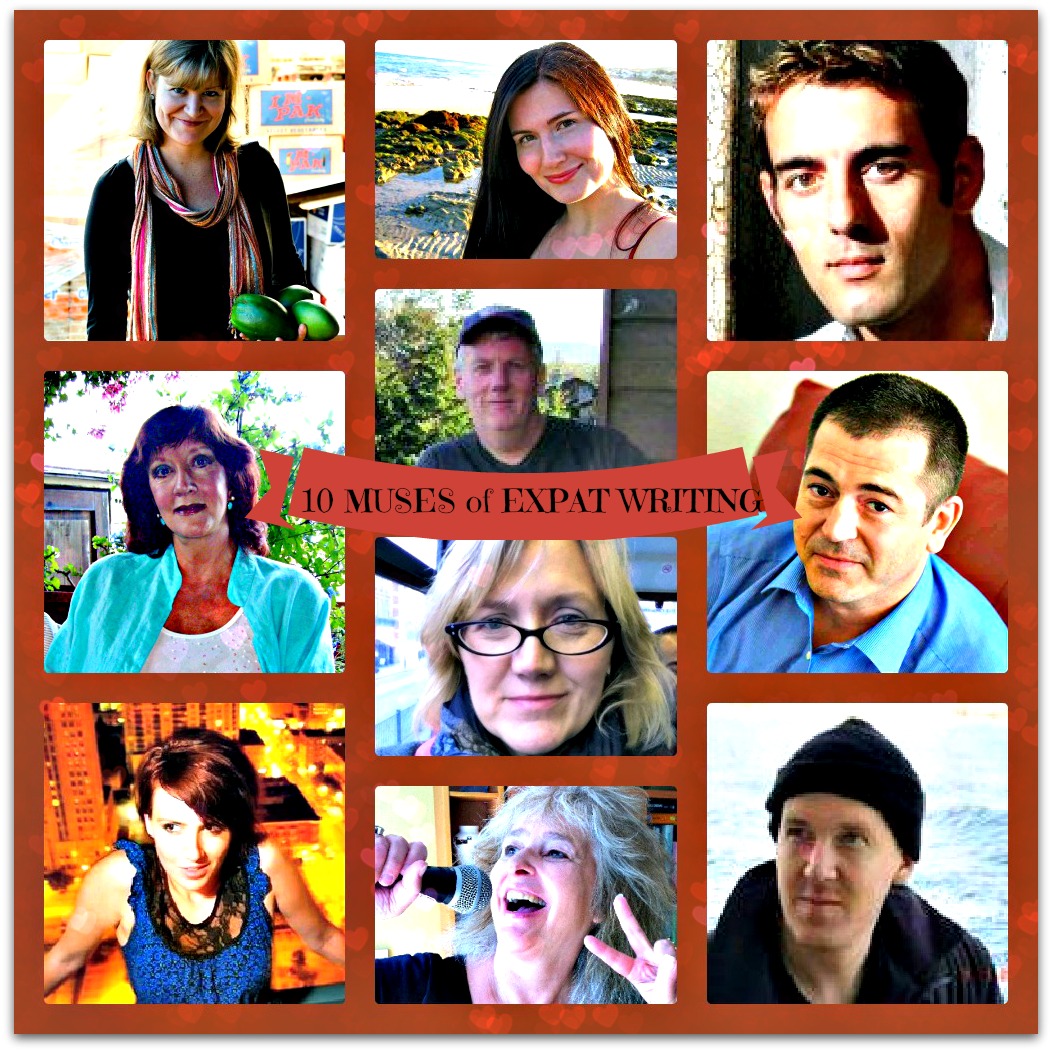
The 10 Muses of Expat & International Adventure Writing and their 5 most popular tunes

10 muses collageGreetings, Displaced Nation-ers! Ready for a little more intellectual stimulation?

A couple of weeks ago, I wrote about Great Thinkers who can help with task of embracing the well-traveled life and teasing out its deeper meaning, in the new year.

And today I will address the needs of those who have resolved to tackle a major writing project in 2013.

It’s a well-known fact that many of us who live in foreign lands aspire to write novels, memoirs and travelogues about our overseas adventures. But many of us also live in isolated situations (by definition).

So who can aid us, provide our inspiration?

Why, the muses of course!

Tell us, O muses, how to tell our stories…

And we don’t even have to look heavenwards to invoke them! The 10 Muses (that’s one more than the ancients got!) of Expat and International Travel Writing are right in our midst. They have already shared the joys, wonders and value of writing with Displaced Nation readers:

  1. Barbara Conelli, author of the Chique Travel Book series, filled with the charm, beauty, secrets and passion of Italy…
  2. Martin Crosbie, who is writing a trilogy entitled My Temporary Life; in December of last year, he published Book Two: My Name Is Hardly.
  3. Helena Halme, author of the novel The Englishman (2012)
  4. Laura Graham, author of the novel Down a Tuscan Alley (2011)
  5. Matt Krause, author of the memoir A Tight Wide-open Space: Finding love in a Muslim land (2011)
  6. Meagan Adele Lopez, author of the novel Three Questions: Because a quarter-life crisis needs answers (2011)
  7. Edith McClintock, author of the mystery novel Monkey Love and Murder (2013)
  8. Alexander McNabb, who is writing the Levant Cycle, a trilogy of books about the Middle East; he released the second book, Beirut — An Explosive Thriller, last September.
  9. Tony James Slater, erstwhile regular at the Displaced Nation and author of a two-book series: The Bear That Ate My Pants: Adventures of a real idiot abroad (2011) and Don’t Need the Whole Dog!, which came out in December.
  10. Wendy Nelson Tokunaga, author of Marriage in Translation: Foreign Wife, Japanese Husband (2011) and of several novels that explore cross-cultural themes between the United States and Japan.

Over the past year on our site, if you were listening closely, these heaven-sent muses were singing a number of tunes. Here are their five top hits:

SONG #1: “Yes, it’s hard; yes it’s uphill. But you’re living the dream, which makes writing a thrill!”

In one of the Displaced Nation’s most popular posts of the past year, Tony James Slater tried to make it out that the life of an expat writer is far from glamorous. Don’t believe him. He was pulling your leg, as usual — or singing off key, to continue the metaphor.

Alexander McNabb has the more accurate rendition. Here’s his account of the prep for his latest thriller, Beirut:

While writing it, I spent hours walking around the city, along the curving corniche and up into the busy streets that cling to the foothills rising from the coast up to the snow-capped mountains. Walking with friends, walking alone — day and night, spring and summer. From the maze of funky little bars of Hamra to the boutiques of Verdun, from the spicy Armenian groceries of Bourj Hammoud to the cafés overlooking the famous rocks at Raouché…

Barbara Conelli is another inspirational example. She explores every nook and cranny of Milan so as to take the reader on an armchair journey. And now she is doing the same with Rome, which will be the subject of her third book in the Chique Travel series.

Great work, if you can get it!

SONG #2: “It’s time to make your creative debut — so why not make it all about you?”

These days it’s hard to tell the difference between a heavily autobiographical novel and a memoir, though one of our muses, Helena Halme, insists that there is a distinction. When questioned about her decision to write The Englishman as a novel — it’s about a young Finnish woman, Kaisa, who meets a dashing British naval officer, a plot that echoes very closely her own life story — she had the following to say:

I tried to write a memoir, but couldn’t! Much of this story is, however, true — but I didn’t think I could call it a memoir as some things were pure fiction. I am a novelist and just keep making stories up.

Hmmm… By that reckoning, perhaps Tony James Slater should be a novelist, too? As regular readers of this blog will know, his favorite topic consists of his own, rather daring but also bumbling, world adventures.

But did a bear really eat his pants, or is he exaggerating for comic effect?

The mind boggles…

But whatever the form, the point is that quite a few of our muses have found plenty of material in their own life experiences. Besides Halme and Slater, we have

  • Martin Crosbie: His protagonist, Malcolm, leaves Scotland for Canada at a formative age, just as he did.
  • Laura Graham: Her protagonist, Lorri, arrives in Italy as a forty-something single and finds a younger Italian man, just as she did.
  • Matt Krause: He has written a memoir on the portion of his life that involved meeting a Turkish woman on a plane and following her back to Turkey. (Reader, he married her!)
  • Meagan Adele Lopez: The protagonist of her debut novel, Del, is offered three questions by her British fiancé (just as Lopez was offered three questions by hers).
  • Edith McClintock: Her protagonist, Emma, works as a researcher in the very Amazonian rainforest where she once conducted her own research.

To conclude, the old adage is alive and well, even (especially?) in expat and travel writing: “Write about what you know and care for…”

SONG #3: “Looking for inspiration from above? The answer lies in cross-cultural love.”

Another theme running through the works of several of our muses is the love that takes place across cultures, usually resulting in marriage. I just now referred to the cross-cultural love stories at the heart of the books produced by Helena Halme (Finnish woman, English man), Laura Graham (Englishwoman, Italian man), Matt Krause (American man, Turkish woman) and Meagan Adele Lopez (American woman, Scotsman).

To this list should be added Wendy Nelson Tokunaga, who has written about Western women getting involved with Japanese men — one of the stranger of all possible unions, to be sure! 😉 — in both fiction and nonfiction (the latter being a bit of a self-help book).

SONG #4: “As your brainstorming proceeds apace, never forget the appeal of place.”

Since travel is a constant for all of us, it should come as no surprise that particular places can become a pull for certain expat writers. They cannot rest until they’ve depicted a place they’ve experienced so that others can live vicariously. Several of our muses represent this principle:

  • Barbara Conelli and her love for “capricious, unpredictable” Milan. To quote from her book: “When the streets of Milan ask you to dance, there’s nothing else to do but put on your ballet shoes and surrender…”
  • Alexander McNabb and his obsession with Beirut. “There can be few places on earth so sexy, dark, cosmopolitan and brittle…,” he writes in his Displaced Nation post.
  • Edith McClintock and her preoccupation with the rainforest and a place called Raleighvallen in the Central Suriname Nature Reserve. As her main character, Emma, says:

    I fell completely and irretrievably in love with the rainforest that week — the deep rich smells of dirt and decay and teeming, thriving life; the warm soft light of the rocky moss-covered paths hidden beneath layers of climbing and tumbling lianas and roots; soaring tree trunks wrapped in colorful bromeliads, orchids, moss, and lichens; and the canopy of leaves of every conceivable size and shape….

SONG #5: “Growing weary of fruitless writing sessions? Time to take some acting lessons!”

Four of our ten muses could double as the muses of acting and entertainment:

  • Tony James Slater and Meagan Adele Lopez trained as actors (Lopez actually starred in a bad horror film!) before embarking on their world travels.
  • Laura Graham enjoyed a long career as a stage actress in Britain, working for the Royal Shakespeare Company and the Young Vic, and on television, before setting herself up as an expat in Tuscany.
  • Wendy Nelson Tokunaga first went to Japan because she won a prize in a songwriting contest sponsored by Japan Victor Records. She is an accomplished karaoke artist who can sing jazz as well as j-pop and enka, a type of sentimental ballad.

Why are so many of the Muses of Expat Writing multi-talented, you may ask? Does a former acting/singing career work to one’s advantage when it comes to overseas travel and writing? I like to think so.

Just as Dickens used to act out the dialogue of his characters, I like to think of Tony James Slater reenacting his wild adventures on the road, in the confines of his flat in Perth…

And sometimes this versatility can add a further dimension to the writing. Last we heard from Lopez, she had created a trailer for her book and was trying to convert it to a screenplay. Tokunaga composed and sang an enka to accompany her novel Love in Translation. (It’s impressive!)

Plus these four could always hew to the tradition of wandering minstrel, one of the oldest careers in the book, if their works don’t sell. (Hey, it’s never a bad idea to have a fallback option when you’re a long ways away from family and friends…)

* * *

So, writers out there, did our 10 Muses sing to you? And will you listen to some of their songs again as you face the blank page in 2013? Let me know in the comments. (Only, be careful of criticizing the Muses — they have been known to be vengeful!)

STAY TUNED for tomorrow’s post, another installment in the life of our fictional expat heroine, Libby. (What, not keeping up with Libby? Read the first three episodes of her expat adventures.)

If you enjoyed this post, we invite you to register for The Displaced Dispatch, a round up of weekly posts from The Displaced Nation, with seasonal recipes, book giveaways and other extras. Register for The Displaced Dispatch by clicking here!

Related posts:

Images: Our Ten Muses (left to right, top to bottom) — Edith McClintock, Barbara Conelli, Tony James Slater; Laura Graham, Martin Crosbie, Helena Halme, Alexander McNabb; Meagan Adele Lopez, Wendy Nelson Tokunaga, Matt Krause.

A once-displaced author on muses, monkeys & murder — and your chance to win her new book!

EdithmcclintockOur first featured author of the new year, Edith McClintock, is today’s guest. Her post should help to alleviate the January doldrums and this “brass monkey” weather. By way of introduction, I should point out that even though she does write mysteries, she herself is a bit of a mystery. Tee hee-hee ha-ha! On the one hand, she is a former Peace Corps worker, and has worked to preserve rainforests. On the other, she has harbored dreams of killing off her fellow researchers in the Amazon! Indeed, working with Edith sounds about as much fun as a barrel of monkeys! But let’s find out more about her creative muses, shall we, before leaping to any conclusions…

— ML Awanohara


I can’t pinpoint the moment I decided to write a novel. The idea percolated for years starting in my early teens. I did, however, always know — to the extent I even understood book categories, which was not much — that my first book would be a mystery, heavy on romantic suspense, and definitely a touch gothic.

Maybe a modern-day version of M.M. Kaye’s light mysteries (before she wrote The Far Pavilions), each set in an exotic locale.

And maybe a little Barbara Michaels mixed with Elizabeth Peters’ humor.

They were all early muses.

But so was travel. I knew the setting would have to be international, exotic…romantic. I wanted my characters to be trapped in a confined setting — like the best Agatha Christie.

From my first trip to Spain when I was thirteen, across Europe and Central and South America in my twenties, I contemplated castles, ruins, plunging cliffs, and remote islands based on their novelistic setting potential.

We are not aMUSEd: “Writing is hard”

But I needed more than a muse to write a book. I needed an obsession. For me, that’s the only way it could have happened, because writing Monkey Love and Murder was hard. Writing is hard. The rejection was crushing.

I cried. My sister cried. The rewriting and rewriting and rewriting again often felt meaningless. More sacrifice than joy. Sometimes exhilarating. More often tedious and lonely.

The truth is the time lost probably wasn’t worth it. I had demanding, more than full-time jobs. I wrote on weekends and evenings. My friends and family were celebrating, playing, gathering, the sun shining. I was hunched over a computer screen talking to my make-believe world.

It takes a certain arrogance to believe you can even write a book. To believe it will get published. To believe people will actually like it. Maybe love it. I had that in the beginning. For years, really. I had to love the idea, the place, the characters.

The place as muse

Because it took an obsession to keep writing and rewriting, in my case probably much longer than I should have. But it wasn’t a person that grabbed me and wouldn’t let go. My muse, my obsession, was the rainforest and a place called Raleighvallen in the Central Suriname Nature Reserve.

MonkeyLoveAndMurder_dropshadowI think my protagonist, Emma, expresses it best:

Even with all the frustrations, I fell completely and irretrievably in love with the rainforest that week — the deep rich smells of dirt and decay and teeming, thriving life; the warm soft light of the rocky moss-covered paths hidden beneath layers of climbing and tumbling lianas and roots; soaring tree trunks wrapped in colorful bromeliads, orchids, moss, and lichens; and the canopy of leaves of every conceivable size and shape. Each day was a new adventure, new wildlife (some good, some terrifying) and ever changing forest, from the sunlit traveling palm groves to the dense, swampy marshes near the river; to the rocky, open forests with the towering trees the spider monkeys loved. I enjoyed watching the spider monkeys too, but I could have been just as happy watching any number of wildlife. It was simply being in the rainforest I loved most.

Like Emma, I spent two years as a Peace Corps volunteer in Suriname living in the capitol, Paramaribo. Unlike her, I joined a monkey research project post-Peace Corps simply because I wanted to spend more time in the rainforest — and chasing monkeys through the jungle seemed like fun.

It was. Hot, frustrating, itchy and wonderful.

I was there for six months, ideas percolating, but I didn’t begin writing until I came home. That’s when I moved beyond the idea of writing as abstract concept and into deep obsession.

Ignorance plus arrogance — a lethal combo?

I came home to the United States, spent three months working full-time and decided I couldn’t continue. Not yet. I was in the throes of a typical angst-ridden readjustment process combined with the initial bubbling of obsession. So I quit my job and drove cross-country to housesit for my sister and then a friend while I pounded out that first draft. I finished and returned to full-time work again, sure my first draft was destined for the bestseller lists.

I clearly had the arrogance. Unfortunately, I also had heaps of ignorance. I still do. I don’t understand publishing. I may never understand publishing.

Nine years later, following hundreds of rejections, countless rewrites, frequent tears and regular quitting (for months, even a year), my first novel is finally published. People, friends, strangers, will read it. Judge it.

It’s wonderful and scary and it took a passionate, often-painful obsession. But still, I’d do it again. I am doing it — I’ve just finished my second mystery (I hope). I have a plan for the next and the next and the next.

As for Monkey Love and Murder, thankfully, I’m finally over that obsession. And it turns out the best thing about finally being published is that I NEVER have to read or rewrite it again!

But still, I hope you’ll read it. I hope you’ll like it. I certainly did. For years.

* * *

Whoop! Whoop! Thank you, Edith! Readers, to whet your taste even more, here are a couple of reviews for Edith’s debut novel, Monkey Love and Murder:

Kirkus Review:

This debut from McClintock, who served in the Peace Corps and worked on a monkey research project, has the ring of authenticity, along with romance and a mystery that keeps you guessing.

Library Journal Review:

This romantic-suspense debut is perfect for those seeking adventure mixed in with their mystery. McClintock creates a vivid jungle environment, a perfect venue for a closed-room mystery. Her characters run a little larger than life, making the story feel like a reality TV show. With a bit of Scott Smith’s tone, this would work for Hilary Davidson fans too.

And let’s not forget the blurb:

Emma Parks joins a monkey research project deep in the South American rainforest on a whim. She refuses to admit it might have something to do with a close friend’s death from which she hasn’t recovered, but it’s certainly not because she knows anything about spider monkeys, least of all what they look like. She’s barely arrived when International Wildlife Conservation’s renowned director drowns during a party celebrating the group’s controversial takeover of the park. Tension mounts following the machete murder of a researcher, threatening Emma’s budding primatology career, her secret romance with an Australian zoologist, and more importantly — her life.

Can’t wait to read it? Why not download the first chapter?

I know, I know, one chapter isn’t the same as reading the whole book. SO ENTER OUR DRAW TO WIN A FREE COPY — in 3 easy steps:
1) Comment on Edith’s post
2) Like her book’s Facebook page
3) Subscribe to our Displaced Dispatch
Yes, of course you can take just one of these steps, or two — but do all three and you’ll have an even greater chance of winning!!! @(‘_’)@

The winners will be announced in our Displaced Dispatch (and on Edith’s Facebook page) on Feb. 2, 2013. She will contact you for your address and is open to shipping anywhere in the world.

NOTE: If you’re not lucky enough to win one of Edith’s books, you can always order it from Amazon, Barnes and Noble, or The Book Depository.

Born in a school bus in the Tennessee woods on the largest commune to come out of the sixties, Edith McClintock works in the conservation and development field and blogs about travel on Novel Adventurers. Although a lifelong reading addict, she didn’t write fiction until post–Peace Corps, when she joined a monkey research project deep in the Amazon. Trapped in a tiny jungle cabin for six months, there was little to do but imagine creative ways to kill off her fellow researchers (all of whom were too nice to make it into her first novel, despite their begging). To find out more about Edith, visit her author’s blog.

STAY TUNED for tomorrow’s post, also on expat writing.

If you enjoyed this post, we invite you to register for The Displaced Dispatch, a round up of weekly posts from The Displaced Nation, with seasonal recipes, book giveaways and other extras. Register for The Displaced Dispatch by clicking here!

Related posts:

Images: Edith McClintock’s author photo (yes, that’s her — in Chinatown in Seattle, buying mangoes) and book cover.

LIBBY’S LIFE #68 – Puppy fat

The paediatrician pinches a wad of baby flesh and plunges her syringe into the right thigh of an unsuspecting George.

A couple of seconds of silence while George’s bottom lip sticks out and he fixes me with a reproachful stare. Then, tears squirting from his eyes, he opens his mouth wide and lets rip a bellow that echoes around the small consulting room, the corridor outside, and probably the waiting room as well.

Undeterred, Dr. Lowell picks up another syringe and sticks it in George’s left thigh. The bellows treble.

“I can give Elizabeth her shots now, as well,” she says, as she presses a small, circular Band-Aid over each pinprick. “She also should have had them several weeks ago.”

The last time I fell for this trick and had both twins vaccinated on the same day, I didn’t sleep for three nights, while I paced around the bedroom with one or the other feverish, grizzling baby. Our usual doctor, the lovely Dr. Wong, who is out sick today with a nasty dose of flu, learned from this. She would never make such a silly suggestion.

“I’d rather deal with just one at a time, thanks. We’ll come back next week. I doubt Beth’s going to catch hepatitis B by then.”

Dr. Lowell reaches for another vial and needle as if she hasn’t heard me. “Best to get it over with,” she says. “If you could just take Elizabeth out of the stroller and undress her—”

Dr. Lowell doesn’t have children. She has a chihuahua. I’ve seen her on Main Street, carrying it around in a wicker shopping basket, dressed in a little pink doggie sweater — pooch, that is, not paediatrician. The Coffee Posse warned me long ago that I should avoid this doctor if possible.

Today, thanks to Dr. Wong’s flu, it wasn’t possible.

“No,” I say, more firmly. Instead of unbuckling Beth from the pushchair, I strap George in beside her.

George’s roars have diminished to hiccuping whimpers. I stroke his head and tell him he’s a brave boy and that he can have some ice cream when we get home.

“He’s fat enough already.” The doctor throws the needles in the sharps bin, and snaps off her blue latex gloves.

I’m not sure I’ve heard right. “Excuse me?”

“Childhood obesity is a real problem. He’s already at the 95th percentile for weight. And you need to watch the weight of your older son, too. Neither of them need ice cream.”

Enough. This doctor visit is over. I wheel the pushchair through the doorway, grazing the paint on the door jamb in my rage.

“And I don’t need a chihuahua fashion expert pretending to be Jillian Michaels,” I tell her. “Come on, Jack. Let’s you and me and the twins go to Baskin Robbins and pig out.”

* * *

“And then, the old witch says my boys are fat and they don’t need any ice cream,” I say to Maggie. “So here we are with a gallon of full fat chocolate brownie ice cream to share with you while you tell me all about your holiday.”

We didn’t go to Baskin Robbins, in the end. We went to the supermarket to buy Maggie’s favourite flavour to share with her. She came back from the Seychelles yesterday and I was dying to hear all about it.

Maggie scoops the ice cream into three dishes, and gives the small one to Jack. The largest one she gives to me, because I have to share mine with the twins. Then she pulls a dog bowl out from under the kitchen sink, fills it with a can of premium dog meat, and gives it to Fergus, who is watching her every move with an adoring expression.

He never looks at me like that. Perhaps this would be a good time to approach the subject of her keeping Fergus indefinitely.

“Nothing like ice cream for de-stressing, I find,” Maggie says, shovelling in a mouthful and closing her eyes.

I’m guessing she’s not talking about my own post-doctor stress levels. I’ll mention Fergus another time.

“Was it so hard, spending five days on a tropical island?” I ask.

Another spoonful. Maggie nods.

“I was there as a witness.”

Blimey. I didn’t expect that. Witness to what, I wonder? Drug deals? I’ve heard rumours of Maggie’s hippie past, and there’s sometimes a suspicious whiff of ‘herbal cigarettes’ on her back porch, but this was different. Dangerous, even. You hear about people giving evidence then ending up in neat little dismembered parcels in the bowels of New York’s sewers.

“Will you have to move, or change your identity, or anything like that?” I’d hate to lose my friend just because some drug cartel had it in for her.

Maggie wrinkles her nose and squints at me. “What do you mean?”

“You know — like witness protection.”

Maggie puts her spoon down in her dish. She laughs, and laughs some more. She picks the spoon up, but has to put it down again because she’s still laughing.

On one hand, I’m pleased because I’ve amused Maggie and made her laugh. Laughter is better than ice cream for stress busting. On the other hand, I’m really offended.

“What did I say?” I ask, when she’s quiet at last.

“I wasn’t a witness to a crime,” she says. “I was a witness to a wedding. One of those barefoot beach weddings. My daughter’s.”

And that’s all she would say about it.

But I surmised that, for Maggie at least, it wasn’t a happy occasion.

* * *

As I zip Jack and the twins up into their coats to walk the couple of hundred yards to our house, Maggie says, “You know — don’t take this the wrong way, but that miserable doctor might not have been entirely wrong. You’re struggling to fasten Jack’s zip.”

Et tu, Maggie?

“The zip is stiff, and Jack is not obese. Thank you.” I’d like to say more, but I need to ask her soon if she will take Fergus off my hands. It wouldn’t do to ruin a beautiful friendship at this point.

“No, I didn’t say he was.” She hesitates. “But he’s…hefty, isn’t he? Heftier than he used to be.”

Maggie shouldn’t go on tropical vacations if it makes her this argumentative. I have a perfectly good mother-in-law available if I want to be insulted.

“Even if he is–” I say “— and he’s not — children need it for their growth spurts. They can’t be expected to follow the standard growth charts all the time.”

Maggie holds up her hands, palms outwards, in a “peace” gesture. “Of course not. Anyway, it’s none of my business. Do forgive me, my dear. Tell me, did they like my Christmas presents?”

“They loved them,” I say, stalling for time. They had so many presents from fond grandparents that I can’t instantly recall what Maggie gave them.

“Handpainted, those boxes are. A relic from the time I owned the craft store in Main Street.”

A-ha! Exquisite little wooden boxes with hinged lids, painted with trains and cars for the boys, and fairies and toadstools for Beth. No wonder I couldn’t remember them instantly — I hadn’t seen them since Boxing Day.

“They’re absolutely beautiful,” I say, quite sincerely. “The children loved them. I’ve put them away safely for now, of course,” I add, crossing my fingers behind my back.

Maggie nods. “A good idea.” She opens the front door and looks outside at the descending clouds. “You’d better go before this mist turns to rain. Where’s Fergus…I might have known, in the kitchen, asking for more food! I don’t know where he puts it. Anyone would think he was never fed. Don’t forget to take the rest of your ice cream with you.”

“You keep it,” I say, having just caught sight of my post-Christmas reflection in Maggie’s full-length hallway mirror.

As children, dog, and I hurry home through the rain, I reflect sourly that one member of the family won’t have to diet this January, and can eat as much as his canine heart desires.

Another reason — the final straw, even — why Fergus has to go.

*  *  *

Next post: LIBBY’S LIFE #69 – This dog’s life takes the biscuit

Previous post: LIBBY’S LIFE #67 – Lights in the rearview mirror

A note for Libby addicts: Check out Woodhaven Happenings, where from time to time you will find more posts from other characters.  Want to remind yourself of Who’s Who in Woodhaven? Click here for the cast list!

Read Libby’s Life from the first episode.

STAY TUNED for Tuesday’s post!

If you enjoyed this post, we invite you to subscribe for email delivery of The Displaced Dispatch, a round up of the week’s posts from The Displaced Nation. Sign up for The Displaced Dispatch by clicking here!

Image: Travel – Map of the World by Salvatore Vuono / FreeDigitalPhotos.net

Expats, here’s how to enrich your lives in 2013: Choose a mentor or a muse!

Expats and other world adventurers, let me guess. You have you spent the past week making resolutions about

  • staying positive about your new life in Country X;
  • indulging in less of the local stodge;
  • giving up the smoking habit that no one is nagging you about now that you’re so far away from home;
  • and/or taking advantage of travel opportunities within the region that may never come your way again

— while also knowing full well that at some point in the not-distant future, you’ll end up stuffing your face with marshmallows (metaphorically speaking).

Never mind, it happens to the best of us, as psychologist Walter Mischel — he of the marshmallow experimentrecently told Abby Hunstman of the Huffington Post. Apparently, it has something to do with the way impulses work in the brain. The key is to trick the brain by coming up with strategies to avoid the marshmallow or treat it as something else.

Today I’d like to propose something I found to be one of the most effective strategies for turning away from the marshmallows you’ve discovered in your new home abroad or, for more veteran expats, turning these marshmallows into something new and exotic. My advice is to find a mentor or a muse in your adopted land — someone who can teach you something new, or who inspires you by their example to try new things…

Trust me, if you choose the right mentor +/or muse, benefits like the following will soon accrue:

1) More exotic looks — and a book deal.

Back when I lived abroad, first in England and then in Japan, I was always studying other women for style and beauty tips. I made a muse of everyone from Princess Diana (I could hardly help it as her image was being constantly thrust in front of me) to the stewardesses I encountered on All Nippon Airways. Have you ever seen the film Fear and Trembling, based on the autobiographical novel of that name, by the oft-displaced Amélie Nothomb? On ANA flights, I behaved a little like the film’s young Belgian protagonist, Amélie, who secretly adulates her supervisor Miss Fubuki. I simply couldn’t believe the world contained such attractive women…

The pay-off came upon my repatriation to the US. With such a wide array of fashion and beauty influences, I’d begun to resemble Countess Olenska in The Age of Innocence — with my Laura Ashley dresses, hair ornaments, strings of (real) pearls, and habit of bowing to everyone.

Is it any wonder my (Japanese) husband-to-be nicknamed me the Duchess? (Better than being the sheltered May Welland, surely?)

My one regret is that I didn’t parlay these style tips into a best-seller — unlike Jennifer Scott, one of the authors who was featured on TDN this past year. While studying in Paris, Scott was in a mentoring relationship with Madame Chic and Madame Bohemienne. (The former was the matriarch in her host family; the latter, in her boyfriend’s host family.) Mme C & Mme B took her under their wing and taught her everything she knows about personal style, preparation of food, home decor, entertaining, make-up, you name it…and is now imparting to others in her Simon & Schuster-published book.

2) More memorable dinner parties.

As mentioned in a previous post, I adopted actress and Indian cookbook writer Madhur Jaffrey as my muse shortly after settling down in the UK. I was (still am) madly in love with her, her cookbooks, even her writing style.

And her recipes do me proud to this day.

Right before Christmas I threw a dinner party for 10 featuring beef cooked in yogurt and black pepper, black cod in a coriander marinade, and several of her vegetable dishes.

It was divine — if I say so myself! To be fair, the guests liked it, too…

3) Improved language skills.

Now the ideal mentor for an adult seeking to pick up a new foreign language is a boyfriend or girlfriend in the local culture — preferably one with gobs of patience. The Japanese have the perfect expression for it: iki jibiki, or walking dictionary.

Just one caveat: If you’re as language challenged as Tony James Slater, it could prove a headache and, ultimately, a heartache.

Still, nothing ventured, nothing gained…

(Married people, you might want to give up on this goal. I’m serious…)

4) A fondness for angels who dance on pinheads.

After seeing the film Lost in Translation, I became an advocate for expats giving themselves intellectual challenges. Really, there’s no excuse for ennui of the sort displayed by Scarlett Johansson character, in a well-traveled life.

It was while living in the UK as a grad student that I discovered the extraordinary scholar-writer Marina Warner, who remains an inspiration to this day. Warner, who grew up in Brussels and Cambridge and was educated at convent school and Oxford University, is best known for her books on feminism and myth.

After reading her book Monuments and Maidens, I could never look at a statue in the same way again!

In her person, too, she is something of a goddess. Though I’d encountered women of formidable intellect before, I found her more appealing than most, I think because she wears her learning lightly and has an ethereal presence, like one of the original Muses.

Booker prizewinner Julian Barnes has written of her “incandescent intelligence and Apulian beauty” (she is half Italian, half English). The one time I met her — I asked her to sign my copy of her Booker Prize-shortlisted novel, The Lost Father — I could see what he meant.

I was gobsmacked.

Major girl crush!

(Don’t have a girl crush? Get one! It will enrich your life immeasurably.)

5) Greater powers of mindfulness — and a book deal.

Third Culture Kid Maria Konnikova was born in Moscow but grew up and was educated in the US. She has started the new year by putting out a book with Viking entitled Mastermind: How to Think Like Sherlock Holmes. Who would guess that a young Russian-born woman would use Conan Doyle’s fictional creations, Holmes and Watson, as her muses? But, as she explains in a recent article in Slate, she has learned everything she knows about the art of mindfulness from that master British sleuth:

Mindfulness allows Holmes to observe those details that most of us don’t even realize we don’t see.

So moved is she by Holmes’s example — and so frustrated by her own, much more limited observational powers — Konnikova does the boldest of all thought experiments: she gives up the Internet…

So does her physiological and emotional well-being improve as a result? Does her mind stop wandering away from the present? Does she become happier? I won’t give it away lest you would like to make Konnikova this year’s muse and invest in her book. Hint: If you do, we may not see you here for a while. 😦

6) The confidence to travel on your own.

We expats tend to be a little less intrepid than the average global wanderer: we’re a little too attached to our creature comforts and may need a kick to become more adventuresome. But even avid travelers sometimes lose their courage, as Amy Baker recently reported in a post for Vagabondish. She recounts the first time she met a Swedish solo traveler in Morocco, who had lived on her own in Zimbabwe for 10 years. This Swede is now her friend — and muse:

She was level-headed, organized and fiercely independent — all characteristics that I aim to embody as a female traveler.

With this “fearless Swedish warrior woman” in mind, Amy started venturing out on her lonesome — and hasn’t looked back.

* * *

Readers, the above is not intended as an exhaustive list as I’m hoping you can contribute your own experiences with mentors and muses abroad: What do you do to avoid the “marshmallows” of the (too?) well-traveled life? Who have you met that has inspired you to new creative, intellectual, or travel heights? Please let us know in the comments. In the meantime, I wish you a happy, healthy — and most of all, intellectually stimulating — new year!

STAY TUNED for next week’s posts.

If you enjoyed this post, we invite you to register for The Displaced Dispatch, a round up of weekly posts from The Displaced Nation, with seasonal recipes, book giveaways and other extras. Register for The Displaced Dispatch by clicking here!

Related posts:


Catching up with this year’s Random Nomads over the holidays (2/3)

RandomNomadXmasPassportWelcome back to the holiday party we are throwing for the expats and other global voyagers who washed up on our shores in 2012. Remember all those Random Nomads who proposed to make us exotic meals based on their far-ranging meanderings? Not to mention their suitcases full of treasures they’d collected and their vocabularies full of strange words… How are they doing these days, and do they have any exciting plans for the holidays? Second in a three-part series (Part One here).

The second third of 2012 brought quite an intriguing (albeit as random as ever) bunch of nomads our way — intriguing because most of them have had experience with spouses from other cultures, suggesting that the point made by one of their number, Wendy Williams, about the globalization of love has some validity. They are:

  • Wendy Williams, the Canadian who is as happy as Larry living with her Austrian husband and their daughter in Vienna.
  • Suzanne Kamata, an American writer who went to Japan on the JET program, married a Japanese man, and made her home on Shikoku Island.
  • Isabelle Bryer, a French artist who feels as though she’s on a permanent vacation because of landing in LA — she’s lived there for years with her American husband and family.
  • Jeff Jung, formerly of corporate America but now an entrepreneur who promotes career breaks from his new base in Bogotá, Colombia.
  • Lynne Murphy, the lovely lexicologist who landed in — I want to say “London” for the alliteration, but it’s Sussex, UK. And yes, despite not being the marrying type, she now treasures her wedding ring of Welsh gold!
  • Melissa Stoey, the former expat in Britain who, despite no longer living in the UK, has a half-British son and remains passionate about all things British.
  • Antrese Wood, the American artist who is busy painting her way around Argentina, having married into the culture.

I’m happy to say that three of this esteemed group are with us today. What have they been up to since nearly a year ago, and are they cooking up anything special for the holidays?

Wendy_Williams1) WENDY WILLIAMS

Have there been any big changes in your life since we last spoke?
Yes, I’ve spent less time at my desk and more time travelling since the publication of my book, The Globalisation of Love. Given the title, I guess I should have expected it.

Where will you be spending the holidays this year?
Since I have “gone native” in Austria, I will be skiing during the holidays. Yipppeeee!

What do you most look forward to eating?
I most look forward to eating a Germknödel, which is a big ball of dough filled with plum sauce and covered in melted butter. Apparently, it has 1,000 calories and I savour every last one. If no one is looking, I lick the plate.

Can you recommend any books you came across in 2012 that speak to the displaced life?

  1. A Nile Adventure — cruising and other stories, by Kim Molyneaux — a light-hearted story of one family’s journey to and adventures in Egypt, both ancient and modern.
  2. Mint Tea to Maori Tattoo!, by Carolina Veranen-Phillips, an account from a fearless female backpacker — is there anywhere she hasn’t been?!
  3. Secrets of a Summer Village, by Saskia Akyil: an intercultural coming-of-age novel for young adults, but a cute read for adults, too.

Have you made any New Year’s resolutions for 2013?
More time with friends & family and more writing, the two of which are completely counter-productive in my case.

Any upcoming travel plans?
I am only happy when I have a plane ticket in my pocket so there are always trips planned. Didn’t René Descartes write, “I travel, therefore I am” — or something like that? The year will start with Germany, Ukraine, Spain and Canada.

SuzanneKamata_festive2) SUZANNE KAMATA

Have there been any big changes in your life since we last spoke?
I sold my debut YA novel, Gadget Girl: The Art of Being Invisible, about a biracial (Japanese/American) girl who travels to Paris with her sculptor Mom, to GemmaMedia. It will be published in May 2013. I was also honored to receive a grant for my work-in-progress, a mother/daughter travel memoir, from the Sustainable Arts Foundation.

How will you be spending the holidays?
We are planning a little jaunt to Osaka between Christmas and New Year’s, but mostly, we’ll be staying at home.

What’s the thing you most look forward to eating?
I’m looking forward to eating fried chicken and Christmas cake, which is what we traditionally have here in Japan on Christmas Eve. There are all kinds of Christmas cakes, but my family likes the kind made of ice cream.

Can you recommend any books you came across in 2012 that speak to the displaced life?

  1. The Girl with Borrowed Wings is a beautifully written contemporary paranormal novel featuring a biracial Third Culture Kid. The author herself, Rinsai Rossetti, is a TCK. She wrote this book when she was a student at Dartmouth. It’s unique and lovely and captures that in-between feeling of those who live in lots of different countries.
  2. I also enjoyed I Taste Fire, Earth, Rain: Elements of a Life with a Sherpa, by Caryl Sherpa, an American woman who went on a round-the-world trip and fell in love with a Sherpa while trekking in Nepal.
  3. Oh, and Harlot’s Sauce: A Memoir of Food, Family, Love, Loss, and Greece, by Patricia Volonakis Davis.

Do you have any New Year’s resolutions for 2013?
Hmmm. Exercise more (same as last year). Also, I resolve to finish a draft of my next novel.

Last but not least, any upcoming travel plans?
Yes! I’m planning on taking my daughter to Paris.

Jeff at Turkish Embassy3) JEFF JUNG

Have there been any big changes in your life since we last spoke?
Since the interview, I launched my first book, The Career Break Traveler’s Handbook. It’s available online at most major book stores in both print and e-versions. And, we’re on the verge of launching Season 1 of our TV show, The Career Break Travel Show, internationally. It includes adventures in South Africa, Spain, New Zealand and Patagonia. We’re just waiting for the new channel to launch.

How will you be spending the holidays this year?
After spending a quiet Christmas in Bogotá, I’ll head off to Washington, DC for my best friend’s wedding on New Year’s Eve. Then I’m off to Texas to see my parents for about ten days.

What’s the thing you most look forward to eating?
As far as food goes, I’m most looking forward to turkey and my dad’s award-winning BBQ.

Can you recommend any books you came across in 2012 that speak to the displaced life?
This year I read Dream. Save. Do., by Betsy and Warren Talbot. It’s a great book to help people achieve whatever goal they have.

Speaking of goals, any New Year’s resolutions for 2013?
Personally, I need to drop a bit of weight. I spent too much time writing and editing in 2012! Professionally, I want to see The Career Break Travel Show find its audience so we can head out to film Season 2!

Last but not least, any exciting travel plans?
I plan to travel for the filming of our second season (countries still to be determined). I also have the chance to go to Romania to volunteer at a bear rescue with Oyster Worldwide. It’ll be a mini-career break for me. I can’t wait.

* * *

Readers, this lot seems just as productive, if not more so, than the last one! Any questions for them — don’t you want to know their secret?

STAY TUNED for tomorrow’s post by the Displaced Nation’s agony aunt, Mary-Sue — she wraps up 2012 by paying a visit to several of this year’s questioners: did they take her advice?!

If you enjoyed this post, we invite you to register for The Displaced Dispatch, a round up of weekly posts from The Displaced Nation, with seasonal recipes, book giveaways and other extras. Register for The Displaced Dispatch by clicking here!

Related posts:

Images: Passport photo from Morguefiles; portrait photos are from the nomads.

LIBBY’S LIFE #66 – The ladies in red

Libby:

“You might want to visit the restroom,” I whisper to Melissa. “You’re losing your dress.”

I’m not a spiteful person — really, I’m not — but it’s very satisfying to have Oliver looking at me as if I’m a present he can’t wait to get home and unwrap, while oblivious to the fact that Melissa’s dress, identical to mine, is doing a pretty good job of unwrapping itself in the presence of 150 co-workers and their partners.

Melissa looks down, sees she is showing more décolletage than is usual or advisable, gives a squawk, and teeters off across the dance floor towards the bathrooms.

Halfway across the polished wooden boards she turns an ankle on her 5-inch heels, staggers, slides a few feet, and sits down heavily in front of one of the DJ’s speakers. Her dress is so tight and her heels are so high that she can’t gain enough balance or traction to get up again, and has to be helped to her feet by a couple of women who are doing their best not to laugh.

On the other side of the room, holding court with the wives of senior executives, Caroline Michaels — she of last year’s nursery school war —  is not so polite. In a lull between songs we can hear her laughing.

“Oh my goodness!” she shrieks, her native Essex showing through the usual, careful, cut-glass-accent veneer. She needs some dim sum to sop up that wine she’s knocking back. “Did you see that? How hilarious. Who is that?”

I turn to Oliver and murmur in his ear, “Shall I tell her about Melissa and Terry, or do you want to?”

Oliver freezes in his listening position. “What?”

I smile at Anita, who is still standing nearby, slightly open-mouthed, no doubt trying to reconcile the lovey-dovey picture of me and a smitten Oliver with the rumours that have been circulating.

You know — the ones about him and Melissa, the rumours that have been such a source of entertainment for the Coffee Morning Posse over the last few months.

Clearly, so that Anita can hear, I say, “Shall I tell Caroline that the trollop on the dance floor has been shagging her husband, or will you?”

Anita’s mouth drops fully open.

Wearing red makes me feel so brave. I must wear it more often.

“How do you know?” Oliver asks after a pause.

OK. The red dress doesn’t make me brave enough to admit to snooping through his phone.

“Woman’s intuition.”

Oliver shakes his head.

I wonder, briefly, if women’s intuition would allow me to know about the promotion and big pay rise that Oliver has turned down, but decide regretfully that would be pushing even his credulity.

Anita at last snaps her jaw shut. “Melissa Connor? Terry Michaels?” she tries to say. It comes out as a kind of croak.

“Yep,” I say.

“Oh, Libby.” She looks as if she’s going to cry. “I’m so sorry. And we all thought—”

I make a cutting gesture across my throat. I don’t really blame Anita in all this. She’s not the gossipy type, and you can’t help what you hear.

Oliver’s been watching me and Anita, back and forth.

“Would either of you like to explain what’s going on?”

Instead of answering, Anita raises a hand in apology and trots off to speak with Julia, another of the English wives. Julia is in the odd position of being a friend of Anita’s and on civil speaking terms with Caroline. I can’t hear what they’re saying, but there’s a lot of whispering on Anita’s part and wide-eyed shock from Julia. Both women keep looking over at Caroline.

“I think the best way to describe it is ‘Putting some affairs in order’,” I tell him, as I watch Julia slowly walk across the room to chat with Caroline.

*  *  *

Melissa:

In the restroom, I finally get this goddamned dress pulled up at the top and down at the bottom instead of the other way round.

It was, like, so embarrassing what happened out there, falling over and all, and I stay in one of the stalls for twenty minutes until someone bangs on the door and asks if I’m OK.

I’m tempted to say I’ve got this novocaine virus that’s going around on some cruise ship in Europe — that would empty the place pretty quick, right? — but I keep quiet and rustle paper around, and whoever it is goes away.

Guess I can’t stay in here all night, anyway. I’ve paid for my ticket, and I intend to get my money’s worth of alcohol.

I figure I’ve been in the restrooms about a half hour, which is enough time for people to forget me falling over on the dance floor. And if they do remember, with a bit of luck they’ll think it was Libby Patrick, since we’re wearing the same dress.

When I get outside and into the crowd, I can’t help but notice some strange looks coming my way — all from the English wives crowd.

Snotty bitches. Geez. You’d think they’d never seen anyone slip on a shiny floor, right?

I look around for Oliver — I don’t know if this red-haddock plan of flirting with him is fooling anyone, but it sure as hell is fun — and see he’s still standing close to Libby, like they’re zipped together down one side, so I go off to find some more wine at the bar.

Except I don’t get that far.

*  *  *

Libby:

I’m so glad I came. This is better than EastEnders, better than Corrie, and more Desperate than Housewives.

“Out!” Caroline screams at Melissa, who stands stock still with a plastic cup of Chardonnay in her hand. Caroline’s accent is now pure TOWIE, with no traces of refinement left. “Out! Go find another stinking job! Go find another stinking man!”

Husband Terry cowers behind her, making little mewling noises of protest. Caroline whips round and snaps at him to shut the f*** up.

My, our true colours really are showing tonight, aren’t they?

The DJ has stopped the music, and the party crowd is silent, watching the drama.

“Who knew about this?” Caroline darts suspicious glances around. “Someone must have. Making me look like a fool.”

You know, I’m so fed up with Caroline’s bullying. Like mother, like son. I walk up to her.

“You were happy enough to make me look like a fool,” I say loudly. “Everyone was talking about Melissa and my husband. Including you. Remember?”

All the wives in the crowd look down and shuffle their feet.

“And it wasn’t true. I’d like everyone to know that. And an apology would be good, too.”

I hold out my hand to Oliver. He takes it. As we make our way to the door, the crowd parts, almost respectfully.

*  *  *

“We might have to find another house to live in, of course,” Oliver says on the way home.

“Charlie’s old house still isn’t rented. We could move there.” I look outside at the Christmas lights in all the Woodhaven gardens. “It’s bigger, of course. Don’t know if we could afford it.”

Oliver drives on for a while, then says, “I’ve been offered a promotion. Didn’t want to tell you, not before I’d decided what to do, but I think I’m going to take it. I made that decision tonight.”

Of course. Oliver doesn’t have to keep his silence about our landlady and his boss any more. His acceptance of the job would be honourable now.

“Tell me all about it,” I say. “Is it more money?”

And as he begins to outline the details I’d already read on his BlackBerry, I smile into the darkness.

*  *  *

Next post: LIBBY’S LIFE #67 – Lights in the rearview mirror

Previous post: LIBBY’S LIFE #65 – All about a dress

A note for Libby addicts: Check out Woodhaven Happenings, where from time to time you will find more posts from other characters.  Want to remind yourself of Who’s Who in Woodhaven? Click here for the cast list!

Read Libby’s Life from the first episode.

STAY TUNED for Monday’s post!

If you enjoyed this post, we invite you to subscribe for email delivery of The Displaced Dispatch, a round up of the week’s posts from The Displaced Nation. Sign up for The Displaced Dispatch by clicking here!

Image: Travel – Map of the World by Salvatore Vuono / FreeDigitalPhotos.net

Highlight of 2012: “Pinning” down expat, TCK, travel & other displaced themes on Pinterest

Would it be mixing my metaphors too much to say we stumbled upon Pinterest in 2012? I suppose so. But that’s really what happened.

By the end of last year, Kate Allison and I were debating about Pinterest: should the Displaced Nation be participating in a pinboard-style photo-sharing site that some commentators were predicting might surpass Facebook in popularity? Kate felt cautious about making another major commitment to social media, whereas I was gung-ho to give it a whirl.

Kate also pointed out, very sensibly, that the Displaced Nation isn’t trading primarily in food, fashion and weddings — the most popular Pinterest topics. Not wishing to be dissuaded, I reminded her of our “IT’S FOOD!” category, adding: “We also do fashion, and multicultural marriage…”

It came to pass that one day in early April, Kate, for reasons still unknown to me, took the Pinterest plunge. She told me about it afterwards and said we’d been missing out on a whole lot of fun! As anyone who reads Kate’s posts will know, for her to say something is fun is a high recommendation. “I wanna get me some of that,” I said to myself.

The bubble tea of the social media world

The first time I pinned, I was reminded, in a strange kind of way, of my first experience with Taiwanese bubble tea. Just as I wasn’t sure what to do with all the tapioca balls or pearls, I wasn’t sure what to do with all the images on a Pinterest page. But as with the tapioca balls, which proved to be chewy and addictive, so with Pinterest. It was not long before I was pinning with the best of ’em.

This pinning business is amusing, that’s for sure, as well as mildly addictive. But let’s not overlook the fundamental question. Do collections of photos that are archived on Pinterest bring more attention to issues that are important to the Displaced Nation? We’re talking not only food but expat stories, TCK experiences, travel yarns, books about the displaced life, movies about said life, and so on.

As New York Times senior writer C.J. Chivers said in a Poynter article listing the ways journalists are trying to use Pinterest:

Used poorly, [Pinterest] would be just as much as a time suck on work and on life as the rest of the Internet can be.

Two dozen boards and counting…

The Displaced Nation currently has 28 boards and has accepted invites to several shared boards, including the one for #hybridambassadors, a group put together by Anastasia Ashman, and two on travel.

The boards that get the most traffic, by far and away, are the shared boards on travel.

Why is it that comparatively few have discovered our other collections? Especially as five of those boards would qualify as a useful “visual index” of themes I would posit to be the core of the shared displaced identity.

Here is just a small sample of what people in our circles may be missing:

1) Displaced Reads
Purpose: Originally created to keep track of all the books by and/or about expats we’d been featuring on the Displaced Nation, this board has become a repository for any books we happen upon that involve global voyages or living in other countries.
Recent pins: Tequila Oil: Getting Lost in Mexico by Hugh Thomson; Beirut: An Explosive Thriller, by Alexander McNabb; and To Hellas and Back, by Lana Penrose.
Recent repin: An Inconvenient Posting: An expat wife’s memoir of lost identity, by Laura Stephens (via BlogExpat, their “Expat Books” board).

2) The Displaced Oscars
Purpose: To keep track of the films we’ve been reviewing since launching our Displaced Oscars theme last March. As with Displaced Books, Displaced Oscars has morphed into a record of all the films we hear about that involve expats, displacement and/or global travel.
Recent pins: The Iran Job, a documentary about an American pro basketball player who signs up to play for an Iranian team for a year; Infancia Clandestina (Clandestine Childhood), a cinematic memoir about a family returning to Argentina after many years in political exile; and Tabu, an experimental fiction that ranges from contemporary Lisbon to an African colony (Portuguese Mozambique) in the distant past.
Recent repin: Notting Hill from the Jetpac blog — they’d pinned it to their “Movies to Fuel Your Wanderlust” board.

3) Third Culture Kids
Purpose: To highlight the third culture kids who’ve contributed to this blog, along with other accomplished people who fall into this category.
Recent pins: Fashion designer Joseph Altuzarra, who was born in Paris to a French-Basque father and Chinese American mother, and now lives in the U.S.; Maggi Aderin Pocock, who was born in Britain to Nigerian parents and is now the BBC’s “face of space”; and Isabel Fonesca, a writer born to an American mother and Uruguayan sculptor father, who ended up living in London (she is the wife of Martin Amis, and they’ve now moved to Brooklyn).
Recent repin: President Obama, via Kristin Bair O’Keefe (her Inspiration board).

4) Multicultural Love
Purpose: To continue one of the blog’s most popular themes, especially after the momentum gained this past February, when we did a whole slew of posts in honor of Valentine’s Day.
Recent pins: Helena Bonham Carter and Tim Burton; Carla Bruni and Nicholas Sarkozy; Martin Amis and Isabel Fonesca.
Recent repin: Becky Ances and her Chinese boyfriend, in Shanghai, via Jocelyn Eikenburg (pinned to her board “Chinese Men and Western Women in Love”).

5) Displaced Hall of Fame (Historical) & Displaced Hall of Fame (Contemporary)
Purpose: To flesh out a category that has been somewhat neglected on our live blog — not for want of examples.
Recent pins: Historical: Robert Sterling Clark, heir to the Singer sewing machine fortune except that he preferred to explore the Far East; Josef Frank, the Hungarian-born architect and designer who became a Swedish citizen and lived in New York; and P.L. Travers, the Australian-born author who moved to Britain in her twenties and composed Mary Poppins in a Sussex cottage. | Contemporary: Writer and literary critic Francine du Plessix Gray; Pakistani writer and journalist Mohammed Hanif; model and actress Diane Kruger.
Recent repins: Historical: Lady Sarah Forbes Bonetta Davies, a West African royal who was taken to England and presented as a “gift” to Queen Victoria, from #hybridambassadors. | Contemporary: David Beckham, via Smitten by Britain (her “My Favourite Brits” board).

Is Pinterest Pinter-esque?

There’s such a wealth of images on Pinterest that I sometimes feel that, as in a Harold Pinter drama where what the characters don’t say speaks volumes, it’s what you don’t pin that’s more important than what you do, in shaping your Pinterest presence.

Right now we are in a period of excess — it was just so right-brain-stimulating to become immersed in the Pinterest world. Or, to put it another way: I’ve done so much pinning, my head is now spinning!

But might we move to more curated collections in 2013? Instead of pinning all of our Random Nomads onto a single board, for instance — with their food choices in another board and their favorite objects in yet another — could we give each one a board of their own, with all of these items?

Readers, we are dizzy and would appreciate your help in getting our balance back. Can you answer these questions please:

  1. What are the rules of the Pinterest game?
  2. What’s a “secret board”?
  3. Should we have fewer boards, more boards?
  4. Are there any other topics we should be covering?

I apologize if you’re fearfully bored (hahaha) but I’m on pins and needles awaiting your advice. What’s more, if I don’t hear from you soon, I may go back to pinning (yes, I’m pining away!).

STAY TUNED for tomorrow’s post from the author of a displaced read (yes, her works have been pinned to our “Displaced Reads” board!).

If you enjoyed this post, we invite you to register for The Displaced Dispatch, a round up of weekly posts from The Displaced Nation, with seasonal recipes, book giveaways and other extras. Register for The Displaced Dispatch by clicking here!

Related posts:

