The Displaced Nation

A home for international creatives

Category Archives: Pot Luck

A British expat in France defends the right to feel skeptical about “Je suis Charlie” fever

Joanna_and_Charlie

Marche Républicaine, by João Dias via Flickr (CC BY 2.0); Joanna Masters-Maggs in Provence, France.

Joanna Masters-Maggs was displaced from England 17 years ago, and has since attempted to re-place herself in the USA, Holland, Brazil, Malaysia, Venezuela, Saudi Arabia, and now France, in Provence. She normally writes about food for the Displaced Nation, but today she offers this opinion piece on the shocking events that took place in Paris last week.

—ML Awanohara

“I disapprove of what you say, but I will defend to the death your right to say it”—this line was actually composed by the English writer Evelyn Beatrice Hall in her 1906 anecdotal biography of Voltaire and ten of his closest associates, although the statement does capture the spirit of the great French philosopher and wit.

I am ashamed to say that unlike the fall of the twin towers on 9/11 or the London bombings of 2005, I cannot remember exactly what I was doing when I first heard of the shootings at the offices of the satirical magazine Charlie Hebdo—I imagine it was something rather prosaic in the kitchen.

I’m not sure what it says about me, but my first thoughts were along the lines of: “Oh good, some news to listen to as I iron.” That, and the usual schadenfreude you feel when something bad happens to someone else. That sinking thrill that it could have been me (I live in France, after all) but it wasn’t, this time at least.

Perhaps I have become immune to these things as a result of my own news addiction and life experiences.

Travelling to and staying in Belfast as a child meant that terrorism occasionally formed the backdrop to my daily life. I still have memories of white-gloved airline staff manually checking our opened suitcases in front of us. I can also recall being scanned, frisked and having our bags searched to enter the so-called ring of steel that protected the Belfast City Centre. Though never pleasant, these searches and quick looks under cars became routine.

For the French, last week was a wake-up call to mass insecurity. The idea of being gunned down while in the supermarket is not a happy one, nor is the thought, for France’s Jewish population, that their lives will be curtailed by the need for constant surveillance of schools and synagogues.

We are not all Charlie Hebdo, are we?

In this land of Voltaire, the slogan “Je suis Charlie” has taken rapid hold. We are all Charlie because we all believe that free speech should be protected, like it or not, and you cannot execute us all.

The problem I have with this is that we are not all Charlie Hebdo, are we?

Which one of us has put their offending cartoons on our Facebook profile or Twitter feed—anyone? I didn’t think so.

Perhaps if we all did, the point would be better made. In fact, we should be uploading a cartoon of an imam, a priest, and a rabbi walking into a bar, as the old joke goes—since satire should be aimed at all groups equally.

Like most people here in France, I was not a reader of Charlie Hebdo, whose weekly circulation averaged 30,000 and which was forced to suspend publication between 1981 and 1992 for want of finance. What I know comes mainly from the headlines the publication generated by its provocative cartoons. It is, therefore, difficult to comment intelligently, but since that doesn’t seem to be a bar to the subject for anyone else I’ll go ahead.

Sauce, satire, and silliness—a British speciality

Being a Brit, I do know about satire. I see it as a means of bursting the bubble of one’s own pomposity and seriousness in all matters.

Case in point: Just a few weeks ago, I was listening to a well-known radio news comedy programme. One of the contributors was poking fun at those of us who were getting hot under the collar over the Scottish bid for independence. “Are people really angry?” he asked—and went on to improvise a scene between an unhappy and dreadfully posh couple in a classic 1930s British black-and-white film, where the husband [England] asks his wife [Scotland]:

“But we do alright, don’t we, Cynthia? I mean it wouldn’t do to make a fuss and do anything untoward or vulgar, would it?”

Despite my irritation with the situation, I laughed, and it was gone—the anger, that is. I laughed despite myself, the irritation gone in a flash.

Really, why get bitter when you can laugh? It feels so much better.

In my view, we can never get enough of this kind of satire. We must laugh at ourselves and each other, until we are helpless with mirth. Humour can be such a leveler. But I worry that last week’s events have generated the kind of anger that may become repressed, preying on the lingering fears of what the expression of ideas can provoke. As an expat, I am often shocked at how restrained the French are, of how afraid they are to risk pricking each other’s self-importance through humour, like us Brits. This experience may make them even less inclined to question pomposity—not a good thing.

More cartoons, please, less #JeSuisCharlie

More cartoons then—and less Twitter-friendly phrases that make us all feel as though we have done something noble when in fact we have done nothing at all.

My husband and I were a little afraid that our kids might not take the minute’s silence at school seriously. Living in, but slightly apart from, French life, we sometimes feel as though local news events do not touch us. Had our kids absorbed too much of our expat hardness?

As it turned out, we should have had more confidence in our offspring’s ability to absorb the feelings of schoolmates, their parents and friends at their sports clubs. Our kids knew better than us, perhaps, the level of grief there is in France at the moment. The legendary caricaturist Jean Cabut (Cabu) for example was loved by a generation of children because of his work on a children’s television programme. For many, the sadness over his loss is real, as though an uncle has died.

Cabu once declared:

“Sometimes laughter can hurt—but laughter, humour and mockery are our only weapons.”

So they are. If actions devoid of laughter, humour and mockery are the only way we can deal with such awful events as those of last week, the terrorist has won. He will know we won’t do anything more because we are afraid.

We post the phrase, but not the satire. We are afraid to, because to do so would single us out for attention and, possibly, reprisal.

We have all silenced ourselves—and this, in the land of Voltaire, is a sad thing indeed.

* * *

Thanks, Joanna, for such a brave post, so very honest while also thought provoking. Readers, what do you make of Joanna’s observations? Please leave a comment. Food lovers, rest assured, she will be back next month in her usual role of Global Food Gossip.

STAY TUNED for tomorrow’s post, offering a few more displaced perspectives on what is commonly being referred to as France’s 9/11.

If you enjoyed this post, we invite you to register for The Displaced Dispatch, a round up of weekly posts from The Displaced Nation, with Alice nominees, exclusive book giveaways and other extras. Register for The Displaced Dispatch by clicking here!

Related posts:

3 anti-New Year’s resolutions for expat creatives, courtesy of the Lord of Misrule

LordofMisrule

“Lord of Misrule,” by _william via Flickr (CC BY-SA 2.0).

The start of a new year, and I’ve been struggling to think of just the right blessing, words of encouragement or meditation to inspire you (and myself for that matter) in the climb to reach new summits in your creative pursuits of 2015.

But here it is, the last day of Christmas, what some of us refer to as Three Kings Day or Epiphany—and I find myself with, well, no epiphanies.

Rather, my mind seems to have been taken over by the Lord of Misrule, a figure of mischief who presided over medieval celebrations of the 12th day of Christmas, or Twelfth Night—known to the Romans in pre-Christian times as Saturnalia (the Celts had their own version: Samhain).

* * *

Wait just a second… The Lord of Misrule is dragging me into the Feast of Fools and offering me a tankard of wassail. He has invited me to give a speech to the assembly. Well, here goes:

“Lords and ladies of the Feast, I am enjoying this occasion when we all have license to behave as fools.

In that spirit, I’d like you join with me in cursing—you heard it right, CURSING—my compatriot Clement Clarke Moore, who wrote a poem about St. Nicholas. I think it should have ended here:

And mamma in her ‘kerchief, and I in my cap,
Had just settled down for a long winter’s nap…

I ask you: Was it really necessary for St. Nick to bound down the chimney just as that poor couple was finally getting some rest?

In that same vein, let us also condemn whoever it was who invented the New Year’s custom of making resolutions!

Surely, what most of us want to do on January 1 is get back to that long winter’s nap and hibernate for a bit?

Where I live, we are now preparing for a second Arctic blast, even colder than the first.

Under these conditions, I would be doing well to get the dog out for a walk and myself to the office—especially as it has just started snowing. Indeed, the last thing I need at this point is one of those lists of 52 goals to accomplish in 2015.

I’ll be lucky if I can remember where I stored my old snow boots.”

* * *

Okay, here I am again. (They gave me a standing ovation, btw. If they ask for an encore, I’ll bring up my new campaign to refer to the Year of the Sheep as the Year of the Alpaca instead, so much cuter!)

But listen, I haven’t completely abrogated my duty of leaving you with some thoughts at the start of the 2015.

At the encouragement of my new best friend, the Lord of Misrule, I present 3 anti-New Year’s resolutions, which you’d do well to heed:

1) There’s nothing wrong with easing in to the new year.

Readers who follow us closely will remember that we recently posted an excerpt from a contribution made by Philippa Ramsden, a Scot who lives in Burma, to columnist Shannon Young’s Dragonfruit anthology. Philippa talks about finding out she has cancer as she reaches the Tropic of Cancer. Well, as her first post of the year to her blog, Feisty Blue Gecko, suggests, she plans not to lean in but to ease in to 2015. I see nothing wrong with that, particularly for those of us, myself included, who found 2014 difficult year because of health issues or losses in their families (not for everyone Facebook’s “Year in Review” app!). Easy, easy, one day at a time. Resolutions can wait.

2) Read what you want to, not what you have to, for a while.

To illustrate this point, allow me to spin a quick travel yarn. My husband and I spent Christmas-into-New Year’s in the arty little town of Hudson, New York, staying in this house with a Parisian-style mansard roof (who knew?):
Hudson_House
It was the kind of house that made you want to sit by the window with a good book, but for one problem: I forgot to pack my Kindle! At first I was in despair: what’s a poor Kindle-less girl to do? That was before I discovered that the Hudson Valley has a wealth of abandoned books. In nearby Greenport, I found a regency romance by Georgette Heyer (deliciously frothy) and J.B. Priestly’s novel Lost Empires, which, in telling the story of the early 20th-century English music hall, paints some extraordinarily vivid characters. Reading two books I’d encountered by chance, I was reminded of my grad student days, when I would read widely as a break from writing my thesis. I was also reminded of why I chose to live in England so long: I was, and remain, enamored of the way they write novels.

3) Be open to finding inspiration in the most unlikely of places.

In the era of social media, there are countless gurus who tell us how to write, offering writing prompts or daily inspiration—when the truth is, the best inspiration usually comes when you least expect it. To continue with my travel yarn: During our stay in Hudson, we decided to visit the Olana State Historic Site, the home of Frederic Church, one of the major figures in the Hudson River School of landscape painting. I went there thinking I would learn something more about this quintessentially American style of painting, only to find that Church was ONE OF US: an early example of an international creative! Yes, he was American and attached to the Hudson Valley, but he also traveled extensively through Europe and the Middle East—Beirut, Jerusalem, and Damascus—with his wife and children and, before marriage, had explored South America. Fittingly, the house he and his wife designed is a mash-up of Victorian, Persian and Moorish styles:

"Olana2006 3 edit1" by Rolf Müller - Own work. Licensed under CC BY-SA 3.0 via Wikimedia Commons - http://commons.wikimedia.org/wiki/File:Olana2006_3_edit1.jpg#mediaviewer/File:Olana2006_3_edit1.jpg

“Olana2006 3 edit1” by Rolf Müller – Own work. Licensed under CC BY-SA 3.0 via Wikimedia Commons.

My goodness, I thought to myself, did they design this place anticipating it would one day be visited by displaced people like us?!

* * *

Okay, the Lord of Misrule is signaling that it’s time to get back to the old wassail bowl and sing a tune for the 12th-night crowd.

Here goes:

With a hey-ho and the snow and the wind,
May you build your own Olana in 2015,
But that’s all one, this post is done.

STAY TUNED for our next post!

If you enjoyed this post, we invite you to register for The Displaced Dispatch, a round up of weekly posts from The Displaced Nation, with Alice nominees, exclusive book giveaways and other extras. Register for The Displaced Dispatch by clicking here!

Related posts:

EXPAT ART AS THERAPY: Works that capture precious memories of life in other countries

ExpatArtasTherapy_Principle1As explained in my introductory post to this series, the Swiss-British philosopher (and Adult Third Culture Kid) Alain de Botton argues that art of all kinds can be a form of therapy, providing powerful solutions to many of life’s dilemmas.

But is that also true of expat works? Does our art benefit humanity more broadly, or are we creating things—memoirs, novels, films, dance and stage performances, social enterprises—that will only ever speak to people like ourselves: what fellow global soul Pico Iyer has called the great floating tribe of people “living in countries not their own”? (We currently number around 230 million, or just over 3 percent of the world’s population.)

SEND IN THE CLOUDS: "London from Hampstead Heath," by John Constable (British Museum)

SEND IN THE CLOUDS: “London from Hampstead Heath,” by John Constable (British Museum). Photo credit: John Constable, via Wikimedia Commons.

In his “Art as Therapy” lecture, de Botton specifies 6 ways art can answer human needs.

The remainder of this series will look at whether, and to what extent, these observations apply to the works of international creatives, beginning with…

Principle #1: Art can compensate for the fact that we have bad memories.
De Botton cites John Constable and his paintings of clouds above Hampstead Heath as an example of how an artist can sometimes capture something significant yet fragile they have experienced and don’t want to forget.

Will the John Constables among us please stand up? Seriously, it strikes me that we international creatives are well positioned to preserve the memories of the daily wonders we’ve encountered in far-flung parts of the world, our knowledge of which accrues over time. (Not for us the Wonders of the World, when there are so many intrepid world travelers around, eager to conquer them.)

Back in the days when I lived first in England and then in Japan, I always felt like the poor cousin of the anthropologist—I wasn’t an area specialist but that left me free to approach life with an Alice-like curiosity, never quite losing the sensation of having fallen through the rabbit hole. And to convey that to others…

But let’s look at some examples, shall we? Each of the visuals below is inspired by or belongs to the work of an international creative that has featured on this site in some way. I selected these four individuals because of their ability to conjure up an image of something rather precious within their new landscape—the expat equivalent of a dramatically shaped cloud. And, as de Botton has been invited to do at several museums, I’ve added post-it notes describing the therapeutic effects I experienced.

#1: Parabéns: We’re All Mad Here

Parabens

Photo credit: Marbela via Flickr (CC BY-SA 2.0)

OBJECT LABEL: Parabéns: We’re All Mad Here, inspired by Megan Farrell (aka Maggie Foxhole) and her book, American Exbrat in São Paulo.
ML’S POST-IT: I have never been to Brazil, but reading Farrell’s step-by-step guide for foreigners who are living (or planning to live) in São Paulo piqued my curiosity. I particularly enjoyed her vivid account of the Brazilian birthday party. What a palava! Far beyond my wildest imaginings. But what is even more curious to me is the Sweet Table, sitting in splendid isolation until the very end of the festivities. According to Farrell:

“The design of the Sweet Table is on the same level of importance for the birthday party as is the set design for a Broadway performance. It consists of hundreds of sweets, strategically placed around the other decorations. But most importantly, NO ONE TOUCHES the Sweet Table until the birthday candles have been blown out at the end of the party. No one. An interesting objective when you have anywhere from thirty to fifty children running around wild and free.”

I rather like the thought of deprivation in the midst of so much decadence: does that make the brigadeiro, when you finally get one, taste even sweeter?
FURTHER READING: Our interview with Megan Farrell, by Andy Martin: Why exbrats in São Paulo need their own book to appreciate life in Brazil’s largest city.

#2: Are Acacia Trees Humans in Disguise?

Acacia Trees

Photo credit: Gezira Sporting Club, by Jorge Láscar via Flickr (CC BY 2.0).

OBJECT LABEL: Are Acacia Trees Humans in Disguise?, inspired by Alice Award nominee Kathleen Saville‘s description of these trees in Zamalek, Gezira Island (Cairo, Egypt) in a post for her personal blog.
ML’S POST-IT: The thought of living in Egypt scares me, and I’ve been avoiding most trees ever since Hurricane Sandy. But after reading Saville’s description of Egyptian acacias—

I see folds and twists in the trunks like nothing I have ever seen in another tree. Each tree looks like a long thin body or leg covered with support hose. It’s odd because the appearance is almost human like.

—I feel calmer. Might I have a tree-hugging future?
FURTHER READING: Saville’s blog, Water Meditations, focusing on her water travels.

#3: Elephant Road Trip

Elephant Road Trip
OBJECT LABEL: Elephant Road Trip, inspired by Ruth Hartley and her novel about Africa, The Shaping of Water (Hartley grew up in that part of the world).
ML’S POST-IT: Hartley’s novel begins with the construction of the Kariba Dam, one of the largest dams in the world, over the Zambezi, the fourth-longest river in Africa, flowing into the Indian Ocean. As much as I enjoyed Hartley’s book, I could never quite wrap my head around the scale of what she describes, whether talking about the dam, a massively ambitious project, or about the problems Africa faces as it attempts to shake off the colonial yoke. Perhaps that’s why I took comfort in Hartley’s description of elephants serving as the continent’s original bulldozers:

The roads over the escarpment follow for the main part the old migratory routes taken year after year for millennia by elephants. Elephants, who for all those thousands of years would roam, not just around Zimbabwe, or just around Kenya, but all the way up sub-Saharan Africa from south to north and back again. Now human governments have decreed that elephants must obey human laws and stay within the bounds of national boundaries drawn by straight-edged rulers on maps. In the time before colonization, a mere 150 years ago, elephants travelled where they always travelled, and they walked across mountains with consummate skill and ease, always finding the most direct routes through the least difficult of the passes.

In the midst of a man-against-nature, man-against-man story, I found it a restorative to imagine these pre-colonial times when the elephant, such a magnificent beast, could be relied on to forge trails through the dense brush and trees.
FURTHER READING: Coming soon: our interview with Ruth Hartley about her book.

#4: Shanghai Mix

Shanghai Mix

Photo credit: Rachel Kanev.

OBJECT LABEL: Shanghai Mix, consisting of a photo taken by globe drifter Rachel Kanev, which she chose to feature in her iinterview with James King for our site’s “A Picture Says…” column.
ML’S POST-IT: Rachel has captured a memory of an experience I’ve had several times myself but had nearly forgotten: namely, what it’s like actually to witness Asian economic development rather than pontificate about it. As Rachel puts it in her chat with James:

In that fleeting instant, one can see Shanghai’s varied transportation, high-rise buildings and red lanterns, as well as Kate Winslet—that curious amalgamation of Western modernity and Chinese traditionalism that is everywhere around you in the city.

Perhaps because she snapped the photo just as the sun was setting, it fills me with sweet nostalgia. (I’m not remembering the smog, for a change…)
FURTHER READING: Rachel Kanev’s blog, Globe Drifting

* * *

So, readers, what do you think of the above “exhibition” of works that touch on expat experiences and emotions. Did you find it therapeutic? And are there other expat works you would recommend for this reason? Do tell in the comments.

STAY TUNED for next week’s fab posts.

If you enjoyed this post, we invite you to register for The Displaced Dispatch, a round up of weekly posts from The Displaced Nation, with Alice nominations, book giveaways, and other extras. Register for The Displaced Dispatch by clicking here!

Related posts:

EXPAT ART AS THERAPY: A new series based on Alain de Botton’s strange and wonderful notions

expat_art_as_therapy introGreetings, Displaced Nationers. While countries in Asia are celebrating harvest and moon festivals, we are marking the occasion with the start of a new series: EXPAT ART AS THERAPY. The series owes its provenance to the fertile and somewhat loony imagination of the young Swiss-English philosopher Alain de Botton. Today and over the next few months, we’ll cover some of the same ground as de Botton in his “Art as Therapy” lecture, in which he demonstrates how art can shed light on life’s big themes.

Except our topic will be the work of international creatives, a subset of artists more generally. Can the art people produce as a result of living among cultures in other parts of the world—and feeling, at times, displaced—shed light on life’s big questions?

Haven’t yet heard of de Botton? Here is (more than) you need to know:

  • Having grown up in both Switzerland and the UK, he’s an Adult Third Culture Kid who comes across as European, English, both and neither.
  • He’s a prolific pop philosopher, with a shelf-full of books and two very popular TED talks to his name.
  • He also has his critics, who call him a “high-brow self-help guru.”
  • Regardless, he hasn’t looked back since his 1997 essay titled How Proust Can Change Your Life became an unlikely blockbuster in the “self-help” category.
  • As explained in a recent Displaced Dispatch—what, not a subscriber yet? get on with it!—de Botton has set up a cultural enterprise in Bloomsbury, London, called The School of Life, which aims to “teach ideas to live by” and “inspire people to change their lives through culture.”

Returning to the aforementioned “art as therapy” lecture, De Botton lists six ways that art can respond to human needs, and in this series I’ll be attempting to apply this scheme to the works of international creatives. Does the art produced by expats, rexpats, TCKS, ATCKs repats, and other international creatives have something to contribute to the good of humanity at large and if so, in what ways?

It all sounds rather grand, doesn’t it—or would grandiose be more accurate? In any event, not to worry, you won’t remember any of this by the time the column starts up properly next month.

That said, perhaps it would help if I left you with a couple of examples of the kinds of questions we’ll be examining, enough to whet your appetite for more.

Here goes:

1) How does it benefit the world that Alan Parker has written a best-selling indie book about what it’s like to be a Brit man trying to raise alpacas in Spain? I’ll warrant that many of us, myself included, have no wish to live in Spain or raise alpacas—yet I did feel moved by the account of his adventures as reported on this blog, and presume that others have as well. What are we all getting out of it?

2) Likewise, are there pleasures for all to be reaped from long-term expat Kathleen Saville’s description of the acacia trees on the island in Zamalek, Gezira Island, where she lives in Cairo? (NOTE: Saville, who blogs at Water Meditations, is a contender for a September Alice Award, which you’d know if you read our most recent Dispatch.) Take me for example. The thought of living in Egypt scares me, and I’ve been avoiding most trees ever since Hurricane Sandy, but after reading Saville’s description of Egyptian acacias—

I see folds and twists in the trunks like nothing I have ever seen in another tree. Each tree looks like a long thin body or leg covered with support hose. It’s odd because the appearance is almost human like.

—I was blown away. Why, and would others with no special interest in Egypt feel the same?

* * *

At this point I hope I’ve said enough for you to make a mental note about checking out next month’s column!

In closing, please join me in a resounding chorus of “Shine on, shine on harvest moon/Up in the sky…” (Click here if you don’t know what I’m talking about or can’t remember the words.) Yes, I know it’s not high art; it’s a Tin Pan Alley stuff. But it’s seasonal and makes me smile—and our mentor, Alain de Botton, would give me a pat on the back for that!

STAY TUNED for Beth Green’s book review column.

If you enjoyed this post, we invite you to register for The Displaced Dispatch, a round up of weekly posts from The Displaced Nation, with Alice nominations, book giveaways, and other extras. Register for The Displaced Dispatch by clicking here!

Related post:

A spoonful of imagination helps the expat life go down: In tribute to our 7 columnists

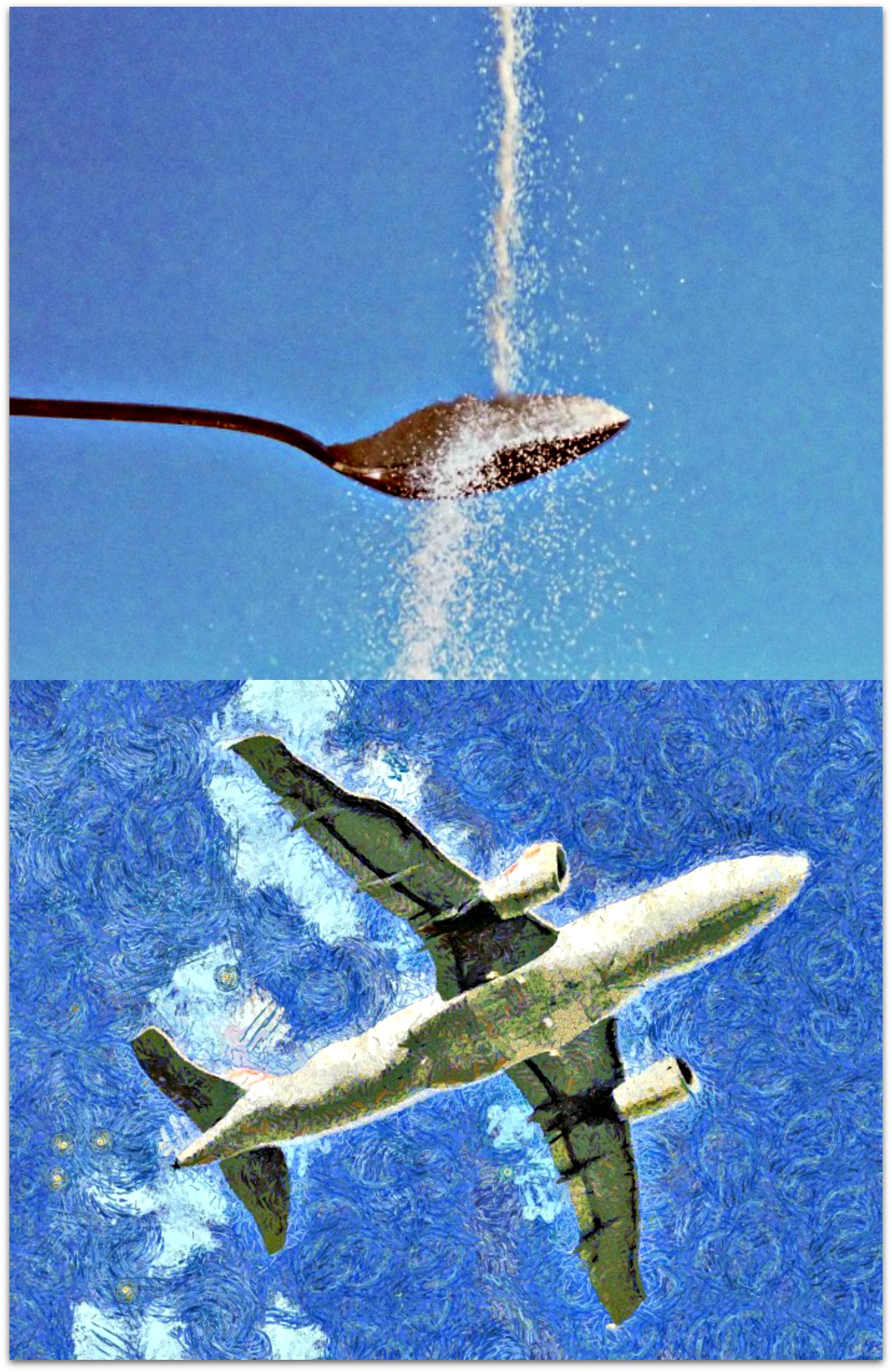
Sugar spoon by jppi (Morguefiles); jet painting by Prawny (Morguefiles).

Sugar spoon by jppi (Morguefiles); jet painting by Prawny (Morguefiles).

Here in the Northern Hemisphere, as summer draws to its inevitable close, I’d like to take a moment to acknowledge the talented individuals who write columns for us from an expat or otherwise displaced perspective.

Curiouser and curiouser! If it weren’t for them, we’d know a great deal less about the contours of the kind of creative life that is lived across two or more distinct cultures.

Fiction, fantasy, food, photos, theatre—oh my! Our columnists also serve as the Wizards who can help the rest of us transform our travels into a trip down the Yellow Brick Road.

(Yes, Dorothy has now joined Alice as a Displaced Nation heroine.)

Without further ado, they are, in alphabetical order:

1) Andrew Couch

COLUMN: Here Be Dragons
INTERESTING FACT ABOUT ANDREW: He spent this summer developing the Peanut Butter Bar WordPress app, which allows you to attach sticky bars to the roof of your site that stay visible no matter how far a user scrolls. (“Smooth” is free. “Chunky,” which has more features, costs $15.)
COLUMN PURPOSE: Andrew demonstrates, through snippets of his own writing, the possibility of collecting materials for a fantasy novel from a life of international travel.
MOST POPULAR POST: Andrew’s first, “The expat life as fuel for fantasy writing,” perhaps because his concept is a little fantastical.
WHY YOU SHOULD FOLLOW: You will never look at your displaced life in quite the same way again but will see yourself as the protagonist in your own Alice or Dorothy story, a story you’re not only living but could (should?) be writing…

2) Beth Green

COLUMN: Booklust, Wanderlust
INTERESTING FACT ABOUT BETH: She grew up on a sailboat and, though now a landlubber, still enjoys a peripatetic life.
COLUMN PURPOSE: Beth selects books with particular appeal to international creatives.
MOST POPULAR POST: Her first, about the Dublin Murder Squad series by ATCK writer Tana French, perhaps reflecting Beth’s own passion for mystery (she is also a member of the Sisters in Crime mystery writers’ association, another interesting fact about Beth).
WHY YOU SHOULD FOLLOW: The peripatetic Beth has a correspondingly eclectic taste in books, sampling everything from psychological mystery to journalistic memoirs of China to biographies of eccentric female travelers of the past century.

3) Elizabeth Liang

COLUMN: TCK Talent
INTERESTING FACT ABOUT LISA: Lisa spent part of the summer in Iceland, putting on her one-woman autobiographical show about growing up as a TCK, Citizen Alien.
COLUMN PURPOSE: Lisa profiles Adult Third Culture Kids with unusual talents. Perhaps not surprisingly, many of them find success as actors, just as Lisa has.
MOST POPULAR POST: Lisa’s interview with Laura Piquado, an actress in New York City who grew up all over the world and told Lisa she is now

dyak and atheist, Muslim, Christian, Bahá’í, Jain, Egyptian, Italian, Canadian—there is nowhere in the world that has ever felt foreign to me.

WHY YOU SHOULD FOLLOW: Because they weren’t originally expats by choice, adult TCKs can teach the rest of us a lot about the glories as well as the challenges of leading a displaced life. Plus Lisa’s gutsiness in developing her own TCK show gives her creds. She and the show are terrific! I know because I’ve met her and seen it.

4) Meagan Adele Lopez

COLUMN TITLE: The Lady Who Writes
INTERESTING FACT ABOUT MAL: Meagan Adele Lopez (nicknamed MAL) is both Anglophile and Francophile (she once lived in Paris). Talk about open-mindedness!
COLUMN PURPOSE: MAL writes about what she wished she’d known before setting out to write and self-publish her first novel, Three Questions, based on a romantic adventure that started at the end of her first expat stint in the UK (in Bristol).
MOST POPULAR POST: MAL’s first, suggesting that expats may easily be able to find a novel in their novel lives. Note: MAL has just wrapped up her six-post series for us.
WHY YOU SHOULD READ: Rather like Dickens, MAL calls on elements from her thespian background (she used to be an actor in Hollywood, no less) for writing a novel. Her characters are real: she imagines “dining out” with them!

5) James King

COLUMN TITLE: A Picture Says…
INTERESTING FACT ABOUT JAMES: James now lives in Thailand but during his previous expat stint, in South Africa, he ended up settling in Capetown, where he still has a house he’s renting out but would like to sell. Anybody interested?!
COLUMN PURPOSE: James tries to coax expats and other displaced types for whom photography is a creative outlet to tell the stories behind their favorite photos.
MOST POPULAR POST: James’s interview with Irish “ruin hunter” and photographer Ed Mooney, which generated a whopping 32 comments.
WHY YOU SHOULD READ: Why people feel compelled to take photos and what their favorite subjects are turns out to be a great window into the displaced mindset. Kudos to James for developing the series in this new direction.

6) JJ Marsh

COLUMN TITLE: Location, Locution
INTERESTING FACT ABOUT JJ: She plans to attend the Chorleywood LitFest on November 16th, 2014, wearing a toga. Hey, carpe diem and all that!
COLUMN PURPOSE: JJ interviews well-known authors who are expats and/or set their books in far-off lands about the role of place (location) in their imagination and subsequent writings (locution).
MOST POPULAR POST: JJ’s interview with Amanda Hodgkinson, who finished her first two novels, 22 Britannia Road and Spilt Milk, after relocating with her family to southwest France.
WHY YOU SHOULD READ: JJ commands respect in the writing world for her own achievement in crafting a European crime series featuring detective inspector Beatrice Stubbs, in which place plays a major role (she thinks of it as a “character,” she says). This must be why so many other authors are willing to share with her the techniques they use to transport readers to other, more remote parts of the world. Her columns are invariably illuminating.

7) Joanna Masters-Maggs

COLUMN TITLE: Global Food Gossip
INTERESTING FACT ABOUT JOANNA: She is a school friend of Displaced Nation founder Kate Allison. Want another one? She is half Irish and half English, which surely qualifies her as a TCK?
COLUMN PURPOSE: Joanna provides the inside story on food that comes from having lived as a trailing spouse in eight very different countries for more than 16 years.
MOST POPULAR POST: “There’s no taste like home,” in which Joanna confesses that she’s been so busy trying to cook the local food for her four kids that she neglected to introduce them to traditional English dishes.
WHY YOU SHOULD READ: Her repeat expat life has turned her into a creative chef extraordinaire. She knows how to make her own clotted cream (and provides a recipe) should homesickness strike, but is equally adept at Texas Barbecue Brisket.

* * *

In other news…

Have you checked out our Pinterest pins lately? We’ve quite the collection of displaced reads, movies and people, eg:

We can take you on a trip out of this displaced world should you wish to be further displaced; or for those who prefer a fantasy metaphor for their escapist tendencies, check out our Alice in Wonderland and Follow the Yellow Brick Road boards.

IT’S FOOD! is one of our most popular boards (natch!), as is World Parties, Holidays & Celebrations (hooray!). We also have two boards that celebrate the spirit of two previous blogs by me and another Displaced Nation founder, Kate Allison:

Speaking of Kate, you may have noticed that after producing episodes of her novel Libby’s Life on a regular basis for a couple of years (90 episodes, can you imagine?!), she is now updating the story on her author blog and aggregating those posts every so often for the Displaced Nation audience.

Last but not least, if you haven’t caught up with our Displaced Dispatch lately, take another look. Besides links to the latest posts, we have ORIGINAL contents by yours truly, exclusive giveaways (there’s one on now!) and candidates for the monthly Alice Awards.

Yes, we are still doing our Alice Awards and have now added an occasional Wizard of Oz column about repatriation: “Emerald City to Kansas”. We’re a busy (dis)place!

STAY TUNED for the announcement of August Alices.

If you enjoyed this post, we invite you to register for The Displaced Dispatch, a round up of weekly posts from The Displaced Nation, with original contents, book giveaways, and other extras. Register for The Displaced Dispatch by clicking here!

Related post:

10 summer hacks picked up from an expat (& repat) life spanning Japan, the UK and the US

summerhacks_US

The summer ideal, so rarely achieved (apart from the cocktail), Public Domain CC0 via Pixar.

New York City, where I now live after years of being an expat on two small islands, the UK and Japan, had a particularly brutal winter in 2014. You would think I’d now be in the mood for summer.

But no. It hasn’t worked that way.

The moment the temperature and humidity levels skyrocketed here in the city, I realized my feelings about summer haven’t changed. Basically, and as expressed in this space before, I can’t stand it. Or, in the somewhat more poetic words of Swedish black metal trio Woods of Infinity:

Summer is not my friend. Satan, let it end.
Sunshine, hurting my eyes. Making my skin look like…argh.

Which brings me to today’s topic: summer hacks. What hacks have I picked up from the three countries where I’ve lived—Japan, the US and the UK—that can help me through summer’s doggiest days?

FROM JAPAN:

1) Avoid the sun at all costs.

Japanese women seem to have been the first to get the memo about avoiding sun damage. During the summer, which in Tokyo can be particularly brutal, most would not venture out in the heat of the day without a hat or a UV parasol, sometimes both. (Note: A regular umbrella will do in lieu a proper parasol.)

2) Carry a fan and a handkerchief.

If the heat becomes unbearably hot, say, when standing on the subway platform or getting into a car, one of the easiest ways to get cool is via a simple fan, either the kind that folds or an uchiwa. And if you find yourself perspiring profusely in a public place, try dabbing your face and neck with a handkerchief folded into a neat square. (When living in Japan, I used to find it entertaining to go into a department store and look at the vast array of handkerchiefs on display in the ground floor accessories. Every major Western designer has done one, meaning they’ve all had to struggle with translating their unique look into a small square of cloth. Who knew?)

3) Eat sparingly (cold soba) or else for energy (grilled eel).

On a hot and humid day, one of the healthiest meals is the simplest: a plate of cold buckwheat noodles, or soba, which have been cooked al dente. The noodles are dipped into a cup containing a special sauce (consisting of dashi, sweetened soy sauce and mirin), to which has been added fresh wasabi and sliced spring onions. Alternatively, if your body feels depleted during a heat wave, you can go to the other extreme and have a meal of unagi kabayaki, freshwater eel that has been glaze-grilled: it is served over white rice, typically with a cold beer to accompany. (By tradition, Japanese favor this meal from mid-July through early August, to counteract the lethargy and debilitation that occurs mid-way through their blistering summers.)

4) Drink plenty of cold tea and, for short bursts of energy, iced coffee with milk and a shot of gum syrup.

In Japan you can buy, at every convenience store, huge plastic bottles of green tea or oolong cha (my fave) to refrigerate so that cold tea (most people don’t ice it) is always on hand. You can also make mugicha: a caffeine-free barley infusion, said to be the “flavor of summer” in Japan and always served a room temperature. Before moving to Japan, I had never before tried iced coffee , where apparently the Japanese have been drinking it since the 1920s. Usually, it’s served in a glass to accompany or finish a restaurant meal—not in a plastic disposable cup (it’s impolite to eat and drink on the streets in that part of the world). Although hesitant at first, I became an immediate fan and was pleased to see it had caught on in the West by the time I returned. Now you can even get iced coffee in Dunkin’ Donuts. And, whereas I don’t usually add sugar to coffee, I will sometimes add to the iced version as I find my body needs that extra bit of energy to get from A to B. (In Japan, one always adds gum syrup, which dissolves much better than sugar, but it’s hard to find that here.)

FROM THE US:

5) If you can’t stand the heat, move to a cold dark box, aka a movie theatre.

Maybe it’s a New York City thing, but I’m thinking of Michael Maslin’s New Yorker cartoon showing a movie theatre with a marquee that says:

AIR
CONDITIONING

and a movie

6) Eat ice cream.

One or two scoops of freshly made ice cream in a dish or a regular sugar cone (nothing heavier or fancier) is one of life’s simple pleasures. Many people die in heat waves (no joke), so this is one to have, and keep, on your bucket list.

7) Seek invites to places where you can swim—in a pool, a lake, the ocean.

Nothing is more refreshing on a hot day than plunging into some cool water. Another tip is to put on a shirt or dress that is slightly damp—it will be dry by the time you reach the subway.

8) No opportunity to escape to a house in the Hamptons or equivalent? Have a cocktail.

See my still-relevant post of three summers ago on cocktails as mini-summer escapes to exotic locales, entitled Some enchanted drinking…

FROM THE U.K.:

9) Seize the moment and go crazy.

British summer tends to be short and sweet—and blissful (not too humid). Should you have a day where the heat breaks and temperatures and humidity levels are bearable, EMBRACE SUMMER AS YOUR FRIEND. Now, British people go to extremes by stripping down, as noted in this recent post by Annabel Kantaria in her Telegraph Expat blog, hence risking sunburn and melanoma. (As an aside: Did you know we once did an interview with Annabel? Check it out if you haven’t seen it.) At the very least, perhaps you could pull off an impromptu picnic or bike ride, or else try to score an outdoor table at a popular restaurant or pub.

10) Have a cuppa.

Contrary to the Japanese and American customs, tea is drunk hot in Britain because it makes you sweat and therefore cool down. This hack is one of the more practical legacies from the days when the Brits occupied India. To this day, I will sometimes make a cuppa when I’m boiling hot. Think the science sounds dubious? Listen to this NPR story. In any event, tea is an important summer drink in all three cultures, for good reason. It sustains you. See my post on the virtues of tea-drinking.

* * *

Readers, it’s your turn. What can you add to my list before that Woods of Infinity song starts haunting me again:

Awake at night again. No tears to weep and too restless to sleep. Thinking of all and nothing and got stuck in between.

Hurry, please! Any foods, drinks, rituals, Bacchanalian festivities or other hacks you’ve picked up from your lives of displacement? How about current films you’d recommend? SOS, I’m melting over here…

STAY TUNED for next week’s fab posts!

If you enjoyed this post, we invite you to register for The Displaced Dispatch, a round up of weekly posts from The Displaced Nation, with seasonal recipes, book giveaways and other extras. Register for The Displaced Dispatch by clicking here!

Related posts:

4 observations after 3 years of holding up a mirror to expat (& repat) life

Las Meninas, by Diego Velázquez [Public domain], via Wikimedia Commons

Las Meninas, by Diego Velázquez [Public domain], via Wikimedia Commons

Earlier this month, I wrote a post in celebration of the Displaced Nation’s third birthday, which occurred on April 1st.

For three years we’ve held up a mirror, as it were, to what we’ve been calling the displaced life, writing and commissioning posts on what motivates people to venture across borders to travel and live.

During the past three years, here’s what our looking-glass has revealed:

1) We aspire to be the fairest of them all.

If our site stats are anything to go by, the Fountain of Youth myth is still alive and well. We may not be searching for water with restorative powers on our travels, but we never tire of reading about Jennifer Scott’s top 20 lessons she learned from Madame Chic while living in Paris, TCK Marie Jhin’s advice on Asian beauty secrets, or my post summarizing beauty tips I picked up on two small islands, England and Japan (three of our most popular posts to date). Heck, even 5 tips on how to look good when you backpack still gets plenty of hits.

2) We mostly just want to have fun.

The popularity of two of Tony James’s Slater’s posts—one listing his five favorite parties around the world and other other telling the tale of his attempt to overcome language barriers in pursuit of an Ecuadorian woman—suggest that good times and love still rank high on the list of reasons why people opt for the road much less traveled. That said, some of us worry about going too far with the latter, if the enduring popularity of my post four reasons to think twice before embarking on cross-cultural marriage is anything to go by.

3) But we love hearing stories about international travelers with a higher purpose.

Most of us do not venture overseas in hopes of changing the world, but we are inspired by tales of those who once did—how else to explain the golden oldie status of 7 extraordinary women with a passion to save souls? And our fascination with the international do-gooder of course continues to the present. Kate Allison’s interview with Robin Wiszowaty, who serves as Kenya Program Director for the Canadian charity Free the Children, still gets lots of hits, as does my post about Richard Branson and other global nomads who delve into global misery. Perhaps we like to bask in reflected glory?!

4) Last but not least, we think we know things other people don’t.

Indeed, the most common phenomenon that has occurred when holding up our mirror to international adventurers is to find our mirror reflected in theirs, and theirs reflected in the lives of people they depict, ad infinitum, in a manner not unlike a Diego Velázquez painting (see above). In my view, this mise en abyme owes to the conviction among (particularly long-term) expats that in venturing so far afield, they have uncovered things about our planet that are worth examining, reporting, and creating something with, be it a memoir of what they’ve experienced (think Jack Scott’s Perking the Pansies: Jack and Liam Move to Turkey, Janet Brown’s Tone Deaf in Bangkok, or Jennifer Eremeeva’s soon-to-be featured Lenin Lives Next Door: Marriage, Martinis, and Mayhem in Moscow), a novel based on their overseas adventures (think Kate Allison’s Libby’s Life or Cinda MacKinnon’s A Place in the World), and/or an art work that springs from what they saw and felt when living in other cultures (eg, Elizabeth Liang’s one-woman show about growing up a TCK).

In short, although many of us can relate to Alice’s feeling of having stepped through the looking glass, we also aren’t afraid to hold up a looking glass to that experience. I often think of Janet Brown telling us she almost went home “a gibbering mess” upon discovering that her Thai landlord was spreading salacious rumors about her, but the point is, she survived to tell us about the experience in her gem of a book. Surely, that’s the kind of hero/ine Linda Janssen has in mind for her self-help book The Emotionally Resilient Expat?

* * *

No doubt there are even more insights our three years of running the Displaced Nation have revealed, but I’ll stop here to see what you make of this list of traits. Does it strike you as being accurate, or perhaps a bit distorted? (Hmmm… Given this site’s proclivity for humor and sending things up, how can you be sure this isn’t a funhouse mirror and I’m not pulling your leg? Har har hardy har har.)

STAY TUNED for next week’s fab posts.

If you enjoyed this post, we invite you to register for The Displaced Dispatch, a round up of weekly posts from The Displaced Nation, with seasonal recipes, book giveaways and other extras. Register for The Displaced Dispatch by clicking here!

Related posts:

An expat’s thoughts on flying and the journey “home”

20131128-020743.jpg

Photo credit: A Windram

This is my third attempt at writing this post. The previous two attempts were quickly aborted; I had tried drafting them during two separate flights back to the UK, but quickly gave up in frustration.

Flying—for me, at least—is not conducive to creativity (if hastily scribbled blog posts can be described as such). I can never settle on a flight, I can never forget that I am 30,000 feet above the earth trapped in a metal tube powered by 36,000 gallons of jet fuel.

But, of course, flying remains an occupational hazard for the expat. No matter how long you may have been away, the call home is at some point unavoidable. After an absence from “home” of nearly three years, over the last few months I’ve had to make two trips back. One for reasons pleasant; one for reasons unpleasant.

Flying, when you think about it, and when I am flying I find I would much rather not think about it (those 36,000 gallons of highly flammable jet fuel remain heavy on my mind), is astonishing. Indeed, it is so astounding that we have to go out of our way to avoid that fact and focus on the banal. The aviation industry is helpful on this point. You wait in a terminal, shitty retail and even shittier food your scant choices to kill time, but it helps numb you, I suppose. Makes you unthinking about the journey ahead, your entry into the heavens.

When I was flying back for more pleasant reasons I began reading French philosopher Michel SerresAngels: A Modern Myth. Serres opens his work with a fictional couple meeting at an airport. He a traveling inspector; she a doctor at the airport medical center. For Serres, the couple see angels when they look around the airport:

I see angels—which, incidentally, in case you didn’t know, comes from the ancient Greek word for messengers. Take a good look around. Air hostess and pilots; radio messages; all the air crew just flown in from Tokyo and just about to leave Rio; those dozen aircraft neatly lined up, wing to wing on the runaway, as they wait to take off; yellow postal vans delivering parcels, packets and telegrams; staff calls over the tannoy; all these bags passing in front of us on the conveyor, endless announcements for Mr X or Miss Y recently arrived from Stockholm or Helsinki; boarding announcements for Berlin and Rome, Sydney and Durban; passengers crossing paths with each other and hurrying for taxis and shuttles while escalators move silently and endlessly up and down . . . like the ladder in Jacob’s dream . . . Don’t you see—what we have here is angels of steel, carrying angels of steel, carrying angels of flesh and blood, who in turn send angel signals across angel air waves . . .

I don’t see any angels sitting around me in the terminal, and I don’t think our messages are worth conveying across the world. I would have enjoyed reading the Serres anywhere other than here, in a terminal.

“Business or pleasure?”

For the expat, the answer is neither. I am going home. I am leaving home. I am leaving the present. I am returning to the past.

On the plane, I put the Serres away and try to read a book (The Journey of Theophanes: Travel, Business, and Daily Life in the Roman Middle East) about a Roman lawyer journeying to Antioch. Over six months he slowly makes his way, noticing the slight changes in geography. Compared to that, what I am doing seems a cheat. I put the book away. I can’t concentrate enough, there’s slight lurch in the plane’s movement that suggests we are beginning to enter turbulence. I just try to watch Iron Man 3 instead.

I am going home. I am leaving home.

STAY TUNED for tomorrow’s post, a TCK Talent interview by monthly columnist Elizabeth Liang.

If you enjoyed this post, we invite you to register for The Displaced Dispatch, a round up of weekly posts from The Displaced Nation, with seasonal recipes, book giveaways and other extras. Register for The Displaced Dispatch by clicking here!

Related posts:

Happy Halloween! A cauldron of 6 cautionary tales for the intrepid traveler

Image: Lake View Cemetery / MorgueFile.com

Yesterday’s Halloween post by Anthony Windram, about the top 5 ghostly settings from literature and film, got us thinking again about the ghostly and ghoulish, the mystical and macabre, the dark and demonic.

Our thoughts, however, did not turn towards the new and original, but to the jaw-clanging skeletons in the Displaced Nation’s very own Crypt.

At which point…someone (Kate Allison?) suggested that we pile all of our Gothic Tales of Old into a cauldron and chant “Bubble, bubble, toil and trouble.” All was going well until one of us—must have been the American—broke in with:

Stirring and stirring and stirring my brew…

Just as she screeched “O-o-o-o-o, o-o-o-o-o”, 6 apparitions arose from the pot: 6 terrifying tales from the Displaced Nation’s deep dark past. Each said they were there to teach travelers a lesson.

And here is what they told us:

1) The Ghost of the Mysteriously Misplaced Post

I am the ghost the represents the post titled The Displaced Nation’s Halloween post is…mysteriously displaced!, composed on Halloween night two years ago by ML Awanohara, whose blood was curdling because:

Kate Allison was supposed to post today, for Halloween…but then, pouf, she vanished without a trace!

As readers who are paying attention know, Kate has now posted 80+ episodes in the life of a fictional British expat family living in New England, called Libby’s Life. Two years ago she vanished before uploading the latest episode because of a freak snowstorm in Connecticut, her adopted home.

She finally resurfaced on On All Saint’s Day—in a MacDonald’s! (Has she gone native, or what?)

Travelers, here is the lesson I’m here to impart for your sake: Truth is stranger than fiction, where so’er you roam.

2) The Ghost of Quizzing Others on Their Supernatural Sightings

Hello there, I am the ghost that arises from THE DISPLACED Q: On your travels … have you ever seen a ghost?, which was composed by Tony James Slater just over a year ago. He impressed with his self-knowledge when he said: “I’m about as psychic as a cheese.” But then he went on to say:

And then, just occasionally, I have dreams when I’m visited by the spirits of people I’ve lost….

Is there any wonder there were no comments and no likes on his post? He scared the bejeezus out of most of his readers.

Still, point taken, and I’m here to impart an important lesson that you international travelers may not have fully considered: As you traverse the world, bear in mind that any ghosts you meet will be people you know (and left behind), not strangers.

3) The Ghost of Compiling a Master List of Grim Reapers

Greetings, I have emanated from the post called Grim Reapers around the globe: 7 creatures that say “Time’s up!”, composed by Kate Allison just over a year ago. Kate reported on the surprising number of cultures that maintain some version of the mythological conniving female who lures men to their deaths.

As frequent visitors to this site will know, Kate has a way with words. For instance, she described
Sihuanaba of Central America as follows:

Seen from the back, she’s an attractive woman with long hair; from the front, it’s a horse. (No jokes about Sex and the City, please.)

But even Kate’s rather offbeat humor could not dissuade from the freakishness of some of these figures.

As far as lasting lessons, this will have to suffice: Next time you get lost in a canyon, try blaming an ancient ghoul. Depending on where you’ve landed, as well as gender, you may just about pull it off.

4) The Ghost of Delivering a Screed against Princess Diana Dolls

A cheery hello to one and all, I am the ghost of Anthony Windram’s EXPAT MOMENTS: The Doll Collection, which he wrote almost exactly a year ago.

As anyone who came across it may recall, Mr. Windram was most distressed to find himself at a bed-and-breakfast in NEW England (he is from Jolly Olde) where the innkeeper has put her prized collection of “individually authenticated” Princess Diana dolls on display in the sitting room. He tossed and turned all night, even heard scratchings at his door.

Now, as regular visitors to this esteemed site know, Mr. Windram is no fool. On the contrary, he has has a mighty brainbox. Which is why I’m so stunned that he allowed himself to be frightened by a set of Lady Di figurines. I’m sure they were only there to cover up the fact that the house is haunted—by a young and rather vigorous ghost, which is how ghosts tend to come in America (just ask Libby). The real take-away, then, particularly for those who venture into the New World: Avoid American B&Bs like the plague if you want a decent night’s sleep.

5) The Ghost of the Expat Criminals Exposé

ML Awanohara showed some temerity in writing a post entitled What did Agatha Christie know? Expats make great criminals back when this blog first started.

As the ghost that arose from this post, I’m here to say she hit the proverbial coffin nail soundly on the head with this assertion:

Just as we don’t like to think of rats being part of the animal kingdom, we don’t like to think of conmen, pirates, gangsters, and terrorists being part of the group we have loosely defined as “global voyagers” … But trust me, they are a part of it — as are murderers.

Which leads us to the lesson I’ll impart today: Just because you’re in a part of the world where marrows tend to thrive, don’t assume the likes of Hercule Poirot will turn up and save you.

6) The Ghost of Finding Travel Inspiration in Margaret Drabble’s “Red Queen”

Not long ago compared to other posts in this collection, ML Awanohara wrote FOOTLOOSE & FANCIFUL: Margaret Drabble’s “The Red Queen”, explaining how her views of Korea had shifted after reading a book by Dame Drabble depicting a period of bloodshed and horror in the 18th-century Korean court. A real-life tale made more vivid by Drabble’s considerable fictional powers, in which the Prince is a homicidal maniac, and his father, the King, a stern Confucian. The King ultimately decides to murder his son in a style so dramatic that ML couldn’t get it out of her head next time she went to Korea. She remains haunted to this day.

As the ghost of this post about a ghost, I find myself torn. On the one hand, what kind of person would read Drabble—that serious, hip, intellectual British novelist, who likes to come across as one’s brainy, Cambridge-educated best friend—to get a handle on what the Koreans are really like? Apples and oranges—or marmite and kimchi, I should say.

On the other—and this is the lesson I’ve come to deliver: Never hesitate to use a Cambridge-educated Brit as a resource for novel sightseeing ideas.

* * *

Readers, have we got you thinking twice about those travel plans? Do let us know in the ca-ca-comments. Hey, at least we spared you the horrors of Sezin Koehler’s 15 films that depict the horrors of being abroad, or otherwise displaced; Tony James Slater’s 5 travel situations that spell H-O-R-R-O-R!; or Kate Allison’s Global grub to die for, including a rather scrumptious recipe for fried tarantula, which goes down a treat in Cambodia.

STAY TUNED for next week’s fab posts!

If you enjoyed this post, we invite you to register for The Displaced Dispatch, a round up of the week’s posts from The Displaced Nation, with our weekly Alice Award, book giveaways, and other extras. Register for The Displaced Dispatch by clicking here!


The Displaced Nation selects its top 5 chillingly atmospheric Halloween locations from literature & film

From greedy children holding up whole neighborhoods to blackmail as they seek a cheap fix for their addiction to stores selling cheap plastic masks and covering their aisles in fake cobwebs, I’ve always found Halloween to be tedious time of the year. Everything ends up looking more crappy than creepy. As the day lacks its own miserly Ebenezer Scrooge-figure I would be more than happy to fill the role.

Of course, that makes me a poor choice indeed to write a Halloween-themed post for The Displaced Nation, but we can all take solace in the knowledge that as I write this I have the lights in my living room turned off and I am ignoring the pleading of the legions of candy junkies knocking on my door asking for one last Hershey hit.

But enough whinging, Windram. Now for my picks for atmospheric locations that can send a chill down your spine:

1) Whitby, United Kingdom

Quite understandably Dracula is associated with Transylvania, but the Yorkshire coastal town of Whitby is also heavily featured in Bram Stoker’s novel as the site of Dracula’s shipwreck.

Stoker visited Whitby in 1890 and was struck by the atmospheric fishing town. It is easy to see why with the ruins of Whitby Abbey high atop the east cliff overlooking the town it is visually spectacular, which makes it a wonder why the Whitby portions of Stoker original novel have so often been ignored by filmmakers adapting Dracula. John Badham’s 1979 adaptation is one of the few movie Draculas to try and depict Whitby, though unfortunately even here the use of the Whitby storyline is disappointing as the Cornish coast in fact stood in for the Yorkshire coast. This adaptation also has Frank Langella as Count Dracula, so make of that what you will. It’s certainly not obvious casting, I’ll give them that.

2) Geneva, Switzerland

Sticking with a Gothic theme, let’s focus our attention on that other horror mainstay: Frankenstein, by Mary Shelley.

Frakenstein was inspired by Shelley’s stay in Geneva, and large parts of the novel are also set there. Of course, modern, clean, ever-so-slightly-dull Geneva is not the inspiration, but rather the Villa Diodati, a country house on the shores of Lake Geneva. It is here that famously the Shelleys, Byron, and Dr Polidori challenged each other to come up with a horror story. From this challenge Mary Shelley wrote Frankenstein.

For an appropriate bit of campy Halloween schlock, Ken Russell’s film Gothic (1986), which is about the events of that challenge, is well worth a watch.

Equally, Benjamin Markovits’ novel Imposture, about Dr Polidori and his writing of the short story “The Vampyre” during that same challenge, is recommended.

3) A field of susuki grass, Japan

This entry is something of a cheat. This is an entry about the 1964 Japanese film Onibaba (literally, “Demon Hag”), which has no specific setting beyond Medieval Japan; but it’s one of the few horror films I’ve found genuinely affecting.

This is a very brief and unsatisfying summary of the film, but during a civil war two women, one old and one young—living in poverty in an area thick with reeds—kill soldiers who find themselves lost near their home, taking their possessions to sell. The older woman is worried that the younger woman, who is having an affair with a neighbor recently returned from the war, will soon be leaving her so she will have to fend to herself. When the older woman kills a samurai wearing a demon mask, she pulls the mask off the corpse (his face is disfigured) and wears it pretending to be a demon so as to scare the younger woman. Once she puts on the mask, however, she is unable to take it off.

Wow, that summary really doesn’t do the film justice. The film’s director, Kaneto Shindo, was especially keen for the film to be shot in a field of susuki grass, which they found near a river bank in Chiba Prefecture. That setting really makes Onibaba visually arresting. Claustrophobic, but also surreal and languid, these grasses heighten the tension, which is why I feel justified in adding a susuki grass field in Japan to this list.

4) Maine, USA

Obviously this is in reference to the frighteningly prodigious novelist Stephen King, a Maine native and someone who in his work has made use of the fictional Derry, Maine.

With its atmospheric coastline, rocky and dramatic, it’s easy to see how it has inspired King in a similar way to how east cliff in Whitby inspired Stoker a century before.

5) Georgetown, Washington, DC, USA

Or, more specifically, the stone steps that are on M Street in Georgetown, which were made famous in the classic horror film The Exorcist (1973). May the power of Christ compel you to visit! Word of warning: The steps are pretty steep, so if you’re heart starts beating fast, it’s probably the cardio-vascular workout you’re getting rather than any ghoulish happening.

* * *

Readers, literature and film are of course packed with thrills and chills. Have I missed anywhere you think belongs in the Top Five? Let me know in the comments…

STAY TUNED for next tomorrow’s Halloween posts, and prepare to be scared!

If you enjoyed this post, we invite you to register for The Displaced Dispatch, a round up of the week’s posts from The Displaced Nation, with our weekly Alice Award, book giveaways, and other extras. Register for The Displaced Dispatch by clicking here!

Related posts: