The Displaced Nation

A home for international creatives

Tag Archives: Writers we love

LOCATION, LOCUTION: Charles Lambert draws on his displaced life to produce psychological thrillers

location-locution-charles-lambert
Tracey Warr is here with fellow displaced Brit Charles Lambert, a master writer of literary thrillers. He was born in England, lives in Italy, and describes himself as deeply enjoying the status of being a foreigner.

Greetings, Displaced Nationers.

My guest this month is the writer Charles Lambert, who was born in Lichfield, UK, a cathedral city in the Midlands, but who has lived in Italy for most of his adult life. After graduating from Cambridge, Charles worked as an EFL teacher in Milan and Turin in the mid-1970s—one of the most tumultuous periods in post-war Italian history, which he has written about in his psychological thriller, The View from the Tower.

After two years, he moved to Setúbal, Portugal, a smallish town south of Lisbon—and found himself, once again, at the heart of a political situation he struggled to understand (see his novella, The Slave House). After six months and a disastrous love affair, he returned to the UK to “get a proper job.” He ended up working as an assistant editor at a medical publisher’s on Euston Road.

Fifteen months later, desperately unhappy, he turned down a promotion and headed back to Italy, where he has lived ever since—initially in Modena (northern Italy) and then in Fondi, about halfway between Rome and Naples.

As I’ve already indicated, all of these backings and forthings have provided rich fodder for Charles’s imagination. Even his current work, as a language teacher in Italian universities, a job he has done since 1982, “makes up in the endless variety of human contact what it lacks, signally, in career opportunities,” as he puts it. Charles has also worked as a journalist for the news agency ANSA, translated for academic presses in the UK and the USA, edited for international agencies, and written critical essays on, among other things, George R. R. Martin’s epic fantasy series, A Song of Ice and Fire, in which he confesses a unashamedly nerdish interest.

But his true passion is fiction writing—in particular, the psychological literary thriller. In addition to his many blog posts, the afore-mentioned novella, The Slave House, the occasional poem, and his acclaimed short story collection, The Scent of Cinnamon (for which he won an O. Henry prize), he has written four novels:

  • The Children’s Home (Scribner, 2016): An inversion of a modern fairytale, the story centers on a disfigured recluse living on his family estate, with a housekeeper as his only companion. His solitude is disrupted when stray children start showing up on his doorstep.
  • The View from the Tower (Penguin Random House, 2013): A psychological thriller and second in a planned trilogy about the darker side of Rome, the story centers on Helen, who has been having an affair with her husband’s best friend, Giacomo, an ex-terrorist, for 30 years. She is in a hotel room in Rome with Giacomo when she receives the news that her husband, a high-level politician, has been murdered. She simultaneously becomes a suspect and suspicious of everyone around her—forcing her to examine her own past and peel back the years of secrets and lies.
  • Any Human Face (Picador, 2011): The first in a planned trilogy about the seamier side of Rome, the story concerns what happens when Andrew, a quirky gay bookstore owner and sometime art/antiquity dealer in Rome, stumbles into a political vipers’ nest involving high-level politicians and Vatican officials while also struggling to overcome heartbreak from his past and learning to love again. When the book first came out, the Guardian called it a “sophisticated literary thriller set on the seamier fringe of Rome’s gay scene, a magnet for the lonely and displaced located a long way off the tourist trail.”
  • Little Monsters (Picador, 2008): Lambert’s début novel and the first of his books set in modern Italy, this is the story of Carol, a young teenager who, having witnessed her father killing her mother, is put into the care of her aunt, who hates and resents her, and her uncle, whom she eventually marries. The story is told in two time frames: Carol as ward and Carol as an adult, when she finds herself drawn to a boat-refugee child in Italy (the child reminds her of her unwanted teenaged self).

charles-lambert-oeuvre-525x
He also recently produced a fictionalized memoir, With a Zero at Its Heart, capturing moments from his life in a unique, experimental format.

Charles says he has no plans to return to the UK, and Brexit is unlikely to persuade him to change his mind:

I don’t define myself as an expat. If I had to define myself, I’d probably go for “economic migrant” or, more simply, “foreigner”, a status I deeply enjoy.

For entirely pragmatic reasons, he is currently in the process of becoming an Italian citizen.

And now let’s hear from Charles about what techniques she uses to conjure up the Italy he knows so well as a long-time resident while also cherishing his status of outsider.

* * *

Welcome, Charles, to Location, Locution. Which tends to come first when you get an idea for a new book: story or location?

Every book is different. My first novel, Little Monsters, began with a sentence and, within seconds, the sentence had found a home in the Peak District, where I spent most of my adolescence. That place, and my memories of it, dictated much of the narrative. The other half of the book was set in contemporary Italy, where I live, although the story took me to a part of Italy I didn’t know that well and I had to use my imagination. So, one novel, half story-led, half place-led. The next two novels I published were both set in Rome, and I can’t imagine them being set in any other city. Rome’s a city with a uniquely composted history of beauty and blood-letting, high ideals and dirty low-down dealings, and the novels dig into that humus with relish. My most recent novel, on the other hand, The Children’s Home, is set in an undefined place and time and the lack of temporal and geographical definition is an integral part of the story.

What is your technique for evoking the atmosphere of these places?

When I’m writing I have a strong sense of where I am. It’s in my mind’s eye, so to speak, so all I need to do is look around and report on what I see. If the place is a real place, then memory is involved. If it isn’t, the details come as I need them. A shop, a street, a tree… As a general rule, though, I’d say less is more. It’s what I call the “Bakelite-ashtray fallacy”—the idea that obsessively name-checking historical materials and brands gives a sense of period. It doesn’t. It gives a sense of working too hard to create a sense of period, and is inevitably counter-productive. The same is true with a sense of place. Too much description draws attention to itself and to the writer’s eagerness to be believed, not to the place it’s supposed to be describing.

Which particular features create a sense of location? Landscape, culture, food?

All three, to a greater or lesser degree, and I’d add language to the list—but, as I said above, with parsimony. It can be hard to resist the temptation to describe in detail every dish your characters are eating—especially if you love food as much as I do and the scene is set in Italy, as scenes in my work often are—but if the purpose of the scene is, well, non-gastronomic, you just need to do your best to keep the detail pared down. My agent, with exemplary dedication, once counted the number of bottles of red wine consumed in one of my novels (Any Human Face, if you’re curious). It was frighteningly high but, we both agreed, integral to the narrative, although it may have contributed to creating, for my characters at least, a serious sense of dislocation!
red-wine-bottles
More seriously, I think descriptions of place need to serve a double purpose. They provide a location, but that location must also give the reader something else, something about the characters’ relationship with that place, for example, or about the way the place might have shaped the characters, who they are, what they think, why they behave the way they do. Without that, it’s window dressing.

Can you give a brief example from your writing that illustrates place?

From Any Human Face (Picador, 2010):

Thirty years ago, Andrew lived just round the corner from Campo de’Fiori, in a two-room garret above the latteria. The latteria still sells its large white bowls of caffelatte and rusk-like biscuits, but Andrew moved on when the intensifying effect of a picturesque tiled roof on winter cold and summer heat became too much for him. Since then, like some bobbing object impelled by a centrifugal force he can neither understand nor halt, he has lived in a series of rented flats, each one a half-mile further from the centre than the one before. By an equally mysterious process, his worldly goods have accumulated as their worth has diminished; each time he moves, the boxes and plastic sacks into which he has stuffed his life seem more forbidding, more intractable. He shuttles between the old flat and the new in whichever car he has borrowed, just one step above a bag lady pushing an overloaded supermarket trolley, front wheel askew, his whole world teetering on a metaphorical wonky castor. He used to think corridors were wasted space. He doesn’t think that now.
roman-roof-tiles

In general, how well do you think you need to know a place before using it as a setting?

Intimately, fairly well, hardly at all. Once again, in other words, it depends. In the passage above, I’m describing a part of Rome I lived in for many years. I had breakfast in that latteria, I ate those biscuits, I sweated and shivered in the kind of garret Andrew lived in. In another novel, on the other hand, long sections are set in a town I spent four days in some years ago and have never revisited. I’m hoping no one will notice. I need to have “felt” the place in some way but that doesn’t necessarily require years of research (although Google Street View can come in handy) or lived, physical presence. Sometimes, a single word might be enough to evoke what’s needed. One of the most potent descriptions of place for me comes at the beginning of Kafka’s The Metamorphosis: “His room, a proper human room although a little too small…”, where the two words “proper” and “human” are enough to mark out the extraordinariness of what’s occurred. His room becomes our room, and yet not our room.

Which writers do you admire for the way they use location?

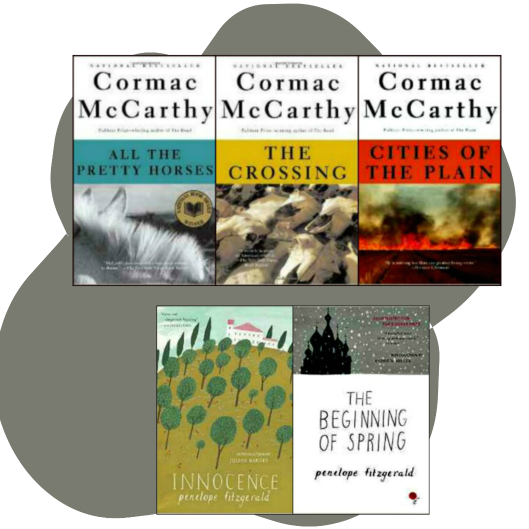
In their very different ways, Cormac McCarthy and Penelope Fitzgerald. In works like the Border Trilogy, McCarthy’s vision of the world and of the lives of its inhabitants (both human and animal) make up a single vision: harsh, numinous, both indifferent and interwoven, a wonder of observation and lyricism. The settings in Fitzgerald’s last four novels range from 1950s Italy to pre-revolutionary Moscow, and there isn’t a moment when the world of the novel isn’t entirely believable. Once again, the trick is to reduce the detail to a bare—and convincing—minimum. There’s a moment in Innocence where children go to Upim (an Italian Woolworth’s) before school starts to buy their exercise books. I don’t know how Fitzgerald knew this, but it was all that was needed to persuade me of the authenticity of the novel’s world.

a-few-of-cls-fave-books

Charles Lambert’s picks for novelists who have mastered the art of writing about place

Thanks so much, Charles, for your answers. It’s been a great pleasure.

* * *

Readers, any questions for Charles? Please leave them in the comments below.

Meanwhile, if you would like to discover more about Charles Lambert and his body of work, I suggest you visit his author site. You can also follow him on Twitter.

À bientôt! Till next time…

* * *

Thank you so much, Tracey and Charles! I found this discussion fascinating. —ML Awanohara

Tracey Warr is an English writer living mostly in France. She has published two medieval novels with Impress Books. She just now published, in English and French, a future fiction novella, Meanda, set on a watery exoplanet, as an Amazon Kindle ebook. Her new historical novel, Conquest: Daughter of the Last King, set in 12th century Wales and England, will be published by Impress Books in October.

STAY TUNED for next week’s fab posts!

If you enjoyed this post, we invite you to register for The Displaced Dispatch, a round up of weekly posts from The Displaced Nation, with weekly updates and much, much more. Register for The Displaced Dispatch by clicking here!

Related posts:

Photo credits: Top visual: The World Book (1920), by Eric Fischer via Flickr (CC BY 2.0); “Writing? Yeah.” by Caleb Roenigk via Flickr (CC BY 2.0); author photo, photo of Setúbal graffiti and of Italian cafe scene were supplied by Charles Lambert; A view of Lichfield Cathedral from the north West, by Roger Robinson via Wikimedia (CC BY-SA 3.0). Visuals that accompany the two quotations: Empty wine bottles via Pixabay; Roof Tiles (Rome), by Stewart Butterfield via Flickr (CC BY 2.0).

LOCATION, LOCUTION: Novelist Hazel Gaynor illuminates the lives of early 20th-century women with an adventuresome streak

location-locution-hazel-gaynor
Tracey Warr is here with fellow historical novelist Hazel Gaynor. As it happens, I recently read her book Memories of Violets, which makes me think we’re in for a treat!

Greetings, Displaced Nationers.

My guest this month is Hazel Gaynor. Originally from North Yorkshire, England, Hazel moved to Kildare, Ireland, in 2001, where she has lived since with her husband and two children. Both her place of origin, England, and her adoptive country, Ireland, feature in her fiction writing, and travel, along with adventure and displacement, is a recurring trope in her work, which thus far has to do with the lives of women of bygone eras whose stories have never been fully told.

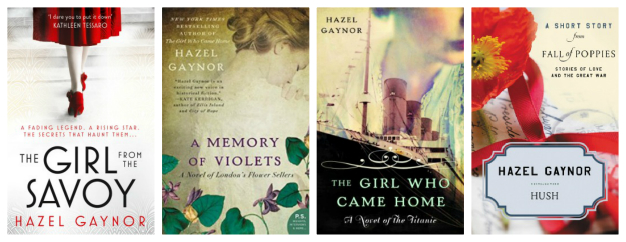
This summer Hazel published her third novel, The Girl from the Savoy, which conjures up a vivid picture of London and social change in the 1920s. It tells the story of two women from very different backgrounds. Dolly is a new chambermaid at London’s iconic Savoy Hotel and longs for a better life. Loretta is a famous actress in the West End. Both are struggling in the aftermath of the Great War. The book came out in June and is already an Irish Times and Globe & Mail Canada bestseller.

I suspect that like ML, some of you are familiar with Hazel’s previous two novels:

  • A Memory of Violets: A Novel of London’s Flower Sellers (2015), based on the lives of London’s flower sellers. The book grew out of Hazel’s love of the plays Pygmalion and My Fair Lady. She decided she wanted to write about the real Eliza Doolittles—the women who sold flowers and watercress on the streets of London. The book has been a New York Times and USA Today bestseller.
  • The Girl Who Came Home, the story of a group of Irish emigrants aboard RMS Initially self-published, the book was published again in 2014, when HarperCollins picked it up along with A Memory of Violets—it went on to win the 2015 RNA Historical Novel of the Year award.

Hazel is also one of nine authors to contribute a short story to the World War I anthology Fall of Poppies: Stories of Love and the Great War (2016). Her story, “Hush,” shows midwife Annie Rawlins doing everything she can to save an infant’s life, while her son, fighting in France, does everything he can to preserve his life in hopes of making it to the end of the war. Hazel’s work has been translated into several languages and she is represented by Michelle Brower of Kuhn Projects/Zachary Shuster Harmsworth, New York.

hazel-gaynor-works

And now let’s hear from Hazel about what techniques she uses to conjure up the lives of women in the early 20th century who, like you and me, opted not to stay put in the place where they were born and sought a more adventuresome life.

* * *

Welcome, Hazel, to Location, Locution. Obviously, as a historical novelist, you are inspired by the past. But which tends to come first when you get an idea for a new book: story or location?

The idea for The Girl from the Savoy initially developed from a conversation with my editor and our mutual love of the 1920s. This was a period of real social change—especially for women—and that always allows for a great story. I knew I wanted to set the story in London, and that it would revolve around an ordinary working girl who had access to the glamorous women she admired and aspired to be like. The social scene of London’s iconic hotels during this era was the perfect setting. When I started researching the history of The Savoy I found so many fascinating accounts of famous people who had dined and stayed there. I imagined the young chambermaids gossiping about the hotel guests in their room late at night, and the story developed from there.

What was your technique for evoking the atmosphere of 1920s London and the Savoy Hotel?

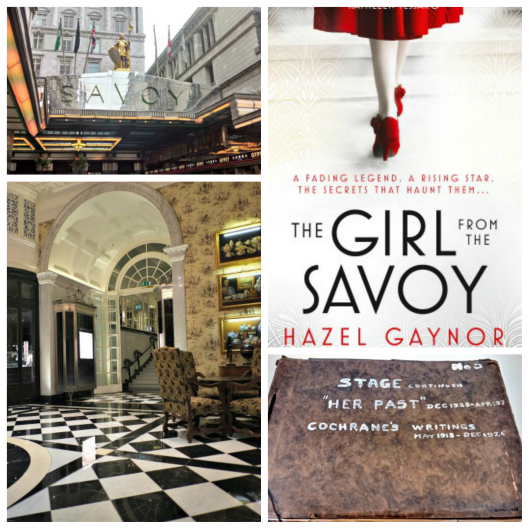
It starts with lots of research so that I understand both the location and the historical era I’m writing in. I love the process of discovery and research and I’m always surprised by what I learn. In researching The Girl from the Savoy I spent an amazing afternoon with the archivist at The Savoy hotel. Sitting in the stunning foyer, talking through the hotel’s rich history was really special. I also spent several afternoons at the Victoria and Albert Museum’s Theatre and Performance Archives, reading through scrapbooks of famous actresses and theatrical producers of the 1920s, which was incredibly inspiring. To help recreate the atmosphere of a particular time and place for the modern reader, I make ample use of the five senses, sound and smell especially, as well as visual description.

savoy-inspirations

Which particular features create a sense of location? Landscape, culture, food?

It depends on the novel. In The Girl Who Came Home, my novel about Irish emigrants on the Titanic, it was partly about depicting the simplicity of the rural Irish landscape and Irish culture, but also about recreating for the reader the sheer scale of The Titanic, and the chaos of the sinking. The central present-day character in A Memory of Violets is Tilly Harper, who leaves the sweeping landscape of the Lake District for the claustrophobic bustle and noise of Victorian London, to take up the job of assistant housemother at Mr. Shaw’s Home for Watercress and Flower Girls (based on the real-life story of John Groom’s Flower Mission). In The Girl from the Savoy my main locations are London and The Savoy, so I focused on capturing the contrast between the glamour of the hotel guests with the simplicity of my character Dolly’s life “downstairs” at the hotel. Culture—especially fashion and music—was also important in creating a real sense of era and location and really capturing that 1920s vibe.

Can you give a brief example from your writing that illustrates place?

From the opening chapter of The Girl from the Savoy:

I pass bicycle shops and tobacconists, wine merchants drapers and milliners, the rain falling in great curtains around me as I catch my reflection in the shop windows. I dodge newspaper vendors and sidestep a huddle of gentlemen in bowler hats as tramcars and motorcars rattle along the road beside me, clanging their bells and tooting their horns. Cries of the street sellers and the pounding hooves of a dray horse add to the jumble of noise. My stomach tumbles like a butter churn, excited and terrified by the prospect of my new position as a maid at The Savoy hotel.
cries-of-streetsellers

In general, how well do you think you need to know a place before using it as a setting?

I like to know the place very well, and always try to go there, if possible, to understand the shape of the landscape and to absorb the atmosphere. For example, I visited Addergoole in County Mayo, Ireland, which was the setting for the Irish scenes in The Girl Who Came Home. I also visited Covent Garden for A Memory of Violets and I know the Lake District very well, so could easily write the scenes set there.
violets-and-girl-who-came-home-locations
Of course, London and the Savoy Hotel and the Victoria Embankment Gardens (which are behind the Savoy) were essential places to visit for research, and to imagine Dolly’s life there in the 1920s.

Which writers do you admire for the way they use location?

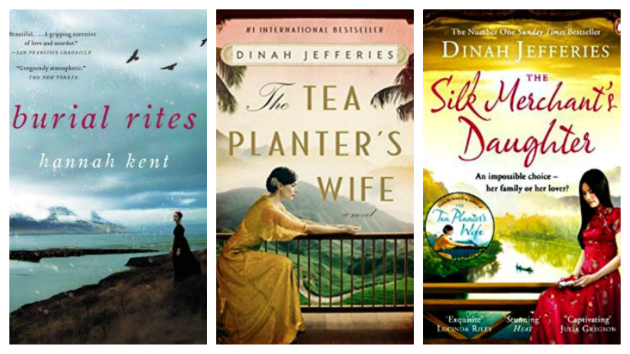
I loved Hannah Kent’s descriptions of Iceland in Burial Rites. [Editor’s note: Kent was born in Adelaide but spent time in Iceland on a Rotary scholarship.] Dinah Jefferies also creates a wonderful sense of location in her novels The Tea Planter’s Wife, set in 1920s Ceylon (Sri Lanka), and The Silk Merchant’s Daughter, which takes place in the turmoil of 1950s Vietnam. [Editor’s note: Jefferies was born in Malaysia and moved to the UK at the age of nine.]

Hazel Gaynor's picks for novelists who have mastered the art of writing about place

Hazel Gaynor’s picks for novelists who have mastered the art of writing about place

Thanks so much, Hazel, for your answers. It’s been a pleasure.

* * *

Readers, any questions for Hazel? Please leave them in the comments below.

Meanwhile, if you would like to discover more about Hazel Gaynor and her books, I suggest you visit her author site. You can also follow her on Facebook and Twitter. And I urge you to check out the blog that she keeps for writing.ie, called Carry on Writing, consisting of interviews with leading novelists, including Philippa Gregory, Sebastian Faulks, Kate Mosse, Jojo Moyes and Cheryl Strayed.

À bientôt! Till next time…

* * *

Thank you so much, Tracey! As I mentioned, I read Hazel Gaynor’s Memories of Violets earlier this year. I was impressed by her ability to re-imagine the lives of London’s flower sellers—of whom most of us have a romanticized image based on movies like Oliver Twist or Pygmalion. I liked that she combed the historical records for details she could use to ensure that her story came close to their everyday reality. In a sense she was helping to write their history but then filling in the gaps with her imagination. And I’m already looking forward to her next book, about the true story of two young cousins who claimed to photograph fairies in their Yorkshire village in the 1920s. The girls’ photos of the so-called Cottingley Fairies captured the public imagination, and Hazel’s version will no doubt capture that of today’s readers! —ML Awanohara

Tracey Warr is an English writer living mostly in France. She has published two medieval novels with Impress Books. She just now published, in English and French, a future fiction novella, Meanda, set on a watery exoplanet, as an Amazon Kindle ebook. Her new historical novel, Conquest: Daughter of the Last King, set in 12th century Wales and England, will be published by Impress Books in October.

STAY TUNED for next week’s fab posts!

If you enjoyed this post, we invite you to register for The Displaced Dispatch, a round up of weekly posts from The Displaced Nation, with weekly updates and much, much more. Register for The Displaced Dispatch by clicking here!

Related posts:

Photo credits: Top of page: The World Book (1920), by Eric Fischer via Flickr (CC BY 2.0); “Writing? Yeah.” by Caleb Roenigk via Flickr (CC BY 2.0). All other photos were supplied by the author or downloaded from Pixabay.

BOOKLUST, WANDERLUST: Expat creatives recommend books for the (not quite) end of summer

End of Summer 2016 Reads

Attention displaced bookworms! Our book review columnist, Beth Green, has canvassed several international creatives for some recommendations of books that suit the various end-of-summer scenarios those of us who live in the Northern Hemisphere will soon be in (if we aren’t already!).

Hello Displaced Nationers!

I’ve traveled quite a bit this summer, and now I’m wondering what I can do, as summer slides into autumn here in Prague, to bask in those prized last few moments of glory before the days get shorter and a chill enters the air.

I decided to canvas fellow international creatives about the books they would recommend for those of us who are:

  • Striving for one last beach read;
  • Stranded at an airport on our way “home”; and/or
  • Getting back to work/school/reality as autumn sets in.

There was just one catch: I asked if they would please recommend books that qualify as “displaced” reads, meaning they are for, by, or about expats or other internationals and so speak to members of our “tribe” (see ML Awanohara’s contribution below).

And now let’s check out their picks (correction: I should say “our” as I’m a contributor this time)—it’s an eclectic mix, but I predict you’ll be tempted by quite a few!

* * *

JENNIFER ALDERSON, expat and writer

TheGoodThiefsGuidetoParis_coverWhen I read on the beach, the story’s got to be light and quirky or it goes back in my tote bag. The Good Thief’s Guide to Paris (2009), by Chris Ewan—or really any of the other four books in Ewan’s popular series of mysteries about a globetrotting thief-for-hire—fits the bill perfectly. I actually dislike the much-displaced Charlie Howard immensely—yet somehow end up rooting for him along the way. An Englishman, he doesn’t feel at home anywhere and travels the world to get inspired to write his next novel—and then ends up involved in criminal activities that mirror his fictitious plots. Each novel revolves around Charlie’s bungled robbery of an artwork or antiquity in yet another famous tourist destination: Amsterdam, Paris, Venice, Las Vegas, Berlin… Ewan’s descriptions of each city are spot on and quite beautiful, in contrast to the wonderfully sarcastic tone of the novels themselves. The capers are silly, absurd constructions involving the shadiest of characters, which inevitably leave a smile on my face. I’ve already finished Paris and Amsterdam. The Good Thief’s Guide to Venice is next.

The City of Falling Angels_coverI actually have two suggestions for books I wish I’d had in my carry-on when stranded en route, both set in one of my favorite countries in the world: Italy! A few days before my husband and I set off for a week-long holiday in Venice, I popped into a local secondhand bookstore and spotted John Berendt’s The City of Falling Angels (2005). I absolutely loved Midnight in the Garden of Good and Evil, so I bought it without even reading the description on the back. Imagine my surprise when I pulled it out of my suitcase and realized it was all about the same magical city I’d just arrived in! It is an absorbing, magnificent novel that effortlessly blends fact and fiction. (Berendt moved to Venice in 1997, just three days after the city’s Fenice opera house burned down during a restoration—accident or arson?) The fabled city and many of her more eccentric residents form the soul of this book; art, opera and architecture are the main ingredients. Let yourself get lost in Berendt’s unique, almost conversational prose and follow along on his deliciously slow journey through one of the prettiest (and most mysterious) places on the planet.

BridgeofSighs_coverMy other pick is the captivating historical novel, Bridge of Sighs and Dreams (2015), by former expat Pamela Allegretto. The story follows one Italian family through the 1930s and 1940s, when Mussolini and later Hitler ruled the land. It is a sometimes gritty, sometimes romantic, tale of betrayal, intrigue and—above all—survival. The author’s beautiful yet compact descriptions of the landscape, people and culture effortlessly transport the reader to this fascinating and complex period in Italian (and European) history. I highly recommend it.

Whichever of these two books you choose, you’ll wish your flight was delayed indefinitely.

The Disobedient Wife_coverI’ve only read the first two chapters of The Disobedient Wife (2015), by Annika Milisic-Stanley, yet I’m already hooked—and would recommend it for anyone trying to get back into work/school mode. It’s such an eloquent description of the expat experience; from the first sentence I felt as if I was reading a soulmate’s description of how it feels to move on to a new destination after building up a life in a foreign country: we say goodbye while wondering what, if any, lasting impact we’ve had on our temporary homes. [Editor’s note: This book also made the Displaced Nation’s “best of expat fiction” list for 2015.]

The official synopsis reads:

The Disobedient Wife intertwines the narratives of a naïve, British expatriate, Harriet, and that of her maid, Nargis, who possesses an inner strength that Harriet comes to admire as their lives begin to unravel against a backdrop of violence and betrayal.

In the first chapter, Harriet is thinking back to her last post in Tajikistan: about the friends she’d willingly left behind and about her home, inhabited by another family only days after her own departure:

“All traces will be erased until the Dutch tulips I laid last September rise above the earth to bloom in April and pronounce that I really was there. The language, learned and badly spoken, is already fading from my dreams…”

These sentences stirred up so many memories for me of people left behind and as well as adventures past. I sometimes wish I could go back—even for a moment—to all of the places I’ve been in this crazy world and just say hello to the people I once knew there and remind them that I’m still around and do think of them once in a while. I cannot wait to finish this book. [Beth’s note: I did NOT mention to Jennifer that Annika is also participating in this column’s roundup—quite a coincidence!]

Jennifer S. Alderson has published two novels, the recently released A Lover’s Portrait: An Art Mystery and Down and Out in Kathmandu (2015), which cover the adventures of traveler and culture lover Zelda Richardson. An American, Jennifer lives in the Netherlands with her Dutch husband and young son.


ML AWANOHARA, Displaced Nation founding editor and former expat

Inspired by the new BBC One TV miniseries, at the beginning of the summer I downloaded War and Peace (new translation by Richard Pevear and Larissa Volokhonsky) onto my Kindle. And, reader, I finished it! And now I’m having trouble finding any novels that hold my attention. By comparison to Tolstoy’s masterwork, they all seem too narrow in scope, and their characters aren’t as beautifully developed. Sigh!

Tribe_coverI’m thinking I should turn to nonfiction until the W&P spell wears off. Right now I have my eye on Sebastian Junger’s latest work, Tribe: On Homecoming and Belonging—which I think could serve any of the purposes Beth has outlined above, though perhaps is best applied to the third condition (getting back to reality). Junger has been compared to Hemingway for his adventure non-fiction and war reporting, but this book is more of an anthropological look at the very human need to belong to a tribe. Though we expats have left our original tribes, I don’t think that this decision eradicates our tribal instincts. On the contrary, we are attracted to tribes of fellow expats; and some of us even find new homes in cultures more tribal than ours—where the people value qualities like loyalty and belonging more than we do in the West.

Junger provides an example to which I can personally relate. Recounting the history of 18th-century America, he says that no native Americans defected to join colonial society even though it was richer, whereas many colonials defected to live with the Indian tribes. They apparently appreciated the communal, caring lifestyle of the latter. That’s how I felt after I’d lived in Japan for several years. I really didn’t fancy returning to my native society, which I’d come to see as overly individualistic and centered on self to the exclusion of little else. To this day (and especially during election years like this one!) I struggle with America’s you’re-on-your-own ethos. Wealth doesn’t necessarily translate into well-being: why can’t my compatriots see that? It’s something I can feel in my bones because of the more tribal life I had in Asia. Could this book help me understand the roots of my displacement?

ML Awanohara, who has lived for extended periods in the UK and Japan, has been running the Displaced Nation site for five years. She works in communications in New York City.


BETH GREEN, Displaced Nation columnist and writer

Hotel_Kerobokan_coverI tend to pick beach books by the setting. So if I am going to the Caribbean, I’ll pick something set in the Caribbean. My last beach destination was Bali, and the book I wish I’d taken with me was Hotel Kerobokan: The Shocking Inside Story of Bali’s Most Notorious Jail (2009), a sharply observed account of life inside Indonesia’s most notorious prison, by Australian journalist Kathryn Bonella. Also great is her subsequent nonfiction title, Snowing in Bali (2012), a graphic look at Bali’s cocaine traffickers. Stories that depict true-life crime in unexpected settings (isn’t Bali supposed to be paradise?) automatically go on my to-read list—but I forgot to pick up Bonella’s book when we were at the airport and then wasn’t able to find in the area around my hotel. I know, most people go to the beach for good weather and strong cocktails; but for me, a holiday isn’t a holiday until I can peel back the veneer and peer at something darker underneath.

The Bat_coverWhat I actually ended up reading was in fact very good—Jo Nesbo’s thriller The Bat, in which he introduces his hard-headed detective Harry Hole and sends him to Australia to pursue a serial killer—but I wish I’d planned ahead and got something that blended with the scenery.

It’s a terrible feeling to get to the boarding gate and realize you don’t have enough chapters left in your book to get you through takeoff. (This is one reason I love my e-reader and try to have it loaded with dozens of books at all times.) For air travel especially, I look for the fattest, longest reads possible.

The Mountain Shadow_coverFor my next long flight, I’m hoping to read Gregory David Robert’s The Mountain Shadow, which came out last year and is the sequel to his equally weighty Shantaram (2003). At 880 pages, this book will take even a fast reader like me a while! Set in Mumbai, India, it continues the story of an escaped Australian prisoner who finds a new niche as a passport forger—but also a better self—in the underbelly of the South Asian crime world. Engrossing and beautifully written, I think it’s the perfect companion for marathon flights. Even if you did manage to finish it mid-flight, you can spend the rest of the trip wondering how close the story is to the author’s real-life history as an escaped convict. Roberts spent 10 years in India as a fugitive after escaping a maximum security prison in Australia, and his first novel, at least, is rumored to be autobiographical.

CatKingofHavana_coverFor the goal of channeling our more serious selves as autumn approaches, how about a fun read by the peripatetic Latvian author Tom Crosshill (he spent several years studying and working in the United States, as well as a year learning traditional dances in Cuba). Crosshill will release The Cat King of Havana (2016) this month. The eponymous Cat King is a half-Cuban American teenager who gets his nicknames from the cat videos he posts online. When he invites his crush to Havana to learn about his heritage and take salsa lessons, he discovers Cuba’s darker side…

Beth Green is the Booklust, Wanderlust columnist for the Displaced Nation. Her bio blurb appears below.


HELENA HALME, novelist and expat

Murder in Aix_coverFor a last hurrah on the beach, I’d recommend Murder in Aix (2013), Book 5 in a mystery series by Susan Kiernan-Lewis, an ex-military dependent who is passionate about France, travel and writing. One of my secret pleasures in life is to settle down with a cozy murder mystery; I also have a passion for the South of France. So when I found The Maggie Newberry Mystery Series, consisting of nine books that featured an expat protagonist-sleuth who solves mysteries in and around Aix-en-Provence, I couldn’t wait to download the whole series onto my Kindle. In the fifth book, Maggie Newberry is heavily pregnant but that doesn’t stop her as she finds herself scrambling to prove the innocence of a dear friend arrested for the murder of an abusive ex-boyfriend. Her partner, a ruggedly handsome French winemaker, doesn’t approve of Maggie’s involvement in the case. “It’s too dangerous,” he tells her.

The novel is pure bliss—a feeling enhanced if you can read it by a pool or on a beach, preferably accompanied by a glass of chilled rosé!

TheBreathofNight_coverFor those inevitable airport delays, I’d recommend The Breath of Night (2013), by Michael Arditti, a much-neglected English author. The first book I read by him, Jubilate, said to be the first serious novel about Lourdes since Zola’s, is one of my all-time favorites, so I was delighted when The Breath of Night came out soon after. This is a story of the murder of one Julian Tremayne, a Catholic priest from England who was working as a missionary in the Philippines in the 1970s. Since their son’s tragic death, Julian’s parents have pursued a campaign to have him declared a saint. The story is told partly through letters from Julian to his parents and partly through an account by a friend of the family, Philip Seward, who has gone to Manila 30 years later to find out the truth about the miracles he is said to have performed. Did Julian lead “a holy life of heroic virtue”—one of the conditions for canonization? While telling an intriguing and captivating tale of life in the Philippines, the book provides a broader commentary on love and faith.

TheParisWife_coverWhen the time comes to settle back into your routine, I would suggest a read of The Paris Wife, by Paula McLain (2011). It’s a fictionalized story of Hemingway’s first years as a struggling writer in Paris in the 1920s, told from the point of view of his first wife, Hadley, a naive Southern girl who suddenly finds herself suddenly plunged into a life of drunken debauchery in the French capital. McLain’s writing is precise and beautiful; her background as a poet comes through in her careful choice of words. Her descriptions of Hemingway when Hadley first meets him are particularly ingenious:

“He smiles with everything he’s got…”

“I can tell he likes being in his body…”

“He seemed to do happiness all the way up and through.”

It’s a brilliant read that will take you somewhere completely different and keep the challenges (boredom?) of work or school at bay a little longer.

Helena Halme is a Finnish author of Nordic women’s and romantic fiction. She lives with her English husband in London. Her works include the best-selling autobiographical novel The Englishman (reviewed on the Displaced Nation), its sequel The Navy Wife, Coffee and Vodka (about which she wrote a guest post for us) and The Red King of Helsinki (for which she won one of our Alice Awards). The Finnish Girl, her latest novella, is the prequel to The Englishman.


MATT KRAUSE, writer and expat

A Time of Gifts_coverFor any of those circumstances, I would recommend A Time of Gifts, by Patrick Leigh Fermor (1977; reissued in 2011 with an introduction by Jan Morris). At the age of 18, Fermor dropped out of school to walk from the heart of London to Constantinople, and his account of that journey—which started in December 1933, not long after Hitler has come to power in Germany, and ended just over two years later—is hailed as a classic of British travel writing. Hitler’s abuses were not yet evident, and Fermor describes drinking beers with Nazis once he reaches Germany. But I particularly enjoyed his account of a luxurious extended weekend in Geneva (or some city, I don’t remember) with a couple of girls he met along the way. I read this book as part of my research before walking across Turkey in 2012–2013, and really liked it.

Matt Krause is a communications coach based in Istanbul. He is the author of the memoir A Tight Wide-Open Space (reviewed on the Displaced Nation) and is working on a book about his walk across Turkey.


ANNIKA MILISIC-STANLEY, ATCK, expat, painter, campaigner and writer

two more book picks_Aug2016When I am on the beach, I get no longer than half an hour of uninterrupted reading time. For that reason, I took a book of short stories with me this year: Angela Readman’s Don’t Try This At Home (2015), which has stories set in the UK, USA, France and elsewhere. Brilliantly engaging, with an amazing use of language, alternately fun and fantastical, this debut, award-winning collection is well worth a read.

Some of you may not be short story fans, in which case I’d recommend The White Tiger (2008), by Aravind Adiga. The “white tiger” of the book’s title is a Bangalore chauffeur, who guides us through his experience of the poverty and corruption of modern India’s caste society. two book picks_Aug2016_515xThe novel won the 2008 Booker, but don’t let that put you off. It is surprisingly accessible and a real page-turner: funny, horrifying and brilliant.

For an agonizing airport wait, I have two suggestions: Atticus Lish’s Preparation for the Next Life (2015) and Sanjeev Sahota’s The Year of the Runaways (also 2015). Both feature immigrants describing their former lives, their motive for departure from their countries of origin, and the harshness of life in a new country as illegals.

CentresofCataclysm_coverAnd once you’re back at the desk, I would recommend giving Centres of Cataclysm (2016, Bloodaxe Books) a try. Edited by Sasha Dugdale and David and Helen Constantine, it’s an anthology celebrating fifty years of modern poetry in translation—full of beautiful gems from poets from around the world. Profits go to refugee charities.

Raised in Britain by Swedish and Anglo-German parents, Annika Milisic-Stanley has worked on humanitarian aid projects in Nepal, Kenya, Somalia, South Sudan, India, Burundi and Egypt as well as living in Tajikistan for several years. She currently lives in Rome with her family. In addition to writing and painting, she works as a campaigner to raise awareness on the plight of refugees in Southern Europe. The Disobedient Wife, about expatriate and local life in Tajikistan, is her debut novel and was named the Cinnamon Press 2015 Novel of the Year. Annika invites you to like her book page on Facebook and follow her on Twitter.


PAMELA JANE ROGERS, expat and artist/author

Saving Fish from Drowning_coverFor that last trip to the beach, I’d recommend Amy Tan’s Saving Fish from Drowning (2005). A group of California travelers decide to go on their planned trip to the Burma (its southern Shan State) without their (deceased) travel director, and in their total ignorance of the customs and religion of that part of the world, create havoc—and commit what is considered a heinous crime. I was directing a travel group in Greece when I read it, which may be why it seemed quite plausible, as well as darkly hilarious.

If you haven’t read it yet (though most on this site probably have), an absorbing read for when you get stuck in an airport is Barbara Kingsolver’s The Poisonwood Bible (1998)The Poisonwood Bible_cover, about a fierce, evangelical Baptist who takes his family and mission to the Belgian Congo in 1959. Between the evangelical Christian father wanting his converts to “gather by the river” in Africa for their baptisms, to the chapters written by his wife and daughters at different ages—the reader is in for a rollicking, sometimes absurd, sometimes sad and sobering, ride.

And when it’s time to face work again, I recommend the book I’m reading now: Passage of the Stork, Delivering the Soul (Springtime Books, 2015), by Madeleine LenaghPassage of the Stork_cover, an American who has lived in the Netherlands since 1970. This is her life story. [Editor’s note: Madeleine Lenagh and her photography have been featured on the Displaced Nation.]

Pamela Jane Rogers is an American artist who has adopted the Greek island of Poros as her home. She has written a memoir of her adventures, which she recently re-published with a hundred of her paintings as illustrations: GREEKSCAPES: Illustrated Journeys with an Artist.


JASMINE SILVERA, former expat and writer

The Best of All Possible Worlds_coverFor the beach I would recommend The Best of All Possible Worlds (2013), by Barbadian author Karen Lord. It’s what many people call “social science fiction” because the story is less obsessed with technological advances than with their interpersonal ramifications. The book opens after a cataclysmic event destroys the home planet of an entire civilization, rendering everyone who managed to be off-world at the time of destruction displaced. It follows the journey of a leader of a group of survivors, who decides to team up with an “assistant biotechnician” to find a suitable replacement home on a colony planet. I know what you’re thinking: it doesn’t sound like a rollicking good time! But it reads a bit like a “he said, she said” travelogue; and one of the two narrators has delightfully funny moments (I’ll let you decide which one). There is humor and sweetness, a bit of intrigue, and a satisfyingly happy ending.

The Pilgrimage_coverFor an absorbing read suitable for a long wait in an airport lounge, try The Pilgrimage (1987), by Brazilian writer Paulo Coelho. [Editor’s note: He was once featured on the Displaced Nation’s Location, Locution column.] I’ll be honest, my experience of the Camino de Santiago was nothing like the one depicted in this book (more technical fabrics and guidebooks, less overt mysticism); but I still find Coelho’s account evocative and moving. Like the work considered to be his masterpiece, The Alchemist, it’s part engaging adventure, part allegory—and a wonderful story. It’s a good one to transport you elsewhere when you’re “stuck” in a place you don’t want to be in.

Committed_coverIf the Way of St. James isn’t your thing, then I might recommend Elizabeth Gilbert’s Committed (2010) for an absorbing read. I can’t imagine what it would be like to attempt a follow-up to a book that was a huge commercial success, let alone a direct “sequel.” But that’s what Gilbert did with Committed. People love or hate the book for all sorts of reasons. But it’s a good one to stick with, IMHO, because it explores not only the byzantine banalities of bureaucratic regulations (something all displaced persons deal with at some point in their adventures) but also the innermost workings of one’s heart as you navigate knowing when to go and when to, well, commit. And while Gilbert occasionally allows herself to navel gaze in less charming a fashion than in Eat, Pray, Love, overall this book is an honest, thoughtful exploration of what marriage and commitment means in a world of divorce, infidelity, and the “best friending” of one’s partner. The book starts out with a decision made and then backtracks through the process—but it’s the journey that counts, after all. [Editor’s note: Hmmm… Will she write a sequel now that she is divorcing her husband of 12 years?]

Kinky Gazpacho_coverFor getting back into your groove at work, I’d recommend Kinky Gazpacho: Life, Love & Spain (2008), by Lori Tharps. There are relatively few travel memoirs written by people of color, so a book full of observations around how race is experienced in different cultures is a rare treasure. As a black woman from the United States, I have found race to be an intrinsic part of my experience in traveling and living abroad. From being stared at, to being touched, to stumbling on some unexpected bit of exported racism where I least expect it, I would say it’s an oversimplification to think that race is something we only struggle with in the land of my birth (that said, I’ve known a few African Americans whose decision to live abroad was based in no small part on the gravity of the struggle for racial equality in America). Nowhere is perfect, and Tharp explores what happens when the fantasy and the reality collide during her year of study abroad in Spain, as she attempts to reconcile that country’s problematic past with its present. She also extends her adventures beyond those of a traveler to become an expat (this is not a spoiler: she marries a Spaniard). I enjoyed Eat, Pray, Love, but this book resonated with my personal experience of travel and life abroad much more deeply.

A world traveler and former expat who remains a California girl at heart, Jasmine Silvera will release her debut, Prague-inspired novel Death’s Dancer in October (it was recently selected for publication by Kindle Press). Follow her on Facebook and Instagram.

* * *

Thanks, everyone, for participating! Readers, what books would you recommend? Let us know in the comments!

Till next time and happy reading!

As always, please let me or ML know if you have any suggestions for books you’d like to see reviewed here! And I urge you to sign up for the DISPLACED DISPATCH, which has at least one Recommended Read every week.

STAY TUNED for next week’s fab posts!

Beth Green is an American writer living in Prague, Czech Republic. She grew up on a sailboat and, though now a landlubber, continues to lead a peripatetic life, having lived in Asia as well as Europe. Her personal Web site is Beth Green Writes. She has also launched the site Everyday Travel Stories. To keep in touch with her in between columns, try following her on Facebook and Twitter. She’s a social media nut!

If you enjoyed this post, we invite you to subscribe to The Displaced Dispatch, a weekly round up of posts from The Displaced Nation and much, much more. Sign up for The Displaced Dispatch by clicking here!

Related posts:
LOCATION, LOCUTION: In trio of memoirs, Marjory McGinn celebrates life inside the heart of Greece at height of economic crisis

Location Locution Marjory McGinn
Tracey Warr is here with Marjory McGinn, a Scottish writer who grew up in Australia and now lives in East Sussex, England. In the course of a life spent trundling between Northern and Southern hemispheres, Marjory discovered Greece, which is the only non-English speaking country she has lived in (fortunately, she can speak some Greek). Her memoirs on her midlife Grecian adventures show a journalist’s eye for mood and detail and a gift for telling a good story, as Tracey’s interview will reveal.

Greetings, Displaced Nationers.

My guest this month is Marjory McGinn, who credits her childhood migration from Scotland to Australia for inspiring an interest in travel and writing and putting a nomadic spin on her adult life. After leaving school in Sydney, Australia, and a short stint working for an airline, Marjory undertook a long overseas trip, arriving firstly in the land of her birth, Scotland. “It was a rite of passage for the children of migrant families in Australia seeking to go back to the ‘old country’ to hunt down their roots and find the cultural links they thought they were missing,” she says.

Greece was always her real destination, however, for reasons she outlines in her series of travel memoirs. The first time she visited Greece, during the military dictatorship in the 1970s, she stayed a year, working in Athens. Despite (perhaps because of?) the political unrest, it was the start of a lifelong love affair with the country. As Marjory puts it in one of her books:

“I was instantly smitten with the place. It was nothing I could easily define, but more a fusion of disparate things, all maddeningly exotic to my young mind.”

Circling back to Australia in the early 1980s, Marjory became a journalist and worked for leading newspapers in Sydney as a feature writer. At the peak of her career, however, the urge to uproot took over once again. Accompanied this time by her English partner and fellow journalist, Jim, she moved back to Scotland at the dawn of the 21st century. The couple carried on working in newspapers for 10 years, but then a decline in the industry inspired them to have a mid-life odyssey in Greece, with their slightly mad Jack Russell terrier, Wallace, in tow.

At that time, of course, Greece was sliding into economic crisis and would soon have to be bailed out repeatedly by its EU partners; it was a country on the edge. But Marjorie and her two companions were undaunted, and what should have been a year living in a hillside village in the wild Mani region (the middle peninsula of the southern Peloponnese), turned into three. They spent another year in the nearby Messinian peninsula, in 2014.

“I think I have probably undertaken a serious move at the start of every decade, for different reasons, and the issue of ‘where is home?’ has been one that I have examined a lot and also in my three travel memoirs, in an ever restless search for the perfect location,” Marjory says. “I am not sure I’ve found it yet, but Greece has already taken a firm grip of my heart. Although we are now back in the UK, living in England this time, Greece will always be on our future odyssey wish-list.”

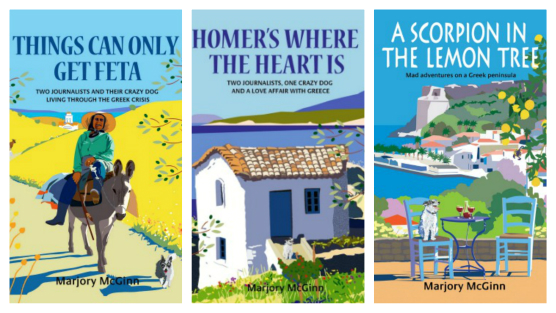
Marjory’s first Greek travel memoir, Things Can Only Get Feta, about life in the Mani village at the start of the debt crisis, was published in 2013, followed by its sequel, Homer’s Where the Heart Is. Her most recent memoir, A Scorpion in the Lemon Tree, came out last month.

MM Trilogy

Now let’s talk to Marjory and hear about how she approached the challenge of capturing life in rural Greece during turbulent times to her readers.

* * *

Welcome, Marjory, to Location, Locution. What was it about living in Greece that inspired you to write a series of memoirs?

When I started writing my first travel memoir, Things Can Only Get Feta, I was living in the the hillside village of Megali Mantineia, and location—it’s a traditional farming settlement—was a driving force. The Mani region of Greece is wild, unspoilt, majestic: beneath the Taygetos mountains, with olive groves spilling down hillsides to the edge of the Messinian Gulf. Like much of rural southern Greece, it also has a rawness about it. So the scenery had a powerful effect on my imagination. But the location on its own might not have inspired me to write a book. What did, however, was a chance meeting early on with an eccentric goat herder, Foteini, who has featured in my three books (that’s her on the cover of the first one) and was probably their unlikely muse. She certainly inspired my journalistic curiosity, and from then on a narrative started to take shape in my mind. She had been riding down the road on her donkey in the village of Megali Mantineia, where we had just looked at a stone house for rent for a year. We weren’t sure about the house, but Foteini sealed our fate by chivvying us up. “Why wouldn’t you take it?” she said, abruptly. Why indeed. So we did, and it was to be the start of one of the most curious and challenging friendships of my life. The fact that I had some reasonable Greek language skills to begin with meant I was able to connect with Foteini and many of the other wonderful villagers struggling through the economic crisis, and I knew I had to write a book to somehow capture the way of life that hadn’t changed that much in centuries—but I felt that due to the Greek sovereign-debt crisis, it would.
Foteini quote

You wanted to make your readers feel what it is like to live in rural Greece at a time of economic turmoil. What was your technique for evoking the atmosphere?

For me it’s always about the people and I tried to evoke the spirit of Greece through the people I befriended, and also through descriptions of their homes, their celebrations and all the funny and touching moments we shared, because really, Greeks are big characters and they dwarf other aspects like landscape—in my mind anyway. I also like to evoke an atmosphere with humour. I do tend to see humour in everything and in the three books I’ve homed in on quirky things—like the way Foteini always dresses in mismatched layers and the fact she likes to peel and then wash her bananas before she eats them. Things like that always cracked me up.

Which particular features create a sense of location? Landscape, culture, food?

I think culture and food in rural Greece gives a strong sense of location. This is a place brimming with customs and local events: saints’ days, feast days, local fetes, and national celebrations. At any one time in Greece, someone is celebrating something. And food is at the heart of everything and it does tend to capture the essence of life, like the ritual of lamb cooked on a spit outdoors at Easter. Greeks can spend half the day sitting around a meal table with family and friends, sharing food and a modest amount of wine. What intoxicates most Greeks is company, parea, and I sometimes think the food is really just a bonus.

Can you give a brief example from your writing that illustrates place?

For our latest odyssey in Greece we lived in Koroni, in Messinia (the left-hand prong of the three Peloponnese peninsulas), a region that hasn’t been written about a great deal. We lived on a hillside again in a glorious setting, ironically, right opposite the Mani and the spine of the Taygetos mountains. This was a very peaceful and unspoilt region. The passage is from my latest memoir, A Scorpion in the Lemon Tree:

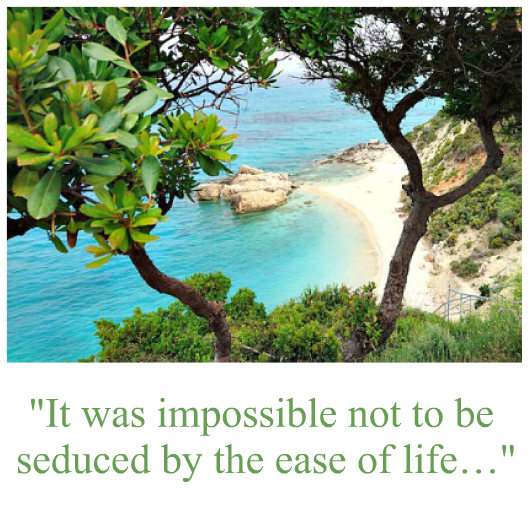
The late afternoons in June were amongst the nicest hours of summer, after the midday heat had died down and especially if cooling winds made a gentle susurrus through the olive orchards from the sea below. It was impossible not to be seduced by the ease of life before the big heatwaves of July and August bore down on us all. We would often go for a late walk, taking the road that continued north past the turn-off for the villa complex. On either side were orchards with ancient olive trees standing in rows, their trunks thick and gnarled with age, but nowhere near past their usefulness. There were small farms, some no more than dry patches of land with wire enclosures for goats and turkeys, watched over by a few chained hounds.

On the right-hand side, another track ascended to a high plateau of land overlooking the gulf. This had been a village once, called Ayios Dimitrios, settled in the 18th century. It was encircled by olive trees growing right to the edge of the cliff-face with the sea below. All that remained of the village were the skeletal outlines of walls hidden in long grass and herb bushes, and a large grinding stone from the village’s olive press.

It was a quiet place, with a peaceful sense of the past, of lives well lived and not quite forgotten. Under one of the olive trees a rickety wooden ladder, used for harvesting, was abandoned and leaning against the trunk, as if offering a stairway to heaven. This place came pretty close already.
Seduced by the ease of life

In general, how well do you think you need to know a place before using it as a setting?

With a travel memoir, knowing a place well need not be an issue if being a newcomer, an ingénue, is part of the narrative. With my memoirs, I already knew a lot about Greece before I went, after living there in my youth and after many long stays. I didn’t know a lot about rural Greece though, and the Mani in particular. It was a quick learning curve, however, because as journalists, Jim and I decided to freelance while there to help fund our adventure and had to connect with the region and the people in quick time, which was no great hardship. I think that helped us enormously and made it easier for me to write a truthful account of living there during the crisis. My third book, A Scorpion In The Lemon Tree, set on the Messinian peninsula, where we lived for a year in 2014, was a totally different experience, as it was a place that we knew nothing about, and more than that, was not the place we really wanted to be. How this happened, and how we dealt with it, formed the main crux of the story, so it worked to my advantage.

Which writers do you admire for the way they use location?

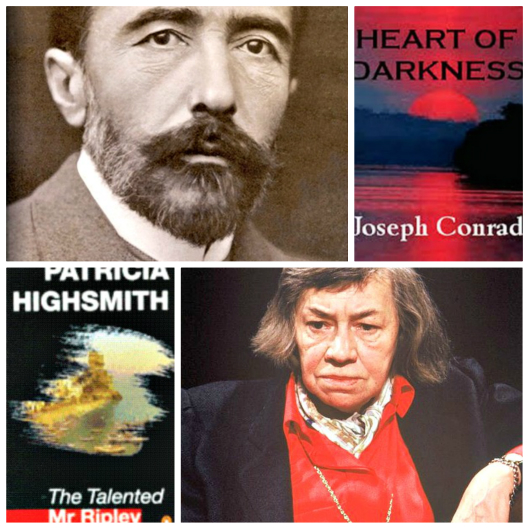
My first literary hero was the displaced (Polish-British) writer Joseph Conrad. The way he evokes the dark, brooding qualities of central Africa in Heart Of Darkness is spine-tinglingit’s still one of my favourite books. I love Patricia Highsmith’s books, especially The Talented Mr Ripley, a novel about (and by!) a displaced American. The Italian locations in the book are so sensual and pervasive, they almost become an extra character in the book.

MM fave authors

Marjory McGinn’s picks for novelists who have mastered the art of writing about place

Thanks so much, Marjory, for your answers. It’s been a pleasure.

Thank you for inviting me to discuss my wanderings on your Location, Locution page for the Displaced Nation site. I enjoyed the experience.

* * *

Readers, any questions for Marjory? Please leave them in the comments below.  And I have one signed copy of A Scorpion in the Lemon Tree, which will go to for FIRST reader to email me their name and postal address traceykwarr@gmail.com with “A Scorpion in the Lemon Tree” in the subject line. **Too late! THE GIVEAWAY NOW HAS A WINNER. Maybe next time?**

Meanwhile, if you would like to discover more about Marjory McGinn and her books, I suggest you visit her Big Fat Greek Odyssey author site and blog. You can also follow her on Twitter.

À bientôt! Till next time…

* * *

Thank you so much, Tracey! I’ve always had a soft spot for Greece myself and was worried about the country during its economic crisis. It was also hit hard by the refugee crisis, I believe. I’ve also never been to the Peloponnese; it sounds fascinating! —ML Awanohara

Tracey Warr is an English writer living mostly in France. She has published two medieval novels with Impress Books. She just now published, in English and French, a future fiction novella, Meanda, set on a watery exoplanet, as an Amazon Kindle ebook. Her new historical novel, Conquest: Daughter of the Last King, set in 12th century Wales and England, will be published by Impress Books in September.

STAY TUNED for next week’s fab posts!

If you enjoyed this post, we invite you to register for The Displaced Dispatch, a round up of weekly posts from The Displaced Nation, with weekly updates and much, much more. Register for The Displaced Dispatch by clicking here!

Related posts:

Photo credits: Top of page: The World Book (1920), by Eric Fischer via Flickr (CC BY 2.0); “Writing? Yeah.” by Caleb Roenigk via Flickr (CC BY 2.0). All other photos were supplied by the author or downloaded from Pixabay, except for: 1) photo of Koroni: [Untitled – Koroni], by MihiScholl via Flickr (CC BY 2.0); photo of Joseph Conrad: Joseph Conrad via Wikimedia Commons (Public Domain Mark 1.0); and 3) photo of Patricia Highsmith: Highsmith on After Dark (1988), by Open Media Ltd via Wikimedia Commons (CC BY-SA 3.0).

LOCATION, LOCUTION: Writing in Finnish and English, expat novelist Emmi Itäranta creates fantasy worlds that feel palpably real

Location Locution Emmi Itaranta
Tracey Warr is here with a Finnish-born writer Emmi Itäranta, for whom displacement means living in another country (England) and writing dual-language dystopian novels. As a special note to long-time Displaced Nation readers, the book that had the greatest impact on Emmi as a child was Alice in Wonderland—until she discovered science fiction and fantasy.

Greetings, Displaced Nationers. My guest this month is Emmi Itäranta, who grew up in Tampere, a city surrounded by two lakes in southern Finland.

And if her childhood was spent in a territory located between Lakes Näsijärvi and Pyhäjärvi, she has chosen to spend her adulthood afloat between two languages, Finnish and English.

After earning an MA in Drama from the University of Finland and temping for a few years in jobs ranging from scriptwriter to press officer, she challenged herself to do an MA in Creative Writing in English at the University of Kent in the UK. As part of that course, she began writing her first novel, Memory of Water, working in English and Finnish simultaneously. As that title suggests, it’s set in a dystopian future where fresh water is scarce.

MoW US cover

England is now Emmi’s home: she has lived in Canterbury since 2007. But she continues to write fiction in both English and Finnish. (She speaks English at home with her Spanish husband.) Emmi feels that her books would be different altogether if she wrote them in only one language. In answer to an interviewer’s questions about the dual-language process that produced Memory of Water, she had the following to say:

I began writing the book in English because part of it formed my creative writing dissertation at the University of Kent, but early on I realised that drafting it in Finnish at the same time helped me polish the writing. The two languages seemed to support and inform each other. You get very, very close to the text when you work in two languages; translators often spot details that the author and editor may have missed. It is a slow process, and hard work, but ultimately I find it rewarding.

Emmi has now come out with her second novel. Published in Finnish in 2015, it has just now made its English-language debut in the UK with Harper Voyager, under the title The City of Woven Streets. The U.S. edition, to be published later this year, will be called The Weaver.
The Woven Streets The Weaver

The City of Woven Streets / The Weaver is a story about an island that is slowly sinking into the sea (if Emmi’s first book had too little water, this one has too much), and where dreaming is forbidden. It has elements of urban fantasy but its world has a feel of the past, rather than present or future. In a city where human life has little value, you must practice a craft if you want to stay alive.

Now let’s talk to Emmi about she gets her readers to experience these extraordinary settings.

* * *

Welcome, Emmi, to Location, Locution. Which comes first in your novels, story or location?

For my second novel, The Weaver / The City of Woven Streets, the location came first. I saw an imaginary city with its strange own internal laws and spent months writing scenes that simply explored the setting but were not yet connected by a story. This surprised me because in my first book, Memory of Water, the story and location were intertwined from the beginning. For that book, the first image that came to me was a young woman preparing tea in a dry future world. The story called for a specific location—far north, near the Arctic—and the location shaped the story.

For those who haven’t read Emmi’s first novel yet: The main character, Noria, lives near present-day Kuusamo, northern Finland, where she is learning to become a tea master in her father’s footsteps. By then Finland is ruled by an Asian superpower, and water for tea is a rare treasure.

Emmi, your novels have a strong sense of place. Can you tell us what techniques you use for evoking those feelings in your readers?

I try to imagine how the characters would experience the place through their senses. What are the shapes and colours surrounding them? How does the air smell and taste? How does the ground feel under their feet, what sounds does it make as they walk? What do they notice, what is relevant to them individually, but also as part of the community that inhabits this setting?

Which particular features create a sense of location? Landscape, culture, food?

All of those, but I would also add things like weather and seasons. Furthermore, I think a sense of history is important, in fiction just as it is in real life. Even if we don’t know the history of a location in detail, the feeling that there is one helps make it more plausible and gives it depth.

Did you have any real cities in mine when you created the city in The Weaver / The City of Woven Streets?

Yes, The Weaver / The City of Woven Streets is set in a fantasy world but to make it feel tangibly real, I used my knowledge and impressions of old European cities I have visited, mainly Prague, Venice and Dubrovnik.

Cities that inspired The Weaver

Three of the European cities that inspired Emmi Itäranta’s city in her latest novel: Venice (center); Prague (bottom right); and Dubrovnik (other three photos).

Can you give a brief example from your writing that illustrates place?

I’d like to share a passage from the first chapter of The Weaver / The City of Woven Streets. It aims to create a sense of the surroundings my main character, Eliana, lives in, a world that is unfamiliar and recognisable at once:

I like the air gondola port because you cannot see the Tower from there: its tall, dark figure is concealed behind the wall and the buildings of the House of Webs. Here I can imagine for a moment that I am beyond the reach of the Council’s gaze. I like the port best at this hour, when the cables have not yet started creaking. The vessels are still, their weight hanging mid-air, or resting at the dock, or floating in the water of the canals. The gate cracks open without a sound. The wrought iron is cold against my skin, and the humidity gathered on its surface clings to my palms. The cable of the air route dives into the precipice, which begins at the rock landing of the port, and the city opens below. I walk along the landing close to the brink. It is steep as a broken bridge. Far below, the sharp edges of Halfway Canal cut through the guts of the island, outlining waters that always run dark, even in brightest summer light.

The sky has begun to fade into the colours of smoke and roses. The first light already clings to the rooftops and windows, to the glint of the Glass Grove a distance away. The flood has finally ceased to rise, and down in the city the water rests on streets and squares. Its surface is smooth and unbroken in the calm closeness of dawn: a strange mirror, like a dark sheet of glass enclosing a shadow double of the city.
The Weaver_quote

In general, how well do you think you need to know a place before using it as a setting?

My stories tend to be set in the future or entirely fictional worlds, so you could say the settings are imaginary for the most part. However, I do use real places as inspiration and find that visiting them where possible really helps bring the fictional setting to life. For The Weaver / The City of Woven Streets, I looked at photographs and journals from my visits to different cities, particularly those with a long history. I’m always interested in trying to understand how different eras have shaped a place. So the end result becomes a mixture of imagination, history, memory and subjective experience.

Which writers do you admire for the way they use location?

There are so many, but the first one that comes to mind is China Miéville and the strange geography of his novel The City and the City. It portrays two fictional cities that overlap, yet are distinct from each other with their own unique and recognisable features, cultures and complex unspoken agreements that define the border between the two. The setting almost becomes a character in its own right.

China Mieville The City and The City

Emmi Itäranta’s pick for a novelist who has mastered the art of writing about place

Thanks so much, Emmi, for your answers.

* * *

Readers, any questions for Emmi? Please leave them in the comments below.

And if you would like to discover more about her, I suggest that you visit her author site. You can also follow her on Facebook and Twitter.

À bientôt! Till next time…

* * *

Thank you so much, Tracey! I loved hearing about the way Emmi’s imagination works, feeding on everything from linguistic differences to her travels within Europe. —ML Awanohara

Tracey Warr is an English writer living mostly in France. She has published two medieval novels with Impress Books. She just now published, in English and French, a future fiction novella, Meanda, set on a watery exoplanet, as an Amazon Kindle ebook. Her new historical novel, Conquest: Daughter of the Last King, set in 12th century Wales and England, will be published by Impress Books in September.

STAY TUNED for next week’s fab posts!

If you enjoyed this post, we invite you to register for The Displaced Dispatch, a round up of weekly posts from The Displaced Nation, with weekly updates and much, much more. Register for The Displaced Dispatch by clicking here!

Related posts:

Photo credits: Top of page: The World Book (1920), by Eric Fischer via Flickr (CC BY 2.0); “Writing? Yeah.” by Caleb Roenigk via Flickr (CC BY 2.0). Emmi’s author bio photo is by Heini Lehväslaiho. All other photos were supplied by the author or downloaded from Pixabay except for 1) in top collage: Cherub (Canterbury, England), by Upupa4me via Flickr (CC BY-SA 2.0); and 2) in bottom collage: Author China Mieville at Utopiales 2010 (France), self-photographed, via Wikimedia Commons (CC BY 3.0).

LOCATION, LOCUTION: Under pseudonym A.J. MacKenzie, Canadian expat couple set crime fiction series in 18th-century Kent village

Location Locution Mackenzie
Tracey Warr is back, this time with a Canadian couple who are practically British—to the point where they have even started writing quintessentially British crime fiction! **Who would like to win a wonderfully atmospheric murder mystery set in Romney Marsh? Two copies on offer. Details below.**

My guests this month, Marilyn Livingstone and Morgen Witzel, have written more than twenty non-fiction books between them, on subjects ranging from doing business in China and managing for success (Morgen) to medieval warfare and economic history (Marilyn). They are also the joint authors of The Road to Crécy: The English Invasion of France, 1346.

But today we’ll be talking about a work of fiction they have produced. The Body on the Doorstep is their first novel as a couple—and the fulfilment of a long-held dream. Fiction writing is where their heart lies, and this novel is just the beginning of a planned series featuring a pair of unlikely sleuths: the tipsy Reverend Hardcastle and the widow, Amelia Chaytor.

Marilyn grew up in Ontario, in the suburbs of Toronto, while Morgen’s family come from northern British Columbia. They met at the University of Victoria, where both were studying history, and married two years later, taking two years out from university to work and travel in Europe before returning to complete their degrees. They were determined to come back to Britain and settle there if possible. “From almost the first moment of arrival, I felt at home here,” says Marilyn.

They came back to Britain in 1987, living in London and then for 12 years in Kent before moving to Devon in 2000. After nearly thirty years living in Britain, both are a little confused by the question, “What is it like to live abroad?”

For them, England is home; Canada is abroad, even though both still have strong family ties in the latter. Questions of ethnicity and belonging, for them, are complex. While both feel that Devon and England are home, they are also very much aware of being Canadians, immigrants.

That sense of being an immigrant, of being from somewhere else, was helpful when it came to the two lead characters of The Body on the Doorstep. Reverend Hardcastle knows his smuggling parishioners well, but is well aware he is not one of them. Amelia Chaytor is also an outsider, a widow still bitterly grieving, and craving solitude. The immigrant experience, say Marilyn and Morgen, taught them about the self-reliance and self-sufficiency, qualities they have passed on to their characters.

Growing up in northern Canada in the 1960s, Morgen lived an essentially pre-modern lifestyle without electricity, running water or most of the conveniences of modern life. That, he says, makes it easier to empathise with people living their lives by candlelight and drawing water from wells in late 18th-century England. Whereas Marilyn feels a little displaced: how did a medievalist end up writing novels set in the late 18th century? She is still looking for an answer.

* * *

Welcome, Morgen and Marilyn, to Location, Locution. Can I ask which came first, story or location?

We had to stop and think about this one, because we couldn’t remember! But probably it was the location, Romney Marsh, because that is so crucial to the book. Romney Marsh is a very distinctive and particular space, a flat open plain jutting out into the sea and fenced off from the rest of Kent by hills. In the early 19th century the Reverend Barham nicknamed the Marsh “the Fifth Continent” because it was so obviously different from the land around it.

This is a historical novel, set during the time of the French Revolution, and the themes involve smuggling, spying and the threat of imminent invasion. You couldn’t ask for a better location for this story; and to a large extent, the location shaped the story and became part of it.
Body on the Doorstep_cover_400x

What techniques do you use for evoking place in your novel? After all, the action takes place long ago.

For us, the key thing is to engage the senses. We like to do more than just describe the visual image of a place. We try to engage as many of the senses as possible, to make the reader feel as if they are actually there.

Sound is vital: the hiss of wind in trees, the suck and roar of waves on shingle beaches, the bleating of sheep, the sound of bees, the rattle of silver in the dining room. Sounds evoke very powerful images, as do smells: of mud, dung, fine wine, perfume, gunsmoke. One feels the glow of a fire, the hot sun on one’s face that causes sweat to break out, the bitter tang of a north wind bearing snow. And taste too: on a stormy day by the sea you taste salt spray on your lips. You taste the food you eat, from stale ship’s biscuit to quails with Madeira sauce. Combining all the senses can make people feel they are part of the scene, not just onlookers, and that is what we try to do.

Also, we tend not to stop and engage in long descriptions of landscape or scene. Most of our descriptions of the landscape/location are made while characters are on the move. Their interaction with the location is key. Those are okay if the landscape or scene is particularly important, or dramatic, but there is always a risk that you will interrupt the flow. We try to introduce a sense of movement into our descriptions.

Ideally, the scene should be dynamic, not static. Even it is just lambs jumping and playing in a meadow, there is something happening so that readers can focus their attention. Just as with the sensory details, the aim is to make readers feel like they have stepped through the looking glass. They are not just watching, they are there, participating.

Which particular features create a sense of location? Landscape, culture, food?

Everything. We’re historical novelists, and everything about people’s lives can be used to give a sense of place, and most importantly, of place-in-time; that is, a particular place at a defined moment in time. So it is landscape, culture, food, dress, methods of transport, housing, drugs, servants, weapons; all the things that tell readers where and when the action is happening.

We also find weather an important scene-setter because weather affects mood so much; it can impact on the mood of the characters, and if we get it right, even the readers. Again, as historical novelists, weather is even more important because, except for the very well-to-do, there was no escape from it. There was no central heating, no rubber boots, no Gortex. People lived with the weather and in the weather, and experienced and felt it far more than we do now.

That said, it is really important not to go overboard and start sounding like an encyclopedia when describing a location. We have a term we use when we think we are indulging in too much description: “Reykjavik”.

Yes, we’d better explain that, hadn’t we? While travelling in Europe on honeymoon, during a very cold winter many years ago, we both read a thriller that happened to be lying around. In the course of the story, the hero is travelling on a plane from Washington to Moscow. Midway through the journey the plane lands in Reykjavik. There then follows a short essay on Iceland, its geography, history, economy, politics, culture and so on, all very accurate and detailed. We waited to see how the story would unfold in Iceland. Instead, the plane refuelled and took off again, without the hero setting foot on the ground! So, “Reykjavik” is code for “interesting detail which does not actually set the scene or advance the story”.
Reykjavic code

Can you give a brief example from your writing that illustrates place?

We’ll offer two, if we may, each of which illustrates a particular way of how we (try to) do it. In the first, the two heroes, Mrs Chaytor and Reverend Hardcastle, are driving back to St Mary in the Marsh. Mrs Chaytor has the reins.

They trotted briskly through Brenzett, and once past the village she whipped up on the long straight to Old Romney. The gig flew down the road, so fast that the rector had to hold onto his hat.

‘What puzzles you now?’ she called over the noise of iron-shod hooves and iron-rimmed wheels.

‘Two men died that night, half a mile apart and within five minutes of each other.’

‘I see. You wonder if the two events might be related. Either your killer, or your victim, or both, might have had some connection with the smugglers.’

‘What other reason would either have for being out on the Marsh on the night of a new moon?’

‘I see your point,’ said his companion thoughtfully, shaking the reins and urging the horse to further speed. ‘It does not feel like a coincidence, does it?’

‘Over the years, I have learned to distrust the very idea of coincidence,’ said the rector, clutching again at his hat. ‘My dear Mrs Chaytor, there is a dray in the road ahead.’

There was indeed a dray in the road ahead, loaded with timber and drawn by two plodding horses. Mrs Chaytor touched the reins to guide the pony and, without slackening speed, pulled around the dray on the outside, one wheel running onto the grass verge, and then swerved back onto the road. The driver of the dray, startled out of his doze, yelled abuse after her. The rector stared at his companion, wondering where she had learned to drive. Thereafter he concentrated on holding his seat as they shot through Old Romney at a speed that left chickens squawking indignantly in the road behind them, and raced on towards the coast. Only on the outskirts of St Mary did she slacken speed, and she trotted the gig sedately up the high street towards the church.
Hold your seat Old Romney

Here, we’re trying to keep things moving. The emphasis is on both picture and speed; that’s the dynamic aspect we talked about.

In contrast, here is the scene where a group of smugglers are ambushed on the Marsh:

From somewhere up ahead there was a hissing noise, like a snake preparing to strike. Suddenly light exploded across the Marsh, an eerie, shivering, unearthly blue light that showed the scene before them in garish contrast. The light glowed off a column of men making their way silently across the Marsh, masked and hooded men with weapons cradled in their arms. Nearer at hand, other men crouched in the grass or in a ditch, their own weapons levelled.

The imperative here is different. Something very violent is about to happen. The scene is deliberately static; we give you detail of what you can see, so that you have it clear in your heads before everything explodes. We use the blue light of the flare to make the scene shocking and disturbing.

In general, how well do you think you need to know a place before using it as a setting?

Very well, but not too well. You have to know it well enough to appreciate its distinctiveness, for your purposes, the things that make it stand out. That means visiting the place, of course, and not just driving through it. It is really important to get out and walk the ground, get your boots dirty, as anthropologists say. Look at the landscapes and the buildings, and talk to people: they will give you all sorts of details you will find nowhere else.

As historical novelists, we also need to get to know that place-in-time, which means stripping away the veneer of roads and bridges and power stations and housing estates and trying to work out what the places looked like in 1796. Documentary sources are a great help with this, as are maps. For example, Romney Marsh today is crossed by modern, tarmacked roads. In our period, as the geographer Hasted writes, apart from the high road from Appledore to New Romney and on to Dymchurch, most roads on the Marsh were distinguished from their surrounding fields only by the presence of a fence on either side.

But you can get to know a landscape almost too well. Again, there comes the urge to describe it in such intimate detail that you lose sight of the story. When that happens: time to call “Reykjavik!”

Which writers do you admire for the way they use location?

Lindsey Davis does a marvelous job with ancient Rome. Fountain Court, where her detective hero, Falco, lives, comes alive; we can see it, and hear its sounds, and smell its smells (she is particularly good with smells). Dorothy Dunnett made the Scottish borders feel like an old friend long before we ever visited them; years after first reading The Game of Kings, walking in Yarrowdale we expected to see Lymond and his horsemen sweeping over the hills. Dick Francis makes you absolutely feel like you are on the back of a horse. Andrea Camilleri evokes Sicily in the same way that Donna Leon evokes Venice; reading their books, you can close your eyes and you are there. But the master is Tolstoy. Be it a battlefield, a ball or a sleigh ride in a winter forest, he does it with both artistry and craft. He puts you there, in the middle of it all, as a participant. One can only admire.

Fave Books Mackenzie

AJ MacKenzie’s picks for novelists who have mastered the art of writing about place

Thanks so much, Marilyn and Morgen, for your thoughtful answers.

* * *

Readers, any questions for Marilyn and Morgen? Please leave them in the comments below.

And if you would like to discover more about A.J. MacKenzie, you can visit their author site and blog. You can also follow them on Twitter.

BOOK GIVEAWAY***********
I have two free copies of A.J. MacKenzie’s new novel to give away to the first two readers to send the correct answer to the question: How many wheels does an 18th-century gig have? Please email your answers ASAP to traceykwarr@gmail.com
***********************

À bientôt! Till next time when my guest will be a Finnish novelist who lives in England, and writes about the future.

* * *

Thank you so much, Tracey! I love the way AJ MacKenzie bring the past alive in the Kent marshes. And to think, they are both Canucks! —ML Awanohara

Tracey Warr is an English writer living mostly in France. She has published two medieval novels and her forthcoming novel, Conquest: Daughter of the Last King, set in 12th century Wales and England, will be published by Impress Books in the autumn.

STAY TUNED for next week’s fab posts!

If you enjoyed this post, we invite you to register for The Displaced Dispatch, a round up of weekly posts from The Displaced Nation, with weekly updates and much, much more. Register for The Displaced Dispatch by clicking here!

Related posts:

Photo credits: Top of page: The World Book (1920), by Eric Fischer via Flickr (CC BY 2.0); “Writing? Yeah.” by Caleb Roenigk via Flickr (CC BY 2.0). All other photos supplied by the authors or downloaded from Pixabay, with the exception of: Two Gigs in Trouble, a painting by Thomas Rowlandson, located at Yale Center for British Art, via Wikimedia Commons (public domain)..

LOCATION, LOCUTION: Deborah Lawrenson’s latest novel is inspired by the beautiful and dramatic Algarve coast—plus she’s giving away a copy!

Tracey Warr is back with her latest interview guest, the novelist Deborah Lawrenson, who started out life as a diplomatic kid (in America we call them “foreign service brats,” with “brat” being used in a good way). **NOTE: Deborah is giving away a copy of her latest book, 300 Days of Sun. Details below.**

My guest this month is British novelist Deborah Lawrenson—who, as the child of diplomatic service parents, was displaced from an early age, spending her childhood moving from Kuwait to China, Belgium, Luxembourg and Singapore.

After graduating from Cambridge University, Deborah worked as a journalist in London, the highlight of which was working under gossip columnist Nigel Dempster, until she built up her confidence to start writing novels. She has now produced eight, including:

  • The Lantern, a modern gothic tale set in the lush countryside of Provence, in the tradition of Daphne de Maurier’s Rebecca; has been a bestseller on both sides of the Atlantic; featured on Channel 4’s TV Book Club (watch discussion HERE).
  • The Art of Falling, which was chosen for the prestigious WHSmith Fresh Talent promotion (2005)—set mostly in Italy, past and present.
  • The Sea Garden, consisting of three novellas set in southern France.
  • Songs of Blue and Gold, a love story set in a lush, richly imagined Corfu, inspired by the life of British writer Lawrence Durrell (incidentally, ITV recently screened a hit drama series based on the Durrells’ expat life in Corfu).

Deborah’s latest novel, 300 Days of Sun, which came out in April, is an atmospheric tale of spies and lies set in Portugal.

Deborah lives in Kent with her husband and daughter—though the family spends as much time as possible at a crumbling hamlet in the Luberon region of Provence, France.

* * *

Welcome, Deborah, to Location, Locution. Can I ask which came first, story or location?

In the case of my new novel, 300 Days of Sun, it was definitely location (though this isn’t always the case with my books). I went to Faro, in southern Portugal, to accompany my 17-year-old daughter when she enrolled in a two-week Portuguese course in the town. While she got to grips with a new language, I wandered around the old town with my notebook and camera, and let my imagination flow. Once I was inspired by the setting, I began to research the history of the country—and was drawn to the fascinating years of the Second World War when Portugal, as a neutral country, was a cauldron of intrigue, spies, enemies, opportunists and double-dealers. Since then, the beautiful and dramatic Algarve coast has become known as a wonderful, friendly place to spend time in the sun—three hundred days of it a year—but there have been some dark events there too, in particular, a notorious case of child abduction.

What techniques do you use for evoking place in your stories? After all, the action takes place long ago.

I’m quite a visual person, so I will always try to paint a vivid picture of the landscapes and immediate surroundings of my characters. Recently someone very kindly—and perceptively—told me that when I evoke a sense of place, it should more accurately be termed “the senses” of place. That is what I try to do: to write sensuously, to make the narrative conjure up the sounds and feel, and the smells, of the story. It’s the details that help the reader feel immersed in a place or time, and I do carefully research to make the transportation as accurate as possible.

Which particular features create a sense of location? Landscape, culture, food?

It’s all of these. You could argue that they are all interlinked anyway, as the culture of a place develops from its unique landscape. Whether that’s the harsh pragmatism of a people scratching a living from the soil of the Provençal uplands, or the geographical situation of Portugal that made it an historically outward-looking seafaring nation and the last escape hatch of Europe during WWII, the physical attributes of a place will influence the character and achievements of its inhabitants. If there was one unifying factor in the novels I write, it would probably be that. And food is simply another aspect of it: fish by the sea; cheese in the mountains from the goats and sheep that are the most viable form of livestock; endless variety in the melting pots of the great cosmopolitan cities.

Can you give a brief example from your writing that illustrates place?

Here are a couple of paragraphs setting the scene in Faro, from the opening pages of 300 Days of Sun:

“My first few days in the country, I was astonished by how many Russian tourists there were here, chattering in the shops and streets. Then I realised: to the uninitiated, Portuguese sounds like Russian. The language is nothing like the soft singsong of Spanish or Italian. The sounds shush and slip around like the shining, sliding cobblestones under your feet.”

“The temperature was climbing. The air was heavy with orange dust from the Sahara that fell like a sprinkling of paprika powder over the town’s white sills and ledges. I walked down to the ferry, needing to get out over water to catch some fresh wind. As the boat ploughed through green salt marshes, I did breathe more easily.”

"The air [in Faro] was heavy with orange dust from the Sahara..."

“The air [in Faro] was heavy with orange dust from the Sahara…”

In general, how well do you think you need to know a place before using it as a setting?

Obviously, knowing a place well will give a novel real depth, as I hope I achieved in The Lantern and The Sea Garden, both set in the South of France, which is my second home. However, I do think it’s possible to visit somewhere relatively briefly but to look hard and use what you see as the basis of a setting, so long as you do some decent research as well. After all, the characters in a novel might only visit a particular place once, and in that case, first impressions will be very useful.

The Lantern and The Sea Garden are both set in the South of France, Deborah's second home.

The Lantern and The Sea Garden are both set in the South of France, Deborah’s second home.

Which writers do you admire for the way they use location?

For me, Lawrence Durrell is the undisputed master. I also love the way Mary Stewart and Daphne du Maurier combined evocative locations with romantic suspense.

Deborah's picks for novelists who have mastered the art of writing about place

Deborah’s picks for novelists who have mastered the art of writing about place

Thanks so much, Deborah.

* * *

Readers, any questions for Deborah? Please leave them in the comments below.

And if you would like to discover more about Deborah you can visit her author site and blog, where she writes not only about her books but all things inspired by the South of France. You can also follow her on Twitter and Instagram.

BOOK GIVEAWAY*******************************
Deborah is offering a free copy of her new novel as a prize. To enter the competition please “Like” Deborah Lawrenson’s Facebook page. Then find the link on her page to this interview and enter a comment underneath.
***************************************************

À bientôt! Till next time when my guests will be a Canadian husband and wife team who write novels together about a pair of unusual sleuths in an 18th-century Kent village, and who are themselves displaced inhabitants there.

* * *

Thank you so much, Tracey! I note that one of the Channel 4 reviewers raved about Deborah’s first book for its “extraordinary description of place and descriptions of smell”; and readers have asked her if they can get the perfume, Lavande de Nuit, she describes in that work. (As it turns out, it exists only in her imagination!) —ML Awanohara

Tracey Warr is an English writer living mostly in France. She has published two medieval novels and her forthcoming novel, Conquest: Daughter of the Last King, set in 12th century Wales and England, will be published by Impress Books in the autumn.

STAY TUNED for next week’s fab posts!

If you enjoyed this post, we invite you to register for The Displaced Dispatch, a round up of weekly posts from The Displaced Nation, with weekly updates and much, much more. Register for The Displaced Dispatch by clicking here!

Related posts:

Photo credits: Top of page: The World Book (1920), by Eric Fischer via Flickr (CC BY 2.0); “Writing? Yeah.” by Caleb Roenigk via Flickr (CC BY 2.0). All other photos supplied by the author, apart from those of Kuwait and Cambridge, which are from Pixabay.

BOOKLUST, WANDERLUST: In honor of Mother’s Day, three books by and about strong international women

booklust-wanderlust-2015

Attention displaced bookworms! For this month’s column, Beth Green has some eclectic picks for displaced reads—all of which feature women who transcend national boundaries.

Hello again, Displaced Nationers!

Mother’s Day is coming up in the United States on May 8 (the UK celebrated its mums in March). As an American who lives abroad, I am marking the occasion by reading the beautiful, intriguing A Mother’s Secret, by Renita D’Silva, which came out in early April.

renita and a mother's secret

Now living in the UK, D’Silva grew up in a coastal village in South India. Reflecting that background, D’Silva’s debut novel, Monsoon Memories, was about an Indian woman who has been exiled from her family for more than a decade and is living in London (it was a Displaced Nation pick for 2014).

Her latest work, A Mother’s Secret, which came out in early April, tells the story of Jaya, the British-born daughter of immigrants. Jaya struggles with the unexpected death of her mother, Durga, followed by the loss of her baby son in a tragic cot death. Looking through her mother’s belongings, Jaya finds diaries that unlock the secrets of her mother’s unhappy past, before she emigrated to England. Part of the story is told by Durga, through diary excerpts, and part by Kali, a mad old lady who, like Durga, was doing her best to survive and succeed in traditional Indian culture.

I haven’t finished A Mother’s Secret yet—and hadn’t even planned on reviewing it—but I’m still willing to recommend it on the strength of D’Silva’s mesmerizing descriptions of India, along with the finely woven mystery connecting Jaya to her mother and to Kali. In D’Silva’s hands, the the India of several decades ago becomes a place of lush, gothic beauty. Take, for instance, her description of a ruined mansion feared by the villagers and rumored to be haunted:

“Oh there’s a curse all right,” the rickshaw driver huffs. “No boy child survives in that family. Everyone associated with that mansion is cursed with unhappiness, insanity, death. You must be out of your mind to go there, and I have warned you plenty. But it’s none of my business, as long as you pay me three times the fare like you promised.” The rickshaw driver’s hair drips with sweat as his ramshackle vehicle brings them closer and closer to the ruin, which looms over the earth-tinged emerald fields, painting the mud below the dark black of clotted blood.

While on the theme of women’s lives, allow me to segue into another book I finished recently, My Life on the Road, by American feminist activist Gloria Steinem. (It was on the Displaced Nation’s Best of 2015 list, and also a pick by fellow Displaced Nation columnist HE Rybol for a 2016 read.)

Gloria Steinem portrait and book

As one doesn’t automatically associate with Steinem with travel, I was surprised to learn how much time she has actually spent “on the road.” Her childhood, I was fascinated to discover, consisted of a series of road trips across the United States with her nomadic parents, who made a living selling antiques. She credits these childhood travels with shaping her later talents as a journalist and organizer. And although she no longer leads a peripatetic life—she bought property and established a home base—she estimates she spends more nights out of her house than in it.

Steinem writes:

Taking to the road—by which I mean letting the road take you—changed who I thought I was. The road is messy in the way that real life is messy. It leads us out of denial and into reality, out of theory and into practice, out of caution and into action, out of statistics and into stories— in short, out of our heads and into our hearts. It’s right up there with life-threatening emergencies and truly mutual sex as a way of being fully alive in the present.

Notably, one of Steinem’s formative experiences came after her graduation from Smith College, when she won a fellowship to study in India for two years. Living in India broadened her horizons and made her aware of the extent of human suffering in the world. India was also where she learned about the “talking circle”—an intimate form of storytelling “in which anyone may speak in turn, everyone must listen, and consensus is more important than time.”

The book isn’t a chronological history of this 82-year-old iconic figure’s travels in America and abroad, but rather a (sometimes disjointed) collection of thoughts about why she enjoys constant movement, and a series of vignettes about the people—and personalities—she’s met along the way.

One of the biggest personalities is her father—a larger-than-life figure from whom Steinem has inherited a love of the nomadic life:

I can’t imagine my father living any other life. When I see him in my mind’s eye, he is always the traveler, eating in a diner instead of a dining room, taking his clothes out of a suitcase instead of a closet, looking for motel VACANCY signs instead of a home, making puns instead of plans, choosing spontaneity over certainty.

When I first picked up the book, I was a little apprehensive that it would be all about Steinem’s political views. (Given that this is an election year in the United States, I’m getting my quota of political reading from the daily news!)

Naturally, Steinem does write about politics—after 40 years devoted to leading a revolution for women’s equality, how could she not? For example, Steinem was at Dr. Martin Luther King’s “I Have a Dream” speech and she drops the usual names you’d expect from that era.

But the majority of her stories are what the title suggests—tales about ordinary people she has encountered on the road, such as taxi drivers or people she met at roadside diners or in airports while on her way to conferences or political events. An example:

Our older driver is like a rough trade character from a Tennessee Williams play— complete with an undershirt revealing tattoos, and an old Marine Corps photo stuck in the frame of his hack license. Clearly, this is his taxi and his world.

The friendships she forges with people across the country, particularly with Native American activists, enliven the book and underscore Steinem’s interest in getting to know local communities—though I sometimes got the bittersweet feeling that, given her restlessness, she will never be more than observer of these grassroots circles. In one such passage, Steinem details a trip she once took to a Native American site in Ohio with the author Alice Walker and Walker’s assistant, Deborah Matthews:

That night we join Deborah’s mother, her eighty-six-year-old grandmother, and teachers and neighbors at a community potluck supper in the school gym. It’s a welcome for us. With the slow-paced humor and warmth I’ve come to cherish, they talk about the history of small-town Ohio, and are delighted that we are interested. Deborah’s grandmother has lived her entire life near Adena mounds that may be even older than the one we just saw. They reminisce about everything from romantic outings in the Great Circle Earthworks to the connection they feel to people they just call “the ancients.”

In short, I’d recommend My Life on the Road not only to anyone interested in Steinem herself and the 1960s American feminist movement, but also to anyone with a passion for travel. (That said, if you’re fed up with hearing about American politics already this year, you might wait until after November to start reading!)

Before I sign off for this month, a book I’d like to mention to any readers thirsting for some armchair adventure is Displaced Nationer and current expat Jennifer S. Alderson’s Down and Out in Kathmandu, which came out at the end of last year and was in my to-be-read pile for 2016.

Jennifer Alderson and book cover

The first in a planned series of international thrillers, the book introduces us to protagonist Zelda Richardson, a burnt-out Seattle-based computer programmer who is heading to Nepal for a volunteer teaching gig.

Teaching English in Nepal is nothing like Zelda expects—relationships with her host families are fraught, facilities are limited and the students are less than impressed with Zelda herself. While struggling to deal with the strange culture and her unruly classroom, she crosses paths with Ian, an Australian backpacker who is on a teaching sabbatical and simply searching for the best weed he can find.

And then, of course, as often happens when you link up with backpackers, Zelda finds herself entangled with an international gang of smugglers who believe she and Ian have stolen their diamonds. They also cross paths with Tommy, a shady Canadian in Thailand…

Alderson’s next Zelda book, The Lover’s Portrait, is set in Amsterdam and is due out at the end of next month.

* * *

Until next time, happy reading!

As always, please let me or ML know if you have any suggestions for books you’d like to see reviewed here! And I urge you to sign up for the DISPLACED DISPATCH, which has at least one Recommended Read every week.

STAY TUNED for next week’s fab posts!

Beth Green is an American writer living in Prague, Czech Republic. She grew up on a sailboat and, though now a landlubber, continues to lead a peripatetic life, having lived in Asia as well as Europe. Her personal Web site is Beth Green Writes. She has also launched the site Everyday Travel Stories. To keep in touch with her in between columns, try following her on Facebook and Twitter. She’s a social media nut!

If you enjoyed this post, we invite you to subscribe to The Displaced Dispatch, a weekly round up of posts from The Displaced Nation and much, much more. Sign up for The Displaced Dispatch by clicking here!

Related posts:
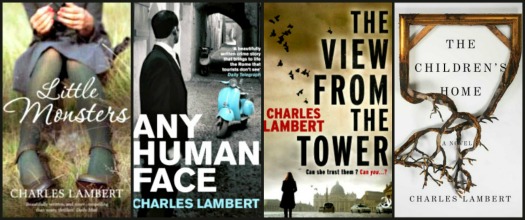
LOCATION, LOCUTION: Scottish expat writer Clare Kane’s novel immerses readers in 1930s Shanghai—plus we’re giving away her book and Donna Leon’s latest!

New columnist Tracey Warr arrives with her first interview guest, the displaced Scottish writer, Clare Kane. **NOTE: Help celebrate her opening column by becoming one of the lucky readers to win Clare’s book and Donna Leon’s latest. Details below.**

My guest this month is novelist Clare Kane. She was born in Scotland but has lived most of her life elsewhere. After studying Chinese at Oxford and working as a Reuters journalist in Madrid, she is currently living in Shanghai, where she works in marketing for TNS (she has a fellowship with WPP, the world’s largest communications services group). She spends her free time exploring the city’s past which she vividly evokes in her debut novel, Electric Shadows of Shanghai.

(And when she’s not writing about the past or researching markets, she’s writing about fashion and why we wear what we wear.)

Electric Shadows of Shanghai creates a fascinating world populated by British diplomats and wives, American journalists, glamorous stars of the Chinese silent film and Russian taxi-dancers turned ballerinas. It poignantly captures how the dreams and desires of these expat and Chinese inhabitants of the city lead them to interact and clash.

Electric-Shadows-high-res-cover-400x

Clare and I share a publisher, Impress Books, but have never met.

Let’s meet her now and hear her views on location, locution.

* * *

Welcome, Clare, to Location, Locution, and thank you for agreeing to be my very first guest. Can I ask which came first, story or location?

Location without a doubt. I’ve always been fascinated by China, and most of my short fiction writing is set there. But time also plays a part. As you pointed out in your introduction, my novel Electric Shadows of Shanghai is set in the 1930s, a particularly rich era in Shanghai’s history when as a free port it attracted people from all over the world: Jews fleeing Nazi Germany, White Russians escaping the Bolsheviks and plenty of adventurers looking to make their fortune.

The story couldn’t have taken place anywhere but Shanghai in the 1930s. Plots are built on conflict and the tensions that existed then helped shaped the story. China was pushing towards modernity, women were bobbing their hair and young men were returning from overseas educations to promote foreign ideas of democracy but these advances were overshadowed by political tensions, the constant threat of Japan and inequalities between rich and poor.

I knew I wanted to write about Shanghai, which has long been my favourite place in the world. Prior to living here each visit was a jolt to the senses, a reminder I was alive. The novel was also driven by my interest in Ruan Lingyu, a silent film actress from the time popular for her modern fashions, progressive ideas and films tackling tough social realities. I also wanted to write about the Russians who came to Shanghai, aristocrats who found themselves working as bodyguards and nightclub dancers (and those were the lucky ones). And I’d long had an idea in my head about a British couple coming to the city and it tearing their marriage apart (as it still does to this day). I pulled these various threads together into one plot and that is Electric Shadows of Shanghai

What techniques do you use for evoking place in your stories? After all, the action takes place long ago.

First, I have to get a hold on the atmosphere myself. With Shanghai it’s easy: I live here. Evoking the past is harder, but not impossible. The city is full of Art Deco haunts almost unchanged from their glory days in the 1930s, where for a moment you can feel like you’ve travelled in time. I also think that despite all the changes that have taken place over the last century, Shanghai probably feels very much as it did in the 1930s. A place of possibility, drawing eclectic characters from around the world. The seedy underbelly that existed then is still here now. And the clash of high and low living—cocktail bars next to noodle stalls—is still very much present.

But I don’t think you should bore the reader with lengthy descriptions of place. It’s about building on any impressions they may already have of a place by weaving in details to the narrative and letting their imaginations do the rest. No reader is a blank slate and I’ve found that even people who have never been to Shanghai nor given the place much thought have an impression of exoticism and glamour when they hear “Shanghai”. It’s my job to build on that, encouraging certain ideas and tearing down others.

Which particular features create a sense of location? Landscape, culture, food?

Tapping into senses other than sight is vital. Descriptions of buildings and landscapes get dull very quickly. I find it’s the snippets of sound, the wafts of smell, that really build a place in the mind. But the people are perhaps most indicative of a place. Not in terms of what it looks like on a map but in how it shapes people. When I look at the characters in my novel many of them are striving, determined to build something in the city, while others are more dissolute, giving in to the sleaze and losing themselves to the night. Each type—and no character is completely clear-cut—reflects their surroundings in their actions.

Can you give a brief example from your writing that illustrates place?

These are the opening lines of Electric Shadows of Shanghai:

Over a million women in Shanghai and one in thirteen a prostitute. Another myth of the Orient, Will thought, when Rollo told him a couple of hours earlier. But he recalled it now on the threshold of the Paradise, its neon promise reflected on the cobbles of the alleyway darkening in milky dusk. They were right on the edge of the International Settlement now, where the sombre society of the Bund gave way to the sweet tang of the night that made the two syllables of Shanghai so thrilling to the foreign ear.

I wanted to plunge the reader into Old Shanghai right away, and I tried to do this both through literal description and by inviting the reader to recall their own impressions of Shanghai (“so thrilling to the foreign ear”).

You live in Shanghai and describe yourself as a Chinese history geek. IN general, how well do you think you need to know a place before using it as a setting?

I have written about places I’ve never visited and I don’t think writers should rule somewhere out just because they aren’t personally familiar with it. Writing is about imagination, after all. It depends on how key place is to the story, how much knowing where this street meets that one impacts on the plot. You run the risk of offending people if you misrepresent a place and doubly so if you’ve never even been there. But if it’s the mood of the place that matters—the bustle of New York in the 1980s, the bleakness of the North Korean countryside—rather than the reality of it, I don’t think we should be precious about places. But research is always key. If you’re not going to research a place, why use it? Just invent a place instead.

Which writers do you admire for the way they use location?

One of my favourite authors is Janice Y K Lee, who has written two novels about Hong Kong. Both are incredibly evocative. She captures the place on every level: the physical look and feel of it and the society that populates the islands. She very gently unravels all the tensions of the place and I love that in her latest book, The Expatriates, she does that through the stories of various women living there.

I’m also a big fan of Chimamanda Ngozi Adichie. I know absolutely nothing about Nigeria but she brings it to life with every word. She makes the reader feel totally comfortable, unveiling place and history as part of an engaging story. I love that she weaves the stories of everyday people into huge historical events. She humanises history. And like Lee, place is key to her novels. They couldn’t take place anywhere else.

Clare's picks for novelists who have mastered the art of writing about place

Clare’s picks for novelists who have mastered the art of writing about place

Thanks so much, Clare.

* * *

Readers, any questions for Clare? Please leave them in the comments below.

And if you would like to discover more about Clare, you can visit her author site. You can also follow her on twitter.

*******************************BOOK GIVEAWAY*******************************
To celebrate the launch of this new series of interviews, I am giving away:

1) A copy of Donna Leon’s new Brunetti novel, The Waters of Eternal Youth, the 25th in this excellent series, available for the first two readers (US addresses only for this one I’m afraid!) to email Tracey with the names of Brunetti’s wife and children. Answers to traceykwarr@gmail.com

2) A free ebook (via Apple iBooks store) of Clare Kane’s Electric Shadows of Shanghai for the first two readers (anywhere) to email Tracey with the name of the main river that flows through Shanghai. Answers to traceykwarr@gmail.com
****************************************************************************

À bientôt! Till next time when my guest will be an English novelist living part-time in France and writing about Portugal in her new novel.

* * *

Thank you so much, Tracey! Shanghai in the 1930s was its own kind of displaced nation, so what a great choice of author/book to kick off the series. And that giveaway—it’s fabulous! —ML Awanohara

Tracey Warr is an English writer living mostly in France. She has published two medieval novels and her forthcoming novel, Conquest: Daughter of the Last King, set in 12th century Wales and England, will be published by Impress Books in the autumn.

STAY TUNED for next week’s fab post!

If you enjoyed this post, we invite you to register for The Displaced Dispatch, a round up of weekly posts from The Displaced Nation, with weekly updates and much, much more. Register for The Displaced Dispatch by clicking here!

Related posts:
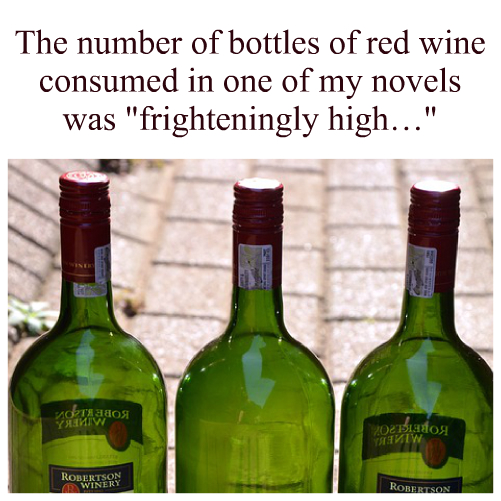
Photo credits: Top of page: (LOCATION ROW) Author photo and book cover (supplied); The World Book (1920), by Eric Fischer via Flickr (CC BY 2.0). (LOCUTION ROW) “Writing? Yeah.” by Caleb Roenigk via Flickr (CC BY 2.0); 24 Shanghai street scene, by mksfca via Flickr (CC BY-NC-ND 2.0); Shanghai street scenes 1, by Wolfgang Staudt via Flickr (CC BY-NC-ND 2.0).

BOOKLUST, WANDERLUST: 6 writers talk expat- and travel-themed books: last year’s faves, this year’s must-reads

booklust-wanderlust-2015

Attention displaced bookworms! Our book review columnist, Beth Green, an American expat in Prague (she is also an Adult Third Culture Kid), has canvassed several international creatives for their favorite expat- and travel-themed books of 2015, along with what’s on their bedside tables in 2016.

Hello, Displaced Nationers!

Last month I wrote to you about my Goodreads Reading Challenge, which, at 34 books and counting, is still proving (ahem) something of a challenge.

For this month’s column, instead of focusing on my 300-book goal, I decided to find out what other international creatives, several of whom have been featured in this column and/or on the Displaced Nation, have been reading.

I asked each of them to answer these two questions:

  1. What were the best books you read last year on displaced/expat/travel themes?
  2. What books are you looking forward to this year in the same or similar genres?  

Their responses are nothing short of tantalizing!

So much so that I’m now wondering…can I squeeze any more in?!

Please take a look:

* * *

MARK ADAMS, bestselling author

For the last several months I’ve been working on a new book about Alaska, so the 49th State has occupied a lot of my reading hours. Naturally, I’ve reread John McPhee’s classic Coming into the Country and Jon Krakauer’s Into the Wild. But two slightly less well-known books with an Alaska connection have really stuck with me.

John Muir and the Ice That Started a Fire_coverThe first is John Muir and the Ice that Started a Fire: How a Visionary and the Glaciers of Alaska Changed America, by Kim Heacox (Lyons Press, 2014). This is a great example of history that comes alive by weaving names, dates and events with passion for a cause, in this case environmentalism. Today, Alaska’s shrinking glaciers are viewed mostly by passengers aboard cruise ships who look up while sampling their breakfast buffets. To Muir, though, they were living things, mysteries that held timeless wisdom. Heacox makes a stirring argument that Muir’s early trips to Alaska jump-started the modern conservation movement.

Deadliest_State_coverThe second book is Kalee Thompson’s The Deadliest Sea: The Untold Story Behind the Greatest Rescue in Coast Guard History (Harper-Collins, 2010). When I realized that my book research was going to take me deep into the Bering Sea, which I wasn’t even sure I could place on a map, I reached for a copy of this. I’m not sure it was the right choice for someone who’ll be sailing those frigid and famously turbulent waters soon, but any readers who like tales along the lines of The Perfect Storm or Black Hawk Down will find that Thompson’s tick-tock re-creation of this lifesaving mission really places them amid the freezing chaos of the action.

Sunnys_Nights_coverOne book I’ve already read and loved in 2016 takes place very far from Alaska. It’s Tim Sultan’s delightful Sunny’s Nights: Lost and Found at a Bar on the Edge of the World, a memoir that tells the story of a curious young man who lands in Brooklyn in the mid-1990s after a peripatetic and somewhat disorienting youth in Laos, the Ivory Coast and Germany. Sultan finds a home at what must be the strangest tavern north of New Orleans—Sunny’s opens only one night a week and its clientele runs from Mafiosi to nuns—and takes on the bar’s namesake owner as a sort of surrogate father. It’s a stained-glass window offering a nostalgic glimpse of a Brooklyn that has largely vanished.

The Seven Storey Mountain_coverNow, a book I’m looking forward to reading this year: The Seven Storey Mountain, by Thomas Merton (Harcourt Brace; Fiftieth Anniversary ed., 1998). When I attended Catholic school in the 1970s, there were probably copies of Thomas Merton’s huge bestseller in every classroom, which is a shame, because most grade schoolers would be more interested in reading the phone book. Now that I’m older and no longer required to recite the Lord’s Prayer along with the Pledge of Allegiance every morning, I have the life experience that pushes one to ponder big questions, such as the meaning of life. Merton made that leap much earlier; he was an urbane, Ivy League-educated writer who abandoned a budding career at age 23 to cloister himself in a Kentucky monastery. (As a writer, I’m almost as awed by his decision to donate all royalties to his monastic order.) This is the story of his circuitous path toward embracing a life of pure spirituality.

Mark Adams is the bestselling author of Meet Me in Atlantis: My Obsessive Quest to Find the Sunken City, which was reviewed for this column in May of last year.


JENNIFER ALDERSON, expat and author

Savage Harvest_coverLast year, while researching my third novel, I was lucky enough to come across Carl Hoffman’s Savage Harvest: A Tale of Cannibals, Colonialism, and Michael Rockefeller’s Tragic Quest for Primitive Art (2014) It is simply one of the best nonfiction travel adventure stories I have read in a very long time. An award-winning American journalist, Hoffman recounts his fascinating journey to Papua New Guinea, where he retraces the last art-collecting expedition made by anthropologist Michael Rockefeller. He juxtaposes his own travels through the Asmat region with a fictive reconstruction of Rockefeller’s final days before his mysterious disappearance, based on extensive archival research and new eyewitness accounts. He effortlessly combines mystery, adventure, personal self-discovery and colonial history into one captivating novel.

The Travelers_cover
When reviewing my bookshelf last week, I noticed I’ve bought quite a few international thrillers and mysteries featuring American expat protagonists this past year. So in that vein, I’m most looking forward to reading Chris Pavone’s The Travelers, (Crown, March 2016). Pavone is an American writer whose first novel, The Expats, is set primarily in the capitals of Luxembourg, Belgium and France. That book was a stylish, fast-paced thriller, yet what caught my attention the most was the lyrical and natural way in which he described these cities without slowing the plot down. His latest thriller promises to crisscross South America and Europe. I can’t wait to read it!

Gallery Pieces_coverAnother mystery/thriller I just learned about is Gallery Pieces: An Art Mystery, by Larry Witham (Archway Publishing, 2015). It’s about an American art expert who travels through Europe attempting to track down artwork stolen during World War Two. it sounds like a great story. Editor’s note: Larry Witham is a former journalist and foreign correspondent who became a full-time writer and artist (painting and drawing) around ten years ago.

Jennifer S. Alderson is the author of Down and Out in Kathmandu and American expat in the Netherlands.


MARIANNE BOHR, Displaced Nation columnist and memoirist

TheRentCollectorOf the travel/expat books I read in 2015, three come to mind immediately. The first is The Rent Collector, by Camron Wright (Shadow Mountain, 2013). This gritty yet heart-warming story is set in the largest municipal dump located on the outskirts of Phnom Penh, Cambodia, a country about which I knew little. A couple with a chronically ill son live in a hovel in the dump, surviving day-to-day from what they can salvage and sell. They struggle to pay the titular rent collector, a bitter, alcoholic woman, every month. Books play a key role in this tale of perseverance.

Wright was inspired to write the book by his son Trevor’s 2012 documentary, River of Victory, who in turn was inspired by the people he met when volunteering as a humanitarian aid worker for the Cambodian Children’s Fund.

A Sport and a Pastime_coverLast year I also enjoyed reading the classic novel A Sport and a Pastime, by James Salter, which was originally published in 1967. (it was republished by Open Road Media in 2012). It’s an erotic tale told in tight prose that takes place in a small town in France. I couldn’t put it down.
Editor’s note: James Salter, who died last year, had a passion for European culture and particularly for France. Though he eventually became a full-time writer, he started his life as an officer in the United States Air Force, just after the end of World War II, and was stationed overseas, in Korea, Germany and France.

Coconut Latitudes_coverAnother book I enjoyed was The Coconut Latitudes: Secrets, Storms and Survival in the Caribbean, by Rita M. Gardner. It’s a coming-of-age memoir set in the Dominican Republic, where Gardner’s father transplanted his young American family. What begins as a dream of life in paradise soon takes a few wrong turns. The book, which came out a year before mine with She Writes Press, was a Gold Medal Winner for Autobiography/Memoir at the IBPA Benjamin Franklin Awards. Editor’s Note: Rita Gardner is a Displaced Nationer who was interviewed for A Picture Says… and featured for Valentine’s Day. Her book was on our “Best of 2014” list.)

Things Can Only Get Feta_coverThis year, I’m looking forward to reading Things Can Only Get Feta: Two journalists and their crazy dog living through the Greek crisis, by Marjory McGinn (2nd Ed.; Pelagos Press, 2015)
I’ve read many memoirs about expats on the isles of Greece, but this one by a transplanted Scottish couple intrigues me because of its location on the Mani Peninsula of the Peloponnese. The rugged landscape and fierce independent people of this part of Greece has always been on my list to visit for an extended period of time, and I can’t wait to delve into this volume. Editor’s note: Marjory McGinn’s sequel, Homer Is Where the Heart Is, made the Displaced Nation’s Best of 2015 nonfiction expat books.

TheDiscoveryofFrance_coverAnother volume on my bedside table is The Discovery of France: A Historical Geography, by Graham Robb (W.W. Norton & Company, 2008). I have owned this book for almost eight years, ever since it was published. I am a Francophile through and through and yet, the book keeps getting pushed aside for others. A history of France from the perspective of its provinces, it received outstanding reviews when it was published, and I am determined to read it in 2016. Editor’s note: For those who like stories of displacement, the author, Graham Robb, is originally from Manchester, UK, but took his Ph.D. in French literature from the University of Tennessee. He married an alumna of Vanderbilt University, and they live in Oxford, UK.

Peanut Butter and Naan_cover Another book on my to-read list is Jennifer Hillman-Magnuson’s Peanut Butter and Naan: Stories of an American Mom in the Far East, which came out with She Writes Press in 2014. This story by a woman whose husband is transferred from the US to India intrigued me the moment I read a review. They uproot their family of five children from their pampered existence in Nashville, Tennessee, to India, where they encounter extreme poverty, malaria, and no conveniences. I’m particularly interested in reading about how the children reacted to the move.

Marianne C. Bohr is the author of Gap Year Girl: A Baby Boomer Adventure Across 21 Countries, which came out last year with She Writes Press. It was on the Displaced Nation’s Best of 2015 list for expat nonfiction. She also contributes an occasional column, World of Words, to the Displaced Nation.


JESSICA PAN, expat and memoirist

TheUnbecoming_coverThe best book I read last year about displaced/expat/travel themes was The Unbecoming, by Rebecca Scherm (Viking, 2015). It’s about a first-class jewel thief Julie from California, who’s really Grace from Tennessee. She makes her way to Paris, where she works for a shady antiques restorer, turning out objets d’art that are exquisite fakes. I loved how the protagonist re-invents herself in Paris—and yet, of course, her past comes back to find her. Gripping and inventive, with an unpredictable love story.

This year I’m looking forward to reading Cities I’ve Never Lived In: Stories, by Sara Majka, which came out with Graywolf Press in January. Cities_Ive_Never_Lived_In_coverOnce again, these linked short stories are about reinvention, which is one of my favorite things about living abroad (and I like to think about the many versions of myself I’ve formed and perhaps left in Beijing, Melbourne and now London).

Majka’s is the second book to come out in a collaboration between Graywolf and the journal A Public Space, to which Majka has contributed (they are also promoting her book). She made her debut in the journal seven years ago with the short story “Saint Andrews Hotel”; you can read it here.

Jessica Pan is the co-author of the 2014 memoir Graduates in Wonderland: The International Misadventures of Two (Almost) Adults. A graduate of Brown University, she worked as an editor of an expat magazine and a TV report in Beijing, earned a journalism degree in Melbourne, Australia, and now makes her living as a London-based writer.


H.E. RYBOL, Displaced Nation columnist, adult TCK and author

Write_This_Second_coverOne of the best books I read last year was Write This Second, by Kira Lynne Allen (Prashanti Press, 2015). Written in verse, the book tells the author’s story about overcoming trauma and reclaiming her life. Allen searingly chronicles a childhood blown apart by racism, incest, and rape, and a young adulthood marred by addiction, domestic violence and post-traumatic stress—but then she finds redemption in the recovery process and healing in her art. A sense of displacement permeates part of the book. Like other readers, I found the experience of this book life changing.

Thank You for Being Expendable_coverAnother book I enjoyed reading last year was Thank You For Being Expendable: And Other Experiences, by Colby Buzzell (Byliner, 2015). Buzzell is an Iraq War veteran, and he wrote these stories, 36 in total, over a decade of making his way back home. Though there were aspects of his adventures I didn’t appreciate, I really took to his style. Like Kira Lynne Allen, he is honest and unfiltered. I also liked that he takes his readers to China, England and other places exploring underground culture while he attempts to return to civilian life and the sense of being expendable.

Florence_and_Me_coverMy last pick for top 2015 reads is Florence and Me: The story of how the city of Florence befriended an American girl from Brooklyn, by Elaine Bertolotti (self-published, 2014). Bertolotti is a proud Italian American whose grandparents were born in Italy. She moved to Florence in the 1970s and taught English while also somehow managing to start up her own art studio and sustain an artistic career. She took pains to master the Italian language as well. Bertolotti says she likes to think of herself as one of the pioneers who paved the road for all the Americans who’ve followed her into the expat life in Italy. Her book is a short, fun read.

My Life on the Road_coverThis year I’m looking forward to reading Gloria Steinem’s My Life on the Road (Random House, 2015). Can’t wait!
Beth’s note: I’m also reading this, this month. It’s great so far!
Editor’s note: Steinem’s book, her first in 20 years, is on the Displaced Nation’s Best of 2015 expat nonfiction list. We gave her the status of honorary expat for her extensive travels within and outside the United States.

HE Rybol is the author of Culture Shock: A Practical Guide and contributes the Culture Shock Toolbox column to the Displaced Nation.


SHANNON YOUNG, expat, author, and Displaced Nation columnist

Here Comes the Sun_coverOne of the best books I read last year was the memoir Here Comes the Sun: A Journey to Adoption in 8 Chakras, by Leza Lowitz (Stone Bridge Press, 2015). Lowitz is an American woman who travels to Japan and falls in love with a Japanese man and begins a life with him in Tokyo. Together they pursue adoption and start a yoga studio. What I liked: Lowitz writes about her experiences with heartfelt vulnerability. Her prose is often poetic as she gets at the heart of the displaced experience and explores a longing for motherhood that took her by surprise. Editor’s note: Leza Lowitz still lives in Tokyo with her husband and son. She calls herself an “accidental global citizen.” She is the author of 17 books in several different genres.

Seafaring Women_coverAnother book I enjoyed was Seafaring Women: Adventures of Pirate Queens, Female Stowaways, and Sailors’ Wives, by David Cordingly (Random House, 2009). It’s an account of the lives of women during the golden age of sail. These are true stories of women who left their homes to go to sea and settle in port towns all over the globe. What I liked: This book is a different take on the displaced theme. It explores the lives of real women who had a unique kind of expat experience in the great seafaring days. As with modern expats, some went to sea for adventure, some were pursuing employment opportunities (occasionally but not always disguised as men), and some were accompanying spouses. One thing’s for sure: nothing is better than real-life female pirates!

The Expatriates A Novel_coverThis year, I’m most looking forward to The Expatriates, by Janice Y.K. Lee (Viking, January 2016). Lee’s novel follows the lives of three expatriate women in Hong Kong. Why I’m interested: Lee’s first novel, The Piano Teacher, was one of the first books I read about Hong Kong. In fact, I bought it on the plane after visiting my now-husband several months before moving to Hong Kong to be with him. I’m looking forward to reading her new novel about the expatriate experience and comparing it to my own life as an expat here.
Shannon Young is a Hong Kong-based expat, Displaced Nation columnist (she contributes the bimonthly column Diary of an Expat Writer) and author of the new release Ferry Tale.

* * *

Thanks, everyone, for your contributions!

Still not seeing the right book for your next armchair adventure? Browsing ML’s great posts about fiction and nonfiction reads for 2016 is an excellent place to start. And, if you’re interested in Asia, I’d also recommend this blog post by Australian-born British novelist and writer Renae Lucas Hall, who writes about Japan. She’s listed some very intriguing books about Japan that she read in 2015 or will be reading in 2016.

So, readers, what’s on your bedside tables, and are you planning to add any of the above books?

Till next time and happy reading!

As always, please let me or ML know if you have any suggestions for books you’d like to see reviewed here! And I urge you to sign up for the DISPLACED DISPATCH, which has at least one Recommended Read every week.

STAY TUNED for more fab posts!

Beth Green is an American writer living in Prague, Czech Republic. She grew up on a sailboat and, though now a landlubber, continues to lead a peripatetic life, having lived in Asia as well as Europe. Her personal Web site is Beth Green Writes. She has also launched the site Everyday Travel Stories. To keep in touch with her in between columns, try following her on Facebook and Twitter. She’s a social media nut!

If you enjoyed this post, we invite you to subscribe to The Displaced Dispatch, a weekly round up of posts from The Displaced Nation and much, much more. Sign up for The Displaced Dispatch by clicking here!

Related posts: