The Displaced Nation

A home for international creatives

Tag Archives: USA

CULTURE SHOCK TOOLBOX: Expat mums, time to loosen your worry nut: relax, write funny stories & try not to embarrass your kids!

sine-culture-shock-toolbox
Transitions enthusiast H.E. Rybol is back with her final post of 2016.

Happy holidays, Displaced Nationers!

Are you already thinking about trips you’d like to make in 2017? Maybe you’re thinking about climbing Mount Kilimanjaro? In which case you’ll find it inspirational to meet Eva Melusine (Sine) Thieme, traveler, writer, and author of the hilarious memoir Kilimanjaro Diaries: Or, How I Spent a Week Dreaming of Toilets, Drinking Crappy Water, and Making Bad Jokes While Having the Time of My Life, about climbing Africa’s highest mountain with her teenage son.

Born in Germany, Sine—whose name is not pronounced like “mine”—has moved across the world seven times, “lugging progressively more stuff and family members along the way,” as she puts it on her author site. Most recently, she and her husband, also German (they met in Stuttgart), spent three years in Johannesburg, South Africa, with their four children.

At that time, Sine started up her popular blog, Joburg Expat, as a space for recording her adventures—ranging from her campaign to help baseball gain a foothold in an African township to a series of hair-raising encounters with lions, great white sharks, and the Johannesburg traffic police.

The family now lives in Tennessee, where Sine continues to maintain her Jo-burg blog. She also writes freelance for the Wall Street Journal and other outlets, and prides herself on remaining sane with four teenagers in the house—which reminds me of a quote by Nora Ephron:

“When your children are teenagers, it’s important to have a dog so that someone in the house is happy to see you.”

Sine says her next book will be about a road trip through Namibia with six people in a five-person car.

She kindly took time out from her busy life to share some of her culture shock experiences. Join us as we talk about mustaches vs. mustard, cultural differences in parenting—and the therapeutic benefits of writing…

* * *

Welcome, Sine, to Culture Shock Toolbox. So where on our beautiful planet have you lived?

I was born in Germany where I spent the first 16 years of my life. I then embarked upon a year as an exchange student in the United States, arriving full of wonder in the Deepest South of Mississippi, marveling at such novelties (to me) as cordless phones, giant TV screens and drive-through fast food. My love for America kindled and confirmed, I returned after my undergraduate studies for an MBA at the University of North Carolina together with my also German-born husband. We have since moved—with an ever-growing entourage of kids—to Singapore, Wisconsin, Kansas, South Africa, and now Tennessee. Having been naturalized in 2010, I don’t consider myself an expat in the United States any more. My most memorable time of feeling like an expat came when we lived in Johannesburg with our four children, from 2010 to 2013.

It sounds like a beautiful love story, what you said about the United States! In the context of your many cultural transitions, did you ever put your foot in your mouth?

The most embarrassing—because I was a self-conscious teenager still learning English—was the time when, as an exchange student in Mississippi, I insisted that I wanted “mustache” with my burger. I had of course confused the word for “mustard”—and it didn’t do my perfectionist self any good to be relentlessly teased about it by my younger host siblings for months on end.
burger-mustache-quote

Any stories from your time in South Africa?

Nowadays I’m not easily embarrassed, but my kids make up for that with their exponential embarrassment on my behalf, which, I’m convinced, comes with the Expat Mom territory. Take, for instance, the school sports scene in South Africa. My daughter Impatience—that’s her blogging name—was playing in a netball match, actually playing pretty well considering she’d never played the sport before in her life. But I was going crazy because no one was going for the rebound after shooting at the basket. “Get the rebound!!!” was naturally what I yelled from the bleachers for an entire half, like a good American mother with Olympic ambitions for all her children, no matter how lowly the league. Well, as any netball players out there will know, it’s not called a “rebound”. It’s also apparently not something you can “get” willy nilly, because there is some kind of zone around the basket or perhaps the goal-shooter—I learned there is actually a position called goal-shooter that comes with its own lettered t-shirt—into into which you can’t extend your arms. Impatience later informed me of this technicality in hushed tones so that I would abstain from any further “encouragement” from the sidelines. South African mothers do not seem to provide such encouragement at all, I came to learn.

How did you handle that situation? Would you handle it differently now? What tools do you think are most useful for adapting to situations like these?

I think in general the key is to relax waaaaay more than we typically do, not just as a tip for expats but a life skill in general. None of this is really so important, so instead of watching my kid with eagle eyes to see how well she plays, I should have socialized with the other mothers much more and dug into the goodies piled onto tables for “tea time,” which had been supplied by some well-meaning parents. South Africans are good at relaxing, as I learned during those years. “Sit back and observe what locals do” is usually a pretty good guideline when arriving in a new land.

Definitely! Looking back again on your many transitions, can you recall any situations you handled with surprising finesse?

I don’t profess to have much finesse. So just abstaining from committing a similarly embarrassing blunder in front of another one of my kids can perhaps count for such a success story. One day I was tempted to walk right into the teacher’s lounge at the prep school, brimming with indignation, to tell my son Jabulani’s geography teacher that no, contrary to her firm belief, the United States does NOT have 52 states, never had, and probably never would. And, while we were at it, zero degrees north is just as good an answer on the exam as zero degrees south, if she really insisted on splitting that particular hair. Jabulani blanched at the prospect. He begged me to abstain. It would be SO embarrassing if I talked to the teacher like that, which is apparently something South African mothers don’t do. So I listened to my child—another good rule for parents of Third Culture Kids to follow. They are so much more attuned to the perils of putting a foot in your mouth. 

Yes, that’s actually something Tanya Crossman wrote about in her book, Misunderstood, which was featured on this site last week.

Come to think of it, it was also Jabulani who found it equally embarrassing when, upon receiving the supply list before cricket season, I was the only mother who had no idea what a “ball box” was. And who then loudly inquired at the sporting goods store as to where she might find one, and proceeded to tell everyone for months afterwards, hooting with laughter, how funny it was that it turned out to be an athletic cup (which is inserted in a jockstrap to protect the genitals against impact from the ball):

Yes, if you think about it, a ball box is indeed a box containing balls, haha, and should we read anything into the fact that South African “ballboxes” are about twice the size of their American counterparts? Hahaha.

embarrassed-tcks

I’m imagining you might say “sense of humour,” but if you had to give advice to new expats, what’s the tool you’d tell them to develop first and why?

Maybe I’m biased because I’m a writer, but I’d actually say the most important tool as an expat is to start writing. Emails to your friends, Facebook posts, a blog, whatever it is, it will lighten your mood tremendously. It will shift being afraid of what’s new towards seeking out the new—because you have an audience and a story to tell. It will turn frustration at yet another long wait at an incomprehensible government office into almost giddy suspense as to what ridiculous thing might happen next, and how to best put it into words to make your readers back home burst into laughter.

How did you feel when you came back to the United States after living in Africa? What was “reverse” culture shock like for you?

It was worse. Before, there was the excitement about living in a new country, coupled with the benevolence you feel towards a people you don’t completely understand. You give them the benefit of the doubt. They might seem a little quirky and weird, and you might not understand all they’re saying, but they smile at you and they’re interesting. Plus, the sun is shining and someone is ironing your laundry at the house, and that someone is not you. But when you return “home” you feel like you understand everyone far too well, and you don’t like what you think you know about their psyche. They’re all too shallow, too pampered, too full of their First World Problems, you think, and there can’t possibly be anything in it for you by getting to know them. You pine for the friends you left behind in the country you left behind, and nothing seems like it will ever be quite so fascinating and exciting again in your life as it once was.

Can you recommend any tools for handling (reverse) culture shock?

The key is to treat your home country like any other expat location—with curiosity, an open mind and heart, and a willingness to adapt. You have to overcome your own snobbishness to realize there are wonderful people everywhere in the world, and only then can you form new friendships, find new passions, and move on with your life. 

That’s good advice: it’s important to find new passions.

You might have cage dived among great white sharks and climbed Mount Kilimanjaro as an expat, and now you might have to settle for the much more mundane sport of tennis upon returning home. But let me tell you: perfecting your forehand is just as challenging and rewarding as living abroad. I’m still trying to find an equally convincing story about the laundry I’m now back to folding myself in a country without domestic help. I’ll get back to you when I come up with it.
shark-forehand-quote

Thank you so much, Sine, for taking the time to share your stories and insights. As you say on your blog, “If life always went exactly as planned, there would be no stories. If you look at it that way, a crappy day can be the greatest gift!” Such a wonderful motto to live by, abroad or at home!

* * *

Displaced Nationers, I hope you enjoyed this interview. Did you turn any frustrating moments into stories? Let us know!

And if you like Sine’s prescriptions, be sure to check out her author site and her blog. You can also follow her on Facebook and Twitter.

Well, hopefully this has you “fixed” until next month/year.

Until then. Prost! Santé!

H.E. Rybol is a TCK and the author of Culture Shock: A Practical Guide and Culture Shock Toolbox and the newly published Reverse Culture Shock. She loves animals, piano, yoga and being outdoors. You can find her on Twitter, Linkedin, Goodreads, and, of course, her author site.  

STAY TUNED for next week/year’s fab posts.

If you enjoyed this post, we invite you to register for The Displaced Dispatch, a biweekly round up of posts from The Displaced Nation—and so much more! Register for The Displaced Dispatch by clicking here!

Related posts:

Photo credits: First visual (collage): Culture shock toolbox branding; photo of Sine & family, her book cover and her blog banner (supplied); View over Stuttgart-South and Stuttgart-Heslach and the “Karlshöhe”, Germany, by MSeses via Wikimedia Commons; and A rainbow over Joburg about two hours ago, by Derek Keats via Flickr (CC BY 2.0).
Second visual: Hamburger via Pixabay (moustache vector art from iPiccy).
Third visual: Embarrassed boy, happy faces and wrench via Pixabay; Australia v England Netabll [sic] Test, by Naparazzi via Flickr (CC BY-SA 2.0); and Traditional protective cup, by Scoty6776 via Wikimedia Commons.
Fourth visual: Great white shark, by Michiel Van Balen via Flickr (CC BY 2.0); and tennis player via Pixabay.

TCK TALENT: Tanya Crossman takes her talent with mentoring TCKs to the next level: a resource-rich book


Columnist Dounia Bertuccelli is back with her second Adult Third Culture Kid guest, who has had a particularly productive year.

Hello readers! Welcome back for my second TCK Talent column, where I am happy to introduce author and TCK mentor Tanya Crossman. Tanya is ending 2016 on a high note as this was the year she had her first book published: Misunderstood: The Impact of Growing Up Overseas in the 21st Century (Summertime Press), a work full of insights into the hearts and minds of Third Culture Kids and, for Tanya, a true labor of love.

Tanya is familiar with what it is like to grow up in other cultures from her own experience. Born in Australia, she grew up mostly in Australia (Sydney and Canberra) but also spent two of her teenage years in the USA when her family moved to Greenwich, Connecticut, due to her dad’s IT career. Being a 13-year-old in such a different part of the world played a major role in shaping Tanya’s adult identity. As she put it to fellow Adult Third Culture Kid, Janneke Muyselaar-Jellema, of the DrieCulturen (Dutch for “three cultures”) blog:

I think it showed me there’s a whole world of opportunity out there, and not to limit myself to what is “normal” in Australia.

After completing a Bachelor degree in Asian Studies at the Australian National University in Canberra, Tanya moved to Beijing for a study year abroad—and ended up staying for 11 years. During that period she also spent a lot of time in Cambodia. She moved back to Australia about two years ago, where she’s been learning to navigate repatriation while completing a Master’s program in Sydney.

It was during her time in China that Tanya began to work with other Third Culture Kids. This became her passion, and, even now that she is back in her passport country, she continues advocating for TCKs.

* * *

Congratulations, Tanya, on the publication of Misunderstood. That’s an amazing accomplishment! How did you develop the ambition to write your own book on this topic?
Thank you for featuring me, Dounia. As you mentioned, I mentored Third Culture Kids who were living in China for years, listening to them and learning how they felt about life. At a certain point I started receiving requests from parents for advice as well as invitations to speak to interested groups both in China and other places. People would ask for resources, and while I was able to point to some excellent works, I couldn’t find anything that represented the angle I spoke from—so eventually I wrote my own book.

“If there’s a book you want to read, but it hasn’t been written yet, then you must write it.” —Toni Morrison

Tell me, how does Misunderstood differ from other TCK resources?
Misunderstood is different because I act as an advocate and a “voice” for young TCKs. I’m trying to express how they really feel about the experience of growing up in a third culture. They have a different experience of the world to their parents. Recognizing this is essential for giving them the support they need. I interviewed nearly 300 TCKs and surveyed 750 TCKs during the writing process, and there are statistics as well as quotes from this work throughout Misunderstood. I explain the TCK perspective but I also articulate how many of them feel—often in their own words.

Who would you say is the primary audience for the book?
My initial goal was to write for parents, teachers and care workers, but I later re-wrote the contents to cater to young adult TCKs as well. Most of them are processing their childhood experiences and finding their place in the world, and I think it will help them to discover there are other people who have felt the same way, and to be given vocabulary to explain their experiences to others.

tanya-crossman-bridges-gap

I know you were a TCK for just two years, and in another English-speaking culture. But I assume that your experience of living in Connecticut (where I now live, btw!) was also a motive for writing this book? And did writing the book help you process your TCK experience?
Only indirectly. I have to say, I knew nothing about TCKs before I began mentoring them in Beijing. I certainly didn’t connect my two years in the United States to their experiences. Once I got into working with TCKs, I started reading the literature (particularly Pollock and Van Reken’s Third Culture Kids: Growing up Among Worlds). As a result, I began to understand and process what I’d felt while living in Connecticut as a teenager. While my Third Culture experience differed from the teens I was working with, I could see there were points of overlap, which was what had helped me make the initial connection. It gave me a head start in understanding the landscape of their inner lives.

What are your hopes for Misunderstood?
My biggest hope is that it ends up in the hands of people around the world who will find it helpful. I want young TCKs to read it and feel understood and empowered. I want parents to read it and feel encouraged because they are able to see their children’s experiences in a new light. Already I am getting responses from TCKs, parents and other expatriate advocates, sharing the ways in which Misunderstood has encouraged or challenged them. That sort of feedback is exciting and humbling. It makes it all worth it.

“Australia doesn’t really feel like “home” anymore. Beijing feels like home…” —Tanya Crossman

You recently repatriated to Australia—how has that experience been?
Repatriation has been HARD!! The first three months I hardly left my room unless I had to. After about ten months I had this feeling of “waking up” and feeling like a person again. It’s really only in the last couple of months that I’ve started to feel anywhere near normal. I’ve been here almost two years now, and although I feel settled enough in my current life, it does feel quite temporary—although that’s partly because I’m in a program of study, which gives me a concrete end date (about a year from now). I definitely expect to head overseas again after that, though I’m open to staying in Australia if the right opportunity comes up.

If you do end up settling in Australia, aren’t you afraid you may get “itchy feet”?
I get itchy feet if I don’t get on a plane every few months, no matter where I’m living! I’ve managed to make two overseas trips in the two years I’ve been back, and I have another planned in a few months’ time.

tanya-crossman-itchy-feet

Are you working on anything new at the moment? Are there plans for a second book?
Mostly I’m working on my completing my master’s degree, though I do have a side project looking at creating reading guides for Misunderstood—in large part prompted by conversations with a few expat mums (in China, South Africa and Thailand) who were interested in using Misunderstood for group discussions.

Please share any other information or links you would like our readers to know about.
There are lots of great resources about TCKs out there, including some great books released in the last five years. Other than the classic Third Culture Kids which I mentioned before, the books I recommend most often are:

Another great resource is Ellen Mahoney’s TCK mentoring organization Sea Change Mentoring.

It’s generous of you to cite these additional resources for us. Thanks so much, Tanya, for this interview!

* * *

Readers, please leave questions or comments for Tanya Crossman below. If you’re interested in learning more about her book, please visit Tanya’s author site. You can also connect with her on Twitter and Facebook.

Born in Nicosia, Cyprus, to Lebanese parents, Dounia Bertuccelli has lived in France, UK, Australia, Philippines, Mexico, and the USA—but never in Lebanon. She writes about her experiences growing up as a TCK and adjusting as an adult TCK on her blog Next Stop, which is a collection of prose, poetry and photography. She also serves as the managing editor of The Black Expat; Expat Resource Manager for Global Living Magazine; co-host of the monthly twitter chat #TCKchat; and TCKchat columnist for Among Worlds magazine. Currently based on the East Coast of the United States, she is happily married to a fellow TCK who shares her love for travel, music and good food. To learn more about Dounia, please read her interview with former TCK Talent columnist Lisa Liang. You can also follow her on Twitter.

STAY TUNED for next week’s fab posts!

If you enjoyed this post, we invite you to register for the biweekly Displaced Dispatch, a round up of posts from The Displaced Nation—and so much more! Register for The Displaced Dispatch by clicking here!

Related posts:

Photo credits: Photos of Tanya supplied. All other photos from Pixabay with exception of Greenwich photo in first collage: Greenwich, Connecticut, by Doug Kerr via Flickr (CC BY-SA 2.0).

WORLD OF WORDS: When words fail you: i.e., you have a throbbing toothache in a foreign country

Marianne Bohr in the Luxembourg Gardens in Paris—is she reading or indulging in reveries about words?

Marianne Bohr in the Luxembourg Gardens in Paris—is she reading or indulging in reveries about French words?

Columnist Marianne Bohr traveled to Corsica last summer to do the GR20 two-week hike across the island, said to be the most grueling long-distance trail in Europe. (She was also, btw, collecting material for Book #2!) When she told me this, I remember thinking: she’s chosen such a curious location! As some readers may recall from Lorraine Mace’s interview with novelist Vanessa Couchman, Corsica exudes a sense of displacement. Annexed by France in 1769, it retains a distinctly Italian flavor. Marianne told meshe read Couchman’s novel, The House at Zaronza, which is set in Corsica, when preparing for her trip. But nothing, readers, could have prepared her for the adventure she shares with us below. —ML Awanohara

My worst travel nightmare has materialized: a throbbing toothache in a foreign country. From experience, I’m sure it’s a dead nerve and I need antibiotics tout de suite.

After two days of downing pain relievers—I am miles from a town of any size on Corsica—I know I must deal with this immediately. Certainly before boarding a ferry from France to Sardinia, Italy—if there’s going to be any chance of me communicating with the doctor.

Readers, as you know I love immersing myself in the world of words. Can you imagine how I felt being in a situation where I was about to have no words?

throbbing-toothache-nightmare

We arrive in Bonafacio, a striking city with a stout hilltop fortress and stunning white chalk cliffs on the southern tip of the island. France is famous for its red tape and I’m ready to tackle it with respect to healthcare.

We reserve a late afternoon ferry for my emergency journey to Italy. Close to tears from the ache, I tell our hotel desk clerk what’s wrong and ask if she can get me a medical appointment. She picks up the phone and dials the local doctor whose office is down at the port. “Yes, he is seeing walk-in patients this morning. Here’s his address and our shuttle will take you.”

We enter his bare-bones, second-story walk-up office in a pastel 18th-century building overlooking the sparkling harbor. I wait ten minutes until his current patient comes out and then in I go. All he asks is my name. No ID, no insurance paperwork, nothing else. I’m in need and he’s treating me. A couple of questions, a quick look in my mouth, a few taps on my teeth, and he writes two prescriptions: one for an antibiotic and one for pain (a drug not available back home). Total damage: $33.

We head to the pharmacy next door, shell out a whopping $16 for the meds, and we’re on our way. Less than an hour after my plaint at the hotel and just shy of $50 for an impromptu doctor’s consult and the cure for my pain. I pop the pills and by the time we board the ferry hours later, my jaw is no longer on fire.

I can only imagine how long visitors to the US would wait, what documents they would be required to provide, and how much they would pay for the same treatment. Red tape and unconscionable fees in France? Not when it comes to healthcare.

french-health-care

* * *

What a harrowing tale, Marianne! But the happy ending reminds me of the first time I went to a doctor in Britain. I was astounded that there weren’t any bills and the doctor simply tried to help me. After that, I became a national-health-service convert. It was a formative moment. It’s also a timely reminder of what we may be giving up in this country—I’m thinking of our post-election debate! —ML Awanohara

Readers, have you ever had this kind of nightmare in a foreign country? Do tell in the comments!

Marianne C. Bohr is a writer whose book, Gap Year Girl: A Baby Boomer Adventure Across 21 Countries, was published in September 2015 with She Writes Press. She married her high school sweetheart and travel partner, and with their two grown children, follows her own advice and travels at every opportunity. The couple has just now taken early retirement in Park City, Utah, where she plans to spend her time working on Book #2. Marianne has an author site where she keeps a blog, and is active on Facebook and Twitter.

STAY TUNED for next week’s fab posts!

If you enjoyed this post, we invite you to register for The biweekly Displaced Dispatch, SO much more than a round-up of posts from The Displaced Nation. Register for The Displaced Dispatch by clicking here!

Related posts:

Photo credits: Top of page: Marianne Bohr (supplied); world map via Pixabay. All other images via Pixabay except the one of red tape: Tied up in red tape, by James Petts via Flickr (CC BY-SA 2.0).

Are we expats on an eightfold path? Poet Robert Peake investigates…

THE DHARMA WHEEL OF EXPAT LIFE

THE DHARMA WHEEL OF EXPAT LIFE

American-born UK-based poet Robert Peake is back, this time with a poem he wrote for HSBC in response to its annual survey of expats.

This year as in years past, HSBC’s Expat Explorer surveyed 16,000 expats about their experience of expat life. But in 2016 they added a new twist: they invited three international creatives to draw on their own expat experiences in interpreting the data.

One of the trio is displaced American poet Robert Peake, who has been on our site before, when we published “Smoke Ring,” one of his poems related to expat life.

Today we are publishing the poem that he wrote for Expat Explorer, with their permission. It’s called “Eightfold Expat” and has eight sections, each of which explores a word that many survey respondents used to describe their lives:

  • great
  • challenging
  • interesting
  • exciting
  • rewarding
  • difficult
  • better
  • different

Notably Robert chose the term “eightfold” for the poem’s title—an allusion to the Buddhist’s eightfold path to nirvana, comprising eight aspects in which the aspirant must become practiced.

This allusion suggests that as we move along the expat path, we are challenged to move beyond conditioned responses, to unlearn what we have learned—and that only then might we reach the “nirvana” of the displaced life.

I like the allusion very much—and am curious to hear what you think!

* * *

Eightfold Expat

I. [Great, the Expanse of an Opened Mind]

selfie-stick_quote_500xWith both hands, take it, this piece
of mind, a gift to yourself, a selfie
taken on a stick that extends into space.
Wave at the dot that was you, a seedling
on the prairie, allotment, or balcony pot,
bursting from husk to sapling, grappling
up, and spreading two leaf-shaped hands
out in the simplest prayer: to grow—
and so you water the one thing depending
on you in this world that was humming
before you arrived, and will hum the day
you depart, planting out and patting down,
packing out a greater part of you in you,
edging grains of dirt from your nails.

II. [A Challenging Chrysalis]

sliding-doors-with-quote_500xThe doors slide open as you pass, the doors
slide shut. Do not take this lightly.
Do not take this personally—the doors
do not know who you are, but who you will
become. Sealed in glass, your beating heart
apparent as your accent, veined to stimulate
the nerve-goo forming its scribbled blueprint,
tunnelling down the spine’s mine shaft,
reclaiming what you thought you knew,
in light, in heat, the gear work whirring
deep inside the leaf-perched skyscraper,
where already cracks are scaling the sides.
You blink. The winds pursue you at this height.
You flex to find your wings are dry now. Go

III. [A Most Interesting Spy]

flat-white-foam-with-quote_500xOrdinary is overrated. But you carry a secret
through the ubiquitous coffee shops, giving
them one of your names to mispronounce
over the hissed disapproval of frothing milk.
You could be one of them; they could be you.
A film as thin as the sheen on your flat white
separates you from the camera-clad throng,
standing like bowling pins on the thoroughfare.
They will ask directions in your native tongue,
and you will pretend that you don’t understand,
the way a lens misunderstands the surface
of places you now inhabit, as if ordinary
could describe the burning pleasure of a sip
that used to scald you, cooling in your mouth.

IV. [Exciting, the Strapped-In Ride]

tuk-tuk-with-quote_500xYou never saw it coming—the pothole, cobble,
pavement crack that sends you to the roof
of the clattering rickshaw. Can you remember
the word for aspirin? How much to tip?
Remember to duck when the lights go amber,
wear your backpack, like armour, on front.
This will force you to be flexible, if your bones
can take it and the frame (yours, its) holds up,
adapting to vibration, mole in an earthquake,
fish in tsunami’s wake-wall, you are the whirl
in whirlpool now, swirling whatever way it goes
this part of the grid-parted, shrinking globe.
Close your eyes, clutch both hands in your lap.
Press down, tuck in, and mind the closing gap.

V. [Rewarding Yourself with Yourself]

martini-with-quote_500xWho wants to be just whelmed? Who wants
to find the golden ticket in the wrapper
whipping down pavement strewn with trash?
Late, over drinks, in a clean and crowded
metropolitan hide, you’ll strain your eyes
in the black-glossed window, trying to make
out anything besides your own reflection,
freckled with lights from the harbour.
What the hell are you doing here?, you’d
like someone to ask above the clink
and chit-chat, emphasising you as if
familiar. And so, you ask, and ask yourself.
In the glint of your martini, constellation.
You’ve come so far to find out who you’re not.

VI. [Difficult Beauty]

airport-lounge-daisies-with-quote_500xIf it were easy, we would all be doing it—
hauling up on a humid red-eye, surrendering
to the body scans and stale sandwiches,
slumping deeper into a crumpled suit at signs
of a fourth delay, getting it wrong, then wrong-
er, our knuckles out for the endless raps,
unwitting child in a full-grown body, stepping
on every hidden crack, and yet—no-one else
can see the daisies growing there, hear music
in the language stripped of meaning, take in
what’s taken, like spare change to a stranger,
for granted, for grounded, given like air.
Notice the air. How it wants to fill your lungs.
Invisible, pervasive. A second world un-sung.

VII. [Better, with a Catch]

mail-flap-with-quote_500xThe stairs have flattened, the step
beneath you precisely that, how could
you have been that other person,
narrow enough to fit a mail flap?
Home is a stream you can never two-
step in. Home is a rain-washed flat.
This is more than a phase, this is
the new you, smiling benignly
at the new recruits, hazing them gently
with your song, a medley of tales
in which you finally see unclouded light,
changeling having shed your winter coat.
And yet, a phrase on Skype, familiar
and remote—catches in your throat.

VIII. [Different Like Narnia]

girl-on-bed-with-quote_500xNot this dust, but a different dust
clung to the sides of your shoes,
and the light in the sky was different—
more yellow, more pale, more or less
savagely warm to the skin. More or
less is not the same as same, degrees
quicker, more shallow the currents,
more guarded or friendly, the streams,
passers-by, and you a passer among—
chin-up to the skyline, jagged or flat
by comparison, and when you undress,
the light switch flipped, the sounds
of the room gently restless, you sleep
halfway between this world and home.

* * *

So tell me, readers: are the eight “folds” Robert suggests in his poem the tools the expat needs to construct a raft that moves them to a more enlightened place? I for one appreciate that Robert catches so many of the nuances of the expat life.

On the one hand, there’s the raw excitement of being in a brand new place, along with the burgeoning self-knowledge that perhaps can only come from being so far away from the familiar. On the other, there’s the realization that living somewhere different isn’t always better, and that one can easily fall victim to arrogance. In other words, the path to enlightenment doesn’t simply come from the thrill and the novelty of being elsewhere; it also comes from an awareness of the limits on how much one can grow in a foreign environment. We expats will only ever be halfway between our new worlds and home…

But the brilliance of Robert’s writing is that it’s open to interpretation. What was your reading of his poem? Do tell in the comments!

The Displaced Nation would like to thank HSBC Expat Explorer for granting permission to republish Robert Peake’s poem here. Please note: You can also listen to Robert reading the poem on the HSBC site.

Robert Peake grew up on the U.S.–Mexico border, in the small desert farming town of El Centro, California. He is now living near London. He created the Transatlantic Poetry series, bringing poets together from around the world for live online poetry readings and conversations. He also collaborates with other artists on film-poems, which have been widely screened in the US and Europe. Robert is a tutor for the UK Poetry Society and writes reviews for Huffington Post. A computer programmer by training, his current pet project is Poet Tips—a crowd-sourced poetry recommendations website designed to help you find your next favourite poet. Robert’s collection, The Knowledge, deals with expat themes and is available from Nine Arches Press.

STAY TUNED for next week’s fab posts.

If you enjoyed this post, we invite you to register for The Displaced Dispatch, a biweekly round up of posts from The Displaced Nation—and much, much more! NOTE: Robert Peake is a Dispatch subscriber: that’s how we met!! Register for The Displaced Dispatch by clicking here!

Related posts:

Photo credits:
Opening visual: Created using Dharma Wheel, courtesy Wikimedia Commons (CC BY-SA 3.0).
Visuals for poem:
I. Selfie Stick in Rome[https://www.flickr.com/photos/30478819@N08/23950053839], by Marco Verch via Flickr (CC BY 2.0).
II. Departures at Midway, by Daniel X. O’Neil via Flickr (CC BY 2.0).
III. Fractal coffee/milk, by Nick Ludlam via Flickr (CC BY 2.0).
IV. Motor Rickshaw, by Jeff Warren via Flickr (CC BY-SA 2.0).
V. Martini, by Robert Couse-Baker via Flickr (CC BY 2.0).
VI. Airport lounge via Pixabay. Insert: Flowers via Pixabay.
VII. E5 colored glass, by Sludge G via Flickr (CC BY-SA 2.0).
VIII. Sleeping woman via Pixabay.

Expat, repat, and otherwise displaced reactions to the 2016 US presidential race

the-trump-panel

Welcome to the Displaced Nation’s virtual panel discussion on the most recent presidential election in America. (Hey, we figured if the pundits could get it all wrong, we could all be pundits, too!)

Before we get started, let me quickly explain how this panel came about. As some of you may know, I lived abroad for many years and, since repatriating to the United States, I’ve often felt like an exile in my own country. That said, the election of political outsider Donald Trump did not entirely surprise me. As explained in the most recent Displaced Dispatch, I had good information sources.

But if it didn’t surprise me, it definitely rocked my view of politics as usual in my native land. In the immediate aftermath, I wanted to be around other like-minded people here in New York City rather than being alone with my thoughts.

Likewise, I had the urge to reach out to the members of the international creative crowd we’ve gathered here at the Displaced Nation. How are they processing the news of America’s Brexit? And what impact do they see it having on their far-flung lives—beginning with the possibility of awkward holiday dinners with families?

A motley lot we expats, repats, and otherwise displaced types may be; but we, too, deserve a chance to say what we think.

And now, over to the panel…

* * *

q1_trumppanel

MARIANNE BOHR, American Francophile: In a lodge in Jackson Hole, Wyoming, with my husband. We were on a cross-country trip to move to Park City, Utah, for our early retirement. I was in shock as I saw state after state in the Trump column.

ANTHONY WINDRAM, British expat (now a U.S. citizen) in New York City: I watched the results at home with a makeshift newsroom. I flitted between CNN on the TV, a different cable news channel on my iPad, twitter on my phone, and various news sites on the laptop. But as the results came in, and the narrative arc of the night started to become apparent, I felt I needed to be away from the constant breaking news and the increasingly hysterical tone of Wolf Blitzer. The repulsion I felt at the result was visceral. Brexit is the closest comparison, but with the British referendum result, I just felt sadness. The Brexit vote centered around fairly abstract ideas about sovereignty and Britain and Europe—thus a toad like Nigel Farage could be dismissed as a distraction; but this election was centered around the carnival barking demagoguery of Trump, and the knowledge that he will not be going away for, at least, the next four years and that he now has a permanent, prominent place in the history of this country, is nauseating.

HE RYBOL, Adult Third Culture Kid based in Luxembourg (moving soon to Canada): I heard it on the car radio on my way home. No thoughts, just disbelief, sadness, frustration, anger. If I had any thoughts, they were about the rise of nationalism in the 1920s and 1930s in Europe.

INDRA CHOPRA, Indian and serial expat: In my hometown, Gurgaon, India, preparing for Diwali, the Hindu festival of lights (October 30). Diwali is a celebration of good over evil but this year the festival stars Trump-ted the message. I was not surprised by the result as I had been following the campaign projections and stories during my stays of the past summer in the USA and Canada. I did feel let down by Hillary Clinton’s defeat, she is more qualified and deserving of the two and secondly it is time for the USA to have a woman president.

LISA LIANG, Adult Third Culture Kid based in Los Angeles: At home on the couch in our living room. I was in numb shock, not because I didn’t think it could happen, but because I had known it could and had decided to be optimistic for the last 36 hours because my psyche could no longer handle the dread and uncertainty. I could not sleep most of that night. The pain, grief, and rage arrived the next day and have peaked and dropped and peaked again on different days.

JACK SCOTT, former British expat in Turkey, now living in Norwich, UK: I first heard about Donald Trump’s victory on the morning news here in Britain. It was a wakeup call, but after Brexit, not entirely unexpected. I think we all know that both outcomes are a symptom of something deeper and more socially corrosive. There are a lot of people out there who feel marooned in poverty with little hope of rescue, including members of my own family. So it was okay to bail out the bankers but not the steelworkers? Really? If I was a praying man, I’d be on my knees hoping that Trump will be less incendiary in office than he has been on the podium, but I wouldn’t bet my shirt on it. Stoking up the darkest fears of those at the bottom of the heap is what got him elected. How a man born to enormous privilege can possibly understand the worries of the common man or woman is beyond me. But then I don’t understand the appeal of former merchant banker, Nigel Farage, either.

ML AWANOHARA, former American expat in UK and Japan, now living in New York: I spent the first part of the evening with a group of seven international friends in my NYC apartment building—only three of whom (myself included) were born here. One of our hosts was born in Montreal and the other in Taiwan, and the other two guests, in Asia (one of whom is my husband, who is Japanese). We were drinking wine and eating Chinese food while watching the returns on a huge TV screen. A bottle of bubbly was chilling in the fridge. Several of us left at midnight, when it was clear Hillary was likely to lose. We never popped the cork. The next morning, I couldn’t get over how quiet and glum everyone looked on the subway. At work several of us gathered around a computer screen to watch Hillary’s speech, with Bill standing behind her. The two of them have been political fixtures in this country for so long, it felt like watching the Twin Towers come down. No wonder people are saying 9/11 and 11/9…

q2_trumppanel

MARIANNE BOHR: It hasn’t changed my views because I remain steadfast in my belief that our country’s system of checks and balances will limit the damage Trump can do. Having lived in France, however, I always think about what the French will say/think about US politics and I’m afraid that many of them are as astounded as Americans. They love President Obama and I’m sure they’re shaking their heads about Trump—while also fearing that his election may indicate what could happen with Marine Le Pen.

ANTHONY WINDRAM: This was the first election I voted in since taking American citizenship. Indeed, this election was one of the primary reasons that I sought citizenship. Now I’ve assumed the nationality, I probably can’t claim displacement anymore: assimilation seems to be the stage I am at now. But there certainly isn’t the pride I felt on the morning when I voted as a US citizen for the first time taking my three-year-old daughter with me to the voting booth. I’m glad she’s only three. I’d have hated to try and explain to an older child that Horrorclown was the President-elect. I also find myself thinking back to my citizenship ceremony. The vast number of Hispanics sworn in with me, the small number of people from the Middle East. The result feels like a stinging rebuke to them from the country they had pledged allegiance to. Perhaps all high schoolers as part of their civic lessons should be taken to see a US naturalization ceremony. (As I write this, it has just occurred to me that as President one of the first duties that Trump will have to do is record a video greeting to be played at all naturalization ceremonies. I would find that grotesque.)

HE RYBOL: If anything, this outcome made me feel how lucky I am to have led an international life, with parents from different countries and with the opportunity to go to university in California (I loved it!). But while I don’t understand how anyone could vote for Trump, I don’t feel comfortable putting all of Trump’s supporters in the same basket, especially considering I’m sitting comfortably on another continent. For some of them, a vote for Trump may be an expression of frustration or even despair, rather than a reflection of who they really are. Part of me would like to encourage them to try living abroad for a while. At the same time, though, I’m aware my suggestion might seem unrealistic for someone who is struggling to make ends meet.

INDRA CHOPRA: I am not directly affected, and neither is my family, by the election verdict. Travel to USA had always been a challenge and additional discourtesies have come to be expected.

LISA LIANG: The election result has made me even more grateful for my TCK upbringing and even more determined to tell my intercultural story in my one-woman show, Alien Citizen, in as many countries as possible. I also want to help countless more people tell their intercultural stories via my workshops. On the painful side, the election has made me wonder if traveling will be harder because US citizens will be reviled and/or because the president elect will find other ways to make it harder. I hope not with all my heart.

JACK SCOTT: Viewing the world from our window, I feel rather insulated from the tragi-comedy engulfing us. I’m glad we chose Norwich to pitch our tent after our Anatolian adventures. While the cattle and corn county surrounding us voted for Brexit, the city itself wanted to remain, me included—though even I waivered a bit. The European Union is hard to love. But now the die has been cast, we just have to get on with it, don’t we?

ML AWANOHARA: I’m living in a bubble (that of a repat, with many international friends) inside a bubble (New York City), so, yes, I’m feeling rather exposed at this point! On the other hand, this election made me realize I do know something—in fact, my knowledge came from my early years abroad. While in the UK, I wrote a doctoral thesis on women, politics, and Shakespeare. My conclusion was that women nearly always find it problematic to exercise power when their power derives from a relationship with a powerful man. Unfortunately for Hillary, my findings showed that she would have been better off had she tried to make it to the top on her own steam, as Margaret Thatcher, and now Theresa May, did. But that is of course the rational side of me. The emotional side is breathing a giant sigh of relief I’m no longer an expat—I can imagine how weary I’d be by now of being asked by everyone I meet to explain the Trump phenomenon. And how much worse, now that he’s the president-elect! I’m also thinking back to the days when I first went abroad and felt happy to be escaping a society I’d come to see, even at that tender age, as fat (literally), lazy (wanting something for nothing), shallow (“shop until you drop”) and degenerate (hopelessly dysfunctional). Even so, I hadn’t quite foreseen that Washington would one day become a reality show!

q3_trumppanel

MARIANNE BOHR: No. I have to say that all my friends have political beliefs that are similar to mine. As I come from a family of eleven children, I learned long ago that we disagree about politics and religion and that we do not discuss them. They simmer under the surface but it’s dangerous to let them boil over. The burns would leave scars.

ANTHONY WINDRAM: I’ve never considered it before, but the family argument regarding politics over the holiday dinner is such an American trope. It doesn’t seem to exist to the same extent in Britain. Perhaps it’s our lack of a Thanksgiving? When eating our big holiday dinner at Christmas, it’s hard to feel mad at individuals who have just showered you with presents and with whom you can look forward to watching Downton Abbey or a Doctor Who Christmas special. By contrast, at Thanksgiving you feel oddly trapped with your family, and America doesn’t do good holiday TV so families have to actually interact with each other—never a good idea. But you know, even if I discovered that my values clash with a family member or friend, I think I’d be okay. I’m surprisingly diplomatic in person. I’ve always had very close friends of differing political persuasions to my own, and I’ve always been a little suspicious of people who don’t. We all know who among friends and family we can have a reasonable political discussion with irrespective of our differences, and who just wants to vent. It’s always best not to engage with the venters—just treat them as dinner theater (which is just as well considering the lack of good holiday TV in the US!).

HE RYBOL: Nope, thankfully the members of my immediate family—our nationalities include German, French, Luxembourgish and Italian—are all on the same side, as our friends who visit that time of year (whose nationalities also include Dutch, Belgian, Brazilian, Swedish, English, and Portuguese).

INDRA CHOPRA: Luckily it seems, this question doesn’t apply to me.

LISA LIANG: Nope. Everyone in my immediate family, and among my close friends, voted for Hillary Clinton. I also made it clear on Facebook at 1:00 a.m. on the calamitous night that anyone who didn’t vote for her could unfriend me. In my life, I don’t need anyone who voted for—or helped enable the election of—a Ku Klux Klan-endorsed, xenophobic, bullier of the disabled, likely rapist and his religious fanatic VP. Those details absolutely cannot be compartmentalized no matter how many people insist that they can.

JACK SCOTT: As far as Brexit goes: Most friends tend to be remainers, unless they’re closet Brexiteers of course (and I suspect a few are). And I’ve long since kept politics out of the conversation, family-wise. We’re a diverse group and it pays to keep mum. Of course, Mother herself is a devoted Brexiteer, as is common for her wartime generation. The old girl doesn’t get out much these days—and didn’t make it to the polling booth.

ML AWANOHARA: Funny what Anthony says—I talked politics at many a Christmas gathering in Britain! And I’ve always found it much harder to talk politics with family and friends in the United States. It’s as though we’ve outsourced our politics here so that we don’t have to tax ourselves overly with worrying about it. (Hm, I wonder if that will change now!) In any case, I suspect the topic of the election may surface occasionally at tomorrow’s Thanksgiving party. A couple of us were Bernie supporters, and the younger people who are coming, my nieces, are part of the millennial generation that felt devastated in the wake of Hillary’s loss. My stepfather is too old to travel but if he were joining us, he would attempt to hold up the side for the Republican Party. But even then we’d probably find some common ground as his idea of the Party is much different than Trump’s!

* * *

More about the panelists:

Marianne Bohr is the author of Gap Year Girl: A Baby Boomer Adventure Across 21 Countries and has been contributing the World of Words column to the Displaced Nation.

Anthony Windram is one of the founders of the Displaced Nation. He has a long-running blog of his own, called Culturally Discombobulated, where he’s been closely covering the 2016 election and now aftermath.

HE Rybol is the author of Culture Shock: A Practical Guide and the recently published Reverse Culture Shock. She has been contributing the Culture Shock Toolbox column to the Displaced Nation.

Indra Chopra contributes to Indian, Middle Eastern and online media. She blogs at TravTrails and has been writing the Accidental Expat column for the Displaced Nation.

Lisa Liang is the creator and star of the solo show Alien Citizen: an earth odyssey. She is also the creator of the Displaced Nation’s TCK Talent column.

Jack Scott is the author of Perking the Pansies—Jack and Liam move to Turkey and Turkey Street: Jack and Liam move to Bodrum. He formerly contributed the popular Jack the Hack (writing advice) column to the Displaced Nation.

ML Awanohara is the founding editor of the Displaced Nation. She is currently contributing the Expat Author Game column to the site.

* * *

Readers, do you have anything to add to the panelists’ heart-felt responses? We’d love to hear from you in the comments!

And we hope you have (had? by the time you read this…) a happy Thanksgiving, those of you who are celebrating—try not to spoil it by talking politics. 🙂

STAY TUNED for next week’s fab posts!

If you enjoyed this post, we invite you to register for The Displaced Dispatch, a round up of biweekly posts from The Displaced Nation and soooo much more. Register for The Displaced Dispatch by clicking here!

Related posts:

Photo credits: Top visual: Panelist photos (supplied). Q1 visual: Donald Trump Backyard Photo Sign at Night – West Des Moines, Iowa, by Tony Webster via Flickr (CC BY-SA 2.0). Q2 visual: Bursting bubble via Pixabay. Q3 visual: Thanksgiving dinner, by Marilyn C. Cole via Flickr (CC BY-SA 2.0).

BOOKLUST, WANDERLUST: From Hong Kong’s dreamy harbour to Dublin’s gritty streets—Displaced Reads for the end of autumn!

booklust-wanderlust-2015

Attention displaced bookworms! For this month’s column, Beth Green —perhaps understandably given the political turbulence in the United States (where she’s from) and Europe (where she lives)—is having an escapist moment.

Hello again, Displaced Nationers!

It’s the most beautiful time of year in Prague—the golden peak of autumn. The trees outside my window have turned various shades of yellow and red, and the air brings a nice crisp bite that has me reaching for gloves and a scarf while also relishing the thought of an afternoon or weekend morning spent reading!

Now, I’m one of those readers who picks a different book for every mood, meaning I usually have more than one book on the go at a time. Lately, I guess I’ve been feeling romantic—or perhaps escapist, as ML out it in her intro—because I kept coming back to, and finally finished, two books by fellow Displaced Nationers that focus not only on wanderlust but, ahem, other lusts.

Both are books I’ve had on my reading list for months, and shame on me for not getting to them sooner!

shannon-young-ferry-tale

Ferry Tale, published by our own columnist Shannon Young in February, invites the reader to a meet-cute in Hong Kong, one of my all-time favorite cities.

The story follows the fate of American singer Katrina. She has fled all the way to Hong Kong to get away from an embarrassing incident that unfortunately was videoed and went viral on YouTube. In her heart of hearts, she knows that she can’t run away from the Internet, but her desire to shed her past compels her to lie to the handsome Canadian-Hong Konger banker she meets on the city’s iconic Star Ferry. To throw him off her track, she gives him the name of a local Instagram star, whom she closely resembles. It’s a tale of mistaken identities and misplaced hurt that resolves itself in a satisfyingly sweet finish.

I loved how Ferry Tale lets us explore Hong Kong through the eyes of newcomer Katrina while also providing an insider’s perspective through the characters she encounters. Author Shannon lives in Hong Kong, and her love for her adopted home shines through in her writing.

And do I even have to say that I enjoyed the romance, which was tender, funny and charming? Three cheers for true love found on a ferry! (Shannon, I know you have a dashing half-Chinese husband. How much of this was based on your own experience?!)

alli-sinclair-midnight-serenade

Meanwhile, Alli Sinclair‘s Midnight Serenade, which I mentioned in a previous column under its Australian title Luna Tango, was released worldwide this summer. Part of Alli’s Dance Card series (another title, Under the Spanish Stars, launches in December), Midnight Serenade whisks the reader off to the late-night dance halls of Argentina in a story line that alternates between the present and post-WWII.

Australian journalist Dani is getting over her recent heartbreak by immersing herself in research about Argentine tango—the dance that stole her mother, Iris, away from her when she was small. Iris ran away to Argentina, leaving Dani in the care of her grandmother, and subsequently became one of the country’s most famous professional dancers. Once in Argentina—and with the help of smoldering Carlos— Dani learns to love the dance she has always hated—and in the process uncovers a deadly family history.

Before reading this book, I didn’t know much about tango or about Argentina, but Alli provides enough context to give the reader both a sense of the most passionate of ballroom dances and what is like to live in this part of the world—not only in Buenos Aires but also in the country’s rural areas. Alli has the travel creds to pull this off: now living back home in Australia, she used to work in South America as a mountain and tour guide.

shamini-flint-inspector-singh

But, readers, by now you should know that, although I enjoy reading the occasional romance, in fiction I generally turn to mysteries and detective novels for slightly darker escapes. One of my recent reads has some of both: Singapore-based author Shamini Flint‘s Inspector Singh Investigates: A Frightfully English Execution, which came out in April. This is the seventh of Flint’s books featuring the dour Sikh Singaporean detective, Singh. As I mentioned in a previous post, our hero Singh travels in almost every book (each book takes place in another international locale), and this time he is being sent to dreary old London (his very first visit) as part of an international officer exchange. Oh, and one more new twist: his wife is determined to accompany him! She says she wants to come along to shop for souvenirs and visit previously unknown relatives, but she also decides to serve as his sidekick!

Inspector and Mrs. Singh, we learn, are not the most romantic of couples. Like most South Asians, they had an arranged marriage and fell into their traditional roles, with each spouse inhabiting completely separate spheres.

Inspector Singh’s assignment is to provide a cultural bridge for the Metropolitan Police to better investigate a cold case involving the murder of a young Asian woman. While he works the case, he thinks his wife is out shopping at Harrod’s and meeting her cousins for tea. And she is—but she’s also determined to help him in the investigation, whether he wants her to (or knows she’s doing it) or not. Their adventures infuriate each other—while also drawing them closer together.

Mrs. Singh’s antics, along with the inspector’s Poirot-esque point-of-view chapters, provide a comical overlay to the rest of the well-planned plot, which is comfortably dark, touching as it does not just on murder but also on home-grown terrorism and stalking. Another feature of the book I very much enjoyed was the portrayal of London through the eyes of the sardonic Singaporean inspector.

tana-french-the-trespasser

And, seeing as we’ve just passed Halloween season, which never fails to put me in the mood for a psychological thriller or two, I’d like to share one more book that I was able to tick off my to-be-read list recently—by my favorite Irish author (and fellow ATCK) Tana French (I wrote my very first column about her!). As mentioned earlier this year, I couldn’t wait to get ahold of the sixth book in her Dublin Murder Squad series, The Trespasser, which came out this month.

All of the books in French’s series follow the squad of murder detectives serving the Irish capital, but each book picks a different protagonist, with a similar but slightly rotating cast of secondary characters. The Trespasser is told from the point of view of Antoinette Conway, now the squad’s only female detective. She and her partner (we’ve met them both in other books as minor characters), Stephen Moran, are called out to investigate a domestic violence case, but then it turns into such a tangled mess, they’re not sure they’ll be able to stay on the squad when it’s finished.

The book plays with different variations on the theme of trespass. Conway feels like an outsider at work, and Conway’s own family history involves boundaries she isn’t sure how to—or if she wants to—trespass herself. Likewise, the victim and the culprit both trespassed on each other’s lives in different ways before the murder.

Like French’s other books, this one is deeply atmospheric. Dublin in January is one of the best places I can think of to set a mystery. I tried something different with this novel—I listened to the audiobook version instead of reading a paper or e-book. I don’t think I’ll continue getting audiobooks, but for this title in particular it was a nice experience. The narration was done by an Irish voice actor, and the accents did bring the setting to life.

* * *

Before I bow out, a quick peek at some of the displaced reads on my Kindle now:

A Lover’s Portrait, by Jennifer S. Alderson: Gripping so far—and when can I plan my next trip to Amsterdam?!)
Waiting for the Tulips to Bloom: Adrift in Istanbul, by Lisa Morrow: I’m excited to get this deep look into Istanbul, a city I’ve visited only briefly. And I enjoyed the two interviews with Lisa that appeared on this site recently.
Coins in the Fountain: A Midlife Escape to Rome, by Judith Works: It just got a great review from Kirkus—“Armchair-travel books are rarely as good as this one”.
Murder in G Major, by Alexia Gordon: After The Trespasser I craved another mystery set in Ireland—I can’t get enough!

How about you, Displaced Nationers? What’s on your Kindles for late fall? And do you have an opinion to add to the Kindle/old-fashioned print debate that ML raised in the last Displaced Dispatch? Plus let’s add audio books to the mix! We’d love to hear from you in the comments…

As always, please let me or ML know if you have any suggestions for books you’d like to see reviewed here! And I urge you to sign up for the DISPLACED DISPATCH, which has at least one Recommended Read every week.

STAY TUNED for next week’s fab posts!

Beth Green is an American writer living in Prague, Czech Republic. She grew up on a sailboat and, though now a landlubber, continues to lead a peripatetic life, having lived in Asia as well as Europe. Her personal Web site is Beth Green Writes. She has also launched the site Everyday Travel Stories. To keep in touch with her in between columns, try following her on Facebook and Twitter. She’s a social media nut!

If you enjoyed this post, we invite you to subscribe to The Displaced Dispatch, a weekly round up of posts from The Displaced Nation and much, much more. Sign up for The Displaced Dispatch by clicking here!

Related posts:

CULTURE SHOCK TOOLBOX: Expats and TCKs, humility is your best cross-cultural tool—and don’t forget to pack that golden triad!

marilyn-gardner-cst
This month transitions enthusiast H.E. Rybol consults with a prominent member of the former expat/Adult Third Culture Kid community on how best to handle culture shock. They also discuss reverse culture shock, though her guest finds that term something of a misnomer…

Hello, Displaced Nationers!

I suspect some of you may already know, or at least know of, my guest this month, the multi-talented Marilyn Gardner. She is a blogger, author, consultant and public speaker. You may have come across her blog, Communicating Across Boundaries, or heard of her book, Between Worlds: Essays on Culture and Belonging, which is drawn from her blog writings and gets rave reviews from Amazon readers, who call her a “master storyteller.”

Born in small-town Massachusetts, Marilyn moved to Pakistan when she was three months old. She returned to the United States for college, became a nurse, and then tried to go “home” to Pakistan, only to be deported back to the U.S. after three months. She resumed her travels with marriage, producing five children on three continents and raising them in Pakistan and Egypt. When she and her husband finally repatriated, they arrived from Cairo at Dulles Airport with five children, 26 suitcases, and an Egyptian Siamese cat. They now live in Cambridge, Massachusetts.

Marilyn has a passion for helping under-served communities, including refugees and immigrants, with their health care needs. She started her blog in 2011 after returning from a trip to Pakistan where she worked as a nurse with internally displaced people. She also works with refugees in the Middle East, especially Iraq and Turkey.

Marilyn often speaks to groups and organizations on topics related to cultural competency, including culture and health care, faith and identity, and adult third culture kids.

She kindly took the time out from her busy life and travels to share some of her many cross-cultural experiences with us. (She conveniently lives 15 minutes from Logan Airport’s international terminal and flies to the Middle East and Pakistan as often as she can!) Check it out 🙂

* * *

Welcome, Marilyn, to Culture Shock Toolbox. Can you tell us which countries you’ve lived in and for how long? 

Pakistan, 20 years; Egypt, 7 years; United States, 28 years; and I have visited over 30 countries.

In the context of cultural transitions, did you ever put your foot in your mouth?

I have lots of memorable stories—some more embarrassing than others, all funny for various reasons. As a child, I wasn’t always aware of the cultural mistakes—but my mom was! At one point when I was three years old we had been invited to a feast in the town where we lived. The women were in one room and the men in another. We sat on the floor and we ate with our hands. Evidently, the minute the food arrived, I lunged toward it and grabbed the rice with both hands. The older woman in the room was none too happy—she sniffed and said loudly: “The child doesn’t know how to eat!” Every Pakistani kid knew that you eat with your right hand only! My mom was red-faced and fumbled over her words. She vowed that once we got home, she would teach us all how to eat in properly Pakistani style!
childrens-culture-shock-toolbox

Wow, I guess your mom needed a toy version of the culture shock toolbox? Did you continue making blunders as you grew up?

As an adult, the rules changed and some mistakes have to do with language and others with behavior. For instance, when I first arrived in Cairo, I had trouble flagging down taxis. Then I realized that Egyptians would just yell loudly “Taks” and wave their hand wildly. So I began yelling loudly and waving my hands wildly. One day I did this while out with one of my Egyptian friends and she was horrified! “Why are you shouting?” she said. I realized I’d been observing male behavior, not female. A woman stands calmly and daintily waves down a taxi; only the men are so loud and aggressive. It was a good example that it’s not only about observing, it’s also about observing and imitating the right behavior. Language mistakes are also common and almost always funny. My husband, for instance, once tried to tell someone he was thinner than another man—but ended up saying he was cleaner than him.

What tools do you think are most useful in scenarios like these? 

In health care we use the term “cultural humility.” You have to be humble enough to admit defeat when you get it wrong. In essence, this is a commitment to life-long learning about culture; a commitment to self-reflection and self-critique; a process whereby you continually place yourself in a posture of learning. I picture this as someone almost on their knees, looking up at another person and saying:

“You tell me what is important, you tell me what I need to know to function most effectively here.”

That’s what we expats, nomads, and Third Culture Kids all need to learn more about, continually posturing ourselves as being willing to grow and to learn.
cultural-humility

That’s a powerful image! But have there also been situations you think you’ve handled with surprising finesse?

There is something about growing up overseas that puts you in a different place from the beginning, and that has stood me well. But again I would stress that there can also be an arrogance that comes from growing up overseas, as in “I know better than you do because I’ve lived this longer”—which can be totally false. We only know what we know, and we can’t possibly have experienced every aspect of a culture, which is why we always need that toolbox. What I think is different from the adult expat is that we Third Culture Kids have been shaped, not just influenced, by cultures other than our own. That distinction is really important. When you’re shaped, it’s like a potter shaping clay. You are molded by different cultural viewpoints, which makes it much harder to be ethnocentric and think your way is best. You tend to see all sides. That in itself has its own issues, the “chameleon effect” I call it—but we won’t go there today!

If you had to give advice to new expats, which tools in their culture shock toolbox would they use most often and why? 

I have two. The first I’ve already mentioned: cultural humility. It is so easy to go as an “expert” and think you know it all. Cultural humility puts you in the place of a servant, a learner. You listen more, talk less, and observe everything. You ask questions not from a place of frustration but from a place of curiosity. In addition, I’d encourage new expats to develop what I call the “golden triad”—empathy, curiosity, and respect. All three are needed in equal measure and when even one of those is missing, we miss something in our experience.
golden-triad

I like the idea of the golden triad: that’s a great tool to add to the toolbox! Moving on to reverse culture shock: I’m not sure that we Third Culture Kids experience it in the same way as others, but can you comment on your reverse culture shock experiences as well? 

You are right, reverse culture shock is a misnomer for us TCKs. We don’t have reverse culture shock when we go to our passport countries—we have plain old culture shock. Reverse culture shock assumes a level of adjustment to our passport countries most of us have never attained. Once we are adults, and we (some of us) have lived longer in our passport countries, then we might feel a reverse culture shock.

What “reverse” culture shock experiences stand out for you the most?

For culture shock in my home country, one of the things that stands out for me is the cost of medications. I left a pharmacy in the middle of a transaction because I was given a bill for over s hundred dollars. I said with all the outrage I could muster “What? This medicine would be $3.00 in the place where I’m from!” To which the pharmacist looked bored and gave me a look that said “Well, obviously you’re not there so just pay up.” I left and said: “This is ridiculous!” I write about other examples in my book, such as paralysis in the cereal aisle and learning to speak “coffee”—I just couldn’t get the drink I wanted! There were so many choices and strange words. Expectations for who I was and how I would respond from dentist offices to work places also come to mind. Too many experiences to count!
repatriation-blues-mg

What are the best tools for dealing with (reverse) culture shock?

As I noted, my passport country was foreign in almost every way but language, so when I finally decided to treat it as foreign, I did much better. Not well mind you—but at least better! I watched and observed the rules, tried to follow the unwritten expectations. I cried a lot. I tried to find my happy places through coffee shops. I decorated my house with all the items I loved from the worlds where I had lived. I made friends with “locals.” I learned how to honor the goodbyes and to grieve even as I moved forward in the new. All of that helped in my adjustment. But what helped the most I think is giving myself time—it’s a process, and the longer we’ve been overseas, the longer the process of adjustment to our passport countries. Lastly, I’d like to note that staying in one place for a while doesn’t mean you grow stagnant. In the past I always equated stability with stagnancy, but that is simply not true. So slowly I have learned how to grow while staying in the same place.

Thank you so much, Marilyn, for sharing your stories with us. I love what you said about cultural humility. I think you’re right, once we start a life of living and communicating across cultures, there will always be a need for carrying a culture shock toolbox, and we should never forget that!

* * *

So, Displaced Nationers, do you have any stories to share that show a lack of cultural humility, and could you have used Marilyn’s customized toolbox at that moment?

If you like her prescriptions, be sure to check out her blog posts. You can also follow her on Facebook and Twitter. And if you’re interested in health care, you should check out the video series she has created with a film maker here and here.

Well, hopefully this has you “fixed” until next month.

Until then. Prost! Santé!

H.E. Rybol is a TCK and the author of Culture Shock: A Practical Guide and Culture Shock Toolbox and the newly published Reverse Culture Shock. She loves animals, piano, yoga and being outdoors. You can find her on Twitter, Linkedin, Goodreads, and, of course, her author site.  

STAY TUNED for next week’s fab posts.

If you enjoyed this post, we invite you to register for The Displaced Dispatch, a biweekly round up of posts from The Displaced Nation—and so much more! Register for The Displaced Dispatch by clicking here!

Related posts:

Photo credits: First visual (collage): Photos of Cairo and Pakistan from Pixabay; culture shock toolbox branding; and photo of Marilyn Gardner, her book cover and her blog banner (supplied). Second visual: Set Tools – Toys, by Suzette via Flickr (CC BY 2.0).
Third visual: Photo of woman kneeling from Pixabay.Fourth visual: Celtic triad vector graphic from Pixabay. Last visual/collage: (top left) Breakfast Cereal Aisle, by Mike Mozart via Flickr (CC BY 2.0); (top right) Specialty Drinks – menu seen at Jack’s Java in Paris, Tennessee, by Kathleen Tyler Conklin via Flickr (CC BY 2.0); and pharmacy cabinet photo via Pixabay.

TCK TALENT: Amy Clare Tasker finds a home, and a place to explore concepts of home, in the theater/re

tck-talent-amy-c-tasker
New TCK columnist Dounia Bertuccelli is here with her first guest, another Adult Third Culture Kid who, like Dounia’s predecessor, Lisa Liang, has a passion for theater.

Hello readers! I’m thrilled to be contributing the TCK Talent column and thought it fitting that my first interviewee, Amy Clare Tasker, works in the performing arts—like my predecessor, Lisa Liang. I had the pleasure of meeting Amy at this year’s 2016 Families in Global Transition Conference, where she was one of the 2016 Pollock Scholars.

Amy is a theater director, writer, producer and performer. Born in Britain, Amy moved to California (the Bay Area) with her family at a young age, where they settled and eventually became US citizens, leading her to initially “identify more as an immigrant than as a TCK.” She pursued a drama degree at the University of California, Irvine, with a year abroad at the University of Manchester, her father’s alma mater and about 20 minutes from where she was born.

In 2013, Amy moved to London, “repatriating” after many years “abroad”. She is now exploring TCK/CCK identity through theater.

* * *

Did growing up as a TCK influence your decision to go into theater, and how has it helped you process your TCK upbringing?
For my thesis project at UC Irvine, I wrote a play called Hyphenated. It was the first time I used theater to explore my British-Americanness—it’s a collection of autobiographical vignettes about my family, strung together with narration from an “Amy” character. I had the idea I could go back to where I was born and find the piece of myself that was missing—and finish my degree while I was at it.

How long ago was that?
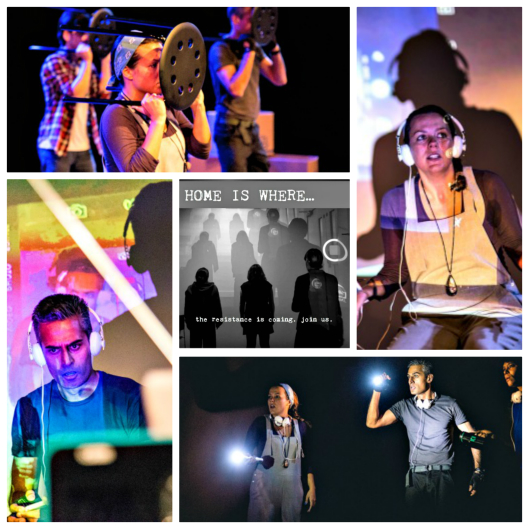
This was nearly a decade ago, when I was just beginning to process my dual identity. I hadn’t yet embraced the concept of the Third Culture Kid, or TCK, as I wasn’t able to identify any real-life TCKs beyond myself and my sisters—and we’re not a perfect fit for the academic definition. I was still looking for the right word for who I was, when my confusion finally led me to the community of TCKs and CCKs (Cross-Cultural Kids). I’ve found a remarkable sense of kinship with people who have lived in those same liminal spaces. We recognize that shared emotional geography, even if we’ve never set foot on the same patches of earth. Since moving to London I’ve really embraced being part of the TCK/CCK community—and theater has been a big part of that, with the development of my own performance lab and a new piece, Home Is Where.

“You know where a lot of my family lives? England!”

I understand you’ve been in London for just over three years. What led to your decision to move eight time zones away from where your immediate family lives?
The decision to move came like a bolt of lightning at the end of Directors Lab West—a one-week intensive workshop I attended in 2012. The experience inspired and challenged me and got me thinking about my career. I have a habit of making major decisions through powerful gut instinct (and then rationalizing them at length afterwards, as I did in this blog post). Besides, I have grandparents, aunts, uncles and cousins in this part of the world.

Since making the move, have you ever gotten “itchy feet”?
I don’t think I get “itchy feet”. Unlike many of my fellow TCKs, I didn’t grow up with high mobility. I never developed that internal clock telling me it’s time to move on again. But still, I often wonder what my life would be like somewhere else in the world, what friends I haven’t met because I’m still here, what opportunities I’m missing out on, what other languages I might know if I hadn’t settled in English-speaking places all my life… But I also want roots.

Is London “home”?
London could be home. I accept I will never be as English as a person who grew up in England, but at least my accent doesn’t stick out here because everyone sounds different. It’s a great base for visiting and working in other European cities… I can see myself staying.

“Directing collaboratively is ‘upholding something with an open hand.’”

Tell me about Home Is Where. What led you to create this particular theater piece?
Whereas Hyphenated was motivated by finding my personal sense of self and cultural identity, Home Is Where is about trying to find a sense of belonging in the context of a global community. It’s also about reaching out to non-TCKs who are curious about these people who move around and get their cultures all mixed up.

I understand the creative process for Home Is Where has involved extensive collaboration?
The process started with identifying fellow TCK and CCK collaborators, and interviewing dozens of people about their cross-cultural experiences. Both the cast and the creative team have contributed ideas for the story, characters, and performance style. Collaboration on this scale is a challenging way to work—but it’s also exhilarating, and creates something unique to this group of people. All twelve of us bring our own cultural identities and diverse artistic backgrounds to the performance, be it music, movement, multimedia, or other styles of theater. The actors weave together their own international experiences with verbatim interviews from fellow cultural hybrids.

It sounds exciting but also a little daunting.
It’s the largest team I’ve ever led, and also the most technically ambitious project I’ve ever attempted. We’re using a technique called headphone verbatim: the actors are listening to the audio recordings of the interviews on stage, and repeating exactly what they hear. That way, the audience can hear exactly what TCKs told us in their interviews. We’re also extending our storytelling outside of the theater. Clips from all our interviews are available on our Online Oral History Library.

What are your hopes and plans for Home Is Where?
We’re still developing the play, finding the best structure to showcase the TCK stories we’ve gathered. At the start of last month we presented a work-in-progress performance in a space in London’s East End; it was set in a futuristic anti-immigration dystopia, inspired by the Brexit vote here in the UK. In an earlier version, we set the interviews in a fictional TCK Embassy—riffing off the idea of the Global Citizen. Right now, we’re in a new script development phase. Hopefully early next year we’ll be back in rehearsal to create the next version of the piece. Ultimately, we’re aiming for a full production in London and then touring around the UK (and maybe even further afield—stay tuned!).

scenes-from-home-is-where

“Five Helens look into a mirror, asking: ‘Is this the face that launched a thousand ships?’”

Are you working on anything else?
I’ve been working on a project about Helen of Troy since 2010, when I started writing with my friend Megan Cohen, a brilliant playwright based in San Francisco. The Helen Project consists of fragments of monologue exploring the myth, icon, and real life of Helen of Troy. We’ve produced a few different “editions” with five actors in both San Francisco and London. I’m currently reshaping it into a solo show, with the idea of directing an immersive performance installation version at some point…

The story of Helen of Troy sounds a far cry removed from the TCK scene.
You know, about two years after we started writing it, I realized it’s also a TCK story. At the end of the Trojan War, our Helen says:

I came home to Sparta. Sparta, where you call me Helen of Troy. In Troy, they called me Helen of Sparta. Or just “the Greek woman”. No one will own me. I don’t belong anywhere.

the-helen-project-2

* * *

Thank you so much, Amy!

Readers, please leave questions or comments for Amy below. You can follow her progress on her Performance Lab site, Facebook and Twitter, where she uses two handles: @AmyClareTasker and @wearehyphenated. Interested in Home Is Where? Read more about it here, and don’t forget you can listen to the TCK interviews at the Online Oral History Library.

Editor’s note: The subheds were taken from Amy Clare Tasker’s blog posts. 

Born in Nicosia, Cyprus, to Lebanese parents, Dounia Bertuccelli has lived in France, UK, Australia, Philippines, Mexico, and the USA—but never in Lebanon. She writes about her experiences growing up as a TCK and adjusting as an adult TCK on her blog Next Stop, which is a collection of prose, poetry and photography. She also serves as the managing editor of The Black Expat; Expat Resource Manager for Global Living Magazine; co-host of the monthly twitter chat #TCKchat; and TCKchat columnist for Among Worlds magazine. Currently based on the East Coast of the United States, she is happily married to a fellow TCK who shares her love for travel, music and good food. To learn more about Dounia, please read her interview with former TCK Talent columnist Lisa Liang. You can also follow her on Twitter.

STAY TUNED for next week’s fab posts!

If you enjoyed this post, we invite you to register for the biweekly Displaced Dispatch, a round up of posts from The Displaced Nation—and so much more! Register for The Displaced Dispatch by clicking here!

Related posts:

Photo credits: Top visual: (top row) London Bridge, Golden Gate Bridge and tragedy/comedy photos are from Pixabay; and photo of Amy Clare Tasker (supplied). Middle visual: Scenes from Home Is Where and flyer for September performance (supplied). Bottom visual: Bust of Helen of Troy by Antonio Canova at Victoria and Albert Museum, uploaded to Wikimedia Commons by Yair Haklai (CC BY-SA 3.0); and scene from The Helen Project (supplied).

DIARY OF AN EXPAT WRITER: Taking time off to look backwards on how far I’ve come…and forwards to the next goals

Diary of an Expat Writer
It’s been a while since we’ve heard from American expat in Hong Kong and aspiring writer Shannon Young. She actually gave herself a break this summer—and as soon as she came back at it, pieces started falling into place…

Dear Displaced Diary,

Did you have a nice summer? Mine was a great mix of family time and travel. Highlights included hanging out with my adorable nephew in Arizona, visiting my grandparents in Oregon, catching up with old friends in New York City, and riding a moped around Bermuda with my husband.

After the intensive work of the previous six months, it was a much-needed chance to clear my head and remember how to be a human being again.

As I shared at the start of the year, I needed to kick into high gear in the first part of 2016 or else start searching for a new day job.

As a consequence, I barely looked up from my computer for six months, during which I wrote and launched the first two books in my new YA Steel of Fire fantasy series, within six weeks of each other.

After the intensity of the winter and spring, the summer break gave me a chance to step back and take stock of how far I’ve come along the journey into a writing career.

From travel writer…to fantasy author

I started my career writing about Hong Kong. I envisioned myself as a travel writer because that seemed like the natural path for an American girl abroad. But the more I’ve written, the more it has become clear that my interests and skills are better suited for fantasy and science fiction. Those early projects were important practice for the kind of work I’m doing now.

It’s common for writers to draw inspiration from the world around them even if they’re not travel writers. I’m sure you expats know what I’m talking about. You encounter a natural wonder or a style of clothing or a cadence of speech. It works its way into your brain, whether you write it down in that moment or not. Eventually it comes back. It may not be in the same form. You change it to align with the needs of your story world, or you remember it a bit differently than it was in reality. In fiction, you get to write from the inspiration rather than describing exactly what you saw—and that’s what makes it so much fun.

Living abroad has helped me to write fantasy because I get to see so many different places and meet people from all over the world, even if none of them wield magic or ride dragons (so far). It has also helped me look at the place I came from with fresh eyes.

MAGICAL HONG KONG: Inspiration for fantasy writing?

MAGICAL HONG KONG: Inspiration for Shannon’s swashbuckling fantasies?

From teacher in Arizona…to writer in Hong Kong

While I was in the States, I took a few days to finish the second draft of Dance of Steel, which will be the third book in my five-book Steel and Fire series. I completed the draft on my 28th birthday in my favorite coffee shop in my hometown, Gilbert, Arizona. I used to spend hours grading essays at that very coffee shop during my first year as a teacher.

At the time I was applying for jobs in Hong Kong, both at schools and with publishers, and it hadn’t even occurred to me to try writing books.

It was fun to mark my progress in a place where I could see how far I’d traveled, both physically and in my career as a writer.

MARK OF PROGRESS: From the coffee shops of Arizona to the Starbucks of Hong Kong

MARK OF PROGRESS: No longer grading papers in an Arizona coffee shop, Shannon is drafting fantasy novels in a Starbucks in Hong Kong.

From vacation mode…back to the grind

I’m writing a five-book series, so I’m always thinking about where my story is going. A long project requires stamina and a steady course, but sometimes moving out of your usual routine can help to get the creative juices flowing again. Having already planned to finish the final draft of Dance of Steel upon my return to Hong Kong after a month off, I was already thinking about what would happen in the next book.

My husband and I took a meandering road trip through Oregon and California before catching our flight to New York. Whenever it was my turn to drive, I’d pass the time on the road thinking through what would happen in the fourth book. I’d write notes in the evenings, but it was helpful to let the story unfold like a movie as I drove. It made me appreciate how much writing you can do when you’re not actually writing. You have to let those ideas develop and see if they really have legs. (Not to worry, I didn’t crash into anything!)

Once we were back in Hong Kong, I hit the ground running to make my editor deadline for the final draft of Dance of Steel. After a month away from the computer, I spent about 100 hours at Starbucks over the course of 12 days.

Hong Kong cooperated by being furiously rainy and dreary for all 12 days.

At 136,145 words, Dance of Steel has ended up being my longest book by 40,000 words.

It was a great way to get back into my routine—and it warned me to budget more time for each draft now that my books are getting longer. Finishing a book is a always a marathon, but I need to continue to work on my pacing.

From aspiring…to official full-time author!

The good news is, six years after I left Arizona, I’m officially making a living as a writer(!!). The month of May was the tipping point, when I published the second book in my Steel and Fire series, Duel of Fire, and my sales began to take off. This series has done exponentially better than my previous (Seabound) fantasy series.

Dance of Steel is the sixth novel I have published under my Jordan Rivet pen name. In the four months since, I’ve met or exceeded my previous day-job income.

And one more exciting piece of news: I signed with a literary agent to represent the auxiliary rights to the series and have now secured a three-book audio deal!

I will have to keep working hard and publishing often to maintain this momentum, but for now, it’s an exciting milestone to celebrate.

steel-and-fire-series_sept-2016

Onwards and upwards…

It’s good to be back at work after the time off. I’m now 80,000 words into the fourth book in the series (not counting thousands of words of notes).

My goal is to finish in time for a Christmas or New Year launch. I’m also working on getting out to writing and social events more often and establishing a sustainable working pace that allows me to put out a book every three or four months.

I’m in this for the long haul now. I want to keep learning, stay excited about the process, and make each book better than the last one:

Thank you, my dear Displaced Diary, for all your help and encouragement along the way!

Yours,

Shannon Young
AKA Jordan Rivet
www.shannonyoungwriter.com
www.jordanrivet.com

* * *

Shannon, I was watching an interview with the playwright Edward Albee, aired to commemorate his death earlier in the month, and he said that whenever he was writing a play, he would “see and hear” the characters in his mind and wait for them to tell him where his story was going. Your road-trip method sounds a little like his! Thanks once again for sharing your latest news. It’s uplifting! ~ML

STAY TUNED for next week’s fab posts!

If you enjoyed this post, we invite you to register for The Displaced Dispatch, a round up of weekly posts from The Displaced Nation and soooooo much more. Register for The Displaced Dispatch by clicking here!

Related posts:

REVERSE CULTURE SHOCK TOOLBOX: To cope with the transition back to your native land, consider vlogging!

reverse-culture-shock-morgan
Transitions enthusiast H.E. Rybol consults with recent repat Morgan Carver Richards about the best tools for fixing a bad case of reverse culture shock syndrome.

Hello, Displaced Nationers! I wonder if you’ve already had the pleasure of encountering the videos made by YouTuber Morgan Carver Richards? If not, you’ve been missing out…

Morgan spent four years in Dubai because of her husband’s flying career and returned to her native United States in January of this year. She has been posting hilarious videos on YouTube as a way of coping with the effects of reverse culture shock.

Here are some of my favorite sound bites from the series:

“Why are there so many cereals?!”

“This doctor bill is like 750 dollars! All she did was look at my leg and give me some Ibuprofen!”

“Kids, they don’t have bus nannies here. You’re on your own out there.”

“No, you cannot walk to the grocery store by yourself. This is not Dubai. Do you want Mommy to go to jail?”

“There are signs outside the primary school saying you can’t take your guns inside. There is NO WAY I’m the only person who finds that odd!”

Originally from South Carolina, Morgan had her own career as a flight attendant for several years. That was before the “lavish Vegas wedding of the shotgun variety” that took her to Dubai and the children that followed. Her career in the airlines industry, combined with her perpetual stir-craziness (hello, itchy feet!), has inspired several books:

morgan-carver-richards-books
Something all of Morgan’s works have in common, including her repatriation videos, is that she likes to make people laugh. Why don’t you see for yourself by checking out Morgan’s very first repat video, “Gardeners, Maids, Savages”:

Despite her skill with the video camera, Morgan claims to be somewhat behind the curve when it comes to adapting to new technologies. But she has no regrets because she thinks that growing up with social media would have made her early life less fulfilling.

Food for thought…

And now let’s find out what Morgan has packed in her reverse culture shock toolbox…

* * *

Hi, Morgan, and welcome to Culture Shock Toolbox—or in your case, REVERSE Culture Shock Toolbox. Where on our beautiful planet have you lived?

I spent four years in the United Arab Emirates and 27 years in the United States where I lived in Phoenix, Arizona; Rock Hill, South Carolina; and Nashville, Tennessee.

Any memorable cultural transition stories? Did you ever put your foot in your mouth?

I have put my foot in my mouth several times, mostly when in the United States. I feel I wrongly assume too often that other people have the same knowledge base on the United Arab Emirates as I have. It easily makes the conversation go from friendly to savage.

How did you handle that situation?

I’m actively working on handling these situations in a more tolerable manner. I’m slowly but surely learning to keep my conversations to a happy medium instead of overreacting. I am still developing the tools to convey my experiences in a way that helps people understand cultural differences and discern reality from what is reported on Fox News (sorry, Fox News, you’re savage).

Can my fellow Americans discern reality from what is reported on Fox News?

“Why can’t my fellow Americans discern reality from what is reported on Fox News?” Morgan Carver Richards grapples with reverse culture shock.

Can you think of any culture shock situations, reverse or otherwise, you’ve handled with finesse?

I handled the relocation to Dubai from the US with surprising finesse compared with my move back to the US, which has had a finesse level of 0%. I think it was easier moving to the UAE because I went in knowing that I would have to learn a new culture and system. Returning to the US I wrongly assumed I would be accustomed to the culture because it’s my home country.

You illustrate some of your reverse culture shock moments in your hilarious YouTube videos. I gather the transition has been rough?

Yes, reverse culture shock has been powerful for me. I know other people repatriate more smoothly, but it wasn’t the case for me. The biggest source of counter culture shock I struggle with still is the less personal approach to daily interactions and the focus on privacy instead of the strong community feel and strong communication aspect that were a part of life in Dubai.

What has helped you deal with reverse culture shock?

Publishing my repatriation videos has led to an outpouring of support, positive feedback, laughter and understanding from other repatriates. I now see that, although each person has their own unique repatriation story, I am not alone with a lot of the feelings and experiences I’ve been having. I cannot stress how incredibly helpful and amazing that experience has been for me.

Did you hear that, expats? Make sure you include an iPhone or video camera in your toolbox. It may come in handy once you have to go home.

vlogging-the-answer

Finally, because some of our readers are still expats, can I ask: are there any tools you found particularly helpful in adjusting to life in the UAE?

My best advice is to take your time and check it out before you move. Don’t go into it with a bad attitude or else your experiences will reflect that attitude. Develop a few strong relationships early in the transition. My few strong relationships were what held me together in my new environment when I had a rough time or a bad day.

Thank you so much, Morgan! Building a new community is essential for handling cultural transitions, which may be why repatriation is so hard—it’s a lonely experience. But vlogging sounds like an excellent way of connecting with others who are going through something similar. We constantly need to remind ourselves: we’re all in this together.

* * *

So, Displaced Nationers, do you have any of your own repat stories to share?

To keep in touch with Morgan, I suggest you subscribe to her YouTube channel, check out her author site, like her Facebook page, and/or follow her on Twitter.

Well, I hope this has you “fixed” until next month.

Until then, cheers! Prost! Santé!

H.E. Rybol is a TCK and the author of Culture Shock: A Practical Guide and Culture Shock Toolbox and Reverse Culture Shock. She loves animals, piano, yoga and being outdoors. You can find her on Twitter, Linkedin, Goodreads, and her author site.  

STAY TUNED for next week’s fab posts.

If you enjoyed this post, we invite you to register for The Displaced Dispatch, a round up of weekly posts from The Displaced Nation—and much, much more! Register for The Displaced Dispatch by clicking here!

Related posts:

Photo credits: All photos are from Pixabay.