The Displaced Nation

A home for international creatives

Tag Archives: Repatriation

EMERALD CITY TO “KANSAS”: Amy Rogerson on seeing the Wizard of Expat Life and returning home (for just six months)

Amy Rogerson wrapping up warm in the UK at Christmas (her own photo); the Ruby Slippers (CC); corn path (Morguefiles).

Amy Rogerson wrapping up warm in the UK at Christmas (her own photo); the Ruby Slippers (CC); corn path (Morguefiles).

Welcome to “Emerald City to ‘Kansas,'” a series in which we focus on expatriate-into-repatriate stories. This month our subject is Amy Rogerson, an Englishwoman who blogs at The Tide That Left about trailing her husband (aka “Mr Tide”), at breathless pace, all around the globe. The couple now live in Dar es Salaam in Tanzania, but in the past four years have also made homes in South Africa, Angola, Qatar, Russia, and Libya. As we catch up with Amy, she is back to the UK (as of April 7th) for a six-month stay. What is it like going “home” again after such a life of adventure? Without further ado, let’s dig into a slice of Amy’s “back to Kansas” story.

—ML Awanohara

To Oz? To Oz!

I didn’t really choose expat life. Rather, it chose me when I fell head over heels in love with a nomadic man. I met my husband five years ago in his final weeks in the UK before he moved to Libya. We continued our relationship long distance for a year, but eventually knew that one of us had to move. I was in a job that made me miserable, whilst he was welcoming new opportunities at work, so it seemed for the best that I move to Benghazi to be with him.

Lions and tigers and bears, oh my!

Moving to Libya was so far beyond my comfort zone that I shocked both myself and those who loved me most. All I knew is that I wanted to be with the man I loved. I never expected my life to become that of a serial expat. As well as living in Libya, we’ve also lived in Russia, Qatar, Angola, South Africa and Tanzania together. In fact, my home is still in Tanzania; repatriation to the UK is just a temporary move for a project I am working on, and I fully intend to return to Dar es Salaam and my wonderful husband in just under six months from now.

We’ve been gone such a long time…

I’m surprised at how much I’ve grown to love my new lifestyle. I’d never wanted to travel or live abroad before I met my husband, but now I struggle with the idea of ever “going back to Kansas” permanently (not that I don’t think I will one day!). I’ve discovered that life can be different from what I was brought up to believe. If choosing the expat life has meant I’ve had to say goodbye to any dreams I had of the picket fence, the family home, the stable job—that isn’t going to happen, at least not for a while—it isn’t necessarily a bad thing.

What have you learned, Dorothy?

Living in six countries in four years, I’ve learned to adapt to change. Nothing stays the same, and I’ve had to be flexible. That flexibility doesn’t just apply to where we live and work, or what our holiday plans are. I’ve also had to learn that there is not just one way of doing something, especially once I started working for a South American company in the Middle East and now in Africa. I’ve had no choice but to get my head round different ways of doing things that I used to believe we do best “at home”. As a Brit working with people from different parts of the world, I’ve often felt as though my colleagues and I weren’t talking the same language when it came to business practices and relationships. But I’ve come to see that instead of believing the British way is right, it helps if I can open my mind to other approaches, some of which may work if you’re willing to give them a try. With time I’ve been able to overcome the differences and pick up skills that will no doubt help me in future.

No place like home?!

Repatriation is bitter-sweet for me. I didn’t really want to return to the UK right now, but circumstances have dictated otherwise. Having been gone from the UK for four years I’m really struggling with settling back in. Much of what I knew before now seems unfamiliar. My time abroad has coloured my behaviour and expectations. In a sense, I’m having to relearn some of that most basic stuff that I found so hard to let go of when I became an expat.

Oh dear! I keep forgetting I’m not in Kansas!

I once thought huge shopping centres where I could buy everything I needed in one go were the perfect solution to hectic British life. Now I find myself shying away from the crowds of people, the flashy goods, and the elevated prices for things with a short shelf life. During my life abroad, I often missed the choices that were available to me in the UK, be it in the supermarket, on the high street, even on the television, but now I just feel overwhelmed and a tad spoilt by all the options. In adapting to new ways of living and thinking abroad, I no longer completely fit in the country I was born and raised in. Perhaps I need to look at this six-month repatriation like a new expat assignment and approach it like I would any other move. I need to be open to adapting. I need to forgive myself for not “feeling at home” immediately when I wouldn’t ask that of myself anywhere else. I’m incredibly lucky to have so many wonderful connections here in the UK. I expect it won’t be long before I feel more settled at home than I do after a few weeks. One thing I do know: the call of expat life hasn’t quietened yet.

* * *

Thank you, Amy, for such an honest, heart-felt account about what it feels like to go home again, if only for half a year. It’s interesting that you’re now having to apply the adaptability you learned from expat life to feeling more at home in your native UK. Readers, can you relate to what Amy says?

STAY TUNED for tomorrow’s fab post!

If you enjoyed this post, we invite you to register for The Displaced Dispatch, a round up of weekly posts from The Displaced Nation, with seasonal recipes, book giveaways and other extras. Register for The Displaced Dispatch by clicking here!

Related posts:

Up, up and away: The Displaced Nation turns three today (no foolin’!)

TDN Birthday CardWal-lah! The Displaced Nation is turning three today. Yes, our birthday is April 1st—no foolin’!

To celebrate, we would like to invite you to a virtual “hot air balloon” party.

Yes, a hot air balloon party—no foolin’ on that score either, though you could have fooled me as I had never heard of such a party until a day or so ago. Back in my day, when I still celebrated birthdays, ordinary balloons would suffice. As Winnie the Pooh once put it:

Nobody can be uncheered with a balloon.

But surely they can be even less uncheered with a hot air balloon—or so I’ve come to be persuaded.

What’s more, I’ve come to realize that hot air ballooning represents most of what we’ve been up to on this site over the past three years. Here are the three observations that led to this considerable epiphany:

1) We are full of hot air.

I won’t point the finger at anyone in particular. We are all guilty. But if I had to start somewhere it might be with:

2) But we’ve steadfastly adhered to our goal of putting air under the wings of international travelers and residents.

Just because we’re full of hot air, doesn’t mean everyone else has to be. Tellingly, our most inspirational posts tend to be by our current crop of columnists. They produce monthly tales of international residents who’ve used their time creatively. Who can fail to feel uplifted when reading about individuals like:

And these are just from the past month! Thank you, JJ Marsh, James King, Lisa Liang, Joanna Masters-Magg and Meagan Adele Lopez (her column comes up tomorrow!) for the critical part all of you have played in keeping us afloat.

On this note, Kate Allison deserves special mention for keeping us entertained with her serial expat novel, Libby’s Life, for the entire length of this voyage. She recently posted its 90th episode! The thought of writing that much fiction online is enough to puncture anyone’s balloon, but not Kate’s!

3) We go wherever the wind takes us.

As regular readers will realize by now, we don’t really steer the balloon, because, well, we can’t. And to be honest, we never had any particular destination in mind. We started out with monthly “themes” of global residency and travel, in hopes we would one day land in an island full of great wealth and fantastic inventions, the kind of place where our themes could become memes. Everyone there would say, how right you are, we international travelers are all writing our own versions of the Alice in Wonderland story! Let’s have a Mad Hatter’s Tea Party to celebrate. As a matter of fact, let’s turn it into an island-wide holiday!

As it turns out, however, we have yet to share the fate of retired schoolteacher Professor William Waterman Sherman. We have not yet found (or founded?) the utopian displaced community of our dreams. Thus, on our second anniversary, we rebranded ourselves as something a little tamer: a “site for international creatives”: fiction and nonfiction writers, artists, entrepreneurs, and activists.

But we kept two categories that pay tribute to our original concept: Pot Luck and Just for Laughs. And to this day, we enjoy lurching towards the odd (you can say that again!) thematic post. We just can’t help ourselves! As most regular readers know, we still give out monthly “Alices” to those with a special handle on the curious and unreal aspects of life as a global resident or voyager. And, just last month, we embraced a new heroine for the repatriate challenge many of us have faced: Dorothy Gale from the Wizard of Oz!

Is it any wonder we are throwing a Hot Air Balloon Party?

* * *

I’ve just now heard that the band has arrived. They’re called The Fifth Dimension—what could be more appropriate for take-off?! Up, up and away!

Hey, even if you’re not a balloonatic yet, we guarantee that this is the most fun you’ll ever have in a wicker basket. (And perhaps the most fear…)

Before leaving, let’s all raise our glasses. Here’s to another good year aboard the Displaced Nation Thermal Airship! Three cheers! Hip, hip, hooray!

Readers, if you have any posts that you particularly enjoyed in the past three years, please let us know in the comments. We can see if we can produce more of the same (depending on which way the wind blows, of course).

STAY TUNED for tomorrow’s fab post from The Lady Who Writes.

If you enjoyed this post, we invite you to register for The Displaced Dispatch, a round up of weekly posts from The Displaced Nation, with seasonal recipes, book giveaways and other extras. Register for The Displaced Dispatch by clicking here!

Related posts:

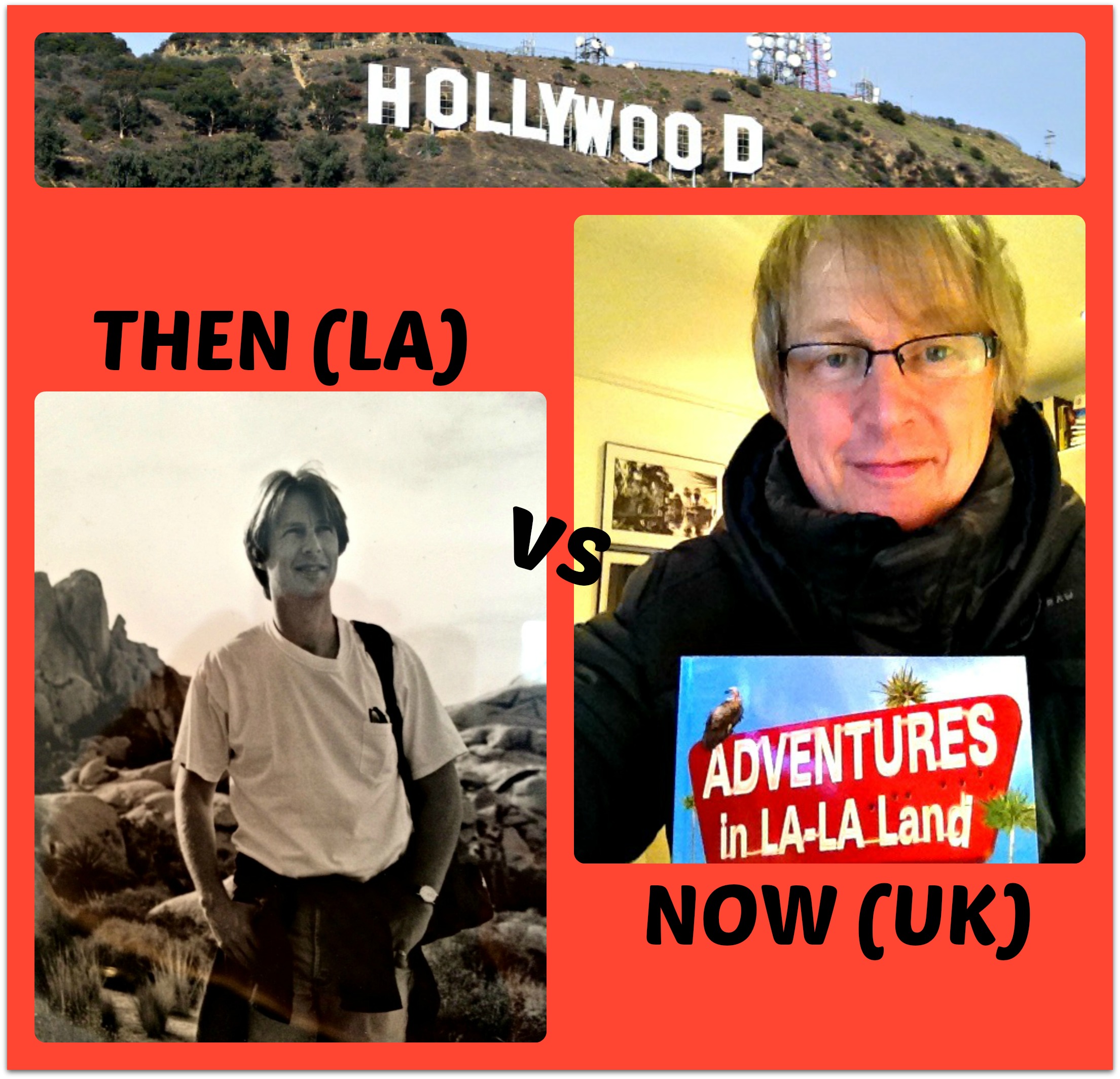
Does an expat life in Los Angeles ever go according to script? Read Tim John’s memoir to find out…

Tim John Hollywood CollageFor many of us, the calling to the expat life is not really a calling at all, but more of a vague (albeit rather deep-seated) need to escape our surroundings in search of adventure. We have no idea of what we’re looking for until we’ve arrived at a place and put down roots. Even then, we still have the mentality of drifters, and it take us a while to access our muses.

My guest today, the screenwriter Tim John, does not belong in that mould, as soon becomes clear from the first few pages of his new book, Adventures in LA-LA Land, an account of the seven years he spent in Los Angeles with his wife, Jenny, and their two young daughters.

You see, Tim plunged into his particular expat adventure with the script already written, both literally (he had a project in the works) and figuratively. Heading for Hollywood was Plan B after he lost his job with a London advertising agency during the recession of the early 1990s, and started dabbling in screenwriting.

The late Christopher Hitchens, another English writer who chose to be based in the United States, once described LA as a city “mostly full of nonsense and delusion and egomania.” But in the script Tim had written for himself and family, it was LA-LA Land—a place where they could have it all, great climate, a house with swimming pool, and (hopefully) big money.

So did Hollywood feed Tim’s creative muses (and fill his coffers) in the manner he expected? You’ll have to read the book to find out. I read it, and found myself surprisingly moved by the story of a man who lives for the movies. In fact, the pace can be likened to that of a roller coaster ride—fun but also harrowing at times.

On that note, it’s time to welcome Tim to the Displaced Nation to talk about his book. And just a heads up: Tim will be “screening” the comments for the person who leaves the best pitch for why they’d like to read it. That lucky individual will be under contract for a free digital copy!!!

* * *

AdventuresinLALALand_coverHi, Tim, and welcome to the Displaced Nation. Can you tell me why you decided to write a memoir about your years in Hollywood?
I’d read so many books about how to write a Hollywood screenplay, but never found one that also told you what it was like living there, so I decided to write my own, based on the seven years I lived there with my wife and two daughters.

Have you thought about turning it into an actual script for a movie?
I would love to turn it into a screenplay, too.

I understand you lived in LA from 1991 to 1998. I’m curious why you produced the book so long after the fact?
I’m not really sure why I waited so long to write it, possibly because I’ve been doing more and more teaching over the last couple of years and I’m often aware that students often don’t get taught important skills that are crucial to being successful as a screenwriter, such as being able to pitch and how to balance writing life with social life and family life. I thought that relating my experiences could be useful for others. If nothing else, they could learn from my mistakes as well as my successes!

In the end, the movie (of my life) was about…

Has your perspective on the experience deepened with time?
I suppose gaining some distance in time and geographically helped me to see Hollywood from a more objective perspective.

What impact did your writing about the experience have on you?
Definitely part of it was cathartic, to process the bizarre experience.

You worked in advertising for a while. When exactly did you catch the movie-making bug?
I worked a copywriter and then as a creative director—both of which are extremely useful if you want to go into film as they teach you so much about writing for a particular audience and how to write pithy dialogue and how to edit, etc. I always loved film mainly because it was such a great escape. As a kid, The Jungle Book was a big favorite. Mutiny on the Bounty and Lawrence of Arabia got me pretty scared, as did that spider in Doctor No!

Yes, I recall your mentioning in the book your fear of spiders when you found yourself face to face with a black widow at your house in LA. I’m still shuddering at the thought of being bitten by a brown recluse, by the way!

Was there a single epiphanic moment?

Your book is chockerblock with what we like to refer to on this site as “displaced moments” as a result of your encounters with not just deadly spiders but also shrieking peacocks, rats, snakes, and even some neighbors who believed in extraterrestrial burglars—and that’s before we get to the highly venomous creatures who populate the Hollywood film industry. Does any one moment stand out as your most displaced?
Wow. There were many moments when I thought “What on Earth am I doing in this bizarre place?” One that sticks out in my professional life was that time I went to pitch to Disney and the exec said “Great to meet you guys, we’re looking for some comedy writers” and I self-effacingly said: “Then you should meet these guys I play tennis with—they’re hilarious.” None of the execs could see I was joking and at the end of the meeting, the development girl took me aside, discreetly handed me a business card and said: “If you continue to have self-esteem issues, see my shrinkshe’s fabulous!”

That makes me think of Johnny Carson’s line: “In Hollywood if you don’t have a shrink, people think you’re crazy.” And I think the Northridge earthquake of 1994 displaced you and your family rather literally.
Yes, the whole house rattled and creaked for over forty seconds and there were waves in the pool.

Ah, the pool… You also talk about how much you loved the weather, having a pool, and taking drives to some fabulous scenery. Can you pinpoint your LEAST displaced moment, when you felt you were born to be in LA-LA Land rather than your native UK?
There were so many great moments. Personally, living in that sunshine, with a pool, a hot tub, etc., along with plenty of money and also plenty of free time (even though you’re constantly thinking of ideas to pitch), seems like a dream for anyone who’s come from the UK climate and ever struggled to make ends meet. It’s like living in a vacationuntil you realize it will all collapse if you don’t sell your next idea, and you’re going to have to sell it far sooner than you expected because the cost of living is very high, especially when you factor in things you’d never had to pay for before, such as earthquake insurance. Never forget that “writer” is only one letter away from “waiter”.

Professionally, when you get to chat with famous stars and talented directors and they take your comments seriouslythat feels unreal but also great. Probably the greatest moment for me was just before I moved to LA, being able to go to the tenth birthday party for George Harrison’s film company, HandMade Films. For anyone English, I think having a chat with a Beatle tops it all.

What did you and George chat about?
I’d worked on two screenplays for his company, so we talked about that. The funniest thing, I thought, at the company’s birthday party, was when George and Ringo joined the band playing on stage. If anyone requested they perform a Beatles’ song, George said: “I don’t know that one.”

In the end, the film was about spirit…

I understand you found LA a culture shock.
Wow, there are so many things that are culturally different about living in the UK and living in America, especially in Hollywood, which many Americans find totally unreal, too. Ones that really stand out: the almost constant sunshine for a start. The smog levels on bad days. The way so many Americans are so welcoming, where so many Brits can be snooty and suspicious. The way so many Americans are optimistic and so many Brits are pessimistic (or maybe more realistic than many film people). I never forgot that Hollywood has been described as “the only town where you can die of encouragement.”

I know you decided to leave LA in part because of your mother’s health and in part because of your daughters’ education. The family, particularly your daughters, didn’t want to go. What were the biggest adjustments?
Tiny parking spaces, terrible weather, high cost of living but a wonderful sense of humor. I did miss my irony in LA. We also hadn’t realized quite how much UK house prices had rocketed during the period when we’d sold ours to live abroad!

What do you think were the chief benefits you and your family derived from being Los Angelenos for a time?
I’m sure that our seven years in LA and coming home taught us all to adapt to change. My elder daughter had enjoyed an ice skating career in the US, which didn’t continue in the UK. But at least she learned that if you set goals and envision yourself achieving those goals, it will seriously boost your chances of success. The rest of us learned that you can probably have all the things you’d like in life—you just can’t have them all at the same time!

Looking back, what was your single most professional achievement during your time in LA?
Not one single thing; rather, it was learning the craft and how to work with industry people sufficiently well to be able get regular work from the studios (but not all the time!).

How do you make a living these days?
Right now, I’m rushing out to give six hours worth of lectures on dialogue to students at Bournemouth University. I also teach on and off about creative writing in general and about writing for advertising, at various universities: Bournemouth Uni, where I teach part of the MA in Advertising, at Southampton Solent, where I do some spots on Advertising and some on Screenwriting, to students at all levels, and at the Arts University in Poole, where I teach adult classes in all sorts of writing. But teaching is just part-time. I also do some freelance copywriting. And most of my time goes into writing screenplays still!

Do you still feel like a Los Angeleno in some respects?
Only in that I have several great friends in LA and I feel totally at home with film industry people. I probably see myself as neither totally British any more or completely Californian. I’m obviously some sort of mongrel.

Writing for publication: A different animal?

Moving back to the book: what was the most difficult part of the writing process?
The hardest part was the guilt I occasionally feel for what I see as building up all the family’s hopes by showing them a few years of a dream lifestyle, then waking them up from that dream by saying we have to go back to the harsh reality of living back in the UK. BUT, as mentioned, the family all feel really lucky to have had those seven great years and have made all those extra friends without staying away from their old friends and family for so long they felt like strangers. (That’s what they tell me anyway. I have an extremely supportive family!)

Why did you decide to self-publish?
Because I’d had two books published by a big publisher many years ago and never felt they did much to promote them. My agent said most publishers only push big brand names and my wife had a friend who did very well self-publishing a memoir, so I thought I’d give it a go.

What audience did you have in mind for the book, and has it been reaching those people? Is it mainly for wannabe British scriptwriters like yourself, or do you think it has broader appeal—for instance, to any Brit who might be thinking of living in America?
I hope the book will appeal to anyone who likes a laugh, to anyone who is interested in a family fish-out-of-water story and to anyone who wonders how you can make it in the film business. There’s plenty in there about the American school my wife taught in, the ones the kids went to, about my eldest daughter making it as an ice-skating champion… It’s by no means just about the movies, but, as I mentioned earlier, it will show you far more about how to make it as a screenwriter than books that simply tell you about the script, the formats, and nothing else.

Of all the advice you transmit to wannabe Hollywood screenwriters, which is the most important?
Make sure you enjoy the writing process as much as possible. Don’t pin everything on whether you sell it or it gets made. Enjoy the small triumphs, such as writing a great scene or even a great line of dialogue. All the little triumphs can add up into a pretty rewarding experience. And never forget that you may well learn more from your mistakes than from your successes.

What’s next for you in terms of creative projects?
I’ve just finished a UK thriller “Living in Sin”; I’m currently doing a re-write for a sci-fi project for a Californian director, and I have a UK drama that I wrote written with a writing partner, Jon Rolls, for which the producers have just this week started looking for a top director and cast—I’m still going for it!

10 Questions for Tim John

Finally, I’d like to ask a series of questions that I’ve asked some of our other featured authors, about your reading and writing—and in your case, also film-watching—habits:
1. Last truly great book you read / film you watched: Paper Towns, by John Green; The Way Way Back (2013), directed by Nat Faxon and Jim Rash.
2. Favorite literary / film genre: It varies enormously but I’d say “comedy drama” for both (eg, Little Miss Sunshine).
3. Reading/film watching habits on a plane: I only ever read paper books and magazines. Generally I watch films on long flights—but nothing involving flights in danger. I’m a nervous flyer. I can never sleep.
4. The one book you’d require President Obama to read, or film you’d require him to watch, and why: War and Peace, so he’s fully aware what Russians can do if stirred up. No films to recommend—I’d rather he kept his eye on world news!
5. Favorite books/films as a child: The Secret Garden; The Jungle Book and Bond movies and then Paper Moon when I was slightly older. Also the musical Oliver.
6. Favorite hero/heroine in fiction/film: Heroines: Victoria Wood as a writer; Kathy Bates as an actress. Heroes: No book heroes apart from Bilbo Baggins (when I was ten); in film, the cheeky little boy in Cinema Paradiso and later Léon in the film of that name.
7. The writer, alive or dead, you’d most like to meet: Woody Allen, as I’m nearly always amazed at how inventive he can be and how, against the odds, he so frequently gets cross-genre movies to work, certainly during his Crimes and Misdemeanors period.
8. Your reading/film-watching habits: I don’t read that many books as I find it hard to give authors the benefit of 50 or 60 pages to get into it. I far prefer books that grab me almost immediately, but with their style and outlook on life, not with purely mechanical plot like Dan Brown or John Grisham. I find those stories generally too thin to keep reading. I frequently start books and leave them if they don’t hold my interest. As far as films go, I go to the cinema at least once a week. I also watch endless boxed sets: generally US drama such as Breaking Bad, The Sopranos, The Wire, House… I really got into The Bridge and Spiral. My worst DVD marathon took place in the early series of 24, when I watched 13 episodes over a single weekend.
9. The book you’d most like to see made as a film: On Mermaid Avenue, a great American novel that I’ve optioned and written a screenplay from.
10. The book you plan to read next / film you plan to watch next: The Fault in Our Stars, by John Green; currently, I don’t have any films I’m looking forward to watching.

* * *

Bravo, Tim! If we ever host the Displaced Oscars, something we’ve been threatening to do for some time now, you’ll definitely be receiving a statue.

So, any COMMENTS or QUESTIONS for Tim, or PITCHES for why you’d like to read the book? Don’t forget, there’s a free digital copy on offer…

And if you can’t wait to read the book or don’t win, Adventures in LA-LA Land is available from Amazon. Be sure to grab a copy! You can also visit Tim’s writer site, like his book’s Facebook page +/or follow him on Twitter.

STAY TUNED for next week’s (month’s) fab posts!

If you enjoyed this post, we invite you to register for The Displaced Dispatch, a round up of weekly posts from The Displaced Nation, with seasonal recipes, book giveaways and other extras. Register for The Displaced Dispatch by clicking here!

Related posts:

EMERALD CITY TO “KANSAS”: Linda Janssen on seeing the Wizard of Expat Life and returning home

Linda Janssen author photo; the Ruby Slippers (CC); corn path (Morguefiles).

Linda Janssen author photo; the Ruby Slippers (CC); corn path (Morguefiles).

Welcome to “Emerald City to ‘Kansas,'” a brand new series in which we focus on expatriate-into-repatriate stories. To kick it off, we are delighted to have Linda Janssen at the Displaced Nation for the first time. As many of you know, she blogs at Adventures in Expatland and is the author of  The Emotionally Resilient Expat. Until recently, she was an expat in the Netherlands. Without further ado, here is Linda’s riff on the classic tale.

—ML Awanohara

Follow (your own) yellow brick road…

For me, moving abroad has always been a matter of “not if, but when”simply a natural evolution of how life has unfolded. I’m married to an adult Third Culture Kid, and we both have studied and worked in and around the international arena throughout our careers. We always looked for an opportunity to take the next obvious step of moving our family overseas to live in another culture.

I can certainly see The Wizard of Oz as an apt metaphor for what we were seeking (i.e., the movie’s characters searching for brains, courage, heart and home). We wanted to soak up as much knowledge, information andmost importantly—firsthand experiences about this incredible world we live in, and our place within that. We wanted to go beyond the “what if” stage of dreaming about making such a move, muster our courage to go outside our comfort zone and just do it. There was such a strong emotional pull to embracing the wayfaring soul within us, we felt compelled to heed this call of the heart.

Unlike Dorothy, though, I had a growing sense that home is wherever you make your life, and I looked forward to learning how that might carry over in a different culture.

“You’ve always had the power, my dear, you just had to learn it for yourself.” – Glinda

Throughout the years we lived in the Netherlands and during these early months of repatriation, I’ve reflected continually on lessons learned—many of which will reverberate for the rest of our lives. In that respect, I think the overarching insight I’ve taken away from our cross-cultural experience is that lessons are never simply learned and put away. We learn and relearn and learn anew from our life experiences; like the turning of a kaleidoscope, the prisms offer us alternative perspectives and new ways of viewing ourselves and our lives.

Living in another culture afforded wonderful opportunities to learn to live more in the moment amid the barrage of new experiences, a deeper sense of our common humanity despite nuanced differences, and even some difficult challenges. It taught me about a tiny slice of our world, but also so much more about myself and my place in it.

Another lesson that echoes is the importance of relationships, not only of family and friends, but of pushing yourself out of your comfort zone to make the connections with others which ground you in your life. It’s easy for us to fall into the trapoften unconsciouslyof feeling as though we’ve got these social/emotional connections covered. It’s when we’re complacent about developing new relationships that we risk being blindsided by loss of people and places which matter to us, or of biding our time until the next move.

There’s no place like home?!

In some ways, yes, absolutely, there is a sense of belonging experienced in returning to our own culture. But there can also be moments of alienation and feeling apart from or not in synch with aspects of that as well. We’ve found treating repatriation as we would a new cross-cultural experience has helped, because both we and the people/culture around us have changed in the intervening years, and I think that’s a healthy attitude to have throughout life.

Returning to the United States has deepened my understanding that while home does have elements of place within it, it is our loved onesfamily and closest friendsthat make a place “home.” We feel that this is our home-base, where we want to be and return to, from which we will launch ourselves on new adventures in the years ahead. We’re part of a larger global community, and that’s reflected in our connectedness with others here and around the world, and my husband’s and my recent decisions to pursue careers in international consulting.

“Not in Kansas any more” feelings?

So far, there haven’t been any particularly cataclysmic events to speak of, more a series of small moments when we’re reminded we’re in new territory. After all, life is a series of cross-cultural experiences, isn’t it?

* * *

Thank you, Linda! And thanks for being so willing to trade the Alice in Wonderland meme (something your blog has in common with ours) for the Wizard of Oz! Readers, any comments or questions for the extraordinary Linda? After reading this, I am harboring the suspicion that Linda is actually Glinda—the Good Witch of the expat world! On that note, be sure to check out her book, The Emotionally Resilient Expat, which is chock full of material about how to engage, adapt, and thrive across cultures.

STAY TUNED for next week’s fab posts!

If you enjoyed this post, we invite you to register for The Displaced Dispatch, a round up of weekly posts from The Displaced Nation, with seasonal recipes, book giveaways and other extras. Register for The Displaced Dispatch by clicking here!

Related posts:

Repeat expat Manal Khan lives in fact, in fiction–and everywhere in between

ManalinSpain

Manal Khan, taken by her husband on a day trip to Segovia.

The Displaced Nation is on a mission to celebrate the contributions made by borderless travelers and global residents to creative pursuits.

Owing to our Western bias, we tend to feature Westerners who have ventured to other parts of the world, but there are plenty of other internationals who, too, deserve kudos—I refer to our counterparts in the less developed world, many of whom flock to the United States and Europe for higher education and employment opportunities, and in the course of that, find their own creative paths.

Is that because they feel as displaced as we do?

Perhaps I’ll uncover some answers in today’s post. I’ll be talking to journalist, poet, essayist, photographer, and storyteller Manal A. Khan, who says that she lives in fact, in fiction—and everywhere in between. Born in Pakistan, Manal has a journalism degree from Berkeley and has worked for an independent news organization in New York City.

I discovered Manal’s magnificent blog, “Windswept Words.”, around the time the Displaced Nation started and have been eager to interview her ever since. But when I tried contacting her, she’d just repatriated to Pakistan. She did not see my request until recently, when she and her husband (also Pakistani) moved abroad again, this time to Europe.*

I am so pleased to be able to catch up with Manal in her latest port of call: Madrid, Spain. I predict that you, too, dear reader, will be as blown away, so to speak, as I was by her windswept words…

* Ironically, on the very day when Manal answered my request, she was awarded one of our Alices for a recent blog post that expresses, at one and the same time, her love for her native Pakistan as well as her discomfort with its social inequalities and excessive religiosity.

* * *

Greetings, Manal. It’s so good to have the chance to catch up with you at long last. I’d like to start by quoting from one of your poems, called “Foreigner”:

sometimes, i wish
i didn’t feel like such a foreigner
in my own country
among my own people
that i wouldn’t be polite,
embarrassed, awkward
that punjabi or urdu would flow from my mouth
as effortlessly as english…

What led you to compose these words?
I wrote “Foreigner” eight years ago, during my college days in my hometown, Lahore. Pakistan is an extremely socially-divided country. If you happen to be born “privileged,” chances are you will get the best lifestyle, the best education, and the best work opportunities that the country has to offer. And if you happen to be born outside of that tiny privileged class—the middle-class barely exists in Pakistan—chances are you will be struggling most of your life just to put food on the table. I happened to be born into the former class, and while I know that I was fortunate, that terrible divide is something I could never reconcile myself with.

And it was not just about money, or wealth. It was about culture, and language, and a sense of belonging. Pakistan used to be a British colony, and gained independence in 1947, along with the rest of the Indian subcontinent. But in many ways, we remain “colonized” by the English language. English is still the language of the powerful, of the elite, and a huge divider of class, culture and people.

So all these different things were swimming in my head when I wrote the poem. You could say that I felt “displaced,” even when I lived in my native country.

I can relate—and I was born in America! Another poem of yours I enjoyed was this short one: “Not Being,”. Allow me to share the first two lines:

If home is where the heart is, my heart is forever moving, a gypsy
If a piece of cloth and a stadium slogan is a test of nationalism, I have no nation…

“Not Being” was written in New York. It was inspired by many different things, but the theme of not belonging, or not quite fitting in—in this case, to Pakistani society—is similar to “Foreigner.” For instance, the definition of a “good” Pakistani, according to accepted norms, is basic and black-and-white: intensely patriotic, passionate about cricket, virulent about America, and careful about fasting in Ramadan and attending Friday prayers; somebody who is dutiful to family, loyal to friends, lives up to expectations, and sticks to his or her roots. I was getting a lot of pressure, directly and indirectly, to be this sort of person from people I knew back home, and from feedback on my blogs published in The Express Tribune. I felt confused. I didn’t agree with or conform to any of those norms, so did that make me a “bad” Pakistani? The poem was an expression of that conflict.

Was the audience you intended for these poems primarily Pakistani?
To be honest, I intended no audience. I published “Foreigner” on Windswept Words a few years ago—it had been sitting in an old notebook till then; and “Not Being” only reached my regular blog readers. But now you mention it, I may submit the poems to one of the Pakistani blog sites I write for. It would be interesting to see people’s reactions.

“Embrace the day with laughing heart…”

Did writing about these themes help you to process the peripatetic life you’ve led as a young Pakistani woman who went to j-school in California and has lived in New York City?
Not only the poems, but most of the writing on my blog over the past few years has revolved around these themes. It’s interesting to see how one’s feelings of displacement evolve over time. Initially, when you are “fresh off the boat,” a foreigner in a foreign land, you feel compelled to uphold a sense of distinction, your separate identity (see my post “When in America, do as the Americans don’t”). At another level, you also want to assimilate, because you don’t to be viewed as an outsider forever (“Change”). And then there is that other level, when you stop waxing nostalgic and start viewing your own country critically (“The Freedom to Be”).

Is writing therapeutic?
Oh yes, definitely. My experience living abroad has changed me inalterably, and writing about it helps to make sense of things, to sift through the good and the bad of places, situations.

LakeSaifulMalook_MK

Photo credit: Manal Khan

You also translate Pakistani stories into English: I’m thinking of your work-in-progress “The Legend of Saif-ul-Malook.” Can you tell us how that got started, and the audience you hope to reach with these tales?
Oh yes! Saif-ul-Malook is the name of a beautiful lake located in the Himalayas, in the northwestern province of Pakistan. It’s a breathtaking region, full of snow-capped mountains, lush pine forests, and startlingly blue lakes. When I was growing up, our family would travel to the mountains every summer, driving from the torrid heat of flat and dusty Lahore to the cool green valleys of Kaghan, Swat, Nathiagali. I first visited Saif-ul-Malook when I was 12 and fell in love with the place for its beauty and for the enchanting legend associated with it, a fairytale that has been penned in several local languages but never in English. So, the next time I went there (four years ago), I was sure to take an audio recorder and capture the full version of the story in the words of the resident raconteur.

This I transcribed, translated into English, and re-wrote with my own little additions (see “The Legend of Saif-ul-Malook Part I”). I have still to write the last part, the epilogue.

But the response I’ve received to the story has been truly wonderful, and so encouraging. English-speaking Pakistanis are thrilled to find this favorite tale of theirs in an accessible form.

I want to continue this sort of storytelling, translating and transforming Pakistani fairytales, many of them unwritten, into English, for an English-speaking audience. I have a few stories in mind, told to me in childhood by an old lady called Bua, who used to work for my grandmother and later lived with my family for many years. She was the quintessential storyteller, silver-haired and toothless, with fabulous tales at the tip of her tongue and a different twist each time she narrated one. (See my profile of Bua.)

Where did you meet your husband, and does he share your feelings of being between cultures?
I met my husband in Lahore many years ago. Like me, he grew up in Lahore, though his family is originally from a Pashtu-speaking tribal region of northwest Pakistan. He also studied in the U.S., and we both lived and worked there together, so, yes, he does share many of my feelings about being in between cultures. But he does not dwell on it as much as I do; he is quite at peace with himself, wherever he is and whatever he is doing. I, on the other hand, have to think and think and write and write before I am able to find that peace, that balance, the position where I stand and where I am comfortable! Still, it helps a lot to be able to discuss these things with him. He is also always my first reader!

“My heart is forever moving…”

In your search for that peace and balance, as you put it, do you recall one moment in particular when living in America that stands out as your most displaced?
I can’t think of any one moment in the U.S. when I felt especially displaced. I think it’s because I lived in such big, multicultural cities (San Francisco Bay Area and New York City), where people were mostly very tolerant and open-minded, and where there were always so many “ethnic” options. In New York if I missed Pakistani food, I could quickly hop over to Haandi or Lahori Kabab Restaurant on Lexington Ave for a hearty, spicy, almost-authentic meal; if I missed the music and dancing, there was no shortage of Bhaṅgṛā– or Bollywood-themed dance clubs; and if I missed Urdu conversation, Pakistani jokes, or just reminiscing about home, there were many lovely people from Pakistan whom I knew from before or had met in the U.S.; and we congregated quite regularly for these chai-biscuit sessions.

How about in Madrid?
In Spain, the experience has been a little bit different. There is hardly any Pakistani or Indian community in Madrid. The American or British expats mostly hang out within their own cliques. Madrilenos are very warm and welcoming, but language is the biggest barrier to cross before you can really feel like a part of the city. Still, we are very new, I’ve started learning Spanish, and we’ve already met some terrific people. So I am not too worried about settling in!

And during your repatriation?
During our recent year and a half in Pakistan, one thing I could not bring myself to get accustomed to was our culture of live-in servants. Even though I had grown up in that environment—and we were always taught to be extremely courteous with the domestic staff—it was very difficult to go back to it after living independently for so long. I think I experienced moments of displacement every single day, in my interaction with the servants in my parents’-in-laws home, where we lived. A part of me abhorred the idea of making a distinction between “them” and “us”—the employers, the masters. But the practical part of me knew that even the servants would consider it wrong, or strange and awkward, if I was to behave in any other way, outside of the conventional master-servant relationship.

I also remember certain conversations, with friends or family, in which somebody would innocently discuss: “Where should the new servant girl sleep? Not in that empty bedroom upstairs, no—she may steal something. Perhaps in the hallway?” To be followed by: “I bought a gorgeous new outfit from so-and-so designer’s store the other day—only Rs. 30,000 (US$280) on sale!”—probably ten times the servant girl’s monthly salary. I always felt so uncomfortable, and so out-of-place, for feeling uncomfortable—yet powerless to do anything or say anything that would make any difference.

What was your least displaced moment, when the peripatetic life made sense, and you felt as though you belonged in the Western world?
For me, feeling at home somewhere is all about making meaningful connections with people, and being free to be yourself. It doesn’t matter where you are, and it need not necessarily be the land of your birth.

One of the places I felt most at home at was the International House in Berkeley, California. A six-story dormitory for both American and foreign students at UC Berkeley, the I-house was a cozy, colorful, microcosmic universe in itself. There we were, young people from every corner of the world, each with our own unique culture, language, background, story, sharing the singular experience of studying and learning in a foreign land, a new place; a place that was beautiful and accepting of our differences, that celebrated our diversity. Even an ordinary meal in the I-house cafeteria—notorious for its tasteless food—was an adventure. I could be sitting next to a Lebanese civil engineer on one side, a Japanese-American graphic artist on the other; an Italian composer and a Korean mathematician in front; and conversation never ran dry. We laughed a lot, and learnt much from each other; and we never felt alone. That life wasn’t “real,” I know; it was and could only be a temporary phase. But I cherish those memories everyday. My one-year fellowship at Democracy Now in New York was a similar experience. We were a diverse, energetic team, united by a shared vision; and we all loved our fair-trade coffee and double-chocolate cupcakes!

How about during your recent sojourn in Pakistan: despite your conflicted feelings, were there moments when you felt entirely at home?
As for Pakistan—it is and always will be home, home at the end of the day. What I loved most during our recent sojourn was traveling within Pakistan. We explored the Karakorum Mountains, the Hindukush, the Himalayas, the Salt Range. We camped by flowing white rivers, under dazzlingly starry skies. We ate unbelievably delicious chapli kababs at nameless roadside restaurants, washing them down with steaming cups of sweet kaava. We tracked brown bears and chased golden marmots in the second-highest plateau in the world. We had tea with a jeep-driver and his eight daughters in their warm three-room cottage on the hillside. I discovered a Pakistan that I had never known before—a Hindu Pakistan, a Buddhist Pakistan, an animist Pakistan, the ancient Pakistan of the Indus Valley Civilization. A much richer Pakistan. And being outside of Lahore, outside of the noisy, constricted city, I felt at home. I felt like another character in the sweeping history of this aged and beautiful land that I loved, yet did not conventionally fit into.

A picture says…

Lahore_MK

Photo credit: Manal Khan

I understand you also use photography as a creative outlet. Can you share some examples with us?
I took this photo in the Old City of Lahore last summer. It was early evening, and the moon had just come up. All the different sources of light—the full moon, the halogen lights in the shops, the headlights of the motorbike behind the tonga—gave the scene a very magical, unreal feel. I love the lights, the shadows and silhouettes in this photo, as well as the depth of the crisscrossing cables overhead, fading away into mist.


Gypsies_MK

Photo credit: Manal Khan

I agree, it’s enchanting, and the cables are an amazing juxtaposition. I believe you have one more photo to share?
Yes, one that I took this summer in Deosai Plains, the second-highest plateau in the world, located in the remote Baltistan region of Pakistan. This region is also home to K2, second-highest mountain in the world. We were crossing the plains in jeeps, when we came upon a caravan of gypsies, traveling in the opposite direction with their children, mules, dogs and horses. I cannot find any information about these people, where they come from, what their destination is, even what language they speak. But they make the trek across Deosai Plains every summer. I love the clarity of this photo, the crispness of the colors; and generally I loved the mystery of these people, in this remote, unpeopled part of the world.

What are your writing plans for the coming year? Will you attempt to put some of your writings together in a book?
I wish! Writing a book, either a novel or a collection or short stories or essays, is definitely something I hope to achieve within the next five years. For the coming year, I want to focus on writing regularly on my blog, about my adventures and experiences in Spain, from multiple perspectives of displacement! I also want to continue the translation, or “transformation” of Pakistani fairy tales into English.

10 Questions for Manal A. Khan

Finally, I’d like to ask a series of questions that I’ve asked some of our other featured authors, about your reading and writing habits:
1. Last truly great book you read: Samarkand, by French-Lebanese writer Amin Maalouf
2. Favorite literary genre: Magical realism, historical and fantasy fiction, creative nonfiction, short stories
3. Reading habits on a plane: I always take one book with me, normally a novel, slim enough to stuff into a handbag, easily readable but thought-provoking: e.g., The White Tiger, by Aravind Adiga.
4. The one book you’d require Mamnoon Hussain to read, and why: He is so new to the Pakistani political scene that I really don’t know much about him! But I would recommend every Pakistani leader to read Jinnah, Pakistan and Islamic Identity, a revisionist biography of Pakistan’s founding father, by Akbar S. Ahmed.
5. Favorite books as a child: The Anne of Green Gables series, by L.M. Montgomery; The Faraway Tree Stories and The Famous Five series, by Enid Blyton; Chronicles of Narnia, by C.S. Lewis; all of Road Dahl; abridged versions of Jules Verne.
6. Favorite heroines: Anne Shirley of Anne of Green Gables and Scheherazade of The Arabian Nights.
7. The writers, alive or dead, you’d most like to meet: Gabriel García Marquez, J.R.R. Tolkien, Ismat Chughtai
8. Your reading habits: I read mostly at night, before bed, or while traveling, or on lazy afternoons curled up on the sofa with a cup of tea.
9. The books you’d most like to see made as a film: One is a novella by celebrated Indian-Muslim authoress Ismat Chughtai, translated from Urdu as The Heart Breaks Free. The other is a collection of satirical short stories by Naguib Mahfouz, titled Arabian Nights & Days. I would love to see both these works as short films, and maybe even produce them myself one day!
10. The book you plan to read next: Don Quixote—because I am in Spain!

* * *

Thank you, Manal! I must say, I love how you combine the spirit and creativity of Anne of Green Gables with the story-telling power of Scheherazade! Like most gifted writers, you are still a child at heart!

Readers, do you have any further questions or comments for Manal? Once again, if you want to read more of her insights, be sure to check out her blog, Windswept Words.

STAY TUNED for Monday’s post, another episode in the life of Libby, our fictional expat heroine…

If you enjoyed this post, we invite you to register for The Displaced Dispatch, a round up of weekly posts from The Displaced Nation, with seasonal recipes, book giveaways and other extras. Register for The Displaced Dispatch by clicking here!

Related posts:

Main image at top of page: Manal Khan, taken by her husband on a day trip to Segovia. All other images are by Manal Khan, and are posted here with her permission.

And the October 2013 Alices go to … these 4 international creatives

 © Iamezan | Dreamstime.com Used under license

© Iamezan | Dreamstime.com
Used under license

If you are a subscriber to our weekly newsletter, Displaced Dispatch, you’re already in the know. But if you’re not (and why aren’t you? off with your head!), listen up. Every week, when that esteemed publication comes out, we present an “Alice Award” to a writer or other kind of creative person who we think has a special handle on the curious and unreal aspects of being a global resident or voyager. Not only that, but this person tries to use this state of befuddlement to their advantage, as a spur to greater creative heights.

Today’s post honors October’s four Alice recipients.

Starting with the most recent, and this time with annotations, they are (drumroll…):

1) CATHY TSANG-FEIGN, American psychologist in Hong Kong, specializing in expat psychology and adjustment issues

For her book: Keep Your Life, Family and Career Intact While Living Abroad
Published: September 2013
Snippet:
Cathy_Feign_cover

[Benjamin is a marketing buyer who was transferred to Hong Kong on a two-year contract. Having been through the phase of “elation,” he now finds himself in phase of “resistance,” with “transformation” and “integration” yet to come.]

Benjamin is getting annoyed by the frantic pace of life in Hong Kong, the indirectness of Chinese people in business, the crowds and difficulties in being understood. He is frustrated at the narrow choice of English-language entertainment on television or in cinemas and theaters. He finds himself missing his old friends, favorite foods, and the ways of doing things back home. Many foreigners in this [resistance] stage tend to associate only with others from their own country. They constantly compare everything to “back in England” (or New York or Frankfurt). Such people remain separate from the local community and establish their own secluded, privileged society. Many expatriates remain in this stage until the day they move back home.

Citation: Dr. Tsang-Feign, we wonder if in addition to Benjamin (who is presumably fictional) you might consider treating Alice in Wonderland as a textbook example of the four phases of acculturation? As you may recall from your own reading of Lewis Carroll’s story, Alice’s elation at falling down the rabbit-hole is rapidly followed by a period of resistance to the wonders found beneath. Down, down, down—Alice’s fall eventually culminates in unlocking a door to a passage through which yields the sight of the most fabulous garden. And her first taste of Wonderland is equally delightful: a drink that has “a sort of mixed flavour of cherry-tart, custard, pine-apple, roast turkey, toffee, and hot buttered toast.” However, it is not long before Alice begins to resist the local community:

“It was much pleasanter at home,” thought poor Alice, “when one wasn’t always growing larger and smaller, and being ordered about by mice and rabbits. I almost wish I hadn’t gone down that rabbit-hole—and yet—and yet—it’s rather curious, you know, this sort of life!”

Still, and as the latter statement attests, even at the height of her resistance Alice shows some potential for “transformation.” And though she never quite achieves “integration” before leaving Wonderland—she always feels a bit what we like to call displaced—her sister predicts that she will forever cherish the memories of her adventures. We can only speculate, not being psychologists ourselves, that this progress is owed to her not having had the opportunity to isolate herself with other Alices, to her having had a solo, and singular, set of experiences. Does that seem a fair assessment?

2) ANONYMOUS BLOGGER at Midwest to Midlands, who describes herself as “an American from the Midwest married to a Brit living in the English Midlands”

For her post: “First a Revisit in England”
Posted on: 23 September 2013
Snippet:

… it has taken me a while to get back on track since returning to England from out visit in the States. What do you do when you need to get yourself in gear? This time for me, some action was needed, or rather lack of action and enjoying the English countryside.

Citation:  M-to-M, we love the idea of getting over the often-rough transitions from homeland to adopted land by doing nothing and simply immersing yourself in your surroundings—we only hope you realize how lucky you are to have landed in the Cotswolds, which has been designated as an Area of Outstanding Natural Beauty. (If you lived in, say, smog-covered Shanghai, this technique would have required more imagination.) In fact, your photographic record of your desultory wanderings—first stop, a magnificent house or two made of Cotswold stone; next stop, a tea room; next, a window-box; next, a shop; next, a tree covered in golden leaves; next, an 18th-century house with an American letterbox—put us in mind of this charming passage from Lewis Carroll’s classic:

“I should see the garden far better,” said Alice to herself, “if I could get to the top of that hill: and here’s a path that leads straight to it—at least, no, it doesn’t do that—” (after going a few yards along the path, and turning several sharp corners), “but I suppose it will at last. But how curiously it twists! It’s more like a corkscrew than a path! Well, THIS turn goes to the hill, I suppose—no, it doesn’t! This goes straight back to the house! Well then, I’ll try it the other way.”

3) MANAL AHMAD KHAN: Journalist, poet, world traveler, and blogger at Windswept Words

For her post: “Thoughts on Leaving Pakistan” (her first post in a year-and-a-half, since she and her husband moved back to Pakistan from the United States, and just before they left for a new adventure in Spain)
Posted on: 4 October 2013
Snippet:

It was a parallel universe, where we all lived free, modern lives, like citizens of a free, modern country, utterly disconnected from the “other” Pakistan, the bigger Pakistan, and for all intents and purposes, the “real” Pakistan. Yet perhaps it was our only survival, the only way to keep sane and creative and happy for those of us who chose to live in our native country.

Citation: Manal, your deep love for your native land shines through your many beautiful photos and stories—as does your frustration about its “overwhelming religiosity and self-righteousness.” We are glad that, unlike Alice, you were able to get out of “that dark hall, and wander about among those beds of bright flowers and those cool fountains” from time to time. And a very pleasant little Wonderland it sounds, that part of Lahore where people meet up in New York-style cafés for mocha cappuccinos, and have children who dress up for Halloween and parties where alcohol flows freely. By the same token, we can appreciate how happy you were to leave this “schizophrenic” life for Madrid. Readers, we will hear about Manal’s latest adventures this month as she has agreed to be one of November’s featured authors!

4) KAY XANDER MELLISH, Wisconsin-born journalist and now an expat entrepreneur in Copenhagen and blogger at How to live in Denmark: An irreverent guide

For her post: Danes and Privacy—Why public nudity is OK and public ambition is not
Posted on: 24 August 2013
Snippet:

Shortly before I arrived in Denmark in 2000, one of the famous guards outside the queen’s palace at Amalieborg was fired.

… She was the first woman to guard the Royal Palace at Amalieborg. … Unfortunately, this young lady also had a part-time job. She was a prostitute. She would guard the palace by day and run her business out of the royal barracks in the evening.

… But she was NOT fired because she was a prostitute. She was fired because she’d been ordered by her commander to stop moonlighting after her side-job was first discovered, and she did not stop. … She was fired for not following orders.

Citation:  Kay, we don’t know which experience is stranger: Alice’s discovery that the Queen of Hearts has cards for guards, or yours that Margrethe II had a prostitute for a guard. But leaving that matter aside, what’s even stranger in both cases is that the rules by which a guard’s behavior is judged are far from transparent, even after an explanation is offered. The Danes you queried about the incident told you that as far as they were concerned, even a Queen’s guard can do what she wants in her private time; but insubordination is unacceptable: off with her job! Likewise, when Alice asks a couple of the Card Guards why they are painting the roses, she gets this response:

Five and Seven said nothing, but looked at Two. Two began in a low voice, “Why the fact is, you see, Miss, this here ought to have been a RED rose-tree, and we put a white one in by mistake; and if the Queen was to find it out, we should all have our heads cut off, you know. So you see, Miss, we’re doing our best, afore she comes.”

We expect you can empathize!

*  *  *

So, readers, do you have a favorite from the above, or have you read any recent posts you think deserve an Alice Award?  We’d love to hear your suggestions! And don’t miss out on these weekly sources of inspiration. Get on our subscription list now!

STAY TUNED for tomorrow’s post, another installment on blogging from JACK THE HACK.

Writers and other international creatives: If you want to know in advance whether you’re one of our Alice Award winners, sign up to receive The Displaced Dispatch, a round up of weekly posts from The Displaced Nation, with news of book giveaways, future posts, and of course, our weekly Alice Award!. Register for The Displaced Dispatch by clicking here!

Related posts:

For TCK writer Cinda MacKinnon, fiction is a way to revisit “homes” she has cherished

Cinda MacKinnon CollageWhen I first returned to the United States after my extended expat journey, I remember humming to myself:

There’s a place for me,
Somewhere a place for me.

But then last month, when I went to see our monthly columnist Elizabeth Liang perform her one-woman show, Alien Citizen, I realized that my displacement, which took place as an adult, does not compare to that of Third Culture Kids. Most expats have been global residents by choice, whereas TCKs had no choice in being dragged around the globe by their parents. They and they alone have earned the epithet of “global nomad”.

Elizabeth has found a place for herself in theatrical circles. And today we talk to another adult TCK, Cinda Crabbe MacKinnon, who has found a place in fiction writers’ groups. Based on the first novel she produced, tellingly entitled A Place in the World, it seems fair to say that Cinda thrives on creating fictional characters whose lives resemble her own in some way, and then placing them in a part of the world where she has fond memories of spending some portion of her formative years, as a TCK.

In brief, A Place in the World centers around a young American woman named Alicia, who marries a Colombian and goes to live on his family’s remote coffee finca in the “cloud” forests of the Andes Mountains. Calamities strike one after another and Alicia ends up running the finca alone.

According to the book description, A Place in the World is a romantic adventure story, with a multicultural cast of characters, in the same vein as Isak Dineson’s Out of Africa.

Unlike Dineson’s work, however, it is not a memoir. Cinda may have loved her time in Colombia, but she didn’t marry a Colombian. And though she always wanted to be a biologist, she became an environmental scientist instead.

Well, enough from me. Let’s find out more about Cinda, why she wrote the book, and the book-writing process. And don’t forget to comment at the end of the interview! As Cinda has agreed to be this month’s featured author, we will be giving away ONE FREE E-COPY of her book to the person who leaves the most interesting comment!

* * *

APlaceintheWorld_coverCinda, pura vida. Thanks so much for agreeing to this interview. Let’s begin at the beginning: what made you decide to write a novel about an American woman who lives in the cloud forests of Colombia?
Well, like all writers the story was simply in my head. Contrary to what I’d been told to do, I wrote for myself, without the idea of publishing—at least when I first got started. But I guess there were also some motivating factors. As you mentioned, I grew up as a Third Culture Kid, or TCK. My family lived in Greece, Germany, Colombia, and Costa Rica because my father was in the United States Air Force and then worked as an attaché to American embassies. I spent my formative years—and by far the longest time—in Colombia and Costa Rica. I wanted to be a rainforest biologist. That didn’t happen, but I’ve been able to live this dream through my protagonist, Alicia. Writing the book gave me an excuse to visit and study tropical nature in several places.

What impact did writing about the experience have on you overall—did it help you process what you’d been through as a TCK?
I love Latin America—the setting and culture are comfortable to me. The book gave me a chance to write about the people in that part of the world who were enormously kind to me. Growing up as a girl without a country, I came “home” for the first time to the States for college and felt totally out of place. Writing gave expression to some of this unanticipated culture shock.

What kinds of books have influenced you as a writer?
When I look at my Goodreads list of top 40 favorite books I see there is a definite multicultural theme: 30 are set in other countries, written by foreign authors or about expats. A few eclectic examples:

  • The Poisonwood Bible, by Barbara Kingsolver
  • Crime and Punishment, by F. Dostoyevsky
  • Zorba the Greek, by N. Kazantzakis
  • Tortilla Curtain, by T.C  Boyle
  • Small Kingdoms, by A. Hobbet
  • How the García Girls Lost Their Accents, by J. Alvarez
  • Eva Luna, by I. Allende
  • Caravans and Hawaii, by James Michener
  • The Thorn Birds, by C. McCullough
  • Pillars of the Earth, by K. Follett;
  • The Paris Wife, P. McLain;
  • Lost in Translation (different from the movie), by N. Mones
  • Dreaming in Cuban, by C. Garcia.

A fish out of water…

As you know, we like to talk about “displacement” on this site. When you were growing up as a TCK, what was your most displaced moment?
When I was working in New Zealand as a young adult. I’d lived in four or five different countries and could make myself understood in several languages so wasn’t expecting that to be a problem in NZ. I remember being with a colleague trying to order a milkshake, and the lady behind the counter asked me to repeat myself. “A chocolate milkshake, please,” I said as clearly as I could. She looked at me blankly and said, “Say it one more time dear, I’m trying very hard to understand you, but your accent is so thick.” As we left the shop, I told my work mate, “I don’t know what I got, but it sure isn’t chocolate!” Alistair smiled and replied, “I thought you asked for ‘banahnah’”!  Go figure!

Yes, having been to New Zealand, I can kind of imagine that! What was your least displaced moment, when you felt that the peripatetic life suited you, and you were at “home”?
As an eighth grader arriving in Costa Rica from Colombia. My first week I was accepted as part of the class and invited to a party. I spoke Spanish and felt I fit in. Costa Ricans are a hospitable people, but I think I was also especially lucky to have been in that particular class. They were—and are—an exceptionally nice group of people; they still meet every month or so for dinner, and any classmate who happens to be in town is invited to drop in. I found life in Costa Rica to be nurturing.

You mentioned the counter culture shock you experienced when coming back to America for college. What was the biggest challenge you faced at that moment?
Well, it wasn’t one thing but all the little things: I was dressed “wrong”, didn’t know the music, had never been to a football game… I just really felt like a fish out of water and wanted to go back to Costa Rica—so, after a couple years, I did! (For a while…)

Clearing the writing & publishing hurdles

Moving on to A Place in the World: what was the most difficult part of the book-writing process?
Beginnings are the most difficult for me, as well as writing synopses for agents and publishers. In general, however, the answer is: time. Finding time to write while I was still working; finding time to meet my indispensable writing critique group; and once edited and published, finding time to speak at bookstores, do interviews, and write posts for my own blog!

What was your path to publishing?
Like any previously unpublished author, I had a difficult time. I had one agent hold onto my novel for six months as we discussed strategies and then (with the downturn in the markets) told me they had decided not to handle unpublished writers anymore. This has become a mantra with traditional publishers. (J.K. Rowlings was turned down dozens of times before finding a publisher for Harry Potter.) After a couple of years (during which time I was polishing the manuscript with my critique group), I decided to “indie” publish. There is a range of providers between traditional publisher and self publishing; and my publisher, VirtualBookworm, is one of those in the middle. I paid for my own editor (she was great—an expat who married a Latino) and a very small fee towards printing; but I get a bigger percentage per book than with a big publisher. I’ve been happy with all the support they have given me and would do it again.

What audience did you intend for the book? Has it been reaching those people?  Can other kinds of expats, who haven’t lived in Latin America, relate to Alicia’s story as well?
I think of it as “mainstream” fiction that will appeal to anyone who likes to read about other places and cultures; but yes, it has been popular with expats. I rather thought that alumni from the overseas schools I went to would be interested, and that has been the case. I’m heartened and amazed at the support and e-mails I’ve received from adults of all ages.

Are you working on any other writing projects?
Yes (she says hesitantly). Hesitantly because, as you might guess from what I’ve already told you, I’m working pretty much FT—and finding time for creative writing is harder than usual! I do have several ideas that I’ve started: one set in Hawaii, another in Costa Rica, and a third in Europe. This last might be of interest to your followers, as it will be about a group of kids in an international school in Switzerland written from the point of view several different characters, taking their experiences into adulthood. And then my writers group thinks I should do a memoir. So I don’t know which of these schemes will “win”, but I intend to set priorities before the New Year.

10 Questions for Cinda MacKinnon

Finally, I’d like to ask a series of questions that I’ve asked some of our other featured authors, about your reading and writing habits:
1. Last truly great book you read: The Help, by Kathryn Stockett, comes to mind, but how great is great? I could go back to Zorba the Greek, by Nikos Kazantzakis.
2. Favorite literary genre: Literary and mainstream—especially multicultural or historical.

3. Reading habits on a plane: Anything—even the airline magazine in a pinch, but I usually take my Kindle with a good novel. Also, planes provide great down time to write!

4. Book(s) you would recommend to other TCKs, expats: Other than my “multicultural” fiction list above, it would be two books: Tales of Wonder, a fascinating autobiography about growing up in China almost a century ago, by Huston Smith; and I’m a Stranger Here Myself—Bill Bryson’s funny take on coming home after years abroad.

5. Favorite books as a child: Fairy Tales, by Brothers Grimm. When I was a little older, the Nancy Drew mysteries and I enjoyed reading Dr. Seuss to my little brother.
6. Favorite heroine: In fiction: Nancy Drew? In real life: There are too many to choose just one.

7. The writer, alive or dead, you’d most like to meet: Barbara Kingsolver and John Steinbeck.
8. Your reading habits: I take a break every afternoon and I get a little reading in, and then my husband and I always read before turning out the light.
9. The book you’d most like to see made as a film: A Place in the World! Seriously, two fans have suggested this and I love the idea. I visualize the opening as the cloud forest seen from the air and then zooming in to the tiled roof house with the veranda and bougainvillea. (This is actually a possibility! A colleague of mine is a script writer and mentioned that it would make a good movie.)
10. The book you plan to read next:  I just started Flight Behavior, by Barbara Kingsolver. Then I’ll probably read The Old Way: A Story of the First People, by Elizabeth Marshall Thomas, or Cristina García’s new novel, King of Cuba.

* * *

Thanks, Cinda! Though I’ve never been to Colombia, I find myself enamoured of the idea of finding a place for myself in a cloud forest. It’s actually an apt metaphor for how many of us “displaced” types live: with our heads in the clouds, pretending we are somewhere else half the time.

Readers, how about you? Is your head in the cloud (forest) after listening to Cinda? BTW, if you’re as new to Colombian cloud forests as I am, I suggest that you check out Cinda’s Pinterest boards. You can also get to know her better by visiting her author site and blog, and liking her Facebook page.

And don’t forget to comment on this post! Extra points, as always, if you’re a Displaced Dispatch subscriber!

The winner will be announced in our Displaced Dispatch on November 2, 2013.

NOTE: If you can’t wait to read the book, you can always get a softcover copy here and the e-book version in various formats on Smashwords or Amazon.

STAY TUNED for tomorrow’s post, when monthly columnist JJ Marsh talks “location, locution” with best-selling Brazilian author Paulo Coelho.

If you enjoyed this post, we invite you to register for The Displaced Dispatch, a round up of weekly posts from The Displaced Nation, with seasonal recipes, book giveaways and other extras. Register for The Displaced Dispatch by clicking here!

Related posts:

Images (left to right): Valle de Cocora in Columbia, with wax palms towering over the cloud forest, courtesy McKay Savage on Flickr (Creative Commons license CC BY 2.0); Cinda MacKinnon as a child in Colombia; Cinda MacKinnon now (she lives in northern California); and Cinda with her husband in front of Monserrate, a mountain that dominates the city center of Bogotá, Colombia, taken just this past summer.

“Unenthusiastic about enthusiasm”: On Sarah Lyall, the relief of being a returning expat, and never getting over the feeling of cultural discombobulation

CulturallyDiscombobulatedFor today’s post ML Awanohara (doyenne of this particular piece of the interweb) suggested that Sarah Lyall‘s recent piece in The New York Times (“Ta-Ta, London. Hello, Awesome”) might provide me with a suitable topic to chisel out a post for the Displaced Nation.

I’ll be honest and admit (though I never articulated this to ML) that I was rather resistant and a tad unenthusiastic to the idea. I’d previously skim-read Sarah Lyall’s book, The Anglo Files: A Field Guide to the British, and found myself irritated by her observations about her life as an American transplant to London.

In short, I didn’t enjoy it. I was left uncharmed and felt it had about it an omnipresent smug tone.

Bill Bryson did it best

Recently, I’ve had a similar reaction with British academic Terry Eagleton‘s new book, Across The Pond (goodness, even the title sounds like another sub-Bryson knock-off), about his thoughts on living in America.

So I’m an equal-opportunity offender on this matter.

Perhaps foreigner-writing-about-their-adopted-home is a sub-genre that is not for me, which is unfortunate considering that’s the very subject of my personal blog, Culturally Discombobulated (now that I think of it, it sounds like a sub-Bryson knock-off, too). Having read Lyall’s article, I suppose she would call this attitude typically English: at once self-loathing and arrogant.

So I decided I would ignore ML’s suggestion and instead write another Capital Ideas post. As I was about to start writing it (well, start thinking about writing it, if I’m going to be entirely honest), I noticed in my inbox an email from my wife telling me to read this article.  Like Sarah Lyall, Mrs W is an American who has spent time living in London before returning to the US.

Putting my initial reservations to one side, I decided to see just what I was missing.

I must admit, Sarah’s right about L.G.

First, a little bit of background: Sarah Lyall has been The New York Times London correspondent for 18 years. Her article this week was about her repatriation to her home country.

I’ll be honest. Unlike when I read her book, The Anglo Files, I found myself more charmed by her writing and observations. This could be the result of the shorter form of a newspaper article, my mellowing, or far more likely our common enemy that is Loyd Grossman—Sarah’s wish on first moving to the UK was that she wouldn’t end up sounding like her more famous compatriot.

Readers who have not spent any considerable time in the UK are probably oblivious to L.G.’s existence. A television presenter (who was host of the original MasterChef, which other than name bears scant resemblance to Fox’s Gordon Ramsey vehicle) as well as a range of pasta sauces (I’ve no idea why, given that he’s not a chef), Loyd Grossman is in possession of the oddest transatlantic accent. It’s preppy New Englander meets Sloane Square yuppie, and just hearing it makes you want to declare class war.

For all of us in clear and present danger of one day developing a transatlantic accent, Loyd Grossman is a stark and terrifying cautionary tale.

…and about us?

Sometimes when I am reading a foreigner’s perspective on the British, I am struck by how awful we sound—a complete bunch of miserable bastards that have developed a carapace of irony and delight in popping positivity like it were a balloon at a child’s birthday party.

Is it any wonder Sarah got a bit fed up with our lack of enthusiasm:

…Britons are not automatically impressed by what I always thought were attractive American qualities—straightforwardness, openness, can-doism, for starters—and they suspect that our surface friendly optimism might possibly be fake. (I suspect that sometimes they might possibly be right.)

Once, in an experiment designed to illustrate Britons’ unease with the way Americans introduce themselves in social situations (in Britain, you’re supposed to wait for the host to do it), I got a friend at a party we were having to go up to a man he had never met. “Hi, I’m Stephen Bayley,” my friend said, sticking out his hand.

“Is that supposed to be some sort of joke?” the man responded.

The pursuit of happiness may be too garish a goal, it turns out, in the land of the pursuit of not-miserableness. After enough Britons respond with “I can’t complain” when you ask them how they are, you begin to feel nostalgic about all those psyched Americans you left behind.

After reading this piece, my wife said that she’d forgotten that so much of my personality was cultural. “I thought,” she said, “that it might be time for you to have some therapy, but then I realized you’re just British—no amount of therapy can fix that.”

* * *

I’ve not experienced what it is like to repatriate yourself back home. I do know, however, that many of you have. Do let me know in the comments below what struck you about moving back and what you missed about the adopted country you left.

Helena Halme on the displacement that can occur when moving between neighboring countries, plus a chance to win her new novel!

HelenaHalmeonBoatIt seems like only yesterday that we were reviewing Helena Halme‘s first novel, The Englishman, and today we have the pleasure of a guest post by Halme describing the themes of another new novel, Coffee and Vodka. Plus she is kindly giving away 3 copies! (Details below.) A Finnish expat in London, Halme was featured in our Random Nomad interview series, and we called on her again for an international fashion special (she is a self-confessed fashion maven). Today, though, we celebrate Halme as an international creative who bravely explores themes of displacement and cross-culturalism through fiction. So, brew yourself a cup of coffee and/or pour a glass of vodka, and let’s hear what Helena Halme has to say!

—ML Awanohara

My novel Coffee and Vodka has been dubbed “Nordic Noir meets family saga”—but its central theme is really the displacement a young girl feels when her family moves countries, from Finland to neighboring Sweden.

Eeva is eleven and lives in a small town in Finland when her father decides that they will emigrate to Sweden in search of a better life. There the displacement the family experiences causes a rift so severe Eeva is still reeling from it thirty years later, when she is forced to re-live the dramatic events of her childhood.

Outsiders tend to think of Scandinavian countries as being similar in many respects. How could the impact of emigrating to a Nordic neighbor be so severe?

But for anyone who’s ever visited Finland and Sweden, the difference between the two is obvious: Finnish is a notoriously difficult tongue, and the country’s culture has been heavily influenced by the hundred years it spent under the rule of its Eastern neighbor, Russia.

Sweden: A sovereign—and superior—neighbor

Finland fought in the Second World War, and lost a large section of its territory to the Soviet Union as part of the price of remaining independent. Already poor, Finland’s less industrialized economy suffered greatly from the war effort.

Sweden on the other hand has no history of having been subjugated to another country’s rule. It remained neutral during the war, profiting from its mineral reserves and undisturbed industry.

Sweden has traditionally been the richest of Scandinavian countries. At one time it ruled over all its neighbors, and as late as the end of 17th century, Finland too was part of Sweden—before Sweden handed it over to Russia. Many of the wealthy, land-owning Finns spoke Swedish as their native tongue.

Even today, Sweden is very much considered in Finland as its Big Brother (for better or worse). For decades after WWII, many Finns emigrated to Sweden in search of a better life. But Finns were shunned in Sweden because of their different language and customs: they were seen as poor people who drank too much, didn’t learn the language and were often violent.

Notably, had I been writing about Sweden and its other Scandinavian neighbors, Norway and Denmark, the cultural differences would have been more subtle, of the kind that expats often find between the United States and the United Kingdom. This is because Swedes, Norwegians and Danes can (more or less) understand each other’s languages. (Anyone who wants to get an appreciation for the kinds of cultural differences that exist between, for instance, Sweden and Denmark, should try watching the Danish/Swedish TV series, The Bridge.)
CoffeeandVodka_cover

Portrayal of little-known cultural differences in a novel

How to convey these historical, cultural and economic differences in a novel? First, I decided to set the story at the time, during the 1970s, when immigration from Finland to Sweden was at its peak. Also at that time, foreign travel and even foreign telephone calls were rare because so expensive. Once you’d emigrated, it was hard to go back or even have much contact with your native land again.

I thought that a story about displacement would be less poignant when you can spend hours on Skype speaking with your nearest and dearest, or can browse the Internet in your own language.

In addition, I decided that the family at the center of my story would make the move from a small town in Finland, Tampere, to the capital of Sweden, Stockholm, as a way of further highlighting the differences between the two countries, and hence the challenges facing the Finnish immigrant family.

Getting into my characters’ heads

After I’d decided on the time and the setting, I told the story the way I always approach writing; I tried to get inside the heads of the characters. I began by seeing the world through the eyes of the 11-year-old Eeva.

How would she react to being uprooted? Did it matter to her how far geographically she was going to go?

Of course not. Just moving to a different town in Finland would have shaken Eeva. But to be moved to a country where she understood nothing people said to her, and to a large capital city with a different way of life? That would be life-changing.

In the first chapter we see Eeva living in Finland, safe in her world. When her father and mother excitedly inform her and her sister, Anja, that they are moving to Sweden, Pappa says:

In Stockholm everything is bigger and better.

This simple sentence indicates that the move will have positive effect on the family’s economics circumstances.

Later, when the family first see their new flat in Stockholm, we see how impressed they all are by the size and quality of the apartment, even though they eventually realize it’s far away from the city centre, in an immigrant area.

In Stockholm the sisters get their own bedrooms—in contrast to an earlier scene where, during the last night the family spend in Finland, the girls have to share the sofa in their grandmother’s small flat.

To suggest the first chinks in the shiny new world the family have entered, I describe the first shopping trip Mamma takes with Eeva and Anja. It’s also the first time the girls hear the then-common abuse directed at Finns: Javla Finnar (Fucking Finns)—after Eeva nearly collides with a Swedish woman’s shopping trolley.

During the same shopping trip, a sales assistant is rude to Mamma when she overhears the family speaking Finnish. This episode visibly shakes Mamma, and she seems quiet and withdrawn afterwards.

Contrasting reactions

When I considered how Mamma and the girls would react to this kind of rejection, I decided that they would try to learn Swedish and blend in as quickly as possible.

I show this desire for Eeva and Anja to sound convincingly Swedish when the girls go shopping with Mamma, and on leaving the flat remind her not to speak at all (not even in Swedish) in the tunnelbana (metro) so that the people around them won’t know that they are from Finland. At this stage the girls had already mastered the language well enough to pass as being Swedish-born.

But I thought Pappa would not react as well as the female members of his family to the situation. As his family begin to enjoy Sweden, learning how to appreciate their new surroundings as well as master the language, he grows resentful. Even though he originally had hopes of his family fitting in, he becomes jealous of the women’s success at adopting and adapting to Swedish ways, and regrets the move.

And so the stage is set for a tragedy. But that’s another part of the story—one you can read in Coffee and Vodka!

As luck would have it, I have THREE COPIES to give away. All you have to do is to post a thoughtful comment on this post. I will choose three of the best comments and send to each of you, in whatever format you choose.

* * *

Kiitos—or should I say tack?—Helena! What’s more, I understand we haven’t caught up with all of your books yet—you have a new one out, The Red King of Helsinki, described as Nordic noir meets Cold War espionage. Sounds tantalizing: will you please come back again???

Readers, to whet your taste even more for Coffee and Vodka, here are some excerpts from Amazon.com reader reviews:

It’s a beautifully written story about a family in turmoil, caused partly by the displacement, but also partly due to the cracks in family dynamics which were already evident before the move to Stockholm. I really liked the voice of Eeva as a 11-year-old full of hope and fear, and then 30 years later as a grown woman who’s unable to commit to a loving relationship.

Set between Finland and Sweden, between the 1970s and the present milllenium, Coffee and Vodka reveals what it was like for a young girl to be uprooted from her home and transplanted to another country. One where she doesn’t speak the language and is despised for her nationality. I’m not ashamed to say this novel made me cry, but it also made me smile. … [E]ven if these things are as foreign to you as they are to me, along with the settings in this novel, Eeva’s story will still strike a chord.

Don’t forget to comment on Helena Halme’s post to be eligible to win a free copy! Extra points, as always, if you’re a Displaced Dispatch subscriber!

The winners will be announced in our Displaced Dispatch on June 1, 2013.

STAY TUNED for tomorrow’s post, on creative international entrepreneurship.

If you enjoyed this post, we invite you to register for The Displaced Dispatch, a round up of weekly posts from The Displaced Nation, with seasonal recipes, book giveaways and other extras. Register for The Displaced Dispatch by clicking here!

Related posts:

img: Helena Halme, taken on a ferry between Finland and Sweden, Finlandsbåt, which features in Coffee and Vodka.

6 Alice-in-Wonderland themes for creatives abroad to explore in their works

 © Iamezan | Dreamstime.com Used under license

© Iamezan | Dreamstime.com
Used under license

Call us zany, but when we first started this site two years ago, someone (no, not me!) had the bright idea of picking a literary or historical figure and using that person as a source of inspiration for a month-long series of posts.

June 2011, for instance, was Alice in Wonderland month; July, Pocahontas month; September, Robert Persig month; and October, Julia Child month.

You’ll never guess which one of these themes proved most popular: why, Alice of course! What international traveler or expat hasn’t experienced the sensation of stepping through the looking glass or falling down the rabbit hole? Like Alice, those of us who venture beyond borders must furiously navigate the new environments we uncover. Also like Alice, we are prone to feeling lonely and a bit sorry for ourselves on occasion.

Most expats can also relate to Alice’s gradual loss of self-identity. As she confesses to the Caterpillar:

“I can’t explain myself, I’m afraid, Sir, because I’m not myself, you see.”

In today’s post, I propose to revisit Lewis Carroll’s masterpiece for themes that are worth exploring from a creative angle. Here are six that I find myself thinking about a lot, when trying to parse my own expat experience (an American, I lived first in England and then in Japan). WARNING: Tongue-in-cheek, but only somewhat!

1) The old adage about trusting your gut doesn’t always work when it comes to your actual gut.

ALICE PASSAGE: In Alice’s Wonderland, a jar labeled “Orange Marmalade” is not actually a jar full of orange marmalade.
APPLIES TO: Expats in Japan, who are always biting into pastries in the hopes of tasting chocolate and tasting azuki bean paste instead. Indeed, should you ever be in need of an Alice-like culinary experience, Japan has got to be your place. There’s the wasabi Kit Kats, of course. And how about the time when Carole Hallett Mobbs’s friend in Tokyo bought a sandwich with a lumpy filling? As Carole reported in her guest post for us:

A gentle squeeze sent a whole cooked potato shooting across the room.

ANOTHER ALICE FOOD PASSAGE: Fearing the contents of the “Drink Me” bottle may be poison, Alice is pleasantly surprised:

it had, in fact, a sort of mixed flavour of cherry-tart, custard, pine-apple, roast turkey, toffee, and hot buttered toast.

APPLIES TO: International travelers who venture to remote spots and are pleasantly surprised by the local cuisine. Actually, you don’t even have to be somewhere remote. Tokyo was where I developed a fondness for hirezake (hot sake with fugu fin) — talk about poisonous cocktails! And travel author Janet Brown told us she dreaded trying fried grasshoppers while living in Bangkok,  only to find she liked them as much as popcorn! But even dedicated locavores, such as Jessica Festa, can have an Alice moment from time to time. I’ll never forget the story about her first experience eating cuy (guinea pig) in Ecuador. As she tells it, she saw it on the grill and thought it resembled her childhood pet, Joey. Repressing her better instinct not to eat anything she grew up playing with, she took a bite and said: “Holy crap, this is delicious!”

2) Communications with others and in general are far from satisfactory.

ALICE PASSAGE: When Alice is “opening out like the largest telescope that ever was, saying good-bye to her feet, she cries “Curiouser and curiouser!”—and then feels surprised that “for the moment she quite forgot how to speak good English.”
APPLIES TO: Native English speakers living in a non-English speaking country. Their English inevitably morphs into the version the locals speak; spelling, too, deteriorates, and doesn’t come back.

ANOTHER ALICE MISCOMMUNICATION: Alice repeatedly offends the creatures in Wonderland without even trying.
APPLIES TO: Anyone who finds themselves “tone deaf” in Bangkok, as the aforementioned Janet Brown once did. (NOTE: Applies equally to those struggling to learn other Asian tonal languages such as Mandarin Chinese.) As she explained in her interview with us:

The most common mistake for foreigners is to tell someone their baby is beautiful, while actually announcing that the infant is bad luck.

3) Committing to another country can sometimes mean altering your body size (or wishing you could).

ALICE PASSAGE: When Alice first lands in Wonderland, she finds herself too large for the doorway out of the dark hall into the beautiful garden.
APPLIES TO: Anyone over 5’5″ living in Japan, Korea or Southeast Asia, who has to keep their head down when entering traditional dwellings for fear of getting a concussion.

ANOTHER BODY-CHANGING ALICE MOMENT: At the instruction of the Caterpillar, Alice tries eating portions of mushroom he’s been sitting on, which make her grow and shrink.
APPLIES TO: Repeat expats, or rex-pats, who find themselves going back and forth between the obesity epidemic in United States and almost anywhere else in the world, where people simply eat less and walk more. While living in Tokyo I soon reached my lowest body weight ever without even trying: all those meals of clear soup, rice, veggies and fish. Now that I’m back in America, I weigh ten pounds more, while in England I was somewhere in between…

4) People in other countries have their own relationships with Father Time.

ALICE PASSAGE: Alice experiences the full gamut: from the White Rabbit dashing about with his stopwatch for fear of being late for an important date, to the slackers at the Mad Hatter’s tea party, who waste time “asking riddles that have no answers.”
APPLIES TO: Repeat expats, or rex-pats, who’ve had the chance to live in Southern Europe, South America, or other places notorious for their laid-back approach to time, as well as in Germany, Switzerland or Japan where people pride themselves on their punctuality. Compared to Japan, I found England a Southern European country. When I was living in Tokyo and visiting the UK during summers, I was always late to appointments because I’d forgotten that trains don’t run on time (or at all). And most of the time, I had their sympathies. Whereas in Japan, I swear a White Rabbit must be in charge of public transport. You can set your watch by the trains! No excuses for lateness…

5) The laws and practices of another land can take some getting used to.

ALICE PASSAGE:

“No, no!” said the Queen. “Sentence first—verdict afterwards.”
“Stuff and nonsense!” said Alice loudly. “The idea of having the sentence first!”

APPLIES TO: Anyone who displaces themselves to a country with a radically different life philosophy. For instance, as an American I found that one of the biggest challenges of getting used to England and then Japan, the two small-island nations where I lived, was that I could never quite accept the natives’ stoicism. As I wrote in the first of my “Lessons from Two Small Islands” posts:

Where the citizens of each of these countries saw grace, strength, endurance, and perseverance, I saw passivity, masochism, fatalism and pain. “Why is everyone bowing so readily to their fates?” I would ask myself repeatedly.

And, though I never committed an act of “queue rage” while standing in line at the post office in the English town where I lived, I came pretty close—especially when watching others who’d come in after I did get served before me.

On those occasions, I felt like crying out: why don’t we try a serpentine line instead?

And what about all those expats living in countries with byzantine immigration laws? Apparently, Alice’s own home, the UK, is among the worst. As we learned from interviewing New Zealander Vicki Jeffels, it essentially tells any wannabe immigrants: “Off with your heads!” Even if you’re from the Commonwealth! Still, at least they no longer discriminate… (Jeffels sorted out her visa problems in the end but has since repatriated.)

6) “Pool of tears” moments eventually build resilience.

ALICE PASSAGES: Alice goes from “shedding gallons of tears, until there was a large pool all round her, about four inches deep” to holding her own in Wonderland (see #5).
APPLIES TO: Well, really all of us. In the previous incarnation of the Displaced Nation, I had a Random Nomads column in which I would interview expats or veterans of international travel and ask them to describe their “most displaced” and “least displaced” moments. Many had difficulty with the former request, I guess because they felt uncomfortable going down the Rabbit Hole and examining their hearts more closely. The American Brian MacDuckston, though, was the rare exception. His “pool of tears” moment was his very first day of work as an English teacher in Japan. He somehow managed to get on the wrong train (every foreigner in Japan’s nightmare) and ended up in a “depot storage yard with an attendant yelling at me in a language I didn’t understand.” He was late for his first class and wanted to quit. Since then, however, he has emerged as one of the leading experts on Japanese ramen. Last we heard, he’d been offered a few gigs on Japanese TV shows as a “ramen reporter” and successfully pitched his first magazine article about a best-of-ramen list. Way to go, Brian, in treating that screaming railway worker as a Jack of Spades!

* * *

So, are you ready to inject a bit of Alice into your Great Work on the voluntarily displaced life? And can you think of any more inspirational passages from Lewis Carroll? (No doubt there are more, and I will think of some of them as soon as I post this.)

Meantime, the Displaced Nation will continue its tradition of awarding “Alices” to writers who capture the curious, unreal side of the displaced life—only we will now be awarding one per week, via our Displaced Dispatch. What, not a subscriber yet? CLICK HERE NOW—or off with your head! Recommendations of posts (your own, other bloggers’) for Alices are also warmly appreciated. Please send to ML@thedisplacednation.com.

STAY TUNED for tomorrow’s post, another in our Old World/New World series.

If you enjoyed this post, we invite you to register for The Displaced Dispatch, a round up of weekly posts from The Displaced Nation, with seasonal recipes, book giveaways and other extras. Register for The Displaced Dispatch by clicking here!

Related posts: