The Displaced Nation

A home for international creatives

Tag Archives: Paris

Meet author Rosie Whitehouse, who trailed her spouse into a war zone (and enter to win her book!)

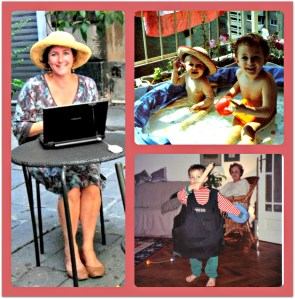
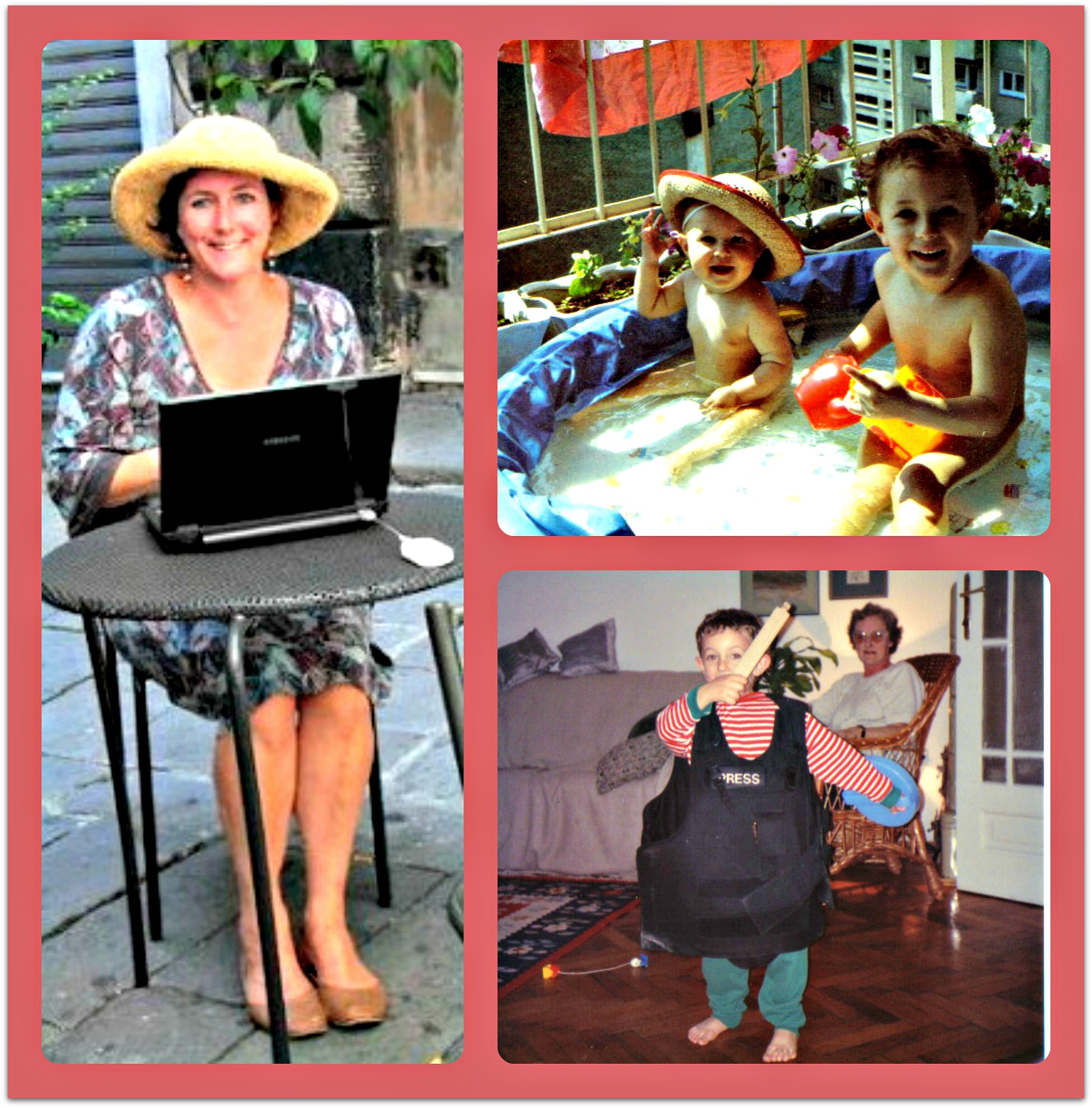
Rosie Whitehouse CollageOne of the expressions I picked up from living in England for many years is “Keep the home fires burning.” For some reason, that expression, along with the WWI song from which it comes, is running through my head as I contemplate talking to today’s featured author, Rosie Whitehouse (click here to hear it being sung):

Keep the Home Fires Burning,
While your hearts are yearning.
Though your lads are far away
They dream of home.
There’s a silver lining
Through the dark clouds shining,
Turn the dark cloud inside out
Till the boys come home.

For me, Rosie is an up-to-date version of what the songwriters had in mind. Educated at the University at London, with a career as a BBC journalist, she chose to stay at home with her children and keep the house warm and welcoming, and the family’s spirits up, while her husband, the journalist Tim Judah, went off to report on various wars for The Economist and other newspapers.

Rosie even went the further step of moving the family home to be closer to Tim for a time. Ironically, she kept the home fires burning in the very place where World War I began, the Balkans. She flew out to a crumbling Bucharest—it had been knocked down by the notorious Ceaușescu, whose secret police killed hundreds during Romania’s 1989 revolution—with one child in tow and another one on the way.

Then, when it seemed possible that her own home could go up in flames as war spread across the former Yugoslavia, Rosie did not give up. She stayed for a total of five years before returning to London, by which time “keeping the home fires burning” was second nature both for her and the couple’s five kids (Tim carried on covering wars in Iraq, Afghanistan, and the Congo).

Having revived her career as a freelance journalist, she decided to write her first book: Are We There Yet? Travels with my Frontline Family—a copy of which we’ll be giving away! (See details below). The book is a tribute to families who have been “burners of the home fires,” whose emotional pain tends to go unheralded. It is also, in her words, “quite funny.” (Hey, growing up in Bucharest, Belgrade, Croatia and Bosnia can be fun!)

By now you must be as curious as I am to meet the intrepid Rosie Whitehouse and learn more about what motivated her to seek out such an unusually displaced (at least by most of our standards!) life. I note that she has an Irish mother—perhaps that explains it?! (I’m thinking Queen Boudicea…)

* * *
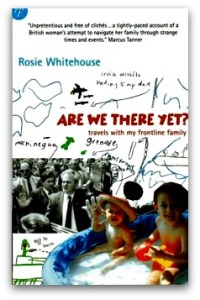
AreWeThereYet_cover_dropshadowHi, Rosie. In your book you say that your husband’s journalist colleagues in Romania, all of whom were single, were shocked to hear he had a two-year-old son and another child on the way. Did people often tell you you were crazy?
Yes, lots of people thought I was crazy.

As a former journalist with a background in Russian studies, do you think you felt a tinge of envy for Tim’s opportunities—which made you want to be on the scene?
Not really, as I would not have been able to cope with going to morgues and so on.

I know you’re going to challenge our definition of “displacement,” but I’ll go ahead and ask: what was your most displaced moment during your stay in the Balkans—when you had to explain Daddy’s muddy boots (he’d been walking in a mass grave), when you visited empty supermarkets, or when you heard the first shots of the conflict in Bosnia while strolling around Sarajevo with the kids?
Those things were reality so in that one doesn’t feel displacement. Quite the opposite in fact. I was intimately plugged into life and death at those moments.

How did you keep yourself sane?
I coped with stressful moments by bunkering down. I wouldn’t send the kids to school and cuddled up with them instead. As long as I shut my front door, where ever I am and whatever is going on, and it is just us, I am able to feel at home.

But getting back to your question about displacement: My best moment in a foreign country was when I saw my mother drive off in a taxi in Bucharest and realizing that apart from my two year old son I didn’t know a soul in the country (my husband was away in Albania for weeks). Wow, at last no one to tell me what to do! Freedom!

More seriously, most displacements do not happen by choice, and my most displaced moments have been as a result of this. I recount a story in the book when I took the kids to Berlin ten years ago. My mother-in-law was born there but fled in 1933 as she was Jewish. The family settled in Paris. As a result I have half French children who speak fluent French and we don’t speak a word of German.

It was a rather stressful visit as we searched for old family homes, one of which the family were still trying to reclaim. My daughter Esti got a headache. I pointed to the department store and suggested that we go in to buy an aspirin. It was Wertheims. My mother in law’s mother was a Wertheim and was murdered in Aushwitz. Esti said:

What, first they give me a headache by stealing the department store and murdering my great granny–and now I am expected to go in and buy an aspirin to make it better? You have to be kidding!

That’s displacement.

Child-rearing on the frontlines

What was the biggest challenge about having children with you on the frontlines?
The biggest challenge was often the simplest thing such as getting them something to eat and getting hold of baby milk.

Did anything surprise you?
Life never ceases to surprise me where ever I am and what ever is going on. The terrible things and the good things always amaze me.

What do you think the kids got out of the experience?
The kids learnt a lot. My eldest son, Ben, would ask about why there was no food in Romania. For me it was a matter of telling simple tales of communism and 1917. For him it began a life-long interest in Russia. He is following in his father’s footsteps.

My eldest daughter, Esti, would like to work for an NGO like Human Rights Watch.

For all of us, it drew us closer together. We are a tight-knit family.

I’ve heard of war reporters feeling bored when they come back to “reality” in their home countries. Did your family experience any of that after five years in the Balkans? What was it like to go “home” again?
Going home is just as difficult as moving to a new country. By the way, the wars didn’t stop either after we got back. My husband has since covered lots of wars and famines including Afghanistan, Iraq and the Congo.

Writing a book, but from the backlines

After you left the Balkans, it took quite a few years before you decided to write the book. What was the catalyst?
It was during the invasion of Iraq in 2003. I was standing in the supermarket and they had just installed a TV with a live feed from Iraq by the checkout. Some soldiers were running across a street in Basra, where some of the heaviest fighting took place, followed by a reporter and camera man. All of their faces were clearly visible. My husband was in Baghdad covering the story for The Economist. I had actually popped out for five minutes of fresh air before the bombers took off from the UK and the countdown to the blitz on Baghdad began.

I realized, to my horror, you could be buying a packet of frozen peas and watch your husband killed in front of your eyes. I know this thought had never entered the mind of the supermarket manager who had simply installed the TV to attract customers.

That evening I found my ten-year-old glued to a grainy grey screen showing an image of Baghdad as the cruise missiles were expected. What do you say? I had to make dinner and she had to do her homework. The UK had a huge debate about the war and the way it was covered, and I felt nobody knew what it was really like to be part of it and a kid to boot.

I also found that very quickly after the Berlin Wall came down that people forgot in Western Europe just how hard life had been under communism, especially in Romania and Albania. No surprise in that, really, as since 1945 most people in Western Europe just forgot the East existed.

I also found people in the UK quick to judge and condemn people in Southeastern Europe as being violent and prone to war. I wanted them to realize we are no different. That is why I’ve also included a chapter on Ireland in the book.

And I wanted to describe the multicultural experience of bringing up half-French, half-Jewish, part-Irish children in various countries, something I found fascinating.

Was it also part of your mission to show others what it is like to be married to, the child of, a war reporter?
Yes, not just to a war reporter but also those who are married to soldiers—especially those who are part-time soldiers and live in the community.

Did you have any personal motives in writing the book, to help you process what you’d been through and to provide your children with a record of where they’d lived?
No, not really. I didn’t write it for us but to make people think about what was going on. I am sure that the kids will appreciate it when they are older.

What was the most difficult part of the book-writing process?
Getting time to do it. I often wrote with my computer on the kitchen side as I was cooking dinner, which was good as I could hear kids talking; and as I was writing about them, it helped to have them there doing their thing.

Did you find it easy to find a publisher for the book?
No it was hard. publishing is a tough business. I started my own publishing company, Reportage Press, which closed a few years ago. Are We There Yet? is on Amazon as a self-published download these days. We also have a number of journalist friends who are taking the self-publishing route quite successfully.

What audience did you intend for the book? Did you think it would also appeal to other kinds of expats, who don’t go to war-torn countries?
Yes, there is a large expat element to the readership, and I know the book has touched the hearts of women feeling lonely and bewildered in a new country. I have been hugged and kissed by quite a few of them. One lady said reading the book had saved her marriage. I’m not sure it was me, but I hope I helped her realize it wasn’t so bad being lonely in London. It is hard being in a strange country with children. It is you who have to interpret it for them and as you are far from the family support group and friends, it is inevitably all up to you to be their world. It’s a tough job. That said, the book is far from serious. It’s actually quite funny.

Can you give us some examples of humorous moments in the book?
The kids are a laugh a minute, so whatever was going on they would often say or do something funny. For example:

For me the market in Piaţă Amzei is the focal point of life in the city centre [of Bucharest]…

“Let’s see the old ladies with the cheese. Come on!” shouts Ben as he darts out of the pushchair and into a smelly covered hall, where they sell heaps of yellowy looking curds, which are akin to feta.They are covered in flies.

The old women with their long black skirts and headscarves beckon him over and offer him little crumbs. He watches their lips and toothy grins with fascination. They look unnerving, like witches with crunched up dirty teeth, but he doesn’t run away. He has come deliberately to stare at them. He studies an old lady’s face carefully as she says something he can’t possibly understand. He is like his father, never frightened of anything and intrigued by the smallest thing. He loves the bizarre and the quirky.

* * *

“Where’s Mr Parking? Why doesn’t he find us a space?” asks Ben as we drive up and down the street outside our flat. Ben loves Mr Parking. I can’t see him anywhere.

Mr Parking is the man who organises the parking lots outside Belgrade town hall. It’s an elegant 1880s building that was once the royal palace and is right next to our block of flats. For a tip, he lets us park in the lots reserved for local officials. I haven’t seen him for weeks and have to be careful where I put the car, or we’ll be towed.

“I think he has gone back to Bosnia to fight, Ben.”

“What!” Ben is horrified.

“Why? I want to park the car. Doesn’t he want to stay here?”

“No, I expect he wanted to go home and defend his village.”

“Where is his village?”

“He’s from eastern Bosnia, the bit between here and Sarajevo [Bosnia’s capital city]. He told Dad he comes from Kamenica. It’s in one of the last bits there that’s still under Muslim control.” It’s a village close to the town of Srebrenica [the town where a massacre took place in 1995, said to be a crime of genocide].

“What! He’s a Muslim?” Ben is amazed: “But he looks like everyone else!”

“Of course, he does! You don’t look different if you’re Muslim. Bosnians look the same whether they are Muslims or not.” My mother has just sent him a book about the Crusades.

“I thought Muslims looked like Arabs.”

Are you working on any other ambitious writing projects?
I would like to write an expat guide to Britain. I spend a lot of time explaining Britain to people as I live in an expat world in the UK to a certain extent as my children have been or go to the French Lycée, and we have a lot of foreign friends who live in London.

Ten Questions for Rosie Whitehouse

Finally, I’d like to ask a series of questions that I’ve asked some of our other featured authors, about your reading and writing habits:
1. Last truly great book you read: Malaparte is on my mind as I am driving to Ukraine. His book on the 1941 invasion of Russia is unforgettable.
2. Favorite literary genre: Novels
3. Reading habits on a plane: Nothing. I am too tense on a plane as I hate flying. If I am calm enough I love to look out of the window.
4. The one book you’d require President Obama to read, and why: My son Ben’s book on Russia: Fragile Empire: How Russia fell in and out of love with Vladimir Putin. It’s a great portrait of contemporary Russia. I am his mum—what else am I supposed to say to this one?
5. Favorite books as a child: I loved Little House on the Prairie but above all I loved the stories my dad used to tell me.
6. Favorite heroine: She doesn’t have a name. She is one of the millions of women who have struggled to keep their families together against the odds. These are the mums who keep the world turning.
7. The writer, alive or dead, you’d most like to meet: I always wanted to meet William Shirer. He must have had an extraordinary experience living in Berlin at the start of World War II. Perhaps the ultimate expat experience! I suggested an interview programme with him to BBC World Service in the 80s but they didn’t have the cash to send me to America to do it. A pity as he died after that.
8. Your reading habits: I read a lot. If you want to write you have to read. I also have to read a lot for work.
9. The book you’d most like to see made as a film: None, really. If you love a book, the last thing you want is for it to become a film as you have the pictures in your head and they are your pictures not someone else’s.
10. The book you plan to read next: Vasily Grossman‘s An Armenian Sketchbook is in my suitcase. I love Grossman. He is a fantastic writer. If you haven’t read Life and Fate, you have really missed out.

* * *

Thanks so much, Rosie! Personally, I found your story very moving and think we should confer on you a “home fires” medal for all you’ve achieved!

Readers, it’s time for you to ENTER OUR DRAW TO WIN A FREE COPY of Rosie Whitehouse’s book. Rosie is giving away ONE COPY and will favor comments that tell her why you’d like to read the book.

Extra points, as always, if you’re a Displaced Dispatch subscriber!

The winner will be announced in our Displaced Dispatch on August 2, 2013.

Rosie Whitehouse is a parenting journalist and mother of five. She is one of the UK’s leading experts on family travel. She has written widely on family matters and traveling with children for The Sunday Telegraph, The Independent, The Guardian, The Daily Mail, Sunday Express, Family Circle, The Economist, and others, as well as for the Web sites B4Baby.com and Raisingkids.co.uk. She has also spoken at events and on television and radio on parenting matters, promoting her travel books and her autobiography, Are We There Yet? Travels with my Frontline Family. You can follow her latest adventures at http://www.rosiewhitehouse.co.uk/.

STAY TUNED for tomorrow’s post in our Olde vs New World series, by guest blogger Claire Bolden.

If you enjoyed this post, we invite you to register for The Displaced Dispatch, a round up of weekly posts from The Displaced Nation, with seasonal recipes, book giveaways and other extras. Register for The Displaced Dispatch by clicking here!

Related posts:

Images (clockwise from left): Rosie Whitehouse at “home” in London; Ben and his baby sister, Esti, living it up on the balcony in Bucharest (July 1991); Ben trying on his dad’s new bulletproof jacket, with Rosie’s mother in background (Belgrade, May 1992).
CAPITAL IDEA: Singapore: A quick guide

Welcome to another “Capital Ideas” – our somewhat idiosyncratic, ever so slightly tongue-in-cheek guide to various world cities, perfect for the ever discerning readership of this blog. We know our readers are always visitors, never tourists (an important distinction).

Do feel free to contribute your own ideas or suggestions in the comments section, we’d love to hear your thoughts, too.

Capital: Singapore.

Wait a moment, isn’t that an island? Well, it’s actually made up of 63 islands, but Singapore is, in fact, a city state.

Like the Vatican? There’s fewer Cardinals, but yes, the Vatican is an example of another city state.

All I know about Singapore is that chewing gum is illegal. As a confessed chewing gum addict, I think I’ll have to pass on this one. Some forms of therapeutic gum is allowed.

So I can get hold of gum? If a doctor or dentist sells it to you for health purposes, then yes.

What else is banned? Candy? No, in fact, when I was last there I noticed that Singapore immigration put out bowls of hard candy as you went through passport control.

That’s definitely preferable than dealing with Homeland Security.Isn’t it?

This still isn’t quite explaining why I should visit. Well, being a well developed, self-contained city state, it’s easy to get a sense of Singapore quickly and it’s easy to get around.

So I should go because it’s convenient? No . . . Well. . . Yes, I suppose it is. Everything is easy and doable. You won’t have aggressive taxi drivers trying to trick you over fares as you leave the airport. It’s a very well-run state. That’s interesting to see, and it means some of the more stressful elements of travelling, aren’t such a problem here.

Wouldn’t that be primarily due to Singapore’s soft authoratinism? Hey, I thought you only knew about the gum?

I’m smarter than I look. Considering your looks, that’s not too difficult, but to answer your earlier question, yes, Singapore’s laws can be draconian at times, and it’s these laws that make it, on the surface, a well-run state that you’ll feel very safe in for the duration of your visit.

What else do I need to know? Well, being a financial and business center for the region means that there’s a large number of European, American, and Australian expat communities in Singapore. 40% of Singapore’s residents are foreigners. Accordingly, no matter where you’re from, you’ll find something or someone to remind you of home. What’s also useful to remember is that English is one of Singapore’s four official languages. Don’t assume that that means that everyone speak it, but a large number of Singaporeans do, which does make it a more convenient destination in terms of being understood than most other Asian destinations.

Will I be able to understand Singlish? You’ll have better luck understanding a drunk tramp screaming at you on Sauchiehall street. The Singapore government strongly discourages Singlish, but personally we find it charming and a rich part of Singapore’s identity.

Okay, so if I do decide to go, what should I do there? If you’re with young children then you need to make a visit to the Singapore zoo? They do an amazing night safari.

Really? The zoo? I was expecting an answer a little more imaginative than that. It is a nice zoo, though. You can also visit the botanical gardens that houses one of the world’s largest orchid collections.

Orchids? Don’t mock. You can see an orchid dedicated to Princess Di AND one dedicated to Margaret Thatcher.

Umm. . .sounds thrilling. The must-do is checking-out Orchard Road.

What’s that? It’s the main road through Singapore. It’s the social epicenter where people come to…and forgive me for using this phrase…shop til they drop.

Are they that into shopping in Singapore? Yes. Orchard road isn’t shop after shop, it’s high-end mall after high-end mall. It needs to be seen to be believed. For a not quite so high-end retail experience, but just as fascinating, visit the Mustafa Centre in Little India. You’ll be able to find anything in this department

I thought this site had cultural pretensions. All I’m hearing about is shopping, zoos, and flowers dedicated to Maggie bloody Thatcher. One of our favorite museums can be found in Singapore.

What would that be? The National Museum of Singapore. They really do an excellent job of presenting the island’s history. It will you a marvellous grounding in the Singapore. Once you’ve finished there you can head over to Raffles for a Singapore Sling.

Wasn’t Raffles a gentleman thief? You’re thinking of a different chap. This Raffles, is Sir Thomas Stamford Raffles a member of the East India Company who founded the city of Singapore. The Raffles Hotel is named after him. It’s an ornate colonial hotel that is worth a visit. It was also here that the cocktail the Singapore Sling was invented.

What’s in it? Gin, Cherry Heering, Bénédictine, and fresh pineapple juice. It’s a very attractive pink color. Drink it in the Long Bar. Bowls of peanuts are also provided in the bar, you’re expected – nay encouraged – to throw the peanut shells on the bar floor. It’s the only place in Singapore you’re allowed to litter. The Long Bar was a favoured hang-out of Ernest Emmingway and Somerset Maugham.

What other food should I try? Kaya toast is my favorite. Kaya is a fruit curd made from coconut and sugar, spread it on hot buttered toast and at with a runny, soft-boiled egg – it’s heaven. Also, if anything is made with pandan – be it bread or cakes – then gobble it down. Pandanus leaves make the most mundane item delicious. You should also go to Clarke Quay to try Chilli Crab, and Little India for some Fish Head Curry.

Fish Head Curry? Sounds gross. It’s an experience, and one I didn’t find unpleasant, though I don’t think I’d want to make a habit of it. The eyes are the best bit.

Should I eat durian? I would say, yes. It’s an experience, you should try it.

What’s it like? Initially, it tastes rather pleasant. There’s a creamy custard taste. It’s the second taste that may make you retch. I’d describe that second taste as being a mix of raw onions, halitosis, and burnt dog hair. In my experience, you may want to try it first as an ice cream flavor before you build up to the real deal.

What should I read? For fiction, A Many-Splendoured Thing by Han Suyin, King Rat by James Cavell, and Far Eastern Tales by Somerset Maugham. For history, try A history of Singapore, 1819-1988 by C.M. Turnbull.

Thanks, I’m off to try and find some durian ice cream. I’ve had garlic ice cream, can it be any worse? Careful what you wish for.

STAY TUNED for a new Displaced Nation post tomorrow.

If you enjoyed this post, we invite you to register for The Displaced Dispatch, a round up of weekly posts from The Displaced Nation, with seasonal recipes, book giveaways and other extras. Register for The Displaced Dispatch by clicking here!

Related posts:

Image: MorgueFile

And the nominees for best expat/travel film are…seeking your vote! Welcome to the 2013 Displaced Oscars

Don’t miss our 4 polls below! Results to be announced in March 2nd Displaced Dispatch! Enjoy!

When I first repatriated to the United States, I relished the chance to watch the Oscars again. For some reason — I’m not sure why, particularly as I was never a big movie buff — I regretted missing out on the pinnacle of Hollywood glamour during my years of living overseas, first in England and then in Japan.

It did not take long, however, before the novelty wore off. I grew bored with the dresses — they all seemed so same-y. And a tux is a tux is a tux.

I also grew bored with the selection of films. Typically, Oscar-nominated films take place within a single country’s borders — and when people cross these borders, it is in the service of maintaining them (IT’S WAR!!!). Apart from when Sofia Coppola was singled out for her Lost in Translation screenplay, the plots do not exactly speak to me and my prior situation of displacement.

Case-in-point: 2013 Oscar nominees

A great example of what I’m talking about are the two historical — or, more accurately, historically informed — movies that are up for this year’s Oscars:

  1. Steven Spielberg’s Lincoln — the quintessential American biographical period piece that the Academy loves (it is predicted to win five Oscars, including best director for Spielberg).
  2. Les Misérables, the film of the musical theatre adaptation — which in turn is based on an historical novel by Victor Hugo (1862), depicting life in the aftermath of the French Revolution. (Les Mis is likely to win for its score, sound mixing, makeup and hair styling, and best supporting actress for Anne Hathaway.)

Actually, make that three historical films, as Quentin Tarantino’s Django Unchained (up for best picture, cinematography and best original screenplay) can come under that rubric as well. The first half is a mock Western and the second, a mock-revenge melodrama about slavery. At least, though, it has one foreign character: German bounty hunter King Schultz (Christoph Waltz). Posing as a dentist, he gallivants around Texas, speaking perfect English. And you’ll never guess what? He’s a villain. He does have manners — but does that mitigate or enhance his villainy? One can never tell with Mr Tarantino…

Likewise, Argo (likely to win best picture along with some other prizes) and Zero Dark Thirty (likely to win for best original screenplay) depict epic events in the — albeit much more recent — American past. And although each of these films portrays Americans abroad, it shows them acting in the service of president and country — with the aim of protecting other Americans. Nothing too displaced about that.

The comedy-drama Silver Linings Playbook (likely to win Best Actress for Jennifer Lawrence) is about two people who bond over shared neuroses — could anything be more American? Not to mention their common love of pro-football (no, Andy, not the soccer kind!).

Perhaps the best of this year’s films for anyone with a proclivity for venturing across borders is Life of Pi (likely to win for best original score and visual effects). The story is about an Indian family that is emigrating to Winnipeg, Canada. Yet, as even those of us who haven’t seen the film know by now, Pi Patel (Suraj Sharma) gets stranded on a lifeboat in the Pacific with a Bengal tiger. (That’s after the steamliner carrying his family’s zoo is pulled underwater during a freak storm.)

Over the course of months, the two unlikely castaways must depend on each other to survive — a scenario that provides an occasion for reflecting on cross-spiritualism, not cross-culturalism. (Pi, who was born a Hindu, loves Jesus and practices Islam.)

It also provides an occasion for displaced Taiwanese filmmaker Ang Lee to try his hand at 3D storytelling.

Why are we trying so hard to fit in when we were born to stand out?

WELCOME TO THE 2013 DISPLACED OSCARS. If we don’t fit into the Hollywood version, we may as well host our own event. We invite you to vote on your favorite films in the four categories we have created below. Preliminary results were announced in the Displaced Dispatch that came out on Saturday, February 23rd. Final results will appear in the Dispatch that comes out on Saturday, March 2nd. Be sure to sign up if you haven’t already!

1) Best Film Exploring Themes of Interest to Expats & International Travelers

This category honors the films that put cross-cultural themes right at the center. And the nominees are:

ShanghaiCalling_pm1) Shanghai Calling (2012, dir. by Daniel Hsia)
SUMMARY: Manhattanite Sam (Daniel Henney), an arrogant young lawyer, is transferred to his firm’s Shanghai office. He bungles his first assignment and finds his career in jeopardy. With the help of his beautiful relocation specialist, among others, he just might be able to save his job and learn to appreciate the wonders that Shanghai has to offer.
WHAT CRITICS ARE SAYING: How often do we get to see Shanghai on the big screen? That said, the plot is somewhat shallow and fails to make the most of Sam’s background as a Chinese American.


TheBestExoticMarigoldHotel_pm2) The Best Exotic Marigold Hotel (2012, dir. by John Madden)
SUMMARY: A group of British retirees — played by British acting greats like Judi Dench, Maggie Smith and Bill Nighy — have outsourced their retirement, attracted by the less expensive and seemingly exotic India. They are enticed by advertisements about the newly restored Marigold Hotel and given false dreams of a life with leisure.
WHAT CRITICS ARE SAYING: At the 2012 Mumbai Film Festival, the film was honored for showcasing Indian filming locations — a view not necessarily shared by viewers outside the subcontinent. Some of us feel that India was slighted by being treated as the shimmering background to a story about retirement-age self-renewal.

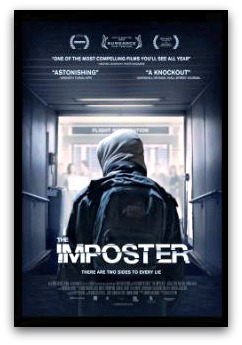
TheImposter_pm3) The Imposter (2012, dir. by Bart Layton)
SUMMARY: Thirteen-year-old Nicholas Barclay disappeared from his home in San Antonio, Texas, in 1994. Three and a half years later, he is allegedly found alive, thousands of miles away in a village in southern Spain with a story of kidnapping and torture. His family is overjoyed to bring him home. But all is not quite as it seems. The boy bears many of the same distinguishing marks he always had, but why does he now have a strange accent? Why does he look so different? This British documentary concerns the 1997 case of French serial imposter Frédéric Bourdin.
WHAT CRITICS ARE SAYING: By common consensus, The Imposter is one of the year’s most provocative pictures. Certainly, Displaced Nation writer Anthony Windram found it that way. In one of our most popular posts of last year, he mused that Bourdin’s story is not entirely unfamiliar to expats, all of whom have chameleon-like qualities.

CAST YOUR VOTE HERE!

2) Best Foreign Displaced Film

This category honors films about displacement that take place in non-English speaking countries and therefore require English speakers to read subtitles while learning about other cultures. And the nominees are:

Tabu_pm1) Tabu (2012, dir. by Portugal’s Miquel Gomes)
SUMMARY: The action in this experimental fiction ranges from contemporary Lisbon to an African colony in the distant past, in what was Portuguese Mozambique. First we are introduced to a cantankerous elderly Portuguese lady with a gambling addition. Then we flashback to her youth as a beautiful young woman living a kind of White Mischief existence at the foot of Mount Tabu, where she falls in love with a handsome adventurer…(Notably, the film’s title references the 1931 German silent film of that name, which took place in the South Seas.)
WHAT CRITICS ARE SAYING: The film shows what happens to expats who live too long — there are no remnants of “paradise” left. But some — e.g., A.O. Scott of the New York Times — have faulted the director for glossing over the issues of colonialism in the film in favor of simple aestheticism.

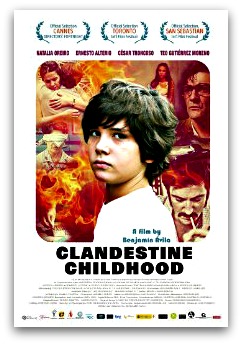
ClandestineChildhood_pm2) Clandestine Childhood (2011, dir. by Benjamín Ávila)
SUMMARY: A cinematic memoir drawn from Ávila’s own experiences, the film paints an unsettling portrait of families affected by military dictatorships. The year is 1979, five years after Perón’s death, and the family of 12-year-old Juan, who have been living in exile in Cuba, returns secretly to Argentina. Juan’s parents are members of an underground organization and for sake of their cover, he must assume the name of “Ernesto” and pretend to be a newcomer from northern Argentina.
WHAT CRITICS ARE SAYING: Juan’s parents aren’t fleeing the law because of their past misdeeds but are trying violently to overthrow a current dictatorship. The film therefore raises the question: do urban guerrillas make good parents? After all, they are asking their son, a Third Culture Kid, to act the part of a native in the homeland he never knew, for the sake of their political ideals. But while this question is intriguing, the story is driven almost entirely by clichés. As one critic remarked:

[T]he writing needs to be sharper to avoid feeling like a generic coming-of-ager.

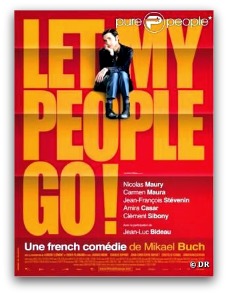
LetMyPeopleGo_pm3) Let My People Go (2011, dir. by Mikael Buch)
SUMMARY: French immigrant Reuben (Nicolas Maury) is living in fairytale Finland — where he got his MA in “Comparative Sauna Cultures” — with his gorgeous Nordic boyfriend Teemu (Jarkko Niemi). He works as the mailman in a neighborhood whose colorful houses look like Scandinavian Skittles. Then, after a misunderstanding involving a parcel full of Euros, Teemu casts his lover out of Eden, sending him back to where he came from: Paris.
WHAT CRITICS ARE SAYING: Ruben’s return to Paris — where he finds his family weathering various crises as well as emotional instability — demonstrates why he left in the first place. (Aren’t most expats escaping something?) However, the scenes with his wacky, feuding family members soon become tedious. As one critic puts it:

The movie’s labored attempt at creating comedy mostly means lots of scenes with Ruben cringing as relatives shout.

CAST YOUR VOTE HERE!

3) Most Displaced Director

This category honors the director who has shown the most chutzpah in raiding the literature of other cultures to make a commercially successful movie (note: they do not cast the natives!). This year’s nominees are:

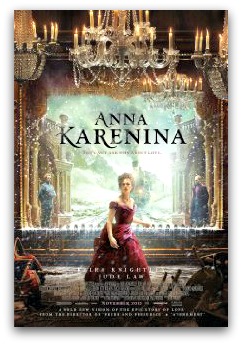
AnnaKarenina_pm1) Joe Wright for doing a British version of Anna Karenina (2012), casting his muse (Keira Knightly) in the titular role
WHAT CRITICS ARE SAYING: Some enjoyed Wright’s bold new interpretation of this classic Russian novel, while others felt that he did Tolstoy a terrible injustice — for instance, New Yorker critic Richard Brody had this to say:

Wright, with flat and flavorless images of an utterly impersonal banality, takes Tolstoy’s plot and translates it into a cinematic language that’s the equivalent of, say, Danielle Steel, simultaneously simplistic and overdone.

LesMiserables_pm2) Tom Hooper for casting a bunch of Aussies, Brits and Americans in Les Misérables
WHAT CRITICS ARE SAYING: Since Hooper previously won the Best Director Oscar for the terribly English drama The King’s Speech (historical drama, yay!), many found it odd that he would choose to take on this sprawling French story, and beloved musical, to create what he calls “an oil tanker of a picture.” But for what it’s worth, Hooper had no qualms about directing a film having to do with French history instead of his own. He is persuaded that Victor Hugo’s story speaks to issues of concern today:

Hugo’s story of populist uprising in 1832 Paris resounds in an era of the Arab Spring, the Occupy protests and general frustration over economic inequality.

DangerousLiaisons_pm3) Korean director Hur Jin-ho for making an Asian version of Dangerous Liaisons (2012) — which was originally an 18th-century novel by Pierre Choderlos de Laclosset — and setting it in 1930s Shanghai
WHAT CRITICS ARE SAYING: Many have complimented Hur Jin-ho’s decorous adaptation, saying it was clever of him to swap the insular, decadent world of de Laclos’ book, which takes place pre-French Revolution, with the similarly gilded cage of Chinese aristocrats just prior to the Japanese invasion. But the film isn’t particularly sophisticated on a political or historical level. As one critic writes: “It’s all just window-dressing: pretty, but substance-free.”

CAST YOUR VOTE HERE!

4) Most Displaced Actor/Actress

This category honors the actor who has performed this year’s greatest feat of playing a role that requires them to take on a whole new nationality. We’re talking Versatility Plus! And the nominees are:

Daniel_Day-Lewis_pm1) Daniel Day-Lewis, the Anglo-Irish actor who portrayed Abe Lincoln in Lincoln
WHAT CRITICS ARE SAYING: Apparently, there was no American actor good enough to play one of the most exceptional presidents the nation has ever known as critics have had nothing but praise for Day Lewis’s performance. Here is a sampling:

His Lincoln is tall and tousled and bent over with the weight of melancholy responsibility in the fourth year of the Civil War.

[Day-Lewis] manages to inject so much quiet humour into what could have been a very reverential portrait.

[The actor] inhabits the ageing figure of the 16th President of the United States with exquisite poise, intellect and grace.

AnneHathaway_pm2) Anne Hathaway for playing saintly prostitute Fantine in Les Misérables
WHAT CRITICS ARE SAYING: Many find it impressive that Hathaway, cast as the tragic Fantine, sings the show-stopping “I Dreamed a Dream” in one take. (Tom Hooper’s contribution to the genre was having the actors sing rather than lip synch.) And some say that her willingness to have her locks shorn off on screen shows her commitment to her craft. That said, her performance is not to everyone’s taste. “Rarely have the movies seen such an embarrassingly naked plea for applause,” writes Australian film critic Jake Wilson — the implication being the Victor Hugo’s Fantine would have had more dignity.

Alicia_Vikander_pm3) Swedish actress Alicia Vikander for taking on two non-Swedish roles: Caroline Matilda of Great Britain (she served as Queen of Denmark and Norway in the 18th century) in A Royal Affair (2012); and Kitty in Anna Karenina (2012)
WHAT CRITICS ARE SAYING: Vikander’s “moxie” is apparently what landed her both of these parts. According to A Royal Affair director Nikolaj Arcel, every actress in Denmark wanted the role of Mathilde, but only Vikander had the requisite “regal quality.” She even went to Copenhagen two months before shooting began to learn to speak Danish fluently. Likewise, Anna Karenina director Joe Wright saw in her the qualities to play Kitty, a flirtatious young woman who believes the dashing Count Vronsky is her Prince Charming, only to find love with a kind-hearted farmer named Levin. It is not uncommon for movie-goers to remark that she outshines Kiera Knightly’s Anna.

CAST YOUR VOTE HERE!

* * *

Are we missing out on any films/categories? Please leave your suggestions in the comments below.

Longing for even more expat and international travel films? Please go to our Displaced Oscars Pinterest board.

As for me, I’m going in search of a displaced after-party! Let’s hope I don’t have to travel too far to find one! 🙂

STAY TUNED for tomorrow’s post, another installment in the life of our fictional expat heroine, Libby. (What, not keeping up with Libby? Read the first three episodes of her expat adventures.)

If you enjoyed this post, we invite you to register for The Displaced Dispatch, a round up of weekly posts from The Displaced Nation, with seasonal recipes, book giveaways and other extras. Register for The Displaced Dispatch by clicking here!

Related posts:

Images: Oscar statuette courtesy Dave_B_ on Flickr; actor pix from Wikimedia.

CAPITAL IDEA: Paris: A quick guide

Welcome to another “Capital Ideas” – our somewhat idiosyncratic, ever so slightly tongue-in-cheek guide to various world cities, perfect for the ever discerning readership of this blog. We know our readers are always visitors, never tourists (an important distinction). As it’s Valentine’s Day we thought it only right to take a look at the world capital of romance – Paris (not very original — ed.).

Do feel free to contribute your own ideas or suggestions in the comments section, we’d love to hear your thoughts, too.

Capital: Paris

Paris, Texas? Um, no.

Don’t be too quick to judge. I hear it’s lovely. I’m sure it is. I liked the movie, if that helps.

Not really. So I guess you’re this is all about the other Paris — the city of love? That’s the one.

Ahh, so this is an easy Valentine’s Day tie-in post? I’m disappointed. Could you have not gone with something a little more left-field for a romantic destination? Such as?

I dunno. Cardiff? Sacramento? Sometimes it’s best to stick with the tried and tested.

Why should I go? I think the British expat writer Lawrence Durrell put it well when he wrote the following about Paris:

The national characteristics … the restless metaphysical curiosity, the tenderness of good living and the passionate individualism. This is the invisible constant in a place with which the ordinary tourist can get in touch just by sitting quite quietly over a glass of wine in a Paris bistro.

But I heard Paris can send a man mad. You’re probably thinking about the likes of Toulouse-Lautrec and the perils of consuming too much absinthe.

No, I mean modern-day tourists. Ah, then you’re probably thinking about Paris Syndrome; it is, in the words of Wikipedia, a transient psychological disorder encountered by some individuals (primarily Japanese tourists) when they visit Paris. It is characterized by a number of psychiatric symptoms such as acute delusional states, hallucinations, feelings of persecution (perceptions of being a victim of prejudice, aggression, or hostility from others), derealization, depersonalization, anxiety, and also psychosomatic manifestations such as dizziness, tachycardia, sweating, and others.

Sounds weird. It is. One of the contributing factors is that many Japanese visitors have an idealized image of Paris as the city of romance and sophistication and trying to reconcile that image with the rude and noisy metropolis they instead encounter is simply overwhelming.

Um, so you’ve written a guide extolling me to go to Paris as it’s Valentine’s Day and Paris is the city of romance and at the very same time you’re also telling me if I go with that expectation I could break down with a psychological disorder? Amazing. You know this would never happen in Sacramento. True, they are no reported cases of Paris Syndrome affecting visitors to Sacramento.

Well, if I go — and I manage not to break down with a psychological disorder — what should I do? The obvious tourist checklist is taking a walk along the Seine, having a wander around Montmartre, making a visit to Notre Dame, climbing the Eiffel Tower, and catching an unsatisfactory glance of the Mona Lisa at the Louvre.

But I thought this site (and this nascent series) prided itself on shying away from the obvious? We do, we do. If you’re looking to uncover the “hidden” Paris you can take that suggestion literally and go to the Catacombs.

I see what you did there. Merci beaucoup! Catacombes de Paris were built following the removal and evacuation of the Saints Innocents Cemetery (Cimetière des Innocents) in the late 18th century as the medieval cemetery was no longer sanitary and was considered the cause of numerous infections in the area. On a related note, you may want to read Pure (2011), by the somewhat displaced English novelist Andrew Miller — about the breaking up of the cemetery.

Thanks for that, but can we move onto a different topic? I don’t think visiting catacombs is a particularly romantic move on my part. Do you have any romantic suggestions? I know a couple who spent the weekend trying to find the best macaroons in the city. If you’ve got a sweet tooth, you may want to give that a try. Laudree is famous for theirs — in fact, they claim to have invented them, so you may want to start there. Another macaroon purveyor definitely worth trying is Pierre Herme. Indeed you’ll do well to resist eating all their pastries and sweets.

You’re going to try and convince me to go on a guided walk, aren’t you? You seem obsessed with them. I do think walking around a city rather than hopping from metro to taxi is a better way of getting to grips with a city, and if you can do that with a knowledgeable guide, so much the better. I’ve heard good things about Paris Walks, so you may want to give them a try. Alternatively, we are living in the age of smart phones. If you don’t want to be with a tourist crowd (and I totally understand why that may be the case), then why not download a walking tour direct to your phone? Invisible Paris offers three walking tours for you to download that are absolutely free. The walks highlight aspects of the city that other guides ignore.

What’s a must-do? Embrace the cliche and go for an evening stroll along the Seine.

Is it easy to get around? Yes, the Metro system makes getting round the city easy. As a visitor it’s well worth purchasing a Paris Visite Pass, which allows you access to all of the city’s public transport

And where’s good to eat? Any recommendations? It’s Paris. You won’t struggle for decent places to eat. You know the drill when it comes to avoiding tourist traps.

What should I read? If you want to brush up on Paris, then you may want to give Graham Robb‘s Parisians: An Adventure History of Paris (2010) a try. Also worth a look for the befuddled foreigner trying to make sense of the city is The Sweet Life in Paris, by displaced American food writer David Lebovitz — it tells the story of his move to Paris. For a solid historical overview of France’s capital city, try The Seven Ages of Paris (2002), by British historian and TCK Alistair Horne. And for a work of fiction sometimes the obvious is the most appropriate — and that’s The Hunchback of Notre-Dame (Notre-Dame de Paris, “Our Lady of Paris”), by Victor Hugo.

What should I watch? You can go all New Wave cool and watch The 400 Blows (1959, dir. François Truffaut), Breathless (1960, dir. by Jean-Luc Godard), or Bande à part (1964, also dir. by Jean-Luc Godard). The antithesis of these is the Old Hollywood glamor of An American in Paris (1951, dir. Vincente Minnelli). Of course, what I’d really advise you to watch is one of my all-time-favourite movies — Les Enfants du Paradis (1945, dir. Marcel Carné). In fact, as it’s Valentine’s Day today, watch it tonight!

But I have reservations at the Sizzler tonight! The Sizzler?

Hey, it’s Valentine’s. I thought, why not splurge? Hmmm, maybe Paris isn’t right for you after all.

STAY TUNED for a new Displaced Nation post on Monday.

If you enjoyed this post, we invite you to register for The Displaced Dispatch, a round up of weekly posts from The Displaced Nation, with seasonal recipes, book giveaways and other extras. Register for The Displaced Dispatch by clicking here!

Related posts:

Catching up with this year’s Random Nomads over the holidays (2/3)

RandomNomadXmasPassportWelcome back to the holiday party we are throwing for the expats and other global voyagers who washed up on our shores in 2012. Remember all those Random Nomads who proposed to make us exotic meals based on their far-ranging meanderings? Not to mention their suitcases full of treasures they’d collected and their vocabularies full of strange words… How are they doing these days, and do they have any exciting plans for the holidays? Second in a three-part series (Part One here).

The second third of 2012 brought quite an intriguing (albeit as random as ever) bunch of nomads our way — intriguing because most of them have had experience with spouses from other cultures, suggesting that the point made by one of their number, Wendy Williams, about the globalization of love has some validity. They are:

  • Wendy Williams, the Canadian who is as happy as Larry living with her Austrian husband and their daughter in Vienna.
  • Suzanne Kamata, an American writer who went to Japan on the JET program, married a Japanese man, and made her home on Shikoku Island.
  • Isabelle Bryer, a French artist who feels as though she’s on a permanent vacation because of landing in LA — she’s lived there for years with her American husband and family.
  • Jeff Jung, formerly of corporate America but now an entrepreneur who promotes career breaks from his new base in Bogotá, Colombia.
  • Lynne Murphy, the lovely lexicologist who landed in — I want to say “London” for the alliteration, but it’s Sussex, UK. And yes, despite not being the marrying type, she now treasures her wedding ring of Welsh gold!
  • Melissa Stoey, the former expat in Britain who, despite no longer living in the UK, has a half-British son and remains passionate about all things British.
  • Antrese Wood, the American artist who is busy painting her way around Argentina, having married into the culture.

I’m happy to say that three of this esteemed group are with us today. What have they been up to since nearly a year ago, and are they cooking up anything special for the holidays?

Wendy_Williams1) WENDY WILLIAMS

Have there been any big changes in your life since we last spoke?
Yes, I’ve spent less time at my desk and more time travelling since the publication of my book, The Globalisation of Love. Given the title, I guess I should have expected it.

Where will you be spending the holidays this year?
Since I have “gone native” in Austria, I will be skiing during the holidays. Yipppeeee!

What do you most look forward to eating?
I most look forward to eating a Germknödel, which is a big ball of dough filled with plum sauce and covered in melted butter. Apparently, it has 1,000 calories and I savour every last one. If no one is looking, I lick the plate.

Can you recommend any books you came across in 2012 that speak to the displaced life?

  1. A Nile Adventure — cruising and other stories, by Kim Molyneaux — a light-hearted story of one family’s journey to and adventures in Egypt, both ancient and modern.
  2. Mint Tea to Maori Tattoo!, by Carolina Veranen-Phillips, an account from a fearless female backpacker — is there anywhere she hasn’t been?!
  3. Secrets of a Summer Village, by Saskia Akyil: an intercultural coming-of-age novel for young adults, but a cute read for adults, too.

Have you made any New Year’s resolutions for 2013?
More time with friends & family and more writing, the two of which are completely counter-productive in my case.

Any upcoming travel plans?
I am only happy when I have a plane ticket in my pocket so there are always trips planned. Didn’t René Descartes write, “I travel, therefore I am” — or something like that? The year will start with Germany, Ukraine, Spain and Canada.

SuzanneKamata_festive2) SUZANNE KAMATA

Have there been any big changes in your life since we last spoke?
I sold my debut YA novel, Gadget Girl: The Art of Being Invisible, about a biracial (Japanese/American) girl who travels to Paris with her sculptor Mom, to GemmaMedia. It will be published in May 2013. I was also honored to receive a grant for my work-in-progress, a mother/daughter travel memoir, from the Sustainable Arts Foundation.

How will you be spending the holidays?
We are planning a little jaunt to Osaka between Christmas and New Year’s, but mostly, we’ll be staying at home.

What’s the thing you most look forward to eating?
I’m looking forward to eating fried chicken and Christmas cake, which is what we traditionally have here in Japan on Christmas Eve. There are all kinds of Christmas cakes, but my family likes the kind made of ice cream.

Can you recommend any books you came across in 2012 that speak to the displaced life?

  1. The Girl with Borrowed Wings is a beautifully written contemporary paranormal novel featuring a biracial Third Culture Kid. The author herself, Rinsai Rossetti, is a TCK. She wrote this book when she was a student at Dartmouth. It’s unique and lovely and captures that in-between feeling of those who live in lots of different countries.
  2. I also enjoyed I Taste Fire, Earth, Rain: Elements of a Life with a Sherpa, by Caryl Sherpa, an American woman who went on a round-the-world trip and fell in love with a Sherpa while trekking in Nepal.
  3. Oh, and Harlot’s Sauce: A Memoir of Food, Family, Love, Loss, and Greece, by Patricia Volonakis Davis.

Do you have any New Year’s resolutions for 2013?
Hmmm. Exercise more (same as last year). Also, I resolve to finish a draft of my next novel.

Last but not least, any upcoming travel plans?
Yes! I’m planning on taking my daughter to Paris.

Jeff at Turkish Embassy3) JEFF JUNG

Have there been any big changes in your life since we last spoke?
Since the interview, I launched my first book, The Career Break Traveler’s Handbook. It’s available online at most major book stores in both print and e-versions. And, we’re on the verge of launching Season 1 of our TV show, The Career Break Travel Show, internationally. It includes adventures in South Africa, Spain, New Zealand and Patagonia. We’re just waiting for the new channel to launch.

How will you be spending the holidays this year?
After spending a quiet Christmas in Bogotá, I’ll head off to Washington, DC for my best friend’s wedding on New Year’s Eve. Then I’m off to Texas to see my parents for about ten days.

What’s the thing you most look forward to eating?
As far as food goes, I’m most looking forward to turkey and my dad’s award-winning BBQ.

Can you recommend any books you came across in 2012 that speak to the displaced life?
This year I read Dream. Save. Do., by Betsy and Warren Talbot. It’s a great book to help people achieve whatever goal they have.

Speaking of goals, any New Year’s resolutions for 2013?
Personally, I need to drop a bit of weight. I spent too much time writing and editing in 2012! Professionally, I want to see The Career Break Travel Show find its audience so we can head out to film Season 2!

Last but not least, any exciting travel plans?
I plan to travel for the filming of our second season (countries still to be determined). I also have the chance to go to Romania to volunteer at a bear rescue with Oyster Worldwide. It’ll be a mini-career break for me. I can’t wait.

* * *

Readers, this lot seems just as productive, if not more so, than the last one! Any questions for them — don’t you want to know their secret?

STAY TUNED for tomorrow’s post by the Displaced Nation’s agony aunt, Mary-Sue — she wraps up 2012 by paying a visit to several of this year’s questioners: did they take her advice?!

If you enjoyed this post, we invite you to register for The Displaced Dispatch, a round up of weekly posts from The Displaced Nation, with seasonal recipes, book giveaways and other extras. Register for The Displaced Dispatch by clicking here!

Related posts:

Images: Passport photo from Morguefiles; portrait photos are from the nomads.

Living La Dolce Vita with Susan Ross Donohue, Canadian Artist & Francophile

The artist Susan Ross Donohue revels in city life, art, literature and anything that makes her laugh. She lives physically in Montreal but mentally in Paris. As she has such a good handle on La Dolce Vita, I asked her to share the sensory highlights of her travels and some advice on enjoying the sweet life even if you stay at home…

Most heart-stopping sight

Our first visit to Paris. My husband and I were very young, and this was our first time abroad. Upon arrival, we took the métro to Charles de Gaulle Étoile, the station closest to where our hotel was located. We walked up the stairs et voilà — there was the Arc de Triomphe just as I imagined it would be, only better. I was stunned. Speechless actually. But I have to say that this still applies. The Arc and the Eiffel still bring tears to my eyes, I’m not sure why.

Most intoxicating scent

The flowers — jasmine, lavendar, roses — in Grasse, in the south of France. Grasse is considered France’s perfume capital as it produces over two-thirds of the natural aromas used in perfumes. Touring Parfumerie Molinard is an education in itself. I thought I knew scents until I took the tour but then I found out how much more there is to learn! But, you don’t have to be an expert to appreciate the aromas of this area. Just breathe in and enjoy.

Dreamiest sound

This is strange — it wasn’t in France! My husband and I had driven from Nice to Sanremo, Italy, just across the border. While wandering through the town, we heard strains of a violin coming from the art gallery (which is what we were looking for in the first place). We went in to check out the art work only to discover the music was “live.” A girl was practicing the violin and she continued to play while we looked at the exhibition. No one in the gallery, which was called Tunnel Dell’Arte, spoke English or French, and our Italian is nil — but we did manage to understand she was practicing for a concert that night. We bought a small painting and the owner mimed that he could send it to us by air (with much flapping of the arms to get the idea across).

Most delicate flavors

It’s a toss-up between the hot dogs at Harry’s New York Bar in Paris and a white wine served at a dinner in the Loire Valley (unfortunately, I can’t remember the name).

Softest physical sensations

Walking in the Tuileries one day, we came across a man feeding the birds out of his hand. We were watching him when he motioned to me to put my hand out, and he filled it with seeds. Sure enough, these tiny little birds landed on my fingers to have their lunch. This was an amazing feeling. Very delicate, very soft, very special.

Most interesting unexpected encounter with another human being

There is no one particular person that I can single out because we’ve always had nothing but good experiences with people during our travels — I’m remembering, for instance, an entire café full of people trying to find a street address for us.

A place that stimulates all five senses

Montmartre stimulates all five senses with the mixture of music, art and restaurants. Further up the hill in Montmartre is the local vineyard, the wonderful restaurant La Maison Rose and the Lapin Agile cabaret, with its fascinating history. I couldn’t go to Paris without some time in Montmartre. I especially like going on a week night, when it’s a bit quieter, and I can picture Picasso, Modigliani or Utrillo sitting at a café talking about art. Bliss.

Favorite contemporary artist with a sense of dolce vita

The American pop artist Jim Dine is a favorite. I’ve loved his work for years and have met him a few time at exhibition openings. He is equally talented in printmaking, painting and sculpture. His work is very personal, but the viewer doesn’t feel like an intruder.

Favorite historical artist

Who had more heart and soul than Van Gogh? To see a real Van Gogh is a totally different experience from seeing a reproduction. This is something else that led me to tears the first time I saw one of his canvases. (Truly, I don’t cry a lot — Paris seems to do that to me!)

Favorite travel quote

″A traveler without observation is a bird without wings.”
– Moslih Eddin Saadi

We travel to open our minds and hearts, and to learn from the experience. For me observation is the whole point of traveling.

Advice for living la dolce vita at home

La dolce vita is whatever you want it to be. Try evenings with a particular country theme — a Spanish night with paella, a Parisian evening with raclette, French wine and music. All the information you need is on the Internet: recipes, lessons for learning a foreign language, instructions for adding a foreign touch to your decor… The possibilities are endless.

Susan Ross Donohue is an artist who lives in Montréal, Canada. She makes frequent trips to Paris, a city she considers her second home. Her travels are recorded in her blog Life, Laughter and Paris, and you can see her artwork — much of which is inspired by the sights and sounds of Paris — at her art site, Susan Ross Donohue. Follow Susan on Twitter (@srossdon) and on Facebook.

STAY TUNED for tomorrow’s bulletin from Woodhaven, where our fictional heroine, Libby, is not so much courting trouble as dragging it handcuffed to the altar. (What, not keeping up with Libby? Read the first three episodes of her expat adventures.)

If you enjoyed this post, we invite you to register for The Displaced Dispatch, a round up of weekly posts from The Displaced Nation, with seasonal recipes, book giveaways and other extras. Register for The Displaced Dispatch by clicking here!

Related posts:

Images: Susan Ross Donohue in her favorite city;  “L’Accordéoniste,” one of her paintings.

CLEOPATRA FOR A DAY: Fashion & beauty diary of Third Culture Kid Tiffany Lake-Haeuser

Let’s all line up and curtsy to the 16-year-old German-American Tiffany Lake-Haeuser, who has just disembarked on the shores of The Displaced Nation. Born in New York City to German parents, this Third Culture Kid returned “home” to Germany when she was six and then at age 13, moved with her family to Abu Dhabi, UAE. Now back in Frankfurt, she divides her time between this city and Paris, where her father currently resides. Today she will play the role of Queen of the Nile and let us in on the fashion and beauty secrets she’s collected from her travels.

BEAUTY STAPLES

I’ve become a big fan of black eyeliner after living in the Middle East. (The real Cleopatra would approve!) The more conservative Arab women in Abu Dhabi and the rest of the UAE don’t wear eyeliner, but those who are more modern or Westernized often wear quite a lot. They all have such nice eyes and long eye lashes, so it always looks striking. Eyeliner easily takes an ordinary make-up to something special.

BEAUTY TREATMENTS

Living in the Middle East also taught me that eyebrow shaping helps frame the face and makes people look elegant. Even though it’s painful, I get my eyebrows done regularly.

And from my various travels, I’ve learned how important it is to take care of one’s skin and hair, especially since those are two things people notice right away when they they meet you.

HAIR

My hair has been very long, but I recently had it cut to much shorter. I have pretty much done everything with my hair from long to short to all different kinds of bangs. The only thing I haven’t done is dye my hair, because I am afraid it will be damaged.

FASHION

My favorite piece of clothing from my travels is not so exotic. It’s a big dark blue woolly cardigan that I bought at the Urban Outfitters in London. I love that sweater because it is so comfortable. Sometimes it can be hard to combine with an outfit, but I’ve discovered some ways I think work well.

LINGERIE

I have never bought lingerie in any country other than my own but I would imagine South America to have nice lingerie so I would definitely keep an eye out for that if I ever travel there.

JEWELRY

My favorite piece of jewelry is a ring my mom bought me at a market in Sharjah (the capital city of Sharjah, one of the emirate states). It has a black smooth stone and a silver frame; the stone is slightly bigger, too. I really like the fact that it doesn’t come from a store that mass produces their stuff, but instead it’s different and individual.

WEARING RIGHT NOW

I am wearing a pair of black jeggings, which I recently got at the German clothing store People’s Place. In my opinion, they are flattering and you can never really go wrong with a comfy pair of skinny jeans. I am also wearing a light green sweatshirt, which is the softest piece of clothing I own (also from People’s Place), and a slightly cropped pastel-pink shirt. It’s also amazingly soft — it’s from a Roman boutique called Brandy Melville, their store in New York City. For accessories I have on a feather necklace from the Urban Outfitters in Frankfurt and a black flower ring that comes from a small jewelry store on the outskirts of Frankfurt.

DAILY FASHION FIXES

I always read Glamour magazine, especially since it has so many versions: German, British, American and Australian. I like to see the differences in fashion around the globe. (British and French magazines have the most cutting-edge fashions, though.) And I read a lot of fashion blogs: for instance, Birds of a feather flock together — by Cailin Klohk, an 18-year-old half-Irish, half-German girl who lives near Frankfurt — and Snakes Nest (an American one).

Actually, I created my own blog at the end of last year as my dream now is to become a fashion journalist. It’s called Girl on the Run. I chose the name because of my many moves and travels, which makes me feel like life never stands still and I am constantly discovering new things.

STYLE ICON

Alexa Chung is very present across Europe — I think she has a beautiful and individual style. She mixes some pieces no one would think of to mix, yet they work so wonderfully together. Also, she seems to follow her own instincts instead of being a slave to current fashion trends.

STREET FASHION

I like to go to the Zeil/Hauptwache area in Frankfurt to people watch; there are so many different kinds of people and fashion-forward styles. I especially like to look at people’s bags as I have a slight obsession with bags.

TOP BEAUTY/STYLE LESSON FROM TRAVELS

From all my travels, I have learned that it is important to follow one’s own tastes and cultivate one’s own style instead of just mimicking fashion trends. There are so many beautiful ways to dress in the world, and seeing them has really opened my eyes and made me open to experimenting with what really suits me.

Tiffany Lake-Haeuser is an 11th-grade student at Frankfurt International School with an ambition to become a fashion journalist some day. For more of her fashion impressions and beauty advice, follow her blog, Girl on the Run, which she plans to update regularly now that it’s spring break!

STAY TUNED for Monday’s post, a celebration of The Displaced Nation’s one-year anniversary!

If you enjoyed this post, we invite you to register for The Displaced Dispatch, a round up of weekly posts from The Displaced Nation, with seasonal recipes, book giveaways and other extras. Register for The Displaced Dispatch by clicking here!

Related posts:

Images: (clockwise beginning with large picture on left): Tiffany Lake-Haeuser on the balcony of her father’s apartment in Paris, sporting her shorter hairdo; applying eyeliner; her Emerati ring (a gift from her mother); and a side view of her beloved cardie from London (Urban Outfitters).

Why you can’t help being jealous of new author and Parisian style guru Jennifer Scott

Before getting started, I have to say something, something rather catty — which is that Jennifer Scott makes me jealous.

I’m jealous in part because she has self-published a book, Lessons from Madame Chic: The Top 20 Things I Learned While Living in Paris, that is doing very well for itself. Nearing the top of Amazon’s Paris Top 10 list, it has just been reviewed by The New York Times (Thursday Styles) and featured in The Daily Mail.

But a much bigger part of the reason for my jealousy of Scott is that she’s such a quick study.

Let me explain. As an American woman who lived in England and Japan for many years, I could identify with many of the lessons Scott picked up from immersing herself in the everyday life of a fine French family: that there are other — more stylish and more sensible — ways to cook and eat, keep house, entertain, wear clothes and put on make-up than those we’ve been taught in our native land.

But just how long was Scott in Paris? Six months! C’est incroyable!

It took her just six months to pick up so many life lessons? At first I wondered: can it be because the French are such good teachers? Scott after all benefited from exposure not only to her host family, whom she calls Famille Chic, but to her boyfriend’s host family, Famille Bohemienne.

But then I decided that, no, the French aren’t so much great teachers as Scott is an avid learner. You see, there is something else she gets right, exquisitely right, with this book — she captures the moment when an expat goes from feeling uncomfortably displaced to deciding she can take something of value away from the experience. Scott may be ignorant, but she isn’t arrogant — an observation that does not by any means apply across the board to newbie expats. (Dare I say, the combination of ignorance and arrogance is an American speciality, especially when we venture abroad!)

There is an incident at the heart of the book that conveys this evolution in Scott’s thinking — I speak of the moment when Madame Chic (the redoubtable matriarch of Famille Chic) turns to her American charge and says: “That sweater does not look good on you.” Stunned by her host mother’s frankness, all Scott can think of to say, in English, is:

Really? But it’s a silk and cashmere blend.

But it’s not the quality Mme Chic has in mind but the color:

It does not suit you at all. It washes you out. You look…sallow.

For Scott, this is the beginning of an epiphany. She feels wounded but then has to concede that Mme Chic could be right — she’s never liked the sweater (it was a gift) but more importantly, why is she bothering to wear colors that don’t suit her?

For the past four years — initially through her blog, The Daily Connoisseur, and now through her new book — the precocious Scott has been making the case for rejecting the typical American life of mindless consumerism. As she learned at the well-manicured feet of Mme Chic, it’s important to make sure the clothes you wear, the food you put into your body, and the items you bring into your home are things you love and that actually suit you. What’s more, living a well-edited life frees up our time for other — artistic, cultural, intellectual, philanthropic — pursuits.

Such sage advice — and from one so young! But enough of my giving vent to the green-eyed monster. It’s time I introduced you to its object — or shall I say, bête noire? — the très très charmante Jennifer Scott. She graciously agreed to answer some of my fashion- and style-related questions, along with a few that relate to the concerns of the Displaced Nation’s “citizens.” The following are some highlights from our exchange. Enjoy — and see if you don’t end up with a case of Scott envy as bad as mine!

The decision to write a book on refined and elegant living

Thank you so much, Jennifer, for agreeing to this chat and also for generously offering to provide two signed copies of your book as a giveaway to Displaced Dispatch subscribers. Let’s start by having you talk a little about your background — where you were born, what you studied and why you went to Paris.
I grew up in the Inland Empire of Southern California, studied theatre and French at the University of Southern California and currently reside in Santa Monica. My junior year of college I studied abroad in Paris, which was a life changing experience and prompted me to write my memoir/lifestyle book, Lessons from Madame Chic.

What made you decide on the format of a how-to book — which as you say is also something of a memoir on your semester abroad?
Since 2008 I’ve been keeping a blog called The Daily Connoisseur, where I explore all facets of how to live well. I did a series on my blog, “The Top 20 Things I Learned While Living in Paris,” where I examined the lessons I learned in Europe and shared how I translated those lessons to my California lifestyle. The series was so popular, I realized there was a strong interest in the application of these lessons — not just in the lessons themselves — so I decided to record my observations in a book.

What audience did you have in mind for the book?
The audience I had in mind was anyone who wanted to live a more refined and elegant lifestyle. I know this sounds broad and general but it’s true. Sure, different parts of the book appeal to different people and age groups, but overall the message is that life should be lived beautifully and passionately and I think that is a universal message.

What portion of the book — the fashion and beauty tips, the lifestyle advice, the memoir — have readers responded to the most?
Most readers say the last third of the book, the section on how to live well, inspires them the most. But I get a lot of great feedback on the beauty, fashion and diet portions of the book, too.

Capsule wardrobes, clothing collections, colors & other tips

I really liked your advice about the capsule wardrobe of 10 core items, based on how Madame Chic and her family dressed. But many of us who’ve been expats in other countries eventually find ourselves drawn to native fashions — sometimes to the point where we start building collections. Last week, for instance, long-time expat Anastasia Ashman told of her collection of silk kebayas (long, fitted jackets) from Malaysia. Are fashion collections a no-no?
I think the idea of a fashion collection is very cool. I don’t personally have one but if you have traveled, or if you live abroad and find yourself drawn to a cultural fashion piece, I say, why not? My only advice would be to make sure your collection is not verging on becoming clutter. Still keep a discerning eye.

Another famous displaced American woman, of course, was Jackie O. What about her habit of buying ten sweaters in different colors — thus saving time and/or disappointment when the style is discontinued, or in the case of international travelers, for fear that you’ll never get to that part of the world again?
This mentality can be tricky and I say that from firsthand experience! A few years ago I realized I was buying everything in threes. If I liked something, I would buy it in three colors for fear I would never find something like it again. I found that the multiple purchases just became clutter in my wardrobe and oftentimes I would change my mind down the line and decide I didn’t actually like the pieces that much after all! I would suggest practicing restraint here as well.

I enjoyed the passage of the book where you recalled Mme Chic criticizing you for wearing the wrong color. When I had my “colors done” in Japan, I was told in no uncertain terms never to wear fuchsia! At the same time, though, I can relate to another remark made by Anastasia last week. She said that because color choice reflects the place where ones live, people like her, who’ve gone back and forth between very different cultures, find themselves varying their palettes rather widely.
I do agree that color choice can be influenced by geography, but I believe one should always go with their passion rather than trying to conform too much. If you love color, by all means you should wear it, even if everyone around you is in a sea of black. Style is about being happy and comfortable with what you are wearing, if you are trying too hard to fit into your surroundings, it doesn’t come off as natural.

Skincare and diet

Moving on to skincare, in your book you mention how careful you are to apply SPF to your face, neck and décolletage — but is that a habit picked up in the U.S. or in France? I was under the impression that French women liked their suntans!
Applying sunscreen is a habit I picked up in the United States but I do believe French women protect themselves on a daily basis with sunscreen as well — they perhaps aren’t so zealous about it as we are. Although everyone is different. I remember when I spent six weeks in Cannes, I loved to observe this French woman (a local) who went to the beach everyday to sunbathe. She was a deep bronze color and her skin was quite leathery so she clearly wasn’t concerned about wearing SPF!

I also identified with the part of your book where you say that French people stay thinner than Americans do by not snacking in between meals. Likewise, I learned to snack less when living in both England and Japan — I lost weight in both countries! That said, I also got into the habit of taking afternoon tea breaks, sometimes with a biscuit (cookie). In your view, is teatime permissible? (Please say yes as it’s a founding principle of The Displaced Nation!)
I adore tea time! I actually spend a good part of every year in England, as my husband is English, and we have tea and some sort of cake or biscuit every day during this charming ritual. Tea time is enjoyable and if you relish it and take it in moderation (only one slice of cake and not two) there is nothing wrong with it. Maintaining a healthy attitude towards eating and not beating yourself up over small pleasures is key. The French equivalent of tea time would be the goûter, which is taken at 4:00 p.m. and can consist of anything from a cup of tea and a slice of cake, to a hot chocolate and a biscuit. Delightful.

The impact of repatriation

Like me, despite your love of foreign countries, you’ve chosen to live in the United States. Have you changed your mind about any of the fashion principles you learned in France since coming back here, or do they still hold fast?
I still utilize the fashion tips I picked up in France through the years — especially the French concept that comfortable doesn’t have to equal frumpiness.

For me, one of the biggest changes I’ve made since coming back to the U.S. concerns shoes. Though I never lived in France, I had somehow imbibed the French preference for ballet shoes or low-heeled pumps, instead of athletic shoes. I don’t think I owned a single pair of sneakers when I first arrived back here! In the past couple of years, though, foot pain and aging have made me concede that athletic shoes are much healthier for the foot, especially when one travels and does a lot of walking…
By necessity, I have to wear an orthotic most days. I still wear chic day shoes like ballet flats and driving loafers, but buy them in bigger sizes so my orthotic fits. Voilà! Comfort and practicality meet style. I love being comfortable but for me it’s about being creative and going about it with style. There are so many comfortable yet stylish alternatives to traditionally comfortable things like sneakers, sweat suits and yoga pants.

So are there any fashion or beauty ideas that American women get right?
American women have great style and get a lot of things right! I think where we go wrong is in editing our wardrobe. We have too many things in our closets and sometimes that clouds our fashion identity a bit.

Cross-cultural marriage and the California life

Moving on to another topic of interest to many “citizens” of The Displaced Nation: cross-cultural marriage. You’ve chosen to marry an “eccentric” Englishman, as you call him in the book. What do you think is the biggest challenge about marrying someone of another culture?
The biggest challenge, for me, is food! My husband and I have very different tastes in food. He loves traditional English food like roasts, fish and chips, shepherd’s pies and other hearty dishes. I tend to like lighter fare. I also adore Mexican cuisine as it plays a big part in California culture and he is not so into it. So when we cook dinner at home, it is always a compromise.

One more question from an expat perspective: have you completely readjusted to living in the United States, or do you still pine for Europe?
I have definitely adjusted back to American culture. I love my Californian lifestyle — which is why I’ve chosen Santa Monica as my main place to live. It’s been over a decade since I’ve lived in France but I still travel to Europe every year. I enjoy taking the best lessons I learn from these travels and incorporating them into my life back home. This is really what my book is about. And doing so has helped me to lead a very rich existence, indeed.

Next is a mystery…?!

Finally, what’s next on the writing front — are you currently working on another book?
My next book is a mystery called Divina Wright and the Case of the Missing Rubies. It is a stylish, vintage take on a modern mystery.

Thank you so much, Jennifer Scott, for engaging in this tête-à-tête! Readers, do you have your own questions for youthful connoisseur? Hurry up, before she gets invited to host her own style series on Cable TV. (Reeooow. Hisssss… I can feel another crise de jalousie coming on!)

STAY TUNED for Wednesday’s interview with another displaced style maven (but providing an Italian perspective!), Barbara Conelli.

If you enjoyed this post, we invite you to register for The Displaced Dispatch, a round up of weekly posts from The Displaced Nation, with seasonal recipes, book giveaways and other extras. Register for The Displaced Dispatch by clicking here!

Related posts:

RANDOM NOMAD: Annabel Kantaria, British Expat in Dubai

Place of birth: London, UK
Passport: UK
Overseas travel history: United Arab Emirates (Dubai): 1998 – present.
Occupation: Former journalist and one of four official expat bloggers for The Weekly Telegraph
Cyberspace coordinates: Telegraph Expat blog (Annabel Kantaria) and @BellaKay (Twitter handle)

What made you leave your homeland in the first place?
Despite being 100 percent British, I never felt at home in England. As young as six years old I used to wake up feeling “displaced.” I was unable to identify that feeling until I moved to Dubai and realized that the feeling had gone. To be honest, I think “home” could be anywhere that has a positive attitude, hot sun, blue sky and a glittering sea.

Was anyone else in your family “displaced”?
My father grew up in India as the child of expat parents and so my own childhood in England was full of stories of hill retreats, jungles, hot sun, ayas and curries. My mother was born to expat parents in Romania. My aunt emigrated from the UK to Canada.

My husband, whom I met at university in the UK, is also displaced — I don’t think it’s a coincidence we ended up together. Of Indian origin, he grew up largely in Kenya and did his secondary schooling and university in the UK. We were married in Nairobi and then lived in the UK for one year. My husband went to Dubai on business, brought me back a book about Dubai and said “Let’s move there!” I didn’t need any convincing. We sold our house and cars, and shipped all our possessions over and have, so far, never looked back. 🙂

So you’ve felt the most displaced in your homeland?
Yes. Growing up in England, I felt like an alien. Throughout my teenage years I plotted my escape. I knew I would leave as soon as I could. It was just a matter of when, where and with whom. Even now, when I go back, I feel like a foreigner.

Is there any particular moment in Dubai that stands out as your “least displaced”?
Probably the first weekend after my husband and I moved to Dubai — when we sitting on the public beach watching the sun go down and the sand turn from white to pink and listening to the azaan (call to prayer) echo across the beach. I had that first flutter of “This is home! We’re not on holiday!” excitement, which still continues, even after 14 years.

You may bring one curiosity you’ve collected from your adopted country into The Displaced Nation. What’s in your suitcase?
A plastic mosque alarm clock that wakes you with the azaan [see photo inset].

You are invited to prepare one meal based on your travels for other members of The Displaced Nation. What’s on your menu?

Emirati food revolves largely around meat and I am a vegetarian, so I would have to broaden it to include other Middle Eastern cuisines. Rather than three courses, I’d offer you a selection of mezze (small dishes):

We’d wash it down with a rich red wine from Lebanon’s Château Musar, Ksara or Kefraya.

For dessert I would offer you a delicious Umm Ali — an Egyptian version of hot, bread pudding, served with a little vanilla sauce. And, of course, a cardamom-laced Arabic coffee to finish.

And now you may add a word or expression from the country where you live in to The Displaced Nation argot. What will you loan us?
Inshallah (If it’s God’s will) — it’s the word you hear the most when you want to get something done and you’re begging for a commitment that it will be. It’s also a word that UAE expats use, in their transient lives, to acknowledge that they aren’t entirely sure of what may happen next. “We’ll be staying here for two years, Inshallah.”

This month we are looking into beauty and fashion. What are the best Emirati beauty secrets you’ve discovered?
From observing highly groomed Arab ladies, I’ve learned the value of the perfectly shaped eyebrow – something to which I’d barely paid any attention in England. I’ve also discovered the joys of a good scrub in the hammam. It’s not Emirati per se, but does have a long history here. And although you don’t often see a UAE national lady without her shayla (rectangular headscarf), the beauty salons are full of Emirati ladies having their hair blow-dried — I’ve learned to get my hair professionally “blown” before any major social event. It gives you an instant polish that makes all the difference.

What about fashion — any beloved outfits, jewelry, or other accessories you’ve collected in the UAE?
Emirati ladies put a lot of thought into accessories such as sunglasses, handbags and shoes, given that the rest of them is covered by the abaya (robe-like dress or cloak) when out in public. I’ve picked up their habit of using a great handbag to pull a look together. I also have a beautiful, jewelled black thobe (ankle-length garment traditionally worn by Arab men) that doubles up as a great evening dress.

Editor’s note: Annabel Kantaria was awarded one of The Displaced Nation’s “Alices” for a post she composed about the need for “behavior lessons” before working in the UAE.

Readers — yay or nay for letting Annabel Kantaria into The Displaced Nation? Tell us your reasons. (Note: It’s fine to vote “nay” as long as you couch your reasoning in terms we all — including Annabel — find amusing.)

STAY TUNED for tomorrow’s installment from our displaced fictional heroine, Libby, who is once again on her own while her feckless husband clocks up more hotel points and air miles — perhaps he intends to be present at the birth of their twins via Skype? (What, not keeping up with Libby? Read the first three episodes of her expat adventures.)

If you enjoyed this post, we invite you to register for The Displaced Dispatch, a round up of weekly posts from The Displaced Nation, with seasonal recipes, book giveaways and other extras. Register for The Displaced Dispatch by clicking here!

Related posts:

img: Annabel Kantaria at a polo match in Dubai; inset: her plastic mosque alarm clock, which she proposes to bring into The Displaced Nation.

RANDOM NOMAD: Lei Lei Clavey, Australian Expat in New York

Place of birth: Melbourne, Australia
Passport: Australia + USA
Overseas travel history: France (Paris): 2005; USA (Santa Barbara, California): 2008-09; USA (New York, New York): May 2011 – present.
Current occupation: Casting director for StyleLikeU, an online fashion magazine based in New York City.
Cyberspace coordinates: Style Like U | Freedom of expression through personal style (work) and @LeiLeiClavey (Twitter handle)

What made you leave your homeland in the first place?
I’ve had the travel bug for as long as I can remember. A lot of it came from my parents, who took me around the world shortly after I was born. The excitement of being in a different country, immersed in a new culture and environment — it’s something I now crave.

Of course, travel is one thing; living in a place for an extended period is another. To make a home amongst strangers takes you out of your comfort zone and tests your courage in new ways. I enjoy the challenge. I always learn new things about myself as I open my eyes to different people, perspectives, and ways of life.

Was anyone else in your family “displaced”?
My father is what you might call permanently displaced. Born in Chicago, he attended Colorado State University and then left the US to live in Taiwan and study Chinese language and herbal medicine. Taiwan was where he met my mother, who was likewise displaced (she is Chinese Australian). My parents lived in Taipei for five years and then moved to Mainland China for two more years before settling permanently in Melbourne, Australia, where my mother was born and grew up — my father now practices there as a Chinese herbal doctor. (Incidentally, The Displaced Nation interviewed my mother, whose name is Gabrielle Wang, last summer about a book she had written on a half-Chinese, half-Aborigine girl who lived in 19th-century Australia.)

A couple of my cousins share my passion for travel and have recently embarked on an adventure in the UK, where many Australians choose to live (the two-year work visa for Australians under 25 is a relatively straightforward process).

Another of my cousins recently shaved her head and embarked on a solo, life-changing adventure in India. I have yet to hear her tales firsthand. All I know is that she has more guts than I ever will to have done that by herself.

Describe the moment when you felt most displaced since making your home in New York City.
I don’t believe anything could surpass how I felt on my first night in New York City. Before leaving Australia I had arranged to stay with a friend of a friend for a month. He told me: “When you arrive, come to 10th, between A and B, and up to the third floor.” A and B: what country uses letters as street names? Surely they must be abbreviations for something!

It was close to midnight by the time I arrived at East 10th Street between Avenue A and Avenue B (thank you, taxi driver, for clearing that up!).

But then I had another challenge. I was exhausted and ready to collapse after my 22-hour plane flight from Melbourne to LA and another five hours to New York City. After dragging my 32kg (70lbs) suitcase up three flights of stairs — yes, it was a walk-up! — bed was the only thing I had in mind. I knocked and waited. No answer. I knocked again. Still no answer. I sat on my suitcase and was feeling very sorry for myself, wondering why I had ever decided to move to NYC, when three young men walked up the stairs. They were surprised and a little bemused to see me sitting outside the door to their apartment. After exchanging glances, they informed me that I was on the 4th floor, not the 3rd. (In the US there is no such thing as a “ground floor” like we have in Australia. The ground floor is the first floor.) So I struggled my way back down one flight of stairs and walked into an artist’s hazy East Village apartment.

People, music and smoke filled the room. It was community open-mic night, held weekly in this man’s apartment in exchange for rent (a great deal, I now realize!). The owner was asleep on the couch, despite the noise of someone playing the Asian zither.

My eyes scanned the audience, and then I saw Will, the friend of my friend. I could finally relax.

I had entered an alternative universe, an environment utterly foreign to me. But I knew at that moment, my New York adventure had begun and my life would be changed forever.

How about the moment when you have felt least displaced?
When I first came to New York City as a tourist, in 2008, it was as if I had lived here before, perhaps in a past life. I loved the city’s multicultural feeling. So many different faces, cultures and languages — I immediately felt at home. Since coming to live in the city ten months ago, I will occasionally bump into the few people I know in the street. That this can happen even in a city of over eight million gives me a buzz.

You may bring one curiosity you’ve collected from each of your adopted countries into The Displaced Nation. What’s in your suitcase?
From Paris: The 2-hour lunch break. Unlike Parisians, New Yorkers work too hard and I believe with no better results than if they were to have a decent break, get refreshed and go back to work. Australia, unfortunately, is following in America’s footsteps. Surely, citizens of The Displaced Nation could enjoy a reasonable work-life balance?
From New York City: The concept of convenience. For most New Yorkers, it is only a short walk to the grocery store, bank or coffee shop. In fact, I have all three on my block — I love it! On the other hand, New Yorkers like to push those convenience boundaries and have EVERYTHING delivered. Convenience has never been so lazy! The Displaced Nation should find a way to have convenience without the laziness.
From Santa Barbara: The practice of recycling. Santa Barbara does a great job of keeping the University of California-Santa Barbara campus, city streets and beaches clean. They understand the need for it and how trash impacts the environment. I cannot stand how dirty the streets are in New York City. I would therefore urge The Displaced Nation to institute Californian-style recycling policies (if you haven’t already!).

You are invited to prepare one meal based on your travels for other members of The Displaced Nation. What’s on your menu?

My menu is inspired by New York City brunches*. I always crave a nice weekend brunch when I fly back to Australia on holiday!
Appetizer: Shrimp and grits, based on a recipe from Peels** with two (allegedly) secret ingredients: a little Budweiser and a lot of tasso, a Cajun-spiced ham.
Main: Fried chicken sandwich, with chilli lime aioli & pickled egg on sweet-potato focaccia with hand-cut fries — based on a recipe from Diner in Williamsburg, Brooklyn.
Dessert: Chocolate sundae consisting of vanilla and malt ice cream, hot fudge, whipped cream, brownie bites, nuts, and pretzels — based on a Peels** recipe.
Drinks: Traditional Bloody Mary, a solid brunch favorite!
*This is an imaginary meal so ignore the high calorie count and just enjoy it!
**Peels is an American diner with a Southern-inspired menu in NYC’s East Village. I used to host there.

And now you may add a word or expression from the country where you live in to The Displaced Nation argot. What will you loan us?
From New York: Debbie Downer, slang for someone who frequently adds bad news and negative feelings to a gathering, thereby bringing down the mood of everyone around them. I hear it being said all the time in the streets of New York. (It was also the name of a fictional character from Saturday Night Live.)
From Paris: La ziqmu/la ziq (music) — an example of verlan, which, similar to Pig Latin, transposes syllables of individual words (la musique) to create slang words (la ziqmu, often shortened to la ziq). Verlan combinations are endless and have become a part of everyday French, especially for younger people.

This month we are looking into beauty and fashion. What’s the best beauty treatment you’ve discovered while abroad?
New Yorkers are crazy about spa treatments, facials, massages, manicures and pedicures. It seems to be everyone’s de-stressing fix, and I have to agree there’s something very relaxing about someone picking dead skin off your feet. Last September, on the weekend when Hurricane Irene was threatening to hit NYC, can you believe that the places that were most packed out were the nail salons? (Besides liquor stores and bars, that is.) There are also speciality barber shops for men in New York. Australian men, take heed! Men in this city have no shame in caring about their looks as much as women do: they see it as a masculine thing.

What about fashion — can you tell us about any beloved outfits, jewelry, or other accessories you’ve collected in your adopted country or countries?
Living in New York and working at an online fashion magazine, I’ve been exposed to the the cutting edge of weird and wonderful styles. Really anything goes, unlike in Australia! No matter how far-out the boundary you feel you are pushing, someone else will always out-do you. I love that! The city has inspired me to accessorize more: to jazz up an otherwise regular outfit with hats, statement jewelry and/or shoes. Also, New York is a walking city, so clothing also has to be practical — a hat to keep your head warm in winter or the sun off your face in summer, and shoes you can actually walk in (more than cab-to-curb, that is!).

Readers — yay or nay for letting Lei Lei Clavey into The Displaced Nation? Tell us your reasons. (Note: It’s fine to vote “nay” as long as you couch your reasoning in terms we all — including Lei Lei — find amusing.)

STAY TUNED for tomorrow’s installment from our displaced fictional heroine, Libby. (What, not keeping up with Libby? Read the first three episodes of her expat adventures.)

If you enjoyed this post, we invite you to register for The Displaced Dispatch, a round up of weekly posts from The Displaced Nation, with seasonal recipes, book giveaways and other extras. Register for The Displaced Dispatch by clicking here!

Related posts:

img: Lei Lei Clavey outside a favorite coffee shop of hers in the East Village, New York City.