The Displaced Nation

A home for international creatives

Tag Archives: New York

CLEOPATRA FOR A DAY: Fashion & beauty diary of Third Culture Kid Tiffany Lake-Haeuser

Let’s all line up and curtsy to the 16-year-old German-American Tiffany Lake-Haeuser, who has just disembarked on the shores of The Displaced Nation. Born in New York City to German parents, this Third Culture Kid returned “home” to Germany when she was six and then at age 13, moved with her family to Abu Dhabi, UAE. Now back in Frankfurt, she divides her time between this city and Paris, where her father currently resides. Today she will play the role of Queen of the Nile and let us in on the fashion and beauty secrets she’s collected from her travels.

BEAUTY STAPLES

I’ve become a big fan of black eyeliner after living in the Middle East. (The real Cleopatra would approve!) The more conservative Arab women in Abu Dhabi and the rest of the UAE don’t wear eyeliner, but those who are more modern or Westernized often wear quite a lot. They all have such nice eyes and long eye lashes, so it always looks striking. Eyeliner easily takes an ordinary make-up to something special.

BEAUTY TREATMENTS

Living in the Middle East also taught me that eyebrow shaping helps frame the face and makes people look elegant. Even though it’s painful, I get my eyebrows done regularly.

And from my various travels, I’ve learned how important it is to take care of one’s skin and hair, especially since those are two things people notice right away when they they meet you.

HAIR

My hair has been very long, but I recently had it cut to much shorter. I have pretty much done everything with my hair from long to short to all different kinds of bangs. The only thing I haven’t done is dye my hair, because I am afraid it will be damaged.

FASHION

My favorite piece of clothing from my travels is not so exotic. It’s a big dark blue woolly cardigan that I bought at the Urban Outfitters in London. I love that sweater because it is so comfortable. Sometimes it can be hard to combine with an outfit, but I’ve discovered some ways I think work well.

LINGERIE

I have never bought lingerie in any country other than my own but I would imagine South America to have nice lingerie so I would definitely keep an eye out for that if I ever travel there.

JEWELRY

My favorite piece of jewelry is a ring my mom bought me at a market in Sharjah (the capital city of Sharjah, one of the emirate states). It has a black smooth stone and a silver frame; the stone is slightly bigger, too. I really like the fact that it doesn’t come from a store that mass produces their stuff, but instead it’s different and individual.

WEARING RIGHT NOW

I am wearing a pair of black jeggings, which I recently got at the German clothing store People’s Place. In my opinion, they are flattering and you can never really go wrong with a comfy pair of skinny jeans. I am also wearing a light green sweatshirt, which is the softest piece of clothing I own (also from People’s Place), and a slightly cropped pastel-pink shirt. It’s also amazingly soft — it’s from a Roman boutique called Brandy Melville, their store in New York City. For accessories I have on a feather necklace from the Urban Outfitters in Frankfurt and a black flower ring that comes from a small jewelry store on the outskirts of Frankfurt.

DAILY FASHION FIXES

I always read Glamour magazine, especially since it has so many versions: German, British, American and Australian. I like to see the differences in fashion around the globe. (British and French magazines have the most cutting-edge fashions, though.) And I read a lot of fashion blogs: for instance, Birds of a feather flock together — by Cailin Klohk, an 18-year-old half-Irish, half-German girl who lives near Frankfurt — and Snakes Nest (an American one).

Actually, I created my own blog at the end of last year as my dream now is to become a fashion journalist. It’s called Girl on the Run. I chose the name because of my many moves and travels, which makes me feel like life never stands still and I am constantly discovering new things.

STYLE ICON

Alexa Chung is very present across Europe — I think she has a beautiful and individual style. She mixes some pieces no one would think of to mix, yet they work so wonderfully together. Also, she seems to follow her own instincts instead of being a slave to current fashion trends.

STREET FASHION

I like to go to the Zeil/Hauptwache area in Frankfurt to people watch; there are so many different kinds of people and fashion-forward styles. I especially like to look at people’s bags as I have a slight obsession with bags.

TOP BEAUTY/STYLE LESSON FROM TRAVELS

From all my travels, I have learned that it is important to follow one’s own tastes and cultivate one’s own style instead of just mimicking fashion trends. There are so many beautiful ways to dress in the world, and seeing them has really opened my eyes and made me open to experimenting with what really suits me.

Tiffany Lake-Haeuser is an 11th-grade student at Frankfurt International School with an ambition to become a fashion journalist some day. For more of her fashion impressions and beauty advice, follow her blog, Girl on the Run, which she plans to update regularly now that it’s spring break!

STAY TUNED for Monday’s post, a celebration of The Displaced Nation’s one-year anniversary!

If you enjoyed this post, we invite you to register for The Displaced Dispatch, a round up of weekly posts from The Displaced Nation, with seasonal recipes, book giveaways and other extras. Register for The Displaced Dispatch by clicking here!

Related posts:

Images: (clockwise beginning with large picture on left): Tiffany Lake-Haeuser on the balcony of her father’s apartment in Paris, sporting her shorter hairdo; applying eyeliner; her Emerati ring (a gift from her mother); and a side view of her beloved cardie from London (Urban Outfitters).

An Italian with a passion: How to live the Dolce Vita, with Barbara Conelli

Barbara Conelli is a woman on a mission — a mission to bring, as she puts it on her website, “Fantastic Fearless Feminine Fun into women’s lives.”

A prolific writer, with one book already published (Chique Secrets of Dolce Vita, a journey through Italy), another coming out in May, and other writing credits galore, Barb “invites women to explore Italy from the comfort of their home with elegance, grace and style, encouraging them to live their own Dolce Vita no matter where they are in the world.”

While many of you will be familiar with her writing and blog, others will know Barb from her popular Chique Show at Blog Talk Radio, where she interviews authors and talks about life in and her passion for Italy.

Today, though, it’s Barb’s turn to be interviewed.

Thank you, Barb, for agreeing to be interviewed! Can you tell us a bit about your background — where you were born, where you grew up, where you studied?
I was born in London to an Austrian mother and an Italian father. My background was incredibly multicultural and the fact that I had relatives in different countries who spoke different languages encouraged me to start learning the languages they spoke, and when I did, I realized some of the relatives were much nicer when I didn’t understand them. But it was too late; at that time I was already speaking eight languages and traveling around the globe, a passion that turned out to be totally incurable. I tried hard to be a homebody but it never worked.

A chronic gatherer of knowledge, I studied at several universities in Spain, Portugal, Italy and the US, and when I got my second PhD I realized the academic career was totally killing my creativity and my soul. (As you can see, realizing important stuff too late was a pattern in my 20s.)

Although I’ve had many homes away from home, Italy has always been my real home. Grandma Lily, my paternal grandmother, made sure I grew up to be a real Italian – food-loving, high-spirited, untameable, capricious and addicted to shoes. I frequently visited my cousins in Italy already when I was a kid, and when I got my heart-broken by an Italian at the age of sixteen, I knew there was no turning back. I was an Italian. Until today I’m not sure whether it’s a blessing or a curse. (Thanks, Grandma Lily!)

You split your time between New York and Milan, correct? When did you move to Milan, and why there in particular?
That’s right! Grandma Lily was born in Milan. She left the city and the country with her parents when she was a little girl and she never went back. However, the city stayed in her heart. I visited Milan many, many times, but I decided to actually get a place there and make it my home when I started to think about writing a book about the city. I wanted to really live it, breathe it, be it. I couldn’t live in Tuscany and write about Milan. That would have made me a tourist, not a Milanese. And I wanted to be one with the city and become familiar with its many faces.

Your first book, Chique Secrets of Dolce Vita, was published last year, and your second, Chique Secrets of Dolce Amore, is due to be published in May. Can you tell us a little about your new book?
Yes, I’d love to! I’m so excited because my editor has just sent me the final version of the manuscript, and I’m totally in love with the book! In Chique Secrets of Dolce Amore, I share my unexpected encounters with the capricious, unpredictable and extravagant city of Milan, its glamorous feminine secrets, the everyday magic of its dreamy streets, the passionate romance of its elegant hideaways, and the sweet Italian art of delightfully falling in love with your life wherever you go. This book is very informative and contains lots of factual information about the city, but at the same time it’s very poetic, lyrical and romantic. It shows that Milan is the perfect city to have a love affair with.

And what happens after Dolce Amore? Another book? Can you give us any hints?
There are several exciting projects I’m working on. Later this year, I’m planning to publish a collection of selected articles and essays I’ve written about Milan and published in magazines and on my blog. I’m also putting together a travel anthology that’s going to be released in the fall, with travel essays and short stories written by sixteen amazing, wonderful authors.

As far as my Chique Book series is concerned, with Chique Secrets of Dolce Amore I’m leaving Milan and venturing into Rome. The next book is titled Chique Secrets of Dolce Far Niente, and in this book I’m going to reveal the hidden face of Rome and share with my readers the Roman art of pleasant, carefree idleness.

My books always have a deeper message and I love using the city I write about as “the stage of life”, a creative space where we can learn, grow and get to know ourselves. Milan is about loving your life and finding beauty in simple, everyday things. Rome is about being fully present in your life instead of exhaustingly focusing on doing, doing, doing.

Something that comes across loud and clear in the reviews of Dolce Vita is your talent for writing descriptive prose and storytelling. What made you decide to write non-fiction rather than a novel?
A good question! I’ll be honest with you: I am working on a novel (okay, looks like I’ve just come out of the closet and admitted I’m a shadow novelist). However, I find writing fiction much less appealing. I love exploring the real world, I love talking to people, I enjoy discovering their stories, understanding what makes them tick. I’m incredibly curious and inquisitive, and I always look deeper, beyond the obvious, the visible. My readers often say that when they read my book, they feel they’re actually there with me, experiencing the same things, tasting the food, submerging themselves in the atmosphere. My books are like a magic carpet that takes you to beautiful places enabling you to live a beautiful adventure sitting in an armchair and wearing your jammies. I truly believe that being able to give this to the reader through the pages of my book is a miracle, and it makes me endlessly happy.

What audience did you have in mind for Dolce Vita when you first wrote it, and did you end up attracting those sorts of readers?
It’s an interesting question. I write primarily for women and I wanted my book to appeal to experienced, avid travelers as well as to those who dream of Italy and desire to explore this beautiful country. I definitely succeeded in connecting with my audience and I’m very grateful for my fabulous readers and fans from all around the world who give me lots of love, support, encouragement and wonderful feedback. However, I was very surprised to see that my book attracted also many male readers who totally enjoyed my writing. I just love that.

To which aspects of your writing have readers responded the most?
When you read the reviews, there seems to be one strong common denominator: “I felt I was really there with the author.” I’ve been so touched by this, and I feel very blessed because it means I’ve been able to get my message across and bring Italian beauty, charm and grace into the lives of many women. This is my definition of success – doing what you love and touching other people’s hearts by sharing your passion with them.

Have you written anything else?
I have two previously published books on relationships and self-love, based on my coaching career. I have also written screenplays for TV shows and scripts for TV talk shows. And I’m a movie translator – I have translated and subtitled over 800 feature films, shows and documentaries for major movie studios, TV channels and distribution companies. I have also translated several fiction and poetry books. Yes, I’m a typical “slasher” – a multi-talented person with many careers. But if you ask me who I truly am, my answer is I’m a writer and traveler. That’s my soul’s calling.

I first heard you — and heard of you! — on your blog talk radio show, the Chique Show. How long has the Chique Show been running?
Chique Show has been broadcasting for about a year. It has gained incredible momentum and today, just 12 months later, we have over 5,500 listeners, recently adding more than one hundred new listeners every week.

Is a radio talk show something you have always wanted to do?
When it all started, it really wasn’t my goal or dream to be a radio hostess, although I had always found this medium fascinating. Chique Show was meant to be just another platform to promote my new book but I immediately fell in love with it, and today it’s much bigger than I ever imagined. Chique Show is a great connector, a wonderful opportunity to meet new people, and my way of giving back and bringing authors closer to their readers.

How would you like to see it evolve?
I would love Chique Show to become a featured, branded show that would broadcast every day on a variety of topics. You know, one of my mottos is the words of Donald Trump: “If you’re going to think anyway, think big.” And Eleanor Roosevelt’s: “You must do the thing you think you cannot do.” I’m a visionary, and there’s not just a branded radio show on my vision board, but also a magazine and TV channel. I love challenging myself and pushing my own boundaries. My mum says I decided I was going to be a success story already as a toddler. I’ve always been stubbornly creative and free-spirited.

You’ve had a lot of guests on the show. Have there been any particularly memorable moments?
You know, I really love those moments when my guest and I totally click. When we find a topic we’re both fascinated about, we chat, we laugh. There’s a fantastic vibe and irresistible energy that totally fill the radio waves, and our listeners can feel it. We are just wonderfully connected.

I’ve also had deeply moving moments on the show when my guests opened up and talked about their life experiences, their struggles, their pain, and how they managed to overcome adversity and follow their dreams.

One of my favorite shows is the interview with author Lyn Fuchs that you featured here on Displaced Nation a couple of months ago. I love smart, talented, open-minded and humble people who are not afraid to do their thing and stand out from the crowd. Lyn is one of those people and having him on the show has been a real pleasure.

Is there anyone you would *love* to interview on your show — a “fantasy” interviewee, as it were, be they alive or dead?
Leonardo da Vinci: the most fantastic “slasher” in history. I wrote about his years in Milan in Chique Secrets of Dolce Vita, and I find him fascinating. I believe his genius is still undervalued. Madeleine Albright, a lady who epitomizes feminine power and wisdom. And Grandma Lily — the sage of my family.

With March being Fashion Month, many of our recent posts have been fashion- and style-related. Now, if you’ve actually read any of those posts, you’ll have realized that three of us anyway are the last people on earth who should be advising on fashion. I poke fun at haute couture, Anthony’s fashion advice begins and ends with chinos and a shirt, and Tony’s staple apparel is shorts and T-shirts. As someone who has made her home in two of the world’s fashion capitals, can you give us any tips about where a couture-challenged person can start?
Okay, my fantasy’s running wild here. Chinos make me think of Indiana Jones (a.k.a. Harrison Ford at his best). And shorts and a t-shirt? Matthew McConaughey. Hot, sexy, juicy! (May I join your team like right now?)

I love fashion because to me it’s yet another expression of creativity and art. It’s also one of the easiest ways to say who you are. You can use fashion to make a statement and I’m totally non-judgmental when it comes to people’s choices.

The best piece of advice is, be yourself. You don’t need to choose one style or color palette and stick with it forever. Fashion is a game and it’s meant to be played and enjoyed. Fashion is not created by designers, it’s created by you, every single morning.

In my closet, you’d find little black dresses and faded jeans, pantsuits and colorful skirts, white shirts and t-shirts with wild patterns. Lots of scarves and hats and other accessories. My wardrobe has as many faces as I do because I may be different every day but I always insist on being myself.

To sum it up, stop flipping through fashion magazines and show the world how beautifully unique you are!

OK, so we’re following your advice and doing a bit of retail therapy in two continents. Where would you suggest as first stop for shopping in Milan?
I suggest you leave your Lonely Planet Guidebook in your bag and start exploring. I love Milanese vintage stores, visiting them is a real adventure. I can recommend “Cavalli e Nastri” in Via Brera, or Oplà in Via Vigevano. For original jewelry, Vigano in Galleria Vittorio Emanuelle. And a Borsalino hat is a must!

And then we take a transatlantic flight and go shopping in New York…where’s our first stop there?
Tiffany & Co., of course! Okay, just kidding. The Tiffany store in both Milan and New York plays a very important role in the last chapter of Chique Secrets of Dolce Amore where it turns into a spicy matchmaker. Plus, I love Breakfast at Tiffany’s.

I almost never shop for clothes in New York but I love New York bookstores. I live on Broadway and I’m addicted to the Strand Book Store at the corner of Broadway and 12th Street.

And on Saturdays, I love going to the Greenmarket at Union Square, the most wonderful outdoor market in New York whose atmosphere reminds me of Italy.

Splitting your time between two countries as you do, do you find it difficult to settle into the ways of one country after a length of time in the other?
Actually, it’s funny because when I come to Milan, my friends usually tell me: “Stop being so American!” It takes me a few days to slow down and return to the spirit of la dolce vita. It always reminds me how fast we actually live in the States, and how we allow life to just pass us by.

When I return to New York, it takes me about a week or two to get used to the bustle of the city. I love New York, it’s an incredibly vibrant city, but it can truly wear you down. You need to manage your energy really well and set your boundaries. Although New York is said to be the city that never sleeps, a New Yorker needs to get some sleep at least every now and then.

What aspect of Italy would you like to transplant to New York life — and why?
The art of taking the time to actually live. Experiencing life with gratitude and a sense of awe. The sweetness of human experience. Achieving great things is wonderful, but your life needs to be balanced, and that’s what New York sometimes misses. We need to stop and smell the roses more often.

What about vice versa? Any aspect of New York life you would like to transplant to Italy?
The glitz, the flashiness and the flamboyance. New York is a self-confident brat and it would be fun to see more of that in the easy-going, laid-back Italian way of life.

You’ve traveled extensively — have you discovered any other places where you’d like to live for a while?
After living in Middle East, Africa, in the Australian outback, in stunning European cities and wonderful metropolises of this world, I would like to create one more home-away-from home in French Polynesia. Sleep, eat, dance, swim in the ocean and write books. My idea of writer’s heaven.

Your suggestion about joining the TDN team? Yes — on condition we can all descend upon your new home in French Polynesia… Heaven indeed. Thanks, Barb, for talking so honestly to us!

We will hear more about Barbara Conelli in a few weeks, when we review her new book, Chique Secrets of Dolce Amore, and subscribers to the Displaced Dispatch can look forward to another exciting giveaway!
If you enjoyed this post, we invite you to subscribe for email delivery of The Displaced Dispatch, a round up of the week’s posts from The Displaced Nation. Sign up for The Displaced Dispatch by clicking here!

Related posts:

Image: Barbara Conelli

CLEOPATRA FOR A DAY: Fashion & beauty diary of former expat Anastasia Ashman

Continuing our feature, “Cleopatra for a Day,” we turn to Anastasia Ashman, an American whose love of the exotic led her to Southeast Asia (Malaysia) and Istanbul, Turkey to live (she also found a Turkish husband en route!). Having just moved back home to California, Ashman opens her little black book and spills the fashion and beauty secrets she has collected over three decades of pursuing a nomadic life.

BEAUTY STAPLES

Like Cleopatra, I’m into medicinal unguents and aromatic oils. My staples are lavender and tea tree oil for the tropical face rot you can get in hot, humid places — and for all other kinds of skin complaints, stress, headaches, jet lag, you name it — and Argan oil for skin dryness. I take them everywhere. I also spray lavender and sandalwood on my sheets.

When living in Southeast Asia I liked nutmeg oil to ward off mosquitoes. (I know that’s not beauty per se but bug-bitten is not an attractive look, and it’s just so heavenly smelling too, I suppose you can slather it on your legs and arms for no reason at all.)

I didn’t even have to go to Africa to become dependent on shea butter for lips and hands, and I like a big block of cocoa butter from the Egyptian Bazaar in Istanbul for après sun and gym smoothing — less greasy than shea butter, which I usually use at night.

I’m not really into branded products. When you move around it’s hard to keep stocking your favorite products and I find companies are always discontinuing the things I like so I’ve become mostly brand agnostic.

I just moved from Istanbul to San Francisco, and I got rid of almost everything I owned so I’m seeing what basics I can live with. Because to me, basics that do a wonderful, multifaceted job are the definition of luxury. You’ve got to figure out what those basics are for you.

Oh, and when I am in Paris, I buy perfume. Loved this tiny place in Le Marais that created scents from the plants on the island of Sardinia. And wouldn’t you know it, the second time I went they’d gone out of business. Crushing.

My favorite perfume maker in Paris at the moment — very intriguing perspective, lots of peppery notes and almost nicotiney pungencies — is L’Artisan Parfumeur. I’ve got my eye on their Fou d’Absinthe.

In another life, past or present, I know I was involved with perfume…

BEAUTY TREATMENTS

Believe Cleopatra would drink them dissolved in vinegar? In Malaysia I used to get capsules of crushed pearls from a Chinese herbalist down the street from my house — apparently they’re good for a creamy-textured skin.

I’ll take a facial in any country. I like Balinese aromatic oil massages when I can get them, too, and will take a bath filled with flowers if I’ve got a view of the jungle. Haven’t yet had my chance to do a buttermilk bath. I also do mud baths and hot springs where ever they’re offered, in volcanic areas of the world.

Another indispensable: the Turkish hamam. It’s really great for detoxification, relaxation and exfoliation. When living in Istanbul, I’d go at least once a season, and more often in the summer. It’s great to do with a clutch of friends. You draw out the poaching experience by socializing in the steamy room on heated marble benches, and take turns having your kese (scrub down) with a rough goat-hair mitt. You hire a woman who specializes in these scrubs, and then she massages you with a soapy air-filled cotton bag, and rinses you off like a mother cat washes her kitten.

Soap gets in the eyes, yes.

I own all the implements now, including hand-crocheted washcloths made with silverized cotton, knitted mitts, oil and laurel oil soaps, copper hamam bowls (for rinsing), linen pestemal (wraps or towels), and round pumice stones. (For haman supplies, try Dervis.com.)

DENTAL CARE

I’ve had dental work done in Malaysia and Turkey and was very satisfied with the level of care and the quality and modernity of the equipment and techniques. I got used to state-of-the-science under-the-gum-line laser cleanings in Malaysia (where my Taiwanese dentist was also an acupuncturist) and worry now that I am back to regular old ineffective cleanings. I’ve had horrific experiences in New York, by the way, so don’t see the USA as a place with better oral care standards.

In general, I like overkill when it comes to my teeth. I’ll see oral surgeons rather than dentists, and have my cleanings from dentists rather than oral hygienists.

ENHANCEMENTS

Turkey apparently has a lot of plastic surgery, as well as Lasik eye surgery. One thing to consider about cosmetic procedures is the local aesthetic and if it’s right for you. I didn’t appreciate the robot-like style of eyebrow shaping in Istanbul (with a squared-off center edge) — so I’d be extra wary of anything permanent!

HAIR

I’ve dyed my hair many colors — from black cherry in Asia to red to blonde in Turkey — and had it styled into ringlets and piled up like a princess and blown straight like an Afghan hound. That last one doesn’t work with my fine hair, and doing this style before an event on the Bosphorus would make it spring into a cotton candy-like formation before I’d had my first hors d’oeuvre.

I’ve had my hair cut by people who don’t know at all how to handle curly hair. That’s pretty daring.

I looked like a fluff ball for most of my time in Asia, because I tried to solve the heat and humidity problem with short hair and got tired of loading it up with products meant for thick straight Asian hair.

Now that I’ve relocated to San Francisco (which, even though it’s close to my hometown of Berkeley where I haven’t lived in 30 years, I still consider “a foreign country”), I’m having my hair cut by a gardener, who trims it dry, like a hedge. Having my hair cut by an untrained person with whatever scissors he can find is also pretty daring!

FASHION

On the fashion front, I have an addiction to pashmina-like shawls from Koza Han, the silk market in Bursa, the old capital of the Ottoman empire and a Silk Road stop. I can keep wearing them for years.

I also have a small collection of custom-made silk kebayas from Malaysia, the long, fitted jacket over a long sarong skirt on brightly hand-drawn and printed batik, which I pull out when I have to go to a State dinner and the dress code is formal/national dress. (It’s only happened once, at Malacañan Palace, in Manila!)

I have one very tightly fitting kebaya jacket that is laser-cut velvet in a midnight blue which I do not wear enough. Thanks for reminding me. I may have to take out the too-stiff shoulder pads.

LINGERIE

I like state-of-the-art stuff that does more than one thing at once and find most places sell very backward underthings that are more about how they look than how they fit, feel, or perform. Nonsense padded bras, bumpy lace, and stuff that is low on performance and high on things I don’t care about.

I got an exercise racerback bra at a Turkish shop and had to throw it away it was so scratchy and poorly performing. No wicking of sweat, no staying put, no motion control. But it had silver glittery thread — and (unnecessary) padding!

JEWELRY

I like most of the jewelry I’ve acquired abroad and am grateful to receive it as gifts, too. All of my pieces have some kind of story — and some attitude, too.

From Turkey: Evil-eye nazar boncuğu pieces in glass and porcelain; silk-stuffed caftan pendants from the Istanbul designer Shibu; Ottoman-style enameled pieces; and an opalized Hand of Fatima on an impossibly fine gold chain. This last piece is what all the stylish women in Istanbul are wearing at the moment.

From China: White pearls from Beijing, pink from Shanghai and purple from Shenyang.

From Malaysia: I got an tiny tin ingot in the shape of a turtle in Malacca, which I was told once served as currency in the Chinese community. I had it mounted in a gold setting and wear it from a thick satin choker.

From Holland: A recent acquisition from Amsterdam are gold and silver leather Lapland bracelets with hand-twinned pewter and silver thread and reindeer horn closures. They’re exquisite and rugged at the same time.

WEARING RIGHT NOW

Today’s a rainy day of errands so I’m wearing a fluffy, black cowl-necked sweater with exaggerated sleeves, brown heathered slacks, and black ankle boots. They’re all from New York, which is where I’ve done the most shopping in recent years.

My earrings are diamond and platinum pendants from Chicago in the 1940s, a gift from my grandmother.

I’ve also got on my platinum wedding and engagement rings. They’re from Mimi So in New York.

DAILY FASHION FIXES

I liked FashionTV in Turkey, which was owned by Demet Sabanci Cetindogan, the businesswoman who sponsored my Expat Harem book tour across America in 2006.

The segment of Turkish society interested in fashion is very fashion forward. I enjoyed being able to watch the runway shows and catch interviews with the designers.

If I could draw and sew I’d make all my own clothes but I am weak in these areas. In another life, when I get a thicker skin for the fashion world’s unpleasantries, I’ll devote myself to learning these things and have a career in fashion design.

STREET STYLE

In Istanbul, Nişantaşi is somewhere you’d see some real fashion victims limping along in their heels on the cobblestones and Istiklal Caddesi, the pedestrian boulevard in Beyoğlu, would be a place to see a million different looks from grungy college kids to young men on the prowl, with their too-long, pointy-toed shoes.

TOP BEAUTY/STYLE LESSONS FROM TRAVELS

In fact, I’m still assimilating everything — and everywhere — I’ve experienced in terms of fashion and beauty, but here are a few thoughts:

1) Layering: I learned from Turkish women to layer your jewelry and wear a ton of things at the same time. Coco Chanel would have a heart attack! But the idea is not to wear earrings, necklace, bracelet and rings all at once, but lots of necklaces or lots of bracelets or lots of rings at the same time.

2) Jewelry as beach accessory: During the summer Turkish wear lots of ropy beaded things on their wrists during a day at the beach — nothing too valuable (it’s the beach!) but attractive nonetheless. Jewelry stands feeding this seasonal obsession crop up at all the fashionable beach spots. Dangly charms and evil eyes and little golden figures on leather and paper ropes.

3) A little bling never hurts: I’ve also been influenced by the flashiness of Turkish culture, and actually own a BCBG track suit with sequined logos on it. This is the kind of thing my Turkish family and I would all wear on a plane or road trip. Comfortable and sporty, but not entirely unaware of being in public (and not at the gym). Coming from dressed-down Northern California, it was difficult to get used to being surrounded by glitzy branded tennis shoes and people wearing watches as jewelry, but I hope I’ve been able to take some of the better innovations away with me. I know I’m more likely to wear a glittery eye shadow now that I’ve lived in the Near East.

4) The need for sun protection: It was a shock to go from bronzed Los Angeles to can’t-get-any-paler Asia and then to the bronzed Mediterranean. In Asia I arrived with sun damage and then had lots of people helping me to fix it — I even used a parasol there. Then in Turkey everyone thought I was inexplicably pale and I let my sun protection regimen slip a bit. I’m back on the daily sunblock.

5) What colors to wear: I also used to get whiplash from trips back and forth between California and Southeast Asia in terms of color in clothing. In Malaysia the colors were vivid jewel tones — for the Malays and the Tamils especially. The louder the print, the better. Around the same time I was living in that part of the world, I witnessed a scuffle between shoppers at C.P. Shades in my hometown Berkeley, fighting over velvet granny skirts in moss, and mildew and wet cement colors. That kind of disconnect wreaks havoc on your wardrobe, and your sense of what looks good. Right now I’m trying to incorporate bright colors into my neutral urges. I’m still working it out.

Anastasia Ashman is founder of GlobalNiche.net, a work-life initiative for cultural creatives and mobile progressives that she calls “creative self enterprise for the global soul.” (Global Niche recently held a Webinar “Dressing the Inner You,” featuring psychologist and author Jennifer Baumgartner talking about the cultural displacement that shows up in one’s dressing style.) A Californian with 14 years of expatriatism under her belt, Ashman was the director of the online neoculture discussion community expat+HAREM and coeditor of the critically- and popularly-acclaimed expat lit collection that inspired this community, Tales from the Expat Harem: Foreign Women in Modern Turkey. Catch her tweeting on Pacific Standard Time at @AnastasiaAshman.

STAY TUNED for tomorrow’s post, a contrarian perspective by Anthony Windram on this month’s fashion and beauty conversation.

If you enjoyed this post, we invite you to register for The Displaced Dispatch, a round up of weekly posts from The Displaced Nation, with seasonal recipes, book giveaways and other extras. Register for The Displaced Dispatch by clicking here!

Related posts:

Images: (clockwise beginning with top left): Anastasia Ashman holding her own with the ever-glamorous Princess Michael of Kent, in Turkey; with her sister Monika, rocking the traditional Turkish Telkari silver jewelry, Anatolian shawl and requisite deep Bodrum tan; displaying her hamam collection — including traditional silver hamam bowl and hand-loomed linen pestemal towels; and sporting ringleted hair (along with some fashion flair!) at the Istanbul launch of Tales from the Expat Harem.

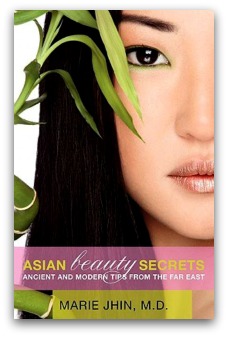
BOOK REVIEW: “Asian Beauty Secrets,” by Marie Jhin

TITLE: Asian Beauty Secrets: Ancient and Modern Tips from the Far East
AUTHOR: Marie Jhin, M.D.
PUBLICATION DATE: July 2011
FORMAT: Paperback and Kindle e-book, available from Amazon
GENRE: Health, fitness & dieting, beauty
SOURCE: Paperback purchased from the Korea Society, New York City

Summary:

Drawing on her experience as a Cornell University-trained dermatologist, combined with a knowledge of Asian beauty remedies, both ancient and modern, Dr. Marie Jhin delivers an East-West guide to vibrant skin and beauty. Born in Seoul, South Korea, Jhin emigrated to Hawaii with her family when she was six (they settled eventually in New York City). She now lives in San Francisco, where she runs her own practice, Premier Dermatology. She has been rated as one of America’s top doctors for the past three years.

Review:

The first time I visited Seoul, my husband, who is Japanese, insisted that I try a spa treatment, as Koreans do this sort of thing better than other Asians, he said. Before I knew it, I was lying naked on a table with an older Korean lady scrubbing every inch of my body. Eventually, she took my hand and put it on my stomach. At first I thought I was touching a piece of terry cloth but no, it was my skin — it had come off in shreds!

I lay there thinking, “Can this be healthy?”

Having pondered these issues quite a lot — also during my years of living in Japan, where I could hardly fail to note how obsessed Japanese women are with skincare — I was intrigued to come across a new book on Asian beauty methods, by San Francisco-based dermatologist Marie Jhin.

Born in Seoul, Jhin is now settled in California. She is not an expat, which makes the title of this post a little misleading; but is she “displaced”? Yesterday she told me in an email exchange that while she doesn’t think of Korea as “home” any more, her birth country remains something of a lodestar. She specializes in Asian skincare, lived in Seoul for two years after college to teach ESL, and has been going to Korea on business of late.

But what really convinced me of Jhin’s “displacedness” is that like me, she was uncertain of the benefits of Korean skin scrubbing but unlike me, let it get under her skin, so to speak:

I grew up doing certain things beauty-wise that I wanted know the truth of. For example, … my mother used to take me to get my skin scrubbed at a Korean sauna. Back then I didn’t understand what the point was, but now, as a dermatologist, I realize that it was basically whole body microdermabrasion that they have been doing for centuries that is great for the skin.

(Good to know!)

Jhin called her book “Asian Beauty Secrets” because it covers the beauty habits of not only Korean but also Chinese and Japanese women. Her key finding is that while women in all three countries have been caught up in the quest to look more Western, they have plenty to be proud of in their native beauty traditions.

The influence of Western beauty ideals

The last time I visited Tokyo, I couldn’t always tell who was a foreigner and who wasn’t since so many Japanese youth had dyed their hair a reddish blonde (I no longer stood out in the crowd!).

Thus I was glad to see Jhin tackle the issue of Western beauty ideals. In addition to dying and streaking their hair, many Asians are getting plastic surgery in the quest to look more Western.

Jhin notes the popularity — especially in Korea, cosmetic surgery capital of Asia (and the world?) — of procedures such as blepharoplasty (double eyelid surgery), rhinoplasty (nose jobs) and surgery to correct what Japanese call daikon-ashi (radish-shaped calves).

And when Asian women do Botox, she says, it’s not to reduce wrinkles but to soften square jaw lines and/or to atrophy cheek muscles and thereby shrink a too-round face.

Jhin draws a line, however, between these procedures and the value traditionally placed by women in all three cultures — Chinese, Japanese and Korean — on having white skin. She cites Chinese Canadian consumer research professor Eric Li in stating that the preoccupation with whiteness predates colonialism and Western notions of beauty. In fact, the Japanese see their own version of whiteness as superior to the Western one!

What Asian women bring to the vanity table

We Westerners are notorious for mistaking one Asian culture for another. Jhin helps us negotiate this sometimes-fraught territory by listing some of their distinguishing elements when it comes to notions of beauty:

1) KOREA

  • Who’s the fairest of them all? In the Far East, it’s Korean women, by common consensus.
  • Korean women like to exfoliate the skin to keep it glowing and healthy.
  • Koreans have long revered the ginseng plant, a vital ingredient in health and beauty potions.

2) JAPAN

  • Going back at least to the Heian period, Japanese have celebrated long tresses — the record of that era being 23 feet! Their favorite conditioning treatment is camellia oil, thought to promote glossy hair growth without making it greasy.
  • Japan spa culture, which dates back thousands of years, favors the use of natural ingredients for cleansing the skin: eg, volcanic mud, wakame seaweed and even nightingale droppings(!).
  • Though Japanese are known for rushing around, they in fact have a tradition of enjoying “empty moments.” Such meditative practices contribute to well-being and bring out a woman’s natural beauty.

3) CHINA

  • In ancient China, pearls were a girl’s best friend: ground pearl powder was taken internally and applied topically. (Hmmm…did they get that habit from Cleopatra, or vice versa?)
  • Chinese have a saying that “a woman’s second face is in her hands” — to this day, Chinese women are meticulous about moisturizing their hands and feet.
  • Traditional Chinese Medicine (TCM) emphasizes certain foods for balancing yin and yang within the body. This inner harmony is thought to contribute to outer radiance.

There is also, of course, much overlap among the three cultures.. All subscribe to the belief that by eating healthy foods, releasing stress (e.g., by getting an accu-massage), and pursuing nature-based healing (TCM) on a regular basis, a woman can enhance her best assets.

The “skinny” on beauty tips and secrets

One of the reasons to pick up a book with the word “secrets” in the title is to find out what one is missing out on. On this score, Jhin’s book is a bit of a mixed beauty bag. Some of her suggestions struck me as being far fetched — and I have a reasonably high tolerance for Asian cultural quirks.

Bird’s nest soup or soup containing hasma (frog fallopian tubes), anyone? Both are ancient Chinese foods thought to nurture glowing skin (Jhin provides recipes). Um, thanks, but no thanks. I’d almost rather eat fugu (which likewise has stimulating properties).

Even more offputting is the Chinese custom of spreading sheep’s placenta on one’s face. (It’s a mercy they’ve moved on from ingesting human placenta, that’s all I can say…)

As for V-steaming one’s chai-york (Korean for vaginal tract) with medicinal herbs such as mugwort (common wormwood) — it will take more than a reassurance by a Beverly Hills doctor to convince me that such a practice doesn’t lead to other problems such as UTIs.

On the other hand, I might actually consider soothing my skin with a high-quality ginseng cream. That sounds nice. Or perhaps I’ll try facial acupuncture. It’s noninvasive and, according to Jhin, can have the effect of a mini-facelift.

Note: More secrets can be found on Jhin’s book site.

Verdict:

For me, the most interesting portion of Asian Beauty Secrets is when Jhin addresses her area of specialization: the conditions peculiar to Asian skin, such as eczema (they are more prone to it than we are) or sun damage that manifests itself not in wrinkles but in brown spots. I also found fascinating the chapter on the latest skin renewal techniques being pioneered by Korean doctors. Acupuncture meets nanotechnology with the “INTRAcel laser” treatment! (The laser reaches “deeper into the dermis for more lasting collagen production and overall skin rejuvenation,” Jhin explains.)

That said, I’d hesitate about recommending Jhin’s book to anyone who isn’t yet oriented (no pun intended!) to beauty practices in this part of the world. Instead you might try experimenting with some of the brands Jhin recommends — e.g., Sulwhasoo cosmetics (now being carried at Bergdorf Goodman here in New York) — by way of familiarizing yourself with Asian skincare methods. As it happens, I got some Sulwhasoo samples when I bought the book — and would be more than happy to report back on the effects, if anyone’s curious! 🙂

STAY TUNED for tomorrow’s installment from our displaced fictional heroine, Libby. (What, not keeping up with Libby? Read the first three episodes of her expat adventures.).

If you enjoyed this post, we invite you to register for The Displaced Dispatch, a round up of weekly posts from The Displaced Nation, with seasonal recipes, book giveaways and other extras. Register for The Displaced Dispatch by clicking here!

Related posts:

CLEOPATRA FOR A DAY: Fashion & beauty diary of expat Helena Halme

Today we introduce a new feature: “Cleopatra for a Day.” Displaced citizens open their little black books and spill the fashion and beauty secrets they’ve collected on their travels. First up is Helena Halme. One of TDN’s Random Nomads, Halme is a Finnish expat in London and a self-professed fashion maven.

BEAUTY

When my husband (“The Englishman”) and I did a house-swap in Los Angeles in the nineties, I discovered Origins, then a skin care range that wasn’t universally available here in the UK. Anything close to nature was an upcoming trend, and the Origins shops in LA looked quite revolutionary — all wooden flooring and straw shopping baskets. I still use a lot of Origins products and couldn’t live without their foot cream, Reinventing the Heel.

Some time ago, an English friend recommended that I try Elizabeth Arden’s Eight Hour cream — I couldn’t live without it now. If I’d ever end up on a desert island, this would be the one luxury item I’d crave for.

HAIR

When I’d only lived in the UK for a matter of months, I cut my hair very, very short. The Englishman was away at sea and when he came back he was quite shocked to see my blonde locks all gone. But, gentleman that he is, he told me the new style suited me. (I’m not so sure it did!) Much more recently, I’ve discovered the the Brazilian blow dry, a luxurious treatment that makes my thick Nordic locks gleam. I feel like a film star!

FASHION

A few years ago on an annual girls’ trip with my school friends, this time to Rome, I bought a long down coat which has been my winter staple ever since. It was weird shopping for warm winter wear in the humid late summer heat in Rome, but it was great to have the style advice of good friends. I understand that the Displaced Nation has been been debating whether down coats can be fashionable. I’d be curious to hear your verdict on my Roman find!

LINGERIE

I seem to always run out of underwear when on holiday, so I have bought some in Rome, New York, Stockholm, Seville… Now what I bought — that would be telling!

JEWELRY

When on holiday in Puglia, Italy, a few years ago, I bought a set of plastic beads. I love them so much I still wear them. They’re a wonderful color that goes with everything.

WEARING RIGHT NOW

Crickey! It’s a miserably cold and rainy Sunday here in London so I’m in my favorite beige-colored Uniqlo jeans, an All Saints double layer t-shirt (bought at their London store in Spitalfields) and my blonde cashmere poncho from Plum. Underwear is Marks and Spencer (it is the one and only store for underwear for me) and there are warm & cozy Ugg boots on my feet.

DAILY FASHION FIX

There are two magazines I cannot live without: Vogue and Grazia. Vogue is for trying to keep up to date with high fashion, Grazia for street style and gossip. I’m also an avid follower and reader of blogs. My favorites are:

STYLE ICON

I don’t really have style icons — I believe that style is a very individual thing; but one person who I really admire is Helena Bonham-Carter. She used to come into the bookshop I worked at in North London and always looked wonderful, in her extremely unique way. However, I could not pull off her style.

STREET FASHION

Two great places to people watch are Selfridges on Oxford Street and Liberty’s on Regent Street. There are lovely cafes in both stores where you can sip your latte and feel as though you’re on the front row of a Mulberry or McQueen show.

TOP BEAUTY/STYLE LESSONS FROM TRAVELS

1) When on holiday to Greece, I learned to try saving my fair skin from burning through the application of sunscreen and after-sun moisturizer.
2) From watching French and Italian women on my trips to Paris or Rome, I learned about how to use a splash of color when wearing neutrals.
3) From my trips to New York I learned about simple lines, neat tailoring, and the chicness of one color (black) or two (eg, beige turtleneck with black trouser suit) — as perfected by designers like Michael Kors, Donna Karan and Ralph Lauren.

Helena Halme blogs at Helena’s London Life and tweets at @HelenaHalme. She will soon be releasing a digital book based on a popular series of her posts, “How I came to be in England,” entitled The Englishman.

STAY TUNED for tomorrow’s post, a male perspective on how to travel and look good.

If you enjoyed this post, we invite you to register for The Displaced Dispatch, a round up of weekly posts from The Displaced Nation, with seasonal recipes, book giveaways and other extras. Register for The Displaced Dispatch by clicking here!

Related posts:

Images: (clockwise beginning with main photo) Helena Halme modeling her Italian down coat in Harrod’s food hall; posing with The Englishman in Italy, just after picking up the beloved beaded necklace; showing off her hair after a Brazilian blow dry in London; staying warm and stylish in London in her blonde cashmere poncho, just a few days ago.

RANDOM NOMAD: Lei Lei Clavey, Australian Expat in New York

Place of birth: Melbourne, Australia
Passport: Australia + USA
Overseas travel history: France (Paris): 2005; USA (Santa Barbara, California): 2008-09; USA (New York, New York): May 2011 – present.
Current occupation: Casting director for StyleLikeU, an online fashion magazine based in New York City.
Cyberspace coordinates: Style Like U | Freedom of expression through personal style (work) and @LeiLeiClavey (Twitter handle)

What made you leave your homeland in the first place?
I’ve had the travel bug for as long as I can remember. A lot of it came from my parents, who took me around the world shortly after I was born. The excitement of being in a different country, immersed in a new culture and environment — it’s something I now crave.

Of course, travel is one thing; living in a place for an extended period is another. To make a home amongst strangers takes you out of your comfort zone and tests your courage in new ways. I enjoy the challenge. I always learn new things about myself as I open my eyes to different people, perspectives, and ways of life.

Was anyone else in your family “displaced”?
My father is what you might call permanently displaced. Born in Chicago, he attended Colorado State University and then left the US to live in Taiwan and study Chinese language and herbal medicine. Taiwan was where he met my mother, who was likewise displaced (she is Chinese Australian). My parents lived in Taipei for five years and then moved to Mainland China for two more years before settling permanently in Melbourne, Australia, where my mother was born and grew up — my father now practices there as a Chinese herbal doctor. (Incidentally, The Displaced Nation interviewed my mother, whose name is Gabrielle Wang, last summer about a book she had written on a half-Chinese, half-Aborigine girl who lived in 19th-century Australia.)

A couple of my cousins share my passion for travel and have recently embarked on an adventure in the UK, where many Australians choose to live (the two-year work visa for Australians under 25 is a relatively straightforward process).

Another of my cousins recently shaved her head and embarked on a solo, life-changing adventure in India. I have yet to hear her tales firsthand. All I know is that she has more guts than I ever will to have done that by herself.

Describe the moment when you felt most displaced since making your home in New York City.
I don’t believe anything could surpass how I felt on my first night in New York City. Before leaving Australia I had arranged to stay with a friend of a friend for a month. He told me: “When you arrive, come to 10th, between A and B, and up to the third floor.” A and B: what country uses letters as street names? Surely they must be abbreviations for something!

It was close to midnight by the time I arrived at East 10th Street between Avenue A and Avenue B (thank you, taxi driver, for clearing that up!).

But then I had another challenge. I was exhausted and ready to collapse after my 22-hour plane flight from Melbourne to LA and another five hours to New York City. After dragging my 32kg (70lbs) suitcase up three flights of stairs — yes, it was a walk-up! — bed was the only thing I had in mind. I knocked and waited. No answer. I knocked again. Still no answer. I sat on my suitcase and was feeling very sorry for myself, wondering why I had ever decided to move to NYC, when three young men walked up the stairs. They were surprised and a little bemused to see me sitting outside the door to their apartment. After exchanging glances, they informed me that I was on the 4th floor, not the 3rd. (In the US there is no such thing as a “ground floor” like we have in Australia. The ground floor is the first floor.) So I struggled my way back down one flight of stairs and walked into an artist’s hazy East Village apartment.

People, music and smoke filled the room. It was community open-mic night, held weekly in this man’s apartment in exchange for rent (a great deal, I now realize!). The owner was asleep on the couch, despite the noise of someone playing the Asian zither.

My eyes scanned the audience, and then I saw Will, the friend of my friend. I could finally relax.

I had entered an alternative universe, an environment utterly foreign to me. But I knew at that moment, my New York adventure had begun and my life would be changed forever.

How about the moment when you have felt least displaced?
When I first came to New York City as a tourist, in 2008, it was as if I had lived here before, perhaps in a past life. I loved the city’s multicultural feeling. So many different faces, cultures and languages — I immediately felt at home. Since coming to live in the city ten months ago, I will occasionally bump into the few people I know in the street. That this can happen even in a city of over eight million gives me a buzz.

You may bring one curiosity you’ve collected from each of your adopted countries into The Displaced Nation. What’s in your suitcase?
From Paris: The 2-hour lunch break. Unlike Parisians, New Yorkers work too hard and I believe with no better results than if they were to have a decent break, get refreshed and go back to work. Australia, unfortunately, is following in America’s footsteps. Surely, citizens of The Displaced Nation could enjoy a reasonable work-life balance?
From New York City: The concept of convenience. For most New Yorkers, it is only a short walk to the grocery store, bank or coffee shop. In fact, I have all three on my block — I love it! On the other hand, New Yorkers like to push those convenience boundaries and have EVERYTHING delivered. Convenience has never been so lazy! The Displaced Nation should find a way to have convenience without the laziness.
From Santa Barbara: The practice of recycling. Santa Barbara does a great job of keeping the University of California-Santa Barbara campus, city streets and beaches clean. They understand the need for it and how trash impacts the environment. I cannot stand how dirty the streets are in New York City. I would therefore urge The Displaced Nation to institute Californian-style recycling policies (if you haven’t already!).

You are invited to prepare one meal based on your travels for other members of The Displaced Nation. What’s on your menu?

My menu is inspired by New York City brunches*. I always crave a nice weekend brunch when I fly back to Australia on holiday!
Appetizer: Shrimp and grits, based on a recipe from Peels** with two (allegedly) secret ingredients: a little Budweiser and a lot of tasso, a Cajun-spiced ham.
Main: Fried chicken sandwich, with chilli lime aioli & pickled egg on sweet-potato focaccia with hand-cut fries — based on a recipe from Diner in Williamsburg, Brooklyn.
Dessert: Chocolate sundae consisting of vanilla and malt ice cream, hot fudge, whipped cream, brownie bites, nuts, and pretzels — based on a Peels** recipe.
Drinks: Traditional Bloody Mary, a solid brunch favorite!
*This is an imaginary meal so ignore the high calorie count and just enjoy it!
**Peels is an American diner with a Southern-inspired menu in NYC’s East Village. I used to host there.

And now you may add a word or expression from the country where you live in to The Displaced Nation argot. What will you loan us?
From New York: Debbie Downer, slang for someone who frequently adds bad news and negative feelings to a gathering, thereby bringing down the mood of everyone around them. I hear it being said all the time in the streets of New York. (It was also the name of a fictional character from Saturday Night Live.)
From Paris: La ziqmu/la ziq (music) — an example of verlan, which, similar to Pig Latin, transposes syllables of individual words (la musique) to create slang words (la ziqmu, often shortened to la ziq). Verlan combinations are endless and have become a part of everyday French, especially for younger people.

This month we are looking into beauty and fashion. What’s the best beauty treatment you’ve discovered while abroad?
New Yorkers are crazy about spa treatments, facials, massages, manicures and pedicures. It seems to be everyone’s de-stressing fix, and I have to agree there’s something very relaxing about someone picking dead skin off your feet. Last September, on the weekend when Hurricane Irene was threatening to hit NYC, can you believe that the places that were most packed out were the nail salons? (Besides liquor stores and bars, that is.) There are also speciality barber shops for men in New York. Australian men, take heed! Men in this city have no shame in caring about their looks as much as women do: they see it as a masculine thing.

What about fashion — can you tell us about any beloved outfits, jewelry, or other accessories you’ve collected in your adopted country or countries?
Living in New York and working at an online fashion magazine, I’ve been exposed to the the cutting edge of weird and wonderful styles. Really anything goes, unlike in Australia! No matter how far-out the boundary you feel you are pushing, someone else will always out-do you. I love that! The city has inspired me to accessorize more: to jazz up an otherwise regular outfit with hats, statement jewelry and/or shoes. Also, New York is a walking city, so clothing also has to be practical — a hat to keep your head warm in winter or the sun off your face in summer, and shoes you can actually walk in (more than cab-to-curb, that is!).

Readers — yay or nay for letting Lei Lei Clavey into The Displaced Nation? Tell us your reasons. (Note: It’s fine to vote “nay” as long as you couch your reasoning in terms we all — including Lei Lei — find amusing.)

STAY TUNED for tomorrow’s installment from our displaced fictional heroine, Libby. (What, not keeping up with Libby? Read the first three episodes of her expat adventures.)

If you enjoyed this post, we invite you to register for The Displaced Dispatch, a round up of weekly posts from The Displaced Nation, with seasonal recipes, book giveaways and other extras. Register for The Displaced Dispatch by clicking here!

Related posts:

img: Lei Lei Clavey outside a favorite coffee shop of hers in the East Village, New York City.

12 NOMADS OF CHRISTMAS: Kate Reuterswärd, American expat in Sweden (12/12)

Current home: Lund, Sweden
Past overseas locations: Italy (Perugia) and Austria (Vienna) — both for six months
Cyberspace coordinates: transatlantic sketches (personal blog), Expat Blog (guest blog for Swedish Institute, a division of the Swedish government) and @kwise321 (Twitter handle)
Recent posts: “You’re Celebrating on the Wrong Day! — and other things you didn’t know about Christmas in Sweden” (Expat Blog: December 27, 2011); “Work makes me happy” (transatlantic sketches: December 29, 2011); “What a year!” (Expat Blog: December 31, 2011)

Where are you spending the holidays this year?
Actually, it’s my first Christmas outside the United States! I’ll be in Lund with my husband and his parents, his sister and her family, and some family friends. I’m looking forward to it.

What do you most like doing during the holidays?
In the US, I always looked forward to baking Christmas cookies and getting gifts for my family and friends. Sometimes my gifts are homemade, sometimes bought at a store, but I love brainstorming the perfect thing for someone. Here, though, the season is full of Christmassy activities: attending glögg parties, decorating the house with lights and going to Christmas markets. It’s the active part of the holiday season that I like the most in Sweden.

Will you be on or offline?
Totally online and hopefully Skyping with my family and friends on a regular basis.

Are you sending any cards?
My husband and I just got married and it was a sort of spur-of-the-moment decision, so we’re sending a combination Christmas/“Oh hey, we’re married!” card. We’ll be writing thank you’s to the people who were there and a little update to people who weren’t.

What’s the thing you most look forward to eating?
Panettone. My family eats this traditional Italian holiday bread for Christmas breakfast with fruit salad, coffee, and mimosas every year. They sell it in Sweden, too, so I’ll be introducing the tradition here.

Have you read any good books this year other expats or “internationals” might enjoy?
I have really enjoyed these two essay collections (though I have to admit that I haven’t finished either of them yet):
1) The Art of Travel, by Alain de Botton (Pantheon, 2002): A thoughtful contemplation on different aspects of travel. As de Botton says, “Few things are as exciting as the idea of travelling somewhere else, but the reality of travel seldom matches our daydreams.”
2) A Supposedly Fun Thing I’ll Never Do Again: Essays and Arguments, by David Foster Wallace (Little, Brown, 1997): His essay on taking a week long cruise in the Caribbean was so true and so funny that I laughed out loud at several points.

If you could travel anywhere for the holidays, where would it be?
No travel dreams for Christmas unless it were to assemble my family and my husband’s all in the same place at the same time. But for New Year’s Eve, I’d love to return to the countryside in County Cork, Ireland, where I went two years ago with a group of eight friends, one of whom has a cabin there. We would all hole up that cabin again to eat, drink lots of champagne, and welcome in the New Year.

What famous person do you think it would be fun to spend New Year’s Eve with?
Despite having attended some exciting New Year’s Eve parties in the U.S. and Europe, I’m not sure I would want to spend New Year’s Eve with a famous person I didn’t feel close to. That said, Dorothy Parker would be hilarious to sit next to at an event like New Year’s Eve — as long as she didn’t turn against me. I would just want to be a fly on the wall.

What’s been your most displaced holiday experience?
Two days come to mind — both having to do with the Fourth of July, not Christmas. The first was in 2010. I had flown back to the States for my friend’s wedding, and then on July 4th I had to fly back to Vienna to go back to work. I spent the entire day in the no man’s land of the Charlotte, JFK, Dusseldorf, and Vienna airports. (I am an extreme budget flyer.) Actually, I’m not sure whether this counts — I didn’t really experience a displaced holiday; I just missed it altogether.

The other time was July 4, 2009. I was spending the summer in Sweden with my then boyfriend (now husband) — my first extended stay in which I started to really get to know his friends and family. We tried to throw a 4th of July party, but something was off. We grilled, we had flags, we had Jell-o shots for a little novelty Americana, but there wasn’t any patriotism and there weren’t any fireworks. For me it felt like a regular barbecue party trying too hard to be something else rather than an actual holiday.

How about the least displaced experience — when you’ve felt the true joy of the season?
Again, it wasn’t Christmas but Thanksgiving, in 2010. I cooked a traditional Thanksgiving feast with all of my mom’s recipes for almost 30 Swedes. We borrowed a friend’s parents’ apartment to fit everyone in, and it was the coziest, most wonderful celebration. My husband downloaded the Macy’s Day Parade for me as a surprise and streamed it while we were cooking and eating. Best of all, one of my Swedish friends asked me halfway through the meal, “Aren’t we supposed to say what we’re thankful for?” I hadn’t wanted to force them to do that, but everyone got really excited about it, and the whole group took turns saying what they were thankful for in what turned out to be really beautiful toasts to the people in their lives. It was amazing.

How do you feel when the holidays are over?
Rested but a little bit sad. So much energy goes into enjoying the holiday season, anticipating Christmas and New Year’s, gift-giving, baking, merry making — and then suddenly it’s all over! And you’ve got all of January and February to slog through until spring is on its way again.

On the first day of Christmas, my true love said to me:
TWELVE STRANGE TRADITIONS,
ELEVEN CAMERAS CLICKING,
TEN SPROUTS A-BRUSSELING,
NINE CELLPHONES DANCING,
EIGHT WHOOPHIS WHOOPING,
SEVEN SKIERS A-PARTYING,
SIX SPOUSES TRAILING,
FIVE GOOOOOOOFY EXPATS.
FOUR ENGLISH CHEESES,
THREE DECENT WHISKIES,
TWO CANDY BOXES,
& AN IRISHMAN IN A PALM TREE!

STAY TUNED for Monday’s post, setting a new theme for the month’s posts on the connection between the displaced life and spiritual awakenings.

If you enjoyed this post, we invite you to register for The Displaced Dispatch, a round up of weekly posts from The Displaced Nation, with seasonal recipes, book giveaways and other extras. Register for The Displaced Dispatch by clicking here!

Related posts:

Dear Mary-Sue: Things to do in Paris

Mary-Sue Wallace is back and she’s dishing out advice to the helpless like it were soup, soup from a big tureen of common sense in the soup kitchen we call the blogosphere … or something like that. If you are looking for solace, then you need Mary-Sue Wallace. Submit your questions and comments here, or if you are a shy bunny requesting anonymity then you can email Mary-Sue directly at thedisplacednation@gmail.com.

Dear Mary-Sue,

Growing up here in Japan as a big-time Francophile, all my life I’ve wanted to visit Paris. This fall I finally have a chance to go visit it for myself. I am so happy at the thought. I will get to stroll the streets and eat plenty of good food. Being such a travel expert could you give me a list of the top things you think I should do when visiting Paris?

— PA, Kyoto

Dear PA,

Ol’ Coley Porter put it best when he wrote that lovely classic of his, I love Paris. “I love Paris in the springtime / I love Paris in the fall / I love Paris in the winter when it drizzles / I love Paris in the summer when it sizzles.” And that sums up so perfectly and so succinctly my own thoughts about this darlin’ city. No matter the time of year, I fall in love with it. Whenever I arrive in Paris, I always make sure on that first night that I go for a stroll along the Seine. Ah, bliss. And when that’s over I go to a little cafe that I adore that is called…

….wait a moment….

….hmm….

….I’m sorry about this, PA, but I just noticed that you wrote that you’re from Japan. In that case, forget Paris. It’s overrated. Have you thought of visiting Malmo? I hear there’s also an interesting cement works in Frankfurt, you could go there. I’m sure it’s fascinating. And people keep telling me Swansea is the Paris of south Wales…

…Aw, shoot. As a loyal Mary-Sue-ite, you deserve a fuller explanation from me, PA. A Japanese Francophile finally visiting Paris after a lifetime of waiting? Aw, honey, sounds like you could be a prime candidate for Paris syndrome. Certain places just seem to have a strange effect on people. Believe me, I know this only too well. It’s why I’m never going back to Jerusalem. Went on a cruise there with my hubby Jake a few years back. Darn it if he didn’t come over all Messianic on me – thought he could walk on water. Well, the fine people at Cunard weren’t too impressed when he went overboard when trying to be all Matthew 14.

And Paris syndrome ‘aint no picnic either, honey. You can end up psychologically destabilized, suffering anxiety, hallucinations, feelings of persecution. Many Japanese visitors to Paris go there with such a romanticized image of the city and its occupants, that it’s a place of sophistication and politeness, that when they finally get there and see for themself the surly, rude reality of Paris they simply can’t cope. 

So PA, I ask again, have you thought about going to Frankfurt? 

— Mary-Sue

Anyhoo, that’s all from me readers. I’m so keen to hear about your cultural issues and all your juicy problems. Do drop me a line with any problems you have.

Mary-Sue is a retired travel agent who lives in Tulsa with her husband Jake. She has taken a credited course in therapy from Tulsa Community College and is the best-selling author of Traveling Made Easy, Low-Fat Chicken Soup for the Traveler’s Soul The Art of War: The Authorized Biography of Samantha Brown, and William Shatner’s TekWar: An Unofficial Guide. If you have any questions that you would like Mary-Sue to answer, you can contact her at thedisplacednation@gmail.com, or by adding to the comments below.

img: Close, by Corina Sanchez.

STAY TUNED for Monday’s post.

If you enjoyed this post, we invite you to subscribe to The Displaced Dispatch, a weekly round up of posts from The Displaced Nation, plus some extras such as seasonal recipes and occasional book giveaways. Sign up for The Displaced Dispatch by clicking here!

Related post:

Dear Mary-Sue: Tempted to make invidious cross-cultural comparisons

Mary-Sue Wallace, The Displaced Nation’s agony aunt is back. Her thoughtful advice eases and soothes any cross-cultural quandary or travel-related confusion you may have. Submit your questions and comments here, or else by emailing her at thedisplacednation@gmail.com.

Dear Wallace-sensei,
As a Japanese expat living in New York, I’m finding myself becoming increasingly unsympathetic to my adopted city. Don’t get me wrong, Wallace-sama, I love it here. It’s just that I’ve found the hysteria surrounding first the earthquake and then Hurricane Irene a little hard to take considering the natural disasters Japan has had to deal with this year. Any advice for how I could stop these uncharitable thoughts that I am having?
— SY, New York City (originally Tokyo)

Dear SY-san,

Let me tell you a little story. There was once an attractive, physically fit young girl. She wasn’t from anywhere exciting, just a small town girl from West Virginia. Her father was a police officer in the town. When this young girl was 10, her father was shot and killed when apprehending a robbery. The girl was sent to Montana to live with her uncle. She didn’t like it in Montana, certainly not on the sheep farm her uncle owned. She tried to run away, to where she didn’t know, she just knew she wanted to be anywhere but Montana. But as she ran she witnessed something awful, the lambs from her uncle’s farm being slaughtered for market. She heard their cries, she still does, SY. She still does — when she dreams. It didn’t stop her running, though — she kept running this small girl.

The girl spent the rest of her childhood in a Lutheran orphanage. It was okay, though she still dreamt of the lambs. The girl was smart, though: she had gumption, she had tenacity and she was able to enroll into the University of Virginia on a full scholarship. When she left college, she applied to the FBI’s training academy. It was the late 70s, it wasn’t easy being one of the only women in the academy. But this girl got on with it. She was uncomplaining, and she was the best, she knew that. None of that sexist bull sticks when you know that.

On completing the training, this girl, now a young woman, joined the Behavioral Science Unit. She was part of a team that traced down serial killers — tried to get in their heads, think like they think. She was sent to a Baltimore asylum for her first interview, to meet with a serial killer who just might be able to help her with the case she had been assigned…

…Sorry, I digress, but the point, SY-san, is that that young girl was, in fact, little ol’ me. Yes, hard to believe, I know. I wasn’t always an agony aunt. Anyhoo, the point is some serious s**t went down. Some really creepy, really heavy stuff. So when I get invited round to Valerie Johnson’s for our book club meeting (second Tuesday of the month — we’re reading The Help at the moment; FABULOUS, you MUST read it), and Valerie starts recounting how she thought there was a robber in her garden the other day and she feared she was going to die — even though it just turned out to be Miguel, her 60-year-old Hispanic gardener — I just bite my tongue. Of course, I want to tell Valerie that she doesn’t know fear until she’s been trapped in a house with a serial killer knowing only one of you is going to get out of there alive. No, that would be rude. So I just sip my raspberry lemonade and nod politely as Valerie talks. New York, dear SY, is your Valerie Johnson. Tolerate her, SY, no matter how much you’d like to wring her neck.
— Mary-Sue

Anyhoo, that’s all from me readers. I’m so keen to hear about your cultural issues and all your juicy problems. Do drop me a line with any problems you have, or if you want to share your fave meatloaf recipe with me (yum! yum!). As they say in Italy, “ciao!” — or, as my (still!) unmarried youngest son (he’s nearly thirty, I despair of him, I really do) might say: “See you on the flip.”

Mary-Sue is a retired travel agent who lives in Tulsa with her husband Jake. She has taken a credited course in therapy from Tulsa Community College and is the best-selling author of Traveling Made Easy, Low-Fat Chicken Soup for the Traveler’s Soul The Art of War: The Authorized Biography of Samantha Brown, and William Shatner’s TekWar: An Unofficial Guide. If you have any questions that you would like Mary-Sue to answer, you can contact her at thedisplacednation@gmail.com, or by adding to the comments below.

img: Close, by Corina Sanchez.

STAY TUNED for Monday’s post, on the wide variety of vehicles that have been used for road trips.

If you enjoyed this post, we invite you to subscribe to The Displaced Dispatch, a weekly round up of posts from The Displaced Nation, plus some extras such as seasonal recipes and occasional book giveaways. Sign up for The Displaced Dispatch by clicking here!

Related post:

The Displaced Nation observes the 10th anniversary of 9/11

Two members of The Displaced Nation team, ML Awanohara and Kate Allison, were living in the United States at the time of 9/11 — Kate as an expatriate from the UK, and ML as a recent repatriate. In commemoration of Sunday’s 10th anniversary, they recount where they were on that day, as well as the impact it’s had on their lives for the past 10 years.

ML AWANOHARA:
I moved to New York City about a year before the 9/11 attacks occurred. Though an American, I’d spent a big chunk of my life abroad, in England and Japan.

But on that fateful day, just as the planes crashed into the towers, I was sitting at an outdoor table at a hotel on the island of Santorini, sipping retsina and savoring the sweetness of the tomatoes in my salad while admiring the hotel’s cliff-perched views of the sea.

The man who would become my second husband and I had gone to Crete for vacation. We’d traveled to this extraordinary cycladic island by ferry for the day.

After lunch, we made our way through the winding streets of Fira to the cable car station — we had to take the cable car back down to the beach to catch the ferry back home to Crete. We decided we needed more film and went into a little souvenir shop near the cable car entrance. The man behind the counter said something excitedly in Greek and gestured at the little TV on his wall.

The screen contained a surreal image of a plane crashing into the twin towers and billows of smoke.

I then had to do one of the hardest things I’ve ever done: get on a ferry for six hours, without any way of finding out what was going on. By the time we reached Crete, I had worked myself up into a state of panic over my sister and her young family, who were living in Battery Park City, right next to the twin towers. (Fortunately, my sister and her two-week-old baby were evacuated.)

We spent the rest of our holiday glued to CNN. On the occasions when we ventured out, many Cretans would offer words of sympathy. I remember in particular talking to the proprietor of one of the many open-fronted shops on Souliou Street, in the old quarter of Rethymno. She confessed to me how frightened 9/11 had made her feel. “If they can do that to America, then how can any of us be safe?” she said, gesturing at her wares, mostly hand-made sweaters.

Dogs, buses and other neuroses

In the aftermath of 9/11, I got my very first dog — a black-and-tan cocker spaniel, whom I named Cadbury for his sweetness (that was before I knew he had moods).

There’s nothing more comforting than a pet when undergoing trauma, and like everyone else in New York, I felt traumatized by the knowledge that there were people out there who hated our country enough to target civilians.

I also started riding the bus home from work. In the months following 9/11, there were constant rumors of threats against the subway. I’d lived through the sarin gas attacks on the Tokyo subway, and didn’t fancy another round of underground terror.

I liked the bus culture and have been taking buses ever since.

The attacks also deepened my interest in politics and foreign affairs. I understood for the first time how vulnerable cities are in general, and New York in particular. Shouldn’t the opinion of New Yorkers, who are on the front lines, count for more than those of people who live in states that aren’t vulnerable to terrorism? Especially when it comes to choosing our nation’s leaders…

That said, city politics are no better. How many city officials does it take to construct a 9/11 memorial? In fact, fewer (or none at all!) would have been more effective.

But I think what I found most disturbing was the role of religion in international affairs. What was all this talk of “holy wars” and crusades? Were we back in the Middle Ages? No doubt I was influenced by all my years of living in the polytheistic Far East, but I just kept thinking: this monotheism embraced by the West and the Middle East has a lot to answer for. (Give me Buddhism any day!)

A noisy anniversary

We’ve made it 10 years, and that’s a relief. At least, I assume that’s why so many people, along with the mainstream media, are making such a loud noise over this. (Are all ten-year anniversaries commemorated this vociferously?)

What I crave right now, to be honest, is some quiet time, away from all these celebratory undercurrents.

When I first came to NYC in 2000, I lived in Greenwich Village. Whenever I looked down 6th Avenue, the twin towers loomed in the distance, helping to orient me in the right direction.

I now live in the East Village, but perhaps I’ll head toward 6th Avenue this Sunday with my two dogs (Cadbury now has a younger companion) and reflect on my lost landmark.

I may also reflect on the snippet of Zen wisdom that appeared in The Displaced Nation’s Monday post, on road trips:

The place to improve the world is first in one’s own heart and head and hands, and then work outward from there.

KATE ALLISON:

Summer 2001 marked our five year anniversary of living in the USA. Nine months before the attacks, we moved from New England to Leesburg, Virginia – a busy, rapidly expanding town about forty minutes west of Washington DC. I loved our new location. There were fields, and cows, and rolling hills; narrow streets and brick houses in the town. It was, dare I say it, very English.

September 11 started as a normal, beautiful, sunny day. I put my eight-year-old on the school bus, and went back home with my preschooler.

A little before 10 a.m., a friend phoned me. We chatted for a moment, then she asked where my husband was; since he worked with her husband, and they both traveled abroad in their jobs, this question wasn’t unusual. It’s what expat wives with traveling spouses talk about.

“At the Virginia office this week,” I said. “Yours?”

“India. He left yesterday from Dulles…thank goodness.”

Here, I should explain that I’m not a big TV watcher, especially when it comes to daytime programming, so the TV wasn’t on. If it had been, most likely it would have been tuned to Teletubbies.

“Why ’thank goodness’?” I asked.

Silence at the end of the phone, then “Haven’t you heard? Turn your TV on. It’s unbelievable.”

So I turned the TV on. I stared at the picture of the Twin Towers, not quite comprehending. I heard the announcement that a plane had crashed into the Pentagon, just forty miles away. The plane was believed to have taken off from Dulles – the airport my husband, his colleagues, and our friends flew from every week. There but for the grace of God.

“World War Three’s just started,” said my friend.

*

My memories of the rest of that day are disjointed. I tried several times to phone family in England to let them know that we were safe, that no one was traveling this week, and eventually, after many busy signals, I got through. My husband came home from work and I breathed more easily. I didn’t want to be alone with just a four-year-old for company while this was going on.

Reports were vague, rumors rife. There were eleven hijacked planes in the air, there were six hijacked planes in the air. The USAF had shot some down; another two hijacked planes were on the way to Washington. Thirty thousand had died in the towers.

What was clear, however, was that airspace was gradually being cleared, and all planes had to land.

The silence from the skies as this happened was deafening. You don’t realize how much noise comes from overhead aircraft – particularly near a busy airport like Dulles – until the noise isn’t there.

In the early afternoon, rumors were still circulating about a rogue flight on its way to the White House or the Capitol. I went outside into our garden for a moment, and was panicked to hear aircraft engines overhead, because by this time all planes in US airspace had been grounded.

Only later did I discover I had heard Air Force One and its accompanying fighter jets, bringing the President back to Washington.

Our daughter returned from school and wanted to know what was going on. Something was going on, she said; she knew it was, because her teacher was being much nicer than usual and had let the kids draw pictures all day.

How do you explain something like this to a child? For the first time, I wondered at the wisdom of bringing children into this world at all.

Two weeks later, still pondering this question, I discovered we were expecting our third baby. Perhaps it was the answer I needed.

*

Déjà vu

No one we personally knew died that day, but because of where we had lived in the US, close to both attacks, many people we knew lost friends or relatives. Their grief makes me uneasy when I see movies being made about 9/11. It’s too soon, too raw. I’m not sure when it will ever be anything else.

Something I was asked a lot in the aftermath – Will you be coming back to live in England after this?

The answer was always No. I grew up in Britain during the 70s and 80s, when IRA bombings on the mainland occurred all too often. These things can happen anywhere.

This attitude was somewhat justified four years later, on July 7, 2005. I was in London that day, having arrived at Heathrow the night before. Had I not been jet lagged and so overslept, my children and I could have been on one of those trains that were torn apart by suicide bombers – we had planned some sightseeing that day.

Like I said before – there but for the grace of God…whatever you conceive Him to be.

STAY TUNED for Monday’s post, when we return to the theme of road trips.

If you enjoyed this post, we invite you to register for The Displaced Dispatch, a round up of weekly posts from The Displaced Nation. Includes seasonal recipes and book giveaways. Register for The Displaced Dispatch by clicking here!

img: Remember — a September 11th memorial image (the New York skyline is reflected in the eye from a silhouette placed on a window), by David Hepworth.