The Displaced Nation

A home for international creatives

Tag Archives: New York City

WONDERLANDED: “Bewildered, Bewitched & Bothered,” by expat writer Sally Rose

bewildered bewitched and bothered

Photo credits: (Row 1) Cheshire Cat, by thethreesisters via Flickr (CC BY 2.0); (Row 2) Alice in Wonderland Cosplay, by Michael Miller via Flickr (CC BY 2.0). Other photos supplied.

A couple of days ago we were Wonderlanded in Santiago, Chile, with American expat writer Sally Rose. She nearly had us twirling in teacups as she took us on a tour of the curiouser and curiouser aspects of her adopted home.

Today we have a chance to sample Sally’s writing and its distinctly wonderlanded quality with this excerpt from her recently published memoir, A Million Sticky Kisses, which recounts her early days as a volunteer English teacher at a not-so-well-off school in Santiago. How does Sally write about being a stranger in a strange land? NOTE: For the purposes of this post, I’ve titled this passage “Bewildered, Bewitched & Bothered” as that seemed an apt way to describe the scenes Sally depicts.

AMillionStickyKisses_cover_pm

* * *

Bewildered, Bewitched & Bothered (Part 2, Chapter 7 of A Million Sticky Kisses, by Sally Rose):

I got up early the next morning because the supervisor had granted me permission to attend the meeting which started at 8:00am. I was at the Metro station by 7:30, where the free newspaper hawkers were setting out stacks of papers. As I walked by, I started to take one from a stack. The male hawker slapped his hand on top of the paper to hold it down. I looked at him as he let out a rapid stream of Spanish, but I had absolutely no idea what he was saying. I tugged again at the paper. “¡No!” He would not let me have it.

“No entiendo. ¿Por qué?” I don’t understand.

From the corner of his eye, he glanced at me. ¡Gringa! I saw him almost relent for a second before tightening his stance as he started explaining again. I listened hard, but without success. He was one of those Chileans that I could not understand at all.

Finally, the woman, who was guarding the other free paper, came over to me and, like she might explain to a 5-year-old who was just learning how to tell time, she pointed to my watch and made a quarter circle with her finger. I understood her, but couldn’t believe it.

“¿Ocho menos cuarto?” 7:45? I had to wait until 7:45 before I could take one of their free papers? She nodded her head.

I realized that it wouldn’t do any good to try and finagle it. This was one of those mysterious Chilean customs that made no sense to a gringa, especially a gringa living in New York, where the papers sat in huge stacks and you could take as many as you liked.

As I walked away, bewildered, I noticed that there were several people already forming a line, willing to wait 15 minutes so that one of the hawkers could hand them a newspaper. They watched our exchange closely to make sure that I didn’t get a newspaper before they did.

I couldn’t wait 15 minutes, not if I wanted to be on time for the meeting. Not that I expected it to actually start at 8:00, but She-Who-Can-Never-Be-Late didn’t want to risk it. I descended the Metro steps without getting my newspaper after all.

"Out of time" street art, which has now been painted over (supplied).

Sally may be in Chile but she doesn’t want to be late! Photo credits: “Out of time” street art, which has now been painted over (supplied); Suivez le lapin blanc, by thierry ehrmann via Flickr (CC BY 2.0)

Incredibly, the meeting started at 8:05. The supervisor was a no-nonsense Chilean who spoke excellent English. I mostly just listened, but Marisol [Sally’s colleague, a Chilean English teacher] told me later, “I think she was nervous around you.”

Then, she added, “Jacqueline [another gringa English teacher] would really like it if you went to her classes today. The supervisor has given her another bad mark. She has received bad marks all year. Without telling her that they will not have her back next year, they have interviewed three other people to replace her. Yesterday, BAY-ACHAY-ESSAY [nickname for Victor Hugo Salinas, head of the English volunteer program] knocked at her door and told her that someone else would be teaching her classes that day. Then, a job applicant took over her classes while poor Jacqueline had to stand and watch.”

Her teaching skills needed improvement, but I almost could not comprehend the cruelty of this. I trudged off to find Jacqueline. Her classes, and now her career at this school, were a lost cause.

After school, I was invited to go with the chorus to the annual Christmas concert at a nearby cathedral. Students from each of The Network’s schools participated. My kids were partnered with girls from the adjacent high school.

We left in a large van from the school, zigging and zagging down narrow backstreets to arrive at the church just in time. We hurried the kids in to find our pews. In the 90-degree heat, my clothes clung to me, but inside the church, it was blissfully cool and smelled of candle wax and furniture polish.

I sat with one of the mother chaperones and kept an eye on the kids. In our chorus were eighteen girls and one boy. They were the only ones wearing their “every day” uniforms, the same gray sweat suits that they wore to school. Choir members from the other schools had on school uniforms, as well, but they were cleaner, dressier, and more expensive.

White shirts, navy pants for boys and white shirts with navy jumpers for girls. I had never seen my kids in any uniform except the sweat suit and I wondered if my school might be the poorest in The Network.

Behind me, I heard commotion and turned to find little girls pushing off and sliding from one end of the well-buffed pew to the other. I gave them a look that included an arched eyebrow and they settled down again, giggling.

The concert began with “It Came upon a Midnight Clear,” in Spanish. My kids were next. I didn’t recognize their song, but it was beautiful with their voices echoing strong in the vaulted cathedral. They accompanied the song by clapping their hands in flamenco-style rhythm while the youngest girl pinged on a triangle.

Sally doesn't mind her kids being in sweat suits when they perform well (photo supplied).

Sally doesn’t mind her kids being in sweat suits when they sing beautifully (photo supplied).

Out of the twenty or more songs, I only recognized five. The rest were traditional Chilean Christmas songs.

Afterward, going home later than usual, the train was crowded. A man entered after me and moved past me. Then, he called attention to himself by bumping into me as he moved in front of me again. “Permiso,” he said as he circled around. I thought he would be getting off at the next station since he stood by the door, but instead of facing the door, he turned around to face me.

All this moving around put me on guard. I was holding my purse, my school bag, and my sweater when I felt something funny going on with my purse. I looked down and saw a sweater hanging over the top of it. His sweater. Then, I felt something fiddling with the zipper. His hand?

Quickly, I moved away to the middle of the car, out of his range. Keeping my eyes on his, I felt around inside my purse to make sure everything was still there. I glared at him with mal de ojo, the evil eye, until he jumped off at the next stop.

Metro and evil eye

You have to have an evil eye on the Santiago Metro if you don’t want to be pickpocketed. Photo credit: Metro Universidad de Chile, by Guillermo Perez via Flickr (CC BY 2.0).

* * *

Thanks, Sally! I love it, especially the section where you descend into the Metro muttering the equivalent of: “I’m late, I’m late, for an important date.” And your mal de ojo (evil eye) powers must be on a par with the Queens of Hearts’s “Off with your head!” Also, I’m glad your version of Wonderland includes children’s music.

Readers, what do you think? Has this excerpt from Sally’s book made you want to read more? If so, you can order A Million Sticky Kisses from Amazon or Good Reads. You can also visit Sally’s author site, where she keeps a blog and/or stay social with Sally by following her on Twitter, Facebook, Pinterest, and Instagram. And of course you can also express appreciation for Sally in the comments below. ~ML

STAY TUNED for next week’s fab posts.

If you enjoyed this post, we invite you to register for The Displaced Dispatch, a round up of weekly posts from The Displaced Nation, and much, much more. Register for The Displaced Dispatch by clicking here!

Related posts:


Wonderlanded in Santiago with Sally Rose, expat writer, teacher and (above all) learner

Photo credits: Santiago (top) and New York City via Pixabay; Sally in Chile & Sally's Alice in Wonderland  painting by Russian artist. (supplied).

Being Wonderlanded with Sally Rose means going from the City That Never Sleeps to the City of Madhouse Parties. Photo credits: Santiago (top) and New York City via Pixabay; Sally in Chile & Sally’s Alice in Wonderland painting by Russian artist. (supplied).

Welcome back to the Displaced Nation’s Wonderlanded series, being held in gratitude for Lewis Carroll’s Alice’s Adventures in Wonderland, which turns 150 this year and, despite this advanced age, continues to stimulate and reassure many of us who have chosen to lead international, displaced, “through the looking glass” lives.

This month we travel
d
o
w
n
the hole with Sally Rose to Santiago, Chile.

At first glance, Sally may not seem to have a strong connection to Alice in Wonderland, having been born and bred in the piney woods of East Texas. But I assure you her life has taken the kinds of twists and turns that would give Alice some serious competition.

First, Sally faced the struggle of getting out of a conservative small town in Texas, which simply didn’t have enough Mad Hatters in it to satisfy her curiosity. As she says in the introduction to her recently published memoir:

At night, I’d lie awake and listen to the whistle of the midnight train as it passed through like clockwork. I always pondered where it might be going. In my imagination, it was always somewhere “exotic” and exciting. Where to tonight? Chicago? New York? Out West?

Once she was old enough to leave home, Sally tried living in the Cajun Country of Louisiana, the plains of Oklahoma, and the “enchanted” land of New Mexico—only to make her way, eventually, to the East Coast and New York City, where she dreamed of writing the Great American Novel.

But even the Big Apple wasn’t enough to sate her restless, adventuresome spirit. Soon it was time to expand her horizons again and go abroad. Having been to Chile on a holiday, she signed up for a volunteer program teaching English in Santiago.

At last she had stepped though the looking glass! From the moment she arrived to live in Santiago, she found herself struggling with both language and culture, along with a whole host of unfamiliar characters—from avaricious school owners to boisterous school kids. She was a “stranger in a strange land.” Would she get out alive and unharmed, with her wallet safe (no joke!). Perhaps if she hadn’t been the recipient of a million sticky kisses, as her memoir is titled, she would have exited her Alice in Wonderland story by now, screaming “Off with their heads!”

But instead she embraced the adventure and has now become a permanent resident of Santiago, a displaced creative. In addition to A Million Sticky Kisses, which chronicles her earliest encounters with her Chilean students, Sally has also produced a children’s book, Penny Possible, about a Golden Retriever named Penny who trained for two years to become a therapy dog for an Iraq war veteran (proceeds are donated to Warrior Canine Connection). It has been a No.1 bestseller on Amazon.

Oh, but wait! A rabbit just darted by. Let’s follow Sally and hear about her Adventures as a Gringa Teacher in the Wonderland of Santiago de Chile…

* * *

Sally Rose: Thanks, ML, and thanks, Displaced Nation readers, for accompanying me on this trip to my special version of Wonderland. As ML mentioned, I was born and raised in East Texas, in a tiny little town. That means the northeast corner between Dallas and Texarkana. I’m not sure why I chose to incarnate in small-town Texas because I always had the feeling that I was a big-city girl, and I’ve since discovered that to be true.

My path to becoming a displaced national went like this: Texas-Louisiana-Texas-Louisiana-Oklahoma-Louisiana-Texas-New Mexico-Texas-New Mexico-New York-Chile.

I’d always wanted to try living in New York, and I’d always thought I’d live overseas. Everything before that was only practice.

“Who in the world am I? Ah, that’s the great puzzle!”

I must have felt disoriented from the moment I was born. Though there were differences in each of the original four states (Texas, Louisiana, Oklahoma, New Mexico), my life before New York was fairly homogenous, but nowhere felt like “home.” Now, I realize that most of my moves have been based on trying to find my tribe. Asking myself, “Where do I fit in?”

Though many people become disoriented by being “down the rabbit hole,” I thrive on feeling that little edge of uncertainty, on feeling puzzled.

Living in New York meant getting used to high rent-tiny apartments, walking and public transit vs. car culture, different (read: NY) attitudes, too many choices, and 7,999,999 other people, yet not being connected to any of them.

Once I got into the rhythm and pace of the city, I found it exhilarating. I called New York my temperamental mistress, but I eventually felt less disoriented there than anywhere else I’d ever lived.

In 2008, I came to Chile on a vacation. Call it karma, fate, or the planets aligning—but the moment I set foot in that strange land, I knew the time had come to follow my heart and make my dream of teaching abroad a reality.

I moved to Chile on March 1, 2011, ready to conquer the world and make a difference in someone’s life.

“Curiouser and curiouser…”

Three years before I made the move, I did several stints of volunteer teaching in low-income schools where the students were considered to be “at risk.” Vulnerables. My book, A Million Sticky Kisses, covers that initial period.

I learned so much about myself that, most of that time, I wondered who was teaching whom.

In Santiago, Sally is teacher but above all learner (photo supplied).

In Santiago, Sally is teacher but above all learner (photo supplied).

“But she went on all the same, shedding gallons of tears, until there was a large pool all round her, about four inches deep…”

Once I decided to relocate to Chile, I had many moments of doubt, starting as the plane sat on the runway at JFK. Buckled in and staring out the airplane window, I had a moment of utter, can’t breathe, panic. What in the world was I doing? Leaving everything behind and moving overseas where I knew almost no one and barely spoke the language, what was I thinking?

Most “pool of tears” moments were followed by elation, the “I did it!” moments. Making the move, finding an apartment, getting my residency visa, opening a bank account, finally understanding enough Spanish to have a phone conversation, all counted as triumphs.

“If everybody minded their own business,” the Duchess said in a hoarse growl, “the world would go round a deal faster than it does.”

I haven’t changed my personal clothing style, which tends to be tailored and conservative. I actually enjoy wearing what I think of as the “Chilean granny uniform.” Wool skirt, wool sweater, wool scarf in neutral tones. And let’s not forget the sensible flats.

My short, red hair has earned me some long looks and possibly some judgment.

For young Chilean women, the hair style is long. Period. There are few exceptions. Once a woman is over 50, it’s acceptable to have shorter hair, but not spiky, red hair, like mine. This leads to suspicions that one is a lesbian, whether it’s true or not.

Sally doesn't care what Chileans think of her granny clothes & short red hair. Or does she? (Photos supplied)

Sally doesn’t care what Chileans think of her granny clothes & short red hair. Or does she? (Photos supplied)

“You’ll get used to it in time,” said the Caterpillar; and it put the hookah into its mouth and began smoking again.

It took me a long time to realize that you cannot be direct with Chileans. If you approach things openly and directly, they will often be embarrassed or offended.

This happened to me the first year that I was here. A teaching colleague had invited me to an asado, a BBQ, for Chile’s national independence day, Fiestas Patrias, September 18.

She invited me, but there were no details. What time did the party start? Would it be at her house or at her sister’s? Could she give me directions?

I sent her an email, asking these questions, but it went unanswered. I tried phoning her. She didn’t pick up. I texted her, Facebook messaged her, and phoned again, multiple times. She never responded to me and I ended up with no plans for the biggest Chilean holiday of the year.

Gringa alone on Fiestas Patrias. Photo credit: Bailando en la fonda, by Osmar Valdebenito via Flickr (CC BY-SA 2.0).

Gringa alone on Fiestas Patrias. Photo credit: Bailando en la fonda, by Osmar Valdebenito via Flickr (CC BY-SA 2.0); inset: Sally Rose (supplied).

The following week at school, she was polite, but not friendly like she’d been before. When I finally found her alone one day, I asked her what had happened. “I waited to hear from you about the BBQ. Why didn’t you respond to my messages?”

Lo que pasa es…” What had happened is that her baby had been sick and the car broke down. Then, her sister had decided not to have the party, and so on and so forth.

“I understand difficult family situations,” I told her. “What I don’t understand is why you didn’t let me know.”

She couldn’t explain this, didn’t seem to understand why it mattered nor why I felt disappointed.

Our relationship never recovered from this incident, and I was never invited again. She became distant; she avoided me. I lost a friend, but learned a lesson. To maintain Chilean friendships, I had to be less direct, or even silent, about many things, which is not my usual style.

“Well, I’ll eat it,” said Alice…

A Chilean food I love? That’s a strong word. I’ve tried octopus—too rubbery. Cochayuyo (dried seaweed)—rubbery and sticky. No love lost there. I’d have to say that my favorite Chilean dish is Pastel de Jaiba. This is a crab casserole baked in an individual clay bowl. ¡Rico!

Pastel de Jaiba, Sally's favorite Chilean dish (photo supplied).

Pastel de Jaiba, Sally’s favorite Chilean dish (photo supplied).

“Take some more tea,” the March Hare said to Alice, very earnestly.

Since my current home is approximately 55m, and my dining room table seats four people, this would be an intimate party. I would host a traditional Chilean once, with a twist or two.

Once is tea time in Chile. Not everyone observes this tradition, but many still do. Once has its roots in friends getting together for a nip in the late afternoon. In some stories, it was soldiers who began the tradition. In other stories, it was older ladies. Either way, they wanted to keep it a secret, so they called it once. The word in Spanish means eleven, after the eleven letters in aguardiente, fire water.

These days, alcohol is not usually served at once. Traditional once includes tea, bread with butter and jam, sometimes ham and cheese, and on special occasions, a cake. Chileans love sweets, and many cakes here are layered with manjar, a tooth-aching, caramelized milk filling, similar to dulce de leche.

I would use my best tablecloth and my English teapot. Manjar‘s too sweet for me, so I would serve a gooey, dark chocolate confection instead, and since I’m a gringa, I would serve a dry, bubbly espumante, in addition to the tea.

Wearing hats might be involved. Gloves, optional.

Is Sally Alice or the Mad Hatter here? (Photo supplied)

Is Sally Alice or the Mad Hatter here? (Photo supplied)

“I almost wish I hadn’t gone down that rabbit-hole—and yet—and yet—it’s rather curious, you know, this sort of life!”

My identity shift began in New York and has continued here in Chile. There is something empowering about moving into the unknown. When you start to have small victories, like navigating the subway or ordering in Spanish at a restaurant, you feel a heady success.

On the flip side, your mettle is tested on an almost-daily basis. Once you have proved to yourself that you can survive, evolve, adapt, and thrive, you get a glimpse of who you really are.

Sally in Disneyland teacup, in the days before she was wonderlanded (photo supplied).

Sally in Disneyland teacup, foreshadowing her experience of being wonderlanded (photo supplied).

Advice for those who have only just stepped through the looking glass

It’s okay to not know where you belong. Change course if necessary. Accept that you may never fit in. If something doesn’t work, be flexible. Try something else. Reinvent yourself. The good news is that you’ve already done it once, and you can do it again.

“Alice had begun to think that very few things indeed were really impossible.”

Ironically, I often work best when I am confused, challenged, or depressed. Since none of these is the case at the moment, I’m distracted by life, in general, but I have two specific projects in mind.

The first is an illustrated children’s book. It will be based in Chile, using iconic settings, and the theme will revolve around two of Santiago’s one million street dogs. I call them Bruno and Roger.

I am also in the process of reviewing and editing a former project titled Well, Why Was I Born: The Romance that Never Was. Publication goal: 2017.

sally rose books

Sally’s great works: two in the bag and two to come.

* * *

Thank you, Sally! That was a jolly good trip, both entertaining and thoughtful. Readers, I wonder if you feel like me, that there was something very special about the experience of being “wonderlanded” with Sally in Santiago? Please let us know in the comments. ~ML

STAY TUNED for the next fab post: an example of how Sally writes about place.

If you enjoyed this post, we invite you to register for The Displaced Dispatch, a round up of weekly posts from The Displaced Nation, and much, much more. Register for The Displaced Dispatch by clicking here!

Related posts:

BOOKLUST, WANDERLUST: Beach bound? Check out summer reading recommendations from featured authors (1/2)

booklust-wanderlust-2015

Attention displaced bookworms! Our book review columnist, Beth Green, an American expat in Prague (she is also an Adult Third Culture Kid), has arrived with a treasure chest full of recommended reads to take you through the summer. NOTE: Check out Part Two here.

Hello again, Displaced Nationers!

Summer is upon us—well, for readers in the northern hemisphere, that is! And for those in the United States, Fourth of July weekend is coming shortly. Even if you’re not beach bound, perhaps you are at least picturing yourself sitting in a beach chair feeling the sand through your toes, the waves pounding towards you, the fresh, bracing sea air filling your lungs…

And what’s that you have in your hand—a book or a Kindle?

I find the sound of the waves and the ocean breeze the perfect conditions for escaping into other worlds that writers conjure up for us in their books. This summer, I’ve already been to a few local parks with my e-reader, and I’ll soon be topping it up with some of the books from our best-of-2014 list for an overseas trip. But I’m always on the look-out for fresh new material, and as there are miles to go before I can flop down on the beach of my dreams, I fear I’ll run out of prime reading matter by then. With this eventuality in mind, I decided to reach out to a few of the authors whose books I’ve recently read or reviewed, along with a few of my bookish friends, to see what books they recommend taking on vacation. I asked them to tell me:

Summer Reading 2015

Photo credits: Amazon Kindle PDF, by goXunuReviews via Flickr (CC BY 2.0); beach chair and sandy feet via Pixabay.

They responded with recommendations that seem tailor made for an audience of international creatives. Enjoy! Part 2 will be posted on Friday.

* * *

ALLI SINCLAIR, world traveler, Australian romance author and former co-blogger at Novel Adventurers: I recommend that you bring one travel book, one classic, and one novel. The following make a good combination:

ChasingtheMonsoon_cover_x300Chasing the Monsoon: A Modern Pilgrimage Through India, by Alexander Frater (Henry Holt & Co, May 1992)
There are some books that touch something in your soul that stays with you forever. For me, Chasing the Monsoon falls into that category. Originally published in the early nineties (and thankfully, still available!), Alexander Frater follows the monsoonal rains from the Kerala backwaters in southern India to Cherrapunji, in northern India—known as the wettest place on earth. Frater connects beautifully with the people he meets and he writes for all senses, giving the reader a full immersion into one of the most captivating countries on Earth.

The Ascent of Rum Doodle_cover_x300The Ascent of Rum Doodle, by W.E. Bowman (Vintage Classics, 2010)
Originally published in 1956 but still in print, this book is one of the most celebrated mountaineering stories of all time. The 1950s saw some of the world’s highest mountains successfully climbed (including Everest), and this book is a parody of mountaineering at it’s finest…er, worst. There’s a route finder who is constantly lost, a diplomat who continually argues, and a doctor who is always ill. Rum Doodle will most definitely appeal to fans of Bill Bryson, who wrote the introduction to the book’s international edition (published in 2010).

HellofromtheGillespies_cover_x300Hello From The Gillespies, by Monica McInerney (Penguin, 2014)
I’m a long time fan of Monica McInerney’s books, maybe because Monica is a “displaced” person: having grown up in Australia, she has split her time between Australia and Ireland for the past 20 years. This book is mostly set in outback Australia but with ties to England. Angela Gillespie, a mother of four adult children, has sent out a regular Christmas letter to friends and family for thirty years. The notes are always cheery and full of good news but this year, her note details the unsettling truth of how her family has fallen apart. If you enjoy family sagas with humour and heart, you can’t go wrong with this book. (True, some people recommend it for the holidays, but it’s summer in Australia at Christmas time, remember?)


BRITTANI SONNENBERG, adult TCK, current expat and author of Home Leave (which we reviewed in November): I would pack the following books (assuming I’d be packing it for someone else, who hadn’t read them yet).
Sonnenberg_collage

The Dog, by Joseph O’Neill (Vintage, September 2014)
It’s a devilish, compelling take on cosmopolitan and expat life by the TCK author of Netherland. (Joseph O’Neill was born in Cork, Ireland, in 1964 and grew up in Mozambique, South Africa, Iran, Turkey, and Holland. He now lives in New York City.)

Ghana Must Go, by Taiye Selasi (Penguin, 2014)
This is an intimate examination of a splintered family, set in Accra, Lagos, London, and New York.

All My Puny Sorrows, by Miriam Toews (McSweeney’s, 2014)
One of the saddest and funniest books I’ve ever read; an honest, moving portrayal of sisters and mental illness.


CHRISTINE KLING, author of travel- and sailing-related thrillers: I’ve just finished up the edits on a the third novel in my Shipwreck Adventure series, and I’m looking forward to taking a bit of time off from writing and working at reading my way through some of the long list of books I’ve been wanting to read. The three books I’d take in my beach bag include two novels and a combination cookbook/memoir/travelogue.

The-Janissary-Tree_cover_x300The Janissary Tree, by Jason Goodwin (Sarah Crichton Book, 2006)
My husband and I are contemplating building a new boat in Turkey, and after our recent visit, I’ve fallen in love with the country. Jason Goodwin has written travel books, histories, and thrillers, and I’ve been waiting for the chance to begin reading his work. The Janissary Tree, winner of the 2007 Edgar Award for Best Novel, is the first in what is now his five-book series set in in the waning days of the Ottoman Empire’s Istanbul. The series features a very unique protagonist Yashim Togalu, a eunuch guardian. In this book, Yashim is called upon to investigate a series of crimes including murder and theft of jewels.

Marina_cover_x300Marina by Carlos Ruiz Zafón (Little, Brown Books for Young Readers, 2014)
The first book I read by this author was The Shadow of the Wind, which I often cite as one of my favorite books of all time. I knew Zafón had written a young adult novel that was published in 1999 and became a “cult classic” in Spanish, and since I enjoy good YA novels like the Harry Potter series and the Hunger Games, I was happy to see this book finally released in English in 2014. Marina is set in Barcelona around 1980 at the end of Franco’s regime. This gothic tale is touted as containing elements of mystery, romance and horror as a young boarding school boy meets the exotic, dark Marina. Together they embark on a series of adventures where they meet the kind of grotesque Barcelona characters Zafón does so well.

Sea-Fare_cover_x300Sea Fare: A Chef’s Journey Across the Ocean, by Victoria Allman (Norlightspress Com, 2013)
Years ago I worked as a chef on our owner-operated charter sailboat, and I know what it is like to have to create meals for demanding guests. Victoria Allman is in an entirely different category as she trained as a chef and has worked your years on multi-million dollar yachts. In Sea Fare, Allman has combined the tales from her beginning as a green Canadian chef looking for a job in the charter yacht industry to the joys of shopping in exotic markets from Italy to Vietnam. From the descriptions of her experiences on board the yacht, dealing with crew problems and falling in love with the captain, the stories are grand, but the recipes and the outstanding color photos of the food, will probably cut my trip to the beach short as I head home to try some new dish.


HEIDI NOROOZY, adult TCK, translator and author of multicultural fiction: I just returned from a research trip to Germany, and my choices seem to reflect that! (I went there because I’m writing a novel about an East German detective, Johannes Christian Alexander Freiherr von Maibeck—I know, it’s a bit of a mouthful—I created for a short story I once wrote. The setting is Leipzig, German Democratic Republic, 1981.)

The-Leipzic-Affair_cover_x300The Leipzig Affair, by Fiona Rintoul (Aurora Metro Press, May 2015)
Set in 1985, this novel tells the story of a Scottish student at Leipzig University who falls in love with an East German girl and stumbles into a world of shifting half-truths. Well written and fast paced, the story captures the atmosphere of its setting very well, a world where nothing is ever quite what it seems. As one reviewer writes: “The book is expertly written and seems to me to be a very comprehensive picture of what it was like to live in the East German state.” (Rintoul, a Scot who lives in Glasgow, gathered her material for the book by visiting East Germany and meeting a woman who had been imprisoned. She also looking at extracts of STASI files on people she met.)

Zoo-Station_cover_x300Zoo Station: Adventures in East and West Berlin, by Ian Walker (Atlantic Monthly Press, 1988)
British journalist Ian Walker, who once covered Central America for the Observer (and never managed to write his promised volume on Nicaragua), produced this travelogue on the two Berlins back in 1988. It depicts bohemian life in the once-divided city, where everyone seemed to be from somewhere else: West Berlin was full of Brits, Asians, Danes, Turks and East German exiles; East Berlin, of Anglo-Austrian expats. Walker’s descriptive narrative and reflections on the broader social issues of the day are what make this book stand out. As one of Amazon reviewer puts it:

Having read “Zoo Station”, I was able to understand why some people regarded East Germany as a pinnacle of socialist achievement, much more preferable to its capitalist twin in the West. It is good travel writing, and is both politically and culturally astute.

The-One-That-Got_Away_cover_300xThe One That Got Away, by Simon Wood (Thomas & Mercer, 2015)
Okay, this one isn’t about Germany, and I haven’t read it yet—but it’s at the top of my summer book bag. Tag line: “She escaped with her life, but the killer’s obsessed with the one that got away.” The story of two grad students in California who decide to take a road trip to to Las Vegas, this suspense novel deals with survivor’s guilt and is bound to be a thrilling ride. (Originally from England, Simon Wood lives in California with his wife.)

* * *

Readers, that’s it for this round; we’ll have another round on Friday (update: check it out here). Meanwhile, have you read any of the above and/or do you have summer reading recommendations to add? Please leave in the comments!

And if you need more frequent fixes, I urge you to sign up for the DISPLACED DISPATCH, which has at least one Recommended Read every week.

STAY TUNED for PART 2 of this post on July 3rd!

Beth Green is an American writer living in Prague, Czech Republic. She grew up on a sailboat and, though now a landlubber, continues to lead a peripatetic life, having lived in Asia as well as Europe. Her personal Web site is Beth Green Writes. She has also launched the site Everyday Travel Stories. To keep in touch with her in between columns, try following her on Facebook and Twitter. She’s a social media nut!

If you enjoyed this post, we invite you to subscribe to The Displaced Dispatch, a weekly round up of posts from The Displaced Nation and much, much more. Sign up for The Displaced Dispatch by clicking here!

Related posts:

CULTURE SHOCK TOOLBOX: How to be a diva in another culture–by not being one!

Culture Shock Toolbox April 2015 Rossi Columnist H.E. Rybol never saw a culture clash she didn’t want to fix. She calls herself a “transitions enthusiast” and credits her Third Culture Kid upbringing for giving her a head start in that department. That said, H.E. is always looking for new tools to add to her kit, and toward that end has been interviewing other displaced creatives about their culture shock experiences. Today she speaks to Kristen Rossi, a New Yorker who is on a mission to spread the Golden Age of Broadway/jazz throughout Asia. Okay, H.E. and Kristen, time to paint the town and all that jazz!

—ML Awanohara

Hello, Displaced Nationers! Today I am delighted to introduce Kristen Evelyn Rossi to Culture Shock Toolbox readers. Kristen is an American actress, singer and voice over artist based in Southeast Asia. Besides being a talented performer, she is an entrepreneur and, while living in Bangkok, has co-founded two organizations: Broadway Babe, an endeavor to bring Broadway style to the Thai capital, and Musical Theatre for KIDS, which offers Broadway musical and theatre workshops for Asian youth.

I was lucky enough to catch up with Kristen recently and ask her a few questions about her somewhat unusual life of crooning her way around Asia, while also teaching others how to traipse the Broadway boards. I can see from the YouTube videos on her Website that she has racked up many successful performances; but I wanted to know: have there been any cultural flops?

Here’s what she had to say…

* * *

Hi, Kristen, and welcome to the Displaced Nation. Can you tell us which countries you’ve lived in and for how long?

I have lived in London (UK) for just under a year; about seven years in Bangkok, Thailand; Hanoi, Vietnam for the past four months; and I will call Macau home in May.

That is quite a few cultural transitions! You are a singer, so I’m not sure if this is the right question, but did you ever put your foot in your mouth? Any memorable stories?

As an entertainer I meet people from all over the world. One common mistake I make is in judging a guest’s nationality. In particular I find it hard to tel the difference between Japanese and Koreans. Sometimes I can tell the difference and sometimes it is hard, especially when they come in their business suits! Several times I have said, “oh are you from ___” and they will just say “no, we are ____” and then look at me very seriously. Awkward.

Another occasional mistake related to nationality is that I don’t always know what the people of a country are called. I remember the first time I was speaking with a diplomat from Qatar. I was about to refer to the people…and hesitated. It made me feel a little embarrassed. (Of course I know now it’s Qatari!)

How do you usually handle these situations?

I try to quickly move on to something I do know and like about the country or culture in question. For example, with Koreans I always say, “Oooh, I just love makgeolli (an alcoholic beverage native to Korea).” Once I say this, I usually get smiles and “ooooh!” and laughs. I’ve found that it helps to learn a few positive facts about the nation and its culture—so you can always change the subject quickly.

In general, how do you think you have handled your many cultural transitions?

Most of my transitions have been positive and quite easy I think because I’m a performer by nature. I just get out there. I walk around, I interact, I am patient, I smile a lot. I figure out how to make the best of the situation.

If you had to give advice to someone who just moved to a new country, what’s the tool you’d tell them to develop first and why?

Engage with the culture. I can only speak on behalf of Southeast Asia/Asia, but what I have found is people want to share their culture with you. They want to be good “hosts”; embrace this. Ask your colleagues or new friends to show you their favorite local artists (music, gallery, etc). Ask them to take you to their favorite coffee spot or their favorite place to get their favorite local dish. Most of the time, they will be flattered you are interested in them, happy to share their culture—and you’ll probably end up making new friends. Another important tool is language. Make an effort to learn even a few words in the local language. You can practice simple words at home and then go into the office and ask your local colleagues if you are saying the words right. They will LOVE IT, I promise!

Thank you so much, Kristen, for taking the time to share your experiences. It’s wonderful to hear that a Broadway diva knows when not to be a diva. And I think you’ve hit the nail soundly on the head in advising that the best way to handle culture shock is to engage with the culture head on. Show interest and ask questions; learn the language and ask for feedback.

* * *

Readers, what do you make of Kristen’s advice? Do you agree with my impression that she’s brought some of the energy of the “city that never sleeps” to this column?

If you like what you heard, be sure to check out Kristen’s site and follow her on Facebook and Twitter.

Well, hopefully this has you “fixed” until next month.

Until then. Prost! Santé!

H.E. Rybol is a TCK and the author of Culture Shock: A Practical Guide and Culture Shock Toolbox. She loves animals, piano, yoga and being outdoors. You can find her on Twitter, Linkedin and Goodreads. She is currently working on her new Web site and her second book.  

STAY TUNED for next week’s fab posts.

If you enjoyed this post, we invite you to register for The Displaced Dispatch, a round up of weekly posts from The Displaced Nation—and much, much more! Register for The Displaced Dispatch by clicking here!

Related post:

BOOKLUST, WANDERLUST: When what happens in a third culture refuses to stay there: Allen Kurzweil’s “Whipping Boy”

Booklust Wanderlust Collage

Left: Oleh Slobodeniuk (CC BY-NC-SA 4.0); right: Beth Green (her own photo).

Attention displaced bookworms! Our book review columnist, Beth Green, an American expat in Prague (she is also an Adult Third Culture Kid), is back with a rather unusual selection: a memoir that reads like crime fiction. The author, but of course, is an international creative. Enjoy!

—ML Awanohara

Hello again, Displaced Nationers!

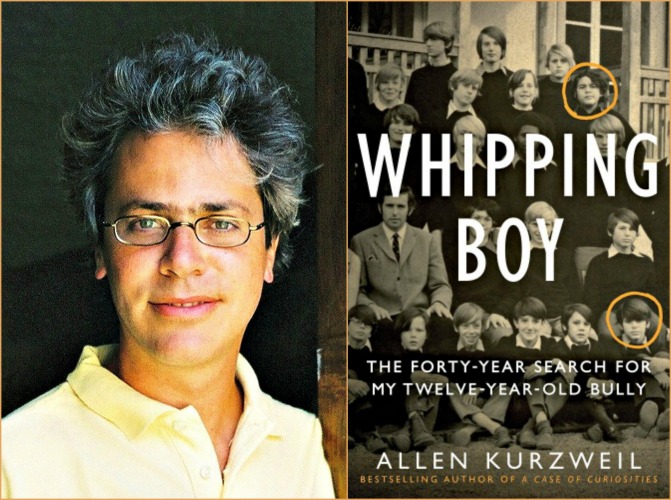
Our Booklust, Wanderlust roundtable series left me with such a wide selection of books to read that I’m only just now coming up for air. This month I’d like to tell you about Whipping Boy: My Forty-Year Search for My Twelve-Year-Old Bully, by the bestselling novelist Allen Kurzweil—which our own ML named as one of the books on her radar in early 2015.

Well, Whipping Boy is out, and it’s a cracking (so to speak) read!

"Allen Kurzweil Wiki2007," by Allen Kurzweil - an image provided by Allen Kurzweil. Transferred from en.wikipedia by SreeBot. Licensed under CC BY-SA 3.0 via Wikimedia Commons.

TCK author Allen Kurzweil & his memoir. Photo credits: “Allen Kurzweil Wiki2007,” by Allen Kurzweil – an image provided by Allen Kurzweil. Transferred from en.wikipedia by SreeBot. Licensed under CC BY-SA 3.0 via Wikimedia Commons.

Kurzweil has produced a memoir that deals with deep emotions dating back to his displaced youth—but that still manages to flow fast and fun like an international thriller. As marketing whiz Kat Gordon put it in a recent tweet:

Hanging on every word of @AllenKurzweil memoir “Whipping Boy.” A whodunit + fairytale in one.

In the fairy tale portion, we watch as our hero, age ten, attends a British-style boarding school perched on an alpine meadow high above Geneva. All goes well until he meets the dastardly Cesar (full name Cesar Augusto Viana), who torments him mercilessly. When our hero grows up, he resolves to track down and confront his childhood nemesis, however long it takes…

The whodunit starts the moment Kurzweil discovers that Cesar has become a leading figure in an international fraud scheme. At that point he converts into an investigative journalist, leaving no stone unturned in his quest to find out how many victims the adult Cesar has racked up.

Before saying anything more about the book, I should point out that Kurzweil is an adult Third Culture Kid. His parents were Jewish émigrés from Vienna to New York City. The family relocated to Milan, Italy, when Kurzweil was young, but he spent his teen years back in New York. He got his education at Yale and the University of Rome and then worked for ten years as a freelance journalist in France, Italy, and Australia before settling back in the United States with his French wife and son.

Kurzweil’s previous works include two novels and a children’s book inspired by his son’s preschool bully. The Whipping Boy has also been excerpted and condensed in the New Yorker.

“In 1971, I met a boy who changed my life forever.”

Kurzweil roomed with Cesar—a burly Filipino rumored to be the son of Ferdinand Marcos’s head of security—at the exclusive Aiglon College, in Villars, Switzerland, for the better part of a year, while Kurzweil’s mother was “test-driving her third husband.” (Kurzweil’s father died of cancer when he was five.)

Kurzweil loved the idea of the school—his deceased father had adored the Alps and mountaineering. But he hated boarding, particularly at night, when Cesar and his stooges would subject him to all manner of hazing. They forced him to eat hot pepper sauce, stole his things (including his most prized possession, his father’s Omega Seamaster watch), taunted him with anti-Semitic slurs, and at one point whipped him with a belt while playing “The 39 Lashes” from Jesus Christ Superstar (Kurzweil was Jesus).

Some form of bullying in schools is universal, but when the kids are internationals, and boarders—dealing with the losses of worlds they have loved (which in Kurzweil’s case was tied to the loss of his dad)—things can get even more intense, something non-TCKs may not appreciate.

Fortunately, though, Kurzweil has a sense of humor. In this book he never misses a chance to point out that life, even when traumatizing, has its comic moments.

“It didn’t take long to shed the habits I’d picked up in Switzerland.”

After a year at the school, Kurzweil moves back to New York City, and quickly re-acculturates:

“[My mother and I] returned to New York, where the plimsolls, anoraks and rucksacks I wore at Aiglon reverted to sneakers, parkas and backpacks. I no longer had to address my teachers as sir and ma’am.”

But while Kurzweil displays the TCK’s resilience in adjusting back to life in the U.S., happy to get rid of the crossbars on his “7s” and scuttle his schooner-sail “4s”, he cannot let go of his memories of Cesar so easily. He harbors an obsession, which grows worse with the years, even (especially?) after he finds success as a writer.

When he learns that his boyhood enemy is most probably a con man working for a shady “royal”-family-led corporation named Badische (pronounced “Baddish,” Kurzweil notes slightly gleefully) that runs investment “schemes” for hard-up New York one-percenters, Kurzweil becomes unstoppable:

Obsessives tend to have obsessions. Cesar wasn’t my first fixation, and I’m sure he won’t be the last. Baseball cards, Matchbox cars, Pez dispensers—I’ve always been a collector…my point is I tend to go overboard. I investigated Cesar and Badische the same way I collected Lincoln pennies—intent on filling every void.

“…I began to acknowledge the obvious: Cesar had taken over my life.”

His investigations span decades and continents, and throughout it all he is haunted by memories of Cesar:

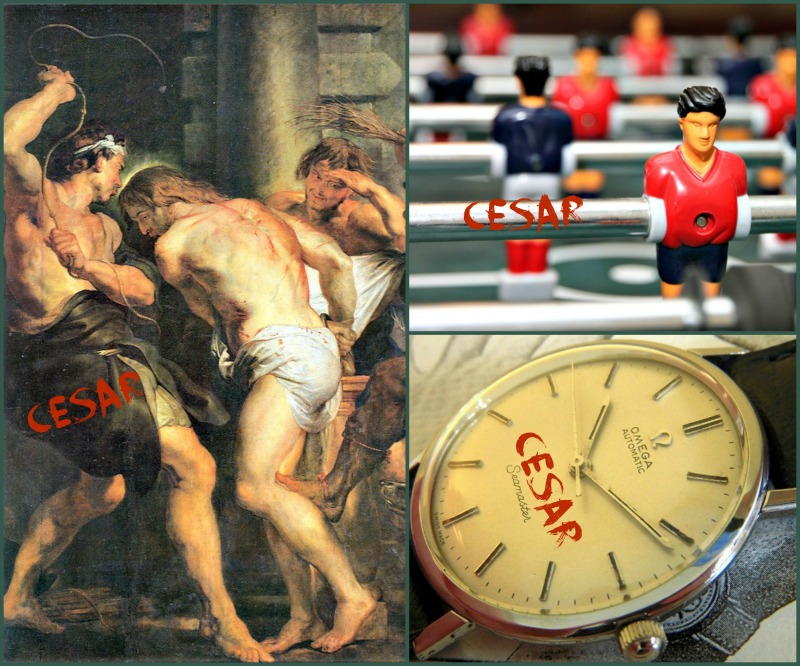
At the back of a dingy bar in Alice Springs, a pair of drunks playing foosball recalled my ex-roommate’s unstoppable bank shot. In Vienna, hanging on the wall of the Kunsthistoriches Museum, a Flagellation of Christ reinvoked the musical whipping. Hot sauce, Andrew Lloyd Weber tunes, Ferdinand Marcos, Montblanc fountain pens, and more than anything else, vintage Omegas, had me reaching for the journal.

The Ubiquitous Cesar. Photo credits (clockwise from left): “Flagellation-of-christ-Rubens” by Peter Paul Rubens (licensed under CC BY-SA 3.0 via Wikimedia Commons); foosball, byrev via Pixabay; Omega watch, ephotographythemes via Pixabay.

Kurzweil shares with the reader his mixed emotions when he at last finds Cesar, wondering what to say to someone who may not even remember him. And then the fear returns—the fear that he experienced as a shy boy being whipped with a belt in his dorm room…only now it is morphing into an adult fear as Kurzweil realizes he has tracked down an actual criminal:

Fake knights. False banks. Imaginary kingdoms. These guys travelled on bogus passports. They hosted lavish dinner parties at five-star hotels. They performed knighting ceremonies. (When I interviewed the assistant U.S. attorney who filed the initial charges, he summed up the crime as Dirty Rotten Scoundrels meets Clue.)

“So, basically, I’m being blamed for your memories?”

Whipping Boy was a quick, satisfying read. I loved the truth-is-stranger-than-fiction details that Kurzweil unearths about Cesar and his company’s schemes.

I loved his humor.

I also enjoyed the quiet pauses when Kurzweil would describe personal moments having nothing to do with the hunt for Cesar: for example, when he met his wife in outback Australia:

A French anthropologist named Françoise Dussart spotted me wandering toward a sacred site off limits to visitors. Concerned for my safety, she drove up and warned me away. She was sitting in the cab of a Toyota Land Cruiser and cradling a baby kangaroo. How could I not fall in love?

And then:

She flew west, from Alice. I flew east, from New York. We met each other halfway, in Paris, broke and in love.

Juanchito via Pixabay[http://pixabay.com/en/kangaroo-australia-jump-creature-250873/]; talitaraquel via Pixabay[http://pixabay.com/en/eiffel-tower-paris-france-tower-350453/]. License: CC0 Public Domain[http://pixabay.com/en/service/terms/#download_terms]

From kangaroo love to love in the City of Light. Photo credits: Australian kangaroo, Juanchito via Pixabay; Eiffel Tower, talitaraquel via Pixabay. License: CC0 Public Domain

I further appreciated his candor in admitting that two people can remember the details of an event differently, particularly when one of them is a psychopath with a chip on his shoulder. As Cesar puts it when they finally meet up again for the first time:

“I recall a lot… But just in bits and pieces. There are some things that people have told me about that I really don’t remember. You might need to prod me a bit.”

I would particularly recommend the book to those who like stories about heists or con artists—the movie American Hustle has some parallels—as well as to anyone who has harbored a fantasy of facing down a childhood bully.

Kurzweil may be beaten but he isn’t conquered, and that’s an inspiration to victims everywhere.

But most of all I appreciated Kurzweil’s understanding that for us TCKs, what happens in a third culture doesn’t always stay in a third culture. Some readers may wonder why Kurzweil couldn’t leave his bullying experience behind, particularly as it happened overseas, in a country to which he had limited personal ties. But for Third Culture Kids, the floating world of the expat is as real as it gets. And, as Kurzeil’s story shows, what happens there can have a life-long impact.

* * *

Fellow TCKs, do you have a Cesar or other skeletons in your cupboard dating back to your school days, at an international school or boarding school? Do tell!

Till next time!

Editor’s note: All subheds are quotes taken from Allen Kurzweil’s New Yorker article.

Beth Green is an American writer and English teacher living in Prague, Czech Republic. She grew up on a sailboat and, though now a landlubber, continues to lead a peripatetic life, having lived in Asia as well as Europe. Her personal Web site is Beth Green Writes, and she is about to launch a new site called Everyday Travel Stories. To keep in touch with her in between columns, try following her on Facebook and Twitter. She’s a social media nut!

STAY TUNED for the next fab post!

If you enjoyed this post, we invite you to register for The Displaced Dispatch, a round up of weekly posts from The Displaced Nation, and much, much more. Register for The Displaced Dispatch by clicking here!

Related posts:

BOOKLUST, WANDERLUST: 2014–2015 books recommended by expats & other international creatives (1/2)

Global Bookshelf Part OneHello Displaced Nationers! Looking back at the our popular series Best of 2014 in expat books, published at the end of last year, I decided we should continue the fun at the start of the year—and managed to convince our redoubtable editor, ML Awanohara, that the pair of us should canvass our “displaced” contacts to see what they’d enjoyed reading from last year’s crop of new books, as well as books they’re looking forward to reading in 2015.

A “best reads” roundtable, if you will.

In Part One, which appears below, several of my bookworm friends from a previous blog, Novel Adventurers, along with ML and JJ Marsh (JJ writes the Location, Locution column for Displaced Nation), discuss their favorite 2014 reads.

In Part Two, a similar group of us will talk about releases we’re hotly anticipating this year.

Having already shared my 2014 faves in last year’s series, I’ll concede the floor to others, beginning with ML.

—Beth Green

* * *

ML AWANOHARA: Thanks, Beth. These days, I seem to be more of a collector than a reader (I simply can’t keep up with all the titles I hear about!). If you’ll allow me to bend the rules, I’d like to highlight five more 2014 books I’ve discovered since our Best of 2014 in expat books went live. While I can’t personally recommend any of these titles, I feel justified in presenting them as an addendum to our series.

I’ll start with these four “displaced” novels, listed from most to least recent:

IHaveLivedToday_cover_300x200I Have Lived Today (October 2014)
Author: Steven Moore
Synopsis: Having barely survived his Dickensian childhood in 1960s Britain, Tristan Nancarrow sets out on a journey that will take him through the alleys of London and New York, to the rocky shores of ancient islands, and on pub crawls in dark and gloomy ports. The book is a classic coming-of-age adventure.
Expat creds: Originally from England, Moore is a writer, photographer, traveler and part-time ESL teacher who splits his time between Mexico, Korea and the world.
How we learned about: From his blog, Twenty-first Century Nomad.

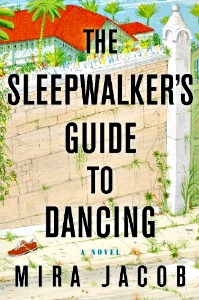
SleepwalkersGuide_cover_300x200The Sleepwalker’s Guide to Dancing (Random House, July 2014)
Author: Mira Jacob
Synopsis: This debut novel takes us on a journey that ranges from 1970s India to suburban 1980s New Mexico to Seattle during the dot.com boom. It follows the fortunes of the Eapens, an Indian American family dealing with tragedy and loss. Alternating between past and present, it shows the family’s transition from India to the United States. As one Indian critic writes, the story is “firmly rooted in an immigrant home, its peculiar methods and madness.”
Expat creds: Jacob is an Adult Third Culture Kid, whose Syrian Christian parents came over from Kerala, India, to New Mexico, in the 1960s. She now lives in Brooklyn with her Jewish American husband and son.
How we found out about: Recommended by Condé Nast Traveler as a book to read on a plane.

SummerattheLake_cover_300x200Summer at the Lake (Orion, June 2014)
Author: Erica James
Synopsis: An Oxford Tour guide, Floriana, a property developer, Adam, and Esme, an elderly woman who lives next door to a recent purchase by Adam, meet by chance and develop a lovely friendship, which takes them from the glittering spires of Oxford to the balmy shores of Lake Como. The story blends the tale of an old romance with a modern love affair.
Expat creds: James divides her time between living in Cheshire, UK, in a small rural hamlet and Lake Como, Italy, giving her plenty to draw upon in her books.
How we heard about: Pinterest.

TheBalladofaSmallPlayer_cover_300x200The Ballad of a Small Player: A Novel (Deckle Edge, April 2014)
Author: Lawrence Osborne
Synopsis: Lord Doyle decamps from the stuffy legal courtrooms of London to the smoky back-alley casinos of Macau, where he tries to capitalize on the ill-gotten gains that forced his flight from his homeland. But can he game the system at the island’s glitzy baccarat tables? With its expat angst and debauched air of moral ambiguity set amid the sinister demimonde of the Far East’s corrupt gambling dens, the book is an introspective study of decline and decay.
Expat creds: Lawrence Osborne was born in England and lives in New York City. A widely published and widely traveled journalist, he has lived a nomadic life in Mexico, Italy, France, Morocco, Cambodia and Thailand, places that he draws on in his fiction and non-fiction. His first novel was The Forgiven, which Beth Green reviewed for the Displaced Nation last year.
How we learned about: From Amazon.

Lastly, I have another expat memoir that was issued in 2014 and I think deserves a spot on our shelves:

FallinginHoney_cover_300x200Falling in Honey: How a Tiny Greek Island Stole My Heart (Sourcebooks, March 2014)
Author: Jennifer Barclay
Synopsis: Barclay first visited the tiny Greek island of Tilos, in the south Aegean, with friends, including a lover with promising prospects. In her mid-thirties when those prospects fell apart, she decides to reconnect with herself by returning to Tilos for a month and immersing herself in Greek culture, food, language, and dance. Emotionally healed and recharged, she returns to England, where she meets a man who wants what she wants, only to discover… (I won’t ruin it for you.)
Expat creds: Born in Manchester, UK, Barclay subsequently grew up on the edge of the Pennines—but has lived in Greece, Canada and France, with longish stays in Guyana and South Korea. She now lives mostly on Tilos. Notably, she previously produced a memoir about life in South Korea, amusingly titled Meeting Mr. Kim: Or How I Went to Korea and Learned to Love Kimchi.
How we learned about: Barclay’s “Gathering Road” podcast interview with Elaine Masters.


TheShadowoftheWind_coverJJ MARSH, crime series author and Displaced Nation columnist (Location, Locution): My best book of 2014 is The Shadow of the Wind, by Carlos Luis Záfon. All booklovers will fall hopelessly in love with this tale of a boy and a book he swears to protect after he is taken to the Cemetery of Forgotten Books by his bookseller father. Which of us could resist doing the same? Readers know how a story can act as a portal to otherwhere. This is the most perfect example, not to mention illuminating Barcelona in addition to the Franco dictatorship, love, loyalty and growth.


TheLie_coverHEIDI NOROOZY, adult TCK, translator and author (@heidinoroozy): One of the most remarkable and memorable books I’ve read recently is The Lie, by Hesh Kestin. Set in Israel, it features a Jewish human rights lawyer whose commitment to her principles is put to the test when her soldier son is kidnapped by Arab militants and whisked over the border to Lebanon. I love stories that explore the human spirit and are set against a backdrop of real-life events. The heart of this novel is the question of how far a mother is willing to go to save her child. Very chilling at times, heartbreaking at others and masterfully told overall.


PointofDirection_cover_300x200KELLY RAFTERY, translator and writer: In 2014, I loved Point of Direction, by Rachel Weaver. A starkly beautiful tale set in the Alaskan outback, it reads like a cross-cultural adventure. Most expats will recognize the feelings of culture shock, disorientation and unreality that haunt Anna, a woman on the run from her own ghosts. The sharp writing style perfectly mirrors the jagged mountains and rough seas that inhabit the novel as surely as another character.


SUPRIYA SAVKOOR, editor and mystery writer: I haven’t read many memoirs, but in recent months, I read two that blew me away. The first, Not My Father’s Son, by Alan Cumming, is a must-read, even if celebrity memoirs aren’t your thing or you don’t know much about this Scottish actor, now a dual American-British citizen based in New York City. NotMyFathersSon_cover_300x200Cumming, it turns out, is a genius storyteller, and he takes us on an extraordinary journey through two juicy family mysteries across four countries and three time periods. It is, in turns, emotional, tragic, exciting, suspenseful, and funny. The colorful cast of characters, with names like Tommy Darling and Sue Gorgeous, are real people. Along the way, you’ll learn all kinds of fascinating little tidbits, much of it cross-cultural, about genealogy, history, pop culture, language, psychology. Even Cumming’s anecdotes about his life as a TV and film star are surprisingly interesting, largely because of the author’s clear-eyed, honest wisdom. (I also highly recommend the audiobook, narrated by Cumming himself. Alongwayhome_cover_300x200 His lovely Scottish accent and intonations are an additional treat.)

A Long Way Home: A Memoir, by Saroo Brierley, is another great read. The story is simple but powerful: a five-year-old boy in rural India gets lost, is ultimately adopted to a family in Australia, then, as an adult, tracks down his birth family and reunites with them. How he pieces together his past and finds his roots is one of several beautiful mysteries in this small book. Loss and identity are obvious themes, but not just for the author. A truly unique story. (Side note: Modern technology is one of this book’s heroes.)


ASuitableBoy_coverALLI SINCLAIR, world traveler and novelist (www.allisinclair.com): I recently re-read A Suitable Boy by Vikram Seth. It was released way back in 1993 and caused quite a stir in the literary world as it was one of the longest novels ever to be published in English (1,349 pages hardcover). I first read it then, and, while it’s highly unusual for me to give a book a second or third read, every few years I return to this wonderful novel rich with Indian history, family saga, and a heartbreaking romance. It’s set in post-partition India and explores the political issues at the time (1950s), along with the Hindu-Muslim issues and the caste system. It’s quite an undertaking to read this book but I enjoy revisiting the characters I love. I am very fond of stories written by Indian authors as there is a beautiful style and interesting points of view I find appealing. There’s a sequel in 2016—I can’t wait!

* * *

Thank you, ML, JJ and guests! Readers, have you read any of the above or do you have further 2014 recommendations? Please leave a comment below. And stay tuned for Part Two of this post, books to look forward to in 2015!

Finally, please be sure to sign up for the DISPLACED DISPATCH, which has a Recommended Read every week. You can also follow the Displaced Nation’s DISPLACED READS Pinterest board.

STAY TUNED for PART 2 of this post: 2015 reads!

If you enjoyed this post, we invite you to subscribe to The Displaced Dispatch, a weekly round up of posts from The Displaced Nation, plus some extras such as seasonal recipes and occasional book giveaways. Sign up for The Displaced Dispatch by clicking here!

Related posts:

LOCATION, LOCUTION: Author and part-time expat Susan Jane Gilman, who plunders her life for memoir and fiction

JJ Marsh Susan Jane GilmanWe welcome JJ Marsh back to the Displaced Nation for her first “location, locution” column of the new year, in which she talks to current authors about their methods for portraying place in their works.

My guest this month is the precocious and prolific Susan Jane Gilman. She is the author of three acclaimed nonfiction works:

  1. A travel memoir, Undress Me in the Temple of Heaven
  2. A memoir of her upbringing in New York City Hypocrite in a Pouffy White Dress, and
  3. An advice book, Kiss My Tiara.

And now she has a novel, a work of historical fiction called The Ice Cream Queen of Orchard Street, which came out in February of last year.

Gilman has also contributed to numerous anthologies, worked as journalist, and written for many well-known publications including the New York Times, Los Angeles Times, Real Simple, and Us magazine. And she claims to have opened the Susan Jane Gilman Institute for Advanced Gelato Studies here in Geneva.

Oh, did I mention she is an expat?

Though made, born, and raised in New York City, and educated at Brown University and the University of Michigan (MFA in Creative Writing), Gilman currently divides her time between Switzerland and the United States.

Perhaps she developed her wanderlust through exposure to her high school English teacher (she went to Stuyvesant), the Pulitzer Prize-winning Irish-American memoirist Frank McCourt. In any event, she holds him accountable for her decision to become a writer.

Now let’s find out how Gilman perceives the connection between location and locution.

* * *

Which comes first, story or location?
Before I sit down to write, I need a sense of narrative, of a who-what-where, but so often, story and location are intertwined. Undress Me in the Temple of Heaven, for example, is the true story of a disastrous backpacking trip I made through the People’s Republic of China in 1986. To separate the story from the place is simply impossible; so much of what made the trip horrific was the poverty and totalitarianism of China itself; I can’t imagine that my travel companion and I would have disintegrated in the same way at, say, the Canyon Ranch Spa or a luxury resort in the Maldives. Similarly, my novel, The Ice Cream Queen of Orchard Street, is a rags-to-riches-to-indictment story that begins with a child immigrating to the USA in 1913. New York City was simply the logical place to have it begin. It is not only my hometown but, of course, the great immigrant gateway to America.

location locution gilman

Lower East Side New York City @1910, credited to the Brown Brothers [Public domain], via Wikimedia Commons; cover art.

What’s your technique for evoking the atmosphere of a place?
First, I usually describe vivid, visual details so that readers can see a place in their mind’s eye. Then I go for are the smells. Smell is the most evocative of all the senses. It brings a place to life more potently than anything else. Add sounds, and there you are. I’m afraid I’m sounding glib in the way that I’m saying this—”use all the senses”—it sounds easy, and it sounds like a recipe. But it’s not. I really struggle and strive to conjure a place, be it a roadside restaurant, a German city, an abandoned tenement, using incisive, significant details. I’m always on “cliche alert.”

Which particular features create a sense of location? Landscape, culture, food?
Background noises, cooking smells, shadow and light, voices, architecture…there are no given particulars. I try to find what is most unique and evocative and go with it.

How well do you need to know the place before using it as a setting?
Saul Bellow wrote a whole novel set in Africa, apparently without having set foot once on the continent. I find this presumptuous. That said, I have written about places that I’ve only been in briefly, or glimpsed, or created out as a composites of other places I’ve been. But I like to have a feel for a place; I need to be able imagine it throughly, to exist in it. Often, if a character needs to be in a place that I’ve never been to, I research it as much as possible. The Internet is a godsend; I find old photographs or use Google Earth. I try to travel there in whatever way I can.

Can you give a brief example of your work which illustrates place?
I don’t have any of my books in front of me because I’m on the road, but read the very first paragraph of The Ice Cream Queen of Orchard Street and you’ll immediately find yourself on the Lower East Side of Manhattan in 1913. Read the first page of Undress Me in the Temple of Heaven and you’re on board a plane plummeting into Hong Kong; the next six pages take you right into downtown Kowloon at night, with all its lurid traffic, neon, and squalor. I’ve been told by readers that these sections have utterly transported them…

Gilman Kowloon Undress_medium

“Typical street scene in downtown Kowloon,” by VasenkaPhotography via Flickr (CC BY 2.0); cover art.

Which writers do you admire for the way they use location?
I love the way Richard Ford conjures up the American West, John Cheever the Connecticut suburbs, Junot Díaz the Dominican community in New York City and Dominica. That said, I usually don’t admire writers so much as specific books, eg:

And, in a different way, I have always admired Anne Tyler for the way she conjures up so well these cosy, fraught, detailed middle class American households. She is stunning in her ability to make you see rooms, houses, offices—small, intimate tableaux—in such a rich way.

Locations need not be exotic or epic, just alive and relevant.

* * *

Readers, if this interview has piqued your curiosity about Susan Jane Gilman and her writings, I encourage you to visit her author site. You can also follow her on Twitter.

JJ Marsh grew up in Wales, Africa and the Middle East, where her curiosity for culture took root and triggered an urge to write. After living in Hong Kong, Nigeria, Dubai, Portugal and France, JJ finally settled in Switzerland, where she is currently halfway through her European crime series, set in compelling locations all over the continent and featuring detective inspector Beatrice Stubbs.

STAY TUNED for next week’s fab posts!

If you enjoyed this post, we invite you to register for The Displaced Dispatch, a round up of weekly posts from The Displaced Nation, with seasonal recipes, book giveaways and other extras. Register for The Displaced Dispatch by clicking here!

Related posts:

3 anti-New Year’s resolutions for expat creatives, courtesy of the Lord of Misrule

LordofMisrule

“Lord of Misrule,” by _william via Flickr (CC BY-SA 2.0).

The start of a new year, and I’ve been struggling to think of just the right blessing, words of encouragement or meditation to inspire you (and myself for that matter) in the climb to reach new summits in your creative pursuits of 2015.

But here it is, the last day of Christmas, what some of us refer to as Three Kings Day or Epiphany—and I find myself with, well, no epiphanies.

Rather, my mind seems to have been taken over by the Lord of Misrule, a figure of mischief who presided over medieval celebrations of the 12th day of Christmas, or Twelfth Night—known to the Romans in pre-Christian times as Saturnalia (the Celts had their own version: Samhain).

* * *

Wait just a second… The Lord of Misrule is dragging me into the Feast of Fools and offering me a tankard of wassail. He has invited me to give a speech to the assembly. Well, here goes:

“Lords and ladies of the Feast, I am enjoying this occasion when we all have license to behave as fools.

In that spirit, I’d like you join with me in cursing—you heard it right, CURSING—my compatriot Clement Clarke Moore, who wrote a poem about St. Nicholas. I think it should have ended here:

And mamma in her ‘kerchief, and I in my cap,
Had just settled down for a long winter’s nap…

I ask you: Was it really necessary for St. Nick to bound down the chimney just as that poor couple was finally getting some rest?

In that same vein, let us also condemn whoever it was who invented the New Year’s custom of making resolutions!

Surely, what most of us want to do on January 1 is get back to that long winter’s nap and hibernate for a bit?

Where I live, we are now preparing for a second Arctic blast, even colder than the first.

Under these conditions, I would be doing well to get the dog out for a walk and myself to the office—especially as it has just started snowing. Indeed, the last thing I need at this point is one of those lists of 52 goals to accomplish in 2015.

I’ll be lucky if I can remember where I stored my old snow boots.”

* * *

Okay, here I am again. (They gave me a standing ovation, btw. If they ask for an encore, I’ll bring up my new campaign to refer to the Year of the Sheep as the Year of the Alpaca instead, so much cuter!)

But listen, I haven’t completely abrogated my duty of leaving you with some thoughts at the start of the 2015.

At the encouragement of my new best friend, the Lord of Misrule, I present 3 anti-New Year’s resolutions, which you’d do well to heed:

1) There’s nothing wrong with easing in to the new year.

Readers who follow us closely will remember that we recently posted an excerpt from a contribution made by Philippa Ramsden, a Scot who lives in Burma, to columnist Shannon Young’s Dragonfruit anthology. Philippa talks about finding out she has cancer as she reaches the Tropic of Cancer. Well, as her first post of the year to her blog, Feisty Blue Gecko, suggests, she plans not to lean in but to ease in to 2015. I see nothing wrong with that, particularly for those of us, myself included, who found 2014 difficult year because of health issues or losses in their families (not for everyone Facebook’s “Year in Review” app!). Easy, easy, one day at a time. Resolutions can wait.

2) Read what you want to, not what you have to, for a while.

To illustrate this point, allow me to spin a quick travel yarn. My husband and I spent Christmas-into-New Year’s in the arty little town of Hudson, New York, staying in this house with a Parisian-style mansard roof (who knew?):
Hudson_House
It was the kind of house that made you want to sit by the window with a good book, but for one problem: I forgot to pack my Kindle! At first I was in despair: what’s a poor Kindle-less girl to do? That was before I discovered that the Hudson Valley has a wealth of abandoned books. In nearby Greenport, I found a regency romance by Georgette Heyer (deliciously frothy) and J.B. Priestly’s novel Lost Empires, which, in telling the story of the early 20th-century English music hall, paints some extraordinarily vivid characters. Reading two books I’d encountered by chance, I was reminded of my grad student days, when I would read widely as a break from writing my thesis. I was also reminded of why I chose to live in England so long: I was, and remain, enamored of the way they write novels.

3) Be open to finding inspiration in the most unlikely of places.

In the era of social media, there are countless gurus who tell us how to write, offering writing prompts or daily inspiration—when the truth is, the best inspiration usually comes when you least expect it. To continue with my travel yarn: During our stay in Hudson, we decided to visit the Olana State Historic Site, the home of Frederic Church, one of the major figures in the Hudson River School of landscape painting. I went there thinking I would learn something more about this quintessentially American style of painting, only to find that Church was ONE OF US: an early example of an international creative! Yes, he was American and attached to the Hudson Valley, but he also traveled extensively through Europe and the Middle East—Beirut, Jerusalem, and Damascus—with his wife and children and, before marriage, had explored South America. Fittingly, the house he and his wife designed is a mash-up of Victorian, Persian and Moorish styles:

"Olana2006 3 edit1" by Rolf Müller - Own work. Licensed under CC BY-SA 3.0 via Wikimedia Commons - http://commons.wikimedia.org/wiki/File:Olana2006_3_edit1.jpg#mediaviewer/File:Olana2006_3_edit1.jpg

“Olana2006 3 edit1” by Rolf Müller – Own work. Licensed under CC BY-SA 3.0 via Wikimedia Commons.

My goodness, I thought to myself, did they design this place anticipating it would one day be visited by displaced people like us?!

* * *

Okay, the Lord of Misrule is signaling that it’s time to get back to the old wassail bowl and sing a tune for the 12th-night crowd.

Here goes:

With a hey-ho and the snow and the wind,
May you build your own Olana in 2015,
But that’s all one, this post is done.

STAY TUNED for our next post!

If you enjoyed this post, we invite you to register for The Displaced Dispatch, a round up of weekly posts from The Displaced Nation, with Alice nominees, exclusive book giveaways and other extras. Register for The Displaced Dispatch by clicking here!

Related posts:

DIARY OF AN EXPAT WRITER: Turning into Jordan Rivet, writer of post-apocalyptic adventures, for an entire month

DiaryExpatWriterAs regular readers of the Displaced Nation will know, Shannon Young* recently took the decision to quit her day job to become a full-time writer in Hong Kong, where she lives with her half-Chinese husband. She joins us today to update the diary of this new phase of her life—and this time has brought along Jordan Rivet, her alter-ego. Hmmm…should be interesting!

—ML Awanohara

Dear Displaced Diary,

I hope you don’t mind if I allow Jordan Rivet to contribute to this month’s entry. I created Jordan Rivet as the pen name for my post-apocalyptic adventure series, which I first started writing during National Novel Writing Month, aka NaNoWriMo (often shortened even further, to NaNo), two years ago. For those who aren’t familiar, NaNo challenges people to write 50,000 words of a novel in the 30 days of November.

Nowadays, writers across the world come out in force to meet this challenge. (Hmmm… Shouldn’t it be renamed INTERnational Novel Writing Month: IntNoWriMo?)

But enough from me: The next portion of this entry will be from Jordan.

* * *

Thank you, Shannon. Displaced Diary, I’ll start out by saying how grateful I am for NaNo: it’s what brought me, Jordan Rivet, into existence. By the end of the month of November two years ago, I had produced 57,002 words about a floating city one disaster away from extinction, and I now have a book out under my name! (I even have my own email and twitter accounts.)

Last time Shannon wrote to you, she talked about going through the final publication stages for her memoir, Year of Fire Dragons—with a lot of help from her friends.

This month, though, has been all about me. I am back and am writing away furiously, having joined NaNo again, here in Hong Kong.

There are writers in Hong Kong!

Hong Kong is sometimes accused of lacking a literary culture. The scene definitely exists, but it can be hard to find. There’s a lot of pressure in this city to focus on purely commercial pursuits—and people are busy.

Yet every November, lots of us creative types come out of the woodwork—pros, beginners, and hobbyists alike. We are a mix of locals, expats, and returners who were educated abroad. You’ll find students and teachers and lawyers and marketers and homemakers. Unlike me, they don’t necessarily have time to write every day, but they do love books. They carve out time for writing in the midst of busy schedules and obligations. They get excited about stories and about inventing new worlds. Their energy is infectious.

People come and go a lot here, but I make new writing friends for Shannon every November, particularly at the NaNo write-ins, where participants gather to chat, write, laugh, and drink coffee together.

Being an adventuresome sort, I particularly love it when we have visitors at our write-ins who are just traveling through the city or who’ve made special trips from Macau and Shenzhen to connect with their fellow NaNo participants.

“Bird by bird, buddy. Just take it bird by bird.” —Kenneth Lamott

Seabound - Jordan RivetThis is my third November working on a novel in Shannon’s post-apocalyptic adventure series set at sea, called The Seabound Chronicles.

As already mentioned, Shannon just now launched my first book in this series, which I’d drafted in November 2012. It’s called Seabound, but back then I’d titled it The Vertigo. Shannon loved it immediately: it was her first foray into fast-paced genre fiction. “Planning and writing a grand adventure is just as much fun as reading one,” she told me.

Now every November I hammer out a very rough draft of another installment in the series, and it always reminds Shannon how much fun writing actually is. (Actually, I wrote the first draft of the sequel the spring after that first NaNo. In November of 2013 I wrote the prequel.)

In Bird by Bird, her classic mediation on the writing life, Anne Lamott argues that writers should produce “shitty first drafts.” Her point is that by giving ourselves permission to write rough, messy, and even bad work, writers can avoid the kind of perfectionism and fear that stifles creativity.

That’s why I’m so glad Shannon invented me during NaNoWriMo. She was thinking that NaNo is a great time to produce what may well be a shitty first draft in the madcap rush to reach 50,000 words in thirty days, and that revisions can always come later.

I love that I get to do the first draft, which is all about discovery. As I’ve said, adventure is my thing!

I’m now working on what I believe will be the fourth and final book in the Seabound Chronicles (27,555 words and going strong). This is the part where I get to figure out what happens in the end.

Though I’m enjoying it to the hilt, I have to tell you that writing my final first draft is bittersweet. Of course Shannon will call me in again, as the series still needs a lot of work. But will I still have a life after it finishes? That is the question…

Since I don’t know the answer, I’ll give you back to Shannon.

* * *

Priorities, priorities

Thanks, Jordan. Diary, I must confess that ever since I quit my job to write full time, I’m finding there are still a lot of things that pull me away. These are all writing-related tasks: answering emails, writing blog posts, updating my websites, requesting reviews, promoting my books, etc.

And, as Jordan reported, I’ve been working on formatting and uploading all the files for the e-book and paperback of Seabound, a task I kind of love but it’s time consuming.

As you know, I want to make the most of this time. I’m slowly developing strategies to keep me on task. Even if the miscellaneous stuff is writing-related, I still have to make sure the real writing comes first.

Thank goodness Jordan has reappeared to keep me on track this month.

It’s not New York City, but…

Once upon a time, I dreamed of living in New York City. I imagined renting a loft in Brooklyn, going to book launches every weekend, and having lunch with authors (ideally as an editor at a major publishing house). It was a very particular sort of dream.

Then this crazy, wonderful expat life happened.

Shannon Young at HKILF

Shannon Young at the Hong Kong Literary Festival earlier this month, reading from her memoir of her first year in Hong Kong, Year of Fire Dragons.

When I first moved to Hong Kong, I worried I’d have to give up my book publishing dreams. A little over four years later, it’s amazing how wrong I was. Hong Kong may not have a deeply entrenched literary and publishing scene like New York’s, but it has provided opportunities for me to chase a more evolved version of my dream. And Hong Kong writers have an energy and optimism that’s all their own.

Earlier this month, I attended the Hong Kong International Literary Festival as one of the featured writers. I got to be on the radio, visit a local secondary school, attend the opening and closing parties, and read from my book, Year of Fire Dragons, at an event.

This expat life isn’t what I planned. I meet people all the time who also didn’t mean to end up in Hong Kong. But through chance and circumstance, here we are. As it turns out, there are plenty of opportunities to follow our dreams, and I wouldn’t want it any other way.

Thanks for continuing to follow my expat writing journey.

Yours,

Shannon (& Jordan)

www.shannonyoungwriter.com

* * *

Readers, I hope you are finding writing buddies wherever you are, as well as alter egos who are as fun (and productive!) as Jordan is. And if you’re participating in NaNoWriMo, get back to work!

*Shannon Young (not Jordan Rivet!) has edited an anthology, How Does One Dress to Buy Dragonfruit? True Stories of Expat Women in Asia (2014), from which she is sharing some excerpts. We’re calling them “chunks” of dragonfruit—they taste delicious!

STAY TUNED for next week’s fab posts!

If you enjoyed this post, we invite you to register for The Displaced Dispatch, a round up of weekly posts from The Displaced Nation, with snippets of worldly wisdom, exclusive book giveaways and our nominees for the monthly Alice Awards. Register for The Displaced Dispatch by clicking here!

Related posts:

And the October 2014 Alices go to … these 3 international creatives

 © Iamezan | Dreamstime.com Used under license

© Iamezan | Dreamstime.com
Used under license

If you are a subscriber to our weekly newsletter, the Displaced Dispatch, you’re already in the know. But if you’re not, listen up. (Hey, why aren’t you? Off with your head!)

Every week, when that esteemed publication comes out, we present contenders for a monthly “Alice Award,” most of whom are writers or other kinds of international creatives who appear to have a special handle on the curious and unreal aspects of being a global resident or voyager.

Not only that, but this person tries to use this state of befuddlement as a spur to greater creative heights.

Today’s post hono(u)rs our three Alice recipients for October. They are (drumroll…):

2) Maya Kachroo-Levine, New Yorker in Los Angeles

For her post: “5 Things an East Coast Transplant Misses on the West Coast,” in Thought Catalog
Posted on: 15 October 2014

"But I'm not used to it!" pleaded poor Alice in a piteous tone. And she thought of herself, "I wish the creatures wouldn't be so easily offended!" "You'll get used to it in time," said the Caterpillar; and it put the hookah into its mouth and began smoking again. Photo credit: Arthur Rackham [Public domain], via Wikimedia Commons.

“But I’m not used to it!” pleaded poor Alice in a piteous tone. And she thought of herself, “I wish the creatures wouldn’t be so easily offended!”
“You’ll get used to it in time,” said the Caterpillar; and it put the hookah into its mouth and began smoking again. Photo credit: Arthur Rackham [Public domain], via Wikimedia Commons.

Alice Connection:

[Y]ou occasionally find yourself feeling that your sarcasm is falling flat, and you want someone to appreciate it. Or better, you want them to argue with you. I miss that.

Citation: Maya, if you think navigating between East and West Coasts is bad in terms of sarcasm and irony, try the UK versus the USA. The former is a lot more irreverent, a difference can cause misunderstanding and even offense (not to mention homesickness for the perpetrator). You have our deepest condolences. What’s more, your point about having to drive two hours merely to go apple picking reminds us of Alice repeatedly trying to reach the garden at the top of the hill at the start of Through the Looking Glass. Likewise in your case it seems reasonable to ask: how hard can it be to reach a deciduous fruit tree? Thank you for your thoughtful (no pun or irony intended!) post. We wonder if the best way to endure this domestic culture shock would be to seek out a Caterpillar equivalent, who in the current California context would most likely manifest itself as a mindfulness guru. Until then, deep breathing; and, as one of that state’s more renowned self-help proponents used to say, try not to sweat the small stuff!

2) Sarah O’Meara, former lifestyle editor for Huffington Post UK turned China expat

Alice_in_Wonderland_by_Arthur_Rackham_The_Pool_of_Tears

It was high time to go, for the pool was getting quite crowded with the birds and animals that had fallen into it: there were a Duck and a Dodo, a Lory and an Eaglet, and several other curious creatures. Alice led the way, and the whole party swam to the shore. Photo credit: Arthur Rackham [Public domain], via Wikimedia Commons.

For her post: “The art of swimming in China,” for Telegraph Expat
Posted on: 27 September 2014
Alice Connection:

Many young Chinese men prefer to conquer, rather than swim, in the water. They thrash their arms around, causing enough splash to choke fellow lane users, yet never quite enough to move them forward. While underneath the surface, their legs flail, neither acting as propellers or buoyancy aids.

Citation: Sarah, we have to say that after reading your wonderfully amusing post, we are still processing the image of women wearing pencil skirts walking very slowly on running machines in heels. Still, we commend your decision to focus not on Chinese sports centers but on the risks one faces “of being half-drowned by frothing waves, or hit in the face” when venturing into China’s public swimming pools. And, just as Alice concludes she may be better off swimming to shore, we applaud your solution to the problem. Joining a private pool, where, as you say, the proportion of non-swimmers is lower, must be much safer, even if you can never quite escape the young men who have adopted the walking and thrashing style of Mao crossing the Yangzte. (My, my. That Mao has a lot to answer for…)

3) Jenny Miller, NYC-based food and travel writer

For her post: “I Ate Tarantulas In Cambodia. And Liked It,” for Food Republic
Posted on: 23 September 2014

'—then you don't like all insects?' the Gnat went on, as quietly as if nothing had happened. 'I like them when they can talk,' Alice said. 'None of them ever talk, where I come from.' Photo credit: John Tenniel.Slatifs at en.wikipedia [Public domain or Public domain], from Wikimedia Commons.

“—then you don’t like all insects?’ the Gnat went on, as quietly as if nothing had happened.
“I like them when they can talk,” Alice said. “None of them ever talk, where I come from.” Photo credit: John Tenniel.Slatifs at en.wikipedia [Public domain or Public domain], from Wikimedia Commons.

Alice Connection:

We might have gone on sampling this towering insect buffet, but Megan made our excuses in Khmer and we walked down the road for an ice cream instead.

Citation: Jenny, we’ve got to hand it to you. What kind of traveler knows exactly what to say when, bumming around Southeast Asia, they find themselves on a bus sitting next to a Peace Corps volunteer named Megan who says she lives in Skuon, Cambodia? Only one who has read her Lonely Planet Cambodia guide from cover to cover! And then, as though being able to conduct a lively conversation with Megan about Skuon’s insect-eating habits were not enough, you take her up on her offer to visit and eat some tarantulas! Now that takes some guts, as you appear to realize once you reach “Cambodia’s spider central.” For sure, you show greater courage than poor Alice, who, upon being informed by the Gnat that a bread-and-butterfly is crawling at her feet, draws her feet back “in some alarm”. She certainly doesn’t think about eating it, even though, compared to your spiders, a bread-and-butterfly meal doesn’t sound half bad:

“Its wings are thin slices of bread, its body is a crust, and its head is a lump of sugar.”

Hmmm… Perhaps you should have read Lewis Carroll more thoroughly?

*  *  *

So, readers, do you have a favorite from the above, or have you read any recent posts you think deserve an Alice Award? We’d love to hear your suggestions! And don’t miss out on the shortlist of Alice contenders we provide in each week’s Dispatch, which are sources of creative thought if nothing else! Get on our subscription list now!

STAY TUNED for more fab posts.

Writers and other international creatives: If you want to know in advance the contenders for our monthly Alice Award winners, sign up to receive The Displaced Dispatch, a round up of weekly posts from The Displaced Nation, with news of book giveaways, future posts, and of course, our weekly Alice Award!. Register for The Displaced Dispatch by clicking here!

Related posts: