The Displaced Nation

A home for international creatives

Tag Archives: It’s Food!

GLOBAL FOOD GOSSIP: The Mysterious Case of the Missing Pastries

global food gossipJoanna Masters-Maggs, our resident repeat-expat Food Gossip and Creative Chef, is back with her column for like-minded food lovers.

This month: The regrettable global takeover of the Cronut, and what should be getting the publicity instead.

* * *

“What in dog-breeding hell is a Cronut?” demanded my son Seb, reading over my shoulder while swigging milk from the bottle in that annoying way 16-year-olds have. Baffled for a second, I realized the confusion and laughed.  My German Shepherd, Sophie, is my obsession and I am always reading articles about breeding and training.  Today, though, I was reading a food magazine which discussed trends for the New Year. Seb had seen a headline that asked:

“2013 was the year of the Cronut and Duffin but what does 2014 hold?”

Those of you elsewhere — anywhere except France, that is — may laugh, but Seb’s assumption that a Cronut is German Shepherd-related rather than food-related was completely justifiable.  My own ignorance of Cronuts and other “blended” pastries was only brought to my attention in December, when a friend living in Kuala Lumpur posted that they had finally arrived there.

I think it true to say that the Cronut hasn’t yet arrived in France and probably never will.

Some dishes deserve to go global

I do hope the same will not be the case for other treats that, my magazine suggested, will be sweeping tastebuds worldwide this year.  I was particularly happy to see the arepa from Venezuela and Columbia on the list. My hips might not want to revisit my interest in these delectable goodies, but I am smacking my lips in anticipation.

I first met arepas in Maracaibo, Venezuela, and our friendship deepened while I lived in Caracas.  These flattened balls of unleavened maize flour-based dough are fried and then filled with a cornucopia of ingredients, depending on the region. North Western Venezuela, where I first fell in love with the arepa, has its own speciality, the Arepa Cabimera, whose filling consists of the improbable combination of cheese, jam, chicken and boiled eggs.  You know when someone is eating a Cabimera as the arepas are unusually square.  Other varieties often include queso guayanés  — a mild, medium-soft cheese similar to mozzarella, shredded chicken and, if you are very lucky, crispy pork rind.

Global — with the exception of France, that is

The idea that I will miss such delights as they sweep the world is distressing, but our ignorance of the Cronut is a sad portent of what might come.  How had the Year of the Cross-bred Pastry missed France? Perhaps it’s not such a surprise; France is not culturally inclined to faddy trends as is, say, London or New York.  Why a “need-to-please” hybrid, when a classic, small, and delightfully buttery croissant is available?  How intolerably vulgar to take such perfection and, presumably, add jam and deep-fry it.

I can feel a thousand thin and elegantly clad Parisian shoulders shudder at the thought.

Hybrid – it’s the new pedigree

On further reflection, my less-thin shoulders shudder too.  As my son’s comment shows, cross-bred dogs are very much at the front of people’s minds at the moment.  Maybe the Cockerpoo, Labradoodle, and Schitzpoo are the canine equivalents of our human desire to have our cake and eat it.  A dog that doesn’t shed and mess up the carpet and sinuses, and a croissant that doesn’t — oh, wait. It does crumble.  Well, a pastry that isn’t a croissant or a doughnut but which still makes a crumbly mess…

Why?  Why make a mash-up of existing pastries when you could come up with something less plagiaristic or stick with what already works?  Oh, listen to me: maybe I do belong in France!  After all, for each hybrid that works there are the unlucky ones in each batch which fail to inherit the best of both worlds and instead exhibit the worst of each.  A croissant where the delicate buttery flavor has been killed by over-sweetening?  A  Labradoodle which sheds anyway and isn’t a pedigree but which costs the same and has the potential to inherit the congenital defects of two different breeds?

What’s more, the frying of such a delicate thing as croissant pastry is not for amateurs.  Getting the layers of pastry and butter to open in the heat of an oven is no mean feat; getting them to do the same in hot fat is entirely different.  Apart from that, think how easily butter burns.  That’s a lot of worry when pâtissierières across France already have mastered the art of injecting chocolate into croissants to make pain au chocolate or, better, almond paste.

For me the almond croissant is the pinnacle of pastry pleasure.  This marriage of crisp pastry with nutty and unctuous almond paste represents the Paul Newman and Joanne Woodward of the Pâtisserie.

The Cronut is, as yet, a Brangelina wannabe and everyone is already asking how much longer is it going to last.

“New” but not necessarily “improved”

The French disdain for change for change’s sake can be seen everywhere.  Fashion classics which stand the test of time are valued over the new and the shocking.  London fashion is all about iconoclasm and rebellion, rather than restraint.   Surely, when it comes to food, good taste should not be derided.  Maybe the French are right not to jump on the bandwagon of each new craze, instead waiting to see what stands the test of time and has what it takes to become part of the pâtisserie canon.

I doubt that the Duffin will ever be the Little Black Dress of the pâtisserie world; certainly not with a name that makes it sound like something an ageing hippie would wear on a cold winter day in Glastonbury, UK.

Hmm, pause for thought indeed.  At least with baking, we can bin the rejects; we cannot do the same with our canine friends who don’t pass the successful hybrid test.

How, then, can a modern culinary classic find acceptance in France?

So, let me find order to my reasoning.  The French, so far, have not accepted the hybrid pastry which tries too hard to please and lacks the elegant restraint of better behaved French patisserie staples.  However, history reveals that the French will eventually accept what will not go away: dishes with an enduring appeal, such as the pizza so…

…let’s return to my arepa whose pedigree cannot be questioned.  This is a traditional, tried and tested, and regionally variable dish.  Given time, I am hopeful that the French, who enjoy regional variety in cheese and wine, should be open to accepting this newcomer.  France has already embraced with overwhelming enthusiasm the pizza and tweaked it to French tastes – crème fraiche anyone?  There is a little van with a wood burning stove on most street corners in every city, town and village of the country.  For every Domino there are scores of restaurants, parlours, and vans, nearly all of them French owned and run.

For the arepa this is hopeful news indeed. I may have to wait longer than a resident of London, Birmingham or, indeed, Kuala Lumpur, but I have hope that the Venezuelans are coming to Aix.

* * *

Joanna was displaced from her native England 16 years ago, and has since attempted to re-place herself and blend into the USA, Holland, Brazil, Malaysia, Venezuela, Saudi Arabia, and now France. She describes herself as a “food gossip”, saying: “I’ve always enjoyed cooking and trying out new recipes. Overseas, I am curious as to what people buy and from where. What is in the baskets of my fellow shoppers? What do they eat when they go home at night?”

Fellow Food Gossips, share your own stories with us!

STAY TUNED for tomorrow’s post!

If you enjoyed this post, we invite you to register for The Displaced Dispatch, a round up of weekly posts from The Displaced Nation, with seasonal recipes, book giveaways and other extras. Register for The Displaced Dispatch by clicking here!

Related posts:

Images: All images from Joanna’s personal photo albums, and used here with her permission

And the December 2013 Alices go to … these 2 international creatives

 © Iamezan | Dreamstime.com Used under license

© Iamezan | Dreamstime.com
Used under license

If you are a subscriber to our weekly newsletter, Displaced Dispatch, you’re already in the know. But if you’re not (and why aren’t you? off with your head!), listen up. Every week, when that esteemed publication comes out, we present contenders for a monthly “Alice Award,” most of whom are writers or other kinds of international creatives who appear to have a special handle on the curious and unreal aspects of being a global resident or voyager. Not only that, but this person tries to use this state of befuddlement to their advantage, as a spur to greater creative heights.

Today’s post honors December’s two Alice recipients.

Starting with the most recent, and this time with annotations, they are (drumroll…):

1) LAURENCE BROWN, British expat in Indiana and blogger at Lost in the Pond

For his post: “7 British Christmas Songs That Somehow Never Made it Big in the US” 
Posted on: 27 November 2013
Snippet:

Growing up in the United Kingdom, one of the more memorable elements of Christmas was the music that bombarded the airwaves day-in-day-out from November onward. And I’m talking huge hits, many of which shot to number one and continued their popularity some twenty, thirty, perhaps forty years after their release. And yet, as I embark on my sixth Christmas in the United States, it has come to my attention that these same hits—ones I initially assumed were likely just as big in the U.S.—are nowhere to be heard.

Citation:  Frankly, Lawrence, we were so busy lamenting the lack of attention given to Carols from Kings that it hadn’t yet dawned on us that Americans are also missing out on Cliff Richard crooning “Christmas time, mistletoe and wine…” And you have a point: Why would anyone States-side wish to hear yet another rendition of Andy Williams singing “Everybody knows some turkey”—yep, that’s you, Andy!—”and some mistletoe/Help to make the season bright…” when they could break it up with Cliff from time to time? And you are so right, the song’s Christian overtones would not go amiss in this part of the world. (Forgive the aside, but does anyone in Indiana know the words to the Robert-Burns-poem-converted-to-New-Year’s-dirge “Auld Lang Syne”, or is that a lacuna as well? Genuinely curious…) We congratulate you for uncovering some prime through-the-looking-glass territory. It’s jolly difficult to have a proper holiday if the music is missing or doesn’t sound right, as anyone who spends Christmas in Vietnam will tell you—there the bands in the restaurants serenade you with things like: “Have yourself a merry little Crease-mass.” And as Alice herself found out when she joined the Mad Hatter for what she thought would be a proper tea party:

“’Twinkle, twinkle, little bat!
How I wonder what you’re at!’

You know the song, perhaps?”

“I’ve heard something like it,” said Alice.

“It goes on, you know,’ the Hatter continued, “in this way:—

‘Up above the world you fly,
Like a tea-tray in the sky.
Twinkle, twinkle—'”

2) JULIE FALCONER, travel writer and social media consultant, Californian based in London, and blogger at A LADY IN LONDON

For her post: Lady’s Expat Holiday Blunders
Posted on: 28 November 2013
Snippet:

I picked [a cracker] up, pulled both ends, popped out the surprise gift and paper crown, and looked up to find everyone at the table staring at me in horror. It was one of a long series of expat moments when I knew that I had done something wrong, and that nobody was going to tell me exactly what.

I gently set the cracker and its contents down, flashed my most sheepish “sorry, I’m a foreigner” smile, and waited. Slowly, each person at the table picked up one end of a cracker, offered the other end to someone else, and played a little game of tug of war. So that’s what I did wrong.

Citation:  Julie, we are sorry to have to inform you of this, but it’s time to crack on with the old cracker techniques because, crackpot as it may sound, crackers have arrived over here in the United States, at Target no less! Though the difference is that you have to show your driver’s license when you buy them because they are technically “firecrackers.” Now that’s crackers, if you ask us! Now, we do hope the English friends who witnessed their rather unfortunate self-cracking episode were a little more tolerant than Alice’s Red Queen (perhaps they thought it fitting in this era of selfies?) and let you keep the surprise gift and paper crown. In which case, you can count yourself a little luckier than our poor sweet heroine:

“You look a little shy; let me introduce you to that leg of mutton,” said the Red Queen. “Alice—Mutton; Mutton—Alice.” The leg of mutton got up in the dish and made a little bow to Alice; and Alice returned the bow, not knowing whether to be frightened or amused.

“May I give you a slice?” she said, taking up the knife and fork, and looking from one Queen to the other.

“Certainly not,” the Red Queen said, very decidedly: “it isn’t etiquette to cut any one you’ve been introduced to. Remove the joint!”

*  *  *

So, readers, do you have a favorite from the above, or have you read any recent posts you think deserve an Alice Award?  We’d love to hear your suggestions! And don’t miss out on the shortlist of Alice contenders we provide in each week’s Dispatch, which are sources of creative thought if nothing else! Get on our subscription list now!

STAY TUNED for tomorrow’s post, a TCK Talent interview by Lisa Liang!

Writers and other international creatives: If you want to know in advance the contenders for our monthly Alice Award winners, sign up to receive The Displaced Dispatch, a round up of weekly posts from The Displaced Nation, with news of book giveaways, future posts, and of course, our weekly Alice Award!. Register for The Displaced Dispatch by clicking here!

Related posts:

Never fear, Santa McNabb is here, with a sack full of Middle Eastern spy thrillers!

Alexander_McNabb_santa

Expat author Alexander McNabb (his own photo)

I’ve always thought of international creative Alexander McNabb as a person who wears many hats, including (but hardly limited to) those of software package salesman, magazine publisher, journalist, radio commentator, literary conference chair, digital communications strategist, and writer of international thrillers. Wait, I almost forgot: talented chef. (In fact, I first discovered him through his now-defunct collective foodie blog, The Fat Expat. Note: The recipes are still available.)

And to this lengthy list I must now add a fur-trimmed Santa hat.* As faithful readers may recall, Alexander visited the Displaced Nation around this time last year, bearing gifts consisting of his first two Middle Eastern spy thrillers: Olives: A Violent Romance and Beirut: An Explosive Thriller.

And here we are again, mid-December, and there he is trudging towards us with a huge sack full of shiny new toys, consisting of the third and final book in what he has branded as his Levant Cycle: Shemlan: A Deadly Tragedy.

What is more, he’ll be GIVING AWAY ONE COPY to the reader who makes the best comment below, as well as DISCOUNTING ALL THREE BOOKS on December 21 and 22 (code available only to Dispatch subscribers).

Readers, I have just finished reading Shemlan, and I can heartily endorse it as a PERFECT READ for the holidays: well written, well paced, and as one of his readers put it in her Amazon review “so very le Carré.” And if you’re a person who loves international travel, you will find yourself learning quite a lot about a part of the world that for many remains a black box.

But enough of the hype. The time has come to welcome the Wise Man and let him do the honors of presenting his latest offerings.

* Alexander, if you don’t like what I’ve done to this photo, I’ll remove the beard, but the hat stays!

* * *

McNabb Giveaway CollageTwo olives, and some extra-dry wit

Hello again, Alexander. First I want to congratulate you on producing three thrillers on the Middle East in relatively rapid succession: Olives, Beirut and now Shemlan. When you first started writing Olives, did you have any idea that two more books would follow?
No idea at all.

Can you remind us of the Olives plot?
Olives centers on a character called Paul Stokes, a young British journalist who travels to Jordan to work on a contract magazine project for the Jordanian Ministry of Natural Resources, which is working on privatizing Jordan’s water network. He falls in love with Aisha, his “minder” from the Ministry. Her brother is bidding against the British for the privatization. Gerald Lynch, a British Secret Intelligence Service officer, turns up and blackmails Paul into spying on Aisha’s family.

As I began to envision a second book, I had in mind a sort of interlinear gloss to Olives, which I was going to call (don’t ask me why!) The Olive Line, showing Lynch’s side of the story. In Olives we always see Lynch through Paul’s very jaded eye (rarely do we like those blackmailing us), while there is a whole other story in there of Lynch negotiating with the Israelis and Jordanian intelligence and figuring out how all three intelligence agencies with vested interests in the water resource issue (the Israeli, British and Jordanians) can work on this together.

But then Beirut happened, almost by accident. All my books have started with dreams, which is sort of cool.

Hmmm… I rather like the idea of The Olive Line.
I’m messing around with a screenplay of Olives, which incorporates some of that material, but it’s on the back burner ‘cos I’ve started writing another book. I can’t stop, it’s like a bad habit.

Somehow that doesn’t surprise me! So tell me: has writing three books based around the Middle East, where you’ve lived for 25 years, helped you to process your own experiences in the region, or is it complete escapism?
I’m sure a lot of my experiences have filtered in there in one way or another, but it’s really about escapism. I’ve stolen people, situations, scenery and feelings of course. It’s true that writing makes thieves of us. But I’ve never been shot at or killed any Albanian hookers, let alone slept with gorgeous madams from Rue Monot [a nightlife street in Beirut]. The world is probably a safer place now I’ve got all that stuff out of my system, but there’s more in there pounding on the gates to get out.

Yes, I can definitely sense that writing has brought out your suppressed desires, especially when it comes to the character of Gerald Lynch, that gritty British spy who appears in all three books and has some definite Bond-like traits. For example, he appears to enjoy women, food and drink, and never meets a firearm he doesn’t excel at using.
Bond? Nah. My British spy in Olives was originally a Terry-Thomas kind of character called Nigel Soames, a sort of gingery spook. He’s got a cameo in Shemlan. This character wasn’t working for me, and I had a business meeting with a big Irish businessman from a rural background in Dubai called Gerald who, during the meeting, uttered the immortal line: “I don’t like being called Gerry. I’ve been twenty years escaping Gerry blablabla” (I can’t tell you his surname). I left the meeting punching the air—Gerald Lynch had just come into being. He’s the anti-Bond. He never uses gadgets, and his idea of sophistication is a servee [shared taxi] and a beer in a shady bar… And he has got SUCH a big authority problem…

401px-James_Nesbitt_July_2008

James Nesbitt. Photo credit: Richard Redshaw, Wikimedia Commons.

You said you’re writing a screenplay for Olives: have you got anyone in mind to play Lynch?
I played a game of “Which film stars would play your protagonists?” with some writer friends a couple of years ago and it was then I realized the only person who could play Lynch would be Irish actor James Nesbitt. Nesbitt is very good at portraying the dark, violent side of characters, and since we played that damn game, he and Lynch have morphed.

Gold, frankincense—and now myrhh

Moving on to Shemlan, which I’ve just finished and very much enjoyed: did you find it any easier to write than the other two books? Did you learn things that you were able to apply?
Oh, yes, you learn. When Olives was published, I was forced to come to the realization that not only was there a third person suddenly involved with my relationship with my books, but that I wasn’t actually welcome in the room anymore!

It’s about you—the reader—and the book, if it works, should never reveal any mark of my passing. It’s like hotel rooms. Every day someone is living in that room, frequently someone new each day—but you never, ever want to see any trace of the others. That hair in the bath, that stain on the sheets. Revolting. Books are the same deal—if you ever catch sight of me, I’ve failed—and you’ve been rudely yanked out of the misty springtime mountainside above Beirut back to wherever you are sitting and wanting not to be…

I’ve been amazed at how much people question books as well—I’d never been conscious of it myself, despite being a lifelong bookworm—but people ask me questions like “Why did Lynch do this?” or “How did Paul do that?” or “Why did you kill so and so?” and you realize they have immersed themselves, invested of themselves, in the world you made up. That’s pretty humbling, to tell the truth.

I’ve also learned loads from my editors. You get to come to terms with your quirks and bad habits and eradicate them. I have a list of lazy words and silly phrases I use too much and I do a search for them and find better ways of putting it.

Let’s talk about Shemlan the place, “a Christian village in a Druze area” as you explain in the book. Can you translate that for the uninitiated?
Shemlan is a village in the Chouf mountains above Beirut. Like many other villages in this area, it is inhabited by Druze families, which is a form of Islam that diverged from the mainstream centuries ago, but also Christian families and perhaps Sunni Muslims. Lebanon is a patchwork of faiths and sectarianism is really part of the national DNA—to the point where even the roles of the national leadership are assigned on sectarian lines.

Why did you name the novel after that place?
Purely because the Middle East Centre for Arab Studies (MECAS) was there—the “British spy school.” It really existed! (I was originally going to call the book “Hartmoor”, but heard of Sarah Ferguson’s plan to release a novel of that name and thought I’d be best getting out of her way.) It’s also the only one of the three novels with decent search engine results built in—I own “Shemlan” on Amazon, for instance, when you search for it. Crespo owns “olives”—I’ll never forgive them for it!

In the latter part of the book, we travel with Lynch to Estonia.
Estonia sort of just happened because of the man Lynch is chasing: Dmitri, a Russian military intelligence operative turned modern-day hood. I made him Estonian, and then I went there on holiday and fell in love, love, love. Tallinn is magnificent, fun, sexy and gloriously historic.

A window on the Middle East

The events you portray in Shemlan are extremely violent. The Middle East is of course known for its violence, and it’s said that all major Western empires have become unraveled there. Why do you think the area brings out the worst in everyone so to speak?
It’s Lebanon’s tragedy to possess remarkable beauty and wealth and constantly squander both. The wealth is agricultural as well as creative and intellectual. I think it’s the washing up of the world’s revealed religions, the clash of interests over resources such as water and, of course, the thorny issue of Israel (and the side effects of America’s involvement in that country and the region as a whole). Add corrupt, lazy governance, some good old-fashioned despotism and a legacy of home-made post-colonial lines slashed on a map and you’ve got yourself a nice potboiler! I’m amazed I seem to be one of very few people setting novels in an area as fascinating, complex and just plain screwed up, to be honest!

Your readers who are based in the Middle East, including some natives, have praised your novels for getting the political details right. Did you do a lot of research?
There’s a lot of research there, but not so much into the politics, which is something that’s just a part of everyday life and conversation in these parts, but certainly into whizzbangs [firearms]. The water crisis that drives Olives is very real, for instance—as are the Oka missile warheads in Beirut—the Soviets actually “lost” 180-odd of the blasted things—and so is MECAS (the “spy school” in Shemlan). You can land a helicopter with no engine, kill someone using champagne and drive a two-tonne truck across the Baltic Sea—all of these are true and the result of quite a bit of research. I do try hard not to let that show too much—I’ve always hated books where the hero hefts his 8.2 calibre Poon and Nargle semi-automatic gas-powered carbine with the double hefted shoulder randomizers—you know, where the research is paraded with a pub bore’s infinite, dreary precision.

Leaving aside the whizzbangs for a moment (I’m way out of my depth), I’d like to move on to the love affair between the British diplomat, Jason Hartmoor, and a Lebanese woman from Shemlan, Mai. When Jason leaves Beirut because of the Civil War, he also leaves Mai, to his everlasting regret. He writes her letters, in which he pours out his heart out, including all his work frustrations. Believable?
There are two romances in the books, that between Paul and Aisha and then that between Jason and Mai. In Jason’s case, it’s as much about frustration with his subsequent marriage to a fellow Brit, Lesley, which is just horrible. And it’s about his yearning, his sense of loss at having left Beirut and being in the situation where he can’t go back. Mai understands him, is sympathetic and an intelligent correspondent who is easy to talk to, where Jason’s own wife is contemptuous of him. But —of course—as we find out, things are never quite as simple as they seem…

Words to the wise on self-publishing

I noticed on your blog that you decided to end your relationship with your agent because of his feedback on this book (or the lack). Can you say a little more about that?
He didn’t feel he could “shop” the book to publishers and I thought that was pretty useless. I mean, not even trying. What’s the point of having an agent who basically says he can’t be bothered to try and sell your book? If he doesn’t feel he can sell a thriller set in the Middle East, then we’re never really going to get on, are we?

I know you worked in editing. What is your editorial process?
I always do a number of edits, both by myself and in response to beta readers and then, of course, it goes for professional editing. In the case of Shemlan, Gary Smailes at Bubblecow did the edit and a fine job he did, too. He also cut 30,000 words from the manuscript, which left some reconstruction work to do, but he had made a valid structural point and I accepted that yes, I had to rebuild the West Wing if the house was going to work. My best beta reader (now everyone else is going to hate me) is a chap called Bob Studholme, who is actually an English lecturer in a university here. He’s very good at “yep, that works; nope, that doesn’t gel” feedback, which is what you really want. And Katie Stine proofread the edited MS and found no less than 230 flubs still in there. She’s a fantastic proofreader. And, yes, it takes all that to polish a manuscript if you’re going to take publishing seriously!

Now that you’ve finished The Levant Cycle, what’s next? And can we look forward to your return here next December?
I’ve just started on a new book that’s set in the UK, about a woman who can’t remember what happened to her when she was working as a teacher in Iraq (that might change to Southern Lebanon). She comes back to the UK to teach here in an institute for talented kids and finds her life starts to unravel as the amnesia fades. Her friend is a journalist who sets out to find out what happened to her before she loses her mind completely. I might junk it after a few chapters and move on to something else, but that’s the current plan and I’m enjoying writing it so far!

10 Questions for Alexander McNabb

Finally, I’d like to ask a series of questions that I’ve asked some of our other featured authors, about your reading and writing habits:
1. Last truly great book you read: I’ve just finished re-reading The True Deceiver, by Tove Jansson. Oh me oh my but that book is glorious. Stark, brooding and oppressive—but glorious!
2. Favorite literary genre: I don’t really have one. I’ll read almost anything – except dystopian paranormal chick lit with vampires. I avoid that.
3. Reading habits on a plane: I tend to watch films on the plane and never at any other time. 99% of my reading now is on my Kindle.
4. The one book you’d require PM Cameron to read, and why: Ulysses by James Joyce. Because it would cause him great pain and therefore gladden me.
5. Favorite books as a child: Oh dear. Confesses. I loved Enid Blyton‘s Famous Five books. By the time I was eight I’d moved on to The Bridge over The River Kwai. I was a terrible bookworm. I once got a detention for reading Scottish author Alister Maclean‘s The Way to Dusty Death during an English class. It had a lurid cover and I hadn’t even bothered to cover it in brown paper. I recently re-read the book, incidentally, and was angered at how utterly crap it was. Awful, awful stuff. Proper shocked at just how bad a piece of writing had become a big bestseller back then.
6. Favorite heroine/hero: I always liked Smilla in the Danish novel Miss Smilla’s Feeling for Snow, and Kristen Scott Thomas in the film version of The English Patient… For heroes: Bertie Wooster.
7. The writer, alive or dead, you’d most like to meet: Lawrence Durrell. He was an atrocious human but a writer of genius. And an expat, though he preferred to be thought of as cosmopolitan.
8. Your reading habits: Kindle all the way. Capricious. I’ll read a good book anywhere. Waiting rooms, toilets, bed, hanging upside down from a tree, I don’t care.
9. The book you’d most like to see made as a film: Olives, without a doubt! As mentioned, I’m working on it…
10. The book you plan to read next: There are several lined up on my Kindle and it could be any one of them—or something I stumble across on Amazon. That’s the wonderful thing about Kindles—the next book is just a click away!

* * *

Thanks so much, Santa McNabb. Does anyone have any COMMENTS for this right jolly old elf? Hurry, before these special offers go up the chimney! The winner of Shemlan (for best comment) will be announced in our January 3rd Displaced Dispatch. And the CODE FOR ALL THREE BOOKS will be in the Dispatch published this weekend, on Saturday the 21st, GOOD FOR JUST TWO DAYS: DEC 21 & 22!!!

STAY TUNED for tomorrow’s post, some last-minute suggestions for expat and international travel e-books to buy for the holidays, including, of course, this one!

If you enjoyed this post, we invite you to register for The Displaced Dispatch, a round up of weekly posts from The Displaced Nation, with seasonal recipes, book giveaways and other extras. Register for The Displaced Dispatch by clicking here!

Related posts:

Repeat expat Manal Khan lives in fact, in fiction–and everywhere in between

ManalinSpain

Manal Khan, taken by her husband on a day trip to Segovia.

The Displaced Nation is on a mission to celebrate the contributions made by borderless travelers and global residents to creative pursuits.

Owing to our Western bias, we tend to feature Westerners who have ventured to other parts of the world, but there are plenty of other internationals who, too, deserve kudos—I refer to our counterparts in the less developed world, many of whom flock to the United States and Europe for higher education and employment opportunities, and in the course of that, find their own creative paths.

Is that because they feel as displaced as we do?

Perhaps I’ll uncover some answers in today’s post. I’ll be talking to journalist, poet, essayist, photographer, and storyteller Manal A. Khan, who says that she lives in fact, in fiction—and everywhere in between. Born in Pakistan, Manal has a journalism degree from Berkeley and has worked for an independent news organization in New York City.

I discovered Manal’s magnificent blog, “Windswept Words.”, around the time the Displaced Nation started and have been eager to interview her ever since. But when I tried contacting her, she’d just repatriated to Pakistan. She did not see my request until recently, when she and her husband (also Pakistani) moved abroad again, this time to Europe.*

I am so pleased to be able to catch up with Manal in her latest port of call: Madrid, Spain. I predict that you, too, dear reader, will be as blown away, so to speak, as I was by her windswept words…

* Ironically, on the very day when Manal answered my request, she was awarded one of our Alices for a recent blog post that expresses, at one and the same time, her love for her native Pakistan as well as her discomfort with its social inequalities and excessive religiosity.

* * *

Greetings, Manal. It’s so good to have the chance to catch up with you at long last. I’d like to start by quoting from one of your poems, called “Foreigner”:

sometimes, i wish
i didn’t feel like such a foreigner
in my own country
among my own people
that i wouldn’t be polite,
embarrassed, awkward
that punjabi or urdu would flow from my mouth
as effortlessly as english…

What led you to compose these words?
I wrote “Foreigner” eight years ago, during my college days in my hometown, Lahore. Pakistan is an extremely socially-divided country. If you happen to be born “privileged,” chances are you will get the best lifestyle, the best education, and the best work opportunities that the country has to offer. And if you happen to be born outside of that tiny privileged class—the middle-class barely exists in Pakistan—chances are you will be struggling most of your life just to put food on the table. I happened to be born into the former class, and while I know that I was fortunate, that terrible divide is something I could never reconcile myself with.

And it was not just about money, or wealth. It was about culture, and language, and a sense of belonging. Pakistan used to be a British colony, and gained independence in 1947, along with the rest of the Indian subcontinent. But in many ways, we remain “colonized” by the English language. English is still the language of the powerful, of the elite, and a huge divider of class, culture and people.

So all these different things were swimming in my head when I wrote the poem. You could say that I felt “displaced,” even when I lived in my native country.

I can relate—and I was born in America! Another poem of yours I enjoyed was this short one: “Not Being,”. Allow me to share the first two lines:

If home is where the heart is, my heart is forever moving, a gypsy
If a piece of cloth and a stadium slogan is a test of nationalism, I have no nation…

“Not Being” was written in New York. It was inspired by many different things, but the theme of not belonging, or not quite fitting in—in this case, to Pakistani society—is similar to “Foreigner.” For instance, the definition of a “good” Pakistani, according to accepted norms, is basic and black-and-white: intensely patriotic, passionate about cricket, virulent about America, and careful about fasting in Ramadan and attending Friday prayers; somebody who is dutiful to family, loyal to friends, lives up to expectations, and sticks to his or her roots. I was getting a lot of pressure, directly and indirectly, to be this sort of person from people I knew back home, and from feedback on my blogs published in The Express Tribune. I felt confused. I didn’t agree with or conform to any of those norms, so did that make me a “bad” Pakistani? The poem was an expression of that conflict.

Was the audience you intended for these poems primarily Pakistani?
To be honest, I intended no audience. I published “Foreigner” on Windswept Words a few years ago—it had been sitting in an old notebook till then; and “Not Being” only reached my regular blog readers. But now you mention it, I may submit the poems to one of the Pakistani blog sites I write for. It would be interesting to see people’s reactions.

“Embrace the day with laughing heart…”

Did writing about these themes help you to process the peripatetic life you’ve led as a young Pakistani woman who went to j-school in California and has lived in New York City?
Not only the poems, but most of the writing on my blog over the past few years has revolved around these themes. It’s interesting to see how one’s feelings of displacement evolve over time. Initially, when you are “fresh off the boat,” a foreigner in a foreign land, you feel compelled to uphold a sense of distinction, your separate identity (see my post “When in America, do as the Americans don’t”). At another level, you also want to assimilate, because you don’t to be viewed as an outsider forever (“Change”). And then there is that other level, when you stop waxing nostalgic and start viewing your own country critically (“The Freedom to Be”).

Is writing therapeutic?
Oh yes, definitely. My experience living abroad has changed me inalterably, and writing about it helps to make sense of things, to sift through the good and the bad of places, situations.

LakeSaifulMalook_MK

Photo credit: Manal Khan

You also translate Pakistani stories into English: I’m thinking of your work-in-progress “The Legend of Saif-ul-Malook.” Can you tell us how that got started, and the audience you hope to reach with these tales?
Oh yes! Saif-ul-Malook is the name of a beautiful lake located in the Himalayas, in the northwestern province of Pakistan. It’s a breathtaking region, full of snow-capped mountains, lush pine forests, and startlingly blue lakes. When I was growing up, our family would travel to the mountains every summer, driving from the torrid heat of flat and dusty Lahore to the cool green valleys of Kaghan, Swat, Nathiagali. I first visited Saif-ul-Malook when I was 12 and fell in love with the place for its beauty and for the enchanting legend associated with it, a fairytale that has been penned in several local languages but never in English. So, the next time I went there (four years ago), I was sure to take an audio recorder and capture the full version of the story in the words of the resident raconteur.

This I transcribed, translated into English, and re-wrote with my own little additions (see “The Legend of Saif-ul-Malook Part I”). I have still to write the last part, the epilogue.

But the response I’ve received to the story has been truly wonderful, and so encouraging. English-speaking Pakistanis are thrilled to find this favorite tale of theirs in an accessible form.

I want to continue this sort of storytelling, translating and transforming Pakistani fairytales, many of them unwritten, into English, for an English-speaking audience. I have a few stories in mind, told to me in childhood by an old lady called Bua, who used to work for my grandmother and later lived with my family for many years. She was the quintessential storyteller, silver-haired and toothless, with fabulous tales at the tip of her tongue and a different twist each time she narrated one. (See my profile of Bua.)

Where did you meet your husband, and does he share your feelings of being between cultures?
I met my husband in Lahore many years ago. Like me, he grew up in Lahore, though his family is originally from a Pashtu-speaking tribal region of northwest Pakistan. He also studied in the U.S., and we both lived and worked there together, so, yes, he does share many of my feelings about being in between cultures. But he does not dwell on it as much as I do; he is quite at peace with himself, wherever he is and whatever he is doing. I, on the other hand, have to think and think and write and write before I am able to find that peace, that balance, the position where I stand and where I am comfortable! Still, it helps a lot to be able to discuss these things with him. He is also always my first reader!

“My heart is forever moving…”

In your search for that peace and balance, as you put it, do you recall one moment in particular when living in America that stands out as your most displaced?
I can’t think of any one moment in the U.S. when I felt especially displaced. I think it’s because I lived in such big, multicultural cities (San Francisco Bay Area and New York City), where people were mostly very tolerant and open-minded, and where there were always so many “ethnic” options. In New York if I missed Pakistani food, I could quickly hop over to Haandi or Lahori Kabab Restaurant on Lexington Ave for a hearty, spicy, almost-authentic meal; if I missed the music and dancing, there was no shortage of Bhaṅgṛā– or Bollywood-themed dance clubs; and if I missed Urdu conversation, Pakistani jokes, or just reminiscing about home, there were many lovely people from Pakistan whom I knew from before or had met in the U.S.; and we congregated quite regularly for these chai-biscuit sessions.

How about in Madrid?
In Spain, the experience has been a little bit different. There is hardly any Pakistani or Indian community in Madrid. The American or British expats mostly hang out within their own cliques. Madrilenos are very warm and welcoming, but language is the biggest barrier to cross before you can really feel like a part of the city. Still, we are very new, I’ve started learning Spanish, and we’ve already met some terrific people. So I am not too worried about settling in!

And during your repatriation?
During our recent year and a half in Pakistan, one thing I could not bring myself to get accustomed to was our culture of live-in servants. Even though I had grown up in that environment—and we were always taught to be extremely courteous with the domestic staff—it was very difficult to go back to it after living independently for so long. I think I experienced moments of displacement every single day, in my interaction with the servants in my parents’-in-laws home, where we lived. A part of me abhorred the idea of making a distinction between “them” and “us”—the employers, the masters. But the practical part of me knew that even the servants would consider it wrong, or strange and awkward, if I was to behave in any other way, outside of the conventional master-servant relationship.

I also remember certain conversations, with friends or family, in which somebody would innocently discuss: “Where should the new servant girl sleep? Not in that empty bedroom upstairs, no—she may steal something. Perhaps in the hallway?” To be followed by: “I bought a gorgeous new outfit from so-and-so designer’s store the other day—only Rs. 30,000 (US$280) on sale!”—probably ten times the servant girl’s monthly salary. I always felt so uncomfortable, and so out-of-place, for feeling uncomfortable—yet powerless to do anything or say anything that would make any difference.

What was your least displaced moment, when the peripatetic life made sense, and you felt as though you belonged in the Western world?
For me, feeling at home somewhere is all about making meaningful connections with people, and being free to be yourself. It doesn’t matter where you are, and it need not necessarily be the land of your birth.

One of the places I felt most at home at was the International House in Berkeley, California. A six-story dormitory for both American and foreign students at UC Berkeley, the I-house was a cozy, colorful, microcosmic universe in itself. There we were, young people from every corner of the world, each with our own unique culture, language, background, story, sharing the singular experience of studying and learning in a foreign land, a new place; a place that was beautiful and accepting of our differences, that celebrated our diversity. Even an ordinary meal in the I-house cafeteria—notorious for its tasteless food—was an adventure. I could be sitting next to a Lebanese civil engineer on one side, a Japanese-American graphic artist on the other; an Italian composer and a Korean mathematician in front; and conversation never ran dry. We laughed a lot, and learnt much from each other; and we never felt alone. That life wasn’t “real,” I know; it was and could only be a temporary phase. But I cherish those memories everyday. My one-year fellowship at Democracy Now in New York was a similar experience. We were a diverse, energetic team, united by a shared vision; and we all loved our fair-trade coffee and double-chocolate cupcakes!

How about during your recent sojourn in Pakistan: despite your conflicted feelings, were there moments when you felt entirely at home?
As for Pakistan—it is and always will be home, home at the end of the day. What I loved most during our recent sojourn was traveling within Pakistan. We explored the Karakorum Mountains, the Hindukush, the Himalayas, the Salt Range. We camped by flowing white rivers, under dazzlingly starry skies. We ate unbelievably delicious chapli kababs at nameless roadside restaurants, washing them down with steaming cups of sweet kaava. We tracked brown bears and chased golden marmots in the second-highest plateau in the world. We had tea with a jeep-driver and his eight daughters in their warm three-room cottage on the hillside. I discovered a Pakistan that I had never known before—a Hindu Pakistan, a Buddhist Pakistan, an animist Pakistan, the ancient Pakistan of the Indus Valley Civilization. A much richer Pakistan. And being outside of Lahore, outside of the noisy, constricted city, I felt at home. I felt like another character in the sweeping history of this aged and beautiful land that I loved, yet did not conventionally fit into.

A picture says…

Lahore_MK

Photo credit: Manal Khan

I understand you also use photography as a creative outlet. Can you share some examples with us?
I took this photo in the Old City of Lahore last summer. It was early evening, and the moon had just come up. All the different sources of light—the full moon, the halogen lights in the shops, the headlights of the motorbike behind the tonga—gave the scene a very magical, unreal feel. I love the lights, the shadows and silhouettes in this photo, as well as the depth of the crisscrossing cables overhead, fading away into mist.


Gypsies_MK

Photo credit: Manal Khan

I agree, it’s enchanting, and the cables are an amazing juxtaposition. I believe you have one more photo to share?
Yes, one that I took this summer in Deosai Plains, the second-highest plateau in the world, located in the remote Baltistan region of Pakistan. This region is also home to K2, second-highest mountain in the world. We were crossing the plains in jeeps, when we came upon a caravan of gypsies, traveling in the opposite direction with their children, mules, dogs and horses. I cannot find any information about these people, where they come from, what their destination is, even what language they speak. But they make the trek across Deosai Plains every summer. I love the clarity of this photo, the crispness of the colors; and generally I loved the mystery of these people, in this remote, unpeopled part of the world.

What are your writing plans for the coming year? Will you attempt to put some of your writings together in a book?
I wish! Writing a book, either a novel or a collection or short stories or essays, is definitely something I hope to achieve within the next five years. For the coming year, I want to focus on writing regularly on my blog, about my adventures and experiences in Spain, from multiple perspectives of displacement! I also want to continue the translation, or “transformation” of Pakistani fairy tales into English.

10 Questions for Manal A. Khan

Finally, I’d like to ask a series of questions that I’ve asked some of our other featured authors, about your reading and writing habits:
1. Last truly great book you read: Samarkand, by French-Lebanese writer Amin Maalouf
2. Favorite literary genre: Magical realism, historical and fantasy fiction, creative nonfiction, short stories
3. Reading habits on a plane: I always take one book with me, normally a novel, slim enough to stuff into a handbag, easily readable but thought-provoking: e.g., The White Tiger, by Aravind Adiga.
4. The one book you’d require Mamnoon Hussain to read, and why: He is so new to the Pakistani political scene that I really don’t know much about him! But I would recommend every Pakistani leader to read Jinnah, Pakistan and Islamic Identity, a revisionist biography of Pakistan’s founding father, by Akbar S. Ahmed.
5. Favorite books as a child: The Anne of Green Gables series, by L.M. Montgomery; The Faraway Tree Stories and The Famous Five series, by Enid Blyton; Chronicles of Narnia, by C.S. Lewis; all of Road Dahl; abridged versions of Jules Verne.
6. Favorite heroines: Anne Shirley of Anne of Green Gables and Scheherazade of The Arabian Nights.
7. The writers, alive or dead, you’d most like to meet: Gabriel García Marquez, J.R.R. Tolkien, Ismat Chughtai
8. Your reading habits: I read mostly at night, before bed, or while traveling, or on lazy afternoons curled up on the sofa with a cup of tea.
9. The books you’d most like to see made as a film: One is a novella by celebrated Indian-Muslim authoress Ismat Chughtai, translated from Urdu as The Heart Breaks Free. The other is a collection of satirical short stories by Naguib Mahfouz, titled Arabian Nights & Days. I would love to see both these works as short films, and maybe even produce them myself one day!
10. The book you plan to read next: Don Quixote—because I am in Spain!

* * *

Thank you, Manal! I must say, I love how you combine the spirit and creativity of Anne of Green Gables with the story-telling power of Scheherazade! Like most gifted writers, you are still a child at heart!

Readers, do you have any further questions or comments for Manal? Once again, if you want to read more of her insights, be sure to check out her blog, Windswept Words.

STAY TUNED for Monday’s post, another episode in the life of Libby, our fictional expat heroine…

If you enjoyed this post, we invite you to register for The Displaced Dispatch, a round up of weekly posts from The Displaced Nation, with seasonal recipes, book giveaways and other extras. Register for The Displaced Dispatch by clicking here!

Related posts:

Main image at top of page: Manal Khan, taken by her husband on a day trip to Segovia. All other images are by Manal Khan, and are posted here with her permission.

GLOBAL FOOD GOSSIP: Stuffing a chair with boar’s hair, and your face with Charlotte Royale – British style, bien sûr.

global food gossipJoanna Masters-Maggs, our resident repeat-expat Food Gossip and Creative Chef, is back with her column for like-minded food lovers, which includes pretty much every expat we’ve ever encountered.

This month: Upholstering armchairs to the tune of Mary Berry.

* * *

I haven’t been cooking much this month.

This is because, instead, I have been totally absorbed in reupholstering an armchair for my daughter’s bedroom.

Like so many “trailing spouses”, I am an International Jack of All Trades and, possibly, Masters of None.  Work visas are rarely applied to spouses and we must do what the current location allows us if we wish to work.

In my time I have taught English (yes, I have a qualification), arranged flowers (basic qualification), taught exercise classes on a Saudi compound (absolutely qualified with first aid certificates to boot) and baked and decorated birthday cakes (the qualification here is hard to pin down, but I am very enthusiastic).

My latest enterprise, however, is gripping me, and might well be what saves me from permanent life as an expat dilettante.

A family history, as recorded on sofa cushions

Over the years my four children have wrought destruction on all our soft furnishing, but the sofas have suffered the worst.  In part, I have been loath to recover them, as they represent something of both the material culture and culinary history of our family.  The stains, ever more poorly hidden by artfully draped throws and cushions, track the growth of the children from breast to solids. Here and there are the stains of snacks smuggled from the pantry or the marks made by friends I felt woefully too weak to upbraid.   Perhaps I’m just too English to tell off other people’s kids successfully.  My “Take the hamburger back to the kitchen before I am forced to beat you” delivered mildly with a smile and a wink, is taken as face value and ignored – I should expect no more, really.   Anyway, confronted with an upholstery bill that reached into five digits, I decided to take another “Have a go, Jo” course.

The result is that I can no longer visit a friend’s house, or watch a film or TV, without becoming entirely distracted by the chairs and sofas on display.

Thanksgiving stuffing? Not unless it’s made of boar’s hair

This new interest has caused me to all but abandon the kitchen.  Meals are late and gracelessly served.  Plates generally consist of pasta with a side of chopped tomatoes, cucumber, and sundry vegetables dragged from the back of the fridge or freezer – anything to make up the 5 a day and free me to return to the basement.  I’m amazed that my family is bored by this approach.  Perhaps they need a little footstool project of their own.

Thankfully for this webpage, this dearth of food-related happenings in my household has been tempered by my need to listen to radio or TV while I work.

This month I caught up with Great British Bake Off: the perfect accompaniment for the stripping and recovering process.  If you haven’t yet discovered the delights of this quintessentially British of “competitions”, I recommend a quick rifle through YouTube.  I’m sure you too will be hooked.

None of the competitors claim that winning the show is their dream, or assure us that they must win because they want it so bad. That they don’t do so on a televised competition comes as a surprise and seems to suggest that things back home have changed more than I could ever have guessed.  So accustomed are we all to naked ambition and self-puffery despite slender talents that the shock of modesty seems inconceivable.  This year there was even a competitor, Ruby, who was so self-effacing that she became a hate figure in the press.  Holding up her various offerings and apologizing for their variously burned, dry or just plain terrible states, she seemed to hail from a bygone age, ignorant of Simon Cowell.  But today this is mistrusted and seems to be insincere, even manipulative.  Interestingly, Mary Berry, the rather strict octogenarian judge, was quick to comfort and reassure.  Modesty has been lost to the British TV in 15 years of TV competitions in music, food, modeling and god-knows-what.

The public might mistrust Ruby’s handwringing over her uselessness, but Mary did the proper thing and bucked her up.

What, really, is so wrong with such a world?

Killing two oiseaux

IMG_2070

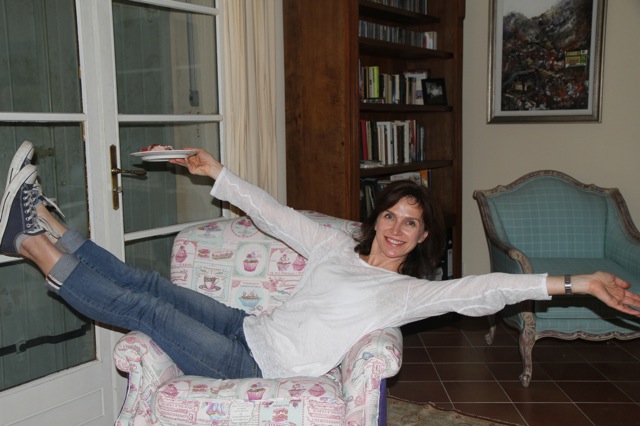
Joanna and her impressive reason
for a lack of cooking this month

Where am I going with this?  Welcome to the wandering mind of someone whose hands are deep in boar’s hair and webbing.  I’ll tell you where, though.  It occurred to me that, since this hugely successful show had been spun off to many countries, each tweaking it to its own tastes and state of mind, I could find the French version and improve my lamentable French while never pausing in my upholstery endeavours.

The first two hour episode proved to be a deeply comforting and successful experiment in language acquisition — mal cuit, anyone?  But then, halfway through the next episode I received a bit of a douche froide, so to speak.  The announcer, thankfully less humorous than her British counterparts as my French is barely up to understanding French slapstick let alone gentle, self-deprecating humour, announced that the Challenge Technique would be English in origin.  Cue the endless pause so beloved of such shows, then:

“Le challenge est……….  Charlotte aux fruits rouge.

Well, strike me down with a langue de chat.  You see, Charlotte Royale wasn’t English, it was French.  I knew this, because it had appeared only a week before on English T.V. and during French Week, no less.

Charlotte? C’est un French name, non?

Finally, something had occurred which made me look up from my stitching.  What gave Charlotte her ambiguous status between the French and the Brits, while retaining value as a challenge worth attempting?  The British show gave no clue.  Although their Charlotte involved Swiss Roll and looked like one of the illustrations in your mother’s 1970s copy of, er, a Mary Berry recipe book, it was accepted without demur by all as French.  Similarly, the French contestants, while sucking in their breath and declaring they were going to have to concentrate hard on this one, they failed to cry as one patissier,  “Zut alors, c’est un recet francais!”

The French presenter thickened the plot further, introducing a historian to explain the English origins of the dish.  Apparently, it was invented by Antoine Carême (yes, the father of the art of patisserie) who worked at both the English and Russian courts for a time.  You see?  Strange, no?  He made it for either a Queen Charlotte, a Princess Charlotte, a cousin Charlotte and then at some point tagged on Russe to include the Tsar in his flattery.

So why is this not considered French if a French man really did invent it?

Unearthing Charlotte’s origins in my own kitchen

IMG_2042

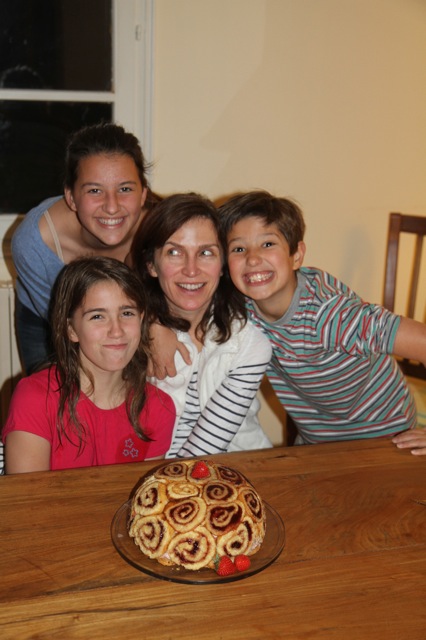
Patrick sharing his British Charlotte Royale. In France.

Patrick, my 9 year old, and I, decided to make the British version.  Doing it for myself cleared up all my questions.  It was, let’s say, a woman of substance.  French Women Do Not Get Fat, and their puddings cannot be hefty either.

My own Charlotte Royal was no slip of a thing.

The Swiss Roll lining was easily managed by Patrick working alone with our trusty KitchenAid.  While the French contestants piped boudoir biscuits to surround their moulds for the light bavarois filling, Patrick sliced up jammy sponge rolls which gave the pud a slightly cerebral air when turned out. How can you cut a petite tranche from that?  Piping even biscuits would be much more of a challenge for child and adult alike.  The Swiss Roll is infinitely more forgiving.

The difference between the French version and the English became clearer.  Simiar amounts of work and skill are involved, but one must be elegant and the other must be generous.  One should look preternaturally perfect, and the other is valued for comfort.  A French dessert should perhaps make you feel you are not quite elegant enough to eat it, while the English makes you feel better because you do not look like the Duchess of Windsor.  Ha ha –  it is not generosity of spirit that holds the French back from planting the tricolor on this this dish.  They are anxious that it is a recipe that can look unfinished, so trifle-like.

When Carême returned to France, he apparently rechristened the dish Charlotte á la Parisienne, probably to soothe the nerves of alarmed locals who may have heard a thing or two about the English king Carême had worked for.  I have no doubt when Charlotte arrived on French shores she resembled a trifle as little as possible.

Carême’s Charlotte is a little rootless, like so many of us expats.  Like us, it is unsure where it belongs and if home will ever be home again.  The Charlotte is perhaps a sort of Third Culture Dessert.

But at least I think I may have found the name for my upholstery business if I ever start one.

Here’s to Third Culture Sofas.

* * *

Joanna was displaced from her native England 16 years ago, and has since attempted to re-place herself and blend into the USA, Holland, Brazil, Malaysia, Venezuela, Saudi Arabia, and now France. She describes herself as a “food gossip”, saying: “I’ve always enjoyed cooking and trying out new recipes. Overseas, I am curious as to what people buy and from where. What is in the baskets of my fellow shoppers? What do they eat when they go home at night?”

Fellow Food Gossips, share your own stories with us!

STAY TUNED for tomorrow’s post!

If you enjoyed this post, we invite you to register for The Displaced Dispatch, a round up of weekly posts from The Displaced Nation, with seasonal recipes, book giveaways and other extras. Register for The Displaced Dispatch by clicking here!

Related posts:

Images: All images from Joanna’s personal photo albums, and used here with her permission

JACK THE HACK: Expat authors, time to build a great and powerful blog (2/3)

The expat experience Jack Scott and his partner, Liam, had in the Turkish port town of Bodrum—they were seeking sanctuary from a pressured existence in London—proved literally to be something to write home about, as in a book! They have since returned to the UK, where they are living the life of Riley in Norwich.  Some months ago, we suggested that Jack reinvent himself as Jack the Hack and submit monthly columns targeted at those of you who are still displaced and hacking away at travelogues-cum-memoirsor, in some cases, autobiographical novels. Warning to non-Brits: Don’t be put off by his wry sense of humo(u)r!

—ML Awanohara

Last month I extolled the virtues of blogging as a way of spreading the word about your words—and, in the process, flogging that box of books you’re using as a door stop.

This month, I want to take you further down the yellow brick road to blogger glory, with answers to the following Frequently Asked Questions.

Where do I start?

First things first. Choose a blogging platform—called a “host.” This will be your blog’s home. The biggest free applications are:

  1. Blogger—easiest.
  2. WordPress—slightly more technical knowledge required.
  3. Tumblr—attracts a younger crowd and great for short posts, video and pictures.

Your host manages all the back office stuff so you don’t have to. Once you’ve signed up, you can roll out a new blog in no time. You don’t need to be technically savvy but it does help to have mastered the basics. All the blogging platforms offer online help and/or tutorials. WordPress, in particular, has a large and active user community. You will learn as you go along and this is all part of the fun. WordPress also offers a free self-hosting package through WordPress.org, providing total freedom and endless possibilities to the serious blogging geek (I’m bad but I ain’t that bad).

What’s in a name?

More than you might think. Choose a title for your blog that reflects its subject matter. Simple is best. For example, the Turkish Travel Blog does exactly what it says on the tin and works well for searching. I also like What’s for Tea Tonight, Dear? because it’s obviously about food but has a witty title.

Don’t ask me why I chose the rather obscure title of Perking the Pansies for my own blog. It’s caused endless confusion, especially across the Pond. All I can say is that it came to me in the night and seemed like a good idea at the time.

How do I make it a looker?

All blogging platforms come with a variety of appealing templates to add a dash of style. Select one; furnish it with your personal touches in words, images and music; accessorize from a menu of widgets and plugins; and, hey presto, you’ve got yourself a blog with punch and panache.

Some fancy features come at a premium but they aren’t necessary.

Your blog will be unique, so move the vases and furniture around to see what works feng shui-wise—rather like flicking through an IKEA catalogue.

Add an interesting “About Me” widget or page. The most successful blogs reveal something of the writer’s personality.

Will I be chained to the computer?

Not unless it turns you on. Posts can be written in batches and scheduled to be published over time. Try to post at least once a week, though. It’s good for what’s called search engine optimization (SEO). Don’t be spooked by this. This is just how Internet search engines index and rank your site— it’s all done in the background. Over time, posting regularly will push up your assets better than a Playtex 18-hour girdle.

What will give my blog the kiss of life?

This is the original million-dollar question. The short answer is, whatever floats your boat: something that interests you will help you write something interesting. Variety, as they say, is the spice of life—so choose a broad theme to write around.

Many authors will post book reviews or write about the writing experience itself. That’s fine and dandy, but just because you’re a writer doesn’t mean that you have to write about writing (I rarely do). And it does no harm to go off-message now and again. Surprise your audience with the occasional left fielder.

The blogosphere is an incredibly hyper-active arena. Bloggers through WordPress alone published more than 35 million posts during September this year, attracting more than 4 billion hits (yes, billion). Obviously, you’ll want your posts to stand out from the crowd. Try to ensure that the titles of your posts spark an interest. If your blog is mostly text, make the first few sentences of each post leap from the screen and get the juices flowing. Break up your words with interesting and relevant images.

In our visual, coffee-on-the-go, no-time-to-read age, the right picture can be more eloquent than a thousand words. Keep your pages clean and uncluttered. Fussy, multi-coloured fonts and busy designs can hurt the eyes and put the reader off. Don’t forget to use relevant categories and tags for each post. They’re good for SEO, too.

And the kiss of death?

If you’ve a book to flog, promote it lightly—otherwise, your readers will change channels quicker than you can say “click here.” By now, I reckon most of my regulars have either bought my book or would rather read the back of an envelope, so there’s little point banging on about it (until the next one, of course).

Don’t use your blog as a daily diary (use Facebook for this if you must). Even your dear old Grandma won’t be that interested in what you had for breakfast or that you broke a nail taking out the rubbish (unless something funny or profound happened on the way to the tip).

If you want to be seen as an authority on something, you need to write with authority.

So, until the third, and last, thrilling installment, I leave you with this final thought:

BLOGGING TIP FOR EXPAT AUTHORS NO 2:

While it’s important to blog regularly, it’s okay to take a break because real life is, well, real. If you have nothing to say, don’t say it.

* * *

Readers, any comments, further questions for Jack the Hack? He’ll be back next month with the third, and final, installment in his blogging advice trilogy: “Making Friends and Influencing People.”

Jack Scott’s debut book, Perking the Pansies—Jack and Liam move to Turkey, is a bitter-sweet tragi-comedy that recalls the first year of a British gay couple in a Muslim country. For more information on this and Jack’s other titles, go to his author site.

STAY TUNED for tomorrow’s post, another installment in the life of our fictional expat heroine, Libby. (What, not keeping up with Libby? Read the first three episodes of her expat adventures.)

If you enjoyed this post, we invite you to register for The Displaced Dispatch, a round up of weekly posts from The Displaced Nation, with seasonal recipes, book giveaways and other extras. Register for The Displaced Dispatch by clicking here!

Related posts:

Images from top, clockwise: Hand with pen / MorgueFile.com; Boats in King’s Lynn, Norfolk / MorgueFile.com; Jack Scott, used with his permission; Turkish boats / MorgueFile.com

Happy Halloween! A cauldron of 6 cautionary tales for the intrepid traveler

Image: Lake View Cemetery / MorgueFile.com

Yesterday’s Halloween post by Anthony Windram, about the top 5 ghostly settings from literature and film, got us thinking again about the ghostly and ghoulish, the mystical and macabre, the dark and demonic.

Our thoughts, however, did not turn towards the new and original, but to the jaw-clanging skeletons in the Displaced Nation’s very own Crypt.

At which point…someone (Kate Allison?) suggested that we pile all of our Gothic Tales of Old into a cauldron and chant “Bubble, bubble, toil and trouble.” All was going well until one of us—must have been the American—broke in with:

Stirring and stirring and stirring my brew…

Just as she screeched “O-o-o-o-o, o-o-o-o-o”, 6 apparitions arose from the pot: 6 terrifying tales from the Displaced Nation’s deep dark past. Each said they were there to teach travelers a lesson.

And here is what they told us:

1) The Ghost of the Mysteriously Misplaced Post

I am the ghost the represents the post titled The Displaced Nation’s Halloween post is…mysteriously displaced!, composed on Halloween night two years ago by ML Awanohara, whose blood was curdling because:

Kate Allison was supposed to post today, for Halloween…but then, pouf, she vanished without a trace!

As readers who are paying attention know, Kate has now posted 80+ episodes in the life of a fictional British expat family living in New England, called Libby’s Life. Two years ago she vanished before uploading the latest episode because of a freak snowstorm in Connecticut, her adopted home.

She finally resurfaced on On All Saint’s Day—in a MacDonald’s! (Has she gone native, or what?)

Travelers, here is the lesson I’m here to impart for your sake: Truth is stranger than fiction, where so’er you roam.

2) The Ghost of Quizzing Others on Their Supernatural Sightings

Hello there, I am the ghost that arises from THE DISPLACED Q: On your travels … have you ever seen a ghost?, which was composed by Tony James Slater just over a year ago. He impressed with his self-knowledge when he said: “I’m about as psychic as a cheese.” But then he went on to say:

And then, just occasionally, I have dreams when I’m visited by the spirits of people I’ve lost….

Is there any wonder there were no comments and no likes on his post? He scared the bejeezus out of most of his readers.

Still, point taken, and I’m here to impart an important lesson that you international travelers may not have fully considered: As you traverse the world, bear in mind that any ghosts you meet will be people you know (and left behind), not strangers.

3) The Ghost of Compiling a Master List of Grim Reapers

Greetings, I have emanated from the post called Grim Reapers around the globe: 7 creatures that say “Time’s up!”, composed by Kate Allison just over a year ago. Kate reported on the surprising number of cultures that maintain some version of the mythological conniving female who lures men to their deaths.

As frequent visitors to this site will know, Kate has a way with words. For instance, she described
Sihuanaba of Central America as follows:

Seen from the back, she’s an attractive woman with long hair; from the front, it’s a horse. (No jokes about Sex and the City, please.)

But even Kate’s rather offbeat humor could not dissuade from the freakishness of some of these figures.

As far as lasting lessons, this will have to suffice: Next time you get lost in a canyon, try blaming an ancient ghoul. Depending on where you’ve landed, as well as gender, you may just about pull it off.

4) The Ghost of Delivering a Screed against Princess Diana Dolls

A cheery hello to one and all, I am the ghost of Anthony Windram’s EXPAT MOMENTS: The Doll Collection, which he wrote almost exactly a year ago.

As anyone who came across it may recall, Mr. Windram was most distressed to find himself at a bed-and-breakfast in NEW England (he is from Jolly Olde) where the innkeeper has put her prized collection of “individually authenticated” Princess Diana dolls on display in the sitting room. He tossed and turned all night, even heard scratchings at his door.

Now, as regular visitors to this esteemed site know, Mr. Windram is no fool. On the contrary, he has has a mighty brainbox. Which is why I’m so stunned that he allowed himself to be frightened by a set of Lady Di figurines. I’m sure they were only there to cover up the fact that the house is haunted—by a young and rather vigorous ghost, which is how ghosts tend to come in America (just ask Libby). The real take-away, then, particularly for those who venture into the New World: Avoid American B&Bs like the plague if you want a decent night’s sleep.

5) The Ghost of the Expat Criminals Exposé

ML Awanohara showed some temerity in writing a post entitled What did Agatha Christie know? Expats make great criminals back when this blog first started.

As the ghost that arose from this post, I’m here to say she hit the proverbial coffin nail soundly on the head with this assertion:

Just as we don’t like to think of rats being part of the animal kingdom, we don’t like to think of conmen, pirates, gangsters, and terrorists being part of the group we have loosely defined as “global voyagers” … But trust me, they are a part of it — as are murderers.

Which leads us to the lesson I’ll impart today: Just because you’re in a part of the world where marrows tend to thrive, don’t assume the likes of Hercule Poirot will turn up and save you.

6) The Ghost of Finding Travel Inspiration in Margaret Drabble’s “Red Queen”

Not long ago compared to other posts in this collection, ML Awanohara wrote FOOTLOOSE & FANCIFUL: Margaret Drabble’s “The Red Queen”, explaining how her views of Korea had shifted after reading a book by Dame Drabble depicting a period of bloodshed and horror in the 18th-century Korean court. A real-life tale made more vivid by Drabble’s considerable fictional powers, in which the Prince is a homicidal maniac, and his father, the King, a stern Confucian. The King ultimately decides to murder his son in a style so dramatic that ML couldn’t get it out of her head next time she went to Korea. She remains haunted to this day.

As the ghost of this post about a ghost, I find myself torn. On the one hand, what kind of person would read Drabble—that serious, hip, intellectual British novelist, who likes to come across as one’s brainy, Cambridge-educated best friend—to get a handle on what the Koreans are really like? Apples and oranges—or marmite and kimchi, I should say.

On the other—and this is the lesson I’ve come to deliver: Never hesitate to use a Cambridge-educated Brit as a resource for novel sightseeing ideas.

* * *

Readers, have we got you thinking twice about those travel plans? Do let us know in the ca-ca-comments. Hey, at least we spared you the horrors of Sezin Koehler’s 15 films that depict the horrors of being abroad, or otherwise displaced; Tony James Slater’s 5 travel situations that spell H-O-R-R-O-R!; or Kate Allison’s Global grub to die for, including a rather scrumptious recipe for fried tarantula, which goes down a treat in Cambodia.

STAY TUNED for next week’s fab posts!

If you enjoyed this post, we invite you to register for The Displaced Dispatch, a round up of the week’s posts from The Displaced Nation, with our weekly Alice Award, book giveaways, and other extras. Register for The Displaced Dispatch by clicking here!


Talking to Sharon Lorimer about starting up a business on the art of being an expat

Sharon Lorimer CollageAnyone who has been an expat has probably thought about, at some time or another, starting up a business to help ease other expats into the notion that they are now international residents. But how many of us have the knowhow and the guts to act on these thoughts?

Sharon Lorimer, a Scot who lives in New York City with her American husband, did not think of herself as having an entrepreneurial mindset until she went to business school. One thing led to another, and almost before she knew it, she’d founded doshebu, a business providing services to various kinds of clients looking to go global.

Now let’s meet Sharon and talk to her about this turn of events in her life. We know that the force of love took her to New York, but what swept her down the path of launching her own business venture?

* * *

Hi, Sharon! It’s always good to talk to a fellow New Yorker, especially a displaced one! What brought you here from Scotland originally?
I fell in love with an American. After a long-distance love affair, we had to have the big talk about where we wanted to live. We were both just out of school and thought there would be more opportunities in New York than in our hometowns of Edinburgh (mine) or DC (his). So I came to New York to get married.

What was the first chapter of your life in the Big Apple?
We joined the dotcom boom: I worked for an Internet advertising agency, and my husband, Kim Khan, has done a variety of jobs, including establishing a bureau for CNBC.com in London. We were in our late 20s and had a vibrant, creative life, with lots of international friends. But then came the dotcom bust, and we started to reassess our lives and the extent to which the dotcom model aligned with our values. I searched for the right business for me but couldn’t find a fit. In 2004, I decided to get an MBA and after graduation in 2008 I started doshebu.

What kinds of services does doshebu offer?
While still in business school, I conducted primary research in International Human Resource Management. The services doshebu provides—to corporate leaders, individuals and families, businesses (human resource units), governments and NGOs, and importers/exporters looking to go global—are based on the gaps I identified in the market. I’ve designed an individual program for each market sector. Expats who are interested can find more information on our Services page. And our online learning site has lots of free resources. We want to build a community there and are continually adding information that you can access for free.

You’ve been out of Scotland for some time. Do you ever feel “displaced”?
I feel most displaced in the places where I’m supposed to be feeling most at home. I find it tough to relate to people who don’t have similar life experiences. Sometimes other Scots don’t even believe I’m Scottish. How do you convince someone you’re not pulling their leg and are actually from the same place as them?

Do you feel more comfortable abroad than in the UK?
Usually when I strike up a conversation with someone who’s traveling the world or living abroad, I find we have lots in common. My husband is the same way. If we encounter foreign tourists in the city, we always want to tell them about really cool places to go and the history behind those places.

Expats as “warriors”

Where did your idea for “doshebu” come from?
Doshebu is an expression of my life experience. When I first moved abroad, I had no idea of how difficult it would be. I packed my suitcase, got my flight, and turned up at my fiancé’s house. It took me a while to realize how unprepared I had been. While I didn’t think of myself as an immigrant, I experienced the loss of status that immigration causes. Lots of expats approach international assignments in that way. Whenever I reach out to talk to others, I can see there is a lot of work to do to help us all understand what moving abroad has done to our lives. These days, I like to think of myself as a pioneer and imagine myself living in a “boundaryless” world, where people live where they want and do what they feel is meaningful to them.

I understand the name for the business is based on the Japanese samarai moral code, Bushidō?
Kim is a black belt in the martial arts. Both of us have experienced the trauma of moving countries (Kim is from Virginia originally but has lived and worked in the UK and Singapore), and we think that living abroad requires something of a warrior mindset. While most people anticipate having a change in lifestyle, they are unprepared for the idea that not everything will be straightforward. For instance, some locals may not appreciate you or your values. Warriors are trained to go into hostile situations, and doshebu’s products address that possibility by educating you and discussing methods of coping. Thus the “way of the warrior” has become the “art of the expat.”

Was opening up your own business something you always wanted to do?
No, I was totally daunted. Although I’d witnessed my grandmother and mother start businesses, and admired them for that, I always shied away from taking that kind of responsibility. But now I feel the desire to build something of my own that wouldn’t exist if it weren’t for my efforts and dedication.

What has been the biggest challenge?
There are two main challenges I face:
1. Limited resources. It’s always tough no matter how big the company is, but it’s really tough when you’re a start-up.
2. Motivation. When you have to motivate yourself and there isn’t a reward at the end of the day, it’s tough to figure out how to keep going. I have to keep reminding myself of how far the company has come—it is no longer a research project but a living company; and I dream of a future when other people think it’s a great company, too.

Expats as artists

The most fulfilling aspect?
Doshebu is an Internet business and there is a lot of technical work behind the scenes. But we called it the “art of the expat” because we find that people who go abroad tend to become more creative and have more diverse interests. I enjoy trying to foster a sense of this in our clients and their families. It can be an advantage to their companies—for instance, if they make a more creative presentation on their work; but it can also be about one’s personal journey, connecting you with your creativity.

If you could do anything else, what would it be?
I’d love to make movies. I wrote a screenplay a while back, and as a photographer and writer, I love movies.

FromtheGlobalScottishKitchen_cover_tdnI see that you’ve created some cookbooks and photobooks under the Art of the Expat brand. My favorite is The Global Scottish Kitchen, with recipes for things like Cock A’ Leekie Udon.
Yes, my next book will also be a cookbook, called Coop du Monde. It’s a step-by-step guide to spicing up the traditional British Sunday Roast. It’s also about helping you be creative in the kitchen by explaining how to experiment with flavors.

In addition, I’m working on another photography book—about graffiti. I want to explore the idea of street art, the photographer and the graffiti artist as being the same person.

You can check out my various books on Blurb.

What’s on your bucket list?
I want to buy a small island and build a house on it. I like the idea of being able to build an environmentally-friendly house. But we’d have to have liquor—Kim and I have also written a book about home-style cocktails, based on our world travels and conversations with bartenders, bon vivants and drinkers. AliasNickandNorasHomestyleCocktails_cover_tdnHmmm…maybe I could sell moonshine in the local market?

* * *

Ah, said like a true entrepreneur, Sharon! Thanks so much for talking to me about your work. I must say, I find your take on “going global” truly refreshing. Readers, any questions for Sharon on what it’s like to be an expat doing a business on behalf of other expats? Fire away! Or if you want to recommend a home-style cocktail for her collection, I’m sure she’d appreciate that, too. For that matter, aren’t cocktails part of the recipe for a successful expat adventure?!

STAY TUNED for the next episode in the online expat novel, Libby’s Life, to appear tomorrow.

If you enjoyed this post, we invite you to register for The Displaced Dispatch, a round up of weekly posts from The Displaced Nation, with seasonal recipes, book giveaways and other extras. Register for The Displaced Dispatch by clicking here!

Related posts:

Images (clockwise from left): Sharon trying out her Bushidō technique(?!) outside of Gaudí’s cathedral in Barcelona; being a tourist in Venice; enjoying a stein of beer at the Oktoberfest in Munich (on the cover of her photography book Oktoberfest); and how the table looked for her and Kim’s 10th-anniversary celebration (note the tartan tablecloth!).

GLOBAL FOOD GOSSIP: Keeping food real in Brazil

JoannaJoanna Masters-Maggs, our resident repeat-expat Food Gossip and Creative Chef, is back with her column for like-minded food lovers, which includes pretty much every expat we’ve ever encountered. This month: Authenticity, Brazilian-style.

* * *

“What’s the most depressing thing I’ve seen this morning?” I demanded of my husband as we arrived at our hotel on that first day in Brazil.

Was it something in my tone of voice that made my husband stick out his jaw? Having your wife positive about a new location is always a good thing. Any hint of wifely discontent can put the terrors into most expat husbands, even the most rufty-tufty oil field types.

“The favelas on either side of the motorway for the entire journey from the airport?” His voice had a slight tone of —  could it be? — belligerence. He’d decided to meet head on what he feared was my Western European squeamishness over visible poverty. I’d agreed to come, after all; it wasn’t his doing that the favelas existed.

“Oh.” I felt a pin pricking my outrage. “Actually no. It was the model of the Statue of Liberty outside the shopping mall we passed, the one with the Hard Rock Café.”

Not the voice of a woman with a strong social conscience, then.

“Aren’t we in Brazil?” I asked lamely.

Living in the shadow of the USA

In my defense, I was afraid that this most exciting and culturally rich of countries appeared in thrall to the ego of a foreign superpower. Here, where Christ the Redeemer looks down calmly over Rio and Guanabara Bay, it distressed me that he was unable to turn his cheek from the abominable reproduction Liberty. Such are the drawbacks of being made of stone.

My frustration really hadn’t abated much by the time we left several years later, but it was tempered. Here was a country that had its own great music, landscape, history and food. Brazil’s son Santos Dumont’s first flight had been overshadowed by the earlier but aided take off of the Wright Brothers’ heavier than air plan.

But surely the same could not happen to Brazilian fast food – and at their own hands?

Coxinha  — wins the Pepsi Challenge against the Chicken McNugget, any day

When I was in Brazil, workers could fill a canteen with beans, rice, a little meat and some pasta for 5 reais. A meal from McD costs four times that and cannot keep a belly as full for as long. Yet not only was there a Hard Rock Café, Dominos and McDonald’s, but the bloody Statue of Liberty to boot, holding her torch triumphantly aloft as if lighting the invasion of foreign fast food. (I know, I need to get over that tacky statue.)

Brazilian fast food choices, which can be grabbed on the run in a similar way to a hamburger, are extensive. Kibe consists of meat and bulgur wheat shaped into rugby balls and deep-fried. Empadhinas are little pastry pies often filled with palm hearts but options are endless. There are bollinhas de arroz (rice balls) and, a slightly more costly option these days, bollinhas de bacallao (salt cod).

Then there is the coxinha. Oooh, heaven. It is a pear-shaped, breadcrumb-coated, deep-fried confection of pulverized chicken, creamy catupiry cheese, and onion. I don’t want to be rude, but for heaven’s sake, Brazil — how could you choose a chicken nugget over that?

Please. It’s time for a Coxinhas R Brazil brand to sweep all before it.

Turn the milk sour with your grouse? Or simply dance the samba?

Brazilians probably have a greater openness and sense of fun than I do. They seem to tolerate kitschy statues and dodgy food for what it is, just a bit of fun not to be taken as a serious threat to national pride. There is a great deal of pride in being Brazilian and, I’m told, there are as many Americans trying to emigrate to Brazil as vice versa – it is a new land of opportunity.

Brazilians seem less sulky or passive aggressive than many in dealing with what they don’t like. One amusing example came in the immediate aftermath of 9/11 when America required passengers arriving on planes to America from Brazil to be subject to the same security searches, and delays, as planes coming from countries deemed a threat. Brazil has no history of terrorism and people were offended. However a cheerful approach was chosen. Officials simply decided to apply the same principle to American planes landing in Sao Paolo, Brazilian style. To ease the pain of the wait, passengers were treated to smiling samba bands and charming dancers. Nothing was ever going to change, but the point was made and relations not permanently soured.

A meal fit for a (Burger) King

Perhaps this non-confrontational approach is best. The invasion of American fast food is all-conquering everywhere. Its advance hasn’t been slowed by a thousand angry French farmers and restauranteurs, or by the Italian Slow Food movement. But its growth in Brazil alongside a rapidly emerging obesity crisis comes alongside economic improvements. According to a recent BBC Programme on the rise of obesity around the world and particularly in developing and BRIC countries, the answer is to be found less in the innate appeal of the food, but in the message that is sent out when you’re seen eating it. McDonald’s is an “aspirational food”.

(You might notice that I started a new paragraph rather suddenly. It was to give you a moment to recover from the shock of seeing the words “McDonalds” and “aspiration”, not only in the same sentence, but right next to each other. The idea of being proud to be seen eating fast food is a difficult one that takes time to absorb. I too enjoy the odd foray into the depths of culinary depravity, but I hide the bags – I admit hypocrisy right here. May I continue now?)

You might think you would aspire to a Wolf oven or even a Meile vacuum cleaner, but McDonald’s? No — bear with me. A Brazilian McDonald’s meal costs four times that of a plate of rice and beans. Its cost would buy you any number of coxinhas. It is impressive conspicuous consumption. You pay to eat a meal which won’t actually fill you and you will have to pay to eat again soon after, but the point is: you can.

It’s a fairly modest aspiration for the new middle class. Thousands of Brazilians have been lifted out of poverty over the last 10 years. But potential hunger is still a recent memory and the fear of slipping back must be strong for many. An outrageously priced Big Mac is still less expensive than a ritzy restaurant in Leblon and it’s certainly easier to avoid potentially embarrassing etiquette gaffes for those not yet accustomed to what is known in America as “fine dining”. This is what fast food companies can trade on, and before you know it, new habits are formed.

If you’re going to gain Brazilian pounds, make them worthwhile

Why get fat on this so-so food, though, when you can get gloriously fat on real cooking? You can easily pile on the pounds with Brazilian feijoida, Let the weight gain be a result of leisurely, indulgent meals and not sandwiches grabbed in plastic furnished, fluorescent lighted “restaurants” that are tiled like public lavatories.

I’d say the same to America. Ditch the McD and get fat on Southern and Soul Food, some of the most luscious food in the world. Wow, those Southerners know how to take a healthy low-calorie green vegetable and give it the cholesterol punch of cheesecake. My two personal favourites: collard greens cooked in fatty port cuts and sweet potatoes mashed with butter and topped with a crumble made of brown sugar pecans and a handful of marshmallows. Sounds appalling, but it is the closest thing to ambrosia since Zeus was a viable god to worship.

Both Brazilian and American Soul food has the opulence and indulgence to deaden and dazzle the senses at the same time. It has what a dried up hamburger and flabby white bun bread cannot hope to rival even with liberal dollops of ketchup.

Oh please. Get fat on real fat and be patriotic about that: your nation’s fat.

Make it worth your while.

Make it worth your money.

Aspire.

* * *

Joanna was displaced from her native England 16 years ago, and has since attempted to re-place herself and blend into the USA, Holland, Brazil, Malaysia, Venezuela, Saudi Arabia, and now France. She describes herself as a “food gossip”, saying: “I’ve always enjoyed cooking and trying out new recipes. Overseas, I am curious as to what people buy and from where. What is in the baskets of my fellow shoppers? What do they eat when they go home at night?”

Fellow Food Gossips, share your own stories with us!

STAY TUNED for tomorrow’s post!

If you enjoyed this post, we invite you to register for The Displaced Dispatch, a round up of weekly posts from The Displaced Nation, with seasonal recipes, book giveaways and other extras. Register for The Displaced Dispatch by clicking here!

Related posts:

And the September 2013 Alices go to … these 4 international creatives

 © Iamezan | Dreamstime.com Used under license

© Iamezan | Dreamstime.com
Used under license

If you are a subscriber to our weekly newsletter, Displaced Dispatch, you’re already in the know. But if you’re not (and why aren’t you? off with your head!), listen up. Every week, when that esteemed publication comes out, we present an “Alice Award” to a writer or other kind of creative person who we think has a special handle on the curious and unreal, who knows what it means to be truly displaced as a global resident or voyager. Not only that, but this person tries to use this state of befuddlement to their advantage, as a spur to greater creative heights.

Today’s post honors September’s four Alice recipients.

Starting with the most recent, and this time with annotations, they are (drumroll…):

1) SHERRY OTT, travel photographer and blogger

Source: Photographing Vietnam’s Rainy Season,” on Everything Everywhere
Posted on: 20 September 2013
Snippet:

From a cultural experience and photography standpoint, inclement weather seasons are a wonderful opportunity to see how the locals really live in situations that we would deem less desirable. You get a true feel for the country and local culture and traditions through the “tough” times. On top of it you get introduced to a number of new products that are used in that inclement weather season that you probably never even dreamed of…

Citation: Sherry, we have to stop you there. Right now we are picturing Alice sloshing through her own tears:

As she said these words her foot slipped, and in another moment, splash! she was up to her chin in salt water. Her first idea was that she had somehow fallen into the sea, “and in that case I can go back by railway,” she said to herself.

But what interests us about you, Sherry—what’s curiouser and curiouser, as Alice might put it—is that, unlike her, you were not having a pool-of-tears moment. As you set foot in Saigon at the height of the monsoon season, your first thought was, my, how lucky I am to see “the skies open up and pour down their wrath on city streets.” And you know what, Sherry? We agree with you. Unlike Alice, who had no means of transport except possibly the train, you had your own motorbike. Also unlike her, you were privy to some unusual sights: double-headed ponchos and ponchos with headlight windows! Poor Alice, on the other hand, when she heard something splashing about in a pool a little ways off, thought she might encounter a walrus or hippopotamus, only to find … a mouse.

2) ALYSSA JAMES Canadian blogger, journalist, traveler

Source: How fast can you slow travel?” on Matador Network
Posted on: 13 September 2013
Snippet:

Because of regulations on how long a truck driver is allowed to be on the road in a day, I was able to explore the city [of Chicago] for exactly 1 hour and 19 minutes.

In those 79 minutes, I was still able to slow travel. I visited the sculpture and centerpiece of Millennium Park known as the Bean (actually called Cloud Gate) and went to the Art Institute. More importantly, I talked with people who lived there. I received interesting insights about the place I wouldn’t have gathered otherwise, like where to get the most delicious Chicago-style pizza ever (Giordano’s deep-dish, double-crusted and stuffed deliciousness).

Citation: Alyssa, we appreciate that you were able to plumb the depths of the Windy City, the largest city in the Midwest, America’s third largest, in just over an hour (hey, that’s no mean feat given how deep the pizza is!). And all this without the benefit of the Queen’s insights in Through the Looking Glass:

“A slow sort of country!” said the Queen. “Now, HERE, you see, it takes all the running YOU can do, to keep in the same place. If you want to get somewhere else, you must run at least twice as fast as that!”

Our only question is, had you followed the Queen’s advice and run twice as fast, do you think you might have at least sampled the stuffed pizza? And of course, had you run twice as fast, you could have sampled it guilt-free! That’s a thought. Next time, perhaps?

3)  ANNE COPELAND, founder and Executive Director of The Interchange Institute

Source: “Tiger Moms, Bébés, and Warm Eskimos” on FIGT blog
Posted on: 1 September 2013
Snippet:

[A]s an interculturalist, I’m at once fascinated, excited … and disappointed by these accounts of parenting in other cultures…. In each case, the message is roughly, “Here’s a new and superior way to raise your children; the result is better than what you’re doing; try it, you’ll like it.” But nowhere do they describe the deep values underlying the parenting choices, the ultimate goals for the kind of adult parents are trying to raise, or the cultural milieu into which the children will be expected to grow.

Citation: Anne, we feel certain that Alice could relate to your woes. She was, after all, rather discombobulated by what she saw of the Duchess’s parenting style. To quote from her account:

While the Duchess sang the second verse of the song, she kept tossing the baby violently up and down, and the poor little thing howled so, that Alice could hardly hear the words:—
“I speak severely to my boy,
I beat him when he sneezes;
For he can thoroughly enjoy
The pepper when he pleases!”

Just imagine, a child that enjoys unlimited amounts of pepper thanks to harsh parenting. It totally makes sense in the Wonderland context. Except…achoo! or should we say: hach-chu (Bengali), hāt-chī (Cantonese), atsjú (Hungarian), aatsjoo (Norwegian), or atchoum (French)? In any case, some sort of onomatopoeia must be required. Parenting may vary from place to place, but not sneezing! But wait, the Japanese say hakushon. Are they trying to stifle the sneeze while frantically searching for a face mask? (Anne, please tell us: will intercultural wonders ever cease?)

4)  NIKKI HODGSON, blogger & traveler

Source: “What is lost (and gained) when the traveler settles down” on Matador Network
Posted on: 16 August 2013
Snippet:

“…Every day that passes separates me from the places I used to belong to, the places I learned to belong to. As I dig my roots deeper into the rocky Colorado soil, I must relinquish my grasp of the banks of the Neckar where I first studied abroad, the mountains of Grenoble that stood guard over me as I fell apart, the dusty hills of Bethlehem where I put myself back together.

And I know that I will never belong to these places the way I once did.”

Citation: Nikki, you put us in mind of Alice’s sister, who like you after your travels, was old and wise enough to know that Wonderland wouldn’t, couldn’t last. Here is the relevant passage:

So she sat on, with closed eyes, and half believed herself in Wonderland, though she knew she had but to open them again, and all would change to dull reality—the grass would be only rustling in the wind, and the pool rippling to the waving of the reeds…

Crazy Wonderland or dull reality? Or, in your case: dusty hills or rocky soil? That is THE expat question… Not much of a choice, is it?

*  *  *

So, readers, do you have a favorite from the above, or have you read any recent posts you think deserve an Alice Award?  We’d love to hear your suggestions! And don’t miss out on these weekly sources of inspiration. Get on our subscription list now!

STAY TUNED for our next post!

Writers and other international creatives: If you want to know in advance whether you’re one of our Alice Award winners, sign up to receive The Displaced Dispatch, a round up of weekly posts from The Displaced Nation, with news of book giveaways, future posts, and of course, our weekly Alice Award!. Register for The Displaced Dispatch by clicking here!

Related posts: