The Displaced Nation

A home for international creatives

Tag Archives: Italy

Catching up with this year’s Random Nomads over the holidays (3/3)

RandomNomadXmasPassportIt’s Christmas Day and the holiday party continues for the expats and other global voyagers who washed up on the Displaced Nation’s shores in 2012. Remember all those Random Nomads who proposed to make us exotic meals based on their far-ranging meanderings? Not to mention their suitcases full of treasures they’d collected and their vocabularies full of strange words… How are they doing these days, and do they have any exciting plans for the holidays? Third in a three-part series (see also Part One and Part Two).

During the final third of 2012, we met some expats and intrepid world travelers who, I think it’s fair to say, have developed some rather unusual hobbies and eating habits. The two are one and the same in the case of Brian MacDuckston, who was featured on our site this past August. He has made a habit of eating ramen in as many Tokyo venues as possible — a hobby that was quirky enough to attract the attention of the New York Times. In addition to Brian — a San Franciscan who originally went to Japan to teach English — we encountered:

  • Liv Gaunt, an Englishwoman who became an expat accidentally, while pursuing her love of scuba diving and underwater photography. Now based in Australia, she told us she has a passion for sharks but would happily do without sea urchins.
  • Mark Wiens, an American third culture kid who now lives in Thailand and travels all over — he feels least displaced when sampling other countries’ street foods.
  • Jessica Festa, an American traveler who loves to venture off the beaten track and eat locally — she did not hesitate to eat cuy in Ecuador (even though it reminded her of her pet guinea pig, Joey, named after a school crush).
  • Larissa Reinhart, a small-town Midwesterner who lived in Japan for several years and, since repatriating, has taken up the pen as a crime novelist. She is now living in small-town Georgia but hopes to go abroad again. She provides recipes for Asian fried chicken, among other delicacies, on her blog about life as an ex-expat.
  • Patricia Winton, an American who responded to 9/11 by giving up her comfortable life in Washington to become an expat crime writer in Rome. She also invested in a pasta-making machine…
  • Bart Schaneman, a Nebraskan who wanted to see the world and has made his home in Seoul, where he is an editor for an English-language newspaper and author of a travelogue on the Trans-Siberian railway. He is a huge fan of kimchi.

Three of this esteemed group are with us today. What have they been up to since a few months ago, and are they cooking up anything special for the holidays, besides chatting with us?

Brian with Ramen_Xmas1) BRIAN MACDUCKSTON

Have there been any big changes in your life since we last spoke?
I’ve been offered a few gigs on Japanese TV shows as a “ramen reporter” and successfully pitched my first magazine article about a best-of-ramen list. A start! I also started a ramen class aimed at non-Japanese speakers. Check it out!

How will you be spending the holidays this year?
A nice staycation in Tokyo.

What’s the thing you most look forward to eating, dare I ask?
I’m trying to eat more high-class sushi, but I’ll probably just stick to a lot of ramen for the next few weeks.

Can you recommend any books or films you came across in 2012 that speak to the displaced life?
I really enjoyed Jiro Dreams of Sushi, a documentary about the most revered sushi chef in the world. [Editor’s note: The film has been available on Netflix since last August.]

Do you have any New Year’s resolutions for 2013?
I want to train myself to stop using double spaces after periods when I write. Not a big goal, but important for someone who has an interest in being paid for my writing.

A worthy goal, imho! (I’ve had to correct quite a few in my time…) So, any upcoming travel plans?
My father will visit Japan, so I am planning a luxury week-long trip of eating and relaxing in hot springs. Two things I’m good at!

LarissaReinhart&Reinhart2) LARISSA REINHART

Any big developments in your life since we last spoke?
My second Cherry Tucker Mystery, Still Life in Brunswick Stew, has a release date of May 21, 2013. [Editor’s note: As mentioned in Larissa’s interview, the first in her Cherry Tucker series, Portrait of a Dead Guy, came out this year.]

How will you be spending the holidays this year?
We travel to visit my family in Illinois and St. Louis after Christmas through New Year’s.

What’s the thing you most look forward to eating?
There’s this Italian grocery, Viviano’s, in the Italian district of St. Louis, called The Hill in St. Louis, that I really look forward to visiting. I’ll stock up on cheap wine and Italian staples for the coming year.

Can you recommend any books or films you came across in 2012 that speak to the displaced life?
Yes, two Japanese films:

  1. The fascinating documentary Jiro Dreams of Sushi. I highly recommend — even for non-sushi fans. The film is beautifully shot and reveals what it takes to be a true master at something. Incredible.
  2. The gorgeous The Secret World of Arrietty (aka The Borrower Arrietty), scripted by Hayao Miyazaki. We were excited to see Arrietty because we saw the ads for the movie when we were still living in Japan (and I’m a big fan of Mary Norton’s The Borrowers, on which the film is based, as well as of Miyazaki).

Have you made any New Year’s resolutions for 2013?
To spend less time on social media and more time writing. I love chatting online, but I need to be more disciplined about getting away from the “water cooler” and back to work.

Any upcoming travel plans?
Disney World for spring break! Woot! And we’re hoping to get back overseas soon, but no definite plans yet.

PatriciaWintonwithholly3) PATRICIA WINTON

Any big changes in your life since we last spoke a couple of months ago?
The month after you featured me, I put my long-time WIP in the bottom drawer for a while and started a new one. I’ve written about 30,000 words. This one, also a mystery, is set in Florence. It takes place during the 500th anniversary celebration of the world’s first culinary society.

Meanwhile, my blog partners at Novel Adventurers are working on an anthology of long short stories. We are an adventurous group comprising (besides me):

  • an Australian who has lived in South America
  • an American of Swiss-German origin who is married to a man from Iran, where they frequently travel
  • an American with close family ties in India, where she frequently travels
  • an American specializing in things Russian, who is married to a Kyrgyz
  • a former Peace Corps volunteer who writes about the Caribbean
  • an American who grew up on a sailboat traveling the world and has lived as an adult in many countries.

We’ll be writing about travel and adventure from international perspectives. It will be some time before it sees publication, but I’ll keep you posted. I think it will interest the Displaced Nation!

Where will you be spending the holidays this year?
I’m spending the holidays quietly at home. I plan to visit a friend in the country for New Year’s weekend. The holidays here last almost three weeks, ending on January 6. Nativity scenes are a big deal here, and I plan to visit various churches to view, and photograph, them as I usually do. I’ll write about them on my blog, Italian Intrigues, on January 3rd.

What’s the thing you most look forward to eating?
Christmas Eve in Italy is devoted to eating fish — usually seven fish dishes from antipasto onward. I’m trying out a new recipe for sea bass stuffed with frutta del mare (non-fin fish). I’m using clams, mussels, shrimp, squid and baby octopus, all well laced with garlic. And I always make the holiday custard that comes from my Tennessee childhood.

Can you recommend any books you came across in 2012 that speak to the displaced life?
The Lacuna, by Barbara Kingsolver. While it was published in 2010, I didn’t read it until this year, and I think it’s a masterpiece. It’s about a man with one foot in Mexico and the other in the US — but that’s a vast oversimplification. After the young man’s Mexican mother dies, he works for Frida Kahlo and Diego Rivera while Leon Trotsky is staying with them. He later moves to the US to join his American father. He eventually becomes a successful writer caught up in the McCarthy witch hunt. I don’t want to include spoilers here, but it’s fabulous. The boy/man is a foreigner in both countries and speaks both languages with an accent.

Do you have any New Year’s resolutions for 2013?
Not that I want to share.

Last but not least, do you have any upcoming travel plans?
No concrete travel plans at the moment. While composing these answers, I received an email about a tour of Uzbekistan that sounds really alluring. And I will probably go to the US to attend a mystery writers conference.

* * *

Readers, any questions for this rather motley (one former expat and two current ones) but highly creative bunch?

STAY TUNED for tomorrow’s post — expat Anthony Windram’s musings on spending Boxing Day in a country that associates boxing with punching, not (Christmas) punch.

If you enjoyed this post, we invite you to register for The Displaced Dispatch, a round up of weekly posts from The Displaced Nation, with seasonal recipes, book giveaways and other extras. Register for The Displaced Dispatch by clicking here!

Related posts:

Images: Passport photo from Morguefiles; portrait photos are from the nomads (Larissa Reinhart’s shows her family in front of one of their favorite Japanese manga characters, Shin-chan, a sort of Bart Simpson of Japan — the creator, Yoshito Usui, had recently died).

TRAVEL YARN: Just a regular expat girls’ night out in Kenya…um, right?

Today, as many of us await the very real horror of Hurricane Sandy, it may be helpful to have a distraction in the form of a scary travel tale. Guest blogger Amy Lucinda Jones, an Englishwoman who lives in Italy, has obliged with this story about an unsettling experience she had while volunteering in Africa.

If I had a pound, or even a penny, for every person who told me that it was dangerous to go to Kenya on my own, well…I would have been able to afford to take a friend with me, too.

Have you heard about all those terrible things that happen to people who go there? And you’re going alone! And you’re a WOMAN!

But, I shrugged off these (somewhat sexist, and racist) warnings and went to Kenya anyway, fresh out of university, ready to face a new part of the world and a new adventure. I had decided to take part in a volunteer programme, helping children in the local community. And while the experience was one of the most interesting, eye opening and rewarding things I have ever done, it was definitely challenging.

The heat for one thing. Then the million tablets I had to take to stop me getting malaria (which, in turn, gave me terrible indigestion…and some other, ahem, more “personal” side effects that I won’t mention).

Oh, and the fact that I found lots of little white ants crawling all over my toothbrush one morning. They were in the breakfast jam, too. After a few days I grew tired of picking them out. Extra protein and whatnot.

But despite the creepy crawlies and the questionable hygiene, nothing compared to the experience I had with my fellow volunteers, one Saturday night.

What an excellent night for…

We’d decided to let off some steam after a tiring week, due to hard work and challenging projects. After having had a few Smirnof Ices (yes, alcopops are still pretty big over there) at a local bar where we lived in Mombasa, we decided to take the party elsewhere. There was a “discotheque” several miles away, where we could drink more sugary alcohol and dance under the stars.

The only problem was getting there.

We approached a taxi driver and bartered with him for a while. There were about eight of us, so two taxis were needed, and the guy suggested we go with his somewhat shifty looking friend. Please don’t let me be in his taxi, I silently prayed, as one of the other girls pulled me in the direction of said taxi driver’s car.

As we got in, though, everything seemed fine. He drove through the city calmly, without saying too much. I didn’t blame the guy for staying so quiet when he had a group of women who were squealing as though they were 13 again, in his back seat.

But then we reached the edge of the city. It was pitch black — a whole load of nothing was surrounding us. I began to feel just a little uneasy, but none of the other girls seemed to be in the slightest bit bothered.

That was until the driver slowed right down. He crawled along the road, looking around him. We all looked at each other. We had done this journey before, and the road was straightforward. It should not be taking this long.

Oh, yes, there will be blood!

“You do know the way to the disco, right?” One of us asked.

“Mmm.”

Well, of course that response filled us with a whole load of confidence. We repeated the question but were met with an even less helpful silence.

I’m sure he’s just lost and feels embarrassed about it, I told myself, noticing that I was starting to sweat a little bit, even though it wasn’t that hot. We all fell silent as he continued to creep along, still surveying his surroundings.

Suddenly a petrol station loomed into view. Our driver pulled over and silently got out of the car. As he closed the door behind him, we erupted into a state of panic.

“Oh my God, what’s he doing?!”

Followed by:

“Who’s that weird man he’s now talking to?!”

And then, the slightly more alarming:

“I actually think he’s going to chop us into little pieces!”

After this last statement I instinctively placed my fingers on the door handle to assess our possible escape option.

“OH MY GOD — THE DOORS ARE LOCKED!!!”

The other girls frantically tried their doors, too, but to no avail. The driver was talking with the attendant and beckoning towards the car. Probably explaining about how he had four young women captive in the back seat, and he was planning to take us to his rickety old house and, of course, chop us all into little pieces.

I seriously started to panic.

After a few more horrific minutes, he ambled back to the car. In a slow, Leatherface-like way. Albeit without the chainsaw (although he could have had one of those in the boot).

He got into the driver’s seat and pulled away. Still driving at an agonizingly slow speed and saying nothing. He took another turning, which was again unknown to us.

We were in silence now — all secretly wondering if we should pounce on him to try and take him out. Grab the steering wheel or something equally as reckless.

Help me! Help meeeee!

We continued to crawl along. I could hear one of the girls whimpering. Or maybe it was me. I don’t remember. I thought back to those who had warned me about the dangers of traveling. Although to be honest, I think their concerns were more along the lines of avoiding being mugged, or catching typhoid from ice cubes. I’m pretty sure they hadn’t imagined me being stuck in the back of a taxi with a murderer.

Okay, that was harsh. Maybe he wasn’t the actual murderer. Maybe he just “found” innocent, unsuspecting people and took them to his “boss,” who would do the torturing and killing. Maybe he was actually a really nice guy who was stuck in this horrid job. I almost started to feel sorry for him.

He pulled over again. This time at the side of the road. In the middle of nowhere. We clung to each other for dear life as he got out and talked into his mobile phone. He’d probably lost the address to the House for Killing Unsuspecting Foreign Women.

After another five minutes of driving, one of the girls squealed. With a voice barely containing her excitement, she pointed out that she recognized the road. “We are two minutes away from the disco,” she said.. We bounced about in the back seat as the driver pulled into the car park. People! Noise! No Killing Houses!

We threw some money at him and escaped the moment he brought the car to a stop.

The other girls were waiting by the entrance. They looked incredibly annoyed by our lateness. But we just didn’t care.

Because we were ALIVE.

Amy Lucinda Jones is an English teacher, keen traveler, food fanatic, and occasional follower of fashion. Currently, she is living in Puglia (Apulia) and discovering southern Italy one gelato at a time… You can keep up with her adventures by visiting her blog, Sunshine and Tomatoes, and/or following her on Twitter: @BritInItaly. She was recently interviewed about her adventures by Expats Blog.

STAY TUNED for tomorrow’s post, an Expat Moment involving creepy Princess Di dolls, by Anthony Windram.

If you enjoyed this post, we invite you to register for The Displaced Dispatch, a round up of weekly posts from The Displaced Nation, with seasonal recipes, book giveaways and other extras. Register for The Displaced Dispatch by clicking here!

Related posts:


RANDOM NOMAD: Patricia Winton, Crime Writer, Expat in Rome & Lover of La Dolce Vita

Place of birth: In a farmhouse belonging to my paternal grandparents near Pelham, Tennessee, on a snowy December night
Passport: USA
Overseas history: Italy (Marina di Pisa, Livorno, Rome): 1969-70; 1970-71; 2002 – present.
Occupation: Crime Writer. My protag is an Italian American journalist rebuilding a career as a food writer in Italy. She first appeared in “Feeding Frenzy,” one of the mystery stories in Fish Tales: The Guppy Anthology, edited by Ramona DeFelice Long (Wildside Press, 2011). She’s waiting in the wings in an as yet unsold manuscript, set in Rome. She will solve another crime in the novel I’m beginning next week (for National Novel Writing Month), set in Florence.
Cyberspace coordinates: Italian Intrigues — Notes about life in Italy, food and wine, mysteries and crime (blog); Novel Adventurers — Seven writers blog about their passion for culture, travel, and storytelling (collaborative blog); @patriciawinton (Twitter handle); and Novel Adventurers (FB page).

What made you abandon your homeland for Italy?
I had the opportunity to come live in Italy when I was quite a young woman, and I lost my heart to the land, the people, and the cuisine — not to mention the wine. I talked about coming back to live for years, but life intervened. Following 9/11 (I worked a block from the White House at the time), I really felt my mortality and decided it was time to make the move. Or to stop talking about it.

Was anyone else in your immediate family displaced?
One of my sisters lived in Panama for three years. Another lives in New Mexico, a state that many people think is a foreign country. One classic example: New Mexicans had trouble trying to get tickets to the Atlanta Olympics and were told to go the the Mexican consulate. The situation is so ridiculous that New Mexico Magazine runs a monthly column called “One of Our 50 Is Missing.”

Tell me about the moment during your various stays in Italy when you felt the most displaced.
“Bureaucracy” may be a French word, but the Italians invented it. If you don’t believe me, I invite you to consider the Biblical story of Christmas: a decree went out from Caesar Augustus that all the world should be taxed, each to his own city.

Getting together the paperwork to file for permanent residency was a nightmare. After almost a year of compiling documents, it all came down to what the Italians saw as a discrepancy: my passport lists my place of birth as Tennessee while my birth certificate, issued by the state of Tennessee, listed my place of birth as Pelham. Getting that sorted out took six months. During the interregnum, every document including my permission to stay expired. I couldn’t renew anything until the residency question was settled.

When did you feel the least displaced?
It’s always at table. On the edge of a Tuscan vineyard enjoying homemade pasta and good wine, sharing laughter with friends. Before a roaring fire in a chilly stately home with simple chicken and salad, but more laughter and wine. With a group of strangers in at a local market luncheonette, querying a table-mate about her meal and being offered a share.

You may bring one curiosity you’ve collected from each of the countries where you’ve traveled or lived into The Displaced Nation. What’s in your suitcase?
A morsa di prosciutto (prosciutto holder). While most prosciutto crudo sold in Italy as elsewhere is machine-sliced, traditional purists want it cut by hand. To hold the ham steady, it’s placed in the morsa, a large clamp that hold it, while a knife is used to slice.

Hmmm… I hope it won’t be deployed by the murderer in one of your crime novels as an instrument of torture! I understand that when you first went to Italy, you learned to make pasta by hand, and then took a pasta machine back to the United States, where you taught many others how to make it, while also writing a food column for a newspaper. We are therefore looking forward to the meal you are invited to prepare for Displaced Nation members, based on your travels. What’s on the menu?

Indeed, I’ll be serving a traditional Italian meal:
Antipasto (appetizer): Fiori di zucca faraciti (zucchini blossoms stuffed with mozzarella and anchovies, dipped in batter and fried)
Primo piatto (first plate — traditionally the pasta, rice, or soup course): Gnocchi di Zucca alla Gorgonzola (pumpkin dumplings with gorgonzola sauce)
Secondo piatto (main course): Grigliata Mista di Pesce (mixed fish grill)
Contorni (vegetable accompaniment): Finocchio (fennel)
Frutta: Pesca (peach)
Dolce (dessert): Tiramisù
Bevande (drinks): Acqua minerale frizzante (fizzy mineral water); and Falanghina (white wine made from one of the oldest grapes grown in Italy)
.

And now can you please suggest an Italian word or expression for the Displaced Nation’s argot?
One that I’m currently enjoying is in gamba, meaning “in the leg.” In general, it means “to be an expert” or “to be good at what you do.” But it means so much more. I wrote an extensive piece about the phrase at Novel Adventurers recently.

Halloween is nearly upon us, and many of our posts of late have been about horror and that sort of thing. Tell me, do you keep up American Halloween celebrations in Rome?
I haven’t really celebrated Halloween since I was a child. I spent much of my adult life working on political campaigns. With Halloween falling days before the election, I never seemed to get organized for it. Here in Italy, it’s a relatively new holiday and more for adults than children, really. Children dress up for carnival, wearing their costumes to school for days before Martedì Grasso (Italian for Mardi Gras).

There are Halloween-related items for sale (plastic Jack O’ Lanterns and such), but no pumpkins for making Jack O’ Lanterns. Those are reserved for cooking. If I do anything to celebrate, I cook pumpkin, either as a vegetable or as part of the primo piatto.

Also in keeping with the season, we’ve started exchanging expat horror stories on the site. What’s the creepiest situation you’ve encountered on your travels?
The creepiest thing that ever happened to me occurred many years ago on a train from Munich to Florence. It started off pleasantly enough. I shared a compartment with five or six other people. A couple of them spoke only German. One woman spoke Italian and German, a man spoke German and English, and I spoke English and Italian. We had a polyglot conversation, with people translating for others and listening to see how much of the foreign tongues we could decipher. It was lots of fun. They all left the train before I did, and each warned me to be careful on my long journey as they descended one by one.

Alone, I moved near the window, and the rocking of the train lulled me to sleep. Quite some time later, I was awakened by the conductor turning on the lights to check tickets. I discovered that I had been joined in the compartment by a man who was in the act of pleasuring himself in the dark while I slept.

Now THAT’s creepy! Readers — yay or nay for letting Patricia Winton into The Displaced Nation? Not only can she cook, but she can tell a shocking story! (Note: It’s fine to vote “nay” as long as you couch your reasoning in terms we all — including Patricia — find amusing!)

STAY TUNED for tomorrow’s post, another horrifying Displaced Q by Tony James Slater!

If you enjoyed this post, we invite you to register for The Displaced Dispatch, a round up of weekly posts from The Displaced Nation, with seasonal recipes, book giveaways and other extras. Register for The Displaced Dispatch by clicking here!

Related posts:

Img: Patricia Winton (author photo)

15 films that depict the horrors of being abroad, or otherwise displaced

Readers, we’re getting goosebumps and our blood is curdling. Horror novelist, former expat and Third Culture Kid Sezin Koehler is here to remind us that, however glamorous the life of an expat or world traveler may seem, it has a netherworld — one that horror movie makers are fond of depicting. To proceed is at your peril.

As if moving or traveling abroad isn’t scary enough, there is a whole host of films that would put the kibosh on even the most adventurous of people. For today’s guest post for The Displaced Nation, I’m breaking down these tales of terror into three groups:

  1. The expat.
  2. The world traveler.
  3. The otherwise displaced.

What follows is a rundown of some of the best horror films that will make you never want to leave home again.

1. Expat Horror: Caveat expat, or expat beware (or in some cases, beware of the expat!).

1) Ils (Them) (2006), dir. David Moreau and Xavier Palud.
In this terrifying French film, two expat partners, a teacher and a writer, living outside Bucharest in Romania are terrorized and psychologically tortured by an unknown group for days before their murder. Based on a true story, the villains — who were apprehended in real life — turn out to be even more shocking than the events they perpetrated.

My big question: Why on earth do you choose to live out in the middle of nowhere in Romania? Tragic story indeed, but really, they should have known better. Now you do.

2) Suspiria (1977), dir. Dario Argento.
Considered one of the classic horror films and what many now consider to be the father of the arthouse horror genre, Argento’s dark and twisted tale features a ballet school in Rome full of young girls from all around the world who live and study within walls haunted by a chilling presence that picks off the girls one by one. The score by Goblin is enough to give you nightmares and make you reconsider sending your children away to school. Ever.

3) & 4) Red Dragon (2002), dir. Bret Rattner; & The Silence of the Lambs (1991), dir. Jonathan Demme.
In Red Dragon Dr. Hannibal Lector is just a British expat living and practicing psychiatry in the United States. In fact, he’s helping the police with a brutal series of murders in which specific body parts had been taken as trophies. Detective Will Graham eventually discovers that not only is psychiatrist-to-the-stars Dr. Lector responsible for these grisly killings, he’s also eating the missing pieces.

The next time we meet Hannibal the Cannibal is in The Silence of the Lambs, where he is safely tucked away in a maximum security prison until the FBI needs his profiling assistance in uncovering the identity of a man who is kidnapping and skinning women.

Maybe Dr. Lector is a reason why locals are so wary of expats around the world?

5) The Omen (1976), dir. Richard Donner.
It’s hard enough being the wife of the American ambassador to the UK, but when Lee Remick discovers that there is something very wrong, very evil with her son, Damien, matters only get worse.

In many ways this is the kind of expat horror to which we can most relate: being in a foreign country, going through a difficult time, and not having the kind of support one might have at home. Even though the Thorns are wealthy and have a full staff at their beck and call, Mrs. Thorn cannot confide in them her misgivings that her son is the Antichrist — nor can she with anyone else since she’s the ambassador’s wife. In the end she goes mad from fear and frustration.

As expats, we’ve all been there. Luckily, though, we didn’t have the incarnation of Satan as our son. At least I hope not.

6) Freaks (1932), dir. Tod Browning.
This magnificent film follows a group of sideshow circus performers in Dust Bowl America — the majority of whom are European expats from all over the continent. As foreigners as well as displaying physical deformities of all kinds, this group is the marginalized of the most marginalized in America not just at that time, but even today.

The gorgeous German and “normal” trapeze artist Cleopatra finds out that Hans, the midget, is fabulously wealthy and sets out to steal him away from his same-sized girlfriend Frieda — with disastrous consequences as the group of freaks tries to bring the wicked Cleopatra into their embrace. Cleo finds out well and good that one does not mess with members of the sideshow.

The message here? Respect your local customs, even if you think them freakish. It could be what stands between your body as it is or being turned into a human-chicken hybrid.

2. Traveler Horror: “Let your suitcases gather dust!”, cry these films.

1) Hostel (2005), dir. Eli Roth.
A group of backpackers passing through the Slovakian capital city, Bratislava — it has no semblance to the real place whatsoever — gets kidnapped by an organization that sells young people to the highest bidders so that they can be tortured and murdered in the Slovakian outback with impunity. While the film is rife with cultural and geographical blunders, it nonetheless preys on a legitimate fear of kidnapping and/or human trafficking while traveling, especially for young women as we see in the two follow-up films in this gory franchise.

Kids, don’t fall for the local pretty girl/handsome boy who picks you up in a bar. You have no idea whom they could be working for.

2) American Werewolf in London (1981), dir. John Landis.
Two American backpackers (uh-oh) in the Scottish highlands stray from the road and are attacked by a wild beast. One dies, the other is in a coma for three days with horrible gashes across his chest. When the doctor informs him he was attacked by a madman he’s confused, claiming it was a wolf that had killed his friend and wounded him. Come full moon, young David Kessler finds out it was neither man nor wolf, and he’s becoming one.

There’s nothing like a story about a horrific accident taking place while traveling, especially when said accident turns you into a monster. Always remember, STAY AWAY FROM THE MOORS/MUIRS!

3) The Descent (2005), dir. Neil Marshall.
After the tragic death of Sarah’s husband and daughter in a wicked car accident, her fellow British extreme-sporting friends decide to take a trip across the pond to Appalachia for a spelunking expedition. Why anyone would think that crawling around in caves would be a good idea I haven’t a clue — let alone choose to take an already-traumatized woman into that scenario. But hey, they do. And not only do they find themselves in an unmapped cave system that has no way back to the surface, there are others down there in the dark who’d like to ensure the girls never leave.

Dear People Traveling to America: For Pete’s sake, avoid the US’s back country! Monsters are above and below.

4) Wolf Creek (2005), dir. Greg Mclean.
Two British tourists in Australia pair up with a local to check out a supposed alien-landing site in the middle of nowhere. All is fine until their car battery dies. Stranded in the badlands of Oz, grateful are they when a mechanic rolls up and tows them to his place to fix their vehicle. But oh, he’s not a mechanic at all. He’s a serial murderer who waits for tourists to come out to the Wolf Creek Crater, and takes his good time torturing them before their slow death.

The film is based on a true story — one of the British girls actually survived and made it to the authorities. It turned out the man had killed hundreds of people over decades, and nobody even suspected a thing. Shiver

5) Primeval (2007), dir. Michael Katleman.
During the Rwanda-Burundi conflict, bodies were dumped into the Ruzizi River at such alarming rates that the crocs began eating human flesh. One of these crocs, nicknamed Gustave by the locals, gets a taste for human flesh and begins hunting humans inland. An American team of journalists are sent to capture and bring back the beast amidst an ongoing civil conflict between warlords and villagers.

The best thing about this movie is that there really is a 70-year-old, 22-feet-long croc named Gustave who swims the Ruzizi. He was last sighted in 2008, but I know he’s still out there. I can feel him.

3. Displaced Horror: “Think twice about moving or taking a sojourn outside the ‘hood” is the moral here.

1) The Amityville Horror (1979), dir. Stuart Rosenberg.
As if moving doesn’t suck enough, can you imagine moving into a house that not only was the site of a brutal family murder but is also haunted? I don’t even know how many whammies that makes the scene. Also based on the true story of the Lutz family, who were terrorized by their house to the point where they fled without any of their belongings and never went back to collect them.

Word to the wise: Always check about the house’s history before you move in, and always remember to burn sage throughout, even in cabinets and drawers, before you move anything in anything at all. Trust me on this one.

2) Se7en (1995), dir. David Fincher.
Heralding a promotion to detective, Brad Pitt gets transferred to an anonymous city with a reputation of being among the worst in America. *Cough* Detroit *Cough*. His wife is miserable as she wants to have a family, but cannot imagine raising children in that town. The first case he lands is a serial killer murdering people based on the Seven Deadly Sins — one that quickly sucks both him and his wife into a horrific spiral of torture and murder.

Women, don’t let your husband drag you to a horrible city. Just don’t. Your life very well may depend on it.

3) The Texas Chainsaw Massacre (2003), dir. Marcus Nispel.
A group of friends on a road trip through Texas and — oh crap! — their car breaks down. It’s just their luck that the person who finds them is the patriarch of the psychotic and inbred Hewett family, known for killing and cooking their victims. There are no happy endings here, people.

If you’re going on a road trip, stick to the main roads, for God’s sake! I mean, jeez, everybody knows that. And while you’re at it, stay the bloody hell out of Texas!

4) El laberinto del fauno (Pan’s Labyrinth) (2006), dir. Guillermo del Toro.
Set in 1944 fascist Spain, the film tells the story of Ofelia, a young girl who accompanies her mother to live with her new stepfather, a barbarous Spanish general. Amidst the horror, Ofelia discovers a fairy world underneath the very grounds of their home, a place to which she escapes when the torture around her becomes too much to bear. But even fairy worlds have their horrors, as she soon finds out.

Moms, jeez, don’t marry jerks and then don’t agree to live in their military camp. Seems like logic to me, but I guess it needs to be said.

* * *

So, are you ready to burn your passport and throw away all your travel gear yet? 😉

And do you have any other films you’d add to my best-of abroad horror list?

Sezin Koehler, author of American Monsters, is a woman either on the verge of a breakdown or breakthrough writing from Lighthouse Point, Florida. Culture shock aside, she’s working on four follow-up novels to her first, progress of which you can follow on her Pinterest boards. Her other online haunts are Zuzu’s Petals, Twitter, and Facebook — all of which feature eclectic bon mots, rants and raves.

STAY TUNED for tomorrow’s post, which has Kate Allison continuing our horror theme.

If you enjoyed this post, we invite you to register for The Displaced Dispatch, a round up of weekly posts from The Displaced Nation, with seasonal recipes, book giveaways and other extras. Register for The Displaced Dispatch by clicking here!

Related posts:

Images: From MorgueFile: Cinema; Hat and suitcase;  Bridge from biplane.

Photo of Sezin, from her newest FB page, ZUZUHULK, used with her permission.

Would I travel for food? It depends…on whether it’s pizza or haggis!

Third Culture Kid Tiffany Lake-Haeuser is back, to tell us what she thinks about gluttony as a motive for travel.

As a Third Culture Kid who was raised in the United States and Abu Dhabi before returning to my native Germany, I’ve learned that every culture has its own traditional foods — but the idea of trying them all? I’ll take that with a pinch of salt, so to speak.  Some of the world’s most celebrated foods are very good; others, not so much.

At my international school in Frankfurt, I’ve found it amusing to walk around at lunchtime and see what the different nationalities are eating. Obviously, we students are somewhat limited by what the cafeteria offers, but once a year on International Day — a day for celebrating all the nationalities at our school — things get a bit more interesting. We get to choose between egg noodles at the Thai stand and the burgers at the U.S. stand, among others…

Food for thought

Would I travel for food? I know that the Displaced Nation has covered this topic obsessively last month. I discussed it with a few of my schoolmates — ironically, during our lunch period — and we agreed that while most of us have a certain sweet or other type of food we make a habit of eating or buying when we are in certain countries, we would not be inclined to go on a food tour.

One of my friends said she makes it a priority to buy “double stuf” oreos in the U.S. Though hardly a delicacy in America, this cookie is seen as an exotic treat at our school.

Other friends mentioned their efforts to avoid certain traditional foods at all costs. For instance, one of them said she loathed eating haggis in Scotland — even though that’s where she is originally from! For those of you who don’t know what haggis is, it is a savory pudding of sheep lung, liver and heart encased with other ingredients in an animal’s stomach. Mmmmm!

Another friend reported she’d found eating snails in France less than appetizing. The snails slimy and chewy, not pleasurable as French people like to claim.

Rice…again!

My own most memorable food experience associated with travel occurred when I was attending international school in Abu Dhabi. I refer to my eighth-grade week-long school trip to Thailand. Every day, we were given plain white rice to eat; it came with every single meal. By the end of the week, we just couldn’t face another bowl of rice! (On the rare occasions when we were served French fries, the students would attack them and within minutes they would be gone.)

However, on the last day of our trip, we were taken to a school and taught how to make chicken curry and spring rolls. Not only was it the best meal I’d had all week (which is of course not biased to the fact that I was the cook!), but I also found it so interesting to see the way these foods were made.

So maybe I would consider a cookery tour one day?

By the way, that still didn’t stop me from refusing to even consider eating rice for another month after that trip!

Pasta & pizza — perfect!

By the time this post goes up, I will be traveling in Italy, which is by far my favorite country to eat in. Pasta and pizza are two of my favorite things to eat in the world — and let’s face it, Italy does these foods better than anywhere else.

Honestly, I don’t even know how I will stop eating, but that’s a different problem.

I guess everyone needs to decide for themselves how far they are willing to travel for scrumptious or adventuresome eats. As for me, I will not be taking the train to Paris (where my dad now lives) every time I want a croissant — even if the original is truly amazing.

* * *

Readers, any thoughts on or reactions to Tiffany Lake-Haeuser’s skepticism about linking international travel to food experiences? Please put them in the comments. You can also follow what she is up to on her blog, Girl on the Run.

STAY TUNED for the Displaced Nation’s agony aunt, Mary-Sue Wallace, who will attempt to offer expat readers solace on their horrifying experiences in tomorrow’s post.

If you enjoyed this post, we invite you to register for The Displaced Dispatch, a round up of weekly posts from The Displaced Nation, with seasonal recipes, book giveaways and other extras. Register for The Displaced Dispatch by clicking here!

Related posts:


RANDOM NOMAD: Jessica Festa, Backpacker, Offbeat Traveler & Locavore

Place of birth: Long Island, New York, USA
Passport: USA — but I’m planning on starting the papers for my Italian passport soon (my grandparents were born there).
Overseas history: Australia (Sydney): 2008. I’ve also backpacked through western Europe (for partying and food!), South America (for surreal landscapes and hiking trails), and Southeast Asia/China and Ghana (for volunteer projects).
Occupation: Freelance travel writer. I have my own site and also write for Gadling, Viator and Matador, among others.
Cyberspace coordinates: Jessie on a Journey — Taking you beyond the guidebook (travel-zine); @JessonaJourney (Twitter handle); Jessie on a Journey (FB page for backpacking community); and Jessie on a Journey (Pinterest).

What made you leave the United States for the Land of Oz?
I chose Australia for studying abroad because I wanted to be able to communicate in English — it was my first time going abroad alone.

On your site you describe yourself as a “natural backpacker.” How did you find living in one country?
It’s so different living somewhere than just traveling to it. When you have a part-time job, class schedule, gym membership, local hangout, go-to grocery store, etc, you really begin to feel a strong connection to a place. Sydney is such a great city. That said, I did not give up my backpacking habit entirely. I also traveled a lot through Australia when studying!

Tell me about the moment on your travels when you felt the most displaced.
I had many moments like that when I did a homestay for a month in Ghana, in West Africa. I was doing orphanage work, and absolutely loved the experience — but the culture is just completely different. Especially in city areas, it’s very loud and chaotic, and people will shout at you and grab your skin to feel if it’s real. They don’t get many tourists, so they’re just curious and wanting to get to know you — but sometimes it got a little too intense.

When have you felt the most comfortable?
In Sydney. I actually called my family crying the night before my flight back to New York, saying I had a new home and would not be returning. I had this camaraderie with my neighbors and so many connections to the community, I really felt like a local.

You may bring one curiosity you’ve collected from each of the countries where you’ve traveled or lived into The Displaced Nation. What’s in your suitcase?
My collection of paintings, jewelry and handcrafted items:

  • Ghanaian artwork and wooden masks
  • Handmade jewelry from Sydney and Bolivia
  • A handwoven purse from Peru
  • Alpaca socks from Ecuador
  • Banksy artwork from the UK
  • Masapán (bread dough art) from Calderón, Ecuador
  • A hand-sewn water-bottle holder from Thailand

You are also invited to prepare one meal based on your travels for other members of The Displaced Nation. What’s on the menu?

Appetizer: Locro, a thick soup with potatoes, avocado, cheese and vegetables from the Andes.
Main: A pesto pasta with some kind of meat mixed in from the Cinque Terre in Italy.
Dessert: Salzburger Nockerl, a sweet soufflé from Austria.
Drink: Malbec wine from Argentina.

I wonder if you could also add a word or expression from one or more of the countries you’ve visited to the Displaced Nation’s argot.
“No worries” from Australia. Such a great phrase for life. I have it tattooed on my foot!

This week you received a “Food Alice” from the Displaced Nation for your post about the first time you tried cuy, or guinea pig, in Ecuador — you said your dinner reminded you of your pet guinea pig, Joey, named after a school crush. So, does food play a big role in your travels?
For me it’s about trying new things. It doesn’t need to be in the fanciest restaurant or prepared by a Michelin chef, just something truly local. For example, in South America while many of the other backpackers went to guidebook-rated restaurants, I always opted for the tiny, simple, dimly-lit local hangouts. I ate 2- and 3-course meals for a $1, and the food was fresh and local. It was exactly what everyday people in the community were having, and that was important to me.

If you were to design a world tour based on food, what would be your top five recommendations?
1) Mendoza, Argentina — try asado (barbecued meat) with a glass of Malbec.
2) Cinque Terre, Italy — try the pesto pasta that I served to you in my meal!
3) Naples, Italy — try the pizza.
4) Cuzco, Peru — try the cuy (guinea pig) or, if you’re too squeamish, the lomo saltado: strips of marinated steak served over white rice and with French fries.
5) Munich, Germany — try the brätwurst. It is like no other sausage I’ve ever tasted, and tastes so much better in Germany!

To be honest, I’m not so sure about going to Cuzco for cuy.
Really? I love it. I’m planning to go back, and possibly move, to Peru or Ecuador in March. I’m already looking forward to getting my fill of cuy again!

Readers — yay or nay for letting Jessica Festa into The Displaced Nation? At least she’s not planning to serve us guinea pig for dinner — that’s a mercy! (Note: It’s fine to vote “nay” as long as you couch your reasoning in terms we all — including Jessie — find amusing!)

STAY TUNED for tomorrow’s post, which will most likely be on food. (No, we haven’t finished gorging ourselves yet!)

If you enjoyed this post, we invite you to register for The Displaced Dispatch, a round up of weekly posts from The Displaced Nation, with seasonal recipes, book giveaways and other extras. Register for The Displaced Dispatch by clicking here!

Related posts:

img: Jessie Festa enjoying one of the biggest and best empanadas in all of Peru, at the Point Hostels in Máncora (May 2012).

And the Alices go to … these 7 writers for their revealing posts on food and world travel

 © Iamezan | Dreamstime.com Used under license

© Iamezan | Dreamstime.com
Used under license

Autumn is finally here, and those of us who lost our appetite during the onslaught of this summer’s heat and humidity find that we can breathe — and eat — again!

Accordingly, the Displaced Nation has turned its attention to food — though in a way that conjures up the magical dreamscape of Alice in Wonderland rather than a blog populated by posts on typical and traditional world cuisines.

On the one hand, we’ve heard from the Top Hatter — I refer to Anthony Windram’s avatar — on the pleasures of indulging in beef tongue at a Kyoto restaurant. On the other, we’ve encountered Duchess Kate (Allison) just as she was pronouncing on the Queen’s favorite chocolate and inviting us to join her in a chocolate cocktail.

Last week when Tony James Slater appeared on the site, he was looking for all the world like Lewis Carroll’s Caterpillar, smoking his hookah and talking in short, somewhat rude sentences. His topic was the time he became violently ill (to use more polite language than he did) on mansaf on his visit to Jordan.

And personally I’ve yet to recover from last week’s encounter with the curious and curiouser Mark Wiens, who said he

would be very happy to fly to a destination and not do any of the normal tourist attractions, but just eat.

What’s more, he had the cheek to propose serving durian to The Displaced Nation! Off with his nose!!!

While putting together this menu of “It’s food!” posts, I’ve found it entertaining to read as many foodie posts as possible on other expat, repat, and travel blogs. And today I’d like to acknowledge some of their writers for what they’ve taught me about food and world travel.

A year-and-a-half ago, I had the pleasure of handing out the Displaced Nation’s Alice Awards to 7 writers who clearly understand — and aren’t afraid to reveal — the curious, unreal side of international travel.

Today I will hand out another set of Alices — you might call them the “Foodie Alices” — to writers who share the Displaced Nation’s down-the-rabbit-hole disposition toward world cuisines, i.e., who aren’t afraid to try mushrooms that make you grow, potions that make you shrink, tea parties where they don’t serve tea, and also feel duty bound to report these experiences to the rest of us.

So, without further ado, the Alices go to (in reverse chronological order):

1) AMANDA VAN MULLIGEN

Awarded for: “Do I Not Like Mushy Peas”, in A Letter from the Netherlands (personal blog about life as an Englishwoman in Holland)
Posted on: 19 September 2012
Choice morsel:

[Regular readers will know I am a fan of the Great British fish and chips.] However, there is no way, no how, I will eat fish and chips with mushy peas. They are vile. Foul. By far, mushy peas are … [t]he most disgusting monstrous green mess that has ever passed my lips. They turn my stomach.

Citation: Amanda, we award you this Food Alice or the feat of turning the typical “foods I miss from home” post on its head. That’s what it means to step through the looking glass. You’re a smart cookie and the rest of us would do well follow your example and focus on the “evil” accompaniments to our native cuisines that for health reasons alone, we’re lucky to have escaped from.

2) ANDREW COUCH

Awarded for: “Making Pancakes from a Bottle,” in Grounded Traveler (personal blog covering expat life in Germany), Posted on: 21 September 2012
Choice morsel:

We do not have a griddle. I imagine very few Germans have a griddle, at least not one useful for pancakes. So I get a set of 3 in a pan and the whole bottle [of Mondamin Pfannkuchen Teig-Mix] makes 12 or so, so I was doing several batches. … It works great, but well.. umm.. the Celsius temperatures still seem hard to understand for me. So while I didn’t overcook the cakes, I did almost burn my finger…

Citation: Andrew, you showed derring-do in experimenting with using bottled German pancake mix (and no griddle) to produce one of your favorite breakfast foods from home. Such bravery merits an Alice as does your acknowledged befuddlement over temperatures in Celsius, the vagaries of baking soda performance across the globe, and the extortionate prices of maple syrup. (Hey, we’ve all been there…)

3) KATE BAILWARD

Awarded for: “Sunday Supper,” in Driving Like a Maniac (personal blog about life as an Englishwoman in Sicily), part of her “Eating like a maniac” series.
Posted on: 3 September 2012
Choice morsel:

A Sunday night chuck it together kind of a lazy supper for one, to use up whatever you’ve got left in the fridge. I had a medium aubergine, a small courgette and some ricotta, as well as a jar of passata vellutata. You could say it was a very bastardised version of parmigiana alla melanzana, or you could just take it on its own merits and call it courgette, ricotta and aubergine rolls in tomato sauce. Or something else entirely. Whatever takes your fancy.

Citation: Kate — Katja, if we may — we give you an Alice for your versatility in writing foodie posts. Just after you published this piece, you wrote a post for Travel Belles on the joys of rustling up one’s own caponata, which you described as the “very essence of traditional Sicilian food.” Clearly, your training as an actor has borne fruit (and veggies!) if you can segue from harried EFL teacher chucking together a pseudo-Italian dinner, to full-fledged cookery expert. (What’s wrong with trifle, btw?)

4) JESSICA FESTA

Awarded for: “Eating My First Pet in Ecuador,” in Jessie on a Journey (personal travel blog)
Posted on: 24 August 24 2012
Choice morsel:

The body is sliced down the middle, opened like a thick book, on top of sizzling coals. Tiny hands, still with finger nails, reach into the air as if their last plea for help had gone completely unnoticed. Bright white teeth gleam out of mouths open in a scream and faces twist in agony. Apparently, the miniature murder scene I am witnessing is about to be my dinner.

Despite having been excited to try the popular Ecuadorian meal, something inside me feels a bit uneasy. My mind wanders back to my first pet, a guinea pig I named Joey after a school crush.

Citation: Jessica, we award you this Alice for your refusal to let “mental discomfort” stop you from ordering cuy, a popular South American dish, just because it resembles your Joey. (I for one never let sentiment get in the way of my enjoyment of koi, or goldfish, in Japan.) You’ve more than delivered on your promise to take us “beyond the guidebook.” We’re also very pleased that you found the dish delicious. Another one to add to our “must try” list, alongside Anthony Windram’s beef tongue.
COMING ON WEDNESDAY: A Random Nomad interview with the cuy-eating Jessie!

5) GERALDINE

Awarded for: “7 Badass Bavarian Foods You Must Try,” in The Everywhereist (personal blog about a trailing spouse’s adventures)
Posted on: 8 May 2012
Choice morsel:

Do you want to eat Bavarian food? OF COURSE YOU DO. It is rich and doughy and filling and is the only thing on the planet that can soak up German beer. Every other fare will simply hide in the corner of your stomach, petrified at the sheer awesomeness of the brew that resides in there with it, and it will never get digested.

In short: if you don’t eat Bavarian food while in Germany, you could die.

Citation: Geraldine, you’re full o’ beans, but we love you for that. Most “10 best foods” posts are about Southeast Asia or, more specifically, Thailand, home of cheap, tasty yet healthy food. But you realized that the market was already satiated for such posts and that it was time to give “badass Bavarian” food — of the kind that puts hairs on one’s chest — more of a chance. Not only that but you persuaded us. Pass the schweinshaxe.

6) & 7) MICHAEL HARLING & TONY HARGIS

Awarded for: “Is America too Sweet or Britain too Bland?” in Pond Parleys (joint blog, now defunct)
Posted on: 13 March 2011
Choice morsel:

Mike: I was surprised, on our recent visit, at how sweet America was: the beer, the bread, the pretzels (sugar-coated pretzels—honest to God) and even, oddly enough, the candy. And if it wasn’t infused with sugar, it was too salty and/or covered in cinnamon. After nearly ten years in UK, I found it all a bit too cloying.
Toni: While I do agree that American food has some strange stuff added to it, I wouldn’t call British food particularly bland. Rather than sweet, there is often a surprisingly savoury taste when you least expect it. While Cumberland sausage can have a peppery bite to it, Americans actually build their sweetness into the sausage, with maple syrup mixed right in.

Citation: Mike and Toni, we know you aren’t publishing Pond Parleys any more, but surely this post goes down in the annals and therefore deserves an Alice. I commented on it at the time it was published, wrote a post about it on TDN, and here I am writing about it again. The pair of you had a genius for pinpointing the kinds of things that routinely throw off American expats in Britain and vice versa, without their even knowing it. In the case of this food post, it turns out that we Yanks, just like the Duchess in Alice’s Adventures in Wonderland, may be allergic to all that pepper in the sausage! And who would have guessed that the sweets-loving Brits would recoil from our foods for their high sugar content?

* * *

So, readers, do you have a favorite from the above, and do you have any other writers/posts to nominate for our next round of Alices? I’d love to hear your suggestions!

STAY TUNED for tomorrow’s post, another Displaced Q focused on food by the anti-foodie Tony James Slater!

If you enjoyed this post, we invite you to register for The Displaced Dispatch, a round up of weekly posts from The Displaced Nation, with seasonal recipes, book giveaways and other extras. Register for The Displaced Dispatch by clicking here!

Related posts:

Displace Yourself…to Tuscany

Welcome back to another in our occasional series, “Displace Yourself,” where we look at books by expats and travelers focusing on particular countries or regions, in hopes of displacing ourselves through their experiences. (One lifetime isn’t long enough to sample it all!)

This month, a place that’s on many of our wish lists: Tuscany, Italy.

Tuscany: Facts and figures

Capital: Florence
Area: 8,878 square miles
Population: 3,750,000
Language: Standard Italian/Tuscan Dialect
Demographic: 93% Italian; immigrants from Britain, America, and China.

*  *  *

To Tuscany from England:

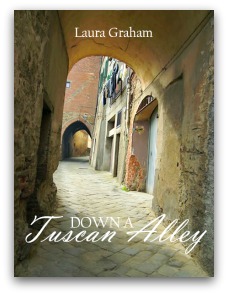
Down A Tuscan Alley (Fiction/memoir)
by Laura Graham
 Published June 2011

The Displaced Nation first met Laura Graham in May this year. Click here to read our interview with her.

About the author:
After the breakdown of a longterm relationship, Laura left England in search for a new life in Italy. With a distinguished acting career behind her, she now runs her own holiday property agency in Sinalunga, where the Tuscan tranquility inspires her writing.

Cyber coordinates:
Website: www.lauragraham.co.uk
Twitter: @LauraGraham7

Overview of book:
A long relationship ends. At 48, house taken by the bank, Lorri has little money. What can she do? And where can she go? Gathering her meager savings and her two beloved cats, she escapes England for a new life in a remote Italian village, never imagining the intrigue, passion and adventure she will find.

One reader’s review:
“The author’s use of dialogue enables the reader to form their own images of the characters to whom we are introduced. The reader is invited to share with [protagonist] Lorri as she develops her confidence, her new language, a knowledge of a different culture and her love for Ronaldo. The juxtaposition of romance and intrigue helps the book to flow to its end, and keeps the reader’s interest. The author brings her story to its conclusion using one of her characters to inform both the reader, and the protagonist herself.” (Amazon.co.uk reviewer)

To Tuscany from New York:

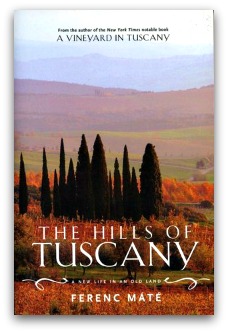
The Hills of Tuscany: A New Life in an Old Land (Autobiography)
by Ferenc Máté
Published November 1998

About the author:
Ferenc Máté  escaped Hungary after the 1956 revolution, and went with his mother to Vancouver, British Columbia. He now lives on a wine estate in Tuscany with his wife (painter and winemaker Candace Máté) and their son, Peter.

Cyber coordinates:
Website: www.ferencmate.com

Overview of book:
This hilarious, international bestseller is a true-life adventure of a New York City couple moving to Tuscany.  Ferenc Máté’s enthusiastic prose is infectious. He brings to life the real Tuscany: the contadini neighbors, country life—the harvest, grape, and olive picking, wine making, mushroom hunting, woodcutting—the holidays, and of course the never-ending, mouthwatering meals. (Amazon.com book description)

One reader’s review:
“As a second-generation Italian-American, I’m getting tired of the subtle patronizing attitudes that some prosperous expatriates to Italy emit via their memoirs. Reading this book, I felt that Ferenc Mate truly felt a genuine empathy with Italians. His ability to laugh at himself, and with his Italian neighbors — not at them — was a superb aspect of this work. He seemed to understand that being at home in Italy requires more than merely hobnobbing with other expatriates, and absorbing their prejudices.” (Amazon.com reviewer)

To Tuscany from California:

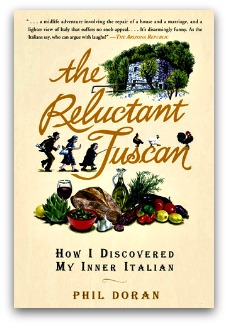
The Reluctant Tuscan: How I Discovered My Inner Italian (Humor/Autobiography)
by Phil Doran
Published March 2006

About the author:
Phil Doran worked in TV production for 25 years, as writer-producer for TV shows such as Sanford and Son, as a writer for The Wonder Years, and writing episodes of The Bob Newhart Show. He divides his time between California and Tuscany.

Cyber coordinates:
Website: www.reluctanttuscan.com

Overview of book:
After twenty-five years of losing her husband to Hollywood, Doran’s wife decided it was finally time for a change—so on one of her many solo trips to Italy she surprised her husband by purchasing a broken-down 300-year-old farmhouse for them to restore. The Reluctant Tuscan is about the author’s transition from being a successful but overworked writer-producer in Hollywood to rediscovering himself and his wife while in Italy, and finding happiness in the last place he expected. (Amazon.com book description)

Readers reviews:
Note: “The Reluctant Tuscan” appears to provoke a “Marmite” response from readers — they either love the book or hate it (or at least, are marginally lukewarm about it.) Here are two fairly typical reviews from both sides of the spectrum, from Amazon.com reviewers.

Love it:
“This is such a fresh, enjoyable book. Phil Doran is so honest & matter of fact about himself & his wife. I picked this book up to glance through & found I could not nor did I want to put it down. So I sat & read it non-stop, from cover to cover….My sides hurt from so much laughing. This is a must read book for anyone & any age….Enjoy!!!”

Lukewarm:
“The book recounts the period of time when the writer moved to a rural town in Tuscany and undertakes renovating a dilapidated farm house, mostly to appease his wife, who has bought the property without consulting him…There were some amusing bits but none that made me laugh out loud. Stereotypes and caricatures of Italians abound and there are multiple references to the Germans and WWII. Maybe it’s a generational thing, but I found these annoying.”

To Tuscany from Jerusalem:

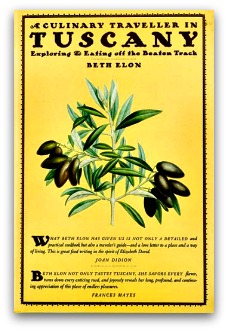
A Culinary Traveller in Tuscany: Exploring and Eating Off  the Beaten Track  (Travel guide/cookbook)
by Beth Elon
Published March 2009

About the author:
Former literary agent and her journalist husband Amos bought a neglected manor house in Tuscany in the late 1970s, long before the region became a desirable destination. Every summer, they would travel with their young family from their home in Jerusalem to spend two months in their Tuscan home, gradually renovating it as they were able. Eventually, the couple made Tuscany their permanent residence.

Overview of book:
“One might think that everything that can be written about Tuscany has been written. But here is a gem of a book in the tradition of M.F.K. Fisher that takes readers down Italian back roads and into private kitchens. There are 10 chapters that represent 10 itineraries into 10 different Tuscan regions. Included are more than 100 recipes and contact information and descriptions from private kitchens and restaurants, trattorias, gourmet shops, bakeries, wineries, and olive oil producers. Also included are days and dates when food festivals are held that celebrate chocolate, truffles, chestnuts and mushrooms. Warning: this book may contribute to an expanding waistline.” (Book Passage Bookstore review)

One reader’s review:
Beth Elton’s title isn’t just a cookbook – it takes a culinary tour of Tuscany into regions largely uncovered in other titles – and surveys the special kitchens and products of over fifty restaurants whose cooks produce original recipes revealed just for this title. All dishes have been adapted for home cooks but retain the authenticity of generations of development, so cooks seeking a blend of travelogue and new dishes to try will find delightful the blend of travel insights and easy dishes.” (Amazon.com reviewer)
.

STAY TUNED for Monday’s travel yarn from our very first Random Nomad, Anita McKay.

If you enjoyed this post, we invite you to subscribe for email delivery of The Displaced Dispatch, a round up of the week’s posts from The Displaced Nation. Sign up for The Displaced Dispatch by clicking here!

Related posts:

Image: MorgueFile

TRAVEL YARN: A second date with Rome

Kym Hamer, an Australian expat in London, joins us today as guest blogger to share her version of a Roman Holiday — one of several trips she has made since having the continent of Europe and all of its history on her doorstep. Notably, for Kym, Rome doesn’t need Gregory Peck to be irresistible!

After 12 years away, I recently went back to Rome.

My only previous dalliance with the Eternal City was part of a “12 cities in 20 days” type tour that at the time, seemed to be the best option for getting a taste of Europe in the three weeks of holiday I had available from my job in Australia. You see, when you’re coming from the other side of the world, the flights are long and expensive, so there needs to be a pretty high rate of return for the time and money invested.

It was an amazing holiday. I visited a whole range of places — some hotly anticipated, some moving me unexpectedly, some not quite what I had hoped for. Each got 1-2 days with an experienced tour guide who made the queues disappear, added humour to the gruelling schedule and brought each city to life with her own blend of historic narrative and personal storytelling.

But each stop allowed no more than a brief and flirtatious encounter, the faint ripples disappearing almost as quickly as they were made by the time I’d left. Each major European city, Rome included, made its impression but was quickly over-run by the next.

Living the dream in London

When I moved to London from Melbourne more than eight years ago, it was the third time I travelled to the UK’s capital in four years. The first time I had been drawn for a week and the second time for four days — both times before a longer “whistlestop” tour of the sort just described. And on both of these visits, I split my time between “tourist” and “traveller,” between the seeing what I wanted to see and the aimless wandering: immersing myself in the city streets, using the local transport and chatting with the natives. One way and another, I got the true taste of the city that was to become my home just a few years later.

I love history and I’ve read it — beginning in the guise of historical fiction (by the likes of Jean Plaidy) through to Simon Schama, Alison Weir and several others — since my very early teens, always trying to imagine what those real worlds, leaping off the pages in front of me, were actually like.

Once I’d moved to London, suddenly I felt I was living the dream (albeit one never particularly aligned to that city). I still stand on Waterloo Bridge at night, gazing at all that history along the riverbank reflected in the Thames, pinching myself and wondering: “Wow, how did I get here?”

Was it a love of history that had tempted me across the world? Not really…there were other candidate cities, but the “right” circumstances conspired with a passionate fling to bring me here. And just as you never know where things might lead in life, the fling came and went, yet London had captured my heart.

The grass still looks green(er)

But my yen to explore means there’s always a sense of looking over the fence (so to speak) with curiosity. What’s it like over there? Would I like it? Be disappointed or even worse, nonplussed?

Which leads me to Rome and some of the other cities I’ve visited since living in London. Being able to hop on a plane (or train — the Eurostar is a pretty fabulous way to travel) and, in just a couple of hours, walk the historic cobbled laneways of a completely different place is an extraordinary experience for any Antipodean. Only a few short hours is required to separate oneself from the familiar and the habitual.

European travel has an especially strong hold on my bucket list. For the most part, Australia’s history is both inextricably linked to and considerably newer than anywhere on the Continent, even though some of the names and boundaries may have changed since I first learned of these faraway lands in the schoolroom.

Of course, nothing can ever take you back in time to know truly what it was like standing at The Green at the Tower of London or inside Newgrange passage tomb in Ireland’s Boyne Valley or atop Hadrian’s Mausoleum — now known as Castel Sant’Angelo — in Rome.

But in the Eternal City, there’s a deep sense of generations past, not just battles won and lost and the rise and fall of the empires that at one time or another shaped “the world” — but also everyday trifles, evidence of the “day-to-day” living of previous generations (take, for instance, Trajan’s market, the “shopping” centre where people went to buy their fresh produce). Both strands of history — the extraordinary and the quotidian — are accessible and visible everywhere.

Second-date nerves

There’s always a part of me that feels a little nervous when I first arrive somewhere new — a piece of me that says, “You could stay in the hotel room tonight, read your guidebook a bit more and be really sure when you set out tomorrow morning.” And it takes some mustering of courage to stop dawdling and plunge right in.

I’m always glad, invigorated actually, once I set off but I guess that essential human-ness in us wants to avoid the risks and keep ourselves safe and sound.

The Rome I had encountered on our first date, before moving to London, had grown faint and unfamiliar. But on this second Roman Holiday, I surprised myself by diving right in to its sights, sounds and smells. I was out the door just an hour after checking in to my hotel. Not for me the lolling about to “recover” from my travels. No way. I had only four days and I wanted to fill it with…well, Rome. It was an immersive experience I was after.

So I walked down from Quirinale in the darkening streets as night fell, map in one hand, camera in the other, my eyes filled with wonder and excitement. A stranger in the night if you will: with no local knowledge, limited lingo (si and grazie get you only so far) and quite frankly no idea where I was going. Tingling and a little breathless with the thrill of discovery somehow I found my way through the warren of streets to the Fontana di Trevi.

And the four days flew by. I walked and bus-sed and walked and Metro-ed and walked and cruised and walked some more. Compact and exuberant, Rome spreads its charm around every corner. The noise and busy-ness were energising although the traffic in some of the piazzas less so.

(I always imagined piazzas to be intimate and bustling, even green, rather than spacious, concrete or filled with litter. So the Piazza Navona and Campo de’ Fiori — the latter translates into “field of flowers” — were amongst the few “oh, is that it?” moments.)

A piece of my heart

From my coin toss into the Trevi on that first night to my final morning meandering in the warm rain through the gardens of the Villa Borghese, my second encounter with Rome has moved us beyond the acknowledgement of two passing strangers. But while we are not yet close friends, there’s a piece of my heart that’s indelibly stamped with a sense of delightful possibility.

Will I return to the Italian capital for a gentle kiss, for one more embrace perhaps? I don’t know but it’s exciting, exhilarating, a little self-conscious and filled with promise.

Just like Rome.

Born and raised in Melbourne, Kym Hamer has worked in London in sales and marketing for the past eight-and-a-half years. She writes the popular blog Gidday from the UK. Also follow Kym on Twitter: @giddayfromtheuk.

STAY TUNED for tomorrow’s Random Nomad interview with an American who has taken the “phile” in Anglophile to an extreme.

If you enjoyed this post, we invite you to register for The Displaced Dispatch, a round up of weekly posts from The Displaced Nation, with seasonal recipes, book giveaways and other extras. Register for The Displaced Dispatch by clicking here!

Related posts:

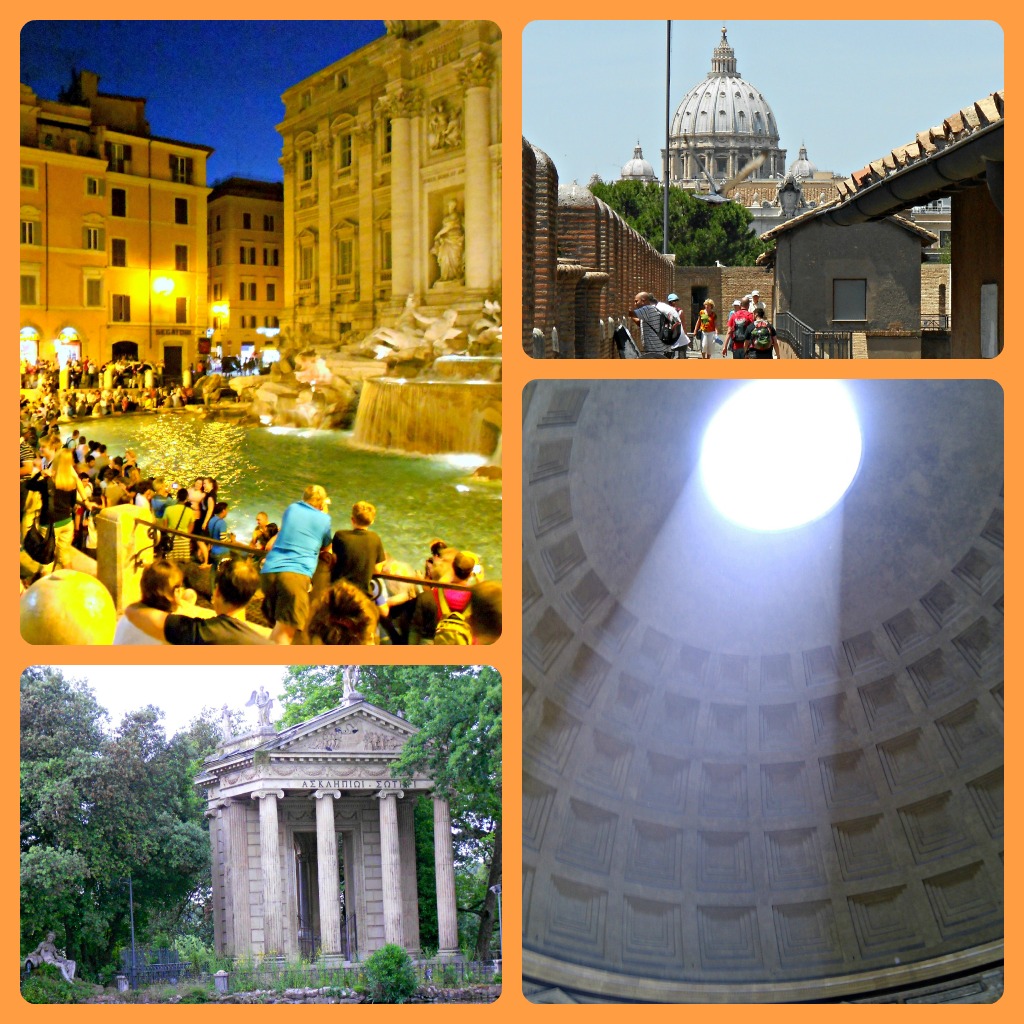
Images: Some enchanted moments from Kym’s second date with Rome. Clockwise from top left: Off peak at the Trevi Fountain (“busy, yes, but somehow still magical”); the Vatican from the battements of the Castel Sant’Angelo; sunlight pouring into the Pantheon; the Giardino del Lago at the Villa Borghese.

For expat novelist Laura Graham, even a dark Tuscan alley has La Dolce Vita to spare

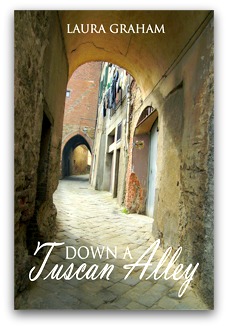
“Down a Tuscan Alley” — when I first heard the title of Laura Graham’s debut novel about an Englishwoman in Tuscany, I assumed it would be a thriller or mystery. Something nefarious would happen down a Tuscan alley, and the protagonist, whose name is Lorri, would find herself enmeshed in events beyond her comprehension, fearful of getting caught in the crossfire between rival Mafia gangs…

The book is no such thing, I’m happy to report (I’m not a fan of Mafia thrillers). Strange things do happen in the dark alley outside of the tiny flat where Lorri lives in the Centro Storico (village on a hill) of the Tuscan town of Sinalunga — but nothing worse than a peeping Tom. And at one point there’s a shady-looking man following Lorri — but he turns out to be (relatively speaking) harmless.

No, the book’s real mystery has to do with why Lorri is living in a tiny Tuscan village on her own. Well, she’s not on her own but has two cats. The last time she was in Sinalunga, it was with her husband, Richard. They had bought the flat together and Richard fixed it up. But now their marriage is over because of Richard’s infidelity. Or Lorri thinks it is over — Richard is having second thoughts.

Lorri, however, is determined. She has come to Italy to get lost in the culture and start her life again. But is she doing the right thing? Her Italian neighbors treat her with some suspicion: what’s a woman doing living on her own, with no visible means of support? (She has decided to do B&B in her little flat, but since it has only one bedroom, when the guests come, she has to sleep on the sitting room floor.)

And she also has to persuade herself to trust her gut instincts. As she says toward the start of the novel:

Am I crazy to come here? Hardly any grasp of the language, forty-seven, alone and with virtually no money? Many would think so…

Lest you think we’re venturing into Under the Tuscan Sun territory, rest assured, we’re not. Lorri does not take life, let alone her midlife predicament, too seriously. This is a flat overlooking an alley we’re talking about, not a 250-year-old villa. And so what if she ends up seizing an opportunity to get involved with the handsome young builder Ronaldo? Isn’t La Dolce Amore the quickest way to obtain La Dolce Vita?

But before I get too carried away with the story, let me turn the conversation over to Laura Graham, who has graciously agreed to answer a few questions about both her book and her life story — which, as she freely admits, the novel is based on.

The decision to write an autobiographical novel

Thank you so much, Laura, for agreeing to this chat. Your story — both in the book and in real life — neatly combines the two themes we’ve been talking about on The Displaced Nation this month: the quest for La Dolce Vita and the need for taking a “midlife gap year,” which sometimes heralds an even bigger life change. But let’s start by having you talk a little about your background — where you were born, what you studied and why you went to live in Italy.
I was born and brought up on the Isle of Tiree on the West Coast of Scotland for the first six years of my life. I then came to London and entered a convent school.

Later, as an adult, I won a scholarship to study drama at the London Academy of Music and Dramatic Art for two years. I received the prize for being the most promising student and immediately got a job understudying Helen Mirren in The Balcony at the Aldwych Theatre in London. I had a long and successful acting career at the Royal Shakespeare Company and the Young Vic, also on television.

When my long relationship ended with my former partner, I felt the need to turn my life around and decided to begin again in Italy. About ten years before, I’d invested £6,000 in a tiny hilltop village apartment in Tuscany, never thinking that one day it would become my permanent home. I still live in the village, but in a house, with my partner Rosalbo, a property restorer and an artist (he paints cats!). Besides writing, I run my own holiday agency, called “Laura’s Houses.”

Down the Tuscan Alley is your first novel. Have you written anything else?
I have also written a book for children called A Tale of Two Tuscan Cats, which was published last October. It has recently come out in Italian. Rosalbo did the illustrations.

What made you decide to write a novel about a middle-aged woman who is determined to change her life by moving abroad?
Because I’ve experienced it and thought it would make a good story — and might help others so inclined.

Why a novel and not a memoir?
I wrote my story in a novel form to protect the people I wrote about — I’ve changed their names, although some of them are now dead.

What audience did you have in mind when writing the book?
Women like myself, who want more from life than just settling into middle age with nothing but memories. Life is to be lived!

One of your Amazon reviewers wrote: “Brava! Brava! Brava! I loved reading Down a Tuscan Alley. The comic cast of characters brought me to the heart of bellisima Italia.” Other readers, however, said they were grateful that the book isn’t just about how beautiful Italy is. To which parts of the story have most readers responded?
The parts that are thought-provoking — about losing oneself in another culture in order to find oneself — and the humor are what people seem to enjoy.

Getting to the heart of La Dolce Vita…

From the time she arrives Italy, Lorri seems to be in touch with the little things that make her Tuscan alley so different from the Devonshire alley where she was living with friends, just before she left: the old stone steps, the steeple of the magnificent ochre-colored church she can see from her window, the birdsong… Is there something special about Italy that awakens the five senses?
In my opinion it is the light that awakens the senses. The light in Tuscany touches something in you, brings you to life — it’s like a medicine, a tonic.

Since you’re a former actress, would you say that daily life in Italy is more theatrical?
Living in Italy is certainly more theatrical than living in the UK. The people here are open and spontaneous.

And Lorri immediately becomes part of that drama. As her elderly English-speaking neighbor in Sinalunga, Lionello Torossi, says: “The people are delighted to see you…You are their portable theater.” But doesn’t some of the charm of a place have to do with its novelty value? Wouldn’t an Italian feel charmed by a Devonshire alley?
I think the Italians would be fascinated by a Devonshire back alley, if only to think — how is it possible to live there?

…and La Dolce Amore

At one point, Lorri is contemplating her affair with Ronaldo and says to herself: “How can you speak with your heart when you don’t know the words?” Call me a skeptic, but couldn’t their relationship change for the worse once their verbal communications improve?
No, I think Lorri would still find Ronaldo enchanting once she’s able to understand more of the language. But perhaps also more infuriating at times!

Lorri also says, with reference to Ronaldo: “These torrid passions are what happens to English women in hot countries.” Is romance so very different in Italy as compared to the UK?
Torrid passions indeed! The Italian art of seduction is very different from the UK. An Italian makes a woman feel every inch a woman and delights in her beauty and femininity no matter what her age.

Many of The Displaced Nation’s readers are in cross-cultural relationships. What do you find to be the biggest challenge about getting together with someone of another culture?
I cannot pretend it’s easy getting together for a long time with someone of a different culture — although it’s not the culture so much as the mentality. There are many things to learn, mainly about one’s self — and that’s always a challenge. Here in Italy, it’s the language I find most difficult and the humor, which is somewhat different from ours. Of the two, language is the bigger difficulty. Communicating is the key to success when living in another country. Otherwise, you can’t offer as much as yourself as you would like to.

The challenge of exporting La Dolce Vita

After living in a small Italian community for so long, do you think you could ever fit back into living in Britain?
No, I can’t imagine myself living again in the UK even though I go back twice a year and enjoy it. But if I had to I would adjust simply because I’m English. But the biggest culture shock — apart from the food — would be the people. I’ve grown so used to the warmth of the Italians.

Could you bottle the formula you’ve developed for La Dolce Vita in Tuscany and bring it back with you?
The only way to bottle the formula of the Tuscan Dolce Vita is to carry it inside my heart — and take it with me wherever I go.

Coming soon!

Please tell me that you’re working on another book. By the time I finished Down a Tuscan Alley, I’d grown fond of Lorri, Ronaldo and the various neighbors — and felt bereft!
I am on the last chapter of my next book: The Story of Kelly McCloud. This is also set in Italy and is about a young woman who takes a job as a housesitter in an Italian villa. Amongst an eccentric English family, a fallen angel and a dragon, she discovers how to use the whole of her brain and realizes the potentiality of the human race.

Assolutamente favoloso! Thanks so much, Laura!

Readers, you can purchase Down a Tuscan Alley on Amazon. You can also read more about Laura Graham at her author site. And, should you now feel tempted into trying out La Dolce Vita for yourself, then consider renting one of her two houses in the Centro Storico of Sinalunga. What are you waiting for?!

STAY TUNED for tomorrow’s episode in the life of our fictional expat heroine, Libby, who has traded her Boston Red Sox cap for a Sherlock Holmes deerstalker in her quest to uncover her husband’s roots. (What, not keeping up with Libby? Read the first three episodes of her expat adventures.)

If you enjoyed this post, we invite you to register for The Displaced Dispatch, a round up of weekly posts from The Displaced Nation, with seasonal recipes, book giveaways and other extras. Register for The Displaced Dispatch by clicking here!

Related posts:

img: Laura Graham, on the terrace outside her house in Tuscany.