The Displaced Nation

A home for international creatives

Tag Archives: Gothic tales

FOOTLOOSE & FANCIFUL: Margaret Drabble’s “The Red Queen”

Welcome to Footloose & Fanciful, an occasional series of posts where we talk about books, films or other art forms that have inspired us to travel to new places or appraise familiar places with fresh eyes.

I’m probably not the best person to kick off this series. As much as I adore fiction, I’m not one to travel on a whim, because of something I read in a book. Especially not these days, when my expat years, spent in England and Japan, are behind me and I have to take time off from work. Typically, I arrive at my destination and collapse in a heap of exhaustion. It’s not until I’ve had a good rest that I am able to take in my surroundings. I peer out the window and say: “Really, I’m in xxx?!”

At that point I go to the other extreme, manically trying to find out as much as possible about where I’ve landed, visiting bookstores with an English-language section to stock up on translated novels, expat memoirs, the lot…

The second time I went to Seoul, South Korea, though, was different, and I’ll make that the subject of today’s post. That trip marked a rare time when a book had piqued my interest in a country to the point of influencing what I wanted to do and see and talk about during my stay.

Finding the soul of Seoul

I said my second visit to Seoul. The first had occurred a few years before. It followed the typical pattern. I arrived tired and unprepared, although on that occasion, I got an immediate lesson in the local culture.

Just as my husband and I were landing in Incheon International Airport, the news was breaking that Dr. Hwang Woo Suk—a veterinary researcher who had achieved world fame by cloning an Afghan hound named Snuppy—had falsified his latest results to make it look as though he’d made advances in human cloning.

“It’s a very Korean story,” some Korean friends of my husband’s informed us. I wasn’t sure what they meant, but little by little, I pieced it together. The Korean government, desperate to project a modern, high-tech face to the world, had turned Dr. Hwang into a national hero. He appeared in many of their promotional campaigns. The post office sold stamps to commemorate his research, and Dr and Mrs Hwang enjoyed a decade of first-class tickets on Korea Air, because of his status as “national treasure.”

Interestingly, our Korean friends were reluctant to condemn him outright. He’d been under a phenomenal amount of pressure to produce results and bring his country greater glory. If you were under that much pressure, you’d probably be tempted to skip a few rounds of clinical trials, too, they seemed to be saying.

I had to think about that for a while. Already, I was inclined to feel sorry for the Koreans because I knew how they’d suffered under Japanese rule. They are the Central Europeans of Asia, if you will. Just as the Hungarians, Poles and Czechs have had to put up with Germany and Russia, the Koreans, due to being sandwiched between China and Japan, have had to put up with incursions from both.

Gradually, I came round to the Korean point of view. My thought process went something like this:

Okay, the Koreans have been victims of some bad geography. But then why do they make things so much worse for themselves by setting such impossibly high standards? What Dr. Hwang did was wrong, a violation of ethical standards in medical research. But, okay, if I can feel sorry for all the Korean schoolchildren cramming like crazy for exams, I guess I can spare a bit of sympathy for Snuppy’s creator…

After arriving home from that trip, I was eager to read more about the country (I hadn’t found much in translation in Seoul’s bookstores).

That was when I happened upon the novel The Red Queen, by Margaret Drabble.

Seeing Korea in shades of red

A novel on Korean history by one of the writers I’d most admired when living in the UK: what could be a more perfect bridge between the two parts of my expat life?

The Red Queen of the book’s title refers to Lady Hyegyong, a Korean woman who lived in the 18th and early 19th centuries. She was plucked from obscurity to marry the Crown Prince of Korea, Sado, who turned out to be…a HOMICIDAL MANIAC, I kid you not.

The reason we know all of this is that Lady Hyegyong left behind a diary, and Part 1 of the novel is Drabble’s version of that document, which she based on JaHyun Kim Haboush’s translation of The Memoirs of Lady Hyegyong: The Autobiographical Writings of a Crown Princess of Eighteenth-Century Korea.

In Part 1, the Crown Princess tells us about what it was like to live with a husband and in a court where daily, several dead bodies would be carried out of the palace (whenever Sado felt agitated or depressed, he would seek relief by murdering his servants) or reports would arrive of another court lady being raped. After he murders his concubine, he starts harassing his own sister, too.

At about this point, I concluded that the only thing worse than discovering you’re married to psychopath would be to find out you’re confined with him in a palace, from which there’s no escape. Terror within a claustrophobic setting must be the worst kind there is!

The story has a further twist. The Crown Prince’s father, King Yongjo, turns out to have been deeply Confucian. He is the kind of Korean parent who sets impossibly high standards for his son, which—it is hinted in the Crown Princess’s diaries—may be part of what triggers the son’s madness.

In the end, the cruel father proves more than the psycho son’s match. On a hot day in July 1762, he summons Sado and orders him to get into a heavy wooden chest, ordinarily used for storing rice or grain. The lid is shut and locked, and Sado is left to starve. It takes eight days.

The Crown Princess is traumatized all over again at witnessing her father-in-law execute her husband in such a cruel manner.

In part 2 of the book, an Oxford academic travels to Seoul with the Crown Princess’s diary in hand (which has been sent to her anonymously via Amazon.com) and finds parallels between her own life and hers. Professor Halliwell feels that the Princess “has entered her, like an alien creature in a science-fiction movie.” She becomes possessed by her—just as I was by the end of the book, just as I’m sure Drabble was, which was what inspired her to create (in her words) this “transcultural tragi-comedy.”

More questions than answers

I went back to Korea for a second time not long after reading the novel, accompanying my husband on some work he had there. So moved had I been by Drabble’s book that I was determined to find a way to pay tribute to the Red Queen, so called because of all the blood that flowed during her husband’s reign.

But here’s the strange thing. All of my attempts to find out about Lady Hyegyong came to naught. My Korean friends said I needed special permission to visit Changgyeong Palace, where this tragic series of events took place. They did not seem to want to engage in a conversation about this period of their history.

I left Korea with more questions than answers: Do Koreans repress this part of their past, and if so, what does that tell us about them? Is my previous view of them as helpless victims all wrong? Did other countries walk in and take over because Korea had weakened itself through its impossibly high Confucian ideals, which had led to total anarchy by the end of the 18th century?

But the weirdest thing is, I wasn’t that surprised by the Korean reaction. While the Western part of me applauds Drabble for resurrecting Lady Hyegyeong as feminist hero, one who lived long enough to write her tale (the existence of her memoirs, incidentally, served to refute later attempts to restore Sado to a position of honor in Korean history books), the Asian part thinks that poor Lady Hyegyeong must feel displaced in Drabble’s novel. Relationships are, after all, a central theme to Confucianism. The husband is the head of the household and the wife is obedient to him, full stop.

This inner dilemma of mine, along with the spirit of Lady Hyegyeong, which Drabble portrays so vividly in her novel, still haunts me to this day…

* * *

Readers, have you ever read a book that has colored your impressions of a place in weird ways? Also, if you would like to contribute to this new series—perhaps an uplifting tale of being inspired by a book set in the idyllic Tuscan countryside would be in order after this rather macabre story?—please don’t hesitate to get in touch: ml@thedisplacednation.com.

STAY TUNED for next week’s fab posts!

If you enjoyed this post, we invite you to register for The Displaced Dispatch, a round up of weekly posts from The Displaced Nation, with seasonal recipes, book giveaways and other extras. Register for The Displaced Dispatch by clicking here!

Related posts:

Mark Hillary delivers reality check to gringos who moan about Brazil, in self-published book (1/2)

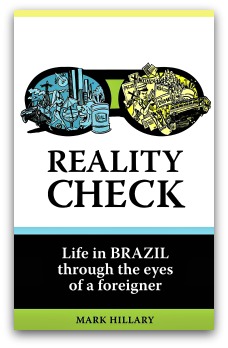
Mark_HillaryA little while ago I interviewed Megan Farrell, a fellow gringo in São Paulo, about the book she had written about “exbrat” life in the city. As far as I’m aware, Megan’s was the first book to be written about life in SP by a foreigner, although she seems to have started a new trend because within the last fortnight another has emerged: Reality Check: Life in BRAZIL through the eyes of a foreigner.

Reality Check is by Mark Hillary, a fellow Brit in São Paulo (he recently moved outside the city), who is an author, blogger, and advisor on technology and globalization. He has already published a number of books and is a contributor to Huffington Post, Reuters, The Guardian, and Computer Weekly.

Mark is also a friend of mine. We connected through Twitter just over a year ago. We eventually met at a local bar when—unsurprisingly, given his background in technology and social media—he organized a meet-up of gringos who had connected online but had yet to meet up in the flesh.

Since then he and I have continued to meet up, although less so since his move to the countryside. We had a particularly memorable trip in June to Rio to watch England play Brazil in football at the brand new Maracanã Stadium. (As anyone who follows my posts should recall, I’m a bit of a football geek.)

Over the past year Mark has written, in his column for the Huffington Post, a number of insightful articles about life as a foreigner in Brazil—most notably, “No HP Sauce, Endless Red Tape: Would You Want to Live in Brazil?, which responded to a gringo Facebook forum that had listed all the reasons why foreigners hated living in this country.

It was to my pleasant surprise, then, when Mark announced he had extended his account of life in Brazil and intended to publish it as an e-book.

Leaving aside my acquaintance with Mark (and the fact he gives a nod to my personal blog in the book!), I must say that I found Reality Check a very enjoyable read. It is a thoughtful and critical, yet balanced, account of his experiences in Brazil and of the country in general—and frankly, I’m rather annoyed that I haven’t written it myself.

Mark’s book also seems to be a good accompaniment to Megan’s. Whilst hers is a straightforward, step-by-step guide to life in São Paulo, his is a narrative providing a broad overview of gringo life. Either way, both books will be of use to those who are either moving to Brazil or perhaps are simply interested in finding out a bit more about South America’s largest and most populous country (it’s also the world’s fifth largest economy).

Anyway, enough of my wittering on. Let’s hear more from Mark himself.

* * *

RealityCheck_bookcoverHi, Mark. Congratulations on your new book and thanks for agreeing to this interview. First off, can you say a little more about what inspired you to write it?
As you already mentioned, I wrote the book in large part as a reaction to the negative posts about Brazil in online gringo communities. Everyone has their own reasons for moving and living away from their home country, but the majority of the groups I’ve encountered online are full of complaints about Brazilian food, prices, bureaucracy… Anyone who reads the posts made in the Facebook group for Gringoes.com would think that the UK and US offer a utopian paradise that would be madness to ever leave.

As you said in your intro, I wrote an article for the Huffington Post where I tried to give a more balanced view on life in Brazil.

Then I thought that, as someone who has rented and bought a home, started a company, hired people, and married a Brazilian, I could probably give a more detailed opinion on the experience—hence the book.

So being married to a Brazilian was what brought you to Brazil?
Yes, we were living in London, but after the financial crash in 2008 my business was much slower than before. By 2010 it became clear that there were many more opportunities for me to build a research and publishing business in Brazil than in the UK and so we moved just before the end of that year, nearly four years ago.

We recently featured another book about expat life in Brazil: American Exbrat in São Paulo, by Megan Farrell. Megan’s focus was on the “exbrat” community in São Paulo—i.e., those who are transferred here for work by a large company. My impression is that your focus is less specific and more of a broad overview of life in Brazil as a foreigner.
I’m not really interested in the exbrats. If a big company transfers someone to Brazil and they have their home taken care of and a driver to ferry them around, and they only ever go for a drink in expat pubs, then I don’t think they are experiencing the real Brazil. I’m not suggesting that the only authentic Brazil experience is living in a favela, but there are other kinds of foreigners here—journalists, teachers, people from all walks of life—who are constantly looking for ways to explore their new home.

Did you have a specific audience in mind when you wrote the book?
I really set out to explore some of my own experiences, with the expectation that people investing in Brazil or looking for a job here might have an interest in the book.

The book has only just been published (2nd September) so I guess it is a little early to tell, but how has it been received so far?
It is very recent, but there is already a very positive review from a Brazilian reader on Amazon. I started my author Facebook page when I published the book, and that community is growing by around a hundred people every day—so people are noticing it. One of the biggest newspapers in Brazil (Folha de SP) has been in touch to interview me about the book—despite my not having done any press promotion for the book due to my traveling almost every day since the publication!

Did you connect with São Paulo and/or Brazil in any new ways whilst writing the book?
It made me more determined to plug areas outside of Rio, which has a lot of friends already. I’ve really enjoyed living in both São Paulo the city and interior—SP needs a few gringo fans to speak out and remind people that the city is not just about concrete and cops murdering civilians.

You recently moved to the countryside outside São Paulo—how and why did that come about?
We spent two years living in the centre of São Paulo and just wanted to find something a bit quieter. I love it where we are now. There is a great sense of community; the neighbours all know each other. There is none of the security paranoia you find in the city centre, and there is some fantastic scenery on our doorstep.

Do you miss SP at all?
I miss being able to go out to see my friends in the city, or go to concerts by international bands that will only ever play in major cities. But we are planning to get a very small apartment in SP soon, so we don’t completely lose touch with it.

You mentioned the “security paranoia” in SP. In my observation, most of us gringos carry a fear that is at odds with how our Brazilian partners and/or friends feel. I enjoyed reading the section of your book covering this perception gap. Do you think that more positive accounts of Brazil by writers/bloggers like you and myself can help to shift these perceptions?
If people like you and me can get visitors to realize that they can walk down Avenida Paulista or along Copacabana Beach without fearing for their life, that would help. On more than one occasion I have met business contacts who flew into town and then were shocked when I suggested meeting away from their hotel. Standard advice from American and European companies is often to stay inside when in Brazil because of all the street crime.

The Brazilians, too, should play a part in correcting this situation. I don’t think we have much influence because we are seen as outsiders, but as more Brazilians get exposed to alternative cultures through travel, I hope it can change a little.

Last year I brought my wife’s teenage cousin on a trip to the USA, just to show her what life is like outside of Brazil. She found it incredible that you could walk up to the front of so many celebrity homes in Los Angeles—that anyone could walk into Sylvester Stallone’s garden. That’s unimaginable in Brazil.

What are you thoughts on foreign media portrayals of Brazil? Do you feel, for example, that persistent foreign criticisms of Brazil’s preparations for the World Cup and Olympics have been fair?
Every World Cup and Olympic games gets this negative press, so I don’t know if it is any worse than the last time. Anyone from the UK should be able to recall how the London Games were going to be a disaster right up to the week of the Games—the attitude seemed to change only when everyone saw that spectacular opening ceremony.

All I know from personal experience is that when you and I went to the Brazil v England football game at the Maracanã in June, the organization was superb. The stadium looked good, the public transport all worked, and the volunteers helping the crowd were great. I couldn’t fault it—so I’m really looking forward to the World Cup.

From the way you write so passionately about Brazil it is clear that you love living here, but there must have been the odd difficult moment when you wondered whether you’d made the right decision in fleeing the economically stagnant UK for your wife’s native land. When have you felt most displaced?
Sometimes the bureaucracy in daily life does get perverse and goes beyond just the criticism of a foreigner claiming that it all works better in Europe. Examples include having to pay someone to get my car registered to a new address or being fined for not paying my stamp duty on the day I agreed a mortgage with the bank—even though I paid on the day I got the documents myself. Sometimes I wonder if there is ever going to be any government that sweeps away this nonsense. I also fear that the job cuts created by improved efficiency means we are stuck with much of this.

Conversely, when have been your least displaced moments, when it all seemed to make sense?
I live in a really beautiful place now surrounded by a lot of wonderful people. Every morning when I take my dog for a walk then start work for the day I know I’m lucky to be here.

* * *

Readers, I will be talking to Mark again on Tuesday of next week, when we focus on his decision to self-publish his book. Any further questions for him, meantime? And don’t forget, if you’re interested in Reality Check, you can purchase it on Amazon. I would also recommend becoming a fan of its Facebook page and following Mark on Twitter: @MarkHillary

STAY TUNED for tomorrow’s post, a new episode in our “Location, Locution” series, by JJ Marsh.

If you enjoyed this post, we invite you to register for The Displaced Dispatch, a round up of weekly posts from The Displaced Nation, with seasonal recipes, book giveaways and other extras. Register for The Displaced Dispatch by clicking here!

Related posts:

images: Mark Hillary’s author image and book cover

Meet author Rosie Whitehouse, who trailed her spouse into a war zone (and enter to win her book!)

Rosie Whitehouse CollageOne of the expressions I picked up from living in England for many years is “Keep the home fires burning.” For some reason, that expression, along with the WWI song from which it comes, is running through my head as I contemplate talking to today’s featured author, Rosie Whitehouse (click here to hear it being sung):

Keep the Home Fires Burning,
While your hearts are yearning.
Though your lads are far away
They dream of home.
There’s a silver lining
Through the dark clouds shining,
Turn the dark cloud inside out
Till the boys come home.

For me, Rosie is an up-to-date version of what the songwriters had in mind. Educated at the University at London, with a career as a BBC journalist, she chose to stay at home with her children and keep the house warm and welcoming, and the family’s spirits up, while her husband, the journalist Tim Judah, went off to report on various wars for The Economist and other newspapers.

Rosie even went the further step of moving the family home to be closer to Tim for a time. Ironically, she kept the home fires burning in the very place where World War I began, the Balkans. She flew out to a crumbling Bucharest—it had been knocked down by the notorious Ceaușescu, whose secret police killed hundreds during Romania’s 1989 revolution—with one child in tow and another one on the way.

Then, when it seemed possible that her own home could go up in flames as war spread across the former Yugoslavia, Rosie did not give up. She stayed for a total of five years before returning to London, by which time “keeping the home fires burning” was second nature both for her and the couple’s five kids (Tim carried on covering wars in Iraq, Afghanistan, and the Congo).

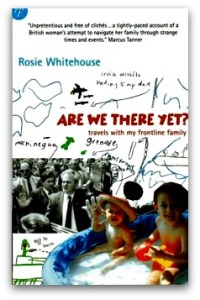
Having revived her career as a freelance journalist, she decided to write her first book: Are We There Yet? Travels with my Frontline Family—a copy of which we’ll be giving away! (See details below). The book is a tribute to families who have been “burners of the home fires,” whose emotional pain tends to go unheralded. It is also, in her words, “quite funny.” (Hey, growing up in Bucharest, Belgrade, Croatia and Bosnia can be fun!)

By now you must be as curious as I am to meet the intrepid Rosie Whitehouse and learn more about what motivated her to seek out such an unusually displaced (at least by most of our standards!) life. I note that she has an Irish mother—perhaps that explains it?! (I’m thinking Queen Boudicea…)

* * *
AreWeThereYet_cover_dropshadowHi, Rosie. In your book you say that your husband’s journalist colleagues in Romania, all of whom were single, were shocked to hear he had a two-year-old son and another child on the way. Did people often tell you you were crazy?
Yes, lots of people thought I was crazy.

As a former journalist with a background in Russian studies, do you think you felt a tinge of envy for Tim’s opportunities—which made you want to be on the scene?
Not really, as I would not have been able to cope with going to morgues and so on.

I know you’re going to challenge our definition of “displacement,” but I’ll go ahead and ask: what was your most displaced moment during your stay in the Balkans—when you had to explain Daddy’s muddy boots (he’d been walking in a mass grave), when you visited empty supermarkets, or when you heard the first shots of the conflict in Bosnia while strolling around Sarajevo with the kids?
Those things were reality so in that one doesn’t feel displacement. Quite the opposite in fact. I was intimately plugged into life and death at those moments.

How did you keep yourself sane?
I coped with stressful moments by bunkering down. I wouldn’t send the kids to school and cuddled up with them instead. As long as I shut my front door, where ever I am and whatever is going on, and it is just us, I am able to feel at home.

But getting back to your question about displacement: My best moment in a foreign country was when I saw my mother drive off in a taxi in Bucharest and realizing that apart from my two year old son I didn’t know a soul in the country (my husband was away in Albania for weeks). Wow, at last no one to tell me what to do! Freedom!

More seriously, most displacements do not happen by choice, and my most displaced moments have been as a result of this. I recount a story in the book when I took the kids to Berlin ten years ago. My mother-in-law was born there but fled in 1933 as she was Jewish. The family settled in Paris. As a result I have half French children who speak fluent French and we don’t speak a word of German.

It was a rather stressful visit as we searched for old family homes, one of which the family were still trying to reclaim. My daughter Esti got a headache. I pointed to the department store and suggested that we go in to buy an aspirin. It was Wertheims. My mother in law’s mother was a Wertheim and was murdered in Aushwitz. Esti said:

What, first they give me a headache by stealing the department store and murdering my great granny–and now I am expected to go in and buy an aspirin to make it better? You have to be kidding!

That’s displacement.

Child-rearing on the frontlines

What was the biggest challenge about having children with you on the frontlines?
The biggest challenge was often the simplest thing such as getting them something to eat and getting hold of baby milk.

Did anything surprise you?
Life never ceases to surprise me where ever I am and what ever is going on. The terrible things and the good things always amaze me.

What do you think the kids got out of the experience?
The kids learnt a lot. My eldest son, Ben, would ask about why there was no food in Romania. For me it was a matter of telling simple tales of communism and 1917. For him it began a life-long interest in Russia. He is following in his father’s footsteps.

My eldest daughter, Esti, would like to work for an NGO like Human Rights Watch.

For all of us, it drew us closer together. We are a tight-knit family.

I’ve heard of war reporters feeling bored when they come back to “reality” in their home countries. Did your family experience any of that after five years in the Balkans? What was it like to go “home” again?
Going home is just as difficult as moving to a new country. By the way, the wars didn’t stop either after we got back. My husband has since covered lots of wars and famines including Afghanistan, Iraq and the Congo.

Writing a book, but from the backlines

After you left the Balkans, it took quite a few years before you decided to write the book. What was the catalyst?
It was during the invasion of Iraq in 2003. I was standing in the supermarket and they had just installed a TV with a live feed from Iraq by the checkout. Some soldiers were running across a street in Basra, where some of the heaviest fighting took place, followed by a reporter and camera man. All of their faces were clearly visible. My husband was in Baghdad covering the story for The Economist. I had actually popped out for five minutes of fresh air before the bombers took off from the UK and the countdown to the blitz on Baghdad began.

I realized, to my horror, you could be buying a packet of frozen peas and watch your husband killed in front of your eyes. I know this thought had never entered the mind of the supermarket manager who had simply installed the TV to attract customers.

That evening I found my ten-year-old glued to a grainy grey screen showing an image of Baghdad as the cruise missiles were expected. What do you say? I had to make dinner and she had to do her homework. The UK had a huge debate about the war and the way it was covered, and I felt nobody knew what it was really like to be part of it and a kid to boot.

I also found that very quickly after the Berlin Wall came down that people forgot in Western Europe just how hard life had been under communism, especially in Romania and Albania. No surprise in that, really, as since 1945 most people in Western Europe just forgot the East existed.

I also found people in the UK quick to judge and condemn people in Southeastern Europe as being violent and prone to war. I wanted them to realize we are no different. That is why I’ve also included a chapter on Ireland in the book.

And I wanted to describe the multicultural experience of bringing up half-French, half-Jewish, part-Irish children in various countries, something I found fascinating.

Was it also part of your mission to show others what it is like to be married to, the child of, a war reporter?
Yes, not just to a war reporter but also those who are married to soldiers—especially those who are part-time soldiers and live in the community.

Did you have any personal motives in writing the book, to help you process what you’d been through and to provide your children with a record of where they’d lived?
No, not really. I didn’t write it for us but to make people think about what was going on. I am sure that the kids will appreciate it when they are older.

What was the most difficult part of the book-writing process?
Getting time to do it. I often wrote with my computer on the kitchen side as I was cooking dinner, which was good as I could hear kids talking; and as I was writing about them, it helped to have them there doing their thing.

Did you find it easy to find a publisher for the book?
No it was hard. publishing is a tough business. I started my own publishing company, Reportage Press, which closed a few years ago. Are We There Yet? is on Amazon as a self-published download these days. We also have a number of journalist friends who are taking the self-publishing route quite successfully.

What audience did you intend for the book? Did you think it would also appeal to other kinds of expats, who don’t go to war-torn countries?
Yes, there is a large expat element to the readership, and I know the book has touched the hearts of women feeling lonely and bewildered in a new country. I have been hugged and kissed by quite a few of them. One lady said reading the book had saved her marriage. I’m not sure it was me, but I hope I helped her realize it wasn’t so bad being lonely in London. It is hard being in a strange country with children. It is you who have to interpret it for them and as you are far from the family support group and friends, it is inevitably all up to you to be their world. It’s a tough job. That said, the book is far from serious. It’s actually quite funny.

Can you give us some examples of humorous moments in the book?
The kids are a laugh a minute, so whatever was going on they would often say or do something funny. For example:

For me the market in Piaţă Amzei is the focal point of life in the city centre [of Bucharest]…

“Let’s see the old ladies with the cheese. Come on!” shouts Ben as he darts out of the pushchair and into a smelly covered hall, where they sell heaps of yellowy looking curds, which are akin to feta.They are covered in flies.

The old women with their long black skirts and headscarves beckon him over and offer him little crumbs. He watches their lips and toothy grins with fascination. They look unnerving, like witches with crunched up dirty teeth, but he doesn’t run away. He has come deliberately to stare at them. He studies an old lady’s face carefully as she says something he can’t possibly understand. He is like his father, never frightened of anything and intrigued by the smallest thing. He loves the bizarre and the quirky.

* * *

“Where’s Mr Parking? Why doesn’t he find us a space?” asks Ben as we drive up and down the street outside our flat. Ben loves Mr Parking. I can’t see him anywhere.

Mr Parking is the man who organises the parking lots outside Belgrade town hall. It’s an elegant 1880s building that was once the royal palace and is right next to our block of flats. For a tip, he lets us park in the lots reserved for local officials. I haven’t seen him for weeks and have to be careful where I put the car, or we’ll be towed.

“I think he has gone back to Bosnia to fight, Ben.”

“What!” Ben is horrified.

“Why? I want to park the car. Doesn’t he want to stay here?”

“No, I expect he wanted to go home and defend his village.”

“Where is his village?”

“He’s from eastern Bosnia, the bit between here and Sarajevo [Bosnia’s capital city]. He told Dad he comes from Kamenica. It’s in one of the last bits there that’s still under Muslim control.” It’s a village close to the town of Srebrenica [the town where a massacre took place in 1995, said to be a crime of genocide].

“What! He’s a Muslim?” Ben is amazed: “But he looks like everyone else!”

“Of course, he does! You don’t look different if you’re Muslim. Bosnians look the same whether they are Muslims or not.” My mother has just sent him a book about the Crusades.

“I thought Muslims looked like Arabs.”

Are you working on any other ambitious writing projects?
I would like to write an expat guide to Britain. I spend a lot of time explaining Britain to people as I live in an expat world in the UK to a certain extent as my children have been or go to the French Lycée, and we have a lot of foreign friends who live in London.

Ten Questions for Rosie Whitehouse

Finally, I’d like to ask a series of questions that I’ve asked some of our other featured authors, about your reading and writing habits:
1. Last truly great book you read: Malaparte is on my mind as I am driving to Ukraine. His book on the 1941 invasion of Russia is unforgettable.
2. Favorite literary genre: Novels
3. Reading habits on a plane: Nothing. I am too tense on a plane as I hate flying. If I am calm enough I love to look out of the window.
4. The one book you’d require President Obama to read, and why: My son Ben’s book on Russia: Fragile Empire: How Russia fell in and out of love with Vladimir Putin. It’s a great portrait of contemporary Russia. I am his mum—what else am I supposed to say to this one?
5. Favorite books as a child: I loved Little House on the Prairie but above all I loved the stories my dad used to tell me.
6. Favorite heroine: She doesn’t have a name. She is one of the millions of women who have struggled to keep their families together against the odds. These are the mums who keep the world turning.
7. The writer, alive or dead, you’d most like to meet: I always wanted to meet William Shirer. He must have had an extraordinary experience living in Berlin at the start of World War II. Perhaps the ultimate expat experience! I suggested an interview programme with him to BBC World Service in the 80s but they didn’t have the cash to send me to America to do it. A pity as he died after that.
8. Your reading habits: I read a lot. If you want to write you have to read. I also have to read a lot for work.
9. The book you’d most like to see made as a film: None, really. If you love a book, the last thing you want is for it to become a film as you have the pictures in your head and they are your pictures not someone else’s.
10. The book you plan to read next: Vasily Grossman‘s An Armenian Sketchbook is in my suitcase. I love Grossman. He is a fantastic writer. If you haven’t read Life and Fate, you have really missed out.

* * *

Thanks so much, Rosie! Personally, I found your story very moving and think we should confer on you a “home fires” medal for all you’ve achieved!

Readers, it’s time for you to ENTER OUR DRAW TO WIN A FREE COPY of Rosie Whitehouse’s book. Rosie is giving away ONE COPY and will favor comments that tell her why you’d like to read the book.

Extra points, as always, if you’re a Displaced Dispatch subscriber!

The winner will be announced in our Displaced Dispatch on August 2, 2013.

Rosie Whitehouse is a parenting journalist and mother of five. She is one of the UK’s leading experts on family travel. She has written widely on family matters and traveling with children for The Sunday Telegraph, The Independent, The Guardian, The Daily Mail, Sunday Express, Family Circle, The Economist, and others, as well as for the Web sites B4Baby.com and Raisingkids.co.uk. She has also spoken at events and on television and radio on parenting matters, promoting her travel books and her autobiography, Are We There Yet? Travels with my Frontline Family. You can follow her latest adventures at http://www.rosiewhitehouse.co.uk/.

STAY TUNED for tomorrow’s post in our Olde vs New World series, by guest blogger Claire Bolden.

If you enjoyed this post, we invite you to register for The Displaced Dispatch, a round up of weekly posts from The Displaced Nation, with seasonal recipes, book giveaways and other extras. Register for The Displaced Dispatch by clicking here!

Related posts:

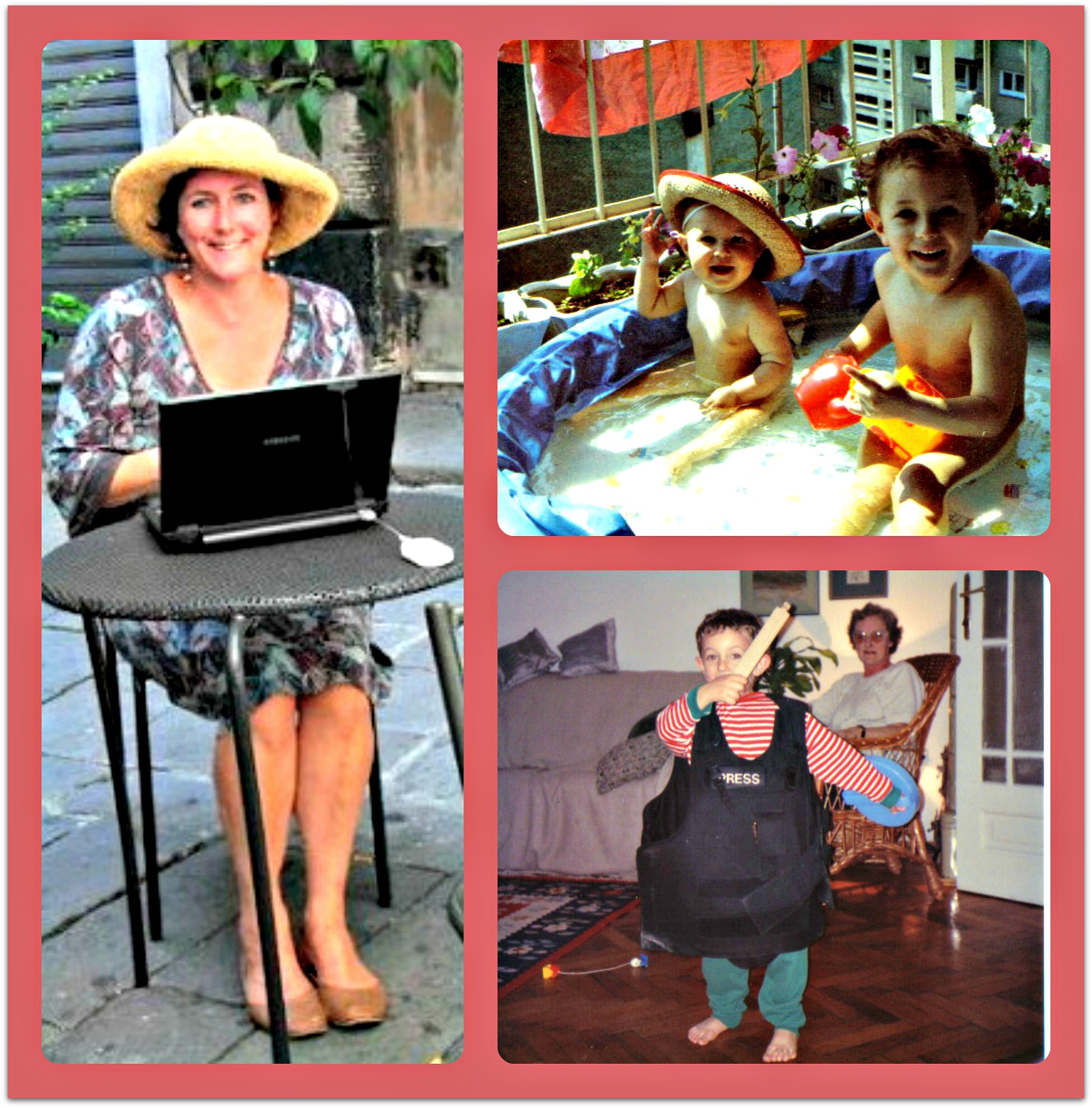
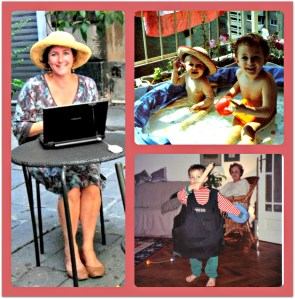
Images (clockwise from left): Rosie Whitehouse at “home” in London; Ben and his baby sister, Esti, living it up on the balcony in Bucharest (July 1991); Ben trying on his dad’s new bulletproof jacket, with Rosie’s mother in background (Belgrade, May 1992).
An American writer in Brazil is transformed from “exbrat” to politically awakened expat

Sao Paulo June Protests CollageWell, the best-laid plans of mice and menand international creatives—often go astray. Today, instead of Andy Martin interviewing Megan Farrell about her excellent book, American Exbrat in São Paulo: Advice, Stories, Tips and Tricks for Surviving South America’s Largest City, Megan herself will post about the transformational effect that the protests in her adopted country are having on her world outlook. (Not to worry, barring further major events, Andy’s interview with Megan should appear next month.)

—ML Awanohara

For nearly a week solid, I was locked to social media sites, doling out information about the protests in Brazil, via blogs, Facebook and Twitter. Along with other expat friends here in Brazil, I was been trying to make up for the fact that global news outlets were doing little to spread the word about the public demonstrations going on in São Paulo and other large cities.

Like a large percentage of my foreign friends, I have a closer connection to the country than your average expat. I have a Brazilian husband, and though she was born in New York City, a daughter who is a Brazilian national.

Ignorance was bliss

I’ll admit, before June 13, the night when police “lost control,” using rubber bullets against protesters and even journalists covering the events, I had little real knowledge about the injustices occurring in my new home country. I chose not to let such things enter my world.

Being displaced often makes it easy to be removed from your own surroundings.

Being displaced also makes it easy to be in a bit of denial.

But that Thursday night in mid-June, as my husband and I sat in a bar near our apartment and watched as the streets filled with protesters, my perspective on my adopted country changed.

The bar’s manager wasn’t allowing patrons to leave out of fear we would be exposed to the enthusiastic, but angry, crowd—some of whom were attempting to start fires to distract the police from blocking their access to Avenida Paulista, the central thoroughfare of São Paulo.

The protest eventually moved on, and we were able to leave, but my interest in what had initiated this movement lingered.

Not just about 20 centavos

By now, many of you hopefully understand that millions hit the streets of Brazil over more than a bus fare increase. Yes, that act was the catalyst. A 20 centavos increase meant an additional monthly expense of eight reais (R$8 is about US $4). It may not sound like a lot to you and I, but as minimum monthly wage in Brazil is R$675 per month (about US $300), every centavo is accounted for in the household of the working poor (i.e. the emerging middle class).

But the fare increase also speaks to deeper issues concerning the government’s priorities. Many Brazilians are finding it hard to stand by and watch as the government attempts to squeeze them for more, all the while spending millions of dollars on preparing stadiums for the 2014 World Cup—millions more than other countries who have hosted the event. Meanwhile, public services within Brazil remain abominable.

A few examples:

  • Across the country, emergency rooms of public hospitals are filled to the brim with patients hoping to get care, yet doctors have no means to help the majority.
  • Public school teachers often don’t show up to conduct class.
  • Police are untrained and uneducated, often looking to supplement their meager incomes with bribes.
  • Public transportation is decrepit in many cities.

“Its hour come round at last…” W.B. Yeats

As I wrote in my recent book, American Exbrat in São Paulo, one of the more frustrating aspects of living in Brazil can be the Brazilians’ passive attitude on the inefficiencies and transgressions that occurred in their country. Be it that the post office ran out of stamps (again) or the police never showed up when called, a local’s response to this would be some version of, “That’s Brazil.”

So when hundreds of thousands took to the street in protest, with a list of complaints in hand, no one was more surprised than the Brazilians.

The media took it lightly at first, burying the story about a bus far increase in the back of the papers. Then, the focus was on the violence of the demonstrations. But the reality is that when you gather such a large group (everyone was invited by social media), there are bound to be a few who are there to express extreme anger or simply to commit acts of violence.

But as one who sits within the scene, I’ve found the protests mostly peaceful and the intentions positive. The people of Brazil want change and want the world to understand that their country isn’t satisfied with the samba and beach party persona. There are real issues within the nation’s borders that need addressing.

Whither the rest of the world?

As mentioned at the outset of this post, sharing information about the realities of Brazil’s protest movement has become an important objective for me. Friends, both foreign and Brazilian, and I have been passing along videos, news articles and photos that depict the main events as well as the sentiments of the people.

Many of us who have blogs about being in Brazilmine is Born Again Brazilianhave written posts on these topics. For instance, I have just posted on Dilma Vana Rousseff, president of Brazil, who has stood in support of the Brazilian protesters.

Yet many friends and family members in the U.S. were still sharing updates on Facebook about their morning meals, their cats, sports teams, and other notices. These felt like irrelevant nonsense. How could this be? How could they just not care?

But then I recalled that I have friends in Turkey, who are going through the current protests. I have friends with family members who are in Greece and must have lived through the two years of protest in that country. I know little about what is happening in Ethiopia, where the first large-scale protest since 2005 has just broken out. And before June 13th, I was blissfully sharing little more than food photos and trip pics.

It is easy to be self-absorbed, content to contemplate the details of one’s own little world. It is even easier as an expat, when so much of your surroundings are of an unfamiliar nature. You take comfort in that which is close to home.

But now I have a different attitude and think about my power to disseminate information. It’s satisfying to share the details of what goes on in the politics of this country and have people you know respond positively.

But it is as important, especially for those of us who have an audience through blogs and other outlets, to keep tabs on what is happening elsewhere in the world and use our skills to move toward justice and peace.

This episode in Brazilian history has changed me forever.

Or so I hope…

* * *

Readers, any questions or comments for Megan about what she is experiencing? Have you had any similar moments of political (re)awakening—or do you not “do” politics as an expat?

STAY TUNED for tomorrow’s post, a new episode in our Capital Ideas series, by Anthony Windram.

If you enjoyed this post, we invite you to register for The Displaced Dispatch, a round up of weekly posts from The Displaced Nation, with seasonal recipes, book giveaways and other extras. Register for The Displaced Dispatch by clicking here!

Related posts:

images: Surrounding Megan Farrell (aka Maggie Foxhole) and her book cover photo are several photos taken by TDN writer Andy Martin. Go to his photo blog to see more.

What’s it like to “come out” as a Third Culture Kid on stage? Elizabeth Liang tells all!

Liang Alien Citizen dancingAs reported here last month, Elizabeth Liang spent the month of May performing, at a venue in Los Angeles, a one-woman show about being a Third Culture Kid, or TCK. As some readers may recall, Liang is a self-described Guatemalan-American business brat of Chinese-Spanish-Irish-French-German-English descent. She was brought up by peripatetic parents in Central America, North Africa, the Middle East, and Connecticut. Many of us were curious about not only how she could pack all of that personal history into a solo stage performance, but also how the (mostly American) audiences would respond. Today is the day we get to find out. Take it away, Elizabeth!

—ML Awanohara

I had no idea what to expect from audiences when I opened my solo show, Alien Citizen, in Hollywood, California, on May 3rd (it closed June 1st).

Since the show is about my upbringing as a dual citizen of mixed heritage in six countries, I assumed it would appeal mainly to Adult Third Culture Kids (ATCKs) and people of mixed heritage—the people I wrote it for, since we rarely see our stories portrayed on stage or screen.

I wanted the show to be funny, but wasn’t sure if the humor would translate.

And I wanted people to be moved by the story.

Some pleasant surprises

As it turned out:
1) I was happily surprised by the composition of the audience. People of all backgrounds, ethnicities, and ages came to see my performance. Some were Americans who had never left their home state until college, others had moved domestically countless times as kids. By the same token, I was pleased that the audience did include ATCKs, global nomads, people of mixed heritage, expats, and immigrants.

2) Many of the houses were full. I had tentatively hoped the story would resonate with enough people to fill the house because the play is about identity, which everyone grapples with. That said, I didn’t expect everyone to empathize with my lifelong experience as an outsider of some kind and even feared that this experience would alienate some audience members… The full houses suggested that the show was actually resonating with most people. For this I must give credit to my director, Sofie Calderon, because she guided me to a brave and inclusive performance. I also take pride in the script, which I worked on for two years.

3) The audience laughed in the right places, mostly. I was astounded at the number of laughs I got in my preview performance. It was wonderful. This continued once the play got under way, although I did have a few quiet nights, when the audience was listening intently and smiling rather than laughing. (Then there was the night when a man in the front row fell asleep. This thickened my skin…after I considered quitting!)

4) The audiences were moved—not only at the end of the play where it was intended, but throughout the performance. People told me that they oscillated between tears and laughter for a large part of the performance—the highest praise I could have hoped for.

Nights to remember

The performance that stands out most for me was the first time my parents, brother, and aunt came to watch me. They had all traveled internationally or cross-country to see it.

My parents and brother are characters in the show, so I was unsure of how they might react. That night got some of the biggest laughs, and my family told me afterward that while they certainly laughed, they also wept throughout the performance because I was telling their story, too. The show brought back experiences they hadn’t thought of in years.

Opening and closing nights were wildly different and weirdly similar. I performed in abject terror on opening weekend, and while I kept it hidden from the audience, it was difficult to enjoy myself on stage. Through the run, I gained heaps of confidence, and was able to relax and “play” more.

However, the final show was reminiscent of opening night in that it wasn’t my best. An actor’s performance is like a speeding train with no seats—ideally, the actor makes a flying leap to catch it, hangs onto the rails, and rides it without falling. Sometimes, though, the actor has to sprint for some time to catch the train, using every skill s/he has—and then keeps slipping from the handrails and grabbing them again, never able to “coast” and enjoy the ride.

I was sorry that my closing night wasn’t a great ride for me, but the good thing about performing for different groups of people each night is that the audience has no idea of what to expect, yet the story remains the same. So closing night still managed to get a standing ovation, as had other nights.

Lessons learned from “coming out” on stage

Performing Alien Citizen was a “coming out” for me. Although I told the story as entertainingly as possible, the play explores the darker aspects of having a peripatetic childhood, being a child of color and mixed heritage in the socially segregated USA of my youth, and being a girl blooming into womanhood on the hostile sidewalks of North Africa and the cold campus of a women’s college in the States.

I had never told these stories publicly (and rarely in private) because I didn’t want to seem ungrateful for all of the wondrous experiences I’d had as a TCK (including life in North Africa and at college), but also because I’m accustomed to listeners failing to understand my point. Hearing negative stories, people tend to conclude that a peripatetic childhood is terrible, or that the country in question is not worth visiting. But that isn’t what I’m trying to say.

Alien Citizen was my attempt to pronounce that:

  1. Being a nomad, a kid of mixed heritage, and a girl can be hard.
  2. This doesn’t nullify the glorious experiences to be had from having any or all of these selves.
  3. The accompanying stories—positive and negative—have a right to be told. They are rarely told, they validate many people’s experiences, and they make a good yarn.

The overwhelmingly positive response of my audiences, night after night, taught me that my story is relatable and interesting, and that it’s a testament to my own strength as a human being, something I hadn’t known would be the case.

Doing the show also confirmed my belief that if a story is told with humor, people will listen to the darker side of it, and empathize.

I’ve been approached by universities in and out of state, as well as venues in Central America, to perform the show and teach workshops on how to create a solo show.

I hope to take the show all over the world.

I’m profoundly grateful that the world premiere of Alien Citizen has led to so many opportunities. I will also teach workshops in Los Angeles starting this fall.

* * *

Readers, I feel moved by this report even though I didn’t get to witness Elizabeth Liang’s deeply moving performance. (Elizabeth, please bring the show to New York so that I can see it!) How about you—any further questions for this brave and bold artist?

STAY TUNED for next week’s posts, featuring yet more international creatives as well as the latest episode in our fictional expat series, Libby’s Life.

If you enjoyed this post, we invite you to register for The Displaced Dispatch, a round up of weekly posts from The Displaced Nation, with seasonal recipes, book giveaways and other extras. Register for The Displaced Dispatch by clicking here!

Related posts:

img: Elizabeth Liang performing Alien Citizen in LA.

NEW VS OLDE WORLDS: Does Australia up the ante on British cultural stereotyping?

Libby Collage New&OldThanks to Kate Allison, regular readers of the Displaced Nation are treated every other week to a new episode in the life of fictional expat Libby Patrick, a 30-something British woman who has relocated with her spouse to a town outside Boston. Her diary, Libby’s Life, is replete with rich observations about life in New England vs. England. In keeping with the Libby tradition, we have started a series of occasional posts by writers who are sensitive to the often subtle, yet powerful, differences between new and old worlds. This month’s contribution is from Russell V J Ward, who made his first appearance at the Displaced Nation as a Random Nomad interviewee. Ward’s popular blog, In Search of a Life Less Ordinary, chronicles his overseas moves first to Canada and then to his wife’s native Australia. The couple now lives in Sydney with their infant son.

—ML Awanohara

RUSSELL_WARDWhen I left my native Britain to live in Canada and then Australia in search of a life less ordinary, I anticipated thriving on the energy I would find in a system that is more open to people who work hard, regardless of class or race.

The Old World with its long history and class traditions held me back and frustrated me. The New World, by contrast, would provide a sense of unfettered opportunity.

This hope has largely been borne out. But I’ve also faced some adjustment challenges, which I’ll talk about in today’s post.

An eye (as well as mouth) opener

The first time I visited a dentist in Sydney was also the first time I learned about Australian attitudes toward certain immigrant groups.

As a rule, I don’t mind going to the dentist’s. I find that most dentists are of the chatty sort, making me feel comfortable and not particularly averse to the fact they’ll shortly be rummaging around in my mouth looking for any signs of badly behaving teeth.

On this occasion, I was laid out horizontally waiting for the dentist to examine my pearly whites. As he leaned over to begin his work, he asked if I was house hunting yet and, if so, how it was going.

“Pretty good,” I replied. “We’re looking at a few options but we’re thinking the North Shore might be a good place to call home.”

“You should look at houses in the west of Sydney,” he said. “Lots of big, grand houses out near Penrith way. Built for wogs. Depends if you like your woggy houses. Lots of concrete and ornate metal railings. Not my thing, but some people love those wog houses.”

I was floored. Did I hear him right? Had he just said what I thought he said? Should I have said anything back? Reprimanded him for saying something so racist and unprofessional in front of me? 

In the end, I smiled awkwardly and said nothing, unsure of the territory I was in and concerned that I might be in danger of overreacting. With the conversation grinding to a halt, he continued with my check-up.

This encounter took place not long after I arrived in Australia, almost seven years ago. I soon found out that a “wog” is in fact a person of Greek or Italian descent, not quite the meaning it has in the UK.

That said, it wasn’t used in a particularly positive light so I remained troubled by what I’d heard.

The Canucks get it more right

It wasn’t the only such occurrence over the years but, more often than not, I put these incidents down to the Aussie sense of humour or credited it to the way things were done and said here.

Besides references to “wogs” and “lebos” (those of Lebanese descent), jokes about “Abos” (Aborigines) are fairly commonplace. Less common, but also prevalent, are negative comments about folk from other cities and countries (us Brits top of the list of course, closely followed by the Yanks and the Kiwis).

So, in those early weeks and months of living in Australia, I realised I should probably “put up” and “shut up” if I wanted to fit in—but I still felt uneasy. Hadn’t I left the cultural stereotyping of the UK behind for the new world?

I’d also stopped at Canada in between, a country that I think gets it rightor more right than the UK, and certainly Australia, does.

Those who’ve followed my blog may know that I previously posted on how Canada and Australia are separated by more than just water. (The post in fact appeared on Maria Foley’s blog, I was an Expat Wifepart of an Expat Dispatches series.) My view was that Australia preaches tolerance, whereas Canada believes in accepting a person, wherever they’re from or whoever and whatever they are.

How much will (should) I tolerate?

Not so long ago, I read an article by a fellow expat in Australia, Lauren Fritsky, in the UK Telegraph, “Seeing in black and white in Australia.” Originally from the East Coast of the U.S., Lauren expressed her unease and embarrassment at hearing what she perceived as racial “icebreakers” in public. She noted her struggles with the apparent lack of political correctness in Australia and the ease with which some of these terms are used by the local population.

Reading this piece was a reality check: I realised how accustomed I’d become to these casual, throwaway, offhand remarks when they do occur. In fact, I often brush them off as unintentional slurs or said without bad feeling behind them. I mean, what’s so bad about giving a Kiwi or a Yank a bit of stick about where they’re from? And the Poms have been ridiculed for years, much as the Lebos and Westies have.

The problem is that, although these words are as much a part of the light-hearted Aussie vernacular as the barbie or the ute, they sometimes come very close to crossing the lineand often, as is the case with the use of choco or Abo, they do.

It’s important to understand the psyche here, the fact that the culture is based on the premise that “anything goes” and “anyone is fair game”. From the camaraderie at the bar to the casual BBQ setting, the light-hearted work environment to the jovial yet die-hard sports rivalries, all combine to create a “no worries, mate” attitude, inspired by a society that goes with the flow without giving a damn what you might think of them.

Yet to this day I still get tiny flashbacks to my former university days spent in the heart of the multicultural British Midlands, where racist taunts and cultural insensitivity tended to be the norm rather than the exception.

The question remains as to whether the basic attitude of tolerance in Australia is good enough to carry the nation forward in today’s many-cultured world.

There’s quite simply no place in such a beautiful land for ugly attitudes and ignorant opinions, and I can only hope that the odd experience or encounter I’ve had along the way isn’t held by the many but by the inconsequential few.

* * *

Thank you, Russell, for such a thoughtful treatment of this controversial topic. Readers, can you relate to Russell Ward’s experience? Has the cultural stereotyping you’ve encountered in your adopted country made you think twice about settling there? Or have you been tempted to turn a blind eye, putting it down to cultural differences?

A Basingstoke lad born and bred, Russell Ward now has dual citizenship with the UK and Australia. As reported on his blog, he recently left his cubicle job to join an Australian-based team of social media professionals, which permits him to work from home most of the time. That said, he and his family are currently training their way across Canada to TBEX Toronto, courtesy of the Canadian Tourist Commission! A version of the above post originally appeared on Ward’s own blog. We thank him for tweaking it on our behalf.

STAY TUNED for tomorrow’s “Capital Ideas” post, by Anthony Windram. (Hint: His choice of city pays tribute to the winner of the Eurovision Song Contest 2013, which ended on Saturday.)

If you enjoyed this post, we invite you to register for The Displaced Dispatch, a round up of weekly posts from The Displaced Nation, with seasonal recipes, book giveaways and other extras. Register for The Displaced Dispatch by clicking here!

Related posts:

Portrait of woman from MorgueFile; Lighthouse (R) from MorgueFile; Lighthouse (L) from MorgueFile

Helena Halme on the displacement that can occur when moving between neighboring countries, plus a chance to win her new novel!

HelenaHalmeonBoatIt seems like only yesterday that we were reviewing Helena Halme‘s first novel, The Englishman, and today we have the pleasure of a guest post by Halme describing the themes of another new novel, Coffee and Vodka. Plus she is kindly giving away 3 copies! (Details below.) A Finnish expat in London, Halme was featured in our Random Nomad interview series, and we called on her again for an international fashion special (she is a self-confessed fashion maven). Today, though, we celebrate Halme as an international creative who bravely explores themes of displacement and cross-culturalism through fiction. So, brew yourself a cup of coffee and/or pour a glass of vodka, and let’s hear what Helena Halme has to say!

—ML Awanohara

My novel Coffee and Vodka has been dubbed “Nordic Noir meets family saga”—but its central theme is really the displacement a young girl feels when her family moves countries, from Finland to neighboring Sweden.

Eeva is eleven and lives in a small town in Finland when her father decides that they will emigrate to Sweden in search of a better life. There the displacement the family experiences causes a rift so severe Eeva is still reeling from it thirty years later, when she is forced to re-live the dramatic events of her childhood.

Outsiders tend to think of Scandinavian countries as being similar in many respects. How could the impact of emigrating to a Nordic neighbor be so severe?

But for anyone who’s ever visited Finland and Sweden, the difference between the two is obvious: Finnish is a notoriously difficult tongue, and the country’s culture has been heavily influenced by the hundred years it spent under the rule of its Eastern neighbor, Russia.

Sweden: A sovereign—and superior—neighbor

Finland fought in the Second World War, and lost a large section of its territory to the Soviet Union as part of the price of remaining independent. Already poor, Finland’s less industrialized economy suffered greatly from the war effort.

Sweden on the other hand has no history of having been subjugated to another country’s rule. It remained neutral during the war, profiting from its mineral reserves and undisturbed industry.

Sweden has traditionally been the richest of Scandinavian countries. At one time it ruled over all its neighbors, and as late as the end of 17th century, Finland too was part of Sweden—before Sweden handed it over to Russia. Many of the wealthy, land-owning Finns spoke Swedish as their native tongue.

Even today, Sweden is very much considered in Finland as its Big Brother (for better or worse). For decades after WWII, many Finns emigrated to Sweden in search of a better life. But Finns were shunned in Sweden because of their different language and customs: they were seen as poor people who drank too much, didn’t learn the language and were often violent.

Notably, had I been writing about Sweden and its other Scandinavian neighbors, Norway and Denmark, the cultural differences would have been more subtle, of the kind that expats often find between the United States and the United Kingdom. This is because Swedes, Norwegians and Danes can (more or less) understand each other’s languages. (Anyone who wants to get an appreciation for the kinds of cultural differences that exist between, for instance, Sweden and Denmark, should try watching the Danish/Swedish TV series, The Bridge.)
CoffeeandVodka_cover

Portrayal of little-known cultural differences in a novel

How to convey these historical, cultural and economic differences in a novel? First, I decided to set the story at the time, during the 1970s, when immigration from Finland to Sweden was at its peak. Also at that time, foreign travel and even foreign telephone calls were rare because so expensive. Once you’d emigrated, it was hard to go back or even have much contact with your native land again.

I thought that a story about displacement would be less poignant when you can spend hours on Skype speaking with your nearest and dearest, or can browse the Internet in your own language.

In addition, I decided that the family at the center of my story would make the move from a small town in Finland, Tampere, to the capital of Sweden, Stockholm, as a way of further highlighting the differences between the two countries, and hence the challenges facing the Finnish immigrant family.

Getting into my characters’ heads

After I’d decided on the time and the setting, I told the story the way I always approach writing; I tried to get inside the heads of the characters. I began by seeing the world through the eyes of the 11-year-old Eeva.

How would she react to being uprooted? Did it matter to her how far geographically she was going to go?

Of course not. Just moving to a different town in Finland would have shaken Eeva. But to be moved to a country where she understood nothing people said to her, and to a large capital city with a different way of life? That would be life-changing.

In the first chapter we see Eeva living in Finland, safe in her world. When her father and mother excitedly inform her and her sister, Anja, that they are moving to Sweden, Pappa says:

In Stockholm everything is bigger and better.

This simple sentence indicates that the move will have positive effect on the family’s economics circumstances.

Later, when the family first see their new flat in Stockholm, we see how impressed they all are by the size and quality of the apartment, even though they eventually realize it’s far away from the city centre, in an immigrant area.

In Stockholm the sisters get their own bedrooms—in contrast to an earlier scene where, during the last night the family spend in Finland, the girls have to share the sofa in their grandmother’s small flat.

To suggest the first chinks in the shiny new world the family have entered, I describe the first shopping trip Mamma takes with Eeva and Anja. It’s also the first time the girls hear the then-common abuse directed at Finns: Javla Finnar (Fucking Finns)—after Eeva nearly collides with a Swedish woman’s shopping trolley.

During the same shopping trip, a sales assistant is rude to Mamma when she overhears the family speaking Finnish. This episode visibly shakes Mamma, and she seems quiet and withdrawn afterwards.

Contrasting reactions

When I considered how Mamma and the girls would react to this kind of rejection, I decided that they would try to learn Swedish and blend in as quickly as possible.

I show this desire for Eeva and Anja to sound convincingly Swedish when the girls go shopping with Mamma, and on leaving the flat remind her not to speak at all (not even in Swedish) in the tunnelbana (metro) so that the people around them won’t know that they are from Finland. At this stage the girls had already mastered the language well enough to pass as being Swedish-born.

But I thought Pappa would not react as well as the female members of his family to the situation. As his family begin to enjoy Sweden, learning how to appreciate their new surroundings as well as master the language, he grows resentful. Even though he originally had hopes of his family fitting in, he becomes jealous of the women’s success at adopting and adapting to Swedish ways, and regrets the move.

And so the stage is set for a tragedy. But that’s another part of the story—one you can read in Coffee and Vodka!

As luck would have it, I have THREE COPIES to give away. All you have to do is to post a thoughtful comment on this post. I will choose three of the best comments and send to each of you, in whatever format you choose.

* * *

Kiitos—or should I say tack?—Helena! What’s more, I understand we haven’t caught up with all of your books yet—you have a new one out, The Red King of Helsinki, described as Nordic noir meets Cold War espionage. Sounds tantalizing: will you please come back again???

Readers, to whet your taste even more for Coffee and Vodka, here are some excerpts from Amazon.com reader reviews:

It’s a beautifully written story about a family in turmoil, caused partly by the displacement, but also partly due to the cracks in family dynamics which were already evident before the move to Stockholm. I really liked the voice of Eeva as a 11-year-old full of hope and fear, and then 30 years later as a grown woman who’s unable to commit to a loving relationship.

Set between Finland and Sweden, between the 1970s and the present milllenium, Coffee and Vodka reveals what it was like for a young girl to be uprooted from her home and transplanted to another country. One where she doesn’t speak the language and is despised for her nationality. I’m not ashamed to say this novel made me cry, but it also made me smile. … [E]ven if these things are as foreign to you as they are to me, along with the settings in this novel, Eeva’s story will still strike a chord.

Don’t forget to comment on Helena Halme’s post to be eligible to win a free copy! Extra points, as always, if you’re a Displaced Dispatch subscriber!

The winners will be announced in our Displaced Dispatch on June 1, 2013.

STAY TUNED for tomorrow’s post, on creative international entrepreneurship.

If you enjoyed this post, we invite you to register for The Displaced Dispatch, a round up of weekly posts from The Displaced Nation, with seasonal recipes, book giveaways and other extras. Register for The Displaced Dispatch by clicking here!

Related posts:

img: Helena Halme, taken on a ferry between Finland and Sweden, Finlandsbåt, which features in Coffee and Vodka.

Eight months into my expat life, two roads diverged and I — I took the one home

Kat Collage_dropshadowToday we welcome back Kat Selvocki to the Displaced Nation. She wrote for us once before: a travel yarn about spending Christmas in Europe with friends. She had just been toiling in the farmlands of Iceland as a volunteer, and was about to head Down Under to begin a new life as a yoga instructor in Sydney. Now, just over a year later, she is back in the United States. What happened? Here is Kat’s repatriation story.

— ML Awanohara

As my year-long working holiday visa for Australia began to wane, I started considering my options.

Or rather, my option.

I teach yoga: a career that doesn’t generally allow for work sponsorship. I also had a rocky relationship with my Australian boyfriend.

The only I way I could feasibly stay in Sydney was to enroll in a course.

I’d heard tales from other expats of reasonably-priced options — reasonably-priced meaning anything under $8,000 a year — but knew in my heart it wasn’t going to work. I no longer had that kind of cash in the bank, and even if I had, you wouldn’t catch me spending it on some ridiculous “business basics” class.

It wasn’t that I necessarily wanted to stay; I just wasn’t sure I wanted to uproot my life after spending just eight months building a new life in Australia. There were places I still wanted to visit in that vast country, things I still wanted to do. And I loved the classes I was teaching.

But then I got glandular fever — commonly known in the US as mono, or the kissing disease. A month into fighting overwhelming exhaustion, all I wanted was for things to be easy again. In the end, it was having a such a debilitating illness that drove me over the edge.

I bought a plane ticket home.

The three emotions of repatriation

First came relief:

  • No more comments about how my tattoos, taste in music, or style were “too American.”
  • No more complicated calculations to figure out when friends or family would be available to Skype.
  • No more job rejections on the basis of not being a citizen.
  • And most importantly: central heating in abundance — finally, I’d stop getting sick so often!

Self-doubt followed. I’d spent years wanting to live as an expat, and when I finally had the opportunity, I’d been utterly miserable.

Had I failed, or not tried hard enough?

Should I have fought to stay longer, or at least until the end of my visa?

Were my reasons for leaving the right ones?

Why hadn’t I applied for that job working at a roadhouse waitress in the Outback, so that I’d at least seen more of the country?

Next up: fear. As I headed off to Oxford, UK, at the end of last year, to spend Christmas with friends before returning to the States to seek work, the wheel had come full circle. As reported on this blog in December 2011, I’d spent my first Christmas away from family, in Europe, on my way to a new life in Australia.

Whereas before I’d been full of excitement and anticipation, this time I was full of worry. I worried about how welcoming people would be when I returned. So many of my relationships had disintegrated while I was away, and I wasn’t sure if that was because of distance or because people were fed up with my use of Aussie slang in our conversations … or was it all my whining about being so bloody tired? (Hm, there’s that slang again!)

I had no idea whether finding work would actually be any easier, especially considering the much higher unemployment rate in the US.

I didn’t know how to talk about my time in Sydney without sounding bitter or depressed — but was also afraid that even if I sounded upbeat, people wouldn’t care to hear about it.

Old habits die hard…

I’d always believed that if something doesn’t work, you can simply head back to the place you were before.

Suddenly, I wasn’t so sure about that.

I had decided to move back to Seattle, a city where I’d lived eight years earlier. But would that be a terrible mistake? I pictured trying — and failing — to recreate the life I’d loved before.

Last time I wrote for the Displaced Nation, I reminisced about the four months I’d spent living in Prague on a study abroad. What I didn’t report was the depression and reverse culture shock I battle against upon returning to the United States.

If that were true after a mere four months, what impact would a year-and-a-half away have? Would I be feeling even more out of place? I dreaded the long readjustment.

I also worried about money, and whether I had enough to get settled again quickly.

…or do they?

As it turned out, I needn’t have worried. (Except for the money concerns. Then again, I’m convinced that no matter how much I’d saved before returning, I still would have worried.)

From the moment I stepped off the plane, it was as if someone had flipped a switch inside of me. Even though things had changed — something that was particularly evident in New York City, which I passed through on the way to the West Coast (I’d lived there after Seattle) — it all felt normal. Easy. Almost as if I’d never left. My internal map and compass worked again; I knew where I was and where I was going.

And I still believe that — even though, two months after returning to the States, I continue to look the wrong way when crossing the street.

* * *

Thanks, Kat, for sharing your story. I found it very moving. Readers, any comments, questions for Kat — any similar stories to share?

Kat Selvocki — badass yoga instructor, photographer, writer and traveler — is currently kicking ass and taking names in Seattle after returning from her expat adventures. Learn more about her on her Web site: KatSelvocki.com. You can also follow her on Twitter: @katselvocki.

STAY TUNED for the final post in our fashion and style series, by the ever-so-stylish Kate Allison! (Well, she certainly has flair!)

If you enjoyed this post, we invite you to register for The Displaced Dispatch, a round up of weekly posts from The Displaced Nation, with seasonal recipes, book giveaways and other extras. Register for The Displaced Dispatch by clicking here!

Related posts:

images: (clockwise, starting top left) Chelsea Market, NYC; Capitol Hill, Seattle; Circular Quay, Sydney; Chelsea Market, NYC; The Rocks, Sydney; in the air when flying from Sydney to Melbourne; Pioneer Square, Seattle. Center shot of Kat Selvocki was taken in Seattle. All photos are Kat’s with the exception of the Circular Quay in Sydney, which came from Morguefiles.

RANDOM NOMAD: Russell VJ Ward, A Bloke from Basingstoke with a Bloomin’ Extraordinary Life

Russell Ward Collage_pmPlace of birth: Basingstoke*, Hampshire, United Kingdom
Passports: UK & Australia
Overseas history: Canada (Vancouver and Ottawa): 2003-06; Australia (Sydney, New South Wales): 2006 – present.
Occupation: Civil servant in New South Wales (state) government; blogger; wannabe fiction writer and entrepreneur — currently setting up a corporate writing business.
Cyberspace coordinates: In Search of a Life Less Ordinary (2012 finalist in the Best Australian Blogs competition); In Search of a Life Less Ordinary (Facebook page); @RussellVJWard (Twitter handle).
*Basingstoke (aka Amazingstoke) is a small commuter town in the south of England that is occasionally voted one of the less preferred towns in Britain — though not by me!

So tell me, how did a bloke from Basingstoke end up in the lovely harbour city of Sydney?
As much as I like Basingstoke, displacement came easy! I always had a burning desire to experience life in a country different to my own. I wanted to explore new environments, opportunities and activities. I was initially drawn to Canada as my grandfather was Canadian, and I had a long-held desire to explore this great country. I left England in 2003 in pursuit of less stress, more emphasis on the greater outdoors, and for a healthier and fuller way of living life. In Canada I lived by mountains and the snow. I blame my Australian wife for the subsequent move to Australia — she wanted to come back home for a while, and knew I was a soft touch for living by the ocean. These days, when spending every available minute doing something, anything, by the beach, I blame her and curse her and blame her some more…

Is anyone else in your immediate family “displaced”?
My grandfather is my opposite number. He met my grandmother while serving with the Canadian Army in Europe during World War II and married her while based in the UK. He returned to Canada several times but ultimately lived out the rest of his life in England.

And wasn’t your wife also displaced at some point? Otherwise, the pair of you would never have met…
Yes, my wife was working in England for a year, while also spending time with her English family (her mother is English and moved to Australia when she was 12). We met in my home town at the gym of all places — she always used to go to the same classes as me.

It sounds as though you’re living the dream in Sydney, but I can imagine you’ve had your displaced moments. Which one stands out?
It occurred just after we arrived in Sydney with our two dogs. I was walking them at a small park opposite our rental house. The younger pup was playing under a tree with his ball when I noticed something dangling out of the tree immediately above him. As I got closer, I realized said dangly thing was a humungous python wrapped around a branch, with its head swinging perilously close to my dog’s own. Thankfully, he’s an obedient little guy (my dog, not the snake) so he came to me as soon as I called. I remember standing there muttering over and over to myself: “What have I done? Where have I taken us? Did I just see a python hanging from a tree?” It became even more surreal when an elderly couple strolled past the tree while out for their morning walk. “Watch out for the python!” I called out. “Oh, don’t worry about him,” the white haired gent replied. “He’s just a harmless diamond python.” I knew then that I was truly displaced … and a lonnnnnnng way from Kansas, Dorothy.

When have you felt the least displaced?
The moment last November when our son, Elliot, was born. Australia was now his place of birth and it suddenly had a new, much more personal, meaning for me. This wild and rugged, unashamedly and devastatingly beautiful country will always be his home, wherever we are as a family in the future. He is an Australian first and foremost — and I’m incredibly proud of having provided that for him.

I’ve seen some of Elliott’s baby pix on Facebook and I must say, he’s adorable! No wonder you’re a proud papa! Besides your wife and new baby, you may bring one precious item or curiosity you’ve collected from the country (or each of the countries) you’ve lived in to The Displaced Nation. What’s in your suitcase?
From Canada: A bowl of poutine — a bowl full of french fries coated with brown gravy and topped off with curd cheese (which is a strange thing to be carrying in your suitcase and no doubt illegal to carry on your travels, but there you go). I’ve always had a penchant for the odd hot chip or fry. When I landed in Canada and somebody introduced me to this delightful French-Canadian dish, I knew I’d found my manna from heaven. Poutine. The very word itself makes me salivate.
From Australia: Probably a pair of budgie smugglers, which, though I’ve never worn — I can never quite get my head around the concept of wearing — would remind me of Oz as the majority of Australian men over the age of 40 wear them. FYI, the budgie smuggler — otherwise known as the “tighty-whitey” or “banana hammock” — is Australian slang for men’s tight-fitting Speedo-style swimwear. It’s something I shall never be seen wearing unless on a desert island by myself.

Don’t even think about it once you’re inside The Displaced Nation. We like to keep a sense of decorum. Next question: Can you donate any words or expressions from your travels to our displaced argot?
From Canada: It has to be “eh?”. “Canada, eh?” is something of a legendary sentence! “How’s it going, eh?” Used often and everywhere, it’s cute, quaint and so very Canadian. I also adore the way Canadians say “out”. Next time you’re near a Canadian, ask him or her to say it and you’ll see why.
From Australia: I’m going to avoid the “g’day” and “no worries” stereotypes and go with “ah yeah” — which I’m told I say all the time and which my friends tell me sounds very Australian. I think I probably used to say it in Amazingstoke, but years later, with the Aussie twang, it sounds less Jude Law and more Steve Irwin.

Let’s move on (or back) to food. You are invited to prepare a meal for the Displaced Nation, based on your travels. What’s on the menu? No poutine, please, we’re displaced!

Appetizer: From Canada — okay, no poutine but possibly a serving of waffles with Canadian maple syrup. I know, it’s not all that healthy and it’ll fill you up as a starter, but it was either that or the BeaverTails (fried dough pastry that resemble a beaver’s tail).
Main: I’ll revert to my current Australian habitat and chuck a couple of steaks with a few prawns on the barbie. (I know it’s an overused cliche — but one I’ve found to be true of life in the land down under.)
Dessert: I’ll whip up a key lime pie — a taste acquired from my short period of time working in the US. The pie was served on my arrival and, after seven hours of cattle-class airplane food, was quite easily the most delicious thing I’d tasted all day.
Drinks: I could share a few schooners of Australian lager, but instead I’ll opt for a jug of iced tea for the non-alcohol drinkers out there — I used to consume it by the gallon when living in Vancouver.

A theme we’ve been exploring this month, in honor of Valentine’s Day, is cross-cultural love. Thanks to your Aussie wife, you qualify! Tell me, what’s your idea of a romantic evening for two — and has it changed since the time when you were an unattached male who hadn’t yet left Britain?
It’s quite similar to when I lived in Britain: i.e., dinner for two, flowers, chocolates, a card and so on. In other words, fairly traditional. The difference now is the setting. In Sydney we’ll sit by the water at a local restaurant, maybe at the edge of the sand on one of the Northern Beaches. The sound of the ocean can be quite soothing … but is it an aphrodisiac, I hear you ask? Next time, I’ll order the oysters and let you know!

😀 Our other theme of the month is film, in honor of the Oscars. Can you recommend any films that speak to the situation of expats and their displacement?
A film I watched recently that I’d thoroughly recommend and which completely spoke to the expat situation was The Best Exotic Marigold Hotel. It’s a British comedy-drama about a group of retirees who travel to India to take up residence in what they believe is a newly restored hotel. The most interesting part for me was the way in which the different characters deal with their displacement, especially to such a polar-opposite country to their own. Some cope well, others not so. And the parallels with everyday expat living are apparent throughout.

That’s actually one of the films we nominated for this year’s Displaced Oscars — results to be announced in our Dispatch on Saturday! We’ll be sure to register your vote before then.

So, readers — yay or nay for letting Russell Ward into The Displaced Nation? Among other contradictions, he’s an Aussie citizen but can’t seem to cope with nonpoisonous snakes and refuses to don a budgie smuggler. And he claims to be loyal to Basing/Amazingstoke, but wants to serve us Canadian (sweet) iced tea. (Note: It’s fine to vote “nay” as long as you couch your reasoning in terms we all — including Russell — find amusing!)

STAY TUNED for tomorrow’s post, a review of Jeff Jung’s new book on mid-life career changes involving travel and the expat life.

If you enjoyed this post, we invite you to register for The Displaced Dispatch, a round up of weekly posts from The Displaced Nation, with seasonal recipes, book giveaways and other extras. Register for The Displaced Dispatch by clicking here!

Related posts:

Images (top to bottom): Banner from Russell VJ Ward’s blog; with his wife on Sydney Harbour (2010); photo he uses for his blog — taken in Launceston, Tasmania, in 2011; wearing Canadian mittens on Avalon Beach, Sydney, just before the Vancouver 2010 Winter Olympics — his way of showing his Canadian friends that he was supporting their athletes: “You should have seen the looks I got from the locals; it was a 35 degree Celsius day and I looked like a madman!”

And the nominees for best expat/travel film are…seeking your vote! Welcome to the 2013 Displaced Oscars

Don’t miss our 4 polls below! Results to be announced in March 2nd Displaced Dispatch! Enjoy!

When I first repatriated to the United States, I relished the chance to watch the Oscars again. For some reason — I’m not sure why, particularly as I was never a big movie buff — I regretted missing out on the pinnacle of Hollywood glamour during my years of living overseas, first in England and then in Japan.

It did not take long, however, before the novelty wore off. I grew bored with the dresses — they all seemed so same-y. And a tux is a tux is a tux.

I also grew bored with the selection of films. Typically, Oscar-nominated films take place within a single country’s borders — and when people cross these borders, it is in the service of maintaining them (IT’S WAR!!!). Apart from when Sofia Coppola was singled out for her Lost in Translation screenplay, the plots do not exactly speak to me and my prior situation of displacement.

Case-in-point: 2013 Oscar nominees

A great example of what I’m talking about are the two historical — or, more accurately, historically informed — movies that are up for this year’s Oscars:

  1. Steven Spielberg’s Lincoln — the quintessential American biographical period piece that the Academy loves (it is predicted to win five Oscars, including best director for Spielberg).
  2. Les Misérables, the film of the musical theatre adaptation — which in turn is based on an historical novel by Victor Hugo (1862), depicting life in the aftermath of the French Revolution. (Les Mis is likely to win for its score, sound mixing, makeup and hair styling, and best supporting actress for Anne Hathaway.)

Actually, make that three historical films, as Quentin Tarantino’s Django Unchained (up for best picture, cinematography and best original screenplay) can come under that rubric as well. The first half is a mock Western and the second, a mock-revenge melodrama about slavery. At least, though, it has one foreign character: German bounty hunter King Schultz (Christoph Waltz). Posing as a dentist, he gallivants around Texas, speaking perfect English. And you’ll never guess what? He’s a villain. He does have manners — but does that mitigate or enhance his villainy? One can never tell with Mr Tarantino…

Likewise, Argo (likely to win best picture along with some other prizes) and Zero Dark Thirty (likely to win for best original screenplay) depict epic events in the — albeit much more recent — American past. And although each of these films portrays Americans abroad, it shows them acting in the service of president and country — with the aim of protecting other Americans. Nothing too displaced about that.

The comedy-drama Silver Linings Playbook (likely to win Best Actress for Jennifer Lawrence) is about two people who bond over shared neuroses — could anything be more American? Not to mention their common love of pro-football (no, Andy, not the soccer kind!).

Perhaps the best of this year’s films for anyone with a proclivity for venturing across borders is Life of Pi (likely to win for best original score and visual effects). The story is about an Indian family that is emigrating to Winnipeg, Canada. Yet, as even those of us who haven’t seen the film know by now, Pi Patel (Suraj Sharma) gets stranded on a lifeboat in the Pacific with a Bengal tiger. (That’s after the steamliner carrying his family’s zoo is pulled underwater during a freak storm.)

Over the course of months, the two unlikely castaways must depend on each other to survive — a scenario that provides an occasion for reflecting on cross-spiritualism, not cross-culturalism. (Pi, who was born a Hindu, loves Jesus and practices Islam.)

It also provides an occasion for displaced Taiwanese filmmaker Ang Lee to try his hand at 3D storytelling.

Why are we trying so hard to fit in when we were born to stand out?

WELCOME TO THE 2013 DISPLACED OSCARS. If we don’t fit into the Hollywood version, we may as well host our own event. We invite you to vote on your favorite films in the four categories we have created below. Preliminary results were announced in the Displaced Dispatch that came out on Saturday, February 23rd. Final results will appear in the Dispatch that comes out on Saturday, March 2nd. Be sure to sign up if you haven’t already!

1) Best Film Exploring Themes of Interest to Expats & International Travelers

This category honors the films that put cross-cultural themes right at the center. And the nominees are:

ShanghaiCalling_pm1) Shanghai Calling (2012, dir. by Daniel Hsia)
SUMMARY: Manhattanite Sam (Daniel Henney), an arrogant young lawyer, is transferred to his firm’s Shanghai office. He bungles his first assignment and finds his career in jeopardy. With the help of his beautiful relocation specialist, among others, he just might be able to save his job and learn to appreciate the wonders that Shanghai has to offer.
WHAT CRITICS ARE SAYING: How often do we get to see Shanghai on the big screen? That said, the plot is somewhat shallow and fails to make the most of Sam’s background as a Chinese American.


TheBestExoticMarigoldHotel_pm2) The Best Exotic Marigold Hotel (2012, dir. by John Madden)
SUMMARY: A group of British retirees — played by British acting greats like Judi Dench, Maggie Smith and Bill Nighy — have outsourced their retirement, attracted by the less expensive and seemingly exotic India. They are enticed by advertisements about the newly restored Marigold Hotel and given false dreams of a life with leisure.
WHAT CRITICS ARE SAYING: At the 2012 Mumbai Film Festival, the film was honored for showcasing Indian filming locations — a view not necessarily shared by viewers outside the subcontinent. Some of us feel that India was slighted by being treated as the shimmering background to a story about retirement-age self-renewal.

TheImposter_pm3) The Imposter (2012, dir. by Bart Layton)
SUMMARY: Thirteen-year-old Nicholas Barclay disappeared from his home in San Antonio, Texas, in 1994. Three and a half years later, he is allegedly found alive, thousands of miles away in a village in southern Spain with a story of kidnapping and torture. His family is overjoyed to bring him home. But all is not quite as it seems. The boy bears many of the same distinguishing marks he always had, but why does he now have a strange accent? Why does he look so different? This British documentary concerns the 1997 case of French serial imposter Frédéric Bourdin.
WHAT CRITICS ARE SAYING: By common consensus, The Imposter is one of the year’s most provocative pictures. Certainly, Displaced Nation writer Anthony Windram found it that way. In one of our most popular posts of last year, he mused that Bourdin’s story is not entirely unfamiliar to expats, all of whom have chameleon-like qualities.

CAST YOUR VOTE HERE!

2) Best Foreign Displaced Film

This category honors films about displacement that take place in non-English speaking countries and therefore require English speakers to read subtitles while learning about other cultures. And the nominees are:

Tabu_pm1) Tabu (2012, dir. by Portugal’s Miquel Gomes)
SUMMARY: The action in this experimental fiction ranges from contemporary Lisbon to an African colony in the distant past, in what was Portuguese Mozambique. First we are introduced to a cantankerous elderly Portuguese lady with a gambling addition. Then we flashback to her youth as a beautiful young woman living a kind of White Mischief existence at the foot of Mount Tabu, where she falls in love with a handsome adventurer…(Notably, the film’s title references the 1931 German silent film of that name, which took place in the South Seas.)
WHAT CRITICS ARE SAYING: The film shows what happens to expats who live too long — there are no remnants of “paradise” left. But some — e.g., A.O. Scott of the New York Times — have faulted the director for glossing over the issues of colonialism in the film in favor of simple aestheticism.

ClandestineChildhood_pm2) Clandestine Childhood (2011, dir. by Benjamín Ávila)
SUMMARY: A cinematic memoir drawn from Ávila’s own experiences, the film paints an unsettling portrait of families affected by military dictatorships. The year is 1979, five years after Perón’s death, and the family of 12-year-old Juan, who have been living in exile in Cuba, returns secretly to Argentina. Juan’s parents are members of an underground organization and for sake of their cover, he must assume the name of “Ernesto” and pretend to be a newcomer from northern Argentina.
WHAT CRITICS ARE SAYING: Juan’s parents aren’t fleeing the law because of their past misdeeds but are trying violently to overthrow a current dictatorship. The film therefore raises the question: do urban guerrillas make good parents? After all, they are asking their son, a Third Culture Kid, to act the part of a native in the homeland he never knew, for the sake of their political ideals. But while this question is intriguing, the story is driven almost entirely by clichés. As one critic remarked:

[T]he writing needs to be sharper to avoid feeling like a generic coming-of-ager.

LetMyPeopleGo_pm3) Let My People Go (2011, dir. by Mikael Buch)
SUMMARY: French immigrant Reuben (Nicolas Maury) is living in fairytale Finland — where he got his MA in “Comparative Sauna Cultures” — with his gorgeous Nordic boyfriend Teemu (Jarkko Niemi). He works as the mailman in a neighborhood whose colorful houses look like Scandinavian Skittles. Then, after a misunderstanding involving a parcel full of Euros, Teemu casts his lover out of Eden, sending him back to where he came from: Paris.
WHAT CRITICS ARE SAYING: Ruben’s return to Paris — where he finds his family weathering various crises as well as emotional instability — demonstrates why he left in the first place. (Aren’t most expats escaping something?) However, the scenes with his wacky, feuding family members soon become tedious. As one critic puts it:

The movie’s labored attempt at creating comedy mostly means lots of scenes with Ruben cringing as relatives shout.

CAST YOUR VOTE HERE!

3) Most Displaced Director

This category honors the director who has shown the most chutzpah in raiding the literature of other cultures to make a commercially successful movie (note: they do not cast the natives!). This year’s nominees are:

AnnaKarenina_pm1) Joe Wright for doing a British version of Anna Karenina (2012), casting his muse (Keira Knightly) in the titular role
WHAT CRITICS ARE SAYING: Some enjoyed Wright’s bold new interpretation of this classic Russian novel, while others felt that he did Tolstoy a terrible injustice — for instance, New Yorker critic Richard Brody had this to say:

Wright, with flat and flavorless images of an utterly impersonal banality, takes Tolstoy’s plot and translates it into a cinematic language that’s the equivalent of, say, Danielle Steel, simultaneously simplistic and overdone.

LesMiserables_pm2) Tom Hooper for casting a bunch of Aussies, Brits and Americans in Les Misérables
WHAT CRITICS ARE SAYING: Since Hooper previously won the Best Director Oscar for the terribly English drama The King’s Speech (historical drama, yay!), many found it odd that he would choose to take on this sprawling French story, and beloved musical, to create what he calls “an oil tanker of a picture.” But for what it’s worth, Hooper had no qualms about directing a film having to do with French history instead of his own. He is persuaded that Victor Hugo’s story speaks to issues of concern today:

Hugo’s story of populist uprising in 1832 Paris resounds in an era of the Arab Spring, the Occupy protests and general frustration over economic inequality.

DangerousLiaisons_pm3) Korean director Hur Jin-ho for making an Asian version of Dangerous Liaisons (2012) — which was originally an 18th-century novel by Pierre Choderlos de Laclosset — and setting it in 1930s Shanghai
WHAT CRITICS ARE SAYING: Many have complimented Hur Jin-ho’s decorous adaptation, saying it was clever of him to swap the insular, decadent world of de Laclos’ book, which takes place pre-French Revolution, with the similarly gilded cage of Chinese aristocrats just prior to the Japanese invasion. But the film isn’t particularly sophisticated on a political or historical level. As one critic writes: “It’s all just window-dressing: pretty, but substance-free.”

CAST YOUR VOTE HERE!

4) Most Displaced Actor/Actress

This category honors the actor who has performed this year’s greatest feat of playing a role that requires them to take on a whole new nationality. We’re talking Versatility Plus! And the nominees are:

Daniel_Day-Lewis_pm1) Daniel Day-Lewis, the Anglo-Irish actor who portrayed Abe Lincoln in Lincoln
WHAT CRITICS ARE SAYING: Apparently, there was no American actor good enough to play one of the most exceptional presidents the nation has ever known as critics have had nothing but praise for Day Lewis’s performance. Here is a sampling:

His Lincoln is tall and tousled and bent over with the weight of melancholy responsibility in the fourth year of the Civil War.

[Day-Lewis] manages to inject so much quiet humour into what could have been a very reverential portrait.

[The actor] inhabits the ageing figure of the 16th President of the United States with exquisite poise, intellect and grace.

AnneHathaway_pm2) Anne Hathaway for playing saintly prostitute Fantine in Les Misérables
WHAT CRITICS ARE SAYING: Many find it impressive that Hathaway, cast as the tragic Fantine, sings the show-stopping “I Dreamed a Dream” in one take. (Tom Hooper’s contribution to the genre was having the actors sing rather than lip synch.) And some say that her willingness to have her locks shorn off on screen shows her commitment to her craft. That said, her performance is not to everyone’s taste. “Rarely have the movies seen such an embarrassingly naked plea for applause,” writes Australian film critic Jake Wilson — the implication being the Victor Hugo’s Fantine would have had more dignity.

Alicia_Vikander_pm3) Swedish actress Alicia Vikander for taking on two non-Swedish roles: Caroline Matilda of Great Britain (she served as Queen of Denmark and Norway in the 18th century) in A Royal Affair (2012); and Kitty in Anna Karenina (2012)
WHAT CRITICS ARE SAYING: Vikander’s “moxie” is apparently what landed her both of these parts. According to A Royal Affair director Nikolaj Arcel, every actress in Denmark wanted the role of Mathilde, but only Vikander had the requisite “regal quality.” She even went to Copenhagen two months before shooting began to learn to speak Danish fluently. Likewise, Anna Karenina director Joe Wright saw in her the qualities to play Kitty, a flirtatious young woman who believes the dashing Count Vronsky is her Prince Charming, only to find love with a kind-hearted farmer named Levin. It is not uncommon for movie-goers to remark that she outshines Kiera Knightly’s Anna.

CAST YOUR VOTE HERE!

* * *

Are we missing out on any films/categories? Please leave your suggestions in the comments below.

Longing for even more expat and international travel films? Please go to our Displaced Oscars Pinterest board.

As for me, I’m going in search of a displaced after-party! Let’s hope I don’t have to travel too far to find one! 🙂

STAY TUNED for tomorrow’s post, another installment in the life of our fictional expat heroine, Libby. (What, not keeping up with Libby? Read the first three episodes of her expat adventures.)

If you enjoyed this post, we invite you to register for The Displaced Dispatch, a round up of weekly posts from The Displaced Nation, with seasonal recipes, book giveaways and other extras. Register for The Displaced Dispatch by clicking here!

Related posts:

Images: Oscar statuette courtesy Dave_B_ on Flickr; actor pix from Wikimedia.