The Displaced Nation

A home for international creatives

Tag Archives: Gothic tales

LOCATION, LOCUTION: Deborah Lawrenson’s latest novel is inspired by the beautiful and dramatic Algarve coast—plus she’s giving away a copy!

Tracey Warr is back with her latest interview guest, the novelist Deborah Lawrenson, who started out life as a diplomatic kid (in America we call them “foreign service brats,” with “brat” being used in a good way). **NOTE: Deborah is giving away a copy of her latest book, 300 Days of Sun. Details below.**

My guest this month is British novelist Deborah Lawrenson—who, as the child of diplomatic service parents, was displaced from an early age, spending her childhood moving from Kuwait to China, Belgium, Luxembourg and Singapore.

After graduating from Cambridge University, Deborah worked as a journalist in London, the highlight of which was working under gossip columnist Nigel Dempster, until she built up her confidence to start writing novels. She has now produced eight, including:

  • The Lantern, a modern gothic tale set in the lush countryside of Provence, in the tradition of Daphne de Maurier’s Rebecca; has been a bestseller on both sides of the Atlantic; featured on Channel 4’s TV Book Club (watch discussion HERE).
  • The Art of Falling, which was chosen for the prestigious WHSmith Fresh Talent promotion (2005)—set mostly in Italy, past and present.
  • The Sea Garden, consisting of three novellas set in southern France.
  • Songs of Blue and Gold, a love story set in a lush, richly imagined Corfu, inspired by the life of British writer Lawrence Durrell (incidentally, ITV recently screened a hit drama series based on the Durrells’ expat life in Corfu).

Deborah’s latest novel, 300 Days of Sun, which came out in April, is an atmospheric tale of spies and lies set in Portugal.

Deborah lives in Kent with her husband and daughter—though the family spends as much time as possible at a crumbling hamlet in the Luberon region of Provence, France.

* * *

Welcome, Deborah, to Location, Locution. Can I ask which came first, story or location?

In the case of my new novel, 300 Days of Sun, it was definitely location (though this isn’t always the case with my books). I went to Faro, in southern Portugal, to accompany my 17-year-old daughter when she enrolled in a two-week Portuguese course in the town. While she got to grips with a new language, I wandered around the old town with my notebook and camera, and let my imagination flow. Once I was inspired by the setting, I began to research the history of the country—and was drawn to the fascinating years of the Second World War when Portugal, as a neutral country, was a cauldron of intrigue, spies, enemies, opportunists and double-dealers. Since then, the beautiful and dramatic Algarve coast has become known as a wonderful, friendly place to spend time in the sun—three hundred days of it a year—but there have been some dark events there too, in particular, a notorious case of child abduction.

What techniques do you use for evoking place in your stories? After all, the action takes place long ago.

I’m quite a visual person, so I will always try to paint a vivid picture of the landscapes and immediate surroundings of my characters. Recently someone very kindly—and perceptively—told me that when I evoke a sense of place, it should more accurately be termed “the senses” of place. That is what I try to do: to write sensuously, to make the narrative conjure up the sounds and feel, and the smells, of the story. It’s the details that help the reader feel immersed in a place or time, and I do carefully research to make the transportation as accurate as possible.

Which particular features create a sense of location? Landscape, culture, food?

It’s all of these. You could argue that they are all interlinked anyway, as the culture of a place develops from its unique landscape. Whether that’s the harsh pragmatism of a people scratching a living from the soil of the Provençal uplands, or the geographical situation of Portugal that made it an historically outward-looking seafaring nation and the last escape hatch of Europe during WWII, the physical attributes of a place will influence the character and achievements of its inhabitants. If there was one unifying factor in the novels I write, it would probably be that. And food is simply another aspect of it: fish by the sea; cheese in the mountains from the goats and sheep that are the most viable form of livestock; endless variety in the melting pots of the great cosmopolitan cities.

Can you give a brief example from your writing that illustrates place?

Here are a couple of paragraphs setting the scene in Faro, from the opening pages of 300 Days of Sun:

“My first few days in the country, I was astonished by how many Russian tourists there were here, chattering in the shops and streets. Then I realised: to the uninitiated, Portuguese sounds like Russian. The language is nothing like the soft singsong of Spanish or Italian. The sounds shush and slip around like the shining, sliding cobblestones under your feet.”

“The temperature was climbing. The air was heavy with orange dust from the Sahara that fell like a sprinkling of paprika powder over the town’s white sills and ledges. I walked down to the ferry, needing to get out over water to catch some fresh wind. As the boat ploughed through green salt marshes, I did breathe more easily.”

"The air [in Faro] was heavy with orange dust from the Sahara..."

“The air [in Faro] was heavy with orange dust from the Sahara…”

In general, how well do you think you need to know a place before using it as a setting?

Obviously, knowing a place well will give a novel real depth, as I hope I achieved in The Lantern and The Sea Garden, both set in the South of France, which is my second home. However, I do think it’s possible to visit somewhere relatively briefly but to look hard and use what you see as the basis of a setting, so long as you do some decent research as well. After all, the characters in a novel might only visit a particular place once, and in that case, first impressions will be very useful.

The Lantern and The Sea Garden are both set in the South of France, Deborah's second home.

The Lantern and The Sea Garden are both set in the South of France, Deborah’s second home.

Which writers do you admire for the way they use location?

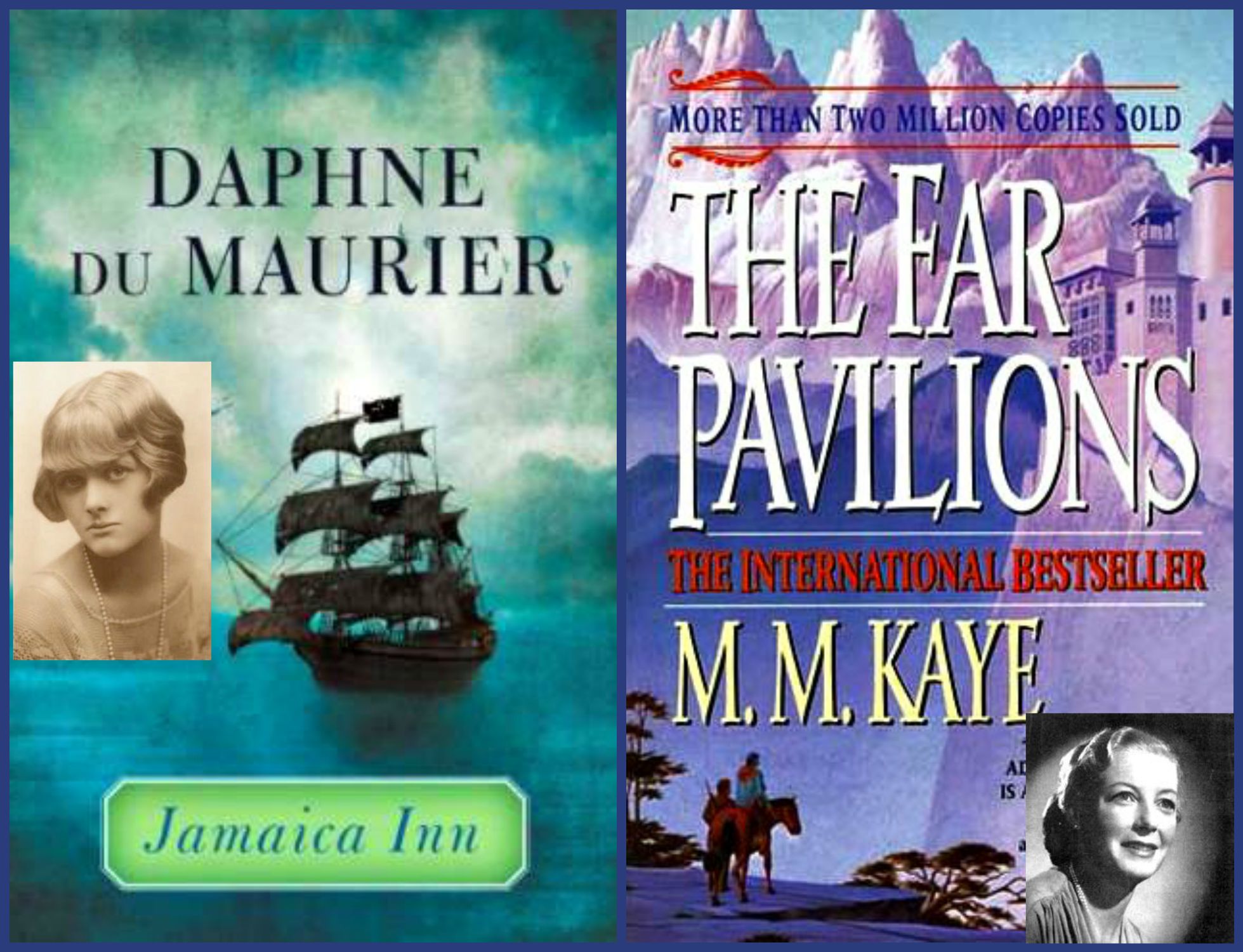
For me, Lawrence Durrell is the undisputed master. I also love the way Mary Stewart and Daphne du Maurier combined evocative locations with romantic suspense.

Deborah's picks for novelists who have mastered the art of writing about place

Deborah’s picks for novelists who have mastered the art of writing about place

Thanks so much, Deborah.

* * *

Readers, any questions for Deborah? Please leave them in the comments below.

And if you would like to discover more about Deborah you can visit her author site and blog, where she writes not only about her books but all things inspired by the South of France. You can also follow her on Twitter and Instagram.

BOOK GIVEAWAY*******************************
Deborah is offering a free copy of her new novel as a prize. To enter the competition please “Like” Deborah Lawrenson’s Facebook page. Then find the link on her page to this interview and enter a comment underneath.
***************************************************

À bientôt! Till next time when my guests will be a Canadian husband and wife team who write novels together about a pair of unusual sleuths in an 18th-century Kent village, and who are themselves displaced inhabitants there.

* * *

Thank you so much, Tracey! I note that one of the Channel 4 reviewers raved about Deborah’s first book for its “extraordinary description of place and descriptions of smell”; and readers have asked her if they can get the perfume, Lavande de Nuit, she describes in that work. (As it turns out, it exists only in her imagination!) —ML Awanohara

Tracey Warr is an English writer living mostly in France. She has published two medieval novels and her forthcoming novel, Conquest: Daughter of the Last King, set in 12th century Wales and England, will be published by Impress Books in the autumn.

STAY TUNED for next week’s fab posts!

If you enjoyed this post, we invite you to register for The Displaced Dispatch, a round up of weekly posts from The Displaced Nation, with weekly updates and much, much more. Register for The Displaced Dispatch by clicking here!

Related posts:

Photo credits: Top of page: The World Book (1920), by Eric Fischer via Flickr (CC BY 2.0); “Writing? Yeah.” by Caleb Roenigk via Flickr (CC BY 2.0). All other photos supplied by the author, apart from those of Kuwait and Cambridge, which are from Pixabay.

THE PERIPATETIC EXPAT: Can an expat also have itchy feet?

Displaced creative Sally Rose: Is she coming…or going?!

Sally Rose, who was one of last year’s Wonderlanded guests, recently confessed to me that she’s a perpetually perplexed peripatetic expat. We decided she needed her own column to explain this contradiction in terms. This is her first attempt. Enjoy! —ML Awanohara

Hello, Displaced Nationers! I’ve been an expat for five years. That’s if you don’t count the five years I spent in New York before that. For a wide-eyed girl from rural Texas, living in New York felt like being in a whole new country, except that I didn’t need a visa.

Now, I’ve been in Santiago, Chile, for five years and I’m beginning to get itchy feet again. What’s that about? A friend accused me of having a five year maximum in any one location. Though I’ve lived longer than five years in several places, they ultimately didn’t stick either.

She could be right.

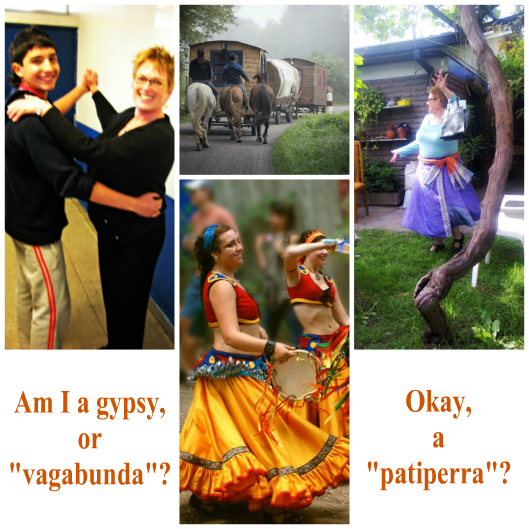
Am I a gypsy (or whatever you’d like to call it) at heart?

I used to tell people in Chile that I had gypsy blood, but in Chile, being associated with gypsies has a bad connotation, so I decided to tell them that I was a vagabunda, a vagabond, but I think that was as bad as gypsy.

My Spanish teacher tells me I’m a patiperra. It’s a Chilean term that means globe-trotter. One Chilean writer, who calls herself Patiperra, defines it as:

“A wanderer. Someone who doesn’t stay at home often, someone whose burning curiosity leads them on journeys to places they’ve never been.”

Guilty, as charged.

Maybe it’s simply my adult ADD kicking in, or I could be kind to myself and say it’s my inquiring mind that wants to know more places.

March 1 will be my five-year mark in Chile, and I’m thinking about making a change.
Sally Rose the Gypsy

Careful what you wish for…

I’m not a writer by profession. I went to Chile to be a volunteer English teacher. I even visited and volunteered four times before making the big leap. My book, A Million Sticky Kisses, chronicles my first visits to Chile as a volunteer teacher.

Volunteering in Chile was a dream-come-true—until I actually moved there. As American radio broadcaster Paul Harvey was fond of saying, here’s the “rest of the story.”

Between my final visit as a volunteer and the time I made the move in 2011, things had changed drastically at “my” school.

The administration had changed, and the director, who had been so kind and supportive of me, had been fired, along with an assistant director and several teachers whom I knew and liked.

A pall of anxiety hung over the school because teachers were being let go for minor infractions. The teachers who remained were terrified of the new director, who was a member of a conservative, rigid religious sect.

He viewed me suspiciously and made it clear that I was not welcome in the classrooms. The atmosphere of the previous two years had vanished.

My teacher friend, Marisol, invited me into her classroom, but even she, who had worked at the school for 40 years, was afraid of the new director’s power.

In the end, I went to the school for 45 minutes, once a week, to do cuentacuentos, story hour, in the library, under the strict supervision of the librarian and her assistant.

The happy days of volunteering in the classes at “my” school with “my” kids were a distant memory.
The Chilean Years
I made other volunteer attempts: doing a workshop for hyperactive fifth graders, singing “The Lion Sleeps Tonight” for three hours in a classroom of 40 nine-year-olds, assisting the English teacher who didn’t speak English.

“What is your name?” I asked her.

“I’m fine, thank you,” she responded.

The last year I volunteered was magical. I’d met a new friend, who happened to be a volunteer coordinator. She asked me to assist in a class of 16-year-olds.

“You want me to do what?!” I’d never worked with 16-year-olds before and just the thought of it gave me the willies.

By saying “Yes,” my pre-conceived notions were shattered when they turned out to be the most respectful, creative, fun kids I’d ever known.

I wanted to be at that school forever, but at the end of year, the owners, who were having financial problems, sold the school, and my students were scattered into the wind.

Should I twiddle my thumbs…or write?

The following year, Year Nº. 4 in Chile, I returned after my summer vacation, thinking that I would find another volunteer position. Something had always turned up before.

But not that year. Though I searched and searched, nothing materialized. I ended up without a purpose, twiddling my thumbs.

That’s when it hit me. I could rekindle my writing.

I had been blogging for years, and I’d previously taken a few stabs at novel writing. This time, I sat down and wrote a children’s book about Penny, a Golden Retriever puppy with a special mission.

The result was Penny Possible, the true story of a service dog in training.

I repatriated back to the US for six months while I revised A Million Sticky Kisses and self-published both books.

Sally Rose Great Works

When I returned to Chile again last year, I penned another children’s story, about a dog named Elvis who lives on the streets in Santiago. It’s currently being illustrated. The working title is Love Me Tender.

Hm…writing is portable!

There are other stories I’d like to complete. Some are half-finished, others are just a twinkle in my eye, but guess what, folks? Writing is portable. It doesn’t matter whether I’m in Chile, the US, or Timbuktu.

Almost at the five-year mark, my feet are itching again. Does this mean I’m leaving Chile?

I’m not sure, but it does mean I’m exploring. The world is a big place and I haven’t found my little piece of it yet.

Stay tuned!

* * *

Thank you, Sally, for sharing your quest to find your “little piece of the world.” Readers, where will Sally try (or not try) next, and how long will she stay? Is she a gypsy or a settler at heart? I hope you’ll join me in saying we look forward to the next installment! —ML Awanohara

Born and raised in the piney woods of East Texas, Sally Rose has lived in the Cajun Country of Louisiana, the plains of Oklahoma, the “enchanted” land of New Mexico, and the Big Apple, New York City. Then she fell in love with Santiago de Chile and has been “telling tall tales” from that long, skinny country since 2009, and living in that city for the past five years. But where will her next act take her? The author of a memoir and a children’s book, Sally has an author site where she keeps a blog, and is active on Facebook and Twitter.

STAY TUNED for next week’s fab posts!

If you enjoyed this post, we invite you to register for The Displaced Dispatch, a round up of weekly posts from The Displaced Nation, and SO much more. Register for The Displaced Dispatch by clicking here!

Related posts:

LOCATION, LOCUTION: Pining for her native Emerald Isle, Sheila Bugler writes crime novels with Irish connections

Location Locution
Columnist Lorraine Mace, aka Frances di Plino, is back with her latest interview guest.

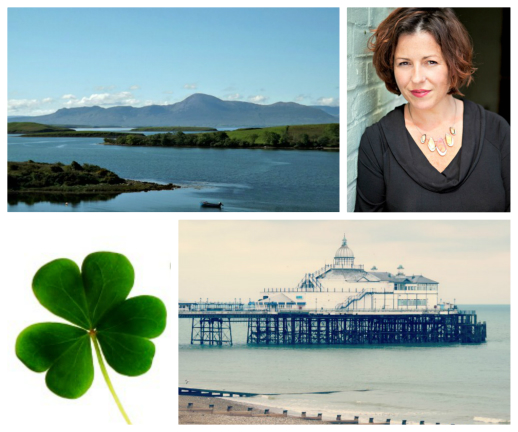
Part of being an Irish emigrant, whether in the UK or farther afield, is a nostalgia for the homeland and its green fields and rich, dark soil—as my guest this month, crime writer Sheila Bugler, will attest.

Sheila grew up in a small town in the west of Ireland. After studying psychology at University College Galway, she left her native land for a life abroad, working in Italy, Spain, Germany, Holland and Argentina. Today she lives with her husband and two children in Eastbourne, a seaside resort town on the south coast of England. Despite being settled in the UK, she pines for Ireland and describes herself as a “reluctant emigrant.”

Sheila Bugler Ireland England

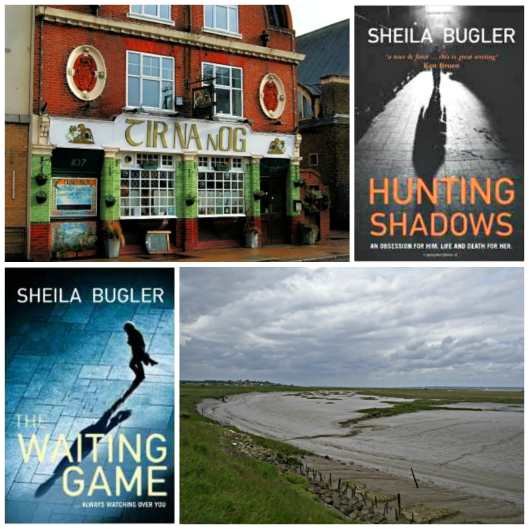
What’s more, these intense feelings for the Emerald Isle are what fuels her creative efforts. Sheila is the author of an acclaimed mystery series published by Brandon Books, an imprint of Ireland’s O’Brien Press, consisting so far of three books of a planned six: Hunting Shadows (2013), The Waiting Game (2014), and All Things Nice (forthcoming, April 2016). The series features Detective Inspector Ellen Kelly, a character whose “Irish roots shine through,” as one Amazon reviewer puts it, and is set amongst the displaced Irish community in southeast London.

As Sheila remarked in an interview with Triskele Books:

I adore Ireland and miss it (despite being very happy in the UK). For me, writing really is a way of connecting with my country. I write Irish characters (not exclusively, of course) and it was always very important to me that Ellen’s roots were Irish. At the moment, I can’t imagine writing a novel that doesn’t have some connection to Ireland.

Her characters, too, are inspired by place: by the bleak wilderness of the North Kent coast. Perhaps they find it reminiscent of the bleak and beautiful Aran Islands off the coast of Galway?

But let’s not get too carried away. It’s time to give Sheila the floor and hear what she has to say about location, locution.

* * *

Welcome, Sheila, to Location, Locution. You have a strong sense of place in your writing, but tell us, which tends to come first, story or location?

Thank you for inviting me, Lorraine. In answer to your question: Story. But often there is a single image, in a particular place, which is the inspiration for that story.

What techniques do you use for evoking place in your crime stories?

I am quite an instinctive writer and try not to overthink the process as it happens. Of course, like all writers I have had to learn the basic techniques, but I don’t think you can force yourself to write in a particular way. Although location plays an important part in my novels, this isn’t a deliberate choice—it’s something that happens naturally as I write.

I like the way location can enhance a particular atmosphere you are trying to create. In my first two novels, Hunting Shadows and The Waiting Game, parts of each book are based in the beautiful, bleak Hoo Peninsula of north Kent.

In Hunting Shadows, this is the perfect location for one of the central characters, Brian. He is an isolated loner and the isolated landscape is a great way of showing how Brian lives his life. In contrast, there is a character in The Waiting Game who uses the Hoo’s wide open spaces and big skies as a backdrop to her work as an artist.

If I am struggling to create a sense of place, I will do some or all of the following:

  • Close my eyes and try to get a picture in my head.
  • Play some music that has a connection with the landscape I’m trying to evoke (for example, bluegrass when I’m writing about the Hoo, traditional Irish music when writing about the west of Ireland).
  • I wait until I can see the place, hear it, smell it, feel it.
  • And then I write it.

Sheila Bugler locations

Which particular features have you used to create a sense of what clearly is to you a special location? Landscape, culture, food?

Obviously it’s all of those things. However, you don’t need to use every one of them to evoke a sense of place.

The author JJ Marsh, for example, puts a lot of importance on food when she is writing about the different locations in her novels (I should add she doesn’t just write about food!).

The Irish noir writer Ken Bruen perfectly evokes the city of Galway[https://en.wikipedia.org/wiki/Galway] with almost no reference to the external landscape. Instead, he brings the city to perfect life through his characters’ voices and the internal spaces, particularly the pubs. Likewise, Ian Rankin manages to perfectly evoke his home city of Edinburgh without ever needing to give us “in your face” descriptions.

As in real life, your characters move through a rich world of noises, smells, colours, places and other people. If you don’t forget that when you are writing, then neither will your readers.

I’m pleased you mentioned JJ Marsh. She was the original creator of this column! But returning to your own works: can you give a brief example from your writing that illustrates place?

I’m going to share two different examples.

First, a short scene from my novel, Hunting Shadows. In this scene, I tried to give an impression of the location through the reactions of the two characters:

Ellen stepped out of the car and looked around. The place reminded her of the black-and-white photos in her parents’ house of old Irish towns. It gave her that same feeling that she was observing somewhere from a time long past. Apart from a scattering of houses—a mixture of semi-derelict Victorian cottages and cheap, flat-roofed eyesores—there was nothing else.

From where she stood, the landscape sloped down to the Thames marshes, bleak and desolate under the heavy sky.

“Listen,” Dai whispered.

Ellen frowned. “What? I can’t hear anything.”

“Duelling banjos,” he said. “I knew it. “Deliverance” country. We’re not safe in a place like this.”

ThamesMarshes_quote
And here is a very different piece from a stand-alone novel I am working on called Walk Away. I don’t normally write this descriptively but my own love for this part of Ireland obviously influenced me:

The town was on the southern edge of Galway Bay, the hills of the Burren sloping up behind it, the vast sweep of the Atlantic Ocean stretching out in front of it. Next stop America. It was beautiful. He knew that. Probably always had.

Sydney was home these days. A modern, open-plan apartment with muted colours, floor to ceiling windows and views across Sydney Harbour. All very tasteful and perfect for a shit-hot, sharp-dressing, arse-kicking, wheeling-and-dealing corporate lawyer.

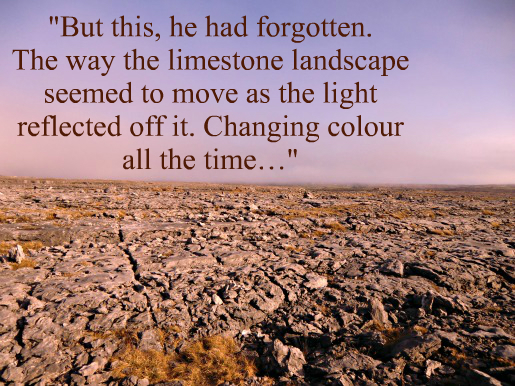
But this, he had forgotten. The way the limestone landscape seemed to move as the light reflected off it. Changing colour all the time from purple to pale pink to grey and back to purple again, in harmony and contrast with the sea.

The_Burren_in_the_evening_sun_515x_quote

How well do you need to know a place before using it as a setting?

If you are using a real location as a setting, you need to know enough about it so it seems real to your reader. In today’s world, there is no excuse not to do this. We all have access to the internet and Google maps. If you haven’t visited a place, do some basic research and make sure you include this in your novel. Using a real pub, for example, instead of making one up can really add to the sense of authenticity.

I once read a crime novel set in Lewisham (where I was living at the time). In one scene, a character is walking down Lewisham High Street and bemoaning the lack of a Marks and Spencer’s. We have M&S in Lewisham! This—and other aspects of the novel—made it clear to me the writer had never been to Lewisham and didn’t know anything about the place he was writing about.

Of course, we can also write about fictional locations. If you do that, your own sense of the place needs to be well-formed before you write about it. The important thing is this: whatever location you choose, it must feel authentic for the story you are writing.

Which writers do you admire for the way they use location?

JJ Marsh writes beautifully in her European crime series featuring Beatrice Stubbs. Similarly, Gilly Hamer writes wonderful descriptions of the stunning Anglesea coastline where her novels are set.

For many reasons, I hold Ken Bruen up as a master when it comes to using location in his novels. He perfectly evokes Galway city, capturing not only its beauty but also the voices and characters of the people who live in that very special place. He is my absolute writing hero.

Bulger fave authors

Thanks so much, Sheila!

* * *

Readers, any questions for Sheila Bugler? Please leave them in the comments below.

And if you’d like to discover more about Sheila, why not visit her author site. You can also follow her on twitter.

Until next month!

Lorraine Mace writes for children with the Vlad the Inhaler books. As Frances di Plino, she writes crime in the D.I. Paolo Storey series. She is a columnist for both of the UK’s top writing magazines, has founded international writing competitions and runs a writing critique service, mentoring authors on three continents.

STAY TUNED for the next fab post!

If you enjoyed this post, we invite you to register for The Displaced Dispatch, a round up of weekly posts from The Displaced Nation, with weekly updates and much, much more. Register for The Displaced Dispatch by clicking here!

Related posts:

Photo credits: Top of page: The World Book (1920), by Eric Fischer via Flickr; “Writing? Yeah.” by Caleb Roenigk via Flickr (both CC BY 2.0). First collage: Sheila Bugler (supplied); County Galway, Eastbourne Pier & shamrock via Pixabay. Second collage: Book cover art; The Tir Na Nog Irish Pub, Wandsworth – London, by Jim Linwood (CC BY 2.0); All Hallows Marshes, Hoo, Kent, by Amanda Slater via Flickr (CC BY-SA 2.0). First quote: Hang on, is that grass over there?, by Andrew Bowden (CC BY-SA 2.0). Second quote: Burren landscape in the evening sun, by YvonneM via Wikimedia Commons (CC BY-SA 3.0). Favorite books collage: Cover art; Blitz Movie Poster via Wikimedia Commons.

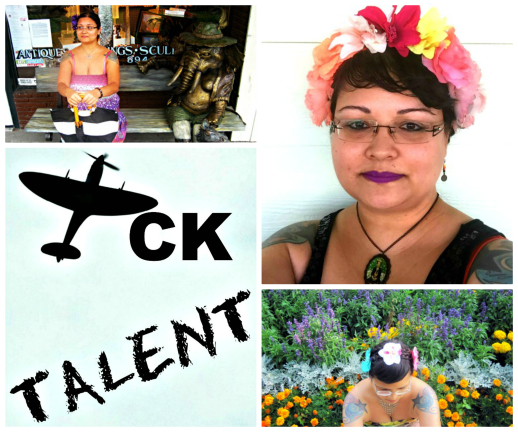
TCK TALENT: Sezín Koehler, multimedia artist, tatoo collector, editor and prodigious writer

Columnist Elizabeth (Lisa) Liang starts off 2016 with a guest who has been to the Displaced Nation before, albeit in different guises: as Alice, as film critic, as featured novelist, as repatriate…though never as a TCK Talent.

Happy 2016, readers! I hope your January has been splendid thus far. Today’s interviewee is writer, editor, tattoo collector, and Huffington Post contributor Sezín Koehler, who also calls herself Zuzu (a nickname she picked up when living in Prague). Sezín may already be familiar to some Displaced Nation readers as an early contributor, including a two-part series listing films that depict the horrors of being abroad, or otherwise displaced; a much-commented upon post called “The Accidental Repatriate”; and an Alice-in-Wonderland-themed post on her life in Prague (that was after she had received one of the Displaced Nation’s very first “Alice” awards).

But what some of you may not know is that Sezín is a Third Culture Kid. She was born in Colombo, Sri Lanka, to a Sri Lankan dad and Lithuanian-American mom. Her mom’s job with UNICEF moved the family from Sri Lanka to Zambia, Thailand, Pakistan, and India.

Sezín went to college in California—and then returned to her family, who were living in Switzerland and then in France (the move again being due to her mom’s job).

Next Sezín moved alone to Spain, where she met her husband, who is American. After living as expats in Turkey, Czech Republic, and Germany, the couple now call Lighthouse Point, Florida, home.

* * *

Welcome, Sezín. What a truly peripatetic life you’ve had! What made you decide to “repatriate” to the USA and come to Lighthouse Point? 
This area is where my husband grew up and has family, although his family moved further north just this year. Economics and a series of unfortunate events are what brought me back to the US—my husband and I returned with literally 15 euros between us.

Sounds like a tough reentry. While living as a nomad can also be tough, were you happiest in a certain place?
That’s a surprisingly difficult question! There was a lot of conflict in my family when I was growing up because of the tension between my American mum and conservative Sri Lankan dad—and all the cultural, social, etc., issues that come with having a multicultural and multiracial family before that became something of the norm. Plus, moving all the time was not a lifestyle that worked for me, and it created uncomfortable cycles of depression that were then compounded by having post-traumatic stress disorder (PTSD) after witnessing the murder of one of my best friends in our final year of university. The repatriation to Florida was one of the more miserable moves—especially since I had never planned to move back to the United States until they sort out more effective gun-control laws.

That sounds terribly painful. How have you coped since your return to the US?
My first two years back made me completely despondent, and then one day I just decided to make the best of the situation. It was time to choose happiness; otherwise I wasn’t going to survive. So now every day I wake up and I find something—big or small—to be happy about and I focus on that for the day. In that sense, and in a strange reversal, I suppose Florida is where I find myself happiest because this is where I learned that happiness isn’t something that happens to me passively because life is perfect. Happiness is a daily choice. And I actively make the choice to be happy however difficult my surroundings.

“That feeling of being an outsider never quite leaves you…”

Do you identify most with a particular culture or cultures, including the very broad “TCK culture”? 
You know, I think I identify with aspects of pretty much every culture under the sun—even ones where I didn’t actually live or visit. Being highly sensitive, coupled with having a TCK upbringing, has made it so I can identify with just about anyone who isn’t a bigot or misogynist, even if our backgrounds are nothing alike. I do find myself particularly drawn to other TCKs because, even if we didn’t live in the same places, there is something about the “universal” TCK personality that resonates with me, and it’s far easier to start on the same page rather than having to work hard to build bridges of understanding between myself and people who haven’t traveled or grown up abroad. I also find that many TCKs understand that just because growing up abroad sounds exciting, it might not have actually felt that way when we were getting yanked from place to place, leaving friends and family behind in those pre-social-media Dark Ages.

Did your TCK upbringing inform your career path as a writer?
To be honest, with all the moving around plus PTSD, it’s been hard to develop a career track other than writing. Being a writer means you take your passion with you wherever you go, and no matter where you are, there is always something new to write about. Writing has been my longest-standing support system and therapy through the variety of traumas that ended up shaping my life, and any day now I hope I’ll start being able to make a living doing it. 🙂

Did growing up as a TCK also influence your career as an editor?
As an editor I focus on academic writing by non-native English speakers, and having lived in so many places has definitely helped me understand all the different (incorrect) ways people use English and help them to get published in English-language publications where English fluency is a requirement.

“As a Third Culture Kid, I always related with monsters more than ‘norms.'”

Tell us about your tattoo collection. Any TCK connections there?
Other than my husband, tattoos are one of the great loves of my life. Tattoos for me have been a way to not just express myself creatively, but have also been a way to re-claim my own body after so many traumas. I have a hybrid identity that I often express in fantastical ways. Sometimes when people ask me where I’m from and I don’t feel like having an intimate conversation about my life I’ll say I’m a mermaid and I’m visiting from the ocean. I have a huge jellyfish on my right thigh and I say, “Meet my pet jelly.” Now that my hair is in a pixie cut, I might introduce myself as a fairy and since I actually have tattooed wings on my shoulders as well as often literally leaving a trail of glitter in my wake, I find it easier than getting into my TCK identity—especially when the person I’m talking to might have never left this corner of Florida.

Keep Calm & Be a Mermaid

So in a way, the tattoos serve as both explanation and protection.
For my entire life I’ve operated under an assumption of otherness—when I’m in the US people ask me where I’m from, and when I’m in Sri Lanka people ask me where I’m from. Being mixed race can be really complicated—and I get a lot of aggression from strangers who try to figure out “what” I am. In a way tattoos are a shield between me and curious eyes, as is much of my performance-of-the-fantastical-self art and being.

Have any of these careers/interests helped you to process your nomadic upbringing?
Writing, definitely! Writing has been my most effective and longest-standing therapeutic tool. Not just my non-fiction, but also my short stories and my novels have most certainly helped me situate my cultural self in lots of different ways that have been helpful and healing. As a writer I’m also an avid reader, and reading is another huge help in figuring out where my strange background and I fit in the grander scheme of culture and society.

“I revel in my boundaryless self…”

As an ATCK, do you have “itchy feet,” or would you prefer to have a home base and only travel for pleasure?
I have always hated moving and I might be the only TCK to say I have never had itchy feet. Ever since I was a little girl all I wanted was to stay in one place and even now at 36 I feel that way. But because of how I grew up moving around, I’ve also come to a point where everywhere seems pretty much the same—I always see the same kinds of people in disparate places, it’s weird—and yet nowhere ever feels like home. So now my concept of home has shifted and simply means being somewhere with people I love.

Moving is one thing, but how do you feel about traveling in general, including for pleasure?
After a lifetime spent on airplanes and traveling, I absolutely hate traveling now. I have crippling aerophobia, and if I’m forced to travel somewhere by plane, everything about the experience is miserable and I end up getting really ill before, during, and after. I find going to new places more stressful than enjoyable. My dream is one day to have a house with a beautiful view and some rescue dogs and never go anywhere ever again. Except through books, of course.

Speaking of books, you published your first novel, American Monsters, four years ago, and I understand the sequel has just come out!
Yes indeed! My second novel, Crime Rave, came out in October 2015, and I don’t think I’ve ever been prouder of one of my creations in my life. Going back to your question about how being a TCK has shaped my writing, this book is a perfect example. The story itself defies genres—it has crime noir, supernatural, horror, and feminist themes just to name a few—and most of my characters are either mixed race or people of color who are not only TCKs themselves or ethno-cultural hybrids, but they’ve all gone through traumas that resulted in superpowers. If there was a label of Third Culture Fiction, my book would totally fit the bill.

The number of novels you have in progress, on top of what you’ve had published, is wildly impressive! Please tell us about them.
Thank you so much, Lisa. I’m currently working on my third, fourth, fifth, and potentially sixth novels—the third is a zombie tale set in Prague, the fourth will find recurring Crime Rave characters on Pine Ridge Reservation in South Dakota, Lighthouse Terror will be a grindhouse horror novel set in a gated community in southeast Florida, and finally I’m toying with the idea of an entire novel about Marilyn Monroe.

Yes, I know you are a big Marilyn fan. I believe she makes an appearance in Crime Rave?
Yes, in Crime Rave she not only lives but has a daughter.
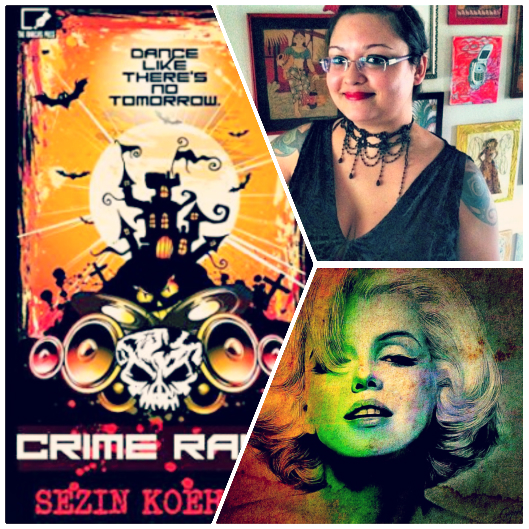
Crime Rave Marilyn
What else are you working on?
As a HuffPost freelancer I’m working on a number of pieces featuring interviews with some badass individuals—authors, activists, artists, scientists, and more. I’m also in the process of starting my own publishing label that will focus on works by women and other marginalized writers who create genre-bending works in which women play all the major roles.

You’re so prodigious!
The one benefit of being an accidental shut-in who works from home here in Lighthouse Point is that I have nothing but time to work on all the creative projects I want, which is another dream come true.

Where can we find your work and follow your progress?
At sezin.org, my HuffPost column, my American Monsters site, and sezinkoehler.com. I’ve also recently revamped my Etsy store, Zuzu Art, with its gallery of sparkly-strange multimedia Alice in Wonderland and Frida Kahlo-inspired pieces. I have a Tumblr cabinet of curiosities called Hybrid/Monster that I continue to update with oddities of the visual nature, and I am rather fond of my Instagram account, where I post pics of my own art, my performance art, and snapshots of life in the tropics. Whew! I didn’t realize how much I produce online until this very moment.

* * *

Thank you so much, Sezín! I’m inspired to know that your artistic path has led to your healing, and that you’ve found daily happiness since the painful reentry to the United States. Congratulations on your many creative, career, and personal accomplishments! Readers, please leave questions or comments for Sezín below.

Editor’s note: All photos are from Koehler’s Hybrid Monsters site (apart from her book cover and the photo of one of her Etsy works) or from Pixabay. The quotes are from her “About the Curatrix” page.

Elizabeth (Lisa) Liang is a prime example of what she writes about in this column: an Adult Third Culture working in a creative field. A Guatemalan-American of Chinese-Spanish-Irish-French-German-English descent, she is an actor, writer, and producer who created the solo show Alien Citizen: an earth odyssey, which has been touring internationally. And now she is working on another show, which we hope to hear more about soon! To keep up with Lisa’s progress in between her columns, be sure to visit her blog, Suitcasefactory. You can also follow her on Twitter and on Facebook.

STAY TUNED for next week’s fab posts!

If you enjoyed this post, we invite you to register for The Displaced Dispatch, a round up of weekly posts from The Displaced Nation, and so much more! Register for The Displaced Dispatch by clicking here!

Related posts:

WONDERLANDED: Will I have a hard or a soft landing?—two excerpts from “Olivia and Sophia,” by expat novelist Rosie Milne

Will I have a hard or a soft landing? Photo credits: Like Alice in Wonderland you can go into the rabbit hole, by expat painter Frank Schwarz via Wikimedia Commons (CC BY-SA 3.0). Inset: Book cover (supplied).

Yesterday we were Wonderlanded with Rosie Milne, a veteran member of the publishing world, a blogger on Asian books, and a novelist in her own right. This post, which I’ve titled “Will I have a hard or a soft landing?”, consists of two excerpts from Rosie’s about-to-be-published historical novel, Olivia and Sophia, which concerns the lives of the first and second wives of the founder of the British trading post of Singapore, Sir Thomas Stamford Raffles. 

Set in London, Java, Sumatra and Singapore, against the backdrop of the Napoleonic Wars—the story takes the form of two fictionalized diaries, one by each of Raffles’s wives. They are:

  • Olivia Devinish, a raffish beauty with a scandalous past. Born in India and raised in Ireland, Olivia accompanied Raffles, who was her second husband, to West Java, where he was serving as governor. She got ill from the island’s harsh conditions and died at age 43. Raffles erected a memorial to her that stands to this day, in what is now the Bogor Botanical Gardens.
  • Sophia Hull, no beauty, but curious and intelligent and eager to embrace the opportunity of an exciting life abroad. Born in London, of Irish descent, she met and married Raffles when he was on leave in England after becoming a widower. The couple then sailed for Bencoolen (Sumatra), where Raffles had been appointed governor general—making Sophia the first white woman to venture into the Sumatran interior. This was the period when Raffles founded the British trading post of Singapore. The couple returned to England in August 1824 because of Raffles’s ill health. He died two years later, one day before his 45th birthday. Sophia then dedicated herself to writing his biography.

According to the book description, Rosie Milne “takes us away from the cold, damp confines of Georgian London to the muggy, hostile tropics and to the titillations and tribulations of a life far away from home.”

And, importantly, for us Displaced Nationers, she also provides a sense of what it was like to be a trailing spouse in an earlier era. Do these two Victorian ladies feel as though they were falling down a rabbit hole, uncertain of where they’d land and whether the landing would be hard or soft? Let’s find out…

* * *

Excerpt from Olivia’s diary

Olivia writes this diary entry on board the Ganges, the ship on which she is sailing from London to India. I think it expresses her sense of having fallen down a rabbit hole in a self-explanatory way.

Sometime, someplace on the ocean

I remain confident the year is 1805, and I am aboard the Ganges, but I write as my heading sometime, someplace on the ocean ’cause sailing across the nothing, nothing, nothing, and yet more nothing of the sea has addled me about both calendar and map. The map I have quite lost track of. At dinner I say my daily toast to happy sight of the next land, and I think: where is that next land? Which is to say: where are we? With no landmarks to watch for by day, and, by night, not being able to read the stars, I am as ignorant now of place as must be the fishes swimming in the waters beneath me. The calendar too, is becoming hazy to me. The tyranny of breakfast at eight, dinner at two, tea at six, and supper at nine keeps me abreast of the hours, but when I think of day and date ’tis as if one of our chilly sea fogs has reached its fingers into my mind, so I no more know whether ’tis Monday, Saturday, Wednesday, or Sunday, than I c’d say our position on the globe.

Olivia Raffles as Alice

Photo credits (top to bottom): Frigate in fog via Pixabay; detail of Here be Dragons map; Down the Rabbit Hole, by thepeachpeddler via Flickr (CC BY 2.0); Olivia Raffles portrait.


Excerpt from Sophia’s diary

Sophia writes this diary entry on board the Mariner, the ship on which she is sailing home from India. It, too, expresses her sense of having fallen down a rabbit hole…

August 1824, the Mariner, off the Cornish Coast

And, behold, I am with thee, and will keep thee in all places whither thou goest, and will bring thee again into this land … I have had my first sight of Home for nigh on seven years. Tho’ in the Eastward Old England sometimes seemed to me unreal, like a dream of Home, and not a literal place on the globe, Cornwall is now crouched in the angry sea to our starboard, and is just as real as sharp granite rocks will allow. I hardly know how to say how I’ve changed since last I saw England. I sometimes feel so disunited from that Lady Raffles who sailed eastward on the Lady Raffles I can scarce think we are the same person – I cannot recall her, it sometimes seems, and must judge she was mistaken to think she ever could return Home. More, I scarcely know how to say who I am now, what I am, what manner of person? As for Tom, now turned of forty, lit now only by shadows of his youthful fires, he says he feels just as wearily jumbled as me, just as uncertain how to begin to make sense of all that has happened these past seven years, if indeed any sense can be made of our lives at all, and he says it is a puzzle to know whether his two sojourns in the Eastwood enabled him to put on, at various times, a new self, as a man may put on a new coat, or if, while in foreign climes, he became more than ever the man who first left, and now returns, to Old England.

Photo credits: Land's End, Cornwall[https://pixabay.com/en/ocean-rock-waves-wind-stormy-826155/] via Pixabay; Sophia Raffles portrait; Down the rabbit hole by Colin Smith[] via the Geograph Britain and Ireland Project (CC BY-SA 2.0) [http://creativecommons.org/licenses/by-sa/2.0/].

Photo credits: Land’s End, Cornwall via Pixabay; Sophia Raffles portrait; Down the rabbit hole, by Colin Smith via the Geograph Britain and Ireland Project (CC BY-SA 2.0).

* * *

Thank you so much, Rosie! I like the way you’ve juxtaposed these two excerpts, one showing the first wife setting out on a Far Eastern adventure, the other showing the second wife confronting the prospect of going home again. In fact, Sophia writes something that is extraordinarily akin in spirit to Alice’s statement:

I could tell you my adventures—beginning from this morning; but it’s no use going back to yesterday, because I was a different person then.

Readers, what do you think? Do these trailing spouses have it harder than their modern-day counterparts, or can you draw a reasonably straight line to today? And have these two excerpts from Rosie’s new novel made you want to read more? Olivia & Sophia, published by Monsoon Press, will be available as a paperback in Asia and Australia on November 1. You can also visit Rosie’s Asian Books Blog and/or stay social by following her on Twitter. And of course you can also express appreciation for Rosie in the comments below. ~ML

STAY TUNED for next week’s fab posts.

If you enjoyed this post, we invite you to register for The Displaced Dispatch, a round up of weekly posts from The Displaced Nation, and much, much more. Register for The Displaced Dispatch by clicking here!

Related posts:


LOCATION, LOCUTION: The Way of expat author Joan Fallon lies in writing about the Camino and other Spain-related themes

Location Locution
Columnist Lorraine Mace, aka Frances di Plino, is back with her latest interview guest.

The theologian Richard Niebuhr once wrote:

Pilgrims are poets who create by taking journeys.

In that sense, today’s author, Joan Fallon, can be considered a modern-day pilgrim, of the kind often encountered within the Displaced Nation. She may not have walked the Camino de Santiago—but the path she took in her life led her to a place where she could write a novel about someone who did.

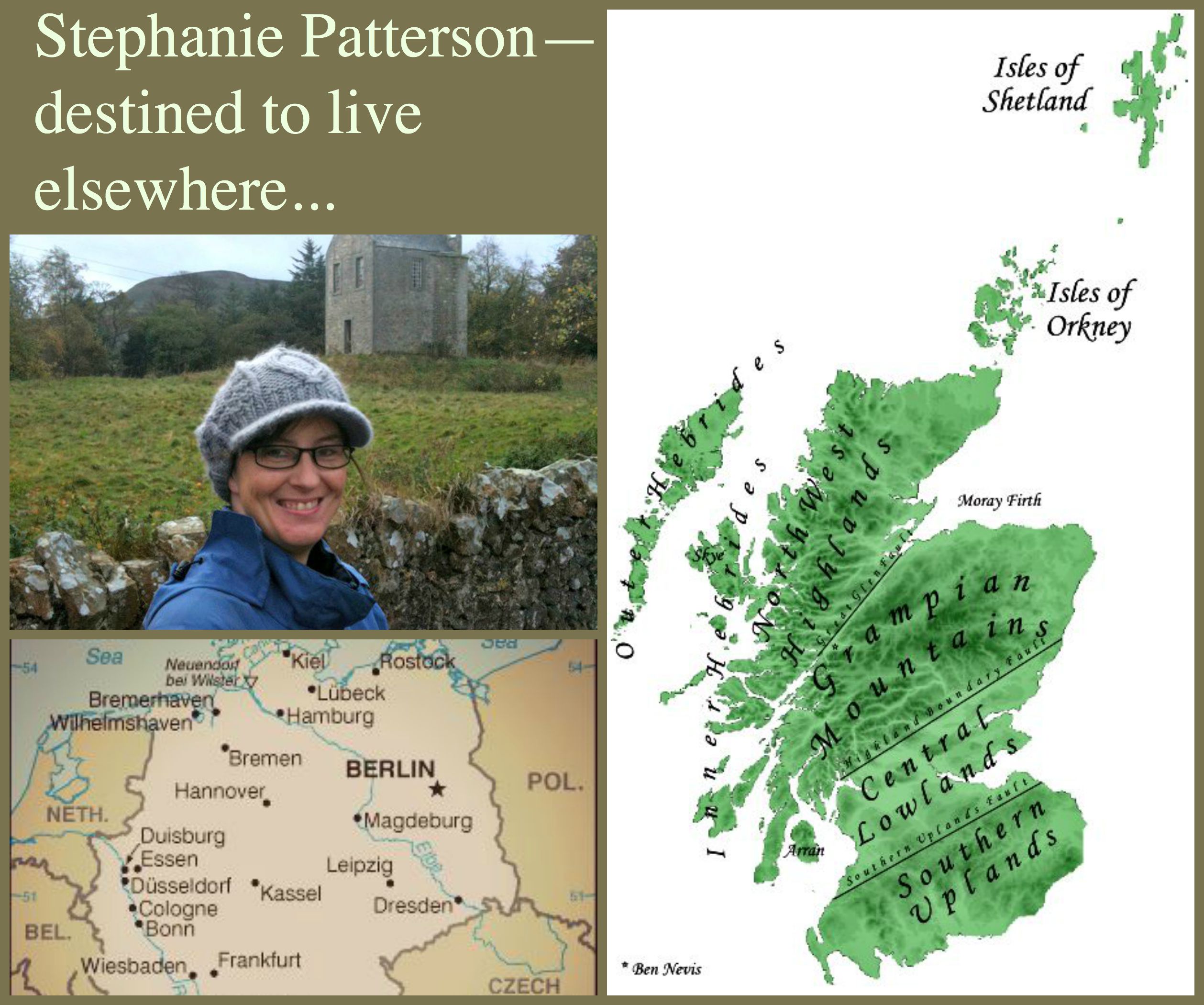
Joan was born with a foot in two cultural camps: her father was Irish and her mother, Scottish. Her first journey into a brand new culture was made as a child, when her family moved from Dumfries, Scotland, to the south of England, which many Celts consider to be a foreign country.

Joan went on to spend her formative years in England. She married, had a family (a son and a daughter), and worked as a teacher while also earning a BA from the Open University in History and Literature.

But in England, Joan was still a pilgrim; she hadn’t yet found the Way. In fact, she lost her way for some time after her son dropped dead unexpectedly when he was only 17. She abandoned her career in teaching (she couldn’t bear being around kids his age) to become a management trainer.

Soon, though, it was time to don her pilgrim’s boots again, this time for a journey into southern Spain. When her husband took early retirement, the couple set off just before the start of the new millennium for their new home in Benajarafe, a coastal village that is a few miles east of Málaga, in Andalusia.

This journey, which brings us to where we find Joan now, led her to the goal she was seeking all along: an opportunity to try out the life of full-time writer. As she put it in a recent interview:

It is something that I had been waiting all my life to do.

Joan completed an Open University course in creative writing, but it wasn’t until she’d spent six years taking journeys within Spain, learning the language and talking to people, that she would embrace her destiny fully. (She was also settling in, finding out how to cope with Spanish bureaucracy and generally dealing with the numerous everyday things that we take for granted in our home country or don’t need: obtaining an identity card, a social security card, becoming a tax resident, registering at the town hall, changing to Spanish number plates, making friends, finding a hairdresser that you like, a new dentist, a new doctor, a vet, a plumber…)

Eventually, her immersion in the Spanish language and local culture paid off. Always interested in social history, Joan decided to interview a number of older Spanish women about how their lives had changed since Franco had died in 1975. She translated the interviews into English, which led to her first published book, Daughters of Spain.

The research for this book also produced two novels:

Joan Fallon's writing career has flowered in Benajarafe, initially with books set in the Franco era

Joan Fallon’s writing career has flowered in Benajarafe, initially with books set in the Franco era. Photo credits: Joan Fallon’s author photo and book covers (supplied); Benajarafe, by Tony Bowden (CC BY-SA 2.0).

One of Joan’s subsequent novels grew out of her experiences of mixing with both Spanish and foreign nationals: Loving Harry, a story about two women in love with the same man, set in expat Spain.

Joan’s frequent visits to other parts of Spain have also inspired books. It was a trip to Galicia that gave her the idea of writing Santiago Talesabout a woman whose life is in tatters and who decides to walk the Camino de Santiago seeking solutions.

Likewise a visit to the Moorish ruins at Madinat al Zahra near Córdoba inspired her to research and write The Shining City, a novel set in Moorish Spain during 10th century.

All of Joan’s novels feature strong women as their heroineswomen who face some kind of difficulty and have to overcome it.

* * *

Welcome, Joan, to Location, Locution. Spain clearly has had a powerful effect on your writing, but which comes first, story or location?

Thank you for inviting me, Lorraine. It depends on the book I am writing whether location or story is the most important. Santiago Tales, as you’ve explained, was set on the Camino de Santiago in northern Spain—location was essential to the story. Spanish Lavender is a love story set in the Spanish Civil War, but it takes place specifically in Málaga, a city I know very well—and therefore I started with the location. In another of my books, The Only Blue Door, which you didn’t mention, I wrote about three children sent to Australia during wartime. Never having been to Australia, I found it hard to write about a place I did not know personally so had to rely on my research. In this case, it was the story that was predominant, not the location.

It sounds as though you like to know the place very well before using it as a setting?

Yes, I prefer to write about places I know. If I don’t know the location well, then I will visit it a number of times noting the layout, the atmosphere and anything else I can put into my writing. Sometimes I will interview someone about a place when I know that they have a greater knowledge of the location than I do. This is what I did with Santiago Tales. I knew the area well but not from the point of view of a pilgrim, so I interviewed a woman who had walked the 800 km of the Camino and was delighted to tell me of her exploits. This gave me the little details that I needed to make my story credible.

Photo credits: Puente rústico, by José Antonio Gil Martínez via Flickr (CC BY 2.0) .

Photo credits: Puente rústico, by José Antonio Gil Martínez via Flickr (CC BY 2.0); book cover art (supplied).

What’s your technique for evoking the atmosphere of a place?

I try to remember as many details as I can, imagining that I am there again and then imagining the character in the location as I knew it. If my story is set somewhere that I have only visited on a few occasions, then it needs more effort to conjure up the required atmosphere, and I will read about the location and look at photographs. Sometimes it is something as simple as knowing if there are hills in the area that the character has to climb or rivers that he has to cross or when he sits down what he can see. All this helps to transport the reader to the location that you have chosen. For me it is a mixture of combining what I know the place is like with the atmosphere I am trying to convey for the story.

Which of your works provides the best illustration of place, and can you give us a brief example?

Place is an especially important factor in The Shining City, which I wrote after visiting the ruins of a city near Córdoba called Madinat al Zahra. I was fascinated by the place and the fact that, although it was once a very prosperous and cultured city, it was abandoned and fell into complete disrepair after only 70 years. It seemed the ideal place to set a historical novel about the Moors in Spain.

Here is a passage from my book, depicting a character from England’s West Country who is following the French Way of the Way of St. James:

The Galician countryside is distinctive. It reminds her a little of her own West Country, with its small fields and dry-stone walls. The change was obvious as soon as she reached O’Cebreiro, set in the green, rolling hills across the border from León, and saw the round stone houses of the area, with their straw roofs and Iron Age design. She has even passed Celtic crosses at the roadside, so like the ones in Cornwall, and fields of fat, contented brown and white cattle. Just like the west coast of Britain and Ireland, Galicia receives its fair share of Atlantic wind and rain and this is evident in the verdure of its countryside. No, she is no longer walking through the dry Meseta; this part of Spain is very different and, to her, feels more like home.

Photo credits: Book cover art (supplied); Medina Azahara - Cordoba, by Roberto Venturini via Flickr (CC BY 2.0).

Photo credits: Book cover art (supplied); Medina Azahara – Cordoba, by Roberto Venturini via Flickr (CC BY 2.0).

Is landscape the only feature you look at to create a sense of location? What about culture, or even food?

All of those and more, depending on the location. Returning to the example of The Shining City, about a place that I had visited when it was a ruin, I had to do a lot of research into what it would have been like when it was a thriving city. I needed to know what food was available at the time, what they grew and what they imported, what type of housing people lived in, how they dressed and what the climate was like. Although this is a historical novel, set in 10th-century Spain, the fact that I live in Spain and know the area well made it so much easier to create the right atmosphere; I knew from experience what the weather was like at different times of the year, which flowers were in bloom and when; and I could imagine easily what the roads to the city were like then from what I could see today.

Which writers do you admire for the way they use location?

I read a book by John Lanchester called Capital, which was the story of a street in London told through the lives of the people who lived there. He used location very well and made it the central pivot for his novel. Donna Tartt also uses location very well and creates a rich and detailed background to her novels. Another writer that gives great importance to location in her novels is Barbara Kingsolver, and Elena Ferrante’s Neapolitan novels about two girls growing up in Naples recreate the atmosphere of that wild-child city beautifully.

Fallon Faves

Joan’s picks for writers who have mastered the art of writing about place

Thanks so much, Joan!

* * *

Readers, any questions for Spain-obsessed Joan Fallon? Please leave them in the comments below.

And if you’d like to discover more about Joan, why not visit her author site +/or her site dedicated to her books that are set in Spain, A Spanish Notebook. You can also follow her on twitter at @joan_fallon and @notesonspain +/or like her Facebook page.

Until next month!

Lorraine Mace writes for children with the Vlad the Inhaler books. As Frances di Plino, she writes crime in the D.I. Paolo Storey series. She is a columnist for both of the UK’s top writing magazines, has founded international writing competitions and runs a writing critique service, mentoring authors on three continents.

STAY TUNED for the next fab post!

If you enjoyed this post, we invite you to register for The Displaced Dispatch, a round up of weekly posts from The Displaced Nation, with weekly updates and much, much more. Register for The Displaced Dispatch by clicking here!

Related posts:

Photo credits (top of page): The World Book (1920), by Eric Fischer via Flickr; “Writing? Yeah.” by Caleb Roenigk via Flickr (both CC BY 2.0).

WORLD OF WORDS: There’s a word for that homesickness that grips expats and overseas travelers, and it’s French!

Marianne Bohr in the Luxembourg Gardens in Paris—is she reading or indulging in reveries about words?

Marianne Bohr in the Luxembourg Gardens in Paris—is she reading or indulging in reveries about French words?

Columnist Marianne Bohr, whose first book, Gap Year Girl, came out at the start of this month with She Writes Press, recounts a time during her travels in France when she and her husband felt suddenly out of place and full of longing for home. Ironically, however, the most apt expression she could think of to describe this feeling was French!

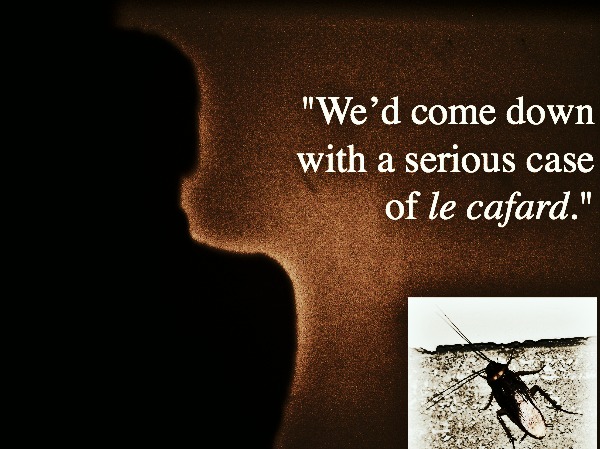
They’re inevitable. Those days that occasionally, and sometimes from out of nowhere, invade the life of a long-term international traveler or expat. You miss home, you’re a stranger in an alien place, you’re gripped by le cafard.

While French has an expression for homesickness (mal du pays), I prefer the other term, le cafard, to describe this dark visitor. It literally means “the cockroach”.

Le_cafard_cockroach

Photo credits: Alone In The Dark, Nobody Waiting, by Môsieur J.; (inset) Gaspard le cafard, by InOutPeaceProject. Both images via Flickr (CC BY-SA 2.0).

The creepy cockroach of homesickness

Seven weeks into our year of living in Europe, homesickness hit and hit hard. My husband, Joe, and I were in southwestern France. The fall weather had turned decidedly cold under steely gray skies and thick cloud cover—never good for lifting one’s spirits. Though we never imagined our adventure abroad would be daily champagne and constant merriment, we didn’t expect the blues to make their appearance so soon.

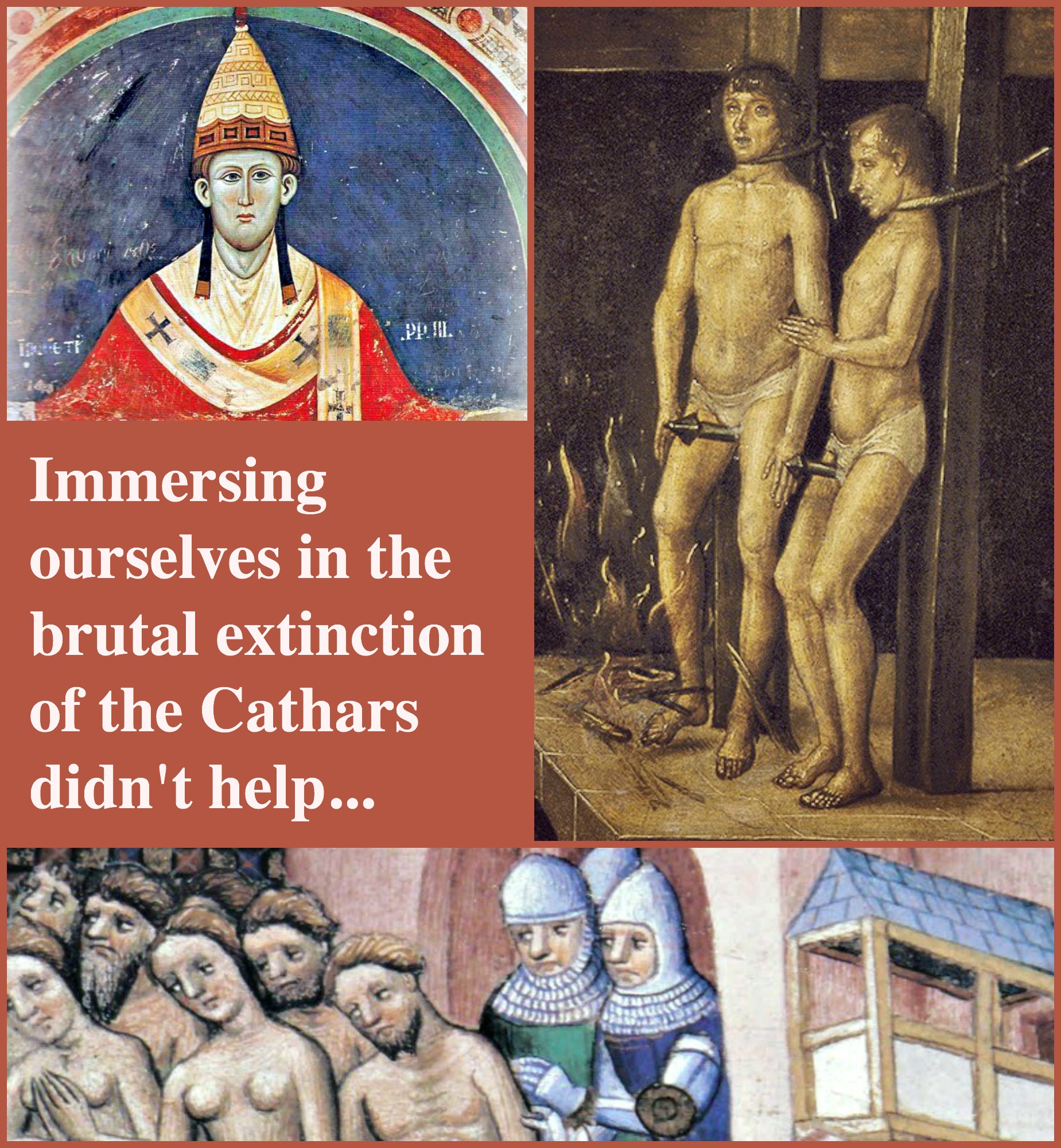
Exploring endless desolate, medieval stone hamlets had darkened our mood. Everything had been touched not only by the savagery of the Hundred Years’ War between the French and English in the 14th and 15th centuries but also by the 13th-century Cathar Crusade.

Prior to leaving for Europe, I’d read extensively about the Cathars and decided that we had to visit the region in which this shameful yet fascinating period of history took place.

The bloodthirsty military campaign of the pope, ironically named Innocent III, to eliminate the dualist offshoot of Catholicism in Languedoc-Roussillon was conducted with abandon against the heretics. No one was spared—men, women, children, and the elderly were all slaughtered. And when Catholics refused to give up their Cathar neighbors, one religious leader (a monk, no less) famously declared: “Kill them all. God will know his own.”

In a sunnier clime, this history might have been remote and intriguing. But against a backdrop of unrelenting gray with no access to the Internet, it left us feeling fogged in and low. Very low. After visiting so many places that witnessed sieges, starvation, plagues, pestilence, and butchery, even the cheeriest of souls would have succumbed to its grip.

Cathar Crusade

Photo credits (clockwise from top left): Pope Innocent III wearing a Y-shaped pallium, by unknown 13th-century artist; “Saint Dominic presiding over an Auto da fe” (detail), by Pedro Berruguete; Expulsion of the inhabitants from Carcassone in 1209, taken from the manuscript Grandes Chroniques de France. All images via Wikimedia Commons.

It’s a bug that thrives in the dark—and in the Dark Ages!

Melancholia, tinged with some serious mal du pays, reared its ugly head without warning. Perhaps we’d had our fill of cold, antiquated spaces and lonely, abandoned stone villages. Or perhaps the total absence of others to provide even a bit of people-watching diversion had brought us down. But maybe we were just in a trough of the normal vicissitudes of travel.

To put it simply, we missed our children and we missed our country—we’d come down with a serious case of le cafard.

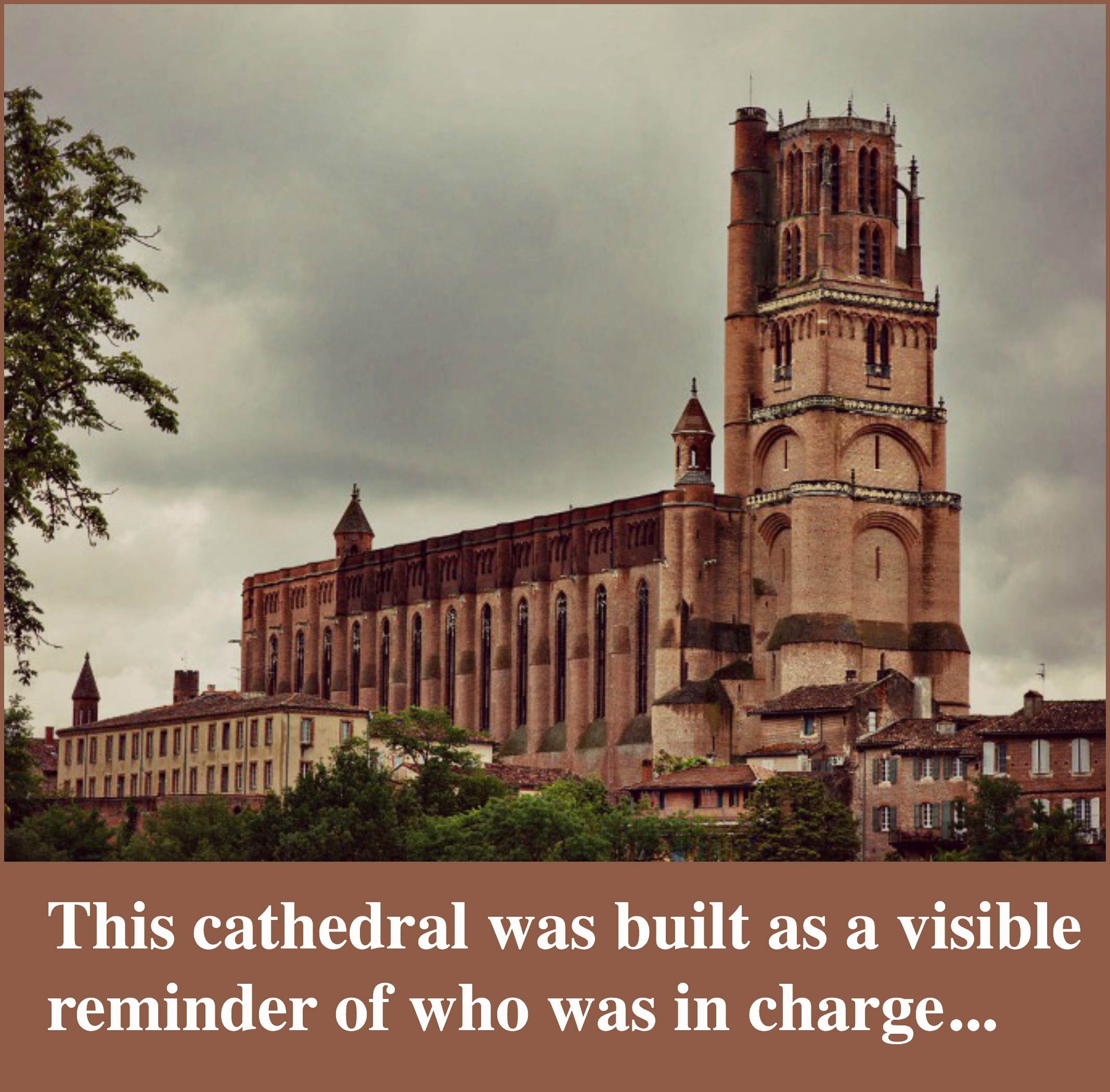
Despite knowing that immersing ourselves in the brutal extinction of the Cathars might not be what we needed to improve our dispositions, we plowed ahead toward our next destination: Caunes-Minervois, just north of Carcassonne. On the way, we stopped and hiked the steep Cathar hill town of Cordes-sur-Ciel, where the region’s alleged heretics had taken refuge, and took a long midday break for a sunny, outdoor lunch in Albi (home of Toulouse-Lautrec), with its austere, imposing redbrick cathedral of Sainte-Cécile, unlike any other church in the world. We noted that the cylindrical exterior of its nave looked like a space shuttle ready for launch. Sainte-Cécile was built after the Cathars were wiped out as a visible reminder to those who might be thinking of defying Rome not to forget who was in charge.

Sainte-Cécile Cathedrale

Photo credit: Cathédrale Sainte-Cécile d’Albi, vue de la rive opposée du Tarn, by Jean-Christophe BENOIST via Wikimedia Commons (CC BY-SA 3.0).

Back on the road, we drove farther south into the Montagne Noire to our ultimate destination: the constricted streets of Caunes-Minervois, where our Internet-enabled hotel awaited. It had been over a week since we’d communicated with our children, and we were lost in reverie about what we would learn when we fired up our laptops. Our son had had an interview the last time we spoke. Did he get the job? we wondered. Our daughter was coming down with a cold. Was she feeling better? Did my latest Amex payment process, and was the house we hoped to rent in Spain still available?

Just can’t get rid of it…

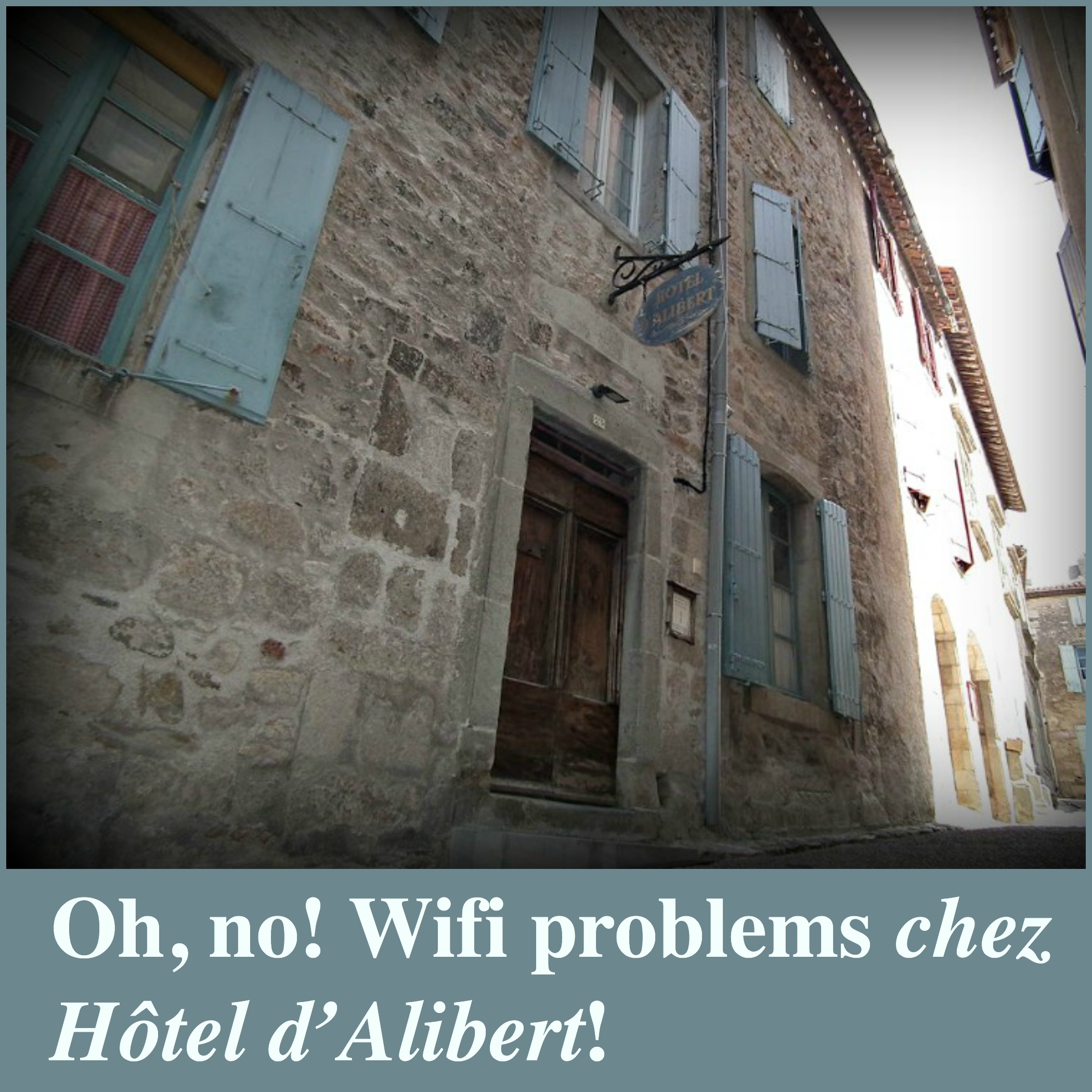
Our home for the next three nights was the Hôtel d’Alibert, an age-old townhome in the heart of the medieval quarter. The affable but quirky owner (you cannot arrive at the hotel between 2:00 and 5:00 p.m. because he is napping—it says so right on the door) lets us in through the French doors of the hotel’s restaurant at just after five. (The front portal remained inexplicably locked all day.)

The coda to our arrival in Caunes-Minervois was this: “Yes, the hotel has free Wi-Fi,” the proprietor confirmed, “but I’m afraid it’s not working; there have been problems.”

Wifi problems at Hotel dAlibert

Photo credit: Hôtel d’Alibert à Caunes-Minervois, by Gaël Gendrotvia Wikimedia Commons (CC BY-SA 3.0).

We were enraged and on the verge of tears. Here we were in yet another deserted town with no means to connect. We dragged our devastated spirits up the spiral stone stairway to our room and dropped our luggage. Le cafard attacked with a vengeance. For the rest of the evening, in a fit of pique, we seriously contemplated the possibility of returning home—of giving up on this gap year business—but finally agreed that all would be better in the morning.

After our night of frustration and reflection, the morning light bolstered our resolve to rally.

* * *

Now back stateside, I still refer to a bout with the blues as le cafard. It just seems so perfect a term. How do other languages express this feeling of profound melancholia? Are there expressions in other languages as accurate as the French?

* * *

Thank you, Marianne! How well you’ve described, with the help of that vivid French metaphor, the sense of alienation that at some point or another plagues all of us who venture beyond borders to travel or live. The word we use on this site, “displaced”, simply isn’t strong enough! Readers, do you have any suggestions for words or sayings in other languages that can convey these feelings? Do let us know in the comments!

Marianne C. Bohr is a writer, editor and French teacher whose book, Gap Year Girl: A Baby Boomer Adventure Across 21 Countries, was published in early September (She Writes Press). She married her high school sweetheart and travel partner, and with their two grown children, follows her own advice and travels at every opportunity. Marianne lives in Bethesda, Maryland, where after decades in publishing, she has followed her Francophile muse to teach French. She has an author site where she keeps a blog, and is active on Facebook and Twitter.

STAY TUNED for the next fab post!

If you enjoyed this post, we invite you to register for The Displaced Dispatch, a round up of weekly posts from The Displaced Nation, and SO much more. Register for The Displaced Dispatch by clicking here!

Related posts:

WONDERLANDED: The Girl in the Mirror–from “Beautiful Affliction,” by expat writer Lene Fogelberg

Lene thru the looking glass

Photo credits (clockwise from top left): Lene Fogelberg author photo (supplied); “Alice through the Looking Glass”, Guildford, by Colin Smith via Wikimedia Commons (CC BY-SA 2.0); icu 2, by Jo Naylo via Flickr (CC BY 2.0).

A couple of days ago we were Wonderlanded with the award-winning Swedish poet Lene Fogelberg, who is now an expat and a writer. This post, which I’ve titled “The Girl in the Mirror,” is an excerpt from Chapter 44 of Lene’s newly published memoir, Beautiful Affliction. It describes the moment when Lene was staring into a mirror in a hospital room having removed all her clothes in preparation for emergency open-heart surgery. (As those who read her interview will know, she was diagnosed with a congenital heart defect shortly after her arrival with her family on the East Coast of the United States, and given only a week to live unless she had medical intervention.)

Unlike Alice, however, Lene has little desire to step through the looking-glass without knowing whether she will end up queen of her own heart…

* * *

IT IS A SMALL ROOM. A toilet. A sink. A soap and disinfectant dispenser on the wall. A single lamp over the mirror. A pale face. Is this me? These eyes, small blood vessels, black pupils dilated. I have nowhere to run. The door is locked and there is no window where I could crawl out, and even if there had been one, I would force myself to stay.

Everything. She said everything.

My shoes. Into the bag. Sweatpants. On top of my shoes. Sweater next. Fold. Into the bag. I’m getting dizzy bending over and getting up, but I have to do this. Slowly. T-shirt. Bra. Underpants. Socks.

Who will open this bag, take out these clothes, unfold them? The floor is cold under my feet.
No jewelry. No rings, no necklace. Nothing to keep my hair from my face. Just skin.

The girl in the mirror is shaking and fighting back tears and her eyes tell me: Do not look away do not dare look away you have to see this. Her chest swelling and shrinking, narrow shoulders, purple nipples, bluish skin stretched over her ribs.

It was all just pretend, she says, the roles you played, the costumes you wore. This is the real you.

Here is my body. Which I have fought and pleaded with and commanded and cared for and decorated and dressed and undressed and loved and hated. Here it is. Pale and thin. And yet it has been heavy, so heavy to carry. In a way it would be a relief to finally step out of it, fold it, and put it in a coffin.

But in these eyes I can see Ingrid and Stina dancing, and in these hands I can feel Anders’s touch, and on this forehead I can feel him stroking me gently, and in this scalp I can feel the pull of my mother braiding my hair, and on these shoulders I can feel the weight of my dad’s arm telling me he loves me without using words. They are all there; my body remembers them, all the memories written on my skin and in every movement.

My body remembers them

Photo credits (clockwise from top left): Getting ready to go out, by Lars Ploughmann via Flickr (CC BY-SA 2.0); release via pixabay; children’s dance via pixabay; Hans via pixabay.

There. My skin is soft under my fingers, will be soft under the scalpel. But my ribs are hard, resisting the line I’m drawing, the curve, showing the way to my heart.

Is this how it will end?

Can she be the queen of hearts

Photo credits; Heart via Pixabay; Red Queen of Hearts, by Suzanne Schroeter via Flickr (CC BY-SA 2.0).

I have done everything they told me. Followed the instructions. But this is the point where that’s not enough. It has to be my own decision. It has to be me reaching for the robe. Me putting it on. Me reaching for the bag. Me looking into the mirror one last time.

The girl in the mirror is staring at me, pleading, please don’t make me.

Is this really happening? Or am I down in the corner, my head in my hands, refusing to make this decision? Crying that it is not fair, it is not fair.

Please, please, don’t make me.

There, there.

Please, don’t.

There is no other way. You know it.

And the girl in the mirror is silent. And she looks away.

The doorknob is cold in my hand.

Click.

Push.

I open the door.

Cold doorknob

Open the door, by Hernán Piñera via Flickr (CC BY-SA 2.0).

Excerpt from Beautiful Affliction: A Memoir, by Lene Fogelberg

* * *

Thank you so much, Lene! I find it extraordinary that you can write so poetically about your adventure of stepping through such a macabre looking-glass and confronting the “real you”. Your powers of self-observation make me think of Alice’s declaration:

I could tell you my adventures—beginning from this morning; but it’s no use going back to yesterday, because I was a different person then.

Except Alice was a timid young woman, whereas you write from your heart about your heart. As you put it in a recent tweet:

There is no shortcut when you write from your heart. You drill through every layer protecting your innermost secrets.


Readers, what do you think? Has this excerpt from Lene’s book moved you, and made you want to read more? Beautiful Affliction, published by She Writes Press, is now available from Amazon or Good Reads. You can also visit Lene’s author site, whee she keeps a blog, and/or stay social by following her on Twitter, Facebook, and Instagram. And of course you can also express appreciation for Lene in the comments below. ~ML

STAY TUNED for next week’s fab posts.

If you enjoyed this post, we invite you to register for The Displaced Dispatch, a round up of weekly posts from The Displaced Nation, and much, much more. Register for The Displaced Dispatch by clicking here!

Related posts:


Wonderlanded with Lene Fogelberg, award-winning poet, writer, and double open-heart surgery survivor

There’s something from Alice in Lene Fogelberg’s story. Photo credits (clockwise, from top left): NecoZAlenky (original Czech film poster for Something from Alice) via Wikimedia Commons; Lene Fogelberg author photo (supplied); operating room via Pixabay.

Welcome back to the Displaced Nation’s Wonderlanded series, being held in gratitude for Lewis Carroll’s Alice’s Adventures in Wonderland, which turns 150 this year and, despite this advanced age, continues to stimulate and reassure many of us who have chosen to lead international, displaced, “through the looking glass” lives.

This month we travel
d
o
w
n
the hole with Lene Fogelberg, a Swede who has lived in quite a few places but right now can be found in Jakarta, Indonesia.

With her long red hair and blue eyes, she looks a little like a Swedish Alice. What’s more, her biography of her early years is not dissimilar to that of Alice Liddell, the muse behind the Lewis Carroll story. Growing up in a small town by the sea, Lene was full of curiosity about the wider world and also in love with words. Describing her youth in a recent guest blog post, Lene says that for her,

written words danced lightly as feathers on the page. I loved to read and made weekly visits to our small town library, the bicycle ride home always wobbly with the heavy pile of books on the rack.

But while similarities are rife to Carroll’s Alice, the “wonderlanded” story Lene lived as an adult in fact comes closer to Czech director Jan Švankmajer’s surrealistic interpretation in his 1988 film, Něco z Alenky.

Něco z Alenky means “something from Alice,” and Lene ended up taking something from Alice’s story when, after moving to the United States with her husband and children, she found herself being wheeled through a rabbit warren of hospital rooms into an operating theatre. As in Švankmajer’s film, she was in a bizarre dream rather than a classic fairy tale.

Strangely, from the time she was young Lene had suspected there was something wrong with her heart. She even harbored a not-so-secret fear of dying young, trying to make the most of each moment. But Swedish doctors repeatedly dismissed her concerns, treating her like a hypochondriac.

And then, it happened: her worst nightmare came true. Shortly after arriving in America she went to have a physical so she could get an American driver’s license—and the American woman doctor informed her she had a congenital heart condition and only a week to live.

Lene survived two emergency open-heart surgeries to tell her story: quite literally! Her memoir (and first book), Beautiful Affliction, is out this week from She Writes Press. Until now, Lene had written in Swedish, mostly poetry, for which she has won some awards. But even though she chose to write her memoir in English, she retains her poetic style, as we will see later in the week when we publish a short book excerpt.

But before that happens, let’s have Lene will take us down into her rather harrowing rabbit hole. True, she’s had some reprieve since since recovering from her surgeries and moving to Jakarta—but only some, as Jakarta is the kind of place where you have to take your life into your own hands to cross the street. But I’m getting ahead of the story—over to Lene!

* * *

Lene Fogelberg: Thank you, ML, and greetings, Displaced Nation readers. Just to give you a little more of my background: I grew up in the south of Sweden, in a small town by the ocean. As ML says, I often stood looking out over the ocean following the waves in my imagination, wondering about all the exciting places in this world. In my youth I spent a couple of summers in France studying French and falling in love with this beautiful country.

As newlyweds my husband and I moved to Germany as students for a year, where I learned the language and took care of our newborn baby (just three months old when we arrived). After Germany, we moved back to Sweden and stayed there until my husband’s employer offered him a position in the United States. We moved to a small town outside of Philadelphia, called Radnor. That became the scene of my life-threatening health crisis. How it erupted and played out is the topic of my book, which, as ML mentioned, came out this week.

We spent a year and a half in the United States in total and then moved back to Sweden for a couple of years. Nearly four years ago we relocated to Jakarta, but in December we will be moving again: to Kuala Lumpur, Malaysia.

“Stop this moment, I tell you!” But [Alice] went on all the same, shedding gallons of tears…

After moving to the US there was a huge pool of tears because of the drama that unfolded in the weeks following the transition. My husband and I had to have physicals prior to getting our American driver’s licenses, and as soon as the doctor put the stethoscope to my chest she reacted to the sound of my heart. It turned out I had a fatal congenital heart disease and that I’d lived longer with this disease than anyone the US doctors had ever met.

Beautiful Affliction story

As Lene attests in her newly published memoir, her “rabbit-hole” experience was full of heart, tears and physical drama. Photo credits (clockwise from top left): Front and back cover art for Lene’s book (supplied); Alice’s Adventures in Wonderland illustration by Milo Winter (1916), via Wikimedia Commons; The White Rabbit’s House, by Kurt Bauschardt via Flickr (CC BY-SA 2.0).

[S]he felt a little nervous about this; “for it might end, you know,’ said Alice to herself, ‘in my going out altogether, like a candle. I wonder what I should be like then?”

The events that unfolded are covered in my book Beautiful Affliction, which is a crazy story, full of heart and physical drama, not unlike Alice’s own confrontations with her changing body.

“Where should I go?” –Alice. “That depends on where you want to end up.” –The Cheshire Cat

Although my physical crisis was great, Jakarta has been one of the biggest challenges in a “wonderland” sense. The city is chaotic, with heavy traffic that is always jammed, making it difficult to navigate. I was shell-shocked for the first six months.

“Oh, I beg your pardon!” [Alice] exclaimed in a tone of great dismay…

Here in Jakarta where the population is mostly Muslim I try not to show too much skin. I wear clothes with sleeves and never skirts shorter than the knees.

skirt and shoes Alice in Wonderland

Photo credit: Alice shoes, by Shimelle Laine via Flickr (CC BY 2.0).

“Well, then,” the Cat went on, “you see, a dog growls when it’s angry and wags its tail when it’s pleased. Now I growl when I’m pleased, and wag my tail when I’m angry.”

Greeting people here in Indonesia can be a minefield. The safest bet is to put my hands together and say, “Namaste.”

“There’s certainly too much pepper in that soup!” Alice said to herself, as well as she could for sneezing.

I love nasi goreng and all the Indonesian dishes—but without the chili, which is too spicy for me.

Nasi Goreng Hold the Chili

Photo credits: Nasi goreng (fried rice), by Tracy Hunter; (inset) Nothing is real, nibble and drink me…, by Wonderlane. Both images via Flickr (CC BY 2.0).

Recipe for a Mad Hatter’s Tea Party

I would invite my family and friends from Sweden and serve all the delicious fruit that can be found here in Indonesia. I know how you can long for sunshine during the long, dark Swedish winters and I would love to give them all a vacation full of sunshine and fruit smoothies.

Tropical Tea Party

Photo credits: A Swedish Mad Hatter [my description], by Rodrigo Parás via Flickr (CC BY 2.0); Fruit stall in Bali, by Midori via Wikimedia Commons (CC BY 3.0).

“Well!” thought Alice to herself. “After such a fall as this, I shall think nothing of tumbling downstairs!”

I am getting more and more courageous. I guess living abroad gives me a sense of “I can do this” and when faced with challenges I can now say to myself: “You have been through worse.”

Advice for those who have only just stepped through the looking glass

Stay busy so you don’t lose yourself to too much introspection. Especially if you are a traveling spouse coming with your expat partner. Make friends who can go with you to explore your new country. And whenever you go on excursions, try to learn the language so you can speak with locals and really get to know the country more than from a tourist’s point of view. The feeling of discovering gems of knowledge that are not in the tourist guides, like a local saying, is very rewarding and makes you feel connected to your new “home”.

Alice had begun to think that very few things indeed were really impossible…

My next writing project is a novel that takes place here in Jakarta. It is a hilarious and heart-breaking story where I combine the ancient myths of Java with modern society and where East meets West. The first draft is basically finished and I hope to follow up my debut book with this story. It is kind of crazy and sometimes I wonder why I am writing it, but I am in love with the characters so I keep going. It is very much a fruit of my “down the rabbit hole” feelings. I would say that most of my writing comes from a place deep inside where I feel like I have discovered something unsettling with the world we live in and, because I need to pinpoint it, I write about it, in an effort to grasp it.

* * *

Thank you, Lene! Being wonderlanded with you was a moving experience. I sense you are a very special person to have survived so much and still be full of curiosity about the world. Readers, please leave your responses to Lene’s story in the comments. And be sure to tune in later in the week when we feature a sample of her writing! ~ML

STAY TUNED for the next fab post: an example of how Lene writes about her wonderlanded experience.

If you enjoyed this post, we invite you to register for The Displaced Dispatch, a round up of weekly posts from The Displaced Nation, and much, much more. Register for The Displaced Dispatch by clicking here!

Related posts:

LOCATION, LOCUTION: For Stephanie Patterson, the role of expat historical novelist seems to have been predestined

Location Locution
Columnist Lorraine Mace, aka Frances di Plino, is back with her latest interview guest.

Hello again, readers. Last month I introduced you to expat writer Oliver Tidy, who found his calling in writing crime novels set in the UK once he became an expat in Turkey. For my guest this month, Stephanie Patterson, it was the other way around. Stephanie developed an early passion for places other than her home country of Germany, and for the English and Scottish medieval periods. In other words, it seemed almost predestined that she would move to the UK and write historical novels set in these places and times.

Although Stephanie first lived in Kent when she arrived in the UK 18 years ago, she relocated to Aberdeen and then, after a stint in Wales (Cardiff), where she met her British husband, Laurence, has lived in Edinburgh for the past 10 years.

Stephanie Patteson destiny

Photo credits (left): Stephanie Patterson in her beloved Scottish Highlands (supplied); Map of Germany, by Central Intelligence Agency; The main geographical divisions of Scotland, by SFC9394—both images via Wikimedia Commons (CC BY-SA 3.0).

Not surprising, given her proclivities, Stephanie believes the key to settling into a new country is total immersion. In her case this technique greatly improved her grasp of the language (she is a certified translator of English to German). It has also enabled her to write romantic suspense and adventure set in Scotland, England and Normandy under the pen name of Cathie Dunn.

In 2011, Stephanie and Laurence set up Crooked Cat Publishing on the model of an independent US publisher. To date, Crooked Cat has published over eighty paperbacks and e-books with authors across the world, several of which have won (or been shortlisted for) prizes. It has quickly developed a reputation for producing quality fiction.

As Cathie Dunn, Stephanie has two historical novels published with Crooked Cat:

  • Highland Arms, a romantic Scottish adventure (originally released through Wild Rose Press), set in Stephanie’s favourite area of the Scottish Highands: Lochaber. It’s the first in her Highland Chronicles series.
  • Dark Deceit, the action of which takes place in 1140s England and Normandy, when a brutal civil war is taking place. It’s the first in her Anarchy Trilogy, set mainly in medieval Normandy.

She has also self-published Silent Deception, a romantic paranormal novella set in Victorian Cornwall.

When she isn’t writing, editing or publishing, Stephanie is visiting castles, towns and cathedrals throughout the UK. A hobby historian, she has taken university modules in Tudor Studies and Scottish Studies. While in Wales, she took part in medieval re-enactment (the medieval and Jacobite eras being her favorites).

Stephanie’s love for medieval Norman history saw her back in Normandy for a holiday in July. Ultimately, she (and her husband) would not rule out moving to France one day, and, yes, she is currently studying French to improve her knowledge of language and culture.

* * *

Welcome, Stephanie, to the Displaced Nation. I think I can guess the answer but I’ll ask you anyway: which comes first, story or location?

Yes, as you probably guessed, I’m usually inspired by location and/or architecture first, which I then combine with potential plot ideas. My Scottish romance, Highland Arms, was born when I travelled through Glencoe and along the dramatic Loch Linnhe in the Scottish Highlands. The forbidding scenery (helped by the adverse weather of sleet, rain and fog) was the perfect setting for an adventure set in the 1720, featuring a smuggler. I always carry a notepad, and on that occasion I found it very useful for jotting down ideas.

Photo credits (clockwise from top left): Highland Arms cover art; A view of Glencoe, by Ronhjones via Wikimedia Commons[https://commons.wikimedia.org/wiki/File:Gleann_comhainn.jpg] (CC BY-SA 3.0) [http://creativecommons.org/licenses/by-sa/3.0/]. Loch Linnhe, by Moralist via Wikimedia Commons[https://commons.wikimedia.org/wiki/File:Vy_i_skottland.JPG](CC BY-SA 3.0) [http://creativecommons.org/licenses/by-sa/3.0/].

Photo credits (clockwise from top left): Highland Arms cover art; A view of Glencoe, by Ronhjones; Loch Linnhe, by Moralist. Both images via Wikimedia Commons (CC BY-SA 3.0).

What’s your technique for evoking the atmosphere of a place?

For Highland Arms, I was fortunate enough to find booklets by local historians about the era, which allowed me to paint a more realistic picture. This, in combination with a number of visits during different seasons, allowed me to set the scene quite realistically. I did the same for Dark Deceit, which is partly set in Gloucestershire and partly in Normandy. I took hundreds of photos during a holiday in Normandy and kept going back to my travel diary for pointers. I prefer to write about areas I’ve visited. If I can convey my own feelings and impressions, it helps create the atmosphere.

Is landscape the only feature you look at to create a sense of location? What about culture, or even food?

As I write historical adventures, I tend to focus on history and landscape. I found Normandy hugely inspiring for its medieval history and the buildings that have survived from that era. The castles and cathedrals paint a vivid picture of 12th-century life, and I try my best to capture it and convey it into my stories. As you mentioned, I consider myself a hobby historian and have bookshelves full of history tomes, in English and French. It helps that I love the culture.

Can you give a brief example of your work which illustrates place?

Here is a passage from Highland Arms:

Catriona nodded. “Thank you, Mr MacKinnon. I wasn’t looking forward to scaling those peaks.” Her gaze scanned the shimmering surface high up, so glaringly white against the deep blue morning sky. Hidden under layers of cloud the day before, the steep hillsides now presented themselves in all their dangerous glory. Stunned by the beauty yet relieved she did not have to cross them, Catriona smiled as she gazed across crags as sharp as a dagger’s edge.

Relaxing in the stillness of her surroundings, she was surprised at her own reaction. Instead of the misery that held her in its grasp for the last few weeks, a new sense flowed through her.

A feeling of…belonging?

She shook her head in disbelief. What brought this on? The eerie stillness should unnerve her, but instead it calmed and steadied her. Taking a deep breath, she gave her mare a nudge with her heel. Perhaps this journey was going to be good for her after all. No longer banishment, but rather an escape. Perhaps even a fortunate escape.

By the time they reached a small settlement by the shore of Loch Linnhe, the sun had crossed its zenith. Melted snow, and the footfalls of men and horses, turned the ground into a muddy slush. A handful of cottages stood scattered along the path, their walls covered in a thick layer of mud to repel the winds. Smoke swirled through holes in the roofs, filling the air with the smell of peat.

Catriona took a deep breath, enjoying the dusky scent. While she waited for MacKinnon to return from a cottage he’d entered on their arrival, she nudged her mare to the water’s edge to let her drink. Her gaze roamed over the large loch, to the far shore and back to where a narrow arm of water branched off into Loch Leven, disappearing from sight between high peaks behind her. The rugged beauty pulled her in.

How well do you need to know the place before using it as a setting?

Though not always possible, I find it easier to describe a setting once I’ve visited it for long enough to develop a “feel” for the location. For Dark Deceit, I developed an impression of what life was like in that region during medieval times by exploring the abbeys in Caen and Falaise Castle, among other monuments from that era. The book’s hero is originally from a town called Mortagne, in today’s southern Normandy. During our holiday, we drove down to the town and had a wander through it. I took in the surrounding forests (which haven’t changed too much since the 1100s) and ignored the more modern aspects. I try my best to picture the landscapes as they might have been.

Which writers do you admire for the way they use location?

One of my favourite novels is Daphne du Maurier’s Jamaica Inn. The way she describes the desolate landscape, the remoteness of the location, is compelling. You have a real sense of being there. I also enjoy reading MM Kaye’s novels, mostly set in India and Africa. A Third Culture Kid (she was born in Simla and lived all over the world as an adult), Kaye evoked a sense of place that many other authors writing about those areas don’t manage in quite the same way.

Patterson faves

Photo credits: Cover art; insets: Young Daphne du Maurier (about 1930), by The Chichester Partnership via Wikimedia Commons (CC BY-SA 3.0); M.M. Kaye via goodreads.

Thanks so much, Stephanie!

* * *

Readers, any questions for the intrepid Stephanie Patterson? Please leave them in the comments below.

And if you’d like to discover more about Stephanie, why not visit her author site. You can also follow her on twitter at @cathiedunn.

Until next month!

Lorraine Mace writes for children with the Vlad the Inhaler books. As Frances di Plino, she writes crime in the D.I. Paolo Storey series. She is a columnist for both of the UK’s top writing magazines, has founded international writing competitions and runs a writing critique service, mentoring authors on three continents.

STAY TUNED for the next fab post!

If you enjoyed this post, we invite you to register for The Displaced Dispatch, a round up of weekly posts from The Displaced Nation, with weekly updates and much, much more. Register for The Displaced Dispatch by clicking here!

Related posts:

Photo credits (top of page): The World Book (1920), by Eric Fischer via Flickr; “Writing? Yeah.” by Caleb Roenigk via Flickr (both CC BY 2.0).