The Displaced Nation

A home for international creatives

Tag Archives: Crosscultural

TCK TALENT: Lisa Liang takes her show back on the road; second stop: Cape Town, South Africa (1/2)

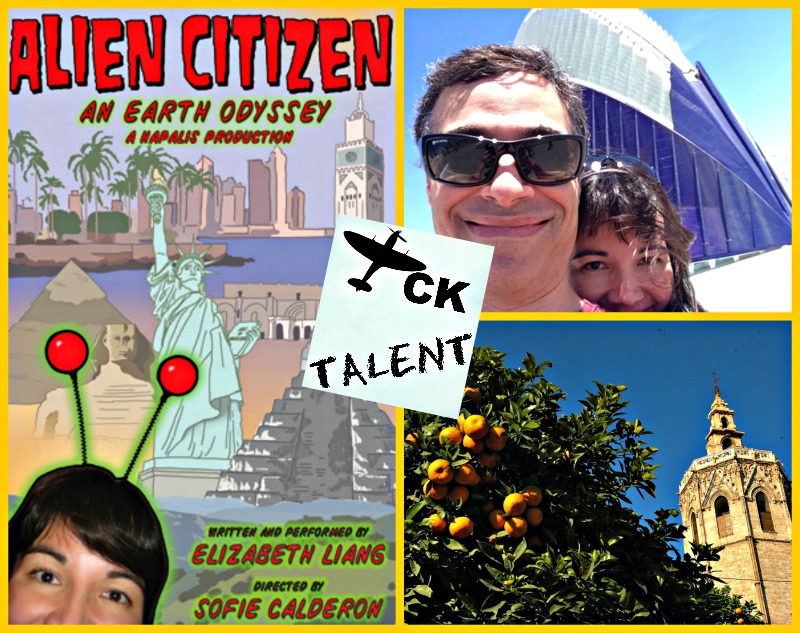
TCK Talent columnist Lisa and her husband (and techie), Dan, head to Cape Town. Photo credits: (from left) Alien Citizen poster; Lisa and Dan in front of Little Theatre on University of Cape Town campus; and view of xxx through bus window (supplied).

TCK Talent columnist Lisa and her husband (and techie), Dan, head to Cape Town. Photo credits: (from left) Alien Citizen poster; Lisa and Dan in front of Little Theatre on University of Cape Town campus (supplied, by Daniel Lawrence); and view of Table Mountain through bus window (supplied, by Lisa Liang).

For the second month running, our TCK Talent columnist Elizabeth (Lisa) Liang updates us on her own creative life. This is the first of a two-part post on her South African experience.

Howzit, dear readers—molweni!

I’m devoting this month’s column to the experience of taking  Alien Citizen: an earth odyssey, my one-woman show about growing up as a Third Culture Kid (TCK) of mixed heritage, to Cape Town, South Africa.

The occasion was the 2015 Women Playwrights International (WPI) Conference, held June 29–July 3. WPI has brought together women playwrights and allied theatre artists, cultural workers, and scholars since 1988. It facilitates communication and collaboration among the international community of women in theatre by holding conferences every three years.

In last month’s column I remarked: “It sounds like my kind of crowd.”

Well…it was!!

It felt enormously special to be at the conference’s 10th assembly and its first gathering on the African continent—my first time back in Africa since I graduated from high school, and my first visit to Cape Town. I’ll always be grateful to the donors who financed the trip via my online crowd-funding campaign.

Into Africa

It takes a gajillion hours to get from Los Angeles, California, where I live, to Cape Town (with a layover at Heathrow). My husband (and techie), Dan, and I can’t sleep on planes (!) so were jet lagged on arrival—and only too glad to reach our lodging at Graça Machel Hall at the University of Cape Town (a residence hall, or dorm), the cost of which was generously covered by a housing grant from the Writers’ Guild of Norway.

The room and especially the communal bathrooms gave us flashbacks to our college years—except this dorm was cleaner and full of adult delegates to WPI and other conferences, which we appreciated. We were also happy that the bathrooms provided a good hot shower—and were taken aback (but ultimately impressed) by the free condoms offered in every bathroom on campus.

Note to travelers: If you visit Cape Town in winter (May–July), be warned: indoors is colder than outdoors. Virtually no one has heating or insulation, so bring thermal socks and long johns to wear beneath your pajamas at night, and a thick sweater for any day you lounge indoors—and you’ll be fine. I also recommend gloves and winter hats, unless you’re from a below-freezing-in-winter climate, in which case you’ll likely shake your head and chuckle at all the other tourists complaining of the cold. (The Canadian delegates seemed to be the most bemused by the rest of us.)

The conferencing experience

Every day Dan and I rode the shuttle taking WPIC delegates to the conference site on UCT’s Hiddingh Campus. During the 15-minute drive along the highway, we thrilled at the sight of Table Mountain, Lion’s Head, Devil’s Peak, the harbor, and the Atlantic. It’s impossible to miss the mountains—they loom over, or cradle (depending on your perspective), Cape Town and are magnificent.

My conferencing mornings began with a fantastic keynote by an African theatremaker or a fascinating panel of mostly African playwrights, all women. This was followed by a tea/coffee/yummy-snack break, then workshops led by theatremakers from all over the world, and then a tasty lunch provided by WPIC. Then: readings of excerpts from plays written by playwrights from everywhere and read by South African actors of every race/ethnicity, doing accents from all over Africa and the English-speaking world. Then another tea break, more readings, then panels/sessions/networking/presentations, then supper break (not provided, and we learned that we could not get a bad meal in Cape Town—every dinner out was delicious). The evenings ended with full-length performances.

I was conferencing 12–13 hours daily, and there was usually a smorgasbord of offerings from which to choose in any given hour.

She's really there! Typical beak between conference sessions 9selfie); conference poster on campus (supplied, by Daniel Lawrence).

She’s really there! Photo credits: Typical break between conference sessions (supplied, selfie); conference poster on campus (supplied, by Daniel Lawrence).

Prep for show time

Dan, meanwhile, toured around Cape Town—but joined me for the two technical rehearsals for Alien Citizen in the Little Theatre on campus. After the classroom debacle learning experience at SIETAR Europa in Valencia in May, we were so happy to be in an actual theatre again! The theatre was a bit run down, but it had a booth, professional lighting grid, and Sean (WPIC15’s excellent production manager), so we were stylin’.

If you’ve been following this column for at least a year, then you know what happened with my first old-fashioned slide projector in Iceland. (Woe.) Well, it nearly happened again. I forgot to attach the slide projector to the voltage converter that I bought expressly for Valencia and Cape Town. Instead, I plugged the projector to the wall with a little plug adapter…and it roared as a burning-wires-and-plastic smell permeated the air.

Gah!!!!

I unplugged everything, made adjustments, replaced the bulb, et voila! The projector worked normally…as long as you could ignore the lingering odor of burned something-or-other.

Conferencing highlights

After making sure that my laptop could communicate with the theatre’s screen projector (EVERY venue’s screen projector is its own special starflake), Dan went back to his Cape Town exploring while I attended another conference lunch. Lunches tended to be three quarters sociable (talktalktalk) and one quarter zombie apocalypse (many of us on iPads/iPhones while digesting). At every lunch, I sat with new people, all of whom were interesting and amiable and from everywhere. That was one of my favorite aspects of the conference.

Other highlights of the conference included:

  • the opening keynote by Zambian-born Mwenya Kabwe, who spoke humorously and eloquently about theatre and being an African woman theatremaker.
  • the performance of Walk: South Africa, which taught us a grim statistic, that half of all South African women will be raped in their lifetimes.
  • Kenyan actress-playwright Mũmbi Kaigwa’s reading of an excerpt from her smart, funny, and moving solo show, They Call Me Wanjikũ.
  • a panel of extraordinary South African theatremakers who told us that all theatre in South Africa in the 1980s was held in protest to Apartheid, but nowadays the theatre scene has become very segregated—it has regressed.
  • the workshop on Community Play Creation lead by Hope McIntyre of Sarasvàti Productions in Canada.
  • countless amazing women, including another ATCK playwright who grew up in many more countries than I did, and an Egyptian professor who was a budding playwright, which brought back happy memories of Egypt.
  • the final keynote by the incredibly accomplished Napo Masheane of South Africa. She spoke of working in a jewelry store as a teen, where adult white men would come in and immediately say: “Can I please talk to someone more intelligent?” She ended her speech with a poem that had a beautiful refrain, which she repeated with evocative gestures more and more quietly until she was only mouthing the words while making the gestures, and it made me cry:

    Do not shut your temple doors, whatever you seek seeks you, whatever you want wants you, whatever you need needs you.

    Do not shut your temple doors, there is enough space for all of us to shine, let us dance with fire under the stars.

SouthAfricatheatreconference_arrow

The delegates to the 2015 Women Playwrights International Conference, in Cape Town. Photo credit: Nardus Englebrecht Photography.

Show time!

After the final keynote, Dan and I had another tech rehearsal for Alien Citizen to program the lights. Sean gave the sandstorm-in-Casablanca a nice effect with upstage lights flickering, and the high-school-dance-in-Cairo was even more humorous because he spotlit me in purple with white polka dots that shimmied back and forth, reminiscent of a disco ball’s reflection.

And then it was showtime. After my experience in Valencia, I couldn’t help but have doubts over whether we would have a decent audience. But while I was waiting in the wings I heard delegates enter and sing along to some pre-show music (“Dancing Queen” and “Stand by Me”). I was glad they were getting into the mood, and it sounded like there were a lot more than 20! When I began the performance I could see that it was a “good house” (theatre jargon for “numerous seats filled”) and there were lots of laughs (which sounded slightly surprised, probably because most of the other shows at the conference had been about harrowing subject matter).

Afterwards I received amazing feedback from delegates from South Africa, Canada, Lebanon, Sweden, Egypt, India, Indonesia, Germany, Hungary, New Zealand, USA, Australia, Spain, Singapore, Kenya, Brazil, Jamaica, and more. Several said that the show was a great way to end the conference. I felt relieved, gratified, and honored.

That night, we met with other delegates at Addis in Cape for tasty Ethiopian food (and a cosmo for me). I’m always slightly braindead after performing, but it was lovely to “wind down” with other theatremakers who were very positive about the show. The next morning at breakfast, and again as we checked out of the dorm, more delegates praised Alien Citizen, which was the best way to end the conference for me.

Before, during, after the show. Photo credits: Drama of the slide projector (selfie by Lisa Liang, supplied); the show, which closed the conference; post-show cosmo at Addis in Cape Town (the latter two by Daniel Lawrence, supplied).

Can’t get over Africa

Thank you for reading, and stay tuned next month for Part 2 of Alien Citizen: an earth odyssey’s trip to Cape Town, to include tours of the winelands, the Cape Peninsula, Robben Island (where Nelson Mandela was imprisoned for 18 of the 21 years he served behind bars), District Six Museum (a tribute to the 60,000 inhabitants of District Six, a former residential area of Cape Town, who were displaced by the apartheid regime), the aforementioned Table Mountain, and more! Until then…hamba kahle!

* * *

Thank you, Lisa! Once again, you’ve taken us on a vicarious journey—not only into a part of the world to which I’ve never been but also into the midst of theatre people, your creative tribe! I found it fascinating, as I’m sure others will as well. Readers, please leave questions or comments for Lisa below.

STAY TUNED for the next fab post!

If you enjoyed this post, we invite you to register for The Displaced Dispatch, a round up of weekly posts from The Displaced Nation, with news, book giveaways and other extras. Register for The Displaced Dispatch by clicking here!

Related posts:

CULTURE SHOCK TOOLBOX: Expats, if success in another country is what you’re after, throw the tools away and go for total immersion

Fiona Citkin for Culture Shock Toolbox
For her column this month, transitions enthusiast H.E. Rybol interviews displaced creative Fiona Citkin about her culture shock memories and coping strategies.

Hello, Displaced Nationers! Today I’m excited to introduce you to Fiona Citkin, who is a professional “diversiculturalist.” She runs her own consultancy on intercultural business competence and has written a major work on the link between intercultural competency and diversity in business, for which she was named Champion of Diversity in 2012.

Lately she has turned her attention to women leaders in the United States who are immigrants. These women came from other countries and “made” it in the world’s most competitive society, despite facing what Fiona calls “quadruple jeopardy”: 1) being women; 2) being mothers; 3) being ambitious; and 4) being foreign born. Fiona’s book is called Cracking the Code: How American Immigrant Women Leaders Achieve Success under Stress. If you’re curious to find out more, I urge you to follow her Huffington Post column, where she provides monthly reports on her research findings.

Fiona has experienced no small measure of that immigrant stress, and success, herself. She grew up and was educated in the Ukraine but has now made the leap to New Jersey.

Though Fiona is constantly on the go, I was able to catch up with her and ask her a few questions about her own culture shock experiences and tools for dealing with them. Here’s what she had to say…

* * *

Hi, Fiona, and welcome to the Displaced Nation. Can you tell us a little about your background?

I was born in Ukraine and lived there most of my life. I started a family; defended two doctorates; wrote an academic book on terminology and translation science; and became head of the English Department at Uzhgorod State University in Transcarpathia (Western Ukraine). I was a visiting professor at the Universities of Budapest, Hungary; Vienna, Austria; Bern, Switzerland, etc.—and have attended many linguistic conferences all over Europe. The longest time I stayed abroad while living in Ukraine was for a teacher-study semester at the University of Edinburgh in Scotland. In short, I knew the taste of success in my homeland. And then I became a Fulbright Scholar to the United States, which gave me the experience of what it means to have one’s old life burn down and try to be a phoenix in a foreign land. As a newcomer in America, I have reinvented myself more than once.

In the context of transitioning from Europe to the United States, did you ever put your foot in your mouth? Can you share any memorable stories?

Here’s a story: I’ve been taught British English, like everybody in Europe. Learning the differences between the British and the American English seems funny now—but wasn’t then. For example, my co-worker Hugh, a friendly guy, suddenly started paying compliments to me, like “Oh, your pants are beautiful” – “Another pair of pretty pants, Fiona” – “I wish my fiancé had such nice pants as yours.” I felt confused and didn’t respond, because in Britain “pants” typically denotes ladies’ underwear…what does he want, I thought? Finally, a girlfriend explained to me that Hugh meant to praise my choice of what in Britain is referred to as “trousers.”

He likes my pants

Photo credit: Pixabay.

What does one do in a situation like that?

When I am not sure what to say, I say nothing and just smile.

Looking back on your transition from the Ukraine to the East Coast of the U.S., can you recall any situations that you handled with surprising finesse?

I hate to brag about “finesse” in cultural matters. No amount of time you live in your new/adopted country can guarantee your 100% integration and “finesse”—because deep down you’ll always be yourself, have a soft spot for your native land, and retain some inborn traits of your original culture. For my upcoming book I have interviewed 50 outstanding American women achievers who happen to be first-generation immigrants, so I have not only my own experience but also their accumulated know-how of how to handle cultural transition. The main fact is: cultural integration is a must for those who want to succeed in a new country.

If you had to give advice to someone who just moved to a new country, what’s the tool you’d tell them to develop first and why?

First, focus on strategies rather than tools, or tactics, because first things should come first, right? After twenty years of living and working in the United States, I have some worthy advice to share—and my books’ subjects have even more. To put it in a nutshell:

  1. Get the best education you can, hopefully in the field that’s most desirable in the host country (high-tech is the best for the USA).
  2. Learn the language BEFORE you come as an immigrant—but remember that culture trumps language, e.g., cultural integration is more important.
  3. Learn to be outgoing, friendly, and helpful to others; participate in the work of your local community.
  4. Be entrepreneurial—as this is the best way to sustain yourself: immigrants experience difficulties in getting jobs, everywhere.
  5. Last but not the least, use whatever your cultural heritage equipped you with to your best advantage.
American Flag and immigrant women successes

Photo credits: Ivana Trump, by Lloyd Klein via Flickr (CC BY 2.0); Firma de Isabel Allende, by Pedro Cambra via Flickr (CC BY 2.0); Gloria Estefan, by Louise Palanker via Flickr (CC BY-SA 2.0). American flag by Pixabay.

Finally, before my book comes out, you can pick up ideas and pieces of advice from my monthly blogs at the Huffington Post.

Thank you so much, Fiona, for taking the time to share your culture shock stories. Developing an outgoing personality—but also knowing when to smile and say nothing—sounds to me like the kind of gauge or caliper we could all use in our cultural transitions. And if you’re in it to win it, so to speak, then it’s time to throw the toolbox away and immerse yourself, hook, line and sinker!

* * *

Readers, what do you make of Fiona’s advice? It would be particularly interesting to hear from those who meet her quadruple stress test (woman, mother, ambitious, foreign) but still have managed to achieve some success: do you have anything to add to Fiona’s prescriptions?

Well, hopefully this has you “fixed” until next month.

Until then. Prost! Santé!

H.E. Rybol is a TCK and the author of Culture Shock: A Practical Guide and Culture Shock Toolbox. She loves animals, piano, yoga and being outdoors. You can find her on Twitter, Linkedin and Goodreads. She is currently working on her new Web site and her second book.  

STAY TUNED for next week’s fab posts.

If you enjoyed this post, we invite you to register for The Displaced Dispatch, a round up of weekly posts from The Displaced Nation—and much, much more! Register for The Displaced Dispatch by clicking here!

Related post:

BOOKLUST, WANDERLUST: Beach bound? Check out summer reading recommendations from featured authors (2/2)

booklust-wanderlust-2015

Attention displaced bookworms! Our book review columnist, Beth Green, an American expat in Prague (she is also an Adult Third Culture Kid), empties the remainder of her treasure chest that she brought to us two days ago, stuffed with recommended reads to take you through the summer.

Hello again. As explained in Part One of this post, I reached out to some of my bookish friends as well as a few of the authors whose books I’ve recently reviewed to see what books they recommend taking on vacation. I asked them to tell me:

Summer Reading 2015

Photo credits: Amazon Kindle PDF, by goXunuReviews via Flickr (CC BY 2.0); beach chair and sandy feet via Pixabay.

Here are the rest of the recommendations I received, including a few from yours truly and ML Awanohara (Displaced Nation’s founding editor) at the end. Enjoy!

* * *

MARK ADAMS, best-selling travel writer and author of Meet Me In Atlantis (which we reviewed in May): My recommendations are a classic travelogue, a biography of an intrepid traveler, and an adventure novel.

The-Snow_Leopard_cover_300xThe Snow Leopard, by Peter Matthiessen (Viking Press, 1978)
Shortly before he died, I had the honor of interviewing Matthiessen at his home on Long Island. I was surprised by how concerned he seemed, knowing that his death was rapidly approaching, that he would be remembered less as a novelist than as the author of The Snow Leopard. I went back to reread it for the first time in twenty years and was amazed by how good it was—a moving story about a man’s search for meaning through Zen Buddhism after the death of his young wife, intertwined flawlessly with a thrilling narrative about an incredible journey through the Himalayas. So fresh and evocative it could have been published yesterday.

Bruce-Chatwin_A-Biography_cover_300xBruce Chatwin: A Biography, by Nicholas Shakespeare (Anchor, 2001)
Chatwin, of course, is one of the great travel writers of all time; he practically reinvented the genre with books like In Patagonia and The Songlines. But as Shakespeare’s brilliant biography demonstrates, Chatwin’s greatest creation may have been the globetrotting persona that he carefully presented to the world. The descriptions—decodings might be a better term—of how Chatwin assembled his literary works will be absolutely riveting to anyone who has tried his or her hand at trying to pin down the essence of a place using only words.

State-of-Wonder_cover_300xState of Wonder, by Ann Patchett (HarperCollins, 2011)
I once heard Ann Patchett on the radio, talking about the job of a novelist. She described it as “creating a world.” No one creates worlds with quite the skill that Patchett does. Reading her descriptions of pharmaceutical research being conducted in the Amazon is like being dropped into the jungle—you can feel the sweat beading on your forehead and the buzz of malarial mosquitoes preparing to land on the back of your neck. And you know what? Patchett’s Bel Canto, which takes place in Lima, Peru, is an equally brilliant tale that performs the magic tricks that only great fiction can, allowing you to read minds and travel through time and space.


MARIANNE C. BOHR, Displaced Nationer and author of the soon-to-be-published Gap Year Girl: A Baby Boomer Adventure Across 21 Countries: My summer reads are usually of the meaty kind because as a teacher, I have more time in July and August to pay close attention and savor every word. As one who suffers wanderlust daily, my three choices all have to do with travel. They are very different books, but each grabs my heart in a different way and I could read them over and over, each time discovering something new.
Bohr Collage

The Drifters, by James A. Michener (Random House, 1971)
This book takes me back to my youth and the thirst for exotic adventure that goes along with being young.

Nothing to Declare: Memoirs of a Woman Traveling Alone, by Mary Morris (Houghton Mifflin Harcourt, 1998)
I wanted to head straight to Mexico when I read this heart-wrenching book and also felt like the author was a new friend when I finished.

An Italian Affair, by Laura Fraser (Vintage, 2001)
What a guilty pleasure immersing myself in this book of islands, romance, lust and longing is. I could read it again and again.


SHIREEN JILLA, adult TCK and former expat and author of The Art of Unpacking Your Life (which we reviewed in May) and Exiled (which we featured in 2011): I would pack three very different books:
Jilla Collage

Red Dust: A Path Through China, by Ma Jian (Vintage, 2002)
Dissident artist Ma Jian’s diary of his walk across China in the wake of his divorce and threatened arrest is utterly enlightening, moving, profound and playful. Walking is clearly an under-rated pastime.

Look at Me, by Jennifer Egan (Anchor, 2009)
A powerful, beautiful novel about the crazed nature of modern urban life, it elevates Egan to one of the greats of American literature.

Paris Stories, by Mavis Gallant (NYRB Classics, 2011)
A regular writer for the New Yorker, Gallant penned these short stories about expats and exiles in Europe particularly Paris. They are brilliantly laid bare. (Born in Montreal, Gallant moved to Paris when she was 28 determined to be a full-time writer. She lived there until her death in 2014.)


BETH GREEN, writer, expat, TCK and BOOKLUST, WANDERLUST columnist: Here are my three picks, one of which I’ve not read and two that I have:

The-Messenger-of-Athens_cover_300xThe Messenger of Athens by Anne Zouroudi (Reagan Author Books, 2010)
Summer is the best time to really sink into a mystery series. I love taking a few titles from an established series and binge reading them on the beach or by the pool. Previously, I’ve done this with Elizabeth George’s Inspector Lynley novels, Janet Evanovich’s Stephanie Plum books and Charlaine Harris’ Southern Vampire mysteries. This year I’ll be spending some time on the beach in Greece, so I’ve got my eyes set on British writer Anne Zouroudi’s Greek Inspector mysteries, which depict ugly crimes based on the seven deadly sins in beautiful Mediterranean surroundings. The series now has seven books, of which Messenger is the first. (Born in England, Zouroudi worked in the UK and the USA before giving it all up to live on a Greek island. She married a Greek as well.)

swamplandia_coverSwamplandia! by Karen Russell (Vintage, 2011)
This darkly fascinating and somewhat magical story of a girl and her siblings abandoned in a run-down theme park in Florida fascinated me when I read it a few years ago. It’s both a chilling odyssey into a swampland netherworld and an exploration of subcultures of the kind rarely seen in American books. For me it had the right amount of tension to keep you turning pages and the right amount of whimsy to keep the potentially depressing material light enough for a summer read.

Daughter-of-Fortune_cover_300xDaughter of Fortune, by Isabel Allende, trans. by Margaret Sayers Peden (Harper, 2014)
Summer is a time for voyages—or at least reading about them! I can name a whole bagful of road trip books I’d happily re-read over summer, but for pure swashbuckling joy I have to recommend Isabel Allende’s historical cross-cultural adventure Daughter of Fortune. An upper-class girl raised in an English enclave in Chile in the 1800s stows away to follow her lover to the gold fields of California. I haven’t read the sequel, Portrait in Sepia, yet, but I’m guessing it’s also worth adding to that beach bag. (Born in Peru and raised in Chile, Allende lives in California.)


ML AWANOHARA, former expat and Displaced Nation founding editor: We are constantly reporting on new displaced reads in the Displaced Dispatch, which comes out once a week. Just to give you a taste of the kinds of things we feature, here is a selection. As you can see, it comprises a work of historical nonfiction that reads like a novel, a memoir with elements of Nordic myth, and a novel by a once-displaced poet, all with beach-bag potential.

Daughters_of_the_Samurai_cover_300xDaughters of the Samurai: A Journey from East to West and Back, by Janice P. Nimura (W.W. Norton, May 2015)
Call it the early Japanese version of our gap year or junior year abroad. The story begins in 1871, after Commodore Perry’s ships opened Japan to the outside world, when five young women were sent to the United States on a mission to learn Western ways and help nurture a new generation of enlightened Japanese leaders. Three of them stayed for ten years and returned to Japan determined to revolutionize women’s education. Several critics have said the book reads like a modern fairy tale. But if the women faced many hurdles in the course of their unusual journey, the tale doesn’t necessarily end happily ever after. “I cannot tell you how I feel,” one of them remarked upon her return to her native land, “but I should like to give one good scream.” Janice Nimura, an American who is married to a Japanese, has spent time living in Japan.

Passage-of-the-stork_cover_300xPassage of the Stork: One Woman’s Journey to Self-Realization and Acceptance, by Madeleine Lenagh (Springtime Books, March 2015)
Madeleine Lenagh is American but spent her first five years as an expat child in Europe, after which she grew up in Connecticut. Rebelling against her mother’s interference in her love life, she set out to travel across Europe alone. Arriving in the Netherlands broke, she took a job as an au pair—and the rest is history. She has now been living in the land of cheese and tulips for over four decades and speaks fluent Dutch. But that’s her travel history. Her own personal history remained repressed until she wrote this memoir. One of the things that interests me about it is that Lenagh chose to weave together the narrative using Nordic mythology. (As long-term followers of the Displaced Nation will know, we are fond of doing the same with the Alice in Wonderland story.) Passage of the Stork is a publication of Springtime Books, the new fledgling of Summertime Publishing, which specializes in books by expats and for expats and is the brainchild of global nomad Jo Parfitt.

hausfrau_coverHausfrau, by Jill Alexander Essbaum (Random House, March 2015)
This novel by Texas-born American poet Jill Alexander Essbaum, her first, depicts an American woman in a cross-cultural marriage to a Swiss banker. They are living with their three young children in a postcard-perfect suburb of Zürich. In the spirit of Essbaum’s erotic poetry, Anna (yes, the name is a nod to Tolstoy’s heroine) engages in a series of messy affairs. Now, is this book the expat answer to Fifty Shades? Actually, the answer to that question interests me less than the fact that Essbaum herself was once a hausfrau in Dietlikon, near Zürich, where she moved with her first husband, an American interested in studying Jungian psychoanalysis. Like Anna, she experienced intense loneliness and isolation—albeit no torrid affairs. Who would have guessed?

* * *

Thank you so much for your recommendations, ML and everyone else! Readers, it’s your turn now. What books are you looking forward to popping in the book bag this summer? And, for our friends in the Southern Hemisphere, what books are getting you through the winter?

Also, can I echo ML’s contribution by urging you to sign up for the DISPLACED DISPATCH, which has at least one Recommended Read every week. And please feel welcome to make recommendations for books to be featured in the Dispatch, and in this column, by contacting ML at ML@thedisplacednation.com.

STAY TUNED for next week’s fab posts!

Beth Green is an American writer living in Prague, Czech Republic. She grew up on a sailboat and, though now a landlubber, continues to lead a peripatetic life, having lived in Asia as well as Europe. Her personal Web site is Beth Green Writes. She has also launched the site Everyday Travel Stories. To keep in touch with her in between columns, try following her on Facebook and Twitter. She’s a social media nut!

If you enjoyed this post, we invite you to subscribe to The Displaced Dispatch, a weekly round up of posts from The Displaced Nation and much, much more. Sign up for The Displaced Dispatch by clicking here!

Related posts:

BOOKLUST, WANDERLUST: Beach bound? Check out summer reading recommendations from featured authors (1/2)

booklust-wanderlust-2015

Attention displaced bookworms! Our book review columnist, Beth Green, an American expat in Prague (she is also an Adult Third Culture Kid), has arrived with a treasure chest full of recommended reads to take you through the summer. NOTE: Check out Part Two here.

Hello again, Displaced Nationers!

Summer is upon us—well, for readers in the northern hemisphere, that is! And for those in the United States, Fourth of July weekend is coming shortly. Even if you’re not beach bound, perhaps you are at least picturing yourself sitting in a beach chair feeling the sand through your toes, the waves pounding towards you, the fresh, bracing sea air filling your lungs…

And what’s that you have in your hand—a book or a Kindle?

I find the sound of the waves and the ocean breeze the perfect conditions for escaping into other worlds that writers conjure up for us in their books. This summer, I’ve already been to a few local parks with my e-reader, and I’ll soon be topping it up with some of the books from our best-of-2014 list for an overseas trip. But I’m always on the look-out for fresh new material, and as there are miles to go before I can flop down on the beach of my dreams, I fear I’ll run out of prime reading matter by then. With this eventuality in mind, I decided to reach out to a few of the authors whose books I’ve recently read or reviewed, along with a few of my bookish friends, to see what books they recommend taking on vacation. I asked them to tell me:

Summer Reading 2015

Photo credits: Amazon Kindle PDF, by goXunuReviews via Flickr (CC BY 2.0); beach chair and sandy feet via Pixabay.

They responded with recommendations that seem tailor made for an audience of international creatives. Enjoy! Part 2 will be posted on Friday.

* * *

ALLI SINCLAIR, world traveler, Australian romance author and former co-blogger at Novel Adventurers: I recommend that you bring one travel book, one classic, and one novel. The following make a good combination:

ChasingtheMonsoon_cover_x300Chasing the Monsoon: A Modern Pilgrimage Through India, by Alexander Frater (Henry Holt & Co, May 1992)
There are some books that touch something in your soul that stays with you forever. For me, Chasing the Monsoon falls into that category. Originally published in the early nineties (and thankfully, still available!), Alexander Frater follows the monsoonal rains from the Kerala backwaters in southern India to Cherrapunji, in northern India—known as the wettest place on earth. Frater connects beautifully with the people he meets and he writes for all senses, giving the reader a full immersion into one of the most captivating countries on Earth.

The Ascent of Rum Doodle_cover_x300The Ascent of Rum Doodle, by W.E. Bowman (Vintage Classics, 2010)
Originally published in 1956 but still in print, this book is one of the most celebrated mountaineering stories of all time. The 1950s saw some of the world’s highest mountains successfully climbed (including Everest), and this book is a parody of mountaineering at it’s finest…er, worst. There’s a route finder who is constantly lost, a diplomat who continually argues, and a doctor who is always ill. Rum Doodle will most definitely appeal to fans of Bill Bryson, who wrote the introduction to the book’s international edition (published in 2010).

HellofromtheGillespies_cover_x300Hello From The Gillespies, by Monica McInerney (Penguin, 2014)
I’m a long time fan of Monica McInerney’s books, maybe because Monica is a “displaced” person: having grown up in Australia, she has split her time between Australia and Ireland for the past 20 years. This book is mostly set in outback Australia but with ties to England. Angela Gillespie, a mother of four adult children, has sent out a regular Christmas letter to friends and family for thirty years. The notes are always cheery and full of good news but this year, her note details the unsettling truth of how her family has fallen apart. If you enjoy family sagas with humour and heart, you can’t go wrong with this book. (True, some people recommend it for the holidays, but it’s summer in Australia at Christmas time, remember?)


BRITTANI SONNENBERG, adult TCK, current expat and author of Home Leave (which we reviewed in November): I would pack the following books (assuming I’d be packing it for someone else, who hadn’t read them yet).
Sonnenberg_collage

The Dog, by Joseph O’Neill (Vintage, September 2014)
It’s a devilish, compelling take on cosmopolitan and expat life by the TCK author of Netherland. (Joseph O’Neill was born in Cork, Ireland, in 1964 and grew up in Mozambique, South Africa, Iran, Turkey, and Holland. He now lives in New York City.)

Ghana Must Go, by Taiye Selasi (Penguin, 2014)
This is an intimate examination of a splintered family, set in Accra, Lagos, London, and New York.

All My Puny Sorrows, by Miriam Toews (McSweeney’s, 2014)
One of the saddest and funniest books I’ve ever read; an honest, moving portrayal of sisters and mental illness.


CHRISTINE KLING, author of travel- and sailing-related thrillers: I’ve just finished up the edits on a the third novel in my Shipwreck Adventure series, and I’m looking forward to taking a bit of time off from writing and working at reading my way through some of the long list of books I’ve been wanting to read. The three books I’d take in my beach bag include two novels and a combination cookbook/memoir/travelogue.

The-Janissary-Tree_cover_x300The Janissary Tree, by Jason Goodwin (Sarah Crichton Book, 2006)
My husband and I are contemplating building a new boat in Turkey, and after our recent visit, I’ve fallen in love with the country. Jason Goodwin has written travel books, histories, and thrillers, and I’ve been waiting for the chance to begin reading his work. The Janissary Tree, winner of the 2007 Edgar Award for Best Novel, is the first in what is now his five-book series set in in the waning days of the Ottoman Empire’s Istanbul. The series features a very unique protagonist Yashim Togalu, a eunuch guardian. In this book, Yashim is called upon to investigate a series of crimes including murder and theft of jewels.

Marina_cover_x300Marina by Carlos Ruiz Zafón (Little, Brown Books for Young Readers, 2014)
The first book I read by this author was The Shadow of the Wind, which I often cite as one of my favorite books of all time. I knew Zafón had written a young adult novel that was published in 1999 and became a “cult classic” in Spanish, and since I enjoy good YA novels like the Harry Potter series and the Hunger Games, I was happy to see this book finally released in English in 2014. Marina is set in Barcelona around 1980 at the end of Franco’s regime. This gothic tale is touted as containing elements of mystery, romance and horror as a young boarding school boy meets the exotic, dark Marina. Together they embark on a series of adventures where they meet the kind of grotesque Barcelona characters Zafón does so well.

Sea-Fare_cover_x300Sea Fare: A Chef’s Journey Across the Ocean, by Victoria Allman (Norlightspress Com, 2013)
Years ago I worked as a chef on our owner-operated charter sailboat, and I know what it is like to have to create meals for demanding guests. Victoria Allman is in an entirely different category as she trained as a chef and has worked your years on multi-million dollar yachts. In Sea Fare, Allman has combined the tales from her beginning as a green Canadian chef looking for a job in the charter yacht industry to the joys of shopping in exotic markets from Italy to Vietnam. From the descriptions of her experiences on board the yacht, dealing with crew problems and falling in love with the captain, the stories are grand, but the recipes and the outstanding color photos of the food, will probably cut my trip to the beach short as I head home to try some new dish.


HEIDI NOROOZY, adult TCK, translator and author of multicultural fiction: I just returned from a research trip to Germany, and my choices seem to reflect that! (I went there because I’m writing a novel about an East German detective, Johannes Christian Alexander Freiherr von Maibeck—I know, it’s a bit of a mouthful—I created for a short story I once wrote. The setting is Leipzig, German Democratic Republic, 1981.)

The-Leipzic-Affair_cover_x300The Leipzig Affair, by Fiona Rintoul (Aurora Metro Press, May 2015)
Set in 1985, this novel tells the story of a Scottish student at Leipzig University who falls in love with an East German girl and stumbles into a world of shifting half-truths. Well written and fast paced, the story captures the atmosphere of its setting very well, a world where nothing is ever quite what it seems. As one reviewer writes: “The book is expertly written and seems to me to be a very comprehensive picture of what it was like to live in the East German state.” (Rintoul, a Scot who lives in Glasgow, gathered her material for the book by visiting East Germany and meeting a woman who had been imprisoned. She also looking at extracts of STASI files on people she met.)

Zoo-Station_cover_x300Zoo Station: Adventures in East and West Berlin, by Ian Walker (Atlantic Monthly Press, 1988)
British journalist Ian Walker, who once covered Central America for the Observer (and never managed to write his promised volume on Nicaragua), produced this travelogue on the two Berlins back in 1988. It depicts bohemian life in the once-divided city, where everyone seemed to be from somewhere else: West Berlin was full of Brits, Asians, Danes, Turks and East German exiles; East Berlin, of Anglo-Austrian expats. Walker’s descriptive narrative and reflections on the broader social issues of the day are what make this book stand out. As one of Amazon reviewer puts it:

Having read “Zoo Station”, I was able to understand why some people regarded East Germany as a pinnacle of socialist achievement, much more preferable to its capitalist twin in the West. It is good travel writing, and is both politically and culturally astute.

The-One-That-Got_Away_cover_300xThe One That Got Away, by Simon Wood (Thomas & Mercer, 2015)
Okay, this one isn’t about Germany, and I haven’t read it yet—but it’s at the top of my summer book bag. Tag line: “She escaped with her life, but the killer’s obsessed with the one that got away.” The story of two grad students in California who decide to take a road trip to to Las Vegas, this suspense novel deals with survivor’s guilt and is bound to be a thrilling ride. (Originally from England, Simon Wood lives in California with his wife.)

* * *

Readers, that’s it for this round; we’ll have another round on Friday (update: check it out here). Meanwhile, have you read any of the above and/or do you have summer reading recommendations to add? Please leave in the comments!

And if you need more frequent fixes, I urge you to sign up for the DISPLACED DISPATCH, which has at least one Recommended Read every week.

STAY TUNED for PART 2 of this post on July 3rd!

Beth Green is an American writer living in Prague, Czech Republic. She grew up on a sailboat and, though now a landlubber, continues to lead a peripatetic life, having lived in Asia as well as Europe. Her personal Web site is Beth Green Writes. She has also launched the site Everyday Travel Stories. To keep in touch with her in between columns, try following her on Facebook and Twitter. She’s a social media nut!

If you enjoyed this post, we invite you to subscribe to The Displaced Dispatch, a weekly round up of posts from The Displaced Nation and much, much more. Sign up for The Displaced Dispatch by clicking here!

Related posts:

TCK TALENT: Lisa Liang takes her show back on the road; first stop: Valencia, Spain!

This month our TCK Talent columnist Elizabeth (Lisa) Liang updates us on her own creative life.

¡Hola, amigos!

As those of you who subscribe to the Displaced Dispatch will know, Alien Citizen: an earth odyssey, my one-woman show about growing up as a Third Culture Kid, or TCK, of mixed heritage, was accepted by two international conferences in two of the world’s most appealing locations: Valencia, Spain, and Cape Town, South Africa. Thinking I’d be a fool to pass up this kind of opportunity, I launched an online crowd-funding campaign to fund both journeys. Two of us would be going: myself and my husband, Dan, who also serves as my “techie” for the show.

It was my fourth experience with crowd-funding—the most recent being last year, to cover expenses for taking the show to an arts center in Reykjavík, Iceland; and once again, the campaign worked. (A relief since I feared I might have tapped out my supporters’ goodwill, but people were as generous as ever—and I won’t ever fundraise for this show again.) We didn’t quite make our goal but could afford to cover the balance. We would be able to attend two international conferences on two continents in two months—hooray!

In this month’s column I’ll recount our trip to Valencia, Spain, to participate in the 2015 SIETAR Europa Congress, on May 21–23. SIETAR, which stands for the Society for Intercultural Education, Training and Research, is the world’s largest association dedicated to intercultural issues.

TCK Talent Lisa Liang takes her show on the road to Valencia, Spain.

TCK Talent columnist Lisa and her husband (and techie), Dan, head to Spain. Photo credits: (from left) Alien Citizen poster; Dan and Lisa in front of Ciudad de Artes y Ciencias (supplied); “Naranjo y el Campanario Valencia,” by Emilio via Flickr (CC BY-SA 2.0).

First impressions of the Land of Sweet Orange Trees

Dan and I had a couple of days of sightseeing before the three-day conference took place at the Universitat de Valencia. We drank lots of fresh-pressed zumo de naranja (“orange juice” in Catalán)—and yes, the oranges are the best we’ve ever tasted!

We toured the wonderful old section of the city, including the Cathedral and its Torre del Micalet, and the spectacular Ciudad de Artes y Ciencias (City of Arts & Sciences)—a futuristic outdoor/indoor complex near the beach, with an awesome aquarium. We even took the long bus route back to our hotel, which gave us a chance to see a lot of the Turia Gardens, a park built on a riverbed.

Dan got to carry on sightseeing while I attended sessions (workshops, panels, and lectures) during the first two days in order to meet people, learn more about the interculturalist professional world, and get the word out on Alien Citizen.

First impressions of SIETAR

In general the other conference participants seemed very nice but a tad noncommittal when I told them about my one-woman show. I think it was rather unusual to have a theatrical piece at the congress, though I noticed there were several sessions on storytelling as an important means of generating intercultural understanding.

Most of the attendees were what I would describe as interculturalist entrepreneurs—perhaps not your usual fringe theatre-goers? Still, I appreciated learning what sort of cross-cultural issues Europeans have been facing, and there was the bonus of generous lunches and yummy pastries along with coffee, tea, and zumo during the breaks. (I may have gained a pound or two.)

At the end of the second day, I was beat—but still had to do a run-through of my show in our hotel room that evening. Theatre takes stamina, so perhaps my two full days of attending conference events had done me a favor.

attending performing SIETAR

First she observes; then she performs. Lisa Liang at Congress Valencia 2015. (Photos supplied.)

Show Day!

The third day of the congress: show day! And some tension… For one thing, I didn’t realize until then that many congress-goers would take the day off to go to the beach or do sightseeing. I feared I might only have five or so attendees, which would be enormously disappointing after making the long journey from California (not to mention the fundraising!).

And for another, I was performing in a classroom like all the other session presenters, which meant we had just 10 minutes to set up. Ten minutes may be fine for a PowerPoint presentation but, especially as the session before us ran a little late, Dan and I really had to hustle to set up all the props, as well as the laptop, old-fashioned slide projector with voltage converter, my tape marks so I would know where to stand when projecting words onto my torso, and chair. We were in such a hurry that I forgot to set up chairs to stand and dance on “upstage.” I had to grab them from the front row in the middle of the performance. Funfunfun!

Despite these challenges, the show was a hit! People did turn up, and there were many more than five, thank goodness. They stayed for the whole performance, which was a coup—there had been walkouts from every session I attended in the previous days (with all the concurrent sessions, people were constantly session-hopping).

After the show, the applause lasted for such a long time that I exited the room to give the audience a break. But they didn’t stop, which was deeply gratifying and a huge relief, so I came back in and took some more bows. Many audience members stayed afterward to thank Dan and me, and in some cases draw parallels with their own lives. Those who found the story relatable included not just people like me, who grew up in different countries, but also people who’d lived only in Spain. One woman said she would distribute the show’s flyers at international schools in her country…so here’s hoping!

Most importantly: the show seemed to help people feel more connected and better understood, which is its ultimate mission.

Post-show celebrations

Post-show, Dan and I went out for a celebratory drink of horchata (made with tiger nuts) at one of Valencia’s oldest and prettiest horchata joints. Then we ambled over to the formerly half-Moorish, half-Catholic quarter, where we ordered a pitcher of sangria (since it cost the same as two glasses).

It may well have been the best sangria I’ve ever had—certainly worth the headache afterwards.

We made it back in time to attend the conference’s gala dinner, which took place in a lovely courtyard at the university. A couple of people who came to the performance approached me to say they were telling everyone at their tables about Alien Citizen. Again, I felt a mix of pride and relief.

Congrats Collage

Brava, Lisa, to another fine performance! Photo credits: (top and bottom) Lisa and Dan celebrating with sangria and at the gala dinner (supplied); (right) “A glass of horchata, Spain” via Wikimedia Commons (CC-BY SA 2.0).

To sum up…

Reflecting on the experience, I came to the conclusion that if the show is accepted at another non-theatre conference in the future, I should perform it only if it can be a keynote (as it was at the FIGT conference in 2014). Practically speaking, it takes time to set up the equipment and props, and as a performer I need space/room to relax and warm up before the show, which runs 80 minutes non-stop and takes my entire being to perform with the energy, precision, and authenticity that the audience deserves.

Still, I’m glad that we brought the show to this intercultural gathering, and I’d love to visit Valencia again. Food-wise, we had truly fantastic tapas and excellent wine, and as a night owl, I appreciated the late dinners. Virtually every Valenciana/o was very polite and friendly, and they all understood my slightly-gringa-inflected Guatemalan accent in Spanish.

The jet lag was only a problem on our first night. It took about a week to recover from it back in L.A., but that may partially be due to wistfulness: we’re not in Valencia anymore (woe!). Between its delights and our appreciative SIETAR audience, it was a fantastic, and very worthwhile, trip.

Next stop: South Africa!

At the time of writing I am preparing to attend the 10th Women Playwrights International Conference, being held in Cape Town from June 29 to July 3. WPI has brought together women playwrights and allied theatre artists, cultural workers and scholars since 1988. It facilitates communications and collaborations among the international community of women in theatre by holding conferences every three years.

It sounds like my crowd. But South Africa: that’s a first! We’re hoping to do a winelands tour and maybe a one-day safari tour. Watch this space for my next update.

* * *

Thank you, Lisa! I enjoyed taking that vicarious journey into a part of Spain to which I’ve never been. Imagine being able to drink fresh-pressed zumo de naranja to one’s heart’s content! (I’m not so sure about the horchata, though.) It was also interesting to hear your take on SIETAR: I know several Displaced Nationers were planning to attend. Readers, please leave questions or comments for Lisa below.

STAY TUNED for the next fab post!

If you enjoyed this post, we invite you to register for The Displaced Dispatch, a round up of weekly posts from The Displaced Nation, with news, book giveaways and other extras. Register for The Displaced Dispatch by clicking here!

Related posts:

CULTURE SHOCK TOOLBOX: Expats, don’t throw away your old coping tools—they may come in handy for your new life abroad

For her column this month, transitions enthusiast H.E. Rybol interviews displaced creative Jessica Lipowski about her culture shock memories and coping strategies.

June 2015 Jessica Libowksi Culture Shock Toolbox
Hello, Displaced Nationers! I’m excited to introduce you to road-less-traveled (#TRLT) buff and foodie Jessica Lipowski. Originally from Detroit, Michigan, Jessica moved to Amsterdam in February 2011 to be with her Dutch boyfriend, Matthijs. She has worked in a variety of jobs related to travel and is currently writing a non-fiction book that documents the stories of 83 entrepreneurs from 50 different countries who live in Amsterdam. They all have in common that they own restaurants in the city.

Jessica, who appreciates Amsterdam’s wide range of cuisines, has developed a curiosity about how all of these people ended up in the same industry, in the same city and with similar passions. As she writes on her site:

Why Amsterdam and how did so many people from every corner of the world end up in this small capital city? What drew them to the land of tulips and windmills?

But our focus today is not these expat restauranteurs but Jessica herself. While sampling Amsterdam’s rich cultural stew, has she ever had to put down her spoon owing to culture shock? And what tools did she use to restore her appetite?

* * *

Hi, Jessica, and welcome to the Displaced Nation. Can you tell us a little about your background?

I am originally from the United States, born and raised in the metropolitan Detroit area. I spent the first 23 years of my life in Michigan, apart from the two summer internships I completed in Washington D.C. In February 2011, I moved to the Netherlands and have resided in Amsterdam for the past four years.

In the context of transitioning from the United States into Europe, did you ever put your foot in your mouth? Can you share any memorable stories?

While working in sales and marketing for an online group travel platform, I often had to attend business meetings and conferences in Europe. I was a regular at one of these events, which took place four to six times a year. I soon developed a friendship with another regular, a Dutch woman, whom I’d always look forward to seeing. On one occasion when we met, she complimented me on the dress I was wearing. I thanked her and then, as I leaned in to share with her where I purchased the dress (I wanted to tell her I’d paid a relatively cheap price), she cut me off and said: “Oh, Jessica, you should never tell someone details like that.” I honestly thought she would appreciate hearing my story, but it turned out to be the kind of information that is supposed to be shared only with close friends.

I got a bargain! Shhh... Photos via Pixabay.

I got a bargain! Shhh… Photo credits: “Street signs of the nine Straatjes” on Wikimedia by JSpijer via Wikimedia Commons (CC BY-SA 3.0); other two photos via Pixabay.

What lessons can you offer to the rest of us from this story?

Instead of being offended, I smiled and apologized. I told my Dutch business acquaintance how much I appreciated that she’d corrected me, and I meant it sincerely, as it would keep me from making the same mistake again in future. I think a smile and an apology can go a long way in such situations. Of course it might have helped if I’d done more research beforehand on social customs and norms in various European countries. But if you haven’t done your research, then don’t be too proud to rely on business colleagues or local friends for advice.

Looking back on your transition from the United States to Holland, can you recall any situations that you handled with surprising finesse?

I surprised myself with my commitment to learning Dutch. My first exposure to the language occurred when I met Matthijs, who is now my partner. When we started dating, I used Rosetta Stone intermittently; but then, once I made the move to Holland, I started taking private lessons once a week. Expats can get by quite easily in Amsterdam speaking just English as the Dutch start learning English at a young age and many speak the language quite well. However, I felt it was important to learn Dutch so that I could speak it with my partner’s family. It’s not easy but can be done. It all comes down to practice, practice, practice.

If you had to give advice to someone who just moved to a new country, what’s the tool you’d tell them to develop first and why?

I guess it would be pack some of your old tools. Because one of the most important things to do when you first arrive is to establish a routine. A routine will help you settle into a new country and feel at home. For instance, if you used to work out or do yoga, search for a gym or studio. Or maybe you always looked forward to grabbing a cup of coffee on the way to work. So find a favorite coffee house en route. Did you used to have an active social circle? Then make a point of joining a local meet-up group, a sports team, classes or other activities where it’s relatively easy to make friends and develop a support system. It will make the transition that much easier.

Thank you so much, Jessica, for taking the time to share your culture shock stories with us. Leaning on local friends for advice and re-establishing small personal rituals or routines: those are two nifty tools that can ease the initial stress of changing countries.

* * *

Readers, what do you make of Jessica’s advice? Have you ever found yourself in a situation in your life abroad where you thought, “I should have done more research”? Do tell!

If you like what you heard from Jessica, be sure to check out her writer’s site and/or follow her on Facebook, Twitter and Instagram.

Well, hopefully this has you “fixed” until next month.

Until then. Prost! Santé!

H.E. Rybol is a TCK and the author of Culture Shock: A Practical Guide and Culture Shock Toolbox. She loves animals, piano, yoga and being outdoors. You can find her on Twitter, Linkedin and Goodreads. She is currently working on her new Web site and her second book.  

STAY TUNED for next week’s fab posts.

If you enjoyed this post, we invite you to register for The Displaced Dispatch, a round up of weekly posts from The Displaced Nation—and much, much more! Register for The Displaced Dispatch by clicking here!

Related post:

CULTURE SHOCK TOOLBOX: How to pry open your mind to new cultures—and keep them all sorted

Yelena Parker for CST Displaced Nation Columnist H.E. Rybol never saw a culture clash she didn’t want to fix. A “transitions enthusiast,” she credits her Third Culture Kid upbringing with giving her a head start in this department. That said, H.E. is always on the lookout for shiny new tools, and toward that end has been interviewing other displaced creatives about their culture shock memories and coping strategies. Today she speaks to Yelena Parker, a Ukrainian expat, executive coach, and writer who, through her many international moves, claims to have mastered the art of “moving without shaking.”

—ML Awanohara

Hello, Displaced Nationers! I’d like you to meet today’s guest, businesswoman and author Yelena Parker. Yelena is Ukrainian but has lived in the United States, Switzerland, Tanzania and now the United Kingdom, and has conducted business in many more countries. Last year she published a book titled Moving without Shaking, which made the Displaced Nation’s “Best of 2014 in Expat Books” list. Described as a “guidebook-meets-memoir,” it aims to help women “who are interested in building their new global life styles whether through working, studying, volunteering or simply living abroad.”

One of Yelena’s contentions is:

Once you are on a serial expat path, new relocations get easier.

Can we take this to mean it’s possible to get better at handling culture shock?

Let’s find out by asking Yelena to describe a few of her own culture shock experiences. She may advocate for moving without shaking; but how does that line up with her own adventures? Has she never shaken like a leaf at some point during her various international moves?

* * *

Hi, Yelena! First can you please tell us which countries you’ve lived in and for how long?

I came to California from Ukraine in my 20s to get an MBA and ended up living there for more than nine years. I didn’t make it till the very end of year 10 as an opportunity came along to relocate to Switzerland for work. After two years in Geneva I moved to London to continue working in tech. I’ve now lived in the UK for four years, only interrupted by a four-month volunteering stint in Tanzania, with a Kilimanjaro climbing break in between.

You’ve certainly made your fair share of cultural transitions. Did you ever put your foot in your mouth? Any memorable stories?

I travel to Moscow frequently for work. During the last trip the taxi driver asked me where I was from. This question is always complicated since, like many here at the Displaced Nation, I now feel as though I’m from everywhere and nowhere in particular. I tend to focus on the most recent location when giving an answer. To be polite, I share where I am coming from literally (versus where I am from). On this occasion, the last port of call was St. Petersburg, which in Soviet times was known as Leningrad. Some wires in my brain must have crossed as I blurted out: “From Leningrad.” The driver said “Really???” We ended up engaging in a much longer conversation, about my Soviet childhood in Ukraine and so on. I think I had a reverse culture shock reaction after being away from where I grew up for so long.

What lessons can you offer to the rest of us from this story?

It’s a bit of a strange example, but what I am trying to get across is that keeping your life truly connected to multiple worlds is very difficult. You are bound to lose some of your identity, forget the basics, replace them with new realities and then, perhaps, come full circle as you find yourself back in your good old comfort zone. You and your memories have many layers now. It can be challenging to keep them sorted. That toolbox of yours needs to have quite a few compartments!

Looking back on your many cultural transitions, can you recall any situations that you handled with surprising finesse?

Moving to Tanzania, I was surprised at how quickly I embraced the pole pole (slowly-slowly) way of life. Until I went on this amazing adventure, I had always been a workaholic. But then I found myself living enjoying the most beautiful sunsets and spending a lot of time talking to people in front of me instead of using various digital ways to connect with people remotely. I didn’t complain about the lack of speedy or efficient services anywhere as I no longer expected that kind of thing. I was not rushed or overwhelmed so wasn’t concerned about being late or other people being late or not showing up to meetings. I just enjoyed every moment of this new experience: no deadlines, no crazy work hours, only things I truly wanted to do. You could say I felt burnt out after working non-stop (or being in school) for 23 years. I do believe, however, that something in that culture was appealing to my natural preferences, which had been suppressed by years of working in the corporate world. I also realized that I wanted to teach again. My first career was in teaching English at a university level in Ukraine—work I’d chosen to abandon when I took a degree in business. That said, I am back on the corporate path again.

If you had to give advice to new expats, what’s the tool you’d tell them to develop first
and why?

I guess it would be some kind of crowbar to pry open your mind to new experiences, no matter how many times you relocate. Learn everything you can about your new home country. Explore it thoroughly. If you end up moving back home, you will regret that you didn’t do enough. If you stay, the more you learn, the easier your assimilation into your new life is going to be.

Thank you so much, Yelena, for taking the time to share your experiences and reminding us that keeping an open mind and a willingness to learn about other cultures can be effective tools, sometimes in unexpected ways! I love your example of becoming immersed in an East African culture and learning more about your own (suppressed) natural preferences as a result. And I of course love the idea of moving without shaking! That’s what this toolbox is for…

* * *

Readers, what do you make of Yelena’s advice? Have you ever found yourself having a Rip-Van-Winkle moment like hers? How about discovering your “true self” in a vastly different culture? Do tell!

If you like what you heard from Yelena, be sure to check out her author site and follow her on Facebook and Twitter.

Well, hopefully this has you “fixed” until next month.

Until then. Prost! Santé!

H.E. Rybol is a TCK and the author of Culture Shock: A Practical Guide and Culture Shock Toolbox. She loves animals, piano, yoga and being outdoors. You can find her on Twitter, Linkedin and Goodreads. She is currently working on her new Web site and her second book.  

STAY TUNED for next week’s fab posts.

If you enjoyed this post, we invite you to register for The Displaced Dispatch, a round up of weekly posts from The Displaced Nation—and much, much more! Register for The Displaced Dispatch by clicking here!

Related post:

CULTURE SHOCK TOOLBOX: How to be a diva in another culture–by not being one!

Culture Shock Toolbox April 2015 Rossi Columnist H.E. Rybol never saw a culture clash she didn’t want to fix. She calls herself a “transitions enthusiast” and credits her Third Culture Kid upbringing for giving her a head start in that department. That said, H.E. is always looking for new tools to add to her kit, and toward that end has been interviewing other displaced creatives about their culture shock experiences. Today she speaks to Kristen Rossi, a New Yorker who is on a mission to spread the Golden Age of Broadway/jazz throughout Asia. Okay, H.E. and Kristen, time to paint the town and all that jazz!

—ML Awanohara

Hello, Displaced Nationers! Today I am delighted to introduce Kristen Evelyn Rossi to Culture Shock Toolbox readers. Kristen is an American actress, singer and voice over artist based in Southeast Asia. Besides being a talented performer, she is an entrepreneur and, while living in Bangkok, has co-founded two organizations: Broadway Babe, an endeavor to bring Broadway style to the Thai capital, and Musical Theatre for KIDS, which offers Broadway musical and theatre workshops for Asian youth.

I was lucky enough to catch up with Kristen recently and ask her a few questions about her somewhat unusual life of crooning her way around Asia, while also teaching others how to traipse the Broadway boards. I can see from the YouTube videos on her Website that she has racked up many successful performances; but I wanted to know: have there been any cultural flops?

Here’s what she had to say…

* * *

Hi, Kristen, and welcome to the Displaced Nation. Can you tell us which countries you’ve lived in and for how long?

I have lived in London (UK) for just under a year; about seven years in Bangkok, Thailand; Hanoi, Vietnam for the past four months; and I will call Macau home in May.

That is quite a few cultural transitions! You are a singer, so I’m not sure if this is the right question, but did you ever put your foot in your mouth? Any memorable stories?

As an entertainer I meet people from all over the world. One common mistake I make is in judging a guest’s nationality. In particular I find it hard to tel the difference between Japanese and Koreans. Sometimes I can tell the difference and sometimes it is hard, especially when they come in their business suits! Several times I have said, “oh are you from ___” and they will just say “no, we are ____” and then look at me very seriously. Awkward.

Another occasional mistake related to nationality is that I don’t always know what the people of a country are called. I remember the first time I was speaking with a diplomat from Qatar. I was about to refer to the people…and hesitated. It made me feel a little embarrassed. (Of course I know now it’s Qatari!)

How do you usually handle these situations?

I try to quickly move on to something I do know and like about the country or culture in question. For example, with Koreans I always say, “Oooh, I just love makgeolli (an alcoholic beverage native to Korea).” Once I say this, I usually get smiles and “ooooh!” and laughs. I’ve found that it helps to learn a few positive facts about the nation and its culture—so you can always change the subject quickly.

In general, how do you think you have handled your many cultural transitions?

Most of my transitions have been positive and quite easy I think because I’m a performer by nature. I just get out there. I walk around, I interact, I am patient, I smile a lot. I figure out how to make the best of the situation.

If you had to give advice to someone who just moved to a new country, what’s the tool you’d tell them to develop first and why?

Engage with the culture. I can only speak on behalf of Southeast Asia/Asia, but what I have found is people want to share their culture with you. They want to be good “hosts”; embrace this. Ask your colleagues or new friends to show you their favorite local artists (music, gallery, etc). Ask them to take you to their favorite coffee spot or their favorite place to get their favorite local dish. Most of the time, they will be flattered you are interested in them, happy to share their culture—and you’ll probably end up making new friends. Another important tool is language. Make an effort to learn even a few words in the local language. You can practice simple words at home and then go into the office and ask your local colleagues if you are saying the words right. They will LOVE IT, I promise!

Thank you so much, Kristen, for taking the time to share your experiences. It’s wonderful to hear that a Broadway diva knows when not to be a diva. And I think you’ve hit the nail soundly on the head in advising that the best way to handle culture shock is to engage with the culture head on. Show interest and ask questions; learn the language and ask for feedback.

* * *

Readers, what do you make of Kristen’s advice? Do you agree with my impression that she’s brought some of the energy of the “city that never sleeps” to this column?

If you like what you heard, be sure to check out Kristen’s site and follow her on Facebook and Twitter.

Well, hopefully this has you “fixed” until next month.

Until then. Prost! Santé!

H.E. Rybol is a TCK and the author of Culture Shock: A Practical Guide and Culture Shock Toolbox. She loves animals, piano, yoga and being outdoors. You can find her on Twitter, Linkedin and Goodreads. She is currently working on her new Web site and her second book.  

STAY TUNED for next week’s fab posts.

If you enjoyed this post, we invite you to register for The Displaced Dispatch, a round up of weekly posts from The Displaced Nation—and much, much more! Register for The Displaced Dispatch by clicking here!

Related post:

CULTURE SHOCK TOOLBOX: Tired of constant adjustments? TCKs and expats, just be yourself!

Olivia Charlet for Culture Shock ToolboxIt’s turning into Third Culture Kid Week at the Displaced Nation! Today our newest columnist H.E. Rybol, who has a German dad and a French mom and is a self-described “transitions enthusiast,” interviews a fellow adult TCK, with a French dad and a Belgian mom, about the tools she used to face the inevitable culture shocks during her family’s many moves. Later in the week, TCK Talent columnist Lisa Liang will be interviewing the poet Maya Evans, who was displaced from Egypt as a child. And you know something else? H.E. recently interviewed Lisa on her own blog. Though not a TCK myself, I always learn a lot from this rather tightly-knit group. I expect you will, too.

—ML Awanohara

Hello, Displaced Nationers! This month I am proud to introduce my first guest to the Culture Shock Toolbox column: Olivia Charlet, a fellow adult TCK and the founder of TCK Dating, a site that explores how our multicultural backgrounds influence our relationships. Olivia is fascinated by questions like: Are we TCKs happier with partners who share a similar nomadic background, or do opposites attract and we gravitate towards those who’ve lived in the same place their whole lives?

Today she has kindly agreed to answer my questions about the culture shocks she has experienced, along with tools she has used to overcome the feeling of not belonging. Here’s what she had to say…

* * *

Hi, Olivia. Thanks for joining me. First, can you tell us a little more about your background: which countries you’ve lived in and for how long? 

Sure! I was born in Tokyo, Japan and lived there for my first four years. I then lived in Düsseldorf, Germany for two years. We later moved to Johannesburg, South Africa, for six-and-a-half years. Finally, I spent middle school in Vienna, Austria, for almost four years. I completed my last two years of high school in Hamburg, Germany, and then went to university in Boston, Massachusetts, for three years, after which I lived in Auckland, New Zealand, for six months. I have now been living in London for around five years. 

That’s a lot of moving! And now we should move on to the topic of my column: cultural transitions. Can you recall any memorable occasions where you “put your foot in,” so to speak, during your many moves?

I still feel like I’m doing that, as an adult TCK here in London, especially when spending time with people who grew up in this part of the world. When I’m with a group of internationals, who are often my friends, this doesn’t happen as often since there’s this shared understanding that we all have slightly different cultural backgrounds. Let’s see… I think it mostly happens when I’m simply being outspoken—when I say things like “I love this!” or “This is amazing” or “It was terrible.” I picked up these expressions from American schools, I think. British people tend to be more understated. They’re more likely to say things like “Yeah, it’s alright” or “She’s nice.” It’s not so intense. 

How do you tend to handle those inevitably awkward situations when you feel people may have misinterpreted you?

When I was younger I would have tried to mold into what they believed to be “normal” or “appropriate” behavior. But unfortunately (or fortunately?), I’ve become less and less likely to do this as I’ve gotten older. I want to be able to me. And express my difference. I don’t like pretending and I need to be authentic. If I’m trying to please them by saying what they want me to say, I won’t be genuine. Growing up outside of my passport country, I spent years learning how to adapt quickly and meet new friends. However, every year that goes by in London, I realise I can find people in the city that won’t expect me to be something else. They’re just fine with me being me (crazy mix of customs and all!).

Looking back, can you recall any situations that you handled with surprising finesse? Why do you think that was? 

Well, that’s really my point. Having grown up moving around so much, I became really good at mimicking customs and behaviours—but not because of any natural ability. I just wanted to fit in. For instance, I played on a German football team in high school, and none of the girls spoke a word of English. They saw me as one of them after only a couple of months. Likewise, while attending university in the United States, I honed in on what the American students and professors needed to see for me to blend into their culture.

If you had to give advice to TCKs or new expats, what’s the tool you’d tell them to develop first?

Strangely, I don’t think I would have said this six months ago, but basically my advice is to truly know yourself. Who are you? What do you love to do? What do you not like to do? How do you like to behave? Are you loud? Are you soft-spoken? Extroverted? Be you. Because really, as much as we try to fit into another world, the truth is you’ll find people in no matter what culture who “get” you and understand you just the way you are. The more you try to change and adapt to what other people want you to be, the more you’ll lose a sense of who you are. And the most important thing (at least for me) about living in a different country is to not lose your core of self. What are your goals? What is your purpose? Who are you? That’s what should matter. And with that will follow meeting people who match that.

Thank you so much, Olivia, for sharing your stories and reminding us that, regardless of where we are, we’ll meet others who “get us.” In a sense your tool consists of putting away the toolbox when it’s a question of remaining true to ourselves.

* * *

Readers, what do you make of Olivia’s advice? Hopefully, it has you “fixed” until next month!

Until then. Prost! Santé!

H.E. Rybol is a TCK and the author of Culture Shock: A Practical Guide and Culture Shock Toolbox. She loves animals, piano, yoga and being outdoors. You can find her on Twitter, Linkedin and Goodreads. She is currently working on her new Web site and her second book.  

STAY TUNED for Lisa Liang’s interview with Maya Evans.

If you enjoyed this post, we invite you to register for The Displaced Dispatch, a round up of weekly posts from The Displaced Nation—and much, much more! Register for The Displaced Dispatch by clicking here!

Related post:

BOOKLUST, WANDERLUST: 2014–2015 books recommended by expats & other international creatives (2/2)

Globe Bookshelf Part TwoHello Displaced Nationers! As those who caught Part One of this post last week will know, we are continuing the party we had at the end of last year in publishing a Best of 2014 in expat books list by soliciting various international creatives and other “displaced” contacts for more recommended books.

In Part One, several of my bookworm friends from a previous blog, Novel Adventurers, along with ML and JJ Marsh (JJ writes the Location, Locution column for Displaced Nation), revealed their favorite 2014 reads.

In Part Two, below, kicking off with yours truly, we talk about releases we’re hotly anticipating this year.

A “forthcoming reads” roundtable, if you will.

—Beth Green

* * *

BETH GREEN: I actively search out books by Elizabeth George, the American author of the Inspector Lynley mystery novels set in Britain, and Elizabeth Gilbert, who achieved fame with her travel memoir, Eat, Pray, Love. 2015 is a great year for me as both Elizabeths have books coming out.

A_Banquet_of_Consequence_300s_coverA Banquet of Consequences (Inspector Lynley Book 19), by Elizabeth George, due out in October.
Synopsis: Lynley and Havers are drawn from Cambridge to London to the windswept town of Shaftesbury during one of their most complex cases yet: the murder of a feminist writer and speaker.
Why I’m excited: Though actually not in the “expat” realm, I have to confess it’s the book I’m most looking forward to reading. I’m a huge fan of George’s diverse characters and elaborate stories.

BigMagic_cover_300Big Magic: Creative Living Beyond Fear, by Elizabeth Gilbert, due out in September.
Synopsis: Gilbert digs deep into her own creative process to share her wisdom and unique perspective about creativity.
Why I’m excited: As some readers may recall, I reviewed her novel The Signature of All Things last fall for this column. It seems that Gilbert is now turning her hand to self-help/motivational books for us creatives. I’m intrigued, and I figure other international creatives should be as well.

Three other upcoming books, by authors I’ve not come across before, have also caught my eye:

Displacement_cover_300Displacement, by Lucy Knisley, due out February 8th.
Synopsis: A graphic-novel-style/comic-book travelogue reporting on a cruise ship trip to the Caribbean Knisley took with her grandparents.
What interests me: Even though I seldom read graphic novels, I’m curious to pick it up, especially given its title(!). Knisley has two previous travelogues in graphic form: French Milk (her six-week trip to Paris to celebrate a milestone birthday) and An Age of License (her all-expenses trip to Europe/Scandinavia).
Meet_Me_in_Atlantis_cover_300Meet Me in Atlantis: My Obsessive Quest to Find the Sunken City, by Mark Adam, due out in March
Synopsis: A few years ago, travel writer Mark Adams made a strange discovery: everything we know about the lost city of Atlantis comes from the work of one man, the Greek philosopher Plato. Then he made a second, stranger discovery: amateur explorers are still actively searching for this sunken city all around the world, based entirely on the clues Plato left behind. Adams decides to track these people down. He reports on what he learns from scientists and amateur historians who all share his curiosity about the facts and fiction surrounding the “lost city.”
What interests me: Count me in that curious group!

The Porcelain Thief: Searching for the Middle Kingdom in Buried China, by Huan Hsu (forthcoming in March).
The_Porcelain_Thief_cover_300Synopsis: The author, raised in Utah, goes back to his ancestral homeland in China, in part to look for porcelain and other treasures his great-great-grandfather may have buried before the family fled the Sino-Japanese War.
What interests me: As a former expat in China, I love anything about this part of the world, and this displaced family saga sounds particularly fascinating!


ML AWANOHARA: I am always on the lookout for books that could be of interest to the Displaced Nation readership. (Whether I end up reading them or not is a different matter!) I’m sure this is just the tip of the iceberg, but thus far in 2015 I have my eye on one novel and several memoirs.

First, the novel:

The_Art_of_Unpacking_Your_Life_cover_300The Art of Unpacking Your Life, by Shireen Jilla (forthcoming in March)
Synopsis: A million miles away from their daily concerns, on a safari in the Kalahari Desert, two women who were once best friends see if they can reconnect.
What interests me: We featured Jilla’s first novel, Exiled, on the Displaced Nation shortly after we started the site as we were curious to as to why, after her own expat life in New York City, she had produced such a dark, dysfunctional family psychodrama concerning a British expat family living on the Upper East Side of New York. (Her answer was extremely satisfying!)

As to memoirs, here are three that were issued in January:
Leaving_Before_the_Rains_Come_cover_300Leaving Before the Rains Come, by Alexandra Fuller (came out in January)
Synopsis: A child of the Rhodesian wars and daughter of two deeply complicated parents, Alexandra Fuller is no stranger to pain. But the disintegration of her own marriage leaves her shattered. Looking to pick up the pieces of her life, she finally confronts the tough questions about her past, about the American man she married in hopes of being saved from the madness of her early life, and about the family she left behind in Africa.
What interests me: I so enjoyed Fuller’s first memoir, Don’t Let’s Go to the Dogs Tonight, about growing up in a white family during the Rhodesian Bush War, I have come to think of her as a modern-day displaced heroine, or goddess: larger than life, an extraordinary mix of beauty and brains, out of this displaced world… (Hmmm… No wonder her marriage to a mere mortal didn’t last.)

Russian_Tattoo_cover_300Russian Tattoo: A Memoir, by Elena Gorokhova
SYNOPSIS: In her first memoir, A Mountain of Crumbs, Gorokhova detailed her life growing up with an iron-willed mother in Soviet-era St. Petersburg. In this follow-up, she escapes both mother and country by entering into an unsuitable marriage with an American. When her husband first brings her to live in Austin, Texas, the culture shock is extreme. He then ships her off to Princeton to live with his psychotherapist mother. There she meets her second husband and a happier future.
WHAT INTERESTS ME: Maybe because I lived abroad for so long and then had to readjust to life in the U.S., I identify very closely with immigrant stories. And for personal reasons, I’m always attracted to stories that revolve around the challenges of cross-cultural marriage.

Whipping_boy_cover_300Whipping Boy: The Forty-Year Search for My Twelve-Year-Old Bully, by Allen Kurzweil
SYNOPSIS: As a 10-year-old American shipped to a Swiss boarding school, Kurzweil endured a year of torment. Years later he set out to search for the chief bully, Cesar, who, it turned out, had gone to prison twice, having become a professional con man. In circling the globe to find Cesar, Kurzweil stands up for all who’ve been the victim of bullies.
WHAT INTERESTS ME: As we’ve always recognized on this site, some of us who are “displaced” have gothic tales to tell. Thank goodness in this case the villain picked on a man who was destined to become a world-class writer, hence able to exact an exquisite revenge.

Finally, I just now heard about another memoir whose title alone has me panting to know more: The Dead Ladies Project: Exiles, Ex-Pats and Ex-Countries, by litblog founder and book reviewer Jessa Crispin, who moved to Berlin in 2009. It’s due out in September; no book cover yet.


JJ MARSH, crime series author and Displaced Nation columnist (Location, Locution): I have a novel and a poem on my list, along with one publishing house.

A_Spool_of_Blue_Thread_300A Spool of Blue Thread: A Novel, by Anne Tyler (forthcoming this month).
Synopsis: It’s not an expat story but rather the opposite: a domestic family saga. The family, Whitshanks, have lived in Baltimore for several generations.
What interests me: Tyler wrote The Accidental Tourist (about the ultra-insular Leary family, who also live in Baltimore) and I’m curious.

“Sentenced to Life”, by Clive James (James, for those who don’t know, is an Australian writer and personality who has long lived in Britain.)
Synopsis: It’s one of James’s recent poems, published in May of last year, and can be read in full on her author site.
What interests me: I heard James on the radio talking about writing poetry about facing death and it humbled me.

I also look forward to whatever Galley Beggar Press puts out because they’re exciting and adventurous and try things other publishers will not. This strategy paid off with their Baileys Prize success of A Girl is a Half-Formed Thing by Eimear McBride last year.


The_Tutor_of_History_cover_300HEIDI NOROOZY, adult TCK, translator and author (@heidinoroozy): This year I’ve resolved to read more books in translation and stories from far-flung parts of the world. And, as I enjoy novels set in foreign locations that are told in local voices, I’ve got these two on my list:

The Tutor of History, written in English by the Nepali author Manjushree Thapa
SYNOPSIS: One of South Asia’s best-known writers, Thapa follows the lives of a variety of characters in the lead-up to local and national elections in a small town in central Nepal.
NOTE: This novel came out in 2012, but I haven’t gotten round to reading it yet.

The_Little_Paris_Bookshop_cover_300The Little Paris Bookshop, by the German author Nina George (forthcoming in English in June).
SYNOPSIS: Monsieur Perdu calls himself a literary apothecary. From his floating bookstore in a barge on the Seine, he prescribes novels for the hardships of life. The only person he can’t seem to heal through literature is himself…but will he manage to do that on a mission he takes to the south of France, with an Italian chef as his companion?
NOTE: I already read the novel in German. In Germany it spent over a year on the bestseller lists.


My_Fellow_Prisoners_cover_300KELLY RAFTERY, translator and writer: In 2015, I am looking forward to being able to read Mikhail Khodorkovsky’s collection of short stories entitled My Fellow Prisoners. Already available in Europe, it is due to have its U.S. release in late February. Convicted on thinly disguised, politically motivated charges, Mikhail Khodorkovsky went from being Russia’s richest man to a labor camp inmate in Siberia. In the decade of his incarceration, Khodorkovsky scribbled short sketches of the men he encountered, jailers and prisoners alike.


SUPRIYA SAVKOOR, editor and mystery writer: In the last roundtable, I mentioned having recently read two gripping memoirs: Not My Father’s Son, by Alan Cumming, and A Long Way Home, by Saroo Brierley. In 2015 I’m looking forward to more books that surprise me as these two did, particularly ones in which the new stories are intertwined with the old ones and make me see the grander scheme of things.

Rebel_Queen_cover_300ALLI SINCLAIR, world traveler and novelist (www.allisinclair.com): I’m a huge fan of Michelle Moran’s books and any book of hers is an automatic buy for me. Moran has an interesting story. Born in Southern California, she was a public high school teacher before becoming a writer, using her summers to travel around the world. It was her experiences as a volunteer on archaeological digs that inspired her to write historical fiction. Moran’s upcoming work, Rebel Queen, will be released in March. It’s about Queen Lakshmi—also known as India’s Joan of Arc because she stood up to the British invasion of her beloved Kingdom of Jhansi. The queen raises two armies—one male and one female—and they go into battle against the well-prepared British.

Moran’s books are rich in historical facts but the stories are so enthralling it never feels like a history lesson. Another reason I’m a fan is because she usually chooses the point of view of someone not so well known. For example, in this story the main character is Sita, one of the Queen’s trusted soldiers and companions, a device that serves to paint a less-biased picture of the more famous Queen Lakshmi.

* * *

Thank you, ML, JJ and guests! Readers, do you have any further 2015 recommendations? Please leave a comment below. And then let’s get our noses back into our books!

Finally, please be sure to sign up for the DISPLACED DISPATCH, which has a Recommended Read every week. You can also follow the Displaced Nation’s DISPLACED READS Pinterest board.

STAY TUNED for next week’s fab posts!

If you enjoyed this post, we invite you to subscribe to The Displaced Dispatch, a weekly round up of posts from The Displaced Nation, plus some extras such as seasonal recipes and occasional book giveaways. Sign up for The Displaced Dispatch by clicking here!

Related posts: