The Displaced Nation

A home for international creatives

Tag Archives: Asia

Catching up with this year’s Random Nomads over the holidays (2/3)

RandomNomadXmasPassportWelcome back to the holiday party we are throwing for the expats and other global voyagers who washed up on our shores in 2012. Remember all those Random Nomads who proposed to make us exotic meals based on their far-ranging meanderings? Not to mention their suitcases full of treasures they’d collected and their vocabularies full of strange words… How are they doing these days, and do they have any exciting plans for the holidays? Second in a three-part series (Part One here).

The second third of 2012 brought quite an intriguing (albeit as random as ever) bunch of nomads our way — intriguing because most of them have had experience with spouses from other cultures, suggesting that the point made by one of their number, Wendy Williams, about the globalization of love has some validity. They are:

  • Wendy Williams, the Canadian who is as happy as Larry living with her Austrian husband and their daughter in Vienna.
  • Suzanne Kamata, an American writer who went to Japan on the JET program, married a Japanese man, and made her home on Shikoku Island.
  • Isabelle Bryer, a French artist who feels as though she’s on a permanent vacation because of landing in LA — she’s lived there for years with her American husband and family.
  • Jeff Jung, formerly of corporate America but now an entrepreneur who promotes career breaks from his new base in Bogotá, Colombia.
  • Lynne Murphy, the lovely lexicologist who landed in — I want to say “London” for the alliteration, but it’s Sussex, UK. And yes, despite not being the marrying type, she now treasures her wedding ring of Welsh gold!
  • Melissa Stoey, the former expat in Britain who, despite no longer living in the UK, has a half-British son and remains passionate about all things British.
  • Antrese Wood, the American artist who is busy painting her way around Argentina, having married into the culture.

I’m happy to say that three of this esteemed group are with us today. What have they been up to since nearly a year ago, and are they cooking up anything special for the holidays?

Wendy_Williams1) WENDY WILLIAMS

Have there been any big changes in your life since we last spoke?
Yes, I’ve spent less time at my desk and more time travelling since the publication of my book, The Globalisation of Love. Given the title, I guess I should have expected it.

Where will you be spending the holidays this year?
Since I have “gone native” in Austria, I will be skiing during the holidays. Yipppeeee!

What do you most look forward to eating?
I most look forward to eating a Germknödel, which is a big ball of dough filled with plum sauce and covered in melted butter. Apparently, it has 1,000 calories and I savour every last one. If no one is looking, I lick the plate.

Can you recommend any books you came across in 2012 that speak to the displaced life?

  1. A Nile Adventure — cruising and other stories, by Kim Molyneaux — a light-hearted story of one family’s journey to and adventures in Egypt, both ancient and modern.
  2. Mint Tea to Maori Tattoo!, by Carolina Veranen-Phillips, an account from a fearless female backpacker — is there anywhere she hasn’t been?!
  3. Secrets of a Summer Village, by Saskia Akyil: an intercultural coming-of-age novel for young adults, but a cute read for adults, too.

Have you made any New Year’s resolutions for 2013?
More time with friends & family and more writing, the two of which are completely counter-productive in my case.

Any upcoming travel plans?
I am only happy when I have a plane ticket in my pocket so there are always trips planned. Didn’t René Descartes write, “I travel, therefore I am” — or something like that? The year will start with Germany, Ukraine, Spain and Canada.

SuzanneKamata_festive2) SUZANNE KAMATA

Have there been any big changes in your life since we last spoke?
I sold my debut YA novel, Gadget Girl: The Art of Being Invisible, about a biracial (Japanese/American) girl who travels to Paris with her sculptor Mom, to GemmaMedia. It will be published in May 2013. I was also honored to receive a grant for my work-in-progress, a mother/daughter travel memoir, from the Sustainable Arts Foundation.

How will you be spending the holidays?
We are planning a little jaunt to Osaka between Christmas and New Year’s, but mostly, we’ll be staying at home.

What’s the thing you most look forward to eating?
I’m looking forward to eating fried chicken and Christmas cake, which is what we traditionally have here in Japan on Christmas Eve. There are all kinds of Christmas cakes, but my family likes the kind made of ice cream.

Can you recommend any books you came across in 2012 that speak to the displaced life?

  1. The Girl with Borrowed Wings is a beautifully written contemporary paranormal novel featuring a biracial Third Culture Kid. The author herself, Rinsai Rossetti, is a TCK. She wrote this book when she was a student at Dartmouth. It’s unique and lovely and captures that in-between feeling of those who live in lots of different countries.
  2. I also enjoyed I Taste Fire, Earth, Rain: Elements of a Life with a Sherpa, by Caryl Sherpa, an American woman who went on a round-the-world trip and fell in love with a Sherpa while trekking in Nepal.
  3. Oh, and Harlot’s Sauce: A Memoir of Food, Family, Love, Loss, and Greece, by Patricia Volonakis Davis.

Do you have any New Year’s resolutions for 2013?
Hmmm. Exercise more (same as last year). Also, I resolve to finish a draft of my next novel.

Last but not least, any upcoming travel plans?
Yes! I’m planning on taking my daughter to Paris.

Jeff at Turkish Embassy3) JEFF JUNG

Have there been any big changes in your life since we last spoke?
Since the interview, I launched my first book, The Career Break Traveler’s Handbook. It’s available online at most major book stores in both print and e-versions. And, we’re on the verge of launching Season 1 of our TV show, The Career Break Travel Show, internationally. It includes adventures in South Africa, Spain, New Zealand and Patagonia. We’re just waiting for the new channel to launch.

How will you be spending the holidays this year?
After spending a quiet Christmas in Bogotá, I’ll head off to Washington, DC for my best friend’s wedding on New Year’s Eve. Then I’m off to Texas to see my parents for about ten days.

What’s the thing you most look forward to eating?
As far as food goes, I’m most looking forward to turkey and my dad’s award-winning BBQ.

Can you recommend any books you came across in 2012 that speak to the displaced life?
This year I read Dream. Save. Do., by Betsy and Warren Talbot. It’s a great book to help people achieve whatever goal they have.

Speaking of goals, any New Year’s resolutions for 2013?
Personally, I need to drop a bit of weight. I spent too much time writing and editing in 2012! Professionally, I want to see The Career Break Travel Show find its audience so we can head out to film Season 2!

Last but not least, any exciting travel plans?
I plan to travel for the filming of our second season (countries still to be determined). I also have the chance to go to Romania to volunteer at a bear rescue with Oyster Worldwide. It’ll be a mini-career break for me. I can’t wait.

* * *

Readers, this lot seems just as productive, if not more so, than the last one! Any questions for them — don’t you want to know their secret?

STAY TUNED for tomorrow’s post by the Displaced Nation’s agony aunt, Mary-Sue — she wraps up 2012 by paying a visit to several of this year’s questioners: did they take her advice?!

If you enjoyed this post, we invite you to register for The Displaced Dispatch, a round up of weekly posts from The Displaced Nation, with seasonal recipes, book giveaways and other extras. Register for The Displaced Dispatch by clicking here!

Related posts:

Images: Passport photo from Morguefiles; portrait photos are from the nomads.

RANDOM NOMAD: Bart Schaneman, Experience-hungry Newspaper Editor in Seoul

Place of birth: Scottsbluff, Nebraska, USA — I was raised on a farm nine miles east of town. I had an incredible childhood.
Passport: USA
Overseas history: South Korea (Jeonju, Seoul, Jeonju, Seoul): 2006-08; 2008-09; 2010-11; 2011 – present.
Occupation: National editor for the Korea JoongAng Daily, an English newspaper in Seoul; and author of Trans-Siberian, a travelogue about a trip on the the world’s longest railway.
Cyberspace coordinates: Bart Schaneman (Tumblr blog) and @bartschaneman (Twitter handle).

What made you abandon your homeland for Korea?
I left because I wanted experiences. I wanted material to write about. I wanted to travel and get out of America. I didn’t want a mortgage. I didn’t want to get trapped. I didn’t want to wait until I was too old to see the world.

Was anyone else in your immediate family displaced?
I’m the only person in my immediate family who doesn’t live in the region called the Great Plains.

Tell me about the moment during your stay in Korea when you felt the most displaced.
I don’t really have a moment like that. Korea’s an exceptional place. It’s safe. The people are kind and educated. It gets easier to live here as a Westerner all the time. I’m here by choice — it gets lonely, and I miss my family, but I don’t really question why I’m here. There were minor annoyances about how things are done differently than what I was used to when I first got here. I don’t really notice those anymore. People here move to their left on the sidewalks. That’s not too hard to get used to.

When did you feel the least displaced?
Every time I go home I remember how lucky I am to live in a foreign country. Not that Nebraska or the Midwest is a bad place. I love it and I hope I’ll be lucky enough to get to live there again someday. It’s just very familiar. Difficult to find interesting. In Asia, I’m rarely bored with my surroundings. I value that more and more as I get older.

You may bring one curiosity you’ve collected from each of the countries where you’ve traveled or lived into The Displaced Nation. What’s in your suitcase?
Kimchi. But only from Korea. It’s not right anywhere else.

We are therefore looking forward to the meal you are invited to prepare for Displaced Nation members, based on your travels. What’s on the menu?

I’m going to serve you all a bowl of chamchi kimchi jjiggae: tuna and kimchi soup. It will make you feel like you can flip over cars after you eat it. Great when you’re sick or hungover.

And now can you offer a Korean word or expression for the Displaced Nation’s argot?
The most important word to understand in Korean culture, to my mind, is jeong. It doesn’t translate directly, but the closest way to describe it is as a type of deep bond that is formed between people over time that helps you care for someone. You might not see an old friend frequently any more, or you might not be romantic with your partner, but you have jeong for them so you still want to help them when they need you. It explains a lot about the Korean mind and Korean society.

Earlier this month we did a poll on expat voting. Do you still follow your home-country politics?
I work as a journalist so I pay attention to American politics. Koreans pay attention as well. I’ve heard it said by people here that when the U.S. coughs the whole world gets sick. Most of my co-workers are from the U.S. and very well informed.

Do you vote despite living abroad?
I vote when I like the candidates, but I don’t vote if I don’t like what’s offered.

Were you surprised at the 2012 outcome?
I’m always surprised at how divided America seems around election time. People I love and trust can think about the world in an extremely different way than I do. That’s more surprising to me than who won the election.

The American Thanksgiving took place last week. What do you feel most thankful for in your life right now?
I’m lucky to have the life I have. I’m healthy. I’m alive. I don’t need much more than that. No complaints from me.

Readers — yay or nay for letting Bart Schaneman into The Displaced Nation? He may have us all eating kimchi, but at least he can amuse us with tales of the Trans-Siberian! (Note: It’s fine to vote “nay” as long as you couch your reasoning in terms we all — including Bart — find amusing!)

STAY TUNED for another episode in the life of our fictional expat heroine, Libby.  Yes, this time she really is posting! Last week, the washing up after her Thanksgiving dinner took longer than expected…! (What, not keeping up with Libby? Read the first three episodes of her expat adventures.)

If you enjoyed this post, we invite you to register for The Displaced Dispatch, a round up of weekly posts from The Displaced Nation, with seasonal recipes, book giveaways and other extras. Register for The Displaced Dispatch by clicking here!

Related posts:

Img: Bart Schaneman in the Boseong Tea Fields in Boseong, South Korea (May 2011).

RANDOM NOMAD: Mark Wiens, Traveling Entrepreneur and Street Food Addict

Place of birth: Phoenix, Arizona, USA
Passport: USA
Overseas history: France (Albertville): 1990–91); Democratic Republic of Congo (Tandala): 1991–94; Kenya (Nairobi): 1995–2004; Thailand (Bangkok): 2009 – present.
Occupation: Freelance writer, blogger, video blogger, and food lover.
Cyberspace coordinates: Migrationology — Cultural Travel and Street Food Around the World (blog); Eating Thai Food (blog); @migrationology (Twitter handle); Migrationology (Facebook); and Migrationology (YouTube channel).

What made you leave your homeland in the first place?
I grew up traveling and living overseas with my parents, who are Christian missionaries. So after returning to the United States to attend university, I was ready to get back to traveling again.

Is anyone else in your immediate family “displaced”?
My parents are now residing in Tanzania. My father is now in leadership so he ventures into remote parts of Africa frequently and gets to see some pretty cool things!

As a Third Culture Kid, you’ve grown up living in several different countries. Tell me about the moment when you felt the most displaced.
What makes me feel out of place? Showing up at the airport, train station or bus station of a new city and not knowing how to get to the city center. That happened a lot when I first began solo traveling. I didn’t do enough initial research before arriving in a country.

One time I flew into Clark Airport in the Philippines thinking it was in Manila, but in reality it’s located about three hours from the city, and there’s no easy way to get to Manila center. I should have known this before arriving and getting lost!

I now still don’t do a lot of planning, but I always do a bit of research to figure out the best way to get from the airport (or station) to the city center!

Wow, you sound pretty comfortable in the big wide world out there, if you don’t even bother doing research before a trip. When have you felt the most comfortable?
Whenever I’m eating delicious food cooked by a local — that’s when I feel the least displaced. In Sri Lanka, for instance, I got into the habit of stopping to eat food along the side of the road. I would always be greeted by genuinely friendly and hospitable people. So in addition to delicious food, I would be connecting with others. That’s how I feel at home in a foreign place.

You may bring one curiosity you’ve collected from your travels into The Displaced Nation. What’s in your suitcase?
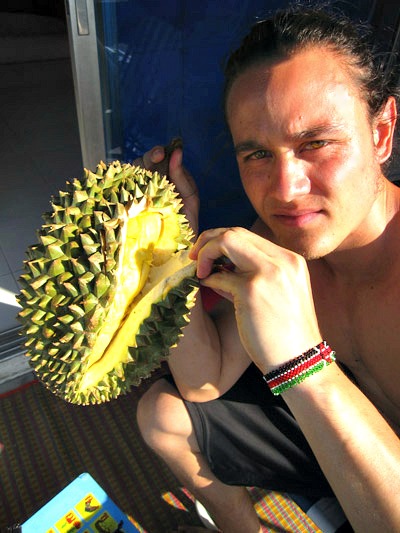
Durian from Southeast Asia — the most amazing fruit in the world! It makes me very happy!

And now you are invited to prepare one meal based on your travels for other members of The Displaced Nation. What’s on the menu?

Appetizer: Poke, the Hawaiian sashimi: cubed pieces of raw fish marinated in onions, soy sauce, and sea salt.
Main: Sichuan fish hot pot, known as Shuizhuyu. It’s the signature dish in Sichuan cooking.
Dessert: Either Thai-style sticky rice with durian, or just plain durian fruit.
Drink: Stoney, a strong ginger soda from East Africa that burns going down.

I wonder if you could also add a word or expression from one or more of the countries you’ve lived in to The Displaced Nation argot.
From Kenya: Sema boss, a slang term for greeting the person who is in charge. It’s a good way to connect.
From Thailand: Mai pen rai, how Thais say “don’t worry about it” or “no problem.” It’s a polite phrase.
From Mexico: Pansa llena, corazón contento: “Stomach full, heart is happy.” When I lived in the US, I had many friends from Mexico who would use that expression with me as they knew I loved to eat. I also have visited northern Mexico a number of times.

This month we’ve been exploring the idea of organizing one’s travels around the wish to try particular foods. I understand that many of your travels are motivated by food interests?
Yes, nowadays just about all my travels are motivated by food. I do travel to see other countries and meet new people, but my main passion is food and that’s what I enjoy searching for. I would be very happy to fly to a destination and not do any of the normal tourist attractions, but just eat. A few months ago I took just a short 24-hour trip to Malaysia with a strict mission to eat. It was an amazing food binge!

Are you more motivated by the idea of trying new foods or by finding the very best of particular foods?
I’d say I’m equally motivated to try new foods and to find the very best foods that I’ve already eaten previously. I’m always excited to try something I’ve never seen or heard of before, but at the same time if I hear about the best bowl of Thai boat noodles, or the most amazing seafood restaurant, I’m quite tempted too!

If you were to design a world tour based on food, what would be your top five stops/foods to try?
I couldn’t narrow it down to five, so here are six:
1) Thailand — try the gaeng som (sour spicy soup), som tam (green papaya salad), and boo pad pongali (crab yellow curry).
2) Malaysia — try the nasi campur (mixed curry and rice), nasi lemak (rice and toppings), and roti canai (roti bread with curry).
3) China — try the Sichuan hot pot and all kinds of exotic delicacies.
4) India — try the thali (rice with a variety of curries), dhosa (pancake with curries) and home-cooked curries.
5) Mexico — try the tacos, burritos, mole (chocolate curry), carne asada (grilled meat), and ceviche (seafood salad).
6) Ethiopia — try the mahaberawi, a platter that includes injera (white spongy bread) topped with a variety of spicy curries.

Readers — yay or nay for letting Mark Wiens into The Displaced Nation? He’s an adventuresome eater, that’s for sure, but can you stand the smell of what’s in his suitcase? (Note: It’s fine to vote “nay” as long as you couch your reasoning in terms we all — including Mark — find amusing!)

STAY TUNED for tomorrow’s episode in the life of our fictional expat heroine, Libby. (What, not keeping up with Libby? Read the first three episodes of her expat adventures.)

If you enjoyed this post, we invite you to register for The Displaced Dispatch, a round up of weekly posts from The Displaced Nation, with seasonal recipes, book giveaways and other extras. Register for The Displaced Dispatch by clicking here!

Related posts:

img: Mark Wiens in the act of trying, for the first time, to cut open a durian fruit, on his balcony in Bangkok.

For former expat Matt Krause, a second act as a heathen pilgrim

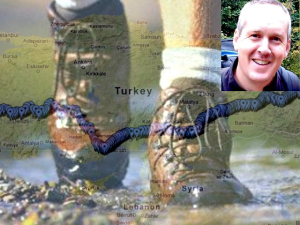
For some of us, starting a new life overseas is challenge enough. But for others, it represents an opportunity to take things to the next level. It’s fair to say that Matt Krause falls into the latter category. Returning to California after following a Turkish woman back to her native land, he used the material for his first book. And now he’s preparing to set out on a 1,300-mile solo walk across Turkey — a country he still regards as his second home. I caught up with Matt recently to ask about this latest, much more athletic challenge.

Hi again, Matt. Welcome back to The Displaced Nation. It seems like only yesterday that we were reviewing your expat memoir, A Tight Wide-open Space, and now we find you preparing for an epic travel adventure. Can you say a little more about it?
On Saturday, September 1, 2012, I will start an eight-month solo walk across Turkey, from the Aegean to Iran — 1,305 miles (2,100 km) in all. I will carry a backpack, a tent, and a sleeping bag.

Why are you doing this?
To put my life where my mouth is.

In 2003 I met a girl on an airplane to Hong Kong. We ended up going out, then moving together to her hometown of Istanbul and getting married there. We lived in Turkey for six years, but in 2009 things unraveled and I came back home to the US.

When I came back to the US, people kept asking me about the differences I had seen in Turkey. Political differences, religious differences, cultural differences, gender differences, just about every kind of difference you could think of.

But I really wanted to tell them about how people are so much the same. Living in Turkey had reminded me that most of what we are as human beings, and how we act in any given situation, is pretty much the same. Human nature being what it is, though, we can’t take our eyes off our differences, and I think that this focus makes us more afraid of each other than we need to be.

I don’t want to talk about this in theory. If these similarities are so profound, I should be able to walk, alone and unprotected, across the country I still think of as my second home.

Going to the dogs

What have you done to prepare for this odyssey?
I walked 1,200 miles (almost 2,000 km), 700 of them with a fully loaded backpack. That’s four hours a day, five days a week, for five months.

I walked the same four 12-mile routes about 25 times each — those were 1,200 very repetitive and boring miles.

However, I love dogs, and the dogs added some flavor to the walks. The first few times I walked those routes, the dogs all acted ferocious, but week by week they warmed up to me. The Labs were the first, of course — I only had to walk past them once or twice before they’d run out to me wagging their behinds like I was an old friend.

The last to go was one particular Doberman Pinscher. He spent about four months acting like he was going to rip my head off each time I passed by, and then one day when I walked by he was busy talking to another dog. He looked over at me like, “Are you serious, are you going to make me interrupt this perfectly good conversation in order to come chase you?” He broke down quickly after that, and now when I walk past his house he just playfully runs alongside me, glancing back at the house every few seconds to make sure nobody’s watching. He’s got a reputation to think about, after all.

How will you finance the trip?
I have savings, which I’ve supplemented by working in the peach and plum orchards near my hometown of Reedley, California. I was grafting, which is basically cutting off the top of an old tree and sticking a new kind of wood into it. The new wood takes over, and within a couple years the tree is producing a new variety of fruit.

I will also be raising some money on Kickstarter in a few weeks.

Will you be grafting any electronic devices onto yourself while you walk?
I’ll have a pocket camera and a cell phone connection so that I can post daily updates (people photos, landscape photos, short written updates, etc) on my Web site, Heathen Pilgrim. Most of the time, of course, I’ll be out in the middle of nowhere. It’s not like I’ll be able to run into the nearest Starbucks and connect over wifi, so I had to figure some things out. I’ve been doing a lot of equipment testing.

An oxymoronic concept?

“Heathen Pilgrim” — that’s a curious name for a project.
I picked that name for a couple of reasons. The main reason is that a heathen is a person who does not share one’s religion. Christians see non-believers as pagan; Muslims see them as infidels; and as far as Jews are concerned, gentiles can never be members of God’s chosen people.

One thing we all have in common is that someone, somewhere considers us heathen. And if you want to travel outside of your own circle, you must be willing to be considered a heathen by someone else. If the people around you are not considering you heathen yet, you have not traveled far enough from home.

I also have a tongue-in-cheek reason. A secondary definition of “heathen” is “a rude or uncivilized person.” I’m a fairly polite and well-mannered person. So calling myself a heathen pilgrim is a bit of an attempt at self-deprecating humor.

Well, particularly when you juxtapose it with a word like “pilgrim,” since pilgrims are supposed to be on a journey to a holy place. Your itinerary is pretty ambitious. Do you identify at all with the athletes who are now preparing for the Olympics?
No, not at all. Those guys train all their lives. I’m just a guy who likes to eat donuts and walk — although I did have to turn a lot of things upside down in my life in order to do this.

On the subject of ways of looking at this project, there’s a relevant saying I like, that we are not entitled to the fruits of our labors, only to the labors themselves.

In this case, I have no control over the meanings people might assign to my walk. I only have a say in whether or not I do it.

A few last-minute jitters

What’s left by way of preparation for this unholy journey of yours?
Not much. At some point you’ve just got to take the leap of faith (no pun intended!), and that time has arrived for me. Right now I’m preparing for the Kickstarter campaign in a few weeks, and there are still a few things I still need to get, like a sleeping pad and a small whiteboard. But I’m as prepared as I’ll ever be without actually doing it. It’s time to go.

But what about psychological preparation? Are you nervous? Despite your affection for Turkey, do you worry about feeling out of your element, displaced in ways you’ve never been before?
You bet I’m nervous. I’ve never walked across a country before. I’ll be displaced and out of my element 24 hours a day, seven days a week, for the entire trip.

What makes me most nervous is that I don’t know where I’ll be sleeping at night. I don’t want to stay in hotels, because then I’d just be doing the tourist thing. So I’ll be taking people up on their offers to pitch my tent in their front yard, or let me sleep on their living room floors, or even sleep on their roofs (many of the roofs in that part of the world are flat, and people use them like a front porch).

For a while, I was really worried about approaching all these strangers and asking for help. In fact, until a few months ago I would wake up in the middle of the night worrying about how that was going to pan out. But then I talked to a young woman who had backpacked through that part of the world many times. She said don’t worry about them, they’ll be fine with it. The worry is in you. Get over it quickly by knocking on a stranger’s door the very first night.

How to follow Matt’s progress

If people want to follow your progress, what should they do?
I’ve put out an open invitation to anyone who wants to come walk part of the route with me. So if you can, get yourself a backpack and a sleeping bag, and join me on the road somewhere.

However, if you can’t join me in person, follow the trip vicariously. There’s the aforementioned Heathen Pilgrim site, a weekly email newsletter, a Facebook page, and my Twitter account (@mattkrause). Use whichever of those you prefer — they’ll be showing pretty much the same content.

I assume you’ll also be getting some books out of this?
I’ll also be writing four books at the end of the trip: two books tentatively titled “Turkey on 12 Miles a Day” and “Walking Turkey”; and two photo essays, tentatively titled “Walk Turkey: The Landscape” and “Walk Turkey: The People.”

Those books will be available later on Amazon, but you can sign up for them early, and get some other trip-related goodies, by backing the trip on Kickstarter. The Kickstarter campaign isn’t live yet, but if you keep an eye on my cyber-coordinates, in early August you’ll hear about it when it starts.

Thanks, Matt. You may not think of yourself as an Olympic athlete, but I’m impressed by your determination and all the meticulous preparations. Readers, make sure you follow Matt’s journey in one of the ways he suggests and spread the word about his Kickstarter campaign. You can also support him by downloading his memoir on his expat life in Turkey — as Kate Allison said in her review, “For all that this is a love story, Matt pulls no punches in the telling of it.” He’s honest, as well as humble. Two great qualities for a pilgrim, even if he is a bit of a heathen! 🙂

STAY TUNED for tomorrow’s Displaced Q on the Olympic Games and the sometimes awkward issues they raise for us displaced types about national loyalties, by Tony James Slater.

If you enjoyed this post, we invite you to register for The Displaced Dispatch, a round up of weekly posts from The Displaced Nation, with seasonal recipes, book giveaways and other extras. Register for The Displaced Dispatch by clicking here!

Related posts:

5 reasons why American aviatrix Amelia Earhart could be an expat heroine

The American aviatrix Amelia Earhart has been propelling her way into the news headlines this week. Yesterday marked the 75th anniversary of her Lockheed Electra disappearing over the Pacific Ocean.

And today marked the beginning of an expedition, led by an American nonprofit group, to locate the wreckage from her plane. The group plans to scan the depths of the Pacific Ocean near a remote island where they believe Earhart and her navigator, Fred Noonan, died as castaways.

With America’s most famous aviatrix back on our horizons, it seems a timely moment to nominate her for our Displaced Hall of Fame, where we put all of our expat heroes and heroines.

What, was she an expat, too? I can hear you asking. In fact, she was an expat briefly — during World War I, when she went to visit her sister in Toronto and ended up staying on as a nurse’s aide in a military hospital.

But I’ll admit that Earhart seems more of a domestic heroine — as American as apple pie, you might say. Born in Atchison, Kansas, in America’s heartland, Amelia grew up tall and willowy like the corn in the fields. As the Reigning Queen of the Air, she became the nation’s sweetheart and to this day retains a special place in the hearts of young American women.

What’s more, recruiting her to serve as a heroine for global nomads, many of whom have hybrid nationalities, might not fly with my fellow Americans. Secretary of State Hillary Clinton has endorsed the expedition to hunt for Earhart’s plane, saying that Earhart embodies the “spirit of America coming of age and increasingly confident, ready to lead in a quite uncertain and dangerous world…”

But in reviewing the main facts of Earhart’s life, I have found plenty of aspects that show how “displaced” she actually was — “displaced” in the sense of being “removed from the usual or proper place” (see definition on our About page) — and hence belongs in our orbit. Here are five of my top reasons:

1) She was born with wings.

Veteran expats and long-term travelers cannot afford to have fear, or dislike of, flying. Should we incline at all in this direction, it may help to lie back in your airplane seat (or pretend you have a seat where it’s possible to lie back) and think of Earhart, who took to the skies without hesitation, as though the airplane wings were her own. Legend has it that she first caught the aviation bug while an expat in Canada. She went to see an exhibition of stunt flying at a fair in Toronto and later wrote about the sensation she’d felt as a pilot began diving at her and her friend:

I remember the mingled fear and pleasure which surged over me as I watched that small plane at the top of its earthward swoop. I did not understand it at the time, but I believe that little red airplane said something to me as it swished by.

From then on, it was all she could do to keep her feet on the earth. Of her first airplane flight she said: “As soon as we left the ground, I knew I had to fly.” In 1921 she took her first flying lesson, and soon saved enough money to buy a second-hand plane.

Of course it helped that in the early days, flying was a romantic sport for the lucky few, not a form of transport where everyone from pilot to passenger feels as though they’re herding or being treated like cattle. Earhart named her first plane “Canary” because of its bright yellow color. Perhaps she felt like a canary when setting her first women’s record: rising to an altitude of 14,000 feet.

By the time she became the first female pilot to cross the Atlantic solo (Charles Lindbergh was first to do so), she had her own little red airplane — a cherry-colored Lockheed Vega, reputed to be the world’s fastest aircraft and therefore favored by pioneering aviators. Hmmm… Did it make her feel like a cardinal?

2) Always restless with the status quo, she let it drive her adventures.

What’s the litmus test for being a travel or expat type? A person who is always upping the ante. We’re a gang of permanent malcontents!

No sooner had Earhart become the first woman to cross the Atlantic (as a passenger) — a flight that made headlines because three women had died within the same year in trying to achieve it — but she sought to become the first woman to fly solo across the Atlantic (1932) and the first person to fly solo across the Pacific, from Honolulu to Oakland (1935), among other achievements.

At that point, there was nothing for it but to make a bid to become the first person to fly around the world (1937).

One wonders what Earhart might have done next, had she not gone down in her plane on the very last leg of the journey. Perhaps she would she have concluded that she’d peaked out too early? (No doubt many of you serial expats and repats can relate…)

3) She had no qualms whatsoever about the risks involved in an adventuresome life.

In the lore surrounding Earhart, great emphasis is placed on her early feminism. Much of it is said to be due to her mother, who had very little interest in bringing up Amelia and her younger sister as “nice little girls” — she even allowed them to wear bloomers!

Clad in this comfortable attire (Amelia would later design a clothing line for women who wanted comfort), the Earhart sisters climbed trees, hunted rats with a rifle, and “belly-slammed” their sleds downhill.

The young Amelia also kept a scrapbook of newspaper clippings about successful women in predominantly male fields, including film direction and production, law, advertising, management, and mechanical engineering.

Although she did marry eventually — to the publisher George Putnam — she always referred to the marriage as a “partnership” with “dual control,” and did not change her last name.

When she became the first woman to fly solo across the Atlantic, Earhart said it proved that men and women were equal in “jobs requiring intelligence, coordination, speed, coolness and willpower.”

(No doubt she would be knocked out to learn that women’s boxing will be included in the London 2012 Olympics for the very first time.)

But to me, what’s even more impressive about Earhart’s life is that she knew about the risks involved in her chosen occupation — but decided not to let them hold her back. That same kind of risk-taking is at the heart of the overseas travel enterprise, which goes against the grain of most people’s common sense. (“You want to go THERE? And FOR HOW LONG?” Expats and global nomads know the drill of fielding constant questions and doubts from the people back home.)

When Earhart set out on her second attempt to circumnavigate the world (the first had ended in a crash when a tire blew out on take-off), she wrote to her husband: “Please know I am quite aware of the hazards.” And then she went ahead and packed a jar of freckle cream. (I say that because a jar of freckle cream was found on the Pacific Island that’s now being searched.)

4) She was never more in her element than when out of her element (quite literally).

There is something that draws all of us to the displaced life. Since it’s a life of challenges, I have to assume that for most of us, it’s that feeling of being a pioneer, of going the way no one else in our circles has gone before…

In Earhart’s case, the displacement was quite literal: she loved being in the empty sky and facing the unknown. In that sense she was like a character out of Greek myth — a female Icarus. As she once said of an early flight:

The stars seemed near enough to touch and never before have I seen so many. I always believed the lure of flying is the lure of beauty…

Jane Mendelsohn was inspired to write her first novel, I Was Amelia Earhart, after reading that a piece of what may have been Earhart’s plane had been recovered on an atoll in the Pacific. Imagining the life that Earhart and Noonan might have led as castaways, Mendelsohn shows Earhart coming into her own in the desert-island setting, and finding peace of mind.

Random House editor Kristin Fritz commends Mendelsohn for creating a whole new iteration of Earhart as

a woman who had perhaps “taken this journey in order to escape the madness of the world,” a woman who “didn’t give a damn if she was alone” and finally a woman who would “live the rest of her long and brilliant life on this wild and desolate island.”

Now that’s displaced! And if Fritz is right and Medelsohn captured the essence of Earhart in her novel, then we should not feel too bad that she perished on an island out in the middle of nowhere. That’s how she would have wanted it…

5) Last but not least, she appears to have known the value of chocolate.

Here we come to the true test of an expat or international traveler: do they like chocolate? Are they addicted to that sudden charge of energy, the little lift, one gets from the sugar and the caffeine? Most seasoned expats and international travelers know that we could never have prevailed during the inevitable moments of loneliness and displacement the life entails without a chocolate supply of some sort.

When Earhart embarked on her 2,408-mile solo flight across the Pacific in 1935, she packed a thermos of hot chocolate in case she felt chilled. As she later observed:

Indeed, that was the most interesting cup of chocolate I have ever had sitting up eight thousand feet over the middle of the Pacific Ocean, quite alone.

* * *

Now that we’re touching down, I feel the need to quote from Mendelsohn’s recent op-ed for the New York Times:

We still wonder what happened to Amelia Earhart — perhaps soon we may even find out — but do we know what to do with her? Do we know how to make not just her mysterious disappearance but also her miraculous life relevant and inspiring to our global society? And could she matter across the globe, that ball around which she tried to fly that feels so much smaller today but is in fact exactly the same size as it was then?

For me there’s an easy answer to all three of Mendelsohn’s questions: YESSSSSSS!!! It’s time Amelia Earhart went global, and not just literally…don’t you agree?

STAY TUNED for Wednesday’s post, another in our Expat Moments series by Anthony Windram — and yes, it does have to do with the 4th of July!

If you enjoyed this post, we invite you to register for The Displaced Dispatch, a round up of weekly posts from The Displaced Nation, with seasonal recipes, book giveaways and other extras. Register for The Displaced Dispatch by clicking here!

Related posts:


Living La Dolce Vita with Food Writer and World Explorer Robyn Eckhardt

Veteran travel and food journalist Robyn Eckhardt is here. A few months ago, she shared some insights on Southeast Asian cooking with Displaced Dispatch subscribers, but for this post I’ve asked her to supply a recipe for La Dolce Vita, or the Sweet Life — drawing the ingredients from her extensive world travels and their sensory delights — along with an easy version anyone can try!

Robyn Eckhardt’s Personal Recipe for La Dolce Vita

Mix together the following:

3 heart-stopping sights

1) The Bund, Shanghai, in 1990 before the city underwent its construction boom. It was of those moments when you realize that a place you know by heart from books (I studied Chinese history in college and grad school) is actually real.
2) Istanbul’s Blue Mosque from a taxi at 1:00 a.m. on a crisp, clear February night. It was my first time in Turkey; I’d just arrived from Shanghai, where I was living at the time. The combination of jetlag and being somewhere so foreign and utterly different to the place that I called home was like a slap in the face, in a good way.
3) When I was 17 I saw the Statue of Liberty up close on a Circle Line tour. Even though I was your typical cynical, jaded teenager, my jaw kind of dropped. I imagined the thousands and thousands of immigrants to the US arriving by ship and having that same view. It’s still a pretty amazing sight, I think.

11 intoxicating scents

1) In most any neighborhood in Chengdu (capital of China’s Sichuan province) at around 5:00-6:00 p.m., the scent of dried chilies hitting hot rapeseed oil.
2) Just-off-the-boat anchovies grilling in Sinop, on the Turkish Black Sea.
3) Chicken barbecuing anywhere in Thailand.
4) Chòu dòufu, or “stinky beancurd,” in Taipei — funky yet beguiling.
5) Jasmine flowers in bloom on a hot summer ‘s (which is actually in September or October) evening in the San Francisco Bay Area.
6) On winter evenings in Santa Fe, burning piñon tree branches in a hundred fireplaces.
7) The seafood section in the market in Butuan, Mindanao in the Philippines, which smells like nothing but seawater — it smelled so good we didn’t mind eating kinilaw (the Philippine “ceviche”) prepared by a fish vendor, right smack in the middle of the market.
8) In any Turkish town or city very early in the morning, the first whiff of rising dough and baking bread from any bakery.
9) The enveloping, almost chokingly overwhelming scent of spices freshly ground in huge quantities at an old, Indian-run spice shop in George Town, Penang.
10) The dining room at a tiny osteria in Calosso, Piemonte, which my husband and I frequented four years in a row. It didn’t matter what was on the menu that day, as soon as I walked in the I knew that I was going to eat wonderful foods, drink good wines and leave very, very happy.
11) Last but not least, the smell of China. You smell it as soon as you get off an airplane. What is it? I’m not really sure. It’s certainly not magnificent but it is intoxicating to me because it never fails to transport me in a single second to my 21-year-old self, abroad and on her own for the first time, arriving in Chengu. Lots of emotions there.

4 dreamy sounds

1) The call to prayer one late afternoon as I sat on a hill overlooking the ruins of the theater at Aspendos, on Turkey’s Mediterranean coast. One muezzin started, then another from the opposite direction began, then another and another, from mosques in nearby villages. Their voices alternately intertwined and competed — one of those incredible moments that leaves you almost gasping for breath.
2) The sound of calling/singing/chanting vendors at wet markets. Especially when they get into a groove, sing-songing the same phrase over and over again. Like at Pudu Market in Kuala Lumpur: satu ringgit satu ringgit satu ringgit satu ringgit satu ringgit satu ringgit! When I hear a great call from a market vendor I just stop and listen while the market frenzy continues around me.
3) The sound of the rain forest waking up on Langkawi Island from the vantage point of the top of a hill, above the forest canopy. I arrived to perfect stillness; as the sky began to lighten there was movement in the trees — creakings and squawks and chirps and rumbles and knocks and grinding noises. Just before I left, ten or so hornbills simultaneously rose from their perches, making a tremendous, wonderful racket with their wide wingspans. It sounded like a jet flying low overhead — whoo whoo whoo whoo. I could feel that noise in my gut. Incredible.
4) A trio of genggong (Jew’s harp) players on the front porch of a cottage on the edge of a rice field in northern Bali. Bali is magical to begin with. This was an unexpected treat.

A particularly delicate flavoring

Normally, I’m attracted to bold flavors, but as this is La Dolce Vita, I’ll probably throw in the sap from the cut flower of an aren palm, which I tasted when I went out at dawn with a palm sugar maker in northern Sumatra to get the sap he was collecting in bamboo tubes from dozens of trees. It was sweet and flowery but in a very, very restrained way — what’s incredible is that after just three hours of boiling it becomes one of the most intensely flavored sugars in the world.

An extraordinary physical sensation

For this recipe I’ll include the most amazing physical sensation I can remember: riding an elephant bareback and solo, which I did last year in northern Thailand near the border with Burma. Grabbing its leathery ear to pull myself up, palming the spiky, hair-sprinkled knobs of its massive forehead to keep my balance, feeling its shoulders move under me when it walked — something I will never, ever forget.

A memorable encounter with strangers

My husband and I ended up eating lunch with an elderly Turkish couple in their traditional timber farmhouse on the Black Sea. The experience sticks with me, for many reasons. Rather than retell the story here, let me point you to the relevant post on our blog, EatingAsia.

A place that stimulates all five senses

For me, this can be anywhere unfamiliar, or where I haven’t visited for a long time. Right now, especially, it’s eastern Turkey, which I’ve been getting to know in bits and pieces over the last two years.

The food is new (to me) and surprising — interesting twists on familiar Turkish dishes and curve balls out of nowhere, like dolma made with cherry tree leaves(!) or dough spirals seasoned with copious amounts of ground poppy seeds that taste like cacao.

I love the way the Turkish language sounds; I speak enough to get by but am nowhere near even half-fluency. I desperately want to be better at it, so when I’m traveling there my ears and brain are hyper alert to conversations around me; I’m constantly trying to understand what I hear, writing down unfamiliar words, trying (and often failing) to communicate well with strangers. That’s fun in a certain way, though ultimately exhausting — but it’s a level of engagement with everything that is going on around me that I don’t always have.

Outside Turkish cities the sky is big and the population sparse. To me — a resident of Southeast Asia — that is incredible and wonderful. When my husband and I go, we rent a car and do long, long road trips. I’m always eager for what’s around the next bend in the road or over the next pass because in two or three hours the terrain can change tremendously.

I can never get over the scent of air in that part of the world: nothing but air, clean fresh air! We make it a point to go once or twice a year when it’s cold; this past February temperatures in Eastern Anatolia averaged about 10 degrees Fahrenheit and there was lots of snow. It was that kind of cold where the hairs in your nose freeze as soon as you walk outdoors and ice cracks under foot and snow crunches with an especially hard “c”. I loved it.

And I’ve had so many great people experiences there — strangers opening their homes and kitchens to me. Even though I’m always a wee bit tentative in that way that you get when you are among strangers somewhere unfamiliar, eastern Turkey is probably the place where I travel with my heart the most open. When I arrive there I take a deep breath and just relax and let whatever is going to happen, happen. I can’t and don’t always let my guard down like that when I travel, so it’s lovely to be somewhere where I can.

Art by 2 artists who understand La Dolce Vita

1) Well, I am biased, but this recipe definitely calls for my husband Dave Hagerman‘s portraits and people-focused street photography because they often capture, I think, that moment when a subject decides to just let it go. Those sorts of photographs only come when a photographer is willing to extend his or herself, take a risk and show utmost respect to his or her subject.
2) I also love the work — paintings especially — of California realist John Register. The empty-room paintings, the diners-at-night paintings. I can’t say much about his heart or his soul when he was painting them, but to me they show that mundane things can evoke emotion. That is beautiful.

An inspiring travel quote

“The first condition of understanding a foreign country is to smell it.”
– Rudyard Kipling

As one who travels most of the time on her stomach, I can especially identify with this sentiment.

* * *

After adding a pinch of salt to all of the above, Robyn is living the sweet life. And if you’re not as well traveled as she is, not to worry. Robyn offers this simple recipe to try at home.

Robyn’s recipe for living La Dolce Vita at home

You don’t have to physically get on a plane or train or bus to travel. Do something unfamiliar in the place you know best, your home:
1) Go to a neighborhood you don’t usually frequent, go to a museum if you are an outdoors person or to a park if you’re an indoors type.
2) If you are not an early riser, go out before dawn and watch your town or city or neighborhood wake up, or if you’re an early-to-bed sort of person, take a nap in the evening and then go out late and see what where you live looks and sounds and feels like when you’re usually asleep.
3) Ride a bus or some other form of public transport if you’re always in your car.
4) Try a new restaurant or bakery or cafe, or shop at a farmer’s market if you usually buy your food at the big box or grocery store.

Penang-based freelance food and travel journalist Robyn Eckhardt is a contributing writer at Travel+Leisure Southeast Asia, a contributor at ZesterDaily and to publications like The New York Times Travel Section, Saveur and SBS Feast. With her photographer husband David Hagerman, she publishes the food-travel blog EatingAsia. As this interview hits interwebs, the two are hiking village-to-village in far northeastern Turkey, learning about beekeeping and cow-herding and tasting lots of honey and cheese.
Final note from ML Awanohara: Extra points will be awarded to anyone who recalls Robyn’s husband, David, being featured in the series I ran at the end of last year: “The 12 Nomads of Christmas.” He’s just as extraordinary as Robyn says!

STAY TUNED for Wednesday’s post, an interview with Laura Graham, author of Down a Tuscan Alley, a semi-autobiographical novel about her mid-life move to Tuscany. (Ah, la dolce vita!)

If you enjoyed this post, we invite you to register for The Displaced Dispatch, a round up of weekly posts from The Displaced Nation, with seasonal recipes, book giveaways and other extras. Register for The Displaced Dispatch by clicking here!

Related posts:
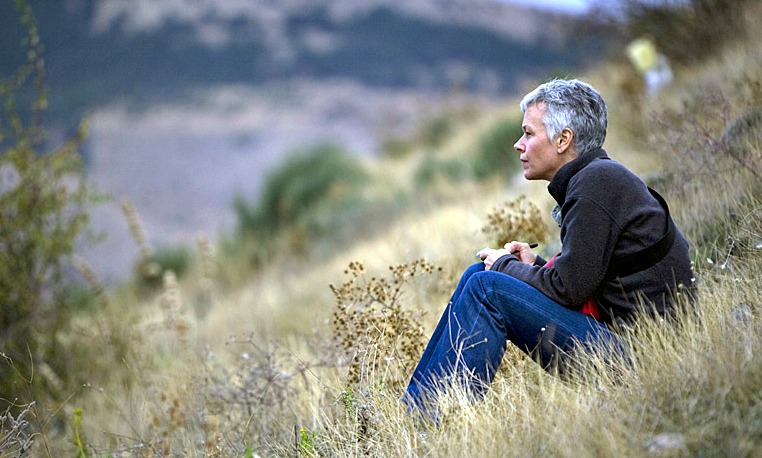
Img: Robyn Eckhardt writing in Tokat, Turkey (by David Hagerman).

RANDOM NOMAD: Suzanne Kamata, American Expat in Japan

Place of birth: Grand Haven, Michigan, a charming tourist town on the shores of Lake Michigan.
Passport: USA
Overseas history: France (Avignon): 1985; Japan (various towns + now Aizumi, Tokushima Prefecture, Shikoku Island): 1988 – present.
Occupation: Author* and TEFL teacher
Cyberspace coordinates: Suzanne Kamata (author site); @shikokusue (Twitter handle)
*Suzanne Kamata is the author of a novel, Losing Kei; a short story anthology, The Beautiful One Has Come (listed on The Displaced Nation’s top books for, by and about expats in 2011); and a picture book, Playing for Papa — all of which concern bicultural relationships and/or families. She is the editor of several anthologies — the most recent being Call Me Okaasan: Adventures in Multicultural Mothering.

What made you leave your homeland in the first place?
A sense of adventure! I wanted to see the world, which I’d glimpsed through reading novels set in other countries, and I wanted to gather up interesting, exotic experiences for the stories and books I would one day write.

Toward the end of my college career, I planned on going into the Peace Corps to teach English in Cameroon. As a fallback, my brother suggested a new program he’d read about in the newspaper. The Japanese government had set up the Japan Exchange and Teaching (JET) Programme to get native English speakers into public schools. I’d studied Asian history in college, and had an interest in Japan (especially the Heian Age, when nobles communicated via poetry), so I applied. After rigorous interviews for both, I was accepted into both the Peace Corps and the JET Program. I decided to go to Japan first, because the JET Program was a one-year program. I figured I’d do a two-year stint in the Peace Corps later, but then I wound up meeting a Japanese guy…

Is anyone else in your immediate family “displaced”?
My brother spent a year in Germany as an exchange student during high school. I think I was influenced a bit by his experience.

You’ve lived in Japan for a long time. Does any one moment stand out as your “most displaced”?
When I was about to give birth to my twins via C-section. My mother and father were on the other side of the world, and my husband was out in the waiting room. I was surrounded by Japanese-speaking strangers. I wondered if I would be able to remember how to speak Japanese during the operation. I think entering motherhood is like going into another country for everyone, but it’s especially surreal in a foreign hospital.

Is there any particular moment that stands out as your “least displaced”?
No one moment but all the moments when I’m with my children. Whenever I spend time with them, I feel completely at home. My children have never lived in my native country, and they have Japanese passports. When I’m away from them I feel a little bit lost.

Do your kids ever go to the United States for visits?
My kids have been to the States numerous times. Most recently, my son went on a school trip to Hawaii, where, for once in his life, he blended in perfectly. There are many mixed race kids in Hawaii. I think my kids feel pretty comfortable in the States, but being on vacation is different from actually living there.

You may bring one curiosity you’ve collected from your adopted country into The Displaced Nation. What’s in your suitcase?
A furoshiki — a Japanese wrapping cloth — dyed with locally grown indigo. It will be easy to tuck into my suitcase, and I’m sure I’ll find ways to use it during my stay at The Displaced Nation. In Japan, I use wrapping cloths to carry books, covered dishes, and oddly shaped parcels. They’re durable and more attractive and ecological than paper or plastic bags. The color will remind me of the area where I’ve lived for over twenty years. The name of the town where I now live is Aizumi, which means “indigo dwelling place.”

You are invited to prepare one meal based on your travels for other members of The Displaced Nation. What’s on your menu?

Starter: A few slices of sea bream sashimi from the straits of Naruto, with a squeeze of sudachi and soy sauce mixed with wasabi on the side for dipping.
Main course: Cubes of grilled Kobe beef strewn with fresh herbs (julienned shiso leaves, coriander, parsley, slivers of ginger root), steamed barley and rice, and miso soup made with fresh wakame — served with a nice Côtes du Rhône wine.
Dessert: Sudachi pie (my own creation: it’s Key lime pie made with sudachi juice instead of lime), served with espresso. I’d also put a plate of sliced Asian pears on the table.

And now you may add a word or expression from the country where you live in to The Displaced Nation argot. What will you loan us?
I like the Japanese word natsukashii, which refers to nostalgia or a longing for things of the past. I don’t think there’s a perfect equivalent in English. At any rate, Americans don’t go around saying “I’m feeling nostalgic!” whereas natsukashii is frequently used in Japan. If someone brings up a memory from the past, another person, filled with nostalgia, might say, “Natsukashii!”

Today, appropriately enough, is “East Meets West Day.” can you tell us about any parties or celebrations you’ve held since you becoming displaced from your native land, that in some way illustrate this theme?
In Japan, only children’s birthdays are celebrated, usually with a store-bought cake. In our family, everyone, including the adults, gets a birthday party. Typically, we have a meal with celebratory dishes such as rice with red beans, or everybody’s favorite sushi, with a homemade birthday cake for dessert. We sing “Happy Birthday to You” in English, and the birthday person makes a wish before blowing out the candles on the cake. (The Japanese have adopted the custom of candles on a child’s birthday cake, but not the making of wishes.)

The Displaced Nation has just turned one year old. Can you give us some advice on themes to cover in our second year — anything you think should be on our radar?
You might consider interviewing Edward Sumoto, who runs a variety of events for Mixed Race/Third Culture individuals in Japan, and the filmmakers/photograhers/writers involved in the Hafu Project. I believe their long-awaited documentary will debut this year.

Readers — yay or nay for letting Suzanne Kamata into The Displaced Nation? Tell us your reasons. (Note: It’s fine to vote “nay” as long as you couch your reasoning in terms we all — including Suzanne — find amusing!)

STAY TUNED for a diversion from the usual updates from life in Woodhaven. In tomorrow’s post, Kate Allison will be reporting on her latest meeting with Libby. (What, not keeping up with Libby? Read the first three episodes of her expat adventures.)

If you enjoyed this post, we invite you to register for The Displaced Dispatch, a round up of weekly posts from The Displaced Nation, with seasonal recipes, book giveaways and other extras. Register for The Displaced Dispatch by clicking here!

Related posts:

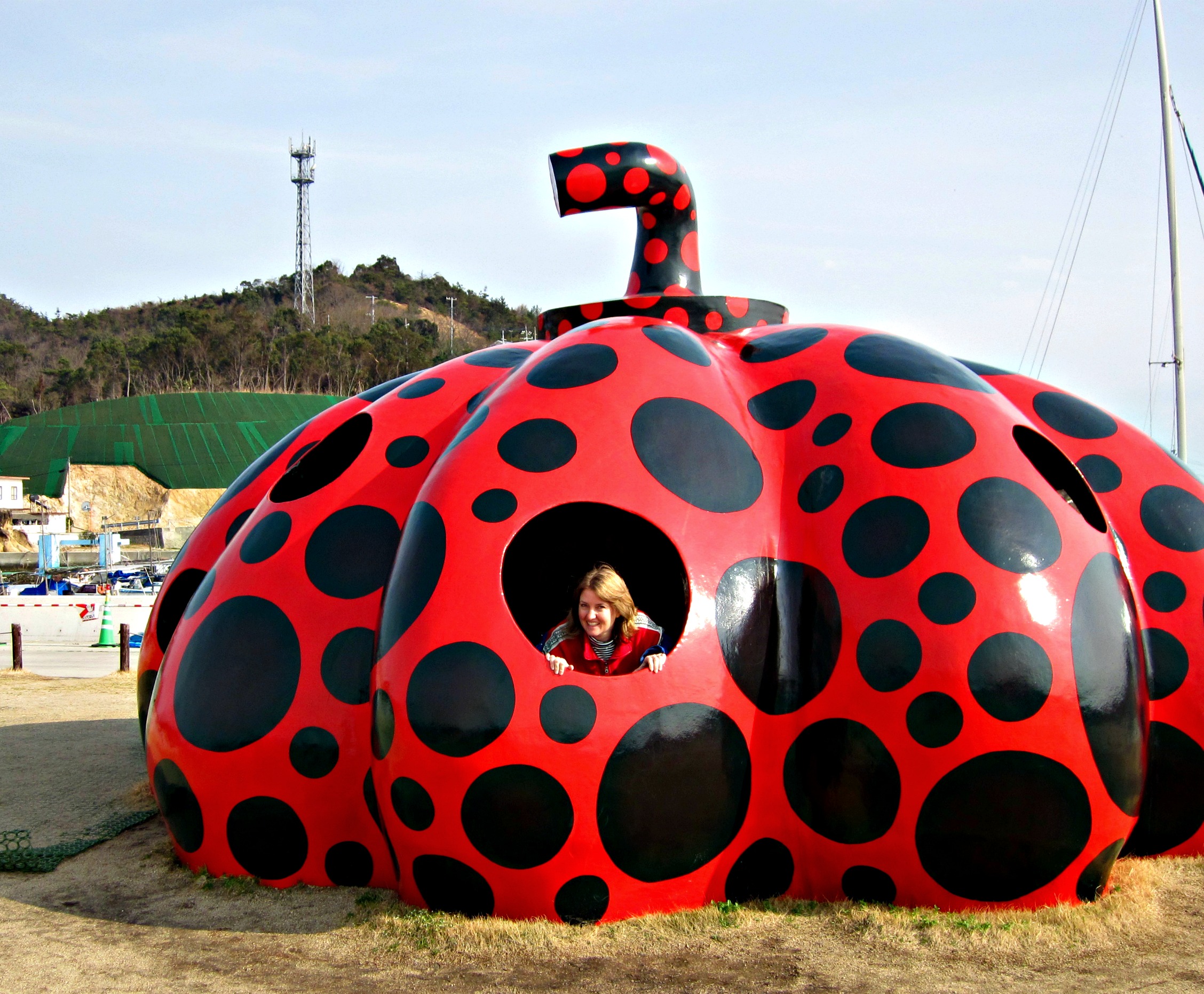
img: Suzanne Kamata standing inside a pumpkin sculpture on the Japanese island of Naoshima (March 2011). The sculpture was created by the well-known artist Yayoi Kusama, who was herself an expat for awhile. (She lived in New York City in the 1960s.)

5 ways to rejuvenate when you’re on the road — a blokey bloke’s perspective

I’m not big on spas. In fact I’ve never been to one. Perhaps because I’m a bloke (and quite a blokey-bloke at that), I just can’t see the appeal of drenching myself in yoghurt or putting cucumber on my eyes. Well, not unless I’m going to a fancy dress party as a Greek salad. 🙂

But that doesn’t mean I’m not on the eternal quest for self-renewal and youthfulness. We all are! Well, anyone over the age of 21, anyway! It’s just that some of us would prefer to avoid the lotions and potions, if alternatives are available.

Here are 5 fail-safe techniques I’ve discovered for feeling younger:

1) Try martial arts — or if all else fails, work out at the gym.

I love yoga — so much so that I practiced it once at two thousand meters at 5:00 a.m., on a tiled floor in a house with no heating. Suffice to say, there were parts of me that remained stuck to that floor long after I was ready to give up! But I believe in yoga’s rejuvenating power, both mental and physical — just not enough to carry on doing it!

Instead I’ve found something more to my tastes: martial arts — specifically Wing Chun kung-fu.

Millions of people around the world practice some form of martial art — can they all be wrong?

Kung-fu offers me the chance to push myself physically. It also challenges me with its spiritual and philosophical components, which are based in passivity and meditation. Manipulation of the invisible life-force or energy flow — known as (also chi) in traditional Chinese culture — is a big part of it, with much of it done through breathing as with yoga.

My advice:

  1. Try it.
  2. Then try it some more…

I can’t think of anything better to be hooked on! You’ll feel happy and amazing and the years will start to pour off.

(If you can’t stomach the idea of punches to the stomach, then try going to the gym — treadmills and all that. It’s odd, but on the days I work out, instead of feeling tired I have the energy of a man ten years younger. It’s all those endorphins!)

2) Travel slowly.

A change is as good as a rest, or so they say. Who “they” are in this instance I’m not sure, but they certainly had a clever turn of phrase!

It’s a lie of course — try having a week’s holiday in Fiji and see how rested you feel after two international flights, separated by five days of jet lag…

A rest is the only thing as good as a rest, which is why I love to take my time as I travel. Luckily for me, I can. These days I make a bit of money from writing, and I’m always keen to try new work experiences as I go. I’ve been a diving guide, a medical guinea pig, a toilet cleaner, a yacht delivery man, a gardener…

Living in a place for a while and taking a job is a great way to meet people and make friends, to get to know an area and its population — it’s also an endless source of ridiculous stories that I can spend the rest of my life turning into books.

If it’s not possible to simply vanish into Asia with a CV and a backpack, I fully understand — but then take longer holidays, with no fixed agenda (even if it means taking fewer holidays). Two weeks away gives you the time to properly relax, and your body will thank you for it.

And just imagine what a month in Fiji would be like! Sunny, is the answer. 🙂

3) Take long walks.

I walk a lot. Even in my bedroom I pace, but that’s not exactly rejuvenation!

I find it revitalizing to be outdoors. I now live in Perth, Australia, where I try to spend an hour or so each day roaming the streets, usually in the evenings (it’s a little on the hot side for casual strolling in the middle of the day).

And yes, I do sometimes get stopped by the police! Fortunately for me, Western Australia doesn’t have a version of Florida’s Stand Your Ground law. When I walk, I feel totally free. The rest of the world goes away, or at least becomes quieter, and I can finally think clearly with all that noise gone.

Some of my best writing has popped into my head spontaneously as I walk — almost as though it were there all along, just waiting for my mind to be still enough to tune in.

And if you’re looking for the ultimate rejuvenation, do a big walk! My wife, my sister and I are still reaping the benefits from hiking the Bibbulmun Track here in Western Australia. It’s 600 miles and took us two months.

After the first week you run out of things to say. After the second week, you run out of the desire to say anything anyway. By the time you’re done, I guarantee there will be peace in your heart and a youthful smile on your face. Because you’ll either be a strong, confident individual as a result of conquering such an epic challenge — or you’ll be dead.

I can’t recommend it enough!

4) Tap into the healing powers of universal energy.

In the course of my many wanderings I’ve acquired a fairly eclectic collection of beliefs — among them, Reiki, a spiritual practice developed in Japan. A sort of laying on of hands to unleash one’s inner energy and help boost the body’s healing system.

I did my Reiki practitioner’s course a few years ago. Though some of it was esoteric, it wasn’t too big a leap for me to imagine an invisible energy field inhabiting the body that we can gain access to, or the notion of supplementing someone else(the patient)’s energy with your own (as the practitioner). It somehow made sense to me, but the proof was in the healing: it really worked!

Feeling skeptical? I can relate — I have friends who chant to the angels and friends who believe in the power of color as a healing medium, neither of which do anything for me.

Still, I recommend giving Reiki healing at least one go in the interest of rejuvenating your body. It’s the furthest I’ve ventured into the bewildering variety of New Age therapies, and the closest I’ve ever gotten to feeling The Force — fantastic! And no, you don’t have to get naked! 🙂

5) Cuddle a furry creature or two.

Anyone who knows me, knows my passion for all kinds of animals. I have volunteered in animal refuges while traveling around and have met some amazing people. I’ve also been shot at, bitten, clawed, mauled, temporarily blinded — and head-butted in the balls by a wild pig. Hey, I never said it was easy!

But as the English writer George Elliot put it in one of her stories: 

Animals are such agreeable friends — they ask no questions, they pass no criticisms.

Having a dog or cat (or three!) to come home to after a long day at work is one of the best ways to soothe one’s fears about the world, and stay sane. But — before you indulge — be sure you can look after a pet, particularly if you travel a lot.

Oh, and if you rescue an animal from a shelter instead, you get double karma points!

STAY TUNED for Monday’s “Ask Mary-Sue” column.

If you enjoyed this post, we invite you to register for The Displaced Dispatch, a round up of weekly posts from The Displaced Nation, with seasonal recipes, book giveaways and other extras. Register for The Displaced Dispatch by clicking here!

Related posts:
Images (clockwise from top left): Our family dog, Meg; on a loooong walk with my wife in Western Australia (no going back!); the fun Fiji scenery; Kung-fu Tony!

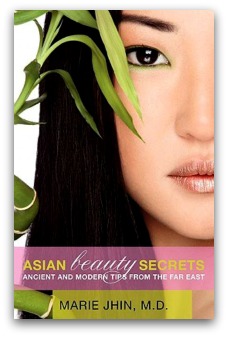
BOOK REVIEW: “Asian Beauty Secrets,” by Marie Jhin

TITLE: Asian Beauty Secrets: Ancient and Modern Tips from the Far East
AUTHOR: Marie Jhin, M.D.
PUBLICATION DATE: July 2011
FORMAT: Paperback and Kindle e-book, available from Amazon
GENRE: Health, fitness & dieting, beauty
SOURCE: Paperback purchased from the Korea Society, New York City

Summary:

Drawing on her experience as a Cornell University-trained dermatologist, combined with a knowledge of Asian beauty remedies, both ancient and modern, Dr. Marie Jhin delivers an East-West guide to vibrant skin and beauty. Born in Seoul, South Korea, Jhin emigrated to Hawaii with her family when she was six (they settled eventually in New York City). She now lives in San Francisco, where she runs her own practice, Premier Dermatology. She has been rated as one of America’s top doctors for the past three years.

Review:

The first time I visited Seoul, my husband, who is Japanese, insisted that I try a spa treatment, as Koreans do this sort of thing better than other Asians, he said. Before I knew it, I was lying naked on a table with an older Korean lady scrubbing every inch of my body. Eventually, she took my hand and put it on my stomach. At first I thought I was touching a piece of terry cloth but no, it was my skin — it had come off in shreds!

I lay there thinking, “Can this be healthy?”

Having pondered these issues quite a lot — also during my years of living in Japan, where I could hardly fail to note how obsessed Japanese women are with skincare — I was intrigued to come across a new book on Asian beauty methods, by San Francisco-based dermatologist Marie Jhin.

Born in Seoul, Jhin is now settled in California. She is not an expat, which makes the title of this post a little misleading; but is she “displaced”? Yesterday she told me in an email exchange that while she doesn’t think of Korea as “home” any more, her birth country remains something of a lodestar. She specializes in Asian skincare, lived in Seoul for two years after college to teach ESL, and has been going to Korea on business of late.

But what really convinced me of Jhin’s “displacedness” is that like me, she was uncertain of the benefits of Korean skin scrubbing but unlike me, let it get under her skin, so to speak:

I grew up doing certain things beauty-wise that I wanted know the truth of. For example, … my mother used to take me to get my skin scrubbed at a Korean sauna. Back then I didn’t understand what the point was, but now, as a dermatologist, I realize that it was basically whole body microdermabrasion that they have been doing for centuries that is great for the skin.

(Good to know!)

Jhin called her book “Asian Beauty Secrets” because it covers the beauty habits of not only Korean but also Chinese and Japanese women. Her key finding is that while women in all three countries have been caught up in the quest to look more Western, they have plenty to be proud of in their native beauty traditions.

The influence of Western beauty ideals

The last time I visited Tokyo, I couldn’t always tell who was a foreigner and who wasn’t since so many Japanese youth had dyed their hair a reddish blonde (I no longer stood out in the crowd!).

Thus I was glad to see Jhin tackle the issue of Western beauty ideals. In addition to dying and streaking their hair, many Asians are getting plastic surgery in the quest to look more Western.

Jhin notes the popularity — especially in Korea, cosmetic surgery capital of Asia (and the world?) — of procedures such as blepharoplasty (double eyelid surgery), rhinoplasty (nose jobs) and surgery to correct what Japanese call daikon-ashi (radish-shaped calves).

And when Asian women do Botox, she says, it’s not to reduce wrinkles but to soften square jaw lines and/or to atrophy cheek muscles and thereby shrink a too-round face.

Jhin draws a line, however, between these procedures and the value traditionally placed by women in all three cultures — Chinese, Japanese and Korean — on having white skin. She cites Chinese Canadian consumer research professor Eric Li in stating that the preoccupation with whiteness predates colonialism and Western notions of beauty. In fact, the Japanese see their own version of whiteness as superior to the Western one!

What Asian women bring to the vanity table

We Westerners are notorious for mistaking one Asian culture for another. Jhin helps us negotiate this sometimes-fraught territory by listing some of their distinguishing elements when it comes to notions of beauty:

1) KOREA

  • Who’s the fairest of them all? In the Far East, it’s Korean women, by common consensus.
  • Korean women like to exfoliate the skin to keep it glowing and healthy.
  • Koreans have long revered the ginseng plant, a vital ingredient in health and beauty potions.

2) JAPAN

  • Going back at least to the Heian period, Japanese have celebrated long tresses — the record of that era being 23 feet! Their favorite conditioning treatment is camellia oil, thought to promote glossy hair growth without making it greasy.
  • Japan spa culture, which dates back thousands of years, favors the use of natural ingredients for cleansing the skin: eg, volcanic mud, wakame seaweed and even nightingale droppings(!).
  • Though Japanese are known for rushing around, they in fact have a tradition of enjoying “empty moments.” Such meditative practices contribute to well-being and bring out a woman’s natural beauty.

3) CHINA

  • In ancient China, pearls were a girl’s best friend: ground pearl powder was taken internally and applied topically. (Hmmm…did they get that habit from Cleopatra, or vice versa?)
  • Chinese have a saying that “a woman’s second face is in her hands” — to this day, Chinese women are meticulous about moisturizing their hands and feet.
  • Traditional Chinese Medicine (TCM) emphasizes certain foods for balancing yin and yang within the body. This inner harmony is thought to contribute to outer radiance.

There is also, of course, much overlap among the three cultures.. All subscribe to the belief that by eating healthy foods, releasing stress (e.g., by getting an accu-massage), and pursuing nature-based healing (TCM) on a regular basis, a woman can enhance her best assets.

The “skinny” on beauty tips and secrets

One of the reasons to pick up a book with the word “secrets” in the title is to find out what one is missing out on. On this score, Jhin’s book is a bit of a mixed beauty bag. Some of her suggestions struck me as being far fetched — and I have a reasonably high tolerance for Asian cultural quirks.

Bird’s nest soup or soup containing hasma (frog fallopian tubes), anyone? Both are ancient Chinese foods thought to nurture glowing skin (Jhin provides recipes). Um, thanks, but no thanks. I’d almost rather eat fugu (which likewise has stimulating properties).

Even more offputting is the Chinese custom of spreading sheep’s placenta on one’s face. (It’s a mercy they’ve moved on from ingesting human placenta, that’s all I can say…)

As for V-steaming one’s chai-york (Korean for vaginal tract) with medicinal herbs such as mugwort (common wormwood) — it will take more than a reassurance by a Beverly Hills doctor to convince me that such a practice doesn’t lead to other problems such as UTIs.

On the other hand, I might actually consider soothing my skin with a high-quality ginseng cream. That sounds nice. Or perhaps I’ll try facial acupuncture. It’s noninvasive and, according to Jhin, can have the effect of a mini-facelift.

Note: More secrets can be found on Jhin’s book site.

Verdict:

For me, the most interesting portion of Asian Beauty Secrets is when Jhin addresses her area of specialization: the conditions peculiar to Asian skin, such as eczema (they are more prone to it than we are) or sun damage that manifests itself not in wrinkles but in brown spots. I also found fascinating the chapter on the latest skin renewal techniques being pioneered by Korean doctors. Acupuncture meets nanotechnology with the “INTRAcel laser” treatment! (The laser reaches “deeper into the dermis for more lasting collagen production and overall skin rejuvenation,” Jhin explains.)

That said, I’d hesitate about recommending Jhin’s book to anyone who isn’t yet oriented (no pun intended!) to beauty practices in this part of the world. Instead you might try experimenting with some of the brands Jhin recommends — e.g., Sulwhasoo cosmetics (now being carried at Bergdorf Goodman here in New York) — by way of familiarizing yourself with Asian skincare methods. As it happens, I got some Sulwhasoo samples when I bought the book — and would be more than happy to report back on the effects, if anyone’s curious! 🙂

STAY TUNED for tomorrow’s installment from our displaced fictional heroine, Libby. (What, not keeping up with Libby? Read the first three episodes of her expat adventures.).

If you enjoyed this post, we invite you to register for The Displaced Dispatch, a round up of weekly posts from The Displaced Nation, with seasonal recipes, book giveaways and other extras. Register for The Displaced Dispatch by clicking here!

Related posts:
The Displaced Q: Can travel and the expat life lead to a healthier diet?

Part of the formula for feeling better about oneself — TDN’s theme this month — is eating a healthier diet. Today Tony James Slater, the newest addition to our team, poses a Displaced Q on the eating habits of travelers and expats.

I’m not sure what qualifies me to pose a question about food, since my idea of healthy eating is using low-fat mayonnaise on a full English breakfast — but hey, I’d love to hear your side of the story…

I think I have what you might consider to be a rather controversial point of view, which is that traveling and leading an expat lifestyle can lead to a healthier diet — but for the most part do not.

WAIT! Before you hit the comments with that vitriolic reply — hear me out. I may be wrong (my past wrongness is legendary), but I believe I have a point. Tell you what — I’ll lay out my opinion (which I’ve put a lot of thought into), and then you can tell me if I’m talking out of my asparagus.

Chopping veggies: too much like hard work?

Plenty of people see travel as a way to reinvent themselves. I should know, I did exactly that, as explained in my last post about volunteering in Ecuador.

But reinventing your lifestyle is one thing — your diet is something else. I think statistically speaking (and I’m no expert) 99.9% of us have struggled with our diet at some point or other.

It’s not a change like deciding to make more “me time,” or adding the beach into your daily itinerary. We struggle because changing our diet requires that dreaded thing: commitment.

And the enemy of commitment is convenience.

Ah, convenience…the single biggest factor driving the fast-food phenomenon worldwide. Is it easier to swing past KFC on your way home from work than it is to get home and start chopping vegetables?

You bet it is.

What’s more, this instant gratification factor appeals not just to the terminally lazy — like me — but to an awful lot of people in a world where free time is increasingly under pressure.

The food you know…

So you’re in a new country. You tour the neighborhood. What’s the first thing you’ll recognize — whether in Cairo, Bangkok, Buenos Aires or Paris? Chances are it’ll be a fast-food joint. It’s just so easy. Nothing new to challenge you — either your palette or your linguistic skills. Just point and grunt, to be rewarded with something you could have bought within five minute’s drive of the last place you lived.

Don’t get me wrong. As I travel I make an effort to eat everything — including, on occasion, things I shouldn’t. (Apparently, the wings stay on the locust, even if they have got most of the soy sauce on them — who knew?)

Still, there is the part of me that, after a few days dining from street vendors, really craves a burger. Or a pizza. Something Western, that tastes of home.

As British writer George Miller once remarked:

The trouble with eating Italian food is that five or six days later you’re hungry again.

Asia — the exception?

There are certain countries with a deserved reputation as a mecca for healthy eating — yes, I’m talking about Japan here. In fact, most Asian countries are considered to have a healthy yet appealing diet, with an emphasis on seafood and simplicity.

For the better part of a year in Thailand I lived like a king. Fresh fruit for breakfast every morning, compared with jam on toast, bacon and sausage back home — score one for healthier eating!

Simple meals of chicken and rice, or noodles from street vendors were my staples. They were as cheap as they were delicious!

And yet… It was all fried. The rice was fried. The chicken was fried. The noodles… Is it possible to overdose on MSG?

I had no control over how my food was cooked and no kitchen to prepare it myself. Back home I fry things occasionally, but I’m a path-of-least-resistance kinda guy. My food isn’t always healthy (burgers, schnitzels, chips) — but I’d stick it in the oven or grill it. So the score…is tricky to say on this one.

And then there’s the booze…

Thailand is famous — at least amongst the 18-35 age group — less for its culinary marvels than for its parties. Score one (a large ONE) + a whisky chaser for the unhealthy diet.

Do you drink more when you travel? Cocktail by the pool? Glass of wine or two in the evening, because why not — you feel so free? Yeah, you do. Don’t worry — so does everyone else. But that’s another nail in the coffin of a healthier diet…

(And yes, I know all about anti-oxidants. That’s how I justify red wine too.)

* * *

In my experience, to eat anything decent, you have to work for it. The easier food is to find, and the more recognizable, the less healthy it tends to be.

If you’re prepared to experiment with different recipes and ingredients, different cooking apparatus and utensils, to learn a few words in the local language and risk using them in the market — then you can manage it.

But if you’re prepared to do all that for the sake of eating healthy, chances are you do it at home too, in which case you’ll eat healthily wherever you are. And probably outlive me by at least a decade.

So, as I said at the beginning: can travel encourage one to adopt a healthier diet? Well, I think it can…but doesn’t.

Am I full of carp? Am I talking sushi? What do you think?

TONY JAMES SLATER is a self-confessed adventureholic. For the last six years he’s been traveling nonstop around the world, working at a variety of jobs including yacht deliverer in the Mediterranean, professional diver in Thailand and snow boarder in New Zealand. He even deprived the world of sandalwood one tree at a time in Australia (though he still maintains it was an accident). Last year, Slater published his first book, That Bear Ate My Pants!, an account of his misadventures while volunteering at the animal refuge in Ecuador. (The book was featured in The Displaced Nation’s list of 2011 expat books.) He is currently working on a second book set in Thailand, while exploring his new home in Perth, Australia.

STAY TUNED for Wednesday’s post, an opinion piece by Lawrence Hunt on what drives today’s young people to seek spiritual enlightenment abroad.

If you enjoyed this post, we invite you to register for The Displaced Dispatch, a round up of weekly posts from The Displaced Nation, with seasonal recipes, book giveaways and other extras. Register for The Displaced Dispatch by clicking here!

Related posts:

Image: Tony Slater with his girlfriend (now wife), Krista, in an open shack-style cafe in Kuta Beach, Bali, Indonesia. Krista is eating nasi goreng, a Balinese veggie curry (over fried rice), whereas Tony has ordered a burger (but will it be too Asianized for his tastes?).