The Displaced Nation

A home for international creatives

The 10 Muses of Expat & International Adventure Writing and their 5 most popular tunes

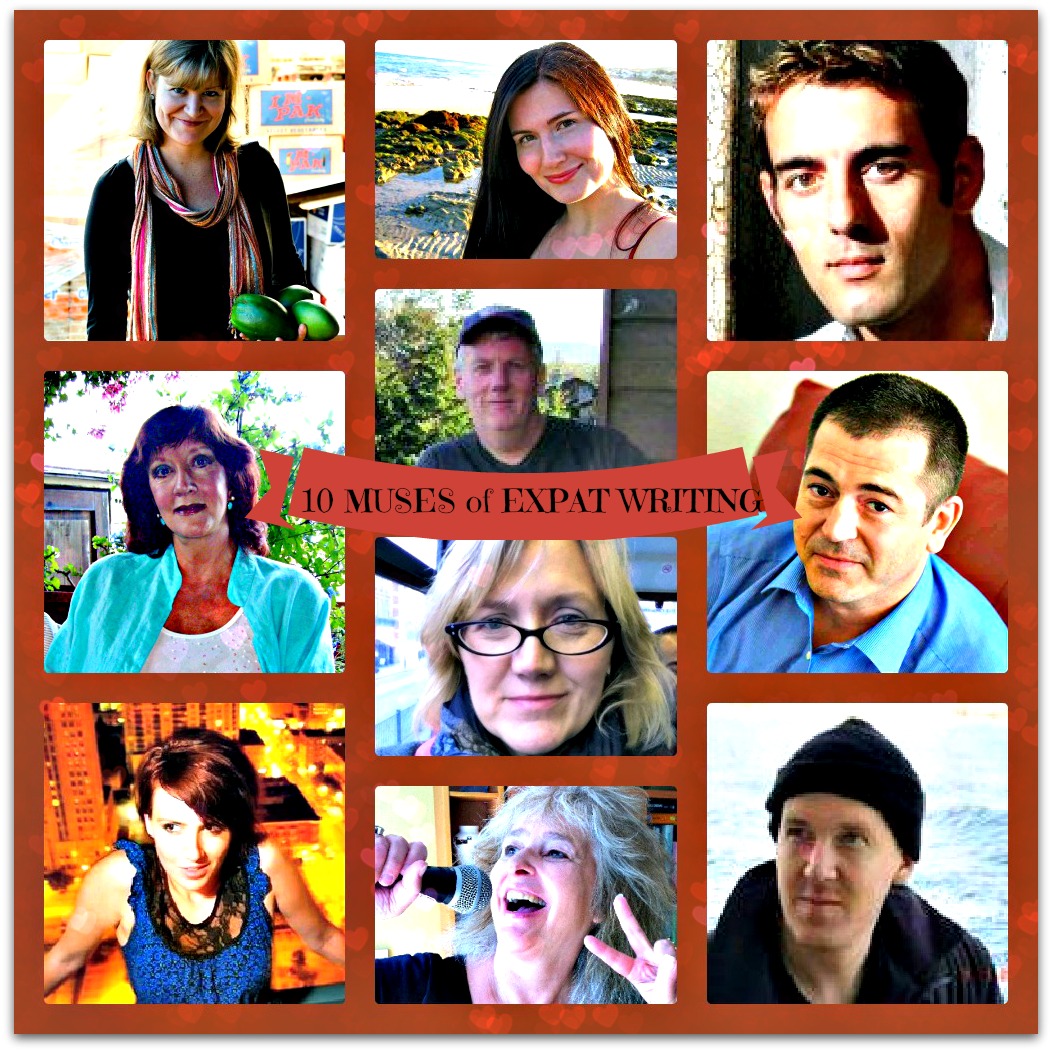
10 muses collageGreetings, Displaced Nation-ers! Ready for a little more intellectual stimulation?

A couple of weeks ago, I wrote about Great Thinkers who can help with task of embracing the well-traveled life and teasing out its deeper meaning, in the new year.

And today I will address the needs of those who have resolved to tackle a major writing project in 2013.

It’s a well-known fact that many of us who live in foreign lands aspire to write novels, memoirs and travelogues about our overseas adventures. But many of us also live in isolated situations (by definition).

So who can aid us, provide our inspiration?

Why, the muses of course!

Tell us, O muses, how to tell our stories…

And we don’t even have to look heavenwards to invoke them! The 10 Muses (that’s one more than the ancients got!) of Expat and International Travel Writing are right in our midst. They have already shared the joys, wonders and value of writing with Displaced Nation readers:

  1. Barbara Conelli, author of the Chique Travel Book series, filled with the charm, beauty, secrets and passion of Italy…
  2. Martin Crosbie, who is writing a trilogy entitled My Temporary Life; in December of last year, he published Book Two: My Name Is Hardly.
  3. Helena Halme, author of the novel The Englishman (2012)
  4. Laura Graham, author of the novel Down a Tuscan Alley (2011)
  5. Matt Krause, author of the memoir A Tight Wide-open Space: Finding love in a Muslim land (2011)
  6. Meagan Adele Lopez, author of the novel Three Questions: Because a quarter-life crisis needs answers (2011)
  7. Edith McClintock, author of the mystery novel Monkey Love and Murder (2013)
  8. Alexander McNabb, who is writing the Levant Cycle, a trilogy of books about the Middle East; he released the second book, Beirut — An Explosive Thriller, last September.
  9. Tony James Slater, erstwhile regular at the Displaced Nation and author of a two-book series: The Bear That Ate My Pants: Adventures of a real idiot abroad (2011) and Don’t Need the Whole Dog!, which came out in December.
  10. Wendy Nelson Tokunaga, author of Marriage in Translation: Foreign Wife, Japanese Husband (2011) and of several novels that explore cross-cultural themes between the United States and Japan.

Over the past year on our site, if you were listening closely, these heaven-sent muses were singing a number of tunes. Here are their five top hits:

SONG #1: “Yes, it’s hard; yes it’s uphill. But you’re living the dream, which makes writing a thrill!”

In one of the Displaced Nation’s most popular posts of the past year, Tony James Slater tried to make it out that the life of an expat writer is far from glamorous. Don’t believe him. He was pulling your leg, as usual — or singing off key, to continue the metaphor.

Alexander McNabb has the more accurate rendition. Here’s his account of the prep for his latest thriller, Beirut:

While writing it, I spent hours walking around the city, along the curving corniche and up into the busy streets that cling to the foothills rising from the coast up to the snow-capped mountains. Walking with friends, walking alone — day and night, spring and summer. From the maze of funky little bars of Hamra to the boutiques of Verdun, from the spicy Armenian groceries of Bourj Hammoud to the cafés overlooking the famous rocks at Raouché…

Barbara Conelli is another inspirational example. She explores every nook and cranny of Milan so as to take the reader on an armchair journey. And now she is doing the same with Rome, which will be the subject of her third book in the Chique Travel series.

Great work, if you can get it!

SONG #2: “It’s time to make your creative debut — so why not make it all about you?”

These days it’s hard to tell the difference between a heavily autobiographical novel and a memoir, though one of our muses, Helena Halme, insists that there is a distinction. When questioned about her decision to write The Englishman as a novel — it’s about a young Finnish woman, Kaisa, who meets a dashing British naval officer, a plot that echoes very closely her own life story — she had the following to say:

I tried to write a memoir, but couldn’t! Much of this story is, however, true — but I didn’t think I could call it a memoir as some things were pure fiction. I am a novelist and just keep making stories up.

Hmmm… By that reckoning, perhaps Tony James Slater should be a novelist, too? As regular readers of this blog will know, his favorite topic consists of his own, rather daring but also bumbling, world adventures.

But did a bear really eat his pants, or is he exaggerating for comic effect?

The mind boggles…

But whatever the form, the point is that quite a few of our muses have found plenty of material in their own life experiences. Besides Halme and Slater, we have

  • Martin Crosbie: His protagonist, Malcolm, leaves Scotland for Canada at a formative age, just as he did.
  • Laura Graham: Her protagonist, Lorri, arrives in Italy as a forty-something single and finds a younger Italian man, just as she did.
  • Matt Krause: He has written a memoir on the portion of his life that involved meeting a Turkish woman on a plane and following her back to Turkey. (Reader, he married her!)
  • Meagan Adele Lopez: The protagonist of her debut novel, Del, is offered three questions by her British fiancé (just as Lopez was offered three questions by hers).
  • Edith McClintock: Her protagonist, Emma, works as a researcher in the very Amazonian rainforest where she once conducted her own research.

To conclude, the old adage is alive and well, even (especially?) in expat and travel writing: “Write about what you know and care for…”

SONG #3: “Looking for inspiration from above? The answer lies in cross-cultural love.”

Another theme running through the works of several of our muses is the love that takes place across cultures, usually resulting in marriage. I just now referred to the cross-cultural love stories at the heart of the books produced by Helena Halme (Finnish woman, English man), Laura Graham (Englishwoman, Italian man), Matt Krause (American man, Turkish woman) and Meagan Adele Lopez (American woman, Scotsman).

To this list should be added Wendy Nelson Tokunaga, who has written about Western women getting involved with Japanese men — one of the stranger of all possible unions, to be sure! 😉 — in both fiction and nonfiction (the latter being a bit of a self-help book).

SONG #4: “As your brainstorming proceeds apace, never forget the appeal of place.”

Since travel is a constant for all of us, it should come as no surprise that particular places can become a pull for certain expat writers. They cannot rest until they’ve depicted a place they’ve experienced so that others can live vicariously. Several of our muses represent this principle:

  • Barbara Conelli and her love for “capricious, unpredictable” Milan. To quote from her book: “When the streets of Milan ask you to dance, there’s nothing else to do but put on your ballet shoes and surrender…”
  • Alexander McNabb and his obsession with Beirut. “There can be few places on earth so sexy, dark, cosmopolitan and brittle…,” he writes in his Displaced Nation post.
  • Edith McClintock and her preoccupation with the rainforest and a place called Raleighvallen in the Central Suriname Nature Reserve. As her main character, Emma, says:

    I fell completely and irretrievably in love with the rainforest that week — the deep rich smells of dirt and decay and teeming, thriving life; the warm soft light of the rocky moss-covered paths hidden beneath layers of climbing and tumbling lianas and roots; soaring tree trunks wrapped in colorful bromeliads, orchids, moss, and lichens; and the canopy of leaves of every conceivable size and shape….

SONG #5: “Growing weary of fruitless writing sessions? Time to take some acting lessons!”

Four of our ten muses could double as the muses of acting and entertainment:

  • Tony James Slater and Meagan Adele Lopez trained as actors (Lopez actually starred in a bad horror film!) before embarking on their world travels.
  • Laura Graham enjoyed a long career as a stage actress in Britain, working for the Royal Shakespeare Company and the Young Vic, and on television, before setting herself up as an expat in Tuscany.
  • Wendy Nelson Tokunaga first went to Japan because she won a prize in a songwriting contest sponsored by Japan Victor Records. She is an accomplished karaoke artist who can sing jazz as well as j-pop and enka, a type of sentimental ballad.

Why are so many of the Muses of Expat Writing multi-talented, you may ask? Does a former acting/singing career work to one’s advantage when it comes to overseas travel and writing? I like to think so.

Just as Dickens used to act out the dialogue of his characters, I like to think of Tony James Slater reenacting his wild adventures on the road, in the confines of his flat in Perth…

And sometimes this versatility can add a further dimension to the writing. Last we heard from Lopez, she had created a trailer for her book and was trying to convert it to a screenplay. Tokunaga composed and sang an enka to accompany her novel Love in Translation. (It’s impressive!)

Plus these four could always hew to the tradition of wandering minstrel, one of the oldest careers in the book, if their works don’t sell. (Hey, it’s never a bad idea to have a fallback option when you’re a long ways away from family and friends…)

* * *

So, writers out there, did our 10 Muses sing to you? And will you listen to some of their songs again as you face the blank page in 2013? Let me know in the comments. (Only, be careful of criticizing the Muses — they have been known to be vengeful!)

STAY TUNED for tomorrow’s post, another installment in the life of our fictional expat heroine, Libby. (What, not keeping up with Libby? Read the first three episodes of her expat adventures.)

If you enjoyed this post, we invite you to register for The Displaced Dispatch, a round up of weekly posts from The Displaced Nation, with seasonal recipes, book giveaways and other extras. Register for The Displaced Dispatch by clicking here!

Related posts:

Images: Our Ten Muses (left to right, top to bottom) — Edith McClintock, Barbara Conelli, Tony James Slater; Laura Graham, Martin Crosbie, Helena Halme, Alexander McNabb; Meagan Adele Lopez, Wendy Nelson Tokunaga, Matt Krause.

A once-displaced author on muses, monkeys & murder — and your chance to win her new book!

EdithmcclintockOur first featured author of the new year, Edith McClintock, is today’s guest. Her post should help to alleviate the January doldrums and this “brass monkey” weather. By way of introduction, I should point out that even though she does write mysteries, she herself is a bit of a mystery. Tee hee-hee ha-ha! On the one hand, she is a former Peace Corps worker, and has worked to preserve rainforests. On the other, she has harbored dreams of killing off her fellow researchers in the Amazon! Indeed, working with Edith sounds about as much fun as a barrel of monkeys! But let’s find out more about her creative muses, shall we, before leaping to any conclusions…

— ML Awanohara


I can’t pinpoint the moment I decided to write a novel. The idea percolated for years starting in my early teens. I did, however, always know — to the extent I even understood book categories, which was not much — that my first book would be a mystery, heavy on romantic suspense, and definitely a touch gothic.

Maybe a modern-day version of M.M. Kaye’s light mysteries (before she wrote The Far Pavilions), each set in an exotic locale.

And maybe a little Barbara Michaels mixed with Elizabeth Peters’ humor.

They were all early muses.

But so was travel. I knew the setting would have to be international, exotic…romantic. I wanted my characters to be trapped in a confined setting — like the best Agatha Christie.

From my first trip to Spain when I was thirteen, across Europe and Central and South America in my twenties, I contemplated castles, ruins, plunging cliffs, and remote islands based on their novelistic setting potential.

We are not aMUSEd: “Writing is hard”

But I needed more than a muse to write a book. I needed an obsession. For me, that’s the only way it could have happened, because writing Monkey Love and Murder was hard. Writing is hard. The rejection was crushing.

I cried. My sister cried. The rewriting and rewriting and rewriting again often felt meaningless. More sacrifice than joy. Sometimes exhilarating. More often tedious and lonely.

The truth is the time lost probably wasn’t worth it. I had demanding, more than full-time jobs. I wrote on weekends and evenings. My friends and family were celebrating, playing, gathering, the sun shining. I was hunched over a computer screen talking to my make-believe world.

It takes a certain arrogance to believe you can even write a book. To believe it will get published. To believe people will actually like it. Maybe love it. I had that in the beginning. For years, really. I had to love the idea, the place, the characters.

The place as muse

Because it took an obsession to keep writing and rewriting, in my case probably much longer than I should have. But it wasn’t a person that grabbed me and wouldn’t let go. My muse, my obsession, was the rainforest and a place called Raleighvallen in the Central Suriname Nature Reserve.

MonkeyLoveAndMurder_dropshadowI think my protagonist, Emma, expresses it best:

Even with all the frustrations, I fell completely and irretrievably in love with the rainforest that week — the deep rich smells of dirt and decay and teeming, thriving life; the warm soft light of the rocky moss-covered paths hidden beneath layers of climbing and tumbling lianas and roots; soaring tree trunks wrapped in colorful bromeliads, orchids, moss, and lichens; and the canopy of leaves of every conceivable size and shape. Each day was a new adventure, new wildlife (some good, some terrifying) and ever changing forest, from the sunlit traveling palm groves to the dense, swampy marshes near the river; to the rocky, open forests with the towering trees the spider monkeys loved. I enjoyed watching the spider monkeys too, but I could have been just as happy watching any number of wildlife. It was simply being in the rainforest I loved most.

Like Emma, I spent two years as a Peace Corps volunteer in Suriname living in the capitol, Paramaribo. Unlike her, I joined a monkey research project post-Peace Corps simply because I wanted to spend more time in the rainforest — and chasing monkeys through the jungle seemed like fun.

It was. Hot, frustrating, itchy and wonderful.

I was there for six months, ideas percolating, but I didn’t begin writing until I came home. That’s when I moved beyond the idea of writing as abstract concept and into deep obsession.

Ignorance plus arrogance — a lethal combo?

I came home to the United States, spent three months working full-time and decided I couldn’t continue. Not yet. I was in the throes of a typical angst-ridden readjustment process combined with the initial bubbling of obsession. So I quit my job and drove cross-country to housesit for my sister and then a friend while I pounded out that first draft. I finished and returned to full-time work again, sure my first draft was destined for the bestseller lists.

I clearly had the arrogance. Unfortunately, I also had heaps of ignorance. I still do. I don’t understand publishing. I may never understand publishing.

Nine years later, following hundreds of rejections, countless rewrites, frequent tears and regular quitting (for months, even a year), my first novel is finally published. People, friends, strangers, will read it. Judge it.

It’s wonderful and scary and it took a passionate, often-painful obsession. But still, I’d do it again. I am doing it — I’ve just finished my second mystery (I hope). I have a plan for the next and the next and the next.

As for Monkey Love and Murder, thankfully, I’m finally over that obsession. And it turns out the best thing about finally being published is that I NEVER have to read or rewrite it again!

But still, I hope you’ll read it. I hope you’ll like it. I certainly did. For years.

* * *

Whoop! Whoop! Thank you, Edith! Readers, to whet your taste even more, here are a couple of reviews for Edith’s debut novel, Monkey Love and Murder:

Kirkus Review:

This debut from McClintock, who served in the Peace Corps and worked on a monkey research project, has the ring of authenticity, along with romance and a mystery that keeps you guessing.

Library Journal Review:

This romantic-suspense debut is perfect for those seeking adventure mixed in with their mystery. McClintock creates a vivid jungle environment, a perfect venue for a closed-room mystery. Her characters run a little larger than life, making the story feel like a reality TV show. With a bit of Scott Smith’s tone, this would work for Hilary Davidson fans too.

And let’s not forget the blurb:

Emma Parks joins a monkey research project deep in the South American rainforest on a whim. She refuses to admit it might have something to do with a close friend’s death from which she hasn’t recovered, but it’s certainly not because she knows anything about spider monkeys, least of all what they look like. She’s barely arrived when International Wildlife Conservation’s renowned director drowns during a party celebrating the group’s controversial takeover of the park. Tension mounts following the machete murder of a researcher, threatening Emma’s budding primatology career, her secret romance with an Australian zoologist, and more importantly — her life.

Can’t wait to read it? Why not download the first chapter?

I know, I know, one chapter isn’t the same as reading the whole book. SO ENTER OUR DRAW TO WIN A FREE COPY — in 3 easy steps:
1) Comment on Edith’s post
2) Like her book’s Facebook page
3) Subscribe to our Displaced Dispatch
Yes, of course you can take just one of these steps, or two — but do all three and you’ll have an even greater chance of winning!!! @(‘_’)@

The winners will be announced in our Displaced Dispatch (and on Edith’s Facebook page) on Feb. 2, 2013. She will contact you for your address and is open to shipping anywhere in the world.

NOTE: If you’re not lucky enough to win one of Edith’s books, you can always order it from Amazon, Barnes and Noble, or The Book Depository.

Born in a school bus in the Tennessee woods on the largest commune to come out of the sixties, Edith McClintock works in the conservation and development field and blogs about travel on Novel Adventurers. Although a lifelong reading addict, she didn’t write fiction until post–Peace Corps, when she joined a monkey research project deep in the Amazon. Trapped in a tiny jungle cabin for six months, there was little to do but imagine creative ways to kill off her fellow researchers (all of whom were too nice to make it into her first novel, despite their begging). To find out more about Edith, visit her author’s blog.

STAY TUNED for tomorrow’s post, also on expat writing.

If you enjoyed this post, we invite you to register for The Displaced Dispatch, a round up of weekly posts from The Displaced Nation, with seasonal recipes, book giveaways and other extras. Register for The Displaced Dispatch by clicking here!

Related posts:

Images: Edith McClintock’s author photo (yes, that’s her — in Chinatown in Seattle, buying mangoes) and book cover.

Do refugees and migrants have anything in common with us expats? No, and yes…

displacedvdisplacedBelieve it or not, the Displaced Nation has occasional qualms about whether “displaced” is the right word to describe a group of expats and internationalists. What does a group of privileged travelers have in common with refugees or migrants who’ve had no choice but to leave their homelands? We thought we’d begin the new year by touching on this vexed question, this time with the help of a mentor, Andy Martin. Andy is now an expat in Brazil, but he previously worked with refugees in London.

— ML Awanohara

Before moving to Brazil in February 2012 I worked with refugees as a social worker in the UK, and my last job entailed supporting unaccompanied minors: children as young as 11 who flee conflicts and persecution in countries such as Afghanistan — on their own.

And it is of them that I remind myself when I reflect upon my own struggles and anxieties at being “displaced” from my own country. Suddenly, my tongue-in-cheek British moans about uncomfortable buses and lopsided pavements (yes, pavements), or my frustrations with struggling to learn Portuguese, seem trivial when contrasted with the experiences of the young people I worked with.

Given this, it would seem bizarre for a rich (relatively) migrant like myself to even contemplate comparing my experiences of displacement with those who flee poverty, persecution or some other unimaginably unfortunate situation that most of us will thankfully never have to experience.

Or is it?

Well, I guess the differences are probably easier to distinguish — for example:

1) The reasons for the migration

Whilst refugees are forcibly displaced through circumstances outside of their control, more fortunate gringos like myself possess far greater agency when it comes to the motives for our movements: love, jobs, travel, etc.

2) The journey itself

Forcibly displaced people often leave their homes unexpectedly with no belongings, or else hurriedly sell whatever possessions and land they have in order to fund their flight, whilst my wife and I had carefully planned our move for over two years (well, we read a few books and, to be fair, she is Brazilian herself — which helps).

What’s more, the route a refugee takes is often perilous, taking months or even years, and in turn may comprise many different means of movement: on foot, by car, on overcrowded boats, airtight lorries or refrigerated trucks. On top of that, their destinies also usually lie in the hands of people smugglers.

My wife and I, though, as middle-earners in the UK, booked our flight with a click of our laptop, and the path from our flat in London to our new life in São Paulo was no more than a day’s inconvenience — and a relatively smooth and comfortable one at that.

I had the cabin crew to serve me unlimited amounts of Cabernet Sauvignon and my biggest anxiety was which of the in-flight films to watch: Moneyball or Midnight in Paris?

3) The arrival at the new destination

Refugees are typically at the complete mercy of the host countries they successfully manage to reach. Most likely, they are from countries for which there are strict immigration controls and they are typically confronted not with empathy but with a culture of disbelief — yes, 11-year-old kids from Afghanistan with no family.

A British citizen like myself meanwhile, merely through my place of birth, possesses a passport that requires one of the fewest number of visas to travel around the world. Even when there is a requirement, particularly to live or work, it’s often pretty straightforward.

Refugees, though, even if they are granted some form of status, will by the nature of their former lives typically have to start from scratch, their qualifications often meaningless (that’s if they can even prove them) — and thus with access to only menial jobs and bottom-of-the-rung housing.

And then, once they’re settled, the mental scars from the trauma they’ve experienced will slowly emerge.

Fortunately for me — with the education I’ve received, the qualifications I’ve gained and the work experience I’ve accumulated — I’ll be in a far better position to start my dream life abroad.

Just take me to the beach already!

* * *

So far, so different then.

Is it really possible then that the experiences of forcibly displaced people can ever be compared to those whose displacement is chosen?

Well, yes, I think they can. Here’s a couple of ways we are similar:

1) The requisite adjustments to a new culture

One of the fascinating things about my job back in London was listening to people describe their reactions and adjustments to their strange new worlds. And, as you can imagine, the youthful frankness of the kids I worked with often made these accounts hilarious and, perhaps, more honest.

For example, I remember one young person seemed bemused as to why on one particularly hot day (well, relatively anyway) in London, so many people were stripping off their clothes and heading to the local park to sunbathe. He only realized why when by the next time I had seen him, there had been subsequently been 20 successive days of rain in London.

“Welcome to the UK,” I joked.

2) The occasional bouts of homesickness

It wasn’t, of course, just the things they were discovering which were intriguing, it was also what they were missing. For some it was their homelands, for others it was speaking their language, whilst often it was specific things like their mother’s home cooking, although most commonly it was the weather — of course.

However, a common and I guess obvious sadness amongst all of them was missing people — whether that be their friends, family or both.

* * *

In sum, writing my blog over the past year has made me realize that despite our very many differences all migrants share some common behaviors: that of exploring, adjusting and, inevitably, comparing (in my case moaning), as well as reflecting upon the losses we have to make in order to get to where we are.

At the same time, I’ve also acknowledged that my own anxieties are not trivial just because they might seem so in comparison. They are real and probably shared by many people. However, thinking about those kids back in the UK just gives me the motivation to try even harder.

Thank you, Andy, for that reality check! Readers, what did you think of Andy’s analysis?

British by birth and slowly becoming a little more Brazilian each day after moving to São Paulo a year ago with his Brazilian wife, Andy Martin is also a qualified social worker in the UK, who specialized in supporting refugees in negotiating the process of displacement. Now, as a migrant himself, he is finding out whether any of the advice he gave them was of any use in the first place. Andy is also known to drink tea, warm beer and play cricket, none of which Brazilians seem to be massively convinced by. You can learn more about him by following his blog, The book is on the table, and/or following him on Twitter: @andyhpmartin.

STAY TUNED for next week’s posts.

If you enjoyed this post, we invite you to register for The Displaced Dispatch, a round up of weekly posts from The Displaced Nation, with seasonal recipes, book giveaways and other extras. Register for The Displaced Dispatch by clicking here!

Related posts:

Images: The photo of the boy is from Morguefiles; the other photo is of Andy Martin (his own).

RANDOM NOMAD: Maggie Eriksson, Displaced Californian in Sweden and Student of Swedish

Maggie_pmPlace of birth: Arcadia, California, USA
Passport: USA & Sweden
Overseas history: Sweden (Landskrona, Malmö): 2005 – present.
Occupation: Unemployed and looking for a job. Meanwhile, I’m studying more Swedish since I’m far from fluent.
Cyberspace coordinates: Mag Wheels (Posterous) and @magsinsweden (Twitter handle).

What made you give up California for Sweden?
My husband is Swedish. After working for five years at the California lab for a small pharmaceutical company, he really wanted to go back home. We started the process in 2003, and a couple of years later, in spring 2005, we finally made the move.

How did the pair of you meet?
He was working as a chemist in Sweden and the company transferred him to their lab in California. We met on a Yahoo message board — he was looking for people to meet in California before he moved. I had been online dating a bit, and when I saw his message I replied. We started to exchange e-mails, then letters and phone calls. After six months we met in real life. 🙂 We dated for a few months and got engaged soon after. We have been married for 12 years. We have no children but share of life with our seven-year-old border terrier named Jake.

What things about Sweden did he miss when living in your part of the world?
Besides his family and friends, he missed Swedish Christmas, Swedish candy, the country’s socialized health care, and its four seasons.

So now you’re displaced. Do you share that fate with anyone else in your immediate family?
No! I’m the only one in my family that lives between cultures.

You’re also job searching in a foreign land. Are jobs hard to come by in Sweden?
Without fluent Swedish, finding work is very hard, especially if you want something more than a temp job. I worked in the retail industry in the States. It took me six years to find a job in that field — and then I was laid off last spring.

Since so many Swedes speak better English than us native English speakers, companies will hire the Swede over the expat. That said, even without Swedish, expats who have good IT skills, a university education and are young may find more doors open to them in this market than someone of my background.

Since we live in Malmö, I’ve now extended my search across the Øresund Bridge, to Copenhagen, Denmark. The job market is better over there.

In March of this year you’ll have been in Sweden for eight years. When have you felt the most displaced?
When I first started learning Swedish — and was facing all the challenges that come with learning a new language. For a long time, I didn’t understand anything people were saying around me. And even now, after almost eight years of living here, I don’t feel like myself when attempting to speak the language.

When have you felt the least displaced?
When I became a citizen and went to the lunch for new immigrants, where I was given an official certificate saying that I’m SWEDISH!

You may bring one curiosity you’ve collected from the country where you’ve lived into The Displaced Nation. What’s in your suitcase?
Difficult… From Sweden I think I would bring this little book of Swedish verbs that I carry around since I always get the verb form wrong! 😉 From California — well, it’s impossible to pick just one thing as there’s so much of everything!

You are invited to prepare a meal for the Displaced Nation, based on your travels. What’s on the menu?

I’ll make you a casual dinner of pyttipanna, similar to bubble and squeak in the UK. It’s a dish made with fried potatoes, onions, and bell peppers. Sometimes you eat it with a fried egg. Most people put ketchup on it.

As you’re such a diligent student of the Swedish language, can you donate a Swedish word or expression to the Displaced Nation’s argot?
Actually, I’ll lend you two:
1) Fika — it refers to a taking a break with a coffee and an open-face sandwich or pastry. Most Swedish people have it once or twice a day. I think you would enjoy it.
2) Farthinder — that means speed bump. I love this word. It makes me laugh every time I see a signpost for one.

This month, we’ve been focusing on the need for mentors: people who teach us what we need to know, or remind us of things we have buried deep. Have you found discovered any new mentors, whether physically present or not, in your life abroad?
I have met people along the way that I would never have been friendly with in my old life in California. Living abroad has given me a new appreciation for people from other cultures whom I’ve gotten to know by having dinner with their families or joining in their celebrations. For instance, I have a friend from Iraq who has been wonderful to me when I was really struggling to fit in and get Sweden. She moved to Sweden with her kids in the 1990s.

If you had all the money and time in the world, what topic(s) would you choose to study in your adopted country?
Well, I’m already studying Swedish, but assuming I were fluent, I would study the history of Scandinavia. I would particularly like to learn more about the people who have come from other places to live in Sweden. How do they adjust to the life here? I love my adopted country but still find it a culture shock in many ways!

Which part of the culture is still shocking?
To be honest, I think it’s the Swedes themselves. Most Swedes are very reserved and it’s hard to befriend them. People don’t talk to each other on the bus or in shops. As a American I have always been very friendly and will chat up a stranger. But now I very rarely do it.

Readers — yay or nay for letting Maggie Eriksson into The Displaced Nation? True, she and her Swedish hubbie have a special chemistry, which must help to alleviate the symptoms of displacement — but could she have picked a more different place to live from California? Doubtful… (Note: It’s fine to vote “nay” as long as you couch your reasoning in terms we all — including Maggie — find amusing!)

STAY TUNED for tomorrow’s thought-provoking guest post by Andy Martin, comparing the forcibly displaced to those of us who’ve made the choice to be displaced.

If you enjoyed this post, we invite you to register for The Displaced Dispatch, a round up of weekly posts from The Displaced Nation, with seasonal recipes, book giveaways and other extras. Register for The Displaced Dispatch by clicking here!

Related posts:

Img: Maggie Eriksson outside her flat in Malmö, Sweden (October 2012).

THE DISPLACED Q: With enough time and resources, what would you most like to learn in your adopted culture?


file0001883482933A long time ago, in a country far, far away, my nine-year-old self visited a museum in England. The American Museum in Bath was my first experience of anything American that wasn’t viewed on a black-and-white TV, and, while I recall finding the museum interesting, there was one particular exhibition that is still lodged in my long-term memory: the extensive collection of antique quilts.  Exquisite, detailed, and painstakingly hand-sewn by American women hundreds of years ago, these quilts and the stories behind them fascinated me.

How difficult can it be?

Fast forward a couple of decades, and there I was, newly arrived in New England. I’d worked out the day-to-day details of where to shop, where to bank, and how to order a pizza in a fake American(ish) accent so that it got delivered to the right address. Perhaps it was the amount of free time suddenly on my hands, or the impending arrival of another baby that put me in a domesticated mood, but when I received in the mail a brochure for adult education courses at the local high school, I signed up for Quilting For Beginners. I was in the heart of quilting territory, and I was going to make one of those big quilts. How difficult could it be, if women two hundred years ago made them by hand, by candlelight?

A newfound respect…

The course lasted for eight weeks. If I’d previously admired the Old American quilters whose handiwork graced the museum in Bath, at the end of those eight weeks they had achieved god-like status in my mind. It’s not as if I was a novice at sewing. My mother, an expert needlewoman and daughter of a tailoress herself, had taught me the basics long ago. But whereas I was making a small lap-quilt on an electric sewing machine, many of the much larger quilts I’d seen in Bath would have been made by hand;  the first American patent for a two-thread machine wasn’t issued until 1846.

…and an appreciation for our foremothers

In the same way I am in awe of Austen and Dickens writing without the help of even a typewriter, let alone a Mac, I am humbled to think of the hours these women spent in creating a textile legacy for their country’s future generations. The two month process of learning a craft associated with the part of the world where I was living made me appreciate aspects of the region’s history and early life, perhaps more than visits to American museums on this side of the Atlantic did.

The quilt I made is still here, draped neatly over a chair in the spare bedroom, a reminder of eight weeks  of cutting, pinning, sewing, and then unpicking when it all went wrong — but eventually finishing. Eight weeks of learning a new craft…and so much more.

Readers, what about you? What would you like to learn in your adopted country, and what else would it teach you?

.
STAY TUNED for Wednesday’s post!

If you enjoyed this post, we invite you to register for The Displaced Dispatch, a round up of weekly posts from The Displaced Nation, with seasonal recipes, book giveaways and other extras. Register for The Displaced Dispatch by clicking here!

Related posts:

Image: Morguefile

LIBBY’S LIFE #68 – Puppy fat

The paediatrician pinches a wad of baby flesh and plunges her syringe into the right thigh of an unsuspecting George.

A couple of seconds of silence while George’s bottom lip sticks out and he fixes me with a reproachful stare. Then, tears squirting from his eyes, he opens his mouth wide and lets rip a bellow that echoes around the small consulting room, the corridor outside, and probably the waiting room as well.

Undeterred, Dr. Lowell picks up another syringe and sticks it in George’s left thigh. The bellows treble.

“I can give Elizabeth her shots now, as well,” she says, as she presses a small, circular Band-Aid over each pinprick. “She also should have had them several weeks ago.”

The last time I fell for this trick and had both twins vaccinated on the same day, I didn’t sleep for three nights, while I paced around the bedroom with one or the other feverish, grizzling baby. Our usual doctor, the lovely Dr. Wong, who is out sick today with a nasty dose of flu, learned from this. She would never make such a silly suggestion.

“I’d rather deal with just one at a time, thanks. We’ll come back next week. I doubt Beth’s going to catch hepatitis B by then.”

Dr. Lowell reaches for another vial and needle as if she hasn’t heard me. “Best to get it over with,” she says. “If you could just take Elizabeth out of the stroller and undress her—”

Dr. Lowell doesn’t have children. She has a chihuahua. I’ve seen her on Main Street, carrying it around in a wicker shopping basket, dressed in a little pink doggie sweater — pooch, that is, not paediatrician. The Coffee Posse warned me long ago that I should avoid this doctor if possible.

Today, thanks to Dr. Wong’s flu, it wasn’t possible.

“No,” I say, more firmly. Instead of unbuckling Beth from the pushchair, I strap George in beside her.

George’s roars have diminished to hiccuping whimpers. I stroke his head and tell him he’s a brave boy and that he can have some ice cream when we get home.

“He’s fat enough already.” The doctor throws the needles in the sharps bin, and snaps off her blue latex gloves.

I’m not sure I’ve heard right. “Excuse me?”

“Childhood obesity is a real problem. He’s already at the 95th percentile for weight. And you need to watch the weight of your older son, too. Neither of them need ice cream.”

Enough. This doctor visit is over. I wheel the pushchair through the doorway, grazing the paint on the door jamb in my rage.

“And I don’t need a chihuahua fashion expert pretending to be Jillian Michaels,” I tell her. “Come on, Jack. Let’s you and me and the twins go to Baskin Robbins and pig out.”

* * *

“And then, the old witch says my boys are fat and they don’t need any ice cream,” I say to Maggie. “So here we are with a gallon of full fat chocolate brownie ice cream to share with you while you tell me all about your holiday.”

We didn’t go to Baskin Robbins, in the end. We went to the supermarket to buy Maggie’s favourite flavour to share with her. She came back from the Seychelles yesterday and I was dying to hear all about it.

Maggie scoops the ice cream into three dishes, and gives the small one to Jack. The largest one she gives to me, because I have to share mine with the twins. Then she pulls a dog bowl out from under the kitchen sink, fills it with a can of premium dog meat, and gives it to Fergus, who is watching her every move with an adoring expression.

He never looks at me like that. Perhaps this would be a good time to approach the subject of her keeping Fergus indefinitely.

“Nothing like ice cream for de-stressing, I find,” Maggie says, shovelling in a mouthful and closing her eyes.

I’m guessing she’s not talking about my own post-doctor stress levels. I’ll mention Fergus another time.

“Was it so hard, spending five days on a tropical island?” I ask.

Another spoonful. Maggie nods.

“I was there as a witness.”

Blimey. I didn’t expect that. Witness to what, I wonder? Drug deals? I’ve heard rumours of Maggie’s hippie past, and there’s sometimes a suspicious whiff of ‘herbal cigarettes’ on her back porch, but this was different. Dangerous, even. You hear about people giving evidence then ending up in neat little dismembered parcels in the bowels of New York’s sewers.

“Will you have to move, or change your identity, or anything like that?” I’d hate to lose my friend just because some drug cartel had it in for her.

Maggie wrinkles her nose and squints at me. “What do you mean?”

“You know — like witness protection.”

Maggie puts her spoon down in her dish. She laughs, and laughs some more. She picks the spoon up, but has to put it down again because she’s still laughing.

On one hand, I’m pleased because I’ve amused Maggie and made her laugh. Laughter is better than ice cream for stress busting. On the other hand, I’m really offended.

“What did I say?” I ask, when she’s quiet at last.

“I wasn’t a witness to a crime,” she says. “I was a witness to a wedding. One of those barefoot beach weddings. My daughter’s.”

And that’s all she would say about it.

But I surmised that, for Maggie at least, it wasn’t a happy occasion.

* * *

As I zip Jack and the twins up into their coats to walk the couple of hundred yards to our house, Maggie says, “You know — don’t take this the wrong way, but that miserable doctor might not have been entirely wrong. You’re struggling to fasten Jack’s zip.”

Et tu, Maggie?

“The zip is stiff, and Jack is not obese. Thank you.” I’d like to say more, but I need to ask her soon if she will take Fergus off my hands. It wouldn’t do to ruin a beautiful friendship at this point.

“No, I didn’t say he was.” She hesitates. “But he’s…hefty, isn’t he? Heftier than he used to be.”

Maggie shouldn’t go on tropical vacations if it makes her this argumentative. I have a perfectly good mother-in-law available if I want to be insulted.

“Even if he is–” I say “— and he’s not — children need it for their growth spurts. They can’t be expected to follow the standard growth charts all the time.”

Maggie holds up her hands, palms outwards, in a “peace” gesture. “Of course not. Anyway, it’s none of my business. Do forgive me, my dear. Tell me, did they like my Christmas presents?”

“They loved them,” I say, stalling for time. They had so many presents from fond grandparents that I can’t instantly recall what Maggie gave them.

“Handpainted, those boxes are. A relic from the time I owned the craft store in Main Street.”

A-ha! Exquisite little wooden boxes with hinged lids, painted with trains and cars for the boys, and fairies and toadstools for Beth. No wonder I couldn’t remember them instantly — I hadn’t seen them since Boxing Day.

“They’re absolutely beautiful,” I say, quite sincerely. “The children loved them. I’ve put them away safely for now, of course,” I add, crossing my fingers behind my back.

Maggie nods. “A good idea.” She opens the front door and looks outside at the descending clouds. “You’d better go before this mist turns to rain. Where’s Fergus…I might have known, in the kitchen, asking for more food! I don’t know where he puts it. Anyone would think he was never fed. Don’t forget to take the rest of your ice cream with you.”

“You keep it,” I say, having just caught sight of my post-Christmas reflection in Maggie’s full-length hallway mirror.

As children, dog, and I hurry home through the rain, I reflect sourly that one member of the family won’t have to diet this January, and can eat as much as his canine heart desires.

Another reason — the final straw, even — why Fergus has to go.

*  *  *

Next post: LIBBY’S LIFE #69 – This dog’s life takes the biscuit

Previous post: LIBBY’S LIFE #67 – Lights in the rearview mirror

A note for Libby addicts: Check out Woodhaven Happenings, where from time to time you will find more posts from other characters.  Want to remind yourself of Who’s Who in Woodhaven? Click here for the cast list!

Read Libby’s Life from the first episode.

STAY TUNED for Tuesday’s post!

If you enjoyed this post, we invite you to subscribe for email delivery of The Displaced Dispatch, a round up of the week’s posts from The Displaced Nation. Sign up for The Displaced Dispatch by clicking here!

Image: Travel – Map of the World by Salvatore Vuono / FreeDigitalPhotos.net
5 displaced reads for tickling an expat/global wanderer’s intellect

Hello again, expats, global nomads, serial wanderers, world citizens, and internationals!

As suggested in my post of last week about mentors and muses, it being January, we have resolved to think Big Thoughts about displacement.

We all know what it feels like to venture across borders to travel and/or live. But how often do we stand back and look at the trees? Or, as Burt Bacharach and Hal David put it in their theme song for the 1966 British film starring Michael Caine:

What’s it all about, Alfie?

To help us figure it out, I propose that we turn to the works of Big Thinkers. I’m talking about the kinds of people who take the kind of life we lead — living here, there and everywhere — for granted, and are more interested in questions of what we’re all doing on this planet and can learn from each other and from ourselves, for that matter.

Against that rather dramatic background, here are 5 displaced — and displacing — reads for your consideration:

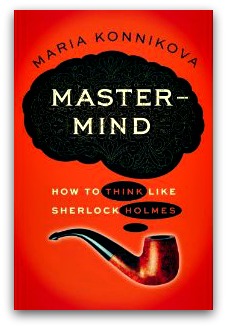
Mastermind_cover_pm1) Mastermind: How to Think Like Sherlock Holmes (Viking, January 2013)

Author: Maria Konnikova
Genre: Self-Help; Cognitive Psychology
Synposis: A primer on increasing one’s mindfulness, based on the lessons imparted by British master sleuth Sherlock Holmes.
Author’s displaced credentials: Born in Russia, Konnikova arrived in the United States at age 4. Though a Third Culture Kid, she has adapted very well to the American scene. She was educated at Harvard, writes the “Literally Psyched” blog for Scientific American, and is doing a PhD at Columbia University in psychology. That said, she has found a muse in an unexpected place: in the fictional works of the terribly Victorian Sir Arthur Conan Doyle.
Why it’s stimulating: So many of us are caught up in the literal idea of travel that we forget that the most interesting voyage of them all lies in exploring the inner workings of our own minds. But Konnikova takes us one step further. She suggests displacing ourselves into the mind of the hyper-observant Sherlock Holmes. To show us how, she does a bold thought experiment — something that most of us, especially those who are living in isolation from family and friends, would find anathema: she downloads Freedom, a program that blocks Internet access completely for a specified amount of time, and sees how it affects her writing. She is shocked by the results. Her conclusion:

Thinking like Sherlock Holmes isn’t just a way to enhance your cognitive powers. It is also a way to derive greater happiness and satisfaction from life.

How we heard about it: Konnikova’s recent article in Slate, “Do You Think Like Sherlock Holmes?”

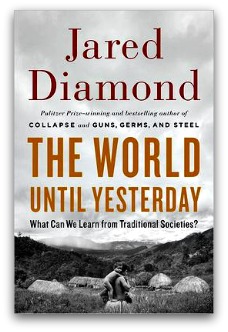
TheWorldUntilYesterday_cover_pm2) The World Until Yesterday: What Can We Learn from Traditional Societies? (Viking, December 2012)

Author: Jared Diamond
Genre: Social History
Synposis: An account of how people in traditional societies — the New Guinea Highlanders, the Inuit, the Amazonian Indians, the Kalahari San — live and what they can teach the rest of us.
Author’s displaced credentials: A polymath and one of the foremost writers of popular science, Diamond was born in the United States, got a degree from Cambridge University, and has had careers in physiology, ecology (specializing in New Guinea and nearby islands), and geography. With the publication of Guns, Germs, and Steel: The Fates of Human Societies, his most popular work to date, he became known for his mastery of global history.
Why it’s stimulating: Diamond displaces us to our (not-so-distant) past by taking us to remote corners of the earth — from the New Guinea Highlands and the Amazon rainforest, to Africa’s Kalahari Desert and the Arctic Circle — where it’s possible to encounter people who are managing without air travel, telecommunications and other fruits of modernity. Pointing out that such accoutrements are extremely recent, he asks: what can traditional peoples teach those of us who live in “complex” societies about how we might live better today? As it turns out, Diamond says, we may be better off dialing down the complexity and living closer to our ancestors:

We get ideas about how to bring up our children. We get ideas about how to have a better old age. We get ideas about how not to die of cancer, heart attacks and stroke.

How we heard about it: An interview with Jared Diamond in Smithsonian Magazine.

Immigrant_Advantage_Book_Cover_pm3) The Immigrant Advantage: What We Can Learn from Newcomers to America about Health, Happiness, and Hope (Free Press, October 2011)

Author: Claudia Kolker
Genre: Social Sciences; Immigration
Synposis: An examination of some of the customs imported by America’s newest residents.
Author’s displaced credentials: A journalist and Third Culture Kid (her mother was from Mexico and father from Ukraine), Claudia Kolker once worked as a freelance reporter in El Salvador from 1992 to 1995, where she covered the Salvadoran postwar recovery as well as social issues throughout Central America, Cuba, Haiti and the Dominican Republic. She has also reported from Japan and India. She now lives in Houston.
Why it’s stimulating: Kolker was spurred to do her research after discovering that most immigrants to the United States, even those from poor or violence-wracked countries, are physically and mentally healthier — they actually live longer! — than most native-born Americans. In a work that in some ways parallels Jared Diamond’s (#2 above), her book takes us on a tour of immigrant households in the United States — Mexican, Hispanic, Chinese, Korean, Vietnamese, Jamaican, etc. — and shows us that there are things about their values we should not only respect but emulate. I don’t know about you, but I find it refreshing to think that privileged Americans like us, who choose to displace ourselves to other lands, could stand to learn some major life lessons from the forcibly displaced. Kudos to Kolker for turning the tables!
How we heard about it: From a recent interview with Kolker on PBS Newshour.

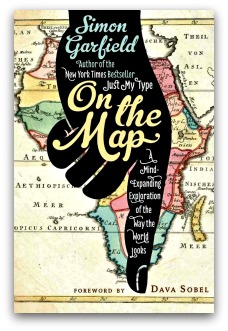
onthemap_cover_pm4) On the Map: A Mind-expanding Exploration of the Way the World Looks (Gotham, December 2012)

Author: Simon Garfield
Genre: Social Sciences; Human Geography
Synposis: A history of mankind’s love affair with maps, beginning with Ptolemy’s world map (one of the 100 diagrams that changed the world); moving through the “cartographic dark ages,” which lasted for about a thousand years; and culminating in our modern obsession with maps, which in fact dates from 1450s Venice, when the atlas became a craze.
Author’s displaced credentials: By splitting his life between London and St. Ives, Cornwall, Garfield could be described as a “domestic expat” within the UK.
Why it’s stimulating: “Displacement” of the sort we talk about in this blog requires constant rewriting and editing of the map you were born with — both figuratively and literally. Garfield shows us that while some of our cases may be extreme (the Displaced Nation being a prime example, with our “Here Be Dragons” obsession), mapmaking is something we humans can’t get enough of:

Maps relate and realign our history. They reflect our best and worst attributes — discovery and curiosity, conflict and destruction — and they chart our transitions of power. Even as individuals, we seem to have a need to plot a path and track our progress, to imagine possibilities of exploration and escape.

How we heard about it: From a 1 Jan 2013 post by Maria Popova on her Brain Pickings blog.

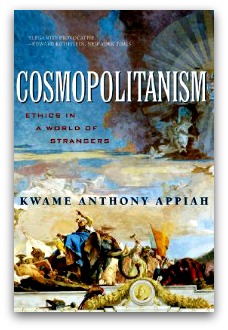
Cosmopolitanism-Appiah-Kwame_cover_pm5) Cosmopolitanism: Ethics in a World of Strangers (W.W. Norton, 2007)

Author: Kwame Anthony Appiah
Genre: Politics; Philosophy; Ethics; Globalization
Synposis: An examination of the ancient philosophy of “cosmopolitanism” — the idea that all human ethnic groups belong to a single community based on a shared morality — and the influence it has had on the Enlightenment, the French Revolution, and the UN’s Universal Declaration of Human Rights.
Author’s displaced credentials: Appiah is the product of a cross-cultural union: his mother was an English author and daughter of the statesman Sir Stafford Cripps, and his father a Ghanaian barrister and politician, who was constantly exhorting his children to remember that they were “citizens of the world.” Raised in Ghana and educated in England, Appiah has taught philosophy on three continents and is now a professor at Princeton University.
Why it’s stimulating: Whether we realize it or not, those of us who venture across borders are making a step towards reducing our culturally isolation. We are opening our minds to seeing the world outside our own contextual walls. But how far can we actually take this? Pretty far, claims Appiah, pointing out that we humans are an inter-cultural, intertwined, and interdependent species, just like every other on the planet — replete with cross-pollinations of language, religion, art, dress, rites, metaphysical outlooks, and progeny. But if Appiah rejects the Sam Huntington view of an inevitable clash of civilizations, he is also not a universalist:

Cosmopolitans suppose that all cultures have enough overlap in their vocabulary of values to begin a conversation. But they don’t suppose, like some Universalists, that we could all come to agreement if only we had the same vocabulary.

How we heard about it: The book was a Global Niche Bookshelf pin, by GlobalNiche.net, on Pinterest.

* * *

Whoa, are you still with me? That was quite a Head Trip! Readers, any responses to this list — any other works to suggest? Much obliged for your input! I think I’ve had a little too much stimulation for one blog post and need to give my brainbox a rest…

STAY TUNED for another episode in the life of our fictional expat heroine, Libby. (What, not keeping up with Libby? Read the first three episodes of her expat adventures.)

If you enjoyed this post, we invite you to register for The Displaced Dispatch, a round up of weekly posts from The Displaced Nation, with seasonal recipes, book giveaways and other extras. Register for The Displaced Dispatch by clicking here!

Related posts:

5 things de Tocqueville can teach expats to US

LibertyI imagine that over the last two or so years the rapid rise of the iPad and other tablet devices has led to a decline in the use of toilet libraries, by which I mean those little collections of books many people keep in their bathrooms for those leisurely times when they have a particularly challenging movement to sit through (perhaps you have your own toilet library. Feel free to share your favorite reads in the comments below).

My own toilet library shows me to be a rather self-righteous, aspiring autodidact. Among my little pile can be found Empires of the World by Nicholas Ostler, The Oxford Book of English Poetry, and Bertrand Russell’s History of Western Philosophy. The books are all left there in the rather grand belief that in the privacy of the privy I might finally learn something. That’s all gone to pot since I got an iPad as I now simply read twitter or play Football Manager on there instead. The books are, sadly, left mostly unread.

One book that should be added to the above trinity – and one that I have fitfully gone through in the last few years – is de Tocqueville’s Democracy in America. When I moved to the US it seemed, unsurprising enough, a cornerstone text that I should familiarize myself with.

For those who don’t already know, Democracy in America  is a study in American society by an aristocrat from Normandy, Alexis de Tocqueville. He journeyed to America in 1831 when he was sent, along with Gustave de Beaumont, to look into the American penal system, although natural curiosity led to both men investigating a lot more than just prisons.

Book II of Democracy in America, in particular, can move me away from reading twitter and reading an actual book. Its short chapters mark it as perfect for inclusion in any toilet library, and it is extremely perceptive into America and Americans. With that in mind, here’s 5 thing that de Tocqueville can teach expats to the US

Warning: de Tocqueville scholars should look away now. No insightful analysis will be found here.

5. An outsider can bring an interesting perspective to US society

Yesterday two of my least favorite people met on CNN, Piers Morgan and Alex Jones (what incidentally is the collective noun for gits?). Jones, a conspiracy theorist firebrand, was behind the recent campaign to have Piers Morgan in light of his views on gun control. Jones screamed “1776!” over and over again at Morgan as well as calling him a “redcoat”. Morgan’s views on gun control aren’t particularly out-of-the-ordinary within the mainstream media, but his foreignness means that, for some, it is doubly offensive when he attacks a text (the second amendment) that they consider sacrosanct.

Morgan clearly is not a modern de Tocqueville, but it is worth remembering that your own outsider status allows you to see US society with fresh eyes and that you can, respectfully and tactfully, challenge certain assumptions.

4. Regardless of how irritating it is when misused, theoretically American exceptionalism is a fascinating, even wonderful, thing.

Most non-Americans understandably roll their eyes when US politicians, particularly when seeking election, proclaim the US as the greatest country in the world, a country unlike any other that is innately superior. That most US political rallies don’t end with a rousing chorus of “America, f#@k yeah!” from Team America is surprising.

However, the first person to describe America as exceptional was de Tocqueville, and in his writings you’ll find that there is much talk of America as a democratic society as opposed to those Monarchic, aristocratic societies of the Old World. It serves as a reminder that America, for all its faults, is founded upon impressive ideals. The main idea underpinning exceptionalism is not American superiority, but that it is qualitatively different from other nations, the first to build an identity based upon its independence. We can certainly debate that this exceptionalism is no longer the case, but in de Tocqueville’s period I do not think it a contentious claim – indeed, it’s an exciting and invigorating thought.

3. Cynicism need not be the default mode for the Western European dealing with America.

It’s easy to be weary when dealing with American life and Americans. They can be unabashed, earnest, loud. The default mode, of which I am very much guilty of, is to mock and sneer and snark about many aspects of American life. The phrase “only in America” is often invoked for some of the worst aspects of American life, de Tocqueville shows that “only in America” can also be positive.

2. “Never mind the quality, feel the length.” A reminder of the sheer size of America.

The America that6 de Tocqueville visited is half the size that the country is now. But the America of the 1830s was a still a vast land and Democracy in America is, in its own dry way, a travelogue to a new land of strange sights. New expats to the US would do well to remember that they don’t just have a country to discover, but a continent.

1. The gift that keeps giving.

The first thing that you many notice about Democracy in America is that it is a hefty tome. For those expats blogging about life in US, you need never worry that you’ll be short of material. The US really is the gift that keeps giving. Look at dear departed Alistair Cooke, he managed to keep ploughing this particular field for over 60 years. You may never fully understand this country, but you can have an interesting time coming to terms with it.

STAY TUNED for tomorrow’s post on reads to tickle the expat’s imagination and intellect.

If you enjoyed this post, we invite you to register for The Displaced Dispatch, a round up of weekly posts from The Displaced Nation, with seasonal recipes, book giveaways and other extras. Register for The Displaced Dispatch by clicking here!

Related posts:

Image: Awindram

Expats, here’s how to enrich your lives in 2013: Choose a mentor or a muse!

Expats and other world adventurers, let me guess. You have you spent the past week making resolutions about

  • staying positive about your new life in Country X;
  • indulging in less of the local stodge;
  • giving up the smoking habit that no one is nagging you about now that you’re so far away from home;
  • and/or taking advantage of travel opportunities within the region that may never come your way again

— while also knowing full well that at some point in the not-distant future, you’ll end up stuffing your face with marshmallows (metaphorically speaking).

Never mind, it happens to the best of us, as psychologist Walter Mischel — he of the marshmallow experimentrecently told Abby Hunstman of the Huffington Post. Apparently, it has something to do with the way impulses work in the brain. The key is to trick the brain by coming up with strategies to avoid the marshmallow or treat it as something else.

Today I’d like to propose something I found to be one of the most effective strategies for turning away from the marshmallows you’ve discovered in your new home abroad or, for more veteran expats, turning these marshmallows into something new and exotic. My advice is to find a mentor or a muse in your adopted land — someone who can teach you something new, or who inspires you by their example to try new things…

Trust me, if you choose the right mentor +/or muse, benefits like the following will soon accrue:

1) More exotic looks — and a book deal.

Back when I lived abroad, first in England and then in Japan, I was always studying other women for style and beauty tips. I made a muse of everyone from Princess Diana (I could hardly help it as her image was being constantly thrust in front of me) to the stewardesses I encountered on All Nippon Airways. Have you ever seen the film Fear and Trembling, based on the autobiographical novel of that name, by the oft-displaced Amélie Nothomb? On ANA flights, I behaved a little like the film’s young Belgian protagonist, Amélie, who secretly adulates her supervisor Miss Fubuki. I simply couldn’t believe the world contained such attractive women…

The pay-off came upon my repatriation to the US. With such a wide array of fashion and beauty influences, I’d begun to resemble Countess Olenska in The Age of Innocence — with my Laura Ashley dresses, hair ornaments, strings of (real) pearls, and habit of bowing to everyone.

Is it any wonder my (Japanese) husband-to-be nicknamed me the Duchess? (Better than being the sheltered May Welland, surely?)

My one regret is that I didn’t parlay these style tips into a best-seller — unlike Jennifer Scott, one of the authors who was featured on TDN this past year. While studying in Paris, Scott was in a mentoring relationship with Madame Chic and Madame Bohemienne. (The former was the matriarch in her host family; the latter, in her boyfriend’s host family.) Mme C & Mme B took her under their wing and taught her everything she knows about personal style, preparation of food, home decor, entertaining, make-up, you name it…and is now imparting to others in her Simon & Schuster-published book.

2) More memorable dinner parties.

As mentioned in a previous post, I adopted actress and Indian cookbook writer Madhur Jaffrey as my muse shortly after settling down in the UK. I was (still am) madly in love with her, her cookbooks, even her writing style.

And her recipes do me proud to this day.

Right before Christmas I threw a dinner party for 10 featuring beef cooked in yogurt and black pepper, black cod in a coriander marinade, and several of her vegetable dishes.

It was divine — if I say so myself! To be fair, the guests liked it, too…

3) Improved language skills.

Now the ideal mentor for an adult seeking to pick up a new foreign language is a boyfriend or girlfriend in the local culture — preferably one with gobs of patience. The Japanese have the perfect expression for it: iki jibiki, or walking dictionary.

Just one caveat: If you’re as language challenged as Tony James Slater, it could prove a headache and, ultimately, a heartache.

Still, nothing ventured, nothing gained…

(Married people, you might want to give up on this goal. I’m serious…)

4) A fondness for angels who dance on pinheads.

After seeing the film Lost in Translation, I became an advocate for expats giving themselves intellectual challenges. Really, there’s no excuse for ennui of the sort displayed by Scarlett Johansson character, in a well-traveled life.

It was while living in the UK as a grad student that I discovered the extraordinary scholar-writer Marina Warner, who remains an inspiration to this day. Warner, who grew up in Brussels and Cambridge and was educated at convent school and Oxford University, is best known for her books on feminism and myth.

After reading her book Monuments and Maidens, I could never look at a statue in the same way again!

In her person, too, she is something of a goddess. Though I’d encountered women of formidable intellect before, I found her more appealing than most, I think because she wears her learning lightly and has an ethereal presence, like one of the original Muses.

Booker prizewinner Julian Barnes has written of her “incandescent intelligence and Apulian beauty” (she is half Italian, half English). The one time I met her — I asked her to sign my copy of her Booker Prize-shortlisted novel, The Lost Father — I could see what he meant.

I was gobsmacked.

Major girl crush!

(Don’t have a girl crush? Get one! It will enrich your life immeasurably.)

5) Greater powers of mindfulness — and a book deal.

Third Culture Kid Maria Konnikova was born in Moscow but grew up and was educated in the US. She has started the new year by putting out a book with Viking entitled Mastermind: How to Think Like Sherlock Holmes. Who would guess that a young Russian-born woman would use Conan Doyle’s fictional creations, Holmes and Watson, as her muses? But, as she explains in a recent article in Slate, she has learned everything she knows about the art of mindfulness from that master British sleuth:

Mindfulness allows Holmes to observe those details that most of us don’t even realize we don’t see.

So moved is she by Holmes’s example — and so frustrated by her own, much more limited observational powers — Konnikova does the boldest of all thought experiments: she gives up the Internet…

So does her physiological and emotional well-being improve as a result? Does her mind stop wandering away from the present? Does she become happier? I won’t give it away lest you would like to make Konnikova this year’s muse and invest in her book. Hint: If you do, we may not see you here for a while. 😦

6) The confidence to travel on your own.

We expats tend to be a little less intrepid than the average global wanderer: we’re a little too attached to our creature comforts and may need a kick to become more adventuresome. But even avid travelers sometimes lose their courage, as Amy Baker recently reported in a post for Vagabondish. She recounts the first time she met a Swedish solo traveler in Morocco, who had lived on her own in Zimbabwe for 10 years. This Swede is now her friend — and muse:

She was level-headed, organized and fiercely independent — all characteristics that I aim to embody as a female traveler.

With this “fearless Swedish warrior woman” in mind, Amy started venturing out on her lonesome — and hasn’t looked back.

* * *

Readers, the above is not intended as an exhaustive list as I’m hoping you can contribute your own experiences with mentors and muses abroad: What do you do to avoid the “marshmallows” of the (too?) well-traveled life? Who have you met that has inspired you to new creative, intellectual, or travel heights? Please let us know in the comments. In the meantime, I wish you a happy, healthy — and most of all, intellectually stimulating — new year!

STAY TUNED for next week’s posts.

If you enjoyed this post, we invite you to register for The Displaced Dispatch, a round up of weekly posts from The Displaced Nation, with seasonal recipes, book giveaways and other extras. Register for The Displaced Dispatch by clicking here!

Related posts:


A newly arrived expat in Boston asks: Is distance really the antidote to romance?

James_Murray_DisplacedToday, we welcome guest blogger James Murray to The Displaced Nation. Originally from East Sussex, UK, James “recently arrived in Boston, Massachusetts, with a half-written book, a smattering of web design skills and a utopian vision that will probably never change the world.” He’s here for his partner, Ash, who is American (although few people think of her that way). Though he doesn’t really label himself a traveler, his displacement is “likely to verge on the permanent.”

I’m finally here in America. After the best part of a year living in separate countries, my partner and I are finally married — which I suppose makes her my wife. The word doesn’t sit well — we have a pretty equal relationship, where the terms ‘husband’ and ‘wife’ seem to imply a structure; a certain assignment of roles. In a husband-and-wife relationship, you can make a guess as to who does the cooking and cleaning; but in a relationship of two partners there are no preconceptions (apart from the one that you might be gay).

But the labels of husband and wife are just one of a number of areas where the typical encapsulation of a relationship differs from the reality.

For around eight months I’d been sitting in limbo over the other side of the Atlantic, fidgeting around with various projects and living in various temporary places — it’s been okay, but I’ve just wanted to get settled for a bit. My partner, Ash, visited a few times, but those occasions weren’t what you would think.

The old airport reunion kiss

In particular, there’s a fault with the ‘airport reunion kiss’ — that little run-up, the unseen orchestra with its musical swell and the big hug and the big kiss between two people who have spent so much time apart. I want to blame Hollywood, but I simply couldn’t find an example of this happening in a movie, so I think it must just be hard-wired into the human mind — that this is simply how it happens, a tempestuous embrace with no doubts and no awkwardness.

It doesn’t work like that. Certainly we kissed at the airport, but after months apart, living our separate lives, we couldn’t quite get our heads around who this other person was. Logically, you know, you could recite details about this person — their likes and dislikes; their beliefs; their habits; but there are memories that are harder to keep.

For instance, how do you remember what it feels like to kiss your partner? How do you remember their smell or a particular look they might give you? There are things that, once they’re not physically there in front of you, just disappear, so when you finally see them again after a long separation, it’s a shock. Not a bad shock, but it’s not comfortable yet — you have to re-acclimatise.

Ash and I found that meeting again after our first three months apart, it actually took about a week for this to happen. Which means that when your partner comes to stay with you for ten days, you’re finally re-discovering your groove when you’re just about to say good-bye again.

Doubt — nothing wrong with that!

Lots of expats know what it’s like to have a long distance relationship — for many that’s the reason they’re expats; but I think we’re badly served by the standard story of long-distance romance and reunion. Who’s talking about the difficulties of keeping the faith throughout doubts and the regular tribulations of a normal life?

It’s hard to discuss doubt sometimes — it’s seen as a sign of weakness, a sign that you don’t love the person you’ve committed yourself to. It’s not — it’s perfectly normal (and it’s normal even if your partner is actually in the same country).

Everyone has doubts and it’s really the failure to acknowledge them that leads to problems. About the least supportive thing I ever said on the phone to Ash was that I had ‘absolute faith’ in our relationship. I wasn’t saying it meanly, but I had essentially raised the bar for our relationship impossibly high — nobody has absolute faith, especially when faced with the unknowns of long distance.

If you have doubts and the other person has absolute faith, who do you turn to? It makes it hard to discuss or even acknowledge those doubts — and you should discuss them if you want to resolve them. Absolute faith is the trump card that ends the conversation, and potentially the relationship, but it’s so often just assumed.

Creatures of the moment?

The funny thing is that now that I’m here and we’ve got used to each other again, it’s as hard to remember the separated life of the past year as it once was to picture living here with Ash.

I think that more than we’d care to admit it, we really are creatures of the moment — what matters is now. Committing to the future is vague and riddled with doubt; the past is foggy and easily forgotten. What carries us through is faith rather than emotion — a faith based on the knowledge that at some point in the past you felt strongly enough to say ‘let’s get married’. You have to trust that knowledge long after you’ve forgotten how exactly you felt at the time.

If what I’m describing sounds peculiar, that’s only because these aren’t the terms we’re usually given to describe our relationships — because the language of romance is a language of absolutes; because to question the titles of ‘husband’ and ‘wife’ seems tantamount to saying you aren’t ready to be one.

There isn’t just one experience of a relationship — no single narrative that applies to everybody; but that’s how it often feels.

So for all the people with doubts — the people who aren’t in a Hollywood romance, but are in love just the same; the people for whom the happiest day of their lives will probably not be the day they got married (or even the birth of their first child) — I think we can still count ourselves as romantics — especially after moving continents (twice in my case) to be with our loved ones.

* * *

Readers, what are your thoughts on long-distance relationships? Does distance lend enchantment to the view, or is it a case of “out of sight, out of mind”?

Check out James’s own blog at quaintjames.com

.

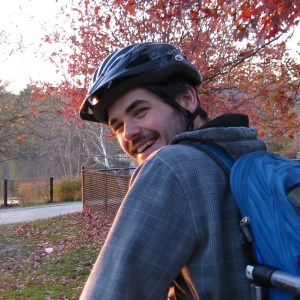
Image: James looking vaguely itinerant in his bike helmet.

STAY TUNED for Thursday’s post!

If you enjoyed this post, we invite you to register for The Displaced Dispatch, a round up of weekly posts from The Displaced Nation, with seasonal recipes, book giveaways and other extras. Register for The Displaced Dispatch by clicking here!

Related posts: