The Displaced Nation

A home for international creatives

GLOBAL FOOD GOSSIP: Gourmet coffee vs The Pod — France’s answer to England’s “Lapsang Souchong vs PG Tips”

global food gossipJoanna Masters-Maggs, our resident repeat-expat Food Gossip and Creative Chef, is back with her column for like-minded food lovers. This month: Coffee, the Achilles heel of French cuisine.

* * *

“I wouldn’t mind French coffee being quite so terrible, if they would just admit it,”  my English friend said in exasperation as she clicked her cup back into its saucer.  “It’s the equivalent of British tea, from an urn, at a railway station in 1930s Huddersfield.”  There was a pause as she picked up her croissant for my inspection. “But I suppose there are compensations.”

If you have spent any significant time in France, you will have noticed that it is very difficult to find a really good cup of coffee.  If you have never visited, I’m sure you will find that difficult to believe, such is France’s reputation for wonderful food, wine and coffee.  So, take a breath, retrieve your eyebrows from your hairline and trust me on this one:

If you’re not a fan of Starbucks, France might just be the place to drive you there.  If you can find one, that is.

Why is French coffee in so unpalatable?  It has the power to cause involuntary facial spasms and to make my stomach roil.  At first I put these symptoms down to my taste buds being insufficiently sophisticated to appreciate its forceful nature.  After two and half years, my friend’s comment helped me to recover some self-esteem and quit making a victim of myself.

Maybejust maybeit’s not only me.

Tea: A Brit’s second language

IMG_2742

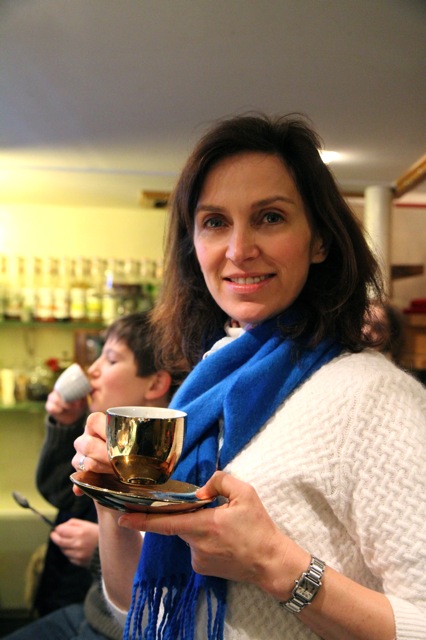
Joanna, apparently mildly surprised at her enjoyment of French coffee

I drink the tea this way, because that’s how I was brought up drinking it.  We drink it for comfort, to stay awake, to go to sleep, or to get over a nasty shock.  It comes with its own social language.  Offering tea to an upset friend shows concern when we cannot find words.  Failing to offer it to an unexpected guest says they should not expect to stay long.  Giving some to a workman is a way to show your respect for them and to ensure a good job.  Thus, overseas, tea is a rock of sameness I cannot let go of.  In fact, it is the only overseas product I really must have if I must have something from home.  It works for me.

Coffee: A rough guide

The coffee in France, therefore, should appeal to my rough taste in beverages.  It is largely made from robusta beans which are recklessly roasted until the flavor verges on the acridity of all things cremated.  It is drunk black, the addition of milk or cream deemed unsophisticated; ironic, given the rough, bad manners of the coffee itself.  The tiny cups are instead dangerously laced with extreme amounts of sugar or sweetener and then downed rapidly in a way Mary Poppins would have approved of.  And why not?  Sometimes even the French should be allowed a break from tasting and judging good food and drink.  My tea gives me the comfort and hit I demand, so why can’t I accept that the French should also be allowed, sometimes, to demand substance over style?

With coffee, the French give themselves a break from the world’s demand for them to be so effortlessly chic.  Coffee is not approached as is, say, wine, with a sort of intellectual or artistic mindset.   The routines of coffee tasting are not observed.  Whereas wine is lifted to the light, swirled, inhaled luxuriously and sucked over the tongue, coffee is knocked back as if by a Russian soldier engaged in long evening of vodka toasting. Coffee is not cupped with the hand to prevent the aroma escaping prematurely before the nose is lowered to inhale the intensified aromas.  It is not sucked over the tongue to seek the full range of flavor.

I must admit, it does the heart good to see the French behaving so badly.

Coffee climate change in Montpellier

IMG_2736

Coffee in Montpellier

I understand, though, that this is changing.  There are increasing numbers of little cafés which roast their own beans and grind to order.  Little places where robusta beans are eschewed for the more subtle delights of arabicas.  It’s been a while since I have had the time to hunt down these places in Paris.  However, last week I was in Montpellier and had the great good fortune to find two of these hallowed places.

Café Solo is an adorable place where the smell of coffee can be enjoyed a considerable distance from the front door even on a rainy February day.  I had forgotten this smell.  You don’t get it in a Starbucks or a Costa or any of the many similar establishments.  The tiny interior is crammed with drawers of beans, a counter of homemade delights in little covered cake stands and, in a corner, a large roasting machine.   My family and I discovered it quite by chance while exploring the streets of Montpellier.

Here we enjoyed what can only be described as a consultation with the artiste who would make our drinks.  She listened to what we like and do not like, and pronounced her judgement on what would suit.  Describing the flavours of each of the beans in that day’s selection, she guided our choice.   Then we waited and watched while our coffee was made.  It arrived in charming mismatched espresso cups and, thoughtfully, with little jugs of frothed milk– just in case.  Hmmmthere was me thinking I am a coffee hooligan who needs the milky stuff, just like a kid, but I absolutely did not need a drop of it.  My mocha bean from Ethiopia was soft and smooth with a tumble of flavours which lasted in the most pleasant way.   It was a delightful surprise.  I am so accustomed to a punch in the back of the throat from a tough one-dimensional over-roast.  Not so here.

“You see,” explained the artiste behind our coffees, “we French make terrible coffee.  We just don’t know how to make it.”    She smiled broadly, knowing full well that we could not agree with her.

We found a similar place a few streets later and just had to go in to try another.  Would it be possible to find two great coffees in one day?  Yes, it was. This time Columbian for me; a bit more acidity, but absolutely no acridity. Lovely.  Again, intoxicating smell of roasting coffee beans.

As we returned to our hotel, nursing the residual flavor of our coffees, we saw a Nespresso shop and just had to go in.  We knew that the chic, modern interior with its rows geometrically displayed and pristine pods as well as the absolute absence of the smell of real coffee would round off our day perfectly.  Today that clinical chicness, instead of depressing us, would only intensify the memory of the delightful little stores we had just left.  How deliciously wonderful it is to confirm how right I was.  Clutching my bags of beans from Café Solo to my nose, I knew in that moment I would never succumb to the clinical pod.  May my work surfaces be forever stained by the work of my little espresso machine and my walls stained by the periodic explosions to which the enthusiastic amateur is prone.

I thought I had no sophistication when it comes to coffee, but, perhaps because I don’t drink tea for the tea itself, I do drink coffee for the coffee itself.  I am much more open to trying different flavours and I am very willing to drink a lot of bad coffee until I find it.  Since I can manage without coffee, I am not lured by the siren call of Nespresso machines, Starbucks, or any of the lesser places.  I found absolute delight in those two shops which sell the stuff the way it should be sold.  I am willing to keep trying everywhere, until I next hit coffee gold.

Perhaps the next big discovery I will make is that the French acceptance of routinely bad coffee has freed them to become gourmet tea drinkers.  It would be fun to think so.

* * *

Joanna was displaced from her native England 16 years ago, and has since attempted to re-place herself and blend into the USA, Holland, Brazil, Malaysia, Venezuela, Saudi Arabia, and now France. She describes herself as a “food gossip”, saying: “I’ve always enjoyed cooking and trying out new recipes. Overseas, I am curious as to what people buy and from where. What is in the baskets of my fellow shoppers? What do they eat when they go home at night?”

Fellow Food Gossips, share your own stories with us!

STAY TUNED for tomorrow’s post!

If you enjoyed this post, we invite you to register for The Displaced Dispatch, a round up of weekly posts from The Displaced Nation, with seasonal recipes, book giveaways and other extras. Register for The Displaced Dispatch by clicking here!

Related posts:

Images: All images from Joanna’s personal photo albums, and used here with her permission

JESS IN JAPAN: Tokyo’s top 6 delights from my newbie expat perch

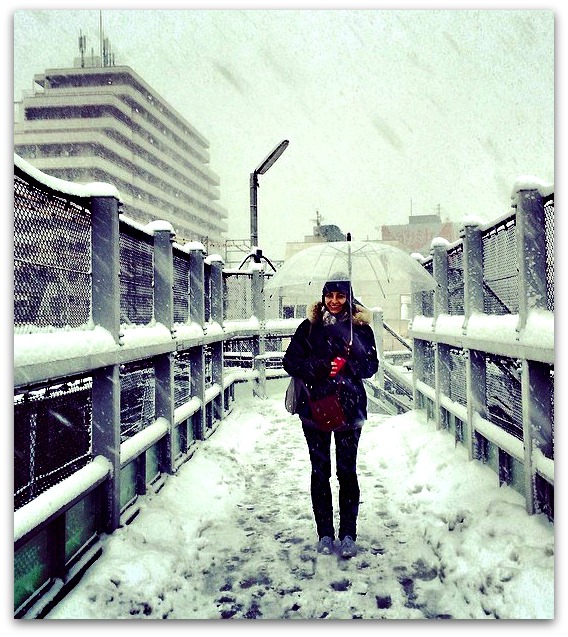
So is snow the same in Tokyo? Kind of, except everyone carries see-through plastic umbrellas! Jess in Tokyo's first February snowfall. Photo credit: Hiro Awanohara

So is snow the same in Tokyo? Kind of, except everyone carries see-through plastic umbrellas! JESS IN JAPAN in a rare heavy snowfall earlier this month. Photo credit: Hiro Awanohara

Today we welcome a new guest columnist: Jessica Awanohara. Any relation, you may wonder? Yes, she’s the American wife of my nephew by marriage, Hiro. The pair, who’d become dyed-in-the-wool New Yorkers, surprised us all by announcing they were moving to Tokyo at the end of 2013. Naturally, I was curious: how is Jessica adjusting to life in that “through-the-looking glass” city? Is it different to live there versus just visit (which she’s done many times in the past)?

—ML Awanohara

There are many things to love about moving to a new country and a few things not to love. Most expats eventually strike a balance between the two.

But are there also places where the love-hate continuum doesn’t apply? I’m beginning to think so ever since I moved from New York to Tokyo in late December of last year. A bad mood is impossible to sustain in this city because everything is hilarious. Wherever you turn, there is something riotous laying in wait…and the next thing you know, you are collapsing in fits of laughter.

I’ve been in Tokyo for over a month now, and have delighted endlessly in many things.

Here are six off the top of my head:

1) Trains are in happy colors.

I live on the Keiō Inokashira railway line, the color of which is bright pink. Not the barfy green of the 4/5/6, nor the almost-royal blue of the A/C, nor the vibrantly atrocious orange of the B/D/F, in New York City. Rather, this line is a sparkling and spritely pink mixed with what I imagine to be the color equivalent of delicious farm-fresh milk. It’s the pink of the gods: the Disney Princess Gods.

2) Subway stations are deeply amusing, so to speak.

Think of New York City’s deepest subway platform: the 63rd Street station on the F Line near Hunter College, or the 191st Street Station on the 1 Line. Imagine how long those escalators are, and now double it—no, triple it! Triple it, and add a couple of extra escalators and a brick-and-mortar set of stairs to the street, and now you have an idea how deep the average street to subway platform trip is in Tokyo. Have you ever tried going to Roppongi, or Azabu-Jūban? Try it!! You may feel as though you’ve walked far enough to be back in New York. Good for quite a few laughs!

3) People on the subway may be dressed much better than us, but they smell just as funny.

How could men in suits and overcoats, or women in designer outfits, smell as bad as we much more disheveled Americans do on the subway? Before taking the leap of moving to Tokyo, I dreaded the idea of being taller, sweatier, and worse smelling than the average citizen on a notoriously packed Japanese train car. Rest assured, inquiring minds, curdled humans smell much the same in Tokyo as in New York: like sweat socks… By the time summer arrives—I’ve visited here often enough to know that summer is no joke!—I should blend in perfectly fine, a thought I find immensely entertaining.

4) Furniture delivery can be farcical, especially when it doesn’t fit through doors.

After a month of living out of another person’s apartment, my husband and I moved into our own place a couple weeks ago. We ordered what can aptly be described as the world’s most beautiful bargain basement sofa and had it delivered to our new, completely empty home. No sooner did our large and lovely couch arrive, than it was exchanged for its tiny, two-seater cousin—that is, tiny enough to actually fit through our front door. In Japan, small is beautiful. How could we have overlooked this basic principle? Our hilarity could not be contained…

5) In Tokyo, cost-of-living statistics are a bit of a joke.

Really, Expatistan.com? I appreciate the cost-of-living data you supply for this great world’s great cities, and am aware that countless magazines and listservs use your data for splashy articles sizing up one city against another. But I’m confused about your aim. On your website it says you want to give people the information “to live as nicely as you live currently.” That means…what exactly? How does one measure the quality of life across cultures? And what about that ideal, which many of us expats hold dear, of “When in Rome…” I can lead the same life materially in Tokyo as I led in New York, but that’s not what makes me happier in this city. Sure, living the luxury life in Tokyo is expensive, but numbers are not the point. The point is, cost-of-living stats are hilarious in a city that gives me such joy!

6) Appliance installation is a riot and a half.

In a related hilarity, it is true that most Tokyo apartments are not outfitted with appliances normally packaged with an apartment in NYC. We had to order our own refrigerator and washing machine (both standard fixtures for the Tokyoite). Our refrigerator, a lovely and highly rated model, cost us all of $500; the washing machine was comparably rated and lower priced. As with anything you buy larger than a shopping bag, you have it delivered to your home for maybe $30 or $50 additional dollars, or oftentimes for free. The hilarity lies in the fact we had two choices when the refrigerator and washing machine were shipped—the delivery men would either leave them at our front door OR huff them up countless flights of stairs and install the machines for the low, low price of…one U.S. dollar. Tough choice, right? Hahaha.

No doubt about it, Japan is a barrel of laughs. Reaching beyond the cruel and unusual TV game shows, the Hello Kitty cafes, the Fruits magazine documenting outlandish clothes in the Harajuku area, and other enduring staples of pop culture in this part of the world, I’ve found countless things to delight me during my first month of residency in Tokyo. My main takeaway is how excited I am to let this town continue to delight me for years to come.

* * *

Readers, what do you think of Jess in Japan’s observations of her new home? I don’t know about you, but I find it ever-so-amusing that so many of her thoughts are focused on subways and apartments: not so different from life here in New York!

STAY TUNED for next week’s fab posts!

If you enjoyed this post, we invite you to register for The Displaced Dispatch, a round up of weekly posts from The Displaced Nation, with seasonal recipes, book giveaways and other extras. Register for The Displaced Dispatch by clicking here!

Related posts:

For this Filipina with a passion for immersive escapades, a picture says…

Jean Alaba Collage

Canon zoom lens; photo credit: Morguefiles. Jean Alaba in front of moat surrounding Osaka Castle, Osaka, Japan. Photo credit: Jean Alaba.

Welcome to our monthly series “A picture says…”, created to celebrate expats and other global residents for whom photography is a creative outlet. The series host is English expat, blogger, writer, world traveler and photography enthusiast James King, who thinks of a camera as a mirror with memory. If you like what you see here, be sure to check out his blog, Jamoroki.

My February guest is 20+ Filipina Jean Alaba. An extrovert who describes herself as a “God-fearing human being” and a “firm believer of living vividly,” Jean is, without a doubt, fulfilling her passion in life: TO TRAVEL. As she explains on the About page of her blog, The Eager Traveller, travel affords her an opportunity to move outside her comfort zone and grow as a person.

Jean was motivated to start up her blog just over a year ago, as a space to record the re-collections of her travels—which she modestly calls “my humble escapades”—in hopes of inspiring others to “nurture their zeal for new adventures” and of promoting the joy of immersing yourself in “the vibrant cultures across the globe.”

Why am I not surprised that Jean has gathered a considerable following in just over one year? My interview with her may provide a few clues as to why other avid travellers are drawn to Jean and her suggested itineraries.

* * *

Hi Jean. I know it has taken us a bit of time to connect, but I’m glad we finally managed to find some time to discuss your photo-travel experiences. Firstly, I see that you are 20+ (I am also 20+: 20 + 50!!), and for one so young you have travelled a fair bit. Can you tell us where you were born and when did you spread your wings to start travelling?
I was born in the Philippines. This may sound like a cliché but my first source of inspiration for travelling was a National Geographic magazine I saw in our school library.

National Geographic is a wonderful publication. I love it.
But I didn’t spread my wings until I made my first trip to West Coast USA. The Strip struck me the most because everyone there seemed to be having the time of their lives. There was such a lot to experience and yet the time was way too short. After that, I developed a passion to immerse myself in new cultures, interact with unfamiliar nationalities and engage in overseas adventures.

To a fearless person, no fence is high enough.—Filipino tagalong proverb

I assume you mean the famous Sunset Strip that has featured in so many movies over the years? I want to know more about your travels, but let’s start with what it’s like to be a solo female traveller.
So far I’ve travelled for pleasure and for business but as yet have never travelled alone. That’s a hurdle I hope to cross this year. I realize it can be risky, but from the inspiring articles I’ve read online, it’s clear it can also be rewarding.

Even though stepping into the unknown by yourself can sometimes be difficult, even for seasoned travellers, I believe preparation is the key. I’m sure you will be fine. Next I would love to know what what countries you have already visited?
So far, I’ve only been to the United States, India, Singapore, Japan, South Korea, Hong Kong, China and Taiwan. I lived in Singapore as an exchange student for four months, which gave me a a sense of independence and responsibility. Another highlight was my six-week business trip in India, where I had the opportunity of visiting Mumbai, Agra, New Delhi and Jaipur. Here are two photos I took on that trip:

Q9-Taj-Mahal

The Taj Mahal in all of its intricacy. Photo credit: Jean Alaba

The first is of the Taj Mahal. I immediately fell in love with its intricate design. By pure luck, a bird flew across at the moment when I snapped this shot. It was only when I was viewing my photos on my laptop that I realized I had captured such an amazing moment. For me, the bird is special: it symbolizes freedom from all the worries in one’s life and from whatever is holding you back from achieving your dreams.

Q9-Bhawani

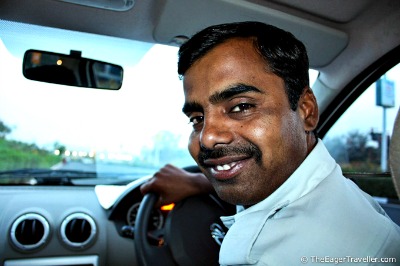
The jolly Jaipur driver Bhawani. Photo credit: Jean Alaba

The second is of Bhawani, the driver assigned to my group during our two-day outing to Jaipur. It reminds me of his kindness and positive disposition in life. He had to take us around Jaipur in the burning hot summer, but never once did he become irritated or impatient. He always had a smile on his face, and that kept us all in a good mood during the trip. In fact, the following week when we went to New Delhi, the company driver assigned to us was totally rude and inconsiderate. At one point he left us in the car sleeping (engine shut off!) while he had his dinner. Worse, when we lightly honked the car to signal that we were awake and frankly not amused, he completely ignored us.

I loved your photo of the Taj Mahal when I first saw it on your blog’s Home Page, but I have to be honest, I never noticed the bird until you pointed it out just now. Maybe that’s good as I was able to appreciate the intricate carvings. Now I’m worried I’ll miss the building and concentrate on the bird!! You’ve captured Bhawani exactly as you describe him; perfect.

One finds a way, or finds a reason to do something.—Filipino tagalong proverb

You are very modest to say you’ve been to “only” eight countries. That’s a lot more than most people visit in a lifetime. So tell us about where are you right now and why.
Well, as you know, James, I am currently in my country of birth, the Philippines, but I’m working out a deal that will hopefully pave the way for life in a new place. I’ll keep you posted.

Q9-Baler

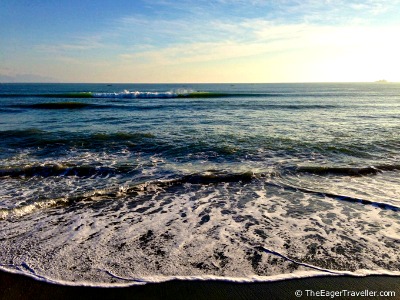
Baler, nicknamed the Philippines’ surfing capital. Photo credit: Jean Alaba

So you are keeping the secret for now, but I’m sure your blog will be give the game away when you are on the move again. The Philippines is a beautiful country and I see you have included one picture in your selection.
Yes, I’ve included this photo of Baler, which is in Aurora province. I like it because it reminds me of my first time attempting to surf and for someone not sporty, I didn’t do too badly. This was also my first time to go beyond my comfort zone in my own part of the world: I travelled for six hours just to catch the waves. It was a spontaneous weekend that proved to be pretty rewarding.

For me, the Baler surf lapping the shore looks just like a welcoming carpet in someone’s lounge.

If you plant, you will harvest.—Filipino tagalong proverb

I know you take a lot of photos but where, so far, are your favourite places to do so? and Can you explain why these places inspire you and how it shows in your next three photos?
My favourite places to take photos so far are India, Japan and Hong Kong. I’ve included one photo of each.

Q10-India

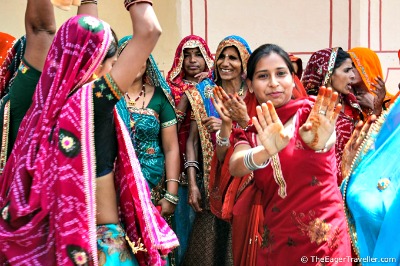
Indian women in colorful saris. Photo credit: Jean Alaba

I like taking photos in India because Indians are very proud of their heritage. This was apparent everywhere we went in India, regardless of the people’s social status.

Q10 Japan

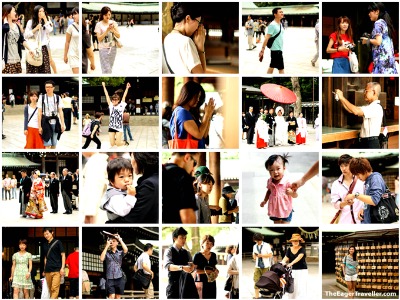
Portraits of Japanese people. Photo credit: Jean Alaba

Japan is a favorite of mine because the people are so organized, disciplined and polite. I never run out of things to see and admire.

Q10-Hong-Kong

A Hong Kong eatery. Photo credit: Jean Alaba

Hong Kong inspires me because of the food! I should think its vast array of local dishes are enough to inspire anyone!

I like that you manage to get a handle on people from the different countries you visit, without actually living in that place. You are clearly a good observer of people, as well as a keen researcher. Tell me, do you feel reserved about taking photos of people, particularly when they are conscious you are doing so?
Not really unless I see they’re offended. But so far, no one has reacted angrily when they see me taking their photo. This is a good thing since I like shooting people. Capturing their unique expressions enables me to glimpse who they are and the kind of lives they lead. I must have taken a thousand portrait shots while in India. Perhaps I’ll get some of these printed and make it my wall art.

I’m the same. I hate to take “posed” photos so never get into a discussion with my subjects. I either take the pic or I don’t. So you like shooting people? Don’t worry; I know what you mean! I think the wall art is a great idea. I know this is a similar question but do you ever ask permission before taking people’s photographs. And how do you get around any language barriers?
Most of the time, I don’t ask but when I was in Japan, where permission needs to be secured for taking photographs of infants and kids, I would politely approach one of the parents and ask them in Japanese—of course with the help of sign language (pointing to my camera and their kids).

Thanks to you, I won’t get into trouble if I ever go to Japan. Would you say that you are motivated by the possibility of capturing something unique, which will never be seen again?
Definitely. You always have to live in the moment, and there is nothing more rewarding than being able to capture the special moments that, unless you have a time machine, you’ll never be able to bring back. Those photos may give you inspiration just when you need it most.

I have to agree, as I think most photographers would. So when did you first realize the power of photography, and how has it changed you?
I first realized it after borrowing a decent SLR for my trip to Hong Kong in 2008. I was able to take high-quality photos to serve as a memento. Ever since, I’ve made it a point to capture moments with my camera, whether during a vacation or simply at a gathering of family or friends—moments I’ll be wanting to view when I get old and grey.

I know what you mean. The picture for me is like a diary of an event in visual form. The photographer can write about it but no one else could.

When the sheets are short, one needs to make do.—Filipino tagalong proverb

Most readers will know by now that I’m not too good on the technical stuff but some of our readers will want to know what kind of camera and lenses you use.
I’m still using the borrowed camera; it’s a Canon 450D. I use the kit lens and a prime lens. It’s outdated equipment now.

You sound a bit like me except that I haven’t managed to borrow any equipment yet. And you aren’t asking me for technical advice. That’s great!! Finally, do you have any advice for wannabe photographers who are traveling or living abroad?
I don’t feel I’m in a position to give advice since I haven’t really achieved anything noteworthy. But I would say from my experience, don’t hesitate to take as many pictures as you can while travelling. Before embarking on a journey, research and learn from the professionals online. You can try copying them, using a trial and error process.

I actually think that is very good non-technical advice, Jean. I’d like to thank you for taking the time to tell your story so far in this interview. On your blog you say:

It has been a spectacular life so far but there is so much more to be seen! I have yet to find that life-changing opportunity which will allow me to do my passion for travelling and blogging as a living.

I have no doubt you will find that opportunity. I’m booking you in for a follow up interview next year to check your progress!!

* * *

Readers, what do you make of Jean’s experiences and her photography advice? And do you have any questions for her on her photos and/or travels? Please leave them in the comments!

And if you want to know more about Jean, don’t forget to visit her excellent blog, The Eager Traveller. You can also follow her on social media:
Twitter: @eagertraveller
Instagram: theeagertraveller
Google+: Jean Alaba

(If you are a photographer and would like to be interviewed by James for this series, please send your information to ml@thedisplacednation.com.)

STAY TUNED for tomorrow’s fab post!

If you enjoyed this post, we invite you to register for The Displaced Dispatch, a round up of weekly posts from The Displaced Nation, with seasonal recipes, book giveaways and other extras. Register for The Displaced Dispatch by clicking here!

Related posts:

THE LADY WHO WRITES: Wannabe novelists, before you write: Read, and read some more…

LadyWhoWrites_brandIntroducing…The Lady Who Writes, Meagan Adele Lopez—a repeat expat in the UK (she now lives in London). Besides writing, her talents include acting, blogging (during her first UK stint, she kept the blog “The Lady Who Lunches”), and crafting ads for social media. In this monthly column, which began yesterday with a self-introduction, Meagan is doling out advice to international creatives who are contemplating writing a novel about their novel, shall we say, life experiences.

—ML Awanohara

Hello again, Displaced Nationers! After my self-introduction yesterday, I’m happy to be back today to discuss my first topic: reading.

Yes, you heard that correctly: reading. Before you even begin to write, you really need to know how to read.

Reading is not just about absorbing the words on the page. You have to be as observant in your reading as you are in your own writing.

Perhaps I am telling you something you’ve already seen in book-writing manuals—but it still remains the best advice I received before writing my novel about an expat love affair, called Three Questions: Because a quarter-life crisis needs answers.

I was always an avid reader, but somehow got out of it once I finished college. By the time I’d decided to write a novel, I was shocked to realize it had been a few years since I’d read more than one book in a year.

Always one to kill multiple birds with one stone (that’s an awful phrase, isn’t it? I really would rather not kill any birds but, alas, the phrase says I must), I formulated a plan to read as much as I could before starting to write.

I would read books that would help me understand the rhythm of the sort of book I intended to produce, while also learning what my target audience was interested in.

And to do that, I would develop a sort of focus group of people who would give me honest and relevant feedback.

The Ladies Who Read

How did I create this? I started a book club for women. BUT this was no ordinary book club. Oh no! This was a book club with sass, spunk and activities, called the Ladies Who…(yes, I am fond of this moniker).

Our group would meet every month to tackle a different book and create some sort of experience based off the book.

One month, we were Ladies Who Cooked. Another month, we were Ladies who Karaoke-ed. Another month, we were the Ladies who Roller Skated. The topic didn’t always completely correlate to the book, but we did our best and always had a blast doing it.

And, although the novel I ended up writing—Three Questions—belongs to the “chick lit” genre, the books we read weren’t necessarily chick lit, and they weren’t just fluff. Some were literary, some were trashy but popular, and others were largely autobiographical.

“Let us read; and let us dance…” — Voltaire

One thing these books did have in common, though: my fellow “ladies” were interested in reading them.

Before, during or after our “Ladies who…” events, we discussed the book: what we liked about it, what we wished the author had thought more about, what bored us, what gripped us, the ins and outs of the character development—and I took notes.

To me, this was better than sitting in a classroom with fellow writers because I was getting first-hand knowledge of what the people wanted out of a good woman’s fiction novel.

The best part about it? One month it was my book that we did this to!

For me, reading before I started writing was immensely helpful. As I mentioned, being able to understand the ebb and flow of what makes a good narrative is extremely important.

I wanted to keep my readers always wanting more, never getting bored (I’m an actress, remember)—but also not jarring them by jumping from scene to scene. It’s a difficult task to accomplish, but reading other successful novels helps. For me, novel writing is not a science. It’s more of a feeling, an art form…

Notably, I found it more difficult to continue reading while I was in the throes of writing because I found myself subconsciously writing in the same style of whatever author I happened to be reading at the time. This caused my writing to become disjointed, confused and derivative, lacking its own identity. I had to separate myself from reading others’ writings during the course of my novel-writing for this reason.

Others might be different, but this was my experience.

Turning the page

Am I saying you must start a book club immediately in order to kill all those birds at once? OK, I’ve got to come up with a different metaphor. How about: “Throwing the baby out with the bath water”? (Ugh, equally as horrible, if not worse.) Actually, this is where the author must come up with her own! Writing your own metaphors, avoiding clichés and repeating phrases could be its own blog post entirely. I digress…

No, I’m not saying that you need to start a book club. What I am saying is for you to know your genre inside and out.

To sum up, here’s Novel Writing Tip No 1 for International Creatives:

Be the master of what you are writing about. Let no one else understand how to let that cliff hang, those lovers love, or that monster scare little children like you can. NO ONE.

* * *

Readers, any questions for Meagan, THE LADY WHO WRITES? What do you think of her book club suggestion? Zany, helpful—or both? Perhaps you have alternative suggestions? Please share in the comments…and let’s get a “Ladies Who Talk About Writing” club going. (Men, you are welcome, too!)

Meagan Adele Lopez grew up in the U.S. with a Cuban-born father and American mother, and at one time enjoyed an acting/casting career in Hollywood, something you can detect in the beautiful trailer for her novel, Three Questions. Her day job these days is in social media advertising. To learn more about Meagan, go to her personal site.

STAY TUNED for next week’s fab posts!

If you enjoyed this post, we invite you to register for The Displaced Dispatch, a round up of weekly posts from The Displaced Nation, with seasonal recipes, book giveaways and other extras. Register for The Displaced Dispatch by clicking here!

Related posts:

THE LADY WHO WRITES: Expats, there may be a novel in your novel life!

LadyWhoWrites_brandMeagan Adele Lopez has always been on the move. By the time she was 12, she had lived in 12 places within the U.S. As a young adult, she moved to Paris and then Bristol, UK. She repatriated to the U.S. but recently crossed The Pond again to settle in London. Meagan’s talents include actress, blogger (she kept the blog “The Lady Who Lunches” while in Bristol), novelist and social media guru. And now, for the Displaced Nation audience, she will deliver advice on writing a novel. Introducing…THE LADY WHO WRITES!

—ML Awanohara

When ML Awanohara asked me to write a series of guest posts about writing a novel, I was a bit taken aback. Who am I to tell you lovely readers how to write a novelI’ve only written one, and it wasn’t a bestseller on the New York Times!

Then I started thinking about what I could contribute to the Displaced Nation, what I know I did really well, and what I know I didn’t do well. Surely the successes and learnings from any first-time author are worth a contribution of, say, a series of at least six guest posts?

After all, I did have 30,000 people download the book in the first six monthsthat’s worth something, right?

Plus, being an expat myself (this is my third try!), hopefully I will be coming from a perspective that you all know and understand. I was lucky enough to be able to write my novel, Three Questions: Because a quarter-life crisis needs answers, while living abroad in England back in 2008. I’m back in England again (London, to be specific) after living in Chicago for three yearsand, yes, I’ve started writing again.

The odd thing is that I found it difficult to write in my own country. My imagination isn’t sparked like it is when I am abroad, and out of my comfort zone. Living in America (where I’m from), I go through the motions of my day-to-day life without digging deeperand this, in my mind, makes my writing dull and uninspired.

When I’m in Europe, I question more, observe more, and simply write more because I have to in order to survive. My writing in Europe comes almost out of a necessity.

It’s more than that, though. For me, when I’m in Europe, I’m curious about everything around me—I am constantly walking around with a slight tilt of my head, wondering how humans are so much alike and yet so different. I question my own actions and why I do the things I do, because the Brits, the French, the Germansthey don’t act the way I act. Simple phrases I would say without thinking in an American bar, like “double fisting” (to carry and consume two alcoholic beverages simultaneously), can cause serious offense, or fits of giggles, in Britain. Saying my name in France makes people think of a car. Even walking on the sidewalk in England I don’t seem to do right.

When walking becomes a struggle, writing becomes a source of solace.

Do you feel this way at all, fellow expats? We all need inspiration in order to write, and for me that comes when I’m put in situations that are out of the ordinary.

So, this blog series won’t be about telling the musts and mustn’ts of novel writing in a step-by-step manner. We all have a different method, and there is no right/wrong way. Rather, this column will provide six things to think about before, during and after writing a novel that maybe you’ve thought about, maybe you haven’t. I hope you will find my ideas inspiring, and never boring!

I’ll be back tomorrow with my first suggestion, which has to do with READING, the first step to writing…

* * *

Readers, any questions for our new monthly columnist, THE LADY WHO WRITES? Anything in particular you would like to see her cover in her series?

Meagan Adele Lopez grew up in the U.S. with a Cuban-born father and American mother, and at one time enjoyed an acting/casting career in Hollywood, something you can detect in the beautiful trailer for her novel, Three Questions. Her day job these days is in social media advertising. To learn more about Meagan, go to her personal site.

STAY TUNED for Meagan’s first piece of writing advice, scheduled for tomorrow!

If you enjoyed this post, we invite you to register for The Displaced Dispatch, a round up of weekly posts from The Displaced Nation, with seasonal recipes, book giveaways and other extras. Register for The Displaced Dispatch by clicking here!

Related posts:

LOCATION, LOCUTION: Chris Pavone, author of “The Expats”, on why story and location are inseparable

Cover art "The Accident; Author photo Chris Pavone; Author photo JJ Marsh

Cover art “The Accident; Author photo Chris Pavone; Author photo JJ Marsh

In this month’s “Location, Locution”, expat crime writer JJ Marsh interviews author Chris Pavone, whose  first novel, The Expats, was published in 2012, and was a New York Times and international bestseller, with nearly twenty foreign editions and a major film deal.

The Expats was nominated for a Los Angeles Times Book Prize and a Macavity, and awards from the Strand Magazine Critics Circle, the Mystery Booksellers Association, and the International Thriller Writers. It received the 2013 Edgar Award and the 2013 Anthony Award for Best First Novel.

Pavone’s new book, The Accident, will be published in March 2014.


Which comes first, story or location?
For some books I think the story and location are inextricably intertwined: the story is about the location. My thriller The Expats is one of those, defined by taking place in a country that’s not the protagonist’s home. The plot is driven by this situation, by her sense of disassociation and isolation, by the necessity of her reinvention.

How do you go about evoking the atmosphere of a place?
I love walking around cities, looking around at the architecture and the shops and the restaurants, at the people and their pets. My characters do the same, using all their senses to inhabit the world around them. Of course walking around, in and of itself, isn’t the type of action that does much to drive a plot forward, so characters should also be doing something else while walking around. Something such as spying…

Which particular features create a sense of location? Landscape, culture, food?
On the written page, I think the clearest evocation is via the physical landscape, especially when it echoes the culture. New York is the big brashness of skyscrapers and noise; London is the polite order of elegant uniformity; Rome is cheerful dilapidated chaos.

How well do you need to know the place before using it as a setting?
As much as my characters. If they’re only in a city for a day, they don’t know that much about the place, and I don’t need to either. Both The Expats and my next book, The Accident, use a variety of locations, and the amount of time the characters spend in placesLuxembourg, Paris, the Alps, Amsterdam, London, Zurich, Los Angeles, etc.is roughly proportionate to the amount of time I’ve spent there.

Could you give a brief example from your work which you feel brings the location to life?
This is the final sentence of The Expats . . .

Kate watches them merge into the flow of the dense crowd, all the streetlights and lamplights ignited in the Carrefour de l’Odeon, a little red Fiat beeping at a bright green Vespa that’s weaving in the traffic, the policeman oblivious while he continues to flirt with the pretty girl, cigarette smoke wafting from the tables filled with wineglasses and tumblers and carafes and bottles, plates of ham and slabs of foie-gras terrine and napkin-lined baskets of crusty sliced baguette, women wearing scarves knotted at the neck and men in plaid sport jackets, peals of laughter and playful smirks, hand-shaking and cheek-kissing, saying hello and waving good-bye, in the thick lively humanity of early night in the City of Light, where a pair of expats is quickly but quietly disappearing.

Which writers do you admire for the way they use location?
Hemingway was not only a master of evoking location, but also of using physical atmosphere as emotional metaphor. Empty barges on the Seine can represent a lot more than just boats.

Next month on Location, Locution:  award-winning author Amanda Hodgkinson.

 * * *

JJ Marsh grew up in Wales, Africa and the Middle East, where her curiosity for culture took root and triggered an urge to write. After living in Hong Kong, Nigeria, Dubai, Portugal and France, JJ finally settled in Switzerland, where she is currently halfway through her European crime series, set in compelling locations all over the continent and featuring detective inspector Beatrice Stubbs.

STAY TUNED for our next post!

If you enjoyed this post, we invite you to register for The Displaced Dispatch, a round up of weekly posts from The Displaced Nation, with seasonal recipes, book giveaways and other extras. Register for The Displaced Dispatch by clicking here!

Related posts:

Two expats in Senegal spin “wax” into Western lifestyle brand

6 Bougies Collage Drop Shadow

Clockwise from top: Six Bougies logo; Kim at the fabric market in Dakar; Megan at a craft fair in Dakar. Photo credit: Six Bougies.

Having repatriated some years ago to the United States, I occasionally still crave the adventure of living abroad. But then I console myself by recalling the Internet journeys I make every week on behalf of the Displaced Nation, in search of international creatives. Those virtual journeys can open my eyes to whole new worlds full of breathtaking color—rather literally in the case of Six Bougies, a siteI landed on from Pinterest several weeks ago.

It turned out to be the companion blog for a business of the same name, run by two American expats in Senegal, the equally bedazzling Kim Rochette and Megan Carpenter.

Kim and Megan are my guests today and will talk about how they came to a life of spinning Western clothes, accessories and home wares out of gorgeous West African fabrics.

In addition, Kim and Megan have kindly agreed to GIVE AWAY A SIX BOUGIES DUFFEL BAG (see photo below) TO THE PERSON WHO LEAVES THE BEST COMMENT! (Wow, a non-book giveaway, a first…)

And one more: Displaced Dispatch subscribers will receive a discount code for use in the Six Bougies Etsy shop. How cool is that? (What, not a subscriber yet? SIGN UP NOW!!)

But before we proceed, I want to make sure you know how to pronounce “bougie.” I initially made the mistake of pronouncing it with a hard “g”—which led to a vision of two American women in colorful garb boogying down the streets of Dakar, Senegal’s capital city.

Outlandish, I know. (Besides, who were the other four?) So take my advice and start practicing now practicing how to say “bougie” with a soft “g”: boo-gee boo-gee boo-gee boo-gee boo-gee boo-gee.

As for why there are six boo-gees, read on. Almost needless to say, it’s a colorful story!

* * *

Greetings, Kim and Megan. Before we get to the meaning of “Six Bougies,” something we’re all curious to know, let’s cover a few of the basics. How long have you been running the business?
KIM: For a little under a year. And don’t forget: it’s “boo-gee.”

In your Etsy shop you describe Six Bou-GEES as “a lifestyle brand that fuses West African textiles, colors and patterns with a Western aesthetic.” What do you mean by a “lifestyle brand”?
MEGAN: We’ve conceived of Six Bougies as a brand that appeals to people who yearn for travel and love to surround themselves with beautiful objects from around the world. Our pillows, neckties and bags can add a little of that spice to everyday life.

I understand that you have a blog that supports this brand?
KIM: Yes, as I try to show with the Six Bougies blog (I’m the the writer of our team, while Megan is the artist), the concept goes far beyond a selection of home wares and accessories for sale. I post about fashion, expat life in Africa, local decor, cultural events in Senegal, and related topics. A few months ago I did a post full of tips on how to have Western clothing made by African tailors. Dakar, where we both live, has affordable tailors at every street corner and a wealth of vibrant textiles for sale at the fabric market. Soon I will write about my attempt to commission furniture for my apartment with local materials from Senegalese artisans, but with a Western aesthetic.

Ah, that sounds like a good example of “African-Western fusion”—true of your product line as well?
KIM: Yes. We use fabrics purchased (and mostly made) in Africa and rely on the expertise of local tailors to execute Megan’s Western-influenced designs, with an international audience in mind. The duffel bags Megan designed are a perfect example of this African-Western fusion, as is our line of neckties in wax.

6 Bougies Merch collage

Six Bougies products: cushion, tie, and duffel bag (we’re giving one away!). Photo credit: Six Bougies.

Please tell me what “wax” is.
KIM: “Wax” is short for “wax print,” which is similar to batik printing. In Africa, these prints are made on colorful cotton cloths, which are mostly industrially produced.

When life gives you scraps…

So, where did the idea for Six Bougies originate?
MEGAN: I had been teaching in Senegal for about a year, acquiring (stockpiling?) wax fabric, beads, and other locally produced goods. It was everywhere, in just about every room and closet of my apartment. But I never had anything made because I was nervous as to how my vision would be executed. But at the end of my first year, I decided to bite the bullet and have 15 pairs of size 8 shorts made in wax. Most of my friends and family (females) are the same size-ish, and I would just give them out as gifts when I went home. They were a huge hit: some friends and family actually wanted more than one pair! That gave me the confidence to start making more products, and eventually transition this into a business.

KIM: About a year ago, I felt the itch to start my own blog on life in Senegal—but beyond the travel blog I had previously updated for family and friends, I wanted to create a space for telling the story of what it’s like for a young, international woman to live in West Africa and travel the region for work, trying to carve out a place in this sometimes crazy and always invigorating place. I also have a great love for design and textiles, which has grown exponentially living in such a tactile, sensory locale. Megan and I decided to join forces and build a brand that melds our passion for West African textiles while also empowering women in the process.

Before we get to the topic of women’s empowerment, it’s high time we learned how you got that unusual name…as I think it relates to that goal?
KIM: We named the business “Six Bougies” after an iconic African pattern by Vlisco that depicts six bougies (spark plugs). A person would wear this fabric to signal that they had a six-cylinder car, a sign of wealth. Eventually, the fabric came to symbolize female empowerment in Africa. Thus “Six Bougies” perfectly marries our passions for design and women’s rights.

Tailors Penda and Adji at work in Dakar

Tailors Penda and Adji at work in Dakar. Photo credit: Six Bougies.

Please tell me that I’m not the only one who mispronounces “bougie”?
KIM: People do mispronounce it sometimes, but it was a risk we were willing to take!

Moving over to your decision to donate a portion of your business’s profits to support and empower women: why that cause in particular?
KIM: In Senegal, tailoring is traditionally a male-oriented career path. Honestly, there aren’t a lot of jobs out there for women, especially single women and/or mothers. So when I meet a female tailor, I try to help them out by giving them business because I know how hard it is to branch out and do something different. And, as Megan and I are both involved in education, we hope to steer our business efforts to this cause as well. We are both very inspired by Della, a similar business based out of Ghana and LA which has really taken off in the past year, partnering with Apple, Urban Outfitters, and Vans to build a veritable social enterprise in Hohoe, Ghana.

“Sew” very happy in Dakar!

Moving on to your expat life in Senegal. What brought you to Dakar originally?
KIM: I first studied abroad in Dakar when I was a junior in college and returned after I graduated. I’ve been living here for nearly four consecutive years. I had always been drawn to African literature, film, and history; and then when I had the opportunity to live in Africa for a semester, I was drawn to Senegal for its complex history with France (I am half-French) and role as as a hub for development in West and Francophone Africa. After studying in Dakar, I was hooked.

MEGAN: I was working at an inner city charter school is Los Angeles as a teacher and decided it was time to teach in a different part of the world to have more access to places that would otherwise be difficult and expensive to reach. There were lots of offers for the Middle East and one for my current school in Senegal. I chose Senegal because the school is highly regarded as a stand out in the region and the country seemed like a fascinating mix of modern yet traditional ideologies. I’ve been here three years and am so happy I took the leap.

What do you like most about life in Dakar?
KIM: I love so much about it! I love the inspiration at every turn—the textiles and local arts, the warm and embracing people, the ocean and cliffs, the music scene. I also love living outside all year round in this coastal, tropical climate, especially after growing up on the East coast with such frigid and long winters! I love how nearly every experience, even and especially the challenges I encounter as an outsider, lead to personal growth. But in many ways, Dakar is also easy; as an expat, I am able to live a comfortable life, eating out, living in a spacious apartment, enjoying all the cultural events the city has to offer, and escaping much of the patriarchy to which most Senegalese women are subject. I am privileged in Dakar and I try not to take that for granted.

MEGAN: Even after three years, there is still so much to discover in this city. I am constantly finding new inspiration in the culture and the people.

Do you ever feel “displaced”?
KIM: I know what you’re saying: what’s a nice girl like me doing living in a boisterous, developing African capital?! It has taken four years, but I have definitely found my niche in Dakar—sometimes to the surprise of friends and family back in the U.S. and France. But there are inevitably moments I feel “displaced,” especially as women living in a patriarchal society. I encounter sexism on a daily basis and there are still cultural nuances that boggle my mind. I’ve written about Dakar’s “Bottom Ten” on the blog.

I also travel throughout West Africa for my “day job,” which entails working extensively in the male-dominated commercial sector. I’ve fielded many advances that might border on sexual harassment in the U.S., and sometimes I don’t feel taken seriously as a woman. In certain settings, I have to be very aware of how my “Western” actions (like direct eye contact!) might be interpreted by men and women of vastly different backgrounds. But learning how to carry myself and to pick up on cultural cues in these extremely diverse settings has also become some of my greatest strengths. I wouldn’t trade these formative experiences for the world!

MEGAN: I’m not going to lie, the first year was tough. The Air France flight I was on landed in the middle of the night, which is when most flights arrive and depart from Dakar. The director of my school picked me up from the airport, which is probably one of the most depressing ones I’ve ever seen, and then drove me through the main thoroughfare, La Corniche, to my apartment, which, in the dead of night, looked like block after block of deserted burnt-out buildings. I thought to myself, “I think I’ve made a terrible decision and how the $@&*% can I get out of here!?” Luckily, my impression of the city has changed dramatically. Getting to know a bit of the culture and cultivating meaningful friendships with locals as well as the expat community has helped me feel at ease.

Do you sometimes feel more comfortable in Dakar than you do back in the U.S.?
KIM: For now, Dakar is home to me. I have a solid group of friends, a real sense of community, and I live here with my boyfriend. But I’m able to travel back to the U.S. two to four times per year for work and holidays, and I relish these opportunities. To be honest, I feel comfortable in both countries. I grew up living between countries—France and the U.S.—and I think this has conditioned me to adapt easily to new environments and transitioning between them. That being said, I do plan to “settle” in the United States eventually, and suspect that reintegrating into American life will be challenging as I moved to Dakar right after graduation and haven’t really lived a typical adult life in the U.S. I’m sure it will be more difficult to build the kind of community you find easily with fellow expats living abroad. We’ll see if life goes according to plan!

MEGAN: When I first moved to Senegal I was in the downtown area people watching and spotted two young talibé boys, probably around seven or eight years old, having an argument. It escalated into blows but then was quickly broken up by a passerby, who was only a few years older than the boys. Watching this teenager mediate the fight instead of walking by like nothing was happening (or worse yet recording and posting it on YouTube) made me feel good about being here. The way people treat each other feels a little more humane, a little more civilized.

Words to sew by…

Was opening up your own business something you always wanted to do?
KIM: Honestly, its not something I had ever really considered! I studied Political Science and envisioned working in the development sector. And now I’m doing both… building a creative business while working as a consultant on various development initiatives.

MEGAN: Being an entreprenuer is in my blood. My dad has started several companies and family dinner conversations often included new business ideas. When I went to Summer Art Camp in high school I used my fake ID to sell cigarettes. I had a streak of badass in me back then 😉 I also set up a impromptu face-painting stand with my friends at an art festival, donation based. Between those two enterprises I made a killing that summer and was able to afford…you guessed it…more art supplies!

During college I studied fine art, mostly drawing and painting, which I now teach. Making paintings for example can be extremely consuming (time and otherwise) and has the possibility to take over your life, while making jewelry is instantly gratifying as well as therapeutic. So I really enjoy making jewelry and designing totes and accessories in my spare time.

What has been the biggest challenge?
KIM: With a demanding “day job,” it has been challenging giving Six Bougies the time and dedication the company really needs to get off the ground. I’m transitioning to pursuing freelance projects so as to devote a lot more time to Six Bougies in 2014—which I’m very excited about!

From a business perspective, it has also been very challenging developing reliable systems to support our creative pursuits. For example, it can be difficult to find tailors who are consistently available for work or willing to teach other women the skills necessary for making our products. In Senegal, most tailors are men so we are still trying to develop the most sustainable system for training women that we can work with longer term.

MEGAN: Kim summed it up pretty well. We are working on sustainability and exposure!

The most fulfilling aspect?
KIM: As the primary blogger in the duo, I absolutely love connecting with people through my posts, especially women who are moving to Dakar or are interested in following a similar path. And as Six Bougies’ social programs develop, I really look forward to the deeper connections and impact we will hopefully make in our Senegalese community.

MEGAN: I love it when people buy my products and really LOVE them. When I see customers wearing the products I make, it makes my heart smile 🙂

“Sew” much fabric, “sew” little time!

If you could do anything else, what would it be?
KIM: I already feel rather stretched, so for now I’d just like to work on Six Bougies and my other professional endeavors to my best ability and see the fruits of that labor!

MEGAN: I think I have the best of both worlds right now, but I would love to be able to be in my studio more and really dedicate time to my personal artistic pursuits.

What’s on your bucket list?
KIM: I have always wanted to live in Madrid and become fluent in Spanish—need to brush up on those high school courses! And I want to attend graduate school in the next couple of years. Let the applications begin…

MEGAN: Actually taking the leap and traveling for a year…or longer.

Do you have any advice for others who are thinking about setting up their own lifestyle brand and selling fashion/homewares? For instance, you’re selling your merchandise through an Etsy shop. Is that working for you?
MEGAN: Etsy is great for where we are at right now, very small scale. I think if business continues to grow and we need to do more shipping overseas, we may have to change our distribution system.

Do you have any big plans, travel or business wise, for 2014?
MEGAN: I’m traveling to Nigeria next month for a volleyball tournament with my students. Then the trifecta of New York, Texas, and California to see family and friends later this summer. As far as the business goes, I’d like to focus on perfecting the quality of our goods and hopefully getting them into boutiques in Dakar and New York.

KIM: I miss traveling for pleasure! I have a trip to South Africa planned for April with my mom and I’m thrilled. I also look forward to growing Six Bougies and pursuing my professional passions more freely. 2014 is going to be good, inshallah 😉

* * *

Inshallah, indeed. Readers, has this interview boo-gee-ed, I mean sparked, any thoughts or questions? Make your comments colorful, why don’t you…there’s an African-Western-fusioned duffel bag on offer!

STAY TUNED for next week’s fab posts.

If you enjoyed this post, we invite you to register for The Displaced Dispatch, a round up of weekly posts from The Displaced Nation, with seasonal recipes, book giveaways and other extras. Register for The Displaced Dispatch by clicking here!

Related posts:

And the January 2014 Alices go to … these 3 international creatives

 © Iamezan | Dreamstime.com Used under license

© Iamezan | Dreamstime.com
Used under license

If you are a subscriber to our weekly newsletter, Displaced Dispatch, you’re already in the know. But if you’re not (and why aren’t you? off with your head!), listen up.

Every week, when that esteemed publication comes out, we present contenders for a monthly “Alice Award,” most of whom are writers or other kinds of international creatives who appear to have a special handle on the curious and unreal aspects of being a global resident or voyager.

Not only that, but this person tries to use this state of befuddlement as a spur to greater creative heights.

Today’s post honors January’s three Alice recipients. Starting with the most recent, they are (drumroll…):

1) AMBER PAULEN, American freelance writer and copyeditor based in Rome, and blogger at Descriptedlines

For her post: “Paesaggio Interiore” (Interior Passages)
Posted on: 17 January 2014
Snippet:

Dreamers are thought to be opposite of the practical, yet I see no difference. Imagining is a practicality that we use in order to survive—an imagined outcome may prevent us from a certain action—but it also makes our lives better. Imagination is the begetter of empathy and the foundation of utopias. It is also, on a minute basis, a way of interpreting the world—the wider these interpretations span, the farther the imagination sees, the more adaptable we are, one of the human race’s single best attributes. Try to find an intelligent mind with a small imagination.

Citation: Amber, we could not agree more with you about the practicality of dreaming, and about the need to put greater value on the life of the mind. Scrolling through the endless photos of man-made and natural scenery that occupy so many travel blogs and Pinterest boards these days can have a numbing effect, reducing life to a set of exterior images—in denial of the fact that each of us possesses some pretty vivid, not to say revealing, internal scenery. What’s more, we believe that the imagination is an extremely powerful, as well as much under-rated, survival tool for expats—the key to our adaptability, as you might put it. On the days when your new life in X country is looking rather grim or mundane, you can always slip into a fantasy land, pretending you’re a royal or a hungry hyena, just as Lewis Carroll’s Alice was wont to do:

And here I wish I could tell you half the things Alice used to say, beginning with her favourite phrase “Let’s pretend.”

She had had quite a long argument with her sister only the day before—all because Alice had begun with “Let’s pretend we’re kings and queens;” and her sister, who liked being very exact, had argued that they couldn’t, because there were only two of them, and Alice had been reduced at last to say, “Well, YOU can be one of them then, and I’LL be all the rest.”

And once she had really frightened her old nurse by shouting suddenly in her ear, “Nurse! Do let’s pretend that I’m a hungry hyaena, and you’re a bone.”

2) DRAKE BAER, contributing writer at Fast Company and co-author of Everything Connects

For his post: “Why weird people are often more creative,” in Fast Company
Posted on: 10 January 2014
Snippet:

In a 2003 study, Carson found that eminent creative achievers were seven times more likely to to have low rather than high latent intelligence scores. That insight prompted her to form a hypothesis: that cognitive disinhibiting allows for way more info to enter into your conscious mind–which you can then tinker with and recombine. The result: creative ideas.

Citation: Drake, we commend you for marshalling the evidence to support something that Lewis Carroll knew intuitively, without the benefit of Carson’s (or anyone else’s) study. Indeed, the world Alice discovers when she steps through the looking glass is teeming with flaming weirdos who, while they may seem rather dim witted at times, let’s face it, are super creative. Take this encounter with Humpty Dumpty, for example, in Through the Looking Glass:

“You seem very clever at explaining words, Sir,” said Alice. “Would you kindly tell me the meaning of the poem called ‘Jabberwocky'”?’

“Let’s hear it,” said Humpty Dumpty. “I can explain all the poems that were ever invented—and a good many that haven’t been invented just yet.”

3) MILDA RATKELYTE, writer, photographer and a budding filmmaker based in Singapore

For her post: “Lessons from 2013,” in her blog, Milda Ratkelyte Photography
Posted on: 1 January 2014
Snippet:

This year I am starting with one simple resolution—slow down and find the time every single day to smell the roses. Although 2013 was probably the hardest year in my life, I am grateful to all the strength it gave me and all the invaluable lessons I’ve learnt along the way…Never take your loved ones for granted, because life is so fragile that you never know if you will get a chance to see them again. Pick up the phone, tell them you love them NOW, not tomorrow or next week. Trust me it will make a huge difference.

Citation: Milda, we have appreciated your lens on the wider world ever since we featured you and some of your photographs in our monthly column “A Picture Says…” And now that you are learning the price of a peripatetic life—living far away from your loved ones, who may be suffering—we appreciate your emotional honesty. As Alice herself discovered when parted from her beloved cat, Dinah:

Down, down, down. There was nothing else to do, so Alice soon began talking again. “Dinah’ll miss me very much to-night, I should think!” (Dinah was the cat.) “I hope they’ll remember her saucer of milk at tea-time. Dinah my dear! I wish you were down here with me! There are no mice in the air, I’m afraid, but you might catch a bat, and that’s very like a mouse, you know.”

While Alice’s concerns are trivial compared to those currently confronting you, we wish that like her, you discover a garden of red roses (only in your case, may they not smell of fresh paint!).
 

*  *  *

So, readers, do you have a favorite from the above, or have you read any recent posts you think deserve an Alice Award?  We’d love to hear your suggestions! And don’t miss out on the shortlist of Alice contenders we provide in each week’s Dispatch, which are sources of creative thought if nothing else! Get on our subscription list now!

STAY TUNED for tomorrow’s post, an interview with some American entrepreneurs in Senegal.

Writers and other international creatives: If you want to know in advance the contenders for our monthly Alice Award winners, sign up to receive The Displaced Dispatch, a round up of weekly posts from The Displaced Nation, with news of book giveaways, future posts, and of course, our weekly Alice Award!. Register for The Displaced Dispatch by clicking here!

Related posts:

TCK TALENT: Why do so many Adult Third Culture Kids gravitate toward acting, and is that the best use of their talents?

Com & Trag Collage

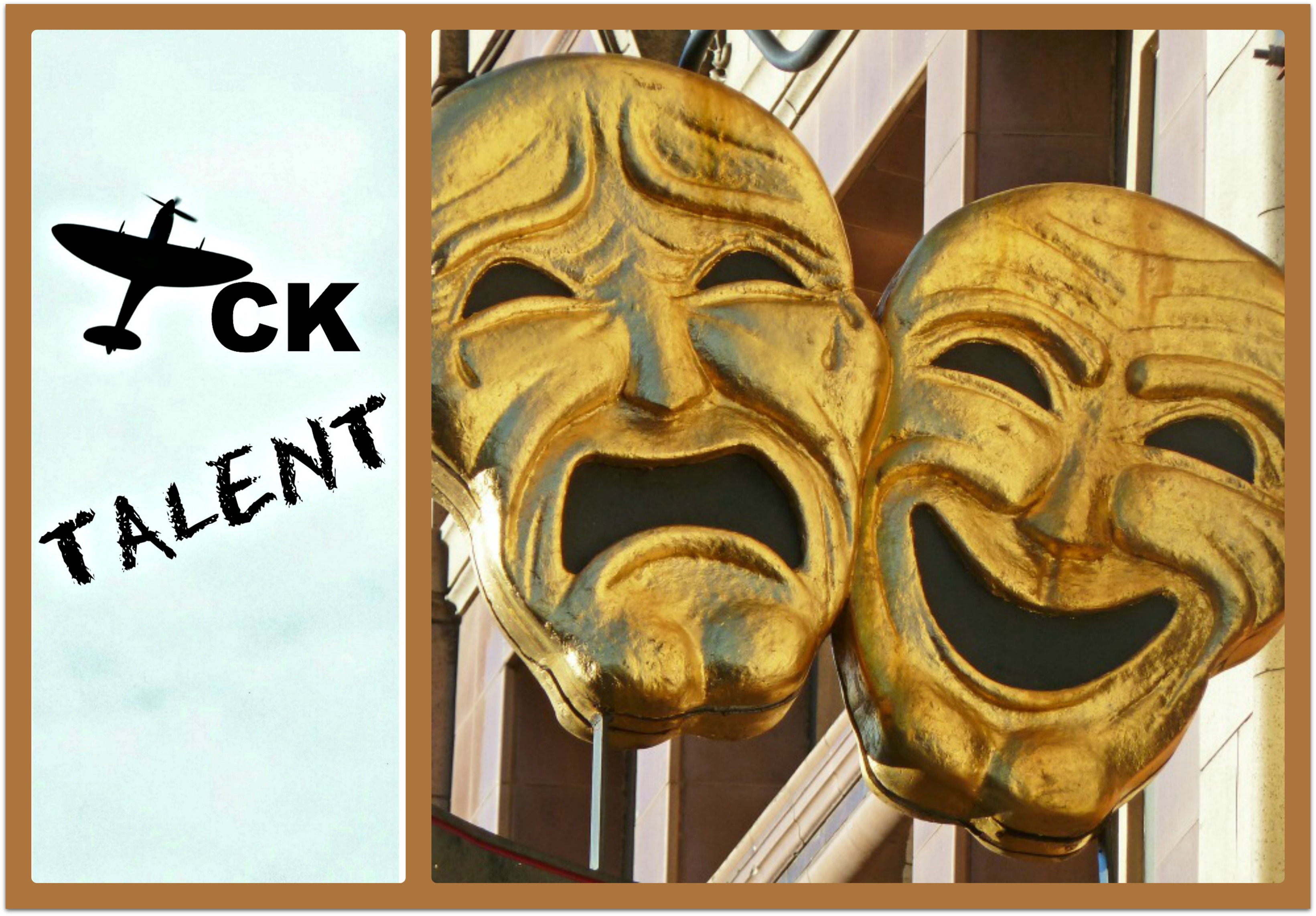
Tragedy and Comedy, Scarborough Hotel, Bishopgate, Leeds. Photo credit: Tim Green via Flickr.

Elizabeth (Lisa) Liang is back with her monthly column about Adult Third Culture Kids (ATCKs) who work in creative fields, Lisa herself being a prime example. A Guatemalan-American of Chinese-Spanish-Irish-French-German-English descent, she has developed her own one-woman show about being a TCK, which will be the closing keynote at this year’s Families in Global Transition (FIGT) conference, “The Global Family.”

In my last column, I interviewed Laura Piquado, a professional actress based in New York who grew up in six countries, including Egypt, where we were drama classmates in high school. As a result of the interview, Laura, editor ML Awanohara, and I had a lively discussion about Laura’s career change from education/activism to acting.

ML said she was puzzled as to why so many intelligent, well-educated Adult Third Culture Kids feel so at home in the acting world. She expressed concern that acting might cultivate a narcissistic outlook on life, which is the opposite of a TCK’s worldly upbringing. She said she found it particularly jarring that Laura could go from go from almost doing a PhD on women’s education in post-conflict societies, to enrolling in acting school—and not look back.

Laura’s response was so eloquent that I am posting it here.

Before you read it, I recommend watching this TED Talk by British actor Thandie Newton:

Born to a Zimbabwean mother and English father, Newton always felt disconnected or “other” while growing up in the UK:

“From about the age of 5, I was aware that I didn’t fit. I was the black, atheist kid in the all-white, Catholic school run by nuns. I was an anomaly.”

Acting gave her a chance to play with her different selves.

And now from Laura Piquado:

I had a similar reaction to yours, Lisa, in seeing acting described by ML as a narcissistic endeavor. While I can certainly understand that reputation (indeed, the Golden Globe awards), I have always idealized what theatre can be: life-changing, hopeful, inspiring, and necessary. It’s the worst to be onstage with someone who’s “masturbating” their way through a show (and equally as painful for an audience member).

I was in Maine a few years ago at a craft school (I’m a potter), and I sat next to a visiting artist at dinner (the amazing Hungarian-born sculptor Gyöngy Lake). She asked me what I did. When I told her I was an actor she said:

“We love you! We need you! You tell the stories of our lives!”

Now while that sounds uber-maudlin, I was completely overwhelmed. I had known this woman for less than two minutes, but she had described, for me, what the essence of art is.

On the other hand, I don’t want to get beaten over the head with social and political commentary every time I go to the theatre. I mean, I love Brecht, but can you imagine if that’s all theatre was? Mother Courage after Mother Courage, after The Caucasian Chalk Circle, after Arturo Ui…ugh. People would stop going. There’s room for pomp-y, wacky, ridiculousness (all hail The Book of Mormon), and everything in between. But I do think theatre at its best, the stories that stay with you, are the ones that connect to a deeper human context.

I was reading an interview with Supreme Court Justice Stephen Breyer in the New York Review of Books where he recounts a story he heard while a law student:

At the turn of the last century, the court was called upon to decide a case on prices for theater tickets—could they be considered basic necessities, and could they be regulated as such? The majority thought the theatre was not a necessity. The great Justice Olive Wendell Holmes Jr. replied in his dissent: “We have not that respect for art that is one of the glories of France. But to many people, the superfluous is the necessary.”

The interview was a larger discourse on France and Proust, but the point Holmes made about the necessity of art resonates.

ML also made the comment:

An interest in international affairs implies that you care about effecting positive social change on behalf of less fortunate people… Do you foresee bringing those two strands of your life together at some point?

The notion of “effecting positive social change” is what I’ll respond to. Again, it’s what I believe theatre can be, from Winter Miller‘s In Darfur to Moisés Kaufman‘s The Laramie Project. Being a part of that kind of theatre is deeply gratifying and something I always seek out. (Or as a potter: being able to go to communities to work with local artisans to make pots that filter clean, potable water falls into that same category.)

The leap from one discipline (social justice through academia) to another (theatre) wasn’t so quantum for me. And while they are vastly different on so many practical and actual levels, “effecting positive social change,” for me, lies at the heart of both.

* * *

So, readers, do you have anything to add to the debate? Are we ATCKs doing ourselves, and the world, a disservice by turning to acting, or can acting be one of our more profound contributions?

STAY TUNED for next week’s fab posts!

If you enjoyed this post, we invite you to register for The Displaced Dispatch, a round up of weekly posts from The Displaced Nation, with seasonal recipes, book giveaways and other extras. Register for The Displaced Dispatch by clicking here!

Related posts:
Trevi Fountain blesses American woman’s coins, granting her true love, a new life abroad, and now a book (we’re giving it away!)

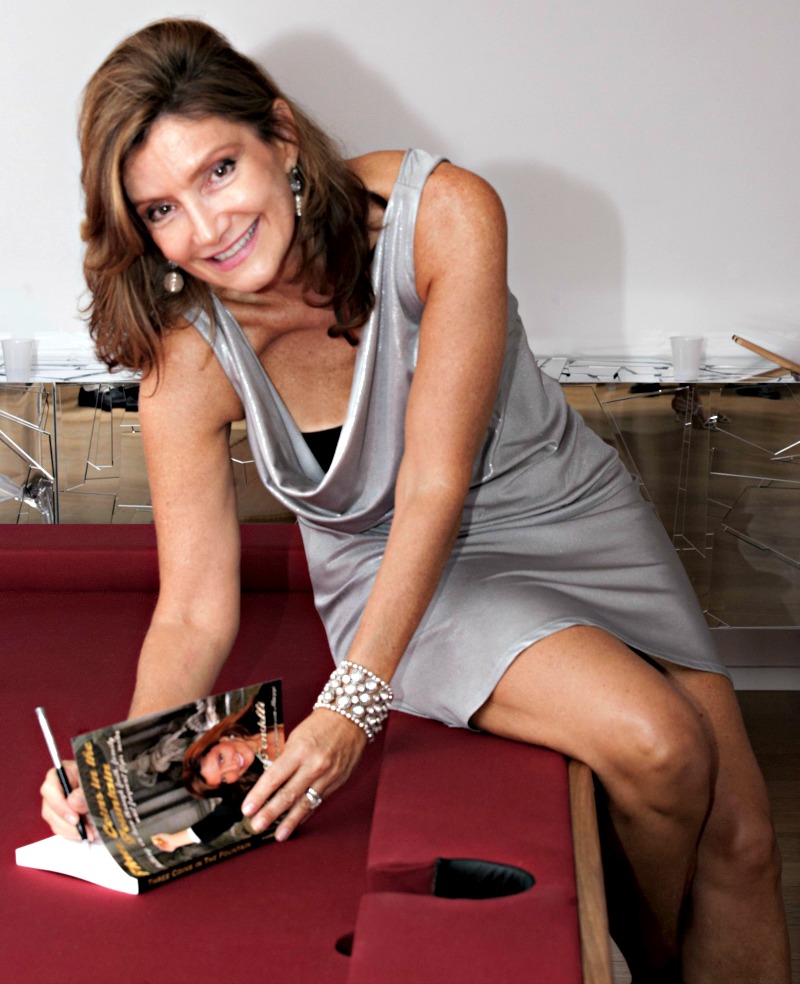
Catherine Tondelli book signing photoWhile an expat in Japan, I mastered the ritual of tossing coins into the offering box, or saisenbako, at the Shinto shrine or Buddhist temple while clapping twice (to attract divine attention) and then making a short prayer.

In the West, of course, we toss coins into fountains and make a wish, but I’d never been one for doing that.

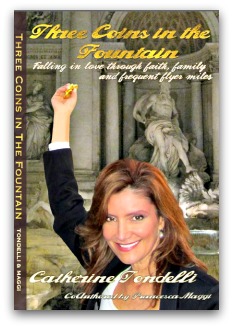
I might start trying it, though, now I’ve read Catherine Tondelli’s memoir, Three Coins in the Fountain, which recounts the luck she had in finding a mate the moment she tossed three coins into the Trevi fountain in the Città Eterna.

Sounds like a pitch for a Hollywood film, doesn’t it? Except, wait a minute, that film has already been done (in the 1950s)!

And it’s real life we are talking about here, not the movies.

Besides, Tondelli has kindly granted me three wishes:

  1. She will answer some questions about her memoir as well as her writing process (see below).
  2. She will GIVE AWAY TWO COPIES (hard copy or Kindle) to the two readers who toss in the best comment below.
  3. She will make the book available for free download for a short period—to be revealed at some point in our weekly Displaced Dispatch. (What? Not a subscriber? SIGN UP NOW!)

Before we start, I should mention that Tondelli’s book has been likened to another book recounting travels in the wake of divorce: Eat, Pray, Love, by Elizabeth Gilbert. But for me, a half-Italian American, Tondelli’s more restricted itinerary makes a a lot more sense. Who needs India and Bali when you can easily get the whole package—great food, a renewed faith in relationships and family, and love—in Bella Italia?

Like me, Tondelli is half-Italian, and I like to think it’s that ancestry that made her realize the truth of Madonna Louise Ciccone’s assertion: “Italians do it better.”

* * *

3-Coins-in-Fountain-by-Catherine-Tondelli_dropshadowWelcome, Catherine. I read your book not long after I’d finished Imperfect Pairings, by Jackie Townsend, which we featured in this space this past November. But that was an autobiographical novel based on Jackie’s marriage to an Italian man. So here’s my question: did you ever consider telling your story as fiction, or perhaps using it to develop a film script for a romantic comedy?
I originally thought about writing it as a novel, but my story was so unique and it gave so much hope to women who have given up all hope of ever finding the man of their dreams after 40 years old. Most people would never believe that stories like this really do happen and that true love will find you as easily as tossing some coins in a fountain. I also felt that many people could relate to my crazy stories of growing up in a large family. In the 1960s it was normal to have families of seven or more children; but, with the exception of Cheaper by the Dozen, there is very little written about large families. You have a lot of crazy stories when you grow up with ten siblings!

Yes, I noticed in the press release for the book that you grew up in Chicago as one of 11 kids who were left behind by a deadbeat, jazz musician dad. Can you tell us a little more about your relationship with the man who bequeathed you the surname “Tondelli”? After all, he features in the book quite a bit as well.
I had a very challenging relationship with my father and harbored resentment towards him for many years. I was only 12 years old when he walked out on my mother. It had a huge impact on the relationships I had and the men I chose. A daughter’s first bonding with any man is with her father: he is her first boyfriend, role model for the men she chooses. We often repeat what we know rather than what we want: we need “familiar,” even if it’s unhealthy. I kept choosing unsuitable men until fate stepped in and finally tossed me a “get a good man” coin to throw in the Trevi fountain.

Did you and your father ever reconcile?
I didn’t speak to him for twenty years. We finally reunited when I was attending a conference in Las Vegas and he was a musician playing on the strip. I called him and we had dinner together. We hugged and kissed at the end of the evening: it was a huge healing moment in my life. I was never as close to him as I was to my mother but we had a good relationship up until the day he passed away one year ago. Writing about him also helped me to heal.

Sono pazzo di te (I’m crazy about you…or am I just crazy?!)

Now turning to the man who would become your husband, the handsome and irrepressible Fausto. Since romance is a big part of what your book is about, I’d like to recount the first moment when the pair of you set eyes on each other. Newly divorced, you were traveling in Italy with your mom and had by that time reached Rome and the Fontana di Trevi, where your mother handed you three coins and urged you to wish for a nice man to come into your life. At that very moment, you heard an Italian man say: “Eeffa you wanta your wish to comb true, you avv to trow the coins witah your layft (h)and as eet’s closer to your (h)art…”
Yes, and then he asked if I knew “de meaning of da tree coins”:

“Da first coin, you find your love in Rome, da second coin, you return to Rome and the t(h)ird coin, you marry in Rome.”

And that’s what happened: he and I fell in love, I returned, and we got married.

Chi ama me, ama il mio gatto (Whoever loves me, loves my cat)

Jackie Townsend entitled her book “Imperfect Pairings” because she thinks Americans have an idyllic view of cross-cultural marriage with Europeans, thinking it sounds very romantic—whereas the reality tends to be culture clash after culture clash. You seem to believe in the romance while also acknowledging there were hurdles along the way. After you got over assuming Fausto was gay, you suspected you might be just one in a long line of fountain pick-ups. And even after he at last won your trust, you and he had to struggle to get used to each other’s habits. He did not take well at first to sleeping with your beloved Siamese cats, for instance.
Three Coins is not your stereotypical girl-on-holiday-meets-man-of-her-dreams-and-lives-happily-ever-after. Yes, we did meet on my trip to Italy, but falling in love and moving to Italy was the last thing I’d expected. I came to Italy only after I had worked for three years in London and only when finding a good job in Rome. And when he proposed, I called my sister.

I like that you put a map at the beginning of the book, showing all the destinations you and Fausto traveled to together, before you decided to live in the same place. I presume Italy and Italian culture were an adjustment?
Even though I grew up in an Italian American household, the cultural learning curve for me was huge.
My mother descends from Irish stock, and Fausto couldn’t believe his ears when I told him my Irish grandmother had put money aside in her will to host a luncheon following her funeral for all her friends and family. When his father passed away, we went down to the morgue to say our last goodbye and then off to the church and finally the cemetery, all within two hours. No lunch, no funeral home, no photographs—it was all too fast, no time to mourn to grieve with family or friends. A real Mork & Mindy moment for me.

Was that your most displaced moment: when you thought, what’s a nice girl like me doing with an Italian?
That’s one, and another would be the Christmas after we moved into our new palazzo in Rome. I went to our five neighbors in the building and brought them Christmas cookies I made and a bottle of Spumante. Fausto looked at me with all my plates of cookies and bottles of Asti in my hand and said: “My love, what are you doing??” I went on to explain that we always bring something over to the next door neighbors in America for Christmas. He just stood there and smiled and said “We don’t do that in Italy.” I said, well, we’re going to start now!

Can you also pinpoint your least displaced moment, the first time you realized you felt much more comfortable with him and in Italy than you do with a man from your own culture in the U.S.?
I think it was when there was a Lazio (Rome) football game on TV and instead he took me to see a classical music concert at the Auditorium. He wasn’t telling me all night how much he was giving up for me…he really enjoyed the concert! I am a big baseball fan, not soccer. I was thrilled.

Non si serra mai una porta che non se n’apra un’altra (When one door closes another opens)

Moving on to the writing of the book: What was the most difficult part of the writing process?
Being constantly turned down by traditional publishers. Also, people I knew who already had books published weren’t very encouraging. Luckily, I didn’t let them get me down. After shopping it around for about six months, I decided to self publish. I realized with all my marketing and PR experience I could do a better job then they could in promoting my book in getting it to the right audience.

I see that you’ve listed Francesca Maggi as a co-author. How did that relationship work?
I was lucky as she was an editor and also an author and a friend. She had just published Burnt by the Tuscan Sun, and I asked for her help on the editing process. I gave her my manuscript and she polished and refined it pointing out my weaknesses and suggested options to strengthen those areas. She was instrumental in getting the flow right and helped with the technical elements. She was a natural choice for me as we share a common love of Italy and America, and she knew my husband well.

Can you offer any advice for others who are writing memoirs and hoping to publish them?
Don’t get discouraged. Publishing a book is not easy but if you have a good story, you now at least have options to get it out there. I love this quote by women’s fiction writer Jennifer Weiner:

The difference between people who believe they have books inside of them and those who actually write books is sheer cussed persistence—the ability to make yourself work at your craft, every day—the belief, even in the face of obstacles, that you’ve got something worth saying.

What audience did you have in mind for the book, and has it been reaching those people?
I really thought the target would be women between 20 and 60 (I do get a lot of emails from women like myself, and am happy they can relate), but I have been amazed at how many men also have written to me to say how much they enjoyed reading it. Obviously anyone who loves Italy, old-time romance, or stories of expat life in Europe would find it entertaining.

What do men like about the book?
I’ve had some nice comments from men who said that they were taking notes on Fausto’s techniques… Many of them also grew up in a large family. Also, Fausto was still a bachelor at 50. His story, too, can be inspiring!

Living La Dolce Vita

In your book you question whether Americans have their values in the right place given that we take so little vacation compared to people in Europe. Have you continued to feel this way about the U.S. since marrying Fausto and settling down in Rome?
Two years ago I decided to live like the Romans do and started working for myself so I could spend more time in the US visiting family and friends and also have more time to enjoy La Dolce Vita.

Do you think you could come back to live in the United States? What would be the adjustments?
After living in Italy for more than 12 years it would be very difficult for me to return to live in the US. Fausto and I have discussed moving back to California as he also acts in film and there are many more opportunities, but then we thought: how can we go and live in a city where they close the restaurants at ten o’clock? It would be very difficult to replace our lifestyle in the US. That said, I would love to transport the US postal office here as Italy still doesn’t have postal stamp machines. I bring my book and my computer now when I go to the post office as I know I’ll be spending the day there.

10 Questions for Catherine Tondelli

Finally, I’d like to ask a series of questions that I’ve asked some of our other featured authors, about your reading and writing habits:
1. Last truly great book you read: Blood from a Stone, by Donna Leone, part of her crime series set in Venice.
2. Favorite literary genre: Biographies or autobiographies: real-life stories are always so much more interesting than anything you could make up. That said, I also enjoy reading fiction.
3. Reading habits on a plane: I usually have long flights as my mother lives in San Diego and I fly from Rome three or four times per year to see her couple that with all the travel I do for my work (am working on events in Dubai, Nairobi, Singapore and London at the moment). I always have three or four books in my library at home that I wait eagerly to put in my carry-on bag for my long, hopefully peaceful journey. I am old fashioned and still like to feel the paper when i read a book.
4. The one book you’d require President Obama to read, and why: Jimmy Carter’s book Our Endangered Values: America’s Moral Crisis. I believe that Jimmy Carter has been one of our great leaders yet he is so humble. He was my 95-year-old grandmother’s favorite president. He tells us that for example the USA gives far less foreign aid to developing countries than most people imagine. And, much of this aid goes to certain select countries whose loyalty we are trying to buy rather than because we want to help the poor. The book opened up my eyes to understand how we are perceived internationally. It will give Obama a good reminder that values and morals are more important than being powerful.
5. Favorite books as a child: Charlotte’s Web, The Adventures of Tom Sawyer
6. Favorite heroine: I have many but at the moment it is Malala, the girl who stood up for education and was shot by the Taliban and survived.
7. The writer, alive or dead, you’d most like to meet: Beatrix Potter. I loved her books as a child, and she was also one of the early pioneer woman who broke the male barrier in publishing.
8. Your reading habits: I like to read in bed with my two Siamese cats (Stella and Luisa) on my lap.
9. The book you’d most like to see made as a film: Three Coins in the Fountain, of course!
10. The book you plan to read next: E-Squared: Nine Do-It-Yourself Energy Experiments That Prove Your Thoughts Create Your Reality, by Pam Grout. She provides experiments that prove our thoughts really do create our reality.

* * *

Thanks so much, Catherine. Readers, your turn! Any COMMENTS or QUESTIONS for Catherine? What would YOU wish for with your three coins, having heard her story? Come on, Valentine’s Day is coming! Surely, someone out there aspires to be the next heart wearing the valentine of the Frank Sinatra song?

STAY TUNED for tomorrow’s TCK TALENT column, by Lisa Liang.

If you enjoyed this post, we invite you to register for The Displaced Dispatch, a round up of weekly posts from The Displaced Nation, with seasonal recipes, book giveaways and other extras. Register for The Displaced Dispatch by clicking here!

Related posts: