The Displaced Nation

A home for international creatives

DIARY OF AN EXPAT WRITER: Testing one, two, three…Can anybody hear me?

DiaryExpatWriterToday we welcome a brand new columnist, the up-and-coming author Shannon Young. This past summer, Shannon announced she’d cut 18 inches off her hair, quit her day job to become a full-time writer, and given herself a pen name for her new series of adventure novels. And, yes, she is an expat, a kind of love refugee, living in Hong Kong. She has generously agreed to chronicle her writing adventure for us.

—ML Awanohara

Dear Displaced Diary,

In this column, I’ll be recording my experiences as a full-time expatriate writer. Officially, this is only a test.

Let’s start with a bit of background: I have been an expat, an American in Hong Kong, for four years and one month. For the past four years, I taught English in a local primary school while harboring a desire to work in book publishing.

Originally, I wanted to be an editor, to find talented writers and help them get their work into the world. I didn’t think I had stories of my own. Then, I moved to Hong Kong. In my new expatriate life, I found stories: personal dramas, bewildering worlds, opportunities for stimulating observations, and even ideas for fiction.

So, I started writing…

I discovered I love the process: mulling over half-formed ideas, stealing character descriptions from people I saw on the street, scribbling outlines on everything, and sitting down in coffee shops for hours at a time to actually do the work.

Four years later, I’ve completed a number of projects composed of bytes and bits of code, of pages and ink, of words and stories. Each project has taught me to look closer at the world around me. Each project has challenged me to be more diligent and to look for opportunities to write something that will matter.

One of those projects, a Kindle single called Pay Off, discusses how my teaching job in Hong Kong enabled me to pay off my large student loans from a US university. I’ve been debt free since December 2013 so have been able look seriously at other occupations.

I want to keep writing…

My teaching contract ended in July 2014. By that time I had accrued some savings, some complete or nearly complete books, and a husband with permanent residency. Instead of continuing to teach, I realized that now was the time to try to make it as a writer.

This is only a test. If I am not bringing in enough money from my writing (or worse, not enjoying the work) around Chinese New Year, I will start looking for a new job.

For now, I’m jumping in with both feet, seeing if this dream is feasible.

Like becoming an expat all over again…

Quitting a day job to write full-time is a lot like moving to a new country. You might know a bit about what to expect and what to pack. You do your homework; you find stories of people who’ve done it successfully, who love their new lives. You also find stories of people who’ve failed, who didn’t gel with the new place for any number of reasons. Most expats fall somewhere in between, learning to live with the difficulties while also enjoying many good moments.

Some people say it isn’t possible to make a living as a writer. They cite the successes and insist such people are outliers: exceptionally good or exceptionally lucky. As with moving to a new country, I suspect the truth lies somewhere in between. All I can do is take the leap and see if I can make it work.

But, just as I wouldn’t move to a new country without a suitcase, I am not starting this writing journey with a blank Word document and “Once upon a time…”

I have a strategy!

Here’s what I’m “packing” for my full-time writing life:

1) A portfolio of published works—comprising not just the student debt Kindle single but also the anthology How Does One Dress to Buy Dragonfruit: True Stories of Expat Women in Asia, which I edited for a small Hong Kong publisher. It came out earlier this year.* Neither of these works is a huge moneymaker, but sales can add up slowly. More importantly, these two publications have given me valuable publishing experience.

2) A book deal. My memoir of my first year in Hong Kong, Year of Fire Dragons, is being published by Blacksmith Books, an independent Hong Kong publisher, at the end of October. Hong Kong is a small market and even healthy sales won’t pay my rent, but at least I have a book to launch and a tangible opportunity to build my career.

3) A genre series in the works. This is the essential part of my strategy, the heavy winter coat, if you will, that I’m packing as you never quite know, once you become an expat, where you might end up. (I’m in Hong Kong now, but as I never could have predicted that, shouldn’t I be prepared for the day when I move to, say, Finland?) Since late 2012 I have had the wild pleasure of working on a series of post-apocalyptic adventure novels set at sea called The Seabound Chronicles (under the pen name Jordan Rivet). I’ve planned for a four-book series and written drafts of three of the titles. Book One, Seabound, is currently with the copy editor and should be ready to launch in November. I plan to self-publish this series as e-books and POD paperbacks and, frankly, hope to make some money.

4) Last but not least, reasonable expectations. While I am hopeful that the combination of my publishing experience so far, my existing works, and a highly commercial series will enable me to continue doing what I love, I am also realistic. I don’t expect to get rich. The goal here is to build up an audience—and a long tail of sales—that will eventually enable me to pay my rent and buy the occasional plane ticket home to see my family. But my primary expectation is that I will work hard, produce the best books I can, and try to learn as I go.

“If you want a pearl, you must dive for it.”—Chinese proverb

I realize I’m taking a risk by forgoing a steady income and living on savings in order to give myself more time to write. But taking risks is second nature to expats. We leave behind everything we know, and there are never any guarantees about how things will turn out.

My own jump into expat life occurred when I followed the man I loved to his home country. At the time, I didn’t even know if we would get along when we finally lived in the same country. At first, it looked like everything would fall to pieces because a month after I arrived in Hong Kong my boyfriend’s company sent him to London. I had a year on my own in Asia, fearing that my risk had been in vain.

That story has a happy ending: that boyfriend is now my husband—and I love Hong Kong. It was a risk that paid off, but it could have gone very wrong. Now, I hope the risk I’m taking will turn out at least half as well.

And can I tell you a secret, diary? Since I stopped working and started focusing on writing full time, I’ve been deliriously happy. I love having hours to myself each day to sit down and work on my own creative projects. I love reading about the publishing industry and studying other people’s books and careers. I’m trying hard not to become an obnoxious friend who only talks about their own work because it’s all I think about these days.

Yes, I know this honeymoon period won’t last forever, but at least allow me to say: it’s been wonderful so far!

And yes, I sometimes struggle with prioritizing, but that’s because there are so many things I want to do! But I’m gradually getting used to my new routines and performing triage on my to-do lists. I’m developing the daily habits of a writer. I want to use this period well.

Each month, I’ll share a bit more with you about where this journey is taking me. I hope you’ll come along for the ride.

Thanks for reading!

Yours,

Shannon Young
www.shannonyoungwriter.com

*From now until the end of the year, Shannon will be sharing excerpts from Dragon Fruit. Stay tuned!

* * *

Readers, it’s your turn. What is a risk you’ve taken in order to follow a dream? Was it becoming an expat or something even more daring, like becoming a full-time writer? What are some difficulties you faced along the way? Let me know in the comments!

STAY TUNED for next week’s fab posts!

If you enjoyed this post, we invite you to register for The Displaced Dispatch, a round up of weekly posts from The Displaced Nation, with snippets of worldly wisdom, exclusive book giveaways and our nominees for the monthly Alice Awards. Register for The Displaced Dispatch by clicking here!

Related posts:

TCK TALENT: Even without slide projector, projection of life as a Third Culture Kid engages Reykjavík audiences

TCK in Iceland Collage

Elizabeth Liang in front of Tjarnarbíó, in downtown Reykjavík, where she performed her one-woman autobiographical show, Citizen Alien, on growing up as a TCK of mixed heritage. Photo courtesy Elizabeth Liang.

This month Elizabeth (Lisa) Liang updates us on her own creative life, which this past summer veered in the direction of an island situated at the confluence of the North Atlantic and Arctic Oceans!

Halló, vinir mínir! Hello, my friends! I’m addressing you in Icelandic because in this month’s column I’ll be re-creating my journey to Reykjavík, where I traveled in August to perform ALIEN CITIZEN: An Earth Odyssey, my one-woman show about growing up as a Third Culture Kid, or TCK, of mixed heritage.

How did I end up performing my show in Iceland? I have a friend in that part of the world who put me in touch with the artistic director of Tjarnarbíó, a creative center for professional live art in Reykjavík, who enthusiastically offered to host the show if I could cover my travel and lodging. Presented with a chance to combine three of my favorite activities—acting, writing and travel—how could I resist?

Engum flýgur sofanda steikt gæs i munn (“One cannot expect to benefit without making some effort”)—Icelandic proverb

My husband, Dan, agreed to work as my stage manager, which was perfect because he knows the show so well. I launched a successful Kickstarter campaign to raise the requisite funds for our trip, found a cozy house in Reykjavík on AirBnB for us to rent, bought our flights, started promoting the show on social media—and then off we went to the Land of Fire and Ice.

We arrived in ideal weather, cool and dry, which many Icelanders told us was lucky because it had been raining all summer. We were relieved to find that our lodgings were in a quiet, pleasant residential area that was a seven-minute walk to downtown and a 15-minute walk to Tjarnarbíó.

Tjarnarbíó is a beautiful venue with state-of-the-art technology. At the technical rehearsal, the two “techies” who adjusted the lights and projector were friendly and professional. (Incidentally, we never met anyone in Iceland who was unfriendly, and the Icelanders we encountered all spoke perfect English, some with gorgeous British accents.)

That said, we had an unexpected snafu at the tech rehearsal. There are two kinds of projections in the show:

  1. Pictures and videos that are projected onto a screen via my laptop, and
  2. Words that I project onto my torso using an old-fashioned slide projector.

During the tech rehearsal, the slide projector I’d used in the show for over a year konked out. The stage hand and I stared at the plume of smoke rising from the top and said: “It’s smoking.”

No, the problem was not the power converter. We had the right one. Nor was it the bulb. We replaced it but the projector still didn’t revive. So my Icelandic friend’s father-in-law generously loaned us his. More on this later…

Citizen Alien Photo Strip

(top to bottom) At the tech rehearsal, the lights were lowered from the ceiling–fancy!; opening night; closing night; post-show celebratory drink; with Dan in front of Hallgrímskirkja Church; with Dan in Þingvellir National Park. All photos courtesy Elizabeth Liang.

August 20, 2014: Opening Night

We had an audience! I only knew of five people who were planning to attend (of whom I’d actually met only one—my Icelandic friend). What a pleasant surprise to see twenty or so people in the house!

And they laughed! I guess the show’s humor translates.

Dan stage managed wonderfully and the light board operator did a great job, too. The only hitch was that when it came time to project slides onto my torso, the borrowed projector didn’t work, even though we’d tested it earlier. I improvised and the audience went right along with this. (Afterward, a very kind audience member offered to loan us his projector, but when we met later, he realized it had a part missing. So Iceland never got to see words projected onto my torso. Ah, well.)

The best part of opening night was the fact that I enjoyed myself on stage, which hadn’t happened in a while. There were two curtain calls and people stayed afterward to shake my hand, thank me, and say lovely things. It was such a pleasure. About half were Icelandic and the other half internationals—once again, the right people had found me and my show. Several said they would spread the word for the next performance.

A few people from Spain, France, the Czech Republic, and Iceland hung out with us at Tjarnarbíó’s cafe afterwards. They all mentioned different parts of the show that resonated for them, and one said she felt that the show does a service for nomadic and non-nomadic people—it’s like a bridge between them. They thought it should be filmed, which I’m planning to do in December.

All hail my director, Sofie Calderon, for making this show such a dynamic experience for the audience! People from far and wide have enjoyed the production, and that’s Sofie’s doing. If it had been up to me, I would have found ways to hide onstage, because performing a solo show is super scary.

August 22, 2014: Closing Night

More people in the audience, which was very moving, because I knew none of them. The word of mouth from opening night must have been good. And maybe all those promos I sent to the international school and Facebook groups helped…?

The performance didn’t feel as good—I was having less fun and getting fewer laughs—but I forged ahead. Afterward Dan and the light board operator said “No way, it was TIGHT, really good show!” Yet more proof that we actors have no idea how well we’re doing. We only know if the audience is responsive or quiet.

Just like on opening night, a bunch of people waited to speak to me afterward. One was a young adult TCK who was very moved by the show. Another was a professor at the University of Rekjavík whose field of study is TCKs. Their compliments, along with all the words of support from other audience members, was tremendously encouraging.

Because the truth is: before embarking on this Northern European adventure, I had no idea how audiences would react, or if there would be any audiences at all. I had girded myself to perform for a handful of kindly people on opening night and then possibly cancel closing night because who knew if there would be enough interest?

Reykjavík may be a small capital, but as it turns out, it has plenty of residents who are international or international in outlook, and open to trying new things.

Kleina & coffee, Björks in boots, Lutherans & lava…

Beyond the show, Dan and I had a glorious time exploring small but pretty Reykjavík; the Blue Lagoon, a thermal spa located in a lava field in Grindavík; and the Golden Circle, a route the loops from Reykjavík to central Iceland and back. Other highlights included:

  • snacking on kleina, a donut-like pastry in the shape of a trapezoid;
  • visiting Hallgrímskirkja, the Lutheran cathedral designed to resemble the lava flows of Iceland’s landscape, and Settlement House;
  • hanging out at the Boston, said to be one of the world’s best bars, and at several coffee houses; and
  • last but not least, watching singers and dancers all over town on Culture Day/Night, a day and night-long program of cultural events that takes place in August every year and is one of the country’s largest festivals.

I also got a kick out of Icelandic fashion—bright colors, unusual cuts—and, as I love boots, was pleased to see practically every woman sporting boots of some kind: ankle, knee-high, sexy, hiking, and everything in between. (Did I buy a pair? Nope. Iceland is expensive.)

On our last night, we stepped out onto our little street to see fireworks, which felt like a final burst of congratulations. I got teary-eyed!

Overall, it was a delightful trip. Dan and I left thinking we’d like to go back someday. We want to see more of the island (puffins! volcanoes!), enjoy the friendly vibe…and hopefully bring another solo show for Icelanders’ entertainment—but without any cantankerous 1980s equipment.

* * *

Thank you, Lisa! Having only been to the Blue Lagoon as a round trip from Keflavík International Airport, I really appreciated this vicarious journey into the heart of the city’s cultural scene. And, as always, I’m impressed that you were contributing to the culture as well as taking something from it! Readers, please leave questions or comments for Lisa below.

STAY TUNED for next week’s fab posts!

If you enjoyed this post, we invite you to register for The Displaced Dispatch, a round up of weekly posts from The Displaced Nation, with news, book giveaways and other extras. Register for The Displaced Dispatch by clicking here!

Related posts:

For this TEFL teacher with a strong Cornish identity but a compulsion for travel and the expat life, a picture says…

Cornish Kylie Collage

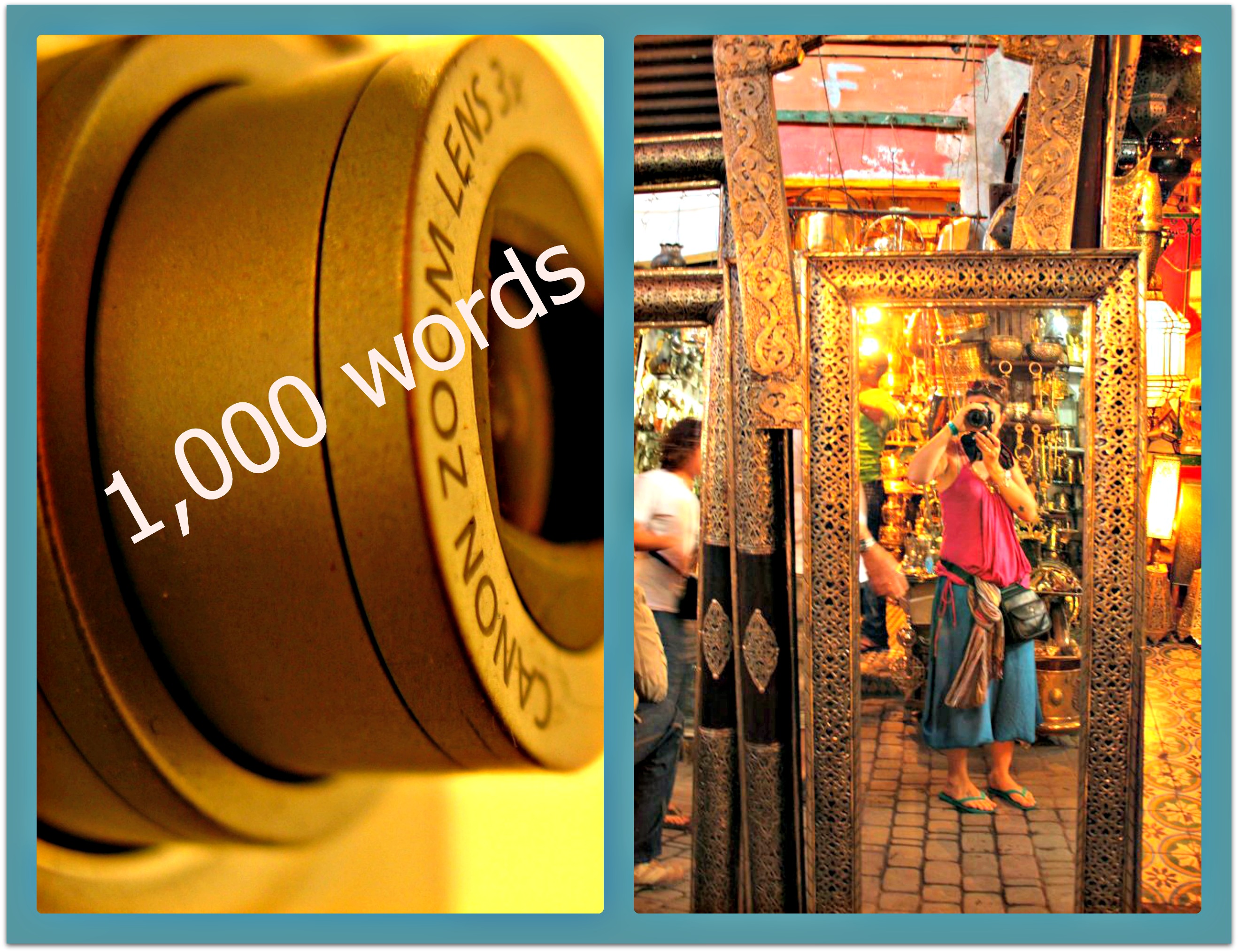
Canon zoom lens; photo credit: Morguefiles. Kylie Millar (self portrait).

Welcome to our monthly series “A picture says…”, created to celebrate expats and other global residents for whom photography is a creative outlet. The series host is English expat, blogger, writer, world traveler and photography enthusiast James King, who thinks of a camera as a mirror with memory. If you like what you see here, be sure to check out his blog, Jamoroki.

My guest this month is 27-year-old Kylie Millar who was born and bred in Cornwall, England, and, though she now finds herself in Thailand, just like me, she remains proud of her Cornish heritage, having branded herself on her travel blog as Cornish Kylie.

Not only that but Kylie informs me that the Cornish were granted official minority status earlier this year. Being born and bred in Cornwall now means, technically, that a person is identified as Cornish first, British secondwith the latter identity being confined largely to one’s passport. Well, it is true that Cornwall was its own Celtic nation before the Norman Conquest, and they have their own language, Kernewek, which is distinct from Welsh.

After the Scottish vote for independence, can a bid by the Independent Republic of Kernow be far behind?

How times have changed!

* * *

Hi Kylie. It’s good to see you at the Displaced Nation. As the name of your blog implies, you are a proud Cornish lass—rightly so! You have also travelled a fair bit. But since Cornwall is a place close to my heart, can you reminisce for a bit about your childhood in that part of the world?
I was born in Truro, the main hub of Cornwall, which has a cathedral and is therefore designated a city as opposed to a town. But I was raised in the hilly seaside town of Falmouth, known for its lovely beaches, fishing port and docks. To some, it may seem like an aging coastal town, but the recent influx of art students to its expanding university has given it a new lease on life and a nice arty vibe. My dad is a fisherman so I grew up living a typical Cornish life: summers on the beaches, the smell of a crab being boiled on the stove top (which to this day I cannot abide—the curse of being a fisherman’s daughter and not liking fish or seafood!). But I really do appreciate how lucky I am to have grown up in such a wonderful place and fully intend to return one day.

Gwrys yn Kernow (made in Cornwall)

As you know I spent my last year in the UK before emigrating to South Africa (1994/5) in Falmouth, so it’s interesting to hear about the changes. How long after I left did you spread your wings and start travelling abroad?
I actually didn’t spread my wings all that much growing up. Family holidays consisted of trips to Butlin’s holiday camps and a few package holidays to Tenerife, in the Canary Islands. I didn’t even move away from Cornwall to go to university, I just commuted the 75 miles east to Plymouth. Why would I want to move away from somewhere like Cornwall?

I agree. It’s a magnetic place even for those of who weren’t born there. Carry on, please.
As part of my degree I had the opportunity to go to China for a few weeks to do a little bit of English teaching and a cultural exchange with Chinese university students. This was my first time to experience a culture completely different from my own. I was only 19 and in a constant state of “culture shock”. It wasn’t until after I completed my degree and had a few years’ work under my belt that the urge to explore really kicked in.

Please tell me a little more about your travels.
Aside from the trip to China, I have holidayed in Egypt and Morocco. Then my next big trip was a month backpacking around Thailand with one of my best friends. That’s how I first caught the Thailand bug.

You certainly don’t intend to let the grass grow under your feet, Kylie. I foresee you becoming a seasoned traveller before long. I know there is a lot more to your story, but let’s start with the reasons that drove you to travel.
I’m not a fan of people traveling purely to “find themselves” or even to “make the world a better place”. Actually, I have changed a lot since coming to Thailand, and I’m sure that, as a TEFL teacher, I’m contributing in some small way to the education of Thailand’s future leaders. But that’s not the sole reason I came here. I had a job in the UK that I loved, but I sensed I was stagnating. So I followed my instincts (very scary but it felt right) and quit, upped sticks and came to Thailand, got a TEFL certificate and started teaching English to Thais.

“Life is so short, you must move very slowly” – Thai proverb

You say you’ve got the Thailand bug, which in my experience can be difficult to explain to anyone who hasn’t lived here. So let’s leave it at that and talk about where, precisely, are you right now and what are you up to.
I spent my first 18 months living in the city of Hat Yai, in southern Thailand, near the Malaysian border. I was teaching English at a government high school, with classes of fifty students and few resources apart from those I conjured up myself. Later I went to Phuket, Thailand’s largest island, to work as a teaching assistant in an international school. The two posts and their locations were poles apart.

Can you say a little about that for the sake of readers who don’t know Thailand?
In Hat Yai I was one of a handful of farangs (Caucasian foreigners) living in a village on the outskirts of the city. On my daily commute to the school, I would meander through rubber plantations, passing water buffalo. At first people would stare, but their stares quickly turned into smiles and shouts of “hello!”. Nobody spoke English beyond that one word, so I had to learn to speak Thai very quickly to be able to order food. In Phuket, by contrast, I am one of thousands of farangs and when Thai people see me they assume that I am a tourist and treat me accordingly. It’s harder to win over the locals here because tourists are their meal ticket. You have to convince them that you aren’t a tourist; you live here like they do. That said, life in Phuket is a lot easier. It has familiar things like pizza and sandwiches (I haven’t got used to eating rice three times a day yet). And of course the island’s beaches are stunning, which reminds me of Cornwall and makes me feel at home.

Ah, I think I detect something of the home bird in you, alongside the intrepid traveller… And now let’s see some of your favorite photos and hear the stories behind them.
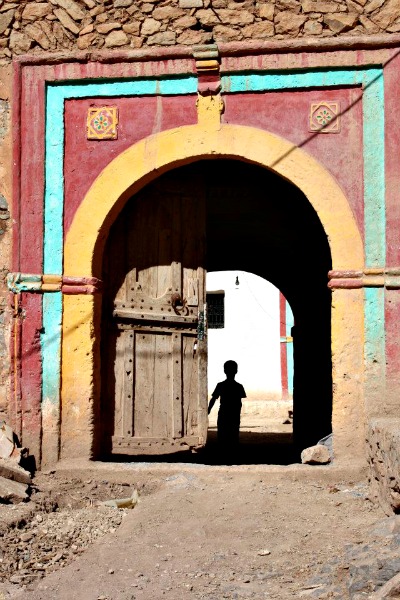
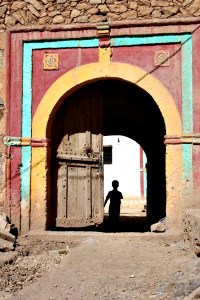
When I was in the Atlas Mountains of Morocco, I couldn’t resist taking pictures of the many beautifully decorated doorways. This picture was accidental as the boy emerged from the doorway just as I pressed the shutter release. Then I realised how people can add an extra dimension and started to include people in more of my photographs. This trip to Morocco was special: it opened my eyes to a very different part of the world.
Kylie_BoyinMoroccanDoor

A boy in a Moorish door; photo credit: Kylie Millar.

I love this. Dirty, dusty, old and full of intrigue. A great shot. What else do you have for us?
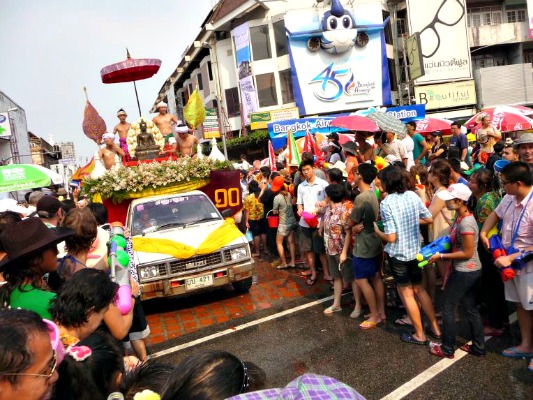
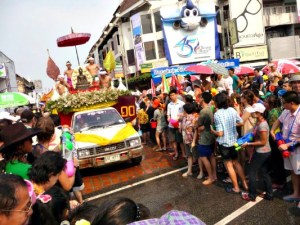
Songkran is the festival held in mid-April to celebrate traditional Thai new year’s. It’s probably the most famous of all the Thai festivals because it’s the scene of the world’s biggest water fight. Determined to join the festivities, I locked away my main camera and went out to the streets. I got this shot when the water fighting stopped to let a convoy of vehicles, carrying Buddha statues, pass to the temple. Songkran is absolutely insane, and if you ever find yourself in Thailand at this time of year, prepare to get wet—or hide!
Kylie_ThaiNewYear

Happy New Year, Chiang Mai style; photo credit: Kylie Millar.

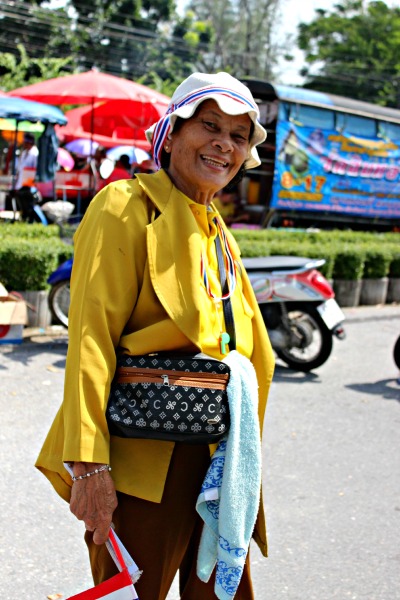
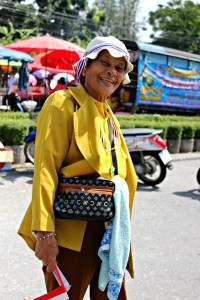
And here’s one more of Thailand. As you know, anti-government protests took place from November 2013 through May of this year. I live close enough to Bangkok that I was able to come in and take photos. Having a big camera was useful as it made it obvious I was an observer, not a participant. Foreign involvement in the protests was a big no-no. On the day I took this shot, anti-government protesters had made progress, spirits were high and the atmosphere was unlike any other I have experienced. People were happy to have their picture taken, and this lady was my favourite, standing proudly in traditional yellow to signal her support for the King. For some reason, the scene made me think of the crowd around the Pyramid Stage at the Glastonbury music festival in England—not what you’d expect at an anti-governmental protest. I’m glad I was able to see it all firsthand.
Kylie_yellowlady

A sunny presence at the Bangkok protests; photo credit: Kylie Millar.

Getting to the zuggans (Cornish for “the essence”)

Now could you show us the kinds of places that tend to bring out your shutterbug instincts?
One of those places was Jemaa el-Fnaa, a bustling square in Marrakesh that offends all of the senses. Said to be the busiest square in Africa, it is hot and dusty, and the air is full of the smell of tagine spices and roasting meats. The sounds of hawkers and snake charmers mix with the buzz of the crowd, punctuated by the call to prayer that reaches every corner of the souks—it’s the largest traditional market in Morocco. Rugs, lamps, cushions and fabrics in deep oranges, luscious reds and striking purple line the narrow lanes of the souks. Rusty tin roofs let in shards of light that make this a photographer’s dream. But cameras can only capture so much…

Kylie_souk

The wonders of the Marrakesh souks; photo credit: Kylie Millar.

You captured the smells as well as the intrigue. Well done. What’s next?
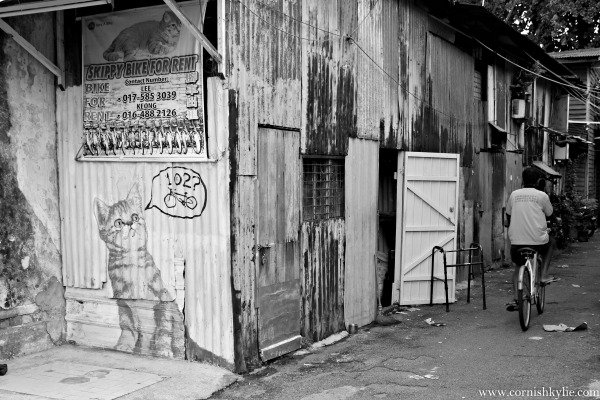
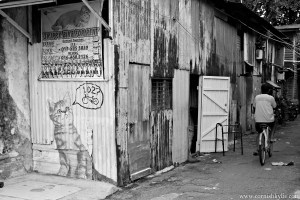
I visited George Town, in the northeast corner of Penang island, twice recently. It’s famous for being one of the main destinations for visa runners and backpackers alike. I was drawn to its hodgepodge of cultures: mosques, churches, Hindu and Buddhist temples all sandwiched together. Ethnic Chinese and Indian communities live alongside each other, and traditional clan families can still be found living on stilt houses on the jetties. In this photo I tried to capture some of that:
Kylie_bikeforrent

The back streets of George Town, Penang; photo credit: Kylie Millar.

I’m not generally a fan of black-and-white photos but this subject lends itself so well. And finally?
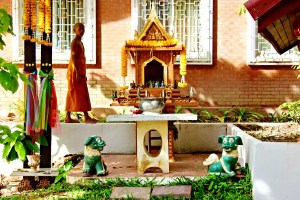
Many of the things that make Thailand unusual are seeming more normal the longer I live here—like the bright orange monk’s robes in this picture, the turquoise sea, the towering Buddha statues, multicolored long boats, the outrageously decorated temples and colourful tuk tuks. It’s home now but, as I think this photo shows, I still like to play the tourist and explore:
Kyli_ThaiOfferings

A novice Thai monk and spirit house; photo credit: Kylie Millar.

I like the way you captured Thailand’s vibrancy. Tell me, do you feel reserved about taking photos of people, particularly when they are conscious that you are doing so?
Actually, I like to try and get natural photographs without the person knowing at all. I want to capture moments and events not someone posing. People generally enjoy having their picture taken, so if they spot a camera they will smile or pull a face and the obligatory peace signs come out. Not quite what I’m looking for… Driving an old banger of a car helps because Thais will sometimes take our picture—because we farangs are assumed to be rich and usually drive smart cars.

“Today I’m going to shoot someone…and they will love me for it!”

It can be annoying, this Asian misconception that all Westerners are rich, but I guess we all get used to it in time. So you don’t ask permission unless you need to before taking people’s photographs—but how do you get around any problem of language?
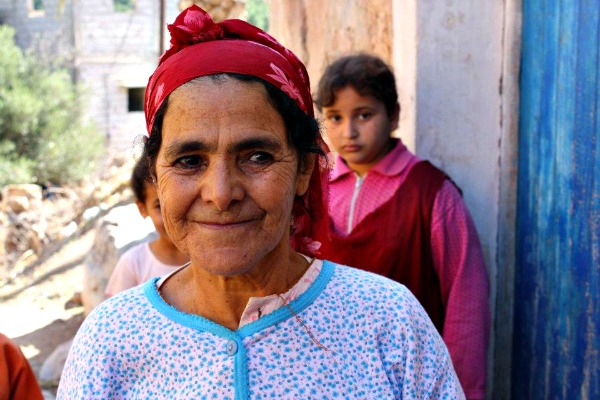
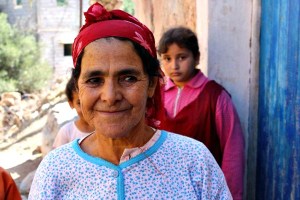
If I am unable to be stealthy, then I use the universal “can I take a picture?” sign consisting of pointing to my camera. I have learned how to ask in Thai but the words sometimes escape me. The big camera is usually a clue! When I was in a mountain village in Morocco, getting some shots of the decorative doors as mentioned above, an old lady smiled at me and gestured that she’d like to have her photograph taken. As I released the shutter button, she held out her hand, demanding payment. Not wanting to cause a scene, I forked out some change. Although not too happy with my offering she took it—if only she knew I only wanted a picture of her back door, not her face!
Kylie_Atlas Mountain lady

People shots for a price; photo credit: Kylie Millar.

Would you say that photography and the ability to be able to capture something unique that will never be seen again is a powerful force for you?
My mum always says that I take so many photographs but I am hardly ever in them. And that is very true. I know that when I am older I will wish I had more pictures of myself having adventures. But for now photography is a means of capturing what I see and feel. If I think the photos are worth sharing, they will end up on my blog. Photography is changing with the times, though. When I studied A-level photography we used film, processed by hand after spending hours in the darkroom. Filters had to be slotted into the machine; now they are just options on an iPhone app. When my mum was younger she went on a trip to Israel and Jerusalem, and she has two rolls of film from that trip—around fifty photographs. Nowadays people will take more than fifty photographs on a single night out. The technology has evolved so much that nearly everyone has a camera in their pocket on their phone, which is great. It makes photography more accessible to all, with no wasted film. But it does mean that photos are not so special and precious as they once were.

Some of our readers may want to know what kind of camera and lenses you use, as well as any post-processing software.
I’ve got a Canon 600D with standard lens, and a 75-300mm telephoto lens (perfect for those stealthy pictures of people, and for animal shots). I’ve also got a Panasonic Lumix point and shoot for the days when a bigger camera isn’t practical. If I am going to edit, I use Adobe Lightroom, which I am still finding my way around. Having never been taught how to use digital post-production software, I have to rely on trial and error—but that was also what it was like in the darkroom. It’s more fun that way!

Finally, do you have any advice for wannabe photographers who are traveling or living abroad?
Take more pictures than you think you need. Bring spare SD cards and back them up—you will lose one or one will break. Don’t keep your camera locked away in a bag, keep it to hand, it needs to become a natural extension of yourself, not this big cumbersome thing you have to get out every time you want to take a picture.

Even though we are more than 40 years apart, we both left Falmouth and ended up in Phuket with the same camera (Canon T3i 600D). No wonder your pics are so good! Thank you for taking the time to tell your fascinating story.

* * *

Readers, what do you make of Kylie’s experiences and her photography advice? And do you have any questions for her about her photos or her travels? Please leave them in the comments! And don’t forget you can follow Kylie on her blog, Cornish Kylie. You can contact her by email at info@cornishkylie.com, and you can also find her on social media: Twitter, Facebook, and Instagram.

(If you are a photographer and would like to be interviewed by James for this series, please send your information to ml@thedisplacednation.com.)

STAY TUNED for next week’s fab posts!

If you enjoyed this post, we invite you to register for The Displaced Dispatch, a round up of weekly posts from The Displaced Nation, with Alice nominees, exclusive book giveaways and other extras. Register for The Displaced Dispatch by clicking here!

Related posts:

https://d3ijcis4e2ziok.cloudfront.net/tpc-check.html

HERE BE DRAGONS: A pox on your expat life! How suffering an illness abroad can inspire fantasy writing

Here Be Dragons Pox

(Clockwise from top) Detail of the medieval map Carta marina; one-day old chicken pox blister, by Evanherk at Dutch Wikipedia (CC BY-SA 3.0); neem leaves, by Miansari66 (CC BY-SA 3.0); Freiberg, by kaffeeeinstein (CC BY-SA 2.0).

HERE BE DRAGONS is back, a column produced by fantasy writer Andrew Couch, an American expat in Germany. We at the Displaced Nation have long been aware of the strong connection between fantasy (think Alice in Wonderland) and a life of international travel and residency. And now Andrew has got us pondering the idea of turning our (mis)adventures into fantasy stories!

—ML Awanohara

A few weeks ago I came down with an adult case of the chicken pox. Seriously, I am in my mid-thirties and never had chicken pox as a kid.

The experience got me thinking about the oddities of dealing with a disease as an expat living abroadand then about how this could become a source of material for a writer like myself, who enjoys leading characters around fantasy realms.

Getting sick in Germany is not the same as getting sick in the United States. To begin with, we don’t have a car, so my wife took me on the tram to see the doctor. He subsequently told me that I shouldn’t really have left the house; my local health service would call me.

In the U.S., we would be driving everywhere and the local health service (do we have one?) couldn’t care less about a case of the chickenpox.

In the end I didn’t get a call from the local health service, nor did my Twitter friends’ predictions I would end up being quarantined come true. And yet I can’t stop thinking about the exposure to disease that comes from riding the trams. Did I get sick because someone else had to ride the trams? Public transport is a glorious thing, but it definitely carries health risks.

Another thing that was strange: the German doctor told me to pretty much suck it up and try not to scratch. Germany, in my experience, is not the super-medicated world we commonly find in the United States.

In the end, despite the fear-inducing comments from friends about how horrible the chicken pox can be as an adult, I had only one day of itchiness amidst a week of hideous red bumps.

Okay, you might be saying, that was really awful, but what does it have to do with fantasy writing? Well, as I mentioned in my first post of the series, the expat experience is a wonderful metaphor for encountering a fantasy world. Why not use the episodes and observations from your life overseas to conjure up fantastical tales?

Here are three ways I can envision using my illness in future stories:

1) Add a plot twist about the threat of sickness and disease and search for a cure. Perhaps I’ll given one of my characters a fever and have a foreign medicine woman tell him to rub certain leaves all over his body. How does he respond? Ohand if you think this is just the realm of fantasy, I did have a friend recommend some Indian neem leaves as a powerful agent for curing skin conditions. I even would have tried them had we been able to figure out how to import them into Germany.

This device could cut another way as well. Perhaps my characters are living in the depths of a jungle, with medicine oozing from every berry, leaf and root. They would likely feel creeped out if required to pay a visit to a city doctor, whose remedy consists of handing out bottles of nondescript white tablets.

2) Use sickness to explore my characters at their worst. In my case, for instance, all I want to do when ill is snuggle under a blanket, drink massive amounts of orange juice, eat grilled cheese sandwiches and watch movies until it goes away. I also want someone to bring me these things. I really would be in trouble if I was not supposed to leave home and didn’t have a wonderful wife (or even friends) to bring me food.

Would my fantasy characters become similarly dependent? How would they cope if deprived of their favorite comfort foods and activities?

3) Explore the fear that comes from a disfiguring illness. You may have had chicken pox when you were small and can no longer remember how you felt. But I tell you this, as an adult with an active imagination, chicken pox are frightening. Bubbly boils cover the body and itch like crazy. Without a ton of stretching (oh, and the fever helped this, too), my imagination could easily have convinced me I had the plague. I refrained from looking in the mirror much, but my wife tells me that I looked as awful as I felt.

And now let’s transfer this physical aspect of disease to fantasy culture. What if my characters didn’t know the long-term impact of the pox? What kind of panic would this induce? Or maybe they know the pox to be non-fatal, but how do they deal with having something that makes them look hideous? Another possibility is that an alien character gets the pox but doesn’t understand when the natives don’t react: is this because they expect that person to die, or because they know the disease will run its course? Terror prevails until that question is answered…

* * *

A few weeks later, I am recovered mostly. I am left with stories to tell.

I also have a mind full of diseases to inflict on future characters in fantasy stories. As the Germans say:

Auf jeden Regen folgt auch Sonnenschein

“After every rain, there will be sunshine.” Similar to “every cloud has a silver lining” but not quite the same as it speaks more to the inevitability of change. “This, too, will pass” would be a closer translation.

For expats, the risk of getting seriously ill while abroad is greater than it is for occasional travelers. Try to recall your first time being sick and dealing with the local culture. Was it more frightening than at home? What about trying to communicate with doctors in another language while suffering from fever? What if your favorite remedy or comfort food just didn’t exist? All of these are situations you can include in your fantasy stories.

Andrew Couch has been a fantasy book nut since childhood; he really has not grown up much since then. After struggling to write his own games for years, he is now creating fantastical worlds in a series of novellas that echo the TV shows, anime and role-playing games of his youth. Beyond fantasy he is an avid blogger and a world traveler who resides in Germany. To learn more about Andrew, check out his blog, Grounded Traveler, and follow him on Twitter: @groundedtravelr.

STAY TUNED for our next fab post!

If you enjoyed this post, we invite you to register for The Displaced Dispatch, a round up of weekly posts from The Displaced Nation, with seasonal recipes, book giveaways and other extras. Register for The Displaced Dispatch by clicking here!

Related posts:

BOOKLUST, WANDERLUST: Curiosity leads Elizabeth Gilbert’s Victorian heroine to international travel

Booklust Wanderlust Collage

Left: Oleh Slobodeniuk (CC BY-NC-SA 4.0); right: Beth Green (her own photo).

Attention displaced bookworms! Our book review columnist, Beth Green, is back. An American who lives in Prague, Beth mixes booklust with wanderlust in equal measures, which gives her just the right background for reviewing book releases on behalf of international creatives.

—ML Awanohara

Hello again, Displaced Nationers! Since I last wrote, summer has slipped by us. The gradual wicking away of days and weeks puts me in mind of the protagonist of the book I have chosen to review this month: The Signature of All Things, a scientific and historical novel by Elizabeth Gilbert (she of Eat, Pray, Love fame).

The story’s heroine, Alma Whittaker, an early Victorian botanist living in North America, thinks of time as running on three concurrent tracks:
1) Human Time, which goes by as quickly and flittingly as a summer’s day.
2) Geological Time, in which the Earth moves.
3) Moss Time, which reflects the events of both Human and Geological time but moves at its own pace, expanding rapidly.

signature_coverAlma regrets that her life is stuck on the track of Human Time in an era that doesn’t favor women of character, intelligence and strength (but not looks). I found her fascinating and think that you international creatives will find her that way as well for these three reasons:

1) She is a Third Culture Kid and a polyglot.

As the daughter of English and Dutch botanists who eloped to start an empire on stolen seeds in the New World, Alma is a delightful fictional example of a Third Culture Kid. She has an unconventional upbringing at a time when most young ladies of her class were strictly bound by convention.

Gilbert writes:

She learned that walking carefully in the mud to save one’s boots or the hems of one’s skirts never rewarded one’s search. She was never scolded for returning home with muddied boots and hems.

At home, Alma speaks English with her British-born father, an old rascal who sailed with Captain Cook and turned himself into a rare plants and pharmaceuticals baron, one of the richest and most powerful men in Philadelphia; and a mix of classical languages with her highly educated mother. As for her nurse:

[The nurse] always spoke Dutch to Alma, and Dutch, to Alma’s ears would forever be the language of comfort and bank vaults and salted ham and safety.

Alma spends her childhood wandering in the breathtaking gardens and fields of her father’s estate, working on French and Latin, and being regaled with tales of far-flung expeditions at her parents’ dinner parties. She grows into a young woman with a wide breadth of knowledge but a constricted life experience.

2) Alma chooses to expand her horizons through international travel, rather like Gilbert herself.

Many novelists would slow down the narrative at this point, bring in a love interest (and a rival or two), and make the story all about the broadening of Alma’s horizons through a courtship followed by marriage. But Gilbert, who first made herself known to the world through the memoir of her solo travels to Italy (to eat), India (to pray) and Bali (where she found love), isn’t the right author for such conventions.

True, Alma’s youth, measured in Human Time, speeds by, but in the world Gilbert creates, one need not be young to have adventures. Indeed, Alma’s true adventures begin only after she believes she’s past her prime, when she enters Moss Time.

The spark that ignites those adventures is a surprise even to her. While contemplating the passage of her middle years, Alma discovers her passion for researching moss and its evolution. Moss, of course, knows no national boundaries. As Gilbert writes:

Moss grows where nothing else can grow. It grows on bricks. It grows on tree bark and roofing slate. It grows in the Arctic Circle and in the balmiest tropics; it also grows on the fur of sloths, on the backs of snails, on decaying human bones.

After Alma’s marriage fails, she sets sail for Tahiti.

As she takes off, so does the book—at least for me: Alma’s voyage across the Atlantic and Pacific was one of my favorite parts of the novel. Experiencing the long, slow sea voyage through the eyes of someone educated but who, at age 48, had barely left the confines of the family estate made for a compelling read.

“The ocean both stunned and disturbed her. Nothing had ever put more of an impression upon her being,” writes Gilbert. “It seemed to her the very distillation of matter, the very masterpiece of mysteries.”

There are also moments when her innocence clashes with her surroundings, as we see in this passage:

Alma offered payment in American coins, but the man attempted to make change for her from a handful of dirty Spanish piastres and Bolivian pesos. Alma could not figure out how he was possibly calculating his currency exchange, until she realized hew as trading in his dull old coins for her shiny new ones.

3) Alma’s insatiable curiosity is the driving force behind her travels.

It is tempting to see Alma as an extension of Gilbert: abandoning a marriage to travel recalls Gilbert’s break-out memoir Eat, Pray, Love. But in that book, along with its sequel Committed: A Love Story, Gilbert’s primary concern is with her ongoing personal evolution as writer, person, friend and romantic partner. In Signature, by contrast, Gilbert has created a character who as a young girl has already surpassed society’s expectations of what she can become. Alma is an intellectual whiz—fluent in languages, adept at math and strategy, precise in science and research—and a sensitive, caring friend. She’s strong. She’s healthy. But most of all, she’s curious—something I think she has in common with those of us who’ve chosen to live in other cultures.

When Alma reaches 16, she is faced with the decision to throw away a pornographic book or hide it. Gilbert writes:

But what about the cankerworm of curiosity that lived within Alma’s belly? What about its desire to feed daily upon the novel, the extraordinary, the true?

Then when Alma is approaching 60, she finally meets the special someone she has been searching for for years and says:

Allow me to tell you something about myself, for it might help you to speak more freely. Implanted in my very disposition—though I do not always consider it either a virtue or a blessing—is a desire to understand the nature of things.

Interestingly, curiosity seems to have become a mantra for Gilbert these days. On recent speaking tours (with Oprah, for example), she has been offering writers this advice:

Foster your curiosity even more than your passion.

To sum up: The Signature of All Things is not always a page-turner and Alma is not always a likable character, but the book held my attention to the end, in large part because I wanted to find out what happened to Alma. Gilbert’s writing, too, is impressive. Certain scenes in the book—the docks and a moss cave in Tahiti, the Spartan kitchen Alma’s abolitionist sister keeps, the crude sea tales of Alma’s father—are portrayed with such cinematic clarity I will never forget them.

Those who have read the book may know that readers have criticized Gilbert for focusing too much attention on Alma’s (mostly unfulfilled) sexual desires. I did not feel that way. Through the force of her sheer intelligence, Alma takes us closer to a period of our history that wasn’t so long ago, at least in Geological Time, when scientific findings were beginning to challenge traditional beliefs. As the English philosopher Thomas Hobbes once said:

Curiosity is the lust of the mind.

What say you, Displaced Nationers? Are you curious about Gilbert’s latest? Until we meet again, may Human Time roll by slowly for a change. (And if it doesn’t, plant some moss on it!)

* * *

Thanks, Beth! Until I read this review, I hadn’t realized that Elizabeth Gilbert, a member of our Displaced Hall of Fame for her travel memoir, had moved on to fiction. Readers, are you familiar with Signature and Alma Whittaker? If so, were you just as smitten as Beth was?

Beth Green is an American writer and English teacher living in Prague, Czech Republic. She grew up on a sailboat and, though now a landlubber, continues to lead a peripatetic life, having lived in Asia as well as Europe. Her personal Web site is Beth Green Writes, and she is about to launch a new site called Everyday Travel Stories. To keep in touch with her in between columns, try following her on Facebook and Twitter. She’s a social media nut!

STAY TUNED for the next fab post!

If you enjoyed this post, we invite you to register for The Displaced Dispatch, a round up of weekly posts from The Displaced Nation, with Alice nominations, exclusive book giveaways and other extras. Register for The Displaced Dispatch by clicking here!

Related posts:

EXPAT ART AS THERAPY: A new series based on Alain de Botton’s strange and wonderful notions

expat_art_as_therapy introGreetings, Displaced Nationers. While countries in Asia are celebrating harvest and moon festivals, we are marking the occasion with the start of a new series: EXPAT ART AS THERAPY. The series owes its provenance to the fertile and somewhat loony imagination of the young Swiss-English philosopher Alain de Botton. Today and over the next few months, we’ll cover some of the same ground as de Botton in his “Art as Therapy” lecture, in which he demonstrates how art can shed light on life’s big themes.

Except our topic will be the work of international creatives, a subset of artists more generally. Can the art people produce as a result of living among cultures in other parts of the world—and feeling, at times, displaced—shed light on life’s big questions?

Haven’t yet heard of de Botton? Here is (more than) you need to know:

  • Having grown up in both Switzerland and the UK, he’s an Adult Third Culture Kid who comes across as European, English, both and neither.
  • He’s a prolific pop philosopher, with a shelf-full of books and two very popular TED talks to his name.
  • He also has his critics, who call him a “high-brow self-help guru.”
  • Regardless, he hasn’t looked back since his 1997 essay titled How Proust Can Change Your Life became an unlikely blockbuster in the “self-help” category.
  • As explained in a recent Displaced Dispatch—what, not a subscriber yet? get on with it!—de Botton has set up a cultural enterprise in Bloomsbury, London, called The School of Life, which aims to “teach ideas to live by” and “inspire people to change their lives through culture.”

Returning to the aforementioned “art as therapy” lecture, De Botton lists six ways that art can respond to human needs, and in this series I’ll be attempting to apply this scheme to the works of international creatives. Does the art produced by expats, rexpats, TCKS, ATCKs repats, and other international creatives have something to contribute to the good of humanity at large and if so, in what ways?

It all sounds rather grand, doesn’t it—or would grandiose be more accurate? In any event, not to worry, you won’t remember any of this by the time the column starts up properly next month.

That said, perhaps it would help if I left you with a couple of examples of the kinds of questions we’ll be examining, enough to whet your appetite for more.

Here goes:

1) How does it benefit the world that Alan Parker has written a best-selling indie book about what it’s like to be a Brit man trying to raise alpacas in Spain? I’ll warrant that many of us, myself included, have no wish to live in Spain or raise alpacas—yet I did feel moved by the account of his adventures as reported on this blog, and presume that others have as well. What are we all getting out of it?

2) Likewise, are there pleasures for all to be reaped from long-term expat Kathleen Saville’s description of the acacia trees on the island in Zamalek, Gezira Island, where she lives in Cairo? (NOTE: Saville, who blogs at Water Meditations, is a contender for a September Alice Award, which you’d know if you read our most recent Dispatch.) Take me for example. The thought of living in Egypt scares me, and I’ve been avoiding most trees ever since Hurricane Sandy, but after reading Saville’s description of Egyptian acacias—

I see folds and twists in the trunks like nothing I have ever seen in another tree. Each tree looks like a long thin body or leg covered with support hose. It’s odd because the appearance is almost human like.

—I was blown away. Why, and would others with no special interest in Egypt feel the same?

* * *

At this point I hope I’ve said enough for you to make a mental note about checking out next month’s column!

In closing, please join me in a resounding chorus of “Shine on, shine on harvest moon/Up in the sky…” (Click here if you don’t know what I’m talking about or can’t remember the words.) Yes, I know it’s not high art; it’s a Tin Pan Alley stuff. But it’s seasonal and makes me smile—and our mentor, Alain de Botton, would give me a pat on the back for that!

STAY TUNED for Beth Green’s book review column.

If you enjoyed this post, we invite you to register for The Displaced Dispatch, a round up of weekly posts from The Displaced Nation, with Alice nominations, book giveaways, and other extras. Register for The Displaced Dispatch by clicking here!

Related post:

LOCATION, LOCUTION: Catriona Troth, novelist – from Scotland to Canada to a long stay in the Chilterns

Kat

In this month’s “Location, Locution”, expat crime writer JJ Marsh interviews Catriona Troth, who was born in Scotland and grew up in Canada before coming back to the UK. She has now lived in the Chilterns longer than she has ever lived in anywhere, a fact that still comes as a surprise.

After more than twenty years spent writing technical reports at work and fiction on the commuter train, Catriona made the shift into freelance writing. Her writing explores themes of identity and childhood memory. Her novella, Gift of the Raven, is set against a backcloth of Canada from the suburbs of Montreal to the forests of the Haida Gwaii. Her novel, Ghost Town, is set in Coventry in 1981, when the city of Two Tone and Ska was riven with battles between skinheads and young Asians.

Which comes first, story or location?
In my case, it’s usually a collision between the two. I have a story in my mind, I look for a location, and when I find the right one, some sort of explosive reaction happens that produces something I never anticipated.

Ghost TownHow do you go about evoking the atmosphere of a place?
I think it’s always about the small, telling details. Readers get bored with long passages of description, so you focus on something striking. It’s important, too, that you appeal to all the readers senses – smell and taste and touch as well and seeing and hearing. It’s also important to see setting not as something static, but as it relates to your characters – how they interact with a place, how it looks through their eyes.

Which particular features create a sense of location? Landscape, culture, food?
It depends. In Gift of the Raven, I was mostly evoking wild places, so landscape was important, and the way colours change with light, and the sounds of wild birds. On the other hand, in my novel, Ghost Town, the setting was the Coventry at a very specific point in time. So I was looking for ways to evoke the contradictions of the city – the old medieval buildings, the post-War concrete monoliths, the grandeur of the new cathedral. But also the little things that mark out what it was like to live in the city at that particular time – like which groups of kids hung out where, how they dressed, what music they liked. One thing that was important to me in both cases was weather – a place can be very different in bright sunshine than it is in teeming rain or thick snow.

How well do you need to know the place before using it as a setting?
For me, knowing the location well allows me to give the story texture and depth. I’m terrible for worrying over whether I have got details right! The internet is great for being able to check things like that – but it can also be a terrible trap, hobbling you when you should be getting the bones of the story down.

Could you give a brief example from your work which you feel brings the location to life?
This is the description, from Gift of the Raven, of a lake in the Rocky Mountains, seen through the eyes of a young boy who is just discovering his own artistic talent.

49560-copyofgiftoftheravencovermediumI was at one end of a narrow lake. The other end disappeared off into tomorrow. Below where I stood, the wind ruffled the edges of the water, but out there it could have been polished stone. A stone so blue you could lose yourself in the colour. At either side—like bold strokes of a palette knife from the sky to the lake—were mountains. Green-black pine over an ash-grey beach, peaks of dazzling white snow …

No. The snow wasn’t just white. In the sunshine it was a hundred different colours. Pink. Blue. Gold. You only saw white if you were too lazy to look.

Which writers do you admire for the way they use location?
A book I read earlier this year which I thought was extraordinary in terms of setting was Peter May’s Lewis Man. He managed to capture the way islands of Hebrides change, day by day, with the changing weather, and also the way the character of the different islands change with the character of their inhabitants. Masterly to achieve this while still creating a fast-paced thriller.

Joanne Harris creates a sense of place through tastes and smells – food is almost always a huge part of her books. Reading some of the passages in her books you can feel as if you have just enjoyed a banquet of tastes.

And for a book that evoked both a time and a place, I’d choose Michel Faber’s The Crimson Petal and the White. The scene where the reader is enticed to follow Sugar into the sleaziest corners of Victorian London is spell-binding. I couldn’t put the book down after that.

* * *

Next month’s Location, Locution: Fran Pickering sets her Josie Clark series in Japan. East-West fusion murder mysteries with a cultural twist.

_(75_of_75)


JJ Marsh grew up in Wales, Africa and the Middle East, where her curiosity for culture took root and triggered an urge to write. After living in Hong Kong, Nigeria, Dubai, Portugal and France, JJ finally settled in Switzerland, where she is currently halfway through her European crime series, set in compelling locations all over the continent and featuring detective inspector Beatrice Stubbs.

STAY TUNED for our next post!

If you enjoyed this post, we invite you to register for The Displaced Dispatch, a round up of weekly posts from The Displaced Nation, with seasonal recipes, book giveaways and other extras. Register for The Displaced Dispatch by clicking here!

Related posts:

And the August 2014 Alices go to … these 3 international creatives

 © Iamezan | Dreamstime.com Used under license

© Iamezan | Dreamstime.com
Used under license

If you are a subscriber to our weekly newsletter, the Displaced Dispatch, you’re already in the know. But if you’re not, listen up. (Hey, why aren’t you? Off with your head!)

Every week, when that esteemed publication comes out, we present contenders for a monthly “Alice Award,” most of whom are writers or other kinds of international creatives who appear to have a special handle on the curious and unreal aspects of being a global resident or voyager.

Not only that, but this person tries to use this state of befuddlement as a spur to greater creative heights.

Today’s post honours August’s three Alice recipients. They are (drumroll…):

1) JESSICA WRAY, overthinking Californian, serial expat (currently in Madrid), and blogger

For her post: Seven Reasons Why English Food Doesn’t Actually Suck on her blog, Curiosity Travels
Posted on: 13 August 2014
Snippet:

3. Yorkshire Pudding
Not the pudding we are used to, this version doesn’t come from a powdered Jello packet. Instead, the Yorkshire pudding is actually referring to the pastry-like cooked dough which holds an assortment of heart attack inducing savory foods.

This specific Yorkshire pudding came with mashed potatoes, sausage and smothered in gravy. Accompanied by an ale, it was great for my soul but horrible for my waistline.

Citation: Jessica, the title of your post goes down in the annals. If that isn’t damning with faint praise, we don’t know what is. Your British hosts would be impressed. And it’s rather too literally gutsy of you to champion the cause of as many as 10 stogy foods merely because of “having dated a Brit for an extended period of time” and after having visited the country only twice. And while we don’t wish to stop you from acquiring a taste for stodge (British victuals need all the support they can get!), we worry you’ve become too focused on the gravy that’s smothering the Yorkshire pud and what it’s doing to your waistline to take in the protocol surrounding the British Sunday roast tradition. Alice, too, forgot her manners after stepping through the looking glass. We refer to the faux pas she committed when attempting to carve the leg of mutton just after having been introduced to it—only to be informed by the Red Queen:

“It isn’t etiquette to cut any one you’ve been introduced to. Remove the joint!”

Should you be possessed by a similar urge to seize the carving knife, don’t be surprised if your hosts are less than appreciative. You may wish to say something cheeky just as Alice did, i.e.:

“I won’t be introduced to the pudding, please, or we shall get no dinner at all.”

Then again, you could always utter an Americanism like: “Don’t get your panties in a bunch.” After all, the Brits have a comparable expression about getting their knickers in a twist. (What’s the worst that can happen—you don’t get invited back and have to make do with the food in Madrid?)

2) KEN SEEROI, American expat in Japan and professional writer, photographer and blogger

For his post: How to Stop Learning Japanese on his blog, Japanese Rule of 7
Posted on: 2 August 2014
Snippet:

Who knew languages had so many components? It’s all those words—that’s the real problem. First, I only wanted to know enough Japanese to order a beer. I figured I’d be happy with one word. But then I wanted another beer, so I needed another word. See, I told you I don’t think about the future.

Citation: We can empathize, Ken. How beautiful life in Japan would be if we foreigners didn’t have to grapple with the “devil’s tongue”. One minute you’re ordering a beer, and the next you find you’ve been captured and hooked: condemned to the life of an eternal student. And the struggle to learn vocabulary that doesn’t resemble Latin in any way is only the half of it. You also have to get into the mode of thinking that what isn’t said is usually far more important than what is said—the (in)famous wa factor. Indeed, if you have wa going, then your listeners should be able to finish your sentences for you—which is great if you’ve forgotten the verb, but not so great if they fill in the blank in the wrong way and you find you’ve agreed to something like tutoring their child in English for the rest of his born days when you were actually trying to say you’re giving up tutoring because you’re writing a book. Another challenging aspect of wa is the tendency to allow emotion to take over in favor of clarity. After all, stating something clearly may mean that that the speaker commits to something and thus would get the blame if the situation goes awry. Should you become the victim of this, you could always do a Humpty Dumpty—we refer to the (in)famous exchange between Alice and Humpty Dumpty over semantics, in Through the Looking Glass:

“When I use a word,” Humpty Dumpty said in rather a scornful tone, “it means just what I choose it to mean—neither more nor less.”

“The question is,” said Alice, “whether you CAN make words mean so many different things.”

“The question is,” said Humpty Dumpty, “which is to be master—that’s all.”

All things considered, though, you may be better off floating in a sea of vagueness. You had the right instincts, Ken, when ordering that beer and realizing one might not be enough. Well done!

3) DR. KATE EVANS, British zoologist, founder of Elephants for Africa (based in Botswana), and expat in Germany

For her remarks in an interview, The Expat that African Elephants Will Never Forget, with Claire Bolden McGill in Global Living Magazine (July/August 2014)
Posted on: 18 August 2014
Snippet:

The sounds we wake up to at night are very different. In Botswana my nights are disturbed by the roaring of a lion, the cackle of hyena or the rumble of an elephant, and I wake up to the sounds of the local franklin (a small chicken-like bird that is common throughout Southern Africa and very funny to watch running).

Citation: Dr. Kate, first of all we must congratulate you on heading up an organization that is doing one of the most noble deeds on the planet—attempting to save the African elephant from extinction. And although we know you have a list of degrees as long as an arm for doing such important work, we also suspect it’s your Alice-like curiosity that makes you so suited to the task. It is not at all surprising to us when you tell Claire (who btw was an Alice winner back in June and has also guest posted for our “New vs. Olde Worlds” series), that you feel more at home in the bush than you do in “hectic lifestyle of the West”. Your comfort level among African wildlife brings to mind this passage from Through the Looking-Glass:

…[Alice] found herself sitting quietly under a tree—while the Gnat (for that was the insect she had been talking to) was balancing itself on a twig just over her head, and fanning her with its wings.

It certainly was a VERY large Gnat: “about the size of a chicken,” Alice thought. Still, she couldn’t feel nervous with it, after they had been talking together so long.

You go on to tell Claire that your expat life owes to a promise you made to an elephant at the age of seven. Were you aware you were channeling Alice?!

*  *  *

So, readers, do you have a favorite from the above, or have you read any recent posts you think deserve an Alice Award? We’d love to hear your suggestions! And don’t miss out on the shortlist of Alice contenders we provide in each week’s Dispatch, which are sources of creative thought if nothing else! Get on our subscription list now!

STAY TUNED for more fab posts.

Writers and other international creatives: If you want to know in advance the contenders for our monthly Alice Award winners, sign up to receive The Displaced Dispatch, a round up of weekly posts from The Displaced Nation, with news of book giveaways, future posts, and of course, our weekly Alice Award!. Register for The Displaced Dispatch by clicking here!

Related posts:

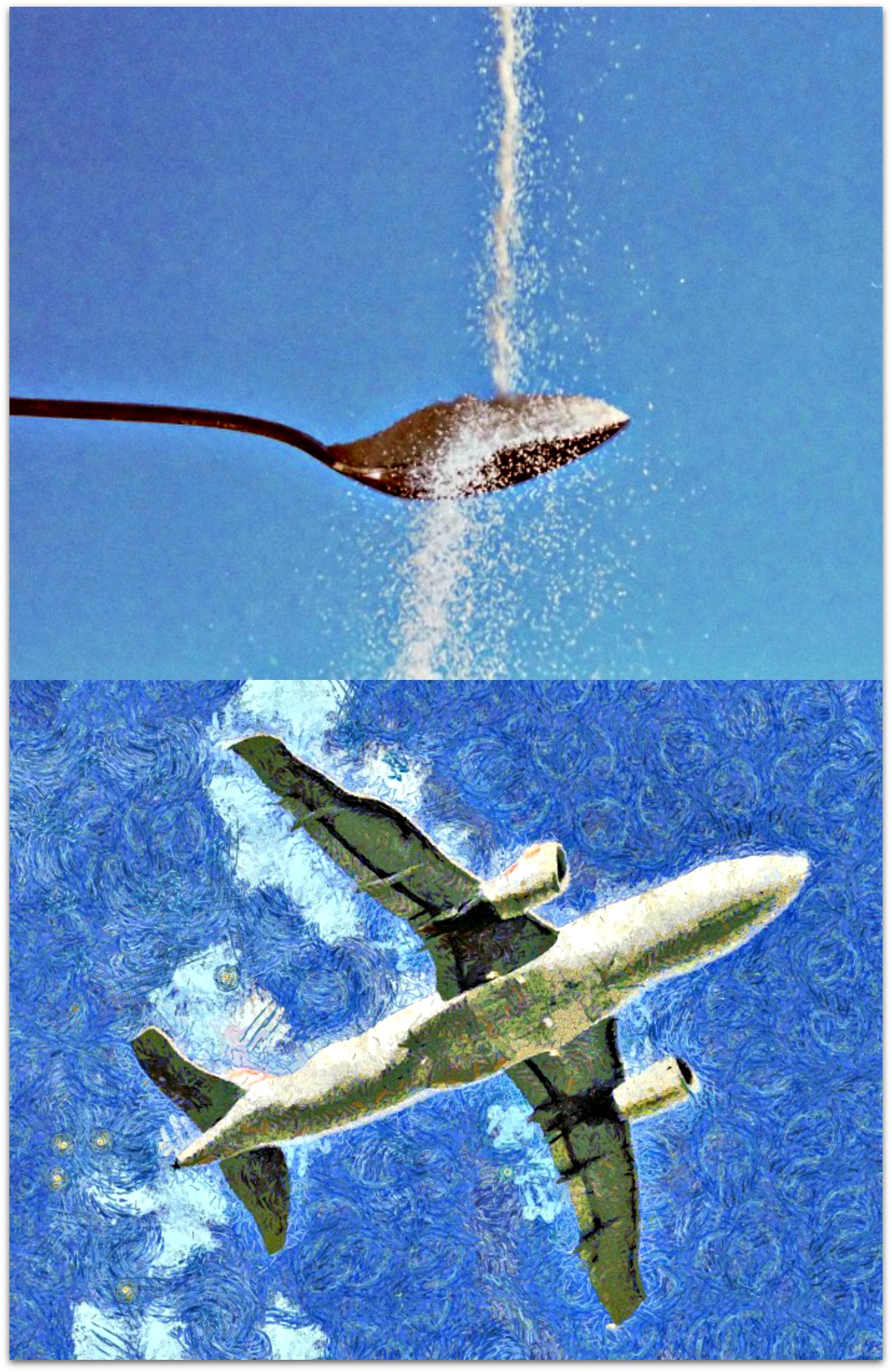
A spoonful of imagination helps the expat life go down: In tribute to our 7 columnists

Sugar spoon by jppi (Morguefiles); jet painting by Prawny (Morguefiles).

Sugar spoon by jppi (Morguefiles); jet painting by Prawny (Morguefiles).

Here in the Northern Hemisphere, as summer draws to its inevitable close, I’d like to take a moment to acknowledge the talented individuals who write columns for us from an expat or otherwise displaced perspective.

Curiouser and curiouser! If it weren’t for them, we’d know a great deal less about the contours of the kind of creative life that is lived across two or more distinct cultures.

Fiction, fantasy, food, photos, theatre—oh my! Our columnists also serve as the Wizards who can help the rest of us transform our travels into a trip down the Yellow Brick Road.

(Yes, Dorothy has now joined Alice as a Displaced Nation heroine.)

Without further ado, they are, in alphabetical order:

1) Andrew Couch

COLUMN: Here Be Dragons
INTERESTING FACT ABOUT ANDREW: He spent this summer developing the Peanut Butter Bar WordPress app, which allows you to attach sticky bars to the roof of your site that stay visible no matter how far a user scrolls. (“Smooth” is free. “Chunky,” which has more features, costs $15.)
COLUMN PURPOSE: Andrew demonstrates, through snippets of his own writing, the possibility of collecting materials for a fantasy novel from a life of international travel.
MOST POPULAR POST: Andrew’s first, “The expat life as fuel for fantasy writing,” perhaps because his concept is a little fantastical.
WHY YOU SHOULD FOLLOW: You will never look at your displaced life in quite the same way again but will see yourself as the protagonist in your own Alice or Dorothy story, a story you’re not only living but could (should?) be writing…

2) Beth Green

COLUMN: Booklust, Wanderlust
INTERESTING FACT ABOUT BETH: She grew up on a sailboat and, though now a landlubber, still enjoys a peripatetic life.
COLUMN PURPOSE: Beth selects books with particular appeal to international creatives.
MOST POPULAR POST: Her first, about the Dublin Murder Squad series by ATCK writer Tana French, perhaps reflecting Beth’s own passion for mystery (she is also a member of the Sisters in Crime mystery writers’ association, another interesting fact about Beth).
WHY YOU SHOULD FOLLOW: The peripatetic Beth has a correspondingly eclectic taste in books, sampling everything from psychological mystery to journalistic memoirs of China to biographies of eccentric female travelers of the past century.

3) Elizabeth Liang

COLUMN: TCK Talent
INTERESTING FACT ABOUT LISA: Lisa spent part of the summer in Iceland, putting on her one-woman autobiographical show about growing up as a TCK, Citizen Alien.
COLUMN PURPOSE: Lisa profiles Adult Third Culture Kids with unusual talents. Perhaps not surprisingly, many of them find success as actors, just as Lisa has.
MOST POPULAR POST: Lisa’s interview with Laura Piquado, an actress in New York City who grew up all over the world and told Lisa she is now

dyak and atheist, Muslim, Christian, Bahá’í, Jain, Egyptian, Italian, Canadian—there is nowhere in the world that has ever felt foreign to me.

WHY YOU SHOULD FOLLOW: Because they weren’t originally expats by choice, adult TCKs can teach the rest of us a lot about the glories as well as the challenges of leading a displaced life. Plus Lisa’s gutsiness in developing her own TCK show gives her creds. She and the show are terrific! I know because I’ve met her and seen it.

4) Meagan Adele Lopez

COLUMN TITLE: The Lady Who Writes
INTERESTING FACT ABOUT MAL: Meagan Adele Lopez (nicknamed MAL) is both Anglophile and Francophile (she once lived in Paris). Talk about open-mindedness!
COLUMN PURPOSE: MAL writes about what she wished she’d known before setting out to write and self-publish her first novel, Three Questions, based on a romantic adventure that started at the end of her first expat stint in the UK (in Bristol).
MOST POPULAR POST: MAL’s first, suggesting that expats may easily be able to find a novel in their novel lives. Note: MAL has just wrapped up her six-post series for us.
WHY YOU SHOULD READ: Rather like Dickens, MAL calls on elements from her thespian background (she used to be an actor in Hollywood, no less) for writing a novel. Her characters are real: she imagines “dining out” with them!

5) James King

COLUMN TITLE: A Picture Says…
INTERESTING FACT ABOUT JAMES: James now lives in Thailand but during his previous expat stint, in South Africa, he ended up settling in Capetown, where he still has a house he’s renting out but would like to sell. Anybody interested?!
COLUMN PURPOSE: James tries to coax expats and other displaced types for whom photography is a creative outlet to tell the stories behind their favorite photos.
MOST POPULAR POST: James’s interview with Irish “ruin hunter” and photographer Ed Mooney, which generated a whopping 32 comments.
WHY YOU SHOULD READ: Why people feel compelled to take photos and what their favorite subjects are turns out to be a great window into the displaced mindset. Kudos to James for developing the series in this new direction.

6) JJ Marsh

COLUMN TITLE: Location, Locution
INTERESTING FACT ABOUT JJ: She plans to attend the Chorleywood LitFest on November 16th, 2014, wearing a toga. Hey, carpe diem and all that!
COLUMN PURPOSE: JJ interviews well-known authors who are expats and/or set their books in far-off lands about the role of place (location) in their imagination and subsequent writings (locution).
MOST POPULAR POST: JJ’s interview with Amanda Hodgkinson, who finished her first two novels, 22 Britannia Road and Spilt Milk, after relocating with her family to southwest France.
WHY YOU SHOULD READ: JJ commands respect in the writing world for her own achievement in crafting a European crime series featuring detective inspector Beatrice Stubbs, in which place plays a major role (she thinks of it as a “character,” she says). This must be why so many other authors are willing to share with her the techniques they use to transport readers to other, more remote parts of the world. Her columns are invariably illuminating.

7) Joanna Masters-Maggs

COLUMN TITLE: Global Food Gossip
INTERESTING FACT ABOUT JOANNA: She is a school friend of Displaced Nation founder Kate Allison. Want another one? She is half Irish and half English, which surely qualifies her as a TCK?
COLUMN PURPOSE: Joanna provides the inside story on food that comes from having lived as a trailing spouse in eight very different countries for more than 16 years.
MOST POPULAR POST: “There’s no taste like home,” in which Joanna confesses that she’s been so busy trying to cook the local food for her four kids that she neglected to introduce them to traditional English dishes.
WHY YOU SHOULD READ: Her repeat expat life has turned her into a creative chef extraordinaire. She knows how to make her own clotted cream (and provides a recipe) should homesickness strike, but is equally adept at Texas Barbecue Brisket.

* * *

In other news…

Have you checked out our Pinterest pins lately? We’ve quite the collection of displaced reads, movies and people, eg:

We can take you on a trip out of this displaced world should you wish to be further displaced; or for those who prefer a fantasy metaphor for their escapist tendencies, check out our Alice in Wonderland and Follow the Yellow Brick Road boards.

IT’S FOOD! is one of our most popular boards (natch!), as is World Parties, Holidays & Celebrations (hooray!). We also have two boards that celebrate the spirit of two previous blogs by me and another Displaced Nation founder, Kate Allison:

Speaking of Kate, you may have noticed that after producing episodes of her novel Libby’s Life on a regular basis for a couple of years (90 episodes, can you imagine?!), she is now updating the story on her author blog and aggregating those posts every so often for the Displaced Nation audience.

Last but not least, if you haven’t caught up with our Displaced Dispatch lately, take another look. Besides links to the latest posts, we have ORIGINAL contents by yours truly, exclusive giveaways (there’s one on now!) and candidates for the monthly Alice Awards.

Yes, we are still doing our Alice Awards and have now added an occasional Wizard of Oz column about repatriation: “Emerald City to Kansas”. We’re a busy (dis)place!

STAY TUNED for the announcement of August Alices.

If you enjoyed this post, we invite you to register for The Displaced Dispatch, a round up of weekly posts from The Displaced Nation, with original contents, book giveaways, and other extras. Register for The Displaced Dispatch by clicking here!

Related post:

BOOKLUST, WANDERLUST: Jane Fletcher Geniesse’s biography of the passionate nomad (but displaced expat) Freya Stark

Booklust Wanderlust Collage

Left: Oleh Slobodeniuk (CC BY-NC-SA 4.0); right: Beth Green (her own photo).

Attention displaced bookworms! Our book review columnist, Beth Green, is back. An American who lives in Prague, Beth mixes booklust with wanderlust in equal measures, which gives her just the right background for reviewing book releases on behalf of international creatives.

—ML Awanohara

Hello again, Displaced Nationers! Hasn’t the summer gone by fast? How’s your progress on that reading list you made back in the day when it seemed like the dog days would go on forever?

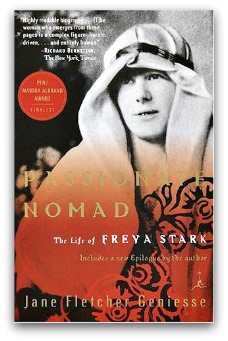
Well, if you abide by the rule that summer ends with the equinox, then you still have a few more weeks. And if you’re searching for one last read to feed your wanderlust, I would recommend the volume I just now finished: a biography of Dame Freya Stark, one of the most amazing travelers and travel writers of the last century. Called Passionate Nomad: The Life of Freya Stark, it’s by former New York Times journalist Jane Fletcher Geniesse.

Passionate_Nomad_coverDays after reading, I’m still in a daze (so to speak), transported by Geniesse’s tale of this intrepid British war-time adventurer.

Stark is one of those people—we’ve all met them on our travels, haven’t we?—who seems to have crammed many lives’ worth of living into one single walk on Earth.

Born to Anglo-Italian-German parents who made their living painting, growing flowers, and managing textile factories (among other pursuits) across Europe, Stark was the original Third Culture Kid. As she traipsed with her parents across Britain, France and Italy, she had no real place to call home. She was further burdened by her parents’ separation and an emotionally manipulative mother, along with numerous illnesses and financial troubles.

A late bloomer

Though she would eventually achieve renown as a witty speaker who could always be counted on to liven up a party, as a young woman Stark despaired of being able to have her own life. She did not make her first trip to the Orient (as it was known in those days) until age 33.

Perhaps because Stark herself told the stories of her travels in the 25 books she published, Geniesse gives most of her attention to the adventures Stark had before being lionized for her travel exploits and writings. (Geniesse covers the last 40 years of Stark’s life—Stark lived to age 100!—in just one chapter.)

For me, Geniesse’s portrait is most brilliant when recreating the straitened times that preceded the period when Stark became fluent in Arabic, gained a reputation for bravery abroad and published her first articles and books on her Middle Eastern travels.

Geniesse relies on her intuition as well as meticulous research to highlight the details of Stark’s upbringing that help to explain her transformation from a penny-pinching flower farmer in Italy to a voracious student of classical literature, a free-spirited wanderer (she was one of the first non-Arabians to travel through the southern Arabian Deserts), and an internationally respected author, speaker, ethnologist and political consultant.

A misfit in the expat community

In tracing Stark’s life journey, Geniesse provides some sense of her struggle to find a place in the expat communities of the interwar years. On the one hand, she had trouble relating to the other Europeans she encountered on her travels, writing in one of her letters:

[The British missionaries in Lebanon] suffer from stagnation of the brain, and that surely produces stagnation of the soul in time. To feel, and think, and learn—learn always: surely that is being alive and young and the real sense. And most people seem to want to stagnate when they reach middle age. I hope I shall not become so, resenting ideas that are not my ideas, and seeing the world with all its changes and growth as a series of congealed formulas.

But during the period she spent within the expat community in Baghdad while researching her next trip, it was clear her fellow expats weren’t clear what to make of her either. As Geniesse writes:

Freya, now 37, was feeling her earlier despair give way to expanding hope. She could change her life; she had watched herself do it—although precisely to what purpose remained as much a mystery to her as the question of what Miss Stark was doing in their midst intrigued the Baghdad community. Freya enjoyed being directionless, learning purely for learning’s sake—and adjusting, if that was her fate, to a spinster’s life.

Geniesse concludes it may have been easier for Stark to explain herself to the tribes and villagers she encountered during her travels as they had no expectations of how she should be behaving. As a European, Christian woman traveling in remote areas of Yemen, Lebanon, Syria, Persia, Iraq and Iran, she was accepted as a foreigner, while in the expatriate communities there was some expectation that she should conduct herself as a proper unmarried lady.

(In fact she did eventually marry, in her fifties, to a good friend—but the couple separated soon afterwards, when her husband told her he was gay.)

Warts and all

Like all good biographers, Geniesse also highlights Stark’s less flattering qualities. From Stark’s petty rivalry with archaeologist Gertrude Caton-Thompson, to her sharp attitude toward women she felt were prettier than herself, to her irresponsible attitude to money and certain friends, Geniesse shows us the other side of this larger-than-life character. I liked Stark all the more for this mix of traits.

As I got to the end of Genisse’s work, I felt a little bereft. I missed Freya. There is something irresistible about a woman who not only writes her own script for her life but also gives herself a series of challenging parts. As Geniesse says, at the end of her life

Freya had followed her own genius. She had imagined herself as the star in many roles over the years—explorer in Persia and Luristan, Mata Hari at the imam’s court, English plenipotentiary during the war, and humble pilgrim, wandering through Turkey’s ancient ruins.

Next up on my reading list will have to be one of Stark’s own stories, several of which are still in print.

And now, I’ll leave you with a quote from Freya Stark herself, excerpted from a letter to her mother, listing the “7 cardinal virtues for a traveller”:
1. To admit standards that are not one’s own standards and discriminate the values that are not one’s own values.
2. To know how to use stupid men and inadequate tools with equanimity.
3. To be able to disassociate oneself from one’s bodily sensations.
4. To be able to take rest and nourishment as and when they come.
5. To love not only nature but human nature also.
6. To have an unpreoccupied, observant and uncensorious mind—in other words, to be unselfish.
7. To be as calmly good-tempered at the end of the day as at the beginning.”

* * *

Thanks, Beth, for bringing Dame Freya Stark to our attention! And now I would like to offically nominate her for our Displaced Hall of Fame. Readers, had you heard of Freya Stark before reading Beth’s column? What do you make of her? Have you encountered an eccentric like her on your own travels, or does she seem like a product of a previous age?

Beth Green is an American writer and English teacher living in Prague, Czech Republic. She grew up on a sailboat and, though now a landlubber, continues to lead a peripatetic life, having lived in Asia as well as Europe. Her personal Web site is Beth Green Writes, and she is about to launch a new site called Everyday Travel Stories. To keep in touch with her in between columns, try following her on Facebook and Twitter. She’s a social media nut!

STAY TUNED for the next fab post!

If you enjoyed this post, we invite you to register for The Displaced Dispatch, a round up of weekly posts from The Displaced Nation, with seasonal recipes, book giveaways and other extras. Register for The Displaced Dispatch by clicking here!

Related posts: