The Displaced Nation

A home for international creatives

Meet author Rosie Whitehouse, who trailed her spouse into a war zone (and enter to win her book!)

Rosie Whitehouse CollageOne of the expressions I picked up from living in England for many years is “Keep the home fires burning.” For some reason, that expression, along with the WWI song from which it comes, is running through my head as I contemplate talking to today’s featured author, Rosie Whitehouse (click here to hear it being sung):

Keep the Home Fires Burning,
While your hearts are yearning.
Though your lads are far away
They dream of home.
There’s a silver lining
Through the dark clouds shining,
Turn the dark cloud inside out
Till the boys come home.

For me, Rosie is an up-to-date version of what the songwriters had in mind. Educated at the University at London, with a career as a BBC journalist, she chose to stay at home with her children and keep the house warm and welcoming, and the family’s spirits up, while her husband, the journalist Tim Judah, went off to report on various wars for The Economist and other newspapers.

Rosie even went the further step of moving the family home to be closer to Tim for a time. Ironically, she kept the home fires burning in the very place where World War I began, the Balkans. She flew out to a crumbling Bucharest—it had been knocked down by the notorious Ceaușescu, whose secret police killed hundreds during Romania’s 1989 revolution—with one child in tow and another one on the way.

Then, when it seemed possible that her own home could go up in flames as war spread across the former Yugoslavia, Rosie did not give up. She stayed for a total of five years before returning to London, by which time “keeping the home fires burning” was second nature both for her and the couple’s five kids (Tim carried on covering wars in Iraq, Afghanistan, and the Congo).

Having revived her career as a freelance journalist, she decided to write her first book: Are We There Yet? Travels with my Frontline Family—a copy of which we’ll be giving away! (See details below). The book is a tribute to families who have been “burners of the home fires,” whose emotional pain tends to go unheralded. It is also, in her words, “quite funny.” (Hey, growing up in Bucharest, Belgrade, Croatia and Bosnia can be fun!)

By now you must be as curious as I am to meet the intrepid Rosie Whitehouse and learn more about what motivated her to seek out such an unusually displaced (at least by most of our standards!) life. I note that she has an Irish mother—perhaps that explains it?! (I’m thinking Queen Boudicea…)

* * *

AreWeThereYet_cover_dropshadowHi, Rosie. In your book you say that your husband’s journalist colleagues in Romania, all of whom were single, were shocked to hear he had a two-year-old son and another child on the way. Did people often tell you you were crazy?
Yes, lots of people thought I was crazy.

As a former journalist with a background in Russian studies, do you think you felt a tinge of envy for Tim’s opportunities—which made you want to be on the scene?
Not really, as I would not have been able to cope with going to morgues and so on.

I know you’re going to challenge our definition of “displacement,” but I’ll go ahead and ask: what was your most displaced moment during your stay in the Balkans—when you had to explain Daddy’s muddy boots (he’d been walking in a mass grave), when you visited empty supermarkets, or when you heard the first shots of the conflict in Bosnia while strolling around Sarajevo with the kids?
Those things were reality so in that one doesn’t feel displacement. Quite the opposite in fact. I was intimately plugged into life and death at those moments.

How did you keep yourself sane?
I coped with stressful moments by bunkering down. I wouldn’t send the kids to school and cuddled up with them instead. As long as I shut my front door, where ever I am and whatever is going on, and it is just us, I am able to feel at home.

But getting back to your question about displacement: My best moment in a foreign country was when I saw my mother drive off in a taxi in Bucharest and realizing that apart from my two year old son I didn’t know a soul in the country (my husband was away in Albania for weeks). Wow, at last no one to tell me what to do! Freedom!

More seriously, most displacements do not happen by choice, and my most displaced moments have been as a result of this. I recount a story in the book when I took the kids to Berlin ten years ago. My mother-in-law was born there but fled in 1933 as she was Jewish. The family settled in Paris. As a result I have half French children who speak fluent French and we don’t speak a word of German.

It was a rather stressful visit as we searched for old family homes, one of which the family were still trying to reclaim. My daughter Esti got a headache. I pointed to the department store and suggested that we go in to buy an aspirin. It was Wertheims. My mother in law’s mother was a Wertheim and was murdered in Aushwitz. Esti said:

What, first they give me a headache by stealing the department store and murdering my great granny–and now I am expected to go in and buy an aspirin to make it better? You have to be kidding!

That’s displacement.

Child-rearing on the frontlines

What was the biggest challenge about having children with you on the frontlines?
The biggest challenge was often the simplest thing such as getting them something to eat and getting hold of baby milk.

Did anything surprise you?
Life never ceases to surprise me where ever I am and what ever is going on. The terrible things and the good things always amaze me.

What do you think the kids got out of the experience?
The kids learnt a lot. My eldest son, Ben, would ask about why there was no food in Romania. For me it was a matter of telling simple tales of communism and 1917. For him it began a life-long interest in Russia. He is following in his father’s footsteps.

My eldest daughter, Esti, would like to work for an NGO like Human Rights Watch.

For all of us, it drew us closer together. We are a tight-knit family.

I’ve heard of war reporters feeling bored when they come back to “reality” in their home countries. Did your family experience any of that after five years in the Balkans? What was it like to go “home” again?
Going home is just as difficult as moving to a new country. By the way, the wars didn’t stop either after we got back. My husband has since covered lots of wars and famines including Afghanistan, Iraq and the Congo.

Writing a book, but from the backlines

After you left the Balkans, it took quite a few years before you decided to write the book. What was the catalyst?
It was during the invasion of Iraq in 2003. I was standing in the supermarket and they had just installed a TV with a live feed from Iraq by the checkout. Some soldiers were running across a street in Basra, where some of the heaviest fighting took place, followed by a reporter and camera man. All of their faces were clearly visible. My husband was in Baghdad covering the story for The Economist. I had actually popped out for five minutes of fresh air before the bombers took off from the UK and the countdown to the blitz on Baghdad began.

I realized, to my horror, you could be buying a packet of frozen peas and watch your husband killed in front of your eyes. I know this thought had never entered the mind of the supermarket manager who had simply installed the TV to attract customers.

That evening I found my ten-year-old glued to a grainy grey screen showing an image of Baghdad as the cruise missiles were expected. What do you say? I had to make dinner and she had to do her homework. The UK had a huge debate about the war and the way it was covered, and I felt nobody knew what it was really like to be part of it and a kid to boot.

I also found that very quickly after the Berlin Wall came down that people forgot in Western Europe just how hard life had been under communism, especially in Romania and Albania. No surprise in that, really, as since 1945 most people in Western Europe just forgot the East existed.

I also found people in the UK quick to judge and condemn people in Southeastern Europe as being violent and prone to war. I wanted them to realize we are no different. That is why I’ve also included a chapter on Ireland in the book.

And I wanted to describe the multicultural experience of bringing up half-French, half-Jewish, part-Irish children in various countries, something I found fascinating.

Was it also part of your mission to show others what it is like to be married to, the child of, a war reporter?
Yes, not just to a war reporter but also those who are married to soldiers—especially those who are part-time soldiers and live in the community.

Did you have any personal motives in writing the book, to help you process what you’d been through and to provide your children with a record of where they’d lived?
No, not really. I didn’t write it for us but to make people think about what was going on. I am sure that the kids will appreciate it when they are older.

What was the most difficult part of the book-writing process?
Getting time to do it. I often wrote with my computer on the kitchen side as I was cooking dinner, which was good as I could hear kids talking; and as I was writing about them, it helped to have them there doing their thing.

Did you find it easy to find a publisher for the book?
No it was hard. publishing is a tough business. I started my own publishing company, Reportage Press, which closed a few years ago. Are We There Yet? is on Amazon as a self-published download these days. We also have a number of journalist friends who are taking the self-publishing route quite successfully.

What audience did you intend for the book? Did you think it would also appeal to other kinds of expats, who don’t go to war-torn countries?
Yes, there is a large expat element to the readership, and I know the book has touched the hearts of women feeling lonely and bewildered in a new country. I have been hugged and kissed by quite a few of them. One lady said reading the book had saved her marriage. I’m not sure it was me, but I hope I helped her realize it wasn’t so bad being lonely in London. It is hard being in a strange country with children. It is you who have to interpret it for them and as you are far from the family support group and friends, it is inevitably all up to you to be their world. It’s a tough job. That said, the book is far from serious. It’s actually quite funny.

Can you give us some examples of humorous moments in the book?
The kids are a laugh a minute, so whatever was going on they would often say or do something funny. For example:

For me the market in Piaţă Amzei is the focal point of life in the city centre [of Bucharest]…

“Let’s see the old ladies with the cheese. Come on!” shouts Ben as he darts out of the pushchair and into a smelly covered hall, where they sell heaps of yellowy looking curds, which are akin to feta.They are covered in flies.

The old women with their long black skirts and headscarves beckon him over and offer him little crumbs. He watches their lips and toothy grins with fascination. They look unnerving, like witches with crunched up dirty teeth, but he doesn’t run away. He has come deliberately to stare at them. He studies an old lady’s face carefully as she says something he can’t possibly understand. He is like his father, never frightened of anything and intrigued by the smallest thing. He loves the bizarre and the quirky.

* * *

“Where’s Mr Parking? Why doesn’t he find us a space?” asks Ben as we drive up and down the street outside our flat. Ben loves Mr Parking. I can’t see him anywhere.

Mr Parking is the man who organises the parking lots outside Belgrade town hall. It’s an elegant 1880s building that was once the royal palace and is right next to our block of flats. For a tip, he lets us park in the lots reserved for local officials. I haven’t seen him for weeks and have to be careful where I put the car, or we’ll be towed.

“I think he has gone back to Bosnia to fight, Ben.”

“What!” Ben is horrified.

“Why? I want to park the car. Doesn’t he want to stay here?”

“No, I expect he wanted to go home and defend his village.”

“Where is his village?”

“He’s from eastern Bosnia, the bit between here and Sarajevo [Bosnia’s capital city]. He told Dad he comes from Kamenica. It’s in one of the last bits there that’s still under Muslim control.” It’s a village close to the town of Srebrenica [the town where a massacre took place in 1995, said to be a crime of genocide].

“What! He’s a Muslim?” Ben is amazed: “But he looks like everyone else!”

“Of course, he does! You don’t look different if you’re Muslim. Bosnians look the same whether they are Muslims or not.” My mother has just sent him a book about the Crusades.

“I thought Muslims looked like Arabs.”

Are you working on any other ambitious writing projects?
I would like to write an expat guide to Britain. I spend a lot of time explaining Britain to people as I live in an expat world in the UK to a certain extent as my children have been or go to the French Lycée, and we have a lot of foreign friends who live in London.

Ten Questions for Rosie Whitehouse

Finally, I’d like to ask a series of questions that I’ve asked some of our other featured authors, about your reading and writing habits:
1. Last truly great book you read: Malaparte is on my mind as I am driving to Ukraine. His book on the 1941 invasion of Russia is unforgettable.
2. Favorite literary genre: Novels
3. Reading habits on a plane: Nothing. I am too tense on a plane as I hate flying. If I am calm enough I love to look out of the window.
4. The one book you’d require President Obama to read, and why: My son Ben’s book on Russia: Fragile Empire: How Russia fell in and out of love with Vladimir Putin. It’s a great portrait of contemporary Russia. I am his mum—what else am I supposed to say to this one?
5. Favorite books as a child: I loved Little House on the Prairie but above all I loved the stories my dad used to tell me.
6. Favorite heroine: She doesn’t have a name. She is one of the millions of women who have struggled to keep their families together against the odds. These are the mums who keep the world turning.
7. The writer, alive or dead, you’d most like to meet: I always wanted to meet William Shirer. He must have had an extraordinary experience living in Berlin at the start of World War II. Perhaps the ultimate expat experience! I suggested an interview programme with him to BBC World Service in the 80s but they didn’t have the cash to send me to America to do it. A pity as he died after that.
8. Your reading habits: I read a lot. If you want to write you have to read. I also have to read a lot for work.
9. The book you’d most like to see made as a film: None, really. If you love a book, the last thing you want is for it to become a film as you have the pictures in your head and they are your pictures not someone else’s.
10. The book you plan to read next: Vasily Grossman‘s An Armenian Sketchbook is in my suitcase. I love Grossman. He is a fantastic writer. If you haven’t read Life and Fate, you have really missed out.

* * *

Thanks so much, Rosie! Personally, I found your story very moving and think we should confer on you a “home fires” medal for all you’ve achieved!

Readers, it’s time for you to ENTER OUR DRAW TO WIN A FREE COPY of Rosie Whitehouse’s book. Rosie is giving away ONE COPY and will favor comments that tell her why you’d like to read the book.

Extra points, as always, if you’re a Displaced Dispatch subscriber!

The winner will be announced in our Displaced Dispatch on August 2, 2013.

Rosie Whitehouse is a parenting journalist and mother of five. She is one of the UK’s leading experts on family travel. She has written widely on family matters and traveling with children for The Sunday Telegraph, The Independent, The Guardian, The Daily Mail, Sunday Express, Family Circle, The Economist, and others, as well as for the Web sites B4Baby.com and Raisingkids.co.uk. She has also spoken at events and on television and radio on parenting matters, promoting her travel books and her autobiography, Are We There Yet? Travels with my Frontline Family. You can follow her latest adventures at http://www.rosiewhitehouse.co.uk/.

STAY TUNED for tomorrow’s post in our Olde vs New World series, by guest blogger Claire Bolden.

If you enjoyed this post, we invite you to register for The Displaced Dispatch, a round up of weekly posts from The Displaced Nation, with seasonal recipes, book giveaways and other extras. Register for The Displaced Dispatch by clicking here!

Related posts:

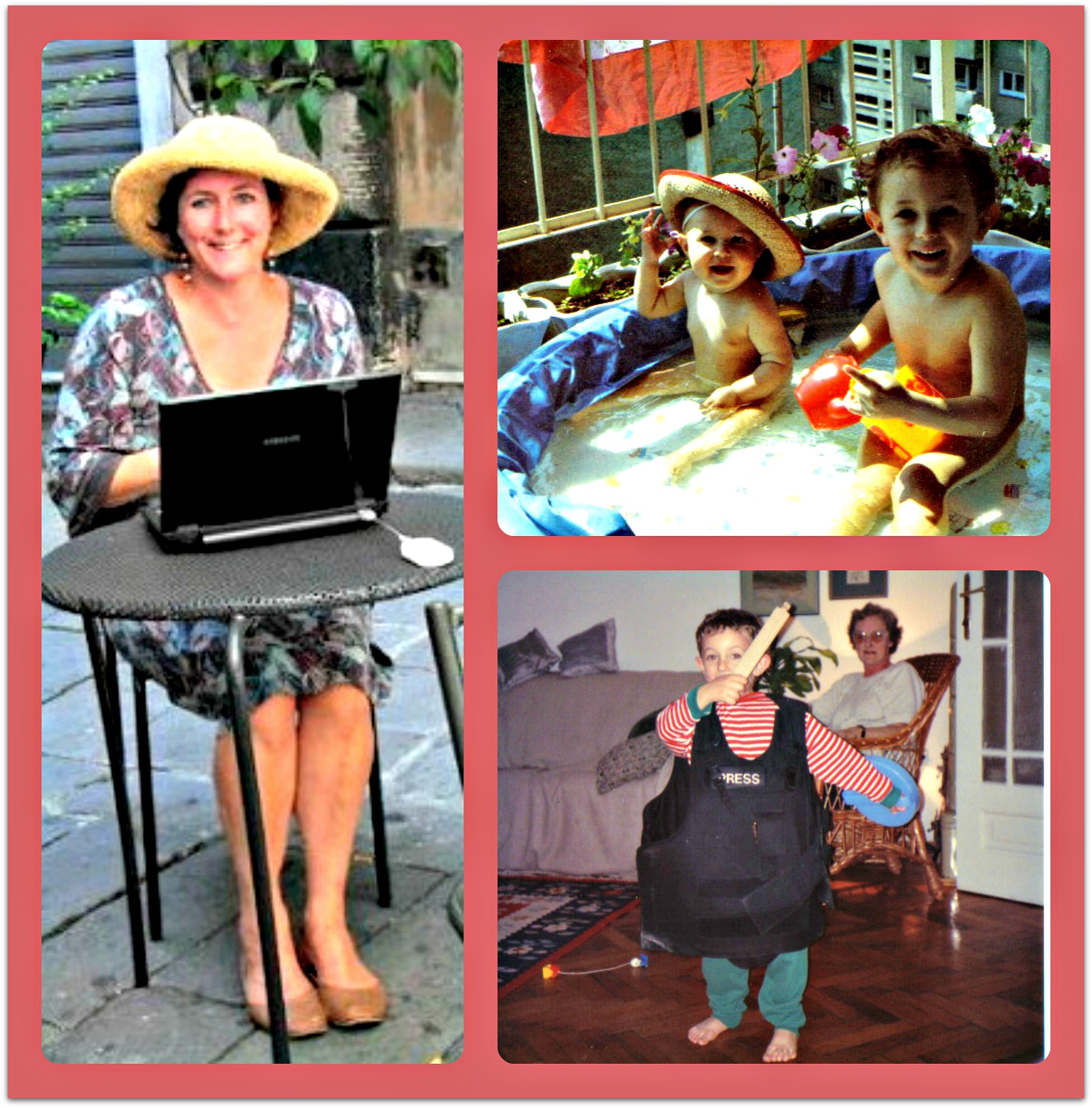
Images (clockwise from left): Rosie Whitehouse at “home” in London; Ben and his baby sister, Esti, living it up on the balcony in Bucharest (July 1991); Ben trying on his dad’s new bulletproof jacket, with Rosie’s mother in background (Belgrade, May 1992).

Getting carried away with author Lisa Egle on a magic carpet, or is it a chicken bus? (Win a copy of her travel memoirs!)

Lisa E Collage for TNBack in the days when my nieces were small—and I’d just repatriated to the United States after quite a few years abroad—I got to know them again through long bouts of playing make-believe at my mother’s (their grandmother’s) house.

We particularly enjoyed Magic Carpet. We had our own home-made version. Adorning ourselves in Grandma’s silk scarves, we would plonk down on her quilted bedspread for a flight of fancy, à la Arabian Nights (not for us the Disney version!):

Whoever sitteth on this carpet and willeth in thought to be taken up and set down upon other site will, in the twinkling of an eye, be borne thither, be that place nearhand or distant many a day’s journey and difficult to reach.

I trust this anecdote will explain why I’m so excited about hosting new author Lisa Egle today. It’s Magic Carpet time again, and this time I get to be the kid, listening to Egle tell of the off-the-beaten-track adventures that are captured in her travel memoirs, Magic Carpet Seduction.

Hey, we even have prizes! Two of our readers will be the lucky recipients of a copy of Egle’s book (see giveaway details below). The giveaway is now over! 😦

Hmmm… The only thing is, I suspect that before we board the Magic Carpet, Egle will ask us to ride on a chicken bus. (Leave the silk scarves at home, girls!)

* * *
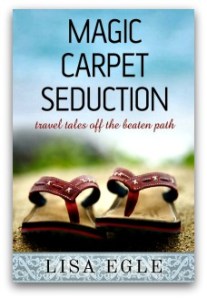
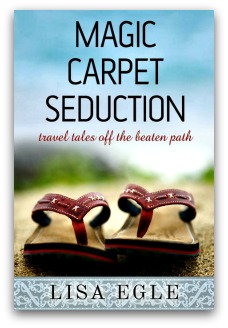
MagicCarpetSeduction_cover_pmHi, Lisa! I won’t need too much persuasion to be seduced by your writing. I’m already a follower of your travel blog, ChickyBus. And I know you’re an American like me, living in New Jersey. Why made you decide to travel in the first place?
After taking short solo trips in the U.S. back in the 1990s, I went on a two-week group tour of Egypt and thought it was the most exciting thing I’d ever done. I then went on another tour, of Ecuador, which turned out to be a life-changing experience (for many reasons, including the fact that I moved there a few months later). While living in Ecuador, I began to travel independently and realized how much I enjoyed it. From that point on, I entered the ranks of “travel addicts.”

How many countries have you been to at this point?
In total, I’ve been to 36 countries, on five continents. I was an expat twice: in Ecuador for a year and half and in Spain for a year. Recently, I spent two months in Indonesia.

And home is now New Jersey?
Yes. I’m a full-time ESL professor at a two-year college in Bloomfield.

I don’t get it. Is a “chicken bus” magical?

Where does the epithet “Chicky Bus” come from?
“Chicky Bus” is the name of one of the stories in my book. It’s about a quirky 12-hour “chicken bus” ride I took in Central America that led me to have epiphanies about living in the moment. When I started my blog, I thought “ChickyBus” would be a cool domain name—one that related to travel and one that people would remember. I also liked it as a blog concept. I’m the “driver” taking readers—”passengers”—on “rides” with me, allowing them to experience the same random moments and unexpected journeys that I do.

There’s also a deeper meaning, however. “Chicky bus” is a metaphor for my unique style of travel—being in the moment while venturing off the beaten path and taking risks (nothing too crazy, of course). It refers to that place of magic and self-discovery that I find wherever I go.

Why did you decide to publish some of your travel stories as a book?
Years ago, while blogging about general topics on a site called http://www.gaia.com, I began sharing travel tales. The feedback was incredibly positive; people were inspired and entertained by what I wrote and said they felt like they were right there with me. After a while, I decided to go all the way with it, to write more stories and to compile them into a book—four major “rides” to different regions of the world (and a total of 9 countries: China, Nicaragua, El Salvador, Guatemala, Mexico, Turkey, Jordan, Syria and Lebanon).

Are any of your chapters based on blog posts?
Interestingly, none of the stories are based on blog posts. I wrote most of the book before I started ChickyBus. There are, however, a few stories (simplified versions) on the blog that came from the book.

Mostly magical connections

We like to talk about “displaced moments” on the Displaced Nation. We can see you’ve experienced your fair share: from close encounters with Carpet Casanovas in Turkey, to meeting with a hermit in the Lebanese mountains, to experiencing political intrigue in a Chinese classroom, to receiving a marriage proposal on that infamous chicken bus in Nicaragua. But we still have to ask you: which is the MOST displaced moment that you’ve included in this book?
The moments you mention were truly unique ones and—believe it or not—I didn’t feel as displaced as one might think. Because I was in the moment and going with the flow, I felt quite comfortable and that I was where I needed to be.

There were a few instances, however, in which I did have that “displaced” feeling—the most extreme of which occurred in China.

It was 1999 and I was teaching English at a university in Changsha in Hunan Province, which was definitely considered off the beaten path back then. For most of my time there, I was in a deep state of culture shock. I struggled with many things, from freedom of speech issues to getting to know my students. There were many “displaced moments”—and even days. Fortunately, after a while, things leveled out and went more smoothly.

So from what you’ve just said, I guess there is a lot of competition for your LEAST displaced moment, when you felt you actually belonged with all of these characters you discovered off the beaten track?
One of my least displaced moments (and possibly favorite) was when a friend and I ended up spending the night with a Mexican family we barely knew. They’d invited us over for lunch. We were planning to take a bus to another city that night because we had to fly home from there the next day. It got later and later and because we were so comfortable, we didn’t want to leave. We ended up staying (and sleeping in two very tiny beds, slightly larger than coffins) and having a wonderful time being part of the family.

P.S. A little Boone’s Farm wine went a long way in helping make us even more comfortable…

Don’t exit until the rug has made a complete stop!

Okay, time to get off that chicken bus and onto that magic carpet. On your post announcing the book’s publication, you say:

So imagine that my book is the equivalent of an invitation to a Bedouin lounge of sorts. If you decide to join me, we’ll get comfy on the cushions and share some tea (or coffee or whichever beverage you like). When you’re ready, I’ll start telling you my favorite travel tales—and together, we’ll take a magic carpet ride.

Why did you choose this metaphor, and indeed use “magic carpet” in your title?
When I was a kid, my friends and brother and I used to sit on the front porch and listen to my mother telling us stories. Years later, I found myself doing the same thing with friends and later, on a blog. Then, I spent time with the Bedouins in Wadi Rum, Jordan. We told our own stories while sharing tea and sitting on the sand under a tent or on a cushion inside a house. In retrospect, I believe that the “invitation” into the Bedouin lounge has something do with each of these experiences.

Re: the title, when people see the words “magic carpet,” the freedom to travel anywhere, magically, usually comes to mind. Also, “Magic Carpet Seduction” is the name of one of the stories in the book. It’s about two men, seemingly different, trying to sell me a carpet and what happens I see through their each one’s sales pitch/ploy.

Also in your blog post announcing the book’s publication, you confess to being exhausted. (I confess to having had similar feelings after long games of Magic Carpet with my nieces!) What was the most challenging part of the writing process?
Mostly, it was finishing the book, editing it and formatting it while maintaining my blog and my full-time teaching job, and being on social media. At times, it was difficult to prioritize and I often felt burnt out.

Overall, however, I would say that editing took a lot out of me. There were a few times when I thought I was finished with a certain stage of the process; then, I’d realize that I wasn’t. Having said this, that is where I learned the most and what helped me become a better writer. So, in the end, it was a positive experience.

Capturing the magic of self-publishing

Why did you self-publish the book?
I took this route mostly because I wanted creative control; I believe the book is unique and slightly nichey. Also, I didn’t want to have to spend a lot of time pursuing an agent and traditional publisher. Mostly, I wanted to get the book done my own way and on my own schedule.

Can you offer any tips for others who are contemplating going down this path?
My best tips for anyone who’d like to self-publish are:

• Hire a professional editor and a proofreader—two (even three) people. Also, get a critique done before you pass the manuscript on to an editor. It’s important because each editor has his/her own specialty and will probably catch something another didn’t.

• Have a cover professionally designed. I know there are ways to do this cheaply or yourself, but it’s worth spending money to do this right since the cover is first thing that people see when searching for a book.

• Have your blog (and social media accounts) set up/established before you publish the book. I’ve seen many people do it the other way around. They finish and publish their book, then set up a blog and join Twitter. Many aren’t sure what to do—they just tweet about their book and don’t interact with others. This tends to hurt them more than help them.

• Don’t give up. I can’t begin to tell you how many times I wanted to quit just because of the sheer amount of work (blog, social media, the book itself, etc.) You can burn out very easily and, if you’re not careful, your health can suffer. Keep going, though, and you’ll cross that finish line!

What audience did you have in mind when writing the book?
I’ve always envisioned the audience as:

  • armchair travelers and those who take tours and fantasize about breaking away
  • other independent travelers/expats
  • non-travelers with an interest in countries often in the news
  • anyone curious about the cultural perspective/insights of a female American traveler.

Is it reaching those readers?
I don’t know the customer demographics yet, but I know that a few men have written reviews on Amazon—and that makes me happy. As is the case with ChickyBus, the book is for people of all ages and both genders. It’s definitely not just for women.

I see you’ve opened your own publishing company and are working on some more ambitious travel-cum-writing projects. Can you tell us some more about that?
I set up a small publishing company for a number of reasons, including accounting and taxes. More than that, I thought it made sense because I will be publishing more books and hopefully, a collection of travel tales written by others. This is a longer-term goal, but definitely something I’m considering for the future.

Are you already working on your next book?
I’m currently working on a trilogy about Native American-style healing journeys in the U.S. (in the Northeast and the Southwest). After that, I’ll hopefully wrap up the rough draft of a book about life-changing experiences I had in Ecuador. That, like the trilogy, would fall under a “spiritual travel” genre.

10 Questions for Lisa

Finally, I’d like to ask a series of questions that I’ve asked some of our other featured authors, about your reading and writing habits:
1. Last truly great book you read: Grey Wolves and White Doves, by John Balian
2. Favorite literary genre: Political thrillers; travel literature.
3. Reading habits on a plane: (what kinds of things do you tend to read and by what means?) Now, because I own a Kindle, this is much easier. I usually have several books to choose from: one I’m sure I’ll love and lose myself in and—a few that I’m curious about. One thing I love to do on a plane (and during my trip) is keep a journal. During my return flight, I re-read the journal and re-experience the trip. I almost always do that and love it!
4. The one book you’d require President Obama to read, and why: Hmmm. That’s a tough question. Maybe my book? I’d want him to see that there are Americans who embrace the rest of the world, despite the media’s distortions of it. Also, I think my book would show him how travel, the way I approach it—focusing mostly on meeting the locals—can help people to connect in a very real way and to overcome cultural misconceptions, ultimately helping make world peace more attainable. Another reason I’d want him to read it is because I think it would provide good escapism since it’s quite humorous. He’s got a tough job and might enjoy it for the entertainment value alone.
5. Favorite books as a child: The Outsiders, a coming-of-age novel by S.E. Hinton; and Go Ask Alice, by Beatrice Sparks.
6. The writer, you’d most like to meet, who is no longer living: Aldous Huxley
7. The writer, you’d most like to meet, who is still alive today: Daniel Keyes
8. Your reading habits: I have a pretty short attention span, so there are many books that I start to read that I don’t finish. However, if a book really gets my attention, then I can’t stop. It becomes something I look forward to and put aside other things to do. Unfortunately, since I started my blog a few years ago, I’ve been reading less than previously. I spend more time reading other blogs and articles than reading actual books. When I seem to read the most is when I’m traveling and find myself without Internet. I end up loving it, too.
9. The book you’d most like to see made as a film: A cyber suspense I’ve written about two women who “meet” on the Internet and what happens when the bond they’ve formed takes a dysfunctional and frightening turn. It’s now in rough draft form (about 15,000 words), but I’m hoping to publish it on Amazon (just for Kindle) in a few months.
10. The book you plan to read next: Actually, there’s a book I’m itching to finish reading—and that’s Shantaram. I always start it and then get interrupted. It’s a very long book (over 900 pages). I think Gregory David Roberts is an awesome writer. His storytelling ability—the way he writes dialogue, how he describes characters, settings and situations, and the way he uses metaphor—makes his experiences incredibly real to me.

* * *

Thanks so much, Lisa! That was absolutely magical, a carpet ride to write home (to my nieces) about! And that chicken bus? It wasn’t half bad! 🙂

What about you, readers? Has she seduced you?

Lisa Egle writes a blog, Chicky Bus, the concept of which is “finding yourself off the beaten path.” Over the past three years, it has been recognized on two “Top 100” lists of independent travel blogs. Egle is also Assistant Professor of ESL at Passaic County Community College in Paterson, New Jersey, where she teaches students from all over the world, especially Latin America and the Middle East. She holds a BA in Social Sciences from New York University and an MA in TESOL (Teaching English to Speakers of Other Languages) from Fairleigh Dickinson University. Lisa recently published a humorous piece in OH SANDY! An Anthology of Humor for a Serious Purpose (sales of which help victims of Hurricane Sandy), and an article on one of her quirkier adventures in Indonesia in LifeLift, the Oprah.com blog. She received an honorable mention in the 77th Annual Writer’s Digest Contest, in the Inspirational category.

STAY TUNED for tomorrow’s post, by guest blogger Elizabeth Liang, who will be updating us on her one-woman play about the TCK life, Alien Citizen.

If you enjoyed this post, we invite you to register for The Displaced Dispatch, a round up of weekly posts from The Displaced Nation, with seasonal recipes, book giveaways and other extras. Register for The Displaced Dispatch by clicking here!

Related posts:

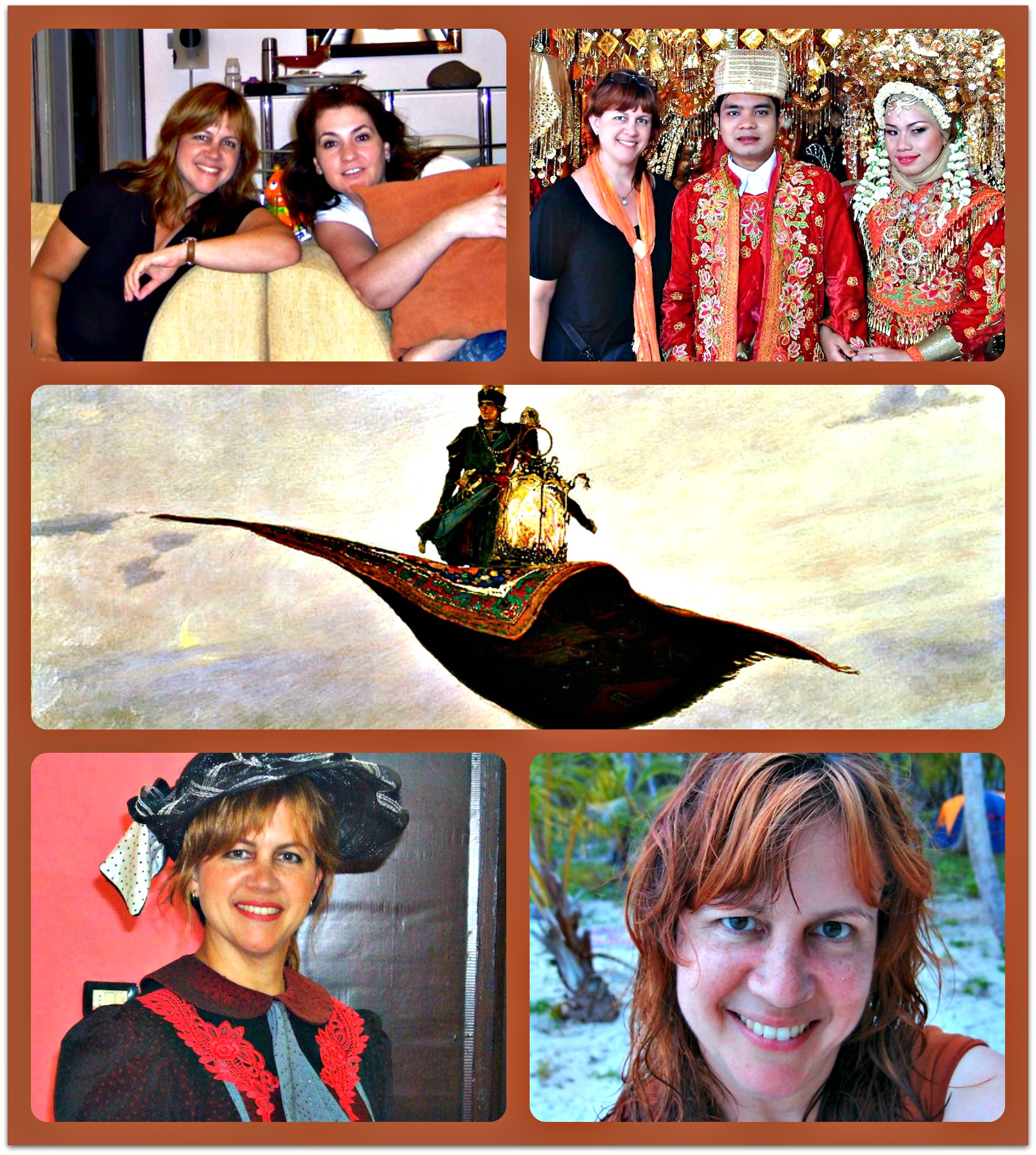
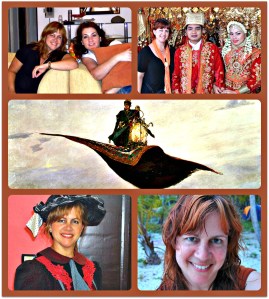
Images (clockwise, starting top left): Lisa at the home of her Cirassian-Jordanian friend, Souzan, with whom she was staying before the latter’s move to New Jersey(!) [this photo is in the book]; Lisa at a wedding in a Minangkabau village in Sumatra (hey, you can’t attend without posing with the bride and groom); Lisa camping in San Blas, Panama, during rainy season and a full moon (a displaced moment, to be sure, as the local Kuna indigenous believe that a full moon equals a curse); and Lisa after being recruited to be on a famous TV show in Damascus, which aired during Ramadan afforded an opportunity to meet one of the most famous actors in Syria—Qusai Khouli (she is wearing a late 1800s outfit, in case you were wondering). The painting in the center is “The Flying Carpet,” by Viktor Vasnetsov (1880), courtesy Wikipedia.
Talking to Kate Allison, writer of serialized expat fiction (we’re giving away her first book!)


Taking_Flight_dropshadowToday I find myself in the enviable position of having to introduce my co-blogger and good friend, Kate Allison. As one of the founding members of the Displaced Nation, she needs no introduction to our regular readers, many of whom are as awestruck as I am at her ability to churn out well-c
rafted, entertaining episodes of Libby’s Life week after week, month after month.

For the uninitiated: Kate’s stories center on Libby Patrick, a thirty-something stay-at-home mum who has trailed her spouse, Oliver, from their native UK to Woodhaven, Massachusetts—a small New England town that, in Libby’s own words, “makes Stepford look like inner city gangland.” The Patricks live there with their three small children: preschooler Jack and infant twins, Beth and George. (At one point they also had a dog, Fergus—don’t ask.)

Libby keeps a diary of her expat adventures, and during the past two years, Kate has churned out a whopping 76 entries, an average of three per month.

In consequence, a number of us (even those who aren’t trailing spouses with families) have become certified Libby addicts—always looking forward to the next installment!

If we need a “fix” between episodes, we can go to Kate’s companion site dedicated to Libby and all things Woodhaven, where not only do we receive more information about Libby and the characters she encounters in Woodhaven, but we can also read additional posts from the other characters’ points of view!

And now there is another exciting development: Kate has just self-published the first year of Libby’s expat life in a single volume, Libby’s Life: Taking Flight. I highly recommend this aggregated version to anyone who is new to the Libby phenomenon…

And you’ll never guess what? We are giving away two copies!!! (Details below.)

But before we get to that, let’s visit with Kate and find out more about her. Having visited with her non-virtually, I can report that she really does live in a small New England town similar to Woodhaven.

What inspired her to create the lovely and loveable Libby, and what possessed her (I don’t think it’s too strong an expression) to commit herself to the potential folly of writing a novel online? Her temerity cannot be underestimated, I think you’ll agree…

* * *

Why did you decide to write a book about a trailing spouse, and how long have you been at this?
I first started “Libby’s Life” on my own blog (now extinct) just before Displaced Nation launched, a little over two years ago. I published three episodes there, and then transferred Libby to The Displaced Nation.

Libby didn’t start out as a book; she started out as a fiction blog because I found it difficult to blog about my personal life which, frankly, isn’t very interesting to anyone else. It’s easier for me to mesh snippets of facts into the fictitious world of Woodhaven. I was uncomfortable writing about my own family members—just because I like writing doesn’t give me the right to invade their privacy—but every now and then, certain incidents in Libby have happened in real life.

For example, when my son was a toddler, he was obsessed with toy cars, just as Jack is now. And the episode about Winter Storm Alfred, when Libby loses power for several days because of a freak snowstorm at Halloween, is based on a real situation. We were without power for four days ourselves after that same storm.

Fortunately, unlike Libby, we don’t have a man-eating landlady who lets herself into our house to sniff my husband’s sweatshirts.

Have you found out anything new about yourself, your own feelings of displacement, in the process?
Libby is at the beginning of her displacement journey. I’m quite a few years ahead of her, and have had to trawl through old memories to imagine how she would feel in certain situations. So the fact that I have to do that suggests I’m not terribly displaced anymore and I’ve come further than I thought.

Turning to Libby, what is her most displaced moment?
Probably when they first moved into their temporary apartment, next to a Limey-hating NRA supporter who liked shooting air soft pellets at the rhododendrons in the back garden. Poor Libs! She was quite traumatized. And also last year, when she went back to England for the first time and everything felt foreign—a reversed displacement.

What is her least displaced moment?
I think it was fairly recently, when she met Willow Reeves. Willow is from Brooklyn, very no-nonsense. She’s the first American friend Libby has made outside the expat Coffee Morning Posse, that hasn’t been via an introduction. It’s a sign that Libs is starting to fit in.

According to a recent article in the business section of the New York Times, serialized fiction, where episodes are delivered to readers in scheduled installments much like episodes in a television series, has been the subject of an unusual amount of experimentation in publishing in recent months. You seem to be ahead of the game in that respect. What have you learned from your two-year-long experiment?
I’m amazed at the number of people who do seem to follow the episodes, and yes, it is like a TV soap opera. I think Aisha at Expatlog commented a while ago that it filled the EastEnders void for her. But I didn’t intend it to be like that when I first started, envisaging instead a few blog posts dealing with certain aspects of moving abroad. I certainly hadn’t envisaged me still doing it two years later.

The main thing it’s taught me is that when I have to write a story because I’m on the Displaced Nation schedule to do so, I can do it. Novelist Peter De Vries famously said:

I write when I’m inspired, and I see to it that I’m inspired at nine o’clock every morning.

It doesn’t matter what type of writer you are—his philosophy is a good one.

What has been the most challenging part of the book-writing process?
Thinking up new topics for story lines. Every now and then I’ll put out a plea for ideas. A friend of mine jokingly said she’d like to see headlice as a Libby topic, and lo! There were headlice.

I now keep track of all the characters and story lines on a timeline program. I can see the last time a character came in, in which story line, in which episode, and I can plan ahead.

Theoretically, anyway. My actual way of planning is to sit in front of the blank screen and panic about a post that’s due in two days’ time. But I’m getting better. I even know what is going to happen in September.

What made you decided to publish the first year of Libby’s Life as a book?
I ended Libby’s Life: Taking Flight ends with Libby’s first Christmas in the United States because that was a natural break in the story. Libs had just started to spread her expat wings at that point, hence Taking Flight.

What do you intend to follow it up with?
The next one will be called Cargo Hold. Well, she’s pregnant with the twins, you see.

What audience do you intend for the Libby books?
It probably falls in the unflattering genre of “hen lit” — chick lit for the more mature woman. It seems most popular with women from thirty onwards, but then again, a friend of mine, a man who is now in his 70s, is an avid fan, so who am I to say?

What aspect of it is proving the most popular—any surprises?
Regarding the audience’s nationality, I expected it to be most popular with English women who had moved around a bit, but it turns out that one of Libby’s greatest cheerleaders is an American lady who is a keen armchair traveler. That’s pretty encouraging. (And thank you—you know who you are!)

Are you working on any other writing projects? (When’s the next book coming out?!)
At the moment I’m rereading/rewriting the 2012 episodes so I can turn them into either one or two short ebooks later this year. Additionally, I’ve gone back—yet again—to the WIP that triggered a lot of Libby characters. Woodhaven, Maggie, Melissa, Patsy, and all the Giannis were around in my imagination and in draft form long before Libby came along. The WIP is the story of Maggie’s daughter, Sara, a Woodhaven native now living in Somerset, England (my own native neck of the woods). Much of it is set in the 1980s, so you get to meet Maggie, Melissa et al when they were younger. Not sure when it will be finished…but making it public through this answer is a good spur.

10 Questions for Kate

Finally, I’d like to ask a series of questions that I’ve asked some of our other featured authors, about your reading and writing habits:
Last truly great book you read: There are two I’ve read several times in the last few years and each time thought “Damn, I wish I’d written that”: The Time Traveler’s Wife by Audrey Niffenegger, and Behind the Scenes at the Museum by Kate Atkinson.
Favorite literary genre: Sigh. Call me predictable. Women’s fiction and travel. Anything by Joanne Harris is a great combination of the two.
Reading habits on a plane: Either some piece of fluffery from the airport bookshop or a book I’ve already read from my Kindle. My Kindle is stuffed with classics, free ebooks, and review copies for TDN. But I have to have a paperback for the times you’re required to Turn Off All Electronic Devices. If I don’t have a paperback, I’ll write in a notebook, and chances are it will be notes on a conversation taking place near me. I’m a compulsive eavesdropper. Be warned.
The one book you’d require President Obama to read, and why: ML, I really hate getting into politics! Pass!
Favorite books as a child: Anne of Green Gables; E Nesbit books, especially The Railway Children; Enid Blyton‘s Malory Towers; Sadlers Wells series by Lorna Hill; anything by Noel Streatfield; the William stories by Richmal Crompton.
Favorite heroine(s): Maggie Tulliver (George Eliot’s The Mill on the Floss) and Emma Woodhouse (Jane Austen’s Emma).
The writer, alive or dead, you’d most like to meet: Roald Dahl. I really would like to know for myself if he was as sick-minded as his books are.
Your reading habits: In bed.
The book you’d most like to see made as a film: I’m looking forward to Robert Redford’s version of Bill Bryson’s A Walk In The Woods. And I’d love to see one of my favorite books in question #1—Behind the Scenes at the Museum. But it would have to be set in the English city of York, as it is in the book, not Americanized and set in Philadelphia or wherever, as so often happens.
The book you plan to read next: My “to read” list gets ever longer. At the top is The Hare With Amber Eyes by Edmund de Waal. At the bottom, just added, is Hilary Mantel‘s Wolf Hall. And a whole lot of others in between.

* * *

Thanks so much, Kate! Long live Libs!!!

Readers, now it’s your chance to ENTER OUR DRAW TO WIN A FREE COPY of Kate Allison’s first Libby book. Kate is giving away TWO FREE COPIES and will favor comments that offer storyline ideas for future Libby posts, which will also get included in Libby at some point!!!

Extra points, as always, if you’re a Displaced Dispatch subscriber!

The winners will be announced in our Displaced Dispatch on June 1, 2013.

STAY TUNED for the next episode in the life of our fictional expat heroine, Libby! (What, not keeping up with Libby? How could you resist after reading this interview?!?!? Sign up NOW for our Displaced Dispatch and you’ll receive the first three chapters!!!)

If you enjoyed this post, we invite you to register for The Displaced Dispatch, a round up of weekly posts from The Displaced Nation, with seasonal recipes, book giveaways and other extras. Register for The Displaced Dispatch by clicking here!

Related posts:

Who is it that can tell me who I am? Third Culture Kid drama!

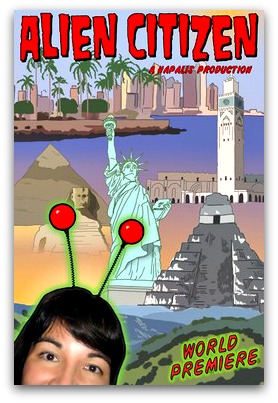
AlienCitizen_posterAt the height of my own repeat expat experience—when I had a foot in Asia (Japan), Europe (UK) and North America (United States)—I often thought of this line from Shakespeare’s King Lear:

Who is it that can tell me who I am?

—King Lear (Act I, Scene 4)

Prone to being somewhat melodramatic and hyperbolic (yes, I know I don’t have three feet!), I decided I’d peaked out too early. After all, Lear was an old man when he cast himself out and then had to grapple with what it feels like not to have a home or identity, whereas I was still a young woman.

It’s a good thing I was never a Third Culture Kid, or TCK—that’s all I can say, or else we’d be in for some MAJOR drama on this site. Instead we can leave that to someone much more suited: the actress Elizabeth Liang, who is the subject of today’s post. A self-described Guatemalan-American business brat of Chinese-Spanish-Irish-French-German-English descent, Liang was brought up by peripatetic parents in Central America, North Africa, the Middle East, and Connecticut.

Having faced the existential question of “Who are you when you’re from everywhere and nowhere?” practically from the moment of birth, Liang has channeled her thoughts into the creation of a one-woman show, Alien Citizen, which will have its world premiere in Los Angeles with performances this coming Friday and Saturday, May 3-4  (closing June 1). It’s being presented by Liang’s own company, HapaLis Productions, in association with the Multiracial Americans of Southern California.

Any TCKs reading this post (and/or their parents) should be happy to hear that Lliang’s play is not a tragedy. According to the press release, which she shared by email last night, Alien Citizen has both funny and poignant moments:

It weaves humorous stories about growing up as an Alien Citizen abroad with American commercial jingles providing [Elizabeth’s] soundtrack through first love, language confusion, culture shock, Clark Gable, and sandstorms.

Hmmm… Clark Gable?

Though Liang is busy preparing for Friday’s opening, she was kind enough to answer a couple of my questions. Naturally, I wanted to hear more about why she’d written the play and the audience she had in mind for it. Here’s what she told me:

I wrote Alien Citizen for my fellow global nomads and TCKs, because we rarely see our stories portrayed on stage or screen. I also wrote it because I kept being asked if I was from the Midwestern USA and I wanted to set the record straight: my story is unusual, and, I hope, interesting. The play is about identity, which everyone grapples with, but I especially hope that everyone who has lived a cross-cultural life—anyone who has felt like a bridge or an island or both—will relate to it.

Aha, I knew it! It’s for the likes of me as well! And probably you, too, reader, if you’re a Displaced Nation regular. We could use a little drama in our lives…

A few choice lines from the drama

I also asked Liang to share some lines from the play. She obliged with the following list:

  • “We’re Guatemalan when I’m little.”
  • “Nobody on TV looks like me…except maybe Spock on the Star Trek reruns.”
  • “Fairfield County, Connecticut. With four whole seasons, including winter! And the people are even colder than the winters.”
  • “Morocco is like the moon to us at first.”
  • “I love Egypt so much in that moment, it knocks the wind out of me. And I’m just this useless teenager from… Well, I’m not from here.”
  • “And I make friends! Because in the theatre, everybody’s weird.”
  • “I’m not from a place, I’m from people.”

I must say, I like that one about everyone in the theatre being weird. Maybe I should have tried my hand at acting after repatriating? (Except at this point I’d choose to be a Korean soap opera star—yes, I know I’m displaced!)

Show our TCK performer some love!

Readers, it’s time we showed Elizabeth some love for what she’s up to this month. If you live in the LA area, get your ticket half price through May 25th and after that at regular price.

If not, you can:

Questions for Elizabeth, calls for encores? (Should we invite her to submit a post on how the play was received?) Please leave them below. And on Friday evening LA time, let’s all shout out, from wherever we are in the world, “Break a leg, Elizabeth!”

STAY TUNED for tomorrow’s post, another installment in the life of our fictional expat heroine, Libby. (What, not keeping up with Libby? Read the first three episodes of her expat adventures.)

If you enjoyed this post, we invite you to register for The Displaced Dispatch, a round up of weekly posts from The Displaced Nation, with seasonal recipes, book giveaways and other extras. Register for The Displaced Dispatch by clicking here!

Related posts:

img: Promotional poster for world premiere of Alien Citizen

6 Alice-in-Wonderland themes for creatives abroad to explore in their works

 © Iamezan | Dreamstime.com Used under license

© Iamezan | Dreamstime.com
Used under license

Call us zany, but when we first started this site two years ago, someone (no, not me!) had the bright idea of picking a literary or historical figure and using that person as a source of inspiration for a month-long series of posts.

June 2011, for instance, was Alice in Wonderland month; July, Pocahontas month; September, Robert Persig month; and October, Julia Child month.

You’ll never guess which one of these themes proved most popular: why, Alice of course! What international traveler or expat hasn’t experienced the sensation of stepping through the looking glass or falling down the rabbit hole? Like Alice, those of us who venture beyond borders must furiously navigate the new environments we uncover. Also like Alice, we are prone to feeling lonely and a bit sorry for ourselves on occasion.

Most expats can also relate to Alice’s gradual loss of self-identity. As she confesses to the Caterpillar:

“I can’t explain myself, I’m afraid, Sir, because I’m not myself, you see.”

In today’s post, I propose to revisit Lewis Carroll’s masterpiece for themes that are worth exploring from a creative angle. Here are six that I find myself thinking about a lot, when trying to parse my own expat experience (an American, I lived first in England and then in Japan). WARNING: Tongue-in-cheek, but only somewhat!

1) The old adage about trusting your gut doesn’t always work when it comes to your actual gut.

ALICE PASSAGE: In Alice’s Wonderland, a jar labeled “Orange Marmalade” is not actually a jar full of orange marmalade.
APPLIES TO: Expats in Japan, who are always biting into pastries in the hopes of tasting chocolate and tasting azuki bean paste instead. Indeed, should you ever be in need of an Alice-like culinary experience, Japan has got to be your place. There’s the wasabi Kit Kats, of course. And how about the time when Carole Hallett Mobbs’s friend in Tokyo bought a sandwich with a lumpy filling? As Carole reported in her guest post for us:

A gentle squeeze sent a whole cooked potato shooting across the room.

ANOTHER ALICE FOOD PASSAGE: Fearing the contents of the “Drink Me” bottle may be poison, Alice is pleasantly surprised:

it had, in fact, a sort of mixed flavour of cherry-tart, custard, pine-apple, roast turkey, toffee, and hot buttered toast.

APPLIES TO: International travelers who venture to remote spots and are pleasantly surprised by the local cuisine. Actually, you don’t even have to be somewhere remote. Tokyo was where I developed a fondness for hirezake (hot sake with fugu fin) — talk about poisonous cocktails! And travel author Janet Brown told us she dreaded trying fried grasshoppers while living in Bangkok,  only to find she liked them as much as popcorn! But even dedicated locavores, such as Jessica Festa, can have an Alice moment from time to time. I’ll never forget the story about her first experience eating cuy (guinea pig) in Ecuador. As she tells it, she saw it on the grill and thought it resembled her childhood pet, Joey. Repressing her better instinct not to eat anything she grew up playing with, she took a bite and said: “Holy crap, this is delicious!”

2) Communications with others and in general are far from satisfactory.

ALICE PASSAGE: When Alice is “opening out like the largest telescope that ever was, saying good-bye to her feet, she cries “Curiouser and curiouser!”—and then feels surprised that “for the moment she quite forgot how to speak good English.”
APPLIES TO: Native English speakers living in a non-English speaking country. Their English inevitably morphs into the version the locals speak; spelling, too, deteriorates, and doesn’t come back.

ANOTHER ALICE MISCOMMUNICATION: Alice repeatedly offends the creatures in Wonderland without even trying.
APPLIES TO: Anyone who finds themselves “tone deaf” in Bangkok, as the aforementioned Janet Brown once did. (NOTE: Applies equally to those struggling to learn other Asian tonal languages such as Mandarin Chinese.) As she explained in her interview with us:

The most common mistake for foreigners is to tell someone their baby is beautiful, while actually announcing that the infant is bad luck.

3) Committing to another country can sometimes mean altering your body size (or wishing you could).

ALICE PASSAGE: When Alice first lands in Wonderland, she finds herself too large for the doorway out of the dark hall into the beautiful garden.
APPLIES TO: Anyone over 5’5″ living in Japan, Korea or Southeast Asia, who has to keep their head down when entering traditional dwellings for fear of getting a concussion.

ANOTHER BODY-CHANGING ALICE MOMENT: At the instruction of the Caterpillar, Alice tries eating portions of mushroom he’s been sitting on, which make her grow and shrink.
APPLIES TO: Repeat expats, or rex-pats, who find themselves going back and forth between the obesity epidemic in United States and almost anywhere else in the world, where people simply eat less and walk more. While living in Tokyo I soon reached my lowest body weight ever without even trying: all those meals of clear soup, rice, veggies and fish. Now that I’m back in America, I weigh ten pounds more, while in England I was somewhere in between…

4) People in other countries have their own relationships with Father Time.

ALICE PASSAGE: Alice experiences the full gamut: from the White Rabbit dashing about with his stopwatch for fear of being late for an important date, to the slackers at the Mad Hatter’s tea party, who waste time “asking riddles that have no answers.”
APPLIES TO: Repeat expats, or rex-pats, who’ve had the chance to live in Southern Europe, South America, or other places notorious for their laid-back approach to time, as well as in Germany, Switzerland or Japan where people pride themselves on their punctuality. Compared to Japan, I found England a Southern European country. When I was living in Tokyo and visiting the UK during summers, I was always late to appointments because I’d forgotten that trains don’t run on time (or at all). And most of the time, I had their sympathies. Whereas in Japan, I swear a White Rabbit must be in charge of public transport. You can set your watch by the trains! No excuses for lateness…

5) The laws and practices of another land can take some getting used to.

ALICE PASSAGE:

“No, no!” said the Queen. “Sentence first—verdict afterwards.”
“Stuff and nonsense!” said Alice loudly. “The idea of having the sentence first!”

APPLIES TO: Anyone who displaces themselves to a country with a radically different life philosophy. For instance, as an American I found that one of the biggest challenges of getting used to England and then Japan, the two small-island nations where I lived, was that I could never quite accept the natives’ stoicism. As I wrote in the first of my “Lessons from Two Small Islands” posts:

Where the citizens of each of these countries saw grace, strength, endurance, and perseverance, I saw passivity, masochism, fatalism and pain. “Why is everyone bowing so readily to their fates?” I would ask myself repeatedly.

And, though I never committed an act of “queue rage” while standing in line at the post office in the English town where I lived, I came pretty close—especially when watching others who’d come in after I did get served before me.

On those occasions, I felt like crying out: why don’t we try a serpentine line instead?

And what about all those expats living in countries with byzantine immigration laws? Apparently, Alice’s own home, the UK, is among the worst. As we learned from interviewing New Zealander Vicki Jeffels, it essentially tells any wannabe immigrants: “Off with your heads!” Even if you’re from the Commonwealth! Still, at least they no longer discriminate… (Jeffels sorted out her visa problems in the end but has since repatriated.)

6) “Pool of tears” moments eventually build resilience.

ALICE PASSAGES: Alice goes from “shedding gallons of tears, until there was a large pool all round her, about four inches deep” to holding her own in Wonderland (see #5).
APPLIES TO: Well, really all of us. In the previous incarnation of the Displaced Nation, I had a Random Nomads column in which I would interview expats or veterans of international travel and ask them to describe their “most displaced” and “least displaced” moments. Many had difficulty with the former request, I guess because they felt uncomfortable going down the Rabbit Hole and examining their hearts more closely. The American Brian MacDuckston, though, was the rare exception. His “pool of tears” moment was his very first day of work as an English teacher in Japan. He somehow managed to get on the wrong train (every foreigner in Japan’s nightmare) and ended up in a “depot storage yard with an attendant yelling at me in a language I didn’t understand.” He was late for his first class and wanted to quit. Since then, however, he has emerged as one of the leading experts on Japanese ramen. Last we heard, he’d been offered a few gigs on Japanese TV shows as a “ramen reporter” and successfully pitched his first magazine article about a best-of-ramen list. Way to go, Brian, in treating that screaming railway worker as a Jack of Spades!

* * *

So, are you ready to inject a bit of Alice into your Great Work on the voluntarily displaced life? And can you think of any more inspirational passages from Lewis Carroll? (No doubt there are more, and I will think of some of them as soon as I post this.)

Meantime, the Displaced Nation will continue its tradition of awarding “Alices” to writers who capture the curious, unreal side of the displaced life—only we will now be awarding one per week, via our Displaced Dispatch. What, not a subscriber yet? CLICK HERE NOW—or off with your head! Recommendations of posts (your own, other bloggers’) for Alices are also warmly appreciated. Please send to ML@thedisplacednation.com.

STAY TUNED for tomorrow’s post, another in our Old World/New World series.

If you enjoyed this post, we invite you to register for The Displaced Dispatch, a round up of weekly posts from The Displaced Nation, with seasonal recipes, book giveaways and other extras. Register for The Displaced Dispatch by clicking here!

Related posts:

Born to run the Shikoku Pilgrimage—and write a book about it (which we’re giving away!)

AMY ChavezWe dedicate today’s interview with distance runner Amy Chavez to those affected by the Boston marathon bombings. Our hopes and prayers and encouragement are with you.

When it comes to long-distance running, I couldn’t put it better than the American cowboy Will Rogers once did:

We can’t all be heroes because someone has to sit on the curb and clap as they go by.

I simply haven’t got the necessary strength, both physical and mental, for that kind of endurance test.

Is it any wonder, then, that I’m feeling intimidated by the prospect of talking to Japan-based expat Amy Chavez about her 900-mile run around Shikoku Island? We’re talking ultramarathon here.

The redoubtable Amy hails from Ohio but has lived in Japan for many years, where she is a well-known writer and columnist for the leading English-language newspaper, the Japan Times.

In 1998, she spent five weeks during March and April running the traditional pilgrimage on Shikoku Island. In essence she ran a marathon per day (sometimes more). And although the weather and conditions were pleasant enough—it was cherry blossom season—it was cold at night, and there were many mountains, though the roads were the worst part “because pavement is hard on the feet, knees, etc.”

Last month Amy published a book with Volcano Press about her record-breaking adventure (almost needless to say, she was the first person to accomplish this feat), Running the Shikoku Pilgrimage: 900 Miles to Englightenment—a copy of which we are giving away!!! (Details below.)

But first I want to find out more about what motivated her on her epic—and energetic—journey, including any challenges she faced in writing her book.

* * *

Pilgrimage-Cover_pmSo, Amy, I understand you decided to run the 900-mile-long Shikoku Pilgrimage after being laid off by the university where you were teaching in Japan. What made you think that running vast distances might be the answer?
Physical challenges have a certain appeal. I was interested in the physical journey, as I think most foreigners are when they walk the pilgrimage the first time.

But you didn’t walk it; you ran it!
For some reason I have never discovered the joy of walking. I dreaded the thought of walking 900 miles, the distance from San Diego to Oregon. But running is somehow different. When people go running, it’s not unusual to run 10 km or more, three or four times a week. People hardly ever do that walking. Instead, they walk around the block and come back. Runners don’t do that. We’re in for the long haul.

Did making this journey allow you to see Japan in a new way?
I was able to see Japan much more objectively. I went from being in my own little world where everything was centered around me—thus when my world crashed, so did I—to being an observer of Japanese culture in the framework of the pilgrimage. So there was a fundamental shift from being a part of the university, where the students and the university relied on me, my teaching skills, and my commitment, to being part of the pilgrimage that didn’t really care whether I did those things or not. The pilgrimage doesn’t care whether you show up or not, whether you complete it or not, whether you understand how it works. In other words, it’s not about you at all. So suddenly you’re on the other end, trying to understand what it is that the pilgrimage is trying to give you, on its own terms, and what you can learn and take away from it.

What was your most displaced moment on the journey?
I’d never felt displaced in Japan until I lost my job. It was a very big thing for me because I had put so much time, effort and love into that job. Suddenly, without warning, I was let go, all because I was a foreigner. I just couldn’t get my head around that. So the journey started as a result of this unnatural feeling of being displaced. The people who had treated me like family had suddenly tossed me out on the street. I was searching for ways to deal with my feelings toward Japan and Japanese people.

“The person who starts the race is not the same person who finishes the race.” [Marathon sign]

How did your feelings toward Japan evolve once the journey got underway?
I was able to see the pilgrimage as this microcosm of Japanese culture. If you’re ever wondered why the Japanese do things or act a certain way, you can find out through this historical context of Buddhism, and the Shikoku Pilgrimage which has been walked for over a thousand years. The purpose of the pilgrimage—to reach enlightenment—has never wavered over the centuries.

You became less and less displaced?
Doing the pilgrimage is often referred to as entering a mandala. You have to leave your safe, secure world and cross over into an unknown world where you are no longer in control. Once you accept this, and surrender yourself to the pilgrimage, you will no longer feel displaced.

Wise words! How long did it take before you surrendered?
It happens for different people at various parts of their pilgrimage but for me, this happened about one third of the way through, or two weeks into, the pilgrimage. Suddenly everything fell into place. I had finally learned to go with the flow and let things happen to me rather than trying to control things that happened to me. We are so used to taking control of our lives: we plan our trips down to the finest detail, we budget monthly, weekly and even daily, we get the right job. But life doesn’t care how much you’ve planned. Life continues to throw us curve balls—your car dies, you come down with an illness, you lose your job. Despite our steadfast planning, that’s not how life works.

It’s is not how the pilgrimage works either. Despite your intentions to do something a certain way, the pilgrimage will constantly present you with challenges—things you’d never planned on. Once you surrender to the ways of the pilgrimage, you no longer feel displaced. You no longer struggle with the elements, the terrain or nature. Instead, you become one with them.

Not surprisingly, this is one of Buddhism’s life metaphors as well.

Another ultramarathon—writing the book

I believe you chronicled your Shikoku adventure in the Japan Times?
Actually, I wrote six columns for the Japan Times. I also kept a diary, but that was separate from the columns.

Once you’d decided to write a book about the experience, what was the greatest challenge?
Time. It takes an enormous amount of time to write a good book. It’s all consuming, a full-time job. On top of that, I still had my weekly deadlines for the newspaper and other publications I write for.

Your book is coming out 15 years after you made the pilgrimage. Why the delay?
It’s not unusual to have so many years between a story and a published book. There’s the year (or longer) it takes to write, there’s the year-long (or longer) search for a publisher, the six months negotiation with the publisher(s), and then the two-year process from book contract to published book. So already five years has passed, and that’s with no bumps along the way.

Then there’s also timing. No one was really interested in my story at the time I did it. But things have changed drastically since then. NHK has had a popular TV series about the pilgrimage, previous books about the pilgrimage have run their course and gone out of print (thus creating a demand for something new), and ultra-running has become one of the fastest growing sports in the world.

Did you derive any new insights from revisiting the adventure?
That’s another reason I think you see so many books that are published a decade or so after they happened is because people often need distance before they can really understand their own journey. How can you talk about how an experience has changed you, or changed your life, if you haven’t had time to prove that it really has? Time gives one perspective. And with time comes wisdom. I was just reading a book the other day and couldn’t help but think it would have been so much better if the writer had waited a decade or so tell his story. He, nor his writing, had matured yet; his book had no arc, it offered no wisdom.

So while I wish my book could have been published a long time ago, I know it’s a much better book because I waited.

What audiences do you intend for the book?
There are three: those interested in Japan, those interested in Buddhism, and those interested in running. The book was officially released in March, and the reviews are just beginning to come out, so it’s too early to tell if those are the audiences the book will attract.

How about people who don’t know Japan—would they enjoy it, or would you be running circles around them?
You would have to have some innate interest in other cultures to get the most enjoyment out of the book—which I think most Displaced Nation readers have. But even if you are only interested in people’s amazing feats and accomplishments, you should enjoy the story, too. It is an adventure travel story about a girl who ran 900 miles that happens to take place in Japan.

Running the Shikoku Pilgrimage sounds like a hard act to follow. Are you working on any other ambitious travel projects that will one day be books?
I have an original hand-written diary of my great-great grandfather’s journey through Japan’s Inland Sea to the Philippines on a ship in 1900. In 2004 I decided to trace his journey in a sailboat. Unfortunately, the trip was cut short when we had to be rescued at sea, and we lost the boat. Determined to finish the trip, however, we bought another sailboat and set out again in 2012. This time we finished the trip despite dodging four typhoons, two tropical storms and running into a reef. I haven’t decided whether the title of the book should be Little Titanic or Storm Girl.

What do you think?

Love it! (Hmmm … the limb doesn’t fall far from the tree.)

10 Questions for Amy

Finally, I’d like to ask a series of questions that I’ve asked some of our other featured authors, about your reading and writing habits:
Last truly great book you read: Jules Verne’s Twenty Thousand Leagues Under the Sea. It’s always the last great book I read.
Favorite literary genre: Adventure travel, memoirs.
Reading habits on a plane: E-books only. Whatever is stacked up still waiting to be read. I also read tons of magazines.
The one book you’d require President Obama to read, and why: Any book on the current farming industry and feedlots. Save the cows!
Favorite books as a child: Anything about horses.
Favorite heroine: I admire Nora Ephron.
The writer, alive or dead, you’d most like to meet: I’d like to go fishing with Ernest Hemingway.
Your reading habits: Mostly non-fiction. More and more creative non-fiction. A little bit of fiction.
The book you’d most like to see made as a film: I’ve learned that books and film are completely different genres, so don’t dare compare them.
The book you plan to read next: Right now I’m reading The Annotated Reminiscences of Lafcadio Hearn. Next I’m going to read Strength Training Past 50. (Hey, you asked!) Oh, I might read Waging Heavy Peace, by Neil Young, before the strength training one, but I haven’t decided yet. Oh, I just remembered, my Dad wants me to read A Conflict of Visions: Ideological Origins of Political Struggles, by Thomas Sowell, so I better read that one next.

* * *

Readers, now it’s your chance to ENTER OUR DRAW TO WIN A FREE COPY of Amy Chavez’s book. Please leave a comment telling us about a physical challenge you’ve set for yourself, preferably in an international setting, and what it taught you. Extra points if you’re a Displaced Dispatch subscriber!!!

The winner will be announced in our Displaced Dispatch on May 2, 2013.

Readers lucky enough to live in the LA area: Amy will be signing books and meeting readers at the LA Times Festival of Books April 20 held on the USC campus, Los Angeles. Look for her in the Kinokuniya booth from 12:00 to 1:30 p.m. Copies of her book also available for purchase. April 21, she will be speaking at the Koyasan Buddhist Temple in Little Tokyo from 1:00 p.m. Public welcome.

STAY TUNED for tomorrow’s post and for a post on Friday about our fictional expat heroine, Libby. (What, not keeping up with Libby? Read the first three episodes of her expat adventures.)

If you enjoyed this post, we invite you to register for The Displaced Dispatch, a round up of weekly posts from The Displaced Nation, with seasonal recipes, book giveaways and other extras. Register for The Displaced Dispatch by clicking here!

Related posts:

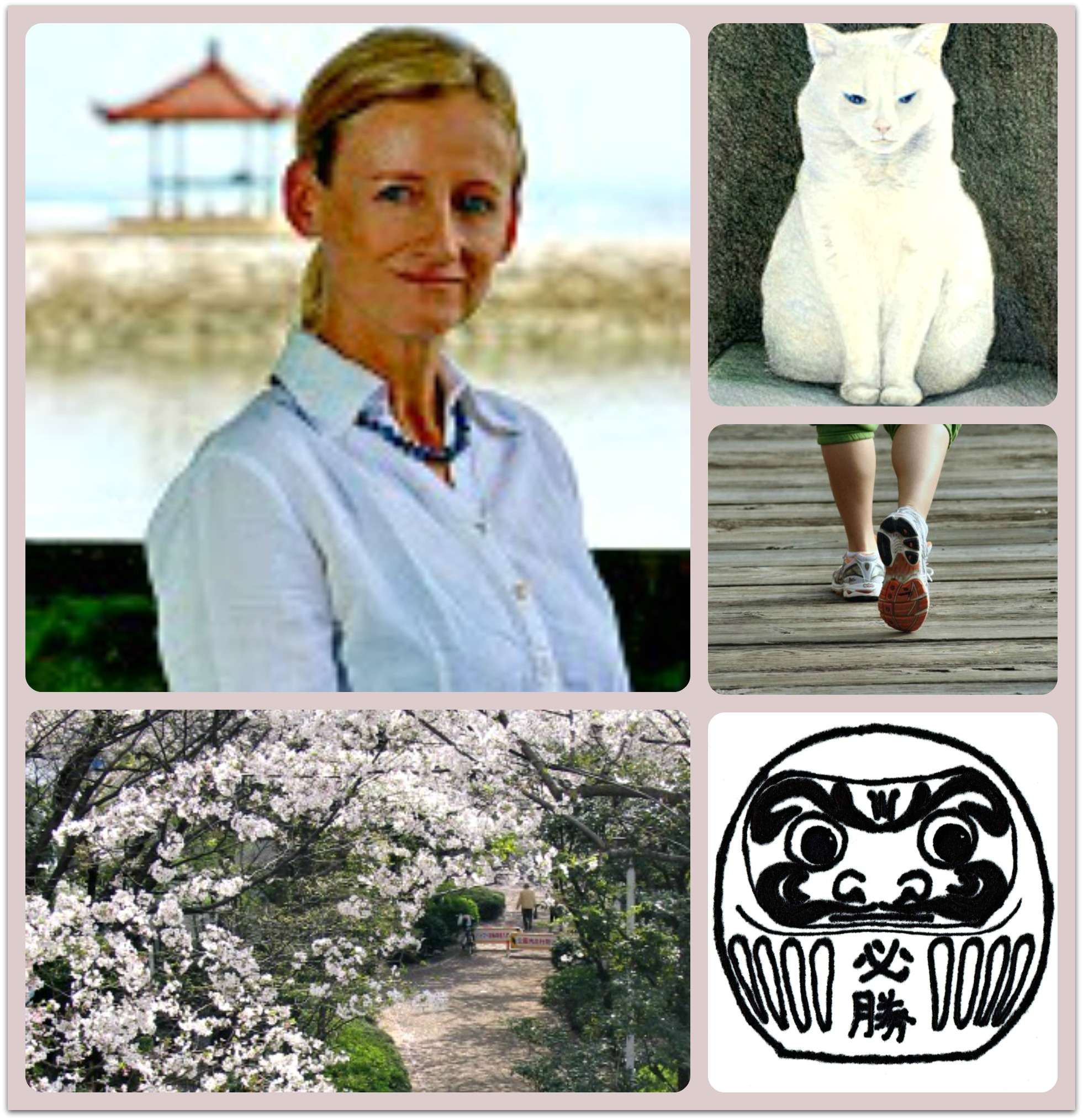
Images: Amy Chavez; Meditating Cat (a character in the book); and Daruma Doll (drawing by Deborah Davidson)—all supplied by Amy Chavez, with permission granted by Davidson. The other two images—of the running feet and the cherry blossoms—are from morguefiles.

Ahoy, mateys! Splice the mainbrace. The Displaced Nation has spotted some treasure!!

OLYMPUS DIGITAL CAMERAAhoy me hearties! Two years ago on Monday, The Three Pirateers — how I like to refer to Anthony Windram, Kate Allison and myself, the Displaced Nation’s founding contributors — swashbuckled our way into this site and declared it a home for ourselves and anyone else who has ever felt “displaced”.

Land ho! we cried, thinking we’d finally found a place to settle our poor, restless souls. No foolin’! (Hm, I wish I were sometimes!)

But as time went on, we were less confident about the nomenclature we’d selected:

Our debates always ended with one of us saying: “Let’s drink grog before the fog.” And a bottle of rum would be passed around … after which we’d conclude that even if we couldn’t find a satisfactory descriptor for our state of mind, international travel had changed us into a bunch of scallywags.

By that I mean, people who’ve taken the road less traveled by — which, ironically, means we’ve traveled more than most. Certainly more than our kith and kin. Indeed, a significant number of us come from families where we are the only ones leading the so-called displaced life.

Our not-so-hidden booty

Avast ye!

We were so busy navel (hahaha) gazing for our first two years that we missed the treasure that was right in front of us.

It wasn’t even buried!

Our treasure, of course, consists of those creative geniuses who’ve produced something remarkable out of the displaced life — be it a novel, a travelogue, an artwork, a business or a social enterprise.

Blow me down! We are a site for international creatives, that’s what we are.

Blimey, how come it took so long for us to figure it out?

Our second incarnation

“Aaaarrrrgggghhhh!” I can hear some of you saying. “I don’t give a crusty stocking for your second incarnation. I like the Displaced Nation just the way it is.”

To which I may respond: “It ain’t healthy fer a ship to sail too long without off loadin’ some cargo, lest it start to fester, aye?”

That said, to call this a second incarnation may be going a tad overboard.

Particularly as we still have a category “just for laughs.”

Indeedy deed. We will continue to shelter anyone whose travels have helped them to cultivate a cutlass-sharp sense of humor.

We’ve still got our black pirate hearts…

Besides, we aren’t clearing the deck completely. That wench Libby — and her crawfish! — will still be here. But on the weeks when she isn’t published, we will have posts full of observations on England versus New England (the stuff that matters when navigating the globe!).

And we’ll still have Capital Ideas — only the treasure hunts will be even richer.

And we’ll of course have even more writers and artists on board.

Last but far from least, we’ll be rolling out some new columns. I’m not giving anything away here, but one of our new mateys is the infamous Cap’n Jack! (Now if that isn’t a hook, I don’t know what is!!)

Aye, plenty of booty for ye!

* * *

Okay, I’ve got two pistols, one plank and I’m out of patience. Any questions?! Seriously, if you have comments or suggestions as we proceed into our third year, let us know! And every time you run across a creative work by a displaced person, please email me (or one of my mateys)! I don’t know about the rest of ’em, but I can be reached at ml [at] thedisplacednation [dot] com.

Until then, may fair winds and good grog come yer way — and never forget that from now on, ye know where “home” is!

STAY TUNED for tomorrow’s post, some musings on the fine art of photography in an international travel setting by Andy Martin.

If you enjoyed this post, we invite you to register for The Displaced Dispatch, a round up of weekly posts from The Displaced Nation, with seasonal recipes, book giveaways and other extras. Register for The Displaced Dispatch by clicking here!

Related posts:

Image: MorgueFile

Marry a diplomat, travel the world and write expat guides: Talking to new author Véronique Martin-Place

Veronique and her bookAs some readers may know, before the Displaced Nation, I had my own blog, called “Seen the Elephant” — which I used as an outlet while struggling to readjust to life in America after having lived abroad, in England and Japan, for quite a few years. (The name for the blog came from the expression used by Victorian travelers: “Been there, done that, seen the elephant.” Which is how I felt…)

It was because of that blog that I got to know today’s guest, Véronique Martin-Place, since she, too, was quite active in the expat blogging world.

And when I found out she was a Frenchwoman living in Chicago, I was intrigued. What did she make of the city of broad shoulders, jazz, and deep-dish pizza?

I asked her this and a host of other questions in an interview for my blog. For starters, she said that she and her family — her husband is a French diplomat and they have two young daughters — were gradually finding their feet in Chicago. (She did not, however, mention she was planning to write a book of that title!) She didn’t entirely approve of America’s throw-away society and still cooked every day for her family — she even offered her recipe for “real” vinaigrette in the comments. She also reported she’d seen plenty of elephants while living in Sri Lanka (her husband’s second assignment, after Norway).

Véronique leads life in the fast lane. A little over three years since our conversation, I find that she has written the definitive expat guide to Chicago: Finding Your Feet in Chicago — The essential guide for expat families (Summertime, 2012). And she is already putting her feet down in a brand new city, one of the world’s trendiest… Here is our exchange:

Bonjour, Véronique! When we last spoke, toward the end of 2010, you told me you’d arrived in Chicago with hopes of getting a job, but then the recession hit, so you’d started up your own writing business. When did you hatch the plan to write a book for expats in the Windy City?
I was already thinking about it when we connected. After witnessing several incidences of culture shock at my daughters’ school, I realized I wasn’t alone in having troubles. Several families from different parts of the world had moved to Chicago around the same time. All of us were in need of information and advice. Meanwhile, I’d started up my blog, Expat Forever, to share my experiences about Chicago — tips on where to settle, which schools to choose, etc. I looked around for local guidebooks to recommend — but there was nothing. So I decided to write one myself.

finding-your-feet-in-chicago-3D-Book CoverThat reminds me of the famous quote by Toni Morrison: “If there’s a book that you want to read, but it hasn’t been written yet, then you must write it.” How long did it take you to produce the book?
From the idea to holding the book in my hands, it took one year and a half! Writing the book directly in English was difficult at the beginning, since English is not my native language. But after a while, I got used to it.

Besides writing in English, what was the most challenging part of the process?
Editing the manuscript. I decided to hire an editor to help with the task.

I know from our previous conversation that having fresh, healthy food is important to you — after all, that’s part of being French! I also seem to recall that you were not a fan of Chicago pizza. You said it was too heavy. But did you cover it in your book?
Of course! I have a chapter dedicated to “Having fun in Chicago,” which includes a section on family-friendly dining out. Before giving my top 10 Chicago child-friendly restaurants, I explain what the Chicago specialties are and insist that children (and their parents) MUST try them. That includes Chicago-style pizza and Chicago-style hot dogs.

What has been the response thus far?
Rather good, I think. I’ve gotten only five-stars comments on Amazon!

Which sections are the most popular?
Readers say they like having so much practical information on family-related topics — not just the advice itself, but all the personal anecdotes and testimonials I include from expat parents. I talked to lots of them and wrote up their stories as “blog posts” or interviews. The stories really speak to the kinds of anxieties most expats have — and they make the book an easy, fun read.

And now your husband has moved on to a diplomatic post in Shanghai! Tell me, does ANYTHING about China remind you of the United States, or are these two countries poles apart?
The United States and China are definitely different cultures — but one similarity struck me right away. Both are consumerist societies. In the US, everything is done to make you purchase and there are plenty of opportunities for you to part with your money. Here in Shanghai, it seems that the only occupation is “shopping.” It’s the only activity people urge you to do from the moment you arrive — visit malls, markets, supermarkets and so on. And I can tell you they have tons of malls, tons of markets (from traditional, the kinds that sell crickets and flowers, to modern, selling electronics, furniture, shoes, and so on), and many, many supermarkets.

How did you prepare yourself and your two daughters for the move?
We didn’t have the chance to make a look-see visit. But six months before moving to Chicago, I’d gone to Shanghai on business, so I had a picture of what to expect: a very urbanized and polluted city. That is also why we decided to settle in the new and “green” development area of Shanghai that is called Pudong.

Did your daughters have any idea of the change they were in for?
My husband and I found some videos about the city on the Internet for them to watch. Fortunately, they’d studied some Mandarin at their American elementary school, so already knew a lot about Chinese traditions and stories. To be honest, I think we learned as much from them about cultural matters as they learned from us on the practical aspects. It was real team work!

I know it’s still early days, but what have you enjoyed the most about living in Shanghai?
Perhaps surprisingly, the fact I can bike! In Pudong, there are a lot of protected biking trails, so it allows me to discover independently this part of the city, and it’s much faster than by foot. But I don’t bike in Puxi (the other side of the Huangpu River, which divides the city into two regions: Pudong, where I live, and Puxi, the city’s historic center). It’s too dangerous.

What is the feature you enjoy the least?
Shanghai is extremely urbanized and I miss greenery. Also, it is very polluted, though less so than Beijing.

What is the top piece of advice you’d give to anyone thinking of becoming an expat in that part of the world — particularly a trailing spouse?
I have five — and actually, they’re for anywhere, not just Shanghai:
1) Learn the language.
2) Get involved in your local community.
3) Keep doing your (or start new) hobbies and/or sports.
4) Discover your surroundings little by little, and you’ll eventually come to know the city as well as the content of your pocket.
5) If you are an accompanying spouse and cannot work locally, go back to school and get new skills, or volunteer to do something you can use professionally upon returning home for good.

And now I have to ask you the obvious question: any plans to write Finding Your Feet in Shanghai?
Many people have indeed asked me that question. And I must admit, the idea was in the back of my mind when I first started my book for expats in Chicago. I thought to myself, this can be the first in a collection, and the next one will be about the city where my husband gets posted next. But at least at this point, I don’t think I’ll write an expat guide to Shanghai. One reason is that there are already lots of books, magazines as well as Web sites for expats in this city. There isn’t the same need as there was in Chicago. But another reason is that my time here is so limited. My husband’s post is for just three years. I’d have to spend all of my time doing research and interviews, getting to know the city like my pocket. And that’s before I can start writing. My book on Chicago was released a couple of weeks after I left to fly to Shanghai — which didn’t give me any time for promoting it locally. I found that very frustrating and wouldn’t want to repeat the experience. Books these days have to be promoted like crazy, and although you can do a lot of it online, I don’t think online promotions can replace interacting with readers in person.

But surely you’ll write another book?
I may not write another book for expat families living in Shanghai, but I already know I will write another book about expatriation. Actually, I have already started it. But I cannot say much more. It is too early.

Aha! You are always so mysterious… Last but not least, I’d like to ask a series of questions that I’ve asked some of our other featured authors, about your reading and writing habits:
1. Last truly great book you read: Rien Ne S’oppose a la Nuit (Nothing Holds Back the Night), by Delphine de Vigan.
2. Favorite literary genre: Memoirs — but also novels, illustrated books like the ones of Danny Gregory (I love his writings and drawings), and carnets de voyage (travel journals). And I have to confess that I still read a lot of children books, especially picture books. My dream is to write and illustrate one.
3. Reading habits on a plane: Something fun and easy to read on my Kindle! I travel light.
4. The one book you’d require the president of France to read, and why: My book, of course! I’m joking. I would like him to read Les mots pour le dire (The Words to Say It), by Marie Cardinal. Everyone should read it.
5. Favorite books as a child: Astérix and Obélix comic book stories, by René Goscinny (illustrated by Albert Uderzo) and Le Petit Prince (The Little Prince), by Antoine de Saint Exupéry.
6. Favorite heroine: Anna Karenina
7. The writer, alive or dead, you’d most like to meet: There are several — all alive and all women: Robin Pascoe, the author of four books about expatriation; Anne Lamott; Annie Ernaux; and the aforementioned Delphine De Vigan.
8. Your reading habits: Every evening, at least one hour, and Sundays as much as I can.
9. The book you’d most like to see made as a film: Hidden in Paris, by Corine Gantz
10. The book you plan to read next: The Help (but I got the French translation), by Kathryn Stockett.

* * *

Wow, what a stimulating list! Readers, any questions or comments for Véronique while we have her attention? Ce qu’est une femme extraordinaire — I think you’ll agree!

STAY TUNED for tomorrow’s post, another installment in the life of our fictional expat heroine, Libby. (What, not keeping up with Libby? Read the first three episodes of her expat adventures.)

If you enjoyed this post, we invite you to register for The Displaced Dispatch, a round up of weekly posts from The Displaced Nation, with seasonal recipes, book giveaways and other extras. Register for The Displaced Dispatch by clicking here!

Related posts:

Images: Véronique Martin-Place with her Chicago book; the book cover in 3D (author’s own photos).

LESSONS FROM TWO SMALL ISLANDS — 6) Keep Calm and Run a Bath

I didn’t think seriously about fashion and beauty until I, an American East Coaster, became a resident of two small islands: Britain and then Japan.

Both London and Tokyo are fashion capitals, and living in each of these cities, I found that every so often I really enjoy thinking about striking clothing combinations, make-up, and self-pampering.

Would I have discovered this love of what America’s Puritan founders would call frivolity had I stayed in this country? It’s conceivable, especially if I’d moved to New York City, where I now live as a repatriate. (NOTE: While I do not have Puritan ancestry, I was raised to be a bluestocking, not a girl in rhinestone-studded pantyhose.)

But in the event, I discovered fashion and beauty through my travels — and from learning about how women in other countries clothe and groom themselves.

So what, you may ask, were my key take-aways from this relatively speaking decadent period of my life? No specific beauty products or fashions, but these five guiding principles:

1) To get an English rose (or any other perfect) complexion, you have to be born with it. Nevertheless, skin care is worth it.

As a Caucasian woman, one of my beauty ideals was that of the English rose: a woman with flawless porcelain skin and rosy cheeks that look as though they’ve been produced by good bracing walks in the countryside wearing sensible shoes and tweed skirts.

When I first moved to England and encountered some actual English Roses, I wondered: is it because of the climate, the cosmetics from Boots the Chemist, the diet? (How do I get me one of those?)

My research soon revealed that diet has nothing to do with it. Not in a country where people grow up eating chips and crisps.

And as nice as the No7 products are, they can’t work miracles.

So maybe a glowing appearance is the result of England’s unique climatic conditions: a paucity of direct sunlight and the moisturizing drizzle that almost always seems to be in the air?

I hardly think that can be the case, as there are plenty of Britons with problem skin…

Trying not to turn pea green with envy (hardly a flattering shade!), I could come to only one conclusion: you have to be born with it.

But, not to despair! Once I reached Japan, where women are obsessed with their skin — some even use whitening lotions to obtain a creamier complexion — I learned that of all the things you can do for beauty, skin care is the most worthwhile.

Ladies, if you protect your skin, you might find yourself turning into an English Rose when you get a bit older — the Last Rose of Summer, so to speak.  While some may swear by Crème de la Mer, I go with the regime I picked up in Japan: sunscreen, a hat and a parasol.

I’d also recommend befriending your dermatologist, who knows a lot more about skin care and sun protection than the woman behind the cosmetics counter…

2) Don’t be afraid of experimenting with your hair: it can add some spice and life to your image.

In the UK one of my English rose-complexioned friends favored a chic bob — but with a streak of blue, green or red in it.

As an American fresh off the boat, I was rather scandalized. Why was she ruining a perfectly good hairstyle?

Over time, however, I came to realize that when you live in a country where skies are often the color of lead, adding a bright color to a strand of hair can brighten up your day.

By the time I left England, I could no longer understand why any woman, once she reached maturity, wouldn’t dye or highlight her hair. She doesn’t know the fun she’s missing out on! And, even though I have yet to streak my hair in an outrageous color, it’s definitely on my bucket list.

In Japan, too, I got some kicks from playing with my hair — this time, by adorning it with the kinds of hair ornaments that have been popular since the times when women wore kimono and kanzashi: combs, hair sticks and pins, hair bands, and fancy barrettes.

I did not have particularly long hair when I first reached Japan, but as long hair is the signature of Japanese ladies — and they were my new role models — I soon had locks long enough to make the most of such accessories. My favorite was the snood — I had one that was attached to a barrette covered with a bow. What a great way to keep long hair out of one’s face.

3) Gemstones and pearls are a girl’s best friend.

Sorry, Marilyn dear, but after living in the UK and Japan, my BFFs are gemstones and pearls. Is this because I went to England in the era of Princess Diana, with her (now Kate Middleton’s) 18-carat sapphire ring?

My relationship with colored gemstones only deepened after I moved to Japan and went on several sojourns into Southeast Asia, land of rubies and sapphires, among others.

My engagement ring is a ruby (purchased by my hubby in Tokyo!).

In Japan itself, I fell for pearls and now have quite the collection of necklaces, earrings, rings, and bracelets, mostly from Wally Yonamine’s in the Roppongi area of Tokyo. The owner, Jane, wife of  Wally (a professional baseball player who played with the Yomiuri Giants) is a displaced Japanese Hawaiian.

4) Youth is the time to have fun with fashion.

In the UK, I was taken in by the spectacle of punk and post-punk kids and their strange fashions, while in Japan I found it mesmerizing to watch the Lolita fashions of the Harajuku kids, on a Sunday afternoon.

Eventually, instead of thinking they were weird, I regretted never having had my own equivalent of wearing Doc Martens with a Laura Ashley dresses … sporting long, back-combed hair, pale skin, dark eyeshadow, eyeliner, and lipstick, black nail varnish, along with a spiked bracelet and dog-collar … dressing up like a Victorian boy …

It just wasn’t the done thing, in my stiff, conservative American circles, to wear outlandish garb. And now it’s too late, of course. Youth is the time when you can get away with it. After that, you have to wait for Halloween. (Unless, of course, you want to come across as “mutton dressed as lamb,” as the English say…)

5) Last but not least, my top beauty tip, reinforced by both of these countries: A bath is much preferable to a shower.

At the beginning of living in England, I missed the American shower so much. I was convinced I would never be clean again. But then one day I woke up and realized I’d been brainwashed into believing I needed to have a shower every day. In fact, daily showers dry out the skin. As one dermatologist puts it:

Most people wash far too much. Using piping-hot water combined with harsh soaps can strip the skin of its oils, resulting in dryness, cracking and even infection.

That was around the same time I opened my mind to the possibility that baths — which tend to be favored over showers in the UK (at least in my day) — might actually be preferable. Nothing like a long hot bath with a glass of wine and a book, my English friends would say. Or, as one British beauty site puts it:

A nice bubble bath is the closest you can come to having a spa-like relaxing experience in your own home, without much effort or without spending a lot of money.

Too true! Plus the English shops sell such wonderful bubble bath creams. My favorite was the Perlier Honey Miel (actually from Italy).

Still, I didn’t mind giving all of that up once I reached Tokyo — not the bathing but the bubbles. In the land of the communal bath, you scrub the skin first and then have a long soak in clean hot water, in a tub (ofuro) that is deep rather than long.

Indeed, Japan was where I learned the benefits of exfoliation: I ended up sloughing off dry skin from parts of my body I didn’t know existed. And then the immersion in clean hot water: bliss! Like returning to the womb…

For a Japanese who works long hours, bathing is a sacred time, a ritual. While I haven’t quite converted that far, I have a Pavlovian reaction every time I hear bath water running. Time to go into Total Relax Mode!

I even have a Japanese bath here in my apartment in NYC, and the thought of sitting in it is what keeps me going … That said, I must confess that I sometimes put bubbles in. What can I say? I’m displaced.

* * *

So, readers, what do you make of my five beauty principles? Have you picked up any of your own in the countries where you live? I’m all ears — only please excuse me for a minute while I make sure the bath water isn’t running over. (I don’t want my downstairs neighbors knocking on my door at 3:00 a.m.!)

STAY TUNED for tomorrow’s post, another installment in the life of our fictional expat heroine, Libby. (What, not keeping up with Libby? Read the first three episodes of her expat adventures.)

If you enjoyed this post, we invite you to register for The Displaced Dispatch, a round up of weekly posts from The Displaced Nation, with seasonal recipes, book giveaways and other extras. Register for The Displaced Dispatch by clicking here!

Related posts:

Image: MorgueFile

RANDOM NOMAD: Russell VJ Ward, A Bloke from Basingstoke with a Bloomin’ Extraordinary Life

Russell Ward Collage_pmPlace of birth: Basingstoke*, Hampshire, United Kingdom
Passports: UK & Australia
Overseas history: Canada (Vancouver and Ottawa): 2003-06; Australia (Sydney, New South Wales): 2006 – present.
Occupation: Civil servant in New South Wales (state) government; blogger; wannabe fiction writer and entrepreneur — currently setting up a corporate writing business.
Cyberspace coordinates: In Search of a Life Less Ordinary (2012 finalist in the Best Australian Blogs competition); In Search of a Life Less Ordinary (Facebook page); @RussellVJWard (Twitter handle).
*Basingstoke (aka Amazingstoke) is a small commuter town in the south of England that is occasionally voted one of the less preferred towns in Britain — though not by me!

So tell me, how did a bloke from Basingstoke end up in the lovely harbour city of Sydney?
As much as I like Basingstoke, displacement came easy! I always had a burning desire to experience life in a country different to my own. I wanted to explore new environments, opportunities and activities. I was initially drawn to Canada as my grandfather was Canadian, and I had a long-held desire to explore this great country. I left England in 2003 in pursuit of less stress, more emphasis on the greater outdoors, and for a healthier and fuller way of living life. In Canada I lived by mountains and the snow. I blame my Australian wife for the subsequent move to Australia — she wanted to come back home for a while, and knew I was a soft touch for living by the ocean. These days, when spending every available minute doing something, anything, by the beach, I blame her and curse her and blame her some more…

Is anyone else in your immediate family “displaced”?
My grandfather is my opposite number. He met my grandmother while serving with the Canadian Army in Europe during World War II and married her while based in the UK. He returned to Canada several times but ultimately lived out the rest of his life in England.

And wasn’t your wife also displaced at some point? Otherwise, the pair of you would never have met…
Yes, my wife was working in England for a year, while also spending time with her English family (her mother is English and moved to Australia when she was 12). We met in my home town at the gym of all places — she always used to go to the same classes as me.

It sounds as though you’re living the dream in Sydney, but I can imagine you’ve had your displaced moments. Which one stands out?
It occurred just after we arrived in Sydney with our two dogs. I was walking them at a small park opposite our rental house. The younger pup was playing under a tree with his ball when I noticed something dangling out of the tree immediately above him. As I got closer, I realized said dangly thing was a humungous python wrapped around a branch, with its head swinging perilously close to my dog’s own. Thankfully, he’s an obedient little guy (my dog, not the snake) so he came to me as soon as I called. I remember standing there muttering over and over to myself: “What have I done? Where have I taken us? Did I just see a python hanging from a tree?” It became even more surreal when an elderly couple strolled past the tree while out for their morning walk. “Watch out for the python!” I called out. “Oh, don’t worry about him,” the white haired gent replied. “He’s just a harmless diamond python.” I knew then that I was truly displaced … and a lonnnnnnng way from Kansas, Dorothy.

When have you felt the least displaced?
The moment last November when our son, Elliot, was born. Australia was now his place of birth and it suddenly had a new, much more personal, meaning for me. This wild and rugged, unashamedly and devastatingly beautiful country will always be his home, wherever we are as a family in the future. He is an Australian first and foremost — and I’m incredibly proud of having provided that for him.

I’ve seen some of Elliott’s baby pix on Facebook and I must say, he’s adorable! No wonder you’re a proud papa! Besides your wife and new baby, you may bring one precious item or curiosity you’ve collected from the country (or each of the countries) you’ve lived in to The Displaced Nation. What’s in your suitcase?
From Canada: A bowl of poutine — a bowl full of french fries coated with brown gravy and topped off with curd cheese (which is a strange thing to be carrying in your suitcase and no doubt illegal to carry on your travels, but there you go). I’ve always had a penchant for the odd hot chip or fry. When I landed in Canada and somebody introduced me to this delightful French-Canadian dish, I knew I’d found my manna from heaven. Poutine. The very word itself makes me salivate.
From Australia: Probably a pair of budgie smugglers, which, though I’ve never worn — I can never quite get my head around the concept of wearing — would remind me of Oz as the majority of Australian men over the age of 40 wear them. FYI, the budgie smuggler — otherwise known as the “tighty-whitey” or “banana hammock” — is Australian slang for men’s tight-fitting Speedo-style swimwear. It’s something I shall never be seen wearing unless on a desert island by myself.

Don’t even think about it once you’re inside The Displaced Nation. We like to keep a sense of decorum. Next question: Can you donate any words or expressions from your travels to our displaced argot?
From Canada: It has to be “eh?”. “Canada, eh?” is something of a legendary sentence! “How’s it going, eh?” Used often and everywhere, it’s cute, quaint and so very Canadian. I also adore the way Canadians say “out”. Next time you’re near a Canadian, ask him or her to say it and you’ll see why.
From Australia: I’m going to avoid the “g’day” and “no worries” stereotypes and go with “ah yeah” — which I’m told I say all the time and which my friends tell me sounds very Australian. I think I probably used to say it in Amazingstoke, but years later, with the Aussie twang, it sounds less Jude Law and more Steve Irwin.

Let’s move on (or back) to food. You are invited to prepare a meal for the Displaced Nation, based on your travels. What’s on the menu? No poutine, please, we’re displaced!

Appetizer: From Canada — okay, no poutine but possibly a serving of waffles with Canadian maple syrup. I know, it’s not all that healthy and it’ll fill you up as a starter, but it was either that or the BeaverTails (fried dough pastry that resemble a beaver’s tail).
Main: I’ll revert to my current Australian habitat and chuck a couple of steaks with a few prawns on the barbie. (I know it’s an overused cliche — but one I’ve found to be true of life in the land down under.)
Dessert: I’ll whip up a key lime pie — a taste acquired from my short period of time working in the US. The pie was served on my arrival and, after seven hours of cattle-class airplane food, was quite easily the most delicious thing I’d tasted all day.
Drinks: I could share a few schooners of Australian lager, but instead I’ll opt for a jug of iced tea for the non-alcohol drinkers out there — I used to consume it by the gallon when living in Vancouver.

A theme we’ve been exploring this month, in honor of Valentine’s Day, is cross-cultural love. Thanks to your Aussie wife, you qualify! Tell me, what’s your idea of a romantic evening for two — and has it changed since the time when you were an unattached male who hadn’t yet left Britain?
It’s quite similar to when I lived in Britain: i.e., dinner for two, flowers, chocolates, a card and so on. In other words, fairly traditional. The difference now is the setting. In Sydney we’ll sit by the water at a local restaurant, maybe at the edge of the sand on one of the Northern Beaches. The sound of the ocean can be quite soothing … but is it an aphrodisiac, I hear you ask? Next time, I’ll order the oysters and let you know!

😀 Our other theme of the month is film, in honor of the Oscars. Can you recommend any films that speak to the situation of expats and their displacement?
A film I watched recently that I’d thoroughly recommend and which completely spoke to the expat situation was The Best Exotic Marigold Hotel. It’s a British comedy-drama about a group of retirees who travel to India to take up residence in what they believe is a newly restored hotel. The most interesting part for me was the way in which the different characters deal with their displacement, especially to such a polar-opposite country to their own. Some cope well, others not so. And the parallels with everyday expat living are apparent throughout.

That’s actually one of the films we nominated for this year’s Displaced Oscars — results to be announced in our Dispatch on Saturday! We’ll be sure to register your vote before then.

So, readers — yay or nay for letting Russell Ward into The Displaced Nation? Among other contradictions, he’s an Aussie citizen but can’t seem to cope with nonpoisonous snakes and refuses to don a budgie smuggler. And he claims to be loyal to Basing/Amazingstoke, but wants to serve us Canadian (sweet) iced tea. (Note: It’s fine to vote “nay” as long as you couch your reasoning in terms we all — including Russell — find amusing!)

STAY TUNED for tomorrow’s post, a review of Jeff Jung’s new book on mid-life career changes involving travel and the expat life.

If you enjoyed this post, we invite you to register for The Displaced Dispatch, a round up of weekly posts from The Displaced Nation, with seasonal recipes, book giveaways and other extras. Register for The Displaced Dispatch by clicking here!

Related posts:

Images (top to bottom): Banner from Russell VJ Ward’s blog; with his wife on Sydney Harbour (2010); photo he uses for his blog — taken in Launceston, Tasmania, in 2011; wearing Canadian mittens on Avalon Beach, Sydney, just before the Vancouver 2010 Winter Olympics — his way of showing his Canadian friends that he was supporting their athletes: “You should have seen the looks I got from the locals; it was a 35 degree Celsius day and I looked like a madman!”