The Displaced Nation

A home for international creatives

TRAVEL YARN: Two madcap Indonesian ladies in weird & wonderful Japan (1/2)

Japan — the country that many Westerners have likened to Lewis Carroll’s “wonderland” for its quality of wacky unpredictability. But what about for other Asians — do they feel as displaced and disoriented there as we do? Our very first Random Nomad, Anita McKay, ventured into the Land of the Rising Sun for the first time this summer, in the company of another Indonesian, P, who had been there once before as a student. McKay reports on the pair’s adventures in this two-part travel yarn.

The message exchange between my travel buddy, P, and me, in May, went like this:

Me: “So have we decided where we want to go this July?”

P: “How about Japan?

Me: “Okay.”

P had lived in Japan decades ago for a student exchange program. She hadn’t been back since, and thought this year would be a good time.

I, on the other hand, didn’t really have any specific destination in mind — just so long as I could go somewhere I hadn’t been to. As I explained in my interview with the Displaced Nation, although I am from Indonesia originally, I have lived for extended periods in Aberdeen, Scotland, and in Australia. But I still hadn’t made it to Japan.

P suggested Tokyo, Kyoto, and Kobe. I added Yokohama to the list because there’s a blog buddy I wanted to meet up with. She and I had been trying to catch up forever and everywhere — UK, Singapore, and Indonesia — but kept missing each other. If I went to Yokohoma, where she is now based, surely we would finally get together?

I prepared myself for the trip by scanning some pages in Trip Advisor and the Lonely Planet guidebook. At least I would have an idea of what to do and where to go — and wouldn’t be entirely dependent on P, who speaks and reads Japanese and has lived there before so presumably knew how to get around.

Madcap traveler’s motto: Be unprepared!

When we landed at Narita Airport, I suggested that we take a taxi because it was 9:00 a.m., and I had taken the notion of a red-eye quite literally — my eyes looked red as I was still recovering from flu. I desperately wanted to have a quick nap before exploring the city.

We crossed the road, dragging our gigantic suitcases with us, and I let P speak with the men at the taxi rank. When she showed them the address of the hotel, one guy frowned and looked at us. “Tokyo?” he asked in disbelief.

We nodded eagerly. The drivers exchanged glances and apparently decided we weren’t crazy. One of them spoke in Japanese to P, who translated: “It’s 23,000 yen.”

I did a quick calculation, and almost fainted when I found out it will cost us almost 300 AUD [around the same in US$] for a taxi to our hotel.

“300 bucks??” I asked P. She nodded calmly, but her eyes couldn’t lie. She was just as shocked as I was.

“No! Cancel!” I shook my head furiously, while P apologized to the drivers. The men just laughed and pointed us back to the airport. “Take the train instead,” I think they said. “Like normal people.” Maybe they said that, too!!

Now we know why there was no one queuing for a taxi, whereas there was a long queue at the train ticket window. And we thought we were being smart!

Everyone had warned us that Japan — Tokyo in particular — is “very expensive!” The city ranks number 1 in the list of the most expensive cities in the world, while Perth, where I now live, is number 19. But really, if the taxi would cost us almost 300 bucks, what kinds of prices could we expect to find in Tokyo?

P had no memory of taxis from the airport. Years ago when she landed in Tokyo, she was picked up by a shuttle bus.

She’d also paid no attention to the length of the journey — she’d been too busy meeting and getting to know the other students. Both of us were surprised when it took almost an hour for the Narita Express to reach Tokyo Station. P had assumed it would be like Jakarta airport to the city centre (just because), and I must have skipped that page in the guidebook…

Well, at least we now knew why it was so expensive to take a taxi: the distance is more like Heathrow to London.

We just kept laughing at our silliness.

It’s food?!?!?

By the time we’d reached our hotel in Chiyoda, a quiet area near the Imperial Palace, we were both rather hungry and decided food would come first on the agenda, before tackling the first sight on our list: Sensō-ji, Tokyo’s oldest temple, in Asakusa.

Food is important to us Indonesians. We eat all the time. In Japan for the first time, I wanted to try something new: not sushi, yakiniku, donburri (rice bowl), soba, or ramen.

“Let’s try this!” I excitedly pointed at one restaurant name in the guidebook. “It’s in Asakusa and it looks…exotic enough.”

P agreed, and under the glare of the July sun we made our way to a restaurant called Komagata Dojo, only to be greeted by the sight of a rather long queue. If there is a queue, then the food must be good, we assured each other. Plus it seems as though most of the people in the queue are locals, so the taste must be authentic.

As it turned out, the restaurant is in its sixth generation of owners, and is famous for its dojo: a tiny freshwater fish like an eel or sardine, cooked in a cast iron pot.

We ordered what seemed to be everyone’s favorite, dojo nabe (hot pot), and also asked for two bowls of rice.

The waitress lit the charcoal burner in front of us, set the pot down on top of it, and told us to sprinkle the spring onions, or negi, on top of the fish.

We looked at each other after the first gulp.

“What do you think?” I asked P.

“What do you think?” she replied back.

“Well…it’s…all right. Weird.”

She nodded. “The rice is very good though.”

I can’t describe the taste. It’s rather bland for my liking, as I grew up in Indonesia, which is famous for its spicy dishes. Not just hot spicy, but lots of flavors in every dish. But dojo nabe isn’t tasteless either. Lots of soft flavors, like soy and spring onions.

When we were about to finish our lunch, I asked P how come Japanese people look so slim if, like the rest of us Asians, they enjoy eating all the time. We were thinking that their diet of raw seafood might be the answer.

“But this isn’t raw,” I pointed at the dojo. “It’s cooked. Plus the size of the rice is rather big.”

We looked around at the other patrons — and, to our horror, we were the only ones who’d seemed to have ordered a bowl of rice each! The rest of the customers were adding the spring onions to their fish but had no rice bowls.

“That’s the only thing they eat for lunch!” I hissed to P. “Spring onions and tiny fish! No wonder they’re slim!”

“No wonder the waiter asked if we wanted one or two bowls of rice,” P admitted when we were at the cashier. “I thought it was because of my rusty Japanese, but now I know because she didn’t believe two small girls can eat that much!”

Hanging our heads in shame, we slipped out of the restaurant and determined we would burn away the calories by walking to Sensō-ji temple. The temple, however, was only a few minutes’ walk away. Still, we had fun taking photos of ourselves under the gigantic red lantern at the temple gate, and looking at the stalls lining the 200-metre-long Nakamise-dōri, the street approaching the temple — selling every manner of Japanese trinket and souvenir, including yukata robes (cotton kimono), tenugui (hand towel, often used as a headband), furoshiki (rectangular cloth for gift wrapping) and folding fans. There were also local snacks for sale, of a kind I’d never seen before in my life, in every shape and color possible, in beautiful packaging.

Kyoto and the Indonesian connection

After two days in Tokyo, we took the shinkansen to Kyoto and stayed in a ryokan — a traditional Japanese guesthouse where you sleep on tatami mats. Being shoppers at heart (another trait of Indonesian tourists!), we were pleased to see that the ryokan was just two minutes away from Nishiki Market, which we saved for our last day.

At first I was skeptical. How “weird and wonderful” can the Nishiki market wares be? I’m an Asian, I’ve seen lots of weird and wonderful things, I don’t think that the Japanese can produce anything that would shock me. Well, I was wrong. From pickled eggplants to live turtles, from grilled sea-eels to rakugan (tea-ceremony sweets) shaped as sushi — every single stall was full of wonders that had me alternatively oohing and ahing, or eek-ing and yuck-ing (along with a few WOWs and OMGs).

But I’m getting ahead of myself. We ended up having a better experience in Kyoto because of making an Indonesian connection on our very first day. After encountering the tail end of the Gion Matsuri, one of Japan’s most famous festivals, named for Kyoto’s Gion district, we stopped in one of the shops in Gion, where the owner happily chatted with us in English. He knew about Indonesia’s first president (I guess because the third of Soekarno’s nine wives was a Japanese woman), and explained to me that the stuff I was buying wasn’t candy but rakugan, made of sugar and starchy powder and often served in Japanese tea ceremony to offset the bitterness of the green tea.

Arranged in a pretty box, the rakugan have the most beautiful soft colors, from baby pink to green. Each was in a floral shape, with delicate carvings on the surface — yet each was only as big as my smallest fingernail. How they could make such detailed coverings in such a small space, I had no idea.

We told the shop owner we were hoping to eat a good soba for dinner. He said to go straight ahead until we reached the kabuki theatre. Next door to that theatre is a famous soba place called Matsuba, he said.

We found the place easily (thanks to P’s ability to read the restaurant sign!), and had fantastic soba with smoked herring.

Our luck didn’t stop there. The next day, after wandering around Kiyomizu-dera, a famously beautiful temple in Eastern Kyoto, and spending a fortune buying souvenirs, cookies and ice cream from virtually every shop along the temple street, we made a quick stop at a proper store to buy sunglasses for P. One of the staff turned out to be an Indonesian. He recommended a bar not far from our hotel for a drink, where the owners are Japanese sisters but can speak Indonesian. Thanks to this advice, we ended up spending our last night in Kyoto befriending a set of Indonesian-speaking Japanese twins.

IT’S FOOD!!!

I queried the twins about where to have lunch on our last morning. They booked us into Gion Nishikawa — 2 stars in the Japanese Michelin Guide and the first restaurant in Japan that made me appreciate how wonderful Japanese food can be. The eight-course, kaiseki-style lunch cost only around 70 AUD and was served directly by the cute chef (whom P rather fancied!) from across the counter. No other Japanese food I’d had before in my life could compare to this.

The chef would tell us (in Japanese, of course) what type of dish he was putting on our plates, and which food goes with which sauce. By the fourth course, which featured three types of fish, even we were starting to feel rather full, and P decided not to finish it — she wanted to save some space for course No. 8. When the chef cleared her dish, he saw that there was still some fish left, put it back in front of her and told her to finish it! I assumed he did that because it was such a costly delicacy.

Meanwhile, I was amazed that one of the fish in the bowl was koi (carp or goldfish) — yes, koi, what people normally keep as a pet! I looked at the chef in disbelief and he only laughed at me and said (as translated by P) that of course they eat koi.

Hahaha — I still felt as though I was eating my own cat…

By the eighth course both P and I swore we wouldn’t eat again until tomorrow. Famous last words! 🙂 We’re Indonesians, remember?

* * *

Readers, do you have any questions or comments for Anita? Stay tuned for the second part of her travel yarn, when the madcap duo move on to Kobe and Yokohama, and then back to Tokyo, to be posted within the next two weeks.

Anita McKay is a property consultant, travel junkie, cat lover, food enthusiast. She resides in Perth with her Scottish husband but is still searching for a place called home. To learn more about her, check out her blog, Finally Woken, and/or follow her on Twitter: @finallywoken.

STAY TUNED for tomorrow’s interview with a hilariously funny British expat author.

If you enjoyed this post, we invite you to register for The Displaced Dispatch, a round up of weekly posts from The Displaced Nation, with seasonal recipes, book giveaways and other extras. Register for The Displaced Dispatch by clicking here!

Related posts:

Images (clockwise from top left): Japanese trinkets for sale at the famed Nakamise-dori in Asakusa, Tokyo; Anita McKay deciding that dojo nabe may be an acquired taste (at a famous Tokyo restaurant); one of the many fabulous lunch courses at Gion Nishikawa in Kyoto; one half of the dynamic duo (A) outside of the JR Station in Kyoto; the other half of the dynamic duo (P) at Nishiki Tenmangu Shrine, just outside Nishiki Market, Kyoto. All photos from Anita McKay’s personal collection.


A classic TCK dilemma: Which of my 3 heritages counts for the Olympics?

We welcome back Third Culture Kid Tiffany Lake-Haeuser to the Displaced Nation. (She last joined us during fashion month.) Born in the United States to German parents, Tiffany returned “home” to Frankfurt when she was six. But then at age 13, she moved with her family to Abu Dhabi, UAE. Now back in Frankfurt, this 16-year-old divides her time between this city and Paris, where her father currently resides. So which team(s) does Tiffany support in the Olympics? That’s the million-euro (or is it dollar?) question.

I was never really very interested in sports. This year, during the Olympics, that changed. You still won’t find me glued to the television to see all the events, but I’m definitely more interested than in the past.

Then of course, there is the somewhat confusing decision of which country to cheer for. Do I support my heritage and the country I now live in, Germany? Or do I support the country I was born in and often associate with, the USA? Well for me it was easy to decide. You see, I am extremely competitive and enjoy cheering for the country that wins, which for the most part leads to me cheering for the USA.

I watched the pre-Olympic trials for the American gymnastics team when I was in the United States visiting childhood friends earlier this summer. I was gobsmacked — not only by the amazing talent of the athletes, but also by the enthusiasm shown by the spectators.  I think that’s when I caught the Olympic bug. Suddenly I was eager to see the team compete for gold in London.

German apathy

But when I got back in Germany, there was barely any sign that the Games were fast approaching. Maybe I was just in the wrong environment, but no one was even talking about it. Even when the Games started, it felt like no one cared. The most excitement I observed was a small promotional program by a pharmacy(!). Unless I was on some social networking site, I barely ever exchanged views with anyone about what was happening at the Olympics.

While waiting for the Games to start, I did some research and found out that since the modern Olympic Games began, the USA has always been in the top three countries when it came to the number of medals won.

This history made me even more inclined to support my other “home” country. I love cheering for countries that are doing well. I love being a fan.

Go USA! Hmmm…unless it’s soccer?

As anyone who read my March interview with The Displaced Nation knows, I’m something of a fashionista. I love the idea of showing some pride for the US team by wearing red, white and blue. It may seem petty, but half the fun of watching the Olympics for a non-athlete like me is getting dressed up and painting your face in your team’s colors.

That’s something I picked up from Germany, in fact. Germans get truly pumped up for one thing: soccer. It’s our pride and joy. During the European Cup or the World Cup, Germany is transformed into a black, red and golden country. While in the USA people have flags hanging by their doors all year long, in Germany that happens only during these major soccer events.

One test of which side I was on in the Olympics came when a friend tried to bug me by saying that Germany was being beaten by his country in some sport. To be honest, I didn’t mind that much. All I could think about how well Gabby Douglas was doing in gymnastics.

Does this mean I am not proud of my German heritage? It definitely doesn’t; by the next soccer game you will see me losing my voice for cheering on Germany.

So it really isn’t that straightforward or clear. You never truly stop cheering for a country that means something to you. All you can really hope for is that the two countries’ teams never play against each other…

Go women athletes!

On a different note, I was excited to hear about how every country sent women to the Olympics this year. I wouldn’t call myself a feminist, but I do think gender equality is important, and that a country that is sending its women athletes to compete in the Olympics for the first time is taking a big step. I hope that gender equality in sports can become the new standard. Some day, perhaps, it will be considered so normal it won’t even make the headlines.

Having lived for three years in Abu Dhabi, I was particularly interested in the news about Saudi Arabian women participating in the Games. I know from experience how easy it is for us Westerners to look at Arab women wearing the hijab and think they are less liberated than we are. When I saw the Saudi women walking behind the men during the London opening ceremony, I was not surprised so much as humbled. Not everyone sees equality in the same way as we Westerners do.

Likewise, I didn’t think it was fair for the International Olympic Committee to consider banning the judo wrestler Wodjan Ali Seraj Abdulrahim Shahrkhani from dressing according to the traditions by which she was raised.  (In the end, they compromised on a cap for her to wear instead of the hijab.) To some degree, I admire Saudi Arabia for insisting upon preserving its cultural identity and traditions in face of the influence of Westernization.

By the time the Games end on Sunday, I think my favorite part will not be about having supported a particular country. The best part, in my opinion, has been seeing the people who rise to the occasion and do phenomenally well. It sounds cheesy, but you can see in their eyes the joy and relief that all their hard work and training has finally paid off — in the moment that counted, they were able to be the best they could be.

* * *

Readers, any thoughts on or reactions to Tiffany Lake-Haeuser’s dilemma? Please put them in the comments. You can also follow what she is up to on her blog, Girl on the Run.

STAY TUNED for tomorrow’s episode in the life of our fictional expat heroine, Libby. (What, not keeping up with Libby? Read the first three episodes of her expat adventures.)

If you enjoyed this post, we invite you to register for The Displaced Dispatch, a round up of weekly posts from The Displaced Nation, with seasonal recipes, book giveaways and other extras. Register for The Displaced Dispatch by clicking here!

Related posts:


The opening ceremony of the London Olympics — from an expat who witnessed Beijing’s spectacle firsthand

As regular readers will know, The Displaced Nation has some special connections to Britain. We therefore held our collective breath when the Olympic ceremony opened on Friday evening in London. How would the Brits measure up to the Chinese extravaganza of four years ago? Britain is after all a declining power — which is not exactly true of China! Today we turn to guest poster Shannon Young, an expat in Hong Kong who has written a book about her firsthand experience of attending the Beijing Games, for a verdict.

Four years ago, 2,008 drummers opened the Summer Olympics in Beijing with a thunderous rhythm heard ’round the world. Spectacular feats of coordination, drama and energy followed, wowing the world with the precision and ambition of the production.

Heralded as the greatest live performance in history, Beijing’s opening ceremony was a tough act to follow.

It was a tough act for me to follow as well. I’d been in the stands as the rumble of the drums swelled through Beijing’s Bird’s Nest stadium. But as the opening ceremony of the London Games was about to begin, I found myself at the kitchen table of my grandparents’ home in Oregon (I am back in the United States for a visit) watching a live stream on my computer.

Oh we can be heroes…just for one day

A landscape that looked rather like a shire appeared, complete with sheep and idyllically dressed country folk. The agrarian scene was quickly replaced with the frenetic energy of the Industrial Revolution, but the contrast was obvious: London was not trying to “beat” China.

Quirky, funny and nuanced. Those three words characterize the July 27th, 2012, ceremony. It displayed the heart and humor for which the British are famous — especially in the form of Rowan Atkinson (Mr. Bean), whose rendition of “Chariots of Fire” completely stole the show.

London brought the opening ceremony of the Summer Olympics back down to a human level. It was no Beijing, but it was the kind of show that speaks to people.

Famous for such films as Trainspotting and Slumdog Millionaire, director Danny Boyle infused the London ceremony with a cinematic flare.

Like many other spectators around the world, I loved the short film in which James Bond picked up Queen Elizabeth in a helicopter, which they (or their stunt doubles) proceeded to jump out of, for their “entrance” into the stadium.

There were other nods to cinematography throughout the production, including to Boyle’s own films, mixing the mediums of live performance and cinema. The costumes were intricate when viewed through a zoomed-in camera, but I had to wonder how much of this was for the camera and not the live audience. The spectators in the stands may not have been able to enjoy the details.

Only rock ‘n roll (but I like it)

There was a rock-and-roll feeling to the show. The dance numbers were more like big parties than expertly timed performances. They were full of mini-storylines and surprises.

The segment that began with a nightmare of the villains of children’s literature ended with the raucous defeat of a gigantic Lord Voldemort by none other than Mary Poppins.

The soundtrack was fun and familiar, liberally paying homage to Britain’s many contributions to culture.

A high-octane production like the Olympics opening ceremony needs to have quiet moments, too.

In Beijing there were eerie performances, such as a single dancer gliding across a glowing scroll.

In London, the quiet moments were solemn. There was a moving dance performance dedicated to the victims of the July 7th bombings on London transport, and a moment of silence for those who fell in the two world wars.

New takes on old classics

The Parade of Nations was faster than usual, bringing 204 teams into the stadium in record time.

The production culminated in the lighting of the torch, which was done in a particularly elegant fashion. David Beckham delivered the torch to retired British rower Sir Stephen Redgrave in a neon speedboat on the Thames.

In a touching act, Britain’s venerated Olympian then delivered the torch to seven promising young athletes, who lit the torch together. The torch itself was composed of many copper petals which rose together on long stems to create the Olympic cauldron.

London’s opening ceremony drew many laughs and perhaps a few tears. There weren’t as many breathtaking moments as in Beijing, but the show was like the British: quirky, personable, and utterly self-assured.

Shannon Young is an American writer currently living in Hong Kong. She is the author of The Olympics Beat: A Spectator’s Memoir of Beijing. She writes a blog called A Kindle in Hong Kong and tweets @ShannonYoungHK.

EDITOR’S NOTE: We will be giving away several copies of Shannon Young’s mini travel memoir of the Beijing Olympics this month. The first will go to a commenter on this post — please share your favorite moment from London’s opening ceremony, or a memorable moment from a previous Olympics.

STAY TUNED for tomorrow’s Expat Moment with Anthony Windram!

If you enjoyed this post, we invite you to register for The Displaced Dispatch, a round up of weekly posts from The Displaced Nation, with seasonal recipes, book giveaways and other extras. Register for The Displaced Dispatch by clicking here!

Related posts:

Images: A London Olympics sign courtesy e-costa on Flickr; author Shannon Young and two of her photos from the opening ceremony of the 2008 Summer Olympics in Beijing.

TRAVEL YARN: A second date with Rome

Kym Hamer, an Australian expat in London, joins us today as guest blogger to share her version of a Roman Holiday — one of several trips she has made since having the continent of Europe and all of its history on her doorstep. Notably, for Kym, Rome doesn’t need Gregory Peck to be irresistible!

After 12 years away, I recently went back to Rome.

My only previous dalliance with the Eternal City was part of a “12 cities in 20 days” type tour that at the time, seemed to be the best option for getting a taste of Europe in the three weeks of holiday I had available from my job in Australia. You see, when you’re coming from the other side of the world, the flights are long and expensive, so there needs to be a pretty high rate of return for the time and money invested.

It was an amazing holiday. I visited a whole range of places — some hotly anticipated, some moving me unexpectedly, some not quite what I had hoped for. Each got 1-2 days with an experienced tour guide who made the queues disappear, added humour to the gruelling schedule and brought each city to life with her own blend of historic narrative and personal storytelling.

But each stop allowed no more than a brief and flirtatious encounter, the faint ripples disappearing almost as quickly as they were made by the time I’d left. Each major European city, Rome included, made its impression but was quickly over-run by the next.

Living the dream in London

When I moved to London from Melbourne more than eight years ago, it was the third time I travelled to the UK’s capital in four years. The first time I had been drawn for a week and the second time for four days — both times before a longer “whistlestop” tour of the sort just described. And on both of these visits, I split my time between “tourist” and “traveller,” between the seeing what I wanted to see and the aimless wandering: immersing myself in the city streets, using the local transport and chatting with the natives. One way and another, I got the true taste of the city that was to become my home just a few years later.

I love history and I’ve read it — beginning in the guise of historical fiction (by the likes of Jean Plaidy) through to Simon Schama, Alison Weir and several others — since my very early teens, always trying to imagine what those real worlds, leaping off the pages in front of me, were actually like.

Once I’d moved to London, suddenly I felt I was living the dream (albeit one never particularly aligned to that city). I still stand on Waterloo Bridge at night, gazing at all that history along the riverbank reflected in the Thames, pinching myself and wondering: “Wow, how did I get here?”

Was it a love of history that had tempted me across the world? Not really…there were other candidate cities, but the “right” circumstances conspired with a passionate fling to bring me here. And just as you never know where things might lead in life, the fling came and went, yet London had captured my heart.

The grass still looks green(er)

But my yen to explore means there’s always a sense of looking over the fence (so to speak) with curiosity. What’s it like over there? Would I like it? Be disappointed or even worse, nonplussed?

Which leads me to Rome and some of the other cities I’ve visited since living in London. Being able to hop on a plane (or train — the Eurostar is a pretty fabulous way to travel) and, in just a couple of hours, walk the historic cobbled laneways of a completely different place is an extraordinary experience for any Antipodean. Only a few short hours is required to separate oneself from the familiar and the habitual.

European travel has an especially strong hold on my bucket list. For the most part, Australia’s history is both inextricably linked to and considerably newer than anywhere on the Continent, even though some of the names and boundaries may have changed since I first learned of these faraway lands in the schoolroom.

Of course, nothing can ever take you back in time to know truly what it was like standing at The Green at the Tower of London or inside Newgrange passage tomb in Ireland’s Boyne Valley or atop Hadrian’s Mausoleum — now known as Castel Sant’Angelo — in Rome.

But in the Eternal City, there’s a deep sense of generations past, not just battles won and lost and the rise and fall of the empires that at one time or another shaped “the world” — but also everyday trifles, evidence of the “day-to-day” living of previous generations (take, for instance, Trajan’s market, the “shopping” centre where people went to buy their fresh produce). Both strands of history — the extraordinary and the quotidian — are accessible and visible everywhere.

Second-date nerves

There’s always a part of me that feels a little nervous when I first arrive somewhere new — a piece of me that says, “You could stay in the hotel room tonight, read your guidebook a bit more and be really sure when you set out tomorrow morning.” And it takes some mustering of courage to stop dawdling and plunge right in.

I’m always glad, invigorated actually, once I set off but I guess that essential human-ness in us wants to avoid the risks and keep ourselves safe and sound.

The Rome I had encountered on our first date, before moving to London, had grown faint and unfamiliar. But on this second Roman Holiday, I surprised myself by diving right in to its sights, sounds and smells. I was out the door just an hour after checking in to my hotel. Not for me the lolling about to “recover” from my travels. No way. I had only four days and I wanted to fill it with…well, Rome. It was an immersive experience I was after.

So I walked down from Quirinale in the darkening streets as night fell, map in one hand, camera in the other, my eyes filled with wonder and excitement. A stranger in the night if you will: with no local knowledge, limited lingo (si and grazie get you only so far) and quite frankly no idea where I was going. Tingling and a little breathless with the thrill of discovery somehow I found my way through the warren of streets to the Fontana di Trevi.

And the four days flew by. I walked and bus-sed and walked and Metro-ed and walked and cruised and walked some more. Compact and exuberant, Rome spreads its charm around every corner. The noise and busy-ness were energising although the traffic in some of the piazzas less so.

(I always imagined piazzas to be intimate and bustling, even green, rather than spacious, concrete or filled with litter. So the Piazza Navona and Campo de’ Fiori — the latter translates into “field of flowers” — were amongst the few “oh, is that it?” moments.)

A piece of my heart

From my coin toss into the Trevi on that first night to my final morning meandering in the warm rain through the gardens of the Villa Borghese, my second encounter with Rome has moved us beyond the acknowledgement of two passing strangers. But while we are not yet close friends, there’s a piece of my heart that’s indelibly stamped with a sense of delightful possibility.

Will I return to the Italian capital for a gentle kiss, for one more embrace perhaps? I don’t know but it’s exciting, exhilarating, a little self-conscious and filled with promise.

Just like Rome.

Born and raised in Melbourne, Kym Hamer has worked in London in sales and marketing for the past eight-and-a-half years. She writes the popular blog Gidday from the UK. Also follow Kym on Twitter: @giddayfromtheuk.

STAY TUNED for tomorrow’s Random Nomad interview with an American who has taken the “phile” in Anglophile to an extreme.

If you enjoyed this post, we invite you to register for The Displaced Dispatch, a round up of weekly posts from The Displaced Nation, with seasonal recipes, book giveaways and other extras. Register for The Displaced Dispatch by clicking here!

Related posts:

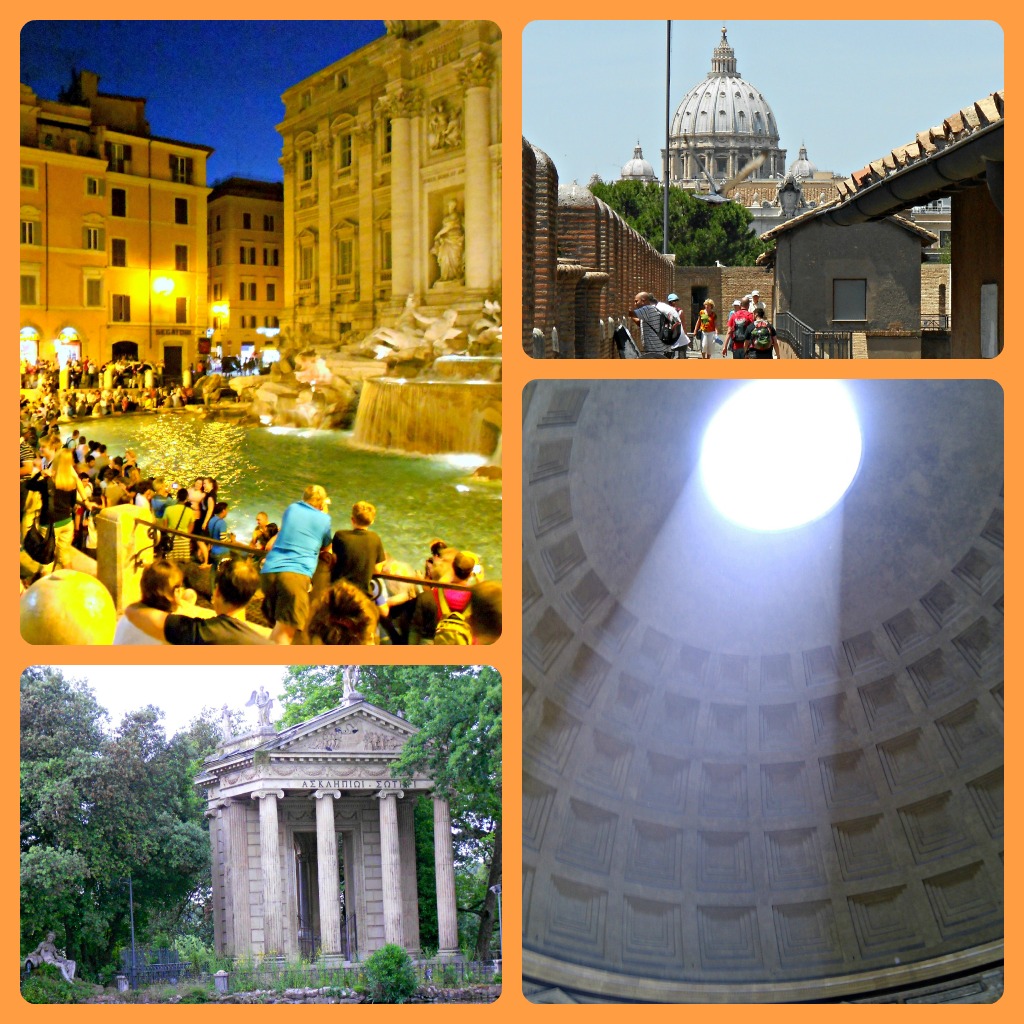
Images: Some enchanted moments from Kym’s second date with Rome. Clockwise from top left: Off peak at the Trevi Fountain (“busy, yes, but somehow still magical”); the Vatican from the battements of the Castel Sant’Angelo; sunlight pouring into the Pantheon; the Giardino del Lago at the Villa Borghese.

When in London, hey? Ag no man! 10 foods I still miss from my homeland…

It’s time to take a break from the craving for La Dolce Vita with a guest post by Lexi Mills, a young South African expat in London. Mills has a another kind of craving: for her home cuisine. YES, IT’S FOOD!!! One of the Displaced Nation’s all-time favorite topics…

I moved from South Africa to London when I was 18 with my parents. Everyday my feet straddle the line between two very different places that I consider home, and sometimes I lean more toward one side than the other. For example, I absolutely love the opportunities that London affords, but I miss the warmth of South African people.

While I will forever be torn between my two homes, one country will forever win when it comes to food: South Africa. You see, South Africa offers not only a great variety of different and amazing landscapes, it is also home to people from diverse backgrounds. A rich combination of cultures, traditions and religions results not only in a unique way of life but also in a wide menu of food items.

I miss everything about South African food: the access to affordable fresh fruit, the healthier diet, grilled meats on the braai (barbecue), to name just a few.

I even miss those packaged foods that you don’t realize you often crave until you don’t have access to them anymore.(Over the years, I’ve met a lot of South African expats and discovered just how much of a hold those packaged foods have on our memories. While you can try to re-create homemade South African foods in other countries, it’s a struggle to replace the items for which you need to find a specialized grocery.)

Out of curiosity, I decided to conduct a study among South African expats here in London to see just how widespread these cravings are. Luckily, as my job is to represent South African Hotels in offering accommodations for travelers to the Rainbow Nation, I was able to utilize their resources for my study of which foods my people miss most.

According to my findings, South Africans who live and work in London miss the following 10 food items from their home country most of all. (Note: I’ve added explanations for the benefit of those who aren’t familiar with our culture.)

1) Biltong

A type of cured meat usually made from raw fillets of beef, ostrich or other meats. South Africa’s biltong can be compared to beef jerky as they are both spiced, dried meats, but biltong has different ingredients, is produced by a different method, and isn’t at all sweet.

2) Dry wors (also known as droëwors in Afrikaans)

Literally, dried sausage. Because it is dried quickly in warm and dry conditions, droëwors does not contain any curing agents as found in most cured sausages. As a result, it should not be kept in moist conditions (such as exist in the UK!). Droëwors is a popular snack.

3) Crème soda

A sweet, carbonated soft drink, usually flavored with vanilla.

4) Nik Naks

A popular brand of maize snack, available in the original real cheese, fruit chutney, cheese & onion and BBQ flavors.

5) Mrs Balls Chutney

A beloved brand of chutney often served with South African meals, with roots firmly planted in the country’s heritage. Made from apricots and peaches, it’s slightly sweet and spicy.

6) Peppermint Crisps

Milk chocolate bars filled with thin cylinders of mint-flavored toffee that were invented in South Africa by Wilson-Rowntree (it’s now produced by Nestlé). Kids in South Africa like to break off both ends of the bar and use it as a “straw” to drink milk.

7) Boerewors

A very popular sausage in South Africa that is used for braais/barbeques. Boerewors is made from coarsely minced beef, sometimes combined with minced pork and lamb as well as spices, and preserved with vinegar and salt. This quintessential South African sausage contains a high proportion of fat; no wonder it’s so tasty!

8) Rusks

Hard, very dry biscuits that were originally prepared by the Dutch for traveling long distances in South Africa’s hot climate. Rusks can be plain or with added texture from nuts, raisins or seeds. We often dunk them in tea.

9) Maize meal, locally referred to as mielie/mealie

Ground maize/corn that you mix with hot water and stir until you get a porridge-like mash (also called pap) — especially delicious when served with a nice homemade meaty tomato sauce.

10) Bakers Tennis Biscuits

A square coconut biscuit with a distinctive petal pattern, made with real golden syrup, coconut and butter. The brand has been around since 1914, when the South African biscuit/cookie manufacturer Bakers first introduced them.

* * *

I hope this gives you an idea of the unique South African palate. If you are an expat, then you’ll know what an adjustment it can be to live in another country, but for me the most profound difference among cultures comes down to cuisine.

Have you had a similar experience? I’d love to hear what foods you miss from back home in the comments!

Lexi Mills is a PR professional living in London. You can find her chatting up Brits all over the Foggy City and enjoying the National Gallery on her days off — a luxury she could not enjoy in her native South Africa. Follow her on Twitter at @leximills.

STAY TUNED for Wednesday’s post, featuring the first of several practitioners of la dolce vita.

If you enjoyed this post, we invite you to register for The Displaced Dispatch, a round up of weekly posts from The Displaced Nation, with seasonal recipes, book giveaways and other extras. Register for The Displaced Dispatch by clicking here!

Related posts:

Img: Octopus, anyone? Lexi Mills at a seaside cafe in Brighton, UK, in 2011.

7 worldwide ways to avoid, forget, or celebrate Friday 13th!

Not being superstitious myself, I tend to scoff at today’s date and treat it like any other. Then again, I once knew someone who had been involved in only two car accidents in her life, both of which occurred on Friday 13th. On a larger transportation scale, the ill-fated Apollo 13  launched at 13:13 (admittedly on April 11th) and exploded on April 13th. And a 1993 study found that the number of hospital admissions from traffic accidents were likely to be 52% higher on Friday 13th than on any other day.

That’s enough to make anyone superstitious about the date, so I won’t think too hard about the fact that, even as I type, my nearest and dearest is somewhere over the Atlantic ocean at 37,000 feet. Nevertheless, I’d like to hazard a guess that the increase in road accidents might be related to the increase in rosary beads and good luck charms hanging from rear view mirrors, thereby obscuring drivers’ visions.

Facts, figures, logic.

The fear of Friday 13th is known variously as friggatriskaidekaphobia, triskaidekaphobia, and paraskevidekatriaphobia. (Too bad if you also suffer from sesquipedaliophobia.) While the combo of Friday and 13 as a double whammy of misfortune is a relatively new invention — the first English reference wasn’t until 1869 — Friday and 13 have always had a bad rap separately.

Think positively about that, all you triskaidekaphobics: instead of being fearful every seven or thirty days, at least the prophets of doom have streamlined the calendar so that now you need only live in terror for two or occasionally three days a year.

Sadly, 2012 is a year with three Friday 13ths. Bad luck.

But take heart!  TDN, with its usual brand of helpfulness, is coming to the rescue of readers still cowering under their duvets and waiting for Saturday to arrive.

You could:

1. Travel to Spain or Greece.

But do it on a Wednesday. While Spanish-speaking countries consider Tuesday 13th to be unlucky, Greece considers Tuesdays in general to be unlucky. Travel on Wednesday, and you should have your bases covered.

2. Travel to Italy.

Friday 17th is unlucky there. Unfortunately, due to the external influence of a dozen Jason movies, Friday 13th is now also seen as unlucky.

So if you’re the type to chuck salt over your shoulder while you’re having a bad day in the kitchen,  maybe you should stay away from Italy — mid-month, at least.

3. Take your mind off it — kiss someone.

Or maybe that’s why you’re still under the duvet? Yesterday, Twitter users decreed that Friday April 13th should be (Inter)National Kissing Day…even though the official date is nearly three months away on July 6th.

4. Celebrate New Year.

Today also happens to be the Tamil New Year,  Puthandu, which falls on either April 13th or 14th of the Gregorian calendar, and is celebrated by Tamils in Tamil Nadu, in Pondicherry in India, and by the Tamil population in Malaysia, Singapore, Reunion Island, and Mauritius.

Tamils mark the day with a feast, decorate their house entrances with kolams, while neem flowers and raw mangoes symbolize growth and prosperity.

If you’re not in any of those countries and you don’t normally celebrate this festival, maybe you should be less ambitious with your own preparations. Buy some mango sorbet.

5. Don your helmet and leathers and go biking.

PD13 is a big celebration for motorcyclists at Port Dover in Ontario, and has been held every Friday 13th since 1981.

If you’re not a biker, ride pillion with one who is. If nothing else, the insects smashing at high speed against your teeth will take your mind off the fact that it’s Friday 13th.

6. Buy a lottery ticket.

On Friday March 13, 2009, Isabel Zaleya of Suffolk County, New York, won a jackpot of $26 million after his friends urged him not to play the lottery that day…because of the date.

7. It’s World Party Month! Throw a party!

Release the Halloween decorations from the basement, and have a Halloween party in April. Come on — did you really need an excuse?

STAY TUNED for some reminiscing on Monday, when we look back at our top posts and themes from our first year.

If you enjoyed this post, we invite you to subscribe for email delivery of The Displaced Dispatch, a round up of the week’s posts from The Displaced Nation. Sign up for The Displaced Dispatch by clicking here!

Related posts:

Image: Victor Habbick / FreeDigitalPhotos.net

Why “expat” is a misleading term for multicultural couples

Today we welcome author and “global love” expert Wendy Williams to The Displaced Nation. A Canadian, she lives in Vienna with her Austrian husband and their daughter. But is she an expat or an immigrant? Yes, that old chestnut! Except…Williams has a novel way of addressing it.

“At the risk of sounding like a snooty intellectual or immigrant diva, I think it’s time to clear up some confusion about the term ‘expat,'” I announced to a features editor recently.

“Oh no,” she warned me, “don’t get bogged down with tedious definitions and classifications. Just write something about the joys and the dramas of being an expat couple. And offer some good advice, too,” she added cheerily.

As the author of The Globalisation of Love — a book about multicultural romance and marriage — I am frequently asked for advice on “expat relationships.” And that’s my whole point today — what is an expat relationship, anyway? And are multicultural couples and expat couples one and the same?

An “expat couple” — what exactly does that mean?

Expat is a term that is bandied about, dare I say recklessly, to describe someone who is living in a foreign country and it is often used to describe couples where one or more partners are foreign born.

Exhibit A: I am Canadian and my husband is Austrian. We live in Vienna. Often we are referred to as an “expat couple” — or even as an “expat family” if our born-in-Austria daughter is included. Granted, I have pretty high standing as matriarch of my family of three, yet does just one “expat” in the family make us an “expat family”? My husband and daughter are living in the country where they were born after all. Other than a bit of English and a lot of peanut butter that I smuggle in from Canada, there is very little “expat” about them.

Yet expat is a label given to anyone with any kind of international flair.

So, time to get to the heart of this worldly weighty matter. An “expatriate,” in my understanding, as well as that of Merriam Webster and even Wikipedia, is “any person living in a different country from where he or she is a citizen.”

Expats usually start their international lives on assignment for a multinational corporation — unless they are Australian, in which case they begin by bussing tables in London’s grottier pubs or teaching Dutch guests to ski in Austria.

Typically, expats enjoy a long list of job perks to deal with the “stresses” of life abroad so they get free rent, paid trips back to the motherland and private school for the kids. Paying income tax seems to be optional. Expats are like visitors to a country: they deal with external issues like culture, language, and religion. Usually they live from one to five years in a given location “making the most of it” exploring the region and learning about the local culture. They always know they will be going home at some point, even if there are more international postings along the way.

Vs a “GloLo couple” — now there’s a precise label!

A multicultural relationship, by contrast, is one where each partner is from a different country or culture. Multicultural couples — or what I call “GloLo couples” in The Globalisation of Love (blatant self-promotion, I know) — deal with issues like culture, language, and religion within the relationship. GloLo couples do not usually have the job perks of expats because they work locally, so they pay their own rent, they have to pay taxes and their kids go to the local school.

Whether they live in his country or her country — or swing back and forth between the two countries every few years — there is a sense of permanence about the geography. The imported partner is an immigrant really, although “immigrant” has taken on some negative connotations in our nilly-willy live-here-work-there globalized society.

Barring bureaucracy and ludicrous immigration laws (Austria, this means you!), GloLo partners may even gain citizenship in the country into which they have married. At the risk of more shameless self-promotion, I call it the “globalization of love.”

So here is my point: An expat couple and a multicultural couple are not necessarily the same relationship constellation and should not be confused with one another. An expat couple can be a GloLo couple if they have different nationalities, however a GloLo couple is not necessarily an expat couple, even if one partner is an expatriate. It is only when a GloLo couple live in a third neutral country that they become an expat couple as well.

Aren’t you glad we cleared that up?

Meanwhile, the features editor still wants some advice on dealing with the joys and the dramas of being an expat couple though. Hmm, how about make the most of it, explore the region and learn about the local culture?

And my advice for multicultural couples? Well, there’s this book I should tell you about…

Question for readers: How do you define “expat” vs “immigrant” — and does Williams’s “glo-lo” term strike you as being useful?

WENDY WILLIAMS is the author of The Globalisation of Love, which was featured in The Displaced Nation’s post Best of 2011: Books for, by and about expats. You can learn more about Williams and her book at her author site, The Globalisation of Love.

STAY TUNED for Monday’s post, an introduction to March’s Cleopatra(!) theme…

If you enjoyed this post, we invite you to register for The Displaced Dispatch, a round up of weekly posts from The Displaced Nation, with seasonal recipes, book giveaways and other extras. Register for The Displaced Dispatch by clicking here!

Related posts:

How NOT to review Iran’s first Oscar-winning movie, “A Separation”

On Sunday night, A Separation became the first Iranian (and Middle Eastern) film to pick up the Academy Award for Best Foreign Language Film. Although the film has already received rave reviews from mainstream critics, we asked a former expat in the Middle East who recently published a book about his adventures in Turkey, Matt Krause, to direct our attention to what’s interesting and important.

When The Displaced Nation asked me to review the Iranian film A Separation, I hadn’t seen it yet. I don’t follow film much, so even though the movie was up for a couple of Oscars, I hadn’t heard of it.

I am currently living in a very small town in California that’s far from Los Angeles and San Francisco. While I was searching for some alternative way to watch the movie, I read up on it. That was my first mistake.

Based on the descriptions I found, I thought it would be about some combination of seeking a better life abroad, caring for an elderly parent, and the strains of life affecting a marriage. These are all topics near and dear to my heart, and I looked forward to seeing what A Separation had to say about them from an Iranian viewpoint.

Before I found the movie I thought about what I would say in the review. I thought about how I would talk about seeking a better life abroad. I thought about how I would talk about caring for an elderly parent. I thought about how I would talk about the strains of life affecting a marriage. I thought about differences between American society and Iranian society. My review was practically written before I had even seen the movie.

I know, it was ridiculous for me to think I could form an opinion on this or any other movie without watching it with my own eyes, but that was Mistake No 2.

I finally located the movie and watched it. As the closing credits rolled I realized none of what I had planned to say was even remotely relevant. I sat in front of the screen slack-jawed wondering, “Whoa, what am I going to say about this one?”

A Separation is a great movie. It is one of the best movies I have seen in a long time and I would definitely recommend it.

Here are three of the elements I responded to most:

1) The theme transcends the particular to examine universal questions.

The movie’s opening scene introduces a married couple being pulled apart by the struggle between searching for a freer life and fulfilling obligations to others. I thought the movie would be about how that conflict plays out in this particular marriage. However, as the story unfolded, I realized this was not a movie about two people negotiating that conflict. It is about how both sides of that conflict duke it out inside of each one of us, how that internal conflict is an inescapable part of being human, and how, despite our attempts to quiet it, that conflict is unresolvable and will be with us until the day we die. We humans want to be free, but we also want others to depend on us.

2) The cinematography conveys the impression of a tight spiritual space.

When that struggle comes to a head, spiritual space can feel awfully tight. A Separation brings that tightness to life not only in the storyline, but also in the cinematography. The camera angles are tight and the spaces feel cramped, whether the scenes take place in a small apartment, a tiny government office, or a crowded city street. In fact, many of the movie’s scenes take place in rooms so crowded there is barely room for the characters to stand.

3) The action relies on tight story-telling, not music and special effects.

Following the movie’s storyline is excellent mental exercise. There are plot twists, and then there are twists to the plot twists, and then there are twists to those twists. Lesser movies use multiple plot twists to cover up for lazy writing, the writers perhaps hoping the plot twists will distract viewers from the writers’ own inability to tell a good story. In A Separation, however, storytelling discipline remains tight through each plot twist. The characters are as baffled by the twists as we are. The twists do not distract us, they simply allow us to view the central conflict from a new angle, before returning us to the original angle in the final scene.

A Separation uses little or no music, not until the end of the final scene when the closing credits are about to roll. Where most movies use music to guide the viewers through the building and release of tension, A Separation relies on tight storytelling to provide that guidance. The lack of music seems almost like the director accepted his own dare to raise the storytelling bar so high music would be unnecessary.

* * *

Watching A Separation was an excellent investment of my time, and I suspect you will think it is of yours, too. Don’t start out expecting this movie to represent anything except itself, though. Check your baggage at the door and listen to what this movie has to say.

Question: Have you seen A Separation and if so, what did you think?

As American from California who specializes in international trade and operations, MATT KRAUSE has spent forty percent of his life abroad, with stints living and working in China and Turkey. Last year he self-published his memoir, A Tight Wide-open Space: Finding love in a Muslim land. The book appeared on The Displaced Nation’s list Best of 2011: Books for, by and about Expats and was reviewed this month by Kate Allison. After finishing the book, Matt decided to walk 1,500 miles from Turkey to Jerusalem, a journey of about six months. You can read about it on his blog Heathen Pilgrim.

STAY TUNED for tomorrow’s Random Nomad interview.

If you enjoyed this post, we invite you to register for The Displaced Dispatch, a round up of weekly posts from The Displaced Nation, with seasonal recipes, book giveaways and other extras. Register for The Displaced Dispatch by clicking here!

Related posts:

What is the true essence of Britishness? Tea? Harry Potter? This TCK has her own ideas.

Today we welcome Laura Stephens to The Displaced Nation to comment on our themes from her third culture kid perspective. Although Laura’s parents are both British, she has spent most of her life in the USA. She is currently studying film production in Boston – most conveniently for us and this month’s Oscars theme.

At the beginning of a semester, it’s only a matter of time before a professor draws upon some of that “Teacher Training Camp” gold, and suggests we spend half a class playing name games. That way, the reasoning goes, we’ll be vaguely aware of the proper nomenclature of our lecture hall peers, with whom we will probably not speak for the rest of the course anyway.

Or worse, the self-proclaimed “hip” professor will pretend to be struck by a brilliant idea, and suggest, “How about we go around in a circle – say your name, and your major, and where you’re from?”

And I’m all, “How about we… don’t.”

Why? Because apart from it evoking irrational anxiety that sends my inner monologue into a manic babbling fit (“What’s my name, again? What was his name? I wasn’t paying attention because I was too busy preparing my answers to make sure I don’t screw up my own name.”) — I never know how to answer that last question:

“Where are you from?”

Where am I from?

I know my options here.

1. I can take the easy way out, and say I’m from Connecticut – lovely New England, just like most of the kids in the class. It’s not untrue, either. I’ve lived there most of my life.

2. I can inflict upon myself the task of revealing unnecessary further explanations about my background. To a bunch of people I only just met, courtesy of the name game? I don’t think so.

Which is why I never come right out and say I’m from England.

My brother and I differ on this. He kept his English accent, although he wasn’t even born there; he just copied it from our parents. He kept it to pick up chicks, and I mock him regularly for this. He seems to do all right with the ladies, though, so he puts up with it.

Me, I always found my English accent more of a hindrance than help; asking for a glass of “water” at a friend’s house was more trouble than it was worth. As a result, I tried to get rid of my accent as soon as I could – somewhere around fifth grade. This helped me get away with not mentioning where I was from, if I didn’t want the attention. I could always mention it later if I felt like it.

At some point after that I decided I wasn’t going to introduce myself as, “Laura, from England.”

I don’t have an English accent, so why should I?

If I introduced myself that way in the College Name Game, people would either pass over it (as they do everyone else’s responses) or perk up and ask some irrelevant question about London (the only place in England, according to Americans) or Harry Potter, or tea and crumpets.

How English is English?

When I mention I moved to the U.S. when I was three, people appear dejected or slightly peeved, as though they’d been ripped off.

“Oh,” they echo knowingly, as if to say, “So that doesn’t really count.”

This irritates me. I was born in England, lived there until I was three, and have visited relatives overseas every other summer since.

I get defensive:

“I drink tea, for crying out loud! I drink tea daily, and I drank tea before it was the cool thing to do. I like crumpets with butter and honey. I’ll take the Pepsi challenge between true Cadbury’s and the Made-by-Hershey’s imitation.”

I stop. “Do you watch The Office?” I ask them.

“Yeah.”

“No, no. The British one.”

And that’s when I realize: one of the major brag points I rely on, when proving to someone just how English I can be, is British film and television.

British television – a treasure lost in the Atlantic?

I’m a film major. Today in my History of Media Arts course, we learned about the introduction of cable television.

My professor lectured, “…and originally there were only three channels…”

(At which point my inner monologue interjected, “Cheese or snow?” – National Lampoon’s European Vacation reference, in case you missed that.)

I’m assuming we stayed within the realm of American television throughout class today, because by the end of the lecture, people had 52 TV channels, and CBeebies had not been mentioned once.

I think it is a shame that British television hasn’t become as popular in the United States as it is in its native country. I’ve introduced a lot of my friends to shows like Fawlty Towers, Blackadder, The Office, The Royle Family, One Foot in the Grave and Outnumbered. Top Gear seems to have gained a foothold with American audiences, but I’d like to see things like Extras and Episodes become more widely known and appreciated.

It’s not just because they’re British that I like them; I like them because they’re funny. I might enjoy them more than my American-born friends do, because of the references within the shows that probably contribute to my understanding, but generally my friends are appreciative of any British video clips I show them.

ABC meets BBC

My American boyfriend and I have a list of films that we intend to watch at some point, and we add to it regularly. We have a list of television series too – ditto. These lists are written on virtual Sticky Notes for Mac.

He, however, has a separate Sticky: “Weird British Shows.” It contains many of the shows I listed above.

From his reactions to the shows to which I’ve already introduced him, though, I know that Boyfriend is not really serious about the “Weird” in the title.

He’s a fan.

What is being English all about, anyway?

Being English is not about crumpet consumption – not entirely, anyway. There is a strong popular culture built around witticisms, subtlety, and sarcasm. I may have only lived in England for the three least memorable years of my life, but I have an intrinsic love for all those lovely British shows of which most Americans have never heard. I don’t care that this is all I have to defend my culture – I push like nobody’s business to get my American friends to watch these shows.

It’s good television, that’s all – even if it is a little weird or different.

Much of British programming is simply an acquired taste.

Which makes sense, right? It’s kind of like…tea.

.

STAY TUNED for Monday’s post – our own thoughts on the Academy Awards!

If you enjoyed this post, we invite you to register for The Displaced Dispatch, a round up of weekly posts from The Displaced Nation, with seasonal recipes, book giveaways and other extras. Register for The Displaced Dispatch by clicking here!

Related posts:


THE DISPLACED Q: Does love conquer all — even language barriers?

Last week Tony James Slater, the newest addition to the TDN team, reported on his success with finding love abroad. But it wasn’t always that easy for him. He may be an incurable adventureholic, but when Cupid’s arrow led to a romance with a woman who didn’t speak English, even he had to wonder if there were limits…

Here’s the scenario:

You’re minding your own business in a friendly sort of bar, enjoying the heady mix of cultures as foreigners — a mix of holiday-makers, transients and expats — rub shoulders with the locals.

Suddenly you see him — or her — across the crowded room. This gorgeous individual is staring right at you, smiling seductively. You make contact with those smoldering eyes…and that’s where it ends.

Because she doesn’t speak your language, and you speak none of hers.

So really, what are you going to say to her?

Can romance transcend the language barrier?

It’s a tricky one.

No lo entiendo, mi amor

I have a little experience in this area; once upon a time, when I doing a three-month stint of volunteering at an animal shelter in Ecuador, I fell madly in lust with a gorgeous Latino woman.

Of course she didn’t speak English — there was no one who could for miles in any direction. I spoke no Spanish, because until that moment there had never seemed enough reasons to learn it.

I was captivated by her — she was the kind of exotic beauty you read about in well, the kind of books that I don’t read. Ahem.

So what do you do?

Two obvious tactics spring to mind.

The first is what I did: get horribly drunk and throw yourself at the poor woman, in the hope that you’ll never remember the embarrassment in the morning, if she laughs in your face.

As it happens, this tactic worked — but it should be noted that this is the first time ever, in the history of mankind, that this has been the case. As a rule, I cannot endorse extreme inebriation as a successful method of flirtation; truly, this must have been Cupid himself in action.

The second tactic is to get a friend who does speak both languages to make some kind of introduction. This can help you get over that incredibly awkward initial stage when neither of you is really sure if the other is genuinely interested.

This is the tactic I should have used, as I had a perfectly good friend with the requisite language skills. Of course by the time I’d thought of that, I was already too drunk to pronounce even English words. It was quite a way down the road when I finally got to communicate in words with my new lover, through an interpreter.

At that point, it was great to have it confirmed that she felt the same way about me as I felt about her!

It was slightly less great to discover that she was already married and had two children. But then, that’s the chance you take when you practice tactic no.1.

Thankfully, she was separated from her husband — although as our relationship progressed, I did hear some disturbing rumors that her husband was looking for me…with a machete. I fervently hoped that was just my boss trying to wind me up. (If it was, he succeeded!)

Pidgin Spanish and pantomime…are there limits?

Although she was beautiful, the thought of meeting her again terrified me anew each time. I felt like such an idiot, struggling to express myself in pidgin Spanish and pantomime. I lived in fear of those awkward moments, when neither of us could make the other understand some fundamental issue.

That said, it definitely motivated me to learn Spanish! After every date I’d come back fired up with the desire to study. I never did any studying, of course — my day job (mucking out animal cages) kept me way too busy for that — but the desire was there. The desire, in fact, had never been a problem!

But how far can a relationship really go, when you don’t even have a language in common? Think how close you can get to someone in a long-term relationship; a connection bordering on the psychic, where you’re almost reading each other’s minds — it just doesn’t work when you’re constantly guessing at what the other person is saying.

The Austrian-British language philosopher Ludwig Wittgenstein once remarked:

The limits of my language are the limits of my world.

If he is right, then isn’t the lack of a shared language the very essence of incompatibility?

Relationship experts the world over agree that couples must work hard to bridge communication gaps. Well, when the gaps of linguistic understanding are wide enough to fly a 747 through — and it can feel like a long-distance relationship even when you’re standing next to each other — bridge-building can be something of a challenge.

My Ecuadorian love and I were together three months, after which I left to fly back home. Ironically, we’d each learned just enough of each other’s languages to really get to know each other’s thoughts, hopes, fears and frustrations — the day before my flight to England.

I’d like to open it up to the floor at this point!

Has anyone got any experience of this that they wouldn’t mind sharing? Or an opinion, on whether or not it’s possible?

Can love really conquer all — including that ultimate bad guy of cross-cultural barriers, linguistics?

What do you think?

I’d love to know!

TONY JAMES SLATER is a self-confessed adventureholic. For the last six years he’s been traveling nonstop around the world, working at a variety of jobs including yacht deliverer in the Mediterranean, professional diver in Thailand and snow boarder in New Zealand. Last year, Slater published his first book, That Bear Ate My Pants!, an account of his misadventures while volunteering at the animal refuge in Ecuador. (The book was featured in The Displaced Nation’s list of 2011 expat books.) He is currently working on a second book set in Thailand, while exploring his new home in Perth, Australia.

STAY TUNED for Tuesday’s post, a review of Matt Krause’s memoir recounting how he met a woman on a plane — and followed her all the way to Turkey! NOTE: Subscribers to our weekly DISPLACED DISPATCH are eligible to win a free, autographed copy!

If you enjoyed this post, we invite you to register for The Displaced Dispatch, a round up of weekly posts from The Displaced Nation, with seasonal recipes, book giveaways and other extras. Register for The Displaced Dispatch by clicking here!

Related posts: