The Displaced Nation

A home for international creatives

Tag Archives: What a Displaced World

LOCATION, LOCUTION: Paulo Coelho, on the monuments that immortalise cities

2010-26In this month’s “Location, Locution”, expat crime writer JJ Marsh talks with Paulo Coelho, the Brazilian best-selling author of The Alchemist, The Devil and Miss Prym, and The Witch of Portobello, among many others.

*  *  *

When I asked Paulo Coelho to take part in the “Location, Locution” concept, he was happy to oblige.

But he wanted to do it his way. So in a change to our usual format, here’s Paulo Coelho on place.

The moving monument

I have visited many monuments in this world that try to immortalize the cities that erect them in prominent places. Imposing men whose names have already been forgotten but who still pose mounted on their beautiful horses. Women who hold crowns or swords to the sky, symbols of victories that no longer even appear in school books. Solitary, nameless children engraved in stone, their innocence for ever lost during the hours and days they were obliged to pose for some sculptor that history has also forgotten.

And when all is said and done, with very rare exceptions (Rio de Janeiro is one of them with its statue of Christ the Redeemer), it is not the statues that mark the city, but the least expected things. When Eiffel built a steel tower for an exposition, he could not have dreamed that this would end up being the symbol of Paris, despite the Louvre, the Arc de Triomphe, and the impressive gardens. An apple represents New York. A not much visited bridge is the symbol of San Francisco. A bridge over the Tagus is also on the postcards of Lisbon. Barcelona, a city full of unresolved things, has an unfinished cathedral (The Holy Family) as its most emblematic monument. In Moscow, a square surrounded by buildings and a name that no longer represents the present (Red Square, in memory of communism) is the main reference. And so on and so forth.

Perhaps thinking about this, a city decided to create a monument that would never remain the same, one that could disappear every night and re-appear the next morning and would change at each and every moment of the day, depending on the strength of the wind and the rays of the sun. Legend has it that a child had the idea just as he was … taking a pee. When he finished his business, he told his father that the place where they lived would be protected from invaders if it had a sculpture capable of vanishing before they drew near. His father went to talk to the town councilors, who, even though they had adopted Protestantism as the official religion and considered everything that escaped logic as superstition, decided to follow the advice.

Another story tells us that, because a river pouring into a lake produced a very strong current, a hydroelectric dam was built there, but when the workers returned home and closed the valves, the pressure was very strong and the turbines eventually burst. Until an engineer had the idea of putting a fountain on the spot where the excess water could escape.

With the passing of time, engineering solved the problem and the fountain became unnecessary. But perhaps reminded of the legend of the little boy, the inhabitants decided to keep it. The city already had many fountains, and this one would be in the middle of a lake, so what could be done to make it visible?

And that is how the moving monument came to be. Powerful pumps were installed, and today a very strong jet of water spouts 500 liters per second vertically at 200 km per hour. They say, and I have confirmed it, that it can even be seen from a plane flying at 10,000 meters. It has no special name, just “Water Fountain” (Jet d’Eau), the symbol of the city of Geneva (where there is no lack of statues of men on horses, heroic women and solitary children).

Once I asked Denise, a Swiss scientist, what she thought of the Water Fountain.

“Our body is almost completely made of water through which electric discharges pass to convey information. One such piece of information is called Love, and this can interfere in the entire organism. Love changes all the time. I think that the symbol of Geneva is the most beautiful monument to Love yet conceived by any artist.”

I don’t know how the little boy in the legend would feel about it, but I think that Denise is absolutely right.

© Translated by James Mulholland

www.paulocoelhoblog.com

Read JJ Marsh’s 2011 interview with Paulo Coelho for Words with JAM magazine

Next on Location, Locution: Janet Skeslien Charles, author of Moonlight in Odessa

* * *

JJ Marsh grew up in Wales, Africa and the Middle East, where her curiosity for culture took root and triggered an urge to write. After living in Hong Kong, Nigeria, Dubai, Portugal and France, JJ finally settled in Switzerland, where she is currently halfway through her European crime series, set in compelling locations all over the continent and featuring detective inspector Beatrice Stubbs.

STAY TUNED for next week’s posts!

If you enjoyed this post, we invite you to register for The Displaced Dispatch, a round up of weekly posts from The Displaced Nation, with seasonal recipes, book giveaways and other extras. Register for The Displaced Dispatch by clicking here!

Related posts:

Image: Paulo Coelho, 2010 – PauloCoelho.com, used with permission.

And the September 2013 Alices go to … these 4 international creatives

 © Iamezan | Dreamstime.com Used under license

© Iamezan | Dreamstime.com
Used under license

If you are a subscriber to our weekly newsletter, Displaced Dispatch, you’re already in the know. But if you’re not (and why aren’t you? off with your head!), listen up. Every week, when that esteemed publication comes out, we present an “Alice Award” to a writer or other kind of creative person who we think has a special handle on the curious and unreal, who knows what it means to be truly displaced as a global resident or voyager. Not only that, but this person tries to use this state of befuddlement to their advantage, as a spur to greater creative heights.

Today’s post honors September’s four Alice recipients.

Starting with the most recent, and this time with annotations, they are (drumroll…):

1) SHERRY OTT, travel photographer and blogger

Source: Photographing Vietnam’s Rainy Season,” on Everything Everywhere
Posted on: 20 September 2013
Snippet:

From a cultural experience and photography standpoint, inclement weather seasons are a wonderful opportunity to see how the locals really live in situations that we would deem less desirable. You get a true feel for the country and local culture and traditions through the “tough” times. On top of it you get introduced to a number of new products that are used in that inclement weather season that you probably never even dreamed of…

Citation: Sherry, we have to stop you there. Right now we are picturing Alice sloshing through her own tears:

As she said these words her foot slipped, and in another moment, splash! she was up to her chin in salt water. Her first idea was that she had somehow fallen into the sea, “and in that case I can go back by railway,” she said to herself.

But what interests us about you, Sherry—what’s curiouser and curiouser, as Alice might put it—is that, unlike her, you were not having a pool-of-tears moment. As you set foot in Saigon at the height of the monsoon season, your first thought was, my, how lucky I am to see “the skies open up and pour down their wrath on city streets.” And you know what, Sherry? We agree with you. Unlike Alice, who had no means of transport except possibly the train, you had your own motorbike. Also unlike her, you were privy to some unusual sights: double-headed ponchos and ponchos with headlight windows! Poor Alice, on the other hand, when she heard something splashing about in a pool a little ways off, thought she might encounter a walrus or hippopotamus, only to find … a mouse.

2) ALYSSA JAMES Canadian blogger, journalist, traveler

Source: How fast can you slow travel?” on Matador Network
Posted on: 13 September 2013
Snippet:

Because of regulations on how long a truck driver is allowed to be on the road in a day, I was able to explore the city [of Chicago] for exactly 1 hour and 19 minutes.

In those 79 minutes, I was still able to slow travel. I visited the sculpture and centerpiece of Millennium Park known as the Bean (actually called Cloud Gate) and went to the Art Institute. More importantly, I talked with people who lived there. I received interesting insights about the place I wouldn’t have gathered otherwise, like where to get the most delicious Chicago-style pizza ever (Giordano’s deep-dish, double-crusted and stuffed deliciousness).

Citation: Alyssa, we appreciate that you were able to plumb the depths of the Windy City, the largest city in the Midwest, America’s third largest, in just over an hour (hey, that’s no mean feat given how deep the pizza is!). And all this without the benefit of the Queen’s insights in Through the Looking Glass:

“A slow sort of country!” said the Queen. “Now, HERE, you see, it takes all the running YOU can do, to keep in the same place. If you want to get somewhere else, you must run at least twice as fast as that!”

Our only question is, had you followed the Queen’s advice and run twice as fast, do you think you might have at least sampled the stuffed pizza? And of course, had you run twice as fast, you could have sampled it guilt-free! That’s a thought. Next time, perhaps?

3)  ANNE COPELAND, founder and Executive Director of The Interchange Institute

Source: “Tiger Moms, Bébés, and Warm Eskimos” on FIGT blog
Posted on: 1 September 2013
Snippet:

[A]s an interculturalist, I’m at once fascinated, excited … and disappointed by these accounts of parenting in other cultures…. In each case, the message is roughly, “Here’s a new and superior way to raise your children; the result is better than what you’re doing; try it, you’ll like it.” But nowhere do they describe the deep values underlying the parenting choices, the ultimate goals for the kind of adult parents are trying to raise, or the cultural milieu into which the children will be expected to grow.

Citation: Anne, we feel certain that Alice could relate to your woes. She was, after all, rather discombobulated by what she saw of the Duchess’s parenting style. To quote from her account:

While the Duchess sang the second verse of the song, she kept tossing the baby violently up and down, and the poor little thing howled so, that Alice could hardly hear the words:—
“I speak severely to my boy,
I beat him when he sneezes;
For he can thoroughly enjoy
The pepper when he pleases!”

Just imagine, a child that enjoys unlimited amounts of pepper thanks to harsh parenting. It totally makes sense in the Wonderland context. Except…achoo! or should we say: hach-chu (Bengali), hāt-chī (Cantonese), atsjú (Hungarian), aatsjoo (Norwegian), or atchoum (French)? In any case, some sort of onomatopoeia must be required. Parenting may vary from place to place, but not sneezing! But wait, the Japanese say hakushon. Are they trying to stifle the sneeze while frantically searching for a face mask? (Anne, please tell us: will intercultural wonders ever cease?)

4)  NIKKI HODGSON, blogger & traveler

Source: “What is lost (and gained) when the traveler settles down” on Matador Network
Posted on: 16 August 2013
Snippet:

“…Every day that passes separates me from the places I used to belong to, the places I learned to belong to. As I dig my roots deeper into the rocky Colorado soil, I must relinquish my grasp of the banks of the Neckar where I first studied abroad, the mountains of Grenoble that stood guard over me as I fell apart, the dusty hills of Bethlehem where I put myself back together.

And I know that I will never belong to these places the way I once did.”

Citation: Nikki, you put us in mind of Alice’s sister, who like you after your travels, was old and wise enough to know that Wonderland wouldn’t, couldn’t last. Here is the relevant passage:

So she sat on, with closed eyes, and half believed herself in Wonderland, though she knew she had but to open them again, and all would change to dull reality—the grass would be only rustling in the wind, and the pool rippling to the waving of the reeds…

Crazy Wonderland or dull reality? Or, in your case: dusty hills or rocky soil? That is THE expat question… Not much of a choice, is it?

*  *  *

So, readers, do you have a favorite from the above, or have you read any recent posts you think deserve an Alice Award?  We’d love to hear your suggestions! And don’t miss out on these weekly sources of inspiration. Get on our subscription list now!

STAY TUNED for our next post!

Writers and other international creatives: If you want to know in advance whether you’re one of our Alice Award winners, sign up to receive The Displaced Dispatch, a round up of weekly posts from The Displaced Nation, with news of book giveaways, future posts, and of course, our weekly Alice Award!. Register for The Displaced Dispatch by clicking here!

Related posts:

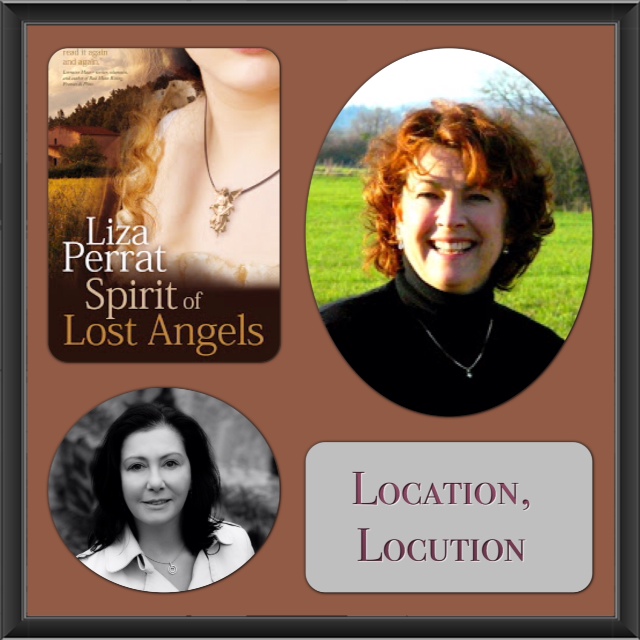
LOCATION, LOCUTION: Liza Perrat on writing a location to life

Liza Perrat visualIn this month’s “Location, Locution”, expat crime writer JJ Marsh interviews  Liza Perrat, author of Spirit of Lost Angels.

Liza grew up in Wollongong, Australia, where she worked as a general nurse and midwife for fifteen years. When she met her French husband on a Bangkok bus, she moved to France, where she has been living with her husband and three children for twenty years. She works part-time as a French-English medical translator.

Spirit of Lost Angels tells the story of Victoire Charpentier and her courage in facing injustice and abuse in revolutionary France. Wolfsangel (due out in November 2013) follows Victoire’s descendant, Celeste, who finds that under Nazi occupation, the personal is political.

*  *  *

Which comes first, story or location?
So far, for me, it has been location. I’m enthused, enthralled or nostalgic about a place, and want to use it as a backdrop around a story. In the case of my current novels, the location has become as much a character as the real-life ones.

How do you go about evoking the atmosphere of a place?
My novels are set in the French rural area in which I live, which makes it much easier to evoke atmosphere. I take loads of photos of the countryside, the people and the buildings, during each different season. The local historical association has lots of sketches and documents on what it looked like through the ages. As I walk the dog, I jot down descriptions of sunrises, sunsets, stormy light, fruit on the trees, snow on the hills, flowers in spring and the icy river in winter.

Which particular features create a sense of location? Landscape, culture, food?
Landscape, culture and food, certainly. But most of all, for me, it is the people who create a sense of location. Often, the people are the place. Also language, especially expressions, plays a part. Architecture too, gives a feel for a place. Smells also, create a sense of location.

How well do you need to know the place before using it as a setting?
Intimately well. I’d have trouble creating a believable atmosphere if I’d not been to a place, or at least read widely on it.

Could you give a brief example from your work which you feel brings the location to life?
Many reviewers of Spirit of Lost Angels commented positively on the atmosphere created of La Salpêtrière asylum in Paris, during the late 1700s:

… I found the scenes of cruelty in the Salpêtrière Asylum painful to read – not because of the way in which they were written, but simply to have been shown such unpalatable truths …

… the section of the novel concerning Victoire’s stay in La Salpêtrière vividly illustrates what a horrible experience it must have been…

… part of the reason I waved to savour this book so much was because of the scenery and the settings…

The book vividly depicts the violent and inhumane methods doctors used to “treat” mental illness at Salpêtrière. To me, this was perhaps the most fascinating portion of the story- descriptions of the appalling conditions under which the women were kept, the rivalries that developed among cell mates, the rules one had to learn in order to survive this prison. The narrative was stark and believable and, believe it or not, educational. Since I’ve finished the book, I’ve been looking up the history of the Salpêtrière Hospital, intrigued at how low mental health care and the care of women had deteriorated at that time. Introducing an urge to learn more, dear readers, is the mark of excellent historical fiction.

Which writers do you admire for the way they use location?
Ones that come to mind:

  • Stef Penney’s The Tenderness of Wolves. Even more amazing as, apparently, she’s never been to the wilderness snowscapes of Canada.
  • Joanne Harris’s Chocolat evokes the small French village.
  • Nikki Gemmell’s Cleave and Kate Grenville’s The Idea of Perfection, describe so well the desolate landscape of central Australia.
  • Jennifer Worth’s Call the Midwife brings to life 1950s East End London.
  • Emma Donoghue’s Room brilliantly portrays an entire existence in a single, small room.

Thank you, Liza!

Next month, my guest on Location, Locution will be Paulo Coelho, author of The Alchemist, The Devil and Miss Prym and Eleven Minutes

* * *

JJ Marsh grew up in Wales, Africa and the Middle East, where her curiosity for culture took root and triggered an urge to write. After living in Hong Kong, Nigeria, Dubai, Portugal and France, JJ finally settled in Switzerland, where she is currently halfway through her European crime series, set in compelling locations all over the continent and featuring detective inspector Beatrice Stubbs.

STAY TUNED for next week’s posts!

If you enjoyed this post, we invite you to register for The Displaced Dispatch, a round up of weekly posts from The Displaced Nation, with seasonal recipes, book giveaways and other extras. Register for The Displaced Dispatch by clicking here!

Related posts:

And the August 2013 Alices go to … these 3 international creatives

 © Iamezan | Dreamstime.com Used under license

© Iamezan | Dreamstime.com
Used under license

As subscribers to our weekly newsletter know, our Displaced Dispatch presents a weekly “Alice Award” to a writer or other kind of creative person who we think has a special handle on the curious and unreal aspects of the displaced life of global residency and travel. Not only that, but this person likes to use their befuddlement as a spur to creativity.

Today’s post honors August’s three Alice recipients. Beginning with the most recent, they are (drumroll…):

1) CALLISTA FOX, TCK blogger and author of the serial novel Suite Dubai

Source: “Friday Night Lights vs. The Eurotrash Girl on CallistaFox.com
Posted on: 26 June 2013
Snippet:

Our boarding school offered cheer leading as an afternoon activity… I signed up because it sounded better than typing or drafting and my parents wouldn’t pay for dressage. We knew only a handful of cheers. None of us could name a proper jump, let alone do one. We wore white tennis skirts and blue sweatshirts and any color of hightop Reebok we owned. When we ran out onto the field to do our pathetic cartwheels the audience was quiet, a few laughed. True, the grass was wet and my roommate Samantha slipped and skidded on her chin. We didn’t have our routine perfected.

Citation: Who stole the tarts, Callista? Who stole the tarts? Your account of your bout with cheer leading at a boarding school in Austria suggests that you were in a classic Alice-in-Wonderland situation, perhaps without even realizing it. Because no young American woman in her right mind would cheer an Austrian team playing Australia in American-style football on a field marked for soccer, unless they’d stepped through the looking glass. Indeed, your description is missing some crucial details, for instance:

  1. Were the teams using a koala bear as the ball? Koalas being to Austria what flamingos are to England—namely, more New World than Old. (Notably, koalas like to eat the leaves of the eucalyptus tree, which doesn’t exactly thrive in The Land of Long-needled Pines.)
  2. Did anyone propose a trial for all of those unruly fans in the half-filled stands who were throwing things at you and the other cheerleaders?

All of which brings us back to our original question: was it an Aussie or an Ausie, the Knave who stole the tarts? That’s what we (and presumably your all-American Texan husband) would most like to know.

Still, we did find amusing the tales of ThirdCultureKid-land that you told to your better half. Clearly your quintessentially TCK life had its moments, including the time you watched a guy eat glass in a bar in Nicosia, Cyprus, when you were only 14.

Is it any wonder that when your parents moved you back to Norman, Oklahoma, when you were 20, you felt exactly like Alice, who told her sister: “Oh, I’ve had such a curious dream!” (You did make a lot of it up, right?)

2) CHRIS ALDEN, British expat; author and journalist

For his book: “101 Reasons to Live Abroad…and 100 Reasons Not To”
Published: March 2013
From the book description:

Do you dream of living abroad? If so, you’re in good company. Tens of thousands of people every year emigrate from the UK—leaving behind the security of work, family and friends for the promise of better weather (hopefully), better prospects (sometimes) and a carefree existence (keep dreaming).

So is now the time to leave Britain and start life as an expat? Or have you already started planning the big move overseas?

101 Reasons to Live Abroad … & 100 Reasons Not To helps you discover if living abroad is right for you. It’s an uplifting guide to the positive sides of life as an expatriate—and a reality check about the challenges that relocation brings.

Citation: Chris, we understand that you’re also the author of 250 Things to Do in Cyprus on a Sunny Day, so would encourage you at some point to compare notes with your fellow Alice awardee, Callista Fox. In the post cited above, Callista reports that, when attending boarding school in Nicosia, she and her friends particularly enjoyed hanging out in a bar drinking Carlsberg with UN soldiers (they were there to keep the peace between Cypriots and Turks). We’re genuinely curious: does this particular activity rank in your Top 250? Or perhaps you think it’s better left for a rainy day? (Actually, does Cyprus even have rainy days? Oh, that’s right: it’s only semi-arid.)

Anyway, we’re awarding you an Alice because, like Lewis Carroll’s little heroine, you appear to appreciate both the positive and negative aspects of turning one’s life upside down, with the balance tipped every so slightly towards the positive. We believe Alice would be impressed that you offer a final, 101st reason to live abroad for those who, having been offered as many as a hundred reasons both for and against, still find themselves dithering. After all, when Alice’s sister urges her to run inside to get her tea, she obliges her “thinking while she ran, as well she might, what a wonderful dream it had been.”

3) LINDA JANSSEN, writer, speaker, consultant, global adventurer and cultural enthusiast

For her book: “The Emotionally Resilient Expat”
Published: 22 June 2013
From the book description:

Linda A. Janssen combines candid personal stories from experienced expats and cross-culturals, with a wealth of practical tools, techniques and best practices from emotional, social and cultural intelligence, positive psychology, mindfulness, stress management, self-care and related areas.”

Citation: Linda, as you know, we’ve been an avid follower of yours on Adventures in Expatland, which has helped to stimulate many of our own “through the looking glass” insights. And now we see you’ve contributed a tome to the discourse on what to do when you fall through the rabbit hole and feel culturally discombobulated. According to your book, which is sprinkled with expat stories and anecdotes, the answer lies in calling on (or developing) reserves of emotional resilience—a quality Alice had in spades, so to speak. Upon hearing of the Queen of Heart’s intention to have her decapitated, she retorted thus:

You’re nothing but a pack of cards!

At which point

the whole pack rose up into the air, and came flying down upon her: she gave a little scream, half of fright and half of anger, and tried to beat them off, and found herself lying on the bank, with her head in the lap of her sister, who was gently brushing away some dead leaves that had fluttered down from the trees upon her face.

Now if that isn’t resilience, what is?

From now on, we look forward to reading about your Adventures in Repatland, which as we noticed from your last post, are only just beginning:

At long last I’m beginning to surface, coming up for air in a new stage in a new place in a country and culture which seem familiar yet I don’t always recognize.

Hey, if it helps to know, we’ve got your back on this one!

* * *

So, readers, do you have a favorite from the above, or have you read any recent posts you think deserve an Alice Award?  We’d love to hear your suggestions! And don’t miss out on these weekly sources of inspiration. Get on our subscription list now!

STAY TUNED for our next post!

Writers and other international creatives: If you want to know in advance whether you’re one of our Alice Award winners, sign up to receive The Displaced Dispatch, a round up of weekly posts from The Displaced Nation, with news of book giveaways, future posts, and of course, our weekly Alice Award!. Register for The Displaced Dispatch by clicking here!

Related posts:

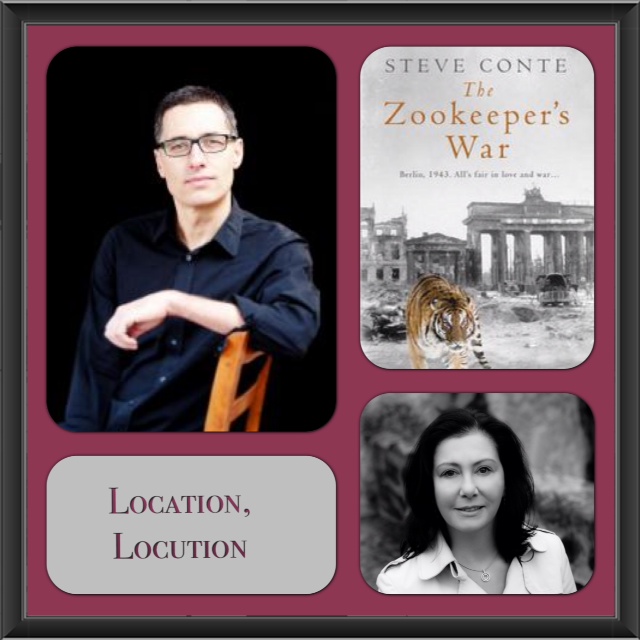
LOCATION, LOCUTION: Award-winning author Steven Conte, bringing location to life through writing

steven conte visualIn this month’s “Location, Locution”, expat crime writer JJ Marsh interviews  Steven Conte, the Melbourne-based author of The Zookeeper’s War. The setting is the Berlin Zoo, 1943. An Australian woman, Vera, and her German husband, Axel, the zoo’s director, struggle to look after the animals through the air raids and food shortages.

In 2008, The Zookeeper’s War won the inaugural Australian Prime Minister’s Award for Fiction, then worth A$100,000. The Zookeeper’s War has been published in Britain and Ireland and translated into Spanish and Portuguese. Barman, life model, taxi driver, public servant, book reviewer and university tutor are some of the jobs with which Steven has supported his writing.

*  *  *

Which comes first, story or location?
For me this depends on the project. The city of Berlin was definitely the initial inspiration for The Zookeeper’s War, in particular the atmosphere of enclosure and entrapment which I sensed there three years before the Berlin Wall came down. While I chose to set my novel in the Berlin of WWII, the Cold War tensions I had witnessed there in 1986 helped me to imagine what it might have felt like to live through the twelve terrifying years of the Third Reich. It was only after the novel was published that I realised I had chosen a setting which has powerful, indeed mythic, associations for many readers (some other examples being New York, Paris, London and, in the east, Hong Kong and Shanghai).

How do you go about evoking the atmosphere of a place?
Stimulating the reader’s senses is the most reliable way, though in a realist narrative a character needs psychologically plausible reasons to notice his or her environment, a difficult ask if focal characters are already familiar with their surroundings. Selecting a focal character who is a newcomer to the setting is one way to emphasise place. Another is to take the focal character on a journey. In The Zookeeper’s War I chose a setting which aerial bombing destroys day by day, compelling the characters to keep on noticing their surroundings.

Which particular features create a sense of location? Landscape, culture, food?
All of the above, provided that accounts of them belong in the story and ring true to the narrative voice. Ideally, descriptive detail reveals as much about the focal character or narrator as it does about setting. In contrast, “unanchored” description can sound like passages of travel writing or anthropology.

How well do you need to know the place before using it as a setting?
With skill, only moderately well, though it’s probably wise to minimise the difference between your characters’ supposed knowledge of a setting and your own. This aside, the best fiction implies more than it states (Hemingway’s iceberg principle), and a few vivid details can be enough to evoke an entire town or city or region. I’d recommend not writing about famous landmarks, since locations such as the Brooklyn Bridge, the Eiffel Tower and the Brandenburg Gate will remain clichés of place however brilliantly they might be described.

Could you give a brief example from your work which you feel brings the location to life?
In the following passage from The Zookeeper’s War the heroine, Vera, walks through Berlin the morning after an air raid:

In the Mitte, the old city, bombs had caved in the skyline, dropping telegraph poles, power lines and tram cables onto burnt-out lorries and trams. Shops were destroyed or boarded up, and glass, chunks of plaster and shrapnel paved the streets. Field kitchens had sprouted at the major intersections, and in alleys off Alexanderplatz girls were already soliciting. Outside one bombed-out tenement Vera read the chalked inscription, Everyone in this shelter has been saved. Around the corner: My angel where are you? Leave a message for your Sigi. In a house without walls on Unter den Linden, a man played Bach on a grand piano, and below him, in a lake fed by a burst water main, a fur stole clung to a hatstand. Half the people on the streets wore a uniform: police, air-raid wardens, women postal workers. Soldiers moved in squads and the only vehicles were staff cars and Wehrmacht lorries, as if the army had conquered Berlin and deployed clerks and shop assistants to the front in a fleet of private cars.

Which writers do you admire for the way they use location?
Cormac McCarthy for the poetry and grandeur of his descriptions, in Blood Meridian and The Border Trilogy, of the border regions of Mexico and the United States. Colm Tóibín for his evocation of the eroding coastline of County Wexford in his early novel The Heather Blazing. William Styron for the magnificent range of settings in Sophie’s Choice, from post-war New York, New England and North Carolina to Warsaw under German occupation and the netherworld of Auschwitz.

* * *

Readers, what did you think of Steven’s suggestions on evoking place? Next month, my guest will be Liza Perrat, author of Spirit of Lost Angels.

JJ Marsh grew up in Wales, Africa and the Middle East, where her curiosity for culture took root and triggered an urge to write. After living in Hong Kong, Nigeria, Dubai, Portugal and France, JJ finally settled in Switzerland, where she is currently halfway through her European crime series, set in compelling locations all over the continent and featuring detective inspector Beatrice Stubbs.

STAY TUNED for Tuesday’s, another installment in the life of our fictional expat heroine, Libby. (What, not keeping up with Libby? Read the first three episodes of her expat adventures.)

If you enjoyed this post, we invite you to register for The Displaced Dispatch, a round up of weekly posts from The Displaced Nation, with seasonal recipes, book giveaways and other extras. Register for The Displaced Dispatch by clicking here!

Related posts:

“Unenthusiastic about enthusiasm”: On Sarah Lyall, the relief of being a returning expat, and never getting over the feeling of cultural discombobulation

CulturallyDiscombobulatedFor today’s post ML Awanohara (doyenne of this particular piece of the interweb) suggested that Sarah Lyall‘s recent piece in The New York Times (“Ta-Ta, London. Hello, Awesome”) might provide me with a suitable topic to chisel out a post for the Displaced Nation.

I’ll be honest and admit (though I never articulated this to ML) that I was rather resistant and a tad unenthusiastic to the idea. I’d previously skim-read Sarah Lyall’s book, The Anglo Files: A Field Guide to the British, and found myself irritated by her observations about her life as an American transplant to London.

In short, I didn’t enjoy it. I was left uncharmed and felt it had about it an omnipresent smug tone.

Bill Bryson did it best

Recently, I’ve had a similar reaction with British academic Terry Eagleton‘s new book, Across The Pond (goodness, even the title sounds like another sub-Bryson knock-off), about his thoughts on living in America.

So I’m an equal-opportunity offender on this matter.

Perhaps foreigner-writing-about-their-adopted-home is a sub-genre that is not for me, which is unfortunate considering that’s the very subject of my personal blog, Culturally Discombobulated (now that I think of it, it sounds like a sub-Bryson knock-off, too). Having read Lyall’s article, I suppose she would call this attitude typically English: at once self-loathing and arrogant.

So I decided I would ignore ML’s suggestion and instead write another Capital Ideas post. As I was about to start writing it (well, start thinking about writing it, if I’m going to be entirely honest), I noticed in my inbox an email from my wife telling me to read this article.  Like Sarah Lyall, Mrs W is an American who has spent time living in London before returning to the US.

Putting my initial reservations to one side, I decided to see just what I was missing.

I must admit, Sarah’s right about L.G.

First, a little bit of background: Sarah Lyall has been The New York Times London correspondent for 18 years. Her article this week was about her repatriation to her home country.

I’ll be honest. Unlike when I read her book, The Anglo Files, I found myself more charmed by her writing and observations. This could be the result of the shorter form of a newspaper article, my mellowing, or far more likely our common enemy that is Loyd Grossman—Sarah’s wish on first moving to the UK was that she wouldn’t end up sounding like her more famous compatriot.

Readers who have not spent any considerable time in the UK are probably oblivious to L.G.’s existence. A television presenter (who was host of the original MasterChef, which other than name bears scant resemblance to Fox’s Gordon Ramsey vehicle) as well as a range of pasta sauces (I’ve no idea why, given that he’s not a chef), Loyd Grossman is in possession of the oddest transatlantic accent. It’s preppy New Englander meets Sloane Square yuppie, and just hearing it makes you want to declare class war.

For all of us in clear and present danger of one day developing a transatlantic accent, Loyd Grossman is a stark and terrifying cautionary tale.

…and about us?

Sometimes when I am reading a foreigner’s perspective on the British, I am struck by how awful we sound—a complete bunch of miserable bastards that have developed a carapace of irony and delight in popping positivity like it were a balloon at a child’s birthday party.

Is it any wonder Sarah got a bit fed up with our lack of enthusiasm:

…Britons are not automatically impressed by what I always thought were attractive American qualities—straightforwardness, openness, can-doism, for starters—and they suspect that our surface friendly optimism might possibly be fake. (I suspect that sometimes they might possibly be right.)

Once, in an experiment designed to illustrate Britons’ unease with the way Americans introduce themselves in social situations (in Britain, you’re supposed to wait for the host to do it), I got a friend at a party we were having to go up to a man he had never met. “Hi, I’m Stephen Bayley,” my friend said, sticking out his hand.

“Is that supposed to be some sort of joke?” the man responded.

The pursuit of happiness may be too garish a goal, it turns out, in the land of the pursuit of not-miserableness. After enough Britons respond with “I can’t complain” when you ask them how they are, you begin to feel nostalgic about all those psyched Americans you left behind.

After reading this piece, my wife said that she’d forgotten that so much of my personality was cultural. “I thought,” she said, “that it might be time for you to have some therapy, but then I realized you’re just British—no amount of therapy can fix that.”

* * *

I’ve not experienced what it is like to repatriate yourself back home. I do know, however, that many of you have. Do let me know in the comments below what struck you about moving back and what you missed about the adopted country you left.

And the July 2013 Alices go to … these 4 international creatives

 © Iamezan | Dreamstime.com Used under license

© Iamezan | Dreamstime.com
Used under license

As subscribers to our weekly newsletter know, each week our Displaced Dispatch presents an “Alice Award” to a writer who we think has a special handle on the curious and unreal aspects of the displaced life of global residency and travel. Not only that, but this person likes to use their befuddlement as a spur to creativity.

Today’s post honors July’s four Alice recipients, beginning with the most recent and this time including citations.

So, without further ado: The July 2013 Alices go to (drumroll…):

1) HELENA HALME, author and Finnish expat in London

For her latest novel: The Red King of Helsinki
Published: March 2013
From the book description:

Nordic Noir meets Cold War Espionage.

Pia’s ambitions to win a gymnastics competition between her Helsinki college and a school from Moscow trigger a set of dangerous events when her best friend disappears and a violent KGB spy, The Red King of Helsinki, threatens her. Will a friendly British ex-navy officer, Iain, be able to save Pia before its too late?

This fast-moving novel set in Finland has everything—a young, feisty protagonist, Nordic Noir and old-fashioned chivalry.

Citation: Helena, how could we not award you an Alice once we heard you’d written a story revolving around a Red King? While we do not know whether you purposely modeled your Red King of Helsinki on the Red King of Lewis Carroll’s Through the Looking Glass, it almost doesn’t matter. The point is, you present us with a classic through-the-looking-glass situation, having set the action during the Cold War and made your Red King into a Soviet spy. Will Pia/Alice checkmate the Red King with the help of that kindly British military gentleman? Or will she go out—bang—like a candle? No need for Tweedledum/dee to explicate. What’s more, you are the perfect person to take us on this particular fictional journey. With your thick blonde locks and acute appreciation for the curious and unreal in your adopted country, it’s not much of a stretch to dub you the Finnish Alice!

2) TRACEY CROKE, Manchester-born, Australia-based freelance journalist and blogger

Source: “A Pom versus the pests” in Telegraph‘s Expat Life
Posted on: 12 June 2013
Snippet:

Small self-amputating lizards dart out of my fruit bowl. Ants march in to weightlift a few missed crumbs off my floor. Possums push their cute limits with roof-dancing antics.

While the elusive ghost bug remains a mystery, large “harmless” spiders, innocent-sounding paper wasps and alien insects get the boot or get spiked by my neighbour’s stilettoes.

It’s just a few of the ways to deal with uninvited houseguests in the subtropics.

Citation: Tracey, your description of the critters of Aussie-land is almost as fascinating as Alice’s account of Wonderland’s inhabitants. In fact, in many ways it sounds as though you have it worse than Alice, who at least didn’t have lizards and hairy hunstman spiders to contend with, though she did have the Caterpillar. Still, on the plus side, you’re lucky that these various creatures do not interact, apart from the Hunstman spiders, that is, who like to eat cockroaches and geckos. Poor Alice, in watching a large plate come out of the door of the Duchess’s house and graze the nose of her footman, couldn’t help but mutter to herself: “It’s really dreadful, the way all the creatures argue. It’s enough to drive one crazy!”

3) STEPHEN CLARKE, an Englishman who grew up in Bournemouth and now lives in Paris; author and Telegraph Expat blogger

Source: “If you listen carefully, you can hear French cheese breathing,” in his Telegraph Expat blog
Posted on: 6 July 2013
Snippet:

A friend sent me the link to a BBC report about American food officials declaring French cheese “filthy” and inedible. The funniest thing was that it was Mimolette, a hard Edam-like cheese that even I as a Brit find a bit bland. It’s usually sold in small semi-circular slices with a curve of rind, or the kind of rectangular rindless blocks that you would think the Americans might enjoy. It’s the last cheese you would expect to get an import ban.

Citation: Stephen, we agree with you that anything bland does not deserve an import ban. For Alice, the most objectionable food in Wonderland was the Duchess’s soup, which had so much pepper that she, the Duchess, and the Duchess’s baby couldn’t stop sneezing. That would hardly do for a roomful of customs officials! Also, since you did such a good job in writing about cheese, we hope you will write about mushrooms next—a food close to Alice’s heart, and also, we believe, very important to the French. Only, do they have any varieties that can alter one’s size? (As long as they don’t alter speed, Americans may not object…)

4) TORRE DE ROCHE, Australian-American TCK and author

Source: “Blogger to Watch: Torre de Roche talks about her journey to big publishing deal”: interview by Jade Craven on ProBlogger.net
Posted on: 22 June 2013
Snippet:

Art is uncertain. Sometimes, in order to feel the delicious comfort of certainty, you might try to make art while grasping onto some idea or technique that seems safe. If you do that, your writing will come out stiff and contrived because you’re not creating, you’re imitating.

Loosen your grip. Let go of control. Embrace the freefalling sensation of having no idea where you’re going with something.

Good art comes from risk, experimentation, and play.

Citation: Torre, we love the way you took your own advice and embraced the free-falling sensation of having no idea where you were going when you fell for a handsome Argentinean man with a humble sailboat and agreed to join him in pursuing the dream of setting off to explore the world, this despite your morbid fear of water. You’ve had a series of adventures to rival Alice’s. Also like her, you’ve lived to tell the story for subsequent generations of wannabe free-falling adventurers, via both your highly successful blog, which you aptly refer to as a “literary potluck party, Mad Hatter style,” and now memoir, Love with a Chance of Drowning. Kudos!

* * *

So, readers, do you have a favorite from the above, and do you have any posts you’d like to see among August’s Alice Awards? We’d love to hear your suggestions! And don’t miss out on these weekly sources of inspiration. Get on our subscription list now!

STAY TUNED for tomorrow’s post!

Writers and other international creatives: If you want to know in advance whether you’re one of our Alice Award winners, sign up to receive The Displaced Dispatch, a round up of weekly posts from The Displaced Nation, with news of book giveaways, future posts, and of course, our weekly Alice Award!. Register for The Displaced Dispatch by clicking here!

Related posts:

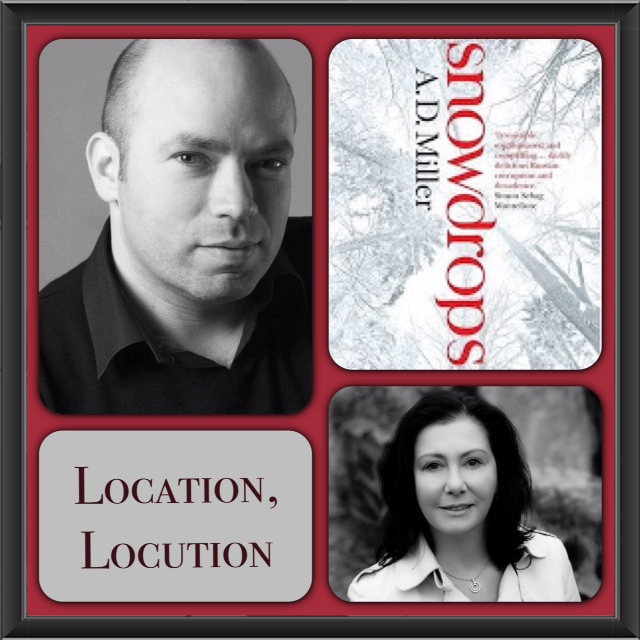
LOCATION, LOCUTION: Booker Prize-nominated author AD Miller, on bringing a location to life through writing

ADMillerIn the second of our series “Location, Locution”, expat crime writer JJ Marsh interviews AD Miller, the British author and journalist.

About AD Miller

AD Miller was born in London in 1974. He studied literature at Cambridge and Princeton, where he began his journalistic career writing travel pieces about America. Returning to London, he worked as a television producer before joining The Economist to write about British politics and culture. In 2004 he became The Economist’s correspondent in Moscow, travelling widely across Russia and the former Soviet Union. He is currently the magazine’s Writer at Large; he lives in London with his wife Emma, daughter Milly and son Jacob. He wrote a critically acclaimed non-fiction book, The Earl of Petticoat Lane, in 2006. His second novel, Snowdrops, was shortlisted for the 2011 Booker Prize.

About his novel, Snowdrops

A fast-paced drama that unfolds during a beautiful but lethally cold Russian winter. Ostensibly a story of naive foreigners and cynical natives, the novel becomes something richer and darker: a tale of erotic obsession, self-deception and moral freefall. It is set in a land of hedonism and desperation, corruption and kindness, magical hideaways and debauched nightclubs; a place where secrets, and corpses, come to light when the snows thaw.

Q&A on Location, Locution

JJ Marsh: Which comes first, story or location?  
AD Miller: Story. But locations can be suggestive of certain kinds of story. For example, Russia lends itself to tales of moral challenge and to philosophical inquiry.

JJM: How do you go about evoking the atmosphere of a place?
ADM: Take notes. Write down what people wear on the Metro and what the vendors on commuter trains are selling. You will recollect less than you think you will. For historical settings, read old newspapers and unpublished memoirs. Remember it is the inconsequential detail that is most important.

JJM: Which particular features create a sense of location? Landscape, culture, food?
ADM: Smell. Sounds. Language (especially slang and proverbs). Clothes. And weather: in Snowdrops, the Russian winter functions as a sort of ancillary sub-plot.

JJM: How well do you need to know the place before using it as a setting?
ADM: You need to know it, and then you need to unknow it. A novel isn’t a travelogue or an encyclopaedia; you enlist only those aspects or details of a place that serve the narrative.

JJM: Could you give a brief example from your work which you feel brings the location to life?
ADM: There’s a passage in Snowdrops in which Nick, the narrator, is taxiing at night alongside “the soupy Moscow River, not yet frozen and curling mysteriously through the wild city”, which is OK.

JJM: Which writers do you admire for the way they use location?
ADM: Isaac Babel and Giorgio Bassani (Odessa and Ferrara respectively).

* * *

Thanks, JJ, for that fabulous interview! Readers, any comments on what AD Miller had to say? Up next month in Location, Locution: Steven Conte, Australian author of The Zookeeper’s War.

JJ Marsh grew up in Wales, Africa and the Middle East, where her curiosity for culture took root and triggered an urge to write. After living in Hong Kong, Nigeria, Dubai, Portugal and France, JJ finally settled in Switzerland, where she is currently halfway through her European crime series, set in compelling locations all over the continent and featuring detective inspector Beatrice Stubbs.

STAY TUNED for tomorrow’s post, another installment in the life of our fictional expat heroine, Libby. (What, not keeping up with Libby? Read the first three episodes of her expat adventures.)

If you enjoyed this post, we invite you to register for The Displaced Dispatch, a round up of weekly posts from The Displaced Nation, with seasonal recipes, book giveaways and other extras. Register for The Displaced Dispatch by clicking here!

Related post:

LOCATION, LOCUTION: Expat author JJ Marsh on bringing a location to life through writing

jill 3Today we welcome expat crime writer JJ Marsh to the Displaced Nation. JJ grew up in Wales, Africa and the Middle East, where her curiosity for culture took root and triggered an urge to write. Having at this point lived in Hong Kong, Nigeria, Dubai, Portugal and France—she finally settled in Switzerland—JJ certainly belongs in our midst! But what makes her even more special is that she has offered to impart her knowledge to other international creatives about the portrayal of “place” in one’s works.

Currently halfway through her European crime series, set in compelling locations all over the continent and featuring detective inspector Beatrice Stubbs (on loan from Interpol), today JJ begins a new series for us, entitled “Location, Locution.” In the opening post, she will answer the questions she plans to ask other displaced authors in future posts.

JJ, we are positively THRILLED (in more ways than one!) to have you as a new columnist. Welcome! And now to get to know you a little better…

Which comes first, story or location?
Story, always. Or at least the bare bones of the plot. Then I audition various places before beginning to write. I have to know the setting, even before populating the novel with characters. The place IS a character. For example, once I knew the victims would be corporate Fat Cats in Behind Closed Doors, the first in my Beatrice Stubbs series, I looked around for a financial centre with the right kind of atmosphere. Turns out my home town of Zürich fitted the bill and even gave me the title.

How do you go about evoking the atmosphere of a place?
I’d say by really looking at it and digging deep. Not only that, but try to look at it from the perspective of your reader. It’s no coincidence that in many European languages, one asks for a description using the word “How”.

Como é?
Wie war es?

Yet in English, we say “What is it like?” We want comparisons to what we know. I actively chose to use a foreigner arriving in a strange country/city, so as to look at it with new eyes.

Which particular features create a sense of location? Landscape, culture, food?
I start with the senses. We notice sights, sounds and smells first, and add to our impressions with tastes and textures, all the while comparing them to our expectations. Food and drink are essential, as they reveal something of the region but also much about the characters. Cultural differences have to be treated with great care in fiction. Lumpen great dumps of information are poison to pace. But subtle observations can be woven into the story, provided they are relevant. I’ve just abandoned a book set in Rome which was clumsily pasted chunks of guidebook against a sub-par Eat, Pray, Love plot. The reader wants to be immersed in the world of the book, not subjected to the author’s holiday snaps.

How well do you need to know the place before using it as a setting?
Speaking for myself, extremely well. I feel insecure describing an area I’ve never visited. But that’s not true for everyone. Stef Penney, who wrote The Tenderness of Wolves, created a beautiful story set against the backdrop of the frozen wastes of Canada. She’d never even been there.

While I am awed by that achievement, I don’t think I could do it. I need to ‘feel’ the place and also, to understand the people.

My nomadic past and interest in culture led me to study the work of Geert Hofstede and Fons Trompenaars. One of their models is to analyze culture like an onion. The outer layer is Symbols—what represents the country to outsiders/its own people? The next is Heroes—who do the people worship and venerate? Peel that away and explore its Rituals—on a national and personal level. At the centre of the Onion, you will find its values, the hardest part of a culture to access. But that’s where the heart is.

Could you give a brief example from your work which you feel brings the location to life?
The recent UK horsemeat scandal amused me, as it’s part of the average menu in Switzerland. Here my combative detectives, one Swiss, one British, have just finished lunch.

Beatrice patted her mouth with her napkin. “Herr Kälin, your recommendation was excellent. I thoroughly enjoyed that meal.”

“Good. Would you like coffee, or shall I get the bill?”

“I’ve taken up enough of your time. Let’s pay up and head for home.” Beatrice finished her wine.

Kälin hailed the waitress. “I wasn’t sure you’d like this kind of farmer’s food.”

“Farmer’s food is my favourite sort. Solid and unpretentious. Not the sort of fare they would serve in those crisp white tents at the polo park.”

Kälin let out a short laugh. Beatrice cocked her head in enquiry.

“It would definitely be inappropriate at the polo park, Frau Stubbs. We’ve just eaten Pferdefleisch. Horse steak.”

Which writers do you admire for the way they use location?
Val McDermid, particularly for A Place of Execution. Not only place but period done with impressive subtlety. Kate Atkinson, for making the environment vital to the plot in a book such as One Good Turn. Monique Roffey for bringing Trinidad to life in The White Woman on the Green Bicycle. Alexander McCall Smith enriches his stories with a wealth of local detail, be it Botswana or Edinburgh. And Kathy Reichs for making her dual identity an advantage. Donna Leon’s Venetian backdrop, Scotland according to Iain Banks in Complicity, and Peter Høeg’s Copenhagen in Smilla’s Sense of Snow.

There are many, many more.

* * *

Thank you, JJ! Readers, any further questions to JJ on her portrayal of “place”, or authors you’d like to see her interview in future posts? Please leave your suggestions in the comments. You may also enjoy checking out the first three books in JJ Marsh’s Beatrice Stubbs series:

  • Behind Closed Doors: Takes place in Zürich, where someone is bumping off bankers.
  • Raw Material: Takes place between London and Pembrokeshire. Here Beatrice is joined by wannabe sleuth, Adrian. Amateur detectives and professional criminals make a bad mix.
  • Tread Softly: Unfolds in the Basque Country of Northern Spain. Beatrice is supposedly on sabbatical, but soon finds herself up to her neck in corruption, murder and Rioja.

STAY TUNED for tomorrow’s interview with Lisa Egle, author of Magic Carpet Seduction, two copies of which we’ll be giving away!

If you enjoyed this post, we invite you to register for The Displaced Dispatch, a round up of weekly posts from The Displaced Nation, with seasonal recipes, book giveaways and other extras. Register for The Displaced Dispatch by clicking here!

Images: Typewriter from MorgueFile; picture of JJ Marsh and her book cover supplied by herself; map from MorgueFile

Helena Halme on the displacement that can occur when moving between neighboring countries, plus a chance to win her new novel!

HelenaHalmeonBoatIt seems like only yesterday that we were reviewing Helena Halme‘s first novel, The Englishman, and today we have the pleasure of a guest post by Halme describing the themes of another new novel, Coffee and Vodka. Plus she is kindly giving away 3 copies! (Details below.) A Finnish expat in London, Halme was featured in our Random Nomad interview series, and we called on her again for an international fashion special (she is a self-confessed fashion maven). Today, though, we celebrate Halme as an international creative who bravely explores themes of displacement and cross-culturalism through fiction. So, brew yourself a cup of coffee and/or pour a glass of vodka, and let’s hear what Helena Halme has to say!

—ML Awanohara

My novel Coffee and Vodka has been dubbed “Nordic Noir meets family saga”—but its central theme is really the displacement a young girl feels when her family moves countries, from Finland to neighboring Sweden.

Eeva is eleven and lives in a small town in Finland when her father decides that they will emigrate to Sweden in search of a better life. There the displacement the family experiences causes a rift so severe Eeva is still reeling from it thirty years later, when she is forced to re-live the dramatic events of her childhood.

Outsiders tend to think of Scandinavian countries as being similar in many respects. How could the impact of emigrating to a Nordic neighbor be so severe?

But for anyone who’s ever visited Finland and Sweden, the difference between the two is obvious: Finnish is a notoriously difficult tongue, and the country’s culture has been heavily influenced by the hundred years it spent under the rule of its Eastern neighbor, Russia.

Sweden: A sovereign—and superior—neighbor

Finland fought in the Second World War, and lost a large section of its territory to the Soviet Union as part of the price of remaining independent. Already poor, Finland’s less industrialized economy suffered greatly from the war effort.

Sweden on the other hand has no history of having been subjugated to another country’s rule. It remained neutral during the war, profiting from its mineral reserves and undisturbed industry.

Sweden has traditionally been the richest of Scandinavian countries. At one time it ruled over all its neighbors, and as late as the end of 17th century, Finland too was part of Sweden—before Sweden handed it over to Russia. Many of the wealthy, land-owning Finns spoke Swedish as their native tongue.

Even today, Sweden is very much considered in Finland as its Big Brother (for better or worse). For decades after WWII, many Finns emigrated to Sweden in search of a better life. But Finns were shunned in Sweden because of their different language and customs: they were seen as poor people who drank too much, didn’t learn the language and were often violent.

Notably, had I been writing about Sweden and its other Scandinavian neighbors, Norway and Denmark, the cultural differences would have been more subtle, of the kind that expats often find between the United States and the United Kingdom. This is because Swedes, Norwegians and Danes can (more or less) understand each other’s languages. (Anyone who wants to get an appreciation for the kinds of cultural differences that exist between, for instance, Sweden and Denmark, should try watching the Danish/Swedish TV series, The Bridge.)
CoffeeandVodka_cover

Portrayal of little-known cultural differences in a novel

How to convey these historical, cultural and economic differences in a novel? First, I decided to set the story at the time, during the 1970s, when immigration from Finland to Sweden was at its peak. Also at that time, foreign travel and even foreign telephone calls were rare because so expensive. Once you’d emigrated, it was hard to go back or even have much contact with your native land again.

I thought that a story about displacement would be less poignant when you can spend hours on Skype speaking with your nearest and dearest, or can browse the Internet in your own language.

In addition, I decided that the family at the center of my story would make the move from a small town in Finland, Tampere, to the capital of Sweden, Stockholm, as a way of further highlighting the differences between the two countries, and hence the challenges facing the Finnish immigrant family.

Getting into my characters’ heads

After I’d decided on the time and the setting, I told the story the way I always approach writing; I tried to get inside the heads of the characters. I began by seeing the world through the eyes of the 11-year-old Eeva.

How would she react to being uprooted? Did it matter to her how far geographically she was going to go?

Of course not. Just moving to a different town in Finland would have shaken Eeva. But to be moved to a country where she understood nothing people said to her, and to a large capital city with a different way of life? That would be life-changing.

In the first chapter we see Eeva living in Finland, safe in her world. When her father and mother excitedly inform her and her sister, Anja, that they are moving to Sweden, Pappa says:

In Stockholm everything is bigger and better.

This simple sentence indicates that the move will have positive effect on the family’s economics circumstances.

Later, when the family first see their new flat in Stockholm, we see how impressed they all are by the size and quality of the apartment, even though they eventually realize it’s far away from the city centre, in an immigrant area.

In Stockholm the sisters get their own bedrooms—in contrast to an earlier scene where, during the last night the family spend in Finland, the girls have to share the sofa in their grandmother’s small flat.

To suggest the first chinks in the shiny new world the family have entered, I describe the first shopping trip Mamma takes with Eeva and Anja. It’s also the first time the girls hear the then-common abuse directed at Finns: Javla Finnar (Fucking Finns)—after Eeva nearly collides with a Swedish woman’s shopping trolley.

During the same shopping trip, a sales assistant is rude to Mamma when she overhears the family speaking Finnish. This episode visibly shakes Mamma, and she seems quiet and withdrawn afterwards.

Contrasting reactions

When I considered how Mamma and the girls would react to this kind of rejection, I decided that they would try to learn Swedish and blend in as quickly as possible.

I show this desire for Eeva and Anja to sound convincingly Swedish when the girls go shopping with Mamma, and on leaving the flat remind her not to speak at all (not even in Swedish) in the tunnelbana (metro) so that the people around them won’t know that they are from Finland. At this stage the girls had already mastered the language well enough to pass as being Swedish-born.

But I thought Pappa would not react as well as the female members of his family to the situation. As his family begin to enjoy Sweden, learning how to appreciate their new surroundings as well as master the language, he grows resentful. Even though he originally had hopes of his family fitting in, he becomes jealous of the women’s success at adopting and adapting to Swedish ways, and regrets the move.

And so the stage is set for a tragedy. But that’s another part of the story—one you can read in Coffee and Vodka!

As luck would have it, I have THREE COPIES to give away. All you have to do is to post a thoughtful comment on this post. I will choose three of the best comments and send to each of you, in whatever format you choose.

* * *

Kiitos—or should I say tack?—Helena! What’s more, I understand we haven’t caught up with all of your books yet—you have a new one out, The Red King of Helsinki, described as Nordic noir meets Cold War espionage. Sounds tantalizing: will you please come back again???

Readers, to whet your taste even more for Coffee and Vodka, here are some excerpts from Amazon.com reader reviews:

It’s a beautifully written story about a family in turmoil, caused partly by the displacement, but also partly due to the cracks in family dynamics which were already evident before the move to Stockholm. I really liked the voice of Eeva as a 11-year-old full of hope and fear, and then 30 years later as a grown woman who’s unable to commit to a loving relationship.

Set between Finland and Sweden, between the 1970s and the present milllenium, Coffee and Vodka reveals what it was like for a young girl to be uprooted from her home and transplanted to another country. One where she doesn’t speak the language and is despised for her nationality. I’m not ashamed to say this novel made me cry, but it also made me smile. … [E]ven if these things are as foreign to you as they are to me, along with the settings in this novel, Eeva’s story will still strike a chord.

Don’t forget to comment on Helena Halme’s post to be eligible to win a free copy! Extra points, as always, if you’re a Displaced Dispatch subscriber!

The winners will be announced in our Displaced Dispatch on June 1, 2013.

STAY TUNED for tomorrow’s post, on creative international entrepreneurship.

If you enjoyed this post, we invite you to register for The Displaced Dispatch, a round up of weekly posts from The Displaced Nation, with seasonal recipes, book giveaways and other extras. Register for The Displaced Dispatch by clicking here!

Related posts:

img: Helena Halme, taken on a ferry between Finland and Sweden, Finlandsbåt, which features in Coffee and Vodka.