The Displaced Nation

A home for international creatives

Tag Archives: UK

5 displaced reads for tickling an expat/global wanderer’s intellect

Hello again, expats, global nomads, serial wanderers, world citizens, and internationals!

As suggested in my post of last week about mentors and muses, it being January, we have resolved to think Big Thoughts about displacement.

We all know what it feels like to venture across borders to travel and/or live. But how often do we stand back and look at the trees? Or, as Burt Bacharach and Hal David put it in their theme song for the 1966 British film starring Michael Caine:

What’s it all about, Alfie?

To help us figure it out, I propose that we turn to the works of Big Thinkers. I’m talking about the kinds of people who take the kind of life we lead — living here, there and everywhere — for granted, and are more interested in questions of what we’re all doing on this planet and can learn from each other and from ourselves, for that matter.

Against that rather dramatic background, here are 5 displaced — and displacing — reads for your consideration:

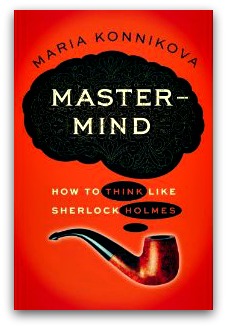
Mastermind_cover_pm1) Mastermind: How to Think Like Sherlock Holmes (Viking, January 2013)

Author: Maria Konnikova
Genre: Self-Help; Cognitive Psychology
Synposis: A primer on increasing one’s mindfulness, based on the lessons imparted by British master sleuth Sherlock Holmes.
Author’s displaced credentials: Born in Russia, Konnikova arrived in the United States at age 4. Though a Third Culture Kid, she has adapted very well to the American scene. She was educated at Harvard, writes the “Literally Psyched” blog for Scientific American, and is doing a PhD at Columbia University in psychology. That said, she has found a muse in an unexpected place: in the fictional works of the terribly Victorian Sir Arthur Conan Doyle.
Why it’s stimulating: So many of us are caught up in the literal idea of travel that we forget that the most interesting voyage of them all lies in exploring the inner workings of our own minds. But Konnikova takes us one step further. She suggests displacing ourselves into the mind of the hyper-observant Sherlock Holmes. To show us how, she does a bold thought experiment — something that most of us, especially those who are living in isolation from family and friends, would find anathema: she downloads Freedom, a program that blocks Internet access completely for a specified amount of time, and sees how it affects her writing. She is shocked by the results. Her conclusion:

Thinking like Sherlock Holmes isn’t just a way to enhance your cognitive powers. It is also a way to derive greater happiness and satisfaction from life.

How we heard about it: Konnikova’s recent article in Slate, “Do You Think Like Sherlock Holmes?”

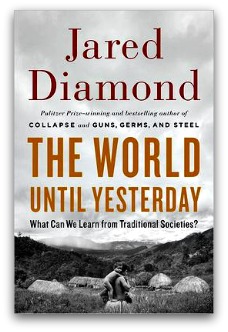
TheWorldUntilYesterday_cover_pm2) The World Until Yesterday: What Can We Learn from Traditional Societies? (Viking, December 2012)

Author: Jared Diamond
Genre: Social History
Synposis: An account of how people in traditional societies — the New Guinea Highlanders, the Inuit, the Amazonian Indians, the Kalahari San — live and what they can teach the rest of us.
Author’s displaced credentials: A polymath and one of the foremost writers of popular science, Diamond was born in the United States, got a degree from Cambridge University, and has had careers in physiology, ecology (specializing in New Guinea and nearby islands), and geography. With the publication of Guns, Germs, and Steel: The Fates of Human Societies, his most popular work to date, he became known for his mastery of global history.
Why it’s stimulating: Diamond displaces us to our (not-so-distant) past by taking us to remote corners of the earth — from the New Guinea Highlands and the Amazon rainforest, to Africa’s Kalahari Desert and the Arctic Circle — where it’s possible to encounter people who are managing without air travel, telecommunications and other fruits of modernity. Pointing out that such accoutrements are extremely recent, he asks: what can traditional peoples teach those of us who live in “complex” societies about how we might live better today? As it turns out, Diamond says, we may be better off dialing down the complexity and living closer to our ancestors:

We get ideas about how to bring up our children. We get ideas about how to have a better old age. We get ideas about how not to die of cancer, heart attacks and stroke.

How we heard about it: An interview with Jared Diamond in Smithsonian Magazine.

Immigrant_Advantage_Book_Cover_pm3) The Immigrant Advantage: What We Can Learn from Newcomers to America about Health, Happiness, and Hope (Free Press, October 2011)

Author: Claudia Kolker
Genre: Social Sciences; Immigration
Synposis: An examination of some of the customs imported by America’s newest residents.
Author’s displaced credentials: A journalist and Third Culture Kid (her mother was from Mexico and father from Ukraine), Claudia Kolker once worked as a freelance reporter in El Salvador from 1992 to 1995, where she covered the Salvadoran postwar recovery as well as social issues throughout Central America, Cuba, Haiti and the Dominican Republic. She has also reported from Japan and India. She now lives in Houston.
Why it’s stimulating: Kolker was spurred to do her research after discovering that most immigrants to the United States, even those from poor or violence-wracked countries, are physically and mentally healthier — they actually live longer! — than most native-born Americans. In a work that in some ways parallels Jared Diamond’s (#2 above), her book takes us on a tour of immigrant households in the United States — Mexican, Hispanic, Chinese, Korean, Vietnamese, Jamaican, etc. — and shows us that there are things about their values we should not only respect but emulate. I don’t know about you, but I find it refreshing to think that privileged Americans like us, who choose to displace ourselves to other lands, could stand to learn some major life lessons from the forcibly displaced. Kudos to Kolker for turning the tables!
How we heard about it: From a recent interview with Kolker on PBS Newshour.

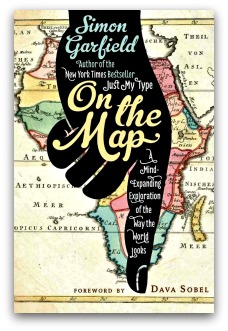
onthemap_cover_pm4) On the Map: A Mind-expanding Exploration of the Way the World Looks (Gotham, December 2012)

Author: Simon Garfield
Genre: Social Sciences; Human Geography
Synposis: A history of mankind’s love affair with maps, beginning with Ptolemy’s world map (one of the 100 diagrams that changed the world); moving through the “cartographic dark ages,” which lasted for about a thousand years; and culminating in our modern obsession with maps, which in fact dates from 1450s Venice, when the atlas became a craze.
Author’s displaced credentials: By splitting his life between London and St. Ives, Cornwall, Garfield could be described as a “domestic expat” within the UK.
Why it’s stimulating: “Displacement” of the sort we talk about in this blog requires constant rewriting and editing of the map you were born with — both figuratively and literally. Garfield shows us that while some of our cases may be extreme (the Displaced Nation being a prime example, with our “Here Be Dragons” obsession), mapmaking is something we humans can’t get enough of:

Maps relate and realign our history. They reflect our best and worst attributes — discovery and curiosity, conflict and destruction — and they chart our transitions of power. Even as individuals, we seem to have a need to plot a path and track our progress, to imagine possibilities of exploration and escape.

How we heard about it: From a 1 Jan 2013 post by Maria Popova on her Brain Pickings blog.

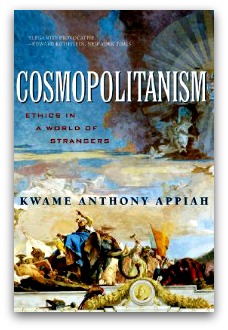
Cosmopolitanism-Appiah-Kwame_cover_pm5) Cosmopolitanism: Ethics in a World of Strangers (W.W. Norton, 2007)

Author: Kwame Anthony Appiah
Genre: Politics; Philosophy; Ethics; Globalization
Synposis: An examination of the ancient philosophy of “cosmopolitanism” — the idea that all human ethnic groups belong to a single community based on a shared morality — and the influence it has had on the Enlightenment, the French Revolution, and the UN’s Universal Declaration of Human Rights.
Author’s displaced credentials: Appiah is the product of a cross-cultural union: his mother was an English author and daughter of the statesman Sir Stafford Cripps, and his father a Ghanaian barrister and politician, who was constantly exhorting his children to remember that they were “citizens of the world.” Raised in Ghana and educated in England, Appiah has taught philosophy on three continents and is now a professor at Princeton University.
Why it’s stimulating: Whether we realize it or not, those of us who venture across borders are making a step towards reducing our culturally isolation. We are opening our minds to seeing the world outside our own contextual walls. But how far can we actually take this? Pretty far, claims Appiah, pointing out that we humans are an inter-cultural, intertwined, and interdependent species, just like every other on the planet — replete with cross-pollinations of language, religion, art, dress, rites, metaphysical outlooks, and progeny. But if Appiah rejects the Sam Huntington view of an inevitable clash of civilizations, he is also not a universalist:

Cosmopolitans suppose that all cultures have enough overlap in their vocabulary of values to begin a conversation. But they don’t suppose, like some Universalists, that we could all come to agreement if only we had the same vocabulary.

How we heard about it: The book was a Global Niche Bookshelf pin, by GlobalNiche.net, on Pinterest.

* * *

Whoa, are you still with me? That was quite a Head Trip! Readers, any responses to this list — any other works to suggest? Much obliged for your input! I think I’ve had a little too much stimulation for one blog post and need to give my brainbox a rest…

STAY TUNED for another episode in the life of our fictional expat heroine, Libby. (What, not keeping up with Libby? Read the first three episodes of her expat adventures.)

If you enjoyed this post, we invite you to register for The Displaced Dispatch, a round up of weekly posts from The Displaced Nation, with seasonal recipes, book giveaways and other extras. Register for The Displaced Dispatch by clicking here!

Related posts:

Expats, here’s how to enrich your lives in 2013: Choose a mentor or a muse!

Expats and other world adventurers, let me guess. You have you spent the past week making resolutions about

  • staying positive about your new life in Country X;
  • indulging in less of the local stodge;
  • giving up the smoking habit that no one is nagging you about now that you’re so far away from home;
  • and/or taking advantage of travel opportunities within the region that may never come your way again

— while also knowing full well that at some point in the not-distant future, you’ll end up stuffing your face with marshmallows (metaphorically speaking).

Never mind, it happens to the best of us, as psychologist Walter Mischel — he of the marshmallow experimentrecently told Abby Hunstman of the Huffington Post. Apparently, it has something to do with the way impulses work in the brain. The key is to trick the brain by coming up with strategies to avoid the marshmallow or treat it as something else.

Today I’d like to propose something I found to be one of the most effective strategies for turning away from the marshmallows you’ve discovered in your new home abroad or, for more veteran expats, turning these marshmallows into something new and exotic. My advice is to find a mentor or a muse in your adopted land — someone who can teach you something new, or who inspires you by their example to try new things…

Trust me, if you choose the right mentor +/or muse, benefits like the following will soon accrue:

1) More exotic looks — and a book deal.

Back when I lived abroad, first in England and then in Japan, I was always studying other women for style and beauty tips. I made a muse of everyone from Princess Diana (I could hardly help it as her image was being constantly thrust in front of me) to the stewardesses I encountered on All Nippon Airways. Have you ever seen the film Fear and Trembling, based on the autobiographical novel of that name, by the oft-displaced Amélie Nothomb? On ANA flights, I behaved a little like the film’s young Belgian protagonist, Amélie, who secretly adulates her supervisor Miss Fubuki. I simply couldn’t believe the world contained such attractive women…

The pay-off came upon my repatriation to the US. With such a wide array of fashion and beauty influences, I’d begun to resemble Countess Olenska in The Age of Innocence — with my Laura Ashley dresses, hair ornaments, strings of (real) pearls, and habit of bowing to everyone.

Is it any wonder my (Japanese) husband-to-be nicknamed me the Duchess? (Better than being the sheltered May Welland, surely?)

My one regret is that I didn’t parlay these style tips into a best-seller — unlike Jennifer Scott, one of the authors who was featured on TDN this past year. While studying in Paris, Scott was in a mentoring relationship with Madame Chic and Madame Bohemienne. (The former was the matriarch in her host family; the latter, in her boyfriend’s host family.) Mme C & Mme B took her under their wing and taught her everything she knows about personal style, preparation of food, home decor, entertaining, make-up, you name it…and is now imparting to others in her Simon & Schuster-published book.

2) More memorable dinner parties.

As mentioned in a previous post, I adopted actress and Indian cookbook writer Madhur Jaffrey as my muse shortly after settling down in the UK. I was (still am) madly in love with her, her cookbooks, even her writing style.

And her recipes do me proud to this day.

Right before Christmas I threw a dinner party for 10 featuring beef cooked in yogurt and black pepper, black cod in a coriander marinade, and several of her vegetable dishes.

It was divine — if I say so myself! To be fair, the guests liked it, too…

3) Improved language skills.

Now the ideal mentor for an adult seeking to pick up a new foreign language is a boyfriend or girlfriend in the local culture — preferably one with gobs of patience. The Japanese have the perfect expression for it: iki jibiki, or walking dictionary.

Just one caveat: If you’re as language challenged as Tony James Slater, it could prove a headache and, ultimately, a heartache.

Still, nothing ventured, nothing gained…

(Married people, you might want to give up on this goal. I’m serious…)

4) A fondness for angels who dance on pinheads.

After seeing the film Lost in Translation, I became an advocate for expats giving themselves intellectual challenges. Really, there’s no excuse for ennui of the sort displayed by Scarlett Johansson character, in a well-traveled life.

It was while living in the UK as a grad student that I discovered the extraordinary scholar-writer Marina Warner, who remains an inspiration to this day. Warner, who grew up in Brussels and Cambridge and was educated at convent school and Oxford University, is best known for her books on feminism and myth.

After reading her book Monuments and Maidens, I could never look at a statue in the same way again!

In her person, too, she is something of a goddess. Though I’d encountered women of formidable intellect before, I found her more appealing than most, I think because she wears her learning lightly and has an ethereal presence, like one of the original Muses.

Booker prizewinner Julian Barnes has written of her “incandescent intelligence and Apulian beauty” (she is half Italian, half English). The one time I met her — I asked her to sign my copy of her Booker Prize-shortlisted novel, The Lost Father — I could see what he meant.

I was gobsmacked.

Major girl crush!

(Don’t have a girl crush? Get one! It will enrich your life immeasurably.)

5) Greater powers of mindfulness — and a book deal.

Third Culture Kid Maria Konnikova was born in Moscow but grew up and was educated in the US. She has started the new year by putting out a book with Viking entitled Mastermind: How to Think Like Sherlock Holmes. Who would guess that a young Russian-born woman would use Conan Doyle’s fictional creations, Holmes and Watson, as her muses? But, as she explains in a recent article in Slate, she has learned everything she knows about the art of mindfulness from that master British sleuth:

Mindfulness allows Holmes to observe those details that most of us don’t even realize we don’t see.

So moved is she by Holmes’s example — and so frustrated by her own, much more limited observational powers — Konnikova does the boldest of all thought experiments: she gives up the Internet…

So does her physiological and emotional well-being improve as a result? Does her mind stop wandering away from the present? Does she become happier? I won’t give it away lest you would like to make Konnikova this year’s muse and invest in her book. Hint: If you do, we may not see you here for a while. 😦

6) The confidence to travel on your own.

We expats tend to be a little less intrepid than the average global wanderer: we’re a little too attached to our creature comforts and may need a kick to become more adventuresome. But even avid travelers sometimes lose their courage, as Amy Baker recently reported in a post for Vagabondish. She recounts the first time she met a Swedish solo traveler in Morocco, who had lived on her own in Zimbabwe for 10 years. This Swede is now her friend — and muse:

She was level-headed, organized and fiercely independent — all characteristics that I aim to embody as a female traveler.

With this “fearless Swedish warrior woman” in mind, Amy started venturing out on her lonesome — and hasn’t looked back.

* * *

Readers, the above is not intended as an exhaustive list as I’m hoping you can contribute your own experiences with mentors and muses abroad: What do you do to avoid the “marshmallows” of the (too?) well-traveled life? Who have you met that has inspired you to new creative, intellectual, or travel heights? Please let us know in the comments. In the meantime, I wish you a happy, healthy — and most of all, intellectually stimulating — new year!

STAY TUNED for next week’s posts.

If you enjoyed this post, we invite you to register for The Displaced Dispatch, a round up of weekly posts from The Displaced Nation, with seasonal recipes, book giveaways and other extras. Register for The Displaced Dispatch by clicking here!

Related posts:


A newly arrived expat in Boston asks: Is distance really the antidote to romance?

James_Murray_DisplacedToday, we welcome guest blogger James Murray to The Displaced Nation. Originally from East Sussex, UK, James “recently arrived in Boston, Massachusetts, with a half-written book, a smattering of web design skills and a utopian vision that will probably never change the world.” He’s here for his partner, Ash, who is American (although few people think of her that way). Though he doesn’t really label himself a traveler, his displacement is “likely to verge on the permanent.”

I’m finally here in America. After the best part of a year living in separate countries, my partner and I are finally married — which I suppose makes her my wife. The word doesn’t sit well — we have a pretty equal relationship, where the terms ‘husband’ and ‘wife’ seem to imply a structure; a certain assignment of roles. In a husband-and-wife relationship, you can make a guess as to who does the cooking and cleaning; but in a relationship of two partners there are no preconceptions (apart from the one that you might be gay).

But the labels of husband and wife are just one of a number of areas where the typical encapsulation of a relationship differs from the reality.

For around eight months I’d been sitting in limbo over the other side of the Atlantic, fidgeting around with various projects and living in various temporary places — it’s been okay, but I’ve just wanted to get settled for a bit. My partner, Ash, visited a few times, but those occasions weren’t what you would think.

The old airport reunion kiss

In particular, there’s a fault with the ‘airport reunion kiss’ — that little run-up, the unseen orchestra with its musical swell and the big hug and the big kiss between two people who have spent so much time apart. I want to blame Hollywood, but I simply couldn’t find an example of this happening in a movie, so I think it must just be hard-wired into the human mind — that this is simply how it happens, a tempestuous embrace with no doubts and no awkwardness.

It doesn’t work like that. Certainly we kissed at the airport, but after months apart, living our separate lives, we couldn’t quite get our heads around who this other person was. Logically, you know, you could recite details about this person — their likes and dislikes; their beliefs; their habits; but there are memories that are harder to keep.

For instance, how do you remember what it feels like to kiss your partner? How do you remember their smell or a particular look they might give you? There are things that, once they’re not physically there in front of you, just disappear, so when you finally see them again after a long separation, it’s a shock. Not a bad shock, but it’s not comfortable yet — you have to re-acclimatise.

Ash and I found that meeting again after our first three months apart, it actually took about a week for this to happen. Which means that when your partner comes to stay with you for ten days, you’re finally re-discovering your groove when you’re just about to say good-bye again.

Doubt — nothing wrong with that!

Lots of expats know what it’s like to have a long distance relationship — for many that’s the reason they’re expats; but I think we’re badly served by the standard story of long-distance romance and reunion. Who’s talking about the difficulties of keeping the faith throughout doubts and the regular tribulations of a normal life?

It’s hard to discuss doubt sometimes — it’s seen as a sign of weakness, a sign that you don’t love the person you’ve committed yourself to. It’s not — it’s perfectly normal (and it’s normal even if your partner is actually in the same country).

Everyone has doubts and it’s really the failure to acknowledge them that leads to problems. About the least supportive thing I ever said on the phone to Ash was that I had ‘absolute faith’ in our relationship. I wasn’t saying it meanly, but I had essentially raised the bar for our relationship impossibly high — nobody has absolute faith, especially when faced with the unknowns of long distance.

If you have doubts and the other person has absolute faith, who do you turn to? It makes it hard to discuss or even acknowledge those doubts — and you should discuss them if you want to resolve them. Absolute faith is the trump card that ends the conversation, and potentially the relationship, but it’s so often just assumed.

Creatures of the moment?

The funny thing is that now that I’m here and we’ve got used to each other again, it’s as hard to remember the separated life of the past year as it once was to picture living here with Ash.

I think that more than we’d care to admit it, we really are creatures of the moment — what matters is now. Committing to the future is vague and riddled with doubt; the past is foggy and easily forgotten. What carries us through is faith rather than emotion — a faith based on the knowledge that at some point in the past you felt strongly enough to say ‘let’s get married’. You have to trust that knowledge long after you’ve forgotten how exactly you felt at the time.

If what I’m describing sounds peculiar, that’s only because these aren’t the terms we’re usually given to describe our relationships — because the language of romance is a language of absolutes; because to question the titles of ‘husband’ and ‘wife’ seems tantamount to saying you aren’t ready to be one.

There isn’t just one experience of a relationship — no single narrative that applies to everybody; but that’s how it often feels.

So for all the people with doubts — the people who aren’t in a Hollywood romance, but are in love just the same; the people for whom the happiest day of their lives will probably not be the day they got married (or even the birth of their first child) — I think we can still count ourselves as romantics — especially after moving continents (twice in my case) to be with our loved ones.

* * *

Readers, what are your thoughts on long-distance relationships? Does distance lend enchantment to the view, or is it a case of “out of sight, out of mind”?

Check out James’s own blog at quaintjames.com

.

Image: James looking vaguely itinerant in his bike helmet.

STAY TUNED for Thursday’s post!

If you enjoyed this post, we invite you to register for The Displaced Dispatch, a round up of weekly posts from The Displaced Nation, with seasonal recipes, book giveaways and other extras. Register for The Displaced Dispatch by clicking here!

Related posts:

An expat in America’s thoughts on Boxing Day

BoxingDayinBritain_collage_3You can never satisfactorily explain Boxing Day to an American. The day sounds comical to them; just another ridiculous Commonwealth quainitism, like fortnights and elevenses.

The true origin’s of the holiday’s curious sounding name are decidedly murky. Over the years various origins have been asserted, the most popular being that this was the day the lord of the manor gifted boxes of money to servants on his estate. If you are interested these origins are detailed in this article from Snopes.

There is nothing, in particular, you need to do on Boxing Day. No unusual traditions to be observed. Stores (similar to the American Black Friday) open early for the sales, and sport also seems to be a familiar theme in Boxing Day throughout the world. In the UK a full fixture list is played by the football league, in Australia the boxing day Test is a modern cricketing tradition, and in Canada they watch hockey (although they seem to do that the other 364 days of the year, too).

There may, however, be some local eccentricities. In my hometown, there is such a thing as the Boxing Day dip. A frankly ludicrous tradition, it involves some peculiar people (possibly with deep-seeded psychological issues) in fancy dress who run into the freezing north sea for the aforementioned “dip”. It’s not something that ever appealed to me, hypothermia never has, but it was always fun — of a sort — watching those foolhardy enough to try it.

One of the joys of Christmas is the build-up, the sense of anticipation, and yet it is over so soon. Boxing Day plays the important role of stretching out the holiday. Give the day a name, you make it something different, you set it apart from the ordinary, even if the name you give it is a silly one. Boxing Day acts as the downer, the Christmas Xanax, for the previous day’s frenetic, festive high. It’s a day for the post-bacchanalian slumber, of leftover turkey transformed into a curry or made into sandwiches, of bad Christmas TV, of lingering on the end of the holiday, of easing back into the mundane.

I am reminded of W.H. Auden‘s Christmas poem, For The Time Being (Auden, btw, was born in England but later took out American citizenship):

Well, so that is that.  Now we must dismantle the tree,
Putting the decorations back into their cardboard boxes —
Some have got broken — and carrying them up to the attic.
The holly and the mistletoe must be taken down and burnt,
And the children got ready for school.  There are enough
Left-overs to do, warmed-up, for the rest of the week —
Not that we have much appetite, having drunk such a lot,
Stayed up so late, attempted — quite unsuccessfully —
To love all of our relatives, and in general
Grossly overestimated our powers.  Once again
As in previous years we have seen the actual Vision and failed
To do more than entertain it as an agreeable
Possibility, once again we have sent Him away,
Begging though to remain His disobedient servant,
The promising child who cannot keep His word for long.
The Christmas Feast is already a fading memory,
And already the mind begins to be vaguely aware
Of an unpleasant whiff of apprehension at the thought
Of Lent and Good Friday which cannot, after all, now
Be very far off.  But, for the time being, here we all are,
Back in the moderate Aristotelian city
Of darning and the Eight-Fifteen, where Euclid’s geometry
And Newton’s mechanics would account for our experience,
And the kitchen table exists because I scrub it.
It seems to have shrunk during the holidays.  The streets
Are much narrower than we remembered; we had forgotten
The office was as depressing as this.  To those who have seen
The Child, however dimly, however incredulously,
The Time Being is, in a sense, the most trying time of all.

STAY TUNED for an installment from our displaced fictional heroine, Libby.

If you enjoyed this post, we invite you to register for The Displaced Dispatch, a round up of weekly posts from The Displaced Nation, with seasonal recipes, book giveaways and other extras. Register for The Displaced Dispatch by clicking here!

Related posts:

Images by Awindram

Catching up with this year’s Random Nomads over the holidays (3/3)

RandomNomadXmasPassportIt’s Christmas Day and the holiday party continues for the expats and other global voyagers who washed up on the Displaced Nation’s shores in 2012. Remember all those Random Nomads who proposed to make us exotic meals based on their far-ranging meanderings? Not to mention their suitcases full of treasures they’d collected and their vocabularies full of strange words… How are they doing these days, and do they have any exciting plans for the holidays? Third in a three-part series (see also Part One and Part Two).

During the final third of 2012, we met some expats and intrepid world travelers who, I think it’s fair to say, have developed some rather unusual hobbies and eating habits. The two are one and the same in the case of Brian MacDuckston, who was featured on our site this past August. He has made a habit of eating ramen in as many Tokyo venues as possible — a hobby that was quirky enough to attract the attention of the New York Times. In addition to Brian — a San Franciscan who originally went to Japan to teach English — we encountered:

  • Liv Gaunt, an Englishwoman who became an expat accidentally, while pursuing her love of scuba diving and underwater photography. Now based in Australia, she told us she has a passion for sharks but would happily do without sea urchins.
  • Mark Wiens, an American third culture kid who now lives in Thailand and travels all over — he feels least displaced when sampling other countries’ street foods.
  • Jessica Festa, an American traveler who loves to venture off the beaten track and eat locally — she did not hesitate to eat cuy in Ecuador (even though it reminded her of her pet guinea pig, Joey, named after a school crush).
  • Larissa Reinhart, a small-town Midwesterner who lived in Japan for several years and, since repatriating, has taken up the pen as a crime novelist. She is now living in small-town Georgia but hopes to go abroad again. She provides recipes for Asian fried chicken, among other delicacies, on her blog about life as an ex-expat.
  • Patricia Winton, an American who responded to 9/11 by giving up her comfortable life in Washington to become an expat crime writer in Rome. She also invested in a pasta-making machine…
  • Bart Schaneman, a Nebraskan who wanted to see the world and has made his home in Seoul, where he is an editor for an English-language newspaper and author of a travelogue on the Trans-Siberian railway. He is a huge fan of kimchi.

Three of this esteemed group are with us today. What have they been up to since a few months ago, and are they cooking up anything special for the holidays, besides chatting with us?

Brian with Ramen_Xmas1) BRIAN MACDUCKSTON

Have there been any big changes in your life since we last spoke?
I’ve been offered a few gigs on Japanese TV shows as a “ramen reporter” and successfully pitched my first magazine article about a best-of-ramen list. A start! I also started a ramen class aimed at non-Japanese speakers. Check it out!

How will you be spending the holidays this year?
A nice staycation in Tokyo.

What’s the thing you most look forward to eating, dare I ask?
I’m trying to eat more high-class sushi, but I’ll probably just stick to a lot of ramen for the next few weeks.

Can you recommend any books or films you came across in 2012 that speak to the displaced life?
I really enjoyed Jiro Dreams of Sushi, a documentary about the most revered sushi chef in the world. [Editor’s note: The film has been available on Netflix since last August.]

Do you have any New Year’s resolutions for 2013?
I want to train myself to stop using double spaces after periods when I write. Not a big goal, but important for someone who has an interest in being paid for my writing.

A worthy goal, imho! (I’ve had to correct quite a few in my time…) So, any upcoming travel plans?
My father will visit Japan, so I am planning a luxury week-long trip of eating and relaxing in hot springs. Two things I’m good at!

LarissaReinhart&Reinhart2) LARISSA REINHART

Any big developments in your life since we last spoke?
My second Cherry Tucker Mystery, Still Life in Brunswick Stew, has a release date of May 21, 2013. [Editor’s note: As mentioned in Larissa’s interview, the first in her Cherry Tucker series, Portrait of a Dead Guy, came out this year.]

How will you be spending the holidays this year?
We travel to visit my family in Illinois and St. Louis after Christmas through New Year’s.

What’s the thing you most look forward to eating?
There’s this Italian grocery, Viviano’s, in the Italian district of St. Louis, called The Hill in St. Louis, that I really look forward to visiting. I’ll stock up on cheap wine and Italian staples for the coming year.

Can you recommend any books or films you came across in 2012 that speak to the displaced life?
Yes, two Japanese films:

  1. The fascinating documentary Jiro Dreams of Sushi. I highly recommend — even for non-sushi fans. The film is beautifully shot and reveals what it takes to be a true master at something. Incredible.
  2. The gorgeous The Secret World of Arrietty (aka The Borrower Arrietty), scripted by Hayao Miyazaki. We were excited to see Arrietty because we saw the ads for the movie when we were still living in Japan (and I’m a big fan of Mary Norton’s The Borrowers, on which the film is based, as well as of Miyazaki).

Have you made any New Year’s resolutions for 2013?
To spend less time on social media and more time writing. I love chatting online, but I need to be more disciplined about getting away from the “water cooler” and back to work.

Any upcoming travel plans?
Disney World for spring break! Woot! And we’re hoping to get back overseas soon, but no definite plans yet.

PatriciaWintonwithholly3) PATRICIA WINTON

Any big changes in your life since we last spoke a couple of months ago?
The month after you featured me, I put my long-time WIP in the bottom drawer for a while and started a new one. I’ve written about 30,000 words. This one, also a mystery, is set in Florence. It takes place during the 500th anniversary celebration of the world’s first culinary society.

Meanwhile, my blog partners at Novel Adventurers are working on an anthology of long short stories. We are an adventurous group comprising (besides me):

  • an Australian who has lived in South America
  • an American of Swiss-German origin who is married to a man from Iran, where they frequently travel
  • an American with close family ties in India, where she frequently travels
  • an American specializing in things Russian, who is married to a Kyrgyz
  • a former Peace Corps volunteer who writes about the Caribbean
  • an American who grew up on a sailboat traveling the world and has lived as an adult in many countries.

We’ll be writing about travel and adventure from international perspectives. It will be some time before it sees publication, but I’ll keep you posted. I think it will interest the Displaced Nation!

Where will you be spending the holidays this year?
I’m spending the holidays quietly at home. I plan to visit a friend in the country for New Year’s weekend. The holidays here last almost three weeks, ending on January 6. Nativity scenes are a big deal here, and I plan to visit various churches to view, and photograph, them as I usually do. I’ll write about them on my blog, Italian Intrigues, on January 3rd.

What’s the thing you most look forward to eating?
Christmas Eve in Italy is devoted to eating fish — usually seven fish dishes from antipasto onward. I’m trying out a new recipe for sea bass stuffed with frutta del mare (non-fin fish). I’m using clams, mussels, shrimp, squid and baby octopus, all well laced with garlic. And I always make the holiday custard that comes from my Tennessee childhood.

Can you recommend any books you came across in 2012 that speak to the displaced life?
The Lacuna, by Barbara Kingsolver. While it was published in 2010, I didn’t read it until this year, and I think it’s a masterpiece. It’s about a man with one foot in Mexico and the other in the US — but that’s a vast oversimplification. After the young man’s Mexican mother dies, he works for Frida Kahlo and Diego Rivera while Leon Trotsky is staying with them. He later moves to the US to join his American father. He eventually becomes a successful writer caught up in the McCarthy witch hunt. I don’t want to include spoilers here, but it’s fabulous. The boy/man is a foreigner in both countries and speaks both languages with an accent.

Do you have any New Year’s resolutions for 2013?
Not that I want to share.

Last but not least, do you have any upcoming travel plans?
No concrete travel plans at the moment. While composing these answers, I received an email about a tour of Uzbekistan that sounds really alluring. And I will probably go to the US to attend a mystery writers conference.

* * *

Readers, any questions for this rather motley (one former expat and two current ones) but highly creative bunch?

STAY TUNED for tomorrow’s post — expat Anthony Windram’s musings on spending Boxing Day in a country that associates boxing with punching, not (Christmas) punch.

If you enjoyed this post, we invite you to register for The Displaced Dispatch, a round up of weekly posts from The Displaced Nation, with seasonal recipes, book giveaways and other extras. Register for The Displaced Dispatch by clicking here!

Related posts:

Images: Passport photo from Morguefiles; portrait photos are from the nomads (Larissa Reinhart’s shows her family in front of one of their favorite Japanese manga characters, Shin-chan, a sort of Bart Simpson of Japan — the creator, Yoshito Usui, had recently died).

The 12 Stodges of Christmas: Global foods to pack on the pounds this December!

ID-100101223

Today, we bring you a helpful list of the most stodgy, calorie-intense dishes that make their way onto holiday dinner tables around the world.

The way we see it, if you’re going to eat celery and spend all January on a treadmill — and it’s pretty much the law that you do — you might as well make December’s crime fit January’s punishment..

On the 1st day of Christmas my true love sent to me…

A Christmas Pudding from England. Also known as Plum Pudding or Plum Duff, although plums do not feature in the  approved list of ingredients, which includes assorted nuts and dried fruits, suet, and a small keg of brandy. The pudding is steam-cooked for approximately four days before being doused in more brandy and set alight at the dinner table. Accompanied by brandy sauce, brandy butter, and the contents of a fire extinguisher.

My True Love only sent one of these because of their extreme density. If Christmas Puddings were chemical elements, they would lie somewhere between osmium and iridium.

On the 2nd day of Christmas…

Two bowls of Kutia from Ukraine. Often the first dish in the traditional 12-dish Christmas Eve supper served in many Eastern European cultures, Kutia is traditionally made from wheatberries, poppy seeds, nuts, raisins, and honey. Apparently,  it should be made about two weeks in advance. Presumably by the time it is ready it has begun the fermentation process and so adds to the seasonal merriment.

On the 3rd day of Christmas…

Three servings of Julgrøt from Norway. Christmas rice pudding, made from rice, sugar, cream, ground almonds, and containing a single whole almond. The person who finds the almond wins a prize…perhaps a crash course in how to perform the Heimlich Maneuver.

On the 4th day of Christmas…

Four pieces of Stollen from Germany. It’s fruit cake, people. Fruit cake gets a bad press, particularly in the USA, as Anthony Windram pointed out on his own blog this week, but if you call it Stollen, it’s all Bavarian and Christmassy and wonderful.

On the 5th day of Christmas…

Five Mince Pies. A Christmas delicacy from Britain: small pies containing dried fruit, sugar, a healthy dose of brandy, and, if you’re going to do it properly, that weird ingredient suet again. Americans find it very difficult to wrap their heads around the idea of fatty bird fodder going into foods for human consumption, so when I offer my American friends my homemade mince pies, filled with made-from-scratch mincemeat, I wait until they’ve eaten a few before enlightening them that they’ve just eaten the contents of their bird feeder.

On the 6th day of Christmas…

Six buckets of KFC from Japan. Orders are placed two months in advance, and people line up outside the Colonel’s place to get their hands on this delicacy, which over the last 40 years has become a Christmas tradition in Japan.

“Our holiday sales are five to ten times higher than other months,” said spokesman Sumeo Yokokawa. “In Japan, Christmas equals KFC.” (ABC News)

A miracle of marketing by KFC, if nothing else.

On the 7th day of Christmas…

Seven Karelian Pasties from Finland. Originally from Russian Karelia, these pasties have a thin crust of rye or rye/wheat and a filling of barley, potato, buckwheat, or rice (the most popular modern filling.) Toppings include cheese, ham, shrimp, and slices of reindeer.

Yes, reindeer. I guess the buck — and Santa Claus — stops in Finland.

On the 8th day of Christmas…

Eight bibingka from the Philippines – a traditional Christmas dessert made from rice flour and coconut milk, baked in banana leaves. A generously-sized bibingka would serve four people. The bibingka made by residents of Mandaue in Cebu, in May 2011, would serve considerably more. It contanined 50 sacks of rice, 50 sacks of sugar, and the milk from 13,500 coconuts.

Now there’s a town that takes its holiday stodge seriously.

On the 9th day of Christmas…

Nine bread puddings from Puerto Rico. Bread Pudding can be found in many variations around the globe; this Puerto Rican version, made with coconut milk and sliced mango, manages to make the ultimate stodgy pudding into something exotic.

Having hankered after a Caribbean Christmas for more years than I can remember, I fear this dessert only serves to strengthen my resolve.

On the 10th day of Christmas…

Ten Bolo Rei from Portugal. Bolo Rei – King Cake. Crown-shaped cakes, encrusted with raisins, nuts, and crystallized fruit. Contains a small metallic toy and a fava bean. Whoever finds the fava bean is supposed to pay for the bolo rei the following year — talk about adding insult to injury.

On the 11th day of Christmas…

Eleven lussekatter from Sweden. These saffron and quark buns are eaten to celebrate Saint Lucy’s Day, the shortest day of the year which, according to the Julian Calendar, was December 13th. When the Gregorian Calendar changed this to December 21st, Saint Lucy’s Day defiantly remained on the 13th. The Swedes’ cavalier attitude to dates and solstices is why I don’t feel too bad about suggesting you eat these delicious morsels on January 4th.

On the 12th day of Christmas…

And finally, if your True Love has really showered you with all these carbs, the only thing he should be giving you on Day 12 is a year’s subscription to Weight Watchers.

.

STAY TUNED for more Random Nomad highlights from 2012!

If you enjoyed this post, we invite you to register for The Displaced Dispatch, a round up of weekly posts from The Displaced Nation, with seasonal recipes, book giveaways and other extras. Register for The Displaced Dispatch by clicking here!

Related posts:

Image: Woman Standing on Weighing Scale – stockimages / FreeDigitalPhotos.net

LIBBY’S LIFE #66 – The ladies in red

Libby:

“You might want to visit the restroom,” I whisper to Melissa. “You’re losing your dress.”

I’m not a spiteful person — really, I’m not — but it’s very satisfying to have Oliver looking at me as if I’m a present he can’t wait to get home and unwrap, while oblivious to the fact that Melissa’s dress, identical to mine, is doing a pretty good job of unwrapping itself in the presence of 150 co-workers and their partners.

Melissa looks down, sees she is showing more décolletage than is usual or advisable, gives a squawk, and teeters off across the dance floor towards the bathrooms.

Halfway across the polished wooden boards she turns an ankle on her 5-inch heels, staggers, slides a few feet, and sits down heavily in front of one of the DJ’s speakers. Her dress is so tight and her heels are so high that she can’t gain enough balance or traction to get up again, and has to be helped to her feet by a couple of women who are doing their best not to laugh.

On the other side of the room, holding court with the wives of senior executives, Caroline Michaels — she of last year’s nursery school war —  is not so polite. In a lull between songs we can hear her laughing.

“Oh my goodness!” she shrieks, her native Essex showing through the usual, careful, cut-glass-accent veneer. She needs some dim sum to sop up that wine she’s knocking back. “Did you see that? How hilarious. Who is that?”

I turn to Oliver and murmur in his ear, “Shall I tell her about Melissa and Terry, or do you want to?”

Oliver freezes in his listening position. “What?”

I smile at Anita, who is still standing nearby, slightly open-mouthed, no doubt trying to reconcile the lovey-dovey picture of me and a smitten Oliver with the rumours that have been circulating.

You know — the ones about him and Melissa, the rumours that have been such a source of entertainment for the Coffee Morning Posse over the last few months.

Clearly, so that Anita can hear, I say, “Shall I tell Caroline that the trollop on the dance floor has been shagging her husband, or will you?”

Anita’s mouth drops fully open.

Wearing red makes me feel so brave. I must wear it more often.

“How do you know?” Oliver asks after a pause.

OK. The red dress doesn’t make me brave enough to admit to snooping through his phone.

“Woman’s intuition.”

Oliver shakes his head.

I wonder, briefly, if women’s intuition would allow me to know about the promotion and big pay rise that Oliver has turned down, but decide regretfully that would be pushing even his credulity.

Anita at last snaps her jaw shut. “Melissa Connor? Terry Michaels?” she tries to say. It comes out as a kind of croak.

“Yep,” I say.

“Oh, Libby.” She looks as if she’s going to cry. “I’m so sorry. And we all thought—”

I make a cutting gesture across my throat. I don’t really blame Anita in all this. She’s not the gossipy type, and you can’t help what you hear.

Oliver’s been watching me and Anita, back and forth.

“Would either of you like to explain what’s going on?”

Instead of answering, Anita raises a hand in apology and trots off to speak with Julia, another of the English wives. Julia is in the odd position of being a friend of Anita’s and on civil speaking terms with Caroline. I can’t hear what they’re saying, but there’s a lot of whispering on Anita’s part and wide-eyed shock from Julia. Both women keep looking over at Caroline.

“I think the best way to describe it is ‘Putting some affairs in order’,” I tell him, as I watch Julia slowly walk across the room to chat with Caroline.

*  *  *

Melissa:

In the restroom, I finally get this goddamned dress pulled up at the top and down at the bottom instead of the other way round.

It was, like, so embarrassing what happened out there, falling over and all, and I stay in one of the stalls for twenty minutes until someone bangs on the door and asks if I’m OK.

I’m tempted to say I’ve got this novocaine virus that’s going around on some cruise ship in Europe — that would empty the place pretty quick, right? — but I keep quiet and rustle paper around, and whoever it is goes away.

Guess I can’t stay in here all night, anyway. I’ve paid for my ticket, and I intend to get my money’s worth of alcohol.

I figure I’ve been in the restrooms about a half hour, which is enough time for people to forget me falling over on the dance floor. And if they do remember, with a bit of luck they’ll think it was Libby Patrick, since we’re wearing the same dress.

When I get outside and into the crowd, I can’t help but notice some strange looks coming my way — all from the English wives crowd.

Snotty bitches. Geez. You’d think they’d never seen anyone slip on a shiny floor, right?

I look around for Oliver — I don’t know if this red-haddock plan of flirting with him is fooling anyone, but it sure as hell is fun — and see he’s still standing close to Libby, like they’re zipped together down one side, so I go off to find some more wine at the bar.

Except I don’t get that far.

*  *  *

Libby:

I’m so glad I came. This is better than EastEnders, better than Corrie, and more Desperate than Housewives.

“Out!” Caroline screams at Melissa, who stands stock still with a plastic cup of Chardonnay in her hand. Caroline’s accent is now pure TOWIE, with no traces of refinement left. “Out! Go find another stinking job! Go find another stinking man!”

Husband Terry cowers behind her, making little mewling noises of protest. Caroline whips round and snaps at him to shut the f*** up.

My, our true colours really are showing tonight, aren’t they?

The DJ has stopped the music, and the party crowd is silent, watching the drama.

“Who knew about this?” Caroline darts suspicious glances around. “Someone must have. Making me look like a fool.”

You know, I’m so fed up with Caroline’s bullying. Like mother, like son. I walk up to her.

“You were happy enough to make me look like a fool,” I say loudly. “Everyone was talking about Melissa and my husband. Including you. Remember?”

All the wives in the crowd look down and shuffle their feet.

“And it wasn’t true. I’d like everyone to know that. And an apology would be good, too.”

I hold out my hand to Oliver. He takes it. As we make our way to the door, the crowd parts, almost respectfully.

*  *  *

“We might have to find another house to live in, of course,” Oliver says on the way home.

“Charlie’s old house still isn’t rented. We could move there.” I look outside at the Christmas lights in all the Woodhaven gardens. “It’s bigger, of course. Don’t know if we could afford it.”

Oliver drives on for a while, then says, “I’ve been offered a promotion. Didn’t want to tell you, not before I’d decided what to do, but I think I’m going to take it. I made that decision tonight.”

Of course. Oliver doesn’t have to keep his silence about our landlady and his boss any more. His acceptance of the job would be honourable now.

“Tell me all about it,” I say. “Is it more money?”

And as he begins to outline the details I’d already read on his BlackBerry, I smile into the darkness.

*  *  *

Next post: LIBBY’S LIFE #67 – Lights in the rearview mirror

Previous post: LIBBY’S LIFE #65 – All about a dress

A note for Libby addicts: Check out Woodhaven Happenings, where from time to time you will find more posts from other characters.  Want to remind yourself of Who’s Who in Woodhaven? Click here for the cast list!

Read Libby’s Life from the first episode.

STAY TUNED for Monday’s post!

If you enjoyed this post, we invite you to subscribe for email delivery of The Displaced Dispatch, a round up of the week’s posts from The Displaced Nation. Sign up for The Displaced Dispatch by clicking here!

Image: Travel – Map of the World by Salvatore Vuono / FreeDigitalPhotos.net
Catching up with this year’s Random Nomads over the holidays (1/3)

RandomNomadXmasPassportThe holiday season is here — the perfect time for the Displaced Nation to catch up with the expats and other global voyagers who washed up on our shores in 2012. Remember all those Random Nomads who proposed to make us exotic meals based on their far-ranging meanderings? Not to mention their suitcases full of treasures they’d collected and their vocabularies full of strange words… How are they doing these days, and do they have any exciting plans for the holidays? First in a three-part series.

In the first part of 2012, quite an array of Random Nomads arrived at the Displaced Nation’s gates, including:

  • Toni Hargis, a Brit married to an American and living in Chicago (she goes by the moniker “Expat Mum”);
  • Megan Farrell, an American married to a Brazilian and living in São Paulo;
  • Liv Hambrett, an Australian moving cities in Germany to be with her SG (Significant German);
  • Lei Lei Clavey, an Australian working in New York City’s fashion industry; and
  • Annabel Kantaria, an Englishwoman living in Dubai (one of the Telegraph Expat bloggers).

Unfortunately, Liv and Lei Lei cannot be with us today as they’ve both headed back to their native Australia. Lei Lei is living in Perth with her boyfriend — and still feeling somewhat displaced as she’s from Melbourne. (Still, her mum, one of our featured authors, Gabrielle Wang, is glad she’s a little closer.)

Liv — who has moved her blog, A Big Life, over to her portfolio site — says she is “now hopelessly pulled in opposing directions by my home country and adopted home, Germany.” Back with her family in Sydney, she is planning a return to Germany in early 2013. Between now and then, SG will have completed his maiden voyage to Oz to pay her a visit.

But now let’s start the party with the three Random Nomads who still qualify as expats. What have they been up to since nearly a year ago, and are they cooking up anything special for the holidays?

ToniHargis_Xmas1) TONI HARGIS

Have there been any big changes in your life since we last spoke?
Yes, I got a new gig writing for BBC America’s “Mind the Gap” column, which is very exciting. I have also just completed a 55,000-word manuscript for a new expat book which should be coming out late Spring 2013. Can’t give any more details at the moment I’m afraid.

Where will you be spending the holidays this year?
We have been going to Copper Mountain, Colorado for the last few years and this year will be the same.

What do you most look forward to eating?
My husband goes mad cooking “skier’s dinners” as he calls them — gumbo, lasagna, chili etc. He will also probably take care of most of the Xmas dinner. Unfortunately, I usually suffer from mild altitude sickness so food isn’t always at the top of my list!

Can you recommend any books you read in 2012 that speak to the displaced life? 
Yes, I read three great books this year on that theme, all from Summertime Publishers:

  1. Expat Life Slice by Slice, by Apple Gidley, which is memoir style and chronicles her (so far) amazing expat adventures.
  2. Finding Your Feet in Chicago, which is a great book for newly arrived expats to the Windy City, by Veronique Martin-Place.
  3. Sunshine Soup: Nourishing the Global Soul, by Jo Parfitt, which came out in 2011 and is a lovely novel set in Dubai about expat women there. (Jo is the founder of Summertime Publishers.)

Do you have any New Year’s resolutions for 2013?
Hmmm…. I try not to make resolutions because it can just be a set up for failure and bitterness (just kidding). There will be a lot of background work to do on my upcoming book, so I suppose my resolution should be to keep my energy levels up and work hard while not ignoring my children for too long!

Last but not least, do you have any upcoming travel plans?
Other than Colorado, I have no definite plans but there will be the annual summer trip to England and perhaps a trip somewhere else in Europe if we can fit it in.

meganfarrell_xmas2) MEGAN FARRELL

Hi there, Megan. Have you had any big changes since we last spoke?
I am currently writing a book, titled American Exbrat in São Paulo: Advice, Stories, Tips and Tricks to Surviving South America’s Largest City, which will be available via Amazon in the next few weeks. And we moved from Jardim Paulista to Higienópolis. The Higienópolis neighborhood feels much more family friendly to me, without losing options for great restaurants and activities.

How will you be spending the holidays this year?
For the holidays, we will be visiting Petrópolis (Brazil’s “City of Emperors” and a lovely mountain resort) and Búzios (known for its magnificent beaches and crystal-clear water), both towns in the state of Rio de Janeiro. I am looking forward to the beach and mountain time.

What’s the thing you most look forward to eating?
Churrasco (Brazilian style barbecue)!

Can you recommend any books you came across in 2012 that speak to the displaced life?
Dark Star Safari: Overland from Cairo to Capetown, by Paul Theroux. I’m also reading Eat, Pray, Love again, but this time in Portuguese (Comer Rezar Amar).

Do you have any New Year’s resolutions for 2013?
I do. My resolutions are to spend more time working on my writing projects and further develop my business. I currently guide executives and managers in their business communications to help them gain advantages in the global market, but I really need to expand my marketing strategy. I also have a large list of São Paulo experiences I have yet to enjoy.

Do you have any upcoming travel plans?
I’m hoping to get back to the States early this year and hit not only Chicago but also Los Angeles and New York City.

AnnabelKantaria_Xmas3) ANNABEL KANTARIA

Have there been any big changes in your life since we last spoke?
None to speak of.

Where will you be spending the holidays this year?
We love to spend Christmas in Dubai as the weather is exactly how a British summer day should be: clear, sunny, blue sky and temperatures of about 28°C (around 82°F).

What’s the thing you most look forward to eating?
We always have a big Christmas lunch in the garden with friends. This year another friend is playing host to us. I feel very lucky as she is practically the “Martha Stewart” of Dubai and I just know the food, decor and company will be divine. I’m vegetarian, so I won’t be eating turkey — I think we’re barbecuing this year.

Can you recommend any books you came across in 2012 that speak to the displaced life?
I read a new book called The Expats, by Chris Pavone, but I was more inspired to revisit old favorites such as White Mischief, by James Fox.

Do you have any New Year’s resolutions for 2013?
To finish writing my book, find an agent and/or publisher and get it published!

Any upcoming travel plans?
We usually go away in the February half-term holidays. Last year we visited family in Kenya before taking a few days in the Seychelles. This year I’m looking East — maybe Thailand, Malaysia (I’ve always wanted to go to Langkawi) or perhaps Bali.

* * *

Readers, before we lose these three Random Nomads to their various holiday (and half-term) adventures, do you have any more questions? Perhaps some of you are wondering, like I am, how they manage to be so productive — each of them has children but also a book to publish in 2013!

STAY TUNED for another episode in the life of our fictional expat heroine, Libby. (What, not keeping up with Libby? Read the first three episodes of her expat adventures.)

If you enjoyed this post, we invite you to register for The Displaced Dispatch, a round up of weekly posts from The Displaced Nation, with seasonal recipes, book giveaways and other extras. Register for The Displaced Dispatch by clicking here!

Related posts:

Images: Passport photo from Morguefile; portrait photos are from the nomads.

Expats and travelers, the adage is true: There’s no place like home for the holidays

“I’ll be home for Christmas if only in my dreams” — Bing Crosby’s closing line has special meaning for best-selling Australian author Lana Penrose. As reported below, she will never forget spending the holidays in Europe during her decade-long stint as an expat, beginning in Greece — highlights from which are chronicled in two memoirs: To Hellas and Back and Kickstart My HeartNOTE: As a special gift to Displaced Nation readers, Lana is giving away a print copy of To Hellas and Back! See details below.

— ML Awanohara

It’s that time again: Christmas, where the cynical amongst us are found warbling, “‘Tis the season to be melancholy.” For the displaced expat, this period really can be an odd time. If you’re remaining in your adopted country, you may catch yourself yearning for your friends, family and homeland. Somehow drunken Uncle Ernie who likes to lick your neck vanishes from memory.

Yes, there’s no place like home, particularly on Christmas Day. I know this because (a) I lived as an expat in Athens for 5 years; (b) I also lived as an expat in London for 5 years; and (c) I’ve written books about it, one a bestseller titled To Hellas and Back (see what I did there?).

So I get it. I truly do.

And I’m no stranger to grappling with the unfamiliar during the festive season. Actually, make that most celebratory occasions.

Hell yeah!

I believe it all started when I was encouraged to join “The Circle.” No, it wasn’t a cult (arguably), although there was a noticeable absence of Kool-Aid and Nike trainers.

I was attending a Greek boyfriend’s cousin’s engagement party in my native country of Australia. It was to be my first head-on collision with Hellenic culture. I distinctly recall being led by the hand towards my beau’s extended family. And as Greek folk music wailed from tinny speakers, I watched relatives dance around and around connected by tightly clutched handkerchiefs.

The leg-scissoring madness was mesmerizing — and there was nothing else for it but to clap along as though attending a barn dance, get hitched and relinquish my country for at least half a decade.

As the years passed, I swallowed more foreign tradition than I did dolmades. I was now living in Greece. And as I’d done so many times before, come Easter I was straddling yet more unfamiliar customs. There I was ingesting mageiritsa soup, traditionally made from lambs’ tongue, lungs, liver and intestines.

It seemed all about innards as my own sighed dejectedly.

A misplaced gift

I also remember a Christmas where I was presented with a gift from a bone fide Athenian native. I excitedly opened a grey velvet box — and there, inside, was a flashy faux gold necklace of the type preferred by gangland hos.

It kind of made sense considering he’d once also given me a birthday present in the form of a pair of black and gold shoes and a fluffy white vest.

At the end of the day, the gesture was beautiful and I couldn’t wait to try everything on as an ensemble … and submit a job application to the Black Eyed Peas.

Food — a substitute for love?

But that stuff’s plain amusing. The toughest part about spending auspicious occasions away from home is missing the people you love most, which thankfully at Christmas usually means the perfect excuse for unprecedented weight gain (if you’re in a country that celebrates such things).

In contrast to Easter, for me Greek Christmases meant hoovering up* delicious fare — including egg and lemon chicken, rice soup, roast pork, turkey stuffed with ground beef, spinach and cheese pies, stuffed cabbage leaves and salads of every description, followed by sesame baklava and cinnamon melomakarona.

My standout memory of a Christmas abroad, however, is the time that an older Greek couple lamented how sorry they were that I wasn’t able to spend the festive season with my family. They “got” it. Because they’d lived as expats, too.

That couple promised to do all in their power to make my day happy, and they succeeded simply by being mindful, considerate and absolutely lovely.

The sentiment was so touching that it will stay with me forever.

So, yeah, the pros and cons of celebrating Christmas abroad. The anomalies are hardly going to kill you, but sometimes you just want to click your shiny red shoes and declare, “There’s no place like home.”
*Canadian slang for “eat very fast and too much.” (Lana, where and when did you pick that up?!)

* * *

And now to that giveaway! Readers, Lana Penrose has offered to send a copy of her best-selling memoir, To Hellas and Back, to the person who leaves the best comment in answer to the question:  Where are you spending the holidays this year, and will you feel at home or displaced? To tempt you even more, consider the fact that To Hellas and Back, which was first published by Penguin, has been described as an “Eat, Pray, Love face-ploughing into a steaming pile of moussaka.” Its dedication coincidentally reads: “For the displaced.” So if you’re tired of reading about the joys of successfully renovating Tuscan homes and the like, this book might be for you!

Sydney-based (and no longer displaced!) author Lana Penrose has had various incarnations, including music journalist, record company promotions gal, music television producer and personal assistant to an iconic pop sensation whose name shall never be revealed unless she’s subjected to Chinese water torture. She also once worked with the now-infamous Simon Cowell, which she today finds really odd. You can read more about her and her works on her author blog and/or follow her on Twitter: @LanaPenrose

STAY TUNED for tomorrow’s post, when we’ll be checking in on some of our Random Nomads from earlier in the year and find out what they’re up to for the holidays and beyond.

If you enjoyed this post, we invite you to register for The Displaced Dispatch, a round up of weekly posts from The Displaced Nation, with seasonal recipes, book giveaways and other extras. Register for The Displaced Dispatch by clicking here!

Related posts:


A clueless immigrant’s 5 expat highlights for the year

I am not doing well with the passing of the years: they are over at an alarming rate. That we are already coming to the end of 2012 fills me with anxiety and dread. So perhaps I am not the best person to be in charge of one of those prerequisite “best-of-the-year” lists that fill up space this time of year. Nonetheless I have revisited my 2012 posts on The Displaced Nation to come up with my personal expat highlights for the year. Do join me on my existential journey.

1. “Travel for excitement, not enlightenment”

We started 2012 with a look at travel and moving abroad as a search for spiritual enlightenment. While I may possibly in the minority among this blog’s readers in finding the Elizabeth Gilbert idea of travel patronising, irritating, and misplaced, I do think travel is important. It (when done properly) broadens the mind; it can also be the most exciting thing you can do in your life. But — let’s be clear — in of itself buying a Virgin Airways ticket does not nourish your soul. That can be done much closer to home.

Now most of us can’t be as amazing as Pico Iyer — that’s just the burden we have to carry through our lives. We can’t just move to rural Japan and fetishize solitude. We will still spend our evenings in the grocery store, our weekends in the mall, they will still be those 2.4 children and those bloody traffic jams — as David Byrne sang, “same as it ever was.”

What I am going to do try and do in 2012 (and yes even though it’s mid-January I still feel it is early enough to mention resolutions in a post) is to take advantage of technology to find some solitude. I’m not going to posture by lighting an incense stick as if the path to personal enlightenment lies in sniffing in something called Egyptian Musk. What I am going to do is take advantage of the quiet moments that my everyday life provides by sitting and concentrating at a task and deriving satisfaction from that. It may be by learning programming, a foreign language, or taking advantage of the sheer, vast number of books that are now available for free on Google books. In this well-known brand of coffee shop while Tony Bennett plays to me and the tattooed man and the policeman and the baristas return to talking about the smaller one’s mother-in-law, I have on my iPad access to a library of books greater than the Bodleian — reason enough not to throw the iPad across the room when I’m annoyed by Iyer.

2. What to wear for an Independence Day party

Being British I always find Independence Day just a little bit awkward. Choosing appropriate clothing is always something of a dilemma.

Finding the Target employee that looked the most patriotic — the telltale signs are a sensible haircut, good posture, and a strong jaw line — I asked where I might find the most patriotic T-shirts in store. Leading me to a selection of T-shirts featuring the stars and stripes, it was difficult for me to contain my disappointment with this somewhat anemic selection.

“Hmmm, do you have anything more patriotic?” I asked.

The patriotic youth seemed a little confused, a look that made him seem increasingly un-American.

“I was,” I said, “looking for something with a little more pizzazz. Something more OTT. I was kinda hoping you’d have one where Jesus is cradling the Liberty Bell while a bald eagle looks down approvingly?”

3. London Olympics

In 2012, I was swept up by the Olympics far more than I anticipated. What I did not enjoy, however, was the poor coverage I had to put up with by NBC which revealed their own awkward world view.

The Games have made me homesick. My usual cynicism is no match for the enthusiasm of my London friends, all of whom seem to be attending events (if Facebook is anything to go by) while I sit watching it in one of the dullest towns in California. The opening ceremony elicited in me a mixture of pride and embarrassment — and as such, perfectly encapsulated for me what it is to be British. The ceremony also irritated Rush Limbaugh — so clearly job well done on Danny Boyle‘s part there.

4. Are you an imposter or a chameleon?

The release of a new documentary film about the French con man, Frédéric Bourdin, led to my favorite discussion of the year: what sort of expat are you, an imposter or a chameleon?

I know that I find myself occupying roles I had previously not thought I would before. Sometimes I am the imposter. I play a role that isn’t me. In my case, it may be exaggerating national characteristics and language that I feel people expect of me, but that I would never use back home. At other times, I find myself trying to be the chameleon. Trying to scrub away my otherness so that no attention is drawn to me because I sound different, or behave differently.

5. Donkeys and elephants: The US Presidential election

Here in the US, 2012 was marked by the presidential election. As a resident alien, a domestic election is an interesting thing as you have one foot in and one foot out.

It’s a strange feeling waking up on the morning of an election in the country that you live, and not voting. Equally, it’s a strange feeling posting your ballot in an election 6,000 miles away as I did in the last British election in 2010.

What are some of your expat highlights of the year? If you have a blog, feel free to leave links to a favorite blog post you may have written.

STAY TUNED for next week’s posts.

If you enjoyed this post, we invite you to register for The Displaced Dispatch, a round up of weekly posts from The Displaced Nation, with seasonal recipes, book giveaways and other extras. Register for The Displaced Dispatch by clicking here!

Related posts: